
A English
Rate of Change of Quantities Questions in English
Class 12 Mathematics · Applications of Derivatives · Rate of Change of Quantities
365+
Questions
English
Language
100%
With Solutions
Showing 48 of 365 questions in English
251
EasyMCQ
The radius of a circle is increasing at a rate of $0.7 \text{ cm/s}$. The rate at which the circumference of the circle is increasing is . . . . . . .
A
$-1.4 \pi \text{ cm/s}$
B
$14 \pi \text{ cm/s}$
C
$0.14 \pi \text{ cm/s}$
D
$1.4 \pi \text{ cm/s}$
Solution
(D) Let $r$ be the radius and $C$ be the circumference of the circle.
Given that the rate of change of the radius is $\frac{dr}{dt} = 0.7 \text{ cm/s}$.
The formula for the circumference of a circle is $C = 2 \pi r$.
Differentiating both sides with respect to time $t$,we get:
$\frac{dC}{dt} = 2 \pi \frac{dr}{dt}$.
Substituting the given value $\frac{dr}{dt} = 0.7 \text{ cm/s}$:
$\frac{dC}{dt} = 2 \pi (0.7) = 1.4 \pi \text{ cm/s}$.
Thus,the circumference of the circle is increasing at a rate of $1.4 \pi \text{ cm/s}$.
Given that the rate of change of the radius is $\frac{dr}{dt} = 0.7 \text{ cm/s}$.
The formula for the circumference of a circle is $C = 2 \pi r$.
Differentiating both sides with respect to time $t$,we get:
$\frac{dC}{dt} = 2 \pi \frac{dr}{dt}$.
Substituting the given value $\frac{dr}{dt} = 0.7 \text{ cm/s}$:
$\frac{dC}{dt} = 2 \pi (0.7) = 1.4 \pi \text{ cm/s}$.
Thus,the circumference of the circle is increasing at a rate of $1.4 \pi \text{ cm/s}$.
0 likes
View Solution252
EasyMCQ
The total revenue in Rupees received from the sale of $x$ units of a product is given by $R(x) = x^2 + 6x + 5$. The marginal revenue,when $x = 20$,is . . . . . . .
A
$525$
B
$126$
C
$46$
D
$96$
Solution
(C) The marginal revenue is defined as the rate of change of total revenue with respect to the number of units sold,which is given by the derivative $R'(x)$.
Given $R(x) = x^2 + 6x + 5$.
Differentiating with respect to $x$,we get:
$R'(x) = \frac{d}{dx}(x^2 + 6x + 5) = 2x + 6$.
To find the marginal revenue when $x = 20$,we substitute $x = 20$ into the derivative:
$R'(20) = 2(20) + 6 = 40 + 6 = 46$.
Thus,the marginal revenue is $46$ Rupees.
Given $R(x) = x^2 + 6x + 5$.
Differentiating with respect to $x$,we get:
$R'(x) = \frac{d}{dx}(x^2 + 6x + 5) = 2x + 6$.
To find the marginal revenue when $x = 20$,we substitute $x = 20$ into the derivative:
$R'(20) = 2(20) + 6 = 40 + 6 = 46$.
Thus,the marginal revenue is $46$ Rupees.
0 likes
View Solution253
EasyMCQ
The rate of change of the area of a circle with respect to its radius at $r = 3 \text{ cm}$ is . . . . . . $\text{cm}^2/\text{cm}$. (in $\pi$)
A
$6$
B
$12$
C
$24$
D
$9$
Solution
(A) The area of a circle $A$ is given by the formula $A = \pi r^2$,where $r$ is the radius.
To find the rate of change of the area with respect to the radius,we differentiate $A$ with respect to $r$:
$\frac{dA}{dr} = \frac{d}{dr}(\pi r^2) = 2 \pi r$.
Now,we evaluate this derivative at $r = 3 \text{ cm}$:
$\left. \frac{dA}{dr} \right|_{r=3} = 2 \pi (3) = 6 \pi$.
Thus,the rate of change of the area with respect to its radius at $r = 3 \text{ cm}$ is $6 \pi \text{ cm}^2/\text{cm}$.
To find the rate of change of the area with respect to the radius,we differentiate $A$ with respect to $r$:
$\frac{dA}{dr} = \frac{d}{dr}(\pi r^2) = 2 \pi r$.
Now,we evaluate this derivative at $r = 3 \text{ cm}$:
$\left. \frac{dA}{dr} \right|_{r=3} = 2 \pi (3) = 6 \pi$.
Thus,the rate of change of the area with respect to its radius at $r = 3 \text{ cm}$ is $6 \pi \text{ cm}^2/\text{cm}$.
0 likes
View Solution254
EasyMCQ
The point on the curve $y^2 = 18x$,at which the rate of change of $Y$-coordinate is twice the rate of change of $X$-coordinate is . . . . . . . $\left(\frac{dx}{dt} \neq 0\right)$
A
$\left(\frac{9}{8}, \frac{9}{2}\right)$
B
$\left(-\frac{9}{8}, \frac{9}{2}\right)$
C
$(2, -4)$
D
$(2, 4)$
Solution
(A) Given the curve equation is $y^2 = 18x$.
Differentiating both sides with respect to $t$,we get:
$2y \frac{dy}{dt} = 18 \frac{dx}{dt}$
$y \frac{dy}{dt} = 9 \frac{dx}{dt}$
According to the problem,the rate of change of $Y$-coordinate is twice the rate of change of $X$-coordinate,i.e.,$\frac{dy}{dt} = 2 \frac{dx}{dt}$.
Substituting this into the differentiated equation:
$y(2 \frac{dx}{dt}) = 9 \frac{dx}{dt}$
Since $\frac{dx}{dt} \neq 0$,we can divide by $\frac{dx}{dt}$:
$2y = 9 \implies y = \frac{9}{2}$.
Now,substitute $y = \frac{9}{2}$ into the original curve equation $y^2 = 18x$:
$\left(\frac{9}{2}\right)^2 = 18x$
$\frac{81}{4} = 18x$
$x = \frac{81}{4 \times 18} = \frac{81}{72} = \frac{9}{8}$.
Thus,the required point is $\left(\frac{9}{8}, \frac{9}{2}\right)$.
Differentiating both sides with respect to $t$,we get:
$2y \frac{dy}{dt} = 18 \frac{dx}{dt}$
$y \frac{dy}{dt} = 9 \frac{dx}{dt}$
According to the problem,the rate of change of $Y$-coordinate is twice the rate of change of $X$-coordinate,i.e.,$\frac{dy}{dt} = 2 \frac{dx}{dt}$.
Substituting this into the differentiated equation:
$y(2 \frac{dx}{dt}) = 9 \frac{dx}{dt}$
Since $\frac{dx}{dt} \neq 0$,we can divide by $\frac{dx}{dt}$:
$2y = 9 \implies y = \frac{9}{2}$.
Now,substitute $y = \frac{9}{2}$ into the original curve equation $y^2 = 18x$:
$\left(\frac{9}{2}\right)^2 = 18x$
$\frac{81}{4} = 18x$
$x = \frac{81}{4 \times 18} = \frac{81}{72} = \frac{9}{8}$.
Thus,the required point is $\left(\frac{9}{8}, \frac{9}{2}\right)$.
0 likes
View Solution255
EasyMCQ
The distance $s$ moved by a particle in time $t$ is given by $s = f(t) = t^3 - 6t^2 + 9t$,where $s$ is in metres and $t$ is in seconds. The velocity of the particle at $t = 2 \ s$ is: (in $m/s$)
A
$-2$
B
$-3$
C
$-1$
D
$1$
Solution
(B) The velocity $v$ of a particle is the rate of change of displacement with respect to time,given by $v = \frac{ds}{dt}$.
Given $s = t^3 - 6t^2 + 9t$.
Differentiating with respect to $t$:
$v = \frac{d}{dt}(t^3 - 6t^2 + 9t) = 3t^2 - 12t + 9$.
To find the velocity at $t = 2 \ s$,substitute $t = 2$ into the velocity equation:
$v(2) = 3(2)^2 - 12(2) + 9$
$v(2) = 3(4) - 24 + 9$
$v(2) = 12 - 24 + 9 = -3 \ m/s$.
Therefore,the velocity at $t = 2 \ s$ is $-3 \ m/s$.
Given $s = t^3 - 6t^2 + 9t$.
Differentiating with respect to $t$:
$v = \frac{d}{dt}(t^3 - 6t^2 + 9t) = 3t^2 - 12t + 9$.
To find the velocity at $t = 2 \ s$,substitute $t = 2$ into the velocity equation:
$v(2) = 3(2)^2 - 12(2) + 9$
$v(2) = 3(4) - 24 + 9$
$v(2) = 12 - 24 + 9 = -3 \ m/s$.
Therefore,the velocity at $t = 2 \ s$ is $-3 \ m/s$.
0 likes
View Solution256
EasyMCQ
The rate of change of the volume of a sphere with respect to its radius when $r = 7 \ cm$ is . . . . . . .
A
$196 \pi \ cm / cm^3$
B
$196 \pi \ cm^2$
C
$196 \pi \ cm^3 / cm$
D
$196 \pi \ cm$
Solution
(B) The volume $V$ of a sphere with radius $r$ is given by the formula: $V = \frac{4}{3} \pi r^3$.
To find the rate of change of the volume with respect to its radius,we differentiate $V$ with respect to $r$:
$\frac{dV}{dr} = \frac{d}{dr} (\frac{4}{3} \pi r^3) = \frac{4}{3} \pi (3r^2) = 4 \pi r^2$.
Now,we evaluate this derivative at $r = 7 \ cm$:
$\frac{dV}{dr} \Big|_{r=7} = 4 \pi (7)^2 = 4 \pi (49) = 196 \pi$.
The unit of the rate of change of volume with respect to radius is $\frac{cm^3}{cm} = cm^2$.
Therefore,the rate of change is $196 \pi \ cm^2$.
To find the rate of change of the volume with respect to its radius,we differentiate $V$ with respect to $r$:
$\frac{dV}{dr} = \frac{d}{dr} (\frac{4}{3} \pi r^3) = \frac{4}{3} \pi (3r^2) = 4 \pi r^2$.
Now,we evaluate this derivative at $r = 7 \ cm$:
$\frac{dV}{dr} \Big|_{r=7} = 4 \pi (7)^2 = 4 \pi (49) = 196 \pi$.
The unit of the rate of change of volume with respect to radius is $\frac{cm^3}{cm} = cm^2$.
Therefore,the rate of change is $196 \pi \ cm^2$.
0 likes
View Solution257
EasyMCQ
The total revenue received from the sale of $x$ units of a product is given by $R(x) = 10x^2 + 20x + 1500$. When $x = 1500$,the marginal revenue is . . . . . . .
A
$3020$
B
$30020$
C
$320$
D
$30200$
Solution
(B) The marginal revenue is defined as the derivative of the total revenue function $R(x)$ with respect to $x$,denoted as $MR = \frac{dR}{dx}$.
Given $R(x) = 10x^2 + 20x + 1500$.
Differentiating with respect to $x$:
$\frac{dR}{dx} = \frac{d}{dx}(10x^2 + 20x + 1500) = 20x + 20$.
To find the marginal revenue when $x = 1500$:
$MR = 20(1500) + 20 = 30000 + 20 = 30020$.
Thus,the correct option is $B$.
Given $R(x) = 10x^2 + 20x + 1500$.
Differentiating with respect to $x$:
$\frac{dR}{dx} = \frac{d}{dx}(10x^2 + 20x + 1500) = 20x + 20$.
To find the marginal revenue when $x = 1500$:
$MR = 20(1500) + 20 = 30000 + 20 = 30020$.
Thus,the correct option is $B$.
0 likes
View Solution258
EasyMCQ
The rate of change of the volume of the sphere with respect to its surface area $S$ is . . . . . . .
A
$\frac{1}{2} \sqrt{\frac{S}{\pi}}$
B
$\frac{1}{4} \sqrt{\frac{S}{\pi}}$
C
$4 \sqrt{\frac{S}{\pi}}$
D
$\sqrt{\frac{S}{\pi}}$
Solution
(B) Let the radius of the sphere be $r$.
The volume $V$ of the sphere is given by $V = \frac{4}{3} \pi r^3$.
The surface area $S$ of the sphere is given by $S = 4 \pi r^2$.
From the surface area formula,we have $r^2 = \frac{S}{4 \pi}$,which implies $r = \sqrt{\frac{S}{4 \pi}} = \frac{1}{2} \sqrt{\frac{S}{\pi}}$.
We need to find $\frac{dV}{dS}$.
Using the chain rule,$\frac{dV}{dS} = \frac{dV/dr}{dS/dr}$.
$\frac{dV}{dr} = \frac{d}{dr} (\frac{4}{3} \pi r^3) = 4 \pi r^2$.
$\frac{dS}{dr} = \frac{d}{dr} (4 \pi r^2) = 8 \pi r$.
Therefore,$\frac{dV}{dS} = \frac{4 \pi r^2}{8 \pi r} = \frac{r}{2}$.
Substituting the value of $r$,we get $\frac{dV}{dS} = \frac{1}{2} (\frac{1}{2} \sqrt{\frac{S}{\pi}}) = \frac{1}{4} \sqrt{\frac{S}{\pi}}$.
Thus,the correct option is $B$.
The volume $V$ of the sphere is given by $V = \frac{4}{3} \pi r^3$.
The surface area $S$ of the sphere is given by $S = 4 \pi r^2$.
From the surface area formula,we have $r^2 = \frac{S}{4 \pi}$,which implies $r = \sqrt{\frac{S}{4 \pi}} = \frac{1}{2} \sqrt{\frac{S}{\pi}}$.
We need to find $\frac{dV}{dS}$.
Using the chain rule,$\frac{dV}{dS} = \frac{dV/dr}{dS/dr}$.
$\frac{dV}{dr} = \frac{d}{dr} (\frac{4}{3} \pi r^3) = 4 \pi r^2$.
$\frac{dS}{dr} = \frac{d}{dr} (4 \pi r^2) = 8 \pi r$.
Therefore,$\frac{dV}{dS} = \frac{4 \pi r^2}{8 \pi r} = \frac{r}{2}$.
Substituting the value of $r$,we get $\frac{dV}{dS} = \frac{1}{2} (\frac{1}{2} \sqrt{\frac{S}{\pi}}) = \frac{1}{4} \sqrt{\frac{S}{\pi}}$.
Thus,the correct option is $B$.
0 likes
View Solution259
EasyMCQ
The volume of a sphere increases at the rate of $\pi \text{ cm}^3/\text{s}$. When the radius is $2 \text{ cm}$,the rate at which the radius increases is . . . . . . $\text{cm/s}$.
A
$36$
B
$16$
C
$\frac{1}{16}$
D
$\frac{1}{36}$
Solution
(C) Let $V$ be the volume and $r$ be the radius of the sphere.
Given that the rate of change of volume is $\frac{dV}{dt} = \pi \text{ cm}^3/\text{s}$.
The volume of a sphere is given by $V = \frac{4}{3} \pi r^3$.
Differentiating both sides with respect to $t$,we get $\frac{dV}{dt} = 4 \pi r^2 \frac{dr}{dt}$.
Substituting the given values $\frac{dV}{dt} = \pi$ and $r = 2 \text{ cm}$:
$\pi = 4 \pi (2)^2 \frac{dr}{dt}$
$\pi = 16 \pi \frac{dr}{dt}$
$\frac{dr}{dt} = \frac{\pi}{16 \pi} = \frac{1}{16} \text{ cm/s}$.
Thus,the rate at which the radius increases is $\frac{1}{16} \text{ cm/s}$.
Given that the rate of change of volume is $\frac{dV}{dt} = \pi \text{ cm}^3/\text{s}$.
The volume of a sphere is given by $V = \frac{4}{3} \pi r^3$.
Differentiating both sides with respect to $t$,we get $\frac{dV}{dt} = 4 \pi r^2 \frac{dr}{dt}$.
Substituting the given values $\frac{dV}{dt} = \pi$ and $r = 2 \text{ cm}$:
$\pi = 4 \pi (2)^2 \frac{dr}{dt}$
$\pi = 16 \pi \frac{dr}{dt}$
$\frac{dr}{dt} = \frac{\pi}{16 \pi} = \frac{1}{16} \text{ cm/s}$.
Thus,the rate at which the radius increases is $\frac{1}{16} \text{ cm/s}$.
0 likes
View Solution260
MediumMCQ
$A$ balloon which always remains spherical is being inflated by pumping in $10 \text{ cm}^3$ of gas per second. Find the rate at which the radius of the balloon is increasing when the radius is $15 \text{ cm}$.
A
$ \frac{1}{90 \Pi} \text{ cm s}^{-1} $
B
$ \frac{1}{9 \Pi} \text{ cm s}^{-1} $
C
$ \frac{1}{30 \Pi} \text{ cm s}^{-1} $
D
$ \frac{1}{\Pi} \text{ cm s}^{-1} $
Solution
(A) The volume of a sphere is given by $V = \frac{4}{3} \Pi r^3$.
Differentiating with respect to time $t$,we get $\frac{dV}{dt} = 4 \Pi r^2 \frac{dr}{dt}$.
Given $\frac{dV}{dt} = 10 \text{ cm}^3 \text{s}^{-1}$ and $r = 15 \text{ cm}$.
Substituting these values: $10 = 4 \Pi (15)^2 \frac{dr}{dt}$.
$\frac{dr}{dt} = \frac{10}{4 \Pi (225)} = \frac{10}{900 \Pi} = \frac{1}{90 \Pi} \text{ cm s}^{-1}$.
Differentiating with respect to time $t$,we get $\frac{dV}{dt} = 4 \Pi r^2 \frac{dr}{dt}$.
Given $\frac{dV}{dt} = 10 \text{ cm}^3 \text{s}^{-1}$ and $r = 15 \text{ cm}$.
Substituting these values: $10 = 4 \Pi (15)^2 \frac{dr}{dt}$.
$\frac{dr}{dt} = \frac{10}{4 \Pi (225)} = \frac{10}{900 \Pi} = \frac{1}{90 \Pi} \text{ cm s}^{-1}$.
0 likes
View Solution261
EasyMCQ
The rate of change of volume of a sphere with respect to its surface area when the radius is $4 \text{ cm}$ is
A
$4 \text{ cm}^3 \text{ cm}^{-2}$
B
$2 \text{ cm}^3 \text{ cm}^{-2}$
C
$6 \text{ cm}^3 \text{ cm}^{-2}$
D
$8 \text{ cm}^3 \text{ cm}^{-2}$
Solution
(B) Let the radius of the sphere be $r = 4 \text{ cm}$.
The volume $V$ of a sphere is given by $V = \frac{4}{3} \pi r^3$.
The surface area $S$ of a sphere is given by $S = 4 \pi r^2$.
Differentiating $V$ and $S$ with respect to $r$:
$\frac{dV}{dr} = 4 \pi r^2$
$\frac{dS}{dr} = 8 \pi r$
Using the chain rule,the rate of change of volume with respect to surface area is:
$\frac{dV}{dS} = \frac{dV/dr}{dS/dr} = \frac{4 \pi r^2}{8 \pi r} = \frac{r}{2}$.
At $r = 4 \text{ cm}$,we have:
$\frac{dV}{dS} = \frac{4}{2} = 2 \text{ cm}^3 \text{ cm}^{-2}$.
The volume $V$ of a sphere is given by $V = \frac{4}{3} \pi r^3$.
The surface area $S$ of a sphere is given by $S = 4 \pi r^2$.
Differentiating $V$ and $S$ with respect to $r$:
$\frac{dV}{dr} = 4 \pi r^2$
$\frac{dS}{dr} = 8 \pi r$
Using the chain rule,the rate of change of volume with respect to surface area is:
$\frac{dV}{dS} = \frac{dV/dr}{dS/dr} = \frac{4 \pi r^2}{8 \pi r} = \frac{r}{2}$.
At $r = 4 \text{ cm}$,we have:
$\frac{dV}{dS} = \frac{4}{2} = 2 \text{ cm}^3 \text{ cm}^{-2}$.
0 likes
View Solution262
EasyMCQ
$A$ stone is dropped into a quiet lake and waves move in circles at the speed of $ 5 \text{ cm s}^{-1} $. At that instant,when the radius of the circular wave is $ 8 \text{ cm} $,how fast is the enclosed area increasing?
A
$ 8 \pi \text{ cm}^2 \text{ s}^{-1} $
B
$ 80 \pi \text{ cm}^2 \text{ s}^{-1} $
C
$ 6 \pi \text{ cm}^2 \text{ s}^{-1} $
D
$ 800 \pi \text{ cm}^2 \text{ s}^{-1} $
Solution
(B) Given that the rate of change of the radius is $ \frac{dr}{dt} = 5 \text{ cm s}^{-1} $.
The area of a circle is given by $ A = \pi r^2 $.
Differentiating both sides with respect to time $ t $,we get:
$ \frac{dA}{dt} = \frac{d}{dt}(\pi r^2) = 2\pi r \frac{dr}{dt} $.
Substituting the given values $ r = 8 \text{ cm} $ and $ \frac{dr}{dt} = 5 \text{ cm s}^{-1} $:
$ \frac{dA}{dt} = 2 \pi (8) (5) = 80 \pi \text{ cm}^2 \text{ s}^{-1} $.
Thus,the enclosed area is increasing at a rate of $ 80 \pi \text{ cm}^2 \text{ s}^{-1} $.
The area of a circle is given by $ A = \pi r^2 $.
Differentiating both sides with respect to time $ t $,we get:
$ \frac{dA}{dt} = \frac{d}{dt}(\pi r^2) = 2\pi r \frac{dr}{dt} $.
Substituting the given values $ r = 8 \text{ cm} $ and $ \frac{dr}{dt} = 5 \text{ cm s}^{-1} $:
$ \frac{dA}{dt} = 2 \pi (8) (5) = 80 \pi \text{ cm}^2 \text{ s}^{-1} $.
Thus,the enclosed area is increasing at a rate of $ 80 \pi \text{ cm}^2 \text{ s}^{-1} $.
0 likes
View Solution263
EasyMCQ
The distance $s$ in meters travelled by a particle in $t$ seconds is given by $s = \frac{2 t^3}{3} - 18 t + \frac{5}{3}$. The acceleration when the particle comes to rest is (in $m/s^2$)
A
$10$
B
$12$
C
$18$
D
$3$
Solution
(B) Given,$s = \frac{2 t^3}{3} - 18 t + \frac{5}{3}$.
Velocity $v = \frac{ds}{dt} = \frac{d}{dt} (\frac{2 t^3}{3} - 18 t + \frac{5}{3}) = 2 t^2 - 18$.
Acceleration $a = \frac{dv}{dt} = \frac{d}{dt} (2 t^2 - 18) = 4 t$.
The particle comes to rest when $v = 0$.
$2 t^2 - 18 = 0 \Rightarrow 2 t^2 = 18 \Rightarrow t^2 = 9 \Rightarrow t = 3 \ s$ (since $t > 0$).
Now,substitute $t = 3$ in the expression for acceleration:
$a = 4(3) = 12 \ m/s^2$.
Velocity $v = \frac{ds}{dt} = \frac{d}{dt} (\frac{2 t^3}{3} - 18 t + \frac{5}{3}) = 2 t^2 - 18$.
Acceleration $a = \frac{dv}{dt} = \frac{d}{dt} (2 t^2 - 18) = 4 t$.
The particle comes to rest when $v = 0$.
$2 t^2 - 18 = 0 \Rightarrow 2 t^2 = 18 \Rightarrow t^2 = 9 \Rightarrow t = 3 \ s$ (since $t > 0$).
Now,substitute $t = 3$ in the expression for acceleration:
$a = 4(3) = 12 \ m/s^2$.
0 likes
View Solution264
EasyMCQ
$A$ particle moves along the curve $\frac{x^2}{16} + \frac{y^2}{4} = 1$. When the rate of change of abscissa is $4$ times that of its ordinate,then the quadrant in which the particle lies is
A
$II$ or $IV$
B
$III$ or $IV$
C
$II$ or $III$
D
$I$ or $III$
Solution
(A) Given the curve equation: $\frac{x^2}{16} + \frac{y^2}{4} = 1$.
Differentiating both sides with respect to $t$:
$\frac{2x}{16} \frac{dx}{dt} + \frac{2y}{4} \frac{dy}{dt} = 0$.
$\frac{x}{8} \frac{dx}{dt} + \frac{y}{2} \frac{dy}{dt} = 0$.
Given that the rate of change of abscissa $(\frac{dx}{dt})$ is $4$ times the rate of change of ordinate $(\frac{dy}{dt})$,i.e.,$\frac{dx}{dt} = 4 \frac{dy}{dt}$.
Substituting this into the differentiated equation:
$\frac{x}{8} (4 \frac{dy}{dt}) + \frac{y}{2} \frac{dy}{dt} = 0$.
$(\frac{x}{2} + \frac{y}{2}) \frac{dy}{dt} = 0$.
Since $\frac{dy}{dt} \neq 0$,we have $\frac{x}{2} + \frac{y}{2} = 0$,which implies $x = -y$.
Substituting $x = -y$ into the original curve equation:
$\frac{(-y)^2}{16} + \frac{y^2}{4} = 1$.
$\frac{y^2}{16} + \frac{4y^2}{16} = 1 \Rightarrow \frac{5y^2}{16} = 1 \Rightarrow y^2 = \frac{16}{5}$.
Thus,$y = \pm \frac{4}{\sqrt{5}}$.
Since $x = -y$,if $y = \frac{4}{\sqrt{5}}$,then $x = -\frac{4}{\sqrt{5}}$ (Quadrant $II$).
If $y = -\frac{4}{\sqrt{5}}$,then $x = \frac{4}{\sqrt{5}}$ (Quadrant $IV$).
Therefore,the particle lies in the $II$ or $IV$ quadrant.
Differentiating both sides with respect to $t$:
$\frac{2x}{16} \frac{dx}{dt} + \frac{2y}{4} \frac{dy}{dt} = 0$.
$\frac{x}{8} \frac{dx}{dt} + \frac{y}{2} \frac{dy}{dt} = 0$.
Given that the rate of change of abscissa $(\frac{dx}{dt})$ is $4$ times the rate of change of ordinate $(\frac{dy}{dt})$,i.e.,$\frac{dx}{dt} = 4 \frac{dy}{dt}$.
Substituting this into the differentiated equation:
$\frac{x}{8} (4 \frac{dy}{dt}) + \frac{y}{2} \frac{dy}{dt} = 0$.
$(\frac{x}{2} + \frac{y}{2}) \frac{dy}{dt} = 0$.
Since $\frac{dy}{dt} \neq 0$,we have $\frac{x}{2} + \frac{y}{2} = 0$,which implies $x = -y$.
Substituting $x = -y$ into the original curve equation:
$\frac{(-y)^2}{16} + \frac{y^2}{4} = 1$.
$\frac{y^2}{16} + \frac{4y^2}{16} = 1 \Rightarrow \frac{5y^2}{16} = 1 \Rightarrow y^2 = \frac{16}{5}$.
Thus,$y = \pm \frac{4}{\sqrt{5}}$.
Since $x = -y$,if $y = \frac{4}{\sqrt{5}}$,then $x = -\frac{4}{\sqrt{5}}$ (Quadrant $II$).
If $y = -\frac{4}{\sqrt{5}}$,then $x = \frac{4}{\sqrt{5}}$ (Quadrant $IV$).
Therefore,the particle lies in the $II$ or $IV$ quadrant.
0 likes
View Solution265
EasyMCQ
$A$ circular plate of radius $5 \text{ cm}$ is heated. Due to expansion,its radius increases at the rate of $0.05 \text{ cm/s}$. The rate at which its area is increasing when the radius is $5.2 \text{ cm}$ is:
A
$27.4 \pi \text{ cm}^2/\text{s}$
B
$5.05 \pi \text{ cm}^2/\text{s}$
C
$0.52 \pi \text{ cm}^2/\text{s}$
D
$5.2 \pi \text{ cm}^2/\text{s}$
Solution
(C) Let $r$ be the radius and $A$ be the area of the circular plate at any time $t$.
We know that the area of a circle is given by $A = \pi r^2$.
Differentiating both sides with respect to $t$,we get:
$\frac{dA}{dt} = 2 \pi r \frac{dr}{dt}$.
Given that the rate of change of radius is $\frac{dr}{dt} = 0.05 \text{ cm/s}$.
We need to find the rate of change of area when $r = 5.2 \text{ cm}$.
Substituting the values into the derivative formula:
$\frac{dA}{dt} = 2 \times \pi \times 5.2 \times 0.05$.
$\frac{dA}{dt} = 10.4 \times 0.05 \times \pi = 0.52 \pi \text{ cm}^2/\text{s}$.
Thus,the rate at which the area is increasing is $0.52 \pi \text{ cm}^2/\text{s}$.
We know that the area of a circle is given by $A = \pi r^2$.
Differentiating both sides with respect to $t$,we get:
$\frac{dA}{dt} = 2 \pi r \frac{dr}{dt}$.
Given that the rate of change of radius is $\frac{dr}{dt} = 0.05 \text{ cm/s}$.
We need to find the rate of change of area when $r = 5.2 \text{ cm}$.
Substituting the values into the derivative formula:
$\frac{dA}{dt} = 2 \times \pi \times 5.2 \times 0.05$.
$\frac{dA}{dt} = 10.4 \times 0.05 \times \pi = 0.52 \pi \text{ cm}^2/\text{s}$.
Thus,the rate at which the area is increasing is $0.52 \pi \text{ cm}^2/\text{s}$.
0 likes
View Solution266
MediumMCQ
The sides of an equilateral triangle are increasing at the rate of $4 \text{ cm/sec}$. Find the rate at which its area is increasing when the side is $14 \text{ cm}$.
A
$28 \sqrt{3} \text{ cm}^2/\text{sec}$
B
$14 \sqrt{3} \text{ cm}^2/\text{sec}$
C
$10 \sqrt{3} \text{ cm}^2/\text{sec}$
D
$7 \sqrt{3} \text{ cm}^2/\text{sec}$
Solution
(A) Let the side of the equilateral triangle be $x$ and its area be $A$.
Given that the rate of change of the side is $\frac{dx}{dt} = 4 \text{ cm/sec}$.
The area of an equilateral triangle is given by $A = \frac{\sqrt{3}}{4} x^2$.
Differentiating both sides with respect to time $t$,we get:
$\frac{dA}{dt} = \frac{\sqrt{3}}{4} \cdot 2x \cdot \frac{dx}{dt}$
$\frac{dA}{dt} = \frac{\sqrt{3}}{2} \cdot x \cdot \frac{dx}{dt}$
Substituting the given values $x = 14 \text{ cm}$ and $\frac{dx}{dt} = 4 \text{ cm/sec}$:
$\frac{dA}{dt} = \frac{\sqrt{3}}{2} \cdot 14 \cdot 4$
$\frac{dA}{dt} = \sqrt{3} \cdot 7 \cdot 4$
$\frac{dA}{dt} = 28 \sqrt{3} \text{ cm}^2/\text{sec}$.
Thus,the area is increasing at the rate of $28 \sqrt{3} \text{ cm}^2/\text{sec}$.
Given that the rate of change of the side is $\frac{dx}{dt} = 4 \text{ cm/sec}$.
The area of an equilateral triangle is given by $A = \frac{\sqrt{3}}{4} x^2$.
Differentiating both sides with respect to time $t$,we get:
$\frac{dA}{dt} = \frac{\sqrt{3}}{4} \cdot 2x \cdot \frac{dx}{dt}$
$\frac{dA}{dt} = \frac{\sqrt{3}}{2} \cdot x \cdot \frac{dx}{dt}$
Substituting the given values $x = 14 \text{ cm}$ and $\frac{dx}{dt} = 4 \text{ cm/sec}$:
$\frac{dA}{dt} = \frac{\sqrt{3}}{2} \cdot 14 \cdot 4$
$\frac{dA}{dt} = \sqrt{3} \cdot 7 \cdot 4$
$\frac{dA}{dt} = 28 \sqrt{3} \text{ cm}^2/\text{sec}$.
Thus,the area is increasing at the rate of $28 \sqrt{3} \text{ cm}^2/\text{sec}$.

0 likes
View Solution267
EasyMCQ
The rate of change of the area of a circle with respect to its radius $r$ at $r = 2 \text{ cm}$ is:
A
$4$
B
$2\pi$
C
$12$
D
$4\pi$
Solution
(D) The area of a circle $A$ is given by the formula:
$A = \pi r^2$
To find the rate of change of the area with respect to the radius $r$,we differentiate $A$ with respect to $r$:
$\frac{dA}{dr} = \frac{d}{dr}(\pi r^2) = 2\pi r$
Now,we evaluate this derivative at $r = 2 \text{ cm}$:
$\left(\frac{dA}{dr}\right)_{r=2} = 2\pi(2) = 4\pi \text{ cm}^2/\text{cm}$
Thus,the rate of change is $4\pi$.
$A = \pi r^2$
To find the rate of change of the area with respect to the radius $r$,we differentiate $A$ with respect to $r$:
$\frac{dA}{dr} = \frac{d}{dr}(\pi r^2) = 2\pi r$
Now,we evaluate this derivative at $r = 2 \text{ cm}$:
$\left(\frac{dA}{dr}\right)_{r=2} = 2\pi(2) = 4\pi \text{ cm}^2/\text{cm}$
Thus,the rate of change is $4\pi$.
0 likes
View Solution268
MediumMCQ
$A$ sphere increases its volume at the rate of $\pi \text{ cm}^3/\text{s}$. The rate at which its surface area increases when the radius is $1 \text{ cm}$ is
A
$2 \pi \text{ cm}^2/\text{s}$
B
$\pi \text{ cm}^2/\text{s}$
C
$\frac{3 \pi}{2} \text{ cm}^2/\text{s}$
D
$\frac{\pi}{2} \text{ cm}^2/\text{s}$
Solution
(A) Given the rate of increase in the volume of the sphere is $\frac{dV}{dt} = \pi \text{ cm}^3/\text{s}$.
We know that the volume of a sphere is $V = \frac{4}{3} \pi r^3$.
Differentiating with respect to $t$,we get $\frac{dV}{dt} = 4 \pi r^2 \frac{dr}{dt}$.
Substituting $\frac{dV}{dt} = \pi$,we have $\pi = 4 \pi r^2 \frac{dr}{dt}$,which implies $\frac{dr}{dt} = \frac{1}{4r^2}$.
The surface area of a sphere is $S = 4 \pi r^2$.
Differentiating with respect to $t$,we get $\frac{dS}{dt} = 8 \pi r \frac{dr}{dt}$.
Substituting $\frac{dr}{dt} = \frac{1}{4r^2}$,we get $\frac{dS}{dt} = 8 \pi r \left( \frac{1}{4r^2} \right) = \frac{2 \pi}{r}$.
When $r = 1 \text{ cm}$,the rate of increase in surface area is $\frac{dS}{dt} = \frac{2 \pi}{1} = 2 \pi \text{ cm}^2/\text{s}$.
We know that the volume of a sphere is $V = \frac{4}{3} \pi r^3$.
Differentiating with respect to $t$,we get $\frac{dV}{dt} = 4 \pi r^2 \frac{dr}{dt}$.
Substituting $\frac{dV}{dt} = \pi$,we have $\pi = 4 \pi r^2 \frac{dr}{dt}$,which implies $\frac{dr}{dt} = \frac{1}{4r^2}$.
The surface area of a sphere is $S = 4 \pi r^2$.
Differentiating with respect to $t$,we get $\frac{dS}{dt} = 8 \pi r \frac{dr}{dt}$.
Substituting $\frac{dr}{dt} = \frac{1}{4r^2}$,we get $\frac{dS}{dt} = 8 \pi r \left( \frac{1}{4r^2} \right) = \frac{2 \pi}{r}$.
When $r = 1 \text{ cm}$,the rate of increase in surface area is $\frac{dS}{dt} = \frac{2 \pi}{1} = 2 \pi \text{ cm}^2/\text{s}$.
0 likes
View Solution269
DifficultMCQ
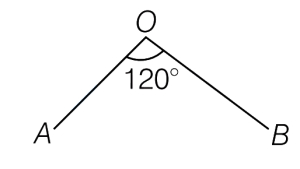
$OA$ and $OB$ are two roads enclosing an angle of $120^{\circ}$. $X$ and $Y$ start from '$O$' at the same time. $X$ travels along $OA$ with a speed of $4 \text{ km/h}$ and $Y$ travels along $OB$ with a speed of $3 \text{ km/h}$. The rate at which the shortest distance between $X$ and $Y$ is increasing after $1 \text{ h}$ is
A
$\sqrt{37} \text{ km/h}$
B
$37 \text{ km/h}$
C
$13 \text{ km/h}$
D
$\sqrt{13} \text{ km/h}$
Solution
(A) Let $O$ be the origin $(0,0)$. Let the position of $X$ at time $t$ be $x(t) = 4t$ along $OA$ and the position of $Y$ at time $t$ be $y(t) = 3t$ along $OB$.
Let $A$ be the shortest distance between $X$ and $Y$ at time $t$.
Using the Law of Cosines in $\triangle OXY$:
$A^2 = (4t)^2 + (3t)^2 - 2(4t)(3t) \cos(120^{\circ})$
Since $\cos(120^{\circ}) = -\frac{1}{2}$,we have:
$A^2 = 16t^2 + 9t^2 - 24t^2 \left(-\frac{1}{2}\right)$
$A^2 = 25t^2 + 12t^2 = 37t^2$
$A = \sqrt{37}t$
Differentiating with respect to $t$:
$2A \frac{dA}{dt} = 37(2t)$
$\frac{dA}{dt} = \frac{37t}{A}$
Substituting $A = \sqrt{37}t$:
$\frac{dA}{dt} = \frac{37t}{\sqrt{37}t} = \sqrt{37} \text{ km/h}$.
Thus,the rate at which the distance is increasing is $\sqrt{37} \text{ km/h}$.
Let $A$ be the shortest distance between $X$ and $Y$ at time $t$.
Using the Law of Cosines in $\triangle OXY$:
$A^2 = (4t)^2 + (3t)^2 - 2(4t)(3t) \cos(120^{\circ})$
Since $\cos(120^{\circ}) = -\frac{1}{2}$,we have:
$A^2 = 16t^2 + 9t^2 - 24t^2 \left(-\frac{1}{2}\right)$
$A^2 = 25t^2 + 12t^2 = 37t^2$
$A = \sqrt{37}t$
Differentiating with respect to $t$:
$2A \frac{dA}{dt} = 37(2t)$
$\frac{dA}{dt} = \frac{37t}{A}$
Substituting $A = \sqrt{37}t$:
$\frac{dA}{dt} = \frac{37t}{\sqrt{37}t} = \sqrt{37} \text{ km/h}$.
Thus,the rate at which the distance is increasing is $\sqrt{37} \text{ km/h}$.
0 likes
View Solution270
EasyMCQ
If the side of a cube is increased by $5 \%$,then the surface area of a cube is increased by (in $\%$)
A
$10$
B
$60$
C
$6$
D
$10.25$
Solution
(D) Let the side of the cube be $x$. The surface area $S$ of the cube is given by $S = 6x^2$.
When the side $x$ is increased by $5 \%$,the new side becomes $x' = x + 0.05x = 1.05x$.
The new surface area $S'$ is given by $S' = 6(1.05x)^2$.
$S' = 6(1.1025x^2) = 1.1025(6x^2) = 1.1025S$.
The percentage increase in surface area is $\frac{S' - S}{S} \times 100 \%$.
$= \frac{1.1025S - S}{S} \times 100 \% = 0.1025 \times 100 \% = 10.25 \%$.
When the side $x$ is increased by $5 \%$,the new side becomes $x' = x + 0.05x = 1.05x$.
The new surface area $S'$ is given by $S' = 6(1.05x)^2$.
$S' = 6(1.1025x^2) = 1.1025(6x^2) = 1.1025S$.
The percentage increase in surface area is $\frac{S' - S}{S} \times 100 \%$.
$= \frac{1.1025S - S}{S} \times 100 \% = 0.1025 \times 100 \% = 10.25 \%$.
0 likes
View Solution271
MediumMCQ
If $f(x) = 2x^{2}$,find $\frac{f(3.8) - f(4)}{3.8 - 4}$.
A
$1.56$
B
$156$
C
$15.6$
D
$0.156$
Solution
(C) Given that,$f(x) = 2x^{2}$.
We need to evaluate the expression $\frac{f(3.8) - f(4)}{3.8 - 4}$.
Substitute the values into the function:
$\frac{f(3.8) - f(4)}{3.8 - 4} = \frac{2(3.8)^{2} - 2(4)^{2}}{3.8 - 4}$.
Factor out $2$ from the numerator:
$= \frac{2(3.8^{2} - 4^{2})}{3.8 - 4}$.
Using the algebraic identity $a^{2} - b^{2} = (a - b)(a + b)$,where $a = 3.8$ and $b = 4$:
$= \frac{2(3.8 - 4)(3.8 + 4)}{3.8 - 4}$.
Cancel the common term $(3.8 - 4)$ from the numerator and denominator:
$= 2(3.8 + 4)$.
$= 2(7.8) = 15.6$.
We need to evaluate the expression $\frac{f(3.8) - f(4)}{3.8 - 4}$.
Substitute the values into the function:
$\frac{f(3.8) - f(4)}{3.8 - 4} = \frac{2(3.8)^{2} - 2(4)^{2}}{3.8 - 4}$.
Factor out $2$ from the numerator:
$= \frac{2(3.8^{2} - 4^{2})}{3.8 - 4}$.
Using the algebraic identity $a^{2} - b^{2} = (a - b)(a + b)$,where $a = 3.8$ and $b = 4$:
$= \frac{2(3.8 - 4)(3.8 + 4)}{3.8 - 4}$.
Cancel the common term $(3.8 - 4)$ from the numerator and denominator:
$= 2(3.8 + 4)$.
$= 2(7.8) = 15.6$.
0 likes
View Solution272
EasyMCQ
If $y=5x^2+6x+6$,$x=2$,and $\Delta x=0.001$,then the value of $dy$ is:
A
$0.026$
B
$0.0026$
C
$0.062$
D
$0.0062$
Solution
(A) Given the function $y = 5x^2 + 6x + 6$.
First,we find the derivative of $y$ with respect to $x$:
$\frac{dy}{dx} = \frac{d}{dx}(5x^2 + 6x + 6) = 10x + 6$.
By definition,the differential $dy$ is given by $dy = (\frac{dy}{dx}) dx$.
Here,$dx = \Delta x = 0.001$ and $x = 2$.
Substituting these values into the expression for $dy$:
$dy = (10(2) + 6) \times 0.001$.
$dy = (20 + 6) \times 0.001$.
$dy = 26 \times 0.001$.
$dy = 0.026$.
First,we find the derivative of $y$ with respect to $x$:
$\frac{dy}{dx} = \frac{d}{dx}(5x^2 + 6x + 6) = 10x + 6$.
By definition,the differential $dy$ is given by $dy = (\frac{dy}{dx}) dx$.
Here,$dx = \Delta x = 0.001$ and $x = 2$.
Substituting these values into the expression for $dy$:
$dy = (10(2) + 6) \times 0.001$.
$dy = (20 + 6) \times 0.001$.
$dy = 26 \times 0.001$.
$dy = 0.026$.
0 likes
View Solution273
EasyMCQ
The displacement $s$ of a particle,in meters,at any time $t$ in seconds is expressed as $s = \frac{t^3}{3} - 6t$. Find the acceleration at the time when the velocity vanishes.
A
$6 \text{ m/s}^2$
B
$2\sqrt{6} \text{ m/s}^2$
C
$12 \text{ m/s}^2$
D
$6\sqrt{6} \text{ m/s}^2$
Solution
(B) Given,the displacement of a particle at time $t$ is $s = \frac{t^3}{3} - 6t$.
Velocity $v$ is the rate of change of displacement with respect to time: $v = \frac{ds}{dt} = \frac{d}{dt}(\frac{t^3}{3} - 6t) = t^2 - 6$.
When the velocity vanishes,$v = 0$,so $t^2 - 6 = 0$,which gives $t = \sqrt{6} \text{ s}$ (considering $t > 0$).
Acceleration $a$ is the rate of change of velocity with respect to time: $a = \frac{dv}{dt} = \frac{d}{dt}(t^2 - 6) = 2t$.
Substituting $t = \sqrt{6} \text{ s}$ into the acceleration equation,we get $a = 2(\sqrt{6}) = 2\sqrt{6} \text{ m/s}^2$.
Velocity $v$ is the rate of change of displacement with respect to time: $v = \frac{ds}{dt} = \frac{d}{dt}(\frac{t^3}{3} - 6t) = t^2 - 6$.
When the velocity vanishes,$v = 0$,so $t^2 - 6 = 0$,which gives $t = \sqrt{6} \text{ s}$ (considering $t > 0$).
Acceleration $a$ is the rate of change of velocity with respect to time: $a = \frac{dv}{dt} = \frac{d}{dt}(t^2 - 6) = 2t$.
Substituting $t = \sqrt{6} \text{ s}$ into the acceleration equation,we get $a = 2(\sqrt{6}) = 2\sqrt{6} \text{ m/s}^2$.
0 likes
View Solution274
EasyMCQ
If displacement $s = 5 \sin(2t)$,then the velocity at the end of $t = \frac{\pi}{3} \text{ s}$ is
A
$5$
B
$-5 \sqrt{3}$
C
$5 \sqrt{3}$
D
$-5$
Solution
(D) Given displacement $s = 5 \sin(2t)$.
Velocity $v$ is the rate of change of displacement with respect to time $t$,given by $v = \frac{ds}{dt}$.
$v = \frac{d}{dt} [5 \sin(2t)] = 5 \cdot \cos(2t) \cdot 2 = 10 \cos(2t)$.
Now,substitute $t = \frac{\pi}{3}$ into the velocity equation:
$v = 10 \cos(2 \cdot \frac{\pi}{3}) = 10 \cos(\frac{2\pi}{3})$.
Since $\cos(\frac{2\pi}{3}) = \cos(120^{\circ}) = -\frac{1}{2}$,
$v = 10 \cdot (-\frac{1}{2}) = -5$.
Thus,the velocity is $-5$. The correct option is $D$.
Velocity $v$ is the rate of change of displacement with respect to time $t$,given by $v = \frac{ds}{dt}$.
$v = \frac{d}{dt} [5 \sin(2t)] = 5 \cdot \cos(2t) \cdot 2 = 10 \cos(2t)$.
Now,substitute $t = \frac{\pi}{3}$ into the velocity equation:
$v = 10 \cos(2 \cdot \frac{\pi}{3}) = 10 \cos(\frac{2\pi}{3})$.
Since $\cos(\frac{2\pi}{3}) = \cos(120^{\circ}) = -\frac{1}{2}$,
$v = 10 \cdot (-\frac{1}{2}) = -5$.
Thus,the velocity is $-5$. The correct option is $D$.
0 likes
View Solution275
DifficultMCQ
If the distance $s$ travelled by a particle in time $t$ is given by $s=t^2-2t+5$,then its acceleration is
A
$0$
B
$1$
C
$2$
D
$3$
Solution
(C) Given the distance function: $s = t^2 - 2t + 5$.
Velocity $v$ is the first derivative of distance with respect to time $t$:
$v = \frac{ds}{dt} = \frac{d}{dt}(t^2 - 2t + 5) = 2t - 2$.
Acceleration $a$ is the derivative of velocity with respect to time $t$:
$a = \frac{dv}{dt} = \frac{d}{dt}(2t - 2) = 2$.
Therefore,the acceleration of the particle is $2$ units.
Velocity $v$ is the first derivative of distance with respect to time $t$:
$v = \frac{ds}{dt} = \frac{d}{dt}(t^2 - 2t + 5) = 2t - 2$.
Acceleration $a$ is the derivative of velocity with respect to time $t$:
$a = \frac{dv}{dt} = \frac{d}{dt}(2t - 2) = 2$.
Therefore,the acceleration of the particle is $2$ units.
0 likes
View Solution276
EasyMCQ
The distance $(s)$ travelled by a particle in time $t$ is given by $s = 4t^2 + 2t + 3$. The velocity of the particle when $t = 3$ seconds is
A
$26 \text{ unit/sec}$
B
$20 \text{ unit/sec}$
C
$24 \text{ unit/sec}$
D
$30 \text{ unit/sec}$
Solution
(A) The velocity $(v)$ of a particle is the rate of change of distance $(s)$ with respect to time $(t)$,which is given by the derivative $v = \frac{ds}{dt}$.
Given the distance equation $s = 4t^2 + 2t + 3$.
Differentiating with respect to $t$:
$v = \frac{d}{dt}(4t^2 + 2t + 3) = 8t + 2$.
To find the velocity at $t = 3$ seconds,substitute $t = 3$ into the velocity equation:
$v = 8(3) + 2 = 24 + 2 = 26 \text{ unit/sec}$.
Given the distance equation $s = 4t^2 + 2t + 3$.
Differentiating with respect to $t$:
$v = \frac{d}{dt}(4t^2 + 2t + 3) = 8t + 2$.
To find the velocity at $t = 3$ seconds,substitute $t = 3$ into the velocity equation:
$v = 8(3) + 2 = 24 + 2 = 26 \text{ unit/sec}$.
0 likes
View Solution277
MediumMCQ
If the velocity $v$ of a particle moving on a straight line is proportional to the cube root of its displacement $x$,then its acceleration $a$ is
A
constant
B
inversely proportional to its velocity
C
proportional to its velocity
D
proportional to its displacement
Solution
(B) Given that the velocity $v$ is proportional to the cube root of displacement $x$:
$v = k x^{1/3}$,where $k$ is a constant.
We know that acceleration $a = \frac{dv}{dt} = \frac{dv}{dx} \cdot \frac{dx}{dt} = v \frac{dv}{dx}$.
First,find $\frac{dv}{dx}$:
$\frac{dv}{dx} = k \cdot \frac{1}{3} x^{-2/3} = \frac{k}{3 x^{2/3}}$.
Now,substitute $v$ and $\frac{dv}{dx}$ into the acceleration formula:
$a = (k x^{1/3}) \cdot \left( \frac{k}{3 x^{2/3}} \right) = \frac{k^2}{3 x^{1/3}}$.
Since $v = k x^{1/3}$,we can write $x^{1/3} = \frac{v}{k}$.
Substituting this into the expression for $a$:
$a = \frac{k^2}{3 (v/k)} = \frac{k^3}{3v}$.
Therefore,$a \propto \frac{1}{v}$,which means the acceleration is inversely proportional to its velocity.
$v = k x^{1/3}$,where $k$ is a constant.
We know that acceleration $a = \frac{dv}{dt} = \frac{dv}{dx} \cdot \frac{dx}{dt} = v \frac{dv}{dx}$.
First,find $\frac{dv}{dx}$:
$\frac{dv}{dx} = k \cdot \frac{1}{3} x^{-2/3} = \frac{k}{3 x^{2/3}}$.
Now,substitute $v$ and $\frac{dv}{dx}$ into the acceleration formula:
$a = (k x^{1/3}) \cdot \left( \frac{k}{3 x^{2/3}} \right) = \frac{k^2}{3 x^{1/3}}$.
Since $v = k x^{1/3}$,we can write $x^{1/3} = \frac{v}{k}$.
Substituting this into the expression for $a$:
$a = \frac{k^2}{3 (v/k)} = \frac{k^3}{3v}$.
Therefore,$a \propto \frac{1}{v}$,which means the acceleration is inversely proportional to its velocity.
0 likes
View Solution278
MediumMCQ
If the volume of a sphere is increasing at the rate of $12 \text{ cm}^3/\text{sec}$,then the rate (in $\text{cm}^2/\text{sec}$) at which its surface area is increasing,when the diameter of the sphere is $12 \text{ cm}$,is:
A
$2$
B
$3$
C
$4$
D
$6$
Solution
(C) Let $V$ be the volume and $S$ be the surface area of the sphere with radius $r$.
Given,$\frac{dV}{dt} = 12 \text{ cm}^3/\text{sec}$.
The volume of a sphere is $V = \frac{4}{3} \pi r^3$.
Differentiating with respect to $t$,we get $\frac{dV}{dt} = 4 \pi r^2 \frac{dr}{dt}$.
Given diameter $d = 12 \text{ cm}$,so radius $r = 6 \text{ cm}$.
Substituting the values: $12 = 4 \pi (6)^2 \frac{dr}{dt} \implies 12 = 144 \pi \frac{dr}{dt} \implies \frac{dr}{dt} = \frac{12}{144 \pi} = \frac{1}{12 \pi} \text{ cm/sec}$.
The surface area of a sphere is $S = 4 \pi r^2$.
Differentiating with respect to $t$,we get $\frac{dS}{dt} = 8 \pi r \frac{dr}{dt}$.
Substituting $r = 6$ and $\frac{dr}{dt} = \frac{1}{12 \pi}$:
$\frac{dS}{dt} = 8 \pi (6) \left( \frac{1}{12 \pi} \right) = 48 \pi \times \frac{1}{12 \pi} = 4 \text{ cm}^2/\text{sec}$.
Given,$\frac{dV}{dt} = 12 \text{ cm}^3/\text{sec}$.
The volume of a sphere is $V = \frac{4}{3} \pi r^3$.
Differentiating with respect to $t$,we get $\frac{dV}{dt} = 4 \pi r^2 \frac{dr}{dt}$.
Given diameter $d = 12 \text{ cm}$,so radius $r = 6 \text{ cm}$.
Substituting the values: $12 = 4 \pi (6)^2 \frac{dr}{dt} \implies 12 = 144 \pi \frac{dr}{dt} \implies \frac{dr}{dt} = \frac{12}{144 \pi} = \frac{1}{12 \pi} \text{ cm/sec}$.
The surface area of a sphere is $S = 4 \pi r^2$.
Differentiating with respect to $t$,we get $\frac{dS}{dt} = 8 \pi r \frac{dr}{dt}$.
Substituting $r = 6$ and $\frac{dr}{dt} = \frac{1}{12 \pi}$:
$\frac{dS}{dt} = 8 \pi (6) \left( \frac{1}{12 \pi} \right) = 48 \pi \times \frac{1}{12 \pi} = 4 \text{ cm}^2/\text{sec}$.
0 likes
View Solution279
MediumMCQ
If the surface area of a spherical bubble is increasing at the rate of $4 \text{ cm}^2/\text{sec}$,then the rate of change in its volume (in $\text{cm}^3/\text{sec}$) when its radius is $8 \text{ cm}$ is:
A
$8$
B
$12$
C
$15$
D
$16$
Solution
(D) Let $r$ be the radius,$S$ be the surface area,and $V$ be the volume of the spherical bubble.
Given: $\frac{dS}{dt} = 4 \text{ cm}^2/\text{sec}$.
The surface area of a sphere is $S = 4\pi r^2$.
Differentiating with respect to $t$: $\frac{dS}{dt} = 8\pi r \frac{dr}{dt}$.
Substituting the given values: $4 = 8\pi(8) \frac{dr}{dt} \implies 4 = 64\pi \frac{dr}{dt} \implies \frac{dr}{dt} = \frac{1}{16\pi} \text{ cm/sec}$.
The volume of a sphere is $V = \frac{4}{3}\pi r^3$.
Differentiating with respect to $t$: $\frac{dV}{dt} = 4\pi r^2 \frac{dr}{dt}$.
Substituting $r = 8$ and $\frac{dr}{dt} = \frac{1}{16\pi}$:
$\frac{dV}{dt} = 4\pi(8)^2 \left(\frac{1}{16\pi}\right) = 4\pi(64) \left(\frac{1}{16\pi}\right) = 4(4) = 16 \text{ cm}^3/\text{sec}$.
Given: $\frac{dS}{dt} = 4 \text{ cm}^2/\text{sec}$.
The surface area of a sphere is $S = 4\pi r^2$.
Differentiating with respect to $t$: $\frac{dS}{dt} = 8\pi r \frac{dr}{dt}$.
Substituting the given values: $4 = 8\pi(8) \frac{dr}{dt} \implies 4 = 64\pi \frac{dr}{dt} \implies \frac{dr}{dt} = \frac{1}{16\pi} \text{ cm/sec}$.
The volume of a sphere is $V = \frac{4}{3}\pi r^3$.
Differentiating with respect to $t$: $\frac{dV}{dt} = 4\pi r^2 \frac{dr}{dt}$.
Substituting $r = 8$ and $\frac{dr}{dt} = \frac{1}{16\pi}$:
$\frac{dV}{dt} = 4\pi(8)^2 \left(\frac{1}{16\pi}\right) = 4\pi(64) \left(\frac{1}{16\pi}\right) = 4(4) = 16 \text{ cm}^3/\text{sec}$.
0 likes
View Solution280
MediumMCQ
If the displacement $S$ of a particle travelling along a straight line in $t$ seconds is given by $S = 2t^3 + 2t^2 - 2t - 3$,then the time taken (in seconds) by the particle to change its direction is
A
$\frac{1}{3}$
B
$2$
C
$3$
D
$\frac{1}{2}$
Solution
(A) The velocity $v$ of the particle is the rate of change of displacement with respect to time $t$,given by $v = \frac{dS}{dt}$.
Given $S = 2t^3 + 2t^2 - 2t - 3$.
Differentiating with respect to $t$,we get $v = \frac{d}{dt}(2t^3 + 2t^2 - 2t - 3) = 6t^2 + 4t - 2$.
$A$ particle changes its direction when its velocity becomes zero.
Setting $v = 0$,we have $6t^2 + 4t - 2 = 0$.
Dividing by $2$,we get $3t^2 + 2t - 1 = 0$.
Factoring the quadratic equation: $3t^2 + 3t - t - 1 = 0 \implies 3t(t + 1) - 1(t + 1) = 0$.
$(3t - 1)(t + 1) = 0$.
This gives $t = \frac{1}{3}$ or $t = -1$.
Since time cannot be negative,we take $t = \frac{1}{3}$ seconds.
Given $S = 2t^3 + 2t^2 - 2t - 3$.
Differentiating with respect to $t$,we get $v = \frac{d}{dt}(2t^3 + 2t^2 - 2t - 3) = 6t^2 + 4t - 2$.
$A$ particle changes its direction when its velocity becomes zero.
Setting $v = 0$,we have $6t^2 + 4t - 2 = 0$.
Dividing by $2$,we get $3t^2 + 2t - 1 = 0$.
Factoring the quadratic equation: $3t^2 + 3t - t - 1 = 0 \implies 3t(t + 1) - 1(t + 1) = 0$.
$(3t - 1)(t + 1) = 0$.
This gives $t = \frac{1}{3}$ or $t = -1$.
Since time cannot be negative,we take $t = \frac{1}{3}$ seconds.
0 likes
View Solution281
EasyMCQ
$A$ point is moving on the curve $y=x^3-3x^2+2x-1$ and the $y$-coordinate of the point is increasing at the rate of $6 \text{ units/sec}$. When the point is at $(2, -1)$,the rate of change of the $x$-coordinate of the point is:
A
$3$
B
$\frac{1}{2}$
C
$-\frac{1}{2}$
D
$-3$
Solution
(A) Given the curve equation: $y = x^3 - 3x^2 + 2x - 1$.
Differentiating both sides with respect to time $t$,we get:
$\frac{dy}{dt} = (3x^2 - 6x + 2) \frac{dx}{dt}$.
We are given that $\frac{dy}{dt} = 6$ units/sec and the point is $(2, -1)$,so $x = 2$.
Substituting these values into the derivative equation:
$6 = (3(2)^2 - 6(2) + 2) \frac{dx}{dt}$.
$6 = (12 - 12 + 2) \frac{dx}{dt}$.
$6 = 2 \frac{dx}{dt}$.
Therefore,$\frac{dx}{dt} = \frac{6}{2} = 3$ units/sec.
Differentiating both sides with respect to time $t$,we get:
$\frac{dy}{dt} = (3x^2 - 6x + 2) \frac{dx}{dt}$.
We are given that $\frac{dy}{dt} = 6$ units/sec and the point is $(2, -1)$,so $x = 2$.
Substituting these values into the derivative equation:
$6 = (3(2)^2 - 6(2) + 2) \frac{dx}{dt}$.
$6 = (12 - 12 + 2) \frac{dx}{dt}$.
$6 = 2 \frac{dx}{dt}$.
Therefore,$\frac{dx}{dt} = \frac{6}{2} = 3$ units/sec.
0 likes
View Solution282
EasyMCQ
If $y = x - x^2$,then the rate of change of $y^2$ with respect to $x^2$ at $x = 2$ is
A
$0$
B
$-1$
C
$3$
D
$9$
Solution
(C) Given $y = x - x^2$.
We need to find the rate of change of $y^2$ with respect to $x^2$.
Let $v = y^2 = (x - x^2)^2 = x^2 + x^4 - 2x^3$.
Let $u = x^2$.
We want to calculate $\frac{dv}{du} = \frac{dv/dx}{du/dx}$.
First,differentiate $v$ with respect to $x$: $\frac{dv}{dx} = \frac{d}{dx}(x^2 + x^4 - 2x^3) = 2x + 4x^3 - 6x^2$.
Next,differentiate $u$ with respect to $x$: $\frac{du}{dx} = \frac{d}{dx}(x^2) = 2x$.
Now,$\frac{dv}{du} = \frac{2x + 4x^3 - 6x^2}{2x} = 1 + 2x^2 - 3x$.
At $x = 2$,the rate of change is $1 + 2(2)^2 - 3(2) = 1 + 8 - 6 = 3$.
We need to find the rate of change of $y^2$ with respect to $x^2$.
Let $v = y^2 = (x - x^2)^2 = x^2 + x^4 - 2x^3$.
Let $u = x^2$.
We want to calculate $\frac{dv}{du} = \frac{dv/dx}{du/dx}$.
First,differentiate $v$ with respect to $x$: $\frac{dv}{dx} = \frac{d}{dx}(x^2 + x^4 - 2x^3) = 2x + 4x^3 - 6x^2$.
Next,differentiate $u$ with respect to $x$: $\frac{du}{dx} = \frac{d}{dx}(x^2) = 2x$.
Now,$\frac{dv}{du} = \frac{2x + 4x^3 - 6x^2}{2x} = 1 + 2x^2 - 3x$.
At $x = 2$,the rate of change is $1 + 2(2)^2 - 3(2) = 1 + 8 - 6 = 3$.
0 likes
View Solution283
EasyMCQ
Displacement $s$ of a particle at time $t$ is expressed as $s=2 t^3-9 t$. Find the acceleration at the time when the velocity vanishes.
A
$6$
B
$6 \sqrt{3}$
C
$6 \sqrt{6}$
D
$3 \sqrt{6}$
Solution
(C) Given displacement $s = 2t^3 - 9t$.
Velocity $v = \frac{ds}{dt} = \frac{d}{dt}(2t^3 - 9t) = 6t^2 - 9$.
The velocity vanishes when $v = 0$,so $6t^2 - 9 = 0 \Rightarrow t^2 = \frac{9}{6} = \frac{3}{2} \Rightarrow t = \sqrt{\frac{3}{2}}$.
Acceleration $a = \frac{dv}{dt} = \frac{d}{dt}(6t^2 - 9) = 12t$.
Substituting $t = \sqrt{\frac{3}{2}}$ into the acceleration equation:
$a = 12 \times \sqrt{\frac{3}{2}} = 12 \times \frac{\sqrt{3}}{\sqrt{2}} = 6 \times \sqrt{2} \times \sqrt{3} = 6\sqrt{6}$.
Velocity $v = \frac{ds}{dt} = \frac{d}{dt}(2t^3 - 9t) = 6t^2 - 9$.
The velocity vanishes when $v = 0$,so $6t^2 - 9 = 0 \Rightarrow t^2 = \frac{9}{6} = \frac{3}{2} \Rightarrow t = \sqrt{\frac{3}{2}}$.
Acceleration $a = \frac{dv}{dt} = \frac{d}{dt}(6t^2 - 9) = 12t$.
Substituting $t = \sqrt{\frac{3}{2}}$ into the acceleration equation:
$a = 12 \times \sqrt{\frac{3}{2}} = 12 \times \frac{\sqrt{3}}{\sqrt{2}} = 6 \times \sqrt{2} \times \sqrt{3} = 6\sqrt{6}$.
0 likes
View Solution284
EasyMCQ
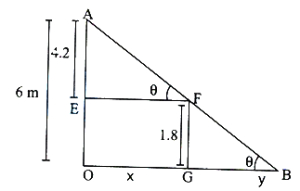
If a man of height $1.8 \ m$ is walking away from the foot of a light pole of height $6 \ m$ with a speed of $7 \ km/h$ on a straight horizontal road,then the rate of change of the length of his shadow is (in $km/h$):
A
$7$
B
$5$
C
$3$
D
$2$
Solution
(C) Let $OA$ be the light pole of height $6 \ m$ and $FG$ be the man of height $1.8 \ m$. Let $x$ be the distance of the man from the pole and $y$ be the length of his shadow.
From the similar triangles $\triangle BGF$ and $\triangle BOA$,we have:
$\frac{FG}{OA} = \frac{BG}{BO}$
$\frac{1.8}{6} = \frac{y}{x+y}$
$1.8(x+y) = 6y$
$1.8x + 1.8y = 6y$
$1.8x = 4.2y$
$y = \frac{1.8}{4.2}x = \frac{18}{42}x = \frac{3}{7}x$
Differentiating both sides with respect to time $t$:
$\frac{dy}{dt} = \frac{3}{7} \frac{dx}{dt}$
Given that the man is walking away from the pole at a speed of $7 \ km/h$,so $\frac{dx}{dt} = 7 \ km/h$.
Therefore,$\frac{dy}{dt} = \frac{3}{7} \times 7 = 3 \ km/h$.
The rate of change of the length of his shadow is $3 \ km/h$.
From the similar triangles $\triangle BGF$ and $\triangle BOA$,we have:
$\frac{FG}{OA} = \frac{BG}{BO}$
$\frac{1.8}{6} = \frac{y}{x+y}$
$1.8(x+y) = 6y$
$1.8x + 1.8y = 6y$
$1.8x = 4.2y$
$y = \frac{1.8}{4.2}x = \frac{18}{42}x = \frac{3}{7}x$
Differentiating both sides with respect to time $t$:
$\frac{dy}{dt} = \frac{3}{7} \frac{dx}{dt}$
Given that the man is walking away from the pole at a speed of $7 \ km/h$,so $\frac{dx}{dt} = 7 \ km/h$.
Therefore,$\frac{dy}{dt} = \frac{3}{7} \times 7 = 3 \ km/h$.
The rate of change of the length of his shadow is $3 \ km/h$.
0 likes
View Solution285
MediumMCQ
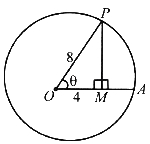
$A$ is a point on the circle with radius $8$ and centre at $O$. $A$ particle $P$ is moving on the circumference of the circle starting from $A$. $M$ is the foot of the perpendicular from $P$ on $OA$ and $\angle POM = \theta$. When $OM = 4$ and $\frac{d\theta}{dt} = 6 \text{ radians/sec}$,then the rate of change of $PM$ is (in units/sec)
A
$24 \sqrt{3}$
B
$24$
C
$15 \sqrt{3}$
D
$48 \sqrt{3}$
Solution
(B) Given that the radius of the circle is $OP = 8$.
$M$ is the foot of the perpendicular from $P$ on $OA$,so $\triangle OMP$ is a right-angled triangle at $M$.
In $\triangle OMP$,we have $\cos \theta = \frac{OM}{OP}$.
Given $OM = 4$ and $OP = 8$,so $\cos \theta = \frac{4}{8} = \frac{1}{2}$.
Also,$PM = OP \sin \theta = 8 \sin \theta$.
To find the rate of change of $PM$ with respect to time $t$,we differentiate $PM$ with respect to $t$:
$\frac{d(PM)}{dt} = \frac{d}{dt}(8 \sin \theta) = 8 \cos \theta \frac{d\theta}{dt}$.
Given $\frac{d\theta}{dt} = 6 \text{ rad/sec}$ and $\cos \theta = \frac{1}{2}$,we substitute these values:
$\frac{d(PM)}{dt} = 8 \times \frac{1}{2} \times 6 = 24 \text{ units/sec}$.
$M$ is the foot of the perpendicular from $P$ on $OA$,so $\triangle OMP$ is a right-angled triangle at $M$.
In $\triangle OMP$,we have $\cos \theta = \frac{OM}{OP}$.
Given $OM = 4$ and $OP = 8$,so $\cos \theta = \frac{4}{8} = \frac{1}{2}$.
Also,$PM = OP \sin \theta = 8 \sin \theta$.
To find the rate of change of $PM$ with respect to time $t$,we differentiate $PM$ with respect to $t$:
$\frac{d(PM)}{dt} = \frac{d}{dt}(8 \sin \theta) = 8 \cos \theta \frac{d\theta}{dt}$.
Given $\frac{d\theta}{dt} = 6 \text{ rad/sec}$ and $\cos \theta = \frac{1}{2}$,we substitute these values:
$\frac{d(PM)}{dt} = 8 \times \frac{1}{2} \times 6 = 24 \text{ units/sec}$.
0 likes
View Solution286
MediumMCQ
If the error committed in measuring the radius of the circle is $0.05 \%$,then the corresponding error in calculating the area is (in $\%$)
A
$0.05$
B
$0.0025$
C
$0.25$
D
$0.1$
Solution
(D) The area of a circle is given by $A = \pi r^2$.
Taking the natural logarithm on both sides,we get $\ln A = \ln \pi + 2 \ln r$.
Differentiating both sides with respect to $r$,we obtain $\frac{dA}{A} = 2 \frac{dr}{r}$.
For small errors,this can be written as $\frac{\Delta A}{A} = 2 \times \frac{\Delta r}{r}$.
Given that the relative error in the radius is $\frac{\Delta r}{r} = 0.05 \%$,the relative error in the area is $\frac{\Delta A}{A} = 2 \times 0.05 \% = 0.1 \%$.
Thus,the corresponding error in calculating the area is $0.1 \%$.
Taking the natural logarithm on both sides,we get $\ln A = \ln \pi + 2 \ln r$.
Differentiating both sides with respect to $r$,we obtain $\frac{dA}{A} = 2 \frac{dr}{r}$.
For small errors,this can be written as $\frac{\Delta A}{A} = 2 \times \frac{\Delta r}{r}$.
Given that the relative error in the radius is $\frac{\Delta r}{r} = 0.05 \%$,the relative error in the area is $\frac{\Delta A}{A} = 2 \times 0.05 \% = 0.1 \%$.
Thus,the corresponding error in calculating the area is $0.1 \%$.
0 likes
View Solution287
EasyMCQ
The diameter and altitude of a right circular cone,at a certain instant,were found to be $10 \ cm$ and $20 \ cm$ respectively. If its diameter is increasing at a rate of $2 \ cm/s$,then at what rate must its altitude change,in order to keep its volume constant (in $cm/s$)?
A
$4$
B
$6$
C
$-4$
D
$-8$
Solution
(D) Let $D$ be the diameter,$r$ be the radius,and $h$ be the altitude of the right circular cone.
Given $D = 10 \ cm$,so $r = 5 \ cm$.
Given $h = 20 \ cm$.
The rate of change of diameter is $\frac{dD}{dt} = 2 \ cm/s$.
Since $D = 2r$,we have $\frac{dr}{dt} = \frac{1}{2} \frac{dD}{dt} = \frac{1}{2} \times 2 = 1 \ cm/s$.
The volume of the cone is $V = \frac{1}{3} \pi r^2 h$.
To keep the volume constant,$\frac{dV}{dt} = 0$.
Using the product rule,$\frac{dV}{dt} = \frac{1}{3} \pi (2rh \frac{dr}{dt} + r^2 \frac{dh}{dt}) = 0$.
Substituting the values: $2(5)(20)(1) + (5)^2 \frac{dh}{dt} = 0$.
$200 + 25 \frac{dh}{dt} = 0$.
$25 \frac{dh}{dt} = -200$.
$\frac{dh}{dt} = -8 \ cm/s$.
Thus,the altitude must change at a rate of $-8 \ cm/s$.
Given $D = 10 \ cm$,so $r = 5 \ cm$.
Given $h = 20 \ cm$.
The rate of change of diameter is $\frac{dD}{dt} = 2 \ cm/s$.
Since $D = 2r$,we have $\frac{dr}{dt} = \frac{1}{2} \frac{dD}{dt} = \frac{1}{2} \times 2 = 1 \ cm/s$.
The volume of the cone is $V = \frac{1}{3} \pi r^2 h$.
To keep the volume constant,$\frac{dV}{dt} = 0$.
Using the product rule,$\frac{dV}{dt} = \frac{1}{3} \pi (2rh \frac{dr}{dt} + r^2 \frac{dh}{dt}) = 0$.
Substituting the values: $2(5)(20)(1) + (5)^2 \frac{dh}{dt} = 0$.
$200 + 25 \frac{dh}{dt} = 0$.
$25 \frac{dh}{dt} = -200$.
$\frac{dh}{dt} = -8 \ cm/s$.
Thus,the altitude must change at a rate of $-8 \ cm/s$.
0 likes
View Solution288
MediumMCQ
$A$ spherical iron ball of $10 \ cm$ radius is coated with a layer of ice of uniform thickness that melts at a rate of $50 \ cm^3/min$. When the thickness of ice is $5 \ cm$,then the rate (in $cm/min$) at which the thickness of ice decreases is:
A
$\frac{5}{6\pi}$
B
$\frac{1}{54\pi}$
C
$\frac{1}{36\pi}$
D
$\frac{1}{18\pi}$
Solution
(D) Let the radius of the iron ball be $r_0 = 10 \ cm$ and the thickness of the ice layer be $x \ cm$. The total radius of the sphere (iron ball + ice) is $R = 10 + x \ cm$.
The volume of the ice layer is $V = \frac{4}{3}\pi (10+x)^3 - \frac{4}{3}\pi (10)^3$.
Since the iron ball is constant,the rate of change of the total volume is equal to the rate of change of the ice volume.
$V = \frac{4}{3}\pi (10+x)^3$.
Differentiating with respect to time $t$:
$\frac{dV}{dt} = 4\pi (10+x)^2 \frac{dx}{dt}$.
Given $\frac{dV}{dt} = -50 \ cm^3/min$ (since it melts) and $x = 5 \ cm$:
$-50 = 4\pi (10+5)^2 \frac{dx}{dt}$.
$-50 = 4\pi (15)^2 \frac{dx}{dt}$.
$-50 = 4\pi (225) \frac{dx}{dt}$.
$-50 = 900\pi \frac{dx}{dt}$.
$\frac{dx}{dt} = -\frac{50}{900\pi} = -\frac{1}{18\pi} \ cm/min$.
The negative sign indicates a decrease in thickness.
Therefore,the rate at which the thickness decreases is $\frac{1}{18\pi} \ cm/min$.
Thus,option $(D)$ is correct.
The volume of the ice layer is $V = \frac{4}{3}\pi (10+x)^3 - \frac{4}{3}\pi (10)^3$.
Since the iron ball is constant,the rate of change of the total volume is equal to the rate of change of the ice volume.
$V = \frac{4}{3}\pi (10+x)^3$.
Differentiating with respect to time $t$:
$\frac{dV}{dt} = 4\pi (10+x)^2 \frac{dx}{dt}$.
Given $\frac{dV}{dt} = -50 \ cm^3/min$ (since it melts) and $x = 5 \ cm$:
$-50 = 4\pi (10+5)^2 \frac{dx}{dt}$.
$-50 = 4\pi (15)^2 \frac{dx}{dt}$.
$-50 = 4\pi (225) \frac{dx}{dt}$.
$-50 = 900\pi \frac{dx}{dt}$.
$\frac{dx}{dt} = -\frac{50}{900\pi} = -\frac{1}{18\pi} \ cm/min$.
The negative sign indicates a decrease in thickness.
Therefore,the rate at which the thickness decreases is $\frac{1}{18\pi} \ cm/min$.
Thus,option $(D)$ is correct.
0 likes
View Solution289
EasyMCQ
The volume of a spherical balloon is increasing at the rate of $30 \ cm^3/min$. Find the rate of change of the surface area of the balloon when its radius is $6 \ cm$.
A
$5 \ cm^2/min$
B
$30 \ cm^2/min$
C
$10 \ cm^2/min$
D
$20 \ cm^2/min$
Solution
(C) Let $v$ be the volume and $s$ be the surface area of the spherical balloon with radius $r$.
Given: $\frac{dv}{dt} = 30 \ cm^3/min$.
The volume of a sphere is $v = \frac{4}{3} \pi r^3$.
Differentiating with respect to $t$: $\frac{dv}{dt} = 4 \pi r^2 \frac{dr}{dt}$.
Substituting the given values: $30 = 4 \pi r^2 \frac{dr}{dt} \implies \frac{dr}{dt} = \frac{30}{4 \pi r^2} = \frac{15}{2 \pi r^2}$.
The surface area of a sphere is $s = 4 \pi r^2$.
Differentiating with respect to $t$: $\frac{ds}{dt} = 8 \pi r \frac{dr}{dt}$.
Substituting $\frac{dr}{dt}$: $\frac{ds}{dt} = 8 \pi r \left( \frac{15}{2 \pi r^2} \right) = \frac{60}{r}$.
For $r = 6 \ cm$: $\frac{ds}{dt} = \frac{60}{6} = 10 \ cm^2/min$.
Given: $\frac{dv}{dt} = 30 \ cm^3/min$.
The volume of a sphere is $v = \frac{4}{3} \pi r^3$.
Differentiating with respect to $t$: $\frac{dv}{dt} = 4 \pi r^2 \frac{dr}{dt}$.
Substituting the given values: $30 = 4 \pi r^2 \frac{dr}{dt} \implies \frac{dr}{dt} = \frac{30}{4 \pi r^2} = \frac{15}{2 \pi r^2}$.
The surface area of a sphere is $s = 4 \pi r^2$.
Differentiating with respect to $t$: $\frac{ds}{dt} = 8 \pi r \frac{dr}{dt}$.
Substituting $\frac{dr}{dt}$: $\frac{ds}{dt} = 8 \pi r \left( \frac{15}{2 \pi r^2} \right) = \frac{60}{r}$.
For $r = 6 \ cm$: $\frac{ds}{dt} = \frac{60}{6} = 10 \ cm^2/min$.
0 likes
View Solution290
EasyMCQ
The volume of a spherical ball is increasing at a rate of $4 \pi \text{ cm}^3 \text{ s}^{-1}$. The rate at which its radius increases,when its volume is $288 \pi \text{ cm}^3$,is ....... $\text{cm s}^{-1}$.
A
$\frac{1}{6}$
B
$\frac{1}{36}$
C
$\frac{1}{9}$
D
$\frac{1}{24}$
Solution
(B) Given,$\frac{dV}{dt} = 4 \pi \text{ cm}^3/\text{s}$ ...$(i)$
We need to find $\frac{dr}{dt}$ when $V = 288 \pi \text{ cm}^3$.
Let $r$ be the radius of the spherical ball.
The volume of a sphere is given by $V = \frac{4}{3} \pi r^3$.
Differentiating both sides with respect to $t$,we get:
$\frac{dV}{dt} = \frac{4}{3} \pi (3r^2) \frac{dr}{dt} = 4 \pi r^2 \frac{dr}{dt}$.
Substituting the given rate $\frac{dV}{dt} = 4 \pi$:
$4 \pi = 4 \pi r^2 \frac{dr}{dt} \Rightarrow \frac{dr}{dt} = \frac{1}{r^2}$ ...(ii)
When $V = 288 \pi$,we have:
$288 \pi = \frac{4}{3} \pi r^3 \Rightarrow r^3 = 288 \times \frac{3}{4} = 216$.
Thus,$r = \sqrt[3]{216} = 6 \text{ cm}$.
Substituting $r = 6$ into equation (ii):
$\frac{dr}{dt} = \frac{1}{6^2} = \frac{1}{36} \text{ cm/s}$.
We need to find $\frac{dr}{dt}$ when $V = 288 \pi \text{ cm}^3$.
Let $r$ be the radius of the spherical ball.
The volume of a sphere is given by $V = \frac{4}{3} \pi r^3$.
Differentiating both sides with respect to $t$,we get:
$\frac{dV}{dt} = \frac{4}{3} \pi (3r^2) \frac{dr}{dt} = 4 \pi r^2 \frac{dr}{dt}$.
Substituting the given rate $\frac{dV}{dt} = 4 \pi$:
$4 \pi = 4 \pi r^2 \frac{dr}{dt} \Rightarrow \frac{dr}{dt} = \frac{1}{r^2}$ ...(ii)
When $V = 288 \pi$,we have:
$288 \pi = \frac{4}{3} \pi r^3 \Rightarrow r^3 = 288 \times \frac{3}{4} = 216$.
Thus,$r = \sqrt[3]{216} = 6 \text{ cm}$.
Substituting $r = 6$ into equation (ii):
$\frac{dr}{dt} = \frac{1}{6^2} = \frac{1}{36} \text{ cm/s}$.
0 likes
View Solution291
EasyMCQ
For the curve $y=5x-2x^3$,if $x$ increases at the rate of $2 \text{ units/sec}$,the rate of change in the slope of the curve at $x=3$ is ......../sec
A
$72$
B
$27$
C
$-72$
D
$-27$
Solution
(C) Given the curve $y = 5x - 2x^3$.
The slope of the curve is given by $m = \frac{dy}{dx} = 5 - 6x^2$.
We need to find the rate of change of the slope with respect to time $t$,which is $\frac{dm}{dt}$.
Differentiating $m$ with respect to $t$ using the chain rule:
$\frac{dm}{dt} = \frac{d}{dt}(5 - 6x^2) = -12x \cdot \frac{dx}{dt}$.
Given that $\frac{dx}{dt} = 2 \text{ units/sec}$ and we need to evaluate this at $x = 3$:
$\left(\frac{dm}{dt}\right)_{x=3} = -12(3) \times 2 = -72$.
Thus,the rate of change of the slope at $x = 3$ is $-72 \text{ units/sec}^2$.
The slope of the curve is given by $m = \frac{dy}{dx} = 5 - 6x^2$.
We need to find the rate of change of the slope with respect to time $t$,which is $\frac{dm}{dt}$.
Differentiating $m$ with respect to $t$ using the chain rule:
$\frac{dm}{dt} = \frac{d}{dt}(5 - 6x^2) = -12x \cdot \frac{dx}{dt}$.
Given that $\frac{dx}{dt} = 2 \text{ units/sec}$ and we need to evaluate this at $x = 3$:
$\left(\frac{dm}{dt}\right)_{x=3} = -12(3) \times 2 = -72$.
Thus,the rate of change of the slope at $x = 3$ is $-72 \text{ units/sec}^2$.
0 likes
View Solution292
EasyMCQ
If $s=60 t-5 t^2$ denotes the distance covered by a particle in time $t$,then the distance it covers before coming to rest is.... units.
A
$120$
B
$720$
C
$240$
D
$180$
Solution
(D) Given the distance function $s = 60t - 5t^2$.
The velocity $v$ is the rate of change of distance with respect to time $t$,given by $v = \frac{ds}{dt}$.
$\frac{ds}{dt} = \frac{d}{dt}(60t - 5t^2) = 60 - 10t$.
The particle comes to rest when its velocity $v = 0$.
Setting $60 - 10t = 0$,we get $10t = 60$,which implies $t = 6 \text{ s}$.
Now,we calculate the distance covered at $t = 6 \text{ s}$:
$s(6) = 60(6) - 5(6)^2$
$s(6) = 360 - 5(36)$
$s(6) = 360 - 180 = 180 \text{ units}$.
Thus,the distance covered before coming to rest is $180 \text{ units}$.
The velocity $v$ is the rate of change of distance with respect to time $t$,given by $v = \frac{ds}{dt}$.
$\frac{ds}{dt} = \frac{d}{dt}(60t - 5t^2) = 60 - 10t$.
The particle comes to rest when its velocity $v = 0$.
Setting $60 - 10t = 0$,we get $10t = 60$,which implies $t = 6 \text{ s}$.
Now,we calculate the distance covered at $t = 6 \text{ s}$:
$s(6) = 60(6) - 5(6)^2$
$s(6) = 360 - 5(36)$
$s(6) = 360 - 180 = 180 \text{ units}$.
Thus,the distance covered before coming to rest is $180 \text{ units}$.
0 likes
View Solution293
EasyMCQ
$A$ kind of bacteria grows by $t^3$ in $t \ s$. The time taken for the rate of growth of the bacteria to become $1200 \ \text{per } s$ is: (in $s$)
A
$10$
B
$20$
C
$40$
D
$400$
Solution
(B) Let $N(t)$ be the number of bacteria at time $t$. The growth is given by $N(t) = t^3$.
The rate of growth of the bacteria is given by the derivative $\frac{dN}{dt} = \frac{d}{dt}(t^3) = 3t^2$.
We are given that the rate of growth is $1200 \ \text{per } s$.
Therefore,$3t^2 = 1200$.
Dividing by $3$,we get $t^2 = 400$.
Taking the square root,$t = \sqrt{400} = 20 \ s$.
Thus,the time taken is $20 \ s$.
The rate of growth of the bacteria is given by the derivative $\frac{dN}{dt} = \frac{d}{dt}(t^3) = 3t^2$.
We are given that the rate of growth is $1200 \ \text{per } s$.
Therefore,$3t^2 = 1200$.
Dividing by $3$,we get $t^2 = 400$.
Taking the square root,$t = \sqrt{400} = 20 \ s$.
Thus,the time taken is $20 \ s$.
0 likes
View Solution294
EasyMCQ
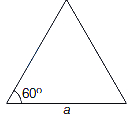
The sides of an equilateral triangle are increasing at the rate of $2 \text{ cm s}^{-1}$. How fast does its area increase when its side is $10 \text{ cm}$?
A
$10 \sqrt{3} \text{ cm}^2 \text{ s}^{-1}$
B
$5 \sqrt{3} \text{ cm}^2 \text{ s}^{-1}$
C
$\sqrt{3} \text{ cm}^2 \text{ s}^{-1}$
D
$2 \sqrt{3} \text{ cm}^2 \text{ s}^{-1}$
Solution
(A) The area $A$ of an equilateral triangle with side $a$ is given by:
$A = \frac{\sqrt{3}}{4} a^2$
Differentiating both sides with respect to time $t$,we get:
$\frac{dA}{dt} = \frac{\sqrt{3}}{4} \cdot 2a \cdot \frac{da}{dt}$
$\frac{dA}{dt} = \frac{\sqrt{3}}{2} a \cdot \frac{da}{dt}$
Given that the rate of increase of the side is $\frac{da}{dt} = 2 \text{ cm s}^{-1}$ and the side length is $a = 10 \text{ cm}$,we substitute these values into the equation:
$\frac{dA}{dt} = \frac{\sqrt{3}}{2} \times 10 \times 2$
$\frac{dA}{dt} = 10 \sqrt{3} \text{ cm}^2 \text{ s}^{-1}$
Thus,the area of the triangle increases at the rate of $10 \sqrt{3} \text{ cm}^2 \text{ s}^{-1}$.
$A = \frac{\sqrt{3}}{4} a^2$
Differentiating both sides with respect to time $t$,we get:
$\frac{dA}{dt} = \frac{\sqrt{3}}{4} \cdot 2a \cdot \frac{da}{dt}$
$\frac{dA}{dt} = \frac{\sqrt{3}}{2} a \cdot \frac{da}{dt}$
Given that the rate of increase of the side is $\frac{da}{dt} = 2 \text{ cm s}^{-1}$ and the side length is $a = 10 \text{ cm}$,we substitute these values into the equation:
$\frac{dA}{dt} = \frac{\sqrt{3}}{2} \times 10 \times 2$
$\frac{dA}{dt} = 10 \sqrt{3} \text{ cm}^2 \text{ s}^{-1}$
Thus,the area of the triangle increases at the rate of $10 \sqrt{3} \text{ cm}^2 \text{ s}^{-1}$.
0 likes
View Solution295
EasyMCQ
The radius of a sphere increases at the rate of $0.04 \text{ cm/sec}$. The rate of increase in the volume of that sphere with respect to its surface area,when its radius is $10 \text{ cm}$ is
A
$16 \pi$
B
$25$
C
$20$
D
$5$
Solution
(D) Let $r$ be the radius of the sphere.
Given,the rate of change in radius is $\frac{dr}{dt} = 0.04 \text{ cm/sec}$.
The volume of the sphere is $V = \frac{4}{3} \pi r^3$.
Differentiating with respect to $t$,we get:
$\frac{dV}{dt} = \frac{4}{3} \pi (3r^2) \cdot \frac{dr}{dt} = 4 \pi r^2 \cdot \frac{dr}{dt} \quad \dots(i)$
The surface area of the sphere is $S = 4 \pi r^2$.
Differentiating with respect to $t$,we get:
$\frac{dS}{dt} = 4 \pi (2r) \cdot \frac{dr}{dt} = 8 \pi r \cdot \frac{dr}{dt} \quad \dots(ii)$
Dividing equation $(i)$ by equation $(ii)$,we get:
$\frac{dV/dt}{dS/dt} = \frac{dV}{dS} = \frac{4 \pi r^2 \cdot \frac{dr}{dt}}{8 \pi r \cdot \frac{dr}{dt}}$
$\frac{dV}{dS} = \frac{r}{2}$
Given $r = 10 \text{ cm}$,we substitute the value:
$\frac{dV}{dS} = \frac{10}{2} = 5 \text{ cm}$.
Thus,the rate of increase in volume with respect to surface area is $5 \text{ cm}$.
Hence,option $(D)$ is correct.
Given,the rate of change in radius is $\frac{dr}{dt} = 0.04 \text{ cm/sec}$.
The volume of the sphere is $V = \frac{4}{3} \pi r^3$.
Differentiating with respect to $t$,we get:
$\frac{dV}{dt} = \frac{4}{3} \pi (3r^2) \cdot \frac{dr}{dt} = 4 \pi r^2 \cdot \frac{dr}{dt} \quad \dots(i)$
The surface area of the sphere is $S = 4 \pi r^2$.
Differentiating with respect to $t$,we get:
$\frac{dS}{dt} = 4 \pi (2r) \cdot \frac{dr}{dt} = 8 \pi r \cdot \frac{dr}{dt} \quad \dots(ii)$
Dividing equation $(i)$ by equation $(ii)$,we get:
$\frac{dV/dt}{dS/dt} = \frac{dV}{dS} = \frac{4 \pi r^2 \cdot \frac{dr}{dt}}{8 \pi r \cdot \frac{dr}{dt}}$
$\frac{dV}{dS} = \frac{r}{2}$
Given $r = 10 \text{ cm}$,we substitute the value:
$\frac{dV}{dS} = \frac{10}{2} = 5 \text{ cm}$.
Thus,the rate of increase in volume with respect to surface area is $5 \text{ cm}$.
Hence,option $(D)$ is correct.
0 likes
View Solution296
EasyMCQ
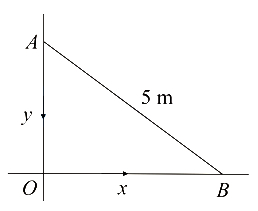
$A$ ladder of $5 \ m$ long rests against a vertical wall with the lower end on the horizontal ground. The lower end of the ladder is pulled along the ground away from the wall at the rate of $3 \ m/sec$. The height of the upper end (in meters) while it is descending at the rate of $4 \ m/sec$,is
A
$1$
B
$2$
C
$3$
D
$4$
Solution
(C) Let $x$ be the distance of the lower end of the ladder from the wall and $y$ be the height of the upper end of the ladder from the ground.
Given the length of the ladder is $5 \ m$,by the Pythagorean theorem,we have $x^2 + y^2 = 5^2 = 25$.
Differentiating both sides with respect to time $t$,we get $2x \frac{dx}{dt} + 2y \frac{dy}{dt} = 0$,which simplifies to $x \frac{dx}{dt} + y \frac{dy}{dt} = 0$.
We are given $\frac{dx}{dt} = 3 \ m/sec$ and the ladder is descending at $\frac{dy}{dt} = -4 \ m/sec$.
Substituting these values into the differentiated equation: $x(3) + y(-4) = 0$,which gives $3x = 4y$,or $x = \frac{4}{3}y$.
Substitute $x = \frac{4}{3}y$ into the original equation $x^2 + y^2 = 25$:
$(\frac{4}{3}y)^2 + y^2 = 25$
$\frac{16}{9}y^2 + y^2 = 25$
$\frac{25}{9}y^2 = 25$
$y^2 = 9$
$y = 3 \ m$ (since height must be positive).
Thus,the height of the upper end is $3 \ m$.
Given the length of the ladder is $5 \ m$,by the Pythagorean theorem,we have $x^2 + y^2 = 5^2 = 25$.
Differentiating both sides with respect to time $t$,we get $2x \frac{dx}{dt} + 2y \frac{dy}{dt} = 0$,which simplifies to $x \frac{dx}{dt} + y \frac{dy}{dt} = 0$.
We are given $\frac{dx}{dt} = 3 \ m/sec$ and the ladder is descending at $\frac{dy}{dt} = -4 \ m/sec$.
Substituting these values into the differentiated equation: $x(3) + y(-4) = 0$,which gives $3x = 4y$,or $x = \frac{4}{3}y$.
Substitute $x = \frac{4}{3}y$ into the original equation $x^2 + y^2 = 25$:
$(\frac{4}{3}y)^2 + y^2 = 25$
$\frac{16}{9}y^2 + y^2 = 25$
$\frac{25}{9}y^2 = 25$
$y^2 = 9$
$y = 3 \ m$ (since height must be positive).
Thus,the height of the upper end is $3 \ m$.
0 likes
View Solution297
EasyMCQ
Air is discharging from a large spherical balloon at the rate of $4 \,m^3 / min$. The rate at which the surface area is shrinking when the radius of the balloon is $8 \,m$, is
A
$2 \,m^2 / min$
B
$1 \,m^2 / min$
C
$4 \,m^2 / min$
D
$8 \,m^2 / min$
Solution
(B) Let $V$ be the volume and $S$ be the surface area of the spherical balloon with radius $r$.
Given, the rate of discharge of air is $\frac{dV}{dt} = -4 \,m^3 / min$ (since air is discharging, volume is decreasing).
The volume of a sphere is $V = \frac{4}{3} \pi r^3$.
Differentiating with respect to $t$, we get $\frac{dV}{dt} = 4 \pi r^2 \frac{dr}{dt}$.
Substituting the given values at $r = 8 \,m$:
$-4 = 4 \pi (8)^2 \frac{dr}{dt} \Rightarrow -4 = 256 \pi \frac{dr}{dt} \Rightarrow \frac{dr}{dt} = -\frac{1}{64 \pi} \,m / min$.
The surface area of a sphere is $S = 4 \pi r^2$.
Differentiating with respect to $t$, we get $\frac{dS}{dt} = 8 \pi r \frac{dr}{dt}$.
Substituting $r = 8 \,m$ and $\frac{dr}{dt} = -\frac{1}{64 \pi} \,m / min$:
$\frac{dS}{dt} = 8 \pi (8) \left( -\frac{1}{64 \pi} \right) = -1 \,m^2 / min$.
Since the surface area is shrinking at a rate of $1 \,m^2 / min$, the rate of shrinking is $1 \,m^2 / min$.
Given, the rate of discharge of air is $\frac{dV}{dt} = -4 \,m^3 / min$ (since air is discharging, volume is decreasing).
The volume of a sphere is $V = \frac{4}{3} \pi r^3$.
Differentiating with respect to $t$, we get $\frac{dV}{dt} = 4 \pi r^2 \frac{dr}{dt}$.
Substituting the given values at $r = 8 \,m$:
$-4 = 4 \pi (8)^2 \frac{dr}{dt} \Rightarrow -4 = 256 \pi \frac{dr}{dt} \Rightarrow \frac{dr}{dt} = -\frac{1}{64 \pi} \,m / min$.
The surface area of a sphere is $S = 4 \pi r^2$.
Differentiating with respect to $t$, we get $\frac{dS}{dt} = 8 \pi r \frac{dr}{dt}$.
Substituting $r = 8 \,m$ and $\frac{dr}{dt} = -\frac{1}{64 \pi} \,m / min$:
$\frac{dS}{dt} = 8 \pi (8) \left( -\frac{1}{64 \pi} \right) = -1 \,m^2 / min$.
Since the surface area is shrinking at a rate of $1 \,m^2 / min$, the rate of shrinking is $1 \,m^2 / min$.
0 likes
View Solution298
EasyMCQ
Each edge of a cube is expanding at the rate of $1 \text{ cm/sec}$. Then the rate (in $\text{cc/sec}$) of change in its volume,when each of its edge is of length $5 \text{ cm}$,is
A
$25$
B
$75$
C
$125$
D
$175$
Solution
(B) Let $x$ be the length of the edge of the cube and $V$ be its volume.
Given that the rate of change of the edge length is $\frac{dx}{dt} = 1 \text{ cm/sec}$.
The volume of a cube is given by $V = x^3$.
Differentiating both sides with respect to time $t$,we get $\frac{dV}{dt} = 3x^2 \frac{dx}{dt}$.
When the edge length $x = 5 \text{ cm}$,we substitute the values into the derivative:
$\frac{dV}{dt} = 3(5)^2(1) = 3 \times 25 \times 1 = 75 \text{ cc/sec}$.
Thus,the rate of change of volume is $75 \text{ cc/sec}$.
Given that the rate of change of the edge length is $\frac{dx}{dt} = 1 \text{ cm/sec}$.
The volume of a cube is given by $V = x^3$.
Differentiating both sides with respect to time $t$,we get $\frac{dV}{dt} = 3x^2 \frac{dx}{dt}$.
When the edge length $x = 5 \text{ cm}$,we substitute the values into the derivative:
$\frac{dV}{dt} = 3(5)^2(1) = 3 \times 25 \times 1 = 75 \text{ cc/sec}$.
Thus,the rate of change of volume is $75 \text{ cc/sec}$.
0 likes
View SolutionApplications of Derivatives — Rate of Change of Quantities · Frequently Asked Questions
1Are these Applications of Derivatives questions useful for JEE and NEET?
Yes. All questions in this section are mapped to JEE Main and NEET exam patterns. Previous year questions from JEE Main, NEET, GUJCET and state-level exams are included with full solutions.
2Can I switch to Hindi or Gujarati for these questions?
Yes. Use the language tabs in the hero section or the sidebar to view the same questions and solutions in English, Hindi or Gujarati.
3How do I generate a question paper from this subtopic?
Use the Vedclass Exam Paper Generator — select the chapter and subtopic, set difficulty, and generate Sets A, B, C, D automatically. First 3 chapters of every subject are free.
Vedclass Products
For Students
Vedclass Test Series
Mock tests in real JEE/NEET style with performance analysis. 5-day free trial.
Start Free TrialFor Teachers
Exam Paper Generator
Generate Set A/B/C/D papers from this chapter in 2 minutes. 3 chapters free.
Try FreeFor Institutes
Online Exam Module
Live online exams with unlimited students, 360° analytics & white-label branding.
See DemoFor Teachers & Institutes
Generate a Applications of Derivatives Exam Paper in 2 Minutes
Select subtopic & difficulty — Sets A, B, C, D auto-generated with No Repeat logic.
First 3 chapters of every subject are free — no payment required.