
A English
Rate of Change of Quantities Questions in English
Class 12 Mathematics · Applications of Derivatives · Rate of Change of Quantities
365+
Questions
English
Language
100%
With Solutions
Showing 49 of 365 questions in English
101
AdvancedMCQ
$A$ point is moving along the curve $y^3 = 27x$. The interval in which the abscissa changes at a slower rate than the ordinate is
A
$(-3, 3)$
B
$(-\infty, \infty)$
C
$(-1, 1)$
D
$(-\infty, -3) \cup (3, \infty)$
Solution
(C) Given the curve equation $y^3 = 27x$.
Differentiating both sides with respect to time $t$,we get:
$3y^2 \frac{dy}{dt} = 27 \frac{dx}{dt}$
$\frac{dx}{dt} = \frac{y^2}{9} \frac{dy}{dt}$.
The problem states that the abscissa $(x)$ changes at a slower rate than the ordinate $(y)$,which means:
$\left| \frac{dx}{dt} \right| < \left| \frac{dy}{dt} \right|$
Substituting the expression for $\frac{dx}{dt}$:
$\left| \frac{y^2}{9} \frac{dy}{dt} \right| < \left| \frac{dy}{dt} \right|$
$\frac{y^2}{9} < 1$
$y^2 < 9$
$-3 < y < 3$.
Since $y^3 = 27x$,when $y = -3$,$x = -1$,and when $y = 3$,$x = 1$.
Thus,the interval for the abscissa $x$ is $(-1, 1)$.
Differentiating both sides with respect to time $t$,we get:
$3y^2 \frac{dy}{dt} = 27 \frac{dx}{dt}$
$\frac{dx}{dt} = \frac{y^2}{9} \frac{dy}{dt}$.
The problem states that the abscissa $(x)$ changes at a slower rate than the ordinate $(y)$,which means:
$\left| \frac{dx}{dt} \right| < \left| \frac{dy}{dt} \right|$
Substituting the expression for $\frac{dx}{dt}$:
$\left| \frac{y^2}{9} \frac{dy}{dt} \right| < \left| \frac{dy}{dt} \right|$
$\frac{y^2}{9} < 1$
$y^2 < 9$
$-3 < y < 3$.
Since $y^3 = 27x$,when $y = -3$,$x = -1$,and when $y = 3$,$x = 1$.
Thus,the interval for the abscissa $x$ is $(-1, 1)$.
0 likes
View Solution102
AdvancedMCQ
The radius of a right circular cylinder increases at a constant rate. Its altitude is a linear function of the radius and increases three times as fast as the radius. When the radius is $1 \, cm$,the altitude is $6 \, cm$. When the radius is $6 \, cm$,the volume is increasing at the rate of $1 \, cm^3/sec$. When the radius is $36 \, cm$,the volume is increasing at a rate of $n \, cm^3/sec$. The value of $n$ is equal to:
A
$12$
B
$22$
C
$30$
D
$33$
Solution
(D) Let $\frac{dr}{dt} = c$ and $h = ar + b$.
Given $\frac{dh}{dt} = 3 \frac{dr}{dt}$,so $a \frac{dr}{dt} = 3 \frac{dr}{dt}$,which implies $a = 3$.
Thus,$h = 3r + b$.
When $r = 1, h = 6$,so $6 = 3(1) + b$,which gives $b = 3$.
Therefore,$h = 3r + 3 = 3(r + 1)$.
The volume $V = \pi r^2 h = \pi r^2 (3r + 3) = 3\pi (r^3 + r^2)$.
Differentiating with respect to $t$,$\frac{dV}{dt} = 3\pi (3r^2 + 2r) \frac{dr}{dt}$.
When $r = 6$,$\frac{dV}{dt} = 1$,so $1 = 3\pi (3(36) + 2(6)) \frac{dr}{dt} = 3\pi (108 + 12) \frac{dr}{dt} = 360\pi \frac{dr}{dt}$.
Thus,$\frac{dr}{dt} = \frac{1}{360\pi}$.
When $r = 36$,$\frac{dV}{dt} = n = 3\pi (3(36)^2 + 2(36)) \frac{dr}{dt}$.
$n = 3\pi (3888 + 72) \frac{1}{360\pi} = 3\pi (3960) \frac{1}{360\pi} = 3 \times 11 = 33$.
Given $\frac{dh}{dt} = 3 \frac{dr}{dt}$,so $a \frac{dr}{dt} = 3 \frac{dr}{dt}$,which implies $a = 3$.
Thus,$h = 3r + b$.
When $r = 1, h = 6$,so $6 = 3(1) + b$,which gives $b = 3$.
Therefore,$h = 3r + 3 = 3(r + 1)$.
The volume $V = \pi r^2 h = \pi r^2 (3r + 3) = 3\pi (r^3 + r^2)$.
Differentiating with respect to $t$,$\frac{dV}{dt} = 3\pi (3r^2 + 2r) \frac{dr}{dt}$.
When $r = 6$,$\frac{dV}{dt} = 1$,so $1 = 3\pi (3(36) + 2(6)) \frac{dr}{dt} = 3\pi (108 + 12) \frac{dr}{dt} = 360\pi \frac{dr}{dt}$.
Thus,$\frac{dr}{dt} = \frac{1}{360\pi}$.
When $r = 36$,$\frac{dV}{dt} = n = 3\pi (3(36)^2 + 2(36)) \frac{dr}{dt}$.
$n = 3\pi (3888 + 72) \frac{1}{360\pi} = 3\pi (3960) \frac{1}{360\pi} = 3 \times 11 = 33$.
0 likes
View Solution103
AdvancedMCQ
$A$ particle moves along the curve $y = x^{3/2}$ in the first quadrant in such a way that its distance from the origin increases at the rate of $11$ units per second. The value of $\frac{dx}{dt}$ when $x = 3$ is
A
$4$
B
$\frac{9}{2}$
C
$\frac{3\sqrt{3}}{2}$
D
None of these
Solution
(A) Let the distance of the particle from the origin be $r$. Then $r^2 = x^2 + y^2$.
Given $y = x^{3/2}$,so $y^2 = x^3$. Thus,$r^2 = x^2 + x^3$.
Differentiating with respect to $t$,we get $2r \frac{dr}{dt} = (2x + 3x^2) \frac{dx}{dt}$.
Given $\frac{dr}{dt} = 11$ and $x = 3$. Then $y = 3^{3/2} = 3\sqrt{3}$.
The distance $r = \sqrt{x^2 + y^2} = \sqrt{3^2 + (3\sqrt{3})^2} = \sqrt{9 + 27} = \sqrt{36} = 6$.
Substituting the values into the derivative equation:
$2(6)(11) = (2(3) + 3(3^2)) \frac{dx}{dt}$
$132 = (6 + 27) \frac{dx}{dt}$
$132 = 33 \frac{dx}{dt}$
$\frac{dx}{dt} = \frac{132}{33} = 4$.
Given $y = x^{3/2}$,so $y^2 = x^3$. Thus,$r^2 = x^2 + x^3$.
Differentiating with respect to $t$,we get $2r \frac{dr}{dt} = (2x + 3x^2) \frac{dx}{dt}$.
Given $\frac{dr}{dt} = 11$ and $x = 3$. Then $y = 3^{3/2} = 3\sqrt{3}$.
The distance $r = \sqrt{x^2 + y^2} = \sqrt{3^2 + (3\sqrt{3})^2} = \sqrt{9 + 27} = \sqrt{36} = 6$.
Substituting the values into the derivative equation:
$2(6)(11) = (2(3) + 3(3^2)) \frac{dx}{dt}$
$132 = (6 + 27) \frac{dx}{dt}$
$132 = 33 \frac{dx}{dt}$
$\frac{dx}{dt} = \frac{132}{33} = 4$.
0 likes
View Solution104
AdvancedMCQ
$A$ cube of ice melts without changing its shape at a uniform rate of $4 \, cm^3/min$. The rate of change of the surface area of the cube,in $cm^2/min$,when the volume of the cube is $125 \, cm^3$,is:
A
$-4$
B
$-16/5$
C
$-16/6$
D
$-8/15$
Solution
(B) Let $x$ be the side length of the cube. The volume $V = x^3$ and surface area $S = 6x^2$.
Given $\frac{dV}{dt} = -4 \, cm^3/min$ (since the ice is melting,the volume is decreasing).
We know $\frac{dV}{dt} = 3x^2 \frac{dx}{dt}$.
Substituting the values: $-4 = 3x^2 \frac{dx}{dt} \implies \frac{dx}{dt} = -\frac{4}{3x^2}$.
We need to find $\frac{dS}{dt}$.
$\frac{dS}{dt} = \frac{d}{dt}(6x^2) = 12x \frac{dx}{dt}$.
Substituting $\frac{dx}{dt}$: $\frac{dS}{dt} = 12x \left( -\frac{4}{3x^2} \right) = -\frac{16}{x}$.
Given $V = 125 \, cm^3$,so $x^3 = 125 \implies x = 5 \, cm$.
Therefore,$\frac{dS}{dt} = -\frac{16}{5} \, cm^2/min$.
Given $\frac{dV}{dt} = -4 \, cm^3/min$ (since the ice is melting,the volume is decreasing).
We know $\frac{dV}{dt} = 3x^2 \frac{dx}{dt}$.
Substituting the values: $-4 = 3x^2 \frac{dx}{dt} \implies \frac{dx}{dt} = -\frac{4}{3x^2}$.
We need to find $\frac{dS}{dt}$.
$\frac{dS}{dt} = \frac{d}{dt}(6x^2) = 12x \frac{dx}{dt}$.
Substituting $\frac{dx}{dt}$: $\frac{dS}{dt} = 12x \left( -\frac{4}{3x^2} \right) = -\frac{16}{x}$.
Given $V = 125 \, cm^3$,so $x^3 = 125 \implies x = 5 \, cm$.
Therefore,$\frac{dS}{dt} = -\frac{16}{5} \, cm^2/min$.
0 likes
View Solution105
AdvancedMCQ
If the sides of a triangle vary slightly in such a way that its circumradius remains constant,then $\frac{da}{\cos A} + \frac{db}{\cos B} + \frac{dc}{\cos C}$ is equal to
A
$6R$
B
$2R(dA + dB + dC)$
C
$0$
D
Both $(B)$ and $(C)$
Solution
(C) We know that in any triangle,$\frac{a}{\sin A} = \frac{b}{\sin B} = \frac{c}{\sin C} = 2R$,where $R$ is the circumradius.
Since $R$ is constant,we have $a = 2R \sin A$,$b = 2R \sin B$,and $c = 2R \sin C$.
Differentiating these with respect to the angles,we get $da = 2R \cos A \, dA$,$db = 2R \cos B \, dB$,and $dc = 2R \cos C \, dC$.
Substituting these into the given expression:
$\frac{da}{\cos A} + \frac{db}{\cos B} + \frac{dc}{\cos C} = \frac{2R \cos A \, dA}{\cos A} + \frac{2R \cos B \, dB}{\cos B} + \frac{2R \cos C \, dC}{\cos C} = 2R(dA + dB + dC)$.
Since the sum of angles in a triangle is $A + B + C = \pi$,differentiating gives $dA + dB + dC = 0$.
Therefore,the expression equals $2R(0) = 0$.
Since $R$ is constant,we have $a = 2R \sin A$,$b = 2R \sin B$,and $c = 2R \sin C$.
Differentiating these with respect to the angles,we get $da = 2R \cos A \, dA$,$db = 2R \cos B \, dB$,and $dc = 2R \cos C \, dC$.
Substituting these into the given expression:
$\frac{da}{\cos A} + \frac{db}{\cos B} + \frac{dc}{\cos C} = \frac{2R \cos A \, dA}{\cos A} + \frac{2R \cos B \, dB}{\cos B} + \frac{2R \cos C \, dC}{\cos C} = 2R(dA + dB + dC)$.
Since the sum of angles in a triangle is $A + B + C = \pi$,differentiating gives $dA + dB + dC = 0$.
Therefore,the expression equals $2R(0) = 0$.
0 likes
View Solution106
AdvancedMCQ
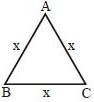
The side of an equilateral triangle expands at the rate of $2 \, cm/s$. The rate of increase of its area when each side is $10 \, cm$ is:
A
$10 \sqrt{2} \, cm^2/s$
B
$10 \sqrt{3} \, cm^2/s$
C
$10 \, cm^2/s$
D
$5 \, cm^2/s$
Solution
(B) Let the side of the equilateral triangle be $x$. Given that the rate of change of the side is $\frac{dx}{dt} = 2 \, cm/s$.
The area $A$ of an equilateral triangle with side $x$ is given by $A = \frac{\sqrt{3}}{4} x^2$.
To find the rate of increase of the area,we differentiate $A$ with respect to time $t$:
$\frac{dA}{dt} = \frac{d}{dt} \left( \frac{\sqrt{3}}{4} x^2 \right) = \frac{\sqrt{3}}{4} \cdot 2x \cdot \frac{dx}{dt} = \frac{\sqrt{3}}{2} x \frac{dx}{dt}$.
Given $x = 10 \, cm$ and $\frac{dx}{dt} = 2 \, cm/s$,we substitute these values into the expression:
$\frac{dA}{dt} = \frac{\sqrt{3}}{2} \times 10 \times 2 = 10 \sqrt{3} \, cm^2/s$.
Thus,the rate of increase of the area is $10 \sqrt{3} \, cm^2/s$.
The area $A$ of an equilateral triangle with side $x$ is given by $A = \frac{\sqrt{3}}{4} x^2$.
To find the rate of increase of the area,we differentiate $A$ with respect to time $t$:
$\frac{dA}{dt} = \frac{d}{dt} \left( \frac{\sqrt{3}}{4} x^2 \right) = \frac{\sqrt{3}}{4} \cdot 2x \cdot \frac{dx}{dt} = \frac{\sqrt{3}}{2} x \frac{dx}{dt}$.
Given $x = 10 \, cm$ and $\frac{dx}{dt} = 2 \, cm/s$,we substitute these values into the expression:
$\frac{dA}{dt} = \frac{\sqrt{3}}{2} \times 10 \times 2 = 10 \sqrt{3} \, cm^2/s$.
Thus,the rate of increase of the area is $10 \sqrt{3} \, cm^2/s$.
0 likes
View Solution107
AdvancedMCQ
If a spherical balloon has a variable diameter $3x + \frac{9}{2}$,then find the rate of change of its volume with respect to $x$.
A
$27\pi (2x + 3)^2$
B
$\frac{27\pi}{16} (2x + 3)^2$
C
$\frac{27\pi}{8} (2x + 3)^2$
D
None of these
Solution
(C) The diameter of the spherical balloon is $D = 3x + \frac{9}{2} = \frac{6x + 9}{2} = \frac{3}{2}(2x + 3)$.
The radius $r$ is given by $r = \frac{D}{2} = \frac{3}{4}(2x + 3)$.
The volume $V$ of a sphere is $V = \frac{4}{3}\pi r^3$.
Substituting $r$,we get $V = \frac{4}{3}\pi \left[ \frac{3}{4}(2x + 3) \right]^3 = \frac{4}{3}\pi \cdot \frac{27}{64} (2x + 3)^3 = \frac{9\pi}{16} (2x + 3)^3$.
Now,differentiating $V$ with respect to $x$ using the chain rule:
$\frac{dV}{dx} = \frac{9\pi}{16} \cdot 3(2x + 3)^2 \cdot \frac{d}{dx}(2x + 3)$.
$\frac{dV}{dx} = \frac{27\pi}{16} (2x + 3)^2 \cdot 2$.
$\frac{dV}{dx} = \frac{27\pi}{8} (2x + 3)^2$.
The radius $r$ is given by $r = \frac{D}{2} = \frac{3}{4}(2x + 3)$.
The volume $V$ of a sphere is $V = \frac{4}{3}\pi r^3$.
Substituting $r$,we get $V = \frac{4}{3}\pi \left[ \frac{3}{4}(2x + 3) \right]^3 = \frac{4}{3}\pi \cdot \frac{27}{64} (2x + 3)^3 = \frac{9\pi}{16} (2x + 3)^3$.
Now,differentiating $V$ with respect to $x$ using the chain rule:
$\frac{dV}{dx} = \frac{9\pi}{16} \cdot 3(2x + 3)^2 \cdot \frac{d}{dx}(2x + 3)$.
$\frac{dV}{dx} = \frac{27\pi}{16} (2x + 3)^2 \cdot 2$.
$\frac{dV}{dx} = \frac{27\pi}{8} (2x + 3)^2$.
0 likes
View Solution108
AdvancedMCQ
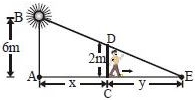
$A$ man of height $2 \ m$ walks at a uniform speed of $5 \ km/hr$ away from a lamp post which is $6 \ m$ high. Find the rate at which the length of his shadow increases in $km/hr$.
A
$2.5$
B
$2$
C
$5$
D
$3$
Solution
(A) Let $AB$ be the lamp post and $CD$ be the man at a particular time $t$.
Let $AC = x$ be the distance of the man from the lamp post and $CE = y$ be the length of his shadow.
Given,the speed of the man is $\frac{dx}{dt} = 5 \ km/hr$.
We need to find the rate at which the shadow increases,i.e.,$\frac{dy}{dt}$.
Since $\Delta ABE \sim \Delta CDE$,we have:
$\frac{AB}{CD} = \frac{AE}{CE}$
$\frac{6}{2} = \frac{x + y}{y}$
$3 = \frac{x + y}{y}$
$3y = x + y$
$2y = x$
Differentiating both sides with respect to $t$:
$2 \frac{dy}{dt} = \frac{dx}{dt}$
$2 \frac{dy}{dt} = 5$
$\frac{dy}{dt} = 2.5 \ km/hr$.
Thus,the length of the shadow increases at the rate of $2.5 \ km/hr$.
Let $AC = x$ be the distance of the man from the lamp post and $CE = y$ be the length of his shadow.
Given,the speed of the man is $\frac{dx}{dt} = 5 \ km/hr$.
We need to find the rate at which the shadow increases,i.e.,$\frac{dy}{dt}$.
Since $\Delta ABE \sim \Delta CDE$,we have:
$\frac{AB}{CD} = \frac{AE}{CE}$
$\frac{6}{2} = \frac{x + y}{y}$
$3 = \frac{x + y}{y}$
$3y = x + y$
$2y = x$
Differentiating both sides with respect to $t$:
$2 \frac{dy}{dt} = \frac{dx}{dt}$
$2 \frac{dy}{dt} = 5$
$\frac{dy}{dt} = 2.5 \ km/hr$.
Thus,the length of the shadow increases at the rate of $2.5 \ km/hr$.
0 likes
View Solution109
DifficultMCQ
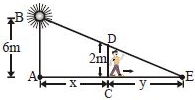
$A$ man of height $2 \ m$ walks at a uniform speed of $5 \ km/hr$ away from a lamp post which is $6 \ m$ high. The rate at which the length of his shadow increases is .......... $km/hr$.
A
$2.5$
B
$2$
C
$5$
D
$3$
Solution
(A) Let $AB$ be the lamp post of height $6 \ m$ and $CD$ be the man of height $2 \ m$ at a particular time $t$.
Let $AC = x$ be the distance of the man from the lamp post and $CE = y$ be the length of his shadow.
Given that the man walks at a speed of $5 \ km/hr$,so $\frac{dx}{dt} = 5 \ km/hr$.
We need to find the rate at which the shadow increases,i.e.,$\frac{dy}{dt}$.
Since $\triangle ABE \sim \triangle CDE$,we have:
$\frac{AB}{CD} = \frac{AE}{CE}$
$\frac{6}{2} = \frac{x + y}{y}$
$3 = \frac{x + y}{y}$
$3y = x + y$
$2y = x$
Differentiating both sides with respect to $t$:
$2 \frac{dy}{dt} = \frac{dx}{dt}$
$2 \frac{dy}{dt} = 5$
$\frac{dy}{dt} = \frac{5}{2} = 2.5 \ km/hr$.
Thus,the length of the shadow increases at the rate of $2.5 \ km/hr$.
Let $AC = x$ be the distance of the man from the lamp post and $CE = y$ be the length of his shadow.
Given that the man walks at a speed of $5 \ km/hr$,so $\frac{dx}{dt} = 5 \ km/hr$.
We need to find the rate at which the shadow increases,i.e.,$\frac{dy}{dt}$.
Since $\triangle ABE \sim \triangle CDE$,we have:
$\frac{AB}{CD} = \frac{AE}{CE}$
$\frac{6}{2} = \frac{x + y}{y}$
$3 = \frac{x + y}{y}$
$3y = x + y$
$2y = x$
Differentiating both sides with respect to $t$:
$2 \frac{dy}{dt} = \frac{dx}{dt}$
$2 \frac{dy}{dt} = 5$
$\frac{dy}{dt} = \frac{5}{2} = 2.5 \ km/hr$.
Thus,the length of the shadow increases at the rate of $2.5 \ km/hr$.
0 likes
View Solution110
AdvancedMCQ
$A$ spherical balloon is expanding. If at any instant the rate of increase of its volume is $16$ times the rate of increase of its radius,then its radius at that instant is:
A
$\frac{1}{\sqrt{\pi}}$
B
$\frac{2}{\sqrt{\pi}}$
C
$\frac{2}{\pi}$
D
$\frac{4}{3\sqrt{\pi}}$
Solution
(B) The volume $V$ of a spherical balloon is given by $V = \frac{4}{3} \pi r^3$,where $r$ is the radius.
Differentiating both sides with respect to time $t$,we get:
$\frac{dV}{dt} = \frac{4}{3} \pi (3r^2) \frac{dr}{dt} = 4 \pi r^2 \frac{dr}{dt}$.
According to the problem,the rate of increase of volume is $16$ times the rate of increase of the radius:
$\frac{dV}{dt} = 16 \frac{dr}{dt}$.
Substituting this into the derivative equation:
$16 \frac{dr}{dt} = 4 \pi r^2 \frac{dr}{dt}$.
Assuming $\frac{dr}{dt} \neq 0$,we can divide both sides by $\frac{dr}{dt}$:
$16 = 4 \pi r^2$.
$r^2 = \frac{16}{4 \pi} = \frac{4}{\pi}$.
Taking the square root of both sides:
$r = \sqrt{\frac{4}{\pi}} = \frac{2}{\sqrt{\pi}}$.
Differentiating both sides with respect to time $t$,we get:
$\frac{dV}{dt} = \frac{4}{3} \pi (3r^2) \frac{dr}{dt} = 4 \pi r^2 \frac{dr}{dt}$.
According to the problem,the rate of increase of volume is $16$ times the rate of increase of the radius:
$\frac{dV}{dt} = 16 \frac{dr}{dt}$.
Substituting this into the derivative equation:
$16 \frac{dr}{dt} = 4 \pi r^2 \frac{dr}{dt}$.
Assuming $\frac{dr}{dt} \neq 0$,we can divide both sides by $\frac{dr}{dt}$:
$16 = 4 \pi r^2$.
$r^2 = \frac{16}{4 \pi} = \frac{4}{\pi}$.
Taking the square root of both sides:
$r = \sqrt{\frac{4}{\pi}} = \frac{2}{\sqrt{\pi}}$.
0 likes
View Solution111
AdvancedMCQ
The radius of a cylinder is increasing at the rate of $5 \ cm/min$,so that its volume remains constant. When its radius is $5 \ cm$ and height is $3 \ cm$,the rate of decrease of its height is .......... $cm/min$.
A
$6$
B
$3$
C
$4$
D
$5$
Solution
(A) The volume of a cylinder is given by $V = \pi r^2 h$. Since the volume is constant,its derivative with respect to time $t$ is zero: $\frac{dV}{dt} = 0$.
Applying the product rule to $V = \pi r^2 h$,we get: $\frac{dV}{dt} = \pi (2rh \frac{dr}{dt} + r^2 \frac{dh}{dt}) = 0$.
Dividing by $\pi r$,we have $2h \frac{dr}{dt} + r \frac{dh}{dt} = 0$.
Given $\frac{dr}{dt} = 5 \ cm/min$,$r = 5 \ cm$,and $h = 3 \ cm$,we substitute these values:
$2(3)(5) + 5 \frac{dh}{dt} = 0$.
$30 + 5 \frac{dh}{dt} = 0$.
$5 \frac{dh}{dt} = -30$.
$\frac{dh}{dt} = -6 \ cm/min$.
The negative sign indicates a decrease. Therefore,the rate of decrease of the height is $6 \ cm/min$.
Applying the product rule to $V = \pi r^2 h$,we get: $\frac{dV}{dt} = \pi (2rh \frac{dr}{dt} + r^2 \frac{dh}{dt}) = 0$.
Dividing by $\pi r$,we have $2h \frac{dr}{dt} + r \frac{dh}{dt} = 0$.
Given $\frac{dr}{dt} = 5 \ cm/min$,$r = 5 \ cm$,and $h = 3 \ cm$,we substitute these values:
$2(3)(5) + 5 \frac{dh}{dt} = 0$.
$30 + 5 \frac{dh}{dt} = 0$.
$5 \frac{dh}{dt} = -30$.
$\frac{dh}{dt} = -6 \ cm/min$.
The negative sign indicates a decrease. Therefore,the rate of decrease of the height is $6 \ cm/min$.
0 likes
View Solution112
AdvancedMCQ
If the rate of change of the area of a square $S$ is equal to its side length,and the rate of change of the side of $S$ is the same as that of a cube $C$,then the rate of change of the volume of $C$,at the time when its side length is $2$ units,will be ............ $units^3/sec$.
A
$24$
B
$12$
C
$6$
D
$3$
Solution
(C) Let the side length of the square and the cube be $x$.
For the square $S$,the area $A = x^2$.
Given that the rate of change of the area is equal to its side length,we have $\frac{dA}{dt} = x$.
Since $\frac{dA}{dt} = \frac{d}{dt}(x^2) = 2x \frac{dx}{dt}$,we equate the two expressions:
$2x \frac{dx}{dt} = x$.
Assuming $x \neq 0$,we get $\frac{dx}{dt} = \frac{1}{2}$.
For the cube $C$,the volume $V = x^3$.
The rate of change of the volume is $\frac{dV}{dt} = 3x^2 \frac{dx}{dt}$.
Given that the rate of change of the side of the cube is the same as that of the square,we use $\frac{dx}{dt} = \frac{1}{2}$.
At the time when the side length $x = 2$ units:
$\frac{dV}{dt} = 3(2)^2 \times \frac{1}{2} = 3 \times 4 \times \frac{1}{2} = 6$ $units^3/sec$.
For the square $S$,the area $A = x^2$.
Given that the rate of change of the area is equal to its side length,we have $\frac{dA}{dt} = x$.
Since $\frac{dA}{dt} = \frac{d}{dt}(x^2) = 2x \frac{dx}{dt}$,we equate the two expressions:
$2x \frac{dx}{dt} = x$.
Assuming $x \neq 0$,we get $\frac{dx}{dt} = \frac{1}{2}$.
For the cube $C$,the volume $V = x^3$.
The rate of change of the volume is $\frac{dV}{dt} = 3x^2 \frac{dx}{dt}$.
Given that the rate of change of the side of the cube is the same as that of the square,we use $\frac{dx}{dt} = \frac{1}{2}$.
At the time when the side length $x = 2$ units:
$\frac{dV}{dt} = 3(2)^2 \times \frac{1}{2} = 3 \times 4 \times \frac{1}{2} = 6$ $units^3/sec$.
0 likes
View Solution113
AdvancedMCQ
The ordinate of a point describing the circle $x^2 + y^2 = 25$ decreases at the rate of $1 \, cm/sec$. Find the rate of change of the abscissa of the point when the ordinate is equal to $3 \, cm$ (Given $x > 0, y > 0$).
A
$\frac{4}{3} \, cm/sec$
B
$2 \, cm/sec$
C
$\frac{3}{4} \, cm/sec$
D
$5 \, cm/sec$
Solution
(C) Given the equation of the circle is $x^2 + y^2 = 25$.
Differentiating both sides with respect to time $t$,we get:
$2x \frac{dx}{dt} + 2y \frac{dy}{dt} = 0$
$\Rightarrow x \frac{dx}{dt} + y \frac{dy}{dt} = 0$.
Given that the ordinate $y$ decreases at the rate of $1 \, cm/sec$,so $\frac{dy}{dt} = -1 \, cm/sec$.
When $y = 3 \, cm$,we find $x$ using the circle equation:
$x^2 + 3^2 = 25 \Rightarrow x^2 = 25 - 9 = 16 \Rightarrow x = 4 \, cm$ (since $x > 0$).
Substituting the values into the derivative equation:
$4 \frac{dx}{dt} + 3(-1) = 0$
$4 \frac{dx}{dt} = 3$
$\frac{dx}{dt} = \frac{3}{4} \, cm/sec$.
Thus,the abscissa increases at the rate of $\frac{3}{4} \, cm/sec$.
Differentiating both sides with respect to time $t$,we get:
$2x \frac{dx}{dt} + 2y \frac{dy}{dt} = 0$
$\Rightarrow x \frac{dx}{dt} + y \frac{dy}{dt} = 0$.
Given that the ordinate $y$ decreases at the rate of $1 \, cm/sec$,so $\frac{dy}{dt} = -1 \, cm/sec$.
When $y = 3 \, cm$,we find $x$ using the circle equation:
$x^2 + 3^2 = 25 \Rightarrow x^2 = 25 - 9 = 16 \Rightarrow x = 4 \, cm$ (since $x > 0$).
Substituting the values into the derivative equation:
$4 \frac{dx}{dt} + 3(-1) = 0$
$4 \frac{dx}{dt} = 3$
$\frac{dx}{dt} = \frac{3}{4} \, cm/sec$.
Thus,the abscissa increases at the rate of $\frac{3}{4} \, cm/sec$.
0 likes
View Solution114
DifficultMCQ
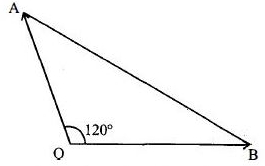
Two ships $A$ and $B$ are sailing straight away from a fixed point $O$ along routes such that $\angle AOB$ is always $120^o$. At a certain instance,$OA = 8 \ km$,$OB = 6 \ km$ and the ship $A$ is sailing at the rate of $20 \ km/hr$ while the ship $B$ is sailing at the rate of $30 \ km/hr$. Then the distance between $A$ and $B$ is changing at the rate (in $km/hr$):
A
$\frac{260}{\sqrt{37}}$
B
$\frac{260}{37}$
C
$\frac{80}{\sqrt{37}}$
D
$\frac{80}{37}$
Solution
(A) Let $OA = x \ km$,$OB = y \ km$,and $AB = R \ km$.
Using the Law of Cosines in $\triangle AOB$:
$R^2 = x^2 + y^2 - 2xy \cos(120^o)$
Since $\cos(120^o) = -\frac{1}{2}$,we have:
$R^2 = x^2 + y^2 - 2xy(-\frac{1}{2}) = x^2 + y^2 + xy \quad \dots(1)$
At the given instance,$x = 8 \ km$ and $y = 6 \ km$:
$R^2 = 8^2 + 6^2 + (8 \times 6) = 64 + 36 + 48 = 148$
$R = \sqrt{148} = 2\sqrt{37} \ km$.
Differentiating equation $(1)$ with respect to time $t$:
$2R \frac{dR}{dt} = 2x \frac{dx}{dt} + 2y \frac{dy}{dt} + (x \frac{dy}{dt} + y \frac{dx}{dt})$
Given $\frac{dx}{dt} = 20 \ km/hr$ and $\frac{dy}{dt} = 30 \ km/hr$:
$2(2\sqrt{37}) \frac{dR}{dt} = 2(8)(20) + 2(6)(30) + (8 \times 30 + 6 \times 20)$
$4\sqrt{37} \frac{dR}{dt} = 320 + 360 + (240 + 120)$
$4\sqrt{37} \frac{dR}{dt} = 680 + 360 = 1040$
$\frac{dR}{dt} = \frac{1040}{4\sqrt{37}} = \frac{260}{\sqrt{37}} \ km/hr$.
Using the Law of Cosines in $\triangle AOB$:
$R^2 = x^2 + y^2 - 2xy \cos(120^o)$
Since $\cos(120^o) = -\frac{1}{2}$,we have:
$R^2 = x^2 + y^2 - 2xy(-\frac{1}{2}) = x^2 + y^2 + xy \quad \dots(1)$
At the given instance,$x = 8 \ km$ and $y = 6 \ km$:
$R^2 = 8^2 + 6^2 + (8 \times 6) = 64 + 36 + 48 = 148$
$R = \sqrt{148} = 2\sqrt{37} \ km$.
Differentiating equation $(1)$ with respect to time $t$:
$2R \frac{dR}{dt} = 2x \frac{dx}{dt} + 2y \frac{dy}{dt} + (x \frac{dy}{dt} + y \frac{dx}{dt})$
Given $\frac{dx}{dt} = 20 \ km/hr$ and $\frac{dy}{dt} = 30 \ km/hr$:
$2(2\sqrt{37}) \frac{dR}{dt} = 2(8)(20) + 2(6)(30) + (8 \times 30 + 6 \times 20)$
$4\sqrt{37} \frac{dR}{dt} = 320 + 360 + (240 + 120)$
$4\sqrt{37} \frac{dR}{dt} = 680 + 360 = 1040$
$\frac{dR}{dt} = \frac{1040}{4\sqrt{37}} = \frac{260}{\sqrt{37}} \ km/hr$.
0 likes
View Solution115
DifficultMCQ
If the volume of a spherical ball is increasing at the rate of $4 \pi \, cc/sec$,then find the rate of increase of its radius (in $cm/sec$),when the volume is $288 \pi \, cc$.
A
$\frac{1}{6}$
B
$\frac{1}{9}$
C
$\frac{1}{36}$
D
$\frac{1}{24}$
Solution
(C) The volume of a sphere is given by $V = \frac{4}{3}\pi r^3$.
Differentiating both sides with respect to time $t$,we get:
$\frac{dV}{dt} = 4\pi r^2 \frac{dr}{dt}$.
Given that $\frac{dV}{dt} = 4\pi \, cc/sec$,we substitute this into the equation:
$4\pi = 4\pi r^2 \frac{dr}{dt} \Rightarrow \frac{dr}{dt} = \frac{1}{r^2}$.
We are given that the volume $V = 288\pi \, cc$.
Using the volume formula:
$288\pi = \frac{4}{3}\pi r^3
\Rightarrow r^3 = \frac{288 \times 3}{4} = 216
\Rightarrow r = 6 \, cm$.
Substituting $r = 6$ into the expression for $\frac{dr}{dt}$:
$\frac{dr}{dt} = \frac{1}{6^2} = \frac{1}{36} \, cm/sec$.
Differentiating both sides with respect to time $t$,we get:
$\frac{dV}{dt} = 4\pi r^2 \frac{dr}{dt}$.
Given that $\frac{dV}{dt} = 4\pi \, cc/sec$,we substitute this into the equation:
$4\pi = 4\pi r^2 \frac{dr}{dt} \Rightarrow \frac{dr}{dt} = \frac{1}{r^2}$.
We are given that the volume $V = 288\pi \, cc$.
Using the volume formula:
$288\pi = \frac{4}{3}\pi r^3
\Rightarrow r^3 = \frac{288 \times 3}{4} = 216
\Rightarrow r = 6 \, cm$.
Substituting $r = 6$ into the expression for $\frac{dr}{dt}$:
$\frac{dr}{dt} = \frac{1}{6^2} = \frac{1}{36} \, cm/sec$.
0 likes
View Solution116
DifficultMCQ
If the surface area of a sphere of radius $r$ is increasing uniformly at the rate $8 \, cm^2/s$,then the rate of change of its volume is
A
constant
B
proportional to $\sqrt{r}$
C
proportional to $r^2$
D
proportional to $r$
Solution
(D) The volume of a sphere is given by $V = \frac{4}{3}\pi r^3$.
Differentiating with respect to time $t$,we get $\frac{dV}{dt} = 4\pi r^2 \frac{dr}{dt} \dots (i)$.
The surface area of a sphere is $S = 4\pi r^2$.
Differentiating with respect to time $t$,we get $\frac{dS}{dt} = 8\pi r \frac{dr}{dt}$.
Given that $\frac{dS}{dt} = 8 \, cm^2/s$,we have $8 = 8\pi r \frac{dr}{dt}$,which implies $\frac{dr}{dt} = \frac{1}{\pi r}$.
Substituting the value of $\frac{dr}{dt}$ into equation $(i)$,we get $\frac{dV}{dt} = 4\pi r^2 \times \frac{1}{\pi r} = 4r$.
Thus,the rate of change of volume $\frac{dV}{dt}$ is proportional to $r$.
Differentiating with respect to time $t$,we get $\frac{dV}{dt} = 4\pi r^2 \frac{dr}{dt} \dots (i)$.
The surface area of a sphere is $S = 4\pi r^2$.
Differentiating with respect to time $t$,we get $\frac{dS}{dt} = 8\pi r \frac{dr}{dt}$.
Given that $\frac{dS}{dt} = 8 \, cm^2/s$,we have $8 = 8\pi r \frac{dr}{dt}$,which implies $\frac{dr}{dt} = \frac{1}{\pi r}$.
Substituting the value of $\frac{dr}{dt}$ into equation $(i)$,we get $\frac{dV}{dt} = 4\pi r^2 \times \frac{1}{\pi r} = 4r$.
Thus,the rate of change of volume $\frac{dV}{dt}$ is proportional to $r$.
0 likes
View Solution117
DifficultMCQ
$A$ spherical balloon is being inflated at the rate of $35 \, cm^3/min$. The rate of increase in the surface area (in $cm^2/min$) of the balloon when its diameter is $14 \, cm$,is
A
$10$
B
$\sqrt{10}$
C
$100$
D
$10\sqrt{10}$
Solution
(A) Let $r$ be the radius of the spherical balloon. The volume $V$ of the sphere is given by $V = \frac{4}{3}\pi r^3$.
Differentiating with respect to time $t$,we get $\frac{dV}{dt} = 4\pi r^2 \frac{dr}{dt}$.
Given $\frac{dV}{dt} = 35 \, cm^3/min$,we have $35 = 4\pi r^2 \frac{dr}{dt}$,which implies $\frac{dr}{dt} = \frac{35}{4\pi r^2} \quad (1)$.
The surface area $S$ of the sphere is $S = 4\pi r^2$.
Differentiating with respect to $t$,we get $\frac{dS}{dt} = 8\pi r \frac{dr}{dt}$.
Substituting the value of $\frac{dr}{dt}$ from $(1)$ into the expression for $\frac{dS}{dt}$:
$\frac{dS}{dt} = 8\pi r \left( \frac{35}{4\pi r^2} \right) = \frac{70}{r}$.
Given the diameter is $14 \, cm$,the radius $r = 7 \, cm$.
Substituting $r = 7$ into the expression for $\frac{dS}{dt}$:
$\frac{dS}{dt} = \frac{70}{7} = 10 \, cm^2/min$.
Differentiating with respect to time $t$,we get $\frac{dV}{dt} = 4\pi r^2 \frac{dr}{dt}$.
Given $\frac{dV}{dt} = 35 \, cm^3/min$,we have $35 = 4\pi r^2 \frac{dr}{dt}$,which implies $\frac{dr}{dt} = \frac{35}{4\pi r^2} \quad (1)$.
The surface area $S$ of the sphere is $S = 4\pi r^2$.
Differentiating with respect to $t$,we get $\frac{dS}{dt} = 8\pi r \frac{dr}{dt}$.
Substituting the value of $\frac{dr}{dt}$ from $(1)$ into the expression for $\frac{dS}{dt}$:
$\frac{dS}{dt} = 8\pi r \left( \frac{35}{4\pi r^2} \right) = \frac{70}{r}$.
Given the diameter is $14 \, cm$,the radius $r = 7 \, cm$.
Substituting $r = 7$ into the expression for $\frac{dS}{dt}$:
$\frac{dS}{dt} = \frac{70}{7} = 10 \, cm^2/min$.
0 likes
View Solution118
DifficultMCQ
If a circular iron sheet of radius $30 \, cm$ is heated such that its area increases at the uniform rate of $6\pi \, cm^2/hr$,then the rate (in $cm/hr$) at which the radius of the circular sheet increases is
A
$1.0$
B
$0.1$
C
$1.1$
D
$2.0$
Solution
(B) Let the radius of the circular sheet be $r$ and its area be $A$.
Given that $A = \pi r^2$.
Differentiating both sides with respect to time $t$,we get:
$\frac{dA}{dt} = 2\pi r \frac{dr}{dt}$.
We are given that $\frac{dA}{dt} = 6\pi \, cm^2/hr$ and $r = 30 \, cm$.
Substituting these values into the equation:
$6\pi = 2\pi (30) \frac{dr}{dt}$.
$6\pi = 60\pi \frac{dr}{dt}$.
$\frac{dr}{dt} = \frac{6\pi}{60\pi} = \frac{1}{10} = 0.1 \, cm/hr$.
Thus,the rate at which the radius of the circular sheet increases is $0.1 \, cm/hr$.
Given that $A = \pi r^2$.
Differentiating both sides with respect to time $t$,we get:
$\frac{dA}{dt} = 2\pi r \frac{dr}{dt}$.
We are given that $\frac{dA}{dt} = 6\pi \, cm^2/hr$ and $r = 30 \, cm$.
Substituting these values into the equation:
$6\pi = 2\pi (30) \frac{dr}{dt}$.
$6\pi = 60\pi \frac{dr}{dt}$.
$\frac{dr}{dt} = \frac{6\pi}{60\pi} = \frac{1}{10} = 0.1 \, cm/hr$.
Thus,the rate at which the radius of the circular sheet increases is $0.1 \, cm/hr$.
0 likes
View Solution119
DifficultMCQ
Consider a rectangle whose length is increasing at the uniform rate of $2 \, m/sec$,breadth is decreasing at the uniform rate of $3 \, m/sec$ and the area is decreasing at the uniform rate of $5 \, m^2/sec$. If after some time the breadth of the rectangle is $2 \, m$,then the length of the rectangle is ........ $m$.
A
$2$
B
$4$
C
$1$
D
$3$
Solution
(D) Let $A$ be the area,$b$ be the breadth,and $\ell$ be the length of the rectangle.
Given: $\frac{dA}{dt} = -5$,$\frac{d\ell}{dt} = 2$,and $\frac{db}{dt} = -3$.
We know that the area of a rectangle is $A = \ell \times b$.
Differentiating both sides with respect to time $t$,we get:
$\frac{dA}{dt} = \ell \cdot \frac{db}{dt} + b \cdot \frac{d\ell}{dt}$.
Substituting the given values:
$-5 = \ell(-3) + b(2)$.
$-5 = -3\ell + 2b$.
When the breadth $b = 2 \, m$,we substitute this into the equation:
$-5 = -3\ell + 2(2)$.
$-5 = -3\ell + 4$.
$3\ell = 4 + 5$.
$3\ell = 9$.
$\ell = 3 \, m$.
Thus,the length of the rectangle is $3 \, m$.
Given: $\frac{dA}{dt} = -5$,$\frac{d\ell}{dt} = 2$,and $\frac{db}{dt} = -3$.
We know that the area of a rectangle is $A = \ell \times b$.
Differentiating both sides with respect to time $t$,we get:
$\frac{dA}{dt} = \ell \cdot \frac{db}{dt} + b \cdot \frac{d\ell}{dt}$.
Substituting the given values:
$-5 = \ell(-3) + b(2)$.
$-5 = -3\ell + 2b$.
When the breadth $b = 2 \, m$,we substitute this into the equation:
$-5 = -3\ell + 2(2)$.
$-5 = -3\ell + 4$.
$3\ell = 4 + 5$.
$3\ell = 9$.
$\ell = 3 \, m$.
Thus,the length of the rectangle is $3 \, m$.
0 likes
View Solution120
DifficultMCQ
The weight $W$ of a certain stock of fish is given by $W = nw,$ where $n$ is the size of the stock and $w$ is the average weight of a fish. If $n$ and $w$ change with time $t$ as $n = 2t^2 + 3$ and $w = t^2 - t + 2,$ then the rate of change of $W$ with respect to $t$ at $t = 1$ is
A
$1$
B
$8$
C
$13$
D
$5$
Solution
(C) Given $W = nw$.
Using the product rule for differentiation,we have:
$\frac{dW}{dt} = n \frac{dw}{dt} + w \frac{dn}{dt}$
Given $n = 2t^2 + 3$ and $w = t^2 - t + 2$.
Calculating the derivatives with respect to $t$:
$\frac{dn}{dt} = 4t$
$\frac{dw}{dt} = 2t - 1$
At $t = 1$:
$n = 2(1)^2 + 3 = 5$
$w = (1)^2 - 1 + 2 = 2$
$\frac{dn}{dt} = 4(1) = 4$
$\frac{dw}{dt} = 2(1) - 1 = 1$
Substituting these values into the derivative formula:
$\frac{dW}{dt} = (5)(1) + (2)(4)$
$\frac{dW}{dt} = 5 + 8 = 13$
Using the product rule for differentiation,we have:
$\frac{dW}{dt} = n \frac{dw}{dt} + w \frac{dn}{dt}$
Given $n = 2t^2 + 3$ and $w = t^2 - t + 2$.
Calculating the derivatives with respect to $t$:
$\frac{dn}{dt} = 4t$
$\frac{dw}{dt} = 2t - 1$
At $t = 1$:
$n = 2(1)^2 + 3 = 5$
$w = (1)^2 - 1 + 2 = 2$
$\frac{dn}{dt} = 4(1) = 4$
$\frac{dw}{dt} = 2(1) - 1 = 1$
Substituting these values into the derivative formula:
$\frac{dW}{dt} = (5)(1) + (2)(4)$
$\frac{dW}{dt} = 5 + 8 = 13$
0 likes
View Solution121
DifficultMCQ
If a metallic circular plate of radius $50 \, cm$ is heated so that its radius increases at the rate of $1 \, mm$ per hour,then the rate at which the area of the plate increases (in $cm^2/hour$) is (in $\pi$)
A
$5$
B
$10$
C
$100$
D
$50$
Solution
(B) Let $A$ be the area of the circular plate and $r$ be its radius. The area is given by $A = \pi r^2$.
Given that the radius $r = 50 \, cm$ and the rate of change of the radius is $\frac{dr}{dt} = 1 \, mm/hour = 0.1 \, cm/hour = \frac{1}{10} \, cm/hour$.
Differentiating the area formula with respect to time $t$,we get $\frac{dA}{dt} = 2\pi r \frac{dr}{dt}$.
Substituting the given values,$\frac{dA}{dt} = 2 \times \pi \times 50 \times \frac{1}{10} = 10\pi \, cm^2/hour$.
Thus,the rate at which the area of the plate increases is $10\pi \, cm^2/hour$.
Given that the radius $r = 50 \, cm$ and the rate of change of the radius is $\frac{dr}{dt} = 1 \, mm/hour = 0.1 \, cm/hour = \frac{1}{10} \, cm/hour$.
Differentiating the area formula with respect to time $t$,we get $\frac{dA}{dt} = 2\pi r \frac{dr}{dt}$.
Substituting the given values,$\frac{dA}{dt} = 2 \times \pi \times 50 \times \frac{1}{10} = 10\pi \, cm^2/hour$.
Thus,the rate at which the area of the plate increases is $10\pi \, cm^2/hour$.
0 likes
View Solution122
DifficultMCQ
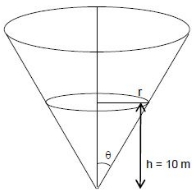
$A$ water tank has the shape of an inverted right circular cone,whose semi-vertical angle is $\tan^{-1}(1/2)$. Water is poured in at a constant rate of $5 \ m^3/min$. Then the rate (in $m/min$) at which the level of water is rising at the instant when the depth of water in the tank is $10 \ m$ is:
A
$\frac{2}{\pi}$
B
$\frac{1}{5\pi}$
C
$\frac{1}{10\pi}$
D
$\frac{1}{15\pi}$
Solution
(B) Let $h$ be the depth of water and $r$ be the radius of the water surface at time $t$.
Given the semi-vertical angle $\theta = \tan^{-1}(1/2)$,we have $\tan \theta = \frac{r}{h} = \frac{1}{2}$,which implies $r = \frac{h}{2}$.
The volume $V$ of the water in the cone is given by $V = \frac{1}{3}\pi r^2 h$.
Substituting $r = \frac{h}{2}$,we get $V = \frac{1}{3}\pi \left(\frac{h}{2}\right)^2 h = \frac{\pi h^3}{12}$.
Differentiating both sides with respect to time $t$,we get $\frac{dV}{dt} = \frac{\pi}{12} (3h^2) \frac{dh}{dt} = \frac{\pi h^2}{4} \frac{dh}{dt}$.
Given $\frac{dV}{dt} = 5 \ m^3/min$ and $h = 10 \ m$,we substitute these values:
$5 = \frac{\pi (10)^2}{4} \frac{dh}{dt}$
$5 = \frac{100\pi}{4} \frac{dh}{dt}$
$5 = 25\pi \frac{dh}{dt}$
$\frac{dh}{dt} = \frac{5}{25\pi} = \frac{1}{5\pi} \ m/min$.
Given the semi-vertical angle $\theta = \tan^{-1}(1/2)$,we have $\tan \theta = \frac{r}{h} = \frac{1}{2}$,which implies $r = \frac{h}{2}$.
The volume $V$ of the water in the cone is given by $V = \frac{1}{3}\pi r^2 h$.
Substituting $r = \frac{h}{2}$,we get $V = \frac{1}{3}\pi \left(\frac{h}{2}\right)^2 h = \frac{\pi h^3}{12}$.
Differentiating both sides with respect to time $t$,we get $\frac{dV}{dt} = \frac{\pi}{12} (3h^2) \frac{dh}{dt} = \frac{\pi h^2}{4} \frac{dh}{dt}$.
Given $\frac{dV}{dt} = 5 \ m^3/min$ and $h = 10 \ m$,we substitute these values:
$5 = \frac{\pi (10)^2}{4} \frac{dh}{dt}$
$5 = \frac{100\pi}{4} \frac{dh}{dt}$
$5 = 25\pi \frac{dh}{dt}$
$\frac{dh}{dt} = \frac{5}{25\pi} = \frac{1}{5\pi} \ m/min$.
0 likes
View Solution123
DifficultMCQ
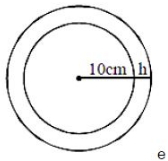
$A$ spherical iron ball of radius $10 \, cm$ is coated with a layer of ice of uniform thickness that melts at a rate of $50 \, cm^3/min$. When the thickness of the ice is $5 \, cm$,then the rate at which the thickness (in $cm/min$) of ice decreases is
A
$\frac{1}{36\pi}$
B
$\frac{5}{6\pi}$
C
$\frac{1}{9\pi}$
D
$\frac{1}{18\pi}$
Solution
(D) Let $r = 10 \, cm$ be the radius of the iron ball and $h$ be the thickness of the ice layer.
The total radius of the sphere including the ice is $R = 10 + h$.
The volume of the ice layer $V$ is given by the difference between the volume of the sphere with ice and the volume of the iron ball:
$V = \frac{4}{3}\pi (10 + h)^3 - \frac{4}{3}\pi (10)^3$
Differentiating both sides with respect to time $t$:
$\frac{dV}{dt} = \frac{4}{3}\pi \cdot 3(10 + h)^2 \cdot \frac{dh}{dt} = 4\pi (10 + h)^2 \frac{dh}{dt}$
Given that the ice melts at a rate of $50 \, cm^3/min$,we have $\frac{dV}{dt} = -50 \, cm^3/min$.
Substituting $h = 5 \, cm$ and $\frac{dV}{dt} = -50$ into the equation:
$-50 = 4\pi (10 + 5)^2 \frac{dh}{dt}$
$-50 = 4\pi (15)^2 \frac{dh}{dt}$
$-50 = 4\pi (225) \frac{dh}{dt}$
$-50 = 900\pi \frac{dh}{dt}$
$\frac{dh}{dt} = -\frac{50}{900\pi} = -\frac{1}{18\pi} \, cm/min$.
The rate at which the thickness decreases is $\frac{1}{18\pi} \, cm/min$.
The total radius of the sphere including the ice is $R = 10 + h$.
The volume of the ice layer $V$ is given by the difference between the volume of the sphere with ice and the volume of the iron ball:
$V = \frac{4}{3}\pi (10 + h)^3 - \frac{4}{3}\pi (10)^3$
Differentiating both sides with respect to time $t$:
$\frac{dV}{dt} = \frac{4}{3}\pi \cdot 3(10 + h)^2 \cdot \frac{dh}{dt} = 4\pi (10 + h)^2 \frac{dh}{dt}$
Given that the ice melts at a rate of $50 \, cm^3/min$,we have $\frac{dV}{dt} = -50 \, cm^3/min$.
Substituting $h = 5 \, cm$ and $\frac{dV}{dt} = -50$ into the equation:
$-50 = 4\pi (10 + 5)^2 \frac{dh}{dt}$
$-50 = 4\pi (15)^2 \frac{dh}{dt}$
$-50 = 4\pi (225) \frac{dh}{dt}$
$-50 = 900\pi \frac{dh}{dt}$
$\frac{dh}{dt} = -\frac{50}{900\pi} = -\frac{1}{18\pi} \, cm/min$.
The rate at which the thickness decreases is $\frac{1}{18\pi} \, cm/min$.
0 likes
View Solution124
DifficultMCQ
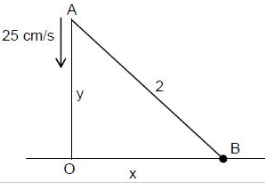
$A$ $2 \ m$ ladder leans against a vertical wall. If the top of the ladder begins to slide down the wall at the rate of $25 \ cm/sec$,then the rate (in $cm/sec$) at which the bottom of the ladder slides away from the wall on the horizontal ground when the top of the ladder is $1 \ m$ above the ground is:
A
$25$
B
$\frac{25}{3}$
C
$25\sqrt{3}$
D
$\frac{25}{\sqrt{3}}$
Solution
(D) Let $x$ be the distance of the bottom of the ladder from the wall and $y$ be the height of the top of the ladder from the ground. The length of the ladder is $L = 2 \ m = 200 \ cm$.
By Pythagoras theorem,we have $x^2 + y^2 = 200^2$.
Differentiating with respect to time $t$,we get $2x \frac{dx}{dt} + 2y \frac{dy}{dt} = 0$,which simplifies to $x \frac{dx}{dt} + y \frac{dy}{dt} = 0$.
Given that the top slides down at $25 \ cm/sec$,we have $\frac{dy}{dt} = -25 \ cm/sec$.
When $y = 1 \ m = 100 \ cm$,we find $x$ using $x^2 + 100^2 = 200^2$,so $x^2 = 40000 - 10000 = 30000$,which gives $x = \sqrt{30000} = 100\sqrt{3} \ cm$.
Substituting these values into the differentiated equation: $(100\sqrt{3}) \frac{dx}{dt} + (100)(-25) = 0$.
$(100\sqrt{3}) \frac{dx}{dt} = 2500$.
$\frac{dx}{dt} = \frac{2500}{100\sqrt{3}} = \frac{25}{\sqrt{3}} \ cm/sec$.
By Pythagoras theorem,we have $x^2 + y^2 = 200^2$.
Differentiating with respect to time $t$,we get $2x \frac{dx}{dt} + 2y \frac{dy}{dt} = 0$,which simplifies to $x \frac{dx}{dt} + y \frac{dy}{dt} = 0$.
Given that the top slides down at $25 \ cm/sec$,we have $\frac{dy}{dt} = -25 \ cm/sec$.
When $y = 1 \ m = 100 \ cm$,we find $x$ using $x^2 + 100^2 = 200^2$,so $x^2 = 40000 - 10000 = 30000$,which gives $x = \sqrt{30000} = 100\sqrt{3} \ cm$.
Substituting these values into the differentiated equation: $(100\sqrt{3}) \frac{dx}{dt} + (100)(-25) = 0$.
$(100\sqrt{3}) \frac{dx}{dt} = 2500$.
$\frac{dx}{dt} = \frac{2500}{100\sqrt{3}} = \frac{25}{\sqrt{3}} \ cm/sec$.
0 likes
View Solution125
EasyMCQ
Find the rate of change of the area of a circle with respect to its radius $r$ when $r=5 \text{ cm}$.
A
$5 \pi \text{ cm}^2/\text{cm}$
B
$10 \pi \text{ cm}^2/\text{cm}$
C
$25 \pi \text{ cm}^2/\text{cm}$
D
$20 \pi \text{ cm}^2/\text{cm}$
Solution
(B) The area $A$ of a circle with radius $r$ is given by $A = \pi r^2$.
To find the rate of change of the area with respect to the radius,we differentiate $A$ with respect to $r$:
$\frac{dA}{dr} = \frac{d}{dr}(\pi r^2) = 2\pi r$.
Given that $r = 5 \text{ cm}$,we substitute this value into the derivative:
$\frac{dA}{dr} = 2 \times \pi \times 5 = 10\pi$.
Therefore,the rate of change of the area of the circle with respect to its radius when $r = 5 \text{ cm}$ is $10\pi \text{ cm}^2/\text{cm}$.
To find the rate of change of the area with respect to the radius,we differentiate $A$ with respect to $r$:
$\frac{dA}{dr} = \frac{d}{dr}(\pi r^2) = 2\pi r$.
Given that $r = 5 \text{ cm}$,we substitute this value into the derivative:
$\frac{dA}{dr} = 2 \times \pi \times 5 = 10\pi$.
Therefore,the rate of change of the area of the circle with respect to its radius when $r = 5 \text{ cm}$ is $10\pi \text{ cm}^2/\text{cm}$.
0 likes
View Solution126
MediumMCQ
The volume of a cube is increasing at a rate of $9 \text{ cm}^3/\text{s}$. How fast is the surface area increasing when the length of an edge is $10 \text{ cm}$ (in $\text{ cm}^2/\text{s}$)?
A
$3.6$
B
$2.4$
C
$1.8$
D
$4.2$
Solution
(A) Let $x$ be the length of an edge of the cube. Let $V$ be the volume and $S$ be the surface area of the cube. Then $V = x^3$ and $S = 6x^2$, where $x$ is a function of time $t$.
Given that the rate of change of volume is $\frac{dV}{dt} = 9 \text{ cm}^3/\text{s}$.
Using the chain rule, $\frac{dV}{dt} = \frac{d}{dt}(x^3) = 3x^2 \cdot \frac{dx}{dt}$.
Substituting the given value, $9 = 3x^2 \cdot \frac{dx}{dt}$, which gives $\frac{dx}{dt} = \frac{3}{x^2}$.
Now, we need to find the rate of change of the surface area, $\frac{dS}{dt}$.
Using the chain rule, $\frac{dS}{dt} = \frac{d}{dt}(6x^2) = 12x \cdot \frac{dx}{dt}$.
Substituting $\frac{dx}{dt} = \frac{3}{x^2}$ into the equation, we get $\frac{dS}{dt} = 12x \cdot \left(\frac{3}{x^2}\right) = \frac{36}{x}$.
When the edge length $x = 10 \text{ cm}$, the rate of change of the surface area is $\frac{dS}{dt} = \frac{36}{10} = 3.6 \text{ cm}^2/\text{s}$.
Given that the rate of change of volume is $\frac{dV}{dt} = 9 \text{ cm}^3/\text{s}$.
Using the chain rule, $\frac{dV}{dt} = \frac{d}{dt}(x^3) = 3x^2 \cdot \frac{dx}{dt}$.
Substituting the given value, $9 = 3x^2 \cdot \frac{dx}{dt}$, which gives $\frac{dx}{dt} = \frac{3}{x^2}$.
Now, we need to find the rate of change of the surface area, $\frac{dS}{dt}$.
Using the chain rule, $\frac{dS}{dt} = \frac{d}{dt}(6x^2) = 12x \cdot \frac{dx}{dt}$.
Substituting $\frac{dx}{dt} = \frac{3}{x^2}$ into the equation, we get $\frac{dS}{dt} = 12x \cdot \left(\frac{3}{x^2}\right) = \frac{36}{x}$.
When the edge length $x = 10 \text{ cm}$, the rate of change of the surface area is $\frac{dS}{dt} = \frac{36}{10} = 3.6 \text{ cm}^2/\text{s}$.
0 likes
View Solution127
MediumMCQ
$A$ stone is dropped into a quiet lake and waves move in circles at a speed of $4 \text{ cm/s}$. At the instant when the radius of the circular wave is $10 \text{ cm}$,how fast is the enclosed area increasing?
A
$80 \pi \text{ cm}^2/\text{s}$
B
$40 \pi \text{ cm}^2/\text{s}$
C
$100 \pi \text{ cm}^2/\text{s}$
D
$160 \pi \text{ cm}^2/\text{s}$
Solution
(A) The area $A$ of a circle with radius $r$ is given by $A = \pi r^2$.
Taking the derivative with respect to time $t$,we get:
$\frac{dA}{dt} = \frac{d}{dt}(\pi r^2) = 2 \pi r \frac{dr}{dt}$.
Given that the rate of change of the radius is $\frac{dr}{dt} = 4 \text{ cm/s}$.
At the instant when $r = 10 \text{ cm}$,we substitute the values into the derivative formula:
$\frac{dA}{dt} = 2 \pi (10 \text{ cm}) (4 \text{ cm/s}) = 80 \pi \text{ cm}^2/\text{s}$.
Thus,the enclosed area is increasing at the rate of $80 \pi \text{ cm}^2/\text{s}$.
Taking the derivative with respect to time $t$,we get:
$\frac{dA}{dt} = \frac{d}{dt}(\pi r^2) = 2 \pi r \frac{dr}{dt}$.
Given that the rate of change of the radius is $\frac{dr}{dt} = 4 \text{ cm/s}$.
At the instant when $r = 10 \text{ cm}$,we substitute the values into the derivative formula:
$\frac{dA}{dt} = 2 \pi (10 \text{ cm}) (4 \text{ cm/s}) = 80 \pi \text{ cm}^2/\text{s}$.
Thus,the enclosed area is increasing at the rate of $80 \pi \text{ cm}^2/\text{s}$.
0 likes
View Solution128
MediumMCQ
The length $x$ of a rectangle is decreasing at the rate of $3 \text{ cm/min}$ and the width $y$ is increasing at the rate of $2 \text{ cm/min}$. When $x = 10 \text{ cm}$ and $y = 6 \text{ cm}$,find the rate of change of the area of the rectangle.
A
$2 \text{ cm}^2/\text{min}$
B
$-2 \text{ cm}^2/\text{min}$
C
$1 \text{ cm}^2/\text{min}$
D
$-1 \text{ cm}^2/\text{min}$
Solution
(A) Given that the length $x$ is decreasing at the rate of $3 \text{ cm/min}$,so $\frac{dx}{dt} = -3 \text{ cm/min}$.
Given that the width $y$ is increasing at the rate of $2 \text{ cm/min}$,so $\frac{dy}{dt} = 2 \text{ cm/min}$.
The area $A$ of the rectangle is given by $A = x \cdot y$.
Differentiating both sides with respect to $t$,we get $\frac{dA}{dt} = \frac{dx}{dt} \cdot y + x \cdot \frac{dy}{dt}$.
Substituting the given values $x = 10 \text{ cm}$,$y = 6 \text{ cm}$,$\frac{dx}{dt} = -3 \text{ cm/min}$,and $\frac{dy}{dt} = 2 \text{ cm/min}$:
$\frac{dA}{dt} = (-3)(6) + (10)(2) = -18 + 20 = 2 \text{ cm}^2/\text{min}$.
Thus,the rate of change of the area is $2 \text{ cm}^2/\text{min}$.
Given that the width $y$ is increasing at the rate of $2 \text{ cm/min}$,so $\frac{dy}{dt} = 2 \text{ cm/min}$.
The area $A$ of the rectangle is given by $A = x \cdot y$.
Differentiating both sides with respect to $t$,we get $\frac{dA}{dt} = \frac{dx}{dt} \cdot y + x \cdot \frac{dy}{dt}$.
Substituting the given values $x = 10 \text{ cm}$,$y = 6 \text{ cm}$,$\frac{dx}{dt} = -3 \text{ cm/min}$,and $\frac{dy}{dt} = 2 \text{ cm/min}$:
$\frac{dA}{dt} = (-3)(6) + (10)(2) = -18 + 20 = 2 \text{ cm}^2/\text{min}$.
Thus,the rate of change of the area is $2 \text{ cm}^2/\text{min}$.
0 likes
View Solution129
MediumMCQ
The total cost $C(x)$ in Rupees,associated with the production of $x$ units of an item is given by $C(x) = 0.005x^{3} - 0.02x^{2} + 30x + 5000$. Find the marginal cost when $3$ units are produced,where marginal cost is defined as the instantaneous rate of change of total cost with respect to the number of units produced.
A
$Rs. 30.015$
B
$Rs. 30.02$
C
$Rs. 30.05$
D
$Rs. 30.10$
Solution
(A) The marginal cost $(MC)$ is the derivative of the total cost function $C(x)$ with respect to $x$:
$MC = \frac{dC}{dx} = \frac{d}{dx}(0.005x^{3} - 0.02x^{2} + 30x + 5000)$
$MC = 0.005(3x^{2}) - 0.02(2x) + 30$
$MC = 0.015x^{2} - 0.04x + 30$
To find the marginal cost when $x = 3$ units are produced,substitute $x = 3$ into the expression for $MC$:
$MC = 0.015(3)^{2} - 0.04(3) + 30$
$MC = 0.015(9) - 0.12 + 30$
$MC = 0.135 - 0.12 + 30$
$MC = 0.015 + 30 = 30.015$
Thus,the marginal cost is $Rs. 30.015$.
$MC = \frac{dC}{dx} = \frac{d}{dx}(0.005x^{3} - 0.02x^{2} + 30x + 5000)$
$MC = 0.005(3x^{2}) - 0.02(2x) + 30$
$MC = 0.015x^{2} - 0.04x + 30$
To find the marginal cost when $x = 3$ units are produced,substitute $x = 3$ into the expression for $MC$:
$MC = 0.015(3)^{2} - 0.04(3) + 30$
$MC = 0.015(9) - 0.12 + 30$
$MC = 0.135 - 0.12 + 30$
$MC = 0.015 + 30 = 30.015$
Thus,the marginal cost is $Rs. 30.015$.
0 likes
View Solution130
MediumMCQ
The total revenue in Rupees received from the sale of $x$ units of a product is given by $R(x) = 3x^2 + 36x + 5$. Find the marginal revenue when $x = 5$,where marginal revenue is defined as the rate of change of total revenue with respect to the number of items sold at an instant.
A
$Rs. 66$
B
$Rs. 56$
C
$Rs. 76$
D
$Rs. 46$
Solution
(A) Marginal revenue is defined as the rate of change of total revenue with respect to the number of units sold,which is given by the derivative $\frac{dR}{dx}$.
Given $R(x) = 3x^2 + 36x + 5$.
Marginal Revenue $(MR) = \frac{dR}{dx} = \frac{d}{dx}(3x^2 + 36x + 5) = 6x + 36$.
To find the marginal revenue when $x = 5$,we substitute $x = 5$ into the expression for $MR$:
$MR = 6(5) + 36 = 30 + 36 = 66$.
Thus,the marginal revenue is $Rs. 66$.
Given $R(x) = 3x^2 + 36x + 5$.
Marginal Revenue $(MR) = \frac{dR}{dx} = \frac{d}{dx}(3x^2 + 36x + 5) = 6x + 36$.
To find the marginal revenue when $x = 5$,we substitute $x = 5$ into the expression for $MR$:
$MR = 6(5) + 36 = 30 + 36 = 66$.
Thus,the marginal revenue is $Rs. 66$.
0 likes
View Solution131
MediumMCQ
Find the rate of change of the area of a circle with respect to its radius $r$ when $r = 3 \text{ cm}$. (in $\pi \text{ cm}$)
A
$6$
B
$3$
C
$9$
D
$12$
Solution
(A) The area of a circle $(A)$ with radius $(r)$ is given by the formula:
$A = \pi r^2$
To find the rate of change of the area with respect to its radius, we differentiate $A$ with respect to $r$:
$\frac{dA}{dr} = \frac{d}{dr}(\pi r^2) = 2 \pi r$
Now, substitute the value $r = 3 \text{ cm}$ into the expression:
$\frac{dA}{dr} = 2 \pi (3) = 6 \pi \text{ cm}$
Thus, the area of the circle is changing at the rate of $6 \pi \text{ cm}$ when its radius is $3 \text{ cm}$.
$A = \pi r^2$
To find the rate of change of the area with respect to its radius, we differentiate $A$ with respect to $r$:
$\frac{dA}{dr} = \frac{d}{dr}(\pi r^2) = 2 \pi r$
Now, substitute the value $r = 3 \text{ cm}$ into the expression:
$\frac{dA}{dr} = 2 \pi (3) = 6 \pi \text{ cm}$
Thus, the area of the circle is changing at the rate of $6 \pi \text{ cm}$ when its radius is $3 \text{ cm}$.
0 likes
View Solution132
MediumMCQ
Find the rate of change of the area of a circle with respect to its radius $r$ when $r=4 \, cm$. (in $\pi \, cm$)
A
$8$
B
$4$
C
$16$
D
$2$
Solution
(A) The area of a circle $(A)$ with radius $(r)$ is given by the formula:
$A = \pi r^{2}$
To find the rate of change of the area with respect to its radius,we differentiate $A$ with respect to $r$:
$\frac{dA}{dr} = \frac{d}{dr}(\pi r^{2}) = 2 \pi r$
Now,substitute the given value $r = 4 \, cm$ into the derivative:
$\frac{dA}{dr} = 2 \pi (4) = 8 \pi \, cm$
Thus,the rate of change of the area of the circle with respect to its radius when $r = 4 \, cm$ is $8 \pi \, cm$.
$A = \pi r^{2}$
To find the rate of change of the area with respect to its radius,we differentiate $A$ with respect to $r$:
$\frac{dA}{dr} = \frac{d}{dr}(\pi r^{2}) = 2 \pi r$
Now,substitute the given value $r = 4 \, cm$ into the derivative:
$\frac{dA}{dr} = 2 \pi (4) = 8 \pi \, cm$
Thus,the rate of change of the area of the circle with respect to its radius when $r = 4 \, cm$ is $8 \pi \, cm$.
0 likes
View Solution133
MediumMCQ
The volume of a cube is increasing at the rate of $8 \, cm^{3}/s$. How fast is the surface area increasing when the length of an edge is $12 \, cm$?
A
$\frac{8}{3} \, cm^{2}/s$
B
$\frac{4}{3} \, cm^{2}/s$
C
$\frac{2}{3} \, cm^{2}/s$
D
$\frac{16}{3} \, cm^{2}/s$
Solution
(A) Let $x$ be the length of an edge,$V$ be the volume,and $S$ be the surface area of the cube.
We have $V = x^{3}$ and $S = 6x^{2}$.
Given that the rate of change of volume is $\frac{dV}{dt} = 8 \, cm^{3}/s$.
Using the chain rule,$\frac{dV}{dt} = \frac{d}{dt}(x^{3}) = 3x^{2} \cdot \frac{dx}{dt}$.
Substituting the given values: $8 = 3x^{2} \cdot \frac{dx}{dt} \implies \frac{dx}{dt} = \frac{8}{3x^{2}}$.
Now,the rate of change of surface area is $\frac{dS}{dt} = \frac{d}{dt}(6x^{2}) = 12x \cdot \frac{dx}{dt}$.
Substituting $\frac{dx}{dt}$ from the previous step: $\frac{dS}{dt} = 12x \cdot \left(\frac{8}{3x^{2}}\right) = \frac{32}{x}$.
When the edge length $x = 12 \, cm$,the rate of change of surface area is $\frac{dS}{dt} = \frac{32}{12} = \frac{8}{3} \, cm^{2}/s$.
We have $V = x^{3}$ and $S = 6x^{2}$.
Given that the rate of change of volume is $\frac{dV}{dt} = 8 \, cm^{3}/s$.
Using the chain rule,$\frac{dV}{dt} = \frac{d}{dt}(x^{3}) = 3x^{2} \cdot \frac{dx}{dt}$.
Substituting the given values: $8 = 3x^{2} \cdot \frac{dx}{dt} \implies \frac{dx}{dt} = \frac{8}{3x^{2}}$.
Now,the rate of change of surface area is $\frac{dS}{dt} = \frac{d}{dt}(6x^{2}) = 12x \cdot \frac{dx}{dt}$.
Substituting $\frac{dx}{dt}$ from the previous step: $\frac{dS}{dt} = 12x \cdot \left(\frac{8}{3x^{2}}\right) = \frac{32}{x}$.
When the edge length $x = 12 \, cm$,the rate of change of surface area is $\frac{dS}{dt} = \frac{32}{12} = \frac{8}{3} \, cm^{2}/s$.
0 likes
View Solution134
MediumMCQ
The radius of a circle is increasing uniformly at the rate of $3 \text{ cm/s}$. Find the rate at which the area of the circle is increasing when the radius is $10 \text{ cm}$.
A
$60 \pi \text{ cm}^2/\text{s}$
B
$30 \pi \text{ cm}^2/\text{s}$
C
$20 \pi \text{ cm}^2/\text{s}$
D
$10 \pi \text{ cm}^2/\text{s}$
Solution
(A) The area of a circle $(A)$ with radius $(r)$ is given by $A = \pi r^2$.
Differentiating both sides with respect to time $(t)$,we get:
$\frac{dA}{dt} = \frac{d}{dt}(\pi r^2) = 2 \pi r \frac{dr}{dt}$ (using the chain rule).
Given that the rate of change of the radius is $\frac{dr}{dt} = 3 \text{ cm/s}$.
Substituting the values,we get:
$\frac{dA}{dt} = 2 \pi r (3) = 6 \pi r$.
When the radius $r = 10 \text{ cm}$,the rate of change of the area is:
$\frac{dA}{dt} = 6 \pi (10) = 60 \pi \text{ cm}^2/\text{s}$.
Thus,the area of the circle is increasing at the rate of $60 \pi \text{ cm}^2/\text{s}$.
Differentiating both sides with respect to time $(t)$,we get:
$\frac{dA}{dt} = \frac{d}{dt}(\pi r^2) = 2 \pi r \frac{dr}{dt}$ (using the chain rule).
Given that the rate of change of the radius is $\frac{dr}{dt} = 3 \text{ cm/s}$.
Substituting the values,we get:
$\frac{dA}{dt} = 2 \pi r (3) = 6 \pi r$.
When the radius $r = 10 \text{ cm}$,the rate of change of the area is:
$\frac{dA}{dt} = 6 \pi (10) = 60 \pi \text{ cm}^2/\text{s}$.
Thus,the area of the circle is increasing at the rate of $60 \pi \text{ cm}^2/\text{s}$.
0 likes
View Solution135
MediumMCQ
An edge of a variable cube is increasing at the rate of $3 \, cm/s$. How fast is the volume of the cube increasing when the edge is $10 \, cm$ long?
A
$900 \, cm^3/s$
B
$600 \, cm^3/s$
C
$300 \, cm^3/s$
D
$100 \, cm^3/s$
Solution
(A) Let $x$ be the length of the edge and $V$ be the volume of the cube.
Then,the volume is given by $V = x^3$.
Differentiating both sides with respect to time $t$,we get:
$\frac{dV}{dt} = \frac{d}{dt}(x^3) = 3x^2 \cdot \frac{dx}{dt}$ (by chain rule).
Given that the rate of increase of the edge is $\frac{dx}{dt} = 3 \, cm/s$.
Substituting this value,we get:
$\frac{dV}{dt} = 3x^2(3) = 9x^2$.
When the edge length $x = 10 \, cm$,the rate of increase of the volume is:
$\frac{dV}{dt} = 9(10)^2 = 9(100) = 900 \, cm^3/s$.
Thus,the volume of the cube is increasing at the rate of $900 \, cm^3/s$.
Then,the volume is given by $V = x^3$.
Differentiating both sides with respect to time $t$,we get:
$\frac{dV}{dt} = \frac{d}{dt}(x^3) = 3x^2 \cdot \frac{dx}{dt}$ (by chain rule).
Given that the rate of increase of the edge is $\frac{dx}{dt} = 3 \, cm/s$.
Substituting this value,we get:
$\frac{dV}{dt} = 3x^2(3) = 9x^2$.
When the edge length $x = 10 \, cm$,the rate of increase of the volume is:
$\frac{dV}{dt} = 9(10)^2 = 9(100) = 900 \, cm^3/s$.
Thus,the volume of the cube is increasing at the rate of $900 \, cm^3/s$.
0 likes
View Solution136
MediumMCQ
$A$ stone is dropped into a quiet lake and waves move in circles at the speed of $5 \text{ cm/s}$. At the instant when the radius of the circular wave is $8 \text{ cm}$,how fast is the enclosed area increasing?
A
$80 \pi \text{ cm}^2/\text{s}$
B
$40 \pi \text{ cm}^2/\text{s}$
C
$20 \pi \text{ cm}^2/\text{s}$
D
$160 \pi \text{ cm}^2/\text{s}$
Solution
(A) The area of a circle $A$ with radius $r$ is given by $A = \pi r^2$.
Differentiating both sides with respect to time $t$,we get:
$\frac{dA}{dt} = \frac{d}{dt}(\pi r^2) = 2\pi r \frac{dr}{dt}$.
Given that the rate of change of the radius is $\frac{dr}{dt} = 5 \text{ cm/s}$.
At the instant when $r = 8 \text{ cm}$,we substitute the values into the derivative:
$\frac{dA}{dt} = 2 \pi (8 \text{ cm}) (5 \text{ cm/s}) = 80 \pi \text{ cm}^2/\text{s}$.
Thus,the enclosed area is increasing at the rate of $80 \pi \text{ cm}^2/\text{s}$.
Differentiating both sides with respect to time $t$,we get:
$\frac{dA}{dt} = \frac{d}{dt}(\pi r^2) = 2\pi r \frac{dr}{dt}$.
Given that the rate of change of the radius is $\frac{dr}{dt} = 5 \text{ cm/s}$.
At the instant when $r = 8 \text{ cm}$,we substitute the values into the derivative:
$\frac{dA}{dt} = 2 \pi (8 \text{ cm}) (5 \text{ cm/s}) = 80 \pi \text{ cm}^2/\text{s}$.
Thus,the enclosed area is increasing at the rate of $80 \pi \text{ cm}^2/\text{s}$.
0 likes
View Solution137
MediumMCQ
The radius of a circle is increasing at the rate of $0.7 \, cm/s$. What is the rate of increase of its circumference?
A
$1.4 \pi \, cm/s$
B
$2.8 \pi \, cm/s$
C
$0.7 \pi \, cm/s$
D
$0.35 \pi \, cm/s$
Solution
(A) The circumference $C$ of a circle with radius $r$ is given by $C = 2 \pi r$.
Differentiating both sides with respect to time $t$,we get the rate of change of circumference as:
$\frac{dC}{dt} = \frac{d}{dt}(2 \pi r) = 2 \pi \frac{dr}{dt}$.
Given that the rate of increase of the radius is $\frac{dr}{dt} = 0.7 \, cm/s$.
Substituting this value into the equation,we get:
$\frac{dC}{dt} = 2 \pi (0.7) = 1.4 \pi \, cm/s$.
Thus,the rate of increase of the circumference is $1.4 \pi \, cm/s$.
Differentiating both sides with respect to time $t$,we get the rate of change of circumference as:
$\frac{dC}{dt} = \frac{d}{dt}(2 \pi r) = 2 \pi \frac{dr}{dt}$.
Given that the rate of increase of the radius is $\frac{dr}{dt} = 0.7 \, cm/s$.
Substituting this value into the equation,we get:
$\frac{dC}{dt} = 2 \pi (0.7) = 1.4 \pi \, cm/s$.
Thus,the rate of increase of the circumference is $1.4 \pi \, cm/s$.
0 likes
View Solution138
MediumMCQ
The length $x$ of a rectangle is decreasing at the rate of $5 \text{ cm/min}$ and the width $y$ is increasing at the rate of $4 \text{ cm/min}$. When $x = 8 \text{ cm}$ and $y = 6 \text{ cm}$,find the rate of change of the perimeter.
A
$-2 \text{ cm/min}$
B
$2 \text{ cm/min}$
C
$-1 \text{ cm/min}$
D
$1 \text{ cm/min}$
Solution
(A) Given that the length $x$ is decreasing at the rate of $5 \text{ cm/min}$,we have $\frac{dx}{dt} = -5 \text{ cm/min}$.
Given that the width $y$ is increasing at the rate of $4 \text{ cm/min}$,we have $\frac{dy}{dt} = 4 \text{ cm/min}$.
The perimeter $P$ of a rectangle is given by the formula $P = 2(x + y)$.
To find the rate of change of the perimeter with respect to time $t$,we differentiate $P$ with respect to $t$:
$\frac{dP}{dt} = 2 \left( \frac{dx}{dt} + \frac{dy}{dt} \right)$.
Substituting the given values:
$\frac{dP}{dt} = 2(-5 + 4) = 2(-1) = -2 \text{ cm/min}$.
Thus,the perimeter is decreasing at the rate of $2 \text{ cm/min}$.
Given that the width $y$ is increasing at the rate of $4 \text{ cm/min}$,we have $\frac{dy}{dt} = 4 \text{ cm/min}$.
The perimeter $P$ of a rectangle is given by the formula $P = 2(x + y)$.
To find the rate of change of the perimeter with respect to time $t$,we differentiate $P$ with respect to $t$:
$\frac{dP}{dt} = 2 \left( \frac{dx}{dt} + \frac{dy}{dt} \right)$.
Substituting the given values:
$\frac{dP}{dt} = 2(-5 + 4) = 2(-1) = -2 \text{ cm/min}$.
Thus,the perimeter is decreasing at the rate of $2 \text{ cm/min}$.
0 likes
View Solution139
DifficultMCQ
The length $x$ of a rectangle is decreasing at the rate of $5 \text{ cm/min}$ and the width $y$ is increasing at the rate of $4 \text{ cm/min}$. When $x = 8 \text{ cm}$ and $y = 6 \text{ cm}$,find the rate of change of the area of the rectangle.
A
$2 \text{ cm}^2/\text{min}$
B
$-2 \text{ cm}^2/\text{min}$
C
$4 \text{ cm}^2/\text{min}$
D
$-4 \text{ cm}^2/\text{min}$
Solution
(A) Given that the length $x$ is decreasing at the rate of $5 \text{ cm/min}$,we have $\frac{dx}{dt} = -5 \text{ cm/min}$.
Given that the width $y$ is increasing at the rate of $4 \text{ cm/min}$,we have $\frac{dy}{dt} = 4 \text{ cm/min}$.
The area $A$ of a rectangle is given by $A = x \times y$.
Differentiating both sides with respect to $t$,we get $\frac{dA}{dt} = \frac{dx}{dt} \cdot y + x \cdot \frac{dy}{dt}$.
Substituting the given values $x = 8 \text{ cm}$,$y = 6 \text{ cm}$,$\frac{dx}{dt} = -5 \text{ cm/min}$,and $\frac{dy}{dt} = 4 \text{ cm/min}$:
$\frac{dA}{dt} = (-5)(6) + (8)(4) = -30 + 32 = 2 \text{ cm}^2/\text{min}$.
Thus,the area of the rectangle is increasing at the rate of $2 \text{ cm}^2/\text{min}$.
Given that the width $y$ is increasing at the rate of $4 \text{ cm/min}$,we have $\frac{dy}{dt} = 4 \text{ cm/min}$.
The area $A$ of a rectangle is given by $A = x \times y$.
Differentiating both sides with respect to $t$,we get $\frac{dA}{dt} = \frac{dx}{dt} \cdot y + x \cdot \frac{dy}{dt}$.
Substituting the given values $x = 8 \text{ cm}$,$y = 6 \text{ cm}$,$\frac{dx}{dt} = -5 \text{ cm/min}$,and $\frac{dy}{dt} = 4 \text{ cm/min}$:
$\frac{dA}{dt} = (-5)(6) + (8)(4) = -30 + 32 = 2 \text{ cm}^2/\text{min}$.
Thus,the area of the rectangle is increasing at the rate of $2 \text{ cm}^2/\text{min}$.
0 likes
View Solution140
MediumMCQ
$A$ balloon,which always remains spherical on inflation,is being inflated by pumping in $900 \, cm^3$ of gas per second. Find the rate at which the radius of the balloon increases when the radius is $15 \, cm$.
A
$\frac{1}{\pi} \, cm/s$
B
$\frac{2}{\pi} \, cm/s$
C
$\frac{1}{2\pi} \, cm/s$
D
$\frac{3}{\pi} \, cm/s$
Solution
(A) The volume of a sphere $(V)$ with radius $(r)$ is given by $V = \frac{4}{3} \pi r^3$.
Differentiating with respect to time $(t)$,we get the rate of change of volume:
$\frac{dV}{dt} = \frac{d}{dt} \left( \frac{4}{3} \pi r^3 \right) = 4 \pi r^2 \frac{dr}{dt}$.
Given that $\frac{dV}{dt} = 900 \, cm^3/s$,we substitute this into the equation:
$900 = 4 \pi r^2 \frac{dr}{dt}$.
Solving for $\frac{dr}{dt}$:
$\frac{dr}{dt} = \frac{900}{4 \pi r^2} = \frac{225}{\pi r^2}$.
When the radius $r = 15 \, cm$:
$\frac{dr}{dt} = \frac{225}{\pi (15)^2} = \frac{225}{225 \pi} = \frac{1}{\pi} \, cm/s$.
Thus,the rate at which the radius increases is $\frac{1}{\pi} \, cm/s$.
Differentiating with respect to time $(t)$,we get the rate of change of volume:
$\frac{dV}{dt} = \frac{d}{dt} \left( \frac{4}{3} \pi r^3 \right) = 4 \pi r^2 \frac{dr}{dt}$.
Given that $\frac{dV}{dt} = 900 \, cm^3/s$,we substitute this into the equation:
$900 = 4 \pi r^2 \frac{dr}{dt}$.
Solving for $\frac{dr}{dt}$:
$\frac{dr}{dt} = \frac{900}{4 \pi r^2} = \frac{225}{\pi r^2}$.
When the radius $r = 15 \, cm$:
$\frac{dr}{dt} = \frac{225}{\pi (15)^2} = \frac{225}{225 \pi} = \frac{1}{\pi} \, cm/s$.
Thus,the rate at which the radius increases is $\frac{1}{\pi} \, cm/s$.
0 likes
View Solution141
MediumMCQ
$A$ balloon,which always remains spherical,has a variable radius. Find the rate at which its volume is increasing with respect to its radius when the radius is $10 \text{ cm}$.
A
$400 \pi \text{ cm}^3/\text{cm}$
B
$200 \pi \text{ cm}^3/\text{cm}$
C
$100 \pi \text{ cm}^3/\text{cm}$
D
$800 \pi \text{ cm}^3/\text{cm}$
Solution
(A) The volume $V$ of a sphere with radius $r$ is given by the formula: $V = \frac{4}{3} \pi r^3$.
To find the rate at which the volume is increasing with respect to the radius,we calculate the derivative $\frac{dV}{dr}$:
$\frac{dV}{dr} = \frac{d}{dr} \left( \frac{4}{3} \pi r^3 \right) = \frac{4}{3} \pi (3r^2) = 4 \pi r^2$.
We are asked to find this rate when the radius $r = 10 \text{ cm}$.
Substituting $r = 10$ into the derivative:
$\frac{dV}{dr} = 4 \pi (10)^2 = 4 \pi (100) = 400 \pi$.
Thus,the rate of change of volume with respect to the radius is $400 \pi \text{ cm}^3/\text{cm}$.
To find the rate at which the volume is increasing with respect to the radius,we calculate the derivative $\frac{dV}{dr}$:
$\frac{dV}{dr} = \frac{d}{dr} \left( \frac{4}{3} \pi r^3 \right) = \frac{4}{3} \pi (3r^2) = 4 \pi r^2$.
We are asked to find this rate when the radius $r = 10 \text{ cm}$.
Substituting $r = 10$ into the derivative:
$\frac{dV}{dr} = 4 \pi (10)^2 = 4 \pi (100) = 400 \pi$.
Thus,the rate of change of volume with respect to the radius is $400 \pi \text{ cm}^3/\text{cm}$.
0 likes
View Solution142
MediumMCQ
$A$ ladder $5 \ m$ long is leaning against a wall. The bottom of the ladder is pulled along the ground,away from the wall,at the rate of $2 \ cm/s$. How fast is its height on the wall decreasing when the foot of the ladder is $4 \ m$ away from the wall?
A
$\frac{8}{3} \ cm/s$
B
$\frac{4}{3} \ cm/s$
C
$\frac{2}{3} \ cm/s$
D
$\frac{1}{3} \ cm/s$
Solution
(A) Let $x$ be the distance of the foot of the ladder from the wall and $y$ be the height of the ladder on the wall.
Given the length of the ladder is $5 \ m$,by Pythagoras theorem: $x^2 + y^2 = 5^2 = 25$.
Differentiating with respect to time $t$: $2x \frac{dx}{dt} + 2y \frac{dy}{dt} = 0$,which simplifies to $\frac{dy}{dt} = -\frac{x}{y} \frac{dx}{dt}$.
Given $\frac{dx}{dt} = 2 \ cm/s = 0.02 \ m/s$.
When $x = 4 \ m$,$y = \sqrt{25 - 4^2} = \sqrt{9} = 3 \ m$.
Substituting the values: $\frac{dy}{dt} = -\frac{4}{3} \times 2 = -\frac{8}{3} \ cm/s$.
The negative sign indicates that the height is decreasing.
Thus,the height is decreasing at the rate of $\frac{8}{3} \ cm/s$.
Given the length of the ladder is $5 \ m$,by Pythagoras theorem: $x^2 + y^2 = 5^2 = 25$.
Differentiating with respect to time $t$: $2x \frac{dx}{dt} + 2y \frac{dy}{dt} = 0$,which simplifies to $\frac{dy}{dt} = -\frac{x}{y} \frac{dx}{dt}$.
Given $\frac{dx}{dt} = 2 \ cm/s = 0.02 \ m/s$.
When $x = 4 \ m$,$y = \sqrt{25 - 4^2} = \sqrt{9} = 3 \ m$.
Substituting the values: $\frac{dy}{dt} = -\frac{4}{3} \times 2 = -\frac{8}{3} \ cm/s$.
The negative sign indicates that the height is decreasing.
Thus,the height is decreasing at the rate of $\frac{8}{3} \ cm/s$.
0 likes
View Solution143
MediumMCQ
$A$ particle moves along the curve $6y = x^3 + 2$. Find the points on the curve at which the $y$-coordinate is changing $8$ times as fast as the $x$-coordinate.
A
$(4, 11)$ and $(-4, -31/3)$
B
$(4, 11)$ and $(4, -31/3)$
C
$(-4, 11)$ and $(4, -31/3)$
D
$(4, 11)$ and $(-4, 31/3)$
Solution
(A) The equation of the curve is given as $6y = x^3 + 2$.
Differentiating both sides with respect to time $t$,we get:
$6 \frac{dy}{dt} = 3x^2 \frac{dx}{dt}$
Dividing by $3$,we get:
$2 \frac{dy}{dt} = x^2 \frac{dx}{dt}$
Given that the $y$-coordinate is changing $8$ times as fast as the $x$-coordinate,i.e.,$\frac{dy}{dt} = 8 \frac{dx}{dt}$.
Substituting this into the equation:
$2(8 \frac{dx}{dt}) = x^2 \frac{dx}{dt}$
$16 \frac{dx}{dt} = x^2 \frac{dx}{dt}$
$(x^2 - 16) \frac{dx}{dt} = 0$
Assuming $\frac{dx}{dt} \neq 0$,we have $x^2 = 16$,which gives $x = 4$ or $x = -4$.
For $x = 4$,$6y = 4^3 + 2 = 64 + 2 = 66$,so $y = 11$. The point is $(4, 11)$.
For $x = -4$,$6y = (-4)^3 + 2 = -64 + 2 = -62$,so $y = -62/6 = -31/3$. The point is $(-4, -31/3)$.
Thus,the required points are $(4, 11)$ and $(-4, -31/3)$.
Differentiating both sides with respect to time $t$,we get:
$6 \frac{dy}{dt} = 3x^2 \frac{dx}{dt}$
Dividing by $3$,we get:
$2 \frac{dy}{dt} = x^2 \frac{dx}{dt}$
Given that the $y$-coordinate is changing $8$ times as fast as the $x$-coordinate,i.e.,$\frac{dy}{dt} = 8 \frac{dx}{dt}$.
Substituting this into the equation:
$2(8 \frac{dx}{dt}) = x^2 \frac{dx}{dt}$
$16 \frac{dx}{dt} = x^2 \frac{dx}{dt}$
$(x^2 - 16) \frac{dx}{dt} = 0$
Assuming $\frac{dx}{dt} \neq 0$,we have $x^2 = 16$,which gives $x = 4$ or $x = -4$.
For $x = 4$,$6y = 4^3 + 2 = 64 + 2 = 66$,so $y = 11$. The point is $(4, 11)$.
For $x = -4$,$6y = (-4)^3 + 2 = -64 + 2 = -62$,so $y = -62/6 = -31/3$. The point is $(-4, -31/3)$.
Thus,the required points are $(4, 11)$ and $(-4, -31/3)$.
0 likes
View Solution144
MediumMCQ
The radius of an air bubble is increasing at the rate of $\frac{1}{2} \text{ cm/s}$. At what rate is the volume of the bubble increasing when the radius is $1 \text{ cm}$?
A
$2 \pi \text{ cm}^3/\text{s}$
B
$\pi \text{ cm}^3/\text{s}$
C
$4 \pi \text{ cm}^3/\text{s}$
D
$8 \pi \text{ cm}^3/\text{s}$
Solution
(A) The air bubble is in the shape of a sphere.
The volume $V$ of a sphere with radius $r$ is given by $V = \frac{4}{3} \pi r^3$.
Differentiating both sides with respect to time $t$,we get:
$\frac{dV}{dt} = \frac{4}{3} \pi \cdot 3r^2 \cdot \frac{dr}{dt} = 4 \pi r^2 \frac{dr}{dt}$.
Given that $\frac{dr}{dt} = \frac{1}{2} \text{ cm/s}$ and $r = 1 \text{ cm}$.
Substituting these values into the equation:
$\frac{dV}{dt} = 4 \pi (1)^2 \left( \frac{1}{2} \right) = 2 \pi \text{ cm}^3/\text{s}$.
Thus,the volume of the bubble is increasing at the rate of $2 \pi \text{ cm}^3/\text{s}$.
The volume $V$ of a sphere with radius $r$ is given by $V = \frac{4}{3} \pi r^3$.
Differentiating both sides with respect to time $t$,we get:
$\frac{dV}{dt} = \frac{4}{3} \pi \cdot 3r^2 \cdot \frac{dr}{dt} = 4 \pi r^2 \frac{dr}{dt}$.
Given that $\frac{dr}{dt} = \frac{1}{2} \text{ cm/s}$ and $r = 1 \text{ cm}$.
Substituting these values into the equation:
$\frac{dV}{dt} = 4 \pi (1)^2 \left( \frac{1}{2} \right) = 2 \pi \text{ cm}^3/\text{s}$.
Thus,the volume of the bubble is increasing at the rate of $2 \pi \text{ cm}^3/\text{s}$.
0 likes
View Solution145
MediumMCQ
$A$ balloon,which always remains spherical,has a variable diameter $\frac{3}{2}(2x+1)$. Find the rate of change of its volume with respect to $x$.
A
$\frac{27}{4} \pi(2x+1)^2$
B
$\frac{27}{8} \pi(2x+1)^2$
C
$\frac{9}{4} \pi(2x+1)^2$
D
$\frac{27}{2} \pi(2x+1)^2$
Solution
(B) The volume of a sphere $(V)$ with radius $(r)$ is given by $V = \frac{4}{3} \pi r^3$.
Given the diameter $d = \frac{3}{2}(2x+1)$,the radius $r$ is $r = \frac{d}{2} = \frac{3}{4}(2x+1)$.
Substituting $r$ into the volume formula:
$V = \frac{4}{3} \pi \left( \frac{3}{4}(2x+1) \right)^3 = \frac{4}{3} \pi \cdot \frac{27}{64} (2x+1)^3 = \frac{9}{16} \pi (2x+1)^3$.
To find the rate of change of volume with respect to $x$,we differentiate $V$ with respect to $x$:
$\frac{dV}{dx} = \frac{d}{dx} \left( \frac{9}{16} \pi (2x+1)^3 \right) = \frac{9}{16} \pi \cdot 3(2x+1)^2 \cdot \frac{d}{dx}(2x+1)$.
$\frac{dV}{dx} = \frac{27}{16} \pi (2x+1)^2 \cdot 2 = \frac{27}{8} \pi (2x+1)^2$.
Given the diameter $d = \frac{3}{2}(2x+1)$,the radius $r$ is $r = \frac{d}{2} = \frac{3}{4}(2x+1)$.
Substituting $r$ into the volume formula:
$V = \frac{4}{3} \pi \left( \frac{3}{4}(2x+1) \right)^3 = \frac{4}{3} \pi \cdot \frac{27}{64} (2x+1)^3 = \frac{9}{16} \pi (2x+1)^3$.
To find the rate of change of volume with respect to $x$,we differentiate $V$ with respect to $x$:
$\frac{dV}{dx} = \frac{d}{dx} \left( \frac{9}{16} \pi (2x+1)^3 \right) = \frac{9}{16} \pi \cdot 3(2x+1)^2 \cdot \frac{d}{dx}(2x+1)$.
$\frac{dV}{dx} = \frac{27}{16} \pi (2x+1)^2 \cdot 2 = \frac{27}{8} \pi (2x+1)^2$.
0 likes
View Solution146
DifficultMCQ
Sand is pouring from a pipe at the rate of $12 \text{ cm}^3/\text{s}$. The falling sand forms a cone on the ground in such a way that the height of the cone is always one-sixth of the radius of the base. How fast is the height of the sand cone increasing when the height is $4 \text{ cm}$?
A
$\frac{1}{48 \pi} \text{ cm/s}$
B
$\frac{1}{72 \pi} \text{ cm/s}$
C
$\frac{1}{96 \pi} \text{ cm/s}$
D
$\frac{1}{108 \pi} \text{ cm/s}$
Solution
(A) The volume of a cone $V$ with radius $r$ and height $h$ is given by $V = \frac{1}{3} \pi r^2 h$.
Given that $h = \frac{1}{6} r$,we have $r = 6h$.
Substituting $r$ in the volume formula: $V = \frac{1}{3} \pi (6h)^2 h = \frac{1}{3} \pi (36h^2) h = 12 \pi h^3$.
Differentiating with respect to time $t$: $\frac{dV}{dt} = 12 \pi (3h^2) \frac{dh}{dt} = 36 \pi h^2 \frac{dh}{dt}$.
Given $\frac{dV}{dt} = 12 \text{ cm}^3/\text{s}$,we set $12 = 36 \pi h^2 \frac{dh}{dt}$.
At $h = 4 \text{ cm}$,$12 = 36 \pi (4)^2 \frac{dh}{dt} = 36 \pi (16) \frac{dh}{dt} = 576 \pi \frac{dh}{dt}$.
Thus,$\frac{dh}{dt} = \frac{12}{576 \pi} = \frac{1}{48 \pi} \text{ cm/s}$.
Given that $h = \frac{1}{6} r$,we have $r = 6h$.
Substituting $r$ in the volume formula: $V = \frac{1}{3} \pi (6h)^2 h = \frac{1}{3} \pi (36h^2) h = 12 \pi h^3$.
Differentiating with respect to time $t$: $\frac{dV}{dt} = 12 \pi (3h^2) \frac{dh}{dt} = 36 \pi h^2 \frac{dh}{dt}$.
Given $\frac{dV}{dt} = 12 \text{ cm}^3/\text{s}$,we set $12 = 36 \pi h^2 \frac{dh}{dt}$.
At $h = 4 \text{ cm}$,$12 = 36 \pi (4)^2 \frac{dh}{dt} = 36 \pi (16) \frac{dh}{dt} = 576 \pi \frac{dh}{dt}$.
Thus,$\frac{dh}{dt} = \frac{12}{576 \pi} = \frac{1}{48 \pi} \text{ cm/s}$.
0 likes
View Solution147
EasyMCQ
The total cost $C(x)$ in Rupees associated with the production of $x$ units of an item is given by $C(x) = 0.007x^{3} - 0.003x^{2} + 15x + 4000$. Find the marginal cost when $17$ units are produced.
A
$Rs. 20.967$
B
$Rs. 21.500$
C
$Rs. 19.850$
D
$Rs. 22.100$
Solution
(A) Marginal cost is the rate of change of total cost with respect to output.
Marginal cost $(MC) = \frac{dC}{dx} = 0.007(3x^{2}) - 0.003(2x) + 15$
$= 0.021x^{2} - 0.006x + 15$
When $x = 17$,$MC = 0.021(17^{2}) - 0.006(17) + 15$
$= 0.021(289) - 0.102 + 15$
$= 6.069 - 0.102 + 15$
$= 20.967$
Hence,when $17$ units are produced,the marginal cost is $Rs. 20.967$.
Marginal cost $(MC) = \frac{dC}{dx} = 0.007(3x^{2}) - 0.003(2x) + 15$
$= 0.021x^{2} - 0.006x + 15$
When $x = 17$,$MC = 0.021(17^{2}) - 0.006(17) + 15$
$= 0.021(289) - 0.102 + 15$
$= 6.069 - 0.102 + 15$
$= 20.967$
Hence,when $17$ units are produced,the marginal cost is $Rs. 20.967$.
0 likes
View Solution148
MediumMCQ
The total revenue in Rupees received from the sale of $x$ units of a product is given by $R(x) = 13x^2 + 26x + 15$. Find the marginal revenue when $x = 7$.
A
$Rs. 208$
B
$Rs. 200$
C
$Rs. 210$
D
$Rs. 215$
Solution
(A) Marginal revenue is defined as the rate of change of total revenue with respect to the number of units sold,which is given by the derivative $\frac{dR}{dx}$.
Given the total revenue function $R(x) = 13x^2 + 26x + 15$.
To find the marginal revenue $(MR)$,we differentiate $R(x)$ with respect to $x$:
$MR = \frac{dR}{dx} = \frac{d}{dx}(13x^2 + 26x + 15)$
$MR = 13(2x) + 26(1) + 0$
$MR = 26x + 26$
Now,we evaluate the marginal revenue at $x = 7$:
$MR = 26(7) + 26$
$MR = 182 + 26$
$MR = 208$
Thus,the marginal revenue when $x = 7$ is $Rs. 208$.
Given the total revenue function $R(x) = 13x^2 + 26x + 15$.
To find the marginal revenue $(MR)$,we differentiate $R(x)$ with respect to $x$:
$MR = \frac{dR}{dx} = \frac{d}{dx}(13x^2 + 26x + 15)$
$MR = 13(2x) + 26(1) + 0$
$MR = 26x + 26$
Now,we evaluate the marginal revenue at $x = 7$:
$MR = 26(7) + 26$
$MR = 182 + 26$
$MR = 208$
Thus,the marginal revenue when $x = 7$ is $Rs. 208$.
0 likes
View Solution149
MediumMCQ
The rate of change of the area of a circle with respect to its radius $r$ at $r = 6 \text{ cm}$ is
A
$10 \pi \text{ cm}^2/\text{cm}$
B
$12 \pi \text{ cm}^2/\text{cm}$
C
$8 \pi \text{ cm}^2/\text{cm}$
D
$11 \pi \text{ cm}^2/\text{cm}$
Solution
(B) The area of a circle $A$ with radius $r$ is given by the formula:
$A = \pi r^2$
To find the rate of change of the area with respect to its radius $r$,we differentiate $A$ with respect to $r$:
$\frac{dA}{dr} = \frac{d}{dr}(\pi r^2) = 2 \pi r$
Now,we evaluate this derivative at $r = 6 \text{ cm}$:
$\frac{dA}{dr} = 2 \pi (6) = 12 \pi \text{ cm}^2/\text{cm}$
Thus,the rate of change of the area of the circle with respect to its radius at $r = 6 \text{ cm}$ is $12 \pi \text{ cm}^2/\text{cm}$.
The correct option is $B$.
$A = \pi r^2$
To find the rate of change of the area with respect to its radius $r$,we differentiate $A$ with respect to $r$:
$\frac{dA}{dr} = \frac{d}{dr}(\pi r^2) = 2 \pi r$
Now,we evaluate this derivative at $r = 6 \text{ cm}$:
$\frac{dA}{dr} = 2 \pi (6) = 12 \pi \text{ cm}^2/\text{cm}$
Thus,the rate of change of the area of the circle with respect to its radius at $r = 6 \text{ cm}$ is $12 \pi \text{ cm}^2/\text{cm}$.
The correct option is $B$.
0 likes
View SolutionApplications of Derivatives — Rate of Change of Quantities · Frequently Asked Questions
1Are these Applications of Derivatives questions useful for JEE and NEET?
Yes. All questions in this section are mapped to JEE Main and NEET exam patterns. Previous year questions from JEE Main, NEET, GUJCET and state-level exams are included with full solutions.
2Can I switch to Hindi or Gujarati for these questions?
Yes. Use the language tabs in the hero section or the sidebar to view the same questions and solutions in English, Hindi or Gujarati.
3How do I generate a question paper from this subtopic?
Use the Vedclass Exam Paper Generator — select the chapter and subtopic, set difficulty, and generate Sets A, B, C, D automatically. First 3 chapters of every subject are free.
Vedclass Products
For Students
Vedclass Test Series
Mock tests in real JEE/NEET style with performance analysis. 5-day free trial.
Start Free TrialFor Teachers
Exam Paper Generator
Generate Set A/B/C/D papers from this chapter in 2 minutes. 3 chapters free.
Try FreeFor Institutes
Online Exam Module
Live online exams with unlimited students, 360° analytics & white-label branding.
See DemoFor Teachers & Institutes
Generate a Applications of Derivatives Exam Paper in 2 Minutes
Select subtopic & difficulty — Sets A, B, C, D auto-generated with No Repeat logic.
First 3 chapters of every subject are free — no payment required.