
A English
Rate of Change of Quantities Questions in English
Class 12 Mathematics · Applications of Derivatives · Rate of Change of Quantities
365+
Questions
English
Language
100%
With Solutions
Showing 50 of 365 questions in English
51
MediumMCQ
$A$ spherical balloon is being inflated at the rate of $35 \, cc/min$. The rate of increase of the surface area of the balloon when its diameter is $14 \, cm$ is ....... $sq \, cm/min$.
A
$7$
B
$10$
C
$17.5$
D
$28$
Solution
(B) Let $r$ be the radius of the spherical balloon. Given that the volume $V = \frac{4}{3}\pi r^3$ is increasing at a rate of $\frac{dV}{dt} = 35 \, cc/min$.
We know that $\frac{dV}{dt} = 4\pi r^2 \frac{dr}{dt}$.
Given diameter $d = 14 \, cm$,so radius $r = 7 \, cm$.
Substituting the values: $35 = 4\pi (7)^2 \frac{dr}{dt} = 196\pi \frac{dr}{dt}$.
Thus,$\frac{dr}{dt} = \frac{35}{196\pi} = \frac{5}{28\pi} \, cm/min$.
The surface area $S = 4\pi r^2$. The rate of increase of surface area is $\frac{dS}{dt} = 8\pi r \frac{dr}{dt}$.
Substituting $r = 7$ and $\frac{dr}{dt} = \frac{5}{28\pi}$:
$\frac{dS}{dt} = 8\pi (7) \left( \frac{5}{28\pi} \right) = 56\pi \left( \frac{5}{28\pi} \right) = 2 \times 5 = 10 \, cm^2/min$.
We know that $\frac{dV}{dt} = 4\pi r^2 \frac{dr}{dt}$.
Given diameter $d = 14 \, cm$,so radius $r = 7 \, cm$.
Substituting the values: $35 = 4\pi (7)^2 \frac{dr}{dt} = 196\pi \frac{dr}{dt}$.
Thus,$\frac{dr}{dt} = \frac{35}{196\pi} = \frac{5}{28\pi} \, cm/min$.
The surface area $S = 4\pi r^2$. The rate of increase of surface area is $\frac{dS}{dt} = 8\pi r \frac{dr}{dt}$.
Substituting $r = 7$ and $\frac{dr}{dt} = \frac{5}{28\pi}$:
$\frac{dS}{dt} = 8\pi (7) \left( \frac{5}{28\pi} \right) = 56\pi \left( \frac{5}{28\pi} \right) = 2 \times 5 = 10 \, cm^2/min$.
0 likes
View Solution52
MediumMCQ
If a particle moves such that the displacement $s$ is proportional to the square of the velocity $v$ acquired,then its acceleration is
A
Proportional to $s^2$
B
Proportional to $1/s^2$
C
Proportional to $s$
D
$A$ constant
Solution
(D) Given that the displacement $s$ is proportional to the square of the velocity $v$,we can write:
$s = kv^2$,where $k$ is a constant of proportionality.
Rearranging for $v^2$,we get $v^2 = \frac{1}{k} s$.
Let $C = \frac{1}{k}$,so $v^2 = Cs$.
Differentiating both sides with respect to time $t$:
$\frac{d}{dt}(v^2) = \frac{d}{dt}(Cs)$
$2v \frac{dv}{dt} = C \frac{ds}{dt}$
Since $\frac{dv}{dt} = a$ (acceleration) and $\frac{ds}{dt} = v$ (velocity),we have:
$2v a = Cv$
Assuming $v \neq 0$,we divide by $v$:
$2a = C$
$a = \frac{C}{2}$
Since $C$ is a constant,the acceleration $a$ is a constant.
$s = kv^2$,where $k$ is a constant of proportionality.
Rearranging for $v^2$,we get $v^2 = \frac{1}{k} s$.
Let $C = \frac{1}{k}$,so $v^2 = Cs$.
Differentiating both sides with respect to time $t$:
$\frac{d}{dt}(v^2) = \frac{d}{dt}(Cs)$
$2v \frac{dv}{dt} = C \frac{ds}{dt}$
Since $\frac{dv}{dt} = a$ (acceleration) and $\frac{ds}{dt} = v$ (velocity),we have:
$2v a = Cv$
Assuming $v \neq 0$,we divide by $v$:
$2a = C$
$a = \frac{C}{2}$
Since $C$ is a constant,the acceleration $a$ is a constant.
0 likes
View Solution53
MediumMCQ
The radius of a cylinder is increasing at the rate of $3 \, m/sec$ and its altitude is decreasing at the rate of $4 \, m/sec$. The rate of change of volume when the radius is $4 \, m$ and the altitude is $6 \, m$ is:
A
$80\pi \, m^3/sec$
B
$144\pi \, m^3/sec$
C
$80 \, m^3/sec$
D
$64 \, m^3/sec$
Solution
(A) The volume of a cylinder is given by $V = \pi r^2 h$.
By differentiating with respect to time $t$,we get:
$\frac{dV}{dt} = \pi \left( 2rh \frac{dr}{dt} + r^2 \frac{dh}{dt} \right)$.
Given: $r = 4 \, m$,$h = 6 \, m$,$\frac{dr}{dt} = 3 \, m/sec$,and $\frac{dh}{dt} = -4 \, m/sec$ (since altitude is decreasing).
Substituting these values:
$\frac{dV}{dt} = \pi \left[ 2(4)(6)(3) + (4)^2(-4) \right]$.
$\frac{dV}{dt} = \pi [144 - 64] = 80\pi \, m^3/sec$.
By differentiating with respect to time $t$,we get:
$\frac{dV}{dt} = \pi \left( 2rh \frac{dr}{dt} + r^2 \frac{dh}{dt} \right)$.
Given: $r = 4 \, m$,$h = 6 \, m$,$\frac{dr}{dt} = 3 \, m/sec$,and $\frac{dh}{dt} = -4 \, m/sec$ (since altitude is decreasing).
Substituting these values:
$\frac{dV}{dt} = \pi \left[ 2(4)(6)(3) + (4)^2(-4) \right]$.
$\frac{dV}{dt} = \pi [144 - 64] = 80\pi \, m^3/sec$.
0 likes
View Solution54
MediumMCQ
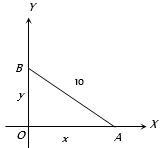
$A$ ladder $10 \, m$ long rests against a vertical wall with the lower end on the horizontal ground. The lower end of the ladder is pulled along the ground away from the wall at the rate of $3 \, cm/sec$. The height of the upper end while it is descending at the rate of $4 \, cm/sec$ is (in $, m$)
A
$4$
B
$6$
C
$7$
D
$8$
Solution
(B) Let $x$ be the distance of the lower end of the ladder from the wall and $y$ be the height of the upper end of the ladder from the ground.
Given that the length of the ladder is $10 \, m$,we have the relation $x^2 + y^2 = 10^2 = 100$.
Differentiating both sides with respect to time $t$,we get:
$2x \frac{dx}{dt} + 2y \frac{dy}{dt} = 0$
$x \frac{dx}{dt} + y \frac{dy}{dt} = 0$
Given $\frac{dx}{dt} = 3 \, cm/sec$ and $\frac{dy}{dt} = -4 \, cm/sec$ (since the height is decreasing).
Substituting these values,we get:
$x(3) + y(-4) = 0$
$3x = 4y \implies x = \frac{4}{3}y$
Substituting $x = \frac{4}{3}y$ into the original equation $x^2 + y^2 = 100$:
$(\frac{4}{3}y)^2 + y^2 = 100$
$\frac{16}{9}y^2 + y^2 = 100$
$\frac{25}{9}y^2 = 100$
$y^2 = 100 \times \frac{9}{25} = 36$
$y = 6 \, m$.
Thus,the height of the upper end is $6 \, m$.
Given that the length of the ladder is $10 \, m$,we have the relation $x^2 + y^2 = 10^2 = 100$.
Differentiating both sides with respect to time $t$,we get:
$2x \frac{dx}{dt} + 2y \frac{dy}{dt} = 0$
$x \frac{dx}{dt} + y \frac{dy}{dt} = 0$
Given $\frac{dx}{dt} = 3 \, cm/sec$ and $\frac{dy}{dt} = -4 \, cm/sec$ (since the height is decreasing).
Substituting these values,we get:
$x(3) + y(-4) = 0$
$3x = 4y \implies x = \frac{4}{3}y$
Substituting $x = \frac{4}{3}y$ into the original equation $x^2 + y^2 = 100$:
$(\frac{4}{3}y)^2 + y^2 = 100$
$\frac{16}{9}y^2 + y^2 = 100$
$\frac{25}{9}y^2 = 100$
$y^2 = 100 \times \frac{9}{25} = 36$
$y = 6 \, m$.
Thus,the height of the upper end is $6 \, m$.
0 likes
View Solution55
DifficultMCQ
The interval in which the function $f(x) = x^3$ increases less rapidly than $g(x) = 6x^2 + 15x + 5$ is:
A
$(- \infty, -1)$
B
$(-5, 1)$
C
$(-1, 5)$
D
$(5, \infty)$
Solution
(C) Let $f(x) = x^3$ and $g(x) = 6x^2 + 15x + 5$.
For $f(x)$ to increase less rapidly than $g(x)$,the rate of change of $f(x)$ must be less than the rate of change of $g(x)$.
This implies $f'(x) < g'(x)$.
Calculating the derivatives: $f'(x) = 3x^2$ and $g'(x) = 12x + 15$.
Setting up the inequality: $3x^2 < 12x + 15$.
Rearranging the terms: $3x^2 - 12x - 15 < 0$.
Dividing by $3$: $x^2 - 4x - 5 < 0$.
Factoring the quadratic: $(x - 5)(x + 1) < 0$.
The inequality holds when $x$ lies between the roots of the quadratic equation $x^2 - 4x - 5 = 0$,which are $x = -1$ and $x = 5$.
Thus,the interval is $(-1, 5)$.
For $f(x)$ to increase less rapidly than $g(x)$,the rate of change of $f(x)$ must be less than the rate of change of $g(x)$.
This implies $f'(x) < g'(x)$.
Calculating the derivatives: $f'(x) = 3x^2$ and $g'(x) = 12x + 15$.
Setting up the inequality: $3x^2 < 12x + 15$.
Rearranging the terms: $3x^2 - 12x - 15 < 0$.
Dividing by $3$: $x^2 - 4x - 5 < 0$.
Factoring the quadratic: $(x - 5)(x + 1) < 0$.
The inequality holds when $x$ lies between the roots of the quadratic equation $x^2 - 4x - 5 = 0$,which are $x = -1$ and $x = 5$.
Thus,the interval is $(-1, 5)$.
0 likes
View Solution56
MediumMCQ
The volume of a spherical balloon is increasing at the rate of $40 \ cm^3/\min$. The rate of change of the surface area of the balloon at the instant when its radius is $8 \ cm$ is ........ $cm^2/\min$.
A
$5/2$
B
$5$
C
$10$
D
$20$
Solution
(C) Let $V$ be the volume and $S$ be the surface area of the spherical balloon with radius $r$.
Given that $\frac{dV}{dt} = 40 \ cm^3/\min$.
The volume of a sphere is $V = \frac{4}{3}\pi r^3$.
Differentiating with respect to $t$,we get $\frac{dV}{dt} = 4\pi r^2 \frac{dr}{dt}$.
Substituting the given values: $40 = 4\pi (8)^2 \frac{dr}{dt} \implies 40 = 256\pi \frac{dr}{dt} \implies \frac{dr}{dt} = \frac{40}{256\pi} = \frac{5}{32\pi} \ cm/\min$.
The surface area of a sphere is $S = 4\pi r^2$.
Differentiating with respect to $t$,we get $\frac{dS}{dt} = 8\pi r \frac{dr}{dt}$.
Substituting $r = 8$ and $\frac{dr}{dt} = \frac{5}{32\pi}$:
$\frac{dS}{dt} = 8\pi \times 8 \times \frac{5}{32\pi} = 64\pi \times \frac{5}{32\pi} = 2 \times 5 = 10 \ cm^2/\min$.
Given that $\frac{dV}{dt} = 40 \ cm^3/\min$.
The volume of a sphere is $V = \frac{4}{3}\pi r^3$.
Differentiating with respect to $t$,we get $\frac{dV}{dt} = 4\pi r^2 \frac{dr}{dt}$.
Substituting the given values: $40 = 4\pi (8)^2 \frac{dr}{dt} \implies 40 = 256\pi \frac{dr}{dt} \implies \frac{dr}{dt} = \frac{40}{256\pi} = \frac{5}{32\pi} \ cm/\min$.
The surface area of a sphere is $S = 4\pi r^2$.
Differentiating with respect to $t$,we get $\frac{dS}{dt} = 8\pi r \frac{dr}{dt}$.
Substituting $r = 8$ and $\frac{dr}{dt} = \frac{5}{32\pi}$:
$\frac{dS}{dt} = 8\pi \times 8 \times \frac{5}{32\pi} = 64\pi \times \frac{5}{32\pi} = 2 \times 5 = 10 \ cm^2/\min$.
0 likes
View Solution57
DifficultMCQ
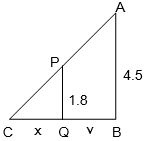
$A$ man of height $1.8 \ m$ is moving away from a lamp post at the rate of $1.2 \ m/sec$. If the height of the lamp post is $4.5 \ m$,then the rate at which the shadow of the man is lengthening is .......... $m/sec$.
A
$0.4$
B
$0.8$
C
$1.2$
D
None of these
Solution
(B) Let $AB$ be the lamp post of height $4.5 \ m$ and $PQ$ be the man of height $1.8 \ m$. Let the man be at a distance $y$ from the lamp post,so $QB = y$. Let the length of the shadow be $x$,so $CQ = x$.
From similar triangles $\triangle AB C$ and $\triangle PQC$,we have:
$\frac{PQ}{AB} = \frac{CQ}{CB}$
$\frac{1.8}{4.5} = \frac{x}{x + y}$
$\frac{2}{5} = \frac{x}{x + y}$
$2(x + y) = 5x$
$2x + 2y = 5x$
$3x = 2y$
$x = \frac{2}{3}y$
Differentiating with respect to time $t$:
$\frac{dx}{dt} = \frac{2}{3} \frac{dy}{dt}$
Given that the man is moving away at $\frac{dy}{dt} = 1.2 \ m/sec$,we have:
$\frac{dx}{dt} = \frac{2}{3} \times 1.2 = 0.8 \ m/sec$.
Thus,the shadow is lengthening at a rate of $0.8 \ m/sec$.
From similar triangles $\triangle AB C$ and $\triangle PQC$,we have:
$\frac{PQ}{AB} = \frac{CQ}{CB}$
$\frac{1.8}{4.5} = \frac{x}{x + y}$
$\frac{2}{5} = \frac{x}{x + y}$
$2(x + y) = 5x$
$2x + 2y = 5x$
$3x = 2y$
$x = \frac{2}{3}y$
Differentiating with respect to time $t$:
$\frac{dx}{dt} = \frac{2}{3} \frac{dy}{dt}$
Given that the man is moving away at $\frac{dy}{dt} = 1.2 \ m/sec$,we have:
$\frac{dx}{dt} = \frac{2}{3} \times 1.2 = 0.8 \ m/sec$.
Thus,the shadow is lengthening at a rate of $0.8 \ m/sec$.
0 likes
View Solution58
EasyMCQ
The distance travelled $s$ (in $cm$) by a particle in $t$ seconds is given by $s = t^3 + 2t^2 + t$. The speed of the particle after $1$ second will be ......... $cm/sec$.
A
$8$
B
$6$
C
$2$
D
None of these
Solution
(A) Given the distance function $s(t) = t^3 + 2t^2 + t$.
The speed $v$ of the particle is the rate of change of distance with respect to time,given by $v = \frac{ds}{dt}$.
Differentiating $s$ with respect to $t$:
$v = \frac{d}{dt}(t^3 + 2t^2 + t) = 3t^2 + 4t + 1$.
To find the speed after $1$ second,substitute $t = 1$ into the expression for $v$:
$v(1) = 3(1)^2 + 4(1) + 1 = 3 + 4 + 1 = 8 \, cm/sec$.
Thus,the speed of the particle after $1$ second is $8 \, cm/sec$.
The speed $v$ of the particle is the rate of change of distance with respect to time,given by $v = \frac{ds}{dt}$.
Differentiating $s$ with respect to $t$:
$v = \frac{d}{dt}(t^3 + 2t^2 + t) = 3t^2 + 4t + 1$.
To find the speed after $1$ second,substitute $t = 1$ into the expression for $v$:
$v(1) = 3(1)^2 + 4(1) + 1 = 3 + 4 + 1 = 8 \, cm/sec$.
Thus,the speed of the particle after $1$ second is $8 \, cm/sec$.
0 likes
View Solution59
EasyMCQ
The side of a square piece is increasing at a rate of $4 \text{ cm/min}$. Find the rate at which the area is increasing when the side is $8 \text{ cm}$ long.
A
$60$
B
$66$
C
$62$
D
$64$
Solution
(D) Let the side of the square be $x$ and its area be $A$.
Given that the rate of change of the side is $\frac{dx}{dt} = 4 \text{ cm/min}$.
The area of a square is given by $A = x^2$.
Differentiating both sides with respect to time $t$,we get $\frac{dA}{dt} = 2x \frac{dx}{dt}$.
When the side $x = 8 \text{ cm}$,the rate of change of the area is:
$\frac{dA}{dt} = 2 \times 8 \times 4 = 64 \text{ cm}^2/\text{min}$.
Given that the rate of change of the side is $\frac{dx}{dt} = 4 \text{ cm/min}$.
The area of a square is given by $A = x^2$.
Differentiating both sides with respect to time $t$,we get $\frac{dA}{dt} = 2x \frac{dx}{dt}$.
When the side $x = 8 \text{ cm}$,the rate of change of the area is:
$\frac{dA}{dt} = 2 \times 8 \times 4 = 64 \text{ cm}^2/\text{min}$.
0 likes
View Solution60
MediumMCQ
The volume of a spherical balloon is increasing at a rate of $40 \text{ cm}^3/\text{min}$. Find the rate of change of its surface area when its radius is $8 \text{ cm}$ (in $\text{cm}^2/\text{min}$).
A
$5/2$
B
$5$
C
$10$
D
$20$
Solution
(C) Let $V$ be the volume and $S$ be the surface area of the spherical balloon with radius $r$.
Given: $\frac{dV}{dt} = 40 \text{ cm}^3/\text{min}$ and $r = 8 \text{ cm}$.
The volume of a sphere is $V = \frac{4}{3}\pi r^3$.
Differentiating with respect to $t$: $\frac{dV}{dt} = 4\pi r^2 \frac{dr}{dt}$.
Substituting the given values: $40 = 4\pi (8)^2 \frac{dr}{dt} \Rightarrow 40 = 256\pi \frac{dr}{dt} \Rightarrow \frac{dr}{dt} = \frac{40}{256\pi} = \frac{5}{32\pi} \text{ cm/min}$.
The surface area of a sphere is $S = 4\pi r^2$.
Differentiating with respect to $t$: $\frac{dS}{dt} = 8\pi r \frac{dr}{dt}$.
Substituting $r = 8$ and $\frac{dr}{dt} = \frac{5}{32\pi}$:
$\frac{dS}{dt} = 8\pi \times 8 \times \frac{5}{32\pi} = 64\pi \times \frac{5}{32\pi} = 2 \times 5 = 10 \text{ cm}^2/\text{min}$.
Given: $\frac{dV}{dt} = 40 \text{ cm}^3/\text{min}$ and $r = 8 \text{ cm}$.
The volume of a sphere is $V = \frac{4}{3}\pi r^3$.
Differentiating with respect to $t$: $\frac{dV}{dt} = 4\pi r^2 \frac{dr}{dt}$.
Substituting the given values: $40 = 4\pi (8)^2 \frac{dr}{dt} \Rightarrow 40 = 256\pi \frac{dr}{dt} \Rightarrow \frac{dr}{dt} = \frac{40}{256\pi} = \frac{5}{32\pi} \text{ cm/min}$.
The surface area of a sphere is $S = 4\pi r^2$.
Differentiating with respect to $t$: $\frac{dS}{dt} = 8\pi r \frac{dr}{dt}$.
Substituting $r = 8$ and $\frac{dr}{dt} = \frac{5}{32\pi}$:
$\frac{dS}{dt} = 8\pi \times 8 \times \frac{5}{32\pi} = 64\pi \times \frac{5}{32\pi} = 2 \times 5 = 10 \text{ cm}^2/\text{min}$.
0 likes
View Solution61
EasyMCQ
If $V = \frac{4}{3}\pi r^3$,find the rate of change of $V$ with respect to $t$ when $r = 10$ and $\frac{dr}{dt} = 0.01$.
A
$\pi$
B
$4\pi$
C
$40\pi$
D
$2\pi$
Solution
(B) Given the volume of a sphere is $V = \frac{4}{3}\pi r^3$.
To find the rate of change of $V$ with respect to $t$,we differentiate both sides with respect to $t$:
$\frac{dV}{dt} = \frac{d}{dt} \left( \frac{4}{3}\pi r^3 \right) = \frac{4}{3}\pi \cdot 3r^2 \cdot \frac{dr}{dt} = 4\pi r^2 \frac{dr}{dt}$.
Given $r = 10$ and $\frac{dr}{dt} = 0.01$.
Substituting these values:
$\frac{dV}{dt} = 4\pi (10)^2 (0.01) = 4\pi (100) (0.01) = 4\pi (1) = 4\pi$.
To find the rate of change of $V$ with respect to $t$,we differentiate both sides with respect to $t$:
$\frac{dV}{dt} = \frac{d}{dt} \left( \frac{4}{3}\pi r^3 \right) = \frac{4}{3}\pi \cdot 3r^2 \cdot \frac{dr}{dt} = 4\pi r^2 \frac{dr}{dt}$.
Given $r = 10$ and $\frac{dr}{dt} = 0.01$.
Substituting these values:
$\frac{dV}{dt} = 4\pi (10)^2 (0.01) = 4\pi (100) (0.01) = 4\pi (1) = 4\pi$.
0 likes
View Solution62
EasyMCQ
$A$ balloon,which always remains spherical,is being inflated by pumping in $900 \ cm^3/sec$ of gas. Find the rate at which the radius of the balloon is increasing when the radius is $15 \ cm$.
A
$1/\pi \ cm/sec$
B
$2/\pi \ cm/sec$
C
$\pi \ cm/sec$
D
$\pi /2 \ cm/sec$
Solution
(A) The volume $V$ of a spherical balloon is given by $V = \frac{4}{3} \pi r^3$.
Differentiating both sides with respect to time $t$,we get:
$\frac{dV}{dt} = 4 \pi r^2 \frac{dr}{dt}$.
Given that $\frac{dV}{dt} = 900 \ cm^3/sec$ and the radius $r = 15 \ cm$,we substitute these values into the equation:
$900 = 4 \pi (15)^2 \frac{dr}{dt}$.
$900 = 4 \pi (225) \frac{dr}{dt}$.
$900 = 900 \pi \frac{dr}{dt}$.
Solving for $\frac{dr}{dt}$:
$\frac{dr}{dt} = \frac{900}{900 \pi} = \frac{1}{\pi} \ cm/sec$.
Thus,the radius of the balloon is increasing at a rate of $1/\pi \ cm/sec$.
Differentiating both sides with respect to time $t$,we get:
$\frac{dV}{dt} = 4 \pi r^2 \frac{dr}{dt}$.
Given that $\frac{dV}{dt} = 900 \ cm^3/sec$ and the radius $r = 15 \ cm$,we substitute these values into the equation:
$900 = 4 \pi (15)^2 \frac{dr}{dt}$.
$900 = 4 \pi (225) \frac{dr}{dt}$.
$900 = 900 \pi \frac{dr}{dt}$.
Solving for $\frac{dr}{dt}$:
$\frac{dr}{dt} = \frac{900}{900 \pi} = \frac{1}{\pi} \ cm/sec$.
Thus,the radius of the balloon is increasing at a rate of $1/\pi \ cm/sec$.
0 likes
View Solution63
MediumMCQ
The radius of a cylinder is increasing at a rate of $3 \text{ m/s}$ and its height is decreasing at a rate of $4 \text{ m/s}$. Find the rate of change of its volume when the radius is $4 \text{ m}$ and the height is $6 \text{ m}$.
A
$80$
B
$-80$
C
$80\pi$
D
$-80\pi$
Solution
(C) Let $r$ be the radius,$h$ be the height,and $V$ be the volume of the cylinder at any time $t$.
Given: $\frac{dr}{dt} = 3 \text{ m/s}$ and $\frac{dh}{dt} = -4 \text{ m/s}$.
We need to find $\frac{dV}{dt}$ when $r = 4 \text{ m}$ and $h = 6 \text{ m}$.
The volume of a cylinder is given by $V = \pi r^2 h$.
Differentiating both sides with respect to $t$ using the product rule:
$\frac{dV}{dt} = \pi \left( r^2 \frac{dh}{dt} + h \cdot 2r \frac{dr}{dt} \right)$.
Substituting the given values:
$\frac{dV}{dt} = \pi \left( (4)^2(-4) + 6 \cdot 2(4)(3) \right)$.
$\frac{dV}{dt} = \pi \left( 16(-4) + 6(24) \right)$.
$\frac{dV}{dt} = \pi (-64 + 144) = 80\pi \text{ m}^3/\text{s}$.
Given: $\frac{dr}{dt} = 3 \text{ m/s}$ and $\frac{dh}{dt} = -4 \text{ m/s}$.
We need to find $\frac{dV}{dt}$ when $r = 4 \text{ m}$ and $h = 6 \text{ m}$.
The volume of a cylinder is given by $V = \pi r^2 h$.
Differentiating both sides with respect to $t$ using the product rule:
$\frac{dV}{dt} = \pi \left( r^2 \frac{dh}{dt} + h \cdot 2r \frac{dr}{dt} \right)$.
Substituting the given values:
$\frac{dV}{dt} = \pi \left( (4)^2(-4) + 6 \cdot 2(4)(3) \right)$.
$\frac{dV}{dt} = \pi \left( 16(-4) + 6(24) \right)$.
$\frac{dV}{dt} = \pi (-64 + 144) = 80\pi \text{ m}^3/\text{s}$.
0 likes
View Solution64
DifficultMCQ
If the velocity of a moving particle is directly proportional to the square root of the distance it has covered,what is its acceleration?
A
Constant
B
$ \propto s^2 $
C
$ \propto \frac{1}{s^2} $
D
$ \propto \frac{1}{s} $
Solution
(A) Let $v$ be the velocity and $s$ be the distance covered by the particle.
Given that $v \propto \sqrt{s}$,which implies $v = k\sqrt{s}$ for some constant $k$.
The acceleration $a$ is given by $a = \frac{dv}{dt} = \frac{dv}{ds} \cdot \frac{ds}{dt} = v \frac{dv}{ds}$.
Since $v = k\sqrt{s}$,we have $\frac{dv}{ds} = k \cdot \frac{1}{2\sqrt{s}} = \frac{k}{2\sqrt{s}}$.
Substituting these into the expression for acceleration:
$a = (k\sqrt{s}) \cdot \left( \frac{k}{2\sqrt{s}} \right) = \frac{k^2}{2}$.
Since $k$ is a constant,$a = \frac{k^2}{2}$ is also a constant.
Therefore,the acceleration of the particle is constant.
Given that $v \propto \sqrt{s}$,which implies $v = k\sqrt{s}$ for some constant $k$.
The acceleration $a$ is given by $a = \frac{dv}{dt} = \frac{dv}{ds} \cdot \frac{ds}{dt} = v \frac{dv}{ds}$.
Since $v = k\sqrt{s}$,we have $\frac{dv}{ds} = k \cdot \frac{1}{2\sqrt{s}} = \frac{k}{2\sqrt{s}}$.
Substituting these into the expression for acceleration:
$a = (k\sqrt{s}) \cdot \left( \frac{k}{2\sqrt{s}} \right) = \frac{k^2}{2}$.
Since $k$ is a constant,$a = \frac{k^2}{2}$ is also a constant.
Therefore,the acceleration of the particle is constant.
0 likes
View Solution65
EasyMCQ
$A$ stone thrown vertically upwards has its motion described by the equation $s = 13.8t - 4.9t^2$,where $s$ is in meters and $t$ is in seconds. The velocity at $t = 1$ second will be ...... $m/s$.
A
$3$
B
$5$
C
$4$
D
None of these.
Solution
(C) The displacement equation is given by $s = 13.8t - 4.9t^2$.
The velocity $v$ is the rate of change of displacement with respect to time,given by $v = \frac{ds}{dt}$.
Differentiating $s$ with respect to $t$:
$v = \frac{d}{dt}(13.8t - 4.9t^2) = 13.8 - 9.8t$.
To find the velocity at $t = 1$ second,substitute $t = 1$ into the velocity equation:
$v(1) = 13.8 - 9.8(1) = 13.8 - 9.8 = 4.0 \text{ } m/s$.
Thus,the velocity at $t = 1$ second is $4 \text{ } m/s$.
The velocity $v$ is the rate of change of displacement with respect to time,given by $v = \frac{ds}{dt}$.
Differentiating $s$ with respect to $t$:
$v = \frac{d}{dt}(13.8t - 4.9t^2) = 13.8 - 9.8t$.
To find the velocity at $t = 1$ second,substitute $t = 1$ into the velocity equation:
$v(1) = 13.8 - 9.8(1) = 13.8 - 9.8 = 4.0 \text{ } m/s$.
Thus,the velocity at $t = 1$ second is $4 \text{ } m/s$.
0 likes
View Solution66
MediumMCQ
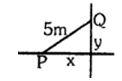
$A$ ladder $5 \ m$ long is leaning against a wall. The bottom of the ladder is pulled along the ground away from the wall at the rate of $2 \ m/sec$. How fast is its height on the wall decreasing when the foot of the ladder is $4 \ m$ away from the wall?
A
$4/3 \ m/sec$
B
$8/3 \ m/sec$
C
$10/3 \ m/sec$
D
$6/3 \ m/sec$
Solution
(B) Let the ladder be $PQ$ with length $5 \ m$. Let $P$ be the bottom of the ladder at a distance $x$ from the wall and $Q$ be the top of the ladder at a height $y$ from the ground.
By the Pythagorean theorem,we have $x^2 + y^2 = 5^2 = 25$.
Given that the bottom of the ladder is moving away from the wall at a rate of $\frac{dx}{dt} = 2 \ m/sec$.
We need to find the rate at which the height $y$ is decreasing,i.e.,$-\frac{dy}{dt}$,when $x = 4 \ m$.
When $x = 4$,substituting into $x^2 + y^2 = 25$ gives $4^2 + y^2 = 25$,so $y^2 = 25 - 16 = 9$,which means $y = 3 \ m$.
Differentiating $x^2 + y^2 = 25$ with respect to $t$,we get:
$2x \frac{dx}{dt} + 2y \frac{dy}{dt} = 0$
Substituting the known values $x = 4$,$y = 3$,and $\frac{dx}{dt} = 2$:
$2(4)(2) + 2(3) \frac{dy}{dt} = 0$
$16 + 6 \frac{dy}{dt} = 0$
$6 \frac{dy}{dt} = -16$
$\frac{dy}{dt} = -\frac{16}{6} = -\frac{8}{3} \ m/sec$.
Since the height is decreasing,the rate of decrease is $\frac{8}{3} \ m/sec$.
By the Pythagorean theorem,we have $x^2 + y^2 = 5^2 = 25$.
Given that the bottom of the ladder is moving away from the wall at a rate of $\frac{dx}{dt} = 2 \ m/sec$.
We need to find the rate at which the height $y$ is decreasing,i.e.,$-\frac{dy}{dt}$,when $x = 4 \ m$.
When $x = 4$,substituting into $x^2 + y^2 = 25$ gives $4^2 + y^2 = 25$,so $y^2 = 25 - 16 = 9$,which means $y = 3 \ m$.
Differentiating $x^2 + y^2 = 25$ with respect to $t$,we get:
$2x \frac{dx}{dt} + 2y \frac{dy}{dt} = 0$
Substituting the known values $x = 4$,$y = 3$,and $\frac{dx}{dt} = 2$:
$2(4)(2) + 2(3) \frac{dy}{dt} = 0$
$16 + 6 \frac{dy}{dt} = 0$
$6 \frac{dy}{dt} = -16$
$\frac{dy}{dt} = -\frac{16}{6} = -\frac{8}{3} \ m/sec$.
Since the height is decreasing,the rate of decrease is $\frac{8}{3} \ m/sec$.
0 likes
View Solution67
MediumMCQ
The sides of an equilateral triangle are increasing at the rate of $2 \ cm/s$. Find the rate at which its area is increasing when each side is $10 \ cm$.
A
$10\sqrt{2} \ cm^2/s$
B
$10\sqrt{3} \ cm^2/s$
C
$10 \ cm^2/s$
D
$5 \ cm^2/s$
Solution
(B) Let $x$ be the side length and $A$ be the area of the equilateral triangle at time $t$.
The area of an equilateral triangle is given by $A = \frac{\sqrt{3}}{4} x^2$.
Differentiating both sides with respect to $t$,we get:
$\frac{dA}{dt} = \frac{\sqrt{3}}{4} \times 2x \times \frac{dx}{dt} = \frac{\sqrt{3}}{2} x \frac{dx}{dt}$.
Given that $\frac{dx}{dt} = 2 \ cm/s$ and $x = 10 \ cm$.
Substituting these values into the derivative formula:
$\frac{dA}{dt} = \frac{\sqrt{3}}{2} \times 10 \times 2 = 10\sqrt{3} \ cm^2/s$.
The area of an equilateral triangle is given by $A = \frac{\sqrt{3}}{4} x^2$.
Differentiating both sides with respect to $t$,we get:
$\frac{dA}{dt} = \frac{\sqrt{3}}{4} \times 2x \times \frac{dx}{dt} = \frac{\sqrt{3}}{2} x \frac{dx}{dt}$.
Given that $\frac{dx}{dt} = 2 \ cm/s$ and $x = 10 \ cm$.
Substituting these values into the derivative formula:
$\frac{dA}{dt} = \frac{\sqrt{3}}{2} \times 10 \times 2 = 10\sqrt{3} \ cm^2/s$.
0 likes
View Solution68
DifficultMCQ
An ice layer of uniform thickness is deposited on an iron sphere of radius $10 \text{ cm}$. The ice melts at a rate of $50 \text{ cm}^3/\text{min}$. When the thickness of the ice layer is $5 \text{ cm}$,the rate at which the thickness of the ice layer is decreasing is ...... $\text{cm/min}$.
A
$1/(54\pi)$
B
$5/(6\pi)$
C
$1/(36\pi)$
D
$1/(18\pi)$
Solution
(D) Let $r$ be the thickness of the ice layer at any time $t$ and $V$ be the volume of the ice layer.
Given that the rate of change of volume is $\frac{dV}{dt} = -50 \text{ cm}^3/\text{min}$.
We need to find $\frac{dr}{dt}$ when $r = 5 \text{ cm}$.
The radius of the sphere including the ice layer is $(r + 10) \text{ cm}$.
The volume of the ice layer $V$ is the volume of the sphere with ice minus the volume of the iron sphere:
$V = \frac{4}{3}\pi(r + 10)^3 - \frac{4}{3}\pi(10)^3$.
Differentiating both sides with respect to $t$:
$\frac{dV}{dt} = 4\pi(r + 10)^2 \frac{dr}{dt}$.
Substituting the given values $\frac{dV}{dt} = -50$ and $r = 5$:
$-50 = 4\pi(5 + 10)^2 \frac{dr}{dt}$.
$-50 = 4\pi(15)^2 \frac{dr}{dt}$.
$-50 = 4\pi(225) \frac{dr}{dt}$.
$-50 = 900\pi \frac{dr}{dt}$.
$\frac{dr}{dt} = -\frac{50}{900\pi} = -\frac{1}{18\pi} \text{ cm/min}$.
Since the question asks for the rate at which the thickness is decreasing,the rate is $1/(18\pi) \text{ cm/min}$.
Given that the rate of change of volume is $\frac{dV}{dt} = -50 \text{ cm}^3/\text{min}$.
We need to find $\frac{dr}{dt}$ when $r = 5 \text{ cm}$.
The radius of the sphere including the ice layer is $(r + 10) \text{ cm}$.
The volume of the ice layer $V$ is the volume of the sphere with ice minus the volume of the iron sphere:
$V = \frac{4}{3}\pi(r + 10)^3 - \frac{4}{3}\pi(10)^3$.
Differentiating both sides with respect to $t$:
$\frac{dV}{dt} = 4\pi(r + 10)^2 \frac{dr}{dt}$.
Substituting the given values $\frac{dV}{dt} = -50$ and $r = 5$:
$-50 = 4\pi(5 + 10)^2 \frac{dr}{dt}$.
$-50 = 4\pi(15)^2 \frac{dr}{dt}$.
$-50 = 4\pi(225) \frac{dr}{dt}$.
$-50 = 900\pi \frac{dr}{dt}$.
$\frac{dr}{dt} = -\frac{50}{900\pi} = -\frac{1}{18\pi} \text{ cm/min}$.
Since the question asks for the rate at which the thickness is decreasing,the rate is $1/(18\pi) \text{ cm/min}$.
0 likes
View Solution69
MediumMCQ
$A$ stone is dropped into a still pond,creating ripples that move at a speed of $3.5 \text{ cm/sec}$. At the instant when the radius of the ripples is $7.5 \text{ cm}$,how fast is the enclosed area increasing?
A
$52.5 \pi \text{ cm}^2/\text{sec}$
B
$50.5 \pi \text{ cm}^2/\text{sec}$
C
$57.5 \pi \text{ cm}^2/\text{sec}$
D
$62.5 \pi \text{ cm}^2/\text{sec}$
Solution
(A) Let $r$ be the radius of the ripple and $A$ be the area of the circle enclosed by the ripple.
Given,the rate of change of the radius is $\frac{dr}{dt} = 3.5 \text{ cm/sec}$.
The area of the circle is given by $A = \pi r^2$.
Differentiating both sides with respect to time $t$,we get $\frac{dA}{dt} = 2 \pi r \frac{dr}{dt}$.
At the instant when $r = 7.5 \text{ cm}$,we substitute the values:
$\frac{dA}{dt} = 2 \times \pi \times 7.5 \times 3.5$.
$\frac{dA}{dt} = 15 \times 3.5 \times \pi$.
$\frac{dA}{dt} = 52.5 \pi \text{ cm}^2/\text{sec}$.
Thus,the area is increasing at a rate of $52.5 \pi \text{ cm}^2/\text{sec}$.
Given,the rate of change of the radius is $\frac{dr}{dt} = 3.5 \text{ cm/sec}$.
The area of the circle is given by $A = \pi r^2$.
Differentiating both sides with respect to time $t$,we get $\frac{dA}{dt} = 2 \pi r \frac{dr}{dt}$.
At the instant when $r = 7.5 \text{ cm}$,we substitute the values:
$\frac{dA}{dt} = 2 \times \pi \times 7.5 \times 3.5$.
$\frac{dA}{dt} = 15 \times 3.5 \times \pi$.
$\frac{dA}{dt} = 52.5 \pi \text{ cm}^2/\text{sec}$.
Thus,the area is increasing at a rate of $52.5 \pi \text{ cm}^2/\text{sec}$.
0 likes
View Solution70
MediumMCQ
Find the rate of change of $\sqrt{x^2 + 16}$ with respect to $\frac{x}{x - 1}$ at $x = 3$.
A
$2$
B
$\frac{11}{5}$
C
$-\frac{12}{5}$
D
$-3$
Solution
(C) Let $y = \sqrt{x^2 + 16}$ and $z = \frac{x}{x - 1}$.
First,differentiate $y$ with respect to $x$:
$\frac{dy}{dx} = \frac{1}{2\sqrt{x^2 + 16}} \cdot (2x) = \frac{x}{\sqrt{x^2 + 16}}$.
Next,differentiate $z$ with respect to $x$ using the quotient rule:
$\frac{dz}{dx} = \frac{(x - 1)(1) - x(1)}{(x - 1)^2} = \frac{-1}{(x - 1)^2}$.
Now,find the rate of change of $y$ with respect to $z$:
$\frac{dy}{dz} = \frac{dy/dx}{dz/dx} = \frac{x}{\sqrt{x^2 + 16}} \cdot (-(x - 1)^2) = \frac{-x(x - 1)^2}{\sqrt{x^2 + 16}}$.
Substitute $x = 3$ into the expression:
$\left( \frac{dy}{dz} \right)_{x = 3} = \frac{-3(3 - 1)^2}{\sqrt{3^2 + 16}} = \frac{-3(2^2)}{\sqrt{9 + 16}} = \frac{-3(4)}{\sqrt{25}} = \frac{-12}{5}$.
First,differentiate $y$ with respect to $x$:
$\frac{dy}{dx} = \frac{1}{2\sqrt{x^2 + 16}} \cdot (2x) = \frac{x}{\sqrt{x^2 + 16}}$.
Next,differentiate $z$ with respect to $x$ using the quotient rule:
$\frac{dz}{dx} = \frac{(x - 1)(1) - x(1)}{(x - 1)^2} = \frac{-1}{(x - 1)^2}$.
Now,find the rate of change of $y$ with respect to $z$:
$\frac{dy}{dz} = \frac{dy/dx}{dz/dx} = \frac{x}{\sqrt{x^2 + 16}} \cdot (-(x - 1)^2) = \frac{-x(x - 1)^2}{\sqrt{x^2 + 16}}$.
Substitute $x = 3$ into the expression:
$\left( \frac{dy}{dz} \right)_{x = 3} = \frac{-3(3 - 1)^2}{\sqrt{3^2 + 16}} = \frac{-3(2^2)}{\sqrt{9 + 16}} = \frac{-3(4)}{\sqrt{25}} = \frac{-12}{5}$.
0 likes
View Solution71
DifficultMCQ
$A$ spherical iron ball of radius $10 \ cm$ is coated with a layer of ice of uniform thickness. The ice melts at a rate of $50 \ cm^3/min$. When the thickness of the ice is $5 \ cm$,the rate at which the thickness of the ice decreases is:
A
$\frac{1}{54\pi} \ cm/min$
B
$\frac{5}{6\pi} \ cm/min$
C
$\frac{1}{36\pi} \ cm/min$
D
$\frac{1}{18\pi} \ cm/min$
Solution
(D) Let $x$ be the thickness of the ice. The total radius of the ball including the ice is $r = (10 + x) \ cm$.
The volume of the ice layer is $V = \frac{4}{3}\pi(10 + x)^3 - \frac{4}{3}\pi(10)^3$.
Differentiating with respect to time $t$,we get $\frac{dV}{dt} = 4\pi(10 + x)^2 \frac{dx}{dt}$.
Given $\frac{dV}{dt} = -50 \ cm^3/min$ (since the ice is melting,the volume is decreasing).
At $x = 5 \ cm$,we have $-50 = 4\pi(10 + 5)^2 \frac{dx}{dt}$.
$-50 = 4\pi(15)^2 \frac{dx}{dt} = 4\pi(225) \frac{dx}{dt} = 900\pi \frac{dx}{dt}$.
Therefore,$\frac{dx}{dt} = -\frac{50}{900\pi} = -\frac{1}{18\pi} \ cm/min$.
The rate at which the thickness decreases is $\frac{1}{18\pi} \ cm/min$.
The volume of the ice layer is $V = \frac{4}{3}\pi(10 + x)^3 - \frac{4}{3}\pi(10)^3$.
Differentiating with respect to time $t$,we get $\frac{dV}{dt} = 4\pi(10 + x)^2 \frac{dx}{dt}$.
Given $\frac{dV}{dt} = -50 \ cm^3/min$ (since the ice is melting,the volume is decreasing).
At $x = 5 \ cm$,we have $-50 = 4\pi(10 + 5)^2 \frac{dx}{dt}$.
$-50 = 4\pi(15)^2 \frac{dx}{dt} = 4\pi(225) \frac{dx}{dt} = 900\pi \frac{dx}{dt}$.
Therefore,$\frac{dx}{dt} = -\frac{50}{900\pi} = -\frac{1}{18\pi} \ cm/min$.
The rate at which the thickness decreases is $\frac{1}{18\pi} \ cm/min$.
0 likes
View Solution72
MediumMCQ
The displacement of a particle at time $t$ is given by $x = At^2 + Bt + C$,where $A, B$ and $C$ are constants. If $v$ is the velocity,then $4Ax - v^2 = ....$
A
$4AC + B^2$
B
$4AC - B^2$
C
$2AC - B^2$
D
$2AC + B^2$
Solution
(B) Given the displacement equation: $x = At^2 + Bt + C$.
Velocity $v$ is the rate of change of displacement with respect to time $t$:
$v = \frac{dx}{dt} = \frac{d}{dt}(At^2 + Bt + C) = 2At + B$.
Now,substitute $x$ and $v$ into the expression $4Ax - v^2$:
$4Ax - v^2 = 4A(At^2 + Bt + C) - (2At + B)^2$.
Expand the terms:
$4Ax - v^2 = (4A^2t^2 + 4ABt + 4AC) - (4A^2t^2 + 4ABt + B^2)$.
Simplify the expression by canceling common terms:
$4Ax - v^2 = 4A^2t^2 - 4A^2t^2 + 4ABt - 4ABt + 4AC - B^2$.
$4Ax - v^2 = 4AC - B^2$.
Velocity $v$ is the rate of change of displacement with respect to time $t$:
$v = \frac{dx}{dt} = \frac{d}{dt}(At^2 + Bt + C) = 2At + B$.
Now,substitute $x$ and $v$ into the expression $4Ax - v^2$:
$4Ax - v^2 = 4A(At^2 + Bt + C) - (2At + B)^2$.
Expand the terms:
$4Ax - v^2 = (4A^2t^2 + 4ABt + 4AC) - (4A^2t^2 + 4ABt + B^2)$.
Simplify the expression by canceling common terms:
$4Ax - v^2 = 4A^2t^2 - 4A^2t^2 + 4ABt - 4ABt + 4AC - B^2$.
$4Ax - v^2 = 4AC - B^2$.
0 likes
View Solution73
DifficultMCQ
$A$ balloon,which always remains spherical,has a variable diameter of $ \frac{3}{2}(2x + 3) $. Find the rate of change of its volume with respect to $ x $.
A
$ \frac{27\pi}{8}(2x - 3)^2 $
B
$ \frac{27\pi}{8}(2x + 3)^2 $
C
$ \frac{27\pi}{8}(3x + 2)^2 $
D
$ \frac{8}{27\pi}(2x + 3)^2 $
Solution
(B) Given the diameter $ d = \frac{3}{2}(2x + 3) $.
The radius $ r = \frac{d}{2} = \frac{3}{4}(2x + 3) $.
Differentiating $ r $ with respect to $ x $,we get $ \frac{dr}{dx} = \frac{3}{4} \times 2 = \frac{3}{2} $.
The volume of a sphere is $ V = \frac{4}{3}\pi r^3 $.
Differentiating $ V $ with respect to $ x $ using the chain rule:
$ \frac{dV}{dx} = \frac{dV}{dr} \times \frac{dr}{dx} $.
$ \frac{dV}{dx} = (4\pi r^2) \times \frac{dr}{dx} $.
Substituting the values of $ r $ and $ \frac{dr}{dx} $:
$ \frac{dV}{dx} = 4\pi \left[ \frac{3}{4}(2x + 3) \right]^2 \times \frac{3}{2} $.
$ \frac{dV}{dx} = 4\pi \times \frac{9}{16}(2x + 3)^2 \times \frac{3}{2} $.
$ \frac{dV}{dx} = \frac{27\pi}{8}(2x + 3)^2 $.
The radius $ r = \frac{d}{2} = \frac{3}{4}(2x + 3) $.
Differentiating $ r $ with respect to $ x $,we get $ \frac{dr}{dx} = \frac{3}{4} \times 2 = \frac{3}{2} $.
The volume of a sphere is $ V = \frac{4}{3}\pi r^3 $.
Differentiating $ V $ with respect to $ x $ using the chain rule:
$ \frac{dV}{dx} = \frac{dV}{dr} \times \frac{dr}{dx} $.
$ \frac{dV}{dx} = (4\pi r^2) \times \frac{dr}{dx} $.
Substituting the values of $ r $ and $ \frac{dr}{dx} $:
$ \frac{dV}{dx} = 4\pi \left[ \frac{3}{4}(2x + 3) \right]^2 \times \frac{3}{2} $.
$ \frac{dV}{dx} = 4\pi \times \frac{9}{16}(2x + 3)^2 \times \frac{3}{2} $.
$ \frac{dV}{dx} = \frac{27\pi}{8}(2x + 3)^2 $.
0 likes
View Solution74
MediumMCQ
The surface area of a spherical bubble increases at a rate of $2 \text{ cm}^2/\text{s}$. The rate at which the volume of the bubble increases when the radius is $6 \text{ cm}$ is . . . . . . $\text{cm}^3/\text{s}$.
A
$6$
B
$9$
C
$3$
D
$12$
Solution
(A) Let $r$ be the radius and $V$ be the volume of the spherical bubble. The surface area $A$ is given by $A = 4\pi r^2$.
Differentiating with respect to time $t$,we get $\frac{dA}{dt} = 8\pi r \frac{dr}{dt}$.
Given $\frac{dA}{dt} = 2 \text{ cm}^2/\text{s}$ and $r = 6 \text{ cm}$,we substitute these values:
$2 = 8\pi(6) \frac{dr}{dt} \Rightarrow 2 = 48\pi \frac{dr}{dt} \Rightarrow \frac{dr}{dt} = \frac{1}{24\pi} \text{ cm/s}$.
The volume $V$ of the sphere is $V = \frac{4}{3}\pi r^3$.
Differentiating with respect to $t$,we get $\frac{dV}{dt} = 4\pi r^2 \frac{dr}{dt}$.
Substituting $r = 6$ and $\frac{dr}{dt} = \frac{1}{24\pi}$:
$\frac{dV}{dt} = 4\pi(6)^2 \left(\frac{1}{24\pi}\right) = 4\pi(36) \left(\frac{1}{24\pi}\right) = \frac{144\pi}{24\pi} = 6 \text{ cm}^3/\text{s}$.
Differentiating with respect to time $t$,we get $\frac{dA}{dt} = 8\pi r \frac{dr}{dt}$.
Given $\frac{dA}{dt} = 2 \text{ cm}^2/\text{s}$ and $r = 6 \text{ cm}$,we substitute these values:
$2 = 8\pi(6) \frac{dr}{dt} \Rightarrow 2 = 48\pi \frac{dr}{dt} \Rightarrow \frac{dr}{dt} = \frac{1}{24\pi} \text{ cm/s}$.
The volume $V$ of the sphere is $V = \frac{4}{3}\pi r^3$.
Differentiating with respect to $t$,we get $\frac{dV}{dt} = 4\pi r^2 \frac{dr}{dt}$.
Substituting $r = 6$ and $\frac{dr}{dt} = \frac{1}{24\pi}$:
$\frac{dV}{dt} = 4\pi(6)^2 \left(\frac{1}{24\pi}\right) = 4\pi(36) \left(\frac{1}{24\pi}\right) = \frac{144\pi}{24\pi} = 6 \text{ cm}^3/\text{s}$.
0 likes
View Solution75
MediumMCQ
In $\Delta ABC$,sides $a$ and $b$ are kept constant such that there is an error $\alpha$ in angle $C$. What is the relative error in the area?
A
$\alpha \cot C$
B
$\alpha \sin C$
C
$\alpha \tan C$
D
$\alpha \cos C$
Solution
(A) The area of the triangle is given by $S = \frac{1}{2} ab \sin C$.
Taking the derivative with respect to $C$,we get $\frac{dS}{dC} = \frac{1}{2} ab \cos C$.
Let $\Delta S$ be the error in the area $S$ corresponding to an error $\Delta C = \alpha$ in angle $C$.
Then,$\Delta S \approx \frac{dS}{dC} \cdot \Delta C = \frac{1}{2} ab \cos C \cdot \alpha$.
The relative error in the area is given by $\frac{\Delta S}{S}$.
Substituting the values,we get $\frac{\Delta S}{S} = \frac{\frac{1}{2} ab \cos C \cdot \alpha}{\frac{1}{2} ab \sin C} = \alpha \cot C$.
Taking the derivative with respect to $C$,we get $\frac{dS}{dC} = \frac{1}{2} ab \cos C$.
Let $\Delta S$ be the error in the area $S$ corresponding to an error $\Delta C = \alpha$ in angle $C$.
Then,$\Delta S \approx \frac{dS}{dC} \cdot \Delta C = \frac{1}{2} ab \cos C \cdot \alpha$.
The relative error in the area is given by $\frac{\Delta S}{S}$.
Substituting the values,we get $\frac{\Delta S}{S} = \frac{\frac{1}{2} ab \cos C \cdot \alpha}{\frac{1}{2} ab \sin C} = \alpha \cot C$.
0 likes
View Solution76
MediumMCQ
The distance $x$ covered by a particle in time $t$ is given by $x = t^3 - 12t^2 + 6t + 8$. What is the velocity of the particle at the instant when its acceleration is zero?
A
$42$
B
$-42$
C
$48$
D
$-48$
Solution
(B) Given the displacement equation: $x = t^3 - 12t^2 + 6t + 8$.
Velocity $v$ is the first derivative of displacement with respect to time: $v = \frac{dx}{dt} = 3t^2 - 24t + 6$.
Acceleration $a$ is the derivative of velocity with respect to time: $a = \frac{dv}{dt} = 6t - 24$.
At the instant when acceleration is zero: $a = 0 \Rightarrow 6t - 24 = 0 \Rightarrow t = 4 \text{ s}$.
Now,substitute $t = 4$ into the velocity equation: $v = 3(4)^2 - 24(4) + 6$.
$v = 3(16) - 96 + 6 = 48 - 96 + 6 = -42 \text{ units/s}$.
Velocity $v$ is the first derivative of displacement with respect to time: $v = \frac{dx}{dt} = 3t^2 - 24t + 6$.
Acceleration $a$ is the derivative of velocity with respect to time: $a = \frac{dv}{dt} = 6t - 24$.
At the instant when acceleration is zero: $a = 0 \Rightarrow 6t - 24 = 0 \Rightarrow t = 4 \text{ s}$.
Now,substitute $t = 4$ into the velocity equation: $v = 3(4)^2 - 24(4) + 6$.
$v = 3(16) - 96 + 6 = 48 - 96 + 6 = -42 \text{ units/s}$.
0 likes
View Solution77
MediumMCQ
The rate of change of the diagonal $R$ of a square with respect to its area $A$ is:
A
$R$
B
$1/R$
C
$\sqrt{A}$
D
$A/2$
Solution
(B) Let the side length of the square be $x$.
The diagonal $R$ is given by $R = \sqrt{x^2 + x^2} = x\sqrt{2}$.
The area $A$ is given by $A = x^2$.
From the area equation,we have $x = \sqrt{A}$.
Substituting this into the diagonal equation,we get $R = \sqrt{2} \cdot \sqrt{A} = \sqrt{2A}$.
To find the rate of change of $R$ with respect to $A$,we differentiate $R$ with respect to $A$:
$\frac{dR}{dA} = \frac{d}{dA}(\sqrt{2} \cdot A^{1/2}) = \sqrt{2} \cdot \frac{1}{2} A^{-1/2} = \frac{\sqrt{2}}{2\sqrt{A}} = \frac{1}{\sqrt{2A}}$.
Since $R = \sqrt{2A}$,we can substitute this back into the expression:
$\frac{dR}{dA} = \frac{1}{R}$.
The diagonal $R$ is given by $R = \sqrt{x^2 + x^2} = x\sqrt{2}$.
The area $A$ is given by $A = x^2$.
From the area equation,we have $x = \sqrt{A}$.
Substituting this into the diagonal equation,we get $R = \sqrt{2} \cdot \sqrt{A} = \sqrt{2A}$.
To find the rate of change of $R$ with respect to $A$,we differentiate $R$ with respect to $A$:
$\frac{dR}{dA} = \frac{d}{dA}(\sqrt{2} \cdot A^{1/2}) = \sqrt{2} \cdot \frac{1}{2} A^{-1/2} = \frac{\sqrt{2}}{2\sqrt{A}} = \frac{1}{\sqrt{2A}}$.
Since $R = \sqrt{2A}$,we can substitute this back into the expression:
$\frac{dR}{dA} = \frac{1}{R}$.
0 likes
View Solution78
DifficultMCQ
For what values of $x$ does the rate of change of $x^3 - 5x^2 + 5x + 8$ become twice the rate of change of $x$?
A
$-3, -\frac{1}{3}$
B
$-3, \frac{1}{3}$
C
$3, -\frac{1}{3}$
D
$3, \frac{1}{3}$
Solution
(D) Let $y = x^3 - 5x^2 + 5x + 8$.
The rate of change of $y$ with respect to time $t$ is given by $\frac{dy}{dt} = \frac{dy}{dx} \times \frac{dx}{dt}$.
Given that $\frac{dy}{dt} = 2 \frac{dx}{dt}$,we have:
$(3x^2 - 10x + 5) \frac{dx}{dt} = 2 \frac{dx}{dt}$.
Assuming $\frac{dx}{dt} \neq 0$,we divide both sides by $\frac{dx}{dt}$:
$3x^2 - 10x + 5 = 2$.
$3x^2 - 10x + 3 = 0$.
Factoring the quadratic equation:
$(3x - 1)(x - 3) = 0$.
Therefore,$x = 3$ or $x = \frac{1}{3}$.
The rate of change of $y$ with respect to time $t$ is given by $\frac{dy}{dt} = \frac{dy}{dx} \times \frac{dx}{dt}$.
Given that $\frac{dy}{dt} = 2 \frac{dx}{dt}$,we have:
$(3x^2 - 10x + 5) \frac{dx}{dt} = 2 \frac{dx}{dt}$.
Assuming $\frac{dx}{dt} \neq 0$,we divide both sides by $\frac{dx}{dt}$:
$3x^2 - 10x + 5 = 2$.
$3x^2 - 10x + 3 = 0$.
Factoring the quadratic equation:
$(3x - 1)(x - 3) = 0$.
Therefore,$x = 3$ or $x = \frac{1}{3}$.
0 likes
View Solution79
MediumMCQ
Find the point on the parabola $y^2 = 18x$ where the rate of change of the $y$-coordinate is twice the rate of change of the $x$-coordinate.
A
$\left( -\frac{9}{8}, \frac{9}{2} \right)$
B
$(2, -4)$
C
$(2, 4)$
D
$\left( \frac{9}{8}, \frac{9}{2} \right)$
Solution
(D) Given the equation of the parabola is $y^2 = 18x$.
Differentiating both sides with respect to $t$,we get $2y \frac{dy}{dt} = 18 \frac{dx}{dt}$,which simplifies to $y \frac{dy}{dt} = 9 \frac{dx}{dt}$ (Equation $1$).
It is given that the rate of change of the $y$-coordinate is twice the rate of change of the $x$-coordinate,i.e.,$\frac{dy}{dt} = 2 \frac{dx}{dt}$.
Substituting this into Equation $1$,we get $y(2 \frac{dx}{dt}) = 9 \frac{dx}{dt}$.
Assuming $\frac{dx}{dt} \neq 0$,we have $2y = 9$,which implies $y = \frac{9}{2}$.
Substituting $y = \frac{9}{2}$ into the original equation $y^2 = 18x$,we get $\left( \frac{9}{2} \right)^2 = 18x$.
This gives $\frac{81}{4} = 18x$,so $x = \frac{81}{4 \times 18} = \frac{9}{8}$.
Thus,the required point is $\left( \frac{9}{8}, \frac{9}{2} \right)$.
Differentiating both sides with respect to $t$,we get $2y \frac{dy}{dt} = 18 \frac{dx}{dt}$,which simplifies to $y \frac{dy}{dt} = 9 \frac{dx}{dt}$ (Equation $1$).
It is given that the rate of change of the $y$-coordinate is twice the rate of change of the $x$-coordinate,i.e.,$\frac{dy}{dt} = 2 \frac{dx}{dt}$.
Substituting this into Equation $1$,we get $y(2 \frac{dx}{dt}) = 9 \frac{dx}{dt}$.
Assuming $\frac{dx}{dt} \neq 0$,we have $2y = 9$,which implies $y = \frac{9}{2}$.
Substituting $y = \frac{9}{2}$ into the original equation $y^2 = 18x$,we get $\left( \frac{9}{2} \right)^2 = 18x$.
This gives $\frac{81}{4} = 18x$,so $x = \frac{81}{4 \times 18} = \frac{9}{8}$.
Thus,the required point is $\left( \frac{9}{8}, \frac{9}{2} \right)$.
0 likes
View Solution80
MediumMCQ
The rate of change of the radius of a sphere is $0.1 \ cm/s$. Find the rate of change of its surface area when its radius is $200 \ cm$.
A
$8\pi \ cm^2/s$
B
$12\pi \ cm^2/s$
C
$160\pi \ cm^2/s$
D
$200\pi \ cm^2/s$
Solution
(C) The surface area $A$ of a sphere with radius $r$ is given by $A = 4\pi r^2$.
Differentiating both sides with respect to time $t$,we get:
$\frac{dA}{dt} = 8\pi r \frac{dr}{dt}$.
Given that $\frac{dr}{dt} = 0.1 \ cm/s$ and $r = 200 \ cm$.
Substituting these values into the derivative formula:
$\frac{dA}{dt} = 8\pi \times 200 \times 0.1$.
$\frac{dA}{dt} = 160\pi \ cm^2/s$.
Differentiating both sides with respect to time $t$,we get:
$\frac{dA}{dt} = 8\pi r \frac{dr}{dt}$.
Given that $\frac{dr}{dt} = 0.1 \ cm/s$ and $r = 200 \ cm$.
Substituting these values into the derivative formula:
$\frac{dA}{dt} = 8\pi \times 200 \times 0.1$.
$\frac{dA}{dt} = 160\pi \ cm^2/s$.
0 likes
View Solution81
MediumMCQ
Water is being poured into a cylindrical vessel with a radius of $2 \text{ cm}$ at a rate of $8 \text{ cm}^3/\text{s}$. The rate at which the height of the water is increasing is:
A
$2 \text{ cm/s}$
B
$2/\pi \text{ cm/s}$
C
$4/\pi \text{ cm/s}$
D
None of these
Solution
(B) Let $h$ be the height of the water and $V$ be the volume of the water at any time $t$.
The radius of the cylindrical vessel is given as $r = 2 \text{ cm}$.
The rate of change of volume is given as $\frac{dV}{dt} = 8 \text{ cm}^3/\text{s}$.
The volume of water in a cylinder is given by the formula $V = \pi r^2 h$.
Substituting $r = 2$,we get $V = \pi (2)^2 h = 4\pi h$.
Differentiating both sides with respect to $t$,we get $\frac{dV}{dt} = 4\pi \frac{dh}{dt}$.
Substituting the given value $\frac{dV}{dt} = 8$,we have $8 = 4\pi \frac{dh}{dt}$.
Therefore,$\frac{dh}{dt} = \frac{8}{4\pi} = \frac{2}{\pi} \text{ cm/s}$.
The radius of the cylindrical vessel is given as $r = 2 \text{ cm}$.
The rate of change of volume is given as $\frac{dV}{dt} = 8 \text{ cm}^3/\text{s}$.
The volume of water in a cylinder is given by the formula $V = \pi r^2 h$.
Substituting $r = 2$,we get $V = \pi (2)^2 h = 4\pi h$.
Differentiating both sides with respect to $t$,we get $\frac{dV}{dt} = 4\pi \frac{dh}{dt}$.
Substituting the given value $\frac{dV}{dt} = 8$,we have $8 = 4\pi \frac{dh}{dt}$.
Therefore,$\frac{dh}{dt} = \frac{8}{4\pi} = \frac{2}{\pi} \text{ cm/s}$.
0 likes
View Solution82
MediumMCQ
The rate of change of the volume of a sphere of radius $r$ with respect to its surface area is:
A
$r/2$
B
$r$
C
$2/r$
D
$1/r$
Solution
(A) Let the volume of the sphere be $V = \frac{4}{3}\pi r^3$ and the surface area be $S = 4\pi r^2$.
We need to find the rate of change of volume with respect to surface area,which is $\frac{dV}{dS}$.
First,differentiate $V$ with respect to $r$: $\frac{dV}{dr} = 4\pi r^2$.
Next,differentiate $S$ with respect to $r$: $\frac{dS}{dr} = 8\pi r$.
Using the chain rule,$\frac{dV}{dS} = \frac{dV/dr}{dS/dr} = \frac{4\pi r^2}{8\pi r}$.
Simplifying this,we get $\frac{dV}{dS} = \frac{r}{2}$.
We need to find the rate of change of volume with respect to surface area,which is $\frac{dV}{dS}$.
First,differentiate $V$ with respect to $r$: $\frac{dV}{dr} = 4\pi r^2$.
Next,differentiate $S$ with respect to $r$: $\frac{dS}{dr} = 8\pi r$.
Using the chain rule,$\frac{dV}{dS} = \frac{dV/dr}{dS/dr} = \frac{4\pi r^2}{8\pi r}$.
Simplifying this,we get $\frac{dV}{dS} = \frac{r}{2}$.
0 likes
View Solution83
MediumMCQ
$A$ particle covers a distance $x$ in time $t$ given by $x = t^3 - 9t^2 + 24t + 6$. When the acceleration of the particle is $6$,its velocity is .... units.
A
$-3$
B
$-6$
C
$0$
D
$3$
Solution
(C) Given,$x = t^3 - 9t^2 + 24t + 6$.
The velocity $v$ is given by the first derivative of $x$ with respect to $t$:
$v = \frac{dx}{dt} = 3t^2 - 18t + 24$.
The acceleration $a$ is given by the second derivative of $x$ with respect to $t$:
$a = \frac{d^2x}{dt^2} = 6t - 18$.
Given that the acceleration $a = 6$:
$6t - 18 = 6$
$6t = 24$
$t = 4$.
Now,substitute $t = 4$ into the velocity equation:
$v = 3(4)^2 - 18(4) + 24$
$v = 3(16) - 72 + 24$
$v = 48 - 72 + 24$
$v = 0$ units.
The velocity $v$ is given by the first derivative of $x$ with respect to $t$:
$v = \frac{dx}{dt} = 3t^2 - 18t + 24$.
The acceleration $a$ is given by the second derivative of $x$ with respect to $t$:
$a = \frac{d^2x}{dt^2} = 6t - 18$.
Given that the acceleration $a = 6$:
$6t - 18 = 6$
$6t = 24$
$t = 4$.
Now,substitute $t = 4$ into the velocity equation:
$v = 3(4)^2 - 18(4) + 24$
$v = 3(16) - 72 + 24$
$v = 48 - 72 + 24$
$v = 0$ units.
0 likes
View Solution84
DifficultMCQ
Two cyclists are moving from a junction of two roads inclined at an angle of $120^{\circ}$ to each other,with velocities of $4 \text{ km/h}$ and $3 \text{ km/h}$ respectively. The rate at which they are separating from each other after $1 \text{ hour}$ is ..... $\text{km/h}$.
A
$\sqrt{37}$
B
$37$
C
$13$
D
$\sqrt{13}$
Solution
(A) Let the position of the first cyclist be $A$ and the second cyclist be $B$ at time $t$. Let the distance between them be $x$.
Given $OA = 4t$ and $OB = 3t$.
Using the Law of Cosines in $\triangle OAB$:
$x^2 = (OA)^2 + (OB)^2 - 2(OA)(OB) \cos(120^{\circ})$
$x^2 = (4t)^2 + (3t)^2 - 2(4t)(3t) \left(-\frac{1}{2}\right)$
$x^2 = 16t^2 + 9t^2 + 12t^2$
$x^2 = 37t^2$
$x = \sqrt{37}t$
The rate at which they are separating is $\frac{dx}{dt}$.
$\frac{dx}{dt} = \frac{d}{dt}(\sqrt{37}t) = \sqrt{37} \text{ km/h}$.
Given $OA = 4t$ and $OB = 3t$.
Using the Law of Cosines in $\triangle OAB$:
$x^2 = (OA)^2 + (OB)^2 - 2(OA)(OB) \cos(120^{\circ})$
$x^2 = (4t)^2 + (3t)^2 - 2(4t)(3t) \left(-\frac{1}{2}\right)$
$x^2 = 16t^2 + 9t^2 + 12t^2$
$x^2 = 37t^2$
$x = \sqrt{37}t$
The rate at which they are separating is $\frac{dx}{dt}$.
$\frac{dx}{dt} = \frac{d}{dt}(\sqrt{37}t) = \sqrt{37} \text{ km/h}$.
0 likes
View Solution85
MediumMCQ
$A$ ladder makes an angle of $30^\circ$ with the wall. $A$ man is climbing the ladder at the rate of $3 \text{ ft/sec}$. What is the rate at which he is approaching the wall?
A
$3 \text{ ft/sec}$
B
$\frac{3}{2} \text{ ft/sec}$
C
$\frac{3}{4} \text{ ft/sec}$
D
$\frac{3}{\sqrt{2}} \text{ ft/sec}$
Solution
(B) Let the ladder be represented by the hypotenuse of a right-angled triangle formed by the ladder,the wall,and the floor.
Let $x$ be the distance of the man from the wall along the ladder.
Let $y$ be the horizontal distance of the man from the wall.
The angle between the ladder and the wall is $\theta = 30^\circ$.
From trigonometry,the horizontal distance $y$ is given by $y = x \sin(\theta)$.
Here,$\theta = 30^\circ$,so $y = x \sin(30^\circ) = x \times \frac{1}{2}$.
Differentiating with respect to time $t$,we get $\frac{dy}{dt} = \frac{dx}{dt} \times \frac{1}{2}$.
Given that the rate of climbing the ladder is $\frac{dx}{dt} = 3 \text{ ft/sec}$.
Therefore,the rate at which he approaches the wall is $\frac{dy}{dt} = 3 \times \frac{1}{2} = \frac{3}{2} \text{ ft/sec}$.
Let $x$ be the distance of the man from the wall along the ladder.
Let $y$ be the horizontal distance of the man from the wall.
The angle between the ladder and the wall is $\theta = 30^\circ$.
From trigonometry,the horizontal distance $y$ is given by $y = x \sin(\theta)$.
Here,$\theta = 30^\circ$,so $y = x \sin(30^\circ) = x \times \frac{1}{2}$.
Differentiating with respect to time $t$,we get $\frac{dy}{dt} = \frac{dx}{dt} \times \frac{1}{2}$.
Given that the rate of climbing the ladder is $\frac{dx}{dt} = 3 \text{ ft/sec}$.
Therefore,the rate at which he approaches the wall is $\frac{dy}{dt} = 3 \times \frac{1}{2} = \frac{3}{2} \text{ ft/sec}$.
0 likes
View Solution86
MediumMCQ
$A$ particle moves along the curve $y = x^2 + 2x$. At what point on the curve do the $x$ and $y$ coordinates of the particle change at the same rate?
A
$\left( \frac{-3}{4}, \frac{-1}{2} \right)$
B
$\left( \frac{-1}{2}, \frac{-3}{4} \right)$
C
$\left( \frac{3}{4}, \frac{1}{2} \right)$
D
$\left( \frac{1}{2}, \frac{3}{4} \right)$
Solution
(B) Given the equation of the curve is $y = x^2 + 2x$.
We are given that the $x$ and $y$ coordinates change at the same rate,which means $\frac{dx}{dt} = \frac{dy}{dt}$.
This implies $\frac{dy/dt}{dx/dt} = 1$.
Differentiating the equation $y = x^2 + 2x$ with respect to $t$,we get:
$\frac{dy}{dt} = (2x + 2) \frac{dx}{dt}$.
Dividing both sides by $\frac{dx}{dt}$,we get:
$\frac{dy/dt}{dx/dt} = 2x + 2$.
Since $\frac{dy/dt}{dx/dt} = 1$,we have:
$1 = 2x + 2$.
$2x = 1 - 2 = -1$.
$x = -\frac{1}{2}$.
Now,substitute $x = -\frac{1}{2}$ into the original equation to find $y$:
$y = (-\frac{1}{2})^2 + 2(-\frac{1}{2}) = \frac{1}{4} - 1 = -\frac{3}{4}$.
Thus,the required point is $\left( -\frac{1}{2}, -\frac{3}{4} \right)$.
We are given that the $x$ and $y$ coordinates change at the same rate,which means $\frac{dx}{dt} = \frac{dy}{dt}$.
This implies $\frac{dy/dt}{dx/dt} = 1$.
Differentiating the equation $y = x^2 + 2x$ with respect to $t$,we get:
$\frac{dy}{dt} = (2x + 2) \frac{dx}{dt}$.
Dividing both sides by $\frac{dx}{dt}$,we get:
$\frac{dy/dt}{dx/dt} = 2x + 2$.
Since $\frac{dy/dt}{dx/dt} = 1$,we have:
$1 = 2x + 2$.
$2x = 1 - 2 = -1$.
$x = -\frac{1}{2}$.
Now,substitute $x = -\frac{1}{2}$ into the original equation to find $y$:
$y = (-\frac{1}{2})^2 + 2(-\frac{1}{2}) = \frac{1}{4} - 1 = -\frac{3}{4}$.
Thus,the required point is $\left( -\frac{1}{2}, -\frac{3}{4} \right)$.
0 likes
View Solution87
DifficultMCQ
$A$ street light is at the top of a $12 \ m$ pole. $A$ man $2 \ m$ tall walks away from the pole towards a wall $12 \ m$ away from the pole at a speed of $1/2 \ m/s$. The rate at which his shadow on the wall is decreasing when he is $8 \ m$ from the wall is:
A
$3/4$
B
$5/4$
C
$3/8$
D
$5/8$
Solution
(A) Let the man be at a distance $x$ from the pole at any time $t$,and let the height of his shadow on the wall be $y$. The total distance from the pole to the wall is $12 \ m$. When the man is $8 \ m$ from the wall,his distance from the pole is $x = 12 - 8 = 4 \ m$. Given $dx/dt = 1/2 \ m/s$.
Using similar triangles,the ratio of the height of the shadow to the height of the man relative to the pole is:
$\frac{y}{2} = \frac{12}{x}$
$y = \frac{24}{x}$
Differentiating with respect to $t$:
$\frac{dy}{dt} = -\frac{24}{x^2} \cdot \frac{dx}{dt}$
At $x = 4$ and $dx/dt = 1/2$:
$\frac{dy}{dt} = -\frac{24}{16} \cdot \frac{1}{2} = -\frac{3}{4} \ m/s$.
The negative sign indicates that the length of the shadow is decreasing. Thus,the rate at which the shadow is decreasing is $3/4 \ m/s$.
Using similar triangles,the ratio of the height of the shadow to the height of the man relative to the pole is:
$\frac{y}{2} = \frac{12}{x}$
$y = \frac{24}{x}$
Differentiating with respect to $t$:
$\frac{dy}{dt} = -\frac{24}{x^2} \cdot \frac{dx}{dt}$
At $x = 4$ and $dx/dt = 1/2$:
$\frac{dy}{dt} = -\frac{24}{16} \cdot \frac{1}{2} = -\frac{3}{4} \ m/s$.
The negative sign indicates that the length of the shadow is decreasing. Thus,the rate at which the shadow is decreasing is $3/4 \ m/s$.
0 likes
View Solution88
MediumMCQ
The surface area of a cube increases at a rate of $2 \ cm^2/sec$. The rate at which its volume increases when the length of its edge is $90 \ cm$ is ..... $cm^3/sec$.
A
$1620$
B
$810$
C
$405$
D
$45$
Solution
(D) Let $x$ be the length of the edge of the cube and $A$ be its surface area. The surface area of a cube is given by $A = 6x^2$.
Given that $\frac{dA}{dt} = 2 \ cm^2/sec$.
Differentiating $A$ with respect to $t$,we get $\frac{dA}{dt} = 12x \frac{dx}{dt}$.
Substituting the given values: $2 = 12 \times 90 \times \frac{dx}{dt}$.
Thus,$\frac{dx}{dt} = \frac{2}{12 \times 90} = \frac{1}{540} \ cm/sec$.
The volume of the cube is $V = x^3$.
Differentiating $V$ with respect to $t$,we get $\frac{dV}{dt} = 3x^2 \frac{dx}{dt}$.
Substituting $x = 90$ and $\frac{dx}{dt} = \frac{1}{540}$:
$\frac{dV}{dt} = 3 \times (90)^2 \times \frac{1}{540} = 3 \times 8100 \times \frac{1}{540} = \frac{24300}{540} = 45 \ cm^3/sec$.
Given that $\frac{dA}{dt} = 2 \ cm^2/sec$.
Differentiating $A$ with respect to $t$,we get $\frac{dA}{dt} = 12x \frac{dx}{dt}$.
Substituting the given values: $2 = 12 \times 90 \times \frac{dx}{dt}$.
Thus,$\frac{dx}{dt} = \frac{2}{12 \times 90} = \frac{1}{540} \ cm/sec$.
The volume of the cube is $V = x^3$.
Differentiating $V$ with respect to $t$,we get $\frac{dV}{dt} = 3x^2 \frac{dx}{dt}$.
Substituting $x = 90$ and $\frac{dx}{dt} = \frac{1}{540}$:
$\frac{dV}{dt} = 3 \times (90)^2 \times \frac{1}{540} = 3 \times 8100 \times \frac{1}{540} = \frac{24300}{540} = 45 \ cm^3/sec$.
0 likes
View Solution89
MediumMCQ
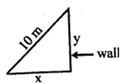
$A$ ladder of length $10 \ m$ is resting against a vertical wall. The bottom of the ladder is pulled along the ground away from the wall at the rate of $2 \ m/min$. How fast is its height on the wall decreasing when the foot of the ladder is $6 \ m$ away from the wall?
A
$-3 \ m/min$
B
$-2/3 \ m/min$
C
$-3/2 \ m/min$
D
None of these
Solution
(C) Let $x$ be the distance of the foot of the ladder from the wall and $y$ be the height of the top of the ladder on the wall.
By the Pythagorean theorem,we have $x^2 + y^2 = 10^2 = 100$.
Differentiating both sides with respect to time $t$,we get $2x \frac{dx}{dt} + 2y \frac{dy}{dt} = 0$.
Given that $x = 6 \ m$ and $\frac{dx}{dt} = 2 \ m/min$.
When $x = 6$,$y = \sqrt{100 - 6^2} = \sqrt{100 - 36} = \sqrt{64} = 8 \ m$.
Substituting these values into the differentiated equation:
$2(6)(2) + 2(8) \frac{dy}{dt} = 0$
$24 + 16 \frac{dy}{dt} = 0$
$16 \frac{dy}{dt} = -24$
$\frac{dy}{dt} = -\frac{24}{16} = -\frac{3}{2} \ m/min$.
Thus,the height is decreasing at the rate of $3/2 \ m/min$.
By the Pythagorean theorem,we have $x^2 + y^2 = 10^2 = 100$.
Differentiating both sides with respect to time $t$,we get $2x \frac{dx}{dt} + 2y \frac{dy}{dt} = 0$.
Given that $x = 6 \ m$ and $\frac{dx}{dt} = 2 \ m/min$.
When $x = 6$,$y = \sqrt{100 - 6^2} = \sqrt{100 - 36} = \sqrt{64} = 8 \ m$.
Substituting these values into the differentiated equation:
$2(6)(2) + 2(8) \frac{dy}{dt} = 0$
$24 + 16 \frac{dy}{dt} = 0$
$16 \frac{dy}{dt} = -24$
$\frac{dy}{dt} = -\frac{24}{16} = -\frac{3}{2} \ m/min$.
Thus,the height is decreasing at the rate of $3/2 \ m/min$.
0 likes
View Solution90
EasyMCQ
If the radius $r$ of a sphere is increasing at a rate of $2 \text{ cm/s}$,then the rate of change of its surface area is proportional to which of the following?
A
$\frac{1}{r}$
B
$\frac{1}{r^2}$
C
$r$
D
$r^2$
Solution
(C) Let the radius of the sphere be $r$ and its surface area be $S$.
The surface area of a sphere is given by $S = 4\pi r^2$.
We are given that the rate of change of the radius is $\frac{dr}{dt} = 2 \text{ cm/s}$.
Differentiating $S$ with respect to time $t$,we get:
$\frac{dS}{dt} = \frac{d}{dt}(4\pi r^2) = 4\pi \times 2r \times \frac{dr}{dt}$.
Substituting the given value of $\frac{dr}{dt}$:
$\frac{dS}{dt} = 8\pi r \times 2 = 16\pi r$.
Since $16\pi$ is a constant,we have $\frac{dS}{dt} \propto r$.
Therefore,the rate of change of the surface area is proportional to $r$.
The surface area of a sphere is given by $S = 4\pi r^2$.
We are given that the rate of change of the radius is $\frac{dr}{dt} = 2 \text{ cm/s}$.
Differentiating $S$ with respect to time $t$,we get:
$\frac{dS}{dt} = \frac{d}{dt}(4\pi r^2) = 4\pi \times 2r \times \frac{dr}{dt}$.
Substituting the given value of $\frac{dr}{dt}$:
$\frac{dS}{dt} = 8\pi r \times 2 = 16\pi r$.
Since $16\pi$ is a constant,we have $\frac{dS}{dt} \propto r$.
Therefore,the rate of change of the surface area is proportional to $r$.
0 likes
View Solution91
DifficultMCQ
$A$ spherical balloon is filled with $4500\pi$ cubic meters of helium gas. If a leak in the balloon causes the gas to escape at the rate of $72\pi$ cubic meters per minute,then the rate (in meters per minute) at which the radius of the balloon decreases $49$ minutes after the leakage began is:
A
$\frac{9}{7}$
B
$\frac{7}{9}$
C
$\frac{2}{9}$
D
$\frac{9}{2}$
Solution
(C) The initial volume of the balloon is $V_i = 4500\pi \text{ m}^3$.
The rate of change of volume is $\frac{dV}{dt} = -72\pi \text{ m}^3/\text{min}$.
After $t = 49$ minutes,the volume $V$ is:
$V = 4500\pi - (72\pi \times 49) = 4500\pi - 3528\pi = 972\pi \text{ m}^3$.
The volume of a sphere is $V = \frac{4}{3}\pi r^3$.
At $t = 49$ minutes,$972\pi = \frac{4}{3}\pi r^3$,which implies $r^3 = \frac{972 \times 3}{4} = 729$.
Thus,$r = \sqrt[3]{729} = 9 \text{ m}$.
Differentiating $V = \frac{4}{3}\pi r^3$ with respect to $t$,we get $\frac{dV}{dt} = 4\pi r^2 \frac{dr}{dt}$.
Substituting the values: $-72\pi = 4\pi (9)^2 \frac{dr}{dt}$.
$-72\pi = 4\pi (81) \frac{dr}{dt} = 324\pi \frac{dr}{dt}$.
$\frac{dr}{dt} = -\frac{72\pi}{324\pi} = -\frac{2}{9}$.
The rate at which the radius decreases is $\frac{2}{9} \text{ m/min}$.
The rate of change of volume is $\frac{dV}{dt} = -72\pi \text{ m}^3/\text{min}$.
After $t = 49$ minutes,the volume $V$ is:
$V = 4500\pi - (72\pi \times 49) = 4500\pi - 3528\pi = 972\pi \text{ m}^3$.
The volume of a sphere is $V = \frac{4}{3}\pi r^3$.
At $t = 49$ minutes,$972\pi = \frac{4}{3}\pi r^3$,which implies $r^3 = \frac{972 \times 3}{4} = 729$.
Thus,$r = \sqrt[3]{729} = 9 \text{ m}$.
Differentiating $V = \frac{4}{3}\pi r^3$ with respect to $t$,we get $\frac{dV}{dt} = 4\pi r^2 \frac{dr}{dt}$.
Substituting the values: $-72\pi = 4\pi (9)^2 \frac{dr}{dt}$.
$-72\pi = 4\pi (81) \frac{dr}{dt} = 324\pi \frac{dr}{dt}$.
$\frac{dr}{dt} = -\frac{72\pi}{324\pi} = -\frac{2}{9}$.
The rate at which the radius decreases is $\frac{2}{9} \text{ m/min}$.
0 likes
View Solution92
DifficultMCQ
At present,a firm is manufacturing $2000$ items. It is estimated that the rate of change of production $P$ with respect to the additional number of workers $x$ is given by $\frac{dP}{dx} = 100 - 12\sqrt{x}$. If the firm employs $25$ more workers,then the new level of production of items is:
A
$2500$
B
$3000$
C
$3500$
D
$4500$
Solution
(C) Given the rate of change of production: $\frac{dP}{dx} = 100 - 12\sqrt{x}$.
Integrating both sides with respect to $x$:
$\int dP = \int (100 - 12x^{1/2}) dx$
$P = 100x - 12 \times \frac{x^{3/2}}{3/2} + C$
$P = 100x - 8x^{3/2} + C$
Initially,when $x = 0$,the production $P = 2000$. Substituting these values:
$2000 = 100(0) - 8(0)^{3/2} + C \Rightarrow C = 2000$.
So,the production function is $P = 100x - 8x^{3/2} + 2000$.
For $x = 25$ additional workers,the new production level is:
$P = 100(25) - 8(25)^{3/2} + 2000$
$P = 2500 - 8(125) + 2000$
$P = 2500 - 1000 + 2000$
$P = 3500$.
Integrating both sides with respect to $x$:
$\int dP = \int (100 - 12x^{1/2}) dx$
$P = 100x - 12 \times \frac{x^{3/2}}{3/2} + C$
$P = 100x - 8x^{3/2} + C$
Initially,when $x = 0$,the production $P = 2000$. Substituting these values:
$2000 = 100(0) - 8(0)^{3/2} + C \Rightarrow C = 2000$.
So,the production function is $P = 100x - 8x^{3/2} + 2000$.
For $x = 25$ additional workers,the new production level is:
$P = 100(25) - 8(25)^{3/2} + 2000$
$P = 2500 - 8(125) + 2000$
$P = 2500 - 1000 + 2000$
$P = 3500$.
0 likes
View Solution93
MediumMCQ
$A$ stone,thrown vertically upward from the surface of the moon at a velocity of $24 \ m/s$,reaches a height of $s = 24t - 0.8t^2$ meters after $t$ seconds. The acceleration due to gravity in $m/s^2$ at the surface of the moon is:
A
$0.8$
B
$1.6$
C
$2.4$
D
$4.9$
Solution
(B) The height of the stone is given by the function $s(t) = 24t - 0.8t^2$.
To find the velocity $v(t)$,we differentiate the position function with respect to time $t$:
$v(t) = \frac{ds}{dt} = \frac{d}{dt}(24t - 0.8t^2) = 24 - 1.6t$.
To find the acceleration $a(t)$,we differentiate the velocity function with respect to time $t$:
$a(t) = \frac{dv}{dt} = \frac{d}{dt}(24 - 1.6t) = -1.6 \ m/s^2$.
The negative sign indicates that the acceleration is directed downwards (opposing the upward motion).
Therefore,the magnitude of the acceleration due to gravity on the surface of the moon is $1.6 \ m/s^2$.
To find the velocity $v(t)$,we differentiate the position function with respect to time $t$:
$v(t) = \frac{ds}{dt} = \frac{d}{dt}(24t - 0.8t^2) = 24 - 1.6t$.
To find the acceleration $a(t)$,we differentiate the velocity function with respect to time $t$:
$a(t) = \frac{dv}{dt} = \frac{d}{dt}(24 - 1.6t) = -1.6 \ m/s^2$.
The negative sign indicates that the acceleration is directed downwards (opposing the upward motion).
Therefore,the magnitude of the acceleration due to gravity on the surface of the moon is $1.6 \ m/s^2$.
0 likes
View Solution94
MediumMCQ
The distance travelled by a particle moving in a straight line in time $t$ is $s = \sqrt{at^2 + bt + c}$. The acceleration of the particle is
A
Proportional to $t$
B
Proportional to $s$
C
Proportional to $s^{-3}$
D
None of these
Solution
(C) Given the distance $s = \sqrt{at^2 + bt + c}$,we have $s^2 = at^2 + bt + c$.
Differentiating with respect to $t$:
$2s \frac{ds}{dt} = 2at + b$
$\frac{ds}{dt} = \frac{2at + b}{2s}$
Differentiating again with respect to $t$ to find acceleration $f = \frac{d^2s}{dt^2}$:
$2 \left( \frac{ds}{dt} \right)^2 + 2s \frac{d^2s}{dt^2} = 2a$
$s \frac{d^2s}{dt^2} = a - \left( \frac{ds}{dt} \right)^2$
$s \frac{d^2s}{dt^2} = a - \frac{(2at + b)^2}{4s^2} = \frac{4as^2 - (2at + b)^2}{4s^2}$
Substituting $s^2 = at^2 + bt + c$:
$s \frac{d^2s}{dt^2} = \frac{4a(at^2 + bt + c) - (4a^2t^2 + 4abt + b^2)}{4s^2}$
$s \frac{d^2s}{dt^2} = \frac{4a^2t^2 + 4abt + 4ac - 4a^2t^2 - 4abt - b^2}{4s^2} = \frac{4ac - b^2}{4s^2}$
$\frac{d^2s}{dt^2} = \frac{4ac - b^2}{4s^3}$
Since $4ac - b^2$ is a constant,the acceleration $f \propto s^{-3}$.
Differentiating with respect to $t$:
$2s \frac{ds}{dt} = 2at + b$
$\frac{ds}{dt} = \frac{2at + b}{2s}$
Differentiating again with respect to $t$ to find acceleration $f = \frac{d^2s}{dt^2}$:
$2 \left( \frac{ds}{dt} \right)^2 + 2s \frac{d^2s}{dt^2} = 2a$
$s \frac{d^2s}{dt^2} = a - \left( \frac{ds}{dt} \right)^2$
$s \frac{d^2s}{dt^2} = a - \frac{(2at + b)^2}{4s^2} = \frac{4as^2 - (2at + b)^2}{4s^2}$
Substituting $s^2 = at^2 + bt + c$:
$s \frac{d^2s}{dt^2} = \frac{4a(at^2 + bt + c) - (4a^2t^2 + 4abt + b^2)}{4s^2}$
$s \frac{d^2s}{dt^2} = \frac{4a^2t^2 + 4abt + 4ac - 4a^2t^2 - 4abt - b^2}{4s^2} = \frac{4ac - b^2}{4s^2}$
$\frac{d^2s}{dt^2} = \frac{4ac - b^2}{4s^3}$
Since $4ac - b^2$ is a constant,the acceleration $f \propto s^{-3}$.
0 likes
View Solution95
MediumMCQ
On dropping a stone in stationary water,circular ripples are observed. The rate of flow of ripples is $6 \text{ cm/sec}$. When the radius of the circle is $10 \text{ cm}$,the rate of increase in its area is:
A
$120 \text{ cm}^2/\text{sec}$
B
$60 \pi \text{ cm}^2/\text{sec}$
C
$10 \pi \text{ cm}^2/\text{sec}$
D
$120 \pi \text{ cm}^2/\text{sec}$
Solution
(D) Let $r$ be the radius of the circular ripple and $A$ be its area.
Given that the rate of change of the radius is $\frac{dr}{dt} = 6 \text{ cm/sec}$.
The area of a circle is given by $A = \pi r^2$.
Differentiating both sides with respect to time $t$,we get:
$\frac{dA}{dt} = 2 \pi r \frac{dr}{dt}$.
Substitute the given values $r = 10 \text{ cm}$ and $\frac{dr}{dt} = 6 \text{ cm/sec}$:
$\frac{dA}{dt} = 2 \pi \times 10 \times 6 = 120 \pi \text{ cm}^2/\text{sec}$.
Thus,the rate of increase in the area is $120 \pi \text{ cm}^2/\text{sec}$.
Given that the rate of change of the radius is $\frac{dr}{dt} = 6 \text{ cm/sec}$.
The area of a circle is given by $A = \pi r^2$.
Differentiating both sides with respect to time $t$,we get:
$\frac{dA}{dt} = 2 \pi r \frac{dr}{dt}$.
Substitute the given values $r = 10 \text{ cm}$ and $\frac{dr}{dt} = 6 \text{ cm/sec}$:
$\frac{dA}{dt} = 2 \pi \times 10 \times 6 = 120 \pi \text{ cm}^2/\text{sec}$.
Thus,the rate of increase in the area is $120 \pi \text{ cm}^2/\text{sec}$.
0 likes
View Solution96
AdvancedMCQ
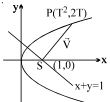
Let $S$ be the focus of $y^2 = 4x$ and a point $P$ is moving on the curve such that its abscissa is increasing at the rate of $4 \text{ units/sec}$. Then the rate of increase of the projection of $SP$ on the line $x + y = 1$ when $P$ is at $(4, 4)$ is:
A
$\sqrt{2}$
B
$-1$
C
$-\sqrt{2}$
D
$-\frac{3}{\sqrt{2}}$
Solution
(A) The focus $S$ of the parabola $y^2 = 4x$ is $(1, 0)$. Let $P$ be a point on the parabola,so $P = (T^2, 2T)$.
The vector $\vec{SP} = (T^2 - 1)\hat{i} + 2T\hat{j}$.
The line is $x + y - 1 = 0$. The normal vector to the line is $\vec{n} = \hat{i} + \hat{j}$. The unit normal vector is $\hat{u} = \frac{\hat{i} + \hat{j}}{\sqrt{2}}$.
The projection of $\vec{SP}$ on the line $x + y = 1$ is the component of $\vec{SP}$ along the direction parallel to the line. The direction vector of the line is $\vec{v} = \hat{i} - \hat{j}$.
The projection $L$ is given by $\frac{\vec{SP} \cdot \vec{v}}{|\vec{v}|} = \frac{(T^2 - 1) - 2T}{\sqrt{2}} = \frac{T^2 - 2T - 1}{\sqrt{2}}$.
Differentiating with respect to $t$: $\frac{dL}{dt} = \frac{1}{\sqrt{2}} (2T - 2) \frac{dT}{dt}$.
Given $\frac{dx}{dt} = 4$. Since $x = T^2$,$\frac{dx}{dt} = 2T \frac{dT}{dt} = 4$. At $P(4, 4)$,$T = 2$,so $4 \frac{dT}{dt} = 4 \implies \frac{dT}{dt} = 1$.
Substituting $\frac{dT}{dt} = 1$ and $T = 2$ into the derivative of $L$:
$\frac{dL}{dt} = \frac{1}{\sqrt{2}} (2(2) - 2)(1) = \frac{2}{\sqrt{2}} = \sqrt{2}$.
The vector $\vec{SP} = (T^2 - 1)\hat{i} + 2T\hat{j}$.
The line is $x + y - 1 = 0$. The normal vector to the line is $\vec{n} = \hat{i} + \hat{j}$. The unit normal vector is $\hat{u} = \frac{\hat{i} + \hat{j}}{\sqrt{2}}$.
The projection of $\vec{SP}$ on the line $x + y = 1$ is the component of $\vec{SP}$ along the direction parallel to the line. The direction vector of the line is $\vec{v} = \hat{i} - \hat{j}$.
The projection $L$ is given by $\frac{\vec{SP} \cdot \vec{v}}{|\vec{v}|} = \frac{(T^2 - 1) - 2T}{\sqrt{2}} = \frac{T^2 - 2T - 1}{\sqrt{2}}$.
Differentiating with respect to $t$: $\frac{dL}{dt} = \frac{1}{\sqrt{2}} (2T - 2) \frac{dT}{dt}$.
Given $\frac{dx}{dt} = 4$. Since $x = T^2$,$\frac{dx}{dt} = 2T \frac{dT}{dt} = 4$. At $P(4, 4)$,$T = 2$,so $4 \frac{dT}{dt} = 4 \implies \frac{dT}{dt} = 1$.
Substituting $\frac{dT}{dt} = 1$ and $T = 2$ into the derivative of $L$:
$\frac{dL}{dt} = \frac{1}{\sqrt{2}} (2(2) - 2)(1) = \frac{2}{\sqrt{2}} = \sqrt{2}$.
0 likes
View Solution97
AdvancedMCQ
The radius of a right circular cylinder increases at the rate of $0.1 \text{ cm/min}$,and the height decreases at the rate of $0.2 \text{ cm/min}$. The rate of change of the volume of the cylinder,in $\text{cm}^3/\text{min}$,when the radius is $2 \text{ cm}$ and the height is $3 \text{ cm}$ is
A
$(- 2\pi )$
B
$(- \frac{8\pi}{5})$
C
$(- \frac{3\pi}{5})$
D
$(\frac{2\pi}{5})$
Solution
(D) The volume of a right circular cylinder is given by $V = \pi r^2h$.
Differentiating both sides with respect to time $t$,we get:
$\frac{dV}{dt} = \pi \left( r^2 \frac{dh}{dt} + 2rh \frac{dr}{dt} \right)$.
Given that $\frac{dr}{dt} = 0.1 = \frac{1}{10} \text{ cm/min}$ and $\frac{dh}{dt} = -0.2 = -\frac{2}{10} \text{ cm/min}$.
Substituting these values into the derivative expression:
$\frac{dV}{dt} = \pi \left( r^2 \left( -\frac{2}{10} \right) + 2rh \left( \frac{1}{10} \right) \right)$.
$\frac{dV}{dt} = \frac{\pi r}{10} (-2r + 2h) = \frac{2\pi r}{10} (h - r) = \frac{\pi r}{5} (h - r)$.
At $r = 2 \text{ cm}$ and $h = 3 \text{ cm}$:
$\frac{dV}{dt} = \frac{\pi (2)}{5} (3 - 2) = \frac{2\pi}{5} \text{ cm}^3/\text{min}$.
Differentiating both sides with respect to time $t$,we get:
$\frac{dV}{dt} = \pi \left( r^2 \frac{dh}{dt} + 2rh \frac{dr}{dt} \right)$.
Given that $\frac{dr}{dt} = 0.1 = \frac{1}{10} \text{ cm/min}$ and $\frac{dh}{dt} = -0.2 = -\frac{2}{10} \text{ cm/min}$.
Substituting these values into the derivative expression:
$\frac{dV}{dt} = \pi \left( r^2 \left( -\frac{2}{10} \right) + 2rh \left( \frac{1}{10} \right) \right)$.
$\frac{dV}{dt} = \frac{\pi r}{10} (-2r + 2h) = \frac{2\pi r}{10} (h - r) = \frac{\pi r}{5} (h - r)$.
At $r = 2 \text{ cm}$ and $h = 3 \text{ cm}$:
$\frac{dV}{dt} = \frac{\pi (2)}{5} (3 - 2) = \frac{2\pi}{5} \text{ cm}^3/\text{min}$.
0 likes
View Solution98
AdvancedMCQ
Coffee is draining from a conical filter,with both height and diameter equal to $15 \, cm$,into a cylindrical coffee pot with a diameter of $15 \, cm$. The rate at which coffee drains from the filter into the pot is $100 \, cm^3/min$. The rate in $cm/min$ at which the level in the pot is rising at the instant when the coffee in the pot is $10 \, cm$ deep,is:
A
$\frac{9}{16\pi}$
B
$\frac{25}{9\pi}$
C
$\frac{5}{3\pi}$
D
$\frac{16}{9\pi}$
Solution
(D) The volume of coffee in the cylindrical pot is given by $V = \pi r^2 h$,where $r$ is the radius and $h$ is the height of the coffee level.
Given the diameter of the pot is $15 \, cm$,the radius $r = \frac{15}{2} \, cm$.
Since the pot is cylindrical,the radius $r$ remains constant as the level rises,so $\frac{dr}{dt} = 0$.
Differentiating the volume with respect to time $t$,we get:
$\frac{dV}{dt} = \pi r^2 \frac{dh}{dt}$.
We are given $\frac{dV}{dt} = 100 \, cm^3/min$.
Substituting the values:
$100 = \pi \left( \frac{15}{2} \right)^2 \frac{dh}{dt}$
$100 = \pi \left( \frac{225}{4} \right) \frac{dh}{dt}$
$\frac{dh}{dt} = \frac{100 \times 4}{225 \pi} = \frac{400}{225 \pi} = \frac{16}{9 \pi} \, cm/min$.
Thus,the rate at which the level in the pot is rising is $\frac{16}{9 \pi} \, cm/min$.
Given the diameter of the pot is $15 \, cm$,the radius $r = \frac{15}{2} \, cm$.
Since the pot is cylindrical,the radius $r$ remains constant as the level rises,so $\frac{dr}{dt} = 0$.
Differentiating the volume with respect to time $t$,we get:
$\frac{dV}{dt} = \pi r^2 \frac{dh}{dt}$.
We are given $\frac{dV}{dt} = 100 \, cm^3/min$.
Substituting the values:
$100 = \pi \left( \frac{15}{2} \right)^2 \frac{dh}{dt}$
$100 = \pi \left( \frac{225}{4} \right) \frac{dh}{dt}$
$\frac{dh}{dt} = \frac{100 \times 4}{225 \pi} = \frac{400}{225 \pi} = \frac{16}{9 \pi} \, cm/min$.
Thus,the rate at which the level in the pot is rising is $\frac{16}{9 \pi} \, cm/min$.
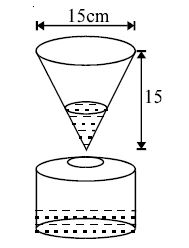
0 likes
View Solution99
AdvancedMCQ
$A$ horse runs along a circle with a speed of $20 \, km/hr$. $A$ lantern is at the centre of the circle. $A$ fence is along the tangent to the circle at the point at which the horse starts. The speed with which the shadow of the horse moves along the fence at the moment when it covers $1/8$ of the circle is (in $km/hr$):
A
$20$
B
$40$
C
$30$
D
$60$
Solution
(B) Let $r$ be the radius of the circle and $v = 20 \, km/hr$ be the speed of the horse.
Let $\theta$ be the angle subtended by the horse at the centre of the circle at any time $t$.
The position of the shadow on the fence is given by $x = r \tan \theta$.
Differentiating with respect to $t$,we get $\frac{dx}{dt} = r \sec^2 \theta \frac{d\theta}{dt}$.
Since the speed of the horse is $v = r \frac{d\theta}{dt}$,we have $\frac{d\theta}{dt} = \frac{v}{r}$.
Substituting this into the expression for $\frac{dx}{dt}$,we get $\frac{dx}{dt} = r \sec^2 \theta \left(\frac{v}{r}\right) = v \sec^2 \theta$.
The horse covers $1/8$ of the circle,which corresponds to an angle $\theta = \frac{1}{8} \times 360^\circ = 45^\circ$.
At $\theta = 45^\circ$,$\sec^2(45^\circ) = (\sqrt{2})^2 = 2$.
Therefore,the speed of the shadow is $\frac{dx}{dt} = 20 \times 2 = 40 \, km/hr$.
Let $\theta$ be the angle subtended by the horse at the centre of the circle at any time $t$.
The position of the shadow on the fence is given by $x = r \tan \theta$.
Differentiating with respect to $t$,we get $\frac{dx}{dt} = r \sec^2 \theta \frac{d\theta}{dt}$.
Since the speed of the horse is $v = r \frac{d\theta}{dt}$,we have $\frac{d\theta}{dt} = \frac{v}{r}$.
Substituting this into the expression for $\frac{dx}{dt}$,we get $\frac{dx}{dt} = r \sec^2 \theta \left(\frac{v}{r}\right) = v \sec^2 \theta$.
The horse covers $1/8$ of the circle,which corresponds to an angle $\theta = \frac{1}{8} \times 360^\circ = 45^\circ$.
At $\theta = 45^\circ$,$\sec^2(45^\circ) = (\sqrt{2})^2 = 2$.
Therefore,the speed of the shadow is $\frac{dx}{dt} = 20 \times 2 = 40 \, km/hr$.
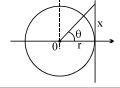
0 likes
View Solution100
AdvancedMCQ
Let $x$ be the length of one of the equal sides of an isosceles triangle,and let $\theta$ be the angle between them. If $x$ is increasing at the rate of $1/12 \ m/hr$,and $\theta$ is increasing at the rate of $\pi/180 \ \text{radians/hr}$,then find the rate in $m^2/hr$ at which the area of the triangle is increasing when $x = 12 \ m$ and $\theta = \pi/4$.

A
$2^{1/2}\left( {1 + \frac{{2\pi }}{5}} \right)$
B
$\frac{{73}}{2} \cdot 2^{1/2}$
C
$\frac{3^{1/2}}{2} + \frac{\pi }{5}$
D
$2^{1/2}\left( {\frac{1}{2} + \frac{\pi }{5}} \right)$
Solution
(D) The area $A$ of an isosceles triangle with equal sides $x$ and included angle $\theta$ is given by $A = \frac{1}{2} x^2 \sin\theta$.
To find the rate of change of area with respect to time $t$,we differentiate with respect to $t$:
$\frac{dA}{dt} = \frac{1}{2} \left( 2x \frac{dx}{dt} \sin\theta + x^2 \cos\theta \frac{d\theta}{dt} \right) = x \frac{dx}{dt} \sin\theta + \frac{1}{2} x^2 \cos\theta \frac{d\theta}{dt}$.
Given values: $x = 12 \ m$,$\theta = \pi/4$,$\frac{dx}{dt} = 1/12 \ m/hr$,and $\frac{d\theta}{dt} = \pi/180 \ \text{rad/hr}$.
Substituting these values:
$\frac{dA}{dt} = (12) \left( \frac{1}{12} \right) \sin(\pi/4) + \frac{1}{2} (12)^2 \cos(\pi/4) \left( \frac{\pi}{180} \right)$
$\frac{dA}{dt} = (1) \left( \frac{1}{\sqrt{2}} \right) + \frac{1}{2} (144) \left( \frac{1}{\sqrt{2}} \right) \left( \frac{\pi}{180} \right)$
$\frac{dA}{dt} = \frac{1}{\sqrt{2}} + \frac{72}{\sqrt{2}} \left( \frac{\pi}{180} \right) = \frac{1}{\sqrt{2}} + \frac{2\pi}{5\sqrt{2}} = \frac{1}{\sqrt{2}} \left( 1 + \frac{2\pi}{5} \right) = \frac{\sqrt{2}}{2} \left( 1 + \frac{2\pi}{5} \right)$.
Wait,checking the options,the expression is $2^{1/2} (1/2 + \pi/5) = \sqrt{2} (1/2 + \pi/5) = \frac{\sqrt{2}}{2} + \frac{\sqrt{2}\pi}{5} = \frac{1}{\sqrt{2}} + \frac{2\pi}{5\sqrt{2}}$. This matches option $D$.
To find the rate of change of area with respect to time $t$,we differentiate with respect to $t$:
$\frac{dA}{dt} = \frac{1}{2} \left( 2x \frac{dx}{dt} \sin\theta + x^2 \cos\theta \frac{d\theta}{dt} \right) = x \frac{dx}{dt} \sin\theta + \frac{1}{2} x^2 \cos\theta \frac{d\theta}{dt}$.
Given values: $x = 12 \ m$,$\theta = \pi/4$,$\frac{dx}{dt} = 1/12 \ m/hr$,and $\frac{d\theta}{dt} = \pi/180 \ \text{rad/hr}$.
Substituting these values:
$\frac{dA}{dt} = (12) \left( \frac{1}{12} \right) \sin(\pi/4) + \frac{1}{2} (12)^2 \cos(\pi/4) \left( \frac{\pi}{180} \right)$
$\frac{dA}{dt} = (1) \left( \frac{1}{\sqrt{2}} \right) + \frac{1}{2} (144) \left( \frac{1}{\sqrt{2}} \right) \left( \frac{\pi}{180} \right)$
$\frac{dA}{dt} = \frac{1}{\sqrt{2}} + \frac{72}{\sqrt{2}} \left( \frac{\pi}{180} \right) = \frac{1}{\sqrt{2}} + \frac{2\pi}{5\sqrt{2}} = \frac{1}{\sqrt{2}} \left( 1 + \frac{2\pi}{5} \right) = \frac{\sqrt{2}}{2} \left( 1 + \frac{2\pi}{5} \right)$.
Wait,checking the options,the expression is $2^{1/2} (1/2 + \pi/5) = \sqrt{2} (1/2 + \pi/5) = \frac{\sqrt{2}}{2} + \frac{\sqrt{2}\pi}{5} = \frac{1}{\sqrt{2}} + \frac{2\pi}{5\sqrt{2}}$. This matches option $D$.
0 likes
View SolutionApplications of Derivatives — Rate of Change of Quantities · Frequently Asked Questions
1Are these Applications of Derivatives questions useful for JEE and NEET?
Yes. All questions in this section are mapped to JEE Main and NEET exam patterns. Previous year questions from JEE Main, NEET, GUJCET and state-level exams are included with full solutions.
2Can I switch to Hindi or Gujarati for these questions?
Yes. Use the language tabs in the hero section or the sidebar to view the same questions and solutions in English, Hindi or Gujarati.
3How do I generate a question paper from this subtopic?
Use the Vedclass Exam Paper Generator — select the chapter and subtopic, set difficulty, and generate Sets A, B, C, D automatically. First 3 chapters of every subject are free.
Vedclass Products
For Students
Vedclass Test Series
Mock tests in real JEE/NEET style with performance analysis. 5-day free trial.
Start Free TrialFor Teachers
Exam Paper Generator
Generate Set A/B/C/D papers from this chapter in 2 minutes. 3 chapters free.
Try FreeFor Institutes
Online Exam Module
Live online exams with unlimited students, 360° analytics & white-label branding.
See DemoFor Teachers & Institutes
Generate a Applications of Derivatives Exam Paper in 2 Minutes
Select subtopic & difficulty — Sets A, B, C, D auto-generated with No Repeat logic.
First 3 chapters of every subject are free — no payment required.