
A English
Maxima and Minima Questions in English
Class 12 Mathematics · Applications of Derivatives · Maxima and Minima
760+
Questions
English
Language
100%
With Solutions
Showing 48 of 760 questions in English
601
MediumMCQ
If $m$ and $M$ are the absolute minimum and absolute maximum values of the function $f(x) = 2\sqrt{2} \sin x - \tan x$ in the interval $[0, \pi/3]$,then $m + M =$
A
$-1$
B
$0$
C
$1$
D
$2$
Solution
(C) Given $f(x) = 2\sqrt{2} \sin x - \tan x$ on $[0, \pi/3]$.
First,find the derivative $f'(x) = 2\sqrt{2} \cos x - \sec^2 x$.
Set $f'(x) = 0$ to find critical points:
$2\sqrt{2} \cos x = \frac{1}{\cos^2 x} \implies \cos^3 x = \frac{1}{2\sqrt{2}} = \left(\frac{1}{\sqrt{2}}\right)^3$.
Thus,$\cos x = \frac{1}{\sqrt{2}}$,which gives $x = \pi/4$.
Now,evaluate $f(x)$ at critical points and endpoints:
$f(0) = 2\sqrt{2}(0) - 0 = 0$.
$f(\pi/4) = 2\sqrt{2}(\frac{1}{\sqrt{2}}) - 1 = 2 - 1 = 1$.
$f(\pi/3) = 2\sqrt{2}(\frac{\sqrt{3}}{2}) - \sqrt{3} = \sqrt{6} - \sqrt{3} \approx 2.45 - 1.73 = 0.72$.
Comparing values: $m = 0$ and $M = 1$.
Therefore,$m + M = 0 + 1 = 1$.
First,find the derivative $f'(x) = 2\sqrt{2} \cos x - \sec^2 x$.
Set $f'(x) = 0$ to find critical points:
$2\sqrt{2} \cos x = \frac{1}{\cos^2 x} \implies \cos^3 x = \frac{1}{2\sqrt{2}} = \left(\frac{1}{\sqrt{2}}\right)^3$.
Thus,$\cos x = \frac{1}{\sqrt{2}}$,which gives $x = \pi/4$.
Now,evaluate $f(x)$ at critical points and endpoints:
$f(0) = 2\sqrt{2}(0) - 0 = 0$.
$f(\pi/4) = 2\sqrt{2}(\frac{1}{\sqrt{2}}) - 1 = 2 - 1 = 1$.
$f(\pi/3) = 2\sqrt{2}(\frac{\sqrt{3}}{2}) - \sqrt{3} = \sqrt{6} - \sqrt{3} \approx 2.45 - 1.73 = 0.72$.
Comparing values: $m = 0$ and $M = 1$.
Therefore,$m + M = 0 + 1 = 1$.
0 likes
View Solution602
MediumMCQ
The number of turning points of the curve $f(x) = 2 \cos x - \sin 2x$ in the interval $[-\pi, \pi]$ is
A
$4$
B
$3$
C
$1$
D
$2$
Solution
(B) To find the turning points,we need to find the points where the derivative $f'(x) = 0$.
Given $f(x) = 2 \cos x - \sin 2x$.
Differentiating with respect to $x$:
$f'(x) = -2 \sin x - 2 \cos 2x$.
Setting $f'(x) = 0$:
$-2 \sin x - 2 \cos 2x = 0$
$\sin x + \cos 2x = 0$.
Using the identity $\cos 2x = 1 - 2 \sin^2 x$:
$\sin x + 1 - 2 \sin^2 x = 0$
$2 \sin^2 x - \sin x - 1 = 0$.
Let $u = \sin x$,then $2u^2 - u - 1 = 0$.
$(2u + 1)(u - 1) = 0$.
So,$\sin x = 1$ or $\sin x = -1/2$.
For $\sin x = 1$ in $[-\pi, \pi]$,$x = \pi/2$.
For $\sin x = -1/2$ in $[-\pi, \pi]$,$x = -\pi/6$ and $x = -5\pi/6$.
Thus,there are $3$ turning points in the given interval.
Given $f(x) = 2 \cos x - \sin 2x$.
Differentiating with respect to $x$:
$f'(x) = -2 \sin x - 2 \cos 2x$.
Setting $f'(x) = 0$:
$-2 \sin x - 2 \cos 2x = 0$
$\sin x + \cos 2x = 0$.
Using the identity $\cos 2x = 1 - 2 \sin^2 x$:
$\sin x + 1 - 2 \sin^2 x = 0$
$2 \sin^2 x - \sin x - 1 = 0$.
Let $u = \sin x$,then $2u^2 - u - 1 = 0$.
$(2u + 1)(u - 1) = 0$.
So,$\sin x = 1$ or $\sin x = -1/2$.
For $\sin x = 1$ in $[-\pi, \pi]$,$x = \pi/2$.
For $\sin x = -1/2$ in $[-\pi, \pi]$,$x = -\pi/6$ and $x = -5\pi/6$.
Thus,there are $3$ turning points in the given interval.
0 likes
View Solution603
MediumMCQ
The difference between the absolute maximum and absolute minimum values of the function $f(x)=2x^3-15x^2+36x-30$ on the interval $[-1, 4]$ is:
A
$80$
B
$1$
C
$85$
D
$4$
Solution
(C) To find the absolute maximum and minimum values of $f(x) = 2x^3 - 15x^2 + 36x - 30$ on $[-1, 4]$,we first find the critical points by setting $f'(x) = 0$.
$f'(x) = 6x^2 - 30x + 36 = 6(x^2 - 5x + 6) = 6(x - 2)(x - 3)$.
The critical points are $x = 2$ and $x = 3$,both of which lie in $[-1, 4]$.
Now,we evaluate $f(x)$ at the critical points and the endpoints of the interval:
$f(-1) = 2(-1)^3 - 15(-1)^2 + 36(-1) - 30 = -2 - 15 - 36 - 30 = -83$.
$f(2) = 2(8) - 15(4) + 36(2) - 30 = 16 - 60 + 72 - 30 = -2$.
$f(3) = 2(27) - 15(9) + 36(3) - 30 = 54 - 135 + 108 - 30 = -3$.
$f(4) = 2(64) - 15(16) + 36(4) - 30 = 128 - 240 + 144 - 30 = 2$.
The absolute maximum value is $2$ and the absolute minimum value is $-83$.
The difference is $2 - (-83) = 85$.
$f'(x) = 6x^2 - 30x + 36 = 6(x^2 - 5x + 6) = 6(x - 2)(x - 3)$.
The critical points are $x = 2$ and $x = 3$,both of which lie in $[-1, 4]$.
Now,we evaluate $f(x)$ at the critical points and the endpoints of the interval:
$f(-1) = 2(-1)^3 - 15(-1)^2 + 36(-1) - 30 = -2 - 15 - 36 - 30 = -83$.
$f(2) = 2(8) - 15(4) + 36(2) - 30 = 16 - 60 + 72 - 30 = -2$.
$f(3) = 2(27) - 15(9) + 36(3) - 30 = 54 - 135 + 108 - 30 = -3$.
$f(4) = 2(64) - 15(16) + 36(4) - 30 = 128 - 240 + 144 - 30 = 2$.
The absolute maximum value is $2$ and the absolute minimum value is $-83$.
The difference is $2 - (-83) = 85$.
0 likes
View Solution604
EasyMCQ
If $x$ is real and $\alpha, \beta$ are maximum and minimum values of $\frac{x^2-x+1}{x^2+x+1}$ respectively,then $\alpha+\beta=$
A
$\frac{10}{3}$
B
$\frac{8}{3}$
C
$\frac{4}{3}$
D
$\frac{2}{3}$
Solution
(A) Let $y = \frac{x^2-x+1}{x^2+x+1}$.
To find the extrema,we differentiate $y$ with respect to $x$:
$\frac{dy}{dx} = \frac{(2x-1)(x^2+x+1) - (2x+1)(x^2-x+1)}{(x^2+x+1)^2} = 0$.
Simplifying the numerator:
$(2x^3 + 2x^2 + 2x - x^2 - x - 1) - (2x^3 - 2x^2 + 2x + x^2 - x + 1) = 0$.
$(2x^3 + x^2 + x - 1) - (2x^3 - x^2 + x + 1) = 0$.
$2x^2 - 2 = 0 \Rightarrow x^2 = 1 \Rightarrow x = \pm 1$.
For $x = -1$,$y = \frac{(-1)^2 - (-1) + 1}{(-1)^2 + (-1) + 1} = \frac{1+1+1}{1-1+1} = \frac{3}{1} = 3$.
For $x = 1$,$y = \frac{1^2 - 1 + 1}{1^2 + 1 + 1} = \frac{1}{3}$.
Thus,the maximum value $\alpha = 3$ and the minimum value $\beta = \frac{1}{3}$.
Therefore,$\alpha + \beta = 3 + \frac{1}{3} = \frac{10}{3}$.
To find the extrema,we differentiate $y$ with respect to $x$:
$\frac{dy}{dx} = \frac{(2x-1)(x^2+x+1) - (2x+1)(x^2-x+1)}{(x^2+x+1)^2} = 0$.
Simplifying the numerator:
$(2x^3 + 2x^2 + 2x - x^2 - x - 1) - (2x^3 - 2x^2 + 2x + x^2 - x + 1) = 0$.
$(2x^3 + x^2 + x - 1) - (2x^3 - x^2 + x + 1) = 0$.
$2x^2 - 2 = 0 \Rightarrow x^2 = 1 \Rightarrow x = \pm 1$.
For $x = -1$,$y = \frac{(-1)^2 - (-1) + 1}{(-1)^2 + (-1) + 1} = \frac{1+1+1}{1-1+1} = \frac{3}{1} = 3$.
For $x = 1$,$y = \frac{1^2 - 1 + 1}{1^2 + 1 + 1} = \frac{1}{3}$.
Thus,the maximum value $\alpha = 3$ and the minimum value $\beta = \frac{1}{3}$.
Therefore,$\alpha + \beta = 3 + \frac{1}{3} = \frac{10}{3}$.
0 likes
View Solution605
EasyMCQ
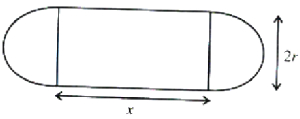
If a running track of $500 \ ft$. is to be laid out enclosing a playground,the shape of which is a rectangle with a semicircle at each end,then the length of the rectangular portion such that the area of the rectangular portion is to be maximum is (in feet).
A
$100$
B
$125$
C
$150$
D
$200$
Solution
(B) Let the length of the rectangular portion be $x$ and the radius of the semicircular ends be $r$. The total perimeter of the track is given by $P = 2x + 2\pi r = 500 \ ft$.
From this,we get $x + \pi r = 250$,so $x = 250 - \pi r$.
The area of the rectangular portion is $A = x \times (2r) = (250 - \pi r)(2r) = 500r - 2\pi r^2$.
To maximize the area,we find the derivative with respect to $r$ and set it to zero:
$\frac{dA}{dr} = 500 - 4\pi r = 0 \Rightarrow r = \frac{125}{\pi}$.
Now,substitute $r$ back into the expression for $x$:
$x = 250 - \pi \left(\frac{125}{\pi}\right) = 250 - 125 = 125 \ ft$.
Thus,the length of the rectangular portion for maximum area is $125 \ ft$.
From this,we get $x + \pi r = 250$,so $x = 250 - \pi r$.
The area of the rectangular portion is $A = x \times (2r) = (250 - \pi r)(2r) = 500r - 2\pi r^2$.
To maximize the area,we find the derivative with respect to $r$ and set it to zero:
$\frac{dA}{dr} = 500 - 4\pi r = 0 \Rightarrow r = \frac{125}{\pi}$.
Now,substitute $r$ back into the expression for $x$:
$x = 250 - \pi \left(\frac{125}{\pi}\right) = 250 - 125 = 125 \ ft$.
Thus,the length of the rectangular portion for maximum area is $125 \ ft$.
0 likes
View Solution606
DifficultMCQ
If $f(x)=p x^3+q x^2+r x+t$ attains local minimum and local maximum values at $x=-2$ and $x=2$ respectively and $p$ is a root of $9 x^2-1=0$,then $p+q+r=$
A
$\frac{4}{3}$
B
$4$
C
$\frac{11}{3}$
D
$\frac{13}{3}$
Solution
(C) Given $f(x) = px^3 + qx^2 + rx + t$.
The derivative is $f'(x) = 3px^2 + 2qx + r$ ... $(i)$
Since $f(x)$ has local extrema at $x = -2$ and $x = 2$,$f'(x) = k(x+2)(x-2) = k(x^2 - 4)$ ... (ii)
Comparing $(i)$ and (ii),we get $3p = k$,$2q = 0$,and $r = -4k$.
Thus,$q = 0$ and $r = -4(3p) = -12p$.
The second derivative is $f''(x) = 6px + 2q = 6px$.
For local minimum at $x = -2$,$f''(-2) = -12p > 0$,which implies $p < 0$.
Given $p$ is a root of $9x^2 - 1 = 0$,so $x = \pm \frac{1}{3}$.
Since $p < 0$,we have $p = -\frac{1}{3}$.
Then $r = -12(-\frac{1}{3}) = 4$.
Therefore,$p + q + r = -\frac{1}{3} + 0 + 4 = \frac{11}{3}$.
The derivative is $f'(x) = 3px^2 + 2qx + r$ ... $(i)$
Since $f(x)$ has local extrema at $x = -2$ and $x = 2$,$f'(x) = k(x+2)(x-2) = k(x^2 - 4)$ ... (ii)
Comparing $(i)$ and (ii),we get $3p = k$,$2q = 0$,and $r = -4k$.
Thus,$q = 0$ and $r = -4(3p) = -12p$.
The second derivative is $f''(x) = 6px + 2q = 6px$.
For local minimum at $x = -2$,$f''(-2) = -12p > 0$,which implies $p < 0$.
Given $p$ is a root of $9x^2 - 1 = 0$,so $x = \pm \frac{1}{3}$.
Since $p < 0$,we have $p = -\frac{1}{3}$.
Then $r = -12(-\frac{1}{3}) = 4$.
Therefore,$p + q + r = -\frac{1}{3} + 0 + 4 = \frac{11}{3}$.
0 likes
View Solution607
DifficultMCQ
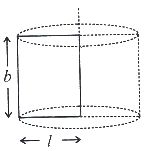
Given that the solid obtained by rotating a rectangle about one of its sides is a cylinder. If the perimeter of a rectangle is $48 \text{ cm}$ and the volume of the cylinder formed by rotating it is maximum,then the dimensions of that rectangle are:
A
$14, 10$
B
$20, 4$
C
$18, 6$
D
$8, 16$
Solution
(D) Let $l$ and $b$ be the length and width of the rectangle.
Given that the perimeter is $48 \text{ cm}$.
$2(l + b) = 48 \Rightarrow l + b = 24 \Rightarrow b = 24 - l$ ... $(i)$
When the rectangle is rotated about side $b$,the radius of the cylinder is $r = l$ and the height is $h = b$.
The volume of the cylinder is $V = \pi r^2 h = \pi l^2 b$.
Substituting $b$ from $(i)$: $V = \pi l^2(24 - l) = 24\pi l^2 - \pi l^3$.
To find the maximum volume,differentiate with respect to $l$:
$\frac{dV}{dl} = 48\pi l - 3\pi l^2$.
Set $\frac{dV}{dl} = 0$ for critical points:
$3\pi l(16 - l) = 0 \Rightarrow l = 0$ or $l = 16$.
Since $l$ must be positive,$l = 16$.
Check the second derivative: $\frac{d^2V}{dl^2} = 48\pi - 6\pi l$.
At $l = 16$,$\frac{d^2V}{dl^2} = 48\pi - 96\pi = -48\pi < 0$.
Since the second derivative is negative,the volume is maximum at $l = 16$.
Then $b = 24 - 16 = 8$.
Thus,the dimensions of the rectangle are $8 \text{ cm}$ and $16 \text{ cm}$.
Given that the perimeter is $48 \text{ cm}$.
$2(l + b) = 48 \Rightarrow l + b = 24 \Rightarrow b = 24 - l$ ... $(i)$
When the rectangle is rotated about side $b$,the radius of the cylinder is $r = l$ and the height is $h = b$.
The volume of the cylinder is $V = \pi r^2 h = \pi l^2 b$.
Substituting $b$ from $(i)$: $V = \pi l^2(24 - l) = 24\pi l^2 - \pi l^3$.
To find the maximum volume,differentiate with respect to $l$:
$\frac{dV}{dl} = 48\pi l - 3\pi l^2$.
Set $\frac{dV}{dl} = 0$ for critical points:
$3\pi l(16 - l) = 0 \Rightarrow l = 0$ or $l = 16$.
Since $l$ must be positive,$l = 16$.
Check the second derivative: $\frac{d^2V}{dl^2} = 48\pi - 6\pi l$.
At $l = 16$,$\frac{d^2V}{dl^2} = 48\pi - 96\pi = -48\pi < 0$.
Since the second derivative is negative,the volume is maximum at $l = 16$.
Then $b = 24 - 16 = 8$.
Thus,the dimensions of the rectangle are $8 \text{ cm}$ and $16 \text{ cm}$.
0 likes
View Solution608
EasyMCQ
The sum of the global minimum and global maximum values of the function $f(x) = \frac{4}{3}x^3 - 4x$ in the interval $[0, 2]$ is:
A
$0$
B
$8/3$
C
$-8/3$
D
$1$
Solution
(A) Given the function $f(x) = \frac{4}{3}x^3 - 4x$ on the interval $[0, 2]$.
First,find the critical points by setting the derivative to zero:
$f'(x) = 4x^2 - 4 = 0 \Rightarrow x^2 = 1 \Rightarrow x = \pm 1$.
Since we are considering the interval $[0, 2]$,we only consider $x = 1$ as a critical point within the interval.
Now,evaluate the function at the critical point and the endpoints of the interval:
$f(0) = \frac{4}{3}(0)^3 - 4(0) = 0$.
$f(1) = \frac{4}{3}(1)^3 - 4(1) = \frac{4}{3} - 4 = -\frac{8}{3}$.
$f(2) = \frac{4}{3}(2)^3 - 4(2) = \frac{32}{3} - 8 = \frac{32 - 24}{3} = \frac{8}{3}$.
Comparing these values,the global minimum is $-\frac{8}{3}$ and the global maximum is $\frac{8}{3}$.
The sum of the global minimum and global maximum values is $\frac{8}{3} + (-\frac{8}{3}) = 0$.
First,find the critical points by setting the derivative to zero:
$f'(x) = 4x^2 - 4 = 0 \Rightarrow x^2 = 1 \Rightarrow x = \pm 1$.
Since we are considering the interval $[0, 2]$,we only consider $x = 1$ as a critical point within the interval.
Now,evaluate the function at the critical point and the endpoints of the interval:
$f(0) = \frac{4}{3}(0)^3 - 4(0) = 0$.
$f(1) = \frac{4}{3}(1)^3 - 4(1) = \frac{4}{3} - 4 = -\frac{8}{3}$.
$f(2) = \frac{4}{3}(2)^3 - 4(2) = \frac{32}{3} - 8 = \frac{32 - 24}{3} = \frac{8}{3}$.
Comparing these values,the global minimum is $-\frac{8}{3}$ and the global maximum is $\frac{8}{3}$.
The sum of the global minimum and global maximum values is $\frac{8}{3} + (-\frac{8}{3}) = 0$.
0 likes
View Solution609
DifficultMCQ
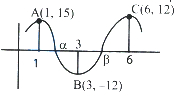
$A(1,15), B(3,-12), C(6,12)$ are three consecutive turning points of a continuous curve $y=f(x)$. If $f(x)=0$ only for $x=\alpha$ and $x=\beta$,then $|\beta-\alpha| < $
A
$27$
B
$2$
C
$5$
D
$25$
Solution
(C) Given that $A(1,15), B(3,-12), C(6,12)$ are three consecutive turning points of a continuous curve $y=f(x)$ and the curve intersects the $x$-axis at $x=\alpha$ and $x=\beta$.
From the given graph,it is clear that:
$1 < \alpha < 3$ and $3 < \beta < 6$.
We want to find the range for $|\beta-\alpha|$.
Since $1 < \alpha < 3$,we have $-3 < -\alpha < -1$.
Also,$3 < \beta < 6$.
Adding these inequalities,we get:
$3 - 3 < \beta - \alpha < 6 - 1$
$0 < \beta - \alpha < 5$.
Therefore,$|\beta-\alpha| < 5$.
From the given graph,it is clear that:
$1 < \alpha < 3$ and $3 < \beta < 6$.
We want to find the range for $|\beta-\alpha|$.
Since $1 < \alpha < 3$,we have $-3 < -\alpha < -1$.
Also,$3 < \beta < 6$.
Adding these inequalities,we get:
$3 - 3 < \beta - \alpha < 6 - 1$
$0 < \beta - \alpha < 5$.
Therefore,$|\beta-\alpha| < 5$.
0 likes
View Solution610
EasyMCQ
The function $f(x) = x^2 + \frac{54}{x}$
A
is increasing and has minimum value $27$ in the interval $(0, \infty)$
B
is decreasing and has neither maximum nor minimum in the interval $(-\infty, 0)$
C
has maximum value $27$ in the interval $(-\infty, \infty)$
D
is increasing and has neither maximum nor minimum values in the interval $(-\infty, \infty)$
Solution
(B) Given $f(x) = x^2 + \frac{54}{x}$.
First,find the derivative: $f'(x) = 2x - \frac{54}{x^2}$.
For $x \in (-\infty, 0)$,$x^2 > 0$ and $x < 0$,so $2x < 0$ and $-\frac{54}{x^2} < 0$. Thus,$f'(x) < 0$,which means $f(x)$ is decreasing in $(-\infty, 0)$.
For critical points,set $f'(x) = 0$: $2x - \frac{54}{x^2} = 0 \Rightarrow 2x^3 = 54 \Rightarrow x^3 = 27 \Rightarrow x = 3$.
Since the only critical point $x = 3$ lies in $(0, \infty)$,there is no critical point in $(-\infty, 0)$.
Therefore,$f(x)$ has neither maximum nor minimum in $(-\infty, 0)$.
First,find the derivative: $f'(x) = 2x - \frac{54}{x^2}$.
For $x \in (-\infty, 0)$,$x^2 > 0$ and $x < 0$,so $2x < 0$ and $-\frac{54}{x^2} < 0$. Thus,$f'(x) < 0$,which means $f(x)$ is decreasing in $(-\infty, 0)$.
For critical points,set $f'(x) = 0$: $2x - \frac{54}{x^2} = 0 \Rightarrow 2x^3 = 54 \Rightarrow x^3 = 27 \Rightarrow x = 3$.
Since the only critical point $x = 3$ lies in $(0, \infty)$,there is no critical point in $(-\infty, 0)$.
Therefore,$f(x)$ has neither maximum nor minimum in $(-\infty, 0)$.
0 likes
View Solution611
DifficultMCQ
The maximum value of $x^4 y^4$ given the constraint $a^2 x^4 + b^2 y^4 = c^6$ is
A
$\frac{c^{12}}{16 a^2 b^2}$
B
$\frac{c^{12}}{4 a^2 b^2}$
C
$\frac{c^{12}}{8 a^2 b^2}$
D
$\frac{c^{12}}{2 a^2 b^2}$
Solution
(B) Using the $AM$-$GM$ inequality for two positive terms $a^2 x^4$ and $b^2 y^4$:
$\frac{a^2 x^4 + b^2 y^4}{2} \ge \sqrt{(a^2 x^4)(b^2 y^4)}$
Given $a^2 x^4 + b^2 y^4 = c^6$,we substitute:
$\frac{c^6}{2} \ge \sqrt{a^2 b^2 x^4 y^4}$
$\frac{c^6}{2} \ge ab x^2 y^2$
Squaring both sides:
$\frac{c^{12}}{4} \ge a^2 b^2 x^4 y^4$
$x^4 y^4 \le \frac{c^{12}}{4 a^2 b^2}$
Thus,the maximum value is $\frac{c^{12}}{4 a^2 b^2}$.
$\frac{a^2 x^4 + b^2 y^4}{2} \ge \sqrt{(a^2 x^4)(b^2 y^4)}$
Given $a^2 x^4 + b^2 y^4 = c^6$,we substitute:
$\frac{c^6}{2} \ge \sqrt{a^2 b^2 x^4 y^4}$
$\frac{c^6}{2} \ge ab x^2 y^2$
Squaring both sides:
$\frac{c^{12}}{4} \ge a^2 b^2 x^4 y^4$
$x^4 y^4 \le \frac{c^{12}}{4 a^2 b^2}$
Thus,the maximum value is $\frac{c^{12}}{4 a^2 b^2}$.
0 likes
View Solution612
EasyMCQ
If $f(x) = 3x + \frac{12}{x}$ is continuous on $R - \{0\}$ and $M$ is its local maximum value,then $\lim_{x \rightarrow M} f(x) = $
A
$37$
B
$-37$
C
$2$
D
$-2$
Solution
(B) Given $f(x) = 3x + \frac{12}{x}$.
First,find the derivative: $f'(x) = 3 - \frac{12}{x^2}$.
For critical points,set $f'(x) = 0$:
$3 - \frac{12}{x^2} = 0 \implies x^2 = 4 \implies x = 2, -2$.
Now,find the second derivative: $f''(x) = \frac{24}{x^3}$.
At $x = 2$,$f''(2) = \frac{24}{8} = 3 > 0$ (Local minimum).
At $x = -2$,$f''(-2) = \frac{24}{-8} = -3 < 0$ (Local maximum).
The local maximum value $M = f(-2) = 3(-2) + \frac{12}{-2} = -6 - 6 = -12$.
We need to evaluate $\lim_{x \rightarrow M} f(x) = \lim_{x \rightarrow -12} (3x + \frac{12}{x})$.
Substituting $x = -12$: $3(-12) + \frac{12}{-12} = -36 - 1 = -37$.
First,find the derivative: $f'(x) = 3 - \frac{12}{x^2}$.
For critical points,set $f'(x) = 0$:
$3 - \frac{12}{x^2} = 0 \implies x^2 = 4 \implies x = 2, -2$.
Now,find the second derivative: $f''(x) = \frac{24}{x^3}$.
At $x = 2$,$f''(2) = \frac{24}{8} = 3 > 0$ (Local minimum).
At $x = -2$,$f''(-2) = \frac{24}{-8} = -3 < 0$ (Local maximum).
The local maximum value $M = f(-2) = 3(-2) + \frac{12}{-2} = -6 - 6 = -12$.
We need to evaluate $\lim_{x \rightarrow M} f(x) = \lim_{x \rightarrow -12} (3x + \frac{12}{x})$.
Substituting $x = -12$: $3(-12) + \frac{12}{-12} = -36 - 1 = -37$.
0 likes
View Solution613
MediumMCQ
An extreme value of $f(x)=\frac{4}{\sin x}+\frac{1}{1-\sin x}$ in $(0, \pi / 2)$ is
A
$9$
B
$8$
C
$2 / 3$
D
$-7 / 2$
Solution
(A) Given $f(x) = \frac{4}{\sin x} + \frac{1}{1-\sin x}$.
To find the extreme value,we differentiate $f(x)$ with respect to $x$:
$f'(x) = -\frac{4 \cos x}{\sin^2 x} + \frac{\cos x}{(1-\sin x)^2}$.
Setting $f'(x) = 0$ for critical points:
$-\frac{4 \cos x}{\sin^2 x} + \frac{\cos x}{(1-\sin x)^2} = 0$.
Since $x \in (0, \pi/2)$,$\cos x \neq 0$,so we can divide by $\cos x$:
$-\frac{4}{\sin^2 x} + \frac{1}{(1-\sin x)^2} = 0$.
$\frac{1}{(1-\sin x)^2} = \frac{4}{\sin^2 x}$.
Taking the square root on both sides:
$\frac{1}{1-\sin x} = \frac{2}{\sin x}$ (since $\sin x > 0$ and $1-\sin x > 0$ in the given interval).
$\sin x = 2 - 2 \sin x$.
$3 \sin x = 2 \Rightarrow \sin x = \frac{2}{3}$.
Now,substitute $\sin x = \frac{2}{3}$ into $f(x)$:
$f(x) = \frac{4}{2/3} + \frac{1}{1-2/3} = 4 \times \frac{3}{2} + \frac{1}{1/3} = 6 + 3 = 9$.
To find the extreme value,we differentiate $f(x)$ with respect to $x$:
$f'(x) = -\frac{4 \cos x}{\sin^2 x} + \frac{\cos x}{(1-\sin x)^2}$.
Setting $f'(x) = 0$ for critical points:
$-\frac{4 \cos x}{\sin^2 x} + \frac{\cos x}{(1-\sin x)^2} = 0$.
Since $x \in (0, \pi/2)$,$\cos x \neq 0$,so we can divide by $\cos x$:
$-\frac{4}{\sin^2 x} + \frac{1}{(1-\sin x)^2} = 0$.
$\frac{1}{(1-\sin x)^2} = \frac{4}{\sin^2 x}$.
Taking the square root on both sides:
$\frac{1}{1-\sin x} = \frac{2}{\sin x}$ (since $\sin x > 0$ and $1-\sin x > 0$ in the given interval).
$\sin x = 2 - 2 \sin x$.
$3 \sin x = 2 \Rightarrow \sin x = \frac{2}{3}$.
Now,substitute $\sin x = \frac{2}{3}$ into $f(x)$:
$f(x) = \frac{4}{2/3} + \frac{1}{1-2/3} = 4 \times \frac{3}{2} + \frac{1}{1/3} = 6 + 3 = 9$.
0 likes
View Solution614
DifficultMCQ
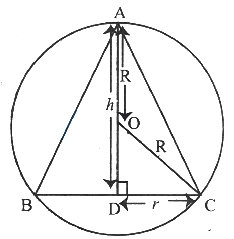
If the height of a cone of greatest volume that can be inscribed in a sphere of radius $R$ is $kR$,then the ratio of the volume of the cone to the volume of the sphere is
A
$8: 27$
B
$27: 64$
C
$8: 125$
D
$4: 5$
Solution
(A) Let the height of the cone be $h$ and the radius of its base be $r$. The sphere has radius $R$. From the geometry of the cone inscribed in a sphere,we have the relation $r^2 = R^2 - (h - R)^2 = 2hR - h^2$.
The volume of the cone is $V = \frac{1}{3} \pi r^2 h = \frac{1}{3} \pi (2hR - h^2) h = \frac{1}{3} \pi (2Rh^2 - h^3)$.
To find the maximum volume,we differentiate $V$ with respect to $h$ and set it to zero:
$\frac{dV}{dh} = \frac{1}{3} \pi (4Rh - 3h^2) = 0$.
Since $h \neq 0$,we have $4R - 3h = 0$,which gives $h = \frac{4R}{3}$.
Thus,$k = \frac{4}{3}$.
The volume of the cone at $h = \frac{4R}{3}$ is $V_{cone} = \frac{1}{3} \pi (2R(\frac{4R}{3})^2 - (\frac{4R}{3})^3) = \frac{1}{3} \pi (\frac{32R^3}{9} - \frac{64R^3}{27}) = \frac{1}{3} \pi (\frac{96R^3 - 64R^3}{27}) = \frac{32}{81} \pi R^3$.
The volume of the sphere is $V_{sphere} = \frac{4}{3} \pi R^3$.
The ratio of the volume of the cone to the volume of the sphere is $\frac{\frac{32}{81} \pi R^3}{\frac{4}{3} \pi R^3} = \frac{32}{81} \times \frac{3}{4} = \frac{8}{27}$.
The volume of the cone is $V = \frac{1}{3} \pi r^2 h = \frac{1}{3} \pi (2hR - h^2) h = \frac{1}{3} \pi (2Rh^2 - h^3)$.
To find the maximum volume,we differentiate $V$ with respect to $h$ and set it to zero:
$\frac{dV}{dh} = \frac{1}{3} \pi (4Rh - 3h^2) = 0$.
Since $h \neq 0$,we have $4R - 3h = 0$,which gives $h = \frac{4R}{3}$.
Thus,$k = \frac{4}{3}$.
The volume of the cone at $h = \frac{4R}{3}$ is $V_{cone} = \frac{1}{3} \pi (2R(\frac{4R}{3})^2 - (\frac{4R}{3})^3) = \frac{1}{3} \pi (\frac{32R^3}{9} - \frac{64R^3}{27}) = \frac{1}{3} \pi (\frac{96R^3 - 64R^3}{27}) = \frac{32}{81} \pi R^3$.
The volume of the sphere is $V_{sphere} = \frac{4}{3} \pi R^3$.
The ratio of the volume of the cone to the volume of the sphere is $\frac{\frac{32}{81} \pi R^3}{\frac{4}{3} \pi R^3} = \frac{32}{81} \times \frac{3}{4} = \frac{8}{27}$.
0 likes
View Solution615
MediumMCQ
The maximum value of $f(x) = \frac{x}{4 + x + x^2}$ on $[-1, 1]$ is
A
$-\frac{1}{4}$
B
$-\frac{1}{3}$
C
$\frac{1}{6}$
D
$\frac{1}{5}$
Solution
(C) Given function is $f(x) = \frac{x}{4 + x + x^2}$.
To find the maximum value,we differentiate $f(x)$ with respect to $x$ using the quotient rule:
$f'(x) = \frac{(4 + x + x^2)(1) - x(1 + 2x)}{(4 + x + x^2)^2}$
$f'(x) = \frac{4 + x + x^2 - x - 2x^2}{(4 + x + x^2)^2} = \frac{4 - x^2}{(4 + x + x^2)^2}$.
For critical points,set $f'(x) = 0$,which implies $4 - x^2 = 0$,so $x = \pm 2$.
Since $x = \pm 2$ are not in the interval $[-1, 1]$,the function has no critical points in the given interval.
Since $4 - x^2 > 0$ for all $x \in [-1, 1]$,$f'(x) > 0$,meaning $f(x)$ is strictly increasing on $[-1, 1]$.
The maximum value occurs at the right endpoint $x = 1$:
$f(1) = \frac{1}{4 + 1 + 1^2} = \frac{1}{6}$.
To find the maximum value,we differentiate $f(x)$ with respect to $x$ using the quotient rule:
$f'(x) = \frac{(4 + x + x^2)(1) - x(1 + 2x)}{(4 + x + x^2)^2}$
$f'(x) = \frac{4 + x + x^2 - x - 2x^2}{(4 + x + x^2)^2} = \frac{4 - x^2}{(4 + x + x^2)^2}$.
For critical points,set $f'(x) = 0$,which implies $4 - x^2 = 0$,so $x = \pm 2$.
Since $x = \pm 2$ are not in the interval $[-1, 1]$,the function has no critical points in the given interval.
Since $4 - x^2 > 0$ for all $x \in [-1, 1]$,$f'(x) > 0$,meaning $f(x)$ is strictly increasing on $[-1, 1]$.
The maximum value occurs at the right endpoint $x = 1$:
$f(1) = \frac{1}{4 + 1 + 1^2} = \frac{1}{6}$.
0 likes
View Solution616
MediumMCQ
The minimum value of $f(x) = x + \frac{4}{x + 2}$ for $x > -2$ is
A
$-1$
B
$-2$
C
$1$
D
$2$
Solution
(D) Given function: $f(x) = x + \frac{4}{x + 2}$ for $x > -2$.
To find the critical points,we calculate the derivative $f'(x)$ and set it to $0$:
$f'(x) = 1 - \frac{4}{(x + 2)^2}$
Setting $f'(x) = 0$:
$1 = \frac{4}{(x + 2)^2} \implies (x + 2)^2 = 4$
Since $x > -2$,we have $x + 2 = 2$,which gives $x = 0$.
Now,we check the second derivative $f''(x) = \frac{8}{(x + 2)^3}$.
At $x = 0$,$f''(0) = \frac{8}{2^3} = 1 > 0$.
Since $f''(0) > 0$,the function has a local minimum at $x = 0$.
The minimum value is $f(0) = 0 + \frac{4}{0 + 2} = \frac{4}{2} = 2$.
To find the critical points,we calculate the derivative $f'(x)$ and set it to $0$:
$f'(x) = 1 - \frac{4}{(x + 2)^2}$
Setting $f'(x) = 0$:
$1 = \frac{4}{(x + 2)^2} \implies (x + 2)^2 = 4$
Since $x > -2$,we have $x + 2 = 2$,which gives $x = 0$.
Now,we check the second derivative $f''(x) = \frac{8}{(x + 2)^3}$.
At $x = 0$,$f''(0) = \frac{8}{2^3} = 1 > 0$.
Since $f''(0) > 0$,the function has a local minimum at $x = 0$.
The minimum value is $f(0) = 0 + \frac{4}{0 + 2} = \frac{4}{2} = 2$.
0 likes
View Solution617
EasyMCQ
The condition that $f(x) = ax^3 + bx^2 + cx + d$ has no extreme value is
A
$b^2 > 3ac$
B
$b^2 = 4ac$
C
$b^2 = 3ac$
D
$b^2 < 3ac$
Solution
(D) Given the function $f(x) = ax^3 + bx^2 + cx + d$.
To find the extreme values,we first find the derivative of $f(x)$ with respect to $x$:
$f'(x) = 3ax^2 + 2bx + c$.
$A$ function has no extreme values if its derivative $f'(x)$ does not change sign,which means $f'(x) = 0$ has no real roots or has equal roots such that the sign does not change.
For the quadratic equation $3ax^2 + 2bx + c = 0$ to have no real roots,its discriminant $D$ must be less than $0$.
$D = (2b)^2 - 4(3a)(c) < 0$.
$4b^2 - 12ac < 0$.
Dividing by $4$,we get $b^2 - 3ac < 0$,which implies $b^2 < 3ac$.
To find the extreme values,we first find the derivative of $f(x)$ with respect to $x$:
$f'(x) = 3ax^2 + 2bx + c$.
$A$ function has no extreme values if its derivative $f'(x)$ does not change sign,which means $f'(x) = 0$ has no real roots or has equal roots such that the sign does not change.
For the quadratic equation $3ax^2 + 2bx + c = 0$ to have no real roots,its discriminant $D$ must be less than $0$.
$D = (2b)^2 - 4(3a)(c) < 0$.
$4b^2 - 12ac < 0$.
Dividing by $4$,we get $b^2 - 3ac < 0$,which implies $b^2 < 3ac$.
0 likes
View Solution618
MediumMCQ
$A$ closed cylinder of given volume will have the least surface area when the ratio of its height to its base radius is:
A
$2 : 1$
B
$1 : 2$
C
$2 : 3$
D
$3 : 2$
Solution
(A) Let the height of the closed cylinder be $h$ and the base radius be $r$.
The volume $V$ of the cylinder is given by $V = \pi r^2 h$,which implies $h = \frac{V}{\pi r^2}$.
The total surface area $S$ of the closed cylinder is $S = 2 \pi r h + 2 \pi r^2$.
Substituting the value of $h$ in the surface area formula: $S = 2 \pi r (\frac{V}{\pi r^2}) + 2 \pi r^2 = \frac{2V}{r} + 2 \pi r^2$.
To find the minimum surface area,we differentiate $S$ with respect to $r$ and set it to zero: $\frac{dS}{dr} = -\frac{2V}{r^2} + 4 \pi r = 0$.
This gives $4 \pi r = \frac{2V}{r^2}$,so $V = 2 \pi r^3$.
Substituting $V = \pi r^2 h$ into this equation: $\pi r^2 h = 2 \pi r^3$.
Dividing both sides by $\pi r^2$,we get $h = 2r$,which means the ratio $h : r = 2 : 1$.
The volume $V$ of the cylinder is given by $V = \pi r^2 h$,which implies $h = \frac{V}{\pi r^2}$.
The total surface area $S$ of the closed cylinder is $S = 2 \pi r h + 2 \pi r^2$.
Substituting the value of $h$ in the surface area formula: $S = 2 \pi r (\frac{V}{\pi r^2}) + 2 \pi r^2 = \frac{2V}{r} + 2 \pi r^2$.
To find the minimum surface area,we differentiate $S$ with respect to $r$ and set it to zero: $\frac{dS}{dr} = -\frac{2V}{r^2} + 4 \pi r = 0$.
This gives $4 \pi r = \frac{2V}{r^2}$,so $V = 2 \pi r^3$.
Substituting $V = \pi r^2 h$ into this equation: $\pi r^2 h = 2 \pi r^3$.
Dividing both sides by $\pi r^2$,we get $h = 2r$,which means the ratio $h : r = 2 : 1$.
0 likes
View Solution619
MediumMCQ
Two particles $P$ and $Q$ located at the points $P(t, t^3 - 16t - 3)$ and $Q(t + 1, t^3 - 6t - 6)$ are moving in a plane. The minimum distance between the points during their motion is:
A
$1$
B
$5$
C
$169$
D
$49$
Solution
(A) The coordinates of the particles are $P(t, t^3 - 16t - 3)$ and $Q(t + 1, t^3 - 6t - 6)$.
The distance $PQ$ between the two particles is given by the distance formula:
$PQ = \sqrt{((t + 1) - t)^2 + ((t^3 - 6t - 6) - (t^3 - 16t - 3))^2}$
$PQ = \sqrt{(1)^2 + (t^3 - 6t - 6 - t^3 + 16t + 3)^2}$
$PQ = \sqrt{1 + (10t - 3)^2}$
To find the minimum distance,we minimize the square of the distance,$y = PQ^2 = 1 + (10t - 3)^2$.
For the minimum value,we set the derivative with respect to $t$ to zero:
$\frac{dy}{dt} = 2(10t - 3) \times 10 = 20(10t - 3) = 0$
This gives $10t - 3 = 0$,or $t = \frac{3}{10}$.
Substituting $t = \frac{3}{10}$ into the expression for $PQ$:
$PQ_{min} = \sqrt{1 + (10(\frac{3}{10}) - 3)^2} = \sqrt{1 + (3 - 3)^2} = \sqrt{1 + 0} = 1$.
Thus,the minimum distance is $1$.
The distance $PQ$ between the two particles is given by the distance formula:
$PQ = \sqrt{((t + 1) - t)^2 + ((t^3 - 6t - 6) - (t^3 - 16t - 3))^2}$
$PQ = \sqrt{(1)^2 + (t^3 - 6t - 6 - t^3 + 16t + 3)^2}$
$PQ = \sqrt{1 + (10t - 3)^2}$
To find the minimum distance,we minimize the square of the distance,$y = PQ^2 = 1 + (10t - 3)^2$.
For the minimum value,we set the derivative with respect to $t$ to zero:
$\frac{dy}{dt} = 2(10t - 3) \times 10 = 20(10t - 3) = 0$
This gives $10t - 3 = 0$,or $t = \frac{3}{10}$.
Substituting $t = \frac{3}{10}$ into the expression for $PQ$:
$PQ_{min} = \sqrt{1 + (10(\frac{3}{10}) - 3)^2} = \sqrt{1 + (3 - 3)^2} = \sqrt{1 + 0} = 1$.
Thus,the minimum distance is $1$.
0 likes
View Solution620
MediumMCQ
If $a, b > 0$,then the minimum value of $y = \frac{b^2}{a-x} + \frac{a^2}{x}$ for $0 < x < a$ is
A
$\frac{(a+b)^2}{a}$
B
$\frac{(a+b)^2}{b}$
C
$\frac{(a-b)^2}{a}$
D
$\frac{(a-b)^2}{b}$
Solution
(A) Given the function $y = \frac{b^2}{a-x} + \frac{a^2}{x}$.
To find the minimum,we differentiate with respect to $x$:
$\frac{dy}{dx} = \frac{b^2}{(a-x)^2} - \frac{a^2}{x^2}$.
Setting $\frac{dy}{dx} = 0$,we get $\frac{b^2}{(a-x)^2} = \frac{a^2}{x^2}$,which implies $\frac{b}{a-x} = \pm \frac{a}{x}$.
Since $0 < x < a$ and $a, b > 0$,we take the positive root: $\frac{b}{a-x} = \frac{a}{x} \Rightarrow bx = a^2 - ax \Rightarrow x(a+b) = a^2 \Rightarrow x = \frac{a^2}{a+b}$.
Using the second derivative test: $\frac{d^2y}{dx^2} = \frac{2b^2}{(a-x)^3} + \frac{2a^2}{x^3}$.
Since $x = \frac{a^2}{a+b}$ lies in $(0, a)$,both terms are positive,so $\frac{d^2y}{dx^2} > 0$,confirming a minimum.
Substituting $x = \frac{a^2}{a+b}$ into $y$:
$y_{\min} = \frac{b^2}{a - \frac{a^2}{a+b}} + \frac{a^2}{\frac{a^2}{a+b}} = \frac{b^2}{\frac{a^2+ab-a^2}{a+b}} + (a+b) = \frac{b^2(a+b)}{ab} + (a+b) = \frac{b(a+b)}{a} + (a+b) = (a+b)(\frac{b}{a} + 1) = (a+b)(\frac{a+b}{a}) = \frac{(a+b)^2}{a}$.
To find the minimum,we differentiate with respect to $x$:
$\frac{dy}{dx} = \frac{b^2}{(a-x)^2} - \frac{a^2}{x^2}$.
Setting $\frac{dy}{dx} = 0$,we get $\frac{b^2}{(a-x)^2} = \frac{a^2}{x^2}$,which implies $\frac{b}{a-x} = \pm \frac{a}{x}$.
Since $0 < x < a$ and $a, b > 0$,we take the positive root: $\frac{b}{a-x} = \frac{a}{x} \Rightarrow bx = a^2 - ax \Rightarrow x(a+b) = a^2 \Rightarrow x = \frac{a^2}{a+b}$.
Using the second derivative test: $\frac{d^2y}{dx^2} = \frac{2b^2}{(a-x)^3} + \frac{2a^2}{x^3}$.
Since $x = \frac{a^2}{a+b}$ lies in $(0, a)$,both terms are positive,so $\frac{d^2y}{dx^2} > 0$,confirming a minimum.
Substituting $x = \frac{a^2}{a+b}$ into $y$:
$y_{\min} = \frac{b^2}{a - \frac{a^2}{a+b}} + \frac{a^2}{\frac{a^2}{a+b}} = \frac{b^2}{\frac{a^2+ab-a^2}{a+b}} + (a+b) = \frac{b^2(a+b)}{ab} + (a+b) = \frac{b(a+b)}{a} + (a+b) = (a+b)(\frac{b}{a} + 1) = (a+b)(\frac{a+b}{a}) = \frac{(a+b)^2}{a}$.
0 likes
View Solution621
EasyMCQ
The maximum area of a right-angled triangle with hypotenuse $h$ is
A
$h^2 / 4$
B
$h^2 / 2$
C
$h^2 / \sqrt{2}$
D
$h^2 / 2\sqrt{2}$
Solution
(A) Let the right-angled triangle be $ABC$ with hypotenuse $AC = h$. Let $\angle A = \theta$.
Then the sides are $AB = h \cos \theta$ and $BC = h \sin \theta$.
The area $A$ of the triangle is given by $A = \frac{1}{2} \times \text{base} \times \text{height} = \frac{1}{2} (h \cos \theta)(h \sin \theta)$.
$A = \frac{h^2}{2} \sin \theta \cos \theta = \frac{h^2}{4} (2 \sin \theta \cos \theta) = \frac{h^2}{4} \sin 2\theta$.
For the area to be maximum,$\sin 2\theta$ must be maximum,which is $1$ when $2\theta = 90^{\circ}$ or $\theta = 45^{\circ}$.
Thus,the maximum area is $\frac{h^2}{4} \times 1 = \frac{h^2}{4}$.
Then the sides are $AB = h \cos \theta$ and $BC = h \sin \theta$.
The area $A$ of the triangle is given by $A = \frac{1}{2} \times \text{base} \times \text{height} = \frac{1}{2} (h \cos \theta)(h \sin \theta)$.
$A = \frac{h^2}{2} \sin \theta \cos \theta = \frac{h^2}{4} (2 \sin \theta \cos \theta) = \frac{h^2}{4} \sin 2\theta$.
For the area to be maximum,$\sin 2\theta$ must be maximum,which is $1$ when $2\theta = 90^{\circ}$ or $\theta = 45^{\circ}$.
Thus,the maximum area is $\frac{h^2}{4} \times 1 = \frac{h^2}{4}$.
0 likes
View Solution622
EasyMCQ
The value of '$a$' for which the function $f(x)=a \sin x+\frac{1}{3} \sin 3 x$ has an extremum value at $x=\frac{\pi}{3}$ is
A
$1$
B
$-1$
C
$0$
D
$2$
Solution
(D) Given the function $f(x)=a \sin x+\frac{1}{3} \sin 3 x$.
To find the extremum,we first find the derivative $f'(x)$:
$f'(x) = \frac{d}{dx}(a \sin x + \frac{1}{3} \sin 3x) = a \cos x + \frac{1}{3} \cdot 3 \cos 3x = a \cos x + \cos 3x$.
Since the function has an extremum at $x = \frac{\pi}{3}$,we must have $f'(\frac{\pi}{3}) = 0$.
Substituting $x = \frac{\pi}{3}$ into the derivative:
$a \cos(\frac{\pi}{3}) + \cos(3 \cdot \frac{\pi}{3}) = 0$.
$a(\frac{1}{2}) + \cos(\pi) = 0$.
Since $\cos(\pi) = -1$,we have:
$\frac{a}{2} - 1 = 0$.
$\frac{a}{2} = 1 \implies a = 2$.
To find the extremum,we first find the derivative $f'(x)$:
$f'(x) = \frac{d}{dx}(a \sin x + \frac{1}{3} \sin 3x) = a \cos x + \frac{1}{3} \cdot 3 \cos 3x = a \cos x + \cos 3x$.
Since the function has an extremum at $x = \frac{\pi}{3}$,we must have $f'(\frac{\pi}{3}) = 0$.
Substituting $x = \frac{\pi}{3}$ into the derivative:
$a \cos(\frac{\pi}{3}) + \cos(3 \cdot \frac{\pi}{3}) = 0$.
$a(\frac{1}{2}) + \cos(\pi) = 0$.
Since $\cos(\pi) = -1$,we have:
$\frac{a}{2} - 1 = 0$.
$\frac{a}{2} = 1 \implies a = 2$.
0 likes
View Solution623
MediumMCQ
Two sides of a triangle are given. If the area of the triangle is maximum,then the angle between the given sides is (in $^{\circ}$)
A
$45$
B
$30$
C
$60$
D
$90$
Solution
(D) Let the two given sides of the triangle be $a$ and $b$,and let $\theta$ be the angle between them.
The area $A$ of the triangle is given by the formula $A = \frac{1}{2} ab \sin \theta$.
Since the sides $a$ and $b$ are fixed,the area $A$ depends only on $\sin \theta$.
For the area to be maximum,$\sin \theta$ must be at its maximum value.
The maximum value of $\sin \theta$ is $1$,which occurs when $\theta = 90^{\circ}$ or $\frac{\pi}{2} \text{ radians}$.
Therefore,the angle between the given sides for the maximum area is $90^{\circ}$.
The area $A$ of the triangle is given by the formula $A = \frac{1}{2} ab \sin \theta$.
Since the sides $a$ and $b$ are fixed,the area $A$ depends only on $\sin \theta$.
For the area to be maximum,$\sin \theta$ must be at its maximum value.
The maximum value of $\sin \theta$ is $1$,which occurs when $\theta = 90^{\circ}$ or $\frac{\pi}{2} \text{ radians}$.
Therefore,the angle between the given sides for the maximum area is $90^{\circ}$.
0 likes
View Solution624
MediumMCQ
For a particle moving on a straight line,it is observed that the distance '$s$' at a time '$t$' is given by $S = 6t - \frac{t^3}{2}$. The maximum velocity during the motion is:
A
$3$
B
$6$
C
$9$
D
$12$
Solution
(B) The velocity $V$ of the particle is the rate of change of displacement with respect to time:
$V = \frac{dS}{dt} = \frac{d}{dt}(6t - \frac{t^3}{2}) = 6 - \frac{3}{2}t^2$
To find the maximum velocity,we analyze the derivative of velocity with respect to time:
$\frac{dV}{dt} = \frac{d}{dt}(6 - \frac{3}{2}t^2) = -3t$
Setting $\frac{dV}{dt} = 0$ gives $t = 0$.
Since $\frac{d^2V}{dt^2} = -3 < 0$,the velocity is maximum at $t = 0$.
Substituting $t = 0$ into the velocity equation:
$V_{max} = 6 - \frac{3}{2}(0)^2 = 6$.
$V = \frac{dS}{dt} = \frac{d}{dt}(6t - \frac{t^3}{2}) = 6 - \frac{3}{2}t^2$
To find the maximum velocity,we analyze the derivative of velocity with respect to time:
$\frac{dV}{dt} = \frac{d}{dt}(6 - \frac{3}{2}t^2) = -3t$
Setting $\frac{dV}{dt} = 0$ gives $t = 0$.
Since $\frac{d^2V}{dt^2} = -3 < 0$,the velocity is maximum at $t = 0$.
Substituting $t = 0$ into the velocity equation:
$V_{max} = 6 - \frac{3}{2}(0)^2 = 6$.
0 likes
View Solution625
MediumMCQ
Let $f(x)=x^2+\frac{1}{x^2}$ and $g(x)=x-\frac{1}{x}$ for $x \in R-\{-1,0,1\}$,then the local minimum of $\frac{f(x)}{g(x)}$ is
A
$-3$
B
$2 \sqrt{2}$
C
$-2 \sqrt{2}$
D
$3$
Solution
(B) Given $f(x)=x^2+\frac{1}{x^2}$ and $g(x)=x-\frac{1}{x}$.
We can write $f(x)$ in terms of $g(x)$ as $f(x)=\left(x-\frac{1}{x}\right)^2+2$.
Let $t=x-\frac{1}{x}$. Then $f(x)=t^2+2$ and $g(x)=t$.
We define $h(t)=\frac{f(x)}{g(x)}=\frac{t^2+2}{t}=t+\frac{2}{t}$.
To find the local minimum,we find the derivative $h'(t)=1-\frac{2}{t^2}$.
Setting $h'(t)=0$,we get $1-\frac{2}{t^2}=0$,which implies $t^2=2$,so $t=\pm \sqrt{2}$.
Using the second derivative test,$h''(t)=\frac{4}{t^3}$.
For $t=\sqrt{2}$,$h''(\sqrt{2})=\frac{4}{(\sqrt{2})^3} > 0$,so $t=\sqrt{2}$ is a point of local minimum.
The local minimum value is $h(\sqrt{2})=\sqrt{2}+\frac{2}{\sqrt{2}}=\sqrt{2}+\sqrt{2}=2\sqrt{2}$.
We can write $f(x)$ in terms of $g(x)$ as $f(x)=\left(x-\frac{1}{x}\right)^2+2$.
Let $t=x-\frac{1}{x}$. Then $f(x)=t^2+2$ and $g(x)=t$.
We define $h(t)=\frac{f(x)}{g(x)}=\frac{t^2+2}{t}=t+\frac{2}{t}$.
To find the local minimum,we find the derivative $h'(t)=1-\frac{2}{t^2}$.
Setting $h'(t)=0$,we get $1-\frac{2}{t^2}=0$,which implies $t^2=2$,so $t=\pm \sqrt{2}$.
Using the second derivative test,$h''(t)=\frac{4}{t^3}$.
For $t=\sqrt{2}$,$h''(\sqrt{2})=\frac{4}{(\sqrt{2})^3} > 0$,so $t=\sqrt{2}$ is a point of local minimum.
The local minimum value is $h(\sqrt{2})=\sqrt{2}+\frac{2}{\sqrt{2}}=\sqrt{2}+\sqrt{2}=2\sqrt{2}$.
0 likes
View Solution626
EasyMCQ
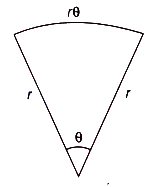
The perimeter of a sector is constant. If its area is to be maximum,the sectorial angle should be
A
$\frac{\pi^c}{6}$
B
$\frac{\pi^c}{4}$
C
$4^c$
D
$2^c$
Solution
(D) Let $r$ be the radius and $\theta$ be the sectorial angle in radians. The perimeter $P$ of the sector is given by $P = 2r + r\theta = r(2 + \theta)$.
Since the perimeter is constant,let $P = k$,where $k$ is a constant.
Thus,$r(2 + \theta) = k$,which implies $r = \frac{k}{2 + \theta}$.
The area $A$ of the sector is given by $A = \frac{1}{2} r^2 \theta$.
Substituting the value of $r$,we get $A = \frac{1}{2} \left(\frac{k}{2 + \theta}\right)^2 \theta = \frac{k^2}{2} \cdot \frac{\theta}{(2 + \theta)^2}$.
To find the maximum area,we differentiate $A$ with respect to $\theta$:
$\frac{dA}{d\theta} = \frac{k^2}{2} \left[ \frac{(2 + \theta)^2(1) - \theta(2)(2 + \theta)}{(2 + \theta)^4} \right] = \frac{k^2}{2} \cdot \frac{(2 + \theta) - 2\theta}{(2 + \theta)^3} = \frac{k^2}{2} \cdot \frac{2 - \theta}{(2 + \theta)^3}$.
Setting $\frac{dA}{d\theta} = 0$,we get $2 - \theta = 0$,which implies $\theta = 2$.
For $\theta = 2$,the second derivative $\frac{d^2A}{d\theta^2}$ is negative,confirming that the area is maximum at $\theta = 2^c$.
Since the perimeter is constant,let $P = k$,where $k$ is a constant.
Thus,$r(2 + \theta) = k$,which implies $r = \frac{k}{2 + \theta}$.
The area $A$ of the sector is given by $A = \frac{1}{2} r^2 \theta$.
Substituting the value of $r$,we get $A = \frac{1}{2} \left(\frac{k}{2 + \theta}\right)^2 \theta = \frac{k^2}{2} \cdot \frac{\theta}{(2 + \theta)^2}$.
To find the maximum area,we differentiate $A$ with respect to $\theta$:
$\frac{dA}{d\theta} = \frac{k^2}{2} \left[ \frac{(2 + \theta)^2(1) - \theta(2)(2 + \theta)}{(2 + \theta)^4} \right] = \frac{k^2}{2} \cdot \frac{(2 + \theta) - 2\theta}{(2 + \theta)^3} = \frac{k^2}{2} \cdot \frac{2 - \theta}{(2 + \theta)^3}$.
Setting $\frac{dA}{d\theta} = 0$,we get $2 - \theta = 0$,which implies $\theta = 2$.
For $\theta = 2$,the second derivative $\frac{d^2A}{d\theta^2}$ is negative,confirming that the area is maximum at $\theta = 2^c$.
0 likes
View Solution627
EasyMCQ
The function $f(x)=2 x^3-9 a x^2+12 a^2 x+1$ $(a>0)$ attains its maximum and minimum at $p$ and $q$ respectively and $p^2=q$. Then,$a=$
A
$1$
B
$2$
C
$1/2$
D
$3$
Solution
(B) Given the function $f(x)=2 x^3-9 a x^2+12 a^2 x+1$ with $a>0$.
First,find the derivative $f^{\prime}(x)$:
$f^{\prime}(x)=6 x^2-18 a x+12 a^2$
$f^{\prime}(x)=6(x^2-3 a x+2 a^2)=6(x-a)(x-2 a)$
For local maxima or minima,set $f^{\prime}(x)=0$:
$6(x-a)(x-2 a)=0 \Rightarrow x=a, 2 a$
Using the second derivative test,$f^{\prime\prime}(x)=12 x-18 a$:
At $x=a$,$f^{\prime\prime}(a)=12 a-18 a=-6 a < 0$ (since $a>0$),so $x=a$ is a point of local maxima.
At $x=2 a$,$f^{\prime\prime}(2 a)=24 a-18 a=6 a > 0$ (since $a>0$),so $x=2 a$ is a point of local minima.
Thus,$p=a$ and $q=2 a$.
Given the condition $p^2=q$,we have:
$a^2=2 a$
$a^2-2 a=0$
$a(a-2)=0$
Since $a>0$,we get $a=2$.
First,find the derivative $f^{\prime}(x)$:
$f^{\prime}(x)=6 x^2-18 a x+12 a^2$
$f^{\prime}(x)=6(x^2-3 a x+2 a^2)=6(x-a)(x-2 a)$
For local maxima or minima,set $f^{\prime}(x)=0$:
$6(x-a)(x-2 a)=0 \Rightarrow x=a, 2 a$
Using the second derivative test,$f^{\prime\prime}(x)=12 x-18 a$:
At $x=a$,$f^{\prime\prime}(a)=12 a-18 a=-6 a < 0$ (since $a>0$),so $x=a$ is a point of local maxima.
At $x=2 a$,$f^{\prime\prime}(2 a)=24 a-18 a=6 a > 0$ (since $a>0$),so $x=2 a$ is a point of local minima.
Thus,$p=a$ and $q=2 a$.
Given the condition $p^2=q$,we have:
$a^2=2 a$
$a^2-2 a=0$
$a(a-2)=0$
Since $a>0$,we get $a=2$.
0 likes
View Solution628
EasyMCQ
The minimum distance of a point on the curve $y=x^2-4$ from the origin is
A
$\frac{\sqrt{15}}{2}$
B
$\frac{\sqrt{19}}{2}$
C
$\sqrt{\frac{15}{2}}$
D
$\sqrt{\frac{19}{2}}$
Solution
(A) Let the point on the curve be $P(x, y) = (x, x^2-4)$.
The square of the distance $D$ from the origin $(0,0)$ is $S = x^2 + y^2 = x^2 + (x^2-4)^2$.
$S = x^2 + x^4 - 8x^2 + 16 = x^4 - 7x^2 + 16$.
To find the minimum,differentiate $S$ with respect to $x$ and set it to zero:
$\frac{dS}{dx} = 4x^3 - 14x = 0$.
$2x(2x^2 - 7) = 0$.
This gives $x = 0$ or $x^2 = \frac{7}{2}$.
If $x = 0$,$S = 16$. If $x^2 = \frac{7}{2}$,$S = (\frac{7}{2})^2 - 7(\frac{7}{2}) + 16 = \frac{49}{4} - \frac{49}{2} + 16 = 16 - \frac{49}{4} = \frac{64-49}{4} = \frac{15}{4}$.
The minimum distance is $\sqrt{S} = \sqrt{\frac{15}{4}} = \frac{\sqrt{15}}{2}$.
The square of the distance $D$ from the origin $(0,0)$ is $S = x^2 + y^2 = x^2 + (x^2-4)^2$.
$S = x^2 + x^4 - 8x^2 + 16 = x^4 - 7x^2 + 16$.
To find the minimum,differentiate $S$ with respect to $x$ and set it to zero:
$\frac{dS}{dx} = 4x^3 - 14x = 0$.
$2x(2x^2 - 7) = 0$.
This gives $x = 0$ or $x^2 = \frac{7}{2}$.
If $x = 0$,$S = 16$. If $x^2 = \frac{7}{2}$,$S = (\frac{7}{2})^2 - 7(\frac{7}{2}) + 16 = \frac{49}{4} - \frac{49}{2} + 16 = 16 - \frac{49}{4} = \frac{64-49}{4} = \frac{15}{4}$.
The minimum distance is $\sqrt{S} = \sqrt{\frac{15}{4}} = \frac{\sqrt{15}}{2}$.
0 likes
View Solution629
EasyMCQ
If an open cylinder of given surface area has maximum volume,then its radius is
A
Height of the cylinder
B
Height of the cylinder/$2$
C
$2$ times height of the cylinder
D
$3$ times height of the cylinder
Solution
(A) Let the radius of the base be $R$ and the height be $H$. The surface area $A$ of an open cylinder is given by $A = 2\pi RH + \pi R^2$.
From this,we can express $H$ as $H = \frac{A - \pi R^2}{2\pi R}$.
The volume $V$ is given by $V = \pi R^2 H = \pi R^2 \left( \frac{A - \pi R^2}{2\pi R} \right) = \frac{R}{2}(A - \pi R^2) = \frac{AR}{2} - \frac{\pi R^3}{2}$.
To find the maximum volume,we differentiate $V$ with respect to $R$: $\frac{dV}{dR} = \frac{A}{2} - \frac{3\pi R^2}{2}$.
Setting $\frac{dV}{dR} = 0$,we get $A = 3\pi R^2$.
Checking the second derivative,$\frac{d^2V}{dR^2} = -3\pi R$,which is negative for $R > 0$,confirming a maximum.
Substituting $A = 3\pi R^2$ into the surface area formula: $3\pi R^2 = 2\pi RH + \pi R^2$.
This simplifies to $2\pi R^2 = 2\pi RH$,which implies $R = H$.
Thus,the radius is equal to the height of the cylinder.
From this,we can express $H$ as $H = \frac{A - \pi R^2}{2\pi R}$.
The volume $V$ is given by $V = \pi R^2 H = \pi R^2 \left( \frac{A - \pi R^2}{2\pi R} \right) = \frac{R}{2}(A - \pi R^2) = \frac{AR}{2} - \frac{\pi R^3}{2}$.
To find the maximum volume,we differentiate $V$ with respect to $R$: $\frac{dV}{dR} = \frac{A}{2} - \frac{3\pi R^2}{2}$.
Setting $\frac{dV}{dR} = 0$,we get $A = 3\pi R^2$.
Checking the second derivative,$\frac{d^2V}{dR^2} = -3\pi R$,which is negative for $R > 0$,confirming a maximum.
Substituting $A = 3\pi R^2$ into the surface area formula: $3\pi R^2 = 2\pi RH + \pi R^2$.
This simplifies to $2\pi R^2 = 2\pi RH$,which implies $R = H$.
Thus,the radius is equal to the height of the cylinder.
0 likes
View Solution630
EasyMCQ
If $x+y=k, x>0, y>0$,then $x^2+y^2$ is minimum,if
A
$x>y$
B
$x < y$
C
$x=y$
D
$x=2 y$
Solution
(C) Given $x+y=k$,where $x>0$ and $y>0$.
We can write $y=k-x$.
Let $f(x) = x^2+y^2 = x^2+(k-x)^2$.
Expanding the expression: $f(x) = x^2+k^2-2kx+x^2 = 2x^2-2kx+k^2$.
To find the minimum,we differentiate $f(x)$ with respect to $x$ and set it to zero:
$f'(x) = 4x-2k = 0 \Rightarrow x = \frac{k}{2}$.
Now,check the second derivative:
$f''(x) = 4 > 0$.
Since the second derivative is positive,the function has a minimum at $x = \frac{k}{2}$.
Substituting $x = \frac{k}{2}$ into $y = k-x$,we get $y = k - \frac{k}{2} = \frac{k}{2}$.
Thus,$x=y=\frac{k}{2}$ gives the minimum value of $x^2+y^2$.
We can write $y=k-x$.
Let $f(x) = x^2+y^2 = x^2+(k-x)^2$.
Expanding the expression: $f(x) = x^2+k^2-2kx+x^2 = 2x^2-2kx+k^2$.
To find the minimum,we differentiate $f(x)$ with respect to $x$ and set it to zero:
$f'(x) = 4x-2k = 0 \Rightarrow x = \frac{k}{2}$.
Now,check the second derivative:
$f''(x) = 4 > 0$.
Since the second derivative is positive,the function has a minimum at $x = \frac{k}{2}$.
Substituting $x = \frac{k}{2}$ into $y = k-x$,we get $y = k - \frac{k}{2} = \frac{k}{2}$.
Thus,$x=y=\frac{k}{2}$ gives the minimum value of $x^2+y^2$.
0 likes
View Solution631
MediumMCQ
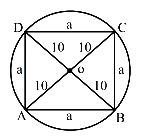
The maximum area of a rectangle inscribed in a circle of radius $10 \text{ cm}$ is
A
$100$
B
$200$
C
$250$
D
$150$
Solution
(B) Let the length and breadth of the rectangle be $x$ and $y$ respectively. The rectangle is inscribed in a circle of radius $R = 10 \text{ cm}$.
The diagonal of the rectangle is equal to the diameter of the circle,so $x^2 + y^2 = (2R)^2 = (20)^2 = 400$.
The area of the rectangle is $A = xy$. To maximize the area,we maximize $A^2 = x^2y^2$.
Let $u = x^2$ and $v = y^2$,then $u + v = 400$. We want to maximize $uv$.
By the $AM$-$GM$ inequality,$\frac{u+v}{2} \geq \sqrt{uv}$,so $\sqrt{uv} \leq \frac{400}{2} = 200$.
Thus,$uv \leq (200)^2 = 40000$.
Alternatively,for a rectangle inscribed in a circle,the area is maximum when it is a square.
If it is a square with side $a$,then $a^2 + a^2 = (20)^2 \Rightarrow 2a^2 = 400 \Rightarrow a^2 = 200$.
The area of the square is $a^2 = 200 \text{ cm}^2$.
The diagonal of the rectangle is equal to the diameter of the circle,so $x^2 + y^2 = (2R)^2 = (20)^2 = 400$.
The area of the rectangle is $A = xy$. To maximize the area,we maximize $A^2 = x^2y^2$.
Let $u = x^2$ and $v = y^2$,then $u + v = 400$. We want to maximize $uv$.
By the $AM$-$GM$ inequality,$\frac{u+v}{2} \geq \sqrt{uv}$,so $\sqrt{uv} \leq \frac{400}{2} = 200$.
Thus,$uv \leq (200)^2 = 40000$.
Alternatively,for a rectangle inscribed in a circle,the area is maximum when it is a square.
If it is a square with side $a$,then $a^2 + a^2 = (20)^2 \Rightarrow 2a^2 = 400 \Rightarrow a^2 = 200$.
The area of the square is $a^2 = 200 \text{ cm}^2$.
0 likes
View Solution632
EasyMCQ
At $x=0$,$f(x)=\cos x-1+\frac{x^2}{2}-\frac{x^3}{3}$
A
has a minimum value
B
has a maximum value
C
has no extremum value
D
is not defined
Solution
(C) Given $f(x)=\cos x-1+\frac{x^2}{2}-\frac{x^3}{3}$.
First,find the first derivative $f'(x)$:
$f'(x) = -\sin x + x - x^2$.
Next,find the second derivative $f''(x)$:
$f''(x) = -\cos x + 1 - 2x$.
Evaluate at $x=0$:
$f'(0) = -\sin(0) + 0 - 0^2 = 0$.
$f''(0) = -\cos(0) + 1 - 2(0) = -1 + 1 = 0$.
Since $f'(0)=0$ and $f''(0)=0$,we check the third derivative $f'''(x)$:
$f'''(x) = \sin x - 2$.
Evaluate at $x=0$:
$f'''(0) = \sin(0) - 2 = -2$.
Since the first non-zero derivative at $x=0$ is of odd order (the third derivative),$x=0$ is a point of inflection and not an extremum point.
Therefore,$f(x)$ has no extremum value at $x=0$.
First,find the first derivative $f'(x)$:
$f'(x) = -\sin x + x - x^2$.
Next,find the second derivative $f''(x)$:
$f''(x) = -\cos x + 1 - 2x$.
Evaluate at $x=0$:
$f'(0) = -\sin(0) + 0 - 0^2 = 0$.
$f''(0) = -\cos(0) + 1 - 2(0) = -1 + 1 = 0$.
Since $f'(0)=0$ and $f''(0)=0$,we check the third derivative $f'''(x)$:
$f'''(x) = \sin x - 2$.
Evaluate at $x=0$:
$f'''(0) = \sin(0) - 2 = -2$.
Since the first non-zero derivative at $x=0$ is of odd order (the third derivative),$x=0$ is a point of inflection and not an extremum point.
Therefore,$f(x)$ has no extremum value at $x=0$.
0 likes
View Solution633
DifficultMCQ
Find the positive value of $a$ for which the equality $2 \alpha + \beta = 8$ holds,where $\alpha$ and $\beta$ are the points of maximum and minimum,respectively,of the function $f(x) = 2 x^3 - 9 a x^2 + 12 a^2 x + 1$.
A
$0$
B
$2$
C
$1$
D
$\frac{1}{4}$
Solution
(B) Given,$a > 0$.
$f(x) = 2 x^3 - 9 a x^2 + 12 a^2 x + 1$.
Find the derivative: $f'(x) = 6 x^2 - 18 a x + 12 a^2$.
Factor the derivative: $f'(x) = 6 (x^2 - 3 a x + 2 a^2) = 6 (x - 2 a) (x - a)$.
Setting $f'(x) = 0$ gives critical points $x = a$ and $x = 2 a$.
Find the second derivative: $f''(x) = 6 (2 x - 3 a) = 12 x - 18 a$.
Check for local maxima and minima:
At $x = a$,$f''(a) = 6 (2 a - 3 a) = -6 a < 0$ (since $a > 0$),so $\alpha = a$ is the point of local maximum.
At $x = 2 a$,$f''(2 a) = 6 (4 a - 3 a) = 6 a > 0$ (since $a > 0$),so $\beta = 2 a$ is the point of local minimum.
Given the condition $2 \alpha + \beta = 8$,substitute $\alpha = a$ and $\beta = 2 a$:
$2(a) + 2 a = 8$.
$4 a = 8$.
$a = 2$.
$f(x) = 2 x^3 - 9 a x^2 + 12 a^2 x + 1$.
Find the derivative: $f'(x) = 6 x^2 - 18 a x + 12 a^2$.
Factor the derivative: $f'(x) = 6 (x^2 - 3 a x + 2 a^2) = 6 (x - 2 a) (x - a)$.
Setting $f'(x) = 0$ gives critical points $x = a$ and $x = 2 a$.
Find the second derivative: $f''(x) = 6 (2 x - 3 a) = 12 x - 18 a$.
Check for local maxima and minima:
At $x = a$,$f''(a) = 6 (2 a - 3 a) = -6 a < 0$ (since $a > 0$),so $\alpha = a$ is the point of local maximum.
At $x = 2 a$,$f''(2 a) = 6 (4 a - 3 a) = 6 a > 0$ (since $a > 0$),so $\beta = 2 a$ is the point of local minimum.
Given the condition $2 \alpha + \beta = 8$,substitute $\alpha = a$ and $\beta = 2 a$:
$2(a) + 2 a = 8$.
$4 a = 8$.
$a = 2$.
0 likes
View Solution634
MediumMCQ
Find the minimum value of $2x + 3y$ when $xy = 6$.
A
$9$
B
$12$
C
$8$
D
$6$
Solution
(B) Given: $xy = 6$
$\implies y = \frac{6}{x}$
Let $f(x) = 2x + 3y = 2x + 3 \left( \frac{6}{x} \right) = 2x + \frac{18}{x}$
To find the minimum value,differentiate $f(x)$ with respect to $x$:
$f'(x) = 2 - \frac{18}{x^2}$
Set $f'(x) = 0$ for critical points:
$2 - \frac{18}{x^2} = 0 \implies x^2 = 9 \implies x = 3$ (assuming $x > 0$ for positive values)
Now,find the second derivative:
$f''(x) = \frac{36}{x^3}$
At $x = 3$,$f''(3) = \frac{36}{27} > 0$,which confirms a local minimum.
The minimum value is $f(3) = 2(3) + \frac{18}{3} = 6 + 6 = 12$.
$\implies y = \frac{6}{x}$
Let $f(x) = 2x + 3y = 2x + 3 \left( \frac{6}{x} \right) = 2x + \frac{18}{x}$
To find the minimum value,differentiate $f(x)$ with respect to $x$:
$f'(x) = 2 - \frac{18}{x^2}$
Set $f'(x) = 0$ for critical points:
$2 - \frac{18}{x^2} = 0 \implies x^2 = 9 \implies x = 3$ (assuming $x > 0$ for positive values)
Now,find the second derivative:
$f''(x) = \frac{36}{x^3}$
At $x = 3$,$f''(3) = \frac{36}{27} > 0$,which confirms a local minimum.
The minimum value is $f(3) = 2(3) + \frac{18}{3} = 6 + 6 = 12$.
0 likes
View Solution635
DifficultMCQ
If the function $f(x) = 2x^3 - 9ax^2 + 12a^2x + 1$,where $a > 0$,attains its maximum and minimum at $p$ and $q$ respectively such that $p^2 = q$,then $a$ equals
A
$0$
B
$1$
C
$2$
D
$-1$
Solution
(C) Given $f(x) = 2x^3 - 9ax^2 + 12a^2x + 1$.
Differentiating $f(x)$ with respect to $x$,we get $f'(x) = 6x^2 - 18ax + 12a^2$.
For maximum or minimum,we set $f'(x) = 0$:
$6(x^2 - 3ax + 2a^2) = 0$
$6(x - a)(x - 2a) = 0$
Thus,the critical points are $x = a$ and $x = 2a$.
Now,we find the second derivative $f''(x) = 12x - 18a$.
At $x = a$,$f''(a) = 12a - 18a = -6a$. Since $a > 0$,$f''(a) < 0$,so $f(x)$ has a maximum at $p = a$.
At $x = 2a$,$f''(2a) = 12(2a) - 18a = 6a$. Since $a > 0$,$f''(2a) > 0$,so $f(x)$ has a minimum at $q = 2a$.
Given the condition $p^2 = q$,we substitute the values:
$a^2 = 2a$
$a^2 - 2a = 0$
$a(a - 2) = 0$
Since $a > 0$,we must have $a = 2$.
Differentiating $f(x)$ with respect to $x$,we get $f'(x) = 6x^2 - 18ax + 12a^2$.
For maximum or minimum,we set $f'(x) = 0$:
$6(x^2 - 3ax + 2a^2) = 0$
$6(x - a)(x - 2a) = 0$
Thus,the critical points are $x = a$ and $x = 2a$.
Now,we find the second derivative $f''(x) = 12x - 18a$.
At $x = a$,$f''(a) = 12a - 18a = -6a$. Since $a > 0$,$f''(a) < 0$,so $f(x)$ has a maximum at $p = a$.
At $x = 2a$,$f''(2a) = 12(2a) - 18a = 6a$. Since $a > 0$,$f''(2a) > 0$,so $f(x)$ has a minimum at $q = 2a$.
Given the condition $p^2 = q$,we substitute the values:
$a^2 = 2a$
$a^2 - 2a = 0$
$a(a - 2) = 0$
Since $a > 0$,we must have $a = 2$.
0 likes
View Solution636
EasyMCQ
The absolute minimum value of $x^4-x^2-2x+5$ is
A
equal to $5$
B
equal to $3$
C
equal to $7$
D
Does not exist
Solution
(B) Let $f(x) = x^4-x^2-2x+5$.
Find the derivative: $f'(x) = 4x^3-2x-2$.
Set $f'(x) = 0$ to find critical points: $4x^3-2x-2 = 0 \Rightarrow 2x^3-x-1 = 0$.
Factoring the cubic equation: $2x^3-2x^2+2x^2-2x+x-1 = 0 \Rightarrow 2x^2(x-1) + 2x(x-1) + 1(x-1) = 0 \Rightarrow (x-1)(2x^2+2x+1) = 0$.
The real root is $x = 1$. The quadratic factor $2x^2+2x+1$ has a negative discriminant $(D = 4-8 = -4)$,so it yields no real roots.
Check the second derivative: $f''(x) = 12x^2-2$.
At $x = 1$,$f''(1) = 12(1)^2-2 = 10 > 0$.
Since $f''(1) > 0$,the function has a local minimum at $x = 1$.
As $x \to \pm \infty$,$f(x) \to \infty$,so the local minimum is the absolute minimum.
Calculating the value: $f(1) = (1)^4-(1)^2-2(1)+5 = 1-1-2+5 = 3$.
Thus,the absolute minimum value is $3$.
Find the derivative: $f'(x) = 4x^3-2x-2$.
Set $f'(x) = 0$ to find critical points: $4x^3-2x-2 = 0 \Rightarrow 2x^3-x-1 = 0$.
Factoring the cubic equation: $2x^3-2x^2+2x^2-2x+x-1 = 0 \Rightarrow 2x^2(x-1) + 2x(x-1) + 1(x-1) = 0 \Rightarrow (x-1)(2x^2+2x+1) = 0$.
The real root is $x = 1$. The quadratic factor $2x^2+2x+1$ has a negative discriminant $(D = 4-8 = -4)$,so it yields no real roots.
Check the second derivative: $f''(x) = 12x^2-2$.
At $x = 1$,$f''(1) = 12(1)^2-2 = 10 > 0$.
Since $f''(1) > 0$,the function has a local minimum at $x = 1$.
As $x \to \pm \infty$,$f(x) \to \infty$,so the local minimum is the absolute minimum.
Calculating the value: $f(1) = (1)^4-(1)^2-2(1)+5 = 1-1-2+5 = 3$.
Thus,the absolute minimum value is $3$.
0 likes
View Solution637
EasyMCQ
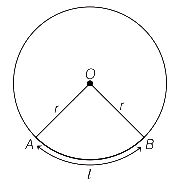
If the area of a circular sector of perimeter $60 \ m$ is to be maximized,then its radius must be......... $m$.
A
$20$
B
$15$
C
$10$
D
$5$
Solution
(B) Given,the perimeter of the circular sector is $P = 60 \ m$.
Let the radius be $r \ m$ and the arc length be $l \ m$.
The perimeter of a circular sector is given by $P = l + 2r$.
Substituting the given perimeter,we have $60 = l + 2r$,which implies $l = 60 - 2r$.
The area $A$ of a circular sector is given by $A = \frac{1}{2}lr$.
Substituting $l = 60 - 2r$ into the area formula,we get:
$A = \frac{1}{2}(60 - 2r)r = 30r - r^2$.
To maximize the area,we find the derivative of $A$ with respect to $r$ and set it to zero:
$\frac{dA}{dr} = \frac{d}{dr}(30r - r^2) = 30 - 2r$.
Setting $\frac{dA}{dr} = 0$ gives $30 - 2r = 0$,so $2r = 30$,which means $r = 15 \ m$.
To confirm this is a maximum,we check the second derivative: $\frac{d^2A}{dr^2} = -2$,which is less than $0$,confirming that $r = 15 \ m$ provides the maximum area.
Let the radius be $r \ m$ and the arc length be $l \ m$.
The perimeter of a circular sector is given by $P = l + 2r$.
Substituting the given perimeter,we have $60 = l + 2r$,which implies $l = 60 - 2r$.
The area $A$ of a circular sector is given by $A = \frac{1}{2}lr$.
Substituting $l = 60 - 2r$ into the area formula,we get:
$A = \frac{1}{2}(60 - 2r)r = 30r - r^2$.
To maximize the area,we find the derivative of $A$ with respect to $r$ and set it to zero:
$\frac{dA}{dr} = \frac{d}{dr}(30r - r^2) = 30 - 2r$.
Setting $\frac{dA}{dr} = 0$ gives $30 - 2r = 0$,so $2r = 30$,which means $r = 15 \ m$.
To confirm this is a maximum,we check the second derivative: $\frac{d^2A}{dr^2} = -2$,which is less than $0$,confirming that $r = 15 \ m$ provides the maximum area.
0 likes
View Solution638
MediumMCQ
The maximum value of $y=x(\log x)^2$ is
A
$e^{-2}$
B
$2 e^{-2}$
C
$3 e^{-2}$
D
$4 e^{-2}$
Solution
(D) Given $y = x(\log x)^2$.
To find the critical points,we differentiate $y$ with respect to $x$:
$\frac{dy}{dx} = x \cdot (2 \log x \cdot \frac{1}{x}) + (\log x)^2 \cdot 1 = 2 \log x + (\log x)^2$.
Setting $\frac{dy}{dx} = 0$:
$\log x (2 + \log x) = 0$.
This gives $\log x = 0$ or $\log x = -2$.
Thus,$x = e^0 = 1$ or $x = e^{-2}$.
Now,we use the second derivative test:
$\frac{d^2y}{dx^2} = \frac{2}{x} + 2 \log x \cdot \frac{1}{x} = \frac{2 + 2 \log x}{x}$.
At $x = 1$,$\frac{d^2y}{dx^2} = \frac{2 + 0}{1} = 2 > 0$,so $x = 1$ is a point of local minima.
At $x = e^{-2}$,$\frac{d^2y}{dx^2} = \frac{2 + 2(-2)}{e^{-2}} = \frac{-2}{e^{-2}} < 0$,so $x = e^{-2}$ is a point of local maxima.
The maximum value is $y(e^{-2}) = e^{-2}(\log e^{-2})^2 = e^{-2}(-2)^2 = 4e^{-2}$.
To find the critical points,we differentiate $y$ with respect to $x$:
$\frac{dy}{dx} = x \cdot (2 \log x \cdot \frac{1}{x}) + (\log x)^2 \cdot 1 = 2 \log x + (\log x)^2$.
Setting $\frac{dy}{dx} = 0$:
$\log x (2 + \log x) = 0$.
This gives $\log x = 0$ or $\log x = -2$.
Thus,$x = e^0 = 1$ or $x = e^{-2}$.
Now,we use the second derivative test:
$\frac{d^2y}{dx^2} = \frac{2}{x} + 2 \log x \cdot \frac{1}{x} = \frac{2 + 2 \log x}{x}$.
At $x = 1$,$\frac{d^2y}{dx^2} = \frac{2 + 0}{1} = 2 > 0$,so $x = 1$ is a point of local minima.
At $x = e^{-2}$,$\frac{d^2y}{dx^2} = \frac{2 + 2(-2)}{e^{-2}} = \frac{-2}{e^{-2}} < 0$,so $x = e^{-2}$ is a point of local maxima.
The maximum value is $y(e^{-2}) = e^{-2}(\log e^{-2})^2 = e^{-2}(-2)^2 = 4e^{-2}$.
0 likes
View Solution639
EasyMCQ
For the function $f(x)=x^3-6x^2-12x-3$,$x=2$ is a
A
point of maxima
B
point of minima
C
point of inflection
D
not a critical point
Solution
(C) Given the function $f(x) = x^3 - 6x^2 - 12x - 3$.
First,find the first derivative: $f'(x) = 3x^2 - 12x - 12$.
Next,find the second derivative: $f''(x) = 6x - 12$.
Evaluate the second derivative at $x = 2$: $f''(2) = 6(2) - 12 = 12 - 12 = 0$.
Since $f'(2) = 3(2)^2 - 12(2) - 12 = 12 - 24 - 12 = -24 \neq 0$,$x=2$ is not a critical point.
However,checking the options provided,the question implies evaluating the nature of the point where $f''(x)=0$.
Since $f''(x)$ changes sign at $x=2$ (for $x < 2$,$f''(x) < 0$ and for $x > 2$,$f''(x) > 0$),$x=2$ is a point of inflection.
First,find the first derivative: $f'(x) = 3x^2 - 12x - 12$.
Next,find the second derivative: $f''(x) = 6x - 12$.
Evaluate the second derivative at $x = 2$: $f''(2) = 6(2) - 12 = 12 - 12 = 0$.
Since $f'(2) = 3(2)^2 - 12(2) - 12 = 12 - 24 - 12 = -24 \neq 0$,$x=2$ is not a critical point.
However,checking the options provided,the question implies evaluating the nature of the point where $f''(x)=0$.
Since $f''(x)$ changes sign at $x=2$ (for $x < 2$,$f''(x) < 0$ and for $x > 2$,$f''(x) > 0$),$x=2$ is a point of inflection.
0 likes
View Solution640
DifficultMCQ
Find the absolute maximum of $x^{40}-x^{20}$ on the interval $[0,1]$.
A
$\frac{-1}{4}$
B
$0$
C
$\frac{1}{4}$
D
$\frac{1}{2}$
Solution
(B) Let $f(x) = x^{40} - x^{20}$ on the interval $[0, 1]$.
To find the absolute maximum,we first find the critical points by setting the derivative $f'(x) = 0$.
$f'(x) = 40x^{39} - 20x^{19} = 20x^{19}(2x^{20} - 1)$.
Setting $f'(x) = 0$,we get $x = 0$ or $2x^{20} = 1$,which implies $x^{20} = \frac{1}{2}$,so $x = (\frac{1}{2})^{1/20}$.
Now,evaluate $f(x)$ at the critical point and the endpoints $x=0$ and $x=1$:
$f(0) = 0^{40} - 0^{20} = 0$.
$f(1) = 1^{40} - 1^{20} = 1 - 1 = 0$.
$f((\frac{1}{2})^{1/20}) = ((\frac{1}{2})^{1/20})^{40} - ((\frac{1}{2})^{1/20})^{20} = (\frac{1}{2})^2 - (\frac{1}{2})^1 = \frac{1}{4} - \frac{1}{2} = -\frac{1}{4}$.
Comparing the values $f(0)=0$,$f(1)=0$,and $f((\frac{1}{2})^{1/20}) = -\frac{1}{4}$,the absolute maximum value is $0$.
To find the absolute maximum,we first find the critical points by setting the derivative $f'(x) = 0$.
$f'(x) = 40x^{39} - 20x^{19} = 20x^{19}(2x^{20} - 1)$.
Setting $f'(x) = 0$,we get $x = 0$ or $2x^{20} = 1$,which implies $x^{20} = \frac{1}{2}$,so $x = (\frac{1}{2})^{1/20}$.
Now,evaluate $f(x)$ at the critical point and the endpoints $x=0$ and $x=1$:
$f(0) = 0^{40} - 0^{20} = 0$.
$f(1) = 1^{40} - 1^{20} = 1 - 1 = 0$.
$f((\frac{1}{2})^{1/20}) = ((\frac{1}{2})^{1/20})^{40} - ((\frac{1}{2})^{1/20})^{20} = (\frac{1}{2})^2 - (\frac{1}{2})^1 = \frac{1}{4} - \frac{1}{2} = -\frac{1}{4}$.
Comparing the values $f(0)=0$,$f(1)=0$,and $f((\frac{1}{2})^{1/20}) = -\frac{1}{4}$,the absolute maximum value is $0$.
0 likes
View Solution641
MediumMCQ
The maximum area of a rectangle that can be formed with a fixed perimeter of $20$ units is $ . . . . . . $ sq units.
A
$30$
B
$25$
C
$20$
D
$15$
Solution
(B) Let the sides of the rectangle be $x$ and $y$.
Given,the perimeter is $20$ units.
$2(x + y) = 20 \Rightarrow x + y = 10 \Rightarrow y = 10 - x$.
The area $A$ of the rectangle is given by $A = xy$.
Substituting $y$,we get $A = x(10 - x) = 10x - x^2$.
To find the maximum area,we differentiate $A$ with respect to $x$:
$\frac{dA}{dx} = 10 - 2x$.
Setting $\frac{dA}{dx} = 0$,we get $10 - 2x = 0$,which implies $x = 5$.
Now,we check the second derivative: $\frac{d^2A}{dx^2} = -2$.
Since $\frac{d^2A}{dx^2} < 0$,the area is maximum at $x = 5$.
When $x = 5$,$y = 10 - 5 = 5$.
Thus,the maximum area is $A = 5 \times 5 = 25$ sq units.
Given,the perimeter is $20$ units.
$2(x + y) = 20 \Rightarrow x + y = 10 \Rightarrow y = 10 - x$.
The area $A$ of the rectangle is given by $A = xy$.
Substituting $y$,we get $A = x(10 - x) = 10x - x^2$.
To find the maximum area,we differentiate $A$ with respect to $x$:
$\frac{dA}{dx} = 10 - 2x$.
Setting $\frac{dA}{dx} = 0$,we get $10 - 2x = 0$,which implies $x = 5$.
Now,we check the second derivative: $\frac{d^2A}{dx^2} = -2$.
Since $\frac{d^2A}{dx^2} < 0$,the area is maximum at $x = 5$.
When $x = 5$,$y = 10 - 5 = 5$.
Thus,the maximum area is $A = 5 \times 5 = 25$ sq units.
0 likes
View Solution642
MediumMCQ
If $f(x)=x^5-5 x^4+5 x^3-10$ has its local maxima and minima at $x=a$ and $x=b$ respectively,then $2 a+b$ is equal to
A
$5$
B
$4$
C
$7$
D
$3$
Solution
(A) Given $f(x) = x^5 - 5x^4 + 5x^3 - 10$.
First,find the derivative $f'(x)$:
$f'(x) = 5x^4 - 20x^3 + 15x^2$.
For local maxima and minima,set $f'(x) = 0$:
$5x^2(x^2 - 4x + 3) = 0
\Rightarrow 5x^2(x - 1)(x - 3) = 0$.
The critical points are $x = 0, 1, 3$.
Now,find the second derivative $f''(x)$:
$f''(x) = 20x^3 - 60x^2 + 30x$.
Check the nature of the critical points:
For $x = 1$: $f''(1) = 20(1)^3 - 60(1)^2 + 30(1) = 20 - 60 + 30 = -10 < 0$. Thus,$x = 1$ is a point of local maxima. So,$a = 1$.
For $x = 3$: $f''(3) = 20(27) - 60(9) + 30(3) = 540 - 540 + 90 = 90 > 0$. Thus,$x = 3$ is a point of local minima. So,$b = 3$.
For $x = 0$: $f''(0) = 0$,which is a point of inflection.
Finally,calculate $2a + b$:
$2a + b = 2(1) + 3 = 5$.
First,find the derivative $f'(x)$:
$f'(x) = 5x^4 - 20x^3 + 15x^2$.
For local maxima and minima,set $f'(x) = 0$:
$5x^2(x^2 - 4x + 3) = 0
\Rightarrow 5x^2(x - 1)(x - 3) = 0$.
The critical points are $x = 0, 1, 3$.
Now,find the second derivative $f''(x)$:
$f''(x) = 20x^3 - 60x^2 + 30x$.
Check the nature of the critical points:
For $x = 1$: $f''(1) = 20(1)^3 - 60(1)^2 + 30(1) = 20 - 60 + 30 = -10 < 0$. Thus,$x = 1$ is a point of local maxima. So,$a = 1$.
For $x = 3$: $f''(3) = 20(27) - 60(9) + 30(3) = 540 - 540 + 90 = 90 > 0$. Thus,$x = 3$ is a point of local minima. So,$b = 3$.
For $x = 0$: $f''(0) = 0$,which is a point of inflection.
Finally,calculate $2a + b$:
$2a + b = 2(1) + 3 = 5$.
0 likes
View Solution643
EasyMCQ
If the function $f(x) = a \sin(x) + \frac{1}{3} \sin(3x)$ attains its maximum value at $x = \frac{\pi}{3}$,then $a$ equals:
A
$3$
B
$\frac{1}{3}$
C
$2$
D
$\frac{1}{2}$
Solution
(C) Given function: $f(x) = a \sin(x) + \frac{1}{3} \sin(3x)$.
First,find the derivative $f'(x)$:
$f'(x) = a \cos(x) + \frac{1}{3} \cos(3x) \cdot 3 = a \cos(x) + \cos(3x)$.
Since the function attains its maximum at $x = \frac{\pi}{3}$,the first derivative must be zero at this point:
$f'\left(\frac{\pi}{3}\right) = 0$.
Substituting $x = \frac{\pi}{3}$ into the derivative:
$a \cos\left(\frac{\pi}{3}\right) + \cos\left(3 \cdot \frac{\pi}{3}\right) = 0$.
$a \cdot \frac{1}{2} + \cos(\pi) = 0$.
Since $\cos(\pi) = -1$,we have:
$\frac{a}{2} - 1 = 0$.
$\frac{a}{2} = 1$.
$a = 2$.
First,find the derivative $f'(x)$:
$f'(x) = a \cos(x) + \frac{1}{3} \cos(3x) \cdot 3 = a \cos(x) + \cos(3x)$.
Since the function attains its maximum at $x = \frac{\pi}{3}$,the first derivative must be zero at this point:
$f'\left(\frac{\pi}{3}\right) = 0$.
Substituting $x = \frac{\pi}{3}$ into the derivative:
$a \cos\left(\frac{\pi}{3}\right) + \cos\left(3 \cdot \frac{\pi}{3}\right) = 0$.
$a \cdot \frac{1}{2} + \cos(\pi) = 0$.
Since $\cos(\pi) = -1$,we have:
$\frac{a}{2} - 1 = 0$.
$\frac{a}{2} = 1$.
$a = 2$.
0 likes
View Solution644
MediumMCQ
If $y = \frac{ax - b}{(x - 1)(x - 4)}$ has a turning point $P(2, -1)$,then the values of $a$ and $b$ are
A
$a = 0, b = 1$
B
$a = 1, b = 0$
C
$a = -1, b = 0$
D
$a = 0, b = -1$
Solution
(B) Given,$y = \frac{ax - b}{(x - 1)(x - 4)} . . . . . . (i)$ has a turning point $P(2, -1)$.
Since point $P$ lies on the curve,it must satisfy equation $(i)$:
$-1 = \frac{2a - b}{(2 - 1)(2 - 4)} = \frac{2a - b}{-2}$
$2a - b = 2 . . . . . . (ii)$
At a turning point,the derivative $\frac{dy}{dx} = 0$.
From equation $(i)$,$y(x^2 - 5x + 4) = ax - b$.
Differentiating with respect to $x$ using the product rule:
$y(2x - 5) + (x^2 - 5x + 4) \frac{dy}{dx} = a$.
At $x = 2$ and $y = -1$,$\frac{dy}{dx} = 0$:
$-1(2(2) - 5) + (2^2 - 5(2) + 4)(0) = a$
$-1(4 - 5) = a$
$a = 1$.
Substituting $a = 1$ into equation $(ii)$:
$2(1) - b = 2$
$b = 0$.
Thus,$a = 1$ and $b = 0$.
Since point $P$ lies on the curve,it must satisfy equation $(i)$:
$-1 = \frac{2a - b}{(2 - 1)(2 - 4)} = \frac{2a - b}{-2}$
$2a - b = 2 . . . . . . (ii)$
At a turning point,the derivative $\frac{dy}{dx} = 0$.
From equation $(i)$,$y(x^2 - 5x + 4) = ax - b$.
Differentiating with respect to $x$ using the product rule:
$y(2x - 5) + (x^2 - 5x + 4) \frac{dy}{dx} = a$.
At $x = 2$ and $y = -1$,$\frac{dy}{dx} = 0$:
$-1(2(2) - 5) + (2^2 - 5(2) + 4)(0) = a$
$-1(4 - 5) = a$
$a = 1$.
Substituting $a = 1$ into equation $(ii)$:
$2(1) - b = 2$
$b = 0$.
Thus,$a = 1$ and $b = 0$.
0 likes
View Solution645
MediumMCQ
If the curved surface area of a right circular cylinder inscribed in a sphere of radius $22 \ cm$ is maximum,then the height of the cylinder will be:
A
$11\sqrt{2} \ cm$
B
$22\sqrt{2} \ cm$
C
$44\sqrt{2} \ cm$
D
$22 \ cm$
Solution
(B) Let $R = 22 \ cm$ be the radius of the sphere and $h$ be the height of the cylinder inscribed in it. Let $r$ be the radius of the cylinder.
From the geometry of the sphere,we have $r^2 + (h/2)^2 = R^2$,which implies $r^2 = R^2 - h^2/4$.
The curved surface area $A$ of the cylinder is given by $A = 2\pi rh = 2\pi h \sqrt{R^2 - h^2/4} = \pi h \sqrt{4R^2 - h^2}$.
To maximize $A$,we maximize $A^2 = \pi^2 h^2 (4R^2 - h^2) = \pi^2 (4R^2h^2 - h^4)$.
Let $f(h) = 4R^2h^2 - h^4$. Differentiating with respect to $h$,we get $f'(h) = 8R^2h - 4h^3$.
Setting $f'(h) = 0$,we get $4h(2R^2 - h^2) = 0$. Since $h > 0$,we have $h^2 = 2R^2$,so $h = R\sqrt{2}$.
Given $R = 22 \ cm$,the height $h = 22\sqrt{2} \ cm$.
From the geometry of the sphere,we have $r^2 + (h/2)^2 = R^2$,which implies $r^2 = R^2 - h^2/4$.
The curved surface area $A$ of the cylinder is given by $A = 2\pi rh = 2\pi h \sqrt{R^2 - h^2/4} = \pi h \sqrt{4R^2 - h^2}$.
To maximize $A$,we maximize $A^2 = \pi^2 h^2 (4R^2 - h^2) = \pi^2 (4R^2h^2 - h^4)$.
Let $f(h) = 4R^2h^2 - h^4$. Differentiating with respect to $h$,we get $f'(h) = 8R^2h - 4h^3$.
Setting $f'(h) = 0$,we get $4h(2R^2 - h^2) = 0$. Since $h > 0$,we have $h^2 = 2R^2$,so $h = R\sqrt{2}$.
Given $R = 22 \ cm$,the height $h = 22\sqrt{2} \ cm$.
0 likes
View Solution646
EasyMCQ
The difference between the greatest and least values of the function $f(x) = -x + \sin 2x$ on $[-\frac{\pi}{2}, \frac{\pi}{2}]$ is
A
$\pi$
B
$\frac{3\sqrt{3}}{2} - \frac{\pi}{3}$
C
$\frac{\sqrt{3}}{2} + \frac{\pi}{6}$
D
$\frac{3\sqrt{3}}{2} + \frac{\pi}{3}$
Solution
(A) Given function is $f(x) = -x + \sin 2x$ on the interval $[-\frac{\pi}{2}, \frac{\pi}{2}]$.
First,find the critical points by setting $f'(x) = 0$.
$f'(x) = -1 + 2 \cos 2x = 0$
$\cos 2x = \frac{1}{2}$
Since $x \in [-\frac{\pi}{2}, \frac{\pi}{2}]$,$2x \in [-\pi, \pi]$.
Thus,$2x = \pm \frac{\pi}{3}$,which gives $x = \pm \frac{\pi}{6}$.
Now,evaluate $f(x)$ at the critical points and the endpoints:
$f(-\frac{\pi}{2}) = -(-\frac{\pi}{2}) + \sin(-\pi) = \frac{\pi}{2} + 0 = \frac{\pi}{2} \approx 1.57$
$f(-\frac{\pi}{6}) = -(-\frac{\pi}{6}) + \sin(-\frac{\pi}{3}) = \frac{\pi}{6} - \frac{\sqrt{3}}{2} \approx 0.52 - 0.866 = -0.346$
$f(\frac{\pi}{6}) = -(\frac{\pi}{6}) + \sin(\frac{\pi}{3}) = -\frac{\pi}{6} + \frac{\sqrt{3}}{2} \approx -0.52 + 0.866 = 0.346$
$f(\frac{\pi}{2}) = -(\frac{\pi}{2}) + \sin(\pi) = -\frac{\pi}{2} + 0 = -\frac{\pi}{2} \approx -1.57$
Comparing these values,the greatest value is $M = \frac{\pi}{2}$ and the least value is $m = -\frac{\pi}{2}$.
The difference is $M - m = \frac{\pi}{2} - (-\frac{\pi}{2}) = \pi$.
First,find the critical points by setting $f'(x) = 0$.
$f'(x) = -1 + 2 \cos 2x = 0$
$\cos 2x = \frac{1}{2}$
Since $x \in [-\frac{\pi}{2}, \frac{\pi}{2}]$,$2x \in [-\pi, \pi]$.
Thus,$2x = \pm \frac{\pi}{3}$,which gives $x = \pm \frac{\pi}{6}$.
Now,evaluate $f(x)$ at the critical points and the endpoints:
$f(-\frac{\pi}{2}) = -(-\frac{\pi}{2}) + \sin(-\pi) = \frac{\pi}{2} + 0 = \frac{\pi}{2} \approx 1.57$
$f(-\frac{\pi}{6}) = -(-\frac{\pi}{6}) + \sin(-\frac{\pi}{3}) = \frac{\pi}{6} - \frac{\sqrt{3}}{2} \approx 0.52 - 0.866 = -0.346$
$f(\frac{\pi}{6}) = -(\frac{\pi}{6}) + \sin(\frac{\pi}{3}) = -\frac{\pi}{6} + \frac{\sqrt{3}}{2} \approx -0.52 + 0.866 = 0.346$
$f(\frac{\pi}{2}) = -(\frac{\pi}{2}) + \sin(\pi) = -\frac{\pi}{2} + 0 = -\frac{\pi}{2} \approx -1.57$
Comparing these values,the greatest value is $M = \frac{\pi}{2}$ and the least value is $m = -\frac{\pi}{2}$.
The difference is $M - m = \frac{\pi}{2} - (-\frac{\pi}{2}) = \pi$.
0 likes
View Solution647
EasyMCQ
The two positive numbers with sum $t$,and the sum of their squares is minimum are
A
$\frac{t}{4}, \frac{3t}{4}$
B
$\frac{t}{3}, \frac{2t}{3}$
C
$\frac{t}{2}, \frac{t}{2}$
D
$\frac{2t}{5}, \frac{3t}{5}$
Solution
(C) Let the two positive numbers be $x$ and $y$. Given that $x + y = t$,so $y = t - x$.
We want to minimize the sum of their squares,$S = x^2 + y^2$.
Substituting $y = t - x$,we get $S(x) = x^2 + (t - x)^2 = x^2 + t^2 - 2tx + x^2 = 2x^2 - 2tx + t^2$.
To find the minimum,we take the derivative with respect to $x$: $\frac{dS}{dx} = 4x - 2t$.
Setting $\frac{dS}{dx} = 0$,we get $4x = 2t$,which implies $x = \frac{t}{2}$.
Since $\frac{d^2S}{dx^2} = 4 > 0$,the function has a minimum at $x = \frac{t}{2}$.
Then $y = t - \frac{t}{2} = \frac{t}{2}$.
Thus,the two numbers are $\frac{t}{2}$ and $\frac{t}{2}$.
We want to minimize the sum of their squares,$S = x^2 + y^2$.
Substituting $y = t - x$,we get $S(x) = x^2 + (t - x)^2 = x^2 + t^2 - 2tx + x^2 = 2x^2 - 2tx + t^2$.
To find the minimum,we take the derivative with respect to $x$: $\frac{dS}{dx} = 4x - 2t$.
Setting $\frac{dS}{dx} = 0$,we get $4x = 2t$,which implies $x = \frac{t}{2}$.
Since $\frac{d^2S}{dx^2} = 4 > 0$,the function has a minimum at $x = \frac{t}{2}$.
Then $y = t - \frac{t}{2} = \frac{t}{2}$.
Thus,the two numbers are $\frac{t}{2}$ and $\frac{t}{2}$.
0 likes
View Solution648
EasyMCQ
For the function $f(x) = x^{40} - x^{20}$,find the absolute minimum value in the interval $[0, 1]$.
A
$1/2$
B
$-1/4$
C
$0$
D
$1$
Solution
(B) To find the absolute minimum of $f(x) = x^{40} - x^{20}$ on the interval $[0, 1]$,we first find the critical points by setting the derivative $f'(x) = 0$.
$f'(x) = 40x^{39} - 20x^{19} = 20x^{19}(2x^{20} - 1)$.
Setting $f'(x) = 0$,we get $x = 0$ or $2x^{20} = 1$,which implies $x^{20} = 1/2$,so $x = (1/2)^{1/20}$.
Since $(1/2)^{1/20}$ is in the interval $(0, 1)$,we evaluate $f(x)$ at the critical point and the endpoints $x = 0$ and $x = 1$.
$f(0) = 0^{40} - 0^{20} = 0$.
$f(1) = 1^{40} - 1^{20} = 0$.
$f((1/2)^{1/20}) = ((1/2)^{1/20})^{40} - ((1/2)^{1/20})^{20} = (1/2)^2 - (1/2)^1 = 1/4 - 1/2 = -1/4$.
Comparing the values $0, 0,$ and $-1/4$,the absolute minimum value is $-1/4$.
$f'(x) = 40x^{39} - 20x^{19} = 20x^{19}(2x^{20} - 1)$.
Setting $f'(x) = 0$,we get $x = 0$ or $2x^{20} = 1$,which implies $x^{20} = 1/2$,so $x = (1/2)^{1/20}$.
Since $(1/2)^{1/20}$ is in the interval $(0, 1)$,we evaluate $f(x)$ at the critical point and the endpoints $x = 0$ and $x = 1$.
$f(0) = 0^{40} - 0^{20} = 0$.
$f(1) = 1^{40} - 1^{20} = 0$.
$f((1/2)^{1/20}) = ((1/2)^{1/20})^{40} - ((1/2)^{1/20})^{20} = (1/2)^2 - (1/2)^1 = 1/4 - 1/2 = -1/4$.
Comparing the values $0, 0,$ and $-1/4$,the absolute minimum value is $-1/4$.
0 likes
View SolutionApplications of Derivatives — Maxima and Minima · Frequently Asked Questions
1Are these Applications of Derivatives questions useful for JEE and NEET?
Yes. All questions in this section are mapped to JEE Main and NEET exam patterns. Previous year questions from JEE Main, NEET, GUJCET and state-level exams are included with full solutions.
2Can I switch to Hindi or Gujarati for these questions?
Yes. Use the language tabs in the hero section or the sidebar to view the same questions and solutions in English, Hindi or Gujarati.
3How do I generate a question paper from this subtopic?
Use the Vedclass Exam Paper Generator — select the chapter and subtopic, set difficulty, and generate Sets A, B, C, D automatically. First 3 chapters of every subject are free.
Vedclass Products
For Students
Vedclass Test Series
Mock tests in real JEE/NEET style with performance analysis. 5-day free trial.
Start Free TrialFor Teachers
Exam Paper Generator
Generate Set A/B/C/D papers from this chapter in 2 minutes. 3 chapters free.
Try FreeFor Institutes
Online Exam Module
Live online exams with unlimited students, 360° analytics & white-label branding.
See DemoFor Teachers & Institutes
Generate a Applications of Derivatives Exam Paper in 2 Minutes
Select subtopic & difficulty — Sets A, B, C, D auto-generated with No Repeat logic.
First 3 chapters of every subject are free — no payment required.