
A English
Maxima and Minima Questions in English
Class 12 Mathematics · Applications of Derivatives · Maxima and Minima
760+
Questions
English
Language
100%
With Solutions
Showing 44 of 760 questions in English
651
MediumMCQ
If $f(x)=a \log |x|+b x^2+x$ has extreme values at $x=-1$ and $x=2$,then the ordered pair $(a, b)=$
A
$(2, -1)$
B
$\left(2, -\frac{1}{2}\right)$
C
$(-1, 2)$
D
$\left(-\frac{1}{2}, 2\right)$
Solution
(B) Given,$f(x)=a \log |x|+b x^2+x$.
The derivative is $f^{\prime}(x) = \frac{a}{x} + 2bx + 1$.
Since the function has extreme values at $x=-1$ and $x=2$,we have $f^{\prime}(-1)=0$ and $f^{\prime}(2)=0$.
For $x=-1$: $f^{\prime}(-1) = \frac{a}{-1} + 2b(-1) + 1 = 0 \Rightarrow -a - 2b + 1 = 0 \Rightarrow a + 2b = 1$ $(i)$.
For $x=2$: $f^{\prime}(2) = \frac{a}{2} + 2b(2) + 1 = 0 \Rightarrow \frac{a}{2} + 4b + 1 = 0 \Rightarrow a + 8b = -2$ (ii).
Subtracting $(i)$ from (ii): $(a + 8b) - (a + 2b) = -2 - 1 \Rightarrow 6b = -3 \Rightarrow b = -\frac{1}{2}$.
Substituting $b = -\frac{1}{2}$ into $(i)$: $a + 2(-\frac{1}{2}) = 1 \Rightarrow a - 1 = 1 \Rightarrow a = 2$.
Thus,the ordered pair $(a, b) = \left(2, -\frac{1}{2}\right)$.
The derivative is $f^{\prime}(x) = \frac{a}{x} + 2bx + 1$.
Since the function has extreme values at $x=-1$ and $x=2$,we have $f^{\prime}(-1)=0$ and $f^{\prime}(2)=0$.
For $x=-1$: $f^{\prime}(-1) = \frac{a}{-1} + 2b(-1) + 1 = 0 \Rightarrow -a - 2b + 1 = 0 \Rightarrow a + 2b = 1$ $(i)$.
For $x=2$: $f^{\prime}(2) = \frac{a}{2} + 2b(2) + 1 = 0 \Rightarrow \frac{a}{2} + 4b + 1 = 0 \Rightarrow a + 8b = -2$ (ii).
Subtracting $(i)$ from (ii): $(a + 8b) - (a + 2b) = -2 - 1 \Rightarrow 6b = -3 \Rightarrow b = -\frac{1}{2}$.
Substituting $b = -\frac{1}{2}$ into $(i)$: $a + 2(-\frac{1}{2}) = 1 \Rightarrow a - 1 = 1 \Rightarrow a = 2$.
Thus,the ordered pair $(a, b) = \left(2, -\frac{1}{2}\right)$.
0 likes
View Solution652
EasyMCQ
For $a > 0$,if the function $f(x) = 2x^3 - 9ax^2 + 12a^2x + 1$ attains its maximum value at $p$ and minimum value at $q$ such that $p^2 = q$,then $a =$
A
$1/2$
B
$1$
C
$2$
D
$4$
Solution
(C) Given,$f(x) = 2x^3 - 9ax^2 + 12a^2x + 1$.
To find the critical points,we calculate the derivative: $f'(x) = 6x^2 - 18ax + 12a^2$.
Setting $f'(x) = 0$,we get $6(x^2 - 3ax + 2a^2) = 0$,which factors as $6(x - a)(x - 2a) = 0$.
Thus,the critical points are $x = a$ and $x = 2a$.
We find the second derivative: $f''(x) = 12x - 18a$.
For $x = a$,$f''(a) = 12a - 18a = -6a$. Since $a > 0$,$f''(a) < 0$,so $f(x)$ has a maximum at $p = a$.
For $x = 2a$,$f''(2a) = 12(2a) - 18a = 6a$. Since $a > 0$,$f''(2a) > 0$,so $f(x)$ has a minimum at $q = 2a$.
Given the condition $p^2 = q$,we substitute the values: $a^2 = 2a$.
Since $a > 0$,we can divide by $a$ to get $a = 2$.
To find the critical points,we calculate the derivative: $f'(x) = 6x^2 - 18ax + 12a^2$.
Setting $f'(x) = 0$,we get $6(x^2 - 3ax + 2a^2) = 0$,which factors as $6(x - a)(x - 2a) = 0$.
Thus,the critical points are $x = a$ and $x = 2a$.
We find the second derivative: $f''(x) = 12x - 18a$.
For $x = a$,$f''(a) = 12a - 18a = -6a$. Since $a > 0$,$f''(a) < 0$,so $f(x)$ has a maximum at $p = a$.
For $x = 2a$,$f''(2a) = 12(2a) - 18a = 6a$. Since $a > 0$,$f''(2a) > 0$,so $f(x)$ has a minimum at $q = 2a$.
Given the condition $p^2 = q$,we substitute the values: $a^2 = 2a$.
Since $a > 0$,we can divide by $a$ to get $a = 2$.
0 likes
View Solution653
MediumMCQ
If $p$ and $q$ are respectively the global maximum and global minimum of the function $f(x) = x^2 e^{2x}$ on the interval $[-2, 2]$,then $p e^{-4} + q e^4 =$
A
$0$
B
$4 e^8$
C
$4$
D
$4 e^8 + 1$
Solution
(C) Given the function $f(x) = x^2 e^{2x}$ on the interval $[-2, 2]$.
First,we find the critical points by setting the derivative $f'(x) = 0$.
$f'(x) = 2x e^{2x} + x^2 (2 e^{2x}) = 2x e^{2x} (1 + x)$.
Setting $f'(x) = 0$,we get $x = 0$ or $x = -1$.
Now,we evaluate the function at the critical points and the endpoints of the interval $[-2, 2]$:
$f(-2) = (-2)^2 e^{2(-2)} = 4 e^{-4}$.
$f(-1) = (-1)^2 e^{2(-1)} = 1 e^{-2} = e^{-2}$.
$f(0) = (0)^2 e^{2(0)} = 0$.
$f(2) = (2)^2 e^{2(2)} = 4 e^4$.
Comparing these values,the global maximum $p = 4 e^4$ and the global minimum $q = 0$.
Finally,we calculate $p e^{-4} + q e^4 = (4 e^4) e^{-4} + (0) e^4 = 4 e^0 + 0 = 4(1) = 4$.
First,we find the critical points by setting the derivative $f'(x) = 0$.
$f'(x) = 2x e^{2x} + x^2 (2 e^{2x}) = 2x e^{2x} (1 + x)$.
Setting $f'(x) = 0$,we get $x = 0$ or $x = -1$.
Now,we evaluate the function at the critical points and the endpoints of the interval $[-2, 2]$:
$f(-2) = (-2)^2 e^{2(-2)} = 4 e^{-4}$.
$f(-1) = (-1)^2 e^{2(-1)} = 1 e^{-2} = e^{-2}$.
$f(0) = (0)^2 e^{2(0)} = 0$.
$f(2) = (2)^2 e^{2(2)} = 4 e^4$.
Comparing these values,the global maximum $p = 4 e^4$ and the global minimum $q = 0$.
Finally,we calculate $p e^{-4} + q e^4 = (4 e^4) e^{-4} + (0) e^4 = 4 e^0 + 0 = 4(1) = 4$.
0 likes
View Solution654
EasyMCQ
The maximum volume (in cubic units) of the cylinder which can be inscribed in a sphere of diameter $6$ units is
A
$12 \sqrt{3} \pi$
B
$4 \sqrt{3} \pi$
C
$3 \sqrt{3} \pi$
D
$8 \sqrt{3} \pi$
Solution
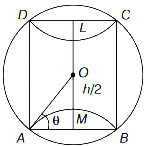
(A) Let $h$ be the height and $r$ be the radius of the cylinder inscribed in a sphere of radius $R = 3$ units.
From the geometry of the inscribed cylinder,we have the relation $r^2 + (h/2)^2 = R^2$.
Substituting $R = 3$,we get $r^2 + h^2/4 = 9$,which implies $r^2 = 9 - h^2/4$.
The volume $V$ of the cylinder is given by $V = \pi r^2 h$.
Substituting $r^2$,we get $V = \pi (9 - h^2/4) h = \pi (9h - h^3/4)$.
To find the maximum volume,we differentiate $V$ with respect to $h$:
$\frac{dV}{dh} = \pi (9 - 3h^2/4)$.
Setting $\frac{dV}{dh} = 0$,we get $9 - 3h^2/4 = 0$,which implies $3h^2/4 = 9$,so $h^2 = 12$ and $h = 2\sqrt{3}$ (since height must be positive).
Then $r^2 = 9 - (12/4) = 9 - 3 = 6$.
The maximum volume is $V = \pi (6) (2\sqrt{3}) = 12\sqrt{3}\pi$ cubic units.
From the geometry of the inscribed cylinder,we have the relation $r^2 + (h/2)^2 = R^2$.
Substituting $R = 3$,we get $r^2 + h^2/4 = 9$,which implies $r^2 = 9 - h^2/4$.
The volume $V$ of the cylinder is given by $V = \pi r^2 h$.
Substituting $r^2$,we get $V = \pi (9 - h^2/4) h = \pi (9h - h^3/4)$.
To find the maximum volume,we differentiate $V$ with respect to $h$:
$\frac{dV}{dh} = \pi (9 - 3h^2/4)$.
Setting $\frac{dV}{dh} = 0$,we get $9 - 3h^2/4 = 0$,which implies $3h^2/4 = 9$,so $h^2 = 12$ and $h = 2\sqrt{3}$ (since height must be positive).
Then $r^2 = 9 - (12/4) = 9 - 3 = 6$.
The maximum volume is $V = \pi (6) (2\sqrt{3}) = 12\sqrt{3}\pi$ cubic units.
0 likes
View Solution655
EasyMCQ
In the interval $[-2, 4]$,the absolute maximum of $f(x) = 2x^3 - 3x^2 - 12x + 5$ occurs at $x =$
A
$4$
B
$-2$
C
$-1$
D
$2$
Solution
(A) Given the function $f(x) = 2x^3 - 3x^2 - 12x + 5$.
To find the critical points,we calculate the derivative $f'(x) = 6x^2 - 6x - 12$.
Setting $f'(x) = 0$,we get $6(x^2 - x - 2) = 0$,which factors as $6(x + 1)(x - 2) = 0$.
Thus,the critical points are $x = -1$ and $x = 2$,both of which lie within the interval $[-2, 4]$.
Now,we evaluate the function at the critical points and the endpoints of the interval:
$f(-2) = 2(-8) - 3(4) - 12(-2) + 5 = -16 - 12 + 24 + 5 = 1$.
$f(-1) = 2(-1) - 3(1) - 12(-1) + 5 = -2 - 3 + 12 + 5 = 12$.
$f(2) = 2(8) - 3(4) - 12(2) + 5 = 16 - 12 - 24 + 5 = -15$.
$f(4) = 2(64) - 3(16) - 12(4) + 5 = 128 - 48 - 48 + 5 = 37$.
Comparing these values,the absolute maximum is $37$,which occurs at $x = 4$.
Therefore,the correct option is $A$.
To find the critical points,we calculate the derivative $f'(x) = 6x^2 - 6x - 12$.
Setting $f'(x) = 0$,we get $6(x^2 - x - 2) = 0$,which factors as $6(x + 1)(x - 2) = 0$.
Thus,the critical points are $x = -1$ and $x = 2$,both of which lie within the interval $[-2, 4]$.
Now,we evaluate the function at the critical points and the endpoints of the interval:
$f(-2) = 2(-8) - 3(4) - 12(-2) + 5 = -16 - 12 + 24 + 5 = 1$.
$f(-1) = 2(-1) - 3(1) - 12(-1) + 5 = -2 - 3 + 12 + 5 = 12$.
$f(2) = 2(8) - 3(4) - 12(2) + 5 = 16 - 12 - 24 + 5 = -15$.
$f(4) = 2(64) - 3(16) - 12(4) + 5 = 128 - 48 - 48 + 5 = 37$.
Comparing these values,the absolute maximum is $37$,which occurs at $x = 4$.
Therefore,the correct option is $A$.
0 likes
View Solution656
MediumMCQ
If the petrol burnt in driving a motor boat varies as the cube of the velocity,then the speed (in $km/h$) of the boat relative to the water,going against a water flow of $C \ km/h$,so that the quantity of petrol burnt is minimum,is:
A
$\frac{2C}{3}$
B
$\frac{3C}{2}$
C
$\frac{4C}{3}$
D
$\frac{3C}{4}$
Solution
(B) Let $v$ be the speed of the motor boat relative to the water,where $v > C$. The speed of the boat relative to the land,while moving against the water flow,is $(v - C)$.
If the distance to be covered is $S$,the time taken is $t = \frac{S}{v - C}$.
The rate of petrol consumption per hour is proportional to the cube of the velocity relative to the water,i.e.,$k v^3$,where $k$ is a constant.
The total petrol consumed $f(v)$ is given by:
$f(v) = (k v^3) \times \left( \frac{S}{v - C} \right) = k S \frac{v^3}{v - C}$.
To find the minimum consumption,we differentiate $f(v)$ with respect to $v$ and set it to zero:
$f'(v) = k S \left[ \frac{(v - C)(3v^2) - v^3(1)}{(v - C)^2} \right] = 0$.
This implies $3v^2(v - C) - v^3 = 0$,which simplifies to $3v^3 - 3v^2C - v^3 = 0$.
$2v^3 - 3v^2C = 0$.
Since $v \neq 0$,we have $2v - 3C = 0$,which gives $v = \frac{3C}{2}$.
If the distance to be covered is $S$,the time taken is $t = \frac{S}{v - C}$.
The rate of petrol consumption per hour is proportional to the cube of the velocity relative to the water,i.e.,$k v^3$,where $k$ is a constant.
The total petrol consumed $f(v)$ is given by:
$f(v) = (k v^3) \times \left( \frac{S}{v - C} \right) = k S \frac{v^3}{v - C}$.
To find the minimum consumption,we differentiate $f(v)$ with respect to $v$ and set it to zero:
$f'(v) = k S \left[ \frac{(v - C)(3v^2) - v^3(1)}{(v - C)^2} \right] = 0$.
This implies $3v^2(v - C) - v^3 = 0$,which simplifies to $3v^3 - 3v^2C - v^3 = 0$.
$2v^3 - 3v^2C = 0$.
Since $v \neq 0$,we have $2v - 3C = 0$,which gives $v = \frac{3C}{2}$.
0 likes
View Solution657
EasyMCQ
The sum of the maximum and the minimum values of $f(x) = 3x^4 - 2x^3 - 6x^2 + 6x + 4$ in the interval $(0, 2)$ is:
A
$28$
B
$\frac{167}{16}$
C
$\frac{134}{15}$
D
$\frac{87}{16}$
Solution
(B) Given the function $f(x) = 3x^4 - 2x^3 - 6x^2 + 6x + 4$.
First,find the derivative $f'(x)$:
$f'(x) = 12x^3 - 6x^2 - 12x + 6$
Factorize the derivative:
$f'(x) = 6(2x^3 - x^2 - 2x + 1) = 6[x^2(2x - 1) - 1(2x - 1)] = 6(x^2 - 1)(2x - 1) = 6(x - 1)(x + 1)(2x - 1)$.
Set $f'(x) = 0$ to find critical points:
$6(x - 1)(x + 1)(2x - 1) = 0$.
The critical points are $x = 1, x = -1, x = 1/2$.
Since we are considering the interval $(0, 2)$,we only consider $x = 1$ and $x = 1/2$ (as $-1$ is outside the interval).
Evaluate $f(x)$ at these points:
$f(1) = 3(1)^4 - 2(1)^3 - 6(1)^2 + 6(1) + 4 = 3 - 2 - 6 + 6 + 4 = 5$.
$f(1/2) = 3(1/16) - 2(1/8) - 6(1/4) + 6(1/2) + 4 = 3/16 - 4/16 - 24/16 + 48/16 + 64/16 = 87/16$.
Comparing the values,the maximum value is $87/16$ and the minimum value is $5$.
The sum of the maximum and minimum values is $87/16 + 5 = (87 + 80) / 16 = 167/16$.
First,find the derivative $f'(x)$:
$f'(x) = 12x^3 - 6x^2 - 12x + 6$
Factorize the derivative:
$f'(x) = 6(2x^3 - x^2 - 2x + 1) = 6[x^2(2x - 1) - 1(2x - 1)] = 6(x^2 - 1)(2x - 1) = 6(x - 1)(x + 1)(2x - 1)$.
Set $f'(x) = 0$ to find critical points:
$6(x - 1)(x + 1)(2x - 1) = 0$.
The critical points are $x = 1, x = -1, x = 1/2$.
Since we are considering the interval $(0, 2)$,we only consider $x = 1$ and $x = 1/2$ (as $-1$ is outside the interval).
Evaluate $f(x)$ at these points:
$f(1) = 3(1)^4 - 2(1)^3 - 6(1)^2 + 6(1) + 4 = 3 - 2 - 6 + 6 + 4 = 5$.
$f(1/2) = 3(1/16) - 2(1/8) - 6(1/4) + 6(1/2) + 4 = 3/16 - 4/16 - 24/16 + 48/16 + 64/16 = 87/16$.
Comparing the values,the maximum value is $87/16$ and the minimum value is $5$.
The sum of the maximum and minimum values is $87/16 + 5 = (87 + 80) / 16 = 167/16$.
0 likes
View Solution658
MediumMCQ
If the distance $s$ covered in time $t$ by a particle moving on a straight line is given by $s = t^5 - 40t^3 + 30t^2 + 80t - 250$,then its minimum acceleration is
A
$260$
B
$-260$
C
$130$
D
$-130$
Solution
(B) Given that,$s = t^5 - 40t^3 + 30t^2 + 80t - 250$.
Velocity $v = \frac{ds}{dt} = 5t^4 - 120t^2 + 60t + 80$.
Acceleration $a = \frac{dv}{dt} = 20t^3 - 240t + 60$.
Let $f(t) = 20t^3 - 240t + 60$.
To find the minimum acceleration,we find the critical points by setting $f'(t) = 0$:
$f'(t) = 60t^2 - 240 = 0 \Rightarrow t^2 = 4 \Rightarrow t = \pm 2$.
Now,check the second derivative $f''(t) = 120t$.
At $t = 2$,$f''(2) = 120(2) = 240 > 0$,so $f(t)$ has a minimum at $t = 2$.
Minimum acceleration $a_{\min} = f(2) = 20(2)^3 - 240(2) + 60 = 160 - 480 + 60 = -260$.
Velocity $v = \frac{ds}{dt} = 5t^4 - 120t^2 + 60t + 80$.
Acceleration $a = \frac{dv}{dt} = 20t^3 - 240t + 60$.
Let $f(t) = 20t^3 - 240t + 60$.
To find the minimum acceleration,we find the critical points by setting $f'(t) = 0$:
$f'(t) = 60t^2 - 240 = 0 \Rightarrow t^2 = 4 \Rightarrow t = \pm 2$.
Now,check the second derivative $f''(t) = 120t$.
At $t = 2$,$f''(2) = 120(2) = 240 > 0$,so $f(t)$ has a minimum at $t = 2$.
Minimum acceleration $a_{\min} = f(2) = 20(2)^3 - 240(2) + 60 = 160 - 480 + 60 = -260$.
0 likes
View Solution659
EasyMCQ
If $f(x) = 2x^6 - 3$,then:
A
the local minimum value of $f$ is zero
B
$-3$ is the local maximum value of $f$
C
$-3$ is the local minimum value of $f$
D
$f$ has neither minimum nor maximum
Solution
(C) To find the local extrema of the function $f(x) = 2x^6 - 3$,we first find its derivative.
$f'(x) = \frac{d}{dx}(2x^6 - 3) = 12x^5$.
Setting the derivative equal to zero to find critical points:
$12x^5 = 0 \implies x = 0$.
Now,we use the first derivative test or second derivative test to check the nature of the point $x = 0$.
Using the first derivative test:
For $x < 0$,$f'(x) = 12x^5 < 0$ (function is decreasing).
For $x > 0$,$f'(x) = 12x^5 > 0$ (function is increasing).
Since the derivative changes sign from negative to positive at $x = 0$,the function has a local minimum at $x = 0$.
The local minimum value is $f(0) = 2(0)^6 - 3 = -3$.
Thus,$-3$ is the local minimum value of $f$.
$f'(x) = \frac{d}{dx}(2x^6 - 3) = 12x^5$.
Setting the derivative equal to zero to find critical points:
$12x^5 = 0 \implies x = 0$.
Now,we use the first derivative test or second derivative test to check the nature of the point $x = 0$.
Using the first derivative test:
For $x < 0$,$f'(x) = 12x^5 < 0$ (function is decreasing).
For $x > 0$,$f'(x) = 12x^5 > 0$ (function is increasing).
Since the derivative changes sign from negative to positive at $x = 0$,the function has a local minimum at $x = 0$.
The local minimum value is $f(0) = 2(0)^6 - 3 = -3$.
Thus,$-3$ is the local minimum value of $f$.
0 likes
View Solution660
EasyMCQ
The greatest value of the real-valued function $f(x)=(x+1)^{1/3}-(x-1)^{1/3}$ on the interval $[0, 1]$ is:
A
$1$
B
$2^{1/3}$
C
$2$
D
$3^{1/3}$
Solution
(C) To find the greatest value of $f(x) = (x+1)^{1/3} - (x-1)^{1/3}$ on $[0, 1]$,we find the derivative $f'(x)$.
$f'(x) = \frac{1}{3}(x+1)^{-2/3} - \frac{1}{3}(x-1)^{-2/3} = \frac{1}{3} \left[ \frac{1}{(x+1)^{2/3}} - \frac{1}{(x-1)^{2/3}} \right]$.
Setting $f'(x) = 0$,we get $(x-1)^{2/3} = (x+1)^{2/3}$,which implies $|x-1| = |x+1|$.
Squaring both sides,$(x-1)^2 = (x+1)^2$,so $x^2 - 2x + 1 = x^2 + 2x + 1$,which gives $4x = 0$,so $x = 0$.
Now,we evaluate $f(x)$ at the critical point $x=0$ and the endpoints $x=0$ and $x=1$.
At $x=0$,$f(0) = (0+1)^{1/3} - (0-1)^{1/3} = 1 - (-1) = 2$.
At $x=1$,$f(1) = (1+1)^{1/3} - (1-1)^{1/3} = 2^{1/3} - 0 = 2^{1/3}$.
Comparing $f(0) = 2$ and $f(1) = 2^{1/3} \approx 1.26$,the greatest value is $2$.
$f'(x) = \frac{1}{3}(x+1)^{-2/3} - \frac{1}{3}(x-1)^{-2/3} = \frac{1}{3} \left[ \frac{1}{(x+1)^{2/3}} - \frac{1}{(x-1)^{2/3}} \right]$.
Setting $f'(x) = 0$,we get $(x-1)^{2/3} = (x+1)^{2/3}$,which implies $|x-1| = |x+1|$.
Squaring both sides,$(x-1)^2 = (x+1)^2$,so $x^2 - 2x + 1 = x^2 + 2x + 1$,which gives $4x = 0$,so $x = 0$.
Now,we evaluate $f(x)$ at the critical point $x=0$ and the endpoints $x=0$ and $x=1$.
At $x=0$,$f(0) = (0+1)^{1/3} - (0-1)^{1/3} = 1 - (-1) = 2$.
At $x=1$,$f(1) = (1+1)^{1/3} - (1-1)^{1/3} = 2^{1/3} - 0 = 2^{1/3}$.
Comparing $f(0) = 2$ and $f(1) = 2^{1/3} \approx 1.26$,the greatest value is $2$.
0 likes
View Solution661
DifficultMCQ
If $0 < x < \frac{\pi}{2}$,then the maximum area (in sq. units) of the triangle whose vertices are $(0,0)$,$(x, \cos x)$ and $(\sin^3 x, 0)$ is
A
$\frac{3 \sqrt{3}}{32}$
B
$\frac{7 \sqrt{3}}{32}$
C
$\frac{5 \sqrt{3}}{32}$
D
$\frac{3 \sqrt{3}}{16}$
Solution
(A) The area $A$ of a triangle with vertices $(0,0)$,$(x_1, y_1)$,and $(x_2, y_2)$ is given by $A = \frac{1}{2} |x_1 y_2 - x_2 y_1|$.
Here,the vertices are $(0,0)$,$(x, \cos x)$,and $(\sin^3 x, 0)$.
Thus,$A(x) = \frac{1}{2} |x(0) - (\sin^3 x)(\cos x)| = \frac{1}{2} \sin^3 x \cos x$ for $x \in (0, \frac{\pi}{2})$.
To find the maximum,we differentiate $A(x)$ with respect to $x$:
$A'(x) = \frac{1}{2} [3 \sin^2 x \cos x \cdot \cos x + \sin^3 x (-\sin x)] = \frac{1}{2} [3 \sin^2 x \cos^2 x - \sin^4 x]$.
Setting $A'(x) = 0$,we get $3 \sin^2 x \cos^2 x = \sin^4 x$.
Since $\sin x \neq 0$,we have $3 \cos^2 x = \sin^2 x$,which implies $\tan^2 x = 3$,so $\tan x = \sqrt{3}$ (since $x \in (0, \frac{\pi}{2})$).
Thus,$x = \frac{\pi}{3}$.
At $x = \frac{\pi}{3}$,$\sin x = \frac{\sqrt{3}}{2}$ and $\cos x = \frac{1}{2}$.
Substituting these values into $A(x)$:
$A = \frac{1}{2} (\frac{\sqrt{3}}{2})^3 (\frac{1}{2}) = \frac{1}{2} (\frac{3 \sqrt{3}}{8}) (\frac{1}{2}) = \frac{3 \sqrt{3}}{32}$.
Here,the vertices are $(0,0)$,$(x, \cos x)$,and $(\sin^3 x, 0)$.
Thus,$A(x) = \frac{1}{2} |x(0) - (\sin^3 x)(\cos x)| = \frac{1}{2} \sin^3 x \cos x$ for $x \in (0, \frac{\pi}{2})$.
To find the maximum,we differentiate $A(x)$ with respect to $x$:
$A'(x) = \frac{1}{2} [3 \sin^2 x \cos x \cdot \cos x + \sin^3 x (-\sin x)] = \frac{1}{2} [3 \sin^2 x \cos^2 x - \sin^4 x]$.
Setting $A'(x) = 0$,we get $3 \sin^2 x \cos^2 x = \sin^4 x$.
Since $\sin x \neq 0$,we have $3 \cos^2 x = \sin^2 x$,which implies $\tan^2 x = 3$,so $\tan x = \sqrt{3}$ (since $x \in (0, \frac{\pi}{2})$).
Thus,$x = \frac{\pi}{3}$.
At $x = \frac{\pi}{3}$,$\sin x = \frac{\sqrt{3}}{2}$ and $\cos x = \frac{1}{2}$.
Substituting these values into $A(x)$:
$A = \frac{1}{2} (\frac{\sqrt{3}}{2})^3 (\frac{1}{2}) = \frac{1}{2} (\frac{3 \sqrt{3}}{8}) (\frac{1}{2}) = \frac{3 \sqrt{3}}{32}$.
0 likes
View Solution662
DifficultMCQ
If a cylindrical vessel of given volume $V$ with no lid on the top is to be made from a sheet of metal,then the radius $(r)$ and height $(h)$ of the vessel so that the metal sheet used is minimum,is
A
$r=\sqrt[3]{\frac{\pi}{V}}, h=\sqrt[3]{\frac{\pi}{V}}$
B
$r=\sqrt{\pi V}, h=\sqrt{\pi V}$
C
$r=\sqrt[3]{\frac{V}{\pi}}, h=\sqrt[3]{\frac{V}{\pi}}$
D
$r=\sqrt{\frac{V}{\pi}}, h=\sqrt{\frac{V}{\pi}}$
Solution
(C) Given that the volume of the cylindrical vessel is $V$ and it has no lid on the top.
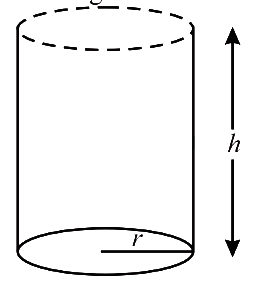
Let $r$ be the radius and $h$ be the height of the cylinder.
The volume of the cylinder is given by $V = \pi r^2 h$,which implies $h = \frac{V}{\pi r^2}$.
The surface area $S$ of the metal sheet used (including the base but no lid) is given by:
$S = 2\pi rh + \pi r^2$
Substituting $h = \frac{V}{\pi r^2}$ into the expression for $S$:
$S(r) = 2\pi r \left(\frac{V}{\pi r^2}\right) + \pi r^2 = \frac{2V}{r} + \pi r^2$
To find the minimum surface area,we differentiate $S(r)$ with respect to $r$ and set it to zero:
$S'(r) = -\frac{2V}{r^2} + 2\pi r = 0$
$2\pi r = \frac{2V}{r^2} \Rightarrow r^3 = \frac{V}{\pi} \Rightarrow r = \sqrt[3]{\frac{V}{\pi}}$
Now,substitute $r$ back into the expression for $h$:
$h = \frac{V}{\pi r^2} = \frac{V}{\pi (V/\pi)^{2/3}} = \frac{V}{\pi} \cdot \left(\frac{\pi}{V}\right)^{2/3} = \left(\frac{V}{\pi}\right)^{1/3} = \sqrt[3]{\frac{V}{\pi}}$
Thus,the radius and height for minimum surface area are $r = \sqrt[3]{\frac{V}{\pi}}$ and $h = \sqrt[3]{\frac{V}{\pi}}$.
Let $r$ be the radius and $h$ be the height of the cylinder.
The volume of the cylinder is given by $V = \pi r^2 h$,which implies $h = \frac{V}{\pi r^2}$.
The surface area $S$ of the metal sheet used (including the base but no lid) is given by:
$S = 2\pi rh + \pi r^2$
Substituting $h = \frac{V}{\pi r^2}$ into the expression for $S$:
$S(r) = 2\pi r \left(\frac{V}{\pi r^2}\right) + \pi r^2 = \frac{2V}{r} + \pi r^2$
To find the minimum surface area,we differentiate $S(r)$ with respect to $r$ and set it to zero:
$S'(r) = -\frac{2V}{r^2} + 2\pi r = 0$
$2\pi r = \frac{2V}{r^2} \Rightarrow r^3 = \frac{V}{\pi} \Rightarrow r = \sqrt[3]{\frac{V}{\pi}}$
Now,substitute $r$ back into the expression for $h$:
$h = \frac{V}{\pi r^2} = \frac{V}{\pi (V/\pi)^{2/3}} = \frac{V}{\pi} \cdot \left(\frac{\pi}{V}\right)^{2/3} = \left(\frac{V}{\pi}\right)^{1/3} = \sqrt[3]{\frac{V}{\pi}}$
Thus,the radius and height for minimum surface area are $r = \sqrt[3]{\frac{V}{\pi}}$ and $h = \sqrt[3]{\frac{V}{\pi}}$.
0 likes
View Solution663
EasyMCQ
$A$ manufacturer can sell $x$ items at a price of rupees $\left(5 - \frac{x}{100}\right)$ each. The cost price of $x$ items is Rs. $\left(\frac{x}{5} + 500\right)$. The number of items that the manufacturer should sell to earn the maximum profit is
A
$230$
B
$240$
C
$260$
D
$376$
Solution
(B) Let $R(x)$ be the revenue function and $C(x)$ be the cost function.
Revenue $R(x) = x \times \left(5 - \frac{x}{100}\right) = 5x - \frac{x^2}{100}$.
Profit function $P(x) = R(x) - C(x) = \left(5x - \frac{x^2}{100}\right) - \left(\frac{x}{5} + 500\right)$.
$P(x) = 5x - \frac{x^2}{100} - \frac{x}{5} - 500 = 4.8x - \frac{x^2}{100} - 500$.
To find the maximum profit,we find the derivative $P'(x)$ and set it to $0$.
$P'(x) = 4.8 - \frac{2x}{100} = 4.8 - \frac{x}{50}$.
Setting $P'(x) = 0$,we get $4.8 = \frac{x}{50}$,which implies $x = 4.8 \times 50 = 240$.
To verify,we check the second derivative $P''(x) = -\frac{1}{50}$.
Since $P''(x) < 0$,the profit is maximum at $x = 240$.
Revenue $R(x) = x \times \left(5 - \frac{x}{100}\right) = 5x - \frac{x^2}{100}$.
Profit function $P(x) = R(x) - C(x) = \left(5x - \frac{x^2}{100}\right) - \left(\frac{x}{5} + 500\right)$.
$P(x) = 5x - \frac{x^2}{100} - \frac{x}{5} - 500 = 4.8x - \frac{x^2}{100} - 500$.
To find the maximum profit,we find the derivative $P'(x)$ and set it to $0$.
$P'(x) = 4.8 - \frac{2x}{100} = 4.8 - \frac{x}{50}$.
Setting $P'(x) = 0$,we get $4.8 = \frac{x}{50}$,which implies $x = 4.8 \times 50 = 240$.
To verify,we check the second derivative $P''(x) = -\frac{1}{50}$.
Since $P''(x) < 0$,the profit is maximum at $x = 240$.
0 likes
View Solution664
DifficultMCQ
The function $f(x)=x^3+a x^2+b x+c$ with $a^2 \leq 3 b$ has:
A
one maximum value
B
no extreme value
C
one maximum and one minimum value
D
two maximum values
Solution
(B) Given the function $f(x)=x^3+a x^2+b x+c$.
To find the extreme values,we differentiate $f(x)$ with respect to $x$:
$f^{\prime}(x)=3 x^2+2 a x+b$.
For extreme values,we set $f^{\prime}(x)=0$:
$3 x^2+2 a x+b=0$.
The roots of this quadratic equation are given by the quadratic formula:
$x = \frac{-2 a \pm \sqrt{(2 a)^2 - 4(3)(b)}}{2(3)} = \frac{-2 a \pm \sqrt{4 a^2 - 12 b}}{6} = \frac{-2 a \pm 2 \sqrt{a^2 - 3 b}}{6} = \frac{-a \pm \sqrt{a^2 - 3 b}}{3}$.
Given the condition $a^2 \leq 3 b$,the term $a^2 - 3 b \leq 0$.
If $a^2 - 3 b < 0$,the roots are imaginary,meaning $f^{\prime}(x)$ is never zero for any real $x$.
If $a^2 = 3 b$,then $f^{\prime}(x) = 3(x + \frac{a}{3})^2$,which is always $\geq 0$,so the function is monotonically increasing and has no local extrema.
Thus,the function has no extreme value.
To find the extreme values,we differentiate $f(x)$ with respect to $x$:
$f^{\prime}(x)=3 x^2+2 a x+b$.
For extreme values,we set $f^{\prime}(x)=0$:
$3 x^2+2 a x+b=0$.
The roots of this quadratic equation are given by the quadratic formula:
$x = \frac{-2 a \pm \sqrt{(2 a)^2 - 4(3)(b)}}{2(3)} = \frac{-2 a \pm \sqrt{4 a^2 - 12 b}}{6} = \frac{-2 a \pm 2 \sqrt{a^2 - 3 b}}{6} = \frac{-a \pm \sqrt{a^2 - 3 b}}{3}$.
Given the condition $a^2 \leq 3 b$,the term $a^2 - 3 b \leq 0$.
If $a^2 - 3 b < 0$,the roots are imaginary,meaning $f^{\prime}(x)$ is never zero for any real $x$.
If $a^2 = 3 b$,then $f^{\prime}(x) = 3(x + \frac{a}{3})^2$,which is always $\geq 0$,so the function is monotonically increasing and has no local extrema.
Thus,the function has no extreme value.
0 likes
View Solution665
DifficultMCQ
The maximum value of $\frac{\log x}{x}, 0 < x < \infty$ is
A
$\infty$
B
$e$
C
$1$
D
$e^{-1}$
Solution
(D) Let $y = \frac{\log x}{x}$.
Find the derivative with respect to $x$ using the quotient rule:
$\frac{dy}{dx} = \frac{x \cdot \frac{1}{x} - \log x \cdot 1}{x^2} = \frac{1 - \log x}{x^2}$.
For critical points,set $\frac{dy}{dx} = 0$:
$1 - \log x = 0 \Rightarrow \log x = 1 \Rightarrow x = e$.
To verify the maximum,find the second derivative:
$\frac{d^2y}{dx^2} = \frac{x^2(-\frac{1}{x}) - (1 - \log x)(2x)}{x^4} = \frac{-x - 2x + 2x \log x}{x^4} = \frac{2 \log x - 3}{x^3}$.
At $x = e$,$\frac{d^2y}{dx^2} = \frac{2(1) - 3}{e^3} = -\frac{1}{e^3} < 0$,so $x = e$ is a point of local maxima.
The maximum value is $y(e) = \frac{\log e}{e} = \frac{1}{e} = e^{-1}$.
Find the derivative with respect to $x$ using the quotient rule:
$\frac{dy}{dx} = \frac{x \cdot \frac{1}{x} - \log x \cdot 1}{x^2} = \frac{1 - \log x}{x^2}$.
For critical points,set $\frac{dy}{dx} = 0$:
$1 - \log x = 0 \Rightarrow \log x = 1 \Rightarrow x = e$.
To verify the maximum,find the second derivative:
$\frac{d^2y}{dx^2} = \frac{x^2(-\frac{1}{x}) - (1 - \log x)(2x)}{x^4} = \frac{-x - 2x + 2x \log x}{x^4} = \frac{2 \log x - 3}{x^3}$.
At $x = e$,$\frac{d^2y}{dx^2} = \frac{2(1) - 3}{e^3} = -\frac{1}{e^3} < 0$,so $x = e$ is a point of local maxima.
The maximum value is $y(e) = \frac{\log e}{e} = \frac{1}{e} = e^{-1}$.
0 likes
View Solution666
DifficultMCQ
If $x$ is real,then the minimum value of $\frac{x^2-x+1}{x^2+x+1}$ is
A
$\frac{1}{3}$
B
$3$
C
$\frac{1}{2}$
D
$2$
Solution
(A) Let $f(x) = \frac{x^2-x+1}{x^2+x+1}$ ... $(i)$
On differentiating with respect to $x$,we get
$f'(x) = \frac{(x^2+x+1)(2x-1) - (x^2-x+1)(2x+1)}{(x^2+x+1)^2}$
For maximum or minimum,put $f'(x) = 0$
$(x^2+x+1)(2x-1) - (x^2-x+1)(2x+1) = 0$
$(2x^3 - x^2 + 2x^2 - x + 2x - 1) - (2x^3 + x^2 - 2x^2 - x + 2x + 1) = 0$
$(2x^3 + x^2 + x - 1) - (2x^3 - x^2 + x + 1) = 0$
$2x^2 - 2 = 0 \Rightarrow x^2 = 1 \Rightarrow x = \pm 1$
Now,$f'(x) = \frac{2x^2-2}{(x^2+x+1)^2}$
Again differentiating,we get $f''(x) = \frac{(x^2+x+1)^2(4x) - (2x^2-2) \cdot 2(x^2+x+1)(2x+1)}{(x^2+x+1)^4}$
At $x = 1$,$f''(1) = \frac{(1+1+1)^2(4) - 0}{(1+1+1)^4} = \frac{9 \times 4}{81} = \frac{36}{81} > 0$
Therefore,the function has a minimum at $x = 1$.
Putting $x = 1$ in equation $(i)$,we get
$f(1) = \frac{1^2-1+1}{1^2+1+1} = \frac{1}{3}$
$\therefore$ The minimum value is $\frac{1}{3}$.
On differentiating with respect to $x$,we get
$f'(x) = \frac{(x^2+x+1)(2x-1) - (x^2-x+1)(2x+1)}{(x^2+x+1)^2}$
For maximum or minimum,put $f'(x) = 0$
$(x^2+x+1)(2x-1) - (x^2-x+1)(2x+1) = 0$
$(2x^3 - x^2 + 2x^2 - x + 2x - 1) - (2x^3 + x^2 - 2x^2 - x + 2x + 1) = 0$
$(2x^3 + x^2 + x - 1) - (2x^3 - x^2 + x + 1) = 0$
$2x^2 - 2 = 0 \Rightarrow x^2 = 1 \Rightarrow x = \pm 1$
Now,$f'(x) = \frac{2x^2-2}{(x^2+x+1)^2}$
Again differentiating,we get $f''(x) = \frac{(x^2+x+1)^2(4x) - (2x^2-2) \cdot 2(x^2+x+1)(2x+1)}{(x^2+x+1)^4}$
At $x = 1$,$f''(1) = \frac{(1+1+1)^2(4) - 0}{(1+1+1)^4} = \frac{9 \times 4}{81} = \frac{36}{81} > 0$
Therefore,the function has a minimum at $x = 1$.
Putting $x = 1$ in equation $(i)$,we get
$f(1) = \frac{1^2-1+1}{1^2+1+1} = \frac{1}{3}$
$\therefore$ The minimum value is $\frac{1}{3}$.
0 likes
View Solution667
DifficultMCQ
$A$ stone thrown upwards has its equation of motion $s = 490t - 4.9t^2$. Then the maximum height reached by it is:
A
$24500$
B
$12500$
C
$12250$
D
$25400$
Solution
(C) Given the equation of motion: $s = 490t - 4.9t^2$.
To find the maximum height,we differentiate $s$ with respect to $t$ and set the derivative to zero:
$\frac{ds}{dt} = 490 - 9.8t$.
Setting $\frac{ds}{dt} = 0$ for maximum height:
$490 - 9.8t = 0$
$9.8t = 490$
$t = \frac{490}{9.8} = 50 \text{ seconds}$.
Now,substitute $t = 50$ into the original equation to find the maximum height $s$:
$s = 490(50) - 4.9(50)^2$
$s = 24500 - 4.9(2500)$
$s = 24500 - 12250$
$s = 12250$.
To find the maximum height,we differentiate $s$ with respect to $t$ and set the derivative to zero:
$\frac{ds}{dt} = 490 - 9.8t$.
Setting $\frac{ds}{dt} = 0$ for maximum height:
$490 - 9.8t = 0$
$9.8t = 490$
$t = \frac{490}{9.8} = 50 \text{ seconds}$.
Now,substitute $t = 50$ into the original equation to find the maximum height $s$:
$s = 490(50) - 4.9(50)^2$
$s = 24500 - 4.9(2500)$
$s = 24500 - 12250$
$s = 12250$.
0 likes
View Solution668
MediumMCQ
The function $f(x) = x e^{-x}, \forall x \in R$ attains a maximum value at $x$ equal to:
A
$1$
B
$2$
C
$\frac{1}{e}$
D
$3$
Solution
(A) Given the function $f(x) = x e^{-x}$.
To find the critical points,we calculate the first derivative $f'(x)$ using the product rule:
$f'(x) = (1)e^{-x} + x(-e^{-x}) = e^{-x}(1 - x)$.
Setting $f'(x) = 0$ for maxima or minima:
$e^{-x}(1 - x) = 0$.
Since $e^{-x} \neq 0$ for any $x \in R$,we have $1 - x = 0$,which gives $x = 1$.
Now,we find the second derivative $f''(x)$ to check for maxima:
$f''(x) = \frac{d}{dx}[e^{-x} - x e^{-x}] = -e^{-x} - [e^{-x} - x e^{-x}] = e^{-x}(x - 2)$.
Evaluating at $x = 1$:
$f''(1) = e^{-1}(1 - 2) = -e^{-1} < 0$.
Since the second derivative is negative at $x = 1$,the function attains a maximum value at $x = 1$.
To find the critical points,we calculate the first derivative $f'(x)$ using the product rule:
$f'(x) = (1)e^{-x} + x(-e^{-x}) = e^{-x}(1 - x)$.
Setting $f'(x) = 0$ for maxima or minima:
$e^{-x}(1 - x) = 0$.
Since $e^{-x} \neq 0$ for any $x \in R$,we have $1 - x = 0$,which gives $x = 1$.
Now,we find the second derivative $f''(x)$ to check for maxima:
$f''(x) = \frac{d}{dx}[e^{-x} - x e^{-x}] = -e^{-x} - [e^{-x} - x e^{-x}] = e^{-x}(x - 2)$.
Evaluating at $x = 1$:
$f''(1) = e^{-1}(1 - 2) = -e^{-1} < 0$.
Since the second derivative is negative at $x = 1$,the function attains a maximum value at $x = 1$.
0 likes
View Solution669
EasyMCQ
If $x+y=60$,$x>0$,$y>0$,then the maximum value of $x y^3$ is
A
$(15)^4 \frac{25}{3}$
B
$45(15)^3$
C
$\frac{(45)^3 9}{5}$
D
$\frac{(45)^4}{3}$
Solution
(D) Given,$x+y=60$.
Using the $AM \geq GM$ inequality for the terms $x, \frac{y}{3}, \frac{y}{3}, \frac{y}{3}$:
$\frac{x + \frac{y}{3} + \frac{y}{3} + \frac{y}{3}}{4} \geq \sqrt[4]{x \cdot \frac{y}{3} \cdot \frac{y}{3} \cdot \frac{y}{3}}$
$\frac{x+y}{4} \geq \sqrt[4]{\frac{x y^3}{27}}$
Substituting $x+y=60$:
$\frac{60}{4} \geq \sqrt[4]{\frac{x y^3}{27}}$
$15 \geq \sqrt[4]{\frac{x y^3}{27}}$
Raising both sides to the power of $4$:
$(15)^4 \geq \frac{x y^3}{27}$
$x y^3 \leq 27 \times (15)^4$
$x y^3 \leq 3^3 \times (3 \times 5)^4$
$x y^3 \leq 3^3 \times 3^4 \times 5^4$
$x y^3 \leq 3^7 \times 5^4$
Since $\frac{(45)^4}{3} = \frac{(3^2 \times 5)^4}{3} = \frac{3^8 \times 5^4}{3} = 3^7 \times 5^4$,the maximum value is $\frac{(45)^4}{3}$.
Using the $AM \geq GM$ inequality for the terms $x, \frac{y}{3}, \frac{y}{3}, \frac{y}{3}$:
$\frac{x + \frac{y}{3} + \frac{y}{3} + \frac{y}{3}}{4} \geq \sqrt[4]{x \cdot \frac{y}{3} \cdot \frac{y}{3} \cdot \frac{y}{3}}$
$\frac{x+y}{4} \geq \sqrt[4]{\frac{x y^3}{27}}$
Substituting $x+y=60$:
$\frac{60}{4} \geq \sqrt[4]{\frac{x y^3}{27}}$
$15 \geq \sqrt[4]{\frac{x y^3}{27}}$
Raising both sides to the power of $4$:
$(15)^4 \geq \frac{x y^3}{27}$
$x y^3 \leq 27 \times (15)^4$
$x y^3 \leq 3^3 \times (3 \times 5)^4$
$x y^3 \leq 3^3 \times 3^4 \times 5^4$
$x y^3 \leq 3^7 \times 5^4$
Since $\frac{(45)^4}{3} = \frac{(3^2 \times 5)^4}{3} = \frac{3^8 \times 5^4}{3} = 3^7 \times 5^4$,the maximum value is $\frac{(45)^4}{3}$.
0 likes
View Solution670
MediumMCQ
If $x$ and $y$ are two positive integers such that $x + 2y = 10$ and $x^2 y^3$ is maximum,then $x^2 + 2y^3 =$
A
$34$
B
$137$
C
$43$
D
$70$
Solution
(D) Given $x + 2y = 10$,where $x, y$ are positive integers.
Possible pairs $(x, y)$ are:
$(8, 1) \implies x^2 y^3 = 8^2 \times 1^3 = 64$
$(6, 2) \implies x^2 y^3 = 6^2 \times 2^3 = 36 \times 8 = 288$
$(4, 3) \implies x^2 y^3 = 4^2 \times 3^3 = 16 \times 27 = 432$
$(2, 4) \implies x^2 y^3 = 2^2 \times 4^3 = 4 \times 64 = 256$
The maximum value of $x^2 y^3$ is $432$,which occurs when $x = 4$ and $y = 3$.
We need to find $x^2 + 2y^3 = 4^2 + 2(3^3) = 16 + 2(27) = 16 + 54 = 70$.
Possible pairs $(x, y)$ are:
$(8, 1) \implies x^2 y^3 = 8^2 \times 1^3 = 64$
$(6, 2) \implies x^2 y^3 = 6^2 \times 2^3 = 36 \times 8 = 288$
$(4, 3) \implies x^2 y^3 = 4^2 \times 3^3 = 16 \times 27 = 432$
$(2, 4) \implies x^2 y^3 = 2^2 \times 4^3 = 4 \times 64 = 256$
The maximum value of $x^2 y^3$ is $432$,which occurs when $x = 4$ and $y = 3$.
We need to find $x^2 + 2y^3 = 4^2 + 2(3^3) = 16 + 2(27) = 16 + 54 = 70$.
0 likes
View Solution671
MediumMCQ
$y = 2x^3 - 8x^2 + 10x - 4$ is a function defined on $[1, 2]$. If the tangent drawn at a point $(a, b)$ on the graph of this function is parallel to the $X$-axis and $a \in (1, 2)$,then $a =$
A
$0$
B
$5$
C
$1$
D
$\frac{5}{3}$
Solution
(D) Given the function $y = 2x^3 - 8x^2 + 10x - 4$.
To find the slope of the tangent,we differentiate $y$ with respect to $x$:
$\frac{dy}{dx} = 6x^2 - 16x + 10$.
Since the tangent is parallel to the $X$-axis,its slope must be zero:
$\frac{dy}{dx} = 0 \implies 6x^2 - 16x + 10 = 0$.
Dividing by $2$,we get $3x^2 - 8x + 5 = 0$.
Factoring the quadratic equation:
$3x^2 - 3x - 5x + 5 = 0 \implies 3x(x - 1) - 5(x - 1) = 0$.
$(3x - 5)(x - 1) = 0$.
This gives $x = 1$ or $x = \frac{5}{3}$.
Since the point $(a, b)$ satisfies $a \in (1, 2)$,we discard $x = 1$ and accept $a = \frac{5}{3}$.
To find the slope of the tangent,we differentiate $y$ with respect to $x$:
$\frac{dy}{dx} = 6x^2 - 16x + 10$.
Since the tangent is parallel to the $X$-axis,its slope must be zero:
$\frac{dy}{dx} = 0 \implies 6x^2 - 16x + 10 = 0$.
Dividing by $2$,we get $3x^2 - 8x + 5 = 0$.
Factoring the quadratic equation:
$3x^2 - 3x - 5x + 5 = 0 \implies 3x(x - 1) - 5(x - 1) = 0$.
$(3x - 5)(x - 1) = 0$.
This gives $x = 1$ or $x = \frac{5}{3}$.
Since the point $(a, b)$ satisfies $a \in (1, 2)$,we discard $x = 1$ and accept $a = \frac{5}{3}$.
0 likes
View Solution672
MediumMCQ
$A$ right circular cone is inscribed in a sphere of radius $3$ units. If the volume of the cone is maximum,then the semi-vertical angle of the cone is
A
$\frac{\pi}{4}$
B
$\frac{\pi}{6}$
C
$\tan ^{-1}(\sqrt{2})$
D
$\tan ^{-1}\left(\frac{1}{\sqrt{2}}\right)$
Solution
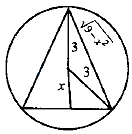
(D) Let $R = 3$ be the radius of the sphere. Let $h$ be the height of the cone and $r$ be the radius of the base of the cone.
Let $x$ be the distance from the center of the sphere to the base of the cone. Then $h = R + x = 3 + x$.
In the right triangle formed by the radius of the sphere,the radius of the cone base,and the distance $x$,we have $r^2 + x^2 = R^2 = 3^2 = 9$,so $r^2 = 9 - x^2$.
The volume of the cone is $V = \frac{1}{3} \pi r^2 h = \frac{1}{3} \pi (9 - x^2)(3 + x)$.
$V = \frac{\pi}{3} (27 + 9x - 3x^2 - x^3)$.
To maximize $V$,we find $\frac{dV}{dx} = \frac{\pi}{3} (9 - 6x - 3x^2) = 0$.
$x^2 + 2x - 3 = 0 \Rightarrow (x + 3)(x - 1) = 0$.
Since $x$ is a distance,$x = 1$ (as $x \neq -3$).
For $x = 1$,$r^2 = 9 - 1^2 = 8$,so $r = \sqrt{8} = 2\sqrt{2}$.
The height $h = 3 + 1 = 4$.
The semi-vertical angle $\theta$ satisfies $\tan \theta = \frac{r}{h} = \frac{2\sqrt{2}}{4} = \frac{1}{\sqrt{2}}$.
Thus,$\theta = \tan ^{-1}\left(\frac{1}{\sqrt{2}}\right)$.
Let $x$ be the distance from the center of the sphere to the base of the cone. Then $h = R + x = 3 + x$.
In the right triangle formed by the radius of the sphere,the radius of the cone base,and the distance $x$,we have $r^2 + x^2 = R^2 = 3^2 = 9$,so $r^2 = 9 - x^2$.
The volume of the cone is $V = \frac{1}{3} \pi r^2 h = \frac{1}{3} \pi (9 - x^2)(3 + x)$.
$V = \frac{\pi}{3} (27 + 9x - 3x^2 - x^3)$.
To maximize $V$,we find $\frac{dV}{dx} = \frac{\pi}{3} (9 - 6x - 3x^2) = 0$.
$x^2 + 2x - 3 = 0 \Rightarrow (x + 3)(x - 1) = 0$.
Since $x$ is a distance,$x = 1$ (as $x \neq -3$).
For $x = 1$,$r^2 = 9 - 1^2 = 8$,so $r = \sqrt{8} = 2\sqrt{2}$.
The height $h = 3 + 1 = 4$.
The semi-vertical angle $\theta$ satisfies $\tan \theta = \frac{r}{h} = \frac{2\sqrt{2}}{4} = \frac{1}{\sqrt{2}}$.
Thus,$\theta = \tan ^{-1}\left(\frac{1}{\sqrt{2}}\right)$.
0 likes
View Solution673
DifficultMCQ
In $\triangle ABC$,$\angle B=90^{\circ}$ and $(b+a)$ is always a constant. In order that $\triangle ABC$ encloses the maximum area,$\angle C=$
A
$\frac{\pi}{4}$
B
$\frac{\pi}{6}$
C
$\frac{\pi}{3}$
D
$\frac{2\pi}{3}$
Solution
(C) Establish Relationships:
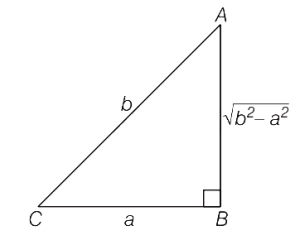
In $\triangle ABC$,we are given $\angle B=90^{\circ}$,making it a right-angled triangle where $b$ is the hypotenuse and $a, c$ are the legs. From the Pythagorean theorem,$c=\sqrt{b^2-a^2}$. We are given that $a+b=k$ (a constant),so $b=k-a$. The area $A$ is:
$A=\frac{1}{2}ac=\frac{1}{2}a\sqrt{b^2-a^2}$
Express Area in Terms of a Single Variable:
Substitute $b=k-a$ into the area equation:
$A=\frac{1}{2}a\sqrt{(k-a)^2-a^2}=\frac{1}{2}a\sqrt{k^2-2ka+a^2-a^2}=\frac{1}{2}a\sqrt{k^2-2ka}$
To maximize $A$,we maximize $f(a)=4A^2=a^2(k^2-2ka)=k^2a^2-2ka^3$.
Differentiate and Solve for Extremum:
Find the derivative of $f(a)$ with respect to $a$ and set it to zero:
$f'(a)=2k^2a-6ka^2=0 \Longrightarrow 2ka(k-3a)=0$
Since $a, k \neq 0$,we have $a=\frac{k}{3}$.
Then $b=k-\frac{k}{3}=\frac{2k}{3}$.
Determine Angle $C$:
In the right triangle,$\cos C=\frac{a}{b}$.
$\cos C=\frac{a}{b}=\frac{k/3}{2k/3}=\frac{1}{2}$
Since $\cos C=\frac{1}{2}$,then $C=\frac{\pi}{3}$.
In $\triangle ABC$,we are given $\angle B=90^{\circ}$,making it a right-angled triangle where $b$ is the hypotenuse and $a, c$ are the legs. From the Pythagorean theorem,$c=\sqrt{b^2-a^2}$. We are given that $a+b=k$ (a constant),so $b=k-a$. The area $A$ is:
$A=\frac{1}{2}ac=\frac{1}{2}a\sqrt{b^2-a^2}$
Express Area in Terms of a Single Variable:
Substitute $b=k-a$ into the area equation:
$A=\frac{1}{2}a\sqrt{(k-a)^2-a^2}=\frac{1}{2}a\sqrt{k^2-2ka+a^2-a^2}=\frac{1}{2}a\sqrt{k^2-2ka}$
To maximize $A$,we maximize $f(a)=4A^2=a^2(k^2-2ka)=k^2a^2-2ka^3$.
Differentiate and Solve for Extremum:
Find the derivative of $f(a)$ with respect to $a$ and set it to zero:
$f'(a)=2k^2a-6ka^2=0 \Longrightarrow 2ka(k-3a)=0$
Since $a, k \neq 0$,we have $a=\frac{k}{3}$.
Then $b=k-\frac{k}{3}=\frac{2k}{3}$.
Determine Angle $C$:
In the right triangle,$\cos C=\frac{a}{b}$.
$\cos C=\frac{a}{b}=\frac{k/3}{2k/3}=\frac{1}{2}$
Since $\cos C=\frac{1}{2}$,then $C=\frac{\pi}{3}$.
0 likes
View Solution674
MediumMCQ
The condition for the function $f(x) = x^3 + px^2 + qx + r$ $(x \in R)$ to have no extreme value is:
A
$p^2 < 3q$
B
$2p^2 < q$
C
$p^2 < \frac{1}{4}q$
D
$p^2 > 3q$
Solution
(A) For a function $f(x)$ to have no extreme value,its derivative $f'(x)$ must not change sign. This means $f'(x)$ must be either always non-negative or always non-positive.
Given $f(x) = x^3 + px^2 + qx + r$.
The derivative is $f'(x) = 3x^2 + 2px + q$.
For $f'(x)$ to have no sign change,the quadratic equation $3x^2 + 2px + q = 0$ must have no real roots or a repeated root.
This implies the discriminant $D \le 0$.
The discriminant $D = (2p)^2 - 4(3)(q) = 4p^2 - 12q$.
Setting $D \le 0$,we get $4p^2 - 12q \le 0$.
Dividing by $4$,we get $p^2 - 3q \le 0$,or $p^2 \le 3q$.
Given the options,the condition $p^2 < 3q$ is the correct choice.
Given $f(x) = x^3 + px^2 + qx + r$.
The derivative is $f'(x) = 3x^2 + 2px + q$.
For $f'(x)$ to have no sign change,the quadratic equation $3x^2 + 2px + q = 0$ must have no real roots or a repeated root.
This implies the discriminant $D \le 0$.
The discriminant $D = (2p)^2 - 4(3)(q) = 4p^2 - 12q$.
Setting $D \le 0$,we get $4p^2 - 12q \le 0$.
Dividing by $4$,we get $p^2 - 3q \le 0$,or $p^2 \le 3q$.
Given the options,the condition $p^2 < 3q$ is the correct choice.
0 likes
View Solution675
MediumMCQ
The local maximum value $l$ and local minimum value $m$ of $f(x) = \frac{x^2+2x+2}{x+1}$ in $R - \{-1\}$ exist at $\alpha, \beta$ respectively,then $\frac{l+m}{\alpha+\beta} =$
A
$0$
B
$-4$
C
$-2$
D
$2$
Solution
(A) Given $f(x) = \frac{x^2+2x+2}{x+1} = \frac{(x+1)^2+1}{x+1} = (x+1) + \frac{1}{x+1}$.
Let $u = x+1$. Then $f(u) = u + \frac{1}{u}$.
To find local extrema,we find the derivative: $f'(u) = 1 - \frac{1}{u^2}$.
Setting $f'(u) = 0$,we get $u^2 = 1$,so $u = 1$ or $u = -1$.
For $u = 1$,$x+1 = 1 \implies x = 0$. $f(0) = 0 + \frac{1}{1} = 2$. This is the local minimum value $m = 2$ at $\beta = 0$.
For $u = -1$,$x+1 = -1 \implies x = -2$. $f(-2) = -2 + \frac{1}{-1} = -2 - 1 = -3$. This is the local maximum value $l = -3$ at $\alpha = -2$.
Thus,$l = -3, m = 2, \alpha = -2, \beta = 0$.
The value of $\frac{l+m}{\alpha+\beta} = \frac{-3+2}{-2+0} = \frac{-1}{-2} = \frac{1}{2}$.
Wait,checking the options,let us re-evaluate. If $f(x) = x+1 + \frac{1}{x+1}$,for $x > -1$,$u > 0$,$f(u) \ge 2$ ($AM$-$GM$). For $x < -1$,$u < 0$,$f(u) \le -2$. The local maximum is $-2$ at $x = -2$ and local minimum is $2$ at $x = 0$. The expression $\frac{l+m}{\alpha+\beta} = \frac{-2+2}{-2+0} = 0$.
Let $u = x+1$. Then $f(u) = u + \frac{1}{u}$.
To find local extrema,we find the derivative: $f'(u) = 1 - \frac{1}{u^2}$.
Setting $f'(u) = 0$,we get $u^2 = 1$,so $u = 1$ or $u = -1$.
For $u = 1$,$x+1 = 1 \implies x = 0$. $f(0) = 0 + \frac{1}{1} = 2$. This is the local minimum value $m = 2$ at $\beta = 0$.
For $u = -1$,$x+1 = -1 \implies x = -2$. $f(-2) = -2 + \frac{1}{-1} = -2 - 1 = -3$. This is the local maximum value $l = -3$ at $\alpha = -2$.
Thus,$l = -3, m = 2, \alpha = -2, \beta = 0$.
The value of $\frac{l+m}{\alpha+\beta} = \frac{-3+2}{-2+0} = \frac{-1}{-2} = \frac{1}{2}$.
Wait,checking the options,let us re-evaluate. If $f(x) = x+1 + \frac{1}{x+1}$,for $x > -1$,$u > 0$,$f(u) \ge 2$ ($AM$-$GM$). For $x < -1$,$u < 0$,$f(u) \le -2$. The local maximum is $-2$ at $x = -2$ and local minimum is $2$ at $x = 0$. The expression $\frac{l+m}{\alpha+\beta} = \frac{-2+2}{-2+0} = 0$.
0 likes
View Solution676
MediumMCQ
If $x$ and $y$ are two positive real numbers such that $xy = 4$,then the minimum value of $\left(\sqrt{x} + \frac{y^2}{2}\right)$ is
A
$4$
B
$\frac{5}{2}$
C
$2\sqrt{2}$
D
$\sqrt{2}$
Solution
(B) Given $xy = 4$,we can express $x$ as $x = \frac{4}{y}$.
Let $f(y) = \sqrt{x} + \frac{y^2}{2} = \sqrt{\frac{4}{y}} + \frac{y^2}{2} = 2y^{-1/2} + \frac{y^2}{2}$.
To find the minimum,we differentiate $f(y)$ with respect to $y$:
$f'(y) = 2(-\frac{1}{2})y^{-3/2} + \frac{1}{2}(2y) = -y^{-3/2} + y$.
Setting $f'(y) = 0$ gives $y = y^{-3/2}$,which implies $y^{5/2} = 1$,so $y = 1$.
For $y = 1$,$x = \frac{4}{1} = 4$.
The value of the expression at $y = 1$ is $f(1) = \sqrt{4} + \frac{1^2}{2} = 2 + 0.5 = 2.5 = \frac{5}{2}$.
Since $f''(y) = \frac{3}{2}y^{-5/2} + 1 > 0$ for $y > 0$,the function has a local minimum at $y = 1$.
Let $f(y) = \sqrt{x} + \frac{y^2}{2} = \sqrt{\frac{4}{y}} + \frac{y^2}{2} = 2y^{-1/2} + \frac{y^2}{2}$.
To find the minimum,we differentiate $f(y)$ with respect to $y$:
$f'(y) = 2(-\frac{1}{2})y^{-3/2} + \frac{1}{2}(2y) = -y^{-3/2} + y$.
Setting $f'(y) = 0$ gives $y = y^{-3/2}$,which implies $y^{5/2} = 1$,so $y = 1$.
For $y = 1$,$x = \frac{4}{1} = 4$.
The value of the expression at $y = 1$ is $f(1) = \sqrt{4} + \frac{1^2}{2} = 2 + 0.5 = 2.5 = \frac{5}{2}$.
Since $f''(y) = \frac{3}{2}y^{-5/2} + 1 > 0$ for $y > 0$,the function has a local minimum at $y = 1$.
0 likes
View Solution677
MediumMCQ
If local maximum of $f(x) = \frac{ax + b}{(x - 1)(x - 4)}$ exists at $(2, -1)$,then $a + b =$
A
$0$
B
-$1$
C
$1$
D
$2$
Solution
(C) Given $f(x) = \frac{ax + b}{x^2 - 5x + 4}$. Since the local maximum exists at $(2, -1)$,we have $f(2) = -1$.
Substituting $x = 2$ into the function: $f(2) = \frac{2a + b}{(2 - 1)(2 - 4)} = \frac{2a + b}{(1)(-2)} = \frac{2a + b}{-2} = -1$.
This implies $2a + b = 2$.
Also,for a local maximum at $x = 2$,the derivative $f'(2) = 0$.
Using the quotient rule $f'(x) = \frac{a(x^2 - 5x + 4) - (ax + b)(2x - 5)}{(x^2 - 5x + 4)^2}$.
Setting $f'(2) = 0$: $a(4 - 10 + 4) - (2a + b)(4 - 5) = 0$.
$a(-2) - (2a + b)(-1) = 0 \implies -2a + 2a + b = 0 \implies b = 0$.
Substituting $b = 0$ into $2a + b = 2$,we get $2a = 2$,so $a = 1$.
Thus,$a + b = 1 + 0 = 1$.
Substituting $x = 2$ into the function: $f(2) = \frac{2a + b}{(2 - 1)(2 - 4)} = \frac{2a + b}{(1)(-2)} = \frac{2a + b}{-2} = -1$.
This implies $2a + b = 2$.
Also,for a local maximum at $x = 2$,the derivative $f'(2) = 0$.
Using the quotient rule $f'(x) = \frac{a(x^2 - 5x + 4) - (ax + b)(2x - 5)}{(x^2 - 5x + 4)^2}$.
Setting $f'(2) = 0$: $a(4 - 10 + 4) - (2a + b)(4 - 5) = 0$.
$a(-2) - (2a + b)(-1) = 0 \implies -2a + 2a + b = 0 \implies b = 0$.
Substituting $b = 0$ into $2a + b = 2$,we get $2a = 2$,so $a = 1$.
Thus,$a + b = 1 + 0 = 1$.
0 likes
View Solution678
MediumMCQ
The function $f(x) = 2x^3 - 9ax^2 + 12a^2x + 1$ where $a > 0$ attains its local maximum and local minimum at $p$ and $q$ respectively. If $p^2 = q$,then $a =$
A
$1$
B
$2$
C
$3$
D
$\frac{1}{2}$
Solution
(B) Given the function $f(x) = 2x^3 - 9ax^2 + 12a^2x + 1$.
First,find the derivative $f'(x) = 6x^2 - 18ax + 12a^2$.
Set $f'(x) = 0$ to find critical points: $6(x^2 - 3ax + 2a^2) = 0$.
Factoring the quadratic gives $6(x - a)(x - 2a) = 0$,so the critical points are $x = a$ and $x = 2a$.
Find the second derivative $f''(x) = 12x - 18a$.
At $x = a$,$f''(a) = 12a - 18a = -6a < 0$ (since $a > 0$),so $x = a$ is a local maximum. Thus,$p = a$.
At $x = 2a$,$f''(2a) = 12(2a) - 18a = 6a > 0$ (since $a > 0$),so $x = 2a$ is a local minimum. Thus,$q = 2a$.
Given the condition $p^2 = q$,we substitute the values: $a^2 = 2a$.
Since $a > 0$,we can divide by $a$ to get $a = 2$.
First,find the derivative $f'(x) = 6x^2 - 18ax + 12a^2$.
Set $f'(x) = 0$ to find critical points: $6(x^2 - 3ax + 2a^2) = 0$.
Factoring the quadratic gives $6(x - a)(x - 2a) = 0$,so the critical points are $x = a$ and $x = 2a$.
Find the second derivative $f''(x) = 12x - 18a$.
At $x = a$,$f''(a) = 12a - 18a = -6a < 0$ (since $a > 0$),so $x = a$ is a local maximum. Thus,$p = a$.
At $x = 2a$,$f''(2a) = 12(2a) - 18a = 6a > 0$ (since $a > 0$),so $x = 2a$ is a local minimum. Thus,$q = 2a$.
Given the condition $p^2 = q$,we substitute the values: $a^2 = 2a$.
Since $a > 0$,we can divide by $a$ to get $a = 2$.
0 likes
View Solution679
DifficultMCQ
If $4+3x-7x^2$ attains its maximum value $M$ at $x=\alpha$ and $5x^2-2x+1$ attains its minimum value $m$ at $x=\beta$,then $\frac{28(M-\alpha)}{5(m+\beta)}=$
A
$28$
B
$23$
C
$5$
D
$1$
Solution
(B) Let $f(x) = 4+3x-7x^2$.
Taking the derivative,$f'(x) = 3-14x$. Setting $f'(x) = 0$,we get $x = \frac{3}{14} = \alpha$.
Since $f''(x) = -14 < 0$,$f(x)$ attains its maximum at $x = \alpha = \frac{3}{14}$.
The maximum value $M = f(\frac{3}{14}) = 4 + 3(\frac{3}{14}) - 7(\frac{3}{14})^2 = 4 + \frac{9}{14} - \frac{63}{196} = 4 + \frac{126-63}{196} = 4 + \frac{63}{196} = 4 + \frac{9}{28} = \frac{112+9}{28} = \frac{121}{28}$.
Now,let $g(x) = 5x^2-2x+1$.
Taking the derivative,$g'(x) = 10x-2$. Setting $g'(x) = 0$,we get $x = \frac{1}{5} = \beta$.
Since $g''(x) = 10 > 0$,$g(x)$ attains its minimum at $x = \beta = \frac{1}{5}$.
The minimum value $m = g(\frac{1}{5}) = 5(\frac{1}{5})^2 - 2(\frac{1}{5}) + 1 = \frac{1}{5} - \frac{2}{5} + 1 = \frac{4}{5}$.
Finally,calculate $\frac{28(M-\alpha)}{5(m+\beta)} = \frac{28(\frac{121}{28} - \frac{3}{14})}{5(\frac{4}{5} + \frac{1}{5})} = \frac{28(\frac{121-6}{28})}{5(1)} = \frac{115}{5} = 23$.
Taking the derivative,$f'(x) = 3-14x$. Setting $f'(x) = 0$,we get $x = \frac{3}{14} = \alpha$.
Since $f''(x) = -14 < 0$,$f(x)$ attains its maximum at $x = \alpha = \frac{3}{14}$.
The maximum value $M = f(\frac{3}{14}) = 4 + 3(\frac{3}{14}) - 7(\frac{3}{14})^2 = 4 + \frac{9}{14} - \frac{63}{196} = 4 + \frac{126-63}{196} = 4 + \frac{63}{196} = 4 + \frac{9}{28} = \frac{112+9}{28} = \frac{121}{28}$.
Now,let $g(x) = 5x^2-2x+1$.
Taking the derivative,$g'(x) = 10x-2$. Setting $g'(x) = 0$,we get $x = \frac{1}{5} = \beta$.
Since $g''(x) = 10 > 0$,$g(x)$ attains its minimum at $x = \beta = \frac{1}{5}$.
The minimum value $m = g(\frac{1}{5}) = 5(\frac{1}{5})^2 - 2(\frac{1}{5}) + 1 = \frac{1}{5} - \frac{2}{5} + 1 = \frac{4}{5}$.
Finally,calculate $\frac{28(M-\alpha)}{5(m+\beta)} = \frac{28(\frac{121}{28} - \frac{3}{14})}{5(\frac{4}{5} + \frac{1}{5})} = \frac{28(\frac{121-6}{28})}{5(1)} = \frac{115}{5} = 23$.
0 likes
View Solution680
EasyMCQ
If $x$ and $y$ are two positive integers such that $x+y=24$ and $x^3 y^5$ is maximum,then $x^2+y^2=$
A
$288$
B
$296$
C
$306$
D
$320$
Solution
(C) Given $x+y=24$,so $y=24-x$.
Let $P = x^3 y^5 = x^3(24-x)^5$.
To find the maximum,we differentiate $P$ with respect to $x$:
$\frac{dP}{dx} = 3x^2(24-x)^5 + x^3 \cdot 5(24-x)^4(-1) = 0$.
$x^2(24-x)^4 [3(24-x) - 5x] = 0$.
$x^2(24-x)^4 [72 - 3x - 5x] = 0$.
$x^2(24-x)^4 (72 - 8x) = 0$.
Since $x$ and $y$ are positive integers,$x \neq 0$ and $x \neq 24$.
Thus,$72 - 8x = 0 \Rightarrow x = 9$.
Then $y = 24 - 9 = 15$.
Finally,$x^2 + y^2 = 9^2 + 15^2 = 81 + 225 = 306$.
Let $P = x^3 y^5 = x^3(24-x)^5$.
To find the maximum,we differentiate $P$ with respect to $x$:
$\frac{dP}{dx} = 3x^2(24-x)^5 + x^3 \cdot 5(24-x)^4(-1) = 0$.
$x^2(24-x)^4 [3(24-x) - 5x] = 0$.
$x^2(24-x)^4 [72 - 3x - 5x] = 0$.
$x^2(24-x)^4 (72 - 8x) = 0$.
Since $x$ and $y$ are positive integers,$x \neq 0$ and $x \neq 24$.
Thus,$72 - 8x = 0 \Rightarrow x = 9$.
Then $y = 24 - 9 = 15$.
Finally,$x^2 + y^2 = 9^2 + 15^2 = 81 + 225 = 306$.
0 likes
View Solution681
EasyMCQ
The sum of the maximum and minimum values of the function $f(x)=\frac{x^2-x+1}{x^2+x+1}$ is
A
$\frac{17}{4}$
B
$\frac{5}{2}$
C
$\frac{10}{3}$
D
$0$
Solution
(C) Let $y = \frac{x^2-x+1}{x^2+x+1}$.
Then $y(x^2+x+1) = x^2-x+1$,which implies $(y-1)x^2 + (y+1)x + (y-1) = 0$.
For $x$ to be real,the discriminant $D \ge 0$.
$D = (y+1)^2 - 4(y-1)^2 \ge 0$.
$(y+1-2(y-1))(y+1+2(y-1)) \ge 0$.
$(-y+3)(3y-1) \ge 0$.
$(y-3)(3y-1) \le 0$.
Thus,$\frac{1}{3} \le y \le 3$.
The maximum value is $3$ and the minimum value is $\frac{1}{3}$.
The sum of the maximum and minimum values is $3 + \frac{1}{3} = \frac{10}{3}$.
Then $y(x^2+x+1) = x^2-x+1$,which implies $(y-1)x^2 + (y+1)x + (y-1) = 0$.
For $x$ to be real,the discriminant $D \ge 0$.
$D = (y+1)^2 - 4(y-1)^2 \ge 0$.
$(y+1-2(y-1))(y+1+2(y-1)) \ge 0$.
$(-y+3)(3y-1) \ge 0$.
$(y-3)(3y-1) \le 0$.
Thus,$\frac{1}{3} \le y \le 3$.
The maximum value is $3$ and the minimum value is $\frac{1}{3}$.
The sum of the maximum and minimum values is $3 + \frac{1}{3} = \frac{10}{3}$.
0 likes
View Solution682
MediumMCQ
If $m$ and $M$ are respectively the absolute minimum and absolute maximum values of a function $f(x)=2x^3+9x^2+12x+1$ defined on $[-3,0]$,then $m+M=$
A
$-7$
B
$0$
C
$1$
D
$5$
Solution
(A) Given the function $f(x)=2x^3+9x^2+12x+1$ on the interval $[-3,0]$.
First,find the derivative $f'(x)$:
$f'(x)=6x^2+18x+12=6(x^2+3x+2)=6(x+1)(x+2)$.
Setting $f'(x)=0$,we get critical points $x=-1$ and $x=-2$.
Now,evaluate $f(x)$ at the critical points and the endpoints of the interval $[-3,0]$:
$f(-3)=2(-27)+9(9)+12(-3)+1 = -54+81-36+1 = -8$.
$f(-2)=2(-8)+9(4)+12(-2)+1 = -16+36-24+1 = -3$.
$f(-1)=2(-1)+9(1)+12(-1)+1 = -2+9-12+1 = -4$.
$f(0)=2(0)+9(0)+12(0)+1 = 1$.
Comparing these values,the absolute minimum $m = -8$ and the absolute maximum $M = 1$.
Therefore,$m+M = -8+1 = -7$.
First,find the derivative $f'(x)$:
$f'(x)=6x^2+18x+12=6(x^2+3x+2)=6(x+1)(x+2)$.
Setting $f'(x)=0$,we get critical points $x=-1$ and $x=-2$.
Now,evaluate $f(x)$ at the critical points and the endpoints of the interval $[-3,0]$:
$f(-3)=2(-27)+9(9)+12(-3)+1 = -54+81-36+1 = -8$.
$f(-2)=2(-8)+9(4)+12(-2)+1 = -16+36-24+1 = -3$.
$f(-1)=2(-1)+9(1)+12(-1)+1 = -2+9-12+1 = -4$.
$f(0)=2(0)+9(0)+12(0)+1 = 1$.
Comparing these values,the absolute minimum $m = -8$ and the absolute maximum $M = 1$.
Therefore,$m+M = -8+1 = -7$.
0 likes
View Solution683
MediumMCQ
If the function $f(x) = \frac{x}{5} + \frac{5}{x}, (x \neq 0)$ attains its relative maximum value at $x = a$,then $\sqrt{a^2 + 2a - 6} = $
A
$10$
B
$6$
C
$5$
D
$3$
Solution
(D) Given the function $f(x) = \frac{x}{5} + \frac{5}{x}$.
First,find the derivative $f'(x) = \frac{1}{5} - \frac{5}{x^2}$.
Set $f'(x) = 0$ to find critical points: $\frac{1}{5} = \frac{5}{x^2} \Rightarrow x^2 = 25 \Rightarrow x = \pm 5$.
Find the second derivative $f''(x) = \frac{10}{x^3}$.
For $x = 5$,$f''(5) = \frac{10}{125} > 0$,so $x = 5$ is a local minimum.
For $x = -5$,$f''(-5) = \frac{10}{-125} < 0$,so $x = -5$ is a local maximum.
Thus,$a = -5$.
Now,calculate $\sqrt{a^2 + 2a - 6} = \sqrt{(-5)^2 + 2(-5) - 6} = \sqrt{25 - 10 - 6} = \sqrt{9} = 3$.
First,find the derivative $f'(x) = \frac{1}{5} - \frac{5}{x^2}$.
Set $f'(x) = 0$ to find critical points: $\frac{1}{5} = \frac{5}{x^2} \Rightarrow x^2 = 25 \Rightarrow x = \pm 5$.
Find the second derivative $f''(x) = \frac{10}{x^3}$.
For $x = 5$,$f''(5) = \frac{10}{125} > 0$,so $x = 5$ is a local minimum.
For $x = -5$,$f''(-5) = \frac{10}{-125} < 0$,so $x = -5$ is a local maximum.
Thus,$a = -5$.
Now,calculate $\sqrt{a^2 + 2a - 6} = \sqrt{(-5)^2 + 2(-5) - 6} = \sqrt{25 - 10 - 6} = \sqrt{9} = 3$.
0 likes
View Solution684
EasyMCQ
$x$ and $y$ are two positive integers such that $2x + 3y = 50$. If $x^2 y^3$ is maximum for $x = \alpha$ and $y = \beta$,then $\frac{\alpha}{2} + \frac{\beta}{5} =$
A
$10$
B
$\frac{10}{3}$
C
$5$
D
$7$
Solution
(D) Given $2x + 3y = 50$. We want to maximize $P = x^2 y^3$.
From the constraint,$y = \frac{50 - 2x}{3}$.
Substituting $y$ in $P$,we get $P = x^2 \left(\frac{50 - 2x}{3}\right)^3 = \frac{1}{27} x^2 (50 - 2x)^3$.
To find the maximum,we differentiate $P$ with respect to $x$:
$\frac{dP}{dx} = \frac{1}{27} [x^2 \cdot 3(50 - 2x)^2(-2) + 2x(50 - 2x)^3] = 0$.
$\Rightarrow 2x(50 - 2x)^2 [-3x + 50 - 2x] = 0$.
$\Rightarrow 2x(50 - 2x)^2 (50 - 5x) = 0$.
Since $x, y$ are positive integers,$x \neq 0$ and $x \neq 25$. Thus,$50 - 5x = 0 \Rightarrow x = 10$.
For $x = 10$,$y = \frac{50 - 2(10)}{3} = \frac{30}{3} = 10$.
Thus,$\alpha = 10$ and $\beta = 10$.
Finally,$\frac{\alpha}{2} + \frac{\beta}{5} = \frac{10}{2} + \frac{10}{5} = 5 + 2 = 7$.
From the constraint,$y = \frac{50 - 2x}{3}$.
Substituting $y$ in $P$,we get $P = x^2 \left(\frac{50 - 2x}{3}\right)^3 = \frac{1}{27} x^2 (50 - 2x)^3$.
To find the maximum,we differentiate $P$ with respect to $x$:
$\frac{dP}{dx} = \frac{1}{27} [x^2 \cdot 3(50 - 2x)^2(-2) + 2x(50 - 2x)^3] = 0$.
$\Rightarrow 2x(50 - 2x)^2 [-3x + 50 - 2x] = 0$.
$\Rightarrow 2x(50 - 2x)^2 (50 - 5x) = 0$.
Since $x, y$ are positive integers,$x \neq 0$ and $x \neq 25$. Thus,$50 - 5x = 0 \Rightarrow x = 10$.
For $x = 10$,$y = \frac{50 - 2(10)}{3} = \frac{30}{3} = 10$.
Thus,$\alpha = 10$ and $\beta = 10$.
Finally,$\frac{\alpha}{2} + \frac{\beta}{5} = \frac{10}{2} + \frac{10}{5} = 5 + 2 = 7$.
0 likes
View Solution685
EasyMCQ
If the absolute maximum and absolute minimum values of the function $f(x) = x^3 - 2x^2 + x - 3$ defined on $[0, 2]$ are $M$ and $m$ respectively,then $M + m =$
A
-$4$
B
$\frac{-104}{27}$
C
$2$
D
-$2$
Solution
(A) Given function: $f(x) = x^3 - 2x^2 + x - 3$ on the interval $[0, 2]$.
First,find the derivative: $f'(x) = 3x^2 - 4x + 1$.
Set $f'(x) = 0$ to find critical points:
$3x^2 - 3x - x + 1 = 0$
$3x(x - 1) - 1(x - 1) = 0$
$(3x - 1)(x - 1) = 0$
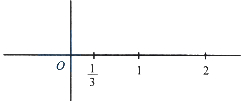
So,$x = \frac{1}{3}$ and $x = 1$.
Both critical points lie within the interval $[0, 2]$.
Now,evaluate the function at the critical points and the endpoints:
$f(0) = 0^3 - 2(0)^2 + 0 - 3 = -3$
$f\left(\frac{1}{3}\right) = \left(\frac{1}{3}\right)^3 - 2\left(\frac{1}{3}\right)^2 + \frac{1}{3} - 3 = \frac{1}{27} - \frac{2}{9} + \frac{1}{3} - 3 = \frac{1 - 6 + 9 - 81}{27} = \frac{-77}{27}$
$f(1) = 1^3 - 2(1)^2 + 1 - 3 = 1 - 2 + 1 - 3 = -3$
$f(2) = 2^3 - 2(2)^2 + 2 - 3 = 8 - 8 + 2 - 3 = -1$
Comparing these values: $\{-3, \frac{-77}{27}, -3, -1\}$.
The absolute maximum value $M = -1$.
The absolute minimum value $m = -3$.
Therefore,$M + m = -1 + (-3) = -4$.
First,find the derivative: $f'(x) = 3x^2 - 4x + 1$.
Set $f'(x) = 0$ to find critical points:
$3x^2 - 3x - x + 1 = 0$
$3x(x - 1) - 1(x - 1) = 0$
$(3x - 1)(x - 1) = 0$
So,$x = \frac{1}{3}$ and $x = 1$.
Both critical points lie within the interval $[0, 2]$.
Now,evaluate the function at the critical points and the endpoints:
$f(0) = 0^3 - 2(0)^2 + 0 - 3 = -3$
$f\left(\frac{1}{3}\right) = \left(\frac{1}{3}\right)^3 - 2\left(\frac{1}{3}\right)^2 + \frac{1}{3} - 3 = \frac{1}{27} - \frac{2}{9} + \frac{1}{3} - 3 = \frac{1 - 6 + 9 - 81}{27} = \frac{-77}{27}$
$f(1) = 1^3 - 2(1)^2 + 1 - 3 = 1 - 2 + 1 - 3 = -3$
$f(2) = 2^3 - 2(2)^2 + 2 - 3 = 8 - 8 + 2 - 3 = -1$
Comparing these values: $\{-3, \frac{-77}{27}, -3, -1\}$.
The absolute maximum value $M = -1$.
The absolute minimum value $m = -3$.
Therefore,$M + m = -1 + (-3) = -4$.
0 likes
View Solution686
EasyMCQ
If the function $f(x)=xe^{-x}, x \in R$ attains its maximum value $\beta$ at $x=\alpha$,then $(\alpha, \beta)=$
A
$\left(2, \frac{1}{e}\right)$
B
$\left(1, \frac{1}{e}\right)$
C
$\left(1, \frac{-1}{e}\right)$
D
$\left(\frac{1}{e}, 1\right)$
Solution
(B) Given function: $f(x) = x e^{-x}$.
To find the maximum value,we first find the derivative $f'(x)$:
$f'(x) = 1 \cdot e^{-x} + x \cdot (-e^{-x}) = e^{-x}(1-x)$.
Setting $f'(x) = 0$ gives $e^{-x}(1-x) = 0$. Since $e^{-x} \neq 0$ for all $x \in R$,we have $1-x = 0$,which implies $x = 1$.
Now,we find the second derivative $f''(x)$ to check for maxima:
$f''(x) = \frac{d}{dx}[e^{-x} - x e^{-x}] = -e^{-x} - (e^{-x} - x e^{-x}) = e^{-x}(x-2)$.
At $x = 1$,$f''(1) = e^{-1}(1-2) = -e^{-1} = -\frac{1}{e} < 0$.
Since $f''(1) < 0$,the function attains a local maximum at $x = 1$.
Thus,$\alpha = 1$.
The maximum value $\beta = f(1) = 1 \cdot e^{-1} = \frac{1}{e}$.
Therefore,$(\alpha, \beta) = \left(1, \frac{1}{e}\right)$.
To find the maximum value,we first find the derivative $f'(x)$:
$f'(x) = 1 \cdot e^{-x} + x \cdot (-e^{-x}) = e^{-x}(1-x)$.
Setting $f'(x) = 0$ gives $e^{-x}(1-x) = 0$. Since $e^{-x} \neq 0$ for all $x \in R$,we have $1-x = 0$,which implies $x = 1$.
Now,we find the second derivative $f''(x)$ to check for maxima:
$f''(x) = \frac{d}{dx}[e^{-x} - x e^{-x}] = -e^{-x} - (e^{-x} - x e^{-x}) = e^{-x}(x-2)$.
At $x = 1$,$f''(1) = e^{-1}(1-2) = -e^{-1} = -\frac{1}{e} < 0$.
Since $f''(1) < 0$,the function attains a local maximum at $x = 1$.
Thus,$\alpha = 1$.
The maximum value $\beta = f(1) = 1 \cdot e^{-1} = \frac{1}{e}$.
Therefore,$(\alpha, \beta) = \left(1, \frac{1}{e}\right)$.
0 likes
View Solution687
EasyMCQ
The maximum volume (in cubic units) of the cylinder which can be inscribed in a sphere of radius $12$ units is
A
$384 \sqrt{3} \pi$
B
$768 \sqrt{3} \pi$
C
$\frac{768 \pi}{\sqrt{3}}$
D
$\frac{1152 \pi}{\sqrt{3}}$
Solution
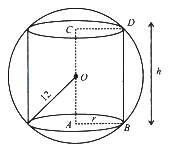
(B) Let $r$ be the radius and $h$ be the height of the cylinder inscribed in a sphere of radius $R = 12$.
From the geometry of the sphere,we have the relation $R^2 = r^2 + (h/2)^2$,which gives $12^2 = r^2 + \frac{h^2}{4}$.
Thus,$r^2 = 144 - \frac{h^2}{4}$.
The volume $V$ of the cylinder is given by $V = \pi r^2 h$.
Substituting $r^2$,we get $V = \pi (144 - \frac{h^2}{4}) h = 144 \pi h - \frac{\pi}{4} h^3$.
To find the maximum volume,we differentiate $V$ with respect to $h$: $\frac{dV}{dh} = 144 \pi - \frac{3 \pi}{4} h^2$.
Setting $\frac{dV}{dh} = 0$,we get $144 \pi = \frac{3 \pi}{4} h^2$,which implies $h^2 = 144 \times \frac{4}{3} = 192$.
So,$h = \sqrt{192} = 8 \sqrt{3}$.
Now,$r^2 = 144 - \frac{192}{4} = 144 - 48 = 96$.
The maximum volume is $V = \pi r^2 h = \pi \times 96 \times 8 \sqrt{3} = 768 \sqrt{3} \pi$ cubic units.
From the geometry of the sphere,we have the relation $R^2 = r^2 + (h/2)^2$,which gives $12^2 = r^2 + \frac{h^2}{4}$.
Thus,$r^2 = 144 - \frac{h^2}{4}$.
The volume $V$ of the cylinder is given by $V = \pi r^2 h$.
Substituting $r^2$,we get $V = \pi (144 - \frac{h^2}{4}) h = 144 \pi h - \frac{\pi}{4} h^3$.
To find the maximum volume,we differentiate $V$ with respect to $h$: $\frac{dV}{dh} = 144 \pi - \frac{3 \pi}{4} h^2$.
Setting $\frac{dV}{dh} = 0$,we get $144 \pi = \frac{3 \pi}{4} h^2$,which implies $h^2 = 144 \times \frac{4}{3} = 192$.
So,$h = \sqrt{192} = 8 \sqrt{3}$.
Now,$r^2 = 144 - \frac{192}{4} = 144 - 48 = 96$.
The maximum volume is $V = \pi r^2 h = \pi \times 96 \times 8 \sqrt{3} = 768 \sqrt{3} \pi$ cubic units.
0 likes
View Solution688
MediumMCQ
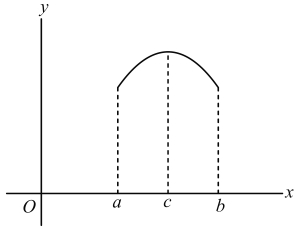
Let a function $f(x)$ be continuous in an interval $[a, b]$. Let $\delta > 0$ be a very small real number. Let $c \in (a, b)$ be such that $f(c - \delta) < f(c)$ and $f(c + \delta) < f(c)$ for every $\delta > 0$. Let $(f(\alpha - \delta) - f(\alpha))(f(\alpha + \delta) - f(\alpha)) < 0$ for all $\alpha \in (a, b)$ and $\alpha \neq c$. Then:
A
$f(x)$ has a local maximum at $c$ and a local minimum at $\alpha$
B
$f(x)$ has a local maximum at $\alpha$ and a local minimum at $c$
C
$f(x)$ has only one local maximum at $c$
D
$f(x)$ has only one local minimum at $c$
Solution
(C) Given that $f(x)$ is continuous in $[a, b]$ and $f(c - \delta) < f(c)$ and $f(c + \delta) < f(c)$ for every $\delta > 0$,it follows by the definition of a local maximum that $f(x)$ has a local maximum at $x = c$.
Now,consider the condition $(f(\alpha - \delta) - f(\alpha))(f(\alpha + \delta) - f(\alpha)) < 0$ for all $\alpha \in (a, b)$ where $\alpha \neq c$.
This inequality implies that the two factors $(f(\alpha - \delta) - f(\alpha))$ and $(f(\alpha + \delta) - f(\alpha))$ must have opposite signs.
Case $1$: $f(\alpha - \delta) - f(\alpha) > 0$ and $f(\alpha + \delta) - f(\alpha) < 0$. This implies $f(\alpha - \delta) > f(\alpha)$ and $f(\alpha + \delta) < f(\alpha)$. This indicates that the function is decreasing in the neighborhood of $\alpha$,so $\alpha$ is a point of inflection (neither a local maximum nor a local minimum).
Case $2$: $f(\alpha - \delta) - f(\alpha) < 0$ and $f(\alpha + \delta) - f(\alpha) > 0$. This implies $f(\alpha - \delta) < f(\alpha)$ and $f(\alpha + \delta) > f(\alpha)$. This indicates that the function is increasing in the neighborhood of $\alpha$,so $\alpha$ is also a point of inflection.
Therefore,$f(x)$ has only one local maximum at $c$ and no local extrema at $\alpha$.
Now,consider the condition $(f(\alpha - \delta) - f(\alpha))(f(\alpha + \delta) - f(\alpha)) < 0$ for all $\alpha \in (a, b)$ where $\alpha \neq c$.
This inequality implies that the two factors $(f(\alpha - \delta) - f(\alpha))$ and $(f(\alpha + \delta) - f(\alpha))$ must have opposite signs.
Case $1$: $f(\alpha - \delta) - f(\alpha) > 0$ and $f(\alpha + \delta) - f(\alpha) < 0$. This implies $f(\alpha - \delta) > f(\alpha)$ and $f(\alpha + \delta) < f(\alpha)$. This indicates that the function is decreasing in the neighborhood of $\alpha$,so $\alpha$ is a point of inflection (neither a local maximum nor a local minimum).
Case $2$: $f(\alpha - \delta) - f(\alpha) < 0$ and $f(\alpha + \delta) - f(\alpha) > 0$. This implies $f(\alpha - \delta) < f(\alpha)$ and $f(\alpha + \delta) > f(\alpha)$. This indicates that the function is increasing in the neighborhood of $\alpha$,so $\alpha$ is also a point of inflection.
Therefore,$f(x)$ has only one local maximum at $c$ and no local extrema at $\alpha$.
0 likes
View Solution689
EasyMCQ
The local maximum value of the function $f(x)=-(x-2)^3(x+2)^2$ is
A
$0$
B
$\frac{12^3 \cdot 8^2}{5^5}$
C
$125$
D
$\frac{2^9 \cdot 3^2}{5^6}$
Solution
(B) Given function is $f(x) = -(x-2)^3(x+2)^2$.
To find the local maximum,we first find the derivative $f'(x)$:
$f'(x) = -[3(x-2)^2(x+2)^2 + (x-2)^3 \cdot 2(x+2)]$
$f'(x) = -(x-2)^2(x+2) [3(x+2) + 2(x-2)]$
$f'(x) = -(x-2)^2(x+2) [3x + 6 + 2x - 4]$
$f'(x) = -(x-2)^2(x+2)(5x + 2)$.
Setting $f'(x) = 0$,we get critical points $x = 2, x = -2, x = -\frac{2}{5}$.
Using the first derivative test:
For $x < -2$,$f'(x) < 0$.
For $-2 < x < -\frac{2}{5}$,$f'(x) > 0$.
For $-\frac{2}{5} < x < 2$,$f'(x) < 0$.
For $x > 2$,$f'(x) < 0$.
Since $f'(x)$ changes from positive to negative at $x = -\frac{2}{5}$,it is a point of local maximum.
The local maximum value is $f(-\frac{2}{5}) = -(-\frac{2}{5}-2)^3(-\frac{2}{5}+2)^2$.
$f(-\frac{2}{5}) = -(-\frac{12}{5})^3(\frac{8}{5})^2 = -(-\frac{1728}{125}) \cdot \frac{64}{25} = \frac{1728 \cdot 64}{3125} = \frac{12^3 \cdot 8^2}{5^5}$.
To find the local maximum,we first find the derivative $f'(x)$:
$f'(x) = -[3(x-2)^2(x+2)^2 + (x-2)^3 \cdot 2(x+2)]$
$f'(x) = -(x-2)^2(x+2) [3(x+2) + 2(x-2)]$
$f'(x) = -(x-2)^2(x+2) [3x + 6 + 2x - 4]$
$f'(x) = -(x-2)^2(x+2)(5x + 2)$.
Setting $f'(x) = 0$,we get critical points $x = 2, x = -2, x = -\frac{2}{5}$.
Using the first derivative test:
For $x < -2$,$f'(x) < 0$.
For $-2 < x < -\frac{2}{5}$,$f'(x) > 0$.
For $-\frac{2}{5} < x < 2$,$f'(x) < 0$.
For $x > 2$,$f'(x) < 0$.
Since $f'(x)$ changes from positive to negative at $x = -\frac{2}{5}$,it is a point of local maximum.
The local maximum value is $f(-\frac{2}{5}) = -(-\frac{2}{5}-2)^3(-\frac{2}{5}+2)^2$.
$f(-\frac{2}{5}) = -(-\frac{12}{5})^3(\frac{8}{5})^2 = -(-\frac{1728}{125}) \cdot \frac{64}{25} = \frac{1728 \cdot 64}{3125} = \frac{12^3 \cdot 8^2}{5^5}$.
0 likes
View Solution690
DifficultMCQ
Let $f(x)=\frac{6 x^2-18 x+21}{6 x^2-18 x+17}$. If $m$ is the maximum value of $f(x)$ and $f(x) > n$ for all $x \in R$,then $14 m-7 n =$
A
$-1$
B
$23$
C
$35$
D
$42$
Solution
(B) Given,$f(x)=\frac{6 x^2-18 x+21}{6 x^2-18 x+17}$.
We can rewrite the function as $f(x)=1+\frac{4}{6 x^2-18 x+17}$.
Let $g(x)=6 x^2-18 x+17$. To find the maximum value of $f(x)$,we need to find the minimum value of $g(x)$.
$g'(x)=12 x-18$. Setting $g'(x)=0$,we get $x=\frac{3}{2}$.
The minimum value of $g(x)$ is $g(\frac{3}{2}) = 6(\frac{9}{4}) - 18(\frac{3}{2}) + 17 = \frac{27}{2} - 27 + 17 = \frac{27-54+34}{2} = \frac{7}{2}$.
Thus,the maximum value of $f(x)$ is $m = 1 + \frac{4}{7/2} = 1 + \frac{8}{7} = \frac{15}{7}$.
As $x \to \pm \infty$,$f(x) \to 1$. Since $g(x) > 0$ for all $x$,$f(x) > 1$ for all $x \in R$. Thus,$n = 1$.
Finally,$14 m - 7 n = 14(\frac{15}{7}) - 7(1) = 30 - 7 = 23$.
We can rewrite the function as $f(x)=1+\frac{4}{6 x^2-18 x+17}$.
Let $g(x)=6 x^2-18 x+17$. To find the maximum value of $f(x)$,we need to find the minimum value of $g(x)$.
$g'(x)=12 x-18$. Setting $g'(x)=0$,we get $x=\frac{3}{2}$.
The minimum value of $g(x)$ is $g(\frac{3}{2}) = 6(\frac{9}{4}) - 18(\frac{3}{2}) + 17 = \frac{27}{2} - 27 + 17 = \frac{27-54+34}{2} = \frac{7}{2}$.
Thus,the maximum value of $f(x)$ is $m = 1 + \frac{4}{7/2} = 1 + \frac{8}{7} = \frac{15}{7}$.
As $x \to \pm \infty$,$f(x) \to 1$. Since $g(x) > 0$ for all $x$,$f(x) > 1$ for all $x \in R$. Thus,$n = 1$.
Finally,$14 m - 7 n = 14(\frac{15}{7}) - 7(1) = 30 - 7 = 23$.
0 likes
View Solution691
MediumMCQ
Let $\sqrt{3}$ be the radius and $\frac{\pi}{3}$ be the semi-vertical angle of a given cone. Then the height of the right circular cylinder of maximum volume that can be inscribed in the given cone is
A
$1$
B
$\frac{\sqrt{3}}{2}$
C
$\frac{2}{\sqrt{3}}$
D
$3$
Solution
(D) Let the radius of the cone be $R = \sqrt{3}$ and the semi-vertical angle be $\alpha = \frac{\pi}{3}$.
The height of the cone is $H = R \cot(\alpha) = \sqrt{3} \cot(\frac{\pi}{3}) = \sqrt{3} \times \frac{1}{\sqrt{3}} = 1$.
Let the radius of the inscribed cylinder be $r$ and its height be $h$.
By similar triangles,$\frac{R-r}{h} = \frac{R}{H} = \frac{\sqrt{3}}{1} = \sqrt{3}$.
Thus,$h = \frac{R-r}{\sqrt{3}} = \frac{\sqrt{3}-r}{\sqrt{3}} = 1 - \frac{r}{\sqrt{3}}$.
The volume of the cylinder is $V = \pi r^2 h = \pi r^2 (1 - \frac{r}{\sqrt{3}}) = \pi (r^2 - \frac{r^3}{\sqrt{3}})$.
To maximize $V$,we find $\frac{dV}{dr} = \pi (2r - \frac{3r^2}{\sqrt{3}}) = \pi (2r - \sqrt{3}r^2) = 0$.
Since $r \neq 0$,we have $2 - \sqrt{3}r = 0$,so $r = \frac{2}{\sqrt{3}}$.
The height of the cylinder is $h = 1 - \frac{1}{\sqrt{3}} (\frac{2}{\sqrt{3}}) = 1 - \frac{2}{3} = \frac{1}{3}$.
The height of the cone is $H = R \cot(\alpha) = \sqrt{3} \cot(\frac{\pi}{3}) = \sqrt{3} \times \frac{1}{\sqrt{3}} = 1$.
Let the radius of the inscribed cylinder be $r$ and its height be $h$.
By similar triangles,$\frac{R-r}{h} = \frac{R}{H} = \frac{\sqrt{3}}{1} = \sqrt{3}$.
Thus,$h = \frac{R-r}{\sqrt{3}} = \frac{\sqrt{3}-r}{\sqrt{3}} = 1 - \frac{r}{\sqrt{3}}$.
The volume of the cylinder is $V = \pi r^2 h = \pi r^2 (1 - \frac{r}{\sqrt{3}}) = \pi (r^2 - \frac{r^3}{\sqrt{3}})$.
To maximize $V$,we find $\frac{dV}{dr} = \pi (2r - \frac{3r^2}{\sqrt{3}}) = \pi (2r - \sqrt{3}r^2) = 0$.
Since $r \neq 0$,we have $2 - \sqrt{3}r = 0$,so $r = \frac{2}{\sqrt{3}}$.
The height of the cylinder is $h = 1 - \frac{1}{\sqrt{3}} (\frac{2}{\sqrt{3}}) = 1 - \frac{2}{3} = \frac{1}{3}$.
0 likes
View Solution692
MediumMCQ
The absolute maximum value of the function $f(x) = 2x^3 - 3x^2 - 36x + 9$ defined on $[-3, 3]$ is
A
$36$
B
$53$
C
$63$
D
$72$
Solution
(B) Given the function $f(x) = 2x^3 - 3x^2 - 36x + 9$ on the interval $[-3, 3]$.
First,find the derivative $f'(x) = 6x^2 - 6x - 36$.
Set $f'(x) = 0$ to find critical points:
$6(x^2 - x - 6) = 0 \Rightarrow 6(x - 3)(x + 2) = 0$.
The critical points are $x = 3$ and $x = -2$.
Both points lie within the interval $[-3, 3]$.
Now,evaluate $f(x)$ at the critical points and the endpoints:
$f(-3) = 2(-3)^3 - 3(-3)^2 - 36(-3) + 9 = -54 - 27 + 108 + 9 = 36$.
$f(-2) = 2(-2)^3 - 3(-2)^2 - 36(-2) + 9 = -16 - 12 + 72 + 9 = 53$.
$f(3) = 2(3)^3 - 3(3)^2 - 36(3) + 9 = 54 - 27 - 108 + 9 = -72$.
The absolute maximum value is the largest of these values,which is $53$.
First,find the derivative $f'(x) = 6x^2 - 6x - 36$.
Set $f'(x) = 0$ to find critical points:
$6(x^2 - x - 6) = 0 \Rightarrow 6(x - 3)(x + 2) = 0$.
The critical points are $x = 3$ and $x = -2$.
Both points lie within the interval $[-3, 3]$.
Now,evaluate $f(x)$ at the critical points and the endpoints:
$f(-3) = 2(-3)^3 - 3(-3)^2 - 36(-3) + 9 = -54 - 27 + 108 + 9 = 36$.
$f(-2) = 2(-2)^3 - 3(-2)^2 - 36(-2) + 9 = -16 - 12 + 72 + 9 = 53$.
$f(3) = 2(3)^3 - 3(3)^2 - 36(3) + 9 = 54 - 27 - 108 + 9 = -72$.
The absolute maximum value is the largest of these values,which is $53$.
0 likes
View Solution693
EasyMCQ
If $6x - x^2 + 12$ attains its extreme value $\beta$ at $x = \alpha$,then $\beta =$
A
$7 \alpha$
B
$5 \alpha$
C
$3 \alpha$
D
$\alpha$
Solution
(A) Let $f(x) = -x^2 + 6x + 12$.
To find the extreme value,we find the derivative $f'(x) = -2x + 6$.
Setting $f'(x) = 0$,we get $-2x + 6 = 0$,which implies $x = 3$.
Thus,$\alpha = 3$.
The extreme value $\beta$ is $f(\alpha) = f(3) = -(3)^2 + 6(3) + 12 = -9 + 18 + 12 = 21$.
Since $\alpha = 3$,we can write $\beta = 21 = 7 \times 3 = 7 \alpha$.
Therefore,$\beta = 7 \alpha$.
To find the extreme value,we find the derivative $f'(x) = -2x + 6$.
Setting $f'(x) = 0$,we get $-2x + 6 = 0$,which implies $x = 3$.
Thus,$\alpha = 3$.
The extreme value $\beta$ is $f(\alpha) = f(3) = -(3)^2 + 6(3) + 12 = -9 + 18 + 12 = 21$.
Since $\alpha = 3$,we can write $\beta = 21 = 7 \times 3 = 7 \alpha$.
Therefore,$\beta = 7 \alpha$.
0 likes
View Solution694
EasyMCQ
The absolute maximum value of the function $f(x)=2 x^3-9 x^2+12 x+1$ on the interval $[0,2]$ is:
A
$8$
B
$1$
C
$6$
D
$5$
Solution
(C) Given the function $f(x)=2 x^3-9 x^2+12 x+1$ on the interval $[0,2]$.
First,find the critical points by calculating the derivative $f'(x)$ and setting it to $0$:
$f'(x) = 6x^2 - 18x + 12$
Setting $f'(x) = 0$ gives:
$6(x^2 - 3x + 2) = 0$
$6(x-1)(x-2) = 0$
Thus,the critical points are $x=1$ and $x=2$.
Now,evaluate the function $f(x)$ at the critical points and the endpoints of the interval $[0,2]$:
At $x=0$: $f(0) = 2(0)^3 - 9(0)^2 + 12(0) + 1 = 1$
At $x=1$: $f(1) = 2(1)^3 - 9(1)^2 + 12(1) + 1 = 2 - 9 + 12 + 1 = 6$
At $x=2$: $f(2) = 2(2)^3 - 9(2)^2 + 12(2) + 1 = 16 - 36 + 24 + 1 = 5$
Comparing the values ${1, 6, 5}$,the absolute maximum value is $6$.
First,find the critical points by calculating the derivative $f'(x)$ and setting it to $0$:
$f'(x) = 6x^2 - 18x + 12$
Setting $f'(x) = 0$ gives:
$6(x^2 - 3x + 2) = 0$
$6(x-1)(x-2) = 0$
Thus,the critical points are $x=1$ and $x=2$.
Now,evaluate the function $f(x)$ at the critical points and the endpoints of the interval $[0,2]$:
At $x=0$: $f(0) = 2(0)^3 - 9(0)^2 + 12(0) + 1 = 1$
At $x=1$: $f(1) = 2(1)^3 - 9(1)^2 + 12(1) + 1 = 2 - 9 + 12 + 1 = 6$
At $x=2$: $f(2) = 2(2)^3 - 9(2)^2 + 12(2) + 1 = 16 - 36 + 24 + 1 = 5$
Comparing the values ${1, 6, 5}$,the absolute maximum value is $6$.
0 likes
View SolutionApplications of Derivatives — Maxima and Minima · Frequently Asked Questions
1Are these Applications of Derivatives questions useful for JEE and NEET?
Yes. All questions in this section are mapped to JEE Main and NEET exam patterns. Previous year questions from JEE Main, NEET, GUJCET and state-level exams are included with full solutions.
2Can I switch to Hindi or Gujarati for these questions?
Yes. Use the language tabs in the hero section or the sidebar to view the same questions and solutions in English, Hindi or Gujarati.
3How do I generate a question paper from this subtopic?
Use the Vedclass Exam Paper Generator — select the chapter and subtopic, set difficulty, and generate Sets A, B, C, D automatically. First 3 chapters of every subject are free.
Vedclass Products
For Students
Vedclass Test Series
Mock tests in real JEE/NEET style with performance analysis. 5-day free trial.
Start Free TrialFor Teachers
Exam Paper Generator
Generate Set A/B/C/D papers from this chapter in 2 minutes. 3 chapters free.
Try FreeFor Institutes
Online Exam Module
Live online exams with unlimited students, 360° analytics & white-label branding.
See DemoFor Teachers & Institutes
Generate a Applications of Derivatives Exam Paper in 2 Minutes
Select subtopic & difficulty — Sets A, B, C, D auto-generated with No Repeat logic.
First 3 chapters of every subject are free — no payment required.