
A English
Maxima and Minima Questions in English
Class 12 Mathematics · Applications of Derivatives · Maxima and Minima
760+
Questions
English
Language
100%
With Solutions
Showing 46 of 760 questions in English
501
MediumMCQ
The sum of two nonzero numbers is $4$. The minimum value of the sum of their reciprocals is
A
$1$
B
$2$
C
$3$
D
$4$
Solution
(A) Let the two nonzero numbers be $x$ and $y$. Given that $x + y = 4$,which implies $y = 4 - x$.
We want to minimize the sum of their reciprocals,$S = \frac{1}{x} + \frac{1}{y}$.
Substituting $y = 4 - x$ into the expression for $S$,we get $S(x) = \frac{1}{x} + \frac{1}{4 - x}$.
To find the minimum,we differentiate $S$ with respect to $x$: $S'(x) = -\frac{1}{x^2} + \frac{1}{(4 - x)^2}$.
Setting $S'(x) = 0$,we get $\frac{1}{x^2} = \frac{1}{(4 - x)^2}$,which implies $x^2 = (4 - x)^2$.
Solving for $x$,$x^2 = 16 - 8x + x^2$,so $8x = 16$,which gives $x = 2$.
If $x = 2$,then $y = 4 - 2 = 2$.
The sum of the reciprocals is $S = \frac{1}{2} + \frac{1}{2} = 1$.
Since $S''(x) = \frac{2}{x^3} + \frac{2}{(4 - x)^3}$,at $x = 2$,$S''(2) = \frac{2}{8} + \frac{2}{8} = \frac{1}{2} > 0$,confirming a local minimum.
Thus,the minimum value is $1$.
We want to minimize the sum of their reciprocals,$S = \frac{1}{x} + \frac{1}{y}$.
Substituting $y = 4 - x$ into the expression for $S$,we get $S(x) = \frac{1}{x} + \frac{1}{4 - x}$.
To find the minimum,we differentiate $S$ with respect to $x$: $S'(x) = -\frac{1}{x^2} + \frac{1}{(4 - x)^2}$.
Setting $S'(x) = 0$,we get $\frac{1}{x^2} = \frac{1}{(4 - x)^2}$,which implies $x^2 = (4 - x)^2$.
Solving for $x$,$x^2 = 16 - 8x + x^2$,so $8x = 16$,which gives $x = 2$.
If $x = 2$,then $y = 4 - 2 = 2$.
The sum of the reciprocals is $S = \frac{1}{2} + \frac{1}{2} = 1$.
Since $S''(x) = \frac{2}{x^3} + \frac{2}{(4 - x)^3}$,at $x = 2$,$S''(2) = \frac{2}{8} + \frac{2}{8} = \frac{1}{2} > 0$,confirming a local minimum.
Thus,the minimum value is $1$.
0 likes
View Solution502
MediumMCQ
If $y = \alpha \log x + \beta x^3 - x$ has extreme values at $x = -1$ and $x = 1$,then $\alpha$ and $\beta$ are respectively
A
$0$ and $\frac{1}{3}$
B
$0$ and $\frac{-1}{3}$
C
$\frac{-1}{3}$ and $\frac{1}{3}$
D
$\frac{1}{3}$ and $\frac{1}{3}$
Solution
(A) Given the function $y = \alpha \log x + \beta x^3 - x$.
For the function to have extreme values at $x = -1$ and $x = 1$,the derivative $\frac{dy}{dx}$ must be zero at these points.
First,find the derivative: $\frac{dy}{dx} = \frac{\alpha}{x} + 3\beta x^2 - 1$.
At $x = 1$: $\frac{dy}{dx} = \alpha + 3\beta - 1 = 0 \implies \alpha + 3\beta = 1$.
At $x = -1$: $\frac{dy}{dx} = \frac{\alpha}{-1} + 3\beta(-1)^2 - 1 = 0 \implies -\alpha + 3\beta = 1$.
Adding the two equations: $(\alpha + 3\beta) + (-\alpha + 3\beta) = 1 + 1 \implies 6\beta = 2 \implies \beta = \frac{1}{3}$.
Substituting $\beta = \frac{1}{3}$ into $\alpha + 3\beta = 1$: $\alpha + 3(\frac{1}{3}) = 1 \implies \alpha + 1 = 1 \implies \alpha = 0$.
Thus,$\alpha = 0$ and $\beta = \frac{1}{3}$.
For the function to have extreme values at $x = -1$ and $x = 1$,the derivative $\frac{dy}{dx}$ must be zero at these points.
First,find the derivative: $\frac{dy}{dx} = \frac{\alpha}{x} + 3\beta x^2 - 1$.
At $x = 1$: $\frac{dy}{dx} = \alpha + 3\beta - 1 = 0 \implies \alpha + 3\beta = 1$.
At $x = -1$: $\frac{dy}{dx} = \frac{\alpha}{-1} + 3\beta(-1)^2 - 1 = 0 \implies -\alpha + 3\beta = 1$.
Adding the two equations: $(\alpha + 3\beta) + (-\alpha + 3\beta) = 1 + 1 \implies 6\beta = 2 \implies \beta = \frac{1}{3}$.
Substituting $\beta = \frac{1}{3}$ into $\alpha + 3\beta = 1$: $\alpha + 3(\frac{1}{3}) = 1 \implies \alpha + 1 = 1 \implies \alpha = 0$.
Thus,$\alpha = 0$ and $\beta = \frac{1}{3}$.
0 likes
View Solution503
MediumMCQ
$A$ manufacturer sells $x$ items at a price of rupees $\left(6-\frac{x}{40}\right)$ each. The cost price of $x$ items is Rs. $\left(\frac{x}{5}+193\right)$. The maximum profit in Rs. is
A
$134.4$
B
$144.3$
C
$143.4$
D
$133.4$
Solution
(C) Let $R(x)$ be the revenue function and $C(x)$ be the cost function.
Revenue $R(x) = x \times \left(6 - \frac{x}{40}\right) = 6x - \frac{x^2}{40}$.
Cost $C(x) = \frac{x}{5} + 193$.
Profit $P(x) = R(x) - C(x) = 6x - \frac{x^2}{40} - \frac{x}{5} - 193$.
$P(x) = -\frac{x^2}{40} + \frac{29x}{5} - 193$.
To find the maximum profit,we find the derivative $P'(x)$ and set it to $0$.
$P'(x) = -\frac{2x}{40} + \frac{29}{5} = -\frac{x}{20} + 5.8$.
Setting $P'(x) = 0$,we get $\frac{x}{20} = 5.8$,so $x = 116$.
Now,find the second derivative $P''(x) = -\frac{1}{20}$. Since $P''(x) < 0$,the profit is maximum at $x = 116$.
Maximum profit $P(116) = -\frac{116^2}{40} + \frac{29(116)}{5} - 193$.
$P(116) = -\frac{13456}{40} + 672.8 - 193 = -336.4 + 672.8 - 193 = 143.4$.
Revenue $R(x) = x \times \left(6 - \frac{x}{40}\right) = 6x - \frac{x^2}{40}$.
Cost $C(x) = \frac{x}{5} + 193$.
Profit $P(x) = R(x) - C(x) = 6x - \frac{x^2}{40} - \frac{x}{5} - 193$.
$P(x) = -\frac{x^2}{40} + \frac{29x}{5} - 193$.
To find the maximum profit,we find the derivative $P'(x)$ and set it to $0$.
$P'(x) = -\frac{2x}{40} + \frac{29}{5} = -\frac{x}{20} + 5.8$.
Setting $P'(x) = 0$,we get $\frac{x}{20} = 5.8$,so $x = 116$.
Now,find the second derivative $P''(x) = -\frac{1}{20}$. Since $P''(x) < 0$,the profit is maximum at $x = 116$.
Maximum profit $P(116) = -\frac{116^2}{40} + \frac{29(116)}{5} - 193$.
$P(116) = -\frac{13456}{40} + 672.8 - 193 = -336.4 + 672.8 - 193 = 143.4$.
0 likes
View Solution504
MediumMCQ
The minimum value of $ax + by$ where $xy = c^2$ is
A
$2c\sqrt{ab}$
B
$2ab\sqrt{c}$
C
$-2c\sqrt{ab}$
D
$2c(ab)$
Solution
(A) Let $f(x, y) = ax + by$ subject to the constraint $xy = c^2$,where $x, y > 0$.
Substituting $y = \frac{c^2}{x}$ into the expression,we get $f(x) = ax + \frac{bc^2}{x}$.
To find the minimum,we differentiate with respect to $x$:
$f'(x) = a - \frac{bc^2}{x^2}$.
Setting $f'(x) = 0$,we get $a = \frac{bc^2}{x^2}$,which implies $x^2 = \frac{bc^2}{a}$,so $x = c\sqrt{\frac{b}{a}}$.
Since $x, y > 0$,we take the positive root.
Then $y = \frac{c^2}{x} = \frac{c^2}{c\sqrt{b/a}} = c\sqrt{\frac{a}{b}}$.
The minimum value is $f = a(c\sqrt{\frac{b}{a}}) + b(c\sqrt{\frac{a}{b}}) = c\sqrt{ab} + c\sqrt{ab} = 2c\sqrt{ab}$.
Substituting $y = \frac{c^2}{x}$ into the expression,we get $f(x) = ax + \frac{bc^2}{x}$.
To find the minimum,we differentiate with respect to $x$:
$f'(x) = a - \frac{bc^2}{x^2}$.
Setting $f'(x) = 0$,we get $a = \frac{bc^2}{x^2}$,which implies $x^2 = \frac{bc^2}{a}$,so $x = c\sqrt{\frac{b}{a}}$.
Since $x, y > 0$,we take the positive root.
Then $y = \frac{c^2}{x} = \frac{c^2}{c\sqrt{b/a}} = c\sqrt{\frac{a}{b}}$.
The minimum value is $f = a(c\sqrt{\frac{b}{a}}) + b(c\sqrt{\frac{a}{b}}) = c\sqrt{ab} + c\sqrt{ab} = 2c\sqrt{ab}$.
0 likes
View Solution505
MediumMCQ
The maximum value of $\left(\frac{1}{x}\right)^x$ is
A
$e^{1/e}$
B
$e^e$
C
$1$
D
$e$
Solution
(A) Let $f(x) = (\frac{1}{x})^x = x^{-x}$.
Taking the natural logarithm on both sides,we get $\ln(f(x)) = -x \ln(x)$.
To find the critical points,we differentiate with respect to $x$:
$\frac{d}{dx}(\ln(f(x))) = \frac{d}{dx}(-x \ln(x))$
$\frac{f'(x)}{f(x)} = -[\ln(x) + x \cdot \frac{1}{x}] = -(\ln(x) + 1)$.
Setting $f'(x) = 0$,we get $\ln(x) + 1 = 0$,which implies $\ln(x) = -1$,so $x = e^{-1} = \frac{1}{e}$.
Now,we check the second derivative or the sign of $f'(x)$ around $x = \frac{1}{e}$.
For $x < \frac{1}{e}$,$f'(x) > 0$ and for $x > \frac{1}{e}$,$f'(x) < 0$,so $x = \frac{1}{e}$ is a point of local maximum.
The maximum value is $f(\frac{1}{e}) = (\frac{1}{1/e})^{1/e} = e^{1/e}$.
Taking the natural logarithm on both sides,we get $\ln(f(x)) = -x \ln(x)$.
To find the critical points,we differentiate with respect to $x$:
$\frac{d}{dx}(\ln(f(x))) = \frac{d}{dx}(-x \ln(x))$
$\frac{f'(x)}{f(x)} = -[\ln(x) + x \cdot \frac{1}{x}] = -(\ln(x) + 1)$.
Setting $f'(x) = 0$,we get $\ln(x) + 1 = 0$,which implies $\ln(x) = -1$,so $x = e^{-1} = \frac{1}{e}$.
Now,we check the second derivative or the sign of $f'(x)$ around $x = \frac{1}{e}$.
For $x < \frac{1}{e}$,$f'(x) > 0$ and for $x > \frac{1}{e}$,$f'(x) < 0$,so $x = \frac{1}{e}$ is a point of local maximum.
The maximum value is $f(\frac{1}{e}) = (\frac{1}{1/e})^{1/e} = e^{1/e}$.
0 likes
View Solution506
MediumMCQ
If $x+y=6, x \geqslant 0, y \geqslant 0$,then the maximum value of $x^2 y$ is
A
$30$
B
$32$
C
$34$
D
$36$
Solution
(B) Let $f(x, y) = x^2 y$. Given $x+y=6$,we have $y = 6-x$.
Substituting $y$ in $f$,we get $f(x) = x^2(6-x) = 6x^2 - x^3$.
To find the maximum,we find the derivative $f'(x) = 12x - 3x^2$.
Setting $f'(x) = 0$,we get $3x(4-x) = 0$,which gives $x=0$ or $x=4$.
Since $x=0$ gives $f(0)=0$,we check $x=4$.
For $x=4$,$y = 6-4 = 2$.
The value is $f(4) = 4^2 \times 2 = 16 \times 2 = 32$.
Thus,the maximum value is $32$.
Substituting $y$ in $f$,we get $f(x) = x^2(6-x) = 6x^2 - x^3$.
To find the maximum,we find the derivative $f'(x) = 12x - 3x^2$.
Setting $f'(x) = 0$,we get $3x(4-x) = 0$,which gives $x=0$ or $x=4$.
Since $x=0$ gives $f(0)=0$,we check $x=4$.
For $x=4$,$y = 6-4 = 2$.
The value is $f(4) = 4^2 \times 2 = 16 \times 2 = 32$.
Thus,the maximum value is $32$.
0 likes
View Solution507
EasyMCQ
The minimum value of the slope of the tangent to the curve $y=x^3-3x^2+2x+93$ is
A
$1$
B
$-1$
C
$2$
D
$-2$
Solution
(B) The slope of the tangent to the curve $y=f(x)$ is given by $m = \frac{dy}{dx}$.
Given $y = x^3 - 3x^2 + 2x + 93$,we differentiate with respect to $x$:
$m = \frac{dy}{dx} = 3x^2 - 6x + 2$.
To find the minimum value of the slope $m$,we differentiate $m$ with respect to $x$ and set it to zero:
$\frac{dm}{dx} = 6x - 6$.
Setting $\frac{dm}{dx} = 0$,we get $6x - 6 = 0$,which implies $x = 1$.
Now,we check the second derivative to confirm the minimum:
$\frac{d^2m}{dx^2} = 6 > 0$,which confirms that the slope has a minimum at $x = 1$.
The minimum value of the slope is $m(1) = 3(1)^2 - 6(1) + 2 = 3 - 6 + 2 = -1$.
Given $y = x^3 - 3x^2 + 2x + 93$,we differentiate with respect to $x$:
$m = \frac{dy}{dx} = 3x^2 - 6x + 2$.
To find the minimum value of the slope $m$,we differentiate $m$ with respect to $x$ and set it to zero:
$\frac{dm}{dx} = 6x - 6$.
Setting $\frac{dm}{dx} = 0$,we get $6x - 6 = 0$,which implies $x = 1$.
Now,we check the second derivative to confirm the minimum:
$\frac{d^2m}{dx^2} = 6 > 0$,which confirms that the slope has a minimum at $x = 1$.
The minimum value of the slope is $m(1) = 3(1)^2 - 6(1) + 2 = 3 - 6 + 2 = -1$.
0 likes
View Solution508
EasyMCQ
The maximum value of the function $f(x)=3x^3-18x^2+27x-40$ on the set $S=\{x \in R : x^2+30 \leq 11x\}$ is
A
$-122$
B
$-222$
C
$222$
D
$122$
Solution
(D) Given the set $S = \{x \in R : x^2+30 \leq 11x\}$.
Solving the inequality: $x^2-11x+30 \leq 0$.
$(x-5)(x-6) \leq 0$,which implies $x \in [5, 6]$.
Now,consider the function $f(x) = 3x^3-18x^2+27x-40$.
Find the derivative: $f'(x) = 9x^2-36x+27 = 9(x^2-4x+3) = 9(x-1)(x-3)$.
For $x \in [5, 6]$,both $(x-1)$ and $(x-3)$ are positive,so $f'(x) > 0$.
Since $f'(x) > 0$ for all $x \in [5, 6]$,the function $f(x)$ is strictly increasing on the interval $[5, 6]$.
The maximum value occurs at the right endpoint $x = 6$.
$f(6) = 3(6)^3 - 18(6)^2 + 27(6) - 40 = 3(216) - 18(36) + 162 - 40 = 648 - 648 + 162 - 40 = 122$.
Solving the inequality: $x^2-11x+30 \leq 0$.
$(x-5)(x-6) \leq 0$,which implies $x \in [5, 6]$.
Now,consider the function $f(x) = 3x^3-18x^2+27x-40$.
Find the derivative: $f'(x) = 9x^2-36x+27 = 9(x^2-4x+3) = 9(x-1)(x-3)$.
For $x \in [5, 6]$,both $(x-1)$ and $(x-3)$ are positive,so $f'(x) > 0$.
Since $f'(x) > 0$ for all $x \in [5, 6]$,the function $f(x)$ is strictly increasing on the interval $[5, 6]$.
The maximum value occurs at the right endpoint $x = 6$.
$f(6) = 3(6)^3 - 18(6)^2 + 27(6) - 40 = 3(216) - 18(36) + 162 - 40 = 648 - 648 + 162 - 40 = 122$.
0 likes
View Solution509
DifficultMCQ
$A$ triangular park is enclosed on two sides by a fence and on the third side by a straight river bank. The two sides having a fence are of the same length $x$. The maximum area (in sq. units) enclosed by the park is
A
$\frac{3}{2} x^2$
B
$\sqrt{\frac{x^3}{8}}$
C
$\frac{1}{2} x^2$
D
$\pi x^2$
Solution
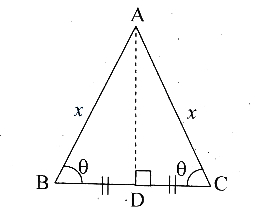
(C) Let $\triangle ABC$ be an isosceles triangle such that $AB = AC = x$.
Let $\angle ABC = \angle ACB = \theta$.
Draw segment $AD \perp$ side $BC$ at point $D$.
In $\triangle ABD$,$AD = x \sin \theta$ and $BD = x \cos \theta$.
Similarly,in $\triangle ACD$,$DC = x \cos \theta$.
Therefore,in $\triangle ABC$,the height is $AD = x \sin \theta$ and the base is $BC = BD + DC = x \cos \theta + x \cos \theta = 2x \cos \theta$.
The area $A$ of $\triangle ABC$ is given by:
$A = \frac{1}{2} \times \text{base} \times \text{height}$
$A = \frac{1}{2} \times (2x \cos \theta) \times (x \sin \theta)$
$A = x^2 \sin \theta \cos \theta = \frac{x^2}{2} \sin(2\theta)$.
Since the maximum value of $\sin(2\theta)$ is $1$ (when $2\theta = 90^\circ$ or $\theta = 45^\circ$),the maximum area is $\frac{x^2}{2}$ sq. units.
Let $\angle ABC = \angle ACB = \theta$.
Draw segment $AD \perp$ side $BC$ at point $D$.
In $\triangle ABD$,$AD = x \sin \theta$ and $BD = x \cos \theta$.
Similarly,in $\triangle ACD$,$DC = x \cos \theta$.
Therefore,in $\triangle ABC$,the height is $AD = x \sin \theta$ and the base is $BC = BD + DC = x \cos \theta + x \cos \theta = 2x \cos \theta$.
The area $A$ of $\triangle ABC$ is given by:
$A = \frac{1}{2} \times \text{base} \times \text{height}$
$A = \frac{1}{2} \times (2x \cos \theta) \times (x \sin \theta)$
$A = x^2 \sin \theta \cos \theta = \frac{x^2}{2} \sin(2\theta)$.
Since the maximum value of $\sin(2\theta)$ is $1$ (when $2\theta = 90^\circ$ or $\theta = 45^\circ$),the maximum area is $\frac{x^2}{2}$ sq. units.
0 likes
View Solution510
EasyMCQ
If the sum of two numbers is $3$,then the maximum value of the product of the first number and the square of the second number is:
A
$6$
B
$4$
C
$5$
D
$3$
Solution
(B) Let the two numbers be $a$ and $b$.
Given that $a + b = 3$,so $b = 3 - a$.
Let the product be $P = a \cdot b^2$.
Substituting the value of $b$,we get $P = a(3 - a)^2 = a(9 - 6a + a^2) = a^3 - 6a^2 + 9a$.
To find the maximum value,we differentiate $P$ with respect to $a$: $\frac{dP}{da} = 3a^2 - 12a + 9$.
Setting $\frac{dP}{da} = 0$,we get $3(a^2 - 4a + 3) = 0$,which implies $3(a - 1)(a - 3) = 0$.
So,$a = 1$ or $a = 3$.
Now,find the second derivative: $\frac{d^2P}{da^2} = 6a - 12$.
For $a = 1$,$\frac{d^2P}{da^2} = 6(1) - 12 = -6 < 0$,so $P$ is maximum at $a = 1$.
For $a = 3$,$\frac{d^2P}{da^2} = 6(3) - 12 = 6 > 0$,so $P$ is minimum at $a = 3$.
Substituting $a = 1$ into the product formula: $P = 1(3 - 1)^2 = 1(2)^2 = 4$.
Thus,the maximum value is $4$.
Given that $a + b = 3$,so $b = 3 - a$.
Let the product be $P = a \cdot b^2$.
Substituting the value of $b$,we get $P = a(3 - a)^2 = a(9 - 6a + a^2) = a^3 - 6a^2 + 9a$.
To find the maximum value,we differentiate $P$ with respect to $a$: $\frac{dP}{da} = 3a^2 - 12a + 9$.
Setting $\frac{dP}{da} = 0$,we get $3(a^2 - 4a + 3) = 0$,which implies $3(a - 1)(a - 3) = 0$.
So,$a = 1$ or $a = 3$.
Now,find the second derivative: $\frac{d^2P}{da^2} = 6a - 12$.
For $a = 1$,$\frac{d^2P}{da^2} = 6(1) - 12 = -6 < 0$,so $P$ is maximum at $a = 1$.
For $a = 3$,$\frac{d^2P}{da^2} = 6(3) - 12 = 6 > 0$,so $P$ is minimum at $a = 3$.
Substituting $a = 1$ into the product formula: $P = 1(3 - 1)^2 = 1(2)^2 = 4$.
Thus,the maximum value is $4$.
0 likes
View Solution511
MediumMCQ
$A$ wire of length $2$ units is cut into two parts,which are bent respectively to form a square of side $x$ units and a circle of radius $r$ units. If the sum of the areas of the square and the circle so formed is minimum,then:
A
$2x = (\pi + 4)r$
B
$(4 - \pi)x = \pi r$
C
$x = 2r$
D
$2x = r$
Solution
(C) Perimeter of the square $= 4x$.
Perimeter of the circle $= 2\pi r$.
Given total length of wire is $2$ units,so $4x + 2\pi r = 2$.
Dividing by $2$,we get $2x + \pi r = 1$,which implies $r = \frac{1 - 2x}{\pi}$.
Sum of the areas $A = x^2 + \pi r^2$.
Substituting $r$ in terms of $x$: $A = x^2 + \pi \left( \frac{1 - 2x}{\pi} \right)^2 = x^2 + \frac{(1 - 2x)^2}{\pi}$.
Differentiating $A$ with respect to $x$: $\frac{dA}{dx} = 2x + \frac{2(1 - 2x)(-2)}{\pi} = 2x - \frac{4(1 - 2x)}{\pi}$.
For minimum area,set $\frac{dA}{dx} = 0$: $2x - \frac{4}{\pi} + \frac{8x}{\pi} = 0$.
Multiply by $\pi$: $2\pi x - 4 + 8x = 0 \Rightarrow (2\pi + 8)x = 4 \Rightarrow (\pi + 4)x = 2$.
Thus,$x = \frac{2}{\pi + 4}$.
Substituting $x$ back into the perimeter equation: $2(\frac{2}{\pi + 4}) + \pi r = 1 \Rightarrow \pi r = 1 - \frac{4}{\pi + 4} = \frac{\pi + 4 - 4}{\pi + 4} = \frac{\pi}{\pi + 4}$.
Therefore,$r = \frac{1}{\pi + 4}$.
Comparing $x$ and $r$,we see that $x = 2r$.
Perimeter of the circle $= 2\pi r$.
Given total length of wire is $2$ units,so $4x + 2\pi r = 2$.
Dividing by $2$,we get $2x + \pi r = 1$,which implies $r = \frac{1 - 2x}{\pi}$.
Sum of the areas $A = x^2 + \pi r^2$.
Substituting $r$ in terms of $x$: $A = x^2 + \pi \left( \frac{1 - 2x}{\pi} \right)^2 = x^2 + \frac{(1 - 2x)^2}{\pi}$.
Differentiating $A$ with respect to $x$: $\frac{dA}{dx} = 2x + \frac{2(1 - 2x)(-2)}{\pi} = 2x - \frac{4(1 - 2x)}{\pi}$.
For minimum area,set $\frac{dA}{dx} = 0$: $2x - \frac{4}{\pi} + \frac{8x}{\pi} = 0$.
Multiply by $\pi$: $2\pi x - 4 + 8x = 0 \Rightarrow (2\pi + 8)x = 4 \Rightarrow (\pi + 4)x = 2$.
Thus,$x = \frac{2}{\pi + 4}$.
Substituting $x$ back into the perimeter equation: $2(\frac{2}{\pi + 4}) + \pi r = 1 \Rightarrow \pi r = 1 - \frac{4}{\pi + 4} = \frac{\pi + 4 - 4}{\pi + 4} = \frac{\pi}{\pi + 4}$.
Therefore,$r = \frac{1}{\pi + 4}$.
Comparing $x$ and $r$,we see that $x = 2r$.
0 likes
View Solution512
DifficultMCQ
If $f(x) = (\sin^4 x + \cos^4 x)$,$0 < x < \frac{\pi}{2}$,then the function has a minimum value of $ . . . . . . $ at $x = . . . . . . $.
A
$0.7934, \frac{\pi}{9}$
B
$\frac{1}{2}, \frac{\pi}{4}$
C
$\frac{5}{8}, \frac{\pi}{3}$
D
$0.75, \frac{\pi}{8}$
Solution
(B) Given $f(x) = \sin^4 x + \cos^4 x$.
We can rewrite this as:
$f(x) = (\sin^2 x + \cos^2 x)^2 - 2 \sin^2 x \cos^2 x$
Since $\sin^2 x + \cos^2 x = 1$,we have:
$f(x) = 1 - 2 \sin^2 x \cos^2 x$
Using the identity $\sin 2x = 2 \sin x \cos x$,we get $\sin^2 x \cos^2 x = \frac{\sin^2 2x}{4}$.
Substituting this into the expression:
$f(x) = 1 - 2 \left(\frac{\sin^2 2x}{4}\right) = 1 - \frac{1}{2} \sin^2 2x$.
For $0 < x < \frac{\pi}{2}$,the range of $2x$ is $0 < 2x < \pi$. Thus,the maximum value of $\sin 2x$ is $1$ at $2x = \frac{\pi}{2}$,which means $x = \frac{\pi}{4}$.
When $\sin 2x = 1$,$f(x) = 1 - \frac{1}{2}(1)^2 = 1 - \frac{1}{2} = \frac{1}{2}$.
Thus,the minimum value is $\frac{1}{2}$ at $x = \frac{\pi}{4}$.
We can rewrite this as:
$f(x) = (\sin^2 x + \cos^2 x)^2 - 2 \sin^2 x \cos^2 x$
Since $\sin^2 x + \cos^2 x = 1$,we have:
$f(x) = 1 - 2 \sin^2 x \cos^2 x$
Using the identity $\sin 2x = 2 \sin x \cos x$,we get $\sin^2 x \cos^2 x = \frac{\sin^2 2x}{4}$.
Substituting this into the expression:
$f(x) = 1 - 2 \left(\frac{\sin^2 2x}{4}\right) = 1 - \frac{1}{2} \sin^2 2x$.
For $0 < x < \frac{\pi}{2}$,the range of $2x$ is $0 < 2x < \pi$. Thus,the maximum value of $\sin 2x$ is $1$ at $2x = \frac{\pi}{2}$,which means $x = \frac{\pi}{4}$.
When $\sin 2x = 1$,$f(x) = 1 - \frac{1}{2}(1)^2 = 1 - \frac{1}{2} = \frac{1}{2}$.
Thus,the minimum value is $\frac{1}{2}$ at $x = \frac{\pi}{4}$.
0 likes
View Solution513
EasyMCQ
The maximum value of $\frac{\log x}{x}$ is
A
$e$
B
$2e$
C
$\frac{1}{e}$
D
$\frac{2}{e}$
Solution
(C) Let $f(x) = \frac{\log x}{x}$.
To find the maximum value,we calculate the derivative $f'(x)$ using the quotient rule:
$f'(x) = \frac{x \cdot \frac{d}{dx}(\log x) - \log x \cdot \frac{d}{dx}(x)}{x^2} = \frac{x \cdot \frac{1}{x} - \log x}{x^2} = \frac{1 - \log x}{x^2}$.
For critical points,set $f'(x) = 0$:
$\frac{1 - \log x}{x^2} = 0 \Rightarrow 1 - \log x = 0 \Rightarrow \log x = 1 \Rightarrow x = e$.
To verify the maximum,we check the second derivative $f''(x)$ at $x = e$:
$f''(x) = \frac{x^2(-\frac{1}{x}) - (1 - \log x)(2x)}{x^4} = \frac{-x - 2x(1 - \log x)}{x^4}$.
At $x = e$,$f''(e) = \frac{-e - 2e(1 - 1)}{e^4} = \frac{-e}{e^4} = -\frac{1}{e^3} < 0$.
Since $f''(e) < 0$,the function has a local maximum at $x = e$.
The maximum value is $f(e) = \frac{\log e}{e} = \frac{1}{e}$.
To find the maximum value,we calculate the derivative $f'(x)$ using the quotient rule:
$f'(x) = \frac{x \cdot \frac{d}{dx}(\log x) - \log x \cdot \frac{d}{dx}(x)}{x^2} = \frac{x \cdot \frac{1}{x} - \log x}{x^2} = \frac{1 - \log x}{x^2}$.
For critical points,set $f'(x) = 0$:
$\frac{1 - \log x}{x^2} = 0 \Rightarrow 1 - \log x = 0 \Rightarrow \log x = 1 \Rightarrow x = e$.
To verify the maximum,we check the second derivative $f''(x)$ at $x = e$:
$f''(x) = \frac{x^2(-\frac{1}{x}) - (1 - \log x)(2x)}{x^4} = \frac{-x - 2x(1 - \log x)}{x^4}$.
At $x = e$,$f''(e) = \frac{-e - 2e(1 - 1)}{e^4} = \frac{-e}{e^4} = -\frac{1}{e^3} < 0$.
Since $f''(e) < 0$,the function has a local maximum at $x = e$.
The maximum value is $f(e) = \frac{\log e}{e} = \frac{1}{e}$.
0 likes
View Solution514
EasyMCQ
The maximum value of the function $f(x)=2x^3-15x^2+36x-48$ on the set $A=\{x | x^2+20 \leq 9x\}$ is
A
-$16$
B
-$7$
C
$16$
D
$7$
Solution
(D) Given the function $f(x)=2x^3-15x^2+36x-48$.
First,we determine the set $A$ by solving the inequality $x^2-9x+20 \leq 0$.
Factoring the quadratic,we get $(x-4)(x-5) \leq 0$,which implies $x \in [4, 5]$.
Next,we find the critical points of $f(x)$ by setting $f'(x)=0$:
$f'(x)=6x^2-30x+36=6(x^2-5x+6)=6(x-2)(x-3)=0$.
The critical points are $x=2$ and $x=3$.
Since both $x=2$ and $x=3$ are outside the interval $[4, 5]$,the function $f(x)$ is monotonic on the interval $[4, 5]$.
We evaluate $f(x)$ at the endpoints of the interval $A=[4, 5]$:
For $x=4$: $f(4)=2(4)^3-15(4)^2+36(4)-48 = 128-240+144-48 = -16$.
For $x=5$: $f(5)=2(5)^3-15(5)^2+36(5)-48 = 250-375+180-48 = 7$.
Comparing the values,the maximum value of $f(x)$ on the set $A$ is $7$.
First,we determine the set $A$ by solving the inequality $x^2-9x+20 \leq 0$.
Factoring the quadratic,we get $(x-4)(x-5) \leq 0$,which implies $x \in [4, 5]$.
Next,we find the critical points of $f(x)$ by setting $f'(x)=0$:
$f'(x)=6x^2-30x+36=6(x^2-5x+6)=6(x-2)(x-3)=0$.
The critical points are $x=2$ and $x=3$.
Since both $x=2$ and $x=3$ are outside the interval $[4, 5]$,the function $f(x)$ is monotonic on the interval $[4, 5]$.
We evaluate $f(x)$ at the endpoints of the interval $A=[4, 5]$:
For $x=4$: $f(4)=2(4)^3-15(4)^2+36(4)-48 = 128-240+144-48 = -16$.
For $x=5$: $f(5)=2(5)^3-15(5)^2+36(5)-48 = 250-375+180-48 = 7$.
Comparing the values,the maximum value of $f(x)$ on the set $A$ is $7$.
0 likes
View Solution515
MediumMCQ
If $y = a \log x + b x^2 + x$ has its extreme values at $x = -1$ and $x = 2$,then the value of $\left(\frac{a}{b} + \frac{b}{a}\right)$ is
A
$-\frac{7}{4}$
B
$-\frac{15}{4}$
C
$-\frac{17}{4}$
D
$-\frac{5}{4}$
Solution
(C) Given the function $y = a \log x + b x^2 + x$.
First,find the derivative with respect to $x$: $\frac{dy}{dx} = \frac{a}{x} + 2bx + 1$.
Since the extreme values occur at $x = -1$ and $x = 2$,the derivative must be zero at these points.
For $x = -1$: $\frac{a}{-1} + 2b(-1) + 1 = 0 \Rightarrow -a - 2b + 1 = 0 \Rightarrow a = 1 - 2b$.
For $x = 2$: $\frac{a}{2} + 2b(2) + 1 = 0 \Rightarrow \frac{a}{2} + 4b + 1 = 0 \Rightarrow a + 8b + 2 = 0$.
Substitute $a = 1 - 2b$ into the second equation: $(1 - 2b) + 8b + 2 = 0 \Rightarrow 6b + 3 = 0 \Rightarrow 6b = -3 \Rightarrow b = -\frac{1}{2}$.
Now,find $a$: $a = 1 - 2(-\frac{1}{2}) = 1 + 1 = 2$.
Finally,calculate $\left(\frac{a}{b} + \frac{b}{a}\right) = \left(\frac{2}{-1/2} + \frac{-1/2}{2}\right) = (-4 - \frac{1}{4}) = -\frac{17}{4}$.
First,find the derivative with respect to $x$: $\frac{dy}{dx} = \frac{a}{x} + 2bx + 1$.
Since the extreme values occur at $x = -1$ and $x = 2$,the derivative must be zero at these points.
For $x = -1$: $\frac{a}{-1} + 2b(-1) + 1 = 0 \Rightarrow -a - 2b + 1 = 0 \Rightarrow a = 1 - 2b$.
For $x = 2$: $\frac{a}{2} + 2b(2) + 1 = 0 \Rightarrow \frac{a}{2} + 4b + 1 = 0 \Rightarrow a + 8b + 2 = 0$.
Substitute $a = 1 - 2b$ into the second equation: $(1 - 2b) + 8b + 2 = 0 \Rightarrow 6b + 3 = 0 \Rightarrow 6b = -3 \Rightarrow b = -\frac{1}{2}$.
Now,find $a$: $a = 1 - 2(-\frac{1}{2}) = 1 + 1 = 2$.
Finally,calculate $\left(\frac{a}{b} + \frac{b}{a}\right) = \left(\frac{2}{-1/2} + \frac{-1/2}{2}\right) = (-4 - \frac{1}{4}) = -\frac{17}{4}$.
0 likes
View Solution516
MediumMCQ
An open tank with a square bottom,to contain $4000 \ cm^3$ of liquid,is to be constructed. The dimensions of the tank,so that the surface area of the tank is minimum,are
A
side of square bottom $= 40 \ cm$,height $= 10 \ cm$.
B
side of square bottom $= 20 \ cm$,height $= 10 \ cm$.
C
side of square bottom $= 10 \ cm$,height $= 40 \ cm$.
D
side of square bottom $= 5 \ cm$,height $= 160 \ cm$.
Solution
(B) Let $x$ be the length of the side of the square bottom and $h$ be the height of the tank.
Given volume $V = x^2 h = 4000 \ cm^3 \dots (i)$.
The surface area $A$ of an open tank is $A = x^2 + 4xh \dots (ii)$.
From $(i)$,$h = \frac{4000}{x^2}$.
Substituting $h$ in $(ii)$,we get $A = x^2 + 4x \left( \frac{4000}{x^2} \right) = x^2 + \frac{16000}{x}$.
Differentiating with respect to $x$,$\frac{dA}{dx} = 2x - \frac{16000}{x^2}$.
For minimum surface area,set $\frac{dA}{dx} = 0$,so $2x = \frac{16000}{x^2} \Rightarrow x^3 = 8000 \Rightarrow x = 20 \ cm$.
Checking the second derivative,$\frac{d^2A}{dx^2} = 2 + \frac{32000}{x^3}$.
At $x = 20$,$\frac{d^2A}{dx^2} = 2 + \frac{32000}{8000} = 2 + 4 = 6 > 0$,hence the area is minimum.
Calculating height,$h = \frac{4000}{20^2} = \frac{4000}{400} = 10 \ cm$.
Given volume $V = x^2 h = 4000 \ cm^3 \dots (i)$.
The surface area $A$ of an open tank is $A = x^2 + 4xh \dots (ii)$.
From $(i)$,$h = \frac{4000}{x^2}$.
Substituting $h$ in $(ii)$,we get $A = x^2 + 4x \left( \frac{4000}{x^2} \right) = x^2 + \frac{16000}{x}$.
Differentiating with respect to $x$,$\frac{dA}{dx} = 2x - \frac{16000}{x^2}$.
For minimum surface area,set $\frac{dA}{dx} = 0$,so $2x = \frac{16000}{x^2} \Rightarrow x^3 = 8000 \Rightarrow x = 20 \ cm$.
Checking the second derivative,$\frac{d^2A}{dx^2} = 2 + \frac{32000}{x^3}$.
At $x = 20$,$\frac{d^2A}{dx^2} = 2 + \frac{32000}{8000} = 2 + 4 = 6 > 0$,hence the area is minimum.
Calculating height,$h = \frac{4000}{20^2} = \frac{4000}{400} = 10 \ cm$.
0 likes
View Solution517
EasyMCQ
If $y=a \log x+b x^2+x$ has its extremum values at $x=-1$ and $x=2$,then
A
$a=2, b=-1$
B
$a=2, b=-\frac{1}{2}$
C
$a=-2, b=\frac{1}{2}$
D
$a=2, b=\frac{1}{2}$
Solution
(B) Given the function $y=a \log x+b x^2+x$.
First,find the derivative with respect to $x$: $\frac{dy}{dx} = \frac{a}{x} + 2bx + 1$.
Since the function has extremum values at $x=-1$ and $x=2$,the derivative must be zero at these points.
For $x=-1$: $\frac{a}{-1} + 2b(-1) + 1 = 0 \Rightarrow -a - 2b + 1 = 0 \Rightarrow a + 2b = 1$ (Equation $i$).
For $x=2$: $\frac{a}{2} + 2b(2) + 1 = 0 \Rightarrow \frac{a}{2} + 4b + 1 = 0 \Rightarrow a + 8b = -2$ (Equation $ii$).
Subtracting Equation $i$ from Equation $ii$: $(a + 8b) - (a + 2b) = -2 - 1 \Rightarrow 6b = -3 \Rightarrow b = -\frac{1}{2}$.
Substituting $b = -\frac{1}{2}$ into Equation $i$: $a + 2(-\frac{1}{2}) = 1 \Rightarrow a - 1 = 1 \Rightarrow a = 2$.
Thus,the values are $a=2$ and $b=-\frac{1}{2}$.
First,find the derivative with respect to $x$: $\frac{dy}{dx} = \frac{a}{x} + 2bx + 1$.
Since the function has extremum values at $x=-1$ and $x=2$,the derivative must be zero at these points.
For $x=-1$: $\frac{a}{-1} + 2b(-1) + 1 = 0 \Rightarrow -a - 2b + 1 = 0 \Rightarrow a + 2b = 1$ (Equation $i$).
For $x=2$: $\frac{a}{2} + 2b(2) + 1 = 0 \Rightarrow \frac{a}{2} + 4b + 1 = 0 \Rightarrow a + 8b = -2$ (Equation $ii$).
Subtracting Equation $i$ from Equation $ii$: $(a + 8b) - (a + 2b) = -2 - 1 \Rightarrow 6b = -3 \Rightarrow b = -\frac{1}{2}$.
Substituting $b = -\frac{1}{2}$ into Equation $i$: $a + 2(-\frac{1}{2}) = 1 \Rightarrow a - 1 = 1 \Rightarrow a = 2$.
Thus,the values are $a=2$ and $b=-\frac{1}{2}$.
0 likes
View Solution518
EasyMCQ
The maximum value of $xy$ when $x+2y=8$ is
A
$20$
B
$16$
C
$24$
D
$8$
Solution
(D) Given the constraint $x+2y=8$.
We can express $y$ in terms of $x$ as $2y = 8-x$,which gives $y = \frac{8-x}{2}$.
Let the function to be maximized be $f(x) = xy$.
Substituting the value of $y$,we get $f(x) = x \cdot \frac{8-x}{2} = 4x - \frac{x^2}{2}$.
To find the maximum value,we differentiate $f(x)$ with respect to $x$:
$f'(x) = \frac{d}{dx}(4x - \frac{x^2}{2}) = 4 - x$.
Setting the derivative to zero for critical points:
$4 - x = 0 \implies x = 4$.
To confirm it is a maximum,we check the second derivative:
$f''(x) = -1$.
Since $f''(4) = -1 < 0$,the function has a local maximum at $x = 4$.
Substituting $x = 4$ back into the expression for $y$:
$y = \frac{8-4}{2} = 2$.
The maximum value of $xy$ is $4 \times 2 = 8$.
We can express $y$ in terms of $x$ as $2y = 8-x$,which gives $y = \frac{8-x}{2}$.
Let the function to be maximized be $f(x) = xy$.
Substituting the value of $y$,we get $f(x) = x \cdot \frac{8-x}{2} = 4x - \frac{x^2}{2}$.
To find the maximum value,we differentiate $f(x)$ with respect to $x$:
$f'(x) = \frac{d}{dx}(4x - \frac{x^2}{2}) = 4 - x$.
Setting the derivative to zero for critical points:
$4 - x = 0 \implies x = 4$.
To confirm it is a maximum,we check the second derivative:
$f''(x) = -1$.
Since $f''(4) = -1 < 0$,the function has a local maximum at $x = 4$.
Substituting $x = 4$ back into the expression for $y$:
$y = \frac{8-4}{2} = 2$.
The maximum value of $xy$ is $4 \times 2 = 8$.
0 likes
View Solution519
MediumMCQ
The maximum value of the function $f(x) = 3x^3 - 18x^2 + 27x - 40$ on the set $S = \{x \in R : x^2 + 30 \leq 11x\}$ is
A
$122$
B
$132$
C
$112$
D
$222$
Solution
(A) First,we determine the set $S$ by solving the inequality $x^2 + 30 \leq 11x$.
$x^2 - 11x + 30 \leq 0$
$(x - 5)(x - 6) \leq 0$
Thus,$x \in [5, 6]$.
Now,consider the function $f(x) = 3x^3 - 18x^2 + 27x - 40$.
Find the derivative $f'(x)$:
$f'(x) = 9x^2 - 36x + 27 = 9(x^2 - 4x + 3) = 9(x - 1)(x - 3)$.
For $x \in [5, 6]$,both $(x - 1)$ and $(x - 3)$ are positive,so $f'(x) > 0$.
Since $f'(x) > 0$ for all $x \in [5, 6]$,the function $f(x)$ is strictly increasing on the interval $[5, 6]$.
The maximum value occurs at the right endpoint $x = 6$.
$f(6) = 3(6)^3 - 18(6)^2 + 27(6) - 40$
$f(6) = 3(216) - 18(36) + 162 - 40$
$f(6) = 648 - 648 + 162 - 40 = 122$.
$x^2 - 11x + 30 \leq 0$
$(x - 5)(x - 6) \leq 0$
Thus,$x \in [5, 6]$.
Now,consider the function $f(x) = 3x^3 - 18x^2 + 27x - 40$.
Find the derivative $f'(x)$:
$f'(x) = 9x^2 - 36x + 27 = 9(x^2 - 4x + 3) = 9(x - 1)(x - 3)$.
For $x \in [5, 6]$,both $(x - 1)$ and $(x - 3)$ are positive,so $f'(x) > 0$.
Since $f'(x) > 0$ for all $x \in [5, 6]$,the function $f(x)$ is strictly increasing on the interval $[5, 6]$.
The maximum value occurs at the right endpoint $x = 6$.
$f(6) = 3(6)^3 - 18(6)^2 + 27(6) - 40$
$f(6) = 3(216) - 18(36) + 162 - 40$
$f(6) = 648 - 648 + 162 - 40 = 122$.
0 likes
View Solution520
EasyMCQ
An open metallic tank is to be constructed with a square base and vertical sides,having a volume of $500 \,m^3$. The dimensions of the tank for the minimum area of the sheet metal used in its construction are:
A
$5 \,m, 5 \,m, 10 \,m$
B
$10 \,m, 10 \,m, 5 \,m$
C
$2 \,m, 2 \,m, 8 \,m$
D
$15 \,m, 15 \,m, 5 \,m$
Solution
(B) Let the side of the square base be $x \,m$ and the height of the tank be $y \,m$.
The volume $V = x^2 y = 500$.
Thus,$y = \frac{500}{x^2}$.
The surface area $S$ of the open tank is $S = x^2 + 4xy$.
Substituting $y$,we get $S = x^2 + 4x \left(\frac{500}{x^2}\right) = x^2 + \frac{2000}{x}$.
Differentiating with respect to $x$: $\frac{dS}{dx} = 2x - \frac{2000}{x^2}$.
Setting $\frac{dS}{dx} = 0$,we get $2x = \frac{2000}{x^2} \Rightarrow x^3 = 1000 \Rightarrow x = 10 \,m$.
The second derivative $\frac{d^2S}{dx^2} = 2 + \frac{4000}{x^3}$. At $x = 10$,$\frac{d^2S}{dx^2} = 2 + 4 = 6 > 0$,so the area is minimum.
The height $y = \frac{500}{10^2} = 5 \,m$.
Thus,the dimensions are $10 \,m, 10 \,m, 5 \,m$.
The volume $V = x^2 y = 500$.
Thus,$y = \frac{500}{x^2}$.
The surface area $S$ of the open tank is $S = x^2 + 4xy$.
Substituting $y$,we get $S = x^2 + 4x \left(\frac{500}{x^2}\right) = x^2 + \frac{2000}{x}$.
Differentiating with respect to $x$: $\frac{dS}{dx} = 2x - \frac{2000}{x^2}$.
Setting $\frac{dS}{dx} = 0$,we get $2x = \frac{2000}{x^2} \Rightarrow x^3 = 1000 \Rightarrow x = 10 \,m$.
The second derivative $\frac{d^2S}{dx^2} = 2 + \frac{4000}{x^3}$. At $x = 10$,$\frac{d^2S}{dx^2} = 2 + 4 = 6 > 0$,so the area is minimum.
The height $y = \frac{500}{10^2} = 5 \,m$.
Thus,the dimensions are $10 \,m, 10 \,m, 5 \,m$.
0 likes
View Solution521
EasyMCQ
If $x=1$ and $x=2$ are extreme points of $f(x)=\alpha \log x+\beta x^2+x$,where $\alpha$ and $\beta$ are constants,then the value of $\alpha^2+2 \beta$ is
A
$1/9$
B
$3$
C
$3/2$
D
$5$
Solution
(A) Given $f(x) = \alpha \log x + \beta x^2 + x$.
Since $x=1$ and $x=2$ are extreme points,the derivative $f'(x)$ must be zero at these points.
$f'(x) = \frac{\alpha}{x} + 2\beta x + 1$.
At $x=1$,$f'(1) = \frac{\alpha}{1} + 2\beta(1) + 1 = 0 \implies \alpha + 2\beta = -1$ (Equation $1$).
At $x=2$,$f'(2) = \frac{\alpha}{2} + 2\beta(2) + 1 = 0 \implies \frac{\alpha}{2} + 4\beta = -1 \implies \alpha + 8\beta = -2$ (Equation $2$).
Subtracting Equation $1$ from Equation $2$: $(\alpha + 8\beta) - (\alpha + 2\beta) = -2 - (-1) \implies 6\beta = -1 \implies \beta = -\frac{1}{6}$.
Substituting $\beta = -\frac{1}{6}$ into Equation $1$: $\alpha + 2(-\frac{1}{6}) = -1 \implies \alpha - \frac{1}{3} = -1 \implies \alpha = -\frac{2}{3}$.
Now,calculate $\alpha^2 + 2\beta$: $(-\frac{2}{3})^2 + 2(-\frac{1}{6}) = \frac{4}{9} - \frac{1}{3} = \frac{4-3}{9} = \frac{1}{9}$.
Since $x=1$ and $x=2$ are extreme points,the derivative $f'(x)$ must be zero at these points.
$f'(x) = \frac{\alpha}{x} + 2\beta x + 1$.
At $x=1$,$f'(1) = \frac{\alpha}{1} + 2\beta(1) + 1 = 0 \implies \alpha + 2\beta = -1$ (Equation $1$).
At $x=2$,$f'(2) = \frac{\alpha}{2} + 2\beta(2) + 1 = 0 \implies \frac{\alpha}{2} + 4\beta = -1 \implies \alpha + 8\beta = -2$ (Equation $2$).
Subtracting Equation $1$ from Equation $2$: $(\alpha + 8\beta) - (\alpha + 2\beta) = -2 - (-1) \implies 6\beta = -1 \implies \beta = -\frac{1}{6}$.
Substituting $\beta = -\frac{1}{6}$ into Equation $1$: $\alpha + 2(-\frac{1}{6}) = -1 \implies \alpha - \frac{1}{3} = -1 \implies \alpha = -\frac{2}{3}$.
Now,calculate $\alpha^2 + 2\beta$: $(-\frac{2}{3})^2 + 2(-\frac{1}{6}) = \frac{4}{9} - \frac{1}{3} = \frac{4-3}{9} = \frac{1}{9}$.
0 likes
View Solution522
EasyMCQ
The function $f(x) = x^3 - 6x^2 + 9x + 2$ has a maximum value when $x$ is
A
$1$
B
$2$
C
$3$
D
$6$
Solution
(A) Given function: $f(x) = x^3 - 6x^2 + 9x + 2$
First,find the derivative $f'(x)$:
$f'(x) = 3x^2 - 12x + 9$
To find the critical points,set $f'(x) = 0$:
$3(x^2 - 4x + 3) = 0$
$3(x - 1)(x - 3) = 0$
So,the critical points are $x = 1$ and $x = 3$.
Now,find the second derivative $f''(x)$:
$f''(x) = 6x - 12$
Check the nature of the function at critical points using the second derivative test:
At $x = 1$: $f''(1) = 6(1) - 12 = -6$. Since $f''(1) < 0$,the function has a local maximum at $x = 1$.
At $x = 3$: $f''(3) = 6(3) - 12 = 6$. Since $f''(3) > 0$,the function has a local minimum at $x = 3$.
Therefore,the function has a maximum value when $x = 1$.
First,find the derivative $f'(x)$:
$f'(x) = 3x^2 - 12x + 9$
To find the critical points,set $f'(x) = 0$:
$3(x^2 - 4x + 3) = 0$
$3(x - 1)(x - 3) = 0$
So,the critical points are $x = 1$ and $x = 3$.
Now,find the second derivative $f''(x)$:
$f''(x) = 6x - 12$
Check the nature of the function at critical points using the second derivative test:
At $x = 1$: $f''(1) = 6(1) - 12 = -6$. Since $f''(1) < 0$,the function has a local maximum at $x = 1$.
At $x = 3$: $f''(3) = 6(3) - 12 = 6$. Since $f''(3) > 0$,the function has a local minimum at $x = 3$.
Therefore,the function has a maximum value when $x = 1$.
0 likes
View Solution523
MediumMCQ
The maximum value of the function $f(x) = 3x^3 - 18x^2 + 27x - 40$ on the set $S = \{x \in R : x^2 + 30 \leq 11x\}$ is
A
$122$
B
$222$
C
$810$
D
$162$
Solution
(A) Given function: $f(x) = 3x^3 - 18x^2 + 27x - 40$.
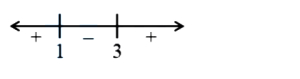
First,find the derivative: $f'(x) = 9x^2 - 36x + 27 = 9(x^2 - 4x + 3) = 9(x - 1)(x - 3)$.
The critical points are $x = 1$ and $x = 3$.
Next,determine the set $S$ by solving the inequality $x^2 + 30 \leq 11x$:
$x^2 - 11x + 30 \leq 0$
$(x - 5)(x - 6) \leq 0$
This gives $x \in [5, 6]$.
Now,evaluate the behavior of $f(x)$ on the interval $[5, 6]$. Since $f'(x) = 9(x - 1)(x - 3)$,for any $x \geq 5$,both $(x - 1)$ and $(x - 3)$ are positive,so $f'(x) > 0$.
Thus,$f(x)$ is strictly increasing on the interval $[5, 6]$.
The maximum value on the set $S = [5, 6]$ occurs at the right endpoint $x = 6$.
$f(6) = 3(6)^3 - 18(6)^2 + 27(6) - 40$
$f(6) = 3(216) - 18(36) + 162 - 40$
$f(6) = 648 - 648 + 162 - 40 = 122$.
Therefore,the maximum value is $122$.
First,find the derivative: $f'(x) = 9x^2 - 36x + 27 = 9(x^2 - 4x + 3) = 9(x - 1)(x - 3)$.
The critical points are $x = 1$ and $x = 3$.
Next,determine the set $S$ by solving the inequality $x^2 + 30 \leq 11x$:
$x^2 - 11x + 30 \leq 0$
$(x - 5)(x - 6) \leq 0$
This gives $x \in [5, 6]$.
Now,evaluate the behavior of $f(x)$ on the interval $[5, 6]$. Since $f'(x) = 9(x - 1)(x - 3)$,for any $x \geq 5$,both $(x - 1)$ and $(x - 3)$ are positive,so $f'(x) > 0$.
Thus,$f(x)$ is strictly increasing on the interval $[5, 6]$.
The maximum value on the set $S = [5, 6]$ occurs at the right endpoint $x = 6$.
$f(6) = 3(6)^3 - 18(6)^2 + 27(6) - 40$
$f(6) = 3(216) - 18(36) + 162 - 40$
$f(6) = 648 - 648 + 162 - 40 = 122$.
Therefore,the maximum value is $122$.
0 likes
View Solution524
EasyMCQ
Local maximum and local minimum values respectively of the function $f(x)=(x-1)(x+2)^2$ are
A
$-4, 0$
B
$0, -4$
C
$-4, 4$
D
$4, -4$
Solution
(B) Given function: $f(x) = (x-1)(x+2)^2$.
Find the derivative $f'(x)$ using the product rule:
$f'(x) = (1)(x+2)^2 + (x-1)(2)(x+2)$
$f'(x) = (x+2)[(x+2) + 2(x-1)]$
$f'(x) = (x+2)(x+2+2x-2) = 3x(x+2)$.
Set $f'(x) = 0$ to find critical points:
$3x(x+2) = 0 \implies x = 0, x = -2$.
Use the first derivative test:
For $x < -2$,$f'(x) > 0$ (increasing).
For $-2 < x < 0$,$f'(x) < 0$ (decreasing).
For $x > 0$,$f'(x) > 0$ (increasing).
At $x = -2$,the function changes from increasing to decreasing,so $f(-2)$ is a local maximum:
$f(-2) = (-2-1)(-2+2)^2 = (-3)(0) = 0$.
At $x = 0$,the function changes from decreasing to increasing,so $f(0)$ is a local minimum:
$f(0) = (0-1)(0+2)^2 = (-1)(4) = -4$.
Thus,the local maximum and local minimum values are $0$ and $-4$ respectively.
Find the derivative $f'(x)$ using the product rule:
$f'(x) = (1)(x+2)^2 + (x-1)(2)(x+2)$
$f'(x) = (x+2)[(x+2) + 2(x-1)]$
$f'(x) = (x+2)(x+2+2x-2) = 3x(x+2)$.
Set $f'(x) = 0$ to find critical points:
$3x(x+2) = 0 \implies x = 0, x = -2$.
Use the first derivative test:
For $x < -2$,$f'(x) > 0$ (increasing).
For $-2 < x < 0$,$f'(x) < 0$ (decreasing).
For $x > 0$,$f'(x) > 0$ (increasing).
At $x = -2$,the function changes from increasing to decreasing,so $f(-2)$ is a local maximum:
$f(-2) = (-2-1)(-2+2)^2 = (-3)(0) = 0$.
At $x = 0$,the function changes from decreasing to increasing,so $f(0)$ is a local minimum:
$f(0) = (0-1)(0+2)^2 = (-1)(4) = -4$.
Thus,the local maximum and local minimum values are $0$ and $-4$ respectively.
0 likes
View Solution525
EasyMCQ
The function,$f(x)=x \sqrt{1-x}$,where $x \in(0,1)$,has a local maximum at $x=$
A
$\frac{1}{3}$
B
$\frac{1}{4}$
C
$\frac{2}{3}$
D
$\frac{3}{4}$
Solution
(C) Given function: $f(x) = x \sqrt{1-x}$
To find the local maximum,we first find the derivative $f^{\prime}(x)$:
$f^{\prime}(x) = (1) \cdot \sqrt{1-x} + x \cdot \frac{1}{2\sqrt{1-x}} \cdot (-1)$
$f^{\prime}(x) = \sqrt{1-x} - \frac{x}{2\sqrt{1-x}}$
$f^{\prime}(x) = \frac{2(1-x) - x}{2\sqrt{1-x}} = \frac{2 - 3x}{2\sqrt{1-x}}$
Set $f^{\prime}(x) = 0$ to find critical points:
$\frac{2 - 3x}{2\sqrt{1-x}} = 0 \Rightarrow 2 - 3x = 0 \Rightarrow x = \frac{2}{3}$
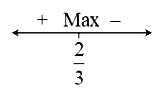
Now,check the sign of $f^{\prime}(x)$ around $x = \frac{2}{3}$:
For $x < \frac{2}{3}$,$f^{\prime}(x) > 0$ (function is increasing).
For $x > \frac{2}{3}$,$f^{\prime}(x) < 0$ (function is decreasing).
Since the derivative changes sign from positive to negative at $x = \frac{2}{3}$,the function has a local maximum at $x = \frac{2}{3}$.
To find the local maximum,we first find the derivative $f^{\prime}(x)$:
$f^{\prime}(x) = (1) \cdot \sqrt{1-x} + x \cdot \frac{1}{2\sqrt{1-x}} \cdot (-1)$
$f^{\prime}(x) = \sqrt{1-x} - \frac{x}{2\sqrt{1-x}}$
$f^{\prime}(x) = \frac{2(1-x) - x}{2\sqrt{1-x}} = \frac{2 - 3x}{2\sqrt{1-x}}$
Set $f^{\prime}(x) = 0$ to find critical points:
$\frac{2 - 3x}{2\sqrt{1-x}} = 0 \Rightarrow 2 - 3x = 0 \Rightarrow x = \frac{2}{3}$
Now,check the sign of $f^{\prime}(x)$ around $x = \frac{2}{3}$:
For $x < \frac{2}{3}$,$f^{\prime}(x) > 0$ (function is increasing).
For $x > \frac{2}{3}$,$f^{\prime}(x) < 0$ (function is decreasing).
Since the derivative changes sign from positive to negative at $x = \frac{2}{3}$,the function has a local maximum at $x = \frac{2}{3}$.
0 likes
View Solution526
MediumMCQ
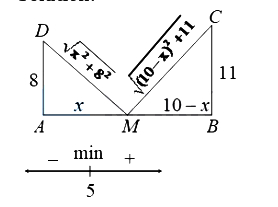
Let $AD$ and $BC$ be two vertical poles at $A$ and $B$ respectively on a horizontal ground. If $AD = 8 \ m$,$BC = 11 \ m$ and $AB = 10 \ m$,then the distance (in meters) of point $M$ on $AB$ from the point $A$ such that $MD^2 + MC^2$ is minimum,is
A
$8$
B
$5$
C
$4$
D
$7$
Solution
(B) Let the distance of point $M$ from $A$ be $x$. Then $AM = x$ and $MB = 10 - x$.
In right-angled triangles $\triangle DAM$ and $\triangle CBM$:
$MD^2 = AM^2 + AD^2 = x^2 + 8^2 = x^2 + 64$
$MC^2 = MB^2 + BC^2 = (10 - x)^2 + 11^2 = (10 - x)^2 + 121$
Let $f(x) = MD^2 + MC^2 = x^2 + 64 + (10 - x)^2 + 121$
$f(x) = x^2 + 64 + 100 - 20x + x^2 + 121$
$f(x) = 2x^2 - 20x + 285$
To find the minimum,differentiate $f(x)$ with respect to $x$:
$f'(x) = 4x - 20$
Set $f'(x) = 0$ for critical points:
$4x - 20 = 0 \Rightarrow x = 5$
Since $f''(x) = 4 > 0$,the function $f(x)$ is minimum at $x = 5$ meters.
In right-angled triangles $\triangle DAM$ and $\triangle CBM$:
$MD^2 = AM^2 + AD^2 = x^2 + 8^2 = x^2 + 64$
$MC^2 = MB^2 + BC^2 = (10 - x)^2 + 11^2 = (10 - x)^2 + 121$
Let $f(x) = MD^2 + MC^2 = x^2 + 64 + (10 - x)^2 + 121$
$f(x) = x^2 + 64 + 100 - 20x + x^2 + 121$
$f(x) = 2x^2 - 20x + 285$
To find the minimum,differentiate $f(x)$ with respect to $x$:
$f'(x) = 4x - 20$
Set $f'(x) = 0$ for critical points:
$4x - 20 = 0 \Rightarrow x = 5$
Since $f''(x) = 4 > 0$,the function $f(x)$ is minimum at $x = 5$ meters.
0 likes
View Solution527
EasyMCQ
On the interval $[0,1]$,the function $f(x) = x^{25}(1-x)^{75}$ takes its maximum value at the point
A
$\frac{1}{2}$
B
$0$
C
$\frac{1}{4}$
D
$\frac{1}{3}$
Solution
(C) Let $f(x) = x^{25}(1-x)^{75}$.
To find the critical points,we differentiate $f(x)$ with respect to $x$ using the product rule:
$f'(x) = 25x^{24}(1-x)^{75} + x^{25} \cdot 75(1-x)^{74} \cdot (-1)$
$f'(x) = 25x^{24}(1-x)^{74} [(1-x) - 3x]$
$f'(x) = 25x^{24}(1-x)^{74} (1-4x)$
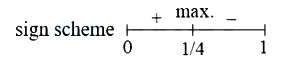
Setting $f'(x) = 0$,we get critical points at $x = 0$,$x = 1$,and $x = \frac{1}{4}$.
Since $f(0) = 0$ and $f(1) = 0$,and $f(x) > 0$ for $x \in (0,1)$,the function must attain its maximum at the critical point $x = \frac{1}{4}$.
To find the critical points,we differentiate $f(x)$ with respect to $x$ using the product rule:
$f'(x) = 25x^{24}(1-x)^{75} + x^{25} \cdot 75(1-x)^{74} \cdot (-1)$
$f'(x) = 25x^{24}(1-x)^{74} [(1-x) - 3x]$
$f'(x) = 25x^{24}(1-x)^{74} (1-4x)$
Setting $f'(x) = 0$,we get critical points at $x = 0$,$x = 1$,and $x = \frac{1}{4}$.
Since $f(0) = 0$ and $f(1) = 0$,and $f(x) > 0$ for $x \in (0,1)$,the function must attain its maximum at the critical point $x = \frac{1}{4}$.
0 likes
View Solution528
DifficultMCQ
$A$ wire of length $20$ units is divided into two parts such that the product of one part and the cube of the other part is maximum. Then,the product of these parts is:
A
$5$
B
$75$
C
$15$
D
$70$
Solution
(B) Let the two parts be $x$ and $y$. Given $x + y = 20$,so $y = 20 - x$.
Let the function be $f(x) = x(20 - x)^3$.
To find the maximum,we differentiate $f(x)$ with respect to $x$:
$f'(x) = (20 - x)^3 + x \cdot 3(20 - x)^2(-1)$
$f'(x) = (20 - x)^2 [20 - x - 3x] = (20 - x)^2 (20 - 4x)$.
Setting $f'(x) = 0$,we get $x = 20$ or $x = 5$.
Since $x=20$ gives $f(x)=0$ (minimum),we check $x = 5$.
For $x = 5$,$y = 20 - 5 = 15$.
The product of the two parts is $xy = 5 \times 15 = 75$.
Let the function be $f(x) = x(20 - x)^3$.
To find the maximum,we differentiate $f(x)$ with respect to $x$:
$f'(x) = (20 - x)^3 + x \cdot 3(20 - x)^2(-1)$
$f'(x) = (20 - x)^2 [20 - x - 3x] = (20 - x)^2 (20 - 4x)$.
Setting $f'(x) = 0$,we get $x = 20$ or $x = 5$.
Since $x=20$ gives $f(x)=0$ (minimum),we check $x = 5$.
For $x = 5$,$y = 20 - 5 = 15$.
The product of the two parts is $xy = 5 \times 15 = 75$.
0 likes
View Solution529
DifficultMCQ
The slant height of a right circular cone is $3 \text{ cm}$. The height of the cone for maximum volume is
A
$5 \text{ cm}$
B
$\sqrt{5} \text{ cm}$
C
$3 \text{ cm}$
D
$\sqrt{3} \text{ cm}$
Solution
(D) The volume of a cone is given by $V = \frac{1}{3} \pi r^2 h$.
Given the slant height $\ell = 3 \text{ cm}$,we have the relation $\ell^2 = r^2 + h^2$,which implies $r^2 = 9 - h^2$.
Substituting $r^2$ into the volume formula: $V = \frac{1}{3} \pi (9 - h^2) h = 3 \pi h - \frac{\pi}{3} h^3$.
To find the maximum volume,we differentiate $V$ with respect to $h$: $\frac{dV}{dh} = 3 \pi - \pi h^2$.
Setting $\frac{dV}{dh} = 0$,we get $3 \pi = \pi h^2$,which gives $h^2 = 3$,so $h = \sqrt{3} \text{ cm}$ (since height must be positive).
Checking the second derivative: $\frac{d^2V}{dh^2} = -2 \pi h$.
At $h = \sqrt{3}$,$\frac{d^2V}{dh^2} = -2 \sqrt{3} \pi < 0$.
Since the second derivative is negative,the volume is maximum when $h = \sqrt{3} \text{ cm}$.
Given the slant height $\ell = 3 \text{ cm}$,we have the relation $\ell^2 = r^2 + h^2$,which implies $r^2 = 9 - h^2$.
Substituting $r^2$ into the volume formula: $V = \frac{1}{3} \pi (9 - h^2) h = 3 \pi h - \frac{\pi}{3} h^3$.
To find the maximum volume,we differentiate $V$ with respect to $h$: $\frac{dV}{dh} = 3 \pi - \pi h^2$.
Setting $\frac{dV}{dh} = 0$,we get $3 \pi = \pi h^2$,which gives $h^2 = 3$,so $h = \sqrt{3} \text{ cm}$ (since height must be positive).
Checking the second derivative: $\frac{d^2V}{dh^2} = -2 \pi h$.
At $h = \sqrt{3}$,$\frac{d^2V}{dh^2} = -2 \sqrt{3} \pi < 0$.
Since the second derivative is negative,the volume is maximum when $h = \sqrt{3} \text{ cm}$.
0 likes
View Solution530
EasyMCQ
If $f(x)=x^2+ax+b$ has a minima at $x=3$ whose value is $5$,then the values of $a$ and $b$ are respectively.
A
-$6$,$14$
B
-$6$,-$14$
C
$14$,-$6$
D
$6$,$14$
Solution
(A) Given the function $f(x) = x^2 + ax + b$.
To find the critical points,we calculate the first derivative: $f'(x) = 2x + a$.
Setting $f'(x) = 0$,we get $x = -a/2$.
Since the second derivative $f''(x) = 2 > 0$,the function has a local minimum at $x = -a/2$.
According to the problem,the minimum occurs at $x = 3$.
Therefore,$-a/2 = 3$,which implies $a = -6$.
Given that the minimum value of the function is $5$ at $x = 3$,we substitute these values into the original function:
$f(3) = (3)^2 + a(3) + b = 5$.
Substituting $a = -6$:
$9 + (-6)(3) + b = 5$.
$9 - 18 + b = 5$.
$-9 + b = 5$.
$b = 14$.
Thus,the values are $a = -6$ and $b = 14$.
To find the critical points,we calculate the first derivative: $f'(x) = 2x + a$.
Setting $f'(x) = 0$,we get $x = -a/2$.
Since the second derivative $f''(x) = 2 > 0$,the function has a local minimum at $x = -a/2$.
According to the problem,the minimum occurs at $x = 3$.
Therefore,$-a/2 = 3$,which implies $a = -6$.
Given that the minimum value of the function is $5$ at $x = 3$,we substitute these values into the original function:
$f(3) = (3)^2 + a(3) + b = 5$.
Substituting $a = -6$:
$9 + (-6)(3) + b = 5$.
$9 - 18 + b = 5$.
$-9 + b = 5$.
$b = 14$.
Thus,the values are $a = -6$ and $b = 14$.
0 likes
View Solution531
DifficultMCQ
The maximum area of the rectangle that can be inscribed in a circle of radius $r$ is
A
$2 r^2$ sq. units
B
$\frac{\pi r^2}{4}$ sq. units
C
$\pi r^2$ units
D
$r^3$ sq. units
Solution
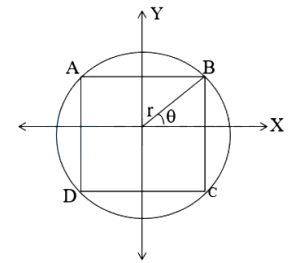
(A) Let the rectangle $ABCD$ be inscribed in a circle of radius $r$ centered at the origin. Let the coordinates of vertex $B$ be $(r \cos \theta, r \sin \theta)$.
Then,the length $AB = 2r \cos \theta$ and the width $BC = 2r \sin \theta$.
The area of the rectangle $A(\theta) = AB \times BC = (2r \cos \theta)(2r \sin \theta) = 2r^2 \sin 2\theta$.
To find the maximum area,we differentiate $A(\theta)$ with respect to $\theta$:
$A'(\theta) = 4r^2 \cos 2\theta$.
Setting $A'(\theta) = 0$,we get $\cos 2\theta = 0$,which implies $2\theta = \frac{\pi}{2}$,so $\theta = \frac{\pi}{4}$.
Checking the second derivative: $A''(\theta) = -8r^2 \sin 2\theta$.
At $\theta = \frac{\pi}{4}$,$A''(\frac{\pi}{4}) = -8r^2 \sin(\frac{\pi}{2}) = -8r^2 < 0$.
Since the second derivative is negative,the area is maximum at $\theta = \frac{\pi}{4}$.
Substituting $\theta = \frac{\pi}{4}$ into the area formula:
Maximum Area $= 2r^2 \sin(2 \times \frac{\pi}{4}) = 2r^2 \sin(\frac{\pi}{2}) = 2r^2(1) = 2r^2$ sq. units.
Then,the length $AB = 2r \cos \theta$ and the width $BC = 2r \sin \theta$.
The area of the rectangle $A(\theta) = AB \times BC = (2r \cos \theta)(2r \sin \theta) = 2r^2 \sin 2\theta$.
To find the maximum area,we differentiate $A(\theta)$ with respect to $\theta$:
$A'(\theta) = 4r^2 \cos 2\theta$.
Setting $A'(\theta) = 0$,we get $\cos 2\theta = 0$,which implies $2\theta = \frac{\pi}{2}$,so $\theta = \frac{\pi}{4}$.
Checking the second derivative: $A''(\theta) = -8r^2 \sin 2\theta$.
At $\theta = \frac{\pi}{4}$,$A''(\frac{\pi}{4}) = -8r^2 \sin(\frac{\pi}{2}) = -8r^2 < 0$.
Since the second derivative is negative,the area is maximum at $\theta = \frac{\pi}{4}$.
Substituting $\theta = \frac{\pi}{4}$ into the area formula:
Maximum Area $= 2r^2 \sin(2 \times \frac{\pi}{4}) = 2r^2 \sin(\frac{\pi}{2}) = 2r^2(1) = 2r^2$ sq. units.
0 likes
View Solution532
MediumMCQ
If $x=-2$ and $x=4$ are the extreme points of $y=x^3-\alpha x^2-\beta x+5$,then
A
$\alpha=3, \beta=24$
B
$\alpha=-24, \beta=-3$
C
$\alpha=-3, \beta=-24$
D
$\alpha=24, \beta=3$
Solution
(A) Given the function $y=x^3-\alpha x^2-\beta x+5$.
Find the derivative with respect to $x$:
$\frac{dy}{dx} = 3x^2 - 2\alpha x - \beta$.
Since $x=-2$ and $x=4$ are extreme points,the derivative must be zero at these values.
For $x=-2$:
$3(-2)^2 - 2\alpha(-2) - \beta = 0 \implies 12 + 4\alpha - \beta = 0 \implies 4\alpha - \beta = -12$ (Equation $1$).
For $x=4$:
$3(4)^2 - 2\alpha(4) - \beta = 0 \implies 48 - 8\alpha - \beta = 0 \implies 8\alpha + \beta = 48$ (Equation $2$).
Adding Equation $1$ and Equation $2$:
$(4\alpha - \beta) + (8\alpha + \beta) = -12 + 48 \implies 12\alpha = 36 \implies \alpha = 3$.
Substitute $\alpha = 3$ into Equation $1$:
$4(3) - \beta = -12 \implies 12 - \beta = -12 \implies \beta = 24$.
Thus,$\alpha=3$ and $\beta=24$.
Find the derivative with respect to $x$:
$\frac{dy}{dx} = 3x^2 - 2\alpha x - \beta$.
Since $x=-2$ and $x=4$ are extreme points,the derivative must be zero at these values.
For $x=-2$:
$3(-2)^2 - 2\alpha(-2) - \beta = 0 \implies 12 + 4\alpha - \beta = 0 \implies 4\alpha - \beta = -12$ (Equation $1$).
For $x=4$:
$3(4)^2 - 2\alpha(4) - \beta = 0 \implies 48 - 8\alpha - \beta = 0 \implies 8\alpha + \beta = 48$ (Equation $2$).
Adding Equation $1$ and Equation $2$:
$(4\alpha - \beta) + (8\alpha + \beta) = -12 + 48 \implies 12\alpha = 36 \implies \alpha = 3$.
Substitute $\alpha = 3$ into Equation $1$:
$4(3) - \beta = -12 \implies 12 - \beta = -12 \implies \beta = 24$.
Thus,$\alpha=3$ and $\beta=24$.
0 likes
View Solution533
MediumMCQ
The number $10$ is divided into two parts such that the sum of double of the first part and the square of the second part is minimum. The two parts are respectively:
A
$9, 1$
B
$8, 2$
C
$6, 4$
D
$7, 3$
Solution
(A) Let the two parts of $10$ be $x$ and $(10-x)$.
Define the function $f(x) = 2x + (10-x)^2$.
Expanding the function: $f(x) = 2x + 100 - 20x + x^2 = x^2 - 18x + 100$.
To find the minimum,find the first derivative: $f'(x) = 2x - 18$.
Set $f'(x) = 0$ to find the critical point: $2x - 18 = 0 \implies x = 9$.
Find the second derivative: $f''(x) = 2$.
Since $f''(9) = 2 > 0$,the function has a minimum at $x = 9$.
The first part is $x = 9$ and the second part is $10 - 9 = 1$.
Therefore,the numbers are $9$ and $1$.
Define the function $f(x) = 2x + (10-x)^2$.
Expanding the function: $f(x) = 2x + 100 - 20x + x^2 = x^2 - 18x + 100$.
To find the minimum,find the first derivative: $f'(x) = 2x - 18$.
Set $f'(x) = 0$ to find the critical point: $2x - 18 = 0 \implies x = 9$.
Find the second derivative: $f''(x) = 2$.
Since $f''(9) = 2 > 0$,the function has a minimum at $x = 9$.
The first part is $x = 9$ and the second part is $10 - 9 = 1$.
Therefore,the numbers are $9$ and $1$.
0 likes
View Solution534
MediumMCQ
For all real $x$,the minimum value of the function $f(x)=\frac{1-x+x^2}{1+x+x^2}$ is
A
$\frac{1}{3}$
B
$0$
C
$3$
D
$1$
Solution
(A) We have $f(x)=\frac{1-x+x^2}{1+x+x^2}$.
To find the critical points,we calculate the derivative $f^{\prime}(x)$ using the quotient rule:
$f^{\prime}(x)=\frac{(1+x+x^2)(2x-1)-(1-x+x^2)(2x+1)}{(1+x+x^2)^2}$.
Expanding the numerator:
$f^{\prime}(x)=\frac{(2x-1+2x^2-x+2x^3-x^2)-(2x+1-2x^2-x+2x^3+x^2)}{(1+x+x^2)^2}$.
$f^{\prime}(x)=\frac{(2x^3+x^2+x-1)-(2x^3-x^2+x+1)}{(1+x+x^2)^2}$.
$f^{\prime}(x)=\frac{2x^2-2}{(1+x+x^2)^2} = \frac{2(x^2-1)}{(1+x+x^2)^2}$.
Setting $f^{\prime}(x)=0$,we get $x^2-1=0$,which implies $x=1$ or $x=-1$.
Evaluating the function at these points:
For $x=1$,$f(1)=\frac{1-1+1}{1+1+1} = \frac{1}{3}$.
For $x=-1$,$f(-1)=\frac{1-(-1)+(-1)^2}{1+(-1)+(-1)^2} = \frac{1+1+1}{1-1+1} = 3$.
Comparing the values,the minimum value of $f(x)$ is $\frac{1}{3}$.
To find the critical points,we calculate the derivative $f^{\prime}(x)$ using the quotient rule:
$f^{\prime}(x)=\frac{(1+x+x^2)(2x-1)-(1-x+x^2)(2x+1)}{(1+x+x^2)^2}$.
Expanding the numerator:
$f^{\prime}(x)=\frac{(2x-1+2x^2-x+2x^3-x^2)-(2x+1-2x^2-x+2x^3+x^2)}{(1+x+x^2)^2}$.
$f^{\prime}(x)=\frac{(2x^3+x^2+x-1)-(2x^3-x^2+x+1)}{(1+x+x^2)^2}$.
$f^{\prime}(x)=\frac{2x^2-2}{(1+x+x^2)^2} = \frac{2(x^2-1)}{(1+x+x^2)^2}$.
Setting $f^{\prime}(x)=0$,we get $x^2-1=0$,which implies $x=1$ or $x=-1$.
Evaluating the function at these points:
For $x=1$,$f(1)=\frac{1-1+1}{1+1+1} = \frac{1}{3}$.
For $x=-1$,$f(-1)=\frac{1-(-1)+(-1)^2}{1+(-1)+(-1)^2} = \frac{1+1+1}{1-1+1} = 3$.
Comparing the values,the minimum value of $f(x)$ is $\frac{1}{3}$.
0 likes
View Solution535
EasyMCQ
The minimum value of the function $f(x) = x \log x$ is
A
-e
B
e
C
$\frac{1}{e}$
D
$-\frac{1}{e}$
Solution
(D) Given the function $f(x) = x \log x$.
To find the minimum value,we first find the derivative $f'(x)$.
Using the product rule: $f'(x) = x \cdot \frac{d}{dx}(\log x) + \log x \cdot \frac{d}{dx}(x) = x \cdot \frac{1}{x} + \log x = 1 + \log x$.
For critical points,set $f'(x) = 0$:
$1 + \log x = 0 \implies \log x = -1 \implies x = e^{-1} = \frac{1}{e}$.
Now,find the second derivative $f''(x)$:
$f''(x) = \frac{d}{dx}(1 + \log x) = \frac{1}{x}$.
Evaluate $f''(x)$ at $x = \frac{1}{e}$:
$f''(\frac{1}{e}) = \frac{1}{1/e} = e$.
Since $e > 0$,the function has a local minimum at $x = \frac{1}{e}$.
The minimum value is $f(\frac{1}{e}) = \frac{1}{e} \log(\frac{1}{e}) = \frac{1}{e} \log(e^{-1}) = \frac{1}{e} (-1) = -\frac{1}{e}$.
To find the minimum value,we first find the derivative $f'(x)$.
Using the product rule: $f'(x) = x \cdot \frac{d}{dx}(\log x) + \log x \cdot \frac{d}{dx}(x) = x \cdot \frac{1}{x} + \log x = 1 + \log x$.
For critical points,set $f'(x) = 0$:
$1 + \log x = 0 \implies \log x = -1 \implies x = e^{-1} = \frac{1}{e}$.
Now,find the second derivative $f''(x)$:
$f''(x) = \frac{d}{dx}(1 + \log x) = \frac{1}{x}$.
Evaluate $f''(x)$ at $x = \frac{1}{e}$:
$f''(\frac{1}{e}) = \frac{1}{1/e} = e$.
Since $e > 0$,the function has a local minimum at $x = \frac{1}{e}$.
The minimum value is $f(\frac{1}{e}) = \frac{1}{e} \log(\frac{1}{e}) = \frac{1}{e} \log(e^{-1}) = \frac{1}{e} (-1) = -\frac{1}{e}$.
0 likes
View Solution536
MediumMCQ
The perimeter of a triangle is $10 \text{ cm}$. If one of its sides is $4 \text{ cm}$,then the remaining sides of the triangle,when the area of the triangle is maximum,are
A
$5 \text{ cm}, 1 \text{ cm}$
B
$3.6 \text{ cm}, 2.4 \text{ cm}$
C
$3 \text{ cm}, 3 \text{ cm}$
D
$2 \text{ cm}, 4 \text{ cm}$
Solution
(C) Let $a, b, c$ be the sides of the triangle. The perimeter of the triangle is $a+b+c = 10 \text{ cm}$.
Given $a = 4 \text{ cm}$,so $b+c = 6 \text{ cm}$,which implies $c = 6-b$.
The semi-perimeter $s = \frac{10}{2} = 5 \text{ cm}$.
Using Heron's formula,the area $\Delta = \sqrt{s(s-a)(s-b)(s-c)} = \sqrt{5(5-4)(5-b)(5-c)} = \sqrt{5(1)(5-b)(5-(6-b))} = \sqrt{5(5-b)(b-1)}$.
To maximize the area,we maximize $f(b) = 5(5-b)(b-1) = 5(-b^2 + 6b - 5)$.
Differentiating with respect to $b$,$f'(b) = 5(-2b + 6)$.
Setting $f'(b) = 0$ gives $b = 3$.
Since $f''(b) = -10 < 0$,the area is maximum at $b = 3 \text{ cm}$.
Then $c = 6 - 3 = 3 \text{ cm}$.
Thus,the remaining sides are $3 \text{ cm}$ and $3 \text{ cm}$.
Given $a = 4 \text{ cm}$,so $b+c = 6 \text{ cm}$,which implies $c = 6-b$.
The semi-perimeter $s = \frac{10}{2} = 5 \text{ cm}$.
Using Heron's formula,the area $\Delta = \sqrt{s(s-a)(s-b)(s-c)} = \sqrt{5(5-4)(5-b)(5-c)} = \sqrt{5(1)(5-b)(5-(6-b))} = \sqrt{5(5-b)(b-1)}$.
To maximize the area,we maximize $f(b) = 5(5-b)(b-1) = 5(-b^2 + 6b - 5)$.
Differentiating with respect to $b$,$f'(b) = 5(-2b + 6)$.
Setting $f'(b) = 0$ gives $b = 3$.
Since $f''(b) = -10 < 0$,the area is maximum at $b = 3 \text{ cm}$.
Then $c = 6 - 3 = 3 \text{ cm}$.
Thus,the remaining sides are $3 \text{ cm}$ and $3 \text{ cm}$.
0 likes
View Solution537
MediumMCQ
The maximum value of the function $f(x) = \frac{\log x}{x}, x > 0$ is
A
$e^{2}$
B
$\frac{1}{e}$
C
$\frac{1}{e^{2}}$
D
$e$
Solution
(B) Let $f(x) = \frac{\log x}{x}$.
To find the maximum value,we find the derivative $f'(x)$ using the quotient rule:
$f'(x) = \frac{x \cdot \frac{d}{dx}(\log x) - \log x \cdot \frac{d}{dx}(x)}{x^2} = \frac{x \cdot \frac{1}{x} - \log x \cdot 1}{x^2} = \frac{1 - \log x}{x^2}$.
Set $f'(x) = 0$ to find critical points:
$1 - \log x = 0 \Rightarrow \log x = 1 \Rightarrow x = e$.
Now,we use the second derivative test:
$f''(x) = \frac{x^2 \cdot (-\frac{1}{x}) - (1 - \log x) \cdot 2x}{x^4} = \frac{-x - 2x + 2x \log x}{x^4} = \frac{2 \log x - 3}{x^3}$.
At $x = e$,$f''(e) = \frac{2 \log e - 3}{e^3} = \frac{2(1) - 3}{e^3} = -\frac{1}{e^3} < 0$.
Since $f''(e) < 0$,the function has a local maximum at $x = e$.
The maximum value is $f(e) = \frac{\log e}{e} = \frac{1}{e}$.
To find the maximum value,we find the derivative $f'(x)$ using the quotient rule:
$f'(x) = \frac{x \cdot \frac{d}{dx}(\log x) - \log x \cdot \frac{d}{dx}(x)}{x^2} = \frac{x \cdot \frac{1}{x} - \log x \cdot 1}{x^2} = \frac{1 - \log x}{x^2}$.
Set $f'(x) = 0$ to find critical points:
$1 - \log x = 0 \Rightarrow \log x = 1 \Rightarrow x = e$.
Now,we use the second derivative test:
$f''(x) = \frac{x^2 \cdot (-\frac{1}{x}) - (1 - \log x) \cdot 2x}{x^4} = \frac{-x - 2x + 2x \log x}{x^4} = \frac{2 \log x - 3}{x^3}$.
At $x = e$,$f''(e) = \frac{2 \log e - 3}{e^3} = \frac{2(1) - 3}{e^3} = -\frac{1}{e^3} < 0$.
Since $f''(e) < 0$,the function has a local maximum at $x = e$.
The maximum value is $f(e) = \frac{\log e}{e} = \frac{1}{e}$.
0 likes
View Solution538
EasyMCQ
$A$ metal wire $108 \ m$ long is bent to form a rectangle. If the area of the rectangle is maximum,then its dimensions are
A
$28 \ m, 28 \ m$
B
$27 \ m, 27 \ m$
C
$25 \ m, 25 \ m$
D
$26 \ m, 26 \ m$
Solution
(B) Let the sides of the rectangle be $x$ and $y$.
Given the perimeter is $108 \ m$,we have $2x + 2y = 108$,which simplifies to $x + y = 54$,or $y = 54 - x$.
The area of the rectangle is $A = x \times y$.
Substituting $y$,we get $A = x(54 - x) = 54x - x^2$.
To find the maximum area,we differentiate $A$ with respect to $x$: $\frac{dA}{dx} = 54 - 2x$.
Setting $\frac{dA}{dx} = 0$,we get $54 - 2x = 0$,which implies $x = 27$.
Since $\frac{d^2A}{dx^2} = -2 < 0$,the area is maximum at $x = 27$.
Then $y = 54 - 27 = 27$.
Thus,the dimensions are $27 \ m$ and $27 \ m$.
Given the perimeter is $108 \ m$,we have $2x + 2y = 108$,which simplifies to $x + y = 54$,or $y = 54 - x$.
The area of the rectangle is $A = x \times y$.
Substituting $y$,we get $A = x(54 - x) = 54x - x^2$.
To find the maximum area,we differentiate $A$ with respect to $x$: $\frac{dA}{dx} = 54 - 2x$.
Setting $\frac{dA}{dx} = 0$,we get $54 - 2x = 0$,which implies $x = 27$.
Since $\frac{d^2A}{dx^2} = -2 < 0$,the area is maximum at $x = 27$.
Then $y = 54 - 27 = 27$.
Thus,the dimensions are $27 \ m$ and $27 \ m$.
0 likes
View Solution539
EasyMCQ
$20 \ m$ of wire is available to fence a flower bed in the form of a circular sector. If the flower bed should have the greatest possible surface area,then the radius of the circle is (in $m$)
A
$2$
B
$4$
C
$5$
D
$10$
Solution
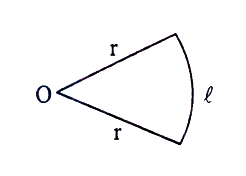
(C) Let $r$ be the radius and $\ell$ be the arc length of the circular sector as shown in the figure. The perimeter of the sector is given by $P = 2r + \ell = 20 \ m$.
Thus,$\ell = 20 - 2r$.
The area $A$ of the circular sector is given by $A = \frac{1}{2} \ell r$.
Substituting the value of $\ell$,we get $A = \frac{1}{2}(20 - 2r)r = 10r - r^2$.
To find the maximum area,we differentiate $A$ with respect to $r$:
$\frac{dA}{dr} = 10 - 2r$.
Setting $\frac{dA}{dr} = 0$,we get $10 - 2r = 0$,which implies $r = 5 \ m$.
To verify the maximum,we find the second derivative: $\frac{d^2A}{dr^2} = -2$.
Since $\frac{d^2A}{dr^2} < 0$,the area is maximum at $r = 5 \ m$.
Thus,$\ell = 20 - 2r$.
The area $A$ of the circular sector is given by $A = \frac{1}{2} \ell r$.
Substituting the value of $\ell$,we get $A = \frac{1}{2}(20 - 2r)r = 10r - r^2$.
To find the maximum area,we differentiate $A$ with respect to $r$:
$\frac{dA}{dr} = 10 - 2r$.
Setting $\frac{dA}{dr} = 0$,we get $10 - 2r = 0$,which implies $r = 5 \ m$.
To verify the maximum,we find the second derivative: $\frac{d^2A}{dr^2} = -2$.
Since $\frac{d^2A}{dr^2} < 0$,the area is maximum at $r = 5 \ m$.
0 likes
View Solution540
EasyMCQ
If rectangles are inscribed in a circle of radius $r$ units,then the dimensions of the rectangle which has maximum area are:
A
$2 r$ units,$r$ units
B
$2 r$ units,$\sqrt{2} r$ units
C
$r$ units,$\sqrt{2} r$ units
D
$\sqrt{2} r$ units,$\sqrt{2} r$ units
Solution
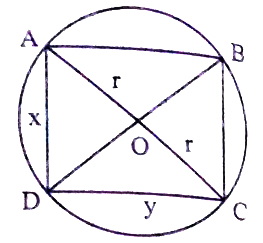
(D) Let $ABCD$ be the rectangle inscribed in a circle of radius $r$.
Since the rectangle is inscribed in the circle,its diagonal is the diameter of the circle.
$\Rightarrow AC = BD = 2r = \text{diameter}$.
Let $x$ and $y$ be the length and breadth of the rectangle.
By Pythagoras theorem,$x^{2} + y^{2} = (2r)^{2} = 4r^{2}$.
$\Rightarrow y = \sqrt{4r^{2} - x^{2}}$.
Now,the area of the rectangle $A = xy = x\sqrt{4r^{2} - x^{2}}$.
To find the maximum area,differentiate $A$ with respect to $x$:
$\frac{dA}{dx} = \sqrt{4r^{2} - x^{2}} + x \cdot \frac{1}{2\sqrt{4r^{2} - x^{2}}} \cdot (-2x) = \sqrt{4r^{2} - x^{2}} - \frac{x^{2}}{\sqrt{4r^{2} - x^{2}}} = \frac{4r^{2} - 2x^{2}}{\sqrt{4r^{2} - x^{2}}}$.
For maximum area,set $\frac{dA}{dx} = 0$:
$4r^{2} - 2x^{2} = 0 \Rightarrow x^{2} = 2r^{2} \Rightarrow x = \sqrt{2}r$.
Substituting $x = \sqrt{2}r$ in the expression for $y$:
$y = \sqrt{4r^{2} - (\sqrt{2}r)^{2}} = \sqrt{4r^{2} - 2r^{2}} = \sqrt{2r^{2}} = \sqrt{2}r$.
Thus,the dimensions are $\sqrt{2}r$ units and $\sqrt{2}r$ units.
Since the rectangle is inscribed in the circle,its diagonal is the diameter of the circle.
$\Rightarrow AC = BD = 2r = \text{diameter}$.
Let $x$ and $y$ be the length and breadth of the rectangle.
By Pythagoras theorem,$x^{2} + y^{2} = (2r)^{2} = 4r^{2}$.
$\Rightarrow y = \sqrt{4r^{2} - x^{2}}$.
Now,the area of the rectangle $A = xy = x\sqrt{4r^{2} - x^{2}}$.
To find the maximum area,differentiate $A$ with respect to $x$:
$\frac{dA}{dx} = \sqrt{4r^{2} - x^{2}} + x \cdot \frac{1}{2\sqrt{4r^{2} - x^{2}}} \cdot (-2x) = \sqrt{4r^{2} - x^{2}} - \frac{x^{2}}{\sqrt{4r^{2} - x^{2}}} = \frac{4r^{2} - 2x^{2}}{\sqrt{4r^{2} - x^{2}}}$.
For maximum area,set $\frac{dA}{dx} = 0$:
$4r^{2} - 2x^{2} = 0 \Rightarrow x^{2} = 2r^{2} \Rightarrow x = \sqrt{2}r$.
Substituting $x = \sqrt{2}r$ in the expression for $y$:
$y = \sqrt{4r^{2} - (\sqrt{2}r)^{2}} = \sqrt{4r^{2} - 2r^{2}} = \sqrt{2r^{2}} = \sqrt{2}r$.
Thus,the dimensions are $\sqrt{2}r$ units and $\sqrt{2}r$ units.
0 likes
View Solution541
EasyMCQ
The maximum volume of a right circular cylinder if the sum of its radius and height is $6 \text{ m}$ is: (in $\pi \text{ m}^3$)
A
$16$
B
$32$
C
$4$
D
$64$
Solution
(B) Let the radius of the cylinder be $r$ and the height be $h$. Given $r + h = 6$, so $h = 6 - r$.
The volume $V$ of the cylinder is given by $V = \pi r^2 h$.
Substituting $h$, we get $V(r) = \pi r^2 (6 - r) = \pi (6r^2 - r^3)$.
To find the maximum volume, we differentiate $V$ with respect to $r$ and set it to zero:
$\frac{dV}{dr} = \pi (12r - 3r^2) = 0$.
$3r(4 - r) = 0$, which gives $r = 0$ (not possible) or $r = 4$.
For $r = 4$, $h = 6 - 4 = 2$.
Checking the second derivative: $\frac{d^2V}{dr^2} = \pi (12 - 6r)$. At $r = 4$, $\frac{d^2V}{dr^2} = \pi (12 - 24) = -12\pi < 0$, so the volume is maximum at $r = 4$.
The maximum volume is $V = \pi (4)^2 (2) = 32\pi \text{ m}^3$.
The volume $V$ of the cylinder is given by $V = \pi r^2 h$.
Substituting $h$, we get $V(r) = \pi r^2 (6 - r) = \pi (6r^2 - r^3)$.
To find the maximum volume, we differentiate $V$ with respect to $r$ and set it to zero:
$\frac{dV}{dr} = \pi (12r - 3r^2) = 0$.
$3r(4 - r) = 0$, which gives $r = 0$ (not possible) or $r = 4$.
For $r = 4$, $h = 6 - 4 = 2$.
Checking the second derivative: $\frac{d^2V}{dr^2} = \pi (12 - 6r)$. At $r = 4$, $\frac{d^2V}{dr^2} = \pi (12 - 24) = -12\pi < 0$, so the volume is maximum at $r = 4$.
The maximum volume is $V = \pi (4)^2 (2) = 32\pi \text{ m}^3$.
0 likes
View Solution542
MediumMCQ
If $P$ is a point on the segment $AB$ of length $12 \text{ cm}$,then the position of $P$ for $AP^{2} + BP^{2}$ to be minimum is such that
A
$P$ divides $AB$ in the ratio $2:3$ internally
B
$P$ divides $AB$ in the ratio $4:3$ internally
C
$P$ is the midpoint of segment $AB$
D
$P$ divides $BA$ in the ratio $2:1$ internally
Solution
(C) Let $d(AP) = x$. Then $d(BP) = 12 - x$.
Define the function $f(x) = AP^{2} + BP^{2} = x^{2} + (12 - x)^{2}$.
Expanding this,we get $f(x) = x^{2} + 144 - 24x + x^{2} = 2x^{2} - 24x + 144$.
To find the minimum,we calculate the first derivative: $f'(x) = 4x - 24$.
Setting $f'(x) = 0$,we get $4x = 24$,which implies $x = 6$.
Checking the second derivative,$f''(x) = 4$. Since $f''(x) > 0$,the function $f(x)$ attains a minimum at $x = 6$.
Since $x = 6$ is exactly half of the total length $12 \text{ cm}$,$P$ is the midpoint of segment $AB$.
Define the function $f(x) = AP^{2} + BP^{2} = x^{2} + (12 - x)^{2}$.
Expanding this,we get $f(x) = x^{2} + 144 - 24x + x^{2} = 2x^{2} - 24x + 144$.
To find the minimum,we calculate the first derivative: $f'(x) = 4x - 24$.
Setting $f'(x) = 0$,we get $4x = 24$,which implies $x = 6$.
Checking the second derivative,$f''(x) = 4$. Since $f''(x) > 0$,the function $f(x)$ attains a minimum at $x = 6$.
Since $x = 6$ is exactly half of the total length $12 \text{ cm}$,$P$ is the midpoint of segment $AB$.
0 likes
View Solution543
DifficultMCQ
If $f(x) = x + \frac{1}{x}$,$x \neq 0$,then the local maximum and minimum values of the function $f$ are respectively....
A
$-1$ and $1$
B
$-2$ and $2$
C
$2$ and $-2$
D
$1$ and $-1$
Solution
(B) Given $f(x) = x + \frac{1}{x}$,$x \neq 0$.
Differentiating with respect to $x$,we get $f'(x) = 1 - \frac{1}{x^2}$.
For local maxima or minima,we set $f'(x) = 0$.
$1 - \frac{1}{x^2} = 0 \Rightarrow x^2 = 1 \Rightarrow x = 1, -1$.
Now,we check the sign of $f'(x)$ around these points:
For $x < -1$,$f'(x) > 0$. For $-1 < x < 0$,$f'(x) < 0$. Since $f'(x)$ changes from positive to negative at $x = -1$,$x = -1$ is a point of local maxima.
The local maximum value is $f(-1) = -1 + \frac{1}{-1} = -2$.
For $0 < x < 1$,$f'(x) < 0$. For $x > 1$,$f'(x) > 0$. Since $f'(x)$ changes from negative to positive at $x = 1$,$x = 1$ is a point of local minima.
The local minimum value is $f(1) = 1 + \frac{1}{1} = 2$.
Thus,the local maximum value is $-2$ and the local minimum value is $2$.
Differentiating with respect to $x$,we get $f'(x) = 1 - \frac{1}{x^2}$.
For local maxima or minima,we set $f'(x) = 0$.
$1 - \frac{1}{x^2} = 0 \Rightarrow x^2 = 1 \Rightarrow x = 1, -1$.
Now,we check the sign of $f'(x)$ around these points:
For $x < -1$,$f'(x) > 0$. For $-1 < x < 0$,$f'(x) < 0$. Since $f'(x)$ changes from positive to negative at $x = -1$,$x = -1$ is a point of local maxima.
The local maximum value is $f(-1) = -1 + \frac{1}{-1} = -2$.
For $0 < x < 1$,$f'(x) < 0$. For $x > 1$,$f'(x) > 0$. Since $f'(x)$ changes from negative to positive at $x = 1$,$x = 1$ is a point of local minima.
The local minimum value is $f(1) = 1 + \frac{1}{1} = 2$.
Thus,the local maximum value is $-2$ and the local minimum value is $2$.
0 likes
View Solution544
MediumMCQ
If $f(x)=3x^3-9x^2-27x+15$,then the maximum value of $f(x)$ is $.....$
A
$-66$
B
$30$
C
$-30$
D
$66$
Solution
(B) Given the function $f(x) = 3x^3 - 9x^2 - 27x + 15$.
To find the critical points,we calculate the first derivative: $f'(x) = 9x^2 - 18x - 27$.
Setting $f'(x) = 0$,we get $9(x^2 - 2x - 3) = 0$,which factors to $9(x - 3)(x + 1) = 0$.
Thus,the critical points are $x = 3$ and $x = -1$.
To determine the nature of these points,we find the second derivative: $f''(x) = 18x - 18$.
At $x = 3$,$f''(3) = 18(3) - 18 = 36 > 0$,so $f(x)$ has a local minimum at $x = 3$.
At $x = -1$,$f''(-1) = 18(-1) - 18 = -36 < 0$,so $f(x)$ has a local maximum at $x = -1$.
The maximum value is $f(-1) = 3(-1)^3 - 9(-1)^2 - 27(-1) + 15 = -3 - 9 + 27 + 15 = 30$.
To find the critical points,we calculate the first derivative: $f'(x) = 9x^2 - 18x - 27$.
Setting $f'(x) = 0$,we get $9(x^2 - 2x - 3) = 0$,which factors to $9(x - 3)(x + 1) = 0$.
Thus,the critical points are $x = 3$ and $x = -1$.
To determine the nature of these points,we find the second derivative: $f''(x) = 18x - 18$.
At $x = 3$,$f''(3) = 18(3) - 18 = 36 > 0$,so $f(x)$ has a local minimum at $x = 3$.
At $x = -1$,$f''(-1) = 18(-1) - 18 = -36 < 0$,so $f(x)$ has a local maximum at $x = -1$.
The maximum value is $f(-1) = 3(-1)^3 - 9(-1)^2 - 27(-1) + 15 = -3 - 9 + 27 + 15 = 30$.
0 likes
View Solution545
EasyMCQ
The maximum value of $f(x) = \frac{\log x}{x}$ $(x > 0, x \neq 1)$ is
A
$e$
B
$\frac{1}{e}$
C
$e^2$
D
$\frac{1}{e^2}$
Solution
(B) Given function is $f(x) = \frac{\log x}{x}$.
To find the maximum value,we find the derivative $f'(x)$ using the quotient rule:
$f'(x) = \frac{x \cdot \frac{d}{dx}(\log x) - \log x \cdot \frac{d}{dx}(x)}{x^2} = \frac{x \cdot \frac{1}{x} - \log x \cdot 1}{x^2} = \frac{1 - \log x}{x^2}$.
For critical points,set $f'(x) = 0$:
$\frac{1 - \log x}{x^2} = 0 \Rightarrow 1 - \log x = 0 \Rightarrow \log x = 1 \Rightarrow x = e$.
To confirm this is a maximum,we check the second derivative or the sign change of $f'(x)$. Since $f'(x) > 0$ for $x < e$ and $f'(x) < 0$ for $x > e$,$x = e$ is a point of local maximum.
The maximum value is $f(e) = \frac{\log e}{e} = \frac{1}{e}$.
To find the maximum value,we find the derivative $f'(x)$ using the quotient rule:
$f'(x) = \frac{x \cdot \frac{d}{dx}(\log x) - \log x \cdot \frac{d}{dx}(x)}{x^2} = \frac{x \cdot \frac{1}{x} - \log x \cdot 1}{x^2} = \frac{1 - \log x}{x^2}$.
For critical points,set $f'(x) = 0$:
$\frac{1 - \log x}{x^2} = 0 \Rightarrow 1 - \log x = 0 \Rightarrow \log x = 1 \Rightarrow x = e$.
To confirm this is a maximum,we check the second derivative or the sign change of $f'(x)$. Since $f'(x) > 0$ for $x < e$ and $f'(x) < 0$ for $x > e$,$x = e$ is a point of local maximum.
The maximum value is $f(e) = \frac{\log e}{e} = \frac{1}{e}$.
0 likes
View Solution546
MediumMCQ
The maximum value of the function $f(x) = x^{3} - 12x^{2} + 36x + 17$ in the interval $[1, 10]$ is:
A
$17$
B
$177$
C
$77$
D
None of these
Solution
(B) Let $f(x) = x^{3} - 12x^{2} + 36x + 17$.
Find the derivative: $f'(x) = 3x^{2} - 24x + 36$.
Set $f'(x) = 0$ to find critical points: $3(x^{2} - 8x + 12) = 0 \Rightarrow 3(x - 2)(x - 6) = 0$.
The critical points are $x = 2$ and $x = 6$.
Evaluate the function at the critical points and the interval endpoints $[1, 10]$:
$f(1) = (1)^{3} - 12(1)^{2} + 36(1) + 17 = 1 - 12 + 36 + 17 = 42$.
$f(2) = (2)^{3} - 12(2)^{2} + 36(2) + 17 = 8 - 48 + 72 + 17 = 49$.
$f(6) = (6)^{3} - 12(6)^{2} + 36(6) + 17 = 216 - 432 + 216 + 17 = 17$.
$f(10) = (10)^{3} - 12(10)^{2} + 36(10) + 17 = 1000 - 1200 + 360 + 17 = 177$.
Comparing these values,the maximum value is $177$.
Find the derivative: $f'(x) = 3x^{2} - 24x + 36$.
Set $f'(x) = 0$ to find critical points: $3(x^{2} - 8x + 12) = 0 \Rightarrow 3(x - 2)(x - 6) = 0$.
The critical points are $x = 2$ and $x = 6$.
Evaluate the function at the critical points and the interval endpoints $[1, 10]$:
$f(1) = (1)^{3} - 12(1)^{2} + 36(1) + 17 = 1 - 12 + 36 + 17 = 42$.
$f(2) = (2)^{3} - 12(2)^{2} + 36(2) + 17 = 8 - 48 + 72 + 17 = 49$.
$f(6) = (6)^{3} - 12(6)^{2} + 36(6) + 17 = 216 - 432 + 216 + 17 = 17$.
$f(10) = (10)^{3} - 12(10)^{2} + 36(10) + 17 = 1000 - 1200 + 360 + 17 = 177$.
Comparing these values,the maximum value is $177$.
0 likes
View SolutionApplications of Derivatives — Maxima and Minima · Frequently Asked Questions
1Are these Applications of Derivatives questions useful for JEE and NEET?
Yes. All questions in this section are mapped to JEE Main and NEET exam patterns. Previous year questions from JEE Main, NEET, GUJCET and state-level exams are included with full solutions.
2Can I switch to Hindi or Gujarati for these questions?
Yes. Use the language tabs in the hero section or the sidebar to view the same questions and solutions in English, Hindi or Gujarati.
3How do I generate a question paper from this subtopic?
Use the Vedclass Exam Paper Generator — select the chapter and subtopic, set difficulty, and generate Sets A, B, C, D automatically. First 3 chapters of every subject are free.
Vedclass Products
For Students
Vedclass Test Series
Mock tests in real JEE/NEET style with performance analysis. 5-day free trial.
Start Free TrialFor Teachers
Exam Paper Generator
Generate Set A/B/C/D papers from this chapter in 2 minutes. 3 chapters free.
Try FreeFor Institutes
Online Exam Module
Live online exams with unlimited students, 360° analytics & white-label branding.
See DemoFor Teachers & Institutes
Generate a Applications of Derivatives Exam Paper in 2 Minutes
Select subtopic & difficulty — Sets A, B, C, D auto-generated with No Repeat logic.
First 3 chapters of every subject are free — no payment required.