
A English
Maxima and Minima Questions in English
Class 12 Mathematics · Applications of Derivatives · Maxima and Minima
760+
Questions
English
Language
100%
With Solutions
Showing 49 of 760 questions in English
551
MediumMCQ
On the interval $[0,1]$,the function $f(x) = x^{25}(1-x)^{75}$ takes its maximum value at the point
A
$0$
B
$1/4$
C
$1/2$
D
$1/3$
Solution
(B) Given,$f(x) = x^{25}(1-x)^{75}$.
To find the maximum value,we calculate the derivative $f'(x)$ using the product rule:
$f'(x) = 25x^{24}(1-x)^{75} - 75x^{25}(1-x)^{74}$.
Factor out the common terms:
$f'(x) = 25x^{24}(1-x)^{74} [ (1-x) - 3x ]$.
$f'(x) = 25x^{24}(1-x)^{74} (1-4x)$.
Setting $f'(x) = 0$ gives critical points $x = 0, 1, 1/4$.
For $x \in (0, 1/4)$,$f'(x) > 0$ (function is increasing).
For $x \in (1/4, 1)$,$f'(x) < 0$ (function is decreasing).
Since the derivative changes sign from positive to negative at $x = 1/4$,the function attains its maximum value at $x = 1/4$.
To find the maximum value,we calculate the derivative $f'(x)$ using the product rule:
$f'(x) = 25x^{24}(1-x)^{75} - 75x^{25}(1-x)^{74}$.
Factor out the common terms:
$f'(x) = 25x^{24}(1-x)^{74} [ (1-x) - 3x ]$.
$f'(x) = 25x^{24}(1-x)^{74} (1-4x)$.
Setting $f'(x) = 0$ gives critical points $x = 0, 1, 1/4$.
For $x \in (0, 1/4)$,$f'(x) > 0$ (function is increasing).
For $x \in (1/4, 1)$,$f'(x) < 0$ (function is decreasing).
Since the derivative changes sign from positive to negative at $x = 1/4$,the function attains its maximum value at $x = 1/4$.
0 likes
View Solution552
MediumMCQ
If the function $f(x)=2 x^{3}-9 a x^{2}+12 a^{2} x+1$ attains its maximum and minimum at $p$ and $q$ respectively such that $p^{2}=q$,then $a$ equals
A
$0$
B
$1$
C
$2$
D
None of these
Solution
(C) Given,$f(x)=2 x^{3}-9 a x^{2}+12 a^{2} x+1$. The critical points are found by setting $f^{\prime}(x)=0$.
$f^{\prime}(x) = 6x^{2} - 18ax + 12a^{2} = 6(x^{2} - 3ax + 2a^{2}) = 6(x-a)(x-2a) = 0$.
So,the critical points are $x=a$ and $x=2a$.
We find the second derivative $f^{\prime \prime}(x) = 12x - 18a$.
For a maximum at $p$,$f^{\prime \prime}(p) < 0 \Rightarrow 12p - 18a < 0 \Rightarrow p < \frac{3}{2}a$.
For a minimum at $q$,$f^{\prime \prime}(q) > 0 \Rightarrow 12q - 18a > 0 \Rightarrow q > \frac{3}{2}a$.
Comparing the critical points $a$ and $2a$ with these conditions,we get $p=a$ and $q=2a$.
Given $p^{2}=q$,we substitute the values: $a^{2} = 2a$.
$a^{2} - 2a = 0 \Rightarrow a(a-2) = 0$.
Thus,$a=0$ or $a=2$.
If $a=0$,$f(x)=2x^{3}+1$,which is a strictly increasing function and has no local maxima or minima.
Therefore,$a=2$ is the only valid solution.
$f^{\prime}(x) = 6x^{2} - 18ax + 12a^{2} = 6(x^{2} - 3ax + 2a^{2}) = 6(x-a)(x-2a) = 0$.
So,the critical points are $x=a$ and $x=2a$.
We find the second derivative $f^{\prime \prime}(x) = 12x - 18a$.
For a maximum at $p$,$f^{\prime \prime}(p) < 0 \Rightarrow 12p - 18a < 0 \Rightarrow p < \frac{3}{2}a$.
For a minimum at $q$,$f^{\prime \prime}(q) > 0 \Rightarrow 12q - 18a > 0 \Rightarrow q > \frac{3}{2}a$.
Comparing the critical points $a$ and $2a$ with these conditions,we get $p=a$ and $q=2a$.
Given $p^{2}=q$,we substitute the values: $a^{2} = 2a$.
$a^{2} - 2a = 0 \Rightarrow a(a-2) = 0$.
Thus,$a=0$ or $a=2$.
If $a=0$,$f(x)=2x^{3}+1$,which is a strictly increasing function and has no local maxima or minima.
Therefore,$a=2$ is the only valid solution.
0 likes
View Solution553
MediumMCQ
If the function $f$ is given by $f(x)=x^3-3(a-2)x^2+3ax+7$,for some $a \in R$,is increasing in $(0,1]$ and decreasing in $[1,5)$,then a root of the equation $\frac{f(x)-14}{(x-1)^2}=0$ $(x \neq 1)$ is
A
$-7$
B
$6$
C
$7$
D
$5$
Solution
(C) Given $f(x)=x^3-3(a-2)x^2+3ax+7$.
Since $f(x)$ is increasing in $(0,1]$ and decreasing in $[1,5)$,$f(x)$ must have a local maximum at $x=1$.
Thus,$f'(1)=0$.
$f'(x)=3x^2-6(a-2)x+3a$.
Substituting $x=1$: $3(1)^2-6(a-2)(1)+3a=0$.
$3-6a+12+3a=0 \Rightarrow -3a+15=0 \Rightarrow a=5$.
Now,substitute $a=5$ into $f(x)$: $f(x)=x^3-3(5-2)x^2+3(5)x+7 = x^3-9x^2+15x+7$.
We need to solve $\frac{f(x)-14}{(x-1)^2}=0$.
$f(x)-14 = x^3-9x^2+15x+7-14 = x^3-9x^2+15x-7$.
By synthetic division or polynomial division,$x^3-9x^2+15x-7 = (x-1)^2(x-7)$.
So,$\frac{(x-1)^2(x-7)}{(x-1)^2} = 0 \Rightarrow x-7=0 \Rightarrow x=7$.
Since $f(x)$ is increasing in $(0,1]$ and decreasing in $[1,5)$,$f(x)$ must have a local maximum at $x=1$.
Thus,$f'(1)=0$.
$f'(x)=3x^2-6(a-2)x+3a$.
Substituting $x=1$: $3(1)^2-6(a-2)(1)+3a=0$.
$3-6a+12+3a=0 \Rightarrow -3a+15=0 \Rightarrow a=5$.
Now,substitute $a=5$ into $f(x)$: $f(x)=x^3-3(5-2)x^2+3(5)x+7 = x^3-9x^2+15x+7$.
We need to solve $\frac{f(x)-14}{(x-1)^2}=0$.
$f(x)-14 = x^3-9x^2+15x+7-14 = x^3-9x^2+15x-7$.
By synthetic division or polynomial division,$x^3-9x^2+15x-7 = (x-1)^2(x-7)$.
So,$\frac{(x-1)^2(x-7)}{(x-1)^2} = 0 \Rightarrow x-7=0 \Rightarrow x=7$.
0 likes
View Solution554
MediumMCQ
Two positive numbers $x$ and $y$ are such that $(x+y)=60$ and $x y^3$ is maximum. Then the numbers $x$ and $y$ are respectively:
A
$15, 45$
B
$30, 30$
C
$20, 40$
D
$40, 20$
Solution
(A) Given that $x+y=60$,so $x=60-y$.
Let $f(y) = x y^3 = (60-y) y^3 = 60 y^3 - y^4$.
To find the maximum,we differentiate $f(y)$ with respect to $y$:
$f'(y) = \frac{d}{dy}(60 y^3 - y^4) = 180 y^2 - 4 y^3$.
Setting $f'(y) = 0$ for critical points:
$4 y^2(45 - y) = 0$.
Since $y$ is a positive number,$y=45$.
Now,we check the second derivative:
$f''(y) = 360 y - 12 y^2$.
At $y=45$,$f''(45) = 360(45) - 12(45)^2 = 45(360 - 540) = 45(-180) < 0$.
Since the second derivative is negative,the function is maximum at $y=45$.
Then $x = 60 - 45 = 15$.
Thus,the numbers are $x=15$ and $y=45$.
Let $f(y) = x y^3 = (60-y) y^3 = 60 y^3 - y^4$.
To find the maximum,we differentiate $f(y)$ with respect to $y$:
$f'(y) = \frac{d}{dy}(60 y^3 - y^4) = 180 y^2 - 4 y^3$.
Setting $f'(y) = 0$ for critical points:
$4 y^2(45 - y) = 0$.
Since $y$ is a positive number,$y=45$.
Now,we check the second derivative:
$f''(y) = 360 y - 12 y^2$.
At $y=45$,$f''(45) = 360(45) - 12(45)^2 = 45(360 - 540) = 45(-180) < 0$.
Since the second derivative is negative,the function is maximum at $y=45$.
Then $x = 60 - 45 = 15$.
Thus,the numbers are $x=15$ and $y=45$.

0 likes
View Solution555
DifficultMCQ
For all real $x$,the minimum value of $\frac{1-x+x^{2}}{1+x+x^{2}}$ is
A
$0$
B
$1/3$
C
$1$
D
$3$
Solution
(B) Let $y = \frac{1-x+x^{2}}{1+x+x^{2}}$.
We can rewrite the expression as $y = \frac{(x^{2}+x+1) - 2x}{x^{2}+x+1} = 1 - \frac{2x}{x^{2}+x+1}$.
To find the minimum value of $y$,we need to maximize the term $\frac{2x}{x^{2}+x+1}$.
Let $f(x) = \frac{x}{x^{2}+x+1}$.
Taking the derivative with respect to $x$ and setting it to $0$:
$f'(x) = \frac{(x^{2}+x+1)(1) - x(2x+1)}{(x^{2}+x+1)^{2}} = \frac{x^{2}+x+1-2x^{2}-x}{(x^{2}+x+1)^{2}} = \frac{1-x^{2}}{(x^{2}+x+1)^{2}}$.
Setting $f'(x) = 0$ gives $1-x^{2} = 0$,so $x = 1$ or $x = -1$.
For $x = 1$,$f(1) = \frac{1}{1+1+1} = \frac{1}{3}$.
For $x = -1$,$f(-1) = \frac{-1}{1-1+1} = -1$.
Since we want to minimize $y = 1 - 2f(x)$,we choose the maximum value of $f(x)$,which is $1/3$.
Thus,the minimum value of $y$ is $1 - 2(1/3) = 1 - 2/3 = 1/3$.
We can rewrite the expression as $y = \frac{(x^{2}+x+1) - 2x}{x^{2}+x+1} = 1 - \frac{2x}{x^{2}+x+1}$.
To find the minimum value of $y$,we need to maximize the term $\frac{2x}{x^{2}+x+1}$.
Let $f(x) = \frac{x}{x^{2}+x+1}$.
Taking the derivative with respect to $x$ and setting it to $0$:
$f'(x) = \frac{(x^{2}+x+1)(1) - x(2x+1)}{(x^{2}+x+1)^{2}} = \frac{x^{2}+x+1-2x^{2}-x}{(x^{2}+x+1)^{2}} = \frac{1-x^{2}}{(x^{2}+x+1)^{2}}$.
Setting $f'(x) = 0$ gives $1-x^{2} = 0$,so $x = 1$ or $x = -1$.
For $x = 1$,$f(1) = \frac{1}{1+1+1} = \frac{1}{3}$.
For $x = -1$,$f(-1) = \frac{-1}{1-1+1} = -1$.
Since we want to minimize $y = 1 - 2f(x)$,we choose the maximum value of $f(x)$,which is $1/3$.
Thus,the minimum value of $y$ is $1 - 2(1/3) = 1 - 2/3 = 1/3$.
0 likes
View Solution556
EasyMCQ
If $y=a \log x+b x^2+x$ has its extreme value at $x=-1$ and $x=2$,then the value of $a+b$ is
A
$\frac{3}{2}$
B
$\frac{1}{2}$
C
$\frac{5}{2}$
D
$\frac{3}{4}$
Solution
(A) Given the function $y=a \log x+b x^2+x$.
Find the derivative with respect to $x$: $\frac{d y}{d x}=\frac{a}{x}+2 b x+1$.
Since the function has extreme values at $x=-1$ and $x=2$,the derivative must be zero at these points.
At $x=-1$: $\frac{a}{-1}+2 b(-1)+1=0 \Rightarrow -a-2 b+1=0 \Rightarrow a+2 b=1$ (Equation $i$).
At $x=2$: $\frac{a}{2}+2 b(2)+1=0 \Rightarrow \frac{a}{2}+4 b+1=0 \Rightarrow a+8 b=-2$ (Equation $ii$).
Subtracting Equation $i$ from Equation $ii$: $(a+8 b)-(a+2 b)=-2-1 \Rightarrow 6 b=-3 \Rightarrow b=-\frac{1}{2}$.
Substitute $b=-\frac{1}{2}$ into Equation $i$: $a+2(-\frac{1}{2})=1 \Rightarrow a-1=1 \Rightarrow a=2$.
Therefore,$a+b=2+(-\frac{1}{2})=\frac{3}{2}$.
Find the derivative with respect to $x$: $\frac{d y}{d x}=\frac{a}{x}+2 b x+1$.
Since the function has extreme values at $x=-1$ and $x=2$,the derivative must be zero at these points.
At $x=-1$: $\frac{a}{-1}+2 b(-1)+1=0 \Rightarrow -a-2 b+1=0 \Rightarrow a+2 b=1$ (Equation $i$).
At $x=2$: $\frac{a}{2}+2 b(2)+1=0 \Rightarrow \frac{a}{2}+4 b+1=0 \Rightarrow a+8 b=-2$ (Equation $ii$).
Subtracting Equation $i$ from Equation $ii$: $(a+8 b)-(a+2 b)=-2-1 \Rightarrow 6 b=-3 \Rightarrow b=-\frac{1}{2}$.
Substitute $b=-\frac{1}{2}$ into Equation $i$: $a+2(-\frac{1}{2})=1 \Rightarrow a-1=1 \Rightarrow a=2$.
Therefore,$a+b=2+(-\frac{1}{2})=\frac{3}{2}$.
0 likes
View Solution557
EasyMCQ
For all real $x$,the minimum value of $\frac{1-x+x^2}{1+x+x^2}$ is
A
$0$
B
$1$
C
$\frac{1}{3}$
D
$3$
Solution
(C) Let $f(x) = \frac{1-x+x^2}{1+x+x^2}$.
Using the quotient rule,$f'(x) = \frac{(1+x+x^2)(-1+2x) - (1-x+x^2)(1+2x)}{(1+x+x^2)^2}$.
Expanding the numerator: $(1+x+x^2)(-1+2x) = -1+2x-x+2x^2-x^2+2x^3 = 2x^3+x^2+x-1$.
$(1-x+x^2)(1+2x) = 1+2x-x-2x^2+x^2+2x^3 = 2x^3-x^2+x+1$.
Subtracting these: $(2x^3+x^2+x-1) - (2x^3-x^2+x+1) = 2x^2-2$.
Thus,$f'(x) = \frac{2x^2-2}{(1+x+x^2)^2}$.
Setting $f'(x) = 0$ gives $2x^2-2 = 0$,so $x^2 = 1$,which means $x = 1$ or $x = -1$.
Evaluating $f(x)$ at these points:
$f(1) = \frac{1-1+1}{1+1+1} = \frac{1}{3}$.
$f(-1) = \frac{1-(-1)+(-1)^2}{1+(-1)+(-1)^2} = \frac{1+1+1}{1-1+1} = \frac{3}{1} = 3$.
Therefore,the minimum value of $f(x)$ is $\frac{1}{3}$.
Using the quotient rule,$f'(x) = \frac{(1+x+x^2)(-1+2x) - (1-x+x^2)(1+2x)}{(1+x+x^2)^2}$.
Expanding the numerator: $(1+x+x^2)(-1+2x) = -1+2x-x+2x^2-x^2+2x^3 = 2x^3+x^2+x-1$.
$(1-x+x^2)(1+2x) = 1+2x-x-2x^2+x^2+2x^3 = 2x^3-x^2+x+1$.
Subtracting these: $(2x^3+x^2+x-1) - (2x^3-x^2+x+1) = 2x^2-2$.
Thus,$f'(x) = \frac{2x^2-2}{(1+x+x^2)^2}$.
Setting $f'(x) = 0$ gives $2x^2-2 = 0$,so $x^2 = 1$,which means $x = 1$ or $x = -1$.
Evaluating $f(x)$ at these points:
$f(1) = \frac{1-1+1}{1+1+1} = \frac{1}{3}$.
$f(-1) = \frac{1-(-1)+(-1)^2}{1+(-1)+(-1)^2} = \frac{1+1+1}{1-1+1} = \frac{3}{1} = 3$.
Therefore,the minimum value of $f(x)$ is $\frac{1}{3}$.
0 likes
View Solution558
DifficultMCQ
If the function $f(x) = x^3 - 3(a - 2)x^2 + 3ax + 7$,for some $a \in R$,is increasing in $(0, 1]$ and decreasing in $[1, 5)$,then a root of the equation $\frac{f(x) - 14}{(x - 1)^2} = 0$ $(x \neq 1)$ is
A
$-7$
B
$-14$
C
$7$
D
$14$
Solution
(C) Given $f(x) = x^3 - 3(a - 2)x^2 + 3ax + 7$.
The derivative is $f'(x) = 3x^2 - 6(a - 2)x + 3a$.
Since the function changes behavior at $x = 1$,we have $f'(1) = 0$.
$3(1)^2 - 6(a - 2)(1) + 3a = 0$
$3 - 6a + 12 + 3a = 0$
$-3a + 15 = 0 \Rightarrow a = 5$.
Substituting $a = 5$ into $f(x)$,we get $f(x) = x^3 - 3(5 - 2)x^2 + 3(5)x + 7 = x^3 - 9x^2 + 15x + 7$.
Now,solve $\frac{f(x) - 14}{(x - 1)^2} = 0$ for $x \neq 1$.
$f(x) - 14 = 0 \Rightarrow x^3 - 9x^2 + 15x + 7 - 14 = 0$.
$x^3 - 9x^2 + 15x - 7 = 0$.
Since $x = 1$ is a root,we divide by $(x - 1)^2$:
$(x - 1)^2(x - 7) = 0$.
The roots are $x = 1$ and $x = 7$.
Since $x \neq 1$,the root is $x = 7$.
The derivative is $f'(x) = 3x^2 - 6(a - 2)x + 3a$.
Since the function changes behavior at $x = 1$,we have $f'(1) = 0$.
$3(1)^2 - 6(a - 2)(1) + 3a = 0$
$3 - 6a + 12 + 3a = 0$
$-3a + 15 = 0 \Rightarrow a = 5$.
Substituting $a = 5$ into $f(x)$,we get $f(x) = x^3 - 3(5 - 2)x^2 + 3(5)x + 7 = x^3 - 9x^2 + 15x + 7$.
Now,solve $\frac{f(x) - 14}{(x - 1)^2} = 0$ for $x \neq 1$.
$f(x) - 14 = 0 \Rightarrow x^3 - 9x^2 + 15x + 7 - 14 = 0$.
$x^3 - 9x^2 + 15x - 7 = 0$.
Since $x = 1$ is a root,we divide by $(x - 1)^2$:
$(x - 1)^2(x - 7) = 0$.
The roots are $x = 1$ and $x = 7$.
Since $x \neq 1$,the root is $x = 7$.
0 likes
View Solution559
MediumMCQ
If $a$ and $b$ are positive numbers such that $a > b$,then the minimum value of $a \sec \theta - b \tan \theta$ for $0 < \theta < \frac{\pi}{2}$ is
A
$\frac{1}{\sqrt{a^2 - b^2}}$
B
$\frac{1}{\sqrt{a^2 + b^2}}$
C
$\sqrt{a^2 + b^2}$
D
$\sqrt{a^2 - b^2}$
Solution
(D) Let $f(\theta) = a \sec \theta - b \tan \theta$.
Then $f'(\theta) = a \sec \theta \tan \theta - b \sec^2 \theta = \sec \theta (a \tan \theta - b \sec \theta)$.
Setting $f'(\theta) = 0$,we get $a \tan \theta - b \sec \theta = 0$ (since $\sec \theta \neq 0$ for $0 < \theta < \frac{\pi}{2}$).
This implies $a \sin \theta = b$,or $\sin \theta = \frac{b}{a}$.
Since $\sin \theta = \frac{b}{a}$,we have $\cos \theta = \sqrt{1 - \frac{b^2}{a^2}} = \frac{\sqrt{a^2 - b^2}}{a}$.
Thus,$\sec \theta = \frac{a}{\sqrt{a^2 - b^2}}$ and $\tan \theta = \frac{b}{\sqrt{a^2 - b^2}}$.
The second derivative $f''(\theta) = a \sec \theta (1 + 2 \tan^2 \theta) > 0$,confirming a minimum at $\sin \theta = \frac{b}{a}$.
The minimum value is $f(\theta) = a \left( \frac{a}{\sqrt{a^2 - b^2}} \right) - b \left( \frac{b}{\sqrt{a^2 - b^2}} \right) = \frac{a^2 - b^2}{\sqrt{a^2 - b^2}} = \sqrt{a^2 - b^2}$.
Then $f'(\theta) = a \sec \theta \tan \theta - b \sec^2 \theta = \sec \theta (a \tan \theta - b \sec \theta)$.
Setting $f'(\theta) = 0$,we get $a \tan \theta - b \sec \theta = 0$ (since $\sec \theta \neq 0$ for $0 < \theta < \frac{\pi}{2}$).
This implies $a \sin \theta = b$,or $\sin \theta = \frac{b}{a}$.
Since $\sin \theta = \frac{b}{a}$,we have $\cos \theta = \sqrt{1 - \frac{b^2}{a^2}} = \frac{\sqrt{a^2 - b^2}}{a}$.
Thus,$\sec \theta = \frac{a}{\sqrt{a^2 - b^2}}$ and $\tan \theta = \frac{b}{\sqrt{a^2 - b^2}}$.
The second derivative $f''(\theta) = a \sec \theta (1 + 2 \tan^2 \theta) > 0$,confirming a minimum at $\sin \theta = \frac{b}{a}$.
The minimum value is $f(\theta) = a \left( \frac{a}{\sqrt{a^2 - b^2}} \right) - b \left( \frac{b}{\sqrt{a^2 - b^2}} \right) = \frac{a^2 - b^2}{\sqrt{a^2 - b^2}} = \sqrt{a^2 - b^2}$.
0 likes
View Solution560
DifficultMCQ
If $x_0$ is the point of local minima of $f(x) = \bar{a} \cdot (\bar{b} \times \bar{c})$ where $\bar{a} = x \hat{i} - 2 \hat{j} + 3 \hat{k}$,$\bar{b} = -2 \hat{i} + x \hat{j} - \hat{k}$,$\bar{c} = 7 \hat{i} - 2 \hat{j} + x \hat{k}$,then the value of $\bar{a} \cdot \bar{b}$ at $x = x_0$ is
A
$-3$
B
$-15$
C
$-12$
D
$-9$
Solution
(B) $f(x) = \bar{a} \cdot (\bar{b} \times \bar{c}) = \begin{vmatrix} x & -2 & 3 \\ -2 & x & -1 \\ 7 & -2 & x \end{vmatrix}$
Expanding the determinant:
$f(x) = x(x^2 - 2) + 2(-2x + 7) + 3(4 - 7x)$
$f(x) = x^3 - 2x - 4x + 14 + 12 - 21x$
$f(x) = x^3 - 27x + 26$
To find local minima,we find $f'(x) = 0$:
$f'(x) = 3x^2 - 27 = 0$
$3(x^2 - 9) = 0 \Rightarrow x = \pm 3$
Using the second derivative test:
$f''(x) = 6x$
$f''(3) = 18 > 0$,so $x_0 = 3$ is the point of local minima.
At $x = 3$:
$\bar{a} = 3 \hat{i} - 2 \hat{j} + 3 \hat{k}$
$\bar{b} = -2 \hat{i} + 3 \hat{j} - \hat{k}$
$\bar{a} \cdot \bar{b} = (3)(-2) + (-2)(3) + (3)(-1)$
$\bar{a} \cdot \bar{b} = -6 - 6 - 3 = -15$
Expanding the determinant:
$f(x) = x(x^2 - 2) + 2(-2x + 7) + 3(4 - 7x)$
$f(x) = x^3 - 2x - 4x + 14 + 12 - 21x$
$f(x) = x^3 - 27x + 26$
To find local minima,we find $f'(x) = 0$:
$f'(x) = 3x^2 - 27 = 0$
$3(x^2 - 9) = 0 \Rightarrow x = \pm 3$
Using the second derivative test:
$f''(x) = 6x$
$f''(3) = 18 > 0$,so $x_0 = 3$ is the point of local minima.
At $x = 3$:
$\bar{a} = 3 \hat{i} - 2 \hat{j} + 3 \hat{k}$
$\bar{b} = -2 \hat{i} + 3 \hat{j} - \hat{k}$
$\bar{a} \cdot \bar{b} = (3)(-2) + (-2)(3) + (3)(-1)$
$\bar{a} \cdot \bar{b} = -6 - 6 - 3 = -15$
0 likes
View Solution561
EasyMCQ
Let $x_0$ be the point of local minima of $f(x) = \overline{a} \cdot (\overline{b} \times \overline{c})$ where $\overline{a} = x \hat{i} - 2 \hat{j} + 3 \hat{k}$,$\overline{b} = -2 \hat{i} + x \hat{j} - \hat{k}$,and $\overline{c} = 7 \hat{i} - 2 \hat{j} + x \hat{k}$. Then the value of $\overline{a} \cdot \overline{b}$ at $x = x_0$ is:
A
$15$
B
$-15$
C
$12$
D
$-12$
Solution
(B) The function $f(x)$ is defined as the scalar triple product of vectors $\overline{a}, \overline{b}, \text{ and } \overline{c}$:
$f(x) = \begin{vmatrix} x & -2 & 3 \\ -2 & x & -1 \\ 7 & -2 & x \end{vmatrix}$
Expanding the determinant along the first row:
$f(x) = x(x^2 - 2) - (-2)(-2x + 7) + 3(4 - 7x)$
$f(x) = x^3 - 2x + 4x - 14 + 12 - 21x$
$f(x) = x^3 - 19x - 2$ (Note: Correcting the expansion: $x(x^2-2) + 2(-2x+7) + 3(4-7x) = x^3 - 2x - 4x + 14 + 12 - 21x = x^3 - 27x + 26$)
To find the local minima,we find the critical points by setting $f'(x) = 0$:
$f'(x) = 3x^2 - 27 = 0$
$3(x^2 - 9) = 0 \Rightarrow x = \pm 3$
Using the second derivative test,$f''(x) = 6x$:
At $x = 3$,$f''(3) = 18 > 0$,so $x_0 = 3$ is the point of local minima.
At $x = 3$,$\overline{a} = 3 \hat{i} - 2 \hat{j} + 3 \hat{k}$ and $\overline{b} = -2 \hat{i} + 3 \hat{j} - \hat{k}$.
Calculating the dot product $\overline{a} \cdot \overline{b}$:
$\overline{a} \cdot \overline{b} = (3)(-2) + (-2)(3) + (3)(-1) = -6 - 6 - 3 = -15$.
$f(x) = \begin{vmatrix} x & -2 & 3 \\ -2 & x & -1 \\ 7 & -2 & x \end{vmatrix}$
Expanding the determinant along the first row:
$f(x) = x(x^2 - 2) - (-2)(-2x + 7) + 3(4 - 7x)$
$f(x) = x^3 - 2x + 4x - 14 + 12 - 21x$
$f(x) = x^3 - 19x - 2$ (Note: Correcting the expansion: $x(x^2-2) + 2(-2x+7) + 3(4-7x) = x^3 - 2x - 4x + 14 + 12 - 21x = x^3 - 27x + 26$)
To find the local minima,we find the critical points by setting $f'(x) = 0$:
$f'(x) = 3x^2 - 27 = 0$
$3(x^2 - 9) = 0 \Rightarrow x = \pm 3$
Using the second derivative test,$f''(x) = 6x$:
At $x = 3$,$f''(3) = 18 > 0$,so $x_0 = 3$ is the point of local minima.
At $x = 3$,$\overline{a} = 3 \hat{i} - 2 \hat{j} + 3 \hat{k}$ and $\overline{b} = -2 \hat{i} + 3 \hat{j} - \hat{k}$.
Calculating the dot product $\overline{a} \cdot \overline{b}$:
$\overline{a} \cdot \overline{b} = (3)(-2) + (-2)(3) + (3)(-1) = -6 - 6 - 3 = -15$.
0 likes
View Solution562
EasyMCQ
The absolute maximum value of $f(x) = \sin x + \cos x$ for $x \in [0, \pi]$ is . . . . . . .
A
$1/\sqrt{2}$
B
$0$
C
$1$
D
$\sqrt{2}$
Solution
(D) To find the absolute maximum value of $f(x) = \sin x + \cos x$ on the interval $[0, \pi]$,we first find the critical points by setting the derivative to zero.
$f'(x) = \cos x - \sin x$.
Setting $f'(x) = 0$,we get $\cos x = \sin x$,which implies $\tan x = 1$.
For $x \in [0, \pi]$,the solution is $x = \pi/4$.
Now,we evaluate $f(x)$ at the critical point and the endpoints of the interval:
$1$. At $x = 0$: $f(0) = \sin(0) + \cos(0) = 0 + 1 = 1$.
$2$. At $x = \pi/4$: $f(\pi/4) = \sin(\pi/4) + \cos(\pi/4) = 1/\sqrt{2} + 1/\sqrt{2} = 2/\sqrt{2} = \sqrt{2}$.
$3$. At $x = \pi$: $f(\pi) = \sin(\pi) + \cos(\pi) = 0 - 1 = -1$.
Comparing these values,the absolute maximum value is $\sqrt{2}$.
$f'(x) = \cos x - \sin x$.
Setting $f'(x) = 0$,we get $\cos x = \sin x$,which implies $\tan x = 1$.
For $x \in [0, \pi]$,the solution is $x = \pi/4$.
Now,we evaluate $f(x)$ at the critical point and the endpoints of the interval:
$1$. At $x = 0$: $f(0) = \sin(0) + \cos(0) = 0 + 1 = 1$.
$2$. At $x = \pi/4$: $f(\pi/4) = \sin(\pi/4) + \cos(\pi/4) = 1/\sqrt{2} + 1/\sqrt{2} = 2/\sqrt{2} = \sqrt{2}$.
$3$. At $x = \pi$: $f(\pi) = \sin(\pi) + \cos(\pi) = 0 - 1 = -1$.
Comparing these values,the absolute maximum value is $\sqrt{2}$.
0 likes
View Solution563
EasyMCQ
Maximum value of the function $f(x) = [x(x-1) + 1]^{\frac{1}{3}}$ for $0 \leq x \leq 1$ is . . . . . . .
A
$(\frac{1}{3})^{\frac{1}{3}}$
B
$1$
C
$\frac{1}{2}$
D
$0$
Solution
(B) To find the maximum value of $f(x) = [x(x-1) + 1]^{\frac{1}{3}}$ on the interval $[0, 1]$,we first find the derivative $f'(x)$.
Let $g(x) = x(x-1) + 1 = x^2 - x + 1$.
Then $f(x) = [g(x)]^{\frac{1}{3}}$.
$f'(x) = \frac{1}{3} [g(x)]^{-\frac{2}{3}} \cdot g'(x) = \frac{1}{3} [x^2 - x + 1]^{-\frac{2}{3}} (2x - 1)$.
Setting $f'(x) = 0$,we get $2x - 1 = 0$,which implies $x = \frac{1}{2}$.
Now,we evaluate $f(x)$ at the critical point and the endpoints:
$f(0) = [0(0-1) + 1]^{\frac{1}{3}} = 1^{\frac{1}{3}} = 1$.
$f(1) = [1(1-1) + 1]^{\frac{1}{3}} = 1^{\frac{1}{3}} = 1$.
$f(\frac{1}{2}) = [\frac{1}{2}(\frac{1}{2}-1) + 1]^{\frac{1}{3}} = [-\frac{1}{4} + 1]^{\frac{1}{3}} = (\frac{3}{4})^{\frac{1}{3}}$.
Comparing the values $1$,$1$,and $(\frac{3}{4})^{\frac{1}{3}}$,the maximum value is $1$.
Let $g(x) = x(x-1) + 1 = x^2 - x + 1$.
Then $f(x) = [g(x)]^{\frac{1}{3}}$.
$f'(x) = \frac{1}{3} [g(x)]^{-\frac{2}{3}} \cdot g'(x) = \frac{1}{3} [x^2 - x + 1]^{-\frac{2}{3}} (2x - 1)$.
Setting $f'(x) = 0$,we get $2x - 1 = 0$,which implies $x = \frac{1}{2}$.
Now,we evaluate $f(x)$ at the critical point and the endpoints:
$f(0) = [0(0-1) + 1]^{\frac{1}{3}} = 1^{\frac{1}{3}} = 1$.
$f(1) = [1(1-1) + 1]^{\frac{1}{3}} = 1^{\frac{1}{3}} = 1$.
$f(\frac{1}{2}) = [\frac{1}{2}(\frac{1}{2}-1) + 1]^{\frac{1}{3}} = [-\frac{1}{4} + 1]^{\frac{1}{3}} = (\frac{3}{4})^{\frac{1}{3}}$.
Comparing the values $1$,$1$,and $(\frac{3}{4})^{\frac{1}{3}}$,the maximum value is $1$.
0 likes
View Solution564
EasyMCQ
The local maximum value of $f(x) = x + \frac{1}{x}$ for $x < 0$ is equal to:
A
-$2$
B
$2$
C
-$4$
D
$4$
Solution
(A) To find the local maximum value of $f(x) = x + \frac{1}{x}$,we first find the derivative $f'(x) = 1 - \frac{1}{x^2}$.
Setting $f'(x) = 0$,we get $1 = \frac{1}{x^2}$,which implies $x^2 = 1$,so $x = 1$ or $x = -1$.
We use the second derivative test: $f''(x) = \frac{2}{x^3}$.
For $x = 1$,$f''(1) = 2 > 0$,so $x = 1$ is a local minimum.
For $x = -1$,$f''(-1) = \frac{2}{(-1)^3} = -2 < 0$,so $x = -1$ is a local maximum.
The local maximum value is $f(-1) = -1 + \frac{1}{-1} = -1 - 1 = -2$.
Setting $f'(x) = 0$,we get $1 = \frac{1}{x^2}$,which implies $x^2 = 1$,so $x = 1$ or $x = -1$.
We use the second derivative test: $f''(x) = \frac{2}{x^3}$.
For $x = 1$,$f''(1) = 2 > 0$,so $x = 1$ is a local minimum.
For $x = -1$,$f''(-1) = \frac{2}{(-1)^3} = -2 < 0$,so $x = -1$ is a local maximum.
The local maximum value is $f(-1) = -1 + \frac{1}{-1} = -1 - 1 = -2$.
0 likes
View Solution565
EasyMCQ
The point on the curve $x^2 = 2y$ which is nearest to the point $(0, 5)$ is . . . . . . .
A
$(2 \sqrt{2}, 4)$
B
$(2 \sqrt{2}, 0)$
C
$(-2 \sqrt{2}, 4)$
D
$(0, 0)$
Solution
(A) Let the point on the curve $x^2 = 2y$ be $(x, y)$. Since $x^2 = 2y$,we have $y = \frac{x^2}{2}$.
The distance $D$ between $(x, y)$ and $(0, 5)$ is given by $D^2 = (x - 0)^2 + (y - 5)^2$.
Substituting $y = \frac{x^2}{2}$,we get $f(x) = D^2 = x^2 + (\frac{x^2}{2} - 5)^2$.
$f(x) = x^2 + \frac{x^4}{4} - 5x^2 + 25 = \frac{x^4}{4} - 4x^2 + 25$.
To find the minimum distance,we differentiate $f(x)$ with respect to $x$ and set it to zero:
$f'(x) = x^3 - 8x = 0$.
$x(x^2 - 8) = 0$,which gives $x = 0$ or $x^2 = 8$ (i.e.,$x = \pm 2\sqrt{2}$).
For $x = 0$,$y = 0$. The distance squared is $(0-0)^2 + (0-5)^2 = 25$.
For $x^2 = 8$,$y = \frac{8}{2} = 4$. The distance squared is $8 + (4-5)^2 = 8 + 1 = 9$.
Since $9 < 25$,the points $(\pm 2\sqrt{2}, 4)$ are the nearest points.
Comparing with the given options,$(2\sqrt{2}, 4)$ is the correct choice.
The distance $D$ between $(x, y)$ and $(0, 5)$ is given by $D^2 = (x - 0)^2 + (y - 5)^2$.
Substituting $y = \frac{x^2}{2}$,we get $f(x) = D^2 = x^2 + (\frac{x^2}{2} - 5)^2$.
$f(x) = x^2 + \frac{x^4}{4} - 5x^2 + 25 = \frac{x^4}{4} - 4x^2 + 25$.
To find the minimum distance,we differentiate $f(x)$ with respect to $x$ and set it to zero:
$f'(x) = x^3 - 8x = 0$.
$x(x^2 - 8) = 0$,which gives $x = 0$ or $x^2 = 8$ (i.e.,$x = \pm 2\sqrt{2}$).
For $x = 0$,$y = 0$. The distance squared is $(0-0)^2 + (0-5)^2 = 25$.
For $x^2 = 8$,$y = \frac{8}{2} = 4$. The distance squared is $8 + (4-5)^2 = 8 + 1 = 9$.
Since $9 < 25$,the points $(\pm 2\sqrt{2}, 4)$ are the nearest points.
Comparing with the given options,$(2\sqrt{2}, 4)$ is the correct choice.
0 likes
View Solution566
DifficultMCQ
The sum of two positive numbers is given. If the sum of their cubes is minimum,then
A
they are equal
B
one is twice the other
C
they are unequal
D
one is thrice the other
Solution
(A) Let $x$ and $y$ be two positive numbers.
Given that their sum is constant,$x + y = a$.
Let $z = x^3 + y^3$.
Substituting $y = a - x$,we get $z = x^3 + (a - x)^3$.
Differentiating with respect to $x$: $\frac{dz}{dx} = 3x^2 - 3(a - x)^2 = 3(x^2 - (a^2 - 2ax + x^2)) = 3(2ax - a^2) = 3a(2x - a)$.
Setting $\frac{dz}{dx} = 0$,we find $2x - a = 0$,which implies $x = \frac{a}{2}$.
Since $y = a - x$,we get $y = a - \frac{a}{2} = \frac{a}{2}$.
Checking the second derivative: $\frac{d^2z}{dx^2} = 6a$. Since $a > 0$,$\frac{d^2z}{dx^2} > 0$,confirming a minimum at $x = \frac{a}{2}$.
Thus,$x = y$,meaning the numbers are equal.
Given that their sum is constant,$x + y = a$.
Let $z = x^3 + y^3$.
Substituting $y = a - x$,we get $z = x^3 + (a - x)^3$.
Differentiating with respect to $x$: $\frac{dz}{dx} = 3x^2 - 3(a - x)^2 = 3(x^2 - (a^2 - 2ax + x^2)) = 3(2ax - a^2) = 3a(2x - a)$.
Setting $\frac{dz}{dx} = 0$,we find $2x - a = 0$,which implies $x = \frac{a}{2}$.
Since $y = a - x$,we get $y = a - \frac{a}{2} = \frac{a}{2}$.
Checking the second derivative: $\frac{d^2z}{dx^2} = 6a$. Since $a > 0$,$\frac{d^2z}{dx^2} > 0$,confirming a minimum at $x = \frac{a}{2}$.
Thus,$x = y$,meaning the numbers are equal.
0 likes
View Solution567
DifficultMCQ
The perimeter of a sector is a constant. If its area is to be maximum,then the sectorial angle is
A
$ \frac{\pi^{c}}{6} $
B
$ \frac{\pi^{c}}{4} $
C
$ 4^{c} $
D
$ 2^{c} $
Solution
(D) Let $r$ be the radius and $\theta$ be the sectorial angle in radians. The perimeter $P$ is given by $P = 2r + r\theta = k$ (constant).
Thus,$r = \frac{k}{2+\theta}$.
The area $A$ of the sector is $A = \frac{1}{2}r^{2}\theta$.
Substituting $r$,we get $A = \frac{1}{2} \left( \frac{k}{2+\theta} \right)^{2} \theta = \frac{k^{2}}{2} \frac{\theta}{(2+\theta)^{2}}$.
To maximize $A$,we differentiate with respect to $\theta$:
$\frac{dA}{d\theta} = \frac{k^{2}}{2} \left[ \frac{(2+\theta)^{2}(1) - \theta(2)(2+\theta)}{(2+\theta)^{4}} \right] = \frac{k^{2}}{2} \left[ \frac{2+\theta - 2\theta}{(2+\theta)^{3}} \right] = \frac{k^{2}}{2} \frac{2-\theta}{(2+\theta)^{3}}$.
Setting $\frac{dA}{d\theta} = 0$,we get $2-\theta = 0$,so $\theta = 2^{c}$.
Since the second derivative is negative at $\theta = 2$,the area is maximum.
Thus,$r = \frac{k}{2+\theta}$.
The area $A$ of the sector is $A = \frac{1}{2}r^{2}\theta$.
Substituting $r$,we get $A = \frac{1}{2} \left( \frac{k}{2+\theta} \right)^{2} \theta = \frac{k^{2}}{2} \frac{\theta}{(2+\theta)^{2}}$.
To maximize $A$,we differentiate with respect to $\theta$:
$\frac{dA}{d\theta} = \frac{k^{2}}{2} \left[ \frac{(2+\theta)^{2}(1) - \theta(2)(2+\theta)}{(2+\theta)^{4}} \right] = \frac{k^{2}}{2} \left[ \frac{2+\theta - 2\theta}{(2+\theta)^{3}} \right] = \frac{k^{2}}{2} \frac{2-\theta}{(2+\theta)^{3}}$.
Setting $\frac{dA}{d\theta} = 0$,we get $2-\theta = 0$,so $\theta = 2^{c}$.
Since the second derivative is negative at $\theta = 2$,the area is maximum.
0 likes
View Solution568
DifficultMCQ
$A$ wire of length $20 \text{ cm}$ is bent in the form of a sector of a circle. The maximum area that can be enclosed by the wire is (in $\text{ cm}^2$)
A
$20$
B
$25$
C
$10$
D
$30$
Solution
(B) Let the radius of the sector be $r$ and the arc length be $s$. The perimeter of the sector is given by $P = 2r + s = 20 \text{ cm}$.
Thus,$s = 20 - 2r$.
The area $A$ of the sector is given by $A = \frac{1}{2} s r$.
Substituting the value of $s$,we get $A = \frac{1}{2} (20 - 2r) r = 10r - r^2$.
To find the maximum area,we differentiate $A$ with respect to $r$ and set it to zero:
$\frac{dA}{dr} = 10 - 2r = 0 \Rightarrow r = 5 \text{ cm}$.
Substituting $r = 5$ into the area equation:
$A = 10(5) - (5)^2 = 50 - 25 = 25 \text{ cm}^2$.
Thus,$s = 20 - 2r$.
The area $A$ of the sector is given by $A = \frac{1}{2} s r$.
Substituting the value of $s$,we get $A = \frac{1}{2} (20 - 2r) r = 10r - r^2$.
To find the maximum area,we differentiate $A$ with respect to $r$ and set it to zero:
$\frac{dA}{dr} = 10 - 2r = 0 \Rightarrow r = 5 \text{ cm}$.
Substituting $r = 5$ into the area equation:
$A = 10(5) - (5)^2 = 50 - 25 = 25 \text{ cm}^2$.
0 likes
View Solution569
EasyMCQ
If a ball is thrown vertically upwards and the height $s$ reached in time $t$ is given by $s = 22t - 11t^{2}$, then the total distance travelled by the ball is (in $\text{ units}$)
A
$44$
B
$33$
C
$11$
D
$22$
Solution
(C) Given the displacement equation: $s = 22t - 11t^{2}$.
To find the maximum height, we differentiate $s$ with respect to $t$ to find the velocity $v = \frac{ds}{dt}$.
$\frac{ds}{dt} = 22 - 22t$.
At the maximum height, the velocity is zero, so $22 - 22t = 0$, which gives $t = 1 \text{ s}$.
Substituting $t = 1$ into the displacement equation:
$s = 22(1) - 11(1)^{2} = 22 - 11 = 11 \text{ units}$.
Since the ball starts from $s=0$ and reaches a maximum height of $11 \text{ units}$, the total distance travelled is $11 \text{ units}$.
To find the maximum height, we differentiate $s$ with respect to $t$ to find the velocity $v = \frac{ds}{dt}$.
$\frac{ds}{dt} = 22 - 22t$.
At the maximum height, the velocity is zero, so $22 - 22t = 0$, which gives $t = 1 \text{ s}$.
Substituting $t = 1$ into the displacement equation:
$s = 22(1) - 11(1)^{2} = 22 - 11 = 11 \text{ units}$.
Since the ball starts from $s=0$ and reaches a maximum height of $11 \text{ units}$, the total distance travelled is $11 \text{ units}$.
0 likes
View Solution570
EasyMCQ
$A$ stone is thrown vertically upwards from the top of a tower $64 \ m$ high according to the law $s=48t-16t^{2}$. The greatest height attained by the stone above the ground is (in $m$)
A
$36$
B
$32$
C
$100$
D
$64$
Solution
(C) Given the displacement from the top of the tower is $s=48t-16t^{2}$.
The velocity is given by $v = \frac{ds}{dt} = 48-32t$.
At the greatest height,the velocity $v=0$.
$48-32t=0 \Rightarrow t = \frac{48}{32} = 1.5 \ s$.
The maximum displacement from the top of the tower is $s = 48(1.5) - 16(1.5)^{2} = 72 - 36 = 36 \ m$.
The total height above the ground is the height of the tower plus the maximum displacement: $H = 64 + 36 = 100 \ m$.
The velocity is given by $v = \frac{ds}{dt} = 48-32t$.
At the greatest height,the velocity $v=0$.
$48-32t=0 \Rightarrow t = \frac{48}{32} = 1.5 \ s$.
The maximum displacement from the top of the tower is $s = 48(1.5) - 16(1.5)^{2} = 72 - 36 = 36 \ m$.
The total height above the ground is the height of the tower plus the maximum displacement: $H = 64 + 36 = 100 \ m$.
0 likes
View Solution571
EasyMCQ
$A$ stone is thrown vertically upwards and the height $x \text{ ft}$ reached by the stone in $t$ seconds is given by $x = 80t - 16t^2$. The stone reaches the maximum height in (in $\text{ s}$)
A
$2$
B
$2.5$
C
$3$
D
$1.5$
Solution
(B) Given the height function: $x = 80t - 16t^2$.
To find the time at which the stone reaches maximum height,we differentiate $x$ with respect to $t$:
$\frac{dx}{dt} = 80 - 32t$.
At maximum height,the velocity of the stone is zero,so $\frac{dx}{dt} = 0$.
Setting the derivative to zero: $80 - 32t = 0$.
$32t = 80$.
$t = \frac{80}{32} = 2.5 \text{ s}$.
To find the time at which the stone reaches maximum height,we differentiate $x$ with respect to $t$:
$\frac{dx}{dt} = 80 - 32t$.
At maximum height,the velocity of the stone is zero,so $\frac{dx}{dt} = 0$.
Setting the derivative to zero: $80 - 32t = 0$.
$32t = 80$.
$t = \frac{80}{32} = 2.5 \text{ s}$.
0 likes
View Solution572
EasyMCQ
For the function $f(x)=x^3-6x^2+12x-3$,the point $x=2$ is
A
$A$ point of minimum
B
$A$ point of inflexion
C
Not a critical point
D
$A$ point of maximum
Solution
(B) Given the function $f(x)=x^3-6x^2+12x-3$. \\ First,find the first derivative: $f'(x)=3x^2-12x+12$. \\ Set $f'(x)=0$ to find critical points: $3(x^2-4x+4)=0 \Rightarrow 3(x-2)^2=0 \Rightarrow x=2$. \\ Next,find the second derivative: $f''(x)=6x-12$. \\ Evaluate the second derivative at $x=2$: $f''(2)=6(2)-12=0$. \\ Since $f''(2)=0$,we check the third derivative: $f'''(x)=6$. \\ Since $f'''(2)=6 \neq 0$,the concavity changes at $x=2$. \\ Therefore,$x=2$ is a point of inflexion.
0 likes
View Solution573
MediumMCQ
The maximum volume of the right circular cone with slant height $6$ units is
A
$4 \sqrt{3} \pi$ cu units
B
$16 \sqrt{3} \pi$ cu units
C
$3 \sqrt{3} \pi$ cu units
D
$6 \sqrt{3} \pi$ cu units
Solution
(B) $\because$ Slant height of the cone,$L = 6$ units.
Let the radius be $r$ and height be $h$.
Volume $(V) = \frac{1}{3} \pi r^2 h$.
Since $L^2 = r^2 + h^2$,we have $r^2 = L^2 - h^2 = 36 - h^2$.
Substituting this into the volume formula: $V = \frac{1}{3} \pi (36 - h^2) h = \frac{1}{3} \pi (36h - h^3)$.
To find the maximum volume,differentiate $V$ with respect to $h$: $\frac{dV}{dh} = \frac{1}{3} \pi (36 - 3h^2)$.
Setting $\frac{dV}{dh} = 0$,we get $36 - 3h^2 = 0 \Rightarrow h^2 = 12 \Rightarrow h = 2 \sqrt{3}$ units.
Checking the second derivative: $\frac{d^2 V}{dh^2} = \frac{1}{3} \pi (-6h) = -2 \pi h$.
At $h = 2 \sqrt{3}$,$\frac{d^2 V}{dh^2} = -4 \sqrt{3} \pi < 0$,so the volume is maximum.
Maximum volume $V = \frac{1}{3} \pi (36 - (2 \sqrt{3})^2) (2 \sqrt{3}) = \frac{1}{3} \pi (36 - 12) (2 \sqrt{3}) = \frac{1}{3} \pi (24) (2 \sqrt{3}) = 16 \sqrt{3} \pi$ cu units.
Let the radius be $r$ and height be $h$.
Volume $(V) = \frac{1}{3} \pi r^2 h$.
Since $L^2 = r^2 + h^2$,we have $r^2 = L^2 - h^2 = 36 - h^2$.
Substituting this into the volume formula: $V = \frac{1}{3} \pi (36 - h^2) h = \frac{1}{3} \pi (36h - h^3)$.
To find the maximum volume,differentiate $V$ with respect to $h$: $\frac{dV}{dh} = \frac{1}{3} \pi (36 - 3h^2)$.
Setting $\frac{dV}{dh} = 0$,we get $36 - 3h^2 = 0 \Rightarrow h^2 = 12 \Rightarrow h = 2 \sqrt{3}$ units.
Checking the second derivative: $\frac{d^2 V}{dh^2} = \frac{1}{3} \pi (-6h) = -2 \pi h$.
At $h = 2 \sqrt{3}$,$\frac{d^2 V}{dh^2} = -4 \sqrt{3} \pi < 0$,so the volume is maximum.
Maximum volume $V = \frac{1}{3} \pi (36 - (2 \sqrt{3})^2) (2 \sqrt{3}) = \frac{1}{3} \pi (36 - 12) (2 \sqrt{3}) = \frac{1}{3} \pi (24) (2 \sqrt{3}) = 16 \sqrt{3} \pi$ cu units.
0 likes
View Solution574
MediumMCQ
An enemy fighter jet is flying along the curve given by $y = x^2 + 2$. $A$ soldier is placed at $(3, 2)$ and wants to shoot down the jet when it is nearest to him. The nearest distance is:
A
$\sqrt{6}$ units
B
$2$ units
C
$\sqrt{5}$ units
D
$\sqrt{3}$ units
Solution
(C) Let $P(x, y)$ be the position of the jet and the soldier be at $A(3, 2)$.
The distance $AP$ is given by $AP = \sqrt{(x - 3)^2 + (y - 2)^2}$.
Since the jet follows the curve $y = x^2 + 2$,we have $y - 2 = x^2$.
Substituting this into the distance formula,let $z = (AP)^2 = (x - 3)^2 + (x^2)^2 = (x - 3)^2 + x^4$.
To find the minimum distance,we differentiate $z$ with respect to $x$: $\frac{dz}{dx} = 2(x - 3) + 4x^3$.
Setting $\frac{dz}{dx} = 0$,we get $4x^3 + 2x - 6 = 0$,which simplifies to $2x^3 + x - 3 = 0$.
By inspection,$x = 1$ is a root since $2(1)^3 + 1 - 3 = 0$.
Checking the second derivative: $\frac{d^2z}{dx^2} = 12x^2 + 2$. At $x = 1$,$\frac{d^2z}{dx^2} = 14 > 0$,so $x = 1$ gives a minimum.
For $x = 1$,$y = (1)^2 + 2 = 3$.
The minimum distance is $\sqrt{(1 - 3)^2 + (3 - 2)^2} = \sqrt{(-2)^2 + (1)^2} = \sqrt{4 + 1} = \sqrt{5}$ units.
The distance $AP$ is given by $AP = \sqrt{(x - 3)^2 + (y - 2)^2}$.
Since the jet follows the curve $y = x^2 + 2$,we have $y - 2 = x^2$.
Substituting this into the distance formula,let $z = (AP)^2 = (x - 3)^2 + (x^2)^2 = (x - 3)^2 + x^4$.
To find the minimum distance,we differentiate $z$ with respect to $x$: $\frac{dz}{dx} = 2(x - 3) + 4x^3$.
Setting $\frac{dz}{dx} = 0$,we get $4x^3 + 2x - 6 = 0$,which simplifies to $2x^3 + x - 3 = 0$.
By inspection,$x = 1$ is a root since $2(1)^3 + 1 - 3 = 0$.
Checking the second derivative: $\frac{d^2z}{dx^2} = 12x^2 + 2$. At $x = 1$,$\frac{d^2z}{dx^2} = 14 > 0$,so $x = 1$ gives a minimum.
For $x = 1$,$y = (1)^2 + 2 = 3$.
The minimum distance is $\sqrt{(1 - 3)^2 + (3 - 2)^2} = \sqrt{(-2)^2 + (1)^2} = \sqrt{4 + 1} = \sqrt{5}$ units.
0 likes
View Solution575
EasyMCQ
The maximum slope of the curve $y=-x^{3}+3x^{2}+2x-27$ is
A
$1$
B
$23$
C
$5$
D
$-23$
Solution
(C) Given the curve $y = -x^{3} + 3x^{2} + 2x - 27$.
To find the slope of the curve,we differentiate with respect to $x$:
$\frac{dy}{dx} = -3x^{2} + 6x + 2$.
Let the slope be $m = -3x^{2} + 6x + 2$.
To find the maximum slope,we differentiate $m$ with respect to $x$:
$\frac{dm}{dx} = -6x + 6$.
Setting $\frac{dm}{dx} = 0$ for critical points:
$-6x + 6 = 0 \implies x = 1$.
Checking the second derivative:
$\frac{d^{2}m}{dx^{2}} = -6 < 0$.
Since the second derivative is negative,the slope is maximum at $x = 1$.
Substituting $x = 1$ into the expression for $m$:
$m_{\text{max}} = -3(1)^{2} + 6(1) + 2 = -3 + 6 + 2 = 5$.
To find the slope of the curve,we differentiate with respect to $x$:
$\frac{dy}{dx} = -3x^{2} + 6x + 2$.
Let the slope be $m = -3x^{2} + 6x + 2$.
To find the maximum slope,we differentiate $m$ with respect to $x$:
$\frac{dm}{dx} = -6x + 6$.
Setting $\frac{dm}{dx} = 0$ for critical points:
$-6x + 6 = 0 \implies x = 1$.
Checking the second derivative:
$\frac{d^{2}m}{dx^{2}} = -6 < 0$.
Since the second derivative is negative,the slope is maximum at $x = 1$.
Substituting $x = 1$ into the expression for $m$:
$m_{\text{max}} = -3(1)^{2} + 6(1) + 2 = -3 + 6 + 2 = 5$.
0 likes
View Solution576
DifficultMCQ
The maximum area of a rectangle that can be inscribed in a circle of radius $2 \text{ units}$ is
A
$8 \pi \text{ sq units}$
B
$4 \text{ sq units}$
C
$5 \text{ sq units}$
D
$8 \text{ sq units}$
Solution
(D) Let the length of the rectangle be $a$ and the breadth be $b$. The diagonal of the rectangle is the diameter of the circle,so $d = 2r = 2(2) = 4$.
In the right-angled triangle formed by the diagonal,$a^2 + b^2 = d^2 = 4^2 = 16$.
The area of the rectangle is $A = a \cdot b$.
Since $b = \sqrt{16 - a^2}$,we have $A = a \sqrt{16 - a^2}$.
To maximize $A$,we maximize $A^2 = f(a) = a^2(16 - a^2) = 16a^2 - a^4$.
Differentiating with respect to $a$: $f'(a) = 32a - 4a^3$.
Setting $f'(a) = 0$,we get $4a(8 - a^2) = 0$. Since $a > 0$,$a^2 = 8$,so $a = 2\sqrt{2}$.
Then $b = \sqrt{16 - 8} = \sqrt{8} = 2\sqrt{2}$.
The maximum area is $A = (2\sqrt{2})(2\sqrt{2}) = 8 \text{ sq units}$.
In the right-angled triangle formed by the diagonal,$a^2 + b^2 = d^2 = 4^2 = 16$.
The area of the rectangle is $A = a \cdot b$.
Since $b = \sqrt{16 - a^2}$,we have $A = a \sqrt{16 - a^2}$.
To maximize $A$,we maximize $A^2 = f(a) = a^2(16 - a^2) = 16a^2 - a^4$.
Differentiating with respect to $a$: $f'(a) = 32a - 4a^3$.
Setting $f'(a) = 0$,we get $4a(8 - a^2) = 0$. Since $a > 0$,$a^2 = 8$,so $a = 2\sqrt{2}$.
Then $b = \sqrt{16 - 8} = \sqrt{8} = 2\sqrt{2}$.
The maximum area is $A = (2\sqrt{2})(2\sqrt{2}) = 8 \text{ sq units}$.
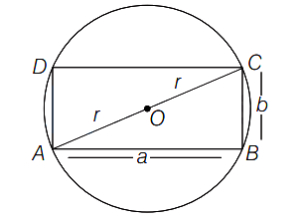
0 likes
View Solution577
MediumMCQ
The maximum value of $x e^{-x}$ is
A
$e$
B
$\frac{1}{e}$
C
$-e$
D
$-\frac{1}{e}$
Solution
(B) Let $y = x e^{-x}$.
On differentiating with respect to $x$,we get:
$\frac{dy}{dx} = x \cdot (-e^{-x}) + e^{-x} \cdot (1) = e^{-x}(1 - x)$.
For maximum or minimum values,we set $\frac{dy}{dx} = 0$:
$e^{-x}(1 - x) = 0$.
Since $e^{-x} \neq 0$ for any real $x$,we have $1 - x = 0$,which implies $x = 1$.
Now,we find the second derivative to check for maxima:
$\frac{d^2y}{dx^2} = e^{-x}(-1) + (1 - x)(-e^{-x}) = -e^{-x} - e^{-x} + x e^{-x} = e^{-x}(x - 2)$.
At $x = 1$:
$\frac{d^2y}{dx^2} = e^{-1}(1 - 2) = -\frac{1}{e} < 0$.
Since the second derivative is negative at $x = 1$,the function has a local maximum at $x = 1$.
The maximum value is $y(1) = 1 \cdot e^{-1} = \frac{1}{e}$.
On differentiating with respect to $x$,we get:
$\frac{dy}{dx} = x \cdot (-e^{-x}) + e^{-x} \cdot (1) = e^{-x}(1 - x)$.
For maximum or minimum values,we set $\frac{dy}{dx} = 0$:
$e^{-x}(1 - x) = 0$.
Since $e^{-x} \neq 0$ for any real $x$,we have $1 - x = 0$,which implies $x = 1$.
Now,we find the second derivative to check for maxima:
$\frac{d^2y}{dx^2} = e^{-x}(-1) + (1 - x)(-e^{-x}) = -e^{-x} - e^{-x} + x e^{-x} = e^{-x}(x - 2)$.
At $x = 1$:
$\frac{d^2y}{dx^2} = e^{-1}(1 - 2) = -\frac{1}{e} < 0$.
Since the second derivative is negative at $x = 1$,the function has a local maximum at $x = 1$.
The maximum value is $y(1) = 1 \cdot e^{-1} = \frac{1}{e}$.
0 likes
View Solution578
MediumMCQ
The maximum area of a rectangle that can be inscribed in a circle of radius $2 \text{ unit}$ is (in square unit)
A
$4$
B
$8 \pi$
C
$8$
D
$5$
Solution
(C) Let the rectangle have sides $x$ and $y$ inscribed in a circle of radius $r = 2 \text{ unit}$.
The diagonal of the rectangle is equal to the diameter of the circle,so $d = 2r = 2 \times 2 = 4 \text{ unit}$.
By the Pythagorean theorem,$x^2 + y^2 = d^2 = 4^2 = 16$.
The area of the rectangle is $A = xy$.
To maximize $A$,we maximize $A^2 = x^2 y^2$.
Since $y^2 = 16 - x^2$,we have $A^2 = x^2(16 - x^2) = 16x^2 - x^4$.
Let $f(x) = 16x^2 - x^4$. To find the maximum,set $f'(x) = 32x - 4x^3 = 0$.
$4x(8 - x^2) = 0$,which gives $x^2 = 8$ (since $x > 0$).
Then $y^2 = 16 - 8 = 8$,so $x = y = \sqrt{8} = 2\sqrt{2}$.
The rectangle is a square with side length $2\sqrt{2}$.
The maximum area is $A = x \times y = \sqrt{8} \times \sqrt{8} = 8 \text{ sq unit}$.
The diagonal of the rectangle is equal to the diameter of the circle,so $d = 2r = 2 \times 2 = 4 \text{ unit}$.
By the Pythagorean theorem,$x^2 + y^2 = d^2 = 4^2 = 16$.
The area of the rectangle is $A = xy$.
To maximize $A$,we maximize $A^2 = x^2 y^2$.
Since $y^2 = 16 - x^2$,we have $A^2 = x^2(16 - x^2) = 16x^2 - x^4$.
Let $f(x) = 16x^2 - x^4$. To find the maximum,set $f'(x) = 32x - 4x^3 = 0$.
$4x(8 - x^2) = 0$,which gives $x^2 = 8$ (since $x > 0$).
Then $y^2 = 16 - 8 = 8$,so $x = y = \sqrt{8} = 2\sqrt{2}$.
The rectangle is a square with side length $2\sqrt{2}$.
The maximum area is $A = x \times y = \sqrt{8} \times \sqrt{8} = 8 \text{ sq unit}$.
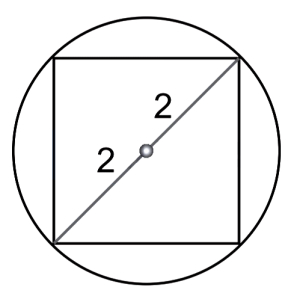
0 likes
View Solution579
MediumMCQ
The maximum value of $\frac{\log x}{x}$ in $(2, \infty)$ is
A
$1$
B
$\frac{2}{e}$
C
$\frac{1}{e}$
D
\text{None of the above}
Solution
(C) Let $y = \frac{\log x}{x}$.
On differentiating with respect to $x$,we get:
$\frac{dy}{dx} = \frac{x \cdot \frac{1}{x} - \log x \cdot 1}{x^2} = \frac{1 - \log x}{x^2}$.
For maxima,set $\frac{dy}{dx} = 0$:
$\frac{1 - \log x}{x^2} = 0 \implies 1 - \log x = 0 \implies \log x = 1 \implies x = e$.
Since $e \approx 2.718$,$x = e$ lies in the interval $(2, \infty)$.
Now,check the second derivative:
$\frac{d^2y}{dx^2} = \frac{x^2(-\frac{1}{x}) - (1 - \log x)(2x)}{x^4} = \frac{-x - 2x + 2x \log x}{x^4} = \frac{2x \log x - 3x}{x^4}$.
At $x = e$,$\frac{d^2y}{dx^2} = \frac{2e(1) - 3e}{e^4} = \frac{-e}{e^4} = -\frac{1}{e^3} < 0$.
Since the second derivative is negative,the function has a maximum at $x = e$.
The maximum value is $y = \frac{\log e}{e} = \frac{1}{e}$.
On differentiating with respect to $x$,we get:
$\frac{dy}{dx} = \frac{x \cdot \frac{1}{x} - \log x \cdot 1}{x^2} = \frac{1 - \log x}{x^2}$.
For maxima,set $\frac{dy}{dx} = 0$:
$\frac{1 - \log x}{x^2} = 0 \implies 1 - \log x = 0 \implies \log x = 1 \implies x = e$.
Since $e \approx 2.718$,$x = e$ lies in the interval $(2, \infty)$.
Now,check the second derivative:
$\frac{d^2y}{dx^2} = \frac{x^2(-\frac{1}{x}) - (1 - \log x)(2x)}{x^4} = \frac{-x - 2x + 2x \log x}{x^4} = \frac{2x \log x - 3x}{x^4}$.
At $x = e$,$\frac{d^2y}{dx^2} = \frac{2e(1) - 3e}{e^4} = \frac{-e}{e^4} = -\frac{1}{e^3} < 0$.
Since the second derivative is negative,the function has a maximum at $x = e$.
The maximum value is $y = \frac{\log e}{e} = \frac{1}{e}$.
0 likes
View Solution580
EasyMCQ
The maximum value of $\frac{\log _{e} x}{x}$,if $x>0$ is
A
$e$
B
$1$
C
$\frac{1}{e}$
D
$-\frac{1}{e}$
Solution
(C) Let $f(x) = \frac{\log _{e} x}{x}$.
To find the maximum value,we find the derivative $f'(x)$ using the quotient rule:
$f'(x) = \frac{x \cdot \frac{d}{dx}(\log _{e} x) - \log _{e} x \cdot \frac{d}{dx}(x)}{x^{2}} = \frac{x \cdot \frac{1}{x} - \log _{e} x \cdot 1}{x^{2}} = \frac{1 - \log _{e} x}{x^{2}}$.
For critical points,set $f'(x) = 0$:
$1 - \log _{e} x = 0 \Rightarrow \log _{e} x = 1 \Rightarrow x = e$.
Now,we check the second derivative $f''(x)$ to confirm the maximum:
$f''(x) = \frac{x^{2}(-\frac{1}{x}) - (1 - \log _{e} x)(2x)}{x^{4}} = \frac{-x - 2x(1 - \log _{e} x)}{x^{4}}$.
At $x = e$,$f''(e) = \frac{-e - 2e(1 - 1)}{e^{4}} = \frac{-e}{e^{4}} = -\frac{1}{e^{3}} < 0$.
Since $f''(e) < 0$,the function has a local maximum at $x = e$.
The maximum value is $f(e) = \frac{\log _{e} e}{e} = \frac{1}{e}$.
To find the maximum value,we find the derivative $f'(x)$ using the quotient rule:
$f'(x) = \frac{x \cdot \frac{d}{dx}(\log _{e} x) - \log _{e} x \cdot \frac{d}{dx}(x)}{x^{2}} = \frac{x \cdot \frac{1}{x} - \log _{e} x \cdot 1}{x^{2}} = \frac{1 - \log _{e} x}{x^{2}}$.
For critical points,set $f'(x) = 0$:
$1 - \log _{e} x = 0 \Rightarrow \log _{e} x = 1 \Rightarrow x = e$.
Now,we check the second derivative $f''(x)$ to confirm the maximum:
$f''(x) = \frac{x^{2}(-\frac{1}{x}) - (1 - \log _{e} x)(2x)}{x^{4}} = \frac{-x - 2x(1 - \log _{e} x)}{x^{4}}$.
At $x = e$,$f''(e) = \frac{-e - 2e(1 - 1)}{e^{4}} = \frac{-e}{e^{4}} = -\frac{1}{e^{3}} < 0$.
Since $f''(e) < 0$,the function has a local maximum at $x = e$.
The maximum value is $f(e) = \frac{\log _{e} e}{e} = \frac{1}{e}$.
0 likes
View Solution581
MediumMCQ
If $x, y$ are two positive integers such that $x+y=20$ and the maximum value of $x^3 y$ is $k$ at $x=\alpha, y=\beta$,then $\frac{k}{\alpha^2 \beta^2} =$
A
$\frac{\alpha}{\beta}+\frac{\beta}{\alpha}$
B
$\frac{\alpha}{\beta}-\frac{\beta}{\alpha}$
C
$\frac{\alpha}{\beta}$
D
$\frac{\alpha+\beta}{\alpha \beta}$
Solution
(C) Given $x+y=20$. We want to maximize $f(x, y) = x^3 y$.
Using the $AM$-$GM$ inequality for the terms $\frac{x}{3}, \frac{x}{3}, \frac{x}{3}, y$:
$\frac{\frac{x}{3} + \frac{x}{3} + \frac{x}{3} + y}{4} \geq \sqrt[4]{\left(\frac{x}{3}\right)^3 y}$
$\frac{x+y}{4} \geq \sqrt[4]{\frac{x^3 y}{27}}$
$\frac{20}{4} \geq \sqrt[4]{\frac{x^3 y}{27}} \Rightarrow 5 \geq \sqrt[4]{\frac{x^3 y}{27}}$
$5^4 \geq \frac{x^3 y}{27} \Rightarrow x^3 y \leq 27 \times 625 = 16875$.
So,$k = 16875$.
The maximum occurs when $\frac{x}{3} = y$.
Since $x+y=20$,we have $3y+y=20$ $\Rightarrow 4y=20$ $\Rightarrow y=5=\beta$ and $x=15=\alpha$.
Now,$\frac{k}{\alpha^2 \beta^2} = \frac{27 \times 625}{15^2 \times 5^2} = \frac{27 \times 625}{225 \times 25} = \frac{16875}{5625} = 3$.
Since $\frac{\alpha}{\beta} = \frac{15}{5} = 3$,the correct option is $\frac{\alpha}{\beta}$.
Using the $AM$-$GM$ inequality for the terms $\frac{x}{3}, \frac{x}{3}, \frac{x}{3}, y$:
$\frac{\frac{x}{3} + \frac{x}{3} + \frac{x}{3} + y}{4} \geq \sqrt[4]{\left(\frac{x}{3}\right)^3 y}$
$\frac{x+y}{4} \geq \sqrt[4]{\frac{x^3 y}{27}}$
$\frac{20}{4} \geq \sqrt[4]{\frac{x^3 y}{27}} \Rightarrow 5 \geq \sqrt[4]{\frac{x^3 y}{27}}$
$5^4 \geq \frac{x^3 y}{27} \Rightarrow x^3 y \leq 27 \times 625 = 16875$.
So,$k = 16875$.
The maximum occurs when $\frac{x}{3} = y$.
Since $x+y=20$,we have $3y+y=20$ $\Rightarrow 4y=20$ $\Rightarrow y=5=\beta$ and $x=15=\alpha$.
Now,$\frac{k}{\alpha^2 \beta^2} = \frac{27 \times 625}{15^2 \times 5^2} = \frac{27 \times 625}{225 \times 25} = \frac{16875}{5625} = 3$.
Since $\frac{\alpha}{\beta} = \frac{15}{5} = 3$,the correct option is $\frac{\alpha}{\beta}$.
0 likes
View Solution582
EasyMCQ
If $a^2 x^4 + b^2 y^4 = c^6$,then the maximum value of $xy$ is:
A
$\frac{c^3}{2ab}$
B
$\frac{c^3}{\sqrt{2ab}}$
C
$\frac{c^3}{ab}$
D
$\frac{c^3}{\sqrt{ab}}$
Solution
(B) Given the equation $a^2 x^4 + b^2 y^4 = c^6$.
Applying the Arithmetic Mean-Geometric Mean $(AM \geq GM)$ inequality for the two terms $a^2 x^4$ and $b^2 y^4$:
$\frac{a^2 x^4 + b^2 y^4}{2} \geq \sqrt{(a^2 x^4)(b^2 y^4)}$
Substituting the given value $a^2 x^4 + b^2 y^4 = c^6$:
$\frac{c^6}{2} \geq \sqrt{a^2 b^2 x^4 y^4}$
$\frac{c^6}{2} \geq ab x^2 y^2$
$x^2 y^2 \leq \frac{c^6}{2ab}$
Taking the square root on both sides:
$xy \leq \frac{c^3}{\sqrt{2ab}}$
Thus,the maximum value of $xy$ is $\frac{c^3}{\sqrt{2ab}}$.
Applying the Arithmetic Mean-Geometric Mean $(AM \geq GM)$ inequality for the two terms $a^2 x^4$ and $b^2 y^4$:
$\frac{a^2 x^4 + b^2 y^4}{2} \geq \sqrt{(a^2 x^4)(b^2 y^4)}$
Substituting the given value $a^2 x^4 + b^2 y^4 = c^6$:
$\frac{c^6}{2} \geq \sqrt{a^2 b^2 x^4 y^4}$
$\frac{c^6}{2} \geq ab x^2 y^2$
$x^2 y^2 \leq \frac{c^6}{2ab}$
Taking the square root on both sides:
$xy \leq \frac{c^3}{\sqrt{2ab}}$
Thus,the maximum value of $xy$ is $\frac{c^3}{\sqrt{2ab}}$.
0 likes
View Solution583
EasyMCQ
The maximum value of $f(x) = \sin (x)$ in the interval $[-\pi / 2, \pi / 2]$ is
A
$-1$
B
$0$
C
$1$
D
$\sqrt{2}$
Solution
(C) The function is $f(x) = \sin (x)$.
In the given interval $[-\pi / 2, \pi / 2]$,the sine function is strictly increasing.
The value at the lower bound is $f(-\pi / 2) = \sin(-\pi / 2) = -1$.
The value at the upper bound is $f(\pi / 2) = \sin(\pi / 2) = 1$.
Therefore,the maximum value of the function in the interval $[-\pi / 2, \pi / 2]$ is $1$.
In the given interval $[-\pi / 2, \pi / 2]$,the sine function is strictly increasing.
The value at the lower bound is $f(-\pi / 2) = \sin(-\pi / 2) = -1$.
The value at the upper bound is $f(\pi / 2) = \sin(\pi / 2) = 1$.
Therefore,the maximum value of the function in the interval $[-\pi / 2, \pi / 2]$ is $1$.
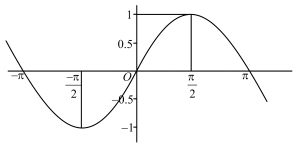
0 likes
View Solution584
EasyMCQ
What is the maximum area of a rectangle that can be formed with a fixed perimeter $p \ cm$?
A
$\frac{p^2}{8} \ cm^2$
B
$\frac{p^2}{16} \ cm^2$
C
$\frac{p^2}{64} \ cm^2$
D
$\frac{p^2}{32} \ cm^2$
Solution
(B) Let the lengths of the adjacent sides of the rectangle be $x \ cm$ and $y \ cm$.
The perimeter of the rectangle is given by $p = 2(x + y)$,which implies $y = \frac{p}{2} - x$.
The area of the rectangle is $A = x y$.
Substituting $y$,we get $A = x(\frac{p}{2} - x) = \frac{px}{2} - x^2$.
To find the maximum area,we differentiate $A$ with respect to $x$ and set it to zero: $\frac{dA}{dx} = \frac{p}{2} - 2x = 0$.
This gives $x = \frac{p}{4} \ cm$.
Consequently,$y = \frac{p}{2} - \frac{p}{4} = \frac{p}{4} \ cm$.
Thus,the maximum area is $A = \frac{p}{4} \times \frac{p}{4} = \frac{p^2}{16} \ cm^2$.
Therefore,option $B$ is correct.
The perimeter of the rectangle is given by $p = 2(x + y)$,which implies $y = \frac{p}{2} - x$.
The area of the rectangle is $A = x y$.
Substituting $y$,we get $A = x(\frac{p}{2} - x) = \frac{px}{2} - x^2$.
To find the maximum area,we differentiate $A$ with respect to $x$ and set it to zero: $\frac{dA}{dx} = \frac{p}{2} - 2x = 0$.
This gives $x = \frac{p}{4} \ cm$.
Consequently,$y = \frac{p}{2} - \frac{p}{4} = \frac{p}{4} \ cm$.
Thus,the maximum area is $A = \frac{p}{4} \times \frac{p}{4} = \frac{p^2}{16} \ cm^2$.
Therefore,option $B$ is correct.
0 likes
View Solution585
MediumMCQ
If $A = \{x \in R : \frac{\pi}{4} \leq x \leq \frac{\pi}{3}\}$ and $f(x) = \sin x - x$,then $f(A)$ is equal to
A
$\left[\frac{\sqrt{3}}{2} - \frac{\pi}{3}, \frac{1}{\sqrt{2}} - \frac{\pi}{4}\right]$
B
$\left[\frac{-1}{\sqrt{2}} - \frac{\pi}{4}, \frac{\sqrt{3}}{2} - \frac{\pi}{3}\right]$
C
$\left[-\frac{\pi}{3}, -\frac{\pi}{4}\right]$
D
$\left[\frac{\pi}{4}, \frac{\pi}{3}\right]$
Solution
(A) Given $f(x) = \sin x - x$.
To find the range $f(A)$,we check the derivative $f'(x) = \cos x - 1$.
Since $\cos x < 1$ for all $x \in [\frac{\pi}{4}, \frac{\pi}{3}]$,$f'(x) < 0$,which means $f(x)$ is a strictly decreasing function.
Therefore,the minimum value is at the upper bound $x = \frac{\pi}{3}$ and the maximum value is at the lower bound $x = \frac{\pi}{4}$.
$f(\frac{\pi}{3}) = \sin(\frac{\pi}{3}) - \frac{\pi}{3} = \frac{\sqrt{3}}{2} - \frac{\pi}{3}$.
$f(\frac{\pi}{4}) = \sin(\frac{\pi}{4}) - \frac{\pi}{4} = \frac{1}{\sqrt{2}} - \frac{\pi}{4}$.
Thus,$f(A) = [\frac{\sqrt{3}}{2} - \frac{\pi}{3}, \frac{1}{\sqrt{2}} - \frac{\pi}{4}]$.
To find the range $f(A)$,we check the derivative $f'(x) = \cos x - 1$.
Since $\cos x < 1$ for all $x \in [\frac{\pi}{4}, \frac{\pi}{3}]$,$f'(x) < 0$,which means $f(x)$ is a strictly decreasing function.
Therefore,the minimum value is at the upper bound $x = \frac{\pi}{3}$ and the maximum value is at the lower bound $x = \frac{\pi}{4}$.
$f(\frac{\pi}{3}) = \sin(\frac{\pi}{3}) - \frac{\pi}{3} = \frac{\sqrt{3}}{2} - \frac{\pi}{3}$.
$f(\frac{\pi}{4}) = \sin(\frac{\pi}{4}) - \frac{\pi}{4} = \frac{1}{\sqrt{2}} - \frac{\pi}{4}$.
Thus,$f(A) = [\frac{\sqrt{3}}{2} - \frac{\pi}{3}, \frac{1}{\sqrt{2}} - \frac{\pi}{4}]$.
0 likes
View Solution586
MediumMCQ
If $A=\{x : 9x \geq x^2+20\}$ and $f: A \rightarrow R$ is defined by $f(x)=2x^3-15x^2+36x-48$,then the maximum value of $f(x)$ is
A
-$20$
B
$7$
C
$20$
D
-$16$
Solution
(B) Given $A=\{x : 9x \geq x^2+20\}$.
Solving the inequality $x^2-9x+20 \leq 0$,we get $(x-4)(x-5) \leq 0$,which implies $x \in [4, 5]$.
Thus,$A=[4, 5]$.
Given $f(x)=2x^3-15x^2+36x-48$.
Finding the derivative,$f'(x)=6x^2-30x+36=6(x^2-5x+6)=6(x-3)(x-2)$.
For critical points,set $f'(x)=0$,which gives $x=2$ and $x=3$.
Since both critical points $x=2$ and $x=3$ lie outside the interval $A=[4, 5]$,the function $f(x)$ is monotonic in this interval.
Checking the sign of $f'(x)$ for $x \in [4, 5]$: $f'(4)=6(4-3)(4-2)=12 > 0$.
Since $f'(x) > 0$ for all $x \in [4, 5]$,$f(x)$ is an increasing function on $[4, 5]$.
Therefore,the maximum value occurs at the right endpoint $x=5$.
$f(5)=2(5)^3-15(5)^2+36(5)-48 = 2(125)-15(25)+180-48 = 250-375+180-48 = 7$.
Solving the inequality $x^2-9x+20 \leq 0$,we get $(x-4)(x-5) \leq 0$,which implies $x \in [4, 5]$.
Thus,$A=[4, 5]$.
Given $f(x)=2x^3-15x^2+36x-48$.
Finding the derivative,$f'(x)=6x^2-30x+36=6(x^2-5x+6)=6(x-3)(x-2)$.
For critical points,set $f'(x)=0$,which gives $x=2$ and $x=3$.
Since both critical points $x=2$ and $x=3$ lie outside the interval $A=[4, 5]$,the function $f(x)$ is monotonic in this interval.
Checking the sign of $f'(x)$ for $x \in [4, 5]$: $f'(4)=6(4-3)(4-2)=12 > 0$.
Since $f'(x) > 0$ for all $x \in [4, 5]$,$f(x)$ is an increasing function on $[4, 5]$.
Therefore,the maximum value occurs at the right endpoint $x=5$.
$f(5)=2(5)^3-15(5)^2+36(5)-48 = 2(125)-15(25)+180-48 = 250-375+180-48 = 7$.
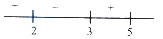
0 likes
View Solution587
MediumMCQ
If a line is moving between the coordinate axes such that the sum of the intercepts made by it on the coordinate axes is always $12$,then the equation of that line which forms a triangle of maximum area with the coordinate axes is
A
$3x+y=9$
B
$5x+7y=35$
C
$x+y=6$
D
$5x+y=10$
Solution
(C) Let the intercepts of the line on the $x$-axis and $y$-axis be $a$ and $b$ respectively. The equation of the line is $\frac{x}{a} + \frac{y}{b} = 1$.
Given that the sum of the intercepts is $a + b = 12$,so $b = 12 - a$.
The area of the triangle formed by the line with the coordinate axes is $A = \frac{1}{2}ab$.
Substituting $b = 12 - a$,we get $A = \frac{1}{2}a(12 - a) = 6a - \frac{1}{2}a^2$.
To find the maximum area,we differentiate $A$ with respect to $a$ and set it to zero:
$\frac{dA}{da} = 6 - a = 0 \Rightarrow a = 6$.
Since $a = 6$,then $b = 12 - 6 = 6$.
The equation of the line is $\frac{x}{6} + \frac{y}{6} = 1$,which simplifies to $x + y = 6$.
Given that the sum of the intercepts is $a + b = 12$,so $b = 12 - a$.
The area of the triangle formed by the line with the coordinate axes is $A = \frac{1}{2}ab$.
Substituting $b = 12 - a$,we get $A = \frac{1}{2}a(12 - a) = 6a - \frac{1}{2}a^2$.
To find the maximum area,we differentiate $A$ with respect to $a$ and set it to zero:
$\frac{dA}{da} = 6 - a = 0 \Rightarrow a = 6$.
Since $a = 6$,then $b = 12 - 6 = 6$.
The equation of the line is $\frac{x}{6} + \frac{y}{6} = 1$,which simplifies to $x + y = 6$.
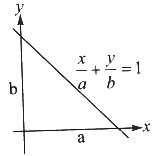
0 likes
View Solution588
MediumMCQ
If $(2, a)$ and $(b, 19)$ are two stationary points of the curve $y=2x^3-15x^2+36x+c$,then $a+b+c=$
A
$-20$
B
$15$
C
$-12$
D
$24$
Solution
(B) Given the curve $y=2x^3-15x^2+36x+c$.
Stationary points occur where $\frac{dy}{dx} = 0$.
$\frac{dy}{dx} = 6x^2 - 30x + 36 = 6(x^2 - 5x + 6) = 6(x-2)(x-3)$.
Setting $\frac{dy}{dx} = 0$,we get $x=2$ and $x=3$.
Since $(2, a)$ is a point on the curve,$a = 2(2)^3 - 15(2)^2 + 36(2) + c = 16 - 60 + 72 + c = 28 + c$.
Since $(b, 19)$ is a point on the curve,$b$ must be the other $x$-coordinate,so $b=3$.
Substituting $x=3$ and $y=19$ into the curve equation: $19 = 2(3)^3 - 15(3)^2 + 36(3) + c$.
$19 = 54 - 135 + 108 + c \Rightarrow 19 = 27 + c \Rightarrow c = -8$.
Now,$a = 28 + (-8) = 20$.
Therefore,$a+b+c = 20 + 3 - 8 = 15$.
Stationary points occur where $\frac{dy}{dx} = 0$.
$\frac{dy}{dx} = 6x^2 - 30x + 36 = 6(x^2 - 5x + 6) = 6(x-2)(x-3)$.
Setting $\frac{dy}{dx} = 0$,we get $x=2$ and $x=3$.
Since $(2, a)$ is a point on the curve,$a = 2(2)^3 - 15(2)^2 + 36(2) + c = 16 - 60 + 72 + c = 28 + c$.
Since $(b, 19)$ is a point on the curve,$b$ must be the other $x$-coordinate,so $b=3$.
Substituting $x=3$ and $y=19$ into the curve equation: $19 = 2(3)^3 - 15(3)^2 + 36(3) + c$.
$19 = 54 - 135 + 108 + c \Rightarrow 19 = 27 + c \Rightarrow c = -8$.
Now,$a = 28 + (-8) = 20$.
Therefore,$a+b+c = 20 + 3 - 8 = 15$.
0 likes
View Solution589
MediumMCQ
The ordinates of the points on the curve $y = \tan^{-1}(\sin \sqrt{x})$,$0 \leq x \leq 8\pi^2$,at which the tangent is parallel to the $x$-axis are
A
$\pm \frac{\pi}{3}$
B
$\pm \frac{\pi}{6}$
C
$\pm \frac{\pi}{4}$
D
$\pm \frac{\pi}{2}$
Solution
(C) Given the curve $y = \tan^{-1}(\sin \sqrt{x})$.
To find the points where the tangent is parallel to the $x$-axis,we set the derivative $\frac{dy}{dx} = 0$.
Differentiating with respect to $x$:
$\frac{dy}{dx} = \frac{1}{1 + (\sin \sqrt{x})^2} \cdot \cos \sqrt{x} \cdot \frac{1}{2\sqrt{x}}$.
Setting $\frac{dy}{dx} = 0$ implies $\cos \sqrt{x} = 0$ (since $x > 0$ for the derivative to be defined).
Thus,$\sqrt{x} = (2n+1)\frac{\pi}{2}$ for $n = 0, 1, 2, \dots$.
Given $0 \leq x \leq 8\pi^2$,we have $0 \leq \sqrt{x} \leq 2\sqrt{2}\pi \approx 8.88$.
Possible values for $\sqrt{x}$ are $\frac{\pi}{2}, \frac{3\pi}{2}, \frac{5\pi}{2}$.
At these points,$\sin \sqrt{x} = \sin((2n+1)\frac{\pi}{2}) = \pm 1$.
Therefore,$y = \tan^{-1}(\pm 1) = \pm \frac{\pi}{4}$.
To find the points where the tangent is parallel to the $x$-axis,we set the derivative $\frac{dy}{dx} = 0$.
Differentiating with respect to $x$:
$\frac{dy}{dx} = \frac{1}{1 + (\sin \sqrt{x})^2} \cdot \cos \sqrt{x} \cdot \frac{1}{2\sqrt{x}}$.
Setting $\frac{dy}{dx} = 0$ implies $\cos \sqrt{x} = 0$ (since $x > 0$ for the derivative to be defined).
Thus,$\sqrt{x} = (2n+1)\frac{\pi}{2}$ for $n = 0, 1, 2, \dots$.
Given $0 \leq x \leq 8\pi^2$,we have $0 \leq \sqrt{x} \leq 2\sqrt{2}\pi \approx 8.88$.
Possible values for $\sqrt{x}$ are $\frac{\pi}{2}, \frac{3\pi}{2}, \frac{5\pi}{2}$.
At these points,$\sin \sqrt{x} = \sin((2n+1)\frac{\pi}{2}) = \pm 1$.
Therefore,$y = \tan^{-1}(\pm 1) = \pm \frac{\pi}{4}$.
0 likes
View Solution590
EasyMCQ
If $x$ and $y$ are two positive numbers such that $x+y=32$,then the minimum value of $x^2+y^2$ is,
A
$500$
B
$256$
C
$1024$
D
$512$
Solution
(D) Let $s = x^2 + y^2$.
Given $x + y = 32$,we can write $y = 32 - x$.
Substituting this into the expression for $s$:
$s = x^2 + (32 - x)^2$.
To find the minimum,we differentiate $s$ with respect to $x$:
$\frac{ds}{dx} = 2x + 2(32 - x)(-1) = 2x - 64 + 2x = 4x - 64$.
Setting $\frac{ds}{dx} = 0$ for critical points:
$4x - 64 = 0 \implies x = 16$.
Then $y = 32 - 16 = 16$.
Checking the second derivative:
$\frac{d^2s}{dx^2} = 4 > 0$,which confirms that $s$ is minimum at $x = 16$.
The minimum value is $s = 16^2 + 16^2 = 256 + 256 = 512$.
Given $x + y = 32$,we can write $y = 32 - x$.
Substituting this into the expression for $s$:
$s = x^2 + (32 - x)^2$.
To find the minimum,we differentiate $s$ with respect to $x$:
$\frac{ds}{dx} = 2x + 2(32 - x)(-1) = 2x - 64 + 2x = 4x - 64$.
Setting $\frac{ds}{dx} = 0$ for critical points:
$4x - 64 = 0 \implies x = 16$.
Then $y = 32 - 16 = 16$.
Checking the second derivative:
$\frac{d^2s}{dx^2} = 4 > 0$,which confirms that $s$ is minimum at $x = 16$.
The minimum value is $s = 16^2 + 16^2 = 256 + 256 = 512$.
0 likes
View Solution591
MediumMCQ
The curve $f(x) = e^x \sin x$ is defined in the interval $[0, 2 \pi]$. The value of $x$ for which the slope of the tangent drawn to the curve at $x$ is maximum,is
A
$\frac{\pi}{4}$
B
$\frac{\pi}{2}$
C
$\frac{\pi}{6}$
D
$\frac{\pi}{3}$
Solution
(B) Given: $f(x) = e^x \sin x$.
The slope of the tangent is given by $m(x) = f'(x)$.
$f'(x) = e^x \sin x + e^x \cos x = e^x (\sin x + \cos x)$.
Let $g(x) = f'(x) = e^x (\sin x + \cos x)$.
To find the maximum slope,we find $g'(x) = 0$.
$g'(x) = e^x (\sin x + \cos x) + e^x (\cos x - \sin x) = 2 e^x \cos x$.
Setting $g'(x) = 0$,we get $2 e^x \cos x = 0$.
Since $e^x \neq 0$ for all $x$,we have $\cos x = 0$.
In the interval $[0, 2 \pi]$,$x = \frac{\pi}{2}$ or $x = \frac{3 \pi}{2}$.
Now,we check the second derivative $g''(x) = 2 e^x \cos x - 2 e^x \sin x = 2 e^x (\cos x - \sin x)$.
At $x = \frac{\pi}{2}$,$g''(\frac{\pi}{2}) = 2 e^{\frac{\pi}{2}} (0 - 1) = -2 e^{\frac{\pi}{2}} < 0$,which indicates a local maximum.
At $x = \frac{3 \pi}{2}$,$g''(\frac{3 \pi}{2}) = 2 e^{\frac{3 \pi}{2}} (0 - (-1)) = 2 e^{\frac{3 \pi}{2}} > 0$,which indicates a local minimum.
Thus,the slope is maximum at $x = \frac{\pi}{2}$.
The slope of the tangent is given by $m(x) = f'(x)$.
$f'(x) = e^x \sin x + e^x \cos x = e^x (\sin x + \cos x)$.
Let $g(x) = f'(x) = e^x (\sin x + \cos x)$.
To find the maximum slope,we find $g'(x) = 0$.
$g'(x) = e^x (\sin x + \cos x) + e^x (\cos x - \sin x) = 2 e^x \cos x$.
Setting $g'(x) = 0$,we get $2 e^x \cos x = 0$.
Since $e^x \neq 0$ for all $x$,we have $\cos x = 0$.
In the interval $[0, 2 \pi]$,$x = \frac{\pi}{2}$ or $x = \frac{3 \pi}{2}$.
Now,we check the second derivative $g''(x) = 2 e^x \cos x - 2 e^x \sin x = 2 e^x (\cos x - \sin x)$.
At $x = \frac{\pi}{2}$,$g''(\frac{\pi}{2}) = 2 e^{\frac{\pi}{2}} (0 - 1) = -2 e^{\frac{\pi}{2}} < 0$,which indicates a local maximum.
At $x = \frac{3 \pi}{2}$,$g''(\frac{3 \pi}{2}) = 2 e^{\frac{3 \pi}{2}} (0 - (-1)) = 2 e^{\frac{3 \pi}{2}} > 0$,which indicates a local minimum.
Thus,the slope is maximum at $x = \frac{\pi}{2}$.
0 likes
View Solution592
MediumMCQ
The radius (in $cm$) of the right circular cylinder of greatest curved surface area which can be inscribed in a given cone with radius $10 \ cm$ is
A
$2.5$
B
$5$
C
$10$
D
$7.5$
Solution
(B) Let the radius of the cone be $R = 10 \ cm$ and its height be $H$. Let the radius of the inscribed cylinder be $r$ and its height be $h$.
By similar triangles,$\frac{H-h}{r} = \frac{H}{R}$,which implies $h = H(1 - \frac{r}{R})$.
The curved surface area $S$ of the cylinder is $S = 2\pi rh = 2\pi r H(1 - \frac{r}{R}) = 2\pi H(r - \frac{r^2}{R})$.
To maximize $S$,we differentiate with respect to $r$ and set to zero: $\frac{dS}{dr} = 2\pi H(1 - \frac{2r}{R}) = 0$.
This gives $1 - \frac{2r}{R} = 0$,so $r = \frac{R}{2}$.
Given $R = 10 \ cm$,we have $r = \frac{10}{2} = 5 \ cm$.
By similar triangles,$\frac{H-h}{r} = \frac{H}{R}$,which implies $h = H(1 - \frac{r}{R})$.
The curved surface area $S$ of the cylinder is $S = 2\pi rh = 2\pi r H(1 - \frac{r}{R}) = 2\pi H(r - \frac{r^2}{R})$.
To maximize $S$,we differentiate with respect to $r$ and set to zero: $\frac{dS}{dr} = 2\pi H(1 - \frac{2r}{R}) = 0$.
This gives $1 - \frac{2r}{R} = 0$,so $r = \frac{R}{2}$.
Given $R = 10 \ cm$,we have $r = \frac{10}{2} = 5 \ cm$.
0 likes
View Solution593
EasyMCQ
The stationary points of the curve $y = 8x^2 - x^4 - 4$ are . . . . . .
A
$(0, -4), (2, 12), (-2, 12)$
B
$(0, 4), (-2, 12), (1, 2)$
C
$(0, -4), (-1, 2), (2, 12)$
D
$(0, 4), (-1, 2), (1, 2)$
Solution
(A) Given curve is $y = 8x^2 - x^4 - 4$.
To find the stationary points,we differentiate the function with respect to $x$:
$\frac{dy}{dx} = 16x - 4x^3$.
Stationary points occur where $\frac{dy}{dx} = 0$:
$16x - 4x^3 = 0$
$4x(4 - x^2) = 0$
This gives $x = 0$ or $x^2 = 4$,which implies $x = 0, 2, -2$.
Now,we find the corresponding $y$-values:
For $x = 0$: $y = 8(0)^2 - (0)^4 - 4 = -4$.
For $x = 2$: $y = 8(2)^2 - (2)^4 - 4 = 8(4) - 16 - 4 = 32 - 20 = 12$.
For $x = -2$: $y = 8(-2)^2 - (-2)^4 - 4 = 8(4) - 16 - 4 = 32 - 20 = 12$.
Thus,the stationary points are $(0, -4), (2, 12), (-2, 12)$.
To find the stationary points,we differentiate the function with respect to $x$:
$\frac{dy}{dx} = 16x - 4x^3$.
Stationary points occur where $\frac{dy}{dx} = 0$:
$16x - 4x^3 = 0$
$4x(4 - x^2) = 0$
This gives $x = 0$ or $x^2 = 4$,which implies $x = 0, 2, -2$.
Now,we find the corresponding $y$-values:
For $x = 0$: $y = 8(0)^2 - (0)^4 - 4 = -4$.
For $x = 2$: $y = 8(2)^2 - (2)^4 - 4 = 8(4) - 16 - 4 = 32 - 20 = 12$.
For $x = -2$: $y = 8(-2)^2 - (-2)^4 - 4 = 8(4) - 16 - 4 = 32 - 20 = 12$.
Thus,the stationary points are $(0, -4), (2, 12), (-2, 12)$.
0 likes
View Solution594
EasyMCQ
The values of $x$ at the stationary points of $f(x)=x^3+3x^2-2$ are
A
$0, 2$
B
$1, 2$
C
$0, -2$
D
$1, 1$
Solution
(C) Given the function $f(x) = x^3 + 3x^2 - 2$.
To find the stationary points,we calculate the first derivative of the function with respect to $x$:
$f'(x) = \frac{d}{dx}(x^3 + 3x^2 - 2) = 3x^2 + 6x$.
Stationary points occur where the first derivative is equal to zero:
$f'(x) = 0 \Rightarrow 3x^2 + 6x = 0$.
Factoring the expression,we get:
$3x(x + 2) = 0$.
This gives the values $x = 0$ and $x = -2$.
Therefore,the values of $x$ at the stationary points are $0$ and $-2$.
To find the stationary points,we calculate the first derivative of the function with respect to $x$:
$f'(x) = \frac{d}{dx}(x^3 + 3x^2 - 2) = 3x^2 + 6x$.
Stationary points occur where the first derivative is equal to zero:
$f'(x) = 0 \Rightarrow 3x^2 + 6x = 0$.
Factoring the expression,we get:
$3x(x + 2) = 0$.
This gives the values $x = 0$ and $x = -2$.
Therefore,the values of $x$ at the stationary points are $0$ and $-2$.
0 likes
View Solution595
MediumMCQ
The displacement $S$ of a particle measured from a fixed point $O$ on a line is given by $S = t^3 - 16t^2 + 64t - 16$. Then the time at which displacement of the particle is maximum is
A
$8$
B
$4$
C
$\frac{8}{3}$
D
$\frac{4}{3}$
Solution
(C) Given the displacement function $S(t) = t^3 - 16t^2 + 64t - 16$.
To find the maximum displacement,we first find the velocity $v(t)$ by differentiating $S$ with respect to $t$:
$v(t) = \frac{dS}{dt} = 3t^2 - 32t + 64$.
Setting $v(t) = 0$ to find the critical points:
$3t^2 - 32t + 64 = 0$.
Using the quadratic formula $t = \frac{-b \pm \sqrt{b^2 - 4ac}}{2a}$:
$t = \frac{32 \pm \sqrt{(-32)^2 - 4(3)(64)}}{2(3)} = \frac{32 \pm \sqrt{1024 - 768}}{6} = \frac{32 \pm \sqrt{256}}{6} = \frac{32 \pm 16}{6}$.
This gives two values: $t_1 = \frac{48}{6} = 8$ and $t_2 = \frac{16}{6} = \frac{8}{3}$.
Now,we find the second derivative to check for maxima:
$a(t) = \frac{d^2S}{dt^2} = 6t - 32$.
For $t = 8$: $a(8) = 6(8) - 32 = 48 - 32 = 16 > 0$ (Local minimum).
For $t = \frac{8}{3}$: $a(\frac{8}{3}) = 6(\frac{8}{3}) - 32 = 16 - 32 = -16 < 0$ (Local maximum).
Thus,the displacement is maximum at $t = \frac{8}{3}$.
To find the maximum displacement,we first find the velocity $v(t)$ by differentiating $S$ with respect to $t$:
$v(t) = \frac{dS}{dt} = 3t^2 - 32t + 64$.
Setting $v(t) = 0$ to find the critical points:
$3t^2 - 32t + 64 = 0$.
Using the quadratic formula $t = \frac{-b \pm \sqrt{b^2 - 4ac}}{2a}$:
$t = \frac{32 \pm \sqrt{(-32)^2 - 4(3)(64)}}{2(3)} = \frac{32 \pm \sqrt{1024 - 768}}{6} = \frac{32 \pm \sqrt{256}}{6} = \frac{32 \pm 16}{6}$.
This gives two values: $t_1 = \frac{48}{6} = 8$ and $t_2 = \frac{16}{6} = \frac{8}{3}$.
Now,we find the second derivative to check for maxima:
$a(t) = \frac{d^2S}{dt^2} = 6t - 32$.
For $t = 8$: $a(8) = 6(8) - 32 = 48 - 32 = 16 > 0$ (Local minimum).
For $t = \frac{8}{3}$: $a(\frac{8}{3}) = 6(\frac{8}{3}) - 32 = 16 - 32 = -16 < 0$ (Local maximum).
Thus,the displacement is maximum at $t = \frac{8}{3}$.
0 likes
View Solution596
MediumMCQ
If the extreme value of the function $f(x) = \frac{4}{\sin x} + \frac{1}{1 - \sin x}$ in the interval $[0, \frac{\pi}{2}]$ is $m$ and it exists at $x = k$,then $\cos k =$
A
$\frac{\sqrt{m}}{4}$
B
$\frac{\sqrt{m+1}}{\sqrt{2}}$
C
$\frac{\sqrt{5}}{\sqrt{m}}$
D
$\frac{1}{m}$
Solution
(C) Let $u = \sin x$. Since $x \in (0, \frac{\pi}{2})$,$u \in (0, 1)$.
Define $g(u) = \frac{4}{u} + \frac{1}{1-u}$.
To find the extreme value,differentiate $g(u)$ with respect to $u$:
$g'(u) = -\frac{4}{u^2} + \frac{1}{(1-u)^2}$.
Set $g'(u) = 0$ to find critical points:
$\frac{1}{(1-u)^2} = \frac{4}{u^2} \implies u^2 = 4(1-u)^2 \implies u^2 = 4(1 - 2u + u^2)$.
$u^2 = 4 - 8u + 4u^2 \implies 3u^2 - 8u + 4 = 0$.
Solving the quadratic equation: $(3u - 2)(u - 2) = 0$.
Since $u \in (0, 1)$,we have $u = \frac{2}{3}$.
Thus,$\sin k = \frac{2}{3}$.
Then $\cos^2 k = 1 - \sin^2 k = 1 - \frac{4}{9} = \frac{5}{9}$,so $\cos k = \frac{\sqrt{5}}{3}$.
The value $m = f(k) = g(\frac{2}{3}) = \frac{4}{2/3} + \frac{1}{1-2/3} = 6 + 3 = 9$.
We need to find $\cos k$ in terms of $m=9$.
$\cos k = \frac{\sqrt{5}}{3} = \frac{\sqrt{5}}{\sqrt{9}} = \frac{\sqrt{5}}{\sqrt{m}}$.
Thus,the correct option is $C$.
Define $g(u) = \frac{4}{u} + \frac{1}{1-u}$.
To find the extreme value,differentiate $g(u)$ with respect to $u$:
$g'(u) = -\frac{4}{u^2} + \frac{1}{(1-u)^2}$.
Set $g'(u) = 0$ to find critical points:
$\frac{1}{(1-u)^2} = \frac{4}{u^2} \implies u^2 = 4(1-u)^2 \implies u^2 = 4(1 - 2u + u^2)$.
$u^2 = 4 - 8u + 4u^2 \implies 3u^2 - 8u + 4 = 0$.
Solving the quadratic equation: $(3u - 2)(u - 2) = 0$.
Since $u \in (0, 1)$,we have $u = \frac{2}{3}$.
Thus,$\sin k = \frac{2}{3}$.
Then $\cos^2 k = 1 - \sin^2 k = 1 - \frac{4}{9} = \frac{5}{9}$,so $\cos k = \frac{\sqrt{5}}{3}$.
The value $m = f(k) = g(\frac{2}{3}) = \frac{4}{2/3} + \frac{1}{1-2/3} = 6 + 3 = 9$.
We need to find $\cos k$ in terms of $m=9$.
$\cos k = \frac{\sqrt{5}}{3} = \frac{\sqrt{5}}{\sqrt{9}} = \frac{\sqrt{5}}{\sqrt{m}}$.
Thus,the correct option is $C$.
0 likes
View Solution597
MediumMCQ
If the area of a right-angled triangle with hypotenuse $5$ is maximum,then its perimeter is
A
$12$
B
$2 \sqrt{3}+\sqrt{13}+5$
C
$7+\sqrt{21}$
D
$5(\sqrt{2}+1)$
Solution
(D) Let the sides of the right-angled triangle be $x$ and $y$,and the hypotenuse be $h = 5$.
By Pythagoras theorem,$x^2 + y^2 = 5^2 = 25$.
The area of the triangle is $A = \frac{1}{2}xy$.
To maximize $A$,we maximize $A^2 = \frac{1}{4}x^2y^2$.
Let $x^2 = 25 \cos^2 \theta$ and $y^2 = 25 \sin^2 \theta$,where $\theta \in (0, \pi/2)$.
Then $A = \frac{1}{2} (5 \cos \theta)(5 \sin \theta) = \frac{25}{4} \sin(2\theta)$.
The area $A$ is maximum when $\sin(2\theta) = 1$,which means $2\theta = \pi/2$,so $\theta = \pi/4$.
Thus,$x = 5 \cos(\pi/4) = \frac{5}{\sqrt{2}}$ and $y = 5 \sin(\pi/4) = \frac{5}{\sqrt{2}}$.
The triangle is an isosceles right-angled triangle.
The perimeter $P = x + y + h = \frac{5}{\sqrt{2}} + \frac{5}{\sqrt{2}} + 5 = \frac{10}{\sqrt{2}} + 5 = 5\sqrt{2} + 5 = 5(\sqrt{2} + 1)$.
By Pythagoras theorem,$x^2 + y^2 = 5^2 = 25$.
The area of the triangle is $A = \frac{1}{2}xy$.
To maximize $A$,we maximize $A^2 = \frac{1}{4}x^2y^2$.
Let $x^2 = 25 \cos^2 \theta$ and $y^2 = 25 \sin^2 \theta$,where $\theta \in (0, \pi/2)$.
Then $A = \frac{1}{2} (5 \cos \theta)(5 \sin \theta) = \frac{25}{4} \sin(2\theta)$.
The area $A$ is maximum when $\sin(2\theta) = 1$,which means $2\theta = \pi/2$,so $\theta = \pi/4$.
Thus,$x = 5 \cos(\pi/4) = \frac{5}{\sqrt{2}}$ and $y = 5 \sin(\pi/4) = \frac{5}{\sqrt{2}}$.
The triangle is an isosceles right-angled triangle.
The perimeter $P = x + y + h = \frac{5}{\sqrt{2}} + \frac{5}{\sqrt{2}} + 5 = \frac{10}{\sqrt{2}} + 5 = 5\sqrt{2} + 5 = 5(\sqrt{2} + 1)$.
0 likes
View Solution598
DifficultMCQ
Let $P(x) = x^4 + ax^3 + bx^2 + cx + d$ be such that $x = 0$ is the only real root of $P'(x) = 0$. If $P(-1) < P(1)$,then in the interval $[-1, 1]$:
A
$P(-1)$ is not the minimum of $P(x)$,but $P(1)$ is the maximum of $P(x)$
B
$P(-1)$ is the minimum of $P(x)$,but $P(1)$ is not the maximum of $P(x)$
C
Neither $P(-1)$ is the minimum nor $P(1)$ is the maximum of $P(x)$
D
$P(-1)$ is the minimum and $P(1)$ is the maximum of $P(x)$
Solution
(A) Given $P(x) = x^4 + ax^3 + bx^2 + cx + d$.
Then $P'(x) = 4x^3 + 3ax^2 + 2bx + c$.
It is given that $x = 0$ is the only real root of $P'(x) = 0$.
Since $P'(x)$ is a cubic polynomial,it must have at least one real root.
If $x = 0$ is the only real root,then $P'(x)$ must be of the form $k x^3$ for some constant $k$.
Comparing coefficients,$4x^3 = k x^3 \implies k = 4$,and $3a = 0, 2b = 0, c = 0$.
Thus,$a = 0, b = 0, c = 0$.
So,$P(x) = x^4 + d$.
$P'(x) = 4x^3$.
For $x \in [-1, 0)$,$P'(x) < 0$,so $P(x)$ is strictly decreasing.
For $x \in (0, 1]$,$P'(x) > 0$,so $P(x)$ is strictly increasing.
Thus,$P(x)$ has a global minimum at $x = 0$.
In the interval $[-1, 1]$,the minimum value is $P(0) = d$.
The maximum value occurs at the endpoints $x = -1$ or $x = 1$.
Since $P(-1) = (-1)^4 + d = 1 + d$ and $P(1) = (1)^4 + d = 1 + d$,we have $P(-1) = P(1)$.
However,the problem states $P(-1) < P(1)$,which contradicts $P(x) = x^4 + d$.
Re-evaluating: If $P'(x) = 4x(x^2 + k)$ where $k > 0$,then $x=0$ is the only real root.
Then $P(x) = x^4 + \frac{k}{2}x^2 + d$.
$P(-1) = 1 + \frac{k}{2} + d$ and $P(1) = 1 + \frac{k}{2} + d$.
This also leads to $P(-1) = P(1)$.
Given the condition $P(-1) < P(1)$,the function must be such that the derivative has only one real root $x=0$ and the function is increasing on average.
Since $P'(x) = 4x^3 + 3ax^2 + 2bx + c = 4x^3$ (as $x=0$ is the only root),the function $P(x) = x^4 + d$ is symmetric.
Given the constraint $P(-1) < P(1)$,the only logical conclusion is that $P(-1)$ is not the minimum and $P(1)$ is the maximum.
Then $P'(x) = 4x^3 + 3ax^2 + 2bx + c$.
It is given that $x = 0$ is the only real root of $P'(x) = 0$.
Since $P'(x)$ is a cubic polynomial,it must have at least one real root.
If $x = 0$ is the only real root,then $P'(x)$ must be of the form $k x^3$ for some constant $k$.
Comparing coefficients,$4x^3 = k x^3 \implies k = 4$,and $3a = 0, 2b = 0, c = 0$.
Thus,$a = 0, b = 0, c = 0$.
So,$P(x) = x^4 + d$.
$P'(x) = 4x^3$.
For $x \in [-1, 0)$,$P'(x) < 0$,so $P(x)$ is strictly decreasing.
For $x \in (0, 1]$,$P'(x) > 0$,so $P(x)$ is strictly increasing.
Thus,$P(x)$ has a global minimum at $x = 0$.
In the interval $[-1, 1]$,the minimum value is $P(0) = d$.
The maximum value occurs at the endpoints $x = -1$ or $x = 1$.
Since $P(-1) = (-1)^4 + d = 1 + d$ and $P(1) = (1)^4 + d = 1 + d$,we have $P(-1) = P(1)$.
However,the problem states $P(-1) < P(1)$,which contradicts $P(x) = x^4 + d$.
Re-evaluating: If $P'(x) = 4x(x^2 + k)$ where $k > 0$,then $x=0$ is the only real root.
Then $P(x) = x^4 + \frac{k}{2}x^2 + d$.
$P(-1) = 1 + \frac{k}{2} + d$ and $P(1) = 1 + \frac{k}{2} + d$.
This also leads to $P(-1) = P(1)$.
Given the condition $P(-1) < P(1)$,the function must be such that the derivative has only one real root $x=0$ and the function is increasing on average.
Since $P'(x) = 4x^3 + 3ax^2 + 2bx + c = 4x^3$ (as $x=0$ is the only root),the function $P(x) = x^4 + d$ is symmetric.
Given the constraint $P(-1) < P(1)$,the only logical conclusion is that $P(-1)$ is not the minimum and $P(1)$ is the maximum.
0 likes
View Solution599
EasyMCQ
The function $f(x) = x e^{-x}$ for all $x \in R$ attains a maximum value at $x = k$, then $k = $
A
$1$
B
$2$
C
$\frac{1}{e}$
D
$3$
Solution
(A) To find the maximum value of the function $f(x) = x e^{-x}$, we first find its derivative with respect to $x$.
Using the product rule, $f'(x) = (1)e^{-x} + x(-e^{-x}) = e^{-x}(1 - x)$.
For critical points, set $f'(x) = 0$.
$e^{-x}(1 - x) = 0$.
Since $e^{-x} \neq 0$ for any $x$, we have $1 - x = 0$, which gives $x = 1$.
To confirm this is a maximum, we use the second derivative test.
$f''(x) = -e^{-x}(1 - x) + e^{-x}(-1) = e^{-x}(x - 1 - 1) = e^{-x}(x - 2)$.
At $x = 1$, $f''(1) = e^{-1}(1 - 2) = -e^{-1} < 0$.
Since the second derivative is negative at $x = 1$, the function attains a local maximum at $x = 1$.
Thus, $k = 1$.
Using the product rule, $f'(x) = (1)e^{-x} + x(-e^{-x}) = e^{-x}(1 - x)$.
For critical points, set $f'(x) = 0$.
$e^{-x}(1 - x) = 0$.
Since $e^{-x} \neq 0$ for any $x$, we have $1 - x = 0$, which gives $x = 1$.
To confirm this is a maximum, we use the second derivative test.
$f''(x) = -e^{-x}(1 - x) + e^{-x}(-1) = e^{-x}(x - 1 - 1) = e^{-x}(x - 2)$.
At $x = 1$, $f''(1) = e^{-1}(1 - 2) = -e^{-1} < 0$.
Since the second derivative is negative at $x = 1$, the function attains a local maximum at $x = 1$.
Thus, $k = 1$.
0 likes
View SolutionApplications of Derivatives — Maxima and Minima · Frequently Asked Questions
1Are these Applications of Derivatives questions useful for JEE and NEET?
Yes. All questions in this section are mapped to JEE Main and NEET exam patterns. Previous year questions from JEE Main, NEET, GUJCET and state-level exams are included with full solutions.
2Can I switch to Hindi or Gujarati for these questions?
Yes. Use the language tabs in the hero section or the sidebar to view the same questions and solutions in English, Hindi or Gujarati.
3How do I generate a question paper from this subtopic?
Use the Vedclass Exam Paper Generator — select the chapter and subtopic, set difficulty, and generate Sets A, B, C, D automatically. First 3 chapters of every subject are free.
Vedclass Products
For Students
Vedclass Test Series
Mock tests in real JEE/NEET style with performance analysis. 5-day free trial.
Start Free TrialFor Teachers
Exam Paper Generator
Generate Set A/B/C/D papers from this chapter in 2 minutes. 3 chapters free.
Try FreeFor Institutes
Online Exam Module
Live online exams with unlimited students, 360° analytics & white-label branding.
See DemoFor Teachers & Institutes
Generate a Applications of Derivatives Exam Paper in 2 Minutes
Select subtopic & difficulty — Sets A, B, C, D auto-generated with No Repeat logic.
First 3 chapters of every subject are free — no payment required.