
A English
Maxima and Minima Questions in English
Class 12 Mathematics · Applications of Derivatives · Maxima and Minima
760+
Questions
English
Language
100%
With Solutions
Showing 43 of 760 questions in English
701
EasyMCQ
If a cubic function $f(x)=a x^3+b x^2-\frac{18}{5} x+\frac{19}{10}$ has a maximum value of $10$ at $x=-3$ and a minimum value of $\frac{-5}{2}$ at $x=2$,then $f(1)=$
A
$-10$
B
$\frac{-6}{5}$
C
$6$
D
$\frac{28}{5}$
Solution
(B) Given the function $f(x)=a x^3+b x^2-\frac{18}{5} x+\frac{19}{10}$.
Taking the derivative,$f^{\prime}(x)=3 a x^2+2 b x-\frac{18}{5}$.
Since $f(x)$ has a maximum at $x=-3$,$f^{\prime}(-3)=0$:
$3 a(-3)^2+2 b(-3)-\frac{18}{5}=0 \Rightarrow 27 a-6 b=\frac{18}{5} \Rightarrow 9 a-2 b=\frac{6}{5} \cdots (1)$.
Since $f(x)$ has a minimum at $x=2$,$f^{\prime}(2)=0$:
$3 a(2)^2+2 b(2)-\frac{18}{5}=0 \Rightarrow 12 a+4 b=\frac{18}{5} \Rightarrow 6 a+2 b=\frac{9}{5} \cdots (2)$.
Adding $(1)$ and $(2)$:
$(9 a-2 b)+(6 a+2 b)=\frac{6}{5}+\frac{9}{5} \Rightarrow 15 a=\frac{15}{5} \Rightarrow 15 a=3 \Rightarrow a=\frac{1}{5}$.
Substituting $a=\frac{1}{5}$ into $(2)$:
$6(\frac{1}{5})+2 b=\frac{9}{5} \Rightarrow 2 b=\frac{9}{5}-\frac{6}{5}=\frac{3}{5} \Rightarrow b=\frac{3}{10}$.
Thus,$f(x)=\frac{1}{5} x^3+\frac{3}{10} x^2-\frac{18}{5} x+\frac{19}{10}$.
Calculating $f(1)$:
$f(1)=\frac{1}{5}(1)^3+\frac{3}{10}(1)^2-\frac{18}{5}(1)+\frac{19}{10} = \frac{2}{10}+\frac{3}{10}-\frac{36}{10}+\frac{19}{10} = \frac{2+3-36+19}{10} = \frac{-12}{10} = \frac{-6}{5}$.
Therefore,$f(1)=\frac{-6}{5}$.
Taking the derivative,$f^{\prime}(x)=3 a x^2+2 b x-\frac{18}{5}$.
Since $f(x)$ has a maximum at $x=-3$,$f^{\prime}(-3)=0$:
$3 a(-3)^2+2 b(-3)-\frac{18}{5}=0 \Rightarrow 27 a-6 b=\frac{18}{5} \Rightarrow 9 a-2 b=\frac{6}{5} \cdots (1)$.
Since $f(x)$ has a minimum at $x=2$,$f^{\prime}(2)=0$:
$3 a(2)^2+2 b(2)-\frac{18}{5}=0 \Rightarrow 12 a+4 b=\frac{18}{5} \Rightarrow 6 a+2 b=\frac{9}{5} \cdots (2)$.
Adding $(1)$ and $(2)$:
$(9 a-2 b)+(6 a+2 b)=\frac{6}{5}+\frac{9}{5} \Rightarrow 15 a=\frac{15}{5} \Rightarrow 15 a=3 \Rightarrow a=\frac{1}{5}$.
Substituting $a=\frac{1}{5}$ into $(2)$:
$6(\frac{1}{5})+2 b=\frac{9}{5} \Rightarrow 2 b=\frac{9}{5}-\frac{6}{5}=\frac{3}{5} \Rightarrow b=\frac{3}{10}$.
Thus,$f(x)=\frac{1}{5} x^3+\frac{3}{10} x^2-\frac{18}{5} x+\frac{19}{10}$.
Calculating $f(1)$:
$f(1)=\frac{1}{5}(1)^3+\frac{3}{10}(1)^2-\frac{18}{5}(1)+\frac{19}{10} = \frac{2}{10}+\frac{3}{10}-\frac{36}{10}+\frac{19}{10} = \frac{2+3-36+19}{10} = \frac{-12}{10} = \frac{-6}{5}$.
Therefore,$f(1)=\frac{-6}{5}$.
0 likes
View Solution702
EasyMCQ
For all $x \in \mathbb{R}$,the minimum value $\frac{1}{3}$ and the maximum value $3$ of $f(x) = \frac{x^2+x+1}{x^2-x+1}$ occur at $l$ and $m$ respectively. Then $l+m$ is equal to:
A
$0$
B
$1$
C
$-1$
D
$2$
Solution
(A) Let $y = \frac{x^2+x+1}{x^2-x+1}$.
To find the critical points,we differentiate $y$ with respect to $x$ using the quotient rule:
$\frac{dy}{dx} = \frac{(x^2-x+1)(2x+1) - (x^2+x+1)(2x-1)}{(x^2-x+1)^2}$
$= \frac{(2x^3 - 2x^2 + 2x + x^2 - x + 1) - (2x^3 + 2x^2 + 2x - x^2 - x - 1)}{(x^2-x+1)^2}$
$= \frac{(2x^3 - x^2 + x + 1) - (2x^3 + x^2 + x - 1)}{(x^2-x+1)^2}$
$= \frac{-2x^2 + 2}{(x^2-x+1)^2} = \frac{2(1-x^2)}{(x^2-x+1)^2}$.
Setting $\frac{dy}{dx} = 0$,we get $1-x^2 = 0$,which implies $x = 1$ or $x = -1$.
For $x = 1$,$y = \frac{1+1+1}{1-1+1} = 3$ (Maximum value).
For $x = -1$,$y = \frac{1-1+1}{1+1+1} = \frac{1}{3}$ (Minimum value).
Thus,the minimum value $\frac{1}{3}$ occurs at $l = -1$ and the maximum value $3$ occurs at $m = 1$.
Therefore,$l+m = -1 + 1 = 0$.
To find the critical points,we differentiate $y$ with respect to $x$ using the quotient rule:
$\frac{dy}{dx} = \frac{(x^2-x+1)(2x+1) - (x^2+x+1)(2x-1)}{(x^2-x+1)^2}$
$= \frac{(2x^3 - 2x^2 + 2x + x^2 - x + 1) - (2x^3 + 2x^2 + 2x - x^2 - x - 1)}{(x^2-x+1)^2}$
$= \frac{(2x^3 - x^2 + x + 1) - (2x^3 + x^2 + x - 1)}{(x^2-x+1)^2}$
$= \frac{-2x^2 + 2}{(x^2-x+1)^2} = \frac{2(1-x^2)}{(x^2-x+1)^2}$.
Setting $\frac{dy}{dx} = 0$,we get $1-x^2 = 0$,which implies $x = 1$ or $x = -1$.
For $x = 1$,$y = \frac{1+1+1}{1-1+1} = 3$ (Maximum value).
For $x = -1$,$y = \frac{1-1+1}{1+1+1} = \frac{1}{3}$ (Minimum value).
Thus,the minimum value $\frac{1}{3}$ occurs at $l = -1$ and the maximum value $3$ occurs at $m = 1$.
Therefore,$l+m = -1 + 1 = 0$.
0 likes
View Solution703
EasyMCQ
The function $f(x) = x^3 - 4x^2 + 4x + 3$ defined on $[-1, 3]$ has
A
minimum value $-6$ at $x = -1$
B
minimum value $6$ at $x = 3$
C
minimum value $3$ at $x = 2$
D
maximum value $9$ at $x = 3$
Solution
(A) Given,$f(x) = x^3 - 4x^2 + 4x + 3$ on the interval $[-1, 3]$.
First,find the critical points by setting $f'(x) = 0$.
$f'(x) = 3x^2 - 8x + 4 = 0$.
$(3x - 2)(x - 2) = 0$,which gives $x = \frac{2}{3}$ and $x = 2$.
Both points lie within the interval $[-1, 3]$.
Now,evaluate $f(x)$ at the critical points and the endpoints:
$f(-1) = (-1)^3 - 4(-1)^2 + 4(-1) + 3 = -1 - 4 - 4 + 3 = -6$.
$f(\frac{2}{3}) = (\frac{2}{3})^3 - 4(\frac{2}{3})^2 + 4(\frac{2}{3}) + 3 = \frac{8}{27} - \frac{16}{9} + \frac{8}{3} + 3 = \frac{8 - 48 + 72 + 81}{27} = \frac{113}{27} \approx 4.18$.
$f(2) = (2)^3 - 4(2)^2 + 4(2) + 3 = 8 - 16 + 8 + 3 = 3$.
$f(3) = (3)^3 - 4(3)^2 + 4(3) + 3 = 27 - 36 + 12 + 3 = 6$.
Comparing these values: $\{-6, 4.18, 3, 6\}$,the minimum value is $-6$ at $x = -1$.
First,find the critical points by setting $f'(x) = 0$.
$f'(x) = 3x^2 - 8x + 4 = 0$.
$(3x - 2)(x - 2) = 0$,which gives $x = \frac{2}{3}$ and $x = 2$.
Both points lie within the interval $[-1, 3]$.
Now,evaluate $f(x)$ at the critical points and the endpoints:
$f(-1) = (-1)^3 - 4(-1)^2 + 4(-1) + 3 = -1 - 4 - 4 + 3 = -6$.
$f(\frac{2}{3}) = (\frac{2}{3})^3 - 4(\frac{2}{3})^2 + 4(\frac{2}{3}) + 3 = \frac{8}{27} - \frac{16}{9} + \frac{8}{3} + 3 = \frac{8 - 48 + 72 + 81}{27} = \frac{113}{27} \approx 4.18$.
$f(2) = (2)^3 - 4(2)^2 + 4(2) + 3 = 8 - 16 + 8 + 3 = 3$.
$f(3) = (3)^3 - 4(3)^2 + 4(3) + 3 = 27 - 36 + 12 + 3 = 6$.
Comparing these values: $\{-6, 4.18, 3, 6\}$,the minimum value is $-6$ at $x = -1$.
0 likes
View Solution704
EasyMCQ
The minimum value of the function $f(x) = 2x^2 - \ln|x|$ for $x \geq 1$ is:
A
$\frac{1}{2} + \ln 2$
B
$2$
C
$4$
D
$2 + \ln 2$
Solution
(B) Given the function $f(x) = 2x^2 - \ln|x|$ for $x \geq 1$.
Since $x \geq 1$,we have $|x| = x$,so $f(x) = 2x^2 - \ln x$.
Find the derivative: $f'(x) = 4x - \frac{1}{x}$.
For critical points,set $f'(x) = 0$:
$4x - \frac{1}{x} = 0 \implies 4x^2 = 1 \implies x^2 = \frac{1}{4} \implies x = \pm \frac{1}{2}$.
Since the domain is $x \geq 1$,there are no critical points in the interval $(1, \infty)$.
Check the behavior of the function: $f'(x) = \frac{4x^2 - 1}{x}$. For $x > 1$,$4x^2 - 1 > 3$,so $f'(x) > 0$.
Since $f'(x) > 0$ for all $x \geq 1$,the function is strictly increasing on $[1, \infty)$.
Therefore,the minimum value occurs at the boundary $x = 1$.
$f(1) = 2(1)^2 - \ln(1) = 2 - 0 = 2$.
Since $x \geq 1$,we have $|x| = x$,so $f(x) = 2x^2 - \ln x$.
Find the derivative: $f'(x) = 4x - \frac{1}{x}$.
For critical points,set $f'(x) = 0$:
$4x - \frac{1}{x} = 0 \implies 4x^2 = 1 \implies x^2 = \frac{1}{4} \implies x = \pm \frac{1}{2}$.
Since the domain is $x \geq 1$,there are no critical points in the interval $(1, \infty)$.
Check the behavior of the function: $f'(x) = \frac{4x^2 - 1}{x}$. For $x > 1$,$4x^2 - 1 > 3$,so $f'(x) > 0$.
Since $f'(x) > 0$ for all $x \geq 1$,the function is strictly increasing on $[1, \infty)$.
Therefore,the minimum value occurs at the boundary $x = 1$.
$f(1) = 2(1)^2 - \ln(1) = 2 - 0 = 2$.
0 likes
View Solution705
EasyMCQ
Let $P(x)$ be a polynomial of degree $3$ having an extreme value at $x=1$. If $\lim _{x \rightarrow 0}\left(\frac{P(x)+4}{x^2}+2\right)=6$,then $\left(\frac{d P}{d x}\right)_{x=\frac{1}{2}}=$
A
$2$
B
$0$
C
$-2$
D
$4$
Solution
(A) Let $P(x) = ax^3 + bx^2 + cx + d$.
Then $P'(x) = 3ax^2 + 2bx + c$.
Since $P(x)$ has an extreme value at $x=1$,we have $P'(1) = 0$,which implies $3a + 2b + c = 0$ ... $(i)$.
Given $\lim_{x \rightarrow 0} \left(\frac{P(x)+4}{x^2} + 2\right) = 6$,we have $\lim_{x \rightarrow 0} \frac{P(x)+4}{x^2} = 4$.
Substituting $P(x)$,we get $\lim_{x \rightarrow 0} \frac{ax^3 + bx^2 + cx + d + 4}{x^2} = 4$.
For the limit to be finite,the coefficients of $x^{-2}$ and $x^{-1}$ must be zero.
Thus,$d+4 = 0 \Rightarrow d = -4$ and $c = 0$.
Then $\lim_{x \rightarrow 0} (ax + b) = 4 \Rightarrow b = 4$.
Substituting $b=4$ and $c=0$ into equation $(i)$,we get $3a + 2(4) + 0 = 0 \Rightarrow 3a = -8 \Rightarrow a = -\frac{8}{3}$.
So,$P(x) = -\frac{8}{3}x^3 + 4x^2 - 4$.
The derivative is $P'(x) = -8x^2 + 8x$.
Evaluating at $x = \frac{1}{2}$,we get $P'(\frac{1}{2}) = -8(\frac{1}{4}) + 8(\frac{1}{2}) = -2 + 4 = 2$.
Then $P'(x) = 3ax^2 + 2bx + c$.
Since $P(x)$ has an extreme value at $x=1$,we have $P'(1) = 0$,which implies $3a + 2b + c = 0$ ... $(i)$.
Given $\lim_{x \rightarrow 0} \left(\frac{P(x)+4}{x^2} + 2\right) = 6$,we have $\lim_{x \rightarrow 0} \frac{P(x)+4}{x^2} = 4$.
Substituting $P(x)$,we get $\lim_{x \rightarrow 0} \frac{ax^3 + bx^2 + cx + d + 4}{x^2} = 4$.
For the limit to be finite,the coefficients of $x^{-2}$ and $x^{-1}$ must be zero.
Thus,$d+4 = 0 \Rightarrow d = -4$ and $c = 0$.
Then $\lim_{x \rightarrow 0} (ax + b) = 4 \Rightarrow b = 4$.
Substituting $b=4$ and $c=0$ into equation $(i)$,we get $3a + 2(4) + 0 = 0 \Rightarrow 3a = -8 \Rightarrow a = -\frac{8}{3}$.
So,$P(x) = -\frac{8}{3}x^3 + 4x^2 - 4$.
The derivative is $P'(x) = -8x^2 + 8x$.
Evaluating at $x = \frac{1}{2}$,we get $P'(\frac{1}{2}) = -8(\frac{1}{4}) + 8(\frac{1}{2}) = -2 + 4 = 2$.
0 likes
View Solution706
MediumMCQ
Let $f(x) = (x - 3)^{2018}(x - 2)^{2019}, x \in R$. If $f(\alpha)$ is a relative maximum of $f$ at $x = \alpha$,then $2\alpha + 3f(\alpha) =$
A
$\frac{20186}{4037}$
B
$\frac{20186}{4037} - 3 \left( \frac{2018}{4037} \right)^{2018} \left( \frac{2019}{4037} \right)^{2019}$
C
$6$
D
$9$
Solution
(B) The given function is $f(x) = (x - 3)^{2018}(x - 2)^{2019}$.
Applying the product rule,$f'(x) = 2018(x - 3)^{2017}(x - 2)^{2019} + 2019(x - 3)^{2018}(x - 2)^{2018}$.
Factoring out common terms,$f'(x) = (x - 3)^{2017}(x - 2)^{2018} \{2018(x - 2) + 2019(x - 3)\}$.
Simplifying the expression inside the braces,$2018x - 4036 + 2019x - 6057 = 4037x - 10093$.
Thus,$f'(x) = (x - 3)^{2017}(x - 2)^{2018} \cdot 4037 \left( x - \frac{10093}{4037} \right)$.
The critical points are $x = 3, 2, \frac{10093}{4037}$.
Analyzing the sign of $f'(x)$ around $x = \alpha = \frac{10093}{4037}$,the derivative changes from positive to negative,indicating a local maximum.
At $x = \alpha = \frac{10093}{4037}$,we have $x - 3 = \frac{10093 - 12111}{4037} = -\frac{2018}{4037}$ and $x - 2 = \frac{10093 - 8074}{4037} = \frac{2019}{4037}$.
Thus,$f(\alpha) = \left( -\frac{2018}{4037} \right)^{2018} \left( \frac{2019}{4037} \right)^{2019} = \left( \frac{2018}{4037} \right)^{2018} \left( \frac{2019}{4037} \right)^{2019}$.
Therefore,$2\alpha + 3f(\alpha) = 2 \left( \frac{10093}{4037} \right) + 3 \left( \frac{2018}{4037} \right)^{2018} \left( \frac{2019}{4037} \right)^{2019} = \frac{20186}{4037} + 3 \left( \frac{2018}{4037} \right)^{2018} \left( \frac{2019}{4037} \right)^{2019}$.
Note: The provided option $B$ has a minus sign,but based on the calculation,the result is positive.
Applying the product rule,$f'(x) = 2018(x - 3)^{2017}(x - 2)^{2019} + 2019(x - 3)^{2018}(x - 2)^{2018}$.
Factoring out common terms,$f'(x) = (x - 3)^{2017}(x - 2)^{2018} \{2018(x - 2) + 2019(x - 3)\}$.
Simplifying the expression inside the braces,$2018x - 4036 + 2019x - 6057 = 4037x - 10093$.
Thus,$f'(x) = (x - 3)^{2017}(x - 2)^{2018} \cdot 4037 \left( x - \frac{10093}{4037} \right)$.
The critical points are $x = 3, 2, \frac{10093}{4037}$.
Analyzing the sign of $f'(x)$ around $x = \alpha = \frac{10093}{4037}$,the derivative changes from positive to negative,indicating a local maximum.
At $x = \alpha = \frac{10093}{4037}$,we have $x - 3 = \frac{10093 - 12111}{4037} = -\frac{2018}{4037}$ and $x - 2 = \frac{10093 - 8074}{4037} = \frac{2019}{4037}$.
Thus,$f(\alpha) = \left( -\frac{2018}{4037} \right)^{2018} \left( \frac{2019}{4037} \right)^{2019} = \left( \frac{2018}{4037} \right)^{2018} \left( \frac{2019}{4037} \right)^{2019}$.
Therefore,$2\alpha + 3f(\alpha) = 2 \left( \frac{10093}{4037} \right) + 3 \left( \frac{2018}{4037} \right)^{2018} \left( \frac{2019}{4037} \right)^{2019} = \frac{20186}{4037} + 3 \left( \frac{2018}{4037} \right)^{2018} \left( \frac{2019}{4037} \right)^{2019}$.
Note: The provided option $B$ has a minus sign,but based on the calculation,the result is positive.
0 likes
View Solution707
EasyMCQ
The smaller side of the rectangle with the largest area,that can be inscribed inside a semi-circle of radius $2 \ units$ is of length
A
$\sqrt{2}$
B
$\sqrt{3}$
C
$\frac{1}{\sqrt{3}}$
D
$\sqrt{2}$
Solution
(A) Let the radius of the semi-circle be $R = 2$. Let the rectangle have length $2x$ and breadth $y$ inscribed in the semi-circle.
By the Pythagorean theorem,$x^2 + y^2 = R^2 = 2^2 = 4$.
Thus,$x = \sqrt{4 - y^2}$.
The area of the rectangle is $A = (2x) \times y = 2y \sqrt{4 - y^2}$.
To maximize $A$,we maximize $A^2 = 4y^2(4 - y^2) = 16y^2 - 4y^4$.
Let $f(y) = 16y^2 - 4y^4$. Differentiating with respect to $y$,we get $f'(y) = 32y - 16y^3$.
Setting $f'(y) = 0$,we have $16y(2 - y^2) = 0$.
Since $y > 0$,$y^2 = 2$,so $y = \sqrt{2}$.
Then $x = \sqrt{4 - 2} = \sqrt{2}$.
The sides of the rectangle are $2x = 2\sqrt{2}$ and $y = \sqrt{2}$.
The smaller side is $\sqrt{2}$.
By the Pythagorean theorem,$x^2 + y^2 = R^2 = 2^2 = 4$.
Thus,$x = \sqrt{4 - y^2}$.
The area of the rectangle is $A = (2x) \times y = 2y \sqrt{4 - y^2}$.
To maximize $A$,we maximize $A^2 = 4y^2(4 - y^2) = 16y^2 - 4y^4$.
Let $f(y) = 16y^2 - 4y^4$. Differentiating with respect to $y$,we get $f'(y) = 32y - 16y^3$.
Setting $f'(y) = 0$,we have $16y(2 - y^2) = 0$.
Since $y > 0$,$y^2 = 2$,so $y = \sqrt{2}$.
Then $x = \sqrt{4 - 2} = \sqrt{2}$.
The sides of the rectangle are $2x = 2\sqrt{2}$ and $y = \sqrt{2}$.
The smaller side is $\sqrt{2}$.
0 likes
View Solution708
EasyMCQ
$A$ right solid circular cylinder of given volume will have the least total surface area when
A
its height is equal to its radius.
B
its height is equal to its diameter.
C
its height is independent of its radius.
D
its height is $34$ times of its radius.
Solution
(B) Let the height of the solid cylinder be $h$ and its radius be $r$.
The volume $V$ is given by $V = \pi r^2 h$,which implies $h = \frac{V}{\pi r^2}$.
The total surface area $S$ is given by $S = 2\pi rh + 2\pi r^2$.
Substituting $h$ in terms of $V$ and $r$: $S = 2\pi r \left(\frac{V}{\pi r^2}\right) + 2\pi r^2 = \frac{2V}{r} + 2\pi r^2$.
To find the minimum surface area,differentiate $S$ with respect to $r$: $\frac{dS}{dr} = -\frac{2V}{r^2} + 4\pi r$.
Setting $\frac{dS}{dr} = 0$,we get $4\pi r = \frac{2V}{r^2}$,which implies $V = 2\pi r^3$.
Substituting $V = \pi r^2 h$ into this equation: $\pi r^2 h = 2\pi r^3$,which simplifies to $h = 2r$.
Since $2r$ is the diameter,the surface area is least when the height is equal to the diameter.
The volume $V$ is given by $V = \pi r^2 h$,which implies $h = \frac{V}{\pi r^2}$.
The total surface area $S$ is given by $S = 2\pi rh + 2\pi r^2$.
Substituting $h$ in terms of $V$ and $r$: $S = 2\pi r \left(\frac{V}{\pi r^2}\right) + 2\pi r^2 = \frac{2V}{r} + 2\pi r^2$.
To find the minimum surface area,differentiate $S$ with respect to $r$: $\frac{dS}{dr} = -\frac{2V}{r^2} + 4\pi r$.
Setting $\frac{dS}{dr} = 0$,we get $4\pi r = \frac{2V}{r^2}$,which implies $V = 2\pi r^3$.
Substituting $V = \pi r^2 h$ into this equation: $\pi r^2 h = 2\pi r^3$,which simplifies to $h = 2r$.
Since $2r$ is the diameter,the surface area is least when the height is equal to the diameter.
0 likes
View Solution709
MediumMCQ
Let $f: D \rightarrow R$,$D \subseteq R$,$c \in D$ and $r$ be a non-zero real number. Consider the following statements:
$Y$. $c$ is an extreme point of $f \Rightarrow c$ is an extreme point of $rf$
$M$. $c$ is an extreme point of $f \Rightarrow c$ is an extreme point of $r+f$
Which of the following is correct?
$Y$. $c$ is an extreme point of $f \Rightarrow c$ is an extreme point of $rf$
$M$. $c$ is an extreme point of $f \Rightarrow c$ is an extreme point of $r+f$
Which of the following is correct?
A
Only $Y$ is true
B
Only $M$ is true
C
Both $Y$ and $M$ are true
D
Neither $Y$ nor $M$ is true
Solution
(C) An extreme point $c$ of a differentiable function $f$ satisfies $f'(c) = 0$.
For statement $Y$: Let $g(x) = rf(x)$. Then $g'(x) = rf'(x)$. At $x=c$,$g'(c) = rf'(c) = r(0) = 0$. Thus,$c$ is an extreme point of $rf$.
For statement $M$: Let $h(x) = r + f(x)$. Then $h'(x) = f'(x)$. At $x=c$,$h'(c) = f'(c) = 0$. Thus,$c$ is an extreme point of $r+f$.
Therefore,both statements are true.
For statement $Y$: Let $g(x) = rf(x)$. Then $g'(x) = rf'(x)$. At $x=c$,$g'(c) = rf'(c) = r(0) = 0$. Thus,$c$ is an extreme point of $rf$.
For statement $M$: Let $h(x) = r + f(x)$. Then $h'(x) = f'(x)$. At $x=c$,$h'(c) = f'(c) = 0$. Thus,$c$ is an extreme point of $r+f$.
Therefore,both statements are true.
0 likes
View Solution710
MediumMCQ
If $(\alpha, \beta)$ and $(\gamma, \delta)$ where $\alpha < \gamma$ are the turning points of $f(x) = 2x^3 - 15x^2 + 36x - 8$,then $\alpha - \gamma - \beta + \delta =$
A
$0$
B
$-2$
C
$2$
D
$1$
Solution
(B) Given the function $f(x) = 2x^3 - 15x^2 + 36x - 8$.
To find the turning points,we calculate the derivative $f'(x)$ and set it to $0$:
$f'(x) = 6x^2 - 30x + 36 = 0$.
Dividing by $6$,we get $x^2 - 5x + 6 = 0$.
Factoring the quadratic equation: $(x - 2)(x - 3) = 0$.
Thus,the $x$-coordinates of the turning points are $x = 2$ and $x = 3$.
For $x = 2$,$f(2) = 2(8) - 15(4) + 36(2) - 8 = 16 - 60 + 72 - 8 = 20$.
For $x = 3$,$f(3) = 2(27) - 15(9) + 36(3) - 8 = 54 - 135 + 108 - 8 = 19$.
Given $\alpha < \gamma$,we have $\alpha = 2$ and $\gamma = 3$.
Correspondingly,$\beta = 20$ and $\delta = 19$.
Now,calculate $\alpha - \gamma - \beta + \delta = 2 - 3 - 20 + 19 = -2$.
To find the turning points,we calculate the derivative $f'(x)$ and set it to $0$:
$f'(x) = 6x^2 - 30x + 36 = 0$.
Dividing by $6$,we get $x^2 - 5x + 6 = 0$.
Factoring the quadratic equation: $(x - 2)(x - 3) = 0$.
Thus,the $x$-coordinates of the turning points are $x = 2$ and $x = 3$.
For $x = 2$,$f(2) = 2(8) - 15(4) + 36(2) - 8 = 16 - 60 + 72 - 8 = 20$.
For $x = 3$,$f(3) = 2(27) - 15(9) + 36(3) - 8 = 54 - 135 + 108 - 8 = 19$.
Given $\alpha < \gamma$,we have $\alpha = 2$ and $\gamma = 3$.
Correspondingly,$\beta = 20$ and $\delta = 19$.
Now,calculate $\alpha - \gamma - \beta + \delta = 2 - 3 - 20 + 19 = -2$.
0 likes
View Solution711
EasyMCQ
The height (in $cm$) of a cylinder of the greatest volume that can be inscribed in a sphere of radius $3 \ cm$ is
A
$3 \sqrt{3}$
B
$2 \sqrt{3}$
C
$\sqrt{3}$
D
$\sqrt{2}$
Solution
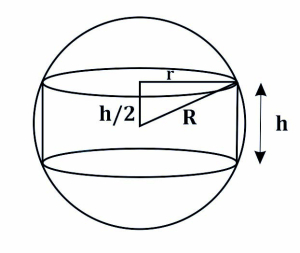
(B) Let $R$ be the radius of the sphere and $r$ and $h$ be the radius and height of the cylinder,respectively.
From the geometry of the sphere and inscribed cylinder,we have the relation: $R^2 = r^2 + (h/2)^2$.
Thus,$r^2 = R^2 - h^2/4$.
The volume $V$ of the cylinder is given by $V = \pi r^2 h = \pi (R^2 - h^2/4) h = \pi R^2 h - \pi h^3/4$.
To find the maximum volume,we differentiate $V$ with respect to $h$: $\frac{dV}{dh} = \pi R^2 - \frac{3\pi h^2}{4}$.
Setting $\frac{dV}{dh} = 0$,we get $\pi R^2 = \frac{3\pi h^2}{4}$,which implies $h^2 = \frac{4R^2}{3}$,so $h = \frac{2R}{\sqrt{3}}$.
Given $R = 3 \ cm$,we have $h = \frac{2 \times 3}{\sqrt{3}} = 2 \sqrt{3} \ cm$.
Since $\frac{d^2V}{dh^2} = -\frac{6\pi h}{4} < 0$ for $h > 0$,the volume is maximum at $h = 2 \sqrt{3} \ cm$.
From the geometry of the sphere and inscribed cylinder,we have the relation: $R^2 = r^2 + (h/2)^2$.
Thus,$r^2 = R^2 - h^2/4$.
The volume $V$ of the cylinder is given by $V = \pi r^2 h = \pi (R^2 - h^2/4) h = \pi R^2 h - \pi h^3/4$.
To find the maximum volume,we differentiate $V$ with respect to $h$: $\frac{dV}{dh} = \pi R^2 - \frac{3\pi h^2}{4}$.
Setting $\frac{dV}{dh} = 0$,we get $\pi R^2 = \frac{3\pi h^2}{4}$,which implies $h^2 = \frac{4R^2}{3}$,so $h = \frac{2R}{\sqrt{3}}$.
Given $R = 3 \ cm$,we have $h = \frac{2 \times 3}{\sqrt{3}} = 2 \sqrt{3} \ cm$.
Since $\frac{d^2V}{dh^2} = -\frac{6\pi h}{4} < 0$ for $h > 0$,the volume is maximum at $h = 2 \sqrt{3} \ cm$.
0 likes
View Solution712
EasyMCQ
Let $f(x) = x^2 e^{-2x}, x > 0$. The maximum value of $f(x)$ is
A
$0$
B
$\frac{1}{e^2}$
C
$\frac{1}{4e^2}$
D
$\frac{1}{2e}$
Solution
(B) Given the function $f(x) = x^2 e^{-2x}$ for $x > 0$.
To find the maximum value,we first find the derivative $f'(x)$:
$f'(x) = \frac{d}{dx}(x^2) \cdot e^{-2x} + x^2 \cdot \frac{d}{dx}(e^{-2x})$
$f'(x) = 2x e^{-2x} + x^2(-2)e^{-2x}$
$f'(x) = 2x e^{-2x}(1 - x)$
Setting $f'(x) = 0$ for critical points:
$2x e^{-2x}(1 - x) = 0$
Since $x > 0$ and $e^{-2x} \neq 0$,we have $1 - x = 0$,which gives $x = 1$.
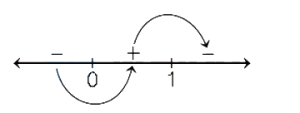
Using the first derivative test:
For $0 < x < 1$,$f'(x) > 0$ (function is increasing).
For $x > 1$,$f'(x) < 0$ (function is decreasing).
Thus,$f(x)$ has a local maximum at $x = 1$.
The maximum value is $f(1) = (1)^2 e^{-2(1)} = e^{-2} = \frac{1}{e^2}$.
To find the maximum value,we first find the derivative $f'(x)$:
$f'(x) = \frac{d}{dx}(x^2) \cdot e^{-2x} + x^2 \cdot \frac{d}{dx}(e^{-2x})$
$f'(x) = 2x e^{-2x} + x^2(-2)e^{-2x}$
$f'(x) = 2x e^{-2x}(1 - x)$
Setting $f'(x) = 0$ for critical points:
$2x e^{-2x}(1 - x) = 0$
Since $x > 0$ and $e^{-2x} \neq 0$,we have $1 - x = 0$,which gives $x = 1$.
Using the first derivative test:
For $0 < x < 1$,$f'(x) > 0$ (function is increasing).
For $x > 1$,$f'(x) < 0$ (function is decreasing).
Thus,$f(x)$ has a local maximum at $x = 1$.
The maximum value is $f(1) = (1)^2 e^{-2(1)} = e^{-2} = \frac{1}{e^2}$.
0 likes
View Solution713
EasyMCQ
The local maximum of $y=x^3-3 x^2+5$ is attained at
A
$x=0$
B
$x=2$
C
$x=1$
D
$x=-1$
Solution
(A) Given,$y=x^3-3 x^2+5$.
On differentiating both sides with respect to $x$,we get $\frac{dy}{dx} = 3x^2 - 6x$.
For local maxima or local minima,we set $\frac{dy}{dx} = 0$.
$3x^2 - 6x = 0 \Rightarrow 3x(x-2) = 0 \Rightarrow x = 0$ or $x = 2$.
Now,differentiating $\frac{dy}{dx}$ with respect to $x$,we get $\frac{d^2y}{dx^2} = 6x - 6$.
At $x = 0$,$\frac{d^2y}{dx^2} = 6(0) - 6 = -6 < 0$.
Since the second derivative is negative at $x = 0$,$x = 0$ is a point of local maxima.
At $x = 2$,$\frac{d^2y}{dx^2} = 6(2) - 6 = 6 > 0$.
Since the second derivative is positive at $x = 2$,$x = 2$ is a point of local minima.
Therefore,the local maximum is attained at $x = 0$.
On differentiating both sides with respect to $x$,we get $\frac{dy}{dx} = 3x^2 - 6x$.
For local maxima or local minima,we set $\frac{dy}{dx} = 0$.
$3x^2 - 6x = 0 \Rightarrow 3x(x-2) = 0 \Rightarrow x = 0$ or $x = 2$.
Now,differentiating $\frac{dy}{dx}$ with respect to $x$,we get $\frac{d^2y}{dx^2} = 6x - 6$.
At $x = 0$,$\frac{d^2y}{dx^2} = 6(0) - 6 = -6 < 0$.
Since the second derivative is negative at $x = 0$,$x = 0$ is a point of local maxima.
At $x = 2$,$\frac{d^2y}{dx^2} = 6(2) - 6 = 6 > 0$.
Since the second derivative is positive at $x = 2$,$x = 2$ is a point of local minima.
Therefore,the local maximum is attained at $x = 0$.
0 likes
View Solution714
MediumMCQ
The height of the cone of maximum volume inscribed in a sphere of radius $R$ is
A
$\frac{R}{3}$
B
$\frac{2 R}{3}$
C
$\frac{4 R}{3}$
D
$\frac{4 R}{\sqrt{3}}$
Solution
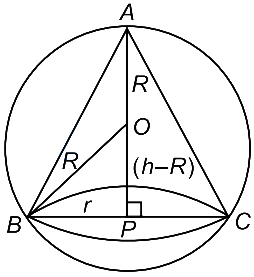
(C) Let the height of the cone be $h$ and the radius of the cone be $r$. Given,the radius of the sphere is $R$.
In $\triangle OPB$,by the Pythagorean theorem,we have:
$R^2 = r^2 + (h - R)^2$
$\Rightarrow r^2 = R^2 - (h - R)^2 = R^2 - (h^2 - 2Rh + R^2) = 2Rh - h^2$.
The volume $V$ of the cone is given by:
$V = \frac{1}{3} \pi r^2 h = \frac{1}{3} \pi (2Rh - h^2) h = \frac{\pi}{3} (2Rh^2 - h^3)$.
To find the maximum volume,differentiate $V$ with respect to $h$:
$\frac{dV}{dh} = \frac{\pi}{3} (4Rh - 3h^2)$.
Setting $\frac{dV}{dh} = 0$ for critical points:
$\frac{\pi}{3} h(4R - 3h) = 0$.
Since $h \neq 0$,we have $h = \frac{4R}{3}$.
Checking the second derivative:
$\frac{d^2V}{dh^2} = \frac{\pi}{3} (4R - 6h)$.
At $h = \frac{4R}{3}$,$\frac{d^2V}{dh^2} = \frac{\pi}{3} (4R - 6(\frac{4R}{3})) = \frac{\pi}{3} (4R - 8R) = -\frac{4\pi R}{3} < 0$.
Since the second derivative is negative,the volume is maximum at $h = \frac{4R}{3}$.
In $\triangle OPB$,by the Pythagorean theorem,we have:
$R^2 = r^2 + (h - R)^2$
$\Rightarrow r^2 = R^2 - (h - R)^2 = R^2 - (h^2 - 2Rh + R^2) = 2Rh - h^2$.
The volume $V$ of the cone is given by:
$V = \frac{1}{3} \pi r^2 h = \frac{1}{3} \pi (2Rh - h^2) h = \frac{\pi}{3} (2Rh^2 - h^3)$.
To find the maximum volume,differentiate $V$ with respect to $h$:
$\frac{dV}{dh} = \frac{\pi}{3} (4Rh - 3h^2)$.
Setting $\frac{dV}{dh} = 0$ for critical points:
$\frac{\pi}{3} h(4R - 3h) = 0$.
Since $h \neq 0$,we have $h = \frac{4R}{3}$.
Checking the second derivative:
$\frac{d^2V}{dh^2} = \frac{\pi}{3} (4R - 6h)$.
At $h = \frac{4R}{3}$,$\frac{d^2V}{dh^2} = \frac{\pi}{3} (4R - 6(\frac{4R}{3})) = \frac{\pi}{3} (4R - 8R) = -\frac{4\pi R}{3} < 0$.
Since the second derivative is negative,the volume is maximum at $h = \frac{4R}{3}$.
0 likes
View Solution715
MediumMCQ
The function $f(x) = x^3 + ax^2 + bx + c$ where $a^2 \leq 3b$ has:
A
one maximum value
B
no extreme value
C
one maximum and one minimum value
D
two maximum values
Solution
(B) Given the function $f(x) = x^3 + ax^2 + bx + c$.
To find the extreme values,we differentiate $f(x)$ with respect to $x$:
$f'(x) = 3x^2 + 2ax + b$.
For extreme values,we set $f'(x) = 0$:
$3x^2 + 2ax + b = 0$.
The discriminant of this quadratic equation is $D = (2a)^2 - 4(3)(b) = 4a^2 - 12b = 4(a^2 - 3b)$.
Given the condition $a^2 \leq 3b$,it follows that $a^2 - 3b \leq 0$,which implies $D \leq 0$.
If $D < 0$,the quadratic equation $f'(x) = 0$ has no real roots,meaning $f'(x)$ does not change sign and the function is strictly monotonic.
If $D = 0$,$f'(x) = 3(x + a/3)^2$,which is always $\geq 0$,so the function is monotonically increasing and has a point of inflection,not an extreme value.
Therefore,the function has no extreme value.
To find the extreme values,we differentiate $f(x)$ with respect to $x$:
$f'(x) = 3x^2 + 2ax + b$.
For extreme values,we set $f'(x) = 0$:
$3x^2 + 2ax + b = 0$.
The discriminant of this quadratic equation is $D = (2a)^2 - 4(3)(b) = 4a^2 - 12b = 4(a^2 - 3b)$.
Given the condition $a^2 \leq 3b$,it follows that $a^2 - 3b \leq 0$,which implies $D \leq 0$.
If $D < 0$,the quadratic equation $f'(x) = 0$ has no real roots,meaning $f'(x)$ does not change sign and the function is strictly monotonic.
If $D = 0$,$f'(x) = 3(x + a/3)^2$,which is always $\geq 0$,so the function is monotonically increasing and has a point of inflection,not an extreme value.
Therefore,the function has no extreme value.
0 likes
View Solution716
EasyMCQ
If $m$ and $M$ respectively denote the minimum and maximum of $f(x)=(x-1)^2+3$ for $x \in [-3, 1]$,then the ordered pair $(m, M)$ is equal to
A
$(-3, 19)$
B
$(3, 19)$
C
$(-19, 3)$
D
$(-19, -3)$
Solution
(B) Given the function $f(x) = (x-1)^2 + 3$ defined on the interval $x \in [-3, 1]$.
To find the critical points,we differentiate $f(x)$ with respect to $x$:
$f'(x) = 2(x-1)$.
Setting $f'(x) = 0$,we get $2(x-1) = 0$,which implies $x = 1$.
Since $x = 1$ is an endpoint of the interval $[-3, 1]$,we evaluate the function at the critical point and the boundaries:
At $x = 1$,$f(1) = (1-1)^2 + 3 = 3$.
At $x = -3$,$f(-3) = (-3-1)^2 + 3 = (-4)^2 + 3 = 16 + 3 = 19$.
Comparing the values,the minimum value $m = 3$ and the maximum value $M = 19$.
Thus,the ordered pair $(m, M)$ is $(3, 19)$.
To find the critical points,we differentiate $f(x)$ with respect to $x$:
$f'(x) = 2(x-1)$.
Setting $f'(x) = 0$,we get $2(x-1) = 0$,which implies $x = 1$.
Since $x = 1$ is an endpoint of the interval $[-3, 1]$,we evaluate the function at the critical point and the boundaries:
At $x = 1$,$f(1) = (1-1)^2 + 3 = 3$.
At $x = -3$,$f(-3) = (-3-1)^2 + 3 = (-4)^2 + 3 = 16 + 3 = 19$.
Comparing the values,the minimum value $m = 3$ and the maximum value $M = 19$.
Thus,the ordered pair $(m, M)$ is $(3, 19)$.
0 likes
View Solution717
EasyMCQ
Observe the statements given below :
Assertion $(A)$ : $f(x)=x e^{-x}$ has the maximum at $x=1$
Reason $(R)$ : $f^{\prime}(1)=0$ and $f^{\prime \prime}(1) < 0$
Which of the following is correct?
Assertion $(A)$ : $f(x)=x e^{-x}$ has the maximum at $x=1$
Reason $(R)$ : $f^{\prime}(1)=0$ and $f^{\prime \prime}(1) < 0$
Which of the following is correct?
A
Both $(A)$ and $(R)$ are true and $(R)$ is the correct reason for $(A)$
B
Both $(A)$ and $(R)$ are true,but $(R)$ is not the correct reason for $(A)$
C
$(A)$ is true,$(R)$ is false
D
$(A)$ is false,$(R)$ is true
Solution
(A) Given,$f(x)=x e^{-x}$.
First,find the derivative $f^{\prime}(x)$ using the product rule:
$f^{\prime}(x) = (1)e^{-x} + x(-e^{-x}) = e^{-x}(1-x)$.
For critical points,set $f^{\prime}(x) = 0$:
$e^{-x}(1-x) = 0 \Rightarrow x = 1$.
Next,find the second derivative $f^{\prime \prime}(x)$:
$f^{\prime \prime}(x) = -e^{-x}(1-x) + e^{-x}(-1) = e^{-x}(x-1-1) = e^{-x}(x-2)$.
Evaluate at $x=1$:
$f^{\prime \prime}(1) = e^{-1}(1-2) = -e^{-1} = -\frac{1}{e} < 0$.
Since $f^{\prime}(1) = 0$ and $f^{\prime \prime}(1) < 0$,the function $f(x)$ has a local maximum at $x=1$.
Therefore,both $(A)$ and $(R)$ are true and $(R)$ is the correct explanation for $(A)$.
First,find the derivative $f^{\prime}(x)$ using the product rule:
$f^{\prime}(x) = (1)e^{-x} + x(-e^{-x}) = e^{-x}(1-x)$.
For critical points,set $f^{\prime}(x) = 0$:
$e^{-x}(1-x) = 0 \Rightarrow x = 1$.
Next,find the second derivative $f^{\prime \prime}(x)$:
$f^{\prime \prime}(x) = -e^{-x}(1-x) + e^{-x}(-1) = e^{-x}(x-1-1) = e^{-x}(x-2)$.
Evaluate at $x=1$:
$f^{\prime \prime}(1) = e^{-1}(1-2) = -e^{-1} = -\frac{1}{e} < 0$.
Since $f^{\prime}(1) = 0$ and $f^{\prime \prime}(1) < 0$,the function $f(x)$ has a local maximum at $x=1$.
Therefore,both $(A)$ and $(R)$ are true and $(R)$ is the correct explanation for $(A)$.
0 likes
View Solution718
EasyMCQ
The minimum value of $2x^2+x-1$ is:
A
$-\frac{1}{4}$
B
$\frac{3}{2}$
C
$-\frac{9}{8}$
D
$\frac{9}{8}$
Solution
(C) Let $y = 2x^2 + x - 1$.
To find the minimum value,we find the derivative $y' = 4x + 1$.
Setting $y' = 0$ for critical points,we get $4x + 1 = 0$,which implies $x = -\frac{1}{4}$.
The second derivative is $y'' = 4$,which is positive $(> 0)$,confirming that the function has a minimum at $x = -\frac{1}{4}$.
Substituting $x = -\frac{1}{4}$ into the original expression:
$y = 2(-\frac{1}{4})^2 + (-\frac{1}{4}) - 1$
$y = 2(\frac{1}{16}) - \frac{1}{4} - 1$
$y = \frac{1}{8} - \frac{2}{8} - \frac{8}{8} = -\frac{9}{8}$.
Thus,the minimum value is $-\frac{9}{8}$.
To find the minimum value,we find the derivative $y' = 4x + 1$.
Setting $y' = 0$ for critical points,we get $4x + 1 = 0$,which implies $x = -\frac{1}{4}$.
The second derivative is $y'' = 4$,which is positive $(> 0)$,confirming that the function has a minimum at $x = -\frac{1}{4}$.
Substituting $x = -\frac{1}{4}$ into the original expression:
$y = 2(-\frac{1}{4})^2 + (-\frac{1}{4}) - 1$
$y = 2(\frac{1}{16}) - \frac{1}{4} - 1$
$y = \frac{1}{8} - \frac{2}{8} - \frac{8}{8} = -\frac{9}{8}$.
Thus,the minimum value is $-\frac{9}{8}$.
0 likes
View Solution719
EasyMCQ
The sum of two numbers is $20$. If the product of the square of one number and the cube of the other is maximum,then the numbers are:
A
$12, 8$
B
$3, 4$
C
$9, 12$
D
$15, 18$
Solution
(A) Let the two numbers be $x$ and $y$.
Given that $x + y = 20$,so $y = 20 - x$.
Let the product be $P = x^2 y^3$.
Substituting $y$,we get $P(x) = x^2(20 - x)^3$.
To find the maximum,differentiate $P$ with respect to $x$:
$\frac{dP}{dx} = 2x(20 - x)^3 + x^2 \cdot 3(20 - x)^2(-1) = x(20 - x)^2 [2(20 - x) - 3x] = x(20 - x)^2 (40 - 5x)$.
Setting $\frac{dP}{dx} = 0$,we get $x = 0$,$x = 20$,or $x = 8$.
Since $x$ and $y$ must be positive,we test $x = 8$.
If $x = 8$,then $y = 20 - 8 = 12$.
Thus,the numbers are $8$ and $12$.
Given that $x + y = 20$,so $y = 20 - x$.
Let the product be $P = x^2 y^3$.
Substituting $y$,we get $P(x) = x^2(20 - x)^3$.
To find the maximum,differentiate $P$ with respect to $x$:
$\frac{dP}{dx} = 2x(20 - x)^3 + x^2 \cdot 3(20 - x)^2(-1) = x(20 - x)^2 [2(20 - x) - 3x] = x(20 - x)^2 (40 - 5x)$.
Setting $\frac{dP}{dx} = 0$,we get $x = 0$,$x = 20$,or $x = 8$.
Since $x$ and $y$ must be positive,we test $x = 8$.
If $x = 8$,then $y = 20 - 8 = 12$.
Thus,the numbers are $8$ and $12$.
0 likes
View Solution720
MediumMCQ
The maximum value of $xy$ subject to $x+y=7$ is
A
$10$
B
$12$
C
$\frac{49}{4}$
D
$\frac{55}{4}$
Solution
(C) Let $M = xy$.
Given $x + y = 7$,we can write $y = 7 - x$.
Substituting this into the expression for $M$,we get $M = x(7 - x) = 7x - x^2$.
To find the maximum value,we differentiate $M$ with respect to $x$: $\frac{dM}{dx} = 7 - 2x$.
Setting $\frac{dM}{dx} = 0$ for critical points,we get $7 - 2x = 0$,which implies $x = \frac{7}{2}$.
Now,we find the second derivative: $\frac{d^2M}{dx^2} = -2$.
Since $\frac{d^2M}{dx^2} < 0$,the function $M$ has a maximum at $x = \frac{7}{2}$.
The maximum value is $M = \frac{7}{2}(7 - \frac{7}{2}) = \frac{7}{2} \times \frac{7}{2} = \frac{49}{4}$.
Given $x + y = 7$,we can write $y = 7 - x$.
Substituting this into the expression for $M$,we get $M = x(7 - x) = 7x - x^2$.
To find the maximum value,we differentiate $M$ with respect to $x$: $\frac{dM}{dx} = 7 - 2x$.
Setting $\frac{dM}{dx} = 0$ for critical points,we get $7 - 2x = 0$,which implies $x = \frac{7}{2}$.
Now,we find the second derivative: $\frac{d^2M}{dx^2} = -2$.
Since $\frac{d^2M}{dx^2} < 0$,the function $M$ has a maximum at $x = \frac{7}{2}$.
The maximum value is $M = \frac{7}{2}(7 - \frac{7}{2}) = \frac{7}{2} \times \frac{7}{2} = \frac{49}{4}$.
0 likes
View Solution721
EasyMCQ
The equation $x \log x = 3 - x$:
A
has no root in $(1, 3)$
B
has exactly one root in $(1, 3)$
C
$x \log x - (3 - x) > 0$ in $[1, 3]$
D
$x \log x - (3 - x) < 0$ in $[1, 3]$
Solution
(B) Let $f(x) = x \log x + x - 3$.
$f'(x) = x \cdot \frac{1}{x} + \log x + 1 = 1 + \log x + 1 = \log x + 2$.
For $x \in (1, 3)$,$\log x > 0$,so $f'(x) = \log x + 2 > 2 > 0$.
Thus,$f(x)$ is strictly increasing on $(1, 3)$.
$f(1) = 1 \cdot \log(1) + 1 - 3 = 0 + 1 - 3 = -2$.
$f(3) = 3 \log 3 + 3 - 3 = 3 \log 3 \approx 3(1.098) = 3.294 > 0$.
Since $f(1) < 0$ and $f(3) > 0$ and $f(x)$ is continuous and strictly increasing,by the Intermediate Value Theorem,there exists exactly one root in $(1, 3)$.
$f'(x) = x \cdot \frac{1}{x} + \log x + 1 = 1 + \log x + 1 = \log x + 2$.
For $x \in (1, 3)$,$\log x > 0$,so $f'(x) = \log x + 2 > 2 > 0$.
Thus,$f(x)$ is strictly increasing on $(1, 3)$.
$f(1) = 1 \cdot \log(1) + 1 - 3 = 0 + 1 - 3 = -2$.
$f(3) = 3 \log 3 + 3 - 3 = 3 \log 3 \approx 3(1.098) = 3.294 > 0$.
Since $f(1) < 0$ and $f(3) > 0$ and $f(x)$ is continuous and strictly increasing,by the Intermediate Value Theorem,there exists exactly one root in $(1, 3)$.
0 likes
View Solution722
EasyMCQ
$A$ missile is fired from the ground level and rises $x$ meters vertically upwards in $t$ seconds,where $x = 100t - \frac{25}{2}t^2$. The maximum height reached is: (in $\text{ m}$)
A
$100$
B
$300$
C
$200$
D
$125$
Solution
(C) Given the height function: $x(t) = 100t - \frac{25}{2}t^2$.
To find the maximum height,we differentiate $x$ with respect to $t$:
$\frac{dx}{dt} = 100 - 25t$.
For maximum height,set the first derivative to zero:
$100 - 25t = 0 \implies t = 4 \text{ s}$.
Now,check the second derivative to confirm it is a maximum:
$\frac{d^2x}{dt^2} = -25$.
Since $\frac{d^2x}{dt^2} < 0$,the function attains a maximum at $t = 4 \text{ s}$.
Substitute $t = 4$ into the original equation:
$x_{\text{max}} = 100(4) - \frac{25}{2}(4)^2 = 400 - \frac{25}{2}(16) = 400 - 200 = 200 \text{ m}$.
To find the maximum height,we differentiate $x$ with respect to $t$:
$\frac{dx}{dt} = 100 - 25t$.
For maximum height,set the first derivative to zero:
$100 - 25t = 0 \implies t = 4 \text{ s}$.
Now,check the second derivative to confirm it is a maximum:
$\frac{d^2x}{dt^2} = -25$.
Since $\frac{d^2x}{dt^2} < 0$,the function attains a maximum at $t = 4 \text{ s}$.
Substitute $t = 4$ into the original equation:
$x_{\text{max}} = 100(4) - \frac{25}{2}(4)^2 = 400 - \frac{25}{2}(16) = 400 - 200 = 200 \text{ m}$.
0 likes
View Solution723
EasyMCQ
The acceleration $f \text{ ft/sec}^2$ of a particle after a time $t \text{ sec}$ starting from rest is given by $f = 6 - \sqrt{1.2t}$. Then the maximum velocity $v$ and time $T$ to attain this velocity are:
A
$T = 20 \text{ sec}$
B
$v = 60 \text{ ft/sec}$
C
$T = 30 \text{ sec}$
D
$v = 40 \text{ ft/sec}$
Solution
(B, C) Given the acceleration $f = \frac{dv}{dt} = 6 - \sqrt{1.2t}$.
At $t = 0$,$v = 0$.
The velocity is maximum when the acceleration $f = 0$.
Setting $f = 0$,we get $6 - \sqrt{1.2t} = 0 \Rightarrow \sqrt{1.2t} = 6 \Rightarrow 1.2t = 36 \Rightarrow t = \frac{36}{1.2} = 30 \text{ sec}$.
Thus,the time $T = 30 \text{ sec}$.
To find the maximum velocity $v$,we integrate the acceleration with respect to time from $t = 0$ to $t = 30$:
$v = \int_{0}^{30} (6 - \sqrt{1.2} \cdot t^{1/2}) dt$
$v = [6t - \sqrt{1.2} \cdot \frac{t^{3/2}}{3/2}]_{0}^{30}$
$v = 6(30) - \frac{2}{3} \sqrt{1.2} \cdot (30)^{3/2}$
$v = 180 - \frac{2}{3} \sqrt{1.2} \cdot 30 \sqrt{30} = 180 - 20 \sqrt{36} = 180 - 20(6) = 180 - 120 = 60 \text{ ft/sec}$.
Therefore,the maximum velocity is $v = 60 \text{ ft/sec}$ at $T = 30 \text{ sec}$.
At $t = 0$,$v = 0$.
The velocity is maximum when the acceleration $f = 0$.
Setting $f = 0$,we get $6 - \sqrt{1.2t} = 0 \Rightarrow \sqrt{1.2t} = 6 \Rightarrow 1.2t = 36 \Rightarrow t = \frac{36}{1.2} = 30 \text{ sec}$.
Thus,the time $T = 30 \text{ sec}$.
To find the maximum velocity $v$,we integrate the acceleration with respect to time from $t = 0$ to $t = 30$:
$v = \int_{0}^{30} (6 - \sqrt{1.2} \cdot t^{1/2}) dt$
$v = [6t - \sqrt{1.2} \cdot \frac{t^{3/2}}{3/2}]_{0}^{30}$
$v = 6(30) - \frac{2}{3} \sqrt{1.2} \cdot (30)^{3/2}$
$v = 180 - \frac{2}{3} \sqrt{1.2} \cdot 30 \sqrt{30} = 180 - 20 \sqrt{36} = 180 - 20(6) = 180 - 120 = 60 \text{ ft/sec}$.
Therefore,the maximum velocity is $v = 60 \text{ ft/sec}$ at $T = 30 \text{ sec}$.
0 likes
View Solution724
EasyMCQ
$A$ particle moving in a straight line starts from rest and the acceleration at any time $t$ is $a - kt^2$,where $a$ and $k$ are positive constants. The maximum velocity attained by the particle is
A
$\frac{2}{3} \sqrt{\frac{a^3}{k}}$
B
$\frac{1}{3} \sqrt{\frac{a^3}{k}}$
C
$\sqrt{\frac{a^3}{k}}$
D
$2 \sqrt{\frac{a^3}{k}}$
Solution
(A) Given acceleration $v'(t) = a - kt^2$. Since the particle starts from rest,$v(0) = 0$.
Integrating with respect to $t$,we get $v(t) = \int (a - kt^2) dt = at - \frac{k}{3}t^3 + C$.
Using $v(0) = 0$,we find $C = 0$,so $v(t) = at - \frac{k}{3}t^3$.
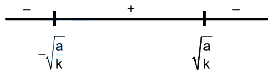
To find the maximum velocity,we set the acceleration to zero: $a - kt^2 = 0$,which gives $t^2 = \frac{a}{k}$,or $t = \sqrt{\frac{a}{k}}$ (since $t > 0$).
Substituting this value of $t$ into the velocity equation:
$v_{\max} = a \sqrt{\frac{a}{k}} - \frac{k}{3} \left(\sqrt{\frac{a}{k}}\right)^3$
$v_{\max} = a \sqrt{\frac{a}{k}} - \frac{k}{3} \cdot \frac{a}{k} \sqrt{\frac{a}{k}}$
$v_{\max} = a \sqrt{\frac{a}{k}} - \frac{a}{3} \sqrt{\frac{a}{k}} = \frac{2a}{3} \sqrt{\frac{a}{k}} = \frac{2}{3} \sqrt{\frac{a^3}{k}}$.
Integrating with respect to $t$,we get $v(t) = \int (a - kt^2) dt = at - \frac{k}{3}t^3 + C$.
Using $v(0) = 0$,we find $C = 0$,so $v(t) = at - \frac{k}{3}t^3$.
To find the maximum velocity,we set the acceleration to zero: $a - kt^2 = 0$,which gives $t^2 = \frac{a}{k}$,or $t = \sqrt{\frac{a}{k}}$ (since $t > 0$).
Substituting this value of $t$ into the velocity equation:
$v_{\max} = a \sqrt{\frac{a}{k}} - \frac{k}{3} \left(\sqrt{\frac{a}{k}}\right)^3$
$v_{\max} = a \sqrt{\frac{a}{k}} - \frac{k}{3} \cdot \frac{a}{k} \sqrt{\frac{a}{k}}$
$v_{\max} = a \sqrt{\frac{a}{k}} - \frac{a}{3} \sqrt{\frac{a}{k}} = \frac{2a}{3} \sqrt{\frac{a}{k}} = \frac{2}{3} \sqrt{\frac{a^3}{k}}$.
0 likes
View Solution725
MediumMCQ
If $f(x)$ is a function such that $f^{\prime}(x)=(x-1)^{2}(4-x),$ then
A
$f(0)=0$
B
$f(x)$ is increasing in $(0, 3)$
C
$x=4$ is a critical point of $f(x)$
D
$f(x)$ is decreasing in $(3, 5)$
Solution
(C) Given $f^{\prime}(x)=(x-1)^{2}(4-x).$
To find the critical points,we set $f^{\prime}(x)=0.$
$(x-1)^{2}(4-x)=0 \implies x=1, 4.$
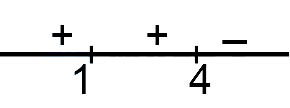
We analyze the sign of $f^{\prime}(x)$ in the intervals $(-\infty, 1), (1, 4),$ and $(4, \infty).$
For $x \in (-\infty, 1),$ $f^{\prime}(x) > 0.$
For $x \in (1, 4),$ $f^{\prime}(x) > 0.$
For $x \in (4, \infty),$ $f^{\prime}(x) < 0.$
Since $f^{\prime}(x) > 0$ for $x \in (-\infty, 4),$ the function is increasing in $(-\infty, 4).$
Since $f^{\prime}(x) < 0$ for $x \in (4, \infty),$ the function is decreasing in $(4, \infty).$
At $x=4,$ $f^{\prime}(x)=0,$ so $x=4$ is a critical point.
Thus,option $C$ is correct.
To find the critical points,we set $f^{\prime}(x)=0.$
$(x-1)^{2}(4-x)=0 \implies x=1, 4.$
We analyze the sign of $f^{\prime}(x)$ in the intervals $(-\infty, 1), (1, 4),$ and $(4, \infty).$
For $x \in (-\infty, 1),$ $f^{\prime}(x) > 0.$
For $x \in (1, 4),$ $f^{\prime}(x) > 0.$
For $x \in (4, \infty),$ $f^{\prime}(x) < 0.$
Since $f^{\prime}(x) > 0$ for $x \in (-\infty, 4),$ the function is increasing in $(-\infty, 4).$
Since $f^{\prime}(x) < 0$ for $x \in (4, \infty),$ the function is decreasing in $(4, \infty).$
At $x=4,$ $f^{\prime}(x)=0,$ so $x=4$ is a critical point.
Thus,option $C$ is correct.
0 likes
View Solution726
MediumMCQ
The minimum value of $f(x) = e^{(x^4 - x^3 + x^2)}$ is
A
$e$
B
$-e$
C
$1$
D
$-1$
Solution
(C) Given function is $f(x) = e^{(x^4 - x^3 + x^2)}$.
To find the minimum value,we find the derivative $f'(x)$:
$f'(x) = e^{(x^4 - x^3 + x^2)} \cdot \frac{d}{dx}(x^4 - x^3 + x^2)$
$f'(x) = e^{(x^4 - x^3 + x^2)} \cdot (4x^3 - 3x^2 + 2x)$
$f'(x) = e^{(x^4 - x^3 + x^2)} \cdot x(4x^2 - 3x + 2)$.
For the quadratic factor $4x^2 - 3x + 2$,the discriminant $D = (-3)^2 - 4(4)(2) = 9 - 32 = -23 < 0$.
Since the leading coefficient $4 > 0$ and $D < 0$,the expression $4x^2 - 3x + 2$ is always positive for all real $x$.
Thus,the sign of $f'(x)$ depends only on $x$.
For $x < 0$,$f'(x) < 0$,so the function is decreasing.
For $x > 0$,$f'(x) > 0$,so the function is increasing.
Therefore,the function attains its minimum value at $x = 0$.
The minimum value is $f(0) = e^{(0^4 - 0^3 + 0^2)} = e^0 = 1$.
To find the minimum value,we find the derivative $f'(x)$:
$f'(x) = e^{(x^4 - x^3 + x^2)} \cdot \frac{d}{dx}(x^4 - x^3 + x^2)$
$f'(x) = e^{(x^4 - x^3 + x^2)} \cdot (4x^3 - 3x^2 + 2x)$
$f'(x) = e^{(x^4 - x^3 + x^2)} \cdot x(4x^2 - 3x + 2)$.
For the quadratic factor $4x^2 - 3x + 2$,the discriminant $D = (-3)^2 - 4(4)(2) = 9 - 32 = -23 < 0$.
Since the leading coefficient $4 > 0$ and $D < 0$,the expression $4x^2 - 3x + 2$ is always positive for all real $x$.
Thus,the sign of $f'(x)$ depends only on $x$.
For $x < 0$,$f'(x) < 0$,so the function is decreasing.
For $x > 0$,$f'(x) > 0$,so the function is increasing.
Therefore,the function attains its minimum value at $x = 0$.
The minimum value is $f(0) = e^{(0^4 - 0^3 + 0^2)} = e^0 = 1$.
0 likes
View Solution727
MediumMCQ
Let $p(x)$ be a real polynomial of least degree which has a local maximum at $x=1$ and a local minimum at $x=3$. If $p(1)=6$ and $p(3)=2$,then $p^{\prime}(0)$ is equal to
A
$8$
B
$9$
C
$3$
D
$6$
Solution
(B) Since $p(x)$ has a local maximum at $x=1$ and a local minimum at $x=3$,its derivative $p^{\prime}(x)$ must have roots at $x=1$ and $x=3$. Thus,$p^{\prime}(x) = a(x-1)(x-3)$ for some constant $a \neq 0$.
Integrating $p^{\prime}(x)$,we get $p(x) = a(\frac{x^3}{3} - 2x^2 + 3x) + b$.
Using $p(1) = 6$: $a(\frac{1}{3} - 2 + 3) + b = 6 \implies \frac{4a}{3} + b = 6 \implies 4a + 3b = 18$.
Using $p(3) = 2$: $a(\frac{27}{3} - 2(9) + 3(3)) + b = 2 \implies a(9 - 18 + 9) + b = 2 \implies b = 2$.
Substituting $b = 2$ into $4a + 3b = 18$,we get $4a + 6 = 18 \implies 4a = 12 \implies a = 3$.
Thus,$p^{\prime}(x) = 3(x-1)(x-3)$.
Evaluating at $x=0$,$p^{\prime}(0) = 3(0-1)(0-3) = 3(-1)(-3) = 9$.
Integrating $p^{\prime}(x)$,we get $p(x) = a(\frac{x^3}{3} - 2x^2 + 3x) + b$.
Using $p(1) = 6$: $a(\frac{1}{3} - 2 + 3) + b = 6 \implies \frac{4a}{3} + b = 6 \implies 4a + 3b = 18$.
Using $p(3) = 2$: $a(\frac{27}{3} - 2(9) + 3(3)) + b = 2 \implies a(9 - 18 + 9) + b = 2 \implies b = 2$.
Substituting $b = 2$ into $4a + 3b = 18$,we get $4a + 6 = 18 \implies 4a = 12 \implies a = 3$.
Thus,$p^{\prime}(x) = 3(x-1)(x-3)$.
Evaluating at $x=0$,$p^{\prime}(0) = 3(0-1)(0-3) = 3(-1)(-3) = 9$.
0 likes
View Solution728
MediumMCQ
The function $f(x) = 2x^3 - 3x^2 - 12x + 4, x \in R$ has
A
two points of local maximum
B
two points of local minimum
C
one local maximum and one local minimum
D
neither maximum nor minimum
Solution
(C) To find the local maxima and minima,we first find the derivative of the function $f(x) = 2x^3 - 3x^2 - 12x + 4$.
$f'(x) = 6x^2 - 6x - 12$.
Setting $f'(x) = 0$ for critical points:
$6(x^2 - x - 2) = 0 \Rightarrow 6(x - 2)(x + 1) = 0$.
Thus,the critical points are $x = 2$ and $x = -1$.
Now,we find the second derivative $f''(x) = 12x - 6$.
For $x = -1$,$f''(-1) = 12(-1) - 6 = -18 < 0$,so $x = -1$ is a point of local maxima.
For $x = 2$,$f''(2) = 12(2) - 6 = 18 > 0$,so $x = 2$ is a point of local minima.
Therefore,the function has one local maximum and one local minimum.
$f'(x) = 6x^2 - 6x - 12$.
Setting $f'(x) = 0$ for critical points:
$6(x^2 - x - 2) = 0 \Rightarrow 6(x - 2)(x + 1) = 0$.
Thus,the critical points are $x = 2$ and $x = -1$.
Now,we find the second derivative $f''(x) = 12x - 6$.
For $x = -1$,$f''(-1) = 12(-1) - 6 = -18 < 0$,so $x = -1$ is a point of local maxima.
For $x = 2$,$f''(2) = 12(2) - 6 = 18 > 0$,so $x = 2$ is a point of local minima.
Therefore,the function has one local maximum and one local minimum.
0 likes
View Solution729
EasyMCQ
Let $f: R \rightarrow R$ be given by $f(x) = |x^2 - 1|$,then
A
$f$ has a local minima at $x = \pm 1$ but no local maxima
B
$f$ has a local maxima at $x = 0$,but no local minima
C
$f$ has a local minima at $x = \pm 1$ and a local maxima at $x = 0$
D
$f$ has neither any local maxima nor any local minima
Solution
(C) The function is defined as $f(x) = |x^2 - 1|$.
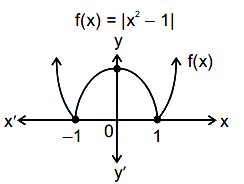
We can analyze the behavior of the function by looking at its graph or by examining its critical points.
$1$. The function $f(x) = |x^2 - 1|$ is non-negative for all $x \in R$.
$2$. At $x = 1$ and $x = -1$,$f(x) = |1^2 - 1| = 0$. Since $f(x) \ge 0$ for all $x$,the points $x = 1$ and $x = -1$ are points of local minima where the minimum value is $0$.
$3$. At $x = 0$,$f(0) = |0^2 - 1| = |-1| = 1$. For values of $x$ in a small neighborhood around $0$ (e.g.,$x \in (-1, 1)$),$f(x) = |x^2 - 1| = 1 - x^2$. Since $1 - x^2 < 1$ for all $x \neq 0$ in this neighborhood,$x = 0$ is a point of local maxima.
Thus,$f$ has local minima at $x = \pm 1$ and a local maxima at $x = 0$.
We can analyze the behavior of the function by looking at its graph or by examining its critical points.
$1$. The function $f(x) = |x^2 - 1|$ is non-negative for all $x \in R$.
$2$. At $x = 1$ and $x = -1$,$f(x) = |1^2 - 1| = 0$. Since $f(x) \ge 0$ for all $x$,the points $x = 1$ and $x = -1$ are points of local minima where the minimum value is $0$.
$3$. At $x = 0$,$f(0) = |0^2 - 1| = |-1| = 1$. For values of $x$ in a small neighborhood around $0$ (e.g.,$x \in (-1, 1)$),$f(x) = |x^2 - 1| = 1 - x^2$. Since $1 - x^2 < 1$ for all $x \neq 0$ in this neighborhood,$x = 0$ is a point of local maxima.
Thus,$f$ has local minima at $x = \pm 1$ and a local maxima at $x = 0$.
0 likes
View Solution730
EasyMCQ
Consider the function $f(x) = x(x - 1)(x - 2) \dots (x - 100)$. Which one of the following is correct?
A
This function has $100$ local maxima
B
This function has $50$ local maxima
C
This function has $51$ local maxima
D
Local minima do not exist for this function
Solution
(B) The function is $f(x) = x(x - 1)(x - 2) \dots (x - 100)$.
This is a polynomial of degree $101$.
The roots of the function are $x = 0, 1, 2, \dots, 100$.
Since the leading coefficient is positive and the degree is odd,the graph starts from $-\infty$ and goes to $+\infty$.
Between any two consecutive roots $x = k$ and $x = k+1$,there must be at least one local extremum (by Rolle's Theorem).
There are $100$ intervals of the form $(k, k+1)$ for $k = 0, 1, \dots, 99$.
In each interval,there is exactly one local extremum.
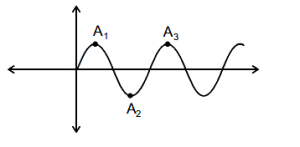
Since the function is positive in $(0, 1)$,negative in $(1, 2)$,positive in $(2, 3)$,and so on,the local extrema alternate between local maxima and local minima.
The intervals are $(0, 1), (1, 2), (2, 3), \dots, (99, 100)$.
Local maxima occur in intervals $(0, 1), (2, 3), \dots, (98, 99)$.
The number of such intervals is $50$ (i.e.,$k = 0, 2, \dots, 98$).
Thus,there are $50$ local maxima.
This is a polynomial of degree $101$.
The roots of the function are $x = 0, 1, 2, \dots, 100$.
Since the leading coefficient is positive and the degree is odd,the graph starts from $-\infty$ and goes to $+\infty$.
Between any two consecutive roots $x = k$ and $x = k+1$,there must be at least one local extremum (by Rolle's Theorem).
There are $100$ intervals of the form $(k, k+1)$ for $k = 0, 1, \dots, 99$.
In each interval,there is exactly one local extremum.
Since the function is positive in $(0, 1)$,negative in $(1, 2)$,positive in $(2, 3)$,and so on,the local extrema alternate between local maxima and local minima.
The intervals are $(0, 1), (1, 2), (2, 3), \dots, (99, 100)$.
Local maxima occur in intervals $(0, 1), (2, 3), \dots, (98, 99)$.
The number of such intervals is $50$ (i.e.,$k = 0, 2, \dots, 98$).
Thus,there are $50$ local maxima.
0 likes
View Solution731
MediumMCQ
Given $f(x) = e^{\sin x} + e^{\cos x}$. The global maximum value of $f(x)$
A
does not exist
B
exists at a point in $\left(0, \frac{\pi}{2}\right)$ and its value is $2 e^{\frac{1}{\sqrt{2}}}$
C
exists at infinitely many points
D
exists at $x=0$ only
Solution
(C) Given the function $f(x) = e^{\sin x} + e^{\cos x}$.
To find the critical points,we set the derivative $f'(x) = 0$:
$f'(x) = e^{\sin x} \cdot \cos x + e^{\cos x} \cdot (-\sin x) = 0$
$e^{\sin x} \cos x = e^{\cos x} \sin x$
$\frac{e^{\sin x}}{e^{\cos x}} = \frac{\sin x}{\cos x}$
$e^{\sin x - \cos x} = \tan x$
Since $f(x)$ is a periodic function with period $2\pi$,the solutions for $x$ occur periodically.
At $x = \frac{\pi}{4}$,$e^{\sin(\pi/4) - \cos(\pi/4)} = e^0 = 1$ and $\tan(\pi/4) = 1$. Thus,$x = \frac{\pi}{4}$ is a critical point.
Due to the periodicity of $\sin x$ and $\cos x$,the function $f(x)$ repeats its values every $2\pi$.
Therefore,the global maximum occurs at $x = 2n\pi + \frac{\pi}{4}$ for all integers $n$.
Since there are infinitely many such points,the global maximum exists at infinitely many points.
To find the critical points,we set the derivative $f'(x) = 0$:
$f'(x) = e^{\sin x} \cdot \cos x + e^{\cos x} \cdot (-\sin x) = 0$
$e^{\sin x} \cos x = e^{\cos x} \sin x$
$\frac{e^{\sin x}}{e^{\cos x}} = \frac{\sin x}{\cos x}$
$e^{\sin x - \cos x} = \tan x$
Since $f(x)$ is a periodic function with period $2\pi$,the solutions for $x$ occur periodically.
At $x = \frac{\pi}{4}$,$e^{\sin(\pi/4) - \cos(\pi/4)} = e^0 = 1$ and $\tan(\pi/4) = 1$. Thus,$x = \frac{\pi}{4}$ is a critical point.
Due to the periodicity of $\sin x$ and $\cos x$,the function $f(x)$ repeats its values every $2\pi$.
Therefore,the global maximum occurs at $x = 2n\pi + \frac{\pi}{4}$ for all integers $n$.
Since there are infinitely many such points,the global maximum exists at infinitely many points.
0 likes
View Solution732
MediumMCQ
If $f(x)=3 \sqrt[3]{x^2}-x^2$,then
A
$f$ has no extrema
B
$f$ is maximum at two points $x=1$ and $x=-1$
C
$f$ is minimum at $x=0$
D
$f$ has maximum at $x=1$ only
Solution
(B) Given $f(x) = 3x^{2/3} - x^2$.
To find the extrema,we differentiate $f(x)$ with respect to $x$:
$f'(x) = 3 \cdot \frac{2}{3} x^{-1/3} - 2x = 2x^{-1/3} - 2x = 2 \left( \frac{1 - x^{4/3}}{x^{1/3}} \right)$.
Setting $f'(x) = 0$,we get $1 - x^{4/3} = 0$,which implies $x^{4/3} = 1$,so $x = 1$ or $x = -1$.
Also,$f'(x)$ is undefined at $x = 0$.
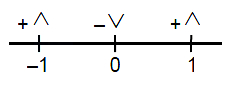
We analyze the sign of $f'(x)$ around the critical points $x = -1, 0, 1$:
For $x < -1$,$f'(x) > 0$.
For $-1 < x < 0$,$f'(x) < 0$.
For $0 < x < 1$,$f'(x) > 0$.
For $x > 1$,$f'(x) < 0$.
At $x = -1$,$f'(x)$ changes from positive to negative,so $f$ has a local maximum at $x = -1$.
At $x = 0$,$f'(x)$ changes from negative to positive,so $f$ has a local minimum at $x = 0$.
At $x = 1$,$f'(x)$ changes from positive to negative,so $f$ has a local maximum at $x = 1$.
Thus,$f$ is maximum at two points $x = 1$ and $x = -1$.
To find the extrema,we differentiate $f(x)$ with respect to $x$:
$f'(x) = 3 \cdot \frac{2}{3} x^{-1/3} - 2x = 2x^{-1/3} - 2x = 2 \left( \frac{1 - x^{4/3}}{x^{1/3}} \right)$.
Setting $f'(x) = 0$,we get $1 - x^{4/3} = 0$,which implies $x^{4/3} = 1$,so $x = 1$ or $x = -1$.
Also,$f'(x)$ is undefined at $x = 0$.
We analyze the sign of $f'(x)$ around the critical points $x = -1, 0, 1$:
For $x < -1$,$f'(x) > 0$.
For $-1 < x < 0$,$f'(x) < 0$.
For $0 < x < 1$,$f'(x) > 0$.
For $x > 1$,$f'(x) < 0$.
At $x = -1$,$f'(x)$ changes from positive to negative,so $f$ has a local maximum at $x = -1$.
At $x = 0$,$f'(x)$ changes from negative to positive,so $f$ has a local minimum at $x = 0$.
At $x = 1$,$f'(x)$ changes from positive to negative,so $f$ has a local maximum at $x = 1$.
Thus,$f$ is maximum at two points $x = 1$ and $x = -1$.
0 likes
View Solution733
MediumMCQ
Let $f(x)=(x-2)^{17}(x+5)^{24}$. Then
A
$f$ does not have a critical point at $x=2$
B
$f$ has a minimum at $x=2$
C
$f$ has neither a maximum nor a minimum at $x=2$
D
$f$ has a maximum at $x=2$
Solution
(C) Given $f(x)=(x-2)^{17}(x+5)^{24}$.
To find the critical points,we find the derivative $f'(x)$:
$f'(x) = 17(x-2)^{16}(x+5)^{24} + 24(x-2)^{17}(x+5)^{23}$
$f'(x) = (x-2)^{16}(x+5)^{23} [17(x+5) + 24(x-2)]$
$f'(x) = (x-2)^{16}(x+5)^{23} [17x + 85 + 24x - 48]$
$f'(x) = (x-2)^{16}(x+5)^{23} (41x + 37)$
The critical points are $x=2, x=-5, x=-\frac{37}{41}$.
Now,examine the sign of $f'(x)$ around $x=2$:
Since $(x-2)^{16}$ is always non-negative,the sign of $f'(x)$ depends on $(x+5)^{23}(41x+37)$.
For $x$ slightly less than $2$,$(x+5)^{23} > 0$ and $(41x+37) > 0$,so $f'(x) > 0$.
For $x$ slightly greater than $2$,$(x+5)^{23} > 0$ and $(41x+37) > 0$,so $f'(x) > 0$.
Since the sign of $f'(x)$ does not change as $x$ passes through $2$,$f(x)$ has neither a maximum nor a minimum at $x=2$.
To find the critical points,we find the derivative $f'(x)$:
$f'(x) = 17(x-2)^{16}(x+5)^{24} + 24(x-2)^{17}(x+5)^{23}$
$f'(x) = (x-2)^{16}(x+5)^{23} [17(x+5) + 24(x-2)]$
$f'(x) = (x-2)^{16}(x+5)^{23} [17x + 85 + 24x - 48]$
$f'(x) = (x-2)^{16}(x+5)^{23} (41x + 37)$
The critical points are $x=2, x=-5, x=-\frac{37}{41}$.
Now,examine the sign of $f'(x)$ around $x=2$:
Since $(x-2)^{16}$ is always non-negative,the sign of $f'(x)$ depends on $(x+5)^{23}(41x+37)$.
For $x$ slightly less than $2$,$(x+5)^{23} > 0$ and $(41x+37) > 0$,so $f'(x) > 0$.
For $x$ slightly greater than $2$,$(x+5)^{23} > 0$ and $(41x+37) > 0$,so $f'(x) > 0$.
Since the sign of $f'(x)$ does not change as $x$ passes through $2$,$f(x)$ has neither a maximum nor a minimum at $x=2$.
0 likes
View Solution734
MediumMCQ
The maximum value of $f(x) = e^{\sin x} + e^{\cos x}$ for $x \in R$ is
A
$2e$
B
$2\sqrt{e}$
C
$2e^{1/\sqrt{2}}$
D
$2e^{-1/\sqrt{2}}$
Solution
(C) Given $f(x) = e^{\sin x} + e^{\cos x}$.
To find the maximum value,we use the Arithmetic Mean-Geometric Mean ($AM$-$GM$) inequality or derivative analysis.
Let $u = \sin x$ and $v = \cos x$. We know that $u^2 + v^2 = 1$.
Using the property that for $f(x) = e^{\sin x} + e^{\cos x}$,the function attains its maximum when $\sin x = \cos x$.
Setting $\sin x = \cos x$,we get $\tan x = 1$,which implies $x = \frac{\pi}{4} + n\pi$.
For $x = \frac{\pi}{4}$,$\sin x = \frac{1}{\sqrt{2}}$ and $\cos x = \frac{1}{\sqrt{2}}$.
Substituting these values into $f(x)$:
$f\left(\frac{\pi}{4}\right) = e^{1/\sqrt{2}} + e^{1/\sqrt{2}} = 2e^{1/\sqrt{2}}$.
Thus,the maximum value is $2e^{1/\sqrt{2}}$.
To find the maximum value,we use the Arithmetic Mean-Geometric Mean ($AM$-$GM$) inequality or derivative analysis.
Let $u = \sin x$ and $v = \cos x$. We know that $u^2 + v^2 = 1$.
Using the property that for $f(x) = e^{\sin x} + e^{\cos x}$,the function attains its maximum when $\sin x = \cos x$.
Setting $\sin x = \cos x$,we get $\tan x = 1$,which implies $x = \frac{\pi}{4} + n\pi$.
For $x = \frac{\pi}{4}$,$\sin x = \frac{1}{\sqrt{2}}$ and $\cos x = \frac{1}{\sqrt{2}}$.
Substituting these values into $f(x)$:
$f\left(\frac{\pi}{4}\right) = e^{1/\sqrt{2}} + e^{1/\sqrt{2}} = 2e^{1/\sqrt{2}}$.
Thus,the maximum value is $2e^{1/\sqrt{2}}$.
0 likes
View Solution735
EasyMCQ
Twenty metres of wire is available to fence off a flower bed in the form of a circular sector. What must the radius of the circle be,if the area of the flower bed is to be the greatest (in $m$)?
A
$10$
B
$4$
C
$5$
D
$6$
Solution
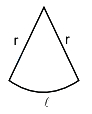
(C) Let the radius of the circular sector be $r$ and the arc length be $\ell$.
Given that the total length of the wire is $20 \ m$,the perimeter of the sector is $2r + \ell = 20$.
Thus,$\ell = 20 - 2r$.
The area $A$ of a circular sector is given by $A = \frac{1}{2} r \ell$.
Substituting the value of $\ell$,we get $A = \frac{1}{2} r (20 - 2r) = 10r - r^2$.
To find the maximum area,we differentiate $A$ with respect to $r$ and set it to zero:
$\frac{dA}{dr} = 10 - 2r = 0$.
Solving for $r$,we get $2r = 10$,which implies $r = 5 \ m$.
To verify that this is a maximum,we check the second derivative: $\frac{d^2A}{dr^2} = -2$,which is less than $0$,confirming that the area is maximum at $r = 5 \ m$.
Given that the total length of the wire is $20 \ m$,the perimeter of the sector is $2r + \ell = 20$.
Thus,$\ell = 20 - 2r$.
The area $A$ of a circular sector is given by $A = \frac{1}{2} r \ell$.
Substituting the value of $\ell$,we get $A = \frac{1}{2} r (20 - 2r) = 10r - r^2$.
To find the maximum area,we differentiate $A$ with respect to $r$ and set it to zero:
$\frac{dA}{dr} = 10 - 2r = 0$.
Solving for $r$,we get $2r = 10$,which implies $r = 5 \ m$.
To verify that this is a maximum,we check the second derivative: $\frac{d^2A}{dr^2} = -2$,which is less than $0$,confirming that the area is maximum at $r = 5 \ m$.
0 likes
View Solution736
EasyMCQ
Let $f: R \rightarrow R$ be given by $f(x) = |x^{2} - 1|$,$x \in R$. Then:
A
$f$ has a local minimum at $x = \pm 1$ but no local maximum.
B
$f$ has a local maximum at $x = 0$ but no local minimum.
C
$f$ has a local minima at $x = \pm 1$ and a local maxima at $x = 0$.
D
$f$ has neither a local maxima nor a local minima at any point.
Solution
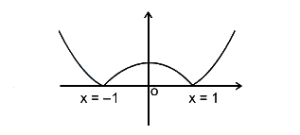
(C) The function is defined as $f(x) = |x^{2} - 1|$.
We can analyze the behavior of the function by looking at its graph or by testing points.
At $x = \pm 1$,$f(x) = |(\pm 1)^{2} - 1| = |1 - 1| = 0$. Since the absolute value function is always non-negative,$f(x) \geq 0$ for all $x \in R$. Thus,$f(x) = 0$ at $x = \pm 1$ represents the absolute minimum value of the function,which is also a local minimum.
At $x = 0$,$f(0) = |0^{2} - 1| = |-1| = 1$. For values of $x$ close to $0$,say $x = 0.1$ or $x = -0.1$,$f(0.1) = |(0.1)^{2} - 1| = |0.01 - 1| = 0.99$. Since $f(0) = 1 > 0.99$,$x = 0$ is a point of local maximum.
Therefore,$f$ has local minima at $x = \pm 1$ and a local maximum at $x = 0$.
We can analyze the behavior of the function by looking at its graph or by testing points.
At $x = \pm 1$,$f(x) = |(\pm 1)^{2} - 1| = |1 - 1| = 0$. Since the absolute value function is always non-negative,$f(x) \geq 0$ for all $x \in R$. Thus,$f(x) = 0$ at $x = \pm 1$ represents the absolute minimum value of the function,which is also a local minimum.
At $x = 0$,$f(0) = |0^{2} - 1| = |-1| = 1$. For values of $x$ close to $0$,say $x = 0.1$ or $x = -0.1$,$f(0.1) = |(0.1)^{2} - 1| = |0.01 - 1| = 0.99$. Since $f(0) = 1 > 0.99$,$x = 0$ is a point of local maximum.
Therefore,$f$ has local minima at $x = \pm 1$ and a local maximum at $x = 0$.
0 likes
View Solution737
MediumMCQ
The greatest and least values of $f(x)=\tan ^{-1} x-\frac{1}{2} \ln x$ on $\left[\frac{1}{\sqrt{3}}, \sqrt{3}\right]$ are
A
$f_{\min }=\sqrt{3}-1$
B
$f_{\max }=\pi / 6+\frac{1}{4} \ln 3$
C
$f_{\min }=\pi / 3-\frac{1}{4} \ln 3$
D
$f_{\max }=\pi / 12+\ln 5$
Solution
(B) Given $f(x) = \tan^{-1} x - \frac{1}{2} \ln x$ on the interval $x \in \left[\frac{1}{\sqrt{3}}, \sqrt{3}\right]$.
First,find the derivative $f'(x)$:
$f'(x) = \frac{1}{1+x^2} - \frac{1}{2x} = \frac{2x - (1+x^2)}{2x(1+x^2)} = \frac{-(x^2 - 2x + 1)}{2x(1+x^2)} = \frac{-(x-1)^2}{2x(1+x^2)}$.
Since $-(x-1)^2 \leq 0$ and $2x(1+x^2) > 0$ for $x \in \left[\frac{1}{\sqrt{3}}, \sqrt{3}\right]$,we have $f'(x) \leq 0$ for all $x$ in the interval.
Thus,$f(x)$ is a strictly decreasing function on the given interval.
The maximum value occurs at the left endpoint $x = \frac{1}{\sqrt{3}}$:
$f_{\max} = f\left(\frac{1}{\sqrt{3}}\right) = \tan^{-1}\left(\frac{1}{\sqrt{3}}\right) - \frac{1}{2} \ln\left(\frac{1}{\sqrt{3}}\right) = \frac{\pi}{6} - \frac{1}{2} \ln(3^{-1/2}) = \frac{\pi}{6} + \frac{1}{4} \ln 3$.
The minimum value occurs at the right endpoint $x = \sqrt{3}$:
$f_{\min} = f(\sqrt{3}) = \tan^{-1}(\sqrt{3}) - \frac{1}{2} \ln(\sqrt{3}) = \frac{\pi}{3} - \frac{1}{2} \ln(3^{1/2}) = \frac{\pi}{3} - \frac{1}{4} \ln 3$.
First,find the derivative $f'(x)$:
$f'(x) = \frac{1}{1+x^2} - \frac{1}{2x} = \frac{2x - (1+x^2)}{2x(1+x^2)} = \frac{-(x^2 - 2x + 1)}{2x(1+x^2)} = \frac{-(x-1)^2}{2x(1+x^2)}$.
Since $-(x-1)^2 \leq 0$ and $2x(1+x^2) > 0$ for $x \in \left[\frac{1}{\sqrt{3}}, \sqrt{3}\right]$,we have $f'(x) \leq 0$ for all $x$ in the interval.
Thus,$f(x)$ is a strictly decreasing function on the given interval.
The maximum value occurs at the left endpoint $x = \frac{1}{\sqrt{3}}$:
$f_{\max} = f\left(\frac{1}{\sqrt{3}}\right) = \tan^{-1}\left(\frac{1}{\sqrt{3}}\right) - \frac{1}{2} \ln\left(\frac{1}{\sqrt{3}}\right) = \frac{\pi}{6} - \frac{1}{2} \ln(3^{-1/2}) = \frac{\pi}{6} + \frac{1}{4} \ln 3$.
The minimum value occurs at the right endpoint $x = \sqrt{3}$:
$f_{\min} = f(\sqrt{3}) = \tan^{-1}(\sqrt{3}) - \frac{1}{2} \ln(\sqrt{3}) = \frac{\pi}{3} - \frac{1}{2} \ln(3^{1/2}) = \frac{\pi}{3} - \frac{1}{4} \ln 3$.
0 likes
View Solution738
EasyMCQ
Let $f(x) = 1 - \sqrt{x^2}$,where the square root is to be taken as positive. Then:
A
$f$ has no extrema at $x = 0$
B
$f$ has minima at $x = 0$
C
$f$ has maxima at $x = 0$
D
$f'(0)$ exists
Solution
(C) Given the function $f(x) = 1 - \sqrt{x^2}$.
Since $\sqrt{x^2} = |x|$,the function can be rewritten as $f(x) = 1 - |x|$.
At $x = 0$,$f(0) = 1 - |0| = 1$.
For any $x \neq 0$,$|x| > 0$,so $f(x) = 1 - |x| < 1$.
Since $f(x) \leq f(0)$ for all $x$ in the domain,the function attains its maximum value at $x = 0$.
Therefore,$f$ has a maxima at $x = 0$.
Since $\sqrt{x^2} = |x|$,the function can be rewritten as $f(x) = 1 - |x|$.
At $x = 0$,$f(0) = 1 - |0| = 1$.
For any $x \neq 0$,$|x| > 0$,so $f(x) = 1 - |x| < 1$.
Since $f(x) \leq f(0)$ for all $x$ in the domain,the function attains its maximum value at $x = 0$.
Therefore,$f$ has a maxima at $x = 0$.
0 likes
View Solution739
MediumMCQ
If the function $f(x)=2x^{3}-9ax^{2}+12a^{2}x+1$ where $a>0$ attains its maximum and minimum at $p$ and $q$ respectively such that $p^{2}=q$,then $a$ is equal to
A
$2$
B
$\frac{1}{2}$
C
$\frac{1}{4}$
D
$3$
Solution
(A) Given the function $f(x)=2x^{3}-9ax^{2}+12a^{2}x+1$.
First,find the derivative $f'(x)$:
$f'(x) = 6x^{2}-18ax+12a^{2}$.
Set $f'(x)=0$ to find critical points:
$6(x^{2}-3ax+2a^{2})=0 \Rightarrow 6(x-a)(x-2a)=0$.
So,the critical points are $x=a$ and $x=2a$.
Now,find the second derivative $f''(x)$:
$f''(x) = 12x-18a$.
Check the nature of the critical points:
For $x=a$: $f''(a) = 12a-18a = -6a$. Since $a>0$,$f''(a) < 0$,so $f(x)$ has a local maximum at $p=a$.
For $x=2a$: $f''(2a) = 12(2a)-18a = 6a$. Since $a>0$,$f''(2a) > 0$,so $f(x)$ has a local minimum at $q=2a$.
Given the condition $p^{2}=q$,substitute the values:
$a^{2} = 2a$.
Since $a>0$,we can divide by $a$:
$a = 2$.
First,find the derivative $f'(x)$:
$f'(x) = 6x^{2}-18ax+12a^{2}$.
Set $f'(x)=0$ to find critical points:
$6(x^{2}-3ax+2a^{2})=0 \Rightarrow 6(x-a)(x-2a)=0$.
So,the critical points are $x=a$ and $x=2a$.
Now,find the second derivative $f''(x)$:
$f''(x) = 12x-18a$.
Check the nature of the critical points:
For $x=a$: $f''(a) = 12a-18a = -6a$. Since $a>0$,$f''(a) < 0$,so $f(x)$ has a local maximum at $p=a$.
For $x=2a$: $f''(2a) = 12(2a)-18a = 6a$. Since $a>0$,$f''(2a) > 0$,so $f(x)$ has a local minimum at $q=2a$.
Given the condition $p^{2}=q$,substitute the values:
$a^{2} = 2a$.
Since $a>0$,we can divide by $a$:
$a = 2$.
0 likes
View Solution740
MediumMCQ
Two particles move in the same straight line starting at the same moment from the same point in the same direction. The first moves with constant velocity $u$ and the second starts from rest with constant acceleration $f$. Then,
A
they will be at the greatest distance at the end of time $\frac{u}{2 f}$ from the start
B
they will be at the greatest distance at the end of time $\frac{u}{f}$ from the start
C
their greatest distance is $\frac{u^{2}}{2 f}$
D
their greatest distance is $\frac{u^{2}}{f}$
Solution
(B, C) Let $S_1$ be the displacement of the first particle and $S_2$ be the displacement of the second particle at time $t$.
For the first particle: $S_1 = u t$.
For the second particle: $S_2 = \frac{1}{2} f t^2$.
The distance between them is $D(t) = |S_1 - S_2| = |u t - \frac{1}{2} f t^2|$.
To find the greatest distance,we differentiate $D(t)$ with respect to $t$ and set it to zero:
$\frac{dD}{dt} = u - f t = 0$.
This gives $t = \frac{u}{f}$.
At $t = \frac{u}{f}$,the distance is $D = u(\frac{u}{f}) - \frac{1}{2} f(\frac{u}{f})^2 = \frac{u^2}{f} - \frac{u^2}{2f} = \frac{u^2}{2f}$.
Thus,the particles are at the greatest distance at $t = \frac{u}{f}$ and the maximum distance is $\frac{u^2}{2f}$.
Therefore,options $B$ and $C$ are correct.
For the first particle: $S_1 = u t$.
For the second particle: $S_2 = \frac{1}{2} f t^2$.
The distance between them is $D(t) = |S_1 - S_2| = |u t - \frac{1}{2} f t^2|$.
To find the greatest distance,we differentiate $D(t)$ with respect to $t$ and set it to zero:
$\frac{dD}{dt} = u - f t = 0$.
This gives $t = \frac{u}{f}$.
At $t = \frac{u}{f}$,the distance is $D = u(\frac{u}{f}) - \frac{1}{2} f(\frac{u}{f})^2 = \frac{u^2}{f} - \frac{u^2}{2f} = \frac{u^2}{2f}$.
Thus,the particles are at the greatest distance at $t = \frac{u}{f}$ and the maximum distance is $\frac{u^2}{2f}$.
Therefore,options $B$ and $C$ are correct.
0 likes
View Solution741
MediumMCQ
Let $\exp(x)$ denote the exponential function $e^x$. If $f(x) = \exp\left(x^{\frac{1}{x}}\right)$ for $x > 0$,then the minimum value of $f$ in the interval $[2, 5]$ is:
A
$\exp\left(e^{\frac{1}{e}}\right)$
B
$\exp\left(2^{\frac{1}{2}}\right)$
C
$\exp\left(5^{\frac{1}{5}}\right)$
D
$\exp\left(3^{\frac{1}{3}}\right)$
Solution
(C) Given $f(x) = \exp\left(x^{\frac{1}{x}}\right)$. Let $g(x) = x^{\frac{1}{x}}$. Since $\exp(u)$ is an increasing function,the minimum of $f(x)$ occurs where $g(x)$ is minimum.
Taking the natural logarithm of $g(x)$,we have $\ln(g(x)) = \frac{\ln x}{x}$.
Differentiating with respect to $x$: $\frac{g'(x)}{g(x)} = \frac{x(\frac{1}{x}) - \ln x(1)}{x^2} = \frac{1 - \ln x}{x^2}$.
Setting $g'(x) = 0$ gives $1 - \ln x = 0$,so $x = e \approx 2.718$.
For $x < e$,$g'(x) > 0$ (increasing),and for $x > e$,$g'(x) < 0$ (decreasing).
Since $e \in [2, 5]$,the function $g(x)$ increases on $[2, e]$ and decreases on $[e, 5]$.
The minimum value of $g(x)$ on $[2, 5]$ must occur at the endpoints $x = 2$ or $x = 5$.
Comparing $g(2) = 2^{1/2} = \sqrt{2} \approx 1.414$ and $g(5) = 5^{1/5} \approx 1.3797$.
Since $g(5) < g(2)$,the minimum value of $g(x)$ is $5^{1/5}$.
Thus,the minimum value of $f(x)$ is $\exp\left(5^{\frac{1}{5}}\right)$.
Taking the natural logarithm of $g(x)$,we have $\ln(g(x)) = \frac{\ln x}{x}$.
Differentiating with respect to $x$: $\frac{g'(x)}{g(x)} = \frac{x(\frac{1}{x}) - \ln x(1)}{x^2} = \frac{1 - \ln x}{x^2}$.
Setting $g'(x) = 0$ gives $1 - \ln x = 0$,so $x = e \approx 2.718$.
For $x < e$,$g'(x) > 0$ (increasing),and for $x > e$,$g'(x) < 0$ (decreasing).
Since $e \in [2, 5]$,the function $g(x)$ increases on $[2, e]$ and decreases on $[e, 5]$.
The minimum value of $g(x)$ on $[2, 5]$ must occur at the endpoints $x = 2$ or $x = 5$.
Comparing $g(2) = 2^{1/2} = \sqrt{2} \approx 1.414$ and $g(5) = 5^{1/5} \approx 1.3797$.
Since $g(5) < g(2)$,the minimum value of $g(x)$ is $5^{1/5}$.
Thus,the minimum value of $f(x)$ is $\exp\left(5^{\frac{1}{5}}\right)$.
0 likes
View Solution742
MediumMCQ
The minimum value of the function $f(x)=2|x-1|+|x-2|$ is
A
$0$
B
$1$
C
$2$
D
$3$
Solution
(B) Given,$f(x) = 2|x-1| + |x-2|$.
We analyze the function in different intervals:
Case $1$: If $x < 1$,then $f(x) = -2(x-1) - (x-2) = -2x + 2 - x + 2 = -3x + 4$. Since the slope is $-3$,the function is decreasing in this interval.
Case $2$: If $1 \leq x < 2$,then $f(x) = 2(x-1) - (x-2) = 2x - 2 - x + 2 = x$. Since the slope is $1$,the function is increasing in this interval.
Case $3$: If $x \geq 2$,then $f(x) = 2(x-1) + (x-2) = 2x - 2 + x - 2 = 3x - 4$. Since the slope is $3$,the function is increasing in this interval.
Comparing these,the function decreases until $x=1$ and then starts increasing.
Therefore,the minimum value occurs at $x=1$.
$f(1) = 2|1-1| + |1-2| = 2(0) + |-1| = 0 + 1 = 1$.
We analyze the function in different intervals:
Case $1$: If $x < 1$,then $f(x) = -2(x-1) - (x-2) = -2x + 2 - x + 2 = -3x + 4$. Since the slope is $-3$,the function is decreasing in this interval.
Case $2$: If $1 \leq x < 2$,then $f(x) = 2(x-1) - (x-2) = 2x - 2 - x + 2 = x$. Since the slope is $1$,the function is increasing in this interval.
Case $3$: If $x \geq 2$,then $f(x) = 2(x-1) + (x-2) = 2x - 2 + x - 2 = 3x - 4$. Since the slope is $3$,the function is increasing in this interval.
Comparing these,the function decreases until $x=1$ and then starts increasing.
Therefore,the minimum value occurs at $x=1$.
$f(1) = 2|1-1| + |1-2| = 2(0) + |-1| = 0 + 1 = 1$.
0 likes
View Solution743
MediumMCQ
If $f(x)=\sin x+2 \cos ^{2} x$ for $\frac{\pi}{4} \leq x \leq \frac{3 \pi}{4}$,then $f$ attains its
A
minimum at $x=\frac{\pi}{4}$
B
maximum at $x=\frac{\pi}{2}$
C
minimum at $x=\frac{\pi}{2}$
D
maximum at $x=\sin ^{-1}\left(\frac{1}{4}\right)$
Solution
(C) Given,$f(x)=\sin x+2 \cos ^{2} x$ for $x \in \left[\frac{\pi}{4}, \frac{3 \pi}{4}\right]$.
$f'(x) = \cos x - 4 \cos x \sin x = \cos x(1 - 2 \sin 2x)$ is incorrect. Let us differentiate correctly:
$f'(x) = \cos x + 2(2 \cos x)(-\sin x) = \cos x - 2 \sin 2x$.
Setting $f'(x) = 0$,we have $\cos x(1 - 4 \sin x) = 0$.
This gives $\cos x = 0$ or $\sin x = \frac{1}{4}$.
For $x \in \left[\frac{\pi}{4}, \frac{3 \pi}{4}\right]$,$\cos x = 0 \Rightarrow x = \frac{\pi}{2}$.
Also,$\sin x = \frac{1}{4}$ has no solution in this interval since $\sin x \geq \sin \frac{\pi}{4} = \frac{1}{\sqrt{2}} \approx 0.707 > 0.25$.
Checking the critical point and endpoints:
$f\left(\frac{\pi}{4}\right) = \sin \frac{\pi}{4} + 2 \cos^2 \frac{\pi}{4} = \frac{1}{\sqrt{2}} + 2(\frac{1}{2}) = \frac{1}{\sqrt{2}} + 1 \approx 1.707$.
$f\left(\frac{\pi}{2}\right) = \sin \frac{\pi}{2} + 2 \cos^2 \frac{\pi}{2} = 1 + 0 = 1$.
$f\left(\frac{3 \pi}{4}\right) = \sin \frac{3 \pi}{4} + 2 \cos^2 \frac{3 \pi}{4} = \frac{1}{\sqrt{2}} + 2(\frac{1}{2}) = \frac{1}{\sqrt{2}} + 1 \approx 1.707$.
Thus,$f(x)$ attains its minimum at $x = \frac{\pi}{2}$.
$f'(x) = \cos x - 4 \cos x \sin x = \cos x(1 - 2 \sin 2x)$ is incorrect. Let us differentiate correctly:
$f'(x) = \cos x + 2(2 \cos x)(-\sin x) = \cos x - 2 \sin 2x$.
Setting $f'(x) = 0$,we have $\cos x(1 - 4 \sin x) = 0$.
This gives $\cos x = 0$ or $\sin x = \frac{1}{4}$.
For $x \in \left[\frac{\pi}{4}, \frac{3 \pi}{4}\right]$,$\cos x = 0 \Rightarrow x = \frac{\pi}{2}$.
Also,$\sin x = \frac{1}{4}$ has no solution in this interval since $\sin x \geq \sin \frac{\pi}{4} = \frac{1}{\sqrt{2}} \approx 0.707 > 0.25$.
Checking the critical point and endpoints:
$f\left(\frac{\pi}{4}\right) = \sin \frac{\pi}{4} + 2 \cos^2 \frac{\pi}{4} = \frac{1}{\sqrt{2}} + 2(\frac{1}{2}) = \frac{1}{\sqrt{2}} + 1 \approx 1.707$.
$f\left(\frac{\pi}{2}\right) = \sin \frac{\pi}{2} + 2 \cos^2 \frac{\pi}{2} = 1 + 0 = 1$.
$f\left(\frac{3 \pi}{4}\right) = \sin \frac{3 \pi}{4} + 2 \cos^2 \frac{3 \pi}{4} = \frac{1}{\sqrt{2}} + 2(\frac{1}{2}) = \frac{1}{\sqrt{2}} + 1 \approx 1.707$.
Thus,$f(x)$ attains its minimum at $x = \frac{\pi}{2}$.
0 likes
View SolutionApplications of Derivatives — Maxima and Minima · Frequently Asked Questions
1Are these Applications of Derivatives questions useful for JEE and NEET?
Yes. All questions in this section are mapped to JEE Main and NEET exam patterns. Previous year questions from JEE Main, NEET, GUJCET and state-level exams are included with full solutions.
2Can I switch to Hindi or Gujarati for these questions?
Yes. Use the language tabs in the hero section or the sidebar to view the same questions and solutions in English, Hindi or Gujarati.
3How do I generate a question paper from this subtopic?
Use the Vedclass Exam Paper Generator — select the chapter and subtopic, set difficulty, and generate Sets A, B, C, D automatically. First 3 chapters of every subject are free.
Vedclass Products
For Students
Vedclass Test Series
Mock tests in real JEE/NEET style with performance analysis. 5-day free trial.
Start Free TrialFor Teachers
Exam Paper Generator
Generate Set A/B/C/D papers from this chapter in 2 minutes. 3 chapters free.
Try FreeFor Institutes
Online Exam Module
Live online exams with unlimited students, 360° analytics & white-label branding.
See DemoFor Teachers & Institutes
Generate a Applications of Derivatives Exam Paper in 2 Minutes
Select subtopic & difficulty — Sets A, B, C, D auto-generated with No Repeat logic.
First 3 chapters of every subject are free — no payment required.