
अ Hindi
Fundamental definite integration Questions in Hindi
Class 12 Mathematics · 7-2.Definite Integral · Fundamental definite integration
682+
Questions
Hindi
Language
100%
With Solutions
Showing 49 of 682 questions in Hindi
251
EasyMCQ
निश्चित समाकल $\int_{0}^{\frac{\pi}{2}} \cos 2x \, dx$ का मान ज्ञात कीजिए।
A
$0$
B
$1$
C
$-1$
D
$\frac{1}{2}$
Solution
(A) माना $I = \int_{0}^{\frac{\pi}{2}} \cos 2x \, dx$ है।
हम जानते हैं कि $\cos 2x$ का प्रति-अवकलज $\frac{\sin 2x}{2}$ होता है।
कलन के द्वितीय मूलभूत प्रमेय के अनुसार,हमें प्राप्त होता है:
$I = \left[ \frac{\sin 2x}{2} \right]_{0}^{\frac{\pi}{2}}$
$I = \frac{1}{2} \left[ \sin(2 \cdot \frac{\pi}{2}) - \sin(2 \cdot 0) \right]$
$I = \frac{1}{2} [\sin \pi - \sin 0]$
चूँकि $\sin \pi = 0$ और $\sin 0 = 0$ है,इसलिए:
$I = \frac{1}{2} [0 - 0] = 0$.
हम जानते हैं कि $\cos 2x$ का प्रति-अवकलज $\frac{\sin 2x}{2}$ होता है।
कलन के द्वितीय मूलभूत प्रमेय के अनुसार,हमें प्राप्त होता है:
$I = \left[ \frac{\sin 2x}{2} \right]_{0}^{\frac{\pi}{2}}$
$I = \frac{1}{2} \left[ \sin(2 \cdot \frac{\pi}{2}) - \sin(2 \cdot 0) \right]$
$I = \frac{1}{2} [\sin \pi - \sin 0]$
चूँकि $\sin \pi = 0$ और $\sin 0 = 0$ है,इसलिए:
$I = \frac{1}{2} [0 - 0] = 0$.
0 likes
View Solution252
EasyMCQ
निश्चित समाकल $\int_{4}^{5} e^{x} \, dx$ का मूल्यांकन कीजिए।
A
$e^{5} - e^{4}$
B
$e^{4}(e - 1)$
C
$e^{5} + e^{4}$
D
$e(e^{5} - e^{4})$
Solution
(B) माना $I = \int_{4}^{5} e^{x} \, dx$ है।
हम जानते हैं कि $e^{x}$ का प्रति-अवकलज $e^{x}$ होता है।
कलन के द्वितीय मूलभूत प्रमेय के अनुसार,$\int_{a}^{b} f(x) \, dx = F(b) - F(a)$,जहाँ $F'(x) = f(x)$ है।
यहाँ,$F(x) = e^{x}$ है।
अतः,$I = F(5) - F(4) = e^{5} - e^{4}$ है।
$e^{4}$ को उभयनिष्ठ लेने पर,हमें $I = e^{4}(e - 1)$ प्राप्त होता है।
हम जानते हैं कि $e^{x}$ का प्रति-अवकलज $e^{x}$ होता है।
कलन के द्वितीय मूलभूत प्रमेय के अनुसार,$\int_{a}^{b} f(x) \, dx = F(b) - F(a)$,जहाँ $F'(x) = f(x)$ है।
यहाँ,$F(x) = e^{x}$ है।
अतः,$I = F(5) - F(4) = e^{5} - e^{4}$ है।
$e^{4}$ को उभयनिष्ठ लेने पर,हमें $I = e^{4}(e - 1)$ प्राप्त होता है।
0 likes
View Solution253
EasyMCQ
निश्चित समाकल $\int_{0}^{\frac{\pi}{4}} \tan x \,dx$ का मान ज्ञात कीजिए।
A
$\frac{1}{2} \log 2$
B
$\log 2$
C
$\frac{1}{4} \log 2$
D
$0$
Solution
(A) माना $I = \int_{0}^{\frac{\pi}{4}} \tan x \,dx$.
हम जानते हैं कि $\int \tan x \,dx = \log |\sec x| = -\log |\cos x|$.
माना $F(x) = -\log |\cos x|$.
कलन के द्वितीय मूलभूत प्रमेय के अनुसार,$I = F\left(\frac{\pi}{4}\right) - F(0)$.
$I = [-\log |\cos x|]_{0}^{\frac{\pi}{4}}$.
$I = -\log |\cos \frac{\pi}{4}| - (-\log |\cos 0|)$.
$I = -\log |\frac{1}{\sqrt{2}}| + \log |1|$.
चूंकि $\log 1 = 0$,इसलिए $I = -\log (2^{-\frac{1}{2}}) = -(-\frac{1}{2}) \log 2 = \frac{1}{2} \log 2$.
हम जानते हैं कि $\int \tan x \,dx = \log |\sec x| = -\log |\cos x|$.
माना $F(x) = -\log |\cos x|$.
कलन के द्वितीय मूलभूत प्रमेय के अनुसार,$I = F\left(\frac{\pi}{4}\right) - F(0)$.
$I = [-\log |\cos x|]_{0}^{\frac{\pi}{4}}$.
$I = -\log |\cos \frac{\pi}{4}| - (-\log |\cos 0|)$.
$I = -\log |\frac{1}{\sqrt{2}}| + \log |1|$.
चूंकि $\log 1 = 0$,इसलिए $I = -\log (2^{-\frac{1}{2}}) = -(-\frac{1}{2}) \log 2 = \frac{1}{2} \log 2$.
0 likes
View Solution254
Medium
निश्चित समाकल $\int_{\frac{\pi}{6}}^{\frac{\pi}{4}} \operatorname{cosec} x \, dx$ का मान ज्ञात कीजिए।
Solution
माना $I = \int_{\frac{\pi}{6}}^{\frac{\pi}{4}} \operatorname{cosec} x \, dx$ है।
हम जानते हैं कि $\int \operatorname{cosec} x \, dx = \log |\operatorname{cosec} x - \cot x| + C$ होता है।
माना $F(x) = \log |\operatorname{cosec} x - \cot x|$ है।
कलन के द्वितीय मूलभूत प्रमेय के अनुसार,$I = F\left(\frac{\pi}{4}\right) - F\left(\frac{\pi}{6}\right)$ है।
$I = \log |\operatorname{cosec} \frac{\pi}{4} - \cot \frac{\pi}{4}| - \log |\operatorname{cosec} \frac{\pi}{6} - \cot \frac{\pi}{6}|$।
चूँकि $\operatorname{cosec} \frac{\pi}{4} = \sqrt{2}$,$\cot \frac{\pi}{4} = 1$,$\operatorname{cosec} \frac{\pi}{6} = 2$,और $\cot \frac{\pi}{6} = \sqrt{3}$ है,इसलिए:
$I = \log |\sqrt{2} - 1| - \log |2 - \sqrt{3}|$।
गुणधर्म $\log a - \log b = \log \left(\frac{a}{b}\right)$ का उपयोग करने पर,हमें प्राप्त होता है:
$I = \log \left( \frac{\sqrt{2} - 1}{2 - \sqrt{3}} \right)$।
हम जानते हैं कि $\int \operatorname{cosec} x \, dx = \log |\operatorname{cosec} x - \cot x| + C$ होता है।
माना $F(x) = \log |\operatorname{cosec} x - \cot x|$ है।
कलन के द्वितीय मूलभूत प्रमेय के अनुसार,$I = F\left(\frac{\pi}{4}\right) - F\left(\frac{\pi}{6}\right)$ है।
$I = \log |\operatorname{cosec} \frac{\pi}{4} - \cot \frac{\pi}{4}| - \log |\operatorname{cosec} \frac{\pi}{6} - \cot \frac{\pi}{6}|$।
चूँकि $\operatorname{cosec} \frac{\pi}{4} = \sqrt{2}$,$\cot \frac{\pi}{4} = 1$,$\operatorname{cosec} \frac{\pi}{6} = 2$,और $\cot \frac{\pi}{6} = \sqrt{3}$ है,इसलिए:
$I = \log |\sqrt{2} - 1| - \log |2 - \sqrt{3}|$।
गुणधर्म $\log a - \log b = \log \left(\frac{a}{b}\right)$ का उपयोग करने पर,हमें प्राप्त होता है:
$I = \log \left( \frac{\sqrt{2} - 1}{2 - \sqrt{3}} \right)$।
0 likes
View Solution255
EasyMCQ
निश्चित समाकल $\int_{0}^{1} \frac{d x}{\sqrt{1-x^{2}}}$ का मान ज्ञात कीजिए।
A
$\frac{\pi}{4}$
B
$\frac{\pi}{2}$
C
$\pi$
D
$0$
Solution
(B) माना $I = \int_{0}^{1} \frac{d x}{\sqrt{1-x^{2}}}$.
हम जानते हैं कि $\frac{1}{\sqrt{1-x^{2}}}$ का प्रतिअवकलज $\sin^{-1} x$ है।
माना $F(x) = \sin^{-1} x$.
कलन के द्वितीय मूलभूत प्रमेय के अनुसार,$I = F(1) - F(0)$ होता है।
सीमाओं को प्रतिस्थापित करने पर,हमें $I = \sin^{-1}(1) - \sin^{-1}(0)$ प्राप्त होता है।
चूंकि $\sin^{-1}(1) = \frac{\pi}{2}$ और $\sin^{-1}(0) = 0$,इसलिए $I = \frac{\pi}{2} - 0$.
अतः,$I = \frac{\pi}{2}$.
हम जानते हैं कि $\frac{1}{\sqrt{1-x^{2}}}$ का प्रतिअवकलज $\sin^{-1} x$ है।
माना $F(x) = \sin^{-1} x$.
कलन के द्वितीय मूलभूत प्रमेय के अनुसार,$I = F(1) - F(0)$ होता है।
सीमाओं को प्रतिस्थापित करने पर,हमें $I = \sin^{-1}(1) - \sin^{-1}(0)$ प्राप्त होता है।
चूंकि $\sin^{-1}(1) = \frac{\pi}{2}$ और $\sin^{-1}(0) = 0$,इसलिए $I = \frac{\pi}{2} - 0$.
अतः,$I = \frac{\pi}{2}$.
0 likes
View Solution256
EasyMCQ
निश्चित समाकलन $\int_{0}^{1} \frac{d x}{1+x^{2}}$ का मान ज्ञात कीजिए।
A
$\frac{\pi}{4}$
B
$\frac{\pi}{2}$
C
$\frac{\pi}{6}$
D
$\pi$
Solution
(A) माना $I = \int_{0}^{1} \frac{d x}{1+x^{2}}$.
हम जानते हैं कि $\frac{1}{1+x^{2}}$ का प्रति-अवकलज $\tan^{-1}(x)$ है।
माना $F(x) = \tan^{-1}(x)$.
कलन के द्वितीय मूलभूत प्रमेय के अनुसार,हमें प्राप्त होता है:
$I = F(1) - F(0)$
$I = \tan^{-1}(1) - \tan^{-1}(0)$
चूंकि $\tan^{-1}(1) = \frac{\pi}{4}$ और $\tan^{-1}(0) = 0$,इसलिए:
$I = \frac{\pi}{4} - 0 = \frac{\pi}{4}$.
हम जानते हैं कि $\frac{1}{1+x^{2}}$ का प्रति-अवकलज $\tan^{-1}(x)$ है।
माना $F(x) = \tan^{-1}(x)$.
कलन के द्वितीय मूलभूत प्रमेय के अनुसार,हमें प्राप्त होता है:
$I = F(1) - F(0)$
$I = \tan^{-1}(1) - \tan^{-1}(0)$
चूंकि $\tan^{-1}(1) = \frac{\pi}{4}$ और $\tan^{-1}(0) = 0$,इसलिए:
$I = \frac{\pi}{4} - 0 = \frac{\pi}{4}$.
0 likes
View Solution257
Easy
निश्चित समाकलन $\int_{2}^{3} \frac{d x}{x^{2}-1}$ का मान ज्ञात कीजिए।
Solution
माना $I = \int_{2}^{3} \frac{d x}{x^{2}-1}$.
मानक समाकलन सूत्र $\int \frac{d x}{x^{2}-a^{2}} = \frac{1}{2a} \log \left| \frac{x-a}{x+a} \right| + C$ का उपयोग करते हुए,जहाँ $a = 1$ है,हमें प्राप्त होता है:
$F(x) = \int \frac{d x}{x^{2}-1} = \frac{1}{2} \log \left| \frac{x-1}{x+1} \right|$.
कलन के द्वितीय मूलभूत प्रमेय के अनुसार,$I = F(3) - F(2)$.
$I = \frac{1}{2} \left[ \log \left| \frac{3-1}{3+1} \right| - \log \left| \frac{2-1}{2+1} \right| \right]$.
$I = \frac{1}{2} \left[ \log \left| \frac{2}{4} \right| - \log \left| \frac{1}{3} \right| \right]$.
$I = \frac{1}{2} \left[ \log \left( \frac{1}{2} \right) - \log \left( \frac{1}{3} \right) \right]$.
गुणधर्म $\log a - \log b = \log \left( \frac{a}{b} \right)$ का उपयोग करते हुए:
$I = \frac{1}{2} \log \left( \frac{1/2}{1/3} \right) = \frac{1}{2} \log \left( \frac{3}{2} \right)$.
मानक समाकलन सूत्र $\int \frac{d x}{x^{2}-a^{2}} = \frac{1}{2a} \log \left| \frac{x-a}{x+a} \right| + C$ का उपयोग करते हुए,जहाँ $a = 1$ है,हमें प्राप्त होता है:
$F(x) = \int \frac{d x}{x^{2}-1} = \frac{1}{2} \log \left| \frac{x-1}{x+1} \right|$.
कलन के द्वितीय मूलभूत प्रमेय के अनुसार,$I = F(3) - F(2)$.
$I = \frac{1}{2} \left[ \log \left| \frac{3-1}{3+1} \right| - \log \left| \frac{2-1}{2+1} \right| \right]$.
$I = \frac{1}{2} \left[ \log \left| \frac{2}{4} \right| - \log \left| \frac{1}{3} \right| \right]$.
$I = \frac{1}{2} \left[ \log \left( \frac{1}{2} \right) - \log \left( \frac{1}{3} \right) \right]$.
गुणधर्म $\log a - \log b = \log \left( \frac{a}{b} \right)$ का उपयोग करते हुए:
$I = \frac{1}{2} \log \left( \frac{1/2}{1/3} \right) = \frac{1}{2} \log \left( \frac{3}{2} \right)$.
0 likes
View Solution258
MediumMCQ
निश्चित समाकलन $\int_{0}^{\frac{\pi}{2}} \cos ^{2} x \,d x$ का मान ज्ञात कीजिए।
A
$\frac{\pi}{2}$
B
$\frac{\pi}{4}$
C
$\frac{\pi}{8}$
D
$\frac{\pi}{6}$
Solution
(B) माना $I = \int_{0}^{\frac{\pi}{2}} \cos ^{2} x \,d x$ है।
त्रिकोणमितीय सर्वसमिका $\cos ^{2} x = \frac{1 + \cos 2x}{2}$ का उपयोग करने पर:
$I = \int_{0}^{\frac{\pi}{2}} \frac{1 + \cos 2x}{2} \,d x$
$I = \frac{1}{2} \int_{0}^{\frac{\pi}{2}} (1 + \cos 2x) \,d x$
$I = \frac{1}{2} \left[ x + \frac{\sin 2x}{2} \right]_{0}^{\frac{\pi}{2}}$
अब,सीमाओं को लागू करने पर:
$I = \frac{1}{2} \left[ \left( \frac{\pi}{2} + \frac{\sin \pi}{2} \right) - \left( 0 + \frac{\sin 0}{2} \right) \right]$
चूंकि $\sin \pi = 0$ और $\sin 0 = 0$ है:
$I = \frac{1}{2} \left[ \frac{\pi}{2} + 0 - 0 - 0 \right] = \frac{\pi}{4}$.
त्रिकोणमितीय सर्वसमिका $\cos ^{2} x = \frac{1 + \cos 2x}{2}$ का उपयोग करने पर:
$I = \int_{0}^{\frac{\pi}{2}} \frac{1 + \cos 2x}{2} \,d x$
$I = \frac{1}{2} \int_{0}^{\frac{\pi}{2}} (1 + \cos 2x) \,d x$
$I = \frac{1}{2} \left[ x + \frac{\sin 2x}{2} \right]_{0}^{\frac{\pi}{2}}$
अब,सीमाओं को लागू करने पर:
$I = \frac{1}{2} \left[ \left( \frac{\pi}{2} + \frac{\sin \pi}{2} \right) - \left( 0 + \frac{\sin 0}{2} \right) \right]$
चूंकि $\sin \pi = 0$ और $\sin 0 = 0$ है:
$I = \frac{1}{2} \left[ \frac{\pi}{2} + 0 - 0 - 0 \right] = \frac{\pi}{4}$.
0 likes
View Solution259
Medium
निश्चित समाकलन $\int_{0}^{1} \frac{2 x+3}{5 x^{2}+1} d x$ का मान ज्ञात कीजिए।
Solution
माना $I = \int_{0}^{1} \frac{2 x+3}{5 x^{2}+1} d x$.
हम समाकलन को इस प्रकार विभाजित कर सकते हैं:
$I = \int_{0}^{1} \frac{2 x}{5 x^{2}+1} d x + \int_{0}^{1} \frac{3}{5 x^{2}+1} d x$.
पहले भाग के लिए,माना $u = 5 x^{2}+1$,तो $du = 10 x d x$,इसलिए $2 x d x = \frac{1}{5} du$.
$\int \frac{2 x}{5 x^{2}+1} d x = \frac{1}{5} \ln(5 x^{2}+1)$.
दूसरे भाग के लिए,$\int \frac{3}{5 x^{2}+1} d x = 3 \int \frac{1}{5(x^{2}+\frac{1}{5})} d x = \frac{3}{5} \int \frac{1}{x^{2}+(\frac{1}{\sqrt{5}})^{2}} d x$.
सूत्र $\int \frac{1}{x^{2}+a^{2}} d x = \frac{1}{a} \tan^{-1}(\frac{x}{a})$ का उपयोग करने पर,हमें प्राप्त होता है:
$\frac{3}{5} \cdot \sqrt{5} \tan^{-1}(\sqrt{5} x) = \frac{3}{\sqrt{5}} \tan^{-1}(\sqrt{5} x)$.
अतः,प्रति-अवकलज $F(x) = \frac{1}{5} \ln(5 x^{2}+1) + \frac{3}{\sqrt{5}} \tan^{-1}(\sqrt{5} x)$ है।
$0$ से $1$ तक मूल्यांकन करने पर:
$I = F(1) - F(0) = [\frac{1}{5} \ln(6) + \frac{3}{\sqrt{5}} \tan^{-1}(\sqrt{5})] - [\frac{1}{5} \ln(1) + \frac{3}{\sqrt{5}} \tan^{-1}(0)]$.
चूंकि $\ln(1) = 0$ और $\tan^{-1}(0) = 0$,हमें प्राप्त होता है:
$I = \frac{1}{5} \ln(6) + \frac{3}{\sqrt{5}} \tan^{-1}(\sqrt{5})$.
हम समाकलन को इस प्रकार विभाजित कर सकते हैं:
$I = \int_{0}^{1} \frac{2 x}{5 x^{2}+1} d x + \int_{0}^{1} \frac{3}{5 x^{2}+1} d x$.
पहले भाग के लिए,माना $u = 5 x^{2}+1$,तो $du = 10 x d x$,इसलिए $2 x d x = \frac{1}{5} du$.
$\int \frac{2 x}{5 x^{2}+1} d x = \frac{1}{5} \ln(5 x^{2}+1)$.
दूसरे भाग के लिए,$\int \frac{3}{5 x^{2}+1} d x = 3 \int \frac{1}{5(x^{2}+\frac{1}{5})} d x = \frac{3}{5} \int \frac{1}{x^{2}+(\frac{1}{\sqrt{5}})^{2}} d x$.
सूत्र $\int \frac{1}{x^{2}+a^{2}} d x = \frac{1}{a} \tan^{-1}(\frac{x}{a})$ का उपयोग करने पर,हमें प्राप्त होता है:
$\frac{3}{5} \cdot \sqrt{5} \tan^{-1}(\sqrt{5} x) = \frac{3}{\sqrt{5}} \tan^{-1}(\sqrt{5} x)$.
अतः,प्रति-अवकलज $F(x) = \frac{1}{5} \ln(5 x^{2}+1) + \frac{3}{\sqrt{5}} \tan^{-1}(\sqrt{5} x)$ है।
$0$ से $1$ तक मूल्यांकन करने पर:
$I = F(1) - F(0) = [\frac{1}{5} \ln(6) + \frac{3}{\sqrt{5}} \tan^{-1}(\sqrt{5})] - [\frac{1}{5} \ln(1) + \frac{3}{\sqrt{5}} \tan^{-1}(0)]$.
चूंकि $\ln(1) = 0$ और $\tan^{-1}(0) = 0$,हमें प्राप्त होता है:
$I = \frac{1}{5} \ln(6) + \frac{3}{\sqrt{5}} \tan^{-1}(\sqrt{5})$.
0 likes
View Solution260
Difficult
निश्चित समाकलन $\int_{1}^{2} \frac{5 x^{2}}{x^{2}+4 x+3} dx$ का मान ज्ञात कीजिए।
Solution
(A) माना $I = \int_{1}^{2} \frac{5 x^{2}}{x^{2}+4 x+3} dx$.
$5x^2$ को $x^2+4x+3$ से विभाजित करने पर,हमें $5 - \frac{20x+15}{x^2+4x+3}$ प्राप्त होता है।
अतः,$I = \int_{1}^{2} 5 dx - \int_{1}^{2} \frac{20x+15}{x^2+4x+3} dx = [5x]_{1}^{2} - I_1 = 5 - I_1$,जहाँ $I_1 = \int_{1}^{2} \frac{20x+15}{x^2+4x+3} dx$.
$I_1$ को हल करने के लिए,माना $20x+15 = A(2x+4) + B$. गुणांकों की तुलना करने पर,$2A = 20 \Rightarrow A = 10$ और $4A+B = 15 \Rightarrow 40+B = 15 \Rightarrow B = -25$.
अतः,$I_1 = \int_{1}^{2} \frac{10(2x+4) - 25}{x^2+4x+3} dx = 10 \int_{1}^{2} \frac{2x+4}{x^2+4x+3} dx - 25 \int_{1}^{2} \frac{dx}{(x+2)^2 - 1^2}$.
$I_1 = [10 \ln|x^2+4x+3|]_{1}^{2} - 25 [\frac{1}{2} \ln|\frac{x+2-1}{x+2+1}|]_{1}^{2} = [10 \ln|x^2+4x+3|]_{1}^{2} - \frac{25}{2} [\ln|\frac{x+1}{x+3}|]_{1}^{2}$.
सीमाओं का मान रखने पर: $I_1 = (10 \ln 15 - 10 \ln 8) - \frac{25}{2} (\ln \frac{3}{5} - \ln \frac{2}{4}) = 10 \ln \frac{15}{8} - \frac{25}{2} \ln \frac{6}{5}$.
अंततः,$I = 5 - (10 \ln \frac{15}{8} - \frac{25}{2} \ln \frac{6}{5}) = 5 - 10 \ln \frac{15}{8} + \frac{25}{2} \ln \frac{6}{5}$.
$5x^2$ को $x^2+4x+3$ से विभाजित करने पर,हमें $5 - \frac{20x+15}{x^2+4x+3}$ प्राप्त होता है।
अतः,$I = \int_{1}^{2} 5 dx - \int_{1}^{2} \frac{20x+15}{x^2+4x+3} dx = [5x]_{1}^{2} - I_1 = 5 - I_1$,जहाँ $I_1 = \int_{1}^{2} \frac{20x+15}{x^2+4x+3} dx$.
$I_1$ को हल करने के लिए,माना $20x+15 = A(2x+4) + B$. गुणांकों की तुलना करने पर,$2A = 20 \Rightarrow A = 10$ और $4A+B = 15 \Rightarrow 40+B = 15 \Rightarrow B = -25$.
अतः,$I_1 = \int_{1}^{2} \frac{10(2x+4) - 25}{x^2+4x+3} dx = 10 \int_{1}^{2} \frac{2x+4}{x^2+4x+3} dx - 25 \int_{1}^{2} \frac{dx}{(x+2)^2 - 1^2}$.
$I_1 = [10 \ln|x^2+4x+3|]_{1}^{2} - 25 [\frac{1}{2} \ln|\frac{x+2-1}{x+2+1}|]_{1}^{2} = [10 \ln|x^2+4x+3|]_{1}^{2} - \frac{25}{2} [\ln|\frac{x+1}{x+3}|]_{1}^{2}$.
सीमाओं का मान रखने पर: $I_1 = (10 \ln 15 - 10 \ln 8) - \frac{25}{2} (\ln \frac{3}{5} - \ln \frac{2}{4}) = 10 \ln \frac{15}{8} - \frac{25}{2} \ln \frac{6}{5}$.
अंततः,$I = 5 - (10 \ln \frac{15}{8} - \frac{25}{2} \ln \frac{6}{5}) = 5 - 10 \ln \frac{15}{8} + \frac{25}{2} \ln \frac{6}{5}$.
0 likes
View Solution261
Medium
निश्चित समाकल का मूल्यांकन करें: $\int_{0}^{\frac{\pi}{4}}\left(2 \sec ^{2} x+x^{3}+2\right) d x$
Solution
माना $I = \int_{0}^{\frac{\pi}{4}} (2 \sec^2 x + x^3 + 2) dx$.
सबसे पहले,अनिश्चित समाकल ज्ञात करें:
$\int (2 \sec^2 x + x^3 + 2) dx = 2 \tan x + \frac{x^4}{4} + 2x = F(x)$.
कलन के द्वितीय मूलभूत प्रमेय के अनुसार,$I = F\left(\frac{\pi}{4}\right) - F(0)$.
$F\left(\frac{\pi}{4}\right) = 2 \tan\left(\frac{\pi}{4}\right) + \frac{1}{4}\left(\frac{\pi}{4}\right)^4 + 2\left(\frac{\pi}{4}\right) = 2(1) + \frac{\pi^4}{4 \times 256} + \frac{\pi}{2} = 2 + \frac{\pi^4}{1024} + \frac{\pi}{2}$.
$F(0) = 2 \tan(0) + \frac{0^4}{4} + 2(0) = 0 + 0 + 0 = 0$.
अतः,$I = 2 + \frac{\pi}{2} + \frac{\pi^4}{1024}$.
सबसे पहले,अनिश्चित समाकल ज्ञात करें:
$\int (2 \sec^2 x + x^3 + 2) dx = 2 \tan x + \frac{x^4}{4} + 2x = F(x)$.
कलन के द्वितीय मूलभूत प्रमेय के अनुसार,$I = F\left(\frac{\pi}{4}\right) - F(0)$.
$F\left(\frac{\pi}{4}\right) = 2 \tan\left(\frac{\pi}{4}\right) + \frac{1}{4}\left(\frac{\pi}{4}\right)^4 + 2\left(\frac{\pi}{4}\right) = 2(1) + \frac{\pi^4}{4 \times 256} + \frac{\pi}{2} = 2 + \frac{\pi^4}{1024} + \frac{\pi}{2}$.
$F(0) = 2 \tan(0) + \frac{0^4}{4} + 2(0) = 0 + 0 + 0 = 0$.
अतः,$I = 2 + \frac{\pi}{2} + \frac{\pi^4}{1024}$.
0 likes
View Solution262
Medium
निश्चित समाकल $\int_{0}^{\pi}\left(\sin ^{2} \frac{x}{2}-\cos ^{2} \frac{x}{2}\right) d x$ का मान ज्ञात कीजिए।
Solution
(C) माना $I = \int_{0}^{\pi} \left(\sin ^{2} \frac{x}{2} - \cos ^{2} \frac{x}{2}\right) d x$.
हम त्रिकोणमितीय सर्वसमिका $\cos 2\theta = \cos^2 \theta - \sin^2 \theta$ जानते हैं।
अतः,$\cos x = \cos^2 \frac{x}{2} - \sin^2 \frac{x}{2}$.
इस मान को समाकल में प्रतिस्थापित करने पर,हमें प्राप्त होता है:
$I = \int_{0}^{\pi} -(\cos^2 \frac{x}{2} - \sin^2 \frac{x}{2}) d x$
$I = -\int_{0}^{\pi} \cos x d x$.
$\cos x$ का समाकल $\sin x$ होता है।
$I = -[\sin x]_{0}^{\pi}$
$I = -(\sin \pi - \sin 0)$
चूंकि $\sin \pi = 0$ और $\sin 0 = 0$ है,
$I = -(0 - 0) = 0$.
हम त्रिकोणमितीय सर्वसमिका $\cos 2\theta = \cos^2 \theta - \sin^2 \theta$ जानते हैं।
अतः,$\cos x = \cos^2 \frac{x}{2} - \sin^2 \frac{x}{2}$.
इस मान को समाकल में प्रतिस्थापित करने पर,हमें प्राप्त होता है:
$I = \int_{0}^{\pi} -(\cos^2 \frac{x}{2} - \sin^2 \frac{x}{2}) d x$
$I = -\int_{0}^{\pi} \cos x d x$.
$\cos x$ का समाकल $\sin x$ होता है।
$I = -[\sin x]_{0}^{\pi}$
$I = -(\sin \pi - \sin 0)$
चूंकि $\sin \pi = 0$ और $\sin 0 = 0$ है,
$I = -(0 - 0) = 0$.
0 likes
View Solution263
Medium
निश्चित समाकलन $\int_{0}^{2} \frac{6 x+3}{x^{2}+4} d x$ का मान ज्ञात कीजिए।
Solution
(N/A) माना $I = \int_{0}^{2} \frac{6 x+3}{x^{2}+4} d x$.
हम समाकलन को इस प्रकार विभाजित कर सकते हैं:
$I = 3 \int_{0}^{2} \frac{2 x}{x^{2}+4} d x + 3 \int_{0}^{2} \frac{1}{x^{2}+4} d x$.
सूत्रों $\int \frac{f'(x)}{f(x)} d x = \log|f(x)|$ और $\int \frac{1}{x^2+a^2} d x = \frac{1}{a} \tan^{-1}(\frac{x}{a})$ का उपयोग करने पर:
$I = \left[ 3 \log(x^2+4) + \frac{3}{2} \tan^{-1}(\frac{x}{2}) \right]_{0}^{2}$.
सीमाओं को लागू करने पर:
$I = \left( 3 \log(2^2+4) + \frac{3}{2} \tan^{-1}(\frac{2}{2}) \right) - \left( 3 \log(0^2+4) + \frac{3}{2} \tan^{-1}(\frac{0}{2}) \right)$.
$I = (3 \log 8 + \frac{3}{2} \tan^{-1}(1)) - (3 \log 4 + \frac{3}{2} \tan^{-1}(0))$.
चूंकि $\tan^{-1}(1) = \frac{\pi}{4}$ और $\tan^{-1}(0) = 0$:
$I = 3 \log 8 + \frac{3}{2}(\frac{\pi}{4}) - 3 \log 4 - 0$.
$I = 3(\log 8 - \log 4) + \frac{3\pi}{8}$.
$I = 3 \log(\frac{8}{4}) + \frac{3\pi}{8} = 3 \log 2 + \frac{3\pi}{8}$.
हम समाकलन को इस प्रकार विभाजित कर सकते हैं:
$I = 3 \int_{0}^{2} \frac{2 x}{x^{2}+4} d x + 3 \int_{0}^{2} \frac{1}{x^{2}+4} d x$.
सूत्रों $\int \frac{f'(x)}{f(x)} d x = \log|f(x)|$ और $\int \frac{1}{x^2+a^2} d x = \frac{1}{a} \tan^{-1}(\frac{x}{a})$ का उपयोग करने पर:
$I = \left[ 3 \log(x^2+4) + \frac{3}{2} \tan^{-1}(\frac{x}{2}) \right]_{0}^{2}$.
सीमाओं को लागू करने पर:
$I = \left( 3 \log(2^2+4) + \frac{3}{2} \tan^{-1}(\frac{2}{2}) \right) - \left( 3 \log(0^2+4) + \frac{3}{2} \tan^{-1}(\frac{0}{2}) \right)$.
$I = (3 \log 8 + \frac{3}{2} \tan^{-1}(1)) - (3 \log 4 + \frac{3}{2} \tan^{-1}(0))$.
चूंकि $\tan^{-1}(1) = \frac{\pi}{4}$ और $\tan^{-1}(0) = 0$:
$I = 3 \log 8 + \frac{3}{2}(\frac{\pi}{4}) - 3 \log 4 - 0$.
$I = 3(\log 8 - \log 4) + \frac{3\pi}{8}$.
$I = 3 \log(\frac{8}{4}) + \frac{3\pi}{8} = 3 \log 2 + \frac{3\pi}{8}$.
0 likes
View Solution264
Medium
निश्चित समाकलन $\int_{0}^{1} \left(x e^{x} + \sin \frac{\pi x}{4}\right) dx$ का मान ज्ञात कीजिए।
Solution
(D) माना $I = \int_{0}^{1} \left(x e^{x} + \sin \frac{\pi x}{4}\right) dx$.
समाकलन के रैखिकता गुण का उपयोग करते हुए:
$I = \int_{0}^{1} x e^{x} dx + \int_{0}^{1} \sin \frac{\pi x}{4} dx$.
पहले भाग के लिए,हम खंडशः समाकलन का उपयोग करते हैं: $\int u dv = uv - \int v du$.
माना $u = x$ और $dv = e^{x} dx$. तब $du = dx$ और $v = e^{x}$.
$\int x e^{x} dx = x e^{x} - \int e^{x} dx = x e^{x} - e^{x}$.
दूसरे भाग के लिए:
$\int \sin \frac{\pi x}{4} dx = -\frac{4}{\pi} \cos \frac{\pi x}{4}$.
इन दोनों को मिलाने पर,प्रति-अवकलज $F(x)$ प्राप्त होता है:
$F(x) = x e^{x} - e^{x} - \frac{4}{\pi} \cos \frac{\pi x}{4}$.
$0$ से $1$ तक की सीमाएं लागू करने पर:
$I = F(1) - F(0) = \left(1 \cdot e^{1} - e^{1} - \frac{4}{\pi} \cos \frac{\pi}{4}\right) - \left(0 \cdot e^{0} - e^{0} - \frac{4}{\pi} \cos 0\right)$.
$I = \left(e - e - \frac{4}{\pi} \cdot \frac{1}{\sqrt{2}}\right) - \left(0 - 1 - \frac{4}{\pi} \cdot 1\right)$.
$I = -\frac{2\sqrt{2}}{\pi} + 1 + \frac{4}{\pi} = 1 + \frac{4 - 2\sqrt{2}}{\pi}$.
समाकलन के रैखिकता गुण का उपयोग करते हुए:
$I = \int_{0}^{1} x e^{x} dx + \int_{0}^{1} \sin \frac{\pi x}{4} dx$.
पहले भाग के लिए,हम खंडशः समाकलन का उपयोग करते हैं: $\int u dv = uv - \int v du$.
माना $u = x$ और $dv = e^{x} dx$. तब $du = dx$ और $v = e^{x}$.
$\int x e^{x} dx = x e^{x} - \int e^{x} dx = x e^{x} - e^{x}$.
दूसरे भाग के लिए:
$\int \sin \frac{\pi x}{4} dx = -\frac{4}{\pi} \cos \frac{\pi x}{4}$.
इन दोनों को मिलाने पर,प्रति-अवकलज $F(x)$ प्राप्त होता है:
$F(x) = x e^{x} - e^{x} - \frac{4}{\pi} \cos \frac{\pi x}{4}$.
$0$ से $1$ तक की सीमाएं लागू करने पर:
$I = F(1) - F(0) = \left(1 \cdot e^{1} - e^{1} - \frac{4}{\pi} \cos \frac{\pi}{4}\right) - \left(0 \cdot e^{0} - e^{0} - \frac{4}{\pi} \cos 0\right)$.
$I = \left(e - e - \frac{4}{\pi} \cdot \frac{1}{\sqrt{2}}\right) - \left(0 - 1 - \frac{4}{\pi} \cdot 1\right)$.
$I = -\frac{2\sqrt{2}}{\pi} + 1 + \frac{4}{\pi} = 1 + \frac{4 - 2\sqrt{2}}{\pi}$.
0 likes
View Solution265
EasyMCQ
निश्चित समाकलन $\int_{1}^{\sqrt{3}} \frac{d x}{1+x^{2}}$ का मान ज्ञात कीजिए।
A
$\frac{\pi}{12}$
B
$\frac{\pi}{3}$
C
$\frac{\pi}{6}$
D
$\frac{2\pi}{3}$
Solution
(A) हम जानते हैं कि $\frac{1}{1+x^2}$ का प्रति-अवकलज $\tan^{-1} x$ होता है।
कलन के द्वितीय मूलभूत प्रमेय के अनुसार,हमें प्राप्त होता है:
$\int_{1}^{\sqrt{3}} \frac{d x}{1+x^{2}} = [\tan^{-1} x]_{1}^{\sqrt{3}}$
ऊपरी और निचली सीमाओं को प्रतिस्थापित करने पर:
$= \tan^{-1}(\sqrt{3}) - \tan^{-1}(1)$
हम जानते हैं कि $\tan^{-1}(\sqrt{3}) = \frac{\pi}{3}$ और $\tan^{-1}(1) = \frac{\pi}{4}$ होता है।
$= \frac{\pi}{3} - \frac{\pi}{4}$
$= \frac{4\pi - 3\pi}{12} = \frac{\pi}{12}$
अतः,सही विकल्प $A$ है।
कलन के द्वितीय मूलभूत प्रमेय के अनुसार,हमें प्राप्त होता है:
$\int_{1}^{\sqrt{3}} \frac{d x}{1+x^{2}} = [\tan^{-1} x]_{1}^{\sqrt{3}}$
ऊपरी और निचली सीमाओं को प्रतिस्थापित करने पर:
$= \tan^{-1}(\sqrt{3}) - \tan^{-1}(1)$
हम जानते हैं कि $\tan^{-1}(\sqrt{3}) = \frac{\pi}{3}$ और $\tan^{-1}(1) = \frac{\pi}{4}$ होता है।
$= \frac{\pi}{3} - \frac{\pi}{4}$
$= \frac{4\pi - 3\pi}{12} = \frac{\pi}{12}$
अतः,सही विकल्प $A$ है।
0 likes
View Solution266
DifficultMCQ
निश्चित समाकलन $\int_{0}^{\frac{2}{3}} \frac{d x}{4+9 x^{2}}$ का मान ज्ञात कीजिए।
A
$\frac{\pi}{6}$
B
$\frac{\pi}{24}$
C
$\frac{\pi}{12}$
D
$\frac{\pi}{4}$
Solution
(B) हमें समाकलन $I = \int_{0}^{\frac{2}{3}} \frac{d x}{4+9 x^{2}}$ का मान ज्ञात करना है।
सबसे पहले,समाकल्य को $\int \frac{d x}{(2)^{2}+(3 x)^{2}}$ के रूप में लिखें।
मान लीजिए $3x = t$,तो $3 dx = dt$,जिसका अर्थ है $dx = \frac{1}{3} dt$.
अनिश्चित समाकलन $\int \frac{1}{3} \frac{dt}{(2)^{2}+t^{2}} = \frac{1}{3} \cdot \frac{1}{2} \tan^{-1}(\frac{t}{2}) = \frac{1}{6} \tan^{-1}(\frac{3x}{2})$ हो जाता है।
सीमाओं $0$ से $\frac{2}{3}$ को लागू करने पर:
$I = \left[ \frac{1}{6} \tan^{-1}(\frac{3x}{2}) \right]_{0}^{\frac{2}{3}}$
$I = \frac{1}{6} \tan^{-1}(\frac{3}{2} \cdot \frac{2}{3}) - \frac{1}{6} \tan^{-1}(0)$
$I = \frac{1}{6} \tan^{-1}(1) - 0$
चूंकि $\tan^{-1}(1) = \frac{\pi}{4}$,इसलिए $I = \frac{1}{6} \cdot \frac{\pi}{4} = \frac{\pi}{24}$.
अतः,सही विकल्प $B$ है।
सबसे पहले,समाकल्य को $\int \frac{d x}{(2)^{2}+(3 x)^{2}}$ के रूप में लिखें।
मान लीजिए $3x = t$,तो $3 dx = dt$,जिसका अर्थ है $dx = \frac{1}{3} dt$.
अनिश्चित समाकलन $\int \frac{1}{3} \frac{dt}{(2)^{2}+t^{2}} = \frac{1}{3} \cdot \frac{1}{2} \tan^{-1}(\frac{t}{2}) = \frac{1}{6} \tan^{-1}(\frac{3x}{2})$ हो जाता है।
सीमाओं $0$ से $\frac{2}{3}$ को लागू करने पर:
$I = \left[ \frac{1}{6} \tan^{-1}(\frac{3x}{2}) \right]_{0}^{\frac{2}{3}}$
$I = \frac{1}{6} \tan^{-1}(\frac{3}{2} \cdot \frac{2}{3}) - \frac{1}{6} \tan^{-1}(0)$
$I = \frac{1}{6} \tan^{-1}(1) - 0$
चूंकि $\tan^{-1}(1) = \frac{\pi}{4}$,इसलिए $I = \frac{1}{6} \cdot \frac{\pi}{4} = \frac{\pi}{24}$.
अतः,सही विकल्प $B$ है।
0 likes
View Solution267
Medium
समाकलन $\int_{0}^{\frac{\pi}{2}} \sqrt{\sin \phi} \cos ^{5} \phi \,d \phi$ का मान ज्ञात कीजिए।
Solution
माना $I = \int_{0}^{\frac{\pi}{2}} \sqrt{\sin \phi} \cos ^{5} \phi \,d \phi$ है।
$\sin \phi = t$ प्रतिस्थापित करने पर,$\cos \phi \,d \phi = dt$ प्राप्त होता है।
जब $\phi = 0$,तब $t = 0$ और जब $\phi = \frac{\pi}{2}$,तब $t = 1$ है।
चूंकि $\cos^4 \phi = (1 - \sin^2 \phi)^2 = (1 - t^2)^2$,इसलिए समाकलन इस प्रकार होगा:
$I = \int_{0}^{1} \sqrt{t} (1 - t^2)^2 \,dt$
$I = \int_{0}^{1} t^{\frac{1}{2}} (1 + t^4 - 2t^2) \,dt$
$I = \int_{0}^{1} (t^{\frac{1}{2}} + t^{\frac{9}{2}} - 2t^{\frac{5}{2}}) \,dt$
प्रत्येक पद का समाकलन करने पर:
$I = \left[ \frac{t^{\frac{3}{2}}}{\frac{3}{2}} + \frac{t^{\frac{11}{2}}}{\frac{11}{2}} - 2 \frac{t^{\frac{7}{2}}}{\frac{7}{2}} \right]_{0}^{1}$
$I = \left[ \frac{2}{3} t^{\frac{3}{2}} + \frac{2}{11} t^{\frac{11}{2}} - \frac{4}{7} t^{\frac{7}{2}} \right]_{0}^{1}$
$I = \frac{2}{3} + \frac{2}{11} - \frac{4}{7}$
लघुत्तम समापवर्त्य $(231)$ लेने पर:
$I = \frac{2(77) + 2(21) - 4(33)}{231} = \frac{154 + 42 - 132}{231} = \frac{64}{231}$.
$\sin \phi = t$ प्रतिस्थापित करने पर,$\cos \phi \,d \phi = dt$ प्राप्त होता है।
जब $\phi = 0$,तब $t = 0$ और जब $\phi = \frac{\pi}{2}$,तब $t = 1$ है।
चूंकि $\cos^4 \phi = (1 - \sin^2 \phi)^2 = (1 - t^2)^2$,इसलिए समाकलन इस प्रकार होगा:
$I = \int_{0}^{1} \sqrt{t} (1 - t^2)^2 \,dt$
$I = \int_{0}^{1} t^{\frac{1}{2}} (1 + t^4 - 2t^2) \,dt$
$I = \int_{0}^{1} (t^{\frac{1}{2}} + t^{\frac{9}{2}} - 2t^{\frac{5}{2}}) \,dt$
प्रत्येक पद का समाकलन करने पर:
$I = \left[ \frac{t^{\frac{3}{2}}}{\frac{3}{2}} + \frac{t^{\frac{11}{2}}}{\frac{11}{2}} - 2 \frac{t^{\frac{7}{2}}}{\frac{7}{2}} \right]_{0}^{1}$
$I = \left[ \frac{2}{3} t^{\frac{3}{2}} + \frac{2}{11} t^{\frac{11}{2}} - \frac{4}{7} t^{\frac{7}{2}} \right]_{0}^{1}$
$I = \frac{2}{3} + \frac{2}{11} - \frac{4}{7}$
लघुत्तम समापवर्त्य $(231)$ लेने पर:
$I = \frac{2(77) + 2(21) - 4(33)}{231} = \frac{154 + 42 - 132}{231} = \frac{64}{231}$.
0 likes
View Solution268
Medium
समाकलन $\int_{0}^{2} \frac{d x}{x+4-x^{2}}$ का मान ज्ञात कीजिए।
Solution
हमारे पास समाकलन $I = \int_{0}^{2} \frac{d x}{x+4-x^{2}}$ है।
सबसे पहले,हर में पूर्ण वर्ग बनाएं: $x+4-x^{2} = -(x^{2}-x-4) = -\left(x^{2}-x+\frac{1}{4}-\frac{1}{4}-4\right) = -\left(\left(x-\frac{1}{2}\right)^{2}-\frac{17}{4}\right) = \left(\frac{\sqrt{17}}{2}\right)^{2}-\left(x-\frac{1}{2}\right)^{2}$.
अब,समाकलन $I = \int_{0}^{2} \frac{d x}{\left(\frac{\sqrt{17}}{2}\right)^{2}-\left(x-\frac{1}{2}\right)^{2}}$ हो जाता है।
माना $t = x-\frac{1}{2}$,तो $dt = dx$. जब $x=0, t=-\frac{1}{2}$ और जब $x=2, t=\frac{3}{2}$.
सूत्र $\int \frac{dx}{a^{2}-x^{2}} = \frac{1}{2a} \log \left| \frac{a+x}{a-x} \right| + C$ का उपयोग करने पर:
$I = \left[ \frac{1}{2(\frac{\sqrt{17}}{2})} \log \left| \frac{\frac{\sqrt{17}}{2}+t}{\frac{\sqrt{17}}{2}-t} \right| \right]_{-\frac{1}{2}}^{\frac{3}{2}} = \frac{1}{\sqrt{17}} \left[ \log \left| \frac{\sqrt{17}+2t}{\sqrt{17}-2t} \right| \right]_{-\frac{1}{2}}^{\frac{3}{2}}$.
सीमाओं को प्रतिस्थापित करने पर: $I = \frac{1}{\sqrt{17}} \left( \log \left| \frac{\sqrt{17}+3}{\sqrt{17}-3} \right| - \log \left| \frac{\sqrt{17}-1}{\sqrt{17}+1} \right| \right) = \frac{1}{\sqrt{17}} \log \left( \frac{\sqrt{17}+3}{\sqrt{17}-3} \times \frac{\sqrt{17}+1}{\sqrt{17}-1} \right)$.
तर्क का सरलीकरण करने पर: $\frac{(\sqrt{17}+3)(\sqrt{17}+1)}{(\sqrt{17}-3)(\sqrt{17}-1)} = \frac{17+\sqrt{17}+3\sqrt{17}+3}{17-\sqrt{17}-3\sqrt{17}+3} = \frac{20+4\sqrt{17}}{20-4\sqrt{17}} = \frac{5+\sqrt{17}}{5-\sqrt{17}}$.
परिमेयकरण करने पर: $\frac{(5+\sqrt{17})^{2}}{25-17} = \frac{25+17+10\sqrt{17}}{8} = \frac{42+10\sqrt{17}}{8} = \frac{21+5\sqrt{17}}{4}$.
अतः,$I = \frac{1}{\sqrt{17}} \log \left( \frac{21+5\sqrt{17}}{4} \right)$.
सबसे पहले,हर में पूर्ण वर्ग बनाएं: $x+4-x^{2} = -(x^{2}-x-4) = -\left(x^{2}-x+\frac{1}{4}-\frac{1}{4}-4\right) = -\left(\left(x-\frac{1}{2}\right)^{2}-\frac{17}{4}\right) = \left(\frac{\sqrt{17}}{2}\right)^{2}-\left(x-\frac{1}{2}\right)^{2}$.
अब,समाकलन $I = \int_{0}^{2} \frac{d x}{\left(\frac{\sqrt{17}}{2}\right)^{2}-\left(x-\frac{1}{2}\right)^{2}}$ हो जाता है।
माना $t = x-\frac{1}{2}$,तो $dt = dx$. जब $x=0, t=-\frac{1}{2}$ और जब $x=2, t=\frac{3}{2}$.
सूत्र $\int \frac{dx}{a^{2}-x^{2}} = \frac{1}{2a} \log \left| \frac{a+x}{a-x} \right| + C$ का उपयोग करने पर:
$I = \left[ \frac{1}{2(\frac{\sqrt{17}}{2})} \log \left| \frac{\frac{\sqrt{17}}{2}+t}{\frac{\sqrt{17}}{2}-t} \right| \right]_{-\frac{1}{2}}^{\frac{3}{2}} = \frac{1}{\sqrt{17}} \left[ \log \left| \frac{\sqrt{17}+2t}{\sqrt{17}-2t} \right| \right]_{-\frac{1}{2}}^{\frac{3}{2}}$.
सीमाओं को प्रतिस्थापित करने पर: $I = \frac{1}{\sqrt{17}} \left( \log \left| \frac{\sqrt{17}+3}{\sqrt{17}-3} \right| - \log \left| \frac{\sqrt{17}-1}{\sqrt{17}+1} \right| \right) = \frac{1}{\sqrt{17}} \log \left( \frac{\sqrt{17}+3}{\sqrt{17}-3} \times \frac{\sqrt{17}+1}{\sqrt{17}-1} \right)$.
तर्क का सरलीकरण करने पर: $\frac{(\sqrt{17}+3)(\sqrt{17}+1)}{(\sqrt{17}-3)(\sqrt{17}-1)} = \frac{17+\sqrt{17}+3\sqrt{17}+3}{17-\sqrt{17}-3\sqrt{17}+3} = \frac{20+4\sqrt{17}}{20-4\sqrt{17}} = \frac{5+\sqrt{17}}{5-\sqrt{17}}$.
परिमेयकरण करने पर: $\frac{(5+\sqrt{17})^{2}}{25-17} = \frac{25+17+10\sqrt{17}}{8} = \frac{42+10\sqrt{17}}{8} = \frac{21+5\sqrt{17}}{4}$.
अतः,$I = \frac{1}{\sqrt{17}} \log \left( \frac{21+5\sqrt{17}}{4} \right)$.
0 likes
View Solution269
Medium
समाकलन $\int_{-1}^{1} \frac{dx}{x^{2}+2x+5}$ का मान ज्ञात कीजिए।
Solution
(D) हमें समाकलन $I = \int_{-1}^{1} \frac{dx}{x^{2}+2x+5}$ दिया गया है।
सबसे पहले,हर में पूर्ण वर्ग बनाने पर: $x^{2}+2x+5 = (x^{2}+2x+1) + 4 = (x+1)^{2} + 2^{2}$.
अतः,$I = \int_{-1}^{1} \frac{dx}{(x+1)^{2} + 2^{2}}$.
माना $u = x+1$,तो $du = dx$.
समाकलन की सीमाएं बदलने पर:
जब $x = -1$,तब $u = -1+1 = 0$.
जब $x = 1$,तब $u = 1+1 = 2$.
अब,समाकलन $I = \int_{0}^{2} \frac{du}{u^{2} + 2^{2}}$ हो जाता है।
मानक सूत्र $\int \frac{dx}{x^{2}+a^{2}} = \frac{1}{a} \tan^{-1}(\frac{x}{a}) + C$ का उपयोग करने पर:
$I = \left[ \frac{1}{2} \tan^{-1}(\frac{u}{2}) \right]_{0}^{2}$.
सीमाओं का मान रखने पर:
$I = \frac{1}{2} \tan^{-1}(\frac{2}{2}) - \frac{1}{2} \tan^{-1}(\frac{0}{2})$
$I = \frac{1}{2} \tan^{-1}(1) - \frac{1}{2} \tan^{-1}(0)$
$I = \frac{1}{2} (\frac{\pi}{4}) - \frac{1}{2} (0) = \frac{\pi}{8}$.
सबसे पहले,हर में पूर्ण वर्ग बनाने पर: $x^{2}+2x+5 = (x^{2}+2x+1) + 4 = (x+1)^{2} + 2^{2}$.
अतः,$I = \int_{-1}^{1} \frac{dx}{(x+1)^{2} + 2^{2}}$.
माना $u = x+1$,तो $du = dx$.
समाकलन की सीमाएं बदलने पर:
जब $x = -1$,तब $u = -1+1 = 0$.
जब $x = 1$,तब $u = 1+1 = 2$.
अब,समाकलन $I = \int_{0}^{2} \frac{du}{u^{2} + 2^{2}}$ हो जाता है।
मानक सूत्र $\int \frac{dx}{x^{2}+a^{2}} = \frac{1}{a} \tan^{-1}(\frac{x}{a}) + C$ का उपयोग करने पर:
$I = \left[ \frac{1}{2} \tan^{-1}(\frac{u}{2}) \right]_{0}^{2}$.
सीमाओं का मान रखने पर:
$I = \frac{1}{2} \tan^{-1}(\frac{2}{2}) - \frac{1}{2} \tan^{-1}(\frac{0}{2})$
$I = \frac{1}{2} \tan^{-1}(1) - \frac{1}{2} \tan^{-1}(0)$
$I = \frac{1}{2} (\frac{\pi}{4}) - \frac{1}{2} (0) = \frac{\pi}{8}$.
0 likes
View Solution270
DifficultMCQ
समाकलन $\int_{\frac{1}{3}}^{1} \frac{\left(x-x^{3}\right)^{\frac{1}{3}}}{x^{4}} d x$ का मान है
A
$6$
B
$0$
C
$3$
D
$4$
Solution
(A) माना $I = \int_{\frac{1}{3}}^{1} \frac{(x-x^3)^{\frac{1}{3}}}{x^4} dx$.
हम समाकल्य को इस प्रकार लिख सकते हैं:
$I = \int_{\frac{1}{3}}^{1} \frac{x(1-x^2)^{\frac{1}{3}}}{x^4 \cdot x^{\frac{1}{3}}} dx = \int_{\frac{1}{3}}^{1} \frac{(1-x^2)^{\frac{1}{3}}}{x^3 \cdot x^{\frac{1}{3}}} dx = \int_{\frac{1}{3}}^{1} \frac{(1-x^2)^{\frac{1}{3}}}{x^{\frac{10}{3}}} dx$.
माना $x = \frac{1}{u}$,तो $dx = -\frac{1}{u^2} du$.
जब $x = \frac{1}{3}$,तो $u = 3$ और जब $x = 1$,तो $u = 1$.
$I = \int_{3}^{1} \frac{(\frac{1}{u} - \frac{1}{u^3})^{\frac{1}{3}}}{1/u^4} (-\frac{1}{u^2}) du = \int_{1}^{3} u^4 \frac{(\frac{u^2-1}{u^3})^{\frac{1}{3}}}{u^2} du = \int_{1}^{3} u^2 \frac{(u^2-1)^{\frac{1}{3}}}{u} du = \int_{1}^{3} u (u^2-1)^{\frac{1}{3}} du$.
माना $u^2-1 = v$,तो $2u du = dv$.
$I = \frac{1}{2} \int_{0}^{8} v^{\frac{1}{3}} dv = \frac{1}{2} [\frac{3}{4} v^{\frac{4}{3}}]_{0}^{8} = \frac{3}{8} (8^{\frac{4}{3}}) = \frac{3}{8} (16) = 6$.
अतः,सही विकल्प $A$ है।
हम समाकल्य को इस प्रकार लिख सकते हैं:
$I = \int_{\frac{1}{3}}^{1} \frac{x(1-x^2)^{\frac{1}{3}}}{x^4 \cdot x^{\frac{1}{3}}} dx = \int_{\frac{1}{3}}^{1} \frac{(1-x^2)^{\frac{1}{3}}}{x^3 \cdot x^{\frac{1}{3}}} dx = \int_{\frac{1}{3}}^{1} \frac{(1-x^2)^{\frac{1}{3}}}{x^{\frac{10}{3}}} dx$.
माना $x = \frac{1}{u}$,तो $dx = -\frac{1}{u^2} du$.
जब $x = \frac{1}{3}$,तो $u = 3$ और जब $x = 1$,तो $u = 1$.
$I = \int_{3}^{1} \frac{(\frac{1}{u} - \frac{1}{u^3})^{\frac{1}{3}}}{1/u^4} (-\frac{1}{u^2}) du = \int_{1}^{3} u^4 \frac{(\frac{u^2-1}{u^3})^{\frac{1}{3}}}{u^2} du = \int_{1}^{3} u^2 \frac{(u^2-1)^{\frac{1}{3}}}{u} du = \int_{1}^{3} u (u^2-1)^{\frac{1}{3}} du$.
माना $u^2-1 = v$,तो $2u du = dv$.
$I = \frac{1}{2} \int_{0}^{8} v^{\frac{1}{3}} dv = \frac{1}{2} [\frac{3}{4} v^{\frac{4}{3}}]_{0}^{8} = \frac{3}{8} (8^{\frac{4}{3}}) = \frac{3}{8} (16) = 6$.
अतः,सही विकल्प $A$ है।
0 likes
View Solution271
Medium
$\int_{-1}^{2}\left|x^{3}-x\right| d x$ का मूल्यांकन करें।
Solution
(D) हम देखते हैं कि $[-1,0]$ पर $x^{3}-x \geq 0$,$[0,1]$ पर $x^{3}-x \leq 0$ और $[1,2]$ पर $x^{3}-x \geq 0$ है।
निश्चित समाकल के गुणधर्म का उपयोग करते हुए,हम अंतराल को विभाजित करते हैं:
$\int_{-1}^{2} |x^{3}-x| dx = \int_{-1}^{0} (x^{3}-x) dx + \int_{0}^{1} -(x^{3}-x) dx + \int_{1}^{2} (x^{3}-x) dx$
$= \int_{-1}^{0} (x^{3}-x) dx + \int_{0}^{1} (x-x^{3}) dx + \int_{1}^{2} (x^{3}-x) dx$
$= \left[ \frac{x^{4}}{4} - \frac{x^{2}}{2} \right]_{-1}^{0} + \left[ \frac{x^{2}}{2} - \frac{x^{4}}{4} \right]_{0}^{1} + \left[ \frac{x^{4}}{4} - \frac{x^{2}}{2} \right]_{1}^{2}$
$= [0 - (\frac{1}{4} - \frac{1}{2})] + [(\frac{1}{2} - \frac{1}{4}) - 0] + [(4 - 2) - (\frac{1}{4} - \frac{1}{2})]$
$= -(-\frac{1}{4}) + (\frac{1}{4}) + (2 - (-\frac{1}{4}))$
$= \frac{1}{4} + \frac{1}{4} + 2 + \frac{1}{4} = \frac{3}{4} + 2 = \frac{11}{4}$
निश्चित समाकल के गुणधर्म का उपयोग करते हुए,हम अंतराल को विभाजित करते हैं:
$\int_{-1}^{2} |x^{3}-x| dx = \int_{-1}^{0} (x^{3}-x) dx + \int_{0}^{1} -(x^{3}-x) dx + \int_{1}^{2} (x^{3}-x) dx$
$= \int_{-1}^{0} (x^{3}-x) dx + \int_{0}^{1} (x-x^{3}) dx + \int_{1}^{2} (x^{3}-x) dx$
$= \left[ \frac{x^{4}}{4} - \frac{x^{2}}{2} \right]_{-1}^{0} + \left[ \frac{x^{2}}{2} - \frac{x^{4}}{4} \right]_{0}^{1} + \left[ \frac{x^{4}}{4} - \frac{x^{2}}{2} \right]_{1}^{2}$
$= [0 - (\frac{1}{4} - \frac{1}{2})] + [(\frac{1}{2} - \frac{1}{4}) - 0] + [(4 - 2) - (\frac{1}{4} - \frac{1}{2})]$
$= -(-\frac{1}{4}) + (\frac{1}{4}) + (2 - (-\frac{1}{4}))$
$= \frac{1}{4} + \frac{1}{4} + 2 + \frac{1}{4} = \frac{3}{4} + 2 = \frac{11}{4}$
0 likes
View Solution272
Difficult
$\int_{-1}^{\frac{3}{2}}|x \sin (\pi x)| d x$ का मूल्यांकन करें।
Solution
(A) माना $f(x) = |x \sin(\pi x)|$ है। फलन $x \sin(\pi x)$,$[-1, 1]$ पर अ-ऋणात्मक है और $[1, \frac{3}{2}]$ पर अ-धनात्मक है।
अतः,$|x \sin(\pi x)| = \begin{cases} x \sin(\pi x) & \text{के लिए } -1 \leq x \leq 1 \\ -x \sin(\pi x) & \text{के लिए } 1 < x \leq \frac{3}{2} \end{cases}$
इसलिए,$\int_{-1}^{\frac{3}{2}} |x \sin(\pi x)| dx = \int_{-1}^{1} x \sin(\pi x) dx - \int_{1}^{\frac{3}{2}} x \sin(\pi x) dx$ है।
खंडशः समाकलन का उपयोग करते हुए,$\int x \sin(\pi x) dx = -\frac{x \cos(\pi x)}{\pi} + \frac{\sin(\pi x)}{\pi^2}$ प्राप्त होता है।
प्रथम समाकलन का मूल्यांकन: $\left[ -\frac{x \cos(\pi x)}{\pi} + \frac{\sin(\pi x)}{\pi^2} \right]_{-1}^{1} = (-\frac{1 \cdot (-1)}{\pi} + 0) - (-\frac{-1 \cdot (-1)}{\pi} + 0) = \frac{1}{\pi} - (-\frac{1}{\pi}) = \frac{2}{\pi}$.
द्वितीय समाकलन का मूल्यांकन: $\left[ -\frac{x \cos(\pi x)}{\pi} + \frac{\sin(\pi x)}{\pi^2} \right]_{1}^{\frac{3}{2}} = (0 + \frac{\sin(3\pi/2)}{\pi^2}) - (-\frac{1 \cdot (-1)}{\pi} + 0) = -\frac{1}{\pi^2} - \frac{1}{\pi}$.
दोनों परिणामों को घटाने पर: $\frac{2}{\pi} - (-\frac{1}{\pi^2} - \frac{1}{\pi}) = \frac{3}{\pi} + \frac{1}{\pi^2}$।
अतः,$|x \sin(\pi x)| = \begin{cases} x \sin(\pi x) & \text{के लिए } -1 \leq x \leq 1 \\ -x \sin(\pi x) & \text{के लिए } 1 < x \leq \frac{3}{2} \end{cases}$
इसलिए,$\int_{-1}^{\frac{3}{2}} |x \sin(\pi x)| dx = \int_{-1}^{1} x \sin(\pi x) dx - \int_{1}^{\frac{3}{2}} x \sin(\pi x) dx$ है।
खंडशः समाकलन का उपयोग करते हुए,$\int x \sin(\pi x) dx = -\frac{x \cos(\pi x)}{\pi} + \frac{\sin(\pi x)}{\pi^2}$ प्राप्त होता है।
प्रथम समाकलन का मूल्यांकन: $\left[ -\frac{x \cos(\pi x)}{\pi} + \frac{\sin(\pi x)}{\pi^2} \right]_{-1}^{1} = (-\frac{1 \cdot (-1)}{\pi} + 0) - (-\frac{-1 \cdot (-1)}{\pi} + 0) = \frac{1}{\pi} - (-\frac{1}{\pi}) = \frac{2}{\pi}$.
द्वितीय समाकलन का मूल्यांकन: $\left[ -\frac{x \cos(\pi x)}{\pi} + \frac{\sin(\pi x)}{\pi^2} \right]_{1}^{\frac{3}{2}} = (0 + \frac{\sin(3\pi/2)}{\pi^2}) - (-\frac{1 \cdot (-1)}{\pi} + 0) = -\frac{1}{\pi^2} - \frac{1}{\pi}$.
दोनों परिणामों को घटाने पर: $\frac{2}{\pi} - (-\frac{1}{\pi^2} - \frac{1}{\pi}) = \frac{3}{\pi} + \frac{1}{\pi^2}$।
0 likes
View Solution273
DifficultMCQ
निश्चित समाकल $\int_{0}^{\frac{\pi}{4}} \frac{\sin x \cos x}{\cos ^{4} x+\sin ^{4} x} d x$ का मान ज्ञात कीजिए।
A
$\frac{\pi}{4}$
B
$\frac{\pi}{8}$
C
$\frac{\pi}{2}$
D
$\frac{\pi}{16}$
Solution
(B) माना $I = \int_{0}^{\frac{\pi}{4}} \frac{\sin x \cos x}{\cos ^{4} x+\sin ^{4} x} d x$.
अंश और हर को $\cos^{4} x$ से विभाजित करने पर:
$I = \int_{0}^{\frac{\pi}{4}} \frac{\tan x \sec^{2} x}{1+\tan^{4} x} d x$.
माना $\tan^{2} x = t$. तब $2 \tan x \sec^{2} x d x = d t$,जिसका अर्थ है $\tan x \sec^{2} x d x = \frac{1}{2} d t$.
जब $x = 0$,तब $t = \tan^{2} 0 = 0$.
जब $x = \frac{\pi}{4}$,तब $t = \tan^{2} \frac{\pi}{4} = 1$.
इन मानों को समाकल में प्रतिस्थापित करने पर:
$I = \frac{1}{2} \int_{0}^{1} \frac{d t}{1+t^{2}}$.
मानक समाकल $\int \frac{1}{1+t^{2}} d t = \tan^{-1} t$ का उपयोग करने पर:
$I = \frac{1}{2} [\tan^{-1} t]_{0}^{1} = \frac{1}{2} (\tan^{-1} 1 - \tan^{-1} 0) = \frac{1}{2} (\frac{\pi}{4} - 0) = \frac{\pi}{8}$.
अंश और हर को $\cos^{4} x$ से विभाजित करने पर:
$I = \int_{0}^{\frac{\pi}{4}} \frac{\tan x \sec^{2} x}{1+\tan^{4} x} d x$.
माना $\tan^{2} x = t$. तब $2 \tan x \sec^{2} x d x = d t$,जिसका अर्थ है $\tan x \sec^{2} x d x = \frac{1}{2} d t$.
जब $x = 0$,तब $t = \tan^{2} 0 = 0$.
जब $x = \frac{\pi}{4}$,तब $t = \tan^{2} \frac{\pi}{4} = 1$.
इन मानों को समाकल में प्रतिस्थापित करने पर:
$I = \frac{1}{2} \int_{0}^{1} \frac{d t}{1+t^{2}}$.
मानक समाकल $\int \frac{1}{1+t^{2}} d t = \tan^{-1} t$ का उपयोग करने पर:
$I = \frac{1}{2} [\tan^{-1} t]_{0}^{1} = \frac{1}{2} (\tan^{-1} 1 - \tan^{-1} 0) = \frac{1}{2} (\frac{\pi}{4} - 0) = \frac{\pi}{8}$.
0 likes
View Solution274
Difficult
निश्चित समाकलन $\int_{0}^{1} \frac{dx}{\sqrt{1+x}-\sqrt{x}}$ का मान ज्ञात कीजिए।
Solution
(D) माना $I = \int_{0}^{1} \frac{dx}{\sqrt{1+x}-\sqrt{x}}$.
हर का परिमेयकरण करने पर:
$I = \int_{0}^{1} \frac{1}{(\sqrt{1+x}-\sqrt{x})} \times \frac{(\sqrt{1+x}+\sqrt{x})}{(\sqrt{1+x}+\sqrt{x})} dx$
$I = \int_{0}^{1} \frac{\sqrt{1+x}+\sqrt{x}}{(1+x)-x} dx$
$I = \int_{0}^{1} (\sqrt{1+x} + \sqrt{x}) dx$
$I = \left[ \frac{2}{3}(1+x)^{3/2} \right]_{0}^{1} + \left[ \frac{2}{3}x^{3/2} \right]_{0}^{1}$
$I = \frac{2}{3} \left[ (1+1)^{3/2} - (1+0)^{3/2} \right] + \frac{2}{3} [1^{3/2} - 0^{3/2}]$
$I = \frac{2}{3} [2^{3/2} - 1] + \frac{2}{3} [1]$
$I = \frac{2}{3} (2\sqrt{2} - 1) + \frac{2}{3}$
$I = \frac{4\sqrt{2}}{3} - \frac{2}{3} + \frac{2}{3} = \frac{4\sqrt{2}}{3}$.
हर का परिमेयकरण करने पर:
$I = \int_{0}^{1} \frac{1}{(\sqrt{1+x}-\sqrt{x})} \times \frac{(\sqrt{1+x}+\sqrt{x})}{(\sqrt{1+x}+\sqrt{x})} dx$
$I = \int_{0}^{1} \frac{\sqrt{1+x}+\sqrt{x}}{(1+x)-x} dx$
$I = \int_{0}^{1} (\sqrt{1+x} + \sqrt{x}) dx$
$I = \left[ \frac{2}{3}(1+x)^{3/2} \right]_{0}^{1} + \left[ \frac{2}{3}x^{3/2} \right]_{0}^{1}$
$I = \frac{2}{3} \left[ (1+1)^{3/2} - (1+0)^{3/2} \right] + \frac{2}{3} [1^{3/2} - 0^{3/2}]$
$I = \frac{2}{3} [2^{3/2} - 1] + \frac{2}{3} [1]$
$I = \frac{2}{3} (2\sqrt{2} - 1) + \frac{2}{3}$
$I = \frac{4\sqrt{2}}{3} - \frac{2}{3} + \frac{2}{3} = \frac{4\sqrt{2}}{3}$.
0 likes
View Solution275
Difficult
निश्चित समाकलन $\int_{0}^{\frac{\pi}{4}} \frac{\sin x+\cos x}{9+16 \sin 2 x} d x$ का मान ज्ञात कीजिए।
Solution
(D) माना $I = \int_{0}^{\frac{\pi}{4}} \frac{\sin x+\cos x}{9+16 \sin 2 x} d x$.
माना $t = \sin x - \cos x$. तब $dt = (\cos x + \sin x) dx$.
जब $x = 0$,तब $t = \sin 0 - \cos 0 = -1$. जब $x = \frac{\pi}{4}$,तब $t = \sin \frac{\pi}{4} - \cos \frac{\pi}{4} = 0$.
अब,$t^2 = (\sin x - \cos x)^2 = \sin^2 x + \cos^2 x - 2 \sin x \cos x = 1 - \sin 2x$.
अतः,$\sin 2x = 1 - t^2$.
इन मानों को समाकलन में प्रतिस्थापित करने पर:
$I = \int_{-1}^{0} \frac{dt}{9 + 16(1 - t^2)} = \int_{-1}^{0} \frac{dt}{9 + 16 - 16t^2} = \int_{-1}^{0} \frac{dt}{25 - 16t^2}$.
सूत्र $\int \frac{dx}{a^2 - x^2} = \frac{1}{2a} \ln \left| \frac{a+x}{a-x} \right| + C$ का उपयोग करने पर:
$I = \frac{1}{4} \int_{-1}^{0} \frac{dt}{5^2 - (4t)^2} = \frac{1}{4} \left[ \frac{1}{2(5)} \ln \left| \frac{5 + 4t}{5 - 4t} \right| \right]_{-1}^{0}$.
$I = \frac{1}{40} \left[ \ln \left| \frac{5+0}{5-0} \right| - \ln \left| \frac{5-4}{5+4} \right| \right] = \frac{1}{40} [ \ln(1) - \ln(1/9) ]$.
चूंकि $\ln(1) = 0$ और $-\ln(1/9) = \ln(9)$:
$I = \frac{1}{40} \ln(9) = \frac{1}{40} \ln(3^2) = \frac{2}{40} \ln(3) = \frac{1}{20} \ln(3)$.
माना $t = \sin x - \cos x$. तब $dt = (\cos x + \sin x) dx$.
जब $x = 0$,तब $t = \sin 0 - \cos 0 = -1$. जब $x = \frac{\pi}{4}$,तब $t = \sin \frac{\pi}{4} - \cos \frac{\pi}{4} = 0$.
अब,$t^2 = (\sin x - \cos x)^2 = \sin^2 x + \cos^2 x - 2 \sin x \cos x = 1 - \sin 2x$.
अतः,$\sin 2x = 1 - t^2$.
इन मानों को समाकलन में प्रतिस्थापित करने पर:
$I = \int_{-1}^{0} \frac{dt}{9 + 16(1 - t^2)} = \int_{-1}^{0} \frac{dt}{9 + 16 - 16t^2} = \int_{-1}^{0} \frac{dt}{25 - 16t^2}$.
सूत्र $\int \frac{dx}{a^2 - x^2} = \frac{1}{2a} \ln \left| \frac{a+x}{a-x} \right| + C$ का उपयोग करने पर:
$I = \frac{1}{4} \int_{-1}^{0} \frac{dt}{5^2 - (4t)^2} = \frac{1}{4} \left[ \frac{1}{2(5)} \ln \left| \frac{5 + 4t}{5 - 4t} \right| \right]_{-1}^{0}$.
$I = \frac{1}{40} \left[ \ln \left| \frac{5+0}{5-0} \right| - \ln \left| \frac{5-4}{5+4} \right| \right] = \frac{1}{40} [ \ln(1) - \ln(1/9) ]$.
चूंकि $\ln(1) = 0$ और $-\ln(1/9) = \ln(9)$:
$I = \frac{1}{40} \ln(9) = \frac{1}{40} \ln(3^2) = \frac{2}{40} \ln(3) = \frac{1}{20} \ln(3)$.
0 likes
View Solution276
Difficult
निश्चित समाकलन $\int_{1}^{4}[|x-1|+|x-2|+|x-3|] d x$ का मान ज्ञात कीजिए।
Solution
माना $I = \int_{1}^{4}[|x-1|+|x-2|+|x-3|] d x$.
$\Rightarrow I = \int_{1}^{4}|x-1| d x + \int_{1}^{4}|x-2| d x + \int_{1}^{4}|x-3| d x$.
$I = I_{1} + I_{2} + I_{3}$ ... $(1)$
जहाँ $I_{1} = \int_{1}^{4}|x-1| d x$,$I_{2} = \int_{1}^{4}|x-2| d x$,और $I_{3} = \int_{1}^{4}|x-3| d x$.
$I_{1} = \int_{1}^{4}|x-1| d x$ के लिए:
चूंकि $1 \leq x \leq 4$ के लिए $(x-1) \geq 0$ है,
$I_{1} = \int_{1}^{4}(x-1) d x = \left[\frac{x^{2}}{2} - x\right]_{1}^{4} = (8 - 4) - (\frac{1}{2} - 1) = 4 + \frac{1}{2} = \frac{9}{2}$. ... $(2)$
$I_{2} = \int_{1}^{4}|x-2| d x$ के लिए:
चूंकि $1 \leq x \leq 2$ के लिए $x-2 \leq 0$ और $2 \leq x \leq 4$ के लिए $x-2 \geq 0$ है,
$I_{2} = \int_{1}^{2}(2-x) d x + \int_{2}^{4}(x-2) d x = \left[2x - \frac{x^{2}}{2}\right]_{1}^{2} + \left[\frac{x^{2}}{2} - 2x\right]_{2}^{4} = (4 - 2 - (2 - \frac{1}{2})) + ((8 - 8) - (2 - 4)) = \frac{1}{2} + 2 = \frac{5}{2}$. ... $(3)$
$I_{3} = \int_{1}^{4}|x-3| d x$ के लिए:
चूंकि $1 \leq x \leq 3$ के लिए $x-3 \leq 0$ और $3 \leq x \leq 4$ के लिए $x-3 \geq 0$ है,
$I_{3} = \int_{1}^{3}(3-x) d x + \int_{3}^{4}(x-3) d x = \left[3x - \frac{x^{2}}{2}\right]_{1}^{3} + \left[\frac{x^{2}}{2} - 3x\right]_{3}^{4} = (9 - \frac{9}{2} - (3 - \frac{1}{2})) + ((8 - 12) - (\frac{9}{2} - 9)) = 2 + \frac{1}{2} = \frac{5}{2}$. ... $(4)$
समीकरण $(1), (2), (3),$ और $(4)$ से,हमें प्राप्त होता है:
$I = \frac{9}{2} + \frac{5}{2} + \frac{5}{2} = \frac{19}{2}$.
$\Rightarrow I = \int_{1}^{4}|x-1| d x + \int_{1}^{4}|x-2| d x + \int_{1}^{4}|x-3| d x$.
$I = I_{1} + I_{2} + I_{3}$ ... $(1)$
जहाँ $I_{1} = \int_{1}^{4}|x-1| d x$,$I_{2} = \int_{1}^{4}|x-2| d x$,और $I_{3} = \int_{1}^{4}|x-3| d x$.
$I_{1} = \int_{1}^{4}|x-1| d x$ के लिए:
चूंकि $1 \leq x \leq 4$ के लिए $(x-1) \geq 0$ है,
$I_{1} = \int_{1}^{4}(x-1) d x = \left[\frac{x^{2}}{2} - x\right]_{1}^{4} = (8 - 4) - (\frac{1}{2} - 1) = 4 + \frac{1}{2} = \frac{9}{2}$. ... $(2)$
$I_{2} = \int_{1}^{4}|x-2| d x$ के लिए:
चूंकि $1 \leq x \leq 2$ के लिए $x-2 \leq 0$ और $2 \leq x \leq 4$ के लिए $x-2 \geq 0$ है,
$I_{2} = \int_{1}^{2}(2-x) d x + \int_{2}^{4}(x-2) d x = \left[2x - \frac{x^{2}}{2}\right]_{1}^{2} + \left[\frac{x^{2}}{2} - 2x\right]_{2}^{4} = (4 - 2 - (2 - \frac{1}{2})) + ((8 - 8) - (2 - 4)) = \frac{1}{2} + 2 = \frac{5}{2}$. ... $(3)$
$I_{3} = \int_{1}^{4}|x-3| d x$ के लिए:
चूंकि $1 \leq x \leq 3$ के लिए $x-3 \leq 0$ और $3 \leq x \leq 4$ के लिए $x-3 \geq 0$ है,
$I_{3} = \int_{1}^{3}(3-x) d x + \int_{3}^{4}(x-3) d x = \left[3x - \frac{x^{2}}{2}\right]_{1}^{3} + \left[\frac{x^{2}}{2} - 3x\right]_{3}^{4} = (9 - \frac{9}{2} - (3 - \frac{1}{2})) + ((8 - 12) - (\frac{9}{2} - 9)) = 2 + \frac{1}{2} = \frac{5}{2}$. ... $(4)$
समीकरण $(1), (2), (3),$ और $(4)$ से,हमें प्राप्त होता है:
$I = \frac{9}{2} + \frac{5}{2} + \frac{5}{2} = \frac{19}{2}$.
0 likes
View Solution277
Difficult
सिद्ध कीजिए कि $\int_{1}^{3} \frac{dx}{x^{2}(x+1)} = \frac{2}{3} + \log \frac{2}{3}$.
Solution
माना $I = \int_{1}^{3} \frac{dx}{x^{2}(x+1)}$.
आंशिक भिन्नों का उपयोग करते हुए,माना $\frac{1}{x^{2}(x+1)} = \frac{A}{x} + \frac{B}{x^{2}} + \frac{C}{x+1}$.
$x^{2}(x+1)$ से गुणा करने पर,हमें प्राप्त होता है $1 = Ax(x+1) + B(x+1) + Cx^{2}$.
पदों का विस्तार करने पर,$1 = (A+C)x^{2} + (A+B)x + B$.
गुणांकों की तुलना करने पर,हमें प्राप्त होता है $B = 1$,$A+B = 0 \Rightarrow A = -1$,और $A+C = 0 \Rightarrow C = 1$.
अतः,$\frac{1}{x^{2}(x+1)} = -\frac{1}{x} + \frac{1}{x^{2}} + \frac{1}{x+1}$.
प्रत्येक पद का समाकलन करने पर:
$I = \int_{1}^{3} \left( -\frac{1}{x} + \frac{1}{x^{2}} + \frac{1}{x+1} \right) dx$
$I = \left[ -\log|x| - \frac{1}{x} + \log|x+1| \right]_{1}^{3}$
$I = \left[ \log\left| \frac{x+1}{x} \right| - \frac{1}{x} \right]_{1}^{3}$
$I = \left( \log\left( \frac{4}{3} \right) - \frac{1}{3} \right) - \left( \log(2) - 1 \right)$
$I = \log\left( \frac{4}{3} \right) - \log(2) - \frac{1}{3} + 1$
$I = \log\left( \frac{4/3}{2} \right) + \frac{2}{3}$
$I = \log\left( \frac{2}{3} \right) + \frac{2}{3}$.
अतः,परिणाम सिद्ध हुआ।
आंशिक भिन्नों का उपयोग करते हुए,माना $\frac{1}{x^{2}(x+1)} = \frac{A}{x} + \frac{B}{x^{2}} + \frac{C}{x+1}$.
$x^{2}(x+1)$ से गुणा करने पर,हमें प्राप्त होता है $1 = Ax(x+1) + B(x+1) + Cx^{2}$.
पदों का विस्तार करने पर,$1 = (A+C)x^{2} + (A+B)x + B$.
गुणांकों की तुलना करने पर,हमें प्राप्त होता है $B = 1$,$A+B = 0 \Rightarrow A = -1$,और $A+C = 0 \Rightarrow C = 1$.
अतः,$\frac{1}{x^{2}(x+1)} = -\frac{1}{x} + \frac{1}{x^{2}} + \frac{1}{x+1}$.
प्रत्येक पद का समाकलन करने पर:
$I = \int_{1}^{3} \left( -\frac{1}{x} + \frac{1}{x^{2}} + \frac{1}{x+1} \right) dx$
$I = \left[ -\log|x| - \frac{1}{x} + \log|x+1| \right]_{1}^{3}$
$I = \left[ \log\left| \frac{x+1}{x} \right| - \frac{1}{x} \right]_{1}^{3}$
$I = \left( \log\left( \frac{4}{3} \right) - \frac{1}{3} \right) - \left( \log(2) - 1 \right)$
$I = \log\left( \frac{4}{3} \right) - \log(2) - \frac{1}{3} + 1$
$I = \log\left( \frac{4/3}{2} \right) + \frac{2}{3}$
$I = \log\left( \frac{2}{3} \right) + \frac{2}{3}$.
अतः,परिणाम सिद्ध हुआ।
0 likes
View Solution278
Medium
सिद्ध कीजिए कि $\int_{0}^{\frac{\pi}{2}} \sin^{3} x \, dx = \frac{2}{3}$.
Solution
(A) माना कि $I = \int_{0}^{\frac{\pi}{2}} \sin^{3} x \, dx$.
हम $\sin^{3} x$ को $\sin^{2} x \cdot \sin x$ के रूप में लिख सकते हैं।
सर्वसमिका $\sin^{2} x = 1 - \cos^{2} x$ का उपयोग करने पर:
$I = \int_{0}^{\frac{\pi}{2}} (1 - \cos^{2} x) \sin x \, dx$.
माना $u = \cos x$,तो $du = -\sin x \, dx$,या $\sin x \, dx = -du$.
जब $x = 0$,तब $u = \cos(0) = 1$.
जब $x = \frac{\pi}{2}$,तब $u = \cos(\frac{\pi}{2}) = 0$.
इन मानों को समाकलन में प्रतिस्थापित करने पर:
$I = \int_{1}^{0} (1 - u^{2}) (-du) = \int_{0}^{1} (1 - u^{2}) \, du$.
$u$ के सापेक्ष समाकलन करने पर:
$I = [u - \frac{u^{3}}{3}]_{0}^{1} = (1 - \frac{1}{3}) - (0 - 0) = \frac{2}{3}$.
अतः,परिणाम सिद्ध हुआ।
हम $\sin^{3} x$ को $\sin^{2} x \cdot \sin x$ के रूप में लिख सकते हैं।
सर्वसमिका $\sin^{2} x = 1 - \cos^{2} x$ का उपयोग करने पर:
$I = \int_{0}^{\frac{\pi}{2}} (1 - \cos^{2} x) \sin x \, dx$.
माना $u = \cos x$,तो $du = -\sin x \, dx$,या $\sin x \, dx = -du$.
जब $x = 0$,तब $u = \cos(0) = 1$.
जब $x = \frac{\pi}{2}$,तब $u = \cos(\frac{\pi}{2}) = 0$.
इन मानों को समाकलन में प्रतिस्थापित करने पर:
$I = \int_{1}^{0} (1 - u^{2}) (-du) = \int_{0}^{1} (1 - u^{2}) \, du$.
$u$ के सापेक्ष समाकलन करने पर:
$I = [u - \frac{u^{3}}{3}]_{0}^{1} = (1 - \frac{1}{3}) - (0 - 0) = \frac{2}{3}$.
अतः,परिणाम सिद्ध हुआ।
0 likes
View Solution279
Medium
सिद्ध कीजिए कि $\int_{0}^{\frac{\pi}{4}} 2 \tan^{3} x \, dx = 1 - \log 2$.
Solution
(N/A) माना $I = \int_{0}^{\frac{\pi}{4}} 2 \tan^{3} x \, dx$.
हम $\tan^{3} x$ को $\tan x (\sec^{2} x - 1)$ के रूप में लिख सकते हैं।
अतः,$I = 2 \int_{0}^{\frac{\pi}{4}} \tan x (\sec^{2} x - 1) \, dx$.
$I = 2 \int_{0}^{\frac{\pi}{4}} \tan x \sec^{2} x \, dx - 2 \int_{0}^{\frac{\pi}{4}} \tan x \, dx$.
प्रथम समाकलन के लिए,माना $u = \tan x$,तो $du = \sec^{2} x \, dx$. जब $x = 0, u = 0$ और जब $x = \frac{\pi}{4}, u = 1$.
$2 \int_{0}^{1} u \, du = 2 \left[ \frac{u^{2}}{2} \right]_{0}^{1} = 1$.
दूसरे समाकलन के लिए,$\int \tan x \, dx = \log |\sec x| = -\log |\cos x|$.
अतः,$-2 \int_{0}^{\frac{\pi}{4}} \tan x \, dx = 2 [\log |\cos x|]_{0}^{\frac{\pi}{4}} = 2 (\log \frac{1}{\sqrt{2}} - \log 1) = 2 (\log 2^{-1/2} - 0) = 2 \times (-\frac{1}{2}) \log 2 = -\log 2$.
इन दोनों को मिलाने पर,$I = 1 - \log 2$.
अतः,परिणाम सिद्ध हुआ।
हम $\tan^{3} x$ को $\tan x (\sec^{2} x - 1)$ के रूप में लिख सकते हैं।
अतः,$I = 2 \int_{0}^{\frac{\pi}{4}} \tan x (\sec^{2} x - 1) \, dx$.
$I = 2 \int_{0}^{\frac{\pi}{4}} \tan x \sec^{2} x \, dx - 2 \int_{0}^{\frac{\pi}{4}} \tan x \, dx$.
प्रथम समाकलन के लिए,माना $u = \tan x$,तो $du = \sec^{2} x \, dx$. जब $x = 0, u = 0$ और जब $x = \frac{\pi}{4}, u = 1$.
$2 \int_{0}^{1} u \, du = 2 \left[ \frac{u^{2}}{2} \right]_{0}^{1} = 1$.
दूसरे समाकलन के लिए,$\int \tan x \, dx = \log |\sec x| = -\log |\cos x|$.
अतः,$-2 \int_{0}^{\frac{\pi}{4}} \tan x \, dx = 2 [\log |\cos x|]_{0}^{\frac{\pi}{4}} = 2 (\log \frac{1}{\sqrt{2}} - \log 1) = 2 (\log 2^{-1/2} - 0) = 2 \times (-\frac{1}{2}) \log 2 = -\log 2$.
इन दोनों को मिलाने पर,$I = 1 - \log 2$.
अतः,परिणाम सिद्ध हुआ।
0 likes
View Solution280
Difficult
सिद्ध कीजिए कि $\int_{0}^{1} \sin^{-1} x \, dx = \frac{\pi}{2} - 1$.
Solution
(N/A) माना $I = \int_{0}^{1} \sin^{-1} x \cdot 1 \, dx$.
खंडशः समाकलन (integration by parts) का उपयोग करने पर,जहाँ $u = \sin^{-1} x$ और $dv = dx$:
$I = [x \sin^{-1} x]_{0}^{1} - \int_{0}^{1} \frac{x}{\sqrt{1-x^{2}}} \, dx$.
दूसरे समाकलन के लिए,माना $1 - x^{2} = t$,तब $-2x \, dx = dt$,या $x \, dx = -\frac{1}{2} dt$.
जब $x = 0, t = 1$ और जब $x = 1, t = 0$.
$I = [x \sin^{-1} x]_{0}^{1} - \int_{1}^{0} \frac{1}{\sqrt{t}} \left(-\frac{1}{2}\right) \, dt$.
$I = [x \sin^{-1} x]_{0}^{1} - \frac{1}{2} \int_{0}^{1} t^{-1/2} \, dt$.
$I = [x \sin^{-1} x]_{0}^{1} - \frac{1}{2} [2\sqrt{t}]_{0}^{1}$.
$I = (1 \cdot \sin^{-1}(1) - 0 \cdot \sin^{-1}(0)) - [\sqrt{t}]_{0}^{1}$.
$I = \frac{\pi}{2} - (\sqrt{1} - \sqrt{0}) = \frac{\pi}{2} - 1$.
अतः,परिणाम सिद्ध हुआ।
खंडशः समाकलन (integration by parts) का उपयोग करने पर,जहाँ $u = \sin^{-1} x$ और $dv = dx$:
$I = [x \sin^{-1} x]_{0}^{1} - \int_{0}^{1} \frac{x}{\sqrt{1-x^{2}}} \, dx$.
दूसरे समाकलन के लिए,माना $1 - x^{2} = t$,तब $-2x \, dx = dt$,या $x \, dx = -\frac{1}{2} dt$.
जब $x = 0, t = 1$ और जब $x = 1, t = 0$.
$I = [x \sin^{-1} x]_{0}^{1} - \int_{1}^{0} \frac{1}{\sqrt{t}} \left(-\frac{1}{2}\right) \, dt$.
$I = [x \sin^{-1} x]_{0}^{1} - \frac{1}{2} \int_{0}^{1} t^{-1/2} \, dt$.
$I = [x \sin^{-1} x]_{0}^{1} - \frac{1}{2} [2\sqrt{t}]_{0}^{1}$.
$I = (1 \cdot \sin^{-1}(1) - 0 \cdot \sin^{-1}(0)) - [\sqrt{t}]_{0}^{1}$.
$I = \frac{\pi}{2} - (\sqrt{1} - \sqrt{0}) = \frac{\pi}{2} - 1$.
अतः,परिणाम सिद्ध हुआ।
0 likes
View Solution281
Difficult
योगफल की सीमा के रूप में $\int_{0}^{2}(x^{2}+3) dx$ का मान ज्ञात कीजिए।
Solution
माना $I = \int_{0}^{2}(x^{2}+3) dx$.
यहाँ,$a = 0$,$b = 2$,और $h = \frac{b-a}{n} = \frac{2-0}{n} = \frac{2}{n}$.
अतः,$nh = 2$ और $f(x) = x^{2}+3$.
निश्चित समाकल की परिभाषा के अनुसार:
$\int_{a}^{b} f(x) dx = \lim_{n \to \infty} h \sum_{r=0}^{n-1} f(a+rh)$.
मान रखने पर:
$I = \lim_{n \to \infty} \frac{2}{n} \sum_{r=0}^{n-1} f(0+rh) = \lim_{n \to \infty} \frac{2}{n} \sum_{r=0}^{n-1} ((rh)^{2}+3)$.
$I = \lim_{n \to \infty} \frac{2}{n} [\sum_{r=0}^{n-1} r^{2}h^{2} + \sum_{r=0}^{n-1} 3]$.
चूंकि $h = \frac{2}{n}$,इसलिए $h^{2} = \frac{4}{n^{2}}$.
$I = \lim_{n \to \infty} \frac{2}{n} [\frac{4}{n^{2}} \sum_{r=0}^{n-1} r^{2} + 3n]$.
सूत्र $\sum_{r=0}^{n-1} r^{2} = \frac{(n-1)n(2n-1)}{6}$ का उपयोग करने पर:
$I = \lim_{n \to \infty} \frac{2}{n} [\frac{4}{n^{2}} \cdot \frac{(n-1)n(2n-1)}{6} + 3n]$.
$I = \lim_{n \to \infty} [\frac{8}{n^{3}} \cdot \frac{(n-1)n(2n-1)}{6} + 6]$.
$I = \lim_{n \to \infty} [\frac{4}{3} \cdot \frac{n(n-1)(2n-1)}{n^{3}} + 6]$.
$I = \lim_{n \to \infty} [\frac{4}{3} \cdot (1)(1 - \frac{1}{n})(2 - \frac{1}{n}) + 6]$.
जैसे $n \to \infty$,वैसे ही $\frac{1}{n} \to 0$:
$I = \frac{4}{3} \cdot (1)(1)(2) + 6 = \frac{8}{3} + 6 = \frac{8+18}{3} = \frac{26}{3}$.
यहाँ,$a = 0$,$b = 2$,और $h = \frac{b-a}{n} = \frac{2-0}{n} = \frac{2}{n}$.
अतः,$nh = 2$ और $f(x) = x^{2}+3$.
निश्चित समाकल की परिभाषा के अनुसार:
$\int_{a}^{b} f(x) dx = \lim_{n \to \infty} h \sum_{r=0}^{n-1} f(a+rh)$.
मान रखने पर:
$I = \lim_{n \to \infty} \frac{2}{n} \sum_{r=0}^{n-1} f(0+rh) = \lim_{n \to \infty} \frac{2}{n} \sum_{r=0}^{n-1} ((rh)^{2}+3)$.
$I = \lim_{n \to \infty} \frac{2}{n} [\sum_{r=0}^{n-1} r^{2}h^{2} + \sum_{r=0}^{n-1} 3]$.
चूंकि $h = \frac{2}{n}$,इसलिए $h^{2} = \frac{4}{n^{2}}$.
$I = \lim_{n \to \infty} \frac{2}{n} [\frac{4}{n^{2}} \sum_{r=0}^{n-1} r^{2} + 3n]$.
सूत्र $\sum_{r=0}^{n-1} r^{2} = \frac{(n-1)n(2n-1)}{6}$ का उपयोग करने पर:
$I = \lim_{n \to \infty} \frac{2}{n} [\frac{4}{n^{2}} \cdot \frac{(n-1)n(2n-1)}{6} + 3n]$.
$I = \lim_{n \to \infty} [\frac{8}{n^{3}} \cdot \frac{(n-1)n(2n-1)}{6} + 6]$.
$I = \lim_{n \to \infty} [\frac{4}{3} \cdot \frac{n(n-1)(2n-1)}{n^{3}} + 6]$.
$I = \lim_{n \to \infty} [\frac{4}{3} \cdot (1)(1 - \frac{1}{n})(2 - \frac{1}{n}) + 6]$.
जैसे $n \to \infty$,वैसे ही $\frac{1}{n} \to 0$:
$I = \frac{4}{3} \cdot (1)(1)(2) + 6 = \frac{8}{3} + 6 = \frac{8+18}{3} = \frac{26}{3}$.
0 likes
View Solution282
DifficultMCQ
समाकलन $\int_{0}^{2} ||x-1|-x| dx$ का मान ज्ञात कीजिए। ($.5$ में)
A
$1$
B
$2$
C
$0$
D
$3$
Solution
(A) माना $f(x) = ||x-1|-x|$ है।
हम निरपेक्ष मान के अंदर के व्यंजक का विश्लेषण करते हैं:
यदि $x \geq 1$ है,तो $|x-1| = x-1$,इसलिए $f(x) = |(x-1)-x| = |-1| = 1$ होगा।
यदि $x < 1$ है,तो $|x-1| = 1-x$,इसलिए $f(x) = |(1-x)-x| = |1-2x|$ होगा।
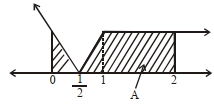
अतः,$f(x) = \begin{cases} |1-2x|, & 0 \leq x < 1 \\ 1, & 1 \leq x \leq 2 \end{cases}$ है।
अब,हम समाकलन का मान ज्ञात करते हैं:
$\int_{0}^{2} f(x) dx = \int_{0}^{1} |1-2x| dx + \int_{1}^{2} 1 dx$।
पहले भाग के लिए,जब $x \leq 1/2$ है तो $|1-2x| = 1-2x$ और जब $x > 1/2$ है तो $2x-1$ होता है:
$\int_{0}^{1} |1-2x| dx = \int_{0}^{1/2} (1-2x) dx + \int_{1/2}^{1} (2x-1) dx$
$= [x-x^2]_{0}^{1/2} + [x^2-x]_{1/2}^{1}$
$= (1/2 - 1/4) - 0 + (1-1) - (1/4 - 1/2) = 1/4 + 1/4 = 1/2$।
दूसरे भाग के लिए:
$\int_{1}^{2} 1 dx = [x]_{1}^{2} = 2-1 = 1$।
कुल समाकलन = $1/2 + 1 = 1.5$।
हम निरपेक्ष मान के अंदर के व्यंजक का विश्लेषण करते हैं:
यदि $x \geq 1$ है,तो $|x-1| = x-1$,इसलिए $f(x) = |(x-1)-x| = |-1| = 1$ होगा।
यदि $x < 1$ है,तो $|x-1| = 1-x$,इसलिए $f(x) = |(1-x)-x| = |1-2x|$ होगा।
अतः,$f(x) = \begin{cases} |1-2x|, & 0 \leq x < 1 \\ 1, & 1 \leq x \leq 2 \end{cases}$ है।
अब,हम समाकलन का मान ज्ञात करते हैं:
$\int_{0}^{2} f(x) dx = \int_{0}^{1} |1-2x| dx + \int_{1}^{2} 1 dx$।
पहले भाग के लिए,जब $x \leq 1/2$ है तो $|1-2x| = 1-2x$ और जब $x > 1/2$ है तो $2x-1$ होता है:
$\int_{0}^{1} |1-2x| dx = \int_{0}^{1/2} (1-2x) dx + \int_{1/2}^{1} (2x-1) dx$
$= [x-x^2]_{0}^{1/2} + [x^2-x]_{1/2}^{1}$
$= (1/2 - 1/4) - 0 + (1-1) - (1/4 - 1/2) = 1/4 + 1/4 = 1/2$।
दूसरे भाग के लिए:
$\int_{1}^{2} 1 dx = [x]_{1}^{2} = 2-1 = 1$।
कुल समाकलन = $1/2 + 1 = 1.5$।
0 likes
View Solution283
MediumMCQ
मान लीजिए $[ t ]$ उस महत्तम पूर्णांक को दर्शाता है जो $t$ से कम या उसके बराबर है। तो $\int_{1}^{2} |2x - [3x]| dx$ का मान ज्ञात कीजिए।
A
$1$
B
$2$
C
$4$
D
$3$
Solution
(A) मान लीजिए $I = \int_{1}^{2} |2x - [3x]| dx$. चूंकि $1 \le x \le 2$,इसलिए $3 \le 3x \le 6$ है।
हम $[3x]$ के मानों के आधार पर अंतराल $[1, 2]$ को विभाजित करते हैं:
स्थिति $1$: $1 \le x < 4/3$,तब $3 \le 3x < 4$,इसलिए $[3x] = 3$। समाकल्य $|2x - 3| = 3 - 2x$ है।
स्थिति $2$: $4/3 \le x < 5/3$,तब $4 \le 3x < 5$,इसलिए $[3x] = 4$। समाकल्य $|2x - 4| = 4 - 2x$ है।
स्थिति $3$: $5/3 \le x \le 2$,तब $5 \le 3x \le 6$,इसलिए $[3x] = 5$। समाकल्य $|2x - 5| = 5 - 2x$ है।
अब,$I = \int_{1}^{4/3} (3 - 2x) dx + \int_{4/3}^{5/3} (4 - 2x) dx + \int_{5/3}^{2} (5 - 2x) dx$।
प्रत्येक समाकलन का मान ज्ञात करने पर:
$\int_{1}^{4/3} (3 - 2x) dx = [3x - x^2]_{1}^{4/3} = (4 - 16/9) - (3 - 1) = 2/9$।
$\int_{4/3}^{5/3} (4 - 2x) dx = [4x - x^2]_{4/3}^{5/3} = (20/3 - 25/9) - (16/3 - 16/9) = 3/9 = 1/3$।
$\int_{5/3}^{2} (5 - 2x) dx = [5x - x^2]_{5/3}^{2} = (10 - 4) - (25/3 - 25/9) = 4/9$।
योग करने पर: $I = 2/9 + 3/9 + 4/9 = 9/9 = 1$।
हम $[3x]$ के मानों के आधार पर अंतराल $[1, 2]$ को विभाजित करते हैं:
स्थिति $1$: $1 \le x < 4/3$,तब $3 \le 3x < 4$,इसलिए $[3x] = 3$। समाकल्य $|2x - 3| = 3 - 2x$ है।
स्थिति $2$: $4/3 \le x < 5/3$,तब $4 \le 3x < 5$,इसलिए $[3x] = 4$। समाकल्य $|2x - 4| = 4 - 2x$ है।
स्थिति $3$: $5/3 \le x \le 2$,तब $5 \le 3x \le 6$,इसलिए $[3x] = 5$। समाकल्य $|2x - 5| = 5 - 2x$ है।
अब,$I = \int_{1}^{4/3} (3 - 2x) dx + \int_{4/3}^{5/3} (4 - 2x) dx + \int_{5/3}^{2} (5 - 2x) dx$।
प्रत्येक समाकलन का मान ज्ञात करने पर:
$\int_{1}^{4/3} (3 - 2x) dx = [3x - x^2]_{1}^{4/3} = (4 - 16/9) - (3 - 1) = 2/9$।
$\int_{4/3}^{5/3} (4 - 2x) dx = [4x - x^2]_{4/3}^{5/3} = (20/3 - 25/9) - (16/3 - 16/9) = 3/9 = 1/3$।
$\int_{5/3}^{2} (5 - 2x) dx = [5x - x^2]_{5/3}^{2} = (10 - 4) - (25/3 - 25/9) = 4/9$।
योग करने पर: $I = 2/9 + 3/9 + 4/9 = 9/9 = 1$।
0 likes
View Solution284
MediumMCQ
यदि समाकलन $\int_{0}^{1/2} \frac{x^{2}}{(1-x^{2})^{3/2}} dx$ का मान $\frac{k}{6}$ है,तो $k$ का मान क्या होगा?
A
$2\sqrt{3}-\pi$
B
$3\sqrt{2}+\pi$
C
$3\sqrt{2}-\pi$
D
$2\sqrt{3}+\pi$
Solution
(A) माना $I = \int_{0}^{1/2} \frac{x^{2}}{(1-x^{2})^{3/2}} dx$.
हम अंश को $x^{2} = (x^{2}-1) + 1$ के रूप में लिख सकते हैं।
अतः,$I = \int_{0}^{1/2} \frac{x^{2}-1}{(1-x^{2})^{3/2}} dx + \int_{0}^{1/2} \frac{1}{(1-x^{2})^{3/2}} dx$.
$I = -\int_{0}^{1/2} \frac{1}{(1-x^{2})^{1/2}} dx + \int_{0}^{1/2} \frac{1}{(1-x^{2})^{3/2}} dx$.
प्रथम समाकलन के लिए,$\int \frac{1}{\sqrt{1-x^{2}}} dx = \sin^{-1}(x)$.
$0$ से $1/2$ तक मान रखने पर,हमें $-[\sin^{-1}(1/2) - \sin^{-1}(0)] = -\pi/6$ प्राप्त होता है।
दूसरे समाकलन के लिए,$x = \sin(\theta)$ लें,तो $dx = \cos(\theta) d\theta$.
जब $x=0, \theta=0$; जब $x=1/2, \theta=\pi/6$.
$\int_{0}^{\pi/6} \frac{\cos(\theta)}{\cos^{3}(\theta)} d\theta = \int_{0}^{\pi/6} \sec^{2}(\theta) d\theta = [\tan(\theta)]_{0}^{\pi/6} = \tan(\pi/6) - \tan(0) = 1/\sqrt{3}$.
इस प्रकार,$I = \frac{1}{\sqrt{3}} - \frac{\pi}{6} = \frac{\sqrt{3}}{3} - \frac{\pi}{6} = \frac{2\sqrt{3}-\pi}{6}$.
इसकी तुलना $\frac{k}{6}$ से करने पर,हमें $k = 2\sqrt{3}-\pi$ प्राप्त होता है।
हम अंश को $x^{2} = (x^{2}-1) + 1$ के रूप में लिख सकते हैं।
अतः,$I = \int_{0}^{1/2} \frac{x^{2}-1}{(1-x^{2})^{3/2}} dx + \int_{0}^{1/2} \frac{1}{(1-x^{2})^{3/2}} dx$.
$I = -\int_{0}^{1/2} \frac{1}{(1-x^{2})^{1/2}} dx + \int_{0}^{1/2} \frac{1}{(1-x^{2})^{3/2}} dx$.
प्रथम समाकलन के लिए,$\int \frac{1}{\sqrt{1-x^{2}}} dx = \sin^{-1}(x)$.
$0$ से $1/2$ तक मान रखने पर,हमें $-[\sin^{-1}(1/2) - \sin^{-1}(0)] = -\pi/6$ प्राप्त होता है।
दूसरे समाकलन के लिए,$x = \sin(\theta)$ लें,तो $dx = \cos(\theta) d\theta$.
जब $x=0, \theta=0$; जब $x=1/2, \theta=\pi/6$.
$\int_{0}^{\pi/6} \frac{\cos(\theta)}{\cos^{3}(\theta)} d\theta = \int_{0}^{\pi/6} \sec^{2}(\theta) d\theta = [\tan(\theta)]_{0}^{\pi/6} = \tan(\pi/6) - \tan(0) = 1/\sqrt{3}$.
इस प्रकार,$I = \frac{1}{\sqrt{3}} - \frac{\pi}{6} = \frac{\sqrt{3}}{3} - \frac{\pi}{6} = \frac{2\sqrt{3}-\pi}{6}$.
इसकी तुलना $\frac{k}{6}$ से करने पर,हमें $k = 2\sqrt{3}-\pi$ प्राप्त होता है।
0 likes
View Solution285
MediumMCQ
$\int_{\pi / 6}^{\pi / 3} \tan ^{3} x \cdot \sin ^{2} 3 x\left(2 \sec ^{2} x \cdot \sin ^{2} 3 x+3 \tan x \cdot \sin 6 x\right) d x$ का मान ज्ञात कीजिए।
A
$\frac{9}{2}$
B
$-\frac{1}{9}$
C
$-\frac{1}{18}$
D
$\frac{7}{18}$
Solution
(C) माना $I = \int_{\pi / 6}^{\pi / 3} \tan ^{3} x \cdot \sin ^{2} 3 x\left(2 \sec ^{2} x \cdot \sin ^{2} 3 x+3 \tan x \cdot \sin 6 x\right) d x$.
ध्यान दें कि $\sin 6x = 2 \sin 3x \cos 3x$.
समाकल्य को इस प्रकार लिखा जा सकता है:
$f(x) = 2 \tan^3 x \sec^2 x \sin^4 3x + 3 \tan^4 x \sin^2 3x (2 \sin 3x \cos 3x) = 2 \tan^3 x \sec^2 x \sin^4 3x + 6 \tan^4 x \sin^3 3x \cos 3x$.
यहाँ $\frac{d}{dx} [(\tan x)^4 (\sin 3x)^4] = 4 \tan^3 x \sec^2 x \sin^4 3x + 4 \tan^4 x \sin^3 3x (3 \cos 3x) = 4 [\tan^3 x \sec^2 x \sin^4 3x + 3 \tan^4 x \sin^3 3x \cos 3x]$.
अतः,समाकल्य $\frac{1}{2} \frac{d}{dx} [(\tan x)^4 (\sin 3x)^4]$ है।
$I = \frac{1}{2} [\tan^4 x \sin^4 3x]_{\pi/6}^{\pi/3} = \frac{1}{2} [(\tan^4 \frac{\pi}{3} \sin^4 \pi) - (\tan^4 \frac{\pi}{6} \sin^4 \frac{\pi}{2})]$.
चूँकि $\sin \pi = 0$ और $\tan \frac{\pi}{6} = \frac{1}{\sqrt{3}}$,$\sin \frac{\pi}{2} = 1$:
$I = \frac{1}{2} [0 - ((\frac{1}{\sqrt{3}})^4 \cdot 1^4)] = \frac{1}{2} [0 - \frac{1}{9}] = -\frac{1}{18}$.
ध्यान दें कि $\sin 6x = 2 \sin 3x \cos 3x$.
समाकल्य को इस प्रकार लिखा जा सकता है:
$f(x) = 2 \tan^3 x \sec^2 x \sin^4 3x + 3 \tan^4 x \sin^2 3x (2 \sin 3x \cos 3x) = 2 \tan^3 x \sec^2 x \sin^4 3x + 6 \tan^4 x \sin^3 3x \cos 3x$.
यहाँ $\frac{d}{dx} [(\tan x)^4 (\sin 3x)^4] = 4 \tan^3 x \sec^2 x \sin^4 3x + 4 \tan^4 x \sin^3 3x (3 \cos 3x) = 4 [\tan^3 x \sec^2 x \sin^4 3x + 3 \tan^4 x \sin^3 3x \cos 3x]$.
अतः,समाकल्य $\frac{1}{2} \frac{d}{dx} [(\tan x)^4 (\sin 3x)^4]$ है।
$I = \frac{1}{2} [\tan^4 x \sin^4 3x]_{\pi/6}^{\pi/3} = \frac{1}{2} [(\tan^4 \frac{\pi}{3} \sin^4 \pi) - (\tan^4 \frac{\pi}{6} \sin^4 \frac{\pi}{2})]$.
चूँकि $\sin \pi = 0$ और $\tan \frac{\pi}{6} = \frac{1}{\sqrt{3}}$,$\sin \frac{\pi}{2} = 1$:
$I = \frac{1}{2} [0 - ((\frac{1}{\sqrt{3}})^4 \cdot 1^4)] = \frac{1}{2} [0 - \frac{1}{9}] = -\frac{1}{18}$.
0 likes
View Solution286
MediumMCQ
मान लीजिए $f(x) = |x - 2|$ और $g(x) = f(f(x))$,$x \in [0, 4]$ है। तो $\int_{0}^{3} (g(x) - f(x)) \, dx$ का मान ज्ञात कीजिए।
A
$\frac{3}{2}$
B
$0$
C
$\frac{1}{2}$
D
$1$
Solution
(D) दिया गया है $f(x) = |x - 2|$ और $g(x) = f(f(x)) = ||x - 2| - 2|$।
हमें $I = \int_{0}^{3} (g(x) - f(x)) \, dx = \int_{0}^{3} g(x) \, dx - \int_{0}^{3} f(x) \, dx$ का मूल्यांकन करना है।
सबसे पहले,$\int_{0}^{3} f(x) \, dx = \int_{0}^{3} |x - 2| \, dx$ की गणना करें।
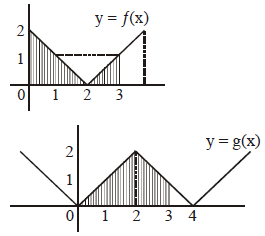
यह $x = 0$ से $x = 3$ तक $f(x)$ के ग्राफ के नीचे का क्षेत्रफल दर्शाता है। ग्राफ दो त्रिभुजों से बना है: एक $2$ आधार और $2$ ऊंचाई वाला ($0$ से $2$ तक),और दूसरा $1$ आधार और $1$ ऊंचाई वाला ($2$ से $3$ तक)।
क्षेत्रफल $= \frac{1}{2} \times 2 \times 2 + \frac{1}{2} \times 1 \times 1 = 2 + 0.5 = 2.5$.
अब,$\int_{0}^{3} g(x) \, dx = \int_{0}^{3} ||x - 2| - 2| \, dx$ की गणना करें।
$x \in [0, 2]$ के लिए,$g(x) = |(2 - x) - 2| = |-x| = x$। क्षेत्रफल $= \int_{0}^{2} x \, dx = \frac{1}{2} \times 2 \times 2 = 2$.
$x \in [2, 3]$ के लिए,$g(x) = |(x - 2) - 2| = |x - 4| = 4 - x$। क्षेत्रफल $= \int_{2}^{3} (4 - x) \, dx = \frac{1}{2} \times (2 + 1) \times 1 = 1.5$.
कुल $\int_{0}^{3} g(x) \, dx = 2 + 1.5 = 3.5$.
अतः,$I = 3.5 - 2.5 = 1$।
हमें $I = \int_{0}^{3} (g(x) - f(x)) \, dx = \int_{0}^{3} g(x) \, dx - \int_{0}^{3} f(x) \, dx$ का मूल्यांकन करना है।
सबसे पहले,$\int_{0}^{3} f(x) \, dx = \int_{0}^{3} |x - 2| \, dx$ की गणना करें।
यह $x = 0$ से $x = 3$ तक $f(x)$ के ग्राफ के नीचे का क्षेत्रफल दर्शाता है। ग्राफ दो त्रिभुजों से बना है: एक $2$ आधार और $2$ ऊंचाई वाला ($0$ से $2$ तक),और दूसरा $1$ आधार और $1$ ऊंचाई वाला ($2$ से $3$ तक)।
क्षेत्रफल $= \frac{1}{2} \times 2 \times 2 + \frac{1}{2} \times 1 \times 1 = 2 + 0.5 = 2.5$.
अब,$\int_{0}^{3} g(x) \, dx = \int_{0}^{3} ||x - 2| - 2| \, dx$ की गणना करें।
$x \in [0, 2]$ के लिए,$g(x) = |(2 - x) - 2| = |-x| = x$। क्षेत्रफल $= \int_{0}^{2} x \, dx = \frac{1}{2} \times 2 \times 2 = 2$.
$x \in [2, 3]$ के लिए,$g(x) = |(x - 2) - 2| = |x - 4| = 4 - x$। क्षेत्रफल $= \int_{2}^{3} (4 - x) \, dx = \frac{1}{2} \times (2 + 1) \times 1 = 1.5$.
कुल $\int_{0}^{3} g(x) \, dx = 2 + 1.5 = 3.5$.
अतः,$I = 3.5 - 2.5 = 1$।
0 likes
View Solution287
MediumMCQ
माना $f(x) = \int \frac{\sqrt{x}}{(1+x)^2} dx$ $(x \geq 0)$ है। तो $f(3) - f(1)$ का मान ज्ञात कीजिए।
A
$-\frac{\pi}{6} + \frac{1}{2} + \frac{\sqrt{3}}{4}$
B
$\frac{\pi}{6} + \frac{1}{2} - \frac{\sqrt{3}}{4}$
C
$-\frac{\pi}{12} + \frac{1}{2} + \frac{\sqrt{3}}{4}$
D
$\frac{\pi}{12} + \frac{1}{2} - \frac{\sqrt{3}}{4}$
Solution
(D) हमें $f(3) - f(1) = \int_{1}^{3} \frac{\sqrt{x}}{(1+x)^2} dx$ का मान ज्ञात करना है।
माना $\sqrt{x} = t$,तब $x = t^2$ और $dx = 2t dt$ होगा।
जब $x=1$,तब $t=1$ और जब $x=3$,तब $t=\sqrt{3}$।
इन मानों को समाकलन में प्रतिस्थापित करने पर:
$f(3) - f(1) = \int_{1}^{\sqrt{3}} \frac{t \cdot 2t}{(1+t^2)^2} dt = 2 \int_{1}^{\sqrt{3}} \frac{t^2}{(1+t^2)^2} dt$.
खंडशः समाकलन (Integration by parts) का उपयोग करते हुए,$u = t$ और $dv = \frac{t}{(1+t^2)^2} dt$ लेने पर,$du = dt$ और $v = -\frac{1}{2(1+t^2)}$ प्राप्त होता है।
$2 \int \frac{t^2}{(1+t^2)^2} dt = 2 \left[ -\frac{t}{2(1+t^2)} + \int \frac{1}{2(1+t^2)} dt \right] = -\frac{t}{1+t^2} + \tan^{-1}(t)$.
$1$ से $\sqrt{3}$ तक सीमाएं लागू करने पर:
$f(3) - f(1) = \left[ -\frac{\sqrt{3}}{1+3} + \tan^{-1}(\sqrt{3}) \right] - \left[ -\frac{1}{1+1} + \tan^{-1}(1) \right]$.
$= \left( -\frac{\sqrt{3}}{4} + \frac{\pi}{3} \right) - \left( -\frac{1}{2} + \frac{\pi}{4} \right) = \frac{1}{2} - \frac{\sqrt{3}}{4} + \frac{\pi}{12}$.
माना $\sqrt{x} = t$,तब $x = t^2$ और $dx = 2t dt$ होगा।
जब $x=1$,तब $t=1$ और जब $x=3$,तब $t=\sqrt{3}$।
इन मानों को समाकलन में प्रतिस्थापित करने पर:
$f(3) - f(1) = \int_{1}^{\sqrt{3}} \frac{t \cdot 2t}{(1+t^2)^2} dt = 2 \int_{1}^{\sqrt{3}} \frac{t^2}{(1+t^2)^2} dt$.
खंडशः समाकलन (Integration by parts) का उपयोग करते हुए,$u = t$ और $dv = \frac{t}{(1+t^2)^2} dt$ लेने पर,$du = dt$ और $v = -\frac{1}{2(1+t^2)}$ प्राप्त होता है।
$2 \int \frac{t^2}{(1+t^2)^2} dt = 2 \left[ -\frac{t}{2(1+t^2)} + \int \frac{1}{2(1+t^2)} dt \right] = -\frac{t}{1+t^2} + \tan^{-1}(t)$.
$1$ से $\sqrt{3}$ तक सीमाएं लागू करने पर:
$f(3) - f(1) = \left[ -\frac{\sqrt{3}}{1+3} + \tan^{-1}(\sqrt{3}) \right] - \left[ -\frac{1}{1+1} + \tan^{-1}(1) \right]$.
$= \left( -\frac{\sqrt{3}}{4} + \frac{\pi}{3} \right) - \left( -\frac{1}{2} + \frac{\pi}{4} \right) = \frac{1}{2} - \frac{\sqrt{3}}{4} + \frac{\pi}{12}$.
0 likes
View Solution288
DifficultMCQ
यदि $[.]$ महत्तम पूर्णांक फलन को दर्शाता है,तो $\int_{0}^{\sqrt{\pi / 2}}\left(\left[ x ^{2}\right]+[-\cos x ]\right) d x$ का मान ............. है।
A
$0$
B
$1$
C
$-1$
D
$-1 - \sqrt{\frac{\pi}{2}}$
Solution
(C) माना $I = \int_{0}^{\sqrt{\pi / 2}} ([x^2] + [-\cos x]) dx$ है।
चूंकि $0 \le x \le \sqrt{\pi / 2} \approx 1.25$,इसलिए $0 \le x^2 \le \pi / 2 \approx 1.57$ है।
अतः,$0 \le x < 1$ के लिए $[x^2] = 0$ और $1 \le x \le \sqrt{\pi / 2}$ के लिए $[x^2] = 1$ है।
$0 \le x \le \sqrt{\pi / 2}$ के लिए,$0 \le \cos x \le 1$ है।
विशेष रूप से,$x \in (0, \sqrt{\pi / 2}]$ के लिए,$0 \le \cos x < 1$ है,इसलिए $-\cos x \in [-1, 0)$ है।
अतः,$x \in (0, \sqrt{\pi / 2}]$ के लिए $[-\cos x] = -1$ और $x = 0$ पर $[-\cos x] = 0$ है।
$I = \int_{0}^{1} (0 - 1) dx + \int_{1}^{\sqrt{\pi / 2}} (1 - 1) dx = \int_{0}^{1} (-1) dx + 0 = -1$।
चूंकि $0 \le x \le \sqrt{\pi / 2} \approx 1.25$,इसलिए $0 \le x^2 \le \pi / 2 \approx 1.57$ है।
अतः,$0 \le x < 1$ के लिए $[x^2] = 0$ और $1 \le x \le \sqrt{\pi / 2}$ के लिए $[x^2] = 1$ है।
$0 \le x \le \sqrt{\pi / 2}$ के लिए,$0 \le \cos x \le 1$ है।
विशेष रूप से,$x \in (0, \sqrt{\pi / 2}]$ के लिए,$0 \le \cos x < 1$ है,इसलिए $-\cos x \in [-1, 0)$ है।
अतः,$x \in (0, \sqrt{\pi / 2}]$ के लिए $[-\cos x] = -1$ और $x = 0$ पर $[-\cos x] = 0$ है।
$I = \int_{0}^{1} (0 - 1) dx + \int_{1}^{\sqrt{\pi / 2}} (1 - 1) dx = \int_{0}^{1} (-1) dx + 0 = -1$।
0 likes
View Solution289
DifficultMCQ
समाकल $I = \int_{0}^{10} \frac{[x] e^{[x]}}{e^{x-1}} dx$ पर विचार करें,जहाँ $[x]$,$x$ से कम या उसके बराबर महत्तम पूर्णांक को दर्शाता है। तो $I$ का मान ज्ञात कीजिए।
A
$9(e-1)$
B
$45(e+1)$
C
$45(e-1)$
D
$9(e+1)$
Solution
(C) समाकल $I = \int_{0}^{10} [x] e^{[x]-x+1} dx$ द्वारा दिया गया है।
चूँकि $x \in [n, n+1)$ के लिए $[x] = n$ होता है,हम समाकल को इस प्रकार विभाजित कर सकते हैं:
$I = \sum_{n=0}^{9} \int_{n}^{n+1} n \cdot e^{n-x+1} dx$.
प्रत्येक पद के लिए समाकल का मूल्यांकन करने पर:
$I = \sum_{n=0}^{9} n \left[ -e^{n-x+1} \right]_{n}^{n+1} = \sum_{n=0}^{9} n \left( -e^{0} + e^{1} \right) = (e-1) \sum_{n=0}^{9} n$.
योग सूत्र $\sum_{n=0}^{9} n = \frac{9 \times 10}{2} = 45$ का उपयोग करने पर,हमें प्राप्त होता है:
$I = 45(e-1)$.
चूँकि $x \in [n, n+1)$ के लिए $[x] = n$ होता है,हम समाकल को इस प्रकार विभाजित कर सकते हैं:
$I = \sum_{n=0}^{9} \int_{n}^{n+1} n \cdot e^{n-x+1} dx$.
प्रत्येक पद के लिए समाकल का मूल्यांकन करने पर:
$I = \sum_{n=0}^{9} n \left[ -e^{n-x+1} \right]_{n}^{n+1} = \sum_{n=0}^{9} n \left( -e^{0} + e^{1} \right) = (e-1) \sum_{n=0}^{9} n$.
योग सूत्र $\sum_{n=0}^{9} n = \frac{9 \times 10}{2} = 45$ का उपयोग करने पर,हमें प्राप्त होता है:
$I = 45(e-1)$.
0 likes
View Solution290
DifficultMCQ
मान लीजिए $P(x) = x^2 + bx + c$ वास्तविक गुणांकों वाला एक द्विघात बहुपद है,जहाँ $\int_{0}^{1} P(x) dx = 1$ है और $P(x)$ को $(x-2)$ से विभाजित करने पर शेषफल $5$ प्राप्त होता है। तो $9(b+c)$ का मान ज्ञात कीजिए:
A
$9$
B
$15$
C
$7$
D
$11$
Solution
(C) दिया गया है $P(x) = x^2 + bx + c$.
$P(x)$ का $0$ से $1$ तक समाकलन करने पर:
$\int_{0}^{1} (x^2 + bx + c) dx = [\frac{x^3}{3} + \frac{bx^2}{2} + cx]_{0}^{1} = \frac{1}{3} + \frac{b}{2} + c = 1$.
$6$ से गुणा करने पर,$2 + 3b + 6c = 6$,अतः $3b + 6c = 4$ ... $(1)$.
शेषफल प्रमेय के अनुसार,$P(2) = 5$:
$2^2 + b(2) + c = 5 \Rightarrow 4 + 2b + c = 5 \Rightarrow 2b + c = 1$ ... $(2)$.
$(2)$ से,$c = 1 - 2b$. इसे $(1)$ में प्रतिस्थापित करने पर:
$3b + 6(1 - 2b) = 4 \Rightarrow 3b + 6 - 12b = 4 \Rightarrow -9b = -2 \Rightarrow b = \frac{2}{9}$.
तब $c = 1 - 2(\frac{2}{9}) = 1 - \frac{4}{9} = \frac{5}{9}$.
अतः,$b + c = \frac{2}{9} + \frac{5}{9} = \frac{7}{9}$.
इसलिए,$9(b + c) = 9(\frac{7}{9}) = 7$.
$P(x)$ का $0$ से $1$ तक समाकलन करने पर:
$\int_{0}^{1} (x^2 + bx + c) dx = [\frac{x^3}{3} + \frac{bx^2}{2} + cx]_{0}^{1} = \frac{1}{3} + \frac{b}{2} + c = 1$.
$6$ से गुणा करने पर,$2 + 3b + 6c = 6$,अतः $3b + 6c = 4$ ... $(1)$.
शेषफल प्रमेय के अनुसार,$P(2) = 5$:
$2^2 + b(2) + c = 5 \Rightarrow 4 + 2b + c = 5 \Rightarrow 2b + c = 1$ ... $(2)$.
$(2)$ से,$c = 1 - 2b$. इसे $(1)$ में प्रतिस्थापित करने पर:
$3b + 6(1 - 2b) = 4 \Rightarrow 3b + 6 - 12b = 4 \Rightarrow -9b = -2 \Rightarrow b = \frac{2}{9}$.
तब $c = 1 - 2(\frac{2}{9}) = 1 - \frac{4}{9} = \frac{5}{9}$.
अतः,$b + c = \frac{2}{9} + \frac{5}{9} = \frac{7}{9}$.
इसलिए,$9(b + c) = 9(\frac{7}{9}) = 7$.
0 likes
View Solution291
DifficultMCQ
मान लीजिए $f: R \rightarrow R$,$f(x)=e^{-x} \sin x$ के रूप में परिभाषित है। यदि $F :[0,1] \rightarrow R$ एक अवकलनीय फलन है,जहाँ $F(x)=\int_{0}^{x} f(t) dt$ है,तो $\int_{0}^{1}(F'(x)+f(x)) e^{x} dx$ का मान किस अंतराल में स्थित है?
A
$[\frac{327}{360}, \frac{329}{360}]$
B
$[\frac{330}{360}, \frac{331}{360}]$
C
$[\frac{331}{360}, \frac{334}{360}]$
D
$[\frac{335}{360}, \frac{336}{360}]$
Solution
(B) दिया गया है $f(x) = e^{-x} \sin x$।
चूँकि $F(x) = \int_{0}^{x} f(t) dt$,कलन के मूलभूत प्रमेय के अनुसार,$F'(x) = f(x)$ है।
हमें $I = \int_{0}^{1} (F'(x) + f(x)) e^{x} dx$ का मान ज्ञात करना है।
$F'(x) = f(x)$ प्रतिस्थापित करने पर,$I = \int_{0}^{1} (f(x) + f(x)) e^{x} dx = \int_{0}^{1} 2f(x) e^{x} dx$ प्राप्त होता है।
$f(x) = e^{-x} \sin x$ रखने पर,$I = 2 \int_{0}^{1} e^{-x} \sin x \cdot e^{x} dx = 2 \int_{0}^{1} \sin x dx$ प्राप्त होता है।
समाकलन करने पर,$I = 2 [-\cos x]_{0}^{1} = 2(1 - \cos 1)$ प्राप्त होता है।
$\cos x$ के लिए टेलर श्रेणी का उपयोग करने पर,$\cos 1 = 1 - \frac{1}{2} + \frac{1}{24} - \frac{1}{720} + \dots$ होता है।
अतः,$I = 2(1 - (1 - \frac{1}{2} + \frac{1}{24} - \frac{1}{720} + \dots)) = 2(\frac{1}{2} - \frac{1}{24} + \frac{1}{720} - \dots) = 1 - \frac{1}{12} + \frac{1}{360} - \dots$ प्राप्त होता है।
$I = \frac{11}{12} + \frac{1}{360} - \dots = \frac{330}{360} + \frac{1}{360} - \dots = \frac{331}{360} - \dots$ होता है।
चूँकि यह श्रेणी एकांतर और घटती हुई है,इसलिए इसका मान $[\frac{330}{360}, \frac{331}{360}]$ अंतराल में स्थित है।
चूँकि $F(x) = \int_{0}^{x} f(t) dt$,कलन के मूलभूत प्रमेय के अनुसार,$F'(x) = f(x)$ है।
हमें $I = \int_{0}^{1} (F'(x) + f(x)) e^{x} dx$ का मान ज्ञात करना है।
$F'(x) = f(x)$ प्रतिस्थापित करने पर,$I = \int_{0}^{1} (f(x) + f(x)) e^{x} dx = \int_{0}^{1} 2f(x) e^{x} dx$ प्राप्त होता है।
$f(x) = e^{-x} \sin x$ रखने पर,$I = 2 \int_{0}^{1} e^{-x} \sin x \cdot e^{x} dx = 2 \int_{0}^{1} \sin x dx$ प्राप्त होता है।
समाकलन करने पर,$I = 2 [-\cos x]_{0}^{1} = 2(1 - \cos 1)$ प्राप्त होता है।
$\cos x$ के लिए टेलर श्रेणी का उपयोग करने पर,$\cos 1 = 1 - \frac{1}{2} + \frac{1}{24} - \frac{1}{720} + \dots$ होता है।
अतः,$I = 2(1 - (1 - \frac{1}{2} + \frac{1}{24} - \frac{1}{720} + \dots)) = 2(\frac{1}{2} - \frac{1}{24} + \frac{1}{720} - \dots) = 1 - \frac{1}{12} + \frac{1}{360} - \dots$ प्राप्त होता है।
$I = \frac{11}{12} + \frac{1}{360} - \dots = \frac{330}{360} + \frac{1}{360} - \dots = \frac{331}{360} - \dots$ होता है।
चूँकि यह श्रेणी एकांतर और घटती हुई है,इसलिए इसका मान $[\frac{330}{360}, \frac{331}{360}]$ अंतराल में स्थित है।
0 likes
View Solution292
DifficultMCQ
समाकलन $\int_{1}^{3} [x^{2}-2x-2] dx$ का मान ज्ञात कीजिए,जहाँ $[x]$ महत्तम पूर्णांक फलन को दर्शाता है:
A
$-\sqrt{2}-\sqrt{3}+1$
B
$-\sqrt{2}-\sqrt{3}-1$
C
$-5$
D
$-4$
Solution
(B) माना $I = \int_{1}^{3} [x^{2}-2x-2] dx$.
कोष्ठक के अंदर के व्यंजक को $(x-1)^{2}-3$ के रूप में लिखा जा सकता है।
चूंकि $3$ एक पूर्णांक है,गुणधर्म $[f(x)+n] = [f(x)]+n$ का उपयोग करने पर,
$I = \int_{1}^{3} [(x-1)^{2}] dx - \int_{1}^{3} 3 dx$.
$t = x-1$ लेने पर,$dt = dx$. जब $x=1, t=0$ और जब $x=3, t=2$.
$I = \int_{0}^{2} [t^{2}] dt - [3x]_{1}^{3} = \int_{0}^{2} [t^{2}] dt - 6$.
अब,$[t^{2}]$ के मानों के आधार पर समाकलन को विभाजित करने पर:
$0 \le t < 1$ के लिए,$[t^{2}] = 0$.
$1 \le t < \sqrt{2}$ के लिए,$[t^{2}] = 1$.
$\sqrt{2} \le t < \sqrt{3}$ के लिए,$[t^{2}] = 2$.
$\sqrt{3} \le t < 2$ के लिए,$[t^{2}] = 3$.
$I = \int_{0}^{1} 0 dt + \int_{1}^{\sqrt{2}} 1 dt + \int_{\sqrt{2}}^{\sqrt{3}} 2 dt + \int_{\sqrt{3}}^{2} 3 dt - 6$.
$I = 0 + (\sqrt{2}-1) + 2(\sqrt{3}-\sqrt{2}) + 3(2-\sqrt{3}) - 6$.
$I = \sqrt{2} - 1 + 2\sqrt{3} - 2\sqrt{2} + 6 - 3\sqrt{3} - 6$.
$I = -\sqrt{2} - \sqrt{3} - 1$.
कोष्ठक के अंदर के व्यंजक को $(x-1)^{2}-3$ के रूप में लिखा जा सकता है।
चूंकि $3$ एक पूर्णांक है,गुणधर्म $[f(x)+n] = [f(x)]+n$ का उपयोग करने पर,
$I = \int_{1}^{3} [(x-1)^{2}] dx - \int_{1}^{3} 3 dx$.
$t = x-1$ लेने पर,$dt = dx$. जब $x=1, t=0$ और जब $x=3, t=2$.
$I = \int_{0}^{2} [t^{2}] dt - [3x]_{1}^{3} = \int_{0}^{2} [t^{2}] dt - 6$.
अब,$[t^{2}]$ के मानों के आधार पर समाकलन को विभाजित करने पर:
$0 \le t < 1$ के लिए,$[t^{2}] = 0$.
$1 \le t < \sqrt{2}$ के लिए,$[t^{2}] = 1$.
$\sqrt{2} \le t < \sqrt{3}$ के लिए,$[t^{2}] = 2$.
$\sqrt{3} \le t < 2$ के लिए,$[t^{2}] = 3$.
$I = \int_{0}^{1} 0 dt + \int_{1}^{\sqrt{2}} 1 dt + \int_{\sqrt{2}}^{\sqrt{3}} 2 dt + \int_{\sqrt{3}}^{2} 3 dt - 6$.
$I = 0 + (\sqrt{2}-1) + 2(\sqrt{3}-\sqrt{2}) + 3(2-\sqrt{3}) - 6$.
$I = \sqrt{2} - 1 + 2\sqrt{3} - 2\sqrt{2} + 6 - 3\sqrt{3} - 6$.
$I = -\sqrt{2} - \sqrt{3} - 1$.
0 likes
View Solution293
DifficultMCQ
$\int_{-1 / \sqrt{2}}^{1 / \sqrt{2}}\left(\left(\frac{x+1}{x-1}\right)^{2}+\left(\frac{x-1}{x+1}\right)^{2}-2\right)^{1 / 2} d x$ का मान ज्ञात कीजिए।
A
$\log _{e} 4$
B
$\log _{e} 16$
C
$2 \log _{e} 16$
D
$4 \log _{e}(3+2 \sqrt{2})$
Solution
(B) माना $I = \int_{-1 / \sqrt{2}}^{1 / \sqrt{2}} \sqrt{\left(\frac{x+1}{x-1}\right)^{2} + \left(\frac{x-1}{x+1}\right)^{2} - 2} \, dx$.
हम जानते हैं कि $a^2 + b^2 - 2 = (a-b)^2$. यहाँ $a = \frac{x+1}{x-1}$ और $b = \frac{x-1}{x+1}$ है।
अतः,समाकल्य $\sqrt{(\frac{x+1}{x-1} - \frac{x-1}{x+1})^2} = |\frac{x+1}{x-1} - \frac{x-1}{x+1}|$ बन जाता है।
मापांक के अंदर के व्यंजक को सरल करने पर: $\frac{(x+1)^2 - (x-1)^2}{x^2-1} = \frac{4x}{x^2-1}$.
इस प्रकार,$I = \int_{-1 / \sqrt{2}}^{1 / \sqrt{2}} |\frac{4x}{x^2-1}| \, dx$.
चूंकि समाकल्य एक सम फलन है,$I = 2 \int_{0}^{1 / \sqrt{2}} |\frac{4x}{x^2-1}| \, dx = 8 \int_{0}^{1 / \sqrt{2}} |\frac{x}{x^2-1}| \, dx$.
$x \in [0, 1/\sqrt{2}]$ के लिए,$x^2-1 < 0$,इसलिए $|\frac{x}{x^2-1}| = -\frac{x}{x^2-1}$.
$I = -8 \int_{0}^{1 / \sqrt{2}} \frac{x}{x^2-1} \, dx = -4 \int_{0}^{1 / \sqrt{2}} \frac{2x}{x^2-1} \, dx$.
$I = -4 [\ln |x^2-1|]_{0}^{1 / \sqrt{2}} = -4 (\ln |1/2 - 1| - \ln |0-1|) = -4 (\ln(1/2) - 0) = -4 \ln(1/2) = 4 \ln 2 = \ln 16$.
हम जानते हैं कि $a^2 + b^2 - 2 = (a-b)^2$. यहाँ $a = \frac{x+1}{x-1}$ और $b = \frac{x-1}{x+1}$ है।
अतः,समाकल्य $\sqrt{(\frac{x+1}{x-1} - \frac{x-1}{x+1})^2} = |\frac{x+1}{x-1} - \frac{x-1}{x+1}|$ बन जाता है।
मापांक के अंदर के व्यंजक को सरल करने पर: $\frac{(x+1)^2 - (x-1)^2}{x^2-1} = \frac{4x}{x^2-1}$.
इस प्रकार,$I = \int_{-1 / \sqrt{2}}^{1 / \sqrt{2}} |\frac{4x}{x^2-1}| \, dx$.
चूंकि समाकल्य एक सम फलन है,$I = 2 \int_{0}^{1 / \sqrt{2}} |\frac{4x}{x^2-1}| \, dx = 8 \int_{0}^{1 / \sqrt{2}} |\frac{x}{x^2-1}| \, dx$.
$x \in [0, 1/\sqrt{2}]$ के लिए,$x^2-1 < 0$,इसलिए $|\frac{x}{x^2-1}| = -\frac{x}{x^2-1}$.
$I = -8 \int_{0}^{1 / \sqrt{2}} \frac{x}{x^2-1} \, dx = -4 \int_{0}^{1 / \sqrt{2}} \frac{2x}{x^2-1} \, dx$.
$I = -4 [\ln |x^2-1|]_{0}^{1 / \sqrt{2}} = -4 (\ln |1/2 - 1| - \ln |0-1|) = -4 (\ln(1/2) - 0) = -4 \ln(1/2) = 4 \ln 2 = \ln 16$.
0 likes
View Solution294
DifficultMCQ
यदि समाकलन $\int_{0}^{5} \frac{x+[x]}{e^{x-[x]}} \,dx = \alpha e^{-1} + \beta$ का मान है,जहाँ $\alpha, \beta \in R, 5\alpha + 6\beta = 0$,और $[x]$ $x$ से कम या उसके बराबर महत्तम पूर्णांक को दर्शाता है; तो $(\alpha + \beta)^{2}$ का मान क्या होगा?
A
$100$
B
$25$
C
$16$
D
$36$
Solution
(B) माना $I = \int_{0}^{5} \frac{x+[x]}{e^{x-[x]}} \,dx$. चूँकि $[x]$ महत्तम पूर्णांक फलन है,हम समाकलन को पूर्णांक बिंदुओं पर विभाजित करते हैं:
$I = \sum_{k=0}^{4} \int_{k}^{k+1} \frac{x+k}{e^{x-k}} \,dx$.
माना $t = x-k$,तो $dx = dt$. जब $x=k, t=0$ और जब $x=k+1, t=1$. समाकलन इस प्रकार बनता है:
$I = \sum_{k=0}^{4} \int_{0}^{1} \frac{t+k+k}{e^{t}} \,dt = \sum_{k=0}^{4} \int_{0}^{1} (t+2k) e^{-t} \,dt$.
$I = \int_{0}^{1} (t+0)e^{-t} dt + \int_{0}^{1} (t+2)e^{-t} dt + \int_{0}^{1} (t+4)e^{-t} dt + \int_{0}^{1} (t+6)e^{-t} dt + \int_{0}^{1} (t+8)e^{-t} dt$.
$I = \int_{0}^{1} (5t + 20)e^{-t} dt = 5 \int_{0}^{1} (t+4)e^{-t} dt$.
खंडशः समाकलन का उपयोग करते हुए $\int (t+4)e^{-t} dt = -(t+4)e^{-t} - \int -e^{-t} dt = -(t+4)e^{-t} - e^{-t} = -(t+5)e^{-t}$.
$0$ से $1$ तक मान लेने पर: $5[-(1+5)e^{-1} - (-(0+5)e^{0})] = 5[-6e^{-1} + 5] = -30e^{-1} + 25$.
$\alpha e^{-1} + \beta$ के साथ तुलना करने पर,हमें $\alpha = -30$ और $\beta = 25$ प्राप्त होता है।
शर्त की जाँच करने पर: $5(-30) + 6(25) = -150 + 150 = 0$. जो सत्य है।
अतः,$(\alpha + \beta)^{2} = (-30 + 25)^{2} = (-5)^{2} = 25$.
$I = \sum_{k=0}^{4} \int_{k}^{k+1} \frac{x+k}{e^{x-k}} \,dx$.
माना $t = x-k$,तो $dx = dt$. जब $x=k, t=0$ और जब $x=k+1, t=1$. समाकलन इस प्रकार बनता है:
$I = \sum_{k=0}^{4} \int_{0}^{1} \frac{t+k+k}{e^{t}} \,dt = \sum_{k=0}^{4} \int_{0}^{1} (t+2k) e^{-t} \,dt$.
$I = \int_{0}^{1} (t+0)e^{-t} dt + \int_{0}^{1} (t+2)e^{-t} dt + \int_{0}^{1} (t+4)e^{-t} dt + \int_{0}^{1} (t+6)e^{-t} dt + \int_{0}^{1} (t+8)e^{-t} dt$.
$I = \int_{0}^{1} (5t + 20)e^{-t} dt = 5 \int_{0}^{1} (t+4)e^{-t} dt$.
खंडशः समाकलन का उपयोग करते हुए $\int (t+4)e^{-t} dt = -(t+4)e^{-t} - \int -e^{-t} dt = -(t+4)e^{-t} - e^{-t} = -(t+5)e^{-t}$.
$0$ से $1$ तक मान लेने पर: $5[-(1+5)e^{-1} - (-(0+5)e^{0})] = 5[-6e^{-1} + 5] = -30e^{-1} + 25$.
$\alpha e^{-1} + \beta$ के साथ तुलना करने पर,हमें $\alpha = -30$ और $\beta = 25$ प्राप्त होता है।
शर्त की जाँच करने पर: $5(-30) + 6(25) = -150 + 150 = 0$. जो सत्य है।
अतः,$(\alpha + \beta)^{2} = (-30 + 25)^{2} = (-5)^{2} = 25$.
0 likes
View Solution295
DifficultMCQ
समाकल $\int \limits_{0}^{1} \frac{\sqrt{x} \, dx}{(1+x)(1+3 x)(3+x)}$ का मान है:
A
$\frac{\pi}{8}\left(1-\frac{\sqrt{3}}{2}\right)$
B
$\frac{\pi}{4}\left(1-\frac{\sqrt{3}}{6}\right)$
C
$\frac{\pi}{8}\left(1-\frac{\sqrt{3}}{6}\right)$
D
$\frac{\pi}{4}\left(1-\frac{\sqrt{3}}{2}\right)$
Solution
(A) $I = \int_{0}^{1} \frac{\sqrt{x}}{(1+x)(1+3x)(3+x)} \, dx$
माना $x = t^2$,तब $dx = 2t \, dt$। जब $x=0, t=0$ और जब $x=1, t=1$।
$I = \int_{0}^{1} \frac{t(2t)}{(t^2+1)(1+3t^2)(3+t^2)} \, dt = \int_{0}^{1} \frac{2t^2}{(t^2+1)(3t^2+1)(t^2+3)} \, dt$
आंशिक भिन्नों का उपयोग करके,हम समाकल्य को इस प्रकार लिख सकते हैं:
$\frac{2t^2}{(t^2+1)(3t^2+1)(t^2+3)} = \frac{A}{t^2+1} + \frac{B}{3t^2+1} + \frac{C}{t^2+3}$
गुणांकों को हल करने पर,हमें $A = \frac{1}{2}, B = -\frac{3}{8}, C = -\frac{1}{8}$ प्राप्त होता है।
$I = \frac{1}{2} \int_{0}^{1} \frac{dt}{t^2+1} - \frac{3}{8} \int_{0}^{1} \frac{dt}{3t^2+1} - \frac{1}{8} \int_{0}^{1} \frac{dt}{t^2+3}$
$I = \frac{1}{2} [\tan^{-1}(t)]_{0}^{1} - \frac{3}{8} \cdot \frac{1}{\sqrt{3}} [\tan^{-1}(\sqrt{3}t)]_{0}^{1} - \frac{1}{8} \cdot \frac{1}{\sqrt{3}} [\tan^{-1}(\frac{t}{\sqrt{3}})]_{0}^{1}$
$I = \frac{1}{2} (\frac{\pi}{4}) - \frac{\sqrt{3}}{8} (\frac{\pi}{3}) - \frac{\sqrt{3}}{24} (\frac{\pi}{6})$
गणना करने पर,अंतिम उत्तर $I = \frac{\pi}{8}(1 - \frac{\sqrt{3}}{2})$ प्राप्त होता है।
माना $x = t^2$,तब $dx = 2t \, dt$। जब $x=0, t=0$ और जब $x=1, t=1$।
$I = \int_{0}^{1} \frac{t(2t)}{(t^2+1)(1+3t^2)(3+t^2)} \, dt = \int_{0}^{1} \frac{2t^2}{(t^2+1)(3t^2+1)(t^2+3)} \, dt$
आंशिक भिन्नों का उपयोग करके,हम समाकल्य को इस प्रकार लिख सकते हैं:
$\frac{2t^2}{(t^2+1)(3t^2+1)(t^2+3)} = \frac{A}{t^2+1} + \frac{B}{3t^2+1} + \frac{C}{t^2+3}$
गुणांकों को हल करने पर,हमें $A = \frac{1}{2}, B = -\frac{3}{8}, C = -\frac{1}{8}$ प्राप्त होता है।
$I = \frac{1}{2} \int_{0}^{1} \frac{dt}{t^2+1} - \frac{3}{8} \int_{0}^{1} \frac{dt}{3t^2+1} - \frac{1}{8} \int_{0}^{1} \frac{dt}{t^2+3}$
$I = \frac{1}{2} [\tan^{-1}(t)]_{0}^{1} - \frac{3}{8} \cdot \frac{1}{\sqrt{3}} [\tan^{-1}(\sqrt{3}t)]_{0}^{1} - \frac{1}{8} \cdot \frac{1}{\sqrt{3}} [\tan^{-1}(\frac{t}{\sqrt{3}})]_{0}^{1}$
$I = \frac{1}{2} (\frac{\pi}{4}) - \frac{\sqrt{3}}{8} (\frac{\pi}{3}) - \frac{\sqrt{3}}{24} (\frac{\pi}{6})$
गणना करने पर,अंतिम उत्तर $I = \frac{\pi}{8}(1 - \frac{\sqrt{3}}{2})$ प्राप्त होता है।
0 likes
View Solution296
DifficultMCQ
मान लीजिए $[t]$ वह महत्तम पूर्णांक है जो $t$ से छोटा या उसके बराबर है। तो $8 \cdot \int \limits_{-\frac{1}{2}}^{1}([2 x]+|x|) \,d x$ का मान .... है।
A
$2$
B
$3$
C
$4$
D
$5$
Solution
(B) मान लीजिए $I = \int_{-1/2}^{1} ([2x] + |x|) \, dx$.
हम समाकलन को इस प्रकार विभाजित कर सकते हैं:
$I = \int_{-1/2}^{1} [2x] \, dx + \int_{-1/2}^{1} |x| \, dx$.
पहले भाग के लिए,$\int_{-1/2}^{1} [2x] \, dx$:
अंतराल $[-1/2, 0)$ में,$2x \in [-1, 0)$,इसलिए $[2x] = -1$.
अंतराल $[0, 1/2)$ में,$2x \in [0, 1)$,इसलिए $[2x] = 0$.
अंतराल $[1/2, 1)$ में,$2x \in [1, 2)$,इसलिए $[2x] = 1$.
अतः,$\int_{-1/2}^{1} [2x] \, dx = \int_{-1/2}^{0} (-1) \, dx + \int_{0}^{1/2} (0) \, dx + \int_{1/2}^{1} (1) \, dx = -[x]_{-1/2}^{0} + 0 + [x]_{1/2}^{1} = -(0 - (-1/2)) + (1 - 1/2) = -1/2 + 1/2 = 0$.
दूसरे भाग के लिए,$\int_{-1/2}^{1} |x| \, dx$:
चूंकि $x < 0$ के लिए $|x| = -x$ और $x \geq 0$ के लिए $|x| = x$:
$\int_{-1/2}^{0} (-x) \, dx + \int_{0}^{1} x \, dx = \left[-\frac{x^2}{2}\right]_{-1/2}^{0} + \left[\frac{x^2}{2}\right]_{0}^{1} = (0 - (-(-1/2)^2/2)) + (1/2 - 0) = -1/8 + 1/2 = 3/8$.
इसलिए,$I = 0 + 3/8 = 3/8$.
अभीष्ट मान $8 \cdot I = 8 \cdot (3/8) = 3$ है।
हम समाकलन को इस प्रकार विभाजित कर सकते हैं:
$I = \int_{-1/2}^{1} [2x] \, dx + \int_{-1/2}^{1} |x| \, dx$.
पहले भाग के लिए,$\int_{-1/2}^{1} [2x] \, dx$:
अंतराल $[-1/2, 0)$ में,$2x \in [-1, 0)$,इसलिए $[2x] = -1$.
अंतराल $[0, 1/2)$ में,$2x \in [0, 1)$,इसलिए $[2x] = 0$.
अंतराल $[1/2, 1)$ में,$2x \in [1, 2)$,इसलिए $[2x] = 1$.
अतः,$\int_{-1/2}^{1} [2x] \, dx = \int_{-1/2}^{0} (-1) \, dx + \int_{0}^{1/2} (0) \, dx + \int_{1/2}^{1} (1) \, dx = -[x]_{-1/2}^{0} + 0 + [x]_{1/2}^{1} = -(0 - (-1/2)) + (1 - 1/2) = -1/2 + 1/2 = 0$.
दूसरे भाग के लिए,$\int_{-1/2}^{1} |x| \, dx$:
चूंकि $x < 0$ के लिए $|x| = -x$ और $x \geq 0$ के लिए $|x| = x$:
$\int_{-1/2}^{0} (-x) \, dx + \int_{0}^{1} x \, dx = \left[-\frac{x^2}{2}\right]_{-1/2}^{0} + \left[\frac{x^2}{2}\right]_{0}^{1} = (0 - (-(-1/2)^2/2)) + (1/2 - 0) = -1/8 + 1/2 = 3/8$.
इसलिए,$I = 0 + 3/8 = 3/8$.
अभीष्ट मान $8 \cdot I = 8 \cdot (3/8) = 3$ है।
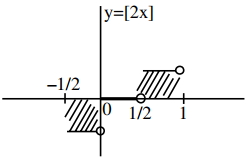
0 likes
View Solution297
DifficultMCQ
यदि सम्मिश्र संख्या $(1-\cos \theta+2 i \sin \theta)^{-1}$ का वास्तविक भाग $\theta \in(0, \pi)$ के लिए $\frac{1}{5}$ है,तो समाकलन $\int_{0}^{\theta} \sin x \,dx$ का मान क्या होगा?
A
$2$
B
$-1$
C
$0$
D
$1$
Solution
(D) माना $z = (1 - \cos \theta + 2i \sin \theta)^{-1} = \frac{1}{(1 - \cos \theta) + 2i \sin \theta}$.
अंश और हर को संयुग्मी $((1 - \cos \theta) - 2i \sin \theta)$ से गुणा करने पर:
$z = \frac{(1 - \cos \theta) - 2i \sin \theta}{(1 - \cos \theta)^2 + 4 \sin^2 \theta}$.
वास्तविक भाग $\text{Re}(z) = \frac{1 - \cos \theta}{(1 - \cos \theta)^2 + 4 \sin^2 \theta} = \frac{1}{5}$.
$1 - \cos \theta = 2 \sin^2 \frac{\theta}{2}$ और $\sin \theta = 2 \sin \frac{\theta}{2} \cos \frac{\theta}{2}$ का उपयोग करने पर:
$\text{Re}(z) = \frac{2 \sin^2 \frac{\theta}{2}}{4 \sin^4 \frac{\theta}{2} + 16 \sin^2 \frac{\theta}{2} \cos^2 \frac{\theta}{2}} = \frac{1}{2(\sin^2 \frac{\theta}{2} + 4 \cos^2 \frac{\theta}{2})} = \frac{1}{5}$.
अतः,$2(\sin^2 \frac{\theta}{2} + 4 \cos^2 \frac{\theta}{2}) = 5 \implies 2(1 + 3 \cos^2 \frac{\theta}{2}) = 5 \implies \cos^2 \frac{\theta}{2} = \frac{1}{2}$.
चूंकि $\theta \in (0, \pi)$,इसलिए $\theta = \frac{\pi}{2}$ प्राप्त होता है।
अंत में,$\int_{0}^{\frac{\pi}{2}} \sin x \,dx = [-\cos x]_{0}^{\frac{\pi}{2}} = 1$.
अंश और हर को संयुग्मी $((1 - \cos \theta) - 2i \sin \theta)$ से गुणा करने पर:
$z = \frac{(1 - \cos \theta) - 2i \sin \theta}{(1 - \cos \theta)^2 + 4 \sin^2 \theta}$.
वास्तविक भाग $\text{Re}(z) = \frac{1 - \cos \theta}{(1 - \cos \theta)^2 + 4 \sin^2 \theta} = \frac{1}{5}$.
$1 - \cos \theta = 2 \sin^2 \frac{\theta}{2}$ और $\sin \theta = 2 \sin \frac{\theta}{2} \cos \frac{\theta}{2}$ का उपयोग करने पर:
$\text{Re}(z) = \frac{2 \sin^2 \frac{\theta}{2}}{4 \sin^4 \frac{\theta}{2} + 16 \sin^2 \frac{\theta}{2} \cos^2 \frac{\theta}{2}} = \frac{1}{2(\sin^2 \frac{\theta}{2} + 4 \cos^2 \frac{\theta}{2})} = \frac{1}{5}$.
अतः,$2(\sin^2 \frac{\theta}{2} + 4 \cos^2 \frac{\theta}{2}) = 5 \implies 2(1 + 3 \cos^2 \frac{\theta}{2}) = 5 \implies \cos^2 \frac{\theta}{2} = \frac{1}{2}$.
चूंकि $\theta \in (0, \pi)$,इसलिए $\theta = \frac{\pi}{2}$ प्राप्त होता है।
अंत में,$\int_{0}^{\frac{\pi}{2}} \sin x \,dx = [-\cos x]_{0}^{\frac{\pi}{2}} = 1$.
0 likes
View Solution298
MediumMCQ
$b > 3$ का वह मान जिसके लिए $12 \int \limits_{3}^{b} \frac{1}{(x^{2}-1)(x^{2}-4)} dx = \log _{e}(\frac{49}{40})$ है,बराबर है
A
$6$
B
$3$
C
$5$
D
$9$
Solution
(A) हम समाकल्य के लिए आंशिक भिन्नों का उपयोग करते हैं: $\frac{1}{(x^2-1)(x^2-4)} = \frac{1}{3} (\frac{1}{x^2-4} - \frac{1}{x^2-1})$.
इसे समाकल में प्रतिस्थापित करने पर: $12 \cdot \frac{1}{3} \int_{3}^{b} (\frac{1}{x^2-4} - \frac{1}{x^2-1}) dx = 4 [\frac{1}{4} \ln |\frac{x-2}{x+2}| - \frac{1}{2} \ln |\frac{x-1}{x+1}|]_{3}^{b} = \log_e(\frac{49}{40})$.
व्यंजक को सरल करने पर: $[\ln |\frac{x-2}{x+2}| - 2 \ln |\frac{x-1}{x+1}|]_{3}^{b} = \ln \frac{49}{40}$.
$[\ln |\frac{x-2}{x+2}| - \ln |(\frac{x-1}{x+1})^2|]_{3}^{b} = \ln \frac{49}{40}$.
$[\ln |\frac{(x-2)(x+1)^2}{(x+2)(x-1)^2}|]_{3}^{b} = \ln \frac{49}{40}$.
$b$ और $3$ पर मान रखने पर: $\ln |\frac{(b-2)(b+1)^2}{(b+2)(b-1)^2}| - \ln |\frac{(3-2)(3+1)^2}{(3+2)(3-1)^2}| = \ln \frac{49}{40}$.
$\ln |\frac{(b-2)(b+1)^2}{(b+2)(b-1)^2}| - \ln |\frac{1 \cdot 16}{5 \cdot 4}| = \ln \frac{49}{40}$.
$\ln |\frac{(b-2)(b+1)^2}{(b+2)(b-1)^2}| - \ln \frac{4}{5} = \ln \frac{49}{40}$.
$\ln |\frac{(b-2)(b+1)^2}{(b+2)(b-1)^2}| = \ln (\frac{49}{40} \cdot \frac{4}{5}) = \ln \frac{49}{50}$.
पदों की तुलना करने पर,हमें $b = 6$ प्राप्त होता है।
इसे समाकल में प्रतिस्थापित करने पर: $12 \cdot \frac{1}{3} \int_{3}^{b} (\frac{1}{x^2-4} - \frac{1}{x^2-1}) dx = 4 [\frac{1}{4} \ln |\frac{x-2}{x+2}| - \frac{1}{2} \ln |\frac{x-1}{x+1}|]_{3}^{b} = \log_e(\frac{49}{40})$.
व्यंजक को सरल करने पर: $[\ln |\frac{x-2}{x+2}| - 2 \ln |\frac{x-1}{x+1}|]_{3}^{b} = \ln \frac{49}{40}$.
$[\ln |\frac{x-2}{x+2}| - \ln |(\frac{x-1}{x+1})^2|]_{3}^{b} = \ln \frac{49}{40}$.
$[\ln |\frac{(x-2)(x+1)^2}{(x+2)(x-1)^2}|]_{3}^{b} = \ln \frac{49}{40}$.
$b$ और $3$ पर मान रखने पर: $\ln |\frac{(b-2)(b+1)^2}{(b+2)(b-1)^2}| - \ln |\frac{(3-2)(3+1)^2}{(3+2)(3-1)^2}| = \ln \frac{49}{40}$.
$\ln |\frac{(b-2)(b+1)^2}{(b+2)(b-1)^2}| - \ln |\frac{1 \cdot 16}{5 \cdot 4}| = \ln \frac{49}{40}$.
$\ln |\frac{(b-2)(b+1)^2}{(b+2)(b-1)^2}| - \ln \frac{4}{5} = \ln \frac{49}{40}$.
$\ln |\frac{(b-2)(b+1)^2}{(b+2)(b-1)^2}| = \ln (\frac{49}{40} \cdot \frac{4}{5}) = \ln \frac{49}{50}$.
पदों की तुलना करने पर,हमें $b = 6$ प्राप्त होता है।
0 likes
View Solution299
DifficultMCQ
मान लीजिए $f(x) = \max \{|x+1|, |x+2|, |x+3|, |x+4|, |x+5|\}$ है। तो $\int_{-6}^{0} f(x) \, dx$ का मान ज्ञात कीजिए।
A
$20$
B
$40$
C
$21$
D
$41$
Solution
(C) दिया गया है $f(x) = \max \{|x+1|, |x+2|, |x+3|, |x+4|, |x+5|\}$।
$x \in [-6, 0]$ के लिए,फलन $f(x)$ इन निरपेक्ष मान फलनों के ऊपरी आवरण द्वारा परिभाषित होता है।
ग्राफ से यह स्पष्ट है कि $f(x) = |x+5|$ जब $x \in [-6, -3]$ और $f(x) = |x+1|$ जब $x \in [-3, 0]$ है।
अतः,$\int_{-6}^{0} f(x) \, dx = \int_{-6}^{-3} |x+5| \, dx + \int_{-3}^{0} |x+1| \, dx$।
गणना करने पर: $\int_{-6}^{-3} -(x+5) \, dx + \int_{-3}^{0} (x+1) \, dx = -\left[\frac{x^2}{2} + 5x\right]_{-6}^{-3} + \left[\frac{x^2}{2} + x\right]_{-3}^{0} = -[(\frac{9}{2} - 15) - (18 - 30)] + [0 - (\frac{9}{2} - 3)] = -[-\frac{21}{2} + 12] - [\frac{3}{2} - 12] = -\frac{3}{2} + \frac{21}{2} = 9 + 12 = 21$।
$x \in [-6, 0]$ के लिए,फलन $f(x)$ इन निरपेक्ष मान फलनों के ऊपरी आवरण द्वारा परिभाषित होता है।
ग्राफ से यह स्पष्ट है कि $f(x) = |x+5|$ जब $x \in [-6, -3]$ और $f(x) = |x+1|$ जब $x \in [-3, 0]$ है।
अतः,$\int_{-6}^{0} f(x) \, dx = \int_{-6}^{-3} |x+5| \, dx + \int_{-3}^{0} |x+1| \, dx$।
गणना करने पर: $\int_{-6}^{-3} -(x+5) \, dx + \int_{-3}^{0} (x+1) \, dx = -\left[\frac{x^2}{2} + 5x\right]_{-6}^{-3} + \left[\frac{x^2}{2} + x\right]_{-3}^{0} = -[(\frac{9}{2} - 15) - (18 - 30)] + [0 - (\frac{9}{2} - 3)] = -[-\frac{21}{2} + 12] - [\frac{3}{2} - 12] = -\frac{3}{2} + \frac{21}{2} = 9 + 12 = 21$।
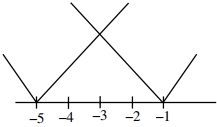
0 likes
View Solution7-2.Definite Integral — Fundamental definite integration · Frequently Asked Questions
1Are these 7-2.Definite Integral questions useful for JEE and NEET?
Yes. All questions in this section are mapped to JEE Main and NEET exam patterns. Previous year questions from JEE Main, NEET, GUJCET and state-level exams are included with full solutions.
2Can I switch to Hindi or Gujarati for these questions?
Yes. Use the language tabs in the hero section or the sidebar to view the same questions and solutions in English, Hindi or Gujarati.
3How do I generate a question paper from this subtopic?
Use the Vedclass Exam Paper Generator — select the chapter and subtopic, set difficulty, and generate Sets A, B, C, D automatically. First 3 chapters of every subject are free.
Vedclass Products
For Students
Vedclass Test Series
Mock tests in real JEE/NEET style with performance analysis. 5-day free trial.
Start Free TrialFor Teachers
Exam Paper Generator
Generate Set A/B/C/D papers from this chapter in 2 minutes. 3 chapters free.
Try FreeFor Institutes
Online Exam Module
Live online exams with unlimited students, 360° analytics & white-label branding.
See DemoFor Teachers & Institutes
Generate a 7-2.Definite Integral Exam Paper in 2 Minutes
Select subtopic & difficulty — Sets A, B, C, D auto-generated with No Repeat logic.
First 3 chapters of every subject are free — no payment required.