
A English
Solubility Questions in English
Class 12 Chemistry · Solutions · Solubility
164+
Questions
English
Language
100%
With Solutions
Showing 50 of 164 questions in English
101
EasyMCQ
Calculate the solubility of a gas in a solvent at $25^{\circ} C$ and $0.8 \ atm$ if Henry's law constant for the solvent is $6.8 \times 10^{-4} \ mol \ dm^{-3} \ atm^{-1}$.
A
$5.88 \times 10^{-4} \ M$
B
$6.12 \times 10^{-4} \ M$
C
$5.44 \times 10^{-4} \ M$
D
$6.48 \times 10^{-4} \ M$
Solution
(C) According to Henry's law,the solubility $(S)$ of a gas in a liquid is given by the formula: $S = K_H \times P$
Where:
$K_H = 6.8 \times 10^{-4} \ mol \ dm^{-3} \ atm^{-1}$
$P = 0.8 \ atm$
Substituting the values:
$S = (6.8 \times 10^{-4} \ mol \ dm^{-3} \ atm^{-1}) \times (0.8 \ atm)$
$S = 5.44 \times 10^{-4} \ mol \ dm^{-3}$
Since $1 \ mol \ dm^{-3} = 1 \ M$,the solubility is $5.44 \times 10^{-4} \ M$.
Where:
$K_H = 6.8 \times 10^{-4} \ mol \ dm^{-3} \ atm^{-1}$
$P = 0.8 \ atm$
Substituting the values:
$S = (6.8 \times 10^{-4} \ mol \ dm^{-3} \ atm^{-1}) \times (0.8 \ atm)$
$S = 5.44 \times 10^{-4} \ mol \ dm^{-3}$
Since $1 \ mol \ dm^{-3} = 1 \ M$,the solubility is $5.44 \times 10^{-4} \ M$.
0 likes
View Solution102
EasyMCQ
Calculate the solubility of a gas having partial pressure $0.15 \ bar$ at $25^{\circ} C$.
$[K_{H} = 0.16 \ mol \ dm^{-3} \ bar^{-1}]$
$[K_{H} = 0.16 \ mol \ dm^{-3} \ bar^{-1}]$
A
$2.4 \times 10^{-2} \ mol \ dm^{-3}$
B
$3.0 \times 10^{-2} \ mol \ dm^{-3}$
C
$2.7 \times 10^{-2} \ mol \ dm^{-3}$
D
$1.8 \times 10^{-2} \ mol \ dm^{-3}$
Solution
(A) According to Henry's Law,the solubility $(S)$ of a gas is given by the formula: $S = K_{H} \times P$.
Given: $K_{H} = 0.16 \ mol \ dm^{-3} \ bar^{-1}$ and $P = 0.15 \ bar$.
Substituting the values: $S = 0.16 \ mol \ dm^{-3} \ bar^{-1} \times 0.15 \ bar = 0.024 \ mol \ dm^{-3}$.
Therefore,$S = 2.4 \times 10^{-2} \ mol \ dm^{-3}$.
Given: $K_{H} = 0.16 \ mol \ dm^{-3} \ bar^{-1}$ and $P = 0.15 \ bar$.
Substituting the values: $S = 0.16 \ mol \ dm^{-3} \ bar^{-1} \times 0.15 \ bar = 0.024 \ mol \ dm^{-3}$.
Therefore,$S = 2.4 \times 10^{-2} \ mol \ dm^{-3}$.
0 likes
View Solution103
MediumMCQ
Calculate Henry's law constant if the solubility of a gas in water at $25^{\circ} C$ is $5.14 \times 10^{-4} \ mol \ dm^{-3}$ and the partial pressure of the gas above the solution is $0.75 \ bar$.
A
$6.85 \times 10^{-4} \ mol \ dm^{-3} \ bar^{-1}$
B
$5.14 \times 10^{-4} \ mol \ dm^{-3} \ bar^{-1}$
C
$1.028 \times 10^{-4} \ mol \ dm^{-3} \ bar^{-1}$
D
$1.371 \times 10^{-4} \ mol \ dm^{-3} \ bar^{-1}$
Solution
(A) According to Henry's law,the solubility $(S)$ is related to the partial pressure $(P)$ by the equation: $S = K_H P$
Here,$K_H$ is the Henry's law constant.
Rearranging the formula to solve for $K_H$: $K_H = \frac{S}{P}$
Substituting the given values: $K_H = \frac{5.14 \times 10^{-4} \ mol \ dm^{-3}}{0.75 \ bar} = 6.85 \times 10^{-4} \ mol \ dm^{-3} \ bar^{-1}$
Here,$K_H$ is the Henry's law constant.
Rearranging the formula to solve for $K_H$: $K_H = \frac{S}{P}$
Substituting the given values: $K_H = \frac{5.14 \times 10^{-4} \ mol \ dm^{-3}}{0.75 \ bar} = 6.85 \times 10^{-4} \ mol \ dm^{-3} \ bar^{-1}$
0 likes
View Solution104
MediumMCQ
What is the solubility of a gas in water at $25^{\circ} C$ if the partial pressure is $0.18 \ atm$? $(K_{H} = 0.16 \ mol \ dm^{-3} \ atm^{-1})$
A
$0.029 \ mol \ dm^{-3}$
B
$0.022 \ mol \ dm^{-3}$
C
$0.032 \ mol \ dm^{-3}$
D
$0.038 \ mol \ dm^{-3}$
Solution
(A) According to Henry's Law,the solubility $(S)$ of a gas is given by the formula: $S = K_{H} \times P$.
Given: $K_{H} = 0.16 \ mol \ dm^{-3} \ atm^{-1}$ and $P = 0.18 \ atm$.
Substituting the values: $S = 0.16 \times 0.18 = 0.0288 \ mol \ dm^{-3}$.
Rounding to two significant figures,we get $0.029 \ mol \ dm^{-3}$.
Given: $K_{H} = 0.16 \ mol \ dm^{-3} \ atm^{-1}$ and $P = 0.18 \ atm$.
Substituting the values: $S = 0.16 \times 0.18 = 0.0288 \ mol \ dm^{-3}$.
Rounding to two significant figures,we get $0.029 \ mol \ dm^{-3}$.
0 likes
View Solution105
EasyMCQ
The solubility of a gas in a liquid is directly proportional to the pressure of the gas over the solution. Identify the law for this statement.
A
Henry's law
B
Raoult's law
C
Dalton's law
D
Avogadro's law
Solution
(A) According to Henry's law,the solubility of a gas in a liquid is directly proportional to the partial pressure of the gas above the liquid surface.
Mathematically,$P = K_H \cdot x$,where $P$ is the partial pressure,$x$ is the mole fraction (solubility),and $K_H$ is Henry's law constant.
Mathematically,$P = K_H \cdot x$,where $P$ is the partial pressure,$x$ is the mole fraction (solubility),and $K_H$ is Henry's law constant.
0 likes
View Solution106
MediumMCQ
What is the solubility of a gas in water at $25^{\circ} C$ if the partial pressure is $0.346 \ bar$ (Henry's law constant is $0.159 \ mol \ dm^{-3} \ bar^{-1}$)?
A
$0.055 \ mol \ dm^{-3}$
B
$0.028 \ mol \ dm^{-3}$
C
$0.083 \ mol \ dm^{-3}$
D
$0.11 \ mol \ dm^{-3}$
Solution
(A) According to Henry's law,the solubility $(S)$ of a gas is given by the formula:
$S = K_{H} \times P$
Given:
$K_{H} = 0.159 \ mol \ dm^{-3} \ bar^{-1}$
$P = 0.346 \ bar$
Calculation:
$S = 0.159 \ mol \ dm^{-3} \ bar^{-1} \times 0.346 \ bar = 0.055 \ mol \ dm^{-3}$
Thus,the solubility of the gas is $0.055 \ mol \ dm^{-3}$.
$S = K_{H} \times P$
Given:
$K_{H} = 0.159 \ mol \ dm^{-3} \ bar^{-1}$
$P = 0.346 \ bar$
Calculation:
$S = 0.159 \ mol \ dm^{-3} \ bar^{-1} \times 0.346 \ bar = 0.055 \ mol \ dm^{-3}$
Thus,the solubility of the gas is $0.055 \ mol \ dm^{-3}$.
0 likes
View Solution107
MediumMCQ
What is Henry's law constant of a gas if the solubility of the gas in water at $25^{\circ} C$ is $0.028 \ mol \ dm^{-3}$? (Partial pressure of the gas $= 0.346 \ bar$)
A
$0.081 \ mol \ dm^{-3} \ bar^{-1}$
B
$0.075 \ mol \ dm^{-3} \ bar^{-1}$
C
$0.093 \ mol \ dm^{-3} \ bar^{-1}$
D
$0.049 \ mol \ dm^{-3} \ bar^{-1}$
Solution
(A) According to Henry's law,the solubility $(S)$ of a gas is directly proportional to its partial pressure $(P)$: $S = K_{H} \times P$.
Here,$S = 0.028 \ mol \ dm^{-3}$ and $P = 0.346 \ bar$.
Therefore,the Henry's law constant $(K_{H})$ is calculated as:
$K_{H} = \frac{S}{P} = \frac{0.028 \ mol \ dm^{-3}}{0.346 \ bar} \approx 0.081 \ mol \ dm^{-3} \ bar^{-1}$.
Here,$S = 0.028 \ mol \ dm^{-3}$ and $P = 0.346 \ bar$.
Therefore,the Henry's law constant $(K_{H})$ is calculated as:
$K_{H} = \frac{S}{P} = \frac{0.028 \ mol \ dm^{-3}}{0.346 \ bar} \approx 0.081 \ mol \ dm^{-3} \ bar^{-1}$.
0 likes
View Solution108
EasyMCQ
Calculate the pressure of the gas if the solubility of the gas in water at $25^{\circ} C$ is $6.85 \times 10^{-4} \ mol \ dm^{-3}$. (Henry's law constant $K_H$ is $6.85 \times 10^{-4} \ mol \ dm^{-3} \ bar^{-1}$) (in $bar$)
A
$0.853$
B
$1.5$
C
$0.5$
D
$1$
Solution
(D) According to Henry's law,the solubility $(S)$ of a gas is directly proportional to the partial pressure $(P)$ of the gas above the solution:
$S = K_H \times P$
Given:
Solubility $(S)$ = $6.85 \times 10^{-4} \ mol \ dm^{-3}$
Henry's law constant $(K_H)$ = $6.85 \times 10^{-4} \ mol \ dm^{-3} \ bar^{-1}$
Rearranging the formula to solve for pressure $(P)$:
$P = S / K_H$
$P = (6.85 \times 10^{-4} \ mol \ dm^{-3}) / (6.85 \times 10^{-4} \ mol \ dm^{-3} \ bar^{-1})$
$P = 1.0 \ bar$
$S = K_H \times P$
Given:
Solubility $(S)$ = $6.85 \times 10^{-4} \ mol \ dm^{-3}$
Henry's law constant $(K_H)$ = $6.85 \times 10^{-4} \ mol \ dm^{-3} \ bar^{-1}$
Rearranging the formula to solve for pressure $(P)$:
$P = S / K_H$
$P = (6.85 \times 10^{-4} \ mol \ dm^{-3}) / (6.85 \times 10^{-4} \ mol \ dm^{-3} \ bar^{-1})$
$P = 1.0 \ bar$
0 likes
View Solution109
EasyMCQ
Calculate the solubility of gas in water at $1.2 \text{ atm}$ and $25^{\circ} C$ if Henry's law constant is $0.45 \text{ mol dm}^{-3} \text{ atm}^{-1}$ at $25^{\circ} C$.
A
$0.45 \text{ mol dm}^{-3}$
B
$0.54 \text{ mol dm}^{-3}$
C
$0.25 \text{ mol dm}^{-3}$
D
$0.31 \text{ mol dm}^{-3}$
Solution
(B) According to Henry's law,the solubility of a gas is given by the formula: $S = k \times p$
Here,$k = 0.45 \text{ mol dm}^{-3} \text{ atm}^{-1}$ and $p = 1.2 \text{ atm}$.
Substituting the values: $S = 0.45 \text{ mol dm}^{-3} \text{ atm}^{-1} \times 1.2 \text{ atm} = 0.54 \text{ mol dm}^{-3}$.
Thus,the solubility of the gas is $0.54 \text{ mol dm}^{-3}$.
Here,$k = 0.45 \text{ mol dm}^{-3} \text{ atm}^{-1}$ and $p = 1.2 \text{ atm}$.
Substituting the values: $S = 0.45 \text{ mol dm}^{-3} \text{ atm}^{-1} \times 1.2 \text{ atm} = 0.54 \text{ mol dm}^{-3}$.
Thus,the solubility of the gas is $0.54 \text{ mol dm}^{-3}$.
0 likes
View Solution110
EasyMCQ
Which of the following laws represents the quantitative relationship between the solubility of gas in liquid and its pressure?
A
Charles's law
B
Avogadro's law
C
Raoult's law
D
Henry's law
Solution
(D) Henry's law states that the partial pressure of the gas in the vapor phase $(p)$ is proportional to the mole fraction of the gas $(x)$ in the solution.
Mathematically,it is expressed as $p = K_H \cdot x$,where $K_H$ is Henry's law constant.
This law directly describes the quantitative relationship between the solubility of a gas in a liquid and its pressure.
Mathematically,it is expressed as $p = K_H \cdot x$,where $K_H$ is Henry's law constant.
This law directly describes the quantitative relationship between the solubility of a gas in a liquid and its pressure.
0 likes
View Solution111
EasyMCQ
What is the unit of Henry's law constant $(K_H)$?
A
$mol \ dm^{-3}$
B
$mol \ dm^3 \ bar^{-1}$
C
$mol \ dm^{-3} \ bar^{-1}$
D
$mol \ dm^{-3} \ bar$
Solution
(C) According to Henry's law,the solubility $(S)$ of a gas in a liquid is directly proportional to the partial pressure $(P)$ of the gas above the liquid: $S = K_H \times P$.
Here,$S$ is expressed in $mol \ dm^{-3}$ and $P$ is expressed in $bar$.
Therefore,the unit of Henry's law constant $(K_H)$ is given by: $K_H = \frac{S}{P} = \frac{mol \ dm^{-3}}{bar} = mol \ dm^{-3} \ bar^{-1}$.
Here,$S$ is expressed in $mol \ dm^{-3}$ and $P$ is expressed in $bar$.
Therefore,the unit of Henry's law constant $(K_H)$ is given by: $K_H = \frac{S}{P} = \frac{mol \ dm^{-3}}{bar} = mol \ dm^{-3} \ bar^{-1}$.
0 likes
View Solution112
EasyMCQ
Calculate the solubility of a gas in water at $0.8 \ atm$ and $25^{\circ} C$. [Henry's law constant is $6.85 \times 10^{-4} \ mol \ dm^{-3} \ atm^{-1}$]
A
$5.48 \times 10^{-4} \ mol \ dm^{-3}$
B
$3.94 \times 10^{-4} \ mol \ dm^{-3}$
C
$6.858 \times 10^{-4} \ mol \ dm^{-3}$
D
$2.74 \times 10^{-4} \ mol \ dm^{-3}$
Solution
(A) According to Henry's law,the solubility $(S)$ of a gas is given by the formula: $S = K_H \times P$
Given:
Pressure $(P)$ = $0.8 \ atm$
Henry's law constant $(K_H)$ = $6.85 \times 10^{-4} \ mol \ dm^{-3} \ atm^{-1}$
Substituting the values:
$S = 6.85 \times 10^{-4} \ mol \ dm^{-3} \ atm^{-1} \times 0.8 \ atm$
$S = 5.48 \times 10^{-4} \ mol \ dm^{-3}$
Given:
Pressure $(P)$ = $0.8 \ atm$
Henry's law constant $(K_H)$ = $6.85 \times 10^{-4} \ mol \ dm^{-3} \ atm^{-1}$
Substituting the values:
$S = 6.85 \times 10^{-4} \ mol \ dm^{-3} \ atm^{-1} \times 0.8 \ atm$
$S = 5.48 \times 10^{-4} \ mol \ dm^{-3}$
0 likes
View Solution113
EasyMCQ
Calculate the solubility of a gas in water at $260 \ mm \ Hg$ and $25^{\circ} C$ if Henry's law constant of the gas is $0.159 \ mol \ dm^{-3} \ atm^{-1}$ at $25^{\circ} C$.
A
$3.8 \times 10^{-2} \ mol \ dm^{-3}$
B
$5.4 \times 10^{-2} \ mol \ dm^{-3}$
C
$2.7 \times 10^{-2} \ mol \ dm^{-3}$
D
$1.2 \times 10^{-2} \ mol \ dm^{-3}$
Solution
(B) According to Henry's law,the solubility $(S)$ of a gas is given by $S = K_H \times p$.
First,convert the pressure from $mm \ Hg$ to $atm$:
$p = \frac{260 \ mm \ Hg}{760 \ mm \ Hg \ atm^{-1}} \approx 0.3421 \ atm$.
Now,calculate the solubility:
$S = 0.159 \ mol \ dm^{-3} \ atm^{-1} \times 0.3421 \ atm \approx 0.05439 \ mol \ dm^{-3}$.
Rounding to two significant figures,we get $S = 5.4 \times 10^{-2} \ mol \ dm^{-3}$.
First,convert the pressure from $mm \ Hg$ to $atm$:
$p = \frac{260 \ mm \ Hg}{760 \ mm \ Hg \ atm^{-1}} \approx 0.3421 \ atm$.
Now,calculate the solubility:
$S = 0.159 \ mol \ dm^{-3} \ atm^{-1} \times 0.3421 \ atm \approx 0.05439 \ mol \ dm^{-3}$.
Rounding to two significant figures,we get $S = 5.4 \times 10^{-2} \ mol \ dm^{-3}$.
0 likes
View Solution114
MediumMCQ
Henry's law constant for $CH_3Br$ is $0.16 \ mol \ L^{-1} \ bar^{-1}$ at $298 \ K$. What pressure is required to have solubility of $0.08 \ mol \ L^{-1}$ (in $bar$)?
A
$0.24$
B
$1.6$
C
$0.5$
D
$4.0$
Solution
(C) According to Henry's Law,the solubility of a gas is given by the formula: $\text{Solubility} = K_H \times P_{gas}$.
Given,$K_H = 0.16 \ mol \ L^{-1} \ bar^{-1}$ and $\text{Solubility} = 0.08 \ mol \ L^{-1}$.
Rearranging the formula to solve for pressure: $P_{gas} = \frac{\text{Solubility}}{K_H}$.
Substituting the values: $P_{gas} = \frac{0.08 \ mol \ L^{-1}}{0.16 \ mol \ L^{-1} \ bar^{-1}} = 0.5 \ bar$.
Given,$K_H = 0.16 \ mol \ L^{-1} \ bar^{-1}$ and $\text{Solubility} = 0.08 \ mol \ L^{-1}$.
Rearranging the formula to solve for pressure: $P_{gas} = \frac{\text{Solubility}}{K_H}$.
Substituting the values: $P_{gas} = \frac{0.08 \ mol \ L^{-1}}{0.16 \ mol \ L^{-1} \ bar^{-1}} = 0.5 \ bar$.
0 likes
View Solution115
MediumMCQ
What is Henry's law constant if the solubility of a gas in water at $298 \ K$ and $1 \ bar$ pressure is $7 \times 10^{-4} \ mol \ L^{-1}$?
A
$2.0 \times 10^{-5} \ mol \ L^{-1} \ bar^{-1}$
B
$7.0 \times 10^{-4} \ mol \ L^{-1} \ bar^{-1}$
C
$3.5 \times 10^{-3} \ mol \ L^{-1} \ bar^{-1}$
D
$3.1 \times 10^{-5} \ mol \ L^{-1} \ bar^{-1}$
Solution
(B) According to Henry's law,the solubility $(S)$ of a gas is directly proportional to the partial pressure $(p)$ of the gas: $S = K_H \times p$.
Given:
Solubility $(S)$ = $7 \times 10^{-4} \ mol \ L^{-1}$
Pressure $(p)$ = $1 \ bar$
Substituting the values into the formula:
$7 \times 10^{-4} \ mol \ L^{-1} = K_H \times 1 \ bar$
Therefore,$K_H = \frac{7 \times 10^{-4} \ mol \ L^{-1}}{1 \ bar} = 7 \times 10^{-4} \ mol \ L^{-1} \ bar^{-1}$.
Given:
Solubility $(S)$ = $7 \times 10^{-4} \ mol \ L^{-1}$
Pressure $(p)$ = $1 \ bar$
Substituting the values into the formula:
$7 \times 10^{-4} \ mol \ L^{-1} = K_H \times 1 \ bar$
Therefore,$K_H = \frac{7 \times 10^{-4} \ mol \ L^{-1}}{1 \ bar} = 7 \times 10^{-4} \ mol \ L^{-1} \ bar^{-1}$.
0 likes
View Solution116
MediumMCQ
Regarding Henry's law,which of the following is not a correct statement?
A
Different gases have different $K_H$ (Henry's law constant) values at the same temperature.
B
The partial pressure of the gas in the vapour phase is proportional to the mole fraction of the gas in the solution.
C
Higher the value of $K_H$ at a given pressure,higher is the solubility of the gas in the liquids.
D
The value of $K_H$ increases with an increase in temperature and $K_H$ is a function of the nature of the gas.
Solution
(C) According to Henry's law,$p = K_H \times x$,where $p$ is the partial pressure of the gas,$K_H$ is the Henry's law constant,and $x$ is the mole fraction of the gas in the solution.
$1$. $K_H$ depends on the nature of the gas and increases with an increase in temperature.
$2$. From the relation $p = K_H \times x$,we can write $x = p / K_H$. This shows that for a given pressure $p$,the solubility $(x)$ is inversely proportional to $K_H$.
$3$. Therefore,a higher value of $K_H$ implies lower solubility of the gas in the liquid.
$4$. Thus,the statement 'Higher the value of $K_H$ at a given pressure,higher is the solubility of the gas in the liquids' is incorrect.
$1$. $K_H$ depends on the nature of the gas and increases with an increase in temperature.
$2$. From the relation $p = K_H \times x$,we can write $x = p / K_H$. This shows that for a given pressure $p$,the solubility $(x)$ is inversely proportional to $K_H$.
$3$. Therefore,a higher value of $K_H$ implies lower solubility of the gas in the liquid.
$4$. Thus,the statement 'Higher the value of $K_H$ at a given pressure,higher is the solubility of the gas in the liquids' is incorrect.
0 likes
View Solution117
EasyMCQ
The Henry's law constant for oxygen is $1.3 \times 10^{-3} \ mol \ dm^{-3} \ atm^{-1}$. If the partial pressure of oxygen is $0.46 \ atm$,what is the concentration of dissolved oxygen?
A
$5.98 \times 10^{-4} \ mol \ dm^{-3}$
B
$3.53 \times 10^{-4} \ mol \ dm^{-3}$
C
$5.98 \ mol \ dm^{-3}$
D
$2.82 \times 10^{-3} \ mol \ dm^{-3}$
Solution
(A) According to Henry's law,the solubility $(S)$ of a gas is given by the formula: $S = K_{H} \times P$
Given: $K_{H} = 1.3 \times 10^{-3} \ mol \ dm^{-3} \ atm^{-1}$ and $P = 0.46 \ atm$
Substituting the values: $S = (1.3 \times 10^{-3} \ mol \ dm^{-3} \ atm^{-1}) \times (0.46 \ atm) = 5.98 \times 10^{-4} \ mol \ dm^{-3}$
Given: $K_{H} = 1.3 \times 10^{-3} \ mol \ dm^{-3} \ atm^{-1}$ and $P = 0.46 \ atm$
Substituting the values: $S = (1.3 \times 10^{-3} \ mol \ dm^{-3} \ atm^{-1}) \times (0.46 \ atm) = 5.98 \times 10^{-4} \ mol \ dm^{-3}$
0 likes
View Solution118
EasyMCQ
Which among the following is true for the value of Henry's law constant $K_H$?
A
It is greater for gases with higher solubilities.
B
It first increases and then decreases with an increase in temperature.
C
It increases with an increase in temperature.
D
It is the same for all gases.
Solution
(C) Henry's law is given by the relation $P = K_H \cdot x$,where $P$ is the partial pressure of the gas,$K_H$ is Henry's law constant,and $x$ is the mole fraction of the gas in the solution.
For a given partial pressure,the solubility of a gas $(x)$ is inversely proportional to $K_H$ $(x = P / K_H)$.
As the temperature increases,the kinetic energy of gas molecules increases,making it harder for them to remain dissolved in the solvent,thus decreasing solubility.
Since solubility decreases as temperature increases,the value of $K_H$ must increase with an increase in temperature for a given pressure.
For a given partial pressure,the solubility of a gas $(x)$ is inversely proportional to $K_H$ $(x = P / K_H)$.
As the temperature increases,the kinetic energy of gas molecules increases,making it harder for them to remain dissolved in the solvent,thus decreasing solubility.
Since solubility decreases as temperature increases,the value of $K_H$ must increase with an increase in temperature for a given pressure.
0 likes
View Solution119
EasyMCQ
Henry's law is a relation between
A
pressure and solubility
B
temperature and pressure
C
volume and solubility
D
pressure and volume
Solution
(A) According to Henry's Law,the solubility of a gas in a liquid is directly proportional to the partial pressure of the gas present above the surface of the liquid or solution.
Mathematically,this is expressed as $S = K_{H} \times P$.
Here,$S$ represents the solubility of the gas,$P$ represents the partial pressure of the gas,and $K_{H}$ is the Henry's law constant.
Mathematically,this is expressed as $S = K_{H} \times P$.
Here,$S$ represents the solubility of the gas,$P$ represents the partial pressure of the gas,and $K_{H}$ is the Henry's law constant.
0 likes
View Solution120
EasyMCQ
$K_H$ is Henry's constant and has the unit
A
$atm \ mol^{-1} \ dm^3$
B
$mol^{-1} \ dm^3 \ atm^{-1}$
C
$atm \ mol \ dm^{-3}$
D
$mol \ dm^{-3} \ atm^{-1}$
Solution
(D) Henry's law is expressed as $P = K_H \times C$,where $P$ is the partial pressure of the gas and $C$ is the concentration of the gas in the solution.
Rearranging for the constant,we get $K_H = \frac{P}{C}$.
The unit of pressure $P$ is $atm$ and the unit of concentration $C$ is $mol \ dm^{-3}$.
Therefore,the unit of $K_H$ is $\frac{atm}{mol \ dm^{-3}} = atm \ dm^3 \ mol^{-1}$ or $mol^{-1} \ dm^3 \ atm$. However,in many textbooks,$K_H$ is expressed as $P = K_H \times x$ (where $x$ is mole fraction,unitless),making the unit of $K_H$ simply $atm$. If $K_H$ is defined as $C = K_H \times P$,then the unit is $mol \ dm^{-3} \ atm^{-1}$. Given the options,the correct unit for $K_H$ in the context of solubility concentration is $mol \ dm^{-3} \ atm^{-1}$.
Rearranging for the constant,we get $K_H = \frac{P}{C}$.
The unit of pressure $P$ is $atm$ and the unit of concentration $C$ is $mol \ dm^{-3}$.
Therefore,the unit of $K_H$ is $\frac{atm}{mol \ dm^{-3}} = atm \ dm^3 \ mol^{-1}$ or $mol^{-1} \ dm^3 \ atm$. However,in many textbooks,$K_H$ is expressed as $P = K_H \times x$ (where $x$ is mole fraction,unitless),making the unit of $K_H$ simply $atm$. If $K_H$ is defined as $C = K_H \times P$,then the unit is $mol \ dm^{-3} \ atm^{-1}$. Given the options,the correct unit for $K_H$ in the context of solubility concentration is $mol \ dm^{-3} \ atm^{-1}$.
0 likes
View Solution121
EasyMCQ
The relation between the solubility of a gas in a liquid at a constant temperature and external pressure is stated by which law?
A
Raoult's law
B
Boyle's law
C
Charles's law
D
Henry's law
Solution
(D) Henry's law states that the mass of a gas dissolved in a given volume of a liquid at a constant temperature is directly proportional to the pressure of the gas in equilibrium with the liquid.
Thus,it defines the relationship between the solubility of a gas in a liquid and the external pressure at a constant temperature.
Thus,it defines the relationship between the solubility of a gas in a liquid and the external pressure at a constant temperature.
0 likes
View Solution122
EasyMCQ
The value of Henry's constant $K_H$ . . . . . . .
A
is not affected by changing temperature
B
decreases with an increase in temperature
C
increases with an increase in temperature
D
first decreases and then increases with an increase in temperature
Solution
(C) Henry's law states that the solubility of a gas in a liquid is proportional to the partial pressure of the gas above the liquid,given by the equation $P = K_H \cdot x$,where $K_H$ is Henry's constant.
As the temperature increases,the kinetic energy of the gas molecules increases,making it easier for them to escape from the solution.
Consequently,the solubility of the gas decreases.
Since $K_H = P / x$,for a constant partial pressure $P$,an increase in temperature leads to a decrease in the mole fraction $x$ of the dissolved gas.
Therefore,the value of $K_H$ increases with an increase in temperature.
As the temperature increases,the kinetic energy of the gas molecules increases,making it easier for them to escape from the solution.
Consequently,the solubility of the gas decreases.
Since $K_H = P / x$,for a constant partial pressure $P$,an increase in temperature leads to a decrease in the mole fraction $x$ of the dissolved gas.
Therefore,the value of $K_H$ increases with an increase in temperature.
0 likes
View Solution123
EasyMCQ
Maximum amount of a solid solute that can be dissolved in a specified amount of a given liquid solvent does not depend upon $ . . . . . . $ .
$(i)$ Temperature $(ii)$ Nature of solute $(iii)$ Pressure $(iv)$ Nature of Solvent
$(i)$ Temperature $(ii)$ Nature of solute $(iii)$ Pressure $(iv)$ Nature of Solvent
A
$(ii)$ and $(iv)$
B
$(ii)$
C
$(i)$ and $(iii)$
D
$(iii)$
Solution
(D) The solubility of a solid solute in a liquid solvent depends on the nature of the solute and solvent (like dissolves like) and the temperature.
However,solids are incompressible,so the effect of pressure on the solubility of a solid in a liquid is negligible.
Therefore,the maximum amount of solid solute that can be dissolved does not depend upon pressure $(iii)$.
Thus,the correct option is $D$.
However,solids are incompressible,so the effect of pressure on the solubility of a solid in a liquid is negligible.
Therefore,the maximum amount of solid solute that can be dissolved does not depend upon pressure $(iii)$.
Thus,the correct option is $D$.
0 likes
View Solution124
EasyMCQ
In which solution,the solubility of the solute decreases with an increase in temperature?
A
Ethanol dissolved in water
B
Glucose dissolved in water
C
$Na-Hg$ amalgam
D
Chlorine dissolved in water
Solution
(D) The solubility of gases in liquids generally decreases with an increase in temperature because the dissolution of gas in a liquid is an exothermic process. According to Le Chatelier's principle,an increase in temperature shifts the equilibrium in the backward direction,thereby decreasing the solubility. Among the given options,$Chlorine$ is a gas,so its solubility in water decreases as the temperature increases.
0 likes
View Solution125
EasyMCQ
The partial pressure of ethane over a solution containing $7.14 \times 10^{-3} \ g$ of ethane is $1 \ bar$. If the solution contains $5 \times 10^{-2} \ g$ of ethane,then what shall be the partial pressure of the gas (in $bar$)? (At equal temperature)
A
$1$
B
$3$
C
$7$
D
$4$
Solution
(C) According to Henry's law,the partial pressure of a gas $(p)$ is directly proportional to its mass $(m)$ dissolved in a given volume of solvent at a constant temperature: $p \propto m$ or $p = k \times m$.
Given: $p_1 = 1 \ bar$,$m_1 = 7.14 \times 10^{-3} \ g$.
We need to find $p_2$ when $m_2 = 5 \times 10^{-2} \ g$.
Using the ratio: $\frac{p_2}{p_1} = \frac{m_2}{m_1}$.
$\frac{p_2}{1} = \frac{5 \times 10^{-2}}{7.14 \times 10^{-3}} = \frac{50 \times 10^{-3}}{7.14 \times 10^{-3}} \approx 7 \ bar$.
Thus,the partial pressure is $7 \ bar$.
Given: $p_1 = 1 \ bar$,$m_1 = 7.14 \times 10^{-3} \ g$.
We need to find $p_2$ when $m_2 = 5 \times 10^{-2} \ g$.
Using the ratio: $\frac{p_2}{p_1} = \frac{m_2}{m_1}$.
$\frac{p_2}{1} = \frac{5 \times 10^{-2}}{7.14 \times 10^{-3}} = \frac{50 \times 10^{-3}}{7.14 \times 10^{-3}} \approx 7 \ bar$.
Thus,the partial pressure is $7 \ bar$.
0 likes
View Solution126
EasyMCQ
Which one is an example of a solid solution?
A
Copper dissolved in gold
B
Glucose dissolved in water
C
Camphor in nitrogen gas
D
Ethanol dissolved in water
Solution
(A) solid solution is a solution in which the solute and solvent are both in the solid state.
$A$ Copper dissolved in gold is an example of a solid solution (alloy),where both components are solids.
$B$ Glucose dissolved in water is a solid-in-liquid solution.
$C$ Camphor in nitrogen gas is a solid-in-gas solution.
$D$ Ethanol dissolved in water is a liquid-in-liquid solution.
Therefore,the correct answer is $A$.
$A$ Copper dissolved in gold is an example of a solid solution (alloy),where both components are solids.
$B$ Glucose dissolved in water is a solid-in-liquid solution.
$C$ Camphor in nitrogen gas is a solid-in-gas solution.
$D$ Ethanol dissolved in water is a liquid-in-liquid solution.
Therefore,the correct answer is $A$.
0 likes
View Solution127
EasyMCQ
Which of the following is an example of a solution in which the solute is a gas and the solvent is a solid?
A
$A$. Aqueous solution of oxygen
B
$B$. Chloroform mixed with nitrogen gas
C
$C$. Camphor in nitrogen gas
D
$D$. Solution of hydrogen in palladium
Solution
(D) solution where the solute is a gas and the solvent is a solid is known as a gas-in-solid solution.
In the case of $H_2$ gas adsorbed on a palladium $(Pd)$ metal surface,hydrogen acts as the solute (gas) and palladium acts as the solvent (solid).
Therefore,the correct option is $D$.
In the case of $H_2$ gas adsorbed on a palladium $(Pd)$ metal surface,hydrogen acts as the solute (gas) and palladium acts as the solvent (solid).
Therefore,the correct option is $D$.
0 likes
View Solution128
EasyMCQ
As temperature increases,the value of $K_H$ increases,thus the value of solubility of a gaseous solute will $ . . . . . . $.
A
Remain constant
B
Decrease
C
Increase
D
Cannot be determined
Solution
(B) According to Henry's Law,the solubility of a gas in a liquid is given by the relation $P = K_H \times x$,where $P$ is the partial pressure of the gas,$K_H$ is Henry's law constant,and $x$ is the mole fraction of the gas in the solution.
Rearranging for solubility $(x)$,we get $x = P / K_H$.
Since $K_H$ is in the denominator,as the temperature increases,$K_H$ increases,which leads to a decrease in the solubility $(x)$ of the gaseous solute.
Rearranging for solubility $(x)$,we get $x = P / K_H$.
Since $K_H$ is in the denominator,as the temperature increases,$K_H$ increases,which leads to a decrease in the solubility $(x)$ of the gaseous solute.
0 likes
View Solution129
EasyMCQ
Which of the following is a solution in which the physical states of solute and solvent are liquid and solid respectively?
A
$Zinc$ amalgam made in mercury
B
Sugar solution
C
Solution of $Naphthalene$ in $Benzene$
D
Moist air
Solution
(A) solution where the solute is liquid and the solvent is solid is known as a solid solution of a liquid in a solid. $Zinc$ amalgam is an example of this,where liquid mercury $(Hg)$ acts as the solute and solid $Zinc$ $(Zn)$ acts as the solvent.
0 likes
View Solution130
MediumMCQ
$5.5 \text{ mg}$ of nitrogen gas dissolves in $180 \text{ g}$ of water at $273 \text{ K}$ and $1 \text{ atm}$ pressure due to nitrogen gas. The mole fraction of nitrogen in $180 \text{ g}$ of water at $5 \text{ atm}$ nitrogen pressure is approximately:
A
$1 \times 10^{-5}$
B
$1 \times 10^{-4}$
C
$1 \times 10^{-6}$
D
$1 \times 10^{-3}$
Solution
(B) Moles of $N_2 = \frac{5.5 \times 10^{-3} \text{ g}}{28 \text{ g/mol}} \approx 1.96 \times 10^{-4} \text{ mol}$.
Moles of $H_2O = \frac{180 \text{ g}}{18 \text{ g/mol}} = 10 \text{ mol}$.
Mole fraction of $N_2$ at $1 \text{ atm}$ $(x_1)$ = $\frac{n_{N_2}}{n_{H_2O} + n_{N_2}} \approx \frac{1.96 \times 10^{-4}}{10} = 1.96 \times 10^{-5}$.
According to Henry's law,$p = K_H \cdot x$,which implies $x \propto p$.
At $5 \text{ atm}$ pressure,the new mole fraction $(x_2)$ is $x_2 = 5 \times x_1 = 5 \times 1.96 \times 10^{-5} = 9.8 \times 10^{-5} \approx 1 \times 10^{-4}$.
Moles of $H_2O = \frac{180 \text{ g}}{18 \text{ g/mol}} = 10 \text{ mol}$.
Mole fraction of $N_2$ at $1 \text{ atm}$ $(x_1)$ = $\frac{n_{N_2}}{n_{H_2O} + n_{N_2}} \approx \frac{1.96 \times 10^{-4}}{10} = 1.96 \times 10^{-5}$.
According to Henry's law,$p = K_H \cdot x$,which implies $x \propto p$.
At $5 \text{ atm}$ pressure,the new mole fraction $(x_2)$ is $x_2 = 5 \times x_1 = 5 \times 1.96 \times 10^{-5} = 9.8 \times 10^{-5} \approx 1 \times 10^{-4}$.
0 likes
View Solution131
EasyMCQ
The variation of solubility with temperature $T$ for a gas in a liquid is shown by the following graphs. The correct representation is:
A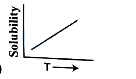
B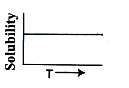
C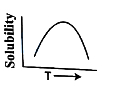
D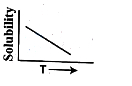
Solution
(D) The dissolution of a gas in a liquid is an exothermic process. According to Le Chatelier's principle,for an exothermic process,an increase in temperature shifts the equilibrium in the backward direction,thereby decreasing the solubility of the gas in the liquid.
Therefore,the solubility of a gas in a liquid decreases as the temperature increases.
This is correctly represented by the graph where solubility decreases linearly or non-linearly with an increase in temperature,which matches option $D$.
Therefore,the solubility of a gas in a liquid decreases as the temperature increases.
This is correctly represented by the graph where solubility decreases linearly or non-linearly with an increase in temperature,which matches option $D$.
0 likes
View Solution132
EasyMCQ
If $N_2$ gas is bubbled through water at $293 \ K$,how many moles of $N_2$ gas would dissolve in $1 \ litre$ of water? Assume that $N_2$ exerts a partial pressure of $0.987 \ bar$. [Given $K_{H}$ for $N_2$ at $293 \ K$ is $76.48 \ kbar$]
A
$0.716 \times 10^{-3}$
B
$7.16 \times 10^{-5}$
C
$7.16 \times 10^{-4}$
D
$7.16 \times 10^{-3}$
Solution
(C) According to Henry's law: $P = K_{H} X$
First,calculate the mole fraction of $N_2$ $(X_{N_2})$:
$X_{N_2} = \frac{P_{N_2}}{K_{H}} = \frac{0.987 \ bar}{76.48 \times 10^3 \ bar} = 1.29 \times 10^{-5}$
Calculate the number of moles of water in $1 \ litre$ $(1000 \ g)$:
$n_{H_2O} = \frac{1000 \ g}{18 \ g/mol} = 55.5 \ mol$
Since $n_{N_2} \ll n_{H_2O}$,we use the approximation $X_{N_2} \approx \frac{n_{N_2}}{n_{H_2O}}$:
$n_{N_2} = X_{N_2} \times n_{H_2O} = 1.29 \times 10^{-5} \times 55.5 \ mol = 7.16 \times 10^{-4} \ mol$
First,calculate the mole fraction of $N_2$ $(X_{N_2})$:
$X_{N_2} = \frac{P_{N_2}}{K_{H}} = \frac{0.987 \ bar}{76.48 \times 10^3 \ bar} = 1.29 \times 10^{-5}$
Calculate the number of moles of water in $1 \ litre$ $(1000 \ g)$:
$n_{H_2O} = \frac{1000 \ g}{18 \ g/mol} = 55.5 \ mol$
Since $n_{N_2} \ll n_{H_2O}$,we use the approximation $X_{N_2} \approx \frac{n_{N_2}}{n_{H_2O}}$:
$n_{N_2} = X_{N_2} \times n_{H_2O} = 1.29 \times 10^{-5} \times 55.5 \ mol = 7.16 \times 10^{-4} \ mol$
0 likes
View Solution133
EasyMCQ
Solubility of a gas in a liquid increases with
A
decrease of $p$ and increase of $T$
B
increase of $p$ and decrease of $T$
C
decrease of $p$ and decrease of $T$
D
increase of $p$ and increase of $T$
Solution
(B) According to Henry's Law,the solubility of a gas in a liquid is directly proportional to the partial pressure of the gas $(p)$ above the liquid surface.
Additionally,the dissolution of a gas in a liquid is an exothermic process. According to Le Chatelier's principle,decreasing the temperature $(T)$ favors the forward reaction,thereby increasing the solubility of the gas.
Additionally,the dissolution of a gas in a liquid is an exothermic process. According to Le Chatelier's principle,decreasing the temperature $(T)$ favors the forward reaction,thereby increasing the solubility of the gas.
0 likes
View Solution134
MediumMCQ
Henry's law constant for the solubility of $N_2$ gas in water at $298 \ K$ is $1.0 \times 10^5 \ atm$. The mole fraction of $N_2$ in air is $0.8$. The number of moles of $N_2$ from air dissolved in $10 \ moles$ of water at $298 \ K$ and $5 \ atm$ pressure is
A
$4.0 \times 10^{-4}$
B
$4.0 \times 10^{-5}$
C
$5.0 \times 10^{-4}$
D
$4.0 \times 10^{-6}$
Solution
(A) Given,Henry's law constant $(K_H)$ for the solubility of $N_2$ gas in water at $298 \ K = 1 \times 10^5 \ atm$.
Mole fraction of $N_2$ in air $(\chi_{N_2, \text{air}}) = 0.8$.
Total pressure $(P_{\text{total}}) = 5 \ atm$.
Partial pressure of nitrogen $(p_{N_2}) = P_{\text{total}} \times \chi_{N_2, \text{air}} = 5 \times 0.8 = 4 \ atm$.
According to Henry's law,$p_{N_2} = K_H \times \chi_{N_2, \text{water}}$.
$4 = 10^5 \times \chi_{N_2, \text{water}} \Rightarrow \chi_{N_2, \text{water}} = 4 \times 10^{-5}$.
We know that $\chi_{N_2, \text{water}} = \frac{n_{N_2}}{n_{N_2} + n_{H_2O}}$.
Since $n_{N_2} \ll n_{H_2O}$,we can approximate $\chi_{N_2, \text{water}} \approx \frac{n_{N_2}}{n_{H_2O}}$.
$4 \times 10^{-5} = \frac{n_{N_2}}{10}$.
$n_{N_2} = 4 \times 10^{-4} \ moles$.
Mole fraction of $N_2$ in air $(\chi_{N_2, \text{air}}) = 0.8$.
Total pressure $(P_{\text{total}}) = 5 \ atm$.
Partial pressure of nitrogen $(p_{N_2}) = P_{\text{total}} \times \chi_{N_2, \text{air}} = 5 \times 0.8 = 4 \ atm$.
According to Henry's law,$p_{N_2} = K_H \times \chi_{N_2, \text{water}}$.
$4 = 10^5 \times \chi_{N_2, \text{water}} \Rightarrow \chi_{N_2, \text{water}} = 4 \times 10^{-5}$.
We know that $\chi_{N_2, \text{water}} = \frac{n_{N_2}}{n_{N_2} + n_{H_2O}}$.
Since $n_{N_2} \ll n_{H_2O}$,we can approximate $\chi_{N_2, \text{water}} \approx \frac{n_{N_2}}{n_{H_2O}}$.
$4 \times 10^{-5} = \frac{n_{N_2}}{10}$.
$n_{N_2} = 4 \times 10^{-4} \ moles$.
0 likes
View Solution135
EasyMCQ
Choose the correct statement.
A
$K_{H}$ value is same for a gas in any solution.
B
Higher the $K_{H}$ value more the solubility of gas.
C
$K_{H}$ value increases on increasing the temperature of the solution.
D
Easily liquefiable gases usually have lesser $K_{H}$ values.
Solution
(C) Among the given statements,only statement $(c)$ is correct regarding the Henry's law constant $(K_{H})$.
$(a)$ $K_{H}$ is a function of the nature of the gas and the solvent used; therefore,the $K_{H}$ value is not the same for a gas in different solutions.
$(b)$ According to Henry's law,$p = K_{H} \cdot x$,which implies $x = p / K_{H}$. Thus,a higher $K_{H}$ value corresponds to lower solubility of the gas.
$(c)$ $K_{H}$ is temperature-dependent and generally increases with an increase in temperature,which explains why gases are less soluble in warm water.
$(d)$ Easily liquefiable gases have stronger intermolecular forces,which leads to lower $K_{H}$ values.
$(a)$ $K_{H}$ is a function of the nature of the gas and the solvent used; therefore,the $K_{H}$ value is not the same for a gas in different solutions.
$(b)$ According to Henry's law,$p = K_{H} \cdot x$,which implies $x = p / K_{H}$. Thus,a higher $K_{H}$ value corresponds to lower solubility of the gas.
$(c)$ $K_{H}$ is temperature-dependent and generally increases with an increase in temperature,which explains why gases are less soluble in warm water.
$(d)$ Easily liquefiable gases have stronger intermolecular forces,which leads to lower $K_{H}$ values.
0 likes
View Solution136
EasyMCQ
The $K_H$ values (in $k\text{bar}$) of argon $(I)$,carbon dioxide $(II)$,formaldehyde $(III)$,and methane $(IV)$ are $40.3$,$1.67$,$1.83 \times 10^{-5}$,and $0.413$ respectively at $298 \ K$. The increasing order of solubility of these gases in liquid is:
A
$II < I < IV < III$
B
$III < IV < II < I$
C
$I < II < IV < III$
D
$II < IV < I < III$
Solution
(C) According to Henry's law,the solubility of a gas in a liquid is inversely proportional to its Henry's law constant $(K_H)$.
Mathematically,$\text{Solubility} \propto \frac{1}{K_H}$.
Given $K_H$ values at $298 \ K$:
Argon $(I)$: $40.3 \ k\text{bar}$
Carbon dioxide $(II)$: $1.67 \ k\text{bar}$
Methane $(IV)$: $0.413 \ k\text{bar}$
Formaldehyde $(III)$: $1.83 \times 10^{-5} \ k\text{bar}$
Comparing the $K_H$ values: $1.83 \times 10^{-5} < 0.413 < 1.67 < 40.3$.
Therefore,the order of $K_H$ is $III < IV < II < I$.
Since solubility is inversely proportional to $K_H$,the increasing order of solubility is $I < II < IV < III$.
Mathematically,$\text{Solubility} \propto \frac{1}{K_H}$.
Given $K_H$ values at $298 \ K$:
Argon $(I)$: $40.3 \ k\text{bar}$
Carbon dioxide $(II)$: $1.67 \ k\text{bar}$
Methane $(IV)$: $0.413 \ k\text{bar}$
Formaldehyde $(III)$: $1.83 \times 10^{-5} \ k\text{bar}$
Comparing the $K_H$ values: $1.83 \times 10^{-5} < 0.413 < 1.67 < 40.3$.
Therefore,the order of $K_H$ is $III < IV < II < I$.
Since solubility is inversely proportional to $K_H$,the increasing order of solubility is $I < II < IV < III$.
0 likes
View Solution137
EasyMCQ
$1 \ g$ of silver gets distributed between $10 \ cm^{3}$ of molten zinc and $100 \ cm^{3}$ of molten lead at $800^{\circ} C$. The percentage of silver still left in the lead layer is approximately
A
$2$
B
$5$
C
$3$
D
$1$
Solution
(C) The partition coefficient $(K)$ for silver between molten zinc and molten lead is $300$.
Let $x$ be the mass of $Ag$ in $Zn$ and $(1 - x)$ be the mass of $Ag$ in $Pb$.
Partition coefficient $= \frac{\text{Conc. of } Ag \text{ in molten } Zn}{\text{Conc. of } Ag \text{ in molten } Pb} = \frac{x / 10}{(1 - x) / 100} = 300$.
Solving for $x$: $\frac{10x}{1 - x} = 300 \implies 10x = 300 - 300x \implies 310x = 300 \implies x = \frac{30}{31}$.
Amount of silver in molten lead $= 1 - x = 1 - \frac{30}{31} = \frac{1}{31} \ g$.
Percentage of silver in lead $= \frac{1/31}{1} \times 100 \approx 3.22 \% \approx 3 \%$.
Let $x$ be the mass of $Ag$ in $Zn$ and $(1 - x)$ be the mass of $Ag$ in $Pb$.
Partition coefficient $= \frac{\text{Conc. of } Ag \text{ in molten } Zn}{\text{Conc. of } Ag \text{ in molten } Pb} = \frac{x / 10}{(1 - x) / 100} = 300$.
Solving for $x$: $\frac{10x}{1 - x} = 300 \implies 10x = 300 - 300x \implies 310x = 300 \implies x = \frac{30}{31}$.
Amount of silver in molten lead $= 1 - x = 1 - \frac{30}{31} = \frac{1}{31} \ g$.
Percentage of silver in lead $= \frac{1/31}{1} \times 100 \approx 3.22 \% \approx 3 \%$.
0 likes
View Solution138
MediumMCQ
Assertion $(A)$: For an endothermic dissolution process,an increase in temperature increases the solubility in a nearly saturated solution.
Reason $(R)$: In a saturated solution,dynamic equilibrium exists between the dissolved solute and the undissolved solute.
Reason $(R)$: In a saturated solution,dynamic equilibrium exists between the dissolved solute and the undissolved solute.
A
Both $(A)$ and $(R)$ are correct and $(R)$ is the correct explanation of $(A)$
B
Both $(A)$ and $(R)$ are correct,but $(R)$ is not the correct explanation of $(A)$
C
$(A)$ is correct but $(R)$ is not correct
D
$(A)$ is incorrect but $(R)$ is correct
Solution
(A) According to Le Chatelier's principle,for an endothermic process,the dissolution can be represented as: $\text{Solute} + \text{Solvent} + \text{Heat} \rightleftharpoons \text{Solution}$.
When the temperature is increased,the equilibrium shifts in the forward direction to absorb the extra heat,thereby increasing the solubility of the solute.
The reason statement is also correct because a saturated solution represents a state of dynamic equilibrium where the rate of dissolution equals the rate of crystallization.
Since the shift in equilibrium due to temperature change is explained by Le Chatelier's principle,$(R)$ is the correct explanation for $(A)$.
When the temperature is increased,the equilibrium shifts in the forward direction to absorb the extra heat,thereby increasing the solubility of the solute.
The reason statement is also correct because a saturated solution represents a state of dynamic equilibrium where the rate of dissolution equals the rate of crystallization.
Since the shift in equilibrium due to temperature change is explained by Le Chatelier's principle,$(R)$ is the correct explanation for $(A)$.
0 likes
View Solution139
MediumMCQ
$K_{H}$ values for $H_2, CO_2, CH_4$ and $O_2$ at $298 \ K$ are $71.18, 1.67, 41.85$ and $34.86 \ kbar$ respectively. Arrange these gases in the increasing order of their solubility.
A
$H_2 < CH_4 < O_2 < CO_2$
B
$H_2 < CH_4 < CO_2 < O_2$
C
$CO_2 < O_2 < CH_4 < H_2$
D
$CO_2 < CH_4 < O_2 < H_2$
Solution
(A) According to Henry's Law,the solubility of a gas in a liquid is inversely proportional to its Henry's Law constant $(K_{H})$.
Mathematically,$S \propto \frac{1}{K_{H}}$.
Given $K_{H}$ values are:
$H_2 = 71.18 \ kbar$
$CH_4 = 41.85 \ kbar$
$O_2 = 34.86 \ kbar$
$CO_2 = 1.67 \ kbar$
Since the solubility is inversely proportional to $K_{H}$,the gas with the highest $K_{H}$ value will have the lowest solubility.
The order of $K_{H}$ values is: $CO_2 < O_2 < CH_4 < H_2$.
Therefore,the increasing order of solubility is: $H_2 < CH_4 < O_2 < CO_2$.
Mathematically,$S \propto \frac{1}{K_{H}}$.
Given $K_{H}$ values are:
$H_2 = 71.18 \ kbar$
$CH_4 = 41.85 \ kbar$
$O_2 = 34.86 \ kbar$
$CO_2 = 1.67 \ kbar$
Since the solubility is inversely proportional to $K_{H}$,the gas with the highest $K_{H}$ value will have the lowest solubility.
The order of $K_{H}$ values is: $CO_2 < O_2 < CH_4 < H_2$.
Therefore,the increasing order of solubility is: $H_2 < CH_4 < O_2 < CO_2$.
0 likes
View Solution140
EasyMCQ
To avoid bends sickness,the tanks used by scuba divers are filled with air and diluted with ......
A
helium gas
B
argon gas
C
krypton gas
D
xenon gas
Solution
(A) The gas bubbles (like $N_2$) in the bodily fluids affect nerve impulses,giving rise to decompression sickness or bends. These can be painful and fatal. To avoid bends sickness,the tanks used by scuba divers are filled with air diluted with helium gas $(He)$.
0 likes
View Solution141
DifficultMCQ
At $T \ (K)$ the molarity of $CO_2$ (in $mol \ L^{-1}$) in $200 \ mL$ of soda water packed under a pressure of $3.4 \ bar$ is ($K_H$ of $CO_2$ in water is $1.7 \times 10^3 \ bar$ at $T \ (K)$).
A
$2.0 \times 10^{-2}$
B
$1.11 \times 10^{-1}$
C
$2.22 \times 10^{-1}$
D
$5.1 \times 10^{-2}$
Solution
(B) According to Henry's law,$p = K_H \cdot \chi$,where $\chi$ is the mole fraction of $CO_2$.
Given $p = 3.4 \ bar$ and $K_H = 1.7 \times 10^3 \ bar$.
$\chi = \frac{p}{K_H} = \frac{3.4}{1.7 \times 10^3} = 2 \times 10^{-3}$.
Since the solution is dilute,$\chi = \frac{n_{CO_2}}{n_{H_2O}}$.
$n_{H_2O} = \frac{200 \ g}{18 \ g \ mol^{-1}} = 11.11 \ mol$.
$n_{CO_2} = \chi \times n_{H_2O} = 2 \times 10^{-3} \times 11.11 = 2.222 \times 10^{-2} \ mol$.
Molarity $= \frac{n_{CO_2}}{\text{Volume in } L} = \frac{2.222 \times 10^{-2} \ mol}{0.2 \ L} = 0.1111 \ mol \ L^{-1} = 1.11 \times 10^{-1} \ mol \ L^{-1}$.
Given $p = 3.4 \ bar$ and $K_H = 1.7 \times 10^3 \ bar$.
$\chi = \frac{p}{K_H} = \frac{3.4}{1.7 \times 10^3} = 2 \times 10^{-3}$.
Since the solution is dilute,$\chi = \frac{n_{CO_2}}{n_{H_2O}}$.
$n_{H_2O} = \frac{200 \ g}{18 \ g \ mol^{-1}} = 11.11 \ mol$.
$n_{CO_2} = \chi \times n_{H_2O} = 2 \times 10^{-3} \times 11.11 = 2.222 \times 10^{-2} \ mol$.
Molarity $= \frac{n_{CO_2}}{\text{Volume in } L} = \frac{2.222 \times 10^{-2} \ mol}{0.2 \ L} = 0.1111 \ mol \ L^{-1} = 1.11 \times 10^{-1} \ mol \ L^{-1}$.
0 likes
View Solution142
MediumMCQ
At $293 \ K$,methane gas was passed into $1 \ L$ of water. The partial pressure of methane is $1 \ bar$. The number of moles of methane dissolved in $1 \ L$ water is ($K_{H}$ of methane $= 0.4 \ kbar$)
A
$1.38$
B
$1.38 \times 10^{-2}$
C
$1.38 \times 10^{-3}$
D
$1.38 \times 10^{-3}$
Solution
(D) According to Henry's Law,$p = K_{H} \times x$.
Given: $p = 1 \ bar$,$K_{H} = 0.4 \ kbar = 400 \ bar$.
$x = \frac{p}{K_{H}} = \frac{1}{400} = 0.0025$.
Since $x = \frac{n_{CH_4}}{n_{CH_4} + n_{H_2O}} \approx \frac{n_{CH_4}}{n_{H_2O}}$,where $n_{H_2O} = \frac{1000 \ g}{18 \ g/mol} = 55.55 \ mol$.
$n_{CH_4} = x \times n_{H_2O} = 0.0025 \times 55.55 = 0.1388 \ mol \approx 1.38 \times 10^{-1} \ mol$.
Given: $p = 1 \ bar$,$K_{H} = 0.4 \ kbar = 400 \ bar$.
$x = \frac{p}{K_{H}} = \frac{1}{400} = 0.0025$.
Since $x = \frac{n_{CH_4}}{n_{CH_4} + n_{H_2O}} \approx \frac{n_{CH_4}}{n_{H_2O}}$,where $n_{H_2O} = \frac{1000 \ g}{18 \ g/mol} = 55.55 \ mol$.
$n_{CH_4} = x \times n_{H_2O} = 0.0025 \times 55.55 = 0.1388 \ mol \approx 1.38 \times 10^{-1} \ mol$.
0 likes
View Solution143
MediumMCQ
In water,which of the following gases has the highest Henry's law constant at $293 \ K$?
A
$N_2$
B
$O_2$
C
$He$
D
$H_2$
Solution
(C)
Based on the values provided for Henry's law constant $(K_H)$ at $293 \text{ K}$,$He$ has the highest value of $144.97 \text{ kbar}$.
| Gas | $K_H / \text{kbar}$ at $293 \text{ K}$ |
|---|---|
| $He$ | $144.97$ |
| $H_2$ | $69.16$ |
| $O_2$ | $34.86$ |
| $N_2$ | $76.48$ |
Based on the values provided for Henry's law constant $(K_H)$ at $293 \text{ K}$,$He$ has the highest value of $144.97 \text{ kbar}$.
0 likes
View Solution144
MediumMCQ
At $293 \ K$,the Henry law constant in water for $N_2$ and $O_2$ are $76.48 \ kbar$ and $34.86 \ kbar$ respectively. What is the ratio of mole fractions of $N_2$ and $O_2$ in water? (Assume partial pressures of $N_2$ and $O_2$ are the same at $293 \ K$)
A
$2.19$
B
$0.95$
C
$0.6$
D
$0.45$
Solution
(D) According to Henry's law: $P = x \cdot K_H$.
For $N_2$: $P_{N_2} = x_{N_2} \cdot K_H(N_2)$.
For $O_2$: $P_{O_2} = x_{O_2} \cdot K_H(O_2)$.
Given that $P_{N_2} = P_{O_2}$,$K_H(N_2) = 76.48 \ kbar$,and $K_H(O_2) = 34.86 \ kbar$.
The ratio of mole fractions is: $\frac{x_{N_2}}{x_{O_2}} = \frac{P_{N_2} / K_H(N_2)}{P_{O_2} / K_H(O_2)} = \frac{K_H(O_2)}{K_H(N_2)}$.
Substituting the values: $\frac{x_{N_2}}{x_{O_2}} = \frac{34.86}{76.48} \approx 0.45$.
For $N_2$: $P_{N_2} = x_{N_2} \cdot K_H(N_2)$.
For $O_2$: $P_{O_2} = x_{O_2} \cdot K_H(O_2)$.
Given that $P_{N_2} = P_{O_2}$,$K_H(N_2) = 76.48 \ kbar$,and $K_H(O_2) = 34.86 \ kbar$.
The ratio of mole fractions is: $\frac{x_{N_2}}{x_{O_2}} = \frac{P_{N_2} / K_H(N_2)}{P_{O_2} / K_H(O_2)} = \frac{K_H(O_2)}{K_H(N_2)}$.
Substituting the values: $\frac{x_{N_2}}{x_{O_2}} = \frac{34.86}{76.48} \approx 0.45$.
0 likes
View Solution145
DifficultMCQ
At $T(K)$,the partial pressure of dissolved oxygen in $1 \ L$ water is $1 \ bar$. The concentration of oxygen in $ppm$ is ($K_{H}$ of $O_2$ at $T(K)$ is $50 \ kbar$)
A
$71.0$
B
$35.50$
C
$17.75$
D
$81.10$
Solution
(B) According to Henry's Law,$P_{O_2} = K_{H} \chi_{O_2}$.
Given: $P_{O_2} = 1 \ bar$,$K_{H} = 50 \ kbar = 50 \times 10^3 \ bar$.
$\chi_{O_2} = \frac{P_{O_2}}{K_{H}} = \frac{1}{50 \times 10^3} = 2 \times 10^{-5}$.
Since $\chi_{O_2} = \frac{n_{O_2}}{n_{O_2} + n_{H_2O}} \approx \frac{n_{O_2}}{n_{H_2O}}$,and $n_{H_2O} = \frac{1000 \ g}{18 \ g/mol} \approx 55.5 \ mol$.
$n_{O_2} = \chi_{O_2} \times 55.5 = 2 \times 10^{-5} \times 55.5 = 1.11 \times 10^{-3} \ mol$.
Mass of $O_2 = 1.11 \times 10^{-3} \ mol \times 32 \ g/mol = 0.03552 \ g$.
Concentration in $ppm = \frac{\text{mass of solute}}{\text{mass of solution}} \times 10^6 = \frac{0.03552 \ g}{1000 \ g} \times 10^6 = 35.52 \ ppm \approx 35.50 \ ppm$.
Given: $P_{O_2} = 1 \ bar$,$K_{H} = 50 \ kbar = 50 \times 10^3 \ bar$.
$\chi_{O_2} = \frac{P_{O_2}}{K_{H}} = \frac{1}{50 \times 10^3} = 2 \times 10^{-5}$.
Since $\chi_{O_2} = \frac{n_{O_2}}{n_{O_2} + n_{H_2O}} \approx \frac{n_{O_2}}{n_{H_2O}}$,and $n_{H_2O} = \frac{1000 \ g}{18 \ g/mol} \approx 55.5 \ mol$.
$n_{O_2} = \chi_{O_2} \times 55.5 = 2 \times 10^{-5} \times 55.5 = 1.11 \times 10^{-3} \ mol$.
Mass of $O_2 = 1.11 \times 10^{-3} \ mol \times 32 \ g/mol = 0.03552 \ g$.
Concentration in $ppm = \frac{\text{mass of solute}}{\text{mass of solution}} \times 10^6 = \frac{0.03552 \ g}{1000 \ g} \times 10^6 = 35.52 \ ppm \approx 35.50 \ ppm$.
0 likes
View Solution146
MediumMCQ
If the $K_{H}$ values for $Ar_{(g)}$,$CO_{2_{(g)}}$,$HCHO_{(g)}$ and $CH_{4_{(g)}}$ respectively are $40.39$,$1.67$,$1.83 \times 10^{-5}$ and $0.413$,then identify the correct increasing order of their solubilities.
A
$HCHO < CH_{4} < CO_{2} < Ar$
B
$HCHO < CO_{2} < CH_{4} < Ar$
C
$Ar < CO_{2} < HCHO < CH_{4}$
D
$Ar < CO_{2} < CH_{4} < HCHO$
Solution
(D) According to Henry's law,the solubility of a gas in a liquid is inversely proportional to the Henry's law constant $(K_{H})$,given by the relation $S \propto \frac{1}{K_{H}}$.
Therefore,a lower $K_{H}$ value corresponds to higher solubility.
The given $K_{H}$ values are: $Ar = 40.39$,$CO_{2} = 1.67$,$CH_{4} = 0.413$,and $HCHO = 1.83 \times 10^{-5}$.
Comparing these values,the order of $K_{H}$ is: $Ar > CO_{2} > CH_{4} > HCHO$.
Thus,the increasing order of solubility is: $Ar < CO_{2} < CH_{4} < HCHO$.
Therefore,a lower $K_{H}$ value corresponds to higher solubility.
The given $K_{H}$ values are: $Ar = 40.39$,$CO_{2} = 1.67$,$CH_{4} = 0.413$,and $HCHO = 1.83 \times 10^{-5}$.
Comparing these values,the order of $K_{H}$ is: $Ar > CO_{2} > CH_{4} > HCHO$.
Thus,the increasing order of solubility is: $Ar < CO_{2} < CH_{4} < HCHO$.
0 likes
View Solution147
EasyMCQ
$A$ gas $X$ is dissolved in water at $2 \ bar$ pressure. Its mole fraction in the solution is $0.02$. Find the mole fraction of water in the solution when the pressure of the gas is doubled at the same temperature.
A
$0.04$
B
$0.98$
C
$0.96$
D
$0.02$
Solution
(C) According to Henry's Law,$p = K_{H} \times \chi_{X}$,where $p$ is the partial pressure of the gas and $\chi_{X}$ is its mole fraction in the solution.
For the initial condition: $2 = K_{H} \times 0.02$ ...$(i)$
When the pressure is doubled,$p' = 4 \ bar$.
$4 = K_{H} \times \chi'_{X}$ ...$(ii)$
Dividing equation $(ii)$ by $(i)$: $\frac{4}{2} = \frac{\chi'_{X}}{0.02}$ $\Rightarrow 2 = \frac{\chi'_{X}}{0.02}$ $\Rightarrow \chi'_{X} = 0.04$.
The sum of mole fractions in a binary solution is $1$.
Therefore,the mole fraction of water is $\chi_{water} = 1 - \chi'_{X} = 1 - 0.04 = 0.96$.
For the initial condition: $2 = K_{H} \times 0.02$ ...$(i)$
When the pressure is doubled,$p' = 4 \ bar$.
$4 = K_{H} \times \chi'_{X}$ ...$(ii)$
Dividing equation $(ii)$ by $(i)$: $\frac{4}{2} = \frac{\chi'_{X}}{0.02}$ $\Rightarrow 2 = \frac{\chi'_{X}}{0.02}$ $\Rightarrow \chi'_{X} = 0.04$.
The sum of mole fractions in a binary solution is $1$.
Therefore,the mole fraction of water is $\chi_{water} = 1 - \chi'_{X} = 1 - 0.04 = 0.96$.
0 likes
View Solution148
MediumMCQ
Henry's law constant for $CO_2$ in water is $1.67 \times 10^8 \ Pa$. Calculate the approximate quantity of $CO_2$ in $500 \ mL$ of soda water when packed under $5 \ atm$ $CO_2$ pressure at $298 \ K$. (in $g$)
A
$3.7$
B
$1.84$
C
$2.2$
D
$4.4$
Solution
(A) According to Henry's law,$p = K_H \times \chi$,where $p$ is the partial pressure,$K_H$ is Henry's law constant,and $\chi$ is the mole fraction of the gas.
Given: $p = 5 \ atm = 5 \times 1.01325 \times 10^5 \ Pa = 5.066 \times 10^5 \ Pa$,$K_H = 1.67 \times 10^8 \ Pa$.
Mole fraction $\chi = \frac{p}{K_H} = \frac{5.066 \times 10^5}{1.67 \times 10^8} \approx 3.033 \times 10^{-3}$.
Assuming $500 \ mL$ of water has a mass of $500 \ g$,the number of moles of water $n_{H_2O} = \frac{500}{18} \approx 27.78 \ mol$.
Since $\chi = \frac{n_{CO_2}}{n_{CO_2} + n_{H_2O}} \approx \frac{n_{CO_2}}{n_{H_2O}}$,we have $n_{CO_2} = \chi \times n_{H_2O} = 3.033 \times 10^{-3} \times 27.78 \approx 0.08426 \ mol$.
Mass of $CO_2 = n_{CO_2} \times \text{molar mass} = 0.08426 \times 44 \approx 3.71 \ g$.
Given: $p = 5 \ atm = 5 \times 1.01325 \times 10^5 \ Pa = 5.066 \times 10^5 \ Pa$,$K_H = 1.67 \times 10^8 \ Pa$.
Mole fraction $\chi = \frac{p}{K_H} = \frac{5.066 \times 10^5}{1.67 \times 10^8} \approx 3.033 \times 10^{-3}$.
Assuming $500 \ mL$ of water has a mass of $500 \ g$,the number of moles of water $n_{H_2O} = \frac{500}{18} \approx 27.78 \ mol$.
Since $\chi = \frac{n_{CO_2}}{n_{CO_2} + n_{H_2O}} \approx \frac{n_{CO_2}}{n_{H_2O}}$,we have $n_{CO_2} = \chi \times n_{H_2O} = 3.033 \times 10^{-3} \times 27.78 \approx 0.08426 \ mol$.
Mass of $CO_2 = n_{CO_2} \times \text{molar mass} = 0.08426 \times 44 \approx 3.71 \ g$.
0 likes
View Solution149
MediumMCQ
The quantity of $CO_2$ in $500 \ mL$ of soda water when packed under $3.34 \ bar$ $CO_2$ pressure at $298 \ K$ in $g$ is
A
$2.442$
B
$1.221$
C
$4.884$
D
$3.663$
Solution
(A) Given: Pressure of $CO_2$ $(p)$ $= 3.34 \ bar = 3.34 \times 10^5 \ Pa$. Henry's law constant $(K_H)$ for $CO_2$ at $298 \ K$ is $1.67 \times 10^8 \ Pa$.
According to Henry's law,$p = K_H \times x$,where $x$ is the mole fraction of $CO_2$.
$x = \frac{p}{K_H} = \frac{3.34 \times 10^5 \ Pa}{1.67 \times 10^8 \ Pa} = 2 \times 10^{-3}$.
Volume of water $= 500 \ mL$. Since density of water is $1 \ g/mL$,mass of water $= 500 \ g$.
Moles of water $(n_{H_2O})$ $= \frac{500 \ g}{18 \ g/mol} = 27.78 \ mol$.
Since $x = \frac{n_{CO_2}}{n_{CO_2} + n_{H_2O}} \approx \frac{n_{CO_2}}{n_{H_2O}}$,we have $n_{CO_2} = x \times n_{H_2O} = 2 \times 10^{-3} \times 27.78 \ mol = 0.05556 \ mol$.
Mass of $CO_2 = n_{CO_2} \times \text{Molar mass of } CO_2 = 0.05556 \ mol \times 44 \ g/mol = 2.4446 \ g \approx 2.442 \ g$.
According to Henry's law,$p = K_H \times x$,where $x$ is the mole fraction of $CO_2$.
$x = \frac{p}{K_H} = \frac{3.34 \times 10^5 \ Pa}{1.67 \times 10^8 \ Pa} = 2 \times 10^{-3}$.
Volume of water $= 500 \ mL$. Since density of water is $1 \ g/mL$,mass of water $= 500 \ g$.
Moles of water $(n_{H_2O})$ $= \frac{500 \ g}{18 \ g/mol} = 27.78 \ mol$.
Since $x = \frac{n_{CO_2}}{n_{CO_2} + n_{H_2O}} \approx \frac{n_{CO_2}}{n_{H_2O}}$,we have $n_{CO_2} = x \times n_{H_2O} = 2 \times 10^{-3} \times 27.78 \ mol = 0.05556 \ mol$.
Mass of $CO_2 = n_{CO_2} \times \text{Molar mass of } CO_2 = 0.05556 \ mol \times 44 \ g/mol = 2.4446 \ g \approx 2.442 \ g$.
0 likes
View Solution150
MediumMCQ
If $CO_2$ gas having a partial pressure of $1.67 \ bar$ is bubbled through $1 \ L$ water at $298 \ K$,the amount of $CO_2$ dissolved in water in $g \ L^{-1}$ is approximately. (Henry's law constant of $CO_2$ is $1.67 \ kbar$ at $298 \ K$)
A
$24.42$
B
$12.21$
C
$2.44$
D
$1.22$
Solution
(C) According to Henry's law: $p = K_H \times \chi$
Given: $p = 1.67 \ bar$,$K_H = 1.67 \ kbar = 1670 \ bar$.
Calculating mole fraction $\chi$ of $CO_2$: $\chi = \frac{p}{K_H} = \frac{1.67}{1670} = 0.001$.
Since the amount of $CO_2$ is very small,$\chi = \frac{n_{CO_2}}{n_{H_2O}} \approx 0.001$.
Number of moles of water in $1 \ L$ is $n_{H_2O} = \frac{1000 \ g}{18 \ g \ mol^{-1}} = 55.55 \ mol$.
Therefore,$n_{CO_2} = 0.001 \times 55.55 = 0.05555 \ mol$.
Mass of $CO_2 = n_{CO_2} \times \text{Molar mass of } CO_2 = 0.05555 \ mol \times 44 \ g \ mol^{-1} \approx 2.44 \ g$.
Thus,the amount of $CO_2$ dissolved is $2.44 \ g \ L^{-1}$.
Given: $p = 1.67 \ bar$,$K_H = 1.67 \ kbar = 1670 \ bar$.
Calculating mole fraction $\chi$ of $CO_2$: $\chi = \frac{p}{K_H} = \frac{1.67}{1670} = 0.001$.
Since the amount of $CO_2$ is very small,$\chi = \frac{n_{CO_2}}{n_{H_2O}} \approx 0.001$.
Number of moles of water in $1 \ L$ is $n_{H_2O} = \frac{1000 \ g}{18 \ g \ mol^{-1}} = 55.55 \ mol$.
Therefore,$n_{CO_2} = 0.001 \times 55.55 = 0.05555 \ mol$.
Mass of $CO_2 = n_{CO_2} \times \text{Molar mass of } CO_2 = 0.05555 \ mol \times 44 \ g \ mol^{-1} \approx 2.44 \ g$.
Thus,the amount of $CO_2$ dissolved is $2.44 \ g \ L^{-1}$.
0 likes
View SolutionSolutions — Solubility · Frequently Asked Questions
1Are these Solutions questions useful for JEE and NEET?
Yes. All questions in this section are mapped to JEE Main and NEET exam patterns. Previous year questions from JEE Main, NEET, GUJCET and state-level exams are included with full solutions.
2Can I switch to Hindi or Gujarati for these questions?
Yes. Use the language tabs in the hero section or the sidebar to view the same questions and solutions in English, Hindi or Gujarati.
3How do I generate a question paper from this subtopic?
Use the Vedclass Exam Paper Generator — select the chapter and subtopic, set difficulty, and generate Sets A, B, C, D automatically. First 3 chapters of every subject are free.
Vedclass Products
For Students
Vedclass Test Series
Mock tests in real JEE/NEET style with performance analysis. 5-day free trial.
Start Free TrialFor Teachers
Exam Paper Generator
Generate Set A/B/C/D papers from this chapter in 2 minutes. 3 chapters free.
Try FreeFor Institutes
Online Exam Module
Live online exams with unlimited students, 360° analytics & white-label branding.
See DemoFor Teachers & Institutes
Generate a Solutions Exam Paper in 2 Minutes
Select subtopic & difficulty — Sets A, B, C, D auto-generated with No Repeat logic.
First 3 chapters of every subject are free — no payment required.