
A English
Solubility Questions in English
Class 12 Chemistry · Solutions · Solubility
164+
Questions
English
Language
100%
With Solutions
Showing 50 of 164 questions in English
51
Advanced
Explain the solubility of a solution formed by a gaseous solute and a liquid solvent.
Solution
(N/A) The solubility of a gas is the maximum amount of gaseous solute that can be dissolved in a specified amount of solvent at a specified temperature and pressure.
Oxygen dissolves only to a small extent in water. It is this dissolved oxygen which sustains all aquatic life. On the other hand,hydrogen chloride gas $(HCl)$ is highly soluble in water.
The solubility of gases in liquids is greatly affected by pressure and temperature.
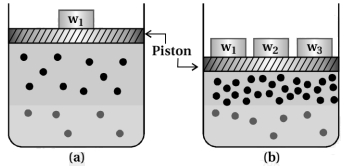
$(i)$ Effect of pressure: The solubility of gases increases with an increase in pressure. For a solution of gases in a solvent,consider a system as shown in Fig. $(a)$. The lower part is the solution and the upper part is the gaseous system at pressure $P$ and temperature $T$. Assume this system to be in a state of dynamic equilibrium,i.e.,under these conditions,the rate of gaseous particles entering and leaving the solution phase is the same.
Now,increase the pressure over the solution phase by compressing the gas to a smaller volume [Fig. $(b)$]. This will increase the number of gaseous particles per unit volume over the solution and also the rate at which the gaseous particles are striking the surface of the solution to enter it. The solubility of the gas will increase until a new equilibrium is reached,resulting in an increase in the pressure of the gas above the solution and thus its solubility increases.
$(ii)$ Effect of temperature: The solubility of gases in liquids decreases with an increase in temperature. When gases dissolve,they enter the liquid phase,and the phenomenon of dissolution is called condensation. This process is exothermic in nature. Therefore,on increasing the temperature,the solubility decreases.
Oxygen dissolves only to a small extent in water. It is this dissolved oxygen which sustains all aquatic life. On the other hand,hydrogen chloride gas $(HCl)$ is highly soluble in water.
The solubility of gases in liquids is greatly affected by pressure and temperature.
$(i)$ Effect of pressure: The solubility of gases increases with an increase in pressure. For a solution of gases in a solvent,consider a system as shown in Fig. $(a)$. The lower part is the solution and the upper part is the gaseous system at pressure $P$ and temperature $T$. Assume this system to be in a state of dynamic equilibrium,i.e.,under these conditions,the rate of gaseous particles entering and leaving the solution phase is the same.
Now,increase the pressure over the solution phase by compressing the gas to a smaller volume [Fig. $(b)$]. This will increase the number of gaseous particles per unit volume over the solution and also the rate at which the gaseous particles are striking the surface of the solution to enter it. The solubility of the gas will increase until a new equilibrium is reached,resulting in an increase in the pressure of the gas above the solution and thus its solubility increases.
$(ii)$ Effect of temperature: The solubility of gases in liquids decreases with an increase in temperature. When gases dissolve,they enter the liquid phase,and the phenomenon of dissolution is called condensation. This process is exothermic in nature. Therefore,on increasing the temperature,the solubility decreases.
0 likes
View Solution52
Advanced
State Henry's law and explain it. Also,mention its applications.
Solution
(N/A) Henry's law states that at a constant temperature,the partial pressure of a gas in the vapour phase $(p)$ is directly proportional to the mole fraction of the gas $(x)$ in the solution. This is expressed as: $p = K_{H} \cdot x$,where $K_{H}$ is the Henry's law constant.
Explanation:
$1$. The law provides a quantitative relationship between the pressure of a gas and its solubility in a solvent.
$2$. Different gases have different $K_{H}$ values at the same temperature,which depends on the nature of the gas.
$3$. $A$ higher value of $K_{H}$ at a given pressure indicates lower solubility of the gas in the liquid.
$4$. The graph of partial pressure versus mole fraction is a straight line passing through the origin.
Applications:
$1$. To increase the solubility of $CO_{2}$ in soft drinks and soda water,the bottles are sealed under high pressure.
$2$. Scuba divers use tanks filled with air diluted with helium to avoid the toxic effects of high nitrogen concentrations at high pressures (the bends).
$3$. At high altitudes,the partial pressure of oxygen is less than that at the ground level,leading to low blood oxygen levels in climbers,causing weakness and inability to think clearly (anoxia).
Explanation:
$1$. The law provides a quantitative relationship between the pressure of a gas and its solubility in a solvent.
$2$. Different gases have different $K_{H}$ values at the same temperature,which depends on the nature of the gas.
$3$. $A$ higher value of $K_{H}$ at a given pressure indicates lower solubility of the gas in the liquid.
$4$. The graph of partial pressure versus mole fraction is a straight line passing through the origin.
Applications:
$1$. To increase the solubility of $CO_{2}$ in soft drinks and soda water,the bottles are sealed under high pressure.
$2$. Scuba divers use tanks filled with air diluted with helium to avoid the toxic effects of high nitrogen concentrations at high pressures (the bends).
$3$. At high altitudes,the partial pressure of oxygen is less than that at the ground level,leading to low blood oxygen levels in climbers,causing weakness and inability to think clearly (anoxia).
0 likes
View Solution53
Medium
What is solubility? What is a saturated solution?
Solution
(N/A) Solubility: The solubility of a substance is its maximum amount that can be dissolved in a specified amount of solvent at a specified temperature. It depends on the nature of the solute and solvent as well as temperature and pressure.
Saturated Solution: $A$ solution in which no more solute can be dissolved at the same temperature and pressure is called a saturated solution. In this state,a dynamic equilibrium exists between the dissolved solute and the undissolved solute.
Saturated Solution: $A$ solution in which no more solute can be dissolved at the same temperature and pressure is called a saturated solution. In this state,a dynamic equilibrium exists between the dissolved solute and the undissolved solute.
0 likes
View Solution54
EasyMCQ
What is dissolution?
A
The process of formation of a solution by mixing a solute in a solvent.
B
The process of separation of solute from a solution.
C
The process of increasing the temperature of a solution.
D
The process of decreasing the concentration of a solution.
Solution
(A) Dissolution is the process in which a solute (solid,liquid,or gas) dissolves in a solvent to form a homogeneous mixture called a solution.
During this process,the solute particles are dispersed uniformly throughout the solvent.
During this process,the solute particles are dispersed uniformly throughout the solvent.
0 likes
View Solution55
Easy
How many millimoles of $CO_2$ gas will dissolve when $CO_2$ gas is passed in $900 \ mL$ water at $298 \ K$ temperature? $[$ The value of $K_H$ is $6.02 \times 10^{-4} \ bar$ and partial pressure of $CO_2$ gas is $2 \times 10^{-8} \ bar.]$
Solution
(A) According to Henry's Law,$P = K_H \times X$,where $X$ is the mole fraction of the gas in the solution.
Given: $P = 2 \times 10^{-8} \ bar$,$K_H = 6.02 \times 10^{-4} \ bar$.
$X = \frac{P}{K_H} = \frac{2 \times 10^{-8}}{6.02 \times 10^{-4}} \approx 3.322 \times 10^{-5}$.
Since the amount of gas is very small,the number of moles of water $n_{H_2O} = \frac{900 \ g}{18 \ g/mol} = 50 \ mol$.
$X = \frac{n_{CO_2}}{n_{CO_2} + n_{H_2O}} \approx \frac{n_{CO_2}}{n_{H_2O}}$.
$n_{CO_2} = X \times n_{H_2O} = 3.322 \times 10^{-5} \times 50 = 1.661 \times 10^{-3} \ mol$.
$n_{CO_2} = 1.661 \ \text{millimoles}$.
Given: $P = 2 \times 10^{-8} \ bar$,$K_H = 6.02 \times 10^{-4} \ bar$.
$X = \frac{P}{K_H} = \frac{2 \times 10^{-8}}{6.02 \times 10^{-4}} \approx 3.322 \times 10^{-5}$.
Since the amount of gas is very small,the number of moles of water $n_{H_2O} = \frac{900 \ g}{18 \ g/mol} = 50 \ mol$.
$X = \frac{n_{CO_2}}{n_{CO_2} + n_{H_2O}} \approx \frac{n_{CO_2}}{n_{H_2O}}$.
$n_{CO_2} = X \times n_{H_2O} = 3.322 \times 10^{-5} \times 50 = 1.661 \times 10^{-3} \ mol$.
$n_{CO_2} = 1.661 \ \text{millimoles}$.
0 likes
View Solution56
Easy
How many millimoles of nitrogen dissolve when nitrogen is passed in $1 \ L$ water at $293 \ K$ temperature? $[$ The value of $K_H$ is $7.648 \times 10^4 \ bar$ and partial pressure of $N_2$ gas is $0.987 \ bar.]$
Solution
According to Henry's Law,$P = K_H \times x$,where $x$ is the mole fraction of the gas in the solution.
$x = P / K_H = 0.987 \ bar / (7.648 \times 10^4 \ bar) = 1.29 \times 10^{-5}$.
Since $1 \ L$ of water contains $1000 \ g$ of water,the number of moles of water is $n_{H_2O} = 1000 \ g / 18 \ g/mol = 55.55 \ mol$.
For dilute solutions,$x = n_{N_2} / n_{H_2O}$,so $n_{N_2} = x \times n_{H_2O} = 1.29 \times 10^{-5} \times 55.55 \ mol = 7.16 \times 10^{-4} \ mol$.
Converting to millimoles: $7.16 \times 10^{-4} \ mol \times 1000 \ mmol/mol = 0.716 \ mmol \approx 0.72 \ mmol$.
$x = P / K_H = 0.987 \ bar / (7.648 \times 10^4 \ bar) = 1.29 \times 10^{-5}$.
Since $1 \ L$ of water contains $1000 \ g$ of water,the number of moles of water is $n_{H_2O} = 1000 \ g / 18 \ g/mol = 55.55 \ mol$.
For dilute solutions,$x = n_{N_2} / n_{H_2O}$,so $n_{N_2} = x \times n_{H_2O} = 1.29 \times 10^{-5} \times 55.55 \ mol = 7.16 \times 10^{-4} \ mol$.
Converting to millimoles: $7.16 \times 10^{-4} \ mol \times 1000 \ mmol/mol = 0.716 \ mmol \approx 0.72 \ mmol$.
0 likes
View Solution57
Medium
Explain the equilibrium of gases in liquids.
Solution
(N/A) The equilibrium of gases in liquids is best illustrated by a closed soda water bottle containing $CO_{2}$ gas under high pressure. An equilibrium exists between the $CO_{2}$ molecules dissolved in the liquid and those in the gaseous state:
$CO_{2(g)} \rightleftharpoons CO_{2(aq)}$
This process is governed by Henry's Law,which states that at a constant temperature,the mass of a gas dissolved in a given volume of solvent is directly proportional to the partial pressure of the gas above the solvent surface:
$\text{Solubility} \propto \text{Pressure} \text{ (at constant } T\text{)}$
When the bottle is sealed,the high pressure of $CO_{2}$ ensures high solubility. Upon opening the bottle,the pressure above the liquid drops to atmospheric pressure. Consequently,the equilibrium shifts to the left,causing dissolved $CO_{2}$ to escape as gas until a new equilibrium is established at the lower partial pressure. This loss of dissolved gas is why soda water becomes 'flat' when left open.
$CO_{2(g)} \rightleftharpoons CO_{2(aq)}$
This process is governed by Henry's Law,which states that at a constant temperature,the mass of a gas dissolved in a given volume of solvent is directly proportional to the partial pressure of the gas above the solvent surface:
$\text{Solubility} \propto \text{Pressure} \text{ (at constant } T\text{)}$
When the bottle is sealed,the high pressure of $CO_{2}$ ensures high solubility. Upon opening the bottle,the pressure above the liquid drops to atmospheric pressure. Consequently,the equilibrium shifts to the left,causing dissolved $CO_{2}$ to escape as gas until a new equilibrium is established at the lower partial pressure. This loss of dissolved gas is why soda water becomes 'flat' when left open.
0 likes
View Solution58
Medium
Explain the equilibrium in soda water and explain it using Henry's law.
Solution
(N/A) In a closed soda water bottle,a saturated solution of $CO_{2}$ gas is maintained under high pressure. An equilibrium exists between the $CO_{2}$ molecules dissolved in water and those in the gaseous state:
$CO_{2(g)} \rightleftharpoons CO_{2(aq)}$ ... $(I)$
(At constant pressure and temperature)
Henry's law states that the mass of a gas dissolved in a given volume of a solvent at a constant temperature is directly proportional to the partial pressure of the gas present above the surface of the solution.
Mathematically,$m \propto p$ or $p = K_{H} \cdot x$,where $p$ is the partial pressure of the gas,$x$ is the mole fraction of the gas in the solution,and $K_{H}$ is Henry's law constant.
As the pressure of $CO_{2}$ above the liquid is high in a sealed bottle,the solubility of $CO_{2}$ in water is high. When the bottle is opened,the pressure of $CO_{2}$ above the liquid drops to the atmospheric pressure. According to Henry's law,the solubility of the gas decreases as the pressure decreases. Consequently,the excess dissolved $CO_{2}$ escapes from the solution to reach a new equilibrium,causing the soda water to become 'flat'.
$CO_{2(g)} \rightleftharpoons CO_{2(aq)}$ ... $(I)$
(At constant pressure and temperature)
Henry's law states that the mass of a gas dissolved in a given volume of a solvent at a constant temperature is directly proportional to the partial pressure of the gas present above the surface of the solution.
Mathematically,$m \propto p$ or $p = K_{H} \cdot x$,where $p$ is the partial pressure of the gas,$x$ is the mole fraction of the gas in the solution,and $K_{H}$ is Henry's law constant.
As the pressure of $CO_{2}$ above the liquid is high in a sealed bottle,the solubility of $CO_{2}$ in water is high. When the bottle is opened,the pressure of $CO_{2}$ above the liquid drops to the atmospheric pressure. According to Henry's law,the solubility of the gas decreases as the pressure decreases. Consequently,the excess dissolved $CO_{2}$ escapes from the solution to reach a new equilibrium,causing the soda water to become 'flat'.
0 likes
View Solution59
MediumMCQ
What happens when a saturated solution of sugar is heated?
A
The solution becomes unsaturated.
B
The solution becomes supersaturated.
C
The amount of dissolved sugar decreases.
D
No change occurs in the solution.
Solution
(A) saturated solution is one in which no more solute can be dissolved at a given temperature.
When a saturated solution of sugar is heated,the solubility of sugar in water increases with temperature.
As a result,more sugar can be dissolved in the solution,making the previously saturated solution unsaturated at the higher temperature.
When a saturated solution of sugar is heated,the solubility of sugar in water increases with temperature.
As a result,more sugar can be dissolved in the solution,making the previously saturated solution unsaturated at the higher temperature.
0 likes
View Solution60
MediumMCQ
Why is a soda water bottle kept in a cold place?
A
To increase the solubility of $CO_2$ gas.
B
To decrease the solubility of $CO_2$ gas.
C
To prevent the bottle from breaking.
D
To maintain the taste of the soda.
Solution
(A) The dissolution of $CO_2$ gas in water is an exothermic process,which can be represented as: $CO_2(g) + H_2O(l) \rightleftharpoons H_2CO_3(aq) + \text{Heat}$.
According to Le Chatelier's Principle,for an exothermic reaction,decreasing the temperature shifts the equilibrium in the forward direction.
Therefore,keeping the soda water bottle in a cold place increases the solubility of $CO_2$ gas in the liquid,ensuring it remains fizzy.
According to Le Chatelier's Principle,for an exothermic reaction,decreasing the temperature shifts the equilibrium in the forward direction.
Therefore,keeping the soda water bottle in a cold place increases the solubility of $CO_2$ gas in the liquid,ensuring it remains fizzy.
0 likes
View Solution61
MediumMCQ
Calculate $K_H$ when $2 \ mmol$ of $O_2$ dissolve in $540 \ mL$ of water at $27 \ ^oC$ temperature. Given $P_{O_2} = 2 \times 10^{-8} \ bar$.
A
$1 \times 10^{-5} \ bar$
B
$5 \times 10^{-6} \ bar$
C
$1 \times 10^{-4} \ bar$
D
$5 \times 10^{-4} \ bar$
Solution
(C) Henry's Law is given by $P = K_H \times \chi$,where $\chi$ is the mole fraction of the gas in the solution.
First,calculate the moles of water: $n_{H_2O} = \frac{540 \ g}{18 \ g/mol} = 30 \ mol$.
Since $2 \ mmol = 2 \times 10^{-3} \ mol$ is very small,the total moles $\approx 30 \ mol$.
Mole fraction $\chi_{O_2} = \frac{n_{O_2}}{n_{H_2O}} = \frac{2 \times 10^{-3}}{30} = \frac{2}{3} \times 10^{-4} \approx 0.667 \times 10^{-4}$.
Using $K_H = \frac{P_{O_2}}{\chi_{O_2}} = \frac{2 \times 10^{-8}}{0.667 \times 10^{-4}} = 3 \times 10^{-4} \ bar$.
First,calculate the moles of water: $n_{H_2O} = \frac{540 \ g}{18 \ g/mol} = 30 \ mol$.
Since $2 \ mmol = 2 \times 10^{-3} \ mol$ is very small,the total moles $\approx 30 \ mol$.
Mole fraction $\chi_{O_2} = \frac{n_{O_2}}{n_{H_2O}} = \frac{2 \times 10^{-3}}{30} = \frac{2}{3} \times 10^{-4} \approx 0.667 \times 10^{-4}$.
Using $K_H = \frac{P_{O_2}}{\chi_{O_2}} = \frac{2 \times 10^{-8}}{0.667 \times 10^{-4}} = 3 \times 10^{-4} \ bar$.
0 likes
View Solution62
Easy
Explain the solubility rule "like dissolves like" in terms of inter-molecular forces that exist in solutions.
Solution
(N/A) The solubility rule "like dissolves like" is based on the inter-molecular forces that exist in a solution.
$A$ solute dissolves in a solvent if the inter-molecular interactions between the solute-solute particles and solvent-solvent particles are similar to the interactions between the solute-solvent particles.
Polar solutes dissolve in polar solvents because they both exhibit strong dipole-dipole interactions or hydrogen bonding.
Non-polar solutes dissolve in non-polar solvents because they both exhibit weak London dispersion forces.
$A$ solute dissolves in a solvent if the inter-molecular interactions between the solute-solute particles and solvent-solvent particles are similar to the interactions between the solute-solvent particles.
Polar solutes dissolve in polar solvents because they both exhibit strong dipole-dipole interactions or hydrogen bonding.
Non-polar solutes dissolve in non-polar solvents because they both exhibit weak London dispersion forces.
0 likes
View Solution63
Easy
What is the significance of Henry's Law constant $K_H$?
Solution
(N/A) Henry's law is expressed mathematically as,$p = K_H X$ (where,$p$ is the partial pressure of the gas in the vapour phase and $X$ is the mole fraction of the gas in the solution).
From this equation,it is evident that for a given pressure,the higher the value of the Henry's law constant $K_H$,the lower is the solubility of the gas in the liquid.
From this equation,it is evident that for a given pressure,the higher the value of the Henry's law constant $K_H$,the lower is the solubility of the gas in the liquid.
0 likes
View Solution64
Easy
Why are aquatic species more comfortable in cold water in comparison to warm water?
Solution
(N/A) It is noteworthy that the values of Henry's law constant $(K_H)$ increase with a decrease of temperature. It is due to this reason that at a given pressure the solubility of oxygen in water increases with a decrease in temperature. Therefore,the presence of more oxygen at lower temperature makes the aquatic species more comfortable in cold water in comparison to warm water.
0 likes
View Solution65
Easy
$(a)$ Explain the following phenomena with the help of Henry’s law.
$(i)$ Painful condition known as bends.
$(ii)$ Feeling of weakness and discomfort in breathing at high altitude.
$(b)$ Why does a soda water bottle kept at room temperature fizz on opening?
$(i)$ Painful condition known as bends.
$(ii)$ Feeling of weakness and discomfort in breathing at high altitude.
$(b)$ Why does a soda water bottle kept at room temperature fizz on opening?
Solution
(N/A) $(i)$ According to Henry's law,the partial pressure of a gas is directly proportional to its solubility in a liquid. Scuba divers,when ascending towards the surface,experience a gradual decrease in external pressure. This reduction in pressure causes the dissolved gases (mainly $N_2$) in the blood to become less soluble,leading to the formation of nitrogen bubbles in the bloodstream. These bubbles block capillaries and create a painful and dangerous medical condition known as bends.
$(ii)$ At high altitudes,the partial pressure of oxygen is significantly lower than at ground level. According to Henry's law,this lower partial pressure results in lower concentrations of oxygen dissolved in the blood and tissues of individuals. This low blood oxygen level leads to symptoms of weakness and discomfort in breathing,often referred to as anoxia.
$(b)$ When a soda water bottle is opened,the partial pressure of $CO_2$ above the liquid decreases suddenly. As per Henry's law,the solubility of $CO_2$ decreases with a decrease in pressure,causing the dissolved $CO_2$ to escape rapidly in the form of bubbles,which produces a fizzing sound.
$(ii)$ At high altitudes,the partial pressure of oxygen is significantly lower than at ground level. According to Henry's law,this lower partial pressure results in lower concentrations of oxygen dissolved in the blood and tissues of individuals. This low blood oxygen level leads to symptoms of weakness and discomfort in breathing,often referred to as anoxia.
$(b)$ When a soda water bottle is opened,the partial pressure of $CO_2$ above the liquid decreases suddenly. As per Henry's law,the solubility of $CO_2$ decreases with a decrease in pressure,causing the dissolved $CO_2$ to escape rapidly in the form of bubbles,which produces a fizzing sound.
0 likes
View Solution66
EasyMCQ
What is the solubility of oxygen gas in $100 \, cm^3$ of water at $293 \, K$ (in $, cm^3$)?
A
$3.08$
B
$3.80$
C
$0.38$
D
$30.8$
Solution
(A) The solubility of oxygen gas in water is a standard physical property.
At $293 \, K$,the solubility of oxygen gas in $100 \, cm^3$ of water is approximately $3.08 \, cm^3$.
Therefore,the correct option is $A$.
At $293 \, K$,the solubility of oxygen gas in $100 \, cm^3$ of water is approximately $3.08 \, cm^3$.
Therefore,the correct option is $A$.
0 likes
View Solution67
MediumMCQ
What kind of attractions are present in an aqueous solution of $NaCl$?
A
Ion-dipole interactions
B
Hydrogen bonding
C
London dispersion forces
D
Covalent bonding
Solution
(A) In an aqueous solution of $NaCl$,the salt dissociates into $Na^{+}_{(aq)}$ and $Cl^{-}_{(aq)}$ ions.
These ions interact with the polar water molecules.
The attraction between the $Na^{+}$ ion and the oxygen end of the $H_{2}O$ molecule,and between the $Cl^{-}$ ion and the hydrogen end of the $H_{2}O$ molecule,is known as an ion-dipole interaction.
These ions interact with the polar water molecules.
The attraction between the $Na^{+}$ ion and the oxygen end of the $H_{2}O$ molecule,and between the $Cl^{-}$ ion and the hydrogen end of the $H_{2}O$ molecule,is known as an ion-dipole interaction.
0 likes
View Solution68
Difficult
Explain the hydration of sodium chloride.
Solution
(N/A) Sodium chloride $(NaCl)$,commonly known as table salt,is an ionic compound formed by the reaction between hydrochloric acid $(HCl)$ and sodium hydroxide $(NaOH)$.
$NaOH + HCl \rightarrow NaCl + H_2O$
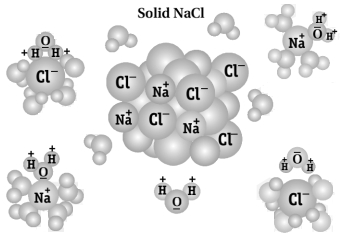
In its solid state,it exists as a crystal lattice consisting of positively charged sodium ions $(Na^+)$ and negatively charged chloride ions $(Cl^-)$,which are held together by strong electrostatic forces of attraction.
Water is a polar solvent with a high dielectric constant of approximately $80$. When $NaCl$ is added to water,the electrostatic forces between the $Na^+$ and $Cl^-$ ions are significantly reduced by this high dielectric constant.
As a result,the ions dissociate and become surrounded by water molecules. The oxygen atom of the water molecule (which carries a partial negative charge) orients itself towards the $Na^+$ ion,while the hydrogen atoms (which carry a partial positive charge) orient themselves towards the $Cl^-$ ion. This process of surrounding the ions with water molecules is called hydration,which stabilizes the ions in the aqueous solution.
$NaOH + HCl \rightarrow NaCl + H_2O$
In its solid state,it exists as a crystal lattice consisting of positively charged sodium ions $(Na^+)$ and negatively charged chloride ions $(Cl^-)$,which are held together by strong electrostatic forces of attraction.
Water is a polar solvent with a high dielectric constant of approximately $80$. When $NaCl$ is added to water,the electrostatic forces between the $Na^+$ and $Cl^-$ ions are significantly reduced by this high dielectric constant.
As a result,the ions dissociate and become surrounded by water molecules. The oxygen atom of the water molecule (which carries a partial negative charge) orients itself towards the $Na^+$ ion,while the hydrogen atoms (which carry a partial positive charge) orient themselves towards the $Cl^-$ ion. This process of surrounding the ions with water molecules is called hydration,which stabilizes the ions in the aqueous solution.
0 likes
View Solution69
Difficult
Explain the factors affecting the solubility of salts in a solution.
Solution
(N/A) The solubility of ionic solids in water varies significantly.
Some ionic solids,such as $CaF_2$,are highly soluble,while others like $LiF$ (lithium fluoride) have very low solubility and are considered insoluble. The solubility of a salt depends on two primary factors:
$(i)$ Lattice enthalpy of the salt: This is the energy required to break one mole of a solid salt into its constituent ions. $A$ higher lattice enthalpy means more energy is needed to break the crystal lattice.
$(ii)$ Solvation enthalpy of ions: This is the energy released when one mole of a solid salt dissolves in a solvent. For a salt to dissolve,the energy released from ion-solvent interactions (solvation enthalpy) must be sufficient to overcome the strong electrostatic forces holding the ions together in the crystal lattice (lattice enthalpy).
Therefore,a salt is soluble in a solvent only when the solvation enthalpy is greater than the lattice enthalpy. If the solvation enthalpy is less than the lattice enthalpy,the salt remains insoluble.
Some ionic solids,such as $CaF_2$,are highly soluble,while others like $LiF$ (lithium fluoride) have very low solubility and are considered insoluble. The solubility of a salt depends on two primary factors:
$(i)$ Lattice enthalpy of the salt: This is the energy required to break one mole of a solid salt into its constituent ions. $A$ higher lattice enthalpy means more energy is needed to break the crystal lattice.
$(ii)$ Solvation enthalpy of ions: This is the energy released when one mole of a solid salt dissolves in a solvent. For a salt to dissolve,the energy released from ion-solvent interactions (solvation enthalpy) must be sufficient to overcome the strong electrostatic forces holding the ions together in the crystal lattice (lattice enthalpy).
Therefore,a salt is soluble in a solvent only when the solvation enthalpy is greater than the lattice enthalpy. If the solvation enthalpy is less than the lattice enthalpy,the salt remains insoluble.
0 likes
View Solution70
MediumMCQ
Henry's constant (in $kbar$) for four gases $\alpha, \beta, \gamma$ and $\delta$ in water at $298 \ K$ is given below:
(Density of water $= 10^{3} \ kg \ m^{-3}$ at $298 \ K$). This table implies that:
| Gas | $K_{H} \ (kbar)$ |
| $\alpha$ | $50$ |
| $\beta$ | $2$ |
| $\gamma$ | $2 \times 10^{-5}$ |
| $\delta$ | $0.5$ |
(Density of water $= 10^{3} \ kg \ m^{-3}$ at $298 \ K$). This table implies that:
A
The pressure of a $55.5 \ m$ (molal) solution of $\gamma$ is $1 \ bar$.
B
The pressure of a $55.5 \ m$ (molal) solution of $\delta$ is $250 \ bar$.
C
Solubility of $\gamma$ at $308 \ K$ is lower than at $298 \ K$.
D
$\alpha$ has the highest solubility in water at a given pressure.
Solution
(B) According to Henry's Law,$P = K_{H} \cdot X$,where $X$ is the mole fraction of the gas.
For a $55.5 \ m$ solution,the number of moles of solute $= 55.5 \ mol$ in $1000 \ g$ of water.
Moles of water $= \frac{1000 \ g}{18 \ g/mol} \approx 55.5 \ mol$.
Mole fraction $X = \frac{55.5}{55.5 + 55.5} = 0.5$.
For $\delta$: $P_{\delta} = K_{H} \cdot X = 0.5 \ kbar \times 0.5 = 0.25 \ kbar = 250 \ bar$.
Thus,option $B$ is correct.
For $\gamma$: $P_{\gamma} = 2 \times 10^{-5} \ kbar \times 0.5 = 1 \times 10^{-5} \ kbar = 0.01 \ bar$.
Solubility of gases generally decreases with an increase in temperature,so option $C$ is correct.
Since $K_{H}$ is inversely proportional to solubility,$\gamma$ has the highest solubility,not $\alpha$.
For a $55.5 \ m$ solution,the number of moles of solute $= 55.5 \ mol$ in $1000 \ g$ of water.
Moles of water $= \frac{1000 \ g}{18 \ g/mol} \approx 55.5 \ mol$.
Mole fraction $X = \frac{55.5}{55.5 + 55.5} = 0.5$.
For $\delta$: $P_{\delta} = K_{H} \cdot X = 0.5 \ kbar \times 0.5 = 0.25 \ kbar = 250 \ bar$.
Thus,option $B$ is correct.
For $\gamma$: $P_{\gamma} = 2 \times 10^{-5} \ kbar \times 0.5 = 1 \times 10^{-5} \ kbar = 0.01 \ bar$.
Solubility of gases generally decreases with an increase in temperature,so option $C$ is correct.
Since $K_{H}$ is inversely proportional to solubility,$\gamma$ has the highest solubility,not $\alpha$.
0 likes
View Solution71
MediumMCQ
The oxygen dissolved in water exerts a partial pressure of $20 \ kPa$ in the vapour above water. The molar solubility of oxygen in water is ............ $\times 10^{-5} \ mol \ dm^{-3}$ (Round off to the Nearest Integer). [Given: Henry's law constant $K_H = 8.0 \times 10^{4} \ kPa$ for $O_2$,Density of water $= 1.0 \ kg \ dm^{-3}$]
A
$20$
B
$15$
C
$30$
D
$25$
Solution
(D) According to Henry's Law,$P = K_H \cdot x$,where $x$ is the mole fraction of $O_2$ in water.
$20 \ kPa = (8.0 \times 10^{4} \ kPa) \cdot x$
$x = \frac{20}{8.0 \times 10^{4}} = 2.5 \times 10^{-4}$.
Since $x = \frac{n_{O_2}}{n_{O_2} + n_{H_2O}} \approx \frac{n_{O_2}}{n_{H_2O}}$ (as $n_{O_2} \ll n_{H_2O}$).
For $1 \ dm^{3}$ of water,mass $= 1000 \ g$,so $n_{H_2O} = \frac{1000}{18} = 55.55 \ mol$.
$n_{O_2} = x \cdot n_{H_2O} = (2.5 \times 10^{-4}) \times 55.55 = 1.38875 \times 10^{-2} \ mol$.
This is the molar solubility in $mol \ dm^{-3}$,which is $1388.75 \times 10^{-5} \ mol \ dm^{-3}$.
Rounding to the nearest integer,we get $1389$.
$20 \ kPa = (8.0 \times 10^{4} \ kPa) \cdot x$
$x = \frac{20}{8.0 \times 10^{4}} = 2.5 \times 10^{-4}$.
Since $x = \frac{n_{O_2}}{n_{O_2} + n_{H_2O}} \approx \frac{n_{O_2}}{n_{H_2O}}$ (as $n_{O_2} \ll n_{H_2O}$).
For $1 \ dm^{3}$ of water,mass $= 1000 \ g$,so $n_{H_2O} = \frac{1000}{18} = 55.55 \ mol$.
$n_{O_2} = x \cdot n_{H_2O} = (2.5 \times 10^{-4}) \times 55.55 = 1.38875 \times 10^{-2} \ mol$.
This is the molar solubility in $mol \ dm^{-3}$,which is $1388.75 \times 10^{-5} \ mol \ dm^{-3}$.
Rounding to the nearest integer,we get $1389$.
0 likes
View Solution72
MediumMCQ
$CO_2$ gas is bubbled through water during a soft drink manufacturing process at $298 \ K$. If $CO_2$ exerts a partial pressure of $0.835 \ bar$,then $x \ mmol$ of $CO_2$ would dissolve in $0.9 \ L$ of water. The value of $x$ is $.....$ (Nearest integer).
(Henry's law constant for $CO_2$ at $298 \ K$ is $1.67 \times 10^3 \ bar$)
(Henry's law constant for $CO_2$ at $298 \ K$ is $1.67 \times 10^3 \ bar$)
A
$50$
B
$25$
C
$55$
D
$35$
Solution
(B) According to Henry's Law,$P = K_H \times \chi$,where $\chi$ is the mole fraction of the gas.
Given: $P = 0.835 \ bar$,$K_H = 1.67 \times 10^3 \ bar$,Volume of water = $0.9 \ L = 900 \ g$.
Moles of water $(n_{H_2O})$ = $\frac{900 \ g}{18 \ g/mol} = 50 \ mol$.
Since the amount of dissolved gas is very small,$\chi_{CO_2} \approx \frac{n_{CO_2}}{n_{H_2O}}$.
$0.835 = 1.67 \times 10^3 \times \frac{n_{CO_2}}{50}$.
$n_{CO_2} = \frac{0.835 \times 50}{1.67 \times 10^3} = \frac{41.75}{1670} = 0.025 \ mol$.
$x \ mmol = 0.025 \times 1000 = 25 \ mmol$.
Therefore,the value of $x$ is $25$.
Given: $P = 0.835 \ bar$,$K_H = 1.67 \times 10^3 \ bar$,Volume of water = $0.9 \ L = 900 \ g$.
Moles of water $(n_{H_2O})$ = $\frac{900 \ g}{18 \ g/mol} = 50 \ mol$.
Since the amount of dissolved gas is very small,$\chi_{CO_2} \approx \frac{n_{CO_2}}{n_{H_2O}}$.
$0.835 = 1.67 \times 10^3 \times \frac{n_{CO_2}}{50}$.
$n_{CO_2} = \frac{0.835 \times 50}{1.67 \times 10^3} = \frac{41.75}{1670} = 0.025 \ mol$.
$x \ mmol = 0.025 \times 1000 = 25 \ mmol$.
Therefore,the value of $x$ is $25$.
0 likes
View Solution73
MediumMCQ
$A$ company dissolves '$X$' amount of $CO_{2}$ at $298 \ K$ in $1 \ L$ of water to prepare soda water. $X = ........ \ \times 10^{-3} \ g$ (nearest integer).
(Given: partial pressure of $CO_{2}$ at $298 \ K = 0.835 \ bar$.
Henry's law constant for $CO_{2}$ at $298 \ K = 1.67 \ kbar$.
Atomic mass of $H$,$C$ and $O$ is $1$,$12$ and $16 \ g \ mol^{-1}$,respectively.)
(Given: partial pressure of $CO_{2}$ at $298 \ K = 0.835 \ bar$.
Henry's law constant for $CO_{2}$ at $298 \ K = 1.67 \ kbar$.
Atomic mass of $H$,$C$ and $O$ is $1$,$12$ and $16 \ g \ mol^{-1}$,respectively.)
A
$870$
B
$1180$
C
$1500$
D
$1222$
Solution
(D) According to Henry's Law: $P = K_{H} \times \chi_{CO_{2}}$
Given:
$P = 0.835 \ bar$
$K_{H} = 1.67 \ kbar = 1670 \ bar$
Since the amount of $CO_{2}$ is very small,we can approximate the mole fraction $\chi_{CO_{2}} \approx \frac{n_{CO_{2}}}{n_{H_{2}O}}$
$n_{H_{2}O} = \frac{1000 \ g}{18 \ g \ mol^{-1}} = 55.55 \ mol$
$0.835 = 1670 \times \frac{n_{CO_{2}}}{55.55}$
$n_{CO_{2}} = \frac{0.835 \times 55.55}{1670} = 0.02777 \ mol$
Mass of $CO_{2} = n_{CO_{2}} \times \text{Molar mass of } CO_{2} = 0.02777 \times 44 = 1.222 \ g$
$X = 1.222 \times 10^{3} \times 10^{-3} \ g = 1222 \times 10^{-3} \ g$
Thus,$X = 1222$.
Given:
$P = 0.835 \ bar$
$K_{H} = 1.67 \ kbar = 1670 \ bar$
Since the amount of $CO_{2}$ is very small,we can approximate the mole fraction $\chi_{CO_{2}} \approx \frac{n_{CO_{2}}}{n_{H_{2}O}}$
$n_{H_{2}O} = \frac{1000 \ g}{18 \ g \ mol^{-1}} = 55.55 \ mol$
$0.835 = 1670 \times \frac{n_{CO_{2}}}{55.55}$
$n_{CO_{2}} = \frac{0.835 \times 55.55}{1670} = 0.02777 \ mol$
Mass of $CO_{2} = n_{CO_{2}} \times \text{Molar mass of } CO_{2} = 0.02777 \times 44 = 1.222 \ g$
$X = 1.222 \times 10^{3} \times 10^{-3} \ g = 1222 \times 10^{-3} \ g$
Thus,$X = 1222$.
0 likes
View Solution74
MediumMCQ
If $O_2$ gas is bubbled through water at $303 \; K$,the number of millimoles of $O_2$ gas that dissolve in $1 \; L$ of water is (Nearest Integer). (Given: Henry's Law constant for $O_2$ at $303 \; K$ is $46.82 \; kbar$ and partial pressure of $O_2 = 0.920 \; bar$). (Assume solubility of $O_2$ in water is too small,nearly negligible).
A
$0$
B
$1$
C
$2$
D
$3$
Solution
(B) According to Henry's Law,$p = K_H \times x$,where $x$ is the mole fraction of the gas in the solution.
Given $p = 0.920 \; bar$ and $K_H = 46.82 \; kbar = 46820 \; bar$.
$x = \frac{p}{K_H} = \frac{0.920}{46820} \approx 1.965 \times 10^{-5}$.
Since the solubility is very small,the number of moles of $H_2O$ in $1 \; L$ $(1000 \; g)$ is $n_{H_2O} = \frac{1000}{18} \approx 55.55 \; mol$.
$x = \frac{n_{O_2}}{n_{O_2} + n_{H_2O}} \approx \frac{n_{O_2}}{n_{H_2O}}$.
$n_{O_2} = x \times n_{H_2O} = (1.965 \times 10^{-5}) \times 55.55 \approx 1.09 \times 10^{-3} \; mol$.
$n_{O_2} \approx 1.09 \; millimoles$.
The nearest integer is $1$.
Given $p = 0.920 \; bar$ and $K_H = 46.82 \; kbar = 46820 \; bar$.
$x = \frac{p}{K_H} = \frac{0.920}{46820} \approx 1.965 \times 10^{-5}$.
Since the solubility is very small,the number of moles of $H_2O$ in $1 \; L$ $(1000 \; g)$ is $n_{H_2O} = \frac{1000}{18} \approx 55.55 \; mol$.
$x = \frac{n_{O_2}}{n_{O_2} + n_{H_2O}} \approx \frac{n_{O_2}}{n_{H_2O}}$.
$n_{O_2} = x \times n_{H_2O} = (1.965 \times 10^{-5}) \times 55.55 \approx 1.09 \times 10^{-3} \; mol$.
$n_{O_2} \approx 1.09 \; millimoles$.
The nearest integer is $1$.
0 likes
View Solution75
MediumMCQ
The values of the Henry's law constant of $Ar$,$CO_{2}$,$CH_{4}$ and $O_{2}$ in water at $25^{\circ} C$ are $40.30$,$1.67$,$0.41$ and $34.86 \ kbar$,respectively. The order of their solubility in water at the same temperature and pressure is
A
$Ar > O_{2} > CO_{2} > CH_{4}$
B
$CH_{4} > CO_{2} > Ar > O_{2}$
C
$CH_{4} > CO_{2} > O_{2} > Ar$
D
$Ar > CH_{4} > O_{2} > CO_{2}$
Solution
(C) According to Henry's law,$p = K_{H} \times \chi$,where $p$ is the partial pressure of the gas,$K_{H}$ is the Henry's law constant,and $\chi$ is the mole fraction of the gas in the solution.
This implies $\chi = \frac{p}{K_{H}}$.
For a given partial pressure $p$,the solubility (represented by mole fraction $\chi$) is inversely proportional to the Henry's law constant $K_{H}$ (i.e.,$\chi \propto \frac{1}{K_{H}}$).
Given $K_{H}$ values: $Ar (40.30) > O_{2} (34.86) > CO_{2} (1.67) > CH_{4} (0.41) \ kbar$.
Since solubility is inversely proportional to $K_{H}$,the order of solubility is $CH_{4} > CO_{2} > O_{2} > Ar$.
This implies $\chi = \frac{p}{K_{H}}$.
For a given partial pressure $p$,the solubility (represented by mole fraction $\chi$) is inversely proportional to the Henry's law constant $K_{H}$ (i.e.,$\chi \propto \frac{1}{K_{H}}$).
Given $K_{H}$ values: $Ar (40.30) > O_{2} (34.86) > CO_{2} (1.67) > CH_{4} (0.41) \ kbar$.
Since solubility is inversely proportional to $K_{H}$,the order of solubility is $CH_{4} > CO_{2} > O_{2} > Ar$.
0 likes
View Solution76
MediumMCQ
The variation of solubility of four different gases $(G_1, G_2, G_3, G_4)$ in a given solvent with pressure at a constant temperature is shown in the plot. The gas with the highest value of Henry's law constant is
A
$G_4$
B
$G_2$
C
$G_3$
D
$G_1$
Solution
(D) According to Henry's law,$p = K_H \chi$,where $K_H$ is Henry's constant and $\chi$ is the mole fraction (solubility).
Rearranging the equation,we get $\chi = \frac{p}{K_H}$.
This implies that for a given pressure $p$,the solubility $\chi$ is inversely proportional to the Henry's law constant $K_H$.
Therefore,the gas with the lowest solubility at a given pressure will have the highest value of $K_H$.
Based on the typical plot where $G_1$ shows the least slope (lowest solubility),$G_1$ has the highest value of Henry's law constant.
Rearranging the equation,we get $\chi = \frac{p}{K_H}$.
This implies that for a given pressure $p$,the solubility $\chi$ is inversely proportional to the Henry's law constant $K_H$.
Therefore,the gas with the lowest solubility at a given pressure will have the highest value of $K_H$.
Based on the typical plot where $G_1$ shows the least slope (lowest solubility),$G_1$ has the highest value of Henry's law constant.
0 likes
View Solution77
MediumMCQ
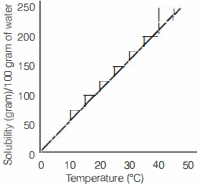
The solubility curve of $KNO_3$ in water is shown below. The amount of $KNO_3$ that dissolves in $50 \ g$ of water at $40^{\circ} C$ is closest to $.... \ g$
A
$100$
B
$150$
C
$200$
D
$50$
Solution
(A) From the graph,it can be seen that the solubility of $KNO_3$ in water at $40^{\circ} C$ is approximately $200 \ g$ per $100 \ g$ of water.
$\therefore$ The amount of $KNO_3$ that dissolves in $50 \ g$ of water will be:
$= \frac{200 \ g}{100 \ g} \times 50 \ g = 100 \ g$
Thus,the correct option is $(A)$.
$\therefore$ The amount of $KNO_3$ that dissolves in $50 \ g$ of water will be:
$= \frac{200 \ g}{100 \ g} \times 50 \ g = 100 \ g$
Thus,the correct option is $(A)$.
0 likes
View Solution78
DifficultMCQ
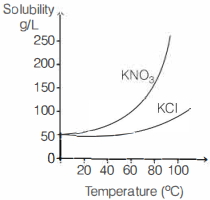
Given the solubility curves of $KNO_3$ and $KCl$,which of the following statements is not true?
A
At room temperature,the solubility of $KNO_3$ and $KCl$ are not equal.
B
The solubilities of both $KNO_3$ and $KCl$ increase with temperature.
C
The solubility of $KCl$ decreases with temperature.
D
The solubility of $KNO_3$ increases much more compared to that of $KCl$ with increase in temperature.
Solution
(C) The correct answer is $(c)$.
From the provided solubility graph,it is evident that the solubility of $KCl$ increases with an increase in temperature. Therefore,the statement $(c)$ is incorrect.
$(a)$ From the graph,it is clear that at room temperature,the solubility values of $KNO_3$ and $KCl$ are different,so they are not equal. Thus,statement $(a)$ is correct.
$(b)$ The curves for both $KNO_3$ and $KCl$ show an upward trend as temperature increases,indicating that their solubilities increase with temperature. Thus,statement $(b)$ is correct.
$(d)$ The slope of the $KNO_3$ curve is much steeper than that of the $KCl$ curve,which means the solubility of $KNO_3$ increases significantly more than that of $KCl$ as temperature rises. Thus,statement $(d)$ is correct.
From the provided solubility graph,it is evident that the solubility of $KCl$ increases with an increase in temperature. Therefore,the statement $(c)$ is incorrect.
$(a)$ From the graph,it is clear that at room temperature,the solubility values of $KNO_3$ and $KCl$ are different,so they are not equal. Thus,statement $(a)$ is correct.
$(b)$ The curves for both $KNO_3$ and $KCl$ show an upward trend as temperature increases,indicating that their solubilities increase with temperature. Thus,statement $(b)$ is correct.
$(d)$ The slope of the $KNO_3$ curve is much steeper than that of the $KCl$ curve,which means the solubility of $KNO_3$ increases significantly more than that of $KCl$ as temperature rises. Thus,statement $(d)$ is correct.
0 likes
View Solution79
MCQ
The $K_{H}$ values for some gases at the same temperature '$T$' are given below:
where $K_{H}$ is Henry's Law constant in water. The order of their solubility in water is:
| Gas | $K_{H} / \text{kbar}$ |
|---|---|
| $Ar$ | $40.3$ |
| $CO_{2}$ | $1.67$ |
| $HCHO$ | $1.83 \times 10^{-5}$ |
| $CH_{4}$ | $0.413$ |
where $K_{H}$ is Henry's Law constant in water. The order of their solubility in water is:
A
$Ar < CO_{2} < CH_{4} < HCHO$
B
$Ar < CH_{4} < CO_{2} < HCHO$
C
$HCHO < CO_{2} < CH_{4} < Ar$
D
$HCHO < CH_{4} < CO_{2} < Ar$
Solution
(A) According to Henry's Law, the solubility of a gas in a liquid is inversely proportional to the Henry's Law constant $(K_{H})$.
Mathematically, $S \propto 1 / K_{H}$.
Therefore, a higher value of $K_{H}$ indicates lower solubility, and a lower value of $K_{H}$ indicates higher solubility.
Comparing the given $K_{H}$ values:
$Ar (40.3) > CO_{2} (1.67) > CH_{4} (0.413) > HCHO (1.83 \times 10^{-5})$.
Thus, the order of solubility in water is:
$Ar < CO_{2} < CH_{4} < HCHO$.
Mathematically, $S \propto 1 / K_{H}$.
Therefore, a higher value of $K_{H}$ indicates lower solubility, and a lower value of $K_{H}$ indicates higher solubility.
Comparing the given $K_{H}$ values:
$Ar (40.3) > CO_{2} (1.67) > CH_{4} (0.413) > HCHO (1.83 \times 10^{-5})$.
Thus, the order of solubility in water is:
$Ar < CO_{2} < CH_{4} < HCHO$.
0 likes
View Solution80
DifficultMCQ
Given below are two statements: one is labelled as Assertion $A$ and the other is labelled as Reason $R$.
Assertion $A$: Helium is used to dilute oxygen in diving apparatus.
Reason $R$: Helium has high solubility in $O_2$.
In the light of the above statements,choose the correct answer from the options given below:
Assertion $A$: Helium is used to dilute oxygen in diving apparatus.
Reason $R$: Helium has high solubility in $O_2$.
In the light of the above statements,choose the correct answer from the options given below:
A
$A$ is false but $R$ is true.
B
Both $A$ and $R$ are true and $R$ is the correct explanation of $A$.
C
Both $A$ and $R$ are true and $R$ is $NOT$ the correct explanation of $A$.
D
$A$ is true but $R$ is false.
Solution
(D) Assertion $A$ is true because helium is used as a diluent for oxygen in diving apparatus to avoid the toxic effects of nitrogen at high pressures.
Reason $R$ is false because helium has very low solubility in blood,which is the actual reason it is preferred,not its solubility in $O_2$.
Therefore,$A$ is true but $R$ is false.
Reason $R$ is false because helium has very low solubility in blood,which is the actual reason it is preferred,not its solubility in $O_2$.
Therefore,$A$ is true but $R$ is false.
0 likes
View Solution81
MediumMCQ
The Henry's law constant $(K_H)$ values of three gases $(A, B, C)$ in water are $145$,$2 \times 10^{-5}$,and $35$ kbar,respectively. The solubility of these gases in water follow the order:
A
$B > C > A$
B
$A > C > B$
C
$A > B > C$
D
$B > A > C$
Solution
(A) According to Henry's law,the solubility of a gas is inversely proportional to the Henry's law constant $(K_H)$ at a given pressure.
Mathematically,$\text{Solubility} \propto \frac{1}{K_H}$.
Given $K_H$ values are:
$A = 145 \text{ kbar}$
$B = 2 \times 10^{-5} \text{ kbar}$
$C = 35 \text{ kbar}$
Comparing the $K_H$ values: $A (145) > C (35) > B (2 \times 10^{-5})$.
Since solubility is inversely proportional to $K_H$,the order of solubility will be the reverse of the order of $K_H$ values.
Therefore,the order of solubility is $B > C > A$.
Mathematically,$\text{Solubility} \propto \frac{1}{K_H}$.
Given $K_H$ values are:
$A = 145 \text{ kbar}$
$B = 2 \times 10^{-5} \text{ kbar}$
$C = 35 \text{ kbar}$
Comparing the $K_H$ values: $A (145) > C (35) > B (2 \times 10^{-5})$.
Since solubility is inversely proportional to $K_H$,the order of solubility will be the reverse of the order of $K_H$ values.
Therefore,the order of solubility is $B > C > A$.
0 likes
View Solution82
DifficultMCQ
The Henry's law constant for the solubility of $N_2$ gas in water at $298 \ K$ is $1.0 \times 10^5 \ atm$. The mole fraction of $N_2$ in air is $0.8$. The number of moles of $N_2$ from air dissolved in $10 \ moles$ of water at $298 \ K$ and $5 \ atm$ pressure is
A
$4.0 \times 10^{-4}$
B
$4.0 \times 10^{-5}$
C
$5.0 \times 10^{-4}$
D
$4.0 \times 10^{-6}$
Solution
(A) Total pressure $P_T = 5 \ atm$. The mole fraction of nitrogen in air is $0.8$.
Partial pressure of nitrogen $P_{N_2} = P_T \times X_{air} = 5 \times 0.8 = 4 \ atm$.
According to Henry's law,$P_{N_2} = K_H \cdot X_{sol}$,where $X_{sol}$ is the mole fraction of $N_2$ in the solution.
$X_{sol} = \frac{P_{N_2}}{K_H} = \frac{4}{1.0 \times 10^5} = 4 \times 10^{-5}$.
Since $X_{sol} = \frac{n_{N_2}}{n_{N_2} + n_{H_2O}} \approx \frac{n_{N_2}}{n_{H_2O}}$ because $n_{N_2} \ll n_{H_2O}$.
Given $n_{H_2O} = 10 \ moles$,we have $4 \times 10^{-5} = \frac{n_{N_2}}{10}$.
Therefore,$n_{N_2} = 4 \times 10^{-4} \ moles$.
Partial pressure of nitrogen $P_{N_2} = P_T \times X_{air} = 5 \times 0.8 = 4 \ atm$.
According to Henry's law,$P_{N_2} = K_H \cdot X_{sol}$,where $X_{sol}$ is the mole fraction of $N_2$ in the solution.
$X_{sol} = \frac{P_{N_2}}{K_H} = \frac{4}{1.0 \times 10^5} = 4 \times 10^{-5}$.
Since $X_{sol} = \frac{n_{N_2}}{n_{N_2} + n_{H_2O}} \approx \frac{n_{N_2}}{n_{H_2O}}$ because $n_{N_2} \ll n_{H_2O}$.
Given $n_{H_2O} = 10 \ moles$,we have $4 \times 10^{-5} = \frac{n_{N_2}}{10}$.
Therefore,$n_{N_2} = 4 \times 10^{-4} \ moles$.
0 likes
View Solution83
MediumMCQ
Which of the following graphs correctly represents the plots of $K_{H}$ for gases in water versus temperature?
A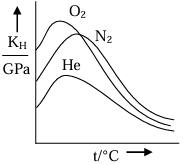
B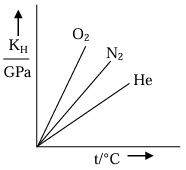
C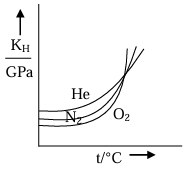
D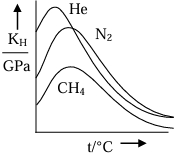
Solution
(D) The Henry's law constant $K_{H}$ is a measure of the solubility of a gas in a liquid.
According to experimental data,the value of $K_{H}$ for gases like $He$,$N_2$,and $CH_4$ in water increases with temperature up to a certain point and then decreases.
Additionally,at a given temperature,the $K_{H}$ values follow the order $He > N_2 > CH_4$.
Graph $D$ correctly depicts this behavior where $K_{H}$ values for $He$,$N_2$,and $CH_4$ show a peak and follow the correct relative order.
According to experimental data,the value of $K_{H}$ for gases like $He$,$N_2$,and $CH_4$ in water increases with temperature up to a certain point and then decreases.
Additionally,at a given temperature,the $K_{H}$ values follow the order $He > N_2 > CH_4$.
Graph $D$ correctly depicts this behavior where $K_{H}$ values for $He$,$N_2$,and $CH_4$ show a peak and follow the correct relative order.
0 likes
View Solution84
MediumMCQ
Which of the following statements regarding Henry's law is incorrect?
A
Higher the value of $K_{H}$ at a given pressure,higher is the solubility of gas in liquid.
B
Different gases have different $K_{H}$ (Henry's law constant) values at the same temperature.
C
The partial pressure of the gas in vapour phase is proportional to the mole fraction of the gas in the solution.
D
The value of $K_{H}$ increases with increase of temperature and $K_{H}$ is function of the nature of the gas.
Solution
(A) Henry's law is expressed as $p = K_{H} \cdot x$,where $p$ is the partial pressure of the gas,$K_{H}$ is the Henry's law constant,and $x$ is the mole fraction of the gas in the solution.
From this relation,$x = p / K_{H}$.
This shows that for a given partial pressure $p$,the solubility $(x)$ is inversely proportional to $K_{H}$.
Therefore,a higher value of $K_{H}$ results in lower solubility of the gas in the liquid.
Statement $A$ is incorrect because it states that higher $K_{H}$ leads to higher solubility.
From this relation,$x = p / K_{H}$.
This shows that for a given partial pressure $p$,the solubility $(x)$ is inversely proportional to $K_{H}$.
Therefore,a higher value of $K_{H}$ results in lower solubility of the gas in the liquid.
Statement $A$ is incorrect because it states that higher $K_{H}$ leads to higher solubility.
0 likes
View Solution85
MediumMCQ
If four gases $A$,$B$,$C$ and $D$ have Henry's constant $(K_H)$ values $1.9 \times 10^1 \ bar$,$6.5 \times 10^{-4} \ bar$,$7.8 \times 10^{-4} \ bar$ and $6.0 \times 10^3 \ bar$ respectively,then which of the following gas has maximum solubility at the same partial pressure?
A
$A$
B
$B$
C
$C$
D
$D$
Solution
(B) According to Henry's Law,the solubility of a gas is given by $S = \frac{P}{K_H}$,where $P$ is the partial pressure and $K_H$ is Henry's constant.
Since the partial pressure $P$ is constant for all gases,the solubility $S$ is inversely proportional to $K_H$ $(S \propto \frac{1}{K_H})$.
Therefore,the gas with the minimum $K_H$ value will have the maximum solubility.
Comparing the given $K_H$ values:
$A: 1.9 \times 10^1 \ bar$
$B: 6.5 \times 10^{-4} \ bar$
$C: 7.8 \times 10^{-4} \ bar$
$D: 6.0 \times 10^3 \ bar$
The minimum value is $6.5 \times 10^{-4} \ bar$,which corresponds to gas $B$.
Since the partial pressure $P$ is constant for all gases,the solubility $S$ is inversely proportional to $K_H$ $(S \propto \frac{1}{K_H})$.
Therefore,the gas with the minimum $K_H$ value will have the maximum solubility.
Comparing the given $K_H$ values:
$A: 1.9 \times 10^1 \ bar$
$B: 6.5 \times 10^{-4} \ bar$
$C: 7.8 \times 10^{-4} \ bar$
$D: 6.0 \times 10^3 \ bar$
The minimum value is $6.5 \times 10^{-4} \ bar$,which corresponds to gas $B$.
0 likes
View Solution86
MediumMCQ
How many grams of carbon dioxide gas are dissolved in $1 \ L$ of carbonated water,if the manufacturer uses a pressure of $2.4 \ atm$ in the bottling process at $25^{\circ} C$ (in $g$)? ($K_{H}$ of $CO_2 = 3000 \ atm$)
A
$8.06$
B
$1.95$
C
$4.59$
D
$6.91$
Solution
(B) According to Henry's Law,the solubility of a gas in a liquid is given by $P = K_H \times x$,where $P$ is the partial pressure of the gas,$K_H$ is Henry's law constant,and $x$ is the mole fraction of the gas in the solution.
Given: $P = 2.4 \ atm$,$K_H = 3000 \ atm$.
$x = \frac{P}{K_H} = \frac{2.4}{3000} = 8 \times 10^{-4}$.
Since the solution is dilute,the number of moles of water in $1 \ L$ $(1000 \ g)$ is $n_{H_2O} = \frac{1000}{18} \approx 55.56 \ mol$.
The mole fraction $x = \frac{n_{CO_2}}{n_{CO_2} + n_{H_2O}} \approx \frac{n_{CO_2}}{n_{H_2O}}$.
Therefore,$n_{CO_2} = x \times n_{H_2O} = (8 \times 10^{-4}) \times 55.56 \approx 0.0444 \ mol$.
The mass of $CO_2$ is $n_{CO_2} \times \text{molar mass} = 0.0444 \ mol \times 44 \ g/mol \approx 1.95 \ g$.
Given: $P = 2.4 \ atm$,$K_H = 3000 \ atm$.
$x = \frac{P}{K_H} = \frac{2.4}{3000} = 8 \times 10^{-4}$.
Since the solution is dilute,the number of moles of water in $1 \ L$ $(1000 \ g)$ is $n_{H_2O} = \frac{1000}{18} \approx 55.56 \ mol$.
The mole fraction $x = \frac{n_{CO_2}}{n_{CO_2} + n_{H_2O}} \approx \frac{n_{CO_2}}{n_{H_2O}}$.
Therefore,$n_{CO_2} = x \times n_{H_2O} = (8 \times 10^{-4}) \times 55.56 \approx 0.0444 \ mol$.
The mass of $CO_2$ is $n_{CO_2} \times \text{molar mass} = 0.0444 \ mol \times 44 \ g/mol \approx 1.95 \ g$.
0 likes
View Solution87
MediumMCQ
Henry's law constants for four gases are given below at $293 \ K$. Which one is most soluble in water when partial pressure of all gases are equal $:-$
A
$A. K_{H}=34.86 \ kbar$
B
$B. K_{H}=69.16 \ kbar$
C
$C. K_{H}=144.97 \ kbar$
D
$D. K_{H}=88.84 \ kbar$
Solution
(A) According to Henry's law,the solubility of a gas in a liquid is given by $P = K_{H} \times x$,where $P$ is the partial pressure,$K_{H}$ is the Henry's law constant,and $x$ is the mole fraction of the gas in the solution.
Rearranging for solubility $(x)$: $x = P / K_{H}$.
Since the partial pressure $(P)$ is constant for all gases,the solubility $(x)$ is inversely proportional to the Henry's law constant $(K_{H})$.
Therefore,the gas with the lowest $K_{H}$ value will have the highest solubility in water.
Comparing the given values: $34.86 < 69.16 < 88.84 < 144.97$.
The lowest value is $34.86 \ kbar$.
Rearranging for solubility $(x)$: $x = P / K_{H}$.
Since the partial pressure $(P)$ is constant for all gases,the solubility $(x)$ is inversely proportional to the Henry's law constant $(K_{H})$.
Therefore,the gas with the lowest $K_{H}$ value will have the highest solubility in water.
Comparing the given values: $34.86 < 69.16 < 88.84 < 144.97$.
The lowest value is $34.86 \ kbar$.
0 likes
View Solution88
DifficultMCQ
In which of the following salts,the solubility increases appreciably with an increase in temperature?
A
$KBr$
B
$NaBr$
C
$NaCl$
D
$KCl$
Solution
(A) The solubility of solid solutes in a liquid solvent depends on temperature.
Based on the solubility curve provided:
- The solubility of $NaCl$ and $KCl$ changes only slightly with an increase in temperature.
- The solubility of $NaBr$ also shows a relatively small increase compared to nitrates.
- Among the given options,$KBr$ shows a more significant (appreciable) increase in solubility with temperature compared to $NaCl$,$NaBr$,and $KCl$.
- Salts like $KNO_3$ and $NaNO_3$ show the most dramatic increase in solubility with temperature.
Based on the solubility curve provided:
- The solubility of $NaCl$ and $KCl$ changes only slightly with an increase in temperature.
- The solubility of $NaBr$ also shows a relatively small increase compared to nitrates.
- Among the given options,$KBr$ shows a more significant (appreciable) increase in solubility with temperature compared to $NaCl$,$NaBr$,and $KCl$.
- Salts like $KNO_3$ and $NaNO_3$ show the most dramatic increase in solubility with temperature.
0 likes
View Solution89
EasyMCQ
Identify from the following salts the one whose solubility in water decreases with an increase in temperature.
A
$NaBr$
B
$NaCl$
C
$NaNO_3$
D
$Na_2SO_4$
Solution
(D) The solubility of most salts increases with an increase in temperature because the dissolution process is endothermic.
However,for some salts like $Na_2SO_4$,the solubility decreases with an increase in temperature above $32.4 \ ^\circ C$ due to the transition from the decahydrate form to the anhydrous form,which is an exothermic process.
According to Le Chatelier's principle,for an exothermic dissolution process,an increase in temperature shifts the equilibrium in the backward direction,thereby decreasing the solubility.
However,for some salts like $Na_2SO_4$,the solubility decreases with an increase in temperature above $32.4 \ ^\circ C$ due to the transition from the decahydrate form to the anhydrous form,which is an exothermic process.
According to Le Chatelier's principle,for an exothermic dissolution process,an increase in temperature shifts the equilibrium in the backward direction,thereby decreasing the solubility.
0 likes
View Solution90
EasyMCQ
Which among the following salts exhibits an inverse relation between its solubility and temperature?
A
$NaBr$
B
$NaNO_3$
C
$KNO_3$
D
$Na_2SO_4$
Solution
(D) The solubility of most salts increases with an increase in temperature. However,for certain salts like $Na_2SO_4$ (specifically the decahydrate form,$Na_2SO_4 \cdot 10H_2O$),the solubility decreases as the temperature increases beyond a certain point due to the transition to the anhydrous form.
0 likes
View Solution91
EasyMCQ
Which among the following salts shows a decrease in solubility with an increase in temperature?
A
$Na_2SO_4$
B
$KNO_3$
C
$NaNO_3$
D
$KBr$
Solution
(A) The dissolution of $Na_2SO_4$ in water is an exothermic process.
When a substance dissolves in water via an exothermic process,its solubility decreases as the temperature increases.
Therefore,the solubility of $Na_2SO_4$ in water decreases with an increase in temperature.
When a substance dissolves in water via an exothermic process,its solubility decreases as the temperature increases.
Therefore,the solubility of $Na_2SO_4$ in water decreases with an increase in temperature.
0 likes
View Solution92
EasyMCQ
Which of the following salt's solubility increases appreciably with an increase in temperature?
A
$NaBr$
B
$NaCl$
C
$KCl$
D
$KNO_3$
Solution
(D) The dissolution of $KNO_3$ in water is an endothermic process,meaning it absorbs heat $(\Delta H_{sol} > 0)$.
According to Le Chatelier's principle,for an endothermic process,an increase in temperature shifts the equilibrium in the forward direction.
This results in a significant increase in the solubility of $KNO_3$ compared to salts like $NaCl$ or $KCl$,whose solubility changes only slightly with temperature.
According to Le Chatelier's principle,for an endothermic process,an increase in temperature shifts the equilibrium in the forward direction.
This results in a significant increase in the solubility of $KNO_3$ compared to salts like $NaCl$ or $KCl$,whose solubility changes only slightly with temperature.
0 likes
View Solution93
EasyMCQ
Solubility of which among the following solids in water changes slightly with temperature?
A
$KNO_3$
B
$NaNO_3$
C
$KBr$
D
$NaBr$
Solution
(D) The solubility of most alkali metal salts increases significantly with temperature,but $NaBr$ shows a relatively small change in solubility compared to others like $KNO_3$ or $NaNO_3$ within certain temperature ranges. This is due to the specific lattice energy and hydration energy balance of $NaBr$.
0 likes
View Solution94
EasyMCQ
What type of solution is the $H_2$ gas in palladium?
A
Gas as solute and solid as solvent
B
Gas as solute and liquid as solvent
C
Gas as solvent and solid as solute
D
Liquid as solute and gas as solvent
Solution
(A) solution of $H_2$ gas in palladium is an example of a solid solution where a gas is the solute and a solid is the solvent.
In this system,the $H_2$ molecules are adsorbed onto the surface of the palladium metal and then diffuse into the metal lattice.
Therefore,the correct classification is gas as solute and solid as solvent.
In this system,the $H_2$ molecules are adsorbed onto the surface of the palladium metal and then diffuse into the metal lattice.
Therefore,the correct classification is gas as solute and solid as solvent.
0 likes
View Solution95
MediumMCQ
Identify the reason for the solubility of polar solute in polar solvent from the following.
A
solute - solute interactions,solute - solvent interactions and solvent - solvent interactions are of similar magnitude.
B
solute - solute interactions $>$ solute - solvent interactions $>$ solvent - solvent interactions.
C
solvent - solvent interactions $>$ solute - solvent interactions $>$ solute - solute interactions.
D
solute - solvent interactions $>$ solute - solute interactions $>$ solvent - solvent interactions.
Solution
(A) The solubility of a polar solute in a polar solvent is mainly due to the favorable interactions between the solute and solvent molecules. These interactions are crucial for the dissolution process.
The most appropriate explanation for this is when the solute - solute,solvent - solvent,and solute - solvent interactions are comparable in magnitude. This balance allows the solute to dissolve efficiently,as the solvent can break apart the solute molecules while maintaining similar intermolecular forces within the mixture.
Correct answer: $A$. Solute - solute interactions,solute - solvent interactions,and solvent - solvent interactions are of similar magnitude.
The most appropriate explanation for this is when the solute - solute,solvent - solvent,and solute - solvent interactions are comparable in magnitude. This balance allows the solute to dissolve efficiently,as the solvent can break apart the solute molecules while maintaining similar intermolecular forces within the mixture.
Correct answer: $A$. Solute - solute interactions,solute - solvent interactions,and solvent - solvent interactions are of similar magnitude.
0 likes
View Solution96
MediumMCQ
Which of the following ionic solids exhibits a decrease in its solubility in water with an increase in temperature?
A
$NaCl$
B
$KNO_3$
C
$NaNO_3$
D
$Na_2SO_4$
Solution
(D) Among the given options,sodium sulfate $(Na_2SO_4)$ exhibits a decrease in solubility with an increase in temperature.
This behavior is unusual because,for most ionic solids,solubility tends to increase with temperature.
However,for $Na_2SO_4$,its dissolution is exothermic,meaning it releases heat when it dissolves in water.
According to Le Chatelier's principle,if the dissolution process is exothermic,increasing the temperature will shift the equilibrium to favor the undissolved solid,thereby reducing solubility at higher temperatures.
Solubility trends for other salts:
- $(1)$ $NaCl$ (Sodium chloride): $NaCl$'s solubility increases with temperature.
- $(2)$ $KNO_3$ (Potassium nitrate): $KNO_3$'s solubility increases significantly with temperature.
- $(3)$ $NaNO_3$ (Sodium nitrate): $NaNO_3$'s solubility also increases with temperature.
This behavior is unusual because,for most ionic solids,solubility tends to increase with temperature.
However,for $Na_2SO_4$,its dissolution is exothermic,meaning it releases heat when it dissolves in water.
According to Le Chatelier's principle,if the dissolution process is exothermic,increasing the temperature will shift the equilibrium to favor the undissolved solid,thereby reducing solubility at higher temperatures.
Solubility trends for other salts:
- $(1)$ $NaCl$ (Sodium chloride): $NaCl$'s solubility increases with temperature.
- $(2)$ $KNO_3$ (Potassium nitrate): $KNO_3$'s solubility increases significantly with temperature.
- $(3)$ $NaNO_3$ (Sodium nitrate): $NaNO_3$'s solubility also increases with temperature.
0 likes
View Solution97
EasyMCQ
Carbonated water is an example of a solution of
A
Gas in liquid
B
Gas in gas
C
Gas in solid
D
Solid in gas
Solution
(A) Carbonated water (soda-water) is prepared by dissolving $CO_2$ gas under high pressure in water.
Since the solute is a gas $(CO_2)$ and the solvent is a liquid (water), it is classified as a $Gas \ in \ liquid$ type of solution.
Since the solute is a gas $(CO_2)$ and the solvent is a liquid (water), it is classified as a $Gas \ in \ liquid$ type of solution.
0 likes
View Solution98
EasyMCQ
Which among the following gases exhibits very low solubility in water at room temperature?
A
$O_2$
B
$CO_2$
C
$NH_3$
D
$HCl$
Solution
(A) The solubility of gases in liquids depends on the nature of the gas and the solvent.
$O_2$ is a non-polar gas and exhibits very low solubility in water at room temperature.
In contrast,gases like $CO_2$,$NH_3$,and $HCl$ are highly soluble in water because they either react with water or are polar in nature.
$O_2$ is a non-polar gas and exhibits very low solubility in water at room temperature.
In contrast,gases like $CO_2$,$NH_3$,and $HCl$ are highly soluble in water because they either react with water or are polar in nature.
0 likes
View Solution99
MediumMCQ
Which among the following salts,solubility decreases with increase in temperature?
A
$Na_2SO_4$
B
$NaBr$
C
$NaCl$
D
$KCl$
Solution
(A) For $Na_2SO_4$ salt,the solubility decreases with an increase in temperature because the dissolution of $Na_2SO_4$ in water is an exothermic process,i.e.,$\Delta_{sol}H < 0$.
According to Le Chatelier's principle,for an exothermic process,an increase in temperature shifts the equilibrium in the backward direction,thereby decreasing solubility.
In contrast,for $NaCl$,$NaBr$,and $KCl$,the dissolution process is endothermic,so their solubility increases with an increase in temperature.
According to Le Chatelier's principle,for an exothermic process,an increase in temperature shifts the equilibrium in the backward direction,thereby decreasing solubility.
In contrast,for $NaCl$,$NaBr$,and $KCl$,the dissolution process is endothermic,so their solubility increases with an increase in temperature.
0 likes
View Solution100
EasyMCQ
Calculate the concentration of dissolved gas in water at $25^{\circ} C$ if the partial pressure of the gas at the same temperature is $0.15 \ atm$. $\left[K_H = 0.15 \ mol \ dm^{-3} \ atm^{-1}\right]$ (in $M$)
A
$0.0225$
B
$0.0182$
C
$0.0293$
D
$0.0261$
Solution
(A) According to Henry's Law,the concentration of a dissolved gas $(C)$ is directly proportional to its partial pressure $(P)$ above the liquid surface.
The formula is given by: $C = K_H \times P$
Given:
$K_H = 0.15 \ mol \ dm^{-3} \ atm^{-1}$
$P = 0.15 \ atm$
Substituting the values:
$C = 0.15 \ mol \ dm^{-3} \ atm^{-1} \times 0.15 \ atm$
$C = 0.0225 \ mol \ dm^{-3}$
Since $1 \ mol \ dm^{-3} = 1 \ M$,the concentration is $0.0225 \ M$.
The formula is given by: $C = K_H \times P$
Given:
$K_H = 0.15 \ mol \ dm^{-3} \ atm^{-1}$
$P = 0.15 \ atm$
Substituting the values:
$C = 0.15 \ mol \ dm^{-3} \ atm^{-1} \times 0.15 \ atm$
$C = 0.0225 \ mol \ dm^{-3}$
Since $1 \ mol \ dm^{-3} = 1 \ M$,the concentration is $0.0225 \ M$.
0 likes
View SolutionSolutions — Solubility · Frequently Asked Questions
1Are these Solutions questions useful for JEE and NEET?
Yes. All questions in this section are mapped to JEE Main and NEET exam patterns. Previous year questions from JEE Main, NEET, GUJCET and state-level exams are included with full solutions.
2Can I switch to Hindi or Gujarati for these questions?
Yes. Use the language tabs in the hero section or the sidebar to view the same questions and solutions in English, Hindi or Gujarati.
3How do I generate a question paper from this subtopic?
Use the Vedclass Exam Paper Generator — select the chapter and subtopic, set difficulty, and generate Sets A, B, C, D automatically. First 3 chapters of every subject are free.
Vedclass Products
For Students
Vedclass Test Series
Mock tests in real JEE/NEET style with performance analysis. 5-day free trial.
Start Free TrialFor Teachers
Exam Paper Generator
Generate Set A/B/C/D papers from this chapter in 2 minutes. 3 chapters free.
Try FreeFor Institutes
Online Exam Module
Live online exams with unlimited students, 360° analytics & white-label branding.
See DemoFor Teachers & Institutes
Generate a Solutions Exam Paper in 2 Minutes
Select subtopic & difficulty — Sets A, B, C, D auto-generated with No Repeat logic.
First 3 chapters of every subject are free — no payment required.