
A English
Solubility Questions in English
Class 12 Chemistry · Solutions · Solubility
164+
Questions
English
Language
100%
With Solutions
Showing 50 of 164 questions in English
1
MediumMCQ
Solubility of iodine in water may be increased by adding
A
Chloroform
B
Potassium iodide
C
Carbon disulphide
D
Sodium thiosulphate
Solution
(B) The solubility of $I_2$ in water increases by the addition of $KI$ due to the formation of the polyhalide ion,$I_3^-$.
$KI + I_2 \to KI_3$
$KI + I_2 \to KI_3$
0 likes
View Solution2
EasyMCQ
The solubility of a gas in water depends on
A
Nature of the gas
B
Temperature
C
Pressure of the gas
D
All of the above
Solution
(D) The solubility of a gas in a liquid depends on several factors:
$1$. Nature of the gas: Gases that can easily be liquefied (higher critical temperature) are more soluble in water.
$2$. Temperature: Generally,the solubility of a gas in a liquid decreases with an increase in temperature.
$3$. Pressure: According to Henry's Law,the solubility of a gas increases with an increase in the partial pressure of the gas above the solution.
$1$. Nature of the gas: Gases that can easily be liquefied (higher critical temperature) are more soluble in water.
$2$. Temperature: Generally,the solubility of a gas in a liquid decreases with an increase in temperature.
$3$. Pressure: According to Henry's Law,the solubility of a gas increases with an increase in the partial pressure of the gas above the solution.
0 likes
View Solution3
EasyMCQ
The statement "The mass of a gas dissolved in a given mass of a solvent at any temperature is proportional to the pressure of the gas above the solvent" is
A
Dalton’s Law of Partial Pressures
B
Law of Mass Action
C
Henry’s Law
D
None of these
Solution
(C) Henry's law states that at a constant temperature,the mass of a gas dissolved in a given volume of a solvent is directly proportional to the partial pressure of the gas present above the surface of the solution.
Mathematically,it is expressed as $m \propto P$ or $m = kP$,where $m$ is the mass of the gas,$P$ is the partial pressure,and $k$ is the proportionality constant.
Mathematically,it is expressed as $m \propto P$ or $m = kP$,where $m$ is the mass of the gas,$P$ is the partial pressure,and $k$ is the proportionality constant.
0 likes
View Solution4
EasyMCQ
Which of the following statements is correct regarding Henry's law?
A
The gas in contact with the liquid should behave as an ideal gas.
B
There should not be any chemical interaction between the gas and the liquid.
C
The pressure applied should be high.
D
All of these.
Solution
(A) Henry's law states that the partial pressure of the gas in the vapor phase $(p)$ is proportional to the mole fraction of the gas $(x)$ in the solution,given by $p = K_H x$.
The assumptions for Henry's law are:
$1$. The gas should behave as an ideal gas.
$2$. There should be no chemical reaction between the gas and the solvent.
$3$. The pressure should be low and the temperature should be high (conditions where gases behave ideally).
Since options $A$ and $B$ are correct,and option $C$ is generally incorrect (Henry's law is valid at low pressures),the question implies conditions for ideal behavior. However,given the standard textbook context,the conditions for Henry's law are that the gas should not react chemically with the solvent and should behave ideally. Thus,both $A$ and $B$ are correct.
The assumptions for Henry's law are:
$1$. The gas should behave as an ideal gas.
$2$. There should be no chemical reaction between the gas and the solvent.
$3$. The pressure should be low and the temperature should be high (conditions where gases behave ideally).
Since options $A$ and $B$ are correct,and option $C$ is generally incorrect (Henry's law is valid at low pressures),the question implies conditions for ideal behavior. However,given the standard textbook context,the conditions for Henry's law are that the gas should not react chemically with the solvent and should behave ideally. Thus,both $A$ and $B$ are correct.
0 likes
View Solution5
EasyMCQ
The statement “If $0.003 \ mol$ of a gas are dissolved in $900 \ g$ of water under a pressure of $1 \ atm$,$0.006 \ mol$ will be dissolved under a pressure of $2 \ atm$”,illustrates:
A
Dalton’s law of partial pressure
B
Graham’s law
C
Raoult’s law
D
Henry’s law
Solution
(D) Henry’s law states that the mass of a gas dissolved in a given volume of liquid at a constant temperature is directly proportional to the pressure of the gas in equilibrium with the liquid.
Mathematically,$m \propto P$ or $S = k_H \times P$,where $S$ is the solubility and $P$ is the partial pressure.
In this case,when pressure increases from $1 \ atm$ to $2 \ atm$ (doubles),the amount of dissolved gas increases from $0.003 \ mol$ to $0.006 \ mol$ (doubles).
This direct proportionality confirms Henry’s law.
Mathematically,$m \propto P$ or $S = k_H \times P$,where $S$ is the solubility and $P$ is the partial pressure.
In this case,when pressure increases from $1 \ atm$ to $2 \ atm$ (doubles),the amount of dissolved gas increases from $0.003 \ mol$ to $0.006 \ mol$ (doubles).
This direct proportionality confirms Henry’s law.
0 likes
View Solution6
EasyMCQ
If the solubility of $NaCl$ at $20\,^{\circ}C$ is $35\,g$ per $100\,g$ of water,then on adding $50\,g$ of $NaCl$ to the same amount of water at the same temperature,the amount of salt that remains undissolved is .......... $g$.
A
$15$
B
$20$
C
$50$
D
$35$
Solution
(A) The solubility of $NaCl$ is $35\,g$ per $100\,g$ of water at $20\,^{\circ}C$.
This means that only $35\,g$ of $NaCl$ can dissolve in $100\,g$ of water at this temperature.
When $50\,g$ of $NaCl$ is added to $100\,g$ of water,the amount of salt that remains undissolved is calculated as:
$\text{Undissolved salt} = \text{Total salt added} - \text{Solubility limit}$
$\text{Undissolved salt} = 50\,g - 35\,g = 15\,g$.
This means that only $35\,g$ of $NaCl$ can dissolve in $100\,g$ of water at this temperature.
When $50\,g$ of $NaCl$ is added to $100\,g$ of water,the amount of salt that remains undissolved is calculated as:
$\text{Undissolved salt} = \text{Total salt added} - \text{Solubility limit}$
$\text{Undissolved salt} = 50\,g - 35\,g = 15\,g$.
0 likes
View Solution7
MediumMCQ
How many grams of water are required to dissolve $4 \ g$ of sodium sulfate at $323 \ K$? The solubility of sodium sulfate at this temperature is $16\%$.
A
$25$
B
$16$
C
$100$
D
$50$
Solution
(A) Solubility is defined as the amount of solute in $100 \ g$ of solvent.
Given that the solubility is $16\%$,it means $16 \ g$ of $Na_2SO_4$ is dissolved in $100 \ g$ of water.
To dissolve $4 \ g$ of $Na_2SO_4$,the amount of water required is calculated as:
$\text{Water required} = \frac{100 \ g \text{ water}}{16 \ g \text{ solute}} \times 4 \ g \text{ solute} = 25 \ g$ of water.
Given that the solubility is $16\%$,it means $16 \ g$ of $Na_2SO_4$ is dissolved in $100 \ g$ of water.
To dissolve $4 \ g$ of $Na_2SO_4$,the amount of water required is calculated as:
$\text{Water required} = \frac{100 \ g \text{ water}}{16 \ g \text{ solute}} \times 4 \ g \text{ solute} = 25 \ g$ of water.
0 likes
View Solution8
MediumMCQ
If $N_2$ gas is bubbled through water at $293 \ K$,how many millimoles of $N_2$ gas would dissolve in $1 \ L$ of water? Assume that $N_2$ exerts a partial pressure of $0.987 \ bar$. The Henry's law constant for $N_2$ at $293 \ K$ is $76.48 \ kbar$.
A
$0.716$
B
$0.516$
C
$0.316$
D
$0.426$
Solution
(A) According to Henry's law,the partial pressure of a gas is related to its mole fraction in the solution: $P = K_H \times x$.
Given $P = 0.987 \ bar$ and $K_H = 76.48 \ kbar = 76480 \ bar$.
Calculating the mole fraction of $N_2$ $(x_{N_2})$:
$x_{N_2} = \frac{P}{K_H} = \frac{0.987 \ bar}{76480 \ bar} = 1.29 \times 10^{-5}$.
In $1 \ L$ of water,the number of moles of water is $n_{H_2O} = \frac{1000 \ g}{18 \ g/mol} = 55.5 \ mol$.
Since $x_{N_2} = \frac{n_{N_2}}{n_{N_2} + n_{H_2O}}$,and $n_{N_2} << n_{H_2O}$,we can approximate $x_{N_2} \approx \frac{n_{N_2}}{n_{H_2O}}$.
$n_{N_2} = x_{N_2} \times 55.5 \ mol = 1.29 \times 10^{-5} \times 55.5 \ mol = 7.16 \times 10^{-4} \ mol$.
Converting to millimoles: $7.16 \times 10^{-4} \ mol \times 1000 \ mmol/mol = 0.716 \ mmol$.
Given $P = 0.987 \ bar$ and $K_H = 76.48 \ kbar = 76480 \ bar$.
Calculating the mole fraction of $N_2$ $(x_{N_2})$:
$x_{N_2} = \frac{P}{K_H} = \frac{0.987 \ bar}{76480 \ bar} = 1.29 \times 10^{-5}$.
In $1 \ L$ of water,the number of moles of water is $n_{H_2O} = \frac{1000 \ g}{18 \ g/mol} = 55.5 \ mol$.
Since $x_{N_2} = \frac{n_{N_2}}{n_{N_2} + n_{H_2O}}$,and $n_{N_2} << n_{H_2O}$,we can approximate $x_{N_2} \approx \frac{n_{N_2}}{n_{H_2O}}$.
$n_{N_2} = x_{N_2} \times 55.5 \ mol = 1.29 \times 10^{-5} \times 55.5 \ mol = 7.16 \times 10^{-4} \ mol$.
Converting to millimoles: $7.16 \times 10^{-4} \ mol \times 1000 \ mmol/mol = 0.716 \ mmol$.
0 likes
View Solution9
MediumMCQ
The Henry's law constant for the solubility of $N_2$ gas in water at $298 \ K$ is $1.0 \times 10^5 \ atm$. The mole fraction of $N_2$ in air is $0.8$. Calculate the number of moles of $N_2$ dissolved in $10 \ moles$ of water at $298 \ K$ and a total pressure of $5 \ atm$.
A
$4 \times 10^{-4}$
B
$4 \times 10^{-5}$
C
$5 \times 10^{-4}$
D
$4 \times 10^{-6}$
Solution
(A) According to Henry's Law,$p_{N_2} = K_H \times x_{N_2}$.
First,calculate the partial pressure of $N_2$ in the air: $p_{N_2} = x_{N_2(air)} \times P_{total} = 0.8 \times 5 \ atm = 4 \ atm$.
Now,calculate the mole fraction of $N_2$ in the water: $x_{N_2(water)} = \frac{p_{N_2}}{K_H} = \frac{4 \ atm}{1.0 \times 10^5 \ atm} = 4 \times 10^{-5}$.
Since $x_{N_2(water)} = \frac{n_{N_2}}{n_{N_2} + n_{H_2O}}$,and $n_{N_2}$ is very small compared to $n_{H_2O} = 10 \ moles$,we can approximate $x_{N_2(water)} \approx \frac{n_{N_2}}{n_{H_2O}}$.
Therefore,$n_{N_2} = x_{N_2(water)} \times n_{H_2O} = (4 \times 10^{-5}) \times 10 = 4 \times 10^{-4} \ moles$.
First,calculate the partial pressure of $N_2$ in the air: $p_{N_2} = x_{N_2(air)} \times P_{total} = 0.8 \times 5 \ atm = 4 \ atm$.
Now,calculate the mole fraction of $N_2$ in the water: $x_{N_2(water)} = \frac{p_{N_2}}{K_H} = \frac{4 \ atm}{1.0 \times 10^5 \ atm} = 4 \times 10^{-5}$.
Since $x_{N_2(water)} = \frac{n_{N_2}}{n_{N_2} + n_{H_2O}}$,and $n_{N_2}$ is very small compared to $n_{H_2O} = 10 \ moles$,we can approximate $x_{N_2(water)} \approx \frac{n_{N_2}}{n_{H_2O}}$.
Therefore,$n_{N_2} = x_{N_2(water)} \times n_{H_2O} = (4 \times 10^{-5}) \times 10 = 4 \times 10^{-4} \ moles$.
0 likes
View Solution10
DifficultMCQ
At $298 \ K$,how many millimoles of $CO_2$ gas will dissolve in $900 \ mL$ of water when $CO_2$ gas is passed through it? The $K_H$ value is $6.02 \times 10^{-4} \ bar$ and the partial pressure of $CO_2$ gas is $2 \times 10^{-8} \ bar$.
A
$2.226$
B
$4.688$
C
$1.212$
D
$1.661$
Solution
(D) According to Henry's Law,the mole fraction of $CO_2$ is given by:
$x_{CO_2} = \frac{P_{CO_2}}{K_H} = \frac{2 \times 10^{-8}}{6.02 \times 10^{-4}} = 3.322 \times 10^{-5}$
Since the density of water is $1 \ g \ mL^{-1}$,the mass of $900 \ mL$ of water is $900 \ g$.
The number of moles of water $(n_{H_2O})$ is:
$n_{H_2O} = \frac{900 \ g}{18 \ g \ mol^{-1}} = 50 \ mol$
Since $x_{CO_2} = \frac{n_{CO_2}}{n_{CO_2} + n_{H_2O}}$,and $n_{CO_2}$ is very small compared to $n_{H_2O}$,we can approximate $n_{CO_2} + n_{H_2O} \approx n_{H_2O} = 50 \ mol$.
$3.322 \times 10^{-5} = \frac{n_{CO_2}}{50}$
$n_{CO_2} = 3.322 \times 10^{-5} \times 50 = 1.661 \times 10^{-3} \ mol$
Converting to millimoles:
$1.661 \times 10^{-3} \ mol \times 10^3 \ mmol \ mol^{-1} = 1.661 \ mmol$
Thus,$1.661 \ mmol$ of $CO_2$ gas will dissolve.
$x_{CO_2} = \frac{P_{CO_2}}{K_H} = \frac{2 \times 10^{-8}}{6.02 \times 10^{-4}} = 3.322 \times 10^{-5}$
Since the density of water is $1 \ g \ mL^{-1}$,the mass of $900 \ mL$ of water is $900 \ g$.
The number of moles of water $(n_{H_2O})$ is:
$n_{H_2O} = \frac{900 \ g}{18 \ g \ mol^{-1}} = 50 \ mol$
Since $x_{CO_2} = \frac{n_{CO_2}}{n_{CO_2} + n_{H_2O}}$,and $n_{CO_2}$ is very small compared to $n_{H_2O}$,we can approximate $n_{CO_2} + n_{H_2O} \approx n_{H_2O} = 50 \ mol$.
$3.322 \times 10^{-5} = \frac{n_{CO_2}}{50}$
$n_{CO_2} = 3.322 \times 10^{-5} \times 50 = 1.661 \times 10^{-3} \ mol$
Converting to millimoles:
$1.661 \times 10^{-3} \ mol \times 10^3 \ mmol \ mol^{-1} = 1.661 \ mmol$
Thus,$1.661 \ mmol$ of $CO_2$ gas will dissolve.
0 likes
View Solution11
EasyMCQ
The solution of sugar in water contains
A
Free atoms
B
Free molecules
C
Free ions
D
Free atoms and free molecules
Solution
(B) $Sugar$ $(C_{12}H_{22}O_{11})$ is a covalent compound.
When dissolved in water,it does not dissociate into ions but exists as individual $free \text{ } molecules$ in the solution.
When dissolved in water,it does not dissociate into ions but exists as individual $free \text{ } molecules$ in the solution.
0 likes
View Solution12
EasyMCQ
The Henry's law constant for the dissolution of a gas in an aqueous medium is $3 \times 10^2 \ atm$. At what partial pressure of the gas will the molality of the gas in the aqueous solution be $\frac{5}{9} \ m$?
A
$1$
B
$4$
C
$3$
D
$68$
Solution
(C) Given: Henry's law constant $K_H = 3 \times 10^2 \ atm$,molality $m = \frac{5}{9} \ mol/kg$.
First,calculate the mole fraction of the gas $(X_A)$ in the solution.
$X_A = \frac{n_{gas}}{n_{gas} + n_{water}} = \frac{m}{m + \frac{1000}{18}} = \frac{5/9}{5/9 + 55.55} = \frac{0.555}{0.555 + 55.55} = \frac{0.555}{56.105} \approx 0.01$.
Using Henry's law: $P = K_H \times X_A$.
$P = (3 \times 10^2 \ atm) \times 0.01 = 3 \ atm$.
First,calculate the mole fraction of the gas $(X_A)$ in the solution.
$X_A = \frac{n_{gas}}{n_{gas} + n_{water}} = \frac{m}{m + \frac{1000}{18}} = \frac{5/9}{5/9 + 55.55} = \frac{0.555}{0.555 + 55.55} = \frac{0.555}{56.105} \approx 0.01$.
Using Henry's law: $P = K_H \times X_A$.
$P = (3 \times 10^2 \ atm) \times 0.01 = 3 \ atm$.
0 likes
View Solution13
AdvancedMCQ
Air is a mixture of a number of gases. The major components are oxygen and nitrogen with approximate proportions of $20\%$ and $79\%$ by volume at $298\ K$. The water is in equilibrium with air at a pressure of $10\ atm$. At $298\ K$,if the Henry's law constants for oxygen and nitrogen are $3.30 \times 10^7\ mm$ and $6.51 \times 10^7\ mm$,respectively,the mole ratio of gases $(O_2 : N_2)$ dissolved in water is about
A
$1 : 2$
B
$2 : 1$
C
$1 : 8$
D
$1 : 3$
Solution
(A) The total pressure of air over water is $10\ atm$.
The partial pressure of nitrogen is $P_{N_2} = \frac{79}{100} \times 10\ atm = 7.9\ atm = 7.9 \times 760\ mm\ Hg = 6004\ mm\ Hg$.
The partial pressure of oxygen is $P_{O_2} = \frac{20}{100} \times 10\ atm = 2.0\ atm = 2.0 \times 760\ mm\ Hg = 1520\ mm\ Hg$.
According to Henry's law,$P = K_H \times X$,where $X$ is the mole fraction of the gas in the solution.
$X_{N_2} = \frac{P_{N_2}}{K_H(N_2)} = \frac{6004}{6.51 \times 10^7} = 9.22 \times 10^{-5}$.
$X_{O_2} = \frac{P_{O_2}}{K_H(O_2)} = \frac{1520}{3.30 \times 10^7} = 4.60 \times 10^{-5}$.
The mole ratio of dissolved gases is $\frac{X_{O_2}}{X_{N_2}} = \frac{4.60 \times 10^{-5}}{9.22 \times 10^{-5}} \approx 0.5 = \frac{1}{2}$.
The partial pressure of nitrogen is $P_{N_2} = \frac{79}{100} \times 10\ atm = 7.9\ atm = 7.9 \times 760\ mm\ Hg = 6004\ mm\ Hg$.
The partial pressure of oxygen is $P_{O_2} = \frac{20}{100} \times 10\ atm = 2.0\ atm = 2.0 \times 760\ mm\ Hg = 1520\ mm\ Hg$.
According to Henry's law,$P = K_H \times X$,where $X$ is the mole fraction of the gas in the solution.
$X_{N_2} = \frac{P_{N_2}}{K_H(N_2)} = \frac{6004}{6.51 \times 10^7} = 9.22 \times 10^{-5}$.
$X_{O_2} = \frac{P_{O_2}}{K_H(O_2)} = \frac{1520}{3.30 \times 10^7} = 4.60 \times 10^{-5}$.
The mole ratio of dissolved gases is $\frac{X_{O_2}}{X_{N_2}} = \frac{4.60 \times 10^{-5}}{9.22 \times 10^{-5}} \approx 0.5 = \frac{1}{2}$.
0 likes
View Solution14
MediumMCQ
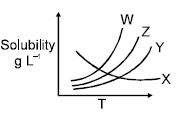
Solubility curves of four ionic salts $X$,$Y$,$Z$,and $W$ are given below. In which case is the value of $\Delta H_{sol.} < 0$?
A
$X$
B
$Y$
C
$Z$
D
$W$
Solution
(A) For a dissolution process,if $\Delta H_{sol.} < 0$,the process is exothermic.
According to Le Chatelier's principle,for an exothermic dissolution process,an increase in temperature leads to a decrease in solubility.
Looking at the provided graph,the solubility of salt $X$ decreases as the temperature $(T)$ increases.
Therefore,for salt $X$,the value of $\Delta H_{sol.} < 0$.
According to Le Chatelier's principle,for an exothermic dissolution process,an increase in temperature leads to a decrease in solubility.
Looking at the provided graph,the solubility of salt $X$ decreases as the temperature $(T)$ increases.
Therefore,for salt $X$,the value of $\Delta H_{sol.} < 0$.
0 likes
View Solution15
MediumMCQ
Which one of the following is least soluble in Acetone?
A
$AgCl$
B
$NaCl$
C
$CCl_4$
D
$LiCl$
Solution
(B) Acetone is a polar aprotic solvent with a moderate dielectric constant.
Solubility in such solvents depends on the ionic character and lattice energy of the salt.
$NaCl$ is a highly ionic compound with a very high lattice energy,making it essentially insoluble in organic solvents like acetone.
$LiCl$ and $AgCl$ possess significant covalent character due to Fajan's rule (small cation size for $Li^+$ and polarizability of $Ag^+$),which increases their solubility in organic solvents compared to $NaCl$.
$CCl_4$ is a non-polar covalent molecule and is miscible with acetone.
Therefore,$NaCl$ is the least soluble among the ionic salts listed.
Solubility in such solvents depends on the ionic character and lattice energy of the salt.
$NaCl$ is a highly ionic compound with a very high lattice energy,making it essentially insoluble in organic solvents like acetone.
$LiCl$ and $AgCl$ possess significant covalent character due to Fajan's rule (small cation size for $Li^+$ and polarizability of $Ag^+$),which increases their solubility in organic solvents compared to $NaCl$.
$CCl_4$ is a non-polar covalent molecule and is miscible with acetone.
Therefore,$NaCl$ is the least soluble among the ionic salts listed.
0 likes
View Solution16
EasyMCQ
The solubility of a gas in a liquid increases with:
A
Increase of temperature and pressure
B
Increase of temperature at constant pressure
C
Increase of pressure at constant temperature
D
Decrease of pressure and temperature
Solution
(C) According to Henry's Law,the solubility of a gas in a liquid is directly proportional to the partial pressure of the gas above the surface of the liquid at a constant temperature.
Therefore,increasing the pressure at a constant temperature increases the solubility of the gas.
Conversely,the dissolution of a gas in a liquid is an exothermic process,so increasing the temperature decreases the solubility of the gas.
Therefore,increasing the pressure at a constant temperature increases the solubility of the gas.
Conversely,the dissolution of a gas in a liquid is an exothermic process,so increasing the temperature decreases the solubility of the gas.
0 likes
View Solution17
MediumMCQ
The Henry's law constant for the solubility of $N_2$ gas in water at $25 \, ^oC$ is $1 \times 10^5 \, atm$. The mole fraction of $N_2$ in air is $0.8$. Calculate the number of moles of $N_2$ from air that will dissolve in $10 \, moles$ of $H_2O$ at $25 \, ^oC$ and at a total pressure of $5 \, atm$.
A
$4 \times 10^{-5}$
B
$4 \times 10^{-4}$
C
$4 \times 10^{4}$
D
$5 \times 10^{-5}$
Solution
(B) The partial pressure of $N_2$ is given by $P_{N_2} = \chi_{N_2} \times P_{total} = 0.8 \times 5 \, atm = 4 \, atm$.
According to Henry's law,$P_{N_2} = K_H \times x_{N_2}$,where $x_{N_2}$ is the mole fraction of $N_2$ in the solution.
$4 = 1 \times 10^5 \times x_{N_2} \Rightarrow x_{N_2} = 4 \times 10^{-5}$.
Since $x_{N_2} = \frac{n_{N_2}}{n_{N_2} + n_{H_2O}} \approx \frac{n_{N_2}}{n_{H_2O}}$ (as $n_{N_2}$ is very small compared to $n_{H_2O}$),
$4 \times 10^{-5} = \frac{n_{N_2}}{10} \Rightarrow n_{N_2} = 4 \times 10^{-4} \, moles$.
According to Henry's law,$P_{N_2} = K_H \times x_{N_2}$,where $x_{N_2}$ is the mole fraction of $N_2$ in the solution.
$4 = 1 \times 10^5 \times x_{N_2} \Rightarrow x_{N_2} = 4 \times 10^{-5}$.
Since $x_{N_2} = \frac{n_{N_2}}{n_{N_2} + n_{H_2O}} \approx \frac{n_{N_2}}{n_{H_2O}}$ (as $n_{N_2}$ is very small compared to $n_{H_2O}$),
$4 \times 10^{-5} = \frac{n_{N_2}}{10} \Rightarrow n_{N_2} = 4 \times 10^{-4} \, moles$.
0 likes
View Solution18
EasyMCQ
According to Henry's law,the solubility of a gas in a given volume of liquid increases with increase in
A
Temperature
B
Pressure
C
Both $A$ and $B$
D
None of these
Solution
(B) According to Henry's law,$S = KP$.
$S$ is the solubility in moles per liter.
$K$ is the Henry's law constant.
$P$ is the partial pressure of the gas in $atm$.
Thus,when pressure increases,the solubility of the gas in a given volume of liquid increases.
Conversely,when the temperature increases,the solubility of the gas in a given volume of liquid decreases.
$S$ is the solubility in moles per liter.
$K$ is the Henry's law constant.
$P$ is the partial pressure of the gas in $atm$.
Thus,when pressure increases,the solubility of the gas in a given volume of liquid increases.
Conversely,when the temperature increases,the solubility of the gas in a given volume of liquid decreases.
0 likes
View Solution19
EasyMCQ
The solubility of a gas in a liquid generally increases with :-
A
Increase in temperature
B
Reduction in gaseous pressure
C
Decrease in temperature and increase of gaseous pressure
D
Amount of liquid taken
Solution
(C) The dissolution of a gas in a liquid is an exothermic process. According to Le Chatelier's principle,a decrease in temperature favors the forward (dissolution) reaction.
Furthermore,according to Henry's Law,the solubility of a gas in a liquid is directly proportional to the partial pressure of the gas above the surface of the liquid.
Therefore,the solubility of a gas increases with a decrease in temperature and an increase in gaseous pressure.
Furthermore,according to Henry's Law,the solubility of a gas in a liquid is directly proportional to the partial pressure of the gas above the surface of the liquid.
Therefore,the solubility of a gas increases with a decrease in temperature and an increase in gaseous pressure.
0 likes
View Solution20
EasyMCQ
The solubility of $CO_2$ in water increases with
A
Increase in temperature
B
Reduction of gas pressure
C
Increase in gas pressure
D
Increase in volume
Solution
(C) The dissolution of a gas in a liquid is generally an exothermic process. According to Le Chatelier's principle,an increase in temperature decreases the solubility of the gas.
According to Henry's Law,the solubility of a gas is directly proportional to the partial pressure of the gas above the liquid surface,expressed as $P = K_H \cdot X_{gas}$.
Therefore,the solubility of $CO_2$ in water increases with an increase in gas pressure.
According to Henry's Law,the solubility of a gas is directly proportional to the partial pressure of the gas above the liquid surface,expressed as $P = K_H \cdot X_{gas}$.
Therefore,the solubility of $CO_2$ in water increases with an increase in gas pressure.
0 likes
View Solution21
AdvancedMCQ
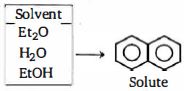
Rank the following solvents in decreasing order of their ability to dissolve the given solute (naphthalene).
A
$Et_2O > EtOH > H_2O$
B
$H_2O > EtOH > Et_2O$
C
$H_2O > Et_2O > EtOH$
D
$Et_2O > H_2O > EtOH$
Solution
(A) The solute given is naphthalene $(C_{10}H_8)$,which is a non-polar hydrocarbon.
According to the principle of 'like dissolves like',non-polar solutes dissolve best in non-polar or less polar solvents.
Comparing the polarity of the solvents:
$1$. $Et_2O$ (Diethyl ether) is non-polar/weakly polar.
$2$. $EtOH$ (Ethanol) is polar.
$3$. $H_2O$ (Water) is highly polar.
Therefore,the order of solubility of naphthalene in these solvents is $Et_2O > EtOH > H_2O$.
Thus,the correct option is $A$.
According to the principle of 'like dissolves like',non-polar solutes dissolve best in non-polar or less polar solvents.
Comparing the polarity of the solvents:
$1$. $Et_2O$ (Diethyl ether) is non-polar/weakly polar.
$2$. $EtOH$ (Ethanol) is polar.
$3$. $H_2O$ (Water) is highly polar.
Therefore,the order of solubility of naphthalene in these solvents is $Et_2O > EtOH > H_2O$.
Thus,the correct option is $A$.
0 likes
View Solution22
MediumMCQ
The solubility of $N_2$ in water at $300 \ K$ and $500 \ torr$ partial pressure is $0.01 \ g \ L^{-1}$. The solubility (in $g \ L^{-1}$) at $750 \ torr$ partial pressure is
A
$0.0075$
B
$0.005$
C
$0.02$
D
$0.015$
Solution
(D) According to Henry's law,the solubility $(S)$ of a gas is directly proportional to its partial pressure $(P)$: $S \propto P$ or $S = kP$.
Given: $P_1 = 500 \ torr$,$S_1 = 0.01 \ g \ L^{-1}$,$P_2 = 750 \ torr$.
Using the relation $\frac{S_1}{S_2} = \frac{P_1}{P_2}$:
$\frac{0.01}{S_2} = \frac{500}{750}$
$S_2 = \frac{0.01 \times 750}{500} = 0.015 \ g \ L^{-1}$.
Given: $P_1 = 500 \ torr$,$S_1 = 0.01 \ g \ L^{-1}$,$P_2 = 750 \ torr$.
Using the relation $\frac{S_1}{S_2} = \frac{P_1}{P_2}$:
$\frac{0.01}{S_2} = \frac{500}{750}$
$S_2 = \frac{0.01 \times 750}{500} = 0.015 \ g \ L^{-1}$.
0 likes
View Solution23
EasyMCQ
Which one of the following statements regarding Henry's law is not correct?
A
Higher the value of $K_H$ at a given pressure,higher is the solubility of the gas in the liquids
B
Different gases have different $K_H$ (Henry's law constant) values at the same temperature
C
The partial pressure of the gas in vapour phase is proportional to the mole fraction of the gas in the solution
D
The value of $K_H$ increases with increase of temperature and $K_H$ is function of the nature of the gas
Solution
(A) Henry's law is expressed as $P = K_H \times x$,where $P$ is the partial pressure of the gas,$x$ is the mole fraction of the gas in the solution,and $K_H$ is Henry's law constant.
From this relation,$x = P / K_H$.
This shows that for a given partial pressure $P$,the solubility $(x)$ is inversely proportional to $K_H$.
Therefore,a higher value of $K_H$ implies lower solubility of the gas in the liquid.
Thus,the statement in option $A$ is incorrect.
From this relation,$x = P / K_H$.
This shows that for a given partial pressure $P$,the solubility $(x)$ is inversely proportional to $K_H$.
Therefore,a higher value of $K_H$ implies lower solubility of the gas in the liquid.
Thus,the statement in option $A$ is incorrect.
0 likes
View Solution24
DifficultMCQ
For the solution of the gases $w$,$x$,$y$ and $z$ in water at $298 \ K$,the Henry's law constants $(K_H)$ are $0.5$,$2$,$35$ and $40 \ kbar$,respectively. The correct plot for the given data is
A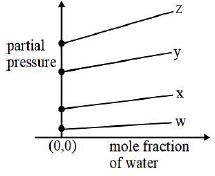
B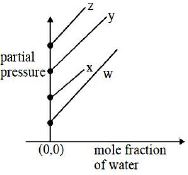
C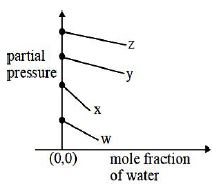
D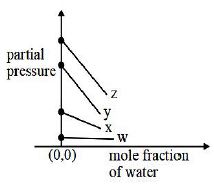
Solution
(C) According to Henry's law,the partial pressure of a gas $(P_{gas})$ is related to its mole fraction $(X_{gas})$ as: $P_{gas} = K_H \cdot X_{gas}$.
Since $X_{gas} + X_{H_2O} = 1$,we have $X_{gas} = 1 - X_{H_2O}$.
Substituting this into the equation: $P_{gas} = K_H(1 - X_{H_2O}) = K_H - K_H \cdot X_{H_2O}$.
This is a linear equation of the form $y = mx + c$,where $y = P_{gas}$,$x = X_{H_2O}$,slope $m = -K_H$,and intercept $c = K_H$.
As the mole fraction of water $(X_{H_2O})$ increases,the partial pressure of the gas decreases linearly.
The intercept on the y-axis is $K_H$. The values of $K_H$ are $0.5$,$2$,$35$,and $40 \ kbar$ for $w$,$x$,$y$,and $z$ respectively.
Therefore,the intercept increases in the order $w < x < y < z$.
The slope is $-K_H$,meaning the lines have negative slopes,and the magnitude of the slope increases as $K_H$ increases.
Looking at the options,the graph in Option $C$ shows lines with negative slopes where the y-intercepts increase in the order $w < x < y < z$.
Since $X_{gas} + X_{H_2O} = 1$,we have $X_{gas} = 1 - X_{H_2O}$.
Substituting this into the equation: $P_{gas} = K_H(1 - X_{H_2O}) = K_H - K_H \cdot X_{H_2O}$.
This is a linear equation of the form $y = mx + c$,where $y = P_{gas}$,$x = X_{H_2O}$,slope $m = -K_H$,and intercept $c = K_H$.
As the mole fraction of water $(X_{H_2O})$ increases,the partial pressure of the gas decreases linearly.
The intercept on the y-axis is $K_H$. The values of $K_H$ are $0.5$,$2$,$35$,and $40 \ kbar$ for $w$,$x$,$y$,and $z$ respectively.
Therefore,the intercept increases in the order $w < x < y < z$.
The slope is $-K_H$,meaning the lines have negative slopes,and the magnitude of the slope increases as $K_H$ increases.
Looking at the options,the graph in Option $C$ shows lines with negative slopes where the y-intercepts increase in the order $w < x < y < z$.
0 likes
View Solution25
MediumMCQ
In which of the following solvents,$KI$ has highest solubility?
A
$C_6H_6 (\epsilon = 0)$
B
$(CH_3)_2CO (\epsilon = 2)$
C
$CH_3OH (\epsilon = 32)$
D
$CCl_4 (\epsilon = 0)$
Solution
(C) $KI$ is an ionic compound.
According to the principle of "like dissolves like",ionic compounds are most soluble in polar solvents with a high dielectric constant $(\epsilon)$.
Among the given options,$CH_3OH$ has the highest dielectric constant $(\epsilon = 32)$.
Therefore,$KI$ will have the highest solubility in $CH_3OH$.
According to the principle of "like dissolves like",ionic compounds are most soluble in polar solvents with a high dielectric constant $(\epsilon)$.
Among the given options,$CH_3OH$ has the highest dielectric constant $(\epsilon = 32)$.
Therefore,$KI$ will have the highest solubility in $CH_3OH$.
0 likes
View Solution26
EasyMCQ
Why is a mixture of $He-O_2$ used by deep-sea divers instead of a $N_2-O_2$ mixture?
A
Helium is much less soluble in blood than nitrogen.
B
Nitrogen is much less soluble in blood than helium.
C
At high pressure in deep sea,nitrogen and oxygen react to form toxic nitric oxide.
D
Nitrogen is highly soluble in water.
Solution
(A) Deep-sea divers use a mixture of $He-O_2$ instead of $N_2-O_2$ because helium is much less soluble in blood compared to nitrogen.
This prevents the formation of nitrogen bubbles in the blood (a condition known as 'bends') when the diver ascends to the surface.
This prevents the formation of nitrogen bubbles in the blood (a condition known as 'bends') when the diver ascends to the surface.
0 likes
View Solution27
MediumMCQ
Henry's law constants for $O_2$ and $N_2$ are $K_{O_2} = 3.3 \times 10^7 \ atm$ and $K_{N_2} = 6.51 \times 10^7 \ atm$. Calculate the ratio of $\frac{X_{O_2}}{X_{N_2}}$,i.e.,the ratio of mole fractions of $O_2$ and $N_2$ dissolved in water at $25 \ ^\circ C$ from air. (Assume air contains $20 \%$ $O_2$ and $80 \%$ $N_2$ by volume).
A
$0.49$
B
$0.92$
C
$0.31$
D
$0.53$
Solution
(A) According to Henry's law,the partial pressure of a gas is given by $p = K_H \cdot X$,where $K_H$ is the Henry's law constant and $X$ is the mole fraction.
For $O_2$: $p_{O_2} = K_{O_2} \cdot X_{O_2} \implies X_{O_2} = \frac{p_{O_2}}{K_{O_2}}$
For $N_2$: $p_{N_2} = K_{N_2} \cdot X_{N_2} \implies X_{N_2} = \frac{p_{N_2}}{K_{N_2}}$
The ratio of mole fractions is $\frac{X_{O_2}}{X_{N_2}} = \frac{p_{O_2}}{K_{O_2}} \times \frac{K_{N_2}}{p_{N_2}} = \left(\frac{p_{O_2}}{p_{N_2}}\right) \times \left(\frac{K_{N_2}}{K_{O_2}}\right)$.
Air contains $20 \%$ $O_2$ and $80 \%$ $N_2$ by volume,so the ratio of partial pressures is $\frac{p_{O_2}}{p_{N_2}} = \frac{20}{80} = \frac{1}{4} = 0.25$.
Substituting the values: $\frac{X_{O_2}}{X_{N_2}} = 0.25 \times \frac{6.51 \times 10^7}{3.3 \times 10^7} = 0.25 \times 1.9727 \approx 0.493$.
For $O_2$: $p_{O_2} = K_{O_2} \cdot X_{O_2} \implies X_{O_2} = \frac{p_{O_2}}{K_{O_2}}$
For $N_2$: $p_{N_2} = K_{N_2} \cdot X_{N_2} \implies X_{N_2} = \frac{p_{N_2}}{K_{N_2}}$
The ratio of mole fractions is $\frac{X_{O_2}}{X_{N_2}} = \frac{p_{O_2}}{K_{O_2}} \times \frac{K_{N_2}}{p_{N_2}} = \left(\frac{p_{O_2}}{p_{N_2}}\right) \times \left(\frac{K_{N_2}}{K_{O_2}}\right)$.
Air contains $20 \%$ $O_2$ and $80 \%$ $N_2$ by volume,so the ratio of partial pressures is $\frac{p_{O_2}}{p_{N_2}} = \frac{20}{80} = \frac{1}{4} = 0.25$.
Substituting the values: $\frac{X_{O_2}}{X_{N_2}} = 0.25 \times \frac{6.51 \times 10^7}{3.3 \times 10^7} = 0.25 \times 1.9727 \approx 0.493$.
0 likes
View Solution28
MediumMCQ
If the solubility of $H_2S$ in water at $STP$ is $0.195 \, m$,what is the value of $K_H$ in $bar$?
A
$0.0263$
B
$69.16$
C
$192$
D
$285$
Solution
(D) The molality $m$ is given by $m = \frac{n_{solute}}{W_{solvent} \text{ (in kg)}}$.
Given $m = 0.195 \, mol/kg$,this means $0.195 \, mol$ of $H_2S$ is dissolved in $1000 \, g$ $(1 \, kg)$ of water.
Number of moles of water $n_{H_2O} = \frac{1000 \, g}{18 \, g/mol} = 55.55 \, mol$.
Mole fraction of $H_2S$ $(X_{H_2S})$ = $\frac{n_{H_2S}}{n_{H_2S} + n_{H_2O}} = \frac{0.195}{0.195 + 55.55} = \frac{0.195}{55.745} \approx 0.0035$.
According to Henry's Law,$P = K_H \times X$.
At $STP$,pressure $P = 0.987 \, bar \approx 1 \, bar$.
$K_H = \frac{P}{X_{H_2S}} = \frac{1}{0.0035} \approx 285.7 \, bar$.
Thus,the value is approximately $285 \, bar$.
Given $m = 0.195 \, mol/kg$,this means $0.195 \, mol$ of $H_2S$ is dissolved in $1000 \, g$ $(1 \, kg)$ of water.
Number of moles of water $n_{H_2O} = \frac{1000 \, g}{18 \, g/mol} = 55.55 \, mol$.
Mole fraction of $H_2S$ $(X_{H_2S})$ = $\frac{n_{H_2S}}{n_{H_2S} + n_{H_2O}} = \frac{0.195}{0.195 + 55.55} = \frac{0.195}{55.745} \approx 0.0035$.
According to Henry's Law,$P = K_H \times X$.
At $STP$,pressure $P = 0.987 \, bar \approx 1 \, bar$.
$K_H = \frac{P}{X_{H_2S}} = \frac{1}{0.0035} \approx 285.7 \, bar$.
Thus,the value is approximately $285 \, bar$.
0 likes
View Solution29
MediumMCQ
Solubility of $N_2$ gas in water at $25\,^{\circ}C$ and $0.78\, atm$ is $5.4 \times 10^{-4}\, M$. Calculate Henry's law constant for $N_2$ in water at $25\,^{\circ}C$.
A
$1.2 \times 10^4\, atm$
B
$8.02 \times 10^4\, atm$
C
$4.5 \times 10^4\, atm$
D
$7.2 \times 10^4\, atm$
Solution
(B) Henry's law states that $P = K_H \times X$,where $P$ is the partial pressure,$K_H$ is Henry's law constant,and $X$ is the mole fraction of the gas.
First,calculate the mole fraction of $N_2$ $(X_{N_2})$.
Given molarity $M = 5.4 \times 10^{-4}\, M$,which means $5.4 \times 10^{-4}\, mol$ of $N_2$ in $1\, L$ of water.
Number of moles of water in $1\, L$ $(1000\, g)$ is $n_{H_2O} = \frac{1000}{18} \approx 55.56\, mol$.
Since $n_{N_2} \ll n_{H_2O}$,$X_{N_2} \approx \frac{n_{N_2}}{n_{H_2O}} = \frac{5.4 \times 10^{-4}}{55.56} \approx 9.72 \times 10^{-6}$.
Now,calculate $K_H = \frac{P_{N_2}}{X_{N_2}} = \frac{0.78\, atm}{9.72 \times 10^{-6}} \approx 8.02 \times 10^4\, atm$.
First,calculate the mole fraction of $N_2$ $(X_{N_2})$.
Given molarity $M = 5.4 \times 10^{-4}\, M$,which means $5.4 \times 10^{-4}\, mol$ of $N_2$ in $1\, L$ of water.
Number of moles of water in $1\, L$ $(1000\, g)$ is $n_{H_2O} = \frac{1000}{18} \approx 55.56\, mol$.
Since $n_{N_2} \ll n_{H_2O}$,$X_{N_2} \approx \frac{n_{N_2}}{n_{H_2O}} = \frac{5.4 \times 10^{-4}}{55.56} \approx 9.72 \times 10^{-6}$.
Now,calculate $K_H = \frac{P_{N_2}}{X_{N_2}} = \frac{0.78\, atm}{9.72 \times 10^{-6}} \approx 8.02 \times 10^4\, atm$.
0 likes
View Solution30
EasyMCQ
Choose the correct statement about Henry's constant $(K_H)$.
$I$. $K_H$ increases with increase in temperature generally.
$II$. $K_H$ decreases with increase in temperature generally.
$III$. $K_H$ is the characteristic constant of the gas-solvent system.
$I$. $K_H$ increases with increase in temperature generally.
$II$. $K_H$ decreases with increase in temperature generally.
$III$. $K_H$ is the characteristic constant of the gas-solvent system.
A
$I$ and $III$
B
$II$ and $III$
C
$I$ and $II$
D
None of these
Solution
(A) Henry's law states that the partial pressure of a gas in vapor phase $(p)$ is proportional to the mole fraction of the gas in the solution $(x)$,given by $p = K_H x$.
$1$. The value of Henry's constant $(K_H)$ depends on the nature of the gas and the solvent,making it a characteristic constant for a specific gas-solvent system at a given temperature. Thus,statement $III$ is correct.
$2$. The solubility of gases in liquids decreases with an increase in temperature. Since $p = K_H x$,for a constant pressure $p$,if $x$ (solubility) decreases,$K_H$ must increase. Therefore,$K_H$ increases with an increase in temperature. Thus,statement $I$ is correct and statement $II$ is incorrect.
Hence,the correct statements are $I$ and $III$.
$1$. The value of Henry's constant $(K_H)$ depends on the nature of the gas and the solvent,making it a characteristic constant for a specific gas-solvent system at a given temperature. Thus,statement $III$ is correct.
$2$. The solubility of gases in liquids decreases with an increase in temperature. Since $p = K_H x$,for a constant pressure $p$,if $x$ (solubility) decreases,$K_H$ must increase. Therefore,$K_H$ increases with an increase in temperature. Thus,statement $I$ is correct and statement $II$ is incorrect.
Hence,the correct statements are $I$ and $III$.
0 likes
View Solution31
MediumMCQ
Henry's law constant for the solubility of $N_2$ gas in water at $298\, K$ is $1.0 \times 10^5\, atm$. The mole fraction of $N_2$ in air is $0.6$. The moles of $N_2$ from air dissolved in $10$ moles of water at $298\, K$ and $5\, atm$ pressure is
A
$3.0 \times 10^{-4}$
B
$4.0 \times 10^{-5}$
C
$5.0 \times 10^{-4}$
D
$6.0 \times 10^{-6}$
Solution
(A) Total pressure $P_T = 5\, atm$.
Mole fraction of $N_2$ in air,$X_{N_2} = 0.6$.
Partial pressure of $N_2$,$P_{N_2} = P_T \times X_{N_2} = 5 \times 0.6 = 3\, atm$.
According to Henry's law,$P_{N_2} = K_H \times X_{solute}$,where $X_{solute}$ is the mole fraction of $N_2$ in water.
$X_{solute} = \frac{P_{N_2}}{K_H} = \frac{3\, atm}{1.0 \times 10^5\, atm} = 3 \times 10^{-5}$.
Since the amount of $N_2$ is very small,$X_{solute} = \frac{n_{N_2}}{n_{N_2} + n_{H_2O}} \approx \frac{n_{N_2}}{n_{H_2O}}$.
Given $n_{H_2O} = 10\, mol$,so $n_{N_2} = X_{solute} \times 10 = 3 \times 10^{-5} \times 10 = 3.0 \times 10^{-4}\, mol$.
Mole fraction of $N_2$ in air,$X_{N_2} = 0.6$.
Partial pressure of $N_2$,$P_{N_2} = P_T \times X_{N_2} = 5 \times 0.6 = 3\, atm$.
According to Henry's law,$P_{N_2} = K_H \times X_{solute}$,where $X_{solute}$ is the mole fraction of $N_2$ in water.
$X_{solute} = \frac{P_{N_2}}{K_H} = \frac{3\, atm}{1.0 \times 10^5\, atm} = 3 \times 10^{-5}$.
Since the amount of $N_2$ is very small,$X_{solute} = \frac{n_{N_2}}{n_{N_2} + n_{H_2O}} \approx \frac{n_{N_2}}{n_{H_2O}}$.
Given $n_{H_2O} = 10\, mol$,so $n_{N_2} = X_{solute} \times 10 = 3 \times 10^{-5} \times 10 = 3.0 \times 10^{-4}\, mol$.
0 likes
View Solution32
EasyMCQ
The solubility of a gas in a liquid is directly proportional to the partial pressure of the gas. This statement is known as ...
A
Raoult's law
B
Henry's law
C
Dalton's law
D
van't Hoff's law
Solution
(B) According to Henry's law,the partial pressure of the gas in the vapour phase $(p)$ is proportional to the mole fraction of the gas $(x)$ in the solution. This is expressed as $p = K_H \cdot x$,where $K_H$ is Henry's law constant. This law states that the solubility of a gas in a liquid is directly proportional to the partial pressure of the gas present above the surface of the solution or solvent.
0 likes
View Solution33
MediumMCQ
Which of the following statements is correct?
A
Hydrated salts dissolve with the absorption of heat.
B
Salts that do not form hydrates dissolve with the evolution of energy.
C
Hydrated salts dissolve with the evolution of heat.
D
All are correct
0 likes
View Solution34
MediumMCQ
Assertion : The molecules of the dissolved gas present in a liquid gain kinetic energy as temperature is raised.
Reason : Gases tend to be more soluble in liquids as the temperature is raised.
Reason : Gases tend to be more soluble in liquids as the temperature is raised.
A
If both Assertion and Reason are correct and the Reason is a correct explanation of the Assertion.
B
If both Assertion and Reason are correct but Reason is not a correct explanation of the Assertion.
C
If the Assertion is correct but Reason is incorrect.
D
If both the Assertion and Reason are incorrect.
Solution
(C) When the temperature is raised,the molecules of the dissolved gas present in a liquid gain kinetic energy.
This higher kinetic energy allows the gas molecules to overcome the intermolecular forces and escape from the solution.
Therefore,the solubility of gases in liquids decreases as the temperature increases.
Thus,the Assertion is correct,but the Reason is incorrect.
This higher kinetic energy allows the gas molecules to overcome the intermolecular forces and escape from the solution.
Therefore,the solubility of gases in liquids decreases as the temperature increases.
Thus,the Assertion is correct,but the Reason is incorrect.
0 likes
View Solution35
MediumMCQ
Assertion : When a salt such as $NaCl$ dissolves,the $Na^{+}$ and $Cl^{-}$ ions leaving the crystal lattice acquire far greater freedom.
Reason : In thermodynamic terms,the formation of solution occurs with a favourable change in free energy,i.e.,$\Delta H$ has a high positive value and $T\Delta S$ a low negative value.
Reason : In thermodynamic terms,the formation of solution occurs with a favourable change in free energy,i.e.,$\Delta H$ has a high positive value and $T\Delta S$ a low negative value.
A
If both Assertion and Reason are correct and the Reason is a correct explanation of the Assertion.
B
If both Assertion and Reason are correct but Reason is not a correct explanation of the Assertion.
C
If the Assertion is correct but Reason is incorrect.
D
If both the Assertion and Reason are incorrect.
Solution
(C) In $NaCl$ crystal,$Na^{+}$ and $Cl^{-}$ ions are strongly held by electrostatic forces of attraction.
When the salt dissolves,these ions leave the crystal lattice and enter the solution,thereby acquiring greater freedom (increased entropy).
Thermodynamically,for a process to be spontaneous,the change in Gibbs free energy,$\Delta G = \Delta H - T\Delta S$,must be negative.
For the dissolution of $NaCl$,the enthalpy change $\Delta H$ is positive (endothermic),but the entropy change $\Delta S$ is positive,making the term $T\Delta S$ large and positive.
Since $T\Delta S > \Delta H$,the value of $\Delta G$ becomes negative,making the process spontaneous.
The reason statement claims $\Delta H$ is highly positive and $T\Delta S$ is a low negative value,which is incorrect as $T\Delta S$ is actually positive for this process.
Thus,the Assertion is correct,but the Reason is incorrect.
When the salt dissolves,these ions leave the crystal lattice and enter the solution,thereby acquiring greater freedom (increased entropy).
Thermodynamically,for a process to be spontaneous,the change in Gibbs free energy,$\Delta G = \Delta H - T\Delta S$,must be negative.
For the dissolution of $NaCl$,the enthalpy change $\Delta H$ is positive (endothermic),but the entropy change $\Delta S$ is positive,making the term $T\Delta S$ large and positive.
Since $T\Delta S > \Delta H$,the value of $\Delta G$ becomes negative,making the process spontaneous.
The reason statement claims $\Delta H$ is highly positive and $T\Delta S$ is a low negative value,which is incorrect as $T\Delta S$ is actually positive for this process.
Thus,the Assertion is correct,but the Reason is incorrect.
0 likes
View Solution36
MediumMCQ
Tincture of iodine is
A
$A$. Aqueous solution of $I_2$
B
$B$. Solution of $I_2$ in aqueous $KI$
C
$C$. Alcoholic solution of $I_2$
D
$D$. Aqueous solution of $KI$
Solution
(C) Tincture of iodine is defined as a $2\%$ solution of iodine $(I_2)$ in a mixture of alcohol and water.
It is primarily used as an antiseptic.
It is primarily used as an antiseptic.
0 likes
View Solution37
MediumMCQ
Assertion: $A$ mixture of $He$ and $O_2$ is used for respiration for deep sea divers.
Reason: $He$ is soluble in blood.
Reason: $He$ is soluble in blood.
A
If both Assertion and Reason are correct and the Reason is a correct explanation of the Assertion.
B
If both Assertion and Reason are correct but Reason is not a correct explanation of the Assertion.
C
If the Assertion is correct but Reason is incorrect.
D
If both the Assertion and Reason are incorrect.
Solution
(C) Deep sea divers use a mixture of $He$ and $O_2$ for respiration because $He$ is much less soluble in blood than $N_2$.
This prevents the formation of bubbles of $N_2$ in the blood when the diver ascends to the surface,a condition known as decompression sickness or 'bends'.
Therefore,the Assertion is correct,but the Reason is incorrect because $He$ is actually sparingly soluble in blood.
This prevents the formation of bubbles of $N_2$ in the blood when the diver ascends to the surface,a condition known as decompression sickness or 'bends'.
Therefore,the Assertion is correct,but the Reason is incorrect because $He$ is actually sparingly soluble in blood.
0 likes
View Solution38
MediumMCQ
Assertion : Iodine is more soluble in water than in carbon tetrachloride.
Reason : Iodine is a polar compound.
Reason : Iodine is a polar compound.
A
If both Assertion and Reason are correct and the Reason is a correct explanation of the Assertion.
B
If both Assertion and Reason are correct but Reason is not a correct explanation of the Assertion.
C
If the Assertion is correct but Reason is incorrect.
D
If both the Assertion and Reason are incorrect.
Solution
(D) Iodine $(I_2)$ is a non-polar covalent molecule.
According to the principle of "like dissolves like",non-polar substances are more soluble in non-polar solvents like $CCl_4$ than in polar solvents like water $(H_2O)$.
Therefore,the assertion that iodine is more soluble in water than in $CCl_4$ is incorrect.
Additionally,the reason that iodine is a polar compound is also incorrect,as $I_2$ is non-polar.
Thus,both the assertion and the reason are incorrect.
According to the principle of "like dissolves like",non-polar substances are more soluble in non-polar solvents like $CCl_4$ than in polar solvents like water $(H_2O)$.
Therefore,the assertion that iodine is more soluble in water than in $CCl_4$ is incorrect.
Additionally,the reason that iodine is a polar compound is also incorrect,as $I_2$ is non-polar.
Thus,both the assertion and the reason are incorrect.
0 likes
View Solution39
Difficult
If $N_2$ gas is bubbled through water at $293 \ K$,how many millimoles of $N_2$ gas would dissolve in $1 \ L$ of water? Assume that $N_2$ exerts a partial pressure of $0.987 \ bar$. Given that Henry's law constant for $N_2$ at $293 \ K$ is $76.48 \ kbar$.
Solution
(0.716) The solubility of a gas is related to its mole fraction in an aqueous solution. According to Henry's law,$p = K_H \times x$.
First,calculate the mole fraction of $N_2$ $(x(N_2))$:
$x(N_2) = \frac{p(N_2)}{K_H} = \frac{0.987 \ bar}{76.48 \times 10^3 \ bar} = 1.29 \times 10^{-5}$.
Since $1 \ L$ of water contains $55.5 \ mol$ of water,and assuming $n$ is the number of moles of $N_2$ dissolved:
$x(N_2) = \frac{n}{n + 55.5} \approx \frac{n}{55.5} = 1.29 \times 10^{-5}$.
Solving for $n$:
$n = 1.29 \times 10^{-5} \times 55.5 \ mol = 7.16 \times 10^{-4} \ mol$.
Converting to millimoles:
$7.16 \times 10^{-4} \ mol \times 1000 \ mmol/mol = 0.716 \ mmol$.
First,calculate the mole fraction of $N_2$ $(x(N_2))$:
$x(N_2) = \frac{p(N_2)}{K_H} = \frac{0.987 \ bar}{76.48 \times 10^3 \ bar} = 1.29 \times 10^{-5}$.
Since $1 \ L$ of water contains $55.5 \ mol$ of water,and assuming $n$ is the number of moles of $N_2$ dissolved:
$x(N_2) = \frac{n}{n + 55.5} \approx \frac{n}{55.5} = 1.29 \times 10^{-5}$.
Solving for $n$:
$n = 1.29 \times 10^{-5} \times 55.5 \ mol = 7.16 \times 10^{-4} \ mol$.
Converting to millimoles:
$7.16 \times 10^{-4} \ mol \times 1000 \ mmol/mol = 0.716 \ mmol$.
0 likes
View Solution40
Medium
$H_2S$,a toxic gas with rotten egg like smell,is used for the qualitative analysis. If the solubility of $H_2S$ in water at $STP$ is $0.195 \, m$,calculate Henry's law constant.
Solution
(N/A) Given,molality $(m) = 0.195 \, mol \, kg^{-1}$.
This means $0.195 \, mol$ of $H_2S$ is dissolved in $1000 \, g$ $(1 \, kg)$ of water.
Moles of water $= \frac{1000 \, g}{18 \, g \, mol^{-1}} = 55.56 \, mol$.
Mole fraction of $H_2S$ $(x) = \frac{n_{H_2S}}{n_{H_2S} + n_{H_2O}} = \frac{0.195}{0.195 + 55.56} = \frac{0.195}{55.755} \approx 0.0035$.
At $STP$,pressure $(p) = 0.987 \, bar$.
According to Henry's law,$p = K_H \cdot x$.
$K_H = \frac{p}{x} = \frac{0.987 \, bar}{0.0035} \approx 282 \, bar$.
This means $0.195 \, mol$ of $H_2S$ is dissolved in $1000 \, g$ $(1 \, kg)$ of water.
Moles of water $= \frac{1000 \, g}{18 \, g \, mol^{-1}} = 55.56 \, mol$.
Mole fraction of $H_2S$ $(x) = \frac{n_{H_2S}}{n_{H_2S} + n_{H_2O}} = \frac{0.195}{0.195 + 55.56} = \frac{0.195}{55.755} \approx 0.0035$.
At $STP$,pressure $(p) = 0.987 \, bar$.
According to Henry's law,$p = K_H \cdot x$.
$K_H = \frac{p}{x} = \frac{0.987 \, bar}{0.0035} \approx 282 \, bar$.
0 likes
View Solution41
Difficult
Henry's law constant for $CO_{2}$ in water is $1.67 \times 10^{8} \ Pa$ at $298 \ K$. Calculate the quantity of $CO_{2}$ in $500 \ mL$ of soda water when packed under $2.5 \ atm$ $CO_{2}$ pressure at $298 \ K$.
Solution
(D) Given:
$K_{H} = 1.67 \times 10^{8} \ Pa$
$P_{CO_{2}} = 2.5 \ atm = 2.5 \times 1.01325 \times 10^{5} \ Pa = 2.533125 \times 10^{5} \ Pa$
According to Henry's law,$p_{CO_{2}} = K_{H} x$,where $x$ is the mole fraction of $CO_{2}$.
$x = \frac{p_{CO_{2}}}{K_{H}} = \frac{2.533125 \times 10^{5}}{1.67 \times 10^{8}} = 0.00152$
Assuming $n_{CO_{2}}$ is negligible compared to $n_{H_{2}O}$,$x \approx \frac{n_{CO_{2}}}{n_{H_{2}O}}$.
For $500 \ mL$ of water,mass $= 500 \ g$,so $n_{H_{2}O} = \frac{500}{18} = 27.78 \ mol$.
$n_{CO_{2}} = x \times n_{H_{2}O} = 0.00152 \times 27.78 = 0.0422 \ mol$.
Mass of $CO_{2} = n_{CO_{2}} \times \text{Molar mass} = 0.0422 \times 44 = 1.857 \ g$ (approx $1.85 \ g$).
$K_{H} = 1.67 \times 10^{8} \ Pa$
$P_{CO_{2}} = 2.5 \ atm = 2.5 \times 1.01325 \times 10^{5} \ Pa = 2.533125 \times 10^{5} \ Pa$
According to Henry's law,$p_{CO_{2}} = K_{H} x$,where $x$ is the mole fraction of $CO_{2}$.
$x = \frac{p_{CO_{2}}}{K_{H}} = \frac{2.533125 \times 10^{5}}{1.67 \times 10^{8}} = 0.00152$
Assuming $n_{CO_{2}}$ is negligible compared to $n_{H_{2}O}$,$x \approx \frac{n_{CO_{2}}}{n_{H_{2}O}}$.
For $500 \ mL$ of water,mass $= 500 \ g$,so $n_{H_{2}O} = \frac{500}{18} = 27.78 \ mol$.
$n_{CO_{2}} = x \times n_{H_{2}O} = 0.00152 \times 27.78 = 0.0422 \ mol$.
Mass of $CO_{2} = n_{CO_{2}} \times \text{Molar mass} = 0.0422 \times 44 = 1.857 \ g$ (approx $1.85 \ g$).
0 likes
View Solution42
Easy
Give an example of a solid solution in which the solute is a gas.
Solution
(N/A) common example of a solid solution where the solute is a gas is the solution of hydrogen gas in palladium metal ($H_2$ in $Pd$).
0 likes
View Solution43
Easy
Why do gases always tend to be less soluble in liquids as the temperature is raised?
Solution
(N/A) The dissolution of a gas in a liquid is an exothermic process,which can be represented as: $\text{Gas} + \text{Solvent} \rightleftharpoons \text{Solution} + \text{Heat}$.
According to Le Chatelier's Principle,if the temperature of a system at equilibrium is increased,the system will shift in the direction that absorbs the added heat.
Since the dissolution process is exothermic,increasing the temperature shifts the equilibrium in the backward direction (towards the gaseous state).
Therefore,the solubility of gases in liquids decreases as the temperature is raised.
According to Le Chatelier's Principle,if the temperature of a system at equilibrium is increased,the system will shift in the direction that absorbs the added heat.
Since the dissolution process is exothermic,increasing the temperature shifts the equilibrium in the backward direction (towards the gaseous state).
Therefore,the solubility of gases in liquids decreases as the temperature is raised.
0 likes
View Solution44
Easy
State Henry's law and mention some important applications.
Solution
(N/A) The effect of pressure on the solubility of a gas in a liquid is governed by Henry's Law. It states that the solubility of a gas in a liquid at a given temperature is directly proportional to the partial pressure of the gas present above the surface of the solution or solvent. Mathematically,$P = K_H X$,where $P$ is the partial pressure of the gas,$X$ is the mole fraction of the gas in the solution,and $K_H$ is Henry's Law constant.
Applications of Henry's law:
$(i)$ In the production of carbonated beverages,$CO_2$ is dissolved under high pressure to increase its solubility.
$(ii)$ In deep-sea diving,tanks are filled with air diluted with helium to avoid the toxic effects of high concentrations of nitrogen at high pressures.
$(iii)$ For climbers or people living at high altitudes,the low partial pressure of $O_2$ leads to low concentrations of $O_2$ in the blood and tissues,causing a condition known as anoxia.
Applications of Henry's law:
$(i)$ In the production of carbonated beverages,$CO_2$ is dissolved under high pressure to increase its solubility.
$(ii)$ In deep-sea diving,tanks are filled with air diluted with helium to avoid the toxic effects of high concentrations of nitrogen at high pressures.
$(iii)$ For climbers or people living at high altitudes,the low partial pressure of $O_2$ leads to low concentrations of $O_2$ in the blood and tissues,causing a condition known as anoxia.
0 likes
View Solution45
EasyMCQ
The partial pressure of ethane over a solution containing $6.56 \times 10^{-2} \ g$ of ethane is $1 \ bar$. If the solution contains $5.00 \times 10^{-2} \ g$ of ethane,then what shall be the partial pressure of the gas (in $bar$)?
A
$0.764$
B
$0.500$
C
$1.250$
D
$2.000$
Solution
(A) According to Henry's law,the partial pressure of a gas is directly proportional to its mole fraction in the solution: $p = K_H \cdot x$.
Since the amount of solute is very small compared to the solvent,the mole fraction $x$ is approximately equal to the ratio of the number of moles of solute to the number of moles of solvent $(n_{solute} / n_{solvent})$.
Thus,$p \propto n_{solute}$.
Given $p_1 = 1 \ bar$ for $n_1 = \frac{6.56 \times 10^{-2} \ g}{30 \ g \ mol^{-1}}$.
We need to find $p_2$ for $n_2 = \frac{5.00 \times 10^{-2} \ g}{30 \ g \ mol^{-1}}$.
Using the proportionality $p_2 / p_1 = n_2 / n_1$:
$p_2 = p_1 \times (n_2 / n_1) = 1 \ bar \times (5.00 \times 10^{-2} / 6.56 \times 10^{-2})$.
$p_2 = 5.00 / 6.56 \ bar = 0.762 \ bar \approx 0.764 \ bar$ (considering standard rounding).
Therefore,the partial pressure is $0.764 \ bar$.
Since the amount of solute is very small compared to the solvent,the mole fraction $x$ is approximately equal to the ratio of the number of moles of solute to the number of moles of solvent $(n_{solute} / n_{solvent})$.
Thus,$p \propto n_{solute}$.
Given $p_1 = 1 \ bar$ for $n_1 = \frac{6.56 \times 10^{-2} \ g}{30 \ g \ mol^{-1}}$.
We need to find $p_2$ for $n_2 = \frac{5.00 \times 10^{-2} \ g}{30 \ g \ mol^{-1}}$.
Using the proportionality $p_2 / p_1 = n_2 / n_1$:
$p_2 = p_1 \times (n_2 / n_1) = 1 \ bar \times (5.00 \times 10^{-2} / 6.56 \times 10^{-2})$.
$p_2 = 5.00 / 6.56 \ bar = 0.762 \ bar \approx 0.764 \ bar$ (considering standard rounding).
Therefore,the partial pressure is $0.764 \ bar$.
0 likes
View Solution46
Easy
Based on solute-solvent interactions,arrange the following in order of increasing solubility in $n$-octane and explain: Cyclohexane,$KCl$,$CH_3OH$,$CH_3CN$.
Solution
(D) $n$-octane is a non-polar solvent. According to the principle of "like dissolves like",non-polar solutes dissolve in non-polar solvents,while polar or ionic solutes have low solubility in non-polar solvents.
The order of increasing polarity of the solutes is: $KCl$ (ionic) $> CH_3OH$ (polar) $> CH_3CN$ (polar) $> Cyclohexane$ (non-polar).
Since $n$-octane is non-polar,the solubility will be highest for the non-polar solute and lowest for the ionic solute.
Therefore,the order of increasing solubility in $n$-octane is: $KCl < CH_3OH < CH_3CN < Cyclohexane$.
The order of increasing polarity of the solutes is: $KCl$ (ionic) $> CH_3OH$ (polar) $> CH_3CN$ (polar) $> Cyclohexane$ (non-polar).
Since $n$-octane is non-polar,the solubility will be highest for the non-polar solute and lowest for the ionic solute.
Therefore,the order of increasing solubility in $n$-octane is: $KCl < CH_3OH < CH_3CN < Cyclohexane$.
0 likes
View Solution47
Easy
Henry's law constant for the molality of methane in benzene at $298 \, K$ is $4.27 \times 10^{5} \, mm \, Hg$. Calculate the solubility of methane in benzene at $298 \, K$ under $760 \, mm \, Hg$.
Solution
(N/A) According to Henry's law,the partial pressure of a gas is proportional to its mole fraction in the solution: $p = k_{H} x$.
Given:
$p = 760 \, mm \, Hg$
$k_{H} = 4.27 \times 10^{5} \, mm \, Hg$
Rearranging the formula for solubility $(x)$:
$x = \frac{p}{k_{H}}$
Substituting the values:
$x = \frac{760 \, mm \, Hg}{4.27 \times 10^{5} \, mm \, Hg}$
$x = 177.9859 \times 10^{-5}$
Rounding to appropriate significant figures:
$x \approx 1.78 \times 10^{-3}$ or $178 \times 10^{-5}$.
Given:
$p = 760 \, mm \, Hg$
$k_{H} = 4.27 \times 10^{5} \, mm \, Hg$
Rearranging the formula for solubility $(x)$:
$x = \frac{p}{k_{H}}$
Substituting the values:
$x = \frac{760 \, mm \, Hg}{4.27 \times 10^{5} \, mm \, Hg}$
$x = 177.9859 \times 10^{-5}$
Rounding to appropriate significant figures:
$x \approx 1.78 \times 10^{-3}$ or $178 \times 10^{-5}$.
0 likes
View Solution48
Difficult
The air is a mixture of a number of gases. The major components are oxygen and nitrogen with approximate proportions of $20 \%$ and $79 \%$ by volume at $298 \ K$. The water is in equilibrium with air at a total pressure of $10 \ atm$. At $298 \ K$,if the Henry's law constants for oxygen and nitrogen are $3.30 \times 10^{7} \ mm \ Hg$ and $6.51 \times 10^{7} \ mm \ Hg$ respectively,calculate the mole fractions of these gases in water.
Solution
(N/A) Given:
Total pressure of air,$P_{total} = 10 \ atm = 10 \times 760 \ mm \ Hg = 7600 \ mm \ Hg$
Percentage of $O_{2} = 20 \%$,Percentage of $N_{2} = 79 \%$
Partial pressure of $O_{2}$,$P_{O_{2}} = \frac{20}{100} \times 7600 \ mm \ Hg = 1520 \ mm \ Hg$
Partial pressure of $N_{2}$,$P_{N_{2}} = \frac{79}{100} \times 7600 \ mm \ Hg = 6004 \ mm \ Hg$
According to Henry's law,$P = K_{H} \cdot x$,where $x$ is the mole fraction.
For $O_{2}$:
$x_{O_{2}} = \frac{P_{O_{2}}}{K_{H(O_{2})}} = \frac{1520 \ mm \ Hg}{3.30 \times 10^{7} \ mm \ Hg} = 4.61 \times 10^{-5}$
For $N_{2}$:
$x_{N_{2}} = \frac{P_{N_{2}}}{K_{H(N_{2})}} = \frac{6004 \ mm \ Hg}{6.51 \times 10^{7} \ mm \ Hg} = 9.22 \times 10^{-5}$
Thus,the mole fractions of $O_{2}$ and $N_{2}$ in water are $4.61 \times 10^{-5}$ and $9.22 \times 10^{-5}$ respectively.
Total pressure of air,$P_{total} = 10 \ atm = 10 \times 760 \ mm \ Hg = 7600 \ mm \ Hg$
Percentage of $O_{2} = 20 \%$,Percentage of $N_{2} = 79 \%$
Partial pressure of $O_{2}$,$P_{O_{2}} = \frac{20}{100} \times 7600 \ mm \ Hg = 1520 \ mm \ Hg$
Partial pressure of $N_{2}$,$P_{N_{2}} = \frac{79}{100} \times 7600 \ mm \ Hg = 6004 \ mm \ Hg$
According to Henry's law,$P = K_{H} \cdot x$,where $x$ is the mole fraction.
For $O_{2}$:
$x_{O_{2}} = \frac{P_{O_{2}}}{K_{H(O_{2})}} = \frac{1520 \ mm \ Hg}{3.30 \times 10^{7} \ mm \ Hg} = 4.61 \times 10^{-5}$
For $N_{2}$:
$x_{N_{2}} = \frac{P_{N_{2}}}{K_{H(N_{2})}} = \frac{6004 \ mm \ Hg}{6.51 \times 10^{7} \ mm \ Hg} = 9.22 \times 10^{-5}$
Thus,the mole fractions of $O_{2}$ and $N_{2}$ in water are $4.61 \times 10^{-5}$ and $9.22 \times 10^{-5}$ respectively.
0 likes
View Solution49
Easy
Give an example of a solution where both the solute and the solvent are in the gaseous state.
Solution
(N/A) solution where both the solute and the solvent are in the gaseous state is a mixture of gases. The most common example is $Air$,which is a homogeneous mixture of gases like $N_2$,$O_2$,$Ar$,$CO_2$,and water vapor.
0 likes
View Solution50
Advanced
What is solubility? Explain the solubility of a solid solute in a liquid solvent.
Solution
(N/A) Solubility of a substance is its maximum amount that can be dissolved in a specified amount of solvent at a specified temperature.
Every solid does not dissolve in a given liquid. While $NaCl$ and sugar dissolve readily in water,naphthalene and anthracene do not. On the other hand,naphthalene and anthracene dissolve readily in benzene but $NaCl$ and sugar do not.
It is observed that polar solutes dissolve in polar solvents and non-polar solutes in non-polar solvents. In general,a solute dissolves in a solvent if the intermolecular interactions are similar in the two,or we may say 'like dissolves like'.
When a solid solute is added to the solvent,some solute dissolves and its concentration increases in solution. This process is known as dissolution.
Some solute particles in solution collide with the solid solute particles and get separated out of solution. This process is known as crystallisation.
$A$ stage is reached when the two processes occur at the same rate. Under such conditions,the number of solute particles going into solution will be equal to the solute particles separating out,and a state of dynamic equilibrium is reached: $Solute + Solvent \rightleftharpoons Solution$.
At this stage,the concentration of solute in the solution will remain constant under the given conditions,i.e.,temperature and pressure. $A$ solution in which no more solute can be dissolved at the same temperature and pressure is called a saturated solution. An unsaturated solution is one in which more solute can be dissolved at the same temperature.
Factors affecting solubility:
$(i)$ Effect of temperature: The solubility of a solid in a liquid is significantly affected by temperature. According to Le Chatelier's Principle,if the dissolution process is endothermic $(\Delta_{sol} H > 0)$,solubility increases with a rise in temperature. If it is exothermic $(\Delta_{sol} H < 0)$,solubility decreases.
$(ii)$ Effect of pressure: Pressure does not have any significant effect on the solubility of solids in liquids because solids and liquids are highly incompressible.
Every solid does not dissolve in a given liquid. While $NaCl$ and sugar dissolve readily in water,naphthalene and anthracene do not. On the other hand,naphthalene and anthracene dissolve readily in benzene but $NaCl$ and sugar do not.
It is observed that polar solutes dissolve in polar solvents and non-polar solutes in non-polar solvents. In general,a solute dissolves in a solvent if the intermolecular interactions are similar in the two,or we may say 'like dissolves like'.
When a solid solute is added to the solvent,some solute dissolves and its concentration increases in solution. This process is known as dissolution.
Some solute particles in solution collide with the solid solute particles and get separated out of solution. This process is known as crystallisation.
$A$ stage is reached when the two processes occur at the same rate. Under such conditions,the number of solute particles going into solution will be equal to the solute particles separating out,and a state of dynamic equilibrium is reached: $Solute + Solvent \rightleftharpoons Solution$.
At this stage,the concentration of solute in the solution will remain constant under the given conditions,i.e.,temperature and pressure. $A$ solution in which no more solute can be dissolved at the same temperature and pressure is called a saturated solution. An unsaturated solution is one in which more solute can be dissolved at the same temperature.
Factors affecting solubility:
$(i)$ Effect of temperature: The solubility of a solid in a liquid is significantly affected by temperature. According to Le Chatelier's Principle,if the dissolution process is endothermic $(\Delta_{sol} H > 0)$,solubility increases with a rise in temperature. If it is exothermic $(\Delta_{sol} H < 0)$,solubility decreases.
$(ii)$ Effect of pressure: Pressure does not have any significant effect on the solubility of solids in liquids because solids and liquids are highly incompressible.
0 likes
View SolutionSolutions — Solubility · Frequently Asked Questions
1Are these Solutions questions useful for JEE and NEET?
Yes. All questions in this section are mapped to JEE Main and NEET exam patterns. Previous year questions from JEE Main, NEET, GUJCET and state-level exams are included with full solutions.
2Can I switch to Hindi or Gujarati for these questions?
Yes. Use the language tabs in the hero section or the sidebar to view the same questions and solutions in English, Hindi or Gujarati.
3How do I generate a question paper from this subtopic?
Use the Vedclass Exam Paper Generator — select the chapter and subtopic, set difficulty, and generate Sets A, B, C, D automatically. First 3 chapters of every subject are free.
Vedclass Products
For Students
Vedclass Test Series
Mock tests in real JEE/NEET style with performance analysis. 5-day free trial.
Start Free TrialFor Teachers
Exam Paper Generator
Generate Set A/B/C/D papers from this chapter in 2 minutes. 3 chapters free.
Try FreeFor Institutes
Online Exam Module
Live online exams with unlimited students, 360° analytics & white-label branding.
See DemoFor Teachers & Institutes
Generate a Solutions Exam Paper in 2 Minutes
Select subtopic & difficulty — Sets A, B, C, D auto-generated with No Repeat logic.
First 3 chapters of every subject are free — no payment required.