
A English
Elevation of boiling point of the solvent Questions in English
Class 12 Chemistry · Solutions · Elevation of boiling point of the solvent
141+
Questions
English
Language
100%
With Solutions
Showing 41 of 141 questions in English
101
EasyMCQ
Which of the following solutions,upon complete dissociation,exhibits the maximum elevation in boiling point?
A
$0.1 \ m \ KCl$
B
$0.05 \ m \ NaCl$
C
$0.1 \ m \ BaCl_2$
D
$0.1 \ m \ MgSO_4$
Solution
(C) The elevation in boiling point $(\Delta T_b)$ is a colligative property,which depends on the van't Hoff factor $(i)$ and the molality $(m)$ of the solution: $\Delta T_b = i \times K_b \times m$.
Upon complete dissociation,the number of particles produced per formula unit is:
$(A)$ $0.1 \ m \ KCl \rightarrow i = 2$,particles = $0.1 \times 2 = 0.2 \ m$
$(B)$ $0.05 \ m \ NaCl \rightarrow i = 2$,particles = $0.05 \times 2 = 0.1 \ m$
$(C)$ $0.1 \ m \ BaCl_2 \rightarrow i = 3$,particles = $0.1 \times 3 = 0.3 \ m$
$(D)$ $0.1 \ m \ MgSO_4 \rightarrow i = 2$,particles = $0.1 \times 2 = 0.2 \ m$
Since the $0.1 \ m \ BaCl_2$ solution has the highest concentration of particles $(0.3 \ m)$,it exhibits the maximum elevation in boiling point.
Upon complete dissociation,the number of particles produced per formula unit is:
$(A)$ $0.1 \ m \ KCl \rightarrow i = 2$,particles = $0.1 \times 2 = 0.2 \ m$
$(B)$ $0.05 \ m \ NaCl \rightarrow i = 2$,particles = $0.05 \times 2 = 0.1 \ m$
$(C)$ $0.1 \ m \ BaCl_2 \rightarrow i = 3$,particles = $0.1 \times 3 = 0.3 \ m$
$(D)$ $0.1 \ m \ MgSO_4 \rightarrow i = 2$,particles = $0.1 \times 2 = 0.2 \ m$
Since the $0.1 \ m \ BaCl_2$ solution has the highest concentration of particles $(0.3 \ m)$,it exhibits the maximum elevation in boiling point.
0 likes
View Solution102
EasyMCQ
$A$ solution of non-volatile solute has boiling point elevation $0.5 \ K$. Calculate molality of solution $[K_{b} = 2.40 \ K \ kg \ mol^{-1}]$.
A
$0.12 \ mol \ kg^{-1}$
B
$0.21 \ mol \ kg^{-1}$
C
$0.16 \ mol \ kg^{-1}$
D
$0.28 \ mol \ kg^{-1}$
Solution
(B) The formula for boiling point elevation is $\Delta T_{b} = K_{b} \times m$.
Given: $\Delta T_{b} = 0.5 \ K$ and $K_{b} = 2.40 \ K \ kg \ mol^{-1}$.
Substituting the values: $0.5 \ K = 2.40 \ K \ kg \ mol^{-1} \times m$.
Therefore,$m = \frac{0.5}{2.40} \approx 0.2083 \ mol \ kg^{-1}$.
Rounding to two decimal places,we get $m = 0.21 \ mol \ kg^{-1}$.
Given: $\Delta T_{b} = 0.5 \ K$ and $K_{b} = 2.40 \ K \ kg \ mol^{-1}$.
Substituting the values: $0.5 \ K = 2.40 \ K \ kg \ mol^{-1} \times m$.
Therefore,$m = \frac{0.5}{2.40} \approx 0.2083 \ mol \ kg^{-1}$.
Rounding to two decimal places,we get $m = 0.21 \ mol \ kg^{-1}$.
0 likes
View Solution103
MediumMCQ
$0.1 \ molal$ aqueous solution of glucose boils at $100.16^{\circ} C$. What is the boiling point of a $0.5 \ molal$ aqueous solution of glucose (in $^{\circ} C$)?
A
$100.80$
B
$100.16$
C
$100.10$
D
$20.8$
Solution
(A) Given:
- For $0.1 \ molal$ solution,$T_b = 100.16^{\circ} C$.
- Boiling point of pure water is $100^{\circ} C$.
- Boiling point elevation formula: $\Delta T_b = K_b \cdot m$ (since glucose is a non-electrolyte,$i = 1$).
Step $1$: Calculate elevation for $0.1 \ molal$ solution:
$\Delta T_b = 100.16 - 100 = 0.16^{\circ} C$.
Step $2$: Use the proportionality $\Delta T_b \propto m$ to find elevation for $0.5 \ molal$ solution:
$\Delta T_b^{\prime} = \Delta T_b \times \frac{m^{\prime}}{m} = 0.16 \times \frac{0.5}{0.1} = 0.16 \times 5 = 0.8^{\circ} C$.
Step $3$: Calculate new boiling point:
$T_b^{\prime} = 100 + 0.8 = 100.80^{\circ} C$.
Thus,the correct option is $A$.
- For $0.1 \ molal$ solution,$T_b = 100.16^{\circ} C$.
- Boiling point of pure water is $100^{\circ} C$.
- Boiling point elevation formula: $\Delta T_b = K_b \cdot m$ (since glucose is a non-electrolyte,$i = 1$).
Step $1$: Calculate elevation for $0.1 \ molal$ solution:
$\Delta T_b = 100.16 - 100 = 0.16^{\circ} C$.
Step $2$: Use the proportionality $\Delta T_b \propto m$ to find elevation for $0.5 \ molal$ solution:
$\Delta T_b^{\prime} = \Delta T_b \times \frac{m^{\prime}}{m} = 0.16 \times \frac{0.5}{0.1} = 0.16 \times 5 = 0.8^{\circ} C$.
Step $3$: Calculate new boiling point:
$T_b^{\prime} = 100 + 0.8 = 100.80^{\circ} C$.
Thus,the correct option is $A$.
0 likes
View Solution104
EasyMCQ
Calculate the molar mass of a nonvolatile solute if a solution containing $0.35 \ g$ of solute in $100 \ g$ of water has a boiling point elevation of $0.01 \ K$ $\left[K_{b}=0.50 \ K \ kg \ mol^{-1}\right]$.
A
$265 \ g \ mol^{-1}$
B
$175 \ g \ mol^{-1}$
C
$105 \ g \ mol^{-1}$
D
$195 \ g \ mol^{-1}$
Solution
(B) The formula for boiling point elevation is $\Delta T_{b} = K_{b} \cdot m$,where $m$ is the molality of the solution.
Molality $m = \frac{W_2 \times 1000}{M_2 \times W_1}$,where $W_2$ is the mass of solute,$M_2$ is the molar mass of solute,and $W_1$ is the mass of solvent.
Substituting the values: $\Delta T_{b} = 0.01 \ K$,$K_{b} = 0.50 \ K \ kg \ mol^{-1}$,$W_2 = 0.35 \ g$,and $W_1 = 100 \ g$.
$0.01 = 0.50 \times \frac{0.35 \times 1000}{M_2 \times 100}$.
$M_2 = \frac{0.50 \times 0.35 \times 1000}{0.01 \times 100} = \frac{175}{1} = 175 \ g \ mol^{-1}$.
Molality $m = \frac{W_2 \times 1000}{M_2 \times W_1}$,where $W_2$ is the mass of solute,$M_2$ is the molar mass of solute,and $W_1$ is the mass of solvent.
Substituting the values: $\Delta T_{b} = 0.01 \ K$,$K_{b} = 0.50 \ K \ kg \ mol^{-1}$,$W_2 = 0.35 \ g$,and $W_1 = 100 \ g$.
$0.01 = 0.50 \times \frac{0.35 \times 1000}{M_2 \times 100}$.
$M_2 = \frac{0.50 \times 0.35 \times 1000}{0.01 \times 100} = \frac{175}{1} = 175 \ g \ mol^{-1}$.
0 likes
View Solution105
MediumMCQ
$A$ solution of a nonvolatile solute is obtained by dissolving $3.5 \ g$ of solute in $100 \ g$ of solvent. The boiling point elevation is $0.35 \ K$. Calculate the molar mass of the solute. $(K_b = 2.5 \ K \ kg \ mol^{-1})$
A
$270 \ g \ mol^{-1}$
B
$260 \ g \ mol^{-1}$
C
$250 \ g \ mol^{-1}$
D
$240 \ g \ mol^{-1}$
Solution
(C) The formula for molar mass of a solute is given by: $M_2 = \frac{K_b \times W_2 \times 1000}{\Delta T_b \times W_1}$
Given: $K_b = 2.5 \ K \ kg \ mol^{-1}$,$W_2 = 3.5 \ g$,$W_1 = 100 \ g$,and $\Delta T_b = 0.35 \ K$.
Substituting the values: $M_2 = \frac{2.5 \times 3.5 \times 1000}{0.35 \times 100}$
$M_2 = \frac{8750}{35} = 250 \ g \ mol^{-1}$.
Given: $K_b = 2.5 \ K \ kg \ mol^{-1}$,$W_2 = 3.5 \ g$,$W_1 = 100 \ g$,and $\Delta T_b = 0.35 \ K$.
Substituting the values: $M_2 = \frac{2.5 \times 3.5 \times 1000}{0.35 \times 100}$
$M_2 = \frac{8750}{35} = 250 \ g \ mol^{-1}$.
0 likes
View Solution106
MediumMCQ
Which of the following solutions exhibits the lowest value of boiling point elevation assuming complete dissociation?
A
$0.1 \text{ m } AlCl_3$
B
$0.01 \text{ m } MgCl_2$
C
$1 \text{ m } KCl$
D
$0.5 \text{ m } NaCl$
Solution
(B) Boiling point elevation is a colligative property given by $\Delta T_b = i \cdot K_b \cdot m$. Assuming complete dissociation,we compare the product $i \cdot m$ for each solution:
$(A)$ For $0.1 \text{ m } AlCl_3$: $i = 4$,$i \cdot m = 4 \times 0.1 = 0.4$
$(B)$ For $0.01 \text{ m } MgCl_2$: $i = 3$,$i \cdot m = 3 \times 0.01 = 0.03$
$(C)$ For $1 \text{ m } KCl$: $i = 2$,$i \cdot m = 2 \times 1 = 2.0$
$(D)$ For $0.5 \text{ m } NaCl$: $i = 2$,$i \cdot m = 2 \times 0.5 = 1.0$
The lowest value of $i \cdot m$ is $0.03$,hence $0.01 \text{ m } MgCl_2$ has the lowest boiling point elevation.
$(A)$ For $0.1 \text{ m } AlCl_3$: $i = 4$,$i \cdot m = 4 \times 0.1 = 0.4$
$(B)$ For $0.01 \text{ m } MgCl_2$: $i = 3$,$i \cdot m = 3 \times 0.01 = 0.03$
$(C)$ For $1 \text{ m } KCl$: $i = 2$,$i \cdot m = 2 \times 1 = 2.0$
$(D)$ For $0.5 \text{ m } NaCl$: $i = 2$,$i \cdot m = 2 \times 0.5 = 1.0$
The lowest value of $i \cdot m$ is $0.03$,hence $0.01 \text{ m } MgCl_2$ has the lowest boiling point elevation.
0 likes
View Solution107
MediumMCQ
If $K_b$ denotes the molal elevation constant of water,then the boiling point of an aqueous solution containing $36 \ g$ of glucose (molar mass $= 180 \ g \ mol^{-1}$) per $dm^3$ is:
A
$(100 + K_b)^{\circ} C$
B
$(100 + 2 \ K_b)^{\circ} C$
C
$(100 + \frac{K_b}{10})^{\circ} C$
D
$(100 + \frac{2 \ K_b}{10})^{\circ} C$
Solution
(D) The molality $m$ of the solution is calculated as follows:
Mass of glucose $(W_2)$ $= 36 \ g$.
Molar mass of glucose $(M_2)$ $= 180 \ g \ mol^{-1}$.
Volume of solution $= 1 \ dm^3 = 1 \ L$.
Assuming the density of the solution is approximately $1 \ g \ mL^{-1}$,the mass of the solvent (water) $W_1$ is $1000 \ g = 1 \ kg$.
Molality $m = \frac{W_2}{M_2 \times W_1 (\text{in } kg)} = \frac{36}{180 \times 1} = 0.2 \ mol \ kg^{-1} = \frac{2}{10} \ mol \ kg^{-1}$.
The elevation in boiling point is given by $\Delta T_b = K_b \times m = K_b \times \frac{2}{10} = \frac{2 \ K_b}{10}$.
The boiling point of water is $100^{\circ} C$.
Therefore,the boiling point of the solution $T_b = 100 + \Delta T_b = (100 + \frac{2 \ K_b}{10})^{\circ} C$.
Mass of glucose $(W_2)$ $= 36 \ g$.
Molar mass of glucose $(M_2)$ $= 180 \ g \ mol^{-1}$.
Volume of solution $= 1 \ dm^3 = 1 \ L$.
Assuming the density of the solution is approximately $1 \ g \ mL^{-1}$,the mass of the solvent (water) $W_1$ is $1000 \ g = 1 \ kg$.
Molality $m = \frac{W_2}{M_2 \times W_1 (\text{in } kg)} = \frac{36}{180 \times 1} = 0.2 \ mol \ kg^{-1} = \frac{2}{10} \ mol \ kg^{-1}$.
The elevation in boiling point is given by $\Delta T_b = K_b \times m = K_b \times \frac{2}{10} = \frac{2 \ K_b}{10}$.
The boiling point of water is $100^{\circ} C$.
Therefore,the boiling point of the solution $T_b = 100 + \Delta T_b = (100 + \frac{2 \ K_b}{10})^{\circ} C$.
0 likes
View Solution108
MediumMCQ
$A$ solution of a nonvolatile solute is obtained by dissolving $1.5 \ g$ in $30 \ g$ of solvent. The boiling point elevation is $0.65 \ K$. Calculate the molal elevation constant if the molar mass of the solute is $150 \ g \ mol^{-1}$.
A
$1.95 \ K \ kg \ mol^{-1}$
B
$2.23 \ K \ kg \ mol^{-1}$
C
$1.52 \ K \ kg \ mol^{-1}$
D
$2.72 \ K \ kg \ mol^{-1}$
Solution
(A) The formula for boiling point elevation is $\Delta T_b = K_b \times m$,where $m$ is the molality.
Molality $m = \frac{W_2 \times 1000}{M_2 \times W_1}$,where $W_2 = 1.5 \ g$,$M_2 = 150 \ g \ mol^{-1}$,and $W_1 = 30 \ g$.
Substituting these into the equation $\Delta T_b = K_b \times \frac{W_2 \times 1000}{M_2 \times W_1}$:
$0.65 = K_b \times \frac{1.5 \times 1000}{150 \times 30}$
$0.65 = K_b \times \frac{1500}{4500}$
$0.65 = K_b \times \frac{1}{3}$
$K_b = 0.65 \times 3 = 1.95 \ K \ kg \ mol^{-1}$.
Molality $m = \frac{W_2 \times 1000}{M_2 \times W_1}$,where $W_2 = 1.5 \ g$,$M_2 = 150 \ g \ mol^{-1}$,and $W_1 = 30 \ g$.
Substituting these into the equation $\Delta T_b = K_b \times \frac{W_2 \times 1000}{M_2 \times W_1}$:
$0.65 = K_b \times \frac{1.5 \times 1000}{150 \times 30}$
$0.65 = K_b \times \frac{1500}{4500}$
$0.65 = K_b \times \frac{1}{3}$
$K_b = 0.65 \times 3 = 1.95 \ K \ kg \ mol^{-1}$.
0 likes
View Solution109
EasyMCQ
Calculate the molality of a solution of a nonvolatile solute having a boiling point elevation of $1.89 \ K$,if the boiling point elevation constant of the solvent is $3.15 \ K \ kg \ mol^{-1}$. (in $m$)
A
$0.4$
B
$0.8$
C
$0.6$
D
$0.3$
Solution
(C) The formula for boiling point elevation is $\Delta T_{b} = K_{b} \times m$.
Given: $\Delta T_{b} = 1.89 \ K$ and $K_{b} = 3.15 \ K \ kg \ mol^{-1}$.
Substituting the values: $1.89 = 3.15 \times m$.
Therefore,$m = \frac{1.89}{3.15} = 0.6 \ mol \ kg^{-1}$ or $0.6 \ m$.
Given: $\Delta T_{b} = 1.89 \ K$ and $K_{b} = 3.15 \ K \ kg \ mol^{-1}$.
Substituting the values: $1.89 = 3.15 \times m$.
Therefore,$m = \frac{1.89}{3.15} = 0.6 \ mol \ kg^{-1}$ or $0.6 \ m$.
0 likes
View Solution110
EasyMCQ
Which among the following solutions has minimum boiling point elevation?
A
$0.1 \ m \ NaCl$
B
$0.2 \ m \ KNO_3$
C
$0.1 \ m \ Na_2SO_4$
D
$0.05 \ m \ CaCl_2$
Solution
(D) The boiling point elevation $\Delta T_b$ is given by $\Delta T_b = i \times K_b \times m$,where $i$ is the van't Hoff factor and $m$ is the molality. The value of $i \times m$ determines the magnitude of elevation.
$A) \ 0.1 \ m \ NaCl: i \times m = 2 \times 0.1 = 0.2 \ m$
$B) \ 0.2 \ m \ KNO_3: i \times m = 2 \times 0.2 = 0.4 \ m$
$C) \ 0.1 \ m \ Na_2SO_4: i \times m = 3 \times 0.1 = 0.3 \ m$
$D) \ 0.05 \ m \ CaCl_2: i \times m = 3 \times 0.05 = 0.15 \ m$
Since $0.05 \ m \ CaCl_2$ has the lowest value of $i \times m$ $(0.15)$,it exhibits the minimum boiling point elevation.
$A) \ 0.1 \ m \ NaCl: i \times m = 2 \times 0.1 = 0.2 \ m$
$B) \ 0.2 \ m \ KNO_3: i \times m = 2 \times 0.2 = 0.4 \ m$
$C) \ 0.1 \ m \ Na_2SO_4: i \times m = 3 \times 0.1 = 0.3 \ m$
$D) \ 0.05 \ m \ CaCl_2: i \times m = 3 \times 0.05 = 0.15 \ m$
Since $0.05 \ m \ CaCl_2$ has the lowest value of $i \times m$ $(0.15)$,it exhibits the minimum boiling point elevation.
0 likes
View Solution111
MediumMCQ
What is the molal elevation constant if one gram mole of a nonvolatile solute is dissolved in $1 \ kg$ of ethyl acetate? $(\Delta T_{b} = x \ K)$
A
$x \ K \ kg \ mol^{-1}$
B
$\frac{x}{2} \ K \ kg \ mol^{-1}$
C
$2x \ K \ kg \ mol^{-1}$
D
$3x \ K \ kg \ mol^{-1}$
Solution
(A) The formula for elevation in boiling point is $\Delta T_{b} = K_{b} \times m$,where $m$ is the molality of the solution.
Molality $(m)$ is defined as the number of moles of solute per kilogram of solvent.
Given that $1 \ \text{mole}$ of solute is dissolved in $1 \ kg$ of solvent,the molality $m = \frac{1 \ \text{mol}}{1 \ \text{kg}} = 1 \ \text{mol} \ kg^{-1}$.
Substituting the values into the equation: $x \ K = K_{b} \times 1 \ \text{mol} \ kg^{-1}$.
Therefore,$K_{b} = x \ K \ kg \ mol^{-1}$.
Molality $(m)$ is defined as the number of moles of solute per kilogram of solvent.
Given that $1 \ \text{mole}$ of solute is dissolved in $1 \ kg$ of solvent,the molality $m = \frac{1 \ \text{mol}}{1 \ \text{kg}} = 1 \ \text{mol} \ kg^{-1}$.
Substituting the values into the equation: $x \ K = K_{b} \times 1 \ \text{mol} \ kg^{-1}$.
Therefore,$K_{b} = x \ K \ kg \ mol^{-1}$.
0 likes
View Solution112
EasyMCQ
$A$ solution of $5.6 \ g$ nonvolatile solute in $50 \ g$ solvent has an elevation in boiling point of $1.75 \ K$. What is the molar mass of the solute $\left(K_{b} = 3 \ K \ kg \ mol^{-1}\right)$?
A
$192 \ g \ mol^{-1}$
B
$200 \ g \ mol^{-1}$
C
$184 \ g \ mol^{-1}$
D
$176 \ g \ mol^{-1}$
Solution
(A) The formula for elevation in boiling point is $\Delta T_{b} = K_{b} \times m$,where $m$ is the molality.
Molality $m = \frac{W_2 \times 1000}{M_2 \times W_1}$,where $W_2$ is the mass of solute,$M_2$ is the molar mass of solute,and $W_1$ is the mass of solvent.
Substituting the values: $1.75 = \frac{3 \times 5.6 \times 1000}{M_2 \times 50}$.
Rearranging for $M_2$: $M_2 = \frac{3 \times 5.6 \times 1000}{1.75 \times 50}$.
$M_2 = \frac{16800}{87.5} = 192 \ g \ mol^{-1}$.
Molality $m = \frac{W_2 \times 1000}{M_2 \times W_1}$,where $W_2$ is the mass of solute,$M_2$ is the molar mass of solute,and $W_1$ is the mass of solvent.
Substituting the values: $1.75 = \frac{3 \times 5.6 \times 1000}{M_2 \times 50}$.
Rearranging for $M_2$: $M_2 = \frac{3 \times 5.6 \times 1000}{1.75 \times 50}$.
$M_2 = \frac{16800}{87.5} = 192 \ g \ mol^{-1}$.
0 likes
View Solution113
MediumMCQ
What is the molality of a solution of a nonvolatile solute having a boiling point elevation of $7.15 \ K$ and a molal elevation constant of $2.75 \ K \ kg \ mol^{-1}$ (in $m$)?
A
$3.2$
B
$2.0$
C
$2.6$
D
$3.8$
Solution
(C) The formula for boiling point elevation is $\Delta T_{b} = K_{b} \times m$.
$\therefore m = \frac{\Delta T_{b}}{K_{b}}$.
Substituting the given values: $m = \frac{7.15 \ K}{2.75 \ K \ kg \ mol^{-1}}$.
$m = 2.6 \ mol \ kg^{-1}$ (or $2.6 \ m$).
$\therefore m = \frac{\Delta T_{b}}{K_{b}}$.
Substituting the given values: $m = \frac{7.15 \ K}{2.75 \ K \ kg \ mol^{-1}}$.
$m = 2.6 \ mol \ kg^{-1}$ (or $2.6 \ m$).
0 likes
View Solution114
EasyMCQ
What is the relation between the molar mass of a solute and the boiling point elevation?
A
$M_2 = \frac{1000 \times K_b \times W_2}{\Delta T_b \times W_1}$
B
$M_2 = \frac{1000 \times \Delta T_b \times W_2}{K_b \times W_1}$
C
$M_2 = \frac{\Delta T_b \times W_1}{1000 \times K_b \times W_2}$
D
$M_2 = \frac{1000 \times K_b \times W_1}{\Delta T_b \times W_2}$
Solution
(A) The boiling point elevation is given by the formula: $\Delta T_b = K_b \times m$,where $m$ is the molality of the solution.
Molality $(m)$ is defined as the number of moles of solute $(n_2)$ per kilogram of solvent ($W_1$ in grams): $m = \frac{n_2 \times 1000}{W_1}$.
Since $n_2 = \frac{W_2}{M_2}$,where $W_2$ is the mass of solute and $M_2$ is the molar mass of solute,we substitute this into the molality equation:
$m = \frac{W_2 \times 1000}{M_2 \times W_1}$.
Substituting this into the boiling point elevation formula:
$\Delta T_b = K_b \times \frac{W_2 \times 1000}{M_2 \times W_1}$.
Rearranging for $M_2$,we get: $M_2 = \frac{1000 \times K_b \times W_2}{\Delta T_b \times W_1}$.
Molality $(m)$ is defined as the number of moles of solute $(n_2)$ per kilogram of solvent ($W_1$ in grams): $m = \frac{n_2 \times 1000}{W_1}$.
Since $n_2 = \frac{W_2}{M_2}$,where $W_2$ is the mass of solute and $M_2$ is the molar mass of solute,we substitute this into the molality equation:
$m = \frac{W_2 \times 1000}{M_2 \times W_1}$.
Substituting this into the boiling point elevation formula:
$\Delta T_b = K_b \times \frac{W_2 \times 1000}{M_2 \times W_1}$.
Rearranging for $M_2$,we get: $M_2 = \frac{1000 \times K_b \times W_2}{\Delta T_b \times W_1}$.
0 likes
View Solution115
EasyMCQ
Calculate the amount of solute dissolved in $160 \ g$ of solvent that boils at $85^{\circ}C$. The molar mass of the solute is $120 \ g \ mol^{-1}$. $(K_{b}$ for solvent $= 2.7^{\circ}C \ kg \ mol^{-1}$ and boiling point of pure solvent $= 76^{\circ}C)$ (in $g$)
A
$64$
B
$42$
C
$50$
D
$60$
Solution
(A) The elevation in boiling point is given by $\Delta T_{b} = T_{b} - T_{b}^{\circ} = 85^{\circ}C - 76^{\circ}C = 9^{\circ}C$.
Using the formula $\Delta T_{b} = K_{b} \times m$,where $m$ is the molality:
$9 = 2.7 \times \frac{W_{B}}{120} \times \frac{1000}{160}$.
Solving for $W_{B}$:
$W_{B} = \frac{9 \times 120 \times 160}{2.7 \times 1000} = \frac{172800}{2700} = 64 \ g$.
Using the formula $\Delta T_{b} = K_{b} \times m$,where $m$ is the molality:
$9 = 2.7 \times \frac{W_{B}}{120} \times \frac{1000}{160}$.
Solving for $W_{B}$:
$W_{B} = \frac{9 \times 120 \times 160}{2.7 \times 1000} = \frac{172800}{2700} = 64 \ g$.
0 likes
View Solution116
MediumMCQ
Which of the following statements is correct for the boiling point of a liquid?
A
Temperature at which a liquid boils at any pressure
B
Temperature at which solid is in equilibrium with its liquid
C
Temperature at which vapour pressure equals the applied pressure
D
Temperature at which applied pressure is greater than vapour pressure of liquid
Solution
(C) The boiling point of a liquid is defined as the temperature at which its vapour pressure becomes equal to the applied or external pressure.
0 likes
View Solution117
MediumMCQ
$A$ solution of $6 \ g$ of solute in $100 \ g$ of water boils at $100.52^{\circ} C$. The molal elevation constant of water is $0.52 \ K \ kg \ mol^{-1}$. What is the molar mass of the solute?
A
$60 \ g \ mol^{-1}$
B
$120 \ g \ mol^{-1}$
C
$90 \ g \ mol^{-1}$
D
$180 \ g \ mol^{-1}$
Solution
(A) Given: $W_2 = 6 \ g$ (mass of solute),$W_1 = 100 \ g$ (mass of solvent),$K_b = 0.52 \ K \ kg \ mol^{-1}$,$T_b = 100.52^{\circ} C$.
Elevation in boiling point $\Delta T_b = T_b - T_b^{\circ} = 100.52^{\circ} C - 100^{\circ} C = 0.52 \ K$.
Using the formula for molar mass of solute: $M_2 = \frac{1000 \cdot K_b \cdot W_2}{\Delta T_b \cdot W_1}$.
Substituting the values: $M_2 = \frac{1000 \times 0.52 \times 6}{0.52 \times 100}$.
$M_2 = \frac{1000 \times 6}{100} = 60 \ g \ mol^{-1}$.
Elevation in boiling point $\Delta T_b = T_b - T_b^{\circ} = 100.52^{\circ} C - 100^{\circ} C = 0.52 \ K$.
Using the formula for molar mass of solute: $M_2 = \frac{1000 \cdot K_b \cdot W_2}{\Delta T_b \cdot W_1}$.
Substituting the values: $M_2 = \frac{1000 \times 0.52 \times 6}{0.52 \times 100}$.
$M_2 = \frac{1000 \times 6}{100} = 60 \ g \ mol^{-1}$.
0 likes
View Solution118
MediumMCQ
What is the boiling point of a decimolal aqueous solution of glucose if the molal elevation constant for water is $0.52 \ ^{\circ}C \ kg \ mol^{-1}$ (in $^{\circ}C$)?
A
$101.52$
B
$99.95$
C
$99.48$
D
$100.052$
Solution
(D) The formula for elevation in boiling point is $\Delta T_b = K_b \times m$.
Given that the solution is decimolal,the molality $m = 0.1 \ mol \ kg^{-1}$.
Given $K_b = 0.52 \ ^{\circ}C \ kg \ mol^{-1}$.
Calculating the elevation in boiling point: $\Delta T_b = 0.52 \times 0.1 = 0.052 \ ^{\circ}C$.
The boiling point of pure water $T_b^{\circ}$ is $100 \ ^{\circ}C$.
The boiling point of the solution $T_b$ is given by $T_b = T_b^{\circ} + \Delta T_b$.
$T_b = 100 \ ^{\circ}C + 0.052 \ ^{\circ}C = 100.052 \ ^{\circ}C$.
Given that the solution is decimolal,the molality $m = 0.1 \ mol \ kg^{-1}$.
Given $K_b = 0.52 \ ^{\circ}C \ kg \ mol^{-1}$.
Calculating the elevation in boiling point: $\Delta T_b = 0.52 \times 0.1 = 0.052 \ ^{\circ}C$.
The boiling point of pure water $T_b^{\circ}$ is $100 \ ^{\circ}C$.
The boiling point of the solution $T_b$ is given by $T_b = T_b^{\circ} + \Delta T_b$.
$T_b = 100 \ ^{\circ}C + 0.052 \ ^{\circ}C = 100.052 \ ^{\circ}C$.
0 likes
View Solution119
MediumMCQ
What is the boiling point of a $0.5 \ m$ aqueous solution of sucrose if a $0.1 \ m$ aqueous solution of glucose boils at $100.16^{\circ} C$ (in $^{\circ} C$)?
A
$100.32$
B
$100.80$
C
$100.16$
D
$100.62$
Solution
(B) The elevation in boiling point is given by $\Delta T_{b} = K_{b} \cdot m$.
For the glucose solution: $T_{b} - T_{b}^{\circ} = K_{b} \cdot m$.
$100.16^{\circ} C - 100^{\circ} C = K_{b} \times 0.1 \ m$.
$0.16 = K_{b} \times 0.1$,so $K_{b} = 1.6 \ ^{\circ} C \ kg \ mol^{-1}$.
Now,for the sucrose solution: $\Delta T_{b} = K_{b} \times m = 1.6 \times 0.5 = 0.80^{\circ} C$.
The boiling point of the sucrose solution is $T_{b} = T_{b}^{\circ} + \Delta T_{b} = 100^{\circ} C + 0.80^{\circ} C = 100.80^{\circ} C$.
For the glucose solution: $T_{b} - T_{b}^{\circ} = K_{b} \cdot m$.
$100.16^{\circ} C - 100^{\circ} C = K_{b} \times 0.1 \ m$.
$0.16 = K_{b} \times 0.1$,so $K_{b} = 1.6 \ ^{\circ} C \ kg \ mol^{-1}$.
Now,for the sucrose solution: $\Delta T_{b} = K_{b} \times m = 1.6 \times 0.5 = 0.80^{\circ} C$.
The boiling point of the sucrose solution is $T_{b} = T_{b}^{\circ} + \Delta T_{b} = 100^{\circ} C + 0.80^{\circ} C = 100.80^{\circ} C$.
0 likes
View Solution120
EasyMCQ
The solution containing $3 \ g$ urea (molar mass $60 \ g \ mol^{-1}$) per $dm^3$ of water and another solution containing $4.5 \ g$ of solute $A$ per $dm^3$ of water boil at the same temperature. What is the molar mass of $A$?
A
$54 \ g \ mol^{-1}$
B
$180 \ g \ mol^{-1}$
C
$120 \ g \ mol^{-1}$
D
$90 \ g \ mol^{-1}$
Solution
(D) The elevation in boiling point is given by $\Delta T_{b} = K_{b} \cdot m$.
Since both solutions boil at the same temperature,their boiling point elevation $\Delta T_{b}$ must be equal.
Assuming $K_{b}$ is the same for both dilute aqueous solutions,the molality $m$ must be equal.
Molality $m = \frac{\text{moles of solute}}{\text{mass of solvent in } kg}$.
For $1 \ dm^3$ of water,the mass is $1 \ kg$.
For urea: $\text{moles} = \frac{3 \ g}{60 \ g \ mol^{-1}} = 0.05 \ mol$.
For solute $A$: $\text{moles} = \frac{4.5 \ g}{M_A}$.
Equating the molalities: $0.05 = \frac{4.5}{M_A}$.
$M_A = \frac{4.5}{0.05} = 90 \ g \ mol^{-1}$.
Since both solutions boil at the same temperature,their boiling point elevation $\Delta T_{b}$ must be equal.
Assuming $K_{b}$ is the same for both dilute aqueous solutions,the molality $m$ must be equal.
Molality $m = \frac{\text{moles of solute}}{\text{mass of solvent in } kg}$.
For $1 \ dm^3$ of water,the mass is $1 \ kg$.
For urea: $\text{moles} = \frac{3 \ g}{60 \ g \ mol^{-1}} = 0.05 \ mol$.
For solute $A$: $\text{moles} = \frac{4.5 \ g}{M_A}$.
Equating the molalities: $0.05 = \frac{4.5}{M_A}$.
$M_A = \frac{4.5}{0.05} = 90 \ g \ mol^{-1}$.
0 likes
View Solution121
MediumMCQ
If the boiling point of a urea solution is $100.18^{\circ}C$ and $K_b$ for water is $0.512 \ K \ kg \ mol^{-1}$,what is the molality of the solution? (Boiling point of water $= 100^{\circ}C$)
A
$0.25 \ mol \ kg^{-1}$
B
$0.6 \ mol \ kg^{-1}$
C
$0.45 \ mol \ kg^{-1}$
D
$0.35 \ mol \ kg^{-1}$
Solution
(D) The elevation in boiling point is given by $\Delta T_b = T_b - T_b^{\circ} = 100.18^{\circ}C - 100^{\circ}C = 0.18 \ K$.
Given $K_b = 0.512 \ K \ kg \ mol^{-1}$.
Using the formula $\Delta T_b = K_b \times m$,where $m$ is the molality.
$m = \frac{\Delta T_b}{K_b} = \frac{0.18}{0.512} \approx 0.35 \ mol \ kg^{-1}$.
Given $K_b = 0.512 \ K \ kg \ mol^{-1}$.
Using the formula $\Delta T_b = K_b \times m$,where $m$ is the molality.
$m = \frac{\Delta T_b}{K_b} = \frac{0.18}{0.512} \approx 0.35 \ mol \ kg^{-1}$.
0 likes
View Solution122
EasyMCQ
Which of the following formulas correctly gives the value of the ebullioscopic constant $(K_{b})$?
A
$\frac{W_{1} \times 1000}{\Delta T_{b} \times W_{2} \times M_{2}}$
B
$\frac{W_{2} \times 1000}{\Delta T_{b} \times W_{1} \times M_{2}}$
C
$\frac{M_{2} \times \Delta T_{b} \times W_{2}}{W_{1}}$
D
$\frac{\Delta T_{b} \times M_{2} \times W_{1}}{W_{2}}$
Solution
(D) The elevation in boiling point is given by the formula: $\Delta T_{b} = K_{b} \times m$.
Here,$m$ is the molality,which is defined as $m = \frac{W_{2} \times 1000}{M_{2} \times W_{1}}$.
Substituting this into the equation: $\Delta T_{b} = K_{b} \times \frac{W_{2} \times 1000}{M_{2} \times W_{1}}$.
Rearranging for $K_{b}$: $K_{b} = \frac{\Delta T_{b} \times M_{2} \times W_{1}}{W_{2} \times 1000}$.
Note: If the molality is defined as moles per kg of solvent,the $1000$ factor is omitted. Given the options provided,option $D$ represents the relationship where $W_{1}$ is in kg.
Here,$m$ is the molality,which is defined as $m = \frac{W_{2} \times 1000}{M_{2} \times W_{1}}$.
Substituting this into the equation: $\Delta T_{b} = K_{b} \times \frac{W_{2} \times 1000}{M_{2} \times W_{1}}$.
Rearranging for $K_{b}$: $K_{b} = \frac{\Delta T_{b} \times M_{2} \times W_{1}}{W_{2} \times 1000}$.
Note: If the molality is defined as moles per kg of solvent,the $1000$ factor is omitted. Given the options provided,option $D$ represents the relationship where $W_{1}$ is in kg.
0 likes
View Solution123
EasyMCQ
Molal elevation constant is the elevation in boiling point produced by
A
$1$ mole of solute in one litre of solvent
B
$1 \ g$ of solute in $100 \ g$ of solvent
C
$100 \ g$ of solute in $1000 \ g$ of solvent
D
$1$ mole of solute in one $kg$ of solvent
Solution
(D) The molal elevation constant $(K_b)$ is defined as the elevation in boiling point when $1 \ mole$ of a non-volatile solute is dissolved in $1 \ kg$ $(1000 \ g)$ of solvent.
This is based on the formula $\Delta T_b = K_b \times m$,where $m$ is the molality of the solution.
When $m = 1 \ mol/kg$,then $\Delta T_b = K_b$.
This is based on the formula $\Delta T_b = K_b \times m$,where $m$ is the molality of the solution.
When $m = 1 \ mol/kg$,then $\Delta T_b = K_b$.
0 likes
View Solution124
MediumMCQ
The elevation in boiling point of a $0.25 \ molal$ aqueous solution of a substance is $(K_b = 0.52 \ K \ kg \ mol^{-1})$. (in $K$)
A
$0.5$
B
$0.50$
C
$0.13$
D
$2.08$
Solution
(C) Key Idea: The elevation in boiling point is directly proportional to the molal concentration of the solute in a solution,given by the formula: $\Delta T_b = K_b \times m$.
Given:
Molality $(m)$ = $0.25 \ mol \ kg^{-1}$
Ebullioscopic constant $(K_b)$ = $0.52 \ K \ kg \ mol^{-1}$
Calculation:
$\Delta T_b = 0.52 \times 0.25 = 0.13 \ K$
Therefore,the elevation in boiling point is $0.13 \ K$.
Given:
Molality $(m)$ = $0.25 \ mol \ kg^{-1}$
Ebullioscopic constant $(K_b)$ = $0.52 \ K \ kg \ mol^{-1}$
Calculation:
$\Delta T_b = 0.52 \times 0.25 = 0.13 \ K$
Therefore,the elevation in boiling point is $0.13 \ K$.
0 likes
View Solution125
MediumMCQ
The correct relation between the elevation in boiling point and the molar mass of a solute is: ($W_1$ and $W_2$ are respectively weight of solvent $\&$ solute)
A
$M_2 = \frac{K_b \times W_2 \times 1000}{\Delta T_b \times W_1}$
B
$M_2 = \frac{K_b \times W_1 \times 1000}{\Delta T_b \times W_2}$
C
$M_2 = \frac{\Delta T_b \times K_b \times 1000}{W_1 \times W_2}$
D
$M_2 = \frac{\Delta T_b \times W_1 \times 1000}{K_b \times W_2}$
Solution
(A) The elevation in boiling point is given by the formula: $\Delta T_b = K_b \times m$,where $m$ is the molality of the solution.
Molality $m$ is defined as the number of moles of solute $(n_2)$ per kilogram of solvent ($W_1$ in grams): $m = \frac{W_2 \times 1000}{M_2 \times W_1}$.
Substituting this into the elevation formula: $\Delta T_b = \frac{K_b \times W_2 \times 1000}{M_2 \times W_1}$.
Rearranging to solve for the molar mass of the solute $(M_2)$: $M_2 = \frac{K_b \times W_2 \times 1000}{\Delta T_b \times W_1}$.
Molality $m$ is defined as the number of moles of solute $(n_2)$ per kilogram of solvent ($W_1$ in grams): $m = \frac{W_2 \times 1000}{M_2 \times W_1}$.
Substituting this into the elevation formula: $\Delta T_b = \frac{K_b \times W_2 \times 1000}{M_2 \times W_1}$.
Rearranging to solve for the molar mass of the solute $(M_2)$: $M_2 = \frac{K_b \times W_2 \times 1000}{\Delta T_b \times W_1}$.
0 likes
View Solution126
EasyMCQ
If molality of a solution is $0.05 \ m$ and elevation in boiling point is $0.16 \ K$,then what is the molal elevation constant of the solvent?
A
$3.2 \ K \ kg \ mol^{-1}$
B
$1.6 \ K \ kg \ mol^{-1}$
C
$2.2 \ K \ kg \ mol^{-1}$
D
$2.3 \ K \ kg \ mol^{-1}$
Solution
(A) The formula for elevation in boiling point is given by $\Delta T_b = K_b \times m$,where $\Delta T_b$ is the elevation in boiling point,$K_b$ is the molal elevation constant,and $m$ is the molality of the solution.
Given values are $\Delta T_b = 0.16 \ K$ and $m = 0.05 \ m$.
Substituting these values into the formula: $0.16 = K_b \times 0.05$.
Solving for $K_b$: $K_b = \frac{0.16}{0.05} = 3.2 \ K \ kg \ mol^{-1}$.
Therefore,the correct option is $A$.
Given values are $\Delta T_b = 0.16 \ K$ and $m = 0.05 \ m$.
Substituting these values into the formula: $0.16 = K_b \times 0.05$.
Solving for $K_b$: $K_b = \frac{0.16}{0.05} = 3.2 \ K \ kg \ mol^{-1}$.
Therefore,the correct option is $A$.
0 likes
View Solution127
EasyMCQ
Which of the following aqueous solutions will have a boiling point of $102.2^{\circ} C$? The molal elevation constant for water is $K_b = 0.512 \ K \ kg \ mol^{-1}$. (Note: The provided constant $2.2 \ K \ kg \ mol^{-1}$ in the prompt is incorrect for water; using standard $K_b = 0.512 \ K \ kg \ mol^{-1}$ for calculation).
A
$1 \ m \ CH_3COOH$
B
$1 \ m \ NaCl$
C
$1 \ M \ NaCl$
D
$1 \ m \ \text{glucose}$
Solution
(D) The boiling point elevation is given by $\Delta T_b = T_b - T_b^{\circ} = 102.2^{\circ} C - 100^{\circ} C = 2.2 \ K$.
Using the formula $\Delta T_b = i \times K_b \times m$,where $K_b = 0.512 \ K \ kg \ mol^{-1}$ and $m = 1 \ m$.
For $1 \ m \ NaCl$,the van't Hoff factor $i \approx 2$.
$\Delta T_b = 2 \times 0.512 \times 1 = 1.024 \ K$.
If we assume the question implies a specific $K_b$ value of $2.2 \ K \ kg \ mol^{-1}$ as stated in the prompt,then for $1 \ m$ non-electrolyte (glucose),$\Delta T_b = 1 \times 2.2 \times 1 = 2.2 \ K$.
Thus,$T_b = 100 + 2.2 = 102.2^{\circ} C$.
Therefore,$1 \ m \ \text{glucose}$ is the correct answer based on the provided constant.
Using the formula $\Delta T_b = i \times K_b \times m$,where $K_b = 0.512 \ K \ kg \ mol^{-1}$ and $m = 1 \ m$.
For $1 \ m \ NaCl$,the van't Hoff factor $i \approx 2$.
$\Delta T_b = 2 \times 0.512 \times 1 = 1.024 \ K$.
If we assume the question implies a specific $K_b$ value of $2.2 \ K \ kg \ mol^{-1}$ as stated in the prompt,then for $1 \ m$ non-electrolyte (glucose),$\Delta T_b = 1 \times 2.2 \times 1 = 2.2 \ K$.
Thus,$T_b = 100 + 2.2 = 102.2^{\circ} C$.
Therefore,$1 \ m \ \text{glucose}$ is the correct answer based on the provided constant.
0 likes
View Solution128
EasyMCQ
For a $1 \ m$ (molal) aqueous solution of glucose,which of the following is correct?
A
$\Delta T_{b} \neq K_{b}$
B
$\Delta T_{b} < K_{b}$
C
$\Delta T_{b} > K_{b}$
D
$\Delta T_{b} = K_{b}$
Solution
(D) The elevation in boiling point is given by the formula: $\Delta T_{b} = i \times K_{b} \times m$.
For glucose,which is a non-electrolyte,the van't Hoff factor $(i)$ is $1$.
Given the molality $(m)$ is $1 \ m$,we substitute these values into the equation:
$\Delta T_{b} = 1 \times K_{b} \times 1 = K_{b}$.
Therefore,$\Delta T_{b} = K_{b}$.
For glucose,which is a non-electrolyte,the van't Hoff factor $(i)$ is $1$.
Given the molality $(m)$ is $1 \ m$,we substitute these values into the equation:
$\Delta T_{b} = 1 \times K_{b} \times 1 = K_{b}$.
Therefore,$\Delta T_{b} = K_{b}$.
0 likes
View Solution129
EasyMCQ
What will be the boiling point of $1 \ m$ urea solution in $K$ unit? $(K_b = 0.52 \ K \ kg \ mol^{-1})$
A
$100.52$
B
$373.67$
C
$378.35$
D
$105.2$
Solution
(B) The elevation in boiling point is given by the formula $\Delta T_b = K_b \times m$.
Given $K_b = 0.52 \ K \ kg \ mol^{-1}$ and molality $m = 1 \ m$,we have $\Delta T_b = 0.52 \times 1 = 0.52 \ K$.
The boiling point of pure water is $373.15 \ K$.
Therefore,the boiling point of the solution is $T_b = T_b^0 + \Delta T_b = 373.15 \ K + 0.52 \ K = 373.67 \ K$.
Thus,the correct option is $B$.
Given $K_b = 0.52 \ K \ kg \ mol^{-1}$ and molality $m = 1 \ m$,we have $\Delta T_b = 0.52 \times 1 = 0.52 \ K$.
The boiling point of pure water is $373.15 \ K$.
Therefore,the boiling point of the solution is $T_b = T_b^0 + \Delta T_b = 373.15 \ K + 0.52 \ K = 373.67 \ K$.
Thus,the correct option is $B$.
0 likes
View Solution130
MediumMCQ
$180 \ g$ of glucose,$C_6H_{12}O_6$,is dissolved in $1 \ kg$ of water in a vessel. The temperature at which water boils at $1.013 \ bar$ is $ . . . . . . $ (given,$K_b$ for water is $0.52 \ K \ kg \ mol^{-1}$. Boiling point for pure water is $373.15 \ K$) (in $K$)
A
$373.67$
B
$373.015$
C
$373.0$
D
$373.202$
Solution
(A) The elevation in boiling point is given by the formula: $\Delta T_b = i \times K_b \times m$.
Since glucose is a non-electrolyte,the van't Hoff factor $i = 1$.
The molality $m$ is calculated as: $m = \frac{\text{moles of solute}}{\text{mass of solvent in kg}} = \frac{180 \ g / 180 \ g \ mol^{-1}}{1 \ kg} = 1 \ mol \ kg^{-1}$.
Substituting the values: $\Delta T_b = 1 \times 0.52 \ K \ kg \ mol^{-1} \times 1 \ mol \ kg^{-1} = 0.52 \ K$.
The boiling point of the solution $T_b$ is: $T_b = T_b^0 + \Delta T_b = 373.15 \ K + 0.52 \ K = 373.67 \ K$.
Since glucose is a non-electrolyte,the van't Hoff factor $i = 1$.
The molality $m$ is calculated as: $m = \frac{\text{moles of solute}}{\text{mass of solvent in kg}} = \frac{180 \ g / 180 \ g \ mol^{-1}}{1 \ kg} = 1 \ mol \ kg^{-1}$.
Substituting the values: $\Delta T_b = 1 \times 0.52 \ K \ kg \ mol^{-1} \times 1 \ mol \ kg^{-1} = 0.52 \ K$.
The boiling point of the solution $T_b$ is: $T_b = T_b^0 + \Delta T_b = 373.15 \ K + 0.52 \ K = 373.67 \ K$.
0 likes
View Solution131
EasyMCQ
The rise in boiling point of a solution containing $1.8 \ g$ of glucose in $100 \ g$ of solvent is $0.1^{\circ} C$. The molal elevation constant of the liquid is
A
$1 \ K \ kg / mol$
B
$2 \ K \ kg / mol$
C
$10 \ K \ kg / mol$
D
$0.1 \ K \ kg / mol$
Solution
(A) Given: Mass of glucose $(w) = 1.8 \ g$
Mass of solvent $(W) = 100 \ g$
Elevation in boiling point $(\Delta T_b) = 0.1^{\circ} C$
Molar mass of glucose $(M) = 180 \ g / mol$
The formula for elevation in boiling point is $\Delta T_b = K_b \times m$,where $m$ is molality.
Molality $(m) = \frac{w \times 1000}{M \times W} = \frac{1.8 \times 1000}{180 \times 100} = 0.1 \ mol / kg$
Now,$K_b = \frac{\Delta T_b}{m} = \frac{0.1}{0.1} = 1 \ K \ kg / mol$.
Mass of solvent $(W) = 100 \ g$
Elevation in boiling point $(\Delta T_b) = 0.1^{\circ} C$
Molar mass of glucose $(M) = 180 \ g / mol$
The formula for elevation in boiling point is $\Delta T_b = K_b \times m$,where $m$ is molality.
Molality $(m) = \frac{w \times 1000}{M \times W} = \frac{1.8 \times 1000}{180 \times 100} = 0.1 \ mol / kg$
Now,$K_b = \frac{\Delta T_b}{m} = \frac{0.1}{0.1} = 1 \ K \ kg / mol$.
0 likes
View Solution132
MediumMCQ
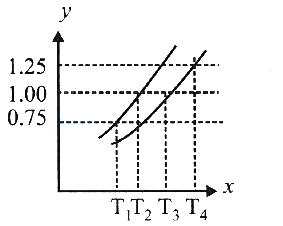
The following graph shows the vapour pressure (in $atm$) on the $y$-axis versus temperature $T$ (in $K$) on the $x$-axis for pure water and an aqueous urea solution. What is the boiling point (in $K$) of the urea solution? (Atmospheric pressure $= 1 \ atm$)
A
$T_1$
B
$T_2$
C
$T_3$
D
$T_4$
Solution
(C) Boiling occurs at the temperature where the vapour pressure of the liquid becomes equal to the external atmospheric pressure.
According to the graph,the upper curve represents pure water and the lower curve represents the aqueous urea solution (since the addition of a non-volatile solute lowers the vapour pressure).
The boiling point of the urea solution is the temperature at which its vapour pressure reaches $1.0 \ atm$.
Looking at the graph,the lower curve intersects the $1.0 \ atm$ line at temperature $T_3$.
According to the graph,the upper curve represents pure water and the lower curve represents the aqueous urea solution (since the addition of a non-volatile solute lowers the vapour pressure).
The boiling point of the urea solution is the temperature at which its vapour pressure reaches $1.0 \ atm$.
Looking at the graph,the lower curve intersects the $1.0 \ atm$ line at temperature $T_3$.
0 likes
View Solution133
MediumMCQ
What is the boiling point of a solution of $0.1 \ m$ $KCl$ (in $K$)? $K_{b}$ of water is $0.52 \ K \ kg \ mol^{-1}$ and $\alpha = 100 \ \%$ (boiling point of pure water is $373 \ K$).
A
$100.104$
B
$373.104$
C
$273.104$
D
$373.052$
Solution
(B) The boiling point elevation is given by the formula $\Delta T_{b} = i \times K_{b} \times m$.
For $KCl$,the van't Hoff factor $i = 2$ because it dissociates completely $(\alpha = 100 \ \%)$ into $K^+$ and $Cl^-$.
Given $K_{b} = 0.52 \ K \ kg \ mol^{-1}$ and $m = 0.1 \ m$.
$\Delta T_{b} = 2 \times 0.52 \times 0.1 = 0.104 \ K$.
The boiling point of the solution $T_{b} = T_{b}^{0} + \Delta T_{b} = 373 \ K + 0.104 \ K = 373.104 \ K$.
For $KCl$,the van't Hoff factor $i = 2$ because it dissociates completely $(\alpha = 100 \ \%)$ into $K^+$ and $Cl^-$.
Given $K_{b} = 0.52 \ K \ kg \ mol^{-1}$ and $m = 0.1 \ m$.
$\Delta T_{b} = 2 \times 0.52 \times 0.1 = 0.104 \ K$.
The boiling point of the solution $T_{b} = T_{b}^{0} + \Delta T_{b} = 373 \ K + 0.104 \ K = 373.104 \ K$.
0 likes
View Solution134
EasyMCQ
The molal elevation constant is the ratio of elevation in boiling point to:
A
Molarity
B
Molality
C
Mole fraction of solute
D
Mole fraction of solvent
Solution
(B) The elevation in boiling point $(\Delta T_{b})$ is directly proportional to the molality $(m)$ of the solution when a non-volatile solute is added to a volatile solvent.
$\Delta T_{b} = K_{b} \times m$
Where:
$\Delta T_{b}$ is the elevation in boiling point.
$K_{b}$ is the molal elevation constant (ebullioscopic constant).
$m$ is the molality of the solution.
Rearranging the formula:
$K_{b} = \frac{\Delta T_{b}}{m}$
Therefore,the molal elevation constant is the ratio of the elevation in boiling point to the molality.
$\Delta T_{b} = K_{b} \times m$
Where:
$\Delta T_{b}$ is the elevation in boiling point.
$K_{b}$ is the molal elevation constant (ebullioscopic constant).
$m$ is the molality of the solution.
Rearranging the formula:
$K_{b} = \frac{\Delta T_{b}}{m}$
Therefore,the molal elevation constant is the ratio of the elevation in boiling point to the molality.
0 likes
View Solution135
DifficultMCQ
If an aqueous solution contains $9 \%$ and $1 \%$ $(w/w)$ of two non-volatile non-electrolytes $X$ (molecular weight $180$) and $Y$ (molecular weight $50$) respectively,the boiling point of the solution in ${ }^{\circ} C$ is approximately $(K_b = 0.52 \ K \ kg \ mol^{-1})$
A
$101.4$
B
$100.4$
C
$102.4$
D
$100.8$
Solution
(B) Mass of solute $X = 9 \ g$,Mass of solute $Y = 1 \ g$.
Mass of solvent $= 100 - (9 + 1) = 90 \ g$.
Moles of $X = \frac{9}{180} = 0.05 \ mol$.
Moles of $Y = \frac{1}{50} = 0.02 \ mol$.
Total moles of solute $= 0.05 + 0.02 = 0.07 \ mol$.
Molality $(m) = \frac{\text{Total moles of solute}}{\text{Mass of solvent in kg}} = \frac{0.07}{0.090} \approx 0.777 \ mol \ kg^{-1}$.
Elevation in boiling point $\Delta T_b = K_b \times m = 0.52 \times 0.777 \approx 0.404 \ { }^{\circ} C$.
Boiling point of solution $= 100 + 0.404 = 100.404 \ { }^{\circ} C \approx 100.4 \ { }^{\circ} C$.
Thus,option $(B)$ is the correct answer.
Mass of solvent $= 100 - (9 + 1) = 90 \ g$.
Moles of $X = \frac{9}{180} = 0.05 \ mol$.
Moles of $Y = \frac{1}{50} = 0.02 \ mol$.
Total moles of solute $= 0.05 + 0.02 = 0.07 \ mol$.
Molality $(m) = \frac{\text{Total moles of solute}}{\text{Mass of solvent in kg}} = \frac{0.07}{0.090} \approx 0.777 \ mol \ kg^{-1}$.
Elevation in boiling point $\Delta T_b = K_b \times m = 0.52 \times 0.777 \approx 0.404 \ { }^{\circ} C$.
Boiling point of solution $= 100 + 0.404 = 100.404 \ { }^{\circ} C \approx 100.4 \ { }^{\circ} C$.
Thus,option $(B)$ is the correct answer.
0 likes
View Solution136
MediumMCQ
$x \ g$ of urea (molar mass $60 \ g \ mol^{-1}$) is completely dissolved in $y \ g$ of pure water and the solution boiled at $373.202 \ K$. If the boiling point of pure water at $1.013 \ bar$ is $373.15 \ K$,then $x:y$ is $(K_b(H_2O) = 0.52 \ K \ kg \ mol^{-1})$
A
$6.0 \times 10^{-3}$
B
$3.0 \times 10^{-3}$
C
$9.0 \times 10^{-3}$
D
$4.5 \times 10^{-3}$
Solution
(A) The elevation in boiling point is given by $\Delta T_b = T_b - T_b^{\circ} = K_b \times m$,where $m$ is the molality of the solution.
$\Delta T_b = 373.202 \ K - 373.15 \ K = 0.052 \ K$.
Using the formula $\Delta T_b = K_b \times \frac{x \times 1000}{y \times M_{\text{urea}}}$,where $M_{\text{urea}} = 60 \ g \ mol^{-1}$.
$0.052 = 0.52 \times \frac{x \times 1000}{y \times 60}$.
$0.052 = \frac{x}{y} \times \frac{520}{60}$.
$\frac{x}{y} = \frac{0.052 \times 60}{520} = \frac{3.12}{520} = 0.006 = 6.0 \times 10^{-3}$.
$\Delta T_b = 373.202 \ K - 373.15 \ K = 0.052 \ K$.
Using the formula $\Delta T_b = K_b \times \frac{x \times 1000}{y \times M_{\text{urea}}}$,where $M_{\text{urea}} = 60 \ g \ mol^{-1}$.
$0.052 = 0.52 \times \frac{x \times 1000}{y \times 60}$.
$0.052 = \frac{x}{y} \times \frac{520}{60}$.
$\frac{x}{y} = \frac{0.052 \times 60}{520} = \frac{3.12}{520} = 0.006 = 6.0 \times 10^{-3}$.
0 likes
View Solution137
EasyMCQ
When salt is added to water,which of the following statements is true?
A
Boiling point decreases
B
Boiling point increases
C
Boiling point remains constant
D
Freezing point increases
Solution
(B) This question is based on the colligative properties of solutions.
Colligative properties are those properties of a solution that depend only on the number of solute particles and not on the nature of the solute.
When a non-volatile solute like salt $(NaCl)$ is added to a solvent like water,the vapor pressure of the solution decreases.
To reach the atmospheric pressure,the solution must be heated to a higher temperature than the pure solvent.
Therefore,the boiling point of the solution is higher than the boiling point of the pure solvent,a phenomenon known as elevation in boiling point.
Colligative properties are those properties of a solution that depend only on the number of solute particles and not on the nature of the solute.
When a non-volatile solute like salt $(NaCl)$ is added to a solvent like water,the vapor pressure of the solution decreases.
To reach the atmospheric pressure,the solution must be heated to a higher temperature than the pure solvent.
Therefore,the boiling point of the solution is higher than the boiling point of the pure solvent,a phenomenon known as elevation in boiling point.
0 likes
View Solution138
EasyMCQ
The molality of an aqueous dilute solution containing a non-volatile solute is $0.1 \ m$. What is the boiling temperature (in $^{\circ}C$) of the solution? (Boiling point elevation constant,$K_b = 0.52 \ K \ kg \ mol^{-1}$; boiling temperature of water $= 100^{\circ}C$).
A
$100.0052$
B
$100.052$
C
$100$
D
$100.52$
Solution
(B) The formula for boiling point elevation is $\Delta T_b = K_b \times m$.
Given,$K_b = 0.52 \ K \ kg \ mol^{-1}$ and molality $m = 0.1 \ m$.
Calculating the elevation in boiling point: $\Delta T_b = 0.52 \times 0.1 = 0.052 \ K$ (or $^{\circ}C$).
The boiling point of the solution is $T_b = T_b^{\circ} + \Delta T_b$.
Since the boiling point of pure water $T_b^{\circ} = 100^{\circ}C$,we have $T_b = 100 + 0.052 = 100.052^{\circ}C$.
Given,$K_b = 0.52 \ K \ kg \ mol^{-1}$ and molality $m = 0.1 \ m$.
Calculating the elevation in boiling point: $\Delta T_b = 0.52 \times 0.1 = 0.052 \ K$ (or $^{\circ}C$).
The boiling point of the solution is $T_b = T_b^{\circ} + \Delta T_b$.
Since the boiling point of pure water $T_b^{\circ} = 100^{\circ}C$,we have $T_b = 100 + 0.052 = 100.052^{\circ}C$.
0 likes
View Solution139
MediumMCQ
An aqueous dilute solution containing non-volatile solute boils at $100.52^{\circ} C$. What is the molality of the solution (in $m$)? ($K_b = 0.52 \ K \ kg \ mol^{-1}$,boiling temperature of water $= 100^{\circ} C$)
A
$0.1$
B
$0.01$
C
$0.001$
D
$1.0$
Solution
(D) The elevation in boiling point is given by the formula: $\Delta T_b = K_b \cdot m$.
Here,$\Delta T_b = T_b - T_b^{\circ}$.
Given: $T_b = 100.52^{\circ} C$,$T_b^{\circ} = 100^{\circ} C$,and $K_b = 0.52 \ K \ kg \ mol^{-1}$.
Calculating the elevation: $\Delta T_b = 100.52 - 100 = 0.52 \ K$.
Substituting the values into the formula: $0.52 = 0.52 \times m$.
Therefore,$m = \frac{0.52}{0.52} = 1.0 \ m$.
Here,$\Delta T_b = T_b - T_b^{\circ}$.
Given: $T_b = 100.52^{\circ} C$,$T_b^{\circ} = 100^{\circ} C$,and $K_b = 0.52 \ K \ kg \ mol^{-1}$.
Calculating the elevation: $\Delta T_b = 100.52 - 100 = 0.52 \ K$.
Substituting the values into the formula: $0.52 = 0.52 \times m$.
Therefore,$m = \frac{0.52}{0.52} = 1.0 \ m$.
0 likes
View Solution140
MediumMCQ
To observe an elevation of boiling point of $0.05^{\circ} C$,the amount of a solute (mol. wt. $= 100$) to be added to $100 \ g$ of water $(K_{b} = 0.5)$ is (in $g$)
A
$2$
B
$0.5$
C
$1$
D
$0.75$
Solution
(C) The formula for elevation of boiling point is $\Delta T_{b} = \frac{w \times K_{b} \times 1000}{M \times W}$.
Here,$w$ is the weight of the solute,$W$ is the weight of the solvent $(100 \ g)$,$M$ is the molecular weight of the solute $(100)$,and $K_{b}$ is the ebullioscopic constant $(0.5 \ K \ kg \ mol^{-1})$.
Given $\Delta T_{b} = 0.05^{\circ} C$.
Substituting the values into the formula:
$0.05 = \frac{w \times 0.5 \times 1000}{100 \times 100}$.
$0.05 = \frac{w \times 500}{10000} = \frac{w}{20}$.
$w = 0.05 \times 20 = 1 \ g$.
Here,$w$ is the weight of the solute,$W$ is the weight of the solvent $(100 \ g)$,$M$ is the molecular weight of the solute $(100)$,and $K_{b}$ is the ebullioscopic constant $(0.5 \ K \ kg \ mol^{-1})$.
Given $\Delta T_{b} = 0.05^{\circ} C$.
Substituting the values into the formula:
$0.05 = \frac{w \times 0.5 \times 1000}{100 \times 100}$.
$0.05 = \frac{w \times 500}{10000} = \frac{w}{20}$.
$w = 0.05 \times 20 = 1 \ g$.
0 likes
View Solution141
DifficultMCQ
$58.4 \ g$ of $NaCl$ and $180 \ g$ of glucose were separately dissolved in $1000 \ mL$ of water. Identify the correct statement regarding the elevation of boiling point $(b.p.)$ of the resulting solutions.
A
$NaCl$ solution will show higher elevation of boiling point
B
Glucose solution will show higher elevation of boiling point
C
Both the solutions will show equal elevation of boiling point
D
The boiling point elevation will be shown by neither of the solutions
Solution
(A) Elevation in boiling point is given by $\Delta T_{b} = i \times K_{b} \times m$.
For $NaCl$ $(58.4 \ g \approx 1 \text{ mole})$,$i = 2$.
For glucose $(180 \ g = 1 \text{ mole})$,$i = 1$.
Since both solutes are dissolved in the same amount of solvent ($1000 \ mL \approx 1 \text{ kg}$ of water),their molality $(m)$ is the same.
Therefore,$\Delta T_{b} \propto i$.
Since $i_{NaCl} > i_{glucose}$,the $NaCl$ solution will show a higher elevation of boiling point.
For $NaCl$ $(58.4 \ g \approx 1 \text{ mole})$,$i = 2$.
For glucose $(180 \ g = 1 \text{ mole})$,$i = 1$.
Since both solutes are dissolved in the same amount of solvent ($1000 \ mL \approx 1 \text{ kg}$ of water),their molality $(m)$ is the same.
Therefore,$\Delta T_{b} \propto i$.
Since $i_{NaCl} > i_{glucose}$,the $NaCl$ solution will show a higher elevation of boiling point.
0 likes
View SolutionSolutions — Elevation of boiling point of the solvent · Frequently Asked Questions
1Are these Solutions questions useful for JEE and NEET?
Yes. All questions in this section are mapped to JEE Main and NEET exam patterns. Previous year questions from JEE Main, NEET, GUJCET and state-level exams are included with full solutions.
2Can I switch to Hindi or Gujarati for these questions?
Yes. Use the language tabs in the hero section or the sidebar to view the same questions and solutions in English, Hindi or Gujarati.
3How do I generate a question paper from this subtopic?
Use the Vedclass Exam Paper Generator — select the chapter and subtopic, set difficulty, and generate Sets A, B, C, D automatically. First 3 chapters of every subject are free.
Vedclass Products
For Students
Vedclass Test Series
Mock tests in real JEE/NEET style with performance analysis. 5-day free trial.
Start Free TrialFor Teachers
Exam Paper Generator
Generate Set A/B/C/D papers from this chapter in 2 minutes. 3 chapters free.
Try FreeFor Institutes
Online Exam Module
Live online exams with unlimited students, 360° analytics & white-label branding.
See DemoFor Teachers & Institutes
Generate a Solutions Exam Paper in 2 Minutes
Select subtopic & difficulty — Sets A, B, C, D auto-generated with No Repeat logic.
First 3 chapters of every subject are free — no payment required.