
A English
Elevation of boiling point of the solvent Questions in English
Class 12 Chemistry · Solutions · Elevation of boiling point of the solvent
141+
Questions
English
Language
100%
With Solutions
Showing 50 of 141 questions in English
51
DifficultMCQ
$1 \ g$ of non-volatile non-electrolyte solute is dissolved in $100 \ g$ of two different solvents $A$ and $B$ whose ebullioscopic constants are in the ratio of $1 : 5$. The ratio of the elevation in their boiling points,$\frac{\Delta T_b (A)}{\Delta T_b (B)}$ is
A
$5:1$
B
$10:1$
C
$1:5$
D
$1:0.2$
Solution
(C) The elevation in boiling point is given by the formula: $\Delta T_b = K_b \times m$,where $K_b$ is the ebullioscopic constant and $m$ is the molality of the solution.
Since the mass of the solute $(1 \ g)$ and the mass of the solvent $(100 \ g)$ are the same for both solvents $A$ and $B$,the molality $m$ is the same for both solutions $(m_A = m_B)$.
Therefore,the ratio of the elevation in boiling points is directly proportional to the ratio of their ebullioscopic constants:
$\frac{\Delta T_b (A)}{\Delta T_b (B)} = \frac{K_{b(A)}}{K_{b(B)}}$.
Given that the ratio of the ebullioscopic constants is $\frac{K_{b(A)}}{K_{b(B)}} = \frac{1}{5}$,the ratio of the elevation in boiling points is $1:5$.
Since the mass of the solute $(1 \ g)$ and the mass of the solvent $(100 \ g)$ are the same for both solvents $A$ and $B$,the molality $m$ is the same for both solutions $(m_A = m_B)$.
Therefore,the ratio of the elevation in boiling points is directly proportional to the ratio of their ebullioscopic constants:
$\frac{\Delta T_b (A)}{\Delta T_b (B)} = \frac{K_{b(A)}}{K_{b(B)}}$.
Given that the ratio of the ebullioscopic constants is $\frac{K_{b(A)}}{K_{b(B)}} = \frac{1}{5}$,the ratio of the elevation in boiling points is $1:5$.
0 likes
View Solution52
MediumMCQ
$13.44 \ g$ of $CuCl_2$ is dissolved in $1 \ kg$ of water. Determine the elevation in boiling point of the solution. [$K_b = 0.52 \ K \ kg \ mol^{-1}$,$mol \ wt$ of $CuCl_2 = 134.4$]
A
$0.16$
B
$0.052$
C
$0.1$
D
$0.5$
Solution
(A) Step $1$: Calculate the number of moles of $CuCl_2$: $n = \frac{13.44 \ g}{134.4 \ g \ mol^{-1}} = 0.1 \ mol$.
Step $2$: Calculate molality $(m)$: $m = \frac{0.1 \ mol}{1 \ kg} = 0.1 \ mol \ kg^{-1}$.
Step $3$: Determine the van't Hoff factor $(i)$: $CuCl_2$ dissociates as $CuCl_2 \rightarrow Cu^{2+} + 2Cl^-$. Assuming $100 \%$ ionization,$i = 3$.
Step $4$: Calculate elevation in boiling point: $\Delta T_b = i \times K_b \times m = 3 \times 0.52 \times 0.1 = 0.156 \ K \approx 0.16 \ K$.
Step $2$: Calculate molality $(m)$: $m = \frac{0.1 \ mol}{1 \ kg} = 0.1 \ mol \ kg^{-1}$.
Step $3$: Determine the van't Hoff factor $(i)$: $CuCl_2$ dissociates as $CuCl_2 \rightarrow Cu^{2+} + 2Cl^-$. Assuming $100 \%$ ionization,$i = 3$.
Step $4$: Calculate elevation in boiling point: $\Delta T_b = i \times K_b \times m = 3 \times 0.52 \times 0.1 = 0.156 \ K \approx 0.16 \ K$.
0 likes
View Solution53
MediumMCQ
Which of the following solutions will exhibit the highest boiling point?
A
$0.01 \ M \ Na_2SO_4$
B
$0.01 \ M \ KNO_3$
C
$0.015 \ M \ \text{urea}$
D
$0.015 \ M \ \text{glucose}$
Solution
(A) The elevation in boiling point is given by the formula $\Delta T_b = i \times K_b \times m$,where $i$ is the van't Hoff factor and $m$ is the molality.
Since $K_b$ is constant for a given solvent,the boiling point depends on the product $i \times m$.
For $0.01 \ M \ Na_2SO_4$,$i = 3$ $(Na_2SO_4 \rightarrow 2Na^+ + SO_4^{2-})$,so $i \times m = 3 \times 0.01 = 0.03$.
For $0.01 \ M \ KNO_3$,$i = 2$ $(KNO_3 \rightarrow K^+ + NO_3^-)$,so $i \times m = 2 \times 0.01 = 0.02$.
For $0.015 \ M \ \text{urea}$,$i = 1$ (non-electrolyte),so $i \times m = 1 \times 0.015 = 0.015$.
For $0.015 \ M \ \text{glucose}$,$i = 1$ (non-electrolyte),so $i \times m = 1 \times 0.015 = 0.015$.
Since $0.01 \ M \ Na_2SO_4$ has the highest value of $i \times m$,it will exhibit the highest boiling point.
Since $K_b$ is constant for a given solvent,the boiling point depends on the product $i \times m$.
For $0.01 \ M \ Na_2SO_4$,$i = 3$ $(Na_2SO_4 \rightarrow 2Na^+ + SO_4^{2-})$,so $i \times m = 3 \times 0.01 = 0.03$.
For $0.01 \ M \ KNO_3$,$i = 2$ $(KNO_3 \rightarrow K^+ + NO_3^-)$,so $i \times m = 2 \times 0.01 = 0.02$.
For $0.015 \ M \ \text{urea}$,$i = 1$ (non-electrolyte),so $i \times m = 1 \times 0.015 = 0.015$.
For $0.015 \ M \ \text{glucose}$,$i = 1$ (non-electrolyte),so $i \times m = 1 \times 0.015 = 0.015$.
Since $0.01 \ M \ Na_2SO_4$ has the highest value of $i \times m$,it will exhibit the highest boiling point.
0 likes
View Solution54
EasyMCQ
Which of the following aqueous solutions will exhibit the highest boiling point?
A
$0.01 \ M \ Na_2SO_4$
B
$0.01 \ M \ KNO_3$
C
$0.015 \ M$ urea
D
$0.015 \ M$ glucose
Solution
(A) The elevation in boiling point is given by the formula $\Delta T_b = i \times K_b \times m$.
Since $K_b$ is constant for the solvent,$\Delta T_b$ depends on the product of the van't Hoff factor $(i)$ and molality $(m)$.
For $0.01 \ M \ Na_2SO_4$,$i = 3$ (as it dissociates into $2Na^+ + SO_4^{2-}$),so $i \times m = 3 \times 0.01 = 0.03$.
For $0.01 \ M \ KNO_3$,$i = 2$ (as it dissociates into $K^+ + NO_3^-$),so $i \times m = 2 \times 0.01 = 0.02$.
For $0.015 \ M$ urea,$i = 1$ (non-electrolyte),so $i \times m = 1 \times 0.015 = 0.015$.
For $0.015 \ M$ glucose,$i = 1$ (non-electrolyte),so $i \times m = 1 \times 0.015 = 0.015$.
Since $0.01 \ M \ Na_2SO_4$ has the highest value of $i \times m$,it will exhibit the highest boiling point.
Since $K_b$ is constant for the solvent,$\Delta T_b$ depends on the product of the van't Hoff factor $(i)$ and molality $(m)$.
For $0.01 \ M \ Na_2SO_4$,$i = 3$ (as it dissociates into $2Na^+ + SO_4^{2-}$),so $i \times m = 3 \times 0.01 = 0.03$.
For $0.01 \ M \ KNO_3$,$i = 2$ (as it dissociates into $K^+ + NO_3^-$),so $i \times m = 2 \times 0.01 = 0.02$.
For $0.015 \ M$ urea,$i = 1$ (non-electrolyte),so $i \times m = 1 \times 0.015 = 0.015$.
For $0.015 \ M$ glucose,$i = 1$ (non-electrolyte),so $i \times m = 1 \times 0.015 = 0.015$.
Since $0.01 \ M \ Na_2SO_4$ has the highest value of $i \times m$,it will exhibit the highest boiling point.
0 likes
View Solution55
EasyMCQ
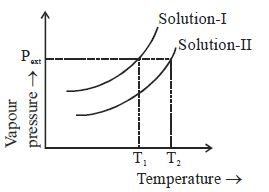
Two different solutions were prepared by dissolving sucrose in water having concentrations of $1 \ m$ and $2 \ m$ respectively. The value of $(T_2 - T_1)$ will be ........... $K$. (Given: $K_b$ for water $= 0.52 \ K \ kg \ mol^{-1}$)
A
$1$
B
$1.86$
C
$0.52$
D
$2.86$
Solution
(C) Sucrose is a non-electrolyte,so the van't Hoff factor $i = 1$.
The boiling point elevation is given by the formula: $\Delta T_b = i K_b m$.
For the first solution $(m_1 = 1 \ m)$: $\Delta T_{b_1} = T_1 - T_0 = 1 \times 0.52 \times 1 = 0.52 \ K$.
For the second solution $(m_2 = 2 \ m)$: $\Delta T_{b_2} = T_2 - T_0 = 1 \times 0.52 \times 2 = 1.04 \ K$.
Subtracting the two equations: $(T_2 - T_0) - (T_1 - T_0) = 1.04 - 0.52$.
Therefore,$T_2 - T_1 = 0.52 \ K$.
The boiling point elevation is given by the formula: $\Delta T_b = i K_b m$.
For the first solution $(m_1 = 1 \ m)$: $\Delta T_{b_1} = T_1 - T_0 = 1 \times 0.52 \times 1 = 0.52 \ K$.
For the second solution $(m_2 = 2 \ m)$: $\Delta T_{b_2} = T_2 - T_0 = 1 \times 0.52 \times 2 = 1.04 \ K$.
Subtracting the two equations: $(T_2 - T_0) - (T_1 - T_0) = 1.04 - 0.52$.
Therefore,$T_2 - T_1 = 0.52 \ K$.
0 likes
View Solution56
DifficultMCQ
$A$ solution is prepared by dissolving a $2.5 \ g$ sample of an unknown compound in $34 \ g$ of benzene,$C_6H_6$. The solution boils at $1.38 \ ^\circ C$ higher than pure benzene. Which expression gives the molar mass of the unknown compound? $K_b$ of $C_6H_6$ is $2.53 \ ^\circ C \ m^{-1}$.
A
$2.53 \times \frac{2.50}{1.38}$
B
$1.38 \times \frac{34}{2.53} \times 2.50$
C
$2.5 \times 10^3 \times \frac{2.53}{34} \times \frac{1}{1.38}$
D
$2.50 \times 10^3 \times \frac{1.38}{34} \times 2.53$
Solution
(C) The formula for the molar mass $(M_2)$ of a solute is given by:
$M_2 = \frac{1000 \times K_b \times w_2}{\Delta T_b \times w_1}$
Where:
$w_2 = 2.5 \ g$ (mass of solute)
$w_1 = 34 \ g$ (mass of solvent)
$\Delta T_b = 1.38 \ ^\circ C$ (elevation in boiling point)
$K_b = 2.53 \ ^\circ C \ m^{-1}$ (ebullioscopic constant)
Substituting the values into the formula:
$M_2 = \frac{1000 \times 2.53 \times 2.5}{1.38 \times 34}$
This can be written as:
$2.5 \times 10^3 \times \frac{2.53}{34} \times \frac{1}{1.38}$
$M_2 = \frac{1000 \times K_b \times w_2}{\Delta T_b \times w_1}$
Where:
$w_2 = 2.5 \ g$ (mass of solute)
$w_1 = 34 \ g$ (mass of solvent)
$\Delta T_b = 1.38 \ ^\circ C$ (elevation in boiling point)
$K_b = 2.53 \ ^\circ C \ m^{-1}$ (ebullioscopic constant)
Substituting the values into the formula:
$M_2 = \frac{1000 \times 2.53 \times 2.5}{1.38 \times 34}$
This can be written as:
$2.5 \times 10^3 \times \frac{2.53}{34} \times \frac{1}{1.38}$
0 likes
View Solution57
MediumMCQ
The elevation in boiling point for a $0.1 \ m$ solution of a solute in $500 \ g$ of benzene is $0.51 \ K$. If $1000 \ g$ of a $0.1 \ m$ solution of the same solute in benzene is added to the above solution,the $\Delta T_b$ for the resulting solution will be ............... $K$.
A
$0.225$
B
$1.02$
C
$1.53$
D
$0.51$
Solution
(D) The elevation in boiling point is given by the formula $\Delta T_b = K_b \times m$,where $m$ is the molality of the solution.
For the first solution: $0.51 = K_b \times 0.1$,so $K_b = 5.1 \ K \cdot kg \cdot mol^{-1}$.
When we mix two solutions of the same molality $(0.1 \ m)$,the resulting solution will also have a molality of $0.1 \ m$ because molality is an intensive property.
Since the molality $(m)$ of the resulting solution remains $0.1 \ m$,the elevation in boiling point $\Delta T_b$ will remain $K_b \times 0.1 = 5.1 \times 0.1 = 0.51 \ K$.
For the first solution: $0.51 = K_b \times 0.1$,so $K_b = 5.1 \ K \cdot kg \cdot mol^{-1}$.
When we mix two solutions of the same molality $(0.1 \ m)$,the resulting solution will also have a molality of $0.1 \ m$ because molality is an intensive property.
Since the molality $(m)$ of the resulting solution remains $0.1 \ m$,the elevation in boiling point $\Delta T_b$ will remain $K_b \times 0.1 = 5.1 \times 0.1 = 0.51 \ K$.
0 likes
View Solution58
MediumMCQ
$5 \ g$ of a non-volatile organic substance with molar mass $M_A$ is dissolved in $200 \ g$ of tetrahydrofuran. If $K_b$ is the molal elevation constant of tetrahydrofuran,then $\Delta T_b$ will be:
A
$K_b / (25 M_A)$
B
$25 K_b / M_A$
C
$5 K_b / M_A$
D
$K_b / (5 M_A)$
Solution
(B) The formula for elevation in boiling point is $\Delta T_b = K_b \times m$,where $m$ is the molality of the solution.
Molality $m = \frac{\text{moles of solute}}{\text{mass of solvent in kg}}$.
Moles of solute = $\frac{\text{mass of solute}}{\text{molar mass of solute}} = \frac{5}{M_A}$.
Mass of solvent = $200 \ g = 0.2 \ kg$.
Therefore,$m = \frac{5 / M_A}{0.2} = \frac{5}{0.2 \times M_A} = \frac{5}{M_A / 5} = \frac{25}{M_A}$.
Substituting this into the elevation formula: $\Delta T_b = K_b \times \frac{25}{M_A} = \frac{25 K_b}{M_A}$.
Molality $m = \frac{\text{moles of solute}}{\text{mass of solvent in kg}}$.
Moles of solute = $\frac{\text{mass of solute}}{\text{molar mass of solute}} = \frac{5}{M_A}$.
Mass of solvent = $200 \ g = 0.2 \ kg$.
Therefore,$m = \frac{5 / M_A}{0.2} = \frac{5}{0.2 \times M_A} = \frac{5}{M_A / 5} = \frac{25}{M_A}$.
Substituting this into the elevation formula: $\Delta T_b = K_b \times \frac{25}{M_A} = \frac{25 K_b}{M_A}$.
0 likes
View Solution59
EasyMCQ
The molal elevation constant is the ratio of the elevation of boiling point to the........
A
Mole fraction of solute
B
Mole fraction of solvent
C
Molality
D
Molarity
Solution
(C) The elevation of boiling point $(\Delta T_b)$ is given by the formula: $\Delta T_b = K_b \times m$,where $K_b$ is the molal elevation constant and $m$ is the molality of the solution.
Therefore,the molal elevation constant $K_b$ is the ratio of the elevation of boiling point $(\Delta T_b)$ to the molality $(m)$: $K_b = \frac{\Delta T_b}{m}$.
Therefore,the molal elevation constant $K_b$ is the ratio of the elevation of boiling point $(\Delta T_b)$ to the molality $(m)$: $K_b = \frac{\Delta T_b}{m}$.
0 likes
View Solution60
EasyMCQ
The boiling point of toluene is $110.7\,^oC$ and its molal elevation constant is $3.32\, K\, kg\, mol^{-1}$. The enthalpy of vaporization of liquid toluene is ............ $kJ\, mol^{-1}$.
A
$34$
B
$0.84$
C
$17$
D
$0.51$
Solution
(A) The molal elevation constant $(K_b)$ is related to the enthalpy of vaporization $(\Delta_{vap}H)$ by the formula: $K_b = \frac{R \times T_b^2 \times M}{1000 \times \Delta_{vap}H}$.
Here,$T_b = 110.7 273.15 = 383.85\, K$.
$R = 8.314\, J\, K^{-1}\, mol^{-1}$.
$M$ (molar mass of toluene,$C_7H_8$) = $92\, g\, mol^{-1}$.
Rearranging for $\Delta_{vap}H$: $\Delta_{vap}H = \frac{R \times T_b^2 \times M}{1000 \times K_b}$.
$\Delta_{vap}H = \frac{8.314 \times (383.85)^2 \times 92}{1000 \times 3.32}$.
$\Delta_{vap}H = \frac{8.314 \times 147340.82 \times 92}{3320} \approx 33945\, J\, mol^{-1} \approx 34\, kJ\, mol^{-1}$.
Here,$T_b = 110.7 273.15 = 383.85\, K$.
$R = 8.314\, J\, K^{-1}\, mol^{-1}$.
$M$ (molar mass of toluene,$C_7H_8$) = $92\, g\, mol^{-1}$.
Rearranging for $\Delta_{vap}H$: $\Delta_{vap}H = \frac{R \times T_b^2 \times M}{1000 \times K_b}$.
$\Delta_{vap}H = \frac{8.314 \times (383.85)^2 \times 92}{1000 \times 3.32}$.
$\Delta_{vap}H = \frac{8.314 \times 147340.82 \times 92}{3320} \approx 33945\, J\, mol^{-1} \approx 34\, kJ\, mol^{-1}$.
0 likes
View Solution61
DifficultMCQ
When $0.5 \ g$ of anthracene is dissolved in $35 \ g$ of chloroform,the boiling point increases by $0.3 \ K$. If the $K_b$ value for $CHCl_3$ is $3.9 \ K \ kg \ mol^{-1}$,the experimental molar mass of anthracene is ......... $g \ mol^{-1}$.
A
$178$
B
$185.7$
C
$212.5$
D
$192$
Solution
(B) The formula for the elevation of boiling point is $\Delta T_b = K_b \times m$,where $m$ is the molality of the solution.
Molality $m = \frac{w_2 \times 1000}{M_2 \times w_1}$,where $w_2$ is the mass of solute,$M_2$ is the molar mass of solute,and $w_1$ is the mass of solvent in grams.
Given: $\Delta T_b = 0.3 \ K$,$w_2 = 0.5 \ g$,$w_1 = 35 \ g$,$K_b = 3.9 \ K \ kg \ mol^{-1}$.
Substituting the values: $0.3 = \frac{3.9 \times 0.5 \times 1000}{M_2 \times 35}$.
$M_2 = \frac{3.9 \times 0.5 \times 1000}{0.3 \times 35} = \frac{1950}{10.5} \approx 185.7 \ g \ mol^{-1}$.
Molality $m = \frac{w_2 \times 1000}{M_2 \times w_1}$,where $w_2$ is the mass of solute,$M_2$ is the molar mass of solute,and $w_1$ is the mass of solvent in grams.
Given: $\Delta T_b = 0.3 \ K$,$w_2 = 0.5 \ g$,$w_1 = 35 \ g$,$K_b = 3.9 \ K \ kg \ mol^{-1}$.
Substituting the values: $0.3 = \frac{3.9 \times 0.5 \times 1000}{M_2 \times 35}$.
$M_2 = \frac{3.9 \times 0.5 \times 1000}{0.3 \times 35} = \frac{1950}{10.5} \approx 185.7 \ g \ mol^{-1}$.
0 likes
View Solution62
DifficultMCQ
$0.15 \ g$ of a solute is dissolved in $15 \ g$ of a solvent. If the solution boils at a temperature $0.215 \ K$ higher than the boiling point of the pure solvent,what is the molar mass of the solute? $(K_b = 2.15 \ K \ kg \ mol^{-1})$
A
$10$
B
$100$
C
$151$
D
$215$
Solution
(B) The formula for elevation in boiling point is $\Delta T_b = K_b \times m$,where $m$ is the molality.
Molality $m = \frac{w_2 \times 1000}{M_2 \times w_1}$,where $w_2$ is the mass of solute,$M_2$ is the molar mass of solute,and $w_1$ is the mass of solvent in grams.
Given: $\Delta T_b = 0.215 \ K$,$w_2 = 0.15 \ g$,$w_1 = 15 \ g$,$K_b = 2.15 \ K \ kg \ mol^{-1}$.
Substituting the values: $0.215 = \frac{2.15 \times 0.15 \times 1000}{M_2 \times 15}$.
$0.215 = \frac{2.15 \times 150}{M_2 \times 15}$.
$0.215 = \frac{2.15 \times 10}{M_2}$.
$M_2 = \frac{21.5}{0.215} = 100 \ g \ mol^{-1}$.
Molality $m = \frac{w_2 \times 1000}{M_2 \times w_1}$,where $w_2$ is the mass of solute,$M_2$ is the molar mass of solute,and $w_1$ is the mass of solvent in grams.
Given: $\Delta T_b = 0.215 \ K$,$w_2 = 0.15 \ g$,$w_1 = 15 \ g$,$K_b = 2.15 \ K \ kg \ mol^{-1}$.
Substituting the values: $0.215 = \frac{2.15 \times 0.15 \times 1000}{M_2 \times 15}$.
$0.215 = \frac{2.15 \times 150}{M_2 \times 15}$.
$0.215 = \frac{2.15 \times 10}{M_2}$.
$M_2 = \frac{21.5}{0.215} = 100 \ g \ mol^{-1}$.
0 likes
View Solution63
EasyMCQ
If the enthalpy of vaporization is approximately the same,for which of the following will the value of the ebullioscopic constant $(K_b)$ be maximum?
A
Naphthalene
B
Toluene
C
Benzene
D
Water
Solution
(A) The ebullioscopic constant $(K_b)$ is given by the formula: $K_b = \frac{R \cdot M_1 \cdot T_b^2}{1000 \cdot \Delta H_{vap}}$.
Here,$R$ is the gas constant,$M_1$ is the molar mass of the solvent,$T_b$ is the boiling point of the solvent,and $\Delta H_{vap}$ is the enthalpy of vaporization.
Given that $\Delta H_{vap}$ is approximately the same for all,$K_b$ is directly proportional to $M_1 \cdot T_b^2$.
Comparing the molar masses $(M_1)$ and boiling points $(T_b)$:
$1$. Naphthalene $(C_{10}H_8)$: $M_1 = 128 \ g/mol$,$T_b = 491 \ K$
$2$. Toluene $(C_7H_8)$: $M_1 = 92 \ g/mol$,$T_b = 384 \ K$
$3$. Benzene $(C_6H_6)$: $M_1 = 78 \ g/mol$,$T_b = 353 \ K$
$4$. Water $(H_2O)$: $M_1 = 18 \ g/mol$,$T_b = 373 \ K$
Calculating the product $M_1 \cdot T_b^2$ shows that Naphthalene has the highest value due to its high molar mass and high boiling point.
Here,$R$ is the gas constant,$M_1$ is the molar mass of the solvent,$T_b$ is the boiling point of the solvent,and $\Delta H_{vap}$ is the enthalpy of vaporization.
Given that $\Delta H_{vap}$ is approximately the same for all,$K_b$ is directly proportional to $M_1 \cdot T_b^2$.
Comparing the molar masses $(M_1)$ and boiling points $(T_b)$:
$1$. Naphthalene $(C_{10}H_8)$: $M_1 = 128 \ g/mol$,$T_b = 491 \ K$
$2$. Toluene $(C_7H_8)$: $M_1 = 92 \ g/mol$,$T_b = 384 \ K$
$3$. Benzene $(C_6H_6)$: $M_1 = 78 \ g/mol$,$T_b = 353 \ K$
$4$. Water $(H_2O)$: $M_1 = 18 \ g/mol$,$T_b = 373 \ K$
Calculating the product $M_1 \cdot T_b^2$ shows that Naphthalene has the highest value due to its high molar mass and high boiling point.
0 likes
View Solution64
EasyMCQ
When $3 \ g$ of a non-volatile solute is dissolved in $200 \ mL$ of water, the boiling point of the solution becomes $100.52 \ ^oC$. If $K_b$ for water is $0.6 \ K \ kg \ mol^{-1}$, the molar mass of the solute is ......... $g \ mol^{-1}$.
A
$10.5$
B
$12.6$
C
$15.7$
D
$17.3$
Solution
(D) Given: Mass of solute $(w_2)$ = $3 \ g$, Volume of water = $200 \ mL$, so Mass of solvent $(w_1)$ = $200 \ g = 0.2 \ kg$.
Boiling point of solution $(T_b)$ = $100.52 \ ^oC$, Boiling point of pure water $(T_b^o)$ = $100 \ ^oC$.
Elevation in boiling point $(\Delta T_b)$ = $T_b - T_b^o = 100.52 - 100 = 0.52 \ K$.
Formula: $\Delta T_b = K_b \times m = K_b \times \frac{w_2 \times 1000}{M_2 \times w_1}$.
Substituting values: $0.52 = 0.6 \times \frac{3 \times 1000}{M_2 \times 200}$.
$0.52 = 0.6 \times \frac{15}{M_2}$.
$M_2 = \frac{0.6 \times 15}{0.52} = \frac{9}{0.52} \approx 17.3 \ g \ mol^{-1}$.
Boiling point of solution $(T_b)$ = $100.52 \ ^oC$, Boiling point of pure water $(T_b^o)$ = $100 \ ^oC$.
Elevation in boiling point $(\Delta T_b)$ = $T_b - T_b^o = 100.52 - 100 = 0.52 \ K$.
Formula: $\Delta T_b = K_b \times m = K_b \times \frac{w_2 \times 1000}{M_2 \times w_1}$.
Substituting values: $0.52 = 0.6 \times \frac{3 \times 1000}{M_2 \times 200}$.
$0.52 = 0.6 \times \frac{15}{M_2}$.
$M_2 = \frac{0.6 \times 15}{0.52} = \frac{9}{0.52} \approx 17.3 \ g \ mol^{-1}$.
0 likes
View Solution65
DifficultMCQ
Exactly $1 \ g$ of urea dissolved in $75 \ g$ of water gives a solution that boils at $100.114 \ ^oC$ at $760 \ torr$. The molecular weight of urea is $60.1$. The boiling point elevation constant for water is
A
$1.02$
B
$0.51$
C
$3.06$
D
$1.51$
Solution
(B) Weight of solute $(w) = 1 \ g$
Weight of solvent $(W) = 75 \ g$
Boiling point of solution $= 100.114 \ ^oC$
Boiling point of solvent $= 100 \ ^oC$
$\Delta T = 100.114 - 100 = 0.114 \ ^oC$
Molecular weight of solute $(m) = 60.1$
Boiling point elevation constant $(K_b) = ?$
The formula for boiling point elevation is $\Delta T = K_b \times m_{olality} = K_b \times \frac{w \times 1000}{m \times W}$
Rearranging for $K_b$: $K_b = \frac{\Delta T \times m \times W}{w \times 1000}$
$K_b = \frac{0.114 \times 60.1 \times 75}{1 \times 1000}$
$K_b = \frac{513.855}{1000} \approx 0.513 \ ^oC \ kg \ mol^{-1}$
Weight of solvent $(W) = 75 \ g$
Boiling point of solution $= 100.114 \ ^oC$
Boiling point of solvent $= 100 \ ^oC$
$\Delta T = 100.114 - 100 = 0.114 \ ^oC$
Molecular weight of solute $(m) = 60.1$
Boiling point elevation constant $(K_b) = ?$
The formula for boiling point elevation is $\Delta T = K_b \times m_{olality} = K_b \times \frac{w \times 1000}{m \times W}$
Rearranging for $K_b$: $K_b = \frac{\Delta T \times m \times W}{w \times 1000}$
$K_b = \frac{0.114 \times 60.1 \times 75}{1 \times 1000}$
$K_b = \frac{513.855}{1000} \approx 0.513 \ ^oC \ kg \ mol^{-1}$
0 likes
View Solution66
MediumMCQ
$18 \ g$ of glucose,$C_6H_{12}O_6$,is dissolved in $1 \ kg$ of water in a saucepan. At what temperature will water boil at $1.013 \ bar$ (in $K$)? $K_b$ for water is $0.52 \ K \ kg \ mol^{-1}$.
A
$373.202$
B
$373.15$
C
$373.52$
D
$374.202$
Solution
(A) $1$. Calculate the moles of glucose: $\text{Moles} = \frac{18 \ g}{180 \ g \ mol^{-1}} = 0.1 \ mol$.
$2$. Determine the molality $(m)$ of the solution: $m = \frac{0.1 \ mol}{1 \ kg} = 0.1 \ mol \ kg^{-1}$.
$3$. Calculate the elevation in boiling point $(\Delta T_b)$: $\Delta T_b = K_b \times m = 0.52 \ K \ kg \ mol^{-1} \times 0.1 \ mol \ kg^{-1} = 0.052 \ K$.
$4$. Determine the boiling point of the solution: $T_b = T_b^0 + \Delta T_b = 373.15 \ K + 0.052 \ K = 373.202 \ K$.
$2$. Determine the molality $(m)$ of the solution: $m = \frac{0.1 \ mol}{1 \ kg} = 0.1 \ mol \ kg^{-1}$.
$3$. Calculate the elevation in boiling point $(\Delta T_b)$: $\Delta T_b = K_b \times m = 0.52 \ K \ kg \ mol^{-1} \times 0.1 \ mol \ kg^{-1} = 0.052 \ K$.
$4$. Determine the boiling point of the solution: $T_b = T_b^0 + \Delta T_b = 373.15 \ K + 0.052 \ K = 373.202 \ K$.
0 likes
View Solution67
Medium
The boiling point of benzene is $353.23 \, K$. When $1.80 \, g$ of a non-volatile solute was dissolved in $90 \, g$ of benzene,the boiling point is raised to $354.11 \, K$. Calculate the molar mass of the solute. $K_{b}$ for benzene is $2.53 \, K \, kg \, mol^{-1}$.
Solution
(N/A) The elevation in boiling point $(\Delta T_{b})$ is given by: $\Delta T_{b} = T_{b} - T_{b}^{\circ} = 354.11 \, K - 353.23 \, K = 0.88 \, K$.
The formula for molar mass $(M_{2})$ of the solute is: $M_{2} = \frac{K_{b} \times w_{2} \times 1000}{\Delta T_{b} \times w_{1}}$.
Substituting the given values: $M_{2} = \frac{2.53 \, K \, kg \, mol^{-1} \times 1.80 \, g \times 1000 \, g \, kg^{-1}}{0.88 \, K \times 90 \, g} = 58 \, g \, mol^{-1}$.
Thus,the molar mass of the solute is $58 \, g \, mol^{-1}$.
The formula for molar mass $(M_{2})$ of the solute is: $M_{2} = \frac{K_{b} \times w_{2} \times 1000}{\Delta T_{b} \times w_{1}}$.
Substituting the given values: $M_{2} = \frac{2.53 \, K \, kg \, mol^{-1} \times 1.80 \, g \times 1000 \, g \, kg^{-1}}{0.88 \, K \times 90 \, g} = 58 \, g \, mol^{-1}$.
Thus,the molar mass of the solute is $58 \, g \, mol^{-1}$.
0 likes
View Solution68
Medium
Boiling point of water at $750 \, mm \, Hg$ is $99.63^{\circ} \, C$. How much sucrose is to be added to $500 \, g$ of water such that it boils at $100^{\circ} \, C$?
Solution
(D) The elevation in boiling point is $\Delta T_{b} = 100^{\circ} \, C - 99.63^{\circ} \, C = 0.37 \, K$.
Mass of solvent $(w_{1}) = 500 \, g$.
Molar mass of sucrose $(C_{12}H_{22}O_{11}) (M_{2}) = 342 \, g \, mol^{-1}$.
Molal elevation constant $(K_{b})$ for water is $0.52 \, K \, kg \, mol^{-1}$.
Using the formula $\Delta T_{b} = \frac{K_{b} \times 1000 \times w_{2}}{M_{2} \times w_{1}}$,we get:
$w_{2} = \frac{\Delta T_{b} \times M_{2} \times w_{1}}{K_{b} \times 1000} = \frac{0.37 \times 342 \times 500}{0.52 \times 1000} \approx 121.67 \, g$.
Thus,$121.67 \, g$ of sucrose must be added.
Mass of solvent $(w_{1}) = 500 \, g$.
Molar mass of sucrose $(C_{12}H_{22}O_{11}) (M_{2}) = 342 \, g \, mol^{-1}$.
Molal elevation constant $(K_{b})$ for water is $0.52 \, K \, kg \, mol^{-1}$.
Using the formula $\Delta T_{b} = \frac{K_{b} \times 1000 \times w_{2}}{M_{2} \times w_{1}}$,we get:
$w_{2} = \frac{\Delta T_{b} \times M_{2} \times w_{1}}{K_{b} \times 1000} = \frac{0.37 \times 342 \times 500}{0.52 \times 1000} \approx 121.67 \, g$.
Thus,$121.67 \, g$ of sucrose must be added.
0 likes
View Solution69
Medium
What is elevation in boiling point? Explain.
Solution
(N/A) The boiling point of a liquid is the temperature at which its vapour pressure becomes equal to the atmospheric pressure $(1.013 \ bar)$.
When a non-volatile solute is added to a pure solvent,the vapour pressure of the resulting solution decreases compared to the pure solvent at the same temperature.
Because the vapour pressure of the solution is lower,it must be heated to a higher temperature to reach the atmospheric pressure $(1.013 \ bar)$.
This increase in the boiling point of the solution compared to the pure solvent is known as the elevation in boiling point,denoted by $\Delta T_b$.
When a non-volatile solute is added to a pure solvent,the vapour pressure of the resulting solution decreases compared to the pure solvent at the same temperature.
Because the vapour pressure of the solution is lower,it must be heated to a higher temperature to reach the atmospheric pressure $(1.013 \ bar)$.
This increase in the boiling point of the solution compared to the pure solvent is known as the elevation in boiling point,denoted by $\Delta T_b$.
0 likes
View Solution70
Advanced
What is molal elevation? Explain.
Solution
(N/A) The elevation in boiling point is defined as the increase in the boiling point of a solution when $1 \ mol$ of a non-volatile solute is dissolved in $1 \ kg$ of solvent.
The boiling point of a solution is always higher than that of the pure solvent. This elevation depends on the number of solute particles rather than their nature.
Let $T_{b}^{0}$ be the boiling point of the pure solvent and $T_{b}$ be the boiling point of the solution. The increase in boiling point is given by $\Delta T_{b} = T_{b} - T_{b}^{0}$.
For dilute solutions,the elevation of boiling point $(\Delta T_{b})$ is directly proportional to the molal concentration $(m)$ of the solute:
$\Delta T_{b} \propto m$
$\Delta T_{b} = K_{b} \times m$
Where $K_{b}$ is the Boiling Point Elevation Constant or Ebullioscopic Constant. Its unit is $K \ kg \ mol^{-1}$.
If $w_{2}$ grams of solute with molar mass $M_{2}$ are dissolved in $w_{1}$ grams of solvent,the molality $(m)$ is:
$m = \frac{w_{2} \times 1000}{M_{2} \times w_{1}}$
Substituting $m$ into the equation for $\Delta T_{b}$:
$\Delta T_{b} = \frac{K_{b} \times 1000 \times w_{2}}{M_{2} \times w_{1}}$
Rearranging to find the molar mass of the solute:
$M_{2} = \frac{1000 \times w_{2} \times K_{b}}{\Delta T_{b} \times w_{1}}$
The boiling point of a solution is always higher than that of the pure solvent. This elevation depends on the number of solute particles rather than their nature.
Let $T_{b}^{0}$ be the boiling point of the pure solvent and $T_{b}$ be the boiling point of the solution. The increase in boiling point is given by $\Delta T_{b} = T_{b} - T_{b}^{0}$.
For dilute solutions,the elevation of boiling point $(\Delta T_{b})$ is directly proportional to the molal concentration $(m)$ of the solute:
$\Delta T_{b} \propto m$
$\Delta T_{b} = K_{b} \times m$
Where $K_{b}$ is the Boiling Point Elevation Constant or Ebullioscopic Constant. Its unit is $K \ kg \ mol^{-1}$.
If $w_{2}$ grams of solute with molar mass $M_{2}$ are dissolved in $w_{1}$ grams of solvent,the molality $(m)$ is:
$m = \frac{w_{2} \times 1000}{M_{2} \times w_{1}}$
Substituting $m$ into the equation for $\Delta T_{b}$:
$\Delta T_{b} = \frac{K_{b} \times 1000 \times w_{2}}{M_{2} \times w_{1}}$
Rearranging to find the molar mass of the solute:
$M_{2} = \frac{1000 \times w_{2} \times K_{b}}{\Delta T_{b} \times w_{1}}$
0 likes
View Solution71
EasyMCQ
Give the unit for the molal elevation constant in boiling point.
A
$K \ kg \ mol^{-1}$
B
$K \ m^{-1}$
C
$K \ kg \ mol$
D
$K \ mol \ kg^{-1}$
Solution
(A) The molal elevation constant $(K_b)$ is defined by the equation: $\Delta T_b = K_b \times m$,where $\Delta T_b$ is the elevation in boiling point $(K)$ and $m$ is the molality $(mol \ kg^{-1})$.
Rearranging for $K_b$: $K_b = \frac{\Delta T_b}{m} = \frac{K}{mol \ kg^{-1}} = K \ kg \ mol^{-1}$.
Thus,the unit is $K \ kg \ mol^{-1}$.
Rearranging for $K_b$: $K_b = \frac{\Delta T_b}{m} = \frac{K}{mol \ kg^{-1}} = K \ kg \ mol^{-1}$.
Thus,the unit is $K \ kg \ mol^{-1}$.
0 likes
View Solution72
MediumMCQ
Give the formula for the boiling point elevation constant $(K_b)$.
A
$K_b = \frac{R \times M_1 \times T_b^2}{1000 \times \Delta_{vap}H}$
B
$K_b = \frac{R \times M_1 \times T_b}{1000 \times \Delta_{vap}H}$
C
$K_b = \frac{R \times T_b^2}{1000 \times \Delta_{vap}H}$
D
$K_b = \frac{M_1 \times T_b^2}{1000 \times \Delta_{vap}H}$
Solution
(A) The boiling point elevation constant $(K_b)$,also known as the ebullioscopic constant,is defined by the formula:
$K_b = \frac{R \times M_1 \times T_b^2}{1000 \times \Delta_{vap}H}$
Where:
$R$ is the universal gas constant,
$M_1$ is the molar mass of the solvent,
$T_b$ is the boiling point of the pure solvent in Kelvin,
$\Delta_{vap}H$ is the enthalpy of vaporization of the solvent.
$K_b = \frac{R \times M_1 \times T_b^2}{1000 \times \Delta_{vap}H}$
Where:
$R$ is the universal gas constant,
$M_1$ is the molar mass of the solvent,
$T_b$ is the boiling point of the pure solvent in Kelvin,
$\Delta_{vap}H$ is the enthalpy of vaporization of the solvent.
0 likes
View Solution73
Easy
Explain why on addition of $1 \ mol$ of $NaCl$ to $1 \ litre$ of water,the boiling point of water increases,while addition of $1 \ mol$ of methyl alcohol to one litre of water decreases its boiling point.
Solution
(N/A) The boiling point of a liquid depends on its vapor pressure relative to the atmospheric pressure. At a fixed atmospheric pressure,a lower vapor pressure leads to a higher boiling point,and vice-versa.
$NaCl$ is a non-volatile solute. When added to water,it occupies the surface area and reduces the escaping tendency of water molecules,thereby lowering the vapor pressure of the solution. Consequently,the boiling point of water increases.
Conversely,methyl alcohol $(CH_3OH)$ is more volatile than water. Its addition increases the total vapor pressure of the solution,which leads to a decrease in the boiling point of the resulting mixture.
$NaCl$ is a non-volatile solute. When added to water,it occupies the surface area and reduces the escaping tendency of water molecules,thereby lowering the vapor pressure of the solution. Consequently,the boiling point of water increases.
Conversely,methyl alcohol $(CH_3OH)$ is more volatile than water. Its addition increases the total vapor pressure of the solution,which leads to a decrease in the boiling point of the resulting mixture.
0 likes
View Solution74
MediumMCQ
If the boiling point of water is $100 \,^{\circ}C$,how many grams of $NaCl$ must be added to $500 \,g$ of water to increase the boiling point by approximately $1 \,^{\circ}C$ (in $,g$)? Given $(K_{b})_{H_2O} = 0.52 \,K \cdot kg/mol$.
A
$2.182$
B
$7.03$
C
$14.06$
D
$28.12$
Solution
(D) The elevation in boiling point is given by the formula: $\Delta T_{b} = i \times K_{b} \times m$.
For $NaCl$,the van't Hoff factor $i = 2$.
The molality $m$ is defined as: $m = \frac{W_{NaCl} \times 1000}{M_{NaCl} \times W_{H_2O(g)}}$.
Given $\Delta T_{b} = 1 \,K$,$K_{b} = 0.52 \,K \cdot kg/mol$,$M_{NaCl} = 58.5 \,g/mol$,and $W_{H_2O} = 500 \,g$.
Substituting the values: $1 = 2 \times 0.52 \times \frac{W_{NaCl} \times 1000}{58.5 \times 500}$.
Solving for $W_{NaCl}$: $W_{NaCl} = \frac{1 \times 58.5 \times 500}{2 \times 0.52 \times 1000} = 28.125 \,g$.
For $NaCl$,the van't Hoff factor $i = 2$.
The molality $m$ is defined as: $m = \frac{W_{NaCl} \times 1000}{M_{NaCl} \times W_{H_2O(g)}}$.
Given $\Delta T_{b} = 1 \,K$,$K_{b} = 0.52 \,K \cdot kg/mol$,$M_{NaCl} = 58.5 \,g/mol$,and $W_{H_2O} = 500 \,g$.
Substituting the values: $1 = 2 \times 0.52 \times \frac{W_{NaCl} \times 1000}{58.5 \times 500}$.
Solving for $W_{NaCl}$: $W_{NaCl} = \frac{1 \times 58.5 \times 500}{2 \times 0.52 \times 1000} = 28.125 \,g$.
0 likes
View Solution75
EasyMCQ
When $3.00 \, g$ of a substance $'X'$ is dissolved in $100 \, g$ of $CCl_4$,it raises the boiling point by $0.60 \, K$. The molar mass of the substance $'X'$ is $..... \, g \, mol^{-1}$. (Nearest integer).
$[$ Given $K_b$ for $CCl_4$ is $5.0 \, K \, kg \, mol^{-1} ]$
$[$ Given $K_b$ for $CCl_4$ is $5.0 \, K \, kg \, mol^{-1} ]$
A
$250$
B
$425$
C
$124$
D
$854$
Solution
(A) The formula for elevation in boiling point is $\Delta T_b = K_b \times m$,where $m$ is the molality of the solution.
Molality $m = \frac{\text{moles of solute}}{\text{mass of solvent in kg}} = \frac{3.00 / M}{100 / 1000} = \frac{30}{M} \, mol \, kg^{-1}$.
Given $\Delta T_b = 0.60 \, K$ and $K_b = 5.0 \, K \, kg \, mol^{-1}$.
Substituting the values: $0.60 = 5.0 \times \left( \frac{30}{M} \right)$.
$0.60 = \frac{150}{M}$.
$M = \frac{150}{0.60} = 250 \, g \, mol^{-1}$.
Molality $m = \frac{\text{moles of solute}}{\text{mass of solvent in kg}} = \frac{3.00 / M}{100 / 1000} = \frac{30}{M} \, mol \, kg^{-1}$.
Given $\Delta T_b = 0.60 \, K$ and $K_b = 5.0 \, K \, kg \, mol^{-1}$.
Substituting the values: $0.60 = 5.0 \times \left( \frac{30}{M} \right)$.
$0.60 = \frac{150}{M}$.
$M = \frac{150}{0.60} = 250 \, g \, mol^{-1}$.
0 likes
View Solution76
MediumMCQ
$A$ solution containing $2.5 \times 10^{-3} \ kg$ of a solute dissolved in $75 \times 10^{-3} \ kg$ of water boils at $373.535 \ K$. The molar mass of the solute is $..... \ g \ mol^{-1}$. [nearest integer] (Given: $K_b(H_2O) = 0.52 \ K \ kg \ mol^{-1}$,boiling point of water $= 373.15 \ K$)
A
$50$
B
$93$
C
$10$
D
$45$
Solution
(D) Given:
Mass of solute $(w_2)$ $= 2.5 \times 10^{-3} \ kg = 2.5 \ g$
Mass of solvent $(w_1)$ $= 75 \times 10^{-3} \ kg = 75 \ g$
$K_b = 0.52 \ K \ kg \ mol^{-1}$
Boiling point of solution $(T_b)$ $= 373.535 \ K$
Boiling point of pure water $(T_b^o)$ $= 373.15 \ K$
Elevation in boiling point $(\Delta T_b)$ $= T_b - T_b^o = 373.535 - 373.15 = 0.385 \ K$
Formula: $\Delta T_b = K_b \times \frac{w_2 \times 1000}{M_2 \times w_1}$
$0.385 = 0.52 \times \frac{2.5 \times 1000}{M_2 \times 75}$
$M_2 = \frac{0.52 \times 2500}{0.385 \times 75} = \frac{1300}{28.875} \approx 45.02 \ g \ mol^{-1}$
Rounding to the nearest integer,the molar mass is $45 \ g \ mol^{-1}$.
Mass of solute $(w_2)$ $= 2.5 \times 10^{-3} \ kg = 2.5 \ g$
Mass of solvent $(w_1)$ $= 75 \times 10^{-3} \ kg = 75 \ g$
$K_b = 0.52 \ K \ kg \ mol^{-1}$
Boiling point of solution $(T_b)$ $= 373.535 \ K$
Boiling point of pure water $(T_b^o)$ $= 373.15 \ K$
Elevation in boiling point $(\Delta T_b)$ $= T_b - T_b^o = 373.535 - 373.15 = 0.385 \ K$
Formula: $\Delta T_b = K_b \times \frac{w_2 \times 1000}{M_2 \times w_1}$
$0.385 = 0.52 \times \frac{2.5 \times 1000}{M_2 \times 75}$
$M_2 = \frac{0.52 \times 2500}{0.385 \times 75} = \frac{1300}{28.875} \approx 45.02 \ g \ mol^{-1}$
Rounding to the nearest integer,the molar mass is $45 \ g \ mol^{-1}$.
0 likes
View Solution77
MediumMCQ
$2 \, g$ of a non-volatile non-electrolyte solute is dissolved in $200 \, g$ of two different solvents $A$ and $B$ whose ebullioscopic constants are in the ratio of $1: 8$. The elevation in boiling points of $A$ and $B$ are in the ratio $\frac{x}{y} (x: y)$. The value of $y$ is .... (Nearest integer)
A
$8$
B
$16$
C
$4$
D
$24$
Solution
(A) The elevation in boiling point is given by the formula $\Delta T_b = K_b \cdot m$,where $K_b$ is the ebullioscopic constant and $m$ is the molality of the solution.
Since the mass of the solute and the mass of the solvent are the same for both solutions,the molality $m$ is identical for both solvents $A$ and $B$.
Given the ratio of ebullioscopic constants $\frac{(K_b)_A}{(K_b)_B} = \frac{1}{8}$.
Therefore,the ratio of the elevation in boiling points is $\frac{(\Delta T_b)_A}{(\Delta T_b)_B} = \frac{(K_b)_A \cdot m}{(K_b)_B \cdot m} = \frac{(K_b)_A}{(K_b)_B} = \frac{1}{8}$.
Comparing this to $\frac{x}{y}$,we get $x = 1$ and $y = 8$.
The value of $y$ is $8$.
Since the mass of the solute and the mass of the solvent are the same for both solutions,the molality $m$ is identical for both solvents $A$ and $B$.
Given the ratio of ebullioscopic constants $\frac{(K_b)_A}{(K_b)_B} = \frac{1}{8}$.
Therefore,the ratio of the elevation in boiling points is $\frac{(\Delta T_b)_A}{(\Delta T_b)_B} = \frac{(K_b)_A \cdot m}{(K_b)_B \cdot m} = \frac{(K_b)_A}{(K_b)_B} = \frac{1}{8}$.
Comparing this to $\frac{x}{y}$,we get $x = 1$ and $y = 8$.
The value of $y$ is $8$.
0 likes
View Solution78
MediumMCQ
Boiling point of a $2\%$ aqueous solution of a non-volatile solute $A$ is equal to the boiling point of an $8\%$ aqueous solution of a non-volatile solute $B$. The relation between molecular weights of $A$ and $B$ is:
A
$M_A = 4M_B$
B
$M_B = 4M_A$
C
$M_A = 8M_B$
D
$M_B = 8M_A$
Solution
(B) For a dilute aqueous solution,the elevation in boiling point is given by $\Delta T_B = K_B \times m$,where $m$ is the molality.
Since the boiling points are equal,the elevation in boiling point is the same,so the molalities must be equal: $m_A = m_B$.
For $A$: $2 \ g$ of solute in $98 \ g$ of solvent. Molality $m_A = \frac{2 / M_A}{98 / 1000} = \frac{2000}{98 M_A}$.
For $B$: $8 \ g$ of solute in $92 \ g$ of solvent. Molality $m_B = \frac{8 / M_B}{92 / 1000} = \frac{8000}{92 M_B}$.
Equating $m_A = m_B$: $\frac{2000}{98 M_A} = \frac{8000}{92 M_B}$.
$\frac{1}{98 M_A} = \frac{4}{92 M_B}$.
$M_B = \frac{4 \times 98}{92} M_A = \frac{392}{92} M_A \approx 4.26 M_A$.
Given the standard approximation often used in such problems where the mass of solvent is taken as $100 \ g$ (assuming dilute solution),the ratio becomes $\frac{2/M_A}{100} = \frac{8/M_B}{100}$,which leads to $M_B = 4M_A$.
Since the boiling points are equal,the elevation in boiling point is the same,so the molalities must be equal: $m_A = m_B$.
For $A$: $2 \ g$ of solute in $98 \ g$ of solvent. Molality $m_A = \frac{2 / M_A}{98 / 1000} = \frac{2000}{98 M_A}$.
For $B$: $8 \ g$ of solute in $92 \ g$ of solvent. Molality $m_B = \frac{8 / M_B}{92 / 1000} = \frac{8000}{92 M_B}$.
Equating $m_A = m_B$: $\frac{2000}{98 M_A} = \frac{8000}{92 M_B}$.
$\frac{1}{98 M_A} = \frac{4}{92 M_B}$.
$M_B = \frac{4 \times 98}{92} M_A = \frac{392}{92} M_A \approx 4.26 M_A$.
Given the standard approximation often used in such problems where the mass of solvent is taken as $100 \ g$ (assuming dilute solution),the ratio becomes $\frac{2/M_A}{100} = \frac{8/M_B}{100}$,which leads to $M_B = 4M_A$.
0 likes
View Solution79
MediumMCQ
$18 \, g$ of glucose $(C_{6}H_{12}O_{6})$ dissolved in $1 \, kg$ of water is heated to boiling. The boiling point (in $K$) measured at $1 \, atm$ pressure is closest to: [Ebullioscopic constant,$K_{b}$ for water is $0.52 \, K \, kg \, mol^{-1}$. Consider the boiling point of pure water to be $373.15 \, K$]
A
$373.15$
B
$373.10$
C
$373.20$
D
$373.25$
Solution
(C) Given,mass of glucose $(C_{6}H_{12}O_{6})$,$w_{2} = 18 \, g$.
Mass of solvent (water),$w_{1} = 1 \, kg$.
$K_{b}$ of water $= 0.52 \, K \, kg \, mol^{-1}$.
Molar mass of glucose $(M_{2}) = 6 \times 12 + 12 \times 1 + 6 \times 16 = 180 \, g \, mol^{-1}$.
Number of moles of glucose $(n_{2}) = \frac{18 \, g}{180 \, g \, mol^{-1}} = 0.1 \, mol$.
Molality $(m) = \frac{n_{2}}{w_{1} \text{ (in kg)}} = \frac{0.1 \, mol}{1 \, kg} = 0.1 \, m$.
Elevation in boiling point,$\Delta T_{b} = K_{b} \times m = 0.52 \times 0.1 = 0.052 \, K$.
Boiling point of solution,$T_{b} = T_{b}^{\circ} + \Delta T_{b} = 373.15 \, K + 0.052 \, K = 373.202 \, K$.
Thus,the boiling point is closest to $373.20 \, K$.
Mass of solvent (water),$w_{1} = 1 \, kg$.
$K_{b}$ of water $= 0.52 \, K \, kg \, mol^{-1}$.
Molar mass of glucose $(M_{2}) = 6 \times 12 + 12 \times 1 + 6 \times 16 = 180 \, g \, mol^{-1}$.
Number of moles of glucose $(n_{2}) = \frac{18 \, g}{180 \, g \, mol^{-1}} = 0.1 \, mol$.
Molality $(m) = \frac{n_{2}}{w_{1} \text{ (in kg)}} = \frac{0.1 \, mol}{1 \, kg} = 0.1 \, m$.
Elevation in boiling point,$\Delta T_{b} = K_{b} \times m = 0.52 \times 0.1 = 0.052 \, K$.
Boiling point of solution,$T_{b} = T_{b}^{\circ} + \Delta T_{b} = 373.15 \, K + 0.052 \, K = 373.202 \, K$.
Thus,the boiling point is closest to $373.20 \, K$.
0 likes
View Solution80
MediumMCQ
$A$ solution containing $2 \ g$ of a non-volatile solute in $20 \ g$ of water boils at $373.52 \ K$. The molecular mass of the solute is $....... \ g \ mol^{-1}$. (Nearest integer) Given,water boils at $373 \ K$,$K_b$ for water $= 0.52 \ K \ kg \ mol^{-1}$.
A
$10$
B
$100$
C
$80$
D
$90$
Solution
(B) The elevation in boiling point is given by $\Delta T_b = T_b - T_b^\circ = 373.52 \ K - 373 \ K = 0.52 \ K$.
Using the formula $\Delta T_b = K_b \times m$,where $m$ is the molality of the solution.
Molality $m = \frac{\text{mass of solute}}{\text{molar mass of solute}} \times \frac{1000}{\text{mass of solvent in } g}$.
Substituting the values: $0.52 = 0.52 \times \frac{2}{M} \times \frac{1000}{20}$.
$1 = \frac{2}{M} \times 50$.
$M = 100 \ g \ mol^{-1}$.
Using the formula $\Delta T_b = K_b \times m$,where $m$ is the molality of the solution.
Molality $m = \frac{\text{mass of solute}}{\text{molar mass of solute}} \times \frac{1000}{\text{mass of solvent in } g}$.
Substituting the values: $0.52 = 0.52 \times \frac{2}{M} \times \frac{1000}{20}$.
$1 = \frac{2}{M} \times 50$.
$M = 100 \ g \ mol^{-1}$.
0 likes
View Solution81
MediumMCQ
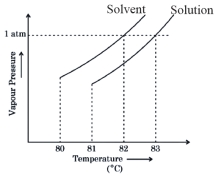
The vapour pressure vs. temperature curve for a solution-solvent system is shown below. The boiling point of the solvent is $........\,^{\circ} C$.
A
$81$
B
$82$
C
$83$
D
$84$
Solution
(B) The boiling point of a liquid is the temperature at which its vapour pressure becomes equal to the external atmospheric pressure $(1 \ atm)$.
Looking at the provided graph,the curve for the solvent intersects the $1 \ atm$ line at a temperature of $82^{\circ} C$.
Therefore,the boiling point of the solvent is $82^{\circ} C$.
Looking at the provided graph,the curve for the solvent intersects the $1 \ atm$ line at a temperature of $82^{\circ} C$.
Therefore,the boiling point of the solvent is $82^{\circ} C$.
0 likes
View Solution82
MediumMCQ
If the boiling points of two solvents $X$ and $Y$ (having same molecular weights) are in the ratio $2 : 1$ and their enthalpies of vaporization are in the ratio $1 : 2$,then the boiling point elevation constant of $X$ is $\underline{ m }$ times the boiling point elevation constant of $Y$. The value of $m$ is $.....$. (Nearest integer)
A
$8$
B
$6$
C
$4$
D
$2$
Solution
(A) The boiling point elevation constant $K_B$ is given by the formula: $K_B = \frac{R \cdot T_B^2 \cdot M}{1000 \cdot \Delta H_{vap}}$.
Since the molecular weights $M$ are the same and $R$ is a constant,we have $K_B \propto \frac{T_B^2}{\Delta H_{vap}}$.
Given $\frac{(T_B)_X}{(T_B)_Y} = \frac{2}{1}$ and $\frac{(\Delta H)_X}{(\Delta H)_Y} = \frac{1}{2}$.
Therefore,$\frac{(K_B)_X}{(K_B)_Y} = \left( \frac{(T_B)_X}{(T_B)_Y} \right)^2 \times \frac{(\Delta H)_Y}{(\Delta H)_X}$.
Substituting the values: $\frac{(K_B)_X}{(K_B)_Y} = (2)^2 \times \left( \frac{2}{1} \right) = 4 \times 2 = 8$.
Thus,$m = 8$.
Since the molecular weights $M$ are the same and $R$ is a constant,we have $K_B \propto \frac{T_B^2}{\Delta H_{vap}}$.
Given $\frac{(T_B)_X}{(T_B)_Y} = \frac{2}{1}$ and $\frac{(\Delta H)_X}{(\Delta H)_Y} = \frac{1}{2}$.
Therefore,$\frac{(K_B)_X}{(K_B)_Y} = \left( \frac{(T_B)_X}{(T_B)_Y} \right)^2 \times \frac{(\Delta H)_Y}{(\Delta H)_X}$.
Substituting the values: $\frac{(K_B)_X}{(K_B)_Y} = (2)^2 \times \left( \frac{2}{1} \right) = 4 \times 2 = 8$.
Thus,$m = 8$.
1 likes
View Solution83
DifficultMCQ
Sea water contains $29.25\%$ $NaCl$ and $19\%$ $MgCl_2$ by weight of solution. The normal boiling point of the sea water is $..........{}^{\circ}C$ (Nearest integer).
Assume $100\%$ ionization for both $NaCl$ and $MgCl_2$.
Given: $K_b(H_2O) = 0.52 \, K \, kg \, mol^{-1}$.
Molar mass of $NaCl$ and $MgCl_2$ is $58.5$ and $95 \, g \, mol^{-1}$ respectively.
Assume $100\%$ ionization for both $NaCl$ and $MgCl_2$.
Given: $K_b(H_2O) = 0.52 \, K \, kg \, mol^{-1}$.
Molar mass of $NaCl$ and $MgCl_2$ is $58.5$ and $95 \, g \, mol^{-1}$ respectively.
A
$115$
B
$114$
C
$113$
D
$116$
Solution
(D) Mass of solution = $100 \, g$.
Mass of $NaCl = 29.25 \, g$,Mass of $MgCl_2 = 19 \, g$.
Mass of solvent $(H_2O)$ = $100 - (29.25 + 19) = 51.75 \, g = 0.05175 \, kg$.
For $NaCl$ $(i=2)$: Moles = $29.25 / 58.5 = 0.5 \, mol$.
For $MgCl_2$ $(i=3)$: Moles = $19 / 95 = 0.2 \, mol$.
Total moles of ions = $(i_{NaCl} \times n_{NaCl}) + (i_{MgCl_2} \times n_{MgCl_2}) = (2 \times 0.5) + (3 \times 0.2) = 1.0 + 0.6 = 1.6 \, mol$.
$\Delta T_b = i \times K_b \times m = K_b \times (n_{total_ions} / \text{mass of solvent in kg}) = 0.52 \times (1.6 / 0.05175) \approx 16.07 \, ^{\circ}C$.
Boiling point of solution = $100 + 16.07 = 116.07 \, ^{\circ}C$.
Nearest integer is $116$.
Mass of $NaCl = 29.25 \, g$,Mass of $MgCl_2 = 19 \, g$.
Mass of solvent $(H_2O)$ = $100 - (29.25 + 19) = 51.75 \, g = 0.05175 \, kg$.
For $NaCl$ $(i=2)$: Moles = $29.25 / 58.5 = 0.5 \, mol$.
For $MgCl_2$ $(i=3)$: Moles = $19 / 95 = 0.2 \, mol$.
Total moles of ions = $(i_{NaCl} \times n_{NaCl}) + (i_{MgCl_2} \times n_{MgCl_2}) = (2 \times 0.5) + (3 \times 0.2) = 1.0 + 0.6 = 1.6 \, mol$.
$\Delta T_b = i \times K_b \times m = K_b \times (n_{total_ions} / \text{mass of solvent in kg}) = 0.52 \times (1.6 / 0.05175) \approx 16.07 \, ^{\circ}C$.
Boiling point of solution = $100 + 16.07 = 116.07 \, ^{\circ}C$.
Nearest integer is $116$.
0 likes
View Solution84
DifficultMCQ
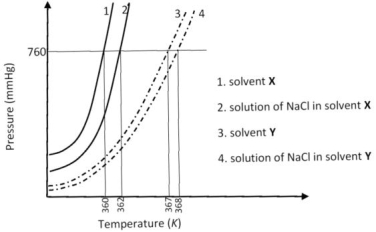
The plot given below shows $P-T$ curves (where $P$ is the pressure and $T$ is the temperature) for two solvents $X$ and $Y$ and isomolal solutions of $NaCl$ in these solvents. $NaCl$ completely dissociates in both the solvents.
On addition of equal number of moles of a non-volatile solute $S$ in equal amount (in $kg$) of these solvents,the elevation of boiling point of solvent $X$ is three times that of solvent $Y$. Solute $S$ is known to undergo dimerization in these solvents. If the degree of dimerization is $0.7$ in solvent $Y$,the degree of dimerization in solvent $X$ is. . . . . . .
On addition of equal number of moles of a non-volatile solute $S$ in equal amount (in $kg$) of these solvents,the elevation of boiling point of solvent $X$ is three times that of solvent $Y$. Solute $S$ is known to undergo dimerization in these solvents. If the degree of dimerization is $0.7$ in solvent $Y$,the degree of dimerization in solvent $X$ is. . . . . . .
A
$0.03$
B
$0.05$
C
$0.07$
D
$0.08$
Solution
(B) From the graph,the boiling points of pure solvents $X$ and $Y$ are $360 \ K$ and $367 \ K$ respectively,and for their $NaCl$ solutions are $362 \ K$ and $368 \ K$ respectively.
For $NaCl$ (completely dissociated,$i = 2$):
$(\Delta T_b)_X = i (K_b)_X m = 362 - 360 = 2 \ K$
$(\Delta T_b)_Y = i (K_b)_Y m = 368 - 367 = 1 \ K$
Dividing the two equations: $\frac{(K_b)_X}{(K_b)_Y} = \frac{2}{1} = 2$.
For solute $S$ undergoing dimerization,the Van't Hoff factor is $i = 1 - \frac{\alpha}{2}$.
Given $\alpha_Y = 0.7$,so $i_Y = 1 - \frac{0.7}{2} = 0.65$.
Given $(\Delta T_b)_X = 3 (\Delta T_b)_Y$ for solute $S$:
$i_X (K_b)_X m = 3 \cdot i_Y (K_b)_Y m$
$(1 - \frac{\alpha_X}{2}) \cdot (K_b)_X = 3 \cdot (0.65) \cdot (K_b)_Y$
$(1 - \frac{\alpha_X}{2}) \cdot 2 = 1.95$
$1 - \frac{\alpha_X}{2} = 0.975$
$\frac{\alpha_X}{2} = 0.025$
$\alpha_X = 0.05$.
For $NaCl$ (completely dissociated,$i = 2$):
$(\Delta T_b)_X = i (K_b)_X m = 362 - 360 = 2 \ K$
$(\Delta T_b)_Y = i (K_b)_Y m = 368 - 367 = 1 \ K$
Dividing the two equations: $\frac{(K_b)_X}{(K_b)_Y} = \frac{2}{1} = 2$.
For solute $S$ undergoing dimerization,the Van't Hoff factor is $i = 1 - \frac{\alpha}{2}$.
Given $\alpha_Y = 0.7$,so $i_Y = 1 - \frac{0.7}{2} = 0.65$.
Given $(\Delta T_b)_X = 3 (\Delta T_b)_Y$ for solute $S$:
$i_X (K_b)_X m = 3 \cdot i_Y (K_b)_Y m$
$(1 - \frac{\alpha_X}{2}) \cdot (K_b)_X = 3 \cdot (0.65) \cdot (K_b)_Y$
$(1 - \frac{\alpha_X}{2}) \cdot 2 = 1.95$
$1 - \frac{\alpha_X}{2} = 0.975$
$\frac{\alpha_X}{2} = 0.025$
$\alpha_X = 0.05$.
0 likes
View Solution85
MediumMCQ
Vessel-$1$ contains $w_2 \ g$ of a non-volatile solute $X$ dissolved in $w_1 \ g$ of water. Vessel-$2$ contains $w_2 \ g$ of another non-volatile solute $Y$ dissolved in $w_1 \ g$ of water. Both the vessels are at the same temperature and pressure. The molar mass of $X$ is $80 \%$ of that of $Y$. The van't Hoff factor for $X$ is $1.2$ times that of $Y$ for their respective concentrations. The elevation of boiling point for the solution in Vessel-$1$ is . . . . . . $\%$ of the solution in Vessel-$2$.
A
$150$
B
$140$
C
$130$
D
$120$
Solution
(A) The elevation in boiling point is given by $\Delta T_b = i \times K_b \times m$,where $m$ is the molality.
For Vessel-$1$: $(\Delta T_b)_1 = i_1 \times K_b \times \frac{w_2 / GMM_X}{w_1 / 1000}$.
For Vessel-$2$: $(\Delta T_b)_2 = i_2 \times K_b \times \frac{w_2 / GMM_Y}{w_1 / 1000}$.
Taking the ratio: $\frac{(\Delta T_b)_1}{(\Delta T_b)_2} = \frac{i_1}{i_2} \times \frac{GMM_Y}{GMM_X}$.
Given $GMM_X = 0.8 \times GMM_Y$ and $i_1 = 1.2 \times i_2$.
Substituting these values: $\frac{(\Delta T_b)_1}{(\Delta T_b)_2} = \frac{1.2 \times i_2}{i_2} \times \frac{GMM_Y}{0.8 \times GMM_Y} = \frac{1.2}{0.8} = 1.5$.
Therefore,the percentage is $1.5 \times 100 = 150 \%$.
For Vessel-$1$: $(\Delta T_b)_1 = i_1 \times K_b \times \frac{w_2 / GMM_X}{w_1 / 1000}$.
For Vessel-$2$: $(\Delta T_b)_2 = i_2 \times K_b \times \frac{w_2 / GMM_Y}{w_1 / 1000}$.
Taking the ratio: $\frac{(\Delta T_b)_1}{(\Delta T_b)_2} = \frac{i_1}{i_2} \times \frac{GMM_Y}{GMM_X}$.
Given $GMM_X = 0.8 \times GMM_Y$ and $i_1 = 1.2 \times i_2$.
Substituting these values: $\frac{(\Delta T_b)_1}{(\Delta T_b)_2} = \frac{1.2 \times i_2}{i_2} \times \frac{GMM_Y}{0.8 \times GMM_Y} = \frac{1.2}{0.8} = 1.5$.
Therefore,the percentage is $1.5 \times 100 = 150 \%$.
0 likes
View Solution86
MediumMCQ
Arrange the following solutions in order of their increasing boiling points.
$(i) \ 10^{-4} \ M \ NaCl$ $(ii) \ 10^{-4} \ M \ \text{Urea}$ $(iii) \ 10^{-3} \ M \ NaCl$ $(iv) \ 10^{-2} \ M \ NaCl$
$(i) \ 10^{-4} \ M \ NaCl$ $(ii) \ 10^{-4} \ M \ \text{Urea}$ $(iii) \ 10^{-3} \ M \ NaCl$ $(iv) \ 10^{-2} \ M \ NaCl$
A
$ii < i < iii < iv$
B
$ii < i \cong iii < iv$
C
$i < ii < iii < iv$
D
$iv < iii < i < ii$
Solution
(A) The elevation in boiling point is given by $\Delta T_{b} = i \cdot K_{b} \cdot m$,where $i$ is the van't Hoff factor and $m$ is the molality (proportional to concentration $C$).
Since $K_{b}$ is constant for the solvent,$\Delta T_{b} \propto i \cdot C$.
Comparing the values of $i \cdot C$: $1 \times 10^{-4} < 2 \times 10^{-4} < 2 \times 10^{-3} < 2 \times 10^{-2}$.
Therefore,the order of increasing boiling points is $(ii) < (i) < (iii) < (iv)$.
Since $K_{b}$ is constant for the solvent,$\Delta T_{b} \propto i \cdot C$.
| Solution | $i \cdot C$ |
| $(i) \ 10^{-4} \ M \ NaCl$ | $2 \times 10^{-4}$ |
| $(ii) \ 10^{-4} \ M \ \text{Urea}$ | $1 \times 10^{-4}$ |
| $(iii) \ 10^{-3} \ M \ NaCl$ | $2 \times 10^{-3}$ |
| $(iv) \ 10^{-2} \ M \ NaCl$ | $2 \times 10^{-2}$ |
Comparing the values of $i \cdot C$: $1 \times 10^{-4} < 2 \times 10^{-4} < 2 \times 10^{-3} < 2 \times 10^{-2}$.
Therefore,the order of increasing boiling points is $(ii) < (i) < (iii) < (iv)$.
0 likes
View Solution87
EasyMCQ
If $K_{b}$ denotes the molal elevation constant of water,then the boiling point of an aqueous solution containing $36 \ g$ of glucose (molar mass $= 180 \ g/mol$) per $1 \ kg$ of water is:
A
$100 + 0.2 K_{b}$
B
$100 + 0.1 K_{b}$
C
$100 + 0.02 K_{b}$
D
$100 + 0.01 K_{b}$
Solution
(A) The molality $(m)$ of the solution is calculated as: $m = \frac{\text{moles of solute}}{\text{mass of solvent in kg}}$.
Given mass of glucose $= 36 \ g$,molar mass $= 180 \ g/mol$.
Moles of glucose $= \frac{36}{180} = 0.2 \ mol$.
Assuming the density of the solution is approximately $1 \ g/mL$,$1 \ dm^3$ (or $1 \ L$) of solution contains $1000 \ g$ of water,which is $1 \ kg$.
Thus,$m = 0.2 \ mol / 1 \ kg = 0.2 \ m$.
The elevation in boiling point is given by $\Delta T_{b} = K_{b} \times m = K_{b} \times 0.2 = 0.2 K_{b}$.
The boiling point of the solution $= 100 + \Delta T_{b} = 100 + 0.2 K_{b}$.
Given mass of glucose $= 36 \ g$,molar mass $= 180 \ g/mol$.
Moles of glucose $= \frac{36}{180} = 0.2 \ mol$.
Assuming the density of the solution is approximately $1 \ g/mL$,$1 \ dm^3$ (or $1 \ L$) of solution contains $1000 \ g$ of water,which is $1 \ kg$.
Thus,$m = 0.2 \ mol / 1 \ kg = 0.2 \ m$.
The elevation in boiling point is given by $\Delta T_{b} = K_{b} \times m = K_{b} \times 0.2 = 0.2 K_{b}$.
The boiling point of the solution $= 100 + \Delta T_{b} = 100 + 0.2 K_{b}$.
0 likes
View Solution88
MediumMCQ
The solution containing $18 \ g \ dm^{-3}$ of glucose (molar mass $180 \ g \ mol^{-1}$) in water and another containing $6 \ g \ dm^{-3}$ of solute $A$ in water boil at the same temperature. What is the molar mass of $A$?
A
$54 \ g \ mol^{-1}$
B
$90 \ g \ mol^{-1}$
C
$120 \ g \ mol^{-1}$
D
$60 \ g \ mol^{-1}$
Solution
(D) Since both solutions boil at the same temperature,their elevation in boiling point $(\Delta T_b)$ must be the same.
Since $\Delta T_b = K_b \times m$,and $K_b$ is the same for the same solvent (water),the molality $(m)$ of both solutions must be equal.
Given concentration in $g \ dm^{-3}$ is $C = \frac{W}{V}$. For a fixed volume of solvent,the molarity and molality are proportional to the concentration divided by the molar mass.
$\frac{C_{\text{glucose}}}{M_{\text{glucose}}} = \frac{C_A}{M_A}$
Substituting the given values:
$\frac{18}{180} = \frac{6}{M_A}$
$0.1 = \frac{6}{M_A}$
$M_A = \frac{6}{0.1} = 60 \ g \ mol^{-1}$.
Since $\Delta T_b = K_b \times m$,and $K_b$ is the same for the same solvent (water),the molality $(m)$ of both solutions must be equal.
Given concentration in $g \ dm^{-3}$ is $C = \frac{W}{V}$. For a fixed volume of solvent,the molarity and molality are proportional to the concentration divided by the molar mass.
$\frac{C_{\text{glucose}}}{M_{\text{glucose}}} = \frac{C_A}{M_A}$
Substituting the given values:
$\frac{18}{180} = \frac{6}{M_A}$
$0.1 = \frac{6}{M_A}$
$M_A = \frac{6}{0.1} = 60 \ g \ mol^{-1}$.
0 likes
View Solution89
EasyMCQ
Calculate the molal elevation constant $(K_b)$ of a solvent if the boiling point of a $0.12 \ m$ solution is $319.8 \ K$ (Boiling point of pure solvent = $319.5 \ K$).
A
$2.0 \ K \ kg \ mol^{-1}$
B
$3.0 \ K \ kg \ mol^{-1}$
C
$2.5 \ K \ kg \ mol^{-1}$
D
$3.5 \ K \ kg \ mol^{-1}$
Solution
(C) The elevation in boiling point is given by the formula: $\Delta T_b = T_b - T_b^\circ$
Given,$T_b = 319.8 \ K$ and $T_b^\circ = 319.5 \ K$.
So,$\Delta T_b = 319.8 \ K - 319.5 \ K = 0.3 \ K$.
The formula for elevation in boiling point is $\Delta T_b = K_b \times m$,where $m$ is the molality.
Given $m = 0.12 \ m$.
Therefore,$K_b = \frac{\Delta T_b}{m} = \frac{0.3 \ K}{0.12 \ mol \ kg^{-1}} = 2.5 \ K \ kg \ mol^{-1}$.
Thus,the correct option is $C$.
Given,$T_b = 319.8 \ K$ and $T_b^\circ = 319.5 \ K$.
So,$\Delta T_b = 319.8 \ K - 319.5 \ K = 0.3 \ K$.
The formula for elevation in boiling point is $\Delta T_b = K_b \times m$,where $m$ is the molality.
Given $m = 0.12 \ m$.
Therefore,$K_b = \frac{\Delta T_b}{m} = \frac{0.3 \ K}{0.12 \ mol \ kg^{-1}} = 2.5 \ K \ kg \ mol^{-1}$.
Thus,the correct option is $C$.
0 likes
View Solution90
EasyMCQ
Calculate the molality of a solution containing a non-volatile solute if the boiling point elevation of the solution is $0.2 \ K$ $[K_{b} = 0.52 \ K \ kg \ mol^{-1}]$.
A
$0.162 \ mol \ kg^{-1}$
B
$0.281 \ mol \ kg^{-1}$
C
$0.385 \ mol \ kg^{-1}$
D
$0.501 \ mol \ kg^{-1}$
Solution
(C) The formula for boiling point elevation is $\Delta T_{b} = K_{b} \times m$,where $\Delta T_{b}$ is the elevation in boiling point,$K_{b}$ is the ebullioscopic constant,and $m$ is the molality of the solution.
Given: $\Delta T_{b} = 0.2 \ K$ and $K_{b} = 0.52 \ K \ kg \ mol^{-1}$.
Rearranging the formula to solve for molality $(m)$: $m = \frac{\Delta T_{b}}{K_{b}}$.
Substituting the values: $m = \frac{0.2}{0.52} \approx 0.3846 \ mol \ kg^{-1}$.
Rounding to three decimal places,we get $m \approx 0.385 \ mol \ kg^{-1}$.
Therefore,the correct option is $C$.
Given: $\Delta T_{b} = 0.2 \ K$ and $K_{b} = 0.52 \ K \ kg \ mol^{-1}$.
Rearranging the formula to solve for molality $(m)$: $m = \frac{\Delta T_{b}}{K_{b}}$.
Substituting the values: $m = \frac{0.2}{0.52} \approx 0.3846 \ mol \ kg^{-1}$.
Rounding to three decimal places,we get $m \approx 0.385 \ mol \ kg^{-1}$.
Therefore,the correct option is $C$.
0 likes
View Solution91
EasyMCQ
Calculate the boiling point elevation of a solution if $15 \ g$ of urea is dissolved in $1000 \ g$ of water. $\left[K_{b} \text{ for water} = 0.52 \ K \ kg \ mol^{-1}; \text{ molar mass of urea} = 60 \ g \ mol^{-1}\right]$ (in $K$)
A
$0.13$
B
$0.24$
C
$0.38$
D
$0.54$
Solution
(A) The formula for boiling point elevation is $\Delta T_{b} = K_{b} \times m$,where $m$ is the molality of the solution.
Molality $(m)$ = $\frac{\text{moles of solute}}{\text{mass of solvent in kg}}$.
Moles of urea = $\frac{\text{given mass}}{\text{molar mass}} = \frac{15 \ g}{60 \ g \ mol^{-1}} = 0.25 \ mol$.
Mass of solvent (water) = $1000 \ g = 1 \ kg$.
Therefore,$m = \frac{0.25 \ mol}{1 \ kg} = 0.25 \ mol \ kg^{-1}$.
Now,$\Delta T_{b} = 0.52 \ K \ kg \ mol^{-1} \times 0.25 \ mol \ kg^{-1} = 0.13 \ K$.
Molality $(m)$ = $\frac{\text{moles of solute}}{\text{mass of solvent in kg}}$.
Moles of urea = $\frac{\text{given mass}}{\text{molar mass}} = \frac{15 \ g}{60 \ g \ mol^{-1}} = 0.25 \ mol$.
Mass of solvent (water) = $1000 \ g = 1 \ kg$.
Therefore,$m = \frac{0.25 \ mol}{1 \ kg} = 0.25 \ mol \ kg^{-1}$.
Now,$\Delta T_{b} = 0.52 \ K \ kg \ mol^{-1} \times 0.25 \ mol \ kg^{-1} = 0.13 \ K$.
0 likes
View Solution92
EasyMCQ
Calculate the number of moles of nonvolatile solute dissolved in $0.3 \ kg$ solvent if $\Delta T_{b}=0.3 \ K$ and $K_{b}$ for solvent is $1.8 \ K \ kg \ mol^{-1}$.
A
$0.051$
B
$0.044$
C
$0.062$
D
$0.073$
Solution
(A) The elevation in boiling point is given by the formula: $\Delta T_{b} = K_{b} \times m$,where $m$ is the molality of the solution.
Molality $m = \frac{n_{solute}}{W_{solvent} \text{ (in kg)}}$.
Substituting the values: $0.3 \ K = 1.8 \ K \ kg \ mol^{-1} \times \frac{n_{solute}}{0.3 \ kg}$.
$n_{solute} = \frac{0.3 \times 0.3}{1.8} \ mol$.
$n_{solute} = \frac{0.09}{1.8} \ mol = 0.05 \ mol$.
Rounding to the nearest option,the correct value is $0.051 \ mol$.
Molality $m = \frac{n_{solute}}{W_{solvent} \text{ (in kg)}}$.
Substituting the values: $0.3 \ K = 1.8 \ K \ kg \ mol^{-1} \times \frac{n_{solute}}{0.3 \ kg}$.
$n_{solute} = \frac{0.3 \times 0.3}{1.8} \ mol$.
$n_{solute} = \frac{0.09}{1.8} \ mol = 0.05 \ mol$.
Rounding to the nearest option,the correct value is $0.051 \ mol$.
0 likes
View Solution93
MediumMCQ
When $0.01 \ mol$ of nonvolatile solute is dissolved in a certain solvent,calculate the mass of the solvent in $kg$ if $\Delta T_{b} = 0.6 \ K$ and $K_{b}$ for the solvent $= 2 \ K \ kg \ mol^{-1}$. (in $kg$)
A
$0.014$
B
$0.028$
C
$0.033$
D
$0.045$
Solution
(C) The formula for elevation in boiling point is $\Delta T_{b} = K_{b} \times m$,where $m$ is the molality of the solution.
Molality $m = \frac{\text{moles of solute}}{\text{mass of solvent in } kg}$.
Given: $\Delta T_{b} = 0.6 \ K$,$K_{b} = 2 \ K \ kg \ mol^{-1}$,and moles of solute $= 0.01 \ mol$.
Substituting the values: $0.6 = 2 \times \frac{0.01}{W_{solvent}}$.
$W_{solvent} = \frac{2 \times 0.01}{0.6} = \frac{0.02}{0.6} = \frac{1}{30} \ kg$.
$W_{solvent} \approx 0.0333 \ kg$.
Thus,the correct option is $C$.
Molality $m = \frac{\text{moles of solute}}{\text{mass of solvent in } kg}$.
Given: $\Delta T_{b} = 0.6 \ K$,$K_{b} = 2 \ K \ kg \ mol^{-1}$,and moles of solute $= 0.01 \ mol$.
Substituting the values: $0.6 = 2 \times \frac{0.01}{W_{solvent}}$.
$W_{solvent} = \frac{2 \times 0.01}{0.6} = \frac{0.02}{0.6} = \frac{1}{30} \ kg$.
$W_{solvent} \approx 0.0333 \ kg$.
Thus,the correct option is $C$.
0 likes
View Solution94
EasyMCQ
Calculate the molality of a solution of a non-volatile solute if the boiling point elevation is $1.75 \ K$ and the $K_b$ for the solvent is $3 \ K \ kg \ mol^{-1}$. (in $m$)
A
$0.480$
B
$0.33$
C
$0.58$
D
$0.63$
Solution
(C) The formula for boiling point elevation is given by $\Delta T_b = K_b \times m$,where $\Delta T_b$ is the boiling point elevation,$K_b$ is the molal boiling point elevation constant,and $m$ is the molality of the solution.
Given: $\Delta T_b = 1.75 \ K$ and $K_b = 3 \ K \ kg \ mol^{-1}$.
Substituting the values into the formula: $1.75 = 3 \times m$.
Solving for $m$: $m = \frac{1.75}{3} \approx 0.5833 \ m$.
Rounding to two decimal places,we get $0.58 \ m$.
Given: $\Delta T_b = 1.75 \ K$ and $K_b = 3 \ K \ kg \ mol^{-1}$.
Substituting the values into the formula: $1.75 = 3 \times m$.
Solving for $m$: $m = \frac{1.75}{3} \approx 0.5833 \ m$.
Rounding to two decimal places,we get $0.58 \ m$.
0 likes
View Solution95
EasyMCQ
Calculate the molality of the solution containing a nonvolatile solute if the boiling point elevation of the solution is $0.39 \ K$.
[$K_{b}$ of water $= 0.52 \ K \ kg \ mol^{-1}$]
[$K_{b}$ of water $= 0.52 \ K \ kg \ mol^{-1}$]
A
$0.52 \ mol \ kg^{-1}$
B
$0.65 \ mol \ kg^{-1}$
C
$0.75 \ mol \ kg^{-1}$
D
$0.86 \ mol \ kg^{-1}$
Solution
(C) The formula for boiling point elevation is given by: $\Delta T_{b} = K_{b} \times m$.
Here,$\Delta T_{b} = 0.39 \ K$ and $K_{b} = 0.52 \ K \ kg \ mol^{-1}$.
Rearranging the formula to solve for molality $(m)$: $m = \frac{\Delta T_{b}}{K_{b}}$.
Substituting the values: $m = \frac{0.39}{0.52} = 0.75 \ mol \ kg^{-1}$.
Therefore,the correct option is $C$.
Here,$\Delta T_{b} = 0.39 \ K$ and $K_{b} = 0.52 \ K \ kg \ mol^{-1}$.
Rearranging the formula to solve for molality $(m)$: $m = \frac{\Delta T_{b}}{K_{b}}$.
Substituting the values: $m = \frac{0.39}{0.52} = 0.75 \ mol \ kg^{-1}$.
Therefore,the correct option is $C$.
0 likes
View Solution96
EasyMCQ
Calculate the number of moles of nonvolatile solute dissolved in $0.5 \ kg$ solvent if molal elevation constant for solvent is $2 \ K \ kg \ mol^{-1}$ and the elevation in boiling point is $\Delta T_{b} = 0.8 \ K$.
A
$0.1$
B
$0.2$
C
$0.3$
D
$0.4$
Solution
(B) The formula for elevation in boiling point is given by: $\Delta T_{b} = K_{b} \times m$,where $m$ is the molality of the solution.
Molality $(m)$ is defined as the number of moles of solute $(n_{solute})$ divided by the mass of the solvent in kilograms $(W_{solvent(kg)})$.
So,$\Delta T_{b} = K_{b} \times \frac{n_{solute}}{W_{solvent(kg)}}$.
Given: $\Delta T_{b} = 0.8 \ K$,$K_{b} = 2 \ K \ kg \ mol^{-1}$,and $W_{solvent(kg)} = 0.5 \ kg$.
Substituting the values: $0.8 = 2 \times \frac{n_{solute}}{0.5}$.
$0.8 = 4 \times n_{solute}$.
$n_{solute} = \frac{0.8}{4} = 0.2 \ mol$.
Molality $(m)$ is defined as the number of moles of solute $(n_{solute})$ divided by the mass of the solvent in kilograms $(W_{solvent(kg)})$.
So,$\Delta T_{b} = K_{b} \times \frac{n_{solute}}{W_{solvent(kg)}}$.
Given: $\Delta T_{b} = 0.8 \ K$,$K_{b} = 2 \ K \ kg \ mol^{-1}$,and $W_{solvent(kg)} = 0.5 \ kg$.
Substituting the values: $0.8 = 2 \times \frac{n_{solute}}{0.5}$.
$0.8 = 4 \times n_{solute}$.
$n_{solute} = \frac{0.8}{4} = 0.2 \ mol$.
0 likes
View Solution97
DifficultMCQ
Calculate the molar mass of a non-volatile solute when $5 \ g$ of it is dissolved in $50 \ g$ of solvent,which boils at $119.6^{\circ} C$. $[K_{b} = 3.2 \ K \ kg \ mol^{-1}$,boiling point of pure solvent $= 118^{\circ} C]$.
A
$180 \ g \ mol^{-1}$
B
$210 \ g \ mol^{-1}$
C
$200 \ g \ mol^{-1}$
D
$190 \ g \ mol^{-1}$
Solution
(C) The elevation in boiling point is given by $\Delta T_{b} = T_{b} - T_{b}^{\circ} = 119.6^{\circ} C - 118^{\circ} C = 1.6 \ K$.
Using the formula $\Delta T_{b} = \frac{1000 \times K_{b} \times W_{2}}{M_{2} \times W_{1}}$,where $W_{2} = 5 \ g$,$W_{1} = 50 \ g$,and $K_{b} = 3.2 \ K \ kg \ mol^{-1}$.
Rearranging for molar mass $M_{2}$: $M_{2} = \frac{1000 \times 3.2 \times 5}{1.6 \times 50}$.
$M_{2} = \frac{16000}{80} = 200 \ g \ mol^{-1}$.
Using the formula $\Delta T_{b} = \frac{1000 \times K_{b} \times W_{2}}{M_{2} \times W_{1}}$,where $W_{2} = 5 \ g$,$W_{1} = 50 \ g$,and $K_{b} = 3.2 \ K \ kg \ mol^{-1}$.
Rearranging for molar mass $M_{2}$: $M_{2} = \frac{1000 \times 3.2 \times 5}{1.6 \times 50}$.
$M_{2} = \frac{16000}{80} = 200 \ g \ mol^{-1}$.
0 likes
View Solution98
EasyMCQ
$A$ solution of non-volatile solute has a boiling point elevation of $1.75 \ K$. Calculate the molality of the solution $[K_{b} = 3.5 \ K \ kg \ mol^{-1}]$.
A
$0.77 \ mol \ kg^{-1}$
B
$0.69 \ mol \ kg^{-1}$
C
$0.50 \ mol \ kg^{-1}$
D
$0.35 \ mol \ kg^{-1}$
Solution
(C) The formula for boiling point elevation is $\Delta T_{b} = K_{b} \times m$.
Given $\Delta T_{b} = 1.75 \ K$ and $K_{b} = 3.5 \ K \ kg \ mol^{-1}$.
Substituting the values: $1.75 \ K = 3.5 \ K \ kg \ mol^{-1} \times m$.
Solving for molality: $m = \frac{1.75}{3.5} = 0.50 \ mol \ kg^{-1}$.
Given $\Delta T_{b} = 1.75 \ K$ and $K_{b} = 3.5 \ K \ kg \ mol^{-1}$.
Substituting the values: $1.75 \ K = 3.5 \ K \ kg \ mol^{-1} \times m$.
Solving for molality: $m = \frac{1.75}{3.5} = 0.50 \ mol \ kg^{-1}$.
0 likes
View Solution99
EasyMCQ
Which of the following equations correctly represents the molar mass of a solute by knowing the boiling point elevation?
A
$M_2 = \frac{1000 \times K_b \times W_2}{\Delta T_b \times W_1}$
B
$M_2 = \frac{1000 \times K_b \times W_1}{\Delta T_b \times W_2}$
C
$M_2 = \frac{1000 \times \Delta T_b \times W_1}{K_b \times W_2}$
D
$M_2 = \frac{1000 \times K_b \times W_2}{\Delta T_b \times W_1}$
Solution
(A) The elevation in boiling point $(\Delta T_b)$ is given by the formula: $\Delta T_b = K_b \times m$,where $m$ is the molality of the solution.
Molality $(m)$ is defined as the number of moles of solute $(n_2)$ per kilogram of solvent $(W_1 \text{ in grams})$.
$m = \frac{n_2 \times 1000}{W_1} = \frac{W_2 \times 1000}{M_2 \times W_1}$.
Substituting this into the elevation formula: $\Delta T_b = \frac{K_b \times W_2 \times 1000}{M_2 \times W_1}$.
Rearranging for the molar mass of the solute $(M_2)$: $M_2 = \frac{1000 \times K_b \times W_2}{\Delta T_b \times W_1}$.
Molality $(m)$ is defined as the number of moles of solute $(n_2)$ per kilogram of solvent $(W_1 \text{ in grams})$.
$m = \frac{n_2 \times 1000}{W_1} = \frac{W_2 \times 1000}{M_2 \times W_1}$.
Substituting this into the elevation formula: $\Delta T_b = \frac{K_b \times W_2 \times 1000}{M_2 \times W_1}$.
Rearranging for the molar mass of the solute $(M_2)$: $M_2 = \frac{1000 \times K_b \times W_2}{\Delta T_b \times W_1}$.
0 likes
View Solution100
EasyMCQ
The molal elevation boiling point constant for water is $0.513 \ ^{\circ}C \ kg \ mol^{-1}$. Calculate the boiling point of the solution if $0.1 \ mol$ of sugar is dissolved in $200 \ g$ of water. (in $^{\circ}C$)
A
$100.513$
B
$100.256$
C
$100.0513$
D
$100.025$
Solution
(B) The formula for elevation in boiling point is $\Delta T_{b} = K_{b} \times m$.
First,calculate the molality $(m)$: $m = \frac{\text{moles of solute}}{\text{mass of solvent in kg}} = \frac{0.1 \ mol}{0.2 \ kg} = 0.5 \ mol \ kg^{-1}$.
Now,calculate the elevation in boiling point: $\Delta T_{b} = 0.513 \ ^{\circ}C \ kg \ mol^{-1} \times 0.5 \ mol \ kg^{-1} = 0.2565 \ ^{\circ}C$.
The boiling point of the solution $(T)$ is $T_{b} + \Delta T_{b} = 100 \ ^{\circ}C + 0.2565 \ ^{\circ}C = 100.2565 \ ^{\circ}C$,which is approximately $100.256 \ ^{\circ}C$.
First,calculate the molality $(m)$: $m = \frac{\text{moles of solute}}{\text{mass of solvent in kg}} = \frac{0.1 \ mol}{0.2 \ kg} = 0.5 \ mol \ kg^{-1}$.
Now,calculate the elevation in boiling point: $\Delta T_{b} = 0.513 \ ^{\circ}C \ kg \ mol^{-1} \times 0.5 \ mol \ kg^{-1} = 0.2565 \ ^{\circ}C$.
The boiling point of the solution $(T)$ is $T_{b} + \Delta T_{b} = 100 \ ^{\circ}C + 0.2565 \ ^{\circ}C = 100.2565 \ ^{\circ}C$,which is approximately $100.256 \ ^{\circ}C$.
0 likes
View SolutionSolutions — Elevation of boiling point of the solvent · Frequently Asked Questions
1Are these Solutions questions useful for JEE and NEET?
Yes. All questions in this section are mapped to JEE Main and NEET exam patterns. Previous year questions from JEE Main, NEET, GUJCET and state-level exams are included with full solutions.
2Can I switch to Hindi or Gujarati for these questions?
Yes. Use the language tabs in the hero section or the sidebar to view the same questions and solutions in English, Hindi or Gujarati.
3How do I generate a question paper from this subtopic?
Use the Vedclass Exam Paper Generator — select the chapter and subtopic, set difficulty, and generate Sets A, B, C, D automatically. First 3 chapters of every subject are free.
Vedclass Products
For Students
Vedclass Test Series
Mock tests in real JEE/NEET style with performance analysis. 5-day free trial.
Start Free TrialFor Teachers
Exam Paper Generator
Generate Set A/B/C/D papers from this chapter in 2 minutes. 3 chapters free.
Try FreeFor Institutes
Online Exam Module
Live online exams with unlimited students, 360° analytics & white-label branding.
See DemoFor Teachers & Institutes
Generate a Solutions Exam Paper in 2 Minutes
Select subtopic & difficulty — Sets A, B, C, D auto-generated with No Repeat logic.
First 3 chapters of every subject are free — no payment required.