
A English
Preparation of Haloalkanes Questions in English
Class 12 Chemistry · Haloalkanes and Haloarenes · Preparation of Haloalkanes
104+
Questions
English
Language
100%
With Solutions
Showing 46 of 104 questions in English
51
MediumMCQ
In the industrial production of chloroform,acetone and ..... are used.
A
Sodium chloride
B
Chlorine gas
C
Calcium hypochlorite
D
Phosgene
Solution
(C) The industrial preparation of chloroform $(CHCl_3)$ involves the reaction of acetone $(CH_3COCH_3)$ with bleaching powder $(CaOCl_2)$.
Bleaching powder acts as a source of chlorine and provides the necessary alkaline medium for the reaction.
The reaction proceeds in three steps: chlorination,hydrolysis,and formation of chloroform.
Bleaching powder acts as a source of chlorine and provides the necessary alkaline medium for the reaction.
The reaction proceeds in three steps: chlorination,hydrolysis,and formation of chloroform.
0 likes
View Solution52
MediumMCQ
The reaction of $Cl_2$ with $CS_2$ in the presence of $AlCl_3$ gives .......
A
$CHCl_3$
B
$CCl_4$
C
$C_2H_5Cl$
D
$C_2H_6$
Solution
(B) The reaction of carbon disulfide $(CS_2)$ with chlorine $(Cl_2)$ in the presence of an anhydrous aluminum chloride $(AlCl_3)$ catalyst is a standard method for the preparation of carbon tetrachloride $(CCl_4)$.
The chemical equation for the reaction is:
$CS_2 + 3Cl_2 \xrightarrow{AlCl_3} CCl_4 + S_2Cl_2$
Thus,the correct product is $CCl_4$.
The chemical equation for the reaction is:
$CS_2 + 3Cl_2 \xrightarrow{AlCl_3} CCl_4 + S_2Cl_2$
Thus,the correct product is $CCl_4$.
0 likes
View Solution53
MediumMCQ
Which of the following sequence of reactions (reagents) can be used for the conversion of $C_6H_5CH_2CH_3$ into $C_6H_5CH=CH_2$?
A
$SOCl_2 : H_2O$
B
$SO_2Cl_2 : \text{alc. } KOH$
C
$Cl_2 / hv : H_2O$
D
$SOCl_2 : \text{alc. } KOH$
Solution
(B) The conversion of ethylbenzene $(C_6H_5CH_2CH_3)$ to styrene $(C_6H_5CH=CH_2)$ requires a two-step process: halogenation followed by dehydrohalogenation.
Step $1$: Free radical chlorination at the benzylic position using $SO_2Cl_2$ (sulfuryl chloride) yields $1$-chloroethylbenzene $(C_6H_5CHClCH_3)$.
Step $2$: Dehydrohalogenation of $C_6H_5CHClCH_3$ using alcoholic $KOH$ (a strong base) leads to the elimination of $HCl$ to form styrene $(C_6H_5CH=CH_2)$.
Step $1$: Free radical chlorination at the benzylic position using $SO_2Cl_2$ (sulfuryl chloride) yields $1$-chloroethylbenzene $(C_6H_5CHClCH_3)$.
Step $2$: Dehydrohalogenation of $C_6H_5CHClCH_3$ using alcoholic $KOH$ (a strong base) leads to the elimination of $HCl$ to form styrene $(C_6H_5CH=CH_2)$.
0 likes
View Solution54
MediumMCQ
The synthesis of alkyl fluorides is best accomplished by
A
Finkelstein reaction
B
Swarts reaction
C
Free radical fluorination
D
Sandmeyer's reaction
Solution
(B) Alkyl fluorides are most conveniently prepared by heating suitable chloro- or bromo-alkanes with inorganic fluorides such as $AsF_3$,$SbF_3$,$CoF_2$,$AgF$,$Hg_2F_2$,etc. This reaction is known as the $Swarts$ reaction.
$CH_3Br + AgF \rightarrow CH_3F + AgBr$
$2CH_3CH_2Cl + Hg_2F_2 \rightarrow 2CH_3CH_2F + Hg_2Cl_2$
$CH_3Br + AgF \rightarrow CH_3F + AgBr$
$2CH_3CH_2Cl + Hg_2F_2 \rightarrow 2CH_3CH_2F + Hg_2Cl_2$
0 likes
View Solution55
DifficultMCQ
Assertion : Alkyl iodide can be prepared by treating alkyl chloride/bromide with $NaI$ in acetone.
Reason : $NaCl/NaBr$ are soluble in acetone while $NaI$ is not.
Reason : $NaCl/NaBr$ are soluble in acetone while $NaI$ is not.
A
If both Assertion and Reason are correct and the Reason is a correct explanation of the Assertion.
B
If both Assertion and Reason are correct but Reason is not a correct explanation of the Assertion.
C
If the Assertion is correct but Reason is incorrect.
D
If both the Assertion and Reason are incorrect.
Solution
(C) The reaction of alkyl chlorides or alkyl bromides with $NaI$ in acetone to form alkyl iodides is known as the $Finkelstein$ reaction.
The chemical equation is: $R-X + NaI \xrightarrow{\text{acetone}} R-I + NaX$ (where $X = Cl, Br$).
In this reaction,$NaI$ is soluble in acetone,whereas $NaCl$ and $NaBr$ are insoluble in acetone.
Because $NaCl$ or $NaBr$ precipitate out of the solution,the equilibrium shifts in the forward direction according to $Le$ $Chatelier's$ principle,facilitating the formation of alkyl iodide.
Therefore,the Assertion is correct,but the Reason is incorrect because it states the solubility properties in reverse.
The chemical equation is: $R-X + NaI \xrightarrow{\text{acetone}} R-I + NaX$ (where $X = Cl, Br$).
In this reaction,$NaI$ is soluble in acetone,whereas $NaCl$ and $NaBr$ are insoluble in acetone.
Because $NaCl$ or $NaBr$ precipitate out of the solution,the equilibrium shifts in the forward direction according to $Le$ $Chatelier's$ principle,facilitating the formation of alkyl iodide.
Therefore,the Assertion is correct,but the Reason is incorrect because it states the solubility properties in reverse.
0 likes
View Solution56
Easy
Write the equations for the preparation of $1-iodobutane$ from:
$(i)$ $1-butanol$
$(ii)$ $1-chlorobutane$
$(iii)$ $but-1-ene$.
$(i)$ $1-butanol$
$(ii)$ $1-chlorobutane$
$(iii)$ $but-1-ene$.
Solution
(N/A) $(i)$ $CH_3CH_2CH_2CH_2OH + HI \xrightarrow{ZnCl_2} CH_3CH_2CH_2CH_2I + H_2O$
$(ii)$ $CH_3CH_2CH_2CH_2Cl + NaI \xrightarrow{\text{dry acetone (Finkelstein reaction)}} CH_3CH_2CH_2CH_2I + NaCl$
$(iii)$ $CH_3CH_2CH=CH_2 + HBr$ $\xrightarrow{\text{peroxide (Anti-Markovnikov addition)}} CH_3CH_2CH_2CH_2Br$ $\xrightarrow{NaI/\text{dry acetone}} CH_3CH_2CH_2CH_2I + NaBr$
$(ii)$ $CH_3CH_2CH_2CH_2Cl + NaI \xrightarrow{\text{dry acetone (Finkelstein reaction)}} CH_3CH_2CH_2CH_2I + NaCl$
$(iii)$ $CH_3CH_2CH=CH_2 + HBr$ $\xrightarrow{\text{peroxide (Anti-Markovnikov addition)}} CH_3CH_2CH_2CH_2Br$ $\xrightarrow{NaI/\text{dry acetone}} CH_3CH_2CH_2CH_2I + NaBr$
0 likes
View Solution57
Difficult
Discuss the methods of preparing haloalkanes from alcohols.
Solution
(N/A) Alcohols $\rightarrow$ Chlorides / Halides: When alcohols react with concentrated halogen acids,the hydroxyl group is replaced by a halogen atom. The reaction of primary and secondary alcohols with $HCl$ requires the presence of $ZnCl_{2}$ as a catalyst. Tertiary alcohols react with concentrated $HCl$ simply by shaking at room temperature.
$(i)$ $R_{3}C-OH + HCl \rightarrow R_{3}C-Cl + H_{2}O$
$(ii)$ $R-OH + HCl \text{ (conc.)} \xrightarrow{\Delta} RCl + H_{2}O$
$(iii)$ $R-OH + HCl \xrightarrow{ZnCl_{2}} RCl + H_{2}O$
$(iv)$ $R-OH + HCl_{(g)} \rightarrow R-Cl + H_{2}O$
The order of reactivity of halogen acids $(HX)$ with alcohols is $3^{0} > 2^{0} > 1^{0}$. Alkyl chlorides can be prepared by passing dry $HCl$ gas through an alcohol solution or by heating a mixture of concentrated aqueous halogen acid and alcohol.
$(b)$ Reaction with phosphorus halides $(PX_{3} / PX_{5})$: The $-OH$ group is replaced by a halogen atom upon reaction with phosphorus halides.
$(i)$ $3R-OH + PX_{3} \rightarrow 3R-X + H_{3}PO_{3} \text{ (where } X = Cl, Br)$
$(ii)$ $R-OH + PCl_{5} \rightarrow R-Cl + POCl_{3} + HCl$
Generally,red phosphorus reacts with bromine and iodine to form $PBr_{3}$ and $PI_{3}$ respectively.
$(c)$ Reaction with thionyl chloride $(SOCl_{2})$: Alcohols react with thionyl chloride to form alkyl chlorides.
$R-OH + SOCl_{2} \rightarrow R-Cl + SO_{2(g)} + HCl_{(g)}$
This method is preferred for preparing alkyl chlorides because the by-products $SO_{2}$ and $HCl$ are gases,leaving behind pure alkyl chloride.
$(d)$ Preparation of bromides: Alcohols are heated with $48\% HBr$ to prepare alkyl bromides.
$ROH + HBr \text{ (48\%)} \xrightarrow{\text{Boiling}} R-Br + H_{2}O$
$(i)$ $R_{3}C-OH + HCl \rightarrow R_{3}C-Cl + H_{2}O$
$(ii)$ $R-OH + HCl \text{ (conc.)} \xrightarrow{\Delta} RCl + H_{2}O$
$(iii)$ $R-OH + HCl \xrightarrow{ZnCl_{2}} RCl + H_{2}O$
$(iv)$ $R-OH + HCl_{(g)} \rightarrow R-Cl + H_{2}O$
The order of reactivity of halogen acids $(HX)$ with alcohols is $3^{0} > 2^{0} > 1^{0}$. Alkyl chlorides can be prepared by passing dry $HCl$ gas through an alcohol solution or by heating a mixture of concentrated aqueous halogen acid and alcohol.
$(b)$ Reaction with phosphorus halides $(PX_{3} / PX_{5})$: The $-OH$ group is replaced by a halogen atom upon reaction with phosphorus halides.
$(i)$ $3R-OH + PX_{3} \rightarrow 3R-X + H_{3}PO_{3} \text{ (where } X = Cl, Br)$
$(ii)$ $R-OH + PCl_{5} \rightarrow R-Cl + POCl_{3} + HCl$
Generally,red phosphorus reacts with bromine and iodine to form $PBr_{3}$ and $PI_{3}$ respectively.
$(c)$ Reaction with thionyl chloride $(SOCl_{2})$: Alcohols react with thionyl chloride to form alkyl chlorides.
$R-OH + SOCl_{2} \rightarrow R-Cl + SO_{2(g)} + HCl_{(g)}$
This method is preferred for preparing alkyl chlorides because the by-products $SO_{2}$ and $HCl$ are gases,leaving behind pure alkyl chloride.
$(d)$ Preparation of bromides: Alcohols are heated with $48\% HBr$ to prepare alkyl bromides.
$ROH + HBr \text{ (48\%)} \xrightarrow{\text{Boiling}} R-Br + H_{2}O$
0 likes
View Solution58
Difficult
Discuss the methods of preparing alkyl halides from hydrocarbon compounds.
Solution
(N/A) Free radical halogenation of alkanes: Free radical chlorination of alkanes in the presence of $Cl_2$ and $h\nu$ or heat,and bromination in the presence of $Br_2$ and $h\nu$ or heat,results in a mixture of mono- and poly-halogenated compounds. It is difficult to separate these components in pure form. Therefore,this method is not suitable for preparing a single alkyl halide.
$(b)$ Alkyl halides from alkenes:
$(i)$ Hydrohalogenation of alkenes: Addition of hydrogen halides ($HCl$,$HBr$,or $HI$) to alkenes leads to the formation of alkyl halides via electrophilic addition. If two addition products are possible,the major product is formed according to Markovnikov's rule. For example:
$CH_3CH=CH_2 + HI \rightarrow CH_3CHICH_3 \text{ (major)} + CH_3CH_2CH_2I \text{ (minor)}$
$(ii)$ Addition of halogens $(X_2)$ to alkenes: Addition of bromine $(Br_2)$ dissolved in $CCl_4$ to an alkene results in the formation of vicinal dibromides. The reddish-brown color of $Br_2$ in $CCl_4$ disappears as the colorless dibromide is formed,which serves as a laboratory test for unsaturation (double bond).
$(b)$ Alkyl halides from alkenes:
$(i)$ Hydrohalogenation of alkenes: Addition of hydrogen halides ($HCl$,$HBr$,or $HI$) to alkenes leads to the formation of alkyl halides via electrophilic addition. If two addition products are possible,the major product is formed according to Markovnikov's rule. For example:
$CH_3CH=CH_2 + HI \rightarrow CH_3CHICH_3 \text{ (major)} + CH_3CH_2CH_2I \text{ (minor)}$
$(ii)$ Addition of halogens $(X_2)$ to alkenes: Addition of bromine $(Br_2)$ dissolved in $CCl_4$ to an alkene results in the formation of vicinal dibromides. The reddish-brown color of $Br_2$ in $CCl_4$ disappears as the colorless dibromide is formed,which serves as a laboratory test for unsaturation (double bond).
0 likes
View Solution59
Medium
Describe the preparation of alkyl halides by halogen exchange reactions.
Solution
(N/A) Finkelstein Reaction: Alkyl iodides are often prepared by the reaction of alkyl chlorides or bromides with $NaI$ in dry acetone. This reaction is known as the Finkelstein reaction.
Reaction: $R-X + NaI \xrightarrow{\text{dry acetone}} R-I + NaX_{(s)}$
(where $X = Cl, Br$)
$NaCl$ or $NaBr$ formed precipitates in dry acetone,which facilitates the forward reaction according to Le Chatelier's principle.
$(b)$ Swarts Reaction: Alkyl fluorides are best prepared by heating an alkyl chloride or bromide in the presence of a metallic fluoride such as $AgF$,$Hg_2F_2$,$CoF_2$,or $SbF_3$. This reaction is known as the Swarts reaction.
Reaction: $H_3C-Br + AgF \rightarrow H_3C-F + AgBr$
Reaction: $R-X + NaI \xrightarrow{\text{dry acetone}} R-I + NaX_{(s)}$
(where $X = Cl, Br$)
$NaCl$ or $NaBr$ formed precipitates in dry acetone,which facilitates the forward reaction according to Le Chatelier's principle.
$(b)$ Swarts Reaction: Alkyl fluorides are best prepared by heating an alkyl chloride or bromide in the presence of a metallic fluoride such as $AgF$,$Hg_2F_2$,$CoF_2$,or $SbF_3$. This reaction is known as the Swarts reaction.
Reaction: $H_3C-Br + AgF \rightarrow H_3C-F + AgBr$
0 likes
View Solution60
Difficult
Write about the Finkelstein and Swarts reactions.
Solution
(N/A) Finkelstein Reaction (Preparation of Alkyl Iodides from Alkyl Chlorides/Bromides): Alkyl chlorides or bromides are reacted with $NaI$ in dry acetone to form alkyl iodides.
"The reaction of alkyl chlorides or bromides with $NaI$ in dry acetone to form alkyl iodides is known as the Finkelstein reaction."
Reaction: $R-X + NaI \xrightarrow{\text{dry acetone}} R-I + NaX(s)$
(where $X = Cl, Br$).
In this reaction,$NaCl$ or $NaBr$ precipitates out,which shifts the equilibrium forward according to Le Chatelier's principle.
$(b)$ Swarts Reaction (Preparation of Alkyl Fluorides from Alkyl Chlorides/Bromides): Alkyl chlorides or bromides are heated with metallic fluorides such as $AgF$,$Hg_2F_2$,$CoF_2$,or $SbF_3$.
"The reaction of alkyl chlorides or bromides with metallic fluorides to form alkyl fluorides is known as the Swarts reaction."
Reaction: $H_3C-Br + AgF \rightarrow H_3C-F + AgBr$
"The reaction of alkyl chlorides or bromides with $NaI$ in dry acetone to form alkyl iodides is known as the Finkelstein reaction."
Reaction: $R-X + NaI \xrightarrow{\text{dry acetone}} R-I + NaX(s)$
(where $X = Cl, Br$).
In this reaction,$NaCl$ or $NaBr$ precipitates out,which shifts the equilibrium forward according to Le Chatelier's principle.
$(b)$ Swarts Reaction (Preparation of Alkyl Fluorides from Alkyl Chlorides/Bromides): Alkyl chlorides or bromides are heated with metallic fluorides such as $AgF$,$Hg_2F_2$,$CoF_2$,or $SbF_3$.
"The reaction of alkyl chlorides or bromides with metallic fluorides to form alkyl fluorides is known as the Swarts reaction."
Reaction: $H_3C-Br + AgF \rightarrow H_3C-F + AgBr$
0 likes
View Solution61
MediumMCQ
How can you obtain iodoethane from ethanol when no other iodine containing reagent except $NaI$ is available in the laboratory?
A
By direct reaction with $NaI$.
B
By converting ethanol to chloroethane followed by Finkelstein reaction with $NaI$.
C
By oxidation of ethanol to acetic acid and then reaction with $NaI$.
D
By dehydration of ethanol to ethene and then reaction with $NaI$.
Solution
(B) Ethanol can be converted to iodoethane by first converting it into a better leaving group,such as a chloroalkane,and then performing a nucleophilic substitution reaction (Finkelstein reaction) using $NaI$ in acetone.
Step $1$: $C_{2}H_{5}OH + HCl \xrightarrow{ZnCl_{2}} C_{2}H_{5}Cl + H_{2}O$
Step $2$: $C_{2}H_{5}Cl + NaI \xrightarrow{\text{Acetone}} C_{2}H_{5}I + NaCl$
Step $1$: $C_{2}H_{5}OH + HCl \xrightarrow{ZnCl_{2}} C_{2}H_{5}Cl + H_{2}O$
Step $2$: $C_{2}H_{5}Cl + NaI \xrightarrow{\text{Acetone}} C_{2}H_{5}I + NaCl$
0 likes
View Solution62
Medium
Describe the preparation of alkyl halides from alcohols.
Solution
(N/A) The hydroxyl group of an alcohol is replaced by a halogen atom upon reaction with concentrated halogen acids,phosphorus halides,or thionyl chloride.
$(i)$ By reaction of alcohols with halogen acids $(HX)$: When an alcohol is reacted with concentrated halogen acids,the $-OH$ group is replaced by $-X$ to form haloalkanes.
Primary $(1^{\circ})$ and secondary $(2^{\circ})$ alcohols require a catalyst,such as anhydrous $ZnCl_{2}$,when reacted with $HCl$.
Example: $CH_{3}CH_{2}OH + HCl \xrightarrow{ZnCl_{2}} CH_{3}CH_{2}Cl + H_{2}O$
The reaction of tertiary $(3^{\circ})$ alcohols with concentrated $HCl$ is carried out simply by shaking at room temperature.
Example: $(CH_{3})_{3}C-OH + HCl \rightarrow (CH_{3})_{3}C-Cl + H_{2}O$
Bromoalkanes are prepared by constant boiling of the suitable alcohol with concentrated $HBr$ $(48\%)$ or by the reaction of alcohol with $NaBr$ in the presence of $H_{2}SO_{4}$.
$CH_{3}CH_{2}OH + HBr \rightarrow CH_{3}CH_{2}Br + H_{2}O$
$CH_{3}CH_{2}OH + NaBr + H_{2}SO_{4} \rightarrow CH_{3}CH_{2}Br + NaHSO_{4} + H_{2}O$
$(i)$ By reaction of alcohols with halogen acids $(HX)$: When an alcohol is reacted with concentrated halogen acids,the $-OH$ group is replaced by $-X$ to form haloalkanes.
Primary $(1^{\circ})$ and secondary $(2^{\circ})$ alcohols require a catalyst,such as anhydrous $ZnCl_{2}$,when reacted with $HCl$.
Example: $CH_{3}CH_{2}OH + HCl \xrightarrow{ZnCl_{2}} CH_{3}CH_{2}Cl + H_{2}O$
The reaction of tertiary $(3^{\circ})$ alcohols with concentrated $HCl$ is carried out simply by shaking at room temperature.
Example: $(CH_{3})_{3}C-OH + HCl \rightarrow (CH_{3})_{3}C-Cl + H_{2}O$
Bromoalkanes are prepared by constant boiling of the suitable alcohol with concentrated $HBr$ $(48\%)$ or by the reaction of alcohol with $NaBr$ in the presence of $H_{2}SO_{4}$.
$CH_{3}CH_{2}OH + HBr \rightarrow CH_{3}CH_{2}Br + H_{2}O$
$CH_{3}CH_{2}OH + NaBr + H_{2}SO_{4} \rightarrow CH_{3}CH_{2}Br + NaHSO_{4} + H_{2}O$
0 likes
View Solution63
Medium
Explain the preparation of alkyl halides by halogen exchange methods.
Solution
(N/A) $(i)$ Finkelstein Reaction: Alkyl iodides are often prepared by the reaction of alkyl chlorides or alkyl bromides with $NaI$ in dry acetone.
$CH_3CH_2Br + NaI \xrightarrow{\text{Acetone}} CH_3CH_2I + NaBr$
$\text{Bromoethane} \rightarrow \text{Iodoethane}$
$CH_3CH_2Cl + NaI \xrightarrow{\text{Acetone}} CH_3CH_2I + NaCl$
$NaCl$ or $NaBr$ thus formed is precipitated in dry acetone. It facilitates the forward reaction according to Le Chatelier's Principle.
$(ii)$ Swarts Reaction: The synthesis of alkyl fluorides is best accomplished by heating an alkyl chloride or alkyl bromide in the presence of a metallic fluoride such as $AgF$,$Hg_2F_2$,$CoF_2$,or $SbF_3$.
$CH_3Br + AgF \rightarrow CH_3F + AgBr$
$CH_3CH_2Br + NaI \xrightarrow{\text{Acetone}} CH_3CH_2I + NaBr$
$\text{Bromoethane} \rightarrow \text{Iodoethane}$
$CH_3CH_2Cl + NaI \xrightarrow{\text{Acetone}} CH_3CH_2I + NaCl$
$NaCl$ or $NaBr$ thus formed is precipitated in dry acetone. It facilitates the forward reaction according to Le Chatelier's Principle.
$(ii)$ Swarts Reaction: The synthesis of alkyl fluorides is best accomplished by heating an alkyl chloride or alkyl bromide in the presence of a metallic fluoride such as $AgF$,$Hg_2F_2$,$CoF_2$,or $SbF_3$.
$CH_3Br + AgF \rightarrow CH_3F + AgBr$
0 likes
View Solution64
MediumMCQ
The products $A$ and $B$ obtained in the following reactions,respectively,are
$3 ROH + PCl_3 \rightarrow 3 RCl + A$
$ROH + PCl_5 \rightarrow RCl + HCl + B$
$3 ROH + PCl_3 \rightarrow 3 RCl + A$
$ROH + PCl_5 \rightarrow RCl + HCl + B$
A
$POCl_3$ and $H_3 PO_4$
B
$H_3 PO_4$ and $POCl_3$
C
$H_3 PO_3$ and $POCl_3$
D
$POCl_3$ and $H_3 PO_3$
Solution
(C) The given reactions represent the preparation of haloalkanes from alcohols using phosphorus halides.
$1$. The reaction of alcohol with phosphorus trichloride is:
$3 ROH + PCl_3 \rightarrow 3 RCl + H_3 PO_3$ $(A)$
$2$. The reaction of alcohol with phosphorus pentachloride is:
$ROH + PCl_5 \rightarrow RCl + HCl + POCl_3$ $(B)$
Thus,$A$ is $H_3 PO_3$ and $B$ is $POCl_3$.
$1$. The reaction of alcohol with phosphorus trichloride is:
$3 ROH + PCl_3 \rightarrow 3 RCl + H_3 PO_3$ $(A)$
$2$. The reaction of alcohol with phosphorus pentachloride is:
$ROH + PCl_5 \rightarrow RCl + HCl + POCl_3$ $(B)$
Thus,$A$ is $H_3 PO_3$ and $B$ is $POCl_3$.
0 likes
View Solution65
MediumMCQ
Identify substrate '$A$' in the following sequence of reactions.
$A$ $\xrightarrow{SOCl_2}{\Delta} B$ $\xrightarrow[Na/\text{ether}]{C_2 H_5 Cl} \text{2-Methylbutane}$
$A$ $\xrightarrow{SOCl_2}{\Delta} B$ $\xrightarrow[Na/\text{ether}]{C_2 H_5 Cl} \text{2-Methylbutane}$
A
Propan$-1-$ol
B
Propan$-2-$ol
C
$2-$Chloropropane
D
Butan$-2-$ol
Solution
(B) The reaction sequence is a Wurtz-Fittig type coupling reaction.
Step $1$: $A \xrightarrow{SOCl_2, \Delta} B$. This is the conversion of an alcohol to an alkyl chloride. Propan$-2-$ol $(CH_3CH(OH)CH_3)$ reacts with $SOCl_2$ to form $2-$chloropropane $(CH_3CHClCH_3)$ as $B$.
Step $2$: $B + C_2H_5Cl \xrightarrow{Na/\text{ether}} \text{2-Methylbutane}$. This is a Wurtz reaction where $2-$chloropropane $(CH_3CHClCH_3)$ reacts with chloroethane $(C_2H_5Cl)$ in the presence of sodium and dry ether to form $2-$methylbutane $(CH_3CH(CH_3)CH_2CH_3)$.
Therefore,substrate $A$ is Propan$-2-$ol.
Step $1$: $A \xrightarrow{SOCl_2, \Delta} B$. This is the conversion of an alcohol to an alkyl chloride. Propan$-2-$ol $(CH_3CH(OH)CH_3)$ reacts with $SOCl_2$ to form $2-$chloropropane $(CH_3CHClCH_3)$ as $B$.
Step $2$: $B + C_2H_5Cl \xrightarrow{Na/\text{ether}} \text{2-Methylbutane}$. This is a Wurtz reaction where $2-$chloropropane $(CH_3CHClCH_3)$ reacts with chloroethane $(C_2H_5Cl)$ in the presence of sodium and dry ether to form $2-$methylbutane $(CH_3CH(CH_3)CH_2CH_3)$.
Therefore,substrate $A$ is Propan$-2-$ol.
0 likes
View Solution66
DifficultMCQ
Choose the false statement from the following.
A
Good yield of alkyl halide may be obtained by heating alcohols with $NaI$ in $95 \% \ H_3PO_4$.
B
Constant boiling $HBr \ (48 \%)$ is used for the preparation of alkyl bromides from alcohols.
C
Tertiary alcohols readily react with conc. $HCl$ in the absence of zinc chloride.
D
The order of reactivity of alcohols with a given halo acid is $1^{\circ} > 2^{\circ} > 3^{\circ}$.
Solution
(D) The reactivity of alcohols with halo acids depends on the stability of the carbocation intermediate formed during the reaction.
Since the stability of carbocations follows the order $3^{\circ} > 2^{\circ} > 1^{\circ}$,the reactivity of alcohols towards halo acids also follows the order $3^{\circ} > 2^{\circ} > 1^{\circ}$.
Therefore,the statement $D$ is false.
Since the stability of carbocations follows the order $3^{\circ} > 2^{\circ} > 1^{\circ}$,the reactivity of alcohols towards halo acids also follows the order $3^{\circ} > 2^{\circ} > 1^{\circ}$.
Therefore,the statement $D$ is false.
0 likes
View Solution67
DifficultMCQ
Identify '$B$' in the following series of reactions:
$CH_3CH_2OH$ $\xrightarrow[H_2SO_4, \Delta]{NaBr} A$ $\xrightarrow{Mg, \text{Dry ether}} B$
$CH_3CH_2OH$ $\xrightarrow[H_2SO_4, \Delta]{NaBr} A$ $\xrightarrow{Mg, \text{Dry ether}} B$
A
Ethyl magnesium bromide
B
Ethyl bromide
C
Sodium ethoxide
D
Ethene
Solution
(A) Step $1$: Ethanol $(CH_3CH_2OH)$ reacts with $NaBr$ in the presence of $H_2SO_4$ and heat to undergo nucleophilic substitution,forming ethyl bromide $(CH_3CH_2Br)$ as product '$A$'.
$CH_3CH_2OH + NaBr + H_2SO_4 \xrightarrow{\Delta} CH_3CH_2Br + NaHSO_4 + H_2O$
Step $2$: Ethyl bromide $(CH_3CH_2Br)$ reacts with magnesium metal in the presence of dry ether to form a Grignard reagent,ethyl magnesium bromide $(CH_3CH_2MgBr)$,which is product '$B$'.
$CH_3CH_2Br + Mg \xrightarrow{\text{Dry ether}} CH_3CH_2MgBr$
$CH_3CH_2OH + NaBr + H_2SO_4 \xrightarrow{\Delta} CH_3CH_2Br + NaHSO_4 + H_2O$
Step $2$: Ethyl bromide $(CH_3CH_2Br)$ reacts with magnesium metal in the presence of dry ether to form a Grignard reagent,ethyl magnesium bromide $(CH_3CH_2MgBr)$,which is product '$B$'.
$CH_3CH_2Br + Mg \xrightarrow{\text{Dry ether}} CH_3CH_2MgBr$
0 likes
View Solution68
EasyMCQ
Which of the following compounds is obtained by using Swartz reaction?
A
Alkyl iodides
B
Alkyl bromides
C
Alkyl chlorides
D
Alkyl fluorides
Solution
(D) The Swartz reaction is a method used to prepare alkyl fluorides by heating alkyl chlorides or alkyl bromides in the presence of metallic fluorides such as $AgF$,$Hg_2F_2$,$CoF_2$,or $SbF_3$.
The general reaction is: $R-X + AgF \rightarrow R-F + AgX$ (where $X = Cl, Br$).
Thus,the product obtained is an alkyl fluoride.
The general reaction is: $R-X + AgF \rightarrow R-F + AgX$ (where $X = Cl, Br$).
Thus,the product obtained is an alkyl fluoride.
0 likes
View Solution69
MediumMCQ
Which among the following reactions is used for the preparation of alkyl fluorides?
A
Finkelstein reaction
B
Swartz reaction
C
Fittig reaction
D
Wurtz reaction
Solution
(B) Alkyl fluorides are prepared by heating alkyl chlorides or bromides with metal fluorides such as $AgF$,$Hg_2F_2$,$AsF_3$,$SbF_3$,etc. This reaction is known as the Swartz reaction.
$R-Cl + AgF \longrightarrow R-F + AgCl \downarrow$
$R-Cl + AgF \longrightarrow R-F + AgCl \downarrow$
0 likes
View Solution70
EasyMCQ
Which of the following compounds is obtained by using the Finkelstein reaction?
A
Alkyl fluorides
B
Alkyl chlorides
C
Alkyl bromides
D
Alkyl iodides
Solution
(D) The Finkelstein reaction is a type of halogen exchange reaction used to prepare alkyl iodides from alkyl chlorides or alkyl bromides.
The general reaction is: $R-X + NaI \longrightarrow R-I + NaX$ (where $X = Cl, Br$).
Thus,alkyl iodides are obtained.
The general reaction is: $R-X + NaI \longrightarrow R-I + NaX$ (where $X = Cl, Br$).
Thus,alkyl iodides are obtained.
0 likes
View Solution71
MediumMCQ
Which among the following reactions does $NOT$ form alkyl halides?
A
Alcohol reacts with halogen in the presence of sunlight.
B
Alcohol reacts with $HCl$ in the presence of anhydrous $ZnCl_2$.
C
Alcohol reacts with $HBr$ in the presence of $NaBr$ and $H_2SO_4$.
D
Alcohol reacts with $HI$ in the presence of $NaI$ and $H_3PO_4$.
Solution
(A) The reaction of alcohol with halogen in the presence of sunlight is a radical substitution reaction typically used for alkanes,not for the preparation of alkyl halides from alcohols.
Alcohol reacts with $HCl$ in the presence of anhydrous $ZnCl_2$ (Lucas reagent) to form alkyl chlorides.
Alcohol reacts with $HBr$ in the presence of $NaBr$ and $H_2SO_4$ to form alkyl bromides.
Alcohol reacts with $HI$ in the presence of $NaI$ and $H_3PO_4$ to form alkyl iodides.
Therefore,the reaction of alcohol with halogen in the presence of sunlight does not produce alkyl halides.
Alcohol reacts with $HCl$ in the presence of anhydrous $ZnCl_2$ (Lucas reagent) to form alkyl chlorides.
Alcohol reacts with $HBr$ in the presence of $NaBr$ and $H_2SO_4$ to form alkyl bromides.
Alcohol reacts with $HI$ in the presence of $NaI$ and $H_3PO_4$ to form alkyl iodides.
Therefore,the reaction of alcohol with halogen in the presence of sunlight does not produce alkyl halides.
0 likes
View Solution72
EasyMCQ
Which among the following compounds is used in Swartz reaction?
A
$AgF$
B
$AgCN$
C
$NaI$
D
$KCN$
Solution
(A) Swartz Reaction: It involves the heating of alkyl chlorides or bromides with metallic fluorides like $AgF$,$Hg_2F_2$,$CoF_2$,or $SbF_3$ to produce alkyl fluorides.
General reaction: $R-X + AgF \rightarrow R-F + AgX$ (where $X = -Cl, -Br$).
General reaction: $R-X + AgF \rightarrow R-F + AgX$ (where $X = -Cl, -Br$).
0 likes
View Solution73
EasyMCQ
Identify the $Swartz$ reaction from the following.
A
$R-Cl + AgF \xrightarrow{\Delta} R-F + AgCl$
B
$R-OH + HX \xrightarrow{\text{suitable condition}} R-X + H_2O$
C
$R-OH + PCl_5 \rightarrow R-Cl + HCl + POCl_3$
D
$R-Cl + NaI \xrightarrow{\text{acetone}} R-I + NaCl$
Solution
(A) The $Swartz$ reaction is a method used for the preparation of alkyl fluorides by heating alkyl chlorides or bromides with metallic fluorides like $AgF$,$Hg_2F_2$,$CoF_2$,or $SbF_3$.
The reaction is represented as: $R-Cl + AgF \xrightarrow{\Delta} R-F + AgCl$.
Option $A$ represents the $Swartz$ reaction.
The reaction is represented as: $R-Cl + AgF \xrightarrow{\Delta} R-F + AgCl$.
Option $A$ represents the $Swartz$ reaction.
0 likes
View Solution74
EasyMCQ
Which among the following methods is used to prepare Grignard reagent?
A
Action of magnesium metal on alkyl halide in presence of dry ether
B
Action of magnesium powder on alkyl halide in aqueous medium
C
Action of magnesium hydroxide on alkyl halide
D
Action of $MgCl_2$ on alkyl halide in presence of dry ether
Solution
(A) The preparation of Grignard reagent involves the reaction of an alkyl halide $(R-X)$ with magnesium metal in the presence of dry ether as a solvent.
The reaction is represented as: $R-X + Mg \xrightarrow{\text{dry ether}} R-MgX$
Dry ether is essential because Grignard reagents are highly reactive and decompose in the presence of moisture or protic solvents.
The reaction is represented as: $R-X + Mg \xrightarrow{\text{dry ether}} R-MgX$
Dry ether is essential because Grignard reagents are highly reactive and decompose in the presence of moisture or protic solvents.
0 likes
View Solution75
EasyMCQ
Identify the name of the reaction in which alkyl fluorides are prepared by heating alkyl bromide or alkyl chloride with metallic fluorides like $AgF$,$Hg_2F_2$,$CoF_2$,or $SbF_3$.
A
Sandmeyer reaction
B
Wurtz reaction
C
Swarts reaction
D
Finkelstein reaction
Solution
(C) The reaction in which alkyl fluorides are prepared by heating alkyl bromides or alkyl chlorides with metallic fluorides (such as $AgF$,$Hg_2F_2$,$CoF_2$,or $SbF_3$) is known as the $Swarts$ reaction.
The general reaction is: $R-X + AgF \rightarrow R-F + AgX$ (where $X = Cl, Br$).
The general reaction is: $R-X + AgF \rightarrow R-F + AgX$ (where $X = Cl, Br$).
0 likes
View Solution76
EasyMCQ
The reaction $2 R-Cl + CoF_{2} \longrightarrow 2 R-F + CoCl_{2}$ is an example of
A
Swarts reaction
B
Finkelstein reaction
C
Wurtz-Fittig reaction
D
Sandmeyer's reaction
Solution
(A) The given reaction involves the replacement of a chlorine atom in an alkyl chloride $(R-Cl)$ with a fluorine atom using a metallic fluoride $(CoF_{2})$.
This specific method of preparing alkyl fluorides from alkyl chlorides or bromides using metallic fluorides like $AgF$,$Hg_{2}F_{2}$,$CoF_{2}$,or $SbF_{3}$ is known as the $Swarts$ reaction.
Therefore,the correct option is $A$.
This specific method of preparing alkyl fluorides from alkyl chlorides or bromides using metallic fluorides like $AgF$,$Hg_{2}F_{2}$,$CoF_{2}$,or $SbF_{3}$ is known as the $Swarts$ reaction.
Therefore,the correct option is $A$.
0 likes
View Solution77
MediumMCQ
Which among the following methods is $NOT$ suitable for the preparation of alkyl chlorides?
A
Addition of $HCl$ to alkene
B
Treating alcohols with Lucas reagent
C
By heating alcohols with thionyl chloride
D
Chlorination of alkanes in presence of sunlight
Solution
(D) The correct answer is $D$.
Chlorination of alkanes in the presence of sunlight (free radical substitution) is not a suitable method for the preparation of alkyl chlorides because it produces a complex mixture of mono-,di-,and polychloroalkanes,which are difficult to separate into individual components.
Chlorination of alkanes in the presence of sunlight (free radical substitution) is not a suitable method for the preparation of alkyl chlorides because it produces a complex mixture of mono-,di-,and polychloroalkanes,which are difficult to separate into individual components.
0 likes
View Solution78
MediumMCQ
Nitroalkanes are obtained in the laboratory from primary or secondary alkyl halides by the action of:
A
$AgNO_2$
B
$NaNO_3$
C
$AgNO_3$
D
$HNO_3$
Solution
(A) The reaction of alkyl halides $(RX)$ with silver nitrite $(AgNO_2)$ is a standard laboratory method for the preparation of nitroalkanes.
The reaction proceeds as follows:
$RX + AgNO_2 \rightarrow RNO_2 (\text{Nitroalkane}) + AgX$
Here,$AgNO_2$ is a covalent compound,which allows the nitrogen atom to act as the nucleophile,leading to the formation of the $C-N$ bond.
The reaction proceeds as follows:
$RX + AgNO_2 \rightarrow RNO_2 (\text{Nitroalkane}) + AgX$
Here,$AgNO_2$ is a covalent compound,which allows the nitrogen atom to act as the nucleophile,leading to the formation of the $C-N$ bond.
0 likes
View Solution79
MediumMCQ
Identify '$A$' in the following reaction.
$2A \xrightarrow{Na / \text{dry ether}} 3,4-$diethyl$-3,4-$dimethylhexane $+ 2NaCl$
$2A \xrightarrow{Na / \text{dry ether}} 3,4-$diethyl$-3,4-$dimethylhexane $+ 2NaCl$
A
$3-$Chloro$-3-$methylpentane
B
$3-$Chloro$-2-$methylpentane
C
$2-$Chloro$-3-$methylpentane
D
$2-$Chloro$-2-$methylpentane
Solution
(A) The given reaction is a Wurtz reaction: $2R-Cl + 2Na \xrightarrow{\text{dry ether}} R-R + 2NaCl$.
To find '$A$',we split the product $3,4-$diethyl$-3,4-$dimethylhexane at the bond between $C3$ and $C4$.
The product is $CH_3CH_2-C(CH_3)(CH_2CH_3)-C(CH_3)(CH_2CH_3)-CH_2CH_3$.
Splitting this at the central $C-C$ bond gives two identical fragments: $CH_3CH_2-C(CH_3)(CH_2CH_3)-$.
Replacing the radical with a chlorine atom gives $CH_3CH_2-C(Cl)(CH_3)-CH_2CH_3$,which is $3-$chloro$-3-$methylpentane.
To find '$A$',we split the product $3,4-$diethyl$-3,4-$dimethylhexane at the bond between $C3$ and $C4$.
The product is $CH_3CH_2-C(CH_3)(CH_2CH_3)-C(CH_3)(CH_2CH_3)-CH_2CH_3$.
Splitting this at the central $C-C$ bond gives two identical fragments: $CH_3CH_2-C(CH_3)(CH_2CH_3)-$.
Replacing the radical with a chlorine atom gives $CH_3CH_2-C(Cl)(CH_3)-CH_2CH_3$,which is $3-$chloro$-3-$methylpentane.
0 likes
View Solution80
MediumMCQ
Which of the following alkyl halide is treated with sodium metal to obtain $2,2,3,3-$tetramethylbutane?
A
$tert-$Butyl bromide
B
$n-$Propyl bromide
C
$sec-$Butyl bromide
D
$n-$Butyl bromide
Solution
(A) The Wurtz reaction involves the coupling of two alkyl halide molecules in the presence of sodium metal to form a symmetrical alkane.
To obtain $2,2,3,3-$tetramethylbutane,we must identify the alkyl group that,when doubled,forms this structure.
The structure of $2,2,3,3-$tetramethylbutane is $(CH_3)_3C-C(CH_3)_3$.
Splitting this molecule at the central $C-C$ bond gives two $(CH_3)_3C-$ groups.
Therefore,the required alkyl halide is $tert-$butyl bromide,$(CH_3)_3C-Br$.
To obtain $2,2,3,3-$tetramethylbutane,we must identify the alkyl group that,when doubled,forms this structure.
The structure of $2,2,3,3-$tetramethylbutane is $(CH_3)_3C-C(CH_3)_3$.
Splitting this molecule at the central $C-C$ bond gives two $(CH_3)_3C-$ groups.
Therefore,the required alkyl halide is $tert-$butyl bromide,$(CH_3)_3C-Br$.
0 likes
View Solution81
EasyMCQ
By which reaction is Freon-$12$ $(CCl_2F_2)$ prepared from $CCl_4$?
A
Wurtz Reaction
B
Fitting Reaction
C
Swarts Reaction
D
Finkelstein Reaction
Solution
(C) The preparation of Freon-$12$ $(CCl_2F_2)$ from carbon tetrachloride $(CCl_4)$ is achieved by the Swarts reaction.
In this reaction,$CCl_4$ is treated with antimony trifluoride $(SbF_3)$ in the presence of antimony pentachloride $(SbCl_5)$ as a catalyst.
The chemical equation is: $3CCl_4 + 2SbF_3 \xrightarrow{SbCl_5} 3CCl_2F_2 + 2SbCl_3$.
In this reaction,$CCl_4$ is treated with antimony trifluoride $(SbF_3)$ in the presence of antimony pentachloride $(SbCl_5)$ as a catalyst.
The chemical equation is: $3CCl_4 + 2SbF_3 \xrightarrow{SbCl_5} 3CCl_2F_2 + 2SbCl_3$.
0 likes
View Solution82
EasyMCQ
Which reagent is not used in the Swarts reaction?
A
$HF$
B
$SbF_3$
C
$AgF$
D
$CoF_2$
Solution
(A) The Swarts reaction is a method used to prepare alkyl fluorides by heating alkyl chlorides or alkyl bromides in the presence of metallic fluorides.
Commonly used metallic fluorides include $AgF$,$Hg_2F_2$,$CoF_2$,and $SbF_3$.
$HF$ (hydrogen fluoride) is not a metallic fluoride and is not used as a reagent in the Swarts reaction.
Therefore,the correct option is $A$.
Commonly used metallic fluorides include $AgF$,$Hg_2F_2$,$CoF_2$,and $SbF_3$.
$HF$ (hydrogen fluoride) is not a metallic fluoride and is not used as a reagent in the Swarts reaction.
Therefore,the correct option is $A$.
0 likes
View Solution83
MediumMCQ
$2-$methylpropane can be prepared by the Wurtz reaction. The haloalkanes taken along with metallic sodium and dry ether are:
A
chloromethane and $2-$chloropropane
B
chloroethane and chloromethane
C
chloroethane and $1-$chloropropane
D
chloromethane and $1-$chloropropane
Solution
(A) To prepare $2-$methylpropane by the Wurtz reaction,we need to couple a methyl group with an isopropyl group. Therefore,the haloalkanes required are chloromethane $(CH_3Cl)$ and $2-$chloropropane $(CH_3CHClCH_3)$.
The reaction is as follows:
$CH_3Cl + CH_3CHClCH_3 + 2Na \xrightarrow{\text{dry ether}} CH_3CH(CH_3)CH_3 + 2NaCl$
Thus,the correct option is $A$.
The reaction is as follows:
$CH_3Cl + CH_3CHClCH_3 + 2Na \xrightarrow{\text{dry ether}} CH_3CH(CH_3)CH_3 + 2NaCl$
Thus,the correct option is $A$.
0 likes
View Solution84
MediumMCQ
The alkyl halides required to prepare $2,3-$dimethylbutane by the Wurtz reaction are
A
$CH_3-CH_2-Br$ and $CH_3-CH_2-Br$
B
$CH_3-CH_2-CH_2-Br$ and $CH_3-Br$
C
$CH_3-CH(Br)-CH_3$ and $CH_3-CH(Br)-CH_3$
D
$CH_3-CH_2-CH_2-Br$ and $CH_3-CH_2-Br$
Solution
(C) The Wurtz reaction involves the coupling of two alkyl halide molecules in the presence of sodium metal in dry ether to form a symmetrical alkane.
To prepare $2,3-$dimethylbutane,which has a symmetric structure,we need two molecules of $2-$bromopropane:
$2 CH_3-CH(Br)-CH_3 + 2 Na \xrightarrow{\text{dry ether}} CH_3-CH(CH_3)-CH(CH_3)-CH_3 + 2 NaBr$
Thus,the required alkyl halide is $2-$bromopropane.
To prepare $2,3-$dimethylbutane,which has a symmetric structure,we need two molecules of $2-$bromopropane:
$2 CH_3-CH(Br)-CH_3 + 2 Na \xrightarrow{\text{dry ether}} CH_3-CH(CH_3)-CH(CH_3)-CH_3 + 2 NaBr$
Thus,the required alkyl halide is $2-$bromopropane.
0 likes
View Solution85
MediumMCQ
Identify the correct products when ethanol reacts with $PCl_5$.
A
Chloroethane,Hydrochloric acid and Phosphorus acid
B
Chloroethane,Hydrochloric acid and Phosphoric acid
C
Chloroethane,Sulfuric acid and Phosphorous oxy chloride
D
Chloroethane,Hydrochloric acid and Phosphorous oxy chloride
Solution
(D) The reaction of ethanol with phosphorus pentachloride $(PCl_5)$ is a standard method for the preparation of alkyl halides.
The chemical equation is:
$CH_3CH_2OH + PCl_5 \rightarrow CH_3CH_2Cl + HCl + POCl_3$
Here,the products formed are chloroethane $(CH_3CH_2Cl)$,hydrogen chloride $(HCl)$,and phosphorus oxychloride $(POCl_3)$.
The chemical equation is:
$CH_3CH_2OH + PCl_5 \rightarrow CH_3CH_2Cl + HCl + POCl_3$
Here,the products formed are chloroethane $(CH_3CH_2Cl)$,hydrogen chloride $(HCl)$,and phosphorus oxychloride $(POCl_3)$.
0 likes
View Solution86
EasyMCQ
Identify the Swarts reaction from the following:
A
$R-CH_2-Br + NaI \xrightarrow[\text{acetone}]{\text{dry}} R-CH_2-I + NaBr$
B
$2 R-CH_2-Br + 2 Na \xrightarrow[\text{ether}]{\text{dry}} R-(CH_2)_2-R + 2 NaBr$
C
$2 C_6H_5Cl + 2 Na \xrightarrow[\text{ether}]{\text{dry}} C_6H_5-C_6H_5 + 2 NaCl$
D
$2 R-CH_2-Br + CoF_2 \longrightarrow 2 R-CH_2-F + CoBr_2$
Solution
(D) The Swarts reaction is a method used for the synthesis of alkyl fluorides.
It involves the heating of an alkyl chloride or alkyl bromide in the presence of a metallic fluoride such as $AgF$,$Hg_2F_2$,$CoF_2$,or $SbF_3$.
In the given options,$2 R-CH_2-Br + CoF_2 \longrightarrow 2 R-CH_2-F + CoBr_2$ represents the Swarts reaction as it involves the exchange of a halogen atom with fluorine using a metallic fluoride.
It involves the heating of an alkyl chloride or alkyl bromide in the presence of a metallic fluoride such as $AgF$,$Hg_2F_2$,$CoF_2$,or $SbF_3$.
In the given options,$2 R-CH_2-Br + CoF_2 \longrightarrow 2 R-CH_2-F + CoBr_2$ represents the Swarts reaction as it involves the exchange of a halogen atom with fluorine using a metallic fluoride.
0 likes
View Solution87
DifficultMCQ
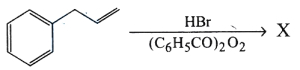
The major product $(X)$ formed in the given reaction is an example of
A
Secondary alkyl halide
B
Primary alkyl halide
C
Tertiary alkyl halide
D
Benzylic halide
Solution
(B) The reaction of allylbenzene with $HBr$ in the presence of benzoyl peroxide $((C_6H_5CO)_2O_2)$ proceeds via the peroxide effect (Kharasch effect),which follows Anti-Markovnikov addition.
In this reaction,the $Br$ atom attaches to the less substituted carbon atom of the double bond.
The product formed is $C_6H_5-CH_2-CH_2-CH_2Br$.
Since the bromine atom is attached to a primary carbon atom,the product is a primary alkyl halide.
In this reaction,the $Br$ atom attaches to the less substituted carbon atom of the double bond.
The product formed is $C_6H_5-CH_2-CH_2-CH_2Br$.
Since the bromine atom is attached to a primary carbon atom,the product is a primary alkyl halide.
0 likes
View Solution88
MediumMCQ
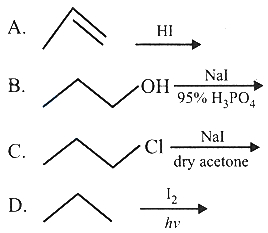
Which of the following are general methods for the preparation of $1-$iodopropane?
A
$A, B$
B
$B, C$
C
$C, D$
D
$A, D$
Solution
(B) The reactions are analyzed as follows:
$A$: Propene reacts with $HI$ to form $2-$iodopropane via Markovnikov addition.
$B$: Propan-$1-$ol reacts with $NaI$ and $H_3PO_4$ to form $1-$iodopropane.
$C$: $1-$chloropropane reacts with $NaI$ in dry acetone (Finkelstein reaction) to form $1-$iodopropane.
$D$: Propane reacts with $I_2$ in the presence of $hv$ to form $2-$iodopropane as the major product due to the stability of the secondary free radical.
Thus,$B$ and $C$ are the correct methods for the preparation of $1-$iodopropane.
$A$: Propene reacts with $HI$ to form $2-$iodopropane via Markovnikov addition.
$B$: Propan-$1-$ol reacts with $NaI$ and $H_3PO_4$ to form $1-$iodopropane.
$C$: $1-$chloropropane reacts with $NaI$ in dry acetone (Finkelstein reaction) to form $1-$iodopropane.
$D$: Propane reacts with $I_2$ in the presence of $hv$ to form $2-$iodopropane as the major product due to the stability of the secondary free radical.
Thus,$B$ and $C$ are the correct methods for the preparation of $1-$iodopropane.
0 likes
View Solution89
EasyMCQ
Finkelstein reaction is used for the synthesis of
A
$RF$
B
$RI$
C
$RCl$
D
$RBr$
Solution
(B) Alkyl iodides are prepared by the reaction of alkyl chlorides or alkyl bromides with $NaI$ in dry acetone. This reaction is known as the Finkelstein reaction.
$R-X + NaI \xrightarrow{\text{Acetone}} R-I + NaX$ (where $X = Cl, Br$)
$NaCl$ or $NaBr$ formed in this reaction is precipitated in dry acetone. This precipitation facilitates the forward reaction according to Le Chatelier's Principle.
$R-X + NaI \xrightarrow{\text{Acetone}} R-I + NaX$ (where $X = Cl, Br$)
$NaCl$ or $NaBr$ formed in this reaction is precipitated in dry acetone. This precipitation facilitates the forward reaction according to Le Chatelier's Principle.
0 likes
View Solution90
EasyMCQ
Identify the halogen exchange reaction from the following.
A
Finkelstein reaction
B
Sandmeyer reaction
C
Fittig reaction
D
Wurtz-Fittig reaction
Solution
(A) The $Finkelstein$ reaction is a classic example of a halogen exchange reaction.
It is an $S_{N}2$ reaction where an alkyl halide (usually chloride or bromide) is converted into an alkyl iodide by treatment with sodium iodide $(NaI)$ in acetone.
The general reaction is: $R-X + NaI \rightarrow R-I + NaX$ (where $X = Cl, Br$).
Other options like $Sandmeyer$,$Fittig$,and $Wurtz-Fittig$ reactions are not halogen exchange reactions.
It is an $S_{N}2$ reaction where an alkyl halide (usually chloride or bromide) is converted into an alkyl iodide by treatment with sodium iodide $(NaI)$ in acetone.
The general reaction is: $R-X + NaI \rightarrow R-I + NaX$ (where $X = Cl, Br$).
Other options like $Sandmeyer$,$Fittig$,and $Wurtz-Fittig$ reactions are not halogen exchange reactions.
0 likes
View Solution91
EasyMCQ
Match the following reactions in List-$I$ with the products obtained in List-$II$:
| List-$I$ | List-$II$ |
|---|---|
| $(A)$ Sandmeyer reaction | $(I)$ $R-I$ |
| $(B)$ Finkelstein reaction | $(II)$ $R-F$ |
| $(C)$ Swarts reaction | $(III)$ $Ar-Br$ |
| $(IV)$ $R-Br$ |
A
$A-III, B-I, C-IV$
B
$A-IV, B-II, C-I$
C
$A-III, B-IV, C-II$
D
$A-III, B-I, C-II$
Solution
(D) The correct matches are:
$(A)$ Sandmeyer reaction: Used to prepare aryl halides like $Ar-Cl$ or $Ar-Br$ from diazonium salts. Thus,$(A-III)$.
$(B)$ Finkelstein reaction: $R-X + NaI \longrightarrow R-I + NaX$ (where $X = Cl, Br$). Thus,$(B-I)$.
$(C)$ Swarts reaction: $R-X + AgF \longrightarrow R-F + AgX$. Thus,$(C-II)$.
Therefore,the correct sequence is $A-III, B-I, C-II$.
$(A)$ Sandmeyer reaction: Used to prepare aryl halides like $Ar-Cl$ or $Ar-Br$ from diazonium salts. Thus,$(A-III)$.
$(B)$ Finkelstein reaction: $R-X + NaI \longrightarrow R-I + NaX$ (where $X = Cl, Br$). Thus,$(B-I)$.
$(C)$ Swarts reaction: $R-X + AgF \longrightarrow R-F + AgX$. Thus,$(C-II)$.
Therefore,the correct sequence is $A-III, B-I, C-II$.
0 likes
View Solution92
MediumMCQ
Identify $X$ and $Y$ in the following reaction:
$CH_2=CH_2 \xrightarrow[(i) X]{(ii) Y} CH_3CH_2I$
$CH_2=CH_2 \xrightarrow[(i) X]{(ii) Y} CH_3CH_2I$
A
$HBr, NaI / \text{dry } CH_3COCH_3$
B
$HBr, I_2 / \text{dry } CH_3COCH_3$
C
$Br_2, NaI / \text{dry } CH_3COCH_3$
D
$Br_2, I_2 / \text{dry } CH_3COCH_3$
Solution
(A) The reaction proceeds in two steps:
Step $1$: Electrophilic addition of $HBr$ to ethene $(CH_2=CH_2)$ gives bromoethane $(CH_3CH_2Br)$. Thus,$X = HBr$.
Step $2$: Bromoethane reacts with $NaI$ in dry acetone to form iodoethane $(CH_3CH_2I)$ via the Finkelstein reaction. Thus,$Y = NaI / \text{dry } CH_3COCH_3$.
Therefore,the correct reagents are $X = HBr$ and $Y = NaI / \text{dry } CH_3COCH_3$.
Step $1$: Electrophilic addition of $HBr$ to ethene $(CH_2=CH_2)$ gives bromoethane $(CH_3CH_2Br)$. Thus,$X = HBr$.
Step $2$: Bromoethane reacts with $NaI$ in dry acetone to form iodoethane $(CH_3CH_2I)$ via the Finkelstein reaction. Thus,$Y = NaI / \text{dry } CH_3COCH_3$.
Therefore,the correct reagents are $X = HBr$ and $Y = NaI / \text{dry } CH_3COCH_3$.
0 likes
View Solution93
EasyMCQ
Which of the following reactions represents the Swarts reaction?
A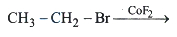
B
C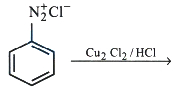
D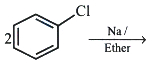
Solution
(A) The Swarts reaction is a method used for the preparation of alkyl fluorides from alkyl chlorides or alkyl bromides by heating them in the presence of metallic fluorides such as $AgF$,$Hg_2F_2$,$CoF_2$,or $SbF_3$.
The reaction is represented as:
$CH_3-CH_2-Br \xrightarrow{CoF_2} CH_3-CH_2-F$
Therefore,option $A$ represents the Swarts reaction.
The reaction is represented as:
$CH_3-CH_2-Br \xrightarrow{CoF_2} CH_3-CH_2-F$
Therefore,option $A$ represents the Swarts reaction.
0 likes
View Solution94
EasyMCQ
Identify the halogen exchange reaction from the following.
A
Sandmeyer reaction
B
Swarts reaction
C
Stephens reaction
D
Wurtz reaction
Solution
(B) The Swarts reaction is a method used for the synthesis of alkyl fluorides by heating alkyl chlorides or alkyl bromides in the presence of a metallic fluoride such as $AgF$,$Hg_2F_2$,$CoF_2$,or $SbF_3$.
This is a classic example of a halogen exchange reaction.
The general reaction is: $H_3C-Br + AgF \rightarrow H_3C-F + AgBr$.
This is a classic example of a halogen exchange reaction.
The general reaction is: $H_3C-Br + AgF \rightarrow H_3C-F + AgBr$.
0 likes
View Solution95
EasyMCQ
The Swarts reaction yields
A
iodohydrocarbons
B
fluorohydrocarbons
C
bromohydrocarbons
D
chlorohydrocarbons
Solution
(B) The Swarts reaction is used to prepare alkyl fluorides from alkyl chlorides or alkyl bromides.
This is achieved by heating the alkyl chloride or bromide in the presence of a metallic fluoride,such as $AgF$,$Hg_2F_2$,$CoF_2$,or $SbF_3$.
For example:
$CH_3-Br + AgF \rightarrow CH_3F + AgBr$
Thus,the Swarts reaction yields fluorohydrocarbons.
This is achieved by heating the alkyl chloride or bromide in the presence of a metallic fluoride,such as $AgF$,$Hg_2F_2$,$CoF_2$,or $SbF_3$.
For example:
$CH_3-Br + AgF \rightarrow CH_3F + AgBr$
Thus,the Swarts reaction yields fluorohydrocarbons.
0 likes
View Solution96
DifficultMCQ
The major product in the following reaction sequence is:
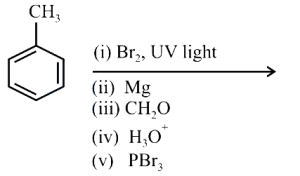
A
$1-$bromo$-1-$phenylethane
B
o-bromomethyltoluene
C
($2$-bromoethyl)benzene
D
p-bromomethyltoluene
Solution
(C) The reaction sequence is as follows:
$1$. Toluene reacts with $Br_2$ in the presence of $UV$ light to undergo free-radical substitution at the benzylic position,forming benzyl bromide $(C_6H_5CH_2Br)$.
$2$. Benzyl bromide reacts with $Mg$ in dry ether to form the Grignard reagent,benzylmagnesium bromide $(C_6H_5CH_2MgBr)$.
$3$. The Grignard reagent reacts with formaldehyde $(CH_2O)$ followed by acidic hydrolysis $(H_3O^+)$ to form $2-$phenylethanol $(C_6H_5CH_2CH_2OH)$.
$4$. Finally,$2$-phenylethanol reacts with $PBr_3$ to replace the hydroxyl group with a bromine atom,yielding ($2$-bromoethyl)benzene $(C_6H_5CH_2CH_2Br)$.
$1$. Toluene reacts with $Br_2$ in the presence of $UV$ light to undergo free-radical substitution at the benzylic position,forming benzyl bromide $(C_6H_5CH_2Br)$.
$2$. Benzyl bromide reacts with $Mg$ in dry ether to form the Grignard reagent,benzylmagnesium bromide $(C_6H_5CH_2MgBr)$.
$3$. The Grignard reagent reacts with formaldehyde $(CH_2O)$ followed by acidic hydrolysis $(H_3O^+)$ to form $2-$phenylethanol $(C_6H_5CH_2CH_2OH)$.
$4$. Finally,$2$-phenylethanol reacts with $PBr_3$ to replace the hydroxyl group with a bromine atom,yielding ($2$-bromoethyl)benzene $(C_6H_5CH_2CH_2Br)$.
0 likes
View SolutionHaloalkanes and Haloarenes — Preparation of Haloalkanes · Frequently Asked Questions
1Are these Haloalkanes and Haloarenes questions useful for JEE and NEET?
Yes. All questions in this section are mapped to JEE Main and NEET exam patterns. Previous year questions from JEE Main, NEET, GUJCET and state-level exams are included with full solutions.
2Can I switch to Hindi or Gujarati for these questions?
Yes. Use the language tabs in the hero section or the sidebar to view the same questions and solutions in English, Hindi or Gujarati.
3How do I generate a question paper from this subtopic?
Use the Vedclass Exam Paper Generator — select the chapter and subtopic, set difficulty, and generate Sets A, B, C, D automatically. First 3 chapters of every subject are free.
Vedclass Products
For Students
Vedclass Test Series
Mock tests in real JEE/NEET style with performance analysis. 5-day free trial.
Start Free TrialFor Teachers
Exam Paper Generator
Generate Set A/B/C/D papers from this chapter in 2 minutes. 3 chapters free.
Try FreeFor Institutes
Online Exam Module
Live online exams with unlimited students, 360° analytics & white-label branding.
See DemoFor Teachers & Institutes
Generate a Haloalkanes and Haloarenes Exam Paper in 2 Minutes
Select subtopic & difficulty — Sets A, B, C, D auto-generated with No Repeat logic.
First 3 chapters of every subject are free — no payment required.