
A English
General Characteristics Questions in English
Class 12 Chemistry · d-and f-Block Elements · General Characteristics
963+
Questions
English
Language
100%
With Solutions
Showing 50 of 963 questions in English
551
Easy
Why is the $E^{\Theta }$ value for the $Mn^{3+}/Mn^{2+}$ couple much more positive than that for $Cr^{3+}/Cr^{2+}$ or $Fe^{3+}/Fe^{2+}$? Explain.
Solution
(N/A) The $E^{\Theta }$ value for the $Mn^{3+}/Mn^{2+}$ couple is much more positive because the third ionization energy of $Mn$ is very high.
This is because $Mn^{2+}$ has a stable $d^{5}$ configuration $([Ar] 3d^{5})$,and removing an electron to form $Mn^{3+}$ $([Ar] 3d^{4})$ requires a significant amount of energy.
In contrast,$Cr^{3+}$ is stable due to the $t_{2g}^{3}$ configuration,and $Fe^{3+}$ is stable due to the $d^{5}$ configuration,making the reduction of $Fe^{3+}$ to $Fe^{2+}$ relatively easier.
This high energy requirement explains why the $+3$ oxidation state of $Mn$ is less stable and of little importance compared to its $+2$ state.
This is because $Mn^{2+}$ has a stable $d^{5}$ configuration $([Ar] 3d^{5})$,and removing an electron to form $Mn^{3+}$ $([Ar] 3d^{4})$ requires a significant amount of energy.
In contrast,$Cr^{3+}$ is stable due to the $t_{2g}^{3}$ configuration,and $Fe^{3+}$ is stable due to the $d^{5}$ configuration,making the reduction of $Fe^{3+}$ to $Fe^{2+}$ relatively easier.
This high energy requirement explains why the $+3$ oxidation state of $Mn$ is less stable and of little importance compared to its $+2$ state.
0 likes
View Solution552
Medium
Silver atom has completely filled $d$ orbitals $\left(4d^{10}\right)$ in its ground state. How can you say that it is a transition element?
Solution
(N/A) The ground state electronic configuration of $Ag$ is $\left[Kr\right] 4d^{10} 5s^{1}$.
Although the $d$-orbital is completely filled in the ground state,a transition element is defined as an element which has an incompletely filled $d$-orbital in its ground state or in any of its common oxidation states.
Silver exhibits $+1$ and $+2$ oxidation states.
In the $+2$ oxidation state,the electronic configuration becomes $\left[Kr\right] 4d^{9}$.
Since the $d$-orbital is incompletely filled in the $+2$ oxidation state,silver is considered a transition element.
Although the $d$-orbital is completely filled in the ground state,a transition element is defined as an element which has an incompletely filled $d$-orbital in its ground state or in any of its common oxidation states.
Silver exhibits $+1$ and $+2$ oxidation states.
In the $+2$ oxidation state,the electronic configuration becomes $\left[Kr\right] 4d^{9}$.
Since the $d$-orbital is incompletely filled in the $+2$ oxidation state,silver is considered a transition element.
0 likes
View Solution553
Medium
In the series $Sc (Z=21)$ to $Zn (Z=30)$,the enthalpy of atomisation of zinc is the lowest,i.e.,$126 \ kJ \ mol^{-1}$. Why?
Solution
(N/A) The enthalpy of atomization depends on the strength of metallic bonding between atoms.
Greater the number of unpaired electrons,stronger is the metallic bonding,and higher is the enthalpy of atomization.
In the $3d$ series,all elements except $Zn$ $(3d^{10} 4s^2)$ have at least one unpaired electron in their $d$-orbitals,which contributes to strong inter-atomic metallic bonding.
Since $Zn$ has a completely filled $d$-subshell $(3d^{10})$ and no unpaired electrons,the metallic bonding is the weakest,leading to the lowest enthalpy of atomization.
Greater the number of unpaired electrons,stronger is the metallic bonding,and higher is the enthalpy of atomization.
In the $3d$ series,all elements except $Zn$ $(3d^{10} 4s^2)$ have at least one unpaired electron in their $d$-orbitals,which contributes to strong inter-atomic metallic bonding.
Since $Zn$ has a completely filled $d$-subshell $(3d^{10})$ and no unpaired electrons,the metallic bonding is the weakest,leading to the lowest enthalpy of atomization.
0 likes
View Solution554
Medium
Which of the $3d$ series of the transition metals exhibits the largest number of oxidation states and why?
Solution
(N/A) $Mn$ $(Z=25)$ has the electronic configuration $[Ar] 3d^{5} 4s^{2}$.
$Mn$ possesses the maximum number of unpaired electrons in the $d$-subshell ($5$ electrons) and $2$ electrons in the $4s$ orbital.
Due to the availability of these $7$ electrons for bonding,$Mn$ exhibits the largest number of oxidation states among the $3d$ transition metals,ranging from $+2$ to $+7$.
$Mn$ possesses the maximum number of unpaired electrons in the $d$-subshell ($5$ electrons) and $2$ electrons in the $4s$ orbital.
Due to the availability of these $7$ electrons for bonding,$Mn$ exhibits the largest number of oxidation states among the $3d$ transition metals,ranging from $+2$ to $+7$.
0 likes
View Solution555
Medium
The $E^{\Theta} (M^{2+} / M)$ value for copper is positive $(+0.34 \ V)$. What is the possible reason for this? (Hint: consider its high $\Delta_{a} H^{\Theta}$ and low $\Delta_{hyd} H^{\Theta}$)
Solution
(N/A) The $E^{\Theta} (M^{2+} / M)$ value of a metal depends on the energy changes involved in the following steps:
$1.$ Sublimation: The energy required for converting one mole of an atom from the solid state to the gaseous state.
$M_{(s)} \longrightarrow M_{(g)}$ $\Delta_{a} H^{\Theta}$ (Atomization energy)
$2.$ Ionization: The energy required to remove electrons from one mole of atoms in the gaseous state.
$M_{(g)} \longrightarrow M^{2+}_{(g)} + 2e^-$ $\Delta_{i} H^{\Theta}$ (Ionization energy)
$3.$ Hydration: The energy released when one mole of ions are hydrated.
$M^{2+}_{(g)} + aq \longrightarrow M^{2+}_{(aq)}$ $\Delta_{hyd} H^{\Theta}$ (Hydration energy)
The net energy change is the sum of these energies. Copper has a very high enthalpy of atomization $(\Delta_{a} H^{\Theta})$ and a relatively low enthalpy of hydration $(\Delta_{hyd} H^{\Theta})$. The sum of these energy terms is positive,which makes the overall $E^{\Theta} (M^{2+} / M)$ value for copper positive.
$1.$ Sublimation: The energy required for converting one mole of an atom from the solid state to the gaseous state.
$M_{(s)} \longrightarrow M_{(g)}$ $\Delta_{a} H^{\Theta}$ (Atomization energy)
$2.$ Ionization: The energy required to remove electrons from one mole of atoms in the gaseous state.
$M_{(g)} \longrightarrow M^{2+}_{(g)} + 2e^-$ $\Delta_{i} H^{\Theta}$ (Ionization energy)
$3.$ Hydration: The energy released when one mole of ions are hydrated.
$M^{2+}_{(g)} + aq \longrightarrow M^{2+}_{(aq)}$ $\Delta_{hyd} H^{\Theta}$ (Hydration energy)
The net energy change is the sum of these energies. Copper has a very high enthalpy of atomization $(\Delta_{a} H^{\Theta})$ and a relatively low enthalpy of hydration $(\Delta_{hyd} H^{\Theta})$. The sum of these energy terms is positive,which makes the overall $E^{\Theta} (M^{2+} / M)$ value for copper positive.
0 likes
View Solution556
Medium
How would you account for the irregular variation of ionization enthalpies (first and second) in the first series of the transition elements?
Solution
(N/A) Ionization enthalpies generally increase across the series due to the continuous filling of inner $d$-orbitals,which increases the effective nuclear charge.
The irregular variations are primarily due to the extra stability of specific electronic configurations like $d^{0}$,$d^{5}$,and $d^{10}$.
For the first ionization enthalpy,$Cr$ $(3d^{5} 4s^{1})$ has a relatively low value because removing one electron leads to a stable $3d^{5}$ configuration. Conversely,$Zn$ $(3d^{10} 4s^{2})$ has a high value because the electron is removed from a stable,fully-filled $4s$ orbital.
Second ionization enthalpies are generally higher than the first. Elements like $Cr$ and $Cu$ show exceptionally high second ionization enthalpies because their $M^{+}$ ions possess stable configurations ($Cr^{+}: 3d^{5}$ and $Cu^{+}: 3d^{10}$),making the removal of a second electron energetically demanding.
The irregular variations are primarily due to the extra stability of specific electronic configurations like $d^{0}$,$d^{5}$,and $d^{10}$.
For the first ionization enthalpy,$Cr$ $(3d^{5} 4s^{1})$ has a relatively low value because removing one electron leads to a stable $3d^{5}$ configuration. Conversely,$Zn$ $(3d^{10} 4s^{2})$ has a high value because the electron is removed from a stable,fully-filled $4s$ orbital.
Second ionization enthalpies are generally higher than the first. Elements like $Cr$ and $Cu$ show exceptionally high second ionization enthalpies because their $M^{+}$ ions possess stable configurations ($Cr^{+}: 3d^{5}$ and $Cu^{+}: 3d^{10}$),making the removal of a second electron energetically demanding.
0 likes
View Solution557
Medium
Why is the highest oxidation state of a metal exhibited in its oxide or fluoride only?
Solution
(N/A) Both oxide $(O^{2-})$ and fluoride $(F^-)$ ions are highly electronegative and have a very small size. Due to these properties,they are able to oxidize the metal to its highest oxidation state.
0 likes
View Solution558
Medium
Calculate the 'spin only' magnetic moment of $M^{2+}_{(aq)}$ ion $(Z=27)$.
Solution
(N/A) The atomic number of the element $M$ is $Z=27$,which corresponds to Cobalt $(Co)$.
The electronic configuration of $Co$ is $[Ar] 3d^7 4s^2$.
For the $M^{2+}$ ion,two electrons are removed from the $4s$ orbital:
$M^{2+} = [Ar] 3d^7$.
The $3d^7$ configuration has $3$ unpaired electrons as shown below:
$3d^7 = \boxed{\uparrow\downarrow} \boxed{\uparrow\downarrow} \boxed{\uparrow} \boxed{\uparrow} \boxed{\uparrow}$
Therefore,the number of unpaired electrons $n = 3$.
The formula for 'spin only' magnetic moment is $\mu = \sqrt{n(n+2)} \ BM$.
Substituting $n=3$:
$\mu = \sqrt{3(3+2)} = \sqrt{3 \times 5} = \sqrt{15} \ BM$.
$\mu \approx 3.87 \ BM$.
The electronic configuration of $Co$ is $[Ar] 3d^7 4s^2$.
For the $M^{2+}$ ion,two electrons are removed from the $4s$ orbital:
$M^{2+} = [Ar] 3d^7$.
The $3d^7$ configuration has $3$ unpaired electrons as shown below:
$3d^7 = \boxed{\uparrow\downarrow} \boxed{\uparrow\downarrow} \boxed{\uparrow} \boxed{\uparrow} \boxed{\uparrow}$
Therefore,the number of unpaired electrons $n = 3$.
The formula for 'spin only' magnetic moment is $\mu = \sqrt{n(n+2)} \ BM$.
Substituting $n=3$:
$\mu = \sqrt{3(3+2)} = \sqrt{3 \times 5} = \sqrt{15} \ BM$.
$\mu \approx 3.87 \ BM$.
0 likes
View Solution559
Medium
Explain why $Cu^{+}$ ion is not stable in aqueous solutions?
Solution
(N/A) In an aqueous medium,$Cu^{2+}$ is more stable than $Cu^{+}$.
This is because,although energy is required to remove one electron from $Cu^{+}$ to form $Cu^{2+}$,the high hydration energy of $Cu^{2+}$ compensates for this energy requirement.
Therefore,$Cu^{+}$ ion in an aqueous solution is unstable and undergoes disproportionation to form $Cu^{2+}$ and $Cu$.
$2Cu_{(aq)}^{+} \to Cu_{(aq)}^{2+} + Cu_{(s)}$
This is because,although energy is required to remove one electron from $Cu^{+}$ to form $Cu^{2+}$,the high hydration energy of $Cu^{2+}$ compensates for this energy requirement.
Therefore,$Cu^{+}$ ion in an aqueous solution is unstable and undergoes disproportionation to form $Cu^{2+}$ and $Cu$.
$2Cu_{(aq)}^{+} \to Cu_{(aq)}^{2+} + Cu_{(s)}$
1 likes
View Solution560
Medium
Write down the electronic configuration of:
$(i) Cr^{3+}$
$(ii) Pm^{3+}$
$(iii) Cu^{+}$
$(iv) Ce^{4+}$
$(v) Co^{2+}$
$(vi) Lu^{2+}$
$(vii) Mn^{2+}$
$(viii) Th^{4+}$
$(i) Cr^{3+}$
$(ii) Pm^{3+}$
$(iii) Cu^{+}$
$(iv) Ce^{4+}$
$(v) Co^{2+}$
$(vi) Lu^{2+}$
$(vii) Mn^{2+}$
$(viii) Th^{4+}$
Solution
$(i) Cr^{3+}: [Ar]^{18} 3d^{3}$
$(ii) Pm^{3+}: [Xe]^{54} 4f^{4}$
$(iii) Cu^{+}: [Ar]^{18} 3d^{10}$
$(iv) Ce^{4+}: [Xe]^{54}$
$(v) Co^{2+}: [Ar]^{18} 3d^{7}$
$(vi) Lu^{2+}: [Xe]^{54} 4f^{14} 5d^{1}$
$(vii) Mn^{2+}: [Ar]^{18} 3d^{5}$
$(viii) Th^{4+}: [Rn]^{86}$
$(ii) Pm^{3+}: [Xe]^{54} 4f^{4}$
$(iii) Cu^{+}: [Ar]^{18} 3d^{10}$
$(iv) Ce^{4+}: [Xe]^{54}$
$(v) Co^{2+}: [Ar]^{18} 3d^{7}$
$(vi) Lu^{2+}: [Xe]^{54} 4f^{14} 5d^{1}$
$(vii) Mn^{2+}: [Ar]^{18} 3d^{5}$
$(viii) Th^{4+}: [Rn]^{86}$
0 likes
View Solution561
Medium
Why are $Mn^{2+}$ compounds more stable than $Fe^{2+}$ towards oxidation to their $+3$ state?
Solution
(A) The electronic configuration of $Mn^{2+}$ is $[Ar] \, 3d^{5}$.
The electronic configuration of $Fe^{2+}$ is $[Ar] \, 3d^{6}$.
Half-filled and fully-filled orbitals are more stable due to exchange energy and symmetry. $Mn^{2+}$ has a stable half-filled $d^{5}$ configuration,making it resistant to oxidation to $Mn^{3+}$.
Conversely,$Fe^{2+}$ has a $3d^{6}$ configuration. By losing one electron,it achieves the stable half-filled $3d^{5}$ configuration. Therefore,$Fe^{2+}$ is easily oxidized to the $Fe^{3+}$ state.
The electronic configuration of $Fe^{2+}$ is $[Ar] \, 3d^{6}$.
Half-filled and fully-filled orbitals are more stable due to exchange energy and symmetry. $Mn^{2+}$ has a stable half-filled $d^{5}$ configuration,making it resistant to oxidation to $Mn^{3+}$.
Conversely,$Fe^{2+}$ has a $3d^{6}$ configuration. By losing one electron,it achieves the stable half-filled $3d^{5}$ configuration. Therefore,$Fe^{2+}$ is easily oxidized to the $Fe^{3+}$ state.
0 likes
View Solution562
Medium
Explain briefly how the $+2$ oxidation state becomes more stable in the first half of the first-row transition elements as the atomic number increases.
Solution
(N/A) The $+2$ oxidation state is achieved by the loss of two $4s$ electrons from the metal atoms. As we move from $Sc$ $(Z=21)$ to $Mn$ $(Z=25)$,the number of electrons in the $3d$ orbital increases from $1$ to $5$. The electronic configurations for the $+2$ ions are as follows:
$Sc^{2+}: 3d^1$
$Ti^{2+}: 3d^2$
$V^{2+}: 3d^3$
$Cr^{2+}: 3d^4$
$Mn^{2+}: 3d^5$
As the number of $d$ electrons increases,the $d$-orbital approaches a half-filled configuration. According to Hund's rule and the principle of exchange energy,a half-filled $d^5$ configuration is exceptionally stable. Therefore,the stability of the $+2$ oxidation state increases across the series,reaching a maximum stability at $Mn^{2+}$ due to its stable $d^5$ configuration.
$Sc^{2+}: 3d^1$
$Ti^{2+}: 3d^2$
$V^{2+}: 3d^3$
$Cr^{2+}: 3d^4$
$Mn^{2+}: 3d^5$
As the number of $d$ electrons increases,the $d$-orbital approaches a half-filled configuration. According to Hund's rule and the principle of exchange energy,a half-filled $d^5$ configuration is exceptionally stable. Therefore,the stability of the $+2$ oxidation state increases across the series,reaching a maximum stability at $Mn^{2+}$ due to its stable $d^5$ configuration.
0 likes
View Solution563
Medium
To what extent do the electronic configurations decide the stability of oxidation states in the first series of the transition elements? Illustrate your answer with examples.
Solution
(N/A) The electronic configuration plays a crucial role in determining the stability of oxidation states in the first transition series.
$1$. $Sc$ $(3d^1 4s^2)$ forms a highly stable $Sc^{3+}$ ion because it achieves the stable noble gas configuration of $[Ar]$ by losing three electrons.
$2$. In the case of $Ti$ $(3d^2 4s^2)$ and $V$ $(3d^3 4s^2)$,the $+4$ and $+5$ oxidation states are stable as they attain the $[Ar]$ configuration.
$3$. For $Mn$ $(3d^5 4s^2)$,the $+2$ oxidation state is particularly stable because the $Mn^{2+}$ ion has a half-filled $d$-orbital $(3d^5)$,which provides extra stability.
$4$. Generally,the stability of the $+2$ oxidation state increases across the series as the $d$-orbitals are progressively filled.
$1$. $Sc$ $(3d^1 4s^2)$ forms a highly stable $Sc^{3+}$ ion because it achieves the stable noble gas configuration of $[Ar]$ by losing three electrons.
$2$. In the case of $Ti$ $(3d^2 4s^2)$ and $V$ $(3d^3 4s^2)$,the $+4$ and $+5$ oxidation states are stable as they attain the $[Ar]$ configuration.
$3$. For $Mn$ $(3d^5 4s^2)$,the $+2$ oxidation state is particularly stable because the $Mn^{2+}$ ion has a half-filled $d$-orbital $(3d^5)$,which provides extra stability.
$4$. Generally,the stability of the $+2$ oxidation state increases across the series as the $d$-orbitals are progressively filled.
0 likes
View Solution564
Medium
What may be the stable oxidation states of the transition elements with the following $d$ electron configurations in the ground state of their atoms: $3d^3$,$3d^5$,$3d^8$,and $3d^4$?
Solution
(N/A) The stable oxidation states depend on the electronic configuration and the stability of the resulting ions.
| Electronic configuration in ground state | Stable oxidation states |
| $(i)$ $3d^3$ (e.g.,$V$) | $+2, +3, +4, +5$ |
| $(ii)$ $3d^5$ (e.g.,$Cr$ or $Mn$) | For $Cr$: $+3, +6$; For $Mn$: $+2, +4, +6, +7$ |
| $(iii)$ $3d^8$ (e.g.,$Ni$) | $+2, +3$ |
| $(iv)$ $3d^4$ | There is no transition element with a $3d^4$ configuration in the ground state (as $Cr$ is $3d^5 4s^1$). |
0 likes
View Solution565
Medium
What are the characteristics of the transition elements and why are they called transition elements? Which of the $d$-block elements may not be regarded as the transition elements?
Solution
(N/A) Transition elements are defined as elements that have partially filled $d$-orbitals in their ground state or in any of their stable oxidation states.
They are called transition elements because they exhibit properties that are intermediate between the highly reactive $s$-block metals and the less reactive $p$-block elements.
Elements such as $Zn$,$Cd$,and $Hg$ (Group $12$ elements) are not regarded as transition elements because they have completely filled $d$-orbitals ($d^{10}$ configuration) in their ground state as well as in their common stable oxidation states.
They are called transition elements because they exhibit properties that are intermediate between the highly reactive $s$-block metals and the less reactive $p$-block elements.
Elements such as $Zn$,$Cd$,and $Hg$ (Group $12$ elements) are not regarded as transition elements because they have completely filled $d$-orbitals ($d^{10}$ configuration) in their ground state as well as in their common stable oxidation states.
0 likes
View Solution566
Medium
In what way is the electronic configuration of the transition elements different from that of the non-transition elements?
Solution
(N/A) Transition elements are defined as elements which have incompletely filled $d$-orbitals in their ground state or in any of their oxidation states. Their general electronic configuration is $(n-1)d^{1-10}ns^{0-2}$.
Non-transition elements are those which do not have partially filled $d$-orbitals. They either have completely empty $d$-orbitals or completely filled $d$-orbitals. Their general electronic configuration is $ns^{1-2}$ or $ns^2 np^{1-6}$.
Non-transition elements are those which do not have partially filled $d$-orbitals. They either have completely empty $d$-orbitals or completely filled $d$-orbitals. Their general electronic configuration is $ns^{1-2}$ or $ns^2 np^{1-6}$.
0 likes
View Solution567
Difficult
Explain giving reasons:
$(i)$ Transition metals and many of their compounds show paramagnetic behaviour.
$(ii)$ The enthalpies of atomisation of the transition metals are high.
$(iii)$ The transition metals generally form coloured compounds.
$(iv)$ Transition metals and their many compounds act as good catalysts.
$(i)$ Transition metals and many of their compounds show paramagnetic behaviour.
$(ii)$ The enthalpies of atomisation of the transition metals are high.
$(iii)$ The transition metals generally form coloured compounds.
$(iv)$ Transition metals and their many compounds act as good catalysts.
Solution
(N/A) $(i)$ Transition metals show paramagnetic behaviour. Paramagnetism arises due to the presence of unpaired electrons,with each electron having a magnetic moment associated with its spin angular momentum. In the first transition series,the orbital angular momentum is quenched,so the resulting paramagnetism is primarily due to the unpaired electrons.
$(ii)$ Transition elements have high effective nuclear charge and a large number of valence electrons,which leads to the formation of very strong metallic bonds. Consequently,the enthalpy of atomisation of transition metals is high.
$(iii)$ Most transition metal complexes are coloured due to $d-d$ transitions. In the presence of ligands,the $d$-orbitals split into two sets of different energies. Electrons absorb radiation from the visible region to transition between these sets,and the reflected light imparts colour to the solution.
$(iv)$ The catalytic activity of transition elements is due to:
$(a)$ Their ability to exhibit variable oxidation states and form complexes,creating unstable intermediate compounds that provide a reaction path with lower activation energy,$E_a$.
$(b)$ Their ability to provide a suitable surface area for reactant molecules to adsorb and react.
$(ii)$ Transition elements have high effective nuclear charge and a large number of valence electrons,which leads to the formation of very strong metallic bonds. Consequently,the enthalpy of atomisation of transition metals is high.
$(iii)$ Most transition metal complexes are coloured due to $d-d$ transitions. In the presence of ligands,the $d$-orbitals split into two sets of different energies. Electrons absorb radiation from the visible region to transition between these sets,and the reflected light imparts colour to the solution.
$(iv)$ The catalytic activity of transition elements is due to:
$(a)$ Their ability to exhibit variable oxidation states and form complexes,creating unstable intermediate compounds that provide a reaction path with lower activation energy,$E_a$.
$(b)$ Their ability to provide a suitable surface area for reactant molecules to adsorb and react.
0 likes
View Solution568
Medium
What are interstitial compounds? Why are such compounds well known for transition metals?
Solution
(N/A) Interstitial compounds are those which are formed when small atoms like $H$,$C$,$N$,or $O$ are trapped inside the crystal lattice of transition metals.
Transition metals are well known for forming these compounds because they possess a large atomic size and contain many interstitial sites (voids) within their crystal structure that can accommodate these small atoms.
Transition metals are well known for forming these compounds because they possess a large atomic size and contain many interstitial sites (voids) within their crystal structure that can accommodate these small atoms.
0 likes
View Solution569
Medium
How is the variability in oxidation states of transition metals different from that of the non-transition metals? Illustrate with examples.
Solution
(N/A) In transition elements,the oxidation states differ by $1$ unit (e.g.,$Fe^{2+}$ and $Fe^{3+}$,$Cu^{+}$ and $Cu^{2+}$) because the energy difference between $(n-1)d$ and $ns$ orbitals is small.
In non-transition elements,the oxidation states typically differ by $2$ units (e.g.,$Sn^{2+}$ and $Sn^{4+}$,$Pb^{2+}$ and $Pb^{4+}$) due to the inert pair effect.
In non-transition elements,the oxidation states typically differ by $2$ units (e.g.,$Sn^{2+}$ and $Sn^{4+}$,$Pb^{2+}$ and $Pb^{4+}$) due to the inert pair effect.
0 likes
View Solution570
Medium
For $M^{2+} / M$ and $M^{3+} / M^{2+}$ systems,the ${E^{\Theta}}$ values for some metals are as follows:
$Cr^{2+} / Cr : -0.9 \ V$
$Cr^{3+} / Cr^{2+} : -0.4 \ V$
$Mn^{2+} / Mn : -1.2 \ V$
$Mn^{3+} / Mn^{2+} : +1.5 \ V$
$Fe^{2+} / Fe : -0.4 \ V$
$Fe^{3+} / Fe^{2+} : +0.8 \ V$
Use this data to comment upon:
$(i)$ The stability of $Fe^{3+}$ in acid solution as compared to that of $Cr^{3+}$ or $Mn^{3+}$ and
$(ii)$ The ease with which iron can be oxidised as compared to a similar process for either chromium or manganese metal.
$Cr^{2+} / Cr : -0.9 \ V$
$Cr^{3+} / Cr^{2+} : -0.4 \ V$
$Mn^{2+} / Mn : -1.2 \ V$
$Mn^{3+} / Mn^{2+} : +1.5 \ V$
$Fe^{2+} / Fe : -0.4 \ V$
$Fe^{3+} / Fe^{2+} : +0.8 \ V$
Use this data to comment upon:
$(i)$ The stability of $Fe^{3+}$ in acid solution as compared to that of $Cr^{3+}$ or $Mn^{3+}$ and
$(ii)$ The ease with which iron can be oxidised as compared to a similar process for either chromium or manganese metal.
Solution
(N/A) $(i)$ The ${E^{\Theta}}$ value for $Fe^{3+} / Fe^{2+}$ is $+0.8 \ V$,which is higher than that for $Cr^{3+} / Cr^{2+}$ $(-0.4 \ V)$ and lower than that for $Mn^{3+} / Mn^{2+}$ $(+1.5 \ V)$.
Since a higher reduction potential indicates easier reduction,$Mn^{3+}$ is most easily reduced to $Mn^{2+}$,followed by $Fe^{3+}$,and $Cr^{3+}$ is the least easily reduced.
Therefore,the stability of these ions in acid solution follows the order: $Mn^{3+} < Fe^{3+} < Cr^{3+}$.
$(ii)$ The reduction potentials for the $M^{2+} / M$ pairs are: $Mn^{2+} / Mn$ $(-1.2 \ V)$,$Cr^{2+} / Cr$ $(-0.9 \ V)$,and $Fe^{2+} / Fe$ $(-0.4 \ V)$.
Lower reduction potential indicates easier oxidation of the metal to its $M^{2+}$ ion.
Since the reduction potential values are in the order $Mn^{2+} / Mn < Cr^{2+} / Cr < Fe^{2+} / Fe$,the ease of oxidation follows the order: $Fe < Cr < Mn$.
Since a higher reduction potential indicates easier reduction,$Mn^{3+}$ is most easily reduced to $Mn^{2+}$,followed by $Fe^{3+}$,and $Cr^{3+}$ is the least easily reduced.
Therefore,the stability of these ions in acid solution follows the order: $Mn^{3+} < Fe^{3+} < Cr^{3+}$.
$(ii)$ The reduction potentials for the $M^{2+} / M$ pairs are: $Mn^{2+} / Mn$ $(-1.2 \ V)$,$Cr^{2+} / Cr$ $(-0.9 \ V)$,and $Fe^{2+} / Fe$ $(-0.4 \ V)$.
Lower reduction potential indicates easier oxidation of the metal to its $M^{2+}$ ion.
Since the reduction potential values are in the order $Mn^{2+} / Mn < Cr^{2+} / Cr < Fe^{2+} / Fe$,the ease of oxidation follows the order: $Fe < Cr < Mn$.
0 likes
View Solution571
Difficult
Predict which of the following will be coloured in aqueous solution: $Ti^{3+}, V^{3+}, Cu^{+}, Sc^{3+}, Mn^{2+}, Fe^{3+},$ and $Co^{2+}$. Give reasons for each.
Solution
(N/A) Only the ions that have unpaired electrons in the $d$-orbital will be coloured due to $d-d$ transitions. The ions in which the $d$-orbital is empty $(d^0)$ or completely filled $(d^{10})$ will be colourless.
From the table,$Sc^{3+}$ $(d^0)$ and $Cu^{+}$ $(d^{10})$ are colourless. All other ions,namely $Ti^{3+}, V^{3+}, Mn^{2+}, Fe^{3+},$ and $Co^{2+}$,contain unpaired electrons in their $d$-orbitals and will be coloured in aqueous solution due to $d-d$ transitions.
| $Element. \text{Atomic Number}$ | $Ionic \text{State}. \text{Electronic Configuration}$ |
|---|---|
| $Ti. 22$ | $Ti^{3+}. [Ar] 3d^{1}$ |
| $V. 23$ | $V^{3+}. [Ar] 3d^{2}$ |
| $Cu. 29$ | $Cu^{+}. [Ar] 3d^{10}$ |
| $Sc. 21$ | $Sc^{3+}. [Ar]$ |
| $Mn. 25$ | $Mn^{2+}. [Ar] 3d^{5}$ |
| $Fe. 26$ | $Fe^{3+}. [Ar] 3d^{5}$ |
| $Co. 27$ | $Co^{2+}. [Ar] 3d^{7}$ |
From the table,$Sc^{3+}$ $(d^0)$ and $Cu^{+}$ $(d^{10})$ are colourless. All other ions,namely $Ti^{3+}, V^{3+}, Mn^{2+}, Fe^{3+},$ and $Co^{2+}$,contain unpaired electrons in their $d$-orbitals and will be coloured in aqueous solution due to $d-d$ transitions.
0 likes
View Solution572
Medium
Compare the stability of the $+2$ oxidation state for the elements of the first transition series.
Solution
(N/A) The stability of the $+2$ oxidation state in the first transition series ($3d$ series) generally increases as we move from left to right across the period.
This trend is observed because the sum of the first and second ionization enthalpies increases across the series,making the removal of the third electron from the $d$-orbital increasingly difficult.
Specifically,for elements like $Mn^{2+}$ ($d^5$ configuration) and $Zn^{2+}$ ($d^{10}$ configuration),the $+2$ state is particularly stable due to the half-filled and fully-filled $d$-orbital configurations,respectively.
Conversely,for elements on the left side of the series,higher oxidation states are often more stable because it is easier to remove electrons from the $d$-orbitals.
This trend is observed because the sum of the first and second ionization enthalpies increases across the series,making the removal of the third electron from the $d$-orbital increasingly difficult.
Specifically,for elements like $Mn^{2+}$ ($d^5$ configuration) and $Zn^{2+}$ ($d^{10}$ configuration),the $+2$ state is particularly stable due to the half-filled and fully-filled $d$-orbital configurations,respectively.
Conversely,for elements on the left side of the series,higher oxidation states are often more stable because it is easier to remove electrons from the $d$-orbitals.
0 likes
View Solution573
Easy
Which metal in the first series of transition metals exhibits $+1$ oxidation state most frequently and why?
Solution
(N/A) In the first transition series,$Cu$ exhibits the $+1$ oxidation state most frequently. This is because the electronic configuration of $Cu^+$ is $[Ar] \, 3d^{10}$. The completely filled $d$-orbital provides extra stability to the ion.
0 likes
View Solution574
Medium
Calculate the number of unpaired electrons in the following gaseous ions: $Mn^{3+}, Cr^{3+}, V^{3+}$ and $Ti^{3+}$. Which one of these is the most stable in aqueous solution?
Solution
(B)
$Cr^{3+}$ is the most stable in aqueous solutions owing to a $t_{2g}^3$ configuration,which corresponds to a half-filled $t_{2g}$ subshell in an octahedral field.
| Gaseous ions | Number of unpaired electrons |
|---|---|
| $(i). Mn^{3+}, [Ar] \, 3d^4$ | $4$ |
| $(ii). Cr^{3+}, [Ar] \, 3d^3$ | $3$ |
| $(iii). V^{3+}, [Ar] \, 3d^2$ | $2$ |
| $(iv). Ti^{3+}, [Ar] \, 3d^1$ | $1$ |
$Cr^{3+}$ is the most stable in aqueous solutions owing to a $t_{2g}^3$ configuration,which corresponds to a half-filled $t_{2g}$ subshell in an octahedral field.
0 likes
View Solution575
Difficult
Compare the general characteristics of the first series of the transition metals with those of the second and third series metals in the respective vertical columns. Give special emphasis on the following points:
$(i)$ electronic configurations,
$(ii)$ oxidation states,
$(iii)$ ionisation enthalpies,and
$(iv)$ atomic sizes.
$(i)$ electronic configurations,
$(ii)$ oxidation states,
$(iii)$ ionisation enthalpies,and
$(iv)$ atomic sizes.
Solution
(N/A) $(i)$ In the $1^{st}, 2^{nd}$ and $3^{rd}$ transition series,the $3d, 4d$ and $5d$ orbitals are respectively filled.
We know that elements in the same vertical column generally have similar electronic configurations.
In the first transition series,two elements show unusual electronic configurations:
$Cr(24) = 3d^5 \, 4s^1$
$Cu(29) = 3d^{10} \, 4s^1$
Similarly,there are exceptions in the second transition series. These are:
$Mo(42) = 4d^5 \, 5s^1$
$Tc(43) = 4d^6 \, 5s^1$
$Ru(44) = 4d^7 \, 5s^1$
$Rh(45) = 4d^8 \, 5s^1$
$Pd(46) = 4d^{10} \, 5s^0$
$Ag(47) = 4d^{10} \, 5s^1$
There are some exceptions in the third transition series as well. These are:
$W(74) = 5d^4 \, 6s^2$
$Pt(78) = 5d^9 \, 6s^1$
$Au(79) = 5d^{10} \, 6s^1$
As a result of these exceptions,it happens many times that the electronic configurations of the elements present in the same group are dissimilar.
$(ii)$ In each of the three transition series the number of oxidation states shown by the elements is the maximum in the middle and the minimum at the extreme ends.
However,$+2$ and $+3$ oxidation states are quite stable for all elements present in the first transition series. All metals present in the first transition series form stable compounds in the $+2$ and $+3$ oxidation states. The stability of the $+2$ and $+3$ oxidation states decreases in the second and the third transition series,wherein higher oxidation states are more important.
For example $[Fe^{II}(CN)_6]^{4-}, [Co^{III}(NH_3)_6]^{3+}, [Ti(H_2O)_6]^{3+}$ are stable complexes,but no such complexes are known for the second and third transition series such as $Mo, W, Rh, Ir$. They form complexes in which their oxidation states are high. For example: $WCl_6, ReF_7, RuO_4,$ etc.
$(iii)$ In each of the three transition series,the first ionisation enthalpy increases from left to right. However,there are some exceptions. The first ionisation enthalpies of the third transition series are higher than those of the first and second transition series. This occurs due to the poor shielding effect of $4f$ electrons in the third transition series.
Certain elements in the second transition series have higher first ionisation enthalpies than elements corresponding to the same vertical column in the first transition series. There are also elements in the $2^{nd}$ transition series whose first ionisation enthalpies are lower than those of the elements corresponding to the same vertical column in the $1^{st}$ transition series.
$(iv)$ Atomic size generally decreases from left to right across a period. Now,among the three transition series,atomic sizes of the elements in the second transition series are greater than those of the elements corresponding to the same vertical column in the first transition series. However,the atomic sizes of the elements in the third transition series are virtually the same as those of the corresponding members in the second transition series. This is due to lanthanoid contraction.
We know that elements in the same vertical column generally have similar electronic configurations.
In the first transition series,two elements show unusual electronic configurations:
$Cr(24) = 3d^5 \, 4s^1$
$Cu(29) = 3d^{10} \, 4s^1$
Similarly,there are exceptions in the second transition series. These are:
$Mo(42) = 4d^5 \, 5s^1$
$Tc(43) = 4d^6 \, 5s^1$
$Ru(44) = 4d^7 \, 5s^1$
$Rh(45) = 4d^8 \, 5s^1$
$Pd(46) = 4d^{10} \, 5s^0$
$Ag(47) = 4d^{10} \, 5s^1$
There are some exceptions in the third transition series as well. These are:
$W(74) = 5d^4 \, 6s^2$
$Pt(78) = 5d^9 \, 6s^1$
$Au(79) = 5d^{10} \, 6s^1$
As a result of these exceptions,it happens many times that the electronic configurations of the elements present in the same group are dissimilar.
$(ii)$ In each of the three transition series the number of oxidation states shown by the elements is the maximum in the middle and the minimum at the extreme ends.
However,$+2$ and $+3$ oxidation states are quite stable for all elements present in the first transition series. All metals present in the first transition series form stable compounds in the $+2$ and $+3$ oxidation states. The stability of the $+2$ and $+3$ oxidation states decreases in the second and the third transition series,wherein higher oxidation states are more important.
For example $[Fe^{II}(CN)_6]^{4-}, [Co^{III}(NH_3)_6]^{3+}, [Ti(H_2O)_6]^{3+}$ are stable complexes,but no such complexes are known for the second and third transition series such as $Mo, W, Rh, Ir$. They form complexes in which their oxidation states are high. For example: $WCl_6, ReF_7, RuO_4,$ etc.
$(iii)$ In each of the three transition series,the first ionisation enthalpy increases from left to right. However,there are some exceptions. The first ionisation enthalpies of the third transition series are higher than those of the first and second transition series. This occurs due to the poor shielding effect of $4f$ electrons in the third transition series.
Certain elements in the second transition series have higher first ionisation enthalpies than elements corresponding to the same vertical column in the first transition series. There are also elements in the $2^{nd}$ transition series whose first ionisation enthalpies are lower than those of the elements corresponding to the same vertical column in the $1^{st}$ transition series.
$(iv)$ Atomic size generally decreases from left to right across a period. Now,among the three transition series,atomic sizes of the elements in the second transition series are greater than those of the elements corresponding to the same vertical column in the first transition series. However,the atomic sizes of the elements in the third transition series are virtually the same as those of the corresponding members in the second transition series. This is due to lanthanoid contraction.
0 likes
View Solution576
Medium
Comment on the statement that elements of the first transition series possess many properties different from those of heavier transition elements.
Solution
(N/A) The properties of the elements of the first transition series differ from those of the heavier transition elements in many ways.
$(i)$ The atomic sizes of the elements of the first transition series are smaller than those of the heavier elements (elements of $2^{nd}$ and $3^{rd}$ transition series).
However,the atomic sizes of the elements in the third transition series are virtually the same as those of the corresponding members in the second transition series. This is due to lanthanoid contraction.
$(ii)$ $+2$ and $+3$ oxidation states are more common for elements in the first transition series,while higher oxidation states are more common for the heavier elements.
$(iii)$ The enthalpies of atomisation of the elements in the first transition series are lower than those of the corresponding elements in the second and third transition series.
$(iv)$ The melting and boiling points of the first transition series are lower than those of the heavier transition elements. This is because of the occurrence of stronger metallic bonding ($M-M$ bonding).
$(v)$ The elements of the first transition series form low-spin or high-spin complexes depending upon the strength of the ligand field. However,the heavier transition elements form only low-spin complexes,irrespective of the strength of the ligand field.
$(i)$ The atomic sizes of the elements of the first transition series are smaller than those of the heavier elements (elements of $2^{nd}$ and $3^{rd}$ transition series).
However,the atomic sizes of the elements in the third transition series are virtually the same as those of the corresponding members in the second transition series. This is due to lanthanoid contraction.
$(ii)$ $+2$ and $+3$ oxidation states are more common for elements in the first transition series,while higher oxidation states are more common for the heavier elements.
$(iii)$ The enthalpies of atomisation of the elements in the first transition series are lower than those of the corresponding elements in the second and third transition series.
$(iv)$ The melting and boiling points of the first transition series are lower than those of the heavier transition elements. This is because of the occurrence of stronger metallic bonding ($M-M$ bonding).
$(v)$ The elements of the first transition series form low-spin or high-spin complexes depending upon the strength of the ligand field. However,the heavier transition elements form only low-spin complexes,irrespective of the strength of the ligand field.
0 likes
View Solution577
Difficult
Why are the $d$-block elements known as "Transition" elements? Why are zinc,cadmium,and mercury not considered transition elements?
Solution
(N/A) Originally,the name transition metals was derived from the fact that their chemical properties were transitional between those of $s$- and $p$-block elements.
According to $IUPAC$,transition elements are defined as elements that have an incompletely filled $d$-subshell either in their neutral atom or in their ionic (oxidized) state.
The presence of incompletely filled $d$-orbitals makes transition elements distinct from non-transition elements.
Zinc $(Zn)$,cadmium $(Cd)$,and mercury $(Hg)$ have fully filled $d$-orbitals in both their neutral and oxidized states ($d^{10}$ configuration).
For example:
${ }_{30} Zn: [Ar] 3d^{10} 4s^{2} \implies Zn^{2+}: [Ar] 3d^{10}$
${ }_{48} Cd: [Kr] 4d^{10} 5s^{2} \implies Cd^{2+}: [Kr] 4d^{10}$
${ }_{80} Hg: [Xe] 4f^{14} 5d^{10} 6s^{2} \implies Hg^{2+}: [Xe] 4f^{14} 5d^{10}$
Since they do not have an incompletely filled $d$-subshell in any common oxidation state,they are not considered transition elements.
According to $IUPAC$,transition elements are defined as elements that have an incompletely filled $d$-subshell either in their neutral atom or in their ionic (oxidized) state.
The presence of incompletely filled $d$-orbitals makes transition elements distinct from non-transition elements.
Zinc $(Zn)$,cadmium $(Cd)$,and mercury $(Hg)$ have fully filled $d$-orbitals in both their neutral and oxidized states ($d^{10}$ configuration).
For example:
${ }_{30} Zn: [Ar] 3d^{10} 4s^{2} \implies Zn^{2+}: [Ar] 3d^{10}$
${ }_{48} Cd: [Kr] 4d^{10} 5s^{2} \implies Cd^{2+}: [Kr] 4d^{10}$
${ }_{80} Hg: [Xe] 4f^{14} 5d^{10} 6s^{2} \implies Hg^{2+}: [Xe] 4f^{14} 5d^{10}$
Since they do not have an incompletely filled $d$-subshell in any common oxidation state,they are not considered transition elements.
0 likes
View Solution578
Medium
Discuss the position of $d$-block elements in the periodic table.
Solution
(N/A) In a periodic table,the $d$-block elements are situated between the $s$-block and $p$-block elements,occupying the large middle section of the periodic table.
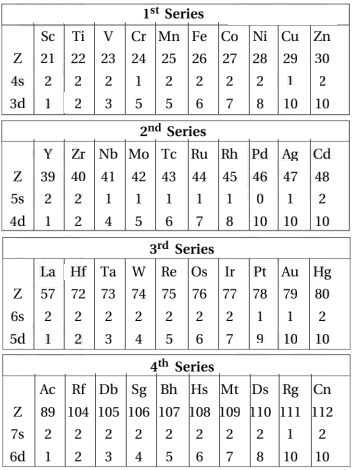
The $d$-block elements are present from group-$3$ to group-$12$ in periods $4$ to $7$. These elements have $d$-orbitals in the penultimate energy level of their atoms that receive electrons,giving rise to four rows of transition elements,namely $3d, 4d, 5d$,and $6d$,as follows:
$(i)$ The first transition series or $3d$-series belongs to the $4^{th}$ period.
$(ii)$ The second transition series or $4d$-series belongs to the $5^{th}$ period.
$(iii)$ The third transition series or $5d$-series belongs to the $6^{th}$ period.
$(iv)$ The fourth transition series or $6d$-series belongs to the $7^{th}$ period.
Thus,there are a total of forty elements with ten elements in each series.
The $d$-block elements are present from group-$3$ to group-$12$ in periods $4$ to $7$. These elements have $d$-orbitals in the penultimate energy level of their atoms that receive electrons,giving rise to four rows of transition elements,namely $3d, 4d, 5d$,and $6d$,as follows:
$(i)$ The first transition series or $3d$-series belongs to the $4^{th}$ period.
$(ii)$ The second transition series or $4d$-series belongs to the $5^{th}$ period.
$(iii)$ The third transition series or $5d$-series belongs to the $6^{th}$ period.
$(iv)$ The fourth transition series or $6d$-series belongs to the $7^{th}$ period.
Thus,there are a total of forty elements with ten elements in each series.
0 likes
View Solution579
Difficult
Write a brief note on the electronic configurations of the transition elements.
Solution
(N/A) The general electronic configuration of $d$-block elements is $(n-1)d^{1-10}ns^{1-2}$. The $(n-1)$ stands for the inner $d$-orbitals,which may have one to ten electrons,and the outermost $ns$-orbital,which may have one to two electrons.
Certain exceptions are observed in the electronic configurations of $d$-block elements due to the very small energy difference between $(n-1)d$ and $ns$ orbitals.
For example,$Cr$ $(3d^5 4s^1)$ exhibits stability due to the half-filled $d$-subshell,and $Cu$ $(3d^{10} 4s^1)$ exhibits stability due to the fully-filled $d$-subshell.
The electronic configurations of transition elements are summarized in the following table:
Certain exceptions are observed in the electronic configurations of $d$-block elements due to the very small energy difference between $(n-1)d$ and $ns$ orbitals.
For example,$Cr$ $(3d^5 4s^1)$ exhibits stability due to the half-filled $d$-subshell,and $Cu$ $(3d^{10} 4s^1)$ exhibits stability due to the fully-filled $d$-subshell.
The electronic configurations of transition elements are summarized in the following table:
| Series | Elements | Configuration |
|---|---|---|
| $3d$ | $Sc$ to $Zn$ | $(n-1)d^{1-10}ns^{1-2}$ |
| $4d$ | $Y$ to $Cd$ | $(n-1)d^{1-10}ns^{0-2}$ |
| $5d$ | $La$ to $Hg$ | $(n-1)d^{1-10}ns^{1-2}$ |
| $6d$ | $Ac$ to $Cn$ | $(n-1)d^{1-10}ns^{1-2}$ |
0 likes
View Solution580
Medium
Explain the exceptions in the general electronic configuration of $3d$-series elements.
Solution
(N/A) The exceptions in electronic configuration occur because of the very small energy difference between $(n-1)d$ and $ns$ orbitals.
$(i)$ The electronic configuration of $Cr$ is not $[Ar] 3d^4 4s^2$ but $[Ar] 3d^5 4s^1$.
$(ii)$ The electronic configuration of $Cu$ is not $[Ar] 3d^9 4s^2$ but $[Ar] 3d^{10} 4s^1$.
In $Cr$,the $3d^5$ configuration is formed because half-filled $d$-orbitals are more stable.
In $Cu$,the $3d^{10}$ configuration is formed because completely filled $d$-orbitals $(3d^{10})$ are more stable.
Due to the small energy gap between $3d$ and $4s$ orbitals,the half-filled $3d^5$ and fully-filled $3d^{10}$ configurations are relatively more stable.
$(i)$ The electronic configuration of $Cr$ is not $[Ar] 3d^4 4s^2$ but $[Ar] 3d^5 4s^1$.
$(ii)$ The electronic configuration of $Cu$ is not $[Ar] 3d^9 4s^2$ but $[Ar] 3d^{10} 4s^1$.
In $Cr$,the $3d^5$ configuration is formed because half-filled $d$-orbitals are more stable.
In $Cu$,the $3d^{10}$ configuration is formed because completely filled $d$-orbitals $(3d^{10})$ are more stable.
Due to the small energy gap between $3d$ and $4s$ orbitals,the half-filled $3d^5$ and fully-filled $3d^{10}$ configurations are relatively more stable.
0 likes
View Solution581
DifficultMCQ
Determine whether the following statements are True $(T)$ or False $(F)$:
$(a)$ Transition elements contain $d$-orbitals.
$(b)$ Ions of transition elements contain incompletely filled $d$-orbitals.
$(c)$ Only elements with completely filled $3d$ orbitals are considered transition elements.
$(d)$ Only elements that have incompletely filled $d$-orbitals in their ground state as well as in their ions are called transition elements.
$(a)$ Transition elements contain $d$-orbitals.
$(b)$ Ions of transition elements contain incompletely filled $d$-orbitals.
$(c)$ Only elements with completely filled $3d$ orbitals are considered transition elements.
$(d)$ Only elements that have incompletely filled $d$-orbitals in their ground state as well as in their ions are called transition elements.
A
$(a) T, (b) T, (c) F, (d) T$
B
$(a) T, (b) T, (c) T, (d) F$
C
$(a) F, (b) T, (c) F, (d) T$
D
$(a) T, (b) F, (c) F, (d) T$
Solution
(A) True: Transition elements are defined as elements which have incompletely filled $d$-orbitals in their ground state or in any of their oxidation states.
$(b)$ True: Transition elements typically exhibit variable oxidation states due to the presence of incompletely filled $d$-orbitals.
$(c)$ False: Elements with completely filled $d$-orbitals (like $Zn, Cd, Hg$) are not considered transition elements because they do not have incompletely filled $d$-orbitals in their ground state or common oxidation states.
$(d)$ True: This is the standard $IUPAC$ definition of a transition element.
$(b)$ True: Transition elements typically exhibit variable oxidation states due to the presence of incompletely filled $d$-orbitals.
$(c)$ False: Elements with completely filled $d$-orbitals (like $Zn, Cd, Hg$) are not considered transition elements because they do not have incompletely filled $d$-orbitals in their ground state or common oxidation states.
$(d)$ True: This is the standard $IUPAC$ definition of a transition element.
0 likes
View Solution582
AdvancedMCQ
Determine whether the following statements are True $(T)$ or False $(F)$:
$(a)$ An element or its ion that does not have a completely filled $d$-orbital is considered a transition element.
$(b)$ $Sc$ is a transition element.
$(c)$ $Zn$ is a transition element.
$(d)$ The energy difference between $(n-1)d$ and $ns$ orbitals is high.
$(a)$ An element or its ion that does not have a completely filled $d$-orbital is considered a transition element.
$(b)$ $Sc$ is a transition element.
$(c)$ $Zn$ is a transition element.
$(d)$ The energy difference between $(n-1)d$ and $ns$ orbitals is high.
A
$(a) T, (b) T, (c) F, (d) F$
B
$(a) F, (b) T, (c) T, (d) F$
C
$(a) T, (b) F, (c) T, (d) T$
D
$(a) F, (b) F, (c) F, (d) T$
Solution
(A) True: $A$ transition element is defined as an element which has an incompletely filled $d$-subshell in its ground state or in any of its oxidation states.
$(b)$ True: $Sc$ $(Z=21)$ has the configuration $[Ar] 3d^1 4s^2$. In its $+3$ oxidation state,it has $3d^0$ configuration,but the definition applies to the element or its ions. Since it has an incompletely filled $d$-orbital in the ground state,it is a transition element.
$(c)$ False: $Zn$ $(Z=30)$ has the configuration $[Ar] 3d^{10} 4s^2$. In its common $+2$ oxidation state,it has $3d^{10}$ configuration. Since it has a completely filled $d$-orbital in both ground and stable oxidation states,it is not considered a transition element.
$(d)$ False: The energy difference between $(n-1)d$ and $ns$ orbitals is very small,which allows for variable oxidation states and complex formation.
$(b)$ True: $Sc$ $(Z=21)$ has the configuration $[Ar] 3d^1 4s^2$. In its $+3$ oxidation state,it has $3d^0$ configuration,but the definition applies to the element or its ions. Since it has an incompletely filled $d$-orbital in the ground state,it is a transition element.
$(c)$ False: $Zn$ $(Z=30)$ has the configuration $[Ar] 3d^{10} 4s^2$. In its common $+2$ oxidation state,it has $3d^{10}$ configuration. Since it has a completely filled $d$-orbital in both ground and stable oxidation states,it is not considered a transition element.
$(d)$ False: The energy difference between $(n-1)d$ and $ns$ orbitals is very small,which allows for variable oxidation states and complex formation.
0 likes
View Solution583
Difficult
Fill in the blanks:
$(a)$ The ground state electronic configurations of $Cr$ and $Cu$ are .......... and ..........,respectively.
$(b)$ Transition elements exhibit certain characteristic properties due to partially filled $d$-orbitals.
$(c)$ The general electronic configuration of transition elements is .......... .
$(a)$ The ground state electronic configurations of $Cr$ and $Cu$ are .......... and ..........,respectively.
$(b)$ Transition elements exhibit certain characteristic properties due to partially filled $d$-orbitals.
$(c)$ The general electronic configuration of transition elements is .......... .
Solution
(N/A) The ground state electronic configuration of $Cr$ $(Z=24)$ is $[Ar] 3d^5 4s^1$ and for $Cu$ $(Z=29)$ is $[Ar] 3d^{10} 4s^1$.
$(b)$ Transition elements exhibit characteristic properties due to partially filled $d$-orbitals.
$(c)$ The general electronic configuration of transition elements is $(n-1)d^{1-10} ns^{1-2}$.
$(b)$ Transition elements exhibit characteristic properties due to partially filled $d$-orbitals.
$(c)$ The general electronic configuration of transition elements is $(n-1)d^{1-10} ns^{1-2}$.
0 likes
View Solution584
MediumMCQ
Fill in the blanks:
$(a)$ The $4f$ and $5f$ series elements are known as lanthanoids and actinoids,respectively.
$(b)$ In transition elements,electrons are filled in the $d$-orbitals of the .......... energy levels.
$(a)$ The $4f$ and $5f$ series elements are known as lanthanoids and actinoids,respectively.
$(b)$ In transition elements,electrons are filled in the $d$-orbitals of the .......... energy levels.
A
Lanthanoids,Actinoids
B
Inner
C
Outer
D
Valence
Solution
(A) The $4f$ series elements are called lanthanoids and the $5f$ series elements are called actinoids.
$(b)$ In transition elements,the electrons are filled in the $(n-1)d$ orbitals,which correspond to the inner energy levels relative to the outermost $ns$ shell.
$(b)$ In transition elements,the electrons are filled in the $(n-1)d$ orbitals,which correspond to the inner energy levels relative to the outermost $ns$ shell.
0 likes
View Solution585
EasyMCQ
List the elements of the first transition series.
A
$Sc, Ti, V, Cr, Mn, Fe, Co, Ni, Cu, Zn$
B
$Y, Zr, Nb, Mo, Tc, Ru, Rh, Pd, Ag, Cd$
C
$La, Hf, Ta, W, Re, Os, Ir, Pt, Au, Hg$
D
$Ac, Rf, Db, Sg, Bh, Hs, Mt, Ds, Rg, Cn$
Solution
(A) The first transition series consists of elements belonging to the $3d$ orbital series, which corresponds to the fourth period of the periodic table.
The elements are:
$Sc$ (Scandium, $Z=21$)
$Ti$ (Titanium, $Z=22$)
$V$ (Vanadium, $Z=23$)
$Cr$ (Chromium, $Z=24$)
$Mn$ (Manganese, $Z=25$)
$Fe$ (Iron, $Z=26$)
$Co$ (Cobalt, $Z=27$)
$Ni$ (Nickel, $Z=28$)
$Cu$ (Copper, $Z=29$)
$Zn$ (Zinc, $Z=30$)
The elements are:
$Sc$ (Scandium, $Z=21$)
$Ti$ (Titanium, $Z=22$)
$V$ (Vanadium, $Z=23$)
$Cr$ (Chromium, $Z=24$)
$Mn$ (Manganese, $Z=25$)
$Fe$ (Iron, $Z=26$)
$Co$ (Cobalt, $Z=27$)
$Ni$ (Nickel, $Z=28$)
$Cu$ (Copper, $Z=29$)
$Zn$ (Zinc, $Z=30$)
0 likes
View Solution586
EasyMCQ
What are the outermost $d$-orbitals for the second and third transition series,respectively?
A
$4d$ and $5d$
B
$3d$ and $4d$
C
$5d$ and $6d$
D
$4d$ and $6d$
Solution
(A) The transition elements are classified into four series based on the filling of $d$-orbitals:
$1$. First transition series involves the filling of $3d$-orbitals ($Sc$ to $Zn$).
$2$. Second transition series involves the filling of $4d$-orbitals ($Y$ to $Cd$).
$3$. Third transition series involves the filling of $5d$-orbitals ($La$ and $Hf$ to $Hg$).
$4$. Fourth transition series involves the filling of $6d$-orbitals.
Therefore,the second transition series corresponds to $4d$-orbitals and the third transition series corresponds to $5d$-orbitals.
$1$. First transition series involves the filling of $3d$-orbitals ($Sc$ to $Zn$).
$2$. Second transition series involves the filling of $4d$-orbitals ($Y$ to $Cd$).
$3$. Third transition series involves the filling of $5d$-orbitals ($La$ and $Hf$ to $Hg$).
$4$. Fourth transition series involves the filling of $6d$-orbitals.
Therefore,the second transition series corresponds to $4d$-orbitals and the third transition series corresponds to $5d$-orbitals.
0 likes
View Solution587
EasyMCQ
How many elements are there in the third transition series?
A
$8$
B
$10$
C
$12$
D
$14$
Solution
(B) The third transition series corresponds to the $5d$-series of elements.
It starts from Lanthanum ($La$, atomic number $57$) and ends at Mercury ($Hg$, atomic number $80$).
However, the transition elements specifically refer to the elements from $Hf$ $(Z=72)$ to $Hg$ $(Z=80)$, but in the context of the $5d$ series as a block of transition elements, it consists of $10$ elements: $Hf, Ta, W, Re, Os, Ir, Pt, Au, Hg$ and $La$ is often included in the series definition.
Standard textbooks define the transition series as having $10$ elements each.
It starts from Lanthanum ($La$, atomic number $57$) and ends at Mercury ($Hg$, atomic number $80$).
However, the transition elements specifically refer to the elements from $Hf$ $(Z=72)$ to $Hg$ $(Z=80)$, but in the context of the $5d$ series as a block of transition elements, it consists of $10$ elements: $Hf, Ta, W, Re, Os, Ir, Pt, Au, Hg$ and $La$ is often included in the series definition.
Standard textbooks define the transition series as having $10$ elements each.
0 likes
View Solution588
EasyMCQ
Which transition elements of the $3d$ series have an exceptional electronic configuration?
A
$Cr$ and $Cu$
B
$Sc$ and $Ti$
C
$Fe$ and $Co$
D
$Mn$ and $Zn$
Solution
(A) The electronic configuration of $3d$ series elements generally follows the $(n-1)d^{1-10}ns^{1-2}$ pattern.
However,$Cr$ $(Z=24)$ has the configuration $[Ar] 3d^5 4s^1$ instead of $3d^4 4s^2$ to achieve extra stability from a half-filled $d$-subshell.
Similarly,$Cu$ $(Z=29)$ has the configuration $[Ar] 3d^{10} 4s^1$ instead of $3d^9 4s^2$ to achieve extra stability from a completely filled $d$-subshell.
However,$Cr$ $(Z=24)$ has the configuration $[Ar] 3d^5 4s^1$ instead of $3d^4 4s^2$ to achieve extra stability from a half-filled $d$-subshell.
Similarly,$Cu$ $(Z=29)$ has the configuration $[Ar] 3d^{10} 4s^1$ instead of $3d^9 4s^2$ to achieve extra stability from a completely filled $d$-subshell.
0 likes
View Solution589
Easy
Write the ground state electronic configurations of $Sc, Ti, V, Cr, Mn, Fe, Co, Ni, Cu$.
Solution
The ground state electronic configurations are as follows:
$Sc \ (Z=21): [Ar] \ 3d^1 \ 4s^2$
$Ti \ (Z=22): [Ar] \ 3d^2 \ 4s^2$
$V \ (Z=23): [Ar] \ 3d^3 \ 4s^2$
$Cr \ (Z=24): [Ar] \ 3d^5 \ 4s^1$
$Mn \ (Z=25): [Ar] \ 3d^5 \ 4s^2$
$Fe \ (Z=26): [Ar] \ 3d^6 \ 4s^2$
$Co \ (Z=27): [Ar] \ 3d^7 \ 4s^2$
$Ni \ (Z=28): [Ar] \ 3d^8 \ 4s^2$
$Cu \ (Z=29): [Ar] \ 3d^{10} \ 4s^1$
$Sc \ (Z=21): [Ar] \ 3d^1 \ 4s^2$
$Ti \ (Z=22): [Ar] \ 3d^2 \ 4s^2$
$V \ (Z=23): [Ar] \ 3d^3 \ 4s^2$
$Cr \ (Z=24): [Ar] \ 3d^5 \ 4s^1$
$Mn \ (Z=25): [Ar] \ 3d^5 \ 4s^2$
$Fe \ (Z=26): [Ar] \ 3d^6 \ 4s^2$
$Co \ (Z=27): [Ar] \ 3d^7 \ 4s^2$
$Ni \ (Z=28): [Ar] \ 3d^8 \ 4s^2$
$Cu \ (Z=29): [Ar] \ 3d^{10} \ 4s^1$
0 likes
View Solution590
Difficult
Why are transition elements hard and do they possess high melting and boiling points?
Solution
(N/A) In transition elements,the strength of the metallic bonds depends on the number of unpaired electrons. The greater the number of unpaired electrons in the $(n-1)d$ subshell,the stronger the metallic bonding and the greater the bond strength. This increases the hardness of the metal.
The high melting points of these elements are due to strong metallic bonds between the atoms,which exhibit significant covalent character. Consequently,a large amount of energy is required to break these bonds to melt the metals.
Within a period,the melting points of transition elements generally increase with the number of unpaired electrons in the $(n-1)d$ subshell. For instance,in the first transition series,chromium $(d^5)$ has a high melting point and is a hard metal due to its maximum number of unpaired electrons.
After the middle of the series,the electrons begin to pair up,which results in a decrease in the strength of the metallic bonds. Hence,the melting points start to decrease.
Elements like $Zn$,$Cd$,and $Hg$ are soft and volatile because they have no unpaired electrons in their $(n-1)d$ subshell,leading to weak metallic bonding and low melting points.
The high melting points of these elements are due to strong metallic bonds between the atoms,which exhibit significant covalent character. Consequently,a large amount of energy is required to break these bonds to melt the metals.
Within a period,the melting points of transition elements generally increase with the number of unpaired electrons in the $(n-1)d$ subshell. For instance,in the first transition series,chromium $(d^5)$ has a high melting point and is a hard metal due to its maximum number of unpaired electrons.
After the middle of the series,the electrons begin to pair up,which results in a decrease in the strength of the metallic bonds. Hence,the melting points start to decrease.
Elements like $Zn$,$Cd$,and $Hg$ are soft and volatile because they have no unpaired electrons in their $(n-1)d$ subshell,leading to weak metallic bonding and low melting points.
0 likes
View Solution591
Difficult
What is enthalpy of atomisation? Explain. $OR$ Write a note on enthalpy of atomisation.
Solution
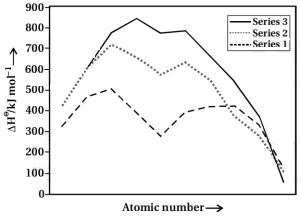
(N/A) The energy required to form $1 \ mol$ of gaseous atoms from its element in its standard state is called standard enthalpy of atomisation $(\Delta_a H^{\ominus})$.
The transition elements have high enthalpies of atomisation because of the presence of strong inter-atomic interactions (strong metallic bonds) between the atoms.
The enthalpy of atomisation generally increases with the increase in the number of unpaired electrons,which results in the formation of stronger metallic bonds.
The elements of $4d$ and $5d$ series have greater enthalpy of atomisation than the corresponding elements of the first transition series ($3d$ series),which results in much more metal-metal bonding in compounds of the heavy transition elements.
Trends in enthalpies of atomisation of transition elements:
In the first transition series,$Zn$ has the minimum enthalpy of atomisation because of the absence of unpaired electrons in its $d$-orbitals ($3d^{10} 4s^2$ configuration).
The transition elements have high enthalpies of atomisation because of the presence of strong inter-atomic interactions (strong metallic bonds) between the atoms.
The enthalpy of atomisation generally increases with the increase in the number of unpaired electrons,which results in the formation of stronger metallic bonds.
The elements of $4d$ and $5d$ series have greater enthalpy of atomisation than the corresponding elements of the first transition series ($3d$ series),which results in much more metal-metal bonding in compounds of the heavy transition elements.
Trends in enthalpies of atomisation of transition elements:
In the first transition series,$Zn$ has the minimum enthalpy of atomisation because of the absence of unpaired electrons in its $d$-orbitals ($3d^{10} 4s^2$ configuration).
0 likes
View Solution592
Difficult
Explain the variations in atomic radii of transition elements along the period. The following table provides data for the first transition series:
| Element | Sc | Ti | $V$ | Cr | Mn | Fe | Co | Ni | Cu | Zn |
|---|---|---|---|---|---|---|---|---|---|---|
| Metallic Radius $M$ (pm) | $164$ | $147$ | $135$ | $129$ | $137$ | $126$ | $125$ | $125$ | $128$ | $137$ |
Solution
(N/A) The atomic radii of transition elements in a period generally decrease with an increase in atomic number, but this decrease becomes small after the middle of the series.
$1$. In the beginning of the series, the atomic radii decrease as the atomic number increases due to the increase in effective nuclear charge. The attraction between the nucleus and the outermost electrons $(4s)$ increases, resulting in a decrease in atomic radii from $Sc$ to $Cr$.
$2$. In the middle of the series, the shielding effect of $d$-electrons and the increasing nuclear attraction are counterbalanced. As a result, the atomic radii remain almost steady from $Cr$ to $Cu$.
$3$. At the end of the series, the electron-electron repulsions in $d$-orbitals become dominant over the nuclear attraction. These repulsions expand the electron cloud, which results in an increase in atomic radii. For example, the atomic radius of $Zn$ $(137 \text{ pm})$ is greater than that of $Cu$ $(128 \text{ pm})$.
$1$. In the beginning of the series, the atomic radii decrease as the atomic number increases due to the increase in effective nuclear charge. The attraction between the nucleus and the outermost electrons $(4s)$ increases, resulting in a decrease in atomic radii from $Sc$ to $Cr$.
$2$. In the middle of the series, the shielding effect of $d$-electrons and the increasing nuclear attraction are counterbalanced. As a result, the atomic radii remain almost steady from $Cr$ to $Cu$.
$3$. At the end of the series, the electron-electron repulsions in $d$-orbitals become dominant over the nuclear attraction. These repulsions expand the electron cloud, which results in an increase in atomic radii. For example, the atomic radius of $Zn$ $(137 \text{ pm})$ is greater than that of $Cu$ $(128 \text{ pm})$.
0 likes
View Solution593
Advanced
Explain on what factors the ionization enthalpies of elements having $d^{n}$ configuration depend upon? Explain the variation in ionization enthalpies of transition elements in the $3d$ series.
Solution
(N/A) The ionization enthalpy depends on three factors:
$(i)$ Nucleus-electron attraction
$(ii)$ Electron-electron repulsion
$(iii)$ Exchange energy
Exchange energy is responsible for the stabilization of the energy state. It is approximately proportional to the total number of possible pairs of parallel spin degenerate orbitals. When several electrons occupy a set of degenerate orbitals, the lowest energy state corresponds to the maximum possible extent of single occupation of orbitals and parallel spins (Hund's Rule). The loss of exchange energy increases the stability and hence the ionization enthalpy increases.
$(i)$ First ionization enthalpy: The first ionization enthalpy follows an irregular trend. This is because the first electron when removed alters the relative energies of $3d$ and $4s$ orbitals. The electrons are first removed from $4s$ and then from $3d$ orbitals.
In the first transition series, going from scandium to zinc, the nuclear charge increases with the increase in atomic number and the electrons are added in $3d$ orbitals. The increase in nuclear charge is opposed by the shielding effect of $3d$ electrons; as a result, the atomic radii decrease less rapidly and so there is a slight increase in ionization enthalpy in the $3d$ series.
$(ii)$ Successive ionization enthalpies: In general, the third ionization enthalpy is higher than the second, which is higher than the first. The high values of successive ionization enthalpies are attributed to high effective nuclear charge and poor shielding of one $d$-electron by another.
The second ionization enthalpy of chromium is higher than manganese, while the third ionization enthalpy of manganese is higher than chromium. In the case of chromium, the second electron is to be removed from a half-filled $(d^{5})$ subshell which is extra stable. In the case of manganese, the third electron is to be removed from a half-filled $(d^{5})$ subshell, making the third ionization enthalpy higher for manganese than chromium.
${}_{24}Cr^{+}:[Ar] 3d^{5} 4s^{0} \rightarrow {}_{24}Cr^{2+}:[Ar] 3d^{4}$
${}_{25}Mn^{2+}:[Ar] 3d^{5} 4s^{0} \rightarrow {}_{25}Mn^{3+}:[Ar] 3d^{4}$ (More difficult to attain)
Thus, for manganese, it is difficult to remove the third electron.
$(iii)$ Stability of $M^{2+}$ ions in gaseous state: The stability of $M^{2+}$ ions depends on the sum of the first and second ionization enthalpies and the enthalpy of atomization. Lower the sum, greater the thermodynamic stability. The dominant factor is the second ionization enthalpy. This explains why $Zn^{2+}$ and $Mn^{2+}$ ions are formed easily and the removal of a third electron is difficult.
$(i)$ Nucleus-electron attraction
$(ii)$ Electron-electron repulsion
$(iii)$ Exchange energy
Exchange energy is responsible for the stabilization of the energy state. It is approximately proportional to the total number of possible pairs of parallel spin degenerate orbitals. When several electrons occupy a set of degenerate orbitals, the lowest energy state corresponds to the maximum possible extent of single occupation of orbitals and parallel spins (Hund's Rule). The loss of exchange energy increases the stability and hence the ionization enthalpy increases.
$(i)$ First ionization enthalpy: The first ionization enthalpy follows an irregular trend. This is because the first electron when removed alters the relative energies of $3d$ and $4s$ orbitals. The electrons are first removed from $4s$ and then from $3d$ orbitals.
In the first transition series, going from scandium to zinc, the nuclear charge increases with the increase in atomic number and the electrons are added in $3d$ orbitals. The increase in nuclear charge is opposed by the shielding effect of $3d$ electrons; as a result, the atomic radii decrease less rapidly and so there is a slight increase in ionization enthalpy in the $3d$ series.
$(ii)$ Successive ionization enthalpies: In general, the third ionization enthalpy is higher than the second, which is higher than the first. The high values of successive ionization enthalpies are attributed to high effective nuclear charge and poor shielding of one $d$-electron by another.
The second ionization enthalpy of chromium is higher than manganese, while the third ionization enthalpy of manganese is higher than chromium. In the case of chromium, the second electron is to be removed from a half-filled $(d^{5})$ subshell which is extra stable. In the case of manganese, the third electron is to be removed from a half-filled $(d^{5})$ subshell, making the third ionization enthalpy higher for manganese than chromium.
${}_{24}Cr^{+}:[Ar] 3d^{5} 4s^{0} \rightarrow {}_{24}Cr^{2+}:[Ar] 3d^{4}$
${}_{25}Mn^{2+}:[Ar] 3d^{5} 4s^{0} \rightarrow {}_{25}Mn^{3+}:[Ar] 3d^{4}$ (More difficult to attain)
Thus, for manganese, it is difficult to remove the third electron.
$(iii)$ Stability of $M^{2+}$ ions in gaseous state: The stability of $M^{2+}$ ions depends on the sum of the first and second ionization enthalpies and the enthalpy of atomization. Lower the sum, greater the thermodynamic stability. The dominant factor is the second ionization enthalpy. This explains why $Zn^{2+}$ and $Mn^{2+}$ ions are formed easily and the removal of a third electron is difficult.
0 likes
View Solution594
Difficult
Why do the transition elements exhibit variable oxidation states?
Solution
(N/A) Transition elements exhibit variable oxidation states because their $(n-1)d$ and $ns$ orbitals have comparable energies.
The general electronic configuration of transition elements is $(n-1)d^{1-10}ns^{1-2}$.
Since the energy difference between the $(n-1)d$ and $ns$ orbitals is very small,electrons from both shells can participate in chemical bond formation.
For the first transition series,the $4s$ electrons are primarily responsible for lower oxidation states,while both $3d$ and $4s$ electrons contribute to higher oxidation states.
The table below illustrates the oxidation states of the first transition series:
The general electronic configuration of transition elements is $(n-1)d^{1-10}ns^{1-2}$.
Since the energy difference between the $(n-1)d$ and $ns$ orbitals is very small,electrons from both shells can participate in chemical bond formation.
For the first transition series,the $4s$ electrons are primarily responsible for lower oxidation states,while both $3d$ and $4s$ electrons contribute to higher oxidation states.
The table below illustrates the oxidation states of the first transition series:
| $Sc$ | $Ti$ | $V$ | $Cr$ | $Mn$ | $Fe$ | $Co$ | $Ni$ | $Cu$ | $Zn$ |
|---|---|---|---|---|---|---|---|---|---|
| $+2$ | $+2$ | $+2$ | $+2$ | $+2$ | $+2$ | $+2$ | $+1$ | $+2$ | |
| $+3$ | $+3$ | $+3$ | $+3$ | $+3$ | $+3$ | $+3$ | $+3$ | $+2$ | |
| $+4$ | $+4$ | $+4$ | $+4$ | $+4$ | $+4$ | $+4$ | |||
| $+5$ | $+5$ | $+5$ | |||||||
| $+6$ | $+6$ | $+6$ | |||||||
| $+7$ |
0 likes
View Solution595
Advanced
How do the oxidation states of the elements vary in the transition series?
Solution
(N/A) The variation of oxidation states in the first transition series ($3d$-series) is as follows:
$1$. At the beginning of the series,fewer $d$-electrons are available for chemical bonding,resulting in fewer oxidation states. For example,Scandium ($Sc$,$d^1$) shows only $(+3)$,while Titanium ($Ti$,$d^2$) shows $(+2, +3, +4)$.
$2$. At the end of the series,$d$-orbitals are nearly or completely filled,leaving fewer orbitals available for bonding. For example,Zinc ($Zn$,$d^{10}$) shows only $(+2)$,and Copper ($Cu$,$d^9$) shows $(+1, +2)$.
$3$. The greatest number of oxidation states is observed in the middle of the series,where both $s$ and $d$ electrons are available for bonding. Manganese $(Mn)$ shows the widest range,from $(+2)$ to $(+7)$.
$4$. Elements in the transition series often exhibit multiple oxidation states differing by unity (e.g.,$V^{II}, V^{III}, V^{IV}, V^{V}$),unlike non-transition elements where oxidation states typically differ by two.
$5$. Down a group,higher oxidation states become more stable. For example,$Mo(VI)$ and $W(VI)$ are more stable than $Cr(VI)$.
$6$. Low oxidation states (e.g.,zero) are observed in complexes where ligands act as $\pi$-acceptors,such as in $Ni(CO)_4$ and $Fe(CO)_5$.
$1$. At the beginning of the series,fewer $d$-electrons are available for chemical bonding,resulting in fewer oxidation states. For example,Scandium ($Sc$,$d^1$) shows only $(+3)$,while Titanium ($Ti$,$d^2$) shows $(+2, +3, +4)$.
$2$. At the end of the series,$d$-orbitals are nearly or completely filled,leaving fewer orbitals available for bonding. For example,Zinc ($Zn$,$d^{10}$) shows only $(+2)$,and Copper ($Cu$,$d^9$) shows $(+1, +2)$.
$3$. The greatest number of oxidation states is observed in the middle of the series,where both $s$ and $d$ electrons are available for bonding. Manganese $(Mn)$ shows the widest range,from $(+2)$ to $(+7)$.
$4$. Elements in the transition series often exhibit multiple oxidation states differing by unity (e.g.,$V^{II}, V^{III}, V^{IV}, V^{V}$),unlike non-transition elements where oxidation states typically differ by two.
$5$. Down a group,higher oxidation states become more stable. For example,$Mo(VI)$ and $W(VI)$ are more stable than $Cr(VI)$.
$6$. Low oxidation states (e.g.,zero) are observed in complexes where ligands act as $\pi$-acceptors,such as in $Ni(CO)_4$ and $Fe(CO)_5$.
0 likes
View Solution596
Difficult
Discuss the magnetic properties of transition elements.
Solution
(N/A) In the presence of a magnetic field,two types of magnetic behaviour are observed for transition elements: $(i)$ Paramagnetism and $(ii)$ Diamagnetism. Paramagnetic substances are attracted by a magnetic field,while diamagnetic substances are repelled by the magnetic field.
Ferromagnetism is an extreme form of paramagnetism where the substance is very strongly attracted by the magnetic field. Paramagnetism arises from the presence of unpaired electrons in $(n-1)d$-orbitals,with each such electron having a magnetic moment associated with its spin as well as orbital motion. For most transition elements,the orbital contribution is not of much significance.
The magnetic moment expresses the paramagnetic behaviour of transition metal ions and is calculated using the "Spin-only" formula $\mu = \sqrt{n(n+2)} \ BM$,where:
$n =$ number of unpaired electrons in $(n-1)d$-orbitals
$\mu =$ Magnetic moment in Bohr Magneton $(BM)$
The magnetic moment increases with the increase in the number of unpaired electrons. If the magnetic moment is zero,the substance is diamagnetic and is repelled by the magnetic field.
Ferromagnetism is an extreme form of paramagnetism where the substance is very strongly attracted by the magnetic field. Paramagnetism arises from the presence of unpaired electrons in $(n-1)d$-orbitals,with each such electron having a magnetic moment associated with its spin as well as orbital motion. For most transition elements,the orbital contribution is not of much significance.
The magnetic moment expresses the paramagnetic behaviour of transition metal ions and is calculated using the "Spin-only" formula $\mu = \sqrt{n(n+2)} \ BM$,where:
$n =$ number of unpaired electrons in $(n-1)d$-orbitals
$\mu =$ Magnetic moment in Bohr Magneton $(BM)$
| Ion | Configuration | Unpaired electron$(s)$ | Calculated Magnetic moment | Observed Magnetic moment |
| $Sc^{3+}$ | $3d^{0}$ | $0$ | $0$ | $0$ |
| $Ti^{3+}$ | $3d^{1}$ | $1$ | $1.73$ | $1.75$ |
| $Ti^{2+}$ | $3d^{2}$ | $2$ | $2.84$ | $2.76$ |
| $V^{2+}$ | $3d^{3}$ | $3$ | $3.87$ | $3.86$ |
| $Cr^{2+}$ | $3d^{4}$ | $4$ | $4.90$ | $4.80$ |
| $Mn^{2+}$ | $3d^{5}$ | $5$ | $5.92$ | $5.96$ |
| $Fe^{2+}$ | $3d^{6}$ | $4$ | $4.90$ | $5.3-5.5$ |
| $Co^{2+}$ | $3d^{7}$ | $3$ | $3.87$ | $4.4-5.2$ |
| $Ni^{2+}$ | $3d^{8}$ | $2$ | $2.84$ | $2.9-3.4$ |
| $Cu^{2+}$ | $3d^{9}$ | $1$ | $1.73$ | $1.8-2.2$ |
| $Zn^{2+}$ | $3d^{10}$ | $0$ | $0$ | $-$ |
The magnetic moment increases with the increase in the number of unpaired electrons. If the magnetic moment is zero,the substance is diamagnetic and is repelled by the magnetic field.
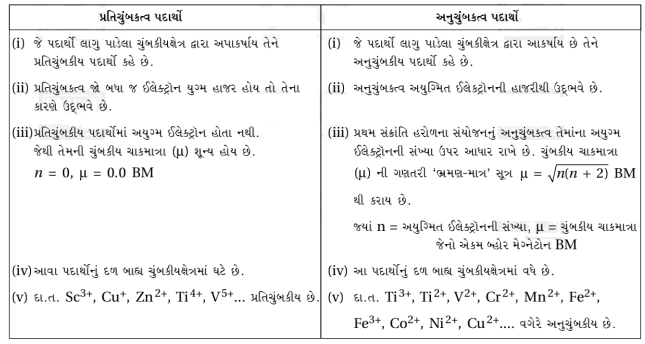
0 likes
View Solution597
Difficult
Why do ions of the first transition series exhibit paramagnetism? State the calculated and experimental observed magnetic moments of these ions.
Solution
(N/A) Paramagnetism arises due to the presence of unpaired electrons.
Each unpaired electron undergoes two types of motion: $(i)$ spin angular momentum and $(ii)$ orbital angular momentum. For the first series of transition metal compounds,the contribution of orbital angular momentum is effectively quenched,and thus its contribution to the magnetic moment value is not significant. Therefore,the magnetic moment value is determined by the number of unpaired electrons present.
The magnetic moment is calculated using the 'spin-only' formula,which is as follows:
$\mu = \sqrt{n(n+2)} \ BM$,where $n =$ number of unpaired electrons.
$\mu =$ magnetic moment (unit is Bohr Magneton $(BM)$).
Thus,as the number of unpaired electrons increases,the value of the magnetic moment increases.
The table below provides the calculated and experimental observed magnetic moment values:
| Ion | Electronic Configuration | Unpaired Electrons | Calculated Magnetic Moment $(BM)$ | Observed Magnetic Moment $(BM)$ |
| :--- | :--- | :--- | :--- | :--- |
| $Sc^{3+}$ | $3d^0$ | $0$ | $0$ | $0$ |
| $Ti^{3+}$ | $3d^1$ | $1$ | $1.73$ | $1.75$ |
| $Ti^{2+}$ | $3d^2$ | $2$ | $2.84$ | $2.76$ |
| $V^{2+}$ | $3d^3$ | $3$ | $3.87$ | $3.86$ |
| $Cr^{2+}$ | $3d^4$ | $4$ | $4.90$ | $4.80$ |
| $Mn^{2+}$ | $3d^5$ | $5$ | $5.92$ | $5.96$ |
| $Fe^{2+}$ | $3d^6$ | $4$ | $4.90$ | $5.3 - 5.5$ |
| $Co^{2+}$ | $3d^7$ | $3$ | $3.87$ | $4.4 - 5.2$ |
| $Ni^{2+}$ | $3d^8$ | $2$ | $2.84$ | $2.9 - 3.4$ |
| $Cu^{2+}$ | $3d^9$ | $1$ | $1.73$ | $1.8 - 2.2$ |
| $Zn^{2+}$ | $3d^{10}$ | $0$ | $0$ | $0$ |
Each unpaired electron undergoes two types of motion: $(i)$ spin angular momentum and $(ii)$ orbital angular momentum. For the first series of transition metal compounds,the contribution of orbital angular momentum is effectively quenched,and thus its contribution to the magnetic moment value is not significant. Therefore,the magnetic moment value is determined by the number of unpaired electrons present.
The magnetic moment is calculated using the 'spin-only' formula,which is as follows:
$\mu = \sqrt{n(n+2)} \ BM$,where $n =$ number of unpaired electrons.
$\mu =$ magnetic moment (unit is Bohr Magneton $(BM)$).
Thus,as the number of unpaired electrons increases,the value of the magnetic moment increases.
The table below provides the calculated and experimental observed magnetic moment values:
| Ion | Electronic Configuration | Unpaired Electrons | Calculated Magnetic Moment $(BM)$ | Observed Magnetic Moment $(BM)$ |
| :--- | :--- | :--- | :--- | :--- |
| $Sc^{3+}$ | $3d^0$ | $0$ | $0$ | $0$ |
| $Ti^{3+}$ | $3d^1$ | $1$ | $1.73$ | $1.75$ |
| $Ti^{2+}$ | $3d^2$ | $2$ | $2.84$ | $2.76$ |
| $V^{2+}$ | $3d^3$ | $3$ | $3.87$ | $3.86$ |
| $Cr^{2+}$ | $3d^4$ | $4$ | $4.90$ | $4.80$ |
| $Mn^{2+}$ | $3d^5$ | $5$ | $5.92$ | $5.96$ |
| $Fe^{2+}$ | $3d^6$ | $4$ | $4.90$ | $5.3 - 5.5$ |
| $Co^{2+}$ | $3d^7$ | $3$ | $3.87$ | $4.4 - 5.2$ |
| $Ni^{2+}$ | $3d^8$ | $2$ | $2.84$ | $2.9 - 3.4$ |
| $Cu^{2+}$ | $3d^9$ | $1$ | $1.73$ | $1.8 - 2.2$ |
| $Zn^{2+}$ | $3d^{10}$ | $0$ | $0$ | $0$ |
0 likes
View Solution598
Medium
What are alloys? Write about them.
Solution
(N/A) Alloys are homogeneous solid solutions of two or more metals or a metal and a non-metal.
In alloys,the atoms of one metal are randomly distributed in the lattice of another metal.
Alloys are prepared by melting the components together. The general conditions for the formation of alloys are:
$(i)$ The difference in the metallic radii of the atoms should be less than $15\%$.
$(ii)$ Transition metals have similar atomic radii and other characteristics,which makes it easy for them to form alloys.
Properties: Alloys are generally harder than their constituent metals and have higher melting points.
Examples: Ferrous alloys are the most common. Metals like $Cr, V, W, Mo,$ and $Mn$ are used to produce various types of steel and stainless steel. Alloys can also be formed between transition metals and non-transition metals.
Examples include $(i)$ Brass $(Copper-Zinc)$ and $(ii)$ Bronze $(Copper-Tin)$. These alloys have significant industrial importance.
In alloys,the atoms of one metal are randomly distributed in the lattice of another metal.
Alloys are prepared by melting the components together. The general conditions for the formation of alloys are:
$(i)$ The difference in the metallic radii of the atoms should be less than $15\%$.
$(ii)$ Transition metals have similar atomic radii and other characteristics,which makes it easy for them to form alloys.
Properties: Alloys are generally harder than their constituent metals and have higher melting points.
Examples: Ferrous alloys are the most common. Metals like $Cr, V, W, Mo,$ and $Mn$ are used to produce various types of steel and stainless steel. Alloys can also be formed between transition metals and non-transition metals.
Examples include $(i)$ Brass $(Copper-Zinc)$ and $(ii)$ Bronze $(Copper-Tin)$. These alloys have significant industrial importance.
0 likes
View Solution599
AdvancedMCQ
Fill in the blanks:
$(a)$ The shielding effect of $d$-electrons is ......... effective than $p$-electrons.
$(b)$ $A$ decrease in exchange energy leads to a ......... in stability.
$(c)$ The maximum oxidation state of $Mn$ is ..........
$(d)$ The stability of $Mo(VI)$ and $W(VI)$ is found to be .......... than that of $Cr(VI)$.
$(a)$ The shielding effect of $d$-electrons is ......... effective than $p$-electrons.
$(b)$ $A$ decrease in exchange energy leads to a ......... in stability.
$(c)$ The maximum oxidation state of $Mn$ is ..........
$(d)$ The stability of $Mo(VI)$ and $W(VI)$ is found to be .......... than that of $Cr(VI)$.
A
Less,Decrease,+$7$,Higher
B
More,Increase,+$6$,Lower
C
Equal,No change,+$5$,Equal
D
None of these,None of these,+$4$,None of these
Solution
(A) The shielding effect of $d$-electrons is less effective than $p$-electrons due to their diffuse shape.
$(b)$ $A$ decrease in exchange energy leads to a decrease in stability,as exchange energy is directly proportional to stability.
$(c)$ The maximum oxidation state of $Mn$ $(Z=25)$ is $+7$,corresponding to the configuration $3d^5 4s^2$.
$(d)$ The stability of $Mo(VI)$ and $W(VI)$ is found to be higher than that of $Cr(VI)$ because stability increases down the group for higher oxidation states.
$(b)$ $A$ decrease in exchange energy leads to a decrease in stability,as exchange energy is directly proportional to stability.
$(c)$ The maximum oxidation state of $Mn$ $(Z=25)$ is $+7$,corresponding to the configuration $3d^5 4s^2$.
$(d)$ The stability of $Mo(VI)$ and $W(VI)$ is found to be higher than that of $Cr(VI)$ because stability increases down the group for higher oxidation states.
0 likes
View Solution600
DifficultMCQ
Determine whether the following statements are True $(T)$ or False $(F)$:
$(a)$ The atomic radii of the elements of the second transition series $(4d)$ are larger than those of the first transition series $(3d)$.
$(b)$ $Cr^{+}$,$Mn^{2+}$,and $Fe^{3+}$ have the same electronic configuration.
$(c)$ $Cr^{+}$,$Mn^{2+}$,and $Fe^{3+}$ have the same $d^5$ electronic configuration.
$(a)$ The atomic radii of the elements of the second transition series $(4d)$ are larger than those of the first transition series $(3d)$.
$(b)$ $Cr^{+}$,$Mn^{2+}$,and $Fe^{3+}$ have the same electronic configuration.
$(c)$ $Cr^{+}$,$Mn^{2+}$,and $Fe^{3+}$ have the same $d^5$ electronic configuration.
A
$(a) T, (b) T, (c) F$
B
$(a) T, (b) F, (c) T$
C
$(a) F, (b) T, (c) F$
D
$(a) T, (b) T, (c) T$
Solution
(A) Due to the lanthanoid contraction and the addition of a new shell,the atomic radii of $4d$ elements are larger than $3d$ elements. This statement is True $(T)$.
$(b)$ Electronic configurations:
$Cr^{+} (Z=24): [Ar] 3d^5$
$Mn^{2+} (Z=25): [Ar] 3d^5$
$Fe^{3+} (Z=26): [Ar] 3d^5$
Since all have the same configuration,this statement is True $(T)$.
$(c)$ As shown above,they have a $d^5$ configuration,not $d^6$. This statement is False $(F)$.
$(b)$ Electronic configurations:
$Cr^{+} (Z=24): [Ar] 3d^5$
$Mn^{2+} (Z=25): [Ar] 3d^5$
$Fe^{3+} (Z=26): [Ar] 3d^5$
Since all have the same configuration,this statement is True $(T)$.
$(c)$ As shown above,they have a $d^5$ configuration,not $d^6$. This statement is False $(F)$.
0 likes
View Solutiond-and f-Block Elements — General Characteristics · Frequently Asked Questions
1Are these d-and f-Block Elements questions useful for JEE and NEET?
Yes. All questions in this section are mapped to JEE Main and NEET exam patterns. Previous year questions from JEE Main, NEET, GUJCET and state-level exams are included with full solutions.
2Can I switch to Hindi or Gujarati for these questions?
Yes. Use the language tabs in the hero section or the sidebar to view the same questions and solutions in English, Hindi or Gujarati.
3How do I generate a question paper from this subtopic?
Use the Vedclass Exam Paper Generator — select the chapter and subtopic, set difficulty, and generate Sets A, B, C, D automatically. First 3 chapters of every subject are free.
Vedclass Products
For Students
Vedclass Test Series
Mock tests in real JEE/NEET style with performance analysis. 5-day free trial.
Start Free TrialFor Teachers
Exam Paper Generator
Generate Set A/B/C/D papers from this chapter in 2 minutes. 3 chapters free.
Try FreeFor Institutes
Online Exam Module
Live online exams with unlimited students, 360° analytics & white-label branding.
See DemoFor Teachers & Institutes
Generate a d-and f-Block Elements Exam Paper in 2 Minutes
Select subtopic & difficulty — Sets A, B, C, D auto-generated with No Repeat logic.
First 3 chapters of every subject are free — no payment required.