
A English
General Characteristics Questions in English
Class 12 Chemistry · d-and f-Block Elements · General Characteristics
963+
Questions
English
Language
100%
With Solutions
Showing 50 of 963 questions in English
601
DifficultMCQ
Determine whether the following statements are True $(T)$ or False $(F)$:
$(a)$ Transition elements exhibit variable oxidation states.
$(b)$ The $E^o$ values for $Mn, Zn,$ and $Ni$ are more positive than expected from the general trend.
$(c)$ Any metal exhibits its maximum high oxidation state in oxide and chloride compounds.
$(a)$ Transition elements exhibit variable oxidation states.
$(b)$ The $E^o$ values for $Mn, Zn,$ and $Ni$ are more positive than expected from the general trend.
$(c)$ Any metal exhibits its maximum high oxidation state in oxide and chloride compounds.
A
$(a) T, (b) T, (c) T$
B
$(a) T, (b) F, (c) T$
C
$(a) T, (b) T, (c) F$
D
$(a) F, (b) T, (c) T$
Solution
(A) True: Transition elements have $(n-1)d$ and $ns$ electrons with comparable energies,allowing them to show variable oxidation states.
$(b)$ True: The $E^o$ values for $Mn^{2+}/Mn$,$Zn^{2+}/Zn$,and $Ni^{2+}/Ni$ are more positive than expected due to factors like high hydration enthalpy or stable electronic configurations $(d^5, d^{10})$.
$(c)$ True: The high electronegativity and small size of oxygen and fluorine (in chlorides/fluorides) stabilize the highest oxidation states of transition metals.
$(b)$ True: The $E^o$ values for $Mn^{2+}/Mn$,$Zn^{2+}/Zn$,and $Ni^{2+}/Ni$ are more positive than expected due to factors like high hydration enthalpy or stable electronic configurations $(d^5, d^{10})$.
$(c)$ True: The high electronegativity and small size of oxygen and fluorine (in chlorides/fluorides) stabilize the highest oxidation states of transition metals.
0 likes
View Solution602
DifficultMCQ
Determine whether the following statements are True $(T)$ or False $(F)$:
$(a)$ The magnetic moment arises from the spin and orbital motion of electrons.
$(b)$ The magnetic moment of $Mn^{2+}$ is $5.92 \ BM$.
$(c)$ Interstitial compounds are covalent compounds.
$(a)$ The magnetic moment arises from the spin and orbital motion of electrons.
$(b)$ The magnetic moment of $Mn^{2+}$ is $5.92 \ BM$.
$(c)$ Interstitial compounds are covalent compounds.
A
$(a) T, (b) T, (c) F$
B
$(a) T, (b) F, (c) F$
C
$(a) F, (b) T, (c) T$
D
$(a) T, (b) T, (c) T$
Solution
(A) True: The magnetic moment of transition metal ions is due to both spin and orbital angular momentum of electrons.
$(b)$ True: For $Mn^{2+}$ ($d^5$ configuration),the number of unpaired electrons $n = 5$. The spin-only magnetic moment is $\mu = \sqrt{n(n+2)} = \sqrt{5(5+2)} = \sqrt{35} \approx 5.92 \ BM$.
$(c)$ False: Interstitial compounds are non-stoichiometric compounds formed when small atoms like $H, C, N$ are trapped inside the crystal lattice of transition metals. They are typically metallic in nature,not covalent.
$(b)$ True: For $Mn^{2+}$ ($d^5$ configuration),the number of unpaired electrons $n = 5$. The spin-only magnetic moment is $\mu = \sqrt{n(n+2)} = \sqrt{5(5+2)} = \sqrt{35} \approx 5.92 \ BM$.
$(c)$ False: Interstitial compounds are non-stoichiometric compounds formed when small atoms like $H, C, N$ are trapped inside the crystal lattice of transition metals. They are typically metallic in nature,not covalent.
0 likes
View Solution603
EasyMCQ
How does the ionization enthalpy change as we move from left to right in each transition series?
A
It increases gradually.
B
It decreases gradually.
C
It remains constant.
D
It increases then decreases.
Solution
(A) In each transition series,as we move from left to right,the nuclear charge increases by one unit at each step.
Due to the poor shielding effect of $d$-electrons,the effective nuclear charge increases,which leads to an increase in the ionization enthalpy.
However,this increase is not regular because of the complex interplay between increasing nuclear charge and increasing shielding effect.
Due to the poor shielding effect of $d$-electrons,the effective nuclear charge increases,which leads to an increase in the ionization enthalpy.
However,this increase is not regular because of the complex interplay between increasing nuclear charge and increasing shielding effect.
0 likes
View Solution604
Difficult
Explain $d$-block elements of the periodic table.
Solution
(N/A) Elements of group $3$ to $12$ are known as $d$-block elements.
The general electronic configuration of these elements is $(n-1)d^{1-10}ns^{0-2}$.
These elements are called $d$-block elements because their last electron enters the $d$-orbital.
Characteristics of $d$-block elements:
- They are all metals. They mostly form coloured ions,exhibit variable valency (oxidation states),show paramagnetism,and are often used as catalysts.
- However,$Zn$,$Cd$,and $Hg$,which have the electronic configuration $(n-1)d^{10}ns^{2}$,do not show most of the properties of transition elements.
Transition Elements: Transition metals form a bridge between the chemically active metals of $s$-block elements and the less active elements of groups $13$ and $14$,hence the name "Transition Elements".
The general electronic configuration of these elements is $(n-1)d^{1-10}ns^{0-2}$.
These elements are called $d$-block elements because their last electron enters the $d$-orbital.
Characteristics of $d$-block elements:
- They are all metals. They mostly form coloured ions,exhibit variable valency (oxidation states),show paramagnetism,and are often used as catalysts.
- However,$Zn$,$Cd$,and $Hg$,which have the electronic configuration $(n-1)d^{10}ns^{2}$,do not show most of the properties of transition elements.
Transition Elements: Transition metals form a bridge between the chemically active metals of $s$-block elements and the less active elements of groups $13$ and $14$,hence the name "Transition Elements".
0 likes
View Solution605
Difficult
What are $d$-block elements and transition elements? Explain characteristics of $d$-block elements.
Solution
(N/A) -block elements are elements belonging to groups $3$ to $12$ in the periodic table,where the last electron enters the $(n-1)d$ orbital. Their general electronic configuration is $(n-1)d^{1-10}ns^{0-2}$.
Transition elements are defined as elements that have partially filled $d$-orbitals in their ground state or in any of their common oxidation states. Thus,$Zn$,$Cd$,and $Hg$ (having $d^{10}$ configuration) are $d$-block elements but not transition elements.
Characteristics of $d$-block elements:
$1$. They are all metals with high melting and boiling points.
$2$. They exhibit variable oxidation states.
$3$. They form coloured ions and compounds.
$4$. They show paramagnetic behaviour due to the presence of unpaired electrons.
$5$. They act as good catalysts due to their ability to adopt multiple oxidation states and provide a large surface area.
Transition elements are defined as elements that have partially filled $d$-orbitals in their ground state or in any of their common oxidation states. Thus,$Zn$,$Cd$,and $Hg$ (having $d^{10}$ configuration) are $d$-block elements but not transition elements.
Characteristics of $d$-block elements:
$1$. They are all metals with high melting and boiling points.
$2$. They exhibit variable oxidation states.
$3$. They form coloured ions and compounds.
$4$. They show paramagnetic behaviour due to the presence of unpaired electrons.
$5$. They act as good catalysts due to their ability to adopt multiple oxidation states and provide a large surface area.
0 likes
View Solution606
Difficult
What are $f$-block elements? Give their characteristics.
Solution
(N/A) The two rows of elements at the bottom of the Periodic Table,called the Lanthanoids,$Ce$ $(Z = 58)$ $-$ $Lu$ $(Z = 71)$ and Actinoids,$Th$ $(Z = 90)$ $-$ $Lr$ $(Z = 103)$,are characterized by the outer electronic configuration $(n-2)f^{1-14}(n-1)d^{0-1}ns^{2}$.
The last electron added to each element is filled in an $f$-orbital. These two series of elements are hence called the Inner-Transition Elements ($f$-Block Elements).
They are all metals. Within each series,the properties of the elements are quite similar.
The chemistry of the early actinoids is more complicated than the corresponding lanthanoids,due to the large number of oxidation states possible for these actinoid elements.
Actinoid elements are radioactive. Many of the actinoid elements have been made only in nanogram quantities or even less by nuclear reactions and their chemistry is not fully studied.
The elements after uranium are called Transuranium Elements.
The last electron added to each element is filled in an $f$-orbital. These two series of elements are hence called the Inner-Transition Elements ($f$-Block Elements).
They are all metals. Within each series,the properties of the elements are quite similar.
The chemistry of the early actinoids is more complicated than the corresponding lanthanoids,due to the large number of oxidation states possible for these actinoid elements.
Actinoid elements are radioactive. Many of the actinoid elements have been made only in nanogram quantities or even less by nuclear reactions and their chemistry is not fully studied.
The elements after uranium are called Transuranium Elements.
0 likes
View Solution607
Medium
All transition elements are $d$-block elements,but all $d$-block elements are not transition elements. Explain.
Solution
(N/A) transition element is defined as an element which has incompletely filled $d$-orbitals in its ground state or in any one of its oxidation states.
$d$-block elements are those in which the last electron enters the $d$-orbital. Their general electronic configuration is $(n-1)d^{1-10} ns^{0-2}$.
Elements like $Zn$,$Cd$,and $Hg$ have a completely filled $d^{10}$ configuration in their ground state as well as in their common oxidation states $(+2)$.
Since they do not have incompletely filled $d$-orbitals,they do not exhibit the characteristic properties of transition elements.
Therefore,while all transition elements belong to the $d$-block,elements like $Zn$,$Cd$,and $Hg$ are $d$-block elements but not transition elements.
$d$-block elements are those in which the last electron enters the $d$-orbital. Their general electronic configuration is $(n-1)d^{1-10} ns^{0-2}$.
Elements like $Zn$,$Cd$,and $Hg$ have a completely filled $d^{10}$ configuration in their ground state as well as in their common oxidation states $(+2)$.
Since they do not have incompletely filled $d$-orbitals,they do not exhibit the characteristic properties of transition elements.
Therefore,while all transition elements belong to the $d$-block,elements like $Zn$,$Cd$,and $Hg$ are $d$-block elements but not transition elements.
0 likes
View Solution608
Medium
Illustrate by taking examples of transition elements and non-transition elements that oxidation states of elements are largely based on electronic configuration.
Solution
(N/A) The oxidation states of elements are determined by their electronic configuration,specifically the number of electrons in the outermost shell and the stability of the resulting configuration.
$1$. Non-transition elements: Consider Nitrogen $(Z=7)$ with configuration $[He] 2s^{2} 2p^{3}$. It can show oxidation states like $-3$ (by gaining $3$ electrons to complete the octet) or $+5$ (by losing $5$ valence electrons).
$2$. Transition elements: Consider Manganese $(Z=25)$ with configuration $[Ar] 3d^{5} 4s^{2}$. Due to the availability of both $4s$ and $3d$ electrons,it exhibits variable oxidation states ranging from $+2$ to $+7$. The $+2$ state arises from the loss of $4s^{2}$ electrons,while higher states involve the progressive loss of $3d$ electrons,reaching stability at $+7$ where the $3d$ subshell becomes empty.
$1$. Non-transition elements: Consider Nitrogen $(Z=7)$ with configuration $[He] 2s^{2} 2p^{3}$. It can show oxidation states like $-3$ (by gaining $3$ electrons to complete the octet) or $+5$ (by losing $5$ valence electrons).
$2$. Transition elements: Consider Manganese $(Z=25)$ with configuration $[Ar] 3d^{5} 4s^{2}$. Due to the availability of both $4s$ and $3d$ electrons,it exhibits variable oxidation states ranging from $+2$ to $+7$. The $+2$ state arises from the loss of $4s^{2}$ electrons,while higher states involve the progressive loss of $3d$ electrons,reaching stability at $+7$ where the $3d$ subshell becomes empty.
0 likes
View Solution609
EasyMCQ
Which metal wire is used as a conductor of electricity?
A
Copper $(Cu)$
B
Iron $(Fe)$
C
Sodium $(Na)$
D
Calcium $(Ca)$
Solution
(A) Copper $(Cu)$ is widely used as a conductor of electricity in wires due to its high electrical conductivity and ductility.
It is a transition metal that allows the flow of electrons with minimal resistance.
It is a transition metal that allows the flow of electrons with minimal resistance.
0 likes
View Solution610
EasyMCQ
Identify the components of the alloy known as German Silver.
A
$Cu, Zn, Ni$
B
$Cu, Ag, Ni$
C
$Cu, Zn, Ag$
D
$Ag, Zn, Ni$
Solution
(A) German Silver is an alloy consisting of Copper $(Cu)$,Zinc $(Zn)$,and Nickel $(Ni)$.
It typically contains $50\% \ Cu$,$30\% \ Zn$,and $20\% \ Ni$ by mass.
Despite its name,it does not contain any Silver $(Ag)$.
It typically contains $50\% \ Cu$,$30\% \ Zn$,and $20\% \ Ni$ by mass.
Despite its name,it does not contain any Silver $(Ag)$.
0 likes
View Solution611
EasyMCQ
The hardness of interstitial compounds is comparable to which of the following?
A
Diamond
B
Graphite
C
Soft metals
D
Non-metals
Solution
(A) Interstitial compounds are formed when small atoms like $H$,$C$,or $N$ are trapped inside the crystal lattice of transition metals.
These compounds are very hard and have high melting points.
Their hardness is comparable to that of $Diamond$.
These compounds are very hard and have high melting points.
Their hardness is comparable to that of $Diamond$.
0 likes
View Solution612
EasyMCQ
What should be the difference in atomic radii of metals to form an alloy?
A
Less than $15\%$
B
More than $15\%$
C
Exactly $15\%$
D
No difference is required
Solution
(A) Alloys are formed by atoms with similar atomic sizes. For the formation of substitutional solid solutions (alloys),the difference in the atomic radii of the constituent metals should be less than $15\%$.
0 likes
View Solution613
EasyMCQ
Why do $CrO_3$ and $V_2O_5$ have low melting points?
A
They are covalent in nature.
B
They are ionic in nature.
C
They have high lattice energy.
D
They have metallic bonding.
Solution
(A) $CrO_3$ and $V_2O_5$ exhibit significant covalent character due to the high oxidation state of the transition metal ($Cr^{6+}$ and $V^{5+}$) and the small size of the metal ions.
According to Fajan's rule,high charge density leads to polarization of the oxide ion,resulting in covalent bonding.
Covalent compounds typically have lower melting points compared to purely ionic compounds because the intermolecular forces are weaker than strong electrostatic ionic attractions.
According to Fajan's rule,high charge density leads to polarization of the oxide ion,resulting in covalent bonding.
Covalent compounds typically have lower melting points compared to purely ionic compounds because the intermolecular forces are weaker than strong electrostatic ionic attractions.
0 likes
View Solution614
EasyMCQ
Which group of elements is known as coinage metals?
A
$Group \ 10$
B
$Group \ 11$
C
$Group \ 12$
D
$Group \ 13$
Solution
(B) The elements of $Group \ 11$ in the periodic table,which include copper $(Cu)$,silver $(Ag)$,and gold $(Au)$,are historically and commonly known as coinage metals because they have been used to mint coins throughout history.
0 likes
View Solution615
Medium
Why are the $E^o$ values for $Mn^{2+}/Mn$,$Zn^{2+}/Zn$,and $Ni^{2+}/Ni$ more negative than expected? The table below provides the values:
| $E^o_{Mn^{2+}/Mn}$ | $E^o_{Zn^{2+}/Zn}$ | $E^o_{Ni^{2+}/Ni}$ |
| :--- | :--- | :--- |
| $-1.18 \ V$ | $-0.76 \ V$ | $-0.25 \ V$ |
| $E^o_{Mn^{2+}/Mn}$ | $E^o_{Zn^{2+}/Zn}$ | $E^o_{Ni^{2+}/Ni}$ |
| :--- | :--- | :--- |
| $-1.18 \ V$ | $-0.76 \ V$ | $-0.25 \ V$ |
Solution
(N/A) The standard electrode potential $(E^o)$ of a metal is determined by the sum of the enthalpy of atomization,ionization enthalpy,and hydration enthalpy.
$1$. For $Mn^{2+}/Mn$: The $Mn^{2+}$ ion has a stable $d^5$ configuration. The high stability of the $d^5$ configuration makes the reduction of $Mn^{2+}$ to $Mn$ less favorable,resulting in a more negative $E^o$ value.
$2$. For $Zn^{2+}/Zn$: The $Zn^{2+}$ ion has a stable $d^{10}$ configuration. Similar to $Mn^{2+}$,the stability of the $d^{10}$ configuration makes the reduction of $Zn^{2+}$ to $Zn$ less favorable,leading to a more negative $E^o$ value.
$3$. For $Ni^{2+}/Ni$: The $Ni^{2+}$ ion has a very high negative hydration enthalpy,which compensates for the energy required for ionization and atomization,resulting in a more negative $E^o$ value than expected from the general trend.
$1$. For $Mn^{2+}/Mn$: The $Mn^{2+}$ ion has a stable $d^5$ configuration. The high stability of the $d^5$ configuration makes the reduction of $Mn^{2+}$ to $Mn$ less favorable,resulting in a more negative $E^o$ value.
$2$. For $Zn^{2+}/Zn$: The $Zn^{2+}$ ion has a stable $d^{10}$ configuration. Similar to $Mn^{2+}$,the stability of the $d^{10}$ configuration makes the reduction of $Zn^{2+}$ to $Zn$ less favorable,leading to a more negative $E^o$ value.
$3$. For $Ni^{2+}/Ni$: The $Ni^{2+}$ ion has a very high negative hydration enthalpy,which compensates for the energy required for ionization and atomization,resulting in a more negative $E^o$ value than expected from the general trend.
0 likes
View Solution616
MediumMCQ
Why is the first ionisation enthalpy of $Cr$ lower than that of $Zn$?
A
$Cr$ has a stable $d^5$ configuration,while $Zn$ has a stable $d^{10}$ configuration.
B
$Cr$ has a lower nuclear charge than $Zn$.
C
The $4s$ electrons in $Cr$ are more shielded than in $Zn$.
D
The $3d$ electrons in $Cr$ are more stable than in $Zn$.
Solution
(A) The first ionisation enthalpy depends on the effective nuclear charge and the electronic configuration of the atom.
$Cr$ has the electronic configuration $[Ar] 3d^5 4s^1$.
$Zn$ has the electronic configuration $[Ar] 3d^{10} 4s^2$.
Although $Cr$ has a stable half-filled $d$-subshell,the effective nuclear charge of $Zn$ $(Z=30)$ is significantly higher than that of $Cr$ $(Z=24)$.
As the atomic number increases across the $3d$ series,the effective nuclear charge increases,which pulls the electrons closer to the nucleus,making them harder to remove.
Therefore,the first ionisation enthalpy of $Zn$ is higher than that of $Cr$ due to its higher effective nuclear charge and the stability of the completely filled $d^{10}$ subshell.
$Cr$ has the electronic configuration $[Ar] 3d^5 4s^1$.
$Zn$ has the electronic configuration $[Ar] 3d^{10} 4s^2$.
Although $Cr$ has a stable half-filled $d$-subshell,the effective nuclear charge of $Zn$ $(Z=30)$ is significantly higher than that of $Cr$ $(Z=24)$.
As the atomic number increases across the $3d$ series,the effective nuclear charge increases,which pulls the electrons closer to the nucleus,making them harder to remove.
Therefore,the first ionisation enthalpy of $Zn$ is higher than that of $Cr$ due to its higher effective nuclear charge and the stability of the completely filled $d^{10}$ subshell.
0 likes
View Solution617
Medium
Transition elements show high melting points. Why?
Solution
(N/A) Transition elements exhibit high melting points due to the involvement of $(n-1)d$ electrons in addition to $ns$ electrons in the metallic bonding.
This leads to strong interatomic interactions and a greater number of covalent bonds between the metal atoms,which results in a high enthalpy of atomization and consequently,high melting points.
This leads to strong interatomic interactions and a greater number of covalent bonds between the metal atoms,which results in a high enthalpy of atomization and consequently,high melting points.
0 likes
View Solution618
Medium
Out of $Cu_2Cl_2$ and $CuCl_2$,which is more stable and why?
Solution
(B) $CuCl_2$ is more stable in an aqueous solution than $Cu_2Cl_2$.
This is because the high hydration enthalpy of $Cu^{2+}(aq)$ compensates for the high second ionization enthalpy required to convert $Cu^+(g)$ to $Cu^{2+}(g)$.
Although the first ionization enthalpy of $Cu$ is lower than the second,the hydration energy released when $Cu^{2+}$ ions are formed in water is significantly higher than that of $Cu^+$ ions,making $Cu^{2+}$ salts more stable in aqueous media.
This is because the high hydration enthalpy of $Cu^{2+}(aq)$ compensates for the high second ionization enthalpy required to convert $Cu^+(g)$ to $Cu^{2+}(g)$.
Although the first ionization enthalpy of $Cu$ is lower than the second,the hydration energy released when $Cu^{2+}$ ions are formed in water is significantly higher than that of $Cu^+$ ions,making $Cu^{2+}$ salts more stable in aqueous media.
0 likes
View Solution619
Medium
Although $Cr^{3+}$ and $Co^{2+}$ ions have the same number of unpaired electrons,the magnetic moment of $Cr^{3+}$ is $3.87 \ BM$ and that of $Co^{2+}$ is $4.87 \ BM$. Why?
Solution
(N/A) The magnetic moment $(\mu)$ is calculated using the spin-only formula: $\mu = \sqrt{n(n+2)} \ BM$,where $n$ is the number of unpaired electrons.
For $Cr^{3+}$ $(Z=24)$: The electronic configuration is $[Ar] 3d^3$. Here,$n = 3$. Thus,$\mu = \sqrt{3(3+2)} = \sqrt{15} \approx 3.87 \ BM$.
For $Co^{2+}$ $(Z=27)$: The electronic configuration is $[Ar] 3d^7$. This results in $n = 3$ unpaired electrons. However,for $Co^{2+}$,there is a significant orbital contribution to the magnetic moment due to the nature of the $d$-orbitals,which increases the observed value to approximately $4.87 \ BM$.
For $Cr^{3+}$ $(Z=24)$: The electronic configuration is $[Ar] 3d^3$. Here,$n = 3$. Thus,$\mu = \sqrt{3(3+2)} = \sqrt{15} \approx 3.87 \ BM$.
For $Co^{2+}$ $(Z=27)$: The electronic configuration is $[Ar] 3d^7$. This results in $n = 3$ unpaired electrons. However,for $Co^{2+}$,there is a significant orbital contribution to the magnetic moment due to the nature of the $d$-orbitals,which increases the observed value to approximately $4.87 \ BM$.
0 likes
View Solution620
MediumMCQ
Although $Zr$ belongs to the $4d$ transition series and $Hf$ belongs to the $5d$ transition series,it is quite difficult to separate them. Why?
A
Due to similar atomic sizes caused by lanthanoid contraction.
B
Due to similar electronic configurations.
C
Due to similar oxidation states.
D
Due to similar chemical reactivity.
Solution
(A) . The difficulty in separating $Zr$ and $Hf$ arises because they possess almost identical atomic and ionic radii.
This phenomenon is a direct consequence of the lanthanoid contraction.
As we move from the $4d$ to the $5d$ series,the filling of $4f$ orbitals occurs before the $5d$ orbitals.
The $4f$ electrons provide poor shielding of the nuclear charge,which leads to an increase in the effective nuclear charge.
This causes the atomic radii of $5d$ elements (like $Hf$) to be very similar to those of the corresponding $4d$ elements (like $Zr$).
This phenomenon is a direct consequence of the lanthanoid contraction.
As we move from the $4d$ to the $5d$ series,the filling of $4f$ orbitals occurs before the $5d$ orbitals.
The $4f$ electrons provide poor shielding of the nuclear charge,which leads to an increase in the effective nuclear charge.
This causes the atomic radii of $5d$ elements (like $Hf$) to be very similar to those of the corresponding $4d$ elements (like $Zr$).
0 likes
View Solution621
MediumMCQ
The halides of transition elements become more covalent with increasing oxidation state of the metal. Why?
A
Due to decrease in ionic radius
B
Due to increase in polarising power of the metal ion
C
Due to increase in electronegativity of the metal
D
Due to decrease in ionization energy
Solution
(B) According to Fajan's rule,the covalent character of an ionic bond increases with an increase in the charge density of the cation.
As the oxidation state of the transition metal increases,the size of the metal ion decreases and its charge increases.
This leads to a higher charge-to-size ratio,which increases the polarising power of the metal ion.
The metal ion then distorts the electron cloud of the halide ion more effectively,resulting in greater covalent character in the metal-halide bond.
As the oxidation state of the transition metal increases,the size of the metal ion decreases and its charge increases.
This leads to a higher charge-to-size ratio,which increases the polarising power of the metal ion.
The metal ion then distorts the electron cloud of the halide ion more effectively,resulting in greater covalent character in the metal-halide bond.
0 likes
View Solution622
Medium
Reactivity of transition elements decreases almost regularly from $Sc$ to $Cu$. Explain.
Solution
(N/A) The reactivity of transition elements is primarily determined by their ability to lose electrons,which is related to their ionization enthalpy.
As we move from $Sc$ $(Z=21)$ to $Cu$ $(Z=29)$ in the $3d$ series,the effective nuclear charge increases due to poor shielding by $d$-electrons.
This leads to an increase in the first and second ionization enthalpies.
Consequently,the tendency to lose electrons decreases,making the elements less reactive.
Additionally,the increase in the enthalpy of atomization (due to stronger metallic bonding as the number of unpaired electrons increases up to $Cr$) also contributes to the decrease in reactivity.
As we move from $Sc$ $(Z=21)$ to $Cu$ $(Z=29)$ in the $3d$ series,the effective nuclear charge increases due to poor shielding by $d$-electrons.
This leads to an increase in the first and second ionization enthalpies.
Consequently,the tendency to lose electrons decreases,making the elements less reactive.
Additionally,the increase in the enthalpy of atomization (due to stronger metallic bonding as the number of unpaired electrons increases up to $Cr$) also contributes to the decrease in reactivity.
0 likes
View Solution623
MediumMCQ
Match the properties given in List-$I$ with the metals given in List-$II$:
| List-$I$ (Property) | List-$II$ (Metal) |
| $(A)$ Element that can show $+8$ oxidation state | $(1)$ $Mn$ |
| $(B)$ $3d$ series element that can show up to $+7$ oxidation state | $(2)$ $Cr$ |
| $(C)$ $3d$ series element with maximum melting point | $(3)$ $Os$ |
| $(4)$ $Fe$ |
A
$A-3, B-1, C-4$
B
$A-1, B-2, C-3$
C
$A-3, B-2, C-1$
D
$A-4, B-1, C-2$
Solution
(A) Osmium $(Os)$ is a transition metal that exhibits an oxidation state of $+8$ in $OsO_4$.
$(B)$ Manganese $(Mn)$ is a $3d$ series element that shows oxidation states ranging from $+2$ to $+7$.
$(C)$ Chromium $(Cr)$ has the highest melting point among the $3d$ series elements due to the involvement of more unpaired electrons in metallic bonding.
Therefore,the correct match is $A-3, B-1, C-2$.
$(B)$ Manganese $(Mn)$ is a $3d$ series element that shows oxidation states ranging from $+2$ to $+7$.
$(C)$ Chromium $(Cr)$ has the highest melting point among the $3d$ series elements due to the involvement of more unpaired electrons in metallic bonding.
Therefore,the correct match is $A-3, B-1, C-2$.
0 likes
View Solution624
Medium
Match the statements given in List-$I$ with the oxidation states given in List-$II$:
| List-$I$ | List-$II$ |
|---|---|
| $A$. Oxidation state of $Mn$ in $MnO_2$ | $i$. $+2$ |
| $B$. Most stable oxidation state of $Mn$ | $ii$. $+3$ |
| $C$. Maximum stable oxidation state of $Mn$ in oxides | $iii$. $+4$ |
| $D$. Characteristic oxidation state of Lanthanoids | $iv$. $+5$ |
| $v$. $+7$ |
Solution
(A-III, B-I, C-V, D-II) $A \rightarrow iii$ ($MnO_2$: $x + 2(-2) = 0 \Rightarrow x = +4$)
$B \rightarrow i$ (The most stable oxidation state of $Mn$ is $+2$)
$C \rightarrow v$ (The maximum stable oxidation state of $Mn$ in oxides is $+7$,as in $Mn_2O_7$)
$D \rightarrow ii$ (The characteristic oxidation state of Lanthanoids is $+3$)
$B \rightarrow i$ (The most stable oxidation state of $Mn$ is $+2$)
$C \rightarrow v$ (The maximum stable oxidation state of $Mn$ in oxides is $+7$,as in $Mn_2O_7$)
$D \rightarrow ii$ (The characteristic oxidation state of Lanthanoids is $+3$)
0 likes
View Solution625
Medium
Match the properties given in List-$I$ with the metals given in List-$II$:
| List-$I$ (Property) | List-$II$ (Metal) |
| $A$. Element with maximum second ionization enthalpy | $i$. $Co$ |
| $B$. Element with maximum third ionization enthalpy | $ii$. $Cr$ |
| $C$. $M$ in $M(CO)_6$ | $iii$. $Cu$ |
| $D$. Element with maximum enthalpy of atomization | $iv$. $Zn$ |
| $v$. $Ni$ |
Solution
(A-III, B-IV, C-II, D-I) $A \rightarrow iii$ ($Cu$ has a stable $d^{10}$ configuration after losing one electron,making the second ionization energy very high).
$B \rightarrow iv$ ($Zn$ has a stable $d^{10}$ configuration; removing the third electron from the $d$-orbital requires very high energy).
$C \rightarrow ii$ ($Cr(CO)_6$ is a stable metal carbonyl complex).
$D \rightarrow i$ ($Co$ has a high enthalpy of atomization due to strong metallic bonding in the $3d$ series).
$B \rightarrow iv$ ($Zn$ has a stable $d^{10}$ configuration; removing the third electron from the $d$-orbital requires very high energy).
$C \rightarrow ii$ ($Cr(CO)_6$ is a stable metal carbonyl complex).
$D \rightarrow i$ ($Co$ has a high enthalpy of atomization due to strong metallic bonding in the $3d$ series).
0 likes
View Solution626
Easy
Which elements were identified by spectroscopy of their minerals?
Solution
(N/A) The elements identified by spectroscopy of their minerals are Rubidium $(Rb)$,Cesium $(Cs)$,Thallium $(Tl)$,Indium $(In)$,Gallium $(Ga)$,and Scandium $(Sc)$.
0 likes
View Solution627
Medium
Match the following atoms/ions with their correct electronic configurations:
| Atom/Ion | Electronic Configuration |
| $(1) \ Cu$ | $(A) 1s^2, 2s^2, 2p^6, 3s^2, 3p^6, 3d^{10}$ |
| $(2) \ Cu^{2+}$ | $(B) 1s^2, 2s^2, 2p^6, 3s^2, 3p^6, 3d^{10}, 4s^2$ |
| $(3) \ Zn^{2+}$ | $(C) 1s^2, 2s^2, 2p^6, 3s^2, 3p^6, 3d^{10}, 4s^1$ |
| $(4) \ Cr^{3+}$ | $(D) 1s^2, 2s^2, 2p^6, 3s^2, 3p^6, 3d^9$ |
| $(E) 1s^2, 2s^2, 2p^6, 3s^2, 3p^6, 3d^3$ |
Solution
(C) The correct matches are:
$(1) \ Cu (Z=29): 1s^2, 2s^2, 2p^6, 3s^2, 3p^6, 3d^{10}, 4s^1 \rightarrow (C)$
$(2) \ Cu^{2+} (Z=29): 1s^2, 2s^2, 2p^6, 3s^2, 3p^6, 3d^9 \rightarrow (D)$
$(3) \ Zn^{2+} (Z=30): 1s^2, 2s^2, 2p^6, 3s^2, 3p^6, 3d^{10} \rightarrow (A)$
$(4) \ Cr^{3+} (Z=24): 1s^2, 2s^2, 2p^6, 3s^2, 3p^6, 3d^3 \rightarrow (E)$
Thus,the correct sequence is $(1-C, 2-D, 3-A, 4-E)$.
$(1) \ Cu (Z=29): 1s^2, 2s^2, 2p^6, 3s^2, 3p^6, 3d^{10}, 4s^1 \rightarrow (C)$
$(2) \ Cu^{2+} (Z=29): 1s^2, 2s^2, 2p^6, 3s^2, 3p^6, 3d^9 \rightarrow (D)$
$(3) \ Zn^{2+} (Z=30): 1s^2, 2s^2, 2p^6, 3s^2, 3p^6, 3d^{10} \rightarrow (A)$
$(4) \ Cr^{3+} (Z=24): 1s^2, 2s^2, 2p^6, 3s^2, 3p^6, 3d^3 \rightarrow (E)$
Thus,the correct sequence is $(1-C, 2-D, 3-A, 4-E)$.
0 likes
View Solution628
Medium
Match the species in List-$I$ with their correct electronic configuration in List-$II$.
| List-$I$ | List-$II$ |
| $(1) \ \text{Cr}$ | $(A) \ [\text{Ar}] \ 3d^8 4s^0$ |
| $(2) \ \text{Fe}^{2+}$ | $(B) \ [\text{Ar}] \ 3d^{10} 4s^1$ |
| $(3) \ \text{Ni}^{2+}$ | $(C) \ [\text{Ar}] \ 3d^6 4s^0$ |
| $(4) \ \text{Cu}$ | $(D) \ [\text{Ar}] \ 3d^5 4s^1$ |
| $(E) \ [\text{Ar}] \ 3d^6 4s^2$ |
Solution
(D) The correct matching is: $(1-D, 2-C, 3-A, 4-B)$.
$(1) \ \text{Cr} \ (Z=24): [\text{Ar}] \ 3d^5 4s^1$ (Matches $D$)
$(2) \ \text{Fe}^{2+} \ (Z=26): [\text{Ar}] \ 3d^6 4s^0$ (Matches $C$)
$(3) \ \text{Ni}^{2+} \ (Z=28): [\text{Ar}] \ 3d^8 4s^0$ (Matches $A$)
$(4) \ \text{Cu} \ (Z=29): [\text{Ar}] \ 3d^{10} 4s^1$ (Matches $B$)
$(1) \ \text{Cr} \ (Z=24): [\text{Ar}] \ 3d^5 4s^1$ (Matches $D$)
$(2) \ \text{Fe}^{2+} \ (Z=26): [\text{Ar}] \ 3d^6 4s^0$ (Matches $C$)
$(3) \ \text{Ni}^{2+} \ (Z=28): [\text{Ar}] \ 3d^8 4s^0$ (Matches $A$)
$(4) \ \text{Cu} \ (Z=29): [\text{Ar}] \ 3d^{10} 4s^1$ (Matches $B$)
0 likes
View Solution629
Medium
Write the names,symbols,and atomic numbers of the elements named after the scientists $T$. Seaborg,Mendeleev,and Rutherford.
Solution
(N/A) The elements named after these scientists are as follows:
| Scientist Name | Element Details |
|---|---|
| $T$. Seaborg | $Z = 106$,Seaborgium $(Sg)$ |
| Mendeleev | $Z = 101$,Mendelevium $(Md)$ |
| Rutherford | $Z = 104$,Rutherfordium $(Rf)$ |
0 likes
View Solution630
EasyMCQ
Determine the name and symbol of the element with atomic number $103$.
A
Unnilseptium,$Uns$
B
Lawrencium,$Lr$
C
Unniltrium,$Unt$
D
Unnilquadium,$Unq$
Solution
(B) According to the $IUPAC$ nomenclature for elements with atomic number $Z > 100$,the digits are represented as: $1 = un$,$0 = nil$,$3 = tri$.
Combining these,we get $Un + nil + tri + ium = Unniltrium$.
The symbol is derived from the first letters of the digits: $U + n + t = Unt$.
The official name for the element with atomic number $103$ is Lawrencium,with the symbol $Lr$.
Combining these,we get $Un + nil + tri + ium = Unniltrium$.
The symbol is derived from the first letters of the digits: $U + n + t = Unt$.
The official name for the element with atomic number $103$ is Lawrencium,with the symbol $Lr$.
0 likes
View Solution631
Easy
Where are the transition elements and inner transition elements located in the periodic table?
Solution
(N/A) $3d$ transition elements: $Sc$ $(Z=21)$ to $Zn$ $(Z=30)$.
$4d$ transition elements: $Y$ $(Z=39)$ to $Cd$ $(Z=48)$.
$5d$ transition elements: $La$ $(Z=57)$ to $Hg$ $(Z=80)$.
$6d$ transition elements: $Ac$ $(Z=89)$ to $Cn$ $(Z=112)$.
$4f$ inner transition elements (Lanthanoids): $Ce$ $(Z=58)$ to $Lu$ $(Z=71)$.
$5f$ inner transition elements (Actinoids): $Th$ $(Z=90)$ to $Lr$ $(Z=103)$.
$4d$ transition elements: $Y$ $(Z=39)$ to $Cd$ $(Z=48)$.
$5d$ transition elements: $La$ $(Z=57)$ to $Hg$ $(Z=80)$.
$6d$ transition elements: $Ac$ $(Z=89)$ to $Cn$ $(Z=112)$.
$4f$ inner transition elements (Lanthanoids): $Ce$ $(Z=58)$ to $Lu$ $(Z=71)$.
$5f$ inner transition elements (Actinoids): $Th$ $(Z=90)$ to $Lr$ $(Z=103)$.
0 likes
View Solution632
Easy
Define transition elements and inner transition elements.
Solution
(N/A) Transition elements are those elements in which the $d$-orbitals are incompletely filled in their ground state or in any of their oxidation states. These are located in groups $3$ to $12$ of the periodic table.
Inner transition elements are those elements in which the $f$-orbitals are incompletely filled in their ground state or in any of their oxidation states. These are known as lanthanoids and actinoids,located in the $f$-block of the periodic table.
Inner transition elements are those elements in which the $f$-orbitals are incompletely filled in their ground state or in any of their oxidation states. These are known as lanthanoids and actinoids,located in the $f$-block of the periodic table.
0 likes
View Solution633
EasyMCQ
Which of the following electronic configurations belongs to the $d$-block elements?
A
$(i)$
B
$(ii)$
C
$(iii)$
D
$(iv)$
Solution
(B) The general electronic configuration of $d$-block elements is $(n-1)d^{1-10}ns^{1-2}$.
$(i)$ $1s^2 2s^2 2p^6 3s^2$ is Magnesium $(Mg)$,which is an $s$-block element.
$(ii)$ $1s^2 2s^2 2p^6 3s^2 3p^6 3d^{10} 4s^2$ is Zinc $(Zn)$,which is a $d$-block element.
$(iii)$ $1s^2 2s^2 2p^5$ is Fluorine $(F)$,which is a $p$-block element.
$(iv)$ $1s^2 2s^2 2p^6 3s^2 3p^3$ is Phosphorus $(P)$,which is a $p$-block element.
Therefore,only configuration $(ii)$ belongs to the $d$-block elements.
$(i)$ $1s^2 2s^2 2p^6 3s^2$ is Magnesium $(Mg)$,which is an $s$-block element.
$(ii)$ $1s^2 2s^2 2p^6 3s^2 3p^6 3d^{10} 4s^2$ is Zinc $(Zn)$,which is a $d$-block element.
$(iii)$ $1s^2 2s^2 2p^5$ is Fluorine $(F)$,which is a $p$-block element.
$(iv)$ $1s^2 2s^2 2p^6 3s^2 3p^3$ is Phosphorus $(P)$,which is a $p$-block element.
Therefore,only configuration $(ii)$ belongs to the $d$-block elements.
0 likes
View Solution634
Easy
Which elements were named by the following?
$(i)$ Lawrence Berkeley Laboratory
$(ii)$ Seaborg's group
$(i)$ Lawrence Berkeley Laboratory
$(ii)$ Seaborg's group
Solution
(N/A) $(i)$ Lawrencium $(Lr)$,$Z = 103$
$(ii)$ Seaborgium $(Sg)$,$Z = 106$
$(ii)$ Seaborgium $(Sg)$,$Z = 106$
0 likes
View Solution635
EasyMCQ
Why are transition elements less electropositive than the metals of group-$1$ and group-$2$?
A
They have higher ionization enthalpy.
B
They have lower ionization enthalpy.
C
They have smaller atomic radii.
D
They have larger atomic radii.
Solution
(A) Transition elements are less electropositive because their ionization enthalpy values are higher than those of group-$1$ and group-$2$ metals,placing them between $s$-block and $p$-block elements in terms of metallic character.
0 likes
View Solution636
Medium
State whether the following statements are true or false:
$(i)$ Atomic size increases with an increase in the atomic number of elements.
$(ii)$ The electron gain enthalpy for noble gases is approximately zero.
$(iii)$ The first element of the actinoid series is $Th$ and the last element is $Lu$.
$(iv)$ The general electronic configuration of $d$-orbitals is always $(n-1)d^{1-10}ns^2$.
$(i)$ Atomic size increases with an increase in the atomic number of elements.
$(ii)$ The electron gain enthalpy for noble gases is approximately zero.
$(iii)$ The first element of the actinoid series is $Th$ and the last element is $Lu$.
$(iv)$ The general electronic configuration of $d$-orbitals is always $(n-1)d^{1-10}ns^2$.
Solution
(N/A) $(i)$ False: Atomic size generally decreases across a period due to increasing effective nuclear charge.
$(ii)$ True: Noble gases have stable closed-shell configurations,making electron gain energetically unfavorable.
$(iii)$ False: The actinoid series starts with $Ac$ $(Z=89)$ or $Th$ $(Z=90)$ depending on definition,but ends with $Lr$ $(Z=103)$,not $Lu$ ($Z=71$,which is a lanthanoid).
$(iv)$ False: While $(n-1)d^{1-10}ns^{1-2}$ is common,there are exceptions like $Pd$ $(4d^{10}5s^0)$ and $Cr$ $(3d^54s^1)$.
$(ii)$ True: Noble gases have stable closed-shell configurations,making electron gain energetically unfavorable.
$(iii)$ False: The actinoid series starts with $Ac$ $(Z=89)$ or $Th$ $(Z=90)$ depending on definition,but ends with $Lr$ $(Z=103)$,not $Lu$ ($Z=71$,which is a lanthanoid).
$(iv)$ False: While $(n-1)d^{1-10}ns^{1-2}$ is common,there are exceptions like $Pd$ $(4d^{10}5s^0)$ and $Cr$ $(3d^54s^1)$.
0 likes
View Solution637
Easy
Match the elements in List-$I$ with their electronic configurations in List-$II$.
| List-$I$ | List-$II$ |
| $(1)$ $Ti^+$ | $(A)$ $(n-1)d^4ns^2$ |
| $(2)$ $_{30}Zn$ | $(B)$ $(n-1)d^{10}ns^1$ |
| $(3)$ $_{24}Cr$ | $(C)$ $(n-1)d^2ns^0$ |
| $(4)$ $_{29}Cu$ | $(D)$ $(n-1)d^5ns^1$ |
| $(E)$ $(n-1)d^0ns^2$ | |
| $(F)$ $(n-1)d^{10}ns^2$ |
Solution
(C) The electronic configurations are as follows:
$(1)$ $Ti$ $(Z=22)$ is $[Ar] 3d^2 4s^2$. $Ti^+$ is $[Ar] 3d^2 4s^1$ or more specifically $(n-1)d^2 ns^1$. However,looking at the options,$(1)$ matches $(C)$ $(n-1)d^2 ns^0$ (assuming $4s$ electron is lost).
$(2)$ $_{30}Zn$ is $[Ar] 3d^{10} 4s^2$,which is $(n-1)d^{10} ns^2$ $(F)$.
$(3)$ $_{24}Cr$ is $[Ar] 3d^5 4s^1$,which is $(n-1)d^5 ns^1$ $(D)$.
$(4)$ $_{29}Cu$ is $[Ar] 3d^{10} 4s^1$,which is $(n-1)d^{10} ns^1$ $(B)$.
Therefore,the correct match is $(1-C), (2-F), (3-D), (4-B)$.
$(1)$ $Ti$ $(Z=22)$ is $[Ar] 3d^2 4s^2$. $Ti^+$ is $[Ar] 3d^2 4s^1$ or more specifically $(n-1)d^2 ns^1$. However,looking at the options,$(1)$ matches $(C)$ $(n-1)d^2 ns^0$ (assuming $4s$ electron is lost).
$(2)$ $_{30}Zn$ is $[Ar] 3d^{10} 4s^2$,which is $(n-1)d^{10} ns^2$ $(F)$.
$(3)$ $_{24}Cr$ is $[Ar] 3d^5 4s^1$,which is $(n-1)d^5 ns^1$ $(D)$.
$(4)$ $_{29}Cu$ is $[Ar] 3d^{10} 4s^1$,which is $(n-1)d^{10} ns^1$ $(B)$.
Therefore,the correct match is $(1-C), (2-F), (3-D), (4-B)$.
0 likes
View Solution638
Medium
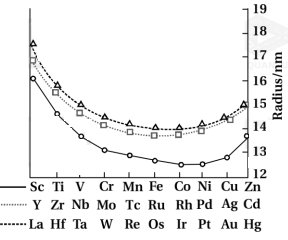
Explain the variations in atomic radii of transition elements in a group.
Solution
(N/A) Down the group,with the increase in atomic number,the atomic radii increase because of the addition of new shells. Hence,the atomic radii of elements of the second transition series are greater than the corresponding elements of the first transition series.
The atomic radii of elements of the second and third transition series are almost the same because of the intervention of the $4f$-orbitals,which must be filled before the $5d$ series of elements begins. The filling of $4f$ before the $5d$ orbital results in a regular decrease in atomic radii,called lanthanoid contraction. The lanthanoid contraction counterbalances the increase in atomic size with the increasing atomic number.
Example: $Zr$ and $Hf$ have very similar chemical properties and have nearly the same atomic radii because of lanthanoid contraction.
The lanthanoid contraction is due to the imperfect shielding of one electron by another in the same set of orbitals. However,the shielding of one $4f$ electron by another is less than that of one $d$ electron by another,and as the nuclear charge increases along the series,there is a fairly regular decrease in the size of the entire $4f^n$ orbitals.
The atomic radii of elements of the second and third transition series are almost the same because of the intervention of the $4f$-orbitals,which must be filled before the $5d$ series of elements begins. The filling of $4f$ before the $5d$ orbital results in a regular decrease in atomic radii,called lanthanoid contraction. The lanthanoid contraction counterbalances the increase in atomic size with the increasing atomic number.
Example: $Zr$ and $Hf$ have very similar chemical properties and have nearly the same atomic radii because of lanthanoid contraction.
The lanthanoid contraction is due to the imperfect shielding of one electron by another in the same set of orbitals. However,the shielding of one $4f$ electron by another is less than that of one $d$ electron by another,and as the nuclear charge increases along the series,there is a fairly regular decrease in the size of the entire $4f^n$ orbitals.
0 likes
View Solution639
Medium
Why do transition elements form a large number of complex compounds?
Solution
(N/A) Complex compounds are those in which the metal ions bind a number of anions or neutral molecules,giving complex species with characteristic properties. Examples include: $[Fe(CN)_{6}]^{3-}$,$[Fe(CN)_{6}]^{4-}$,$[Cu(NH_{3})_{4}]^{2+}$,and $[PtCl_{4}]^{2-}$.
The transition elements have a great tendency to form complex compounds because of:
$(i)$ Small size of metal ions.
$(ii)$ High nuclear charge.
$(iii)$ Availability of vacant $d$-orbitals of suitable energy to accommodate lone pairs of electrons donated by the ligands.
The transition elements have a great tendency to form complex compounds because of:
$(i)$ Small size of metal ions.
$(ii)$ High nuclear charge.
$(iii)$ Availability of vacant $d$-orbitals of suitable energy to accommodate lone pairs of electrons donated by the ligands.
0 likes
View Solution640
Medium
Write a note on interstitial compounds.
Solution
(N/A) Interstitial compounds are those which are formed when small atoms like $B$,$H$,$C$,or $N$ are trapped inside the crystal lattice of metals.
The transition elements form interstitial compounds with these elements. The $B$,$H$,$C$,and $N$ occupy the vacant spaces (interstitial sites) in the crystal lattice,and as a result,the compounds formed are extremely hard.
They are classified as borides,hydrides,carbides,or nitrides depending on the nature of atoms trapped in the vacant sites. They are usually non-stoichiometric,neither typically covalent nor ionic. Examples include $TiC$,$Mn_4N$,$Fe_3H$,$VH_{0.58}$,and $TiH_{1.7}$.
The important physical and chemical characteristics of these compounds are:
$(i)$ High melting points,even higher than those of pure metals.
$(ii)$ They are extremely hard. Some borides approach diamond in hardness.
$(iii)$ They retain metallic conductivity.
$(iv)$ They are chemically inert.
The transition elements form interstitial compounds with these elements. The $B$,$H$,$C$,and $N$ occupy the vacant spaces (interstitial sites) in the crystal lattice,and as a result,the compounds formed are extremely hard.
They are classified as borides,hydrides,carbides,or nitrides depending on the nature of atoms trapped in the vacant sites. They are usually non-stoichiometric,neither typically covalent nor ionic. Examples include $TiC$,$Mn_4N$,$Fe_3H$,$VH_{0.58}$,and $TiH_{1.7}$.
The important physical and chemical characteristics of these compounds are:
$(i)$ High melting points,even higher than those of pure metals.
$(ii)$ They are extremely hard. Some borides approach diamond in hardness.
$(iii)$ They retain metallic conductivity.
$(iv)$ They are chemically inert.
0 likes
View Solution641
Easy
The halides of transition elements become more covalent with increasing oxidation state of the metal. Why?
Solution
(N/A) According to $Fajan's$ rule,as the oxidation state of the metal ion increases,its size decreases and its charge density increases. This leads to an increase in the polarizing power of the metal ion. Consequently,the metal ion polarizes the electron cloud of the halide ion more effectively,resulting in an increase in the covalent character of the bond.
0 likes
View Solution642
Easy
The second and third rows of transition elements resemble each other much more than they resemble the first row. Explain why?
Solution
(N/A) The properties of elements of the second and third transition series are similar due to the lanthanoid contraction.
As a result of the lanthanoid contraction,the elements of the third transition series have atomic radii that are almost identical to those of the corresponding elements in the second transition series.
This similarity in atomic radii leads to a significant similarity in their chemical and physical properties.
As a result of the lanthanoid contraction,the elements of the third transition series have atomic radii that are almost identical to those of the corresponding elements in the second transition series.
This similarity in atomic radii leads to a significant similarity in their chemical and physical properties.
0 likes
View Solution643
MediumMCQ
The correct electronic configuration and spin-only magnetic moment $(B.M.)$ of $Gd^{3+}$ $(Z = 64)$ are respectively:
A
$[Xe] 5f^7$ and $8.9$
B
$[Xe] 4f^7$ and $7.9$
C
$[Xe] 5f^7$ and $7.9$
D
$[Xe] 4f^7$ and $8.9$
Solution
(B) The atomic number of Gadolinium $(Gd)$ is $Z = 64$.
Its ground state electronic configuration is $[Xe] 4f^7 5d^1 6s^2$.
For the $Gd^{3+}$ ion,three electrons are removed (one from $5d$ and two from $6s$):
$Gd^{3+} = [Xe] 4f^7$.
Here,there are $7$ unpaired electrons $(n = 7)$ in the $4f$ orbital.
The formula for the spin-only magnetic moment $(\mu)$ is $\mu = \sqrt{n(n+2)} \ B.M.$
$\mu = \sqrt{7(7+2)} = \sqrt{7 \times 9} = \sqrt{63} \approx 7.9 \ B.M.$
Therefore,the correct option is $B$.
Its ground state electronic configuration is $[Xe] 4f^7 5d^1 6s^2$.
For the $Gd^{3+}$ ion,three electrons are removed (one from $5d$ and two from $6s$):
$Gd^{3+} = [Xe] 4f^7$.
Here,there are $7$ unpaired electrons $(n = 7)$ in the $4f$ orbital.
The formula for the spin-only magnetic moment $(\mu)$ is $\mu = \sqrt{n(n+2)} \ B.M.$
$\mu = \sqrt{7(7+2)} = \sqrt{7 \times 9} = \sqrt{63} \approx 7.9 \ B.M.$
Therefore,the correct option is $B$.
0 likes
View Solution644
MediumMCQ
The set that contains the atomic numbers of only transition elements is -
A
$21, 32, 53, 64$
B
$21, 25, 42, 72$
C
$9, 17, 34, 38$
D
$37, 42, 50, 64$
Solution
(B) Transition elements are defined as elements which have incompletely filled $d$-orbitals in their ground state or in any of their oxidation states.
These include elements with atomic numbers:
$21-30$ (first transition series),
$39-48$ (second transition series),
$57$ and $72-80$ (third transition series),
$89$ and $104-112$ (fourth transition series).
In the given set $21, 25, 42, 72$:
$21$ $(Sc)$,$25$ $(Mn)$,$42$ $(Mo)$,and $72$ $(Hf)$ are all transition elements.
Therefore,the correct set is $21, 25, 42, 72$.
These include elements with atomic numbers:
$21-30$ (first transition series),
$39-48$ (second transition series),
$57$ and $72-80$ (third transition series),
$89$ and $104-112$ (fourth transition series).
In the given set $21, 25, 42, 72$:
$21$ $(Sc)$,$25$ $(Mn)$,$42$ $(Mo)$,and $72$ $(Hf)$ are all transition elements.
Therefore,the correct set is $21, 25, 42, 72$.
0 likes
View Solution645
EasyMCQ
The calculated spin-only magnetic moment of $Cr^{2+}$ ion is......$B.M.$
A
$2.84$
B
$3.87$
C
$4.90$
D
$5.92$
Solution
(C) The electronic configuration of $Cr$ is $[Ar] 3d^5 4s^1$.
For $Cr^{2+}$ ion,two electrons are removed,resulting in the configuration $[Ar] 3d^4$.
This means there are $n = 4$ unpaired electrons.
The spin-only magnetic moment is calculated using the formula $\mu = \sqrt{n(n+2)} \ B.M.$
Substituting $n = 4$:
$\mu = \sqrt{4(4+2)} \ B.M. = \sqrt{4 \times 6} \ B.M. = \sqrt{24} \ B.M. \approx 4.90 \ B.M.$
For $Cr^{2+}$ ion,two electrons are removed,resulting in the configuration $[Ar] 3d^4$.
This means there are $n = 4$ unpaired electrons.
The spin-only magnetic moment is calculated using the formula $\mu = \sqrt{n(n+2)} \ B.M.$
Substituting $n = 4$:
$\mu = \sqrt{4(4+2)} \ B.M. = \sqrt{4 \times 6} \ B.M. = \sqrt{24} \ B.M. \approx 4.90 \ B.M.$
0 likes
View Solution646
MediumMCQ
Match the following aspects with the respective metal.
Select the correct option.
| Aspects | Metal |
| $a$. The metal which reveals a maximum number of oxidation states | $i$. Scandium |
| $b$. The metal although placed in $3d$ block is considered not as a transition element | $ii$. Copper |
| $c$. The metal which does not exhibit variable oxidation states | $iii$. Manganese |
| $d$. The metal which in $+1$ oxidation state in aqueous solution undergoes disproportionation | $iv$. Zinc |
Select the correct option.
A
$a-ii, b-iv, c-i, d-iii$
B
$a-i, b-iv, c-ii, d-iii$
C
$a-iii, b-iv, c-i, d-ii$
D
$a-iii, b-i, c-iv, d-ii$
Solution
(C) In the $3d$-series,$Manganese$ $(Mn)$ exhibits the maximum number of oxidation states,ranging from $+2$ to $+7$.
$Zinc$ $(Zn)$ has a completely filled $d$-orbital $(3d^{10})$ in its ground state and its common oxidation state $(+2)$,therefore it is not considered a transition element.
$Scandium$ $(Sc)$ exhibits only one oxidation state,which is $+3$.
$Copper$ $(Cu^{+})$ undergoes a disproportionation reaction in an aqueous solution: $2Cu^{+}_{(aq)} \longrightarrow Cu^{2+}_{(aq)} + Cu_{(s)}$.
Thus,the correct matching is: $a-iii, b-iv, c-i, d-ii$.
$Zinc$ $(Zn)$ has a completely filled $d$-orbital $(3d^{10})$ in its ground state and its common oxidation state $(+2)$,therefore it is not considered a transition element.
$Scandium$ $(Sc)$ exhibits only one oxidation state,which is $+3$.
$Copper$ $(Cu^{+})$ undergoes a disproportionation reaction in an aqueous solution: $2Cu^{+}_{(aq)} \longrightarrow Cu^{2+}_{(aq)} + Cu_{(s)}$.
Thus,the correct matching is: $a-iii, b-iv, c-i, d-ii$.
0 likes
View Solution647
MediumMCQ
The correct order of spin-only magnetic moment (in $BM$) for $Mn^{2+}$,$Cr^{2+}$,and $Ti^{2+}$ ions is:
A
$Mn^{2+} > Ti^{2+} > Cr^{2+}$
B
$Ti^{2+} > Cr^{2+} > Mn^{2+}$
C
$Mn^{2+} > Cr^{2+} > Ti^{2+}$
D
$Cr^{2+} > Ti^{2+} > Mn^{2+}$
Solution
(C) The spin-only magnetic moment $(\mu)$ depends on the number of unpaired electrons $(n)$ and is given by the formula: $\mu = \sqrt{n(n+2)} \ BM$.
The electronic configurations and number of unpaired electrons for the ions are:
$1$. For $Mn^{2+}$ $(Z=25)$: $[Ar] 3d^5$. Number of unpaired electrons $(n)$ = $5$. $\mu = \sqrt{5(5+2)} = \sqrt{35} \ BM$.
$2$. For $Cr^{2+}$ $(Z=24)$: $[Ar] 3d^4$. Number of unpaired electrons $(n)$ = $4$. $\mu = \sqrt{4(4+2)} = \sqrt{24} \ BM$.
$3$. For $Ti^{2+}$ $(Z=22)$: $[Ar] 3d^2$. Number of unpaired electrons $(n)$ = $2$. $\mu = \sqrt{2(2+2)} = \sqrt{8} \ BM$.
Comparing the values,the correct order of spin-only magnetic moment is $Mn^{2+} > Cr^{2+} > Ti^{2+}$.
The electronic configurations and number of unpaired electrons for the ions are:
$1$. For $Mn^{2+}$ $(Z=25)$: $[Ar] 3d^5$. Number of unpaired electrons $(n)$ = $5$. $\mu = \sqrt{5(5+2)} = \sqrt{35} \ BM$.
$2$. For $Cr^{2+}$ $(Z=24)$: $[Ar] 3d^4$. Number of unpaired electrons $(n)$ = $4$. $\mu = \sqrt{4(4+2)} = \sqrt{24} \ BM$.
$3$. For $Ti^{2+}$ $(Z=22)$: $[Ar] 3d^2$. Number of unpaired electrons $(n)$ = $2$. $\mu = \sqrt{2(2+2)} = \sqrt{8} \ BM$.
Comparing the values,the correct order of spin-only magnetic moment is $Mn^{2+} > Cr^{2+} > Ti^{2+}$.
0 likes
View Solution648
MediumMCQ
Which element has the least covalent radius?
A
$Mn$
B
$Cu$
C
$Zn$
D
$Ni$
Solution
(D) The covalent radii for the given transition elements are as follows:
$Ni = 125 \text{ pm}$
$Cu = 128 \text{ pm}$
$Zn = 137 \text{ pm}$
$Mn = 137 \text{ pm}$
Comparing these values, $Ni$ has the smallest covalent radius among the given options.
$Ni = 125 \text{ pm}$
$Cu = 128 \text{ pm}$
$Zn = 137 \text{ pm}$
$Mn = 137 \text{ pm}$
Comparing these values, $Ni$ has the smallest covalent radius among the given options.
0 likes
View Solution649
MediumMCQ
For the ions $Zn^{2+}, Ni^{2+}$ and $Cr^{3+}$ which among the following statements is correct?
(Atomic number of $Zn = 30, Ni = 28$ and $Cr = 24$)
(Atomic number of $Zn = 30, Ni = 28$ and $Cr = 24$)
A
All these are colourless.
B
All these are coloured.
C
Only $Ni^{2+}$ is coloured and $Zn^{2+}$ and $Cr^{3+}$ are colourless.
D
Only $Zn^{2+}$ is colourless and $Ni^{2+}$ and $Cr^{3+}$ are coloured.
Solution
(D) The colour of transition metal ions is due to the presence of unpaired electrons which allow $d-d$ transitions.
Electronic configurations:
$Zn^{2+} (Z=30): [Ar] 3d^{10} 4s^0$ (All electrons are paired,so it is colourless).
$Ni^{2+} (Z=28): [Ar] 3d^8 4s^0$ (Has $2$ unpaired electrons,so it is coloured).
$Cr^{3+} (Z=24): [Ar] 3d^3 4s^0$ (Has $3$ unpaired electrons,so it is coloured).
Therefore,only $Zn^{2+}$ is colourless,while $Ni^{2+}$ and $Cr^{3+}$ are coloured.
Electronic configurations:
$Zn^{2+} (Z=30): [Ar] 3d^{10} 4s^0$ (All electrons are paired,so it is colourless).
$Ni^{2+} (Z=28): [Ar] 3d^8 4s^0$ (Has $2$ unpaired electrons,so it is coloured).
$Cr^{3+} (Z=24): [Ar] 3d^3 4s^0$ (Has $3$ unpaired electrons,so it is coloured).
Therefore,only $Zn^{2+}$ is colourless,while $Ni^{2+}$ and $Cr^{3+}$ are coloured.
0 likes
View Solution650
MediumMCQ
$A$ chloro compound of vanadium has a spin-only magnetic moment of $1.73 \ BM$. This vanadium chloride has the formula:
A
$VCl_2$
B
$VCl_4$
C
$VCl_3$
D
$VCl_5$
Solution
(B) The spin-only magnetic moment is given by the formula $\mu = \sqrt{n(n+2)} \ BM$,where $n$ is the number of unpaired electrons.
Given $\mu = 1.73 \ BM$,we have $1.73 = \sqrt{n(n+2)}$.
Squaring both sides,$3 = n(n+2)$,which gives $n^2 + 2n - 3 = 0$.
Solving for $n$,we get $(n+3)(n-1) = 0$,so $n = 1$ (since $n$ cannot be negative).
Vanadium $(V)$ has the atomic number $23$ and electronic configuration $[Ar] 3d^3 4s^2$.
For $n=1$,the vanadium ion must have one unpaired electron.
In $VCl_4$,vanadium is in the $+4$ oxidation state $(V^{4+})$.
The configuration of $V^{4+}$ is $[Ar] 3d^1$,which contains $1$ unpaired electron.
Thus,the formula is $VCl_4$.
Given $\mu = 1.73 \ BM$,we have $1.73 = \sqrt{n(n+2)}$.
Squaring both sides,$3 = n(n+2)$,which gives $n^2 + 2n - 3 = 0$.
Solving for $n$,we get $(n+3)(n-1) = 0$,so $n = 1$ (since $n$ cannot be negative).
Vanadium $(V)$ has the atomic number $23$ and electronic configuration $[Ar] 3d^3 4s^2$.
For $n=1$,the vanadium ion must have one unpaired electron.
In $VCl_4$,vanadium is in the $+4$ oxidation state $(V^{4+})$.
The configuration of $V^{4+}$ is $[Ar] 3d^1$,which contains $1$ unpaired electron.
Thus,the formula is $VCl_4$.
0 likes
View Solutiond-and f-Block Elements — General Characteristics · Frequently Asked Questions
1Are these d-and f-Block Elements questions useful for JEE and NEET?
Yes. All questions in this section are mapped to JEE Main and NEET exam patterns. Previous year questions from JEE Main, NEET, GUJCET and state-level exams are included with full solutions.
2Can I switch to Hindi or Gujarati for these questions?
Yes. Use the language tabs in the hero section or the sidebar to view the same questions and solutions in English, Hindi or Gujarati.
3How do I generate a question paper from this subtopic?
Use the Vedclass Exam Paper Generator — select the chapter and subtopic, set difficulty, and generate Sets A, B, C, D automatically. First 3 chapters of every subject are free.
Vedclass Products
For Students
Vedclass Test Series
Mock tests in real JEE/NEET style with performance analysis. 5-day free trial.
Start Free TrialFor Teachers
Exam Paper Generator
Generate Set A/B/C/D papers from this chapter in 2 minutes. 3 chapters free.
Try FreeFor Institutes
Online Exam Module
Live online exams with unlimited students, 360° analytics & white-label branding.
See DemoFor Teachers & Institutes
Generate a d-and f-Block Elements Exam Paper in 2 Minutes
Select subtopic & difficulty — Sets A, B, C, D auto-generated with No Repeat logic.
First 3 chapters of every subject are free — no payment required.