
A English
General Characteristics Questions in English
Class 12 Chemistry · d-and f-Block Elements · General Characteristics
963+
Questions
English
Language
100%
With Solutions
Showing 50 of 963 questions in English
451
EasyMCQ
$A$ substance which is not paramagnetic is
A
$Cr(ClO_4)_3$
B
$KMnO_4$
C
$TiCl_3$
D
$VOBr_2$
Solution
(B) substance is paramagnetic if it contains unpaired electrons $(n > 0)$. If it has no unpaired electrons $(n = 0)$,it is diamagnetic.
$1$. $Cr(ClO_4)_3$: $Cr$ is in $+3$ oxidation state. Electronic configuration of $Cr^{3+}$ is $[Ar]3d^3$. Here,$n = 3$,so it is paramagnetic.
$2$. $KMnO_4$: $Mn$ is in $+7$ oxidation state. Electronic configuration of $Mn^{7+}$ is $[Ar]3d^0$. Here,$n = 0$,so it is diamagnetic.
$3$. $TiCl_3$: $Ti$ is in $+3$ oxidation state. Electronic configuration of $Ti^{3+}$ is $[Ar]3d^1$. Here,$n = 1$,so it is paramagnetic.
$4$. $VOBr_2$: $V$ is in $+4$ oxidation state. Electronic configuration of $V^{4+}$ is $[Ar]3d^1$. Here,$n = 1$,so it is paramagnetic.
Therefore,$KMnO_4$ is not paramagnetic.
$1$. $Cr(ClO_4)_3$: $Cr$ is in $+3$ oxidation state. Electronic configuration of $Cr^{3+}$ is $[Ar]3d^3$. Here,$n = 3$,so it is paramagnetic.
$2$. $KMnO_4$: $Mn$ is in $+7$ oxidation state. Electronic configuration of $Mn^{7+}$ is $[Ar]3d^0$. Here,$n = 0$,so it is diamagnetic.
$3$. $TiCl_3$: $Ti$ is in $+3$ oxidation state. Electronic configuration of $Ti^{3+}$ is $[Ar]3d^1$. Here,$n = 1$,so it is paramagnetic.
$4$. $VOBr_2$: $V$ is in $+4$ oxidation state. Electronic configuration of $V^{4+}$ is $[Ar]3d^1$. Here,$n = 1$,so it is paramagnetic.
Therefore,$KMnO_4$ is not paramagnetic.
0 likes
View Solution452
MediumMCQ
Which one of the following exhibits the largest number of oxidation states?
A
$Ti \ (22)$
B
$V \ (23)$
C
$Cr \ (24)$
D
$Mn \ (25)$
Solution
(D) The transition elements exhibit variable oxidation states due to the participation of $(n-1)d$ and $ns$ electrons in bonding.
Among the given elements,$Mn \ (Z=25)$ has the electronic configuration $[Ar] \ 3d^5 \ 4s^2$.
It exhibits the largest number of oxidation states ranging from $+2$ to $+7$ $(+2, +3, +4, +6, +7)$ because it has the maximum number of unpaired electrons available for bonding.
Among the given elements,$Mn \ (Z=25)$ has the electronic configuration $[Ar] \ 3d^5 \ 4s^2$.
It exhibits the largest number of oxidation states ranging from $+2$ to $+7$ $(+2, +3, +4, +6, +7)$ because it has the maximum number of unpaired electrons available for bonding.
0 likes
View Solution453
MediumMCQ
The element with which of the following outer electron configuration may exhibit the largest number of oxidation states in its compounds?
A
$3d^5\, 4s^2$
B
$3d^8\, 4s^2$
C
$3d^7\, 4s^2$
D
$3d^6\, 4s^2$
Solution
(A) The element with the outer electron configuration $3d^5\, 4s^2$ is Manganese $(Mn)$.
This configuration corresponds to the $3d$ transition series.
$Mn$ has $7$ valence electrons ($5$ in $d$-orbital and $2$ in $s$-orbital),allowing it to exhibit a wide range of oxidation states from $+2$ to $+7$ in its compounds.
This is the largest number of oxidation states among the given options.
This configuration corresponds to the $3d$ transition series.
$Mn$ has $7$ valence electrons ($5$ in $d$-orbital and $2$ in $s$-orbital),allowing it to exhibit a wide range of oxidation states from $+2$ to $+7$ in its compounds.
This is the largest number of oxidation states among the given options.
0 likes
View Solution454
DifficultMCQ
Magnetic moment of $Gd^{3+}$ ion $(Z = 64)$ is .......... $B.M.$
A
$3.62$
B
$9.72$
C
$7.9$
D
$10.60$
Solution
(C) The electronic configuration of $Gd$ $(Z = 64)$ is $[Xe] 4f^7 5d^1 6s^2$.
For the $Gd^{3+}$ ion,three electrons are removed,resulting in the configuration: $[Xe] 4f^7$.
The number of unpaired electrons $(n)$ is $7$.
The magnetic moment $(\mu)$ is calculated using the spin-only formula: $\mu = \sqrt{n(n + 2)} \ B.M.$
Substituting $n = 7$: $\mu = \sqrt{7(7 + 2)} = \sqrt{7 \times 9} = \sqrt{63} \approx 7.9 \ B.M.$
For the $Gd^{3+}$ ion,three electrons are removed,resulting in the configuration: $[Xe] 4f^7$.
The number of unpaired electrons $(n)$ is $7$.
The magnetic moment $(\mu)$ is calculated using the spin-only formula: $\mu = \sqrt{n(n + 2)} \ B.M.$
Substituting $n = 7$: $\mu = \sqrt{7(7 + 2)} = \sqrt{7 \times 9} = \sqrt{63} \approx 7.9 \ B.M.$
0 likes
View Solution455
MediumMCQ
Which of the following paramagnetic ions would exhibit a magnetic moment (spin only) of the order of $5 \ BM$?
(At. Nos. $Mn = 25$,$Cr = 24$,$V = 23$,$Ti = 22$)
(At. Nos. $Mn = 25$,$Cr = 24$,$V = 23$,$Ti = 22$)
A
$Mn^{2+}$
B
$Ti^{2+}$
C
$V^{2+}$
D
$Cr^{2+}$
Solution
(D) The magnetic moment (spin only) is calculated using the formula $\mu = \sqrt{n(n+2)} \ BM$,where $n$ is the number of unpaired electrons.
$1$. For $Mn^{2+}$ $(d^5)$: $n = 5$,$\mu = \sqrt{5(5+2)} = \sqrt{35} \approx 5.92 \ BM$.
$2$. For $Ti^{2+}$ $(d^2)$: $n = 2$,$\mu = \sqrt{2(2+2)} = \sqrt{8} \approx 2.83 \ BM$.
$3$. For $V^{2+}$ $(d^3)$: $n = 3$,$\mu = \sqrt{3(3+2)} = \sqrt{15} \approx 3.87 \ BM$.
$4$. For $Cr^{2+}$ $(d^4)$: $n = 4$,$\mu = \sqrt{4(4+2)} = \sqrt{24} \approx 4.90 \ BM$.
The value $4.90 \ BM$ is of the order of $5 \ BM$. Thus,$Cr^{2+}$ is the correct answer.
$1$. For $Mn^{2+}$ $(d^5)$: $n = 5$,$\mu = \sqrt{5(5+2)} = \sqrt{35} \approx 5.92 \ BM$.
$2$. For $Ti^{2+}$ $(d^2)$: $n = 2$,$\mu = \sqrt{2(2+2)} = \sqrt{8} \approx 2.83 \ BM$.
$3$. For $V^{2+}$ $(d^3)$: $n = 3$,$\mu = \sqrt{3(3+2)} = \sqrt{15} \approx 3.87 \ BM$.
$4$. For $Cr^{2+}$ $(d^4)$: $n = 4$,$\mu = \sqrt{4(4+2)} = \sqrt{24} \approx 4.90 \ BM$.
The value $4.90 \ BM$ is of the order of $5 \ BM$. Thus,$Cr^{2+}$ is the correct answer.
0 likes
View Solution456
EasyMCQ
The number of unpaired electrons in Gadolinium $[Z = 64]$ is
A
$3$
B
$8$
C
$6$
D
$2$
Solution
(B) The electronic configuration of Gadolinium $[Z = 64]$ is $[Xe] 4f^7 5d^1 6s^2$.
In the $4f$ subshell,there are $7$ unpaired electrons.
In the $5d$ subshell,there is $1$ unpaired electron.
Therefore,the total number of unpaired electrons is $7 + 1 = 8$.
In the $4f$ subshell,there are $7$ unpaired electrons.
In the $5d$ subshell,there is $1$ unpaired electron.
Therefore,the total number of unpaired electrons is $7 + 1 = 8$.
0 likes
View Solution457
EasyMCQ
The transition element that has the lowest enthalpy of atomisation is
A
$Fe$
B
$Cu$
C
$V$
D
$Zn$
Solution
(D) The enthalpy of atomisation depends on the strength of metallic bonding,which is determined by the number of unpaired electrons in the $d$-orbital.
$Zn$ has a completely filled $d$-orbital $(3d^{10} 4s^2)$,meaning there are no unpaired electrons available for metallic bonding.
Consequently,$Zn$ exhibits the weakest metallic bonding among the $3d$ transition series,resulting in the lowest enthalpy of atomisation.
$Zn$ has a completely filled $d$-orbital $(3d^{10} 4s^2)$,meaning there are no unpaired electrons available for metallic bonding.
Consequently,$Zn$ exhibits the weakest metallic bonding among the $3d$ transition series,resulting in the lowest enthalpy of atomisation.
0 likes
View Solution458
EasyMCQ
The element that usually does $NOT$ show variable oxidation states is
A
$Cu$
B
$Ti$
C
$Sc$
D
$V$
Solution
(C) The electronic configuration of $Sc$ $(Z=21)$ is $[Ar] 3d^1 4s^2$.
After losing three electrons,it forms $Sc^{3+}$,which has a stable noble gas configuration $([Ar])$.
Due to this stable configuration,$Sc$ does not show variable oxidation states and exhibits only $+3$ oxidation state.
After losing three electrons,it forms $Sc^{3+}$,which has a stable noble gas configuration $([Ar])$.
Due to this stable configuration,$Sc$ does not show variable oxidation states and exhibits only $+3$ oxidation state.
0 likes
View Solution459
EasyMCQ
The statement that is $INCORRECT$ about the interstitial compounds is
A
they have metallic conductivity
B
they have high melting points
C
they are chemically reactive
D
they are very hard
Solution
(C) Interstitial compounds are formed when small atoms like $H$,$C$,or $N$ are trapped inside the crystal lattice of transition metals.
These compounds typically exhibit high melting points,high hardness,and retain metallic conductivity.
However,they are generally chemically inert,not reactive.
Therefore,the statement that they are chemically reactive is $INCORRECT$.
These compounds typically exhibit high melting points,high hardness,and retain metallic conductivity.
However,they are generally chemically inert,not reactive.
Therefore,the statement that they are chemically reactive is $INCORRECT$.
0 likes
View Solution460
AdvancedMCQ
Consider the hydrated ions of $Ti^{2+}$,$V^{2+}$,$Ti^{3+}$,and $Sc^{3+}$. The correct order of their spin-only magnetic moments is
A
$Ti^{3+} < Ti^{2+} < Sc^{3+} < V^{2+}$
B
$Sc^{3+} < Ti^{3+} < Ti^{2+} < V^{2+}$
C
$V^{2+} < Ti^{2+} < Ti^{3+} < Sc^{3+}$
D
$Sc^{3+} < Ti^{3+} < V^{2+} < Ti^{2+}$
Solution
(B) The spin-only magnetic moment $(\mu)$ is calculated using the formula $\mu = \sqrt{n(n+2)} \ B.M.$,where $n$ is the number of unpaired electrons.
$1. Sc^{3+} (Z=21): [Ar] 3d^0$. Number of unpaired electrons $(n) = 0$. $\mu = 0 \ B.M.$
$2. Ti^{3+} (Z=22): [Ar] 3d^1$. Number of unpaired electrons $(n) = 1$. $\mu = \sqrt{1(1+2)} = \sqrt{3} \ B.M. \approx 1.73 \ B.M.$
$3. Ti^{2+} (Z=22): [Ar] 3d^2$. Number of unpaired electrons $(n) = 2$. $\mu = \sqrt{2(2+2)} = \sqrt{8} \ B.M. \approx 2.83 \ B.M.$
$4. V^{2+} (Z=23): [Ar] 3d^3$. Number of unpaired electrons $(n) = 3$. $\mu = \sqrt{3(3+2)} = \sqrt{15} \ B.M. \approx 3.87 \ B.M.$
Comparing the values: $0 < 1.73 < 2.83 < 3.87$.
Therefore,the correct order is $Sc^{3+} < Ti^{3+} < Ti^{2+} < V^{2+}$.
$1. Sc^{3+} (Z=21): [Ar] 3d^0$. Number of unpaired electrons $(n) = 0$. $\mu = 0 \ B.M.$
$2. Ti^{3+} (Z=22): [Ar] 3d^1$. Number of unpaired electrons $(n) = 1$. $\mu = \sqrt{1(1+2)} = \sqrt{3} \ B.M. \approx 1.73 \ B.M.$
$3. Ti^{2+} (Z=22): [Ar] 3d^2$. Number of unpaired electrons $(n) = 2$. $\mu = \sqrt{2(2+2)} = \sqrt{8} \ B.M. \approx 2.83 \ B.M.$
$4. V^{2+} (Z=23): [Ar] 3d^3$. Number of unpaired electrons $(n) = 3$. $\mu = \sqrt{3(3+2)} = \sqrt{15} \ B.M. \approx 3.87 \ B.M.$
Comparing the values: $0 < 1.73 < 2.83 < 3.87$.
Therefore,the correct order is $Sc^{3+} < Ti^{3+} < Ti^{2+} < V^{2+}$.
0 likes
View Solution461
DifficultMCQ
The correct order of the first ionization enthalpies is:
A
$Mn < Ti < Zn < Ni$
B
$Zn < Ni < Mn < Ti$
C
$Ti < Mn < Zn < Ni$
D
$Ti < Mn < Ni < Zn$
Solution
(D) The first ionization enthalpy generally increases across a period from left to right due to an increase in effective nuclear charge.
For the $3d$ series elements $(Ti, Mn, Ni, Zn)$,the general trend is $Ti < Mn < Ni < Zn$.
$Ti$ $([Ar] 3d^2 4s^2)$ has the lowest ionization enthalpy,while $Zn$ $([Ar] 3d^{10} 4s^2)$ has the highest due to its stable,fully-filled $d$-orbital configuration.
For the $3d$ series elements $(Ti, Mn, Ni, Zn)$,the general trend is $Ti < Mn < Ni < Zn$.
$Ti$ $([Ar] 3d^2 4s^2)$ has the lowest ionization enthalpy,while $Zn$ $([Ar] 3d^{10} 4s^2)$ has the highest due to its stable,fully-filled $d$-orbital configuration.
0 likes
View Solution462
MediumMCQ
The pair that has similar atomic radii is
A
$Ti$ and $Hf$
B
$Mn$ and $Re$
C
$Sc$ and $Ni$
D
$Mo$ and $W$
Solution
(D) Due to the lanthanoid contraction, the elements of the $5d$ series have atomic radii very similar to those of the corresponding elements of the $4d$ series. $Mo$ ($4d$ series) and $W$ ($5d$ series) exhibit this phenomenon, resulting in similar atomic radii.
0 likes
View Solution463
AdvancedMCQ
The magnetic moment of $M^{x+}$ (atomic number $= 25$) is $\sqrt{15} \ BM$. The number of unpaired electrons and the value of $x$,respectively,are
A
$4, 3$
B
$3, 4$
C
$3, 2$
D
$5, 2$
Solution
(B) The magnetic moment is given by the formula $\mu = \sqrt{n(n+2)} \ BM$,where $n$ is the number of unpaired electrons.
Given $\mu = \sqrt{15} \ BM$,we have $\sqrt{n(n+2)} = \sqrt{15}$,which implies $n(n+2) = 15$.
Solving for $n$,$n^2 + 2n - 15 = 0$,which factors as $(n+5)(n-3) = 0$. Since $n$ must be positive,$n = 3$.
The atomic number of $M$ is $25$,which corresponds to Manganese $(Mn)$.
The electronic configuration of $Mn$ $(Z=25)$ is $[Ar] 3d^{5} 4s^{2}$.
For $M^{x+}$ to have $3$ unpaired electrons,it must have a $3d^{3}$ configuration.
$Mn^{4+}$ has the configuration $[Ar] 3d^{3} 4s^{0}$,which contains $3$ unpaired electrons.
Thus,the number of unpaired electrons is $3$ and the value of $x$ is $4$.
Given $\mu = \sqrt{15} \ BM$,we have $\sqrt{n(n+2)} = \sqrt{15}$,which implies $n(n+2) = 15$.
Solving for $n$,$n^2 + 2n - 15 = 0$,which factors as $(n+5)(n-3) = 0$. Since $n$ must be positive,$n = 3$.
The atomic number of $M$ is $25$,which corresponds to Manganese $(Mn)$.
The electronic configuration of $Mn$ $(Z=25)$ is $[Ar] 3d^{5} 4s^{2}$.
For $M^{x+}$ to have $3$ unpaired electrons,it must have a $3d^{3}$ configuration.
$Mn^{4+}$ has the configuration $[Ar] 3d^{3} 4s^{0}$,which contains $3$ unpaired electrons.
Thus,the number of unpaired electrons is $3$ and the value of $x$ is $4$.
0 likes
View Solution464
MediumMCQ
Which of the following elements show $+7$ oxidation states?
A
$Cl$
B
$Mn$
C
$Np$
D
All of these
Solution
(D) The oxidation state of $+7$ is exhibited by several elements across the periodic table.
$Cl$ (Chlorine) shows $+7$ oxidation state in compounds like $HClO_4$ (perchloric acid).
$Mn$ (Manganese) shows $+7$ oxidation state in $KMnO_4$ (potassium permanganate).
$Np$ (Neptunium) is an actinide that can exhibit a $+7$ oxidation state in compounds like $NpO_2F_3$.
Therefore,all the given elements can show a $+7$ oxidation state.
$Cl$ (Chlorine) shows $+7$ oxidation state in compounds like $HClO_4$ (perchloric acid).
$Mn$ (Manganese) shows $+7$ oxidation state in $KMnO_4$ (potassium permanganate).
$Np$ (Neptunium) is an actinide that can exhibit a $+7$ oxidation state in compounds like $NpO_2F_3$.
Therefore,all the given elements can show a $+7$ oxidation state.
0 likes
View Solution465
EasyMCQ
Which pair of ions is colourless?
A
$Mn^{3+}, Co^{3+}$
B
$Fe^{3+}, Cr^{3+}$
C
$Zn^{2+}, Sc^{3+}$
D
$Ti^{2+}, Cu^{2+}$
Solution
(C) Ions are colourless if they do not have any unpaired electrons in their $d$-orbitals (i.e.,$d^0$ or $d^{10}$ configuration).
$1$. $Mn^{3+}$ $(3d^4)$,$Co^{3+}$ $(3d^6)$: Both have unpaired electrons,so they are coloured.
$2$. $Fe^{3+}$ $(3d^5)$,$Cr^{3+}$ $(3d^3)$: Both have unpaired electrons,so they are coloured.
$3$. $Zn^{2+}$ $(3d^{10})$: It has a completely filled $d$-subshell with no unpaired electrons,so it is colourless.
$4$. $Sc^{3+}$ $(3d^0)$: It has an empty $d$-subshell with no unpaired electrons,so it is colourless.
$5$. $Ti^{2+}$ $(3d^2)$,$Cu^{2+}$ $(3d^9)$: Both have unpaired electrons,so they are coloured.
Therefore,the pair $Zn^{2+}$ and $Sc^{3+}$ is colourless.
$1$. $Mn^{3+}$ $(3d^4)$,$Co^{3+}$ $(3d^6)$: Both have unpaired electrons,so they are coloured.
$2$. $Fe^{3+}$ $(3d^5)$,$Cr^{3+}$ $(3d^3)$: Both have unpaired electrons,so they are coloured.
$3$. $Zn^{2+}$ $(3d^{10})$: It has a completely filled $d$-subshell with no unpaired electrons,so it is colourless.
$4$. $Sc^{3+}$ $(3d^0)$: It has an empty $d$-subshell with no unpaired electrons,so it is colourless.
$5$. $Ti^{2+}$ $(3d^2)$,$Cu^{2+}$ $(3d^9)$: Both have unpaired electrons,so they are coloured.
Therefore,the pair $Zn^{2+}$ and $Sc^{3+}$ is colourless.
0 likes
View Solution466
EasyMCQ
Transition elements form complex compounds due to:
A
Presence of empty $d$-orbitals
B
Large size
C
Variable valency
D
Presence of $2e^-$ in outer shell
Solution
(A) Transition metal ions form coordination complexes because they possess empty valence shell orbitals (specifically $d$-orbitals) that can accept lone pairs of electrons from ligands,which act as Lewis bases.
0 likes
View Solution467
EasyMCQ
The outermost shell electronic configuration of a transition element is:
A
$ns^2\,nd^{1-10}$
B
$(n-1)d^{1-10}\,ns^{1-2}$
C
$(n-1)d^2\,ns^{0-2}$
D
$(n-1)d^{1-10}\,ns^2$
Solution
(B) Transition elements are defined as elements which have incompletely filled $d$-orbitals in their ground state or in any of their oxidation states.
The general electronic configuration of transition elements is represented as $(n-1)d^{1-10}\,ns^{1-2}$,where $(n-1)$ represents the inner $d$-orbitals and $n$ represents the outermost shell.
The general electronic configuration of transition elements is represented as $(n-1)d^{1-10}\,ns^{1-2}$,where $(n-1)$ represents the inner $d$-orbitals and $n$ represents the outermost shell.
0 likes
View Solution468
EasyMCQ
Which of the following represents the decreasing order of the second ionization enthalpy $(I.P_2)$?
A
$Cr > Mn > V > Ti$
B
$Mn > Cr > V > Ti$
C
$Ti > V > Cr > Mn$
D
$V > Ti > Cr > Mn$
Solution
(A) The electronic configurations of the neutral atoms are: $Ti ([Ar] 3d^2 4s^2)$,$V ([Ar] 3d^3 4s^2)$,$Cr ([Ar] 3d^5 4s^1)$,and $Mn ([Ar] 3d^5 4s^2)$.
After the removal of the first electron $(I.P_1)$,the configurations become: $Ti^+ ([Ar] 3d^2 4s^1)$,$V^+ ([Ar] 3d^3 4s^1)$,$Cr^+ ([Ar] 3d^5)$,and $Mn^+ ([Ar] 3d^5 4s^1)$.
The second ionization enthalpy $(I.P_2)$ involves removing an electron from these ions.
$Cr^+$ has a stable half-filled $d^5$ configuration,making it very difficult to remove the second electron,resulting in the highest $I.P_2$.
$Mn^+$ has a $3d^5 4s^1$ configuration,where the $4s$ electron is relatively easier to remove than the $d^5$ electron of $Cr^+$.
Comparing the trends,the order of $I.P_2$ is $Cr > Mn > V > Ti$.
After the removal of the first electron $(I.P_1)$,the configurations become: $Ti^+ ([Ar] 3d^2 4s^1)$,$V^+ ([Ar] 3d^3 4s^1)$,$Cr^+ ([Ar] 3d^5)$,and $Mn^+ ([Ar] 3d^5 4s^1)$.
The second ionization enthalpy $(I.P_2)$ involves removing an electron from these ions.
$Cr^+$ has a stable half-filled $d^5$ configuration,making it very difficult to remove the second electron,resulting in the highest $I.P_2$.
$Mn^+$ has a $3d^5 4s^1$ configuration,where the $4s$ electron is relatively easier to remove than the $d^5$ electron of $Cr^+$.
Comparing the trends,the order of $I.P_2$ is $Cr > Mn > V > Ti$.
0 likes
View Solution469
MediumMCQ
The $I.P.$ values of $Cr, Zn, Mn$,and $Hg$ are $7.4 \ eV, 6.7 \ eV, 10.4 \ eV$,and $9.3 \ eV$. These $I.P.$ values are not listed in the order of the elements. Identify the correct $I.P.$ value for the given elements.
A
$I.P.$ of $Zn = 10.4 \ eV$
B
$I.P.$ of $Mn = 7.4 \ eV$
C
$I.P.$ of $Cr = 9.3 \ eV$
D
$I.P.$ of $Hg = 9.3 \ eV$
Solution
(B) The ionization potential $(I.P.)$ values are determined by electronic configuration and effective nuclear charge.
For the given elements,the values are: $Mn (3d^5 4s^2) = 7.4 \ eV$,$Cr (3d^5 4s^1) = 6.7 \ eV$,$Zn (3d^{10} 4s^2) = 9.4 \ eV$ (approx $9.3 \ eV$),and $Hg (5d^{10} 6s^2) = 10.4 \ eV$ due to lanthanoid contraction.
Matching the values: $I.P.$ of $Mn = 7.4 \ eV$,$I.P.$ of $Cr = 6.7 \ eV$,$I.P.$ of $Hg = 10.4 \ eV$,and $I.P.$ of $Zn = 9.3 \ eV$.
Comparing with options,$I.P.$ of $Mn = 7.4 \ eV$ is correct.
For the given elements,the values are: $Mn (3d^5 4s^2) = 7.4 \ eV$,$Cr (3d^5 4s^1) = 6.7 \ eV$,$Zn (3d^{10} 4s^2) = 9.4 \ eV$ (approx $9.3 \ eV$),and $Hg (5d^{10} 6s^2) = 10.4 \ eV$ due to lanthanoid contraction.
Matching the values: $I.P.$ of $Mn = 7.4 \ eV$,$I.P.$ of $Cr = 6.7 \ eV$,$I.P.$ of $Hg = 10.4 \ eV$,and $I.P.$ of $Zn = 9.3 \ eV$.
Comparing with options,$I.P.$ of $Mn = 7.4 \ eV$ is correct.
0 likes
View Solution470
EasyMCQ
Which forms interstitial compounds?
A
$Fe$
B
$Co$
C
$Ni$
D
All
Solution
(D) An interstitial compound is formed when small atoms like $H$,$C$,$N$,or $O$ are trapped inside the crystal lattice of transition metals.
Transition metals like $Fe$,$Co$,and $Ni$ have large interstitial spaces in their crystal lattices,allowing them to form interstitial compounds.
Therefore,all of the given metals can form interstitial compounds.
Transition metals like $Fe$,$Co$,and $Ni$ have large interstitial spaces in their crystal lattices,allowing them to form interstitial compounds.
Therefore,all of the given metals can form interstitial compounds.
0 likes
View Solution471
MediumMCQ
Which of the following triads has approximately equal size?
A
$Na^{+}, Mg^{2+}, Al^{3+}$
B
$F^{-}, Ne, O^{2-}$
C
$Mn^{+}, Cr, Fe^{2+}$
D
$Fe, Co, Ni$
Solution
(D) The species $Fe$, $Co$, and $Ni$ belong to the $d$-block elements (transition metals) in the same period ($4^{th}$ period).
In the $d$-block, the atomic radii decrease slightly across a period due to the shielding effect of $d$-electrons, which almost balances the increase in nuclear charge.
Consequently, the atomic radii of $Fe$ $(126 \text{ pm})$, $Co$ $(125 \text{ pm})$, and $Ni$ $(124 \text{ pm})$ are approximately equal.
In contrast, $Na^{+}$, $Mg^{2+}$, and $Al^{3+}$ are isoelectronic but have different nuclear charges, leading to a significant decrease in ionic radii $(Na^{+} > Mg^{2+} > Al^{3+})$.
In the $d$-block, the atomic radii decrease slightly across a period due to the shielding effect of $d$-electrons, which almost balances the increase in nuclear charge.
Consequently, the atomic radii of $Fe$ $(126 \text{ pm})$, $Co$ $(125 \text{ pm})$, and $Ni$ $(124 \text{ pm})$ are approximately equal.
In contrast, $Na^{+}$, $Mg^{2+}$, and $Al^{3+}$ are isoelectronic but have different nuclear charges, leading to a significant decrease in ionic radii $(Na^{+} > Mg^{2+} > Al^{3+})$.
0 likes
View Solution472
MediumMCQ
Transition metals are not characterized by
A
fixed valency
B
coloured compound
C
high melting and boiling points
D
tendency to form complexes
Solution
(A) Transition metals are characterized by variable valency,not fixed valency.
This is due to the participation of both $(n-1)d$ and $ns$ electrons in bonding because their energy levels are very close.
They form coloured compounds due to $d-d$ transitions.
They have high melting and boiling points due to strong metallic bonding involving $d$-electrons.
They have a high tendency to form complexes due to the availability of vacant $d$-orbitals and high charge-to-size ratio.
This is due to the participation of both $(n-1)d$ and $ns$ electrons in bonding because their energy levels are very close.
They form coloured compounds due to $d-d$ transitions.
They have high melting and boiling points due to strong metallic bonding involving $d$-electrons.
They have a high tendency to form complexes due to the availability of vacant $d$-orbitals and high charge-to-size ratio.
0 likes
View Solution473
DifficultMCQ
Choose the correct statement regarding transition elements.
A
Transition elements have low melting points.
B
Transition elements do not have catalytic activity.
C
Transition elements exhibit variable oxidation states.
D
Transition elements exhibit inert pair effect.
Solution
(C) Transition elements are characterized by the presence of partially filled $d$-orbitals.
Due to the presence of unpaired electrons,they exhibit variable oxidation states.
They have high enthalpies of atomization due to strong interatomic interactions.
They act as good catalysts because of their ability to adopt multiple oxidation states and provide a large surface area for reactions.
Therefore,the statement that transition elements exhibit variable oxidation states is correct.
Due to the presence of unpaired electrons,they exhibit variable oxidation states.
They have high enthalpies of atomization due to strong interatomic interactions.
They act as good catalysts because of their ability to adopt multiple oxidation states and provide a large surface area for reactions.
Therefore,the statement that transition elements exhibit variable oxidation states is correct.
0 likes
View Solution474
EasyMCQ
Which element is named after the name of a planet?
A
$Hg$
B
$Po$
C
$Pu$
D
$Ra$
Solution
(C) The element $Pu$ (Plutonium) is named after the planet Pluto.
$Uranus$ $(1781) = Uranium$ $(1789)$
$Neptune$ $(1846) = Neptunium$ $(1940)$
$Pluto$ $(1930) = Plutonium$ $(1940)$
These elements were named after celestial bodies that were considered planets at the time of their discovery or naming.
$Uranus$ $(1781) = Uranium$ $(1789)$
$Neptune$ $(1846) = Neptunium$ $(1940)$
$Pluto$ $(1930) = Plutonium$ $(1940)$
These elements were named after celestial bodies that were considered planets at the time of their discovery or naming.
0 likes
View Solution475
DifficultMCQ
Which of the following is not a representative element?
A
Tellurium
B
Tantalum
C
Thallium
D
Astatine
Solution
(B) Representative elements are those belonging to $s$-block and $p$-block (excluding noble gases in some contexts, but generally groups $1, 2$ and $13-17$).
$(A)$ Tellurium $(Te)$ is in group $16$ ($p$-block).
$(B)$ Tantalum $(Ta, Z = 73)$ is a $d$-block element, specifically a transition element.
$(C)$ Thallium $(Tl)$ is in group $13$ ($p$-block).
$(D)$ Astatine $(At)$ is in group $17$ ($p$-block).
Therefore, Tantalum is not a representative element.
$(A)$ Tellurium $(Te)$ is in group $16$ ($p$-block).
$(B)$ Tantalum $(Ta, Z = 73)$ is a $d$-block element, specifically a transition element.
$(C)$ Thallium $(Tl)$ is in group $13$ ($p$-block).
$(D)$ Astatine $(At)$ is in group $17$ ($p$-block).
Therefore, Tantalum is not a representative element.
0 likes
View Solution476
MediumMCQ
The period number and group number of Tantalum $(Z = 73)$ are respectively:
A
$5, 7$
B
$6, 13$
C
$6, 5$
D
None of these
Solution
(C) The electronic configuration of Tantalum ($Ta$,$Z = 73$) is $[Xe] \ 4f^{14} \ 5d^3 \ 6s^2$.
Since the highest principal quantum number $(n)$ is $6$,the period number is $6$.
The element belongs to the $d$-block because the last electron enters the $d$-orbital. For $d$-block elements,the group number is calculated as $(n-1)d \text{ electrons} + ns \text{ electrons} = 3 + 2 = 5$.
Therefore,Tantalum belongs to period $6$ and group $5$.
Since the highest principal quantum number $(n)$ is $6$,the period number is $6$.
The element belongs to the $d$-block because the last electron enters the $d$-orbital. For $d$-block elements,the group number is calculated as $(n-1)d \text{ electrons} + ns \text{ electrons} = 3 + 2 = 5$.
Therefore,Tantalum belongs to period $6$ and group $5$.
| Element | Period,Group |
| $Tc$ $(Z=43)$ | $5, 7$ |
| $Tl$ $(Z=81)$ | $6, 13$ |
| $Ta$ $(Z=73)$ | $6, 5$ |
0 likes
View Solution477
AdvancedMCQ
Which of the following graphs is the correct representation of the relationship between atomic number $(Z)$ and the magnetic moment of $d-$block elements? [Outer electronic configuration : $(n - 1)d^x\ ns^{1\ or\ 2}$]
A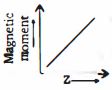
B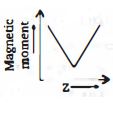
C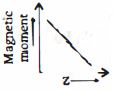
D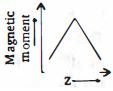
Solution
(D) The magnetic moment is given by the formula: $\mu = \sqrt{n(n + 2)} \ BM$,where $n$ is the number of unpaired electrons.
As the atomic number $(Z)$ increases across a $d-$block series,the number of unpaired electrons first increases as the $d-$orbitals are filled up to the middle (i.e.,$d^5$ configuration).
After the middle of the series,the number of unpaired electrons begins to decrease as the $d-$orbitals start pairing up.
Therefore,the magnetic moment also follows the same trend: it increases up to the middle of the series and then decreases.
This trend is correctly represented by the graph in option $D$.
As the atomic number $(Z)$ increases across a $d-$block series,the number of unpaired electrons first increases as the $d-$orbitals are filled up to the middle (i.e.,$d^5$ configuration).
After the middle of the series,the number of unpaired electrons begins to decrease as the $d-$orbitals start pairing up.
Therefore,the magnetic moment also follows the same trend: it increases up to the middle of the series and then decreases.
This trend is correctly represented by the graph in option $D$.
0 likes
View Solution478
AdvancedMCQ
If the $IUPAC$ name of an element is "unununium",then the correct statement regarding the element is:
A
It is an inner transition element
B
It belongs to the $8^{th}$ period in the periodic table
C
It is a transition element
D
It is a non-transition element
Solution
(C) The $IUPAC$ name "unununium" corresponds to the atomic number $Z = 111$.
This element is known as Roentgenium $(Rg)$.
It belongs to the $7^{th}$ period and $11^{th}$ group of the periodic table.
Elements with atomic numbers $21-30$,$39-48$,$57, 72-80$,and $89, 104-112$ are classified as transition elements.
Therefore,it is a transition element.
This element is known as Roentgenium $(Rg)$.
It belongs to the $7^{th}$ period and $11^{th}$ group of the periodic table.
Elements with atomic numbers $21-30$,$39-48$,$57, 72-80$,and $89, 104-112$ are classified as transition elements.
Therefore,it is a transition element.
0 likes
View Solution479
DifficultMCQ
The correct order of atomic/ionic radii is
A
$Sc > Ti > V > Cr$
B
$Co > Ni > Cu > Zn$
C
$S^{2-} > Cl^{-} > O^{2-} > N^{3-}$
D
None of these
Solution
(A) In the $3d$-series,atomic radii generally decrease from $Sc$ to $Cr$ due to the increase in effective nuclear charge. Thus,the order $Sc > Ti > V > Cr$ is correct.
For option $(b)$,the correct order is $Zn > Cu > Co \approx Ni$ because the increase in shielding effect balances the increase in nuclear charge.
For option $(c)$,for isoelectronic species,the ionic radius increases as the negative charge increases and decreases as the atomic number increases. The correct order is $N^{3-} > O^{2-} > F^{-} > S^{2-} > Cl^{-}$.
Therefore,option $(a)$ is the correct statement.
For option $(b)$,the correct order is $Zn > Cu > Co \approx Ni$ because the increase in shielding effect balances the increase in nuclear charge.
For option $(c)$,for isoelectronic species,the ionic radius increases as the negative charge increases and decreases as the atomic number increases. The correct order is $N^{3-} > O^{2-} > F^{-} > S^{2-} > Cl^{-}$.
Therefore,option $(a)$ is the correct statement.
0 likes
View Solution480
MediumMCQ
$La$ (lanthanum) having atomic number $57$ is a member of
A
$s-$ block elements
B
$p-$ block elements
C
$d-$ block elements
D
$f-$ block elements
Solution
(C) The electronic configuration of $La$ (atomic number $57$) is $[Xe] 5d^1 6s^2$.
Since the last electron enters the $5d$ orbital,$La$ is classified as a $d-$ block element.
Since the last electron enters the $5d$ orbital,$La$ is classified as a $d-$ block element.
0 likes
View Solution481
EasyMCQ
The higher oxidation states of transition elements are found to be in combination with $A$ and $B$,which are:
A
$F, O$
B
$O, N$
C
$O, S$
D
$F, Cl$
Solution
(A) The higher oxidation states of transition elements are found in combination with $F$ and $O$ because $F$ and $O$ are the most electronegative elements.
These elements have a high ability to stabilize the higher oxidation states of transition metals.
For example,$Os$ shows the highest oxidation state of $+8$ in $OsO_4$.
Similarly,$Mn$ shows the highest oxidation state of $+7$ in $KMnO_4$.
These elements have a high ability to stabilize the higher oxidation states of transition metals.
For example,$Os$ shows the highest oxidation state of $+8$ in $OsO_4$.
Similarly,$Mn$ shows the highest oxidation state of $+7$ in $KMnO_4$.
0 likes
View Solution482
EasyMCQ
Among the following metals,the most dense is
A
osmium
B
chromium
C
platinum
D
gold
Solution
(A) The density of a metal is determined by its atomic mass and atomic volume.
Osmium $(Os)$ has the highest density among the transition metals,with a value of approximately $22.59 \ g/cm^3$.
Platinum $(Pt)$ has a density of $21.45 \ g/cm^3$,and Gold $(Au)$ has a density of $19.32 \ g/cm^3$.
Chromium $(Cr)$ has a much lower density of $7.19 \ g/cm^3$.
Therefore,Osmium is the most dense metal among the given options.
Osmium $(Os)$ has the highest density among the transition metals,with a value of approximately $22.59 \ g/cm^3$.
Platinum $(Pt)$ has a density of $21.45 \ g/cm^3$,and Gold $(Au)$ has a density of $19.32 \ g/cm^3$.
Chromium $(Cr)$ has a much lower density of $7.19 \ g/cm^3$.
Therefore,Osmium is the most dense metal among the given options.
0 likes
View Solution483
EasyMCQ
In comparison of ferrous salts,ferric salts are
A
more stable
B
less stable
C
equally stable
D
none of these
Solution
(A) Ferric salts are more stable than Ferrous salts.
$Fe^{3+}$ ions are more stable compared to $Fe^{2+}$ due to their electronic configuration.
The electronic configuration of $Fe^{3+}$ is $[Ar] 3d^5 4s^0$,which is a half-filled $d$-orbital configuration,making it extra stable.
$Fe^{3+}$ ions are more stable compared to $Fe^{2+}$ due to their electronic configuration.
The electronic configuration of $Fe^{3+}$ is $[Ar] 3d^5 4s^0$,which is a half-filled $d$-orbital configuration,making it extra stable.
0 likes
View Solution484
EasyMCQ
Which of the following properties is not characteristic of transition metals?
A
Variable oxidation states
B
Tendency to form complexes
C
Formation of coloured compounds
D
None of these
Solution
(D) Transition metals are characterized by several unique properties due to the presence of partially filled $d$-orbitals.
$1$. They exhibit variable oxidation states because the energy difference between $(n-1)d$ and $ns$ orbitals is small.
$2$. They have a strong tendency to form coordination complexes due to their small size,high nuclear charge,and availability of vacant $d$-orbitals.
$3$. They form coloured compounds due to $d-d$ transitions of electrons.
Since all the listed properties are characteristic of transition metals,the correct answer is $D$.
$1$. They exhibit variable oxidation states because the energy difference between $(n-1)d$ and $ns$ orbitals is small.
$2$. They have a strong tendency to form coordination complexes due to their small size,high nuclear charge,and availability of vacant $d$-orbitals.
$3$. They form coloured compounds due to $d-d$ transitions of electrons.
Since all the listed properties are characteristic of transition metals,the correct answer is $D$.
0 likes
View Solution485
EasyMCQ
In a transition series,as the atomic number increases,paramagnetism
A
increases gradually
B
decreases gradually
C
first increases to a maximum and then decreases
D
first decreases to a minimum and then increases
Solution
(C) For transition elements,as the atomic number increases,electrons enter the empty $d$-orbitals.
Initially,the $d$-orbitals are singly occupied,which increases the number of unpaired electrons and thus increases paramagnetism.
This continues until the $d$-orbitals are half-filled ($d^5$ configuration),which corresponds to the point of maximum paramagnetism.
Beyond this point,electrons start pairing up in the $d$-orbitals,which reduces the number of unpaired electrons and consequently decreases paramagnetism.
Therefore,paramagnetism first increases to a maximum and then decreases.
Initially,the $d$-orbitals are singly occupied,which increases the number of unpaired electrons and thus increases paramagnetism.
This continues until the $d$-orbitals are half-filled ($d^5$ configuration),which corresponds to the point of maximum paramagnetism.
Beyond this point,electrons start pairing up in the $d$-orbitals,which reduces the number of unpaired electrons and consequently decreases paramagnetism.
Therefore,paramagnetism first increases to a maximum and then decreases.
0 likes
View Solution486
EasyMCQ
The most abundant transition metal in the earth's crust is
A
$Zn$
B
$Fe$
C
$Hg$
D
$Au$
Solution
(B) The transition metals are elements belonging to the $d$-block of the periodic table.
Among the transition metals,$Fe$ (Iron) is the most abundant metal in the earth's crust,ranking fourth among all elements and first among transition metals.
Among the transition metals,$Fe$ (Iron) is the most abundant metal in the earth's crust,ranking fourth among all elements and first among transition metals.
0 likes
View Solution487
MediumMCQ
The electrons which take part in order to exhibit variable oxidation states by transition metals are
A
$ns$ only
B
$(n - 1) \, d$ only
C
$ns$ and $(n - 1) \, d$ only but not $np$
D
$(n - 1) \, d$ and $np$ only but not $ns$
Solution
(C) Transition metals exhibit variable oxidation states because the energy difference between the $(n - 1) \, d$ orbitals and the $ns$ orbitals is very small.
Due to this small energy gap,electrons from both the $(n - 1) \, d$ subshell and the $ns$ subshell can participate in bond formation.
Therefore,both $ns$ and $(n - 1) \, d$ electrons are involved in exhibiting variable oxidation states.
Due to this small energy gap,electrons from both the $(n - 1) \, d$ subshell and the $ns$ subshell can participate in bond formation.
Therefore,both $ns$ and $(n - 1) \, d$ electrons are involved in exhibiting variable oxidation states.
0 likes
View Solution488
EasyMCQ
$Zn$ and $Cd$ metals do not show variable valency because
A
they have only two electrons in the outermost subshells
B
their $d$-subshells are completely filled
C
their $d$-subshells are partially filled
D
they are relatively soft metals
Solution
(B) The electronic configuration of $Zn$ is $[Ar] 3d^{10} 4s^2$ and $Cd$ is $[Kr] 4d^{10} 5s^2$.
Because their $d$-subshells are completely filled,the $d$-electrons are not available for bonding.
Consequently,they do not exhibit variable valency like other transition elements.
Because their $d$-subshells are completely filled,the $d$-electrons are not available for bonding.
Consequently,they do not exhibit variable valency like other transition elements.
0 likes
View Solution489
EasyMCQ
Paramagnetism is not exhibited by
A
$CuSO_4 \cdot 5H_2O$
B
$CuCl_2 \cdot 5H_2O$
C
$CuI$
D
$NiSO_4 \cdot 6H_2O$
Solution
(C) Paramagnetism is exhibited by species containing unpaired electrons.
In $CuSO_4 \cdot 5H_2O$,$Cu^{2+}$ has $3d^9$ configuration (one unpaired electron).
In $CuCl_2 \cdot 5H_2O$,$Cu^{2+}$ has $3d^9$ configuration (one unpaired electron).
In $NiSO_4 \cdot 6H_2O$,$Ni^{2+}$ has $3d^8$ configuration (two unpaired electrons).
In $CuI$,the copper ion is $Cu^{+}$,which has a $3d^{10}$ electronic configuration.
Since all electrons are paired in the $3d$ subshell,$CuI$ is diamagnetic and does not exhibit paramagnetism.
In $CuSO_4 \cdot 5H_2O$,$Cu^{2+}$ has $3d^9$ configuration (one unpaired electron).
In $CuCl_2 \cdot 5H_2O$,$Cu^{2+}$ has $3d^9$ configuration (one unpaired electron).
In $NiSO_4 \cdot 6H_2O$,$Ni^{2+}$ has $3d^8$ configuration (two unpaired electrons).
In $CuI$,the copper ion is $Cu^{+}$,which has a $3d^{10}$ electronic configuration.
Since all electrons are paired in the $3d$ subshell,$CuI$ is diamagnetic and does not exhibit paramagnetism.
0 likes
View Solution490
EasyMCQ
Which of the following electronic configurations is associated with the highest stable oxidation state?
A
$[Ar]\, 3d^1\, 4s^2$
B
$[Ar]\, 3d^5\, 4s^1$
C
$[Ar]\, 3d^5\, 4s^2$
D
$[Ar]\, 3d^6\, 4s^2$
Solution
(C) The stability of an electronic configuration is determined by the exchange energy and symmetry of the orbitals.
Half-filled $(d^5)$ and completely filled $(d^{10})$ $d$-orbitals,along with filled $s$-orbitals,provide extra stability.
In the configuration $[Ar]\, 3d^5\, 4s^2$ (which corresponds to Manganese,$Mn$),the $3d$ subshell is exactly half-filled $(d^5)$ and the $4s$ subshell is completely filled $(s^2)$.
This specific configuration is exceptionally stable,allowing the element to exhibit a wide range of oxidation states,with $+2$ being particularly stable due to the loss of $4s$ electrons leaving a stable $d^5$ core.
Half-filled $(d^5)$ and completely filled $(d^{10})$ $d$-orbitals,along with filled $s$-orbitals,provide extra stability.
In the configuration $[Ar]\, 3d^5\, 4s^2$ (which corresponds to Manganese,$Mn$),the $3d$ subshell is exactly half-filled $(d^5)$ and the $4s$ subshell is completely filled $(s^2)$.
This specific configuration is exceptionally stable,allowing the element to exhibit a wide range of oxidation states,with $+2$ being particularly stable due to the loss of $4s$ electrons leaving a stable $d^5$ core.
0 likes
View Solution491
MediumMCQ
Metal-metal bonding is more frequent in $4d$ or $5d$ series than in $3d$ series due to
A
their greater enthalpies of atomisation
B
the large size of the orbitals which participates in the metal-metal bond formation
C
their ability to involve both $ns$ and $(n - 1)d$ electrons in the bond formation
D
the comparable size of $4d$ and $5d$ series elements
Solution
(B) In the $d$-block elements,metal-metal bonding is more extensive in the $4d$ and $5d$ series compared to the $3d$ series.
This is primarily because the $4d$ and $5d$ orbitals are larger in size and more diffuse than the $3d$ orbitals.
Due to their larger size,these orbitals can effectively overlap with each other to form stronger metal-metal bonds.
Therefore,the correct reason is the large size of the orbitals which participate in the metal-metal bond formation.
This is primarily because the $4d$ and $5d$ orbitals are larger in size and more diffuse than the $3d$ orbitals.
Due to their larger size,these orbitals can effectively overlap with each other to form stronger metal-metal bonds.
Therefore,the correct reason is the large size of the orbitals which participate in the metal-metal bond formation.
0 likes
View Solution492
EasyMCQ
The correct statement about iron includes:
$I$) The highest oxidation state of iron is $+ 6$ in $K_2FeO_4$.
$II$) The iron shows $+ 2$ oxidation state with six electrons in the $3d$ orbitals.
$III$) The common oxidation state of iron is $+ 3$ with five unpaired electrons in the $3d$ orbital.
$I$) The highest oxidation state of iron is $+ 6$ in $K_2FeO_4$.
$II$) The iron shows $+ 2$ oxidation state with six electrons in the $3d$ orbitals.
$III$) The common oxidation state of iron is $+ 3$ with five unpaired electrons in the $3d$ orbital.
A
$I, II, III$
B
$I, II$
C
$II, III$
D
$I$ only
Solution
(A) $I$) In $K_2FeO_4$,iron is in the $+ 6$ oxidation state,which is its highest oxidation state.
$II$) The electronic configuration of $Fe$ is $[Ar] 3d^6 4s^2$. In the $+ 2$ oxidation state $(Fe^{2+})$,it loses two $4s$ electrons,leaving $3d^6$ configuration,which has six electrons in the $3d$ orbitals.
$III$) The electronic configuration of $Fe^{3+}$ is $[Ar] 3d^5$. This has five unpaired electrons in the $3d$ orbital,making it a common and stable oxidation state due to the half-filled $d$-subshell.
Thus,all three statements are correct.
$II$) The electronic configuration of $Fe$ is $[Ar] 3d^6 4s^2$. In the $+ 2$ oxidation state $(Fe^{2+})$,it loses two $4s$ electrons,leaving $3d^6$ configuration,which has six electrons in the $3d$ orbitals.
$III$) The electronic configuration of $Fe^{3+}$ is $[Ar] 3d^5$. This has five unpaired electrons in the $3d$ orbital,making it a common and stable oxidation state due to the half-filled $d$-subshell.
Thus,all three statements are correct.
0 likes
View Solution493
MediumMCQ
Many transition metals form interstitial compounds. The characteristics of these interstitial compounds are:
$I$. They have high melting points,higher than those of pure metals.
$II$. They are very hard.
$III$. They retain metallic conductivity.
$IV$. They are chemically more reactive than the pure metals.
$I$. They have high melting points,higher than those of pure metals.
$II$. They are very hard.
$III$. They retain metallic conductivity.
$IV$. They are chemically more reactive than the pure metals.
A
$I, II, III$
B
$I, III$
C
$II, IV$
D
$IV$ only
Solution
(A) Interstitial compounds are formed when small atoms like $H, C, N$ or $O$ are trapped inside the crystal lattice of transition metals.
The characteristics of these compounds are:
$1$. They have high melting points,higher than those of pure metals.
$2$. They are very hard (some borides approach diamond in hardness).
$3$. They retain metallic conductivity.
$4$. They are chemically inert (not more reactive than pure metals).
Therefore,statements $I, II,$ and $III$ are correct.
The characteristics of these compounds are:
$1$. They have high melting points,higher than those of pure metals.
$2$. They are very hard (some borides approach diamond in hardness).
$3$. They retain metallic conductivity.
$4$. They are chemically inert (not more reactive than pure metals).
Therefore,statements $I, II,$ and $III$ are correct.
0 likes
View Solution494
MediumMCQ
Technetium,the element below manganese in the Periodic Table,would be expected to have high values for its:
$(I)$ melting point
$(II)$ boiling point
$(III)$ density
$(I)$ melting point
$(II)$ boiling point
$(III)$ density
A
$I, II, III$
B
$I, II$
C
$II, III$
D
$I$ only
Solution
(A) Technetium $(Tc)$ is a transition metal located in the $5th$ period,directly below manganese $(Mn)$ in the Periodic Table.
Transition metals in the $4d$ and $5d$ series generally exhibit higher melting points,boiling points,and densities compared to their $3d$ counterparts due to stronger metallic bonding resulting from increased effective nuclear charge and more extensive $d$-orbital participation.
Therefore,technetium is expected to have high values for its melting point,boiling point,and density.
Thus,the correct option is $A$.
Transition metals in the $4d$ and $5d$ series generally exhibit higher melting points,boiling points,and densities compared to their $3d$ counterparts due to stronger metallic bonding resulting from increased effective nuclear charge and more extensive $d$-orbital participation.
Therefore,technetium is expected to have high values for its melting point,boiling point,and density.
Thus,the correct option is $A$.
0 likes
View Solution495
MediumMCQ
All $Zn(II)$ compounds are white because
A
$Zn^{2+}$ has a $d^{10}$ configuration and the $d$-subshell is full
B
$Zn^{2+}$ shows $d-d$ transition
C
$Zn^{2+}$ has no electron in the $4s$-subshell
D
$Zn$ is not a transition element
Solution
(A) The electronic configuration of $Zn^{2+}$ is $3d^{10}4s^{0}$.
Since the $d$-subshell is completely filled,there are no vacant orbitals available for $d-d$ transitions.
As a result,$Zn^{2+}$ compounds do not absorb visible light and appear white or colorless.
Since the $d$-subshell is completely filled,there are no vacant orbitals available for $d-d$ transitions.
As a result,$Zn^{2+}$ compounds do not absorb visible light and appear white or colorless.
0 likes
View Solution496
MediumMCQ
The transition metals exhibit higher enthalpies of atomisation due to
A
their ability to show variable oxidation states
B
the presence of incompletely filled $d-$ subshell
C
their ability to exist in the solid state with unpaired electrons
D
strong interatomic interaction arises because of having large number of unpaired electrons in their atoms
Solution
(D) Transition metals have high enthalpies of atomisation because of the strong interatomic interactions.
These strong interactions are primarily due to the presence of a large number of unpaired electrons in their $(n-1)d$ orbitals.
These unpaired electrons participate in metallic bonding,which leads to stronger metallic bonds compared to other elements.
Therefore,more energy is required to break these bonds to atomise the metal.
These strong interactions are primarily due to the presence of a large number of unpaired electrons in their $(n-1)d$ orbitals.
These unpaired electrons participate in metallic bonding,which leads to stronger metallic bonds compared to other elements.
Therefore,more energy is required to break these bonds to atomise the metal.
0 likes
View Solution497
MediumMCQ
Which of the following statements are correct about $Zn$,$Cd$ and $Hg$?
$(I)$ They exhibit high enthalpies of atomisation as the $d-$subshell is full.
$(II)$ $Zn$ and $Cd$ do not show variable oxidation states while $Hg$ shows $+I$ and $+II$.
$(III)$ Compounds of $Zn$,$Cd$ and $Hg$ are paramagnetic in nature.
$(IV)$ $Zn$,$Cd$ and $Hg$ are called soft metals.
$(I)$ They exhibit high enthalpies of atomisation as the $d-$subshell is full.
$(II)$ $Zn$ and $Cd$ do not show variable oxidation states while $Hg$ shows $+I$ and $+II$.
$(III)$ Compounds of $Zn$,$Cd$ and $Hg$ are paramagnetic in nature.
$(IV)$ $Zn$,$Cd$ and $Hg$ are called soft metals.
A
$I, II, III$
B
$I, III$
C
$II, IV$
D
$II, III, IV$
Solution
(C) Statement $(I)$ is incorrect because $Zn$,$Cd$,and $Hg$ have fully filled $d$-orbitals $(d^{10})$,which leads to weak metallic bonding and consequently low enthalpies of atomisation.
Statement $(II)$ is correct. $Zn$ and $Cd$ exhibit only $+2$ oxidation state,whereas $Hg$ can exhibit $+1$ (as $Hg_2^{2+}$) and $+2$ oxidation states.
Statement $(III)$ is incorrect. Since they have a $d^{10}$ configuration,all electrons are paired,making their compounds diamagnetic,not paramagnetic.
Statement $(IV)$ is correct. Due to weak metallic bonding resulting from the $d^{10}$ configuration,these elements are relatively soft compared to other transition metals.
Therefore,statements $(II)$ and $(IV)$ are correct.
Statement $(II)$ is correct. $Zn$ and $Cd$ exhibit only $+2$ oxidation state,whereas $Hg$ can exhibit $+1$ (as $Hg_2^{2+}$) and $+2$ oxidation states.
Statement $(III)$ is incorrect. Since they have a $d^{10}$ configuration,all electrons are paired,making their compounds diamagnetic,not paramagnetic.
Statement $(IV)$ is correct. Due to weak metallic bonding resulting from the $d^{10}$ configuration,these elements are relatively soft compared to other transition metals.
Therefore,statements $(II)$ and $(IV)$ are correct.
0 likes
View Solution498
MediumMCQ
Which of the following is $NOT$ a characteristic of the transition elements in the series from scandium to zinc?
A
The formation of coloured cations
B
The presence of at least one unpaired electron in a $d-$ orbital of a cation
C
The ability to form complex ions
D
None of these
Solution
(D) Transition elements are defined as elements which have incompletely filled $d-$orbitals in their ground state or in any of their oxidation states.
$1$. The formation of coloured cations is a characteristic property due to $d-d$ transitions.
$2$. The presence of at least one unpaired electron in a $d-$orbital of a cation is the fundamental definition of transition elements.
$3$. The ability to form complex ions is a characteristic property due to small size,high nuclear charge,and availability of vacant $d-$orbitals.
Since all the given options are characteristic properties of transition elements,the correct answer is $D$.
$1$. The formation of coloured cations is a characteristic property due to $d-d$ transitions.
$2$. The presence of at least one unpaired electron in a $d-$orbital of a cation is the fundamental definition of transition elements.
$3$. The ability to form complex ions is a characteristic property due to small size,high nuclear charge,and availability of vacant $d-$orbitals.
Since all the given options are characteristic properties of transition elements,the correct answer is $D$.
0 likes
View Solution499
DifficultMCQ
Properties common to the elements manganese,iron,cobalt,nickel,and copper include the ready formation by them all of:
$I$. Coloured ions in aqueous solution
$II$. Oxides of nitrogen are formed on reaction with concentrated $HNO_3$
$III$. Chlorides of formula $MCl_2$ and $MCl_3$
$I$. Coloured ions in aqueous solution
$II$. Oxides of nitrogen are formed on reaction with concentrated $HNO_3$
$III$. Chlorides of formula $MCl_2$ and $MCl_3$
A
$I, II, III$
B
$I, II$
C
$II, III$
D
$I$ only
Solution
(B) $1$. Transition metals like $Mn, Fe, Co, Ni,$ and $Cu$ have partially filled $d$-orbitals,which allow for $d-d$ transitions,resulting in the formation of coloured ions in aqueous solution. Thus,statement $I$ is correct.
$2$. These metals are reactive and act as reducing agents. When they react with concentrated nitric acid $(HNO_3)$,they are oxidized,and the nitric acid is reduced to various oxides of nitrogen (such as $NO_2$ or $NO$). Thus,statement $II$ is correct.
$3$. While these metals can form chlorides,they do not all readily form both $MCl_2$ and $MCl_3$. For example,$Cu$ primarily forms $CuCl_2$ $(Cu(II))$ and $CuCl$ $(Cu(I))$,but $CuCl_3$ is not a stable common chloride. Therefore,statement $III$ is not common to all these elements.
Conclusion: Statements $I$ and $II$ are common to all these elements.
$2$. These metals are reactive and act as reducing agents. When they react with concentrated nitric acid $(HNO_3)$,they are oxidized,and the nitric acid is reduced to various oxides of nitrogen (such as $NO_2$ or $NO$). Thus,statement $II$ is correct.
$3$. While these metals can form chlorides,they do not all readily form both $MCl_2$ and $MCl_3$. For example,$Cu$ primarily forms $CuCl_2$ $(Cu(II))$ and $CuCl$ $(Cu(I))$,but $CuCl_3$ is not a stable common chloride. Therefore,statement $III$ is not common to all these elements.
Conclusion: Statements $I$ and $II$ are common to all these elements.
0 likes
View Solution500
MediumMCQ
$Cr^{2+}$ has a magnetic moment same as that of
A
$Fe^{2+}$
B
$Cu^{2+}$
C
$Co^{2+}$
D
$Cu^{+}$
Solution
(A) The magnetic moment $(\mu)$ is calculated using the formula $\mu = \sqrt{n(n+2)} \ BM$, where $n$ is the number of unpaired electrons.
For $Cr^{2+}$ $(Z=24)$: Electronic configuration is $[Ar] 3d^4$. Number of unpaired electrons $(n)$ = $4$.
For $Fe^{2+}$ $(Z=26)$: Electronic configuration is $[Ar] 3d^6$. Number of unpaired electrons $(n)$ = $4$.
For $Cu^{2+}$ $(Z=29)$: Electronic configuration is $[Ar] 3d^9$. Number of unpaired electrons $(n)$ = $1$.
For $Co^{2+}$ $(Z=27)$: Electronic configuration is $[Ar] 3d^7$. Number of unpaired electrons $(n)$ = $3$.
For $Cu^{+}$ $(Z=29)$: Electronic configuration is $[Ar] 3d^{10}$. Number of unpaired electrons $(n)$ = $0$.
Since $Cr^{2+}$ and $Fe^{2+}$ both have $4$ unpaired electrons, they have the same magnetic moment.
For $Cr^{2+}$ $(Z=24)$: Electronic configuration is $[Ar] 3d^4$. Number of unpaired electrons $(n)$ = $4$.
For $Fe^{2+}$ $(Z=26)$: Electronic configuration is $[Ar] 3d^6$. Number of unpaired electrons $(n)$ = $4$.
For $Cu^{2+}$ $(Z=29)$: Electronic configuration is $[Ar] 3d^9$. Number of unpaired electrons $(n)$ = $1$.
For $Co^{2+}$ $(Z=27)$: Electronic configuration is $[Ar] 3d^7$. Number of unpaired electrons $(n)$ = $3$.
For $Cu^{+}$ $(Z=29)$: Electronic configuration is $[Ar] 3d^{10}$. Number of unpaired electrons $(n)$ = $0$.
Since $Cr^{2+}$ and $Fe^{2+}$ both have $4$ unpaired electrons, they have the same magnetic moment.
0 likes
View Solutiond-and f-Block Elements — General Characteristics · Frequently Asked Questions
1Are these d-and f-Block Elements questions useful for JEE and NEET?
Yes. All questions in this section are mapped to JEE Main and NEET exam patterns. Previous year questions from JEE Main, NEET, GUJCET and state-level exams are included with full solutions.
2Can I switch to Hindi or Gujarati for these questions?
Yes. Use the language tabs in the hero section or the sidebar to view the same questions and solutions in English, Hindi or Gujarati.
3How do I generate a question paper from this subtopic?
Use the Vedclass Exam Paper Generator — select the chapter and subtopic, set difficulty, and generate Sets A, B, C, D automatically. First 3 chapters of every subject are free.
Vedclass Products
For Students
Vedclass Test Series
Mock tests in real JEE/NEET style with performance analysis. 5-day free trial.
Start Free TrialFor Teachers
Exam Paper Generator
Generate Set A/B/C/D papers from this chapter in 2 minutes. 3 chapters free.
Try FreeFor Institutes
Online Exam Module
Live online exams with unlimited students, 360° analytics & white-label branding.
See DemoFor Teachers & Institutes
Generate a d-and f-Block Elements Exam Paper in 2 Minutes
Select subtopic & difficulty — Sets A, B, C, D auto-generated with No Repeat logic.
First 3 chapters of every subject are free — no payment required.