
A English
Properties of Amines Questions in English
Class 12 Chemistry · Amines · Properties of Amines
1212+
Questions
English
Language
100%
With Solutions
Showing 50 of 1212 questions in English
951
MediumMCQ
Which of the following statements is incorrect in case of Hofmann bromamide degradation?
A
Reaction is useful for decreasing length of carbon chain by one carbon atom
B
It gives tertiary amine
C
It gives primary amine
D
Aqueous or alcoholic $KOH$ is used with bromine
Solution
(B) The Hofmann bromamide degradation reaction involves the treatment of an amide with bromine in an aqueous or alcoholic solution of a strong base like $KOH$ or $NaOH$.
This reaction results in the formation of a primary amine $(R-NH_2)$ with one carbon atom less than the original amide $(R-CONH_2)$.
Therefore,the statement that it gives a tertiary amine is incorrect.
This reaction results in the formation of a primary amine $(R-NH_2)$ with one carbon atom less than the original amide $(R-CONH_2)$.
Therefore,the statement that it gives a tertiary amine is incorrect.
0 likes
View Solution952
MediumMCQ
In the case of substituted aniline,the group which decreases the basic strength is
A
$-OCH_3$
B
$-CH_3$
C
$-NH_2$
D
$-C_6H_5$
Solution
(D) The basic strength of aniline is determined by the availability of the lone pair of electrons on the nitrogen atom.
Electron-withdrawing groups $(EWG)$ decrease the electron density on the nitrogen atom,thereby decreasing the basic strength.
Among the given options,$-OCH_3$,$-CH_3$,and $-NH_2$ are electron-donating groups $(EDG)$ due to their $+M$ or $+I$ effects,which increase the basic strength.
$-C_6H_5$ (phenyl group) acts as an electron-withdrawing group due to its $-I$ effect and resonance,thus decreasing the basic strength of aniline.
Electron-withdrawing groups $(EWG)$ decrease the electron density on the nitrogen atom,thereby decreasing the basic strength.
Among the given options,$-OCH_3$,$-CH_3$,and $-NH_2$ are electron-donating groups $(EDG)$ due to their $+M$ or $+I$ effects,which increase the basic strength.
$-C_6H_5$ (phenyl group) acts as an electron-withdrawing group due to its $-I$ effect and resonance,thus decreasing the basic strength of aniline.
0 likes
View Solution953
MediumMCQ
Primary nitro alkanes are obtained in good yield by oxidising aldoximes with the help of $-$
A
Trifluoroperoxyacetic acid
B
Acidified potassium permanganate
C
Concentrated nitric acid
D
Potassium dichromate and dilute sulphuric acid
Solution
(A) Primary nitro alkanes are obtained in good yield by oxidizing aldoximes with the help of trifluoroperoxyacetic acid $(CF_3COOOH)$.
0 likes
View Solution954
MediumMCQ
Select the compound which on treatment with nitrous acid liberates nitrogen.
A
Nitroethane
B
Triethylamine
C
Diethylamine
D
Ethylamine
Solution
(D) Primary amines $(1^{\circ})$ react with nitrous acid $(HNO_2)$ to form unstable diazonium salts,which decompose to release nitrogen gas $(N_2)$.
$R-NH_2 + HNO_2$ $\rightarrow [R-N_2^+Cl^-]$ $\rightarrow R-OH + N_2 \uparrow + H_2O$
Among the given options,Ethylamine $(CH_3CH_2NH_2)$ is a primary amine,while Nitroethane is a nitro compound,Triethylamine is a tertiary amine,and Diethylamine is a secondary amine.
$R-NH_2 + HNO_2$ $\rightarrow [R-N_2^+Cl^-]$ $\rightarrow R-OH + N_2 \uparrow + H_2O$
Among the given options,Ethylamine $(CH_3CH_2NH_2)$ is a primary amine,while Nitroethane is a nitro compound,Triethylamine is a tertiary amine,and Diethylamine is a secondary amine.
0 likes
View Solution955
DifficultMCQ
The amine $A$,when treated with nitrous acid,gives a yellow oily substance. The amine $A$ is
A
Triethylamine
B
Trimethylamine
C
Aniline
D
Methylphenylamine
Solution
(D) Secondary amines ($2^{\circ}$ amines) react with nitrous acid $(HNO_2)$ to form $N$-nitrosoamines,which are yellow oily substances.
Among the given options,$N$-methylaniline (methylphenylamine) is a secondary amine $(C_6H_5NHCH_3)$.
Triethylamine and trimethylamine are tertiary amines,and aniline is a primary aromatic amine.
Among the given options,$N$-methylaniline (methylphenylamine) is a secondary amine $(C_6H_5NHCH_3)$.
Triethylamine and trimethylamine are tertiary amines,and aniline is a primary aromatic amine.
0 likes
View Solution956
MediumMCQ
Which of the following is the strongest base?
A
$C_6H_5NH_2$
B
$CH_3NH_2$
C
$NH_3$
D
$CH_3CONH_2$
Solution
(B) The basic nature of an amine is due to the presence of a lone pair of electrons on the nitrogen atom,which is available for bond formation with a Lewis acid.
In $CH_3NH_2$,the $+I$ effect of the $-CH_3$ group increases the electron density on the nitrogen atom,making it more available for donation compared to $NH_3$.
In $C_6H_5NH_2$,the lone pair is involved in resonance with the benzene ring,reducing its availability.
In $CH_3CONH_2$,the lone pair is involved in resonance with the carbonyl group $(C=O)$,significantly reducing its basicity.
Therefore,$CH_3NH_2$ is the strongest base among the given options.
In $CH_3NH_2$,the $+I$ effect of the $-CH_3$ group increases the electron density on the nitrogen atom,making it more available for donation compared to $NH_3$.
In $C_6H_5NH_2$,the lone pair is involved in resonance with the benzene ring,reducing its availability.
In $CH_3CONH_2$,the lone pair is involved in resonance with the carbonyl group $(C=O)$,significantly reducing its basicity.
Therefore,$CH_3NH_2$ is the strongest base among the given options.
0 likes
View Solution957
EasyMCQ
Which of the following is the strongest base?
A
Aniline $(C_6H_5NH_2)$
B
$N$-methylaniline $(C_6H_5NHCH_3)$
C
o-Toluidine $(2-CH_3C_6H_4NH_2)$
D
Benzylamine $(C_6H_5CH_2NH_2)$
Solution
(D) In aniline,$N$-methylaniline,and o-toluidine,the lone pair of electrons on the nitrogen atom is in conjugation with the benzene ring,which decreases its availability for protonation,making them weaker bases.
In benzylamine $(C_6H_5CH_2NH_2)$,the lone pair on the nitrogen atom is not in conjugation with the benzene ring because of the presence of a $-CH_2-$ group between the benzene ring and the nitrogen atom.
Therefore,the lone pair is more available for protonation,making benzylamine the strongest base among the given compounds.
In benzylamine $(C_6H_5CH_2NH_2)$,the lone pair on the nitrogen atom is not in conjugation with the benzene ring because of the presence of a $-CH_2-$ group between the benzene ring and the nitrogen atom.
Therefore,the lone pair is more available for protonation,making benzylamine the strongest base among the given compounds.
0 likes
View Solution958
DifficultMCQ
Which of the following amines gives a yellow oily liquid with $HNO_{2}$?
A
Ethyl methyl amine
B
Aniline
C
$3-$methyl benzyl amine
D
Methyl amine
Solution
(A) Secondary amines (containing $NH$ group) when treated with $HNO_{2}$ give $N-$nitrosoamines which separate as yellow oily liquids.
The structures of the given compounds are:
$(A)$ Ethyl methyl amine: $CH_{3}-NH-C_{2}H_{5}$ $(2^{\circ})$
$(B)$ Aniline: $C_{6}H_{5}NH_{2}$ $(1^{\circ})$
$(C)$ $3-$methyl benzyl amine: $CH_{3}-C_{6}H_{4}-CH_{2}NH_{2}$ $(1^{\circ})$
$(D)$ Methyl amine: $CH_{3}NH_{2}$ $(1^{\circ})$
Among the given compounds,only ethyl methyl amine is a secondary amine,thus it gives a yellow oily liquid with $HNO_{2}$.
The structures of the given compounds are:
$(A)$ Ethyl methyl amine: $CH_{3}-NH-C_{2}H_{5}$ $(2^{\circ})$
$(B)$ Aniline: $C_{6}H_{5}NH_{2}$ $(1^{\circ})$
$(C)$ $3-$methyl benzyl amine: $CH_{3}-C_{6}H_{4}-CH_{2}NH_{2}$ $(1^{\circ})$
$(D)$ Methyl amine: $CH_{3}NH_{2}$ $(1^{\circ})$
Among the given compounds,only ethyl methyl amine is a secondary amine,thus it gives a yellow oily liquid with $HNO_{2}$.
0 likes
View Solution959
MediumMCQ
In the following reaction sequence,$C_2H_5NH_2$ $\xrightarrow{HNO_2} A$ $\xrightarrow{PCl_5} B$ $\xrightarrow{NH_3} C$,the compound '$C$' is
A
$CH_3NH_2$
B
$C_2H_5NH_2$
C
$CH_3CH=NH$
D
$(CH_3)_2NH$
Solution
(B) The reaction sequence is as follows:
$1$. Ethyl amine $(C_2H_5NH_2)$ reacts with nitrous acid $(HNO_2)$ to form ethanol $(C_2H_5OH)$,which is compound '$A$'.
$2$. Ethanol $(C_2H_5OH)$ reacts with phosphorus pentachloride $(PCl_5)$ to form ethyl chloride $(C_2H_5Cl)$,which is compound '$B$'.
$3$. Ethyl chloride $(C_2H_5Cl)$ reacts with ammonia $(NH_3)$ via nucleophilic substitution to form ethyl amine $(C_2H_5NH_2)$,which is compound '$C$'.
Thus,the compound '$C$' is $C_2H_5NH_2$.
$1$. Ethyl amine $(C_2H_5NH_2)$ reacts with nitrous acid $(HNO_2)$ to form ethanol $(C_2H_5OH)$,which is compound '$A$'.
$2$. Ethanol $(C_2H_5OH)$ reacts with phosphorus pentachloride $(PCl_5)$ to form ethyl chloride $(C_2H_5Cl)$,which is compound '$B$'.
$3$. Ethyl chloride $(C_2H_5Cl)$ reacts with ammonia $(NH_3)$ via nucleophilic substitution to form ethyl amine $(C_2H_5NH_2)$,which is compound '$C$'.
Thus,the compound '$C$' is $C_2H_5NH_2$.
0 likes
View Solution960
EasyMCQ
Which of the following is the weakest base?
A
Ethyl amine
B
Ammonia
C
Dimethyl amine
D
Methyl amine
Solution
(B) The basic strength of amines depends on the availability of the lone pair of electrons on the nitrogen atom.
Alkyl groups are electron-releasing groups that exert a positive inductive effect $(+I)$,which increases the electron density on the nitrogen atom,thereby increasing the basicity.
In $NH_3$ (ammonia),there is no alkyl group attached to the nitrogen atom.
Therefore,$NH_3$ is the weakest base among the given options.
Alkyl groups are electron-releasing groups that exert a positive inductive effect $(+I)$,which increases the electron density on the nitrogen atom,thereby increasing the basicity.
In $NH_3$ (ammonia),there is no alkyl group attached to the nitrogen atom.
Therefore,$NH_3$ is the weakest base among the given options.
0 likes
View Solution961
MediumMCQ
The reagent used in Hofmann elimination reaction is
A
$Na-Hg / H_2O$
B
$HNO_2$
C
Moist $Ag_2O$
D
$LiAlH_4$
Solution
(C) The Hofmann elimination reaction involves the conversion of an amine into an alkene.
First,the amine is converted into a quaternary ammonium iodide by reaction with excess methyl iodide $(CH_3I)$.
Then,the quaternary ammonium salt is treated with moist silver oxide $(Ag_2O + H_2O)$,which replaces the iodide ion with a hydroxide ion $(OH^-)$.
Finally,heating the quaternary ammonium hydroxide leads to the elimination reaction,producing an alkene,a tertiary amine,and water.
First,the amine is converted into a quaternary ammonium iodide by reaction with excess methyl iodide $(CH_3I)$.
Then,the quaternary ammonium salt is treated with moist silver oxide $(Ag_2O + H_2O)$,which replaces the iodide ion with a hydroxide ion $(OH^-)$.
Finally,heating the quaternary ammonium hydroxide leads to the elimination reaction,producing an alkene,a tertiary amine,and water.
0 likes
View Solution962
MediumMCQ
The end product in Hofmann's exhaustive methylation of amines is:
A
Primary amine
B
Secondary amine
C
Tertiary amine
D
Quaternary ammonium halide
Solution
(D) Hofmann's exhaustive methylation involves the reaction of an amine with an excess of an alkyl halide.
The reaction proceeds through successive alkylations until a quaternary ammonium salt is formed.
For example,with ethylamine and ethyl iodide:
$CH_3CH_2NH_2 + 3CH_3CH_2I \rightarrow (CH_3CH_2)_4N^{+}I^{-} + 3HI$.
Thus,the final product is a quaternary ammonium halide.
The reaction proceeds through successive alkylations until a quaternary ammonium salt is formed.
For example,with ethylamine and ethyl iodide:
$CH_3CH_2NH_2 + 3CH_3CH_2I \rightarrow (CH_3CH_2)_4N^{+}I^{-} + 3HI$.
Thus,the final product is a quaternary ammonium halide.
0 likes
View Solution963
EasyMCQ
What is the loss in molar mass when a primary amine is obtained by Hofmann degradation of amide?
A
$32 \ g \ mol^{-1}$
B
$14 \ g \ mol^{-1}$
C
$28 \ g \ mol^{-1}$
D
$30 \ g \ mol^{-1}$
Solution
(C) The Hofmann bromamide degradation reaction is represented as: $R-CONH_2 + Br_2 + 4KOH \rightarrow R-NH_2 + K_2CO_3 + 2KBr + 2H_2O$.
In this reaction,the amide group $(-CONH_2)$ is converted into an amine group $(-NH_2)$.
The carbon atom of the carbonyl group is lost as potassium carbonate $(K_2CO_3)$.
The loss in molar mass corresponds to the mass of the carbonyl group $(CO)$ that is removed from the amide to form the amine.
The molar mass of $CO$ is $12 + 16 = 28 \ g \ mol^{-1}$.
Therefore,the loss in molar mass is $28 \ g \ mol^{-1}$.
In this reaction,the amide group $(-CONH_2)$ is converted into an amine group $(-NH_2)$.
The carbon atom of the carbonyl group is lost as potassium carbonate $(K_2CO_3)$.
The loss in molar mass corresponds to the mass of the carbonyl group $(CO)$ that is removed from the amide to form the amine.
The molar mass of $CO$ is $12 + 16 = 28 \ g \ mol^{-1}$.
Therefore,the loss in molar mass is $28 \ g \ mol^{-1}$.
0 likes
View Solution964
DifficultMCQ
How many moles of iodomethane are consumed in the following conversion?
$CH_3NH_2 \xrightarrow[\Delta]{CH_3I} (CH_3)_4N^{+}I^{-}$
$CH_3NH_2 \xrightarrow[\Delta]{CH_3I} (CH_3)_4N^{+}I^{-}$
A
Four
B
Three
C
Two
D
One
Solution
(B) The reaction of methylamine $(CH_3NH_2)$ with iodomethane $(CH_3I)$ proceeds via exhaustive alkylation until the quaternary ammonium salt is formed:
$CH_3NH_2 + CH_3I \rightarrow (CH_3)_2NH + HI$
$(CH_3)_2NH + CH_3I \rightarrow (CH_3)_3N + HI$
$(CH_3)_3N + CH_3I \rightarrow (CH_3)_4N^{+}I^{-}$
Summing these steps,$3$ moles of $CH_3I$ are consumed to convert $1$ mole of $CH_3NH_2$ into tetramethylammonium iodide $((CH_3)_4N^{+}I^{-})$.
$CH_3NH_2 + CH_3I \rightarrow (CH_3)_2NH + HI$
$(CH_3)_2NH + CH_3I \rightarrow (CH_3)_3N + HI$
$(CH_3)_3N + CH_3I \rightarrow (CH_3)_4N^{+}I^{-}$
Summing these steps,$3$ moles of $CH_3I$ are consumed to convert $1$ mole of $CH_3NH_2$ into tetramethylammonium iodide $((CH_3)_4N^{+}I^{-})$.
0 likes
View Solution965
MediumMCQ
Which of the following reactions does not match correctly with its name?
A
$R-NH_2 + 3 R-X \rightarrow$ Hofmann exhaustive alkylation
B
$R-CONH_2 + Br_2 + 4 KOH \rightarrow$ Hofmann degradation
C
$R-CONH_2 + 4[H] \xrightarrow{LiAlH_4} R-CH_2-NH_2$ : Mendius reduction
D
$R-CH_2-\stackrel{+}{N}(R)_3 \stackrel{-}{X} \xrightarrow[(ii) \Delta]{(i) \text{moist } Ag_2O} R-CH=CH_2$ : Hofmann elimination
Solution
(C) The correct answer is $C$.
$A$. $R-NH_2 + 3 R-X \rightarrow R-N^+(R)_3 X^-$ is known as Hofmann exhaustive alkylation.
$B$. $R-CONH_2 + Br_2 + 4 KOH \rightarrow R-NH_2 + K_2CO_3 + 2 KBr + 2 H_2O$ is known as Hofmann bromamide degradation.
$C$. The reduction of amides $(R-CONH_2)$ to amines $(R-CH_2-NH_2)$ using $LiAlH_4$ is a standard reduction of amides,not Mendius reduction. Mendius reduction specifically refers to the reduction of nitriles $(R-CN)$ to primary amines $(R-CH_2-NH_2)$ using $Na/EtOH$ or $H_2/Ni$.
$D$. The reaction of quaternary ammonium salts with moist $Ag_2O$ followed by heating is known as Hofmann elimination.
$A$. $R-NH_2 + 3 R-X \rightarrow R-N^+(R)_3 X^-$ is known as Hofmann exhaustive alkylation.
$B$. $R-CONH_2 + Br_2 + 4 KOH \rightarrow R-NH_2 + K_2CO_3 + 2 KBr + 2 H_2O$ is known as Hofmann bromamide degradation.
$C$. The reduction of amides $(R-CONH_2)$ to amines $(R-CH_2-NH_2)$ using $LiAlH_4$ is a standard reduction of amides,not Mendius reduction. Mendius reduction specifically refers to the reduction of nitriles $(R-CN)$ to primary amines $(R-CH_2-NH_2)$ using $Na/EtOH$ or $H_2/Ni$.
$D$. The reaction of quaternary ammonium salts with moist $Ag_2O$ followed by heating is known as Hofmann elimination.
0 likes
View Solution966
DifficultMCQ
Identify the product $A$ in the following reaction:
$[(CH_3CH_2CH_2)(CH_3CH_2)_3N]^+ OH^- \xrightarrow{\Delta, -H_2O} A + (CH_3CH_2CH_2)(CH_3CH_2)_2N$
$[(CH_3CH_2CH_2)(CH_3CH_2)_3N]^+ OH^- \xrightarrow{\Delta, -H_2O} A + (CH_3CH_2CH_2)(CH_3CH_2)_2N$
A
$H_2C=CH_2$
B
$CH_3-CH_2-CH_3$
C
$CH_3-C\equiv CH$
D
$CH_3-CH=CH_2$
Solution
(A) The given reaction is a Hofmann elimination reaction.
In this reaction,a quaternary ammonium hydroxide is heated,leading to the formation of an alkene and a tertiary amine.
The hydroxide ion $(OH^-)$ acts as a base and abstracts a proton from the $\beta$-carbon atom of the alkyl group attached to the nitrogen.
According to the Hofmann rule,the less substituted alkene is formed as the major product.
In the given reactant,the alkyl groups attached to the nitrogen are one propyl group $(CH_3CH_2CH_2-)$ and three ethyl groups $(-CH_2CH_3)$.
When the base abstracts a proton from the $\beta$-carbon of an ethyl group,ethene $(H_2C=CH_2)$ is formed as the alkene product $A$.
In this reaction,a quaternary ammonium hydroxide is heated,leading to the formation of an alkene and a tertiary amine.
The hydroxide ion $(OH^-)$ acts as a base and abstracts a proton from the $\beta$-carbon atom of the alkyl group attached to the nitrogen.
According to the Hofmann rule,the less substituted alkene is formed as the major product.
In the given reactant,the alkyl groups attached to the nitrogen are one propyl group $(CH_3CH_2CH_2-)$ and three ethyl groups $(-CH_2CH_3)$.
When the base abstracts a proton from the $\beta$-carbon of an ethyl group,ethene $(H_2C=CH_2)$ is formed as the alkene product $A$.
0 likes
View Solution967
EasyMCQ
Identify the product obtained when benzamide is treated with bromine and aqueous sodium hydroxide.
A
Bromobenzene
B
Phenol
C
Benzyl alcohol
D
Aniline
Solution
(D) The reaction of benzamide with bromine and aqueous sodium hydroxide is known as the Hofmann bromamide degradation reaction. In this reaction,an amide is converted into a primary amine with one fewer carbon atom. The reaction is as follows: $C_6H_5CONH_2 + Br_2 + 4NaOH \rightarrow C_6H_5NH_2 + Na_2CO_3 + 2NaBr + 2H_2O$. The final product obtained is aniline $(C_6H_5NH_2)$.
0 likes
View Solution968
DifficultMCQ
The compound that forms a yellow oily liquid with nitrous acid is
A
$2-$methyl aniline
B
methyl amine
C
Benzyl amine
D
diethyl amine
Solution
(D) Secondary amines (containing the $R_2NH$ group) react with nitrous acid $(HNO_2)$ to form $N$-nitrosoamines,which are yellow oily liquids.
Among the given options:
$(a)$ $2-$methyl aniline is a primary aromatic amine.
$(b)$ Methyl amine $(CH_3NH_2)$ is a primary aliphatic amine.
$(c)$ Benzyl amine $(C_6H_5CH_2NH_2)$ is a primary aliphatic amine.
$(d)$ Diethyl amine $((C_2H_5)_2NH)$ is a secondary aliphatic amine.
Therefore,diethyl amine reacts with $HNO_2$ to form $N$-nitrosodiethylamine,which is a yellow oily liquid.
Reaction: $(C_2H_5)_2NH + HNO_2 \rightarrow (C_2H_5)_2N-N=O + H_2O$.
Among the given options:
$(a)$ $2-$methyl aniline is a primary aromatic amine.
$(b)$ Methyl amine $(CH_3NH_2)$ is a primary aliphatic amine.
$(c)$ Benzyl amine $(C_6H_5CH_2NH_2)$ is a primary aliphatic amine.
$(d)$ Diethyl amine $((C_2H_5)_2NH)$ is a secondary aliphatic amine.
Therefore,diethyl amine reacts with $HNO_2$ to form $N$-nitrosodiethylamine,which is a yellow oily liquid.
Reaction: $(C_2H_5)_2NH + HNO_2 \rightarrow (C_2H_5)_2N-N=O + H_2O$.
0 likes
View Solution969
MediumMCQ
$Isopropyl$ amine with an excess of acetyl chloride will give:
A
$((CH_{3}CO)_{2}N-CH(CH_{3})_{2})$
B
$CH_{3}CONHCH(CH_{3})_{2}$
C
$((CH_{3})_{2}CHN(COCH_{3})_{2})$
D
None of these
Solution
(C) The reaction of a primary amine with an excess of acetyl chloride $(CH_{3}COCl)$ in the presence of a base leads to diacylation.
The reaction is:
$(CH_{3})_{2}CHNH_{2} + 2CH_{3}COCl \rightarrow (CH_{3})_{2}CHN(COCH_{3})_{2} + 2HCl$.
Here,the primary amine $(CH_{3})_{2}CHNH_{2}$ reacts with two equivalents of acetyl chloride to form $N,N$-diacetylisopropylamine,which is $((CH_{3})_{2}CHN(COCH_{3})_{2})$.
The reaction is:
$(CH_{3})_{2}CHNH_{2} + 2CH_{3}COCl \rightarrow (CH_{3})_{2}CHN(COCH_{3})_{2} + 2HCl$.
Here,the primary amine $(CH_{3})_{2}CHNH_{2}$ reacts with two equivalents of acetyl chloride to form $N,N$-diacetylisopropylamine,which is $((CH_{3})_{2}CHN(COCH_{3})_{2})$.
0 likes
View Solution970
EasyMCQ
Which of the following amines on heating with chloroform generates a foul-smelling product?
A
Ethanamine
B
Ethylmethylamine
C
Ethyldimethylamine
D
Diethylmethylamine
Solution
(A) The reaction of primary amines with chloroform $(CHCl_3)$ in the presence of an alcoholic base $(KOH)$ is known as the carbylamine reaction.
This reaction produces isocyanides (carbylamines),which have a characteristic foul smell.
Since only primary amines undergo this reaction,among the given options,$CH_3CH_2NH_2$ (Ethanamine) is a primary amine,while the others are secondary or tertiary amines.
This reaction produces isocyanides (carbylamines),which have a characteristic foul smell.
Since only primary amines undergo this reaction,among the given options,$CH_3CH_2NH_2$ (Ethanamine) is a primary amine,while the others are secondary or tertiary amines.
0 likes
View Solution971
EasyMCQ
Which among the following reactions represents the Carbylamine reaction?
A
$R-NH_2 + CHCl_3 + 3KOH \xrightarrow{\Delta, \text{alc.}} R-NC + 3KCl + 3H_2O$
B
$R-NH_2 + HNO_2 \xrightarrow{NaNO_2 + HCl} R-OH + N_2 \uparrow + H_2O$
C
$R-NH_2 + CH_3COCl \xrightarrow{\text{pyridine}} R-NH-COCH_3 + HCl$
D
$R-NH_2 + R-X \rightarrow R_4N^+ X^- + 2HX$
Solution
(A) The Carbylamine reaction is a chemical test for the detection of primary amines. In this reaction,a primary amine is heated with chloroform $(CHCl_3)$ and alcoholic potassium hydroxide $(KOH)$ to form an isocyanide (carbylamine),which has a foul smell.
The reaction is: $R-NH_2 + CHCl_3 + 3KOH \xrightarrow{\Delta, \text{alc.}} R-NC + 3KCl + 3H_2O$.
The reaction is: $R-NH_2 + CHCl_3 + 3KOH \xrightarrow{\Delta, \text{alc.}} R-NC + 3KCl + 3H_2O$.
0 likes
View Solution972
DifficultMCQ
On heating benzyl amine with chloroform and ethanolic $KOH$,the product obtained is:
A
benzyl alcohol
B
benzaldehyde
C
benzonitrile
D
benzyl isocyanide
Solution
(D) Benzyl amine $(C_6H_5CH_2NH_2)$ is a primary $(1^{\circ})$ amine.
Primary amines react with chloroform $(CHCl_3)$ and ethanolic potassium hydroxide $(KOH)$ to form isocyanides (carbylamines),which have a foul smell.
This reaction is known as the carbylamine reaction.
The chemical equation is:
$C_6H_5CH_2NH_2 + CHCl_3 + 3KOH (alc.) \rightarrow C_6H_5CH_2NC + 3KCl + 3H_2O$
Thus,the product obtained is benzyl isocyanide.
Primary amines react with chloroform $(CHCl_3)$ and ethanolic potassium hydroxide $(KOH)$ to form isocyanides (carbylamines),which have a foul smell.
This reaction is known as the carbylamine reaction.
The chemical equation is:
$C_6H_5CH_2NH_2 + CHCl_3 + 3KOH (alc.) \rightarrow C_6H_5CH_2NC + 3KCl + 3H_2O$
Thus,the product obtained is benzyl isocyanide.
0 likes
View Solution973
MediumMCQ
$A$ mixture of ethyl amine,chloroform,and alcoholic $KOH$ on heating gives:
A
alkyl cyanide
B
ethyl cyanate
C
ethyl isocyanide
D
ethyl isocyanate
Solution
(C) The reaction of a primary amine with chloroform $(CHCl_3)$ and alcoholic potassium hydroxide $(KOH)$ is known as the carbylamine reaction.
The chemical equation is: $C_2H_5NH_2 + CHCl_3 + 3KOH(alc.) \longrightarrow C_2H_5NC + 3KCl + 3H_2O$.
The product formed is ethyl isocyanide $(C_2H_5NC)$.
The chemical equation is: $C_2H_5NH_2 + CHCl_3 + 3KOH(alc.) \longrightarrow C_2H_5NC + 3KCl + 3H_2O$.
The product formed is ethyl isocyanide $(C_2H_5NC)$.
0 likes
View Solution974
MediumMCQ
Which among the following compounds is a primary amine?
A
Ethyl methyl propyl amine
B
Hexamethylene diamine
C
Diphenyl amine
D
$N,N$-Dimethyl aniline
Solution
(B) primary $(1^{\circ})$ amine is a compound where the nitrogen atom is attached to only one alkyl or aryl group,represented by the general formula $R-NH_2$.
$1$. Ethyl methyl propyl amine: $CH_3-CH_2-N(CH_3)-CH_2-CH_2-CH_3$. The nitrogen is attached to three alkyl groups,so it is a $3^{\circ}$ amine.
$2$. Hexamethylene diamine: $H_2N-(CH_2)_6-NH_2$. Each nitrogen atom is attached to only one carbon atom,so it is a $1^{\circ}$ amine.
$3$. Diphenyl amine: $Ph-NH-Ph$. The nitrogen is attached to two phenyl groups,so it is a $2^{\circ}$ amine.
$4$. $N,N$-Dimethyl aniline: $Ph-N(CH_3)_2$. The nitrogen is attached to one phenyl group and two methyl groups,so it is a $3^{\circ}$ amine.
Therefore,Hexamethylene diamine is the primary amine.
$1$. Ethyl methyl propyl amine: $CH_3-CH_2-N(CH_3)-CH_2-CH_2-CH_3$. The nitrogen is attached to three alkyl groups,so it is a $3^{\circ}$ amine.
$2$. Hexamethylene diamine: $H_2N-(CH_2)_6-NH_2$. Each nitrogen atom is attached to only one carbon atom,so it is a $1^{\circ}$ amine.
$3$. Diphenyl amine: $Ph-NH-Ph$. The nitrogen is attached to two phenyl groups,so it is a $2^{\circ}$ amine.
$4$. $N,N$-Dimethyl aniline: $Ph-N(CH_3)_2$. The nitrogen is attached to one phenyl group and two methyl groups,so it is a $3^{\circ}$ amine.
Therefore,Hexamethylene diamine is the primary amine.
0 likes
View Solution975
EasyMCQ
Identify an aromatic,mixed,$3^{\circ}$ amine from the following.
A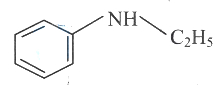
$N,N$-dimethylaniline
B
$(C_2H_5)_3N$
C
$(CH_3)_3C-NH_2$
D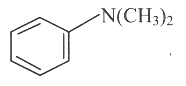
$N$-ethyl-$N$-methylaniline
Solution
(D) tertiary $(3^{\circ})$ amine is formed by replacing all $3$ hydrogen atoms of $NH_3$ with alkyl or aryl groups.
An aromatic amine contains at least one phenyl ring attached to the nitrogen atom.
$A$ mixed amine contains different types of groups (e.g.,alkyl and aryl) attached to the nitrogen.
$N,N$-dimethylaniline is an aromatic,tertiary amine,but it is a simple amine because the two alkyl groups are identical.
$N$-ethyl-$N$-methylaniline is an aromatic,tertiary amine,and it is a mixed amine because the two alkyl groups attached to the nitrogen are different (ethyl and methyl).
An aromatic amine contains at least one phenyl ring attached to the nitrogen atom.
$A$ mixed amine contains different types of groups (e.g.,alkyl and aryl) attached to the nitrogen.
$N,N$-dimethylaniline is an aromatic,tertiary amine,but it is a simple amine because the two alkyl groups are identical.
$N$-ethyl-$N$-methylaniline is an aromatic,tertiary amine,and it is a mixed amine because the two alkyl groups attached to the nitrogen are different (ethyl and methyl).
0 likes
View Solution976
EasyMCQ
Which of the following is an example of a symmetrical tertiary amine?
A
$N,N$-dimethylamine
B
$N,N$-dimethylaniline
C
Triphenylamine
D
Isobutylamine
Solution
(C) tertiary amine is symmetrical if the nitrogen atom is attached to three identical alkyl or aryl groups.
In $N(CH_3)_3$ (trimethylamine),the nitrogen is attached to three methyl groups,but this is not provided as an option.
Looking at the provided images:
Option $A$ is not a tertiary amine.
Option $B$ is $N,N$-dimethylaniline (asymmetric).
Option $C$ is triphenylamine,where the nitrogen atom is attached to three identical phenyl groups. Therefore,it is a symmetrical tertiary amine.
Option $D$ is a primary amine.
In $N(CH_3)_3$ (trimethylamine),the nitrogen is attached to three methyl groups,but this is not provided as an option.
Looking at the provided images:
Option $A$ is not a tertiary amine.
Option $B$ is $N,N$-dimethylaniline (asymmetric).
Option $C$ is triphenylamine,where the nitrogen atom is attached to three identical phenyl groups. Therefore,it is a symmetrical tertiary amine.
Option $D$ is a primary amine.
0 likes
View Solution977
EasyMCQ
Which among the following compounds is a secondary amine?
A
hexane-$1,6$-diamine
B
$N,N$-Dimethylbenzenamine
C
$N$-methylbenzenamine
D
Prop-$2$-en-$1$-amine
Solution
(C) secondary $(2^{\circ})$ amine is a compound where the nitrogen atom is bonded to two carbon atoms and one hydrogen atom $(R_2NH)$.
$1$. Hexane-$1,6$-diamine is a primary amine $(R-NH_2)$.
$2$. $N,N$-Dimethylbenzenamine is a tertiary amine $(R_3N)$.
$3$. $N$-methylbenzenamine $(C_6H_5-NH-CH_3)$ has the nitrogen atom attached to a phenyl group and a methyl group,making it a secondary amine.
$4$. Prop-$2$-en-$1$-amine is a primary amine $(R-NH_2)$.
Therefore,$N$-methylbenzenamine is the correct answer.
$1$. Hexane-$1,6$-diamine is a primary amine $(R-NH_2)$.
$2$. $N,N$-Dimethylbenzenamine is a tertiary amine $(R_3N)$.
$3$. $N$-methylbenzenamine $(C_6H_5-NH-CH_3)$ has the nitrogen atom attached to a phenyl group and a methyl group,making it a secondary amine.
$4$. Prop-$2$-en-$1$-amine is a primary amine $(R-NH_2)$.
Therefore,$N$-methylbenzenamine is the correct answer.
0 likes
View Solution978
MediumMCQ
Which of the following conjugate bases is stabilized to a greater extent due to solvation of ammonia and amines?
A
$R_3NH^+$
B
$RNH_3^+$
C
$NH_4^+$
D
$R_2NH_2^+$
Solution
(C) The stability of the conjugate acid (ammonium ion) in aqueous solution depends on the extent of hydrogen bonding with water molecules.
More hydrogen atoms attached to the nitrogen atom allow for more extensive hydrogen bonding with water,leading to greater stabilization through solvation.
In $NH_4^+$,there are $4$ hydrogen atoms available for hydrogen bonding.
In $RNH_3^+$,there are $3$ hydrogen atoms.
In $R_2NH_2^+$,there are $2$ hydrogen atoms.
In $R_3NH^+$,there is only $1$ hydrogen atom.
Therefore,$NH_4^+$ is stabilized to the greatest extent due to solvation.
More hydrogen atoms attached to the nitrogen atom allow for more extensive hydrogen bonding with water,leading to greater stabilization through solvation.
In $NH_4^+$,there are $4$ hydrogen atoms available for hydrogen bonding.
In $RNH_3^+$,there are $3$ hydrogen atoms.
In $R_2NH_2^+$,there are $2$ hydrogen atoms.
In $R_3NH^+$,there is only $1$ hydrogen atom.
Therefore,$NH_4^+$ is stabilized to the greatest extent due to solvation.
0 likes
View Solution979
MediumMCQ
Which of the following amines acts as the strongest base?
A
$CH_3NH_2$
B
$(C_2H_5)N(CH_3)_2$
C
$(CH_3)_2NH$
D
$(CH_3)_3N$
Solution
(B) The basicity of amines in the aqueous phase depends on the combined effect of inductive effect,solvation effect,and steric hindrance.
For methyl-substituted amines,the order of basicity is $(CH_3)_2NH > CH_3NH_2 > (CH_3)_3N$.
However,among the given options,$(C_2H_5)N(CH_3)_2$ is a tertiary amine with an ethyl group,which provides a stronger inductive effect ($+I$ effect) compared to methyl groups,making it more basic than the others listed.
For methyl-substituted amines,the order of basicity is $(CH_3)_2NH > CH_3NH_2 > (CH_3)_3N$.
However,among the given options,$(C_2H_5)N(CH_3)_2$ is a tertiary amine with an ethyl group,which provides a stronger inductive effect ($+I$ effect) compared to methyl groups,making it more basic than the others listed.
0 likes
View Solution980
EasyMCQ
Which among the following amines has the lowest $pK_{b}$ value?
A
$CH_3CH_2NH_2$
B
$(CH_3CH_2)_2NH$
C
$(CH_3CH_2)_3N$
D
$C_6H_5NH_2$
Solution
(B) The basicity of amines is inversely proportional to their $pK_{b}$ values.
In the gas phase or non-polar solvents,the basicity order is $3^{\circ} > 2^{\circ} > 1^{\circ} > NH_3$.
However,in aqueous solution,the basicity is determined by a combination of inductive effect,solvation effect,and steric hindrance.
For ethylamines in aqueous solution,the order of basicity is $(CH_3CH_2)_2NH > CH_3CH_2NH_2 > (CH_3CH_2)_3N > C_6H_5NH_2$.
Since $(CH_3CH_2)_2NH$ is the most basic,it will have the lowest $pK_{b}$ value.
In the gas phase or non-polar solvents,the basicity order is $3^{\circ} > 2^{\circ} > 1^{\circ} > NH_3$.
However,in aqueous solution,the basicity is determined by a combination of inductive effect,solvation effect,and steric hindrance.
For ethylamines in aqueous solution,the order of basicity is $(CH_3CH_2)_2NH > CH_3CH_2NH_2 > (CH_3CH_2)_3N > C_6H_5NH_2$.
Since $(CH_3CH_2)_2NH$ is the most basic,it will have the lowest $pK_{b}$ value.
0 likes
View Solution981
MediumMCQ
Identify the compound from the following having the highest basic strength.
A
$CH_3CH_2NH_2$
B
$NH_3$
C
$(CH_3)_2NH$
D
$C_6H_5NH_2$
Solution
(C) The basic strength of amines in the aqueous phase depends on the inductive effect,solvation effect,and steric hindrance.
For aliphatic amines,the secondary amine $(CH_3)_2NH$ exhibits the highest basic strength due to the combined effect of the $+I$ effect of two methyl groups and favorable solvation,which outweighs the steric hindrance compared to tertiary amines.
For aliphatic amines,the secondary amine $(CH_3)_2NH$ exhibits the highest basic strength due to the combined effect of the $+I$ effect of two methyl groups and favorable solvation,which outweighs the steric hindrance compared to tertiary amines.
0 likes
View Solution982
MediumMCQ
Which among the following compounds is the weakest base?
A
Phenylmethanamine
B
$N$-Methylaniline
C
Benzenamine
D
$N, N$-Dimethylaniline
Solution
(C) The basicity of amines depends on the availability of the lone pair of electrons on the nitrogen atom for protonation.
In $Phenylmethanamine$ $(C_6H_5CH_2NH_2)$,the lone pair is localized on the nitrogen atom as it is not in conjugation with the benzene ring.
In $Benzenamine$ $(C_6H_5NH_2)$,$N$-Methylaniline,and $N, N$-Dimethylaniline,the lone pair on the nitrogen atom is involved in resonance with the benzene ring,which decreases its availability for protonation.
Among the aromatic amines,the presence of electron-donating alkyl groups on the nitrogen atom increases the electron density on the nitrogen,making them stronger bases than $Benzenamine$.
Therefore,$Benzenamine$ has the least available lone pair due to resonance and the absence of electron-donating groups,making it the weakest base among the given options.
In $Phenylmethanamine$ $(C_6H_5CH_2NH_2)$,the lone pair is localized on the nitrogen atom as it is not in conjugation with the benzene ring.
In $Benzenamine$ $(C_6H_5NH_2)$,$N$-Methylaniline,and $N, N$-Dimethylaniline,the lone pair on the nitrogen atom is involved in resonance with the benzene ring,which decreases its availability for protonation.
Among the aromatic amines,the presence of electron-donating alkyl groups on the nitrogen atom increases the electron density on the nitrogen,making them stronger bases than $Benzenamine$.
Therefore,$Benzenamine$ has the least available lone pair due to resonance and the absence of electron-donating groups,making it the weakest base among the given options.
0 likes
View Solution983
EasyMCQ
Which of the following amines is the weakest base?
A
Trimethylamine
B
Methylamine
C
Diethylamine
D
Aniline
Solution
(D) In $Aniline$ $(C_6H_5NH_2)$,the lone pair of electrons on the nitrogen atom is involved in resonance with the benzene ring.
This delocalization of the lone pair makes it less available for protonation,thereby making $Aniline$ the weakest base among the given options.
This delocalization of the lone pair makes it less available for protonation,thereby making $Aniline$ the weakest base among the given options.
0 likes
View Solution984
MediumMCQ
How many isomers of $C_4H_{11}N$ are tertiary amines?
A
$1$
B
$2$
C
$3$
D
$4$
Solution
(A) tertiary amine has the general structure $R_3N$.
For the molecular formula $C_4H_{11}N$,the only possible tertiary amine is $N,N$-dimethylethanamine,which has the structure $CH_3-CH_2-N(CH_3)_2$.
Thus,there is only $1$ isomer of $C_4H_{11}N$ that is a tertiary amine.
For the molecular formula $C_4H_{11}N$,the only possible tertiary amine is $N,N$-dimethylethanamine,which has the structure $CH_3-CH_2-N(CH_3)_2$.
Thus,there is only $1$ isomer of $C_4H_{11}N$ that is a tertiary amine.
0 likes
View Solution985
EasyMCQ
Which isomer among the following has the highest boiling point?
A
$n$-Butylamine
B
$tert$-Butylamine
C
Ethyldimethylamine
D
Diethylamine
Solution
(A) The boiling point of amines depends on the extent of intermolecular hydrogen bonding.
Primary amines $(R-NH_2)$ have two hydrogen atoms attached to the nitrogen,allowing for extensive hydrogen bonding.
Secondary amines $(R_2NH)$ have one hydrogen atom,and tertiary amines $(R_3N)$ have no hydrogen atoms attached to nitrogen,thus they cannot form intermolecular hydrogen bonds.
Among the given isomers,$n$-Butylamine $(CH_3CH_2CH_2CH_2NH_2)$ is a primary amine with a straight chain,which allows for maximum surface area and stronger intermolecular forces compared to branched isomers or secondary/tertiary amines.
Therefore,$n$-Butylamine has the highest boiling point.
Primary amines $(R-NH_2)$ have two hydrogen atoms attached to the nitrogen,allowing for extensive hydrogen bonding.
Secondary amines $(R_2NH)$ have one hydrogen atom,and tertiary amines $(R_3N)$ have no hydrogen atoms attached to nitrogen,thus they cannot form intermolecular hydrogen bonds.
Among the given isomers,$n$-Butylamine $(CH_3CH_2CH_2CH_2NH_2)$ is a primary amine with a straight chain,which allows for maximum surface area and stronger intermolecular forces compared to branched isomers or secondary/tertiary amines.
Therefore,$n$-Butylamine has the highest boiling point.
0 likes
View Solution986
MediumMCQ
Among the following isomeric amines,the amine having the highest boiling point is:
A
diethylamine
B
$n$-butylamine
C
tert-butylamine
D
ethyldimethylamine
Solution
(B) The boiling point of amines depends on the extent of intermolecular $H$-bonding.
$1^{\circ}$-amines (primary amines) have two $H$-atoms attached to the nitrogen atom,allowing for extensive intermolecular $H$-bonding.
$n$-butylamine $(CH_3CH_2CH_2CH_2NH_2)$ is a $1^{\circ}$-amine,whereas diethylamine is a $2^{\circ}$-amine and ethyldimethylamine is a $3^{\circ}$-amine.
$tert$-butylamine is also a $1^{\circ}$-amine,but its branched structure reduces the surface area for van der Waals forces compared to the straight-chain $n$-butylamine.
Therefore,$n$-butylamine has the highest boiling point.
$1^{\circ}$-amines (primary amines) have two $H$-atoms attached to the nitrogen atom,allowing for extensive intermolecular $H$-bonding.
$n$-butylamine $(CH_3CH_2CH_2CH_2NH_2)$ is a $1^{\circ}$-amine,whereas diethylamine is a $2^{\circ}$-amine and ethyldimethylamine is a $3^{\circ}$-amine.
$tert$-butylamine is also a $1^{\circ}$-amine,but its branched structure reduces the surface area for van der Waals forces compared to the straight-chain $n$-butylamine.
Therefore,$n$-butylamine has the highest boiling point.
0 likes
View Solution987
MediumMCQ
How many metamers are possible for the molecular formula $C_4H_{11}N$?
A
$2$
B
$3$
C
$4$
D
$5$
Solution
(B) Metamers are isomers that have the same molecular formula but differ in the nature of the alkyl groups attached to the same polyvalent functional group (in this case,the secondary amine group,$-NH-$).
For the molecular formula $C_4H_{11}N$,the secondary amines ($2^{\circ}$ amines) are:
$1$) $CH_3CH_2-NH-CH_2CH_3$ (Diethylamine)
$2$) $CH_3-NH-CH_2CH_2CH_3$ (Methylpropylamine)
$3$) $CH_3-NH-CH(CH_3)_2$ (Methylisopropylamine)
Thus,there are $3$ possible metamers.
For the molecular formula $C_4H_{11}N$,the secondary amines ($2^{\circ}$ amines) are:
$1$) $CH_3CH_2-NH-CH_2CH_3$ (Diethylamine)
$2$) $CH_3-NH-CH_2CH_2CH_3$ (Methylpropylamine)
$3$) $CH_3-NH-CH(CH_3)_2$ (Methylisopropylamine)
Thus,there are $3$ possible metamers.
0 likes
View Solution988
MediumMCQ
Which of the following isomers has the highest boiling point?
A
tert-Butylamine
B
Ethyldimethylamine
C
Diethylamine
D
n-Butylamine
Solution
(D) The boiling point of amines depends on the extent of intermolecular hydrogen bonding. Primary amines have two hydrogen atoms attached to the nitrogen,allowing for extensive hydrogen bonding. Secondary amines have one hydrogen atom,and tertiary amines have no hydrogen atoms attached to the nitrogen.
Therefore,the order of boiling points for isomeric amines is: $\text{primary amine} > \text{secondary amine} > \text{tertiary amine}$.
Among the given options,$n$-butylamine is a primary amine,diethylamine is a secondary amine,and both tert-butylamine and ethyldimethylamine are isomers that have less effective hydrogen bonding or are tertiary. Thus,$n$-butylamine has the highest boiling point.
Therefore,the order of boiling points for isomeric amines is: $\text{primary amine} > \text{secondary amine} > \text{tertiary amine}$.
Among the given options,$n$-butylamine is a primary amine,diethylamine is a secondary amine,and both tert-butylamine and ethyldimethylamine are isomers that have less effective hydrogen bonding or are tertiary. Thus,$n$-butylamine has the highest boiling point.
0 likes
View Solution989
MediumMCQ
Which of the following compounds is obtained when a quaternary ammonium hydroxide is strongly heated?
A
Alkane
B
Alkyne
C
Alkene
D
Amide
Solution
(C) Quaternary ammonium hydroxides on strong heating undergo $\beta$-elimination to give an alkene.
This reaction is known as the Hoffmann elimination reaction.
This reaction is known as the Hoffmann elimination reaction.
0 likes
View Solution990
EasyMCQ
Identify the reagent $R$ used in the reaction stated below.
$C_6H_5N_2Cl + R \rightarrow C_6H_6$
$C_6H_5N_2Cl + R \rightarrow C_6H_6$
A
$HCl$
B
$H_3PO_2 / H_2O$
C
$H_2O / HCl$
D
$HNO_3$
Solution
(B) The conversion of benzene diazonium chloride to benzene is a reduction reaction.
This reaction is carried out using hypophosphorous acid $(H_3PO_2)$ in the presence of water $(H_2O)$.
The reaction is: $C_6H_5N_2Cl + H_3PO_2 + H_2O \rightarrow C_6H_6 + N_2 + H_3PO_3 + HCl$.
This reaction is carried out using hypophosphorous acid $(H_3PO_2)$ in the presence of water $(H_2O)$.
The reaction is: $C_6H_5N_2Cl + H_3PO_2 + H_2O \rightarrow C_6H_6 + N_2 + H_3PO_3 + HCl$.
0 likes
View Solution991
MediumMCQ
What is the product formed when benzene diazonium chloride reacts with ethanol?
A
Phenol
B
Ethyl benzene
C
Benzyl alcohol
D
Benzene
Solution
(D) The reaction of benzene diazonium chloride with ethanol $(CH_3CH_2OH)$ acts as a reduction process.
In this reaction,ethanol is oxidized to acetaldehyde $(CH_3CHO)$ and the diazonium salt is reduced to benzene $(C_6H_6)$.
The chemical equation is: $C_6H_5N_2Cl + C_2H_5OH \rightarrow C_6H_6 + CH_3CHO + N_2 + HCl$.
In this reaction,ethanol is oxidized to acetaldehyde $(CH_3CHO)$ and the diazonium salt is reduced to benzene $(C_6H_6)$.
The chemical equation is: $C_6H_5N_2Cl + C_2H_5OH \rightarrow C_6H_6 + CH_3CHO + N_2 + HCl$.
0 likes
View Solution992
MediumMCQ
Which of the following compounds can be obtained by an azo coupling reaction?
A
Benzenediazonium chloride
B
Fluoroarene
C
$p$-Hydroxyazobenzene
D
$N$-Ethylbenzenesulfonamide
Solution
(C) Azo coupling reactions involve the reaction of a diazonium salt with an electron-rich aromatic compound (like a phenol or an aromatic amine) to form an azo compound $(Ar-N=N-Ar')$.
In this reaction,benzenediazonium chloride reacts with phenol in a basic medium to produce $p$-hydroxyazobenzene.
Therefore,$p$-hydroxyazobenzene is the product obtained via an azo coupling reaction.
In this reaction,benzenediazonium chloride reacts with phenol in a basic medium to produce $p$-hydroxyazobenzene.
Therefore,$p$-hydroxyazobenzene is the product obtained via an azo coupling reaction.
0 likes
View Solution993
MediumMCQ
Identify the product of the following reaction:
$\text{Aniline} \xrightarrow[ii) \text{H}_2\text{O}, \Delta]{i) \text{NaNO}_2 + \text{HCl}, 273 \text{ K}} \text{Product}$
$\text{Aniline} \xrightarrow[ii) \text{H}_2\text{O}, \Delta]{i) \text{NaNO}_2 + \text{HCl}, 273 \text{ K}} \text{Product}$
A
$o-\text{Nitroaniline}$
B
$m-\text{Nitroaniline}$
C
$p-\text{Nitroaniline}$
D
$\text{Phenol}$
Solution
(D) The reaction of aniline with $\text{NaNO}_2$ and $\text{HCl}$ at $273-278 \text{ K}$ is known as diazotization,which produces benzenediazonium chloride.
When benzenediazonium chloride is heated with water,it undergoes hydrolysis to form phenol.
The overall reaction is:
$\text{C}_6\text{H}_5\text{NH}_2$ $\xrightarrow[ii) \text{H}_2\text{O}, \Delta]{i) \text{NaNO}_2 + \text{HCl}, 273 \text{ K}} \text{C}_6\text{H}_5\text{OH} (\text{Phenol})$
When benzenediazonium chloride is heated with water,it undergoes hydrolysis to form phenol.
The overall reaction is:
$\text{C}_6\text{H}_5\text{NH}_2$ $\xrightarrow[ii) \text{H}_2\text{O}, \Delta]{i) \text{NaNO}_2 + \text{HCl}, 273 \text{ K}} \text{C}_6\text{H}_5\text{OH} (\text{Phenol})$
0 likes
View Solution994
MediumMCQ
Identify the final product formed on ammonolysis of benzyl chloride followed by the reaction with two moles of $CH_3 I$.
A
$C_6 H_5 CH_2 NHCH_3$
B
$C_6 H_5 CH_2 NH_2$
C
$C_6 H_5 N(CH_3)_2$
D
$C_6 H_5 CH_2 N(CH_3)_2$
Solution
(D) Step $1$: Ammonolysis of benzyl chloride $(C_6 H_5 CH_2 Cl)$ with alcoholic $NH_3$ yields benzylamine $(C_6 H_5 CH_2 NH_2)$.
$C_6 H_5 CH_2 Cl + NH_3 \rightarrow C_6 H_5 CH_2 NH_2 + HCl$
Step $2$: Benzylamine reacts with two moles of methyl iodide $(CH_3 I)$ via nucleophilic substitution (alkylation) to form $N,N$-dimethylbenzylamine $(C_6 H_5 CH_2 N(CH_3)_2)$.
$C_6 H_5 CH_2 NH_2 + 2CH_3 I \rightarrow C_6 H_5 CH_2 N(CH_3)_2 + 2HI$
Thus,the final product is $C_6 H_5 CH_2 N(CH_3)_2$.
$C_6 H_5 CH_2 Cl + NH_3 \rightarrow C_6 H_5 CH_2 NH_2 + HCl$
Step $2$: Benzylamine reacts with two moles of methyl iodide $(CH_3 I)$ via nucleophilic substitution (alkylation) to form $N,N$-dimethylbenzylamine $(C_6 H_5 CH_2 N(CH_3)_2)$.
$C_6 H_5 CH_2 NH_2 + 2CH_3 I \rightarrow C_6 H_5 CH_2 N(CH_3)_2 + 2HI$
Thus,the final product is $C_6 H_5 CH_2 N(CH_3)_2$.
0 likes
View Solution995
EasyMCQ
Which among the following amines has the highest value of $pK_{b}$?
A
$(CH_3)_2 NH$
B
$(CH_3)_3 N$
C
$CH_3 NH_2$
D
$C_6 H_5 NH_2$
Solution
(D) The $pK_{b}$ value is inversely proportional to the basic strength of the amine. $A$ higher $pK_{b}$ value indicates a weaker base.
Among the given options,$C_6 H_5 NH_2$ (aniline) is an aromatic amine where the lone pair of electrons on the nitrogen atom is delocalized into the benzene ring due to resonance.
This delocalization significantly reduces the availability of the lone pair for protonation,making aniline a much weaker base compared to aliphatic amines like $(CH_3)_2 NH$,$(CH_3)_3 N$,and $CH_3 NH_2$.
Since aniline is the weakest base,it has the highest $pK_{b}$ value.
Among the given options,$C_6 H_5 NH_2$ (aniline) is an aromatic amine where the lone pair of electrons on the nitrogen atom is delocalized into the benzene ring due to resonance.
This delocalization significantly reduces the availability of the lone pair for protonation,making aniline a much weaker base compared to aliphatic amines like $(CH_3)_2 NH$,$(CH_3)_3 N$,and $CH_3 NH_2$.
Since aniline is the weakest base,it has the highest $pK_{b}$ value.
0 likes
View Solution996
EasyMCQ
Identify the $CORRECT$ decreasing order of solubilities of alcohols,alkanes,and amines in water having comparable molar mass.
A
Alcohol $>$ amine $>$ alkane
B
Alkane $>$ amine $>$ alcohol
C
Amine $>$ alcohol $>$ alkane
D
Alkane $>$ alcohol $>$ amine
Solution
(A) The solubility of organic compounds in water depends on their ability to form hydrogen bonds with water molecules.
Alcohols $(R-OH)$ form stronger hydrogen bonds with water due to the high electronegativity of oxygen compared to nitrogen.
Amines $(R-NH_2)$ also form hydrogen bonds with water,but these are weaker than those formed by alcohols because nitrogen is less electronegative than oxygen.
Alkanes are non-polar and cannot form hydrogen bonds with water,making them practically insoluble.
Therefore,the decreasing order of solubility is: $\text{Alcohol} > \text{Amine} > \text{Alkane}$.
Alcohols $(R-OH)$ form stronger hydrogen bonds with water due to the high electronegativity of oxygen compared to nitrogen.
Amines $(R-NH_2)$ also form hydrogen bonds with water,but these are weaker than those formed by alcohols because nitrogen is less electronegative than oxygen.
Alkanes are non-polar and cannot form hydrogen bonds with water,making them practically insoluble.
Therefore,the decreasing order of solubility is: $\text{Alcohol} > \text{Amine} > \text{Alkane}$.
0 likes
View Solution997
EasyMCQ
$R + CH_3-CO-CH_3 \xrightarrow{H^{+}} \text{Schiff's base}$. What is $R$ in this reaction?
A
$C_6H_5-NH-NH_2$
B
$NH_2-NH_2$
C
$CH_3-NH_2$
D
$NH_2OH$
Solution
(C) $Schiff's \ base$ is formed by the reaction of a primary amine $(R-NH_2)$ with an aldehyde or a ketone.
In the given reaction,$CH_3-CO-CH_3$ (acetone) reacts with $R$ to form a $Schiff's \ base$.
Among the given options,$CH_3-NH_2$ is a primary amine.
The reaction is: $CH_3-CO-CH_3 + CH_3-NH_2 \xrightarrow{H^{+}} CH_3-C(CH_3)=N-CH_3 + H_2O$.
Therefore,$R$ is $CH_3-NH_2$.
In the given reaction,$CH_3-CO-CH_3$ (acetone) reacts with $R$ to form a $Schiff's \ base$.
Among the given options,$CH_3-NH_2$ is a primary amine.
The reaction is: $CH_3-CO-CH_3 + CH_3-NH_2 \xrightarrow{H^{+}} CH_3-C(CH_3)=N-CH_3 + H_2O$.
Therefore,$R$ is $CH_3-NH_2$.
0 likes
View Solution998
DifficultMCQ
Biologically active adrenaline and ephedrine,which are used to increase blood pressure,contain which of the following functional groups?
A
Primary amino group
B
Secondary amino group
C
Tertiary amino group
D
Quaternary ammonium salt
Solution
(B) Adrenaline and ephedrine are biologically active compounds used to increase blood pressure.
In the structure of adrenaline,the nitrogen atom is bonded to one methyl group and one alkyl chain,making it a secondary amine.
Similarly,ephedrine also contains a secondary amino group.
Therefore,both contain a secondary amino group.
In the structure of adrenaline,the nitrogen atom is bonded to one methyl group and one alkyl chain,making it a secondary amine.
Similarly,ephedrine also contains a secondary amino group.
Therefore,both contain a secondary amino group.
0 likes
View Solution999
MediumMCQ
Identify $A$,$B$ and $C$ in the sequence: $CH_3CH_2Br$ $\xrightarrow[Alc.]{KCN} A$ $\xrightarrow{LiAlH_4} B$ $\xrightarrow[0^{\circ}C]{HNO_2} C$
A
$CH_3-CH_2-CN, CH_3-CH_2-CH_2-NH_2, CH_3-CH_2-CH_2-OH$
B
$CH_3-CH_2-NC, CH_3-CH_2-OH, CH_3-CH_2-CH_2-NH_2$
C
$CH_3-CH_2-CN, C_2H_5-OH, C_2H_5-N_2Cl$
D
$CH_3-CH_2-CN, CH_3-CH_2-NH_2, C_2H_5-OH$
Solution
(A) The reaction sequence is as follows:
$1$. $CH_3CH_2Br + KCN \rightarrow CH_3CH_2CN (A) + KBr$
$2$. $CH_3CH_2CN + 4[H] \xrightarrow{LiAlH_4} CH_3CH_2CH_2NH_2 (B)$
$3$. $CH_3CH_2CH_2NH_2 + HNO_2$ $\xrightarrow{0^{\circ}C} [CH_3CH_2CH_2N_2^+]$ $\rightarrow CH_3CH_2CH_2^+$ $\xrightarrow{H_2O} CH_3CH_2CH_2OH (C)$
(Note: While rearrangement to the more stable isopropyl carbocation can occur,the primary alcohol $CH_3CH_2CH_2OH$ is the major product expected in this context.)
$1$. $CH_3CH_2Br + KCN \rightarrow CH_3CH_2CN (A) + KBr$
$2$. $CH_3CH_2CN + 4[H] \xrightarrow{LiAlH_4} CH_3CH_2CH_2NH_2 (B)$
$3$. $CH_3CH_2CH_2NH_2 + HNO_2$ $\xrightarrow{0^{\circ}C} [CH_3CH_2CH_2N_2^+]$ $\rightarrow CH_3CH_2CH_2^+$ $\xrightarrow{H_2O} CH_3CH_2CH_2OH (C)$
(Note: While rearrangement to the more stable isopropyl carbocation can occur,the primary alcohol $CH_3CH_2CH_2OH$ is the major product expected in this context.)
0 likes
View Solution1000
MediumMCQ
Aniline does not undergo
A
nitration
B
sulphonation
C
Friedel-Craft's reaction
D
bromination
Solution
(C) Aniline does not undergo Friedel-Craft's reaction because the lone pair on the nitrogen atom of the $-NH_2$ group forms a coordinate bond with the Lewis acid (catalyst) like $AlCl_3$.
This results in the formation of a positively charged species on the nitrogen atom,which acts as a strong deactivating group for the aromatic ring,thereby preventing the reaction.
This results in the formation of a positively charged species on the nitrogen atom,which acts as a strong deactivating group for the aromatic ring,thereby preventing the reaction.
0 likes
View SolutionAmines — Properties of Amines · Frequently Asked Questions
1Are these Amines questions useful for JEE and NEET?
Yes. All questions in this section are mapped to JEE Main and NEET exam patterns. Previous year questions from JEE Main, NEET, GUJCET and state-level exams are included with full solutions.
2Can I switch to Hindi or Gujarati for these questions?
Yes. Use the language tabs in the hero section or the sidebar to view the same questions and solutions in English, Hindi or Gujarati.
3How do I generate a question paper from this subtopic?
Use the Vedclass Exam Paper Generator — select the chapter and subtopic, set difficulty, and generate Sets A, B, C, D automatically. First 3 chapters of every subject are free.
Vedclass Products
For Students
Vedclass Test Series
Mock tests in real JEE/NEET style with performance analysis. 5-day free trial.
Start Free TrialFor Teachers
Exam Paper Generator
Generate Set A/B/C/D papers from this chapter in 2 minutes. 3 chapters free.
Try FreeFor Institutes
Online Exam Module
Live online exams with unlimited students, 360° analytics & white-label branding.
See DemoFor Teachers & Institutes
Generate a Amines Exam Paper in 2 Minutes
Select subtopic & difficulty — Sets A, B, C, D auto-generated with No Repeat logic.
First 3 chapters of every subject are free — no payment required.