
A English
Properties of Amines Questions in English
Class 12 Chemistry · Amines · Properties of Amines
1212+
Questions
English
Language
100%
With Solutions
Showing 50 of 1212 questions in English
1
MediumMCQ
The high melting point and insolubility in organic solvents of sulphanilic acid are due to its $......$ structure.
A
Simple ionic
B
Bipolar ionic
C
Cubic
D
Hexagonal
Solution
(B) Sulphanilic acid exists as a zwitterion,which is a $Bipolar \ ionic$ structure.
Due to strong electrostatic forces of attraction between these ions,it exhibits a high melting point and is insoluble in organic solvents.
Due to strong electrostatic forces of attraction between these ions,it exhibits a high melting point and is insoluble in organic solvents.
0 likes
View Solution2
EasyMCQ
Which of the following is the strongest base?
A
$C_2H_5^-$
B
$C_2H_5COO^-$
C
$C_2H_5O^-$
D
$OH^-$
Solution
(A) The strength of a base is inversely proportional to the strength of its conjugate acid.
$1$. The conjugate acids of the given bases are: $C_2H_6$ (for $C_2H_5^-$),$C_2H_5COOH$ (for $C_2H_5COO^-$),$C_2H_5OH$ (for $C_2H_5O^-$),and $H_2O$ (for $OH^-$).
$2$. The order of acidity of these conjugate acids is: $C_2H_5COOH > C_2H_5OH > H_2O > C_2H_6$.
$3$. Since $C_2H_6$ is the weakest acid,its conjugate base $C_2H_5^-$ is the strongest base.
$1$. The conjugate acids of the given bases are: $C_2H_6$ (for $C_2H_5^-$),$C_2H_5COOH$ (for $C_2H_5COO^-$),$C_2H_5OH$ (for $C_2H_5O^-$),and $H_2O$ (for $OH^-$).
$2$. The order of acidity of these conjugate acids is: $C_2H_5COOH > C_2H_5OH > H_2O > C_2H_6$.
$3$. Since $C_2H_6$ is the weakest acid,its conjugate base $C_2H_5^-$ is the strongest base.
0 likes
View Solution3
MediumMCQ
Which gas is obtained when urea is heated with $HNO_2$?
A
$N_2$
B
$H_2$
C
$O_2$
D
$NH_3$
Solution
(A) The reaction of urea with nitrous acid $(HNO_2)$ is as follows:
$NH_2CONH_2 + 2HNO_2 \to CO_2 + 2N_2 + 3H_2O$
As shown in the balanced chemical equation,nitrogen gas $(N_2)$ is evolved along with carbon dioxide and water.
$NH_2CONH_2 + 2HNO_2 \to CO_2 + 2N_2 + 3H_2O$
As shown in the balanced chemical equation,nitrogen gas $(N_2)$ is evolved along with carbon dioxide and water.
0 likes
View Solution4
MediumMCQ
The strongest nucleophile is
A
$RNH_2$
B
$ROH$
C
$C_6H_5O^-$
D
$CH_3O^-$
Solution
(D) The nucleophilicity of a species depends on its ability to donate an electron pair.
$CH_3O^-$ is a strong nucleophile because the negative charge is localized on the oxygen atom,making it highly available for donation.
In contrast,$C_6H_5O^-$ is less nucleophilic due to resonance stabilization of the negative charge on the benzene ring.
$RNH_2$ and $ROH$ are neutral species and are generally weaker nucleophiles compared to their corresponding alkoxide ions.
$CH_3O^-$ is a strong nucleophile because the negative charge is localized on the oxygen atom,making it highly available for donation.
In contrast,$C_6H_5O^-$ is less nucleophilic due to resonance stabilization of the negative charge on the benzene ring.
$RNH_2$ and $ROH$ are neutral species and are generally weaker nucleophiles compared to their corresponding alkoxide ions.
0 likes
View Solution5
MediumMCQ
Among the following,the strongest nucleophile is
A
$C_2H_5SH$
B
$CH_3COO^-$
C
$CH_3NH_2$
D
$NCCH_2^-$
Solution
(A) The correct answer is $A$.
Nucleophilicity is the ability of a species to donate an electron pair to an electrophile.
Factors affecting nucleophilicity include charge,electronegativity,and solvent effects.
Comparing the given species:
$1$. $C_2H_5SH$ (Ethanethiol): Sulfur is less electronegative than oxygen and nitrogen,making its lone pair more available for donation.
$2$. $CH_3COO^-$ (Acetate ion): The negative charge is delocalized over two oxygen atoms via resonance,which decreases its nucleophilicity.
$3$. $CH_3NH_2$ (Methylamine): Nitrogen is more electronegative than sulfur,making its lone pair less available.
$4$. $NCCH_2^-$ (Cyanomethyl anion): The negative charge is stabilized by the strong electron-withdrawing $-I$ and $-M$ effect of the cyano $(-CN)$ group,significantly reducing its nucleophilicity.
Therefore,$C_2H_5SH$ acts as the strongest nucleophile among the given options due to the lower electronegativity of sulfur compared to oxygen and nitrogen,and the lack of resonance stabilization or strong electron-withdrawing groups.
Nucleophilicity is the ability of a species to donate an electron pair to an electrophile.
Factors affecting nucleophilicity include charge,electronegativity,and solvent effects.
Comparing the given species:
$1$. $C_2H_5SH$ (Ethanethiol): Sulfur is less electronegative than oxygen and nitrogen,making its lone pair more available for donation.
$2$. $CH_3COO^-$ (Acetate ion): The negative charge is delocalized over two oxygen atoms via resonance,which decreases its nucleophilicity.
$3$. $CH_3NH_2$ (Methylamine): Nitrogen is more electronegative than sulfur,making its lone pair less available.
$4$. $NCCH_2^-$ (Cyanomethyl anion): The negative charge is stabilized by the strong electron-withdrawing $-I$ and $-M$ effect of the cyano $(-CN)$ group,significantly reducing its nucleophilicity.
Therefore,$C_2H_5SH$ acts as the strongest nucleophile among the given options due to the lower electronegativity of sulfur compared to oxygen and nitrogen,and the lack of resonance stabilization or strong electron-withdrawing groups.
0 likes
View Solution6
MediumMCQ
Which compound is optically active?
A
$4-$chloro$1-$hydroxybutane
B
$3^o-$butyl alcohol
C
Secondary butyl amine
D
$n-$butyl alcohol
Solution
(C) compound is optically active if it contains a chiral carbon atom (a carbon atom bonded to four different groups).
In $CH_3-CH(NH_2)-CH_2-CH_3$ (Secondary butyl amine),the $C-2$ carbon is bonded to a hydrogen atom,a methyl group,an amino group,and an ethyl group.
Since all four groups attached to the $C-2$ carbon are different,it is a chiral center.
Therefore,Secondary butyl amine is optically active.
In $CH_3-CH(NH_2)-CH_2-CH_3$ (Secondary butyl amine),the $C-2$ carbon is bonded to a hydrogen atom,a methyl group,an amino group,and an ethyl group.
Since all four groups attached to the $C-2$ carbon are different,it is a chiral center.
Therefore,Secondary butyl amine is optically active.
0 likes
View Solution7
MediumMCQ
Pyridine is less basic than triethylamine because
A
Pyridine has aromatic character
B
Nitrogen in pyridine is $sp^2$ hybridized
C
Pyridine is a cyclic system
D
In pyridine,lone pair of nitrogen is delocalized
Solution
(D) The basicity of amines is primarily due to the availability of a lone pair of electrons on the nitrogen atom for donation to a proton or Lewis acid.
In triethylamine,the lone pair on the nitrogen is localized and readily available for donation.
In pyridine,the nitrogen atom is $sp^2$ hybridized,and its lone pair is part of the aromatic $\pi$-electron system (delocalized) to satisfy $H$ückel's rule.
Because the lone pair is delocalized,it is significantly less available for protonation,making pyridine less basic than triethylamine.
In triethylamine,the lone pair on the nitrogen is localized and readily available for donation.
In pyridine,the nitrogen atom is $sp^2$ hybridized,and its lone pair is part of the aromatic $\pi$-electron system (delocalized) to satisfy $H$ückel's rule.
Because the lone pair is delocalized,it is significantly less available for protonation,making pyridine less basic than triethylamine.
0 likes
View Solution8
MediumMCQ
Amongst the following,the most basic compound is:
A
Benzylamine
B
Aniline
C
Acetanilide
D
$p-$nitroaniline
Solution
(A) The basicity of amines depends on the availability of the lone pair of electrons on the nitrogen atom for protonation.
In $Benzylamine$ $(C_6H_5CH_2NH_2)$,the $-NH_2$ group is attached to an $sp^3$ hybridized carbon atom,not directly to the benzene ring. Thus,the lone pair is fully available.
In $Aniline$ $(C_6H_5NH_2)$,the lone pair is involved in resonance with the benzene ring,reducing its availability.
In $Acetanilide$ $(CH_3CONHC_6H_5)$,the lone pair is involved in resonance with the carbonyl group $(C=O)$,further reducing basicity.
In $p-nitroaniline$,the strong electron-withdrawing $-NO_2$ group decreases the electron density on the nitrogen atom,making it the least basic.
Therefore,$Benzylamine$ is the most basic compound.
In $Benzylamine$ $(C_6H_5CH_2NH_2)$,the $-NH_2$ group is attached to an $sp^3$ hybridized carbon atom,not directly to the benzene ring. Thus,the lone pair is fully available.
In $Aniline$ $(C_6H_5NH_2)$,the lone pair is involved in resonance with the benzene ring,reducing its availability.
In $Acetanilide$ $(CH_3CONHC_6H_5)$,the lone pair is involved in resonance with the carbonyl group $(C=O)$,further reducing basicity.
In $p-nitroaniline$,the strong electron-withdrawing $-NO_2$ group decreases the electron density on the nitrogen atom,making it the least basic.
Therefore,$Benzylamine$ is the most basic compound.
0 likes
View Solution9
MediumMCQ
The reaction given below is known as:
$ArN_2^+ X^- + Cu_2Cl_2 + HCl \to ArCl + N_2 + Cu_2Cl_2$
$ArN_2^+ X^- + Cu_2Cl_2 + HCl \to ArCl + N_2 + Cu_2Cl_2$
A
Chlorination
B
Sandmeyer's reaction
C
Perkin reaction
D
Substitution reaction
Solution
(B) The reaction of a diazonium salt with cuprous chloride $(Cu_2Cl_2)$ in the presence of hydrochloric acid $(HCl)$ to form an aryl chloride is a classic example of the Sandmeyer's reaction.
In this reaction,the diazonium group $(-N_2^+)$ is replaced by a chlorine atom $(Cl)$ using a copper$(I)$ salt as a catalyst.
In this reaction,the diazonium group $(-N_2^+)$ is replaced by a chlorine atom $(Cl)$ using a copper$(I)$ salt as a catalyst.
0 likes
View Solution10
AdvancedMCQ
Treatment of ammonia with excess of ethyl chloride will yield
A
Diethyl amine
B
Ethane
C
Tetraethyl ammonium chloride
D
Methyl amine
Solution
(C) The reaction of ammonia with an alkyl halide is a nucleophilic substitution reaction that proceeds until the quaternary ammonium salt is formed if the alkyl halide is in excess.
$NH_3 + C_2H_5Cl \rightarrow C_2H_5NH_2 + HCl$
$C_2H_5NH_2 + C_2H_5Cl \rightarrow (C_2H_5)_2NH + HCl$
$(C_2H_5)_2NH + C_2H_5Cl \rightarrow (C_2H_5)_3N + HCl$
$(C_2H_5)_3N + C_2H_5Cl \rightarrow [(C_2H_5)_4N]^+ Cl^-$
Since ethyl chloride is in excess,the final product is the quaternary ammonium salt,which is $Tetraethyl \ ammonium \ chloride$.
$NH_3 + C_2H_5Cl \rightarrow C_2H_5NH_2 + HCl$
$C_2H_5NH_2 + C_2H_5Cl \rightarrow (C_2H_5)_2NH + HCl$
$(C_2H_5)_2NH + C_2H_5Cl \rightarrow (C_2H_5)_3N + HCl$
$(C_2H_5)_3N + C_2H_5Cl \rightarrow [(C_2H_5)_4N]^+ Cl^-$
Since ethyl chloride is in excess,the final product is the quaternary ammonium salt,which is $Tetraethyl \ ammonium \ chloride$.
0 likes
View Solution11
DifficultMCQ
When chloroform is treated with a primary amine and $KOH$,what is the characteristic smell of the product formed?
A
Rose odour
B
Sour almond-like smell
C
Offensive odour
D
Sour oil of wintergreen-like smell
Solution
(C) This reaction is known as the $Carbylamine$ reaction.
When a primary amine reacts with chloroform $(CHCl_3)$ and alcoholic $KOH$,an isocyanide (carbylamine) is formed.
The reaction is: $R-NH_2 + CHCl_3 + 3KOH \to R-NC + 3KCl + 3H_2O$.
The product,alkyl isocyanide $(R-NC)$,is characterized by an extremely offensive odour.
When a primary amine reacts with chloroform $(CHCl_3)$ and alcoholic $KOH$,an isocyanide (carbylamine) is formed.
The reaction is: $R-NH_2 + CHCl_3 + 3KOH \to R-NC + 3KCl + 3H_2O$.
The product,alkyl isocyanide $(R-NC)$,is characterized by an extremely offensive odour.
0 likes
View Solution12
MediumMCQ
Carbylamine is liberated when $.....$ is heated with chloroform and alcoholic potash.
A
An aldehyde
B
$A$ primary amine
C
$A$ secondary amine
D
$A$ phenol
Solution
(B) The carbylamine reaction (also known as the Hofmann isocyanide test) is a diagnostic test for primary amines. $R-NH_2 + CHCl_3 + 3KOH (\text{alc.}) \rightarrow R-NC + 3KCl + 3H_2O$. In this reaction,a primary amine reacts with chloroform and alcoholic potassium hydroxide to produce an isocyanide (carbylamine),which has a foul,offensive smell.
0 likes
View Solution13
DifficultMCQ
The bad-smelling substance formed by the action of alcoholic caustic potash on chloroform and aniline is:
A
Phenyl isocyanide
B
Nitrobenzene
C
Phenyl cyanide
D
Phenyl isocyanate
Solution
(A) The reaction of primary amines (like aniline) with chloroform $(CHCl_3)$ and alcoholic potassium hydroxide $(KOH)$ is known as the Carbylamine reaction.
This reaction produces a foul-smelling substance called phenyl isocyanide (or phenyl carbylamine).
The chemical equation is:
$C_6H_5NH_2 + CHCl_3 + 3KOH \rightarrow C_6H_5NC + 3KCl + 3H_2O$
Therefore,the correct option is $(A)$.
This reaction produces a foul-smelling substance called phenyl isocyanide (or phenyl carbylamine).
The chemical equation is:
$C_6H_5NH_2 + CHCl_3 + 3KOH \rightarrow C_6H_5NC + 3KCl + 3H_2O$
Therefore,the correct option is $(A)$.
0 likes
View Solution14
MediumMCQ
When ethyl amine is heated with chloroform and alcoholic $KOH$,a compound with an offensive smell is obtained. This compound is
A
$A$ secondary amine
B
An isocyanide
C
$A$ cyanide
D
An acid
Solution
(B) The reaction is the carbylamine reaction: $C_2H_5NH_2 + CHCl_3 + 3KOH \to C_2H_5NC + 3KCl + 3H_2O$.
In this reaction,ethyl isocyanide $(C_2H_5NC)$ is formed,which is known for its characteristic unpleasant and offensive smell.
In this reaction,ethyl isocyanide $(C_2H_5NC)$ is formed,which is known for its characteristic unpleasant and offensive smell.
0 likes
View Solution15
MediumMCQ
In the following reaction $X$ is
$CH_3NH_2 + X + KOH \to CH_3NC$ (highly offensive odour)
$CH_3NH_2 + X + KOH \to CH_3NC$ (highly offensive odour)
A
$CH_2Cl_2$
B
$CHCl_3$
C
$CH_3Cl$
D
$CCl_4$
Solution
(B) The given reaction is the $Carbylamine$ reaction,which is a characteristic test for primary amines.
In this reaction,a primary amine reacts with chloroform $(CHCl_3)$ and alcoholic potassium hydroxide $(KOH)$ to form an isocyanide (carbylamine),which has a highly offensive odour.
The balanced chemical equation is:
$CH_3NH_2 + CHCl_3 + 3KOH \to CH_3NC + 3KCl + 3H_2O$
Therefore,$X$ is $CHCl_3$.
In this reaction,a primary amine reacts with chloroform $(CHCl_3)$ and alcoholic potassium hydroxide $(KOH)$ to form an isocyanide (carbylamine),which has a highly offensive odour.
The balanced chemical equation is:
$CH_3NH_2 + CHCl_3 + 3KOH \to CH_3NC + 3KCl + 3H_2O$
Therefore,$X$ is $CHCl_3$.
0 likes
View Solution16
DifficultMCQ
The compound that will react most readily with $NaOH$ to form methanol is
A
$(CH_3)_4N^{+}I^{-}$
B
$CH_3OCH_3$
C
$(CH_3)_3S^{+}I^{-}$
D
$(CH_3)_3CCl$
Solution
(A) The reaction involves a nucleophilic substitution $(S_N2)$ where $OH^-$ acts as the nucleophile.
In $(CH_3)_4N^+I^-$,the quaternary ammonium salt acts as a good leaving group (trimethylamine,$(CH_3)_3N$) because the positive charge on the nitrogen atom makes the attached methyl group highly electrophilic.
$(CH_3)_4N^+I^- + OH^- \rightarrow CH_3OH + (CH_3)_3N + I^-$.
This reaction proceeds readily due to the high reactivity of the methyl group attached to the positively charged nitrogen atom.
In $(CH_3)_4N^+I^-$,the quaternary ammonium salt acts as a good leaving group (trimethylamine,$(CH_3)_3N$) because the positive charge on the nitrogen atom makes the attached methyl group highly electrophilic.
$(CH_3)_4N^+I^- + OH^- \rightarrow CH_3OH + (CH_3)_3N + I^-$.
This reaction proceeds readily due to the high reactivity of the methyl group attached to the positively charged nitrogen atom.
0 likes
View Solution17
MediumMCQ
The action of nitrous acid with ethylamine produces:
A
Ethane
B
Ammonia
C
Ethyl alcohol
D
Nitroethane
Solution
(C) When ethylamine $(C_2H_5NH_2)$ reacts with nitrous acid $(HNO_2)$,it undergoes a diazotization reaction followed by the evolution of nitrogen gas to form ethyl alcohol $(C_2H_5OH)$.
The chemical equation is:
$C_2H_5NH_2 + HNO_2 \to C_2H_5OH + N_2 + H_2O$
The chemical equation is:
$C_2H_5NH_2 + HNO_2 \to C_2H_5OH + N_2 + H_2O$
0 likes
View Solution18
MediumMCQ
What is formed when benzylamine reacts with nitrous acid?
A
$C_6H_5OH$
B
$C_6H_5ON$
C
$C_2H_5N_2OH$
D
$C_6H_5CH_2OH$
Solution
(D) Benzylamine $(C_6H_5CH_2NH_2)$ is a primary aliphatic amine.
When primary aliphatic amines react with nitrous acid $(HNO_2)$,they form unstable aliphatic diazonium salts,which decompose to form alcohols with the evolution of nitrogen gas $(N_2)$.
The reaction is:
$C_6H_5CH_2NH_2 + HNO_2 \rightarrow C_6H_5CH_2OH + N_2 + H_2O$
Thus,the product formed is benzyl alcohol $(C_6H_5CH_2OH)$.
When primary aliphatic amines react with nitrous acid $(HNO_2)$,they form unstable aliphatic diazonium salts,which decompose to form alcohols with the evolution of nitrogen gas $(N_2)$.
The reaction is:
$C_6H_5CH_2NH_2 + HNO_2 \rightarrow C_6H_5CH_2OH + N_2 + H_2O$
Thus,the product formed is benzyl alcohol $(C_6H_5CH_2OH)$.
0 likes
View Solution19
DifficultMCQ
Benzenediazonium chloride on reaction with phenol in weakly basic medium gives
A
Diphenyl ether
B
$p$-hydroxyazobenzene
C
Chlorobenzene
D
Benzene
Solution
(B) The reaction between benzenediazonium chloride and phenol in a weakly basic medium is a coupling reaction.
In this reaction,the diazonium group $(-N=N-)$ replaces the hydrogen atom at the para-position of the phenol ring.
The product formed is $p$-hydroxyazobenzene,which is an orange-red dye.
The reaction is: $C_6H_5N_2Cl + C_6H_5OH \xrightarrow{OH^-} C_6H_5-N=N-C_6H_4OH + HCl$.
In this reaction,the diazonium group $(-N=N-)$ replaces the hydrogen atom at the para-position of the phenol ring.
The product formed is $p$-hydroxyazobenzene,which is an orange-red dye.
The reaction is: $C_6H_5N_2Cl + C_6H_5OH \xrightarrow{OH^-} C_6H_5-N=N-C_6H_4OH + HCl$.
0 likes
View Solution20
MediumMCQ
Azo-dyes are prepared from
A
Aniline
B
Benzaldehyde
C
Benzoic acid
D
Phenol
Solution
(A) Azo-dyes are prepared by the coupling reaction of a diazonium salt with an aromatic compound such as an amine or a phenol. The most common starting material for the preparation of the diazonium salt is $Aniline$ $(C_6H_5NH_2)$. The reaction involves the coupling of the diazonium cation with an electron-rich aromatic ring,such as $Phenol$ or $Aniline$,to form the azo group $(-N=N-)$. Since $Aniline$ is the primary precursor for the diazonium salt used in the synthesis of almost all azo-dyes,it is the correct answer.
0 likes
View Solution21
MediumMCQ
In the sequence of the following reactions,$X$ and $Y$ are respectively: $CH_3OH$ $\xrightarrow{HI} CH_3I$ $\xrightarrow{KCN} CH_3CN$ $\xrightarrow{\text{reduction}} X$ $\xrightarrow{HNO_2} Y$
A
$CH_3CH_2NH_2$ and $CH_3CH_2OH$
B
$CH_3CH_2NH_2$ and $CH_3COOH$
C
$CH_3CH_2OH$ and $CH_3CHO$
D
$CH_3OCH_3$ and $CH_3CHO$
Solution
(A) $1$. The reaction sequence starts with methanol $(CH_3OH)$,which reacts with $HI$ to form methyl iodide $(CH_3I)$.
$2$. $CH_3I$ reacts with $KCN$ to form methyl cyanide $(CH_3CN)$.
$3$. Reduction of methyl cyanide $(CH_3CN)$ using a reducing agent (like $LiAlH_4$ or $H_2/Ni$) yields ethylamine $(CH_3CH_2NH_2)$,which is $X$.
$4$. Ethylamine $(CH_3CH_2NH_2)$ reacts with nitrous acid $(HNO_2)$ to form ethyl alcohol $(CH_3CH_2OH)$,which is $Y$.
$2$. $CH_3I$ reacts with $KCN$ to form methyl cyanide $(CH_3CN)$.
$3$. Reduction of methyl cyanide $(CH_3CN)$ using a reducing agent (like $LiAlH_4$ or $H_2/Ni$) yields ethylamine $(CH_3CH_2NH_2)$,which is $X$.
$4$. Ethylamine $(CH_3CH_2NH_2)$ reacts with nitrous acid $(HNO_2)$ to form ethyl alcohol $(CH_3CH_2OH)$,which is $Y$.
0 likes
View Solution22
MediumMCQ
Identify the product $C$ in the series:
$CH_3CN$ $\xrightarrow{Na/C_2H_5OH} A$ $\xrightarrow{HNO_2} B$ $\xrightarrow{copper, 573 \ K} C$
$CH_3CN$ $\xrightarrow{Na/C_2H_5OH} A$ $\xrightarrow{HNO_2} B$ $\xrightarrow{copper, 573 \ K} C$
A
$CH_3COOH$
B
$CH_3CH_2NHOH$
C
$CH_3CONH_2$
D
$CH_3CHO$
Solution
(D) Step $1$: Reduction of acetonitrile $(CH_3CN)$ with $Na/C_2H_5OH$ (Mendius reduction) gives ethylamine $(A)$: $CH_3CN + 4[H] \rightarrow CH_3CH_2NH_2$ $(A)$.
Step $2$: Reaction of ethylamine $(A)$ with nitrous acid $(HNO_2)$ gives ethanol $(B)$: $CH_3CH_2NH_2 + HNO_2 \rightarrow CH_3CH_2OH + N_2 + H_2O$ $(B)$.
Step $3$: Dehydrogenation of ethanol $(B)$ over heated copper catalyst at $573 \ K$ gives acetaldehyde $(C)$: $CH_3CH_2OH \xrightarrow{Cu, 573 \ K} CH_3CHO + H_2$ $(C)$.
Step $2$: Reaction of ethylamine $(A)$ with nitrous acid $(HNO_2)$ gives ethanol $(B)$: $CH_3CH_2NH_2 + HNO_2 \rightarrow CH_3CH_2OH + N_2 + H_2O$ $(B)$.
Step $3$: Dehydrogenation of ethanol $(B)$ over heated copper catalyst at $573 \ K$ gives acetaldehyde $(C)$: $CH_3CH_2OH \xrightarrow{Cu, 573 \ K} CH_3CHO + H_2$ $(C)$.
0 likes
View Solution23
MediumMCQ
Urea is
A
Monoacidic base
B
Diacidic base
C
Neutral
D
Amphoteric
Solution
(A) Urea $(NH_2CONH_2)$ contains a carbonyl group attached to two amino groups. Due to the resonance effect,the lone pair on the nitrogen atoms is involved in delocalization,making it a weak base. It reacts with one equivalent of a strong acid like nitric acid $(HNO_3)$ to form urea nitrate $(NH_2CONH_2 \cdot HNO_3)$. Therefore,it acts as a monoacidic base.
0 likes
View Solution24
DifficultMCQ
On prolonged heating of ammonium cyanate or urea,we get
A
$N_2$
B
$CO_2$
C
Biuret
D
Ammonium carbonate
Solution
(C) Ammonium cyanate isomerizes to urea upon heating: $NH_4CNO \xrightarrow{\Delta} NH_2CONH_2$.
On prolonged heating of urea,two molecules of urea condense with the elimination of an ammonia molecule $(NH_3)$ to form biuret:
$NH_2CONH_2 + NH_2CONH_2 \xrightarrow{\Delta} NH_2CONHCONH_2 + NH_3$.
Thus,the product obtained is biuret.
On prolonged heating of urea,two molecules of urea condense with the elimination of an ammonia molecule $(NH_3)$ to form biuret:
$NH_2CONH_2 + NH_2CONH_2 \xrightarrow{\Delta} NH_2CONHCONH_2 + NH_3$.
Thus,the product obtained is biuret.
0 likes
View Solution25
MediumMCQ
Urea on slow heating gives:
A
$NH_2CONHNO_2$
B
$NH_2CONHCONH_2$
C
$HCNO$
D
$NH_2CONH_2 \cdot HNO_3$
Solution
(B) When urea $(NH_2CONH_2)$ is heated slowly,it undergoes a condensation reaction to form biuret $(NH_2CONHCONH_2)$ with the evolution of ammonia $(NH_3)$ gas.
The chemical reaction is:
$2NH_2CONH_2 \xrightarrow{\Delta} NH_2CONHCONH_2 + NH_3$
The chemical reaction is:
$2NH_2CONH_2 \xrightarrow{\Delta} NH_2CONHCONH_2 + NH_3$
0 likes
View Solution26
DifficultMCQ
Which one of the following orders is wrong with respect to the property indicated?
A
Formic acid $ > $ acetic acid $ > $ propanoic acid (acid strength)
B
Fluoroacetic acid $ > $ chloroacetic acid $ > $ bromoacetic acid (acid strength)
C
Benzoic acid $ > $ phenol $ > $ cyclohexanol (acid strength)
D
Aniline $ > $ cyclohexylamine $ > $ benzamide (basic strength)
Solution
(D) The correct order of basic strength is: $\text{cyclohexylamine} > \text{aniline} > \text{benzamide}$.
In $\text{cyclohexylamine}$,the nitrogen lone pair is localized.
In $\text{aniline}$,the lone pair is involved in resonance with the benzene ring,reducing basicity.
In $\text{benzamide}$,the lone pair is involved in resonance with both the benzene ring and the carbonyl group,significantly reducing basicity.
Therefore,the order given in option $D$ is incorrect.
In $\text{cyclohexylamine}$,the nitrogen lone pair is localized.
In $\text{aniline}$,the lone pair is involved in resonance with the benzene ring,reducing basicity.
In $\text{benzamide}$,the lone pair is involved in resonance with both the benzene ring and the carbonyl group,significantly reducing basicity.
Therefore,the order given in option $D$ is incorrect.
0 likes
View Solution27
MediumMCQ
$C_6H_5CONHCH_3$ can be converted into $C_6H_5CH_2NHCH_3$ by
A
$NaBH_4$
B
$H_2 - Pd/C$
C
$LiAlH_4$
D
$Zn - Hg/HCl$
Solution
(C) The conversion of an amide $(C_6H_5CONHCH_3)$ to an amine $(C_6H_5CH_2NHCH_3)$ involves the reduction of the carbonyl group $(C=O)$ to a methylene group $(CH_2)$.
$LiAlH_4$ is a strong reducing agent that reduces amides to amines,but it typically reduces the carbonyl group to a methylene group $(C_6H_5CONHCH_3 \xrightarrow{LiAlH_4} C_6H_5CH_2NHCH_3)$.
However,the Clemmensen reduction $(Zn-Hg/HCl)$ is specifically used to reduce aldehydes and ketones to alkanes,but it is not the standard reagent for reducing amides to amines.
In the context of standard organic chemistry reagents,$LiAlH_4$ is the correct reagent for the reduction of amides to amines.
$LiAlH_4$ is a strong reducing agent that reduces amides to amines,but it typically reduces the carbonyl group to a methylene group $(C_6H_5CONHCH_3 \xrightarrow{LiAlH_4} C_6H_5CH_2NHCH_3)$.
However,the Clemmensen reduction $(Zn-Hg/HCl)$ is specifically used to reduce aldehydes and ketones to alkanes,but it is not the standard reagent for reducing amides to amines.
In the context of standard organic chemistry reagents,$LiAlH_4$ is the correct reagent for the reduction of amides to amines.
0 likes
View Solution28
DifficultMCQ
The reagent used for the protection of the amino group during the nitration of aniline is:
A
$SOCl_2$ / Pyridine
B
$PCl_5$
C
Acetic acid
D
Acetic anhydride
Solution
(D) Aniline is highly reactive and sensitive to oxidation. During nitration,the $-NH_2$ group is protonated in the acidic medium to form the anilinium ion $(-NH_3^+)$,which is meta-directing. To obtain ortho and para products and to protect the amino group from oxidation,it is acetylated using acetic anhydride ($CH_3CO)_2O$ to form acetanilide. After nitration,the acetyl group is removed by hydrolysis.
0 likes
View Solution29
MediumMCQ
Triaminobenzene is a
A
$2^o$ amine
B
$3^o$ amine
C
$1^o$ amine
D
Quaternary salt
Solution
(C) In $1,3,5$-triaminobenzene,each amino group $(-NH_2)$ is attached directly to the benzene ring.
Since each nitrogen atom is bonded to only one carbon atom (the aromatic ring carbon),these are classified as primary $(1^o)$ amines.
Since each nitrogen atom is bonded to only one carbon atom (the aromatic ring carbon),these are classified as primary $(1^o)$ amines.
0 likes
View Solution30
DifficultMCQ
Number of isomeric primary amines obtained from $C_4H_{11}N$ are
A
$3$
B
$4$
C
$5$
D
$6$
Solution
(B) The molecular formula $C_4H_{11}N$ corresponds to a saturated amine.
Primary amines $(1^o)$ have the general structure $R-NH_2$.
The possible isomeric primary amines for the butyl group are:
$1$. $n$-butylamine: $CH_3CH_2CH_2CH_2NH_2$
$2$. Isobutylamine: $(CH_3)_2CHCH_2NH_2$
$3$. $sec$-butylamine: $CH_3CH_2CH(NH_2)CH_3$
$4$. $tert$-butylamine: $(CH_3)_3CNH_2$
Thus,there are $4$ isomeric primary amines.
Primary amines $(1^o)$ have the general structure $R-NH_2$.
The possible isomeric primary amines for the butyl group are:
$1$. $n$-butylamine: $CH_3CH_2CH_2CH_2NH_2$
$2$. Isobutylamine: $(CH_3)_2CHCH_2NH_2$
$3$. $sec$-butylamine: $CH_3CH_2CH(NH_2)CH_3$
$4$. $tert$-butylamine: $(CH_3)_3CNH_2$
Thus,there are $4$ isomeric primary amines.
0 likes
View Solution31
MediumMCQ
The amine formed from an amide by means of bromine and alkali has
A
Same number of $C$ atoms as that of amide
B
One less $C$ atom than that of amide
C
One more $C$ atom than that of amide
D
Two more $C$ atoms than that of amide
Solution
(B) The reaction described is the $\text{Hofmann bromamide degradation reaction}$.
In this reaction,an amide is treated with bromine $(Br_2)$ in the presence of an aqueous or ethanolic solution of sodium hydroxide $(NaOH)$.
This process results in the degradation of the amide to a primary amine containing one carbon atom less than the original amide.
For example: $\text{CH}_3\text{CONH}_2$ $\xrightarrow{\text{Br}_2/\text{NaOH}} \text{CH}_3\text{NH}_2 + \text{Na}_2\text{CO}_3 + 2\text{NaBr} + 2\text{H}_2\text{O}$.
Thus,the amine formed has one less $C$ atom than the amide.
In this reaction,an amide is treated with bromine $(Br_2)$ in the presence of an aqueous or ethanolic solution of sodium hydroxide $(NaOH)$.
This process results in the degradation of the amide to a primary amine containing one carbon atom less than the original amide.
For example: $\text{CH}_3\text{CONH}_2$ $\xrightarrow{\text{Br}_2/\text{NaOH}} \text{CH}_3\text{NH}_2 + \text{Na}_2\text{CO}_3 + 2\text{NaBr} + 2\text{H}_2\text{O}$.
Thus,the amine formed has one less $C$ atom than the amide.
0 likes
View Solution32
MediumMCQ
Acetanilide can be prepared from aniline and which of the following?
A
Ethanol
B
Acetaldehyde
C
Acetone
D
Acetic anhydride
Solution
(D) Acetanilide is prepared by the acetylation of aniline.
When aniline $(C_6H_5NH_2)$ reacts with acetic anhydride $((CH_3CO)_2O)$ in the presence of an acid or base catalyst,the amino group of aniline undergoes acetylation to form acetanilide $(C_6H_5NHCOCH_3)$ and acetic acid $(CH_3COOH)$ as a byproduct.
The reaction is:
$C_6H_5NH_2 + (CH_3CO)_2O \rightarrow C_6H_5NHCOCH_3 + CH_3COOH$
Therefore,the correct option is $(D)$.
When aniline $(C_6H_5NH_2)$ reacts with acetic anhydride $((CH_3CO)_2O)$ in the presence of an acid or base catalyst,the amino group of aniline undergoes acetylation to form acetanilide $(C_6H_5NHCOCH_3)$ and acetic acid $(CH_3COOH)$ as a byproduct.
The reaction is:
$C_6H_5NH_2 + (CH_3CO)_2O \rightarrow C_6H_5NHCOCH_3 + CH_3COOH$
Therefore,the correct option is $(D)$.
0 likes
View Solution33
MediumMCQ
Reduction of nitroalkanes in neutral medium (e.g.,$Zn / NH_4Cl$) forms mainly
A
$R-NH_2$
B
$R-NHOH$
C
$R-N=N-Cl$
D
All of these
Solution
(B) When nitro compounds (nitroalkanes or nitroarenes) are reduced in a neutral medium using $Zn$ and $NH_4Cl$,the reaction proceeds to form $N$-substituted hydroxylamines as the major product.
For example,the reduction of nitrobenzene with $Zn / NH_4Cl$ yields $N$-phenylhydroxylamine $(C_6H_5NHOH)$.
The general reaction is: $R-NO_2 + 4[H] \xrightarrow{Zn/NH_4Cl} R-NHOH + H_2O$.
Thus,the correct product is $R-NHOH$.
For example,the reduction of nitrobenzene with $Zn / NH_4Cl$ yields $N$-phenylhydroxylamine $(C_6H_5NHOH)$.
The general reaction is: $R-NO_2 + 4[H] \xrightarrow{Zn/NH_4Cl} R-NHOH + H_2O$.
Thus,the correct product is $R-NHOH$.
0 likes
View Solution34
DifficultMCQ
Nitrosobenzene can be prepared by oxidizing aniline with which of the following reagents?
A
$H_2SO_4$
B
$H_2SO_5$
C
$H_2SO_3$
D
$K_2Cr_2O_7$
Solution
(B) Nitrosobenzene $(C_6H_5NO)$ is prepared by the oxidation of aniline $(C_6H_5NH_2)$ using Caro's acid $(H_2SO_5)$.
This reaction involves the controlled oxidation of the amino group to a nitroso group.
This reaction involves the controlled oxidation of the amino group to a nitroso group.
0 likes
View Solution35
MediumMCQ
Chloropicrin is manufactured by the reaction between $Cl_2$,$NaOH$ and
A
Nitromethane
B
Nitroethane
C
Nitrophenol
D
Nitrostyrene
Solution
(A) Chloropicrin $(CCl_3NO_2)$ is prepared by the reaction of nitromethane with chlorine in the presence of sodium hydroxide.
The chemical equation is:
$CH_3NO_2 + 3Cl_2 + 3NaOH \to CCl_3NO_2 + 3NaCl + 3H_2O$.
The chemical equation is:
$CH_3NO_2 + 3Cl_2 + 3NaOH \to CCl_3NO_2 + 3NaCl + 3H_2O$.
0 likes
View Solution36
MediumMCQ
Which of the following is converted into an alcohol on treatment with $HNO_2$?
A
Methyl amine
B
Aniline
C
Dimethyl amine
D
Triethyl amine
Solution
(A) Primary aliphatic amines react with nitrous acid $(HNO_2)$ to form unstable diazonium salts,which further decompose to yield alcohols,nitrogen gas,and water.
For methyl amine: $CH_3NH_2 + HNO_2 \rightarrow CH_3OH + N_2 + H_2O$.
Aniline $(C_6H_5NH_2)$ forms a stable benzene diazonium salt at low temperatures $(0-5 \ ^\circ C)$.
Secondary amines form $N$-nitrosoamines,and tertiary amines form salts with $HNO_2$.
For methyl amine: $CH_3NH_2 + HNO_2 \rightarrow CH_3OH + N_2 + H_2O$.
Aniline $(C_6H_5NH_2)$ forms a stable benzene diazonium salt at low temperatures $(0-5 \ ^\circ C)$.
Secondary amines form $N$-nitrosoamines,and tertiary amines form salts with $HNO_2$.
0 likes
View Solution37
MediumMCQ
When aniline reacts with $NaNO_2$ and dil. $HCl$ at $0^{\circ} - 5^{\circ}C,$ the product formed is
A
Nitroaniline
B
Benzene diazonium chloride
C
Benzene
D
Trinitroaniline
Solution
(B) The reaction of aniline $(C_6H_5NH_2)$ with nitrous acid $(HNO_2)$,which is generated in situ by the reaction of $NaNO_2$ and dil. $HCl$,at a low temperature of $0^{\circ} - 5^{\circ}C$ is known as the diazotization reaction.
The chemical equation for this reaction is:
$C_6H_5NH_2 + NaNO_2 + 2HCl \xrightarrow{0^{\circ} - 5^{\circ}C} C_6H_5N_2^+Cl^- + NaCl + 2H_2O$
The product formed is benzene diazonium chloride.
The chemical equation for this reaction is:
$C_6H_5NH_2 + NaNO_2 + 2HCl \xrightarrow{0^{\circ} - 5^{\circ}C} C_6H_5N_2^+Cl^- + NaCl + 2H_2O$
The product formed is benzene diazonium chloride.
0 likes
View Solution38
DifficultMCQ
Starting from propanoic acid,the following reactions were carried out: $CH_3-CH_2-COOH$ $\xrightarrow{SOCl_2} X$ $\xrightarrow{NH_3} Y$ $\xrightarrow{Br_2 + KOH} Z$. What is the compound $Z$?
A
$CH_3-CH_2-Br$
B
$CH_3-CH_2-NH_2$
C
$CH_3-CH_2-COBr$
D
$CH_3-CH_2-CH_2-NH_2$
Solution
(B) The reaction sequence is as follows:
$1.$ Propanoic acid $(CH_3-CH_2-COOH)$ reacts with $SOCl_2$ to form propanoyl chloride $(X = CH_3-CH_2-COCl)$.
$2.$ Propanoyl chloride reacts with $NH_3$ to form propanamide $(Y = CH_3-CH_2-CONH_2)$.
$3.$ Propanamide undergoes Hoffmann bromamide degradation with $Br_2 + KOH$ to form ethylamine $(Z = CH_3-CH_2-NH_2)$.
The overall reaction is: $CH_3-CH_2-COOH$ $\xrightarrow{SOCl_2} CH_3-CH_2-COCl$ $\xrightarrow{NH_3} CH_3-CH_2-CONH_2$ $\xrightarrow{Br_2 + KOH} CH_3-CH_2-NH_2$.
$1.$ Propanoic acid $(CH_3-CH_2-COOH)$ reacts with $SOCl_2$ to form propanoyl chloride $(X = CH_3-CH_2-COCl)$.
$2.$ Propanoyl chloride reacts with $NH_3$ to form propanamide $(Y = CH_3-CH_2-CONH_2)$.
$3.$ Propanamide undergoes Hoffmann bromamide degradation with $Br_2 + KOH$ to form ethylamine $(Z = CH_3-CH_2-NH_2)$.
The overall reaction is: $CH_3-CH_2-COOH$ $\xrightarrow{SOCl_2} CH_3-CH_2-COCl$ $\xrightarrow{NH_3} CH_3-CH_2-CONH_2$ $\xrightarrow{Br_2 + KOH} CH_3-CH_2-NH_2$.
0 likes
View Solution39
DifficultMCQ
In the following reaction,$X$ is:
$X$ $\xrightarrow{\text{Bromination}} Y$ $\xrightarrow{NaNO_2 + HCl} Z$ $\xrightarrow[C_2H_5OH]{\text{Boiling}} \text{1,3,5-Tribromobenzene}$
$X$ $\xrightarrow{\text{Bromination}} Y$ $\xrightarrow{NaNO_2 + HCl} Z$ $\xrightarrow[C_2H_5OH]{\text{Boiling}} \text{1,3,5-Tribromobenzene}$
A
Benzoic acid
B
Salicylic acid
C
Phenol
D
Aniline
Solution
(D) The reaction sequence is as follows:
$1$. $X$ is Aniline $(C_6H_5NH_2)$.
$2$. Bromination of Aniline with $Br_2$ water gives $2,4,6$-Tribromoaniline $(Y)$.
$3$. Treatment of $Y$ with $NaNO_2 + HCl$ at $0-5 \ ^\circ C$ yields the diazonium salt,$2,4,6$-Tribromobenzenediazonium chloride $(Z)$.
$4$. Boiling $Z$ with ethanol $(C_2H_5OH)$ results in the reduction of the diazonium group to a hydrogen atom,producing $1,3,5$-Tribromobenzene.
Therefore,$X$ is Aniline.
$1$. $X$ is Aniline $(C_6H_5NH_2)$.
$2$. Bromination of Aniline with $Br_2$ water gives $2,4,6$-Tribromoaniline $(Y)$.
$3$. Treatment of $Y$ with $NaNO_2 + HCl$ at $0-5 \ ^\circ C$ yields the diazonium salt,$2,4,6$-Tribromobenzenediazonium chloride $(Z)$.
$4$. Boiling $Z$ with ethanol $(C_2H_5OH)$ results in the reduction of the diazonium group to a hydrogen atom,producing $1,3,5$-Tribromobenzene.
Therefore,$X$ is Aniline.
0 likes
View Solution40
MediumMCQ
The reaction $C_6H_5NH_2 + CHCl_3 + 3KOH \to C_6H_5NC + 3KCl + 3H_2O$ is known as
A
Carbylamine reaction
B
Reimer-Tiemann reaction
C
Kolbe reaction
D
Hofmann's degradation
Solution
(A) The given reaction is $C_6H_5NH_2 + CHCl_3 + 3KOH \to C_6H_5NC + 3KCl + 3H_2O$.
This reaction is known as the Carbylamine reaction.
It is a characteristic test for primary amines,where a primary amine reacts with chloroform and alcoholic $KOH$ to form an isocyanide (carbylamine),which has a foul smell.
This reaction is known as the Carbylamine reaction.
It is a characteristic test for primary amines,where a primary amine reacts with chloroform and alcoholic $KOH$ to form an isocyanide (carbylamine),which has a foul smell.
0 likes
View Solution41
MediumMCQ
Which of the following reacts with chloroform $(CHCl_3)$ and a base $(KOH)$ to form phenyl isocyanide?
A
Aniline
B
Phenol
C
Benzene
D
Nitrobenzene
Solution
(A) The reaction described is the $Carbylamine$ reaction,which is a characteristic test for primary amines ($R-NH_2$ or $Ar-NH_2$).
When aniline $(C_6H_5NH_2)$ reacts with chloroform $(CHCl_3)$ in the presence of an alcoholic base like potassium hydroxide $(KOH)$,it forms phenyl isocyanide $(C_6H_5NC)$,which has a foul smell.
The chemical equation is:
$C_6H_5NH_2 + CHCl_3 + 3KOH \rightarrow C_6H_5NC + 3KCl + 3H_2O$
Therefore,the correct option is $(A)$.
When aniline $(C_6H_5NH_2)$ reacts with chloroform $(CHCl_3)$ in the presence of an alcoholic base like potassium hydroxide $(KOH)$,it forms phenyl isocyanide $(C_6H_5NC)$,which has a foul smell.
The chemical equation is:
$C_6H_5NH_2 + CHCl_3 + 3KOH \rightarrow C_6H_5NC + 3KCl + 3H_2O$
Therefore,the correct option is $(A)$.
0 likes
View Solution42
MediumMCQ
Aromatic primary amine when treated with cold $HNO_2$ gives
A
Benzyl alcohol
B
Nitro benzene
C
Benzene
D
Diazonium salt
Solution
(D) When an aromatic primary amine (like aniline) is treated with nitrous acid $(HNO_2)$,which is generated in situ by the reaction of $NaNO_2$ and $HCl$ at a low temperature of $0-5^{\circ}C$ $(273-278 \ K)$,it undergoes a diazotization reaction.
This reaction results in the formation of an aromatic diazonium salt,such as benzene diazonium chloride.
The reaction is: $C_6H_5NH_2 + NaNO_2 + 2HCl \xrightarrow{0-5^{\circ}C} C_6H_5N_2^+Cl^- + NaCl + 2H_2O$.
This reaction results in the formation of an aromatic diazonium salt,such as benzene diazonium chloride.
The reaction is: $C_6H_5NH_2 + NaNO_2 + 2HCl \xrightarrow{0-5^{\circ}C} C_6H_5N_2^+Cl^- + NaCl + 2H_2O$.
0 likes
View Solution43
MediumMCQ
Which of the following compounds is the strongest base?
A
Ammonia
B
Aniline
C
Methylamine
D
$N$-methylaniline
Solution
(C) The basicity of amines depends on the availability of the lone pair of electrons on the nitrogen atom and the stability of the conjugate acid formed.
$1$. $CH_3NH_2$ (Methylamine) is a $1^{\circ}$ aliphatic amine. The $+I$ effect of the methyl group increases the electron density on the nitrogen atom,making it more basic than ammonia.
$2$. $NH_3$ (Ammonia) has no alkyl group to increase electron density.
$3$. $C_6H_5NH_2$ (Aniline) is less basic because the lone pair on nitrogen is involved in resonance with the benzene ring.
$4$. $C_6H_5NHCH_3$ ($N$-methylaniline) is also less basic than aliphatic amines due to the resonance of the lone pair with the benzene ring.
Therefore,$CH_3NH_2$ is the strongest base among the given options.
$1$. $CH_3NH_2$ (Methylamine) is a $1^{\circ}$ aliphatic amine. The $+I$ effect of the methyl group increases the electron density on the nitrogen atom,making it more basic than ammonia.
$2$. $NH_3$ (Ammonia) has no alkyl group to increase electron density.
$3$. $C_6H_5NH_2$ (Aniline) is less basic because the lone pair on nitrogen is involved in resonance with the benzene ring.
$4$. $C_6H_5NHCH_3$ ($N$-methylaniline) is also less basic than aliphatic amines due to the resonance of the lone pair with the benzene ring.
Therefore,$CH_3NH_2$ is the strongest base among the given options.
0 likes
View Solution44
MediumMCQ
The product of the following reaction is:
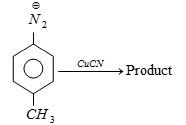
A
p-toluidine
B
p-tolunitrile
C
benzonitrile
D
aniline
Solution
(B) The given reaction is a Sandmeyer reaction where a diazonium salt reacts with $CuCN$ to replace the diazonium group $(-N_2^+)$ with a cyano group $(-CN)$.
In this case,the starting material is $p$-methylbenzenediazonium ion.
When it reacts with $CuCN$,the $-N_2^+$ group is replaced by $-CN$,resulting in $p$-tolunitrile ($4$-methylbenzonitrile).
In this case,the starting material is $p$-methylbenzenediazonium ion.
When it reacts with $CuCN$,the $-N_2^+$ group is replaced by $-CN$,resulting in $p$-tolunitrile ($4$-methylbenzonitrile).
0 likes
View Solution45
DifficultMCQ
Ethyl amine on heating with $CS_2$ in presence of $HgCl_2$ forms
A
$C_2H_5NCS$
B
$(C_2H_5)_2S$
C
$(C_2H_5)_2CS$
D
$C_2H_5(CS)_2$
Solution
(A) This reaction is known as the Hofmann mustard oil reaction.
When ethyl amine $(C_2H_5NH_2)$ is heated with carbon disulfide $(CS_2)$ in the presence of mercuric chloride $(HgCl_2)$,it forms ethyl isothiocyanate $(C_2H_5NCS)$.
The chemical equation is:
$C_2H_5NH_2 + CS_2 + HgCl_2 \to C_2H_5NCS + 2HCl + HgS$
Thus,the correct option is $A$.
When ethyl amine $(C_2H_5NH_2)$ is heated with carbon disulfide $(CS_2)$ in the presence of mercuric chloride $(HgCl_2)$,it forms ethyl isothiocyanate $(C_2H_5NCS)$.
The chemical equation is:
$C_2H_5NH_2 + CS_2 + HgCl_2 \to C_2H_5NCS + 2HCl + HgS$
Thus,the correct option is $A$.
0 likes
View Solution46
MediumMCQ
Which of the following reacts with $NaNO_2 + HCl$ to give phenol?
A
$C_6H_5CH_2NHCH_3$
B
$(CH_3)_2NH$
C
$CH_3NH_2$
D
$C_6H_5NH_2$
Solution
(D) . $C_6H_5NH_2$ reacts with $NaNO_2 + HCl$ at $0-5 \ ^\circ C$ to form benzene diazonium chloride $(C_6H_5N_2Cl)$.
This diazonium salt,upon hydrolysis with water $(H_2O)$,yields phenol $(C_6H_5OH)$ along with the evolution of $N_2$ gas and the formation of $HCl$.
The reaction sequence is: $C_6H_5NH_2$ $\xrightarrow{NaNO_2/HCl} C_6H_5N_2Cl$ $\xrightarrow{H_2O} C_6H_5OH + N_2 + HCl$.
This diazonium salt,upon hydrolysis with water $(H_2O)$,yields phenol $(C_6H_5OH)$ along with the evolution of $N_2$ gas and the formation of $HCl$.
The reaction sequence is: $C_6H_5NH_2$ $\xrightarrow{NaNO_2/HCl} C_6H_5N_2Cl$ $\xrightarrow{H_2O} C_6H_5OH + N_2 + HCl$.
0 likes
View Solution47
DifficultMCQ
In the reaction $C_6H_5NH_2 + HCl + NaNO_2 \to X$,the product $X$ is:
A
Aniline hydrochloride
B
Nitro aniline
C
Benzenediazonium chloride
D
None of these
Solution
(C) The reaction of aniline $(C_6H_5NH_2)$ with nitrous acid $(HNO_2)$,generated in situ from $NaNO_2$ and $HCl$ at $0-5 \ ^\circ C$ $(273-278 \ K)$,is known as the diazotization reaction.
The chemical equation is: $C_6H_5NH_2 + NaNO_2 + 2HCl \to C_6H_5N_2^+Cl^- + NaCl + 2H_2O$.
Here,$X$ is $C_6H_5N_2Cl$,which is known as Benzenediazonium chloride.
The chemical equation is: $C_6H_5NH_2 + NaNO_2 + 2HCl \to C_6H_5N_2^+Cl^- + NaCl + 2H_2O$.
Here,$X$ is $C_6H_5N_2Cl$,which is known as Benzenediazonium chloride.
0 likes
View Solution48
MediumMCQ
When aniline is treated with sodium nitrite and hydrochloric acid at $0\,^{\circ}C$,it gives:
A
Phenol and $N_2$
B
Diazonium salt
C
Hydrazo compound
D
No reaction takes place
Solution
(B) The reaction of aniline $(C_6H_5NH_2)$ with sodium nitrite $(NaNO_2)$ and hydrochloric acid $(HCl)$ at a low temperature of $0-5\,^{\circ}C$ is known as the diazotization reaction.
This reaction results in the formation of benzene diazonium chloride,which is a diazonium salt.
The chemical equation is: $C_6H_5NH_2 + NaNO_2 + 2HCl \xrightarrow{0-5\,^{\circ}C} C_6H_5N_2^+Cl^- + NaCl + 2H_2O$.
This reaction results in the formation of benzene diazonium chloride,which is a diazonium salt.
The chemical equation is: $C_6H_5NH_2 + NaNO_2 + 2HCl \xrightarrow{0-5\,^{\circ}C} C_6H_5N_2^+Cl^- + NaCl + 2H_2O$.
0 likes
View Solution49
MediumMCQ
$CH_3NO_2 \xrightarrow{Sn + HCl} CH_3X$,the '$X$' contains:
A
$-NH_2$
B
$-COOH$
C
$-CHO$
D
$(CH_3CO)_2O$
Solution
(A) The reaction of nitroalkanes with $Sn/HCl$ is a reduction reaction.
$CH_3NO_2 + 6[H] \xrightarrow{Sn/HCl} CH_3NH_2 + 2H_2O$.
Here,the product is methylamine $(CH_3NH_2)$.
Comparing $CH_3NH_2$ with $CH_3X$,we find that $X$ is $-NH_2$.
$CH_3NO_2 + 6[H] \xrightarrow{Sn/HCl} CH_3NH_2 + 2H_2O$.
Here,the product is methylamine $(CH_3NH_2)$.
Comparing $CH_3NH_2$ with $CH_3X$,we find that $X$ is $-NH_2$.
0 likes
View Solution50
MediumMCQ
In the series of reactions: $C_6H_5NH_2$ $\xrightarrow{NaNO_2/HCl}_{0 - 5\ ^\circ C} X$ $\xrightarrow{HNO_2}_{H_2O} Y + N_2 + HCl$. $X$ and $Y$ are respectively:
A
$C_6H_5 - N = N - C_6H_5$,$C_6H_5N_2^+ Cl^-$
B
$C_6H_5N_2^+ Cl^-$,$C_6H_5 - N = N - C_6H_5$
C
$C_6H_5N_2^+ Cl^-$,$C_6H_5NO_2$
D
$C_6H_5NO_2$,$C_6H_6$
Solution
(C) Step $1$: Aniline $(C_6H_5NH_2)$ reacts with $NaNO_2/HCl$ at $0 - 5\ ^\circ C$ to form benzene diazonium chloride $(C_6H_5N_2^+ Cl^-)$,which is $X$.
Step $2$: Benzene diazonium chloride $(C_6H_5N_2^+ Cl^-)$ reacts with $HNO_2$ in the presence of $H_2O$ to form nitrobenzene $(C_6H_5NO_2)$,which is $Y$,along with the evolution of $N_2$ gas and formation of $HCl$.
Therefore,$X$ is $C_6H_5N_2^+ Cl^-$ and $Y$ is $C_6H_5NO_2$.
Step $2$: Benzene diazonium chloride $(C_6H_5N_2^+ Cl^-)$ reacts with $HNO_2$ in the presence of $H_2O$ to form nitrobenzene $(C_6H_5NO_2)$,which is $Y$,along with the evolution of $N_2$ gas and formation of $HCl$.
Therefore,$X$ is $C_6H_5N_2^+ Cl^-$ and $Y$ is $C_6H_5NO_2$.
0 likes
View SolutionAmines — Properties of Amines · Frequently Asked Questions
1Are these Amines questions useful for JEE and NEET?
Yes. All questions in this section are mapped to JEE Main and NEET exam patterns. Previous year questions from JEE Main, NEET, GUJCET and state-level exams are included with full solutions.
2Can I switch to Hindi or Gujarati for these questions?
Yes. Use the language tabs in the hero section or the sidebar to view the same questions and solutions in English, Hindi or Gujarati.
3How do I generate a question paper from this subtopic?
Use the Vedclass Exam Paper Generator — select the chapter and subtopic, set difficulty, and generate Sets A, B, C, D automatically. First 3 chapters of every subject are free.
Vedclass Products
For Students
Vedclass Test Series
Mock tests in real JEE/NEET style with performance analysis. 5-day free trial.
Start Free TrialFor Teachers
Exam Paper Generator
Generate Set A/B/C/D papers from this chapter in 2 minutes. 3 chapters free.
Try FreeFor Institutes
Online Exam Module
Live online exams with unlimited students, 360° analytics & white-label branding.
See DemoFor Teachers & Institutes
Generate a Amines Exam Paper in 2 Minutes
Select subtopic & difficulty — Sets A, B, C, D auto-generated with No Repeat logic.
First 3 chapters of every subject are free — no payment required.