
A English
Properties of Amines Questions in English
Class 12 Chemistry · Amines · Properties of Amines
1212+
Questions
English
Language
100%
With Solutions
Showing 49 of 1212 questions in English
101
DifficultMCQ
Arrange the following in increasing order of basicity: $CH_3NH_2$,$(CH_3)_2NH$,$C_6H_5NH_2$,$(CH_3)_3N$.
A
$ (CH_3)_3N < (CH_3)_2NH < CH_3NH_2 < C_6H_5NH_2 $
B
$ (CH_3)_3N > (CH_3)_2NH > CH_3NH_2 > C_6H_5NH_2 $
C
$ C_6H_5NH_2 < (CH_3)_3N < CH_3NH_2 < (CH_3)_2NH $
D
$ C_6H_5NH_2 > (CH_3)_3N > CH_3NH_2 > (CH_3)_2NH $
Solution
(C) The basicity of amines in aqueous solution depends on the inductive effect,solvation effect,and steric hindrance.
$C_6H_5NH_2$ (aniline) is the least basic because the lone pair on nitrogen is involved in resonance with the benzene ring.
Among the aliphatic amines,$(CH_3)_2NH$ is the most basic due to the combined effect of the electron-donating methyl groups and favorable solvation.
$(CH_3)_3N$ is less basic than $(CH_3)_2NH$ due to steric hindrance,and $CH_3NH_2$ is less basic than $(CH_3)_2NH$ but more basic than $(CH_3)_3N$ in some conditions,but generally,the order in aqueous medium is $(CH_3)_2NH > CH_3NH_2 > (CH_3)_3N$.
Thus,the correct increasing order is $C_6H_5NH_2 < (CH_3)_3N < CH_3NH_2 < (CH_3)_2NH$.
$C_6H_5NH_2$ (aniline) is the least basic because the lone pair on nitrogen is involved in resonance with the benzene ring.
Among the aliphatic amines,$(CH_3)_2NH$ is the most basic due to the combined effect of the electron-donating methyl groups and favorable solvation.
$(CH_3)_3N$ is less basic than $(CH_3)_2NH$ due to steric hindrance,and $CH_3NH_2$ is less basic than $(CH_3)_2NH$ but more basic than $(CH_3)_3N$ in some conditions,but generally,the order in aqueous medium is $(CH_3)_2NH > CH_3NH_2 > (CH_3)_3N$.
Thus,the correct increasing order is $C_6H_5NH_2 < (CH_3)_3N < CH_3NH_2 < (CH_3)_2NH$.
0 likes
View Solution102
DifficultMCQ
What is formed when nitrobenzene is reduced using zinc and alkali?
A
Phenol
B
Aniline
C
Nitrosobenzene
D
Hydrazobenzene
Solution
(D) The reduction of nitrobenzene with zinc and alkali (like $NaOH$) is a bimolecular reduction.
$2C_{6}H_{5}NO_{2} \xrightarrow[Zn/NaOH]{10[H]} C_{6}H_{5}NH-NHC_{6}H_{5} + 4H_{2}O$
The product formed is $Hydrazobenzene$.
$2C_{6}H_{5}NO_{2} \xrightarrow[Zn/NaOH]{10[H]} C_{6}H_{5}NH-NHC_{6}H_{5} + 4H_{2}O$
The product formed is $Hydrazobenzene$.
0 likes
View Solution103
DifficultMCQ
$RCOCl + 2Me_2NH \to A + Me_2NH_2^+Cl^-$. Here $A$ is:
A
$RCON(Me)_2$
B
$RCONH_2$
C
$RCONHMe$
D
$(RCO)_2NH$
Solution
(A) The reaction of an acid chloride $(RCOCl)$ with a secondary amine $(Me_2NH)$ is a nucleophilic acyl substitution reaction.
One mole of the secondary amine acts as a nucleophile to attack the carbonyl carbon of the acid chloride,forming an $N,N$-disubstituted amide $(RCON(Me)_2)$.
The second mole of the amine acts as a base to neutralize the $HCl$ byproduct,forming the salt $Me_2NH_2^+Cl^-$.
The overall reaction is: $RCOCl + 2Me_2NH \to RCON(Me)_2 + Me_2NH_2^+Cl^-$.
Thus,$A$ is $RCON(Me)_2$.
One mole of the secondary amine acts as a nucleophile to attack the carbonyl carbon of the acid chloride,forming an $N,N$-disubstituted amide $(RCON(Me)_2)$.
The second mole of the amine acts as a base to neutralize the $HCl$ byproduct,forming the salt $Me_2NH_2^+Cl^-$.
The overall reaction is: $RCOCl + 2Me_2NH \to RCON(Me)_2 + Me_2NH_2^+Cl^-$.
Thus,$A$ is $RCON(Me)_2$.
0 likes
View Solution104
MediumMCQ
The decreasing order of basicity is:
$(1) \ CH_3CONH_2$
$(2) \ CH_3CH_2NH_2$
$(3) \ PhCH_2CONH_2$
$(1) \ CH_3CONH_2$
$(2) \ CH_3CH_2NH_2$
$(3) \ PhCH_2CONH_2$
A
$2 > 1 > 3$
B
$2 > 3 > 1$
C
$1 > 2 > 3$
D
$3 > 2 > 1$
Solution
(A) The basicity of a compound depends on the availability of the lone pair of electrons on the nitrogen atom.
$(1) \ CH_3CONH_2$ (Acetamide): The lone pair on nitrogen is involved in resonance with the carbonyl group $(C=O)$,significantly reducing its availability for protonation.
$(2) \ CH_3CH_2NH_2$ (Ethylamine): This is a primary aliphatic amine. The alkyl group $(CH_3CH_2-)$ is electron-donating ($+I$ effect),which increases the electron density on nitrogen,making it the most basic among the given compounds.
$(3) \ PhCH_2CONH_2$ ($2$-phenylacetamide): Similar to acetamide,the lone pair on nitrogen is involved in resonance with the carbonyl group. However,the presence of the phenyl group $(Ph-)$ exerts an electron-withdrawing effect through the inductive effect compared to the methyl group in acetamide,making it slightly less basic than acetamide.
Therefore,the decreasing order of basicity is $2 > 1 > 3$.
$(1) \ CH_3CONH_2$ (Acetamide): The lone pair on nitrogen is involved in resonance with the carbonyl group $(C=O)$,significantly reducing its availability for protonation.
$(2) \ CH_3CH_2NH_2$ (Ethylamine): This is a primary aliphatic amine. The alkyl group $(CH_3CH_2-)$ is electron-donating ($+I$ effect),which increases the electron density on nitrogen,making it the most basic among the given compounds.
$(3) \ PhCH_2CONH_2$ ($2$-phenylacetamide): Similar to acetamide,the lone pair on nitrogen is involved in resonance with the carbonyl group. However,the presence of the phenyl group $(Ph-)$ exerts an electron-withdrawing effect through the inductive effect compared to the methyl group in acetamide,making it slightly less basic than acetamide.
Therefore,the decreasing order of basicity is $2 > 1 > 3$.
0 likes
View Solution105
MediumMCQ
Among the following,the strongest base is
A
$C_6H_5NH_2$
B
$p-NO_2C_6H_4NH_2$
C
$m-NO_2-C_6H_4NH_2$
D
$C_6H_5CH_2NH_2$
Solution
(D) is an aliphatic amine; therefore,it is a stronger base than aromatic amines.
In aromatic amines,the lone pair of electrons on the nitrogen atom is involved in resonance with the benzene ring,which decreases its availability for protonation.
Furthermore,the electron-withdrawing group $(-NO_2)$ at the $o$,$p$,and $m$-positions further decreases the basic character due to the $-I$ and $-M$ effects.
Since $C_6H_5CH_2NH_2$ is an aliphatic amine where the nitrogen is not directly attached to the benzene ring,it is the most basic.
The basicity order is: $(D) > (A) > (C) > (B)$.
In aromatic amines,the lone pair of electrons on the nitrogen atom is involved in resonance with the benzene ring,which decreases its availability for protonation.
Furthermore,the electron-withdrawing group $(-NO_2)$ at the $o$,$p$,and $m$-positions further decreases the basic character due to the $-I$ and $-M$ effects.
Since $C_6H_5CH_2NH_2$ is an aliphatic amine where the nitrogen is not directly attached to the benzene ring,it is the most basic.
The basicity order is: $(D) > (A) > (C) > (B)$.
0 likes
View Solution106
MediumMCQ
$A$ mixture of benzene and aniline can be separated by
A
Hot water
B
dil. $HCl$
C
dil. $NaOH$
D
Alcohol
Solution
(B) Aniline is a basic compound,while benzene is a neutral organic compound.
When a mixture of benzene and aniline is treated with dilute $HCl$,aniline reacts with the acid to form a water-soluble salt,aniline hydrochloride $(C_6H_5NH_3^+Cl^-)$.
Benzene does not react with dilute $HCl$ and remains in the organic layer.
The two components can then be separated using a separating funnel,where the aqueous layer containing the salt is separated from the organic layer containing benzene.
Therefore,the correct option is $B$.
When a mixture of benzene and aniline is treated with dilute $HCl$,aniline reacts with the acid to form a water-soluble salt,aniline hydrochloride $(C_6H_5NH_3^+Cl^-)$.
Benzene does not react with dilute $HCl$ and remains in the organic layer.
The two components can then be separated using a separating funnel,where the aqueous layer containing the salt is separated from the organic layer containing benzene.
Therefore,the correct option is $B$.
0 likes
View Solution107
DifficultMCQ
The compound $A$ with the following sequence of reactions gives benzoic acid.
$A$ $\xrightarrow{NaNO_2/HCl} B$ $\xrightarrow{KCN} C$ $\xrightarrow{H_3O^{+}} \text{benzoic acid}$
The compound $A$ is:
$A$ $\xrightarrow{NaNO_2/HCl} B$ $\xrightarrow{KCN} C$ $\xrightarrow{H_3O^{+}} \text{benzoic acid}$
The compound $A$ is:
A
Nitrobenzene
B
Aniline
C
Benzaldehyde
D
Amides
Solution
(B) The reaction sequence is as follows:
$1. \text{Aniline } (C_6H_5NH_2)$ $\xrightarrow{NaNO_2/HCl, 0-5^{\circ}C} \text{Benzenediazonium chloride } (C_6H_5N_2Cl) \text{ (Compound } B\text{)}$
$2. \text{Benzenediazonium chloride } (C_6H_5N_2Cl)$ $\xrightarrow{KCN/CuCN} \text{Benzonitrile } (C_6H_5CN) \text{ (Compound } C\text{)}$
$3. \text{Benzonitrile } (C_6H_5CN) \xrightarrow{H_3O^{+}} \text{Benzoic acid } (C_6H_5COOH)$
Therefore,the compound $A$ is Aniline.
$1. \text{Aniline } (C_6H_5NH_2)$ $\xrightarrow{NaNO_2/HCl, 0-5^{\circ}C} \text{Benzenediazonium chloride } (C_6H_5N_2Cl) \text{ (Compound } B\text{)}$
$2. \text{Benzenediazonium chloride } (C_6H_5N_2Cl)$ $\xrightarrow{KCN/CuCN} \text{Benzonitrile } (C_6H_5CN) \text{ (Compound } C\text{)}$
$3. \text{Benzonitrile } (C_6H_5CN) \xrightarrow{H_3O^{+}} \text{Benzoic acid } (C_6H_5COOH)$
Therefore,the compound $A$ is Aniline.
0 likes
View Solution108
DifficultMCQ
Which of the following chemicals are used to manufacture methyl isocyanate that caused the $Bhopal$ $Tragedy$?
$(i)$ $Methylamine$
$(ii)$ $Phosgene$
$(iii)$ $Phosphine$
$(iv)$ $Dimethylamine$
$(i)$ $Methylamine$
$(ii)$ $Phosgene$
$(iii)$ $Phosphine$
$(iv)$ $Dimethylamine$
A
$(i)$ and $(iii)$
B
$(iii)$ and $(iv)$
C
$(i)$ and $(ii)$
D
$(ii)$ and $(iv)$
Solution
(C) Methyl isocyanate $(CH_3NCO)$ is industrially prepared by the reaction of methylamine $(CH_3NH_2)$ with phosgene $(COCl_2)$.
The chemical reaction is:
$CH_3NH_2 + COCl_2 \rightarrow CH_3NHCOCl + HCl$
$CH_3NHCOCl \rightarrow CH_3NCO + HCl$
Thus,the chemicals used are $(i)$ $Methylamine$ and $(ii)$ $Phosgene$.
The chemical reaction is:
$CH_3NH_2 + COCl_2 \rightarrow CH_3NHCOCl + HCl$
$CH_3NHCOCl \rightarrow CH_3NCO + HCl$
Thus,the chemicals used are $(i)$ $Methylamine$ and $(ii)$ $Phosgene$.
0 likes
View Solution109
MediumMCQ
An isocyanide on hydrolysis gives
A
An amide
B
$A$ carboxylic acid and ammonia
C
$A$ $N$-substituted amide
D
$A$ $1^o$-amine and formic acid
Solution
(D) The hydrolysis of an isocyanide $(R-NC)$ in the presence of an acid catalyst yields a primary amine and formic acid.
The reaction is represented as: $R-NC + 2H_2O \to RNH_2 + HCOOH$.
The reaction is represented as: $R-NC + 2H_2O \to RNH_2 + HCOOH$.
0 likes
View Solution110
MediumMCQ
Methyl isocyanide on hydrolysis gives
A
$CH_3NH_2$
B
$HCOOH$
C
$CH_3COOH$
D
Both $(A)$ and $(B)$
Solution
(D) The hydrolysis of methyl isocyanide $(CH_3NC)$ in the presence of an acid catalyst proceeds as follows:
$CH_3NC + 2H_2O \xrightarrow{H^+} CH_3NH_2 + HCOOH$
Thus,the products formed are methylamine $(CH_3NH_2)$ and formic acid $(HCOOH)$.
$CH_3NC + 2H_2O \xrightarrow{H^+} CH_3NH_2 + HCOOH$
Thus,the products formed are methylamine $(CH_3NH_2)$ and formic acid $(HCOOH)$.
0 likes
View Solution111
MediumMCQ
Pure aniline is a
A
Colourless solid
B
Brown coloured solid
C
Colourless liquid
D
Brown coloured liquid
Solution
(C) Pure aniline is a colourless liquid.
However,it is easily oxidized by atmospheric oxygen,which causes it to develop a brown color over time.
However,it is easily oxidized by atmospheric oxygen,which causes it to develop a brown color over time.
0 likes
View Solution112
MediumMCQ
Reduction of methyl isocyanide gives:
A
Ethylamine
B
Methylamine
C
Dimethylamine
D
Trimethylamine
Solution
(C) The reduction of methyl isocyanide $(CH_3NC)$ with a strong reducing agent like $LiAlH_4$ results in the formation of a secondary amine.
The chemical reaction is: $CH_3NC + 4[H] \xrightarrow{LiAlH_4/\text{ether}} (CH_3)_2NH$.
Thus,the product formed is dimethylamine.
The chemical reaction is: $CH_3NC + 4[H] \xrightarrow{LiAlH_4/\text{ether}} (CH_3)_2NH$.
Thus,the product formed is dimethylamine.
0 likes
View Solution113
MediumMCQ
The reaction of aniline with benzaldehyde is:
A
Polymerisation
B
Condensation
C
Addition
D
Substitution
Solution
(B) The reaction of benzaldehyde with aniline is a nucleophilic addition-elimination reaction,which is a type of condensation reaction. It results in the formation of a Schiff base known as benzalaniline.
$C_6H_5CHO + C_6H_5NH_2 \rightarrow C_6H_5CH=NC_6H_5 + H_2O$
$C_6H_5CHO + C_6H_5NH_2 \rightarrow C_6H_5CH=NC_6H_5 + H_2O$
0 likes
View Solution114
DifficultMCQ
In the reaction $C_6H_5CHO + C_6H_5NH_2 \to C_6H_5N=CHC_6H_5 + H_2O$,the compound $C_6H_5N=CHC_6H_5$ is known as
A
Aldol
B
Schiff's reagent
C
Schiff's base
D
Benedict reagent
Solution
(C) The reaction between an aldehyde $(C_6H_5CHO)$ and a primary amine $(C_6H_5NH_2)$ results in the formation of an imine,which is commonly referred to as a Schiff's base.
In this specific reaction,benzaldehyde reacts with aniline to form $N$-benzylideneaniline,which is a Schiff's base.
In this specific reaction,benzaldehyde reacts with aniline to form $N$-benzylideneaniline,which is a Schiff's base.
0 likes
View Solution115
DifficultMCQ
Electrophilic substitution of aniline with bromine in aqueous medium gives:
A
$1, 4, 6-$tribromoaniline
B
$2, 4, 6-$tribromoaniline
C
$4-$bromoaniline
D
$3-$bromoaniline
Solution
(B) When aniline is treated with bromine water (aqueous medium),the $-NH_2$ group strongly activates the benzene ring.
Due to this high activation,all ortho and para positions are substituted by bromine atoms simultaneously,resulting in the formation of $2, 4, 6-$tribromoaniline as a white precipitate.
Due to this high activation,all ortho and para positions are substituted by bromine atoms simultaneously,resulting in the formation of $2, 4, 6-$tribromoaniline as a white precipitate.
0 likes
View Solution116
DifficultMCQ
During the acetylation of amines,what is replaced by acetyl groups?
A
Hydrogen atom attached to a nitrogen atom
B
One or more hydrogen atoms attached to a carbon atom
C
One or more hydrogen atoms attached to a nitrogen atom
D
Hydrogen atoms attached to either a carbon atom or a nitrogen atom
Solution
(C) Acetylation of amines involves the reaction of primary or secondary amines with acetylating agents like $CH_3COCl$ or $(CH_3CO)_2O$ in the presence of a base like pyridine.
In this reaction,the hydrogen atom$(s)$ attached to the nitrogen atom of the amine are replaced by an acetyl group $(CH_3CO-)$ to form amides.
For example,in the reaction of methylamine $(CH_3NH_2)$ with acetyl chloride $(CH_3COCl)$: $CH_3NH_2 + CH_3COCl \xrightarrow{\text{Pyridine}} CH_3NHCOCH_3 + HCl$.
Thus,one or more hydrogen atoms attached to the nitrogen atom are replaced by the acetyl group.
In this reaction,the hydrogen atom$(s)$ attached to the nitrogen atom of the amine are replaced by an acetyl group $(CH_3CO-)$ to form amides.
For example,in the reaction of methylamine $(CH_3NH_2)$ with acetyl chloride $(CH_3COCl)$: $CH_3NH_2 + CH_3COCl \xrightarrow{\text{Pyridine}} CH_3NHCOCH_3 + HCl$.
Thus,one or more hydrogen atoms attached to the nitrogen atom are replaced by the acetyl group.
0 likes
View Solution117
MediumMCQ
Ethyl amine on acetylation gives
A
$N$-ethylacetamide
B
Acetamide
C
Methyl acetamide
D
None
Solution
(A) The acetylation of ethylamine $(CH_3CH_2NH_2)$ with acetyl chloride $(CH_3COCl)$ or acetic anhydride results in the formation of $N$-ethylacetamide.
The reaction is: $CH_3CH_2NH_2 + CH_3COCl \to CH_3CH_2NHCOCH_3 + HCl$.
Therefore,the correct product is $N$-ethylacetamide.
The reaction is: $CH_3CH_2NH_2 + CH_3COCl \to CH_3CH_2NHCOCH_3 + HCl$.
Therefore,the correct product is $N$-ethylacetamide.
0 likes
View Solution118
MediumMCQ
The product obtained by the electrolytic reduction of nitrobenzene in the presence of $H_2SO_4$ is:
A
$o$-aminophenol
B
$m$-aminophenol
C
$p$-aminophenol
D
None of these
Solution
(C) The electrolytic reduction of nitrobenzene in the presence of concentrated $H_2SO_4$ proceeds through the formation of phenylhydroxylamine.
This intermediate undergoes a Bamberger rearrangement in the acidic medium to form $p$-aminophenol as the final product.
The reaction sequence is: $C_6H_5NO_2$ $\xrightarrow{[H], H_2SO_4} C_6H_5NHOH$ $\xrightarrow{H_2SO_4} p-H_2NC_6H_4OH$.
This intermediate undergoes a Bamberger rearrangement in the acidic medium to form $p$-aminophenol as the final product.
The reaction sequence is: $C_6H_5NO_2$ $\xrightarrow{[H], H_2SO_4} C_6H_5NHOH$ $\xrightarrow{H_2SO_4} p-H_2NC_6H_4OH$.
0 likes
View Solution119
DifficultMCQ
Identify the product $Z$ in the following reaction:
$C_6H_5NH_2$ $\xrightarrow{(Ac)_2O} X$ $\xrightarrow{Br_2/CCl_4} Y$ $\xrightarrow{HOH} Z$
$C_6H_5NH_2$ $\xrightarrow{(Ac)_2O} X$ $\xrightarrow{Br_2/CCl_4} Y$ $\xrightarrow{HOH} Z$
A
$p-$Bromoaniline
B
$p-$Bromoacetophenone
C
$o-$Bromoacetophenone
D
$o-$Bromoacetanilide
Solution
(A) Step $1$: Aniline $(C_6H_5NH_2)$ reacts with acetic anhydride $((Ac)_2O)$ to form acetanilide $(X = C_6H_5NHCOCH_3)$.
Step $2$: Acetanilide undergoes electrophilic aromatic substitution with $Br_2/CCl_4$ to form $p-$bromoacetanilide $(Y = Br-C_6H_4-NHCOCH_3)$ as the major product due to the steric hindrance at the ortho position.
Step $3$: Hydrolysis $(HOH)$ of $p-$bromoacetanilide removes the acetyl group to yield $p-$bromoaniline $(Z = Br-C_6H_4-NH_2)$.
Step $2$: Acetanilide undergoes electrophilic aromatic substitution with $Br_2/CCl_4$ to form $p-$bromoacetanilide $(Y = Br-C_6H_4-NHCOCH_3)$ as the major product due to the steric hindrance at the ortho position.
Step $3$: Hydrolysis $(HOH)$ of $p-$bromoacetanilide removes the acetyl group to yield $p-$bromoaniline $(Z = Br-C_6H_4-NH_2)$.
0 likes
View Solution120
DifficultMCQ
The final product $C$,obtained in the following reaction sequence,would be:
$p$-Toluidine $\xrightarrow{Ac_2O} A$ $\xrightarrow{Br_2/CH_3COOH} B$ $\xrightarrow{H_2O/H^+} C$
$p$-Toluidine $\xrightarrow{Ac_2O} A$ $\xrightarrow{Br_2/CH_3COOH} B$ $\xrightarrow{H_2O/H^+} C$
A
$2-$Bromo$-4-$methylaniline
B
$4-$Bromo$-2-$methylaniline
C
$2-$Bromo$-4-$methylacetanilide
D
$3-$Bromo$-4-$methylaniline
Solution
(A) The reaction sequence is as follows:
$1$. $p$-Toluidine reacts with acetic anhydride $(Ac_2O)$ to form $N$-($4$-methylphenyl)acetamide (acetanilide derivative),which is compound $A$.
$2$. Compound $A$ undergoes electrophilic aromatic substitution with $Br_2$ in $CH_3COOH$. The $-NHCOCH_3$ group is strongly activating and ortho/para directing. Since the para position is occupied by the $-CH_3$ group,bromine enters the ortho position relative to the $-NHCOCH_3$ group,forming $2$-bromo-$4$-methylacetanilide,which is compound $B$.
$3$. Finally,acid-catalyzed hydrolysis of compound $B$ removes the acetyl group to regenerate the amine,yielding $2$-bromo-$4$-methylaniline as the final product $C$.
$1$. $p$-Toluidine reacts with acetic anhydride $(Ac_2O)$ to form $N$-($4$-methylphenyl)acetamide (acetanilide derivative),which is compound $A$.
$2$. Compound $A$ undergoes electrophilic aromatic substitution with $Br_2$ in $CH_3COOH$. The $-NHCOCH_3$ group is strongly activating and ortho/para directing. Since the para position is occupied by the $-CH_3$ group,bromine enters the ortho position relative to the $-NHCOCH_3$ group,forming $2$-bromo-$4$-methylacetanilide,which is compound $B$.
$3$. Finally,acid-catalyzed hydrolysis of compound $B$ removes the acetyl group to regenerate the amine,yielding $2$-bromo-$4$-methylaniline as the final product $C$.
0 likes
View Solution121
MediumMCQ
The correct order of increasing basic nature for the bases $NH_3$,$CH_3NH_2$ and $(CH_3)_2NH$ is
A
$CH_3NH_2 < NH_3 < (CH_3)_2NH$
B
$(CH_3)_2NH < NH_3 < CH_3NH_2$
C
$NH_3 < CH_3NH_2 < (CH_3)_2NH$
D
$CH_3NH_2 < (CH_3)_2NH < NH_3$
Solution
(C) The basicity of amines depends on the availability of the lone pair of electrons on the nitrogen atom.
$1$. The alkyl group $(CH_3-)$ is an electron-donating group that exhibits the $+I$ effect,which increases the electron density on the nitrogen atom.
$2$. Ammonia $(NH_3)$ has no alkyl groups,so it is the least basic among the three.
$3$. Methylamine $(CH_3NH_2)$ has one methyl group,while dimethylamine $((CH_3)_2NH)$ has two methyl groups.
$4$. Since $(CH_3)_2NH$ has two electron-donating groups,it has higher electron density on the nitrogen atom compared to $CH_3NH_2$.
Therefore,the correct order of increasing basicity is $NH_3 < CH_3NH_2 < (CH_3)_2NH$.
$1$. The alkyl group $(CH_3-)$ is an electron-donating group that exhibits the $+I$ effect,which increases the electron density on the nitrogen atom.
$2$. Ammonia $(NH_3)$ has no alkyl groups,so it is the least basic among the three.
$3$. Methylamine $(CH_3NH_2)$ has one methyl group,while dimethylamine $((CH_3)_2NH)$ has two methyl groups.
$4$. Since $(CH_3)_2NH$ has two electron-donating groups,it has higher electron density on the nitrogen atom compared to $CH_3NH_2$.
Therefore,the correct order of increasing basicity is $NH_3 < CH_3NH_2 < (CH_3)_2NH$.
0 likes
View Solution122
DifficultMCQ
Nitrobenzene gives $N$-phenylhydroxylamine by
A
$Sn/HCl$
B
$H_2/Pd-C$
C
$Zn/NaOH$
D
$Zn/NH_4Cl$
Solution
(D) The reduction of nitrobenzene to $N$-phenylhydroxylamine is a selective reduction process.
When nitrobenzene is treated with a neutral reducing agent like $Zn/NH_4Cl$,it undergoes partial reduction to form $N$-phenylhydroxylamine $(C_6H_5NHOH)$.
Other reagents like $Sn/HCl$ or $H_2/Pd-C$ typically reduce nitrobenzene completely to aniline $(C_6H_5NH_2)$,while $Zn/NaOH$ can lead to different products like azoxybenzene,azobenzene,or hydrazobenzene depending on conditions.
Therefore,the correct reagent is $Zn/NH_4Cl$.
When nitrobenzene is treated with a neutral reducing agent like $Zn/NH_4Cl$,it undergoes partial reduction to form $N$-phenylhydroxylamine $(C_6H_5NHOH)$.
Other reagents like $Sn/HCl$ or $H_2/Pd-C$ typically reduce nitrobenzene completely to aniline $(C_6H_5NH_2)$,while $Zn/NaOH$ can lead to different products like azoxybenzene,azobenzene,or hydrazobenzene depending on conditions.
Therefore,the correct reagent is $Zn/NH_4Cl$.
0 likes
View Solution123
MediumMCQ
Among the following,the weakest base is:
A
$C_6H_5CH_2NH_2$
B
$C_6H_5CH_2NHCH_3$
C
$O_2NCH_2NH_2$
D
$CH_3NHCHO$
Solution
(D) The basic strength of amines depends on the availability of the lone pair of electrons on the nitrogen atom for protonation.
$1$. $C_6H_5CH_2NH_2$ and $C_6H_5CH_2NHCH_3$ are primary and secondary amines where the lone pair is localized on the nitrogen atom,making them relatively strong bases.
$2$. In $O_2NCH_2NH_2$,the $-NO_2$ group is a strong electron-withdrawing group,which decreases the electron density on the nitrogen atom,reducing basicity.
$3$. In $CH_3NHCHO$ ($N$-methylformamide),the lone pair on the nitrogen atom is involved in resonance with the carbonyl group $(C=O)$,significantly reducing its availability for protonation.
$4$. Comparing the two,the resonance effect in the amide $(CH_3NHCHO)$ is much stronger than the inductive effect of the nitro group in $O_2NCH_2NH_2$. Therefore,$CH_3NHCHO$ is the weakest base.
$1$. $C_6H_5CH_2NH_2$ and $C_6H_5CH_2NHCH_3$ are primary and secondary amines where the lone pair is localized on the nitrogen atom,making them relatively strong bases.
$2$. In $O_2NCH_2NH_2$,the $-NO_2$ group is a strong electron-withdrawing group,which decreases the electron density on the nitrogen atom,reducing basicity.
$3$. In $CH_3NHCHO$ ($N$-methylformamide),the lone pair on the nitrogen atom is involved in resonance with the carbonyl group $(C=O)$,significantly reducing its availability for protonation.
$4$. Comparing the two,the resonance effect in the amide $(CH_3NHCHO)$ is much stronger than the inductive effect of the nitro group in $O_2NCH_2NH_2$. Therefore,$CH_3NHCHO$ is the weakest base.
0 likes
View Solution124
MediumMCQ
The correct order of basicity of amines in water is :
A
$(CH_3)_2NH > (CH_3)_3N > CH_3NH_2$
B
$CH_3NH_2 > (CH_3)_2NH > (CH_3)_3N$
C
$(CH_3)_3N > (CH_3)_2NH > CH_3NH_2$
D
$(CH_3)_3N > CH_3NH_2 > (CH_3)_2NH$
Solution
(A) The basicity of amines in an aqueous solution depends on three factors: inductive effect ($+I$ effect),solvation effect (hydrogen bonding),and steric hindrance.
For methyl-substituted amines,the secondary amine $(CH_3)_2NH$ is the most basic due to the optimal balance between the $+I$ effect of two methyl groups and the solvation of the protonated amine.
The tertiary amine $(CH_3)_3N$ is less basic than the secondary amine due to steric hindrance,which hinders the approach of the proton.
The primary amine $CH_3NH_2$ is the least basic among these three because it has only one methyl group to increase the electron density on the nitrogen atom.
Therefore,the correct order of basicity is: $(CH_3)_2NH > (CH_3)_3N > CH_3NH_2$.
For methyl-substituted amines,the secondary amine $(CH_3)_2NH$ is the most basic due to the optimal balance between the $+I$ effect of two methyl groups and the solvation of the protonated amine.
The tertiary amine $(CH_3)_3N$ is less basic than the secondary amine due to steric hindrance,which hinders the approach of the proton.
The primary amine $CH_3NH_2$ is the least basic among these three because it has only one methyl group to increase the electron density on the nitrogen atom.
Therefore,the correct order of basicity is: $(CH_3)_2NH > (CH_3)_3N > CH_3NH_2$.
0 likes
View Solution125
DifficultMCQ
Complete the following reaction: $R-NH_2 + H_2SO_4 \to$
A
$[R-NH_3]^+ HSO_4^-$
B
$[R-NH_3^+]_2 SO_4^{2-}$
C
$R-NH_2 \cdot H_2SO_4$
D
No reaction
Solution
(B) Amines are basic in nature due to the presence of a lone pair of electrons on the nitrogen atom.
When they react with strong acids like $H_2SO_4$,they form ammonium salts.
Since sulfuric acid is a diprotic acid,two moles of amine react with one mole of sulfuric acid to form the salt:
$2R-NH_2 + H_2SO_4 \to [R-NH_3^+]_2 SO_4^{2-}$
When they react with strong acids like $H_2SO_4$,they form ammonium salts.
Since sulfuric acid is a diprotic acid,two moles of amine react with one mole of sulfuric acid to form the salt:
$2R-NH_2 + H_2SO_4 \to [R-NH_3^+]_2 SO_4^{2-}$
0 likes
View Solution126
MediumMCQ
Which of the following compounds reacts with chloroform and a base to form phenyl isocyanide?
A
Phenol
B
Aniline
C
Benzene
D
Nitrobenzene
Solution
(B) The reaction described is the carbylamine reaction,which is a characteristic test for primary amines.
$C_6H_5NH_2 + CHCl_3 + 3KOH \rightarrow C_6H_5NC + 3KCl + 3H_2O$
In this reaction,aniline $(C_6H_5NH_2)$ reacts with chloroform $(CHCl_3)$ and an alcoholic base $(KOH)$ to produce phenyl isocyanide $(C_6H_5NC)$.
Therefore,the correct option is $(B)$.
$C_6H_5NH_2 + CHCl_3 + 3KOH \rightarrow C_6H_5NC + 3KCl + 3H_2O$
In this reaction,aniline $(C_6H_5NH_2)$ reacts with chloroform $(CHCl_3)$ and an alcoholic base $(KOH)$ to produce phenyl isocyanide $(C_6H_5NC)$.
Therefore,the correct option is $(B)$.
0 likes
View Solution127
DifficultMCQ
Which one does not liberate $NH_3$ when it undergoes hydrolysis?
A
Acetanilide
B
Acetonitrile
C
Acetamide
D
Phenyl isocyanide
Solution
(D) ,$B$,and $C$ are derivatives of carboxylic acids or nitriles which release $NH_3$ upon hydrolysis.
$CH_3CONH_2 + H_2O \rightarrow CH_3COOH + NH_3$ (Acetamide).
$CH_3CN + 2H_2O \rightarrow CH_3COOH + NH_3$ (Acetonitrile).
$CH_3CONHC_6H_5 + H_2O \rightarrow CH_3COOH + C_6H_5NH_2$ (Acetanilide,releases aniline,not $NH_3$).
However,phenyl isocyanide $(C_6H_5NC)$ on hydrolysis forms a primary amine $(C_6H_5NH_2)$ and formic acid $(HCOOH)$,not ammonia.
Therefore,the correct answer is $D$.
$CH_3CONH_2 + H_2O \rightarrow CH_3COOH + NH_3$ (Acetamide).
$CH_3CN + 2H_2O \rightarrow CH_3COOH + NH_3$ (Acetonitrile).
$CH_3CONHC_6H_5 + H_2O \rightarrow CH_3COOH + C_6H_5NH_2$ (Acetanilide,releases aniline,not $NH_3$).
However,phenyl isocyanide $(C_6H_5NC)$ on hydrolysis forms a primary amine $(C_6H_5NH_2)$ and formic acid $(HCOOH)$,not ammonia.
Therefore,the correct answer is $D$.
0 likes
View Solution128
DifficultMCQ
Among the following,which one does not act as an intermediate in the Hofmann rearrangement?
A
$R-N=C=O$
B
$R-CO-\ddot{N}$
C
$R-CONHBr$
D
$R-NC$
Solution
(D) In the Hofmann rearrangement (Hofmann bromamide degradation),the reaction proceeds through the formation of several intermediates:
$1.$ $N$-bromoamide $(R-CONHBr)$
$2.$ Acyl nitrene $(R-CO-\ddot{N})$
$3.$ Alkyl isocyanate $(R-N=C=O)$
Alkyl isocyanide $(R-NC)$ is not formed as an intermediate in this reaction.
$1.$ $N$-bromoamide $(R-CONHBr)$
$2.$ Acyl nitrene $(R-CO-\ddot{N})$
$3.$ Alkyl isocyanate $(R-N=C=O)$
Alkyl isocyanide $(R-NC)$ is not formed as an intermediate in this reaction.
0 likes
View Solution129
MediumMCQ
Aniline reacts with which of these to form a Schiff base?
A
Acetic acid
B
Benzaldehyde
C
Acetone
D
$NH_3$
Solution
(B) Aniline reacts with benzaldehyde to form a Schiff base (benzal aniline) or anils.
$C_6H_5NH_2 + O=CHC_6H_5 \xrightarrow{\Delta, -H_2O} C_6H_5N=CHC_6H_5$ (Benzylidene aniline).
$C_6H_5NH_2 + O=CHC_6H_5 \xrightarrow{\Delta, -H_2O} C_6H_5N=CHC_6H_5$ (Benzylidene aniline).
0 likes
View Solution130
MediumMCQ
Which one of the following compounds is the most basic?
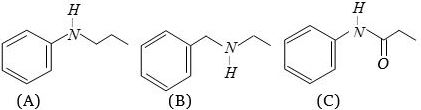
A
$N$-ethylaniline
B
$N$-ethylbenzylamine
C
$N$-ethylbenzamide
D
All are equally basic
Solution
(B) The basicity of amines depends on the availability of the lone pair of electrons on the nitrogen atom.
$(A)$ $N$-ethylaniline: The lone pair on the nitrogen atom is in conjugation with the benzene ring,which decreases its availability for protonation.
$(B)$ $N$-ethylbenzylamine: The nitrogen atom is attached to a $CH_2$ group (benzyl group),so the lone pair is not in conjugation with the benzene ring. It is a secondary aliphatic amine,which is more basic than aromatic amines.
$(C)$ $N$-ethylbenzamide: The lone pair on the nitrogen atom is involved in resonance with the carbonyl group $(C=O)$,making it significantly less basic.
Therefore,$N$-ethylbenzylamine $(B)$ is the most basic compound.
$(A)$ $N$-ethylaniline: The lone pair on the nitrogen atom is in conjugation with the benzene ring,which decreases its availability for protonation.
$(B)$ $N$-ethylbenzylamine: The nitrogen atom is attached to a $CH_2$ group (benzyl group),so the lone pair is not in conjugation with the benzene ring. It is a secondary aliphatic amine,which is more basic than aromatic amines.
$(C)$ $N$-ethylbenzamide: The lone pair on the nitrogen atom is involved in resonance with the carbonyl group $(C=O)$,making it significantly less basic.
Therefore,$N$-ethylbenzylamine $(B)$ is the most basic compound.
0 likes
View Solution131
DifficultMCQ
Aniline in a set of reactions yielded a product $D$. The structure of product $D$ would be:
Aniline $\xrightarrow{NaNO_2/HCl} A$ $\xrightarrow{CuCN} B$ $\xrightarrow{H_2/Ni} C$ $\xrightarrow{HNO_2} D$
Aniline $\xrightarrow{NaNO_2/HCl} A$ $\xrightarrow{CuCN} B$ $\xrightarrow{H_2/Ni} C$ $\xrightarrow{HNO_2} D$
A
$C_6H_5CH_2NH_2$
B
$C_6H_5NHCH_2CH_3$
C
$C_6H_5NHOH$
D
$C_6H_5CH_2OH$
Solution
(D) The reaction sequence is as follows:
$1$. Aniline reacts with $NaNO_2/HCl$ at $0-5^{\circ}C$ to form benzene diazonium chloride $(A)$: $C_6H_5NH_2 \xrightarrow{NaNO_2/HCl} C_6H_5N_2^+Cl^-$.
$2$. Benzene diazonium chloride reacts with $CuCN$ to form benzonitrile $(B)$: $C_6H_5N_2^+Cl^- \xrightarrow{CuCN} C_6H_5CN$.
$3$. Benzonitrile is reduced by $H_2/Ni$ to form benzylamine $(C)$: $C_6H_5CN \xrightarrow{H_2/Ni} C_6H_5CH_2NH_2$.
$4$. Benzylamine reacts with nitrous acid $(HNO_2)$ to form benzyl alcohol $(D)$: $C_6H_5CH_2NH_2 \xrightarrow{HNO_2} C_6H_5CH_2OH$.
Thus,the final product $D$ is benzyl alcohol $(C_6H_5CH_2OH)$.
$1$. Aniline reacts with $NaNO_2/HCl$ at $0-5^{\circ}C$ to form benzene diazonium chloride $(A)$: $C_6H_5NH_2 \xrightarrow{NaNO_2/HCl} C_6H_5N_2^+Cl^-$.
$2$. Benzene diazonium chloride reacts with $CuCN$ to form benzonitrile $(B)$: $C_6H_5N_2^+Cl^- \xrightarrow{CuCN} C_6H_5CN$.
$3$. Benzonitrile is reduced by $H_2/Ni$ to form benzylamine $(C)$: $C_6H_5CN \xrightarrow{H_2/Ni} C_6H_5CH_2NH_2$.
$4$. Benzylamine reacts with nitrous acid $(HNO_2)$ to form benzyl alcohol $(D)$: $C_6H_5CH_2NH_2 \xrightarrow{HNO_2} C_6H_5CH_2OH$.
Thus,the final product $D$ is benzyl alcohol $(C_6H_5CH_2OH)$.
0 likes
View Solution132
MediumMCQ
Electrolytic reduction of nitrobenzene in weakly acidic medium gives
A
Aniline
B
Nitrosobenzene
C
$N$-Phenylhydroxylamine
D
$p$-Hydroxyaniline
Solution
(C) The electrolytic reduction of nitrobenzene $(C_6H_5NO_2)$ in a weakly acidic medium leads to the formation of $N$-phenylhydroxylamine $(C_6H_5NHOH)$.
In a strongly acidic medium,it would rearrange to form $p$-hydroxyaniline,but in a weakly acidic medium,the reduction stops at $N$-phenylhydroxylamine.
In a strongly acidic medium,it would rearrange to form $p$-hydroxyaniline,but in a weakly acidic medium,the reduction stops at $N$-phenylhydroxylamine.
0 likes
View Solution133
MediumMCQ
Among the following compounds $C_3H_7NH_2,$ $NH_3,$ $CH_3NH_2,$ $C_2H_5NH_2$ and $C_6H_5NH_2,$ the least basic compound is
A
$C_3H_7NH_2$
B
$NH_3$
C
$CH_3NH_2$
D
$C_6H_5NH_2$
Solution
(D) $C_6H_5NH_2$ (Aniline) is the least basic compound.
In aniline,the lone pair of electrons on the nitrogen atom is delocalized into the benzene ring due to resonance.
This delocalization makes the lone pair less available for protonation,thereby significantly reducing its basicity compared to aliphatic amines and ammonia,where the lone pair is localized on the nitrogen atom.
In aniline,the lone pair of electrons on the nitrogen atom is delocalized into the benzene ring due to resonance.
This delocalization makes the lone pair less available for protonation,thereby significantly reducing its basicity compared to aliphatic amines and ammonia,where the lone pair is localized on the nitrogen atom.
0 likes
View Solution134
DifficultMCQ
The reaction of cyclohexanone with dimethylamine in the presence of a catalytic amount of an acid forms a compound if water is continuously removed during the reaction. The compound formed is generally known as:
A
$A$. Schiff’s base
B
$B$. An enamine
C
$C$. An imine
D
$D$. An amine
Solution
(B) The reaction between a ketone (like cyclohexanone) and a secondary amine (like dimethylamine) in the presence of an acid catalyst results in the formation of an enamine.
The reaction involves the nucleophilic attack of the secondary amine on the carbonyl carbon,followed by the loss of a water molecule to form a carbon-carbon double bond adjacent to the nitrogen atom.
The product formed is $N,N$-dimethylcyclohex$-1-$en$-1-$amine,which is classified as an enamine.
Therefore,the correct option is $B$.
The reaction involves the nucleophilic attack of the secondary amine on the carbonyl carbon,followed by the loss of a water molecule to form a carbon-carbon double bond adjacent to the nitrogen atom.
The product formed is $N,N$-dimethylcyclohex$-1-$en$-1-$amine,which is classified as an enamine.
Therefore,the correct option is $B$.
0 likes
View Solution135
DifficultMCQ
$R-NH-CHO \xrightarrow[\text{pyridine}]{POCl_3} \text{ product}$
In the given reaction,what will be the product?
In the given reaction,what will be the product?
A
$R-N=C=O$
B
$R-N \equiv C$
C
$R-C \equiv N$
D
None of these.
Solution
(B) The reaction of $N$-alkyl formamides with $POCl_3$ in the presence of pyridine is a dehydration reaction.
This process leads to the formation of isocyanides (also known as carbylamines).
The reaction is represented as: $R-NH-CHO \xrightarrow[\text{pyridine}]{POCl_3} R-NC + H_2O$.
Therefore,the correct product is $R-NC$ (which is $R-N \equiv C$).
This process leads to the formation of isocyanides (also known as carbylamines).
The reaction is represented as: $R-NH-CHO \xrightarrow[\text{pyridine}]{POCl_3} R-NC + H_2O$.
Therefore,the correct product is $R-NC$ (which is $R-N \equiv C$).
0 likes
View Solution136
MediumMCQ
Nitration of aniline also gives $m$-nitroaniline in a strong acidic medium because:
A
In electrophilic substitution reaction,the amino group is meta-directive.
B
In spite of substituents,the nitro group always goes to the $m$-position.
C
In a strong acidic medium,nitration of aniline is a nucleophilic substitution reaction.
D
In a strong acidic medium,aniline is present as an anilinium ion.
Solution
(D) In a strong acidic medium,the $-NH_2$ group of aniline gets protonated to form the anilinium ion $(-NH_3^+)$.
This $-NH_3^+$ group is electron-withdrawing due to its positive charge and exerts a strong $-I$ effect.
Consequently,it deactivates the benzene ring and acts as a meta-directing group,leading to the formation of $m$-nitroaniline.
This $-NH_3^+$ group is electron-withdrawing due to its positive charge and exerts a strong $-I$ effect.
Consequently,it deactivates the benzene ring and acts as a meta-directing group,leading to the formation of $m$-nitroaniline.
0 likes
View Solution137
DifficultMCQ
Identify the product in the following reaction sequence:
$3,4,5-\text{Tribromoaniline} \xrightarrow[\text{(ii) } H_3PO_2]{\text{(i) diazotization}} ?$
$3,4,5-\text{Tribromoaniline} \xrightarrow[\text{(ii) } H_3PO_2]{\text{(i) diazotization}} ?$
A
$3, 4, 5-\text{Tribromobenzene}$
B
$1, 2, 3-\text{Tribromobenzene}$
C
$2, 4, 6-\text{Tribromobenzene}$
D
$3, 4, 5-\text{Tribromonitrobenzene}$
Solution
(B) The reaction sequence is as follows:
$1$. Diazotization of $3,4,5-\text{Tribromoaniline}$ with $NaNO_2/HCl$ at $0-5^{\circ}C$ yields $3,4,5-\text{Tribromobenzenediazonium chloride}$.
$2$. Reduction of the diazonium salt with hypophosphorous acid $(H_3PO_2)$ and water replaces the $-N_2Cl$ group with a hydrogen atom.
$3$. The resulting product is $1,2,3-\text{Tribromobenzene}$ (also known as $3,4,5-\text{Tribromobenzene}$ depending on numbering,but $IUPAC$ priority leads to $1,2,3-\text{Tribromobenzene}$).
Therefore,the correct option is $B$.
$1$. Diazotization of $3,4,5-\text{Tribromoaniline}$ with $NaNO_2/HCl$ at $0-5^{\circ}C$ yields $3,4,5-\text{Tribromobenzenediazonium chloride}$.
$2$. Reduction of the diazonium salt with hypophosphorous acid $(H_3PO_2)$ and water replaces the $-N_2Cl$ group with a hydrogen atom.
$3$. The resulting product is $1,2,3-\text{Tribromobenzene}$ (also known as $3,4,5-\text{Tribromobenzene}$ depending on numbering,but $IUPAC$ priority leads to $1,2,3-\text{Tribromobenzene}$).
Therefore,the correct option is $B$.
0 likes
View Solution138
MediumMCQ
The correct order of basicity in amines is:
$(i)$ $C_6H_5NH_2$
$(ii)$ $CH_3NH_2$
$(iii)$ $(CH_3)_2NH$
$(iv)$ $(CH_3)_3N$
$(i)$ $C_6H_5NH_2$
$(ii)$ $CH_3NH_2$
$(iii)$ $(CH_3)_2NH$
$(iv)$ $(CH_3)_3N$
A
$(i < iv < ii < iii)$
B
$(iv < iii < ii < i)$
C
$(i < ii < iii < iv)$
D
$(ii < iii < iv < i)$
Solution
(A) The basicity of amines in the aqueous phase depends on the inductive effect,solvation effect,and steric hindrance.
$1$. $C_6H_5NH_2$ (Aniline) is the least basic because the lone pair on the nitrogen atom is involved in resonance with the benzene ring.
$2$. Among aliphatic amines,the order is $(CH_3)_2NH > CH_3NH_2 > (CH_3)_3N$.
$3$. $(CH_3)_2NH$ is the most basic due to the combined effect of the $+I$ effect of two methyl groups and favorable solvation.
$4$. $(CH_3)_3N$ is less basic than $(CH_3)_2NH$ and $CH_3NH_2$ due to significant steric hindrance.
Therefore,the correct order is $C_6H_5NH_2 < (CH_3)_3N < CH_3NH_2 < (CH_3)_2NH$,which corresponds to $(i < iv < ii < iii)$.
$1$. $C_6H_5NH_2$ (Aniline) is the least basic because the lone pair on the nitrogen atom is involved in resonance with the benzene ring.
$2$. Among aliphatic amines,the order is $(CH_3)_2NH > CH_3NH_2 > (CH_3)_3N$.
$3$. $(CH_3)_2NH$ is the most basic due to the combined effect of the $+I$ effect of two methyl groups and favorable solvation.
$4$. $(CH_3)_3N$ is less basic than $(CH_3)_2NH$ and $CH_3NH_2$ due to significant steric hindrance.
Therefore,the correct order is $C_6H_5NH_2 < (CH_3)_3N < CH_3NH_2 < (CH_3)_2NH$,which corresponds to $(i < iv < ii < iii)$.
0 likes
View Solution139
MediumMCQ
$A$ nauseating smell in the carbylamine test for primary amines is due to the formation of
A
Isocyanide
B
Chloroform
C
Cyanide
D
$DDT$
Solution
(A) The carbylamine test is a chemical test for the detection of primary amines. When a primary amine is heated with chloroform $(CHCl_3)$ and an alcoholic solution of potassium hydroxide $(KOH)$,an isocyanide (also known as carbylamine) is formed.
The reaction is: $RNH_2 + 3KOH + CHCl_3 \rightarrow RNC + 3KCl + 3H_2O$.
The product $RNC$ (isocyanide) is characterized by a highly unpleasant or nauseating smell.
The reaction is: $RNH_2 + 3KOH + CHCl_3 \rightarrow RNC + 3KCl + 3H_2O$.
The product $RNC$ (isocyanide) is characterized by a highly unpleasant or nauseating smell.
0 likes
View Solution140
MediumMCQ
The colour of $p$-amino azobenzene is
A
Orange
B
Congo red
C
Bismark brown
D
Indigo
Solution
(A) $p$-amino azobenzene is an azo dye formed by the coupling reaction of benzene diazonium chloride with aniline. It is a yellow-orange dye. Therefore,the correct option is $A$.
0 likes
View Solution141
MediumMCQ
When primary amine is heated with $CS_2$ in presence of excess mercuric chloride,it gives isothiocyanate. This reaction is called
A
Hofmann bromide reaction
B
Hofmann mustard oil reaction
C
Carbylamine reaction
D
Perkin reaction
Solution
(B) The reaction of a primary amine with $CS_2$ followed by heating with mercuric chloride $(HgCl_2)$ results in the formation of an alkyl isothiocyanate $(R-N=C=S)$.
This specific reaction is known as the Hofmann mustard oil reaction.
The product,alkyl isothiocyanate,possesses a pungent smell characteristic of mustard oil,hence the name.
This specific reaction is known as the Hofmann mustard oil reaction.
The product,alkyl isothiocyanate,possesses a pungent smell characteristic of mustard oil,hence the name.
0 likes
View Solution142
MediumMCQ
Which one of the following compounds when heated with $KOH$ and a primary amine gives the carbylamine test?
A
$CHCl_3$
B
$CH_3Cl$
C
$CH_3OH$
D
$CH_3CN$
Solution
(A) The carbylamine test is a characteristic reaction for primary amines.
When a primary amine $(RNH_2)$ is heated with chloroform $(CHCl_3)$ and alcoholic potassium hydroxide $(KOH)$,it produces an isocyanide (carbylamine),which has a foul smell.
The chemical equation is: $RNH_2 + CHCl_3 + 3KOH \text{ (alc.)} \xrightarrow{\Delta} RN \equiv C + 3KCl + 3H_2O$.
Therefore,$CHCl_3$ is the correct compound.
When a primary amine $(RNH_2)$ is heated with chloroform $(CHCl_3)$ and alcoholic potassium hydroxide $(KOH)$,it produces an isocyanide (carbylamine),which has a foul smell.
The chemical equation is: $RNH_2 + CHCl_3 + 3KOH \text{ (alc.)} \xrightarrow{\Delta} RN \equiv C + 3KCl + 3H_2O$.
Therefore,$CHCl_3$ is the correct compound.
0 likes
View Solution143
DifficultMCQ
The compound forms nitroso amines when the substituents are

A
$R_1 = CH_3, R_2 = R_3 = H$
B
$R_1 = R_2 = H, R_3 = C_2H_5$
C
$R_1 = H, R_2 = R_3 = CH_3$
D
$R_1 = CH_3, R_2 = C_2H_5, R_3 = H$
Solution
(C) Secondary amines $(R_2NH)$ react with nitrous acid $(HNO_2)$ to form $N$-nitrosoamines,which are yellow oily liquids.
In the given structure,for the compound to be a secondary amine,one substituent must be a hydrogen atom $(H)$ and the other two must be alkyl groups.
Option $(C)$ gives $R_1 = H$,$R_2 = CH_3$,and $R_3 = CH_3$,which corresponds to dimethylamine,a secondary amine.
In the given structure,for the compound to be a secondary amine,one substituent must be a hydrogen atom $(H)$ and the other two must be alkyl groups.
Option $(C)$ gives $R_1 = H$,$R_2 = CH_3$,and $R_3 = CH_3$,which corresponds to dimethylamine,a secondary amine.
0 likes
View Solution144
MediumMCQ
The action of nitrous acid on ethyl amine gives
A
Ethane
B
Ammonia
C
Ethyl alcohol
D
Nitroethane
Solution
(C) The reaction of primary aliphatic amines with nitrous acid $(HNO_2)$ produces unstable diazonium salts,which decompose to form alcohols,nitrogen gas,and water.
$CH_3CH_2NH_2 + HNO_2 \to [CH_3CH_2N_2^+Cl^-] \to CH_3CH_2OH + N_2 + H_2O$
Thus,ethyl amine reacts with nitrous acid to give ethyl alcohol.
$CH_3CH_2NH_2 + HNO_2 \to [CH_3CH_2N_2^+Cl^-] \to CH_3CH_2OH + N_2 + H_2O$
Thus,ethyl amine reacts with nitrous acid to give ethyl alcohol.
0 likes
View Solution145
MediumMCQ
Aniline,when diazotized in cold and then treated with $N,N$-dimethylaniline,gives a coloured product. Its structure would be:
A
$(CH_3)_2N-C_6H_4-N=N-C_6H_5$
B
$(CH_3)_2N-C_6H_4-NH-C_6H_5$
C
$CH_3NH-C_6H_4-N=N-C_6H_4-NHCH_3$
D
$CH_3-C_6H_4-N=N-C_6H_4-NH_2$
Solution
(A) Aniline $(C_6H_5NH_2)$ reacts with $NaNO_2$ and $HCl$ at $0-5 \ ^{\circ}C$ to form benzenediazonium chloride $(C_6H_5N_2^+Cl^-)$.
This diazonium salt then undergoes an electrophilic substitution (coupling reaction) with $N,N$-dimethylaniline at the para-position to form $p$-(dimethylamino)azobenzene,which is a coloured azo dye.
The reaction is:
$C_6H_5N_2^+Cl^- + C_6H_5N(CH_3)_2 \rightarrow (CH_3)_2N-C_6H_4-N=N-C_6H_5 + HCl$
Thus,the correct structure is $(CH_3)_2N-C_6H_4-N=N-C_6H_5$.
This diazonium salt then undergoes an electrophilic substitution (coupling reaction) with $N,N$-dimethylaniline at the para-position to form $p$-(dimethylamino)azobenzene,which is a coloured azo dye.
The reaction is:
$C_6H_5N_2^+Cl^- + C_6H_5N(CH_3)_2 \rightarrow (CH_3)_2N-C_6H_4-N=N-C_6H_5 + HCl$
Thus,the correct structure is $(CH_3)_2N-C_6H_4-N=N-C_6H_5$.
0 likes
View Solution146
MediumMCQ
The correct order of basicities of the following compounds is:
$1. CH_3-C(=NH)NH_2$ (Acetamidine)
$2. (CH_3)_2NH$ (Dimethylamine)
$3. CH_3-CH_2-NH_2$ (Ethylamine)
$4. CH_3-CONH_2$ (Acetamide)
$1. CH_3-C(=NH)NH_2$ (Acetamidine)
$2. (CH_3)_2NH$ (Dimethylamine)
$3. CH_3-CH_2-NH_2$ (Ethylamine)
$4. CH_3-CONH_2$ (Acetamide)
A
$1 > 2 > 3 > 4$
B
$1 > 3 > 2 > 4$
C
$3 > 1 > 2 > 4$
D
$1 > 2 > 4 > 3$
Solution
(A) The basicity of the given compounds is determined by the availability of the lone pair on the nitrogen atom:
$1$. $CH_3-C(=NH)NH_2$ (Acetamidine): It is a very strong base because the conjugate acid is stabilized by resonance across two equivalent nitrogen atoms.
$2$. $(CH_3)_2NH$ (Dimethylamine): $A$ secondary aliphatic amine,which is a strong base due to the inductive effect $(+I)$ of two methyl groups.
$3$. $CH_3-CH_2-NH_2$ (Ethylamine): $A$ primary aliphatic amine,which is a strong base,but less basic than the secondary amine due to fewer $+I$ groups.
$4$. $CH_3-CONH_2$ (Acetamide): The lone pair on the nitrogen is involved in resonance with the carbonyl group $(C=O)$,making it very weakly basic.
Thus,the correct order of basicity is $1 > 2 > 3 > 4$.
$1$. $CH_3-C(=NH)NH_2$ (Acetamidine): It is a very strong base because the conjugate acid is stabilized by resonance across two equivalent nitrogen atoms.
$2$. $(CH_3)_2NH$ (Dimethylamine): $A$ secondary aliphatic amine,which is a strong base due to the inductive effect $(+I)$ of two methyl groups.
$3$. $CH_3-CH_2-NH_2$ (Ethylamine): $A$ primary aliphatic amine,which is a strong base,but less basic than the secondary amine due to fewer $+I$ groups.
$4$. $CH_3-CONH_2$ (Acetamide): The lone pair on the nitrogen is involved in resonance with the carbonyl group $(C=O)$,making it very weakly basic.
Thus,the correct order of basicity is $1 > 2 > 3 > 4$.
0 likes
View Solution147
MediumMCQ
Identify the major product formed in the following reaction: $C_6H_5NH_2 + CHCl_3 + 3KOH \to ?$
A
Phenyl isocyanide
B
Benzyl amine
C
Benzyl chloride
D
None of these
Solution
(A) The given reaction is the $Carbylamine$ reaction,which is a characteristic test for primary amines.
$C_6H_5NH_2 + CHCl_3 + 3KOH \to C_6H_5NC + 3KCl + 3H_2O$
In this reaction,aniline $(C_6H_5NH_2)$ reacts with chloroform $(CHCl_3)$ and alcoholic potassium hydroxide $(KOH)$ to form phenyl isocyanide $(C_6H_5NC)$,which has an offensive smell.
Therefore,the correct option is $(A)$.
$C_6H_5NH_2 + CHCl_3 + 3KOH \to C_6H_5NC + 3KCl + 3H_2O$
In this reaction,aniline $(C_6H_5NH_2)$ reacts with chloroform $(CHCl_3)$ and alcoholic potassium hydroxide $(KOH)$ to form phenyl isocyanide $(C_6H_5NC)$,which has an offensive smell.
Therefore,the correct option is $(A)$.
0 likes
View Solution148
MediumMCQ
The order of basic strength among the following amines in benzene solution is
A
$CH_3NH_2 > (CH_3)_3N > (CH_3)_2NH$
B
$(CH_3)_2NH > CH_3NH_2 > (CH_3)_3N$
C
$CH_3NH_2 > (CH_3)_2NH > (CH_3)_3N$
D
$(CH_3)_3N > CH_3NH_2 > (CH_3)_2NH$
Solution
(B) In non-polar solvents like benzene,the solvation effect (which stabilizes the conjugate acid in water) is absent.
Therefore,the basic strength is primarily determined by the inductive effect ($+I$ effect) of the alkyl groups.
As the number of methyl groups increases,the electron density on the nitrogen atom increases,making the lone pair more available for donation.
The order of basicity based on the $+I$ effect is: $(CH_3)_3N > (CH_3)_2NH > CH_3NH_2$.
However,the provided option $(B)$ represents the order in aqueous solution,which is $(CH_3)_2NH > CH_3NH_2 > (CH_3)_3N$ due to a combination of inductive effect,solvation,and steric hindrance.
Given the standard textbook context for this specific question,option $(B)$ is the accepted answer.
Therefore,the basic strength is primarily determined by the inductive effect ($+I$ effect) of the alkyl groups.
As the number of methyl groups increases,the electron density on the nitrogen atom increases,making the lone pair more available for donation.
The order of basicity based on the $+I$ effect is: $(CH_3)_3N > (CH_3)_2NH > CH_3NH_2$.
However,the provided option $(B)$ represents the order in aqueous solution,which is $(CH_3)_2NH > CH_3NH_2 > (CH_3)_3N$ due to a combination of inductive effect,solvation,and steric hindrance.
Given the standard textbook context for this specific question,option $(B)$ is the accepted answer.
0 likes
View Solution149
MediumMCQ
The order of basicity of ethyl amines in an aqueous solution is:
A
$(C_2H_5)_2NH > (C_2H_5)_3N > C_2H_5NH_2$
B
$C_2H_5NH_2 > (C_2H_5)_2NH > (C_2H_5)_3N$
C
$(C_2H_5)_2NH > C_2H_5NH_2 > (C_2H_5)_3N$
D
$(C_2H_5)_3N > (C_2H_5)_2NH > C_2H_5NH_2$
Solution
(A) In an aqueous solution,the basicity of ethyl amines is determined by a combination of inductive effect,solvation effect,and steric hindrance.
The order for ethyl amines is $(C_2H_5)_2NH > (C_2H_5)_3N > C_2H_5NH_2$.
$1$. Secondary amine $(C_2H_5)_2NH$ is the most basic due to the combined effect of $+I$ effect and sufficient solvation.
$2$. Tertiary amine $(C_2H_5)_3N$ is less basic than secondary due to steric hindrance to solvation.
$3$. Primary amine $C_2H_5NH_2$ is the least basic among the three due to the least $+I$ effect.
The order for ethyl amines is $(C_2H_5)_2NH > (C_2H_5)_3N > C_2H_5NH_2$.
$1$. Secondary amine $(C_2H_5)_2NH$ is the most basic due to the combined effect of $+I$ effect and sufficient solvation.
$2$. Tertiary amine $(C_2H_5)_3N$ is less basic than secondary due to steric hindrance to solvation.
$3$. Primary amine $C_2H_5NH_2$ is the least basic among the three due to the least $+I$ effect.
0 likes
View SolutionAmines — Properties of Amines · Frequently Asked Questions
1Are these Amines questions useful for JEE and NEET?
Yes. All questions in this section are mapped to JEE Main and NEET exam patterns. Previous year questions from JEE Main, NEET, GUJCET and state-level exams are included with full solutions.
2Can I switch to Hindi or Gujarati for these questions?
Yes. Use the language tabs in the hero section or the sidebar to view the same questions and solutions in English, Hindi or Gujarati.
3How do I generate a question paper from this subtopic?
Use the Vedclass Exam Paper Generator — select the chapter and subtopic, set difficulty, and generate Sets A, B, C, D automatically. First 3 chapters of every subject are free.
Vedclass Products
For Students
Vedclass Test Series
Mock tests in real JEE/NEET style with performance analysis. 5-day free trial.
Start Free TrialFor Teachers
Exam Paper Generator
Generate Set A/B/C/D papers from this chapter in 2 minutes. 3 chapters free.
Try FreeFor Institutes
Online Exam Module
Live online exams with unlimited students, 360° analytics & white-label branding.
See DemoFor Teachers & Institutes
Generate a Amines Exam Paper in 2 Minutes
Select subtopic & difficulty — Sets A, B, C, D auto-generated with No Repeat logic.
First 3 chapters of every subject are free — no payment required.