
A English
Properties of alcohol Questions in English
Class 12 Chemistry · Alcohols, Phenols and Ethers · Properties of alcohol
889+
Questions
English
Language
100%
With Solutions
Showing 50 of 889 questions in English
151
MediumMCQ
Which of the following can work as a dehydrating agent for alcohols?
A
$H_2SO_4$
B
$Al_2O_3$
C
$H_3PO_4$
D
All of these
Solution
(D) The dehydration of alcohols to form alkenes or ethers requires a dehydrating agent.
$H_2SO_4$ (concentrated),$Al_2O_3$ (heated),and $H_3PO_4$ (concentrated) are all well-known dehydrating agents used in organic chemistry to remove a water molecule from alcohols.
Therefore,all of these can act as a dehydrating agent.
$H_2SO_4$ (concentrated),$Al_2O_3$ (heated),and $H_3PO_4$ (concentrated) are all well-known dehydrating agents used in organic chemistry to remove a water molecule from alcohols.
Therefore,all of these can act as a dehydrating agent.
0 likes
View Solution152
MediumMCQ
What is formed when glycerol reacts with $HI$?
A
$CH_2I-CHI-CH_2I$
B
$CH_2=CH-CH_2I$
C
$CH_3-CH_2-CH_3$
D
$CH_2I-CH_2-CH_2I$
Solution
(B) Glycerol $(CH_2OH-CHOH-CH_2OH)$ reacts with excess $HI$ to form $1,2,3$-triiodopropane.
This intermediate is unstable and undergoes elimination of $I_2$ to form allyl iodide $(CH_2=CH-CH_2I)$.
This intermediate is unstable and undergoes elimination of $I_2$ to form allyl iodide $(CH_2=CH-CH_2I)$.
0 likes
View Solution153
MediumMCQ
Which of the following alcohols will undergo dehydration most easily?
A
$3-$methylbutan$-2-$ol
B
Ethyl alcohol
C
$2-$methylpropan$-2-$ol
D
$2-$methylbutan$-2-$ol
Solution
(D) The ease of dehydration of alcohols follows the order: $3^{\circ} > 2^{\circ} > 1^{\circ}$ alcohol. This is because the rate-determining step involves the formation of a carbocation intermediate. $3^{\circ}$ carbocations are the most stable. Among the given options,$2-$methylpropan$-2-$ol and $2-$methylbutan$-2-$ol are both $3^{\circ}$ alcohols. However,$2-$methylbutan$-2-$ol forms a slightly more stable carbocation due to the presence of more alkyl groups providing hyperconjugation and inductive effects,making it the most reactive towards dehydration.
0 likes
View Solution154
DifficultMCQ
Which one of the following reactions would produce a secondary alcohol?
A
$C_6H_5COCH_3 \xrightarrow[2.H^{+}]{1.CH_3MgBr}$
B
$C_6H_5COCH_3 \xrightarrow[2.H^{+}]{1.LiAlH_4}$
C
$CH_3CHO \xrightarrow[2.H^{+}]{1.LiAlH_4}$
D
$CH_3COCH_3 \xrightarrow[2.Br_2]{1.OH^{-}}$
Solution
(B) The reduction of a ketone with $LiAlH_4$ yields a secondary alcohol.
In option $(B)$,$C_6H_5COCH_3$ (acetophenone) is a ketone.
Upon reaction with $LiAlH_4$ followed by $H^{+}$,it is reduced to $C_6H_5-CH(OH)-CH_3$,which is a secondary $(2^o)$ alcohol.
Option $(A)$ produces a tertiary alcohol,option $(C)$ produces a primary alcohol,and option $(D)$ is a halogenation reaction.
In option $(B)$,$C_6H_5COCH_3$ (acetophenone) is a ketone.
Upon reaction with $LiAlH_4$ followed by $H^{+}$,it is reduced to $C_6H_5-CH(OH)-CH_3$,which is a secondary $(2^o)$ alcohol.
Option $(A)$ produces a tertiary alcohol,option $(C)$ produces a primary alcohol,and option $(D)$ is a halogenation reaction.
0 likes
View Solution155
MediumMCQ
The best method to prepare cyclohexene from cyclohexanol is by using
A
Conc. $HCl + ZnCl_2$
B
Conc. $H_3PO_4$
C
$HBr$
D
Conc. $HCl$
Solution
(B) The conversion of cyclohexanol to cyclohexene is an acid-catalyzed dehydration reaction.
Concentrated $H_3PO_4$ (phosphoric acid) is preferred over other mineral acids like $H_2SO_4$ or $HCl$ because it is a non-oxidizing dehydrating agent,which minimizes side reactions like oxidation or substitution.
The reaction is as follows:
$C_6H_{11}OH \xrightarrow{Conc. H_3PO_4, \Delta} C_6H_{10} + H_2O$
Thus,option $(B)$ is the correct answer.
Concentrated $H_3PO_4$ (phosphoric acid) is preferred over other mineral acids like $H_2SO_4$ or $HCl$ because it is a non-oxidizing dehydrating agent,which minimizes side reactions like oxidation or substitution.
The reaction is as follows:
$C_6H_{11}OH \xrightarrow{Conc. H_3PO_4, \Delta} C_6H_{10} + H_2O$
Thus,option $(B)$ is the correct answer.
0 likes
View Solution156
EasyMCQ
Which of the following compounds is the most acidic?
A
$CH_4$
B
$C_2H_6$
C
$CH \equiv CH$
D
$C_2H_5OH$
Solution
(D) Acidity is determined by the stability of the conjugate base formed after the loss of a proton $(H^+)$.
In $CH_4$,$C_2H_6$,and $CH \equiv CH$,the negative charge on the conjugate base resides on carbon atoms with $sp^3$,$sp^3$,and $sp$ hybridization,respectively.
In $C_2H_5OH$,the negative charge resides on an oxygen atom,which is much more electronegative than carbon.
The order of acidity is: $C_2H_5OH > CH \equiv CH > C_2H_6 > CH_4$.
Therefore,$C_2H_5OH$ is the most acidic compound.
In $CH_4$,$C_2H_6$,and $CH \equiv CH$,the negative charge on the conjugate base resides on carbon atoms with $sp^3$,$sp^3$,and $sp$ hybridization,respectively.
In $C_2H_5OH$,the negative charge resides on an oxygen atom,which is much more electronegative than carbon.
The order of acidity is: $C_2H_5OH > CH \equiv CH > C_2H_6 > CH_4$.
Therefore,$C_2H_5OH$ is the most acidic compound.
0 likes
View Solution157
MediumMCQ
$C_2H_5OH$ can be differentiated from $CH_3OH$ by:
A
Reaction with $HCl$
B
Reaction with $NH_3$
C
By iodoform test
D
By solubility in water
Solution
(C) $C_2H_5OH$ contains a $CH_3CH(OH)-$ group,which gives a positive iodoform test with $I_2$ and $NaOH$ to form yellow precipitate of $CHI_3$.
$CH_3OH$ does not contain this group and does not give the iodoform test.
$C_2H_5OH + 4I_2 + 6NaOH \rightarrow CHI_3 + HCOONa + 5NaI + 5H_2O$
$CH_3OH + I_2 + NaOH \rightarrow \text{No reaction}$
$CH_3OH$ does not contain this group and does not give the iodoform test.
$C_2H_5OH + 4I_2 + 6NaOH \rightarrow CHI_3 + HCOONa + 5NaI + 5H_2O$
$CH_3OH + I_2 + NaOH \rightarrow \text{No reaction}$
0 likes
View Solution158
MediumMCQ
Tertiary butyl alcohol gives tertiary butyl chloride on treatment with
A
Conc. $HCl$ / anhydrous $ZnCl_2$
B
$KCN$
C
$NaOCl$
D
$Cl_2$
Solution
(A) The conversion of tertiary butyl alcohol to tertiary butyl chloride is a nucleophilic substitution reaction ($S_N1$ mechanism).
Tertiary alcohols react readily with concentrated $HCl$ in the presence of anhydrous $ZnCl_2$ (Lucas reagent) to form alkyl chlorides.
The reaction is: $(CH_3)_3C-OH + HCl \xrightarrow{anhydrous ZnCl_2} (CH_3)_3C-Cl + H_2O$.
Tertiary alcohols react readily with concentrated $HCl$ in the presence of anhydrous $ZnCl_2$ (Lucas reagent) to form alkyl chlorides.
The reaction is: $(CH_3)_3C-OH + HCl \xrightarrow{anhydrous ZnCl_2} (CH_3)_3C-Cl + H_2O$.
0 likes
View Solution159
EasyMCQ
Glycerol is used in the manufacture of
A
Dynamite
B
Varnish
C
Paints
D
Soft drinks
Solution
(A) $Glycerol$ reacts with concentrated $HNO_3$ in the presence of $H_2SO_4$ to form glyceryl trinitrate (nitroglycerin).
Nitroglycerin is an explosive liquid,which is absorbed on an inert material like $Kieselguhr$ (a porous siliceous earth) to form $Dynamite$.
Nitroglycerin is an explosive liquid,which is absorbed on an inert material like $Kieselguhr$ (a porous siliceous earth) to form $Dynamite$.
0 likes
View Solution160
MediumMCQ
Methyl alcohol is toxic. The reason assigned is
A
It stops respiratory track
B
It reacts with nitrogen and forms $CN^{-}$ in the lungs
C
It increases $CO_2$ content in the blood
D
It is a reduction product of formaldehyde
Solution
(B) Methyl alcohol $(CH_3OH)$ is toxic because it is oxidized in the liver to formaldehyde and then to formic acid. Formic acid causes metabolic acidosis and can lead to blindness or death. The statement provided in the option is scientifically incorrect as methanol does not react with nitrogen to form $CN^-$ in the lungs. However,based on the provided options,$B$ is the intended answer.
0 likes
View Solution161
MediumMCQ
Glycerol is used:
A
As a sweetening agent
B
In the manufacture of good quality soap
C
In the manufacture of nitro-glycerine
D
In all of these
Solution
(D) Glycerol is a versatile compound used in various industries.
$1$. It acts as a sweetening agent in food and beverages.
$2$. It is a key ingredient in the manufacture of high-quality soaps.
$3$. It is used as a raw material in the production of nitro-glycerine,which is an explosive.
Therefore,all the given options are correct.
$1$. It acts as a sweetening agent in food and beverages.
$2$. It is a key ingredient in the manufacture of high-quality soaps.
$3$. It is used as a raw material in the production of nitro-glycerine,which is an explosive.
Therefore,all the given options are correct.
0 likes
View Solution162
MediumMCQ
Liquor poisoning is primarily caused by the presence of which substance?
A
Presence of impurities in liquor
B
Presence of methyl alcohol
C
Presence of ethyl alcohol
D
Presence of carbonic acid
Solution
(B) Liquor poisoning,often referred to as methanol poisoning,occurs due to the presence of $CH_3OH$ (methyl alcohol) in alcoholic beverages. $CH_3OH$ is toxic to the human body as it is oxidized to formaldehyde and then to formic acid in the liver,which can lead to blindness and death.
0 likes
View Solution163
MediumMCQ
In order to make alcohol undrinkable,pyridine and methanol are added to it. The resulting alcohol is called:
A
Power alcohol
B
Proof spirit
C
Denatured spirit
D
Poison alcohol
Solution
(C) The process of making ethanol unfit for drinking by adding toxic substances like methanol,pyridine,or copper sulfate is known as denaturing. The resulting mixture is called $Denatured \ spirit$.
0 likes
View Solution164
MediumMCQ
Denatured spirit is mainly used as a
A
Good fuel
B
Drug
C
Solvent in preparing varnishes
D
Material in the preparation of oil
Solution
(C) Denatured spirit is ethanol that has been rendered unfit for drinking by the addition of small amounts of poisonous substances like methanol,pyridine,or copper sulfate. Due to its properties as an alcohol,it is primarily used as a solvent in the preparation of varnishes,paints,and lacquers.
0 likes
View Solution165
MediumMCQ
Main constituent of dynamite is
A
Nitrobenzene
B
Nitroglycerine
C
Picric acid
D
$TNT$
Solution
(B) Dynamite is an explosive material consisting of a mixture of glyceryl trinitrate (nitroglycerine) and glyceryl dinitrate,which is absorbed on an inert absorbent material like kieselguhr.
0 likes
View Solution166
MediumMCQ
Wine (alcoholic beverages) contains
A
$CH_3OH$
B
Glycerol
C
$C_2H_5OH$
D
$2-$propanol
Solution
(C) Alcoholic beverages,such as wine,beer,or distilled spirits,contain ethyl alcohol,also known as ethanol,with the chemical formula $C_2H_5OH$ (or $CH_3CH_2OH$),as the primary intoxicating agent.
0 likes
View Solution167
MediumMCQ
Tonics in general contain
A
Ether
B
Methanol
C
Ethanol
D
Rectified spirit
Solution
(C) Tonics generally contain $Ethanol$ $(C_2H_5OH)$,which acts as a solvent for various medicinal ingredients.
0 likes
View Solution168
MediumMCQ
Widespread deaths due to liquor poisoning occur due to
A
Presence of carbonic acid in liquor
B
Presence of ethyl alcohol in liquor
C
Presence of methyl alcohol in liquor
D
Presence of lead compounds in liquor
Solution
(C) Widespread deaths due to liquor poisoning occur due to the presence of methyl alcohol $(CH_3OH)$ in liquor.
Methyl alcohol is toxic and,upon ingestion,is oxidized to formaldehyde and formic acid in the liver,which causes blindness and death.
Methyl alcohol is toxic and,upon ingestion,is oxidized to formaldehyde and formic acid in the liver,which causes blindness and death.
0 likes
View Solution169
MediumMCQ
Which is used as an antifreeze?
A
Glycol
B
Ethyl alcohol
C
Water
D
Methanol
Solution
(A) $(A)$. Ethylene glycol is commonly used as an antifreeze in automobile radiators.
It works by lowering the freezing point of water, which prevents the coolant from freezing in cold climates.
It works by lowering the freezing point of water, which prevents the coolant from freezing in cold climates.
0 likes
View Solution170
MediumMCQ
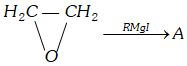
The product $A$ in the following reaction is
A
$RCHOHR$
B
$RCHOH \cdot CH_3$
C
$R - CH_2 - CH_2 - OH$
D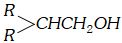
Solution
(C) The reaction of ethylene oxide (oxirane) with a Grignard reagent $(RMgI)$ involves the nucleophilic attack of the alkyl group $(R^-)$ on one of the carbon atoms of the epoxide ring,leading to ring opening.
The reaction proceeds as follows:
$C_2H_4O + RMgI \to R - CH_2 - CH_2 - OMgI$
Subsequent hydrolysis of the intermediate yields the primary alcohol:
$R - CH_2 - CH_2 - OMgI + H_2O \to R - CH_2 - CH_2 - OH + MgI(OH)$
Thus,the product $A$ is $R - CH_2 - CH_2 - OH$.
The reaction proceeds as follows:
$C_2H_4O + RMgI \to R - CH_2 - CH_2 - OMgI$
Subsequent hydrolysis of the intermediate yields the primary alcohol:
$R - CH_2 - CH_2 - OMgI + H_2O \to R - CH_2 - CH_2 - OH + MgI(OH)$
Thus,the product $A$ is $R - CH_2 - CH_2 - OH$.
0 likes
View Solution171
MediumMCQ
The correct order of boiling point for primary $({1^o}),$ secondary $({2^o}),$ and tertiary $({3^o})$ alcohols is
A
${1^o} > {2^o} > {3^o}$
B
${3^o} > {2^o} > {1^o}$
C
${2^o} > {1^o} > {3^o}$
D
${2^o} > {3^o} > {1^o}$
Solution
(A) The correct order is ${1^o} > {2^o} > {3^o}$.
As the number of branches in the alkyl group increases,the surface area of the molecule decreases.
This leads to a decrease in the magnitude of van der Waals forces of attraction between the molecules.
Consequently,the boiling point decreases from primary to tertiary alcohols.
As the number of branches in the alkyl group increases,the surface area of the molecule decreases.
This leads to a decrease in the magnitude of van der Waals forces of attraction between the molecules.
Consequently,the boiling point decreases from primary to tertiary alcohols.
0 likes
View Solution172
MediumMCQ
Which of the following statements is correct regarding the rate of dehydration in alcohols?
A
$1^o > 2^o$
B
$2^o > 3^o$
C
$3^o > 2^o > 1^o$
D
None of these
Solution
(C) The dehydration of alcohols proceeds via the formation of a carbocation intermediate.
The stability of carbocations follows the order: $3^o > 2^o > 1^o$.
Therefore,the rate of dehydration of alcohols follows the same order: $3^o > 2^o > 1^o$.
The stability of carbocations follows the order: $3^o > 2^o > 1^o$.
Therefore,the rate of dehydration of alcohols follows the same order: $3^o > 2^o > 1^o$.
0 likes
View Solution173
MediumMCQ
Distinction between primary,secondary and tertiary alcohol is done by
A
Oxidation method
B
Lucas test
C
Victor Meyer method
D
All of these
Solution
(D) . The distinction between primary,secondary,and tertiary alcohols can be performed using all three methods: oxidation,the Victor Meyer test,and the Lucas test.
0 likes
View Solution174
MediumMCQ
When alcohol reacts with concentrated $H_2SO_4$,the intermediate compound formed is:
A
Carbonium ion
B
Alkoxy ion
C
Alkyl hydrogen sulphate
D
None of these
Solution
(A) The correct answer is $A$. In the dehydration of alcohols using concentrated $H_2SO_4$,the reaction proceeds via the formation of a carbonium ion (carbocation) intermediate.
Step $1$: Protonation of the alcohol group: $R-CH_2-CH_2-OH + H^+ \rightarrow R-CH_2-CH_2-OH_2^+$
Step $2$: Loss of water molecule to form a carbonium ion: $R-CH_2-CH_2-OH_2^+ \rightarrow R-CH_2-CH_2^+ + H_2O$
Step $3$: The carbonium ion may undergo $1, 2-$ hydride or $1, 2-$ methyl shifts to form a more stable carbonium ion before losing a proton to form an alkene.
Step $1$: Protonation of the alcohol group: $R-CH_2-CH_2-OH + H^+ \rightarrow R-CH_2-CH_2-OH_2^+$
Step $2$: Loss of water molecule to form a carbonium ion: $R-CH_2-CH_2-OH_2^+ \rightarrow R-CH_2-CH_2^+ + H_2O$
Step $3$: The carbonium ion may undergo $1, 2-$ hydride or $1, 2-$ methyl shifts to form a more stable carbonium ion before losing a proton to form an alkene.
0 likes
View Solution175
MediumMCQ
Isopropyl alcohol on oxidation gives
A
Acetone
B
Acetaldehyde
C
Ether
D
Ethylene
Solution
(A) Isopropyl alcohol is a secondary alcohol. On oxidation,secondary alcohols are oxidized to ketones.
The reaction is as follows:
$CH_3CH(OH)CH_3 \xrightarrow{[O]} CH_3COCH_3 + H_2O$
Here,$CH_3CH(OH)CH_3$ is isopropyl alcohol (propan$-2-$ol) and $CH_3COCH_3$ is acetone (propanone).
The reaction is as follows:
$CH_3CH(OH)CH_3 \xrightarrow{[O]} CH_3COCH_3 + H_2O$
Here,$CH_3CH(OH)CH_3$ is isopropyl alcohol (propan$-2-$ol) and $CH_3COCH_3$ is acetone (propanone).
0 likes
View Solution176
MediumMCQ
The oxidation product of $2-propanol$ with hot conc. $HNO_3$ is
A
Ethanoic acid
B
Propanone
C
Propanal
D
None of these
Solution
(B) Hot concentrated $HNO_3$ is a strong oxidizing agent.
It oxidizes secondary alcohols like $2-propanol$ $(CH_3CH(OH)CH_3)$ to the corresponding ketone,which is $propanone$ $(CH_3COCH_3)$.
The reaction is: $CH_3CH(OH)CH_3 + [O] \xrightarrow{\text{conc. } HNO_3} CH_3COCH_3 + H_2O$.
It oxidizes secondary alcohols like $2-propanol$ $(CH_3CH(OH)CH_3)$ to the corresponding ketone,which is $propanone$ $(CH_3COCH_3)$.
The reaction is: $CH_3CH(OH)CH_3 + [O] \xrightarrow{\text{conc. } HNO_3} CH_3COCH_3 + H_2O$.
0 likes
View Solution177
MediumMCQ
Glycerol reacts with potassium bisulphate to produce
A
Allyl iodide
B
Allyl sulphate
C
Acryl aldehyde
D
Glycerol trisulphate
Solution
(C) When $Glycerol$ is heated with $KHSO_4$,it undergoes dehydration by the loss of two molecules of water $(H_2O)$.
This reaction results in the formation of an $\alpha, \beta$-unsaturated aldehyde known as $Acryl \ aldehyde$ (also called $Acrolein$).
The reaction is represented as:
$CH_2OH-CHOH-CH_2OH \xrightarrow{KHSO_4, \Delta} CH_2=CH-CHO + 2H_2O$
This reaction results in the formation of an $\alpha, \beta$-unsaturated aldehyde known as $Acryl \ aldehyde$ (also called $Acrolein$).
The reaction is represented as:
$CH_2OH-CHOH-CH_2OH \xrightarrow{KHSO_4, \Delta} CH_2=CH-CHO + 2H_2O$
0 likes
View Solution178
DifficultMCQ
Which of the following oxidation reactions can be carried out with chromic acid in aqueous acetone at $5 - 10^{\circ}C$?
A
$CH_3-(CH_2)_3-C \equiv C-CH(OH)-CH_3 \to CH_3-(CH_2)_3-C \equiv C-CO-CH_3$
B
$CH_3-(CH_2)_3-CH=CH-CH_2OH \to CH_3-(CH_2)_3-CH=CH-CHO$
C
$C_6H_5-CH_3 \to C_6H_5-COOH$
D
$CH_3-(CH_2)_3-CH_2OH \to CH_3-(CH_2)_3-CHO$
Solution
(A) Chromic acid in aqueous acetone at $5 - 10^{\circ}C$ is known as the $Jones$ reagent.
It is a selective oxidizing agent that oxidizes secondary alcohols to ketones and primary alcohols to carboxylic acids.
$A$ key feature of the $Jones$ reagent is that it does not oxidize or affect carbon-carbon double or triple bonds.
In option $(A)$,a secondary alcohol containing a triple bond is correctly oxidized to a ketone while the triple bond remains intact.
Options $(B)$ and $(D)$ show primary alcohols being oxidized to aldehydes,which is incorrect as the $Jones$ reagent typically oxidizes primary alcohols to carboxylic acids.
Option $(C)$ requires much stronger oxidizing conditions.
It is a selective oxidizing agent that oxidizes secondary alcohols to ketones and primary alcohols to carboxylic acids.
$A$ key feature of the $Jones$ reagent is that it does not oxidize or affect carbon-carbon double or triple bonds.
In option $(A)$,a secondary alcohol containing a triple bond is correctly oxidized to a ketone while the triple bond remains intact.
Options $(B)$ and $(D)$ show primary alcohols being oxidized to aldehydes,which is incorrect as the $Jones$ reagent typically oxidizes primary alcohols to carboxylic acids.
Option $(C)$ requires much stronger oxidizing conditions.
0 likes
View Solution179
MediumMCQ
Which of the following responds to a positive $(+ve)$ iodoform test?
A
$Butan-1-ol$
B
$Butanal$
C
$Butan-2-ol$
D
$Pentan-3-one$
Solution
(C) The iodoform test is positive for compounds containing a methyl ketone group $(CH_3-CO-)$ or a methyl carbinol group $(CH_3-CH(OH)-)$.
Among the given options,$Butan-2-ol$ $(CH_3-CH(OH)-CH_2-CH_3)$ contains the $CH_3-CH(OH)-$ group and thus gives a positive iodoform test.
Among the given options,$Butan-2-ol$ $(CH_3-CH(OH)-CH_2-CH_3)$ contains the $CH_3-CH(OH)-$ group and thus gives a positive iodoform test.
0 likes
View Solution180
EasyMCQ
Which of the following will not give the iodoform test?
A
Isopropyl alcohol
B
Ethanol
C
Ethanal
D
Benzyl alcohol
Solution
(D) The iodoform test is given by compounds containing the $CH_3CO-$ group or the $CH_3CH(OH)-$ group.
$A$ Isopropyl alcohol $(CH_3CH(OH)CH_3)$ contains the $CH_3CH(OH)-$ group and gives a positive test.
$B$ Ethanol $(CH_3CH_2OH)$ contains the $CH_3CH(OH)-$ group and gives a positive test.
$C$ Ethanal $(CH_3CHO)$ contains the $CH_3CO-$ group and gives a positive test.
$D$ Benzyl alcohol $(C_6H_5CH_2OH)$ does not contain either the $CH_3CO-$ or the $CH_3CH(OH)-$ group,therefore it will not give the iodoform test.
$A$ Isopropyl alcohol $(CH_3CH(OH)CH_3)$ contains the $CH_3CH(OH)-$ group and gives a positive test.
$B$ Ethanol $(CH_3CH_2OH)$ contains the $CH_3CH(OH)-$ group and gives a positive test.
$C$ Ethanal $(CH_3CHO)$ contains the $CH_3CO-$ group and gives a positive test.
$D$ Benzyl alcohol $(C_6H_5CH_2OH)$ does not contain either the $CH_3CO-$ or the $CH_3CH(OH)-$ group,therefore it will not give the iodoform test.
0 likes
View Solution181
MediumMCQ
When benzyl alcohol is oxidised with $KMnO_4$,the product obtained is
A
Benzaldehyde
B
Benzoic acid
C
$CO_2$ and $H_2O$
D
None of these
Solution
(B) The oxidation of primary alcohols like benzyl alcohol $(C_6H_5CH_2OH)$ with a strong oxidizing agent like $KMnO_4$ leads to the formation of a carboxylic acid.
The reaction is: $C_6H_5CH_2OH + 2[O] \xrightarrow{KMnO_4} C_6H_5COOH + H_2O$.
Therefore,the product obtained is benzoic acid.
The reaction is: $C_6H_5CH_2OH + 2[O] \xrightarrow{KMnO_4} C_6H_5COOH + H_2O$.
Therefore,the product obtained is benzoic acid.
0 likes
View Solution182
MediumMCQ
Tertiary alcohols $(3^{\circ})$ having at least four carbon atoms upon drastic oxidation yield carboxylic acid with:
A
One carbon atom less
B
Two carbon atoms less
C
Three carbon atom less
D
All the above three options are correct
Solution
(D) Tertiary alcohols $(3^{\circ})$ are resistant to oxidation under mild conditions. However,under drastic conditions (e.g.,using concentrated $HNO_3$ or $KMnO_4$ at high temperatures),they undergo carbon-carbon bond cleavage.
First,the tertiary alcohol is oxidized to a ketone by losing one carbon atom.
Then,the resulting ketone undergoes further oxidation,which involves the cleavage of the carbon-carbon bond,resulting in the loss of more carbon atoms to form carboxylic acids.
Specifically,for a tertiary alcohol with $n$ carbon atoms,the oxidation process involves the loss of carbon atoms at each step of the cleavage,leading to products with fewer carbon atoms than the parent alcohol. The reaction follows the general pathway: $R_3C-OH$ $\xrightarrow{[O]} R_2C=O$ $\xrightarrow{[O]} R-COOH$.
Thus,the resulting carboxylic acid has fewer carbon atoms than the original tertiary alcohol.
First,the tertiary alcohol is oxidized to a ketone by losing one carbon atom.
Then,the resulting ketone undergoes further oxidation,which involves the cleavage of the carbon-carbon bond,resulting in the loss of more carbon atoms to form carboxylic acids.
Specifically,for a tertiary alcohol with $n$ carbon atoms,the oxidation process involves the loss of carbon atoms at each step of the cleavage,leading to products with fewer carbon atoms than the parent alcohol. The reaction follows the general pathway: $R_3C-OH$ $\xrightarrow{[O]} R_2C=O$ $\xrightarrow{[O]} R-COOH$.
Thus,the resulting carboxylic acid has fewer carbon atoms than the original tertiary alcohol.
0 likes
View Solution183
MediumMCQ
The rose odour from an ester is formed by the action of $HCOOH$ on
A
Pine oil
B
Olive oil
C
Geraniol
D
Turpentine oil
Solution
(C) . $C_{10}H_{17}OH$ (Geraniol),a liquid terpene alcohol,reacts with $HCOOH$ to form an ester that possesses a rose-like odour.
0 likes
View Solution184
DifficultMCQ
Which of the following will have the highest viscosity?
A
$CH_3OH$
B
$C_2H_5OH$
C
$CH_2OH-CH_2OH$
D
None of these
Solution
(C) Viscosity is directly related to the extent of intermolecular hydrogen bonding.
$CH_2OH-CH_2OH$ (Ethylene glycol) contains two $-OH$ groups per molecule,which allows for extensive intermolecular hydrogen bonding compared to $CH_3OH$ and $C_2H_5OH$,which have only one $-OH$ group.
Therefore,ethylene glycol has the highest viscosity.
$CH_2OH-CH_2OH$ (Ethylene glycol) contains two $-OH$ groups per molecule,which allows for extensive intermolecular hydrogen bonding compared to $CH_3OH$ and $C_2H_5OH$,which have only one $-OH$ group.
Therefore,ethylene glycol has the highest viscosity.
0 likes
View Solution185
MediumMCQ
The boiling point of methanol $(CH_3OH)$ is higher than that of methyl thiol $(CH_3SH)$ because:
A
Methanol has intermolecular hydrogen bonding and methyl thiol has intermolecular hydrogen bonding.
B
Methanol has intermolecular hydrogen bonding and methyl thiol does not.
C
Methanol does not have hydrogen bonding and methyl thiol has intermolecular hydrogen bonding.
D
Neither methanol nor methyl thiol has hydrogen bonding.
Solution
(B) Methanol $(CH_3OH)$ contains an oxygen atom bonded to a hydrogen atom,which allows for the formation of strong intermolecular hydrogen bonds between its molecules.
Methyl thiol $(CH_3SH)$ contains a sulfur atom,which is less electronegative than oxygen and has a larger atomic size,preventing it from forming significant hydrogen bonds.
Due to the presence of intermolecular hydrogen bonding in methanol,it requires more energy to overcome these forces,resulting in a higher boiling point compared to methyl thiol.
Methyl thiol $(CH_3SH)$ contains a sulfur atom,which is less electronegative than oxygen and has a larger atomic size,preventing it from forming significant hydrogen bonds.
Due to the presence of intermolecular hydrogen bonding in methanol,it requires more energy to overcome these forces,resulting in a higher boiling point compared to methyl thiol.
0 likes
View Solution186
MediumMCQ
Methanol and ethanol are soluble in water due to......
A
Covalent property
B
$H$-bonding property
C
Oxygen bonding property
D
None of the above
Solution
(B) Methanol and ethanol are capable of forming $H$-bonds with water molecules.
Due to this intermolecular $H$-bonding,they are soluble in water.
Due to this intermolecular $H$-bonding,they are soluble in water.
0 likes
View Solution187
MediumMCQ
Which of the following compounds will have the maximum $H$-bonding?
A
Ethanol
B
Diethyl ether
C
Ethyl chloride
D
Triethylamine
Solution
(A) Hydrogen bonding occurs when hydrogen is covalently bonded to a highly electronegative atom like $O$,$N$,or $F$.
Among the given options,ethanol $(C_2H_5OH)$ contains an $-OH$ group,which allows for strong intermolecular hydrogen bonding.
Diethyl ether $(C_2H_5-O-C_2H_5)$ lacks a hydrogen atom bonded to oxygen,so it cannot form $H$-bonds.
Ethyl chloride $(C_2H_5Cl)$ does not have hydrogen bonded to a highly electronegative atom.
Triethylamine $((C_2H_5)_3N)$ has nitrogen,but no hydrogen atom is directly attached to it,preventing $H$-bonding.
Therefore,ethanol exhibits the maximum $H$-bonding.
Among the given options,ethanol $(C_2H_5OH)$ contains an $-OH$ group,which allows for strong intermolecular hydrogen bonding.
Diethyl ether $(C_2H_5-O-C_2H_5)$ lacks a hydrogen atom bonded to oxygen,so it cannot form $H$-bonds.
Ethyl chloride $(C_2H_5Cl)$ does not have hydrogen bonded to a highly electronegative atom.
Triethylamine $((C_2H_5)_3N)$ has nitrogen,but no hydrogen atom is directly attached to it,preventing $H$-bonding.
Therefore,ethanol exhibits the maximum $H$-bonding.
0 likes
View Solution188
EasyMCQ
What is Lucas reagent?
A
Anhydrous $ZnCl_2 +$ concentrated $HCl$
B
Hydrous $ZnCl_2 +$ dilute $HCl$
C
Concentrated $HNO_3 +$ anhydrous $ZnCl_2$
D
Concentrated $HNO_3 +$ anhydrous $MgCl_2$
Solution
(A) Lucas reagent is a mixture of anhydrous $ZnCl_2$ and concentrated $HCl$. It is used to distinguish between primary,secondary,and tertiary alcohols.
0 likes
View Solution189
DifficultMCQ
Heating $I_2$ and $NaOH$ with which of the following produces iodoform?
A
$C_2H_5OH$
B
$CH_3OH$
C
$HCOOH$
D
$C_6H_6$
Solution
(A) The iodoform test is given by compounds containing the $CH_3CH(OH)-$ group (like $2$-alkanols) or the $CH_3CO-$ group (methyl ketones).
Among the given options,$C_2H_5OH$ (ethanol) contains the $CH_3CH(OH)-$ group,which reacts with $I_2$ and $NaOH$ to form iodoform $(CHI_3)$.
Among the given options,$C_2H_5OH$ (ethanol) contains the $CH_3CH(OH)-$ group,which reacts with $I_2$ and $NaOH$ to form iodoform $(CHI_3)$.
0 likes
View Solution190
DifficultMCQ
Which of the following substances gives a yellow precipitate with $I_2$ and alkali?
A
$CH_3OH$
B
$CH_3CH_2CH_2OH$
C
$C_2H_5OC_2H_5$
D
$CH_3CH_2OH$
Solution
(D) The iodoform test is given by compounds containing the $CH_3CO-$ group or the $CH_3CH(OH)-$ group.
Among the given options,$CH_3CH_2OH$ (ethanol) contains the $CH_3CH(OH)-$ group.
When $CH_3CH_2OH$ reacts with $I_2$ and $NaOH$,it forms $CHI_3$ (iodoform),which is a yellow precipitate.
Among the given options,$CH_3CH_2OH$ (ethanol) contains the $CH_3CH(OH)-$ group.
When $CH_3CH_2OH$ reacts with $I_2$ and $NaOH$,it forms $CHI_3$ (iodoform),which is a yellow precipitate.
0 likes
View Solution191
DifficultMCQ
What is the product formed when neopentyl alcohol reacts with concentrated $HCl$ in the presence of $ZnCl_2$?
A
$t$-butyl chloride
B
Isobutylene
C
$t$-pentyl chloride
D
Neopentyl chloride
Solution
(C) Neopentyl alcohol ($CH_3)_3CCH_2OH$ reacts with $HCl$ in the presence of $ZnCl_2$ to form a primary carbocation. This primary carbocation undergoes a $1,2$-methyl shift to form a more stable tertiary carbocation ($t$-pentyl carbocation). The chloride ion then attacks this tertiary carbocation to yield $t$-pentyl chloride as the major product.
0 likes
View Solution192
DifficultMCQ
Which of the following compounds gives a positive iodoform test with $I_2$ and $NaOH$?
A
$CH_3CH_2CH(OH)CH_2CH_3$
B
$C_6H_5CH_2CH_2OH$
C
$CH_3CH(CH_3)CH_2OH$
D
$PhCH(OH)CH_3$
Solution
(D) The iodoform test is given by compounds containing the $CH_3CO-$ group or the $CH_3CH(OH)-$ group.
$A$: $CH_3CH_2CH(OH)CH_2CH_3$ is a secondary alcohol but does not have a $CH_3CH(OH)-$ group.
$B$: $C_6H_5CH_2CH_2OH$ is a primary alcohol and does not have the required group.
$C$: $CH_3CH(CH_3)CH_2OH$ is a primary alcohol and does not have the required group.
$D$: $PhCH(OH)CH_3$ contains the $CH_3CH(OH)-$ group attached to a phenyl ring,which satisfies the condition for a positive iodoform test.
Therefore,the correct option is $D$.
$A$: $CH_3CH_2CH(OH)CH_2CH_3$ is a secondary alcohol but does not have a $CH_3CH(OH)-$ group.
$B$: $C_6H_5CH_2CH_2OH$ is a primary alcohol and does not have the required group.
$C$: $CH_3CH(CH_3)CH_2OH$ is a primary alcohol and does not have the required group.
$D$: $PhCH(OH)CH_3$ contains the $CH_3CH(OH)-$ group attached to a phenyl ring,which satisfies the condition for a positive iodoform test.
Therefore,the correct option is $D$.
0 likes
View Solution193
MediumMCQ
What is the order of reactivity of the following alcohols with halogen acids?
$(1) \ CH_3CH_2CH_2OH$
$(2) \ CH_3CH_2CH(CH_3)OH$
$(3) \ CH_3CH_2C(CH_3)_2OH$
$(1) \ CH_3CH_2CH_2OH$
$(2) \ CH_3CH_2CH(CH_3)OH$
$(3) \ CH_3CH_2C(CH_3)_2OH$
A
$(1) > (2) > (3)$
B
$(3) > (2) > (1)$
C
$(2) > (1) > (3)$
D
$(1) > (3) > (2)$
Solution
(B) The reaction of alcohols with halogen acids proceeds via the formation of a carbocation intermediate.
The reactivity of alcohols towards halogen acids follows the order: $3^\circ > 2^\circ > 1^\circ$ alcohol.
This is because the stability of the carbocation formed is $3^\circ > 2^\circ > 1^\circ$.
$(1)$ is a primary $(1^\circ)$ alcohol: $CH_3CH_2CH_2OH$.
$(2)$ is a secondary $(2^\circ)$ alcohol: $CH_3CH_2CH(CH_3)OH$.
$(3)$ is a tertiary $(3^\circ)$ alcohol: $CH_3CH_2C(CH_3)_2OH$.
Therefore,the order of reactivity is $(3) > (2) > (1)$.
The reactivity of alcohols towards halogen acids follows the order: $3^\circ > 2^\circ > 1^\circ$ alcohol.
This is because the stability of the carbocation formed is $3^\circ > 2^\circ > 1^\circ$.
$(1)$ is a primary $(1^\circ)$ alcohol: $CH_3CH_2CH_2OH$.
$(2)$ is a secondary $(2^\circ)$ alcohol: $CH_3CH_2CH(CH_3)OH$.
$(3)$ is a tertiary $(3^\circ)$ alcohol: $CH_3CH_2C(CH_3)_2OH$.
Therefore,the order of reactivity is $(3) > (2) > (1)$.
0 likes
View Solution194
DifficultMCQ
Which of the following statements is incorrect?
A
The reactivity order of alkyl halides with alkenes is $R-I > R-Br > R-Cl > R-F$.
B
Reaction of acetone with methyl magnesium bromide gives butan-$2$-ol.
C
$C_2H_4Cl_2$ exists in two isomeric forms.
D
Reduction of ethyl chloride with $Zn-Cu$ couple and alcohol gives ethane.
Solution
(B) Statement $A$ is incorrect because alkyl halides do not react with alkenes to form products in this manner; rather,they are typically formed from alkenes via hydrohalogenation.
Statement $B$ is correct: $CH_3COCH_3 + CH_3MgBr$ $\rightarrow (CH_3)_3COMgBr$ $\xrightarrow{H_2O} (CH_3)_3COH$ (tert-butyl alcohol),but wait,the question asks for butan-$2$-ol. Actually,the reaction of $CH_3MgBr$ with acetaldehyde gives propan-$2$-ol,and with acetone gives tert-butyl alcohol. Thus,statement $B$ is also chemically incorrect as stated.
However,in the context of standard multiple-choice questions,statement $A$ is fundamentally flawed regarding the reaction type. Let us re-evaluate: $C_2H_4Cl_2$ has two isomers: $1,1$-dichloroethane and $1,2$-dichloroethane. This is correct.
Reduction of ethyl chloride $(C_2H_5Cl)$ with $Zn-Cu/C_2H_5OH$ gives ethane $(C_2H_6)$. This is correct.
Therefore,statement $B$ is the intended incorrect statement as it describes the wrong product for the reaction of acetone with methyl magnesium bromide.
Statement $B$ is correct: $CH_3COCH_3 + CH_3MgBr$ $\rightarrow (CH_3)_3COMgBr$ $\xrightarrow{H_2O} (CH_3)_3COH$ (tert-butyl alcohol),but wait,the question asks for butan-$2$-ol. Actually,the reaction of $CH_3MgBr$ with acetaldehyde gives propan-$2$-ol,and with acetone gives tert-butyl alcohol. Thus,statement $B$ is also chemically incorrect as stated.
However,in the context of standard multiple-choice questions,statement $A$ is fundamentally flawed regarding the reaction type. Let us re-evaluate: $C_2H_4Cl_2$ has two isomers: $1,1$-dichloroethane and $1,2$-dichloroethane. This is correct.
Reduction of ethyl chloride $(C_2H_5Cl)$ with $Zn-Cu/C_2H_5OH$ gives ethane $(C_2H_6)$. This is correct.
Therefore,statement $B$ is the intended incorrect statement as it describes the wrong product for the reaction of acetone with methyl magnesium bromide.
0 likes
View Solution195
DifficultMCQ
What is the product obtained by the reaction of ethyl alcohol with bleaching powder?
A
$CHCl_3$
B
$CCl_3CHO$
C
$CH_3COCH_3$
D
$CH_3CHO$
Solution
(A) The reaction of ethyl alcohol $(CH_3CH_2OH)$ with bleaching powder $(CaOCl_2)$ involves the formation of chloroform $(CHCl_3)$.
Step $1$: Bleaching powder reacts with water to produce chlorine: $CaOCl_2 + H_2O \rightarrow Ca(OH)_2 + Cl_2$.
Step $2$: Chlorine oxidizes ethyl alcohol to acetaldehyde: $CH_3CH_2OH + Cl_2 \rightarrow CH_3CHO + 2HCl$.
Step $3$: Acetaldehyde is chlorinated to form chloral $(CCl_3CHO)$,which then reacts with calcium hydroxide to yield chloroform: $2CH_3CHO + 6Cl_2 \rightarrow 2CCl_3CHO + 6HCl$ and $2CCl_3CHO + Ca(OH)_2 \rightarrow 2CHCl_3 + (HCOO)_2Ca$ (or calcium acetate depending on conditions).
The final major organic product is chloroform $(CHCl_3)$.
Step $1$: Bleaching powder reacts with water to produce chlorine: $CaOCl_2 + H_2O \rightarrow Ca(OH)_2 + Cl_2$.
Step $2$: Chlorine oxidizes ethyl alcohol to acetaldehyde: $CH_3CH_2OH + Cl_2 \rightarrow CH_3CHO + 2HCl$.
Step $3$: Acetaldehyde is chlorinated to form chloral $(CCl_3CHO)$,which then reacts with calcium hydroxide to yield chloroform: $2CH_3CHO + 6Cl_2 \rightarrow 2CCl_3CHO + 6HCl$ and $2CCl_3CHO + Ca(OH)_2 \rightarrow 2CHCl_3 + (HCOO)_2Ca$ (or calcium acetate depending on conditions).
The final major organic product is chloroform $(CHCl_3)$.
0 likes
View Solution196
DifficultMCQ
What is the correct order of reactivity of the following alcohols towards $H-X$?
$(I) \; CH_2 = CH - OH$
$(II) \; CH_2 = CH - CH_2OH$
$(III) \; CH_3 - CH_2 - OH$
$(IV) \; CH_3 - CH(OH) - CH_3$
$(I) \; CH_2 = CH - OH$
$(II) \; CH_2 = CH - CH_2OH$
$(III) \; CH_3 - CH_2 - OH$
$(IV) \; CH_3 - CH(OH) - CH_3$
A
$II > I > III > IV$
B
$IV > III > II > I$
C
$II > IV > I > III$
D
$II > IV > III > I$
Solution
(D) The reactivity of alcohols towards $H-X$ depends on the stability of the carbocation intermediate formed after the loss of water.
$(I)$ Vinyl alcohol $(CH_2=CH-OH)$ forms a vinyl carbocation $(CH_2=CH^+)$,which is highly unstable.
$(II)$ Allyl alcohol $(CH_2=CH-CH_2OH)$ forms an allyl carbocation $(CH_2=CH-CH_2^+)$,which is resonance stabilized.
$(III)$ Ethanol $(CH_3-CH_2OH)$ forms a primary carbocation $(CH_3-CH_2^+)$.
$(IV)$ Isopropyl alcohol $(CH_3-CH(OH)-CH_3)$ forms a secondary carbocation $(CH_3-CH^+-CH_3)$,which is more stable than a primary carbocation due to inductive effect and hyperconjugation.
Stability order of carbocations: $Allyl > Secondary > Primary > Vinyl$.
Therefore,the reactivity order is: $II > IV > III > I$.
$(I)$ Vinyl alcohol $(CH_2=CH-OH)$ forms a vinyl carbocation $(CH_2=CH^+)$,which is highly unstable.
$(II)$ Allyl alcohol $(CH_2=CH-CH_2OH)$ forms an allyl carbocation $(CH_2=CH-CH_2^+)$,which is resonance stabilized.
$(III)$ Ethanol $(CH_3-CH_2OH)$ forms a primary carbocation $(CH_3-CH_2^+)$.
$(IV)$ Isopropyl alcohol $(CH_3-CH(OH)-CH_3)$ forms a secondary carbocation $(CH_3-CH^+-CH_3)$,which is more stable than a primary carbocation due to inductive effect and hyperconjugation.
Stability order of carbocations: $Allyl > Secondary > Primary > Vinyl$.
Therefore,the reactivity order is: $II > IV > III > I$.
0 likes
View Solution197
DifficultMCQ
Lucas reagent is ...... .
A
Conc. $HCl$ + anhydrous $ZnCl_2$
B
Dil. $HCl$ + aqueous $ZnCl_2$
C
Conc. $HNO_3$ + anhydrous $ZnCl_2$
D
Conc. $HCl$ + anhydrous $MgCl_2$
Solution
(A) Lucas reagent is a mixture of concentrated hydrochloric acid $(HCl)$ and anhydrous zinc chloride $(ZnCl_2)$.
It is used to distinguish between primary,secondary,and tertiary alcohols based on the rate of reaction,which results in the formation of alkyl chlorides (turbidity).
Therefore,the correct composition is concentrated $HCl$ and anhydrous $ZnCl_2$.
It is used to distinguish between primary,secondary,and tertiary alcohols based on the rate of reaction,which results in the formation of alkyl chlorides (turbidity).
Therefore,the correct composition is concentrated $HCl$ and anhydrous $ZnCl_2$.
0 likes
View Solution198
EasyMCQ
What is the order of reactivity for the reaction ${{C}_{2}}{{H}_{5}}OH + HX \xrightarrow{Zn{{X}_{2}}} {{C}_{2}}{{H}_{5}}X + {{H}_{2}}O$?
A
$HI > HCl > HBr$
B
$HI > HBr > HCl$
C
$HCl > HBr > HI$
D
$HBr > HI > HCl$
Solution
(B) The reaction of alcohols with hydrogen halides $(HX)$ in the presence of $ZnX_2$ (Lucas reagent) follows the mechanism where the bond strength of $H-X$ determines the reactivity.
As the size of the halogen atom increases,the bond dissociation energy of the $H-X$ bond decreases,making it easier to break.
The bond dissociation energy order is $HI < HBr < HCl$.
Therefore,the reactivity order for the reaction is $HI > HBr > HCl$.
As the size of the halogen atom increases,the bond dissociation energy of the $H-X$ bond decreases,making it easier to break.
The bond dissociation energy order is $HI < HBr < HCl$.
Therefore,the reactivity order for the reaction is $HI > HBr > HCl$.
0 likes
View Solution199
MediumMCQ
What is the product formed when chlorine reacts with ethanol?
A
Ethyl chloride
B
Chloroform
C
Chloral
D
Acetaldehyde
Solution
(C) The reaction of ethanol with chlorine occurs in two main steps:
$1$. Ethanol is oxidized to acetaldehyde by chlorine: $CH_3CH_2OH + Cl_2 \to CH_3CHO + 2HCl$
$2$. Acetaldehyde then reacts with excess chlorine to form chloral: $CH_3CHO + 3Cl_2 \to CCl_3CHO + 3HCl$
Therefore,the final product formed is chloral.
$1$. Ethanol is oxidized to acetaldehyde by chlorine: $CH_3CH_2OH + Cl_2 \to CH_3CHO + 2HCl$
$2$. Acetaldehyde then reacts with excess chlorine to form chloral: $CH_3CHO + 3Cl_2 \to CCl_3CHO + 3HCl$
Therefore,the final product formed is chloral.
0 likes
View Solution200
MediumMCQ
$PhMgBr + (CH_3)_2CH-OH \to A$. Identify the product $A$.
A
$Ph-H$ (Benzene)
B
$CH_3-C(CH_3)_2-OPh$
C
$CH_3-CH(CH_3)-OPh$
D
$CH_3-C(CH_3)_2-Ph$
Solution
(A) Grignard reagents $(RMgX)$ act as strong bases when they react with compounds containing active hydrogen atoms (like alcohols,$R-OH$).
In this reaction,$PhMgBr$ acts as a base and abstracts the acidic proton from the hydroxyl group of the alcohol (propan$-2-$ol).
The reaction is: $PhMgBr + (CH_3)_2CH-OH \to Ph-H + (CH_3)_2CH-OMgBr$.
The product $A$ is benzene $(Ph-H)$.
In this reaction,$PhMgBr$ acts as a base and abstracts the acidic proton from the hydroxyl group of the alcohol (propan$-2-$ol).
The reaction is: $PhMgBr + (CH_3)_2CH-OH \to Ph-H + (CH_3)_2CH-OMgBr$.
The product $A$ is benzene $(Ph-H)$.
0 likes
View SolutionAlcohols, Phenols and Ethers — Properties of alcohol · Frequently Asked Questions
1Are these Alcohols, Phenols and Ethers questions useful for JEE and NEET?
Yes. All questions in this section are mapped to JEE Main and NEET exam patterns. Previous year questions from JEE Main, NEET, GUJCET and state-level exams are included with full solutions.
2Can I switch to Hindi or Gujarati for these questions?
Yes. Use the language tabs in the hero section or the sidebar to view the same questions and solutions in English, Hindi or Gujarati.
3How do I generate a question paper from this subtopic?
Use the Vedclass Exam Paper Generator — select the chapter and subtopic, set difficulty, and generate Sets A, B, C, D automatically. First 3 chapters of every subject are free.
Vedclass Products
For Students
Vedclass Test Series
Mock tests in real JEE/NEET style with performance analysis. 5-day free trial.
Start Free TrialFor Teachers
Exam Paper Generator
Generate Set A/B/C/D papers from this chapter in 2 minutes. 3 chapters free.
Try FreeFor Institutes
Online Exam Module
Live online exams with unlimited students, 360° analytics & white-label branding.
See DemoFor Teachers & Institutes
Generate a Alcohols, Phenols and Ethers Exam Paper in 2 Minutes
Select subtopic & difficulty — Sets A, B, C, D auto-generated with No Repeat logic.
First 3 chapters of every subject are free — no payment required.