
A English
Properties of Carboxylic Acids and Their Derivatives Questions in English
Class 12 Chemistry · 8-2.Carboxylic acids and Their derivative · Properties of Carboxylic Acids and Their Derivatives
791+
Questions
English
Language
100%
With Solutions
Showing 50 of 791 questions in English
201
MediumMCQ
Which of the following statements is true regarding $HCOOH$ (formic acid)?
A
It is weaker than $CH_3COOH$ (acetic acid).
B
It acts as a reducing agent.
C
It gives a ketone when its calcium salt is heated.
D
It acts as an oxidizing agent.
0 likes
View Solution202
MediumMCQ
Formic acid and acetic acid differ in which of the following?
A
Displacement of hydrogen by sodium
B
Formation of ester with alcohol
C
Reduction of Fehling's solution
D
Reaction with blue litmus
Solution
(C) Formic acid contains an aldehyde group $(H-CHO)$ in its structure,which allows it to act as a reducing agent.
Specifically,it reduces Fehling's solution to red precipitate of cuprous oxide $(Cu_2O)$.
Acetic acid $(CH_3COOH)$ lacks this aldehyde group and does not reduce Fehling's solution.
Specifically,it reduces Fehling's solution to red precipitate of cuprous oxide $(Cu_2O)$.
Acetic acid $(CH_3COOH)$ lacks this aldehyde group and does not reduce Fehling's solution.
0 likes
View Solution203
MediumMCQ
What is the decreasing order of acidic strength for the following acids?
$[I]$ Methanoic acid
$[II]$ Ethanoic acid
$[III]$ Propanoic acid
$[IV]$ Butanoic acid
$[I]$ Methanoic acid
$[II]$ Ethanoic acid
$[III]$ Propanoic acid
$[IV]$ Butanoic acid
A
$I > II > III > IV$
B
$IV > III > II > I$
C
$I > IV > III > II$
D
$IV > I > II > III$
Solution
(A) The acidic strength of carboxylic acids is inversely proportional to the $+I$ (inductive) effect of the alkyl group attached to the $-COOH$ group.
As the number of carbon atoms in the alkyl chain increases,the $+I$ effect increases,which destabilizes the carboxylate ion and decreases the acidic strength.
The order is:
$I$ (Methanoic acid,$H-COOH$) > $II$ (Ethanoic acid,$CH_3-COOH$) > $III$ (Propanoic acid,$CH_3CH_2-COOH$) > $IV$ (Butanoic acid,$CH_3CH_2CH_2-COOH$)
Therefore,the correct order is $I > II > III > IV$.
As the number of carbon atoms in the alkyl chain increases,the $+I$ effect increases,which destabilizes the carboxylate ion and decreases the acidic strength.
The order is:
$I$ (Methanoic acid,$H-COOH$) > $II$ (Ethanoic acid,$CH_3-COOH$) > $III$ (Propanoic acid,$CH_3CH_2-COOH$) > $IV$ (Butanoic acid,$CH_3CH_2CH_2-COOH$)
Therefore,the correct order is $I > II > III > IV$.
0 likes
View Solution204
MediumMCQ
In the ring substitution reaction of $C_6H_5Y$,the major product obtained is the $m-$ isomer. What is the group $Y$?
A
$-NH_2$
B
$-COOH$
C
$-CH_3$
D
$-Cl$
Solution
(B) The group $Y$ must be a meta-directing group for the $m-$ isomer to be the major product in an electrophilic aromatic substitution reaction.
$-COOH$ is an electron-withdrawing group and acts as a meta-directing group.
$-NH_2$,$-CH_3$,and $-Cl$ are ortho/para-directing groups.
$-COOH$ is an electron-withdrawing group and acts as a meta-directing group.
$-NH_2$,$-CH_3$,and $-Cl$ are ortho/para-directing groups.
0 likes
View Solution205
MediumMCQ
Which of the following is the correct order of relative acidity for the given acids?
A
$FCH_2COOH > ClCH_2COOH > BrCH_2COOH$
B
$ClCH_2COOH > BrCH_2COOH > FCH_2COOH$
C
$BrCH_2COOH > ClCH_2COOH > FCH_2COOH$
D
$ClCH_2COOH > FCH_2COOH > BrCH_2COOH$
Solution
(A) The acidity of carboxylic acids is increased by the presence of electron-withdrawing groups $(EWG)$ due to the $-I$ (inductive) effect.
The strength of the $-I$ effect for halogens follows the order of their electronegativity:
$F > Cl > Br$.
Therefore,the electron-withdrawing power decreases in the order $F > Cl > Br$,which stabilizes the conjugate base (carboxylate ion) more effectively in the order $FCH_2COO^- > ClCH_2COO^- > BrCH_2COO^-$.
Thus,the correct order of relative acidity is $FCH_2COOH > ClCH_2COOH > BrCH_2COOH$.
The strength of the $-I$ effect for halogens follows the order of their electronegativity:
$F > Cl > Br$.
Therefore,the electron-withdrawing power decreases in the order $F > Cl > Br$,which stabilizes the conjugate base (carboxylate ion) more effectively in the order $FCH_2COO^- > ClCH_2COO^- > BrCH_2COO^-$.
Thus,the correct order of relative acidity is $FCH_2COOH > ClCH_2COOH > BrCH_2COOH$.
0 likes
View Solution206
MediumMCQ
What is the major product formed upon the sulfonation of benzoic acid?
A
$o$-sulfobenzoic acid
B
$m$-sulfobenzoic acid
C
$p$-sulfobenzoic acid
D
$o$- and $p$-sulfobenzoic acid
Solution
(B) The $-COOH$ group attached to the benzene ring is a strong electron-withdrawing group due to its $-I$ and $-M$ effects.
It is a deactivating group and is meta-directing for electrophilic aromatic substitution reactions.
Therefore,when benzoic acid undergoes sulfonation with fuming sulfuric acid ($H_2SO_4$ or $SO_3/H_2SO_4$),the incoming electrophile $(SO_3)$ attacks the meta-position,yielding $m$-sulfobenzoic acid as the major product.
It is a deactivating group and is meta-directing for electrophilic aromatic substitution reactions.
Therefore,when benzoic acid undergoes sulfonation with fuming sulfuric acid ($H_2SO_4$ or $SO_3/H_2SO_4$),the incoming electrophile $(SO_3)$ attacks the meta-position,yielding $m$-sulfobenzoic acid as the major product.
0 likes
View Solution207
MediumMCQ
What is the product of the reaction between lactic acid and dilute $H_2SO_4$?
A
Acetic acid
B
Propionic acid
C
Acrylic acid
D
Formic acid
Solution
(D) Lactic acid $(CH_3-CH(OH)-COOH)$ undergoes dehydration and cleavage in the presence of dilute $H_2SO_4$ upon heating.
The reaction is: $CH_3-CH(OH)-COOH \xrightarrow[\Delta]{H_2SO_4} CH_3CHO + HCOOH$.
Thus,the products formed are acetaldehyde and formic acid.
The reaction is: $CH_3-CH(OH)-COOH \xrightarrow[\Delta]{H_2SO_4} CH_3CHO + HCOOH$.
Thus,the products formed are acetaldehyde and formic acid.
0 likes
View Solution208
MediumMCQ
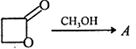
What is $A$ in the following reaction?
A
$HO-CH_2-CH_2-COOCH_3$
B
$HOOC-CH_2-CH_2-OCH_3$
C
Both are correct
D
None is correct
Solution
(A) The reaction involves the ring-opening of $\beta$-propiolactone by methanol $(\text{CH}_3\text{OH})$.
In the presence of an acid catalyst,the carbonyl oxygen is protonated,making the carbonyl carbon more electrophilic.
Alternatively,the nucleophilic attack of methanol on the carbonyl carbon leads to the cleavage of the acyl-oxygen bond.
This results in the formation of methyl $3$-hydroxypropionate,which is $HO-CH_2-CH_2-COOCH_3$.
In the presence of an acid catalyst,the carbonyl oxygen is protonated,making the carbonyl carbon more electrophilic.
Alternatively,the nucleophilic attack of methanol on the carbonyl carbon leads to the cleavage of the acyl-oxygen bond.
This results in the formation of methyl $3$-hydroxypropionate,which is $HO-CH_2-CH_2-COOCH_3$.
0 likes
View Solution209
MediumMCQ
Which of the following substances will not undergo the Hell-Volhard-Zelinsky reaction?
A
$HCOOH$
B
$CCl_3COOH$
C
$C_6H_5COOH$
D
All of these
Solution
(D) The Hell-Volhard-Zelinsky $(HVZ)$ reaction requires the presence of at least one $\alpha$-hydrogen atom in the carboxylic acid.
$HCOOH$ (formic acid) has no $\alpha$-carbon.
$CCl_3COOH$ (trichloroacetic acid) has an $\alpha$-carbon but no $\alpha$-hydrogen.
$C_6H_5COOH$ (benzoic acid) has an $\alpha$-carbon attached to the benzene ring,but it lacks an $\alpha$-hydrogen.
Therefore,none of these compounds can undergo the $HVZ$ reaction.
$HCOOH$ (formic acid) has no $\alpha$-carbon.
$CCl_3COOH$ (trichloroacetic acid) has an $\alpha$-carbon but no $\alpha$-hydrogen.
$C_6H_5COOH$ (benzoic acid) has an $\alpha$-carbon attached to the benzene ring,but it lacks an $\alpha$-hydrogen.
Therefore,none of these compounds can undergo the $HVZ$ reaction.
0 likes
View Solution210
MediumMCQ
What is the product formed when acetic acid reacts with chlorine in the presence of an anhydrous $FeCl_3$ catalyst?
A
Acetyl chloride
B
Methyl chloride
C
Trichloroacetic acid
D
Chloral hydrate
Solution
(C) The reaction of acetic acid with chlorine in the presence of a catalyst like anhydrous $FeCl_3$ (or red phosphorus) leads to the substitution of hydrogen atoms on the $\alpha$-carbon.
$CH_3COOH + 3Cl_2 \xrightarrow{FeCl_3} CCl_3COOH + 3HCl$
This reaction is known as the Hell-Volhard-Zelinsky reaction (or $\alpha$-halogenation).
The final product is $CCl_3COOH$,which is Trichloroacetic acid.
$CH_3COOH + 3Cl_2 \xrightarrow{FeCl_3} CCl_3COOH + 3HCl$
This reaction is known as the Hell-Volhard-Zelinsky reaction (or $\alpha$-halogenation).
The final product is $CCl_3COOH$,which is Trichloroacetic acid.
0 likes
View Solution211
MediumMCQ
Which of the following is a strong reducing agent?
A
Ethanoic acid
B
Benzoic acid
C
Methanoic acid
D
Chloroacetic acid
Solution
(C) Methanoic acid $(HCOOH)$ is a strong reducing agent because it contains both a carboxylic group and an aldehydic group $(CHO)$ in its structure,which allows it to reduce Tollens' reagent and Fehling's solution.
0 likes
View Solution212
MediumMCQ
What product is obtained when two moles of acetic acid are heated with $P_2O_5$?
A
$2$ moles of ethyl alcohol
B
Formic anhydride
C
Acetic anhydride
D
$2$ moles of methyl cyanide
Solution
(C) When two moles of acetic acid $(CH_3COOH)$ are heated with phosphorus pentoxide $(P_2O_5)$,which acts as a dehydrating agent,a molecule of water is removed to form acetic anhydride.
The reaction is: $2CH_3COOH \xrightarrow{P_2O_5, \Delta} (CH_3CO)_2O + H_2O$.
Thus,the product obtained is acetic anhydride.
The reaction is: $2CH_3COOH \xrightarrow{P_2O_5, \Delta} (CH_3CO)_2O + H_2O$.
Thus,the product obtained is acetic anhydride.
0 likes
View Solution213
MediumMCQ
What is the reason for the solubility of low molecular weight carboxylic acids in water?
A
Low molecular weight
B
Hydrogen bonding
C
Dissociation into ions
D
Easy hydrolysis
Solution
(B) Low molecular weight carboxylic acids are soluble in water because they can form $H$-bonds with water molecules.
0 likes
View Solution214
MediumMCQ
Dimerization in carboxylic acids is due to which of the following?
A
Ionic bond
B
Covalent bond
C
Coordinate bond
D
Intermolecular hydrogen bonding
Solution
(D) Carboxylic acids exist as dimers in the vapor phase or in aprotic solvents due to the formation of stable intermolecular hydrogen bonds between two carboxylic acid molecules. This structure is represented as follows:
$R-C(=O)OH \dots O=C(OH)-R$
This cyclic structure is stabilized by two hydrogen bonds.
$R-C(=O)OH \dots O=C(OH)-R$
This cyclic structure is stabilized by two hydrogen bonds.
0 likes
View Solution215
MediumMCQ
What is the product formed when lactic acid is oxidized in the presence of alkaline potassium permanganate $(KMnO_4)$?
A
Tartaric acid
B
Pyruvic acid
C
Cinnamic acid
D
Propionic acid
Solution
(B) The oxidation of lactic acid $(CH_3-CH(OH)-COOH)$ with alkaline $KMnO_4$ results in the oxidation of the secondary alcohol group to a ketone group.
The reaction is:
$CH_3-CH(OH)-COOH \xrightarrow{KMnO_4} CH_3-CO-COOH$
Here,lactic acid is converted into pyruvic acid $(CH_3-CO-COOH)$.
The reaction is:
$CH_3-CH(OH)-COOH \xrightarrow{KMnO_4} CH_3-CO-COOH$
Here,lactic acid is converted into pyruvic acid $(CH_3-CO-COOH)$.
0 likes
View Solution216
MediumMCQ
Carboxylic acids are more acidic than phenol and alcohol. The reason for this is ......
A
Intermolecular hydrogen bonding
B
Formation of dimer
C
Highly acidic hydrogen
D
Resonance stabilization of their conjugate base
Solution
(D) The conjugate base of a carboxylic acid,i.e.,the carboxylate ion,is resonance stabilized. The negative charge is delocalized over two electronegative oxygen atoms,which makes the carboxylate ion much more stable than the alkoxide or phenoxide ions. This increased stability of the conjugate base shifts the equilibrium towards the formation of $H^+$ ions,thereby increasing the acidity of carboxylic acids. The resonance structure is: $CH_3-COOH \xrightarrow{-H^+} CH_3-COO^- \leftrightarrow CH_3-COO^-$
0 likes
View Solution217
MediumMCQ
Which of the following is the strongest acid?
A
$CH_3COOH$
B
$CH_2ClCH_2COOH$
C
$CH_2ClCOOH$
D
$CH_3CH_2COOH$
Solution
(C) The acidity of carboxylic acids is increased by the presence of electron-withdrawing groups ($-I$ effect) and decreased by electron-donating groups ($+I$ effect).
In $CH_2ClCOOH$,the chlorine atom exerts a strong $-I$ effect,which stabilizes the carboxylate anion significantly.
Comparing the options:
$CH_3CH_2COOH$ and $CH_3COOH$ have alkyl groups which show $+I$ effect,making them weaker acids.
$CH_2ClCH_2COOH$ has the chlorine atom further away from the carboxyl group,reducing its $-I$ effect compared to $CH_2ClCOOH$.
Therefore,$CH_2ClCOOH$ is the strongest acid among the given options.
In $CH_2ClCOOH$,the chlorine atom exerts a strong $-I$ effect,which stabilizes the carboxylate anion significantly.
Comparing the options:
$CH_3CH_2COOH$ and $CH_3COOH$ have alkyl groups which show $+I$ effect,making them weaker acids.
$CH_2ClCH_2COOH$ has the chlorine atom further away from the carboxyl group,reducing its $-I$ effect compared to $CH_2ClCOOH$.
Therefore,$CH_2ClCOOH$ is the strongest acid among the given options.
0 likes
View Solution218
MediumMCQ
Consider the acidity of the following carboxylic acids:
$(I)$ $PhCOOH$
$(II)$ $o-NO_2C_6H_4COOH$
$(III)$ $p-NO_2C_6H_4COOH$
$(IV)$ $m-NO_2C_6H_4COOH$
Which of the following is the correct order of acidity?
$(I)$ $PhCOOH$
$(II)$ $o-NO_2C_6H_4COOH$
$(III)$ $p-NO_2C_6H_4COOH$
$(IV)$ $m-NO_2C_6H_4COOH$
Which of the following is the correct order of acidity?
A
$I > II > III > IV$
B
$II > III > IV > I$
C
$II > IV > I > III$
D
$II > III > IV > I$
Solution
(B) The presence of an electron-withdrawing group $(-NO_2)$ on the benzene ring increases the acidity of benzoic acid.
$1$. The ortho-substituted isomer $(II)$ is the most acidic due to the ortho-effect.
$2$. The para-isomer $(III)$ has a strong $-I$ and $-M$ effect,making it more acidic than the meta-isomer.
$3$. The meta-isomer $(IV)$ only exerts a $-I$ effect,making it more acidic than benzoic acid $(I)$ but less acidic than the para-isomer.
$4$. Benzoic acid $(I)$ has no electron-withdrawing substituent.
Therefore,the correct order of acidity is $II > III > IV > I$.
$1$. The ortho-substituted isomer $(II)$ is the most acidic due to the ortho-effect.
$2$. The para-isomer $(III)$ has a strong $-I$ and $-M$ effect,making it more acidic than the meta-isomer.
$3$. The meta-isomer $(IV)$ only exerts a $-I$ effect,making it more acidic than benzoic acid $(I)$ but less acidic than the para-isomer.
$4$. Benzoic acid $(I)$ has no electron-withdrawing substituent.
Therefore,the correct order of acidity is $II > III > IV > I$.
0 likes
View Solution219
MediumMCQ
Which of the following acids has the lowest $pK_a$ value?
A
$CH_3COOH$
B
$HCOOH$
C
$(CH_3)_2CHCOOH$
D
$CH_3CH_2COOH$
Solution
(B) The $pK_a$ value is inversely proportional to the acid strength.
$HCOOH$ (formic acid) is the strongest acid among the given options because the hydrogen atom attached to the carboxyl group does not exert any electron-donating inductive effect ($+I$ effect),unlike the alkyl groups in other options.
Therefore,$HCOOH$ has the lowest $pK_a$ value.
$HCOOH$ (formic acid) is the strongest acid among the given options because the hydrogen atom attached to the carboxyl group does not exert any electron-donating inductive effect ($+I$ effect),unlike the alkyl groups in other options.
Therefore,$HCOOH$ has the lowest $pK_a$ value.
0 likes
View Solution220
MediumMCQ
What is the major product of the nitration of benzoic acid?
A
$3-$nitrobenzoic acid
B
$4-$nitrobenzoic acid
C
$2-$nitrobenzoic acid
D
$2,4-$dinitrobenzoic acid
Solution
(A) The $-COOH$ group is a strongly electron-withdrawing group and is meta-directing in electrophilic aromatic substitution reactions.
Therefore,during the nitration of benzoic acid using a mixture of concentrated $HNO_3$ and $H_2SO_4$,the incoming electrophile $(NO_2^+)$ attacks the meta-position.
This results in the formation of $3-$nitrobenzoic acid as the major product.
Therefore,during the nitration of benzoic acid using a mixture of concentrated $HNO_3$ and $H_2SO_4$,the incoming electrophile $(NO_2^+)$ attacks the meta-position.
This results in the formation of $3-$nitrobenzoic acid as the major product.
0 likes
View Solution221
MediumMCQ
Which of the following carboxylic acids will undergo decarboxylation most easily?
A
$C_6H_5-CO-CH_2-COOH$
B
$C_6H_5-CO-COOH$
C
$C_6H_5-CH(OH)-COOH$
D
$C_6H_5-CH(NH_2)-COOH$
Solution
(A) The decarboxylation of $\beta$-keto acids occurs easily upon heating through a six-membered cyclic transition state. Among the given options,$C_6H_5-CO-CH_2-COOH$ is a $\beta$-keto acid,which facilitates the loss of $CO_2$ via this mechanism.
0 likes
View Solution222
MediumMCQ
$CH_3CH_2COOH$ $\xrightarrow{Br_2/P} X$ $\xrightarrow{NH_3} Y$. What is $Y$ in the above reaction?
A
Lactic acid
B
Ethylamine
C
Propylamine
D
Alanine
Solution
(D) The reaction is the Hell-Volhard-Zelinsky $(HVZ)$ reaction followed by nucleophilic substitution.
$1$. $CH_3CH_2COOH \xrightarrow{Br_2/P} CH_3CH(Br)COOH$ ($X$ is $2$-bromopropanoic acid).
$2$. $CH_3CH(Br)COOH \xrightarrow{NH_3} CH_3CH(NH_2)COOH$ ($Y$ is $2$-aminopropanoic acid,commonly known as Alanine).
$1$. $CH_3CH_2COOH \xrightarrow{Br_2/P} CH_3CH(Br)COOH$ ($X$ is $2$-bromopropanoic acid).
$2$. $CH_3CH(Br)COOH \xrightarrow{NH_3} CH_3CH(NH_2)COOH$ ($Y$ is $2$-aminopropanoic acid,commonly known as Alanine).
0 likes
View Solution223
DifficultMCQ
Which of the following acids,upon heating,loses a water molecule to form an $\alpha, \beta$-unsaturated acid?
A
$CH_3CH(OH)COOH$
B
$HOCH_2COOH$
C
$CH_3CH(OH)CH_2COOH$
D
$HOCH_2CH_2CH_2COOH$
Solution
(C) $\beta$-hydroxy carboxylic acids readily lose a water molecule upon heating to form $\alpha, \beta$-unsaturated acids.
$CH_3-CH(OH)-CH_2COOH \xrightarrow{\Delta} CH_3-CH=CH-COOH + H_2O$
This reaction involves the elimination of the hydroxyl group from the $\beta$-carbon and a hydrogen atom from the $\alpha$-carbon,resulting in the formation of a double bond between the $\alpha$ and $\beta$ carbons.
$CH_3-CH(OH)-CH_2COOH \xrightarrow{\Delta} CH_3-CH=CH-COOH + H_2O$
This reaction involves the elimination of the hydroxyl group from the $\beta$-carbon and a hydrogen atom from the $\alpha$-carbon,resulting in the formation of a double bond between the $\alpha$ and $\beta$ carbons.
0 likes
View Solution224
MediumMCQ
When propionic acid is reacted with aqueous sodium carbonate,$CO_2$ is released. From where does the $'C'$ of $CO_2$ come?
A
From the methyl group
B
From the carboxylic group
C
From the methylene group
D
From the carbonate
Solution
(D) The reaction between propionic acid $(CH_3CH_2COOH)$ and sodium carbonate $(Na_2CO_3)$ or sodium bicarbonate $(NaHCO_3)$ involves the evolution of $CO_2$ gas.
In this acid-base reaction,the $CO_2$ released originates from the carbonate or bicarbonate salt,not from the carboxylic acid group of the organic molecule.
Therefore,the carbon atom in the evolved $CO_2$ comes from the carbonate $(CO_3^{2-})$ or bicarbonate $(HCO_3^-)$ ion.
In this acid-base reaction,the $CO_2$ released originates from the carbonate or bicarbonate salt,not from the carboxylic acid group of the organic molecule.
Therefore,the carbon atom in the evolved $CO_2$ comes from the carbonate $(CO_3^{2-})$ or bicarbonate $(HCO_3^-)$ ion.
0 likes
View Solution225
MediumMCQ
Which of the following acids will have the lowest dissociation constant $(K_a)$?
A
$CH_3CHFCOOH$
B
$FCH_2CH_2COOH$
C
$BrCH_2CH_2COOH$
D
$CH_3CHBrCOOH$
Solution
(C) The acidity of carboxylic acids is influenced by the inductive effect of substituents.
$1$. $\alpha$-halo acids are stronger than $\beta$-halo acids because the electron-withdrawing group is closer to the carboxyl group.
$2$. Fluorine $(F)$ has a stronger electron-withdrawing inductive effect than Bromine $(Br)$.
$3$. Comparing the given options:
- $CH_3CHFCOOH$ ($\alpha$-fluoro acid) is the strongest.
- $CH_3CHBrCOOH$ ($\alpha$-bromo acid) is stronger than $\beta$-substituted acids.
- Between $FCH_2CH_2COOH$ and $BrCH_2CH_2COOH$,both are $\beta$-substituted. Since $F$ is more electronegative than $Br$,$FCH_2CH_2COOH$ is stronger than $BrCH_2CH_2COOH$.
Therefore,$BrCH_2CH_2COOH$ is the weakest acid and will have the lowest dissociation constant $(K_a)$.
$1$. $\alpha$-halo acids are stronger than $\beta$-halo acids because the electron-withdrawing group is closer to the carboxyl group.
$2$. Fluorine $(F)$ has a stronger electron-withdrawing inductive effect than Bromine $(Br)$.
$3$. Comparing the given options:
- $CH_3CHFCOOH$ ($\alpha$-fluoro acid) is the strongest.
- $CH_3CHBrCOOH$ ($\alpha$-bromo acid) is stronger than $\beta$-substituted acids.
- Between $FCH_2CH_2COOH$ and $BrCH_2CH_2COOH$,both are $\beta$-substituted. Since $F$ is more electronegative than $Br$,$FCH_2CH_2COOH$ is stronger than $BrCH_2CH_2COOH$.
Therefore,$BrCH_2CH_2COOH$ is the weakest acid and will have the lowest dissociation constant $(K_a)$.
0 likes
View Solution226
MediumMCQ
Which of the following does not react with acetic acid to produce acetyl chloride?
A
$CHCl_3$
B
$PCl_3$
C
$PCl_5$
D
$SOCl_2$
Solution
(A) Acetic acid $(CH_3COOH)$ reacts with chlorinating agents like $PCl_3$,$PCl_5$,and $SOCl_2$ to form acetyl chloride $(CH_3COCl)$.
$3CH_3COOH + PCl_3 \rightarrow 3CH_3COCl + H_3PO_3$
$CH_3COOH + PCl_5 \rightarrow CH_3COCl + POCl_3 + HCl$
$CH_3COOH + SOCl_2 \rightarrow CH_3COCl + SO_2 + HCl$
Chloroform $(CHCl_3)$ is a solvent and does not act as a chlorinating agent for carboxylic acids to produce acid chlorides.
$3CH_3COOH + PCl_3 \rightarrow 3CH_3COCl + H_3PO_3$
$CH_3COOH + PCl_5 \rightarrow CH_3COCl + POCl_3 + HCl$
$CH_3COOH + SOCl_2 \rightarrow CH_3COCl + SO_2 + HCl$
Chloroform $(CHCl_3)$ is a solvent and does not act as a chlorinating agent for carboxylic acids to produce acid chlorides.
0 likes
View Solution227
MediumMCQ
What is formed when ethyl alcohol reacts with acetyl chloride?
A
Ethyl chloride
B
Acetic acid
C
Methyl acetate
D
Ethyl acetate
Solution
(D) The reaction between ethyl alcohol $(CH_3CH_2OH)$ and acetyl chloride $(CH_3COCl)$ is an esterification reaction.
The reaction is: $CH_3COCl + CH_3CH_2OH \to CH_3COOCH_2CH_3 + HCl$.
The product formed is ethyl acetate.
The reaction is: $CH_3COCl + CH_3CH_2OH \to CH_3COOCH_2CH_3 + HCl$.
The product formed is ethyl acetate.
0 likes
View Solution228
MediumMCQ
Which of the following compounds will $NOT$ produce acetamide upon reaction with ammonia?
A
Acetic acid
B
Acetyl chloride
C
Methyl acetate
D
Methyl propionate
Solution
(D) Acetamide $(CH_3CONH_2)$ is formed when compounds containing an acetyl group $(CH_3CO-)$ react with ammonia $(NH_3)$.
$1$. Acetic acid $(CH_3COOH)$ reacts with $NH_3$ to form ammonium acetate,which on heating gives acetamide.
$2$. Acetyl chloride $(CH_3COCl)$ reacts with $NH_3$ to form acetamide.
$3$. Methyl acetate $(CH_3COOCH_3)$ reacts with $NH_3$ to form acetamide.
$4$. Methyl propionate $(CH_3CH_2COOCH_3)$ contains a propionyl group $(CH_3CH_2CO-)$ instead of an acetyl group. Therefore,it reacts with $NH_3$ to produce propionamide $(CH_3CH_2CONH_2)$ and methanol $(CH_3OH)$:
$CH_3CH_2COOCH_3 + NH_3 \to CH_3CH_2CONH_2 + CH_3OH$.
$1$. Acetic acid $(CH_3COOH)$ reacts with $NH_3$ to form ammonium acetate,which on heating gives acetamide.
$2$. Acetyl chloride $(CH_3COCl)$ reacts with $NH_3$ to form acetamide.
$3$. Methyl acetate $(CH_3COOCH_3)$ reacts with $NH_3$ to form acetamide.
$4$. Methyl propionate $(CH_3CH_2COOCH_3)$ contains a propionyl group $(CH_3CH_2CO-)$ instead of an acetyl group. Therefore,it reacts with $NH_3$ to produce propionamide $(CH_3CH_2CONH_2)$ and methanol $(CH_3OH)$:
$CH_3CH_2COOCH_3 + NH_3 \to CH_3CH_2CONH_2 + CH_3OH$.
0 likes
View Solution229
MediumMCQ
Which of the following reagents will convert a carboxylic acid into an ester?
A
$C_2H_5OH$
B
Dry $HCl + C_2H_5OH$
C
$LiAlH_4$
D
$Al(OCH_3)_3$
Solution
(B) The reaction of a carboxylic acid with an alcohol in the presence of an acid catalyst (like dry $HCl$) is known as Fischer esterification.
$RCOOH + C_2H_5OH \xrightarrow{Dry \ HCl} RCOOC_2H_5 + H_2O$
Here,the carboxylic acid reacts with ethanol in the presence of dry $HCl$ to form an ester.
$RCOOH + C_2H_5OH \xrightarrow{Dry \ HCl} RCOOC_2H_5 + H_2O$
Here,the carboxylic acid reacts with ethanol in the presence of dry $HCl$ to form an ester.
0 likes
View Solution230
DifficultMCQ
$\text{Toluene}$ $\xrightarrow{[O]} A$ $\xrightarrow{SOCl_2} B$ $\xrightarrow{NaN_3} C$ $\xrightarrow{\Delta} D$. What is $D$?
A
Phenylamine
B
Amide
C
Phenyl isocyanate
D
Chain-extended hydrocarbon
Solution
(C) $1$. Toluene on oxidation gives benzoic acid $(A)$.
$2$. Benzoic acid reacts with $SOCl_2$ to form benzoyl chloride $(B)$.
$3$. Benzoyl chloride reacts with $NaN_3$ to form benzoyl azide $(C)$.
$4$. Upon heating,benzoyl azide undergoes Curtius rearrangement to form phenyl isocyanate $(D)$.
$2$. Benzoic acid reacts with $SOCl_2$ to form benzoyl chloride $(B)$.
$3$. Benzoyl chloride reacts with $NaN_3$ to form benzoyl azide $(C)$.
$4$. Upon heating,benzoyl azide undergoes Curtius rearrangement to form phenyl isocyanate $(D)$.
0 likes
View Solution231
MediumMCQ
What is the product obtained when acetamide is hydrolyzed in boiling acid?
A
Ethyl amine
B
Ethyl alcohol
C
Acetic acid
D
Acetaldehyde
Solution
(C) The hydrolysis of acetamide $(CH_3CONH_2)$ in the presence of a boiling mineral acid (like $HCl$) results in the formation of acetic acid and ammonium chloride.
The reaction is as follows:
$CH_3CONH_2 + H_2O + HCl \xrightarrow{\Delta} CH_3COOH + NH_4Cl$
Therefore,the product obtained is acetic acid.
The reaction is as follows:
$CH_3CONH_2 + H_2O + HCl \xrightarrow{\Delta} CH_3COOH + NH_4Cl$
Therefore,the product obtained is acetic acid.
0 likes
View Solution232
MediumMCQ
What happens when $LiAlH_4$ is added to an ester?
A
Two units of alcohol are obtained.
B
One unit of alcohol and one unit of acid are obtained.
C
Two units of acid are obtained.
D
None of these.
Solution
(A) $LiAlH_4$ is a strong reducing agent that reduces esters to primary alcohols. The reaction is as follows:
$R-COOR' + 4[H] \xrightarrow{LiAlH_4} R-CH_2OH + R'OH$
In this reaction,the ester is cleaved to produce two alcohol molecules: one derived from the acyl part $(R-CH_2OH)$ and one from the alkoxy part $(R'OH)$.
$R-COOR' + 4[H] \xrightarrow{LiAlH_4} R-CH_2OH + R'OH$
In this reaction,the ester is cleaved to produce two alcohol molecules: one derived from the acyl part $(R-CH_2OH)$ and one from the alkoxy part $(R'OH)$.
0 likes
View Solution233
MediumMCQ
Which of the following reagents is used to obtain acetic anhydride from acetyl chloride?
A
$P_2O_5$
B
$H_2SO_4$
C
$CH_3COONa$
D
$CH_3COCH_3$
Solution
(C) The reaction of acetyl chloride with sodium acetate yields acetic anhydride.
$CH_3COCl + CH_3COONa \rightarrow (CH_3CO)_2O + NaCl$
Thus,$CH_3COONa$ is the correct reagent.
$CH_3COCl + CH_3COONa \rightarrow (CH_3CO)_2O + NaCl$
Thus,$CH_3COONa$ is the correct reagent.
0 likes
View Solution234
MediumMCQ
What is formed when ethyl benzoate undergoes saponification with caustic soda?
A
Benzyl alcohol,ethanoic acid
B
Sodium benzoate,ethanol
C
Benzoic acid,sodium ethoxide
D
Phenol,ethanoic acid
Solution
(B) Saponification of an ester like ethyl benzoate $(C_6H_5COOC_2H_5)$ with a strong base like caustic soda $(NaOH)$ results in the formation of a sodium salt of the carboxylic acid and an alcohol.
The reaction is: $C_6H_5COOC_2H_5 + NaOH \rightarrow C_6H_5COONa + C_2H_5OH$.
Here,$C_6H_5COONa$ is sodium benzoate and $C_2H_5OH$ is ethanol.
The reaction is: $C_6H_5COOC_2H_5 + NaOH \rightarrow C_6H_5COONa + C_2H_5OH$.
Here,$C_6H_5COONa$ is sodium benzoate and $C_2H_5OH$ is ethanol.
0 likes
View Solution235
MediumMCQ
$C_2H_5OH$ reacts with which of the following to produce a sweet,fruity smell?
A
$PCl_5$
B
$CH_3COCH_3$
C
$CH_3COOH$
D
None of these
Solution
(C) The reaction of an alcohol with a carboxylic acid in the presence of an acid catalyst produces an ester. Esters are known for their characteristic sweet,fruity smell. The reaction is: $C_2H_5OH + CH_3COOH \rightarrow CH_3COOC_2H_5 + H_2O$.
0 likes
View Solution236
MediumMCQ
Which of the following compounds reacts with methyl magnesium iodide to produce ethyl acetate?
A
Ethyl formate
B
Ethyl chloroformate
C
Acetyl chloride
D
Carbon dioxide
Solution
(B) The reaction of ethyl chloroformate $(ClCOOC_2H_5)$ with methyl magnesium iodide $(CH_3MgI)$ proceeds via a nucleophilic acyl substitution mechanism.
$Cl-CO-OC_2H_5 + CH_3MgI \rightarrow CH_3-CO-OC_2H_5 + Mg(I)Cl$
In this reaction,the methyl group from the Grignard reagent replaces the chlorine atom of the ethyl chloroformate,resulting in the formation of ethyl acetate $(CH_3COOC_2H_5)$.
$Cl-CO-OC_2H_5 + CH_3MgI \rightarrow CH_3-CO-OC_2H_5 + Mg(I)Cl$
In this reaction,the methyl group from the Grignard reagent replaces the chlorine atom of the ethyl chloroformate,resulting in the formation of ethyl acetate $(CH_3COOC_2H_5)$.
0 likes
View Solution237
MediumMCQ
What is obtained when the silver salt of a fatty acid is refluxed with an alkyl halide?
A
Acid
B
Ester
C
Ether
D
Amine
Solution
(B) The reaction between the silver salt of a fatty acid $(RCOOAg)$ and an alkyl halide $(R'X)$ is known as the nucleophilic substitution reaction,which yields an ester as the product.
The chemical equation is: $RCOOAg + R'X \to RCOOR' + AgX$.
The chemical equation is: $RCOOAg + R'X \to RCOOR' + AgX$.
0 likes
View Solution238
DifficultMCQ
An organic compound is boiled with alcoholic potash. The product is cooled and acidified with $HCl$,resulting in the precipitation of a white solid. What could be the starting compound?
A
Ethyl benzoate
B
Ethyl formate
C
Ethyl acetate
D
Methyl acetate
Solution
(A) The reaction involves the alkaline hydrolysis (saponification) of an ester.
When an ester is boiled with alcoholic $KOH$,it forms the potassium salt of the corresponding carboxylic acid and an alcohol.
Upon acidification with $HCl$,the potassium salt is converted into the free carboxylic acid.
If the resulting carboxylic acid is a solid at room temperature and insoluble in water,it will precipitate as a white solid.
Among the given options,$Ethyl \ benzoate$ $(C_6H_5COOC_2H_5)$ undergoes hydrolysis to form potassium benzoate $(C_6H_5COOK)$ and ethanol.
Potassium benzoate,upon acidification with $HCl$,yields benzoic acid $(C_6H_5COOH)$,which is a white crystalline solid that is sparingly soluble in water and thus precipitates out.
The reaction is:
$C_6H_5COOC_2H_5 + KOH \rightarrow C_6H_5COOK + C_2H_5OH$
$C_6H_5COOK + HCl \rightarrow C_6H_5COOH(s) + KCl$
When an ester is boiled with alcoholic $KOH$,it forms the potassium salt of the corresponding carboxylic acid and an alcohol.
Upon acidification with $HCl$,the potassium salt is converted into the free carboxylic acid.
If the resulting carboxylic acid is a solid at room temperature and insoluble in water,it will precipitate as a white solid.
Among the given options,$Ethyl \ benzoate$ $(C_6H_5COOC_2H_5)$ undergoes hydrolysis to form potassium benzoate $(C_6H_5COOK)$ and ethanol.
Potassium benzoate,upon acidification with $HCl$,yields benzoic acid $(C_6H_5COOH)$,which is a white crystalline solid that is sparingly soluble in water and thus precipitates out.
The reaction is:
$C_6H_5COOC_2H_5 + KOH \rightarrow C_6H_5COOK + C_2H_5OH$
$C_6H_5COOK + HCl \rightarrow C_6H_5COOH(s) + KCl$
0 likes
View Solution239
DifficultMCQ
What is obtained when $(CH_3)_2NCOCH_3$ is refluxed with acid?
A
$2CH_3NH_2 + CH_3COOH$
B
$2CH_3OH + CH_3CONH_2$
C
$(CH_3)_2NH + CH_3COOH$
D
$(CH_3)_2NCOOH + CH_4$
Solution
(C) The compound $(CH_3)_2NCOCH_3$ is an $N,N$-dimethylacetamide.
Acidic hydrolysis (refluxing with acid) of an amide involves the cleavage of the $C-N$ bond.
$(CH_3)_2NCOCH_3 + H_2O \xrightarrow{H^+} CH_3COOH + (CH_3)_2NH$.
Thus,the products are acetic acid and dimethylamine.
Acidic hydrolysis (refluxing with acid) of an amide involves the cleavage of the $C-N$ bond.
$(CH_3)_2NCOCH_3 + H_2O \xrightarrow{H^+} CH_3COOH + (CH_3)_2NH$.
Thus,the products are acetic acid and dimethylamine.
0 likes
View Solution240
DifficultMCQ
Which of the following,when one mole of each is hydrolyzed with water,will result in the lowest $pH$?
A
$(CH_3CO)_2O$
B
$CH_3COCl$
C
$CH_3CONH_2$
D
$CH_3COOC_2H_5$
Solution
(B) The hydrolysis of $CH_3COCl$ produces $HCl$ and $CH_3COOH$.
$CH_3COCl + H_2O \rightarrow CH_3COOH + HCl$.
Since $HCl$ is a strong acid,it dissociates completely in water to produce a high concentration of $H^+$ ions,resulting in the lowest $pH$ among the given options.
$CH_3COCl + H_2O \rightarrow CH_3COOH + HCl$.
Since $HCl$ is a strong acid,it dissociates completely in water to produce a high concentration of $H^+$ ions,resulting in the lowest $pH$ among the given options.
0 likes
View Solution241
MediumMCQ
What is the product formed when ethyl acetate reacts with an excess of $CH_3MgI$ followed by hydrolysis?
A
$n$-propyl alcohol
B
tert-butyl alcohol
C
Propanol
D
Isopropyl alcohol
Solution
(B) Ethyl acetate $(CH_3COOC_2H_5)$ reacts with $CH_3MgI$ in two steps.
Step $1$: Nucleophilic attack of $CH_3^-$ on the carbonyl carbon of ethyl acetate forms an unstable intermediate,which eliminates ethoxide to form acetone $(CH_3COCH_3)$.
Step $2$: Since $CH_3MgI$ is in excess,it reacts with the formed acetone to produce a magnesium alkoxide intermediate,which upon hydrolysis yields tert-butyl alcohol ($2$-methylpropan-$2$-ol).
Reaction: $CH_3COOC_2H_5 + CH_3MgI \rightarrow CH_3COCH_3 + Mg(OC_2H_5)I$.
Then,$CH_3COCH_3 + CH_3MgI \rightarrow (CH_3)_3COMgI$.
Finally,$(CH_3)_3COMgI + H_2O/H^+ \rightarrow (CH_3)_3COH + Mg(OH)I$.
Step $1$: Nucleophilic attack of $CH_3^-$ on the carbonyl carbon of ethyl acetate forms an unstable intermediate,which eliminates ethoxide to form acetone $(CH_3COCH_3)$.
Step $2$: Since $CH_3MgI$ is in excess,it reacts with the formed acetone to produce a magnesium alkoxide intermediate,which upon hydrolysis yields tert-butyl alcohol ($2$-methylpropan-$2$-ol).
Reaction: $CH_3COOC_2H_5 + CH_3MgI \rightarrow CH_3COCH_3 + Mg(OC_2H_5)I$.
Then,$CH_3COCH_3 + CH_3MgI \rightarrow (CH_3)_3COMgI$.
Finally,$(CH_3)_3COMgI + H_2O/H^+ \rightarrow (CH_3)_3COH + Mg(OH)I$.
0 likes
View Solution242
DifficultMCQ
In the reaction,$C_6H_5CHO + (CH_3CO)_2O \xrightarrow{CH_3COONa} (A)$,product $(A)$ is
A
Acetaldehyde
B
Cinnamic acid
C
$\beta-$naphthol
D
Phenol
Solution
(B) The given reaction is the $Perkin$ reaction.
$Perkin$ reaction is a condensation reaction in which an aromatic aldehyde is heated with an aliphatic acid anhydride in the presence of the sodium salt of the corresponding acid to form an $\alpha, \beta-$unsaturated acid.
$C_6H_5CHO + (CH_3CO)_2O \xrightarrow{CH_3COONa} C_6H_5CH=CHCOOH + CH_3COOH$.
Here,$C_6H_5CHO$ is benzaldehyde and $(CH_3CO)_2O$ is acetic anhydride.
The product $(A)$ formed is $C_6H_5CH=CHCOOH$,which is cinnamic acid.
$Perkin$ reaction is a condensation reaction in which an aromatic aldehyde is heated with an aliphatic acid anhydride in the presence of the sodium salt of the corresponding acid to form an $\alpha, \beta-$unsaturated acid.
$C_6H_5CHO + (CH_3CO)_2O \xrightarrow{CH_3COONa} C_6H_5CH=CHCOOH + CH_3COOH$.
Here,$C_6H_5CHO$ is benzaldehyde and $(CH_3CO)_2O$ is acetic anhydride.
The product $(A)$ formed is $C_6H_5CH=CHCOOH$,which is cinnamic acid.
0 likes
View Solution243
DifficultMCQ
In the reaction $C_8H_6O_4$ $\xrightarrow{\Delta} X$ $\xrightarrow{NH_3}$,the compound $X$ is
A
Phthalic anhydride
B
Phthalic acid
C
$o-$xylene
D
Benzoic acid
Solution
(A) The starting material $C_8H_6O_4$ is phthalic acid.
When phthalic acid is heated $(\Delta)$,it undergoes dehydration to form phthalic anhydride,which is compound $X$.
Phthalic anhydride then reacts with $NH_3$ to form phthalamic acid.
Therefore,compound $X$ is phthalic anhydride.
When phthalic acid is heated $(\Delta)$,it undergoes dehydration to form phthalic anhydride,which is compound $X$.
Phthalic anhydride then reacts with $NH_3$ to form phthalamic acid.
Therefore,compound $X$ is phthalic anhydride.
0 likes
View Solution244
MediumMCQ
In the quick vinegar process of acetic acid,the temperature of the mixture is ......... $K$.
A
$300$
B
$427$
C
$500$
D
$350$
Solution
(A) The quick vinegar process involves the oxidation of ethanol using the bacteria $Acetobacter \ aceti$.
This process is carried out at a temperature of approximately $300 \ K$.
The chemical reaction is: $CH_3CH_2OH + O_2 \xrightarrow{Acetobacter, 300 \ K} CH_3COOH + H_2O$.
This process is carried out at a temperature of approximately $300 \ K$.
The chemical reaction is: $CH_3CH_2OH + O_2 \xrightarrow{Acetobacter, 300 \ K} CH_3COOH + H_2O$.
0 likes
View Solution245
MediumMCQ
Formic acid can reduce
A
Tollen's reagent
B
Mercuric chloride
C
$KMnO_4$
D
All of these
Solution
(D) Formic acid $(HCOOH)$ acts as both a carboxylic acid and an aldehyde due to the presence of the aldehydic group $(-CHO)$ in its structure.
$(A)$ Tollen's reagent: $HCOOH + Ag_2O \to CO_2 + H_2O + 2Ag$ (Silver mirror is formed).
$(B)$ Mercuric chloride: $HCOOH + 2HgCl_2 \to 2CO_2 + 4HCl + 2Hg$ (Black precipitate of $Hg$ is formed).
$(C)$ $KMnO_4$: $5HCOOH + 2KMnO_4 + 3H_2SO_4 \to 5CO_2 + K_2SO_4 + 2MnSO_4 + 8H_2O$ (Decolorization of $KMnO_4$ occurs).
Since formic acid reduces all of these,the correct option is $(D)$.
$(A)$ Tollen's reagent: $HCOOH + Ag_2O \to CO_2 + H_2O + 2Ag$ (Silver mirror is formed).
$(B)$ Mercuric chloride: $HCOOH + 2HgCl_2 \to 2CO_2 + 4HCl + 2Hg$ (Black precipitate of $Hg$ is formed).
$(C)$ $KMnO_4$: $5HCOOH + 2KMnO_4 + 3H_2SO_4 \to 5CO_2 + K_2SO_4 + 2MnSO_4 + 8H_2O$ (Decolorization of $KMnO_4$ occurs).
Since formic acid reduces all of these,the correct option is $(D)$.
0 likes
View Solution246
MediumMCQ
Dimerisation in carboxylic acid is due to
A
Ionic bond
B
Covalent bond
C
Coordinate bond
D
Intermolecular hydrogen bond
Solution
(D) The dimerisation of carboxylic acids in non-aqueous solvents like benzene is due to the formation of $2$ intermolecular hydrogen bonds between two carboxylic acid molecules,resulting in a stable cyclic structure.
0 likes
View Solution247
MediumMCQ
Which of the following is the strongest acid?
A
$CF_3COOH$
B
$CBr_3COOH$
C
$CH_3COOH$
D
$CCl_3COOH$
Solution
(A) The acidity of carboxylic acids is determined by the stability of the conjugate base (carboxylate ion).
Electron-withdrawing groups $(EWG)$ stabilize the carboxylate ion through the inductive effect ($-I$ effect),thereby increasing acidity.
The strength of the $-I$ effect depends on the electronegativity of the substituent.
Fluorine $(F)$ is more electronegative than Chlorine $(Cl)$ and Bromine $(Br)$.
Therefore,the $-I$ effect follows the order: $CF_3 > CCl_3 > CBr_3 > CH_3$.
Thus,$CF_3COOH$ is the strongest acid among the given options.
Electron-withdrawing groups $(EWG)$ stabilize the carboxylate ion through the inductive effect ($-I$ effect),thereby increasing acidity.
The strength of the $-I$ effect depends on the electronegativity of the substituent.
Fluorine $(F)$ is more electronegative than Chlorine $(Cl)$ and Bromine $(Br)$.
Therefore,the $-I$ effect follows the order: $CF_3 > CCl_3 > CBr_3 > CH_3$.
Thus,$CF_3COOH$ is the strongest acid among the given options.
0 likes
View Solution248
MediumMCQ
Aspirin is obtained by the reaction of salicylic acid with
A
Acetone
B
Acetaldehyde
C
Acetyl chloride
D
Acetic anhydride
Solution
(D) Aspirin (acetylsalicylic acid) is prepared by the acetylation of the phenolic $-OH$ group of salicylic acid using acetic anhydride in the presence of an acid catalyst.
The reaction is as follows:
$C_6H_4(OH)COOH + (CH_3CO)_2O \rightarrow C_6H_4(OCOCH_3)COOH + CH_3COOH$
Therefore,the correct option is $(d)$.
The reaction is as follows:
$C_6H_4(OH)COOH + (CH_3CO)_2O \rightarrow C_6H_4(OCOCH_3)COOH + CH_3COOH$
Therefore,the correct option is $(d)$.
0 likes
View Solution249
MediumMCQ
Oxalic acid when reduced with zinc and $H_2SO_4$ gives
A
Glyoxallic acid
B
Glyoxal
C
Glycollic acid
D
Glycol
Solution
(C) The reduction of oxalic acid $(HOOC-COOH)$ with zinc and $H_2SO_4$ is a specific chemical reaction that yields glycollic acid $(CH_2(OH)-COOH)$.
The chemical equation for the reaction is:
$HOOC-COOH + 4[H] \xrightarrow{Zn / H_2SO_4} CH_2(OH)-COOH + H_2O$
The chemical equation for the reaction is:
$HOOC-COOH + 4[H] \xrightarrow{Zn / H_2SO_4} CH_2(OH)-COOH + H_2O$
0 likes
View Solution250
MediumMCQ
Which of the following substances reacts with $NH_3$ to form an amide or an amide-like derivative?
A
Carboxylic acid
B
Potassium
C
Hydrogen
D
Ethane
Solution
(A) Carboxylic acids $(RCOOH)$ react with ammonia $(NH_3)$ to form ammonium salts $(RCOONH_4)$,which upon heating lose a water molecule to form amides $(RCONH_2)$.
$RCOOH + NH_3 \to RCOONH_4$
$RCOONH_4 \xrightarrow{\Delta} RCONH_2 + H_2O$
Therefore,carboxylic acids are the substances that yield amides upon heating with $NH_3$.
$RCOOH + NH_3 \to RCOONH_4$
$RCOONH_4 \xrightarrow{\Delta} RCONH_2 + H_2O$
Therefore,carboxylic acids are the substances that yield amides upon heating with $NH_3$.
0 likes
View Solution8-2.Carboxylic acids and Their derivative — Properties of Carboxylic Acids and Their Derivatives · Frequently Asked Questions
1Are these 8-2.Carboxylic acids and Their derivative questions useful for JEE and NEET?
Yes. All questions in this section are mapped to JEE Main and NEET exam patterns. Previous year questions from JEE Main, NEET, GUJCET and state-level exams are included with full solutions.
2Can I switch to Hindi or Gujarati for these questions?
Yes. Use the language tabs in the hero section or the sidebar to view the same questions and solutions in English, Hindi or Gujarati.
3How do I generate a question paper from this subtopic?
Use the Vedclass Exam Paper Generator — select the chapter and subtopic, set difficulty, and generate Sets A, B, C, D automatically. First 3 chapters of every subject are free.
Vedclass Products
For Students
Vedclass Test Series
Mock tests in real JEE/NEET style with performance analysis. 5-day free trial.
Start Free TrialFor Teachers
Exam Paper Generator
Generate Set A/B/C/D papers from this chapter in 2 minutes. 3 chapters free.
Try FreeFor Institutes
Online Exam Module
Live online exams with unlimited students, 360° analytics & white-label branding.
See DemoFor Teachers & Institutes
Generate a 8-2.Carboxylic acids and Their derivative Exam Paper in 2 Minutes
Select subtopic & difficulty — Sets A, B, C, D auto-generated with No Repeat logic.
First 3 chapters of every subject are free — no payment required.