
A English
Properties of Carboxylic Acids and Their Derivatives Questions in English
Class 12 Chemistry · 8-2.Carboxylic acids and Their derivative · Properties of Carboxylic Acids and Their Derivatives
791+
Questions
English
Language
100%
With Solutions
Showing 50 of 791 questions in English
151
EasyMCQ
When salicylic acid is treated with acetic anhydride,we get:
A
Aspirin
B
Paracetamol
C
Salol
D
None of these
Solution
(A) The reaction of salicylic acid with acetic anhydride in the presence of an acid catalyst (or base) is known as acetylation.
This reaction converts the phenolic $-OH$ group of salicylic acid into an acetyl group,resulting in the formation of acetylsalicylic acid,which is commonly known as $Aspirin$.
The chemical equation is:
$C_6H_4(OH)COOH + (CH_3CO)_2O \rightarrow C_6H_4(OCOCH_3)COOH + CH_3COOH$
Thus,the correct option is $A$.
This reaction converts the phenolic $-OH$ group of salicylic acid into an acetyl group,resulting in the formation of acetylsalicylic acid,which is commonly known as $Aspirin$.
The chemical equation is:
$C_6H_4(OH)COOH + (CH_3CO)_2O \rightarrow C_6H_4(OCOCH_3)COOH + CH_3COOH$
Thus,the correct option is $A$.
0 likes
View Solution152
EasyMCQ
Which of the following acids has the highest $pK_a$ value?
A
$HCOOH$
B
$CH_3COOH$
C
$ClCH_2COOH$
D
$FCH_2COOH$
Solution
(B) The $pK_a$ value is inversely proportional to the acid strength. $A$ higher $pK_a$ value indicates a weaker acid.
Comparing the given acids:
$FCH_2COOH$ is the strongest due to the strong $-I$ effect of $F$.
$ClCH_2COOH$ is the next strongest due to the $-I$ effect of $Cl$.
$HCOOH$ is stronger than $CH_3COOH$ because the $CH_3$ group in $CH_3COOH$ exerts a $+I$ effect,which destabilizes the carboxylate ion.
Therefore,$CH_3COOH$ is the weakest acid among the given options and has the highest $pK_a$ value.
Comparing the given acids:
$FCH_2COOH$ is the strongest due to the strong $-I$ effect of $F$.
$ClCH_2COOH$ is the next strongest due to the $-I$ effect of $Cl$.
$HCOOH$ is stronger than $CH_3COOH$ because the $CH_3$ group in $CH_3COOH$ exerts a $+I$ effect,which destabilizes the carboxylate ion.
Therefore,$CH_3COOH$ is the weakest acid among the given options and has the highest $pK_a$ value.
0 likes
View Solution153
MediumMCQ
What is the product obtained when acetamide is treated with nitrous acid $(HNO_2)$?
A
Acetic acid
B
Ethylamine
C
Ethanol
D
Acetamide
Solution
(A) The reaction of acetamide $(CH_3CONH_2)$ with nitrous acid $(HNO_2)$ results in the formation of acetic acid,nitrogen gas,and water.
The chemical equation is: $CH_3CONH_2 + HNO_2 \rightarrow CH_3COOH + N_2 + H_2O$.
The chemical equation is: $CH_3CONH_2 + HNO_2 \rightarrow CH_3COOH + N_2 + H_2O$.
0 likes
View Solution154
MediumMCQ
What is the name of the class of products formed in the reaction $RCOOH + H_2N\phi \rightarrow RCONH\phi$? [Here $\phi = C_6H_5$]
A
Anilide
B
Anil
C
Amine
D
None of these
Solution
(A) The reaction between a carboxylic acid $(RCOOH)$ and an aromatic amine ($H_2N\phi$,where $\phi = C_6H_5$) is an acylation reaction.
The product formed is an amide,specifically an $N$-substituted amide known as an anilide.
The general structure $RCONH\phi$ represents an anilide.
The product formed is an amide,specifically an $N$-substituted amide known as an anilide.
The general structure $RCONH\phi$ represents an anilide.
0 likes
View Solution155
MediumMCQ
$N, N$-Dimethylacetamide is formed by the reaction of which of the following?
A
Acetyl chloride and methanamine
B
Acetyl chloride and ethanamine
C
Acetyl chloride and dimethylamine
D
Acetyl chloride and diethylamine
Solution
(C) The reaction between an acid chloride and an amine is an acylation reaction.
$N, N$-Dimethylacetamide has the structure $CH_3CON(CH_3)_2$.
This compound is formed by the reaction of acetyl chloride $(CH_3COCl)$ with dimethylamine $((CH_3)_2NH)$.
The reaction is: $CH_3COCl + (CH_3)_2NH \rightarrow CH_3CON(CH_3)_2 + HCl$.
$N, N$-Dimethylacetamide has the structure $CH_3CON(CH_3)_2$.
This compound is formed by the reaction of acetyl chloride $(CH_3COCl)$ with dimethylamine $((CH_3)_2NH)$.
The reaction is: $CH_3COCl + (CH_3)_2NH \rightarrow CH_3CON(CH_3)_2 + HCl$.
0 likes
View Solution156
MediumMCQ
What is the name of the reaction: ${C_6}{H_5}CONH_2 \xrightarrow{PCl_5} C_6H_5CN$?
A
Denitration
B
Deoxygenation
C
Dehydration
D
None of these
Solution
(C) The reaction involves the conversion of an amide $({C_6}{H_5}CONH_2)$ to a nitrile $({C_6}{H_5}CN)$ using $PCl_5$.
$PCl_5$ acts as a dehydrating agent here,removing a molecule of water $(H_2O)$ from the amide group $(-CONH_2)$ to form the nitrile group $(-CN)$.
Since a water molecule is removed,this process is known as dehydration.
$PCl_5$ acts as a dehydrating agent here,removing a molecule of water $(H_2O)$ from the amide group $(-CONH_2)$ to form the nitrile group $(-CN)$.
Since a water molecule is removed,this process is known as dehydration.
0 likes
View Solution157
MediumMCQ
Which of the following substances produces an explosive upon decarboxylation?
A
$2, 4, 6-$ Trinitrobenzoic acid
B
$2, 4-$ Dinitrobenzoic acid
C
$o-$ Aminobenzoic acid
D
$o-$ Hydroxybenzoic acid
Solution
(A) Decarboxylation of $2, 4, 6-$ trinitrobenzoic acid involves the removal of the $-COOH$ group as $CO_2$ upon heating.
The reaction is: $C_6H_2(NO_2)_3COOH \xrightarrow{\Delta} C_6H_3(NO_2)_3 + CO_2$.
The product formed is $2, 4, 6-$ trinitrotoluene $(TNT)$,which is a well-known explosive.
The reaction is: $C_6H_2(NO_2)_3COOH \xrightarrow{\Delta} C_6H_3(NO_2)_3 + CO_2$.
The product formed is $2, 4, 6-$ trinitrotoluene $(TNT)$,which is a well-known explosive.
0 likes
View Solution158
MediumMCQ
What product is obtained when acetamide is heated with $P_2O_5$?
A
Ammonium acetate
B
Acetonitrile
C
$NH_3$
D
Methylamine
Solution
(B) When acetamide $(CH_3CONH_2)$ is heated with phosphorus pentoxide $(P_2O_5)$,it undergoes dehydration to form acetonitrile $(CH_3CN)$.
$CH_3CONH_2 \xrightarrow{P_2O_5, \Delta} CH_3CN + H_2O$
$CH_3CONH_2 \xrightarrow{P_2O_5, \Delta} CH_3CN + H_2O$
0 likes
View Solution159
DifficultMCQ
What is the possible product when $CH_3MgBr$ (excess) reacts with an ethyl ester?
A
Triethyl methanol
B
$2-$methylpentan$-2-$ol
C
$2-$methylbutan$-2-$ol
D
Tert-butyl alcohol
Solution
(C) When an ester $(RCOOR')$ reacts with an excess of Grignard reagent $(R''MgX)$,it first forms a ketone,which then reacts further with another molecule of the Grignard reagent to form a tertiary alcohol.
For an ethyl ester $(RCOOCH_2CH_3)$,the reaction with excess $CH_3MgBr$ proceeds as follows:
$1$. $RCOOCH_2CH_3 + CH_3MgBr \rightarrow RCOCH_3 + CH_3CH_2OMgBr$
$2$. $RCOCH_3 + CH_3MgBr \rightarrow R-C(OH)(CH_3)_2$
Assuming the ethyl ester is ethyl acetate $(CH_3COOCH_2CH_3)$:
$CH_3COOCH_2CH_3 + 2CH_3MgBr \rightarrow CH_3-C(OH)(CH_3)_2 + CH_3CH_2OMgBr$
The product is $2$-methylpropan-$2$-ol (tert-butyl alcohol).
However,if the ester is ethyl propionate $(CH_3CH_2COOCH_2CH_3)$:
$CH_3CH_2COOCH_2CH_3 + 2CH_3MgBr \rightarrow CH_3CH_2-C(OH)(CH_3)_2 + CH_3CH_2OMgBr$
The product is $2$-methylbutan-$2$-ol.
Given the options provided,option $C$ represents $2$-methylbutan-$2$-ol,which corresponds to the reaction of ethyl propionate with excess $CH_3MgBr$.
For an ethyl ester $(RCOOCH_2CH_3)$,the reaction with excess $CH_3MgBr$ proceeds as follows:
$1$. $RCOOCH_2CH_3 + CH_3MgBr \rightarrow RCOCH_3 + CH_3CH_2OMgBr$
$2$. $RCOCH_3 + CH_3MgBr \rightarrow R-C(OH)(CH_3)_2$
Assuming the ethyl ester is ethyl acetate $(CH_3COOCH_2CH_3)$:
$CH_3COOCH_2CH_3 + 2CH_3MgBr \rightarrow CH_3-C(OH)(CH_3)_2 + CH_3CH_2OMgBr$
The product is $2$-methylpropan-$2$-ol (tert-butyl alcohol).
However,if the ester is ethyl propionate $(CH_3CH_2COOCH_2CH_3)$:
$CH_3CH_2COOCH_2CH_3 + 2CH_3MgBr \rightarrow CH_3CH_2-C(OH)(CH_3)_2 + CH_3CH_2OMgBr$
The product is $2$-methylbutan-$2$-ol.
Given the options provided,option $C$ represents $2$-methylbutan-$2$-ol,which corresponds to the reaction of ethyl propionate with excess $CH_3MgBr$.
0 likes
View Solution160
DifficultMCQ
What will be the product $D$ in the following reaction?
$CH_3Cl$ $\xrightarrow{KCN} (A)$ $\xrightarrow{H_3O^+} (B)$ $\xrightarrow{NH_3} (C)$ $\xrightarrow{\Delta} (D)$
$CH_3Cl$ $\xrightarrow{KCN} (A)$ $\xrightarrow{H_3O^+} (B)$ $\xrightarrow{NH_3} (C)$ $\xrightarrow{\Delta} (D)$
A
$CH_3CH_2NH_2$
B
$CH_3CN$
C
$HCONH_2$
D
$CH_3CONH_2$
Solution
(D) The reaction sequence is as follows:
$1$. $CH_3Cl + KCN \rightarrow CH_3CN (A) + KCl$ (Nucleophilic substitution)
$2$. $CH_3CN + H_3O^+ \rightarrow CH_3COOH (B)$ (Acidic hydrolysis of nitrile)
$3$. $CH_3COOH + NH_3 \rightarrow CH_3COONH_4 (C)$ (Formation of ammonium acetate salt)
$4$. $CH_3COONH_4 \xrightarrow{\Delta} CH_3CONH_2 (D) + H_2O$ (Dehydration to form acetamide)
Thus,the final product $D$ is $CH_3CONH_2$.
$1$. $CH_3Cl + KCN \rightarrow CH_3CN (A) + KCl$ (Nucleophilic substitution)
$2$. $CH_3CN + H_3O^+ \rightarrow CH_3COOH (B)$ (Acidic hydrolysis of nitrile)
$3$. $CH_3COOH + NH_3 \rightarrow CH_3COONH_4 (C)$ (Formation of ammonium acetate salt)
$4$. $CH_3COONH_4 \xrightarrow{\Delta} CH_3CONH_2 (D) + H_2O$ (Dehydration to form acetamide)
Thus,the final product $D$ is $CH_3CONH_2$.
0 likes
View Solution161
MediumMCQ
The major product formed by the nitration of benzoic acid is $......$.
A
$3$-Nitrobenzoic acid
B
$4$-Nitrobenzoic acid
C
$2$-Nitrobenzoic acid
D
$2, 4$-Dinitrobenzoic acid
Solution
(A) In benzoic acid,the $-COOH$ group is a deactivating and $meta$-directing group for electrophilic aromatic substitution reactions.
Therefore,the nitration of benzoic acid using a mixture of concentrated $HNO_3$ and concentrated $H_2SO_4$ yields $3$-nitrobenzoic acid as the major product.
Therefore,the nitration of benzoic acid using a mixture of concentrated $HNO_3$ and concentrated $H_2SO_4$ yields $3$-nitrobenzoic acid as the major product.
0 likes
View Solution162
EasyMCQ
When $C_6H_5Z$ undergoes electrophilic substitution,the major product obtained is the meta-isomer. Therefore,the group $Z$ is:
A
$-COOH$
B
$-Cl$
C
$-NH_2$
D
$-CH_3$
Solution
(A) In electrophilic aromatic substitution,the orientation of the incoming group depends on the nature of the substituent already present on the benzene ring.
Groups that are electron-withdrawing by inductive or resonance effects (deactivating groups) are meta-directing.
Among the given options,$-COOH$ is an electron-withdrawing group due to the presence of the carbonyl group attached to the benzene ring,which makes it a meta-directing group.
$-Cl$ is ortho/para-directing due to the resonance effect.
$-NH_2$ and $-CH_3$ are ortho/para-directing due to their electron-donating nature.
Therefore,the correct answer is $-COOH$.
Groups that are electron-withdrawing by inductive or resonance effects (deactivating groups) are meta-directing.
Among the given options,$-COOH$ is an electron-withdrawing group due to the presence of the carbonyl group attached to the benzene ring,which makes it a meta-directing group.
$-Cl$ is ortho/para-directing due to the resonance effect.
$-NH_2$ and $-CH_3$ are ortho/para-directing due to their electron-donating nature.
Therefore,the correct answer is $-COOH$.
0 likes
View Solution163
MediumMCQ
What is the product of the pyrolysis of ethyl acetate?
A
$CH_3COCH_3$
B
$CH_2 = CH_2$
C
$CH_2 = C = O$
D
$CH_3 - CHO$
Solution
(B) Pyrolysis of ethyl acetate $(CH_3COOCH_2CH_3)$ at high temperatures involves a syn-elimination reaction through a cyclic transition state.
This process yields ethene $(CH_2 = CH_2)$ and acetic acid $(CH_3COOH)$.
The reaction is represented as:
$CH_3COOCH_2CH_3 \xrightarrow{\Delta} CH_2 = CH_2 + CH_3COOH$.
This process yields ethene $(CH_2 = CH_2)$ and acetic acid $(CH_3COOH)$.
The reaction is represented as:
$CH_3COOCH_2CH_3 \xrightarrow{\Delta} CH_2 = CH_2 + CH_3COOH$.
0 likes
View Solution164
EasyMCQ
Which of the following sequences represents the correct order of decreasing acidity?
A
$PhCO_2H > PhSO_3H > PhCH_2OH > PhOH$
B
$PhSO_3H > PhOH > PhCO_2H > PhCH_2OH$
C
$PhCO_2H > PhOH > PhCH_2OH > PhSO_3H$
D
$PhSO_3H > PhCO_2H > PhOH > PhCH_2OH$
Solution
(D) The acidity of organic compounds depends on the stability of their conjugate bases.
$1$. $PhSO_3H$ (Benzenesulfonic acid) is a strong acid because the negative charge on the conjugate base is delocalized over three oxygen atoms.
$2$. $PhCO_2H$ (Benzoic acid) is a carboxylic acid,which is more acidic than phenols due to resonance stabilization of the carboxylate ion.
$3$. $PhOH$ (Phenol) is acidic because the phenoxide ion is resonance-stabilized by the benzene ring.
$4$. $PhCH_2OH$ (Benzyl alcohol) is the least acidic as the negative charge on the alkoxide ion is not resonance-stabilized.
Thus,the correct order of decreasing acidity is $PhSO_3H > PhCO_2H > PhOH > PhCH_2OH$.
$1$. $PhSO_3H$ (Benzenesulfonic acid) is a strong acid because the negative charge on the conjugate base is delocalized over three oxygen atoms.
$2$. $PhCO_2H$ (Benzoic acid) is a carboxylic acid,which is more acidic than phenols due to resonance stabilization of the carboxylate ion.
$3$. $PhOH$ (Phenol) is acidic because the phenoxide ion is resonance-stabilized by the benzene ring.
$4$. $PhCH_2OH$ (Benzyl alcohol) is the least acidic as the negative charge on the alkoxide ion is not resonance-stabilized.
Thus,the correct order of decreasing acidity is $PhSO_3H > PhCO_2H > PhOH > PhCH_2OH$.
0 likes
View Solution165
MediumMCQ
What is the correct order of increasing acidic strength for the following compounds?
$I. CH_3CO_2H$
$II. MeOCH_2CO_2H$
$III. CF_3CO_2H$
$IV. (CH_3)_2CHCO_2H$
$I. CH_3CO_2H$
$II. MeOCH_2CO_2H$
$III. CF_3CO_2H$
$IV. (CH_3)_2CHCO_2H$
A
$IV < I < II < III$
B
$IV < I < II < III$
C
$I < IV < II < III$
D
$II < IV < I < III$
Solution
(A) The acidic strength of carboxylic acids depends on the stability of the conjugate base (carboxylate ion). Electron-withdrawing groups $(EWG)$ increase acidity by stabilizing the negative charge,while electron-donating groups $(EDG)$ decrease acidity by destabilizing it.
$I. CH_3CO_2H$: Reference compound.
$II. MeOCH_2CO_2H$: Contains $-OCH_3$ group,which is an $EWG$ due to the inductive effect ($-I$ effect),making it more acidic than $I$.
$III. CF_3CO_2H$: Contains three fluorine atoms,which are strongly electron-withdrawing ($-I$ effect),making it the most acidic.
$IV. (CH_3)_2CHCO_2H$: Contains two methyl groups,which are electron-donating ($+I$ effect),making it less acidic than $I$.
Comparing the effects: The order of acidity is $IV < I < II < III$.
$I. CH_3CO_2H$: Reference compound.
$II. MeOCH_2CO_2H$: Contains $-OCH_3$ group,which is an $EWG$ due to the inductive effect ($-I$ effect),making it more acidic than $I$.
$III. CF_3CO_2H$: Contains three fluorine atoms,which are strongly electron-withdrawing ($-I$ effect),making it the most acidic.
$IV. (CH_3)_2CHCO_2H$: Contains two methyl groups,which are electron-donating ($+I$ effect),making it less acidic than $I$.
Comparing the effects: The order of acidity is $IV < I < II < III$.
0 likes
View Solution166
MediumMCQ
Which is the strongest acid?
A
$CH_3CH_2CH(Cl)CO_2H$
B
$ClCH_2CH_2COOH$
C
$CH_3COOH$
D
$HCOOH$
Solution
(A) The acidity of carboxylic acids is determined by the stability of the conjugate base (carboxylate ion).
Electron-withdrawing groups $(EWG)$ like $-Cl$ increase acidity by stabilizing the negative charge on the carboxylate ion through the inductive effect ($-I$ effect).
The strength of the $-I$ effect decreases with distance.
In $CH_3CH_2CH(Cl)CO_2H$,the $-Cl$ group is on the $\alpha$-carbon,which is closer to the $-COOH$ group compared to $ClCH_2CH_2COOH$ (where it is on the $\beta$-carbon).
Therefore,$CH_3CH_2CH(Cl)CO_2H$ is the strongest acid among the given options.
Electron-withdrawing groups $(EWG)$ like $-Cl$ increase acidity by stabilizing the negative charge on the carboxylate ion through the inductive effect ($-I$ effect).
The strength of the $-I$ effect decreases with distance.
In $CH_3CH_2CH(Cl)CO_2H$,the $-Cl$ group is on the $\alpha$-carbon,which is closer to the $-COOH$ group compared to $ClCH_2CH_2COOH$ (where it is on the $\beta$-carbon).
Therefore,$CH_3CH_2CH(Cl)CO_2H$ is the strongest acid among the given options.
0 likes
View Solution167
MediumMCQ
Which of the following is the most acidic substance?
A
$CH_3COOH$
B
$C_6H_5COOH$
C
$C_6H_5OH$
D
$O_2N-C_6H_4-COOH$
Solution
(D) The acidity of carboxylic acids is increased by electron-withdrawing groups $(EWG)$ attached to the ring.
In $p-nitrobenzoic$ acid $(O_2N-C_6H_4-COOH)$,the $-NO_2$ group exerts both a strong $-I$ (inductive) effect and a $-M$ (mesomeric) effect.
These effects stabilize the carboxylate anion by withdrawing electron density,making it the most acidic among the given options.
In $p-nitrobenzoic$ acid $(O_2N-C_6H_4-COOH)$,the $-NO_2$ group exerts both a strong $-I$ (inductive) effect and a $-M$ (mesomeric) effect.
These effects stabilize the carboxylate anion by withdrawing electron density,making it the most acidic among the given options.
0 likes
View Solution168
MediumMCQ
Arrange the following acids in decreasing order of acidity:
$(I) CH_3CH_2COOH$
$(II) CH_2 = CH - COOH$
$(III) HC \equiv C - COOH$
$(I) CH_3CH_2COOH$
$(II) CH_2 = CH - COOH$
$(III) HC \equiv C - COOH$
A
$I > II > III$
B
$III > II > I$
C
$II > I > III$
D
$III > I > II$
Solution
(B) The acidity of carboxylic acids depends on the stability of the conjugate base (carboxylate ion).
Electron-withdrawing groups ($-I$ effect) stabilize the conjugate base and increase acidity.
The hybridization of the carbon atom attached to the carboxyl group determines the $-I$ effect strength: $sp > sp^2 > sp^3$.
In $(III)$,the carbon is $sp$ hybridized (strongest $-I$ effect).
In $(II)$,the carbon is $sp^2$ hybridized.
In $(I)$,the carbon is $sp^3$ hybridized (weakest $-I$ effect).
Therefore,the decreasing order of acidity is $III > II > I$.
Electron-withdrawing groups ($-I$ effect) stabilize the conjugate base and increase acidity.
The hybridization of the carbon atom attached to the carboxyl group determines the $-I$ effect strength: $sp > sp^2 > sp^3$.
In $(III)$,the carbon is $sp$ hybridized (strongest $-I$ effect).
In $(II)$,the carbon is $sp^2$ hybridized.
In $(I)$,the carbon is $sp^3$ hybridized (weakest $-I$ effect).
Therefore,the decreasing order of acidity is $III > II > I$.
0 likes
View Solution169
EasyMCQ
Which of the following acids has the lowest $pK_a$ value?
A
$CH_3CH_2COOH$
B
$(CH_3)_2CHCOOH$
C
$HCOOH$
D
$CH_3COOH$
Solution
(C) The $pK_a$ value is inversely proportional to the acidic strength of the acid.
Stronger acids have lower $pK_a$ values.
Acidic strength depends on the stability of the conjugate base (carboxylate ion).
Electron-donating groups (like alkyl groups) destabilize the carboxylate ion by increasing the negative charge density,thereby decreasing acidic strength.
$HCOOH$ has no alkyl group attached to the carboxyl group,whereas the others have alkyl groups ($CH_3-$,$CH_3CH_2-$,$(CH_3)_2CH-$) which are electron-donating via the $+I$ effect.
Therefore,$HCOOH$ is the strongest acid among the given options and has the lowest $pK_a$ value.
Stronger acids have lower $pK_a$ values.
Acidic strength depends on the stability of the conjugate base (carboxylate ion).
Electron-donating groups (like alkyl groups) destabilize the carboxylate ion by increasing the negative charge density,thereby decreasing acidic strength.
$HCOOH$ has no alkyl group attached to the carboxyl group,whereas the others have alkyl groups ($CH_3-$,$CH_3CH_2-$,$(CH_3)_2CH-$) which are electron-donating via the $+I$ effect.
Therefore,$HCOOH$ is the strongest acid among the given options and has the lowest $pK_a$ value.
2 likes
View Solution170
MediumMCQ
Which of the following is the most acidic compound?
A
$p$-Nitrophenol
B
$p$-Hydroxybenzoic acid
C
$o$-Hydroxybenzoic acid
D
$p$-Toluic acid
Solution
(C) To determine the acidity,we compare the stability of the conjugate base formed after the loss of a proton $(H^+)$.
$1$. $p$-Nitrophenol is a phenol derivative,which is generally less acidic than carboxylic acids.
$2$. Among the carboxylic acids ($p$-Hydroxybenzoic acid,$o$-Hydroxybenzoic acid,and $p$-Toluic acid),the acidity depends on the inductive and resonance effects of the substituents.
$3$. $o$-Hydroxybenzoic acid (Salicylic acid) exhibits the ortho effect and intramolecular hydrogen bonding,which stabilizes the carboxylate anion significantly.
$4$. Comparing the substituents: $-OH$ at the ortho position in $o$-hydroxybenzoic acid provides strong stabilization compared to the para position in $p$-hydroxybenzoic acid due to the proximity of the hydroxyl group to the carboxylate group.
$5$. Therefore,$o$-Hydroxybenzoic acid is the most acidic among the given options.
$1$. $p$-Nitrophenol is a phenol derivative,which is generally less acidic than carboxylic acids.
$2$. Among the carboxylic acids ($p$-Hydroxybenzoic acid,$o$-Hydroxybenzoic acid,and $p$-Toluic acid),the acidity depends on the inductive and resonance effects of the substituents.
$3$. $o$-Hydroxybenzoic acid (Salicylic acid) exhibits the ortho effect and intramolecular hydrogen bonding,which stabilizes the carboxylate anion significantly.
$4$. Comparing the substituents: $-OH$ at the ortho position in $o$-hydroxybenzoic acid provides strong stabilization compared to the para position in $p$-hydroxybenzoic acid due to the proximity of the hydroxyl group to the carboxylate group.
$5$. Therefore,$o$-Hydroxybenzoic acid is the most acidic among the given options.
0 likes
View Solution171
EasyMCQ
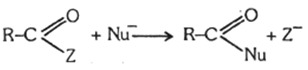
The rate of reaction is fastest when $Z$ is.....
A
$OCOCH_3$
B
$NH_2$
C
$OC_2H_5$
D
$Cl$
Solution
(D) In nucleophilic acyl substitution reactions,the rate of reaction depends on the ability of the group $Z$ to act as a leaving group.
The better the leaving group,the faster the reaction.
$A$ good leaving group is the conjugate base of a strong acid,which means it is a weak base.
Comparing the basicity of the leaving groups:
$Cl^-$ is the conjugate base of $HCl$ (a strong acid).
$OCOCH_3^-$ is the conjugate base of $CH_3COOH$ (a weak acid).
$OC_2H_5^-$ is the conjugate base of $C_2H_5OH$ (a very weak acid).
$NH_2^-$ is the conjugate base of $NH_3$ (an extremely weak acid).
Since $Cl^-$ is the weakest base among the given options,it is the best leaving group,making the reaction fastest when $Z = Cl$.
The better the leaving group,the faster the reaction.
$A$ good leaving group is the conjugate base of a strong acid,which means it is a weak base.
Comparing the basicity of the leaving groups:
$Cl^-$ is the conjugate base of $HCl$ (a strong acid).
$OCOCH_3^-$ is the conjugate base of $CH_3COOH$ (a weak acid).
$OC_2H_5^-$ is the conjugate base of $C_2H_5OH$ (a very weak acid).
$NH_2^-$ is the conjugate base of $NH_3$ (an extremely weak acid).
Since $Cl^-$ is the weakest base among the given options,it is the best leaving group,making the reaction fastest when $Z = Cl$.
0 likes
View Solution172
MediumMCQ
What is the correct order of acidic strength?
A
$HCOOH > CH_3COOH > C_2H_5COOH$
B
$C_2H_5COOH > CH_3COOH > HCOOH$
C
$HCOOH > C_2H_5COOH > CH_3COOH$
D
$CH_3COOH > HCOOH > C_2H_5COOH$
Solution
(A) The acidic strength of carboxylic acids is inversely proportional to the $+I$ (inductive) effect of the alkyl group attached to the carboxylate group.
$HCOOH$ has no alkyl group (only $H$),while $CH_3COOH$ has a methyl group ($+I$ effect) and $C_2H_5COOH$ has an ethyl group (stronger $+I$ effect than methyl).
As the $+I$ effect increases,the stability of the conjugate base decreases,thereby decreasing the acidic strength.
Therefore,the correct order is $HCOOH > CH_3COOH > C_2H_5COOH$.
$HCOOH$ has no alkyl group (only $H$),while $CH_3COOH$ has a methyl group ($+I$ effect) and $C_2H_5COOH$ has an ethyl group (stronger $+I$ effect than methyl).
As the $+I$ effect increases,the stability of the conjugate base decreases,thereby decreasing the acidic strength.
Therefore,the correct order is $HCOOH > CH_3COOH > C_2H_5COOH$.
0 likes
View Solution173
MediumMCQ
Arrange the following compounds in the correct decreasing order of their acidic strength:
$(I) HCOOH$
$(II) CH_3COOH$
$(III) CH_3CH_2COOH$
$(IV) C_6H_5COOH$
$(I) HCOOH$
$(II) CH_3COOH$
$(III) CH_3CH_2COOH$
$(IV) C_6H_5COOH$
A
$I > II > III > IV$
B
$IV > I > II > III$
C
$I > IV > II > III$
D
$IV > II > III > I$
Solution
(C) The acidic strength of carboxylic acids depends on the stability of the carboxylate ion formed after the loss of a proton.
Electron-donating groups (like alkyl groups) decrease acidity by destabilizing the carboxylate ion via the $+I$ effect.
Electron-withdrawing groups (like the phenyl group) increase acidity by stabilizing the carboxylate ion via the $-I$ and resonance effects.
Comparing the compounds:
$(I) HCOOH$: No alkyl group attached.
$(II) CH_3COOH$: Contains one methyl group ($+I$ effect).
$(III) CH_3CH_2COOH$: Contains an ethyl group ($+I$ effect,stronger than methyl).
$(IV) C_6H_5COOH$: Contains a phenyl group ($-I$ and resonance effect).
Order of acidity: $HCOOH > C_6H_5COOH > CH_3COOH > CH_3CH_2COOH$.
Thus,the correct order is $(I) > (IV) > (II) > (III)$.
Electron-donating groups (like alkyl groups) decrease acidity by destabilizing the carboxylate ion via the $+I$ effect.
Electron-withdrawing groups (like the phenyl group) increase acidity by stabilizing the carboxylate ion via the $-I$ and resonance effects.
Comparing the compounds:
$(I) HCOOH$: No alkyl group attached.
$(II) CH_3COOH$: Contains one methyl group ($+I$ effect).
$(III) CH_3CH_2COOH$: Contains an ethyl group ($+I$ effect,stronger than methyl).
$(IV) C_6H_5COOH$: Contains a phenyl group ($-I$ and resonance effect).
Order of acidity: $HCOOH > C_6H_5COOH > CH_3COOH > CH_3CH_2COOH$.
Thus,the correct order is $(I) > (IV) > (II) > (III)$.
0 likes
View Solution174
MediumMCQ
Which of the following is the strongest acid?
A
$CH_3CH_2COOH$
B
$ClCH_2CH_2COOH$
C
$ClCH_2COOH$
D
$CH_3COOH$
Solution
(C) The strength of carboxylic acids is determined by the stability of the conjugate base (carboxylate ion).
Electron-withdrawing groups (EWGs) like $Cl$ increase the acidity by stabilizing the negative charge through the inductive effect ($-I$ effect).
Comparing the given acids:
$1$. $CH_3CH_2COOH$ (Propanoic acid): Contains an electron-donating alkyl group,which decreases acidity.
$2$. $ClCH_2CH_2COOH$ ($3$-Chloropropanoic acid): The $Cl$ atom is at the $\gamma$-position relative to the carboxyl group,so its $-I$ effect is weak.
$3$. $ClCH_2COOH$ (Chloroacetic acid): The $Cl$ atom is at the $\alpha$-position,exerting a strong $-I$ effect,which significantly stabilizes the carboxylate ion.
$4$. $CH_3COOH$ (Acetic acid): Contains a methyl group,which is less electron-donating than the ethyl group in propanoic acid.
Therefore,$ClCH_2COOH$ is the strongest acid among the given options.
Electron-withdrawing groups (EWGs) like $Cl$ increase the acidity by stabilizing the negative charge through the inductive effect ($-I$ effect).
Comparing the given acids:
$1$. $CH_3CH_2COOH$ (Propanoic acid): Contains an electron-donating alkyl group,which decreases acidity.
$2$. $ClCH_2CH_2COOH$ ($3$-Chloropropanoic acid): The $Cl$ atom is at the $\gamma$-position relative to the carboxyl group,so its $-I$ effect is weak.
$3$. $ClCH_2COOH$ (Chloroacetic acid): The $Cl$ atom is at the $\alpha$-position,exerting a strong $-I$ effect,which significantly stabilizes the carboxylate ion.
$4$. $CH_3COOH$ (Acetic acid): Contains a methyl group,which is less electron-donating than the ethyl group in propanoic acid.
Therefore,$ClCH_2COOH$ is the strongest acid among the given options.
0 likes
View Solution175
MediumMCQ
Which of the following has the maximum $pK_a$ value?
A
$CH_2FCOOH$
B
$CH_2ClCOOH$
C
$CH_3COOH$
D
$HCOOH$
Solution
(C) The $pK_a$ value is inversely proportional to the acidic strength of the carboxylic acid.
Stronger acids have lower $pK_a$ values,while weaker acids have higher $pK_a$ values.
The acidic strength order is: $CH_2FCOOH > CH_2ClCOOH > HCOOH > CH_3COOH$.
Since $CH_3COOH$ is the weakest acid among the given options due to the $+I$ effect of the methyl group,it has the maximum $pK_a$ value.
Stronger acids have lower $pK_a$ values,while weaker acids have higher $pK_a$ values.
The acidic strength order is: $CH_2FCOOH > CH_2ClCOOH > HCOOH > CH_3COOH$.
Since $CH_3COOH$ is the weakest acid among the given options due to the $+I$ effect of the methyl group,it has the maximum $pK_a$ value.
0 likes
View Solution176
EasyMCQ
Which acid is the strongest?
A
$CH_3COOH$
B
$CH_2ClCOOH$
C
$CHCl_2COOH$
D
$CCl_3COOH$
Solution
(D) The acidic strength of carboxylic acids is directly proportional to the electron-withdrawing effect ($-I$ effect) of the substituents attached to the alpha-carbon.
As the number of chlorine atoms increases,the $-I$ effect increases,which stabilizes the carboxylate anion by dispersing the negative charge.
Therefore,the order of acidic strength is: $CH_3COOH < CH_2ClCOOH < CHCl_2COOH < CCl_3COOH$.
Thus,$CCl_3COOH$ is the strongest acid.
As the number of chlorine atoms increases,the $-I$ effect increases,which stabilizes the carboxylate anion by dispersing the negative charge.
Therefore,the order of acidic strength is: $CH_3COOH < CH_2ClCOOH < CHCl_2COOH < CCl_3COOH$.
Thus,$CCl_3COOH$ is the strongest acid.
0 likes
View Solution177
DifficultMCQ
Ionic species are stabilized by the dispersal of charge. Which of the following carboxylate ions is the most stable?
A
$CH_3-COO^-$
B
$Cl-CH_2-COO^-$
C
$F-CH_2-COO^-$
D
$F_2CH-COO^-$
Solution
(D) The stability of a carboxylate ion $(R-COO^-)$ is increased by the presence of electron-withdrawing groups (EWGs) attached to the alpha carbon.
These groups stabilize the negative charge through the inductive effect ($-I$ effect) by dispersing the charge density.
Comparing the given options:
$A$: $CH_3-COO^-$ (contains an electron-donating methyl group,which destabilizes the ion).
$B$: $Cl-CH_2-COO^-$ (contains one $Cl$ atom,which has a $-I$ effect).
$C$: $F-CH_2-COO^-$ (contains one $F$ atom,which has a stronger $-I$ effect than $Cl$).
$D$: $F_2CH-COO^-$ (contains two $F$ atoms,which exert a much stronger combined $-I$ effect than a single $F$ or $Cl$ atom).
Since the $-I$ effect is additive and distance-dependent,the presence of two fluorine atoms provides the greatest dispersal of the negative charge,making $F_2CH-COO^-$ the most stable carboxylate ion.
These groups stabilize the negative charge through the inductive effect ($-I$ effect) by dispersing the charge density.
Comparing the given options:
$A$: $CH_3-COO^-$ (contains an electron-donating methyl group,which destabilizes the ion).
$B$: $Cl-CH_2-COO^-$ (contains one $Cl$ atom,which has a $-I$ effect).
$C$: $F-CH_2-COO^-$ (contains one $F$ atom,which has a stronger $-I$ effect than $Cl$).
$D$: $F_2CH-COO^-$ (contains two $F$ atoms,which exert a much stronger combined $-I$ effect than a single $F$ or $Cl$ atom).
Since the $-I$ effect is additive and distance-dependent,the presence of two fluorine atoms provides the greatest dispersal of the negative charge,making $F_2CH-COO^-$ the most stable carboxylate ion.
0 likes
View Solution178
MediumMCQ
Considering the acidity of carboxylic acids:
$(I) PhCOOH$
$(II) o-NO_2C_6H_4COOH$
$(III) p-NO_2C_6H_4COOH$
$(IV) m-NO_2C_6H_4COOH$
What is the correct order of acidic strength?
$(I) PhCOOH$
$(II) o-NO_2C_6H_4COOH$
$(III) p-NO_2C_6H_4COOH$
$(IV) m-NO_2C_6H_4COOH$
What is the correct order of acidic strength?
A
$I > II > III > IV$
B
$II > IV > III > I$
C
$II > IV > I > III$
D
$II > III > IV > I$
Solution
(D) The acidity of substituted benzoic acids is determined by the electronic effects of the substituents.
$1$. The $-NO_2$ group is a strong electron-withdrawing group ($-I$ and $-M$ effect).
$2$. In $(II)$ $o-NO_2C_6H_4COOH$,the ortho effect significantly increases the acidity compared to other isomers.
$3$. In $(III)$ $p-NO_2C_6H_4COOH$,the $-NO_2$ group exerts both $-I$ and $-M$ effects,making it more acidic than $(IV)$ $m-NO_2C_6H_4COOH$,where only the $-I$ effect operates.
$4$. $(I)$ $PhCOOH$ has no electron-withdrawing group,so it is the least acidic.
Therefore,the correct order of acidic strength is $(II) > (III) > (IV) > (I)$.
$1$. The $-NO_2$ group is a strong electron-withdrawing group ($-I$ and $-M$ effect).
$2$. In $(II)$ $o-NO_2C_6H_4COOH$,the ortho effect significantly increases the acidity compared to other isomers.
$3$. In $(III)$ $p-NO_2C_6H_4COOH$,the $-NO_2$ group exerts both $-I$ and $-M$ effects,making it more acidic than $(IV)$ $m-NO_2C_6H_4COOH$,where only the $-I$ effect operates.
$4$. $(I)$ $PhCOOH$ has no electron-withdrawing group,so it is the least acidic.
Therefore,the correct order of acidic strength is $(II) > (III) > (IV) > (I)$.
0 likes
View Solution179
EasyMCQ
What is the correct order of acidity for the given compounds?
A
$FCH_2COOH > CH_3COOH > BrCH_2COOH > ClCH_2COOH$
B
$BrCH_2COOH > ClCH_2COOH > FCH_2COOH > CH_3COOH$
C
$FCH_2COOH > ClCH_2COOH > BrCH_2COOH > CH_3COOH$
D
$CH_3COOH > BrCH_2COOH > ClCH_2COOH > FCH_2COOH$
Solution
(C) The acidity of carboxylic acids is determined by the stability of the conjugate base (carboxylate ion).
Electron-withdrawing groups ($-I$ effect) stabilize the carboxylate ion and increase acidity,while electron-donating groups (like the methyl group) decrease it.
The strength of the $-I$ effect follows the order: $F > Cl > Br > I$.
Therefore,the acidity order is $FCH_2COOH > ClCH_2COOH > BrCH_2COOH > CH_3COOH$.
Electron-withdrawing groups ($-I$ effect) stabilize the carboxylate ion and increase acidity,while electron-donating groups (like the methyl group) decrease it.
The strength of the $-I$ effect follows the order: $F > Cl > Br > I$.
Therefore,the acidity order is $FCH_2COOH > ClCH_2COOH > BrCH_2COOH > CH_3COOH$.
0 likes
View Solution180
EasyMCQ
Which ester is used as a medicine?
A
Ethyl acetate
B
Methyl acetate
C
Methyl salicylate
D
Ethyl benzoate
Solution
(C) $Methyl \ salicylate$ is commonly known as oil of wintergreen. It is used in medicinal preparations,particularly in ointments and balms,for its analgesic and anti-inflammatory properties to relieve muscle and joint pain.
0 likes
View Solution181
EasyMCQ
What is obtained by the reaction of salicylic acid with acetic anhydride?
A
Aspirin
B
Paracetamol
C
Salol
D
Chloramphenicol
Solution
(A) The reaction of salicylic acid $(C_7H_6O_3)$ with acetic anhydride $((CH_3CO)_2O)$ in the presence of an acid catalyst is known as acetylation.
This reaction produces acetylsalicylic acid,which is commonly known as $Aspirin$ and acetic acid as a byproduct.
The chemical equation is: $C_6H_4(OH)COOH + (CH_3CO)_2O \rightarrow C_6H_4(OCOCH_3)COOH + CH_3COOH$.
This reaction produces acetylsalicylic acid,which is commonly known as $Aspirin$ and acetic acid as a byproduct.
The chemical equation is: $C_6H_4(OH)COOH + (CH_3CO)_2O \rightarrow C_6H_4(OCOCH_3)COOH + CH_3COOH$.
0 likes
View Solution182
MediumMCQ
Which of the following reactions with ethanol produces a fruity smell?
A
$PCl_5$
B
$CH_3COCH_3$
C
$CH_3COOH$
D
None of these
Solution
(C) The reaction between ethanol and acetic acid in the presence of an acid catalyst $(H^+)$ is an esterification reaction:
$C_2H_5OH + CH_3COOH \xrightarrow{H^+} CH_3COOC_2H_5 + H_2O$
The product formed is ethyl acetate,which is an ester.
Esters are known for their characteristic fruity,sweet smell.
$C_2H_5OH + CH_3COOH \xrightarrow{H^+} CH_3COOC_2H_5 + H_2O$
The product formed is ethyl acetate,which is an ester.
Esters are known for their characteristic fruity,sweet smell.
0 likes
View Solution183
EasyMCQ
Which reagent is used to convert ethanoic acid into ethanol?
A
$LiAlH_4$
B
$BH_3$
C
$PCl_3$
D
$K_2Cr_2O_7/H^{+}$
Solution
(A) Carboxylic acids are reduced to primary alcohols using strong reducing agents like lithium aluminium hydride $(LiAlH_4)$.
The reaction is: $CH_3COOH + 4[H] \xrightarrow{LiAlH_4} CH_3CH_2OH + H_2O$.
The reaction is: $CH_3COOH + 4[H] \xrightarrow{LiAlH_4} CH_3CH_2OH + H_2O$.
0 likes
View Solution184
MediumMCQ
What is the reaction between an alcohol and a carboxylic acid called?
A
Esterification
B
Hydrolysis
C
Saponification
D
Hydrogenation
Solution
(A) The reaction between an alcohol and a carboxylic acid produces an ester. Therefore,this reaction is called esterification.
$RCOOH + R'OH \to RCOOR' + H_2O$
$\text{Carboxylic acid} + \text{Alcohol} \to \text{Ester} + \text{Water}$
$RCOOH + R'OH \to RCOOR' + H_2O$
$\text{Carboxylic acid} + \text{Alcohol} \to \text{Ester} + \text{Water}$
0 likes
View Solution185
MediumMCQ
Which of the following reagents will convert propanoic acid into propan$-1-$ol?
A
$KMnO_4$
B
$MnO_2$
C
$Cr_2O_3$
D
$LiAlH_4$
Solution
(D) Carboxylic acids are reduced to primary alcohols by strong reducing agents like lithium aluminium hydride $(LiAlH_4)$.
The reaction is:
$CH_3CH_2COOH \xrightarrow{LiAlH_4} CH_3CH_2CH_2OH$
Thus,$LiAlH_4$ is the correct reagent.
The reaction is:
$CH_3CH_2COOH \xrightarrow{LiAlH_4} CH_3CH_2CH_2OH$
Thus,$LiAlH_4$ is the correct reagent.
0 likes
View Solution186
MediumMCQ
Identify the correct order of boiling points for the following compounds:
$I. \, CH_3CH_2CH_2CH_2OH$
$II. \, CH_3CH_2CH_2CHO$
$III. \, CH_3CH_2CH_2COOH$
$I. \, CH_3CH_2CH_2CH_2OH$
$II. \, CH_3CH_2CH_2CHO$
$III. \, CH_3CH_2CH_2COOH$
A
$I > II > III$
B
$III > I > II$
C
$I > III > II$
D
$III > II > I$
Solution
(B) The boiling point depends on the strength of intermolecular forces,primarily hydrogen bonding and dipole-dipole interactions.
$III$ $(CH_3CH_2CH_2COOH)$ is a carboxylic acid,which forms strong intermolecular hydrogen bonds (dimers),leading to the highest boiling point.
$I$ $(CH_3CH_2CH_2CH_2OH)$ is an alcohol,which also forms intermolecular hydrogen bonds,but they are generally weaker than those in carboxylic acids.
$II$ $(CH_3CH_2CH_2CHO)$ is an aldehyde,which exhibits only dipole-dipole interactions and lacks hydrogen bonding,resulting in the lowest boiling point.
Therefore,the correct order is $III > I > II$.
$III$ $(CH_3CH_2CH_2COOH)$ is a carboxylic acid,which forms strong intermolecular hydrogen bonds (dimers),leading to the highest boiling point.
$I$ $(CH_3CH_2CH_2CH_2OH)$ is an alcohol,which also forms intermolecular hydrogen bonds,but they are generally weaker than those in carboxylic acids.
$II$ $(CH_3CH_2CH_2CHO)$ is an aldehyde,which exhibits only dipole-dipole interactions and lacks hydrogen bonding,resulting in the lowest boiling point.
Therefore,the correct order is $III > I > II$.
0 likes
View Solution187
MediumMCQ
Which of the following compounds reacts with $NaHCO_3$ solution to produce a sodium salt and $CO_2$ gas: phenol,acetic acid,or $n$-hexanol?
A
Acetic acid and phenol
B
Acetic acid
C
Phenol
D
$n$-hexanol
Solution
(B) Carboxylic acids,such as acetic acid $(CH_3COOH)$,are stronger acids than carbonic acid $(H_2CO_3)$.
Therefore,they react with sodium bicarbonate $(NaHCO_3)$ to evolve $CO_2$ gas.
Phenol and $n$-hexanol are much weaker acids than carbonic acid and do not react with $NaHCO_3$ to release $CO_2$.
Therefore,they react with sodium bicarbonate $(NaHCO_3)$ to evolve $CO_2$ gas.
Phenol and $n$-hexanol are much weaker acids than carbonic acid and do not react with $NaHCO_3$ to release $CO_2$.
0 likes
View Solution188
MediumMCQ
Identify $Z$ in the following reaction:
$1,2-bis(hydroxymethyl)benzene$ $\xrightarrow[\text{Vigorous Oxidation}]{} X$ $\xrightarrow[\text{Dry Heating}]{} Z$
$1,2-bis(hydroxymethyl)benzene$ $\xrightarrow[\text{Vigorous Oxidation}]{} X$ $\xrightarrow[\text{Dry Heating}]{} Z$
A
Phthalic acid
B
Phthalic anhydride
C
Benzoic acid
D
Phthalimide
Solution
(B) The starting material is $1,2-bis(hydroxymethyl)benzene$ (also known as $o-xylene$ glycol).
$1$. Vigorous oxidation of $1,2-bis(hydroxymethyl)benzene$ using a strong oxidizing agent (like $KMnO_4$) converts the two $-CH_2OH$ groups into $-COOH$ groups,forming $X$,which is Phthalic acid $(benzene-1,2-dicarboxylic \ acid)$.
$2$. Upon dry heating,Phthalic acid undergoes dehydration to form $Z$,which is Phthalic anhydride.
The reaction sequence is:
$1,2-bis(hydroxymethyl)benzene$ $\xrightarrow[\text{Oxidation}]{} \text{Phthalic acid} (X)$ $\xrightarrow[\text{Heating}]{} \text{Phthalic anhydride} (Z) + H_2O$.
$1$. Vigorous oxidation of $1,2-bis(hydroxymethyl)benzene$ using a strong oxidizing agent (like $KMnO_4$) converts the two $-CH_2OH$ groups into $-COOH$ groups,forming $X$,which is Phthalic acid $(benzene-1,2-dicarboxylic \ acid)$.
$2$. Upon dry heating,Phthalic acid undergoes dehydration to form $Z$,which is Phthalic anhydride.
The reaction sequence is:
$1,2-bis(hydroxymethyl)benzene$ $\xrightarrow[\text{Oxidation}]{} \text{Phthalic acid} (X)$ $\xrightarrow[\text{Heating}]{} \text{Phthalic anhydride} (Z) + H_2O$.
0 likes
View Solution189
MediumMCQ
The rearrangement of phenyl esters to $o-$ and $p-$ hydroxy ketones in the presence of $AlCl_3$ is known as:
A
Friedel-Crafts reaction
B
Fries rearrangement
C
Esterification
D
Coupling
Solution
(B) The reaction where phenyl esters undergo rearrangement in the presence of anhydrous $AlCl_3$ to yield $o-$ and $p-$ hydroxy ketones is known as the Fries rearrangement.
The reaction is as follows:
$Phenyl \ acetate \xrightarrow{Anhyd. AlCl_3, \Delta} o-Hydroxyacetophenone + p-Hydroxyacetophenone$
The reaction is as follows:
$Phenyl \ acetate \xrightarrow{Anhyd. AlCl_3, \Delta} o-Hydroxyacetophenone + p-Hydroxyacetophenone$
0 likes
View Solution190
MediumMCQ
Which of the following substances is known as oil of wintergreen?
A
Phenyl benzoate
B
Phenyl salicylate
C
Phenyl acetate
D
Methyl salicylate
Solution
(D) Methyl salicylate is commonly known as oil of wintergreen. Its chemical structure is $C_6H_4(OH)(COOCH_3)$.
0 likes
View Solution191
MediumMCQ
When compound $A$ reacts with methyl alcohol in the presence of a few drops of $H_2SO_4$,it forms oil of wintergreen. What is compound $A$?
A
Succinic acid
B
Salicylic acid
C
Tartaric acid
D
Oxalic acid
Solution
(B) The reaction of salicylic acid with methyl alcohol in the presence of $H_2SO_4$ (esterification) produces methyl salicylate,which is known as oil of wintergreen.
0 likes
View Solution192
MediumMCQ
What is the product $X$ in the following reaction?
$CH_3CHO + CH_2(COOH)_2 \xrightarrow{\Delta} X$
$CH_3CHO + CH_2(COOH)_2 \xrightarrow{\Delta} X$
A
$CH_3COOH$
B
$C_2H_5COOH$
C
$CH_3CH=CHCOOH$
D
$HOOC-CH=CH-COOH$
Solution
(C) The reaction is a Knoevenagel condensation followed by decarboxylation.
$CH_3CHO + CH_2(COOH)_2$ $\xrightarrow{\Delta} CH_3CH=C(COOH)_2$ $\xrightarrow{-\text{CO}_2} CH_3CH=CHCOOH$ (Crotonic acid).
Thus,the product $X$ is $CH_3CH=CHCOOH$.
$CH_3CHO + CH_2(COOH)_2$ $\xrightarrow{\Delta} CH_3CH=C(COOH)_2$ $\xrightarrow{-\text{CO}_2} CH_3CH=CHCOOH$ (Crotonic acid).
Thus,the product $X$ is $CH_3CH=CHCOOH$.
0 likes
View Solution193
MediumMCQ
What does the product obtained from the reaction of acetaldehyde with $HCN$ followed by hydrolysis exhibit?
A
Metamerism
B
Tautomerism
C
Enantiomerism
D
Geometrical isomerism
Solution
(C) The reaction of acetaldehyde with $HCN$ forms a cyanohydrin,which upon hydrolysis yields lactic acid $(2-hydroxypropanoic \ acid)$.
$CH_3CHO + HCN \to CH_3CH(OH)CN \xrightarrow{H_3O^+} CH_3CH(OH)COOH$.
Lactic acid contains a chiral carbon atom (the central carbon bonded to $-H, -OH, -CH_3, -COOH$ groups).
Due to the presence of this chiral center,lactic acid exists as two non-superimposable mirror images,thus exhibiting enantiomerism.
$CH_3CHO + HCN \to CH_3CH(OH)CN \xrightarrow{H_3O^+} CH_3CH(OH)COOH$.
Lactic acid contains a chiral carbon atom (the central carbon bonded to $-H, -OH, -CH_3, -COOH$ groups).
Due to the presence of this chiral center,lactic acid exists as two non-superimposable mirror images,thus exhibiting enantiomerism.
0 likes
View Solution194
MediumMCQ
$A$ is a high molecular weight phenol and $B$ is an aromatic carboxylic acid. Which of the following would you use to separate a mixture of $A$ and $B$?
A
$NaOH$
B
$Na_2CO_3$
C
Lime
D
$NaHCO_3$
Solution
(D) Phenols are less acidic than carboxylic acids and do not react with $NaHCO_3$ to evolve $CO_2$ gas.
Carboxylic acids react with $NaHCO_3$ to form water-soluble sodium carboxylate salts.
Therefore,$NaHCO_3$ can be used to extract the carboxylic acid $(B)$ from the mixture,leaving the phenol $(A)$ in the organic phase.
Carboxylic acids react with $NaHCO_3$ to form water-soluble sodium carboxylate salts.
Therefore,$NaHCO_3$ can be used to extract the carboxylic acid $(B)$ from the mixture,leaving the phenol $(A)$ in the organic phase.
0 likes
View Solution195
MediumMCQ
$2CH_3COOH \xrightarrow{P_2O_5} ........;$ What will be the product of this reaction?
A
$CO$ and $H_2O$
B
Formic acid
C
Ethanoic anhydride
D
Ethyl ethanoate
Solution
(C) The reaction of acetic acid with $P_2O_5$ (a dehydrating agent) leads to the formation of ethanoic anhydride.
$2CH_3COOH \xrightarrow{P_2O_5, \Delta} (CH_3CO)_2O + H_2O$
Here,$CH_3COOH$ is acetic acid and $(CH_3CO)_2O$ is ethanoic anhydride.
$2CH_3COOH \xrightarrow{P_2O_5, \Delta} (CH_3CO)_2O + H_2O$
Here,$CH_3COOH$ is acetic acid and $(CH_3CO)_2O$ is ethanoic anhydride.
0 likes
View Solution196
MediumMCQ
$RCH_2CH_2COOH \xrightarrow[P]{Br_2} RCH_2CH(Br)COOH$. What is this reaction called?
A
Reimer-Tiemann reaction
B
Hell-Volhard-Zelinsky reaction
C
Cannizzaro reaction
D
Sandmeyer reaction
Solution
(B) The reaction of carboxylic acids having an $\alpha$-hydrogen with bromine or chlorine in the presence of a small amount of red phosphorus to produce $\alpha$-halo carboxylic acids is known as the $Hell-Volhard-Zelinsky$ $(HVZ)$ reaction.
0 likes
View Solution197
MediumMCQ
What is glacial acetic acid?
A
Pure acetic acid at $100\,^{\circ}C$
B
Acetic acid mixed with methanol
C
Pure acetic acid at $0\,^{\circ}C$
D
Pure acetic acid at around $16.6\,^{\circ}C$
Solution
(D) Pure acetic acid has a melting point of $16.6\,^{\circ}C$.
At temperatures below this,it forms ice-like crystals,which is why it is known as glacial acetic acid.
At temperatures below this,it forms ice-like crystals,which is why it is known as glacial acetic acid.
0 likes
View Solution198
MediumMCQ
What is obtained when oxalic acid is dehydrated in the presence of concentrated $H_2SO_4$?
A
$C + CO_2$
B
$CO$
C
$CO_2$
D
$CO + CO_2$
Solution
(D) Oxalic acid undergoes dehydration in the presence of concentrated $H_2SO_4$ to produce carbon monoxide,carbon dioxide,and water.
The chemical reaction is as follows:
$(COOH)_2 \xrightarrow{conc. H_2SO_4} CO + CO_2 + H_2O$
The chemical reaction is as follows:
$(COOH)_2 \xrightarrow{conc. H_2SO_4} CO + CO_2 + H_2O$
0 likes
View Solution199
MediumMCQ
What is formed when $CH_3COOH$ reacts with $PCl_5$?
A
$CH_2ClCOOH$
B
$CHCl_2COOH$
C
$CH_3COCl$
D
$CH_3CH_2Cl$
Solution
(C) The reaction of acetic acid $(CH_3COOH)$ with phosphorus pentachloride $(PCl_5)$ yields acetyl chloride $(CH_3COCl)$ along with phosphorus oxychloride $(POCl_3)$ and hydrogen chloride $(HCl)$.
The chemical equation is:
$CH_3COOH + PCl_5 \to CH_3COCl + POCl_3 + HCl$
The chemical equation is:
$CH_3COOH + PCl_5 \to CH_3COCl + POCl_3 + HCl$
0 likes
View Solution200
MediumMCQ
Which of the following substances produces ethane upon heating with soda lime?
A
Ethanoic acid
B
Methanoic acid
C
Propanoic acid
D
$A$ or $B$
Solution
(C) Decarboxylation of carboxylic acids with soda lime $(NaOH + CaO)$ removes one carbon atom from the chain as $Na_2CO_3$.
To obtain ethane $(C_2H_6)$,we need a carboxylic acid with three carbon atoms.
Propanoic acid $(CH_3CH_2COOH)$ undergoes decarboxylation to form ethane $(CH_3CH_3)$:
$CH_3CH_2COOH + NaOH \xrightarrow{CaO} CH_3CH_3 + Na_2CO_3$.
To obtain ethane $(C_2H_6)$,we need a carboxylic acid with three carbon atoms.
Propanoic acid $(CH_3CH_2COOH)$ undergoes decarboxylation to form ethane $(CH_3CH_3)$:
$CH_3CH_2COOH + NaOH \xrightarrow{CaO} CH_3CH_3 + Na_2CO_3$.
0 likes
View Solution8-2.Carboxylic acids and Their derivative — Properties of Carboxylic Acids and Their Derivatives · Frequently Asked Questions
1Are these 8-2.Carboxylic acids and Their derivative questions useful for JEE and NEET?
Yes. All questions in this section are mapped to JEE Main and NEET exam patterns. Previous year questions from JEE Main, NEET, GUJCET and state-level exams are included with full solutions.
2Can I switch to Hindi or Gujarati for these questions?
Yes. Use the language tabs in the hero section or the sidebar to view the same questions and solutions in English, Hindi or Gujarati.
3How do I generate a question paper from this subtopic?
Use the Vedclass Exam Paper Generator — select the chapter and subtopic, set difficulty, and generate Sets A, B, C, D automatically. First 3 chapters of every subject are free.
Vedclass Products
For Students
Vedclass Test Series
Mock tests in real JEE/NEET style with performance analysis. 5-day free trial.
Start Free TrialFor Teachers
Exam Paper Generator
Generate Set A/B/C/D papers from this chapter in 2 minutes. 3 chapters free.
Try FreeFor Institutes
Online Exam Module
Live online exams with unlimited students, 360° analytics & white-label branding.
See DemoFor Teachers & Institutes
Generate a 8-2.Carboxylic acids and Their derivative Exam Paper in 2 Minutes
Select subtopic & difficulty — Sets A, B, C, D auto-generated with No Repeat logic.
First 3 chapters of every subject are free — no payment required.