
A English
Preparation of Carboxylic Acids and Their Derivatives Questions in English
Class 12 Chemistry · 8-2.Carboxylic acids and Their derivative · Preparation of Carboxylic Acids and Their Derivatives
150+
Questions
English
Language
100%
With Solutions
Showing 50 of 150 questions in English
51
MediumMCQ
Which of the following reagents is used for the conversion of $CH_3OH$ to $CH_3COOH$?
A
$K_2Cr_2O_7 / H^+$
B
$CO / Rh$
C
$KMnO_4$
D
$H_3PO_4$
Solution
(B) The conversion of methanol $(CH_3OH)$ to acetic acid $(CH_3COOH)$ is an industrial process known as the Monsanto process or carbonylation of methanol.
In this reaction,methanol reacts with carbon monoxide $(CO)$ in the presence of a rhodium $(Rh)$ catalyst to produce acetic acid.
The chemical equation is: $CH_3OH + CO \xrightarrow{Rh} CH_3COOH$.
In this reaction,methanol reacts with carbon monoxide $(CO)$ in the presence of a rhodium $(Rh)$ catalyst to produce acetic acid.
The chemical equation is: $CH_3OH + CO \xrightarrow{Rh} CH_3COOH$.
0 likes
View Solution52
MediumMCQ
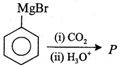
What is $P$ in the following reaction?
A
Benzaldehyde
B
Benzoic acid
C
Phenol
D
Benzophenone
Solution
(B) The reaction of a Grignard reagent $(C_6H_5MgBr)$ with carbon dioxide $(CO_2)$ followed by acid hydrolysis $(H_3O^+)$ is a standard method for the preparation of carboxylic acids.
The reaction proceeds as follows:
$C_6H_5MgBr + CO_2 \rightarrow C_6H_5COOMgBr$
$C_6H_5COOMgBr + H_3O^+ \rightarrow C_6H_5COOH + Mg(OH)Br$
Thus,the product $P$ is benzoic acid $(C_6H_5COOH)$.
The reaction proceeds as follows:
$C_6H_5MgBr + CO_2 \rightarrow C_6H_5COOMgBr$
$C_6H_5COOMgBr + H_3O^+ \rightarrow C_6H_5COOH + Mg(OH)Br$
Thus,the product $P$ is benzoic acid $(C_6H_5COOH)$.
0 likes
View Solution53
MediumMCQ
Which of the following methods is used to prepare acetic acid?
A
Oxidation of methyl alcohol with potassium permanganate
B
Distillation of calcium acetate in the presence of calcium formate
C
Oxidation of acetaldehyde in the presence of potassium dichromate and acid
D
Heating glycerol with sulfuric acid
Solution
(C) Acetic acid is prepared by the oxidation of acetaldehyde using an oxidizing agent like potassium dichromate $(K_2Cr_2O_7)$ in the presence of sulfuric acid $(H_2SO_4)$.
The chemical reaction is:
$CH_3CHO + [O] \xrightarrow{K_2Cr_2O_7 + H_2SO_4} CH_3COOH$
Acetaldehyde $\rightarrow$ Acetic acid
The chemical reaction is:
$CH_3CHO + [O] \xrightarrow{K_2Cr_2O_7 + H_2SO_4} CH_3COOH$
Acetaldehyde $\rightarrow$ Acetic acid
0 likes
View Solution54
MediumMCQ
Which reaction is suitable for the preparation of $\alpha$-chloroacetic acid?
A
Hell-Volhard-Zelinsky reaction
B
Stephen reaction
C
Perkin reaction
D
None of these
Solution
(A) The $Hell-Volhard-Zelinsky$ $(HVZ)$ reaction is the most suitable method for the preparation of $\alpha$-halocarboxylic acids,such as $\alpha$-chloroacetic acid,by reacting a carboxylic acid containing an $\alpha$-hydrogen with $Cl_2$ or $Br_2$ in the presence of a small amount of red phosphorus.
0 likes
View Solution55
MediumMCQ
Which of the following processes can be used to oxidize toluene to benzoic acid?
A
Alkaline $KMnO_4$
B
Acidic $KMnO_4$
C
Both $A$ and $B$
D
None of these
Solution
(C) Toluene can be oxidized to benzoic acid using strong oxidizing agents like alkaline $KMnO_4$ (followed by acidification) or acidic $KMnO_4$ or acidic $K_2Cr_2O_7$.
Both alkaline $KMnO_4$ and acidic $KMnO_4$ are effective reagents for this transformation.
Therefore,the correct answer is both $A$ and $B$.
Both alkaline $KMnO_4$ and acidic $KMnO_4$ are effective reagents for this transformation.
Therefore,the correct answer is both $A$ and $B$.
0 likes
View Solution56
MediumMCQ
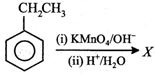
What will be $X$ in the following reaction?
A
Phenylacetic acid
B
Phenylacetaldehyde
C
Benzoic acid
D
Benzaldehyde
Solution
(C) During the oxidation of alkylbenzenes with alkaline $KMnO_4$,the entire side chain is oxidized to a carboxyl group $(-COOH)$,regardless of the length of the side chain,provided that the benzylic carbon has at least one hydrogen atom. In this reaction,ethylbenzene is oxidized to benzoic acid.
0 likes
View Solution57
MediumMCQ
What is obtained when toluene is chlorinated in the presence of light and heat,followed by treatment with aqueous $NaOH$?
A
$o-$cresol
B
$p-$cresol
C
$1,3,5-$trihydroxytoluene
D
Benzoic acid
Solution
(D) $1$. Chlorination of toluene in the presence of light $(h\nu)$ and heat $(\Delta)$ leads to the formation of benzotrichloride $(C_6H_5CCl_3)$.
$2$. When benzotrichloride is treated with aqueous $NaOH$,the three chlorine atoms are replaced by hydroxyl groups to form an unstable intermediate,phenylmethanetriol $(C_6H_5C(OH)_3)$.
$3$. This intermediate loses a water molecule to form benzoic acid $(C_6H_5COOH)$,which exists as sodium benzoate $(C_6H_5COONa)$ in the presence of excess $NaOH$. Upon acidification,it yields benzoic acid.
$2$. When benzotrichloride is treated with aqueous $NaOH$,the three chlorine atoms are replaced by hydroxyl groups to form an unstable intermediate,phenylmethanetriol $(C_6H_5C(OH)_3)$.
$3$. This intermediate loses a water molecule to form benzoic acid $(C_6H_5COOH)$,which exists as sodium benzoate $(C_6H_5COONa)$ in the presence of excess $NaOH$. Upon acidification,it yields benzoic acid.
0 likes
View Solution58
MediumMCQ
Which of the following reagents is the correct sequence for the conversion of $R-CH_2-CH_2OH$ to $R-CH_2-CH_2-COOH$?
A
$PBr_3, KCN, H_3O^+$
B
$PBr_3, KCN, H_2$
C
$KCN, H^+$
D
$HCN, PBr_3, H^+$
Solution
(A) The conversion of an alcohol to a carboxylic acid with an additional carbon atom involves the following steps:
$1$. Conversion of alcohol to alkyl bromide: $R-CH_2-CH_2OH \xrightarrow{PBr_3} R-CH_2-CH_2Br$
$2$. Nucleophilic substitution with cyanide: $R-CH_2-CH_2Br \xrightarrow{KCN} R-CH_2-CH_2CN$
$3$. Acidic hydrolysis of nitrile to carboxylic acid: $R-CH_2-CH_2CN \xrightarrow{H_3O^+} R-CH_2-CH_2COOH$
Thus,the correct sequence of reagents is $PBr_3, KCN, H_3O^+$.
$1$. Conversion of alcohol to alkyl bromide: $R-CH_2-CH_2OH \xrightarrow{PBr_3} R-CH_2-CH_2Br$
$2$. Nucleophilic substitution with cyanide: $R-CH_2-CH_2Br \xrightarrow{KCN} R-CH_2-CH_2CN$
$3$. Acidic hydrolysis of nitrile to carboxylic acid: $R-CH_2-CH_2CN \xrightarrow{H_3O^+} R-CH_2-CH_2COOH$
Thus,the correct sequence of reagents is $PBr_3, KCN, H_3O^+$.
0 likes
View Solution59
MediumMCQ
How is glacial acetic acid obtained?
A
By distillation of vinegar
B
By crystallization,separation,and melting of acetic acid
C
By reacting vinegar with a dehydrating agent
D
By chemically separating acetic acid
Solution
(B) The freezing point of pure acetic acid is $16.6 \ ^{\circ}C$.
It is obtained by cooling acetic acid until it crystallizes,separating the crystals,and then melting them to obtain pure glacial acetic acid.
It is obtained by cooling acetic acid until it crystallizes,separating the crystals,and then melting them to obtain pure glacial acetic acid.
0 likes
View Solution60
MediumMCQ
Identify the product $C$ in the following reaction sequence:
$CH_3CN$ $\xrightarrow{Na/C_2H_5OH} A$ $\xrightarrow{HNO_2} B$ $\xrightarrow{Cr_2O_7^{2-}} C$
$CH_3CN$ $\xrightarrow{Na/C_2H_5OH} A$ $\xrightarrow{HNO_2} B$ $\xrightarrow{Cr_2O_7^{2-}} C$
A
$CH_3COOH$
B
$CH_3CH_2NHOH$
C
$CH_3CONH_2$
D
$CH_3CHO$
Solution
(A) Step $1$: Reduction of acetonitrile $(CH_3CN)$ with $Na/C_2H_5OH$ (Mendius reduction) gives ethylamine $(A)$:
$CH_3CN + 4[H] \xrightarrow{Na/C_2H_5OH} CH_3CH_2NH_2$ $(A)$.
Step $2$: Reaction of ethylamine $(A)$ with nitrous acid $(HNO_2)$ gives ethanol $(B)$:
$CH_3CH_2NH_2 + HNO_2 \rightarrow CH_3CH_2OH + N_2 + H_2O$ $(B)$.
Step $3$: Oxidation of ethanol $(B)$ with potassium dichromate $(Cr_2O_7^{2-}/H^+)$ gives acetic acid $(C)$:
$CH_3CH_2OH \xrightarrow{[O]} CH_3COOH$ $(C)$.
$CH_3CN + 4[H] \xrightarrow{Na/C_2H_5OH} CH_3CH_2NH_2$ $(A)$.
Step $2$: Reaction of ethylamine $(A)$ with nitrous acid $(HNO_2)$ gives ethanol $(B)$:
$CH_3CH_2NH_2 + HNO_2 \rightarrow CH_3CH_2OH + N_2 + H_2O$ $(B)$.
Step $3$: Oxidation of ethanol $(B)$ with potassium dichromate $(Cr_2O_7^{2-}/H^+)$ gives acetic acid $(C)$:
$CH_3CH_2OH \xrightarrow{[O]} CH_3COOH$ $(C)$.
0 likes
View Solution61
MediumMCQ
Pyruvic acid is obtained by
A
Oxidation of acetaldehyde cyanohydrin
B
Oxidation of acetone cyanohydrin
C
Oxidation of formaldehyde cyanohydrin
D
None of these
Solution
(A) The synthesis of pyruvic acid involves the reaction of acetaldehyde with hydrogen cyanide to form acetaldehyde cyanohydrin.
$CH_3CHO + HCN \to CH_3CH(OH)CN$
Hydrolysis of the cyanohydrin yields lactic acid.
$CH_3CH(OH)CN + 2H_2O \to CH_3CH(OH)COOH + NH_3$
Finally,the oxidation of the secondary alcohol group in lactic acid gives pyruvic acid.
$CH_3CH(OH)COOH + [O] \to CH_3COCOOH + H_2O$
$CH_3CHO + HCN \to CH_3CH(OH)CN$
Hydrolysis of the cyanohydrin yields lactic acid.
$CH_3CH(OH)CN + 2H_2O \to CH_3CH(OH)COOH + NH_3$
Finally,the oxidation of the secondary alcohol group in lactic acid gives pyruvic acid.
$CH_3CH(OH)COOH + [O] \to CH_3COCOOH + H_2O$
0 likes
View Solution62
MediumMCQ
The compound formed as a result of oxidation of ethyl benzene by $KMnO_4$ is
A
benzyl alcohol
B
benzophenone
C
acetophenone
D
benzoic acid
Solution
(D) When alkyl benzenes (like ethyl benzene) are treated with strong oxidizing agents such as alkaline $KMnO_4$,the alkyl side chain is oxidized to a carboxylic acid group $(-COOH)$ attached to the benzene ring,regardless of the length of the alkyl chain,provided that the benzylic carbon has at least one hydrogen atom.
In the case of ethyl benzene $(C_6H_5-CH_2-CH_3)$,the benzylic carbon has two hydrogen atoms,so it undergoes oxidation to form benzoic acid $(C_6H_5-COOH)$.
In the case of ethyl benzene $(C_6H_5-CH_2-CH_3)$,the benzylic carbon has two hydrogen atoms,so it undergoes oxidation to form benzoic acid $(C_6H_5-COOH)$.
0 likes
View Solution63
MediumMCQ
By which of the following sequence of steps can the alcohol $RCH_2CH_2OH (X)$ be converted into $RCH_2CH_2COOH (Y)$?
A
$X$ $\xrightarrow{PBr_3}$ $\xrightarrow{KCN}$ $\xrightarrow{H_3O^{+}} Y$
B
$X$ $\xrightarrow{PBr_3}$ $\xrightarrow{KCN}$ $\xrightarrow{H_2/Pt} Y$
C
$X$ $\xrightarrow{KCN}$ $\xrightarrow{H_3O^{+}} Y$
D
$X$ $\xrightarrow{HCN}$ $\xrightarrow{PBr_3}$ $\xrightarrow{H_3O^{+}} Y$
Solution
(A) The conversion of an alcohol to a carboxylic acid with one additional carbon atom involves the following steps:
$1$. Conversion of alcohol to alkyl bromide: $RCH_2CH_2OH \xrightarrow{PBr_3} RCH_2CH_2Br$
$2$. Nucleophilic substitution with cyanide: $RCH_2CH_2Br \xrightarrow{KCN} RCH_2CH_2CN$
$3$. Acidic hydrolysis of nitrile to carboxylic acid: $RCH_2CH_2CN \xrightarrow{H_3O^{+}} RCH_2CH_2COOH$
Thus,the correct sequence is $X$ $\xrightarrow{PBr_3}$ $\xrightarrow{KCN}$ $\xrightarrow{H_3O^{+}} Y$.
$1$. Conversion of alcohol to alkyl bromide: $RCH_2CH_2OH \xrightarrow{PBr_3} RCH_2CH_2Br$
$2$. Nucleophilic substitution with cyanide: $RCH_2CH_2Br \xrightarrow{KCN} RCH_2CH_2CN$
$3$. Acidic hydrolysis of nitrile to carboxylic acid: $RCH_2CH_2CN \xrightarrow{H_3O^{+}} RCH_2CH_2COOH$
Thus,the correct sequence is $X$ $\xrightarrow{PBr_3}$ $\xrightarrow{KCN}$ $\xrightarrow{H_3O^{+}} Y$.
0 likes
View Solution64
MediumMCQ
$X$ $\xrightarrow{Cl_2} \text{Benzotrichloride}$ $\xrightarrow{\text{Hydrolysis}} Y$
$X$ and $Y$ respectively are :
$X$ and $Y$ respectively are :
A
Benzene,Benzaldehyde
B
Toluene,Benzaldehyde
C
Toluene,Benzoic acid
D
Benzene,Benzoic acid
Solution
(C) The reaction sequence is as follows:
$1$. $X$ is $Toluene$ $(C_6H_5CH_3)$.
$2$. $Toluene$ reacts with $Cl_2$ in the presence of light (free radical chlorination) to form $Benzotrichloride$ $(C_6H_5CCl_3)$.
$3$. $Benzotrichloride$ undergoes hydrolysis to form $Benzoic \ acid$ $(C_6H_5COOH)$.
Therefore,$X$ is $Toluene$ and $Y$ is $Benzoic \ acid$.
$1$. $X$ is $Toluene$ $(C_6H_5CH_3)$.
$2$. $Toluene$ reacts with $Cl_2$ in the presence of light (free radical chlorination) to form $Benzotrichloride$ $(C_6H_5CCl_3)$.
$3$. $Benzotrichloride$ undergoes hydrolysis to form $Benzoic \ acid$ $(C_6H_5COOH)$.
Therefore,$X$ is $Toluene$ and $Y$ is $Benzoic \ acid$.
0 likes
View Solution65
DifficultMCQ
Malonic acid can be prepared from acetic acid using which combination of chemicals in the proper sequence?
A
$HCN, H_3O^{+}$
B
$Br_2 - \text{Red } P, KCN, H_3O^{+}$
C
$NaCN, H_3O^{+}$
D
$HOCl, KCN, H_3O^{+}$
Solution
(B) $1.$ $\alpha$-Bromination of acetic acid using $Br_2$ and $\text{Red } P$ ($HVZ$ reaction): $CH_3COOH \xrightarrow{Br_2/\text{Red } P} BrCH_2COOH$.
$2.$ Substitution of the bromine atom with a cyano group using $KCN$: $BrCH_2COOH \xrightarrow{KCN} NCCH_2COOH$.
$3.$ Acidic hydrolysis of the cyano group to a carboxyl group: $NCCH_2COOH \xrightarrow{H_3O^{+}} HOOCCH_2COOH$ (Malonic acid).
$2.$ Substitution of the bromine atom with a cyano group using $KCN$: $BrCH_2COOH \xrightarrow{KCN} NCCH_2COOH$.
$3.$ Acidic hydrolysis of the cyano group to a carboxyl group: $NCCH_2COOH \xrightarrow{H_3O^{+}} HOOCCH_2COOH$ (Malonic acid).
0 likes
View Solution66
AdvancedMCQ
Which of the following would be the best synthesis of $2,2-$dimethylpropanoic acid?
A
Acetone reacting with $1. CH_3MgBr/H^+, 2. SOBr_2, 3. KCN, 4. H_3O^+$
B
Acetone reacting with $1. CH_3MgBr/H^+, 2. SOBr_2, 3. Mg/Et_2O, 4. CO_2/H^+$
C
Propanal reacting with $1. CH_3MgBr/H^+, 2. SOBr_2, 3. KCN, 4. H_3O^+$
D
Formaldehyde reacting with $1. CH_3MgBr/H^+, 2. SOBr_2, 3. Mg/Et_2O, 4. CO_2/H^+$
Solution
(B) $2,2-$dimethylpropanoic acid is $(CH_3)_3CCOOH$.
To synthesize this,we need a tertiary alkyl halide precursor,specifically $2-$bromo$-2-$methylpropane $(CH_3)_3CBr$.
Starting with acetone $(CH_3)_2C=O$:
$1.$ Reaction with $CH_3MgBr$ followed by $H^+$ gives $2-$methylpropan$-2-$ol $(CH_3)_3COH$.
$2.$ Reaction with $SOBr_2$ converts the alcohol to $2-$bromo$-2-$methylpropane $(CH_3)_3CBr$.
$3.$ Reaction with $Mg$ in $Et_2O$ forms the Grignard reagent $(CH_3)_3CMgBr$.
$4.$ Reaction with $CO_2$ followed by $H^+$ yields $2,2-$dimethylpropanoic acid $(CH_3)_3CCOOH$.
Thus,option $B$ is the correct synthesis.
To synthesize this,we need a tertiary alkyl halide precursor,specifically $2-$bromo$-2-$methylpropane $(CH_3)_3CBr$.
Starting with acetone $(CH_3)_2C=O$:
$1.$ Reaction with $CH_3MgBr$ followed by $H^+$ gives $2-$methylpropan$-2-$ol $(CH_3)_3COH$.
$2.$ Reaction with $SOBr_2$ converts the alcohol to $2-$bromo$-2-$methylpropane $(CH_3)_3CBr$.
$3.$ Reaction with $Mg$ in $Et_2O$ forms the Grignard reagent $(CH_3)_3CMgBr$.
$4.$ Reaction with $CO_2$ followed by $H^+$ yields $2,2-$dimethylpropanoic acid $(CH_3)_3CCOOH$.
Thus,option $B$ is the correct synthesis.
0 likes
View Solution67
DifficultMCQ
Find product $V$ in the following reaction sequence:
$CH_3-CH(CH_3)-COOH$ $\xrightarrow[H_3O^{+}]{LiAlH_4} I$ $\xrightarrow{PBr_3} II$ $\xrightarrow[ether]{Mg} III$ $\xrightarrow{CO_2} IV$ $\xrightarrow{H_3O^{+}} V$
$CH_3-CH(CH_3)-COOH$ $\xrightarrow[H_3O^{+}]{LiAlH_4} I$ $\xrightarrow{PBr_3} II$ $\xrightarrow[ether]{Mg} III$ $\xrightarrow{CO_2} IV$ $\xrightarrow{H_3O^{+}} V$
A
$CH_3-CH(CH_3)-CH_2Br$
B
$CH_3-C(CH_3)(Br)-COOH$
C
$CH_3-CH(CH_3)-CH_2-O^{-}CHO$
D
$CH_3-CH(CH_3)-CH_2-COOH$
Solution
(D) The reaction sequence is as follows:
$1.$ Reduction: $CH_3-CH(CH_3)-COOH \xrightarrow{LiAlH_4/H_3O^{+}} CH_3-CH(CH_3)-CH_2OH$ $(I)$
$2.$ Bromination: $CH_3-CH(CH_3)-CH_2OH \xrightarrow{PBr_3} CH_3-CH(CH_3)-CH_2Br$ $(II)$
$3.$ Grignard formation: $CH_3-CH(CH_3)-CH_2Br \xrightarrow{Mg/ether} CH_3-CH(CH_3)-CH_2MgBr$ $(III)$
$4.$ Carboxylation: $CH_3-CH(CH_3)-CH_2MgBr \xrightarrow{CO_2} CH_3-CH(CH_3)-CH_2COOMgBr$ $(IV)$
$5.$ Hydrolysis: $CH_3-CH(CH_3)-CH_2COOMgBr \xrightarrow{H_3O^{+}} CH_3-CH(CH_3)-CH_2COOH$ $(V)$
The final product $V$ is $3$-methylbutanoic acid.
$1.$ Reduction: $CH_3-CH(CH_3)-COOH \xrightarrow{LiAlH_4/H_3O^{+}} CH_3-CH(CH_3)-CH_2OH$ $(I)$
$2.$ Bromination: $CH_3-CH(CH_3)-CH_2OH \xrightarrow{PBr_3} CH_3-CH(CH_3)-CH_2Br$ $(II)$
$3.$ Grignard formation: $CH_3-CH(CH_3)-CH_2Br \xrightarrow{Mg/ether} CH_3-CH(CH_3)-CH_2MgBr$ $(III)$
$4.$ Carboxylation: $CH_3-CH(CH_3)-CH_2MgBr \xrightarrow{CO_2} CH_3-CH(CH_3)-CH_2COOMgBr$ $(IV)$
$5.$ Hydrolysis: $CH_3-CH(CH_3)-CH_2COOMgBr \xrightarrow{H_3O^{+}} CH_3-CH(CH_3)-CH_2COOH$ $(V)$
The final product $V$ is $3$-methylbutanoic acid.
0 likes
View Solution68
DifficultMCQ
Identify an appropriate reagent for the conversion of $1^o$ Alcohol to carboxylic acid:-
A
$PCC$
B
Anhydrous $CrO_3$
C
$Cu/573 \ K$
D
$KMnO_4/H^{\oplus}$
Solution
(D) The conversion of a primary alcohol $(R-CH_2OH)$ to a carboxylic acid $(R-COOH)$ requires a strong oxidizing agent.
$PCC$ (Pyridinium chlorochromate) is a mild oxidizing agent that stops the oxidation at the aldehyde stage.
Anhydrous $CrO_3$ in $CH_2Cl_2$ also typically oxidizes primary alcohols to aldehydes.
$Cu/573 \ K$ is used for the dehydrogenation of primary alcohols to aldehydes.
$KMnO_4/H^{\oplus}$ is a strong oxidizing agent that effectively converts primary alcohols directly into carboxylic acids.
$PCC$ (Pyridinium chlorochromate) is a mild oxidizing agent that stops the oxidation at the aldehyde stage.
Anhydrous $CrO_3$ in $CH_2Cl_2$ also typically oxidizes primary alcohols to aldehydes.
$Cu/573 \ K$ is used for the dehydrogenation of primary alcohols to aldehydes.
$KMnO_4/H^{\oplus}$ is a strong oxidizing agent that effectively converts primary alcohols directly into carboxylic acids.
0 likes
View Solution69
MediumMCQ
In the reaction sequence $CH_3-C \equiv CH$ $\xrightarrow{CH_3MgBr, \text{Dry ether}} CH_4 + (A)$ $\xrightarrow[(i) \ CO_2]{(ii) \ H_2O/H^+} (B)$,$(B)$ will be
A
$CH_3-C \equiv C-CH_3$
B
$CH_3-C \equiv C-MgBr$
C
$CH_3-C \equiv C-COOH$
D
$CH_3-CH=CH-COOH$
Solution
(C) The reaction of propyne $(CH_3-C \equiv CH)$ with Grignard reagent $(CH_3MgBr)$ is an acid-base reaction.
Terminal alkynes have acidic hydrogen,which reacts with the Grignard reagent to form an alkynyl magnesium bromide and methane $(CH_4)$.
$CH_3-C \equiv CH + CH_3MgBr \rightarrow CH_3-C \equiv C-MgBr + CH_4$
Here,$(A)$ is $CH_3-C \equiv C-MgBr$.
Next,the reaction of $(A)$ with $CO_2$ followed by acidic hydrolysis $(H_2O/H^+)$ is a standard method to prepare carboxylic acids from Grignard reagents.
$CH_3-C \equiv C-MgBr + CO_2 \rightarrow CH_3-C \equiv C-COOMgBr$
$CH_3-C \equiv C-COOMgBr + H_2O/H^+ \rightarrow CH_3-C \equiv C-COOH + Mg(OH)Br$
Thus,$(B)$ is but$-2-$ynoic acid $(CH_3-C \equiv C-COOH)$.
Terminal alkynes have acidic hydrogen,which reacts with the Grignard reagent to form an alkynyl magnesium bromide and methane $(CH_4)$.
$CH_3-C \equiv CH + CH_3MgBr \rightarrow CH_3-C \equiv C-MgBr + CH_4$
Here,$(A)$ is $CH_3-C \equiv C-MgBr$.
Next,the reaction of $(A)$ with $CO_2$ followed by acidic hydrolysis $(H_2O/H^+)$ is a standard method to prepare carboxylic acids from Grignard reagents.
$CH_3-C \equiv C-MgBr + CO_2 \rightarrow CH_3-C \equiv C-COOMgBr$
$CH_3-C \equiv C-COOMgBr + H_2O/H^+ \rightarrow CH_3-C \equiv C-COOH + Mg(OH)Br$
Thus,$(B)$ is but$-2-$ynoic acid $(CH_3-C \equiv C-COOH)$.
0 likes
View Solution70
MediumMCQ
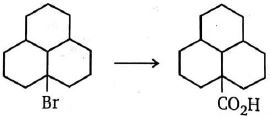
Compare the two methods shown for the preparation of carboxylic acids.
Method $1$: $RBr$ $\xrightarrow[diethyl \ ether]{Mg} RMgBr$ $\xrightarrow[2. \ H_3O^{+}]{1. \ CO_2} RCO_2H$
Method $2$: $RBr$ $\xrightarrow{NaCN} RCN$ $\xrightarrow[heat]{H_2O, HCl} RCO_2H$
Which one of the following statements correctly describes this conversion for the given substrate ($1$-bromoadamantane)?
Method $1$: $RBr$ $\xrightarrow[diethyl \ ether]{Mg} RMgBr$ $\xrightarrow[2. \ H_3O^{+}]{1. \ CO_2} RCO_2H$
Method $2$: $RBr$ $\xrightarrow{NaCN} RCN$ $\xrightarrow[heat]{H_2O, HCl} RCO_2H$
Which one of the following statements correctly describes this conversion for the given substrate ($1$-bromoadamantane)?
A
Both Method $1$ and Method $2$ are appropriate for carrying out this conversion.
B
Neither Method $1$ nor Method $2$ is appropriate for carrying out this conversion.
C
Method $1$ will work well,but Method $2$ is not appropriate.
D
Method $2$ will work well,but Method $1$ is not appropriate.
Solution
(C) The substrate is $1$-bromoadamantane,a tertiary bridgehead halide.
Method $2$ involves an $S_N2$ reaction with $NaCN$. $S_N2$ reactions are extremely difficult at bridgehead carbons because the nucleophile cannot approach from the backside,and the transition state would require an $sp^2$-hybridized bridgehead carbon,which is forbidden by Bredt's rule.
Method $1$ involves the formation of a Grignard reagent $(RMgBr)$. While formation of Grignard reagents at bridgehead carbons is slow,it is generally possible. The subsequent reaction of the Grignard reagent with $CO_2$ is a standard method for preparing carboxylic acids.
Therefore,Method $1$ is appropriate,while Method $2$ is not.
Method $2$ involves an $S_N2$ reaction with $NaCN$. $S_N2$ reactions are extremely difficult at bridgehead carbons because the nucleophile cannot approach from the backside,and the transition state would require an $sp^2$-hybridized bridgehead carbon,which is forbidden by Bredt's rule.
Method $1$ involves the formation of a Grignard reagent $(RMgBr)$. While formation of Grignard reagents at bridgehead carbons is slow,it is generally possible. The subsequent reaction of the Grignard reagent with $CO_2$ is a standard method for preparing carboxylic acids.
Therefore,Method $1$ is appropriate,while Method $2$ is not.
0 likes
View Solution71
MediumMCQ
Benzotrichloride reacts with milk of lime to form
A
Benzal
B
Benzoic acid
C
Benzyl alcohol
D
Phenol
Solution
(B) The reaction of benzotrichloride $(Ph-CCl_3)$ with milk of lime $(Ca(OH)_2)$ involves the hydrolysis of the trichloromethyl group.
First,the three chlorine atoms are replaced by hydroxyl groups to form an unstable intermediate,phenylmethanetriol $(Ph-C(OH)_3)$.
This intermediate undergoes dehydration by losing a water molecule $(-H_2O)$ to form benzoic acid $(Ph-COOH)$.
First,the three chlorine atoms are replaced by hydroxyl groups to form an unstable intermediate,phenylmethanetriol $(Ph-C(OH)_3)$.
This intermediate undergoes dehydration by losing a water molecule $(-H_2O)$ to form benzoic acid $(Ph-COOH)$.
0 likes
View Solution72
DifficultMCQ
$CH_3-(CH_2)_3-OH$ $\xrightarrow[Et_3N]{CH_3-SO_2-Cl} (A)$ $\xrightarrow{K^{14}CN} (B)$ $\xrightarrow{H_3O^{\oplus}} (C)$
Product $(C)$ is
Product $(C)$ is
A
$CH_3-(CH_2)_3-CO_2H$
B
$CH_3-(CH_2)_3-^{14}CO_2H$
C
$CH_3-CO_2H$
D
$CH_3-^{14}C(O)OH$
Solution
(B) Step $1$: The alcohol $CH_3-(CH_2)_3-OH$ reacts with methanesulfonyl chloride $(CH_3SO_2Cl)$ in the presence of triethylamine $(Et_3N)$ to form a good leaving group,the mesylate $(A)$,which is $CH_3-(CH_2)_3-OSO_2CH_3$.
Step $2$: The mesylate $(A)$ undergoes an $S_N2$ reaction with $K^{14}CN$. The $^{14}CN^-$ nucleophile attacks the primary carbon,displacing the mesylate group to form the nitrile $(B)$,which is $CH_3-(CH_2)_3-^{14}CN$.
Step $3$: The nitrile $(B)$ undergoes acid-catalyzed hydrolysis $(H_3O^{\oplus})$ to form the corresponding carboxylic acid $(C)$,which is $CH_3-(CH_2)_3-^{14}COOH$.
Step $2$: The mesylate $(A)$ undergoes an $S_N2$ reaction with $K^{14}CN$. The $^{14}CN^-$ nucleophile attacks the primary carbon,displacing the mesylate group to form the nitrile $(B)$,which is $CH_3-(CH_2)_3-^{14}CN$.
Step $3$: The nitrile $(B)$ undergoes acid-catalyzed hydrolysis $(H_3O^{\oplus})$ to form the corresponding carboxylic acid $(C)$,which is $CH_3-(CH_2)_3-^{14}COOH$.
0 likes
View Solution73
DifficultMCQ
$Ph-C(=O)-CH_3$ $\xrightarrow[HCl]{NaNO_2} (A)$ $\xrightarrow[heat]{Ac_2O} (B)$ $\xrightarrow{H_3O^{+}} (C)$
Product $(C)$ of the above reaction is
Product $(C)$ of the above reaction is
A
$Ph-CO_2H$
B
$Ph-C(=O)-CO_2H$
C
$Ph-C(=O)-CHO$
D
$Ph-C(=O)-CH_2OH$
Solution
(B) The reaction of acetophenone $(PhCOCH_3)$ with $NaNO_2/HCl$ leads to the formation of an isonitroso compound (oxime),$PhCOCH=NOH$ (Product $A$).
Treatment of the oxime with acetic anhydride $(Ac_2O)$ followed by heating causes dehydration to form the nitrile,$PhCOCN$ (Product $B$).
Finally,the acid-catalyzed hydrolysis of the nitrile group $(CN)$ yields the carboxylic acid group $(COOH)$,resulting in the final product $PhCOCO_2H$ (Product $C$).
Treatment of the oxime with acetic anhydride $(Ac_2O)$ followed by heating causes dehydration to form the nitrile,$PhCOCN$ (Product $B$).
Finally,the acid-catalyzed hydrolysis of the nitrile group $(CN)$ yields the carboxylic acid group $(COOH)$,resulting in the final product $PhCOCO_2H$ (Product $C$).
0 likes
View Solution74
DifficultMCQ
The major product formed when $1, 1, 1-$trichloropropane is treated with aqueous potassium hydroxide is:
A
Propyne
B
$1-$Propanol
C
$2-$Propanol
D
Propionic acid
Solution
(D) When $1, 1, 1-$trichloropropane $(CH_3-CH_2-CCl_3)$ is treated with aqueous $KOH$,a nucleophilic substitution reaction occurs. The three chlorine atoms are replaced by three hydroxyl $(-OH)$ groups to form an unstable intermediate gem-triol. This intermediate immediately loses a water molecule to form propionic acid (propanoic acid).
Reaction:
$CH_3-CH_2-CCl_3 + 3KOH_{(aq)}$ $\rightarrow [CH_3-CH_2-C(OH)_3] + 3KCl$ $\rightarrow CH_3-CH_2-COOH + H_2O$
Reaction:
$CH_3-CH_2-CCl_3 + 3KOH_{(aq)}$ $\rightarrow [CH_3-CH_2-C(OH)_3] + 3KCl$ $\rightarrow CH_3-CH_2-COOH + H_2O$
0 likes
View Solution75
MediumMCQ
Which reaction is incorrectly written?
A
$CH_3-CH=CH_2 \xrightarrow[(BH_3)_2]{H_2O_2/OH^{-}} CH_3-CH_2-CH_2-OH$
B
$CH_3-CHO \xrightarrow[H_2O]{CH_3MgBr} CH_3-CH(OH)-CH_3$
C
$CH_3-C(CH_3)=CH_2 \xrightarrow{dil. H_2SO_4} CH_3-C(OH)(CH_3)-CH_3$
D
$CH_3-CN \xrightarrow[\Delta]{H_2O/H^{+}} CH_3-CONH_2$
Solution
(D) The reaction of nitriles $(CH_3-CN)$ with dilute acid $(H_2O/H^{+})$ and heat $(\Delta)$ results in complete hydrolysis to form carboxylic acids $(CH_3-COOH)$ and ammonium ions $(NH_4^+)$.
The formation of an amide $(CH_3-CONH_2)$ is an intermediate step and is not the final product under these conditions.
Therefore,the reaction is incorrectly written.
The formation of an amide $(CH_3-CONH_2)$ is an intermediate step and is not the final product under these conditions.
Therefore,the reaction is incorrectly written.
0 likes
View Solution76
DifficultMCQ
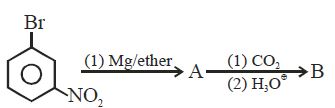
What will be the final product $B$ in the following reaction?
A
$3-$Nitrobenzoic acid
B
$3-$Nitrobenzaldehyde
C
$3-$Aminobenzoic acid
D
$4-$Nitrobenzoic acid
Solution
(A) The starting material is $1-$bromo-$3-$nitrobenzene.
Step $1$: Reaction with $Mg$ in dry ether forms the Grignard reagent,$3-$nitrophenylmagnesium bromide $(A)$.
Step $2$: The Grignard reagent reacts with $CO_2$ followed by acid hydrolysis $(H_3O^+)$ to form a carboxylic acid group at the position where $MgBr$ was attached.
Thus,the product $B$ is $3-$nitrobenzoic acid.
Step $1$: Reaction with $Mg$ in dry ether forms the Grignard reagent,$3-$nitrophenylmagnesium bromide $(A)$.
Step $2$: The Grignard reagent reacts with $CO_2$ followed by acid hydrolysis $(H_3O^+)$ to form a carboxylic acid group at the position where $MgBr$ was attached.
Thus,the product $B$ is $3-$nitrobenzoic acid.
0 likes
View Solution77
MediumMCQ
What is the product formed by the reaction of cane sugar with concentrated nitric acid?
A
$CO_2$ and $NO$
B
Oxalic acid
C
$CO$ and $H_2O$
D
Carbonic acid
Solution
(B) The reaction of cane sugar $(C_{12}H_{22}O_{11})$ with concentrated nitric acid $(HNO_3)$ acts as an oxidizing agent to produce oxalic acid.
The balanced chemical equation is:
$C_{12}H_{22}O_{11} + 18[O] \xrightarrow{conc. HNO_3} 6(COOH)_2 + 5H_2O$
Thus,the main product formed is oxalic acid.
The balanced chemical equation is:
$C_{12}H_{22}O_{11} + 18[O] \xrightarrow{conc. HNO_3} 6(COOH)_2 + 5H_2O$
Thus,the main product formed is oxalic acid.
0 likes
View Solution78
DifficultMCQ
What is $A$ in the following reaction?
$Cyclopropyl bromide \xrightarrow[(ii) CO_2, (iii) H_3O^+]{(i) Mg, Et_2O} A$
$Cyclopropyl bromide \xrightarrow[(ii) CO_2, (iii) H_3O^+]{(i) Mg, Et_2O} A$
A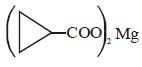
B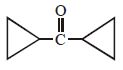
C
D
Solution
(D) The reaction proceeds as follows:
$1$. Cyclopropyl bromide reacts with $Mg$ in the presence of $Et_2O$ to form the Grignard reagent,cyclopropylmagnesium bromide $(C_3H_5MgBr)$.
$2$. The Grignard reagent then undergoes a nucleophilic addition reaction with $CO_2$ to form the magnesium salt of the carboxylic acid,which is cyclopropylmagnesium carboxylate.
$3$. Finally,acid hydrolysis with $H_3O^+$ converts the magnesium salt into the final product,cyclopropanecarboxylic acid $(C_3H_5COOH)$.
$1$. Cyclopropyl bromide reacts with $Mg$ in the presence of $Et_2O$ to form the Grignard reagent,cyclopropylmagnesium bromide $(C_3H_5MgBr)$.
$2$. The Grignard reagent then undergoes a nucleophilic addition reaction with $CO_2$ to form the magnesium salt of the carboxylic acid,which is cyclopropylmagnesium carboxylate.
$3$. Finally,acid hydrolysis with $H_3O^+$ converts the magnesium salt into the final product,cyclopropanecarboxylic acid $(C_3H_5COOH)$.
0 likes
View Solution79
MediumMCQ
Hydrolysis of acetonitrile in acidic medium gives
A
$CH_3-CH_2-NH_2$
B
$CH_3-COOH$
C
$CH_3-CONH_2$
D
$CH_3-CHO$
Solution
(B) The hydrolysis of acetonitrile $(CH_3CN)$ in an acidic medium proceeds in two steps:
$1$. Partial hydrolysis to form acetamide $(CH_3CONH_2)$.
$2$. Complete hydrolysis to form acetic acid $(CH_3COOH)$.
In the presence of an acidic medium,the reaction is:
$CH_3-CN + 2H_2O \xrightarrow{H^+} CH_3-COOH + NH_4^+$
$1$. Partial hydrolysis to form acetamide $(CH_3CONH_2)$.
$2$. Complete hydrolysis to form acetic acid $(CH_3COOH)$.
In the presence of an acidic medium,the reaction is:
$CH_3-CN + 2H_2O \xrightarrow{H^+} CH_3-COOH + NH_4^+$
0 likes
View Solution80
DifficultMCQ
In the reaction $R - X$ $\xrightarrow[\text{alcoholic}]{KCN} A$ $\xrightarrow[\Delta]{H_2O/H^\oplus} B$,product $(B)$ is
A
Alkyl chloride
B
Aldehyde
C
Carboxylic acid
D
Ketone
Solution
(C) The reaction proceeds as follows:
$1$. $R - X + KCN \xrightarrow{\text{alcoholic}} R - CN + KX$ (Nucleophilic substitution to form an alkyl cyanide $A$).
$2$. $R - CN + 2H_2O \xrightarrow{H^\oplus/\Delta} R - COOH + NH_3$ (Acidic hydrolysis of cyanide to form a carboxylic acid $B$).
Therefore,the final product $(B)$ is a carboxylic acid.
$1$. $R - X + KCN \xrightarrow{\text{alcoholic}} R - CN + KX$ (Nucleophilic substitution to form an alkyl cyanide $A$).
$2$. $R - CN + 2H_2O \xrightarrow{H^\oplus/\Delta} R - COOH + NH_3$ (Acidic hydrolysis of cyanide to form a carboxylic acid $B$).
Therefore,the final product $(B)$ is a carboxylic acid.
0 likes
View Solution81
AdvancedMCQ
Identify the product $C$ in the following reaction sequence:
$1$-bromo-$4$-chlorobenzene $+ Mg (1 \text{ mole})$ $\xrightarrow{THF} A$ $\xrightarrow{CO_2} B$ $\xrightarrow{H^+} C$
$1$-bromo-$4$-chlorobenzene $+ Mg (1 \text{ mole})$ $\xrightarrow{THF} A$ $\xrightarrow{CO_2} B$ $\xrightarrow{H^+} C$
A
$4$-chlorobenzoic acid
B
$4$-chlorobenzoic acid
C
$4$-chlorobenzoic acid
D
$4$-chlorobenzoic acid
Solution
(B) $1$. The reaction of $1$-bromo-$4$-chlorobenzene with $1 \text{ mole}$ of $Mg$ in $THF$ selectively forms the Grignard reagent at the $Br$ position because $C-Br$ bond is weaker than $C-Cl$ bond. Thus,$A$ is $4$-chlorophenylmagnesium bromide.
$2$. The Grignard reagent $(A)$ reacts with $CO_2$ to form a magnesium carboxylate intermediate $(B)$,which is $4$-chlorophenylmagnesium carboxylate.
$3$. Acidic hydrolysis $(H^+)$ of the intermediate $B$ yields $4$-chlorobenzoic acid as the final product $C$.
$2$. The Grignard reagent $(A)$ reacts with $CO_2$ to form a magnesium carboxylate intermediate $(B)$,which is $4$-chlorophenylmagnesium carboxylate.
$3$. Acidic hydrolysis $(H^+)$ of the intermediate $B$ yields $4$-chlorobenzoic acid as the final product $C$.
0 likes
View Solution82
MediumMCQ
The reaction of toluene with acidic $KMnO_4$ gives ..........
A
Benzoic acid
B
Benzyl alcohol
C
Benzaldehyde
D
Benzene
Solution
(A) The oxidation of toluene with acidic $KMnO_4$ is a standard reaction used to convert the alkyl side chain of an aromatic ring into a carboxylic acid group.
The methyl group $(-CH_3)$ attached to the benzene ring is oxidized to a carboxyl group $(-COOH)$.
The reaction is: $C_6H_5CH_3 + [O] \xrightarrow{KMnO_4/H^+} C_6H_5COOH$ (Benzoic acid).
The methyl group $(-CH_3)$ attached to the benzene ring is oxidized to a carboxyl group $(-COOH)$.
The reaction is: $C_6H_5CH_3 + [O] \xrightarrow{KMnO_4/H^+} C_6H_5COOH$ (Benzoic acid).
0 likes
View Solution83
DifficultMCQ
In the reaction $R-X$ $\xrightarrow{alc. KCN} A$ $\xrightarrow{dil. HCl} B$,the product $B$ is .....
A
Alkyl chloride
B
Aldehyde
C
Carboxylic acid
D
Ketone
Solution
(C) The reaction proceeds as follows:
$1$. $R-X + KCN (alc.) \rightarrow R-CN + KX$. Here,$A$ is an alkyl cyanide (nitrile).
$2$. $R-CN + 2H_2O \xrightarrow{dil. HCl} R-COOH + NH_4Cl$. The partial or complete hydrolysis of nitriles in the presence of dilute acid yields carboxylic acids.
Therefore,$B$ is a carboxylic acid.
$1$. $R-X + KCN (alc.) \rightarrow R-CN + KX$. Here,$A$ is an alkyl cyanide (nitrile).
$2$. $R-CN + 2H_2O \xrightarrow{dil. HCl} R-COOH + NH_4Cl$. The partial or complete hydrolysis of nitriles in the presence of dilute acid yields carboxylic acids.
Therefore,$B$ is a carboxylic acid.
0 likes
View Solution84
DifficultMCQ
In the following reaction,the compound $B$ will be:
$C_2H_5Br$ $\xrightarrow{KCN} A$ $\xrightarrow{\text{Hydrolysis}} B$
$C_2H_5Br$ $\xrightarrow{KCN} A$ $\xrightarrow{\text{Hydrolysis}} B$
A
Ethyl chloride
B
Acetic acid
C
Propionic acid
D
Ethyl cyanide
Solution
(C) $1$. The reaction of ethyl bromide $(C_2H_5Br)$ with $KCN$ is a nucleophilic substitution reaction.
$2$. $C_2H_5Br + KCN \rightarrow C_2H_5CN + KBr$. Here,$A$ is ethyl cyanide $(C_2H_5CN)$.
$3$. The hydrolysis of alkyl cyanides $(R-CN)$ yields carboxylic acids $(R-COOH)$.
$4$. $C_2H_5CN + 2H_2O \xrightarrow{H^+} C_2H_5COOH + NH_3$.
$5$. The product $B$ is propionic acid $(C_2H_5COOH)$.
$2$. $C_2H_5Br + KCN \rightarrow C_2H_5CN + KBr$. Here,$A$ is ethyl cyanide $(C_2H_5CN)$.
$3$. The hydrolysis of alkyl cyanides $(R-CN)$ yields carboxylic acids $(R-COOH)$.
$4$. $C_2H_5CN + 2H_2O \xrightarrow{H^+} C_2H_5COOH + NH_3$.
$5$. The product $B$ is propionic acid $(C_2H_5COOH)$.
0 likes
View Solution85
DifficultMCQ
Which of the following reaction sequences converts $R-CH_2CH_2OH$ into $R-CH_2CH_2COOH$?
A
$PBr_3, KCN, H_3O^+$
B
$PBr_3, KCN, H_2/Pt$
C
$KCN, H_3O^+$
D
$HCN, PBr_3, H_3O^+$
Solution
(A) The conversion of an alcohol to a carboxylic acid with one additional carbon atom involves the following steps:
$1$. Conversion of alcohol to alkyl bromide using $PBr_3$: $R-CH_2CH_2OH + PBr_3 \rightarrow R-CH_2CH_2Br + H_3PO_3$.
$2$. Nucleophilic substitution with $KCN$ to form a nitrile: $R-CH_2CH_2Br + KCN \rightarrow R-CH_2CH_2CN + KBr$.
$3$. Acidic hydrolysis of the nitrile to form a carboxylic acid: $R-CH_2CH_2CN + 2H_2O + H^+ \rightarrow R-CH_2CH_2COOH + NH_4^+$.
Thus,the correct sequence is $PBr_3, KCN, H_3O^+$.
$1$. Conversion of alcohol to alkyl bromide using $PBr_3$: $R-CH_2CH_2OH + PBr_3 \rightarrow R-CH_2CH_2Br + H_3PO_3$.
$2$. Nucleophilic substitution with $KCN$ to form a nitrile: $R-CH_2CH_2Br + KCN \rightarrow R-CH_2CH_2CN + KBr$.
$3$. Acidic hydrolysis of the nitrile to form a carboxylic acid: $R-CH_2CH_2CN + 2H_2O + H^+ \rightarrow R-CH_2CH_2COOH + NH_4^+$.
Thus,the correct sequence is $PBr_3, KCN, H_3O^+$.
0 likes
View Solution86
AdvancedMCQ
What is the product of the following reaction?
$Hex-3-ynal$ $\xrightarrow[(ii) PBr_3]{(i) NaBH_4}$ $\xrightarrow[(ii) CO_2 / H_3O^{+}]{(i) Mg / ether}$ ?
$Hex-3-ynal$ $\xrightarrow[(ii) PBr_3]{(i) NaBH_4}$ $\xrightarrow[(ii) CO_2 / H_3O^{+}]{(i) Mg / ether}$ ?
A
Hexanoic acid
B
Hex$-3-$enoic acid
C
Hept$-4-$ynoic acid
D
Hex$-3-$enoic acid
Solution
(C) The reaction proceeds as follows:
$1$. $NaBH_4$ reduces the aldehyde group $(-CHO)$ to a primary alcohol $(-CH_2OH)$ without affecting the triple bond. The product is $hex-3-yn-1-ol$.
$2$. $PBr_3$ converts the primary alcohol into an alkyl bromide: $CH_3-CH_2-C \equiv C-CH_2-CH_2-Br$.
$3$. $Mg / ether$ forms the Grignard reagent: $CH_3-CH_2-C \equiv C-CH_2-CH_2-MgBr$.
$4$. The Grignard reagent reacts with $CO_2$ followed by acidic workup $(H_3O^+)$ to form a carboxylic acid with one additional carbon atom.
$5$. The final product is $hept-4-ynoic$ acid,which corresponds to the structure $CH_3-CH_2-C \equiv C-CH_2-CH_2-COOH$.
$1$. $NaBH_4$ reduces the aldehyde group $(-CHO)$ to a primary alcohol $(-CH_2OH)$ without affecting the triple bond. The product is $hex-3-yn-1-ol$.
$2$. $PBr_3$ converts the primary alcohol into an alkyl bromide: $CH_3-CH_2-C \equiv C-CH_2-CH_2-Br$.
$3$. $Mg / ether$ forms the Grignard reagent: $CH_3-CH_2-C \equiv C-CH_2-CH_2-MgBr$.
$4$. The Grignard reagent reacts with $CO_2$ followed by acidic workup $(H_3O^+)$ to form a carboxylic acid with one additional carbon atom.
$5$. The final product is $hept-4-ynoic$ acid,which corresponds to the structure $CH_3-CH_2-C \equiv C-CH_2-CH_2-COOH$.
0 likes
View Solution87
Difficult
Write a method of preparation for carboxylic acid from the oxidation of primary alcohol and aldehyde compounds.
Solution
(N/A) Oxidation of primary alcohol compounds: Primary alcohols can be oxidized to carboxylic acids using strong oxidizing agents like potassium permanganate $(KMnO_4)$ in acidic,basic,or neutral media,or potassium dichromate $(K_2Cr_2O_7)$ in acidic medium,or Jones reagent $(CrO_3 + H_2SO_4)$.
General reaction:
$RCH_2OH \xrightarrow{[O]} RCOOH$
Examples:
$1$. $CH_3(CH_2)_8CH_2OH \xrightarrow{CrO_3-H_2SO_4} CH_3(CH_2)_8COOH$
$2$. $CH_3CH_2OH \xrightarrow{K_2Cr_2O_7-H_2SO_4} CH_3COOH$
$(b)$ Oxidation of aldehyde compounds: Aldehydes are easily oxidized to carboxylic acids using mild oxidizing agents like Tollen's reagent or stronger agents like $KMnO_4$ or $HNO_3$.
General reaction:
$R-CHO \xrightarrow{[O]} RCOOH$
Examples:
$1$. $CH_3CHO \xrightarrow{[O]} CH_3COOH$
$2$. $C_6H_5CHO \xrightarrow{[O]} C_6H_5COOH$
General reaction:
$RCH_2OH \xrightarrow{[O]} RCOOH$
Examples:
$1$. $CH_3(CH_2)_8CH_2OH \xrightarrow{CrO_3-H_2SO_4} CH_3(CH_2)_8COOH$
$2$. $CH_3CH_2OH \xrightarrow{K_2Cr_2O_7-H_2SO_4} CH_3COOH$
$(b)$ Oxidation of aldehyde compounds: Aldehydes are easily oxidized to carboxylic acids using mild oxidizing agents like Tollen's reagent or stronger agents like $KMnO_4$ or $HNO_3$.
General reaction:
$R-CHO \xrightarrow{[O]} RCOOH$
Examples:
$1$. $CH_3CHO \xrightarrow{[O]} CH_3COOH$
$2$. $C_6H_5CHO \xrightarrow{[O]} C_6H_5COOH$
0 likes
View Solution88
Medium
Write a note on the preparation of carboxylic acid from alkyl benzene.
Solution
(N/A) Aromatic carboxylic acids can be prepared by the vigorous oxidation of alkyl benzenes with chromic acid or acidic/alkaline potassium permanganate $(KMnO_4)$.
$(a)$ The entire side chain is oxidized to the carboxyl group $(-COOH)$ irrespective of the length of the side chain,provided that the benzylic carbon atom has at least one hydrogen atom.
$(b)$ Primary and secondary alkyl groups are oxidized to the carboxyl group in this manner.
$(c)$ If the benzylic carbon atom does not have any hydrogen atom (i.e.,tertiary alkyl group),then oxidation is not possible.
$(d)$ The reaction proceeds via the formation of a potassium salt (e.g.,potassium benzoate),which upon acidic hydrolysis $(H_3O^+)$ yields the corresponding aromatic carboxylic acid.
General reaction:
$C_6H_5-CH_2-R$ $\xrightarrow[\Delta]{KMnO_4, KOH} C_6H_5-COOK$ $\xrightarrow{H_3O^+} C_6H_5-COOH$
$(a)$ The entire side chain is oxidized to the carboxyl group $(-COOH)$ irrespective of the length of the side chain,provided that the benzylic carbon atom has at least one hydrogen atom.
$(b)$ Primary and secondary alkyl groups are oxidized to the carboxyl group in this manner.
$(c)$ If the benzylic carbon atom does not have any hydrogen atom (i.e.,tertiary alkyl group),then oxidation is not possible.
$(d)$ The reaction proceeds via the formation of a potassium salt (e.g.,potassium benzoate),which upon acidic hydrolysis $(H_3O^+)$ yields the corresponding aromatic carboxylic acid.
General reaction:
$C_6H_5-CH_2-R$ $\xrightarrow[\Delta]{KMnO_4, KOH} C_6H_5-COOK$ $\xrightarrow{H_3O^+} C_6H_5-COOH$
0 likes
View Solution89
Medium
Describe the method for the preparation of carboxylic acids from nitrogen-containing compounds (nitriles) with suitable examples.
Solution
(N/A) Carboxylic acids can be prepared from nitriles $(R-CN)$ through hydrolysis.
$1.$ Hydrolysis of Nitriles:
Nitriles are first hydrolyzed to amides in the presence of $H^{+}$ or $OH^{-}$ catalysts,and then further hydrolyzed to carboxylic acids.
General Reaction:
$R-C \equiv N + H_2O$ $\xrightarrow{H^{+} \text{ or } OH^{-}} R-CONH_2$ $\xrightarrow{H^{+} \text{ or } OH^{-}, H_2O} R-COOH + NH_3$
$2.$ Preparation from Alcohols (via Nitriles):
Alcohols can be converted to alkyl halides,then to nitriles,and finally to carboxylic acids with one additional carbon atom.
Example:
$CH_3OH$ $\xrightarrow{PCl_3} CH_3Cl$ $\xrightarrow{KCN} CH_3CN$ $\xrightarrow{H^{+}, \Delta, H_2O} CH_3COOH$ (Ethanoic acid)
Note: The reaction can be stopped at the amide stage by controlling the reaction conditions.
$1.$ Hydrolysis of Nitriles:
Nitriles are first hydrolyzed to amides in the presence of $H^{+}$ or $OH^{-}$ catalysts,and then further hydrolyzed to carboxylic acids.
General Reaction:
$R-C \equiv N + H_2O$ $\xrightarrow{H^{+} \text{ or } OH^{-}} R-CONH_2$ $\xrightarrow{H^{+} \text{ or } OH^{-}, H_2O} R-COOH + NH_3$
$2.$ Preparation from Alcohols (via Nitriles):
Alcohols can be converted to alkyl halides,then to nitriles,and finally to carboxylic acids with one additional carbon atom.
Example:
$CH_3OH$ $\xrightarrow{PCl_3} CH_3Cl$ $\xrightarrow{KCN} CH_3CN$ $\xrightarrow{H^{+}, \Delta, H_2O} CH_3COOH$ (Ethanoic acid)
Note: The reaction can be stopped at the amide stage by controlling the reaction conditions.
0 likes
View Solution90
Medium
Give the reaction methods to prepare carboxylic acid from amide compounds.
Solution
(N/A) Amides can be converted into carboxylic acids through hydrolysis in the presence of an acid or base catalyst followed by heating.
General reaction:
$RCONH_2 \xrightarrow{H_3O^{+}, \Delta} RCOOH + NH_3$
Example:
$CH_3CONH_2 \xrightarrow{H_3O^{+}, \Delta} CH_3COOH + NH_3$
Another example:
$C_6H_5CONH_2 \xrightarrow{H_3O^{+}, \Delta} C_6H_5COOH + NH_3$
General reaction:
$RCONH_2 \xrightarrow{H_3O^{+}, \Delta} RCOOH + NH_3$
Example:
$CH_3CONH_2 \xrightarrow{H_3O^{+}, \Delta} CH_3COOH + NH_3$
Another example:
$C_6H_5CONH_2 \xrightarrow{H_3O^{+}, \Delta} C_6H_5COOH + NH_3$
0 likes
View Solution91
Difficult
Give the method of preparation of carboxylic acid from the reaction of a Grignard reagent with $CO_2$ with suitable examples.
Solution
(N/A) Grignard reagents react with carbon dioxide (dry ice) to form salts of carboxylic acids,which upon acidification with mineral acid yield the corresponding carboxylic acids.
General reaction:
$R-Mg-X + O=C=O \xrightarrow{\text{dry ether}} R-COO^-Mg^+X$
$R-COO^-Mg^+X \xrightarrow{H_3O^+} RCOOH + Mg(OH)X$
Example $(i)$: Preparation of ethanoic acid from methyl bromide:
$CH_3Br \xrightarrow{Mg, \text{dry ether}} CH_3MgBr$
$CH_3MgBr + CO_2 \xrightarrow{\text{dry ether}} CH_3COOMgBr$
$CH_3COOMgBr \xrightarrow{H_3O^+} CH_3COOH + Mg(OH)Br$
Example $(ii)$: Preparation of benzoic acid from bromobenzene:
$C_6H_5Br \xrightarrow{Mg, \text{dry ether}} C_6H_5MgBr$
$C_6H_5MgBr + CO_2 \xrightarrow{\text{dry ether}} C_6H_5COOMgBr$
$C_6H_5COOMgBr \xrightarrow{H_3O^+} C_6H_5COOH + Mg(OH)Br$
General reaction:
$R-Mg-X + O=C=O \xrightarrow{\text{dry ether}} R-COO^-Mg^+X$
$R-COO^-Mg^+X \xrightarrow{H_3O^+} RCOOH + Mg(OH)X$
Example $(i)$: Preparation of ethanoic acid from methyl bromide:
$CH_3Br \xrightarrow{Mg, \text{dry ether}} CH_3MgBr$
$CH_3MgBr + CO_2 \xrightarrow{\text{dry ether}} CH_3COOMgBr$
$CH_3COOMgBr \xrightarrow{H_3O^+} CH_3COOH + Mg(OH)Br$
Example $(ii)$: Preparation of benzoic acid from bromobenzene:
$C_6H_5Br \xrightarrow{Mg, \text{dry ether}} C_6H_5MgBr$
$C_6H_5MgBr + CO_2 \xrightarrow{\text{dry ether}} C_6H_5COOMgBr$
$C_6H_5COOMgBr \xrightarrow{H_3O^+} C_6H_5COOH + Mg(OH)Br$
0 likes
View Solution92
Difficult
Write the method of preparation of carboxylic acid from acyl halides and anhydride compounds.
Solution
(N/A) Carboxylic acid from acid chloride compounds:
$(i)$ Acid chlorides when hydrolysed with water give carboxylic acids.
$RCOCl + H_{2}O \longrightarrow RCOOH + HCl$
$(ii)$ Acyl chlorides are more readily hydrolysed with aqueous base to give carboxylate ions,which on acidification provide corresponding carboxylic acids.
$RCOCl$ $\xrightarrow{OH^{-}, H_{2}O} RCOO^{-}$ $\xrightarrow{H_{3}O^{+}} RCOOH$
$(b)$ Carboxylic acid from acid anhydrides:
Anhydrides are hydrolysed to corresponding acid$(s)$ with water.
$(i)$ $(CH_{3}CO)_{2}O + H_{2}O \longrightarrow 2CH_{3}COOH$ (Acetic anhydride $\longrightarrow$ Ethanoic acid)
$(ii)$ $(C_{6}H_{5}CO)_{2}O + H_{2}O \longrightarrow 2C_{6}H_{5}COOH$ (Benzoic anhydride $\longrightarrow$ Benzoic acid)
$(iii)$ $C_{6}H_{5}CO-O-COCH_{3} + H_{2}O \longrightarrow C_{6}H_{5}COOH + CH_{3}COOH$ (Benzoic ethanoic anhydride $\longrightarrow$ Benzoic acid + Acetic acid)
$(i)$ Acid chlorides when hydrolysed with water give carboxylic acids.
$RCOCl + H_{2}O \longrightarrow RCOOH + HCl$
$(ii)$ Acyl chlorides are more readily hydrolysed with aqueous base to give carboxylate ions,which on acidification provide corresponding carboxylic acids.
$RCOCl$ $\xrightarrow{OH^{-}, H_{2}O} RCOO^{-}$ $\xrightarrow{H_{3}O^{+}} RCOOH$
$(b)$ Carboxylic acid from acid anhydrides:
Anhydrides are hydrolysed to corresponding acid$(s)$ with water.
$(i)$ $(CH_{3}CO)_{2}O + H_{2}O \longrightarrow 2CH_{3}COOH$ (Acetic anhydride $\longrightarrow$ Ethanoic acid)
$(ii)$ $(C_{6}H_{5}CO)_{2}O + H_{2}O \longrightarrow 2C_{6}H_{5}COOH$ (Benzoic anhydride $\longrightarrow$ Benzoic acid)
$(iii)$ $C_{6}H_{5}CO-O-COCH_{3} + H_{2}O \longrightarrow C_{6}H_{5}COOH + CH_{3}COOH$ (Benzoic ethanoic anhydride $\longrightarrow$ Benzoic acid + Acetic acid)
0 likes
View Solution93
Medium
Write the method of preparation of carboxylic acid compounds from ester compounds,with suitable examples.
Solution
(N/A) $(i)$ Acidic hydrolysis of esters gives directly carboxylic acids while basic hydrolysis gives carboxylates,which on acidification give corresponding carboxylic acids.
$(ii)$ General reaction:
$R-CO-OR' + H_2O \xrightarrow{H^+} RCOOH + R'OH$
$(iii)$ Examples:
Example-$(i)$:
$C_6H_5COOC_2H_5 + H_2O \xrightarrow{H_3O^+} C_6H_5COOH + C_2H_5OH$
(Ethyl benzoate $\rightarrow$ Benzoic acid + Ethanol)
Example-$(ii)$:
$CH_3COOC_2H_5 + H_2O \xrightarrow{H_3O^+} CH_3COOH + C_2H_5OH$
(Ethyl acetate $\rightarrow$ Ethanoic acid + Ethanol)
$(ii)$ General reaction:
$R-CO-OR' + H_2O \xrightarrow{H^+} RCOOH + R'OH$
$(iii)$ Examples:
Example-$(i)$:
$C_6H_5COOC_2H_5 + H_2O \xrightarrow{H_3O^+} C_6H_5COOH + C_2H_5OH$
(Ethyl benzoate $\rightarrow$ Benzoic acid + Ethanol)
Example-$(ii)$:
$CH_3COOC_2H_5 + H_2O \xrightarrow{H_3O^+} CH_3COOH + C_2H_5OH$
(Ethyl acetate $\rightarrow$ Ethanoic acid + Ethanol)
0 likes
View Solution94
MediumMCQ
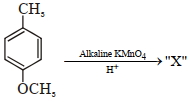
Considering the above chemical reaction,identify the product $X$.
A
$4-$methoxybenzaldehyde
B
$4-$methoxybenzyl alcohol
C
$4-$methoxybenzoic acid
D
$4-$methylphenol
Solution
(C) The reaction involves the oxidation of an alkyl group attached to a benzene ring using alkaline $KMnO_4$ followed by acidification $(H^+)$.
Alkaline $KMnO_4$ is a strong oxidizing agent that oxidizes the alkyl side chain (specifically,a methyl group attached to the benzene ring) to a carboxylic acid group $(-COOH)$.
In the given reactant,$1$-methoxy-$4$-methylbenzene,the methyl group $(-CH_3)$ at the para position is oxidized to a carboxylic acid group $(-COOH)$,while the methoxy group $(-OCH_3)$ remains unaffected.
Therefore,the product $X$ is $4$-methoxybenzoic acid.
Alkaline $KMnO_4$ is a strong oxidizing agent that oxidizes the alkyl side chain (specifically,a methyl group attached to the benzene ring) to a carboxylic acid group $(-COOH)$.
In the given reactant,$1$-methoxy-$4$-methylbenzene,the methyl group $(-CH_3)$ at the para position is oxidized to a carboxylic acid group $(-COOH)$,while the methoxy group $(-OCH_3)$ remains unaffected.
Therefore,the product $X$ is $4$-methoxybenzoic acid.
0 likes
View Solution95
MediumMCQ
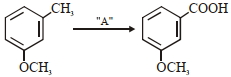
In the above reaction,the reagent $A$ is :
A
$NaBH_4, H_3O^{+}$
B
$LiAlH_4$
C
Alkaline $KMnO_4, H^{+}$
D
$HCl, Zn-Hg$
Solution
(C) The reaction shows the oxidation of an alkyl group (specifically a methyl group attached to a benzene ring) to a carboxylic acid group $(-COOH)$.
Alkaline $KMnO_4$ followed by acidic workup $(H^+)$ is a strong oxidizing agent that converts alkyl side chains on aromatic rings into carboxylic acid groups,regardless of the length of the alkyl chain,provided there is at least one benzylic hydrogen atom.
Therefore,the reagent $A$ is alkaline $KMnO_4$ followed by $H^+$.
Alkaline $KMnO_4$ followed by acidic workup $(H^+)$ is a strong oxidizing agent that converts alkyl side chains on aromatic rings into carboxylic acid groups,regardless of the length of the alkyl chain,provided there is at least one benzylic hydrogen atom.
Therefore,the reagent $A$ is alkaline $KMnO_4$ followed by $H^+$.
0 likes
View Solution96
MediumMCQ
Which one of the following reactions will not yield propionic acid?
A
$CH_{3}CH_{2}COCH_{3} + OI^{-} / H_{3}O^{+}$
B
$CH_{3}CH_{2}CH_{3} + KMnO_{4} (\text{Heat}), OH^{-} / H_{3}O^{+}$
C
$CH_{3}CH_{2}CCl_{3} + OH^{-} / H_{3}O^{+}$
D
$CH_{3}CH_{2}CH_{2}Br + Mg, CO_{2} / \text{dry ether} / H_{3}O^{+}$
Solution
(D) Let us analyze each reaction:
$(A)$ $CH_{3}CH_{2}COCH_{3}$ undergoes the haloform reaction with $OI^{-}$ to yield propanoic acid $(CH_{3}CH_{2}COOH)$.
$(B)$ Oxidation of $CH_{3}CH_{2}CH_{3}$ with $KMnO_{4}$ can yield propanoic acid.
$(C)$ Hydrolysis of $CH_{3}CH_{2}CCl_{3}$ with $OH^{-}$ followed by acidification yields propanoic acid $(CH_{3}CH_{2}COOH)$.
$(D)$ $CH_{3}CH_{2}CH_{2}Br$ reacts with $Mg$ to form a Grignard reagent $(CH_{3}CH_{2}CH_{2}MgBr)$,which on reaction with $CO_{2}$ followed by hydrolysis yields butanoic acid $(CH_{3}CH_{2}CH_{2}COOH)$,not propanoic acid.
Therefore,the correct option is $D$.
$(A)$ $CH_{3}CH_{2}COCH_{3}$ undergoes the haloform reaction with $OI^{-}$ to yield propanoic acid $(CH_{3}CH_{2}COOH)$.
$(B)$ Oxidation of $CH_{3}CH_{2}CH_{3}$ with $KMnO_{4}$ can yield propanoic acid.
$(C)$ Hydrolysis of $CH_{3}CH_{2}CCl_{3}$ with $OH^{-}$ followed by acidification yields propanoic acid $(CH_{3}CH_{2}COOH)$.
$(D)$ $CH_{3}CH_{2}CH_{2}Br$ reacts with $Mg$ to form a Grignard reagent $(CH_{3}CH_{2}CH_{2}MgBr)$,which on reaction with $CO_{2}$ followed by hydrolysis yields butanoic acid $(CH_{3}CH_{2}CH_{2}COOH)$,not propanoic acid.
Therefore,the correct option is $D$.
0 likes
View Solution97
EasyMCQ
$RMgX + CO_2$ $\xrightarrow[\text{dry}]{ \text{ether} } Y$ $\xrightarrow{ H_3O^{+} } RCOOH$
What is $Y$ in the above reaction?
What is $Y$ in the above reaction?
A
$R_3CO^{-}Mg^{+}X$
B
$RCOO^{-}X^{+}$
C
$(RCOO)_2Mg$
D
$RCOO^{-}Mg^{+}X$
Solution
(D) The reaction of a Grignard reagent $(RMgX)$ with carbon dioxide $(CO_2)$ is a nucleophilic addition reaction.
The nucleophilic alkyl group $(R^-)$ of the Grignard reagent attacks the electrophilic carbon atom of $CO_2$.
This results in the formation of an intermediate carboxylate salt,which is $RCOO^{-}Mg^{+}X$ (often written as $RCOOMgX$).
Subsequent acid hydrolysis $(H_3O^{+})$ of this intermediate yields the corresponding carboxylic acid $(RCOOH)$.
The nucleophilic alkyl group $(R^-)$ of the Grignard reagent attacks the electrophilic carbon atom of $CO_2$.
This results in the formation of an intermediate carboxylate salt,which is $RCOO^{-}Mg^{+}X$ (often written as $RCOOMgX$).
Subsequent acid hydrolysis $(H_3O^{+})$ of this intermediate yields the corresponding carboxylic acid $(RCOOH)$.
0 likes
View Solution98
DifficultMCQ
$A \xrightarrow[\begin{smallmatrix} (ii) CN^{-} \\ (iii) H_{2}O/H^{+} \end{smallmatrix}]{(1) Cl_{2}, \Delta }$ $4-$Bromophenyl acetic acid.
In the above reaction '$A$' is ....
In the above reaction '$A$' is ....
A
$4-$Bromoethylbenzene
B
Bromobenzene
C
$4-$Bromotoluene
D
$4-$Bromostyrene
Solution
(C) The reaction sequence is as follows:
$1$. $4-$Bromotoluene reacts with $Cl_{2}$ in the presence of heat (free radical substitution) to form $4-$bromobenzyl chloride $(Br-C_{6}H_{4}-CH_{2}Cl)$.
$2$. This product then reacts with $CN^{-}$ (nucleophilic substitution) to form $4-$bromophenylacetonitrile $(Br-C_{6}H_{4}-CH_{2}CN)$.
$3$. Finally,acid-catalyzed hydrolysis of the nitrile group yields $4-$bromophenylacetic acid $(Br-C_{6}H_{4}-CH_{2}COOH)$.
Therefore,the starting material '$A$' is $4-$bromotoluene.
$1$. $4-$Bromotoluene reacts with $Cl_{2}$ in the presence of heat (free radical substitution) to form $4-$bromobenzyl chloride $(Br-C_{6}H_{4}-CH_{2}Cl)$.
$2$. This product then reacts with $CN^{-}$ (nucleophilic substitution) to form $4-$bromophenylacetonitrile $(Br-C_{6}H_{4}-CH_{2}CN)$.
$3$. Finally,acid-catalyzed hydrolysis of the nitrile group yields $4-$bromophenylacetic acid $(Br-C_{6}H_{4}-CH_{2}COOH)$.
Therefore,the starting material '$A$' is $4-$bromotoluene.
0 likes
View Solution99
MediumMCQ
In the reaction,$x$,$y$ and $z$ are
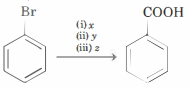
A
$x = Mg$,dry ether; $y = CH_{3}Cl$; $z = H_{2}O$
B
$x = Mg$,dry methanol; $y = CO_{2}$; $z = \text{dil. } HCl$
C
$x = Mg$,dry ether; $y = CO_{2}$; $z = \text{dil. } HCl$
D
$x = Mg$,dry methanol; $y = CH_{3}Cl$; $z = H_{2}O$
Solution
(C) The correct option is $C$.
Bromobenzene reacts with $Mg$ in the presence of dry ether to form a Grignard reagent (phenylmagnesium bromide).
This Grignard reagent then reacts with $CO_{2}$ to form an intermediate,which upon hydrolysis with $\text{dil. } HCl$ gives benzoic acid.
Bromobenzene reacts with $Mg$ in the presence of dry ether to form a Grignard reagent (phenylmagnesium bromide).
This Grignard reagent then reacts with $CO_{2}$ to form an intermediate,which upon hydrolysis with $\text{dil. } HCl$ gives benzoic acid.
0 likes
View Solution100
DifficultMCQ
Acid $D$ formed in the reaction sequence is:
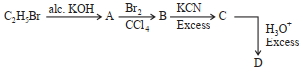
A
Gluconic acid
B
Succinic acid
C
Oxalic acid
D
Malonic acid
Solution
(B) The reaction sequence is as follows:
$1$. $C_2H_5Br$ reacts with alcoholic $KOH$ (dehydrohalogenation) to form ethene $(CH_2=CH_2)$ as product $A$.
$2$. Ethene $(A)$ reacts with $Br_2$ in $CCl_4$ (electrophilic addition) to form $1,2-$dibromoethane $(BrCH_2-CH_2Br)$ as product $B$.
$3$. $1,2-$dibromoethane $(B)$ reacts with excess $KCN$ (nucleophilic substitution) to form succinonitrile $(NC-CH_2-CH_2-CN)$ as product $C$.
$4$. Succinonitrile $(C)$ undergoes acid hydrolysis $(H_3O^+)$ to form succinic acid $(HOOC-CH_2-CH_2-COOH)$ as product $D$.
$1$. $C_2H_5Br$ reacts with alcoholic $KOH$ (dehydrohalogenation) to form ethene $(CH_2=CH_2)$ as product $A$.
$2$. Ethene $(A)$ reacts with $Br_2$ in $CCl_4$ (electrophilic addition) to form $1,2-$dibromoethane $(BrCH_2-CH_2Br)$ as product $B$.
$3$. $1,2-$dibromoethane $(B)$ reacts with excess $KCN$ (nucleophilic substitution) to form succinonitrile $(NC-CH_2-CH_2-CN)$ as product $C$.
$4$. Succinonitrile $(C)$ undergoes acid hydrolysis $(H_3O^+)$ to form succinic acid $(HOOC-CH_2-CH_2-COOH)$ as product $D$.
0 likes
View Solution8-2.Carboxylic acids and Their derivative — Preparation of Carboxylic Acids and Their Derivatives · Frequently Asked Questions
1Are these 8-2.Carboxylic acids and Their derivative questions useful for JEE and NEET?
Yes. All questions in this section are mapped to JEE Main and NEET exam patterns. Previous year questions from JEE Main, NEET, GUJCET and state-level exams are included with full solutions.
2Can I switch to Hindi or Gujarati for these questions?
Yes. Use the language tabs in the hero section or the sidebar to view the same questions and solutions in English, Hindi or Gujarati.
3How do I generate a question paper from this subtopic?
Use the Vedclass Exam Paper Generator — select the chapter and subtopic, set difficulty, and generate Sets A, B, C, D automatically. First 3 chapters of every subject are free.
Vedclass Products
For Students
Vedclass Test Series
Mock tests in real JEE/NEET style with performance analysis. 5-day free trial.
Start Free TrialFor Teachers
Exam Paper Generator
Generate Set A/B/C/D papers from this chapter in 2 minutes. 3 chapters free.
Try FreeFor Institutes
Online Exam Module
Live online exams with unlimited students, 360° analytics & white-label branding.
See DemoFor Teachers & Institutes
Generate a 8-2.Carboxylic acids and Their derivative Exam Paper in 2 Minutes
Select subtopic & difficulty — Sets A, B, C, D auto-generated with No Repeat logic.
First 3 chapters of every subject are free — no payment required.