
A English
Preparation of Carboxylic Acids and Their Derivatives Questions in English
Class 12 Chemistry · 8-2.Carboxylic acids and Their derivative · Preparation of Carboxylic Acids and Their Derivatives
150+
Questions
English
Language
100%
With Solutions
Showing 39 of 150 questions in English
101
MediumMCQ
Consider the following reactions. From these reactions,which reaction will give carboxylic acid as a major product?
$(A)$ $R-C \equiv N \xrightarrow[(i) H^{+}/H_2O]{\text{mild condition}} R-CONH_2$
$(B)$ $R-MgX \xrightarrow[(ii) H_3O^{+}]{\text{(i) } CO_2} R-COOH$
$(C)$ $R-C \equiv N \xrightarrow[(ii) H_3O^{+}]{\text{(i) } SnCl_2/HCl} R-CHO$
$(D)$ $R-CH_2-OH \xrightarrow{PCC} R-CHO$
$(E)$ $\text{Benzoyl chloride} \xrightarrow[(ii) Br_2/H_2O]{\text{(i) } H_2/Pd-BaSO_4} \text{Benzoic acid}$
Choose the correct answer from the options given below:
$(A)$ $R-C \equiv N \xrightarrow[(i) H^{+}/H_2O]{\text{mild condition}} R-CONH_2$
$(B)$ $R-MgX \xrightarrow[(ii) H_3O^{+}]{\text{(i) } CO_2} R-COOH$
$(C)$ $R-C \equiv N \xrightarrow[(ii) H_3O^{+}]{\text{(i) } SnCl_2/HCl} R-CHO$
$(D)$ $R-CH_2-OH \xrightarrow{PCC} R-CHO$
$(E)$ $\text{Benzoyl chloride} \xrightarrow[(ii) Br_2/H_2O]{\text{(i) } H_2/Pd-BaSO_4} \text{Benzoic acid}$
Choose the correct answer from the options given below:
A
$A$ and $D$ only
B
$A, B$ and $E$ only
C
$B, C$ and $E$ only
D
$B$ and $E$ only
Solution
(D) Let us analyze each reaction:
$(A)$ Nitriles on partial hydrolysis under mild conditions yield amides $(R-CONH_2)$,not carboxylic acids.
$(B)$ Grignard reagents react with $CO_2$ followed by acidic hydrolysis to form carboxylic acids $(R-COOH)$. This is a standard method for preparing carboxylic acids.
$(C)$ This is the Stephen reduction,which converts nitriles to aldehydes $(R-CHO)$.
$(D)$ $PCC$ (Pyridinium chlorochromate) is a mild oxidizing agent that oxidizes primary alcohols to aldehydes $(R-CHO)$.
$(E)$ Benzoyl chloride undergoes Rosenmund reduction with $H_2/Pd-BaSO_4$ to form benzaldehyde,which is then oxidized to benzoic acid by $Br_2/H_2O$ (acting as a mild oxidizing agent in this context). Thus,it yields a carboxylic acid.
Therefore,reactions $(B)$ and $(E)$ produce carboxylic acids as major products.
$(A)$ Nitriles on partial hydrolysis under mild conditions yield amides $(R-CONH_2)$,not carboxylic acids.
$(B)$ Grignard reagents react with $CO_2$ followed by acidic hydrolysis to form carboxylic acids $(R-COOH)$. This is a standard method for preparing carboxylic acids.
$(C)$ This is the Stephen reduction,which converts nitriles to aldehydes $(R-CHO)$.
$(D)$ $PCC$ (Pyridinium chlorochromate) is a mild oxidizing agent that oxidizes primary alcohols to aldehydes $(R-CHO)$.
$(E)$ Benzoyl chloride undergoes Rosenmund reduction with $H_2/Pd-BaSO_4$ to form benzaldehyde,which is then oxidized to benzoic acid by $Br_2/H_2O$ (acting as a mild oxidizing agent in this context). Thus,it yields a carboxylic acid.
Therefore,reactions $(B)$ and $(E)$ produce carboxylic acids as major products.
0 likes
View Solution102
MediumMCQ
Acetic anhydride is obtained by the reaction of:
A
Sodium and acetic acid
B
Ammonia and acetic acid
C
$P_2O_5$ and acetic acid
D
Ethanol and acetic acid
Solution
(C) Acetic anhydride is prepared by the dehydration of acetic acid using a dehydrating agent like phosphorus pentoxide $(P_2O_5)$ upon heating.
The chemical reaction is as follows:
$2CH_3COOH \xrightarrow{P_2O_5, \Delta} (CH_3CO)_2O + H_2O$
Thus,acetic anhydride is obtained by the reaction of $P_2O_5$ and acetic acid.
The chemical reaction is as follows:
$2CH_3COOH \xrightarrow{P_2O_5, \Delta} (CH_3CO)_2O + H_2O$
Thus,acetic anhydride is obtained by the reaction of $P_2O_5$ and acetic acid.
0 likes
View Solution103
MediumMCQ
Identify the product formed in the following reaction: $CH_3CH_2MgBr$ $\xrightarrow{i. \text{Dry ice} / \text{dry ether}}$ $\xrightarrow{ii. \text{dil. } HCl} \text{Product}$
A
Ethanoic acid
B
Propanoic acid
C
$2-$Methylpropanoic acid
D
Butanoic acid
Solution
(B) The reaction of a Grignard reagent $(RMgX)$ with dry ice $(CO_2)$ followed by acid hydrolysis yields a carboxylic acid with one carbon atom more than the alkyl group of the Grignard reagent.
In this reaction,$CH_3CH_2MgBr$ (Ethyl magnesium bromide) reacts with $CO_2$ to form an intermediate complex,$CH_3CH_2COOMgBr$.
Upon subsequent hydrolysis with dilute $HCl$,the complex is converted into $CH_3CH_2COOH$,which is Propanoic acid.
The overall reaction is: $CH_3CH_2MgBr + CO_2$ $\rightarrow CH_3CH_2COOMgBr$ $\xrightarrow{H_3O^+} CH_3CH_2COOH + Mg(OH)Br$.
In this reaction,$CH_3CH_2MgBr$ (Ethyl magnesium bromide) reacts with $CO_2$ to form an intermediate complex,$CH_3CH_2COOMgBr$.
Upon subsequent hydrolysis with dilute $HCl$,the complex is converted into $CH_3CH_2COOH$,which is Propanoic acid.
The overall reaction is: $CH_3CH_2MgBr + CO_2$ $\rightarrow CH_3CH_2COOMgBr$ $\xrightarrow{H_3O^+} CH_3CH_2COOH + Mg(OH)Br$.
0 likes
View Solution104
MediumMCQ
Identify substrate '$S$' in the following reaction.
$S \xrightarrow{\text{Dimethyl cadmium}} \text{Propanone} + \text{Cadmium chloride}$
$S \xrightarrow{\text{Dimethyl cadmium}} \text{Propanone} + \text{Cadmium chloride}$
A
Ethyl chloride
B
Ethylene dichloride
C
Ethanoyl chloride
D
Ethylidene dichloride
Solution
(C) The reaction of acid chlorides with dialkyl cadmium is a standard method for the preparation of ketones.
The general reaction is: $2RCOCl + R'_2Cd \rightarrow 2RCOR' + CdCl_2$.
Here,the product is propanone $(CH_3COCH_3)$ and the reagent is dimethyl cadmium $((CH_3)_2Cd)$.
Comparing the general reaction,$R'$ is a methyl group $(CH_3)$.
Thus,$2RCOCl + (CH_3)_2Cd \rightarrow 2CH_3COCH_3 + CdCl_2$.
For the product to be propanone,$R$ must be a methyl group $(CH_3)$.
Therefore,the substrate $S$ is ethanoyl chloride $(CH_3COCl)$.
The general reaction is: $2RCOCl + R'_2Cd \rightarrow 2RCOR' + CdCl_2$.
Here,the product is propanone $(CH_3COCH_3)$ and the reagent is dimethyl cadmium $((CH_3)_2Cd)$.
Comparing the general reaction,$R'$ is a methyl group $(CH_3)$.
Thus,$2RCOCl + (CH_3)_2Cd \rightarrow 2CH_3COCH_3 + CdCl_2$.
For the product to be propanone,$R$ must be a methyl group $(CH_3)$.
Therefore,the substrate $S$ is ethanoyl chloride $(CH_3COCl)$.
0 likes
View Solution105
MediumMCQ
Which of the following compounds is obtained when $R-CHO$ is treated with dilute nitric acid?
A
Ketones
B
Carboxylic acids
C
Alcohols
D
Amides
Solution
(B) Aldehydes $(R-CHO)$ undergo oxidation when treated with oxidizing agents like dilute nitric acid $(HNO_3)$.
This reaction converts the aldehyde group into a carboxylic acid group.
The chemical equation is: $R-CHO \xrightarrow{\text{Dil. } HNO_3} R-COOH$ (Carboxylic acid).
This reaction converts the aldehyde group into a carboxylic acid group.
The chemical equation is: $R-CHO \xrightarrow{\text{Dil. } HNO_3} R-COOH$ (Carboxylic acid).
0 likes
View Solution106
MediumMCQ
Which among the following compounds is obtained when ethanenitrile is acid hydrolysed?
A
Formic acid
B
Acetamide
C
Formamide
D
Acetic acid
Solution
(D) Acid hydrolysis of ethanenitrile $(CH_3CN)$ involves the reaction with water in the presence of an acid catalyst $(H^+)$.
Initially,it forms acetamide,which further hydrolyzes to form acetic acid $(CH_3COOH)$ and ammonium salt $(NH_4^+)$.
The overall reaction is:
$CH_3CN + 2H_2O \xrightarrow{H^+} CH_3COOH + NH_4^+$
Initially,it forms acetamide,which further hydrolyzes to form acetic acid $(CH_3COOH)$ and ammonium salt $(NH_4^+)$.
The overall reaction is:
$CH_3CN + 2H_2O \xrightarrow{H^+} CH_3COOH + NH_4^+$
0 likes
View Solution107
MediumMCQ
Identify the product $B$ in the following reaction.
Dry ice $\xrightarrow[\text{dry ether}]{CH_3MgBr} A$ $\xrightarrow{H_3O^{+}} B$
Dry ice $\xrightarrow[\text{dry ether}]{CH_3MgBr} A$ $\xrightarrow{H_3O^{+}} B$
A
Methanoic acid
B
Ethanoic acid
C
Methanol
D
Ethanol
Solution
(B) The reaction of Grignard reagent $(CH_3MgBr)$ with dry ice $(CO_2)$ in the presence of dry ether forms an intermediate magnesium salt,$CH_3COOMgBr$ $(A)$.
The reaction is: $CH_3MgBr + CO_2 \xrightarrow{\text{dry ether}} CH_3COOMgBr$.
Upon acidic hydrolysis $(H_3O^{+})$,the intermediate $A$ yields ethanoic acid $(B)$.
The reaction is: $CH_3COOMgBr + H_3O^{+} \rightarrow CH_3COOH + Mg(OH)Br$.
The reaction is: $CH_3MgBr + CO_2 \xrightarrow{\text{dry ether}} CH_3COOMgBr$.
Upon acidic hydrolysis $(H_3O^{+})$,the intermediate $A$ yields ethanoic acid $(B)$.
The reaction is: $CH_3COOMgBr + H_3O^{+} \rightarrow CH_3COOH + Mg(OH)Br$.
0 likes
View Solution108
MediumMCQ
In a reaction,$(CH_3)_2CHMgBr + CO_2$ $\xrightarrow[\text{dry ether}]{} A$ $\xrightarrow[dil. HCl]{H_2O} B$. Find the product '$B$' of the above reaction.
A
Propanoic acid
B
$2-$Methylpropanoic acid
C
Butanoic acid
D
$2,2-$Dimethylethanoic acid
Solution
(B) The reaction of a Grignard reagent with carbon dioxide is a standard method for the preparation of carboxylic acids.
Step $1$: $(CH_3)_2CHMgBr + CO_2 \rightarrow (CH_3)_2CH-COO-MgBr$ (Intermediate $A$).
Step $2$: $(CH_3)_2CH-COO-MgBr + H_2O / H^+ \rightarrow (CH_3)_2CH-COOH + Mg(OH)Br$.
The product $B$ is $(CH_3)_2CH-COOH$,which is named $2-$methylpropanoic acid (also known as isobutyric acid).
Step $1$: $(CH_3)_2CHMgBr + CO_2 \rightarrow (CH_3)_2CH-COO-MgBr$ (Intermediate $A$).
Step $2$: $(CH_3)_2CH-COO-MgBr + H_2O / H^+ \rightarrow (CH_3)_2CH-COOH + Mg(OH)Br$.
The product $B$ is $(CH_3)_2CH-COOH$,which is named $2-$methylpropanoic acid (also known as isobutyric acid).
0 likes
View Solution109
MediumMCQ
Identify the product formed in the following reaction.
$CH_3CH_2MgBr \xrightarrow[\text{ii) dil. } HCl]{\text{i) Dry ice / dry ether}} \text{Product}$
$CH_3CH_2MgBr \xrightarrow[\text{ii) dil. } HCl]{\text{i) Dry ice / dry ether}} \text{Product}$
A
Ethanoic acid
B
Propanoic acid
C
$2-$Methylpropanoic acid
D
Butanoic acid
Solution
(B) The reaction of a Grignard reagent $(RMgX)$ with dry ice $(CO_2)$ followed by acidic hydrolysis is a standard method for the preparation of carboxylic acids.
In this reaction,the nucleophilic alkyl group $(CH_3CH_2^-)$ of the Grignard reagent attacks the electrophilic carbon atom of $CO_2$ to form a magnesium carboxylate salt $(CH_3CH_2COO^-Mg^+Br^-)$.
Subsequent hydrolysis with dilute $HCl$ converts the salt into the corresponding carboxylic acid.
$CH_3CH_2MgBr + CO_2 \rightarrow CH_3CH_2COOMgBr$
$CH_3CH_2COOMgBr + H_2O/H^+ \rightarrow CH_3CH_2COOH + Mg(OH)Br$
The product formed is $CH_3CH_2COOH$,which is Propanoic acid.
In this reaction,the nucleophilic alkyl group $(CH_3CH_2^-)$ of the Grignard reagent attacks the electrophilic carbon atom of $CO_2$ to form a magnesium carboxylate salt $(CH_3CH_2COO^-Mg^+Br^-)$.
Subsequent hydrolysis with dilute $HCl$ converts the salt into the corresponding carboxylic acid.
$CH_3CH_2MgBr + CO_2 \rightarrow CH_3CH_2COOMgBr$
$CH_3CH_2COOMgBr + H_2O/H^+ \rightarrow CH_3CH_2COOH + Mg(OH)Br$
The product formed is $CH_3CH_2COOH$,which is Propanoic acid.
0 likes
View Solution110
MediumMCQ
Identify product '$B$' in the following reaction: $\text{Cumene}$ $\xrightarrow[\Delta]{KMnO_4, KOH} A$ $\xrightarrow{H_3 O^{+}} B$
A
Phenol
B
Benzophenone
C
Benzaldehyde
D
Benzoic acid
Solution
(D) The reaction of cumene (isopropylbenzene) with alkaline $KMnO_4$ followed by heating results in the oxidation of the alkyl side chain to a carboxylate group.
In the first step,cumene is oxidized to potassium benzoate $(A)$.
In the second step,acidification of potassium benzoate with $H_3O^+$ yields benzoic acid $(B)$.
In the first step,cumene is oxidized to potassium benzoate $(A)$.
In the second step,acidification of potassium benzoate with $H_3O^+$ yields benzoic acid $(B)$.
0 likes
View Solution111
EasyMCQ
Identify the product formed in the following reaction.
$C_6H_5-CH_2-CH_3 \xrightarrow[\text{ii) } H_3O^{+}]{\text{alk. } KMnO_4} \text{product}$
$C_6H_5-CH_2-CH_3 \xrightarrow[\text{ii) } H_3O^{+}]{\text{alk. } KMnO_4} \text{product}$
A
$C_6H_5-CH_2COOH$
B
$C_6H_5-CH_2-CH_2-CH_2-COOH$
C
$C_6H_5-OH$
D
$C_6H_5-COOH$
Solution
(D) The reaction of an alkylbenzene with an alkyl group having at least one benzylic hydrogen atom with alkaline $KMnO_4$ followed by acidic hydrolysis $(H_3O^+)$ results in the oxidation of the alkyl side chain to a carboxylic acid group.
In the given reaction,ethylbenzene $(C_6H_5-CH_2-CH_3)$ is oxidized to benzoic acid $(C_6H_5-COOH)$.
The reaction is: $C_6H_5-CH_2-CH_3 \xrightarrow[\text{(ii) } H_3O^{+}]{\text{(i) alk. } KMnO_4} C_6H_5-COOH$.
In the given reaction,ethylbenzene $(C_6H_5-CH_2-CH_3)$ is oxidized to benzoic acid $(C_6H_5-COOH)$.
The reaction is: $C_6H_5-CH_2-CH_3 \xrightarrow[\text{(ii) } H_3O^{+}]{\text{(i) alk. } KMnO_4} C_6H_5-COOH$.
0 likes
View Solution112
MediumMCQ
Which among the following compounds is $NOT$ used for the preparation of aromatic carboxylic acids from alkyl benzene?
A
Diborane
B
Dilute nitric acid
C
Alkaline potassium permanganate
D
Chromic acid
Solution
(A) Aromatic carboxylic acids can be prepared from alkyl benzenes by vigorous oxidation of the alkyl side chain using strong oxidizing agents.
Alkaline potassium permanganate $(KMnO_4/OH^-)$ and chromic acid $(H_2CrO_4)$ are well-known strong oxidizing agents used for this purpose.
Dilute nitric acid $(HNO_3)$ is also capable of oxidizing the alkyl side chain of alkyl benzenes to a carboxylic acid group.
Diborane $(B_2H_6)$ is a reducing agent,typically used for hydroboration-oxidation reactions to convert alkenes into alcohols,and it is not used for the oxidation of alkyl benzenes to carboxylic acids.
Therefore,the correct answer is $A$.
Alkaline potassium permanganate $(KMnO_4/OH^-)$ and chromic acid $(H_2CrO_4)$ are well-known strong oxidizing agents used for this purpose.
Dilute nitric acid $(HNO_3)$ is also capable of oxidizing the alkyl side chain of alkyl benzenes to a carboxylic acid group.
Diborane $(B_2H_6)$ is a reducing agent,typically used for hydroboration-oxidation reactions to convert alkenes into alcohols,and it is not used for the oxidation of alkyl benzenes to carboxylic acids.
Therefore,the correct answer is $A$.
0 likes
View Solution113
DifficultMCQ
Identify compound $A$ in the following reaction.
$R-Mg-X + A$ $\xrightarrow{\text{dry ether}} R-COOMgX$ $\xrightarrow[\text{dil } HCl]{H_2O} R-COOH + Mg(X)OH$
$R-Mg-X + A$ $\xrightarrow{\text{dry ether}} R-COOMgX$ $\xrightarrow[\text{dil } HCl]{H_2O} R-COOH + Mg(X)OH$
A
$K_2Cr_2O_7$
B
$NaOH$
C
$CO_2$ (Solid)
D
$NH_3$
Solution
(C) The reaction of a Grignard reagent $(R-Mg-X)$ with solid carbon dioxide ($CO_2$,dry ice) followed by acidic hydrolysis is a standard method for the preparation of carboxylic acids.
Step $1$: $R-Mg-X + CO_2 \xrightarrow{\text{dry ether}} R-COOMgX$ (Carboxylato magnesium halide).
Step $2$: $R-COOMgX + H_2O \xrightarrow{\text{dil } HCl} R-COOH + Mg(X)OH$ (Carboxylic acid).
Therefore,compound $A$ is $CO_2$ (Solid).
Step $1$: $R-Mg-X + CO_2 \xrightarrow{\text{dry ether}} R-COOMgX$ (Carboxylato magnesium halide).
Step $2$: $R-COOMgX + H_2O \xrightarrow{\text{dil } HCl} R-COOH + Mg(X)OH$ (Carboxylic acid).
Therefore,compound $A$ is $CO_2$ (Solid).
0 likes
View Solution114
DifficultMCQ
Identify product '$B$' in the following reaction.
$Cumene$ $\xrightarrow[\Delta]{KMnO_4, KOH} A$ $\xrightarrow{H_3O^{+}} B$
$Cumene$ $\xrightarrow[\Delta]{KMnO_4, KOH} A$ $\xrightarrow{H_3O^{+}} B$
A
Benzoic acid
B
Benzophenone
C
Phenol
D
Benzaldehyde
Solution
(A) The reaction of $Cumene$ (isopropylbenzene) with alkaline $KMnO_4$ followed by acidification is a standard method for the oxidation of alkylbenzenes.
$1$. In the first step,$Cumene$ is oxidized to potassium benzoate $(A)$ by alkaline $KMnO_4$ under heating.
$2$. In the second step,acidification with $H_3O^{+}$ converts potassium benzoate into $Benzoic \ acid$ $(B)$.
Therefore,the final product $B$ is $Benzoic \ acid$.
$1$. In the first step,$Cumene$ is oxidized to potassium benzoate $(A)$ by alkaline $KMnO_4$ under heating.
$2$. In the second step,acidification with $H_3O^{+}$ converts potassium benzoate into $Benzoic \ acid$ $(B)$.
Therefore,the final product $B$ is $Benzoic \ acid$.
0 likes
View Solution115
EasyMCQ
The compound from which formic acid cannot be prepared is
A
methyl alcohol
B
carbon monoxide $+ NaOH$
C
glycerol
D
methyl magnesium bromide
Solution
(D) Formic acid $(HCOOH)$ cannot be prepared from methyl magnesium bromide $(CH_{3}MgBr)$ because Grignard reagents react with $CO_{2}$ to form carboxylic acids with at least two carbon atoms (e.g.,acetic acid).
Formic acid can be prepared from the other reagents as follows:
$(a)$ $CH_{3}OH$ $\xrightarrow{[O]} HCHO$ $\xrightarrow{[O]} HCOOH$
$(b)$ $CO + NaOH$ $\longrightarrow HCOONa$ $\xrightarrow{H_{2}SO_{4}} HCOOH + NaHSO_{4}$
$(c)$ Glycerol + Oxalic acid $\xrightarrow{383 \ K} HCOOH + \text{glycerol}$
Formic acid can be prepared from the other reagents as follows:
$(a)$ $CH_{3}OH$ $\xrightarrow{[O]} HCHO$ $\xrightarrow{[O]} HCOOH$
$(b)$ $CO + NaOH$ $\longrightarrow HCOONa$ $\xrightarrow{H_{2}SO_{4}} HCOOH + NaHSO_{4}$
$(c)$ Glycerol + Oxalic acid $\xrightarrow{383 \ K} HCOOH + \text{glycerol}$
0 likes
View Solution116
EasyMCQ
Identify the product $X$ in the following reaction.
$CH_3COCl \xrightarrow{H_2O} X$
$CH_3COCl \xrightarrow{H_2O} X$
A
Ethanol
B
Ethanal
C
Ethanoic acid
D
Ethylethanoate
Solution
(C) The reaction of ethanoyl chloride $(CH_3COCl)$ with water $(H_2O)$ is a hydrolysis reaction.
In this reaction,the chlorine atom is replaced by a hydroxyl group $(-OH)$ from water.
The chemical equation is: $CH_3COCl + H_2O \rightarrow CH_3COOH + HCl$.
The product $X$ formed is ethanoic acid $(CH_3COOH)$.
In this reaction,the chlorine atom is replaced by a hydroxyl group $(-OH)$ from water.
The chemical equation is: $CH_3COCl + H_2O \rightarrow CH_3COOH + HCl$.
The product $X$ formed is ethanoic acid $(CH_3COOH)$.
0 likes
View Solution117
MediumMCQ
Which among the following reactions forms acid anhydride?
A
$R-COOH$ treated with $NaHCO_{3(aq)}$
B
$R-COOH$ treated with $PCl_5$
C
$R-COOH$ (excess) heated in presence of $P_2O_5$
D
$R-COOH$ treated with $R'-OH$ and heated
Solution
(C) When two molecules of carboxylic acid $(R-COOH)$ are heated in the presence of a dehydrating agent like phosphorus pentoxide $(P_2O_5)$,they undergo a condensation reaction to form an acid anhydride by the elimination of a water molecule $(H_2O)$.
The reaction is represented as:
$2R-COOH \xrightarrow{P_2O_5, \Delta} (RCO)_2O + H_2O$
Thus,option $C$ is the correct reaction for the formation of acid anhydride.
The reaction is represented as:
$2R-COOH \xrightarrow{P_2O_5, \Delta} (RCO)_2O + H_2O$
Thus,option $C$ is the correct reaction for the formation of acid anhydride.
0 likes
View Solution118
DifficultMCQ
Identify product $C$ in the following conversion sequence: $m$-Hydroxybenzaldehyde $\xrightarrow[\text{Protection of } -OH \text{ group}]{C_6H_5CH_2Cl} A$ $\xrightarrow{[O]} B$ $\xrightarrow{\text{deprotection}} C$.
A
Benzoic acid
B
$m$-Hydroxybenzoic acid
C
Phenol
D
Phenyl benzoate
Solution
(B) Step $1$: Protection of the $-OH$ group of $m$-hydroxybenzaldehyde with benzyl chloride $(C_6H_5CH_2Cl)$ gives $m$-benzyloxybenzaldehyde $(A)$.
Step $2$: Oxidation of the aldehyde group in $A$ using an oxidizing agent $[O]$ yields $m$-benzyloxybenzoic acid $(B)$.
Step $3$: Deprotection of the benzyl group (usually via catalytic hydrogenation or acid-catalyzed cleavage) removes the protecting group to yield $m$-hydroxybenzoic acid $(C)$.
Step $2$: Oxidation of the aldehyde group in $A$ using an oxidizing agent $[O]$ yields $m$-benzyloxybenzoic acid $(B)$.
Step $3$: Deprotection of the benzyl group (usually via catalytic hydrogenation or acid-catalyzed cleavage) removes the protecting group to yield $m$-hydroxybenzoic acid $(C)$.
0 likes
View Solution119
MediumMCQ
Identify the compounds $A$ and $B$ in the following reaction.
A
$A =$ methylisocyanide,$B =$ Methanoic acid
B
$A =$ Ethanenitrile,$B =$ Methanoic acid
C
$A =$ Ethanenitrile,$B =$ Ethanoic acid
D
$A =$ methyl cyanide,$B =$ methanoic acid
Solution
(C) The reaction is as follows:
$CH_3Cl + KCN_{(alc)} \xrightarrow{\Delta} CH_3CN (A) + KCl$
$CH_3CN + 2H_2O \xrightarrow{HCl} CH_3COOH (B) + NH_4Cl$
In the first step,chloromethane reacts with alcoholic $KCN$ to form ethanenitrile $(CH_3CN)$,which is compound $A$.
In the second step,the acid hydrolysis of ethanenitrile yields ethanoic acid $(CH_3COOH)$,which is compound $B$.
Therefore,$A =$ Ethanenitrile and $B =$ Ethanoic acid.
$CH_3Cl + KCN_{(alc)} \xrightarrow{\Delta} CH_3CN (A) + KCl$
$CH_3CN + 2H_2O \xrightarrow{HCl} CH_3COOH (B) + NH_4Cl$
In the first step,chloromethane reacts with alcoholic $KCN$ to form ethanenitrile $(CH_3CN)$,which is compound $A$.
In the second step,the acid hydrolysis of ethanenitrile yields ethanoic acid $(CH_3COOH)$,which is compound $B$.
Therefore,$A =$ Ethanenitrile and $B =$ Ethanoic acid.
0 likes
View Solution120
MediumMCQ
Identify the product '$B$' in the following reaction.
$Cumene$ $\xrightarrow{KMnO_4, KOH} A$ $\xrightarrow{H_3O^+} B$
$Cumene$ $\xrightarrow{KMnO_4, KOH} A$ $\xrightarrow{H_3O^+} B$
A
Phenol
B
Potassium benzoate
C
Benzoic acid
D
Aniline
Solution
(C) The reaction of $Cumene$ (isopropylbenzene) with alkaline $KMnO_4$ followed by acidic hydrolysis is a standard method for the oxidation of alkylbenzenes.
Step $1$: Oxidation of $Cumene$ with $KMnO_4$ and $KOH$ yields $Potassium \ benzoate$ $(A)$.
Step $2$: Acidification of $Potassium \ benzoate$ with $H_3O^+$ yields $Benzoic \ acid$ $(B)$.
Therefore,the final product $B$ is $Benzoic \ acid$.
Step $1$: Oxidation of $Cumene$ with $KMnO_4$ and $KOH$ yields $Potassium \ benzoate$ $(A)$.
Step $2$: Acidification of $Potassium \ benzoate$ with $H_3O^+$ yields $Benzoic \ acid$ $(B)$.
Therefore,the final product $B$ is $Benzoic \ acid$.
0 likes
View Solution121
MediumMCQ
Identify the product formed in the following reaction.
$C_6H_5-CH_2-CH_3 \xrightarrow[ii) H_3O^{+}]{i) \text{alk. } KMnO_4} \text{Product}$
$C_6H_5-CH_2-CH_3 \xrightarrow[ii) H_3O^{+}]{i) \text{alk. } KMnO_4} \text{Product}$
A
$C_6H_5-CH_2-COOH$
B
$C_6H_5CH_2-CH_2-COOH$
C
$C_6H_5-OH$
D
$C_6H_5-COOH$
Solution
(D) The reaction of an alkylbenzene with an alkyl group having at least one benzylic hydrogen atom with alkaline $KMnO_4$ followed by acidic hydrolysis $(H_3O^+)$ results in the oxidation of the alkyl side chain to a carboxylic acid group.
In the given reactant,$C_6H_5-CH_2-CH_3$ (ethylbenzene),the benzylic carbon is the $CH_2$ group.
Upon oxidation,the entire alkyl side chain is converted into a carboxyl group $(-COOH)$ attached to the benzene ring.
Therefore,the product formed is benzoic acid,$C_6H_5-COOH$.
In the given reactant,$C_6H_5-CH_2-CH_3$ (ethylbenzene),the benzylic carbon is the $CH_2$ group.
Upon oxidation,the entire alkyl side chain is converted into a carboxyl group $(-COOH)$ attached to the benzene ring.
Therefore,the product formed is benzoic acid,$C_6H_5-COOH$.
0 likes
View Solution122
MediumMCQ
Identify the product formed when ethyl benzene reacts with nitric acid.
A
$o-$Nitro ethylbenzene
B
Ethoxy benzene
C
$p-$Nitro ethylbenzene
D
Benzoic acid
Solution
(D) When ethyl benzene is treated with strong oxidizing agents like $HNO_3$ or $KMnO_4$,the alkyl side chain attached to the benzene ring is oxidized to a carboxylic acid group $(-COOH)$.
Thus,ethyl benzene undergoes strong oxidation to form benzoic acid.
Thus,ethyl benzene undergoes strong oxidation to form benzoic acid.
0 likes
View Solution123
MediumMCQ
Identify the product '$B$' in the following reaction.
$Dry \ ice$ $\xrightarrow[Dry \ ether]{CH_3MgBr} A$ $\xrightarrow[dil. \ HCl]{H_2O} B$
$Dry \ ice$ $\xrightarrow[Dry \ ether]{CH_3MgBr} A$ $\xrightarrow[dil. \ HCl]{H_2O} B$
A
Methanoic acid
B
Ethanoic acid
C
Methanol
D
Ethanol
Solution
(B) The reaction of dry ice $(CO_2)$ with a Grignard reagent $(CH_3MgBr)$ in the presence of dry ether forms an intermediate addition product $(A)$,which is $CH_3COOMgBr$.
$CO_2 + CH_3MgBr \xrightarrow{Dry \ ether} CH_3COOMgBr (A)$
This intermediate $(A)$ upon hydrolysis with dilute $HCl$ yields a carboxylic acid $(B)$,which is ethanoic acid $(CH_3COOH)$.
$CH_3COOMgBr + H_2O \xrightarrow{dil. \ HCl} CH_3COOH (B) + Mg(OH)Br$
Therefore,the product $B$ is ethanoic acid.
$CO_2 + CH_3MgBr \xrightarrow{Dry \ ether} CH_3COOMgBr (A)$
This intermediate $(A)$ upon hydrolysis with dilute $HCl$ yields a carboxylic acid $(B)$,which is ethanoic acid $(CH_3COOH)$.
$CH_3COOMgBr + H_2O \xrightarrow{dil. \ HCl} CH_3COOH (B) + Mg(OH)Br$
Therefore,the product $B$ is ethanoic acid.
0 likes
View Solution124
MediumMCQ
Identify $A$ and $B$ in the following reactions: $R-CHO \xrightarrow{A} R-CH_2OH \xleftarrow{B} R-COOH$
A
| $A: NaBH_4$ | $B: H_2 | Pd$ |
B
| $A: H_2 | Pd$ | $B: i) LiAlH_4, ii) H_3O^+$ |
C
| $A: SnCl_2$ | $B: MnO_2$ |
D
| $A: NaBH_4$ | $B: SnCl_2$ |
Solution
(B) The reaction $R-CHO \rightarrow R-CH_2OH$ is the reduction of an aldehyde to a primary alcohol. Both $NaBH_4$ and $H_2 | Pd$ can perform this reduction.
The reaction $R-COOH \rightarrow R-CH_2OH$ is the reduction of a carboxylic acid to a primary alcohol. Carboxylic acids are resistant to reduction by $NaBH_4$ and $H_2 | Pd$. $A$ strong reducing agent like $LiAlH_4$ followed by acidic workup $(H_3O^+)$ is required for this transformation.
Comparing the options,option $B$ provides a valid set of reagents for both steps: $H_2 | Pd$ can reduce the aldehyde,and $LiAlH_4$ is the standard reagent for reducing carboxylic acids to primary alcohols.
The reaction $R-COOH \rightarrow R-CH_2OH$ is the reduction of a carboxylic acid to a primary alcohol. Carboxylic acids are resistant to reduction by $NaBH_4$ and $H_2 | Pd$. $A$ strong reducing agent like $LiAlH_4$ followed by acidic workup $(H_3O^+)$ is required for this transformation.
Comparing the options,option $B$ provides a valid set of reagents for both steps: $H_2 | Pd$ can reduce the aldehyde,and $LiAlH_4$ is the standard reagent for reducing carboxylic acids to primary alcohols.
0 likes
View Solution125
MediumMCQ
Which one of the following functional groups undergoes hydrolysis with alkali to yield an acid group?
A
$CN^{-}$
B
$-CHO$
C
$-COCH_3$
D
$-Br$
Solution
(A) Cyanides $(-CN)$ undergo hydrolysis in the presence of an alkali (like $NaOH$) or an acid to produce a carboxylic acid group $(-COOH)$.
The reaction is as follows:
$R-CN + 2H_2O \xrightarrow{NaOH} R-COOH + NH_3$
The reaction is as follows:
$R-CN + 2H_2O \xrightarrow{NaOH} R-COOH + NH_3$
0 likes
View Solution126
EasyMCQ
Identify the compound $(B)$ in the given reaction.
$CH_3Cl$ $\xrightarrow{KCN} (A)$ $\xrightarrow{H^+ / H_2O} (B)$
$CH_3Cl$ $\xrightarrow{KCN} (A)$ $\xrightarrow{H^+ / H_2O} (B)$
A
$CH_3NH_2$
B
$HCOOH$
C
$CH_3COOH$
D
$CH_3COCH_3$
Solution
(C) Step $1$: Reaction of chloromethane with potassium cyanide $(KCN)$ is a nucleophilic substitution reaction where the cyanide ion $(CN^-)$ replaces the chloride ion $(Cl^-)$ to form methyl cyanide $(CH_3CN)$,which is compound $(A)$.
$CH_3Cl + KCN \rightarrow CH_3CN + KCl$
Step $2$: Acidic hydrolysis of methyl cyanide $(CH_3CN)$ leads to the formation of an amide intermediate,which further hydrolyzes to form acetic acid $(CH_3COOH)$ as the final product $(B)$.
$CH_3CN + 2H_2O \xrightarrow{H^+} CH_3COOH + NH_3$
$CH_3Cl + KCN \rightarrow CH_3CN + KCl$
Step $2$: Acidic hydrolysis of methyl cyanide $(CH_3CN)$ leads to the formation of an amide intermediate,which further hydrolyzes to form acetic acid $(CH_3COOH)$ as the final product $(B)$.
$CH_3CN + 2H_2O \xrightarrow{H^+} CH_3COOH + NH_3$
0 likes
View Solution127
EasyMCQ
What are $A, B$ and $C$ in the following reaction sequence?
$CH_2=CH_2$ $\xrightarrow{HBr} A$ $\xrightarrow{KCN} B$ $\xrightarrow{H^{+} / H_2O} C$
$CH_2=CH_2$ $\xrightarrow{HBr} A$ $\xrightarrow{KCN} B$ $\xrightarrow{H^{+} / H_2O} C$
A
$A: CH_3-CH_2-Br, B: CH_3-CH_2-CN, C: CH_3-CH_2-COOH$
B
$A: CH_2=CHBr, B: CH_3-CH_2-CN, C: CH_3-COOH$
C
$A: CH_3-CH_2-Br, B: CH_3-CH_2-NC, C: CH_3-CH_2-NHCH_3$
D
$A: CH_2=CHBr, B: CH_2=CHCN, C: CH_2=CHCOOH$
Solution
(A) The reaction sequence is as follows:
$1.$ Addition of $HBr$ to ethene $(CH_2=CH_2)$ follows Markovnikov's rule to give ethyl bromide $(A)$:
$CH_2=CH_2 + HBr \rightarrow CH_3-CH_2-Br$
$2.$ Nucleophilic substitution of ethyl bromide with $KCN$ gives ethyl cyanide $(B)$:
$CH_3-CH_2-Br + KCN \rightarrow CH_3-CH_2-CN + KBr$
$3.$ Acidic hydrolysis of ethyl cyanide gives propanoic acid $(C)$:
$CH_3-CH_2-CN \xrightarrow{H^{+}/H_2O} CH_3-CH_2-COOH$
Therefore,the correct option is $A$.
$1.$ Addition of $HBr$ to ethene $(CH_2=CH_2)$ follows Markovnikov's rule to give ethyl bromide $(A)$:
$CH_2=CH_2 + HBr \rightarrow CH_3-CH_2-Br$
$2.$ Nucleophilic substitution of ethyl bromide with $KCN$ gives ethyl cyanide $(B)$:
$CH_3-CH_2-Br + KCN \rightarrow CH_3-CH_2-CN + KBr$
$3.$ Acidic hydrolysis of ethyl cyanide gives propanoic acid $(C)$:
$CH_3-CH_2-CN \xrightarrow{H^{+}/H_2O} CH_3-CH_2-COOH$
Therefore,the correct option is $A$.
0 likes
View Solution128
MediumMCQ
What is $C$ in the following sequence of reaction?
$CH_3OH$ $\xrightarrow{PCl_3} A$ $\xrightarrow{KCN} B$ $\xrightarrow{\text{Hydrolysis}} C$
$CH_3OH$ $\xrightarrow{PCl_3} A$ $\xrightarrow{KCN} B$ $\xrightarrow{\text{Hydrolysis}} C$
A
$CH_3CH_2OH$
B
$CH_3CHO$
C
$CH_3COOH$
D
$HOCH_2-CH_2OH$
Solution
(C) The reaction sequence is as follows:
$1$. $CH_3OH + PCl_3 \rightarrow CH_3Cl (A) + H_3PO_3$
$2$. $CH_3Cl + KCN \rightarrow CH_3CN (B) + KCl$
$3$. $CH_3CN + 2H_2O \xrightarrow{H_3O^+} CH_3COOH (C) + NH_3$
Therefore,$C$ is $CH_3COOH$.
$1$. $CH_3OH + PCl_3 \rightarrow CH_3Cl (A) + H_3PO_3$
$2$. $CH_3Cl + KCN \rightarrow CH_3CN (B) + KCl$
$3$. $CH_3CN + 2H_2O \xrightarrow{H_3O^+} CH_3COOH (C) + NH_3$
Therefore,$C$ is $CH_3COOH$.
0 likes
View Solution129
MediumMCQ
An alkyl bromide $X$ $(C_5H_{11}Br)$ undergoes hydrolysis in a two-step mechanism. $X$ is converted to a Grignard reagent and then reacted with $CO_2$ in dry ether followed by acidification to give $Y$. What is $Y$?
A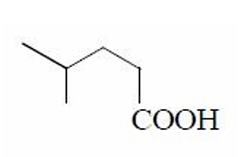
B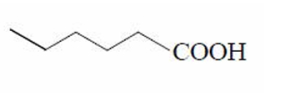
C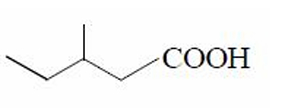
D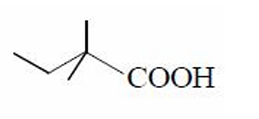
Solution
(C) The alkyl bromide $X$ $(C_5H_{11}Br)$ reacts with $Mg$ in dry ether to form a Grignard reagent $(R-MgBr)$.
Reaction with $CO_2$ followed by acidification yields a carboxylic acid with one additional carbon atom $(R-COOH)$.
Since the final product $Y$ is a carboxylic acid derived from a $C_5$ alkyl bromide,it must contain $5+1=6$ carbon atoms.
Among the options,$3$-methylbutanoic acid $(C_5H_{10}O_2)$ has $5$ carbons,hexanoic acid $(C_6H_{12}O_2)$ has $6$ carbons,$3$-methylpentanoic acid $(C_6H_{12}O_2)$ has $6$ carbons,and $2,2$-dimethylbutanoic acid $(C_6H_{12}O_2)$ has $6$ carbons.
Given the structure of the options provided,the reaction of $1$-bromo$-3-$methylbutane with $Mg$ followed by $CO_2$ and $H_3O^+$ gives $4$-methylpentanoic acid. However,looking at the provided options,option $A$ represents $3$-methylbutanoic acid,$B$ represents hexanoic acid,$C$ represents $3$-methylpentanoic acid,and $D$ represents $2,2$-dimethylbutanoic acid.
Based on the standard synthesis of carboxylic acids from alkyl halides via Grignard reagents,the chain length increases by one. The correct structure for $Y$ corresponding to the Grignard reagent derived from $1$-bromo$-3-$methylbutane is $4$-methylpentanoic acid. Since this is not explicitly listed,but $3$-methylpentanoic acid is a common isomer,we identify the correct structure based on the provided image $C$.
Reaction with $CO_2$ followed by acidification yields a carboxylic acid with one additional carbon atom $(R-COOH)$.
Since the final product $Y$ is a carboxylic acid derived from a $C_5$ alkyl bromide,it must contain $5+1=6$ carbon atoms.
Among the options,$3$-methylbutanoic acid $(C_5H_{10}O_2)$ has $5$ carbons,hexanoic acid $(C_6H_{12}O_2)$ has $6$ carbons,$3$-methylpentanoic acid $(C_6H_{12}O_2)$ has $6$ carbons,and $2,2$-dimethylbutanoic acid $(C_6H_{12}O_2)$ has $6$ carbons.
Given the structure of the options provided,the reaction of $1$-bromo$-3-$methylbutane with $Mg$ followed by $CO_2$ and $H_3O^+$ gives $4$-methylpentanoic acid. However,looking at the provided options,option $A$ represents $3$-methylbutanoic acid,$B$ represents hexanoic acid,$C$ represents $3$-methylpentanoic acid,and $D$ represents $2,2$-dimethylbutanoic acid.
Based on the standard synthesis of carboxylic acids from alkyl halides via Grignard reagents,the chain length increases by one. The correct structure for $Y$ corresponding to the Grignard reagent derived from $1$-bromo$-3-$methylbutane is $4$-methylpentanoic acid. Since this is not explicitly listed,but $3$-methylpentanoic acid is a common isomer,we identify the correct structure based on the provided image $C$.
0 likes
View Solution130
DifficultMCQ
What is the final product of the following reaction sequence?
$C_4H_8$ $\xrightarrow[\text{peroxide}]{\text{HBr}} X$ $\xrightarrow[\text{(ii) } CO_2]{\text{(i) Mg/dry ether, (iii) } H_3O^+} Y$
$C_4H_8$ $\xrightarrow[\text{peroxide}]{\text{HBr}} X$ $\xrightarrow[\text{(ii) } CO_2]{\text{(i) Mg/dry ether, (iii) } H_3O^+} Y$
A
$3-$methylbutanal
B
$2-$methylbutanoic acid
C
$2,2-$dimethylpropanoic acid
D
$3-$methylbutanoic acid
Solution
(D) $1$. The ozonolysis of $C_4H_8$ gives acetone $(CH_3COCH_3)$ and formaldehyde $(HCHO)$. This confirms that $C_4H_8$ is isobutylene,$(CH_3)_2C=CH_2$.
$2$. Reaction of isobutylene with $HBr$ in the presence of peroxide follows anti-Markovnikov addition: $(CH_3)_2C=CH_2 + HBr \xrightarrow{\text{peroxide}} (CH_3)_2CH-CH_2Br$ ($X$ is $1-$bromo$-2-$methylpropane).
$3$. $X$ reacts with $Mg$ in dry ether to form the Grignard reagent: $(CH_3)_2CH-CH_2MgBr$.
$4$. The Grignard reagent reacts with $CO_2$ followed by acid hydrolysis to form a carboxylic acid: $(CH_3)_2CH-CH_2MgBr + CO_2$ $\rightarrow (CH_3)_2CH-CH_2COOMgBr$ $\xrightarrow{H_3O^+} (CH_3)_2CH-CH_2COOH$.
$5$. The final product $Y$ is $3-$methylbutanoic acid.
$2$. Reaction of isobutylene with $HBr$ in the presence of peroxide follows anti-Markovnikov addition: $(CH_3)_2C=CH_2 + HBr \xrightarrow{\text{peroxide}} (CH_3)_2CH-CH_2Br$ ($X$ is $1-$bromo$-2-$methylpropane).
$3$. $X$ reacts with $Mg$ in dry ether to form the Grignard reagent: $(CH_3)_2CH-CH_2MgBr$.
$4$. The Grignard reagent reacts with $CO_2$ followed by acid hydrolysis to form a carboxylic acid: $(CH_3)_2CH-CH_2MgBr + CO_2$ $\rightarrow (CH_3)_2CH-CH_2COOMgBr$ $\xrightarrow{H_3O^+} (CH_3)_2CH-CH_2COOH$.
$5$. The final product $Y$ is $3-$methylbutanoic acid.
0 likes
View Solution131
EasyMCQ
What is the catalyst used in the conversion of acetaldehyde to acetic acid?
A
Manganese acetate
B
$LiAlH_4$
C
$H_2 / Ni$
D
$Na / NH_3$
Solution
(A) The oxidation of acetaldehyde $(CH_3CHO)$ to acetic acid $(CH_3COOH)$ is an industrial process.
This reaction is typically catalyzed by manganese acetate $(Mn(CH_3COO)_2)$ in the presence of air or oxygen.
The reaction is: $2CH_3CHO + O_2 \xrightarrow{Mn(CH_3COO)_2} 2CH_3COOH$.
This reaction is typically catalyzed by manganese acetate $(Mn(CH_3COO)_2)$ in the presence of air or oxygen.
The reaction is: $2CH_3CHO + O_2 \xrightarrow{Mn(CH_3COO)_2} 2CH_3COOH$.
0 likes
View Solution132
MediumMCQ
$CH_3MgBr + CO_2$ $\xrightarrow{\text{Dry ether}} Y$ $\xrightarrow{H_3O^{\oplus}} Z$
Identify $Z$ from the following.
Identify $Z$ from the following.
A
Ethyl acetate
B
Acetic acid
C
Propanoic acid
D
Methyl acetate
Solution
(B) The reaction of Grignard reagent $(CH_3MgBr)$ with carbon dioxide $(CO_2)$ in the presence of dry ether forms an intermediate magnesium carboxylate complex $(Y = CH_3COOMgBr)$.
Upon subsequent acid hydrolysis $(H_3O^{\oplus})$,this complex yields a carboxylic acid.
Since the Grignard reagent used is methylmagnesium bromide $(CH_3MgBr)$,the resulting carboxylic acid is acetic acid $(CH_3COOH)$.
Upon subsequent acid hydrolysis $(H_3O^{\oplus})$,this complex yields a carboxylic acid.
Since the Grignard reagent used is methylmagnesium bromide $(CH_3MgBr)$,the resulting carboxylic acid is acetic acid $(CH_3COOH)$.
0 likes
View Solution133
MediumMCQ
Which one of the following functional groups undergoes hydrolysis with alkali to yield an acid group?
A
$-CN$
B
$-CHO$
C
$-COCH_3$
D
$-Br$
Solution
(A) Cyanides $(-CN)$ undergo hydrolysis in the presence of an alkali (like $NaOH$) or an acid to yield a carboxylic acid group $(-COOH)$.
The reaction is as follows:
$R-CN + 2H_2O \xrightarrow{NaOH} R-COOH + NH_3$
The reaction is as follows:
$R-CN + 2H_2O \xrightarrow{NaOH} R-COOH + NH_3$
0 likes
View Solution134
DifficultMCQ
The major product in the following reaction is:
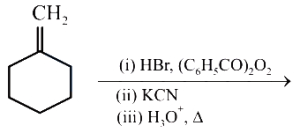
A
Cyclohexanecarboxylic acid with a methyl group at the alpha position.
B
$1-$methylcyclohexanecarboxylic acid.
C
Cyclohexylacetic acid.
D
$3-$cyclohexylpropanoic acid.
Solution
(C) The reaction proceeds as follows:
$1$. The first step is the anti-Markovnikov addition of $HBr$ to methylenecyclohexane in the presence of a peroxide,$(C_6H_5CO)_2O_2$. This yields (cyclohexylmethyl) bromide,$C_6H_{11}CH_2Br$.
$2$. The second step is a nucleophilic substitution reaction with $KCN$,where the bromide ion is replaced by a cyanide group,yielding cyclohexylacetonitrile,$C_6H_{11}CH_2CN$.
$3$. The third step is the acid-catalyzed hydrolysis of the nitrile group followed by heating,which converts the $-CN$ group into a carboxylic acid group,$-COOH$. The final product is cyclohexylacetic acid,$C_6H_{11}CH_2COOH$.
$1$. The first step is the anti-Markovnikov addition of $HBr$ to methylenecyclohexane in the presence of a peroxide,$(C_6H_5CO)_2O_2$. This yields (cyclohexylmethyl) bromide,$C_6H_{11}CH_2Br$.
$2$. The second step is a nucleophilic substitution reaction with $KCN$,where the bromide ion is replaced by a cyanide group,yielding cyclohexylacetonitrile,$C_6H_{11}CH_2CN$.
$3$. The third step is the acid-catalyzed hydrolysis of the nitrile group followed by heating,which converts the $-CN$ group into a carboxylic acid group,$-COOH$. The final product is cyclohexylacetic acid,$C_6H_{11}CH_2COOH$.
0 likes
View Solution135
EasyMCQ
In the reaction sequence,$C_2H_5Cl + KCN$ $\xrightarrow{C_2H_5OH} X$ $\xrightarrow{H_3O^{\oplus}, \Delta} Y$. What is the molecular formula of $Y$?
A
$C_3H_6O_2$
B
$C_3H_5N$
C
$C_2H_4O_2$
D
$C_2H_6O$
Solution
(A) The reaction sequence is as follows:
$1$. $C_2H_5Cl + KCN \xrightarrow{C_2H_5OH} C_2H_5CN (X) + KCl$
This is a nucleophilic substitution reaction where $CN^{-}$ replaces $Cl^{-}$.
$2$. $C_2H_5CN + 2H_2O \xrightarrow{H_3O^{\oplus}, \Delta} C_2H_5COOH (Y) + NH_3$
Acidic hydrolysis of the nitrile $(X)$ yields the corresponding carboxylic acid $(Y)$,which is propanoic acid $(C_2H_5COOH)$.
The molecular formula of propanoic acid $(C_2H_5COOH)$ is $C_3H_6O_2$.
$1$. $C_2H_5Cl + KCN \xrightarrow{C_2H_5OH} C_2H_5CN (X) + KCl$
This is a nucleophilic substitution reaction where $CN^{-}$ replaces $Cl^{-}$.
$2$. $C_2H_5CN + 2H_2O \xrightarrow{H_3O^{\oplus}, \Delta} C_2H_5COOH (Y) + NH_3$
Acidic hydrolysis of the nitrile $(X)$ yields the corresponding carboxylic acid $(Y)$,which is propanoic acid $(C_2H_5COOH)$.
The molecular formula of propanoic acid $(C_2H_5COOH)$ is $C_3H_6O_2$.
0 likes
View Solution136
MediumMCQ
Toluene on reaction with reagent $A$ gives $X$. This $(X)$ forms $2,4-$dinitrophenylhydrazone and reduces ammonical silver nitrate solution. Reaction of toluene with another reagent $B$ forms $Y$,which dissolves in $NaHCO_3$ with evolution of $CO_2$. What are $A$ and $B$ respectively?
A
$CrO_2Cl_2 | CS_2, H_3O^+ ; KMnO_4 | OH^-, \Delta, H_3O^+$
B
$CrO_3+(CH_3CO)_2O, H_3O^+ ; CrO_2Cl_2 | CS_2, H_3O^+$
C
$KMnO_4 | OH^-, \Delta ; CrO_3-H_2SO_4$
D
$CrO_3+(CH_3CO)_2O, H_3O^+ ; KMnO_4-KOH / \Delta, H_3O^+$
Solution
(A) $1$. Toluene reacts with $CrO_2Cl_2$ in $CS_2$ followed by hydrolysis ($Etard$ reaction) to form benzaldehyde $(X)$.
$2$. Benzaldehyde $(X)$ contains a carbonyl group,so it forms $2,4-$dinitrophenylhydrazone and acts as a reducing agent towards Tollen's reagent (ammonical silver nitrate).
$3$. Toluene reacts with $KMnO_4 | OH^-, \Delta$ followed by acidic workup to form benzoic acid $(Y)$.
$4$. Benzoic acid $(Y)$ is acidic enough to react with $NaHCO_3$ to evolve $CO_2$ gas.
$5$. Therefore,$A$ is $CrO_2Cl_2 | CS_2, H_3O^+$ and $B$ is $KMnO_4 | OH^-, \Delta, H_3O^+$.
$2$. Benzaldehyde $(X)$ contains a carbonyl group,so it forms $2,4-$dinitrophenylhydrazone and acts as a reducing agent towards Tollen's reagent (ammonical silver nitrate).
$3$. Toluene reacts with $KMnO_4 | OH^-, \Delta$ followed by acidic workup to form benzoic acid $(Y)$.
$4$. Benzoic acid $(Y)$ is acidic enough to react with $NaHCO_3$ to evolve $CO_2$ gas.
$5$. Therefore,$A$ is $CrO_2Cl_2 | CS_2, H_3O^+$ and $B$ is $KMnO_4 | OH^-, \Delta, H_3O^+$.
0 likes
View Solution137
DifficultMCQ
The correct set$(s)$ of reactions to synthesize benzoic acid starting from benzene is/are:
A
$(i) Br_2 / Fe, (ii) Mg / \text{dry ether}, (iii) CO_2, (iv) H_3O^{\oplus}$
B
$(i) Br_2 / Fe, (ii) NH_3, 25^{\circ}C, (iii) NaNO_2, \text{dil. } HCl, 0^{\circ} \text{ to } 5^{\circ}C, (iv) CuCN / KCN, (v) \text{dil. } HCl, \Delta$
C
$(i) CH_3Cl, \text{Anhydrous } AlCl_3, (ii) KMnO_4 / OH^{\ominus}, \Delta, (iii) H_3O^{\oplus}$
D
$(i) CH_3COCl, \text{Anhydrous } AlCl_3, (ii) Br_2, NaOH, (iii) H_3O^{\oplus}$
Solution
(A, C, D) To synthesize benzoic acid from benzene:
Option $(A)$: Benzene reacts with $Br_2/Fe$ to form bromobenzene,which forms a Grignard reagent $(PhMgBr)$ with $Mg/\text{dry ether}$. This reacts with $CO_2$ followed by acid hydrolysis $(H_3O^{\oplus})$ to yield benzoic acid.
Option $(C)$: Friedel-Crafts alkylation of benzene with $CH_3Cl/AlCl_3$ gives toluene. Oxidation of toluene with alkaline $KMnO_4$ followed by acidification gives benzoic acid.
Option $(D)$: Friedel-Crafts acylation of benzene with $CH_3COCl/AlCl_3$ gives acetophenone. The haloform reaction with $Br_2/NaOH$ followed by acidification gives benzoic acid.
Option $(B)$ is incorrect as the reaction sequence does not lead to benzoic acid.
Therefore,the correct sets are $(A), (C),$ and $(D)$.
Option $(A)$: Benzene reacts with $Br_2/Fe$ to form bromobenzene,which forms a Grignard reagent $(PhMgBr)$ with $Mg/\text{dry ether}$. This reacts with $CO_2$ followed by acid hydrolysis $(H_3O^{\oplus})$ to yield benzoic acid.
Option $(C)$: Friedel-Crafts alkylation of benzene with $CH_3Cl/AlCl_3$ gives toluene. Oxidation of toluene with alkaline $KMnO_4$ followed by acidification gives benzoic acid.
Option $(D)$: Friedel-Crafts acylation of benzene with $CH_3COCl/AlCl_3$ gives acetophenone. The haloform reaction with $Br_2/NaOH$ followed by acidification gives benzoic acid.
Option $(B)$ is incorrect as the reaction sequence does not lead to benzoic acid.
Therefore,the correct sets are $(A), (C),$ and $(D)$.
0 likes
View Solution138
MediumMCQ
Identify the method by which $Me_{3}CCOOH$ can be prepared.
A
Treating $1 \ mol$ of $MeCOMe$ with $2 \ mol$ of $MeMgI$
B
Treating $1 \ mol$ of $MeCO_{2}Me$ with $3 \ mol$ of $MeMgI$
C
Treating $1 \ mol$ of $MeCHO$ with $3 \ mol$ of $MeMgI$
D
Treating $1 \ mol$ of dry ice with $1 \ mol$ of $Me_{3}CMgI$
Solution
(D) The preparation of $Me_{3}CCOOH$ (pivalic acid) from a Grignard reagent involves the reaction of a Grignard reagent with dry ice $(CO_{2})$.
The reaction is as follows:
$O=C=O + (CH_{3})_{3}CMgI \rightarrow (CH_{3})_{3}C-COOMgI$
Followed by hydrolysis:
$(CH_{3})_{3}C-COOMgI + H_{2}O \rightarrow (CH_{3})_{3}C-COOH + Mg(OH)I$
Thus,treating $1 \ mol$ of dry ice with $1 \ mol$ of $Me_{3}CMgI$ yields $Me_{3}CCOOH$.
The reaction is as follows:
$O=C=O + (CH_{3})_{3}CMgI \rightarrow (CH_{3})_{3}C-COOMgI$
Followed by hydrolysis:
$(CH_{3})_{3}C-COOMgI + H_{2}O \rightarrow (CH_{3})_{3}C-COOH + Mg(OH)I$
Thus,treating $1 \ mol$ of dry ice with $1 \ mol$ of $Me_{3}CMgI$ yields $Me_{3}CCOOH$.
0 likes
View Solution139
DifficultMCQ
Grignard reagent $RMgBr$ $(P)$ reacts with water and forms a gas $(Q)$. One gram of $Q$ occupies $1.4 \ dm^3$ at $STP$. $(P)$ on reaction with dry ice in dry ether followed by $H_3O^{+}$ forms a compound $(Z)$. $0.1 \ mole$ of $(Z)$ will weigh . . . . . . $g$. (Nearest integer)
A
$6$
B
$16$
C
$4$
D
$60$
Solution
(A) At $STP$,$22.4 \ dm^3$ of a gas corresponds to $1 \ mole$.
Given that $1.4 \ dm^3$ of gas $(Q)$ weighs $1 \ g$.
Therefore,the molar mass of $(Q)$ is $\frac{22.4 \ dm^3/mol \times 1 \ g}{1.4 \ dm^3} = 16 \ g/mol$.
Since the gas $(Q)$ is formed from $RMgBr$ and water,it is an alkane. The alkane with molar mass $16 \ g/mol$ is methane $(CH_4)$.
Thus,the alkyl group $R$ in $RMgBr$ is a methyl group $(CH_3)$,and $(P)$ is $CH_3MgBr$.
Reaction of $CH_3MgBr$ with dry ice $(CO_2)$ followed by acidic hydrolysis $(H_3O^{+})$ yields acetic acid $(CH_3COOH)$ as compound $(Z)$.
The molar mass of $CH_3COOH$ is $12 + 3(1) + 12 + 2(16) + 1 = 60 \ g/mol$.
Weight of $0.1 \ mole$ of $(Z)$ = $0.1 \ mol \times 60 \ g/mol = 6 \ g$.
Given that $1.4 \ dm^3$ of gas $(Q)$ weighs $1 \ g$.
Therefore,the molar mass of $(Q)$ is $\frac{22.4 \ dm^3/mol \times 1 \ g}{1.4 \ dm^3} = 16 \ g/mol$.
Since the gas $(Q)$ is formed from $RMgBr$ and water,it is an alkane. The alkane with molar mass $16 \ g/mol$ is methane $(CH_4)$.
Thus,the alkyl group $R$ in $RMgBr$ is a methyl group $(CH_3)$,and $(P)$ is $CH_3MgBr$.
Reaction of $CH_3MgBr$ with dry ice $(CO_2)$ followed by acidic hydrolysis $(H_3O^{+})$ yields acetic acid $(CH_3COOH)$ as compound $(Z)$.
The molar mass of $CH_3COOH$ is $12 + 3(1) + 12 + 2(16) + 1 = 60 \ g/mol$.
Weight of $0.1 \ mole$ of $(Z)$ = $0.1 \ mol \times 60 \ g/mol = 6 \ g$.
0 likes
View Solution8-2.Carboxylic acids and Their derivative — Preparation of Carboxylic Acids and Their Derivatives · Frequently Asked Questions
1Are these 8-2.Carboxylic acids and Their derivative questions useful for JEE and NEET?
Yes. All questions in this section are mapped to JEE Main and NEET exam patterns. Previous year questions from JEE Main, NEET, GUJCET and state-level exams are included with full solutions.
2Can I switch to Hindi or Gujarati for these questions?
Yes. Use the language tabs in the hero section or the sidebar to view the same questions and solutions in English, Hindi or Gujarati.
3How do I generate a question paper from this subtopic?
Use the Vedclass Exam Paper Generator — select the chapter and subtopic, set difficulty, and generate Sets A, B, C, D automatically. First 3 chapters of every subject are free.
Vedclass Products
For Students
Vedclass Test Series
Mock tests in real JEE/NEET style with performance analysis. 5-day free trial.
Start Free TrialFor Teachers
Exam Paper Generator
Generate Set A/B/C/D papers from this chapter in 2 minutes. 3 chapters free.
Try FreeFor Institutes
Online Exam Module
Live online exams with unlimited students, 360° analytics & white-label branding.
See DemoFor Teachers & Institutes
Generate a 8-2.Carboxylic acids and Their derivative Exam Paper in 2 Minutes
Select subtopic & difficulty — Sets A, B, C, D auto-generated with No Repeat logic.
First 3 chapters of every subject are free — no payment required.