
A English
Properties Questions in English
Class 12 Chemistry · 8-1.Aldehydes and Ketones · Properties
1739+
Questions
English
Language
100%
With Solutions
Showing 39 of 1739 questions in English
1701
MediumMCQ
Amongst the following compounds,the one that will not respond to Cannizzaro reaction upon treatment with alkali is
A
$Cl_{3}CCHO$
B
$Me_{3}CCHO$
C
$C_{6}H_{5}CHO$
D
$HCHO$
Solution
(A) The Cannizzaro reaction is a disproportionation reaction given by aldehydes that do not possess an $\alpha$-hydrogen atom.
$HCHO$,$Me_{3}CCHO$ (pivalaldehyde),and $C_{6}H_{5}CHO$ (benzaldehyde) all lack $\alpha$-hydrogens and thus undergo the Cannizzaro reaction.
$Cl_{3}CCHO$ (chloral) also lacks an $\alpha$-hydrogen,but it does not undergo the standard Cannizzaro reaction.
Instead,when treated with alkali,it undergoes a haloform-type cleavage because the $CCl_{3}^{-}$ group is an excellent leaving group due to the strong electron-withdrawing effect of the three chlorine atoms,which stabilizes the resulting carbanion.
Therefore,$Cl_{3}CCHO$ reacts with alkali to produce chloroform $(CHCl_{3})$ and formate $(HCOO^-)$ rather than undergoing the typical disproportionation of the Cannizzaro reaction.
$HCHO$,$Me_{3}CCHO$ (pivalaldehyde),and $C_{6}H_{5}CHO$ (benzaldehyde) all lack $\alpha$-hydrogens and thus undergo the Cannizzaro reaction.
$Cl_{3}CCHO$ (chloral) also lacks an $\alpha$-hydrogen,but it does not undergo the standard Cannizzaro reaction.
Instead,when treated with alkali,it undergoes a haloform-type cleavage because the $CCl_{3}^{-}$ group is an excellent leaving group due to the strong electron-withdrawing effect of the three chlorine atoms,which stabilizes the resulting carbanion.
Therefore,$Cl_{3}CCHO$ reacts with alkali to produce chloroform $(CHCl_{3})$ and formate $(HCOO^-)$ rather than undergoing the typical disproportionation of the Cannizzaro reaction.
0 likes
View Solution1702
MediumMCQ
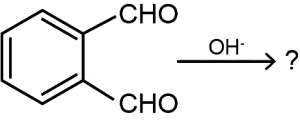
The product of the above reaction is
A
$A$ benzene ring with a $-CH_2OH$ group and a $-COOH$ group at ortho positions.
B
$A$ benzene ring with a $-CH_2O^-$ group and a $-COOH$ group at ortho positions.
C
$A$ benzene ring with a $-CH_2OH$ group and a $-COO^-$ group at ortho positions.
D
$A$ benzene ring with a $-CH_2O^-$ group and a $-COO^-$ group at ortho positions.
Solution
(C) The given reaction is an example of an intramolecular Cannizzaro reaction. In this reaction,phthalaldehyde reacts with a base $(OH^-)$ to undergo disproportionation,where one aldehyde group is reduced to a primary alcohol $(-CH_2OH)$ and the other is oxidized to a carboxylate ion $(-COO^-)$. The final product is the ortho-hydroxymethylbenzoate ion.
0 likes
View Solution1703
EasyMCQ
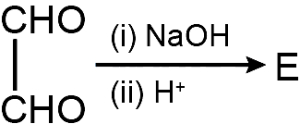
In the following reaction,the product $E$ is
A
$CH_2OH-CHO$
B
$CHO-CO_2H$
C
$CH_2OH-CO_2H$
D
$CO_2H-CO_2H$
Solution
(C) Aldehydes lacking $\alpha-H$ atoms undergo the Cannizzaro reaction when treated with concentrated alkali $(NaOH)$. In this reaction,one part of the molecule is reduced to an alcohol,and the other part is oxidized to a salt of a carboxylic acid.
Glyoxal $(CHO-CHO)$ lacks $\alpha-H$ atoms and undergoes an intramolecular Cannizzaro reaction.
Upon treatment with $NaOH$ followed by acidification with $H^+$,one aldehyde group is reduced to a $-CH_2OH$ group,and the other is oxidized to a $-CO_2H$ group,resulting in glycolic acid $(CH_2OH-CO_2H)$.
Glyoxal $(CHO-CHO)$ lacks $\alpha-H$ atoms and undergoes an intramolecular Cannizzaro reaction.
Upon treatment with $NaOH$ followed by acidification with $H^+$,one aldehyde group is reduced to a $-CH_2OH$ group,and the other is oxidized to a $-CO_2H$ group,resulting in glycolic acid $(CH_2OH-CO_2H)$.
0 likes
View Solution1704
DifficultMCQ
The intermediate $J$ in the following Wittig reaction is

A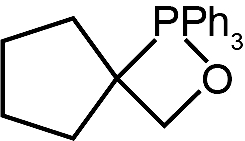
B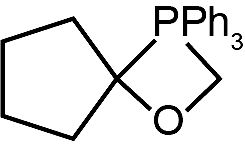
C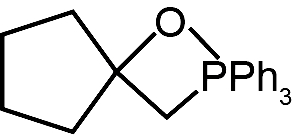
D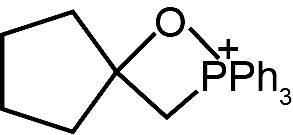
Solution
(A) The Wittig reaction involves the reaction of a phosphonium ylide with a carbonyl compound to form an alkene.
$1$. The phosphonium salt reacts with a strong base like $n-BuLi$ to form the phosphorus ylide.
$2$. The ylide then undergoes a $[2+2]$ cycloaddition with the carbonyl compound (formaldehyde,$CH_2=O$) to form a four-membered ring intermediate known as an oxaphosphetane.
$3$. This oxaphosphetane intermediate $J$ subsequently decomposes to form the alkene and triphenylphosphine oxide.
$4$. The structure of the oxaphosphetane intermediate $J$ is a four-membered ring containing carbon,oxygen,and phosphorus atoms,where the carbon is also attached to the cyclopentyl group. Option $A$ correctly represents this oxaphosphetane structure.
$1$. The phosphonium salt reacts with a strong base like $n-BuLi$ to form the phosphorus ylide.
$2$. The ylide then undergoes a $[2+2]$ cycloaddition with the carbonyl compound (formaldehyde,$CH_2=O$) to form a four-membered ring intermediate known as an oxaphosphetane.
$3$. This oxaphosphetane intermediate $J$ subsequently decomposes to form the alkene and triphenylphosphine oxide.
$4$. The structure of the oxaphosphetane intermediate $J$ is a four-membered ring containing carbon,oxygen,and phosphorus atoms,where the carbon is also attached to the cyclopentyl group. Option $A$ correctly represents this oxaphosphetane structure.
0 likes
View Solution1705
EasyMCQ
Upon treatment with $Al(OEt)_3$ followed by usual reactions (work up),$CH_3CHO$ will produce
A
only $CH_3COOCH_2CH_3$
B
a mixture of $CH_3COOH$ and $EtOH$
C
only $CH_3COOH$
D
only $EtOH$
Solution
(A) The reaction of $CH_3CHO$ (acetaldehyde) with $Al(OEt)_3$ (aluminum ethoxide) is known as the Tishchenko reaction.
This reaction involves the disproportionation of two molecules of an aldehyde to form an ester.
Specifically,$2CH_3CHO \xrightarrow{Al(OEt)_3} CH_3COOCH_2CH_3$ (ethyl acetate).
Therefore,the product formed is ethyl acetate $(CH_3COOCH_2CH_3)$.
This reaction involves the disproportionation of two molecules of an aldehyde to form an ester.
Specifically,$2CH_3CHO \xrightarrow{Al(OEt)_3} CH_3COOCH_2CH_3$ (ethyl acetate).
Therefore,the product formed is ethyl acetate $(CH_3COOCH_2CH_3)$.
0 likes
View Solution1706
EasyMCQ
Which one of the following is produced when acetone is saturated with $HCl$ gas?
A
Acetone alcohol
B
Phorone
C
Mesityl oxide
D
Benzene
Solution
(C) When acetone $(CH_3COCH_3)$ is saturated with dry $HCl$ gas,it undergoes self-aldol condensation followed by dehydration to form mesityl oxide $(CH_3COCH=C(CH_3)_2)$.
The reaction is as follows:
$2CH_3COCH_3 \xrightarrow{HCl(g)} CH_3COCH=C(CH_3)_2 + H_2O$
Note: Phorone is formed as a minor product,but the major product is mesityl oxide.
The reaction is as follows:
$2CH_3COCH_3 \xrightarrow{HCl(g)} CH_3COCH=C(CH_3)_2 + H_2O$
Note: Phorone is formed as a minor product,but the major product is mesityl oxide.
0 likes
View Solution1707
EasyMCQ
Reaction of formaldehyde and ammonia gives
A
Hexamethylene tetramine
B
Bakelite
C
Urea
D
Triethylene Tetramine
Solution
(A) The reaction between formaldehyde $(HCHO)$ and ammonia $(NH_3)$ results in the formation of hexamethylene tetramine,also known as urotropine.
The balanced chemical equation is:
$6 HCHO + 4 NH_3 \rightarrow (CH_2)_6 N_4 + 6 H_2 O$
The balanced chemical equation is:
$6 HCHO + 4 NH_3 \rightarrow (CH_2)_6 N_4 + 6 H_2 O$
0 likes
View Solution1708
DifficultMCQ
Which of the following compounds is not formed in the iodoform reaction of acetone?
A
$CH_3COCH_2I$
B
$ICH_2COCH_2I$
C
$CH_3COCH_3$
D
$CH_3COCI_3$
Solution
(B) The iodoform reaction of acetone involves the sequential replacement of hydrogen atoms on the alpha-carbon by iodine atoms in the presence of a base $(OI^-)$.
Step $1$: $CH_3COCH_3 + OI^- \rightarrow CH_3COCH_2I + OH^-$
Step $2$: $CH_3COCH_2I + OI^- \rightarrow CH_3COCH_2I + OH^-$
Step $3$: $CH_3COCH_2I + OI^- \rightarrow CH_3COCI_3 + OH^-$
Step $4$: $CH_3COCI_3 + OH^- \rightarrow CH_3COO^- + CHI_3$
Comparing these intermediates with the given options,$ICH_2COCH_2I$ is not formed during the reaction as the iodination occurs specifically on the methyl group that is adjacent to the carbonyl group.
Step $1$: $CH_3COCH_3 + OI^- \rightarrow CH_3COCH_2I + OH^-$
Step $2$: $CH_3COCH_2I + OI^- \rightarrow CH_3COCH_2I + OH^-$
Step $3$: $CH_3COCH_2I + OI^- \rightarrow CH_3COCI_3 + OH^-$
Step $4$: $CH_3COCI_3 + OH^- \rightarrow CH_3COO^- + CHI_3$
Comparing these intermediates with the given options,$ICH_2COCH_2I$ is not formed during the reaction as the iodination occurs specifically on the methyl group that is adjacent to the carbonyl group.
0 likes
View Solution1709
MediumMCQ
For making a distinction between $2$-pentanone and $3$-pentanone,the reagent to be employed is
A
$K_2Cr_2O_7 / H_2SO_4$
B
$Zn-Hg / HCl$
C
$SeO_2$
D
None of the above
Solution
(D) $2$-pentanone $(CH_3COCH_2CH_2CH_3)$ contains a $CH_3CO-$ group,which makes it capable of undergoing the iodoform test with $I_2 / NaOH$.
$3$-pentanone $(CH_3CH_2COCH_2CH_3)$ does not contain a $CH_3CO-$ group and therefore does not give the iodoform test.
Since the iodoform test is not listed among the options $(A)$,$(B)$,or $(C)$,the correct choice is $(D)$.
$3$-pentanone $(CH_3CH_2COCH_2CH_3)$ does not contain a $CH_3CO-$ group and therefore does not give the iodoform test.
Since the iodoform test is not listed among the options $(A)$,$(B)$,or $(C)$,the correct choice is $(D)$.
0 likes
View Solution1710
EasyMCQ
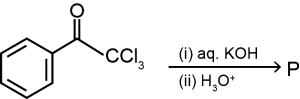
One of the products of the following reaction is $P$. Structure of $P$ is
A
Phenylglyoxylic acid
B
Benzaldehyde
C
Benzoic acid
D
$2,2-$dichloro$-2-$hydroxyacetophenone
Solution
(C) $2,2,2-$trichloroacetophenone reacts with aqueous $KOH$ via a haloform-like cleavage reaction. The hydroxide ion attacks the carbonyl carbon,followed by the departure of the stable $CHCl_3$ (chloroform) leaving group to form the potassium salt of benzoic acid. Subsequent acidification with $H_3O^+$ yields benzoic acid as the final product $P$.
Thus,option $(c)$ is the correct answer.
Thus,option $(c)$ is the correct answer.
0 likes
View Solution1711
MediumMCQ
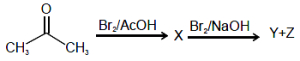
The correct option for the above reaction is
A
$X = CH_3COCH_2Br, Y = CHBr_3, Z = CH_3CO_2Na$
B
$X = CH_3COCBr_3, Y = CHBr_3, Z = CH_3CO_2Na$
C
$X = CH_3COCH_2Br, Y = CHBr_3, Z = CH_2BrCO_2Na$
D
$X = CH_2BrCOCH_2Br, Y = CHBr_3, Z = CH_2BrCO_2Na$
Solution
(A) In the first step,acetone $(CH_3COCH_3)$ reacts with $Br_2$ in an acidic medium $(AcOH)$. Acidic halogenation of ketones typically results in monohalogenation at the $\alpha$-carbon,yielding $X = CH_3COCH_2Br$.
In the second step,the monobromoacetone $(CH_3COCH_2Br)$ reacts with $Br_2$ in a basic medium $(NaOH)$. This is a haloform reaction. The base promotes further halogenation of the $\alpha$-carbon followed by cleavage to form bromoform $(CHBr_3)$ and the corresponding carboxylate salt,which is sodium acetate $(CH_3CO_2Na)$.
In the second step,the monobromoacetone $(CH_3COCH_2Br)$ reacts with $Br_2$ in a basic medium $(NaOH)$. This is a haloform reaction. The base promotes further halogenation of the $\alpha$-carbon followed by cleavage to form bromoform $(CHBr_3)$ and the corresponding carboxylate salt,which is sodium acetate $(CH_3CO_2Na)$.
0 likes
View Solution1712
EasyMCQ
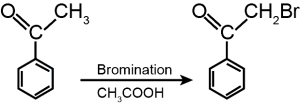
Bromination of $PhCOMe$ in acetic medium produces mainly
A
$2$-bromoacetophenone (ortho-substituted)
B
$4$-bromoacetophenone (para-substituted)
C
$2,2,2$-tribromoacetophenone
D
$2$-bromo$-1-$phenylethan$-1-$one (phenacyl bromide)
Solution
0 likes
View Solution1713
MediumMCQ
In the following reaction,the major product $(H)$ is

A
$2-$methylenetetrahydrofuran
B
hexan$-2-$one
C
$2,2-$dimethyltetrahydrofuran
D
$2-$vinyltetrahydrofuran
Solution
(C) The reaction proceeds in two steps:
$1$. The Grignard reagent $CH_3MgBr$ acts as a nucleophile and attacks the carbonyl carbon of $5-chloropentan-2-one$. This forms an alkoxide intermediate.
$2$. Upon workup with $H_3O^+$,the alkoxide oxygen is protonated to form an alcohol. However,in the presence of the internal chloride group,the alkoxide oxygen performs an intramolecular nucleophilic substitution $(S_N2)$ reaction,displacing the chloride ion to form a five-membered cyclic ether,$2,2-dimethyltetrahydrofuran$.
$1$. The Grignard reagent $CH_3MgBr$ acts as a nucleophile and attacks the carbonyl carbon of $5-chloropentan-2-one$. This forms an alkoxide intermediate.
$2$. Upon workup with $H_3O^+$,the alkoxide oxygen is protonated to form an alcohol. However,in the presence of the internal chloride group,the alkoxide oxygen performs an intramolecular nucleophilic substitution $(S_N2)$ reaction,displacing the chloride ion to form a five-membered cyclic ether,$2,2-dimethyltetrahydrofuran$.
0 likes
View Solution1714
DifficultMCQ
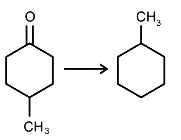
The above conversion can be carried out by,
A
$Zn-Hg / \text{Conc. } HCl$
B
$i. H_2NNH_2, ii. NaOH \text{ in ethylene glycol, } \Delta$
C
$i. HSCH_2CH_2SH / H^{\oplus}, ii. H_2 / Ni$
D
Bromine water
Solution
(A, B, C) The given reaction is the reduction of a ketone (specifically $4$-methylcyclohexanone) to an alkane ($1$-methylcyclohexane). This involves the reduction of the carbonyl group $(-C=O)$ to a methylene group $(-CH_2-)$.
$A$. $Zn-Hg / \text{Conc. } HCl$ is the reagent for Clemmensen reduction.
$B$. $i. H_2NNH_2, ii. NaOH \text{ in ethylene glycol, } \Delta$ is the reagent for Wolff-Kishner reduction.
$C$. $i. HSCH_2CH_2SH / H^{\oplus}, ii. H_2 / Ni$ is the Mozingo reduction method.
All three methods $(A, B, C)$ are standard chemical reactions used to reduce a carbonyl group to a methylene group. Therefore,all these reagents can carry out the given conversion.
$A$. $Zn-Hg / \text{Conc. } HCl$ is the reagent for Clemmensen reduction.
$B$. $i. H_2NNH_2, ii. NaOH \text{ in ethylene glycol, } \Delta$ is the reagent for Wolff-Kishner reduction.
$C$. $i. HSCH_2CH_2SH / H^{\oplus}, ii. H_2 / Ni$ is the Mozingo reduction method.
All three methods $(A, B, C)$ are standard chemical reactions used to reduce a carbonyl group to a methylene group. Therefore,all these reagents can carry out the given conversion.
0 likes
View Solution1715
MediumMCQ
Which of the following compounds will respond to the haloform reaction with $I_{2}$ and $KOH$?
A
$ICH_{2}COCH_{2}Ph$
B
$PhCOCH(OH)CH_{3}$
C
$CH_{3}CH=CH-C(OH)(CH_{3})Ph$
D
$PhCH_{2}NHCOCH_{3}$
Solution
(A, B) The haloform reaction is given by compounds containing the $CH_{3}CO-$ group or compounds that can be oxidized to this group (like $CH_{3}CH(OH)-$ derivatives).
$1$. $ICH_{2}COCH_{2}Ph$: This compound contains an $\alpha$-hydrogen at the $ICH_{2}$ position. Under basic conditions with $I_{2}$,the $ICH_{2}$ group can be further iodinated to $CI_{3}CO-$,which then undergoes cleavage to form iodoform $(CHI_{3})$.
$2$. $PhCOCH(OH)CH_{3}$: This is a secondary alcohol with a $CH_{3}CH(OH)-$ group. It is oxidized by $I_{2}/KOH$ to the corresponding ketone $PhCOCOCH_{3}$,which contains the $CH_{3}CO-$ group and thus gives the haloform reaction.
Therefore,both compounds $(a)$ and $(b)$ respond to the haloform reaction.
$1$. $ICH_{2}COCH_{2}Ph$: This compound contains an $\alpha$-hydrogen at the $ICH_{2}$ position. Under basic conditions with $I_{2}$,the $ICH_{2}$ group can be further iodinated to $CI_{3}CO-$,which then undergoes cleavage to form iodoform $(CHI_{3})$.
$2$. $PhCOCH(OH)CH_{3}$: This is a secondary alcohol with a $CH_{3}CH(OH)-$ group. It is oxidized by $I_{2}/KOH$ to the corresponding ketone $PhCOCOCH_{3}$,which contains the $CH_{3}CO-$ group and thus gives the haloform reaction.
Therefore,both compounds $(a)$ and $(b)$ respond to the haloform reaction.
0 likes
View Solution1716
DifficultMCQ
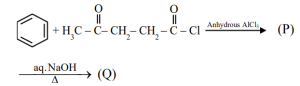
In the given reaction sequence,the percentage of oxygen in compound $(Q)$ is . . . . . . $\%$. (Nearest integer)
A
$8$
B
$10$
C
$12$
D
$14$
Solution
(B) The reaction of benzene with $4$-oxopentanoyl chloride in the presence of anhydrous $AlCl_3$ (Friedel-Crafts acylation) gives compound $(P)$,which is $1$-phenylpentane-$1,4$-dione.
Intramolecular aldol condensation of $(P)$ in the presence of aqueous $NaOH$ and heat gives compound $(Q)$,which is $3$-phenylcyclopent-$2$-en-$1$-one.
The molecular formula of $(Q)$ is $C_{11}H_{10}O$.
The molecular mass of $(Q) = (11 \times 12) + (10 \times 1) + (1 \times 16) = 132 + 10 + 16 = 158 \ g/mol$.
The percentage of oxygen in $(Q) = \frac{\text{Mass of oxygen}}{\text{Total molecular mass}} \times 100 = \frac{16}{158} \times 100 \approx 10.12 \%$.
The nearest integer value is $10 \%$.
Intramolecular aldol condensation of $(P)$ in the presence of aqueous $NaOH$ and heat gives compound $(Q)$,which is $3$-phenylcyclopent-$2$-en-$1$-one.
The molecular formula of $(Q)$ is $C_{11}H_{10}O$.
The molecular mass of $(Q) = (11 \times 12) + (10 \times 1) + (1 \times 16) = 132 + 10 + 16 = 158 \ g/mol$.
The percentage of oxygen in $(Q) = \frac{\text{Mass of oxygen}}{\text{Total molecular mass}} \times 100 = \frac{16}{158} \times 100 \approx 10.12 \%$.
The nearest integer value is $10 \%$.
0 likes
View Solution1717
DifficultMCQ
Which of the following statements are $TRUE$ about Haloform reaction?
$A$. Sodium hypochlorite reacts with $KI$ to give $KOI$.
$B$. $KOI$ is a reducing agent.
$C$. $\alpha, \beta$-unsaturated methylketone will give iodoform reaction.
$D$. Isopropyl alcohol will not give iodoform test.
$E$. Methanoic acid will give positive iodoform test.
Choose the correct answer from the options given below:
$A$. Sodium hypochlorite reacts with $KI$ to give $KOI$.
$B$. $KOI$ is a reducing agent.
$C$. $\alpha, \beta$-unsaturated methylketone will give iodoform reaction.
$D$. Isopropyl alcohol will not give iodoform test.
$E$. Methanoic acid will give positive iodoform test.
Choose the correct answer from the options given below:
A
$A, C$ & $E$ only
B
$A, B$ & $C$ only
C
$A$ & $C$ only
D
$B, D$ & $E$ only
Solution
(C) Statement $A$ is true: $NaOCl + KI \rightarrow NaCl + KOI$.
Statement $B$ is false: $KOI$ is an oxidizing agent,not a reducing agent.
Statement $C$ is true: $\alpha, \beta$-unsaturated methylketones (like $CH_3-CH=CH-CO-CH_3$) contain the $CH_3CO-$ group and thus give the iodoform reaction.
Statement $D$ is false: Isopropyl alcohol $(CH_3CH(OH)CH_3)$ contains the $CH_3CH(OH)-$ group and gives a positive iodoform test.
Statement $E$ is false: Methanoic acid $(HCOOH)$ does not contain the $CH_3CO-$ or $CH_3CH(OH)-$ group and does not give the iodoform test.
Therefore,only statements $A$ and $C$ are true.
Statement $B$ is false: $KOI$ is an oxidizing agent,not a reducing agent.
Statement $C$ is true: $\alpha, \beta$-unsaturated methylketones (like $CH_3-CH=CH-CO-CH_3$) contain the $CH_3CO-$ group and thus give the iodoform reaction.
Statement $D$ is false: Isopropyl alcohol $(CH_3CH(OH)CH_3)$ contains the $CH_3CH(OH)-$ group and gives a positive iodoform test.
Statement $E$ is false: Methanoic acid $(HCOOH)$ does not contain the $CH_3CO-$ or $CH_3CH(OH)-$ group and does not give the iodoform test.
Therefore,only statements $A$ and $C$ are true.
0 likes
View Solution1718
DifficultMCQ
The iodoform test can differentiate between:
$A$. Methanol and Ethanol
$B$. $CH_3COOH$ and $CH_3CH_2COOH$
$C$. Cyclohexene and cyclohexanone
$D$. Diethyl ether and Pentan$-3-$one
$E$. Anisole and acetone
Choose the correct answer from the options given below:
$A$. Methanol and Ethanol
$B$. $CH_3COOH$ and $CH_3CH_2COOH$
$C$. Cyclohexene and cyclohexanone
$D$. Diethyl ether and Pentan$-3-$one
$E$. Anisole and acetone
Choose the correct answer from the options given below:
A
$A$ & $E$ only
B
$A$ & $D$ only
C
$A, B$ & $E$ only
D
$B, C$ & $E$ only
Solution
(A) The iodoform test is given by compounds containing the $CH_3CO-$ group or the $CH_3CH(OH)-$ group.
$A$. Methanol $(CH_3OH)$ does not give the test,while Ethanol $(CH_3CH_2OH)$ gives the test. Thus,they can be differentiated.
$B$. Both $CH_3COOH$ and $CH_3CH_2COOH$ do not contain the required group,so they cannot be differentiated.
$C$. Cyclohexene does not give the test,while cyclohexanone (if it had a methyl group at the alpha position) would,but simple cyclohexanone does not have the $CH_3CO-$ group. However,in many contexts,this is considered a differentiation between a ketone and an alkene,but strictly speaking,cyclohexanone does not give a positive iodoform test.
$D$. Diethyl ether does not give the test,while Pentan$-3-$one $(CH_3CH_2COCH_2CH_3)$ does not contain the $CH_3CO-$ group and thus does not give the test.
$E$. Anisole $(C_6H_5OCH_3)$ does not give the test,while acetone $(CH_3COCH_3)$ gives the test. Thus,they can be differentiated.
Therefore,pairs $A$ and $E$ can be differentiated by the iodoform test.
$A$. Methanol $(CH_3OH)$ does not give the test,while Ethanol $(CH_3CH_2OH)$ gives the test. Thus,they can be differentiated.
$B$. Both $CH_3COOH$ and $CH_3CH_2COOH$ do not contain the required group,so they cannot be differentiated.
$C$. Cyclohexene does not give the test,while cyclohexanone (if it had a methyl group at the alpha position) would,but simple cyclohexanone does not have the $CH_3CO-$ group. However,in many contexts,this is considered a differentiation between a ketone and an alkene,but strictly speaking,cyclohexanone does not give a positive iodoform test.
$D$. Diethyl ether does not give the test,while Pentan$-3-$one $(CH_3CH_2COCH_2CH_3)$ does not contain the $CH_3CO-$ group and thus does not give the test.
$E$. Anisole $(C_6H_5OCH_3)$ does not give the test,while acetone $(CH_3COCH_3)$ gives the test. Thus,they can be differentiated.
Therefore,pairs $A$ and $E$ can be differentiated by the iodoform test.
0 likes
View Solution1719
DifficultMCQ
Given below are two statements:
Statement $I$: Cross aldol condensation between two different aldehydes will always produce four different products.
Statement $II$: When semicarbazide reacts with a mixture of benzaldehyde and acetophenone under optimum pH,it forms a condensation product with acetophenone only.
In the light of the above statements,choose the correct answer from the options given below:
Statement $I$: Cross aldol condensation between two different aldehydes will always produce four different products.
Statement $II$: When semicarbazide reacts with a mixture of benzaldehyde and acetophenone under optimum pH,it forms a condensation product with acetophenone only.
In the light of the above statements,choose the correct answer from the options given below:
A
Both Statement $I$ and Statement $II$ are false
B
Statement $I$ is false but Statement $II$ is true
C
Both Statement $I$ and Statement $II$ are true
D
Statement $I$ is true but Statement $II$ is false
Solution
(A) Statement $I$ is false because cross aldol condensation between two different aldehydes can produce a mixture of $2$ or $4$ products depending on whether both aldehydes possess $\alpha$-hydrogens.
Statement $II$ is false because both benzaldehyde (an aldehyde) and acetophenone (a ketone) react with semicarbazide to form their respective semicarbazones under optimum $pH$ conditions. Benzaldehyde is generally more reactive towards nucleophilic addition than acetophenone due to less steric hindrance and electronic factors.
Statement $II$ is false because both benzaldehyde (an aldehyde) and acetophenone (a ketone) react with semicarbazide to form their respective semicarbazones under optimum $pH$ conditions. Benzaldehyde is generally more reactive towards nucleophilic addition than acetophenone due to less steric hindrance and electronic factors.
0 likes
View Solution1720
DifficultMCQ
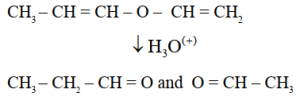
The acidic hydrolysis of unsaturated ethers produces carbonyl compounds as shown below. Based on this, predict the solution or reagent that will help to distinguish '$P$' and '$Q$' obtained in the following reaction.
A
Lucas reagent
B
$2,4-DNP$ reagent
C
Saturated $NaHSO_{3}$ solution
D
Fehling solution
Solution
(D) The acidic hydrolysis of the given unsaturated ether yields '$P$' (propanal, $CH_3CH_2CHO$) and '$Q$' (acetone, $CH_3COCH_3$).
'$P$' is an aldehyde, while '$Q$' is a ketone.
Fehling's solution is a mild oxidizing agent that reacts with aliphatic aldehydes to form a red precipitate of $Cu_2O$, but it does not react with ketones.
Therefore, Fehling's solution can be used to distinguish between '$P$' and '$Q$'.
'$P$' gives a positive Fehling's test, while '$Q$' gives a negative Fehling's test.
'$P$' is an aldehyde, while '$Q$' is a ketone.
Fehling's solution is a mild oxidizing agent that reacts with aliphatic aldehydes to form a red precipitate of $Cu_2O$, but it does not react with ketones.
Therefore, Fehling's solution can be used to distinguish between '$P$' and '$Q$'.
'$P$' gives a positive Fehling's test, while '$Q$' gives a negative Fehling's test.
0 likes
View Solution1721
DifficultMCQ
$x$ is the product obtained from propanenitrile and stannous chloride in the presence of hydrochloric acid followed by hydrolysis. $y$ is the product obtained from but$-2-$ene by ozonolysis followed by hydrolysis. From the following,which product is not obtained when one mole of $x$ and one mole of $y$ react with each other in the presence of alkali followed by heating?
A
$2-$Methylbut$-2-$enal
B
Pent$-2-$enal
C
$2-$Methylpent$-2-$enal
D
$3-$Methylbut$-2-$enal
Solution
(D) $1$. Propanenitrile $(CH_3CH_2CN)$ on reduction with $SnCl_2/HCl$ followed by hydrolysis gives propanal $(CH_3CH_2CHO)$,which is $x$.
$2$. But$-2-$ene $(CH_3CH=CHCH_3)$ on ozonolysis followed by hydrolysis gives two moles of ethanal $(CH_3CHO)$,which is $y$.
$3$. The reaction between propanal $(x)$ and ethanal $(y)$ in the presence of alkali $(NaOH)$ and heat is a crossed aldol condensation reaction.
$4$. The possible products are:
- Self-aldol of propanal: $CH_3CH_2CH(OH)CH(CH_3)CHO \xrightarrow{\Delta} CH_3CH_2CH=C(CH_3)CHO$ ($2-$Methylpent$-2-$enal).
- Self-aldol of ethanal: $CH_3CH(OH)CH_2CHO \xrightarrow{\Delta} CH_3CH=CHCHO$ (But$-2-$enal).
- Crossed-aldol ($CH_3CHO$ as nucleophile): $CH_3CH_2CH(OH)CH_2CHO \xrightarrow{\Delta} CH_3CH_2CH=CHCHO$ (Pent$-2-$enal).
- Crossed-aldol ($CH_3CH_2CHO$ as nucleophile): $CH_3CH(OH)CH(CH_3)CHO \xrightarrow{\Delta} CH_3CH=C(CH_3)CHO$ ($2-$Methylbut$-2-$enal).
$5$. $3-$Methylbut$-2-$enal is not formed in this reaction.
$2$. But$-2-$ene $(CH_3CH=CHCH_3)$ on ozonolysis followed by hydrolysis gives two moles of ethanal $(CH_3CHO)$,which is $y$.
$3$. The reaction between propanal $(x)$ and ethanal $(y)$ in the presence of alkali $(NaOH)$ and heat is a crossed aldol condensation reaction.
$4$. The possible products are:
- Self-aldol of propanal: $CH_3CH_2CH(OH)CH(CH_3)CHO \xrightarrow{\Delta} CH_3CH_2CH=C(CH_3)CHO$ ($2-$Methylpent$-2-$enal).
- Self-aldol of ethanal: $CH_3CH(OH)CH_2CHO \xrightarrow{\Delta} CH_3CH=CHCHO$ (But$-2-$enal).
- Crossed-aldol ($CH_3CHO$ as nucleophile): $CH_3CH_2CH(OH)CH_2CHO \xrightarrow{\Delta} CH_3CH_2CH=CHCHO$ (Pent$-2-$enal).
- Crossed-aldol ($CH_3CH_2CHO$ as nucleophile): $CH_3CH(OH)CH(CH_3)CHO \xrightarrow{\Delta} CH_3CH=C(CH_3)CHO$ ($2-$Methylbut$-2-$enal).
$5$. $3-$Methylbut$-2-$enal is not formed in this reaction.
0 likes
View Solution1722
DifficultMCQ
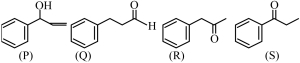
Given below are the four isomeric compounds $(P, Q, R, S)$. Identify the correct statements from below.
$A$. $Q, R$ and $S$ will give a precipitate with $2,4-DNP$.
$B$. $P$ and $Q$ will give a positive Bayer's test.
$C$. $Q$ and $R$ will give a sooty flame.
$D$. $R$ and $S$ will give a yellow precipitate with $I_2/NaOH$.
$E$. $Q$ alone will deposit silver with Tollen's reagent.
Choose the correct option.
$A$. $Q, R$ and $S$ will give a precipitate with $2,4-DNP$.
$B$. $P$ and $Q$ will give a positive Bayer's test.
$C$. $Q$ and $R$ will give a sooty flame.
$D$. $R$ and $S$ will give a yellow precipitate with $I_2/NaOH$.
$E$. $Q$ alone will deposit silver with Tollen's reagent.
Choose the correct option.
A
$A, C$ and $E$ only
B
$A$ and $E$ only
C
$C$ and $E$ only
D
$A, B, D$ and $E$ only
Solution
(A) The structures are: $P$ ($1$-phenylprop$-2-$en$-1-$ol),$Q$ ($3$-phenylpropanal),$R$ ($1$-phenylpropan$-2-$one),$S$ ($1$-phenylpropan$-1-$one).
$A$. $2,4-DNP$ reacts with aldehydes and ketones. $Q$ (aldehyde),$R$ (ketone),and $S$ (ketone) give the test. Statement $A$ is correct.
$B$. Bayer's test is for unsaturation. Only $P$ has a double bond. Statement $B$ is incorrect.
$C$. Aromatic compounds give a sooty flame. All four compounds contain a phenyl ring,so all give a sooty flame. Statement $C$ is technically correct,but we evaluate based on the options provided.
$D$. $I_2/NaOH$ (Iodoform test) requires a $CH_3CO-$ group or $CH_3CH(OH)-$ group. $R$ has $CH_3CO-$ and $S$ does not. Statement $D$ is incorrect.
$E$. Tollen's reagent is for aldehydes. Only $Q$ is an aldehyde. Statement $E$ is correct.
Combining the correct statements $A, C, E$,the correct option is $A$.
$A$. $2,4-DNP$ reacts with aldehydes and ketones. $Q$ (aldehyde),$R$ (ketone),and $S$ (ketone) give the test. Statement $A$ is correct.
$B$. Bayer's test is for unsaturation. Only $P$ has a double bond. Statement $B$ is incorrect.
$C$. Aromatic compounds give a sooty flame. All four compounds contain a phenyl ring,so all give a sooty flame. Statement $C$ is technically correct,but we evaluate based on the options provided.
$D$. $I_2/NaOH$ (Iodoform test) requires a $CH_3CO-$ group or $CH_3CH(OH)-$ group. $R$ has $CH_3CO-$ and $S$ does not. Statement $D$ is incorrect.
$E$. Tollen's reagent is for aldehydes. Only $Q$ is an aldehyde. Statement $E$ is correct.
Combining the correct statements $A, C, E$,the correct option is $A$.
0 likes
View Solution1723
DifficultMCQ
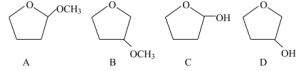
$A$ student is given one compound among the following compounds that gives a positive test with Tollen's reagent. The compound is:
A
$A$
B
$B$
C
$C$
D
$D$
Solution
(C) Tollen's reagent is an oxidizing agent that reacts with aldehydes to form a silver mirror.
Compounds that exist in equilibrium with an open-chain aldehyde form will give a positive Tollen's test.
Hemiacetals are in equilibrium with their open-chain aldehyde form in the presence of a base (present in Tollen's reagent).
Compound $C$ is a cyclic hemiacetal,which can open to form an aldehyde,thus giving a positive Tollen's test.
Compounds $A$ and $B$ are acetals (ethers),which do not open to form aldehydes under these conditions.
Compound $D$ is a cyclic alcohol,which does not contain the hemiacetal functional group required to form an aldehyde.
Therefore,the correct compound is $C$.
Compounds that exist in equilibrium with an open-chain aldehyde form will give a positive Tollen's test.
Hemiacetals are in equilibrium with their open-chain aldehyde form in the presence of a base (present in Tollen's reagent).
Compound $C$ is a cyclic hemiacetal,which can open to form an aldehyde,thus giving a positive Tollen's test.
Compounds $A$ and $B$ are acetals (ethers),which do not open to form aldehydes under these conditions.
Compound $D$ is a cyclic alcohol,which does not contain the hemiacetal functional group required to form an aldehyde.
Therefore,the correct compound is $C$.
0 likes
View Solution1724
DifficultMCQ
The compound $A$,$C_{8}H_{8}O_{2}$,reacts with acetophenone to form a single product via cross-Aldol condensation. The compound $A$ on reaction with conc. $NaOH$ forms a substituted benzyl alcohol. Identify compound $A$.
A
$2-$hydroxy acetophenone
B
$4-$methoxy benzaldehyde
C
$4-$hydroxy benzaldehyde
D
$4-$methyl benzoic acid
Solution
(B) Compound $A$ $(C_{8}H_{8}O_{2})$ undergoes cross-Aldol condensation with acetophenone to form a single product. This implies $A$ is an aldehyde without $\alpha$-hydrogens,such as $4-$methoxybenzaldehyde $(p-CH_3OC_6H_4CHO)$.
When $4-$methoxybenzaldehyde reacts with conc. $NaOH$,it undergoes the Cannizzaro reaction because it lacks $\alpha$-hydrogens.
The reaction produces $4-$methoxybenzyl alcohol $(p-CH_3OC_6H_4CH_2OH)$ and $4-$methoxybenzoate ion $(p-CH_3OC_6H_4COO^-)$.
Therefore,compound $A$ is $4-$methoxybenzaldehyde.
When $4-$methoxybenzaldehyde reacts with conc. $NaOH$,it undergoes the Cannizzaro reaction because it lacks $\alpha$-hydrogens.
The reaction produces $4-$methoxybenzyl alcohol $(p-CH_3OC_6H_4CH_2OH)$ and $4-$methoxybenzoate ion $(p-CH_3OC_6H_4COO^-)$.
Therefore,compound $A$ is $4-$methoxybenzaldehyde.
0 likes
View Solution1725
DifficultMCQ
Match the List-$I$ with List-$II$.
Choose the correct answer from the options given below:
| List-$I$ (Reagents) | List-$II$ (Reaction Name) |
|---|---|
| $A$. $NH_2-NH_2, KOH$ | $I$. Tollen's Test |
| $B$. $[Ag(NH_3)_2]OH$ | $II$. Clemmensen Reduction |
| $C$. Aq. $CuSO_4$,Sodium Potassium tartarate,$KOH$ | $III$. Wolff-Kishner Reduction |
| $D$. $Zn-Hg, HCl$ | $IV$. Fehling's Test |
Choose the correct answer from the options given below:
A
$A-III, B-I, C-IV, D-II$
B
$A-II, B-I, C-IV, D-III$
C
$A-IV, B-III, C-II, D-I$
D
$A-III, B-IV, C-I, D-II$
Solution
(A) The correct matches are as follows:
$A$. $NH_2-NH_2, KOH$ is used in the Wolff-Kishner reduction $(III)$.
$B$. $[Ag(NH_3)_2]OH$ is the reagent for Tollen's test $(I)$.
$C$. Aqueous $CuSO_4$,Sodium Potassium tartarate,and $KOH$ constitute the Fehling's solution used in Fehling's test $(IV)$.
$D$. $Zn-Hg, HCl$ is used in the Clemmensen reduction $(II)$.
Thus,the correct sequence is $A-III, B-I, C-IV, D-II$.
$A$. $NH_2-NH_2, KOH$ is used in the Wolff-Kishner reduction $(III)$.
$B$. $[Ag(NH_3)_2]OH$ is the reagent for Tollen's test $(I)$.
$C$. Aqueous $CuSO_4$,Sodium Potassium tartarate,and $KOH$ constitute the Fehling's solution used in Fehling's test $(IV)$.
$D$. $Zn-Hg, HCl$ is used in the Clemmensen reduction $(II)$.
Thus,the correct sequence is $A-III, B-I, C-IV, D-II$.
0 likes
View Solution1726
DifficultMCQ
Identify $R', R''$ and $R'''$ for the following reaction: $R'R''C=O \xrightarrow{(i) R'''MgX, (ii) H_2O} 2-methylbutane-2-ol$
A
$R'=C_2H_5, R''=C_2H_5, R'''=CH_3$
B
$R'=CH_3, R''=C_2H_5, R'''=CH_3$
C
$R'=C_2H_5, R''=CH_3, R'''=C_2H_5$
D
$R'=CH_3, R''=CH_3, R'''=CH_3$
Solution
(B) The reaction of a Grignard reagent $(R'''MgX)$ with a ketone $(R'R''C=O)$ produces a tertiary alcohol.
The structure of $2-methylbutane-2-ol$ is $CH_3-C(OH)(CH_3)-CH_2-CH_3$.
This tertiary alcohol is formed by the nucleophilic addition of a Grignard reagent to a ketone.
If we react butan$-2-$one $(CH_3-CO-C_2H_5)$ with methylmagnesium bromide $(CH_3MgBr)$,the methyl group $(CH_3)$ attacks the carbonyl carbon,resulting in $2-methylbutane-2-ol$.
Comparing this with the general reaction $R'R''C=O + R'''MgX \rightarrow R'R''C(OH)R'''$,we identify $R'=CH_3$,$R''=C_2H_5$,and $R'''=CH_3$.
The structure of $2-methylbutane-2-ol$ is $CH_3-C(OH)(CH_3)-CH_2-CH_3$.
This tertiary alcohol is formed by the nucleophilic addition of a Grignard reagent to a ketone.
If we react butan$-2-$one $(CH_3-CO-C_2H_5)$ with methylmagnesium bromide $(CH_3MgBr)$,the methyl group $(CH_3)$ attacks the carbonyl carbon,resulting in $2-methylbutane-2-ol$.
Comparing this with the general reaction $R'R''C=O + R'''MgX \rightarrow R'R''C(OH)R'''$,we identify $R'=CH_3$,$R''=C_2H_5$,and $R'''=CH_3$.
0 likes
View Solution1727
MediumMCQ
Which reagent is used to distinguish Acetophenone and Benzophenone?
A
$Cu^{2+}/OH^-$
B
$Br_2/H_2O$
C
$[Ag(NH_3)_2]^+/OH^-$
D
$NaOI$
Solution
(D) Acetophenone $(C_6H_5COCH_3)$ contains a methyl ketone group $(-COCH_3)$,which undergoes the iodoform reaction with $NaOI$ (sodium hypoiodite) to form a yellow precipitate of iodoform $(CHI_3)$.
Benzophenone $(C_6H_5COC_6H_5)$ lacks a methyl group attached to the carbonyl carbon; therefore,it does not give the iodoform test.
Thus,$NaOI$ is the correct reagent to distinguish between these two compounds.
Benzophenone $(C_6H_5COC_6H_5)$ lacks a methyl group attached to the carbonyl carbon; therefore,it does not give the iodoform test.
Thus,$NaOI$ is the correct reagent to distinguish between these two compounds.
0 likes
View Solution1728
MediumMCQ
Which of the following aldehydes does not give the Cannizzaro reaction?
A
$HCHO$
B
$CCl_3CHO$
C
Benzaldehyde
D
$CH_3CH_2CHO$
Solution
(D) The Cannizzaro reaction is a characteristic reaction of aldehydes that do not possess any $\alpha$-hydrogen atoms.
$1$. $HCHO$ (Formaldehyde) has no $\alpha$-hydrogen.
$2$. $CCl_3CHO$ (Trichloroacetaldehyde) has no $\alpha$-hydrogen.
$3$. Benzaldehyde $(C_6H_5CHO)$ has no $\alpha$-hydrogen.
All of the above compounds undergo the Cannizzaro reaction.
$4$. Propanal $(CH_3CH_2CHO)$ contains two $\alpha$-hydrogen atoms attached to the $\alpha$-carbon. Therefore,it undergoes aldol condensation in the presence of a dilute base,not the Cannizzaro reaction.
Thus,the correct answer is $CH_3CH_2CHO$.
$1$. $HCHO$ (Formaldehyde) has no $\alpha$-hydrogen.
$2$. $CCl_3CHO$ (Trichloroacetaldehyde) has no $\alpha$-hydrogen.
$3$. Benzaldehyde $(C_6H_5CHO)$ has no $\alpha$-hydrogen.
All of the above compounds undergo the Cannizzaro reaction.
$4$. Propanal $(CH_3CH_2CHO)$ contains two $\alpha$-hydrogen atoms attached to the $\alpha$-carbon. Therefore,it undergoes aldol condensation in the presence of a dilute base,not the Cannizzaro reaction.
Thus,the correct answer is $CH_3CH_2CHO$.
0 likes
View Solution1729
MediumMCQ
Which of the following compounds gives only a primary alcohol on reaction with a Grignard reagent $(RMgX)$?
A
$CH_3CH_2CHO$
B
$HCHO$
C
$CH_3CH_2COCH_3$
D
$C_6H_5COCH_3$
Solution
(B) Formaldehyde $(HCHO)$ is the simplest aldehyde. When it reacts with a Grignard reagent $(RMgX)$,it forms an addition product which,upon acidic hydrolysis,yields a primary alcohol $(RCH_2OH)$.
Other aldehydes $(R'CHO)$ react with Grignard reagents to form secondary alcohols $(R'CH(OH)R)$.
Ketones $(R'COR'')$ react with Grignard reagents to form tertiary alcohols $(R'R''C(OH)R)$.
Other aldehydes $(R'CHO)$ react with Grignard reagents to form secondary alcohols $(R'CH(OH)R)$.
Ketones $(R'COR'')$ react with Grignard reagents to form tertiary alcohols $(R'R''C(OH)R)$.
0 likes
View Solution1730
DifficultMCQ
An organic compound $x$ where the molar ratio of $C$,$O$,and $H$ are equal,on treatment with $50\% \ KOH$ under reflux followed by acidification produced $y$. The most likely structure of $y$ is: [Molar mass of $x$ is $58 \ g \ mol^{-1}$]
A
$CH_{2} = CH - C(=O) - OH$
B
$CH_{3} - CH = CH - CH = O$
C
$HO - CH_{2} - COOH$
D
$CH_{3} - C(=O) - OH$
Solution
(C) Let the empirical formula be $(COH)_{n}$.
The molar mass is $12n + 16n + n = 29n = 58 \Rightarrow n = 2$.
Thus,the molecular formula is $C_{2}H_{2}O_{2}$,which corresponds to glyoxal $(CHO-CHO)$.
Glyoxal contains two aldehyde groups and lacks $\alpha$-hydrogen atoms,so it undergoes the Cannizzaro reaction in the presence of $50\% \ KOH$.
In this reaction,one aldehyde group is oxidized to a carboxylate group and the other is reduced to a primary alcohol group.
$CHO-CHO + KOH \rightarrow HO-CH_{2}-COOK$.
Upon acidification,the salt converts to glycolic acid: $HO-CH_{2}-COOH$.
Therefore,the correct structure of $y$ is $HO-CH_{2}-COOH$.
The molar mass is $12n + 16n + n = 29n = 58 \Rightarrow n = 2$.
Thus,the molecular formula is $C_{2}H_{2}O_{2}$,which corresponds to glyoxal $(CHO-CHO)$.
Glyoxal contains two aldehyde groups and lacks $\alpha$-hydrogen atoms,so it undergoes the Cannizzaro reaction in the presence of $50\% \ KOH$.
In this reaction,one aldehyde group is oxidized to a carboxylate group and the other is reduced to a primary alcohol group.
$CHO-CHO + KOH \rightarrow HO-CH_{2}-COOK$.
Upon acidification,the salt converts to glycolic acid: $HO-CH_{2}-COOH$.
Therefore,the correct structure of $y$ is $HO-CH_{2}-COOH$.
0 likes
View Solution1731
MediumMCQ
Given below are two statements: Statement $I$: The condensation reaction between $CH_{3} - CH = O$ and $H_{2}N - NH - C(=O) - NH_{2}$ under optimum pH will produce $CH_{3} - CH = N - N(H) - C(=O) - NH_{2}$. Statement $II$: The molecule,$Ph - CH(OH)(OCH_{3})$ will generate $Ph - CH = O$ in the presence of dilute acid. In the light of the above statements,choose the correct answer from the options given below:
A
Both Statement $I$ and Statement $II$ are true
B
Both Statement $I$ and Statement $II$ are false
C
Statement $I$ is true but Statement $II$ is false
D
Statement $I$ is false but Statement $II$ is true
Solution
(A) Statement $I$: Acetaldehyde $(CH_{3}CHO)$ reacts with semicarbazide $(H_{2}NNHCONH_{2})$ via a nucleophilic addition-elimination reaction to form a semicarbazone. The product $CH_{3} - CH = N - NH - C(=O) - NH_{2}$ is correctly represented.
Statement $II$: The molecule $Ph - CH(OH)(OCH_{3})$ is a hemiacetal. In the presence of dilute acid,hemiacetals undergo hydrolysis to regenerate the corresponding aldehyde $(Ph-CHO)$ and alcohol $(CH_{3}OH)$. Thus,both statements are correct.
Statement $II$: The molecule $Ph - CH(OH)(OCH_{3})$ is a hemiacetal. In the presence of dilute acid,hemiacetals undergo hydrolysis to regenerate the corresponding aldehyde $(Ph-CHO)$ and alcohol $(CH_{3}OH)$. Thus,both statements are correct.
0 likes
View Solution1732
DifficultMCQ
'x' is the product obtained by the hydrolysis of prop$-1-$yne in the presence of mercuric sulphate and dilute acidic medium at $333 \ K$. 'y' is the product obtained by the reaction of ethanenitrile with methylmagnesium bromide in dry ether followed by hydrolysis. The $IUPAC$ name of the product obtained from the reaction of 'x' and 'y' in the presence of barium hydroxide followed by heating is:
A
$2-$Methylpent$-4-$en$-3-$one
B
$4-$Methylpent$-3-$en$-2-$one
C
$4-$Methylpent$-1-$ene
D
$2-$Methylpent$-3-$one
Solution
(B) Step $1$: Formation of 'x'. Hydrolysis of prop$-1-$yne $(CH_{3}C \equiv CH)$ in the presence of $HgSO_{4}/H^{+}$ at $333 \ K$ follows Kucherov's reaction to yield acetone $(CH_{3}COCH_{3})$.
Step $2$: Formation of 'y'. Reaction of ethanenitrile $(CH_{3}CN)$ with methylmagnesium bromide $(CH_{3}MgBr)$ in dry ether followed by hydrolysis yields acetone $(CH_{3}COCH_{3})$.
Step $3$: Aldol condensation. Both 'x' and 'y' are acetone. The reaction of two molecules of acetone in the presence of $Ba(OH)_{2}$ undergoes self-aldol condensation to form $4-$hydroxy$-4-$methylpentan$-2-$one $(CH_{3}COCH_{2}C(OH)(CH_{3})_{2})$.
Step $4$: Dehydration. Heating the aldol product causes dehydration (loss of $H_{2}O$) to form the $\alpha,\beta$-unsaturated ketone,$4$-methylpent$-3-$en$-2-$one $(CH_{3}COCH=C(CH_{3})_{2})$.
Step $2$: Formation of 'y'. Reaction of ethanenitrile $(CH_{3}CN)$ with methylmagnesium bromide $(CH_{3}MgBr)$ in dry ether followed by hydrolysis yields acetone $(CH_{3}COCH_{3})$.
Step $3$: Aldol condensation. Both 'x' and 'y' are acetone. The reaction of two molecules of acetone in the presence of $Ba(OH)_{2}$ undergoes self-aldol condensation to form $4-$hydroxy$-4-$methylpentan$-2-$one $(CH_{3}COCH_{2}C(OH)(CH_{3})_{2})$.
Step $4$: Dehydration. Heating the aldol product causes dehydration (loss of $H_{2}O$) to form the $\alpha,\beta$-unsaturated ketone,$4$-methylpent$-3-$en$-2-$one $(CH_{3}COCH=C(CH_{3})_{2})$.
0 likes
View Solution1733
DifficultMCQ
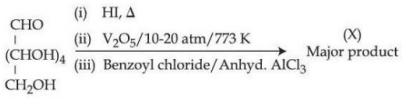
Consider the following reactions. Total number of electrons in the $\pi$ bonds and lone pair of electrons in the product is:
A
$12$
B
$16$
C
$14$
D
$18$
Solution
(D) The reaction sequence is as follows:
$1$. Glucose reacts with $HI/\Delta$ to form $n$-hexane.
$2$. $n$-hexane undergoes aromatization in the presence of $V_2O_5$ at $773 \ K$ and high pressure to form benzene.
$3$. Benzene reacts with benzoyl chloride in the presence of anhydrous $AlCl_3$ (Friedel-Crafts acylation) to form benzophenone $(Ph-CO-Ph)$.
In the product,benzophenone $(C_{13}H_{10}O)$:
- Each phenyl ring has $3$ $\pi$ bonds,so $2$ rings have $6$ $\pi$ bonds.
- The $C=O$ group has $1$ $\pi$ bond.
- Total $\pi$ bonds = $6 + 1 = 7$. Each $\pi$ bond contains $2$ electrons,so total $\pi$ electrons = $7 \times 2 = 14$.
- The oxygen atom in the $C=O$ group has $2$ lone pairs of electrons,which equals $2 \times 2 = 4$ electrons.
- Total number of electrons = $14 + 4 = 18$.
$1$. Glucose reacts with $HI/\Delta$ to form $n$-hexane.
$2$. $n$-hexane undergoes aromatization in the presence of $V_2O_5$ at $773 \ K$ and high pressure to form benzene.
$3$. Benzene reacts with benzoyl chloride in the presence of anhydrous $AlCl_3$ (Friedel-Crafts acylation) to form benzophenone $(Ph-CO-Ph)$.
In the product,benzophenone $(C_{13}H_{10}O)$:
- Each phenyl ring has $3$ $\pi$ bonds,so $2$ rings have $6$ $\pi$ bonds.
- The $C=O$ group has $1$ $\pi$ bond.
- Total $\pi$ bonds = $6 + 1 = 7$. Each $\pi$ bond contains $2$ electrons,so total $\pi$ electrons = $7 \times 2 = 14$.
- The oxygen atom in the $C=O$ group has $2$ lone pairs of electrons,which equals $2 \times 2 = 4$ electrons.
- Total number of electrons = $14 + 4 = 18$.
0 likes
View Solution1734
DifficultMCQ
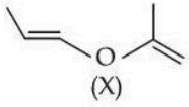
$A$ molecule $(X)$ with the following structure is hydrolyzed under mild acidic conditions to produce $(Y)$ and $(Z)$. Identify the correct statements about $(Y)$ and $(Z)$.
A
$A, B$ and $C$ Only
B
$B$ and $C$ Only
C
$C$ and $D$ Only
D
$A$ and $D$ Only
Solution
(D) The molecule $(X)$ is an enol ether. Acidic hydrolysis of an enol ether involves the protonation of the double bond followed by the attack of water,leading to the cleavage of the $C-O$ bond to produce a carbonyl compound (aldehyde or ketone) and an alcohol.
In this specific case,the hydrolysis of the given enol ether yields propanal $(CH_3CH_2CHO)$ and acetone $(CH_3COCH_3)$.
$(Y)$ and $(Z)$ are propanal and acetone.
Statement $(A)$ is correct as both products have distinct molar masses,but in general,hydrolysis products can be analyzed for mass.
Statement $(D)$ is correct because both propanal (an aldehyde) and acetone (a ketone) contain a carbonyl group $(C=O)$,which reacts with $2,4$-dinitrophenylhydrazine $(2,4-DNP)$ to form a hydrazone derivative (addition-elimination reaction).
In this specific case,the hydrolysis of the given enol ether yields propanal $(CH_3CH_2CHO)$ and acetone $(CH_3COCH_3)$.
$(Y)$ and $(Z)$ are propanal and acetone.
Statement $(A)$ is correct as both products have distinct molar masses,but in general,hydrolysis products can be analyzed for mass.
Statement $(D)$ is correct because both propanal (an aldehyde) and acetone (a ketone) contain a carbonyl group $(C=O)$,which reacts with $2,4$-dinitrophenylhydrazine $(2,4-DNP)$ to form a hydrazone derivative (addition-elimination reaction).
0 likes
View Solution1735
MediumMCQ
The major product of which of the following reactions is not obtained by a rearrangement reaction?
A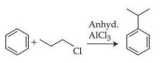
B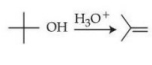
C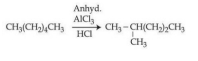
D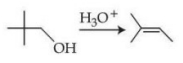
Solution
(C) The reaction of $n$-butyl alcohol $(CH_3CH_2CH_2CH_2OH)$ with $HBr$ involves the formation of a primary carbocation,which undergoes a $1,2$-hydride shift to form a more stable secondary carbocation,leading to a rearranged product ($2$-bromobutane).
In the reaction with conc. $H_2SO_4$ at $413 \ K$,the primary carbocation intermediate can undergo rearrangement before elimination to form the alkene.
In the reaction with $PCl_5$ or $SOCl_2$ (in the presence of pyridine),the reaction proceeds via an $S_N2$ mechanism. In an $S_N2$ mechanism,the nucleophile attacks the carbon atom from the backside,and the leaving group departs simultaneously. Since there is no carbocation intermediate formed in an $S_N2$ reaction,no rearrangement can occur.
Therefore,the reaction of $n$-butyl alcohol with $PCl_5$ or $SOCl_2$ (in the presence of pyridine) does not involve a rearrangement reaction.
In the reaction with conc. $H_2SO_4$ at $413 \ K$,the primary carbocation intermediate can undergo rearrangement before elimination to form the alkene.
In the reaction with $PCl_5$ or $SOCl_2$ (in the presence of pyridine),the reaction proceeds via an $S_N2$ mechanism. In an $S_N2$ mechanism,the nucleophile attacks the carbon atom from the backside,and the leaving group departs simultaneously. Since there is no carbocation intermediate formed in an $S_N2$ reaction,no rearrangement can occur.
Therefore,the reaction of $n$-butyl alcohol with $PCl_5$ or $SOCl_2$ (in the presence of pyridine) does not involve a rearrangement reaction.
0 likes
View Solution1736
MediumMCQ
Given below are two statements:
Statement $I$: $2, 6$-diethylcyclohexanone and $6$-methyl-$2$-$n$-propylcyclohexanone are metamers.
Statement $II$: $2, 2, 6, 6$-tetramethylcyclohexanone exhibits keto-enol tautomerism.
Statement $I$: $2, 6$-diethylcyclohexanone and $6$-methyl-$2$-$n$-propylcyclohexanone are metamers.
Statement $II$: $2, 2, 6, 6$-tetramethylcyclohexanone exhibits keto-enol tautomerism.
A
Both Statement $I$ and Statement $II$ are true
B
Both Statement $I$ and Statement $II$ are false
C
Statement $I$ is true but Statement $II$ is false
D
Statement $I$ is false but Statement $II$ is true
Solution
(C) Statement $I$: Metamers are isomers that have the same molecular formula but differ in the distribution of alkyl groups attached to the same polyvalent functional group. Both $2, 6$-diethylcyclohexanone and $6$-methyl-$2$-$n$-propylcyclohexanone have the same molecular formula $(C_{10}H_{18}O)$ but different alkyl substituents attached to the carbonyl group. Thus,they are metamers. Statement $I$ is true.
Statement $II$: Keto-enol tautomerism requires the presence of at least one $\alpha$-hydrogen atom adjacent to the carbonyl group. In $2, 2, 6, 6$-tetramethylcyclohexanone,all four $\alpha$-positions are substituted by methyl groups,meaning there are no $\alpha$-hydrogens available. Therefore,it cannot exhibit keto-enol tautomerism. Statement $II$ is false.
Statement $II$: Keto-enol tautomerism requires the presence of at least one $\alpha$-hydrogen atom adjacent to the carbonyl group. In $2, 2, 6, 6$-tetramethylcyclohexanone,all four $\alpha$-positions are substituted by methyl groups,meaning there are no $\alpha$-hydrogens available. Therefore,it cannot exhibit keto-enol tautomerism. Statement $II$ is false.
0 likes
View Solution1737
DifficultMCQ
An optically active alkyl bromide $C_4H_9Br$ reacts with ethanolic $KOH$ to form major compound $[A]$,which reacts with bromine to give compound $[B]$. Compound $[B]$ reacts with ethanolic $KOH$ and sodamide to give compound $[C]$. One molecule of water adds to compound $[C]$ on warming with mercuric sulphate and dilute sulphuric acid at $333 \text{ K}$ to form compound $[D]$. The functional group in compound $[D]$ will be confirmed by:
A
Haloform test
B
Lucas test
C
Silver mirror test
D
Benedict test
Solution
(A) The optically active alkyl bromide $C_4H_9Br$ is $2$-bromobutane.
Reaction of $2$-bromobutane with ethanolic $KOH$ (dehydrohalogenation) gives but-$2$-ene as the major product $[A]$.
Reaction of but-$2$-ene $[A]$ with $Br_2$ yields $2,3$-dibromobutane $[B]$.
Reaction of $2,3$-dibromobutane $[B]$ with alcoholic $KOH$ followed by $NaNH_2$ (dehydrohalogenation) yields but-$2$-yne $[C]$.
Hydration of but-$2$-yne $[C]$ in the presence of $HgSO_4/H_2SO_4$ (Kucherov's reaction) yields butanone $(CH_3COCH_2CH_3)$,which is a methyl ketone.
Methyl ketones are confirmed by the Haloform test (specifically the Iodoform test).
Reaction of $2$-bromobutane with ethanolic $KOH$ (dehydrohalogenation) gives but-$2$-ene as the major product $[A]$.
Reaction of but-$2$-ene $[A]$ with $Br_2$ yields $2,3$-dibromobutane $[B]$.
Reaction of $2,3$-dibromobutane $[B]$ with alcoholic $KOH$ followed by $NaNH_2$ (dehydrohalogenation) yields but-$2$-yne $[C]$.
Hydration of but-$2$-yne $[C]$ in the presence of $HgSO_4/H_2SO_4$ (Kucherov's reaction) yields butanone $(CH_3COCH_2CH_3)$,which is a methyl ketone.
Methyl ketones are confirmed by the Haloform test (specifically the Iodoform test).
0 likes
View Solution1738
DifficultMCQ
'x' is the product obtained from benzene by reacting it with carbon monoxide and hydrogen chloride in the presence of cuprous chloride. 'y' is the major product obtained from benzene by reacting it with ethanoyl chloride in the presence of anhydrous $AlCl_3$. The major product obtained by heating 'x' and 'y' in the presence of alkali is 'z'. The total number of $\pi$ (pi) electrons in 'z' is . . . . . . .
A
$12$
B
$14$
C
$16$
D
$18$
Solution
(C) $1$. Reaction of benzene with $CO$ and $HCl$ in the presence of $CuCl$ is the Gattermann-Koch reaction,which yields Benzaldehyde $(x)$.
$2$. Reaction of benzene with ethanoyl chloride in the presence of anhydrous $AlCl_3$ is Friedel-Crafts acylation,which yields Acetophenone $(y)$.
$3$. Heating Benzaldehyde $(x)$ and Acetophenone $(y)$ in the presence of an alkali is a Claisen-Schmidt condensation reaction,which yields Benzalacetophenone (Chalcone) as product $(z)$.
$4$. The structure of Chalcone $(C_6H_5-CH=CH-CO-C_6H_5)$ contains two benzene rings,one $C=C$ double bond,and one $C=O$ double bond.
$5$. Each benzene ring contributes $6$ $\pi$ electrons $(6 \times 2 = 12)$.
$6$. The $C=C$ bond contributes $2$ $\pi$ electrons.
$7$. The $C=O$ bond contributes $2$ $\pi$ electrons.
$8$. Total $\pi$ electrons = $12 + 2 + 2 = 16$.
$2$. Reaction of benzene with ethanoyl chloride in the presence of anhydrous $AlCl_3$ is Friedel-Crafts acylation,which yields Acetophenone $(y)$.
$3$. Heating Benzaldehyde $(x)$ and Acetophenone $(y)$ in the presence of an alkali is a Claisen-Schmidt condensation reaction,which yields Benzalacetophenone (Chalcone) as product $(z)$.
$4$. The structure of Chalcone $(C_6H_5-CH=CH-CO-C_6H_5)$ contains two benzene rings,one $C=C$ double bond,and one $C=O$ double bond.
$5$. Each benzene ring contributes $6$ $\pi$ electrons $(6 \times 2 = 12)$.
$6$. The $C=C$ bond contributes $2$ $\pi$ electrons.
$7$. The $C=O$ bond contributes $2$ $\pi$ electrons.
$8$. Total $\pi$ electrons = $12 + 2 + 2 = 16$.
0 likes
View Solution1739
DifficultMCQ
Compound $P$ $(C_{8}H_{8}O)$ gives a red-orange precipitate with $2,4-DNP$ reagent and it does not reduce Fehling's reagent. On drastic oxidation with chromic acid,$P$ gives an aromatic product $Q$ that produces effervescence on treating with aqueous $NaHCO_{3}$. Compound $P$ and $Q$,respectively,are:
A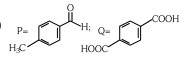
B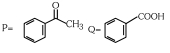
C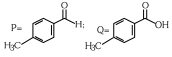
D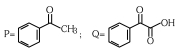
Solution
(B) $1$. Compound $P$ $(C_{8}H_{8}O)$ reacts with $2,4-DNP$ reagent,which confirms the presence of a carbonyl group (aldehyde or ketone).
$2$. It does not reduce Fehling's reagent,which indicates that $P$ is a ketone,not an aldehyde.
$3$. The molecular formula $C_{8}H_{8}O$ corresponds to acetophenone $(C_{6}H_{5}COCH_{3})$.
$4$. On drastic oxidation with chromic acid $(H_{2}CrO_{4})$,the alkyl group attached to the benzene ring is oxidized to a carboxylic acid group.
$5$. Acetophenone $(C_{6}H_{5}COCH_{3})$ on oxidation yields benzoic acid $(C_{6}H_{5}COOH)$ as product $Q$.
$6$. Benzoic acid $(Q)$ reacts with aqueous $NaHCO_{3}$ to produce effervescence due to the evolution of $CO_{2}$ gas.
$7$. Therefore,$P$ is acetophenone and $Q$ is benzoic acid.
$2$. It does not reduce Fehling's reagent,which indicates that $P$ is a ketone,not an aldehyde.
$3$. The molecular formula $C_{8}H_{8}O$ corresponds to acetophenone $(C_{6}H_{5}COCH_{3})$.
$4$. On drastic oxidation with chromic acid $(H_{2}CrO_{4})$,the alkyl group attached to the benzene ring is oxidized to a carboxylic acid group.
$5$. Acetophenone $(C_{6}H_{5}COCH_{3})$ on oxidation yields benzoic acid $(C_{6}H_{5}COOH)$ as product $Q$.
$6$. Benzoic acid $(Q)$ reacts with aqueous $NaHCO_{3}$ to produce effervescence due to the evolution of $CO_{2}$ gas.
$7$. Therefore,$P$ is acetophenone and $Q$ is benzoic acid.
0 likes
View Solution8-1.Aldehydes and Ketones — Properties · Frequently Asked Questions
1Are these 8-1.Aldehydes and Ketones questions useful for JEE and NEET?
Yes. All questions in this section are mapped to JEE Main and NEET exam patterns. Previous year questions from JEE Main, NEET, GUJCET and state-level exams are included with full solutions.
2Can I switch to Hindi or Gujarati for these questions?
Yes. Use the language tabs in the hero section or the sidebar to view the same questions and solutions in English, Hindi or Gujarati.
3How do I generate a question paper from this subtopic?
Use the Vedclass Exam Paper Generator — select the chapter and subtopic, set difficulty, and generate Sets A, B, C, D automatically. First 3 chapters of every subject are free.
Vedclass Products
For Students
Vedclass Test Series
Mock tests in real JEE/NEET style with performance analysis. 5-day free trial.
Start Free TrialFor Teachers
Exam Paper Generator
Generate Set A/B/C/D papers from this chapter in 2 minutes. 3 chapters free.
Try FreeFor Institutes
Online Exam Module
Live online exams with unlimited students, 360° analytics & white-label branding.
See DemoFor Teachers & Institutes
Generate a 8-1.Aldehydes and Ketones Exam Paper in 2 Minutes
Select subtopic & difficulty — Sets A, B, C, D auto-generated with No Repeat logic.
First 3 chapters of every subject are free — no payment required.