
A English
Properties Questions in English
Class 12 Chemistry · 8-1.Aldehydes and Ketones · Properties
1739+
Questions
English
Language
100%
With Solutions
Showing 50 of 1739 questions in English
1351
EasyMCQ
Which among the following compounds has the highest boiling point?
A
Propanal
B
Ethanal
C
Pentanal
D
Hexanal
Solution
(D) The boiling point of aldehydes and ketones depends on the molecular mass and the strength of intermolecular forces.
As the carbon chain length increases,the molecular mass increases,which leads to an increase in the magnitude of van der Waals forces of attraction.
Among the given options,$Hexanal$ $(C_6H_{12}O)$ has the longest carbon chain and the highest molecular mass compared to $Propanal$ $(C_3H_6O)$,$Ethanal$ $(C_2H_4O)$,and $Pentanal$ $(C_5H_{10}O)$.
Therefore,$Hexanal$ has the highest boiling point.
As the carbon chain length increases,the molecular mass increases,which leads to an increase in the magnitude of van der Waals forces of attraction.
Among the given options,$Hexanal$ $(C_6H_{12}O)$ has the longest carbon chain and the highest molecular mass compared to $Propanal$ $(C_3H_6O)$,$Ethanal$ $(C_2H_4O)$,and $Pentanal$ $(C_5H_{10}O)$.
Therefore,$Hexanal$ has the highest boiling point.
0 likes
View Solution1352
EasyMCQ
Which among the following has the lowest boiling point?
A
Pentanal
B
Propanal
C
Methanal
D
Ethanal
Solution
(C) The boiling point of aldehydes and ketones depends on the molecular mass and the strength of intermolecular forces.
As the molecular mass increases,the magnitude of van der Waals forces increases,leading to a higher boiling point.
Among the given options,$Methanal$ $(HCHO)$ has the lowest molecular mass $(30 \ g/mol)$.
Therefore,$Methanal$ has the lowest boiling point.
As the molecular mass increases,the magnitude of van der Waals forces increases,leading to a higher boiling point.
Among the given options,$Methanal$ $(HCHO)$ has the lowest molecular mass $(30 \ g/mol)$.
Therefore,$Methanal$ has the lowest boiling point.
0 likes
View Solution1353
EasyMCQ
Identify the name of the reaction in which the carbonyl group of aldehydes and ketones is reduced to a methylene group upon treatment with hydrazine,followed by heating with sodium hydroxide in ethylene glycol.
A
Wolff-Kishner reduction
B
Clemmensen reduction
C
Stephen reaction
D
Etard reaction
Solution
(A) The reaction described is the $Wolff-Kishner$ reduction.
In this process,aldehydes or ketones are first treated with hydrazine $(NH_2NH_2)$ to form a hydrazone intermediate.
Subsequently,heating this hydrazone with a strong base like sodium hydroxide $(NaOH)$ in a high-boiling solvent such as ethylene glycol results in the reduction of the carbonyl group $(>C=O)$ to a methylene group $(>CH_2)$ with the evolution of nitrogen gas $(N_2)$.
In this process,aldehydes or ketones are first treated with hydrazine $(NH_2NH_2)$ to form a hydrazone intermediate.
Subsequently,heating this hydrazone with a strong base like sodium hydroxide $(NaOH)$ in a high-boiling solvent such as ethylene glycol results in the reduction of the carbonyl group $(>C=O)$ to a methylene group $(>CH_2)$ with the evolution of nitrogen gas $(N_2)$.
0 likes
View Solution1354
MediumMCQ
Identify the products of the following reaction: $HCHO + C_6H_5CHO \xrightarrow[ii) H_3O^{+}]{i) conc. NaOH} \text{Products}$
A
Phenylmethanol and methanol
B
Methanol and benzoic acid
C
Methanoic acid and phenylmethanol
D
Methanoic acid and benzoic acid
Solution
(C) The given reaction is a $Cross-Cannizzaro$ reaction between formaldehyde $(HCHO)$ and benzaldehyde $(C_6H_5CHO)$ in the presence of concentrated $NaOH$.
In a $Cross-Cannizzaro$ reaction,the more reactive aldehyde (formaldehyde) undergoes oxidation to form a salt of the carboxylic acid,while the less reactive aldehyde (benzaldehyde) undergoes reduction to form an alcohol.
$1$. Formaldehyde $(HCHO)$ is more reactive towards nucleophilic attack,so it gets oxidized to sodium formate $(HCOONa)$,which upon acidification $(H_3O^+)$ gives methanoic acid $(HCOOH)$.
$2$. Benzaldehyde $(C_6H_5CHO)$ gets reduced to phenylmethanol $(C_6H_5CH_2OH)$.
Therefore,the products are methanoic acid and phenylmethanol.
In a $Cross-Cannizzaro$ reaction,the more reactive aldehyde (formaldehyde) undergoes oxidation to form a salt of the carboxylic acid,while the less reactive aldehyde (benzaldehyde) undergoes reduction to form an alcohol.
$1$. Formaldehyde $(HCHO)$ is more reactive towards nucleophilic attack,so it gets oxidized to sodium formate $(HCOONa)$,which upon acidification $(H_3O^+)$ gives methanoic acid $(HCOOH)$.
$2$. Benzaldehyde $(C_6H_5CHO)$ gets reduced to phenylmethanol $(C_6H_5CH_2OH)$.
Therefore,the products are methanoic acid and phenylmethanol.
0 likes
View Solution1355
MediumMCQ
Identify the product formed when $Hex-3-enenitrile$ is reduced with diisobutylaluminium hydride $(DIBAL-H)$ followed by acid hydrolysis?
A
$Hexanal$
B
$Hexan-3-one$
C
$Hex-3-enal$
D
$Hexanoic acid$
Solution
(C) The reduction of nitriles with diisobutylaluminium hydride $(DIBAL-H)$ followed by acid hydrolysis is a standard method to prepare aldehydes.
$DIBAL-H$ selectively reduces the nitrile group $(-CN)$ to an imine intermediate,which upon hydrolysis yields the corresponding aldehyde.
In the case of $Hex-3-enenitrile$ $(CH_3CH_2CH=CHCH_2CN)$,the nitrile group is reduced to an aldehyde group $(-CHO)$ while the carbon-carbon double bond $(C=C)$ remains unaffected.
Therefore,the product formed is $Hex-3-enal$ $(CH_3CH_2CH=CHCH_2CHO)$.
$DIBAL-H$ selectively reduces the nitrile group $(-CN)$ to an imine intermediate,which upon hydrolysis yields the corresponding aldehyde.
In the case of $Hex-3-enenitrile$ $(CH_3CH_2CH=CHCH_2CN)$,the nitrile group is reduced to an aldehyde group $(-CHO)$ while the carbon-carbon double bond $(C=C)$ remains unaffected.
Therefore,the product formed is $Hex-3-enal$ $(CH_3CH_2CH=CHCH_2CHO)$.
0 likes
View Solution1356
EasyMCQ
Which among the following has the highest boiling point?
A
Ethanal
B
Propanal
C
Pentanal
D
Hexanal
Solution
(D) The boiling point of aldehydes and ketones increases with an increase in the molecular mass due to the increase in the magnitude of intermolecular van der Waals forces of attraction.
Among the given options,$Hexanal$ $(C_6H_{12}O)$ has the highest molecular mass compared to $Ethanal$ $(C_2H_4O)$,$Propanal$ $(C_3H_6O)$,and $Pentanal$ $(C_5H_{10}O)$.
Therefore,$Hexanal$ has the highest boiling point.
Among the given options,$Hexanal$ $(C_6H_{12}O)$ has the highest molecular mass compared to $Ethanal$ $(C_2H_4O)$,$Propanal$ $(C_3H_6O)$,and $Pentanal$ $(C_5H_{10}O)$.
Therefore,$Hexanal$ has the highest boiling point.
0 likes
View Solution1357
EasyMCQ
Identify the reaction in which the carbonyl group of aldehydes and ketones is reduced to a methylene group upon treatment with zinc-amalgam and concentrated hydrochloric acid.
A
Wolff-Kishner reduction.
B
Stephen reaction.
C
Clemmensen reduction.
D
Etard reaction.
Solution
(C) The reduction of the carbonyl group $(>C=O)$ of aldehydes and ketones to a methylene group $(-CH_2-)$ using zinc-amalgam $(Zn-Hg)$ and concentrated hydrochloric acid $(HCl)$ is known as the $Clemmensen \ reduction$.
The general reaction is: $R-CO-R' + 4[H] \xrightarrow{Zn-Hg/HCl} R-CH_2-R' + H_2O$.
The general reaction is: $R-CO-R' + 4[H] \xrightarrow{Zn-Hg/HCl} R-CH_2-R' + H_2O$.
0 likes
View Solution1358
DifficultMCQ
Identify the product '$B$' in the following reaction:
Ethylphenyl ketone $\xrightarrow[-H_2O]{H_2N-NH_2} A$ $\xrightarrow{KOH, HO(CH_2)_2OH, \Delta} B$
Ethylphenyl ketone $\xrightarrow[-H_2O]{H_2N-NH_2} A$ $\xrightarrow{KOH, HO(CH_2)_2OH, \Delta} B$
A
Phenylhydrazone
B
Ethylbenzene
C
$n-$propylbenzene
D
Isopropylbenzene
Solution
(C) The given reaction sequence is the Wolff-Kishner reduction.
Step $1$: Ethylphenyl ketone reacts with hydrazine $(H_2N-NH_2)$ to form a hydrazone $(A)$.
Step $2$: The hydrazone $(A)$ reacts with a strong base $(KOH)$ in the presence of ethylene glycol $(HO(CH_2)_2OH)$ and heat to undergo reduction,converting the carbonyl group $(C=O)$ into a methylene group $(-CH_2-)$.
Starting material: $C_6H_5-CO-C_2H_5$ (Propiophenone or Ethylphenyl ketone).
Product $B$: $C_6H_5-CH_2-C_2H_5$,which is $n-$propylbenzene.
Step $1$: Ethylphenyl ketone reacts with hydrazine $(H_2N-NH_2)$ to form a hydrazone $(A)$.
Step $2$: The hydrazone $(A)$ reacts with a strong base $(KOH)$ in the presence of ethylene glycol $(HO(CH_2)_2OH)$ and heat to undergo reduction,converting the carbonyl group $(C=O)$ into a methylene group $(-CH_2-)$.
Starting material: $C_6H_5-CO-C_2H_5$ (Propiophenone or Ethylphenyl ketone).
Product $B$: $C_6H_5-CH_2-C_2H_5$,which is $n-$propylbenzene.
0 likes
View Solution1359
MediumMCQ
Identify the product '$B$' in the following sequence of reactions.
$2CH_3COCH_3$ $\xrightarrow{Ba(OH)_2} A$ $\xrightarrow[-H_2O]{\Delta} B$
$2CH_3COCH_3$ $\xrightarrow{Ba(OH)_2} A$ $\xrightarrow[-H_2O]{\Delta} B$
A
$4-$Hydroxy$-4-$methylpentan$-2-$one
B
$2-$methylpentan$-3-$one
C
$2-$methylpent$-2-$en$-4-$one
D
$4-$methylpent$-3-$en$-2-$one
Solution
(D) The reaction sequence represents the Aldol condensation of propanone.
Step $1$: Two molecules of propanone react in the presence of a base like $Ba(OH)_2$ to form a $\beta-$hydroxy ketone,which is $4-$hydroxy$-4-$methylpentan$-2-$one $(A)$.
Step $2$: Upon heating,the $\beta-$hydroxy ketone undergoes dehydration (loss of water) to form an $\alpha,\beta-$unsaturated ketone.
$4-$Hydroxy$-4-$methylpentan$-2-$one $\xrightarrow{\Delta, -H_2O} 4-$methylpent$-3-$en$-2-$one $(B)$.
Thus,the product $B$ is $4-$methylpent$-3-$en$-2-$one.
Step $1$: Two molecules of propanone react in the presence of a base like $Ba(OH)_2$ to form a $\beta-$hydroxy ketone,which is $4-$hydroxy$-4-$methylpentan$-2-$one $(A)$.
Step $2$: Upon heating,the $\beta-$hydroxy ketone undergoes dehydration (loss of water) to form an $\alpha,\beta-$unsaturated ketone.
$4-$Hydroxy$-4-$methylpentan$-2-$one $\xrightarrow{\Delta, -H_2O} 4-$methylpent$-3-$en$-2-$one $(B)$.
Thus,the product $B$ is $4-$methylpent$-3-$en$-2-$one.
0 likes
View Solution1360
EasyMCQ
Which of the following compounds is used to convert acetaldehyde into acetaldehyde cyanohydrin?
A
$FeCl_3$ (neutral)
B
$H_2SO_4$ (dil.)
C
$HCN$
D
$NaHSO_3$
Solution
(C) The conversion of acetaldehyde $(CH_3CHO)$ into acetaldehyde cyanohydrin involves the nucleophilic addition of hydrogen cyanide $(HCN)$ to the carbonyl group of the aldehyde.
The reaction is as follows:
$CH_3CHO + HCN \rightarrow CH_3CH(OH)CN$
Thus,$HCN$ is the reagent used for this transformation.
The reaction is as follows:
$CH_3CHO + HCN \rightarrow CH_3CH(OH)CN$
Thus,$HCN$ is the reagent used for this transformation.
0 likes
View Solution1361
EasyMCQ
What type of reaction is the formation of aldol from aldehyde?
A
Condensation reaction
B
Addition reaction
C
Substitution reaction
D
Elimination reaction
Solution
(A) The formation of aldol from aldehyde is known as an aldol condensation reaction.
In this reaction,two molecules of an aldehyde or ketone containing at least one $\alpha$-hydrogen atom react in the presence of a dilute alkali to form $\beta$-hydroxy aldehyde (aldol) or $\beta$-hydroxy ketone (ketol).
Since the reaction involves the combination of two molecules with the elimination of a water molecule (in the subsequent step),it is classified as a condensation reaction.
In this reaction,two molecules of an aldehyde or ketone containing at least one $\alpha$-hydrogen atom react in the presence of a dilute alkali to form $\beta$-hydroxy aldehyde (aldol) or $\beta$-hydroxy ketone (ketol).
Since the reaction involves the combination of two molecules with the elimination of a water molecule (in the subsequent step),it is classified as a condensation reaction.
0 likes
View Solution1362
MediumMCQ
Identify the product '$B$' in the following reaction sequence:
$\text{Ethyl phenyl ketone}$ $\xrightarrow{H_2N-NH_2} A$ $\xrightarrow{KOH, HO-(CH_2)_2-OH, \Delta} B$
$\text{Ethyl phenyl ketone}$ $\xrightarrow{H_2N-NH_2} A$ $\xrightarrow{KOH, HO-(CH_2)_2-OH, \Delta} B$
A
Phenylhydrazone
B
Ethyl benzene
C
n-Propyl benzene
D
Isopropyl benzene
Solution
(C) The given reaction is the Wolff-Kishner reduction.
In the first step,ethyl phenyl ketone $(C_6H_5-CO-CH_2CH_3)$ reacts with hydrazine $(H_2N-NH_2)$ to form a hydrazone $(A)$.
In the second step,the hydrazone is treated with a strong base $(KOH)$ in a high-boiling solvent like ethylene glycol $(HO-(CH_2)_2-OH)$ and heated $(\Delta)$.
This process reduces the carbonyl group $(C=O)$ to a methylene group $(CH_2)$.
Thus,the ethyl phenyl ketone $(C_6H_5-CO-CH_2CH_3)$ is reduced to $n$-propyl benzene $(C_6H_5-CH_2-CH_2CH_3)$.
In the first step,ethyl phenyl ketone $(C_6H_5-CO-CH_2CH_3)$ reacts with hydrazine $(H_2N-NH_2)$ to form a hydrazone $(A)$.
In the second step,the hydrazone is treated with a strong base $(KOH)$ in a high-boiling solvent like ethylene glycol $(HO-(CH_2)_2-OH)$ and heated $(\Delta)$.
This process reduces the carbonyl group $(C=O)$ to a methylene group $(CH_2)$.
Thus,the ethyl phenyl ketone $(C_6H_5-CO-CH_2CH_3)$ is reduced to $n$-propyl benzene $(C_6H_5-CH_2-CH_2CH_3)$.
0 likes
View Solution1363
MediumMCQ
Identify product $B$ in the following sequence of reactions:
$2 \ CH_3COCH_3$ $\xrightarrow{Ba(OH)_2} A$ $\xrightarrow{\Delta, -H_2O} B$
$2 \ CH_3COCH_3$ $\xrightarrow{Ba(OH)_2} A$ $\xrightarrow{\Delta, -H_2O} B$
A
$4-$Hydroxy$-4-$methylpentan$-2-$one
B
$2-$Methylpentan$-3-$one
C
$2-$Methylpent$-2-$en$-4-$one
D
$4-$Methylpent$-3-$en$-2-$one
Solution
(D) The reaction of $2$ molecules of propanone in the presence of $Ba(OH)_2$ is an aldol condensation reaction.
Step $1$: Two molecules of propanone undergo aldol condensation to form $4-$hydroxy$-4-$methylpentan$-2-$one (product $A$).
$2 CH_3COCH_3 \xrightarrow{Ba(OH)_2} (CH_3)_2C(OH)CH_2COCH_3$ (Product $A$)
Step $2$: Upon heating $( \Delta )$ and dehydration $(-H_2O)$,product $A$ loses a water molecule to form an $\alpha, \beta-$unsaturated ketone,which is $4-$methylpent$-3-$en$-2-$one (product $B$).
$(CH_3)_2C(OH)CH_2COCH_3 \xrightarrow{\Delta, -H_2O} (CH_3)_2C=CHCOCH_3$ (Product $B$)
Thus,the correct product $B$ is $4-$methylpent$-3-$en$-2-$one.
Step $1$: Two molecules of propanone undergo aldol condensation to form $4-$hydroxy$-4-$methylpentan$-2-$one (product $A$).
$2 CH_3COCH_3 \xrightarrow{Ba(OH)_2} (CH_3)_2C(OH)CH_2COCH_3$ (Product $A$)
Step $2$: Upon heating $( \Delta )$ and dehydration $(-H_2O)$,product $A$ loses a water molecule to form an $\alpha, \beta-$unsaturated ketone,which is $4-$methylpent$-3-$en$-2-$one (product $B$).
$(CH_3)_2C(OH)CH_2COCH_3 \xrightarrow{\Delta, -H_2O} (CH_3)_2C=CHCOCH_3$ (Product $B$)
Thus,the correct product $B$ is $4-$methylpent$-3-$en$-2-$one.
0 likes
View Solution1364
MediumMCQ
Identify the product '$B$' in the following reaction:
$2 CH_3CHO$ $\xrightarrow{\text{dil. NaOH}} A$ $\xrightarrow[\Delta]{-H_2O} B$
$2 CH_3CHO$ $\xrightarrow{\text{dil. NaOH}} A$ $\xrightarrow[\Delta]{-H_2O} B$
A
But$-3-$enal
B
$3-$Hydroxybutanal
C
But$-2-$enal
D
$4-$Hydroxybutanal
Solution
(C) The reaction is an Aldol condensation followed by dehydration.
Step $1$: Two molecules of acetaldehyde $(CH_3CHO)$ react in the presence of dilute $NaOH$ to form $3-$hydroxybutanal $(A)$,which is $CH_3CH(OH)CH_2CHO$.
Step $2$: Upon heating with acid or base,$3-$hydroxybutanal undergoes dehydration (loss of $H_2O$) to form an $\alpha,\beta-$unsaturated aldehyde,which is but$-2-$enal $(CH_3CH=CHCHO)$,also known as crotonaldehyde.
Therefore,the product '$B$' is but$-2-$enal.
Step $1$: Two molecules of acetaldehyde $(CH_3CHO)$ react in the presence of dilute $NaOH$ to form $3-$hydroxybutanal $(A)$,which is $CH_3CH(OH)CH_2CHO$.
Step $2$: Upon heating with acid or base,$3-$hydroxybutanal undergoes dehydration (loss of $H_2O$) to form an $\alpha,\beta-$unsaturated aldehyde,which is but$-2-$enal $(CH_3CH=CHCHO)$,also known as crotonaldehyde.
Therefore,the product '$B$' is but$-2-$enal.
0 likes
View Solution1365
EasyMCQ
Which of the following aldehydes is less reactive towards nucleophilic addition reaction?
A
Benzaldehyde
B
Formaldehyde
C
Acetaldehyde
D
Butyraldehyde
Solution
(A) The reactivity of aldehydes towards nucleophilic addition reactions depends on two main factors: steric hindrance and electronic effects.
$1$. Steric hindrance: As the size of the alkyl group attached to the carbonyl carbon increases,the attack of the nucleophile becomes more difficult.
$2$. Electronic effects: Electron-donating groups ($+I$ or $+M$ effect) decrease the electrophilicity of the carbonyl carbon,thereby reducing reactivity.
In $C_6H_5CHO$ (Benzaldehyde),the phenyl group is bulky (high steric hindrance) and also exerts a $+M$ effect (resonance),which stabilizes the carbonyl carbon and reduces its electrophilicity.
Therefore,the decreasing order of reactivity is: $HCHO > CH_3CHO > CH_3CH_2CH_2CHO > C_6H_5CHO$.
Thus,$C_6H_5CHO$ is the least reactive.
$1$. Steric hindrance: As the size of the alkyl group attached to the carbonyl carbon increases,the attack of the nucleophile becomes more difficult.
$2$. Electronic effects: Electron-donating groups ($+I$ or $+M$ effect) decrease the electrophilicity of the carbonyl carbon,thereby reducing reactivity.
In $C_6H_5CHO$ (Benzaldehyde),the phenyl group is bulky (high steric hindrance) and also exerts a $+M$ effect (resonance),which stabilizes the carbonyl carbon and reduces its electrophilicity.
Therefore,the decreasing order of reactivity is: $HCHO > CH_3CHO > CH_3CH_2CH_2CHO > C_6H_5CHO$.
Thus,$C_6H_5CHO$ is the least reactive.
0 likes
View Solution1366
MediumMCQ
Which of the following carbonyl compounds does $NOT$ undergo aldol condensation?
A
Acetone
B
Benzophenone
C
Acetaldehyde
D
Acetophenone
Solution
(B) Aldol condensation requires the presence of at least one $\alpha$-hydrogen atom in the carbonyl compound.
$1$. Acetone $(CH_3COCH_3)$ has $6$ $\alpha$-hydrogens.
$2$. Benzophenone $(C_6H_5COC_6H_5)$ has no $\alpha$-hydrogen atom attached to the carbonyl carbon.
$3$. Acetaldehyde $(CH_3CHO)$ has $3$ $\alpha$-hydrogens.
$4$. Acetophenone $(C_6H_5COCH_3)$ has $3$ $\alpha$-hydrogens.
Therefore,Benzophenone does not undergo aldol condensation.
$1$. Acetone $(CH_3COCH_3)$ has $6$ $\alpha$-hydrogens.
$2$. Benzophenone $(C_6H_5COC_6H_5)$ has no $\alpha$-hydrogen atom attached to the carbonyl carbon.
$3$. Acetaldehyde $(CH_3CHO)$ has $3$ $\alpha$-hydrogens.
$4$. Acetophenone $(C_6H_5COCH_3)$ has $3$ $\alpha$-hydrogens.
Therefore,Benzophenone does not undergo aldol condensation.
0 likes
View Solution1367
EasyMCQ
Identify $A$ in the following reaction: $A + CH_3MgBr$ $\xrightarrow{\text{ether}} \text{complex}$ $\xrightarrow{H_3O^{+}} (CH_3)_3C-OH$
A
Acetaldehyde
B
Propionaldehyde
C
Acetyl chloride
D
Acetone
Solution
(D) The reaction of a Grignard reagent $(CH_3MgBr)$ with a carbonyl compound followed by acid hydrolysis $(H_3O^{+})$ produces an alcohol.
In the given reaction,the product is tert-butyl alcohol,which is $(CH_3)_3C-OH$.
Since the Grignard reagent provides one methyl group $(CH_3)$,the carbonyl compound $A$ must provide the remaining three-carbon skeleton with a carbonyl group.
Acetone $(CH_3COCH_3)$ reacts with $CH_3MgBr$ to form an intermediate complex,which upon hydrolysis yields tert-butyl alcohol.
The reaction is: $CH_3COCH_3 + CH_3MgBr$ $\rightarrow (CH_3)_3C-OMgBr$ $\xrightarrow{H_3O^{+}} (CH_3)_3C-OH + Mg(OH)Br$.
Therefore,$A$ is Acetone.
In the given reaction,the product is tert-butyl alcohol,which is $(CH_3)_3C-OH$.
Since the Grignard reagent provides one methyl group $(CH_3)$,the carbonyl compound $A$ must provide the remaining three-carbon skeleton with a carbonyl group.
Acetone $(CH_3COCH_3)$ reacts with $CH_3MgBr$ to form an intermediate complex,which upon hydrolysis yields tert-butyl alcohol.
The reaction is: $CH_3COCH_3 + CH_3MgBr$ $\rightarrow (CH_3)_3C-OMgBr$ $\xrightarrow{H_3O^{+}} (CH_3)_3C-OH + Mg(OH)Br$.
Therefore,$A$ is Acetone.
0 likes
View Solution1368
MediumMCQ
Which of the following compounds is highly reactive towards $HCN$?
A
$C_6H_5CHO$
B
$HCHO$
C
$CH_3COCH_3$
D
$CH_3CHO$
Solution
(B) The reactivity of carbonyl compounds towards nucleophilic addition reactions like $HCN$ addition depends on two factors: steric hindrance and electronic effects.
$1$. Steric hindrance: Smaller groups around the carbonyl carbon facilitate the attack of the nucleophile $(CN^-)$.
$2$. Electronic effects: Electron-withdrawing groups increase the electrophilicity of the carbonyl carbon.
Among the given options,$HCHO$ (formaldehyde) has the smallest hydrogen atoms attached to the carbonyl carbon,resulting in the least steric hindrance.
Therefore,$HCHO$ is the most reactive towards $HCN$.
$1$. Steric hindrance: Smaller groups around the carbonyl carbon facilitate the attack of the nucleophile $(CN^-)$.
$2$. Electronic effects: Electron-withdrawing groups increase the electrophilicity of the carbonyl carbon.
Among the given options,$HCHO$ (formaldehyde) has the smallest hydrogen atoms attached to the carbonyl carbon,resulting in the least steric hindrance.
Therefore,$HCHO$ is the most reactive towards $HCN$.
0 likes
View Solution1369
EasyMCQ
Which of the following is Clemmensen reduction?
A
$>C=O + 4[H] \xrightarrow{Zn-Hg / \text{conc. } HCl / \Delta} >CH_2 + H_2O$
B
$-COCl \xrightarrow{H_2 / Pd-BaSO_4} -CHO + HCl$
C
$-CH=O$ $\xrightarrow{H_2N-NH_2 / -H_2O} R-CH=N-NH_2$ $\xrightarrow{KOH / \text{ethylene glycol} / \Delta} -CH_3 + N_2$
D
$-C \equiv N + 2[H]$ $\xrightarrow{SnCl_2 / \text{dil. } HCl} -CH=NH \cdot HCl$ $\xrightarrow{H_3O^+} -CHO + NH_4Cl$
Solution
(A) The Clemmensen reduction is a chemical reaction where aldehydes or ketones are reduced to alkanes using zinc amalgam $(Zn-Hg)$ and concentrated hydrochloric acid $(HCl)$.
Option $A$ represents the general reaction for the Clemmensen reduction: $>C=O + 4[H] \xrightarrow{Zn-Hg / \text{conc. } HCl / \Delta} >CH_2 + H_2O$.
Option $B$ is the Rosenmund reduction.
Option $C$ is the Wolff-Kishner reduction.
Option $D$ is the Stephen reduction.
Option $A$ represents the general reaction for the Clemmensen reduction: $>C=O + 4[H] \xrightarrow{Zn-Hg / \text{conc. } HCl / \Delta} >CH_2 + H_2O$.
Option $B$ is the Rosenmund reduction.
Option $C$ is the Wolff-Kishner reduction.
Option $D$ is the Stephen reduction.
0 likes
View Solution1370
MediumMCQ
In the reaction,$C_6H_5COCH_3 \xrightarrow[Zn-Hg / \text{conc. } HCl]{[H]} X$,$X$ is
A
toluene
B
methylbenzene
C
benzyl alcohol
D
ethylbenzene
Solution
(D) The given reaction is the $Clemmensen$ reduction,which reduces a carbonyl group $(C=O)$ to a methylene group $(CH_2)$.
$C_6H_5COCH_3 + 4[H] \xrightarrow[Zn-Hg / \text{conc. } HCl] C_6H_5CH_2CH_3 + H_2O$.
The product $X$ is $C_6H_5CH_2CH_3$,which is ethylbenzene.
$C_6H_5COCH_3 + 4[H] \xrightarrow[Zn-Hg / \text{conc. } HCl] C_6H_5CH_2CH_3 + H_2O$.
The product $X$ is $C_6H_5CH_2CH_3$,which is ethylbenzene.
0 likes
View Solution1371
MediumMCQ
Which of the following is most reactive towards the addition reaction of hydrogen cyanide to form the corresponding cyanohydrin?
A
Acetone
B
Formaldehyde
C
Acetaldehyde
D
Diethyl ketone
Solution
(B) The rate of nucleophilic addition reaction is inversely proportional to the steric hindrance around the carbonyl carbon.
$HCHO > CH_3CHO > CH_3COCH_3 > C_2H_5COC_2H_5$
Formaldehyde has the least steric hindrance and the highest electrophilicity of the carbonyl carbon,making it the most reactive towards nucleophilic addition of $HCN$.
$HCHO > CH_3CHO > CH_3COCH_3 > C_2H_5COC_2H_5$
Formaldehyde has the least steric hindrance and the highest electrophilicity of the carbonyl carbon,making it the most reactive towards nucleophilic addition of $HCN$.
0 likes
View Solution1372
MediumMCQ
When aldehydes or ketones are treated with $C_6H_5-NH-NH_2$ (phenylhydrazine),the product formed is:
A
Semicarbazone
B
Phenylhydrazone
C
Hydrazine
D
Oxime
Solution
(B) The reaction of aldehydes or ketones with phenylhydrazine $(C_6H_5-NH-NH_2)$ involves the nucleophilic addition of the amine group to the carbonyl carbon followed by the elimination of a water molecule.
This condensation reaction results in the formation of a phenylhydrazone.
The general reaction is:
$R_2C=O + H_2N-NH-C_6H_5 \rightarrow R_2C=N-NH-C_6H_5 + H_2O$
Thus,the product formed is a phenylhydrazone.
This condensation reaction results in the formation of a phenylhydrazone.
The general reaction is:
$R_2C=O + H_2N-NH-C_6H_5 \rightarrow R_2C=N-NH-C_6H_5 + H_2O$
Thus,the product formed is a phenylhydrazone.
0 likes
View Solution1373
MediumMCQ
Which reaction intermediate is formed during the condensation reaction between acetaldehyde and formaldehyde?
A
$: \overline{C}H_{2}CHO$
B
$C_{2}^{+}CHO$
C
$\stackrel{+}{C}H_{2}OH$
D
$: \overline{C}HCHO$
Solution
(A) In the crossed aldol condensation between acetaldehyde $(CH_{3}CHO)$ and formaldehyde $(HCHO)$,the base $(OH^{-})$ abstracts an $\alpha$-hydrogen atom from the acetaldehyde molecule because the $\alpha$-hydrogens are acidic due to the electron-withdrawing effect of the carbonyl group.
This abstraction results in the formation of an enolate ion (carbanion) intermediate,which is represented as $: \overline{C}H_{2}CHO$.
This abstraction results in the formation of an enolate ion (carbanion) intermediate,which is represented as $: \overline{C}H_{2}CHO$.
0 likes
View Solution1374
MediumMCQ
Which of the following compounds does not undergo haloform reaction?
A
Ethanal
B
Propanal
C
Propanone
D
Butanone
Solution
(B) The haloform reaction is given by compounds containing the $CH_3CO-$ group (methyl ketones) or the $CH_3CH(OH)-$ group (secondary alcohols).
Ethanal $(CH_3CHO)$ contains the $CH_3CO-$ group.
Propanone $(CH_3COCH_3)$ and Butanone $(CH_3COCH_2CH_3)$ are methyl ketones.
Propanal $(CH_3CH_2CHO)$ does not contain the $CH_3CO-$ group,as the methyl group is attached to a methylene group,not the carbonyl carbon.
Therefore,Propanal does not undergo the haloform reaction.
Ethanal $(CH_3CHO)$ contains the $CH_3CO-$ group.
Propanone $(CH_3COCH_3)$ and Butanone $(CH_3COCH_2CH_3)$ are methyl ketones.
Propanal $(CH_3CH_2CHO)$ does not contain the $CH_3CO-$ group,as the methyl group is attached to a methylene group,not the carbonyl carbon.
Therefore,Propanal does not undergo the haloform reaction.
0 likes
View Solution1375
MediumMCQ
Identify the test from the following in which an aldehyde,when boiled with an ammoniacal silver nitrate solution,deposits silver.
A
Schiff's test
B
Tollen's test
C
Gehling test
D
Iodoform test
Solution
(B) Tollen's reagent,which is an ammoniacal silver nitrate solution,oxidises aldehydes to the corresponding carboxylate anion. During this process,$Ag^+$ ions are reduced to metallic silver,which deposits as a silver mirror or a greyish-black precipitate on the inner walls of the test tube.
0 likes
View Solution1376
EasyMCQ
What is the product obtained in the reaction?
$CH_3-CH=CH-CH_2-CHO \xrightarrow[(ii) H_3O^{+}]{(i) LiAlH_4} \text{product}$
$CH_3-CH=CH-CH_2-CHO \xrightarrow[(ii) H_3O^{+}]{(i) LiAlH_4} \text{product}$
A
$CH_3-CH=CH-CH_2-CH_2-OH$
B
$CH_3-CH=CH-CH_2-COOH$
C
$CH_3-CH_2-CH_2-CH_2-CHO$
D
$CH_3-CH_2-CH_2-CH_2-CH_3$
Solution
(A) $LiAlH_4$ is a selective reducing agent that reduces the aldehyde group to a primary alcohol while leaving the isolated carbon-carbon double bond intact.
Therefore,the reaction of $CH_3-CH=CH-CH_2-CHO$ with $(i) LiAlH_4$ followed by $(ii) H_3O^{+}$ yields $CH_3-CH=CH-CH_2-CH_2-OH$.
Therefore,the reaction of $CH_3-CH=CH-CH_2-CHO$ with $(i) LiAlH_4$ followed by $(ii) H_3O^{+}$ yields $CH_3-CH=CH-CH_2-CH_2-OH$.
0 likes
View Solution1377
EasyMCQ
Which among the following colours is obtained in Schiff test of aldehydes?
A
Blue
B
Green
C
Magenta
D
Black
Solution
(C) When an alcoholic solution of an aldehyde is treated with a few drops of Schiff's reagent,a pink,red,or magenta colour appears.
0 likes
View Solution1378
MediumMCQ
Identify the products of the following reaction:
$HCHO + C_6H_5CHO \xrightarrow[ii. \ H_3O^+]{i. \ conc. \ NaOH} ?$
$HCHO + C_6H_5CHO \xrightarrow[ii. \ H_3O^+]{i. \ conc. \ NaOH} ?$
A
Methanoic acid and phenyl methanol
B
Methanol and benzoic acid
C
Methanol and phenol
D
Methanoic acid and phenol
Solution
(A) The reaction between methanal $(HCHO)$ and benzaldehyde $(C_6H_5CHO)$ in the presence of concentrated $NaOH$ is a cross-Cannizzaro reaction.
In this reaction,the more reactive aldehyde (methanal) undergoes oxidation to form a salt of carboxylic acid (sodium methanoate),which upon acidification $(H_3O^+)$ yields methanoic acid $(HCOOH)$.
The less reactive aldehyde (benzaldehyde) undergoes reduction to form the corresponding alcohol,phenyl methanol $(C_6H_5CH_2OH)$.
In this reaction,the more reactive aldehyde (methanal) undergoes oxidation to form a salt of carboxylic acid (sodium methanoate),which upon acidification $(H_3O^+)$ yields methanoic acid $(HCOOH)$.
The less reactive aldehyde (benzaldehyde) undergoes reduction to form the corresponding alcohol,phenyl methanol $(C_6H_5CH_2OH)$.
0 likes
View Solution1379
MediumMCQ
Which of the following is a solid trimer of formaldehyde?
A
Metaldehyde
B
Paraformaldehyde
C
Paraldehyde
D
Trioxane
Solution
(D) Formaldehyde $(HCHO)$ undergoes polymerization to form different products depending on the conditions.
$1$. Paraformaldehyde is a linear polymer of formaldehyde with the formula $HO(CH_2O)_n H$.
$2$. Trioxane $(C_3H_6O_3)$ is the cyclic trimer of formaldehyde,which is a solid at room temperature.
$3$. Paraldehyde is the cyclic trimer of acetaldehyde,not formaldehyde.
Therefore,the correct answer is Trioxane.
$1$. Paraformaldehyde is a linear polymer of formaldehyde with the formula $HO(CH_2O)_n H$.
$2$. Trioxane $(C_3H_6O_3)$ is the cyclic trimer of formaldehyde,which is a solid at room temperature.
$3$. Paraldehyde is the cyclic trimer of acetaldehyde,not formaldehyde.
Therefore,the correct answer is Trioxane.
0 likes
View Solution1380
MediumMCQ
Which of the following compounds reacts with ammonia to form urotropine?
A
Ethanal
B
Methanal
C
Propanone
D
Propanal
Solution
(B) Methanal $(HCHO)$ reacts with ammonia $(NH_3)$ to form urotropine (hexamethylenetetramine).
The chemical reaction is as follows:
$6HCHO + 4NH_3 \rightarrow (CH_2)_6N_4 + 6H_2O$
The chemical reaction is as follows:
$6HCHO + 4NH_3 \rightarrow (CH_2)_6N_4 + 6H_2O$
0 likes
View Solution1381
MediumMCQ
Which of the following does not give a yellow solid on treatment with sodium hypoiodite?
A
Acetophenone
B
Pentan-$3$-one
C
Pentan-$2$-one
D
Ethanal
Solution
(B) Pentan-$3$-one does not give a yellow solid on treatment with sodium hypoiodite because this reaction is given only by methyl ketones.
Ketones that have at least one methyl group linked to the carbonyl carbon atom (i.e.,$CH_3-CO-$ group) are oxidized by sodium hypoiodite to form iodoform $(CHI_3)$,which is a yellow solid.
This reaction is known as the iodoform reaction.
Since pentan-$3$-one $(CH_3CH_2COCH_2CH_3)$ lacks a methyl group attached to the carbonyl carbon,it does not undergo the iodoform reaction.
Ketones that have at least one methyl group linked to the carbonyl carbon atom (i.e.,$CH_3-CO-$ group) are oxidized by sodium hypoiodite to form iodoform $(CHI_3)$,which is a yellow solid.
This reaction is known as the iodoform reaction.
Since pentan-$3$-one $(CH_3CH_2COCH_2CH_3)$ lacks a methyl group attached to the carbonyl carbon,it does not undergo the iodoform reaction.
0 likes
View Solution1382
EasyMCQ
Which among the following compounds forms pink colouration on addition of Schiff's reagent?
A
Propanol
B
Propanone
C
Propanal
D
Propanoic acid
Solution
(C) Schiff's reagent is a specific test used to detect the presence of aldehydes.
Aldehydes react with Schiff's reagent to produce a characteristic pink or magenta colouration.
Among the given options,$Propanal$ $(CH_3CH_2CHO)$ is an aldehyde.
Propanol is an alcohol,Propanone is a ketone,and Propanoic acid is a carboxylic acid; none of these react with Schiff's reagent to give the pink colouration.
Therefore,the correct option is $C$.
Aldehydes react with Schiff's reagent to produce a characteristic pink or magenta colouration.
Among the given options,$Propanal$ $(CH_3CH_2CHO)$ is an aldehyde.
Propanol is an alcohol,Propanone is a ketone,and Propanoic acid is a carboxylic acid; none of these react with Schiff's reagent to give the pink colouration.
Therefore,the correct option is $C$.
0 likes
View Solution1383
MediumMCQ
Which of the following does $NOT$ exhibit haloform reaction?
A
Ethanal
B
Propanal
C
Propanone
D
Butanone
Solution
(B) The haloform reaction is given by compounds containing the $CH_3CO-$ group or compounds that can be oxidized to this group (like $CH_3CH(OH)-$ group).
$1$. Ethanal $(CH_3CHO)$ contains the $CH_3CO-$ group and gives a positive haloform test.
$2$. Propanal $(CH_3CH_2CHO)$ does not contain the $CH_3CO-$ group and cannot be oxidized to it,so it does not give a positive haloform test.
$3$. Propanone $(CH_3COCH_3)$ contains the $CH_3CO-$ group and gives a positive haloform test.
$4$. Butanone $(CH_3COCH_2CH_3)$ contains the $CH_3CO-$ group and gives a positive haloform test.
Therefore,Propanal does not exhibit the haloform reaction.
$1$. Ethanal $(CH_3CHO)$ contains the $CH_3CO-$ group and gives a positive haloform test.
$2$. Propanal $(CH_3CH_2CHO)$ does not contain the $CH_3CO-$ group and cannot be oxidized to it,so it does not give a positive haloform test.
$3$. Propanone $(CH_3COCH_3)$ contains the $CH_3CO-$ group and gives a positive haloform test.
$4$. Butanone $(CH_3COCH_2CH_3)$ contains the $CH_3CO-$ group and gives a positive haloform test.
Therefore,Propanal does not exhibit the haloform reaction.
0 likes
View Solution1384
EasyMCQ
Which of the following compounds when treated with ammoniacal silver nitrate exhibits silver mirror test?
A
Ethanol
B
Ethanal
C
Ethoxyethane
D
Ethanoic acid
Solution
(B) The silver mirror test is a characteristic reaction of aldehydes.
Ammoniacal silver nitrate is known as Tollen's reagent.
$CH_3CHO + 2[Ag(NH_3)_2]^+ + 3OH^- \rightarrow CH_3COO^- + 2Ag(s) + 4NH_3 + 2H_2O$.
Ethanal $(CH_3CHO)$ is an aldehyde and thus gives a positive silver mirror test.
Ammoniacal silver nitrate is known as Tollen's reagent.
$CH_3CHO + 2[Ag(NH_3)_2]^+ + 3OH^- \rightarrow CH_3COO^- + 2Ag(s) + 4NH_3 + 2H_2O$.
Ethanal $(CH_3CHO)$ is an aldehyde and thus gives a positive silver mirror test.
0 likes
View Solution1385
EasyMCQ
Which of the following on reaction with ammoniacal silver nitrate forms a silver precipitate?
A
Ethanol
B
Ethanal
C
Ethoxyethane
D
Ethanoic acid
Solution
(B) Ammoniacal silver nitrate is known as Tollens' reagent.
It acts as a mild oxidizing agent and specifically oxidizes aldehydes to their corresponding carboxylate anions.
During this process,the $Ag^+$ ions in the reagent are reduced to metallic silver,which forms a silver mirror or a greyish-black precipitate.
Among the given options,$Ethanal$ $(CH_3CHO)$ is an aldehyde,while the others are an alcohol,an ether,and a carboxylic acid,respectively.
Therefore,only $Ethanal$ reacts with Tollens' reagent to form a silver precipitate.
It acts as a mild oxidizing agent and specifically oxidizes aldehydes to their corresponding carboxylate anions.
During this process,the $Ag^+$ ions in the reagent are reduced to metallic silver,which forms a silver mirror or a greyish-black precipitate.
Among the given options,$Ethanal$ $(CH_3CHO)$ is an aldehyde,while the others are an alcohol,an ether,and a carboxylic acid,respectively.
Therefore,only $Ethanal$ reacts with Tollens' reagent to form a silver precipitate.
0 likes
View Solution1386
MediumMCQ
Identify the product $Y$ in the following reaction: $CH_3-CO-CH_3 + 3NaOI \xrightarrow{\Delta} Y + CH_3-COONa + 2NaOH$
A
$CH_4$
B
$CH_3OH$
C
$CH_3$
D
$CHI_3$
Solution
(D) The given reaction is the iodoform reaction,which is a characteristic test for methyl ketones or methyl carbinols.
In this reaction,acetone $(CH_3COCH_3)$ reacts with sodium hypoiodite $(NaOI)$ to form iodoform $(CHI_3)$ as a yellow precipitate along with sodium acetate $(CH_3COONa)$ and sodium hydroxide $(NaOH)$.
Thus,the product $Y$ is $CHI_3$ (iodoform).
In this reaction,acetone $(CH_3COCH_3)$ reacts with sodium hypoiodite $(NaOI)$ to form iodoform $(CHI_3)$ as a yellow precipitate along with sodium acetate $(CH_3COONa)$ and sodium hydroxide $(NaOH)$.
Thus,the product $Y$ is $CHI_3$ (iodoform).
0 likes
View Solution1387
MediumMCQ
Identify the compound $X$ in the following reaction.
Acetone $+ X \stackrel{\Delta}{\longrightarrow} CHI_3 \downarrow + CH_3COONa + 2 NaOH$
Acetone $+ X \stackrel{\Delta}{\longrightarrow} CHI_3 \downarrow + CH_3COONa + 2 NaOH$
A
$NaOI$
B
dil. $NaOH$
C
$K_2Cr_2O_7$
D
conc. $KOH$
Solution
(A) The given reaction is the iodoform test,which is a characteristic reaction for methyl ketones or compounds containing the $CH_3CO-$ group.
Acetone $(CH_3COCH_3)$ reacts with iodine $(I_2)$ in the presence of sodium hydroxide $(NaOH)$ to form sodium hypoiodite $(NaOI)$,which acts as the oxidizing and iodinating agent.
The balanced chemical equation for the reaction is:
$CH_3COCH_3 + 3NaOI \stackrel{\Delta}{\longrightarrow} CHI_3 \downarrow + CH_3COONa + 2NaOH$
Thus,the compound $X$ is $NaOI$ (which is generated in situ from $I_2$ and $NaOH$).
Acetone $(CH_3COCH_3)$ reacts with iodine $(I_2)$ in the presence of sodium hydroxide $(NaOH)$ to form sodium hypoiodite $(NaOI)$,which acts as the oxidizing and iodinating agent.
The balanced chemical equation for the reaction is:
$CH_3COCH_3 + 3NaOI \stackrel{\Delta}{\longrightarrow} CHI_3 \downarrow + CH_3COONa + 2NaOH$
Thus,the compound $X$ is $NaOI$ (which is generated in situ from $I_2$ and $NaOH$).
0 likes
View Solution1388
EasyMCQ
Which among the following compounds does not exhibit the iodoform test?
A
Acetaldehyde
B
sec-Butyl alcohol
C
n-Butyl alcohol
D
Acetophenone
Solution
(C) Compounds that exhibit the iodoform test must contain either a methyl ketone group $(CH_3-CO-R)$ or a methyl carbinol group $(CH_3-CH(OH)-R)$.
Acetaldehyde $(CH_3CHO)$ contains the $CH_3-CO-$ group.
sec-Butyl alcohol $(CH_3-CH(OH)-CH_2CH_3)$ contains the $CH_3-CH(OH)-$ group.
Acetophenone $(C_6H_5-CO-CH_3)$ contains the $CH_3-CO-$ group.
n-Butyl alcohol $(CH_3-CH_2-CH_2-CH_2-OH)$ does not contain either of these structural units.
Therefore,$n$-Butyl alcohol does not show the iodoform test.
Acetaldehyde $(CH_3CHO)$ contains the $CH_3-CO-$ group.
sec-Butyl alcohol $(CH_3-CH(OH)-CH_2CH_3)$ contains the $CH_3-CH(OH)-$ group.
Acetophenone $(C_6H_5-CO-CH_3)$ contains the $CH_3-CO-$ group.
n-Butyl alcohol $(CH_3-CH_2-CH_2-CH_2-OH)$ does not contain either of these structural units.
Therefore,$n$-Butyl alcohol does not show the iodoform test.
0 likes
View Solution1389
EasyMCQ
Identify product $B$ in the following reaction: $\text{Propanone}$ $\xrightarrow{\text{Ba(OH)}_2} A$ $\xrightarrow{\Delta, -\text{H}_2\text{O}} B$
A
$2-$Methylpentan$-3-$one
B
$4-$Hydroxy$-4-$methylpentan$-2-$one
C
$4-$Methylpent$-3-$en$-2-$one
D
$2-$Methylpent$-2-$en$-4-$one
Solution
(C) The reaction of propanone with $\text{Ba(OH)}_2$ is an aldol condensation reaction.
Two molecules of propanone undergo self-aldol condensation to form $4-$hydroxy$-4-$methylpentan$-2-$one (product $A$).
Upon heating $(A)$,it undergoes dehydration (loss of water) to form an $\alpha,\beta-$unsaturated ketone,which is $4-$methylpent$-3-$en$-2-$one (product $B$).
Two molecules of propanone undergo self-aldol condensation to form $4-$hydroxy$-4-$methylpentan$-2-$one (product $A$).
Upon heating $(A)$,it undergoes dehydration (loss of water) to form an $\alpha,\beta-$unsaturated ketone,which is $4-$methylpent$-3-$en$-2-$one (product $B$).
0 likes
View Solution1390
EasyMCQ
Which of the following does $NOT$ give a yellow precipitate when reacted with a $(NaOH + I_{2})$ mixture?
A
Acetophenone
B
Benzaldehyde
C
Acetone
D
Acetaldehyde
Solution
(B) The haloform reaction is given by compounds containing the $CH_{3}CO-$ group or the $CH_{3}CH(OH)-$ group.
Acetaldehyde $(CH_{3}CHO)$,acetone $(CH_{3}COCH_{3})$,and acetophenone $(C_{6}H_{5}COCH_{3})$ all contain the $CH_{3}CO-$ group and thus give a yellow precipitate of iodoform $(CHI_{3})$ with $I_{2}$ and $NaOH$.
Benzaldehyde $(C_{6}H_{5}CHO)$ does not contain the $CH_{3}CO-$ group,so it does not undergo the haloform reaction.
Acetaldehyde $(CH_{3}CHO)$,acetone $(CH_{3}COCH_{3})$,and acetophenone $(C_{6}H_{5}COCH_{3})$ all contain the $CH_{3}CO-$ group and thus give a yellow precipitate of iodoform $(CHI_{3})$ with $I_{2}$ and $NaOH$.
Benzaldehyde $(C_{6}H_{5}CHO)$ does not contain the $CH_{3}CO-$ group,so it does not undergo the haloform reaction.
0 likes
View Solution1391
EasyMCQ
Which of the following compounds will give a positive iodoform test?
A
Isopropyl alcohol
B
Propionaldehyde
C
Ethylphenyl ketone
D
Benzyl alcohol
Solution
(A) The iodoform test is given by compounds containing the $CH_3CO-$ group or the $CH_3CH(OH)-$ group.
Isopropyl alcohol $(CH_3CH(OH)CH_3)$ contains the $CH_3CH(OH)-$ group,so it gives a positive iodoform test.
Propionaldehyde $(CH_3CH_2CHO)$ does not contain the $CH_3CO-$ group.
Ethylphenyl ketone $(C_6H_5COCH_2CH_3)$ does not contain the $CH_3CO-$ group.
Benzyl alcohol $(C_6H_5CH_2OH)$ does not contain the $CH_3CH(OH)-$ group.
Isopropyl alcohol $(CH_3CH(OH)CH_3)$ contains the $CH_3CH(OH)-$ group,so it gives a positive iodoform test.
Propionaldehyde $(CH_3CH_2CHO)$ does not contain the $CH_3CO-$ group.
Ethylphenyl ketone $(C_6H_5COCH_2CH_3)$ does not contain the $CH_3CO-$ group.
Benzyl alcohol $(C_6H_5CH_2OH)$ does not contain the $CH_3CH(OH)-$ group.
0 likes
View Solution1392
EasyMCQ
Which of the following gives condensation with hydroxylamine but does not undergo self-condensation?
A
Methanal
B
Propanal
C
Acetone
D
Ethanal
Solution
(A) Aldehydes and ketones react with hydroxylamine $(NH_2OH)$ to form oximes,which is a condensation reaction.
Self-condensation (Aldol condensation) requires the presence of at least one $\alpha$-hydrogen atom.
Methanal $(HCHO)$ does not contain any $\alpha$-hydrogen atom,so it cannot undergo self-aldol condensation.
Propanal $(CH_3CH_2CHO)$,Acetone $(CH_3COCH_3)$,and Ethanal $(CH_3CHO)$ all contain $\alpha$-hydrogen atoms and thus undergo self-condensation.
Therefore,the correct answer is Methanal.
Self-condensation (Aldol condensation) requires the presence of at least one $\alpha$-hydrogen atom.
Methanal $(HCHO)$ does not contain any $\alpha$-hydrogen atom,so it cannot undergo self-aldol condensation.
Propanal $(CH_3CH_2CHO)$,Acetone $(CH_3COCH_3)$,and Ethanal $(CH_3CHO)$ all contain $\alpha$-hydrogen atoms and thus undergo self-condensation.
Therefore,the correct answer is Methanal.
0 likes
View Solution1393
MediumMCQ
Mandelonitrile is obtained by the reaction between hydrogen cyanide and
A
Propionaldehyde
B
Benzaldehyde
C
Acetaldehyde
D
Acetone
Solution
(B) Mandelonitrile is a cyanohydrin formed by the nucleophilic addition of hydrogen cyanide $(HCN)$ to benzaldehyde $(C_6H_5CHO)$.
The reaction is as follows:
$C_6H_5CHO + HCN \rightarrow C_6H_5CH(OH)CN$ (Mandelonitrile).
The reaction is as follows:
$C_6H_5CHO + HCN \rightarrow C_6H_5CH(OH)CN$ (Mandelonitrile).
0 likes
View Solution1394
DifficultMCQ
Which of the following statements is false?
A
$40 \%$ solution of $HCHO$ is known as formalin
B
$HCHO$ is least reactive in its homologous series
C
The boiling point of iso-valeraldehyde is less than $n$-valeraldehyde
D
The boiling point of ketones is higher than that of aldehydes
Solution
(B) $HCHO$ (formaldehyde) is the most reactive aldehyde in its homologous series due to the absence of electron-donating alkyl groups and minimal steric hindrance. Therefore,the statement that $HCHO$ is the least reactive is false.
$40 \%$ solution of $HCHO$ is indeed called formalin.
Branching in iso-valeraldehyde decreases the surface area compared to $n$-valeraldehyde,leading to a lower boiling point.
Ketones generally have higher boiling points than isomeric aldehydes due to the higher dipole moment of the carbonyl group.
$40 \%$ solution of $HCHO$ is indeed called formalin.
Branching in iso-valeraldehyde decreases the surface area compared to $n$-valeraldehyde,leading to a lower boiling point.
Ketones generally have higher boiling points than isomeric aldehydes due to the higher dipole moment of the carbonyl group.
0 likes
View Solution1395
MediumMCQ
Identify an aldehyde used in margarine and in food for its buttery odour.
A
Benzaldehyde
B
Butyraldehyde
C
Cinnamaldehyde
D
Oxaldehyde
Solution
(B) The correct answer is $B$ (Butyraldehyde).
Butyraldehyde (also known as butanal) is an aldehyde that has a characteristic buttery odor.
It is commonly used in the food industry to impart a buttery flavor,and it is also found in margarine to enhance its aroma.
Here is a quick look at the other options:
- $A$ Benzaldehyde: This aldehyde has an almond-like aroma and is used in flavorings and perfumes,but not for a buttery odor.
- $C$ Cinnamaldehyde: This aldehyde is responsible for the characteristic flavor and aroma of cinnamon,not butter.
- $D$ Oxaldehyde: This is not a common aldehyde and does not fit the description related to buttery odors.
Thus,Butyraldehyde is the aldehyde associated with the buttery scent in margarine and other food products.
Butyraldehyde (also known as butanal) is an aldehyde that has a characteristic buttery odor.
It is commonly used in the food industry to impart a buttery flavor,and it is also found in margarine to enhance its aroma.
Here is a quick look at the other options:
- $A$ Benzaldehyde: This aldehyde has an almond-like aroma and is used in flavorings and perfumes,but not for a buttery odor.
- $C$ Cinnamaldehyde: This aldehyde is responsible for the characteristic flavor and aroma of cinnamon,not butter.
- $D$ Oxaldehyde: This is not a common aldehyde and does not fit the description related to buttery odors.
Thus,Butyraldehyde is the aldehyde associated with the buttery scent in margarine and other food products.
0 likes
View Solution1396
EasyMCQ
What is the percentage of formaldehyde in formalin (in $\%$)?
A
$60$
B
$40$
C
$10$
D
$20$
Solution
(B) The correct answer is $40 \%$.
Formalin is an aqueous solution of formaldehyde gas.
It typically contains $40 \%$ formaldehyde by volume in water.
Formalin is an aqueous solution of formaldehyde gas.
It typically contains $40 \%$ formaldehyde by volume in water.
0 likes
View Solution1397
MediumMCQ
Formalin is the commercial name of
A
formic acid
B
fluoroform
C
$40 \%$ aqueous solution of methanal
D
para formaldehyde
Solution
(C) $40 \%$ aqueous solution of formaldehyde $(methanal)$ is known as formalin.
Formalin is commonly used as a disinfectant and as a preservative for biological specimens.
Formalin is commonly used as a disinfectant and as a preservative for biological specimens.
0 likes
View Solution1398
EasyMCQ
Which of the following is called as Mandelonitrile?
A
Acetone Cyanohydrin
B
Acetaldehyde Cyanohydrin
C
Benzaldehyde Cyanohydrin
D
Formaldehyde Cyanohydrin
Solution
(C) Mandelonitrile is the cyanohydrin of benzaldehyde.
Its chemical formula is $C_6H_5CH(OH)CN$.
It is also known as $\alpha$-hydroxyphenylacetonitrile or benzaldehyde cyanohydrin.
Its chemical formula is $C_6H_5CH(OH)CN$.
It is also known as $\alpha$-hydroxyphenylacetonitrile or benzaldehyde cyanohydrin.
0 likes
View Solution1399
EasyMCQ
Which of the following is the structural formula of mesityl oxide?
A
$(CH_3)_2CH-CH=CH-CO-CH_3$
B
$(CH_3)_2C=CH-CO-CH_3$
C
$(CH_3)_3C-CH=CH-CO-CH_3$
D
$(CH_3)_2CH-CH=CH-CO-CH(CH_3)_2$
Solution
(B) Mesityl oxide is an $\alpha,\beta$-unsaturated ketone with the chemical formula $(CH_3)_2C=CHCOCH_3$.
It is formed by the aldol condensation of two molecules of acetone followed by dehydration.
The structure consists of an isopropylidene group attached to an acetyl group.
It is formed by the aldol condensation of two molecules of acetone followed by dehydration.
The structure consists of an isopropylidene group attached to an acetyl group.
0 likes
View Solution1400
EasyMCQ
Which among the following compounds is a hemiacetal?
A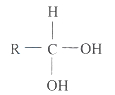
B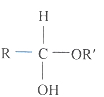
C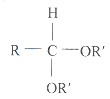
D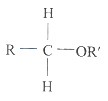
Solution
(B) hemiacetal is an organic compound formed by the reaction of an aldehyde or ketone with an alcohol. It is characterized by a central carbon atom bonded to one hydroxyl group $(-OH)$,one alkoxy group $(-OR^{\prime})$,one hydrogen atom $(-H)$,and one alkyl or aryl group $(-R)$.
Looking at the options:
Option $(A)$ represents a gem-diol.
Option $(B)$ represents a hemiacetal,as it contains both an $-OH$ and an $-OR^{\prime}$ group on the same carbon.
Option $(C)$ represents an acetal.
Option $(D)$ represents an ether.
Therefore,the correct structure is $(B)$.
Looking at the options:
Option $(A)$ represents a gem-diol.
Option $(B)$ represents a hemiacetal,as it contains both an $-OH$ and an $-OR^{\prime}$ group on the same carbon.
Option $(C)$ represents an acetal.
Option $(D)$ represents an ether.
Therefore,the correct structure is $(B)$.
0 likes
View Solution8-1.Aldehydes and Ketones — Properties · Frequently Asked Questions
1Are these 8-1.Aldehydes and Ketones questions useful for JEE and NEET?
Yes. All questions in this section are mapped to JEE Main and NEET exam patterns. Previous year questions from JEE Main, NEET, GUJCET and state-level exams are included with full solutions.
2Can I switch to Hindi or Gujarati for these questions?
Yes. Use the language tabs in the hero section or the sidebar to view the same questions and solutions in English, Hindi or Gujarati.
3How do I generate a question paper from this subtopic?
Use the Vedclass Exam Paper Generator — select the chapter and subtopic, set difficulty, and generate Sets A, B, C, D automatically. First 3 chapters of every subject are free.
Vedclass Products
For Students
Vedclass Test Series
Mock tests in real JEE/NEET style with performance analysis. 5-day free trial.
Start Free TrialFor Teachers
Exam Paper Generator
Generate Set A/B/C/D papers from this chapter in 2 minutes. 3 chapters free.
Try FreeFor Institutes
Online Exam Module
Live online exams with unlimited students, 360° analytics & white-label branding.
See DemoFor Teachers & Institutes
Generate a 8-1.Aldehydes and Ketones Exam Paper in 2 Minutes
Select subtopic & difficulty — Sets A, B, C, D auto-generated with No Repeat logic.
First 3 chapters of every subject are free — no payment required.