
A English
Properties Questions in English
Class 12 Chemistry · 8-1.Aldehydes and Ketones · Properties
1739+
Questions
English
Language
100%
With Solutions
Showing 49 of 1739 questions in English
1301
DifficultMCQ
An aromatic compound '$X$' with molecular formula $C_9H_{10}O$ gives the following chemical tests :
$(i)$ shows $2,4-DNP$ reaction
$(ii)$ reduces Tollens' reagent
$(iii)$ undergoes Cannizzaro reaction and
$(iv)$ on vigorous oxidation $1,2$-benzenedicarboxylic acid is obtained.
$X$ is :
$(i)$ shows $2,4-DNP$ reaction
$(ii)$ reduces Tollens' reagent
$(iii)$ undergoes Cannizzaro reaction and
$(iv)$ on vigorous oxidation $1,2$-benzenedicarboxylic acid is obtained.
$X$ is :
A
$2-$ethylbenzaldehyde
B
$3-$ethylbenzaldehyde
C
$2-$methylacetophenone
D
$3-$ethylbenzaldehyde
Solution
(A) The molecular formula $C_9H_{10}O$ and the given tests indicate the following:
$(i)$ $2,4-DNP$ test indicates the presence of a carbonyl group (aldehyde or ketone).
$(ii)$ Reduction of Tollens' reagent confirms the presence of an aldehyde group $(-CHO)$.
$(iii)$ The Cannizzaro reaction occurs in aldehydes that do not have $\alpha$-hydrogen atoms. This implies the $-CHO$ group is attached directly to the benzene ring,and there is no $\alpha$-hydrogen on the carbon attached to the ring.
$(iv)$ Vigorous oxidation yielding $1,2$-benzenedicarboxylic acid (phthalic acid) indicates that the compound is an ortho-substituted benzene derivative with an alkyl group at the ortho position.
Considering these points,$2$-ethylbenzaldehyde fits all criteria. The $-CHO$ group is attached to the ring,and the ortho-position has an ethyl group. However,for the Cannizzaro reaction,the aldehyde must not have $\alpha$-hydrogens. In $2$-ethylbenzaldehyde,the carbon attached to the ring (the $\alpha$-carbon of the ethyl group) has two hydrogen atoms. This suggests the structure must be $2$-methylbenzaldehyde or similar. Re-evaluating the options,$2$-ethylbenzaldehyde is the only ortho-substituted isomer provided that could yield phthalic acid upon oxidation of both side chains.
$(i)$ $2,4-DNP$ test indicates the presence of a carbonyl group (aldehyde or ketone).
$(ii)$ Reduction of Tollens' reagent confirms the presence of an aldehyde group $(-CHO)$.
$(iii)$ The Cannizzaro reaction occurs in aldehydes that do not have $\alpha$-hydrogen atoms. This implies the $-CHO$ group is attached directly to the benzene ring,and there is no $\alpha$-hydrogen on the carbon attached to the ring.
$(iv)$ Vigorous oxidation yielding $1,2$-benzenedicarboxylic acid (phthalic acid) indicates that the compound is an ortho-substituted benzene derivative with an alkyl group at the ortho position.
Considering these points,$2$-ethylbenzaldehyde fits all criteria. The $-CHO$ group is attached to the ring,and the ortho-position has an ethyl group. However,for the Cannizzaro reaction,the aldehyde must not have $\alpha$-hydrogens. In $2$-ethylbenzaldehyde,the carbon attached to the ring (the $\alpha$-carbon of the ethyl group) has two hydrogen atoms. This suggests the structure must be $2$-methylbenzaldehyde or similar. Re-evaluating the options,$2$-ethylbenzaldehyde is the only ortho-substituted isomer provided that could yield phthalic acid upon oxidation of both side chains.
0 likes
View Solution1302
MediumMCQ
What will be the order of reactivity of the following carbonyl compounds with a nucleophile?
$(I)$ $HCHO$
$(II)$ $CH_3CHO$
$(III)$ $(CH_3)_2CO$
$(IV)$ $(Me_3C)_2CO$
$(I)$ $HCHO$
$(II)$ $CH_3CHO$
$(III)$ $(CH_3)_2CO$
$(IV)$ $(Me_3C)_2CO$
A
$I > II > III > IV$
B
$IV > III > II > I$
C
$II > I > IV > III$
D
$III > II > I > IV$
Solution
(A) The reactivity of carbonyl compounds towards nucleophilic addition reactions depends on two factors: electronic effects and steric hindrance.
$1$. Electronic effect: Alkyl groups are electron-donating ($+I$ effect),which decreases the electrophilicity of the carbonyl carbon.
$2$. Steric hindrance: As the size of the alkyl groups attached to the carbonyl carbon increases,the approach of the nucleophile becomes more difficult.
Comparing the compounds:
$(I)$ $HCHO$: No alkyl groups,least steric hindrance,highest electrophilicity.
$(II)$ $CH_3CHO$: One methyl group.
$(III)$ $(CH_3)_2CO$: Two methyl groups.
$(IV)$ $(Me_3C)_2CO$: Two very bulky tert-butyl groups,maximum steric hindrance.
Therefore,the order of reactivity is $I > II > III > IV$.
$1$. Electronic effect: Alkyl groups are electron-donating ($+I$ effect),which decreases the electrophilicity of the carbonyl carbon.
$2$. Steric hindrance: As the size of the alkyl groups attached to the carbonyl carbon increases,the approach of the nucleophile becomes more difficult.
Comparing the compounds:
$(I)$ $HCHO$: No alkyl groups,least steric hindrance,highest electrophilicity.
$(II)$ $CH_3CHO$: One methyl group.
$(III)$ $(CH_3)_2CO$: Two methyl groups.
$(IV)$ $(Me_3C)_2CO$: Two very bulky tert-butyl groups,maximum steric hindrance.
Therefore,the order of reactivity is $I > II > III > IV$.
0 likes
View Solution1303
MediumMCQ
In which of the following reactions is a carbon$-$carbon bond $NOT$ formed during the formation of the product?
A
Reimer$-$Tiemann Reaction
B
Wurtz Reaction
C
Cannizzaro Reaction
D
Friedel$-$Crafts Reaction
Solution
(C) In the $Cannizzaro$ reaction,an aldehyde lacking an $\alpha$-hydrogen atom undergoes disproportionation in the presence of a concentrated base to form a carboxylic acid salt and an alcohol. No new $C-C$ bond is formed in this process.
In the $Reimer-Tiemann$ reaction,a $C-C$ bond is formed between the phenol ring and the dichlorocarbene species.
In the $Wurtz$ reaction,two alkyl halides react to form a higher alkane,creating a new $C-C$ bond.
In the $Friedel-Crafts$ reaction,an alkyl or acyl group is attached to an aromatic ring,forming a new $C-C$ bond.
In the $Reimer-Tiemann$ reaction,a $C-C$ bond is formed between the phenol ring and the dichlorocarbene species.
In the $Wurtz$ reaction,two alkyl halides react to form a higher alkane,creating a new $C-C$ bond.
In the $Friedel-Crafts$ reaction,an alkyl or acyl group is attached to an aromatic ring,forming a new $C-C$ bond.
0 likes
View Solution1304
MediumMCQ
Which of the following can be distinguished by the iodoform reaction?
A
Ethyl alcohol and other $1^{\circ}$ alcohols
B
$HCHO$ and $CH_3CHO$
C
$CH_3CHO$ and $CH_3CH_2CHO$
D
All of these
Solution
(D) The iodoform reaction is given by compounds containing the $CH_3CO-$ group or the $CH_3CH(OH)-$ group.
$(1)$ Ethyl alcohol $(CH_3CH_2OH)$ gives a positive iodoform test,whereas other $1^{\circ}$ alcohols (like $CH_3CH_2CH_2OH$) do not.
$(2)$ $CH_3CHO$ contains the $CH_3CO-$ group and gives a positive test,while $HCHO$ does not.
$(3)$ $CH_3CHO$ gives a positive test,while $CH_3CH_2CHO$ does not.
Since all the given pairs can be distinguished by the iodoform reaction,the correct answer is $D$.
$(1)$ Ethyl alcohol $(CH_3CH_2OH)$ gives a positive iodoform test,whereas other $1^{\circ}$ alcohols (like $CH_3CH_2CH_2OH$) do not.
$(2)$ $CH_3CHO$ contains the $CH_3CO-$ group and gives a positive test,while $HCHO$ does not.
$(3)$ $CH_3CHO$ gives a positive test,while $CH_3CH_2CHO$ does not.
Since all the given pairs can be distinguished by the iodoform reaction,the correct answer is $D$.
0 likes
View Solution1305
MediumMCQ
Match the Column-$I$ with Column-$II$.
| Column-$I$ | Column-$II$ |
|---|---|
| $A$. Acetophenone and Benzophenone | $P$. $NaHCO_3$ |
| $B$. Phenol and Benzoic acid | $Q$. $NaHSO_3$ |
| $C$. Propanone and Ethanal | $R$. $I_2 / NaOH$ |
| $D$. Acetone and Acetophenone | $S$. Fehling solution |
A
$A$ $\rightarrow P, B$ $\rightarrow Q, C$ $\rightarrow R, D$ $\rightarrow S$
B
$A$ $\rightarrow R, B$ $\rightarrow P, C$ $\rightarrow S, D$ $\rightarrow Q$
C
$A$ $\rightarrow R, B$ $\rightarrow P, C$ $\rightarrow Q, D$ $\rightarrow S$
D
$A$ $\rightarrow Q, B$ $\rightarrow P, C$ $\rightarrow S, D$ $\rightarrow R$
Solution
(B) . Acetophenone $(CH_3COC_6H_5)$ contains a methyl ketone group and gives a positive iodoform test with $I_2 / NaOH$,whereas benzophenone $(C_6H_5COC_6H_5)$ does not. Thus,$A \rightarrow R$.
$B$. Benzoic acid is a stronger acid than phenol and reacts with $NaHCO_3$ to evolve $CO_2$ gas,while phenol does not. Thus,$B \rightarrow P$.
$C$. Ethanal $(CH_3CHO)$ gives a positive Fehling test,while propanone (a ketone) does not. Thus,$C \rightarrow S$.
$D$. Acetone $(CH_3COCH_3)$ is a small ketone and reacts with $NaHSO_3$ to form a crystalline bisulfite addition product,whereas acetophenone is sterically hindered and does not form this product. Thus,$D \rightarrow Q$.
Therefore,the correct matching is $A$ $\rightarrow R, B$ $\rightarrow P, C$ $\rightarrow S, D$ $\rightarrow Q$.
$B$. Benzoic acid is a stronger acid than phenol and reacts with $NaHCO_3$ to evolve $CO_2$ gas,while phenol does not. Thus,$B \rightarrow P$.
$C$. Ethanal $(CH_3CHO)$ gives a positive Fehling test,while propanone (a ketone) does not. Thus,$C \rightarrow S$.
$D$. Acetone $(CH_3COCH_3)$ is a small ketone and reacts with $NaHSO_3$ to form a crystalline bisulfite addition product,whereas acetophenone is sterically hindered and does not form this product. Thus,$D \rightarrow Q$.
Therefore,the correct matching is $A$ $\rightarrow R, B$ $\rightarrow P, C$ $\rightarrow S, D$ $\rightarrow Q$.
0 likes
View Solution1306
MediumMCQ
Which one of the following on treatment with $50 \% \text{ aq. } NaOH$ yields the corresponding alcohol and salt of carboxylic acid?
A
$C_6H_5CHO$
B
$CH_3CH_2CH_2CHO$
C
$CH_3COCH_3$
D
$CH_3CHO$
Solution
(A) Aldehydes that do not contain $\alpha$-hydrogen atoms undergo the Cannizzaro reaction when treated with concentrated alkali $(50 \% \text{ aq. } NaOH)$.
In this reaction,one molecule of the aldehyde is reduced to the corresponding alcohol,while another is oxidized to the salt of the carboxylic acid.
$C_6H_5CHO$ (benzaldehyde) lacks $\alpha$-hydrogen atoms and thus undergoes the Cannizzaro reaction:
$2C_6H_5CHO + NaOH (50 \% \text{ aq.}) \rightarrow C_6H_5CH_2OH + C_6H_5COONa$
In this reaction,one molecule of the aldehyde is reduced to the corresponding alcohol,while another is oxidized to the salt of the carboxylic acid.
$C_6H_5CHO$ (benzaldehyde) lacks $\alpha$-hydrogen atoms and thus undergoes the Cannizzaro reaction:
$2C_6H_5CHO + NaOH (50 \% \text{ aq.}) \rightarrow C_6H_5CH_2OH + C_6H_5COONa$
0 likes
View Solution1307
MediumMCQ
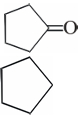
The given compound can be converted into the product by which of the following reagents?
A
$Red \ P + HI$
B
Wolff-Kishner reduction
C
Clemmensen reduction
D
All of the above
Solution
(D) The given reaction shows the reduction of cyclopentanone to cyclopentane.
Carbonyl groups $(C=O)$ can be reduced to alkanes $(CH_2)$ using the following methods:
$1$. $Red \ P + HI$: This is a strong reducing agent that reduces carbonyl compounds to alkanes.
$2$. Wolff-Kishner reduction: Uses hydrazine $(NH_2NH_2)$ in the presence of a base like $KOH$ and a high-boiling solvent like ethylene glycol.
$3$. Clemmensen reduction: Uses zinc amalgam $(Zn-Hg)$ in the presence of concentrated $HCl$.
Since all three methods are standard reactions for the reduction of a ketone to an alkane,the correct answer is $D$.
Carbonyl groups $(C=O)$ can be reduced to alkanes $(CH_2)$ using the following methods:
$1$. $Red \ P + HI$: This is a strong reducing agent that reduces carbonyl compounds to alkanes.
$2$. Wolff-Kishner reduction: Uses hydrazine $(NH_2NH_2)$ in the presence of a base like $KOH$ and a high-boiling solvent like ethylene glycol.
$3$. Clemmensen reduction: Uses zinc amalgam $(Zn-Hg)$ in the presence of concentrated $HCl$.
Since all three methods are standard reactions for the reduction of a ketone to an alkane,the correct answer is $D$.
0 likes
View Solution1308
MediumMCQ
Match the examples given in Column $I$ with the name of the reaction in Column $II$ and identify the correct matches.
| Column $I$ $(Example)$ | Column $II$ $(Reaction)$ |
|---|---|
| $a$. $CH_3COCl + H_2 \xrightarrow{Pd-C/BaSO_4} CH_3CHO$ | Stephen's reaction |
| $b$. $C_6H_5CHO \xrightarrow{NaOH, \Delta} C_6H_5CH_2OH + C_6H_5COO^-Na^+$ | Cannizzaro's reaction |
| $c$. $C_6H_6 + CH_3COCl \xrightarrow{AlCl_3} C_6H_5COCH_3$ | Friedel-Crafts acylation |
| $d$. $R-CH_2-COOH \xrightarrow[H_2O]{Br_2/Red P} R-CH(Br)-COOH$ | $HVZ$ reaction |
| $e$. $CH_3-CN \xrightarrow[\text{(ii) } H_2O/H^+]{\text{(i) } SnCl_2/HCl} CH_3CHO$ | Stephen's reaction |
| $f$. $2 CH_3CHO \xrightarrow[\Delta]{NaOH} CH_3-CH=CHCHO$ | Aldol condensation |
A
$b, c, d, f$
B
$b, d, f$
C
$a, b, d, f$
D
$b, c, d, e, f$
Solution
(B) Let's evaluate each reaction:
$a$. $CH_3COCl + H_2 \xrightarrow{Pd-C/BaSO_4} CH_3CHO$ is Rosenmund's reduction,not Stephen's reaction.
$b$. $C_6H_5CHO$ undergoing disproportionation with $NaOH$ is Cannizzaro's reaction. (Correct)
$c$. $C_6H_6 + CH_3COCl \xrightarrow{AlCl_3} C_6H_5COCH_3$ is Friedel-Crafts acylation,not alkylation. (Incorrect label)
$d$. $R-CH_2-COOH \xrightarrow[H_2O]{Br_2/Red P} R-CH(Br)-COOH$ is the Hell-Volhard-Zelinsky $(HVZ)$ reaction. (Correct)
$e$. $CH_3-CN \xrightarrow[\text{(ii) } H_2O/H^+]{\text{(i) } SnCl_2/HCl} CH_3CHO$ is Stephen's reaction. (Correct,but not listed in the options as a correct match)
$f$. $2 CH_3CHO \xrightarrow[\Delta]{NaOH} CH_3-CH=CHCHO$ is Aldol condensation. (Correct)
Comparing the correct matches $(b, d, f)$,option $B$ is the correct choice.
$a$. $CH_3COCl + H_2 \xrightarrow{Pd-C/BaSO_4} CH_3CHO$ is Rosenmund's reduction,not Stephen's reaction.
$b$. $C_6H_5CHO$ undergoing disproportionation with $NaOH$ is Cannizzaro's reaction. (Correct)
$c$. $C_6H_6 + CH_3COCl \xrightarrow{AlCl_3} C_6H_5COCH_3$ is Friedel-Crafts acylation,not alkylation. (Incorrect label)
$d$. $R-CH_2-COOH \xrightarrow[H_2O]{Br_2/Red P} R-CH(Br)-COOH$ is the Hell-Volhard-Zelinsky $(HVZ)$ reaction. (Correct)
$e$. $CH_3-CN \xrightarrow[\text{(ii) } H_2O/H^+]{\text{(i) } SnCl_2/HCl} CH_3CHO$ is Stephen's reaction. (Correct,but not listed in the options as a correct match)
$f$. $2 CH_3CHO \xrightarrow[\Delta]{NaOH} CH_3-CH=CHCHO$ is Aldol condensation. (Correct)
Comparing the correct matches $(b, d, f)$,option $B$ is the correct choice.
0 likes
View Solution1309
MediumMCQ
An aldehyde or ketone containing at least one $\alpha-H$ atom reacts with dilute $NaOH$ to form a $\beta-$hydroxy aldehyde or $\beta-$hydroxy ketone. This reaction is known as $—$
A
Aldol condensation
B
Aldol reaction
C
Cannizzaro reaction
D
$HVZ$ reaction
Solution
(B) Aldehydes and ketones containing at least one $\alpha-H$ atom undergo a reaction in the presence of dilute alkali ($NaOH$ or $KOH$) to form $\beta-$hydroxy aldehydes (aldol) or $\beta-$hydroxy ketones (ketol). This reaction is known as the Aldol reaction. When this product is heated,it undergoes dehydration to form $\alpha, \beta-$unsaturated carbonyl compounds,which is known as Aldol condensation. Since the question describes the formation of the $\beta-$hydroxy product,it is specifically referred to as the Aldol reaction.
0 likes
View Solution1310
MediumMCQ
Methyl ketone can be oxidized using the haloform reaction. The oxidized product (carboxylate ion) has $:-$
A
$1$ carbon more than methyl ketone
B
$2$ carbon more than methyl ketone
C
$1$ carbon less than methyl ketone
D
$2$ carbon less than methyl ketone
Solution
(C) The haloform reaction is a characteristic reaction of methyl ketones $(R-CO-CH_3)$.
In this reaction,the methyl group $(-CH_3)$ is converted into a haloform ($CHX_3$,where $X = Cl, Br, I$).
The remaining part of the molecule is oxidized to a carboxylate ion $(R-COO^-)$.
Since the methyl group is removed from the original ketone,the resulting carboxylate ion contains one carbon atom less than the parent methyl ketone.
In this reaction,the methyl group $(-CH_3)$ is converted into a haloform ($CHX_3$,where $X = Cl, Br, I$).
The remaining part of the molecule is oxidized to a carboxylate ion $(R-COO^-)$.
Since the methyl group is removed from the original ketone,the resulting carboxylate ion contains one carbon atom less than the parent methyl ketone.
0 likes
View Solution1311
MediumMCQ
Which one of the following is not correctly matched?
A
$>C=O \xrightarrow{\text{Clemmensen reduction}} >CH_2$
B
$>C=O \xrightarrow{\text{Wolff-Kishner reduction}} >CH-OH$
C
$-COCl \xrightarrow{\text{Rosenmund reduction}} -CHO$
D
$-C \equiv N \xrightarrow[(ii) H_2O]{(i) \text{Stephen reduction}} -CHO$
Solution
(B) In $A$,Clemmensen reduction $(Zn-Hg/HCl)$ reduces a carbonyl group $(>C=O)$ to a methylene group $(>CH_2)$. This is correctly matched.
In $B$,Wolff-Kishner reduction $(NH_2NH_2/KOH, \Delta)$ reduces a carbonyl group $(>C=O)$ to a methylene group $(>CH_2)$,not an alcohol $(>CH-OH)$. Therefore,this is incorrectly matched.
In $C$,Rosenmund reduction $(H_2/Pd-BaSO_4)$ reduces an acid chloride $(-COCl)$ to an aldehyde $(-CHO)$. This is correctly matched.
In $D$,Stephen reduction ($SnCl_2/HCl$ followed by $H_2O$) reduces a nitrile $(-C \equiv N)$ to an aldehyde $(-CHO)$. This is correctly matched.
In $B$,Wolff-Kishner reduction $(NH_2NH_2/KOH, \Delta)$ reduces a carbonyl group $(>C=O)$ to a methylene group $(>CH_2)$,not an alcohol $(>CH-OH)$. Therefore,this is incorrectly matched.
In $C$,Rosenmund reduction $(H_2/Pd-BaSO_4)$ reduces an acid chloride $(-COCl)$ to an aldehyde $(-CHO)$. This is correctly matched.
In $D$,Stephen reduction ($SnCl_2/HCl$ followed by $H_2O$) reduces a nitrile $(-C \equiv N)$ to an aldehyde $(-CHO)$. This is correctly matched.
0 likes
View Solution1312
MediumMCQ
$\alpha-H$ containing aldehyde and ketone reacts with dil $NaOH$ and gives $\beta-hydroxy$ aldehyde or $\beta-hydroxy$ ketone. This reaction is called $-$
A
Aldol condensation
B
Aldol reaction
C
Cannizzaro reaction
D
$HVZ$ reaction
Solution
(A) The reaction of aldehydes or ketones containing at least one $\alpha-hydrogen$ atom with dilute alkali ($NaOH$ or $KOH$) leads to the formation of $\beta-hydroxy$ aldehydes (aldol) or $\beta-hydroxy$ ketones (ketol). This reaction is known as the $Aldol$ $reaction$ or $Aldol$ $condensation$ (if followed by dehydration). Among the given options,$Aldol$ $condensation$ is the most appropriate term for this transformation.
0 likes
View Solution1313
MediumMCQ
In the Cannizzaro reaction given below,the slowest step is $:-$
$2Ph-CHO \xrightarrow{\stackrel{\ominus}{O}H} PhCH_2OH + PhCO_2^{\ominus}$
$2Ph-CHO \xrightarrow{\stackrel{\ominus}{O}H} PhCH_2OH + PhCO_2^{\ominus}$
A
The attack of $\stackrel{\ominus}{O}H$ at carbonyl group
B
The transfer of hydride ion to carbonyl group
C
The abstraction of proton from the carboxylic acid
D
The deprotonation of $PhCH_2-OH$
Solution
(B) The mechanism of the Cannizzaro reaction involves the following steps:
$1$. Nucleophilic attack of $\stackrel{\ominus}{O}H$ on the carbonyl carbon of one molecule of benzaldehyde to form a dihydroxyalkoxide intermediate.
$2$. The hydride ion $(H^{\ominus})$ transfer from the dihydroxyalkoxide intermediate to the carbonyl carbon of another molecule of benzaldehyde. This is the rate-determining step (slowest step) because it involves the breaking of a $C-H$ bond.
$3$. Rapid proton exchange between the resulting carboxylic acid and the alkoxide ion to form the carboxylate ion and alcohol.
$1$. Nucleophilic attack of $\stackrel{\ominus}{O}H$ on the carbonyl carbon of one molecule of benzaldehyde to form a dihydroxyalkoxide intermediate.
$2$. The hydride ion $(H^{\ominus})$ transfer from the dihydroxyalkoxide intermediate to the carbonyl carbon of another molecule of benzaldehyde. This is the rate-determining step (slowest step) because it involves the breaking of a $C-H$ bond.
$3$. Rapid proton exchange between the resulting carboxylic acid and the alkoxide ion to form the carboxylate ion and alcohol.
0 likes
View Solution1314
MediumMCQ
Which of the following on reaction with Grignard reagent followed by hydrolysis forms a tertiary alcohol?
A
Methanal
B
Ethanal
C
Propanal
D
Propanone
Solution
(D) The reaction of a Grignard reagent $(R'MgX)$ with carbonyl compounds follows these rules:
$1$. Reaction with methanal $(HCHO)$ yields a primary alcohol $(R'CH_2OH)$.
$2$. Reaction with other aldehydes $(RCHO)$ yields a secondary alcohol $(R'RCHOH)$.
$3$. Reaction with ketones $(RR'CO)$ yields a tertiary alcohol $(RR'R''COH)$.
Among the given options,$A$,$B$,and $C$ are aldehydes,while $D$ (Propanone,$CH_3COCH_3$) is a ketone.
Therefore,the reaction of propanone with a Grignard reagent followed by hydrolysis produces a tertiary alcohol.
$1$. Reaction with methanal $(HCHO)$ yields a primary alcohol $(R'CH_2OH)$.
$2$. Reaction with other aldehydes $(RCHO)$ yields a secondary alcohol $(R'RCHOH)$.
$3$. Reaction with ketones $(RR'CO)$ yields a tertiary alcohol $(RR'R''COH)$.
Among the given options,$A$,$B$,and $C$ are aldehydes,while $D$ (Propanone,$CH_3COCH_3$) is a ketone.
Therefore,the reaction of propanone with a Grignard reagent followed by hydrolysis produces a tertiary alcohol.
0 likes
View Solution1315
DifficultMCQ
Which of the following on reaction with Grignard reagent followed by hydrolysis forms a secondary alcohol?
A
$HCHO$
B
$CH_3CHO$
C
$CH_3COCH_3$
D
$CH_3CH_2COCH_3$
Solution
(B) The reaction of a Grignard reagent $(R-MgX)$ with carbonyl compounds follows these general rules:
$1$. Formaldehyde $(HCHO)$ reacts with a Grignard reagent to form a primary $(1^{\circ})$ alcohol.
$2$. Other aldehydes $(R'-CHO)$ react with a Grignard reagent to form a secondary $(2^{\circ})$ alcohol.
$3$. Ketones $(R'-CO-R'')$ react with a Grignard reagent to form a tertiary $(3^{\circ})$ alcohol.
Among the given options:
- $HCHO$ is formaldehyde (forms primary alcohol).
- $CH_3CHO$ is acetaldehyde (an aldehyde,forms secondary alcohol).
- $CH_3COCH_3$ is acetone (a ketone,forms tertiary alcohol).
- $CH_3CH_2COCH_3$ is butanone (a ketone,forms tertiary alcohol).
Therefore,$CH_3CHO$ reacts with a Grignard reagent to produce a secondary alcohol.
$1$. Formaldehyde $(HCHO)$ reacts with a Grignard reagent to form a primary $(1^{\circ})$ alcohol.
$2$. Other aldehydes $(R'-CHO)$ react with a Grignard reagent to form a secondary $(2^{\circ})$ alcohol.
$3$. Ketones $(R'-CO-R'')$ react with a Grignard reagent to form a tertiary $(3^{\circ})$ alcohol.
Among the given options:
- $HCHO$ is formaldehyde (forms primary alcohol).
- $CH_3CHO$ is acetaldehyde (an aldehyde,forms secondary alcohol).
- $CH_3COCH_3$ is acetone (a ketone,forms tertiary alcohol).
- $CH_3CH_2COCH_3$ is butanone (a ketone,forms tertiary alcohol).
Therefore,$CH_3CHO$ reacts with a Grignard reagent to produce a secondary alcohol.
0 likes
View Solution1316
MediumMCQ
What type of product is obtained when formaldehyde reacts with $CH_3MgBr$ in dry ether?
A
Primary alcohol with same number of carbon atoms as in aldehyde.
B
Primary alcohol with one carbon atom more than aldehyde.
C
Secondary alcohol with one carbon atom more than aldehyde.
D
Tertiary alcohol with two carbon atoms more than aldehyde.
Solution
(B) The reaction of formaldehyde $(HCHO)$ with a Grignard reagent $(CH_3MgBr)$ in the presence of dry ether proceeds as follows:
$1$. Nucleophilic attack of the $CH_3^-$ group from the Grignard reagent on the electrophilic carbonyl carbon of formaldehyde leads to the formation of an addition product: $H_3C-CH_2-OMgBr$.
$2$. Subsequent acid hydrolysis $(H^+/H_2O)$ of this intermediate yields ethanol $(CH_3CH_2OH)$,which is a primary $(1^\circ)$ alcohol.
$3$. Formaldehyde contains $1$ carbon atom,and the resulting ethanol contains $2$ carbon atoms.
$4$. Therefore,the product is a primary alcohol with one carbon atom more than the starting aldehyde.
$1$. Nucleophilic attack of the $CH_3^-$ group from the Grignard reagent on the electrophilic carbonyl carbon of formaldehyde leads to the formation of an addition product: $H_3C-CH_2-OMgBr$.
$2$. Subsequent acid hydrolysis $(H^+/H_2O)$ of this intermediate yields ethanol $(CH_3CH_2OH)$,which is a primary $(1^\circ)$ alcohol.
$3$. Formaldehyde contains $1$ carbon atom,and the resulting ethanol contains $2$ carbon atoms.
$4$. Therefore,the product is a primary alcohol with one carbon atom more than the starting aldehyde.
0 likes
View Solution1317
MediumMCQ
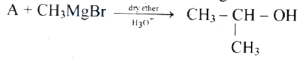
Identify reactant '$A$' in the following reaction.
A
$HCHO$
B
$CH_3CHO$
C
$CH_2OH-CH_2OH$
D
$CH_3COOH$
Solution
(B) The given reaction is the reaction of a Grignard reagent $(CH_3MgBr)$ with a carbonyl compound $(A)$ to form a secondary alcohol $(CH_3-CH(OH)-CH_3)$.
$1$. The reaction of $CH_3MgBr$ with formaldehyde $(HCHO)$ yields a primary alcohol.
$2$. The reaction of $CH_3MgBr$ with acetaldehyde $(CH_3CHO)$ yields a secondary alcohol (propan$-2-$ol).
$3$. The reaction of $CH_3MgBr$ with a ketone (like acetone) yields a tertiary alcohol.
Therefore,the reactant '$A$' is acetaldehyde $(CH_3CHO)$.
$1$. The reaction of $CH_3MgBr$ with formaldehyde $(HCHO)$ yields a primary alcohol.
$2$. The reaction of $CH_3MgBr$ with acetaldehyde $(CH_3CHO)$ yields a secondary alcohol (propan$-2-$ol).
$3$. The reaction of $CH_3MgBr$ with a ketone (like acetone) yields a tertiary alcohol.
Therefore,the reactant '$A$' is acetaldehyde $(CH_3CHO)$.
0 likes
View Solution1318
MediumMCQ
Identify the compound '$A$' in the following sequence of reactions.
$A$ $\xrightarrow[\text{Dry ether}]{C_2H_5MgBr} B$ $\xrightarrow{H_2O/H^{+}} \text{3-Methylpentan-3-ol}$
$A$ $\xrightarrow[\text{Dry ether}]{C_2H_5MgBr} B$ $\xrightarrow{H_2O/H^{+}} \text{3-Methylpentan-3-ol}$
A
Propanal
B
Propanone
C
Butanal
D
Butanone
Solution
(D) The reaction of a Grignard reagent $(C_2H_5MgBr)$ with a ketone $(A)$ followed by acid hydrolysis $(H_2O/H^+)$ yields a tertiary alcohol.
Given the product is $\text{3-Methylpentan-3-ol}$,which has the structure $CH_3-CH_2-C(OH)(CH_3)-CH_2-CH_3$.
The Grignard reagent $C_2H_5MgBr$ provides an ethyl group $(C_2H_5)$.
Removing the ethyl group from the tertiary carbon of the product leaves a ketone with a methyl group and a propyl group attached to the carbonyl carbon,which is $CH_3-CH_2-C(=O)-CH_3$,known as $\text{Butanone}$.
Thus,the compound $A$ is $\text{Butanone}$.
Given the product is $\text{3-Methylpentan-3-ol}$,which has the structure $CH_3-CH_2-C(OH)(CH_3)-CH_2-CH_3$.
The Grignard reagent $C_2H_5MgBr$ provides an ethyl group $(C_2H_5)$.
Removing the ethyl group from the tertiary carbon of the product leaves a ketone with a methyl group and a propyl group attached to the carbonyl carbon,which is $CH_3-CH_2-C(=O)-CH_3$,known as $\text{Butanone}$.
Thus,the compound $A$ is $\text{Butanone}$.
0 likes
View Solution1319
EasyMCQ
Identify the reducing agent used for the following conversion:
$R-CHO \rightarrow R-CH_2-OH$
$R-CHO \rightarrow R-CH_2-OH$
A
$Na$ / Dry ether
B
$K_2Cr_2O_7$ / dil. $H_2SO_4$
C
$LiAlH_4$ / $H_3O^+$
D
$Sn$ / $HCl$
Solution
(C) The conversion of an aldehyde $(R-CHO)$ to a primary alcohol $(R-CH_2-OH)$ is a reduction reaction.
$LiAlH_4$ (Lithium aluminium hydride) is a strong reducing agent that effectively reduces aldehydes to primary alcohols.
The reaction is: $R-CHO \xrightarrow{LiAlH_4 / H_3O^+} R-CH_2-OH$.
$LiAlH_4$ (Lithium aluminium hydride) is a strong reducing agent that effectively reduces aldehydes to primary alcohols.
The reaction is: $R-CHO \xrightarrow{LiAlH_4 / H_3O^+} R-CH_2-OH$.
0 likes
View Solution1320
MediumMCQ
Identify the compound $A$ in the following reaction: $A + CH_3MgBr$ $\xrightarrow{\text{dry ether}} \text{intermediate}$ $\xrightarrow{H_3O^+} CH_3CH_2OH + Mg(Br)(OH)$
A
Acetic acid
B
Acetaldehyde
C
Formaldehyde
D
Acetone
Solution
(C) The reaction of a Grignard reagent $(CH_3MgBr)$ with formaldehyde $(HCHO)$ followed by acid hydrolysis $(H_3O^+)$ yields a primary alcohol $(CH_3CH_2OH)$.
The reaction mechanism is as follows:
$HCHO + CH_3MgBr \rightarrow CH_3CH_2OMgBr$
$CH_3CH_2OMgBr + H_2O \rightarrow CH_3CH_2OH + Mg(OH)Br$
Thus,the compound $A$ is formaldehyde $(HCHO)$.
The reaction mechanism is as follows:
$HCHO + CH_3MgBr \rightarrow CH_3CH_2OMgBr$
$CH_3CH_2OMgBr + H_2O \rightarrow CH_3CH_2OH + Mg(OH)Br$
Thus,the compound $A$ is formaldehyde $(HCHO)$.
0 likes
View Solution1321
MediumMCQ
Identify the product formed in the following reaction: $CH_3-CH=CH-CH_2-CHO \xrightarrow[(ii) \ H_3O^{+}]{(i) \ LiAlH_4} \text{Product}$
A
$CH_3-CH=CH-CH_2-CH_2-OH$
B
$CH_3-CH_2-CH_2-CH_2-CH_2-OH$
C
$CH_3-CH=CH-CH_2-CHO$
D
$CH_3-CH_2-CH=CH-CH_2-OH$
Solution
(A) $LiAlH_4$ is a strong reducing agent that reduces aldehydes to primary alcohols.
It does not reduce isolated carbon-carbon double bonds $(C=C)$.
Therefore,the aldehyde group $(-CHO)$ is reduced to a primary alcohol group $(-CH_2OH)$ while the double bond remains intact.
The reaction is:
$CH_3-CH=CH-CH_2-CHO \xrightarrow[(ii) \ H_3O^{+}]{(i) \ LiAlH_4} CH_3-CH=CH-CH_2-CH_2-OH$
Thus,the correct product is $CH_3-CH=CH-CH_2-CH_2-OH$.
It does not reduce isolated carbon-carbon double bonds $(C=C)$.
Therefore,the aldehyde group $(-CHO)$ is reduced to a primary alcohol group $(-CH_2OH)$ while the double bond remains intact.
The reaction is:
$CH_3-CH=CH-CH_2-CHO \xrightarrow[(ii) \ H_3O^{+}]{(i) \ LiAlH_4} CH_3-CH=CH-CH_2-CH_2-OH$
Thus,the correct product is $CH_3-CH=CH-CH_2-CH_2-OH$.
0 likes
View Solution1322
MediumMCQ
Which of the following compounds on reaction with Grignard reagent followed by hydrolysis forms secondary alcohol?
A
$CH_3CHO$
B
$HCHO$
C
$CH_3CH_2COCH_3$
D
$CH_3COCH_3$
Solution
(A) Aldehydes other than formaldehyde $(HCHO)$ react with Grignard reagents $(RMgX)$ to form secondary alcohols after acidic hydrolysis.
$CH_3CHO + RMgX$ $\rightarrow CH_3CH(OMgX)R$ $\xrightarrow{H_3O^+} CH_3CH(OH)R$ (Secondary alcohol).
Formaldehyde $(HCHO)$ forms primary alcohols,while ketones form tertiary alcohols.
Therefore,$CH_3CHO$ is the correct answer.
$CH_3CHO + RMgX$ $\rightarrow CH_3CH(OMgX)R$ $\xrightarrow{H_3O^+} CH_3CH(OH)R$ (Secondary alcohol).
Formaldehyde $(HCHO)$ forms primary alcohols,while ketones form tertiary alcohols.
Therefore,$CH_3CHO$ is the correct answer.
0 likes
View Solution1323
MediumMCQ
To obtain $3-$methylbutan$-2-$ol from acetaldehyde,the Grignard's reagent used is
A
$CH_3MgBr$
B
$CH_3CH_2CH_2MgBr$
C
$CH_3CH_2MgBr$
D
$(CH_3)_2CHMgBr$
Solution
(D) The reaction of acetaldehyde $(CH_3CHO)$ with a Grignard reagent $(RMgBr)$ followed by acid hydrolysis $(H_3O^+)$ yields a secondary alcohol.
To obtain $3-$methylbutan$-2-$ol $(CH_3-CH(OH)-CH(CH_3)_2)$,the Grignard reagent must provide the isopropyl group $(CH(CH_3)_2)$.
The reaction is as follows:
$CH_3-CH=O + (CH_3)_2CHMgBr \rightarrow CH_3-CH(OMgBr)-CH(CH_3)_2$
$CH_3-CH(OMgBr)-CH(CH_3)_2 + H_2O/H^+ \rightarrow CH_3-CH(OH)-CH(CH_3)_2 + Mg(OH)Br$
Thus,the required Grignard reagent is isopropylmagnesium bromide,which is $(CH_3)_2CHMgBr$.
To obtain $3-$methylbutan$-2-$ol $(CH_3-CH(OH)-CH(CH_3)_2)$,the Grignard reagent must provide the isopropyl group $(CH(CH_3)_2)$.
The reaction is as follows:
$CH_3-CH=O + (CH_3)_2CHMgBr \rightarrow CH_3-CH(OMgBr)-CH(CH_3)_2$
$CH_3-CH(OMgBr)-CH(CH_3)_2 + H_2O/H^+ \rightarrow CH_3-CH(OH)-CH(CH_3)_2 + Mg(OH)Br$
Thus,the required Grignard reagent is isopropylmagnesium bromide,which is $(CH_3)_2CHMgBr$.
0 likes
View Solution1324
MediumMCQ
Identify compound $A$ from the following reaction:
$A + C_2H_5MgBr$ $\xrightarrow[ether]{dry} B$ $\xrightarrow{H_3O^{+}} 3-\text{methylpentan}-3-\text{ol}$
$A + C_2H_5MgBr$ $\xrightarrow[ether]{dry} B$ $\xrightarrow{H_3O^{+}} 3-\text{methylpentan}-3-\text{ol}$
A
Butanal
B
Propanone
C
Propanal
D
Butanone
Solution
(D) The reaction of a Grignard reagent $(C_2H_5MgBr)$ with a carbonyl compound $(A)$ followed by acid hydrolysis $(H_3O^{+})$ yields an alcohol.
In the final product,$3-\text{methylpentan}-3-\text{ol}$,the carbon atom bearing the hydroxyl group is bonded to two ethyl groups $(C_2H_5-)$ and one methyl group $(CH_3-)$.
Since one ethyl group comes from the Grignard reagent $(C_2H_5MgBr)$,the carbonyl compound $(A)$ must provide the remaining part of the structure,which is a ketone with one methyl group and one ethyl group attached to the carbonyl carbon.
Thus,the structure of $A$ is $CH_3-CO-CH_2-CH_3$,which is butanone.
The reaction is:
$CH_3-CO-CH_2-CH_3 + C_2H_5MgBr$ $\rightarrow CH_3-C(OMgBr)(C_2H_5)-CH_2-CH_3$ $\xrightarrow{H_3O^{+}} CH_3-C(OH)(C_2H_5)-CH_2-CH_3$ (which is $3-\text{methylpentan}-3-\text{ol}$).
In the final product,$3-\text{methylpentan}-3-\text{ol}$,the carbon atom bearing the hydroxyl group is bonded to two ethyl groups $(C_2H_5-)$ and one methyl group $(CH_3-)$.
Since one ethyl group comes from the Grignard reagent $(C_2H_5MgBr)$,the carbonyl compound $(A)$ must provide the remaining part of the structure,which is a ketone with one methyl group and one ethyl group attached to the carbonyl carbon.
Thus,the structure of $A$ is $CH_3-CO-CH_2-CH_3$,which is butanone.
The reaction is:
$CH_3-CO-CH_2-CH_3 + C_2H_5MgBr$ $\rightarrow CH_3-C(OMgBr)(C_2H_5)-CH_2-CH_3$ $\xrightarrow{H_3O^{+}} CH_3-C(OH)(C_2H_5)-CH_2-CH_3$ (which is $3-\text{methylpentan}-3-\text{ol}$).
0 likes
View Solution1325
MediumMCQ
Which of the following is reacted with benzaldehyde to obtain $1-$phenylethanol?
A
$C_{6}H_{5}MgBr$
B
$C_{6}H_{5}CH_{2}MgBr$
C
$CH_{3}MgBr$
D
$CH_{3}CH_{2}MgBr$
Solution
(C) The reaction of benzaldehyde $(C_{6}H_{5}CHO)$ with a Grignard reagent $(RMgX)$ followed by acid hydrolysis yields a secondary alcohol.
To obtain $1-$phenylethanol $(C_{6}H_{5}CH(OH)CH_{3})$,the Grignard reagent must provide the methyl group $(CH_{3})$.
Therefore,the reaction is:
$C_{6}H_{5}CHO + CH_{3}MgBr \rightarrow [C_{6}H_{5}CH(CH_{3})OMgBr]$
$[C_{6}H_{5}CH(CH_{3})OMgBr] + H_{2}O/H^{+} \rightarrow C_{6}H_{5}CH(OH)CH_{3} + Mg(OH)Br$
Thus,benzaldehyde reacts with $CH_{3}MgBr$ to produce $1-$phenylethanol.
To obtain $1-$phenylethanol $(C_{6}H_{5}CH(OH)CH_{3})$,the Grignard reagent must provide the methyl group $(CH_{3})$.
Therefore,the reaction is:
$C_{6}H_{5}CHO + CH_{3}MgBr \rightarrow [C_{6}H_{5}CH(CH_{3})OMgBr]$
$[C_{6}H_{5}CH(CH_{3})OMgBr] + H_{2}O/H^{+} \rightarrow C_{6}H_{5}CH(OH)CH_{3} + Mg(OH)Br$
Thus,benzaldehyde reacts with $CH_{3}MgBr$ to produce $1-$phenylethanol.
0 likes
View Solution1326
EasyMCQ
Which of the following reagents is used for the following conversion?
$CH_3-CH=CH-CHO \longrightarrow CH_3-CH=CH-CH_2OH$
$CH_3-CH=CH-CHO \longrightarrow CH_3-CH=CH-CH_2OH$
A
$H_3O^{+}$
B
$Zn-Hg / HCl$
C
$H_2 / Ni$
D
$LiAlH_4$
Solution
(D) $LiAlH_4$ (Lithium aluminium hydride) is a selective reducing agent that reduces the aldehyde group $(-CHO)$ to a primary alcohol $(-CH_2OH)$ without affecting the carbon-carbon double bond $(C=C)$.
Therefore,$CH_3-CH=CH-CHO$ is converted to $CH_3-CH=CH-CH_2OH$ using $LiAlH_4$.
Therefore,$CH_3-CH=CH-CHO$ is converted to $CH_3-CH=CH-CH_2OH$ using $LiAlH_4$.
0 likes
View Solution1327
MediumMCQ
Which of the following compounds does $NOT$ undergo haloform reaction?
A
$CH_3-CH(OH)-CH_3$
B
$CH_3-CO-CH_3$
C
$C_2H_5-CH(OH)-C_2H_5$
D
$CH_3-CO-C_2H_5$
Solution
(C) The haloform reaction is given by compounds containing the $CH_3CO-$ group or the $CH_3CH(OH)-$ group.
$(A)$ $CH_3-CH(OH)-CH_3$ contains the $CH_3CH(OH)-$ group,so it gives the haloform reaction.
$(B)$ $CH_3-CO-CH_3$ contains the $CH_3CO-$ group,so it gives the haloform reaction.
$(C)$ $C_2H_5-CH(OH)-C_2H_5$ (pentan$-3-$ol) does not contain the $CH_3CH(OH)-$ group,so it does not give the haloform reaction.
$(D)$ $CH_3-CO-C_2H_5$ (butan$-2-$one) contains the $CH_3CO-$ group,so it gives the haloform reaction.
Therefore,the correct option is $C$.
$(A)$ $CH_3-CH(OH)-CH_3$ contains the $CH_3CH(OH)-$ group,so it gives the haloform reaction.
$(B)$ $CH_3-CO-CH_3$ contains the $CH_3CO-$ group,so it gives the haloform reaction.
$(C)$ $C_2H_5-CH(OH)-C_2H_5$ (pentan$-3-$ol) does not contain the $CH_3CH(OH)-$ group,so it does not give the haloform reaction.
$(D)$ $CH_3-CO-C_2H_5$ (butan$-2-$one) contains the $CH_3CO-$ group,so it gives the haloform reaction.
Therefore,the correct option is $C$.
0 likes
View Solution1328
DifficultMCQ
When an aldehyde is treated with an excess of monohydric alcohol,what is formed?
A
Hemiacetal
B
Oxime
C
Imine
D
Acetal
Solution
(D) When an aldehyde reacts with one equivalent of a monohydric alcohol in the presence of dry $HCl$ gas,it forms a hemiacetal.
However,when the aldehyde is treated with an excess of monohydric alcohol,the hemiacetal further reacts to form an acetal.
The reaction is: $R-CHO + 2R'-OH \xrightarrow{dry \ HCl} R-CH(OR')_2 + H_2O$.
Thus,the final product formed is an acetal.
However,when the aldehyde is treated with an excess of monohydric alcohol,the hemiacetal further reacts to form an acetal.
The reaction is: $R-CHO + 2R'-OH \xrightarrow{dry \ HCl} R-CH(OR')_2 + H_2O$.
Thus,the final product formed is an acetal.
0 likes
View Solution1329
EasyMCQ
When an oxime is treated with trifluoroperoxyacetic acid,it yields:
A
$1^{\circ}$ nitroalkanes
B
$2^{\circ}$ nitroalkanes
C
$1^{\circ}$ amines
D
$2^{\circ}$ amines
Solution
(B) The oxidation of an oxime with trifluoroperoxyacetic acid $(CF_3COOOH)$ results in the formation of a nitro compound.
For example,the oxidation of acetone oxime $(CH_3-C(=N-OH)-CH_3)$ yields $2-$nitropropane $(CH_3-CH(NO_2)-CH_3)$.
Generally,aldoximes yield $1^{\circ}$ nitroalkanes,while ketoximes yield $2^{\circ}$ nitroalkanes.
For example,the oxidation of acetone oxime $(CH_3-C(=N-OH)-CH_3)$ yields $2-$nitropropane $(CH_3-CH(NO_2)-CH_3)$.
Generally,aldoximes yield $1^{\circ}$ nitroalkanes,while ketoximes yield $2^{\circ}$ nitroalkanes.
0 likes
View Solution1330
MediumMCQ
For the sequence of reactions $A$ $\xrightarrow{C_2H_5MgI} B$ $\xrightarrow{H_2O / H^{+}} \text{tert-pentyl alcohol}$. The compound $A$ in the sequence is
A
$2-$butanone
B
acetaldehyde
C
acetone
D
propanal
Solution
(C) The reaction of a Grignard reagent $(RMgX)$ with a carbonyl compound followed by hydrolysis yields an alcohol.
To obtain $\text{tert-pentyl alcohol}$ $(CH_3CH_2C(CH_3)_2OH)$,we need to react a ketone with a Grignard reagent.
Here,the Grignard reagent is $C_2H_5MgI$ (ethylmagnesium iodide).
When $C_2H_5MgI$ reacts with $A$ (acetone,$CH_3COCH_3$),the nucleophilic ethyl group attacks the carbonyl carbon of acetone.
$CH_3COCH_3 + C_2H_5MgI \rightarrow CH_3C(OMgI)(CH_3)(C_2H_5)$.
Upon hydrolysis with $H_2O/H^+$,this forms $CH_3C(OH)(CH_3)(C_2H_5)$,which is $2-$methylbutan$-2-$ol,commonly known as $\text{tert-pentyl alcohol}$.
Therefore,compound $A$ is acetone.
To obtain $\text{tert-pentyl alcohol}$ $(CH_3CH_2C(CH_3)_2OH)$,we need to react a ketone with a Grignard reagent.
Here,the Grignard reagent is $C_2H_5MgI$ (ethylmagnesium iodide).
When $C_2H_5MgI$ reacts with $A$ (acetone,$CH_3COCH_3$),the nucleophilic ethyl group attacks the carbonyl carbon of acetone.
$CH_3COCH_3 + C_2H_5MgI \rightarrow CH_3C(OMgI)(CH_3)(C_2H_5)$.
Upon hydrolysis with $H_2O/H^+$,this forms $CH_3C(OH)(CH_3)(C_2H_5)$,which is $2-$methylbutan$-2-$ol,commonly known as $\text{tert-pentyl alcohol}$.
Therefore,compound $A$ is acetone.
0 likes
View Solution1331
MediumMCQ
Aldol condensation reaction is
A
Electrophilic substitution
B
Nucleophilic substitution
C
Electrophilic addition-elimination reaction
D
Nucleophilic addition-elimination reaction
Solution
(D) Aldol condensation involves the attack of an enolate ion (a nucleophile) on the carbonyl carbon of another aldehyde or ketone molecule.
This process is a nucleophilic addition reaction,which is followed by the elimination of a water molecule (dehydration) to form an $\alpha,\beta$-unsaturated carbonyl compound.
Therefore,the overall process is classified as a nucleophilic addition-elimination reaction.
This process is a nucleophilic addition reaction,which is followed by the elimination of a water molecule (dehydration) to form an $\alpha,\beta$-unsaturated carbonyl compound.
Therefore,the overall process is classified as a nucleophilic addition-elimination reaction.
0 likes
View Solution1332
MediumMCQ
What is the number of different products formed when a mixture of ethanal and propanal reacts with aqueous $NaOH$ after warming?
A
$4$
B
$2$
C
$1$
D
$3$
Solution
(A) When a mixture of two different aldehydes (ethanal and propanal),both containing at least one $\alpha$-hydrogen,reacts with aqueous $NaOH$ and is warmed,it undergoes a cross-aldol condensation reaction.
Each aldehyde can undergo self-aldol condensation,and they can also undergo cross-aldol condensation with each other.
$1$. Self-aldol of ethanal: $CH_3CHO + CH_3CHO \rightarrow CH_3CH=CHCHO$ (after dehydration).
$2$. Self-aldol of propanal: $CH_3CH_2CHO + CH_3CH_2CHO \rightarrow CH_3CH_2CH=C(CH_3)CHO$ (after dehydration).
$3$. Cross-aldol (ethanal as donor,propanal as acceptor): $CH_3CHO + CH_3CH_2CHO \rightarrow CH_3CH=C(CH_3)CHO$ (after dehydration).
$4$. Cross-aldol (propanal as donor,ethanal as acceptor): $CH_3CH_2CHO + CH_3CHO \rightarrow CH_3CH_2CH=CHCHO$ (after dehydration).
Thus,a total of $4$ different aldol condensation products are formed.
Each aldehyde can undergo self-aldol condensation,and they can also undergo cross-aldol condensation with each other.
$1$. Self-aldol of ethanal: $CH_3CHO + CH_3CHO \rightarrow CH_3CH=CHCHO$ (after dehydration).
$2$. Self-aldol of propanal: $CH_3CH_2CHO + CH_3CH_2CHO \rightarrow CH_3CH_2CH=C(CH_3)CHO$ (after dehydration).
$3$. Cross-aldol (ethanal as donor,propanal as acceptor): $CH_3CHO + CH_3CH_2CHO \rightarrow CH_3CH=C(CH_3)CHO$ (after dehydration).
$4$. Cross-aldol (propanal as donor,ethanal as acceptor): $CH_3CH_2CHO + CH_3CHO \rightarrow CH_3CH_2CH=CHCHO$ (after dehydration).
Thus,a total of $4$ different aldol condensation products are formed.
0 likes
View Solution1333
MediumMCQ
The aldol condensation product of acetone on dehydration gives:
A
but$-2-$enal
B
$2-$methylpent$-3-$en$-4-$one
C
$4-$hydroxy$-4-$methylpentan$-2-$one
D
$4-$methylpent$-3-$en$-2-$one
Solution
(D) Acetone $(CH_3COCH_3)$ undergoes aldol condensation in the presence of a base like $Ba(OH)_2$ to form $4-$hydroxy$-4-$methylpentan$-2-$one (diacetone alcohol).
$2CH_3COCH_3 \xrightarrow{Ba(OH)_2} (CH_3)_2C(OH)CH_2COCH_3$
Upon dehydration (heating with acid),the $4-$hydroxy$-4-$methylpentan$-2-$one loses a water molecule to form $4-$methylpent$-3-$en$-2-$one (mesityl oxide).
$(CH_3)_2C(OH)CH_2COCH_3 \xrightarrow{\Delta, H^+} (CH_3)_2C=CHCOCH_3 + H_2O$
Thus,the final product is $4-$methylpent$-3-$en$-2-$one.
$2CH_3COCH_3 \xrightarrow{Ba(OH)_2} (CH_3)_2C(OH)CH_2COCH_3$
Upon dehydration (heating with acid),the $4-$hydroxy$-4-$methylpentan$-2-$one loses a water molecule to form $4-$methylpent$-3-$en$-2-$one (mesityl oxide).
$(CH_3)_2C(OH)CH_2COCH_3 \xrightarrow{\Delta, H^+} (CH_3)_2C=CHCOCH_3 + H_2O$
Thus,the final product is $4-$methylpent$-3-$en$-2-$one.
0 likes
View Solution1334
MediumMCQ
Benzaldehyde reacts with ammonia to form
A
benzaldehyde ammonia
B
urotropine
C
hydrobenzamide
D
ammonium chloride
Solution
(C) The reaction of benzaldehyde with ammonia is a condensation reaction. Three molecules of benzaldehyde $(3C_6H_5CHO)$ react with two molecules of ammonia $(2NH_3)$ to produce hydrobenzamide $((C_6H_5CH)_3N_2)$ and three molecules of water $(3H_2O)$.
The balanced chemical equation is:
$3C_6H_5CHO + 2NH_3 \rightarrow (C_6H_5CH)_3N_2 + 3H_2O$
The balanced chemical equation is:
$3C_6H_5CHO + 2NH_3 \rightarrow (C_6H_5CH)_3N_2 + 3H_2O$
0 likes
View Solution1335
EasyMCQ
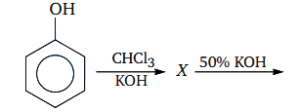
The final product of the following reaction is/are:
A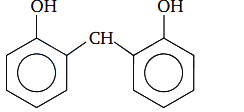
B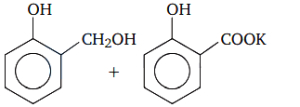
C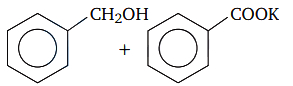
D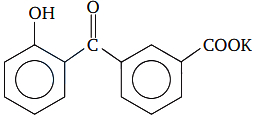
Solution
(A) The reaction of phenol with $CHCl_3$ and $KOH$ is the Reimer-Tiemann reaction,which yields salicylaldehyde ($2$-hydroxybenzaldehyde) as the intermediate $X$.
Salicylaldehyde contains an aldehyde group but no $\alpha$-hydrogen atoms.
When treated with $50 \%$ $KOH$ solution,it undergoes the Cannizzaro reaction,a disproportionation reaction.
One molecule of salicylaldehyde is reduced to the corresponding alcohol ($2$-hydroxybenzyl alcohol),and another molecule is oxidized to the corresponding carboxylic acid salt (potassium $2-$hydroxybenzoate).
Salicylaldehyde contains an aldehyde group but no $\alpha$-hydrogen atoms.
When treated with $50 \%$ $KOH$ solution,it undergoes the Cannizzaro reaction,a disproportionation reaction.
One molecule of salicylaldehyde is reduced to the corresponding alcohol ($2$-hydroxybenzyl alcohol),and another molecule is oxidized to the corresponding carboxylic acid salt (potassium $2-$hydroxybenzoate).
0 likes
View Solution1336
MediumMCQ
Which does not react with Fehling's solution?
A
$CH_{3}CHO$
B
$C_{6}H_{5}CHO$
C
$C_{6}H_{12}O_{6}$
D
$HCOOH$
Solution
(B) Fehling's solution is a mild oxidizing agent used to distinguish aliphatic aldehydes from aromatic aldehydes and ketones.
Aliphatic aldehydes like $CH_{3}CHO$ and reducing sugars like $C_{6}H_{12}O_{6}$ react with Fehling's solution to give a red precipitate of $Cu_{2}O$.
Formic acid $(HCOOH)$ also gives a positive test with Fehling's solution due to the presence of an aldehydic group.
Aromatic aldehydes like $C_{6}H_{5}CHO$ do not react with Fehling's solution because the resonance stabilization of the benzene ring makes the carbonyl carbon less susceptible to oxidation.
Aliphatic aldehydes like $CH_{3}CHO$ and reducing sugars like $C_{6}H_{12}O_{6}$ react with Fehling's solution to give a red precipitate of $Cu_{2}O$.
Formic acid $(HCOOH)$ also gives a positive test with Fehling's solution due to the presence of an aldehydic group.
Aromatic aldehydes like $C_{6}H_{5}CHO$ do not react with Fehling's solution because the resonance stabilization of the benzene ring makes the carbonyl carbon less susceptible to oxidation.
0 likes
View Solution1337
MediumMCQ
The aldol condensation of $CH_{3}CHO$ results in the formation of
A
$CH_{3}CH(OH)CH_{2}CHO$
B
$CH_{3}CH_{2}CH(OH)CHO$
C
$CH_{3}CH_{2}CH_{2}OH$
D
$CH_{3}CH(OH)CH_{3}$
Solution
(A) The aldol condensation of two molecules of acetaldehyde $(CH_{3}CHO)$ in the presence of a dilute base $(OH^-)$ yields $3-$hydroxybutanal,commonly known as aldol.
The reaction is as follows:
$2CH_{3}CHO \xrightarrow{OH^-} CH_{3}CH(OH)CH_{2}CHO$ (aldol)
The reaction is as follows:
$2CH_{3}CHO \xrightarrow{OH^-} CH_{3}CH(OH)CH_{2}CHO$ (aldol)
0 likes
View Solution1338
EasyMCQ
Which of the following compounds on reaction with ammoniacal silver nitrate solution forms a precipitate of silver?
A
Ethanal
B
Ethanoic acid
C
Ethanol
D
Ethoxy ethane
Solution
(A) The silver mirror test,also known as Tollen's test,is given by aldehydes.
Ethanal $(CH_3CHO)$ is an aldehyde,so it reacts with ammoniacal silver nitrate $([Ag(NH_3)_2]^+)$ to form a silver mirror (precipitate of silver).
The reaction is: $CH_3CHO + 2[Ag(NH_3)_2]^+ + 3OH^- \rightarrow CH_3COO^- + 2Ag(s) + 4NH_3 + 2H_2O$.
Ethanal $(CH_3CHO)$ is an aldehyde,so it reacts with ammoniacal silver nitrate $([Ag(NH_3)_2]^+)$ to form a silver mirror (precipitate of silver).
The reaction is: $CH_3CHO + 2[Ag(NH_3)_2]^+ + 3OH^- \rightarrow CH_3COO^- + 2Ag(s) + 4NH_3 + 2H_2O$.
0 likes
View Solution1339
DifficultMCQ
When an alcoholic solution of an organic compound is treated with a few drops of Schiff's reagent,a pink colour appears. This confirms the presence of which group?
A
$-COOH$
B
$-CHO$
C
$-C=O$
D
$-CH_2OH$
Solution
(B) Schiff's reagent is a specific test used to detect the presence of an aldehydic group $(-CHO)$.
When an aldehyde reacts with Schiff's reagent,it restores the pink colour of the reagent,confirming the presence of the $-CHO$ group.
When an aldehyde reacts with Schiff's reagent,it restores the pink colour of the reagent,confirming the presence of the $-CHO$ group.
0 likes
View Solution1340
MediumMCQ
Iodoform test is not given by
A
$2-$pentanone
B
ethanol
C
ethanal
D
$3-$pentanone
Solution
(D) The iodoform test is given by compounds that contain either the $CH_{3}CO-$ group or the $CH_{3}CH(OH)-$ group.
$2-$pentanone $(CH_{3}COCH_{2}CH_{2}CH_{3})$ contains the $CH_{3}CO-$ group.
Ethanal $(CH_{3}CHO)$ contains the $CH_{3}CO-$ group.
Ethanol $(CH_{3}CH_{2}OH)$ contains the $CH_{3}CH(OH)-$ group.
However,$3-$pentanone $(CH_{3}CH_{2}COCH_{2}CH_{3})$ does not contain either of these groups,so it does not give the iodoform test.
$2-$pentanone $(CH_{3}COCH_{2}CH_{2}CH_{3})$ contains the $CH_{3}CO-$ group.
Ethanal $(CH_{3}CHO)$ contains the $CH_{3}CO-$ group.
Ethanol $(CH_{3}CH_{2}OH)$ contains the $CH_{3}CH(OH)-$ group.
However,$3-$pentanone $(CH_{3}CH_{2}COCH_{2}CH_{3})$ does not contain either of these groups,so it does not give the iodoform test.
0 likes
View Solution1341
MediumMCQ
An ester $(A)$ with molecular formula $C_9H_{10}O_2$ was treated with excess of $CH_3MgBr$ and the complex so formed was treated with $H_2SO_4$ to give an olefin $(B)$. Ozonolysis of $(B)$ gave a ketone with molecular formula $C_8H_8O$ which shows positive iodoform test. The structure of $(A)$ is
A
$C_6H_5COOC_2H_5$
B
$C_6H_5COOC_6H_5$
C
$C_6H_5COOCH_3$
D
$p-CH_3O-C_6H_4-COCH_3$
Solution
(A) $1$. Ester $(A)$ is $C_6H_5COOC_2H_5$ (Ethyl benzoate).
$2$. Reaction with excess $CH_3MgBr$ followed by acid workup yields a tertiary alcohol: $C_6H_5C(OH)(CH_3)_2$.
$3$. Dehydration of this alcohol with $H_2SO_4$ gives the olefin $(B)$,which is $C_6H_5-C(CH_3)=CH_2$ ($2$-phenylpropene).
$4$. Ozonolysis of $(B)$ $(C_6H_5-C(CH_3)=CH_2)$ yields acetophenone $(C_6H_5COCH_3)$,which has the formula $C_8H_8O$.
$5$. Acetophenone contains a methyl ketone group $(-COCH_3)$,which gives a positive iodoform test.
$6$. Therefore,the ester $(A)$ is $C_6H_5COOC_2H_5$.
$2$. Reaction with excess $CH_3MgBr$ followed by acid workup yields a tertiary alcohol: $C_6H_5C(OH)(CH_3)_2$.
$3$. Dehydration of this alcohol with $H_2SO_4$ gives the olefin $(B)$,which is $C_6H_5-C(CH_3)=CH_2$ ($2$-phenylpropene).
$4$. Ozonolysis of $(B)$ $(C_6H_5-C(CH_3)=CH_2)$ yields acetophenone $(C_6H_5COCH_3)$,which has the formula $C_8H_8O$.
$5$. Acetophenone contains a methyl ketone group $(-COCH_3)$,which gives a positive iodoform test.
$6$. Therefore,the ester $(A)$ is $C_6H_5COOC_2H_5$.
0 likes
View Solution1342
EasyMCQ
Identify the product of the following reaction: $CH_3-CH=CH-CH_2-C \equiv N \xrightarrow[H_3O^{+}]{\text{DIBAL-H}} \text{Product}$
A
Pent$-3-$enoic acid
B
Pentanal
C
Pent$-3-$enal
D
Pentanoic acid
Solution
(C) The reagent $DIBAL-H$ (Diisobutylaluminium hydride) is a selective reducing agent that reduces nitriles $(-CN)$ to imines,which upon acidic hydrolysis $(H_3O^{+})$ yield aldehydes.
It does not affect the carbon-carbon double bond $(C=C)$.
The reaction is:
$CH_3-CH=CH-CH_2-C \equiv N \xrightarrow[H_3O^{+}]{\text{DIBAL-H}} CH_3-CH=CH-CH_2-CHO$
The product formed is $Pent-3-enal$.
It does not affect the carbon-carbon double bond $(C=C)$.
The reaction is:
$CH_3-CH=CH-CH_2-C \equiv N \xrightarrow[H_3O^{+}]{\text{DIBAL-H}} CH_3-CH=CH-CH_2-CHO$
The product formed is $Pent-3-enal$.
0 likes
View Solution1343
MediumMCQ
Identify the reagent used in the following conversion.
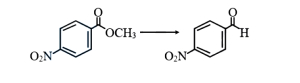
A
$CO, HCl / AlCl_3$
B
$CrO_2 Cl_2 \cdot H_3 O^{+}$
C
$AlH(i-Bu)_2, H_3 O^{+}$
D
$CrO_3, (CH_3 CO)_2 O$
Solution
(C) The given reaction is the reduction of an ester (methyl $4$-nitrobenzoate) to an aldehyde ($4$-nitrobenzaldehyde).
$DIBAL-H$ (Diisobutylaluminium hydride),represented as $AlH(i-Bu)_2$,is a selective reducing agent that reduces esters to aldehydes at low temperatures,followed by acidic workup $(H_3 O^{+})$.
Therefore,the correct reagent is $AlH(i-Bu)_2, H_3 O^{+}$.
$DIBAL-H$ (Diisobutylaluminium hydride),represented as $AlH(i-Bu)_2$,is a selective reducing agent that reduces esters to aldehydes at low temperatures,followed by acidic workup $(H_3 O^{+})$.
Therefore,the correct reagent is $AlH(i-Bu)_2, H_3 O^{+}$.
0 likes
View Solution1344
DifficultMCQ
Identify '$B$' in the following reaction:
$C_6H_5CN + C_6H_5MgBr$ $\xrightarrow{\text{ether}} A$ $\xrightarrow{H_3O^+} B + Mg(Br)(OH)$
$C_6H_5CN + C_6H_5MgBr$ $\xrightarrow{\text{ether}} A$ $\xrightarrow{H_3O^+} B + Mg(Br)(OH)$
A
Benzophenone
B
Benzaldehyde
C
Aniline
D
Diphenyl
Solution
(A) The reaction of benzonitrile $(C_6H_5CN)$ with phenylmagnesium bromide $(C_6H_5MgBr)$ in the presence of dry ether forms an intermediate imine complex $(A)$.
This imine complex is then hydrolyzed by $H_3O^+$ to yield benzophenone $(C_6H_5COC_6H_5)$ as the final product '$B$'.
The reaction is: $C_6H_5CN + C_6H_5MgBr$ $\rightarrow C_6H_5C(NMgBr)C_6H_5$ $\xrightarrow{H_3O^+} C_6H_5COC_6H_5 + NH_3 + Mg(Br)(OH)$.
This imine complex is then hydrolyzed by $H_3O^+$ to yield benzophenone $(C_6H_5COC_6H_5)$ as the final product '$B$'.
The reaction is: $C_6H_5CN + C_6H_5MgBr$ $\rightarrow C_6H_5C(NMgBr)C_6H_5$ $\xrightarrow{H_3O^+} C_6H_5COC_6H_5 + NH_3 + Mg(Br)(OH)$.
0 likes
View Solution1345
MediumMCQ
Identify the product of the following reaction: $Formaldehyde + Benzaldehyde \xrightarrow[H_3O^{+}]{conc. NaOH} \text{product}$
A
Phenyl methanol and methanol
B
Methanol and benzoic acid
C
Methanoic acid and phenyl methanol
D
Methanoic acid and benzoic acid
Solution
(C) The reaction between $Formaldehyde$ $(HCHO)$ and $Benzaldehyde$ $(C_6H_5CHO)$ in the presence of concentrated $NaOH$ is a $Cross-Cannizzaro$ reaction.
Since $Formaldehyde$ has no $\alpha$-hydrogen,it is more susceptible to nucleophilic attack by $OH^-$.
$Formaldehyde$ undergoes oxidation to form $Methanoic$ $acid$ (which exists as $Sodium$ $formate$ in basic medium) and $Benzaldehyde$ undergoes reduction to form $Phenyl$ $methanol$ ($Benzyl$ $alcohol$).
Upon acidification with $H_3O^+$,$Sodium$ $formate$ converts to $Methanoic$ $acid$ $(HCOOH)$.
Thus,the products are $Methanoic$ $acid$ and $Phenyl$ $methanol$.
Since $Formaldehyde$ has no $\alpha$-hydrogen,it is more susceptible to nucleophilic attack by $OH^-$.
$Formaldehyde$ undergoes oxidation to form $Methanoic$ $acid$ (which exists as $Sodium$ $formate$ in basic medium) and $Benzaldehyde$ undergoes reduction to form $Phenyl$ $methanol$ ($Benzyl$ $alcohol$).
Upon acidification with $H_3O^+$,$Sodium$ $formate$ converts to $Methanoic$ $acid$ $(HCOOH)$.
Thus,the products are $Methanoic$ $acid$ and $Phenyl$ $methanol$.
0 likes
View Solution1346
EasyMCQ
Identify the reagent $R$ used in the following reaction:
$\text{Ketone} \xrightarrow{R} \text{Semicarbazone}$
$\text{Ketone} \xrightarrow{R} \text{Semicarbazone}$
A
$NH_2OH$
B
$NH_2NHCONH_2$
C
$NH_2NHC_6H_5$
D
$NH_2-NH_2$
Solution
(B) The reaction of a ketone with semicarbazide $(NH_2NHCONH_2)$ in a weakly acidic medium leads to the formation of a semicarbazone.
The general reaction is: $R_2C=O + NH_2NHCONH_2 \rightarrow R_2C=NNHCONH_2 + H_2O$.
Therefore,the reagent $R$ is semicarbazide,which is $NH_2NHCONH_2$.
The general reaction is: $R_2C=O + NH_2NHCONH_2 \rightarrow R_2C=NNHCONH_2 + H_2O$.
Therefore,the reagent $R$ is semicarbazide,which is $NH_2NHCONH_2$.
0 likes
View Solution1347
EasyMCQ
Which of the following compounds has the highest boiling point?
A
Acetaldehyde
B
Propionaldehyde
C
Butyraldehyde
D
Valeraldehyde
Solution
(D) The boiling point of aldehydes increases with an increase in the molecular mass due to an increase in the magnitude of van der Waals forces of attraction.
$Acetaldehyde$ $(CH_3CHO)$ has $2$ carbons,$Propionaldehyde$ $(CH_3CH_2CHO)$ has $3$ carbons,$Butyraldehyde$ $(CH_3CH_2CH_2CHO)$ has $4$ carbons,and $Valeraldehyde$ $(CH_3CH_2CH_2CH_2CHO)$ has $5$ carbons.
Since $Valeraldehyde$ has the highest molecular mass among the given options,it exhibits the strongest van der Waals forces and therefore has the highest boiling point.
$Acetaldehyde$ $(CH_3CHO)$ has $2$ carbons,$Propionaldehyde$ $(CH_3CH_2CHO)$ has $3$ carbons,$Butyraldehyde$ $(CH_3CH_2CH_2CHO)$ has $4$ carbons,and $Valeraldehyde$ $(CH_3CH_2CH_2CH_2CHO)$ has $5$ carbons.
Since $Valeraldehyde$ has the highest molecular mass among the given options,it exhibits the strongest van der Waals forces and therefore has the highest boiling point.
0 likes
View Solution1348
MediumMCQ
Identify the product '$B$' in the following reaction:
Ethanal $\xrightarrow{\text{dil. } NaOH} A$ $\xrightarrow[-\text{H}_2\text{O}]{\Delta} B$
Ethanal $\xrightarrow{\text{dil. } NaOH} A$ $\xrightarrow[-\text{H}_2\text{O}]{\Delta} B$
A
$3-$Hydroxybutanal
B
$4-$Hydroxybutanal
C
but$-2-$enal
D
but$-3-$enal
Solution
(C) The given reaction is an Aldol condensation followed by dehydration.
Step $1$: Two molecules of ethanal $(CH_3CHO)$ react in the presence of dilute $NaOH$ to form $3-$hydroxybutanal $(A)$.
$2CH_3CHO \xrightarrow{\text{dil. } NaOH} CH_3CH(OH)CH_2CHO$ $(A)$.
Step $2$: Upon heating,$3-$hydroxybutanal undergoes dehydration (loss of water) to form an $\alpha, \beta-$unsaturated aldehyde,which is but$-2-$enal $(B)$.
$CH_3CH(OH)CH_2CHO \xrightarrow[-\text{H}_2\text{O}]{\Delta} CH_3CH=CHCHO$ $(B)$.
Thus,the product '$B$' is but$-2-$enal.
Step $1$: Two molecules of ethanal $(CH_3CHO)$ react in the presence of dilute $NaOH$ to form $3-$hydroxybutanal $(A)$.
$2CH_3CHO \xrightarrow{\text{dil. } NaOH} CH_3CH(OH)CH_2CHO$ $(A)$.
Step $2$: Upon heating,$3-$hydroxybutanal undergoes dehydration (loss of water) to form an $\alpha, \beta-$unsaturated aldehyde,which is but$-2-$enal $(B)$.
$CH_3CH(OH)CH_2CHO \xrightarrow[-\text{H}_2\text{O}]{\Delta} CH_3CH=CHCHO$ $(B)$.
Thus,the product '$B$' is but$-2-$enal.
0 likes
View Solution1349
EasyMCQ
Which among the following compounds has the highest boiling point?
A
Propanal
B
Ethanal
C
Pentanal
D
Hexanal
Solution
(D) The boiling point of aldehydes and ketones depends on the molecular mass and the strength of intermolecular forces.
As the carbon chain length increases,the molecular mass increases,which leads to an increase in the magnitude of van der Waals forces of attraction.
Among the given options,$Hexanal$ $(C_6H_{12}O)$ has the longest carbon chain and the highest molecular mass compared to $Propanal$ $(C_3H_6O)$,$Ethanal$ $(C_2H_4O)$,and $Pentanal$ $(C_5H_{10}O)$.
Therefore,$Hexanal$ has the highest boiling point.
As the carbon chain length increases,the molecular mass increases,which leads to an increase in the magnitude of van der Waals forces of attraction.
Among the given options,$Hexanal$ $(C_6H_{12}O)$ has the longest carbon chain and the highest molecular mass compared to $Propanal$ $(C_3H_6O)$,$Ethanal$ $(C_2H_4O)$,and $Pentanal$ $(C_5H_{10}O)$.
Therefore,$Hexanal$ has the highest boiling point.
0 likes
View Solution8-1.Aldehydes and Ketones — Properties · Frequently Asked Questions
1Are these 8-1.Aldehydes and Ketones questions useful for JEE and NEET?
Yes. All questions in this section are mapped to JEE Main and NEET exam patterns. Previous year questions from JEE Main, NEET, GUJCET and state-level exams are included with full solutions.
2Can I switch to Hindi or Gujarati for these questions?
Yes. Use the language tabs in the hero section or the sidebar to view the same questions and solutions in English, Hindi or Gujarati.
3How do I generate a question paper from this subtopic?
Use the Vedclass Exam Paper Generator — select the chapter and subtopic, set difficulty, and generate Sets A, B, C, D automatically. First 3 chapters of every subject are free.
Vedclass Products
For Students
Vedclass Test Series
Mock tests in real JEE/NEET style with performance analysis. 5-day free trial.
Start Free TrialFor Teachers
Exam Paper Generator
Generate Set A/B/C/D papers from this chapter in 2 minutes. 3 chapters free.
Try FreeFor Institutes
Online Exam Module
Live online exams with unlimited students, 360° analytics & white-label branding.
See DemoFor Teachers & Institutes
Generate a 8-1.Aldehydes and Ketones Exam Paper in 2 Minutes
Select subtopic & difficulty — Sets A, B, C, D auto-generated with No Repeat logic.
First 3 chapters of every subject are free — no payment required.