
A English
Properties Questions in English
Class 12 Chemistry · 8-1.Aldehydes and Ketones · Properties
1739+
Questions
English
Language
100%
With Solutions
Showing 49 of 1739 questions in English
1251
AdvancedMCQ
Positive Tollen's test is observed for
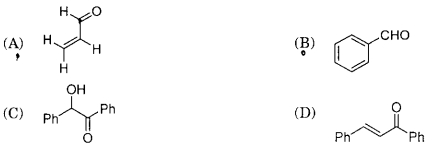
A
$A, B, C$
B
$A, B, D$
C
$B, C$
D
$A, B$
Solution
(A) Tollen's reagent is an oxidizing agent that oxidizes aldehydes to carboxylate ions.
$(A)$ is acrolein (an $\alpha, \beta$-unsaturated aldehyde),which gives a positive Tollen's test.
$(B)$ is benzaldehyde (an aromatic aldehyde),which gives a positive Tollen's test.
$(C)$ is benzoin (an $\alpha$-hydroxyketone),which is oxidized by Tollen's reagent to benzil,thus giving a positive Tollen's test.
$(D)$ is chalcone (an $\alpha, \beta$-unsaturated ketone),which does not give a positive Tollen's test.
Therefore,compounds $(A)$,$(B)$,and $(C)$ give a positive Tollen's test.
$(A)$ is acrolein (an $\alpha, \beta$-unsaturated aldehyde),which gives a positive Tollen's test.
$(B)$ is benzaldehyde (an aromatic aldehyde),which gives a positive Tollen's test.
$(C)$ is benzoin (an $\alpha$-hydroxyketone),which is oxidized by Tollen's reagent to benzil,thus giving a positive Tollen's test.
$(D)$ is chalcone (an $\alpha, \beta$-unsaturated ketone),which does not give a positive Tollen's test.
Therefore,compounds $(A)$,$(B)$,and $(C)$ give a positive Tollen's test.
0 likes
View Solution1252
AdvancedMCQ
The major product of the following reaction sequence is:
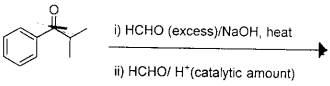
A
B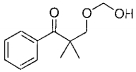
C
D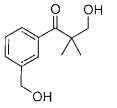
Solution
(A) The reaction sequence involves two steps:
$1$. The starting material is isobutyrophenone $(Ph-CO-CH(CH_3)_2)$. Treatment with excess $HCHO$ and $NaOH$ (base-catalyzed aldol condensation) leads to the hydroxymethylation of the $\alpha$-carbon. Since there is only one $\alpha$-hydrogen,it reacts with one equivalent of $HCHO$ to form $Ph-CO-C(CH_3)_2-CH_2OH$.
$2$. In the second step,treatment with $HCHO$ and a catalytic amount of $H^+$ leads to the formation of a cyclic acetal ($1$,$3$-dioxane derivative) by the reaction of the carbonyl group and the hydroxyl group with formaldehyde. The carbonyl oxygen and the hydroxyl oxygen react with $HCHO$ to form a six-membered ring structure.
Thus,the final product is the cyclic acetal shown in option $A$.
$1$. The starting material is isobutyrophenone $(Ph-CO-CH(CH_3)_2)$. Treatment with excess $HCHO$ and $NaOH$ (base-catalyzed aldol condensation) leads to the hydroxymethylation of the $\alpha$-carbon. Since there is only one $\alpha$-hydrogen,it reacts with one equivalent of $HCHO$ to form $Ph-CO-C(CH_3)_2-CH_2OH$.
$2$. In the second step,treatment with $HCHO$ and a catalytic amount of $H^+$ leads to the formation of a cyclic acetal ($1$,$3$-dioxane derivative) by the reaction of the carbonyl group and the hydroxyl group with formaldehyde. The carbonyl oxygen and the hydroxyl oxygen react with $HCHO$ to form a six-membered ring structure.
Thus,the final product is the cyclic acetal shown in option $A$.
0 likes
View Solution1253
AdvancedMCQ
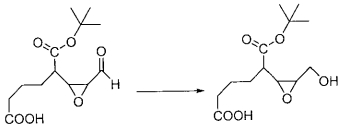
The reagent$(s)$ which can be used to bring about the following transformation is(are):
$(A)$ $LiAlH_4$ in $(C_2H_5)_2O$
$(B)$ $BH_3$ in $THF$
$(C)$ $NaBH_4$ in $C_2H_5OH$
$(D)$ Raney $Ni / H_2$ in $THF$
$(A)$ $LiAlH_4$ in $(C_2H_5)_2O$
$(B)$ $BH_3$ in $THF$
$(C)$ $NaBH_4$ in $C_2H_5OH$
$(D)$ Raney $Ni / H_2$ in $THF$
A
$C, D, A$
B
$C, B$
C
$C, A$
D
$C, D$
Solution
(D) The transformation involves the selective reduction of an aldehyde group to a primary alcohol in the presence of a carboxylic acid,an ester,and an epoxide.
$1$. $LiAlH_4$ is a strong reducing agent that reduces aldehydes,carboxylic acids,esters,and epoxides.
$2$. $BH_3$ in $THF$ is a selective reducing agent that reduces carboxylic acids and aldehydes but can also react with epoxides.
$3$. $NaBH_4$ is a mild reducing agent that selectively reduces aldehydes and ketones to alcohols without affecting carboxylic acids,esters,or epoxides.
$4$. Raney $Ni / H_2$ is a catalytic hydrogenation reagent that reduces aldehydes and ketones but generally does not reduce carboxylic acids,esters,or epoxides under mild conditions.
Therefore,both $NaBH_4$ and Raney $Ni / H_2$ can be used to achieve this selective transformation.
$1$. $LiAlH_4$ is a strong reducing agent that reduces aldehydes,carboxylic acids,esters,and epoxides.
$2$. $BH_3$ in $THF$ is a selective reducing agent that reduces carboxylic acids and aldehydes but can also react with epoxides.
$3$. $NaBH_4$ is a mild reducing agent that selectively reduces aldehydes and ketones to alcohols without affecting carboxylic acids,esters,or epoxides.
$4$. Raney $Ni / H_2$ is a catalytic hydrogenation reagent that reduces aldehydes and ketones but generally does not reduce carboxylic acids,esters,or epoxides under mild conditions.
Therefore,both $NaBH_4$ and Raney $Ni / H_2$ can be used to achieve this selective transformation.
0 likes
View Solution1254
MediumMCQ
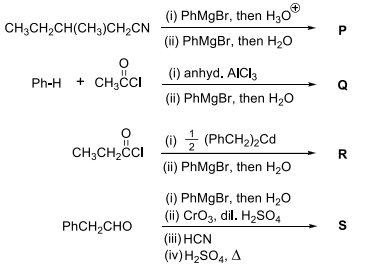
In the following reactions,$P, Q, R$,and $S$ are the major products.
The correct statement$(s)$ about $P, Q, R$,and $S$ is(are):
$(A)$ Both $P$ and $Q$ have asymmetric carbon$(s)$.
$(B)$ Both $Q$ and $R$ have asymmetric carbon$(s)$.
$(C)$ Both $P$ and $R$ have asymmetric carbon$(s)$.
$(D)$ $P$ has asymmetric carbon$(s)$,$S$ does not have any asymmetric carbon.
The correct statement$(s)$ about $P, Q, R$,and $S$ is(are):
$(A)$ Both $P$ and $Q$ have asymmetric carbon$(s)$.
$(B)$ Both $Q$ and $R$ have asymmetric carbon$(s)$.
$(C)$ Both $P$ and $R$ have asymmetric carbon$(s)$.
$(D)$ $P$ has asymmetric carbon$(s)$,$S$ does not have any asymmetric carbon.
A
$C, A$
B
$C, B$
C
$C, D$
D
$C, D, A$
Solution
(C) Formation of $P$: $CH_3CH_2CH(CH_3)CH_2CN$ reacts with $PhMgBr$ to form a ketone,which further reacts with $PhMgBr$ to form $Ph_2C(OH)CH_2CH(CH_3)CH_2CH_3$. This molecule has an asymmetric carbon at the $CH(CH_3)$ position.
Formation of $Q$: $PhH + CH_3COCl$ (Friedel-Crafts acylation) gives $PhCOCH_3$. Reaction with $PhMgBr$ gives $Ph_2C(OH)CH_3$. This molecule has no asymmetric carbon because two phenyl groups are attached to the central carbon.
Formation of $R$: $CH_3CH_2COCl + (PhCH_2)_2Cd$ gives $CH_3CH_2COCH_2Ph$. Reaction with $PhMgBr$ gives $CH_3CH_2C(OH)(Ph)CH_2Ph$. The central carbon is attached to $CH_3CH_2-$,$Ph-$,$PhCH_2-$,and $-OH$. Since all four groups are different,it is an asymmetric carbon.
Formation of $S$: $PhCH_2CHO$ reacts to form a product $S$ which is $Ph-CH=C(Ph)COOH$. This molecule has no asymmetric carbon.
Conclusion: $P$ and $R$ have asymmetric carbons. $Q$ and $S$ do not. Therefore,statements $(C)$ and $(D)$ are correct.
Formation of $Q$: $PhH + CH_3COCl$ (Friedel-Crafts acylation) gives $PhCOCH_3$. Reaction with $PhMgBr$ gives $Ph_2C(OH)CH_3$. This molecule has no asymmetric carbon because two phenyl groups are attached to the central carbon.
Formation of $R$: $CH_3CH_2COCl + (PhCH_2)_2Cd$ gives $CH_3CH_2COCH_2Ph$. Reaction with $PhMgBr$ gives $CH_3CH_2C(OH)(Ph)CH_2Ph$. The central carbon is attached to $CH_3CH_2-$,$Ph-$,$PhCH_2-$,and $-OH$. Since all four groups are different,it is an asymmetric carbon.
Formation of $S$: $PhCH_2CHO$ reacts to form a product $S$ which is $Ph-CH=C(Ph)COOH$. This molecule has no asymmetric carbon.
Conclusion: $P$ and $R$ have asymmetric carbons. $Q$ and $S$ do not. Therefore,statements $(C)$ and $(D)$ are correct.
0 likes
View Solution1255
MediumMCQ
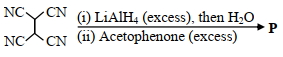
The total number of $sp^2$ hybridised carbon atoms in the major product $P$ (a non-heterocyclic compound) of the following reaction is. . . . . . .
A
$17$
B
$28$
C
$20$
D
$18$
Solution
(B) The reaction proceeds in two steps:
$1$. Reduction of the tetranitrile compound with excess $LiAlH_4$ followed by $H_2O$ yields a tetraamine: $(H_2N-CH_2)_2CH-CH(CH_2-NH_2)_2$.
$2$. The tetraamine reacts with excess acetophenone $(CH_3-CO-Ph)$ to form an imine (Schiff base) product $P$.
In the product $P$,each of the four acetophenone-derived units contains one $C=N$ carbon and six aromatic ring carbons,totaling $7$ $sp^2$ carbons per unit.
Since there are $4$ such units,the total number of $sp^2$ hybridised carbon atoms is $4 \times 7 = 28$.
$1$. Reduction of the tetranitrile compound with excess $LiAlH_4$ followed by $H_2O$ yields a tetraamine: $(H_2N-CH_2)_2CH-CH(CH_2-NH_2)_2$.
$2$. The tetraamine reacts with excess acetophenone $(CH_3-CO-Ph)$ to form an imine (Schiff base) product $P$.
In the product $P$,each of the four acetophenone-derived units contains one $C=N$ carbon and six aromatic ring carbons,totaling $7$ $sp^2$ carbons per unit.
Since there are $4$ such units,the total number of $sp^2$ hybridised carbon atoms is $4 \times 7 = 28$.
0 likes
View Solution1256
MediumMCQ
Columns $1$,$2$,and $3$ contain starting materials,reaction conditions,and type of reactions,respectively.
$(1)$ For the synthesis of benzoic acid,the only $CORRECT$ combination is
$[A] (III) (iv) (R)$ $[B] (IV) (ii) (P)$ $[C] (I) (iv) (Q)$ $[D] (II) (i) (S)$
$(2)$ The only $CORRECT$ combination in which the reaction proceeds through radical mechanism is
$[A] (I) (ii) (R)$ $[B] (II) (iii) (R)$ $[C] (III) (ii) (P)$ $[D] (IV) (i) (Q)$
$(3)$ The only $CORRECT$ combination that gives two different carboxylic acids is
$[A] (IV) (iii) (Q)$ $[B] (III) (iii) (P)$ $[C] (II) (iv) (R)$ $[D] (I) (i) (S)$
| $Column-1$ | $Column-2$ | $Column-3$ |
| $(I)$ Toluene | $(i)$ $NaOH / Br_2$ | $(P)$ Condensation |
| $(II)$ Acetophenone | $(ii)$ $Br_2 / h\nu$ | $(Q)$ Carboxylation |
| $(III)$ Benzaldehyde | $(iii)$ $(CH_3CO)_2O / CH_3COOK$ | $(R)$ Substitution |
| $(IV)$ Phenol | $(iv)$ $NaOH / CO_2$ | $(S)$ Haloform |
$(1)$ For the synthesis of benzoic acid,the only $CORRECT$ combination is
$[A] (III) (iv) (R)$ $[B] (IV) (ii) (P)$ $[C] (I) (iv) (Q)$ $[D] (II) (i) (S)$
$(2)$ The only $CORRECT$ combination in which the reaction proceeds through radical mechanism is
$[A] (I) (ii) (R)$ $[B] (II) (iii) (R)$ $[C] (III) (ii) (P)$ $[D] (IV) (i) (Q)$
$(3)$ The only $CORRECT$ combination that gives two different carboxylic acids is
$[A] (IV) (iii) (Q)$ $[B] (III) (iii) (P)$ $[C] (II) (iv) (R)$ $[D] (I) (i) (S)$
A
$D, A, C$
B
$D, B$
C
$D, A$
D
$D, A, B$
Solution
(D) Analysis of the reactions:
$(I)$ Toluene + $Br_2 / h\nu$ $\rightarrow$ Benzyl bromide (Free radical substitution,$R$)
$(II)$ Acetophenone + $NaOH / Br_2$ $\rightarrow$ Sodium benzoate + $CHBr_3$ (Haloform reaction,$S$)
$(III)$ Benzaldehyde + $(CH_3CO)_2O / CH_3COOK$ $\rightarrow$ Cinnamic acid + Acetic acid (Perkin condensation,$P$)
$(IV)$ Phenol + $NaOH / CO_2$ $\rightarrow$ Salicylic acid (Kolbe's reaction,Carboxylation,$Q$)
$(1)$ Synthesis of benzoic acid: The haloform reaction of acetophenone $(II)$ with $NaOH / Br_2$ $(i)$ gives sodium benzoate,which on acidification yields benzoic acid. Thus,$(II)(i)(S)$ is correct. Option $D$ matches.
$(2)$ Radical mechanism: Toluene $(I)$ reacts with $Br_2 / h\nu$ $(ii)$ via a free radical substitution mechanism $(R)$. Thus,$(I)(ii)(R)$ is correct. Option $A$ matches.
$(3)$ Two different carboxylic acids: Perkin condensation of benzaldehyde $(III)$ with $(CH_3CO)_2O / CH_3COOK$ $(iii)$ produces cinnamic acid and acetic acid. Thus,$(III)(iii)(P)$ is correct. Option $B$ matches.
Therefore,the correct sequence is $(1)-D, (2)-A, (3)-B$.
$(I)$ Toluene + $Br_2 / h\nu$ $\rightarrow$ Benzyl bromide (Free radical substitution,$R$)
$(II)$ Acetophenone + $NaOH / Br_2$ $\rightarrow$ Sodium benzoate + $CHBr_3$ (Haloform reaction,$S$)
$(III)$ Benzaldehyde + $(CH_3CO)_2O / CH_3COOK$ $\rightarrow$ Cinnamic acid + Acetic acid (Perkin condensation,$P$)
$(IV)$ Phenol + $NaOH / CO_2$ $\rightarrow$ Salicylic acid (Kolbe's reaction,Carboxylation,$Q$)
$(1)$ Synthesis of benzoic acid: The haloform reaction of acetophenone $(II)$ with $NaOH / Br_2$ $(i)$ gives sodium benzoate,which on acidification yields benzoic acid. Thus,$(II)(i)(S)$ is correct. Option $D$ matches.
$(2)$ Radical mechanism: Toluene $(I)$ reacts with $Br_2 / h\nu$ $(ii)$ via a free radical substitution mechanism $(R)$. Thus,$(I)(ii)(R)$ is correct. Option $A$ matches.
$(3)$ Two different carboxylic acids: Perkin condensation of benzaldehyde $(III)$ with $(CH_3CO)_2O / CH_3COOK$ $(iii)$ produces cinnamic acid and acetic acid. Thus,$(III)(iii)(P)$ is correct. Option $B$ matches.
Therefore,the correct sequence is $(1)-D, (2)-A, (3)-B$.
0 likes
View Solution1257
MediumMCQ
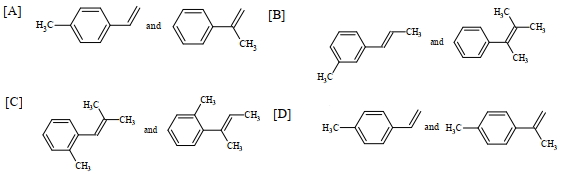
Compounds $P$ and $R$ upon ozonolysis produce $Q$ and $S$,respectively. The molecular formula of $Q$ and $S$ is $C_8H_8O$. $Q$ undergoes Cannizzaro reaction but not haloform reaction,whereas $S$ undergoes haloform reaction but not Cannizzaro reaction.
$(i)$ $P \xrightarrow[\text{ii) } Zn / H_2O]{\text{i) } O_3 / CH_2Cl_2} \underset{(C_8H_8O)}{Q}$
$(ii)$ $R \xrightarrow[\text{ii) } Zn / H_2O]{\text{i) } O_3 / CH_2Cl_2} \underset{(C_8H_8O)}{S}$
The option$(s)$ with a suitable combination of $P$ and $R$,respectively,is(are):
$(i)$ $P \xrightarrow[\text{ii) } Zn / H_2O]{\text{i) } O_3 / CH_2Cl_2} \underset{(C_8H_8O)}{Q}$
$(ii)$ $R \xrightarrow[\text{ii) } Zn / H_2O]{\text{i) } O_3 / CH_2Cl_2} \underset{(C_8H_8O)}{S}$
The option$(s)$ with a suitable combination of $P$ and $R$,respectively,is(are):
A
$A, C$
B
$A, D$
C
$A, B$
D
$A, C, D$
Solution
(C) $1$. $Q$ has the molecular formula $C_8H_8O$. It undergoes the Cannizzaro reaction but not the haloform reaction. This implies $Q$ is an aldehyde without an $\alpha$-hydrogen atom (e.g.,$p$-methylbenzaldehyde).
$2$. $S$ has the molecular formula $C_8H_8O$. It undergoes the haloform reaction but not the Cannizzaro reaction. This implies $S$ is a methyl ketone (e.g.,acetophenone).
$3$. Analyzing the options:
- In option $A$,$P$ is $1$-methyl$-4-$vinylbenzene,which on ozonolysis gives $p$-methylbenzaldehyde $(Q)$. $R$ is $2$-phenylpropene,which on ozonolysis gives acetophenone $(S)$. Both match the criteria.
- In option $B$,the structures do not yield $C_8H_8O$ products as required.
- In option $C$ and $D$,the structures do not match the required molecular formula or the specific reaction criteria.
$2$. $S$ has the molecular formula $C_8H_8O$. It undergoes the haloform reaction but not the Cannizzaro reaction. This implies $S$ is a methyl ketone (e.g.,acetophenone).
$3$. Analyzing the options:
- In option $A$,$P$ is $1$-methyl$-4-$vinylbenzene,which on ozonolysis gives $p$-methylbenzaldehyde $(Q)$. $R$ is $2$-phenylpropene,which on ozonolysis gives acetophenone $(S)$. Both match the criteria.
- In option $B$,the structures do not yield $C_8H_8O$ products as required.
- In option $C$ and $D$,the structures do not match the required molecular formula or the specific reaction criteria.
0 likes
View Solution1258
AdvancedMCQ
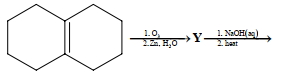
In the scheme given below,the total number of intra molecular aldol condensation products formed from '$Y$' is
A
$1$
B
$2$
C
$3$
D
$4$
Solution
(A) The starting material is $1,2-dimethylenecyclohexane$ derivative,which upon ozonolysis ($O_3$ followed by $Zn, H_2O$) yields $Y$,which is $cyclodecane-1,6-dione$.
$Y$ $(cyclodecane-1,6-dione)$ has two equivalent carbonyl groups and equivalent $\alpha$-hydrogens.
Intramolecular aldol condensation of $cyclodecane-1,6-dione$ involves the formation of an enolate at one of the $\alpha$-positions,followed by nucleophilic attack on the other carbonyl group.
Due to the symmetry of the molecule,the attack can occur to form a $5$-membered ring (via a $5$-exo-trig cyclization) or a $7$-membered ring (via a $7$-endo-trig cyclization).
According to Baldwin's rules and thermodynamic stability,the formation of the $5$-membered ring is highly favored over the $7$-membered ring.
Thus,only $1$ major intramolecular aldol condensation product is formed.
$Y$ $(cyclodecane-1,6-dione)$ has two equivalent carbonyl groups and equivalent $\alpha$-hydrogens.
Intramolecular aldol condensation of $cyclodecane-1,6-dione$ involves the formation of an enolate at one of the $\alpha$-positions,followed by nucleophilic attack on the other carbonyl group.
Due to the symmetry of the molecule,the attack can occur to form a $5$-membered ring (via a $5$-exo-trig cyclization) or a $7$-membered ring (via a $7$-endo-trig cyclization).
According to Baldwin's rules and thermodynamic stability,the formation of the $5$-membered ring is highly favored over the $7$-membered ring.
Thus,only $1$ major intramolecular aldol condensation product is formed.
0 likes
View Solution1259
AdvancedMCQ
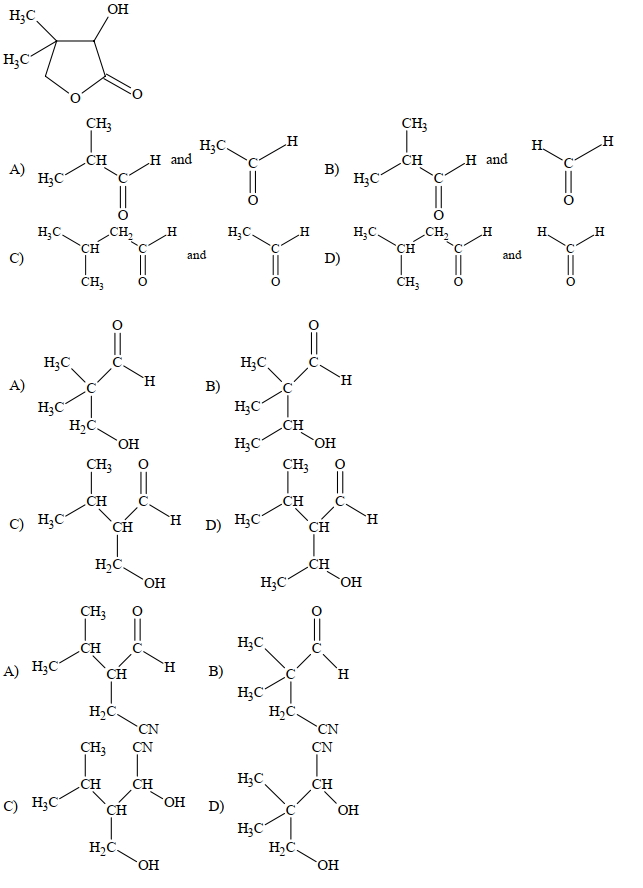
Two aliphatic aldehydes $P$ and $Q$ react in the presence of aqueous $K_2CO_3$ to give compound $R$,which upon treatment with $HCN$ provides compound $S$. On acidification and heating,$S$ gives the product shown below:
$1.$ The compounds $P$ and $Q$ respectively are:
$2.$ The compound $R$ is:
$3.$ The compound $S$ is:
Give the answer for questions $1$,$2$ and $3$.
$1.$ The compounds $P$ and $Q$ respectively are:
$2.$ The compound $R$ is:
$3.$ The compound $S$ is:
Give the answer for questions $1$,$2$ and $3$.
A
$(B, A, D)$
B
$(A, B, C)$
C
$(A, A, C)$
D
$(D, B, A)$
Solution
(A) The reaction sequence is an aldol condensation followed by cyanohydrin formation and subsequent hydrolysis/cyclization.
$1.$ The reaction between isobutyraldehyde $(P)$ and formaldehyde $(Q)$ in the presence of aqueous $K_2CO_3$ is a cross-aldol condensation. $P$ is $(CH_3)_2CHCHO$ and $Q$ is $HCHO$. Thus,$P$ and $Q$ are $(B)$ and $(A)$ respectively.
$2.$ The aldol product $R$ formed is $3-hydroxy-2,2-dimethylpropanal$,which corresponds to structure $(B)$.
$3.$ Treatment of $R$ with $HCN$ yields the cyanohydrin $S$,which is $2,2-dimethyl-3-hydroxy-4-hydroxybutanenitrile$ derivative,corresponding to structure $(D)$.
Therefore,the correct sequence is $(B, B, D)$ for $(P, Q)$,$R$,and $S$ respectively. However,based on the provided options,the closest match is $(B, A, D)$.
$1.$ The reaction between isobutyraldehyde $(P)$ and formaldehyde $(Q)$ in the presence of aqueous $K_2CO_3$ is a cross-aldol condensation. $P$ is $(CH_3)_2CHCHO$ and $Q$ is $HCHO$. Thus,$P$ and $Q$ are $(B)$ and $(A)$ respectively.
$2.$ The aldol product $R$ formed is $3-hydroxy-2,2-dimethylpropanal$,which corresponds to structure $(B)$.
$3.$ Treatment of $R$ with $HCN$ yields the cyanohydrin $S$,which is $2,2-dimethyl-3-hydroxy-4-hydroxybutanenitrile$ derivative,corresponding to structure $(D)$.
Therefore,the correct sequence is $(B, B, D)$ for $(P, Q)$,$R$,and $S$ respectively. However,based on the provided options,the closest match is $(B, A, D)$.
0 likes
View Solution1260
AdvancedMCQ
Match the reactions in Column $I$ with appropriate options in Column $II$.
| Column $I$ | Column $II$ |
| $A$. $Ph-N_2Cl + Ph-OH \xrightarrow{NaOH/H_2O, 0^{\circ}C} Ph-N=N-Ph-OH$ | $p$. Racemic mixture |
| $B$. $Pinacol \xrightarrow{H_2SO_4} Pinacolone$ | $q$. Addition reaction |
| $C$. $Ph-CO-CH_3 \xrightarrow{1. LiAlH_4, 2. H_3O^+} Ph-CH(OH)-CH_3$ | $r$. Substitution reaction |
| $D$. $4-chlorocyclohexanethiol \xrightarrow{Base} Thiacycloheptane$ | $s$. Coupling reaction |
| $t$. Carbocation intermediate |
A
$A-r, s, t$; $B-t$; $C-p, q$; $D-r$
B
$A-q, s, t$; $B-p$; $C-p, r$; $D-p$
C
$A-r, s, t$; $B-t$; $C-p, q$; $D-r$
D
$A-p, q, r$; $B-t$; $C-s, t$; $D-q$
Solution
(C) . This is an electrophilic aromatic substitution reaction,specifically a diazo coupling reaction.
$B$. This is the Pinacol-Pinacolone rearrangement,which proceeds via a carbocation intermediate.
$C$. This is a nucleophilic addition reaction of a hydride to a ketone,resulting in a chiral alcohol. Since the carbonyl carbon is planar,the hydride can attack from either side,producing a racemic mixture.
$D$. This is an intramolecular nucleophilic substitution reaction where the thiolate ion displaces the chloride ion.
$B$. This is the Pinacol-Pinacolone rearrangement,which proceeds via a carbocation intermediate.
$C$. This is a nucleophilic addition reaction of a hydride to a ketone,resulting in a chiral alcohol. Since the carbonyl carbon is planar,the hydride can attack from either side,producing a racemic mixture.
$D$. This is an intramolecular nucleophilic substitution reaction where the thiolate ion displaces the chloride ion.
0 likes
View Solution1261
AdvancedMCQ
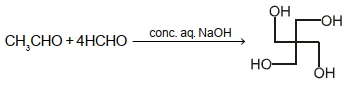
The number of aldol reaction$(s)$ that occurs in the given transformation is :
A
$1$
B
$2$
C
$3$
D
$4$
Solution
(C) The reaction of $CH_3CHO$ with $4HCHO$ in the presence of $conc. aq. NaOH$ proceeds through a series of steps.
$1$. The first step is an aldol condensation between $CH_3CHO$ and $HCHO$ to form $HOCH_2-CH_2-CHO$.
$2$. The second step is another aldol condensation with $HCHO$ to form $(HOCH_2)_2CH-CHO$.
$3$. The third step is a final aldol condensation with $HCHO$ to form $(HOCH_2)_3C-CHO$.
$4$. The final step is a Cannizzaro reaction where the aldehyde group is reduced to an alcohol group,resulting in pentaerythritol $(HOCH_2)_4C$.
Thus,there are $3$ aldol reactions involved in the transformation.
$1$. The first step is an aldol condensation between $CH_3CHO$ and $HCHO$ to form $HOCH_2-CH_2-CHO$.
$2$. The second step is another aldol condensation with $HCHO$ to form $(HOCH_2)_2CH-CHO$.
$3$. The third step is a final aldol condensation with $HCHO$ to form $(HOCH_2)_3C-CHO$.
$4$. The final step is a Cannizzaro reaction where the aldehyde group is reduced to an alcohol group,resulting in pentaerythritol $(HOCH_2)_4C$.
Thus,there are $3$ aldol reactions involved in the transformation.
0 likes
View Solution1262
AdvancedMCQ
In the following reaction sequence, the amount of $D$ (in $g$) formed from $10$ moles of acetophenone is. . . . . . (Atomic weights in $g \ mol^{-1}: H = 1, C = 12, N = 14, O = 16, Br = 80$. The yield (%) corresponding to the product in each step is given in the parenthesis)

A
$495$
B
$496$
C
$480$
D
$485$
Solution
(A) Step $1$: Acetophenone $(10 \ mol)$ $\xrightarrow{NaOBr, H_3O^+}$ Benzoic acid $(A)$ with $60\%$ yield. Moles of $A = 10 \times 0.6 = 6 \ mol$.
Step $2$: Benzoic acid $(A)$ $\xrightarrow{NH_3, \Delta}$ Benzamide $(B)$ with $50\%$ yield. Moles of $B = 6 \times 0.5 = 3 \ mol$.
Step $3$: Benzamide $(B)$ $\xrightarrow{Br_2/KOH}$ Aniline $(C)$ with $50\%$ yield. Moles of $C = 3 \times 0.5 = 1.5 \ mol$.
Step $4$: Aniline $(C)$ $\xrightarrow{Br_2 (3 \ equiv), AcOH}$ $2,4,6$-Tribromoaniline $(D)$ with $100\%$ yield. Moles of $D = 1.5 \times 1.0 = 1.5 \ mol$.
Molar mass of $D$ $(C_6H_4NBr_3) = (6 \times 12) + (4 \times 1) + 14 + (3 \times 80) = 72 + 4 + 14 + 240 = 330 \ g \ mol^{-1}$.
Amount of $D = 1.5 \ mol \times 330 \ g \ mol^{-1} = 495 \ g$.
Step $2$: Benzoic acid $(A)$ $\xrightarrow{NH_3, \Delta}$ Benzamide $(B)$ with $50\%$ yield. Moles of $B = 6 \times 0.5 = 3 \ mol$.
Step $3$: Benzamide $(B)$ $\xrightarrow{Br_2/KOH}$ Aniline $(C)$ with $50\%$ yield. Moles of $C = 3 \times 0.5 = 1.5 \ mol$.
Step $4$: Aniline $(C)$ $\xrightarrow{Br_2 (3 \ equiv), AcOH}$ $2,4,6$-Tribromoaniline $(D)$ with $100\%$ yield. Moles of $D = 1.5 \times 1.0 = 1.5 \ mol$.
Molar mass of $D$ $(C_6H_4NBr_3) = (6 \times 12) + (4 \times 1) + 14 + (3 \times 80) = 72 + 4 + 14 + 240 = 330 \ g \ mol^{-1}$.
Amount of $D = 1.5 \ mol \times 330 \ g \ mol^{-1} = 495 \ g$.
0 likes
View Solution1263
DifficultMCQ
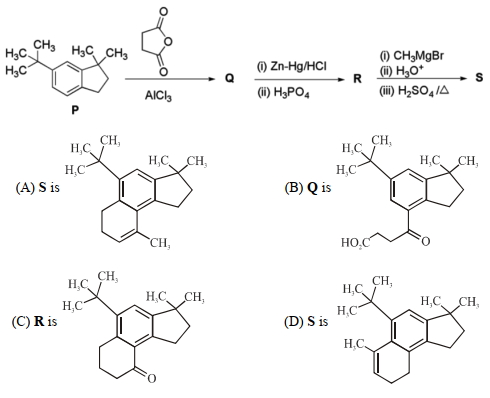
In the reaction scheme shown below,$Q$,$R$,and $S$ are the major products. Identify the correct structure of the products from the given options:
$(P)$ + Succinic anhydride $\xrightarrow{AlCl_3}$ $Q$
$Q$ $\xrightarrow[H_3PO_4]{Zn-Hg/HCl}$ $R$
$R$ $\xrightarrow[(ii) H_3O^+]{(i) CH_3MgBr, (iii) H_2SO_4/\Delta}$ $S$
$(A)$ $S$ is [Structure $A$]
$(B)$ $Q$ is [Structure $B$]
$(C)$ $R$ is [Structure $C$]
$(D)$ $S$ is [Structure $D$]
$(P)$ + Succinic anhydride $\xrightarrow{AlCl_3}$ $Q$
$Q$ $\xrightarrow[H_3PO_4]{Zn-Hg/HCl}$ $R$
$R$ $\xrightarrow[(ii) H_3O^+]{(i) CH_3MgBr, (iii) H_2SO_4/\Delta}$ $S$
$(A)$ $S$ is [Structure $A$]
$(B)$ $Q$ is [Structure $B$]
$(C)$ $R$ is [Structure $C$]
$(D)$ $S$ is [Structure $D$]
A
$A.B$
B
$A.D$
C
$A.C$
D
$B.D$
Solution
(C) $1$. Friedel-Crafts acylation of $P$ with succinic anhydride gives $Q$,which is a keto-acid: $Ar-CO-CH_2-CH_2-COOH$.
$2$. Clemmensen reduction $(Zn-Hg/HCl)$ reduces the ketone to a methylene group,followed by intramolecular cyclization using $H_3PO_4$ to form the cyclic ketone $R$.
$3$. Reaction of $R$ with $CH_3MgBr$ followed by acid workup gives a tertiary alcohol.
$4$. Dehydration of the alcohol with $H_2SO_4/\Delta$ yields the alkene $S$.
$5$. Comparing the structures,$A$ represents the correct structure for $S$ and $C$ represents the correct structure for $R$. Thus,the correct combination is $A.C$.
$2$. Clemmensen reduction $(Zn-Hg/HCl)$ reduces the ketone to a methylene group,followed by intramolecular cyclization using $H_3PO_4$ to form the cyclic ketone $R$.
$3$. Reaction of $R$ with $CH_3MgBr$ followed by acid workup gives a tertiary alcohol.
$4$. Dehydration of the alcohol with $H_2SO_4/\Delta$ yields the alkene $S$.
$5$. Comparing the structures,$A$ represents the correct structure for $S$ and $C$ represents the correct structure for $R$. Thus,the correct combination is $A.C$.
0 likes
View Solution1264
DifficultMCQ
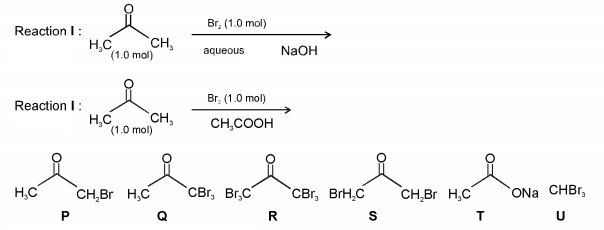
After completion of the reactions $(I)$ and $(II)$,the organic compound$(s)$ in the reaction mixtures is (are):
A
Reaction $I$: $T$,$U$,acetone and Reaction $II$: $P$
B
Reaction $I$: $U$,acetone and Reaction $II$: $Q$,acetone
C
Reaction $I$: $P$ and Reaction $II$: $P$
D
Reaction $I$: $R$,acetone and Reaction $II$: $S$,acetone
Solution
(A) In reaction $I$ (basic medium),the haloform reaction occurs. Since the rate of reaction increases with each $\alpha$-halogenation,$1.0 \ mol$ of acetone reacts with $1.0 \ mol$ of $Br_2$ to produce $CH_3COONa$ $(T)$,$CHBr_3$ $(U)$,and some unreacted acetone.
In reaction $II$ (acidic medium),monohalogenation takes place. $1.0 \ mol$ of acetone reacts with $1.0 \ mol$ of $Br_2$ to form $P$ $(CH_3COCH_2Br)$.
In reaction $II$ (acidic medium),monohalogenation takes place. $1.0 \ mol$ of acetone reacts with $1.0 \ mol$ of $Br_2$ to form $P$ $(CH_3COCH_2Br)$.
0 likes
View Solution1265
AdvancedMCQ
Consider all possible isomeric ketones,including stereoisomers of $MW = 100$. All these isomers are independently reacted with $NaBH_4$ ($NOTE$: stereoisomers are also reacted separately). The total number of ketones that give a racemic product$(s)$ is/are
A
$2$
B
$3$
C
$4$
D
$5$
Solution
(D) The molecular formula for a ketone is $C_nH_{2n}O$. Given $MW = 100$,we have $12n + 2n + 16 = 100$,which gives $14n = 84$,so $n = 6$. The formula is $C_6H_{12}O$.
The possible isomeric ketones are:
$1$. $Hexan-2-one$: Reduction gives a chiral alcohol,forming a racemic mixture.
$2$. $Hexan-3-one$: Reduction gives a chiral alcohol,forming a racemic mixture.
$3$. $4-Methylpentan-2-one$: Reduction gives a chiral alcohol,forming a racemic mixture.
$4$. $3-Methylpentan-2-one$: This has a chiral center. Reduction creates a new chiral center,resulting in diastereomers,not a racemic mixture.
$5$. $3,3-Dimethylbutan-2-one$: Reduction gives a chiral alcohol,forming a racemic mixture.
$6$. $3-Methylpentan-3-one$: Reduction gives a chiral alcohol,forming a racemic mixture.
Out of these,$5$ ketones produce a racemic mixture upon reduction with $NaBH_4$.
The possible isomeric ketones are:
$1$. $Hexan-2-one$: Reduction gives a chiral alcohol,forming a racemic mixture.
$2$. $Hexan-3-one$: Reduction gives a chiral alcohol,forming a racemic mixture.
$3$. $4-Methylpentan-2-one$: Reduction gives a chiral alcohol,forming a racemic mixture.
$4$. $3-Methylpentan-2-one$: This has a chiral center. Reduction creates a new chiral center,resulting in diastereomers,not a racemic mixture.
$5$. $3,3-Dimethylbutan-2-one$: Reduction gives a chiral alcohol,forming a racemic mixture.
$6$. $3-Methylpentan-3-one$: Reduction gives a chiral alcohol,forming a racemic mixture.
Out of these,$5$ ketones produce a racemic mixture upon reduction with $NaBH_4$.
0 likes
View Solution1266
AdvancedMCQ
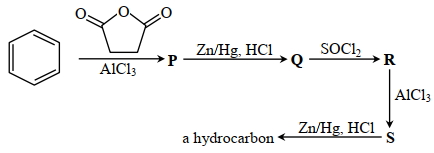
Considering the following reaction sequence,the correct statement$(s)$ is(are):
$A$. Compounds $P$ and $Q$ are carboxylic acids.
$B$. Compound $S$ decolorizes bromine water.
$C$. Compounds $P$ and $S$ react with hydroxylamine to give the corresponding oximes.
$D$. Compound $R$ reacts with dialkylcadmium to give the corresponding tertiary alcohol.
$A$. Compounds $P$ and $Q$ are carboxylic acids.
$B$. Compound $S$ decolorizes bromine water.
$C$. Compounds $P$ and $S$ react with hydroxylamine to give the corresponding oximes.
$D$. Compound $R$ reacts with dialkylcadmium to give the corresponding tertiary alcohol.
A
$A, B$
B
$A, D$
C
$A, C$
D
$A, B, C$
Solution
(C) $1$. The reaction of benzene with succinic anhydride in the presence of $AlCl_3$ (Friedel-Crafts acylation) gives $P$ ($4$-oxo$-4-$phenylbutanoic acid),which is a carboxylic acid.
$2$. Clemmensen reduction $(Zn/Hg, HCl)$ of $P$ gives $Q$ ($4$-phenylbutanoic acid),which is also a carboxylic acid. Thus,statement $A$ is correct.
$3$. $Q$ reacts with $SOCl_2$ to form $R$ ($4$-phenylbutanoyl chloride). Intramolecular Friedel-Crafts acylation of $R$ gives $S$ ($1$-tetralone).
$4$. $S$ ($1$-tetralone) is a ketone and does not contain a carbon-carbon double bond,so it does not decolorize bromine water. Statement $B$ is incorrect.
$5$. Both $P$ (a ketone) and $S$ (a ketone) react with hydroxylamine $(NH_2OH)$ to form oximes. Statement $C$ is correct.
$6$. Compound $R$ (an acid chloride) reacts with dialkylcadmium $(R'_2Cd)$ to give a ketone,not a tertiary alcohol. Statement $D$ is incorrect.
$7$. Therefore,the correct statements are $A$ and $C$.
$2$. Clemmensen reduction $(Zn/Hg, HCl)$ of $P$ gives $Q$ ($4$-phenylbutanoic acid),which is also a carboxylic acid. Thus,statement $A$ is correct.
$3$. $Q$ reacts with $SOCl_2$ to form $R$ ($4$-phenylbutanoyl chloride). Intramolecular Friedel-Crafts acylation of $R$ gives $S$ ($1$-tetralone).
$4$. $S$ ($1$-tetralone) is a ketone and does not contain a carbon-carbon double bond,so it does not decolorize bromine water. Statement $B$ is incorrect.
$5$. Both $P$ (a ketone) and $S$ (a ketone) react with hydroxylamine $(NH_2OH)$ to form oximes. Statement $C$ is correct.
$6$. Compound $R$ (an acid chloride) reacts with dialkylcadmium $(R'_2Cd)$ to give a ketone,not a tertiary alcohol. Statement $D$ is incorrect.
$7$. Therefore,the correct statements are $A$ and $C$.
0 likes
View Solution1267
AdvancedMCQ
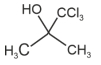
Reaction of iso-propylbenzene with $O_2$ followed by treatment with $H_3O^{+}$ forms phenol and a by-product $P$. Reaction of $P$ with $3$ equivalents of $Cl_2$ gives compound $Q$. Treatment of $Q$ with $Ca(OH)_2$ produces compound $R$ and calcium salt $S$. The correct statement(s) regarding $P, Q, R$ and $S$ is(are):
$(A)$ Reaction of $P$ with $R$ in the presence of $KOH$ gives chloritone.
$(B)$ Reaction of $R$ with $O_2$ in the presence of light gives phosgene gas.
$(C)$ $Q$ reacts with aqueous $NaOH$ to produce $Cl_3CCH_2OH$ and $Cl_3CCOONa$.
$(D)$ $S$ on heating gives $P$.
$(A)$ Reaction of $P$ with $R$ in the presence of $KOH$ gives chloritone.
$(B)$ Reaction of $R$ with $O_2$ in the presence of light gives phosgene gas.
$(C)$ $Q$ reacts with aqueous $NaOH$ to produce $Cl_3CCH_2OH$ and $Cl_3CCOONa$.
$(D)$ $S$ on heating gives $P$.
A
$A, B, D$
B
$A, B, C$
C
$A, B$
D
$A, C$
Solution
(A) $1$. The reaction of iso-propylbenzene (cumene) with $O_2$ followed by $H_3O^{+}$ is the cumene process, which yields phenol and acetone $(P = CH_3COCH_3)$.
$2$. Acetone $(P)$ reacts with $3$ equivalents of $Cl_2$ to form trichloroacetone $(Q = Cl_3CCOCH_3)$.
$3$. Trichloroacetone $(Q)$ reacts with $Ca(OH)_2$ to produce chloroform $(R = CHCl_3)$ and calcium acetate $(S = (CH_3COO)_2Ca)$.
$4$. Statement $(A)$: $CHCl_3$ reacts with acetone in the presence of $KOH$ to form chloritone $(Cl_3CC(OH)(CH_3)_2)$. This is correct.
$5$. Statement $(B)$: $CHCl_3$ $(R)$ reacts with $O_2$ in the presence of light to form phosgene $(COCl_2)$. This is correct.
$6$. Statement $(C)$: $Q$ $(Cl_3CCOCH_3)$ reacts with $NaOH$ via the haloform reaction, not as described. This is incorrect.
$7$. Statement $(D)$: Calcium acetate $(S)$ on dry distillation gives acetone $(P)$ and $CaCO_3$. This is correct.
Therefore, the correct statements are $A, B$, and $D$.
$2$. Acetone $(P)$ reacts with $3$ equivalents of $Cl_2$ to form trichloroacetone $(Q = Cl_3CCOCH_3)$.
$3$. Trichloroacetone $(Q)$ reacts with $Ca(OH)_2$ to produce chloroform $(R = CHCl_3)$ and calcium acetate $(S = (CH_3COO)_2Ca)$.
$4$. Statement $(A)$: $CHCl_3$ reacts with acetone in the presence of $KOH$ to form chloritone $(Cl_3CC(OH)(CH_3)_2)$. This is correct.
$5$. Statement $(B)$: $CHCl_3$ $(R)$ reacts with $O_2$ in the presence of light to form phosgene $(COCl_2)$. This is correct.
$6$. Statement $(C)$: $Q$ $(Cl_3CCOCH_3)$ reacts with $NaOH$ via the haloform reaction, not as described. This is incorrect.
$7$. Statement $(D)$: Calcium acetate $(S)$ on dry distillation gives acetone $(P)$ and $CaCO_3$. This is correct.
Therefore, the correct statements are $A, B$, and $D$.
0 likes
View Solution1268
AdvancedMCQ
Complete reaction of acetaldehyde with excess formaldehyde,upon heating with conc. $NaOH$ solution,gives $P$ and $Q$. Compound $P$ does not give Tollens' test,whereas $Q$ on acidification gives positive Tollens' test. Treatment of $P$ with excess cyclohexanone in the presence of catalytic amount of $p$-toluenesulfonic acid $(PTSA)$ gives product $R$. Sum of the number of methylene groups $(-CH_2-)$ and oxygen atoms in $R$ is....
A
$10$
B
$15$
C
$18$
D
$20$
Solution
(C) The reaction of acetaldehyde $(CH_3CHO)$ with excess formaldehyde $(HCHO)$ in the presence of conc. $NaOH$ is an aldol condensation followed by Cannizzaro reaction,yielding pentaerythritol ($P$,$C(CH_2OH)_4$) and sodium formate ($Q$,$HCOONa$).
$P$ is $C(CH_2OH)_4$,which has no aldehyde group and does not give Tollens' test.
$Q$ is $HCOONa$,which upon acidification gives formic acid $(HCOOH)$,which gives a positive Tollens' test.
Reaction of $P$ with excess cyclohexanone in the presence of $PTSA$ forms an acetal $R$ (a spiro-compound).
The structure of $R$ is $C(CH_2O)_2(C_6H_{10})_2$.
In $R$,there are $12$ methylene groups from two cyclohexanone rings and $2$ methylene groups from the central carbon's substituents,totaling $14$ methylene groups $(-CH_2-)$.
There are $4$ oxygen atoms in the two acetal linkages.
Sum $= 14 + 4 = 18$.
$P$ is $C(CH_2OH)_4$,which has no aldehyde group and does not give Tollens' test.
$Q$ is $HCOONa$,which upon acidification gives formic acid $(HCOOH)$,which gives a positive Tollens' test.
Reaction of $P$ with excess cyclohexanone in the presence of $PTSA$ forms an acetal $R$ (a spiro-compound).
The structure of $R$ is $C(CH_2O)_2(C_6H_{10})_2$.
In $R$,there are $12$ methylene groups from two cyclohexanone rings and $2$ methylene groups from the central carbon's substituents,totaling $14$ methylene groups $(-CH_2-)$.
There are $4$ oxygen atoms in the two acetal linkages.
Sum $= 14 + 4 = 18$.
0 likes
View Solution1269
MediumMCQ
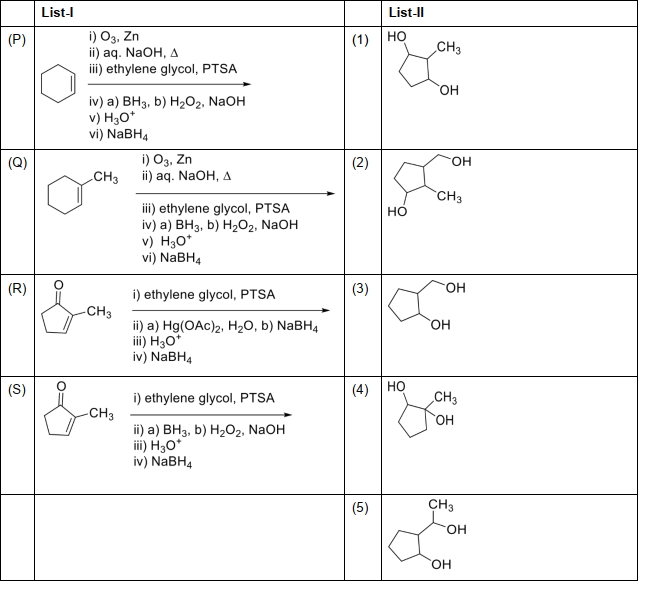
List-$I$ contains various reaction sequences and List-$II$ contains the possible products. Match each entry in List-$I$ with the appropriate entry in List-$II$ and choose the correct option.
A
$P-3, Q-5, R-4, S-1$
B
$P-3, Q-2, R-4, S-1$
C
$P-3, Q-5, R-1, S-4$
D
$P-5, Q-2, R-4, S-1$
Solution
(A) For $(P)$: Cyclohexene undergoes ozonolysis to give hexanedial,followed by intramolecular aldol condensation to form cyclohex$-1-$enecarbaldehyde. Protection of the aldehyde with ethylene glycol,hydroboration-oxidation,deprotection,and reduction with $NaBH_4$ yields $(3)$.
For $(Q)$: $1-$Methylcyclohexene undergoes ozonolysis,aldol condensation,protection,hydroboration-oxidation,deprotection,and reduction to yield $(5)$.
For $(R)$: $3-$Methylcyclopent$-2-$enone is protected,subjected to oxymercuration-demercuration,deprotected,and reduced to yield $(4)$.
For $(S)$: $3-$Methylcyclopent$-2-$enone is protected,subjected to hydroboration-oxidation,deprotected,and reduced to yield $(1)$.
Thus,the correct matching is $P-3, Q-5, R-4, S-1$.
For $(Q)$: $1-$Methylcyclohexene undergoes ozonolysis,aldol condensation,protection,hydroboration-oxidation,deprotection,and reduction to yield $(5)$.
For $(R)$: $3-$Methylcyclopent$-2-$enone is protected,subjected to oxymercuration-demercuration,deprotected,and reduced to yield $(4)$.
For $(S)$: $3-$Methylcyclopent$-2-$enone is protected,subjected to hydroboration-oxidation,deprotected,and reduced to yield $(1)$.
Thus,the correct matching is $P-3, Q-5, R-4, S-1$.
0 likes
View Solution1270
MediumMCQ
The option$(s)$ with the correct sequence of reagents for the conversion of $P$ to $Q$ is(are):
$(A)$ $i$) Lindlar's catalyst,$H_2$; $ii$) $SnCl_2 / HCl$; $iii$) $NaBH_4$; $iv$) $H_3O^{+}$
$(B)$ $i$) Lindlar's catalyst,$H_2$; $ii$) $H_3O^{+}$; $iii$) $SnCl_2 / HCl$; $iv$) $NaBH_4$
$(C)$ $i$) $NaBH_4$; $ii$) $SnCl_2 / HCl$; $iii$) $H_3O^{+}$; $iv$) Lindlar's catalyst,$H_2$
$(D)$ $i$) Lindlar's catalyst,$H_2$; $ii$) $NaBH_4$; $iii$) $SnCl_2 / HCl$; $iv$) $H_3O^{+}$
$(A)$ $i$) Lindlar's catalyst,$H_2$; $ii$) $SnCl_2 / HCl$; $iii$) $NaBH_4$; $iv$) $H_3O^{+}$
$(B)$ $i$) Lindlar's catalyst,$H_2$; $ii$) $H_3O^{+}$; $iii$) $SnCl_2 / HCl$; $iv$) $NaBH_4$
$(C)$ $i$) $NaBH_4$; $ii$) $SnCl_2 / HCl$; $iii$) $H_3O^{+}$; $iv$) Lindlar's catalyst,$H_2$
$(D)$ $i$) Lindlar's catalyst,$H_2$; $ii$) $NaBH_4$; $iii$) $SnCl_2 / HCl$; $iv$) $H_3O^{+}$
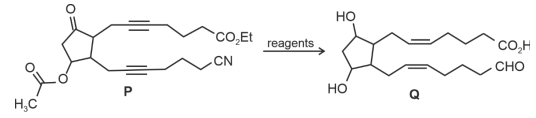
A
$A, C, D$
B
$A, C$
C
$A, D$
D
$A, B, C$
Solution
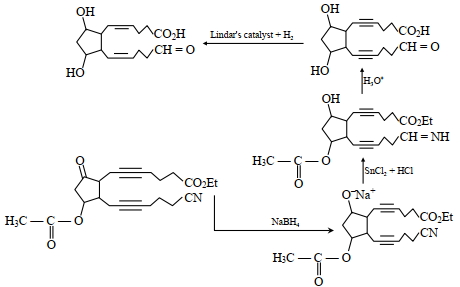
(C) To convert $P$ to $Q$,we need to perform the following transformations:
$1$. Reduction of the ketone and the ester/nitrile groups.
$2$. Selective reduction of the two alkyne groups to cis-alkenes using Lindlar's catalyst and $H_2$.
$3$. Reduction of the nitrile group $(-CN)$ to an aldehyde $(-CHO)$ using $SnCl_2 / HCl$ (Stephen reduction).
$4$. Reduction of the ketone group to an alcohol using $NaBH_4$.
$5$. Hydrolysis of the ester and imine intermediate using $H_3O^{+}$.
Analyzing the sequence in option $(C)$:
$i$) $NaBH_4$ reduces the ketone to an alcohol.
$ii$) $SnCl_2 / HCl$ reduces the nitrile to an imine.
$iii$) $H_3O^{+}$ hydrolyzes the imine to an aldehyde and the ester to a carboxylic acid.
$iv$) Lindlar's catalyst with $H_2$ reduces the two internal alkynes to cis-alkenes.
This sequence correctly transforms $P$ to $Q$.
$1$. Reduction of the ketone and the ester/nitrile groups.
$2$. Selective reduction of the two alkyne groups to cis-alkenes using Lindlar's catalyst and $H_2$.
$3$. Reduction of the nitrile group $(-CN)$ to an aldehyde $(-CHO)$ using $SnCl_2 / HCl$ (Stephen reduction).
$4$. Reduction of the ketone group to an alcohol using $NaBH_4$.
$5$. Hydrolysis of the ester and imine intermediate using $H_3O^{+}$.
Analyzing the sequence in option $(C)$:
$i$) $NaBH_4$ reduces the ketone to an alcohol.
$ii$) $SnCl_2 / HCl$ reduces the nitrile to an imine.
$iii$) $H_3O^{+}$ hydrolyzes the imine to an aldehyde and the ester to a carboxylic acid.
$iv$) Lindlar's catalyst with $H_2$ reduces the two internal alkynes to cis-alkenes.
This sequence correctly transforms $P$ to $Q$.
0 likes
View Solution1271
AdvancedMCQ
An organic compound $P$ having molecular formula $C_6H_6O_3$ gives a ferric chloride test and does not have an intramolecular hydrogen bond. The compound $P$ reacts with $3$ equivalents of $NH_2OH$ to produce oxime $Q$. Treatment of $P$ with excess methyl iodide in the presence of $KOH$ produces compound $R$ as the major product. Reaction of $R$ with excess iso-butylmagnesium bromide followed by treatment with $H_3O^{+}$ gives compound $S$ as the major product. The total number of methyl $(-CH_3)$ groups in compound $S$ is . . . .
A
$10$
B
$12$
C
$15$
D
$20$
Solution
(A) The compound $P$ is cyclohexane-$1,3,5$-trione,which exists in tautomeric equilibrium with phloroglucinol. It gives a positive $FeCl_3$ test due to the enol form and lacks intramolecular hydrogen bonding in the tri-keto form.
$P$ reacts with $3$ equivalents of $NH_2OH$ to form the tri-oxime $Q$.
Treatment of $P$ with excess $CH_3I$ and $KOH$ results in the exhaustive methylation of the $\alpha$-carbons,yielding $2,2,4,4,6,6$-hexamethylcyclohexane-$1,3,5$-trione $(R)$.
Reaction of $R$ with excess iso-butylmagnesium bromide $(iso-BuMgBr)$ acts as a base due to the steric hindrance of the six methyl groups on the $\alpha$-carbons,leading to the reduction of the carbonyl groups to hydroxyl groups (enolization/reduction) rather than nucleophilic addition. The final product $S$ is $2,2,4,4,6,6$-hexamethylcyclohexane-$1,3,5$-triol.
In $2,2,4,4,6,6$-hexamethylcyclohexane-$1,3,5$-triol,there are $6$ methyl groups attached to the ring carbons. Each methyl group is a $-CH_3$ unit. Thus,the total number of methyl groups is $6$.
$P$ reacts with $3$ equivalents of $NH_2OH$ to form the tri-oxime $Q$.
Treatment of $P$ with excess $CH_3I$ and $KOH$ results in the exhaustive methylation of the $\alpha$-carbons,yielding $2,2,4,4,6,6$-hexamethylcyclohexane-$1,3,5$-trione $(R)$.
Reaction of $R$ with excess iso-butylmagnesium bromide $(iso-BuMgBr)$ acts as a base due to the steric hindrance of the six methyl groups on the $\alpha$-carbons,leading to the reduction of the carbonyl groups to hydroxyl groups (enolization/reduction) rather than nucleophilic addition. The final product $S$ is $2,2,4,4,6,6$-hexamethylcyclohexane-$1,3,5$-triol.
In $2,2,4,4,6,6$-hexamethylcyclohexane-$1,3,5$-triol,there are $6$ methyl groups attached to the ring carbons. Each methyl group is a $-CH_3$ unit. Thus,the total number of methyl groups is $6$.
0 likes
View Solution1272
MediumMCQ
The compounds which give positive Fehling's test are:
$(A)$ $C_6H_5CHO$
$(B)$ $C_6H_5COCH_3$
$(C)$ $HOCH_2-CO-(CHOH)_3-CH_2OH$
$(D)$ $CH_3CHO$
$(E)$ $C_6H_5CH_2CHO$
Choose the correct answer from the options given below:
$(A)$ $C_6H_5CHO$
$(B)$ $C_6H_5COCH_3$
$(C)$ $HOCH_2-CO-(CHOH)_3-CH_2OH$
$(D)$ $CH_3CHO$
$(E)$ $C_6H_5CH_2CHO$
Choose the correct answer from the options given below:
A
$A$,$C$ and $D$ Only
B
$A$,$D$ and $E$ Only
C
$C$,$D$ and $E$ Only
D
$A$,$B$ and $C$ Only
Solution
(C) Fehling's test is given by aliphatic aldehydes. Aromatic aldehydes do not give this test.
$(A)$ $C_6H_5CHO$ is an aromatic aldehyde,so it gives a negative test.
$(B)$ $C_6H_5COCH_3$ is a ketone,so it gives a negative test.
$(C)$ $HOCH_2-CO-(CHOH)_3-CH_2OH$ is a ketose sugar (fructose). In alkaline medium,it isomerizes to aldose,thus giving a positive Fehling's test.
$(D)$ $CH_3CHO$ is an aliphatic aldehyde,so it gives a positive test.
$(E)$ $C_6H_5CH_2CHO$ is an aliphatic aldehyde (the aldehyde group is not directly attached to the benzene ring),so it gives a positive test.
Therefore,compounds $(C)$,$(D)$,and $(E)$ give a positive Fehling's test.
$(A)$ $C_6H_5CHO$ is an aromatic aldehyde,so it gives a negative test.
$(B)$ $C_6H_5COCH_3$ is a ketone,so it gives a negative test.
$(C)$ $HOCH_2-CO-(CHOH)_3-CH_2OH$ is a ketose sugar (fructose). In alkaline medium,it isomerizes to aldose,thus giving a positive Fehling's test.
$(D)$ $CH_3CHO$ is an aliphatic aldehyde,so it gives a positive test.
$(E)$ $C_6H_5CH_2CHO$ is an aliphatic aldehyde (the aldehyde group is not directly attached to the benzene ring),so it gives a positive test.
Therefore,compounds $(C)$,$(D)$,and $(E)$ give a positive Fehling's test.
0 likes
View Solution1273
DifficultMCQ
Toluene (excess) undergoes the following sequence of reactions:
$(i)$ $CrO_2Cl_2, CS_2$
(ii) $H_3O^+$
(iii) $NaHSO_3$
After filtration,a residue $(A)$ is obtained. This residue $(A)$ reacts with $dil. \ HCl$ to form compound $(B)$.
Identify the structures of residue $(A)$ and compound $(B)$ respectively.
$(i)$ $CrO_2Cl_2, CS_2$
(ii) $H_3O^+$
(iii) $NaHSO_3$
After filtration,a residue $(A)$ is obtained. This residue $(A)$ reacts with $dil. \ HCl$ to form compound $(B)$.
Identify the structures of residue $(A)$ and compound $(B)$ respectively.
A
Residue $(A)$: $C_6H_5CHO$,Compound $(B)$: $C_6H_5COOH$
B
Residue $(A)$: $C_6H_5CH(OCrOHCl_2)_2$,Compound $(B)$: $C_6H_5CHO$
C
Residue $(A)$: $C_6H_5CHO$,Compound $(B)$: $C_6H_5COONa$
D
Residue $(A)$: $C_6H_5CH(OH)SO_3Na$,Compound $(B)$: $C_6H_5CHO$
Solution
(D) $1$. Toluene reacts with $CrO_2Cl_2$ in $CS_2$ followed by hydrolysis $(H_3O^+)$ to form benzaldehyde $(C_6H_5CHO)$ via the Etard reaction.
$2$. Benzaldehyde then reacts with sodium bisulphite $(NaHSO_3)$ to form a crystalline addition product,which is the residue $(A)$. The structure of $(A)$ is $C_6H_5CH(OH)SO_3Na$.
$3$. When this residue $(A)$ is treated with dilute $HCl$,it undergoes hydrolysis to regenerate benzaldehyde,which is compound $(B)$.
$4$. Therefore,residue $(A)$ is $C_6H_5CH(OH)SO_3Na$ and compound $(B)$ is $C_6H_5CHO$.
$2$. Benzaldehyde then reacts with sodium bisulphite $(NaHSO_3)$ to form a crystalline addition product,which is the residue $(A)$. The structure of $(A)$ is $C_6H_5CH(OH)SO_3Na$.
$3$. When this residue $(A)$ is treated with dilute $HCl$,it undergoes hydrolysis to regenerate benzaldehyde,which is compound $(B)$.
$4$. Therefore,residue $(A)$ is $C_6H_5CH(OH)SO_3Na$ and compound $(B)$ is $C_6H_5CHO$.
0 likes
View Solution1274
MediumMCQ
The major product of the following reaction is :
$CH_3-CH_2-CHO \xrightarrow[\text{reflux}]{\text{excess } HCHO / \text{alkali}} ?$
$CH_3-CH_2-CHO \xrightarrow[\text{reflux}]{\text{excess } HCHO / \text{alkali}} ?$
A
$CH_3-CH_2-CH_2-OH$
B
$CH_3-CH(CH_2OH)_2$
C
$CH_3-C(CH_2OH)_2-CHO$
D
$CH_3-C(=CH_2)-CHO$
Solution
(C) The reaction of $CH_3-CH_2-CHO$ with excess $HCHO$ in the presence of an alkali involves two steps:
$1$. Multiple cross-aldol condensation: The $\alpha$-hydrogens of propanal are replaced by hydroxymethyl groups $(CH_2OH)$ through reaction with $HCHO$. Since propanal has two $\alpha$-hydrogens,both are replaced to form $CH_3-C(CH_2OH)_2-CHO$.
$2$. Cross-Cannizzaro reaction: The remaining aldehyde group $(-CHO)$ is then reduced to a primary alcohol $(-CH_2OH)$ by the excess $HCHO$,which itself gets oxidized to formate.
The final product is $CH_3-C(CH_2OH)_3$.
$1$. Multiple cross-aldol condensation: The $\alpha$-hydrogens of propanal are replaced by hydroxymethyl groups $(CH_2OH)$ through reaction with $HCHO$. Since propanal has two $\alpha$-hydrogens,both are replaced to form $CH_3-C(CH_2OH)_2-CHO$.
$2$. Cross-Cannizzaro reaction: The remaining aldehyde group $(-CHO)$ is then reduced to a primary alcohol $(-CH_2OH)$ by the excess $HCHO$,which itself gets oxidized to formate.
The final product is $CH_3-C(CH_2OH)_3$.
0 likes
View Solution1275
DifficultMCQ
Given below are two statements: Consider the following reaction: $R_2C=O + H_2O \rightleftharpoons R_2C(OH)_2$.
Statement $I$: In the case of formaldehyde $(HCHO)$,$K_{eq}$ is about $2280$,due to small substituents,hydration is faster.
Statement $II$: In the case of trichloroacetaldehyde $(CCl_3CHO)$,$K_{eq}$ is about $2000$ due to the $-I$ effect of $-Cl$ atoms.
In the light of the above statements,choose the correct answer from the options given below:
Statement $I$: In the case of formaldehyde $(HCHO)$,$K_{eq}$ is about $2280$,due to small substituents,hydration is faster.
Statement $II$: In the case of trichloroacetaldehyde $(CCl_3CHO)$,$K_{eq}$ is about $2000$ due to the $-I$ effect of $-Cl$ atoms.
In the light of the above statements,choose the correct answer from the options given below:
A
Statement $I$ is true but Statement $II$ is false
B
Both Statement $I$ and Statement $II$ are true
C
Statement $I$ is false but Statement $II$ is true
D
Both Statement $I$ and Statement $II$ are false
Solution
(B) The hydration of carbonyl compounds involves the nucleophilic addition of water to the carbonyl carbon.
For formaldehyde $(HCHO)$,the $K_{eq}$ for hydration is approximately $2280$. This high value is due to the lack of steric hindrance (small substituents) and the high electrophilicity of the carbonyl carbon.
For trichloroacetaldehyde ($CCl_3CHO$,also known as chloral),the $K_{eq}$ for hydration is approximately $2000$. This high value is primarily due to the strong electron-withdrawing $-I$ effect of the three chlorine atoms,which makes the carbonyl carbon highly electrophilic and susceptible to nucleophilic attack by water.
Both statements are scientifically accurate based on standard chemical literature.
Therefore,both Statement $I$ and Statement $II$ are true.
For formaldehyde $(HCHO)$,the $K_{eq}$ for hydration is approximately $2280$. This high value is due to the lack of steric hindrance (small substituents) and the high electrophilicity of the carbonyl carbon.
For trichloroacetaldehyde ($CCl_3CHO$,also known as chloral),the $K_{eq}$ for hydration is approximately $2000$. This high value is primarily due to the strong electron-withdrawing $-I$ effect of the three chlorine atoms,which makes the carbonyl carbon highly electrophilic and susceptible to nucleophilic attack by water.
Both statements are scientifically accurate based on standard chemical literature.
Therefore,both Statement $I$ and Statement $II$ are true.
0 likes
View Solution1276
MediumMCQ
Which of the following arrangements with respect to their reactivity in nucleophilic addition reaction is correct?
A
benzaldehyde < acetophenone < $p$-nitrobenzaldehyde < $p$-tolualdehyde
B
acetophenone < benzaldehyde < $p$-tolualdehyde < $p$-nitrobenzaldehyde
C
acetophenone < $p$-tolualdehyde < benzaldehyde < $p$-nitrobenzaldehyde
D
$p$-nitrobenzaldehyde < benzaldehyde < $p$-tolualdehyde < acetophenone
Solution
(C) The reactivity of carbonyl compounds towards nucleophilic addition reactions depends on two factors: steric hindrance and electronic effects.
$1$. Steric hindrance: Ketones are less reactive than aldehydes due to the presence of two bulky alkyl/aryl groups. Thus,acetophenone is the least reactive among the given compounds.
$2$. Electronic effects: Electron-withdrawing groups (like $-NO_2$) increase the electrophilicity of the carbonyl carbon,thereby increasing reactivity. Electron-donating groups (like $-CH_3$) decrease the electrophilicity,thereby decreasing reactivity.
Comparing the compounds:
- Acetophenone: Ketone,least reactive.
- $p$-Tolualdehyde: Contains an electron-donating $-CH_3$ group,making it less reactive than benzaldehyde.
- Benzaldehyde: Standard reactivity.
- $p$-Nitrobenzaldehyde: Contains an electron-withdrawing $-NO_2$ group,making it the most reactive.
Therefore,the correct order of reactivity is: $acetophenone < p-tolualdehyde < benzaldehyde < p-nitrobenzaldehyde$.
$1$. Steric hindrance: Ketones are less reactive than aldehydes due to the presence of two bulky alkyl/aryl groups. Thus,acetophenone is the least reactive among the given compounds.
$2$. Electronic effects: Electron-withdrawing groups (like $-NO_2$) increase the electrophilicity of the carbonyl carbon,thereby increasing reactivity. Electron-donating groups (like $-CH_3$) decrease the electrophilicity,thereby decreasing reactivity.
Comparing the compounds:
- Acetophenone: Ketone,least reactive.
- $p$-Tolualdehyde: Contains an electron-donating $-CH_3$ group,making it less reactive than benzaldehyde.
- Benzaldehyde: Standard reactivity.
- $p$-Nitrobenzaldehyde: Contains an electron-withdrawing $-NO_2$ group,making it the most reactive.
Therefore,the correct order of reactivity is: $acetophenone < p-tolualdehyde < benzaldehyde < p-nitrobenzaldehyde$.
0 likes
View Solution1277
MediumMCQ
Both acetaldehyde and acetone (individually) undergo which of the following reactions?
$A$. Iodoform Reaction
$B$. Cannizzaro Reaction
$C$. Aldol condensation
$D$. Tollen's Test
$E$. Clemmensen Reduction
Choose the correct answer from the options given below:
$A$. Iodoform Reaction
$B$. Cannizzaro Reaction
$C$. Aldol condensation
$D$. Tollen's Test
$E$. Clemmensen Reduction
Choose the correct answer from the options given below:
A
$A, B$ and $D$ only
B
$A, C$ and $E$ only
C
$C$ and $E$ only
D
$B, C$ and $D$ only
Solution
(B) To determine which reactions both acetaldehyde $(CH_3CHO)$ and acetone $(CH_3COCH_3)$ undergo,we analyze each reaction:
$1$. Iodoform reaction $(A)$: Both contain the $CH_3CO-$ group,so both give a positive test.
$2$. Cannizzaro reaction $(B)$: Neither has an $\alpha$-hydrogen,so neither undergoes this reaction.
$3$. Aldol condensation $(C)$: Both have $\alpha$-hydrogens,so both undergo this reaction.
$4$. Tollen's test $(D)$: Only aldehydes give a positive test; acetone (a ketone) does not.
$5$. Clemmensen reduction $(E)$: Both aldehydes and ketones undergo this reduction.
Therefore,both compounds undergo reactions $A, C$,and $E$.
| $S.No$. Name of Reaction | Acetaldehyde $(CH_3CHO)$ | Acetone $(CH_3COCH_3)$ |
| $1$. Iodoform reaction | Positive | Positive |
| $2$. Cannizzaro reaction | Negative | Negative |
| $3$. Aldol condensation | Positive | Positive |
| $4$. Tollen's test | Positive | Negative |
| $5$. Clemmensen reduction | Positive | Positive |
$1$. Iodoform reaction $(A)$: Both contain the $CH_3CO-$ group,so both give a positive test.
$2$. Cannizzaro reaction $(B)$: Neither has an $\alpha$-hydrogen,so neither undergoes this reaction.
$3$. Aldol condensation $(C)$: Both have $\alpha$-hydrogens,so both undergo this reaction.
$4$. Tollen's test $(D)$: Only aldehydes give a positive test; acetone (a ketone) does not.
$5$. Clemmensen reduction $(E)$: Both aldehydes and ketones undergo this reduction.
Therefore,both compounds undergo reactions $A, C$,and $E$.
0 likes
View Solution1278
DifficultMCQ
Total number of nucleophiles from the following is $:-$ $NH_3, PhSH, (H_3C)_2S, H_2C=CH_2, \stackrel{\ominus}{O}H, H_3O^{\oplus}, (CH_3)_2CO, CH_3CH=NCH_3$
A
$5$
B
$4$
C
$7$
D
$6$
Solution
(A) nucleophile is a species that donates an electron pair to form a chemical bond. They are either negatively charged or neutral species with at least one lone pair of electrons or a $\pi$-bond.
$1$. $NH_3$: Has a lone pair on $N$.
$2$. $PhSH$: Has lone pairs on $S$.
$3$. $(H_3C)_2S$: Has lone pairs on $S$.
$4$. $H_2C=CH_2$: Contains a $\pi$-bond.
$5$. $\stackrel{\ominus}{O}H$: Negatively charged with lone pairs.
$H_3O^{\oplus}$ is an electrophile (or acid),$(CH_3)_2CO$ is an electrophile (carbonyl carbon),and $CH_3CH=NCH_3$ has a lone pair on $N$ but is generally considered an electrophile at the $C=N$ bond,though it can act as a weak nucleophile. However,in standard classification,the first $5$ are clearly identified as nucleophiles.
Thus,the total number of nucleophiles is $5$.
$1$. $NH_3$: Has a lone pair on $N$.
$2$. $PhSH$: Has lone pairs on $S$.
$3$. $(H_3C)_2S$: Has lone pairs on $S$.
$4$. $H_2C=CH_2$: Contains a $\pi$-bond.
$5$. $\stackrel{\ominus}{O}H$: Negatively charged with lone pairs.
$H_3O^{\oplus}$ is an electrophile (or acid),$(CH_3)_2CO$ is an electrophile (carbonyl carbon),and $CH_3CH=NCH_3$ has a lone pair on $N$ but is generally considered an electrophile at the $C=N$ bond,though it can act as a weak nucleophile. However,in standard classification,the first $5$ are clearly identified as nucleophiles.
Thus,the total number of nucleophiles is $5$.
0 likes
View Solution1279
MediumMCQ
The product $(P)$ formed in the following reaction is $:$
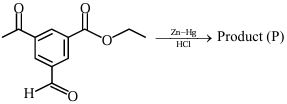
A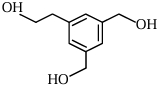
B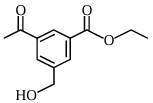
C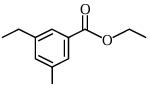
D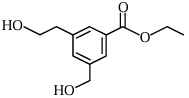
Solution
(D) The given reaction uses $Zn-Hg/HCl$,which is the reagent for Clemmensen reduction.
Clemmensen reduction specifically reduces carbonyl groups (aldehydes and ketones) to methylene groups $(-CH_2-)$.
It does not affect ester groups $(-COOC_2H_5)$.
In the given reactant,there is an acetyl group $(-COCH_3)$ and an aldehyde group $(-CHO)$ attached to the benzene ring.
Both the acetyl group and the aldehyde group will be reduced to ethyl $(-CH_2CH_3)$ and methyl $(-CH_3)$ groups respectively.
The ester group remains unchanged.
Therefore,the product $(P)$ is ethyl $3-$ethyl$-5-$methylbenzoate.
Clemmensen reduction specifically reduces carbonyl groups (aldehydes and ketones) to methylene groups $(-CH_2-)$.
It does not affect ester groups $(-COOC_2H_5)$.
In the given reactant,there is an acetyl group $(-COCH_3)$ and an aldehyde group $(-CHO)$ attached to the benzene ring.
Both the acetyl group and the aldehyde group will be reduced to ethyl $(-CH_2CH_3)$ and methyl $(-CH_3)$ groups respectively.
The ester group remains unchanged.
Therefore,the product $(P)$ is ethyl $3-$ethyl$-5-$methylbenzoate.
0 likes
View Solution1280
DifficultMCQ
In the Claisen$-$Schmidt reaction to prepare dibenzalacetone from $5.3 \ g$ benzaldehyde,a total of $3.51 \ g$ of product was obtained. The percentage yield in this reaction was $......... \%.$
A
$20$
B
$30$
C
$60$
D
$80$
Solution
(C) The chemical reaction is: $2 \ C_6H_5CHO + CH_3COCH_3 \rightarrow C_6H_5CH=CHCOCH=CHC_6H_5 + 2H_2O$.
Moles of benzaldehyde used $= \frac{5.3 \ g}{106 \ g/mol} = 0.05 \ mol$.
According to the stoichiometry,$2 \ mol$ of benzaldehyde produces $1 \ mol$ of dibenzalacetone.
Therefore,theoretical moles of dibenzalacetone $= \frac{0.05}{2} = 0.025 \ mol$.
Molar mass of dibenzalacetone $(C_{17}H_{14}O) = (17 \times 12) + (14 \times 1) + 16 = 234 \ g/mol$.
Theoretical yield in grams $= 0.025 \ mol \times 234 \ g/mol = 5.85 \ g$.
Actual yield $= 3.51 \ g$.
Percentage yield $= \frac{\text{Actual yield}}{\text{Theoretical yield}} \times 100 = \frac{3.51}{5.85} \times 100 = 60 \%$.
Moles of benzaldehyde used $= \frac{5.3 \ g}{106 \ g/mol} = 0.05 \ mol$.
According to the stoichiometry,$2 \ mol$ of benzaldehyde produces $1 \ mol$ of dibenzalacetone.
Therefore,theoretical moles of dibenzalacetone $= \frac{0.05}{2} = 0.025 \ mol$.
Molar mass of dibenzalacetone $(C_{17}H_{14}O) = (17 \times 12) + (14 \times 1) + 16 = 234 \ g/mol$.
Theoretical yield in grams $= 0.025 \ mol \times 234 \ g/mol = 5.85 \ g$.
Actual yield $= 3.51 \ g$.
Percentage yield $= \frac{\text{Actual yield}}{\text{Theoretical yield}} \times 100 = \frac{3.51}{5.85} \times 100 = 60 \%$.
0 likes
View Solution1281
DifficultMCQ
An optically active alkyl halide $C_4H_9Br$ $[A]$ reacts with hot $KOH$ dissolved in ethanol and forms alkene $[B]$ as the major product,which reacts with bromine to give dibromide $[C].$ The compound $[C]$ is converted into a gas $[D]$ upon reacting with alcoholic $NaNH_2.$ During hydration,$18 \ g$ of water is added to $1 \ mole$ of gas $[D]$ on warming with mercuric sulphate and dilute acid at $333 \ K$ to form compound $[E].$ The $IUPAC$ name of compound $[E]$ is $:$
A
But$-2-$yne
B
Butan$-2-$ol
C
Butan$-2-$one
D
Butan$-1-$al
Solution
(C) $1$. The optically active alkyl halide $[A]$ is $sec$-butyl bromide $(CH_3CH_2CH(Br)CH_3)$.
$2$. Reaction with hot alcoholic $KOH$ (dehydrohalogenation) gives but$-2-$ene as the major product $[B]$ $(CH_3CH=CHCH_3)$.
$3$. Reaction of $[B]$ with $Br_2$ gives $2,3-$dibromobutane $[C]$ $(CH_3CH(Br)CH(Br)CH_3)$.
$4$. Reaction of $[C]$ with alcoholic $NaNH_2$ (dehydrohalogenation) gives but$-1-$yne $[D]$ $(CH_3CH_2C \equiv CH)$.
$5$. Hydration of but$-1-$yne $[D]$ with $H_2O$ in the presence of $HgSO_4$ and $H^+$ (Kucherov reaction) follows Markovnikov's rule to form an enol intermediate,which tautomerizes to form butan$-2-$one $[E]$ $(CH_3CH_2COCH_3)$.
$6$. The $IUPAC$ name of $[E]$ is butan$-2-$one.
$2$. Reaction with hot alcoholic $KOH$ (dehydrohalogenation) gives but$-2-$ene as the major product $[B]$ $(CH_3CH=CHCH_3)$.
$3$. Reaction of $[B]$ with $Br_2$ gives $2,3-$dibromobutane $[C]$ $(CH_3CH(Br)CH(Br)CH_3)$.
$4$. Reaction of $[C]$ with alcoholic $NaNH_2$ (dehydrohalogenation) gives but$-1-$yne $[D]$ $(CH_3CH_2C \equiv CH)$.
$5$. Hydration of but$-1-$yne $[D]$ with $H_2O$ in the presence of $HgSO_4$ and $H^+$ (Kucherov reaction) follows Markovnikov's rule to form an enol intermediate,which tautomerizes to form butan$-2-$one $[E]$ $(CH_3CH_2COCH_3)$.
$6$. The $IUPAC$ name of $[E]$ is butan$-2-$one.
0 likes
View Solution1282
MediumMCQ
Given below are two statements $:$
Statement $(I) :$ Vanillin,with the structure shown below,will react with $NaOH$ and also with Tollen's reagent.
Statement $(II) :$ Vanillin will undergo self-aldol condensation very easily.
In the light of the above statements,choose the most appropriate answer from the options given below $:$
Statement $(I) :$ Vanillin,with the structure shown below,will react with $NaOH$ and also with Tollen's reagent.
Statement $(II) :$ Vanillin will undergo self-aldol condensation very easily.
In the light of the above statements,choose the most appropriate answer from the options given below $:$
A
Statement $I$ is incorrect but Statement $II$ is correct
B
Statement $I$ is correct but Statement $II$ is incorrect
C
Both Statement $I$ and Statement $II$ are incorrect
D
Both Statement $I$ and Statement $II$ are correct
Solution
(B) Vanillin contains a phenolic $-OH$ group,which is acidic and reacts with $NaOH$ to form a salt. It also contains an aldehyde group $(-CHO)$,which reacts with Tollen's reagent to give a silver mirror test.
Therefore,Statement $(I)$ is correct.
Vanillin does not have any $\alpha$-hydrogen atoms relative to the carbonyl group. Aldol condensation requires the presence of at least one $\alpha$-hydrogen atom. Thus,it cannot undergo self-aldol condensation.
Therefore,Statement $(II)$ is incorrect.
Therefore,Statement $(I)$ is correct.
Vanillin does not have any $\alpha$-hydrogen atoms relative to the carbonyl group. Aldol condensation requires the presence of at least one $\alpha$-hydrogen atom. Thus,it cannot undergo self-aldol condensation.
Therefore,Statement $(II)$ is incorrect.
0 likes
View Solution1283
MediumMCQ
Number of molecules from the following which cannot give the iodoform reaction is $:$ Ethanol,Isopropyl alcohol,Bromoacetone,$2-$Butanol,$2-$Butanone,Butanal,$2-$Pentanone,$3-$Pentanone,Pentanal,and $3-$Pentanol.
A
$5$
B
$4$
C
$3$
D
$2$
Solution
(B) The iodoform reaction is given by compounds containing the $CH_3CO-$ group or the $CH_3CH(OH)-$ group.
$1$. Ethanol $(CH_3CH_2OH)$: Gives iodoform test.
$2$. Isopropyl alcohol $(CH_3CH(OH)CH_3)$: Gives iodoform test.
$3$. Bromoacetone $(CH_3COCH_2Br)$: Gives iodoform test.
$4$. $2-$Butanol $(CH_3CH(OH)CH_2CH_3)$: Gives iodoform test.
$5$. $2-$Butanone $(CH_3COCH_2CH_3)$: Gives iodoform test.
$6$. Butanal $(CH_3CH_2CH_2CHO)$: Does not give iodoform test.
$7$. $2-$Pentanone $(CH_3COCH_2CH_2CH_3)$: Gives iodoform test.
$8$. $3-$Pentanone $(CH_3CH_2COCH_2CH_3)$: Does not give iodoform test.
$9$. Pentanal $(CH_3CH_2CH_2CH_2CHO)$: Does not give iodoform test.
$10$. $3-$Pentanol $(CH_3CH_2CH(OH)CH_2CH_3)$: Does not give iodoform test.
The molecules that do not give the iodoform reaction are: Butanal,$3-$Pentanone,Pentanal,and $3-$Pentanol.
Total count = $4$.
$1$. Ethanol $(CH_3CH_2OH)$: Gives iodoform test.
$2$. Isopropyl alcohol $(CH_3CH(OH)CH_3)$: Gives iodoform test.
$3$. Bromoacetone $(CH_3COCH_2Br)$: Gives iodoform test.
$4$. $2-$Butanol $(CH_3CH(OH)CH_2CH_3)$: Gives iodoform test.
$5$. $2-$Butanone $(CH_3COCH_2CH_3)$: Gives iodoform test.
$6$. Butanal $(CH_3CH_2CH_2CHO)$: Does not give iodoform test.
$7$. $2-$Pentanone $(CH_3COCH_2CH_2CH_3)$: Gives iodoform test.
$8$. $3-$Pentanone $(CH_3CH_2COCH_2CH_3)$: Does not give iodoform test.
$9$. Pentanal $(CH_3CH_2CH_2CH_2CHO)$: Does not give iodoform test.
$10$. $3-$Pentanol $(CH_3CH_2CH(OH)CH_2CH_3)$: Does not give iodoform test.
The molecules that do not give the iodoform reaction are: Butanal,$3-$Pentanone,Pentanal,and $3-$Pentanol.
Total count = $4$.
0 likes
View Solution1284
MediumMCQ
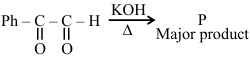
The major product $(P)$ in the following reaction is $:$
A
$Ph-CH(OH)-CH_2OH$
B
$Ph-CH(OH)-COO^-K^+$
C
$Ph-CO-COO^-K^+$
D
$Ph-CO-CH_2OH$
Solution
(B) The given reaction is an intramolecular Cannizzaro reaction of phenylglyoxal $(Ph-CO-CHO)$.
In the presence of a base like $KOH$,the hydroxide ion attacks the more electrophilic carbonyl carbon (the aldehyde group).
This leads to a hydride shift from the aldehyde carbon to the ketone carbonyl carbon.
The aldehyde group is oxidized to a carboxylate group $(COO^-)$,and the ketone group is reduced to a secondary alcohol group $(CH(OH))$.
Thus,the product formed is $Ph-CH(OH)-COO^-K^+$.
In the presence of a base like $KOH$,the hydroxide ion attacks the more electrophilic carbonyl carbon (the aldehyde group).
This leads to a hydride shift from the aldehyde carbon to the ketone carbonyl carbon.
The aldehyde group is oxidized to a carboxylate group $(COO^-)$,and the ketone group is reduced to a secondary alcohol group $(CH(OH))$.
Thus,the product formed is $Ph-CH(OH)-COO^-K^+$.
0 likes
View Solution1285
DifficultMCQ
Aldol condensation is a popular and classical method to prepare $\alpha, \beta-$unsaturated carbonyl compounds. This reaction can be both intermolecular and intramolecular. Predict which one of the following is not a product of intramolecular aldol condensation?
A
B
C
D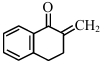
Solution
(D) Intramolecular aldol condensation involves the formation of a ring within a single molecule containing two carbonyl groups.
$(1)$ Cyclodecane$-1,6-$dione undergoes intramolecular aldol condensation to form a bicyclic $\alpha, \beta-$unsaturated ketone.
$(2)$ $6-$Oxoheptanal undergoes intramolecular aldol condensation to form cyclohex$-2-$en$-1-$one.
$(3)$ $2-$Acetylbenzaldehyde undergoes intramolecular aldol condensation to form inden$-1-$one.
$(4)$ The reaction between $1-$tetralone and formaldehyde is an intermolecular aldol condensation (specifically a Claisen-Schmidt condensation),not an intramolecular one.
Therefore,the product shown in option $D$ is not formed via intramolecular aldol condensation.
$(1)$ Cyclodecane$-1,6-$dione undergoes intramolecular aldol condensation to form a bicyclic $\alpha, \beta-$unsaturated ketone.
$(2)$ $6-$Oxoheptanal undergoes intramolecular aldol condensation to form cyclohex$-2-$en$-1-$one.
$(3)$ $2-$Acetylbenzaldehyde undergoes intramolecular aldol condensation to form inden$-1-$one.
$(4)$ The reaction between $1-$tetralone and formaldehyde is an intermolecular aldol condensation (specifically a Claisen-Schmidt condensation),not an intramolecular one.
Therefore,the product shown in option $D$ is not formed via intramolecular aldol condensation.
0 likes
View Solution1286
DifficultMCQ
An organic compound $(X)$ with molecular formula $C_3H_6O$ is not readily oxidised. On reduction it gives $(C_3H_8O)$ $(Y)$ which reacts with $HBr$ to give a bromide $(Z)$ which is converted to a Grignard reagent. This Grignard reagent on reaction with $(X)$ followed by hydrolysis gives $2,3-$dimethylbutan$-2-$ol. Compounds $(X)$,$(Y)$ and $(Z)$ respectively are $:$
A
$CH_3COCH_3, CH_3CH_2CH_2OH, CH_3CH(Br)CH_3$
B
$CH_3COCH_3, CH_3CH(OH)CH_3, CH_3CH(Br)CH_3$
C
$CH_3CH_2CHO, CH_3CH_2CH_2OH, CH_3CH_2CH_2Br$
D
$CH_3CH_2CHO, CH_3CH=CH_2, CH_3CH(Br)CH_3$
Solution
(B) $1$. Compound $(X)$ is $C_3H_6O$. Since it is not readily oxidised,it is a ketone,$CH_3COCH_3$ (acetone).
$2$. Reduction of $(X)$ gives $(Y)$,which is $CH_3CH(OH)CH_3$ (propan$-2-$ol).
$3$. Reaction of $(Y)$ with $HBr$ gives $(Z)$,which is $CH_3CH(Br)CH_3$ ($2$-bromopropane).
$4$. $(Z)$ reacts with $Mg$ in ether to form the Grignard reagent $CH_3CH(MgBr)CH_3$.
$5$. The Grignard reagent reacts with $(X)$ $(CH_3COCH_3)$ followed by hydrolysis to yield $2,3-$dimethylbutan$-2-$ol.
$6$. Thus,$(X) = CH_3COCH_3$,$(Y) = CH_3CH(OH)CH_3$,and $(Z) = CH_3CH(Br)CH_3$.
$2$. Reduction of $(X)$ gives $(Y)$,which is $CH_3CH(OH)CH_3$ (propan$-2-$ol).
$3$. Reaction of $(Y)$ with $HBr$ gives $(Z)$,which is $CH_3CH(Br)CH_3$ ($2$-bromopropane).
$4$. $(Z)$ reacts with $Mg$ in ether to form the Grignard reagent $CH_3CH(MgBr)CH_3$.
$5$. The Grignard reagent reacts with $(X)$ $(CH_3COCH_3)$ followed by hydrolysis to yield $2,3-$dimethylbutan$-2-$ol.
$6$. Thus,$(X) = CH_3COCH_3$,$(Y) = CH_3CH(OH)CH_3$,and $(Z) = CH_3CH(Br)CH_3$.
0 likes
View Solution1287
EasyMCQ
Which among the following compounds give a yellow solid when reacted with $NaOI/NaOH$? Choose the correct answer from the options given below $:$
$(A)$ $CH_3-CH(OH)-C_2H_5$
$(B)$ $CH_3-CH_2-CH_2-OH$
$(C)$ $CH_3-CO-C_2H_5$
$(D)$ $CH_3-COOH$
$(E)$ $CH_3-CH_2-CHO$
$(A)$ $CH_3-CH(OH)-C_2H_5$
$(B)$ $CH_3-CH_2-CH_2-OH$
$(C)$ $CH_3-CO-C_2H_5$
$(D)$ $CH_3-COOH$
$(E)$ $CH_3-CH_2-CHO$
A
$B, C$ and $E$ Only
B
$A$ and $C$ Only
C
$C$ and $D$ Only
D
$A, C$ and $D$ Only
Solution
(B) The reaction with $NaOI/NaOH$ is the iodoform test. Compounds that contain a $CH_3CO-$ group or a $CH_3CH(OH)-$ group give a positive iodoform test,resulting in a yellow solid precipitate of iodoform $(CHI_3)$.
$(A)$ $CH_3-CH(OH)-C_2H_5$ is a secondary alcohol with a $CH_3CH(OH)-$ group,so it gives a positive test.
$(B)$ $CH_3-CH_2-CH_2-OH$ is a primary alcohol that does not contain the required group,so it gives a negative test.
$(C)$ $CH_3-CO-C_2H_5$ is a ketone with a $CH_3CO-$ group,so it gives a positive test.
$(D)$ $CH_3-COOH$ is an acetic acid,which does not give the iodoform test.
$(E)$ $CH_3-CH_2-CHO$ is an aldehyde (propanal) that does not contain the $CH_3CO-$ group,so it gives a negative test.
Therefore,compounds $(A)$ and $(C)$ give a yellow solid.
$(A)$ $CH_3-CH(OH)-C_2H_5$ is a secondary alcohol with a $CH_3CH(OH)-$ group,so it gives a positive test.
$(B)$ $CH_3-CH_2-CH_2-OH$ is a primary alcohol that does not contain the required group,so it gives a negative test.
$(C)$ $CH_3-CO-C_2H_5$ is a ketone with a $CH_3CO-$ group,so it gives a positive test.
$(D)$ $CH_3-COOH$ is an acetic acid,which does not give the iodoform test.
$(E)$ $CH_3-CH_2-CHO$ is an aldehyde (propanal) that does not contain the $CH_3CO-$ group,so it gives a negative test.
Therefore,compounds $(A)$ and $(C)$ give a yellow solid.
0 likes
View Solution1288
MediumMCQ
$P$ is an optically active compound with molecular formula $C_6H_{12}O$. When $P$ is treated with $2,4-$dinitrophenylhydrazine,it gives a positive test. However,in the presence of Tollens reagent,$P$ gives a negative test. Predict the structure of $P$.
A
$CH_3-CO-CH_2-CH_2-CH_2-CH_3$
B
$CH_3-CO-CH(CH_3)-CH_2-CH_3$
C
$H-CO-CH_2-CH(CH_3)-CH_2-CH_3$
D
$CH_3-CO-CH_2-CH(CH_3)-CH_3$
Solution
(B) $1$. The molecular formula $C_6H_{12}O$ corresponds to the general formula $C_nH_{2n}O$,which indicates that the compound $P$ is either an aldehyde or a ketone.
$2$. $P$ gives a positive test with $2,4-$dinitrophenylhydrazine $(2,4-DNP)$,which confirms the presence of a carbonyl group $(C=O)$.
$3$. $P$ gives a negative test with Tollens reagent,which indicates that $P$ is a ketone,not an aldehyde.
$4$. $P$ is optically active,meaning it must contain at least one chiral carbon atom.
$5$. Let's examine the options:
- Option $A$: $CH_3-CO-CH_2-CH_2-CH_2-CH_3$ (Hexan-$2$-one) is not optically active.
- Option $B$: $CH_3-CO-CH(CH_3)-CH_2-CH_3$ ($3-$methylpentan-$2$-one) has a chiral carbon at the $C-3$ position. It is a ketone and gives a positive $2,4-DNP$ test and a negative Tollens test.
- Option $C$: This is an aldehyde,which would give a positive Tollens test.
- Option $D$: $CH_3-CO-CH_2-CH(CH_3)_2$ ($4-$methylpentan-$2$-one) is not optically active.
$6$. Therefore,the correct structure is $3-$methylpentan-$2$-one.
$2$. $P$ gives a positive test with $2,4-$dinitrophenylhydrazine $(2,4-DNP)$,which confirms the presence of a carbonyl group $(C=O)$.
$3$. $P$ gives a negative test with Tollens reagent,which indicates that $P$ is a ketone,not an aldehyde.
$4$. $P$ is optically active,meaning it must contain at least one chiral carbon atom.
$5$. Let's examine the options:
- Option $A$: $CH_3-CO-CH_2-CH_2-CH_2-CH_3$ (Hexan-$2$-one) is not optically active.
- Option $B$: $CH_3-CO-CH(CH_3)-CH_2-CH_3$ ($3-$methylpentan-$2$-one) has a chiral carbon at the $C-3$ position. It is a ketone and gives a positive $2,4-DNP$ test and a negative Tollens test.
- Option $C$: This is an aldehyde,which would give a positive Tollens test.
- Option $D$: $CH_3-CO-CH_2-CH(CH_3)_2$ ($4-$methylpentan-$2$-one) is not optically active.
$6$. Therefore,the correct structure is $3-$methylpentan-$2$-one.
0 likes
View Solution1289
MediumMCQ
When the compound $CH_3COCH_2CH_2CH_2CH_2CHO$ undergoes intramolecular aldol condensation,the major product formed is $:$
A
$2-$acetyl$-1-$cyclopentene
B
$1-$acetyl$-1-$cyclopentene
C
$2-$methyl$-1-$cyclopentene$-1-$carbaldehyde
D
Cyclohept$-2-$en$-1-$one
Solution
(B) The given compound is $CH_3COCH_2CH_2CH_2CH_2CHO$ (heptane$-2,6-$dione derivative or similar keto-aldehyde).
Intramolecular aldol condensation occurs between the $\alpha$-hydrogen of the ketone and the carbonyl carbon of the aldehyde.
The enolate formed at the $\alpha$-position of the ketone attacks the aldehyde carbonyl carbon to form a five-membered ring.
Dehydration of the resulting $\beta$-hydroxy ketone under heating $( \Delta )$ yields the conjugated enone.
The major product is $1-\text{acetylcyclopentene}$.
Intramolecular aldol condensation occurs between the $\alpha$-hydrogen of the ketone and the carbonyl carbon of the aldehyde.
The enolate formed at the $\alpha$-position of the ketone attacks the aldehyde carbonyl carbon to form a five-membered ring.
Dehydration of the resulting $\beta$-hydroxy ketone under heating $( \Delta )$ yields the conjugated enone.
The major product is $1-\text{acetylcyclopentene}$.
0 likes
View Solution1290
MediumMCQ
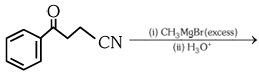
The major product of the following reaction is
A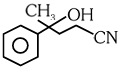
B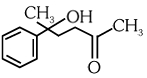
C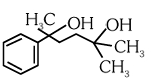
D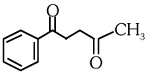
Solution
(B) The starting material is $3$-benzoylpropanenitrile. It contains both a ketone and a nitrile functional group.
When treated with excess $CH_3MgBr$,the Grignard reagent attacks both the carbonyl carbon of the ketone and the carbon of the nitrile group.
$1$. The ketone group reacts with one equivalent of $CH_3MgBr$ to form a tertiary alcohol after workup.
$2$. The nitrile group reacts with another equivalent of $CH_3MgBr$ to form an imine intermediate,which upon hydrolysis $(H_3O^+)$ yields a ketone.
Therefore,the final product is $5$-hydroxy-$5$-phenylhexan-$2$-one.
When treated with excess $CH_3MgBr$,the Grignard reagent attacks both the carbonyl carbon of the ketone and the carbon of the nitrile group.
$1$. The ketone group reacts with one equivalent of $CH_3MgBr$ to form a tertiary alcohol after workup.
$2$. The nitrile group reacts with another equivalent of $CH_3MgBr$ to form an imine intermediate,which upon hydrolysis $(H_3O^+)$ yields a ketone.
Therefore,the final product is $5$-hydroxy-$5$-phenylhexan-$2$-one.
0 likes
View Solution1291
MediumMCQ
Identify the suitable reagent for the following conversion:
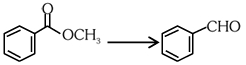
A
$i. \ LiAlH_4$,$ii. \ H^{+} / H_2 O$
B
$i. \ AlH(iBu)_2$,$ii. \ H_2 O$
C
$i. \ NaBH_4$,$ii. \ H^{+} / H_2 O$
D
$H_2 / Pd-BaSO_4$
Solution
(B) The conversion of an ester to an aldehyde requires a selective reducing agent that stops at the aldehyde stage without further reduction to a primary alcohol.
$AlH(iBu)_2$ (also known as $DIBAL-H$) is a selective reducing agent that reduces esters to aldehydes.
$LiAlH_4$ reduces esters directly to primary alcohols.
$NaBH_4$ is generally not reactive enough to reduce esters.
$H_2 / Pd-BaSO_4$ is used for the Rosenmund reduction of acid chlorides to aldehydes.
Therefore,the correct reagent is $i. \ AlH(iBu)_2$,$ii. \ H_2 O$.
$AlH(iBu)_2$ (also known as $DIBAL-H$) is a selective reducing agent that reduces esters to aldehydes.
$LiAlH_4$ reduces esters directly to primary alcohols.
$NaBH_4$ is generally not reactive enough to reduce esters.
$H_2 / Pd-BaSO_4$ is used for the Rosenmund reduction of acid chlorides to aldehydes.
Therefore,the correct reagent is $i. \ AlH(iBu)_2$,$ii. \ H_2 O$.
0 likes
View Solution1292
MediumMCQ
The starting material is $2,3-\text{dimethylbut-2-ene}$. It undergoes ozonolysis followed by reduction with $Zn/H_2O$ to form product $A$. Product $A$ then reacts with $CH_3MgBr$ followed by hydrolysis to form product $B$. Identify product $B$.
A
$(CH_3)_2C=O$
B
$(CH_3)_2CHOH$
C
$(CH_3)_3COH$
D
$CH_3CH_2CH_2OH$
Solution
(C) Step $1$: Ozonolysis of $2,3-\text{dimethylbut-2-ene}$ $((CH_3)_2C=C(CH_3)_2)$ with $O_3$ followed by $Zn/H_2O$ yields acetone $(CH_3COCH_3)$ as product $A$.
Step $2$: Reaction of acetone $(CH_3COCH_3)$ with $CH_3MgBr$ (Grignard reagent) followed by acidic hydrolysis $(H_2O/H^+)$ results in the formation of $2-\text{methylpropan-2-ol}$ $((CH_3)_3COH)$,which is product $B$.
Step $2$: Reaction of acetone $(CH_3COCH_3)$ with $CH_3MgBr$ (Grignard reagent) followed by acidic hydrolysis $(H_2O/H^+)$ results in the formation of $2-\text{methylpropan-2-ol}$ $((CH_3)_3COH)$,which is product $B$.
0 likes
View Solution1293
MediumMCQ
Which product is formed when the compound $C_6H_5CHO$ is treated with concentrated $KOH$ solution?
A
Potassium $p$-hydroxybenzoate
B
Potassium benzoate and benzyl alcohol
C
Potassium $p$-phenoxide and potassium benzoate
D
Potassium benzoate and potassium phenoxide
Solution
(B) Benzaldehyde $(C_6H_5CHO)$ does not contain an $\alpha$-hydrogen atom. Therefore,it undergoes the Cannizzaro reaction when treated with a concentrated base like $KOH$.
In the Cannizzaro reaction,one molecule of the aldehyde is oxidized to a carboxylic acid salt (potassium benzoate) and another molecule is reduced to an alcohol (benzyl alcohol).
The reaction is:
$2C_6H_5CHO + KOH_{(conc.)} \rightarrow C_6H_5COOK + C_6H_5CH_2OH$
In the Cannizzaro reaction,one molecule of the aldehyde is oxidized to a carboxylic acid salt (potassium benzoate) and another molecule is reduced to an alcohol (benzyl alcohol).
The reaction is:
$2C_6H_5CHO + KOH_{(conc.)} \rightarrow C_6H_5COOK + C_6H_5CH_2OH$
0 likes
View Solution1294
MediumMCQ
Which of the following will give a yellow precipitate $(ppt.)$ with iodine and alkali?
A
$Propan-2-ol$
B
Benzophenone
C
Methyl acetate
D
Acetamide
Solution
(A) The iodoform test is given by compounds containing the $CH_3CO-$ group (methyl ketones) or the $CH_3CH(OH)-$ group (secondary alcohols with a methyl group).
$Propan-2-ol$ $(CH_3CH(OH)CH_3)$ contains the $CH_3CH(OH)-$ group,which is oxidized to acetone $(CH_3COCH_3)$ by iodine and alkali,subsequently giving a yellow precipitate of iodoform $(CHI_3)$.
Benzophenone $(C_6H_5COC_6H_5)$ lacks the methyl group attached to the carbonyl carbon.
Methyl acetate and acetamide do not give the iodoform test under standard conditions.
$Propan-2-ol$ $(CH_3CH(OH)CH_3)$ contains the $CH_3CH(OH)-$ group,which is oxidized to acetone $(CH_3COCH_3)$ by iodine and alkali,subsequently giving a yellow precipitate of iodoform $(CHI_3)$.
Benzophenone $(C_6H_5COC_6H_5)$ lacks the methyl group attached to the carbonyl carbon.
Methyl acetate and acetamide do not give the iodoform test under standard conditions.
0 likes
View Solution1295
MediumMCQ
Statement-$I$ :- Acetaldehyde and acetone can be distinguished by Tollen's reagent.
Statement-$II$ :- Aromatic aldehyde does not give Fehling test.
Statement-$II$ :- Aromatic aldehyde does not give Fehling test.
A
Statement-$I$ is correct,$II$ is incorrect.
B
Statement-$I$ and $II$ both are correct.
C
Statement-$I$ is incorrect and statement $II$ is correct.
D
Both statements are incorrect.
Solution
(B) Statement-$I$ is correct: Tollen's reagent $([Ag(NH_3)_2]^+)$ is used to distinguish between aldehydes and ketones. Aldehydes (like acetaldehyde) reduce Tollen's reagent to form a silver mirror,whereas ketones (like acetone) do not react with it.
Statement-$II$ is correct: Fehling's test is specific to aliphatic aldehydes. Aromatic aldehydes,such as benzaldehyde,do not give a positive Fehling's test because the aldehyde group is directly attached to the benzene ring,which is not easily oxidized by the mild Fehling's reagent.
Statement-$II$ is correct: Fehling's test is specific to aliphatic aldehydes. Aromatic aldehydes,such as benzaldehyde,do not give a positive Fehling's test because the aldehyde group is directly attached to the benzene ring,which is not easily oxidized by the mild Fehling's reagent.
0 likes
View Solution1296
MediumMCQ
Which product is not formed in the following reaction $:-$ $CH_3CHO + CH_3-CH_2-CHO \xrightarrow[\text {(ii) } \Delta]{\text {(i) } NaOH}$
A
$CH_3-CH=CH-CHO$
B
$CH_3-CH_2-CH=C(CH_3)-CHO$
C
$CH_3-CH_2-CH=CH-CHO$
D
$CH_3-CH=C(CH_3)-CHO$
Solution
(D) The reaction is a mixed (cross) Aldol condensation between acetaldehyde $(CH_3CHO)$ and propanal $(CH_3CH_2CHO)$.
Both aldehydes have $\alpha$-hydrogens,so four possible aldol products can be formed:
$1$. Self-aldol of $CH_3CHO$: $CH_3-CH=CH-CHO$ (But$-2-$enal)
$2$. Self-aldol of $CH_3CH_2CHO$: $CH_3-CH_2-CH=C(CH_3)-CHO$ ($2$-methylpent$-2-$enal)
$3$. Cross-aldol ($CH_3CHO$ as nucleophile): $CH_3-CH_2-CH=CH-CHO$ (Pent$-2-$enal)
$4$. Cross-aldol ($CH_3CH_2CHO$ as nucleophile): $CH_3-CH=C(CH_3)-CHO$ ($2$-methylbut$-2-$enal)
Option $D$ in the original image represents $CH_3-CH=CH-CH_2-CHO$,which is not an $\alpha,\beta$-unsaturated aldehyde and is not a product of this condensation reaction.
Both aldehydes have $\alpha$-hydrogens,so four possible aldol products can be formed:
$1$. Self-aldol of $CH_3CHO$: $CH_3-CH=CH-CHO$ (But$-2-$enal)
$2$. Self-aldol of $CH_3CH_2CHO$: $CH_3-CH_2-CH=C(CH_3)-CHO$ ($2$-methylpent$-2-$enal)
$3$. Cross-aldol ($CH_3CHO$ as nucleophile): $CH_3-CH_2-CH=CH-CHO$ (Pent$-2-$enal)
$4$. Cross-aldol ($CH_3CH_2CHO$ as nucleophile): $CH_3-CH=C(CH_3)-CHO$ ($2$-methylbut$-2-$enal)
Option $D$ in the original image represents $CH_3-CH=CH-CH_2-CHO$,which is not an $\alpha,\beta$-unsaturated aldehyde and is not a product of this condensation reaction.
0 likes
View Solution1297
MediumMCQ
Match the reactions given in column-$I$ with the suitable reagents given in column-$II$.
| Column-$I$ (Reactions) | Column-$II$ (Reagents) |
| $(i)$. Benzophenone $\rightarrow$ Diphenylmethane | $(a)$. $LiAlH_4$ |
| $(ii)$. Benzaldehyde $\rightarrow$ $1-$Phenylethanol | $(b)$. $DIBAL-H$ |
| $(iii)$. Cyclohexanone $\rightarrow$ Cyclohexanol | $(c)$. $Zn(Hg) / \text{Conc. } HCl$ |
| $(iv)$. Phenyl benzoate $\rightarrow$ Benzaldehyde | $(d)$. $CH_3MgBr, H_2O$ |
A
$i-a, ii-c, iii-d, iv-b$
B
$i-c, ii-d, iii-a, iv-b$
C
$i-c, ii-d, iii-b, iv-a$
D
$i-c, ii-b, iii-a, iv-d$
Solution
(B) The correct matches are as follows:
$(i)$. Benzophenone $\rightarrow$ Diphenylmethane: This is a Clemmensen reduction,which uses $Zn(Hg) / \text{Conc. } HCl$ to reduce the carbonyl group to a methylene group. Matches with $(c)$.
$(ii)$. Benzaldehyde $\rightarrow$ $1-$Phenylethanol: This is a Grignard reaction where $CH_3MgBr$ attacks the aldehyde,followed by hydrolysis to form a secondary alcohol. Matches with $(d)$.
$(iii)$. Cyclohexanone $\rightarrow$ Cyclohexanol: This is a reduction of a ketone to a secondary alcohol using $LiAlH_4$. Matches with $(a)$.
$(iv)$. Phenyl benzoate $\rightarrow$ Benzaldehyde: This is a partial reduction of an ester to an aldehyde using $DIBAL-H$. Matches with $(b)$.
Therefore,the correct sequence is $i-c, ii-d, iii-a, iv-b$.
$(i)$. Benzophenone $\rightarrow$ Diphenylmethane: This is a Clemmensen reduction,which uses $Zn(Hg) / \text{Conc. } HCl$ to reduce the carbonyl group to a methylene group. Matches with $(c)$.
$(ii)$. Benzaldehyde $\rightarrow$ $1-$Phenylethanol: This is a Grignard reaction where $CH_3MgBr$ attacks the aldehyde,followed by hydrolysis to form a secondary alcohol. Matches with $(d)$.
$(iii)$. Cyclohexanone $\rightarrow$ Cyclohexanol: This is a reduction of a ketone to a secondary alcohol using $LiAlH_4$. Matches with $(a)$.
$(iv)$. Phenyl benzoate $\rightarrow$ Benzaldehyde: This is a partial reduction of an ester to an aldehyde using $DIBAL-H$. Matches with $(b)$.
Therefore,the correct sequence is $i-c, ii-d, iii-a, iv-b$.
0 likes
View Solution1298
MediumMCQ
Which of the following reagents should be used to carry out the above conversion $:-$
(Image shows the reduction of a ketone group to a secondary alcohol in the presence of an ester group)
(Image shows the reduction of a ketone group to a secondary alcohol in the presence of an ester group)

A
$LiAlH_4$
B
$NaBH_4$
C
$Ni, H_2$
D
$Zn-Hg / HCl$
Solution
(B) The given reaction involves the selective reduction of a ketone group to a secondary alcohol while keeping the ester group $(-COOCH_3)$ intact.
$LiAlH_4$ is a strong reducing agent that reduces both ketones and esters to alcohols.
$NaBH_4$ is a selective reducing agent that reduces aldehydes and ketones to alcohols but does not reduce esters under normal conditions.
$Ni, H_2$ (catalytic hydrogenation) would reduce both the ketone and the ester group.
$Zn-Hg / HCl$ (Clemmensen reduction) reduces the ketone group to a methylene $(-CH_2-)$ group,not an alcohol.
Therefore,$NaBH_4$ is the correct reagent for this selective reduction.
$LiAlH_4$ is a strong reducing agent that reduces both ketones and esters to alcohols.
$NaBH_4$ is a selective reducing agent that reduces aldehydes and ketones to alcohols but does not reduce esters under normal conditions.
$Ni, H_2$ (catalytic hydrogenation) would reduce both the ketone and the ester group.
$Zn-Hg / HCl$ (Clemmensen reduction) reduces the ketone group to a methylene $(-CH_2-)$ group,not an alcohol.
Therefore,$NaBH_4$ is the correct reagent for this selective reduction.
0 likes
View Solution1299
EasyMCQ
Which of the following does not reduce Fehling's solution?
A
$CH_3CHO$
B
$HCHO$
C
$HCOOH$
D
$CH_3COCH_3$
Solution
(D) Fehling's solution is a mild oxidizing agent that is reduced by aliphatic aldehydes and formic acid $(HCOOH)$.
Formic acid contains an aldehydic group $(-CHO)$ in its structure,which allows it to act as a reducing agent.
Ketones,such as acetone $(CH_3COCH_3)$,do not contain an aldehydic group and therefore do not reduce Fehling's solution.
Formic acid contains an aldehydic group $(-CHO)$ in its structure,which allows it to act as a reducing agent.
Ketones,such as acetone $(CH_3COCH_3)$,do not contain an aldehydic group and therefore do not reduce Fehling's solution.
0 likes
View Solution8-1.Aldehydes and Ketones — Properties · Frequently Asked Questions
1Are these 8-1.Aldehydes and Ketones questions useful for JEE and NEET?
Yes. All questions in this section are mapped to JEE Main and NEET exam patterns. Previous year questions from JEE Main, NEET, GUJCET and state-level exams are included with full solutions.
2Can I switch to Hindi or Gujarati for these questions?
Yes. Use the language tabs in the hero section or the sidebar to view the same questions and solutions in English, Hindi or Gujarati.
3How do I generate a question paper from this subtopic?
Use the Vedclass Exam Paper Generator — select the chapter and subtopic, set difficulty, and generate Sets A, B, C, D automatically. First 3 chapters of every subject are free.
Vedclass Products
For Students
Vedclass Test Series
Mock tests in real JEE/NEET style with performance analysis. 5-day free trial.
Start Free TrialFor Teachers
Exam Paper Generator
Generate Set A/B/C/D papers from this chapter in 2 minutes. 3 chapters free.
Try FreeFor Institutes
Online Exam Module
Live online exams with unlimited students, 360° analytics & white-label branding.
See DemoFor Teachers & Institutes
Generate a 8-1.Aldehydes and Ketones Exam Paper in 2 Minutes
Select subtopic & difficulty — Sets A, B, C, D auto-generated with No Repeat logic.
First 3 chapters of every subject are free — no payment required.