
A English
Properties Questions in English
Class 12 Chemistry · 8-1.Aldehydes and Ketones · Properties
1739+
Questions
English
Language
100%
With Solutions
Showing 50 of 1739 questions in English
1151
MediumMCQ
Hex$-4-$en$-2-$ol on treatment with $PCC$ gives $'A'.$ $'A'$ on reaction with sodium hypoiodite gives $'B',$ which on further heating with soda lime gives $'C'.$ The compound $'C'$ is $....... .$
A
$2-$pentene
B
proponaldehyde
C
$2-$butene
D
$4-$methylpent$-2-$ene
Solution
(C) $1$. $PCC$ (Pyridinium chlorochromate) oxidizes the secondary alcohol $CH_3-CH=CH-CH_2-CH(OH)-CH_3$ to the ketone $CH_3-CH=CH-CH_2-CO-CH_3$ (Compound $'A'$).
$2$. Compound $'A'$ contains a methyl ketone group,so it undergoes the iodoform reaction with sodium hypoiodite $(NaOI)$ to form the carboxylic acid $CH_3-CH=CH-CH_2-COOH$ (Compound $'B'$) and iodoform $(CHI_3)$.
$3$. Decarboxylation of the carboxylic acid $CH_3-CH=CH-CH_2-COOH$ with soda lime $(NaOH + CaO)$ removes $CO_2$ to yield $CH_3-CH=CH-CH_3$ (Compound $'C'$),which is $but-2-ene$.
$2$. Compound $'A'$ contains a methyl ketone group,so it undergoes the iodoform reaction with sodium hypoiodite $(NaOI)$ to form the carboxylic acid $CH_3-CH=CH-CH_2-COOH$ (Compound $'B'$) and iodoform $(CHI_3)$.
$3$. Decarboxylation of the carboxylic acid $CH_3-CH=CH-CH_2-COOH$ with soda lime $(NaOH + CaO)$ removes $CO_2$ to yield $CH_3-CH=CH-CH_3$ (Compound $'C'$),which is $but-2-ene$.
0 likes
View Solution1152
MediumMCQ
Which of the following is an example of a conjugated diketone?
A
$CH_3-CO-CH_2-CH_2-CH_2-CO-CH_3$
B
$CH_3-CO-CH_2-(C_6H_8O)$
C
$p-Benzoquinone$
D
$C_6H_5-CO-CH_2-CH_2-CO-CH_3$
Solution
(C) conjugated diketone is a compound where the two carbonyl groups are separated by a system of alternating single and double bonds,allowing for resonance delocalization between the two carbonyl groups.
In $p-Benzoquinone$,the two carbonyl groups are part of a cyclic system where they are conjugated with the carbon-carbon double bonds in the ring.
Therefore,$p-Benzoquinone$ is a conjugated diketone.
In $p-Benzoquinone$,the two carbonyl groups are part of a cyclic system where they are conjugated with the carbon-carbon double bonds in the ring.
Therefore,$p-Benzoquinone$ is a conjugated diketone.
0 likes
View Solution1153
MediumMCQ
The major product of the above reaction is $A$.
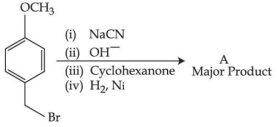
A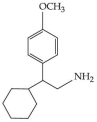
B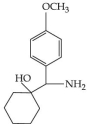
C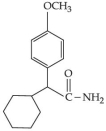
D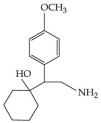
Solution
(A) Step $1$: $4$-Methoxybenzyl bromide reacts with $NaCN$ to form $4$-methoxybenzyl cyanide $(CH_3O-C_6H_4-CH_2CN)$.
Step $2$: In the presence of $OH^-$,the alpha-hydrogen of the nitrile is abstracted to form a carbanion,which then performs a nucleophilic attack on the carbonyl carbon of cyclohexanone.
Step $3$: This results in the formation of a cyanohydrin derivative: $CH_3O-C_6H_4-CH(CN)-C(OH)(C_6H_{10})$.
Step $4$: Finally,catalytic hydrogenation using $H_2, Ni$ reduces the nitrile group $(-CN)$ to a primary amine group $(-CH_2NH_2)$.
The final product is $1-(4-methoxyphenyl)-2-(cyclohexyl)-2-hydroxyethanamine$ derivative,which matches the structure in option $A$.
Step $2$: In the presence of $OH^-$,the alpha-hydrogen of the nitrile is abstracted to form a carbanion,which then performs a nucleophilic attack on the carbonyl carbon of cyclohexanone.
Step $3$: This results in the formation of a cyanohydrin derivative: $CH_3O-C_6H_4-CH(CN)-C(OH)(C_6H_{10})$.
Step $4$: Finally,catalytic hydrogenation using $H_2, Ni$ reduces the nitrile group $(-CN)$ to a primary amine group $(-CH_2NH_2)$.
The final product is $1-(4-methoxyphenyl)-2-(cyclohexyl)-2-hydroxyethanamine$ derivative,which matches the structure in option $A$.
0 likes
View Solution1154
DifficultMCQ
Which of the following ketones will $NOT$ give an enamine upon treatment with secondary amines?
A
$Diethyl \ ketone$ $(C_2H_5-CO-C_2H_5)$
B
$Ethyl \ methyl \ ketone$ $(C_2H_5-CO-CH_3)$
C
$Di-tert-butyl \ ketone$ $((t-Bu)_2CO)$
D
$Cyclohexanone$
Solution
(C) Enamine formation is a nucleophilic addition-elimination reaction between a carbonyl compound (having at least one $\alpha$-hydrogen) and a secondary amine.
In the case of $Di-tert-butyl \ ketone$ $((t-Bu)_2CO)$,the carbonyl carbon is highly sterically hindered by two bulky $tert-butyl$ groups.
Due to this extreme steric hindrance,the secondary amine cannot approach the carbonyl carbon to initiate the nucleophilic attack,thus preventing the formation of an enamine.
In the case of $Di-tert-butyl \ ketone$ $((t-Bu)_2CO)$,the carbonyl carbon is highly sterically hindered by two bulky $tert-butyl$ groups.
Due to this extreme steric hindrance,the secondary amine cannot approach the carbonyl carbon to initiate the nucleophilic attack,thus preventing the formation of an enamine.
0 likes
View Solution1155
MediumMCQ
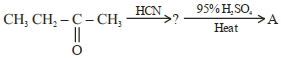
The final product $A$ in the following reaction sequence is:
A
$CH_3-CH=C(CH_3)-COOH$
B
$CH_3-CH=C(CH_3)-CN$
C
$CH_3-CH_2-C(OH)(CH_3)-COOH$
D
$CH_3-CH=C(CH_3)-CONH_2$
Solution
(A) $1$. The reaction of $CH_3CH_2COCH_3$ (butanone) with $HCN$ is a nucleophilic addition reaction,which forms a cyanohydrin: $CH_3CH_2C(OH)(CN)CH_3$.
$2$. Treatment of the cyanohydrin with $95\% \ H_2SO_4$ and heat leads to the dehydration of the alcohol group and hydrolysis of the nitrile group (or dehydration followed by hydrolysis),resulting in an $\alpha,\beta$-unsaturated carboxylic acid.
$3$. The dehydration of $CH_3CH_2C(OH)(CN)CH_3$ followed by hydrolysis yields $CH_3-CH=C(CH_3)-COOH$ ($2$-methylbut$-2-$enoic acid).
$2$. Treatment of the cyanohydrin with $95\% \ H_2SO_4$ and heat leads to the dehydration of the alcohol group and hydrolysis of the nitrile group (or dehydration followed by hydrolysis),resulting in an $\alpha,\beta$-unsaturated carboxylic acid.
$3$. The dehydration of $CH_3CH_2C(OH)(CN)CH_3$ followed by hydrolysis yields $CH_3-CH=C(CH_3)-COOH$ ($2$-methylbut$-2-$enoic acid).
0 likes
View Solution1156
MediumMCQ
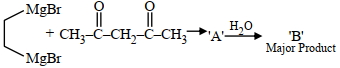
Consider the above reaction sequence and identify the product $B$.
A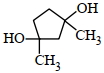
B
C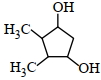
D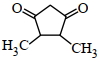
Solution
(A) The reaction involves a nucleophilic addition of a di-Grignard reagent to a diketone. The two $MgBr$ groups act as nucleophilic centers that attack the two carbonyl carbons of acetylacetone $(CH_3COCH_2COCH_3)$.
This cyclization reaction forms a cyclic di-alkoxide intermediate.
Upon hydrolysis with $H_2O$,the alkoxide groups are protonated to form the corresponding diol.
The final product $B$ is $1,3$-dimethylcyclopentane-$1,3$-diol.
This cyclization reaction forms a cyclic di-alkoxide intermediate.
Upon hydrolysis with $H_2O$,the alkoxide groups are protonated to form the corresponding diol.
The final product $B$ is $1,3$-dimethylcyclopentane-$1,3$-diol.
0 likes
View Solution1157
DifficultMCQ
Isobutyraldehyde on reaction with formaldehyde and $K_{2}CO_{3}$ gives compound '$A$.' Compound '$A$' reacts with $KCN$ and yields compound '$B$,' which on hydrolysis gives a stable compound '$C$.' The compound '$C$' is .... .
A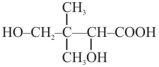
B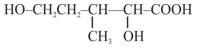
C
D
Solution
(C) $1$. Isobutyraldehyde $((CH_{3})_{2}CHCHO)$ reacts with formaldehyde $(HCHO)$ in the presence of $K_{2}CO_{3}$ (aldol condensation followed by Cannizzaro-like step or simply aldol addition) to form compound '$A$',which is $3$-hydroxy-$2,2$-dimethylpropanal $(HO-CH_{2}-C(CH_{3})_{2}-CHO)$.
$2$. Compound '$A$' reacts with $KCN$ (cyanohydrin formation) to yield compound '$B$',which is $2,4$-dihydroxy-$3,3$-dimethylbutanenitrile $(HO-CH_{2}-C(CH_{3})_{2}-CH(OH)-CN)$.
$3$. Hydrolysis of '$B$' gives the corresponding carboxylic acid,$2,4$-dihydroxy-$3,3$-dimethylbutanoic acid $(HO-CH_{2}-C(CH_{3})_{2}-CH(OH)-COOH)$.
$4$. This hydroxy acid undergoes intramolecular cyclization (lactonization) to form a stable lactone,which is $3$-hydroxy-$4,4$-dimethyltetrahydrofuran-$2$-one (as shown in option $C$).
$2$. Compound '$A$' reacts with $KCN$ (cyanohydrin formation) to yield compound '$B$',which is $2,4$-dihydroxy-$3,3$-dimethylbutanenitrile $(HO-CH_{2}-C(CH_{3})_{2}-CH(OH)-CN)$.
$3$. Hydrolysis of '$B$' gives the corresponding carboxylic acid,$2,4$-dihydroxy-$3,3$-dimethylbutanoic acid $(HO-CH_{2}-C(CH_{3})_{2}-CH(OH)-COOH)$.
$4$. This hydroxy acid undergoes intramolecular cyclization (lactonization) to form a stable lactone,which is $3$-hydroxy-$4,4$-dimethyltetrahydrofuran-$2$-one (as shown in option $C$).
0 likes
View Solution1158
MediumMCQ
The correct structure of product $A$ formed in the following reaction:
$PhCHO + PhCHO \xrightarrow[in\, D_2O]{NaOD} A + PhCOO^{-}$
($Ph$ is $-C_6H_5$)
$PhCHO + PhCHO \xrightarrow[in\, D_2O]{NaOD} A + PhCOO^{-}$
($Ph$ is $-C_6H_5$)
A
B
C
D
Solution
(A) The given reaction is a Cannizzaro reaction involving benzaldehyde $(PhCHO)$ in the presence of a base $(NaOD)$ and a deuterated solvent $(D_2O)$.
In the mechanism of the Cannizzaro reaction, the hydride ion $(H^-)$ is transferred from the tetrahedral intermediate of one aldehyde molecule to the carbonyl carbon of another aldehyde molecule.
Since the reaction is carried out in $D_2O$, the oxygen atom of the hydroxyl group in the resulting alcohol will exchange its hydrogen with deuterium, leading to the formation of an $-OD$ group.
However, the hydrogen atom attached to the alpha-carbon of the alcohol $(PhCH_2OD)$ comes from the aldehyde carbon $(PhCHO)$, which does not exchange with the solvent during the hydride transfer step.
Therefore, the product formed is benzyl alcohol with a deuterated hydroxyl group, which is $Ph-CH_2-OD$.
In the mechanism of the Cannizzaro reaction, the hydride ion $(H^-)$ is transferred from the tetrahedral intermediate of one aldehyde molecule to the carbonyl carbon of another aldehyde molecule.
Since the reaction is carried out in $D_2O$, the oxygen atom of the hydroxyl group in the resulting alcohol will exchange its hydrogen with deuterium, leading to the formation of an $-OD$ group.
However, the hydrogen atom attached to the alpha-carbon of the alcohol $(PhCH_2OD)$ comes from the aldehyde carbon $(PhCHO)$, which does not exchange with the solvent during the hydride transfer step.
Therefore, the product formed is benzyl alcohol with a deuterated hydroxyl group, which is $Ph-CH_2-OD$.
0 likes
View Solution1159
MediumMCQ
In the given reaction,
$Cyclohexanone \xrightarrow[(ii) \text{ heat}]{(i) \text{ } OH^-} 'P'$
The number of $\pi$ electrons present in the product $'P'$ is $....$
$Cyclohexanone \xrightarrow[(ii) \text{ heat}]{(i) \text{ } OH^-} 'P'$
The number of $\pi$ electrons present in the product $'P'$ is $....$
A
$4$
B
$3$
C
$2$
D
$1$
Solution
(A) The given reaction is an aldol condensation of cyclohexanone in the presence of a base $(OH^-)$ followed by heating,which leads to the formation of an $\alpha,\beta$-unsaturated ketone.
The product $'P'$ is $2$-cyclohexylidenecyclohexanone.
In this molecule,there is one $C=O$ double bond and one $C=C$ double bond.
Each double bond contains $2$ $\pi$ electrons.
Therefore,the total number of $\pi$ electrons in the product $'P'$ is $2 + 2 = 4$.
The product $'P'$ is $2$-cyclohexylidenecyclohexanone.
In this molecule,there is one $C=O$ double bond and one $C=C$ double bond.
Each double bond contains $2$ $\pi$ electrons.
Therefore,the total number of $\pi$ electrons in the product $'P'$ is $2 + 2 = 4$.
0 likes
View Solution1160
MediumMCQ
$C_6H_{12}O_6$ $\xrightarrow{\text{Zymase}} A$ $\xrightarrow[\Delta]{NaOI} B + CHI_3$
The number of carbon atoms present in the product $B$ is $.....$
The number of carbon atoms present in the product $B$ is $.....$
A
$4$
B
$3$
C
$1$
D
$2$
Solution
(C) The fermentation of glucose $(C_6H_{12}O_6)$ by the enzyme zymase produces ethanol $(CH_3CH_2OH)$ and carbon dioxide $(CO_2)$.
$C_6H_{12}O_6 \xrightarrow{\text{Zymase}} 2CH_3CH_2OH + 2CO_2$
Here,$A$ is $CH_3CH_2OH$.
Ethanol reacts with $NaOI$ (sodium hypoiodite) in a haloform reaction to produce iodoform $(CHI_3)$ and sodium formate $(HCOONa)$.
$CH_3CH_2OH + 4NaOI \rightarrow CHI_3 + HCOONa + 3NaOH + H_2O$
Here,$B$ is sodium formate $(HCOONa)$.
The product $B$ $(HCOONa)$ contains $1$ carbon atom.
$C_6H_{12}O_6 \xrightarrow{\text{Zymase}} 2CH_3CH_2OH + 2CO_2$
Here,$A$ is $CH_3CH_2OH$.
Ethanol reacts with $NaOI$ (sodium hypoiodite) in a haloform reaction to produce iodoform $(CHI_3)$ and sodium formate $(HCOONa)$.
$CH_3CH_2OH + 4NaOI \rightarrow CHI_3 + HCOONa + 3NaOH + H_2O$
Here,$B$ is sodium formate $(HCOONa)$.
The product $B$ $(HCOONa)$ contains $1$ carbon atom.
0 likes
View Solution1161
DifficultMCQ
What is the major product of the following reaction?
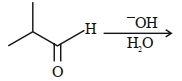
A
$2,4-$dimethylpent$-2-$enal
B
$3-$hydroxy$-2,4-$dimethylpentanal
C
$2,4-$dimethylpentane$-2,3-$dione
D
$2,3-$dimethylpent$-2-$enal
Solution
(B) The reaction involves the self-aldol condensation of isobutyraldehyde ($2$-methylpropanal) in the presence of a dilute base $(\text{OH}^-)$.
$1$. The base abstracts an $\alpha$-hydrogen from isobutyraldehyde to form an enolate ion.
$2$. This enolate ion acts as a nucleophile and attacks the carbonyl carbon of another molecule of isobutyraldehyde.
$3$. The resulting alkoxide is protonated to form the $\beta$-hydroxy aldehyde,which is $3-$hydroxy$-2,4-$dimethylpentanal.
Therefore,the major product is $3-$hydroxy$-2,4-$dimethylpentanal.
$1$. The base abstracts an $\alpha$-hydrogen from isobutyraldehyde to form an enolate ion.
$2$. This enolate ion acts as a nucleophile and attacks the carbonyl carbon of another molecule of isobutyraldehyde.
$3$. The resulting alkoxide is protonated to form the $\beta$-hydroxy aldehyde,which is $3-$hydroxy$-2,4-$dimethylpentanal.
Therefore,the major product is $3-$hydroxy$-2,4-$dimethylpentanal.
0 likes
View Solution1162
MediumMCQ
$CH_{3}CH_{2}CN$ $\xrightarrow[Ether]{CH_{3}MgBr} A$ $\xrightarrow{H_{3}O^{+}} B$ $\xrightarrow[HCl]{Zn-Hg} C$
The correct structure of $C$ is
The correct structure of $C$ is
A
$CH_{3}CH_{2}CH_{2}CH_{3}$
B
$CH_{3}CH_{2}COCH_{3}$
C
$CH_{3}CH_{2}CH(OH)CH_{3}$
D
$CH_{3}CH_{2}CH=CH_{2}$
Solution
(A) $1$. The reaction of $CH_{3}CH_{2}CN$ (propanenitrile) with $CH_{3}MgBr$ (Grignard reagent) followed by acid hydrolysis $(H_{3}O^{+})$ yields a ketone,$B$,which is butan$-2-$one $(CH_{3}CH_{2}COCH_{3})$.
$2$. The reaction is: $CH_{3}CH_{2}CN + CH_{3}MgBr$ $\rightarrow CH_{3}CH_{2}C(NMgBr)CH_{3}$ $\xrightarrow{H_{3}O^{+}} CH_{3}CH_{2}COCH_{3}$ $(B)$.
$3$. The subsequent step is the Clemmensen reduction,which uses $Zn-Hg/HCl$ to reduce the carbonyl group $(C=O)$ of the ketone to a methylene group $(-CH_{2}-)$.
$4$. Therefore,$CH_{3}CH_{2}COCH_{3} \xrightarrow[HCl]{Zn-Hg} CH_{3}CH_{2}CH_{2}CH_{3}$ ($C$,butane).
$2$. The reaction is: $CH_{3}CH_{2}CN + CH_{3}MgBr$ $\rightarrow CH_{3}CH_{2}C(NMgBr)CH_{3}$ $\xrightarrow{H_{3}O^{+}} CH_{3}CH_{2}COCH_{3}$ $(B)$.
$3$. The subsequent step is the Clemmensen reduction,which uses $Zn-Hg/HCl$ to reduce the carbonyl group $(C=O)$ of the ketone to a methylene group $(-CH_{2}-)$.
$4$. Therefore,$CH_{3}CH_{2}COCH_{3} \xrightarrow[HCl]{Zn-Hg} CH_{3}CH_{2}CH_{2}CH_{3}$ ($C$,butane).
0 likes
View Solution1163
MediumMCQ
Which one of the following reactions does not represent the correct combination of substrate and product under the given conditions?
A
$4-$methylbenzoyl chloride $\xrightarrow{H_2, Pd/BaSO_4}$ $4-$methylbenzaldehyde
B
$4-$methylbenzonitrile $\xrightarrow{(i) DIBAL-H, (ii) H_2O}$ $4-$methylbenzaldehyde
C
Ethyl $4-$methylbenzoate $\xrightarrow{(i) AlH(iso-Bu)_2, (ii) H_2O}$ $4-$methylbenzaldehyde
D
$4-$methylbenzyl alcohol $\xrightarrow{(i) Na_2Cr_2O_7, (ii) H_2SO_4, H_2O}$ $4-$methylbenzaldehyde
Solution
(D) Let us analyze each reaction:
$A$. Rosenmund reduction: Acid chloride is reduced to aldehyde using $H_2$ and $Pd/BaSO_4$. This is correct.
$B$. Nitriles are reduced to aldehydes using $DIBAL-H$ followed by hydrolysis. This is correct.
$C$. Esters are reduced to aldehydes using $DIBAL-H$ at low temperature followed by hydrolysis. This is correct.
$D$. Oxidation of primary alcohols with strong oxidizing agents like $Na_2Cr_2O_7/H_2SO_4$ (Jones reagent) typically proceeds further to carboxylic acids. Therefore,$4$-methylbenzyl alcohol will be oxidized to $4$-methylbenzoic acid,not $4$-methylbenzaldehyde. Thus,this reaction does not represent the correct product.
$A$. Rosenmund reduction: Acid chloride is reduced to aldehyde using $H_2$ and $Pd/BaSO_4$. This is correct.
$B$. Nitriles are reduced to aldehydes using $DIBAL-H$ followed by hydrolysis. This is correct.
$C$. Esters are reduced to aldehydes using $DIBAL-H$ at low temperature followed by hydrolysis. This is correct.
$D$. Oxidation of primary alcohols with strong oxidizing agents like $Na_2Cr_2O_7/H_2SO_4$ (Jones reagent) typically proceeds further to carboxylic acids. Therefore,$4$-methylbenzyl alcohol will be oxidized to $4$-methylbenzoic acid,not $4$-methylbenzaldehyde. Thus,this reaction does not represent the correct product.
0 likes
View Solution1164
DifficultMCQ
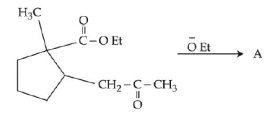
In the given reaction,the number of chiral carbon$(s)$ in product $A$ is .......
(Where $Et$ is $-C_2H_5$)
(Where $Et$ is $-C_2H_5$)
A
$2$
B
$3$
C
$4$
D
$5$
Solution
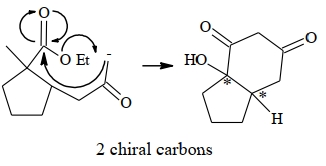
(A) The reaction is an intramolecular Claisen condensation (Dieckmann condensation).
$1$. The ethoxide ion $(EtO^-)$ abstracts an $\alpha$-hydrogen from the ketone group,forming an enolate.
$2$. This enolate attacks the ester carbonyl carbon,leading to the formation of a bicyclic compound (product $A$).
$3$. The resulting product $A$ is a bicyclo[$4.3$.$0$]nonane derivative with two hydroxyl and ketone groups.
$4$. By examining the structure of the product,we identify two chiral centers (marked with asterisks in the structure),which are the bridgehead carbons where the ring fusion occurs and substituents are attached.
Therefore,the number of chiral carbons in product $A$ is $2$.
$1$. The ethoxide ion $(EtO^-)$ abstracts an $\alpha$-hydrogen from the ketone group,forming an enolate.
$2$. This enolate attacks the ester carbonyl carbon,leading to the formation of a bicyclic compound (product $A$).
$3$. The resulting product $A$ is a bicyclo[$4.3$.$0$]nonane derivative with two hydroxyl and ketone groups.
$4$. By examining the structure of the product,we identify two chiral centers (marked with asterisks in the structure),which are the bridgehead carbons where the ring fusion occurs and substituents are attached.
Therefore,the number of chiral carbons in product $A$ is $2$.
0 likes
View Solution1165
DifficultMCQ
Consider the above reaction and predict the major product.

A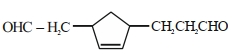
B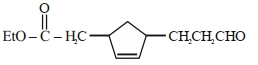
C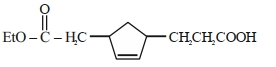
D
Solution
(A) $DiBAL-H$ (Diisobutylaluminium hydride) is a selective reducing agent that reduces esters $(-COOEt)$ and nitriles $(-CN)$ to aldehydes $(-CHO)$ at low temperatures (typically $-78 \ ^{\circ}C$).
In the given reaction,the starting material contains both an ester group $(-COOEt)$ and an aldehyde group $(-CHO)$.
$DiBAL-H$ will selectively reduce the ester group to an aldehyde group while leaving the existing aldehyde group unaffected.
Therefore,the ester group $EtO-CO-CH_2-$ is converted to $OHC-CH_2-$.
The final product is $OHC-CH_2-cyclopent-3-ene-CH_2CH_2CHO$.
In the given reaction,the starting material contains both an ester group $(-COOEt)$ and an aldehyde group $(-CHO)$.
$DiBAL-H$ will selectively reduce the ester group to an aldehyde group while leaving the existing aldehyde group unaffected.
Therefore,the ester group $EtO-CO-CH_2-$ is converted to $OHC-CH_2-$.
The final product is $OHC-CH_2-cyclopent-3-ene-CH_2CH_2CHO$.
0 likes
View Solution1166
DifficultMCQ
The products formed in the following reaction,$A$ and $B$ are
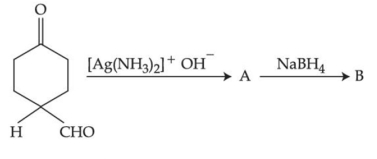
A
$A$ = $4-$oxocyclohexanecarboxylic acid,$B$ = $4-$hydroxycyclohexanecarboxylic acid
B
$A$ = $4-$hydroxycyclohexanecarboxylic acid,$B$ = $4-$hydroxycyclohexanecarboxylic acid
C
$A$ = $4-$oxocyclohexanecarboxylic acid,$B$ = $4-$oxocyclohexanecarboxylic acid
D
$A$ = $4-$oxocyclohexanecarboxylic acid,$B$ = $4-$hydroxycyclohexanecarboxylic acid
Solution
(D) The starting material is $4$-oxocyclohexanecarbaldehyde.
Step $1$: Treatment with Tollens' reagent $[Ag(NH_3)_2]^+ OH^-$ selectively oxidizes the aldehyde group to a carboxylic acid group while leaving the ketone group unaffected. Thus,$A$ is $4$-oxocyclohexanecarboxylic acid.
Step $2$: Treatment with $NaBH_4$ reduces the ketone group to a secondary alcohol but does not reduce the carboxylic acid group. Thus,$B$ is $4$-hydroxycyclohexanecarboxylic acid.
Step $1$: Treatment with Tollens' reagent $[Ag(NH_3)_2]^+ OH^-$ selectively oxidizes the aldehyde group to a carboxylic acid group while leaving the ketone group unaffected. Thus,$A$ is $4$-oxocyclohexanecarboxylic acid.
Step $2$: Treatment with $NaBH_4$ reduces the ketone group to a secondary alcohol but does not reduce the carboxylic acid group. Thus,$B$ is $4$-hydroxycyclohexanecarboxylic acid.
0 likes
View Solution1167
MediumMCQ
Which reactant will give the following alcohol on reaction with one mole of phenyl magnesium bromide $(PhMgBr)$ followed by acidic hydrolysis?
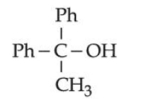
A
$CH_3-C \equiv N$
B
$Ph-C \equiv N$
C
$CH_3-CO-O-Ph$
D
$Ph-CO-CH_3$
Solution
(D) The target alcohol is $1,1-diphenyl-1-ethanol$ (or $1-phenylethanol$ derivative with two phenyl groups attached to the same carbon).
Reaction of a ketone with a Grignard reagent $(RMgX)$ followed by acidic hydrolysis yields a tertiary alcohol.
Specifically,the reaction of acetophenone $(Ph-CO-CH_3)$ with one mole of phenyl magnesium bromide $(PhMgBr)$ followed by acidic hydrolysis $(H^+)$ proceeds as follows:
$Ph-CO-CH_3 + PhMgBr \rightarrow Ph-C(OMgBr)(Ph)-CH_3$
$Ph-C(OMgBr)(Ph)-CH_3 + H_2O/H^+ \rightarrow Ph-C(OH)(Ph)-CH_3 + Mg(OH)Br$
This matches the structure of the product shown in the image. Therefore,the correct reactant is acetophenone $(Ph-CO-CH_3)$.
Reaction of a ketone with a Grignard reagent $(RMgX)$ followed by acidic hydrolysis yields a tertiary alcohol.
Specifically,the reaction of acetophenone $(Ph-CO-CH_3)$ with one mole of phenyl magnesium bromide $(PhMgBr)$ followed by acidic hydrolysis $(H^+)$ proceeds as follows:
$Ph-CO-CH_3 + PhMgBr \rightarrow Ph-C(OMgBr)(Ph)-CH_3$
$Ph-C(OMgBr)(Ph)-CH_3 + H_2O/H^+ \rightarrow Ph-C(OH)(Ph)-CH_3 + Mg(OH)Br$
This matches the structure of the product shown in the image. Therefore,the correct reactant is acetophenone $(Ph-CO-CH_3)$.
0 likes
View Solution1168
MediumMCQ
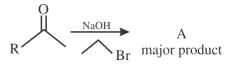
The structure of $A$ in the given reaction is:
A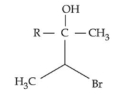
B
C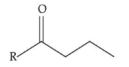
D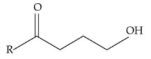
Solution
(D) The reaction involves the treatment of a ketone with a base $(NaOH)$ and an alkyl halide $(CH_3CH_2Br)$. This is an alkylation reaction of the enolate ion formed from the ketone.
$1$. The base $(NaOH)$ abstracts an $\alpha$-hydrogen from the ketone $(R-CO-CH_3)$ to form an enolate ion $(R-CO-CH_2^-)$.
$2$. The enolate ion then acts as a nucleophile and attacks the alkyl halide $(CH_3CH_2Br)$ via an $S_N2$ mechanism.
$3$. The alkyl group $(CH_3CH_2-)$ gets attached to the $\alpha$-carbon of the ketone.
$4$. The resulting product is $R-CO-CH_2-CH_2-CH_3$.
Comparing this with the given options,option $D$ represents the structure $R-CO-CH_2-CH_2-CH_3$.
$1$. The base $(NaOH)$ abstracts an $\alpha$-hydrogen from the ketone $(R-CO-CH_3)$ to form an enolate ion $(R-CO-CH_2^-)$.
$2$. The enolate ion then acts as a nucleophile and attacks the alkyl halide $(CH_3CH_2Br)$ via an $S_N2$ mechanism.
$3$. The alkyl group $(CH_3CH_2-)$ gets attached to the $\alpha$-carbon of the ketone.
$4$. The resulting product is $R-CO-CH_2-CH_2-CH_3$.
Comparing this with the given options,option $D$ represents the structure $R-CO-CH_2-CH_2-CH_3$.
0 likes
View Solution1169
DifficultMCQ
Among the following,the marked proton of which compound shows the lowest $pK_{a}$ value?
A
$CH_3-CH_2-COOH$ (marked $H$ on $\alpha$-carbon)
B
$CH_3-CO-CH_2-CH_3$ (marked $H$ on $\alpha$-carbon)
C
$C_6H_5-CH_2-CO-CH_3$ (marked $H$ on benzylic carbon)
D
$C_6H_5-CH_2-COOH$ (marked $H$ on benzylic carbon)
Solution
(C) The $pK_{a}$ value is inversely proportional to the acidity of the compound. The acidity depends on the stability of the conjugate base formed after the removal of the proton.
$1$. In $A$,the conjugate base is stabilized by resonance with the carbonyl group,but it also experiences cross-conjugation with the $-OH$ group.
$2$. In $B$,the conjugate base is stabilized by resonance with the carbonyl group.
$3$. In $C$,the conjugate base is stabilized by resonance with the carbonyl group $AND$ the phenyl ring,making it highly stable.
$4$. In $D$,the conjugate base is stabilized by resonance with the carboxylate group,but it is less stable than $C$ due to the nature of the resonance.
Comparing the stability of the conjugate bases,the benzylic proton in $C$ $(C_6H_5-CH_2-CO-CH_3)$ forms the most stable conjugate base due to extended conjugation with both the phenyl ring and the carbonyl group. Therefore,it is the most acidic and has the lowest $pK_{a}$ value.
$1$. In $A$,the conjugate base is stabilized by resonance with the carbonyl group,but it also experiences cross-conjugation with the $-OH$ group.
$2$. In $B$,the conjugate base is stabilized by resonance with the carbonyl group.
$3$. In $C$,the conjugate base is stabilized by resonance with the carbonyl group $AND$ the phenyl ring,making it highly stable.
$4$. In $D$,the conjugate base is stabilized by resonance with the carboxylate group,but it is less stable than $C$ due to the nature of the resonance.
Comparing the stability of the conjugate bases,the benzylic proton in $C$ $(C_6H_5-CH_2-CO-CH_3)$ forms the most stable conjugate base due to extended conjugation with both the phenyl ring and the carbonyl group. Therefore,it is the most acidic and has the lowest $pK_{a}$ value.
1 likes
View Solution1170
DifficultMCQ
Consider the above reaction sequence,the Product $'C'$ is
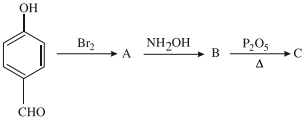
A
$3,5-$dibromobenzonitrile
B
$3,5-$dibromo$-4-$hydroxybenzaldehyde
C
$3,5-$dibromo$-4-$hydroxybenzaldehyde oxime
D
$3,5-$dibromo$-4-$hydroxybenzonitrile
Solution
(D) Step $1$: The reaction of $4$-hydroxybenzaldehyde with $Br_2$ leads to electrophilic aromatic substitution at the ortho positions relative to the $-OH$ group,forming $3,5$-dibromo-$4$-hydroxybenzaldehyde (Product $A$).
Step $2$: The reaction of $A$ with $NH_2OH$ (hydroxylamine) converts the aldehyde group $(-CHO)$ into an oxime group $(-CH=N-OH)$,forming $3,5$-dibromo-$4$-hydroxybenzaldehyde oxime (Product $B$).
Step $3$: The reaction of $B$ with $P_2O_5$ (a dehydrating agent) causes the dehydration of the oxime group to a nitrile group $(-CN)$,yielding $3,5$-dibromo-$4$-hydroxybenzonitrile (Product $C$).
Step $2$: The reaction of $A$ with $NH_2OH$ (hydroxylamine) converts the aldehyde group $(-CHO)$ into an oxime group $(-CH=N-OH)$,forming $3,5$-dibromo-$4$-hydroxybenzaldehyde oxime (Product $B$).
Step $3$: The reaction of $B$ with $P_2O_5$ (a dehydrating agent) causes the dehydration of the oxime group to a nitrile group $(-CN)$,yielding $3,5$-dibromo-$4$-hydroxybenzonitrile (Product $C$).
0 likes
View Solution1171
DifficultMCQ
Consider the following reaction sequence:
$4\text{-aminobenzonitrile}$ $\xrightarrow[(ii) H_2O]{(i) AlH(i-Bu)_2} 'A'$ $\xrightarrow[dil. NaOH, \Delta]{CH_3CHO} B$
The product $B$ is?
$4\text{-aminobenzonitrile}$ $\xrightarrow[(ii) H_2O]{(i) AlH(i-Bu)_2} 'A'$ $\xrightarrow[dil. NaOH, \Delta]{CH_3CHO} B$
The product $B$ is?
A
$4\text{-aminobenzaldehyde}$
B
$4\text{-aminocinnamaldehyde}$
C
$4\text{-amino-N-ethylidenebenzylamine}$
D
$4\text{-amino-N-formylbenzamide}$
Solution
(B) Step $1$: The reduction of $4\text{-aminobenzonitrile}$ with $DIBAL-H$ $(AlH(i-Bu)_2)$ followed by hydrolysis yields $4\text{-aminobenzaldehyde}$ as product '$A$'.
Step $2$: The reaction of $4\text{-aminobenzaldehyde}$ with acetaldehyde $(CH_3CHO)$ in the presence of dilute $NaOH$ and heat is a cross-aldol condensation reaction.
Step $3$: The aldehyde group of $4\text{-aminobenzaldehyde}$ reacts with the $\alpha\text{-hydrogen}$ of acetaldehyde to form $4\text{-aminocinnamaldehyde}$ as the major product '$B$'.
Step $2$: The reaction of $4\text{-aminobenzaldehyde}$ with acetaldehyde $(CH_3CHO)$ in the presence of dilute $NaOH$ and heat is a cross-aldol condensation reaction.
Step $3$: The aldehyde group of $4\text{-aminobenzaldehyde}$ reacts with the $\alpha\text{-hydrogen}$ of acetaldehyde to form $4\text{-aminocinnamaldehyde}$ as the major product '$B$'.
0 likes
View Solution1172
DifficultMCQ
Among the following,the compounds which can be reduced with formaldehyde and conc. $aq.$ $KOH$ are $.....$
A
only $II$ and $V$
B
only $I$ and $V$
C
only $II$ and $III$
D
only $I, II$ and $IV$
Solution
(A) The reaction described is a crossed Cannizzaro reaction. Compounds that lack $\alpha$-hydrogen atoms undergo this reaction in the presence of concentrated $KOH$. Formaldehyde $(HCHO)$ acts as the reducing agent,being more reactive towards nucleophilic attack,and thus it gets oxidized to formate $(HCOO^-)$,while the other aldehyde is reduced to its corresponding alcohol. The compounds $II$ and $V$ are aldehydes that do not possess $\alpha$-hydrogens,allowing them to be reduced to alcohols by $HCHO$ in the presence of conc. $aq.$ $KOH$.
0 likes
View Solution1173
DifficultMCQ
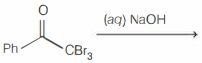
The major products of the following reaction are:
A
$PhCOOH$ and $CHBr_{3}$
B
$PhCOO^{-}$ and $CHBr_{3}$
C
$PhCOO^{-}$ and $NaBr$
D
$PhH$ and $CBr_{3}CO_{2}Na$
Solution
(B) The reaction shown is the final step of the haloform reaction.
In this step,the hydroxide ion $(OH^{-})$ acts as a nucleophile and attacks the carbonyl carbon of the $PhCOCBr_{3}$ molecule.
This leads to the formation of a tetrahedral intermediate,which then collapses to expel the stable $CBr_{3}^{-}$ carbanion and form benzoic acid $(PhCOOH)$.
Finally,an intermolecular proton exchange occurs between the carboxylic acid $(PhCOOH)$ and the $CBr_{3}^{-}$ carbanion,resulting in the formation of the benzoate ion $(PhCOO^{-})$ and bromoform $(CHBr_{3})$.
In this step,the hydroxide ion $(OH^{-})$ acts as a nucleophile and attacks the carbonyl carbon of the $PhCOCBr_{3}$ molecule.
This leads to the formation of a tetrahedral intermediate,which then collapses to expel the stable $CBr_{3}^{-}$ carbanion and form benzoic acid $(PhCOOH)$.
Finally,an intermolecular proton exchange occurs between the carboxylic acid $(PhCOOH)$ and the $CBr_{3}^{-}$ carbanion,resulting in the formation of the benzoate ion $(PhCOO^{-})$ and bromoform $(CHBr_{3})$.
0 likes
View Solution1174
MediumMCQ
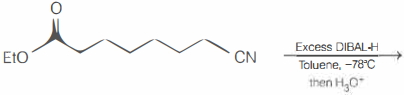
The major product of the following reaction is:
A
An aldehyde at both ends of the chain.
B
An aldehyde and a nitrile group.
C
An ester and an aldehyde group.
D
$A$ carboxylic acid and an aldehyde group.
Solution
(A) $DIBAL-H$ (diisobutylaluminium hydride) is a selective reducing agent. At low temperatures $(-78^{\circ}C)$,it reduces both ester $(-COOEt)$ and nitrile $(-CN)$ functional groups to aldehydes. Since the reaction uses excess $DIBAL-H$ followed by acidic workup $(H_3O^+)$,both functional groups are converted into aldehyde groups $(-CHO)$. The final product is a dialdehyde.
0 likes
View Solution1175
DifficultMCQ
The product of which of the following reactions forms a reddish brown precipitate when subjected to Fehling's test?
A
Benzene + $CO + HCl$ in the presence of anhydrous $AlCl_3/CuCl$
B
Propanoyl chloride + $(CH_3CH_2)_2Cd$
C
p-Toluic acid + $PCl_5$ followed by $H_2, Pd-BaSO_4$
D
$1-$Methylcyclohexene + $O_3$ followed by $Zn/H_2O$
Solution
(D) Fehling's test is given by aliphatic aldehydes but not by aromatic aldehydes or ketones.
$(a)$ Gattermann-Koch reaction gives benzaldehyde (aromatic aldehyde).
$(b)$ Reaction of acid chloride with dialkylcadmium gives a ketone (pentan$-3-$one).
$(c)$ Rosenmund reduction of p-toluoyl chloride gives p-tolualdehyde (aromatic aldehyde).
$(d)$ Ozonolysis of $1-$methylcyclohexene gives $6-$oxoheptanal,which is an aliphatic keto-aldehyde. Since it contains an aliphatic aldehyde group,it gives a positive Fehling's test (reddish brown precipitate of $Cu_2O$).
$(a)$ Gattermann-Koch reaction gives benzaldehyde (aromatic aldehyde).
$(b)$ Reaction of acid chloride with dialkylcadmium gives a ketone (pentan$-3-$one).
$(c)$ Rosenmund reduction of p-toluoyl chloride gives p-tolualdehyde (aromatic aldehyde).
$(d)$ Ozonolysis of $1-$methylcyclohexene gives $6-$oxoheptanal,which is an aliphatic keto-aldehyde. Since it contains an aliphatic aldehyde group,it gives a positive Fehling's test (reddish brown precipitate of $Cu_2O$).
0 likes
View Solution1176
DifficultMCQ
The amount (in $mol$) of bromoform $(CHBr_{3})$ produced when $1.0 \ mol$ of acetone reacts completely with $1.0 \ mol$ of bromine in the presence of aqueous $NaOH$ is $......$
A
$\frac{1}{3}$
B
$\frac{2}{3}$
C
$1$
D
$2$
Solution
(A) The reaction of acetone with bromine in the presence of aqueous $NaOH$ is the haloform reaction.
The balanced chemical equation for the reaction of acetone with bromine is:
$CH_{3}COCH_{3} + 3Br_{2} + 4NaOH \rightarrow CHBr_{3} + CH_{3}COONa + 3NaBr + 3H_{2}O$
From the stoichiometry of the reaction,$3 \ mol$ of $Br_{2}$ are required to produce $1 \ mol$ of $CHBr_{3}$.
Given that $1.0 \ mol$ of bromine is used,the amount of $CHBr_{3}$ produced is:
$\text{Amount of } CHBr_{3} = \frac{1}{3} \times \text{Amount of } Br_{2} = \frac{1}{3} \times 1.0 \ mol = \frac{1}{3} \ mol$.
The balanced chemical equation for the reaction of acetone with bromine is:
$CH_{3}COCH_{3} + 3Br_{2} + 4NaOH \rightarrow CHBr_{3} + CH_{3}COONa + 3NaBr + 3H_{2}O$
From the stoichiometry of the reaction,$3 \ mol$ of $Br_{2}$ are required to produce $1 \ mol$ of $CHBr_{3}$.
Given that $1.0 \ mol$ of bromine is used,the amount of $CHBr_{3}$ produced is:
$\text{Amount of } CHBr_{3} = \frac{1}{3} \times \text{Amount of } Br_{2} = \frac{1}{3} \times 1.0 \ mol = \frac{1}{3} \ mol$.
0 likes
View Solution1177
MediumMCQ
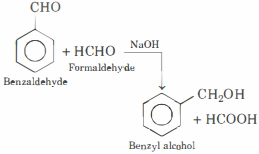
Benzaldehyde can be converted to benzyl alcohol in concentrated aqueous $NaOH$ solution using
A
$acetone$
B
$acetaldehyde$
C
$formic \ acid$
D
$formaldehyde$
Solution
(D) Benzaldehyde can be converted to benzyl alcohol in concentrated aqueous $NaOH$ solution using $formaldehyde$.
This reaction is known as the $Cross-Cannizzaro$ reaction,where one molecule of benzaldehyde is reduced to benzyl alcohol while $formaldehyde$ is oxidized to a formate salt.
Aldehydes that do not have an $\alpha-hydrogen$ atom undergo this type of reaction.
This reaction is known as the $Cross-Cannizzaro$ reaction,where one molecule of benzaldehyde is reduced to benzyl alcohol while $formaldehyde$ is oxidized to a formate salt.
Aldehydes that do not have an $\alpha-hydrogen$ atom undergo this type of reaction.
0 likes
View Solution1178
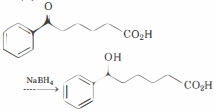
DifficultMCQ
The major product of the following reaction is:
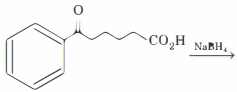
A
$6-$hydroxy$-6-$phenylhexanoic acid
B
$6,6-$dihydroxy$-6-$phenylhexanoic acid
C
$1-$phenylhexane$-1,6-$diol
D
$6-$phenylhexanoic acid
Solution
0 likes
View Solution1179
MediumMCQ
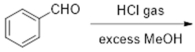
The major product formed in the following reaction is:
A
Benzaldehyde hemiacetal
B
Benzaldehyde dimethyl acetal
C
Methyl benzoate
D
Benzaldehyde trimethyl acetal
Solution
(B) The reaction of an aldehyde with an excess of alcohol in the presence of dry $HCl$ gas is a nucleophilic addition reaction.
First,the aldehyde reacts with one equivalent of alcohol to form a hemiacetal.
Subsequently,the hemiacetal reacts with another molecule of alcohol to form a gem-dialkoxy compound known as an acetal.
Since the reaction is performed with excess $MeOH$,the final major product is the acetal,which is $C_6H_5CH(OCH_3)_2$ (benzaldehyde dimethyl acetal).
First,the aldehyde reacts with one equivalent of alcohol to form a hemiacetal.
Subsequently,the hemiacetal reacts with another molecule of alcohol to form a gem-dialkoxy compound known as an acetal.
Since the reaction is performed with excess $MeOH$,the final major product is the acetal,which is $C_6H_5CH(OCH_3)_2$ (benzaldehyde dimethyl acetal).
0 likes
View Solution1180
MediumMCQ
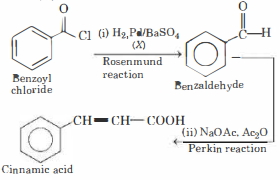
In the reaction,
$C_6H_5COCl \xrightarrow[(ii) Y]{(i) X} C_6H_5CH=CHCOOH$
$X$ and $Y$ are
$C_6H_5COCl \xrightarrow[(ii) Y]{(i) X} C_6H_5CH=CHCOOH$
$X$ and $Y$ are
A
$X = H_2, Pd / BaSO_4 ; Y = NaOAc, Ac_2O$
B
$X = LiAlH_4 ; Y = NaOAc, Ac_2O$
C
$X = H_2, Pd / C ; Y = NaOH, Ac_2O$
D
$X = LiAlH_4 ; Y = NaOH, Ac_2O$
Solution
(A)
In step $(i)$,benzoyl chloride undergoes reduction in the presence of $H_2, Pd / BaSO_4$ to give benzaldehyde.
This reaction is known as the Rosenmund reduction. The reagent is a selective reducing agent,which reduces acid chlorides to an aldehyde group.
In step $(ii)$,benzaldehyde undergoes condensation with acetic anhydride in the presence of an alkali salt of the acid $(NaOAc)$ to give cinnamic acid $(\alpha, \beta$-unsaturated aromatic acid).
This reaction is known as the Perkin reaction.
In step $(i)$,benzoyl chloride undergoes reduction in the presence of $H_2, Pd / BaSO_4$ to give benzaldehyde.
This reaction is known as the Rosenmund reduction. The reagent is a selective reducing agent,which reduces acid chlorides to an aldehyde group.
In step $(ii)$,benzaldehyde undergoes condensation with acetic anhydride in the presence of an alkali salt of the acid $(NaOAc)$ to give cinnamic acid $(\alpha, \beta$-unsaturated aromatic acid).
This reaction is known as the Perkin reaction.
0 likes
View Solution1181
MediumMCQ
In the following reaction,$C_6H_5CN$ $\xrightarrow[(ii) H_3O^+]{(i) SnCl_2/HCl} X$ $\xrightarrow{Dil. NaOH} Y$. Here,$X$ and $Y$ are:
A
$X = C_6H_5CH_2Cl, Y = \text{4-methylchalcone}$
B
$X = C_6H_5CH_2Cl, Y = \text{chalcone derivative}$
C
$X = C_6H_5CHO, Y = \text{4-methylchalcone}$
D
$X = C_6H_5CHO, Y = \text{4-methylchalcone}$ (with correct structure)
Solution
(D) The reaction proceeds in two main steps:
$1$. The first step is the $Stephen \ reduction$ of benzonitrile $(C_6H_5CN)$ using $SnCl_2/HCl$ followed by hydrolysis,which yields benzaldehyde $(C_6H_5CHO)$ as product $X$.
$2$. The second step is the $Claisen-Schmidt$ condensation (a type of aldol condensation) between benzaldehyde $(X)$ and $4-methylacetophenone$ in the presence of dilute $NaOH$. This reaction produces an $\alpha, \beta$-unsaturated ketone,which is $Y$ (specifically,$1-(4-methylphenyl)-3-phenylprop-2-en-1-one$).
$1$. The first step is the $Stephen \ reduction$ of benzonitrile $(C_6H_5CN)$ using $SnCl_2/HCl$ followed by hydrolysis,which yields benzaldehyde $(C_6H_5CHO)$ as product $X$.
$2$. The second step is the $Claisen-Schmidt$ condensation (a type of aldol condensation) between benzaldehyde $(X)$ and $4-methylacetophenone$ in the presence of dilute $NaOH$. This reaction produces an $\alpha, \beta$-unsaturated ketone,which is $Y$ (specifically,$1-(4-methylphenyl)-3-phenylprop-2-en-1-one$).
0 likes
View Solution1182
AdvancedMCQ
Acetophenone $(PhCOCH_3)$ reacts with perbenzoic acid to produce a compound $X$. Reaction of $X$ with excess $CH_3MgBr$ followed by treatment with aqueous acid predominantly produces
A
Benzoic acid
B
Phenyl acetate
C
tert-Butyl alcohol and phenol
D
$1-$Phenylethanol
Solution
(C) Acetophenone $(PhCOCH_3)$ reacts with perbenzoic acid to undergo Baeyer-Villiger oxidation to form phenyl acetate $(PhOCOCH_3)$ as compound $X$.
When $X$ $(PhOCOCH_3)$ reacts with excess $CH_3MgBr$,the ester undergoes nucleophilic acyl substitution followed by addition to the resulting ketone.
$1$. $PhOCOCH_3 + CH_3MgBr \rightarrow PhOMgBr + CH_3COCH_3$ (acetone).
$2$. The formed acetone further reacts with another equivalent of $CH_3MgBr$ to form tert-butoxide $( (CH_3)_3COMgBr )$.
$3$. Upon treatment with aqueous acid $(H_3O^+)$,the products are phenol $(PhOH)$ and tert-butyl alcohol $((CH_3)_3COH)$.
When $X$ $(PhOCOCH_3)$ reacts with excess $CH_3MgBr$,the ester undergoes nucleophilic acyl substitution followed by addition to the resulting ketone.
$1$. $PhOCOCH_3 + CH_3MgBr \rightarrow PhOMgBr + CH_3COCH_3$ (acetone).
$2$. The formed acetone further reacts with another equivalent of $CH_3MgBr$ to form tert-butoxide $( (CH_3)_3COMgBr )$.
$3$. Upon treatment with aqueous acid $(H_3O^+)$,the products are phenol $(PhOH)$ and tert-butyl alcohol $((CH_3)_3COH)$.
0 likes
View Solution1183
MediumMCQ
Upon reaction with $CH_3MgBr$ followed by protonation,the compound that produces ethanol is
A
$CH_3CHO$
B
$HCOOH$
C
$HCHO$
D
$(CHO)_2$
Solution
(C) The reaction of a Grignard reagent $(RMgX)$ with formaldehyde $(HCHO)$ followed by acid hydrolysis $(H_3O^+)$ yields a primary alcohol with one more carbon atom than the Grignard reagent.
For the production of ethanol $(CH_3CH_2OH)$,which has two carbon atoms,the Grignard reagent $CH_3MgBr$ (one carbon) must react with formaldehyde ($HCHO$,one carbon).
The reaction is as follows:
$HCHO + CH_3MgBr \rightarrow H-C(H)(CH_3)-OMgBr$
$H-C(H)(CH_3)-OMgBr + H_3O^+ \rightarrow CH_3CH_2OH + Mg(OH)Br$
Thus,the correct compound is formaldehyde $(HCHO)$.
For the production of ethanol $(CH_3CH_2OH)$,which has two carbon atoms,the Grignard reagent $CH_3MgBr$ (one carbon) must react with formaldehyde ($HCHO$,one carbon).
The reaction is as follows:
$HCHO + CH_3MgBr \rightarrow H-C(H)(CH_3)-OMgBr$
$H-C(H)(CH_3)-OMgBr + H_3O^+ \rightarrow CH_3CH_2OH + Mg(OH)Br$
Thus,the correct compound is formaldehyde $(HCHO)$.
0 likes
View Solution1184
DifficultMCQ
In the following reactions,
$CH_3COCH_3 \xrightarrow[(ii) D_3O^+]{(i) NaBH_4} X$
$CH_3COCH_3 \xrightarrow[(ii) H_3O^+]{(i) NaBD_4} Y$
$X$ and $Y$ are
$CH_3COCH_3 \xrightarrow[(ii) D_3O^+]{(i) NaBH_4} X$
$CH_3COCH_3 \xrightarrow[(ii) H_3O^+]{(i) NaBD_4} Y$
$X$ and $Y$ are
A
$X = CH_3CH(OD)CH_3, Y = CH_3CD(OH)CH_3$
B
$X = CH_3CD(OH)CH_3, Y = CH_3CH(OD)CH_3$
C
$X = CH_3CD(OH)CH_3, Y = CH_3CD(OH)CH_3$
D
$X = CH_3CH(OH)CH_3, Y = CH_3CH(OH)CH_3$
Solution
(A) In the first reaction:
$(i)$ $NaBH_4$ acts as a source of hydride ion $(H^-)$,which attacks the carbonyl carbon of acetone $(CH_3COCH_3)$ to form an alkoxide intermediate.
(ii) Upon treatment with $D_3O^+$,the alkoxide oxygen is protonated (deuterated) to form the alcohol $CH_3CH(OD)CH_3$,which is $X$.
In the second reaction:
$(i)$ $NaBD_4$ acts as a source of deuteride ion $(D^-)$,which attacks the carbonyl carbon of acetone to form an alkoxide intermediate containing a deuterium atom at the alpha position.
(ii) Upon treatment with $H_3O^+$,the alkoxide oxygen is protonated to form the alcohol $CH_3CD(OH)CH_3$,which is $Y$.
Thus,$X = CH_3CH(OD)CH_3$ and $Y = CH_3CD(OH)CH_3$.
$(i)$ $NaBH_4$ acts as a source of hydride ion $(H^-)$,which attacks the carbonyl carbon of acetone $(CH_3COCH_3)$ to form an alkoxide intermediate.
(ii) Upon treatment with $D_3O^+$,the alkoxide oxygen is protonated (deuterated) to form the alcohol $CH_3CH(OD)CH_3$,which is $X$.
In the second reaction:
$(i)$ $NaBD_4$ acts as a source of deuteride ion $(D^-)$,which attacks the carbonyl carbon of acetone to form an alkoxide intermediate containing a deuterium atom at the alpha position.
(ii) Upon treatment with $H_3O^+$,the alkoxide oxygen is protonated to form the alcohol $CH_3CD(OH)CH_3$,which is $Y$.
Thus,$X = CH_3CH(OD)CH_3$ and $Y = CH_3CD(OH)CH_3$.
0 likes
View Solution1185
DifficultMCQ
In the reaction sequence,
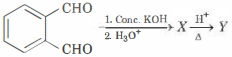
the major products $X$ and $Y$ respectively are
the major products $X$ and $Y$ respectively are
A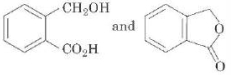
B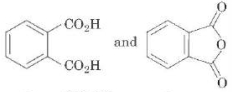
C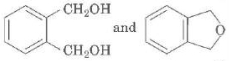
D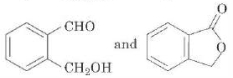
Solution
(A) The starting compound,phthalaldehyde,does not contain $\alpha$-hydrogen atoms. Therefore,in the presence of a strong base like $KOH$,it undergoes an intramolecular Cannizzaro reaction.
In this reaction,one aldehyde group is reduced to a primary alcohol $(-CH_2OH)$ while the other aldehyde group is oxidized to a carboxylic acid salt $(-COO^-)$. Upon acidification with $H_3O^+$,the salt is converted into the carboxylic acid group $(-COOH)$,yielding $X$ ($o$-hydroxymethylbenzoic acid).
When $X$ is heated in the presence of an acid catalyst $(H^+)$,it undergoes intramolecular esterification (loss of $H_2O$) to form a cyclic ester known as a lactone,which is $Y$ (phthalide).
In this reaction,one aldehyde group is reduced to a primary alcohol $(-CH_2OH)$ while the other aldehyde group is oxidized to a carboxylic acid salt $(-COO^-)$. Upon acidification with $H_3O^+$,the salt is converted into the carboxylic acid group $(-COOH)$,yielding $X$ ($o$-hydroxymethylbenzoic acid).
When $X$ is heated in the presence of an acid catalyst $(H^+)$,it undergoes intramolecular esterification (loss of $H_2O$) to form a cyclic ester known as a lactone,which is $Y$ (phthalide).
0 likes
View Solution1186
MediumMCQ
In the following reaction,the major product $X$ is
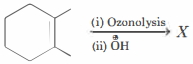
A
$3-$methylcyclohex$-2-$en$-1-$one
B
$2-$methylcyclopent$-1-$enecarbaldehyde
C
heptane$-2,6-$dione
D
$2-$methylcyclohex$-2-$en$-1-$one
Solution
(A) The reaction proceeds in two steps:
Step $1$: Ozonolysis of $1,2$-dimethylcyclopentene followed by reductive workup $(Zn/H_2O)$ leads to the formation of heptane-$2,6$-dione.
Step $2$: The resulting heptane-$2,6$-dione undergoes an intramolecular aldol condensation in the presence of base $(OH^-)$. The enolate formed at the $\alpha$-carbon attacks the other carbonyl group to form a $\beta$-hydroxy ketone intermediate. This intermediate subsequently undergoes dehydration (loss of $H_2O$) to form the stable $\alpha,\beta$-unsaturated carbonyl compound,which is $3$-methylcyclohex-$2$-en-$1$-one.
Step $1$: Ozonolysis of $1,2$-dimethylcyclopentene followed by reductive workup $(Zn/H_2O)$ leads to the formation of heptane-$2,6$-dione.
Step $2$: The resulting heptane-$2,6$-dione undergoes an intramolecular aldol condensation in the presence of base $(OH^-)$. The enolate formed at the $\alpha$-carbon attacks the other carbonyl group to form a $\beta$-hydroxy ketone intermediate. This intermediate subsequently undergoes dehydration (loss of $H_2O$) to form the stable $\alpha,\beta$-unsaturated carbonyl compound,which is $3$-methylcyclohex-$2$-en-$1$-one.
0 likes
View Solution1187
MediumMCQ
$4$-formylbenzoic acid on treatment with one equivalent of hydrazine followed by heating with alc. $KOH$ gives the major product:
A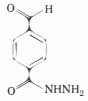
B
C
D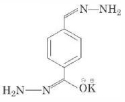
Solution
(B) $4$-formylbenzoic acid contains both an aldehyde group $(-CHO)$ and a carboxylic acid group $(-COOH)$.
When treated with one equivalent of hydrazine $(NH_2NH_2)$,the more reactive aldehyde group forms a hydrazone.
Subsequent heating with alcoholic $KOH$ triggers the Wolff-Kishner reduction of the hydrazone to a methyl group $(-CH_3)$.
Meanwhile,the carboxylic acid group reacts with the base $(KOH)$ to form a potassium carboxylate salt $(-COO^-K^+)$.
Therefore,the major product is $4$-methylbenzoate potassium salt.
When treated with one equivalent of hydrazine $(NH_2NH_2)$,the more reactive aldehyde group forms a hydrazone.
Subsequent heating with alcoholic $KOH$ triggers the Wolff-Kishner reduction of the hydrazone to a methyl group $(-CH_3)$.
Meanwhile,the carboxylic acid group reacts with the base $(KOH)$ to form a potassium carboxylate salt $(-COO^-K^+)$.
Therefore,the major product is $4$-methylbenzoate potassium salt.
0 likes
View Solution1188
AdvancedMCQ
Calcium butanoate on heating followed by treatment with $1,2-$ethanediol in the presence of a catalytic amount of an acid,produces a major product which is
A
B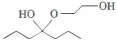
C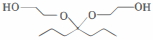
D
Solution
(A) $1$. Heating calcium butanoate,$(CH_3CH_2CH_2COO)_2Ca$,results in the formation of heptan$-4-$one $(CH_3CH_2CH_2COCH_2CH_2CH_3)$ and calcium carbonate $(CaCO_3)$.
$2$. Heptan$-4-$one reacts with $1,2-$ethanediol $(HOCH_2CH_2OH)$ in the presence of an acid catalyst to form a cyclic ketal.
$3$. The reaction involves the nucleophilic attack of the diol on the carbonyl carbon,followed by the elimination of water to form the cyclic structure shown in option $A$.
$2$. Heptan$-4-$one reacts with $1,2-$ethanediol $(HOCH_2CH_2OH)$ in the presence of an acid catalyst to form a cyclic ketal.
$3$. The reaction involves the nucleophilic attack of the diol on the carbonyl carbon,followed by the elimination of water to form the cyclic structure shown in option $A$.
0 likes
View Solution1189
DifficultMCQ
The reaction of ethyl methyl ketone with $Cl_2$ / excess $OH^{-}$ gives the following major product:
A
$ClCH_2CH_2COCH_3$
B
$CH_3CH_2COCCl_3$
C
$ClCH_2CH_2COCH_2Cl$
D
$CH_3CCl_2COCH_2Cl$
Solution
(B) The reaction of ethyl methyl ketone $(CH_3CH_2COCH_3)$ with $Cl_2$ in the presence of excess $OH^{-}$ is a haloform-type reaction (specifically,chlorination of the $\alpha$-carbon).
Since the methyl group $(CH_3)$ attached to the carbonyl is more sterically accessible and the resulting enolate is more stable for further substitution,the chlorination occurs preferentially at the methyl group.
The $\alpha$-hydrogens of the methyl group are successively replaced by chlorine atoms due to the inductive effect of the chlorine atoms,which makes the remaining $\alpha$-hydrogens even more acidic.
Ultimately,the methyl group is converted into a trichloromethyl group $(-CCl_3)$,resulting in the product $CH_3CH_2COCCl_3$.
Since the methyl group $(CH_3)$ attached to the carbonyl is more sterically accessible and the resulting enolate is more stable for further substitution,the chlorination occurs preferentially at the methyl group.
The $\alpha$-hydrogens of the methyl group are successively replaced by chlorine atoms due to the inductive effect of the chlorine atoms,which makes the remaining $\alpha$-hydrogens even more acidic.
Ultimately,the methyl group is converted into a trichloromethyl group $(-CCl_3)$,resulting in the product $CH_3CH_2COCCl_3$.
0 likes
View Solution1190
MediumMCQ
In the following conversion,
$C_6H_5CN$ $\xrightarrow[(ii) H_3O^+]{(i) MeMgBr} X$ $\xrightarrow[H_3O^+]{NaOH/I_2} Y$
the major products $X$ and $Y$,respectively are
$C_6H_5CN$ $\xrightarrow[(ii) H_3O^+]{(i) MeMgBr} X$ $\xrightarrow[H_3O^+]{NaOH/I_2} Y$
the major products $X$ and $Y$,respectively are
A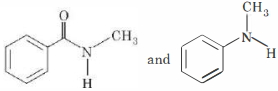
$I$
B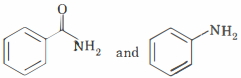
$II$
C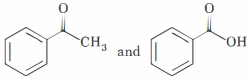
$III$
D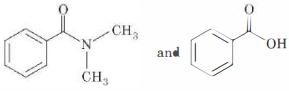
$IV$
Solution
(C) The reaction sequence is as follows:
$1$. Benzonitrile $(C_6H_5CN)$ reacts with methylmagnesium bromide $(MeMgBr)$ followed by acid hydrolysis $(H_3O^+)$ to form acetophenone $(C_6H_5COCH_3)$ as product $X$.
$2$. Acetophenone $(C_6H_5COCH_3)$ contains a methyl ketone group,which undergoes the iodoform reaction with $NaOH/I_2$ followed by acidification $(H_3O^+)$ to produce benzoic acid $(C_6H_5COOH)$ as product $Y$.
Thus,$X$ is acetophenone and $Y$ is benzoic acid,which corresponds to option $III$.
$1$. Benzonitrile $(C_6H_5CN)$ reacts with methylmagnesium bromide $(MeMgBr)$ followed by acid hydrolysis $(H_3O^+)$ to form acetophenone $(C_6H_5COCH_3)$ as product $X$.
$2$. Acetophenone $(C_6H_5COCH_3)$ contains a methyl ketone group,which undergoes the iodoform reaction with $NaOH/I_2$ followed by acidification $(H_3O^+)$ to produce benzoic acid $(C_6H_5COOH)$ as product $Y$.
Thus,$X$ is acetophenone and $Y$ is benzoic acid,which corresponds to option $III$.
0 likes
View Solution1191
EasyMCQ
The reaction of butanal with $n$-propylmagnesium bromide gives a
A
chiral secondary alcohol
B
achiral secondary alcohol
C
chiral tertiary alcohol
D
achiral tertiary alcohol
Solution
(B) The reaction of butanal $(CH_3CH_2CH_2CHO)$ with $n$-propylmagnesium bromide $(CH_3CH_2CH_2MgBr)$ is a nucleophilic addition reaction.
First,the Grignard reagent attacks the carbonyl carbon of butanal to form an alkoxide intermediate.
Upon acidic hydrolysis $(H_3O^+)$,this intermediate yields heptan-$4$-ol $(CH_3CH_2CH_2CH(OH)CH_2CH_2CH_3)$.
In heptan-$4$-ol,the central carbon atom is bonded to two identical $n$-propyl groups $(-CH_2CH_2CH_3)$ and one hydrogen atom and one hydroxyl group.
Since the central carbon is bonded to two identical groups,it is not a chiral center.
Therefore,the product is an achiral secondary alcohol.
Thus,the correct option is $(b)$.
First,the Grignard reagent attacks the carbonyl carbon of butanal to form an alkoxide intermediate.
Upon acidic hydrolysis $(H_3O^+)$,this intermediate yields heptan-$4$-ol $(CH_3CH_2CH_2CH(OH)CH_2CH_2CH_3)$.
In heptan-$4$-ol,the central carbon atom is bonded to two identical $n$-propyl groups $(-CH_2CH_2CH_3)$ and one hydrogen atom and one hydroxyl group.
Since the central carbon is bonded to two identical groups,it is not a chiral center.
Therefore,the product is an achiral secondary alcohol.
Thus,the correct option is $(b)$.
0 likes
View Solution1192
MediumMCQ
The reddish brown precipitate formed in the Fehling's test for aldehydes $(RCHO)$ is due to the formation of
A
$Cu$
B
$Cu_2O$
C
$CuO$
D
$(RCOO)_2Cu$
Solution
(B)
Fehling's reagent is a mixture of aqueous copper sulphate and alkaline sodium potassium tartrate.
When an aldehyde is heated with Fehling's reagent,a reddish brown precipitate is obtained,and the aldehydes are oxidized to the corresponding carboxylate anion.
This reddish brown precipitate is due to the formation of copper$(I)$ oxide.
$RCHO + 2Cu^{2+} + 5OH^{-} \xrightarrow{\Delta} RCOO^{-} + Cu_2O \downarrow + 3H_2O$
Fehling's reagent is a mixture of aqueous copper sulphate and alkaline sodium potassium tartrate.
When an aldehyde is heated with Fehling's reagent,a reddish brown precipitate is obtained,and the aldehydes are oxidized to the corresponding carboxylate anion.
This reddish brown precipitate is due to the formation of copper$(I)$ oxide.
$RCHO + 2Cu^{2+} + 5OH^{-} \xrightarrow{\Delta} RCOO^{-} + Cu_2O \downarrow + 3H_2O$
0 likes
View Solution1193
MediumMCQ
In the following reaction,
$CH_3-C \equiv CH$ $\xrightarrow[H_3O^+]{Hg^{2+}} X$ $\xrightarrow[PhCHO]{dil. NaOH} Y$
$X$ and $Y$,respectively,are
$CH_3-C \equiv CH$ $\xrightarrow[H_3O^+]{Hg^{2+}} X$ $\xrightarrow[PhCHO]{dil. NaOH} Y$
$X$ and $Y$,respectively,are
A
$X = CH_3CH_2CHO$,$Y = Ph-CH=C(CH_3)CHO$
B
$X = CH_3COCH_3$,$Y = CH_3COCH=CHPh$
C
$X = CH_3COCH_3$,$Y = Ph-CH=C(CH_3)CH_3$
D
$X = CH_3CH_2CHO$,$Y = Ph-CH=CHCH_2CH_3$
Solution
(B) In the first step,propyne $(CH_3-C \equiv CH)$ undergoes hydration in the presence of $Hg^{2+}$ and $H_3O^+$ to form acetone $(CH_3COCH_3)$ as $X$.
In the second step,acetone reacts with benzaldehyde $(PhCHO)$ in the presence of dilute $NaOH$. This is a Claisen-Schmidt condensation (a type of cross-aldol condensation) where the $\alpha$-hydrogen of acetone reacts with the carbonyl group of benzaldehyde to form $4$-phenylbut-$3$-en-$2$-one $(CH_3COCH=CHPh)$ as $Y$.
In the second step,acetone reacts with benzaldehyde $(PhCHO)$ in the presence of dilute $NaOH$. This is a Claisen-Schmidt condensation (a type of cross-aldol condensation) where the $\alpha$-hydrogen of acetone reacts with the carbonyl group of benzaldehyde to form $4$-phenylbut-$3$-en-$2$-one $(CH_3COCH=CHPh)$ as $Y$.
0 likes
View Solution1194
MediumMCQ
The major products in the reaction $Br_3CCHO \stackrel{NaOH}{\longrightarrow}$ are $....$
A
$CHBr_3 + HCOONa$
B
$NaBr + CH_2=CBr_2$
C
$NaOBr + DCHO$
D
$Br_3CCH_2OH + Br_3CCOONa$
Solution
(A) The reaction $Br_3CCHO \stackrel{NaOH}{\longrightarrow} CHBr_3 + HCOONa$ is a classic example of the haloform reaction (specifically,the bromoform reaction).
In this reaction,the trihaloacetaldehyde $(Br_3CCHO)$ reacts with a base $(NaOH)$.
The hydroxide ion $(OH^-)$ attacks the carbonyl carbon,leading to the cleavage of the $C-C$ bond.
This results in the formation of bromoform $(CHBr_3)$ and the sodium salt of the corresponding carboxylic acid,which is sodium formate $(HCOONa)$.
In this reaction,the trihaloacetaldehyde $(Br_3CCHO)$ reacts with a base $(NaOH)$.
The hydroxide ion $(OH^-)$ attacks the carbonyl carbon,leading to the cleavage of the $C-C$ bond.
This results in the formation of bromoform $(CHBr_3)$ and the sodium salt of the corresponding carboxylic acid,which is sodium formate $(HCOONa)$.
0 likes
View Solution1195
MediumMCQ
$A$ compound that shows positive iodoform test is
A
$2$-pentanone
B
$3$-pentanone
C
$3$-pentanol
D
$1$-pentanol
Solution
(A)
Iodoform test with sodium hypoiodite is used for the detection of the $CH_3CO-$ group or the $CH_3CH(OH)-$ group,which produces the $CH_3CO-$ group upon oxidation.
Iodoform reaction with the given compounds is as follows:
$(A)$ $CH_3CH_2CH_2COCH_3 + 3I_2 + 4NaOH \longrightarrow CH_3CH_2CH_2COONa + CHI_3 + 3NaI + 3H_2O$. It gives a positive iodoform test due to the presence of the $CH_3CO-$ group.
$(B)$ $CH_3CH_2COCH_2CH_3$ does not contain a $CH_3CO-$ group,so it gives a negative iodoform test.
$(C)$ $CH_3CH_2CH(OH)CH_2CH_3$ does not contain a $CH_3CH(OH)-$ group,so it gives a negative iodoform test.
$(D)$ $CH_3CH_2CH_2CH_2CH_2OH$ is a primary alcohol that does not contain a $CH_3CH(OH)-$ group,so it gives a negative iodoform test.
Iodoform test with sodium hypoiodite is used for the detection of the $CH_3CO-$ group or the $CH_3CH(OH)-$ group,which produces the $CH_3CO-$ group upon oxidation.
Iodoform reaction with the given compounds is as follows:
$(A)$ $CH_3CH_2CH_2COCH_3 + 3I_2 + 4NaOH \longrightarrow CH_3CH_2CH_2COONa + CHI_3 + 3NaI + 3H_2O$. It gives a positive iodoform test due to the presence of the $CH_3CO-$ group.
$(B)$ $CH_3CH_2COCH_2CH_3$ does not contain a $CH_3CO-$ group,so it gives a negative iodoform test.
$(C)$ $CH_3CH_2CH(OH)CH_2CH_3$ does not contain a $CH_3CH(OH)-$ group,so it gives a negative iodoform test.
$(D)$ $CH_3CH_2CH_2CH_2CH_2OH$ is a primary alcohol that does not contain a $CH_3CH(OH)-$ group,so it gives a negative iodoform test.
0 likes
View Solution1196
MediumMCQ
Phenylmagnesium bromide,upon reaction with a compound $X$ followed by treatment with acid,gives benzyl alcohol. The compound $X$ is
A
carbon dioxide
B
ethylene
C
formaldehyde
D
methanol
Solution
(C) The reaction of a Grignard reagent $(PhMgBr)$ with formaldehyde $(HCHO)$ followed by acid hydrolysis $(H_3O^+)$ yields a primary alcohol.
Specifically,the nucleophilic phenyl group $(Ph^-)$ attacks the electrophilic carbonyl carbon of formaldehyde $(HCHO)$,forming an intermediate alkoxide $(Ph-CH_2-O^-)$.
Subsequent protonation by acid results in the formation of benzyl alcohol $(Ph-CH_2OH)$.
Therefore,the compound $X$ is formaldehyde.
Specifically,the nucleophilic phenyl group $(Ph^-)$ attacks the electrophilic carbonyl carbon of formaldehyde $(HCHO)$,forming an intermediate alkoxide $(Ph-CH_2-O^-)$.
Subsequent protonation by acid results in the formation of benzyl alcohol $(Ph-CH_2OH)$.
Therefore,the compound $X$ is formaldehyde.
0 likes
View Solution1197
DifficultMCQ
The following transformation can be best carried out using:
A
$LiAlH_4$ in $THF$
B
$BH_3$ in $THF$
C
$NaBH_4$ in $EtOH$
D
$DIBAL-H$ in hexane
Solution
(C) $NaBH_4$ in $EtOH$ is a mild reducing agent.
It selectively reduces the aldehyde group $(-CHO)$ to a primary alcohol $(-CH_2OH)$ without affecting other functional groups like esters,carboxylic acids,or nitriles present in the molecule.
It selectively reduces the aldehyde group $(-CHO)$ to a primary alcohol $(-CH_2OH)$ without affecting other functional groups like esters,carboxylic acids,or nitriles present in the molecule.
0 likes
View Solution1198
DifficultMCQ
Compound $(X)$ undergoes the following sequence of reactions to give the Lactone $(Y)$. Identify $(X)$.
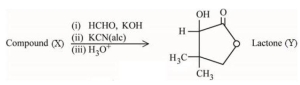
A
$(CH_3)_2CH-CHO$
B
$(HOCH_2)(CH_3)_2C-CHO$
C
$H_2C(OH)-CH_2-CH_2-CH_2-CHO$
D
$H_2C(CH_3)-CH_2-CHO$
Solution
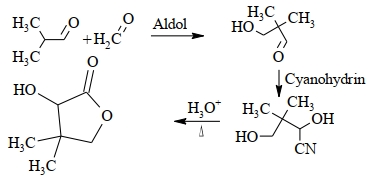
(A) The reaction sequence is as follows:
$1$. Aldol condensation of isobutyraldehyde $(CH_3)_2CH-CHO$ with formaldehyde $(HCHO)$ in the presence of $KOH$ gives $3-hydroxy-2,2-dimethylpropanal$ $(HOCH_2-C(CH_3)_2-CHO)$.
$2$. This product reacts with $KCN$ to form a cyanohydrin.
$3$. Acidic hydrolysis $(H_3O^+)$ followed by heating leads to the formation of the lactone $(Y)$ via intramolecular esterification.
Therefore,the starting compound $(X)$ is isobutyraldehyde,which is $(CH_3)_2CH-CHO$.
$1$. Aldol condensation of isobutyraldehyde $(CH_3)_2CH-CHO$ with formaldehyde $(HCHO)$ in the presence of $KOH$ gives $3-hydroxy-2,2-dimethylpropanal$ $(HOCH_2-C(CH_3)_2-CHO)$.
$2$. This product reacts with $KCN$ to form a cyanohydrin.
$3$. Acidic hydrolysis $(H_3O^+)$ followed by heating leads to the formation of the lactone $(Y)$ via intramolecular esterification.
Therefore,the starting compound $(X)$ is isobutyraldehyde,which is $(CH_3)_2CH-CHO$.
0 likes
View Solution1199
MediumMCQ
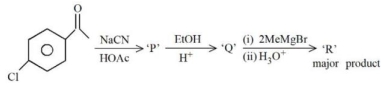
$R$ formed in the following sequence of reaction is:
A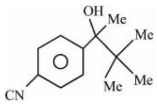
B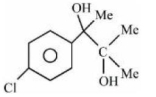
C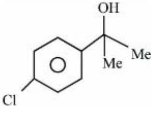
D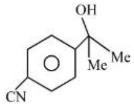
Solution
(B) $1$. The reaction of $4$-chloroacetophenone with $NaCN$ and $HOAc$ (cyanohydrin formation) yields $P$,which is $2-(4-chlorophenyl)-2-hydroxypropanenitrile$.
$2$. The reaction of $P$ with $EtOH$ in the presence of $H^+$ (acid-catalyzed esterification/hydrolysis) converts the nitrile group to an ester,yielding $Q$,which is ethyl $2-(4-chlorophenyl)-2-hydroxypropanoate$.
$3$. The reaction of $Q$ with $2$ equivalents of $MeMgBr$ followed by $H_3O^+$ (Grignard reaction with an ester) replaces the ester group with a tertiary alcohol group,yielding $R$,which is $1-(4-chlorophenyl)-1,2-dihydroxy-2-methylpropane$ (or $2-(4-chlorophenyl)-3-methylbutane-2,3-diol$).
$2$. The reaction of $P$ with $EtOH$ in the presence of $H^+$ (acid-catalyzed esterification/hydrolysis) converts the nitrile group to an ester,yielding $Q$,which is ethyl $2-(4-chlorophenyl)-2-hydroxypropanoate$.
$3$. The reaction of $Q$ with $2$ equivalents of $MeMgBr$ followed by $H_3O^+$ (Grignard reaction with an ester) replaces the ester group with a tertiary alcohol group,yielding $R$,which is $1-(4-chlorophenyl)-1,2-dihydroxy-2-methylpropane$ (or $2-(4-chlorophenyl)-3-methylbutane-2,3-diol$).
0 likes
View Solution1200
DifficultMCQ
Given below are two statements:
Statement $I$: $H_2N-CO-CH_2-CH_2-CO-CH_3$ under Clemmensen reduction conditions will give $HOOC-(CH_2)_3-CH_3$.
Statement $II$: $CH_3-CH(CH_3)-CH_2-CH(Cl)-CO-CH_3$ under Wolff-Kishner reduction conditions will give $CH_3-CH(CH_3)-CH_2-CH(Cl)-CH_2-CH_3$.
In the light of the above statements,choose the correct answer from the options given below:
Statement $I$: $H_2N-CO-CH_2-CH_2-CO-CH_3$ under Clemmensen reduction conditions will give $HOOC-(CH_2)_3-CH_3$.
Statement $II$: $CH_3-CH(CH_3)-CH_2-CH(Cl)-CO-CH_3$ under Wolff-Kishner reduction conditions will give $CH_3-CH(CH_3)-CH_2-CH(Cl)-CH_2-CH_3$.
In the light of the above statements,choose the correct answer from the options given below:
A
Statement $I$ is false but Statement $II$ is true
B
Both Statement $I$ and Statement $II$ are false
C
Statement $I$ is true but Statement $II$ is false
D
Both Statement $I$ and Statement $II$ are true
Solution
(B) Statement $I$ is false. Clemmensen reduction $(Zn-Hg/conc. HCl)$ reduces carbonyl groups to methylene groups. However,it does not hydrolyze amides to carboxylic acids under standard conditions. The amide group remains intact.
Statement $II$ is false. Wolff-Kishner reduction $(NH_2NH_2/OH^-/glycol)$ reduces carbonyl groups to methylene groups. However,in the presence of an $\alpha$-halo ketone,the basic conditions $(OH^-)$ lead to elimination reactions (dehydrohalogenation) rather than just simple reduction of the carbonyl group. Thus,the product would involve an alkene,not the simple alkane derivative shown.
Statement $II$ is false. Wolff-Kishner reduction $(NH_2NH_2/OH^-/glycol)$ reduces carbonyl groups to methylene groups. However,in the presence of an $\alpha$-halo ketone,the basic conditions $(OH^-)$ lead to elimination reactions (dehydrohalogenation) rather than just simple reduction of the carbonyl group. Thus,the product would involve an alkene,not the simple alkane derivative shown.
0 likes
View Solution8-1.Aldehydes and Ketones — Properties · Frequently Asked Questions
1Are these 8-1.Aldehydes and Ketones questions useful for JEE and NEET?
Yes. All questions in this section are mapped to JEE Main and NEET exam patterns. Previous year questions from JEE Main, NEET, GUJCET and state-level exams are included with full solutions.
2Can I switch to Hindi or Gujarati for these questions?
Yes. Use the language tabs in the hero section or the sidebar to view the same questions and solutions in English, Hindi or Gujarati.
3How do I generate a question paper from this subtopic?
Use the Vedclass Exam Paper Generator — select the chapter and subtopic, set difficulty, and generate Sets A, B, C, D automatically. First 3 chapters of every subject are free.
Vedclass Products
For Students
Vedclass Test Series
Mock tests in real JEE/NEET style with performance analysis. 5-day free trial.
Start Free TrialFor Teachers
Exam Paper Generator
Generate Set A/B/C/D papers from this chapter in 2 minutes. 3 chapters free.
Try FreeFor Institutes
Online Exam Module
Live online exams with unlimited students, 360° analytics & white-label branding.
See DemoFor Teachers & Institutes
Generate a 8-1.Aldehydes and Ketones Exam Paper in 2 Minutes
Select subtopic & difficulty — Sets A, B, C, D auto-generated with No Repeat logic.
First 3 chapters of every subject are free — no payment required.