
A English
Properties Questions in English
Class 12 Chemistry · 8-1.Aldehydes and Ketones · Properties
1739+
Questions
English
Language
100%
With Solutions
Showing 49 of 1739 questions in English
1001
DifficultMCQ
The reaction of chloroform with acetone gives ...................
A
Insecticide
B
Hypnotic agent
C
Analgesic
D
Isocyanide
Solution
(B) The reaction between chloroform $(CHCl_3)$ and acetone $(CH_3COCH_3)$ in the presence of a base (like $KOH$) is a nucleophilic addition reaction. This reaction produces $1,1,1$-trichloro$-2-$methylpropan$-2-$ol,which is commonly known as Chloretone. Chloretone is used as a hypnotic agent in medicine.
0 likes
View Solution1002
DifficultMCQ
Which of the following does not give a yellow precipitate with iodine and alkali?
A
$2-$Hydroxypropane
B
Benzophenone
C
Methyl acetate
D
Acetamide
Solution
(B) The iodoform test is given by compounds containing the $CH_3CO-$ group or the $CH_3CH(OH)-$ group.
$1$. $2-$Hydroxypropane $(CH_3CH(OH)CH_3)$ contains the $CH_3CH(OH)-$ group,so it gives a positive iodoform test.
$2$. Methyl acetate $(CH_3COOCH_3)$ contains the $CH_3CO-$ group,so it gives a positive iodoform test.
$3$. Benzophenone $(C_6H_5COC_6H_5)$ does not contain a $CH_3CO-$ group attached to a hydrogen or another carbon,so it does not give the iodoform test.
$4$. Acetamide $(CH_3CONH_2)$ contains the $CH_3CO-$ group,so it gives a positive iodoform test.
Therefore,Benzophenone does not give a yellow precipitate with iodine and alkali.
$1$. $2-$Hydroxypropane $(CH_3CH(OH)CH_3)$ contains the $CH_3CH(OH)-$ group,so it gives a positive iodoform test.
$2$. Methyl acetate $(CH_3COOCH_3)$ contains the $CH_3CO-$ group,so it gives a positive iodoform test.
$3$. Benzophenone $(C_6H_5COC_6H_5)$ does not contain a $CH_3CO-$ group attached to a hydrogen or another carbon,so it does not give the iodoform test.
$4$. Acetamide $(CH_3CONH_2)$ contains the $CH_3CO-$ group,so it gives a positive iodoform test.
Therefore,Benzophenone does not give a yellow precipitate with iodine and alkali.
0 likes
View Solution1003
AdvancedMCQ
Which of the following is the correct statement for the given reaction?
$CH_3-CH=O + C_6H_5-CH=O \xrightarrow[\Delta]{OH^{\ominus}(aq)} X_{(C_4H_6O)} + Y_{(C_9H_8O)}$
$CH_3-CH=O + C_6H_5-CH=O \xrightarrow[\Delta]{OH^{\ominus}(aq)} X_{(C_4H_6O)} + Y_{(C_9H_8O)}$
A
$X$ is a simple aldol condensation product
B
$Y$ is a cross aldol condensation product
C
Formation of $Y$ is a Claisen-Schmidt reaction
D
All of the above
Solution
(D) The reaction involves the condensation of acetaldehyde $(CH_3CHO)$ and benzaldehyde $(C_6H_5CHO)$ in the presence of a dilute base.
$1$. $X$ is formed by the self-aldol condensation of two molecules of acetaldehyde: $2CH_3CHO$ $\rightarrow CH_3-CH(OH)-CH_2-CHO$ $\xrightarrow{-\Delta, -H_2O} CH_3-CH=CH-CHO$ (But$-2-$enal,$C_4H_6O$). This is a simple aldol condensation product.
$2$. $Y$ is formed by the cross-aldol condensation between acetaldehyde and benzaldehyde: $CH_3CHO + C_6H_5CHO \rightarrow C_6H_5-CH=CH-CHO$ (Cinnamaldehyde,$C_9H_8O$). This is a cross-aldol condensation product.
$3$. The specific cross-aldol condensation between an aromatic aldehyde and an aliphatic aldehyde/ketone is known as the Claisen-Schmidt reaction.
Therefore,all statements are correct.
$1$. $X$ is formed by the self-aldol condensation of two molecules of acetaldehyde: $2CH_3CHO$ $\rightarrow CH_3-CH(OH)-CH_2-CHO$ $\xrightarrow{-\Delta, -H_2O} CH_3-CH=CH-CHO$ (But$-2-$enal,$C_4H_6O$). This is a simple aldol condensation product.
$2$. $Y$ is formed by the cross-aldol condensation between acetaldehyde and benzaldehyde: $CH_3CHO + C_6H_5CHO \rightarrow C_6H_5-CH=CH-CHO$ (Cinnamaldehyde,$C_9H_8O$). This is a cross-aldol condensation product.
$3$. The specific cross-aldol condensation between an aromatic aldehyde and an aliphatic aldehyde/ketone is known as the Claisen-Schmidt reaction.
Therefore,all statements are correct.
0 likes
View Solution1004
DifficultMCQ
Which of the following gives a positive iodoform test? The reaction is shown below:
$2,3,5-\text{trimethylhepta-2,4-diene} \xrightarrow[(2) H_2O/Zn]{(1) O_3} X (C_3H_6O) + Y (C_3H_4O_2) + Z (C_2H_4O)$
$2,3,5-\text{trimethylhepta-2,4-diene} \xrightarrow[(2) H_2O/Zn]{(1) O_3} X (C_3H_6O) + Y (C_3H_4O_2) + Z (C_2H_4O)$
A
$X$ and $Y$
B
Only $X$
C
$X$ and $Z$
D
$X, Y,$ and $Z$
Solution
(D) The given reactant is $2,3,5-\text{trimethylhepta-2,4-diene}$.
Upon reductive ozonolysis,the double bonds break to form carbonyl compounds:
$1$. The first double bond at $C_2-C_3$ yields acetone ($CH_3COCH_3$,$C_3H_6O$) as $X$.
$2$. The central part yields methylglyoxal ($CH_3COCHO$,$C_3H_4O_2$) as $Y$.
$3$. The terminal double bond yields acetaldehyde ($CH_3CHO$,$C_2H_4O$) as $Z$.
Compounds containing the $CH_3CO-$ group or those that can be oxidized to it (like ethanol or acetaldehyde) give a positive iodoform test.
- $X$ (Acetone,$CH_3COCH_3$) contains the $CH_3CO-$ group.
- $Y$ (Methylglyoxal,$CH_3COCHO$) contains the $CH_3CO-$ group.
- $Z$ (Acetaldehyde,$CH_3CHO$) contains the $CH_3CO-$ group.
Therefore,all three compounds $X, Y,$ and $Z$ give a positive iodoform test.
Upon reductive ozonolysis,the double bonds break to form carbonyl compounds:
$1$. The first double bond at $C_2-C_3$ yields acetone ($CH_3COCH_3$,$C_3H_6O$) as $X$.
$2$. The central part yields methylglyoxal ($CH_3COCHO$,$C_3H_4O_2$) as $Y$.
$3$. The terminal double bond yields acetaldehyde ($CH_3CHO$,$C_2H_4O$) as $Z$.
Compounds containing the $CH_3CO-$ group or those that can be oxidized to it (like ethanol or acetaldehyde) give a positive iodoform test.
- $X$ (Acetone,$CH_3COCH_3$) contains the $CH_3CO-$ group.
- $Y$ (Methylglyoxal,$CH_3COCHO$) contains the $CH_3CO-$ group.
- $Z$ (Acetaldehyde,$CH_3CHO$) contains the $CH_3CO-$ group.
Therefore,all three compounds $X, Y,$ and $Z$ give a positive iodoform test.
0 likes
View Solution1005
EasyMCQ
What is formed when carbon monoxide reacts with $Cl_2$ in the presence of sunlight?
A
Phosgene
B
$COCl$
C
Phosphine
D
$CCl_4$
Solution
(A) Carbon monoxide $(CO)$ reacts with chlorine $(Cl_2)$ in the presence of sunlight (or activated charcoal) to form carbonyl chloride,which is commonly known as phosgene $(COCl_2)$.
The chemical equation is: $CO + Cl_2 \xrightarrow{h\nu} COCl_2$.
The chemical equation is: $CO + Cl_2 \xrightarrow{h\nu} COCl_2$.
0 likes
View Solution1006
DifficultMCQ
Which of the following reagents reacts with benzaldehyde to produce $1$-phenylethanol?
A
Methyl iodide and magnesium
B
Methyl bromide
C
Methyl bromide and $AlBr_3$
D
$CH_3MgI$ (Methylmagnesium iodide)
Solution
(D) Benzaldehyde $(C_6H_5CHO)$ reacts with a Grignard reagent $(CH_3MgI)$ to form an addition product,which upon hydrolysis yields $1$-phenylethanol $(C_6H_5CH(OH)CH_3)$.
Step $1$: $C_6H_5CHO + CH_3MgI \rightarrow C_6H_5CH(OMgI)CH_3$
Step $2$: $C_6H_5CH(OMgI)CH_3 + H_2O \rightarrow C_6H_5CH(OH)CH_3 + Mg(OH)I$
Therefore,the correct reagent is methylmagnesium iodide $(CH_3MgI)$,which is formed from methyl iodide and magnesium.
Step $1$: $C_6H_5CHO + CH_3MgI \rightarrow C_6H_5CH(OMgI)CH_3$
Step $2$: $C_6H_5CH(OMgI)CH_3 + H_2O \rightarrow C_6H_5CH(OH)CH_3 + Mg(OH)I$
Therefore,the correct reagent is methylmagnesium iodide $(CH_3MgI)$,which is formed from methyl iodide and magnesium.
0 likes
View Solution1007
MediumMCQ
In the reaction $CH_3CH_2OH \xrightarrow{OH^-} CH_3CHO$,which carbon atom undergoes oxidation?
A
$C$ of $CH_3$
B
$C$ of $CH_2$
C
Both $A$ and $B$
D
None of these
Solution
(B) In the reactant $CH_3-CH_2OH$,the oxidation state of the $C$ atom in the $CH_3$ group is $-3$,and the oxidation state of the $C$ atom in the $CH_2$ group is $-1$.
In the product $CH_3-CHO$,the oxidation state of the $C$ atom in the $CH_3$ group remains $-3$,while the oxidation state of the $C$ atom in the $CHO$ group becomes $+1$.
Since the oxidation state of the $C$ atom in the $CH_2$ group increases from $-1$ to $+1$,it undergoes oxidation.
In the product $CH_3-CHO$,the oxidation state of the $C$ atom in the $CH_3$ group remains $-3$,while the oxidation state of the $C$ atom in the $CHO$ group becomes $+1$.
Since the oxidation state of the $C$ atom in the $CH_2$ group increases from $-1$ to $+1$,it undergoes oxidation.
0 likes
View Solution1008
MediumMCQ
The end product $(C)$ in the following sequence of reactions is:
$HC \equiv CH$ $\xrightarrow[20\% \ H_2SO_4]{1\% \ HgSO_4} A$ $\xrightarrow[H_2O]{CH_3MgX} B$ $\xrightarrow{[O]} (C)$
$HC \equiv CH$ $\xrightarrow[20\% \ H_2SO_4]{1\% \ HgSO_4} A$ $\xrightarrow[H_2O]{CH_3MgX} B$ $\xrightarrow{[O]} (C)$
A
acetic acid
B
isopropyl alcohol
C
acetone
D
ethanol
Solution
(C) Step $1$: Hydration of ethyne $(HC \equiv CH)$ in the presence of $1\% \ HgSO_4$ and $20\% \ H_2SO_4$ (Kucherov reaction) yields acetaldehyde $(CH_3CHO)$ as product $A$.
Step $2$: Reaction of acetaldehyde $(CH_3CHO)$ with methylmagnesium halide $(CH_3MgX)$ followed by hydrolysis $(H_2O)$ gives propan$-2-$ol $(CH_3CHOHCH_3)$ as product $B$.
Step $3$: Oxidation $([O])$ of propan$-2-$ol $(CH_3CHOHCH_3)$ yields acetone $(CH_3COCH_3)$ as the final product $C$.
Step $2$: Reaction of acetaldehyde $(CH_3CHO)$ with methylmagnesium halide $(CH_3MgX)$ followed by hydrolysis $(H_2O)$ gives propan$-2-$ol $(CH_3CHOHCH_3)$ as product $B$.
Step $3$: Oxidation $([O])$ of propan$-2-$ol $(CH_3CHOHCH_3)$ yields acetone $(CH_3COCH_3)$ as the final product $C$.
0 likes
View Solution1009
MediumMCQ
$3-\text{Hydroxybutanal}$ is formed when $X$ reacts with $Y$ in dilute $Z$ solution. What are $X, Y$ and $Z$? $(X, Y, Z)$
A
$CH_3-CHO, CH_3-CO-CH_3, NaOH$
B
$CH_3-CHO, CH_3-CHO, NaCl$
C
$CH_3-CO-CH_3, CH_3-CO-CH_3, HCl$
D
$CH_3-CHO, CH_3-CHO, NaOH$
Solution
(D) $3-\text{Hydroxybutanal}$ is formed by the $\text{Aldol condensation}$ of acetaldehyde $(CH_3-CHO)$ in the presence of dilute $NaOH$.
Therefore,$X = CH_3-CHO$,$Y = CH_3-CHO$,and $Z = NaOH$.
$2CH_3-CHO \xrightarrow{\text{dilute } NaOH} CH_3-CH(OH)-CH_2-CHO$
Therefore,$X = CH_3-CHO$,$Y = CH_3-CHO$,and $Z = NaOH$.
$2CH_3-CHO \xrightarrow{\text{dilute } NaOH} CH_3-CH(OH)-CH_2-CHO$
0 likes
View Solution1010
AdvancedMCQ
In the Cannizzaro reaction,the intermediate that will be the best hydride donor is:
A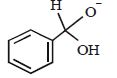
B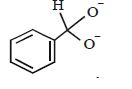
C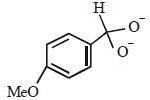
D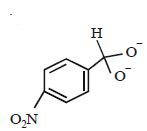
Solution
(C) In the Cannizzaro reaction,the rate-determining step involves the transfer of a hydride ion $(H^-)$ from the gem-diol dianion intermediate to another molecule of the aldehyde.
The ability of the intermediate to act as a hydride donor depends on the electron density at the carbon atom attached to the hydrogen. An electron-donating group (like $-OCH_3$) increases the electron density on the carbon,making the $C-H$ bond more polarized and facilitating the release of the hydride ion.
Conversely,an electron-withdrawing group (like $-NO_2$) decreases the electron density,making it a poorer hydride donor.
Comparing the options:
- Option $A$ is a mono-anion,which is not the primary hydride donor.
- Option $B$ is the unsubstituted benzaldehyde gem-diol dianion.
- Option $C$ has a methoxy group $(-OCH_3)$,which is an electron-donating group ($+M$ effect),making it the best hydride donor.
- Option $D$ has a nitro group $(-NO_2)$,which is an electron-withdrawing group ($-M$ effect),making it the poorest hydride donor.
Therefore,the intermediate with the electron-donating group is the best hydride donor.
The ability of the intermediate to act as a hydride donor depends on the electron density at the carbon atom attached to the hydrogen. An electron-donating group (like $-OCH_3$) increases the electron density on the carbon,making the $C-H$ bond more polarized and facilitating the release of the hydride ion.
Conversely,an electron-withdrawing group (like $-NO_2$) decreases the electron density,making it a poorer hydride donor.
Comparing the options:
- Option $A$ is a mono-anion,which is not the primary hydride donor.
- Option $B$ is the unsubstituted benzaldehyde gem-diol dianion.
- Option $C$ has a methoxy group $(-OCH_3)$,which is an electron-donating group ($+M$ effect),making it the best hydride donor.
- Option $D$ has a nitro group $(-NO_2)$,which is an electron-withdrawing group ($-M$ effect),making it the poorest hydride donor.
Therefore,the intermediate with the electron-donating group is the best hydride donor.
0 likes
View Solution1011
MediumMCQ
Identify the product for the following reaction: $CH_3-CO-CH_3 + HO-CH_2-CH_2-OH \xrightarrow{HCl} ?$
A
$CH_3-CH(OH)-CH_3 + HOOC-COOH$
B
The cyclic ketal structure: $C(CH_3)_2(OCH_2CH_2O)$
C
$CH_3-C(OH)(CH_3)-CH(OH)-CH_3$
D
No reaction
Solution
(B) Acetone reacts with ethylene glycol in the presence of dry $HCl$ gas to form a cyclic ketal,specifically $2,2-dimethyl-1,3-dioxolane$.
The reaction involves the elimination of a water molecule between the carbonyl oxygen of the ketone and the hydroxyl hydrogens of the diol.
The reaction is: $CH_3-CO-CH_3 + HO-CH_2-CH_2-OH \xrightarrow{HCl} \text{Cyclic Ketal} + H_2O$.
The reaction involves the elimination of a water molecule between the carbonyl oxygen of the ketone and the hydroxyl hydrogens of the diol.
The reaction is: $CH_3-CO-CH_3 + HO-CH_2-CH_2-OH \xrightarrow{HCl} \text{Cyclic Ketal} + H_2O$.
0 likes
View Solution1012
EasyMCQ
$(CH_3)_3CCHO$ does not undergo aldol condensation due to
A
three electron donating methyl groups
B
cleavage taking place between $-C-CHO$ bond
C
absence of $\alpha-$ hydrogen atom in the molecule
D
bulky $(CH_3)_3C-$ group
Solution
(C) Aldol condensation is a reaction given by aldehydes or ketones that contain at least one $\alpha-$ hydrogen atom.
In the molecule $(CH_3)_3CCHO$ ($2$,$2$-dimethylpropanal),the carbonyl carbon is attached to a tertiary butyl group $(CH_3)_3C-$.
There is no hydrogen atom attached to the $\alpha-$ carbon (the carbon adjacent to the carbonyl group).
Due to the absence of $\alpha-$ hydrogen atoms,it cannot form an enolate ion,and therefore,it does not undergo aldol condensation.
In the molecule $(CH_3)_3CCHO$ ($2$,$2$-dimethylpropanal),the carbonyl carbon is attached to a tertiary butyl group $(CH_3)_3C-$.
There is no hydrogen atom attached to the $\alpha-$ carbon (the carbon adjacent to the carbonyl group).
Due to the absence of $\alpha-$ hydrogen atoms,it cannot form an enolate ion,and therefore,it does not undergo aldol condensation.
0 likes
View Solution1013
MediumMCQ
Which of the following undergoes haloform reaction?
$ (i) \ CH_3CH_2COCH_2Cl $
$ (ii) \ C_6H_5COCH_3 $
$ (iii) \ C_6H_5COCHCl_2 $
$ (iv) \ CH_3CH_2COCCl_3 $
$ (i) \ CH_3CH_2COCH_2Cl $
$ (ii) \ C_6H_5COCH_3 $
$ (iii) \ C_6H_5COCHCl_2 $
$ (iv) \ CH_3CH_2COCCl_3 $
A
only $ (ii) $
B
$ (ii) $ and $ (iv) $
C
$ (i) $,$ (ii) $ and $ (iv) $
D
all the four
Solution
(D) The haloform reaction requires the presence of a methyl ketone group $(-COCH_3)$ or a group that can be converted into one,such as a secondary alcohol $(-CH(OH)CH_3)$.
In the presence of a base and halogen,the $\alpha$-hydrogens are replaced by halogen atoms to form a trihalo derivative $(-COCX_3)$.
This intermediate then undergoes nucleophilic attack by $OH^-$,followed by the cleavage of the $C-C$ bond to release the haloform $(CHX_3)$.
Compound $ (i) \ CH_3CH_2COCH_2Cl $ has $\alpha$-hydrogens on the $CH_2Cl$ group,which can be further halogenated to $COCCl_3$.
Compound $ (ii) \ C_6H_5COCH_3 $ is a methyl ketone.
Compound $ (iii) \ C_6H_5COCHCl_2 $ already has a dihalo group and can be further halogenated to $COCCl_3$.
Compound $ (iv) \ CH_3CH_2COCCl_3 $ already contains the $COCCl_3$ group,which is the necessary intermediate for the haloform cleavage.
Therefore,all four compounds can undergo the haloform reaction.
In the presence of a base and halogen,the $\alpha$-hydrogens are replaced by halogen atoms to form a trihalo derivative $(-COCX_3)$.
This intermediate then undergoes nucleophilic attack by $OH^-$,followed by the cleavage of the $C-C$ bond to release the haloform $(CHX_3)$.
Compound $ (i) \ CH_3CH_2COCH_2Cl $ has $\alpha$-hydrogens on the $CH_2Cl$ group,which can be further halogenated to $COCCl_3$.
Compound $ (ii) \ C_6H_5COCH_3 $ is a methyl ketone.
Compound $ (iii) \ C_6H_5COCHCl_2 $ already has a dihalo group and can be further halogenated to $COCCl_3$.
Compound $ (iv) \ CH_3CH_2COCCl_3 $ already contains the $COCCl_3$ group,which is the necessary intermediate for the haloform cleavage.
Therefore,all four compounds can undergo the haloform reaction.
0 likes
View Solution1014
MediumMCQ
Cannizzaro reaction between formaldehyde molecules involves the formation of
A
$HO-CH_2-O^-$
B
$O^--CH_2-O^-$
C
Both $(a)$ and $(b)$
D
None
Solution
(C) The Cannizzaro reaction of formaldehyde $(HCHO)$ involves the nucleophilic attack of the hydroxide ion $(OH^-)$ on the carbonyl carbon to form the hydroxyalkoxide monoanion $(HO-CH_2-O^-)$.
In the presence of a high concentration of base,a second $OH^-$ can deprotonate the hydroxyl group to form the dianion $(O^--CH_2-O^-)$.
Both of these species can act as intermediates that transfer a hydride ion to another formaldehyde molecule to complete the disproportionation process.
In the presence of a high concentration of base,a second $OH^-$ can deprotonate the hydroxyl group to form the dianion $(O^--CH_2-O^-)$.
Both of these species can act as intermediates that transfer a hydride ion to another formaldehyde molecule to complete the disproportionation process.
0 likes
View Solution1015
DifficultMCQ
Carbonyl compounds undergo nucleophilic addition because of
A
electronegativity difference of carbon and oxygen atoms
B
electromeric effect
C
more stable anion with negative charge on oxygen atom and less stable carbonium ion
D
none of the above
Solution
(A) The carbonyl group $(C=O)$ is polar due to the difference in electronegativity between carbon $(2.5)$ and oxygen $(3.5)$.
Oxygen is more electronegative,which pulls the electron density of the $\pi$-bond towards itself,creating a partial positive charge $(\delta+)$ on the carbon atom and a partial negative charge $(\delta-)$ on the oxygen atom.
This electrophilic carbon center makes the carbonyl compound susceptible to attack by nucleophiles.
Furthermore,the resulting intermediate is an alkoxide ion where the negative charge is stabilized on the highly electronegative oxygen atom,making the addition reaction favorable.
Oxygen is more electronegative,which pulls the electron density of the $\pi$-bond towards itself,creating a partial positive charge $(\delta+)$ on the carbon atom and a partial negative charge $(\delta-)$ on the oxygen atom.
This electrophilic carbon center makes the carbonyl compound susceptible to attack by nucleophiles.
Furthermore,the resulting intermediate is an alkoxide ion where the negative charge is stabilized on the highly electronegative oxygen atom,making the addition reaction favorable.
0 likes
View Solution1016
EasyMCQ
Which is not true about acetophenone?
A
It reacts with $2,4-DNP$ to form $2,4-dinitrophenylhydrazone$.
B
It reacts with Tollen's reagent to form silver mirror.
C
It reacts with $I_2/NaOH$ to form iodoform.
D
On oxidation with alkaline $KMnO_4$ followed by hydrolysis,it gives benzoic acid.
Solution
(B) Acetophenone $(C_6H_5COCH_3)$ is a ketone.
Ketones do not reduce Tollen's reagent,so it does not form a silver mirror.
It reacts with $2,4-DNP$ as it contains a carbonyl group.
It gives a positive iodoform test due to the presence of the $CH_3CO-$ group.
Oxidation of acetophenone with alkaline $KMnO_4$ followed by hydrolysis yields benzoic acid.
Ketones do not reduce Tollen's reagent,so it does not form a silver mirror.
It reacts with $2,4-DNP$ as it contains a carbonyl group.
It gives a positive iodoform test due to the presence of the $CH_3CO-$ group.
Oxidation of acetophenone with alkaline $KMnO_4$ followed by hydrolysis yields benzoic acid.
0 likes
View Solution1017
MediumMCQ
Which of the following products is formed when benzaldehyde is treated with $CH_3MgBr$ and the addition product so obtained is subjected to acid hydrolysis?
A
$A$ secondary alcohol
B
$A$ primary alcohol
C
Phenol
D
tert-Butyl alcohol
Solution
(A) The reaction of benzaldehyde $(C_6H_5CHO)$ with a Grignard reagent $(CH_3MgBr)$ follows a nucleophilic addition mechanism.
First,the nucleophilic $CH_3^-$ group attacks the carbonyl carbon of benzaldehyde to form an intermediate alkoxide: $C_6H_5CHO + CH_3MgBr \rightarrow C_6H_5CH(OMgBr)CH_3$.
Second,acid hydrolysis of this intermediate yields the final product: $C_6H_5CH(OMgBr)CH_3 + H_2O/H^+ \rightarrow C_6H_5CH(OH)CH_3 + Mg(OH)Br$.
The product $C_6H_5CH(OH)CH_3$ is $1$-phenylethanol,which is a secondary $(2^o)$ alcohol.
First,the nucleophilic $CH_3^-$ group attacks the carbonyl carbon of benzaldehyde to form an intermediate alkoxide: $C_6H_5CHO + CH_3MgBr \rightarrow C_6H_5CH(OMgBr)CH_3$.
Second,acid hydrolysis of this intermediate yields the final product: $C_6H_5CH(OMgBr)CH_3 + H_2O/H^+ \rightarrow C_6H_5CH(OH)CH_3 + Mg(OH)Br$.
The product $C_6H_5CH(OH)CH_3$ is $1$-phenylethanol,which is a secondary $(2^o)$ alcohol.
0 likes
View Solution1018
MediumMCQ
In the reaction of benzaldehyde with acetaldehyde in the presence of dilute $NaOH$,the product $(A)$ will be:
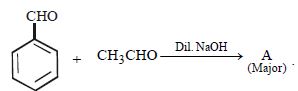
A
$C_6H_5-CH(OH)-CH_2-CHO$
B
$C_6H_5-CH=CH-CHO$
C
$C_6H_5-CH_2-CH_2-CHO$
D
$C_6H_5-CH(OH)-CH_2-CH_2OH$
Solution
(B) The reaction between benzaldehyde $(C_6H_5CHO)$ and acetaldehyde $(CH_3CHO)$ in the presence of dilute alkali is a Claisen-Schmidt condensation.
Acetaldehyde acts as the nucleophile by forming an enolate ion,which attacks the carbonyl carbon of benzaldehyde.
The initial aldol product formed is $C_6H_5-CH(OH)-CH_2-CHO$ ($3$-hydroxy$-3-$phenylpropanal).
This product undergoes spontaneous dehydration in the presence of base and heat to form the more stable conjugated product,cinnamaldehyde $(C_6H_5-CH=CH-CHO)$.
Acetaldehyde acts as the nucleophile by forming an enolate ion,which attacks the carbonyl carbon of benzaldehyde.
The initial aldol product formed is $C_6H_5-CH(OH)-CH_2-CHO$ ($3$-hydroxy$-3-$phenylpropanal).
This product undergoes spontaneous dehydration in the presence of base and heat to form the more stable conjugated product,cinnamaldehyde $(C_6H_5-CH=CH-CHO)$.
0 likes
View Solution1019
AdvancedMCQ
An ester $(A)$ with molecular formula $C_9H_{10}O_2$ was treated with excess of $CH_3MgBr$ and the complex so formed was treated with $H_2SO_4$ to give an olefin $(B)$. Ozonolysis of $(B)$ gave a ketone with molecular formula $C_8H_8O$ which shows positive iodoform test. The structure of $(A)$ is
A
$C_6H_5COOC_2H_5$
B
$C_2H_5COOC_6H_5$
C
$CH_3COOCH_2C_6H_5$
D
$C_6H_5CH_2COOCH_3$
Solution
(A) The ester $(A)$ is $C_6H_5COOC_2H_5$ (ethyl benzoate).
Reaction with excess $CH_3MgBr$ proceeds as follows:
$C_6H_5COOC_2H_5 + 2CH_3MgBr \rightarrow C_6H_5-C(OH)(CH_3)_2 + Mg(OC_2H_5)Br + Mg(OH)Br$.
Dehydration with $H_2SO_4$ gives the olefin $(B)$: $C_6H_5-C(CH_3)=CH_2$ ($2$-phenylpropene).
Ozonolysis of $(B)$ yields $C_6H_5COCH_3$ (acetophenone) and $HCHO$.
Acetophenone $(C_6H_5COCH_3)$ contains a $CH_3CO-$ group and thus gives a positive iodoform test.
Reaction with excess $CH_3MgBr$ proceeds as follows:
$C_6H_5COOC_2H_5 + 2CH_3MgBr \rightarrow C_6H_5-C(OH)(CH_3)_2 + Mg(OC_2H_5)Br + Mg(OH)Br$.
Dehydration with $H_2SO_4$ gives the olefin $(B)$: $C_6H_5-C(CH_3)=CH_2$ ($2$-phenylpropene).
Ozonolysis of $(B)$ yields $C_6H_5COCH_3$ (acetophenone) and $HCHO$.
Acetophenone $(C_6H_5COCH_3)$ contains a $CH_3CO-$ group and thus gives a positive iodoform test.
0 likes
View Solution1020
MediumMCQ
Aldehydes that do not undergo aldol condensation are:
$1$. $CH_3CH_2CHO$ (propanal)
$2$. $Cl_3CCHO$ (trichloroethanal)
$3$. $HCHO$ (methanal)
$4$. $CH_3CHO$ (ethanal)
$5$. $C_6H_5CHO$ (benzaldehyde)
$1$. $CH_3CH_2CHO$ (propanal)
$2$. $Cl_3CCHO$ (trichloroethanal)
$3$. $HCHO$ (methanal)
$4$. $CH_3CHO$ (ethanal)
$5$. $C_6H_5CHO$ (benzaldehyde)
A
$3$ and $4$ only
B
$3$ and $5$ only
C
$1, 2$ and $3$ only
D
$2, 3$ and $5$ only
Solution
(D) Aldol condensation occurs in aldehydes and ketones that possess at least one $\alpha$-hydrogen atom.
$1$. Propanal $(CH_3CH_2CHO)$ has $2$ $\alpha$-hydrogen atoms.
$2$. Trichloroethanal $(Cl_3CCHO)$ has no $\alpha$-hydrogen atoms.
$3$. Methanal $(HCHO)$ has no $\alpha$-hydrogen atoms.
$4$. Ethanal $(CH_3CHO)$ has $3$ $\alpha$-hydrogen atoms.
$5$. Benzaldehyde $(C_6H_5CHO)$ has no $\alpha$-hydrogen atoms.
Therefore,trichloroethanal $(2)$,methanal $(3)$,and benzaldehyde $(5)$ do not undergo aldol condensation.
$1$. Propanal $(CH_3CH_2CHO)$ has $2$ $\alpha$-hydrogen atoms.
$2$. Trichloroethanal $(Cl_3CCHO)$ has no $\alpha$-hydrogen atoms.
$3$. Methanal $(HCHO)$ has no $\alpha$-hydrogen atoms.
$4$. Ethanal $(CH_3CHO)$ has $3$ $\alpha$-hydrogen atoms.
$5$. Benzaldehyde $(C_6H_5CHO)$ has no $\alpha$-hydrogen atoms.
Therefore,trichloroethanal $(2)$,methanal $(3)$,and benzaldehyde $(5)$ do not undergo aldol condensation.
0 likes
View Solution1021
MediumMCQ
Aldol condensation will not be observed in
A
chloral
B
phenylacetaldehyde
C
hexanal
D
nitromethane
Solution
(A) Aldol condensation is observed only in carbonyl compounds (aldehydes and ketones) that possess at least one $\alpha$-hydrogen atom.
$(a)$ Chloral $(CCl_3CHO)$ has no $\alpha$-hydrogen atom because the $\alpha$-carbon is bonded to three chlorine atoms.
$(b)$ Phenylacetaldehyde $(C_6H_5CH_2CHO)$ has two $\alpha$-hydrogen atoms.
$(c)$ Hexanal $(CH_3(CH_2)_4CHO)$ has two $\alpha$-hydrogen atoms.
$(d)$ Nitromethane $(CH_3NO_2)$ is not an aldehyde or ketone,but it does possess $\alpha$-hydrogen atoms and can undergo a condensation reaction similar to aldol,but strictly speaking,the question refers to carbonyl compounds. Among the options,chloral is the classic example that does not undergo aldol condensation.
$(a)$ Chloral $(CCl_3CHO)$ has no $\alpha$-hydrogen atom because the $\alpha$-carbon is bonded to three chlorine atoms.
$(b)$ Phenylacetaldehyde $(C_6H_5CH_2CHO)$ has two $\alpha$-hydrogen atoms.
$(c)$ Hexanal $(CH_3(CH_2)_4CHO)$ has two $\alpha$-hydrogen atoms.
$(d)$ Nitromethane $(CH_3NO_2)$ is not an aldehyde or ketone,but it does possess $\alpha$-hydrogen atoms and can undergo a condensation reaction similar to aldol,but strictly speaking,the question refers to carbonyl compounds. Among the options,chloral is the classic example that does not undergo aldol condensation.
0 likes
View Solution1022
MediumMCQ
Assertion : Acetaldehyde on treatment with alkali gives aldol.
Reason : Acetaldehyde molecule contains $\alpha$-hydrogen atom.
Reason : Acetaldehyde molecule contains $\alpha$-hydrogen atom.
A
If both Assertion and Reason are correct and the Reason is a correct explanation of the Assertion.
B
If both Assertion and Reason are correct but Reason is not a correct explanation of the Assertion.
C
If the Assertion is correct but Reason is incorrect.
D
If both the Assertion and Reason are incorrect.
Solution
(A) Acetaldehyde $(CH_3CHO)$ contains $\alpha$-hydrogen atoms attached to the $\alpha$-carbon.
In the presence of a dilute alkali,it undergoes an aldol condensation reaction to form $3-$hydroxybutanal (aldol).
Therefore,the presence of $\alpha$-hydrogen is the reason for the aldol condensation reaction.
In the presence of a dilute alkali,it undergoes an aldol condensation reaction to form $3-$hydroxybutanal (aldol).
Therefore,the presence of $\alpha$-hydrogen is the reason for the aldol condensation reaction.
0 likes
View Solution1023
MediumMCQ
Assertion : Hydroxyketones are not directly used in Grignard reaction.
Reason : Grignard reagents react with hydroxyl group.
Reason : Grignard reagents react with hydroxyl group.
A
If both Assertion and Reason are correct and the Reason is a correct explanation of the Assertion.
B
If both Assertion and Reason are correct but Reason is not a correct explanation of the Assertion.
C
If the Assertion is correct but Reason is incorrect.
D
If both the Assertion and Reason are incorrect.
Solution
(A) Grignard reagents $(RMgX)$ are strong bases and highly reactive nucleophiles.
They react rapidly with acidic hydrogen atoms,such as those present in the hydroxyl $(-OH)$ group of hydroxyketones,to form an alkoxide and an alkane $(R-H)$.
Therefore,to perform a Grignard reaction on a hydroxyketone,the hydroxyl group must first be protected (e.g.,by silylation) to prevent this side reaction.
They react rapidly with acidic hydrogen atoms,such as those present in the hydroxyl $(-OH)$ group of hydroxyketones,to form an alkoxide and an alkane $(R-H)$.
Therefore,to perform a Grignard reaction on a hydroxyketone,the hydroxyl group must first be protected (e.g.,by silylation) to prevent this side reaction.
0 likes
View Solution1024
MediumMCQ
Assertion : Isobutanal does not give iodoform test.
Reason : It does not have $\alpha - $ hydrogen.
Reason : It does not have $\alpha - $ hydrogen.
A
If both Assertion and Reason are correct and the Reason is a correct explanation of the Assertion.
B
If both Assertion and Reason are correct but Reason is not a correct explanation of the Assertion.
C
If the Assertion is correct but Reason is incorrect.
D
If both the Assertion and Reason are incorrect.
Solution
(C) The iodoform test is given by compounds containing the $CH_3CO-$ group or compounds that can be oxidized to this group (like ethanol or secondary alcohols with a methyl group).
Isobutanal is $(CH_3)_2CHCHO$. It does not contain the $CH_3CO-$ group,so it does not give the iodoform test.
The reason provided is incorrect because isobutanal does have an $\alpha$-hydrogen atom (the hydrogen attached to the carbon adjacent to the carbonyl group).
Therefore,the Assertion is correct,but the Reason is incorrect.
Isobutanal is $(CH_3)_2CHCHO$. It does not contain the $CH_3CO-$ group,so it does not give the iodoform test.
The reason provided is incorrect because isobutanal does have an $\alpha$-hydrogen atom (the hydrogen attached to the carbon adjacent to the carbonyl group).
Therefore,the Assertion is correct,but the Reason is incorrect.
0 likes
View Solution1025
MediumMCQ
Assertion : Protonation of a carbonyl group increases its electrophilic character.
Reason : Protonation of a carbonyl group involves addition of an electrophile on nucleophilic oxygen.
Reason : Protonation of a carbonyl group involves addition of an electrophile on nucleophilic oxygen.
A
If both Assertion and Reason are correct and the Reason is a correct explanation of the Assertion.
B
If both Assertion and Reason are correct but Reason is not a correct explanation of the Assertion.
C
If the Assertion is correct but Reason is incorrect.
D
If both the Assertion and Reason are incorrect.
Solution
(B) The Assertion is correct because protonation of the carbonyl oxygen atom increases the positive charge on the carbon atom,thereby enhancing its electrophilic character.
The Reason is also correct because the oxygen atom of the carbonyl group acts as a nucleophile (due to lone pairs) and accepts a proton $(H^+)$,which is an electrophile.
However,the Reason is not the correct explanation for the Assertion,as the increased electrophilicity is a consequence of the resonance effect and inductive effect induced by the positive charge on oxygen,not simply the fact that an electrophile was added.
The Reason is also correct because the oxygen atom of the carbonyl group acts as a nucleophile (due to lone pairs) and accepts a proton $(H^+)$,which is an electrophile.
However,the Reason is not the correct explanation for the Assertion,as the increased electrophilicity is a consequence of the resonance effect and inductive effect induced by the positive charge on oxygen,not simply the fact that an electrophile was added.
0 likes
View Solution1026
MediumMCQ
Assertion : Aldol condensation can be catalysed both by acids and bases.
Reason : $\beta$-Hydroxyaldehydes or ketones readily undergo acid-catalysed dehydration.
Reason : $\beta$-Hydroxyaldehydes or ketones readily undergo acid-catalysed dehydration.
A
If both Assertion and Reason are correct and the Reason is a correct explanation of the Assertion.
B
If both Assertion and Reason are correct but Reason is not a correct explanation of the Assertion.
C
If the Assertion is correct but Reason is incorrect.
D
If both the Assertion and Reason are incorrect.
Solution
(B) The Assertion is correct because aldol condensation involves the formation of a nucleophile (either an enolate ion in base or an enol in acid) which attacks the carbonyl carbon.
Both acids and bases can catalyze this process.
The Reason is also correct because $\beta$-hydroxyaldehydes or ketones (aldols) are unstable and undergo dehydration to form $\alpha,\beta$-unsaturated carbonyl compounds in the presence of an acid.
However,the Reason does not explain why the condensation itself is catalyzed by both acids and bases; it describes a subsequent step (dehydration).
Therefore,both are correct,but the Reason is not the correct explanation of the Assertion.
Both acids and bases can catalyze this process.
The Reason is also correct because $\beta$-hydroxyaldehydes or ketones (aldols) are unstable and undergo dehydration to form $\alpha,\beta$-unsaturated carbonyl compounds in the presence of an acid.
However,the Reason does not explain why the condensation itself is catalyzed by both acids and bases; it describes a subsequent step (dehydration).
Therefore,both are correct,but the Reason is not the correct explanation of the Assertion.
0 likes
View Solution1027
MediumMCQ
Assertion : $2, 2-$ Dimethylpropanal undergoes Cannizzaro reaction with conc. $NaOH$.
Reason : Cannizzaro reaction is a disproportionation reaction.
Reason : Cannizzaro reaction is a disproportionation reaction.
A
If both Assertion and Reason are correct and the Reason is a correct explanation of the Assertion.
B
If both Assertion and Reason are correct but Reason is not a correct explanation of the Assertion.
C
If the Assertion is correct but Reason is incorrect.
D
If both the Assertion and Reason are incorrect.
Solution
(A) The Cannizzaro reaction is a disproportionation reaction (self-oxidation and reduction) that occurs in aldehydes lacking $\alpha-hydrogen$ atoms.
$2, 2-$ Dimethylpropanal (pivalaldehyde) is $(CH_3)_3CCHO$. It has no $\alpha-hydrogen$ atom attached to the carbonyl carbon.
Therefore,it undergoes the Cannizzaro reaction in the presence of concentrated $NaOH$.
Both the Assertion and the Reason are correct,and the Reason correctly explains why the compound undergoes the reaction.
$2, 2-$ Dimethylpropanal (pivalaldehyde) is $(CH_3)_3CCHO$. It has no $\alpha-hydrogen$ atom attached to the carbonyl carbon.
Therefore,it undergoes the Cannizzaro reaction in the presence of concentrated $NaOH$.
Both the Assertion and the Reason are correct,and the Reason correctly explains why the compound undergoes the reaction.
0 likes
View Solution1028
DifficultMCQ
Assertion: Acetoacetic ester,$CH_3COCH_2COOC_2H_5$,will give iodoform test.
Reason: It does not contain $CH_3CO-$ group.
Reason: It does not contain $CH_3CO-$ group.
A
If both Assertion and Reason are correct and the Reason is a correct explanation of the Assertion.
B
If both Assertion and Reason are correct but Reason is not a correct explanation of the Assertion.
C
If the Assertion is correct but Reason is incorrect.
D
If both the Assertion and Reason are incorrect.
Solution
(D) Both Assertion and Reason are incorrect.
Acetoacetic ester $(CH_3COCH_2COOC_2H_5)$ does not give a positive iodoform test under standard conditions because the active methylene group $(CH_2)$ between the two carbonyl groups is highly acidic and reactive,leading to cleavage rather than the formation of iodoform.
The Reason is also incorrect because the structure of acetoacetic ester clearly contains the $CH_3CO-$ (acetyl) group.
Acetoacetic ester $(CH_3COCH_2COOC_2H_5)$ does not give a positive iodoform test under standard conditions because the active methylene group $(CH_2)$ between the two carbonyl groups is highly acidic and reactive,leading to cleavage rather than the formation of iodoform.
The Reason is also incorrect because the structure of acetoacetic ester clearly contains the $CH_3CO-$ (acetyl) group.
0 likes
View Solution1029
MediumMCQ
Assertion : Benzaldehyde is more reactive than ethanol towards nucleophilic attack.
Reason : The overall effect of $-I$ and $+R$ effect of phenyl group decreases the electron density on the carbon atom of $>C=O$ group in benzaldehyde.
Reason : The overall effect of $-I$ and $+R$ effect of phenyl group decreases the electron density on the carbon atom of $>C=O$ group in benzaldehyde.
A
If both Assertion and Reason are correct and the Reason is a correct explanation of the Assertion.
B
If both Assertion and Reason are correct but Reason is not a correct explanation of the Assertion.
C
If the Assertion is correct but Reason is incorrect.
D
If both the Assertion and Reason are incorrect.
Solution
(D) The Assertion is incorrect because benzaldehyde is less reactive than ethanol towards nucleophilic attack. This is due to the steric hindrance of the bulky phenyl group and the resonance stabilization of the carbonyl carbon by the phenyl ring.
The Reason is also incorrect because the $+R$ effect of the phenyl group is electron-donating,which increases the electron density on the carbonyl carbon,thereby reducing its electrophilicity.
The Reason is also incorrect because the $+R$ effect of the phenyl group is electron-donating,which increases the electron density on the carbonyl carbon,thereby reducing its electrophilicity.
0 likes
View Solution1030
MediumMCQ
Assertion : The boiling points of aldehydes and ketones are higher than hydrocarbons and ethers of comparable molecular masses.
Reason : There is a weak molecular association in aldehydes and ketones arising out of the dipole-dipole interactions.
Reason : There is a weak molecular association in aldehydes and ketones arising out of the dipole-dipole interactions.
A
If both Assertion and Reason are correct and the Reason is a correct explanation of the Assertion.
B
If both Assertion and Reason are correct but Reason is not a correct explanation of the Assertion.
C
If the Assertion is correct but Reason is incorrect.
D
If both the Assertion and Reason are incorrect.
Solution
(A) Aldehydes and ketones possess a polar carbonyl group $(C=O)$,which creates a permanent dipole moment.
Due to this polarity,there exist dipole-dipole interactions between the molecules of aldehydes and ketones.
These intermolecular dipole-dipole interactions are stronger than the weak van der Waals forces present in hydrocarbons and ethers of comparable molecular masses.
Consequently,more energy is required to overcome these forces,leading to higher boiling points for aldehydes and ketones compared to hydrocarbons and ethers.
Thus,both the Assertion and the Reason are correct,and the Reason is the correct explanation of the Assertion.
Due to this polarity,there exist dipole-dipole interactions between the molecules of aldehydes and ketones.
These intermolecular dipole-dipole interactions are stronger than the weak van der Waals forces present in hydrocarbons and ethers of comparable molecular masses.
Consequently,more energy is required to overcome these forces,leading to higher boiling points for aldehydes and ketones compared to hydrocarbons and ethers.
Thus,both the Assertion and the Reason are correct,and the Reason is the correct explanation of the Assertion.
0 likes
View Solution1031
DifficultMCQ
The reaction that does not give benzoic acid as the major product is
A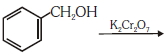
B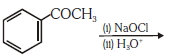
C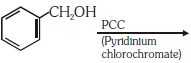
D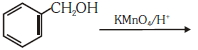
Solution
(C) The oxidation of primary alcohols with strong oxidizing agents like $K_2Cr_2O_7$ or $KMnO_4/H^+$ yields carboxylic acids. Thus,phenylmethanol $(C_6H_5CH_2OH)$ gives benzoic acid $(C_6H_5COOH)$ in options $A$ and $D$.
The haloform reaction of acetophenone $(C_6H_5COCH_3)$ with $NaOCl$ followed by acid workup $(H_3O^+)$ is a standard method to produce benzoic acid,as shown in option $B$.
$PCC$ (Pyridinium chlorochromate) is a mild oxidizing agent that oxidizes primary alcohols only up to the aldehyde stage. Therefore,the reaction of phenylmethanol with $PCC$ yields benzaldehyde $(C_6H_5CHO)$ as the major product,not benzoic acid. Hence,option $C$ is the correct answer.
The haloform reaction of acetophenone $(C_6H_5COCH_3)$ with $NaOCl$ followed by acid workup $(H_3O^+)$ is a standard method to produce benzoic acid,as shown in option $B$.
$PCC$ (Pyridinium chlorochromate) is a mild oxidizing agent that oxidizes primary alcohols only up to the aldehyde stage. Therefore,the reaction of phenylmethanol with $PCC$ yields benzaldehyde $(C_6H_5CHO)$ as the major product,not benzoic acid. Hence,option $C$ is the correct answer.
0 likes
View Solution1032
AdvancedMCQ
Consider the following reactions:
$A$ $\xrightarrow[(i) CH_3MgBr]{(ii) H_3O^{+}} B$ $\xrightarrow[573 \text{ K}]{Cu} 2\text{-methyl-2-butene}$
The mass percentage of carbon in $A$ is:
$A$ $\xrightarrow[(i) CH_3MgBr]{(ii) H_3O^{+}} B$ $\xrightarrow[573 \text{ K}]{Cu} 2\text{-methyl-2-butene}$
The mass percentage of carbon in $A$ is:
A
$72.72$
B
$37.62$
C
$33.33$
D
$66.67$
Solution
(D) is formed by the reaction of $A$ with $CH_3MgBr$.
Since $B$ gives $2\text{-methyl-2-butene}$ $(CH_3-C(CH_3)=CH-CH_3)$ upon heating with $Cu$ at $573 \text{ K}$,$B$ must be a tertiary alcohol,specifically $2\text{-methyl-2-butanol}$ $(CH_3-C(OH)(CH_3)-CH_2-CH_3)$.
Therefore,$A$ must be butanone $(CH_3-CO-CH_2-CH_3)$.
The molecular formula of $A$ is $C_4H_8O$.
The molar mass of $A = (4 \times 12) + (8 \times 1) + 16 = 72 \text{ g/mol}$.
The mass of carbon in $A = 4 \times 12 = 48 \text{ g}$.
The mass percentage of carbon $= \frac{48}{72} \times 100 = 66.67\%$.
Since $B$ gives $2\text{-methyl-2-butene}$ $(CH_3-C(CH_3)=CH-CH_3)$ upon heating with $Cu$ at $573 \text{ K}$,$B$ must be a tertiary alcohol,specifically $2\text{-methyl-2-butanol}$ $(CH_3-C(OH)(CH_3)-CH_2-CH_3)$.
Therefore,$A$ must be butanone $(CH_3-CO-CH_2-CH_3)$.
The molecular formula of $A$ is $C_4H_8O$.
The molar mass of $A = (4 \times 12) + (8 \times 1) + 16 = 72 \text{ g/mol}$.
The mass of carbon in $A = 4 \times 12 = 48 \text{ g}$.
The mass percentage of carbon $= \frac{48}{72} \times 100 = 66.67\%$.
0 likes
View Solution1033
AdvancedMCQ
Identify $(A)$ in the following reaction sequence:
$\mathop {(A)}\limits_{\text{gives positive iodoform Test}}$ $\xrightarrow[(ii) H^{+}, H_2O, (iii) \text{conc. } H_2SO_4/\Delta ]{(i) CH_3MgBr} (B)$ $\xrightarrow{O_3/Zn, H_2O}$
$\mathop {(A)}\limits_{\text{gives positive iodoform Test}}$ $\xrightarrow[(ii) H^{+}, H_2O, (iii) \text{conc. } H_2SO_4/\Delta ]{(i) CH_3MgBr} (B)$ $\xrightarrow{O_3/Zn, H_2O}$
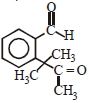
A
$3-$methyl$-4-$phenylbut$-3-$en$-2-$one
B
$4-$phenylbut$-3-$en$-2-$one
C
$3-$methyl$-3-$phenylbut$-2-$one
D
$4-$methyl$-4-$phenylbut$-3-$en$-2-$one
Solution
(A) The reaction sequence starts with $(A)$,which gives a positive iodoform test,indicating the presence of a $CH_3CO-$ group.
$1$. $(A)$ reacts with $CH_3MgBr$ followed by $H_3O^+$ to form a tertiary alcohol.
$2$. Dehydration with conc. $H_2SO_4/\Delta$ yields a cyclic compound $(B)$ (an indene derivative).
$3$. Ozonolysis $(O_3/Zn, H_2O)$ of $(B)$ breaks the double bond to form a dicarbonyl compound.
Based on the provided solution image,$(A)$ is $3$-methyl-$4$-phenylbut-$3$-en-$2$-one. This structure contains the $CH_3CO-$ group (positive iodoform test) and matches the reaction pathway shown.
$1$. $(A)$ reacts with $CH_3MgBr$ followed by $H_3O^+$ to form a tertiary alcohol.
$2$. Dehydration with conc. $H_2SO_4/\Delta$ yields a cyclic compound $(B)$ (an indene derivative).
$3$. Ozonolysis $(O_3/Zn, H_2O)$ of $(B)$ breaks the double bond to form a dicarbonyl compound.
Based on the provided solution image,$(A)$ is $3$-methyl-$4$-phenylbut-$3$-en-$2$-one. This structure contains the $CH_3CO-$ group (positive iodoform test) and matches the reaction pathway shown.
0 likes
View Solution1034
AdvancedMCQ
The major product $(Y)$ in the following reactions is
$CH_3-CH(CH_3)-C\equiv CH$ $\xrightarrow[H_2O]{HgSO_4, H_2SO_4} X$ $\xrightarrow[(ii) \ conc. H_2SO_4 / \Delta]{(i) \ C_2H_5MgBr, H_2O} Y$
$CH_3-CH(CH_3)-C\equiv CH$ $\xrightarrow[H_2O]{HgSO_4, H_2SO_4} X$ $\xrightarrow[(ii) \ conc. H_2SO_4 / \Delta]{(i) \ C_2H_5MgBr, H_2O} Y$
A
$CH_3-C(CH_3)(C_2H_5)-CH(OH)-CH_3$
B
$CH_3-CH(CH_3)-C(=CH-CH_3)-CH_3$
C
$CH_3-C(CH_3)=C(C_2H_5)-CH_3$
D
$CH_3-CH(CH_3)-C(=CH_2)-CH_2CH_3$
Solution
(C) Step $1$: Hydration of alkyne $(X)$
$CH_3-CH(CH_3)-C\equiv CH + H_2O \xrightarrow{HgSO_4, H_2SO_4} CH_3-CH(CH_3)-CO-CH_3$ ($X$ is $3-methylbutan-2-one$)
Step $2$: Grignard reaction
$CH_3-CH(CH_3)-CO-CH_3 + C_2H_5MgBr \xrightarrow{H_2O} CH_3-CH(CH_3)-C(OH)(C_2H_5)-CH_3$
Step $3$: Dehydration
$CH_3-CH(CH_3)-C(OH)(C_2H_5)-CH_3 \xrightarrow{conc. H_2SO_4, \Delta} CH_3-C(CH_3)=C(C_2H_5)-CH_3$ (Major product $Y$ follows Saytzeff rule)
$CH_3-CH(CH_3)-C\equiv CH + H_2O \xrightarrow{HgSO_4, H_2SO_4} CH_3-CH(CH_3)-CO-CH_3$ ($X$ is $3-methylbutan-2-one$)
Step $2$: Grignard reaction
$CH_3-CH(CH_3)-CO-CH_3 + C_2H_5MgBr \xrightarrow{H_2O} CH_3-CH(CH_3)-C(OH)(C_2H_5)-CH_3$
Step $3$: Dehydration
$CH_3-CH(CH_3)-C(OH)(C_2H_5)-CH_3 \xrightarrow{conc. H_2SO_4, \Delta} CH_3-C(CH_3)=C(C_2H_5)-CH_3$ (Major product $Y$ follows Saytzeff rule)
0 likes
View Solution1035
Medium
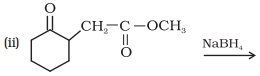
Write the structures of the products of the following reactions:
$(i)$ $CH_3-CH=CH_2 \xrightarrow{H_2O/H^+}$
$(ii)$ (See image)
$(iii)$ $CH_3-CH_2-CH(CH_3)-CHO \xrightarrow{NaBH_4}$
$(i)$ $CH_3-CH=CH_2 \xrightarrow{H_2O/H^+}$
$(ii)$ (See image)
$(iii)$ $CH_3-CH_2-CH(CH_3)-CHO \xrightarrow{NaBH_4}$
Solution
(N/A) $(i)$ $CH_3-CH=CH_2$ (Propene) $\xrightarrow{H_2O/H^+}$ $CH_3-CH(OH)-CH_3$ (Propan$-2-$ol)
$(ii)$ $NaBH_4$ selectively reduces the ketone group to a secondary alcohol while leaving the ester group intact. The product is Methyl ($2$-hydroxycyclohexyl) ethanoate.
$(iii)$ $CH_3-CH_2-CH(CH_3)-CHO$ ($2$-Methylbutanal) $\xrightarrow{NaBH_4}$ $CH_3-CH_2-CH(CH_3)-CH_2OH$ ($2$-Methylbutan$-1-$ol)
$(ii)$ $NaBH_4$ selectively reduces the ketone group to a secondary alcohol while leaving the ester group intact. The product is Methyl ($2$-hydroxycyclohexyl) ethanoate.
$(iii)$ $CH_3-CH_2-CH(CH_3)-CHO$ ($2$-Methylbutanal) $\xrightarrow{NaBH_4}$ $CH_3-CH_2-CH(CH_3)-CH_2OH$ ($2$-Methylbutan$-1-$ol)
0 likes
View Solution1036
Medium
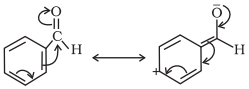
Would you expect $benzaldehyde$ to be more reactive or less reactive in nucleophilic addition reactions than $propanal$? Explain your answer.
Solution
(N/A) The carbon atom of the carbonyl group of $benzaldehyde$ is less electrophilic than the carbon atom of the carbonyl group present in $propanal$.
In $benzaldehyde$,the phenyl group is attached to the carbonyl carbon,which provides resonance stabilization to the carbonyl group. This resonance effect delocalizes the positive charge on the carbonyl carbon,thereby reducing its electrophilicity.
Additionally,the phenyl group exerts a steric hindrance that makes the approach of a nucleophile more difficult compared to the smaller alkyl group in $propanal$.
Therefore,$benzaldehyde$ is less reactive than $propanal$ towards nucleophilic addition reactions.
In $benzaldehyde$,the phenyl group is attached to the carbonyl carbon,which provides resonance stabilization to the carbonyl group. This resonance effect delocalizes the positive charge on the carbonyl carbon,thereby reducing its electrophilicity.
Additionally,the phenyl group exerts a steric hindrance that makes the approach of a nucleophile more difficult compared to the smaller alkyl group in $propanal$.
Therefore,$benzaldehyde$ is less reactive than $propanal$ towards nucleophilic addition reactions.
0 likes
View Solution1037
Difficult
An organic compound $(A)$ with molecular formula $C_8H_8O$ forms an orange-red precipitate with $2,4-DNP$ reagent and gives a yellow precipitate on heating with iodine in the presence of sodium hydroxide. It neither reduces Tollens' or Fehlings' reagent,nor does it decolourise bromine water or Baeyer's reagent. On drastic oxidation with chromic acid,it gives a carboxylic acid $(B)$ having molecular formula $C_7H_6O_2$. Identify the compounds $(A)$ and $(B)$ and explain the reactions involved.
Solution
(A) forms a $2,4-DNP$ derivative,which indicates it is an aldehyde or a ketone. Since it does not reduce Tollens' or Fehling's reagent,$(A)$ must be a ketone.
$(A)$ responds to the iodoform test,which confirms it is a methyl ketone.
The molecular formula of $(A)$ indicates a high degree of unsaturation,yet it does not decolourise bromine water or Baeyer's reagent,suggesting the unsaturation is due to an aromatic ring.
Compound $(B)$,being an oxidation product of a ketone,is a carboxylic acid. The molecular formula of $(B)$ corresponds to benzoic acid $(C_6H_5COOH)$.
Therefore,$(A)$ is phenyl methyl ketone (acetophenone,$C_6H_5COCH_3$).
The reactions are as follows:
$1$. Formation of $2,4-DNP$ derivative: $C_6H_5COCH_3 + H_2NNHC_6H_3(NO_2)_2 \rightarrow C_6H_5C(CH_3)=NNHC_6H_3(NO_2)_2 + H_2O$
$2$. Iodoform test: $C_6H_5COCH_3 + 3I_2 + 4NaOH \rightarrow C_6H_5COONa + CHI_3 + 3NaI + 3H_2O$
$3$. Oxidation: $C_6H_5COCH_3 \xrightarrow{H_2CrO_4} C_6H_5COOH$
$(A)$ responds to the iodoform test,which confirms it is a methyl ketone.
The molecular formula of $(A)$ indicates a high degree of unsaturation,yet it does not decolourise bromine water or Baeyer's reagent,suggesting the unsaturation is due to an aromatic ring.
Compound $(B)$,being an oxidation product of a ketone,is a carboxylic acid. The molecular formula of $(B)$ corresponds to benzoic acid $(C_6H_5COOH)$.
Therefore,$(A)$ is phenyl methyl ketone (acetophenone,$C_6H_5COCH_3$).
The reactions are as follows:
$1$. Formation of $2,4-DNP$ derivative: $C_6H_5COCH_3 + H_2NNHC_6H_3(NO_2)_2 \rightarrow C_6H_5C(CH_3)=NNHC_6H_3(NO_2)_2 + H_2O$
$2$. Iodoform test: $C_6H_5COCH_3 + 3I_2 + 4NaOH \rightarrow C_6H_5COONa + CHI_3 + 3NaI + 3H_2O$
$3$. Oxidation: $C_6H_5COCH_3 \xrightarrow{H_2CrO_4} C_6H_5COOH$
0 likes
View Solution1038
Difficult
Arrange the following compounds in increasing order of their reactivity in nucleophilic addition reactions.
$(i)$ Ethanal,Propanal,Propanone,Butanone.
$(ii)$ Benzaldehyde,$p-$Tolualdehyde,$p-$Nitrobenzaldehyde,Acetophenone.
Hint: Consider steric effect and electronic effect.
$(i)$ Ethanal,Propanal,Propanone,Butanone.
$(ii)$ Benzaldehyde,$p-$Tolualdehyde,$p-$Nitrobenzaldehyde,Acetophenone.
Hint: Consider steric effect and electronic effect.
Solution
(N/A) $(i)$ The $+I$ effect of the alkyl group increases in the order: $\text{Ethanal} < \text{Propanal} < \text{Propanone} < \text{Butanone}$.
The electron density at the carbonyl carbon increases with the increase in the $+I$ effect. As a result,the chances of attack by a nucleophile decrease. Hence,the increasing order of the reactivities of the given carbonyl compounds in nucleophilic addition reactions is: $\text{Butanone} < \text{Propanone} < \text{Propanal} < \text{Ethanal}$.
$(ii)$ The $+I$ effect is more in ketone than in aldehyde. Hence,acetophenone is the least reactive in nucleophilic addition reactions. Among aldehydes,the $+I$ effect is the highest in $p-$Tolualdehyde because of the presence of the electron-donating $-CH_3$ group and the lowest in $p-$Nitrobenzaldehyde because of the presence of the electron-withdrawing $-NO_2$ group. The electron-withdrawing group increases the electrophilicity of the carbonyl carbon.
Hence,the increasing order of the reactivities of the given compounds is: $\text{Acetophenone} < p-\text{Tolualdehyde} < \text{Benzaldehyde} < p-\text{Nitrobenzaldehyde}$.
The electron density at the carbonyl carbon increases with the increase in the $+I$ effect. As a result,the chances of attack by a nucleophile decrease. Hence,the increasing order of the reactivities of the given carbonyl compounds in nucleophilic addition reactions is: $\text{Butanone} < \text{Propanone} < \text{Propanal} < \text{Ethanal}$.
$(ii)$ The $+I$ effect is more in ketone than in aldehyde. Hence,acetophenone is the least reactive in nucleophilic addition reactions. Among aldehydes,the $+I$ effect is the highest in $p-$Tolualdehyde because of the presence of the electron-donating $-CH_3$ group and the lowest in $p-$Nitrobenzaldehyde because of the presence of the electron-withdrawing $-NO_2$ group. The electron-withdrawing group increases the electrophilicity of the carbonyl carbon.
Hence,the increasing order of the reactivities of the given compounds is: $\text{Acetophenone} < p-\text{Tolualdehyde} < \text{Benzaldehyde} < p-\text{Nitrobenzaldehyde}$.
0 likes
View Solution1039
Easy
Predict the products of the following reactions:
$(i)$ Cyclopentanone + $NH_2OH \xrightarrow{H^+} ?$
(ii) Cyclohexanone + $2,4-DNP \xrightarrow{H^+} ?$
(iii) $R-CH=CH-CHO + NH_2CONHNH_2 \xrightarrow{H^+} ?$
(iv) Acetophenone + $CH_3CH_2NH_2 \xrightarrow{H^+} ?$
$(i)$ Cyclopentanone + $NH_2OH \xrightarrow{H^+} ?$
(ii) Cyclohexanone + $2,4-DNP \xrightarrow{H^+} ?$
(iii) $R-CH=CH-CHO + NH_2CONHNH_2 \xrightarrow{H^+} ?$
(iv) Acetophenone + $CH_3CH_2NH_2 \xrightarrow{H^+} ?$
Solution
(N/A) The reactions involve the nucleophilic addition of ammonia derivatives to carbonyl compounds followed by the elimination of a water molecule to form imine derivatives.
$(i)$ Cyclopentanone + $NH_2OH \xrightarrow{H^+} \text{Cyclopentanone oxime} + H_2O$
(ii) Cyclohexanone + $2,4-DNP \xrightarrow{H^+} \text{Cyclohexanone-2,4-dinitrophenylhydrazone} + H_2O$
(iii) $R-CH=CH-CHO + NH_2CONHNH_2 \xrightarrow{H^+} R-CH=CH-CH=NNHCONH_2 + H_2O$
(iv) Acetophenone + $CH_3CH_2NH_2 \xrightarrow{H^+} \text{N-ethylacetophenone imine} + H_2O$
$(i)$ Cyclopentanone + $NH_2OH \xrightarrow{H^+} \text{Cyclopentanone oxime} + H_2O$
(ii) Cyclohexanone + $2,4-DNP \xrightarrow{H^+} \text{Cyclohexanone-2,4-dinitrophenylhydrazone} + H_2O$
(iii) $R-CH=CH-CHO + NH_2CONHNH_2 \xrightarrow{H^+} R-CH=CH-CH=NNHCONH_2 + H_2O$
(iv) Acetophenone + $CH_3CH_2NH_2 \xrightarrow{H^+} \text{N-ethylacetophenone imine} + H_2O$
0 likes
View Solution1040
Difficult
What is meant by the following terms? Give an example of the reaction in each case.
$(i)$ Cyanohydrin
$(ii)$ Acetal
$(iii)$ Semicarbazone
$(iv)$ Aldol
$(v)$ Hemiacetal
$(vi)$ Oxime
$(vii)$ Ketal
$(viii)$ Imine
$(ix)$ $2,4-DNP$ derivative
$(x)$ Schiff's base
$(i)$ Cyanohydrin
$(ii)$ Acetal
$(iii)$ Semicarbazone
$(iv)$ Aldol
$(v)$ Hemiacetal
$(vi)$ Oxime
$(vii)$ Ketal
$(viii)$ Imine
$(ix)$ $2,4-DNP$ derivative
$(x)$ Schiff's base
Solution
(N/A) $(i)$ $\text{Cyanohydrin}$: Formed by the addition of $HCN$ to aldehydes or ketones. Example: $CH_3CHO + HCN \rightarrow CH_3CH(OH)CN$ (Acetaldehyde cyanohydrin).
$(ii)$ $\text{Acetal}$: Formed when an aldehyde reacts with two equivalents of a monohydric alcohol in the presence of dry $HCl$. Example: $CH_3CHO + 2C_2H_5OH \xrightarrow{dry \ HCl} CH_3CH(OC_2H_5)_2 + H_2O$.
$(iii)$ $\text{Semicarbazone}$: Formed by the reaction of an aldehyde or ketone with semicarbazide. Example: $CH_3CHO + NH_2NHCONH_2 \rightarrow CH_3CH=NNHCONH_2 + H_2O$.
$(iv)$ $\text{Aldol}$: $A$ $\beta$-hydroxy aldehyde or ketone formed by the condensation of two molecules of an aldehyde or ketone containing $\alpha$-hydrogen. Example: $2CH_3CHO \xrightarrow{dil. NaOH} CH_3CH(OH)CH_2CHO$.
$(v)$ $\text{Hemiacetal}$: Formed by the addition of one molecule of alcohol to an aldehyde. Example: $CH_3CHO + C_2H_5OH \xrightarrow{HCl} CH_3CH(OH)(OC_2H_5)$.
$(vi)$ $\text{Oxime}$: Formed by the reaction of aldehydes or ketones with hydroxylamine $(NH_2OH)$. Example: $CH_3CHO + NH_2OH \rightarrow CH_3CH=NOH + H_2O$.
$(vii)$ $\text{Ketal}$: Formed by the reaction of a ketone with two equivalents of alcohol or a diol. Example: $CH_3COCH_3 + HOCH_2CH_2OH \xrightarrow{HCl} \text{Ethylene glycol ketal}$.
$(viii)$ $\text{Imine}$: Compounds containing a carbon-nitrogen double bond $(>C=NH)$,formed by reaction with ammonia. Example: $CH_3CHO + NH_3 \rightarrow CH_3CH=NH + H_2O$.
$(ix)$ $2,4-DNP$ $\text{derivative}$: Formed by the reaction of carbonyl compounds with $2,4$-dinitrophenylhydrazine. Example: $R_2C=O + H_2NNHC_6H_3(NO_2)_2 \rightarrow R_2C=NNHC_6H_3(NO_2)_2 + H_2O$.
$(x)$ $\text{Schiff's base}$: An imine formed by the reaction of an aldehyde or ketone with a primary amine $(RNH_2)$. Example: $CH_3CHO + CH_3NH_2 \rightarrow CH_3CH=NCH_3 + H_2O$.
$(ii)$ $\text{Acetal}$: Formed when an aldehyde reacts with two equivalents of a monohydric alcohol in the presence of dry $HCl$. Example: $CH_3CHO + 2C_2H_5OH \xrightarrow{dry \ HCl} CH_3CH(OC_2H_5)_2 + H_2O$.
$(iii)$ $\text{Semicarbazone}$: Formed by the reaction of an aldehyde or ketone with semicarbazide. Example: $CH_3CHO + NH_2NHCONH_2 \rightarrow CH_3CH=NNHCONH_2 + H_2O$.
$(iv)$ $\text{Aldol}$: $A$ $\beta$-hydroxy aldehyde or ketone formed by the condensation of two molecules of an aldehyde or ketone containing $\alpha$-hydrogen. Example: $2CH_3CHO \xrightarrow{dil. NaOH} CH_3CH(OH)CH_2CHO$.
$(v)$ $\text{Hemiacetal}$: Formed by the addition of one molecule of alcohol to an aldehyde. Example: $CH_3CHO + C_2H_5OH \xrightarrow{HCl} CH_3CH(OH)(OC_2H_5)$.
$(vi)$ $\text{Oxime}$: Formed by the reaction of aldehydes or ketones with hydroxylamine $(NH_2OH)$. Example: $CH_3CHO + NH_2OH \rightarrow CH_3CH=NOH + H_2O$.
$(vii)$ $\text{Ketal}$: Formed by the reaction of a ketone with two equivalents of alcohol or a diol. Example: $CH_3COCH_3 + HOCH_2CH_2OH \xrightarrow{HCl} \text{Ethylene glycol ketal}$.
$(viii)$ $\text{Imine}$: Compounds containing a carbon-nitrogen double bond $(>C=NH)$,formed by reaction with ammonia. Example: $CH_3CHO + NH_3 \rightarrow CH_3CH=NH + H_2O$.
$(ix)$ $2,4-DNP$ $\text{derivative}$: Formed by the reaction of carbonyl compounds with $2,4$-dinitrophenylhydrazine. Example: $R_2C=O + H_2NNHC_6H_3(NO_2)_2 \rightarrow R_2C=NNHC_6H_3(NO_2)_2 + H_2O$.
$(x)$ $\text{Schiff's base}$: An imine formed by the reaction of an aldehyde or ketone with a primary amine $(RNH_2)$. Example: $CH_3CHO + CH_3NH_2 \rightarrow CH_3CH=NCH_3 + H_2O$.
0 likes
View Solution1041
Difficult
Draw structures of the following derivatives:
$(i)$ The $2,4-$dinitrophenylhydrazone of benzaldehyde
$(ii)$ Cyclopropanone oxime
$(iii)$ Acetaldehyde dimethyl acetal
$(iv)$ The semicarbazone of cyclobutanone
$(v)$ The ethylene ketal of hexan$-3-$one
$(vi)$ The methyl hemiacetal of formaldehyde
$(i)$ The $2,4-$dinitrophenylhydrazone of benzaldehyde
$(ii)$ Cyclopropanone oxime
$(iii)$ Acetaldehyde dimethyl acetal
$(iv)$ The semicarbazone of cyclobutanone
$(v)$ The ethylene ketal of hexan$-3-$one
$(vi)$ The methyl hemiacetal of formaldehyde
Solution
(N/A) $(i)$ Benzaldehyde $2,4-$dinitrophenylhydrazone: $C_6H_5CH=NNHC_6H_3(NO_2)_2$
$(ii)$ Cyclopropanone oxime: $(CH_2)_2C=NOH$
$(iii)$ Acetaldehyde dimethyl acetal: $CH_3CH(OCH_3)_2$
$(iv)$ Cyclobutanone semicarbazone: $(CH_2)_3C=NNHCONH_2$
$(v)$ Ethylene ketal of hexan$-3-$one: $CH_3CH_2C(OCH_2CH_2O)CH_2CH_2CH_3$
$(vi)$ Methyl hemiacetal of formaldehyde: $HCH(OH)(OCH_3)$
$(ii)$ Cyclopropanone oxime: $(CH_2)_2C=NOH$
$(iii)$ Acetaldehyde dimethyl acetal: $CH_3CH(OCH_3)_2$
$(iv)$ Cyclobutanone semicarbazone: $(CH_2)_3C=NNHCONH_2$
$(v)$ Ethylene ketal of hexan$-3-$one: $CH_3CH_2C(OCH_2CH_2O)CH_2CH_2CH_3$
$(vi)$ Methyl hemiacetal of formaldehyde: $HCH(OH)(OCH_3)$
0 likes
View Solution1042
Difficult
Predict the products formed when cyclohexanecarbaldehyde reacts with the following reagents:
$(i)$ $PhMgBr$ and then $H_3O^{+}$
$(ii)$ Tollens' reagent
$(iii)$ Semicarbazide and weak acid
$(iv)$ Excess ethanol and acid
$(v)$ Zinc amalgam and dilute hydrochloric acid
$(i)$ $PhMgBr$ and then $H_3O^{+}$
$(ii)$ Tollens' reagent
$(iii)$ Semicarbazide and weak acid
$(iv)$ Excess ethanol and acid
$(v)$ Zinc amalgam and dilute hydrochloric acid
Solution
(N/A) $(i)$ Cyclohexanecarbaldehyde reacts with $PhMgBr$ (a Grignard reagent) followed by acid hydrolysis to form cyclohexylphenylcarbinol.
$(ii)$ Cyclohexanecarbaldehyde reacts with Tollens' reagent $([Ag(NH_3)_2]^+)$ to form the cyclohexanecarboxylate ion and a silver mirror ($Ag$ precipitate).
$(iii)$ Cyclohexanecarbaldehyde reacts with semicarbazide in the presence of a weak acid to form cyclohexanecarbaldehyde semicarbazone.
$(iv)$ Cyclohexanecarbaldehyde reacts with excess ethanol in the presence of dry $HCl$ gas to form cyclohexanecarbaldehyde diethyl acetal.
$(v)$ Cyclohexanecarbaldehyde undergoes Clemmensen reduction with zinc amalgam $(Zn-Hg)$ and dilute hydrochloric acid $(HCl)$ to form methylcyclohexane.
$(ii)$ Cyclohexanecarbaldehyde reacts with Tollens' reagent $([Ag(NH_3)_2]^+)$ to form the cyclohexanecarboxylate ion and a silver mirror ($Ag$ precipitate).
$(iii)$ Cyclohexanecarbaldehyde reacts with semicarbazide in the presence of a weak acid to form cyclohexanecarbaldehyde semicarbazone.
$(iv)$ Cyclohexanecarbaldehyde reacts with excess ethanol in the presence of dry $HCl$ gas to form cyclohexanecarbaldehyde diethyl acetal.
$(v)$ Cyclohexanecarbaldehyde undergoes Clemmensen reduction with zinc amalgam $(Zn-Hg)$ and dilute hydrochloric acid $(HCl)$ to form methylcyclohexane.
0 likes
View Solution1043
Difficult
Which of the following compounds would undergo aldol condensation,which the Cannizzaro reaction and which neither? Write the structures of the expected products of aldol condensation and Cannizzaro reaction.
$(i)$ Methanal $(ii)$ $2-$Methylpentanal $(iii)$ Benzaldehyde $(iv)$ Benzophenone $(v)$ Cyclohexanone $(vi)$ $1-$Phenylpropanone $(vii)$ Phenylacetaldehyde $(viii)$ Butan$-1-$ol $(ix)$ $2,2-$Dimethylbutanal
$(i)$ Methanal $(ii)$ $2-$Methylpentanal $(iii)$ Benzaldehyde $(iv)$ Benzophenone $(v)$ Cyclohexanone $(vi)$ $1-$Phenylpropanone $(vii)$ Phenylacetaldehyde $(viii)$ Butan$-1-$ol $(ix)$ $2,2-$Dimethylbutanal
Solution
(N/A) Aldehydes and ketones having at least one $\alpha-$hydrogen undergo aldol condensation. The compounds $(ii)$ $2-$methylpentanal,$(v)$ cyclohexanone,$(vi)$ $1-$phenylpropanone,and $(vii)$ phenylacetaldehyde contain one or more $\alpha-$hydrogen atoms. Therefore,these undergo aldol condensation.
Aldehydes having no $\alpha-$hydrogen atoms undergo Cannizzaro reactions. The compounds $(i)$ Methanal,$(iii)$ Benzaldehyde,and $(ix)$ $2,2-$dimethylbutanal do not have any $\alpha-$hydrogen. Therefore,these undergo Cannizzaro reactions.
Compound $(iv)$ Benzophenone is a ketone having no $\alpha-$hydrogen atom and compound $(viii)$ Butan$-1-$ol is an alcohol. Hence,these compounds do not undergo either aldol condensation or Cannizzaro reactions.
Aldol condensation $(ii)$: $2CH_3CH_2CH_2-CH(CH_3)-CHO \xrightarrow{dil. NaOH} CH_3CH_2CH_2-CH(CH_3)-CH(OH)-CH(CHO)-CH_2CH_2CH_3$ (product: $3-$Hydroxy$-2,4-$dimethyl$-2-$propylheptanal).
Cannizzaro reaction $(i)$: $2HCHO + conc. KOH \to CH_3OH + HCOOK$.
Cannizzaro reaction $(ix)$: $2CH_3CH_2-C(CH_3)_2-CHO \xrightarrow{conc. NaOH} CH_3CH_2-C(CH_3)_2-CH_2OH + CH_3CH_2-C(CH_3)_2-COONa$.
Aldehydes having no $\alpha-$hydrogen atoms undergo Cannizzaro reactions. The compounds $(i)$ Methanal,$(iii)$ Benzaldehyde,and $(ix)$ $2,2-$dimethylbutanal do not have any $\alpha-$hydrogen. Therefore,these undergo Cannizzaro reactions.
Compound $(iv)$ Benzophenone is a ketone having no $\alpha-$hydrogen atom and compound $(viii)$ Butan$-1-$ol is an alcohol. Hence,these compounds do not undergo either aldol condensation or Cannizzaro reactions.
Aldol condensation $(ii)$: $2CH_3CH_2CH_2-CH(CH_3)-CHO \xrightarrow{dil. NaOH} CH_3CH_2CH_2-CH(CH_3)-CH(OH)-CH(CHO)-CH_2CH_2CH_3$ (product: $3-$Hydroxy$-2,4-$dimethyl$-2-$propylheptanal).
Cannizzaro reaction $(i)$: $2HCHO + conc. KOH \to CH_3OH + HCOOK$.
Cannizzaro reaction $(ix)$: $2CH_3CH_2-C(CH_3)_2-CHO \xrightarrow{conc. NaOH} CH_3CH_2-C(CH_3)_2-CH_2OH + CH_3CH_2-C(CH_3)_2-COONa$.
0 likes
View Solution1044
Difficult
How will you convert ethanal into the following compounds?
$(i)$ Butane$-1,3-$diol
$(ii)$ But$-2-$enal
$(iii)$ But$-2-$enoic acid
$(i)$ Butane$-1,3-$diol
$(ii)$ But$-2-$enal
$(iii)$ But$-2-$enoic acid
Solution
(N/A) $(i)$ Ethanal undergoes aldol condensation with dilute alkali to form $3-$hydroxybutanal,which upon reduction with $NaBH_4$ yields butane$-1,3-$diol.
$CH_3CHO$ $\xrightarrow{dil.NaOH} CH_3-CH(OH)-CH_2-CHO$ $\xrightarrow{NaBH_4} CH_3-CH(OH)-CH_2-CH_2OH$
$(ii)$ Ethanal undergoes aldol condensation with dilute alkali to form $3-$hydroxybutanal,which upon heating undergoes dehydration to yield but$-2-$enal.
$CH_3CHO$ $\xrightarrow{dil.NaOH} CH_3-CH(OH)-CH_2-CHO$ $\xrightarrow{\Delta, -H_2O} CH_3-CH=CH-CHO$
$(iii)$ But$-2-$enal is oxidized using Tollen's reagent to yield but$-2-$enoic acid.
$CH_3-CH=CH-CHO \xrightarrow{[Ag(NH_3)_2]^+OH^-} CH_3-CH=CH-COOH$
$CH_3CHO$ $\xrightarrow{dil.NaOH} CH_3-CH(OH)-CH_2-CHO$ $\xrightarrow{NaBH_4} CH_3-CH(OH)-CH_2-CH_2OH$
$(ii)$ Ethanal undergoes aldol condensation with dilute alkali to form $3-$hydroxybutanal,which upon heating undergoes dehydration to yield but$-2-$enal.
$CH_3CHO$ $\xrightarrow{dil.NaOH} CH_3-CH(OH)-CH_2-CHO$ $\xrightarrow{\Delta, -H_2O} CH_3-CH=CH-CHO$
$(iii)$ But$-2-$enal is oxidized using Tollen's reagent to yield but$-2-$enoic acid.
$CH_3-CH=CH-CHO \xrightarrow{[Ag(NH_3)_2]^+OH^-} CH_3-CH=CH-COOH$
0 likes
View Solution1045
Difficult
Write the structural formulas and names of the four possible aldol condensation products from propanal and butanal. In each case,indicate which aldehyde acts as the nucleophile and which acts as the electrophile.
Solution
(N/A) Propanal $(CH_3CH_2CHO)$ and butanal $(CH_3CH_2CH_2CHO)$ both contain $\alpha$-hydrogen atoms. Therefore,they undergo both self-aldol and cross-aldol condensation to give a mixture of four products. The products are formed as follows:
| $1$. Propanal (Electrophile) + Propanal (Nucleophile) | $CH_3CH_2CH=C(CH_3)CHO$ ($2$-methylpent$-2-$enal) |
| $2$. Butanal (Electrophile) + Butanal (Nucleophile) | $CH_3CH_2CH_2CH=C(C_2H_5)CHO$ ($2$-ethylhex$-2-$enal) |
| $3$. Propanal (Electrophile) + Butanal (Nucleophile) | $CH_3CH_2CH=C(C_2H_5)CHO$ ($2$-ethylpent$-2-$enal) |
| $4$. Butanal (Electrophile) + Propanal (Nucleophile) | $CH_3CH_2CH_2CH=C(CH_3)CHO$ ($2$-methylhex$-2-$enal) |
0 likes
View Solution1046
DifficultMCQ
An organic compound with the molecular formula $C_9H_{10}O$ forms a $2,4-DNP$ derivative,reduces Tollens' reagent,and undergoes the Cannizzaro reaction. On vigorous oxidation,it gives $1,2-benzenedicarboxylic$ acid. Identify the compound.
A
$2-ethylbenzaldehyde$
B
$3-ethylbenzaldehyde$
C
$4-ethylbenzaldehyde$
D
$2,3-dimethylbenzaldehyde$
Solution
(A) The compound with molecular formula $C_9H_{10}O$ forms a $2,4-DNP$ derivative and reduces Tollens' reagent,which confirms it is an aldehyde.
Since it undergoes the Cannizzaro reaction,it must not have any $\alpha$-hydrogen atoms attached to the carbonyl carbon. However,in aromatic aldehydes,the $-CHO$ group is attached to the benzene ring,and the Cannizzaro reaction occurs if there are no $\alpha$-hydrogens on the carbon adjacent to the carbonyl group (though aromatic aldehydes generally undergo Cannizzaro regardless of ring substituents).
On vigorous oxidation,it yields $1,2-benzenedicarboxylic$ acid (phthalic acid). This indicates that the original compound is an ortho-substituted benzene derivative with an ethyl group at the ortho position relative to the $-CHO$ group.
Thus,the compound is $2-ethylbenzaldehyde$.
Since it undergoes the Cannizzaro reaction,it must not have any $\alpha$-hydrogen atoms attached to the carbonyl carbon. However,in aromatic aldehydes,the $-CHO$ group is attached to the benzene ring,and the Cannizzaro reaction occurs if there are no $\alpha$-hydrogens on the carbon adjacent to the carbonyl group (though aromatic aldehydes generally undergo Cannizzaro regardless of ring substituents).
On vigorous oxidation,it yields $1,2-benzenedicarboxylic$ acid (phthalic acid). This indicates that the original compound is an ortho-substituted benzene derivative with an ethyl group at the ortho position relative to the $-CHO$ group.
Thus,the compound is $2-ethylbenzaldehyde$.
0 likes
View Solution1047
Difficult
Complete each synthesis by providing the missing starting material, reagent, or products for the following reactions:
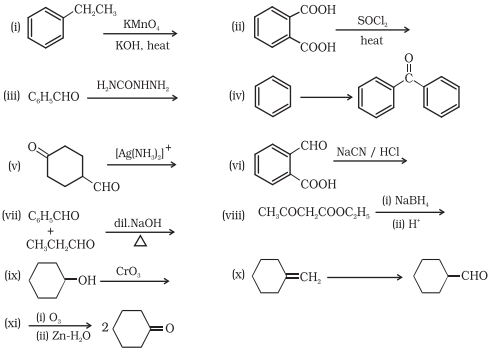
Solution
(N/A) $(i)$ Ethylbenzene + $KMnO_4/KOH, \Delta \rightarrow$ Benzoic acid $(C_6H_5COOH)$
$(ii)$ Phthalic acid + $SOCl_2, \Delta \rightarrow$ Phthaloyl chloride $(C_6H_4(COCl)_2)$
$(iii)$ Benzaldehyde + Semicarbazide $(H_2NCONHNH_2)$ $\rightarrow$ Benzaldehyde semicarbazone $(C_6H_5CH=NNHCONH_2)$
$(iv)$ Benzene + Benzoyl chloride $(C_6H_5COCl)$ + $AlCl_3 \rightarrow$ Benzophenone $(C_6H_5COC_6H_5)$
$(v)$ $4$-Oxocyclohexanecarbaldehyde + Tollens' reagent $[Ag(NH_3)_2]^+$ $\rightarrow$ $4$-Oxocyclohexanecarboxylic acid
$(vi)$ $2$-Formylbenzoic acid + $NaCN/HCl \rightarrow$ $2$-($1$-hydroxy-$1$-cyanomethyl)benzoic acid
$(vii)$ Benzaldehyde + Propanal + $dil. NaOH, \Delta \rightarrow$ $2$-Methyl-$3$-phenylprop-$2$-enal (Cross-Aldol product)
$(viii)$ Ethyl acetoacetate + $(i) NaBH_4, (ii) H^+ \rightarrow$ Ethyl $3$-hydroxybutanoate $(CH_3CH(OH)CH_2COOC_2H_5)$
$(ix)$ Cyclohexanol + $CrO_3 \rightarrow$ Cyclohexanone
$(x)$ Methylenecyclohexane + $(i) B_2H_6, (ii) H_2O_2/OH^- \rightarrow$ Cyclohexylmethanol (Hydroboration-oxidation)
$(xi)$ $1,1'$-Bicyclohexylidene + $(i) O_3, (ii) Zn-H_2O \rightarrow$ $2$ Cyclohexanone
$(ii)$ Phthalic acid + $SOCl_2, \Delta \rightarrow$ Phthaloyl chloride $(C_6H_4(COCl)_2)$
$(iii)$ Benzaldehyde + Semicarbazide $(H_2NCONHNH_2)$ $\rightarrow$ Benzaldehyde semicarbazone $(C_6H_5CH=NNHCONH_2)$
$(iv)$ Benzene + Benzoyl chloride $(C_6H_5COCl)$ + $AlCl_3 \rightarrow$ Benzophenone $(C_6H_5COC_6H_5)$
$(v)$ $4$-Oxocyclohexanecarbaldehyde + Tollens' reagent $[Ag(NH_3)_2]^+$ $\rightarrow$ $4$-Oxocyclohexanecarboxylic acid
$(vi)$ $2$-Formylbenzoic acid + $NaCN/HCl \rightarrow$ $2$-($1$-hydroxy-$1$-cyanomethyl)benzoic acid
$(vii)$ Benzaldehyde + Propanal + $dil. NaOH, \Delta \rightarrow$ $2$-Methyl-$3$-phenylprop-$2$-enal (Cross-Aldol product)
$(viii)$ Ethyl acetoacetate + $(i) NaBH_4, (ii) H^+ \rightarrow$ Ethyl $3$-hydroxybutanoate $(CH_3CH(OH)CH_2COOC_2H_5)$
$(ix)$ Cyclohexanol + $CrO_3 \rightarrow$ Cyclohexanone
$(x)$ Methylenecyclohexane + $(i) B_2H_6, (ii) H_2O_2/OH^- \rightarrow$ Cyclohexylmethanol (Hydroboration-oxidation)
$(xi)$ $1,1'$-Bicyclohexylidene + $(i) O_3, (ii) Zn-H_2O \rightarrow$ $2$ Cyclohexanone
0 likes
View Solution1048
Difficult
An organic compound contains $69.77 \%$ carbon,$11.63 \%$ hydrogen and the rest is oxygen. The molecular mass of the compound is $86$. It does not reduce Tollens' reagent but forms an addition compound with sodium hydrogensulphite and gives a positive iodoform test. On vigorous oxidation,it gives ethanoic acid and propanoic acid. Write the possible structure of the compound.
Solution
(A) $1$. Calculate the empirical formula:
$C:H:O = \frac{69.77}{12} : \frac{11.63}{1} : \frac{18.6}{16} = 5.81 : 11.63 : 1.16 = 5 : 10 : 1$.
Empirical formula is $C_5H_{10}O$.
$2$. Determine molecular formula:
Empirical formula mass $= 5(12) + 10(1) + 16 = 86$.
Since molecular mass is $86$,the molecular formula is $C_5H_{10}O$.
$3$. Analyze chemical properties:
- Does not reduce Tollens' reagent: Not an aldehyde.
- Forms addition compound with $NaHSO_3$: Contains a carbonyl group.
- Positive iodoform test: Contains a $CH_3CO-$ group.
- Oxidation yields ethanoic acid $(CH_3COOH)$ and propanoic acid $(CH_3CH_2COOH)$: The cleavage occurs at the $C-C$ bond adjacent to the carbonyl group.
$4$. Conclusion:
The compound is $Pentan-2-one$ $(CH_3COCH_2CH_2CH_3)$.
$C:H:O = \frac{69.77}{12} : \frac{11.63}{1} : \frac{18.6}{16} = 5.81 : 11.63 : 1.16 = 5 : 10 : 1$.
Empirical formula is $C_5H_{10}O$.
$2$. Determine molecular formula:
Empirical formula mass $= 5(12) + 10(1) + 16 = 86$.
Since molecular mass is $86$,the molecular formula is $C_5H_{10}O$.
$3$. Analyze chemical properties:
- Does not reduce Tollens' reagent: Not an aldehyde.
- Forms addition compound with $NaHSO_3$: Contains a carbonyl group.
- Positive iodoform test: Contains a $CH_3CO-$ group.
- Oxidation yields ethanoic acid $(CH_3COOH)$ and propanoic acid $(CH_3CH_2COOH)$: The cleavage occurs at the $C-C$ bond adjacent to the carbonyl group.
$4$. Conclusion:
The compound is $Pentan-2-one$ $(CH_3COCH_2CH_2CH_3)$.
0 likes
View Solution1049
MediumMCQ
What are the products formed when $(i)$ $HCHO$,$(ii)$ $CH_3CHO$,and $(iii)$ $CH_3COCH_3$ are reacted with $CH_3MgBr$ followed by hydrolysis?
A
$(i)$ Primary alcohol,$(ii)$ Secondary alcohol,$(iii)$ Tertiary alcohol
B
$(i)$ Secondary alcohol,$(ii)$ Primary alcohol,$(iii)$ Tertiary alcohol
C
$(i)$ Tertiary alcohol,$(ii)$ Secondary alcohol,$(iii)$ Primary alcohol
D
$(i)$ Primary alcohol,$(ii)$ Tertiary alcohol,$(iii)$ Secondary alcohol
Solution
(A) The reaction of Grignard reagent $(CH_3MgBr)$ with carbonyl compounds followed by hydrolysis yields alcohols:
$1$. $HCHO + CH_3MgBr$ $\rightarrow CH_3CH_2OMgBr$ $\xrightarrow{H_2O/H^+} CH_3CH_2OH$ (Primary alcohol).
$2$. $CH_3CHO + CH_3MgBr$ $\rightarrow CH_3CH(CH_3)OMgBr$ $\xrightarrow{H_2O/H^+} CH_3CH(OH)CH_3$ (Secondary alcohol).
$3$. $CH_3COCH_3 + CH_3MgBr$ $\rightarrow (CH_3)_3COMgBr$ $\xrightarrow{H_2O/H^+} (CH_3)_3COH$ (Tertiary alcohol).
$1$. $HCHO + CH_3MgBr$ $\rightarrow CH_3CH_2OMgBr$ $\xrightarrow{H_2O/H^+} CH_3CH_2OH$ (Primary alcohol).
$2$. $CH_3CHO + CH_3MgBr$ $\rightarrow CH_3CH(CH_3)OMgBr$ $\xrightarrow{H_2O/H^+} CH_3CH(OH)CH_3$ (Secondary alcohol).
$3$. $CH_3COCH_3 + CH_3MgBr$ $\rightarrow (CH_3)_3COMgBr$ $\xrightarrow{H_2O/H^+} (CH_3)_3COH$ (Tertiary alcohol).
0 likes
View Solution8-1.Aldehydes and Ketones — Properties · Frequently Asked Questions
1Are these 8-1.Aldehydes and Ketones questions useful for JEE and NEET?
Yes. All questions in this section are mapped to JEE Main and NEET exam patterns. Previous year questions from JEE Main, NEET, GUJCET and state-level exams are included with full solutions.
2Can I switch to Hindi or Gujarati for these questions?
Yes. Use the language tabs in the hero section or the sidebar to view the same questions and solutions in English, Hindi or Gujarati.
3How do I generate a question paper from this subtopic?
Use the Vedclass Exam Paper Generator — select the chapter and subtopic, set difficulty, and generate Sets A, B, C, D automatically. First 3 chapters of every subject are free.
Vedclass Products
For Students
Vedclass Test Series
Mock tests in real JEE/NEET style with performance analysis. 5-day free trial.
Start Free TrialFor Teachers
Exam Paper Generator
Generate Set A/B/C/D papers from this chapter in 2 minutes. 3 chapters free.
Try FreeFor Institutes
Online Exam Module
Live online exams with unlimited students, 360° analytics & white-label branding.
See DemoFor Teachers & Institutes
Generate a 8-1.Aldehydes and Ketones Exam Paper in 2 Minutes
Select subtopic & difficulty — Sets A, B, C, D auto-generated with No Repeat logic.
First 3 chapters of every subject are free — no payment required.