
A English
Properties Questions in English
Class 12 Chemistry · 8-1.Aldehydes and Ketones · Properties
1739+
Questions
English
Language
100%
With Solutions
Showing 50 of 1739 questions in English
901
MediumMCQ
Arrange the following compounds in decreasing order of reactivity towards nucleophilic addition reaction:
$(I)$ $C_6H_5COCH_3$
$(II)$ $CH_3COCH_3$
$(III)$ $CH_3CHO$
$(I)$ $C_6H_5COCH_3$
$(II)$ $CH_3COCH_3$
$(III)$ $CH_3CHO$
A
$I > II > III$
B
$III > II > I$
C
$II > I > III$
D
$III > I > II$
Solution
(B) The reactivity of carbonyl compounds towards nucleophilic addition reaction $(NAR)$ depends on two factors: steric hindrance and electronic effects.
$1$. Steric hindrance: Smaller groups around the carbonyl carbon allow easier attack by the nucleophile.
$2$. Electronic effects: Electron-donating groups (like alkyl groups) decrease the electrophilicity of the carbonyl carbon,while electron-withdrawing groups increase it.
Comparing the given compounds:
$(III)$ $CH_3CHO$ (Acetaldehyde) has one methyl group and one hydrogen atom.
$(II)$ $CH_3COCH_3$ (Acetone) has two methyl groups,which provide more steric hindrance and electron-donating effect than acetaldehyde.
$(I)$ $C_6H_5COCH_3$ (Acetophenone) has a phenyl group,which provides significant steric hindrance and also resonance stabilization,making the carbonyl carbon less electrophilic.
Thus,the order of reactivity is $CH_3CHO > CH_3COCH_3 > C_6H_5COCH_3$,which corresponds to $(III) > (II) > (I)$.
$1$. Steric hindrance: Smaller groups around the carbonyl carbon allow easier attack by the nucleophile.
$2$. Electronic effects: Electron-donating groups (like alkyl groups) decrease the electrophilicity of the carbonyl carbon,while electron-withdrawing groups increase it.
Comparing the given compounds:
$(III)$ $CH_3CHO$ (Acetaldehyde) has one methyl group and one hydrogen atom.
$(II)$ $CH_3COCH_3$ (Acetone) has two methyl groups,which provide more steric hindrance and electron-donating effect than acetaldehyde.
$(I)$ $C_6H_5COCH_3$ (Acetophenone) has a phenyl group,which provides significant steric hindrance and also resonance stabilization,making the carbonyl carbon less electrophilic.
Thus,the order of reactivity is $CH_3CHO > CH_3COCH_3 > C_6H_5COCH_3$,which corresponds to $(III) > (II) > (I)$.
0 likes
View Solution902
AdvancedMCQ
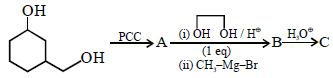
What is $C$ in the following reaction sequence?
A
$3-$(hydroxymethyl)$-1-$methylcyclohexan$-1-$ol
B
$3-$formyl$-1-$methylcyclohexan$-1-$ol
C
$1-$($1$-hydroxyethyl)cyclohexan$-1-$ol
D
$3-$($1$-hydroxyethyl)cyclohexan$-1-$one
Solution
(B) $1$. The starting material is $3-(hydroxymethyl)cyclohexan-1-ol$.
$2$. Treatment with $PCC$ (Pyridinium chlorochromate) oxidizes both the primary and secondary alcohol groups to a ketone and an aldehyde,respectively,forming $3-formylcyclohexan-1-one$ $(A)$.
$3$. The aldehyde group is more reactive towards nucleophilic attack than the ketone. However,the reaction uses $1 \ eq$ of ethylene glycol $(HO-CH_2-CH_2-OH)$ with $H^+$,which selectively protects the aldehyde as an acetal,leaving the ketone free.
$4$. Reaction with $CH_3MgBr$ (Grignard reagent) occurs at the ketone carbonyl to form a tertiary alcohol after workup.
$5$. Finally,acid-catalyzed hydrolysis $(H_3O^+)$ of the acetal group regenerates the aldehyde.
$6$. The final product $C$ is $3-formyl-1-methylcyclohexan-1-ol$.
$2$. Treatment with $PCC$ (Pyridinium chlorochromate) oxidizes both the primary and secondary alcohol groups to a ketone and an aldehyde,respectively,forming $3-formylcyclohexan-1-one$ $(A)$.
$3$. The aldehyde group is more reactive towards nucleophilic attack than the ketone. However,the reaction uses $1 \ eq$ of ethylene glycol $(HO-CH_2-CH_2-OH)$ with $H^+$,which selectively protects the aldehyde as an acetal,leaving the ketone free.
$4$. Reaction with $CH_3MgBr$ (Grignard reagent) occurs at the ketone carbonyl to form a tertiary alcohol after workup.
$5$. Finally,acid-catalyzed hydrolysis $(H_3O^+)$ of the acetal group regenerates the aldehyde.
$6$. The final product $C$ is $3-formyl-1-methylcyclohexan-1-ol$.
0 likes
View Solution903
MediumMCQ
$CCl_3CHO \xrightarrow[KOH]{Conc.}$ Main product is
A
$CCl_3CH_2OH$
B
$CCl_3COOK$
C
$CHCl_3$
D
$(A)$ and $(B)$ both
Solution
(D) The reaction of $CCl_3CHO$ (chloral) with concentrated $KOH$ is an example of the Cannizzaro reaction.
Since $CCl_3CHO$ does not have any $\alpha$-hydrogen,it undergoes self-oxidation and reduction (disproportionation).
The aldehyde group is oxidized to a carboxylate salt $(CCl_3COOK)$ and reduced to an alcohol $(CCl_3CH_2OH)$.
Therefore,both $CCl_3CH_2OH$ and $CCl_3COOK$ are formed as products.
Since $CCl_3CHO$ does not have any $\alpha$-hydrogen,it undergoes self-oxidation and reduction (disproportionation).
The aldehyde group is oxidized to a carboxylate salt $(CCl_3COOK)$ and reduced to an alcohol $(CCl_3CH_2OH)$.
Therefore,both $CCl_3CH_2OH$ and $CCl_3COOK$ are formed as products.
0 likes
View Solution904
MediumMCQ
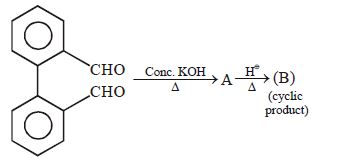
The structure of $(B)$ is
A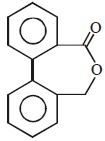
B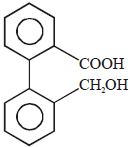
C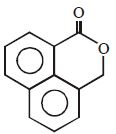
D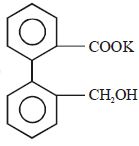
Solution
(A) The starting material is $2,2'$-diformylbiphenyl.
When treated with concentrated $KOH$ and heat,it undergoes an intramolecular Cannizzaro reaction.
One aldehyde group is reduced to a $-CH_2OH$ group,and the other is oxidized to a $-COOK$ group,forming intermediate $(A)$,which is potassium $2'$-(hydroxymethyl)biphenyl$-2-$carboxylate.
Upon treatment with $H^+$ and heat,the carboxylic acid and alcohol groups undergo intramolecular esterification (cyclization) to form a cyclic ester (lactone) $(B)$.
When treated with concentrated $KOH$ and heat,it undergoes an intramolecular Cannizzaro reaction.
One aldehyde group is reduced to a $-CH_2OH$ group,and the other is oxidized to a $-COOK$ group,forming intermediate $(A)$,which is potassium $2'$-(hydroxymethyl)biphenyl$-2-$carboxylate.
Upon treatment with $H^+$ and heat,the carboxylic acid and alcohol groups undergo intramolecular esterification (cyclization) to form a cyclic ester (lactone) $(B)$.
0 likes
View Solution905
MediumMCQ
Number of $\sigma$ and $\pi$ bonds in benzophenone is
A
$24, 6$
B
$24, 7$
C
$25, 6$
D
$25, 7$
Solution
(D) The chemical formula of benzophenone is $(C_6H_5)_2CO$.
In the structure,there are two phenyl rings attached to a carbonyl group $(C=O)$.
Each phenyl ring $(C_6H_5)$ contains $6$ $C-C$ bonds (including $3$ double bonds) and $5$ $C-H$ bonds.
Total $\sigma$ bonds in two phenyl rings = $2 \times (6 + 5) = 22$.
There are $2$ $C-C$ single bonds connecting the carbonyl carbon to the phenyl rings.
There is $1$ $C-O$ $\sigma$ bond in the carbonyl group.
Total $\sigma$ bonds = $22 + 2 + 1 = 25$.
Total $\pi$ bonds = $2 \times 3$ (from two benzene rings) + $1$ (from $C=O$ bond) = $6 + 1 = 7$.
Thus,there are $25$ $\sigma$ bonds and $7$ $\pi$ bonds.
In the structure,there are two phenyl rings attached to a carbonyl group $(C=O)$.
Each phenyl ring $(C_6H_5)$ contains $6$ $C-C$ bonds (including $3$ double bonds) and $5$ $C-H$ bonds.
Total $\sigma$ bonds in two phenyl rings = $2 \times (6 + 5) = 22$.
There are $2$ $C-C$ single bonds connecting the carbonyl carbon to the phenyl rings.
There is $1$ $C-O$ $\sigma$ bond in the carbonyl group.
Total $\sigma$ bonds = $22 + 2 + 1 = 25$.
Total $\pi$ bonds = $2 \times 3$ (from two benzene rings) + $1$ (from $C=O$ bond) = $6 + 1 = 7$.
Thus,there are $25$ $\sigma$ bonds and $7$ $\pi$ bonds.
0 likes
View Solution906
DifficultMCQ
The reaction of $CH_3CH_2CHO$ with $PCl_5$ yields a product. Identify the type of dihalide formed.
A
gem-dihalide
B
Vic-dihalide
C
Both gem and Vic-dihalide
D
None of these
Solution
(A) When an aldehyde or ketone reacts with $PCl_5$,the oxygen atom of the carbonyl group is replaced by two chlorine atoms,resulting in the formation of a gem-dihalide (where both halogen atoms are attached to the same carbon atom).
The reaction is: $CH_3CH_2CHO + PCl_5 \to CH_3CH_2CHCl_2 + POCl_3$.
Thus,the product formed is a gem-dihalide.
The reaction is: $CH_3CH_2CHO + PCl_5 \to CH_3CH_2CHCl_2 + POCl_3$.
Thus,the product formed is a gem-dihalide.
0 likes
View Solution907
DifficultMCQ
Compound "x" having molecular formula $C_3H_6O$,is reduced by Red $P/HI$ to give compound "y" $(C_3H_8)$. If "x" reduces Tollen's reagent,what is the possible structure of "x"?
A
$CH_3-CH_2-CHO$
B
$CH_3-CO-CH_3$
C
$CH_2=CH-CH_2-OH$
D
Both $A$ and $B$
Solution
(A) The molecular formula $C_3H_6O$ corresponds to either an aldehyde or a ketone.
Reduction by Red $P/HI$ converts carbonyl compounds into alkanes.
Since "x" reduces Tollen's reagent,it must be an aldehyde.
The only aldehyde with the formula $C_3H_6O$ is propanal,which is $CH_3-CH_2-CHO$.
Reduction by Red $P/HI$ converts carbonyl compounds into alkanes.
Since "x" reduces Tollen's reagent,it must be an aldehyde.
The only aldehyde with the formula $C_3H_6O$ is propanal,which is $CH_3-CH_2-CHO$.
0 likes
View Solution908
AdvancedMCQ
In the given reaction,what is $Y$?
$(P)$ $\xrightarrow{\Delta} X$ $\xrightarrow{Zn-Hg/HCl} Y$
$(P)$ $\xrightarrow{\Delta} X$ $\xrightarrow{Zn-Hg/HCl} Y$
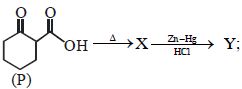
A
Cyclohexylmethane
B
Cyclohexanone
C
Cyclohexane
D
$1,2-$bis(hydroxymethyl)cyclohexane
Solution
(C) The starting material $(P)$ is $2$-oxocyclohexanecarboxylic acid.
Step $1$: Heating $(P)$ causes decarboxylation,where the $-COOH$ group is removed as $CO_2$,resulting in the formation of cyclohexanone as $X$.
Step $2$: The reaction of cyclohexanone $(X)$ with $Zn-Hg/HCl$ is a Clemmensen reduction,which reduces the carbonyl group $(>C=O)$ to a methylene group $(>CH_2)$.
Therefore,the final product $Y$ is cyclohexane.
Step $1$: Heating $(P)$ causes decarboxylation,where the $-COOH$ group is removed as $CO_2$,resulting in the formation of cyclohexanone as $X$.
Step $2$: The reaction of cyclohexanone $(X)$ with $Zn-Hg/HCl$ is a Clemmensen reduction,which reduces the carbonyl group $(>C=O)$ to a methylene group $(>CH_2)$.
Therefore,the final product $Y$ is cyclohexane.
0 likes
View Solution909
MediumMCQ
Which of the following does not give alcohol with $NaBH_4$?
A
$CH_3CH_2CHO$
B
$CH_3CH_2COCH_2CH_3$
C
$CH_3COCl$
D
$CH_3COOCH_2CH_3$
Solution
(D) $NaBH_4$ (Sodium borohydride) is a selective reducing agent that reduces aldehydes and ketones to alcohols.
It does not reduce carboxylic acid derivatives like acid chlorides $(RCOCl)$ or esters $(RCOOR')$ to alcohols under normal conditions.
- $CH_3CH_2CHO$ (Aldehyde) is reduced to $CH_3CH_2CH_2OH$ (Alcohol).
- $CH_3CH_2COCH_2CH_3$ (Ketone) is reduced to $CH_3CH_2CH(OH)CH_2CH_3$ (Alcohol).
- $CH_3COCl$ (Acid chloride) is reduced to an aldehyde or alcohol only with stronger reducing agents like $LiAlH_4$,but $NaBH_4$ is generally too weak to reduce it to alcohol.
- $CH_3COOCH_2CH_3$ (Ester) is not reduced by $NaBH_4$.
However,in the context of standard chemistry problems,acid chlorides and esters are both considered non-reactive towards $NaBH_4$ for reduction to alcohols. Given the options,$CH_3COCl$ and $CH_3COOCH_2CH_3$ both do not give alcohols. Typically,$NaBH_4$ is known for not reducing esters. Thus,the most appropriate answer is $D$.
It does not reduce carboxylic acid derivatives like acid chlorides $(RCOCl)$ or esters $(RCOOR')$ to alcohols under normal conditions.
- $CH_3CH_2CHO$ (Aldehyde) is reduced to $CH_3CH_2CH_2OH$ (Alcohol).
- $CH_3CH_2COCH_2CH_3$ (Ketone) is reduced to $CH_3CH_2CH(OH)CH_2CH_3$ (Alcohol).
- $CH_3COCl$ (Acid chloride) is reduced to an aldehyde or alcohol only with stronger reducing agents like $LiAlH_4$,but $NaBH_4$ is generally too weak to reduce it to alcohol.
- $CH_3COOCH_2CH_3$ (Ester) is not reduced by $NaBH_4$.
However,in the context of standard chemistry problems,acid chlorides and esters are both considered non-reactive towards $NaBH_4$ for reduction to alcohols. Given the options,$CH_3COCl$ and $CH_3COOCH_2CH_3$ both do not give alcohols. Typically,$NaBH_4$ is known for not reducing esters. Thus,the most appropriate answer is $D$.
0 likes
View Solution910
MediumMCQ
Which of the following reagents would carry out the following transformation?
$C_6H_5COCH_3 \rightarrow C_6H_5CH(OD)CH_3$ (Note: The product shows a deuterium atom attached to the chiral carbon,not the oxygen).
$C_6H_5COCH_3 \rightarrow C_6H_5CH(OD)CH_3$ (Note: The product shows a deuterium atom attached to the chiral carbon,not the oxygen).
A
$NaBD_4$ in $CH_3OH$
B
$LiAlH_4$,then $D_2O$
C
$NaBD_4$ in $CH_3OD$
D
$LiAlD_4$,then $D_2O$
Solution
(A) The transformation involves the reduction of acetophenone $(C_6H_5COCH_3)$ to a secondary alcohol where a deuterium atom is incorporated at the alpha-carbon position.
$NaBD_4$ acts as a source of deuteride ions $(D^-)$.
When $NaBD_4$ reacts with the ketone in a protic solvent like $CH_3OH$,the $D^-$ ion attacks the carbonyl carbon to form a $C-D$ bond,and the oxygen is protonated by the solvent to form an $-OH$ group.
Therefore,$NaBD_4$ in $CH_3OH$ will yield the product $C_6H_5CH(D)OH$.
$NaBD_4$ acts as a source of deuteride ions $(D^-)$.
When $NaBD_4$ reacts with the ketone in a protic solvent like $CH_3OH$,the $D^-$ ion attacks the carbonyl carbon to form a $C-D$ bond,and the oxygen is protonated by the solvent to form an $-OH$ group.
Therefore,$NaBD_4$ in $CH_3OH$ will yield the product $C_6H_5CH(D)OH$.
0 likes
View Solution911
DifficultMCQ
$A$ compound gives a positive test with $I_2/NaOH$ and is extracted from benzene by $NaHSO_3$. It may be:
A
$CH_3(CH_2)_4CHO$
B
$CH_3(CH_2)_3COCH_3$
C
$CH_3CH_2COCH_2CH_3$
D
$CH_3(CH_2)_4CH_2OH$
Solution
(B) $1$. The $I_2/NaOH$ test (iodoform test) is positive for compounds containing the $CH_3CO-$ group or the $CH_3CH(OH)-$ group.
$2$. Extraction from benzene by $NaHSO_3$ indicates the formation of a bisulfite addition compound,which is characteristic of aldehydes and small methyl ketones.
$3$. $CH_3(CH_2)_4CHO$ (hexanal) gives a positive $NaHSO_3$ test but does not contain the $CH_3CO-$ group required for a positive iodoform test.
$4$. $CH_3(CH_2)_3COCH_3$ (hexan$-2-$one) contains the $CH_3CO-$ group,thus giving a positive iodoform test,and it is a methyl ketone,which reacts with $NaHSO_3$ to form a crystalline addition product.
$5$. Therefore,the correct compound is $CH_3(CH_2)_3COCH_3$.
$2$. Extraction from benzene by $NaHSO_3$ indicates the formation of a bisulfite addition compound,which is characteristic of aldehydes and small methyl ketones.
$3$. $CH_3(CH_2)_4CHO$ (hexanal) gives a positive $NaHSO_3$ test but does not contain the $CH_3CO-$ group required for a positive iodoform test.
$4$. $CH_3(CH_2)_3COCH_3$ (hexan$-2-$one) contains the $CH_3CO-$ group,thus giving a positive iodoform test,and it is a methyl ketone,which reacts with $NaHSO_3$ to form a crystalline addition product.
$5$. Therefore,the correct compound is $CH_3(CH_2)_3COCH_3$.
0 likes
View Solution912
DifficultMCQ
In the given reaction,what is $y$?
$CH_3CH_2COCH_2COOH$ $\xrightarrow{\Delta} x$ $\xrightarrow[(ii) H_2O]{(i) LiAlH_4} y$
$CH_3CH_2COCH_2COOH$ $\xrightarrow{\Delta} x$ $\xrightarrow[(ii) H_2O]{(i) LiAlH_4} y$
A
Butan$-2-$one
B
Butan$-2-$ol
C
Butan$-2-$ol
D
Butane$-1,3-$diol
0 likes
View Solution913
MediumMCQ
Among the given pairs,in which pair does the second compound have less enol content than the first compound?
A
Cyclohexanone,Cyclohex$-2-$en$-1-$one
B
Cyclobutane$-1,2-$dione,Cyclobutanone
C
$OHC-CH_2-CHO$,$CH_3-CHO$
D
None of these
Solution
(B) To determine the enol content,we look at factors like resonance,aromaticity,and intramolecular hydrogen bonding.
$(A)$ Cyclohexanone vs. Cyclohex$-2-$en$-1-$one: Cyclohex$-2-$en$-1-$one has higher enol content due to conjugation of the double bond with the carbonyl group in the enol form. Thus,the second compound has more enol content.
$(B)$ Cyclobutane$-1,2-$dione vs. Cyclobutanone: Cyclobutane$-1,2-$dione has a significantly higher enol content because its enol form is stabilized by intramolecular hydrogen bonding and conjugation. Thus,the second compound has less enol content.
$(C)$ $OHC-CH_2-CHO$ (malonaldehyde) vs. $CH_3-CHO$ (acetaldehyde): Malonaldehyde has very high enol content due to strong intramolecular hydrogen bonding. Acetaldehyde has negligible enol content. Thus,the second compound has less enol content.
Since both $(B)$ and $(C)$ satisfy the condition,and typically such questions have a single best answer or are multiple-choice,$(B)$ and $(C)$ are both correct. Given the structure of the question,$(B)$ is a classic example.
$(A)$ Cyclohexanone vs. Cyclohex$-2-$en$-1-$one: Cyclohex$-2-$en$-1-$one has higher enol content due to conjugation of the double bond with the carbonyl group in the enol form. Thus,the second compound has more enol content.
$(B)$ Cyclobutane$-1,2-$dione vs. Cyclobutanone: Cyclobutane$-1,2-$dione has a significantly higher enol content because its enol form is stabilized by intramolecular hydrogen bonding and conjugation. Thus,the second compound has less enol content.
$(C)$ $OHC-CH_2-CHO$ (malonaldehyde) vs. $CH_3-CHO$ (acetaldehyde): Malonaldehyde has very high enol content due to strong intramolecular hydrogen bonding. Acetaldehyde has negligible enol content. Thus,the second compound has less enol content.
Since both $(B)$ and $(C)$ satisfy the condition,and typically such questions have a single best answer or are multiple-choice,$(B)$ and $(C)$ are both correct. Given the structure of the question,$(B)$ is a classic example.
0 likes
View Solution914
MediumMCQ
The correct order of rate of reaction towards nucleophilic addition reaction for the following compounds is:
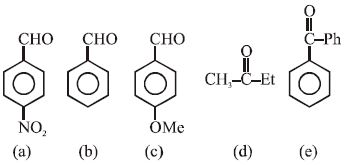
A
$a > b > c > d > e$
B
$a > b > d > c > e$
C
$a > c > b > d > e$
D
$a > b > c > e > d$
Solution
(A) The rate of nucleophilic addition reaction depends on the electrophilicity of the carbonyl carbon and steric hindrance.
$1$. Aldehydes are more reactive than ketones due to less steric hindrance and higher electrophilicity. Thus,$(a, b, c) > (d, e)$.
$2$. Among aldehydes,electron-withdrawing groups increase the electrophilicity of the carbonyl carbon,while electron-donating groups decrease it.
- $(a)$ has a $-NO_2$ group (strong electron-withdrawing),so it is most reactive.
- $(b)$ is benzaldehyde.
- $(c)$ has a $-OMe$ group (electron-donating by resonance),so it is least reactive among the aldehydes.
Order for aldehydes: $a > b > c$.
$3$. Among ketones,$(d)$ is an aliphatic ketone $(CH_3-CO-Et)$ and $(e)$ is an aromatic ketone (benzophenone). Aliphatic ketones are more reactive than aromatic ketones due to less steric hindrance and lack of resonance stabilization of the carbonyl group by the phenyl ring.
Order for ketones: $d > e$.
Combining these,the overall order is $a > b > c > d > e$.
$1$. Aldehydes are more reactive than ketones due to less steric hindrance and higher electrophilicity. Thus,$(a, b, c) > (d, e)$.
$2$. Among aldehydes,electron-withdrawing groups increase the electrophilicity of the carbonyl carbon,while electron-donating groups decrease it.
- $(a)$ has a $-NO_2$ group (strong electron-withdrawing),so it is most reactive.
- $(b)$ is benzaldehyde.
- $(c)$ has a $-OMe$ group (electron-donating by resonance),so it is least reactive among the aldehydes.
Order for aldehydes: $a > b > c$.
$3$. Among ketones,$(d)$ is an aliphatic ketone $(CH_3-CO-Et)$ and $(e)$ is an aromatic ketone (benzophenone). Aliphatic ketones are more reactive than aromatic ketones due to less steric hindrance and lack of resonance stabilization of the carbonyl group by the phenyl ring.
Order for ketones: $d > e$.
Combining these,the overall order is $a > b > c > d > e$.
0 likes
View Solution915
DifficultMCQ
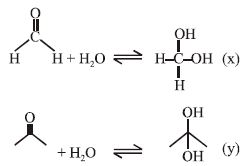
The image shows the hydration equilibrium of formaldehyde and acetone. Identify the values of $x$ and $y$ representing the percentage of hydrate formed at equilibrium for formaldehyde and acetone,respectively.
A
$x = 0.2\,\%,\,\,y = 99.95\,\%$
B
$x = 99.9\,\%,\,\,y = 0.2\,\%$
C
$x = 0.2\,\%,\,\,y = 0.2\,\%$
D
$x = 99.9\,\%,\,\,y = 99.9\,\%$
Solution
(B) Formaldehyde $(HCHO)$ is the simplest aldehyde and has minimal steric hindrance,making its gem-diol (hydrate) form very stable. At equilibrium,the percentage of hydrate formed is approximately $99.9\,\%$.
Acetone $(CH_3COCH_3)$ is a ketone with significant steric hindrance from the two methyl groups,which destabilizes the gem-diol form. Consequently,the equilibrium lies far to the left,and the percentage of hydrate formed is very low,approximately $0.2\,\%$.
Therefore,$x = 99.9\,\%$ and $y = 0.2\,\%$.
Acetone $(CH_3COCH_3)$ is a ketone with significant steric hindrance from the two methyl groups,which destabilizes the gem-diol form. Consequently,the equilibrium lies far to the left,and the percentage of hydrate formed is very low,approximately $0.2\,\%$.
Therefore,$x = 99.9\,\%$ and $y = 0.2\,\%$.
0 likes
View Solution916
MediumMCQ
Arrange the following compounds in decreasing order of reactivity towards nucleophilic addition reaction:
$I: HCHO$
$II: CH_3CHO$
$III: CH_3COCH_3$
$IV: PhCOCH_3$
$I: HCHO$
$II: CH_3CHO$
$III: CH_3COCH_3$
$IV: PhCOCH_3$
A
$I > II > III > IV$
B
$II > I > III > IV$
C
$IV > III > II > I$
D
$II > III > IV > I$
Solution
(A) The reactivity of carbonyl compounds towards nucleophilic addition reaction $(NAR)$ is governed by two main factors:
$1.$ Electronic effect: The electrophilicity of the carbonyl carbon. Electron-donating groups $(EDG)$ decrease reactivity by reducing the positive charge on the carbonyl carbon,while electron-withdrawing groups increase it.
$2.$ Steric effect: The bulkiness of the groups attached to the carbonyl carbon. Increased steric hindrance makes it difficult for the nucleophile to attack,thus decreasing reactivity.
Comparing the given compounds:
$I: HCHO$ (Formaldehyde) - No $EDG$,least steric hindrance.
$II: CH_3CHO$ (Acetaldehyde) - One $CH_3$ group (weak $EDG$,some steric hindrance).
$III: CH_3COCH_3$ (Acetone) - Two $CH_3$ groups (more $EDG$,more steric hindrance).
$IV: PhCOCH_3$ (Acetophenone) - One $Ph$ group and one $CH_3$ group. The phenyl group is a stronger $EDG$ (via resonance) and is bulkier than $CH_3$,significantly reducing the electrophilicity and increasing steric hindrance.
Therefore,the order of reactivity is $I > II > III > IV$.
$1.$ Electronic effect: The electrophilicity of the carbonyl carbon. Electron-donating groups $(EDG)$ decrease reactivity by reducing the positive charge on the carbonyl carbon,while electron-withdrawing groups increase it.
$2.$ Steric effect: The bulkiness of the groups attached to the carbonyl carbon. Increased steric hindrance makes it difficult for the nucleophile to attack,thus decreasing reactivity.
Comparing the given compounds:
$I: HCHO$ (Formaldehyde) - No $EDG$,least steric hindrance.
$II: CH_3CHO$ (Acetaldehyde) - One $CH_3$ group (weak $EDG$,some steric hindrance).
$III: CH_3COCH_3$ (Acetone) - Two $CH_3$ groups (more $EDG$,more steric hindrance).
$IV: PhCOCH_3$ (Acetophenone) - One $Ph$ group and one $CH_3$ group. The phenyl group is a stronger $EDG$ (via resonance) and is bulkier than $CH_3$,significantly reducing the electrophilicity and increasing steric hindrance.
Therefore,the order of reactivity is $I > II > III > IV$.
0 likes
View Solution917
DifficultMCQ
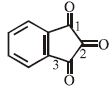
Which carbonyl group is most reactive for $NAR$ (Nucleophilic Addition Reaction)?
A
$1$
B
$2$
C
$3$
D
All have same reactivity
Solution
(B) The reactivity of a carbonyl group towards nucleophilic addition depends on the electrophilicity of the carbonyl carbon. In the given molecule (indane$-1,2,3-$trione),the central carbonyl group (labeled $2$) is flanked by two other carbonyl groups. These adjacent carbonyl groups exert a strong electron-withdrawing effect,making the carbon at position $2$ highly electrophilic. Furthermore,the transition state resulting from the nucleophilic attack at the $2^{nd}$ carbonyl group experiences less electrostatic repulsion compared to the other positions,as the negative charge is better delocalized across the three oxygen atoms. Therefore,the $2^{nd}$ carbonyl group is the most reactive.
0 likes
View Solution918
DifficultMCQ
$HOCH_2-C(=O)-CH(OH)-CH_2OH \xrightarrow{HIO_4}$ Product obtained is:
A
$H_2C=O$
B
$HCOOH$
C
$CO_2$
D
All of the above
Solution
(D) Periodic acid $(HIO_4)$ cleaves the $C-C$ bond in vicinal diols,$\alpha$-hydroxy ketones,and $\alpha$-hydroxy aldehydes.
In the given compound $HOCH_2-C(=O)-CH(OH)-CH_2OH$:
$1.$ The $C_1-C_2$ bond cleavage gives $HCHO$ (from $CH_2OH$) and a carboxyl group at $C_2$.
$2.$ The $C_2-C_3$ bond cleavage converts the $C_2$ group to $CO_2$ and the $C_3$ group to an aldehyde.
$3.$ The $C_3-C_4$ bond cleavage converts the $C_3$ group to $HCOOH$ and the $C_4$ group to $HCHO$.
Thus,the products are $HCHO$ $(H_2C=O)$,$HCOOH$,and $CO_2$.
In the given compound $HOCH_2-C(=O)-CH(OH)-CH_2OH$:
$1.$ The $C_1-C_2$ bond cleavage gives $HCHO$ (from $CH_2OH$) and a carboxyl group at $C_2$.
$2.$ The $C_2-C_3$ bond cleavage converts the $C_2$ group to $CO_2$ and the $C_3$ group to an aldehyde.
$3.$ The $C_3-C_4$ bond cleavage converts the $C_3$ group to $HCOOH$ and the $C_4$ group to $HCHO$.
Thus,the products are $HCHO$ $(H_2C=O)$,$HCOOH$,and $CO_2$.
0 likes
View Solution919
MediumMCQ
Which of the following reactions is incorrect?
A
$C_6H_5CN \xrightarrow{H_3O^+} C_6H_5COOH$
B
$C_6H_5CN \xrightarrow[(2) H_2O]{(1) DIBAL-H} C_6H_5CHO$
C
$C_6H_5CN \xrightarrow[(2) H_2O]{(1) LiAlH_4} C_6H_5CH_2OH$
D
$C_6H_5CN \xrightarrow[(2) H_2O]{(1) PhMgBr} C_6H_5COC_6H_5$
Solution
(C) Let us analyze each reaction:
$(A)$ Acidic hydrolysis of benzonitrile $(C_6H_5CN)$ yields benzoic acid $(C_6H_5COOH)$. This is correct.
$(B)$ Controlled reduction of nitriles with $DIBAL-H$ followed by hydrolysis yields aldehydes $(C_6H_5CHO)$. This is correct.
$(C)$ Reduction of nitriles with $LiAlH_4$ followed by hydrolysis yields primary amines $(C_6H_5CH_2NH_2)$,not primary alcohols $(C_6H_5CH_2OH)$. This is incorrect.
$(D)$ Reaction of nitriles with Grignard reagents $(PhMgBr)$ followed by hydrolysis yields ketones $(C_6H_5COC_6H_5)$. This is correct.
Therefore,the incorrect reaction is $(C)$.
$(A)$ Acidic hydrolysis of benzonitrile $(C_6H_5CN)$ yields benzoic acid $(C_6H_5COOH)$. This is correct.
$(B)$ Controlled reduction of nitriles with $DIBAL-H$ followed by hydrolysis yields aldehydes $(C_6H_5CHO)$. This is correct.
$(C)$ Reduction of nitriles with $LiAlH_4$ followed by hydrolysis yields primary amines $(C_6H_5CH_2NH_2)$,not primary alcohols $(C_6H_5CH_2OH)$. This is incorrect.
$(D)$ Reaction of nitriles with Grignard reagents $(PhMgBr)$ followed by hydrolysis yields ketones $(C_6H_5COC_6H_5)$. This is correct.
Therefore,the incorrect reaction is $(C)$.
0 likes
View Solution920
MediumMCQ
Which of the following does not give an Aldol condensation reaction?
A
B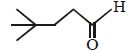
C
D
Solution
(C) Aldol condensation is shown by aldehydes and ketones having at least one $\alpha$-hydrogen atom.
$HCHO$ (Formaldehyde) does not contain any $\alpha$-hydrogen atom,hence it does not undergo Aldol condensation.
$HCHO$ (Formaldehyde) does not contain any $\alpha$-hydrogen atom,hence it does not undergo Aldol condensation.
0 likes
View Solution921
DifficultMCQ
Which of the following is $D$ in the given reaction sequence?
$(CH_3)_3C-CH_2OH$ $\xrightarrow{PCC} B$ $\xrightarrow{Conc. NaOH} A + C$ $\xrightarrow{NaOH/CaO, \Delta} D$
$(CH_3)_3C-CH_2OH$ $\xrightarrow{PCC} B$ $\xrightarrow{Conc. NaOH} A + C$ $\xrightarrow{NaOH/CaO, \Delta} D$
A
$(CH_3)_3C-CH_3$
B
$(CH_3)_2CH-CH_3$
C
$(CH_3)_3C-COONa$
D
$(CH_3)_3C-CH_2-CH_2-C(CH_3)_3$
Solution
(B) The reaction sequence is as follows:
$1$. $(CH_3)_3C-CH_2OH$ is a primary alcohol. Oxidation with $PCC$ gives the corresponding aldehyde,$B$,which is $(CH_3)_3C-CHO$ (pivalaldehyde).
$2$. $B$ $((CH_3)_3C-CHO)$ has no $\alpha$-hydrogen atoms. Therefore,it undergoes the Cannizzaro reaction with concentrated $NaOH$.
$3$. The Cannizzaro reaction produces the corresponding alcohol $(A = (CH_3)_3C-CH_2OH)$ and the sodium salt of the carboxylic acid $(C = (CH_3)_3C-COONa)$.
$4$. Decarboxylation of the sodium salt of the carboxylic acid $(C)$ with soda lime $(NaOH/CaO, \Delta)$ removes the $-COONa$ group and replaces it with a hydrogen atom.
$5$. $(CH_3)_3C-COONa \xrightarrow{NaOH/CaO, \Delta} (CH_3)_3C-H$,which is isobutane ($(CH_3)_3CH$ or $2$-methylpropane).
$6$. Comparing this with the options,the structure corresponding to isobutane is represented by option $B$.
$1$. $(CH_3)_3C-CH_2OH$ is a primary alcohol. Oxidation with $PCC$ gives the corresponding aldehyde,$B$,which is $(CH_3)_3C-CHO$ (pivalaldehyde).
$2$. $B$ $((CH_3)_3C-CHO)$ has no $\alpha$-hydrogen atoms. Therefore,it undergoes the Cannizzaro reaction with concentrated $NaOH$.
$3$. The Cannizzaro reaction produces the corresponding alcohol $(A = (CH_3)_3C-CH_2OH)$ and the sodium salt of the carboxylic acid $(C = (CH_3)_3C-COONa)$.
$4$. Decarboxylation of the sodium salt of the carboxylic acid $(C)$ with soda lime $(NaOH/CaO, \Delta)$ removes the $-COONa$ group and replaces it with a hydrogen atom.
$5$. $(CH_3)_3C-COONa \xrightarrow{NaOH/CaO, \Delta} (CH_3)_3C-H$,which is isobutane ($(CH_3)_3CH$ or $2$-methylpropane).
$6$. Comparing this with the options,the structure corresponding to isobutane is represented by option $B$.
0 likes
View Solution922
DifficultMCQ
Which of the following gives Fehling's solution test?
A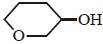
B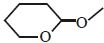
C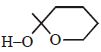
D
Solution
(D) Fehling's solution test is used to distinguish aliphatic aldehydes from aromatic aldehydes and ketones.
Aliphatic aldehydes,such as acetaldehyde $(CH_3CHO)$,are easily oxidized to carboxylic acids by Fehling's solution,resulting in the formation of a reddish-brown precipitate of cuprous oxide $(Cu_2O)$.
Aromatic aldehydes (like benzaldehyde) and ketones (like acetophenone and benzophenone) do not give this test.
Therefore,the correct option is $D$.
Aliphatic aldehydes,such as acetaldehyde $(CH_3CHO)$,are easily oxidized to carboxylic acids by Fehling's solution,resulting in the formation of a reddish-brown precipitate of cuprous oxide $(Cu_2O)$.
Aromatic aldehydes (like benzaldehyde) and ketones (like acetophenone and benzophenone) do not give this test.
Therefore,the correct option is $D$.
0 likes
View Solution923
MediumMCQ
Which of the following does not show haloform reaction?
A
$3-$pentanone
B
$1-$phenylethanol
C
$3-$methylbutan$-2-$ol
D
Acetophenone
Solution
(A) The haloform reaction is given by compounds containing the $CH_3CO-$ group or compounds that can be oxidized to this group (e.g.,secondary alcohols with the $CH_3CH(OH)-$ group).
$1$. $3-$pentanone is $CH_3CH_2COCH_2CH_3$. It does not contain the $CH_3CO-$ group,so it does not give the haloform reaction.
$2$. $1-$phenylethanol is $C_6H_5CH(OH)CH_3$. It contains the $CH_3CH(OH)-$ group,which can be oxidized to the $CH_3CO-$ group,so it gives a positive haloform test.
$3$. $3-$methylbutan$-2-$ol is $(CH_3)_2CHCH(OH)CH_3$. It contains the $CH_3CH(OH)-$ group,so it gives a positive haloform test.
$4$. Acetophenone is $C_6H_5COCH_3$. It contains the $CH_3CO-$ group,so it gives a positive haloform test.
Therefore,$3-$pentanone does not show the haloform reaction.
$1$. $3-$pentanone is $CH_3CH_2COCH_2CH_3$. It does not contain the $CH_3CO-$ group,so it does not give the haloform reaction.
$2$. $1-$phenylethanol is $C_6H_5CH(OH)CH_3$. It contains the $CH_3CH(OH)-$ group,which can be oxidized to the $CH_3CO-$ group,so it gives a positive haloform test.
$3$. $3-$methylbutan$-2-$ol is $(CH_3)_2CHCH(OH)CH_3$. It contains the $CH_3CH(OH)-$ group,so it gives a positive haloform test.
$4$. Acetophenone is $C_6H_5COCH_3$. It contains the $CH_3CO-$ group,so it gives a positive haloform test.
Therefore,$3-$pentanone does not show the haloform reaction.
0 likes
View Solution924
DifficultMCQ
The product formed in the following reaction is:
$CHO-CH(OH)-CH_2OH \xrightarrow{2HIO_4} ?$
$CHO-CH(OH)-CH_2OH \xrightarrow{2HIO_4} ?$
A
$2HCHO, HCO_2H$
B
$HCHO, 2HCO_2H$
C
$CO_2, HCHO$
D
$CO_2, HCO_2H$
Solution
(B) The reaction involves the oxidative cleavage of a vicinal diol (or $\alpha$-hydroxy carbonyl compound) by periodic acid $(HIO_4)$.
$1$. The starting material is glyceraldehyde $(CHO-CH(OH)-CH_2OH)$.
$2$. The first $HIO_4$ molecule cleaves the bond between the $C_1$ (aldehyde) and $C_2$ (hydroxyl) carbons. This produces $HCOOH$ (formic acid) and $HOCH_2CHO$ (glycolaldehyde).
$3$. The second $HIO_4$ molecule cleaves the glycolaldehyde $(HOCH_2CHO)$ into $HCHO$ (formaldehyde) and $HCOOH$ (formic acid).
$4$. Summing the products: $HCOOH + HCOOH + HCHO = 2HCOOH + HCHO$.
Therefore,the final products are $HCHO$ and $2HCO_2H$.
$1$. The starting material is glyceraldehyde $(CHO-CH(OH)-CH_2OH)$.
$2$. The first $HIO_4$ molecule cleaves the bond between the $C_1$ (aldehyde) and $C_2$ (hydroxyl) carbons. This produces $HCOOH$ (formic acid) and $HOCH_2CHO$ (glycolaldehyde).
$3$. The second $HIO_4$ molecule cleaves the glycolaldehyde $(HOCH_2CHO)$ into $HCHO$ (formaldehyde) and $HCOOH$ (formic acid).
$4$. Summing the products: $HCOOH + HCOOH + HCHO = 2HCOOH + HCHO$.
Therefore,the final products are $HCHO$ and $2HCO_2H$.
0 likes
View Solution925
DifficultMCQ
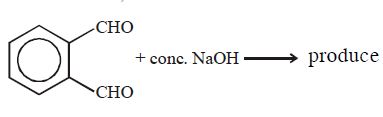
The reaction of phthalaldehyde with concentrated $NaOH$ produces:
A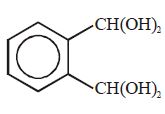
B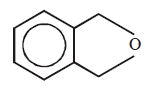
C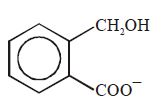
D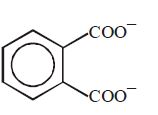
Solution
(C) The reaction of phthalaldehyde (benzene$-1,2-$dicarbaldehyde) with concentrated $NaOH$ is an intramolecular Cannizzaro reaction.
In this reaction,one aldehyde group is oxidized to a carboxylate group $(-COO^-)$ and the other aldehyde group is reduced to an alcohol group $(-CH_2OH)$.
Thus,the product formed is $2-(hydroxymethyl)benzoate$ ion.
In this reaction,one aldehyde group is oxidized to a carboxylate group $(-COO^-)$ and the other aldehyde group is reduced to an alcohol group $(-CH_2OH)$.
Thus,the product formed is $2-(hydroxymethyl)benzoate$ ion.
0 likes
View Solution926
MediumMCQ
Which of the following will not give the iodoform test?
A
$CH_3COCH_3$
B
$CH_3CHICH_3$
C
$CH_3CH(OH)CH_3$
D
$C_2H_5COC_2H_5$
Solution
(D) The iodoform test is given by compounds containing the $CH_3CO-$ group or the $CH_3CH(OH)-$ group.
$C_2H_5COC_2H_5$ (pentan-$3$-one) does not contain a methyl group directly attached to the carbonyl carbon,so it does not give the iodoform test.
$C_2H_5COC_2H_5$ (pentan-$3$-one) does not contain a methyl group directly attached to the carbonyl carbon,so it does not give the iodoform test.
0 likes
View Solution927
AdvancedMCQ
Preparation of looking mirrors involves the use of
A
red lead
B
ammonical silver nitrate
C
ammonical $AgNO_3$ + red lead
D
ammonical $AgNO_3$ + red lead + $HCHO$
Solution
(D) The preparation of looking mirrors (silvering of glass) is based on the Tollens' test,which involves the reduction of ammoniacal silver nitrate ($AgNO_3$ + $NH_4OH$) to metallic silver by an aldehyde.
$HCHO$ (formaldehyde) is commonly used as the reducing agent to deposit a thin,uniform layer of silver on the glass surface.
Therefore,the process involves the use of ammoniacal silver nitrate and $HCHO$.
$HCHO$ (formaldehyde) is commonly used as the reducing agent to deposit a thin,uniform layer of silver on the glass surface.
Therefore,the process involves the use of ammoniacal silver nitrate and $HCHO$.
0 likes
View Solution928
MediumMCQ
Which of the following is the incorrect order for keto-enol stability?
A
Cyclohexanone < Phenol (aromatic enol)
B
$Ph-C(OH)=CH_2 < Ph-C(=O)-CH_3$
C
$CH_3-C(=O)-C(=O)-CH_3 > CH_2=C(OH)-C(=O)-CH_3$
D
$CH_3-C(=O)-H > CH_2=CH-OH$
Solution
(B) In general,the keto form is more stable than the enol form because the $C=O$ bond energy is significantly higher than the $C=C$ bond energy.
Option $A$: The enol form (phenol) is aromatic,which provides extra stability,making it more stable than the keto form (cyclohexadienone). Thus,$Keto < Enol$ is correct.
Option $B$: For acetophenone,the keto form $(Ph-C(=O)-CH_3)$ is much more stable than its enol form $(Ph-C(OH)=CH_2)$. The given order $Enol < Keto$ is correct.
Option $C$: The keto form is generally more stable. The given order $Keto > Enol$ is correct.
Option $D$: The keto form is more stable than the enol form. The given order $Keto > Enol$ is correct.
Since all provided options represent correct stability orders,there is no incorrect order among the choices. However,if one must be chosen based on common textbook errors,option $B$ is often misprinted in sources.
Option $A$: The enol form (phenol) is aromatic,which provides extra stability,making it more stable than the keto form (cyclohexadienone). Thus,$Keto < Enol$ is correct.
Option $B$: For acetophenone,the keto form $(Ph-C(=O)-CH_3)$ is much more stable than its enol form $(Ph-C(OH)=CH_2)$. The given order $Enol < Keto$ is correct.
Option $C$: The keto form is generally more stable. The given order $Keto > Enol$ is correct.
Option $D$: The keto form is more stable than the enol form. The given order $Keto > Enol$ is correct.
Since all provided options represent correct stability orders,there is no incorrect order among the choices. However,if one must be chosen based on common textbook errors,option $B$ is often misprinted in sources.
0 likes
View Solution929
MediumMCQ
Which of the following,on reaction with $50\%\,KOH$,gives the corresponding alcohol and acid salt?
A
Acetaldehyde
B
Acetone
C
Benzaldehyde
D
Cyclohexanone
Solution
(C) Aldehydes that do not possess any $\alpha$-hydrogen atoms undergo the Cannizzaro reaction in the presence of a concentrated alkali (like $50\%\,KOH$ or $NaOH$).
In this reaction,one molecule of the aldehyde is reduced to the corresponding alcohol,and another molecule is oxidized to the corresponding carboxylic acid salt.
Among the given options,Benzaldehyde $(C_6H_5CHO)$ has no $\alpha$-hydrogen atoms,whereas Acetaldehyde,Acetone,and Cyclohexanone all possess $\alpha$-hydrogen atoms.
Therefore,Benzaldehyde undergoes the Cannizzaro reaction to form benzyl alcohol and potassium benzoate.
In this reaction,one molecule of the aldehyde is reduced to the corresponding alcohol,and another molecule is oxidized to the corresponding carboxylic acid salt.
Among the given options,Benzaldehyde $(C_6H_5CHO)$ has no $\alpha$-hydrogen atoms,whereas Acetaldehyde,Acetone,and Cyclohexanone all possess $\alpha$-hydrogen atoms.
Therefore,Benzaldehyde undergoes the Cannizzaro reaction to form benzyl alcohol and potassium benzoate.
0 likes
View Solution930
DifficultMCQ
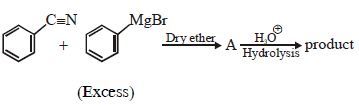
Consider the following reaction. The structure of the main product will be
A
Benzaldehyde
B
Benzophenone
C
Triphenylmethanol
D
Diphenylmethanol
Solution
(C) The reaction involves the addition of a Grignard reagent to a nitrile.
$1$. The reaction of benzonitrile $(C_6H_5CN)$ with phenylmagnesium bromide $(C_6H_5MgBr)$ in excess,followed by hydrolysis,proceeds as follows:
$2$. First,the nucleophilic phenyl group from $C_6H_5MgBr$ attacks the electrophilic carbon of the nitrile group $(C \equiv N)$ to form an imine salt intermediate: $C_6H_5-C(C_6H_5)=NMgBr$.
$3$. Since the Grignard reagent is in excess,it can further react with the imine or the resulting ketone. However,in the standard reaction of nitriles with excess Grignard reagents followed by hydrolysis,the intermediate imine is hydrolyzed to a ketone.
$4$. Wait,let us re-evaluate: The reaction of a nitrile with one equivalent of Grignard reagent gives an imine,which upon hydrolysis yields a ketone. If the Grignard reagent is in excess,the ketone formed can react further with another equivalent of the Grignard reagent to form a tertiary alcohol after hydrolysis.
$5$. Benzonitrile + $C_6H_5MgBr$ (excess) $\rightarrow$ Intermediate $\xrightarrow{H_3O^+}$ $C_6H_5-C(OH)(C_6H_5)_2$ (Triphenylmethanol).
$6$. Therefore,the main product is Triphenylmethanol.
$1$. The reaction of benzonitrile $(C_6H_5CN)$ with phenylmagnesium bromide $(C_6H_5MgBr)$ in excess,followed by hydrolysis,proceeds as follows:
$2$. First,the nucleophilic phenyl group from $C_6H_5MgBr$ attacks the electrophilic carbon of the nitrile group $(C \equiv N)$ to form an imine salt intermediate: $C_6H_5-C(C_6H_5)=NMgBr$.
$3$. Since the Grignard reagent is in excess,it can further react with the imine or the resulting ketone. However,in the standard reaction of nitriles with excess Grignard reagents followed by hydrolysis,the intermediate imine is hydrolyzed to a ketone.
$4$. Wait,let us re-evaluate: The reaction of a nitrile with one equivalent of Grignard reagent gives an imine,which upon hydrolysis yields a ketone. If the Grignard reagent is in excess,the ketone formed can react further with another equivalent of the Grignard reagent to form a tertiary alcohol after hydrolysis.
$5$. Benzonitrile + $C_6H_5MgBr$ (excess) $\rightarrow$ Intermediate $\xrightarrow{H_3O^+}$ $C_6H_5-C(OH)(C_6H_5)_2$ (Triphenylmethanol).
$6$. Therefore,the main product is Triphenylmethanol.
0 likes
View Solution931
MediumMCQ
Which of the following compounds does not give the iodoform test?
A
$CH_3-CO-CH_2OH$
B
$CH_2I-CH(OH)-CH_2OH$
C
$CHO-CO-Ph$
D
$CH_3-CH(OH)-Ph$
Solution
(C) The iodoform test is positive for compounds containing a methyl ketone group $(CH_3-CO-)$ or a methyl carbinol group $(CH_3-CH(OH)-)$. It is also positive for compounds that can be oxidized or halogenated to these forms,such as $\alpha$-halo ketones $(XCH_2-CO-)$.
$(A)$ $CH_3-CO-CH_2OH$ is a methyl ketone. (Positive)
$(B)$ $CH_2I-CH(OH)-CH_2OH$ can be oxidized to $CH_2I-CO-CH_2OH$,which contains the $CH_2I-CO-$ group. (Positive)
$(C)$ $CHO-CO-Ph$ (Phenylglyoxal) does not contain a methyl group or a halomethyl group attached to the carbonyl carbon. (Negative)
$(D)$ $CH_3-CH(OH)-Ph$ is a methyl carbinol. (Positive)
Therefore,$(C)$ does not give the iodoform test.
$(A)$ $CH_3-CO-CH_2OH$ is a methyl ketone. (Positive)
$(B)$ $CH_2I-CH(OH)-CH_2OH$ can be oxidized to $CH_2I-CO-CH_2OH$,which contains the $CH_2I-CO-$ group. (Positive)
$(C)$ $CHO-CO-Ph$ (Phenylglyoxal) does not contain a methyl group or a halomethyl group attached to the carbonyl carbon. (Negative)
$(D)$ $CH_3-CH(OH)-Ph$ is a methyl carbinol. (Positive)
Therefore,$(C)$ does not give the iodoform test.
0 likes
View Solution932
MediumMCQ
Which of the following is most reactive towards nucleophilic addition reaction?
A
Cyclohex$-2-$en$-1-$one
B
Cyclohexa$-2,5-$diene$-1,4-$dione
C
Cyclohex$-2-$en$-1-$one (isomer)
D
Cyclohexanone
Solution
(B) The reactivity of carbonyl compounds towards nucleophilic addition depends on two main factors:
$1$. Steric hindrance: Smaller groups around the carbonyl carbon increase reactivity.
$2$. Electronic effects: Electron-withdrawing groups increase the electrophilicity of the carbonyl carbon,thereby increasing reactivity.
Among the given options,$Cyclohexa-2,5-diene-1,4-dione$ (also known as $p-benzoquinone$) has two carbonyl groups and is conjugated with double bonds. The presence of two electron-withdrawing carbonyl groups and the conjugated system makes the carbonyl carbon highly electrophilic,making it the most reactive towards nucleophilic addition.
$1$. Steric hindrance: Smaller groups around the carbonyl carbon increase reactivity.
$2$. Electronic effects: Electron-withdrawing groups increase the electrophilicity of the carbonyl carbon,thereby increasing reactivity.
Among the given options,$Cyclohexa-2,5-diene-1,4-dione$ (also known as $p-benzoquinone$) has two carbonyl groups and is conjugated with double bonds. The presence of two electron-withdrawing carbonyl groups and the conjugated system makes the carbonyl carbon highly electrophilic,making it the most reactive towards nucleophilic addition.
0 likes
View Solution933
DifficultMCQ
$CH_3COOCH_2CH_3 + PhMgBr_{(excess)} \to P \xrightarrow{H_2O} Q$;
$Q$ is
$Q$ is
A
$Ph_3C-OH$
B
$Ph_2C(OH)CH_3$
C
$PhC(OH)(CH_3)_2$
D
$(CH_3)_3C-OH$
Solution
(B) The starting material is ethyl acetate $(CH_3COOCH_2CH_3)$.
When an ester reacts with an excess of a Grignard reagent $(PhMgBr)$,the first equivalent of the Grignard reagent attacks the carbonyl carbon to form a ketone intermediate $(CH_3-CO-Ph)$ and an alkoxide $(CH_3CH_2O^-)$.
The ketone intermediate is more reactive than the ester,so it immediately reacts with a second equivalent of $PhMgBr$ to form a tertiary alkoxide $(CH_3-C(Ph)_2-O^-)$.
Upon hydrolysis with $H_2O$,the alkoxide is protonated to form the final tertiary alcohol product,$CH_3C(OH)(Ph)_2$.
Comparing this with the options,the correct structure is $Ph_2C(OH)CH_3$.
When an ester reacts with an excess of a Grignard reagent $(PhMgBr)$,the first equivalent of the Grignard reagent attacks the carbonyl carbon to form a ketone intermediate $(CH_3-CO-Ph)$ and an alkoxide $(CH_3CH_2O^-)$.
The ketone intermediate is more reactive than the ester,so it immediately reacts with a second equivalent of $PhMgBr$ to form a tertiary alkoxide $(CH_3-C(Ph)_2-O^-)$.
Upon hydrolysis with $H_2O$,the alkoxide is protonated to form the final tertiary alcohol product,$CH_3C(OH)(Ph)_2$.
Comparing this with the options,the correct structure is $Ph_2C(OH)CH_3$.
0 likes
View Solution934
MediumMCQ
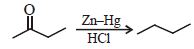
The reaction shown in the image is:
A
Finkelstein reaction
B
Williamson's synthesis
C
Clemmensen's reduction
D
Schotten-Baumann reaction
Solution
(C) The reaction involves the reduction of a ketone (butanone) to an alkane (butane) using zinc amalgam $(Zn-Hg)$ and concentrated hydrochloric acid $(HCl)$.
This specific reduction of carbonyl groups to methylene groups is known as the Clemmensen reduction.
This specific reduction of carbonyl groups to methylene groups is known as the Clemmensen reduction.
0 likes
View Solution935
MediumMCQ
$CH_3-COOH \xrightarrow[(2)\Delta ]{(1)Ca(OH)_2} P$. Compound $P$ can show:
A
Aldol condensation reaction
B
Cannizzaro's reaction
C
Reducing property with Tollen's reagent
D
All
Solution
(A) The reaction of acetic acid $(CH_3COOH)$ with $Ca(OH)_2$ followed by heating is a dry distillation process.
$1$. $2CH_3COOH + Ca(OH)_2 \rightarrow (CH_3COO)_2Ca + 2H_2O$
$2$. $(CH_3COO)_2Ca \xrightarrow{\Delta} CH_3COCH_3 + CaCO_3$
Compound $P$ is acetone $(CH_3COCH_3)$.
Acetone contains $\alpha$-hydrogens,so it undergoes Aldol condensation.
It does not undergo Cannizzaro's reaction (requires no $\alpha$-hydrogen) and does not reduce Tollen's reagent (ketones are not easily oxidized).
$1$. $2CH_3COOH + Ca(OH)_2 \rightarrow (CH_3COO)_2Ca + 2H_2O$
$2$. $(CH_3COO)_2Ca \xrightarrow{\Delta} CH_3COCH_3 + CaCO_3$
Compound $P$ is acetone $(CH_3COCH_3)$.
Acetone contains $\alpha$-hydrogens,so it undergoes Aldol condensation.
It does not undergo Cannizzaro's reaction (requires no $\alpha$-hydrogen) and does not reduce Tollen's reagent (ketones are not easily oxidized).
0 likes
View Solution936
DifficultMCQ
$CH_3-CO-CH_2-COOCH_3$ $\xrightarrow[H_2O]{H^{+}} A$ $\xrightarrow{\Delta} B$ $\xrightarrow{HCN} C$. What are $B$ and $C$?
A
$CH_3-CH(OH)-CH_2-COOH$,$CH_3-CH(CN)-CH_2-COOH$
B
$CH_3-CH(OH)-CH_2-COOH$,$CH_3-CH(CN)-CH_2-CN$
C
$CH_3-CO-CH_3$,$CH_3-C(OH)(CN)-CH_3$
D
$CH_3-CH=CH-COOH$,$CH_3-CH(CN)-CH_2-COOH$
Solution
(C) Step $1$: Acidic hydrolysis of the ester group in methyl acetoacetate gives acetoacetic acid $(A)$.
$CH_3-CO-CH_2-COOCH_3 + H_2O \xrightarrow{H^{+}} CH_3-CO-CH_2-COOH (A) + CH_3OH$
Step $2$: Heating acetoacetic acid (a $\beta$-keto acid) causes decarboxylation to form acetone $(B)$.
$CH_3-CO-CH_2-COOH \xrightarrow{\Delta} CH_3-CO-CH_3 (B) + CO_2$
Step $3$: Nucleophilic addition of $HCN$ to acetone forms acetone cyanohydrin $(C)$.
$CH_3-CO-CH_3 + HCN \rightarrow CH_3-C(OH)(CN)-CH_3 (C)$
$CH_3-CO-CH_2-COOCH_3 + H_2O \xrightarrow{H^{+}} CH_3-CO-CH_2-COOH (A) + CH_3OH$
Step $2$: Heating acetoacetic acid (a $\beta$-keto acid) causes decarboxylation to form acetone $(B)$.
$CH_3-CO-CH_2-COOH \xrightarrow{\Delta} CH_3-CO-CH_3 (B) + CO_2$
Step $3$: Nucleophilic addition of $HCN$ to acetone forms acetone cyanohydrin $(C)$.
$CH_3-CO-CH_3 + HCN \rightarrow CH_3-C(OH)(CN)-CH_3 (C)$
0 likes
View Solution937
DifficultMCQ
Identify the final product of the following reaction sequence:
$o$-Phthalaldehyde $\xrightarrow{\text{OH}^-} A$ $\xrightarrow{\text{H}^+, \Delta} ?$
$o$-Phthalaldehyde $\xrightarrow{\text{OH}^-} A$ $\xrightarrow{\text{H}^+, \Delta} ?$
A
$o$-Hydroxymethylbenzoic acid
B
$o$-Dihydroxymethylbenzene
C
Phthalide
D
Isocoumarin
Solution
(C) The reaction of $o$-phthalaldehyde with a base $(\text{OH}^-)$ undergoes an intramolecular Cannizzaro reaction.
In this reaction,one aldehyde group is oxidized to a carboxylate group $(\text{COO}^-)$ and the other is reduced to a hydroxymethyl group $(\text{CH}_2\text{OH})$,forming the salt of $o$-hydroxymethylbenzoic acid (intermediate $A$).
Upon acidification $(\text{H}^+)$ and heating $(\Delta)$,the carboxylic acid group and the hydroxyl group undergo an intramolecular esterification (cyclization) to form a cyclic ester known as phthalide.
In this reaction,one aldehyde group is oxidized to a carboxylate group $(\text{COO}^-)$ and the other is reduced to a hydroxymethyl group $(\text{CH}_2\text{OH})$,forming the salt of $o$-hydroxymethylbenzoic acid (intermediate $A$).
Upon acidification $(\text{H}^+)$ and heating $(\Delta)$,the carboxylic acid group and the hydroxyl group undergo an intramolecular esterification (cyclization) to form a cyclic ester known as phthalide.
0 likes
View Solution938
MediumMCQ
Which of the following compounds gives a yellow solid product when reacted with $NaOI$?
A
$CH_3-CH_2-OH$
B
$CH_3-OH$
C
$CH_3-CO-OCH_3$
D
$CH_3-CH_2-CO-CH_2-CH_3$
Solution
(A) The reaction with $NaOI$ is known as the iodoform test.
Compounds containing the $CH_3-CO-$ group or the $CH_3-CH(OH)-$ group give a positive iodoform test.
Ethanol $(CH_3-CH_2-OH)$ contains the $CH_3-CH(OH)-$ group,which is oxidized to acetaldehyde $(CH_3-CHO)$.
Acetaldehyde then reacts with $NaOI$ to form a yellow precipitate of iodoform $(CHI_3)$.
Compounds containing the $CH_3-CO-$ group or the $CH_3-CH(OH)-$ group give a positive iodoform test.
Ethanol $(CH_3-CH_2-OH)$ contains the $CH_3-CH(OH)-$ group,which is oxidized to acetaldehyde $(CH_3-CHO)$.
Acetaldehyde then reacts with $NaOI$ to form a yellow precipitate of iodoform $(CHI_3)$.
0 likes
View Solution939
MediumMCQ
$CH_3-CHO \xrightarrow{NaOH + Cl_2} A + HCOONa$. Product $A$ can be used as:
A
$(A)$ Analgesic
B
$(B)$ Anesthetic
C
$(C)$ Bactericidal
D
$(D)$ Fire extinguisher
Solution
(B) The given reaction is a haloform reaction:
$CH_3-CHO + 3Cl_2 + 4NaOH \rightarrow CHCl_3 + HCOONa + 3NaCl + 3H_2O$
Product $A$ is chloroform $(CHCl_3)$.
Chloroform is historically and commonly known for its use as an anesthetic.
$CH_3-CHO + 3Cl_2 + 4NaOH \rightarrow CHCl_3 + HCOONa + 3NaCl + 3H_2O$
Product $A$ is chloroform $(CHCl_3)$.
Chloroform is historically and commonly known for its use as an anesthetic.
0 likes
View Solution940
MediumMCQ
$CH_3CHO \xrightarrow{LiAlH_4} CH_3CH_2OH$
Which nucleophile is added in this reaction?
Which nucleophile is added in this reaction?
A
$AlH_4^{\ominus}$
B
$Li^{\oplus}$
C
$H^{\oplus}$
D
$H^{\ominus}$
Solution
(D) The reaction involves the reduction of an aldehyde $(CH_3CHO)$ to a primary alcohol $(CH_3CH_2OH)$ using lithium aluminum hydride $(LiAlH_4)$.
$LiAlH_4$ acts as a source of hydride ions $(H^{\ominus})$.
The hydride ion $(H^{\ominus})$ acts as a nucleophile and attacks the electrophilic carbonyl carbon of the aldehyde group.
Therefore,the nucleophile added in this reaction is $H^{\ominus}$.
$LiAlH_4$ acts as a source of hydride ions $(H^{\ominus})$.
The hydride ion $(H^{\ominus})$ acts as a nucleophile and attacks the electrophilic carbonyl carbon of the aldehyde group.
Therefore,the nucleophile added in this reaction is $H^{\ominus}$.
0 likes
View Solution941
DifficultMCQ
$PhMgBr$ [Excess] + $CH_3COCl \xrightarrow{H_3O^+}$
The final product of the above reaction is:
The final product of the above reaction is:
A
$Ph-CH(OH)-CH_3$
B
$Ph-C(OH)(Ph)-CH_3$
C
$Ph-C(=O)-CH_3$
D
$Ph_3CH$
Solution
(B) $1.$ When an excess of Grignard reagent $(PhMgBr)$ reacts with an acid chloride $(CH_3COCl)$,the reaction occurs in two steps.
$2.$ Nucleophilic acyl substitution: The first equivalent of $PhMgBr$ reacts with $CH_3COCl$ to form acetophenone $(Ph-C(=O)-CH_3)$ and $MgBrCl$.
$3.$ Nucleophilic addition: Since the Grignard reagent is in excess,a second equivalent of $PhMgBr$ attacks the carbonyl group of acetophenone to form an alkoxide intermediate,which upon acid workup $(H^+)$ yields $1,1$-diphenylethanol $(Ph-C(OH)(Ph)-CH_3)$.
Reaction:
$CH_3COCl + PhMgBr$ $\rightarrow Ph-C(=O)-CH_3$ $\xrightarrow{PhMgBr} Ph-C(OMgBr)(Ph)-CH_3$ $\xrightarrow{H^+} Ph-C(OH)(Ph)-CH_3$.
$2.$ Nucleophilic acyl substitution: The first equivalent of $PhMgBr$ reacts with $CH_3COCl$ to form acetophenone $(Ph-C(=O)-CH_3)$ and $MgBrCl$.
$3.$ Nucleophilic addition: Since the Grignard reagent is in excess,a second equivalent of $PhMgBr$ attacks the carbonyl group of acetophenone to form an alkoxide intermediate,which upon acid workup $(H^+)$ yields $1,1$-diphenylethanol $(Ph-C(OH)(Ph)-CH_3)$.
Reaction:
$CH_3COCl + PhMgBr$ $\rightarrow Ph-C(=O)-CH_3$ $\xrightarrow{PhMgBr} Ph-C(OMgBr)(Ph)-CH_3$ $\xrightarrow{H^+} Ph-C(OH)(Ph)-CH_3$.
0 likes
View Solution942
DifficultMCQ
Which of the following compounds undergo Cannizzaro reaction?
$(a)$ $HCHO$
$(b)$ $C_6H_5-CHO$
$(c)$ $CH_3-C(CH_3)_2-CHO$
$(d)$ $Ph-CH_2-CHO$
$(a)$ $HCHO$
$(b)$ $C_6H_5-CHO$
$(c)$ $CH_3-C(CH_3)_2-CHO$
$(d)$ $Ph-CH_2-CHO$
A
$a, b, d$
B
$b, d$
C
$a, b, c$
D
$a, c, d$
Solution
(C) Aldehydes that do not possess any $\alpha$-hydrogen atoms undergo the Cannizzaro reaction in the presence of a concentrated base.
$(a)$ $HCHO$ (Formaldehyde): No $\alpha$-carbon,hence no $\alpha$-hydrogen. It undergoes Cannizzaro reaction.
$(b)$ $C_6H_5-CHO$ (Benzaldehyde): The $\alpha$-carbon (the carbon attached to the aldehyde group) has no hydrogen atom attached to it. It undergoes Cannizzaro reaction.
$(c)$ $CH_3-C(CH_3)_2-CHO$ ($2$,$2$-Dimethylpropanal): The $\alpha$-carbon is bonded to three methyl groups and has no $\alpha$-hydrogen. It undergoes Cannizzaro reaction.
$(d)$ $Ph-CH_2-CHO$ (Phenylacetaldehyde): The $\alpha$-carbon is attached to two hydrogen atoms. It does not undergo Cannizzaro reaction.
Therefore,compounds $(a)$,$(b)$,and $(c)$ undergo the Cannizzaro reaction.
$(a)$ $HCHO$ (Formaldehyde): No $\alpha$-carbon,hence no $\alpha$-hydrogen. It undergoes Cannizzaro reaction.
$(b)$ $C_6H_5-CHO$ (Benzaldehyde): The $\alpha$-carbon (the carbon attached to the aldehyde group) has no hydrogen atom attached to it. It undergoes Cannizzaro reaction.
$(c)$ $CH_3-C(CH_3)_2-CHO$ ($2$,$2$-Dimethylpropanal): The $\alpha$-carbon is bonded to three methyl groups and has no $\alpha$-hydrogen. It undergoes Cannizzaro reaction.
$(d)$ $Ph-CH_2-CHO$ (Phenylacetaldehyde): The $\alpha$-carbon is attached to two hydrogen atoms. It does not undergo Cannizzaro reaction.
Therefore,compounds $(a)$,$(b)$,and $(c)$ undergo the Cannizzaro reaction.
0 likes
View Solution943
DifficultMCQ
Which of the following compounds gives a positive test with $2,4$-$DNP$ ($2$,$4$-dinitrophenylhydrazine)?
$(a)$ Acetone
$(b)$ Butan-$2$-one
$(c)$ Acetaldehyde
$(d)$ Formaldehyde
$(a)$ Acetone
$(b)$ Butan-$2$-one
$(c)$ Acetaldehyde
$(d)$ Formaldehyde
A
$a, b$
B
$b, c$
C
$a, b, d$
D
All
Solution
(D) $2,4$-$DNP$ ($2$,$4$-dinitrophenylhydrazine) is a reagent used to identify the presence of a carbonyl group (aldehydes and ketones).
All the given compounds contain a carbonyl group:
$(a)$ Acetone $(CH_3COCH_3)$ is a ketone.
$(b)$ Butan-$2$-one $(CH_3COCH_2CH_3)$ is a ketone.
$(c)$ Acetaldehyde $(CH_3CHO)$ is an aldehyde.
$(d)$ Formaldehyde $(HCHO)$ is an aldehyde.
Since all these compounds possess a carbonyl group,they all react with $2,4$-$DNP$ to form a yellow,orange,or red precipitate.
Therefore,the correct option is $D$.
All the given compounds contain a carbonyl group:
$(a)$ Acetone $(CH_3COCH_3)$ is a ketone.
$(b)$ Butan-$2$-one $(CH_3COCH_2CH_3)$ is a ketone.
$(c)$ Acetaldehyde $(CH_3CHO)$ is an aldehyde.
$(d)$ Formaldehyde $(HCHO)$ is an aldehyde.
Since all these compounds possess a carbonyl group,they all react with $2,4$-$DNP$ to form a yellow,orange,or red precipitate.
Therefore,the correct option is $D$.
0 likes
View Solution944
MediumMCQ
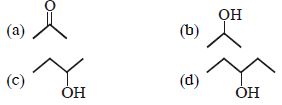
Which of the following gives a positive iodoform test?
A
$(a), (d)$
B
$(b), (c), (d)$
C
$(a), (b), (c)$
D
$(c), (d)$
Solution
(C) The iodoform test is given by compounds containing the $CH_3CO-$ group or the $CH_3CH(OH)-$ group.
$(a)$ Acetone $(CH_3COCH_3)$ contains the $CH_3CO-$ group,so it gives a positive iodoform test.
$(b)$ Isopropyl alcohol $(CH_3CH(OH)CH_3)$ contains the $CH_3CH(OH)-$ group,so it gives a positive iodoform test.
$(c)$ Butan$-2-$ol $(CH_3CH(OH)CH_2CH_3)$ contains the $CH_3CH(OH)-$ group,so it gives a positive iodoform test.
$(d)$ Pentan$-3-$ol $(CH_3CH_2CH(OH)CH_2CH_3)$ does not contain either the $CH_3CO-$ or $CH_3CH(OH)-$ group,so it does not give a positive iodoform test.
Therefore,compounds $(a), (b),$ and $(c)$ give a positive iodoform test.
$(a)$ Acetone $(CH_3COCH_3)$ contains the $CH_3CO-$ group,so it gives a positive iodoform test.
$(b)$ Isopropyl alcohol $(CH_3CH(OH)CH_3)$ contains the $CH_3CH(OH)-$ group,so it gives a positive iodoform test.
$(c)$ Butan$-2-$ol $(CH_3CH(OH)CH_2CH_3)$ contains the $CH_3CH(OH)-$ group,so it gives a positive iodoform test.
$(d)$ Pentan$-3-$ol $(CH_3CH_2CH(OH)CH_2CH_3)$ does not contain either the $CH_3CO-$ or $CH_3CH(OH)-$ group,so it does not give a positive iodoform test.
Therefore,compounds $(a), (b),$ and $(c)$ give a positive iodoform test.
0 likes
View Solution945
MediumMCQ
Clemmensen's reduction will convert cyclohexanone into
A
$n$-Hexane
B
Benzene
C
Cyclohexane
D
Cyclohexanol
Solution
(C) In Clemmensen's reduction,the carbonyl group $(>C=O)$ of aldehydes and ketones is reduced to a methylene group $(-CH_2-)$ upon treatment with Zinc-amalgam $(Zn-Hg)$ and concentrated $HCl$.
For cyclohexanone,the reaction is as follows:
$Cyclohexanone \xrightarrow{Zn-Hg, \text{conc. } HCl} Cyclohexane$
Thus,cyclohexanone is converted into cyclohexane.
For cyclohexanone,the reaction is as follows:
$Cyclohexanone \xrightarrow{Zn-Hg, \text{conc. } HCl} Cyclohexane$
Thus,cyclohexanone is converted into cyclohexane.
0 likes
View Solution946
DifficultMCQ
Treatment of propionaldehyde with dil. $NaOH$ gives:
A
$CH_3CH_2COOCH_2CH_2CH_3$
B
$CH_3CH_2CHOCH_2CH_2CH_3$
C
$CH_3CH_2CH(OH)CH(CH_3)CHO$
D
$CH_3CH_2COCH_2CH_2CHO$
Solution
(C) Propionaldehyde $(CH_3CH_2CHO)$ contains $\alpha$-hydrogens and undergoes an aldol condensation reaction in the presence of dilute $NaOH$.
The reaction involves the formation of an enolate ion from one molecule of propionaldehyde,which then attacks the carbonyl carbon of another molecule.
The product formed is $3$-hydroxy-$2$-methylpentanal,which is represented as $CH_3CH_2CH(OH)CH(CH_3)CHO$.
The reaction involves the formation of an enolate ion from one molecule of propionaldehyde,which then attacks the carbonyl carbon of another molecule.
The product formed is $3$-hydroxy-$2$-methylpentanal,which is represented as $CH_3CH_2CH(OH)CH(CH_3)CHO$.
0 likes
View Solution947
MediumMCQ
$Propanal$ on treatment with dilute sodium hydroxide forms:
A
$CH_3CH_2CH_2CH_2CH_2CHO$
B
$CH_3CH_2CH(OH)CH_2CH_2CHO$
C
$CH_3CH_2CH(OH)CH(CH_3)CHO$
D
$CH_3CH_2COONa$
Solution
(C) $Propanal$ $(CH_3CH_2CHO)$ contains $\alpha$-hydrogens,so it undergoes an aldol condensation reaction in the presence of dilute sodium hydroxide $(NaOH)$.
In this reaction,two molecules of $propanal$ react to form a $\beta$-hydroxy aldehyde.
The reaction is as follows:
$CH_3CH_2CHO + CH_3CH_2CHO \xrightarrow{dil. NaOH} CH_3CH_2CH(OH)CH(CH_3)CHO$.
The product formed is $3-hydroxy-2-methylpentanal$.
In this reaction,two molecules of $propanal$ react to form a $\beta$-hydroxy aldehyde.
The reaction is as follows:
$CH_3CH_2CHO + CH_3CH_2CHO \xrightarrow{dil. NaOH} CH_3CH_2CH(OH)CH(CH_3)CHO$.
The product formed is $3-hydroxy-2-methylpentanal$.
0 likes
View Solution948
MediumMCQ
Which of the following compounds does not give a positive Fehling's test?
A
$CH_3CHO$
B
$C_6H_5CHO$
C
$CH_3COCH_3$
D
Both $B$ and $C$
Solution
(D) Fehling's test is used to distinguish aliphatic aldehydes from aromatic aldehydes and ketones.
Aliphatic aldehydes like $CH_3CHO$ give a positive Fehling's test (forming a red precipitate of $Cu_2O$).
However,aromatic aldehydes like benzaldehyde $(C_6H_5CHO)$ and ketones like acetone $(CH_3COCH_3)$ do not give a positive Fehling's test.
Aliphatic aldehydes like $CH_3CHO$ give a positive Fehling's test (forming a red precipitate of $Cu_2O$).
However,aromatic aldehydes like benzaldehyde $(C_6H_5CHO)$ and ketones like acetone $(CH_3COCH_3)$ do not give a positive Fehling's test.
0 likes
View Solution949
DifficultMCQ
Consider the following reaction:
$H-CHO-(CH_2)_4-OH \xrightarrow{H^+} \text{Cyclic product}$
The above reaction is an example of:
$H-CHO-(CH_2)_4-OH \xrightarrow{H^+} \text{Cyclic product}$
The above reaction is an example of:
A
intermolecular hemiacetal formation
B
intramolecular hemiacetal formation
C
intermolecular acetal formation
D
intramolecular acetal formation
Solution
(B) The reaction involves the nucleophilic attack of the hydroxyl $(-OH)$ group on the carbonyl $(C=O)$ carbon of the same molecule in the presence of an acid catalyst $(H^+)$.
Since the $-OH$ group and the $C=O$ group are present in the same molecule,the cyclization is an intramolecular process.
The product formed is a hemiacetal because it contains both an $-OH$ group and an $-OR$ group attached to the same carbon atom.
Therefore,the reaction is an example of intramolecular hemiacetal formation.
Since the $-OH$ group and the $C=O$ group are present in the same molecule,the cyclization is an intramolecular process.
The product formed is a hemiacetal because it contains both an $-OH$ group and an $-OR$ group attached to the same carbon atom.
Therefore,the reaction is an example of intramolecular hemiacetal formation.
0 likes
View Solution950
EasyMCQ
Acetaldehyde cannot give:
A
Iodoform test
B
Lucas test
C
Benedict test
D
Tollen's test
Solution
(B) Acetaldehyde $(CH_3CHO)$ contains a methyl ketone group,so it gives a positive result with the Iodoform test.
It also acts as an aldehyde,giving positive results with Benedict's test and Tollen's test.
The Lucas test is specifically used to distinguish between primary,secondary,and tertiary alcohols,not aldehydes.
It also acts as an aldehyde,giving positive results with Benedict's test and Tollen's test.
The Lucas test is specifically used to distinguish between primary,secondary,and tertiary alcohols,not aldehydes.
0 likes
View Solution8-1.Aldehydes and Ketones — Properties · Frequently Asked Questions
1Are these 8-1.Aldehydes and Ketones questions useful for JEE and NEET?
Yes. All questions in this section are mapped to JEE Main and NEET exam patterns. Previous year questions from JEE Main, NEET, GUJCET and state-level exams are included with full solutions.
2Can I switch to Hindi or Gujarati for these questions?
Yes. Use the language tabs in the hero section or the sidebar to view the same questions and solutions in English, Hindi or Gujarati.
3How do I generate a question paper from this subtopic?
Use the Vedclass Exam Paper Generator — select the chapter and subtopic, set difficulty, and generate Sets A, B, C, D automatically. First 3 chapters of every subject are free.
Vedclass Products
For Students
Vedclass Test Series
Mock tests in real JEE/NEET style with performance analysis. 5-day free trial.
Start Free TrialFor Teachers
Exam Paper Generator
Generate Set A/B/C/D papers from this chapter in 2 minutes. 3 chapters free.
Try FreeFor Institutes
Online Exam Module
Live online exams with unlimited students, 360° analytics & white-label branding.
See DemoFor Teachers & Institutes
Generate a 8-1.Aldehydes and Ketones Exam Paper in 2 Minutes
Select subtopic & difficulty — Sets A, B, C, D auto-generated with No Repeat logic.
First 3 chapters of every subject are free — no payment required.