
A English
Properties Questions in English
Class 12 Chemistry · 8-1.Aldehydes and Ketones · Properties
1739+
Questions
English
Language
100%
With Solutions
Showing 50 of 1739 questions in English
951
AdvancedMCQ
Identify the structure of $B$ in the following reaction sequence:
$2,6-\text{dimethylcyclohexane-1,4-dione} + \text{ethane-1,2-diol}$ $\xrightarrow{H^+} A$ $\xrightarrow[2. H_3O^+]{1. LiAlH_4} B$
$2,6-\text{dimethylcyclohexane-1,4-dione} + \text{ethane-1,2-diol}$ $\xrightarrow{H^+} A$ $\xrightarrow[2. H_3O^+]{1. LiAlH_4} B$
A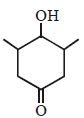
B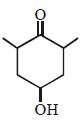
C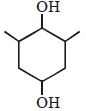
D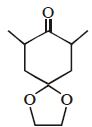
Solution
(B) $1$. The starting material is $2,6-\text{dimethylcyclohexane-1,4-dione}$.
$2$. Reaction with $\text{ethane-1,2-diol}$ in the presence of $H^+$ is a protection reaction. The more reactive ketone (less sterically hindered) is protected as a cyclic acetal. In $2,6-\text{dimethylcyclohexane-1,4-dione}$,the $C_4$ ketone is less hindered than the $C_1$ ketone (which is flanked by two methyl groups). Thus,$A$ is $2,6-\text{dimethyl-4,4-(ethylenedioxy)cyclohexan-1-one}$.
$3$. Treatment with $LiAlH_4$ reduces the remaining ketone at $C_1$ to a secondary alcohol.
$4$. Subsequent acid hydrolysis $(H_3O^+)$ removes the acetal protecting group at $C_4$,regenerating the ketone.
$5$. The final product $B$ is $4-\text{hydroxy-2,6-dimethylcyclohexan-1-one}$ (or its isomer depending on stereochemistry,but the connectivity is $4-\text{hydroxy-2,6-dimethylcyclohexan-1-one}$).
$2$. Reaction with $\text{ethane-1,2-diol}$ in the presence of $H^+$ is a protection reaction. The more reactive ketone (less sterically hindered) is protected as a cyclic acetal. In $2,6-\text{dimethylcyclohexane-1,4-dione}$,the $C_4$ ketone is less hindered than the $C_1$ ketone (which is flanked by two methyl groups). Thus,$A$ is $2,6-\text{dimethyl-4,4-(ethylenedioxy)cyclohexan-1-one}$.
$3$. Treatment with $LiAlH_4$ reduces the remaining ketone at $C_1$ to a secondary alcohol.
$4$. Subsequent acid hydrolysis $(H_3O^+)$ removes the acetal protecting group at $C_4$,regenerating the ketone.
$5$. The final product $B$ is $4-\text{hydroxy-2,6-dimethylcyclohexan-1-one}$ (or its isomer depending on stereochemistry,but the connectivity is $4-\text{hydroxy-2,6-dimethylcyclohexan-1-one}$).
0 likes
View Solution952
MediumMCQ
Iodoform test is not given by
A
$CH_3-CO-CH_2-COOC_2H_5$
B
$CH_3-CO-CH_3$
C
$CH_3-CH_2-CO-CH_3$
D
$CH_3-CH_2-CH(OH)-CH_3$
Solution
(A) The iodoform test is given by compounds containing the $CH_3-CO-$ or $CH_3-CH(OH)-$ group.
Ethyl acetoacetate $(CH_3-CO-CH_2-COOC_2H_5)$ contains an active methylene group between two carbonyl groups.
The protons of the methylene group are much more acidic than those of the terminal methyl group.
Therefore,under basic conditions,the reaction occurs at the methylene position rather than the methyl group,preventing the formation of iodoform $(CHI_3)$.
Ethyl acetoacetate $(CH_3-CO-CH_2-COOC_2H_5)$ contains an active methylene group between two carbonyl groups.
The protons of the methylene group are much more acidic than those of the terminal methyl group.
Therefore,under basic conditions,the reaction occurs at the methylene position rather than the methyl group,preventing the formation of iodoform $(CHI_3)$.
0 likes
View Solution953
DifficultMCQ
In the reaction
$Phenol$ $\xrightarrow[\text{Reimer-Tiemann}]{} X$ $\xrightarrow[(ii) H^+]{(i) NaOH \text{ (conc.)}} Z$
Product $Z$ is
$Phenol$ $\xrightarrow[\text{Reimer-Tiemann}]{} X$ $\xrightarrow[(ii) H^+]{(i) NaOH \text{ (conc.)}} Z$
Product $Z$ is
A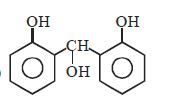
B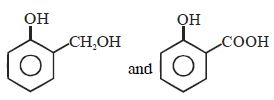
C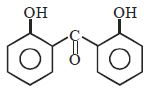
D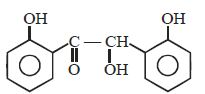
Solution
(C) The Reimer-Tiemann reaction of phenol with $CHCl_3$ and $NaOH$ yields salicylaldehyde ($X = 2$-hydroxybenzaldehyde).
When salicylaldehyde is treated with concentrated $NaOH$,it undergoes the Cannizzaro reaction. Since salicylaldehyde is an aromatic aldehyde without $\alpha$-hydrogens,it undergoes self-oxidation and reduction.
The aldehyde group $(-CHO)$ is reduced to a primary alcohol group $(-CH_2OH)$ and oxidized to a carboxylate group $(-COO^-)$.
Upon subsequent acidification with $H^+$,the carboxylate group is converted to a carboxylic acid group $(-COOH)$.
Thus,the final product $Z$ is a mixture of $2$-hydroxybenzyl alcohol and $2$-hydroxybenzoic acid (salicylic acid).
When salicylaldehyde is treated with concentrated $NaOH$,it undergoes the Cannizzaro reaction. Since salicylaldehyde is an aromatic aldehyde without $\alpha$-hydrogens,it undergoes self-oxidation and reduction.
The aldehyde group $(-CHO)$ is reduced to a primary alcohol group $(-CH_2OH)$ and oxidized to a carboxylate group $(-COO^-)$.
Upon subsequent acidification with $H^+$,the carboxylate group is converted to a carboxylic acid group $(-COOH)$.
Thus,the final product $Z$ is a mixture of $2$-hydroxybenzyl alcohol and $2$-hydroxybenzoic acid (salicylic acid).
0 likes
View Solution954
MediumMCQ
Arrange the following compounds in decreasing order of reactivity towards nucleophilic addition reactions:
$(I) \ HCHO$,$(II) \ CH_3CHO$,$(III) \ CH_3COCH_3$,$(IV) \ CH_3CH_2COCH_2CH_3$
$(I) \ HCHO$,$(II) \ CH_3CHO$,$(III) \ CH_3COCH_3$,$(IV) \ CH_3CH_2COCH_2CH_3$
A
$I > II > III > IV$
B
$IV > III > II > I$
C
$III > II > I > IV$
D
$I > IV > II > III$
Solution
(A) Reactivity towards nucleophilic addition reactions depends on steric and electronic factors.
As the number and size of alkyl groups attached to the carbonyl carbon increase,the reactivity decreases due to the $+I$ effect (which reduces the electrophilicity of the carbonyl carbon) and increased steric hindrance.
$HCHO$ has no alkyl groups,$CH_3CHO$ has one methyl group,$CH_3COCH_3$ has two methyl groups,and $CH_3CH_2COCH_2CH_3$ has two larger ethyl groups.
Therefore,the correct decreasing order of reactivity is: $I > II > III > IV$.
As the number and size of alkyl groups attached to the carbonyl carbon increase,the reactivity decreases due to the $+I$ effect (which reduces the electrophilicity of the carbonyl carbon) and increased steric hindrance.
$HCHO$ has no alkyl groups,$CH_3CHO$ has one methyl group,$CH_3COCH_3$ has two methyl groups,and $CH_3CH_2COCH_2CH_3$ has two larger ethyl groups.
Therefore,the correct decreasing order of reactivity is: $I > II > III > IV$.
0 likes
View Solution955
AdvancedMCQ
The major product formed in the reaction is
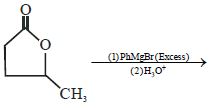
A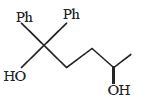
B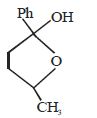
C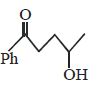
D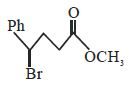
Solution
(A) The starting material is a $\gamma$-lactone ($5$-membered cyclic ester) with a methyl group at the $\alpha$-position.
When treated with excess $PhMgBr$ (a Grignard reagent),the following steps occur:
$1$. The Grignard reagent attacks the carbonyl carbon of the ester,opening the ring to form a ketone intermediate.
$2$. Since $PhMgBr$ is in excess,it further attacks the newly formed ketone to produce a tertiary alcohol.
$3$. Upon acidic workup $(H_3O^+)$,the alkoxide is protonated to form the final diol product.
The ring-opening of the lactone results in a chain where the original carbonyl carbon becomes a tertiary alcohol with two phenyl groups,and the original oxygen of the ester becomes a secondary alcohol at the other end of the chain.
Thus,the product is a $1,4-$diol: $Ph_2C(OH)-CH_2-CH_2-CH(OH)-CH_3$.
When treated with excess $PhMgBr$ (a Grignard reagent),the following steps occur:
$1$. The Grignard reagent attacks the carbonyl carbon of the ester,opening the ring to form a ketone intermediate.
$2$. Since $PhMgBr$ is in excess,it further attacks the newly formed ketone to produce a tertiary alcohol.
$3$. Upon acidic workup $(H_3O^+)$,the alkoxide is protonated to form the final diol product.
The ring-opening of the lactone results in a chain where the original carbonyl carbon becomes a tertiary alcohol with two phenyl groups,and the original oxygen of the ester becomes a secondary alcohol at the other end of the chain.
Thus,the product is a $1,4-$diol: $Ph_2C(OH)-CH_2-CH_2-CH(OH)-CH_3$.
0 likes
View Solution956
MediumMCQ
$CH_3-C \equiv CH \xrightarrow[dil. H_2SO_4]{Hg^{+2}} (P)$,$CH_3-C \equiv CH \xrightarrow[(2) H_2O_2]{(1) BH_3, THF} (Q)$. $P$ and $Q$ can be differentiated by
A
$2,4-DNP$
B
$NaHSO_3$
C
$NaOI$
D
All
Solution
(C) The reaction of propyne with $Hg^{+2}/dil. H_2SO_4$ (oxymercuration-demercuration) yields acetone $(CH_3COCH_3)$,which is $(P)$.
The hydroboration-oxidation of propyne yields propanal $(CH_3CH_2CHO)$,which is $(Q)$.
Acetone $(P)$ is a methyl ketone and gives a positive iodoform test with $NaOI$ (forming yellow precipitate of $CHI_3$).
Propanal $(Q)$ is an aldehyde and does not contain the $CH_3CO-$ group,so it gives a negative iodoform test.
Both $P$ and $Q$ are carbonyl compounds and would react with $2,4-DNP$ and $NaHSO_3$,so they cannot be differentiated by these reagents.
Therefore,they can be differentiated by $NaOI$.
The hydroboration-oxidation of propyne yields propanal $(CH_3CH_2CHO)$,which is $(Q)$.
Acetone $(P)$ is a methyl ketone and gives a positive iodoform test with $NaOI$ (forming yellow precipitate of $CHI_3$).
Propanal $(Q)$ is an aldehyde and does not contain the $CH_3CO-$ group,so it gives a negative iodoform test.
Both $P$ and $Q$ are carbonyl compounds and would react with $2,4-DNP$ and $NaHSO_3$,so they cannot be differentiated by these reagents.
Therefore,they can be differentiated by $NaOI$.
0 likes
View Solution957
MediumMCQ
$CH_3-CO-CH_2-COOH$ $\xrightarrow{\Delta} X$ $\xrightarrow[OH^-]{HCN} Y$,$Y$ is:
A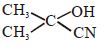
B
C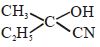
D
$CH_3-CO-CH_2-CN$
Solution
(A) $\beta$-keto acids undergo decarboxylation on heating to give ketones.
$CH_3-CO-CH_2-COOH \xrightarrow{\Delta} CH_3-CO-CH_3 + CO_2$
Here,the product $X$ is acetone $(CH_3-CO-CH_3)$.
Acetone reacts with $HCN$ in the presence of a base $(OH^-)$ to form acetone cyanohydrin $(Y)$.
$CH_3-CO-CH_3 + HCN \xrightarrow{OH^-} CH_3-C(OH)(CN)-CH_3$
The structure of acetone cyanohydrin is shown in option $A$.
$CH_3-CO-CH_2-COOH \xrightarrow{\Delta} CH_3-CO-CH_3 + CO_2$
Here,the product $X$ is acetone $(CH_3-CO-CH_3)$.
Acetone reacts with $HCN$ in the presence of a base $(OH^-)$ to form acetone cyanohydrin $(Y)$.
$CH_3-CO-CH_3 + HCN \xrightarrow{OH^-} CH_3-C(OH)(CN)-CH_3$
The structure of acetone cyanohydrin is shown in option $A$.
0 likes
View Solution958
DifficultMCQ
$CH_3-CO-OC_2H_5 \xrightarrow{H_2N-NH_2} X$; $CH_3-CO-C_2H_5 \xrightarrow{H_2N-NH_2} Y$. $X$ and $Y$ are:
A
$X = CH_3-C(=N-NH_2)-OC_2H_5$,$Y = CH_3-C(=N-NH_2)-C_2H_5$
B
$X = CH_3-CO-NH_2$,$Y = CH_3-C(=N-NH_2)-C_2H_5$
C
$X = CH_3-CO-NH-NH_2$,$Y = CH_3-C(=N-NH_2)-C_2H_5$
D
$X = CH_3-C(=N-NH_2)-C_2H_5$,$Y = CH_3-C(=N-NH_2)-C_2H_5$
Solution
(C) Esters react with hydrazine $(H_2N-NH_2)$ to form acid hydrazides via nucleophilic acyl substitution.
Ketones react with hydrazine to form hydrazones via nucleophilic addition-elimination.
$CH_3-CO-OC_2H_5 + H_2N-NH_2 \rightarrow CH_3-CO-NH-NH_2 (X) + C_2H_5OH$
$CH_3-CO-C_2H_5 + H_2N-NH_2 \rightarrow CH_3-C(=N-NH_2)-C_2H_5 (Y) + H_2O$
Ketones react with hydrazine to form hydrazones via nucleophilic addition-elimination.
$CH_3-CO-OC_2H_5 + H_2N-NH_2 \rightarrow CH_3-CO-NH-NH_2 (X) + C_2H_5OH$
$CH_3-CO-C_2H_5 + H_2N-NH_2 \rightarrow CH_3-C(=N-NH_2)-C_2H_5 (Y) + H_2O$
0 likes
View Solution959
MediumMCQ
The reaction shown below is:
$CH_3CH_2COCH_2CH_3 \xrightarrow{Zn-Hg/HCl} CH_3CH_2CH_2CH_2CH_3$
$CH_3CH_2COCH_2CH_3 \xrightarrow{Zn-Hg/HCl} CH_3CH_2CH_2CH_2CH_3$
A
Finkelstein reaction
B
Williamson's synthesis
C
Clemmensen's reduction
D
Schotten Bauman reaction
Solution
(C) The given reaction involves the reduction of a ketone $(pentan-3-one)$ to an alkane $(pentane)$ using zinc amalgam $(Zn-Hg)$ and concentrated hydrochloric acid $(HCl)$.
This specific chemical reaction,where carbonyl groups $(C=O)$ are reduced to methylene groups $(CH_2)$,is known as the Clemmensen's reduction.
This specific chemical reaction,where carbonyl groups $(C=O)$ are reduced to methylene groups $(CH_2)$,is known as the Clemmensen's reduction.
0 likes
View Solution960
DifficultMCQ
Which statement is incorrect for the given reaction sequence: $CH_3-CN$ $\xrightarrow[(2) H_2O]{(1) CH_3MgBr} X$ $\xrightarrow{2,4-DNP} Y$?
A
$X = CH_3-C(=O)-CH_3$
B
$Y$ is formed as a red-orange precipitate
C
$Y$ is formed by a nucleophilic addition-elimination mechanism
D
None
Solution
(D) $CH_3-CN$ reacts with $CH_3MgBr$ followed by hydrolysis to give acetone $(X = CH_3-C(=O)-CH_3)$.
Acetone then reacts with $2,4-DNP$ (Brady's reagent) to form a red-orange precipitate $(Y)$ via a nucleophilic addition-elimination mechanism.
Since all statements $A$,$B$,and $C$ are correct,the incorrect statement is 'None'.
Acetone then reacts with $2,4-DNP$ (Brady's reagent) to form a red-orange precipitate $(Y)$ via a nucleophilic addition-elimination mechanism.
Since all statements $A$,$B$,and $C$ are correct,the incorrect statement is 'None'.
0 likes
View Solution961
DifficultMCQ
In the given reaction,$X$ can be:
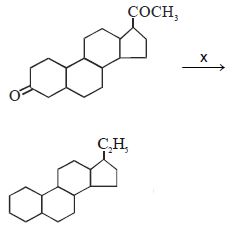
A
$NH_2-NH_2/KOH$
B
$Zn-Hg/HCl$
C
$Red \ P + HI$
D
All of these
Solution
(D) The given reaction involves the reduction of both the ketone group $(>C=O)$ and the acetyl group $(-COCH_3)$ to methylene $(-CH_2-)$ and ethyl $(-C_2H_5)$ groups respectively.
$1$. $NH_2-NH_2/KOH$ is the reagent for Wolff-Kishner reduction.
$2$. $Zn-Hg/HCl$ is the reagent for Clemmensen reduction.
$3$. $Red \ P + HI$ is a strong reducing agent that reduces carbonyl groups to alkanes.
All these reagents are capable of reducing carbonyl compounds to their corresponding alkanes.
$1$. $NH_2-NH_2/KOH$ is the reagent for Wolff-Kishner reduction.
$2$. $Zn-Hg/HCl$ is the reagent for Clemmensen reduction.
$3$. $Red \ P + HI$ is a strong reducing agent that reduces carbonyl groups to alkanes.
All these reagents are capable of reducing carbonyl compounds to their corresponding alkanes.
0 likes
View Solution962
MediumMCQ
Which of the following will not give $D.N.P.$ test?
A
$CH_3-CHO$
B
$CH_3-CO-CH_3$
C
$CH_3-O-CH_3$
D
$C_6H_5-CHO$
Solution
(C) $2,4$-Dinitrophenylhydrazine $(D.N.P.)$ test is a characteristic reaction used for the identification of carbonyl compounds (aldehydes and ketones).
$D.N.P.$ reacts with the carbonyl group $(>C=O)$ to form a yellow,orange,or red precipitate.
$CH_3-CHO$ (acetaldehyde) is an aldehyde,so it gives the test.
$CH_3-CO-CH_3$ (acetone) is a ketone,so it gives the test.
$C_6H_5-CHO$ (benzaldehyde) is an aldehyde,so it gives the test.
$CH_3-O-CH_3$ (dimethyl ether) is an ether,not a carbonyl compound,so it will not give the $D.N.P.$ test.
$D.N.P.$ reacts with the carbonyl group $(>C=O)$ to form a yellow,orange,or red precipitate.
$CH_3-CHO$ (acetaldehyde) is an aldehyde,so it gives the test.
$CH_3-CO-CH_3$ (acetone) is a ketone,so it gives the test.
$C_6H_5-CHO$ (benzaldehyde) is an aldehyde,so it gives the test.
$CH_3-O-CH_3$ (dimethyl ether) is an ether,not a carbonyl compound,so it will not give the $D.N.P.$ test.
0 likes
View Solution963
DifficultMCQ
In the reaction,the product $[X]$ will be:

A
B
C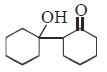
D
Solution
(D) The reaction between two molecules of cyclohexanone in the presence of a base (dilute $NaOH$) and heat $(\Delta)$ is an aldol condensation reaction.
$1$. First,the base abstracts an $\alpha$-hydrogen from one molecule of cyclohexanone to form an enolate ion.
$2$. The enolate ion attacks the carbonyl carbon of another cyclohexanone molecule to form a $\beta$-hydroxy ketone (aldol).
$3$. Upon heating $(\Delta)$,the $\beta$-hydroxy ketone undergoes dehydration (loss of $H_2O$) to form an $\alpha,\beta$-unsaturated ketone as the final product $[X]$.
$1$. First,the base abstracts an $\alpha$-hydrogen from one molecule of cyclohexanone to form an enolate ion.
$2$. The enolate ion attacks the carbonyl carbon of another cyclohexanone molecule to form a $\beta$-hydroxy ketone (aldol).
$3$. Upon heating $(\Delta)$,the $\beta$-hydroxy ketone undergoes dehydration (loss of $H_2O$) to form an $\alpha,\beta$-unsaturated ketone as the final product $[X]$.
0 likes
View Solution964
DifficultMCQ
Identify the product $Y$ in the following reaction sequence:
$C_6H_6 + CH_3CH_2CH_2Cl$ $\xrightarrow{AlCl_3} X$ $\xrightarrow{KMnO_4} Y$
$C_6H_6 + CH_3CH_2CH_2Cl$ $\xrightarrow{AlCl_3} X$ $\xrightarrow{KMnO_4} Y$
A
$3-$phenylpropanoic acid
B
$2-$phenylpropanoic acid
C
benzoic acid
D
$4-$isopropylbenzoic acid
Solution
(C) $1$. The reaction of benzene with $n$-propyl chloride in the presence of $AlCl_3$ is a Friedel-Crafts alkylation.
$2$. Due to the rearrangement of the primary carbocation $(CH_3CH_2CH_2^+)$ to a more stable secondary carbocation $(CH_3CH^+CH_3)$,the major product $X$ is isopropylbenzene (cumene).
$3$. Oxidation of alkylbenzenes with $KMnO_4$ oxidizes the alkyl side chain to a carboxylic acid group,provided there is at least one benzylic hydrogen atom.
$4$. In isopropylbenzene,the benzylic carbon has one hydrogen atom,so it gets oxidized to a benzoic acid group.
$5$. Therefore,the final product $Y$ is benzoic acid $(C_6H_5COOH)$.
$2$. Due to the rearrangement of the primary carbocation $(CH_3CH_2CH_2^+)$ to a more stable secondary carbocation $(CH_3CH^+CH_3)$,the major product $X$ is isopropylbenzene (cumene).
$3$. Oxidation of alkylbenzenes with $KMnO_4$ oxidizes the alkyl side chain to a carboxylic acid group,provided there is at least one benzylic hydrogen atom.
$4$. In isopropylbenzene,the benzylic carbon has one hydrogen atom,so it gets oxidized to a benzoic acid group.
$5$. Therefore,the final product $Y$ is benzoic acid $(C_6H_5COOH)$.
0 likes
View Solution965
MediumMCQ
Which of the following compounds can show an aldol condensation reaction?
A
Acetone $(CH_3COCH_3)$
B
Acetophenone $(PhCOCH_3)$
C
Acetaldehyde $(CH_3CHO)$
D
All of the above
Solution
(D) Aldol condensation is shown by aldehydes and ketones that possess at least one $\alpha$-hydrogen atom.
$1$. Acetone $(CH_3COCH_3)$: It has six $\alpha$-hydrogen atoms attached to the $\alpha$-carbons.
$2$. Acetophenone $(PhCOCH_3)$: It has three $\alpha$-hydrogen atoms attached to the $\alpha$-carbon (the methyl group).
$3$. Acetaldehyde $(CH_3CHO)$: It has three $\alpha$-hydrogen atoms attached to the $\alpha$-carbon.
Since all the given compounds possess at least one $\alpha$-hydrogen atom,they all can undergo aldol condensation.
$1$. Acetone $(CH_3COCH_3)$: It has six $\alpha$-hydrogen atoms attached to the $\alpha$-carbons.
$2$. Acetophenone $(PhCOCH_3)$: It has three $\alpha$-hydrogen atoms attached to the $\alpha$-carbon (the methyl group).
$3$. Acetaldehyde $(CH_3CHO)$: It has three $\alpha$-hydrogen atoms attached to the $\alpha$-carbon.
Since all the given compounds possess at least one $\alpha$-hydrogen atom,they all can undergo aldol condensation.
0 likes
View Solution966
MediumMCQ
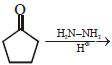
The reaction shown in the image proceeds via which mechanism?
A
Nucleophilic substitution-elimination mechanism
B
Electrophilic addition-elimination mechanism
C
Electrophilic substitution-elimination mechanism
D
Nucleophilic addition-elimination mechanism
Solution
(D) The reaction of a carbonyl compound (cyclopentanone) with hydrazine $(H_2N-NH_2)$ in the presence of an acid catalyst $(H^+)$ is a classic example of nucleophilic addition followed by elimination of a water molecule.
$1$. The nucleophilic nitrogen atom of hydrazine attacks the electrophilic carbonyl carbon of the ketone.
$2$. This is followed by proton transfer and the elimination of a water molecule $(H_2O)$ to form a hydrazone.
$3$. Therefore,the overall mechanism is classified as a nucleophilic addition-elimination reaction.
$1$. The nucleophilic nitrogen atom of hydrazine attacks the electrophilic carbonyl carbon of the ketone.
$2$. This is followed by proton transfer and the elimination of a water molecule $(H_2O)$ to form a hydrazone.
$3$. Therefore,the overall mechanism is classified as a nucleophilic addition-elimination reaction.
0 likes
View Solution967
MediumMCQ
The reaction involving the reduction of a ketone to an alkane using zinc amalgam $(Zn-Hg)$ and concentrated hydrochloric acid $(HCl)$ is known as:
A
Finkelstein reaction
B
Williamson's synthesis
C
Clemmensen's reduction
D
Schotten-Baumann reaction
Solution
(C) The reaction involves the reduction of a ketone (e.g.,butanone) to an alkane (e.g.,butane) using zinc amalgam $(Zn-Hg)$ and concentrated hydrochloric acid $(HCl)$.
This specific chemical reaction,which reduces carbonyl groups $(C=O)$ to methylene groups $(CH_2)$,is known as the Clemmensen's reduction.
This specific chemical reaction,which reduces carbonyl groups $(C=O)$ to methylene groups $(CH_2)$,is known as the Clemmensen's reduction.
0 likes
View Solution968
DifficultMCQ
Match List-$I$ with List-$II$ and then select the correct answer from the codes given below that list.
| List-$I$ | List-$II$ |
| $A$. $C_6H_6 + CO + HCl \xrightarrow{AlCl_3} C_6H_5CHO$ | $a$. Gattermann-Koch reaction |
| $B$. $C_6H_5CH_3 \xrightarrow{CrO_2Cl_2} C_6H_5CHO$ | $b$. Etard reaction |
| $C$. $C_6H_5CH_2Br + CH_3Br \xrightarrow{Na/ether} C_6H_5CH_2CH_3$ | $c$. Wurtz-Fittig reaction |
| $D$. $C_6H_6 + (CH_3)_2C = CH_2 \xrightarrow{H_2SO_4} C_6H_5C(CH_3)_3$ | $d$. Friedel-Crafts alkylation |
A
$A-c, B-a, C-b, D-d$
B
$A-d, B-c, C-a, D-b$
C
$A-c, B-b, C-c, D-d$
D
$A-c, B-b, C-c, D-d$
Solution
(C) . $C_6H_6 + CO + HCl \xrightarrow{AlCl_3} C_6H_5CHO$ is the Gattermann-Koch reaction $(A-a)$.
$B$. $C_6H_5CH_3 \xrightarrow{CrO_2Cl_2} C_6H_5CHO$ is the Etard reaction $(B-b)$.
$C$. $C_6H_5CH_2Br + CH_3Br \xrightarrow{Na/ether} C_6H_5CH_2CH_3$ is the Wurtz-Fittig reaction $(C-c)$.
$D$. $C_6H_6 + (CH_3)_2C = CH_2 \xrightarrow{H_2SO_4} C_6H_5C(CH_3)_3$ is the Friedel-Crafts alkylation $(D-d)$.
Therefore,the correct matching is $A-a, B-b, C-c, D-d$.
$B$. $C_6H_5CH_3 \xrightarrow{CrO_2Cl_2} C_6H_5CHO$ is the Etard reaction $(B-b)$.
$C$. $C_6H_5CH_2Br + CH_3Br \xrightarrow{Na/ether} C_6H_5CH_2CH_3$ is the Wurtz-Fittig reaction $(C-c)$.
$D$. $C_6H_6 + (CH_3)_2C = CH_2 \xrightarrow{H_2SO_4} C_6H_5C(CH_3)_3$ is the Friedel-Crafts alkylation $(D-d)$.
Therefore,the correct matching is $A-a, B-b, C-c, D-d$.
0 likes
View Solution969
DifficultMCQ
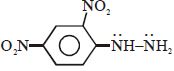
Which of the following reacts with $2,4-DNP$ reagent to give an orange precipitate?
A
$CH_3-CH_2-COOH$
B
$CH_3-CH_2-OH$
C
$CH_3-CH_2-CHO$
D
All of these
Solution
(C) Carbonyl compounds such as aldehydes and ketones react with $2,4-DNP$ $(2,4-Dinitrophenylhydrazine)$ to form orange,yellow,or red precipitates of $2,4-dinitrophenylhydrazones$.
Among the given options,$CH_3-CH_2-CHO$ (propanal) is an aldehyde and will react to give an orange precipitate.
Among the given options,$CH_3-CH_2-CHO$ (propanal) is an aldehyde and will react to give an orange precipitate.
0 likes
View Solution970
DifficultMCQ
$OHC-CH_2-CH_2-CH_2-CH_2-CHO \xrightarrow{OH^{-} / \Delta} \text{Product } (A) \text{ is:}$
A
$1-$acetylcyclopentene
B
cyclopent$-1-$enecarbaldehyde
C
$HO-CH_2-CH_2-CH_2-CH_2-CH_2-COOH$
D
$HO-CH_2-CH_2-CH_2-CH_2-CH_2-CH_2-OH$
Solution
(B) The reaction is an intramolecular Aldol condensation.
Hexanedial $(OHC-(CH_2)_4-CHO)$ contains six carbon atoms.
In the presence of a base $(OH^{-})$ and heat $(\Delta)$,it undergoes cyclization.
The $\alpha$-carbon of one aldehyde group attacks the carbonyl carbon of the other aldehyde group to form a stable $5-$membered ring.
Subsequent dehydration results in the formation of an $\alpha,\beta$-unsaturated aldehyde,which is cyclopent$-1-$enecarbaldehyde.
Hexanedial $(OHC-(CH_2)_4-CHO)$ contains six carbon atoms.
In the presence of a base $(OH^{-})$ and heat $(\Delta)$,it undergoes cyclization.
The $\alpha$-carbon of one aldehyde group attacks the carbonyl carbon of the other aldehyde group to form a stable $5-$membered ring.
Subsequent dehydration results in the formation of an $\alpha,\beta$-unsaturated aldehyde,which is cyclopent$-1-$enecarbaldehyde.
0 likes
View Solution971
MediumMCQ
Acetone and acetaldehyde can be distinguished by
A
Tollen's test
B
Iodoform test
C
Lucas test
D
$NaHCO_3$
Solution
(A) Acetaldehyde $(CH_3CHO)$ is an aldehyde,while acetone $(CH_3COCH_3)$ is a ketone.
$1$. Tollen's reagent $([Ag(NH_3)_2]^+)$ reacts with aldehydes to form a silver mirror but does not react with ketones.
$2$. Therefore,Tollen's test can distinguish between them.
$3$. Note: Both compounds give a positive Iodoform test,so it cannot be used to distinguish them.
$1$. Tollen's reagent $([Ag(NH_3)_2]^+)$ reacts with aldehydes to form a silver mirror but does not react with ketones.
$2$. Therefore,Tollen's test can distinguish between them.
$3$. Note: Both compounds give a positive Iodoform test,so it cannot be used to distinguish them.
0 likes
View Solution972
MediumMCQ
Identify the group $R$ in the following reaction:
$CH_3CH_2CHO \xrightarrow[2. H_3O^+]{1. RMgBr} CH_3CH_2CH(OH)CH_2CH_3$
$R$ is:
$CH_3CH_2CHO \xrightarrow[2. H_3O^+]{1. RMgBr} CH_3CH_2CH(OH)CH_2CH_3$
$R$ is:
A
$CH_3-$
B
$CH_3-CH_2-$
C
$CH_3-CH(CH_3)-$
D
$CH_3-CH_2-CH_2-$
Solution
(B) The reaction of a Grignard reagent $(RMgBr)$ with an aldehyde $(R'CHO)$ followed by acid hydrolysis $(H_3O^+)$ yields a secondary alcohol.
In the given reaction,the starting material is propanal $(CH_3CH_2CHO)$ and the product is pentan$-3-$ol $(CH_3CH_2CH(OH)CH_2CH_3)$.
The carbon skeleton of the product shows that an ethyl group $(CH_3CH_2-)$ has been added to the carbonyl carbon of the propanal.
Therefore,the Grignard reagent used must be ethylmagnesium bromide $(CH_3CH_2MgBr)$,which implies that $R$ is the ethyl group,$CH_3CH_2-$.
Thus,the correct option is $(B)$.
In the given reaction,the starting material is propanal $(CH_3CH_2CHO)$ and the product is pentan$-3-$ol $(CH_3CH_2CH(OH)CH_2CH_3)$.
The carbon skeleton of the product shows that an ethyl group $(CH_3CH_2-)$ has been added to the carbonyl carbon of the propanal.
Therefore,the Grignard reagent used must be ethylmagnesium bromide $(CH_3CH_2MgBr)$,which implies that $R$ is the ethyl group,$CH_3CH_2-$.
Thus,the correct option is $(B)$.
0 likes
View Solution973
MediumMCQ
$A$ mixture of $PhCHO$ and $HCHO$ is treated with $NaOH$. Which of the following processes occur during the Cannizzaro reaction?
A
$A, C$
B
$A, D$
C
$B, C$
D
$B, D$
Solution
(C) In a cross-Cannizzaro reaction between $PhCHO$ (benzaldehyde) and $HCHO$ (formaldehyde),the more reactive aldehyde undergoes oxidation,while the less reactive aldehyde undergoes reduction.
Formaldehyde $(HCHO)$ is more reactive towards nucleophilic attack than benzaldehyde $(PhCHO)$.
Therefore,$HCHO$ is oxidized to formate $(HCOO^-)$ and $PhCHO$ is reduced to benzyl alcohol $(PhCH_2OH)$.
Thus,the reaction involves the oxidation of $HCHO$ and the reduction of $PhCHO$.
Formaldehyde $(HCHO)$ is more reactive towards nucleophilic attack than benzaldehyde $(PhCHO)$.
Therefore,$HCHO$ is oxidized to formate $(HCOO^-)$ and $PhCHO$ is reduced to benzyl alcohol $(PhCH_2OH)$.
Thus,the reaction involves the oxidation of $HCHO$ and the reduction of $PhCHO$.
0 likes
View Solution974
MediumMCQ
Correct order of reactivity in nucleophilic addition reaction is:
$(i)$ Benzaldehyde
(ii) $p$-Methylbenzaldehyde
(iii) $p$-Nitrobenzaldehyde
(iv) Acetophenone
$(i)$ Benzaldehyde
(ii) $p$-Methylbenzaldehyde
(iii) $p$-Nitrobenzaldehyde
(iv) Acetophenone
A
$iii > i > ii > iv$
B
$iii > ii > i > iv$
C
$ii > iv > i > iii$
D
$iv > ii > iii > i$
Solution
(A) The reactivity of carbonyl compounds towards nucleophilic addition depends on the magnitude of the positive charge on the carbonyl carbon.
Electron-withdrawing groups $(-NO_2)$ increase the electrophilicity of the carbonyl carbon,thereby increasing reactivity.
Electron-donating groups $(-CH_3)$ decrease the electrophilicity,thereby decreasing reactivity.
Steric hindrance also plays a role; ketones $(iv)$ are less reactive than aldehydes due to steric and electronic factors.
Comparing the compounds:
(iii) $p$-Nitrobenzaldehyde: $-NO_2$ is a strong electron-withdrawing group,making it the most reactive.
$(i)$ Benzaldehyde: No substituent.
(ii) $p$-Methylbenzaldehyde: $-CH_3$ is an electron-donating group,making it less reactive than benzaldehyde.
(iv) Acetophenone: It is a ketone,which is less reactive than aldehydes due to the $+I$ effect of the methyl group and steric hindrance.
The order is: $(iii) > (i) > (ii) > (iv)$.
Electron-withdrawing groups $(-NO_2)$ increase the electrophilicity of the carbonyl carbon,thereby increasing reactivity.
Electron-donating groups $(-CH_3)$ decrease the electrophilicity,thereby decreasing reactivity.
Steric hindrance also plays a role; ketones $(iv)$ are less reactive than aldehydes due to steric and electronic factors.
Comparing the compounds:
(iii) $p$-Nitrobenzaldehyde: $-NO_2$ is a strong electron-withdrawing group,making it the most reactive.
$(i)$ Benzaldehyde: No substituent.
(ii) $p$-Methylbenzaldehyde: $-CH_3$ is an electron-donating group,making it less reactive than benzaldehyde.
(iv) Acetophenone: It is a ketone,which is less reactive than aldehydes due to the $+I$ effect of the methyl group and steric hindrance.
The order is: $(iii) > (i) > (ii) > (iv)$.
0 likes
View Solution975
DifficultMCQ
The product which is not expected to be formed in the following reaction is:
$C_6H_5CHO + CH_3CH_2CHO \xrightarrow{OH^-(aq.), \Delta} \text{Product}$
$C_6H_5CHO + CH_3CH_2CHO \xrightarrow{OH^-(aq.), \Delta} \text{Product}$
A
$C_6H_5CH=CH-CH_2-CHO$
B
$CH_3-CH_2-CH=C(CH_3)-CHO$
C
$C_6H_5CH=C(CH_3)-CHO$
D
All
Solution
(A) The reaction is a cross-aldol condensation between benzaldehyde $(C_6H_5CHO)$ and propanal $(CH_3CH_2CHO)$.
Benzaldehyde has no $\alpha$-hydrogen,so it cannot form an enolate ion.
Propanal has $\alpha$-hydrogens and can form an enolate ion $(CH_3-CH^--CHO)$.
Possible products include:
$1$. Self-aldol of propanal: $CH_3CH_2CH(OH)CH(CH_3)CHO$,which dehydrates to $CH_3CH_2CH=C(CH_3)CHO$.
$2$. Cross-aldol (benzaldehyde as electrophile,propanal as nucleophile): $C_6H_5CH(OH)CH(CH_3)CHO$,which dehydrates to $C_6H_5CH=C(CH_3)CHO$.
$3$. The product $C_6H_5CH=CH-CH_2-CHO$ would require the formation of an enolate from propanal at the terminal methyl group,which is not the kinetic or thermodynamic pathway for this reaction,or it would require benzaldehyde to act as a nucleophile,which is impossible.
Thus,$C_6H_5CH=CH-CH_2-CHO$ is not expected to be formed.
Benzaldehyde has no $\alpha$-hydrogen,so it cannot form an enolate ion.
Propanal has $\alpha$-hydrogens and can form an enolate ion $(CH_3-CH^--CHO)$.
Possible products include:
$1$. Self-aldol of propanal: $CH_3CH_2CH(OH)CH(CH_3)CHO$,which dehydrates to $CH_3CH_2CH=C(CH_3)CHO$.
$2$. Cross-aldol (benzaldehyde as electrophile,propanal as nucleophile): $C_6H_5CH(OH)CH(CH_3)CHO$,which dehydrates to $C_6H_5CH=C(CH_3)CHO$.
$3$. The product $C_6H_5CH=CH-CH_2-CHO$ would require the formation of an enolate from propanal at the terminal methyl group,which is not the kinetic or thermodynamic pathway for this reaction,or it would require benzaldehyde to act as a nucleophile,which is impossible.
Thus,$C_6H_5CH=CH-CH_2-CHO$ is not expected to be formed.
0 likes
View Solution976
MediumMCQ
Which of the following compounds has the maximum dipole moment and can show optical isomerism?
A
$3$-chlorobutan-$2$-one
B
butan-$2$-ol
C
$2$-methylbutanoic acid
D
$2$-chloropentane
Solution
(A) To show optical isomerism,a molecule must have at least one chiral center (a carbon atom bonded to four different groups).
$A$. $3$-chlorobutan-$2$-one: $CH_3-CHCl-CO-CH_3$. The carbon at position $3$ is chiral. It also contains a highly polar carbonyl group $(C=O)$ and a $C-Cl$ bond,leading to a high dipole moment.
$B$. Butan-$2$-ol: $CH_3-CH(OH)-CH_2-CH_3$. It has a chiral center at $C_2$,but the dipole moment is lower than that of the ketone derivative.
$C$. $2$-methylbutanoic acid: $CH_3-CH_2-CH(CH_3)-COOH$. It has a chiral center at $C_2$,but the dipole moment is generally lower than that of the chloro-ketone.
$D$. $2$-chloropentane: $CH_3-CH_2-CH_2-CHCl-CH_3$. It has a chiral center at $C_2$,but the dipole moment is lower due to the absence of the polar carbonyl group.
Therefore,$3$-chlorobutan-$2$-one has the maximum dipole moment due to the combined effect of the $C=O$ and $C-Cl$ polar groups and exhibits optical isomerism.
$A$. $3$-chlorobutan-$2$-one: $CH_3-CHCl-CO-CH_3$. The carbon at position $3$ is chiral. It also contains a highly polar carbonyl group $(C=O)$ and a $C-Cl$ bond,leading to a high dipole moment.
$B$. Butan-$2$-ol: $CH_3-CH(OH)-CH_2-CH_3$. It has a chiral center at $C_2$,but the dipole moment is lower than that of the ketone derivative.
$C$. $2$-methylbutanoic acid: $CH_3-CH_2-CH(CH_3)-COOH$. It has a chiral center at $C_2$,but the dipole moment is generally lower than that of the chloro-ketone.
$D$. $2$-chloropentane: $CH_3-CH_2-CH_2-CHCl-CH_3$. It has a chiral center at $C_2$,but the dipole moment is lower due to the absence of the polar carbonyl group.
Therefore,$3$-chlorobutan-$2$-one has the maximum dipole moment due to the combined effect of the $C=O$ and $C-Cl$ polar groups and exhibits optical isomerism.
0 likes
View Solution977
MediumMCQ
Which of the following does not respond to Fehling's solution test and haloform reaction but shows Cannizzaro's reaction?
A
$Cl_3C-CHO$
B
$HCHO$
C
$C_2H_5-CO-C_2H_5$
D
$C_6H_5-CHO$
Solution
(D) $C_6H_5-CHO$ (Benzaldehyde) does not contain $\alpha$-hydrogen,therefore it undergoes Cannizzaro's reaction.
It does not respond to Fehling's solution test because it is an aromatic aldehyde.
It does not contain a $CH_3-CO-$ group,so it does not give the haloform reaction.
It does not respond to Fehling's solution test because it is an aromatic aldehyde.
It does not contain a $CH_3-CO-$ group,so it does not give the haloform reaction.
0 likes
View Solution978
MediumMCQ
The given alkene undergoes ozonolysis: $2\text{-methylbut-2-ene}$ $\xrightarrow[{(2)\ H_2O/Zn}]{{(1)\ O_3}} \mathop X\limits_{(C_2H_4O)} + \mathop Y\limits_{(C_3H_6O)}$
$X \xrightarrow[{(2)\ H_2O}]{{(1)\ LiAlH_4}} P$
$Y \xrightarrow[{(2)\ H_2O}]{{(1)\ LiAlH_4}} Q$
Which of the following statements is incorrect for $X$,$Y$,$P$,and $Q$?
$X \xrightarrow[{(2)\ H_2O}]{{(1)\ LiAlH_4}} P$
$Y \xrightarrow[{(2)\ H_2O}]{{(1)\ LiAlH_4}} Q$
Which of the following statements is incorrect for $X$,$Y$,$P$,and $Q$?
A
$X$ and $Y$ give positive iodoform test
B
$P$ and $Q$ can be distinguished by Victor Meyer test
C
$P$ and $Q$ are homologues
D
$X$ shows Cannizzaro's reaction but $Y$ does not
Solution
(D) The starting material is $2\text{-methylbut-2-ene}$ $(CH_3-C(CH_3)=CH-CH_3)$.
Ozonolysis of this alkene yields $X$ ($CH_3CHO$,acetaldehyde) and $Y$ ($CH_3COCH_3$,acetone).
Reduction of $X$ $(CH_3CHO)$ with $LiAlH_4$ gives $P$ ($CH_3CH_2OH$,ethanol,a primary alcohol).
Reduction of $Y$ $(CH_3COCH_3)$ with $LiAlH_4$ gives $Q$ ($CH_3CH(OH)CH_3$,propan$-2-$ol,a secondary alcohol).
Evaluating the options:
$(A)$ Both $CH_3CHO$ and $CH_3COCH_3$ contain the $CH_3CO-$ group,so both give a positive iodoform test. (Correct)
$(B)$ $P$ is a primary alcohol and $Q$ is a secondary alcohol. They can be distinguished by the Victor Meyer test. (Correct)
$(C)$ $P$ $(C_2H_6O)$ and $Q$ $(C_3H_8O)$ differ by a $-CH_2-$ group,so they are homologues. (Correct)
$(D)$ $X$ $(CH_3CHO)$ does not have an $\alpha$-hydrogen,so it does not show the Cannizzaro reaction. Wait,$CH_3CHO$ has $\alpha$-hydrogens,so it undergoes aldol condensation,not Cannizzaro. $Y$ $(CH_3COCH_3)$ also has $\alpha$-hydrogens. The statement that $X$ shows Cannizzaro is incorrect.
Ozonolysis of this alkene yields $X$ ($CH_3CHO$,acetaldehyde) and $Y$ ($CH_3COCH_3$,acetone).
Reduction of $X$ $(CH_3CHO)$ with $LiAlH_4$ gives $P$ ($CH_3CH_2OH$,ethanol,a primary alcohol).
Reduction of $Y$ $(CH_3COCH_3)$ with $LiAlH_4$ gives $Q$ ($CH_3CH(OH)CH_3$,propan$-2-$ol,a secondary alcohol).
Evaluating the options:
$(A)$ Both $CH_3CHO$ and $CH_3COCH_3$ contain the $CH_3CO-$ group,so both give a positive iodoform test. (Correct)
$(B)$ $P$ is a primary alcohol and $Q$ is a secondary alcohol. They can be distinguished by the Victor Meyer test. (Correct)
$(C)$ $P$ $(C_2H_6O)$ and $Q$ $(C_3H_8O)$ differ by a $-CH_2-$ group,so they are homologues. (Correct)
$(D)$ $X$ $(CH_3CHO)$ does not have an $\alpha$-hydrogen,so it does not show the Cannizzaro reaction. Wait,$CH_3CHO$ has $\alpha$-hydrogens,so it undergoes aldol condensation,not Cannizzaro. $Y$ $(CH_3COCH_3)$ also has $\alpha$-hydrogens. The statement that $X$ shows Cannizzaro is incorrect.
0 likes
View Solution979
DifficultMCQ
Find the major product of the following reaction: $C_6H_5CHO + CH_3CHO \xrightarrow{Ca(OH)_2, \Delta} ?$
A
$C_6H_5-CH=CH-CH_2-OH$
B
$C_6H_5-CH_2-CH=CH-CHO$
C
$C_6H_5-CH=CH-CHO$
D
$C_6H_5-CH_2-CH_2-CHO$
Solution
(C) The reaction between Benzaldehyde $(C_6H_5CHO)$ and Acetaldehyde $(CH_3CHO)$ in the presence of a base $(Ca(OH)_2)$ and heating is a Claisen-Schmidt condensation (a type of Cross-Aldol condensation).
Benzaldehyde lacks $\alpha$-hydrogens,so the enolate ion is formed from acetaldehyde.
The enolate ion attacks the carbonyl carbon of benzaldehyde to form an aldol intermediate,which subsequently undergoes dehydration upon heating to yield the $\alpha,\beta$-unsaturated aldehyde,Cinnamaldehyde $(C_6H_5-CH=CH-CHO)$.
Benzaldehyde lacks $\alpha$-hydrogens,so the enolate ion is formed from acetaldehyde.
The enolate ion attacks the carbonyl carbon of benzaldehyde to form an aldol intermediate,which subsequently undergoes dehydration upon heating to yield the $\alpha,\beta$-unsaturated aldehyde,Cinnamaldehyde $(C_6H_5-CH=CH-CHO)$.
0 likes
View Solution980
DifficultMCQ
Arrange the following compounds in order of decreasing reactivity for nucleophilic addition reaction:
$(I)$ $CH_3COCH_2Cl$
$(II)$ $ClCH_2CHO$
$(III)$ $HCHO$
$(IV)$ $CH_3COCH_3$
$(I)$ $CH_3COCH_2Cl$
$(II)$ $ClCH_2CHO$
$(III)$ $HCHO$
$(IV)$ $CH_3COCH_3$
A
$I > IV > II > III$
B
$I > II > III > IV$
C
$II > III > I > IV$
D
$II > I > III > IV$
Solution
(C) Nucleophilic addition reactivity depends on the electrophilicity of the carbonyl carbon and steric hindrance.
$1.$ Aldehydes are generally more reactive than ketones due to less steric hindrance and fewer electron-donating groups.
$2.$ Electron-withdrawing groups (like $Cl$) increase the positive charge on the carbonyl carbon via the $-I$ effect,thereby increasing reactivity.
Comparing the given compounds:
- $(II)$ $ClCH_2CHO$ is an aldehyde with an electron-withdrawing group,making it the most reactive.
- $(III)$ $HCHO$ is the simplest aldehyde with minimal steric hindrance.
- $(I)$ $CH_3COCH_2Cl$ is a ketone with an electron-withdrawing group.
- $(IV)$ $CH_3COCH_3$ is a simple ketone with two electron-donating methyl groups.
Therefore,the order of decreasing reactivity is: $II > III > I > IV$.
$1.$ Aldehydes are generally more reactive than ketones due to less steric hindrance and fewer electron-donating groups.
$2.$ Electron-withdrawing groups (like $Cl$) increase the positive charge on the carbonyl carbon via the $-I$ effect,thereby increasing reactivity.
Comparing the given compounds:
- $(II)$ $ClCH_2CHO$ is an aldehyde with an electron-withdrawing group,making it the most reactive.
- $(III)$ $HCHO$ is the simplest aldehyde with minimal steric hindrance.
- $(I)$ $CH_3COCH_2Cl$ is a ketone with an electron-withdrawing group.
- $(IV)$ $CH_3COCH_3$ is a simple ketone with two electron-donating methyl groups.
Therefore,the order of decreasing reactivity is: $II > III > I > IV$.
0 likes
View Solution981
MediumMCQ
Which of the following will not give the Cannizzaro reaction?
A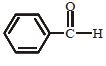
B
C
$CCl_3CHO$
D
$HCHO$
Solution
(C) The Cannizzaro reaction is characteristic of aldehydes that lack $\alpha$-hydrogen atoms.
$A$ (Benzaldehyde) lacks $\alpha$-hydrogens and undergoes the Cannizzaro reaction.
$B$ (Trimethylacetaldehyde or Pivalaldehyde) lacks $\alpha$-hydrogens and undergoes the Cannizzaro reaction.
$D$ (Formaldehyde) lacks $\alpha$-hydrogens and undergoes the Cannizzaro reaction.
$C$ ($CCl_3CHO$,Chloral) lacks $\alpha$-hydrogens,but it does not undergo the typical Cannizzaro disproportionation reaction. Instead,in the presence of concentrated alkali,it undergoes a haloform-type cleavage reaction to produce chloroform $(CHCl_3)$ and a formate salt $(HCOO^-)$.
$A$ (Benzaldehyde) lacks $\alpha$-hydrogens and undergoes the Cannizzaro reaction.
$B$ (Trimethylacetaldehyde or Pivalaldehyde) lacks $\alpha$-hydrogens and undergoes the Cannizzaro reaction.
$D$ (Formaldehyde) lacks $\alpha$-hydrogens and undergoes the Cannizzaro reaction.
$C$ ($CCl_3CHO$,Chloral) lacks $\alpha$-hydrogens,but it does not undergo the typical Cannizzaro disproportionation reaction. Instead,in the presence of concentrated alkali,it undergoes a haloform-type cleavage reaction to produce chloroform $(CHCl_3)$ and a formate salt $(HCOO^-)$.
0 likes
View Solution982
MediumMCQ
Which of the following will show the haloform reaction?
A
$CH_3-COOH$
B
$CH_3-CH_2-CH(OH)-CH_2-CH_3$
C
$CH_3-CO-CH_3$
D
$C_6H_5-CHO$
Solution
(C) The haloform reaction is given by compounds that contain either the methyl ketone group $(CH_3-CO-)$ or the methyl carbinol group $(CH_3-CH(OH)-)$.
In the given options,acetone $(CH_3-CO-CH_3)$ contains the $CH_3-CO-$ group.
Therefore,it gives a positive haloform test.
In the given options,acetone $(CH_3-CO-CH_3)$ contains the $CH_3-CO-$ group.
Therefore,it gives a positive haloform test.
0 likes
View Solution983
DifficultMCQ
The reaction sequence is: Cyclopentene $\xrightarrow[Cold\, dil.]{KMnO_4 / OH^{-}} X$ $\xrightarrow{HIO_4} Y$ $\xrightarrow{OH^{-} / \Delta} Z$; $Z$ is
A
Cyclopent$-1-$enecarbaldehyde
B
Cyclopent$-1-$ene$-1-$carbaldehyde
C
Cyclopent$-1-$enecarbaldehyde
D
Cyclopentanone
0 likes
View Solution984
AdvancedMCQ
Which of the following is an incorrect match for differentiating the given compounds?
A
| Compounds to Differentiate | Reagent |
| $1$. Benzene and Benzaldehyde | Fehling solution |
B
| Compounds to Differentiate | Reagent |
| $2$. $CH_3OH$ and $C_2H_5OH$ | $NaOH / I_2$ |
C
| Compounds to Differentiate | Reagent |
| $3$. $CH_3-C\equiv CH$ and $HC\equiv CH$ | $(Cu_2Cl_2 + NH_4OH)$ |
D
| Compounds to Differentiate | Reagent |
| $4$. $(CH_3)_3COH$ and $(CH_3)_2CHCH_2OH$ | $[HCl_{(conc.)} + ZnCl_{2(anhyd.)}]$ |
Solution
(A) Let's analyze each option:
$1$. Benzene and Benzaldehyde: Fehling solution is used to distinguish aliphatic aldehydes from ketones. Benzaldehyde is an aromatic aldehyde and does not give a positive Fehling test. However,benzene is an inert hydrocarbon. This pair is generally not differentiated by Fehling solution as neither reacts positively in a way that distinguishes them effectively,making this an incorrect match.
$2$. $CH_3OH$ and $C_2H_5OH$: $C_2H_5OH$ gives a positive iodoform test ($CHI_3$ yellow precipitate) with $NaOH/I_2$,while $CH_3OH$ does not. This is a correct match.
$3$. $CH_3-C\equiv CH$ and $HC\equiv CH$: Both are terminal alkynes and will form precipitates with Tollens' reagent or ammoniacal cuprous chloride. They cannot be distinguished by this reagent. Wait,actually,both react. Thus,this is also problematic,but let's re-evaluate the most 'incorrect' one. Actually,$CH_3-C\equiv CH$ and $HC\equiv CH$ both react with $(Cu_2Cl_2 + NH_4OH)$ to form red precipitates. So this is also an incorrect match.
However,in standard chemistry problems of this type,option $1$ is the most fundamentally incorrect as Fehling solution is specifically for aliphatic aldehydes.
Actually,looking at the options provided,$1$ is the most clearly incorrect match.
$1$. Benzene and Benzaldehyde: Fehling solution is used to distinguish aliphatic aldehydes from ketones. Benzaldehyde is an aromatic aldehyde and does not give a positive Fehling test. However,benzene is an inert hydrocarbon. This pair is generally not differentiated by Fehling solution as neither reacts positively in a way that distinguishes them effectively,making this an incorrect match.
$2$. $CH_3OH$ and $C_2H_5OH$: $C_2H_5OH$ gives a positive iodoform test ($CHI_3$ yellow precipitate) with $NaOH/I_2$,while $CH_3OH$ does not. This is a correct match.
$3$. $CH_3-C\equiv CH$ and $HC\equiv CH$: Both are terminal alkynes and will form precipitates with Tollens' reagent or ammoniacal cuprous chloride. They cannot be distinguished by this reagent. Wait,actually,both react. Thus,this is also problematic,but let's re-evaluate the most 'incorrect' one. Actually,$CH_3-C\equiv CH$ and $HC\equiv CH$ both react with $(Cu_2Cl_2 + NH_4OH)$ to form red precipitates. So this is also an incorrect match.
However,in standard chemistry problems of this type,option $1$ is the most fundamentally incorrect as Fehling solution is specifically for aliphatic aldehydes.
Actually,looking at the options provided,$1$ is the most clearly incorrect match.
0 likes
View Solution985
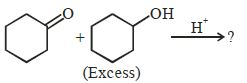
DifficultMCQ
What is the major product of the following reaction?
A
Cyclohexyl ether
B
Bicyclohexyl
C
$1,1-$dicyclohexyloxycyclohexane
D
Cyclohexane$-1,1-$diol
Solution
(C) The reaction between a ketone (cyclohexanone) and an alcohol (cyclohexanol) in the presence of an acid catalyst $(H^+)$ leads to the formation of an acetal. Since the alcohol is present in excess,the reaction proceeds to form a ketal (a type of acetal). The ketone carbonyl oxygen is protonated,followed by the nucleophilic attack of the first molecule of cyclohexanol to form a hemiacetal intermediate. $A$ second molecule of cyclohexanol then attacks the intermediate,leading to the loss of water and the formation of the final ketal product,$1,1$-dicyclohexyloxycyclohexane.
0 likes
View Solution986
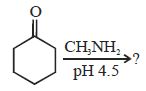
DifficultMCQ
What is the product of the following reaction?
A
$N$-methylcyclohex$-1-$en$-1-$amine
B
$1-$(aminomethyl)cyclohexan$-1-$ol
C
$N$-cyclohexylidenemethanamine
D
$1-$(methylamino)cyclohexan$-1-$ol
Solution
(C) The reaction of a ketone (cyclohexanone) with a primary amine $(CH_3NH_2)$ in the presence of a mildly acidic catalyst $(pH \ 4.5)$ is a nucleophilic addition-elimination reaction.
First,the nucleophilic nitrogen of the amine attacks the electrophilic carbonyl carbon of the ketone to form a hemiaminal intermediate ($1$-(methylamino)cyclohexan$-1-$ol).
Under acidic conditions,this intermediate undergoes dehydration (loss of a water molecule) to form an imine ($N$-cyclohexylidenemethanamine).
The reaction proceeds as follows:
$C_6H_{10}O + CH_3NH_2 \xrightarrow{pH \ 4.5} C_6H_{10}=NCH_3 + H_2O$.
Therefore,the final product is $N$-cyclohexylidenemethanamine.
First,the nucleophilic nitrogen of the amine attacks the electrophilic carbonyl carbon of the ketone to form a hemiaminal intermediate ($1$-(methylamino)cyclohexan$-1-$ol).
Under acidic conditions,this intermediate undergoes dehydration (loss of a water molecule) to form an imine ($N$-cyclohexylidenemethanamine).
The reaction proceeds as follows:
$C_6H_{10}O + CH_3NH_2 \xrightarrow{pH \ 4.5} C_6H_{10}=NCH_3 + H_2O$.
Therefore,the final product is $N$-cyclohexylidenemethanamine.
0 likes
View Solution987
DifficultMCQ
An organic compound $A$ on reaction with $PCC$ $(\text{Pyridinium chlorochromate})$ gives a compound $B$. $B$ on further reaction with $I_2$ and $NaOH$ forms tri-iodomethane. Identify the compound $A$.
A
$HCOOH$
B
$CH_3-CH_2-CO-CH_3$
C
$CH_3-CHO$
D
$C_2H_5OH$
Solution
(D) is $C_2H_5OH$ (ethanol),which is a primary alcohol.
When $C_2H_5OH$ reacts with $PCC$,it is oxidized to $CH_3-CHO$ (acetaldehyde),which is compound $B$.
$CH_3-CHO$ contains a methyl ketone/aldehyde group $(CH_3-CO-)$,which undergoes the iodoform reaction with $I_2$ and $NaOH$ to form $CHI_3$ (tri-iodomethane).
Reaction: $CH_3-CH_2-OH$ $\xrightarrow{PCC} CH_3-CHO$ $\xrightarrow{I_2/NaOH} CHI_3 + HCOONa$.
When $C_2H_5OH$ reacts with $PCC$,it is oxidized to $CH_3-CHO$ (acetaldehyde),which is compound $B$.
$CH_3-CHO$ contains a methyl ketone/aldehyde group $(CH_3-CO-)$,which undergoes the iodoform reaction with $I_2$ and $NaOH$ to form $CHI_3$ (tri-iodomethane).
Reaction: $CH_3-CH_2-OH$ $\xrightarrow{PCC} CH_3-CHO$ $\xrightarrow{I_2/NaOH} CHI_3 + HCOONa$.
0 likes
View Solution988
MediumMCQ
When acetaldehyde is heated with Fehling's solution,it gives a red precipitate of:
A
$CuSO_4$
B
$CuO$
C
$Cu_2Cl_2$
D
$Cu_2O$
Solution
(D) Fehling's solution is a tartaric acid complex of cupric ions.
When acetaldehyde is heated with Fehling's solution,it undergoes oxidation to form an acetate ion,while the cupric ions $(Cu^{2+})$ are reduced to cuprous oxide $(Cu_2O)$.
The chemical reaction is:
$CH_3CHO + 2Cu^{2+} + 5OH^{-} \xrightarrow{\Delta} CH_3COO^{-} + Cu_2O \downarrow + 3H_2O$
The red precipitate formed is $Cu_2O$ (cuprous oxide).
When acetaldehyde is heated with Fehling's solution,it undergoes oxidation to form an acetate ion,while the cupric ions $(Cu^{2+})$ are reduced to cuprous oxide $(Cu_2O)$.
The chemical reaction is:
$CH_3CHO + 2Cu^{2+} + 5OH^{-} \xrightarrow{\Delta} CH_3COO^{-} + Cu_2O \downarrow + 3H_2O$
The red precipitate formed is $Cu_2O$ (cuprous oxide).
0 likes
View Solution989
MediumMCQ
Addition of hydrogen cyanide $(HCN)$ to carbonyl compounds is:
A
Accelerated by addition of base
B
Accelerated by addition of acids
C
Addition of either acid or base do not affect the rate
D
Retarded by addition of base
Solution
(A) The addition of $HCN$ to carbonyl compounds is a nucleophilic addition reaction.
In this reaction,the cyanide ion $(CN^-)$ acts as the nucleophile.
Since $HCN$ is a weak acid,it does not dissociate significantly to provide $CN^-$ ions.
Adding a base (like $OH^-$) helps in the deprotonation of $HCN$ to generate a higher concentration of $CN^-$ ions $(HCN + OH^- \rightarrow CN^- + H_2O)$.
Therefore,the presence of a base increases the rate of the reaction by increasing the concentration of the nucleophile.
In this reaction,the cyanide ion $(CN^-)$ acts as the nucleophile.
Since $HCN$ is a weak acid,it does not dissociate significantly to provide $CN^-$ ions.
Adding a base (like $OH^-$) helps in the deprotonation of $HCN$ to generate a higher concentration of $CN^-$ ions $(HCN + OH^- \rightarrow CN^- + H_2O)$.
Therefore,the presence of a base increases the rate of the reaction by increasing the concentration of the nucleophile.
0 likes
View Solution990
DifficultMCQ
Arrange the following compounds in increasing order of their reactivity in nucleophilic addition reaction :
$(P)$ Benzaldehyde
$(Q)$ $p-$Tolualdehyde
$(R)$ $p-$Nitrobenzaldehyde
$(S)$ Acetophenone
$(P)$ Benzaldehyde
$(Q)$ $p-$Tolualdehyde
$(R)$ $p-$Nitrobenzaldehyde
$(S)$ Acetophenone
A
$P < R < Q < S$
B
$S < Q < P < R$
C
$P < Q < R < S$
D
$Q < P < S < R$
Solution
(B) Nucleophilic addition reactivity depends on the electrophilicity of the carbonyl carbon.
$1$. Ketones are less reactive than aldehydes due to steric hindrance and the electron-donating effect of the alkyl group. Thus,Acetophenone $(S)$ is the least reactive.
$2$. Among aldehydes,electron-donating groups (like $-CH_3$ in $p-$Tolualdehyde) decrease reactivity,while electron-withdrawing groups (like $-NO_2$ in $p-$Nitrobenzaldehyde) increase reactivity.
$3$. Comparing the aldehydes: $p-$Tolualdehyde $(Q)$ < Benzaldehyde $(P)$ < $p-$Nitrobenzaldehyde $(R)$.
Combining these,the increasing order of reactivity is: $S < Q < P < R$.
$1$. Ketones are less reactive than aldehydes due to steric hindrance and the electron-donating effect of the alkyl group. Thus,Acetophenone $(S)$ is the least reactive.
$2$. Among aldehydes,electron-donating groups (like $-CH_3$ in $p-$Tolualdehyde) decrease reactivity,while electron-withdrawing groups (like $-NO_2$ in $p-$Nitrobenzaldehyde) increase reactivity.
$3$. Comparing the aldehydes: $p-$Tolualdehyde $(Q)$ < Benzaldehyde $(P)$ < $p-$Nitrobenzaldehyde $(R)$.
Combining these,the increasing order of reactivity is: $S < Q < P < R$.
0 likes
View Solution991
DifficultMCQ
The reaction of $3$-bromobenzaldehyde with concentrated $NaOH$ $(50\, \%)$ yields which of the following products?
A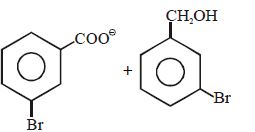
B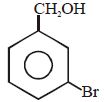
C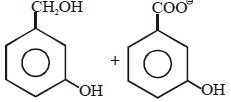
D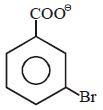
Solution
(A) The given reaction is an example of the Cannizzaro reaction,which occurs in aldehydes that do not have an $\alpha$-hydrogen atom in the presence of a concentrated base like $NaOH$.
In this reaction,the aldehyde undergoes self-oxidation and reduction (disproportionation) to form a carboxylic acid salt and an alcohol.
For $3$-bromobenzaldehyde,the aldehyde group $(-CHO)$ is at the meta-position relative to the bromine atom.
The reaction proceeds as follows:
$2 \text{ } C_6H_4(Br)CHO + NaOH (conc.) \rightarrow C_6H_4(Br)COO^- Na^+ + C_6H_4(Br)CH_2OH$.
Thus,the products are $3$-bromobenzoate ion and $3$-bromobenzyl alcohol.
In this reaction,the aldehyde undergoes self-oxidation and reduction (disproportionation) to form a carboxylic acid salt and an alcohol.
For $3$-bromobenzaldehyde,the aldehyde group $(-CHO)$ is at the meta-position relative to the bromine atom.
The reaction proceeds as follows:
$2 \text{ } C_6H_4(Br)CHO + NaOH (conc.) \rightarrow C_6H_4(Br)COO^- Na^+ + C_6H_4(Br)CH_2OH$.
Thus,the products are $3$-bromobenzoate ion and $3$-bromobenzyl alcohol.
0 likes
View Solution992
DifficultMCQ
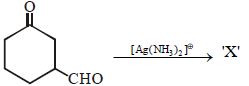
What is the product '$X$' in the following reaction?
(Image of $3-$formylcyclohexanone reacting with $[Ag(NH_3)_2]^+$)
(Image of $3-$formylcyclohexanone reacting with $[Ag(NH_3)_2]^+$)
A
$3-$oxocyclohexanecarboxylate ion
B
$3-$hydroxycyclohexanecarbaldehyde
C
$3-$hydroxycyclohexylmethanol
D
$3-$methylcyclohexanone
Solution
(A) The reagent $[Ag(NH_3)_2]^+$ is Tollens' reagent,which is a mild oxidizing agent.
It specifically oxidizes aldehyde groups $(-CHO)$ to carboxylate groups $(-COO^-)$ while leaving ketone groups $(C=O)$ unaffected.
In the given reactant,$3$-formylcyclohexanone,there is both a ketone group and an aldehyde group.
The Tollens' reagent will selectively oxidize the aldehyde group to a carboxylate ion,resulting in the formation of $3-$oxocyclohexanecarboxylate ion.
It specifically oxidizes aldehyde groups $(-CHO)$ to carboxylate groups $(-COO^-)$ while leaving ketone groups $(C=O)$ unaffected.
In the given reactant,$3$-formylcyclohexanone,there is both a ketone group and an aldehyde group.
The Tollens' reagent will selectively oxidize the aldehyde group to a carboxylate ion,resulting in the formation of $3-$oxocyclohexanecarboxylate ion.
0 likes
View Solution993
DifficultMCQ
Which of the following compounds will not undergo tautomerism?
A
Cyclohex$-1-$en$-1-$ol
B
$2-$Methylcyclohexanone
C
$2,6-$Dimethylcyclohexanone
D
$2,2,6,6-$Tetramethylcyclohexanone
Solution
(D) Tautomerism requires the presence of at least one $\alpha$-hydrogen atom adjacent to the carbonyl group (in keto-enol tautomerism) or a similar structural requirement for other types.
$A$: Cyclohex$-1-$en$-1-$ol is an enol,which can tautomerize to cyclohexanone.
$B$: $2-$Methylcyclohexanone has an $\alpha$-hydrogen at the $C-2$ position,so it can undergo tautomerism.
$C$: $2,6-$Dimethylcyclohexanone has $\alpha$-hydrogens at both $C-2$ and $C-6$ positions,so it can undergo tautomerism.
$D$: $2,2,6,6-$Tetramethylcyclohexanone has no $\alpha$-hydrogen atoms because all four $\alpha$-positions (two at $C-2$ and two at $C-6$) are substituted with methyl groups. Therefore,it cannot undergo keto-enol tautomerism.
$A$: Cyclohex$-1-$en$-1-$ol is an enol,which can tautomerize to cyclohexanone.
$B$: $2-$Methylcyclohexanone has an $\alpha$-hydrogen at the $C-2$ position,so it can undergo tautomerism.
$C$: $2,6-$Dimethylcyclohexanone has $\alpha$-hydrogens at both $C-2$ and $C-6$ positions,so it can undergo tautomerism.
$D$: $2,2,6,6-$Tetramethylcyclohexanone has no $\alpha$-hydrogen atoms because all four $\alpha$-positions (two at $C-2$ and two at $C-6$) are substituted with methyl groups. Therefore,it cannot undergo keto-enol tautomerism.
0 likes
View Solution994
MediumMCQ
Keto-enol tautomerism is observed in which of the following?
A
$C_6H_5CHO$
B
$C_6H_5COCH_3$
C
$C_6H_5COC_6H_5$
D
$C_6H_5COC(CH_3)_2C_6H_5$
Solution
(B) Keto-enol tautomerism requires the presence of at least one $\alpha$-hydrogen atom adjacent to the carbonyl group $(C=O)$.
In $C_6H_5COCH_3$ (acetophenone),the $CH_3$ group is attached to the carbonyl carbon,which provides three $\alpha$-hydrogen atoms.
These $\alpha$-hydrogens are acidic and can be removed to form an enolate,leading to tautomerism.
In $C_6H_5CHO$,$C_6H_5COC_6H_5$,and $C_6H_5COC(CH_3)_2C_6H_5$,there are no $\alpha$-hydrogen atoms available adjacent to the carbonyl group,so they do not exhibit keto-enol tautomerism.
In $C_6H_5COCH_3$ (acetophenone),the $CH_3$ group is attached to the carbonyl carbon,which provides three $\alpha$-hydrogen atoms.
These $\alpha$-hydrogens are acidic and can be removed to form an enolate,leading to tautomerism.
In $C_6H_5CHO$,$C_6H_5COC_6H_5$,and $C_6H_5COC(CH_3)_2C_6H_5$,there are no $\alpha$-hydrogen atoms available adjacent to the carbonyl group,so they do not exhibit keto-enol tautomerism.
0 likes
View Solution995
MediumMCQ
In the reaction $CH_3CHO + HCN \to CH_3CH(OH)CN$,a chiral center is generated. The product will be ........
A
Racemic mixture
B
Meso compound
C
Dextrorotatory
D
Laevorotatory
Solution
(A) The reaction of acetaldehyde $(CH_3CHO)$ with $HCN$ is a nucleophilic addition reaction.
In this reaction,the $CN^-$ ion attacks the planar carbonyl carbon from either side with equal probability.
This leads to the formation of both $R$ and $S$ enantiomers of the product,$CH_3CH(OH)CN$,in equal amounts.
$A$ mixture containing equal amounts of both enantiomers is known as a racemic mixture.
In this reaction,the $CN^-$ ion attacks the planar carbonyl carbon from either side with equal probability.
This leads to the formation of both $R$ and $S$ enantiomers of the product,$CH_3CH(OH)CN$,in equal amounts.
$A$ mixture containing equal amounts of both enantiomers is known as a racemic mixture.
0 likes
View Solution996
DifficultMCQ
Which of the following has the lowest enol content?
A
$CH_3COCH_2COCH_3$
B
$CH_3COCH_3$
C
$PhCOCH_2COPh$
D
$CH_3CHO$
0 likes
View Solution997
DifficultMCQ
Which of the following substances cannot be used as a starting material for the preparation of iodoform?
A
$CH_3CH(OH)CH_3$
B
$CH_3CH_2OH$
C
$CH_3OH$
D
$CH_3COCH_3$
Solution
(C) The iodoform test is given by compounds containing the $CH_3CO-$ group or compounds that can be oxidized to this group (like $CH_3CH(OH)-$ group).
$CH_3CH(OH)CH_3$ (isopropyl alcohol) contains the $CH_3CH(OH)-$ group.
$CH_3CH_2OH$ (ethanol) contains the $CH_3CH(OH)-$ group.
$CH_3COCH_3$ (acetone) contains the $CH_3CO-$ group.
$CH_3OH$ (methanol) does not contain the $CH_3CO-$ or $CH_3CH(OH)-$ group,so it cannot form iodoform.
$CH_3CH(OH)CH_3$ (isopropyl alcohol) contains the $CH_3CH(OH)-$ group.
$CH_3CH_2OH$ (ethanol) contains the $CH_3CH(OH)-$ group.
$CH_3COCH_3$ (acetone) contains the $CH_3CO-$ group.
$CH_3OH$ (methanol) does not contain the $CH_3CO-$ or $CH_3CH(OH)-$ group,so it cannot form iodoform.
0 likes
View Solution998
DifficultMCQ
Which of the following compounds does not give the iodoform test?
A
$CH_3CHO$
B
$CH_3CH_2OH$
C
$C_6H_5COCH_3$
D
$C_6H_5CH_2CH_2OH$
Solution
(D) The iodoform test is given by compounds containing the $CH_3CO-$ group or the $CH_3CH(OH)-$ group.
$CH_3CHO$ (acetaldehyde) contains the $CH_3CO-$ group.
$CH_3CH_2OH$ (ethanol) can be oxidized to $CH_3CHO$,which contains the $CH_3CH(OH)-$ group.
$C_6H_5COCH_3$ (acetophenone) contains the $CH_3CO-$ group attached to a phenyl ring.
$C_6H_5CH_2CH_2OH$ ($2$-phenylethanol) does not contain either the $CH_3CO-$ or $CH_3CH(OH)-$ group.
Therefore,$C_6H_5CH_2CH_2OH$ does not give the iodoform test.
$CH_3CHO$ (acetaldehyde) contains the $CH_3CO-$ group.
$CH_3CH_2OH$ (ethanol) can be oxidized to $CH_3CHO$,which contains the $CH_3CH(OH)-$ group.
$C_6H_5COCH_3$ (acetophenone) contains the $CH_3CO-$ group attached to a phenyl ring.
$C_6H_5CH_2CH_2OH$ ($2$-phenylethanol) does not contain either the $CH_3CO-$ or $CH_3CH(OH)-$ group.
Therefore,$C_6H_5CH_2CH_2OH$ does not give the iodoform test.
0 likes
View Solution999
DifficultMCQ
Chlorotone,used as a medicine,is prepared by the reaction of acetone with .....
A
Chlorine
B
Ethyl chloride
C
Chloroform
D
Ethylene dichloride
Solution
(C) Chlorotone $(1,1,1-\text{trichloro-2-methylpropan-2-ol})$ is prepared by the reaction of acetone $(CH_3COCH_3)$ with chloroform $(CHCl_3)$ in the presence of a base like potassium hydroxide $(KOH)$.
The reaction is: $CH_3COCH_3 + CHCl_3 \xrightarrow{KOH} (CH_3)_2C(OH)CCl_3$.
The reaction is: $CH_3COCH_3 + CHCl_3 \xrightarrow{KOH} (CH_3)_2C(OH)CCl_3$.
0 likes
View Solution1000
DifficultMCQ
Compounds containing two $-OH$ groups on the same carbon atom are generally unstable,but which of the following is stable?
A
$CH_3CH(OH)_2$
B
$CH_3C(OH)_3$
C
$Cl_3C-CH(OH)_2$
D
None of these
0 likes
View Solution8-1.Aldehydes and Ketones — Properties · Frequently Asked Questions
1Are these 8-1.Aldehydes and Ketones questions useful for JEE and NEET?
Yes. All questions in this section are mapped to JEE Main and NEET exam patterns. Previous year questions from JEE Main, NEET, GUJCET and state-level exams are included with full solutions.
2Can I switch to Hindi or Gujarati for these questions?
Yes. Use the language tabs in the hero section or the sidebar to view the same questions and solutions in English, Hindi or Gujarati.
3How do I generate a question paper from this subtopic?
Use the Vedclass Exam Paper Generator — select the chapter and subtopic, set difficulty, and generate Sets A, B, C, D automatically. First 3 chapters of every subject are free.
Vedclass Products
For Students
Vedclass Test Series
Mock tests in real JEE/NEET style with performance analysis. 5-day free trial.
Start Free TrialFor Teachers
Exam Paper Generator
Generate Set A/B/C/D papers from this chapter in 2 minutes. 3 chapters free.
Try FreeFor Institutes
Online Exam Module
Live online exams with unlimited students, 360° analytics & white-label branding.
See DemoFor Teachers & Institutes
Generate a 8-1.Aldehydes and Ketones Exam Paper in 2 Minutes
Select subtopic & difficulty — Sets A, B, C, D auto-generated with No Repeat logic.
First 3 chapters of every subject are free — no payment required.