
A English
Properties Questions in English
Class 12 Chemistry · 8-1.Aldehydes and Ketones · Properties
1739+
Questions
English
Language
100%
With Solutions
Showing 50 of 1739 questions in English
1051
Medium
How can propan$-2-$one be converted to tertiary butyl alcohol?
Solution
(N/A) Propan$-2-$one $(CH_3COCH_3)$ reacts with a Grignard reagent,methyl magnesium halide ($CH_3MgX$,where $X = Cl, Br, I$),in the presence of dry ether to form an addition product.
This addition product is then subjected to acid hydrolysis $(H^+/H_2O)$ to yield tertiary butyl alcohol ($2$-methylpropan$-2$-ol).
The reaction is as follows:
$CH_3COCH_3 + CH_3MgX \xrightarrow{\text{dry ether}} (CH_3)_3COMgX$
$(CH_3)_3COMgX + H_2O \xrightarrow{H^+} (CH_3)_3COH + Mg(OH)X$
This addition product is then subjected to acid hydrolysis $(H^+/H_2O)$ to yield tertiary butyl alcohol ($2$-methylpropan$-2$-ol).
The reaction is as follows:
$CH_3COCH_3 + CH_3MgX \xrightarrow{\text{dry ether}} (CH_3)_3COMgX$
$(CH_3)_3COMgX + H_2O \xrightarrow{H^+} (CH_3)_3COH + Mg(OH)X$
0 likes
View Solution1052
Difficult
Match the reactants in Column-$I$ with the major products in Column-$II$ obtained after the reaction.
| Column-$I$ (Reactants) | Column-$II$ (Major Product) |
| $A$. $HCHO \xrightarrow{(i) CH_3MgBr, (ii) H_2O}$ | $i$. $C_6H_5CHOHCH_3$ |
| $B$. $C_6H_5CHO \xrightarrow{(i) CH_3MgBr, (ii) H_2O}$ | $ii$. $(CH_3)_3COH$ |
| $C$. $CH_3COCH_3 \xrightarrow{(i) CH_3MgBr, (ii) H_2O}$ | $iii$. $CH_3CHOHCH_3$ |
| $D$. $CH_3CHO \xrightarrow{(i) CH_3MgBr, (ii) H_2O}$ | $iv$. $CH_3CH_2OH$ |
Solution
(A-IV, B-I, C-II, D-III) The reaction of Grignard reagent $(CH_3MgBr)$ with carbonyl compounds followed by hydrolysis yields alcohols:
$A$. $HCHO + CH_3MgBr \rightarrow CH_3CH_2OH$ (Primary alcohol,$iv$)
$B$. $C_6H_5CHO + CH_3MgBr \rightarrow C_6H_5CH(OH)CH_3$ (Secondary alcohol,$i$)
$C$. $CH_3COCH_3 + CH_3MgBr \rightarrow (CH_3)_3COH$ (Tertiary alcohol,$ii$)
$D$. $CH_3CHO + CH_3MgBr \rightarrow CH_3CH(OH)CH_3$ (Secondary alcohol,$iii$)
Therefore,the correct matching is: $A-iv, B-i, C-ii, D-iii$.
$A$. $HCHO + CH_3MgBr \rightarrow CH_3CH_2OH$ (Primary alcohol,$iv$)
$B$. $C_6H_5CHO + CH_3MgBr \rightarrow C_6H_5CH(OH)CH_3$ (Secondary alcohol,$i$)
$C$. $CH_3COCH_3 + CH_3MgBr \rightarrow (CH_3)_3COH$ (Tertiary alcohol,$ii$)
$D$. $CH_3CHO + CH_3MgBr \rightarrow CH_3CH(OH)CH_3$ (Secondary alcohol,$iii$)
Therefore,the correct matching is: $A-iv, B-i, C-ii, D-iii$.
0 likes
View Solution1053
Medium
Write about the boiling points of aldehydes and ketones.
Solution
(N/A) Physical state at room temperature: Methanal is a gas at room temperature. Ethanal is a volatile liquid. Other aldehydes and ketones are liquid or solid at room temperature.
$(b)$ The boiling points of aldehydes and ketones are higher than those of hydrocarbons and ethers of comparable molecular masses. This is due to weak molecular association in aldehydes and ketones arising out of the dipole-dipole interactions.
$(b)$ The boiling points of aldehydes and ketones are higher than those of hydrocarbons and ethers of comparable molecular masses. This is due to weak molecular association in aldehydes and ketones arising out of the dipole-dipole interactions.
0 likes
View Solution1054
Medium
Explain the solubility of aldehyde and ketone compounds.
Solution
(N/A) The lower members of aldehydes and ketones,such as methanal,ethanal,and propanone,are miscible with water in all proportions because they form hydrogen bonds with water molecules.
$(i)$ Intermolecular hydrogen bond between a ketone and a water molecule is shown below:
(ii) Intermolecular hydrogen bond between an aldehyde and a water molecule is shown below:
However,the solubility of aldehydes and ketones decreases rapidly as the length of the alkyl chain increases,due to the increasing hydrophobic character of the hydrocarbon part.
$(i)$ Intermolecular hydrogen bond between a ketone and a water molecule is shown below:
(ii) Intermolecular hydrogen bond between an aldehyde and a water molecule is shown below:
However,the solubility of aldehydes and ketones decreases rapidly as the length of the alkyl chain increases,due to the increasing hydrophobic character of the hydrocarbon part.
0 likes
View Solution1055
Medium
Describe the various chemical reactions of aldehyde and ketone compounds.
Solution
(N/A) Aldehyde and ketone compounds undergo the following types of reactions:
$(a)$ Nucleophilic addition and nucleophilic addition-elimination reactions:
$(i)$ Addition of hydrogen cyanide $(HCN)$.
$(ii)$ Addition of sodium hydrogensulphite $(NaHSO_3)$.
$(iii)$ Addition of Grignard reagents $(RMgX)$.
$(iv)$ Addition of alcohols to form hemiacetals and acetals (for aldehydes) or ketals (for ketones).
$(v)$ Addition of ammonia and its derivatives $(NH_2-Z)$.
$(b)$ Reduction reactions:
$(i)$ Reduction to alcohols using $LiAlH_4$,$NaBH_4$,or catalytic hydrogenation.
$(ii)$ Reduction to hydrocarbons via Clemmensen reduction or Wolff-Kishner reduction.
$(c)$ Oxidation reactions:
$(i)$ Oxidation to carboxylic acids using $HNO_3$,$KMnO_4$,or $K_2Cr_2O_7$.
$(ii)$ Tollens' test (specific to aldehydes).
$(iii)$ Fehling's test (specific to aliphatic aldehydes).
$(iv)$ Haloform test: For compounds possessing $CH_3CH(OH)-$ or $CH_3CO-$ groups.
$(d)$ Reactions due to $\alpha$-hydrogen:
$(i)$ Aldol condensation.
$(ii)$ Cross-aldol condensation.
$(e)$ Other reactions:
$(i)$ Cannizzaro reaction (for aldehydes lacking $\alpha$-hydrogen).
$(ii)$ Electrophilic substitution reactions (for aromatic aldehydes and ketones).
$(a)$ Nucleophilic addition and nucleophilic addition-elimination reactions:
$(i)$ Addition of hydrogen cyanide $(HCN)$.
$(ii)$ Addition of sodium hydrogensulphite $(NaHSO_3)$.
$(iii)$ Addition of Grignard reagents $(RMgX)$.
$(iv)$ Addition of alcohols to form hemiacetals and acetals (for aldehydes) or ketals (for ketones).
$(v)$ Addition of ammonia and its derivatives $(NH_2-Z)$.
$(b)$ Reduction reactions:
$(i)$ Reduction to alcohols using $LiAlH_4$,$NaBH_4$,or catalytic hydrogenation.
$(ii)$ Reduction to hydrocarbons via Clemmensen reduction or Wolff-Kishner reduction.
$(c)$ Oxidation reactions:
$(i)$ Oxidation to carboxylic acids using $HNO_3$,$KMnO_4$,or $K_2Cr_2O_7$.
$(ii)$ Tollens' test (specific to aldehydes).
$(iii)$ Fehling's test (specific to aliphatic aldehydes).
$(iv)$ Haloform test: For compounds possessing $CH_3CH(OH)-$ or $CH_3CO-$ groups.
$(d)$ Reactions due to $\alpha$-hydrogen:
$(i)$ Aldol condensation.
$(ii)$ Cross-aldol condensation.
$(e)$ Other reactions:
$(i)$ Cannizzaro reaction (for aldehydes lacking $\alpha$-hydrogen).
$(ii)$ Electrophilic substitution reactions (for aromatic aldehydes and ketones).
0 likes
View Solution1056
Difficult
Explain the mechanism of nucleophilic addition reactions of aldehyde and ketone compounds.
Solution
(N/A) The mechanism of nucleophilic addition to the carbonyl group involves the following steps:
$(i)$ $A$ nucleophile $(Nu^-)$ attacks the electrophilic carbon atom of the polar carbonyl group from a direction approximately perpendicular to the plane of the $sp^2$ hybridized orbitals of the carbonyl carbon.
$(ii)$ Slow step-$1$: The hybridization of the carbon changes from $sp^2$ to $sp^3$ in this process,and a tetrahedral alkoxide intermediate is produced.
$(iii)$ Fast step-$2$: The alkoxide intermediate captures a proton from the reaction medium to form the final addition product.
The boiling points of aldehydes and ketones are lower than those of alcohols of similar molecular masses due to the absence of intermolecular hydrogen bonding. They exhibit weak intermolecular association due to dipole-dipole interactions between the opposite ends of the $C=O$ dipoles.
$(i)$ $A$ nucleophile $(Nu^-)$ attacks the electrophilic carbon atom of the polar carbonyl group from a direction approximately perpendicular to the plane of the $sp^2$ hybridized orbitals of the carbonyl carbon.
$(ii)$ Slow step-$1$: The hybridization of the carbon changes from $sp^2$ to $sp^3$ in this process,and a tetrahedral alkoxide intermediate is produced.
$(iii)$ Fast step-$2$: The alkoxide intermediate captures a proton from the reaction medium to form the final addition product.
| Compound (Type) | Boiling Point $(K)$ |
| $n$-Butane (Hydrocarbon) | $273$ |
| Methoxyethane (Ether) | $281$ |
| Propanal (Aldehyde) | $322$ |
| Acetone (Ketone) | $329$ |
| Propan-$1$-ol (Alcohol) | $370$ |
The boiling points of aldehydes and ketones are lower than those of alcohols of similar molecular masses due to the absence of intermolecular hydrogen bonding. They exhibit weak intermolecular association due to dipole-dipole interactions between the opposite ends of the $C=O$ dipoles.
0 likes
View Solution1057
Medium
Explain the reactivity of nucleophilic addition reactions of aldehyde and ketone compounds.
Solution
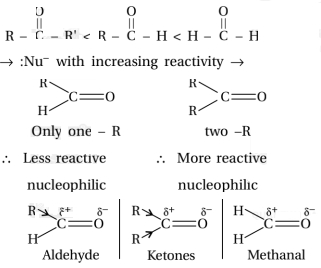
(N/A) Aldehydes are generally more reactive than ketones in nucleophilic addition reactions due to steric and electronic factors.
$(i)$ Steric effect: Sterically,the presence of two relatively large substituents in ketones hinders the approach of the nucleophile to the carbonyl carbon more than in aldehydes,which have only one such substituent.
$(ii)$ Electronic effect: Electronically,aldehydes are more reactive than ketones because two alkyl groups in ketones reduce the electrophilicity of the carbonyl carbon more effectively than the single alkyl group in aldehydes.
In an aldehyde $(RCHO)$,only one $-R$ group is present,while in a ketone $(RCOR)$,two alkyl groups are present,which reduces the electrophilicity of the carbonyl group.
$(i)$ Steric effect: Sterically,the presence of two relatively large substituents in ketones hinders the approach of the nucleophile to the carbonyl carbon more than in aldehydes,which have only one such substituent.
$(ii)$ Electronic effect: Electronically,aldehydes are more reactive than ketones because two alkyl groups in ketones reduce the electrophilicity of the carbonyl carbon more effectively than the single alkyl group in aldehydes.
In an aldehyde $(RCHO)$,only one $-R$ group is present,while in a ketone $(RCOR)$,two alkyl groups are present,which reduces the electrophilicity of the carbonyl group.
0 likes
View Solution1058
Medium
Write a note on the addition of hydrogen cyanide to aldehydes and ketones.
Solution
(N/A) Aldehydes and ketones react with hydrogen cyanide $(HCN)$ to yield cyanohydrins.
$(i)$ This reaction occurs very slowly with pure $HCN$.
$(ii)$ Therefore,it is catalysed by a base. The generated cyanide ion $(CN^-)$,being a stronger nucleophile,readily adds to the carbonyl carbon of the aldehyde or ketone to yield the corresponding cyanohydrin.
$(iii)$ The reaction mechanism is as follows:
$HCN + OH^- \rightleftharpoons :CN^- + H_2O$
$R_2C=O + :CN^- \rightleftharpoons R_2C(O^-)(CN)$ (Tetrahedral intermediate)
$R_2C(O^-)(CN) + H_2O \rightleftharpoons R_2C(OH)(CN) + OH^-$
$(iv)$ Note: The carbonyl carbon in the reactant is $sp^2$ hybridized,while in the cyanohydrin product,it becomes $sp^3$ hybridized. This is a nucleophilic addition reaction.
$(i)$ This reaction occurs very slowly with pure $HCN$.
$(ii)$ Therefore,it is catalysed by a base. The generated cyanide ion $(CN^-)$,being a stronger nucleophile,readily adds to the carbonyl carbon of the aldehyde or ketone to yield the corresponding cyanohydrin.
$(iii)$ The reaction mechanism is as follows:
$HCN + OH^- \rightleftharpoons :CN^- + H_2O$
$R_2C=O + :CN^- \rightleftharpoons R_2C(O^-)(CN)$ (Tetrahedral intermediate)
$R_2C(O^-)(CN) + H_2O \rightleftharpoons R_2C(OH)(CN) + OH^-$
$(iv)$ Note: The carbonyl carbon in the reactant is $sp^2$ hybridized,while in the cyanohydrin product,it becomes $sp^3$ hybridized. This is a nucleophilic addition reaction.
0 likes
View Solution1059
Medium
Write a note on the addition of sodium hydrogen sulphite $(NaHSO_3)$ to the carbonyl group.
Solution
(N/A) Sodium hydrogen sulphite $(NaHSO_3)$ adds to aldehydes and ketones to form the corresponding addition products.
The reaction is as follows:
$R-C(=O)-R' + NaHSO_3 \rightleftharpoons R-C(OH)(SO_3Na)-R'$
$1$. The nucleophilic part of $NaHSO_3$ is the sulphite ion $(SO_3^{2-})$,which attacks the electrophilic carbonyl carbon.
$2$. This is followed by a proton transfer to form the stable crystalline bisulphite addition compound.
$3$. This reaction is reversible and is used for the separation and purification of aldehydes and ketones,as the addition product can be decomposed back to the original carbonyl compound by treatment with dilute mineral acid or base.
The reaction is as follows:
$R-C(=O)-R' + NaHSO_3 \rightleftharpoons R-C(OH)(SO_3Na)-R'$
$1$. The nucleophilic part of $NaHSO_3$ is the sulphite ion $(SO_3^{2-})$,which attacks the electrophilic carbonyl carbon.
$2$. This is followed by a proton transfer to form the stable crystalline bisulphite addition compound.
$3$. This reaction is reversible and is used for the separation and purification of aldehydes and ketones,as the addition product can be decomposed back to the original carbonyl compound by treatment with dilute mineral acid or base.
0 likes
View Solution1060
Medium
Explain the addition of a $Grignard$ reagent to aldehyde and ketone compounds.
Solution
(N/A) The reaction involves the nucleophilic addition of a $Grignard$ reagent $(R-Mg-X)$ to the carbonyl group $(C=O)$ of an aldehyde or ketone.
$1.$ The nucleophilic alkyl group $(R^-)$ of the $Grignard$ reagent attacks the electrophilic carbonyl carbon,while the electrophilic magnesium species $(Mg^+X)$ coordinates with the carbonyl oxygen,forming an intermediate addition product (alkoxymagnesium halide).
$2.$ Subsequent hydrolysis of this intermediate with water $(H_2O)$ yields an alcohol.
General reaction:
$R-Mg-X + >C=O$ $\rightarrow >C(R)-OMgX$ $\xrightarrow{H_2O} >C(R)-OH + Mg(OH)X$
Applications:
- $Methanal$ $(HCHO)$ reacts with $Grignard$ reagents to produce primary $(1^{\circ})$ alcohols.
- Other aldehydes $(RCHO)$ react to produce secondary $(2^{\circ})$ alcohols.
- Ketones $(R_2CO)$ react to produce tertiary $(3^{\circ})$ alcohols.
$1.$ The nucleophilic alkyl group $(R^-)$ of the $Grignard$ reagent attacks the electrophilic carbonyl carbon,while the electrophilic magnesium species $(Mg^+X)$ coordinates with the carbonyl oxygen,forming an intermediate addition product (alkoxymagnesium halide).
$2.$ Subsequent hydrolysis of this intermediate with water $(H_2O)$ yields an alcohol.
General reaction:
$R-Mg-X + >C=O$ $\rightarrow >C(R)-OMgX$ $\xrightarrow{H_2O} >C(R)-OH + Mg(OH)X$
Applications:
- $Methanal$ $(HCHO)$ reacts with $Grignard$ reagents to produce primary $(1^{\circ})$ alcohols.
- Other aldehydes $(RCHO)$ react to produce secondary $(2^{\circ})$ alcohols.
- Ketones $(R_2CO)$ react to produce tertiary $(3^{\circ})$ alcohols.
0 likes
View Solution1061
Medium
Give the reaction of $(a)$ acetaldehyde and $(b)$ acetone with $(i)$ $NaHSO_{3}$ and $(ii)$ $HCN$.
Solution
(N/A) $(i)$ Reaction of acetaldehyde with $NaHSO_{3}$:
$CH_{3}CHO + NaHSO_{3} \rightarrow CH_{3}CH(OH)SO_{3}Na$ (Acetaldehyde sodium bisulphite addition product)
$(a)$ $(ii)$ Reaction of acetaldehyde with $HCN$:
$CH_{3}CHO + HCN \rightarrow CH_{3}CH(OH)CN$ (Acetaldehyde cyanohydrin)
$(b)$ $(i)$ Reaction of acetone with $NaHSO_{3}$:
$CH_{3}COCH_{3} + NaHSO_{3} \rightarrow CH_{3}C(OH)(SO_{3}Na)CH_{3}$ (Acetone sodium bisulphite addition product)
$(b)$ $(ii)$ Reaction of acetone with $HCN$:
$CH_{3}COCH_{3} + HCN \rightarrow CH_{3}C(OH)(CN)CH_{3}$ (Acetone cyanohydrin)
$CH_{3}CHO + NaHSO_{3} \rightarrow CH_{3}CH(OH)SO_{3}Na$ (Acetaldehyde sodium bisulphite addition product)
$(a)$ $(ii)$ Reaction of acetaldehyde with $HCN$:
$CH_{3}CHO + HCN \rightarrow CH_{3}CH(OH)CN$ (Acetaldehyde cyanohydrin)
$(b)$ $(i)$ Reaction of acetone with $NaHSO_{3}$:
$CH_{3}COCH_{3} + NaHSO_{3} \rightarrow CH_{3}C(OH)(SO_{3}Na)CH_{3}$ (Acetone sodium bisulphite addition product)
$(b)$ $(ii)$ Reaction of acetone with $HCN$:
$CH_{3}COCH_{3} + HCN \rightarrow CH_{3}C(OH)(CN)CH_{3}$ (Acetone cyanohydrin)
0 likes
View Solution1062
Difficult
Give applications of cyanohydrins with acetaldehyde with suitable reactions. $OR$ Give following conversions by using acetaldehyde as starting material.
$(a)$ Lactic acid and acrylic acid
$(b)$ Alanine
$(c)$ $1$-amino propane-$2$-ol
$(a)$ Lactic acid and acrylic acid
$(b)$ Alanine
$(c)$ $1$-amino propane-$2$-ol
Solution
(N/A) Applications of cyanohydrins:
$(a)$ Conversion of acetaldehyde to Lactic acid and Acrylic acid:
$CH_3CHO + HCN \rightarrow CH_3CH(OH)CN$ (Acetaldehyde cyanohydrin)
$CH_3CH(OH)CN + H_2O, H^+ \rightarrow CH_3CH(OH)COOH$ (Lactic acid)
$CH_3CH(OH)COOH \xrightarrow{H_2SO_4, \Delta} CH_2=CH-COOH$ (Acrylic acid)
$(b)$ Conversion of acetaldehyde to Alanine:
$CH_3CH(OH)CN + NH_3 \rightarrow CH_3CH(NH_2)CN$
$CH_3CH(NH_2)CN + H_2O, H^+ \rightarrow CH_3CH(NH_2)COOH$ (Alanine)
$(c)$ Conversion of acetaldehyde to $1$-amino propane-$2$-ol:
$CH_3CH(OH)CN \xrightarrow{LiAlH_4, 4H} CH_3CH(OH)CH_2NH_2$ ($1$-amino propane-$2$-ol)
$(a)$ Conversion of acetaldehyde to Lactic acid and Acrylic acid:
$CH_3CHO + HCN \rightarrow CH_3CH(OH)CN$ (Acetaldehyde cyanohydrin)
$CH_3CH(OH)CN + H_2O, H^+ \rightarrow CH_3CH(OH)COOH$ (Lactic acid)
$CH_3CH(OH)COOH \xrightarrow{H_2SO_4, \Delta} CH_2=CH-COOH$ (Acrylic acid)
$(b)$ Conversion of acetaldehyde to Alanine:
$CH_3CH(OH)CN + NH_3 \rightarrow CH_3CH(NH_2)CN$
$CH_3CH(NH_2)CN + H_2O, H^+ \rightarrow CH_3CH(NH_2)COOH$ (Alanine)
$(c)$ Conversion of acetaldehyde to $1$-amino propane-$2$-ol:
$CH_3CH(OH)CN \xrightarrow{LiAlH_4, 4H} CH_3CH(OH)CH_2NH_2$ ($1$-amino propane-$2$-ol)
0 likes
View Solution1063
Medium
Write a note on addition compounds of alcohol in aldehyde and ketone. $OR$ What are hemiacetal,acetal and ketal compounds? Give examples.
Solution
(N/A) Addition of alcohol to aldehyde compounds:
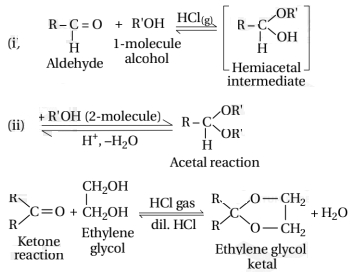
$(i)$ Hemiacetal: Aldehydes react with one equivalent of monohydric alcohol in the presence of dry hydrogen chloride to yield an alkoxyalcohol intermediate,known as a hemiacetal.
$(ii)$ Acetal: These further react with one more molecule of alcohol to give a gem-dialkoxy compound known as an acetal.
In a hemiacetal,the carbonyl carbon atom is attached to one alkoxy group and one hydroxyl group,whereas in an acetal,the carbonyl carbon atom is attached to two alkoxy groups.
$(b)$ Addition of alcohol to ketone compounds and ketal formation: Ketones react with dihydric alcohols like ethylene glycol under similar conditions to form cyclic products known as ethylene glycol ketals.
$(c)$ Dry hydrogen chloride protonates the oxygen of the carbonyl compounds,thereby increasing the electrophilicity of the carbonyl carbon and facilitating the nucleophilic attack of the alcohol.
$(d)$ Acetals and ketals are hydrolysed with aqueous mineral acids to yield the corresponding aldehydes and ketones,respectively.
$(i)$ Hemiacetal: Aldehydes react with one equivalent of monohydric alcohol in the presence of dry hydrogen chloride to yield an alkoxyalcohol intermediate,known as a hemiacetal.
$(ii)$ Acetal: These further react with one more molecule of alcohol to give a gem-dialkoxy compound known as an acetal.
In a hemiacetal,the carbonyl carbon atom is attached to one alkoxy group and one hydroxyl group,whereas in an acetal,the carbonyl carbon atom is attached to two alkoxy groups.
$(b)$ Addition of alcohol to ketone compounds and ketal formation: Ketones react with dihydric alcohols like ethylene glycol under similar conditions to form cyclic products known as ethylene glycol ketals.
$(c)$ Dry hydrogen chloride protonates the oxygen of the carbonyl compounds,thereby increasing the electrophilicity of the carbonyl carbon and facilitating the nucleophilic attack of the alcohol.
$(d)$ Acetals and ketals are hydrolysed with aqueous mineral acids to yield the corresponding aldehydes and ketones,respectively.
0 likes
View Solution1064
Medium
What is an acetal? Give examples. $OR$ Give the reaction of ethanal with $(a)$ ethanol and $(b)$ ethylene glycol in the presence of dry $HCl$ gas.
Solution
(N/A) An acetal is a gem-dialkoxy compound formed by the reaction of an aldehyde or ketone with two equivalents of a monohydric alcohol or one equivalent of a dihydric alcohol in the presence of an acid catalyst like dry $HCl$ gas.
$(i)$ Reaction of ethanal with ethanol:
$CH_3CHO + C_2H_5OH \xrightarrow{dry \ HCl} CH_3CH(OH)(OC_2H_5)$ (Hemiacetal)
$CH_3CH(OH)(OC_2H_5) + C_2H_5OH \xrightarrow{dry \ HCl} CH_3CH(OC_2H_5)_2 + H_2O$ ($1$,$1$-Diethoxyethane,an acetal)
$(ii)$ Reaction of ethanal with ethylene glycol:
$CH_3CHO + HOCH_2CH_2OH \xrightarrow{dry \ HCl} CH_3CH(O_2C_2H_4) + H_2O$ ($2$-Methyl$-1,3-$dioxolane,a cyclic acetal).
$(i)$ Reaction of ethanal with ethanol:
$CH_3CHO + C_2H_5OH \xrightarrow{dry \ HCl} CH_3CH(OH)(OC_2H_5)$ (Hemiacetal)
$CH_3CH(OH)(OC_2H_5) + C_2H_5OH \xrightarrow{dry \ HCl} CH_3CH(OC_2H_5)_2 + H_2O$ ($1$,$1$-Diethoxyethane,an acetal)
$(ii)$ Reaction of ethanal with ethylene glycol:
$CH_3CHO + HOCH_2CH_2OH \xrightarrow{dry \ HCl} CH_3CH(O_2C_2H_4) + H_2O$ ($2$-Methyl$-1,3-$dioxolane,a cyclic acetal).
0 likes
View Solution1065
Difficult
Explain the addition of ammonia and its derivatives to aldehyde and ketone compounds.
Solution
(N/A) The reaction of aldehydes and ketones with ammonia derivatives $(H_{2}N-Z)$ is a nucleophilic addition-elimination reaction.
$(1)$ Mechanism:
Nucleophiles,such as ammonia and its derivatives $(H_{2}N-Z)$,add to the carbonyl group of aldehydes and ketones. The reaction is reversible and acid-catalyzed. The equilibrium favors the product formation due to the rapid dehydration of the intermediate to form $C=N-Z$.
General reaction:
$>C=O + H_{2}N-Z \rightleftharpoons >C(OH)NHZ \xrightarrow{-H_{2}O} >C=N-Z$
$(2)$ Addition of alcohols:
Aldehydes react with one molecule of monohydric alcohol in the presence of dry $HCl$ gas to form hemiacetals,which further react with another molecule of alcohol to form acetals.
$(3)$ Cyclic ketals:
Ketones react with dihydric alcohols like ethylene glycol in the presence of dry $HCl$ gas to form cyclic products known as ethylene glycol ketals.
$(4)$ Hydrolysis:
Acetals and ketals are hydrolyzed with aqueous mineral acids to yield the corresponding aldehydes and ketones.
$(1)$ Mechanism:
Nucleophiles,such as ammonia and its derivatives $(H_{2}N-Z)$,add to the carbonyl group of aldehydes and ketones. The reaction is reversible and acid-catalyzed. The equilibrium favors the product formation due to the rapid dehydration of the intermediate to form $C=N-Z$.
General reaction:
$>C=O + H_{2}N-Z \rightleftharpoons >C(OH)NHZ \xrightarrow{-H_{2}O} >C=N-Z$
$(2)$ Addition of alcohols:
Aldehydes react with one molecule of monohydric alcohol in the presence of dry $HCl$ gas to form hemiacetals,which further react with another molecule of alcohol to form acetals.
$(3)$ Cyclic ketals:
Ketones react with dihydric alcohols like ethylene glycol in the presence of dry $HCl$ gas to form cyclic products known as ethylene glycol ketals.
$(4)$ Hydrolysis:
Acetals and ketals are hydrolyzed with aqueous mineral acids to yield the corresponding aldehydes and ketones.
0 likes
View Solution1066
Medium
Write the reduction reaction of aldehydes and ketones.
Solution
(N/A) The reduction of aldehydes and ketones to alcohols can be represented as follows:
Reduction of aldehydes to primary alcohols $(1^{\circ})$:
$R-CHO + 2[H] \rightarrow R-CH_2OH$
Reduction of ketones to secondary alcohols $(2^{\circ})$:
$R-CO-R' + 2[H] \rightarrow R-CH(OH)-R'$
Common reducing agents used include $LiAlH_4$,$NaBH_4$,or catalytic hydrogenation using $H_2/Ni$.
Reduction of aldehydes to primary alcohols $(1^{\circ})$:
$R-CHO + 2[H] \rightarrow R-CH_2OH$
Reduction of ketones to secondary alcohols $(2^{\circ})$:
$R-CO-R' + 2[H] \rightarrow R-CH(OH)-R'$
Common reducing agents used include $LiAlH_4$,$NaBH_4$,or catalytic hydrogenation using $H_2/Ni$.
0 likes
View Solution1067
Medium
Write a note on the preparation of secondary alcohols from ketones by reduction reaction.
Solution
Ketones are reduced to secondary alcohols by using reducing agents like sodium borohydride $(NaBH_{4})$ or lithium aluminium hydride $(LiAlH_{4})$,as well as by catalytic hydrogenation (e.g.,$H_{2}/Ni, H_{2}/Pt, H_{2}/Pd$).
The general reaction is:
$R-CO-R' \xrightarrow{NaBH_{4} \text{ or } LiAlH_{4} \text{ or } H_{2}/Ni} R-CH(OH)-R'$
For example,the reduction of propanone $(CH_{3}COCH_{3})$ gives propan$-2-$ol $(CH_{3}CH(OH)CH_{3})$:
$CH_{3}COCH_{3} \xrightarrow{NaBH_{4}} CH_{3}CH(OH)CH_{3}$
The general reaction is:
$R-CO-R' \xrightarrow{NaBH_{4} \text{ or } LiAlH_{4} \text{ or } H_{2}/Ni} R-CH(OH)-R'$
For example,the reduction of propanone $(CH_{3}COCH_{3})$ gives propan$-2-$ol $(CH_{3}CH(OH)CH_{3})$:
$CH_{3}COCH_{3} \xrightarrow{NaBH_{4}} CH_{3}CH(OH)CH_{3}$
0 likes
View Solution1068
Medium
Explain the preparation of hydrocarbon compounds by the Clemmensen reduction reaction.
Solution
(N/A) In the Clemmensen reduction reaction,the carbonyl group $(>C=O)$ of aldehydes and ketones is reduced to a methylene group $(-CH_{2}-)$ upon treatment with zinc amalgam $(Zn-Hg)$ and concentrated hydrochloric acid $(HCl)$.
General reaction:
$>C=O + 4[H] \xrightarrow{Zn-Hg, \text{Conc. } HCl} >CH_{2} + H_{2}O$
Examples:
$(i)$ $CH_{3}CHO + 4[H] \xrightarrow{Zn-Hg, \text{Conc. } HCl} CH_{3}CH_{3} + H_{2}O$ (Ethanal to Ethane)
(ii) $CH_{3}COCH_{3} + 4[H] \xrightarrow{Zn-Hg, \text{Conc. } HCl} CH_{3}CH_{2}CH_{3} + H_{2}O$ (Propanone to Propane)
(iii) $C_{6}H_{5}COCH_{3} + 4[H] \xrightarrow{Zn-Hg, \text{Conc. } HCl} C_{6}H_{5}CH_{2}CH_{3} + H_{2}O$ (Acetophenone to Ethylbenzene)
General reaction:
$>C=O + 4[H] \xrightarrow{Zn-Hg, \text{Conc. } HCl} >CH_{2} + H_{2}O$
Examples:
$(i)$ $CH_{3}CHO + 4[H] \xrightarrow{Zn-Hg, \text{Conc. } HCl} CH_{3}CH_{3} + H_{2}O$ (Ethanal to Ethane)
(ii) $CH_{3}COCH_{3} + 4[H] \xrightarrow{Zn-Hg, \text{Conc. } HCl} CH_{3}CH_{2}CH_{3} + H_{2}O$ (Propanone to Propane)
(iii) $C_{6}H_{5}COCH_{3} + 4[H] \xrightarrow{Zn-Hg, \text{Conc. } HCl} C_{6}H_{5}CH_{2}CH_{3} + H_{2}O$ (Acetophenone to Ethylbenzene)
0 likes
View Solution1069
Medium
Write about the Wolff-Kishner reduction reaction. Or,write the reduction reaction of aldehydes and ketones by the Wolff-Kishner reduction reaction.
Solution
(N/A) The Wolff-Kishner reduction is a chemical reaction used to reduce the carbonyl group of aldehydes and ketones to a $CH_{2}$ group.
Mechanism and Reaction:
$1$. The aldehyde or ketone is first treated with hydrazine $(NH_{2}NH_{2})$ to form a hydrazone intermediate,with the loss of a water molecule $(H_{2}O)$.
$2$. The hydrazone is then heated (at $453-473 \ K$) with a strong base like potassium hydroxide $(KOH)$ in a high-boiling solvent such as ethylene glycol.
$3$. This process results in the evolution of nitrogen gas $(N_{2})$ and the formation of the corresponding hydrocarbon.
General Reaction:
$>C=O + NH_{2}-NH_{2}$ $\xrightarrow{-H_{2}O} >C=N-NH_{2}$ $\xrightarrow{KOH, \Delta, \text{ethylene glycol}} >CH_{2} + N_{2}$
Example $1$: Reduction of acetaldehyde to ethane
$CH_{3}CHO + NH_{2}NH_{2}$ $\rightarrow CH_{3}CH=NNH_{2}$ $\xrightarrow{KOH, \text{glycol}, \Delta} CH_{3}CH_{3} + N_{2}$
Example $2$: Reduction of acetone to propane
$(CH_{3})_{2}CO + NH_{2}NH_{2}$ $\rightarrow (CH_{3})_{2}C=NNH_{2}$ $\xrightarrow{KOH, \text{glycol}, \Delta} CH_{3}CH_{2}CH_{3} + N_{2}$
Mechanism and Reaction:
$1$. The aldehyde or ketone is first treated with hydrazine $(NH_{2}NH_{2})$ to form a hydrazone intermediate,with the loss of a water molecule $(H_{2}O)$.
$2$. The hydrazone is then heated (at $453-473 \ K$) with a strong base like potassium hydroxide $(KOH)$ in a high-boiling solvent such as ethylene glycol.
$3$. This process results in the evolution of nitrogen gas $(N_{2})$ and the formation of the corresponding hydrocarbon.
General Reaction:
$>C=O + NH_{2}-NH_{2}$ $\xrightarrow{-H_{2}O} >C=N-NH_{2}$ $\xrightarrow{KOH, \Delta, \text{ethylene glycol}} >CH_{2} + N_{2}$
Example $1$: Reduction of acetaldehyde to ethane
$CH_{3}CHO + NH_{2}NH_{2}$ $\rightarrow CH_{3}CH=NNH_{2}$ $\xrightarrow{KOH, \text{glycol}, \Delta} CH_{3}CH_{3} + N_{2}$
Example $2$: Reduction of acetone to propane
$(CH_{3})_{2}CO + NH_{2}NH_{2}$ $\rightarrow (CH_{3})_{2}C=NNH_{2}$ $\xrightarrow{KOH, \text{glycol}, \Delta} CH_{3}CH_{2}CH_{3} + N_{2}$
0 likes
View Solution1070
Medium
Explain the different oxidation reactions of aldehydes and ketones.
Solution
(N/A) $1$. Oxidation of Aldehydes: Aldehydes are easily oxidized to carboxylic acids with the same number of carbon atoms using common oxidizing agents like $KMnO_4$,$K_2Cr_2O_7$,or even mild agents like $Tollens'$ reagent and $Fehling's$ solution. The reaction is: $R-CHO + [O] \rightarrow R-COOH$.
$2$. Oxidation of Ketones: Ketones are generally resistant to oxidation under normal conditions. They require strong oxidizing agents (like concentrated $HNO_3$ or $KMnO_4$ at high temperatures) and undergo cleavage of $C-C$ bonds to form a mixture of carboxylic acids with fewer carbon atoms than the original ketone. The reaction follows $Popoff's$ rule.
$2$. Oxidation of Ketones: Ketones are generally resistant to oxidation under normal conditions. They require strong oxidizing agents (like concentrated $HNO_3$ or $KMnO_4$ at high temperatures) and undergo cleavage of $C-C$ bonds to form a mixture of carboxylic acids with fewer carbon atoms than the original ketone. The reaction follows $Popoff's$ rule.
0 likes
View Solution1071
Medium
Explain the oxidation of aldehydes and ketones by strong oxidizing agents.
Solution
(N/A) Aldehydes differ from ketones in their oxidation reactions. The following reactions are used to identify aldehydes and ketones.
$(a)$ Oxidation by strong oxidizing agents:
$(i)$ Aldehyde compounds: Aldehydes are easily oxidized to carboxylic acids on treatment with common oxidizing agents like nitric acid $(HNO_3)$,potassium permanganate $(KMnO_4)$,potassium dichromate $(K_2Cr_2O_7)$,etc.
$R-CHO \xrightarrow{(O) HNO_3 / KMnO_4 / K_2Cr_2O_7} RCOOH$
In this reaction,the number of carbon atoms remains constant. The $C-H$ bond is converted to a $C-OH$ bond.
$(ii)$ Ketone compounds: Ketones are generally oxidized under vigorous conditions,i.e.,using strong oxidizing agents at elevated temperatures. Their oxidation involves carbon-carbon bond cleavage to afford a mixture of carboxylic acids having fewer carbon atoms than the parent ketone.
For example,the oxidation of an unsymmetrical ketone $R-CH_2-CO-CH_2-R'$ leads to cleavage at different positions:
$R-CH_2-CO-CH_2-R' \xrightarrow{(O) KMnO_4/HNO_3/K_2Cr_2O_7, \Delta} R-COOH + R'-CH_2COOH + R-CH_2COOH + R'-COOH$
This results in a mixture of products due to cleavage of both $C_1-C_2$ and $C_2-C_3$ bonds.
$(a)$ Oxidation by strong oxidizing agents:
$(i)$ Aldehyde compounds: Aldehydes are easily oxidized to carboxylic acids on treatment with common oxidizing agents like nitric acid $(HNO_3)$,potassium permanganate $(KMnO_4)$,potassium dichromate $(K_2Cr_2O_7)$,etc.
$R-CHO \xrightarrow{(O) HNO_3 / KMnO_4 / K_2Cr_2O_7} RCOOH$
In this reaction,the number of carbon atoms remains constant. The $C-H$ bond is converted to a $C-OH$ bond.
$(ii)$ Ketone compounds: Ketones are generally oxidized under vigorous conditions,i.e.,using strong oxidizing agents at elevated temperatures. Their oxidation involves carbon-carbon bond cleavage to afford a mixture of carboxylic acids having fewer carbon atoms than the parent ketone.
For example,the oxidation of an unsymmetrical ketone $R-CH_2-CO-CH_2-R'$ leads to cleavage at different positions:
$R-CH_2-CO-CH_2-R' \xrightarrow{(O) KMnO_4/HNO_3/K_2Cr_2O_7, \Delta} R-COOH + R'-CH_2COOH + R-CH_2COOH + R'-COOH$
This results in a mixture of products due to cleavage of both $C_1-C_2$ and $C_2-C_3$ bonds.
0 likes
View Solution1072
Difficult
Write about $(a)$ Tollen's Test and $(b)$ Fehling solution. $OR$ Write the oxidation reaction of only aldehyde. $OR$ Write tests which are utilized to differentiate aldehydes and ketones.
Solution
(A) Explanation: Oxidation of aldehyde compounds is easier than that of ketones. In this oxidation of aldehyde compounds,the conversion of $C-H$ to $C-OH$ is easily carried out. Due to this reason,the oxidation of aldehyde to acid is done with mild oxidizing agents like $Ag^{+}$,$Cu^{2+}$,etc.
Oxidation of aldehyde can be done by $(i)$ Tollen's reagent and $(ii)$ Fehling reagent,but the oxidation of ketone cannot be done under these conditions. So,for this reason,the mild oxidizing agents given below are used to distinguish aldehydes from ketones.
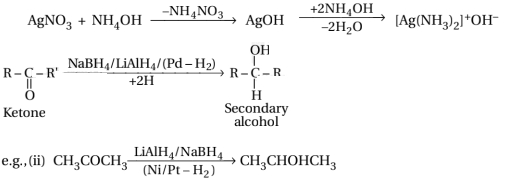
$(a)$ Tollen's test: On warming an aldehyde with freshly prepared ammoniacal silver nitrate solution (Tollen's reagent),a bright silver mirror is produced due to the formation of silver metal. The aldehydes are oxidized to the corresponding carboxylate anion. The reaction occurs in an alkaline medium.
Procedure: When aldehyde compounds are heated with Tollen's reagent in a test tube,it gives silver metal,which produces a layer on the test tube inner wall and gives a silver mirror. In this reaction,the aldehyde $(-CHO)$ group is oxidized into a negative ion,carboxylate $(-COO^{-})$,while $Ag^{+}$ is reduced to $Ag$.
This Tollen's test is also known as the silver mirror test. This test is only given by aldehydes; ketones do not give this test.
$(b)$ Fehling Test: This test is only given by aliphatic aldehydes,but ketones do not give this test.
Fehling solution: Fehling solution $A$ and Fehling solution $B$ are mixed in equal proportions.
Fehling solution $A$: It is a solution of copper sulphate $(CuSO_{4}$ solution$)$.
Fehling solution $B$: It is an alkaline solution of sodium potassium tartrate (Rochelle salt).
Oxidation of aldehyde can be done by $(i)$ Tollen's reagent and $(ii)$ Fehling reagent,but the oxidation of ketone cannot be done under these conditions. So,for this reason,the mild oxidizing agents given below are used to distinguish aldehydes from ketones.
$(a)$ Tollen's test: On warming an aldehyde with freshly prepared ammoniacal silver nitrate solution (Tollen's reagent),a bright silver mirror is produced due to the formation of silver metal. The aldehydes are oxidized to the corresponding carboxylate anion. The reaction occurs in an alkaline medium.
Procedure: When aldehyde compounds are heated with Tollen's reagent in a test tube,it gives silver metal,which produces a layer on the test tube inner wall and gives a silver mirror. In this reaction,the aldehyde $(-CHO)$ group is oxidized into a negative ion,carboxylate $(-COO^{-})$,while $Ag^{+}$ is reduced to $Ag$.
This Tollen's test is also known as the silver mirror test. This test is only given by aldehydes; ketones do not give this test.
$(b)$ Fehling Test: This test is only given by aliphatic aldehydes,but ketones do not give this test.
Fehling solution: Fehling solution $A$ and Fehling solution $B$ are mixed in equal proportions.
Fehling solution $A$: It is a solution of copper sulphate $(CuSO_{4}$ solution$)$.
Fehling solution $B$: It is an alkaline solution of sodium potassium tartrate (Rochelle salt).
0 likes
View Solution1073
Medium
Write about the oxidation reaction of methyl ketone compounds $(R-CO-CH_3)$ by the haloform reaction or write a note on the Haloform test.
Solution
(N/A) Methyl ketones $(R-CO-CH_3)$ are oxidized by sodium hypohalite $(NaOX)$ to the sodium salts of corresponding carboxylic acids having one carbon atom less than that of the carbonyl compound. The methyl group is converted to haloform $(CHX_3)$. This oxidation does not affect a carbon-carbon double bond $(C=C)$,if present in the molecule.
$R-CO-CH_3 + 3NaOX \rightarrow R-COONa + CHX_3 + 2NaOH$
The reaction proceeds in two steps:
$(i)$ $R-CO-CH_3 + 3NaOX \rightarrow R-CO-CX_3 + 3NaOH$
(ii) $R-CO-CX_3 + NaOH \rightarrow R-COONa + CHX_3$
Iodoform reaction with sodium hypoiodite $(NaOI)$ is also used for the detection of the $CH_3CO-$ group or $CH_3CH(OH)-$ group,which produces iodoform ($CHI_3$,yellow precipitate) on oxidation.
$R-CO-CH_3 + 3NaOX \rightarrow R-COONa + CHX_3 + 2NaOH$
The reaction proceeds in two steps:
$(i)$ $R-CO-CH_3 + 3NaOX \rightarrow R-CO-CX_3 + 3NaOH$
(ii) $R-CO-CX_3 + NaOH \rightarrow R-COONa + CHX_3$
Iodoform reaction with sodium hypoiodite $(NaOI)$ is also used for the detection of the $CH_3CO-$ group or $CH_3CH(OH)-$ group,which produces iodoform ($CHI_3$,yellow precipitate) on oxidation.
0 likes
View Solution1074
Medium
Explain the iodoform test.
Solution
(N/A) Aim: The iodoform test is used to identify compounds containing the $CH_3CO-$ group (methyl ketones) or compounds that can be oxidized to this group,such as $CH_3CH(OH)-$ (secondary alcohols) and ethanol.
Procedure: The compound is treated with iodine $(I_2)$ in the presence of sodium hydroxide $(NaOH)$. This generates sodium hypoiodite $(NaOI)$ in situ.
Reaction: $R-CO-CH_3 + 3I_2 + 4NaOH \rightarrow R-COONa + CHI_3 + 3NaI + 3H_2O$
Observation: The formation of a yellow precipitate of iodoform $(CHI_3)$ indicates a positive test result.
Note: Ethanol $(CH_3CH_2OH)$ also gives this test because it is oxidized to acetaldehyde $(CH_3CHO)$ by sodium hypoiodite,which then undergoes the iodoform reaction.
Procedure: The compound is treated with iodine $(I_2)$ in the presence of sodium hydroxide $(NaOH)$. This generates sodium hypoiodite $(NaOI)$ in situ.
Reaction: $R-CO-CH_3 + 3I_2 + 4NaOH \rightarrow R-COONa + CHI_3 + 3NaI + 3H_2O$
Observation: The formation of a yellow precipitate of iodoform $(CHI_3)$ indicates a positive test result.
Note: Ethanol $(CH_3CH_2OH)$ also gives this test because it is oxidized to acetaldehyde $(CH_3CHO)$ by sodium hypoiodite,which then undergoes the iodoform reaction.
0 likes
View Solution1075
Difficult
Explain aldol condensation and the acidity of the $\alpha$-carbon of aldehydes and ketones. Provide the aldol condensation reactions for $ethanal$ and $propanone$.
Solution
(N/A) $1$. $\alpha$-Acidity: The $\alpha$-hydrogen atoms in aldehydes and ketones are acidic due to the strong electron-withdrawing effect of the carbonyl group and the resonance stabilization of the resulting conjugate base (enolate ion).
$2$. Aldol Condensation: Aldehydes and ketones containing at least one $\alpha$-hydrogen undergo a reaction in the presence of dilute alkali to form $\beta$-hydroxy aldehydes (aldol) or $\beta$-hydroxy ketones (ketol).
$3$. $Ethanal$ $(CH_3CHO)$: $2CH_3CHO \xrightarrow{dil. NaOH} CH_3-CH(OH)-CH_2-CHO$ ($3$-hydroxybutanal).
$4$. $Propanone$ $(CH_3COCH_3)$: $2CH_3COCH_3 \xrightarrow{Ba(OH)_2} CH_3-C(OH)(CH_3)-CH_2-COCH_3$ ($4$-hydroxy$-4-$methylpentan$-2-$one).
$2$. Aldol Condensation: Aldehydes and ketones containing at least one $\alpha$-hydrogen undergo a reaction in the presence of dilute alkali to form $\beta$-hydroxy aldehydes (aldol) or $\beta$-hydroxy ketones (ketol).
$3$. $Ethanal$ $(CH_3CHO)$: $2CH_3CHO \xrightarrow{dil. NaOH} CH_3-CH(OH)-CH_2-CHO$ ($3$-hydroxybutanal).
$4$. $Propanone$ $(CH_3COCH_3)$: $2CH_3COCH_3 \xrightarrow{Ba(OH)_2} CH_3-C(OH)(CH_3)-CH_2-COCH_3$ ($4$-hydroxy$-4-$methylpentan$-2-$one).
0 likes
View Solution1076
Medium
Explain the statement: "The $\alpha$-hydrogen of an aldehyde and ketone is acidic."
Solution
(N/A) The $\alpha$-hydrogen of an aldehyde and ketone is acidic due to the following reasons:
$(i)$ The carbonyl group is strongly electron-withdrawing ($-I$ effect),which weakens the $C-H$ bond at the $\alpha$-position.
$(ii)$ The conjugate base formed after the removal of the $\alpha$-proton is stabilized by resonance. The negative charge on the $\alpha$-carbon is delocalized onto the electronegative oxygen atom of the carbonyl group,forming an enolate ion.
This resonance stabilization makes the $\alpha$-hydrogen atoms significantly more acidic than those in simple alkanes.
$(i)$ The carbonyl group is strongly electron-withdrawing ($-I$ effect),which weakens the $C-H$ bond at the $\alpha$-position.
$(ii)$ The conjugate base formed after the removal of the $\alpha$-proton is stabilized by resonance. The negative charge on the $\alpha$-carbon is delocalized onto the electronegative oxygen atom of the carbonyl group,forming an enolate ion.
This resonance stabilization makes the $\alpha$-hydrogen atoms significantly more acidic than those in simple alkanes.
0 likes
View Solution1077
Medium
Explain the aldol condensation reaction.
Solution
(N/A) Aldol condensation:
$(i)$ Aldehydes and ketones possessing at least one $\alpha$-hydrogen atom undergo a reaction in the presence of a dilute alkali (base) to form $\beta$-hydroxy aldehydes (aldol) or $\beta$-hydroxy ketones (ketol),respectively. This reaction is known as aldol condensation.
$(ii)$ The name 'aldol' is derived from the two functional groups present in the product: aldehyde and alcohol.
$(iii)$ Upon heating,these aldol and ketol products readily lose a water molecule to form $\alpha, \beta$-unsaturated carbonyl compounds. This overall process is also referred to as aldol condensation.
$(b)$ Example: Aldol condensation of acetaldehyde $(CH_3CHO)$:
$2CH_3CHO$ $\xrightarrow{\text{dil. NaOH}} CH_3CH(OH)CH_2CHO$ $\xrightarrow{\Delta, -H_2O} CH_3CH=CHCHO$ (But$-2-$enal).
$(c)$ Key points:
$(i)$ Only aldehydes and ketones with at least one $\alpha$-hydrogen atom undergo this reaction because $\alpha$-hydrogens are acidic in nature.
$(ii)$ Compounds like benzaldehyde $(C_6H_5CHO)$ and trimethylacetaldehyde $((CH_3)_3CCHO)$ do not possess $\alpha$-hydrogen atoms and therefore do not undergo aldol condensation.
$(i)$ Aldehydes and ketones possessing at least one $\alpha$-hydrogen atom undergo a reaction in the presence of a dilute alkali (base) to form $\beta$-hydroxy aldehydes (aldol) or $\beta$-hydroxy ketones (ketol),respectively. This reaction is known as aldol condensation.
$(ii)$ The name 'aldol' is derived from the two functional groups present in the product: aldehyde and alcohol.
$(iii)$ Upon heating,these aldol and ketol products readily lose a water molecule to form $\alpha, \beta$-unsaturated carbonyl compounds. This overall process is also referred to as aldol condensation.
$(b)$ Example: Aldol condensation of acetaldehyde $(CH_3CHO)$:
$2CH_3CHO$ $\xrightarrow{\text{dil. NaOH}} CH_3CH(OH)CH_2CHO$ $\xrightarrow{\Delta, -H_2O} CH_3CH=CHCHO$ (But$-2-$enal).
$(c)$ Key points:
$(i)$ Only aldehydes and ketones with at least one $\alpha$-hydrogen atom undergo this reaction because $\alpha$-hydrogens are acidic in nature.
$(ii)$ Compounds like benzaldehyde $(C_6H_5CHO)$ and trimethylacetaldehyde $((CH_3)_3CCHO)$ do not possess $\alpha$-hydrogen atoms and therefore do not undergo aldol condensation.
0 likes
View Solution1078
Medium
Explain the cross aldol condensation reaction.
Solution
(N/A) When an aldol condensation reaction is carried out between two different aldehyde or ketone compounds,it is known as a cross aldol condensation. If both compounds possess at least one $\alpha$-hydrogen atom,the reaction between them yields a mixture of $4$ different products.
For example,the reaction between ethanal $(CH_3CHO)$ and propanal $(CH_3CH_2CHO)$ in the presence of dilute $NaOH$ followed by heating gives the following four products:
$(i)$ Self-aldol condensation of two molecules of ethanal: $CH_3-CH=CH-CHO$ (but$-2-$enal).
$(ii)$ Self-aldol condensation of two molecules of propanal: $CH_3CH_2-CH=C(CH_3)-CHO$ ($2$-methylpent$-2-$enal).
$(iii)$ Cross-aldol condensation where the $\alpha$-hydrogen of propanal reacts with the carbonyl oxygen of ethanal: $CH_3-CH=C(CH_3)-CHO$ ($2$-methylbut$-2-$enal).
$(iv)$ Cross-aldol condensation where the $\alpha$-hydrogen of ethanal reacts with the carbonyl oxygen of propanal: $CH_3CH_2-CH=CH-CHO$ (pent$-2-$enal).
The acidity of $\alpha$-hydrogen is due to the strong electron-withdrawing effect of the carbonyl group and the resonance stabilization of the resulting enolate ion (conjugated base).
For example,the reaction between ethanal $(CH_3CHO)$ and propanal $(CH_3CH_2CHO)$ in the presence of dilute $NaOH$ followed by heating gives the following four products:
$(i)$ Self-aldol condensation of two molecules of ethanal: $CH_3-CH=CH-CHO$ (but$-2-$enal).
$(ii)$ Self-aldol condensation of two molecules of propanal: $CH_3CH_2-CH=C(CH_3)-CHO$ ($2$-methylpent$-2-$enal).
$(iii)$ Cross-aldol condensation where the $\alpha$-hydrogen of propanal reacts with the carbonyl oxygen of ethanal: $CH_3-CH=C(CH_3)-CHO$ ($2$-methylbut$-2-$enal).
$(iv)$ Cross-aldol condensation where the $\alpha$-hydrogen of ethanal reacts with the carbonyl oxygen of propanal: $CH_3CH_2-CH=CH-CHO$ (pent$-2-$enal).
The acidity of $\alpha$-hydrogen is due to the strong electron-withdrawing effect of the carbonyl group and the resonance stabilization of the resulting enolate ion (conjugated base).
0 likes
View Solution1079
Medium
Explain the Cannizzaro reaction.
Solution
(N/A) The Cannizzaro reaction is a chemical reaction in which two molecules of an aldehyde that lack $\alpha-$hydrogen atoms are heated with a strong base. This process involves self-oxidation and reduction (disproportionation),where one molecule is reduced to an alcohol and another is oxidized to a salt of a carboxylic acid.
$(a)$ Cannizzaro reaction of formaldehyde:
Two molecules of formaldehyde $(HCHO)$ react with concentrated $KOH$ upon heating to produce methanol $(CH_3OH)$ and potassium formate $(HCOOK)$.
$(b)$ Cannizzaro reaction of benzaldehyde:
Benzaldehyde lacks $\alpha-$hydrogen. When heated with concentrated $NaOH$,it undergoes the Cannizzaro reaction,where one molecule of benzaldehyde is reduced to benzyl alcohol $(C_6H_5CH_2OH)$ and another is oxidized to sodium benzoate $(C_6H_5COONa)$.
$(a)$ Cannizzaro reaction of formaldehyde:
Two molecules of formaldehyde $(HCHO)$ react with concentrated $KOH$ upon heating to produce methanol $(CH_3OH)$ and potassium formate $(HCOOK)$.
$(b)$ Cannizzaro reaction of benzaldehyde:
Benzaldehyde lacks $\alpha-$hydrogen. When heated with concentrated $NaOH$,it undergoes the Cannizzaro reaction,where one molecule of benzaldehyde is reduced to benzyl alcohol $(C_6H_5CH_2OH)$ and another is oxidized to sodium benzoate $(C_6H_5COONa)$.
0 likes
View Solution1080
Difficult
Write a note on the electrophilic substitution reaction of aromatic aldehydes and ketones.
Solution
(N/A) Aromatic aldehydes and ketones undergo electrophilic substitution reactions in their benzene rings.
The carbonyl group ($-CHO$ or $-COCH_3$) present in these compounds is electron-withdrawing in nature due to the $-I$ and $-M$ effects.
Consequently,these groups are meta-directing and deactivate the ring towards electrophilic attack.
Examples include:
$1$. Nitration of benzaldehyde gives $m$-nitrobenzaldehyde.
$2$. Sulphonation of benzaldehyde gives $m$-benzaldehyde sulphonic acid.
$3$. Bromination,nitration,and sulphonation of acetophenone yield the corresponding $m$-substituted products.
The carbonyl group ($-CHO$ or $-COCH_3$) present in these compounds is electron-withdrawing in nature due to the $-I$ and $-M$ effects.
Consequently,these groups are meta-directing and deactivate the ring towards electrophilic attack.
Examples include:
$1$. Nitration of benzaldehyde gives $m$-nitrobenzaldehyde.
$2$. Sulphonation of benzaldehyde gives $m$-benzaldehyde sulphonic acid.
$3$. Bromination,nitration,and sulphonation of acetophenone yield the corresponding $m$-substituted products.
0 likes
View Solution1081
Difficult
$A$ compound $(X)$ possesses a smell like bitter almond.
$(i)$ It does not give the Fehling test.
$(ii)$ It gives the silver mirror test.
$(iii)$ Compound $(X)$ gives orange precipitates of benzaldehyde $2,4-$dinitrophenylhydrazone with $2,4-DNP$.
Identify compound $(X)$ and provide its chemical reactions.
$(i)$ It does not give the Fehling test.
$(ii)$ It gives the silver mirror test.
$(iii)$ Compound $(X)$ gives orange precipitates of benzaldehyde $2,4-$dinitrophenylhydrazone with $2,4-DNP$.
Identify compound $(X)$ and provide its chemical reactions.
Solution
(N/A) $(i)$ Compound $(X)$ does not give the Fehling test,which indicates it is not an aliphatic aldehyde; it is likely benzaldehyde.
$(ii)$ Compound $(X)$ gives the silver mirror test,confirming the presence of an aldehyde group. Combining $(i)$ and $(ii)$,we conclude $(X)$ is benzaldehyde.
$(iii)$ The formation of orange precipitates of benzaldehyde $2,4-$dinitrophenylhydrazone with $2,4-DNP$ confirms that $(X)$ is benzaldehyde.
Chemical Reactions:
$(i)$ Reaction with Tollen's reagent (Silver mirror test):
$C_6H_5CHO + 2[Ag(NH_3)_2]^+ + 3OH^{-} \longrightarrow C_6H_5COO^{-} + 2Ag(s) + 4NH_3 + 2H_2O$
$(ii)$ Reaction with $2,4-DNP$:
$C_6H_5CHO + (NO_2)_2C_6H_3NHNH_2 \xrightarrow{H^+} C_6H_5CH=NNHC_6H_3(NO_2)_2 + H_2O$
$(ii)$ Compound $(X)$ gives the silver mirror test,confirming the presence of an aldehyde group. Combining $(i)$ and $(ii)$,we conclude $(X)$ is benzaldehyde.
$(iii)$ The formation of orange precipitates of benzaldehyde $2,4-$dinitrophenylhydrazone with $2,4-DNP$ confirms that $(X)$ is benzaldehyde.
Chemical Reactions:
$(i)$ Reaction with Tollen's reagent (Silver mirror test):
$C_6H_5CHO + 2[Ag(NH_3)_2]^+ + 3OH^{-} \longrightarrow C_6H_5COO^{-} + 2Ag(s) + 4NH_3 + 2H_2O$
$(ii)$ Reaction with $2,4-DNP$:
$C_6H_5CHO + (NO_2)_2C_6H_3NHNH_2 \xrightarrow{H^+} C_6H_5CH=NNHC_6H_3(NO_2)_2 + H_2O$
0 likes
View Solution1082
Medium
Give the chemical conversions for the following:
$(i)$ $2-$Hydroxy$-2-$methylpropanoic acid from acetone
$(ii)$ Ethane from ethanol
$(i)$ $2-$Hydroxy$-2-$methylpropanoic acid from acetone
$(ii)$ Ethane from ethanol
Solution
(N/A) $(i)$ Conversion of acetone to $2-$hydroxy$-2-$methylpropanoic acid:
Acetone $(CH_3COCH_3)$ reacts with $HCN$ in the presence of $OH^-$ to form acetone cyanohydrin. This cyanohydrin is then hydrolyzed with $H_2O/H^+$ to yield $2-$hydroxy$-2-$methylpropanoic acid.
$CH_3COCH_3 + HCN$ $\xrightarrow{OH^-} CH_3C(OH)(CN)CH_3$ $\xrightarrow{H_3O^+} CH_3C(OH)(COOH)CH_3$
$(ii)$ Conversion of ethanol to ethane:
Ethanol $(CH_3CH_2OH)$ is first oxidized to ethanal $(CH_3CHO)$ using $PCC$ or $Cu/573K$. Then,ethanal undergoes Wolff-Kishner reduction using hydrazine $(NH_2NH_2)$ and $KOH$ in ethylene glycol to produce ethane $(CH_3CH_3)$.
$CH_3CH_2OH$ $\xrightarrow{[O]} CH_3CHO$ $\xrightarrow{NH_2NH_2, KOH, \Delta} CH_3CH_3$
Acetone $(CH_3COCH_3)$ reacts with $HCN$ in the presence of $OH^-$ to form acetone cyanohydrin. This cyanohydrin is then hydrolyzed with $H_2O/H^+$ to yield $2-$hydroxy$-2-$methylpropanoic acid.
$CH_3COCH_3 + HCN$ $\xrightarrow{OH^-} CH_3C(OH)(CN)CH_3$ $\xrightarrow{H_3O^+} CH_3C(OH)(COOH)CH_3$
$(ii)$ Conversion of ethanol to ethane:
Ethanol $(CH_3CH_2OH)$ is first oxidized to ethanal $(CH_3CHO)$ using $PCC$ or $Cu/573K$. Then,ethanal undergoes Wolff-Kishner reduction using hydrazine $(NH_2NH_2)$ and $KOH$ in ethylene glycol to produce ethane $(CH_3CH_3)$.
$CH_3CH_2OH$ $\xrightarrow{[O]} CH_3CHO$ $\xrightarrow{NH_2NH_2, KOH, \Delta} CH_3CH_3$
0 likes
View Solution1083
Medium
Give the conversion of the following:
$(i)$ $but-2-enal$ from $ethanal$
$(ii)$ $Methyl$ $benzoate$ from $benzaldehyde$
$(i)$ $but-2-enal$ from $ethanal$
$(ii)$ $Methyl$ $benzoate$ from $benzaldehyde$
Solution
(N/A) $(i)$ $But-2-enal$ from $ethanal$:
$2CH_3CHO$ $\xrightarrow{dil. NaOH} CH_3-CH(OH)-CH_2-CHO$ $\xrightarrow{\Delta, -H_2O} CH_3-CH=CH-CHO$
$Ethanal$ undergoes aldol condensation in the presence of dilute $NaOH$ to form $3-hydroxybutanal$ (aldol),which upon heating loses a water molecule to form $but-2-enal$.
$(ii)$ $Methyl$ $benzoate$ from $benzaldehyde$:
$C_6H_5CHO$ $\xrightarrow{[O]} C_6H_5COOH$ $\xrightarrow{CH_3OH, conc. H_2SO_4, \Delta} C_6H_5COOCH_3$
$Benzaldehyde$ is first oxidized to $benzoic$ $acid$ using an oxidizing agent like $KMnO_4$ or $Tollens'$ reagent. Then,$benzoic$ $acid$ undergoes Fischer esterification with $methanol$ in the presence of concentrated $H_2SO_4$ to yield $methyl$ $benzoate$.
$2CH_3CHO$ $\xrightarrow{dil. NaOH} CH_3-CH(OH)-CH_2-CHO$ $\xrightarrow{\Delta, -H_2O} CH_3-CH=CH-CHO$
$Ethanal$ undergoes aldol condensation in the presence of dilute $NaOH$ to form $3-hydroxybutanal$ (aldol),which upon heating loses a water molecule to form $but-2-enal$.
$(ii)$ $Methyl$ $benzoate$ from $benzaldehyde$:
$C_6H_5CHO$ $\xrightarrow{[O]} C_6H_5COOH$ $\xrightarrow{CH_3OH, conc. H_2SO_4, \Delta} C_6H_5COOCH_3$
$Benzaldehyde$ is first oxidized to $benzoic$ $acid$ using an oxidizing agent like $KMnO_4$ or $Tollens'$ reagent. Then,$benzoic$ $acid$ undergoes Fischer esterification with $methanol$ in the presence of concentrated $H_2SO_4$ to yield $methyl$ $benzoate$.
0 likes
View Solution1084
Medium
Give the conversion of the following:
$(i)$ Benzoic acid from Bromobenzene
(ii) $2$-methylbutan-$2$-ol from Propenone
$(i)$ Benzoic acid from Bromobenzene
(ii) $2$-methylbutan-$2$-ol from Propenone
Solution
(N/A) $(i)$ Conversion of Bromobenzene to Benzoic acid:
$1$. Bromobenzene reacts with $Mg$ in the presence of dry ether to form Phenylmagnesium bromide $(C_6H_5MgBr)$.
$2$. $C_6H_5MgBr$ reacts with $CO_2$ followed by acidic hydrolysis to form Benzoic acid $(C_6H_5COOH)$.
(ii) Conversion of Propenone (Acetone) to $2$-methylbutan-$2$-ol:
$1$. Propenone $(CH_3COCH_3)$ reacts with Ethylmagnesium bromide $(CH_3CH_2MgBr)$ in the presence of dry ether.
$2$. This forms an addition product which,upon acidic hydrolysis,yields $2$-methylbutan-$2$-ol $(CH_3CH_2C(OH)(CH_3)_2)$.
$1$. Bromobenzene reacts with $Mg$ in the presence of dry ether to form Phenylmagnesium bromide $(C_6H_5MgBr)$.
$2$. $C_6H_5MgBr$ reacts with $CO_2$ followed by acidic hydrolysis to form Benzoic acid $(C_6H_5COOH)$.
(ii) Conversion of Propenone (Acetone) to $2$-methylbutan-$2$-ol:
$1$. Propenone $(CH_3COCH_3)$ reacts with Ethylmagnesium bromide $(CH_3CH_2MgBr)$ in the presence of dry ether.
$2$. This forms an addition product which,upon acidic hydrolysis,yields $2$-methylbutan-$2$-ol $(CH_3CH_2C(OH)(CH_3)_2)$.
0 likes
View Solution1085
Difficult
Provide the conversion for the following:
$(i)$ Formaldehyde to Butan$-1-$ol
$(ii)$ $1-$Bromopropan$-2-$one from Isopropyl alcohol
$(i)$ Formaldehyde to Butan$-1-$ol
$(ii)$ $1-$Bromopropan$-2-$one from Isopropyl alcohol
Solution
(N/A) $(i)$ Formaldehyde $(HCHO)$ reacts with propylmagnesium bromide $(CH_3CH_2CH_2MgBr)$ in the presence of dry ether to form an addition product,which upon hydrolysis yields butan$-1-$ol $(CH_3CH_2CH_2CH_2OH)$.
$(ii)$ Isopropyl alcohol $(CH_3CH(OH)CH_3)$ is oxidized using $CrO_3$ or $Cu$ at $573 \ K$ to form acetone $(CH_3COCH_3)$. Acetone then undergoes $\alpha-$bromination with $Br_2$ to yield $1-$bromopropan$-2-$one $(BrCH_2COCH_3)$.
$(ii)$ Isopropyl alcohol $(CH_3CH(OH)CH_3)$ is oxidized using $CrO_3$ or $Cu$ at $573 \ K$ to form acetone $(CH_3COCH_3)$. Acetone then undergoes $\alpha-$bromination with $Br_2$ to yield $1-$bromopropan$-2-$one $(BrCH_2COCH_3)$.
0 likes
View Solution1086
Difficult
Give the conversion of the following:
$(i)$ $\text{Pent-3-en-2-one}$ from $\text{Ethanal}$
$(ii)$ $\text{Pent-2-enal}$ from $\text{Ethanal}$
$(i)$ $\text{Pent-3-en-2-one}$ from $\text{Ethanal}$
$(ii)$ $\text{Pent-2-enal}$ from $\text{Ethanal}$
Solution
(N/A) $(i)$ $\text{Conversion of Ethanal to Pent-3-en-2-one}$:
$\text{Ethanal } (CH_3CHO) \text{ reacts with Propanone } (CH_3COCH_3) \text{ in the presence of dilute } NaOH \text{ (Cross-Aldol condensation) to form 4-hydroxypentan-2-one.}$
$CH_3CHO + CH_3COCH_3 \xrightarrow{\text{dil. } NaOH} CH_3CH(OH)CH_2COCH_3$
$\text{Dehydration of 4-hydroxypentan-2-one by heating gives Pent-3-en-2-one.}$
$CH_3CH(OH)CH_2COCH_3 \xrightarrow{\Delta, -H_2O} CH_3CH=CHCOCH_3$
$(ii)$ $\text{Conversion of Ethanal to Pent-2-enal}$:
$\text{Ethanal } (CH_3CHO) \text{ undergoes Cross-Aldol condensation with Propanal } (CH_3CH_2CHO) \text{ in the presence of dilute } NaOH \text{ to form 3-hydroxypentanal.}$
$CH_3CH_2CHO + CH_3CHO \xrightarrow{\text{dil. } NaOH} CH_3CH_2CH(OH)CH_2CHO$
$\text{Dehydration of 3-hydroxypentanal by heating gives Pent-2-enal.}$
$CH_3CH_2CH(OH)CH_2CHO \xrightarrow{\Delta, -H_2O} CH_3CH_2CH=CHCHO$
$\text{Ethanal } (CH_3CHO) \text{ reacts with Propanone } (CH_3COCH_3) \text{ in the presence of dilute } NaOH \text{ (Cross-Aldol condensation) to form 4-hydroxypentan-2-one.}$
$CH_3CHO + CH_3COCH_3 \xrightarrow{\text{dil. } NaOH} CH_3CH(OH)CH_2COCH_3$
$\text{Dehydration of 4-hydroxypentan-2-one by heating gives Pent-3-en-2-one.}$
$CH_3CH(OH)CH_2COCH_3 \xrightarrow{\Delta, -H_2O} CH_3CH=CHCOCH_3$
$(ii)$ $\text{Conversion of Ethanal to Pent-2-enal}$:
$\text{Ethanal } (CH_3CHO) \text{ undergoes Cross-Aldol condensation with Propanal } (CH_3CH_2CHO) \text{ in the presence of dilute } NaOH \text{ to form 3-hydroxypentanal.}$
$CH_3CH_2CHO + CH_3CHO \xrightarrow{\text{dil. } NaOH} CH_3CH_2CH(OH)CH_2CHO$
$\text{Dehydration of 3-hydroxypentanal by heating gives Pent-2-enal.}$
$CH_3CH_2CH(OH)CH_2CHO \xrightarrow{\Delta, -H_2O} CH_3CH_2CH=CHCHO$
0 likes
View Solution1087
Medium
Provide the chemical conversion for the following:
$(i)$ $3-$phenylprop$-2-$enal from Benzaldehyde and Ethanal (Cross-Aldol Condensation).
$(ii)$ Benzyl alcohol from Benzene.
$(i)$ $3-$phenylprop$-2-$enal from Benzaldehyde and Ethanal (Cross-Aldol Condensation).
$(ii)$ Benzyl alcohol from Benzene.
Solution
(N/A) $(i)$ $3-$phenylprop$-2-$enal is prepared by the cross-aldol condensation of Benzaldehyde $(C_6H_5CHO)$ and Ethanal $(CH_3CHO)$ in the presence of dilute $NaOH$ followed by dehydration.
$C_6H_5CHO + CH_3CHO$ $\xrightarrow{\text{dil. } NaOH} C_6H_5CH(OH)CH_2CHO$ $\xrightarrow{\Delta, -H_2O} C_6H_5CH=CHCHO$
$(ii)$ Benzyl alcohol is prepared from Benzene in two steps:
$1.$ Gattermann-Koch reaction of Benzene with $CO$ and $HCl$ in the presence of anhydrous $AlCl_3$ and $CuCl$ to form Benzaldehyde.
$2.$ Cannizzaro reaction of Benzaldehyde with concentrated $NaOH$ to form Benzyl alcohol and Sodium benzoate.
$C_6H_6$ $\xrightarrow{CO, HCl, \text{anhydrous } AlCl_3, CuCl} C_6H_5CHO$ $\xrightarrow{\text{conc. } NaOH, \Delta} C_6H_5CH_2OH + C_6H_5COONa$
$C_6H_5CHO + CH_3CHO$ $\xrightarrow{\text{dil. } NaOH} C_6H_5CH(OH)CH_2CHO$ $\xrightarrow{\Delta, -H_2O} C_6H_5CH=CHCHO$
$(ii)$ Benzyl alcohol is prepared from Benzene in two steps:
$1.$ Gattermann-Koch reaction of Benzene with $CO$ and $HCl$ in the presence of anhydrous $AlCl_3$ and $CuCl$ to form Benzaldehyde.
$2.$ Cannizzaro reaction of Benzaldehyde with concentrated $NaOH$ to form Benzyl alcohol and Sodium benzoate.
$C_6H_6$ $\xrightarrow{CO, HCl, \text{anhydrous } AlCl_3, CuCl} C_6H_5CHO$ $\xrightarrow{\text{conc. } NaOH, \Delta} C_6H_5CH_2OH + C_6H_5COONa$
0 likes
View Solution1088
Medium
Why is there a large difference in the boiling points of butanal and butan$-1-$ol?
Solution
The boiling point of butan$-1-$ol is significantly higher than that of butanal because butan$-1-$ol molecules are associated through intermolecular hydrogen bonding.
In contrast,butanal molecules are held together only by weak dipole-dipole interactions.
This strong intermolecular hydrogen bonding in alcohols requires more energy to break,resulting in a higher boiling point compared to aldehydes of similar molecular mass.
In contrast,butanal molecules are held together only by weak dipole-dipole interactions.
This strong intermolecular hydrogen bonding in alcohols requires more energy to break,resulting in a higher boiling point compared to aldehydes of similar molecular mass.
0 likes
View Solution1089
Medium
Write a test to differentiate between pentan$-2-$one and pentan$-3-$one.
Solution
Pentan$-2-$one contains a $CH_3CO-$ group,therefore it gives a positive iodoform test with $I_2/NaOH$,forming a yellow precipitate of iodoform $(CHI_3)$.
Pentan$-3-$one does not contain a $CH_3CO-$ group,therefore it does not give a positive iodoform test.
Reaction:
$CH_3CH_2CH_2COCH_3 + 3I_2 + 4NaOH \rightarrow CH_3CH_2CH_2COONa + CHI_3 \text{ (yellow ppt)} + 3NaI + 3H_2O$
$CH_3CH_2COCH_2CH_3 + I_2/NaOH \rightarrow \text{No reaction}$
Pentan$-3-$one does not contain a $CH_3CO-$ group,therefore it does not give a positive iodoform test.
Reaction:
$CH_3CH_2CH_2COCH_3 + 3I_2 + 4NaOH \rightarrow CH_3CH_2CH_2COONa + CHI_3 \text{ (yellow ppt)} + 3NaI + 3H_2O$
$CH_3CH_2COCH_2CH_3 + I_2/NaOH \rightarrow \text{No reaction}$
0 likes
View Solution1090
Medium
Oxidation of ketones involves carbon-carbon bond cleavage. Name the products formed on the oxidation of $2,5-$dimethylhexan$-3-$one.
Solution
(N/A) According to Popoff's rule,the oxidation of an unsymmetrical ketone occurs by the cleavage of the $C-C$ bond on either side of the carbonyl group,such that the smaller alkyl group stays with the carbonyl carbon.
For $2,5-$dimethylhexan$-3-$one $(CH_3-CH(CH_3)-CO-CH_2-CH(CH_3)-CH_3)$,cleavage can occur in two ways:
$1$. Cleavage between $C_2$ and $C_3$: This yields $2-$methylpropanoic acid $(CH_3-CH(CH_3)-COOH)$ and $2-$methylpropanoic acid $(CH_3-CH(CH_3)-COOH)$.
$2$. Cleavage between $C_3$ and $C_4$: This yields $3-$methylbutanoic acid $(CH_3-CH(CH_3)-CH_2-COOH)$ and propan$-2-$one $(CH_3-CO-CH_3)$.
Propan$-2-$one can undergo further oxidation to form ethanoic acid $(CH_3COOH)$ and methanoic acid $(HCOOH)$,which eventually oxidizes to $CO_2$ and $H_2O$.
For $2,5-$dimethylhexan$-3-$one $(CH_3-CH(CH_3)-CO-CH_2-CH(CH_3)-CH_3)$,cleavage can occur in two ways:
$1$. Cleavage between $C_2$ and $C_3$: This yields $2-$methylpropanoic acid $(CH_3-CH(CH_3)-COOH)$ and $2-$methylpropanoic acid $(CH_3-CH(CH_3)-COOH)$.
$2$. Cleavage between $C_3$ and $C_4$: This yields $3-$methylbutanoic acid $(CH_3-CH(CH_3)-CH_2-COOH)$ and propan$-2-$one $(CH_3-CO-CH_3)$.
Propan$-2-$one can undergo further oxidation to form ethanoic acid $(CH_3COOH)$ and methanoic acid $(HCOOH)$,which eventually oxidizes to $CO_2$ and $H_2O$.
0 likes
View Solution1091
Medium
What products are formed on the reaction of $Propanal$ with $2-Methylpropanal$ in the presence of $NaOH$? Write the name of the reaction.
Solution
(N/A) The reaction between $Propanal$ $(CH_3CH_2CHO)$ and $2-Methylpropanal$ $((CH_3)_2CHCHO)$ in the presence of dilute $NaOH$ is a $Cross-Aldol$ $Condensation$ reaction.
Since both aldehydes contain $\alpha$-hydrogens,a mixture of four different $\beta-hydroxy$ aldehydes (aldols) is formed:
$1$. Self-aldol condensation of $Propanal$: $3-hydroxy-2-methylpentanal$.
$2$. Self-aldol condensation of $2-Methylpropanal$: $3-hydroxy-2,2,4-trimethylpentanal$.
$3$. Cross-aldol condensation ($Propanal$ as nucleophile,$2-Methylpropanal$ as electrophile): $3-hydroxy-2,4-dimethylpentanal$.
$4$. Cross-aldol condensation ($2-Methylpropanal$ as nucleophile,$Propanal$ as electrophile): $3-hydroxy-2,2-dimethylpentanal$.
The reaction is known as $Cross-Aldol$ $Condensation$.
Since both aldehydes contain $\alpha$-hydrogens,a mixture of four different $\beta-hydroxy$ aldehydes (aldols) is formed:
$1$. Self-aldol condensation of $Propanal$: $3-hydroxy-2-methylpentanal$.
$2$. Self-aldol condensation of $2-Methylpropanal$: $3-hydroxy-2,2,4-trimethylpentanal$.
$3$. Cross-aldol condensation ($Propanal$ as nucleophile,$2-Methylpropanal$ as electrophile): $3-hydroxy-2,4-dimethylpentanal$.
$4$. Cross-aldol condensation ($2-Methylpropanal$ as nucleophile,$Propanal$ as electrophile): $3-hydroxy-2,2-dimethylpentanal$.
The reaction is known as $Cross-Aldol$ $Condensation$.
0 likes
View Solution1092
Medium
Match the reactions given in Column-$I$ with the suitable reagents given in Column-$II$.
| Column-$I$ (Reactions) | Column-$II$ (Reagents) |
|---|---|
| $(A).$ Benzophenone $\to$ Diphenylmethane | $(1).$ $LiAlH_4$ |
| $(B).$ Benzaldehyde $\to$ $1-$Phenylethanol | $(2).$ $DiBAL-H$ |
| $(C).$ Cyclohexanone $\to$ Cyclohexanol | $(3).$ $Zn(Hg) / \text{Conc. } HCl$ |
| $(D).$ Phenyl benzoate $\to$ Benzaldehyde | $(4).$ $CH_3MgBr$ |
Solution
(A-3, B-4, C-1, D-2) $(A)-3, (B)-4, (C)-1, (D)-2$
Step-by-step explanation:
$(A).$ Benzophenone $(Ph_2C=O)$ is reduced to Diphenylmethane $(Ph_2CH_2)$ using Clemmensen reduction,which uses $Zn(Hg) / \text{Conc. } HCl$ (Reagent $3$).
$(B).$ Benzaldehyde $(PhCHO)$ reacts with Grignard reagent $CH_3MgBr$ (Reagent $4$) followed by hydrolysis to form $1-$Phenylethanol $(PhCH(OH)CH_3)$.
$(C).$ Cyclohexanone is reduced to Cyclohexanol using $LiAlH_4$ (Reagent $1$).
$(D).$ Phenyl benzoate is reduced to Benzaldehyde using $DiBAL-H$ (Reagent $2$).
Step-by-step explanation:
$(A).$ Benzophenone $(Ph_2C=O)$ is reduced to Diphenylmethane $(Ph_2CH_2)$ using Clemmensen reduction,which uses $Zn(Hg) / \text{Conc. } HCl$ (Reagent $3$).
$(B).$ Benzaldehyde $(PhCHO)$ reacts with Grignard reagent $CH_3MgBr$ (Reagent $4$) followed by hydrolysis to form $1-$Phenylethanol $(PhCH(OH)CH_3)$.
$(C).$ Cyclohexanone is reduced to Cyclohexanol using $LiAlH_4$ (Reagent $1$).
$(D).$ Phenyl benzoate is reduced to Benzaldehyde using $DiBAL-H$ (Reagent $2$).
0 likes
View Solution1093
Medium
Match the example given in Column-$I$ with the name of the reaction in Column-$II$.
| Column-$I$ (Example) | Column-$II$ (Reaction) |
|---|---|
| $(A)$ $CH_3COCl + H_2 \xrightarrow{Pd-C/BaSO_4} CH_3CHO$ | $(1)$ Friedel-Crafts acylation |
| $(B)$ $C_6H_5CHO \xrightarrow{NaOH} C_6H_5CH_2OH + C_6H_5COONa$ | $(2)$ $HVZ$ reaction |
| $(C)$ $C_6H_6 + CH_3COCl \xrightarrow{AlCl_3} C_6H_5COCH_3$ | $(3)$ Aldol condensation |
| $(D)$ $R-CH_2COOH \xrightarrow{Br_2/Red P} R-CH(Br)COOH$ | $(4)$ Cannizzaro's reaction |
| $(E)$ $CH_3-CN \xrightarrow{SnCl_2/HCl, H_2O/H^+} CH_3-CHO$ | $(5)$ Rosenmund's reduction |
| $(F)$ $2CH_3CHO \xrightarrow{NaOH} CH_3-CH=CH-CHO$ | $(6)$ Stephen's reaction |
Solution
(A-5, B-4, C-1, D-2, E-6, F-3) The correct matches are as follows:
$(A)$ $CH_3COCl + H_2 \xrightarrow{Pd-C/BaSO_4} CH_3CHO$ is Rosenmund's reduction $(5)$.
$(B)$ $C_6H_5CHO \xrightarrow{NaOH} C_6H_5CH_2OH + C_6H_5COONa$ is Cannizzaro's reaction $(4)$.
$(C)$ $C_6H_6 + CH_3COCl \xrightarrow{AlCl_3} C_6H_5COCH_3$ is Friedel-Crafts acylation $(1)$.
$(D)$ $R-CH_2COOH \xrightarrow{Br_2/Red P} R-CH(Br)COOH$ is $HVZ$ reaction $(2)$.
$(E)$ $CH_3-CN \xrightarrow{SnCl_2/HCl, H_2O/H^+} CH_3-CHO$ is Stephen's reaction $(6)$.
$(F)$ $2CH_3CHO \xrightarrow{NaOH} CH_3-CH=CH-CHO$ is Aldol condensation $(3)$.
Therefore,the correct matching is: $A-5, B-4, C-1, D-2, E-6, F-3$.
$(A)$ $CH_3COCl + H_2 \xrightarrow{Pd-C/BaSO_4} CH_3CHO$ is Rosenmund's reduction $(5)$.
$(B)$ $C_6H_5CHO \xrightarrow{NaOH} C_6H_5CH_2OH + C_6H_5COONa$ is Cannizzaro's reaction $(4)$.
$(C)$ $C_6H_6 + CH_3COCl \xrightarrow{AlCl_3} C_6H_5COCH_3$ is Friedel-Crafts acylation $(1)$.
$(D)$ $R-CH_2COOH \xrightarrow{Br_2/Red P} R-CH(Br)COOH$ is $HVZ$ reaction $(2)$.
$(E)$ $CH_3-CN \xrightarrow{SnCl_2/HCl, H_2O/H^+} CH_3-CHO$ is Stephen's reaction $(6)$.
$(F)$ $2CH_3CHO \xrightarrow{NaOH} CH_3-CH=CH-CHO$ is Aldol condensation $(3)$.
Therefore,the correct matching is: $A-5, B-4, C-1, D-2, E-6, F-3$.
0 likes
View Solution1094
Difficult
An aromatic compound $A$ (Molecular formula $C_{8}H_{8}O$) gives a positive $2,4-DNP$ test. It gives a yellow precipitate of compound $B$ on treatment with iodine and sodium hydroxide solution. Compound $A$ does not give Tollen's or Fehling's test. On drastic oxidation with potassium permanganate,it forms a carboxylic acid $C$ (Molecular formula $C_{7}H_{6}O_{2}$),which is also formed along with the yellow compound in the above reaction. Identify $A, B$ and $C$ and write all the reactions involved.
Solution
(A) $1$. Compound $A$ has the molecular formula $C_{8}H_{8}O$. Since it gives a positive $2,4-DNP$ test,it contains a carbonyl group (aldehyde or ketone).
$2$. It does not give Tollen's or Fehling's test,which confirms that $A$ is a ketone.
$3$. It gives a yellow precipitate with $I_{2}/NaOH$ (iodoform test),indicating the presence of a $CH_{3}CO-$ group.
$4$. The compound $A$ is acetophenone $(C_{6}H_{5}COCH_{3})$.
$5$. Reaction with $I_{2}/NaOH$ gives iodoform ($CHI_{3}$,compound $B$) and sodium benzoate,which upon acidification gives benzoic acid ($C_{6}H_{5}COOH$,compound $C$).
$6$. Oxidation of acetophenone with $KMnO_{4}$ also yields benzoic acid $(C)$.
Reactions:
- $2,4-DNP$ test: $C_{6}H_{5}COCH_{3} + 2,4-(NO_{2})_{2}C_{6}H_{3}NHNH_{2}$ $\rightarrow C_{6}H_{5}C(CH_{3})=NNHC_{6}H_{3}(NO_{2})_{2} + H_{2}O$
- Iodoform test: $C_{6}H_{5}COCH_{3} + 3I_{2} + 4NaOH \rightarrow C_{6}H_{5}COONa + CHI_{3} + 3NaI + 3H_{2}O$. Acidification of $C_{6}H_{5}COONa$ gives $C_{6}H_{5}COOH$ $(C)$.
- Oxidation: $C_{6}H_{5}COCH_{3} + [O] \xrightarrow{KMnO_{4}} C_{6}H_{5}COOH$ $(C)$.
$2$. It does not give Tollen's or Fehling's test,which confirms that $A$ is a ketone.
$3$. It gives a yellow precipitate with $I_{2}/NaOH$ (iodoform test),indicating the presence of a $CH_{3}CO-$ group.
$4$. The compound $A$ is acetophenone $(C_{6}H_{5}COCH_{3})$.
$5$. Reaction with $I_{2}/NaOH$ gives iodoform ($CHI_{3}$,compound $B$) and sodium benzoate,which upon acidification gives benzoic acid ($C_{6}H_{5}COOH$,compound $C$).
$6$. Oxidation of acetophenone with $KMnO_{4}$ also yields benzoic acid $(C)$.
Reactions:
- $2,4-DNP$ test: $C_{6}H_{5}COCH_{3} + 2,4-(NO_{2})_{2}C_{6}H_{3}NHNH_{2}$ $\rightarrow C_{6}H_{5}C(CH_{3})=NNHC_{6}H_{3}(NO_{2})_{2} + H_{2}O$
- Iodoform test: $C_{6}H_{5}COCH_{3} + 3I_{2} + 4NaOH \rightarrow C_{6}H_{5}COONa + CHI_{3} + 3NaI + 3H_{2}O$. Acidification of $C_{6}H_{5}COONa$ gives $C_{6}H_{5}COOH$ $(C)$.
- Oxidation: $C_{6}H_{5}COCH_{3} + [O] \xrightarrow{KMnO_{4}} C_{6}H_{5}COOH$ $(C)$.
0 likes
View Solution1095
Medium
Write down functional isomers of a carbonyl compound with molecular formula $C_3H_6O$. Which isomer will react faster with $HCN$ and why? Explain the mechanism of the reaction also. Will the reaction lead to the completion with the conversion of whole reactant into product at reaction conditions? If a strong acid is added to the reaction mixture what will be the effect on concentration of the product and why?
Solution
(N/A) The functional isomers of $C_3H_6O$ containing a carbonyl group are propanal $(CH_3CH_2CHO)$ and propanone $(CH_3COCH_3)$.
$(a)$ Propanal $(CH_3CH_2CHO)$ reacts faster with $HCN$ than propanone $(CH_3COCH_3)$ because propanal is less sterically hindered and more electrophilic due to the presence of only one electron-donating alkyl group compared to two in propanone.
$(b)$ The reaction mechanism involves the nucleophilic attack of the cyanide ion $(CN^-)$ on the carbonyl carbon,followed by protonation.
$HCN + OH^- \rightleftharpoons CN^- + H_2O$
$R_2C=O + CN^- \rightleftharpoons R_2C(O^-)CN$
$R_2C(O^-)CN + H_2O \rightleftharpoons R_2C(OH)CN + OH^-$
$(c)$ The reaction is reversible and does not go to completion; it reaches an equilibrium state.
$(d)$ If a strong acid is added,it reacts with the $CN^-$ ions to form $HCN$,thereby decreasing the concentration of the nucleophile $(CN^-)$. This shifts the equilibrium to the left,decreasing the concentration of the cyanohydrin product.
$(a)$ Propanal $(CH_3CH_2CHO)$ reacts faster with $HCN$ than propanone $(CH_3COCH_3)$ because propanal is less sterically hindered and more electrophilic due to the presence of only one electron-donating alkyl group compared to two in propanone.
$(b)$ The reaction mechanism involves the nucleophilic attack of the cyanide ion $(CN^-)$ on the carbonyl carbon,followed by protonation.
$HCN + OH^- \rightleftharpoons CN^- + H_2O$
$R_2C=O + CN^- \rightleftharpoons R_2C(O^-)CN$
$R_2C(O^-)CN + H_2O \rightleftharpoons R_2C(OH)CN + OH^-$
$(c)$ The reaction is reversible and does not go to completion; it reaches an equilibrium state.
$(d)$ If a strong acid is added,it reacts with the $CN^-$ ions to form $HCN$,thereby decreasing the concentration of the nucleophile $(CN^-)$. This shifts the equilibrium to the left,decreasing the concentration of the cyanohydrin product.
0 likes
View Solution1096
Difficult
When liquid $A$ is treated with a freshly prepared ammoniacal silver nitrate solution,it gives a bright silver mirror. The liquid forms a white crystalline solid on treatment with sodium hydrogensulphite. Liquid $B$ also forms a white crystalline solid with sodium hydrogensulphite but it does not give a test with ammoniacal silver nitrate. Which of the two liquids is an aldehyde? Write the chemical equations of these reactions also.
Solution
(A) Since liquid $A$ reduces ammoniacal silver nitrate (Tollen's reagent),$A$ is an aldehyde.
Reaction with sodium hydrogensulphite:
$R-C(=O)-R' + NaHSO_3 \rightleftharpoons R-C(OH)(SO_3Na)-R'$
(Where $R$ or $R'$ is $H$ for aldehyde,and both are alkyl/aryl for ketone. This forms a white crystalline solid.)
Tollen's test for aldehyde $(A)$:
$RCHO + 2[Ag(NH_3)_2]^+ + 3OH^- \rightarrow RCOO^- + 2Ag(s) + 4NH_3 + 2H_2O$
(The formation of silver mirror confirms the presence of an aldehyde.)
Conclusion: Liquid $A$ is an aldehyde,while liquid $B$ is a ketone.
Reaction with sodium hydrogensulphite:
$R-C(=O)-R' + NaHSO_3 \rightleftharpoons R-C(OH)(SO_3Na)-R'$
(Where $R$ or $R'$ is $H$ for aldehyde,and both are alkyl/aryl for ketone. This forms a white crystalline solid.)
Tollen's test for aldehyde $(A)$:
$RCHO + 2[Ag(NH_3)_2]^+ + 3OH^- \rightarrow RCOO^- + 2Ag(s) + 4NH_3 + 2H_2O$
(The formation of silver mirror confirms the presence of an aldehyde.)
Conclusion: Liquid $A$ is an aldehyde,while liquid $B$ is a ketone.
0 likes
View Solution1097
Medium
Some organic compounds possess fragrance and taste. Their names are given in Column-$I$,structures in Column-$II$,and their sources in Column-$III$. Match Column-$I$ with Column-$II$ and Column-$III$.
| Column-$I$ (Name) | Column-$II$ (Structure) | Column-$III$ (Source) |
|---|---|---|
| $(A)$ Vanillin | $(i)$ $C_6H_4(OH)CHO$ (ortho) | $(p)$ From cinnamon |
| $(B)$ Salicylaldehyde | $(ii)$ $C_6H_5CH=CHCHO$ | $(q)$ From seeds of vanilla |
| $(C)$ Cinnamaldehyde | $(iii)$ $C_6H_3(OH)(OCH_3)CHO$ | $(r)$ From meadow sweet |
Solution
(A) The correct matches are as follows:
$(A)$ Vanillin: Structure $(iii)$ ($4$-hydroxy$-3-$methoxybenzaldehyde),Source $(q)$ (From seeds of vanilla).
$(B)$ Salicylaldehyde: Structure $(i)$ ($2$-hydroxybenzaldehyde),Source $(r)$ (From meadow sweet).
$(C)$ Cinnamaldehyde: Structure $(ii)$ ($3$-phenylprop$-2-$enal),Source $(p)$ (From cinnamon).
Therefore,the correct matching is: $A$ $\rightarrow iii$ $\rightarrow q, B$ $\rightarrow i$ $\rightarrow r, C$ $\rightarrow ii$ $\rightarrow p$.
$(A)$ Vanillin: Structure $(iii)$ ($4$-hydroxy$-3-$methoxybenzaldehyde),Source $(q)$ (From seeds of vanilla).
$(B)$ Salicylaldehyde: Structure $(i)$ ($2$-hydroxybenzaldehyde),Source $(r)$ (From meadow sweet).
$(C)$ Cinnamaldehyde: Structure $(ii)$ ($3$-phenylprop$-2-$enal),Source $(p)$ (From cinnamon).
Therefore,the correct matching is: $A$ $\rightarrow iii$ $\rightarrow q, B$ $\rightarrow i$ $\rightarrow r, C$ $\rightarrow ii$ $\rightarrow p$.
0 likes
View Solution1098
Medium
In the following table,Column-$I$ shows the structure of a compound,Column-$II$ shows its $IUPAC$ name,and Column-$III$ shows its common name. Match the $IUPAC$ name and common name for each structure given in Column-$I$.
| Column-$I$ (Structure) | Column-$II$ ($IUPAC$ name) | Column-$III$ (Common name) |
| :--- | :--- | :--- |
| $(A)$ $C_6H_4(CHO)_2$ (ortho) | $(i)$ Benzophenone | $(p)$ Acrolein |
| $(B)$ $(CH_3)_2C=CHCOCH_3$ | $(ii)$ Benzene$-1,2-$dicarbaldehyde | $(q)$ Diphenyl ketone |
| $(C)$ $CH_2=CH-CHO$ | $(iii)$ Prop$-2-$enal | $(r)$ Phthaldehyde |
| $(D)$ $(C_6H_5)_2CO$ | $(iv)$ $4-$methylpent$-3-$en$-2-$one | $(s)$ Mesityl oxide |
| Column-$I$ (Structure) | Column-$II$ ($IUPAC$ name) | Column-$III$ (Common name) |
| :--- | :--- | :--- |
| $(A)$ $C_6H_4(CHO)_2$ (ortho) | $(i)$ Benzophenone | $(p)$ Acrolein |
| $(B)$ $(CH_3)_2C=CHCOCH_3$ | $(ii)$ Benzene$-1,2-$dicarbaldehyde | $(q)$ Diphenyl ketone |
| $(C)$ $CH_2=CH-CHO$ | $(iii)$ Prop$-2-$enal | $(r)$ Phthaldehyde |
| $(D)$ $(C_6H_5)_2CO$ | $(iv)$ $4-$methylpent$-3-$en$-2-$one | $(s)$ Mesityl oxide |
Solution
(A) The correct matches are as follows:
$(A)$ Structure is $o$-phthaldehyde,which is Benzene$-1,2-$dicarbaldehyde $(ii)$ and is commonly known as Phthaldehyde $(r)$. So,$(A-ii-r)$.
$(B)$ Structure is $(CH_3)_2C=CHCOCH_3$,which is $4-$methylpent$-3-$en$-2-$one $(iv)$ and is commonly known as Mesityl oxide $(s)$. So,$(B-iv-s)$.
$(C)$ Structure is $CH_2=CH-CHO$,which is Prop$-2-$enal $(iii)$ and is commonly known as Acrolein $(p)$. So,$(C-iii-p)$.
$(D)$ Structure is $(C_6H_5)_2CO$,which is Diphenylmethanone ($i$ - note: the option list uses Benzophenone as the name,which is the common name,but in this context,it matches the structure) and is commonly known as Diphenyl ketone $(q)$. So,$(D-i-q)$.
$(A)$ Structure is $o$-phthaldehyde,which is Benzene$-1,2-$dicarbaldehyde $(ii)$ and is commonly known as Phthaldehyde $(r)$. So,$(A-ii-r)$.
$(B)$ Structure is $(CH_3)_2C=CHCOCH_3$,which is $4-$methylpent$-3-$en$-2-$one $(iv)$ and is commonly known as Mesityl oxide $(s)$. So,$(B-iv-s)$.
$(C)$ Structure is $CH_2=CH-CHO$,which is Prop$-2-$enal $(iii)$ and is commonly known as Acrolein $(p)$. So,$(C-iii-p)$.
$(D)$ Structure is $(C_6H_5)_2CO$,which is Diphenylmethanone ($i$ - note: the option list uses Benzophenone as the name,which is the common name,but in this context,it matches the structure) and is commonly known as Diphenyl ketone $(q)$. So,$(D-i-q)$.
0 likes
View Solution1099
Medium
Match the compounds in Column-$I$ with their respective intermolecular attraction forces in Column-$II$.
| Column-$I$ (Compound) | Column-$II$ (Attraction Forces) |
|---|---|
| $A$. Aldehyde | $i$. Intermolecular hydrogen bond formed in $ROH$ between $O^{\delta -}$ of one molecule and $H^{\delta +}$ of another molecule. |
| $B$. Ketone | $ii$. Dipole-dipole forces between $C^{\delta +}$ of one molecule and $O^{\delta -}$ of another molecule. |
| $C$. Alcohol | $iii$. van der Waals forces |
| $D$. Alkane | $iv$. Ionic forces |
Solution
(A-II, B-II, C-I, D-III) The correct matching is: $A-ii, B-ii, C-i, D-iii$.
$A$. Aldehydes possess a polar carbonyl group $(C=O)$,resulting in dipole-dipole interactions between molecules.
$B$. Ketones also possess a polar carbonyl group $(C=O)$,resulting in dipole-dipole interactions between molecules.
$C$. Alcohols contain an $-OH$ group,which allows for the formation of intermolecular hydrogen bonds between the $O^{\delta -}$ of one molecule and the $H^{\delta +}$ of another.
$D$. Alkanes are non-polar molecules and exhibit only weak London dispersion forces,which are a type of van der Waals force.
$A$. Aldehydes possess a polar carbonyl group $(C=O)$,resulting in dipole-dipole interactions between molecules.
$B$. Ketones also possess a polar carbonyl group $(C=O)$,resulting in dipole-dipole interactions between molecules.
$C$. Alcohols contain an $-OH$ group,which allows for the formation of intermolecular hydrogen bonds between the $O^{\delta -}$ of one molecule and the $H^{\delta +}$ of another.
$D$. Alkanes are non-polar molecules and exhibit only weak London dispersion forces,which are a type of van der Waals force.
0 likes
View Solution1100
Medium
Match the reactions in Column-$I$ with their products in Column-$II$.
| Column-$I$ (Reagents) | Column-$II$ (Product) |
| :--- | :--- |
| $(A) \ CH_3CHO + 2C_2H_5OH \xrightarrow{HCl_{(g)}} $ | $(i) \ (CH_3)_2C(OCH_2)_2$ |
| $(B) \ CH_3COCH_3 + CH_2OH-CH_2OH \xrightarrow{HCl_{(g)}} $ | $(ii) \ CH_3CH(OH)CN$ |
| $(C) \ CH_3CHO + HCN$ $\xrightarrow{OH^-}$ $\xrightarrow{H_3O^+}$ | $(iii) \ CH_3CH(OC_2H_5)_2$ |
| $(D) \ CH_3CHO + HCN \xrightarrow{OH^-} $ | $(iv) \ CH_3CH(OH)COOH$ |
| Column-$I$ (Reagents) | Column-$II$ (Product) |
| :--- | :--- |
| $(A) \ CH_3CHO + 2C_2H_5OH \xrightarrow{HCl_{(g)}} $ | $(i) \ (CH_3)_2C(OCH_2)_2$ |
| $(B) \ CH_3COCH_3 + CH_2OH-CH_2OH \xrightarrow{HCl_{(g)}} $ | $(ii) \ CH_3CH(OH)CN$ |
| $(C) \ CH_3CHO + HCN$ $\xrightarrow{OH^-}$ $\xrightarrow{H_3O^+}$ | $(iii) \ CH_3CH(OC_2H_5)_2$ |
| $(D) \ CH_3CHO + HCN \xrightarrow{OH^-} $ | $(iv) \ CH_3CH(OH)COOH$ |
Solution
(A-III, B-I, C-IV, D-II) The reactions are analyzed as follows:
$(A)$ Acetaldehyde reacts with ethanol in the presence of dry $HCl$ gas to form an acetal: $CH_3CHO + 2C_2H_5OH \xrightarrow{HCl_{(g)}} CH_3CH(OC_2H_5)_2 + H_2O$. This matches $(iii)$.
$(B)$ Acetone reacts with ethylene glycol in the presence of dry $HCl$ gas to form a cyclic ketal: $CH_3COCH_3 + HOCH_2CH_2OH \xrightarrow{HCl_{(g)}} (CH_3)_2C(OCH_2)_2 + H_2O$. This matches $(i)$.
$(C)$ Acetaldehyde reacts with $HCN$ to form a cyanohydrin,which upon acid hydrolysis yields a hydroxy acid: $CH_3CHO + HCN$ $\xrightarrow{OH^-} CH_3CH(OH)CN$ $\xrightarrow{H_3O^+} CH_3CH(OH)COOH$. This matches $(iv)$.
$(D)$ Acetaldehyde reacts with $HCN$ to form a cyanohydrin: $CH_3CHO + HCN \xrightarrow{OH^-} CH_3CH(OH)CN$. This matches $(ii)$.
Therefore,the correct matching is: $A-iii, B-i, C-iv, D-ii$.
$(A)$ Acetaldehyde reacts with ethanol in the presence of dry $HCl$ gas to form an acetal: $CH_3CHO + 2C_2H_5OH \xrightarrow{HCl_{(g)}} CH_3CH(OC_2H_5)_2 + H_2O$. This matches $(iii)$.
$(B)$ Acetone reacts with ethylene glycol in the presence of dry $HCl$ gas to form a cyclic ketal: $CH_3COCH_3 + HOCH_2CH_2OH \xrightarrow{HCl_{(g)}} (CH_3)_2C(OCH_2)_2 + H_2O$. This matches $(i)$.
$(C)$ Acetaldehyde reacts with $HCN$ to form a cyanohydrin,which upon acid hydrolysis yields a hydroxy acid: $CH_3CHO + HCN$ $\xrightarrow{OH^-} CH_3CH(OH)CN$ $\xrightarrow{H_3O^+} CH_3CH(OH)COOH$. This matches $(iv)$.
$(D)$ Acetaldehyde reacts with $HCN$ to form a cyanohydrin: $CH_3CHO + HCN \xrightarrow{OH^-} CH_3CH(OH)CN$. This matches $(ii)$.
Therefore,the correct matching is: $A-iii, B-i, C-iv, D-ii$.
0 likes
View Solution8-1.Aldehydes and Ketones — Properties · Frequently Asked Questions
1Are these 8-1.Aldehydes and Ketones questions useful for JEE and NEET?
Yes. All questions in this section are mapped to JEE Main and NEET exam patterns. Previous year questions from JEE Main, NEET, GUJCET and state-level exams are included with full solutions.
2Can I switch to Hindi or Gujarati for these questions?
Yes. Use the language tabs in the hero section or the sidebar to view the same questions and solutions in English, Hindi or Gujarati.
3How do I generate a question paper from this subtopic?
Use the Vedclass Exam Paper Generator — select the chapter and subtopic, set difficulty, and generate Sets A, B, C, D automatically. First 3 chapters of every subject are free.
Vedclass Products
For Students
Vedclass Test Series
Mock tests in real JEE/NEET style with performance analysis. 5-day free trial.
Start Free TrialFor Teachers
Exam Paper Generator
Generate Set A/B/C/D papers from this chapter in 2 minutes. 3 chapters free.
Try FreeFor Institutes
Online Exam Module
Live online exams with unlimited students, 360° analytics & white-label branding.
See DemoFor Teachers & Institutes
Generate a 8-1.Aldehydes and Ketones Exam Paper in 2 Minutes
Select subtopic & difficulty — Sets A, B, C, D auto-generated with No Repeat logic.
First 3 chapters of every subject are free — no payment required.