
A English
Properties Questions in English
Class 12 Chemistry · 8-1.Aldehydes and Ketones · Properties
1739+
Questions
English
Language
100%
With Solutions
Showing 50 of 1739 questions in English
1101
MediumMCQ
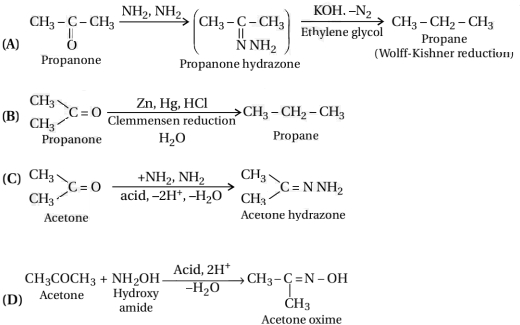
Match the reactants in Column-$I$ with their corresponding products in Column-$II$.
A
Column-$I$:
$(A)$ $CH_3-CO-CH_3 \xrightarrow{NH_2NH_2, KOH, \text{Ethylene glycol}}$
$(B)$ $(CH_3)_2C=O \xrightarrow{Zn-Hg, HCl}$
$(C)$ $(CH_3)_2C=O \xrightarrow{NH_2NH_2, \text{acid}}$
$(D)$ $CH_3COCH_3 + NH_2OH \xrightarrow{H^+}$
$(A)$ $CH_3-CO-CH_3 \xrightarrow{NH_2NH_2, KOH, \text{Ethylene glycol}}$
$(B)$ $(CH_3)_2C=O \xrightarrow{Zn-Hg, HCl}$
$(C)$ $(CH_3)_2C=O \xrightarrow{NH_2NH_2, \text{acid}}$
$(D)$ $CH_3COCH_3 + NH_2OH \xrightarrow{H^+}$
B
Column-$II$:
$(i)$ $(CH_3)_2C=NNH_2$
(ii) $CH_3-C(=N-OH)-CH_3$
(iii) $CH_3CH_2CH_3$
(iv) $CH_3CH_2CH_2CH_3$
$(i)$ $(CH_3)_2C=NNH_2$
(ii) $CH_3-C(=N-OH)-CH_3$
(iii) $CH_3CH_2CH_3$
(iv) $CH_3CH_2CH_2CH_3$
Solution
0 likes
View Solution1102
Medium
Reactant of Column-$I$ when reacted with acetaldehyde in the presence of $H^{+}$ gives the product given in Column-$II$ and their names are given in Column-$III$. Match the reactants in Column-$I$ with the products in Column-$II$ and their names in Column-$III$.
| Column-$I$ (Reagent) | Column-$II$ (Product) and Column-$III$ (Name) |
| $A$. Ammonia $(NH_{3})$ | $i$. $CH_{3}CH=NCH_{3}$; $m$. Acetaldehyde hydrazone |
| $B$. Amine $(CH_{3}NH_{2})$ | $ii$. $CH_{3}CH=NNH_{2}$; $n$. Acetaldehyde oxime |
| $C$. Hydroxyl amine $(NH_{2}OH)$ | $iii$. $CH_{3}CH=NH$; $o$. Acetaldehyde imine |
| $D$. Hydrazine $(NH_{2}NH_{2})$ | $iv$. $CH_{3}CH=NOH$; $q$. Acetaldehyde methyl imine |
Solution
(A) The reaction of acetaldehyde $(CH_{3}CHO)$ with ammonia derivatives in the presence of $H^{+}$ follows the general reaction: $CH_{3}CHO + H_{2}N-Z \rightarrow CH_{3}CH=N-Z + H_{2}O$.
$A$. Ammonia $(NH_{3})$ reacts to form $CH_{3}CH=NH$ (Acetaldehyde imine) $\rightarrow A-iii-o$.
$B$. Methylamine $(CH_{3}NH_{2})$ reacts to form $CH_{3}CH=NCH_{3}$ (Acetaldehyde methyl imine) $\rightarrow B-i-q$.
$C$. Hydroxylamine $(NH_{2}OH)$ reacts to form $CH_{3}CH=NOH$ (Acetaldehyde oxime) $\rightarrow C-iv-n$.
$D$. Hydrazine $(NH_{2}NH_{2})$ reacts to form $CH_{3}CH=NNH_{2}$ (Acetaldehyde hydrazone) $\rightarrow D-ii-m$.
Correct matching: $A-iii-o, B-i-q, C-iv-n, D-ii-m$.
$A$. Ammonia $(NH_{3})$ reacts to form $CH_{3}CH=NH$ (Acetaldehyde imine) $\rightarrow A-iii-o$.
$B$. Methylamine $(CH_{3}NH_{2})$ reacts to form $CH_{3}CH=NCH_{3}$ (Acetaldehyde methyl imine) $\rightarrow B-i-q$.
$C$. Hydroxylamine $(NH_{2}OH)$ reacts to form $CH_{3}CH=NOH$ (Acetaldehyde oxime) $\rightarrow C-iv-n$.
$D$. Hydrazine $(NH_{2}NH_{2})$ reacts to form $CH_{3}CH=NNH_{2}$ (Acetaldehyde hydrazone) $\rightarrow D-ii-m$.
Correct matching: $A-iii-o, B-i-q, C-iv-n, D-ii-m$.
0 likes
View Solution1103
Difficult
Match the reactants in Column-$I$ with the major products in Column-$II$.
| Column-$I$ (Reactants) | Column-$II$ (Products) |
|---|---|
| $(A)$ $HCHO + \text{Cyclohexyl-MgBr} \rightarrow X \xrightarrow{H_2O} Y$ | $(i)$ $\text{Benzenesulfonic acid}$ |
| $(B)$ $\text{2-oxocyclohexylacetate} \xrightarrow{NaBH_4}$ | $(ii)$ $\text{Cyclohexylmethanol}$ |
| $(C)$ $HCHO + CH_3-CH_2-CH(CH_3)-CH_2-MgBr \rightarrow X \xrightarrow{H_2O} Y$ | $(iii)$ $\text{2-(2-hydroxycyclohexyl)acetate}$ |
| $(D)$ $\text{Benzene} + \text{Oleum}$ | $(iv)$ $Y = \text{3-methylpentan-1-ol}$ |
Solution
(A-II, B-III, C-IV, D-I) $HCHO$ reacts with $\text{Cyclohexyl-MgBr}$ to form a primary alcohol, $\text{Cyclohexylmethanol}$ $(ii)$.
$(B)$ $NaBH_4$ selectively reduces the ketone group to an alcohol, yielding $\text{2-(2-hydroxycyclohexyl)acetate}$ $(iii)$.
$(C)$ $HCHO$ reacts with $CH_3-CH_2-CH(CH_3)-CH_2-MgBr$ to form a primary alcohol, $\text{3-methylpentan-1-ol}$ $(iv)$.
$(D)$ $\text{Benzene}$ reacts with $\text{Oleum}$ $(H_2SO_4 + SO_3)$ to undergo sulfonation, forming $\text{Benzenesulfonic acid}$ $(i)$.
Thus, the correct matching is: $(A-ii, B-iii, C-iv, D-i)$.
$(B)$ $NaBH_4$ selectively reduces the ketone group to an alcohol, yielding $\text{2-(2-hydroxycyclohexyl)acetate}$ $(iii)$.
$(C)$ $HCHO$ reacts with $CH_3-CH_2-CH(CH_3)-CH_2-MgBr$ to form a primary alcohol, $\text{3-methylpentan-1-ol}$ $(iv)$.
$(D)$ $\text{Benzene}$ reacts with $\text{Oleum}$ $(H_2SO_4 + SO_3)$ to undergo sulfonation, forming $\text{Benzenesulfonic acid}$ $(i)$.
Thus, the correct matching is: $(A-ii, B-iii, C-iv, D-i)$.
0 likes
View Solution1104
MediumMCQ
Predict the products of the following reactions with $CH_3CHO$:
$(i) CH_3CHO + C_6H_5MgBr$
$(ii) CH_3CHO + C_6H_{11}MgBr$
$(iii) CH_3CHO + (CH_3)_2CHMgBr$
Followed by acidic hydrolysis in each case.
$(i) CH_3CHO + C_6H_5MgBr$
$(ii) CH_3CHO + C_6H_{11}MgBr$
$(iii) CH_3CHO + (CH_3)_2CHMgBr$
Followed by acidic hydrolysis in each case.
A
$(i) 1-\text{phenylethanol}, (ii) 1-\text{cyclohexylethanol}, (iii) 3-\text{methylbutan-2-ol}$
B
$(i) 2-\text{phenylethanol}, (ii) 2-\text{cyclohexylethanol}, (iii) 2-\text{methylbutan-2-ol}$
C
$(i) \text{Benzyl alcohol}, (ii) \text{Cyclohexylmethanol}, (iii) \text{Pentan-2-ol}$
D
$(i) \text{Phenol}, (ii) \text{Cyclohexanol}, (iii) \text{Propan-2-ol}$
Solution
(A) The reaction of Grignard reagents $(RMgX)$ with acetaldehyde $(CH_3CHO)$ followed by acidic hydrolysis $(H_3O^+)$ yields secondary alcohols.
$(i) CH_3CHO + C_6H_5MgBr$ $\rightarrow CH_3CH(OMgBr)C_6H_5$ $\xrightarrow{H_3O^+} CH_3CH(OH)C_6H_5$ $(1-\text{phenylethanol})$
$(ii) CH_3CHO + C_6H_{11}MgBr$ $\rightarrow CH_3CH(OMgBr)C_6H_{11}$ $\xrightarrow{H_3O^+} CH_3CH(OH)C_6H_{11}$ $(1-\text{cyclohexylethanol})$
$(iii) CH_3CHO + (CH_3)_2CHMgBr$ $\rightarrow CH_3CH(OMgBr)CH(CH_3)_2$ $\xrightarrow{H_3O^+} CH_3CH(OH)CH(CH_3)_2$ $(3-\text{methylbutan-2-ol})$
Thus,the correct products are $1-\text{phenylethanol}$,$1-\text{cyclohexylethanol}$,and $3-\text{methylbutan-2-ol}$.
$(i) CH_3CHO + C_6H_5MgBr$ $\rightarrow CH_3CH(OMgBr)C_6H_5$ $\xrightarrow{H_3O^+} CH_3CH(OH)C_6H_5$ $(1-\text{phenylethanol})$
$(ii) CH_3CHO + C_6H_{11}MgBr$ $\rightarrow CH_3CH(OMgBr)C_6H_{11}$ $\xrightarrow{H_3O^+} CH_3CH(OH)C_6H_{11}$ $(1-\text{cyclohexylethanol})$
$(iii) CH_3CHO + (CH_3)_2CHMgBr$ $\rightarrow CH_3CH(OMgBr)CH(CH_3)_2$ $\xrightarrow{H_3O^+} CH_3CH(OH)CH(CH_3)_2$ $(3-\text{methylbutan-2-ol})$
Thus,the correct products are $1-\text{phenylethanol}$,$1-\text{cyclohexylethanol}$,and $3-\text{methylbutan-2-ol}$.
0 likes
View Solution1105
MediumMCQ
Two compounds $A$ and $B$ with the same molecular formula $(C_{3}H_{6}O)$ undergo Grignard's reaction with methylmagnesium bromide to give products $C$ and $D$. Products $C$ and $D$ show the following chemical tests.
$C$ and $D$ respectively are:
| Test | $C$ | $D$ |
| Ceric ammonium nitrate Test | Positive | Positive |
| Lucas Test | Turbidity obtained after five minutes | Turbidity obtained immediately |
| Iodoform Test | Positive | Negative |
$C$ and $D$ respectively are:
A
$C = CH_{3}CH(OH)CH_{3}$,$D = CH_{3}CH_{2}CH(OH)CH_{3}$
B
$C = CH_{3}CH_{2}CH_{2}OH$,$D = CH_{3}C(CH_{3})(OH)CH_{3}$
C
$C = CH_{3}CH_{2}CH(OH)CH_{3}$,$D = CH_{3}C(CH_{3})(OH)CH_{3}$
D
$C = CH_{3}CH_{2}CH_{2}OH$,$D = CH_{3}CH_{2}CH(OH)CH_{3}$
Solution
(C) is propanal $(CH_{3}CH_{2}CHO)$. Reaction with $CH_{3}MgBr$ gives butan$-2-$ol $(CH_{3}CH_{2}CH(OH)CH_{3})$ as $C$.
Butan$-2-$ol is a $2^{\circ}$ alcohol,gives positive Iodoform test,and Lucas test turbidity in $5$ minutes.
$B$ is acetone $(CH_{3}COCH_{3})$. Reaction with $CH_{3}MgBr$ gives $2$-methylpropan$-2-$ol $(CH_{3}C(CH_{3})(OH)CH_{3})$ as $D$.
$2$-methylpropan$-2-$ol is a $3^{\circ}$ alcohol,gives immediate turbidity with Lucas reagent,and negative Iodoform test.
Thus,$C$ is $CH_{3}CH_{2}CH(OH)CH_{3}$ and $D$ is $CH_{3}C(CH_{3})(OH)CH_{3}$.
Butan$-2-$ol is a $2^{\circ}$ alcohol,gives positive Iodoform test,and Lucas test turbidity in $5$ minutes.
$B$ is acetone $(CH_{3}COCH_{3})$. Reaction with $CH_{3}MgBr$ gives $2$-methylpropan$-2-$ol $(CH_{3}C(CH_{3})(OH)CH_{3})$ as $D$.
$2$-methylpropan$-2-$ol is a $3^{\circ}$ alcohol,gives immediate turbidity with Lucas reagent,and negative Iodoform test.
Thus,$C$ is $CH_{3}CH_{2}CH(OH)CH_{3}$ and $D$ is $CH_{3}C(CH_{3})(OH)CH_{3}$.
0 likes
View Solution1106
MediumMCQ
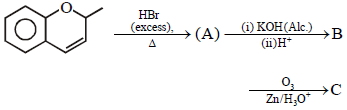
The major aromatic product $C$ in the following reaction sequence will be :
A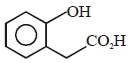
B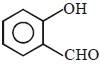
C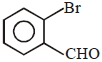
D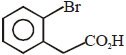
Solution
(B) $1$. The reaction of $2$-methyl-$2H$-chromene with excess $HBr$ under heating leads to the cleavage of the ether ring. The $C-O$ bond breaks,and $HBr$ adds across the double bond and the ring-opened position,resulting in a phenolic compound with a dibromoalkyl side chain: $2-(3,5-dibromopentyl)phenol$ (or similar depending on regioselectivity,but the provided solution image shows the specific transformation).
$2$. Treatment with alcoholic $KOH$ followed by $H^+$ causes dehydrohalogenation,forming a conjugated diene side chain attached to the phenol ring: $2-(penta-1,3-dienyl)phenol$.
$3$. Finally,reductive ozonolysis $(O_3, Zn/H_2O)$ cleaves the double bonds in the side chain. The terminal double bond yields formaldehyde $(HCHO)$,the internal double bond yields glyoxal $(CHO-CHO)$,and the side chain attached to the benzene ring yields salicylaldehyde $(2-hydroxybenzaldehyde)$.
$4$. Among the options,the major aromatic product $C$ is salicylaldehyde.
$2$. Treatment with alcoholic $KOH$ followed by $H^+$ causes dehydrohalogenation,forming a conjugated diene side chain attached to the phenol ring: $2-(penta-1,3-dienyl)phenol$.
$3$. Finally,reductive ozonolysis $(O_3, Zn/H_2O)$ cleaves the double bonds in the side chain. The terminal double bond yields formaldehyde $(HCHO)$,the internal double bond yields glyoxal $(CHO-CHO)$,and the side chain attached to the benzene ring yields salicylaldehyde $(2-hydroxybenzaldehyde)$.
$4$. Among the options,the major aromatic product $C$ is salicylaldehyde.
0 likes
View Solution1107
MediumMCQ
The increasing order of the following compounds towards $HCN$ addition is:
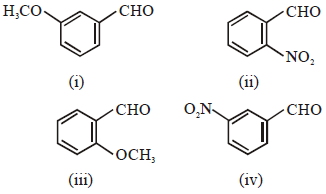
A
$(iii) < (i) < (iv) < (ii)$
B
$(iii) < (iv) < (i) < (ii)$
C
$(iii) < (i) < (iv) < (ii)$
D
$(i) < (iii) < (iv) < (ii)$
Solution
(A) The reactivity of carbonyl compounds towards nucleophilic addition of $HCN$ depends on the electrophilicity of the carbonyl carbon and steric hindrance. Electron-withdrawing groups ($-I$ or $-R$ effect) increase the electrophilicity of the carbonyl carbon,thereby increasing reactivity. Electron-donating groups ($+R$ or $+I$ effect) decrease the electrophilicity,thereby decreasing reactivity.
$(i)$ $m$-Methoxybenzaldehyde: $-OCH_3$ group shows $-I$ effect (electron-withdrawing) from the meta position.
(ii) $o$-Nitrobenzaldehyde: $-NO_2$ group shows both $-I$ and $-R$ effects (strong electron-withdrawing).
(iii) $o$-Methoxybenzaldehyde: $-OCH_3$ group shows $+R$ effect (strong electron-donating) from the ortho position.
(iv) $m$-Nitrobenzaldehyde: $-NO_2$ group shows only $-I$ effect from the meta position.
Comparing the effects:
- (iii) has a strong electron-donating group $(+R)$,making it the least reactive.
- $(i)$ has a weak electron-withdrawing group $(-I)$.
- (iv) has a stronger electron-withdrawing group ($-I$ only).
- (ii) has the strongest electron-withdrawing effect ($-I$ and $-R$),making it the most reactive.
Thus,the increasing order of reactivity is: $(iii) < (i) < (iv) < (ii)$.
$(i)$ $m$-Methoxybenzaldehyde: $-OCH_3$ group shows $-I$ effect (electron-withdrawing) from the meta position.
(ii) $o$-Nitrobenzaldehyde: $-NO_2$ group shows both $-I$ and $-R$ effects (strong electron-withdrawing).
(iii) $o$-Methoxybenzaldehyde: $-OCH_3$ group shows $+R$ effect (strong electron-donating) from the ortho position.
(iv) $m$-Nitrobenzaldehyde: $-NO_2$ group shows only $-I$ effect from the meta position.
Comparing the effects:
- (iii) has a strong electron-donating group $(+R)$,making it the least reactive.
- $(i)$ has a weak electron-withdrawing group $(-I)$.
- (iv) has a stronger electron-withdrawing group ($-I$ only).
- (ii) has the strongest electron-withdrawing effect ($-I$ and $-R$),making it the most reactive.
Thus,the increasing order of reactivity is: $(iii) < (i) < (iv) < (ii)$.
0 likes
View Solution1108
MediumMCQ
The increasing order of the reactivity of the following compounds in nucleophilic addition reaction is:
Propanal,Benzaldehyde,Propanone,Butanone
Propanal,Benzaldehyde,Propanone,Butanone
A
$Butanone < Propanone < Benzaldehyde < Propanal$
B
$Benzaldehyde < Butanone < Propanone < Propanal$
C
$Propanal < Propanone < Butanone < Benzaldehyde$
D
$Benzaldehyde < Propanal < Propanone < Butanone$
Solution
(A) The reactivity of carbonyl compounds towards nucleophilic addition reactions depends on two factors: steric hindrance and electronic effects.
$1$. Steric hindrance: Smaller groups around the carbonyl carbon increase reactivity. Aldehydes are more reactive than ketones.
$2$. Electronic effects: Electron-donating groups decrease the electrophilicity of the carbonyl carbon,thus decreasing reactivity.
Comparing the compounds:
- $Propanal$ $(CH_3CH_2CHO)$: Most reactive (Aldehyde,least steric hindrance).
- $Benzaldehyde$ $(C_6H_5CHO)$: Less reactive than $Propanal$ due to resonance stabilization of the carbonyl group by the phenyl ring.
- $Propanone$ $(CH_3COCH_3)$: Ketone,less reactive than aldehydes due to steric hindrance and $+I$ effect of two methyl groups.
- $Butanone$ $(CH_3COCH_2CH_3)$: Least reactive due to greater steric hindrance compared to $Propanone$.
Thus,the increasing order of reactivity is: $Butanone < Propanone < Benzaldehyde < Propanal$.
$1$. Steric hindrance: Smaller groups around the carbonyl carbon increase reactivity. Aldehydes are more reactive than ketones.
$2$. Electronic effects: Electron-donating groups decrease the electrophilicity of the carbonyl carbon,thus decreasing reactivity.
Comparing the compounds:
- $Propanal$ $(CH_3CH_2CHO)$: Most reactive (Aldehyde,least steric hindrance).
- $Benzaldehyde$ $(C_6H_5CHO)$: Less reactive than $Propanal$ due to resonance stabilization of the carbonyl group by the phenyl ring.
- $Propanone$ $(CH_3COCH_3)$: Ketone,less reactive than aldehydes due to steric hindrance and $+I$ effect of two methyl groups.
- $Butanone$ $(CH_3COCH_2CH_3)$: Least reactive due to greater steric hindrance compared to $Propanone$.
Thus,the increasing order of reactivity is: $Butanone < Propanone < Benzaldehyde < Propanal$.
0 likes
View Solution1109
MediumMCQ
The compound $A$ in the following reaction is:
$A$ $\xrightarrow[(ii) Conc. H_2SO_4 / \Delta]{(i) CH_3MgBr / H_2O} B$ $\xrightarrow[(ii) Zn / H_2O]{(i) O_3} C + D$
$D \xrightarrow[Ba(OH)_2, \Delta]{} CH_3-C(CH_3)=CH-CO-CH_3$
$A$ $\xrightarrow[(ii) Conc. H_2SO_4 / \Delta]{(i) CH_3MgBr / H_2O} B$ $\xrightarrow[(ii) Zn / H_2O]{(i) O_3} C + D$
$D \xrightarrow[Ba(OH)_2, \Delta]{} CH_3-C(CH_3)=CH-CO-CH_3$
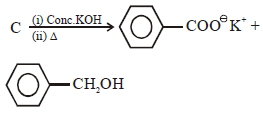
A
$C_6H_5-CH_2-CO-CH_3$
B
$C_6H_5-CO-CH_2-CH_3$
C
$C_6H_5-CH_2-CO-CH_2-CH_3$
D
$C_6H_5-CO-CH_3$
Solution
(A) The product formed from $D$ by the action of $Ba(OH)_2$ and $\Delta$ is mesityl oxide $(CH_3-C(CH_3)=CH-CO-CH_3)$,which is a self-aldol condensation product of acetone. Therefore,$D$ is acetone $(CH_3-CO-CH_3)$.
Since ozonolysis of $B$ gives $C$ and $D$ (acetone),$B$ must contain the $(CH_3)_2C=$ group.
When $A$ $(C_6H_5-CH_2-CO-CH_3)$ reacts with $CH_3MgBr$ followed by dehydration with $Conc. H_2SO_4$,it forms $B$ $(C_6H_5-CH=C(CH_3)_2)$.
$C_6H_5-CH_2-CO-CH_3$ $\xrightarrow{CH_3MgBr} C_6H_5-CH_2-C(OH)(CH_3)_2$ $\xrightarrow{H^{+}, \Delta} C_6H_5-CH=C(CH_3)_2 (B)$.
Ozonolysis of $B$: $C_6H_5-CH=C(CH_3)_2 \xrightarrow{O_3/Zn, H_2O} C_6H_5-CHO (C) + CH_3-CO-CH_3 (D)$.
Since ozonolysis of $B$ gives $C$ and $D$ (acetone),$B$ must contain the $(CH_3)_2C=$ group.
When $A$ $(C_6H_5-CH_2-CO-CH_3)$ reacts with $CH_3MgBr$ followed by dehydration with $Conc. H_2SO_4$,it forms $B$ $(C_6H_5-CH=C(CH_3)_2)$.
$C_6H_5-CH_2-CO-CH_3$ $\xrightarrow{CH_3MgBr} C_6H_5-CH_2-C(OH)(CH_3)_2$ $\xrightarrow{H^{+}, \Delta} C_6H_5-CH=C(CH_3)_2 (B)$.
Ozonolysis of $B$: $C_6H_5-CH=C(CH_3)_2 \xrightarrow{O_3/Zn, H_2O} C_6H_5-CHO (C) + CH_3-CO-CH_3 (D)$.
0 likes
View Solution1110
MediumMCQ
The major product of the following reaction is:
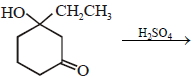
A
$3-$ethylidenecyclohexan$-1-$one
B
$3-$ethylcyclohex$-2-$en$-1-$one
C
$2-$ethylcyclohex$-2-$en$-1-$one
D
$3-$vinylcyclohexan$-1-$one
Solution
(B) The reaction involves the acid-catalyzed dehydration of a tertiary alcohol.
$1$. Protonation of the hydroxyl group by $H_2SO_4$ forms a good leaving group $(-OH_2^+)$.
$2$. Loss of water molecule generates a stable carbocation at the tertiary carbon.
$3$. Elimination of a proton from the adjacent carbon (alpha to the carbonyl group) occurs to form the most stable conjugated alkene.
$4$. The double bond forms between the carbon bearing the ethyl group and the adjacent carbon to form a conjugated system with the carbonyl group,resulting in $3-$ethylcyclohex$-2-$en$-1-$one.
$1$. Protonation of the hydroxyl group by $H_2SO_4$ forms a good leaving group $(-OH_2^+)$.
$2$. Loss of water molecule generates a stable carbocation at the tertiary carbon.
$3$. Elimination of a proton from the adjacent carbon (alpha to the carbonyl group) occurs to form the most stable conjugated alkene.
$4$. The double bond forms between the carbon bearing the ethyl group and the adjacent carbon to form a conjugated system with the carbonyl group,resulting in $3-$ethylcyclohex$-2-$en$-1-$one.
0 likes
View Solution1111
MediumMCQ
Reaction between acetone and methylmagnesium chloride followed by hydrolysis will give :
A
Isobutyl alcohol
B
Isopropyl alcohol
C
Sec. butyl alcohol
D
Tert. butyl alcohol
Solution
(D) The reaction of acetone $(CH_3COCH_3)$ with methylmagnesium chloride $(CH_3MgCl)$,which is a Grignard reagent,involves the nucleophilic attack of the methyl group on the carbonyl carbon of acetone.
This forms an intermediate magnesium alkoxide: $(CH_3)_3C-OMgCl$.
Subsequent hydrolysis of this intermediate with water $(H_2O)$ yields $2$-methylpropan-$2$-ol,commonly known as tert-butyl alcohol $((CH_3)_3COH)$.
This forms an intermediate magnesium alkoxide: $(CH_3)_3C-OMgCl$.
Subsequent hydrolysis of this intermediate with water $(H_2O)$ yields $2$-methylpropan-$2$-ol,commonly known as tert-butyl alcohol $((CH_3)_3COH)$.
0 likes
View Solution1112
MediumMCQ
The reaction between benzaldehyde and acetophenone in the presence of dilute $NaOH$ is known as:
A
Cross Aldol condensation
B
Aldol condensation
C
Cannizzaro's reaction
D
Cross Cannizzaro's reaction
Solution
(A) The reaction between two different carbonyl compounds (benzaldehyde and acetophenone),where at least one of them has an $\alpha$-hydrogen atom (acetophenone has three $\alpha$-hydrogens),in the presence of a dilute base like $NaOH$ is called $Cross$ $Aldol$ $condensation$.
Benzaldehyde $(C_6H_5CHO)$ does not have an $\alpha$-hydrogen,while acetophenone $(C_6H_5COCH_3)$ has $\alpha$-hydrogens.
This specific reaction leads to the formation of a $\beta$-hydroxy ketone,which upon dehydration gives an $\alpha,\beta$-unsaturated ketone.
Benzaldehyde $(C_6H_5CHO)$ does not have an $\alpha$-hydrogen,while acetophenone $(C_6H_5COCH_3)$ has $\alpha$-hydrogens.
This specific reaction leads to the formation of a $\beta$-hydroxy ketone,which upon dehydration gives an $\alpha,\beta$-unsaturated ketone.
0 likes
View Solution1113
MediumMCQ
Which of the following compounds does not undergo aldol condensation?
A
$CH_3-C(CH_3)_2-CHO$
B
$CH_3-CHO$
C
$CH_3-CO-CH_3$
D
$CH_3-CH_2-CHO$
Solution
(A) Aldol condensation requires the presence of at least one $\alpha$-hydrogen atom in the aldehyde or ketone.
In $CH_3-C(CH_3)_2-CHO$ ($2,2$-dimethylpropanal),the $\alpha$-carbon atom is bonded to three methyl groups and has no hydrogen atoms attached to it.
Therefore,it does not undergo aldol condensation.
In $CH_3-C(CH_3)_2-CHO$ ($2,2$-dimethylpropanal),the $\alpha$-carbon atom is bonded to three methyl groups and has no hydrogen atoms attached to it.
Therefore,it does not undergo aldol condensation.
0 likes
View Solution1114
MediumMCQ
Find the end product of the following reaction:
Product is
Product is
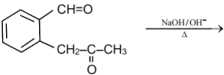
A
B
C
D
Solution
(D) The given reaction is an intramolecular Aldol condensation reaction.
$1$. The base $(OH^-)$ abstracts an $\alpha$-hydrogen from the methyl group of the ketone,forming an enolate ion.
$2$. This enolate ion performs a nucleophilic attack on the carbonyl carbon of the aldehyde group.
$3$. This leads to the formation of a cyclic $\beta$-hydroxy ketone intermediate.
$4$. Upon heating $(\Delta)$,the intermediate undergoes dehydration (loss of $H_2O$) to form an $\alpha, \beta$-unsaturated carbonyl compound.
Comparing the final structure with the given options,the product corresponds to option $D$.
$1$. The base $(OH^-)$ abstracts an $\alpha$-hydrogen from the methyl group of the ketone,forming an enolate ion.
$2$. This enolate ion performs a nucleophilic attack on the carbonyl carbon of the aldehyde group.
$3$. This leads to the formation of a cyclic $\beta$-hydroxy ketone intermediate.
$4$. Upon heating $(\Delta)$,the intermediate undergoes dehydration (loss of $H_2O$) to form an $\alpha, \beta$-unsaturated carbonyl compound.
Comparing the final structure with the given options,the product corresponds to option $D$.
0 likes
View Solution1115
MediumMCQ
Product $(B)$ is :
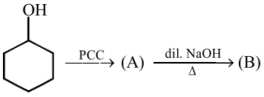
A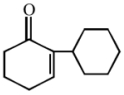
B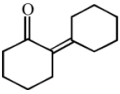
C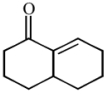
D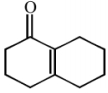
Solution
(B) Step $1$: Cyclohexanol is oxidized by $PCC$ (Pyridinium chlorochromate) to form cyclohexanone,which is product $(A)$.
Step $2$: Cyclohexanone undergoes self-aldol condensation in the presence of dilute $NaOH$ and heat $(\Delta)$ to form the $\alpha,\beta$-unsaturated ketone,which is cyclohexylidenecyclohexanone,product $(B)$.
Step $2$: Cyclohexanone undergoes self-aldol condensation in the presence of dilute $NaOH$ and heat $(\Delta)$ to form the $\alpha,\beta$-unsaturated ketone,which is cyclohexylidenecyclohexanone,product $(B)$.
0 likes
View Solution1116
MediumMCQ
The above compounds can be differentiated by the following reagent:
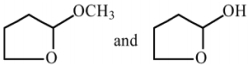
A
$2,4-DNP$ (Brady reagent)
B
Tollen's reagent
C
Lucas reagent
D
$NaHSO_3$
Solution
(B) The first compound is a cyclic acetal ($2$-methoxytetrahydrofuran),which is stable in basic conditions and does not react with Tollen's reagent.
The second compound is a cyclic hemiacetal ($2$-hydroxytetrahydrofuran),which exists in equilibrium with its open-chain hydroxy-aldehyde form in aqueous solution.
The open-chain hydroxy-aldehyde contains a free aldehyde group $(-CHO)$,which gives a positive Tollen's test (formation of silver mirror).
Therefore,Tollen's reagent can be used to differentiate between the two.
The second compound is a cyclic hemiacetal ($2$-hydroxytetrahydrofuran),which exists in equilibrium with its open-chain hydroxy-aldehyde form in aqueous solution.
The open-chain hydroxy-aldehyde contains a free aldehyde group $(-CHO)$,which gives a positive Tollen's test (formation of silver mirror).
Therefore,Tollen's reagent can be used to differentiate between the two.
0 likes
View Solution1117
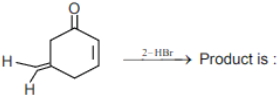
DifficultMCQ
The reaction of $5-$methylenecyclohex$-2-$enone with $2$ equivalents of $HBr$ yields which of the following products?
A
$3-$bromo$-5-$(bromomethyl)cyclohexanone
B
$2,5-$dibromocyclohexanone
C
$3-$bromo$-5-$methyl$-5-$hydroxycyclohex$-2-$enone
D
$3-$bromo$-5-$bromo$-5-$methylcyclohexanone
Solution
(D) The reaction involves the electrophilic addition of $HBr$ to the two double bonds present in $5-$methylenecyclohex$-2-$enone.
First,$HBr$ adds to the exocyclic double bond. Protonation occurs to form a stable $3^{\circ}$ carbocation at the $5-$position,which is then attacked by the bromide ion to give a $5-$bromo$-5-$methylcyclohex$-2-$enone intermediate.
Second,$HBr$ adds to the remaining endocyclic double bond. According to Markovnikov's rule,the proton adds to the carbon with more hydrogens,and the bromide adds to the carbon that forms a more stable carbocation (stabilized by the inductive effect of the carbonyl group).
The final product is $3-$bromo$-5-$bromo$-5-$methylcyclohexanone.
First,$HBr$ adds to the exocyclic double bond. Protonation occurs to form a stable $3^{\circ}$ carbocation at the $5-$position,which is then attacked by the bromide ion to give a $5-$bromo$-5-$methylcyclohex$-2-$enone intermediate.
Second,$HBr$ adds to the remaining endocyclic double bond. According to Markovnikov's rule,the proton adds to the carbon with more hydrogens,and the bromide adds to the carbon that forms a more stable carbocation (stabilized by the inductive effect of the carbonyl group).
The final product is $3-$bromo$-5-$bromo$-5-$methylcyclohexanone.
0 likes
View Solution1118
MediumMCQ
$HCHO$ (more reactive towards oxidation) + $CH_3CHO \xrightarrow{Conc. NaOH}$ Find out the products of the reaction.
A
$CH_3CH_2OH$ and $HCO_2Na$
B
$CH_3CH_2OH$ and $CH_3OH$
C
$CH_3CO_2Na$ and $CH_3OH$
D
$CH_3CO_2Na$ and $HCO_2Na$
Solution
(A) In a Cross-Cannizzaro reaction between formaldehyde $(HCHO)$ and acetaldehyde $(CH_3CHO)$,formaldehyde is more reactive towards nucleophilic attack by $OH^-$ because it lacks electron-donating alkyl groups.
Consequently,formaldehyde is oxidized to sodium formate $(HCO_2Na)$,and acetaldehyde is reduced to ethanol $(CH_3CH_2OH)$.
Reaction: $HCHO + CH_3CHO \xrightarrow{Conc. NaOH} HCO_2Na + CH_3CH_2OH$
Consequently,formaldehyde is oxidized to sodium formate $(HCO_2Na)$,and acetaldehyde is reduced to ethanol $(CH_3CH_2OH)$.
Reaction: $HCHO + CH_3CHO \xrightarrow{Conc. NaOH} HCO_2Na + CH_3CH_2OH$
0 likes
View Solution1119
MediumMCQ
Correct order for nucleophilic addition reaction :
$(1)$ $C_{6}H_{5}COC_{6}H_{5}$
$(2)$ $C_{6}H_{5}CHO$
$(3)$ $p-CH_{3}C_{6}H_{4}CHO$
$(4)$ $p-CH_{3}OC_{6}H_{4}CHO$
$(1)$ $C_{6}H_{5}COC_{6}H_{5}$
$(2)$ $C_{6}H_{5}CHO$
$(3)$ $p-CH_{3}C_{6}H_{4}CHO$
$(4)$ $p-CH_{3}OC_{6}H_{4}CHO$
A
$2 > 3 > 4 > 1$
B
$4 > 3 > 2 > 1$
C
$2 > 1 > 3 > 4$
D
$4 > 2 > 3 > 1$
Solution
(A) Nucleophilic addition reactivity depends on the electrophilicity of the carbonyl carbon.
$1.$ Aldehydes are more reactive than ketones due to less steric hindrance and lower electronic repulsion.
$2.$ Electron-donating groups $(EDG)$ decrease the electrophilicity of the carbonyl carbon,thereby decreasing reactivity.
$3.$ The order of electron-donating strength is: $CH_{3}O$ (strong $+M$) $> CH_{3}$ (weak $+I$) $> H$ (no effect).
$4.$ Comparing the compounds:
$(1)$ $C_{6}H_{5}COC_{6}H_{5}$ (Ketone,least reactive)
$(2)$ $C_{6}H_{5}CHO$ (Benzaldehyde,most reactive among these)
$(3)$ $p-CH_{3}C_{6}H_{4}CHO$ (Aldehyde with $+I$ group)
$(4)$ $p-CH_{3}OC_{6}H_{4}CHO$ (Aldehyde with $+M$ group)
Thus,the reactivity order is: $2 > 3 > 4 > 1$.
$1.$ Aldehydes are more reactive than ketones due to less steric hindrance and lower electronic repulsion.
$2.$ Electron-donating groups $(EDG)$ decrease the electrophilicity of the carbonyl carbon,thereby decreasing reactivity.
$3.$ The order of electron-donating strength is: $CH_{3}O$ (strong $+M$) $> CH_{3}$ (weak $+I$) $> H$ (no effect).
$4.$ Comparing the compounds:
$(1)$ $C_{6}H_{5}COC_{6}H_{5}$ (Ketone,least reactive)
$(2)$ $C_{6}H_{5}CHO$ (Benzaldehyde,most reactive among these)
$(3)$ $p-CH_{3}C_{6}H_{4}CHO$ (Aldehyde with $+I$ group)
$(4)$ $p-CH_{3}OC_{6}H_{4}CHO$ (Aldehyde with $+M$ group)
Thus,the reactivity order is: $2 > 3 > 4 > 1$.
0 likes
View Solution1120
MediumMCQ
$C_{7}H_{10}O$ reacts with $CH_{3}MgBr$ to give a compound $C_{8}H_{12}O$ which gives a positive iodoform test. Identify the structure of $A$.
A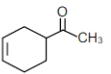
B
C
D
Solution
(C) The reaction of an aldehyde or ketone with $CH_{3}MgBr$ (Grignard reagent) followed by hydrolysis yields an alcohol.
For the resulting alcohol to give a positive iodoform test,it must contain a $CH_{3}CH(OH)-$ group.
Starting with $C_{7}H_{10}O$,if $A$ is cyclohex$-3-$ene$-1-$carbaldehyde,the reaction is:
$C_{6}H_{9}CHO + CH_{3}MgBr \rightarrow C_{6}H_{9}CH(OMgBr)CH_{3}$
Upon hydrolysis,this gives $C_{6}H_{9}CH(OH)CH_{3}$,which is a secondary alcohol with a $CH_{3}CH(OH)-$ group.
This structure gives a positive iodoform test with $I_{2}/NaOH$.
Thus,the structure of $A$ is cyclohex$-3-$ene$-1-$carbaldehyde.
For the resulting alcohol to give a positive iodoform test,it must contain a $CH_{3}CH(OH)-$ group.
Starting with $C_{7}H_{10}O$,if $A$ is cyclohex$-3-$ene$-1-$carbaldehyde,the reaction is:
$C_{6}H_{9}CHO + CH_{3}MgBr \rightarrow C_{6}H_{9}CH(OMgBr)CH_{3}$
Upon hydrolysis,this gives $C_{6}H_{9}CH(OH)CH_{3}$,which is a secondary alcohol with a $CH_{3}CH(OH)-$ group.
This structure gives a positive iodoform test with $I_{2}/NaOH$.
Thus,the structure of $A$ is cyclohex$-3-$ene$-1-$carbaldehyde.
0 likes
View Solution1121
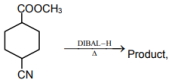
MediumMCQ
The product of the given reaction is:
A
B
C
D
Solution
(B) $DIBAL-H$ (Diisobutylaluminium hydride) acts as a selective reducing agent. It is capable of reducing both esters $(-COOR)$ and nitriles $(-CN)$ to aldehydes $(-CHO)$ at low temperatures. In the given substrate,both the ester group $(-COOCH_3)$ and the nitrile group $(-CN)$ are reduced to aldehyde groups $(-CHO)$. Therefore,the product is a cyclohexane$-1,4-$dicarbaldehyde. Thus,option $(B)$ is the correct answer.
0 likes
View Solution1122
MediumMCQ
Predict the product $X$ for the following reaction:
$2\text{-oxocyclohex-3-en-1-yl} \text{ acetate derivative} \rightarrow{NaBH_4, MeOH} X$
$2\text{-oxocyclohex-3-en-1-yl} \text{ acetate derivative} \rightarrow{NaBH_4, MeOH} X$
A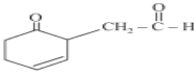
B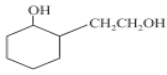
C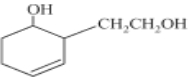
D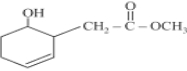
Solution
(D) $NaBH_4$ (Sodium borohydride) is a selective reducing agent that specifically reduces aldehydes and ketones to their corresponding alcohols.
It does not reduce esters or carbon-carbon double bonds $(C=C)$ under standard conditions.
In the given substrate,there is a ketone group on the cyclohexene ring and an ester group $(-COOCH_3)$ on the side chain.
Therefore,$NaBH_4$ will selectively reduce the ketone to a secondary alcohol $(-OH)$ while leaving the ester and the double bond intact.
The product $X$ is $2\text{-hydroxycyclohex-3-en-1-yl} \text{ acetate derivative}$ (specifically,the structure shown in option $D$).
It does not reduce esters or carbon-carbon double bonds $(C=C)$ under standard conditions.
In the given substrate,there is a ketone group on the cyclohexene ring and an ester group $(-COOCH_3)$ on the side chain.
Therefore,$NaBH_4$ will selectively reduce the ketone to a secondary alcohol $(-OH)$ while leaving the ester and the double bond intact.
The product $X$ is $2\text{-hydroxycyclohex-3-en-1-yl} \text{ acetate derivative}$ (specifically,the structure shown in option $D$).
0 likes
View Solution1123
DifficultMCQ
The product $P$ in the above reaction is
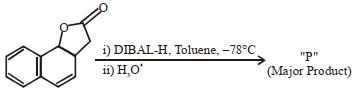
A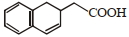
B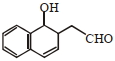
C
D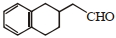
Solution
(C) $DIBAL-H$ (Diisobutylaluminum hydride) is a selective reducing agent that reduces esters to aldehydes at low temperatures $(-78^{\circ}C)$.
In the given reaction,$DIBAL-H$ reduces the cyclic ester (lactone) to a lactol,which then opens to form a hydroxy-aldehyde.
$DIBAL-H$ does not reduce the carbon-carbon double bond $(C=C)$ present in the molecule.
Therefore,the reaction converts the lactone group into a hydroxy-aldehyde group while keeping the rest of the structure intact,which matches option $C$.
In the given reaction,$DIBAL-H$ reduces the cyclic ester (lactone) to a lactol,which then opens to form a hydroxy-aldehyde.
$DIBAL-H$ does not reduce the carbon-carbon double bond $(C=C)$ present in the molecule.
Therefore,the reaction converts the lactone group into a hydroxy-aldehyde group while keeping the rest of the structure intact,which matches option $C$.
0 likes
View Solution1124
MediumMCQ
The product $A$ in the above reaction is

A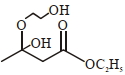
B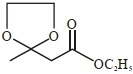
C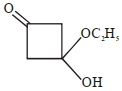
D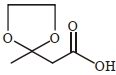
Solution
(B) The reaction of a ketone with ethylene glycol in the presence of an acid catalyst $(H^+)$ is a standard method for the protection of the carbonyl group as a cyclic acetal.
In the given molecule,ethyl acetoacetate,there are two carbonyl groups: a ketone and an ester.
Ketones are more reactive towards nucleophilic addition than esters.
Therefore,the ethylene glycol selectively reacts with the ketone group to form a cyclic acetal,while the ester group remains unaffected.
The product $A$ is the cyclic acetal of ethyl acetoacetate.
In the given molecule,ethyl acetoacetate,there are two carbonyl groups: a ketone and an ester.
Ketones are more reactive towards nucleophilic addition than esters.
Therefore,the ethylene glycol selectively reacts with the ketone group to form a cyclic acetal,while the ester group remains unaffected.
The product $A$ is the cyclic acetal of ethyl acetoacetate.
0 likes
View Solution1125
DifficultMCQ
Consider the above reaction,the products $X$ and $Y$ respectively are:
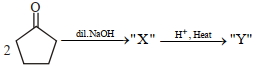
A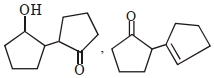
B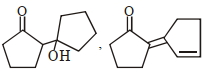
C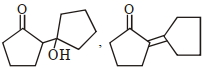
D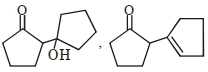
Solution
(D) The reaction is an Aldol condensation of cyclopentanone.
$1$. In the presence of $dil. NaOH$,two molecules of cyclopentanone undergo self-aldol condensation to form a $\beta$-hydroxy ketone,which is $X$ ($2$-($1$-hydroxycyclopentyl)cyclopentanone).
$2$. Upon heating with $H^+$,the $\beta$-hydroxy ketone undergoes dehydration to form an $\alpha,\beta$-unsaturated ketone,which is $Y$ ($2$-cyclopentylidenecyclopentanone).
$1$. In the presence of $dil. NaOH$,two molecules of cyclopentanone undergo self-aldol condensation to form a $\beta$-hydroxy ketone,which is $X$ ($2$-($1$-hydroxycyclopentyl)cyclopentanone).
$2$. Upon heating with $H^+$,the $\beta$-hydroxy ketone undergoes dehydration to form an $\alpha,\beta$-unsaturated ketone,which is $Y$ ($2$-cyclopentylidenecyclopentanone).
0 likes
View Solution1126
DifficultMCQ
In Tollen's test for aldehyde,the overall number of electron$(s)$ transferred to the Tollen's reagent formula $[Ag(NH_{3})_{2}]^{+}$ per aldehyde group to form silver mirror is $......$. (Round off to the Nearest integer)
A
$1$
B
$2$
C
$4$
D
$6$
Solution
(B) The oxidation of an aldehyde to a carboxylate ion by Tollen's reagent is represented by the following balanced chemical equation:
$RCHO + 2[Ag(NH_{3})_{2}]^{+} + 3OH^{-} \rightarrow RCOO^{-} + 2Ag + 4NH_{3} + 2H_{2}O$
In this reaction,the aldehyde group $(-CHO)$ is oxidized to a carboxylate group $(-COO^{-})$,which involves the loss of $2$ electrons.
These $2$ electrons are transferred to the two silver ions $(Ag^{+})$ present in the Tollen's reagent,reducing them to metallic silver $(Ag^{0})$.
Therefore,the total number of electrons transferred to the Tollen's reagent per aldehyde group is $2$.
$RCHO + 2[Ag(NH_{3})_{2}]^{+} + 3OH^{-} \rightarrow RCOO^{-} + 2Ag + 4NH_{3} + 2H_{2}O$
In this reaction,the aldehyde group $(-CHO)$ is oxidized to a carboxylate group $(-COO^{-})$,which involves the loss of $2$ electrons.
These $2$ electrons are transferred to the two silver ions $(Ag^{+})$ present in the Tollen's reagent,reducing them to metallic silver $(Ag^{0})$.
Therefore,the total number of electrons transferred to the Tollen's reagent per aldehyde group is $2$.
0 likes
View Solution1127
MediumMCQ
Consider the following chemical reaction.
$CH \equiv CH \xrightarrow[{(2) CO, HCl, AlCl_3}]{{(1) Red hot Fe tube, 873 K}} \text{Product}$
The number of $sp^{2}$ hybridized carbon atom$(s)$ present in the product is ..........
$CH \equiv CH \xrightarrow[{(2) CO, HCl, AlCl_3}]{{(1) Red hot Fe tube, 873 K}} \text{Product}$
The number of $sp^{2}$ hybridized carbon atom$(s)$ present in the product is ..........
A
$3$
B
$9$
C
$4$
D
$7$
Solution
(D) The reaction proceeds in two steps:
$1$. $3 CH \equiv CH \xrightarrow{\text{Red hot Fe tube, } 873 \text{ K}} C_6H_6$ (Benzene).
$2$. $C_6H_6 + CO + HCl \xrightarrow{AlCl_3} C_6H_5CHO$ (Benzaldehyde) via Gattermann-Koch reaction.
In benzaldehyde $(C_6H_5CHO)$,there are $6$ carbon atoms in the benzene ring,all of which are $sp^{2}$ hybridized.
The carbonyl carbon atom $(C=O)$ is also $sp^{2}$ hybridized.
Therefore,the total number of $sp^{2}$ hybridized carbon atoms is $6 + 1 = 7$.
$1$. $3 CH \equiv CH \xrightarrow{\text{Red hot Fe tube, } 873 \text{ K}} C_6H_6$ (Benzene).
$2$. $C_6H_6 + CO + HCl \xrightarrow{AlCl_3} C_6H_5CHO$ (Benzaldehyde) via Gattermann-Koch reaction.
In benzaldehyde $(C_6H_5CHO)$,there are $6$ carbon atoms in the benzene ring,all of which are $sp^{2}$ hybridized.
The carbonyl carbon atom $(C=O)$ is also $sp^{2}$ hybridized.
Therefore,the total number of $sp^{2}$ hybridized carbon atoms is $6 + 1 = 7$.
0 likes
View Solution1128
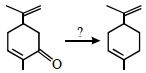
EasyMCQ
Which of the following reagents is suitable for the preparation of the product in the above reaction?
A
$NaBH_{4}$
B
$NH_{2}NH_{2} / C_{2}H_{5}O^{-}Na^{+}$
C
$Ni / H_{2}$
D
$Red \ P + Cl_{2}$
Solution
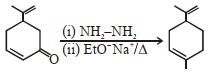
(B) The reaction involves the reduction of a carbonyl group $(C=O)$ to a methylene group $(-CH_{2}-)$ in the presence of a carbon-carbon double bond $(C=C)$.
Wolff-Kishner reduction,which uses hydrazine $(NH_{2}NH_{2})$ followed by a strong base like sodium ethoxide $(C_{2}H_{5}O^{-}Na^{+})$ and heat,is specifically used to reduce carbonyl groups to alkanes without affecting the $C=C$ double bond.
$NaBH_{4}$ reduces carbonyls but is typically used for alcohols,and $Ni/H_{2}$ would reduce both the carbonyl and the $C=C$ double bond.
Wolff-Kishner reduction,which uses hydrazine $(NH_{2}NH_{2})$ followed by a strong base like sodium ethoxide $(C_{2}H_{5}O^{-}Na^{+})$ and heat,is specifically used to reduce carbonyl groups to alkanes without affecting the $C=C$ double bond.
$NaBH_{4}$ reduces carbonyls but is typically used for alcohols,and $Ni/H_{2}$ would reduce both the carbonyl and the $C=C$ double bond.
0 likes
View Solution1129
EasyMCQ
$2,4-DNP$ test can be used to identify:
A
Amine
B
Aldehyde
C
Ether
D
Halogens
Solution
(B) $2,4-DNP$ stands for $2,4-dinitrophenylhydrazine$.
This reagent is used to identify carbonyl compounds,which include both aldehydes and ketones.
Among the given options,aldehyde is a carbonyl compound.
This reagent is used to identify carbonyl compounds,which include both aldehydes and ketones.
Among the given options,aldehyde is a carbonyl compound.
0 likes
View Solution1130
DifficultMCQ
Identify $A$ in the given chemical reaction:

A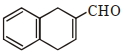
B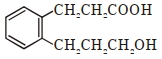
C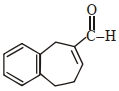
D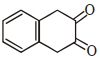
Solution
(A) The given reaction is an intramolecular aldol condensation of $o$-phenylenediacetaldehyde.
$1$. The base $(OH^-)$ abstracts an $\alpha$-hydrogen from one of the aldehyde groups to form an enolate ion.
$2$. This enolate ion performs a nucleophilic attack on the carbonyl carbon of the other aldehyde group,leading to the formation of a cyclic $\beta$-hydroxy aldehyde.
$3$. Upon heating in the presence of an acid or base (dehydration),the $\beta$-hydroxy aldehyde undergoes elimination of a water molecule to form an $\alpha,\beta$-unsaturated aldehyde.
$4$. The final product is $2$-formyl$-1,2,3,4-$tetrahydronaphthalene.
$1$. The base $(OH^-)$ abstracts an $\alpha$-hydrogen from one of the aldehyde groups to form an enolate ion.
$2$. This enolate ion performs a nucleophilic attack on the carbonyl carbon of the other aldehyde group,leading to the formation of a cyclic $\beta$-hydroxy aldehyde.
$3$. Upon heating in the presence of an acid or base (dehydration),the $\beta$-hydroxy aldehyde undergoes elimination of a water molecule to form an $\alpha,\beta$-unsaturated aldehyde.
$4$. The final product is $2$-formyl$-1,2,3,4-$tetrahydronaphthalene.
0 likes
View Solution1131
DifficultMCQ
The major products formed in the following reaction sequence $A$ and $B$ are :
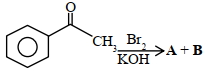
A
$A$ = $C_6H_5COOK$,$B$ = $CHBr_3$
B
$A$ = $C_6H_5COCH_2Br$,$B$ = $C_6H_5COCH_2OH$
C
$A$ = $C_6H_5COCBr_3$,$B$ = $C_6H_5CHO$
D
$A$ = $C_6H_3Br_2COCH_3$,$B$ = $C_6H_3(OH)_2COCH_3$
Solution
(A) The given reaction is the haloform reaction. Acetophenone $(C_6H_5COCH_3)$ reacts with bromine $(Br_2)$ in the presence of a base $(KOH)$.
This reaction converts the methyl ketone group $(-COCH_3)$ into a carboxylate salt $(-COOK)$ and a haloform $(CHBr_3)$.
The reaction is: $C_6H_5COCH_3 + 3Br_2 + 4KOH \rightarrow C_6H_5COOK + CHBr_3 + 3KBr + 3H_2O$.
Thus,the major products are $A = C_6H_5COOK$ and $B = CHBr_3$.
This reaction converts the methyl ketone group $(-COCH_3)$ into a carboxylate salt $(-COOK)$ and a haloform $(CHBr_3)$.
The reaction is: $C_6H_5COCH_3 + 3Br_2 + 4KOH \rightarrow C_6H_5COOK + CHBr_3 + 3KBr + 3H_2O$.
Thus,the major products are $A = C_6H_5COOK$ and $B = CHBr_3$.
0 likes
View Solution1132
MediumMCQ
Consider the given reaction. Identify $X$ and $Y$.
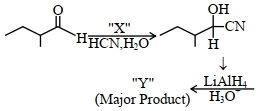
A
$X = NaOH, Y = CH_3CH_2CH(CH_3)CH(OH)CH_2NH_2$
B
$X = HNO_3, Y = CH_3CH_2CH(CH_3)CH(OH)CH_2NH_2$
C
$X = NaOH, Y = CH_3CH_2CH(CH_3)CH(OH)CH_2NH_2$
D
$X = HNO_3, Y = CH_3CH_2CH(CH_3)CH(OH)NH_2$
Solution
(C) The reaction involves the nucleophilic addition of cyanide to an aldehyde,catalyzed by a base like $NaOH$.
$1$. The first step is the formation of a cyanohydrin: $R-CHO + HCN \xrightarrow{NaOH} R-CH(OH)CN$.
$2$. The second step is the reduction of the nitrile group $(-CN)$ to a primary amine $(-CH_2NH_2)$ using a strong reducing agent like $LiAlH_4$.
$3$. Thus,$X$ is $NaOH$ and the final product $Y$ is $CH_3CH_2CH(CH_3)CH(OH)CH_2NH_2$.
$1$. The first step is the formation of a cyanohydrin: $R-CHO + HCN \xrightarrow{NaOH} R-CH(OH)CN$.
$2$. The second step is the reduction of the nitrile group $(-CN)$ to a primary amine $(-CH_2NH_2)$ using a strong reducing agent like $LiAlH_4$.
$3$. Thus,$X$ is $NaOH$ and the final product $Y$ is $CH_3CH_2CH(CH_3)CH(OH)CH_2NH_2$.
0 likes
View Solution1133
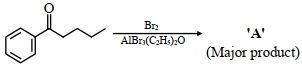
MediumMCQ
Consider the given reaction,the product $A$ is :
A
The structure of $1-$bromo$-1-$phenylpentan$-1-$one (or similar)
B
The structure of $4-$bromo$-1-$phenylpentan$-1-$one
C
The structure of $1-$($4$-bromophenyl)pentan$-1-$one
D
The structure of $1-$($3$-bromophenyl)pentan$-1-$one
Solution
(D) The reaction involves the bromination of valerophenone ($1$-phenylpentan$-1-$one) using $Br_2$ in the presence of $AlBr_3$ and diethyl ether $(Et_2O)$.
$AlBr_3$ is a Lewis acid catalyst used for electrophilic aromatic substitution.
The carbonyl group $(-CO-R)$ attached to the benzene ring is a strong electron-withdrawing group due to its $-I$ and $-M$ effects.
This makes the benzene ring deactivated and meta-directing for electrophilic substitution reactions.
Therefore,the electrophile $Br^+$ attacks the meta-position of the benzene ring to form $1-$($3$-bromophenyl)pentan$-1-$one as the major product.
$AlBr_3$ is a Lewis acid catalyst used for electrophilic aromatic substitution.
The carbonyl group $(-CO-R)$ attached to the benzene ring is a strong electron-withdrawing group due to its $-I$ and $-M$ effects.
This makes the benzene ring deactivated and meta-directing for electrophilic substitution reactions.
Therefore,the electrophile $Br^+$ attacks the meta-position of the benzene ring to form $1-$($3$-bromophenyl)pentan$-1-$one as the major product.
0 likes
View Solution1134
EasyMCQ
In the following sequence of reactions,the final product $D$ is:

A
$CH_3-CH_2-CH_2-CH_2-CH_2-CHO$
B
$CH_3-CH=CH-CH_2-CH_2-CH_2-COOH$
C
$CH_3-CH=CH-CH(OH)-CH_2-CH_2-CH_3$
D
$CH_3-CH_2-CH_2-CH_2-CH_2-CO-CH_3$
Solution
(D) Step $1$: $CH_3-C \equiv CH + NaNH_2 \rightarrow CH_3-C \equiv C^- Na^+ (A) + NH_3$.
Step $2$: The nucleophile $(A)$ reacts with $4$-bromopentan-$2$-ol to form $B$ $(CH_3-C \equiv C-CH_2-CH_2-CH(OH)-CH_3)$.
Step $3$: Hydrogenation with $H_2/Pd-C$ reduces the alkyne to an alkane,yielding $C$ $(CH_3-CH_2-CH_2-CH_2-CH_2-CH(OH)-CH_3)$.
Step $4$: Oxidation with $CrO_3$ converts the secondary alcohol into a ketone,yielding $D$ $(CH_3-CH_2-CH_2-CH_2-CH_2-CO-CH_3)$.
Step $2$: The nucleophile $(A)$ reacts with $4$-bromopentan-$2$-ol to form $B$ $(CH_3-C \equiv C-CH_2-CH_2-CH(OH)-CH_3)$.
Step $3$: Hydrogenation with $H_2/Pd-C$ reduces the alkyne to an alkane,yielding $C$ $(CH_3-CH_2-CH_2-CH_2-CH_2-CH(OH)-CH_3)$.
Step $4$: Oxidation with $CrO_3$ converts the secondary alcohol into a ketone,yielding $D$ $(CH_3-CH_2-CH_2-CH_2-CH_2-CO-CH_3)$.
0 likes
View Solution1135
EasyMCQ
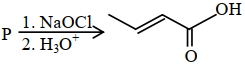
The structure of the starting compound $P$ used in the reaction given below is:
A
$CH_3-CH=CH-COCH_3$
B
$CH_3-CH_2-CH=CH-CHO$
C
$3,4-$dihydro-2H-pyran
D
cyclopentanone
Solution
(A) The given reaction is a haloform reaction,which is characteristic of methyl ketones $(R-CO-CH_3)$.
In the presence of a hypohalite reagent like $NaOCl$ followed by acidic workup $(H_3O^+)$,a methyl ketone is oxidized to a carboxylic acid and chloroform $(CHCl_3)$ is produced as a byproduct.
The product shown in the reaction is crotonic acid $(CH_3-CH=CH-COOH)$.
Therefore,the starting compound $P$ must be the corresponding methyl ketone,which is $CH_3-CH=CH-COCH_3$ (pent$-3-$en$-2-$one).
In the presence of a hypohalite reagent like $NaOCl$ followed by acidic workup $(H_3O^+)$,a methyl ketone is oxidized to a carboxylic acid and chloroform $(CHCl_3)$ is produced as a byproduct.
The product shown in the reaction is crotonic acid $(CH_3-CH=CH-COOH)$.
Therefore,the starting compound $P$ must be the corresponding methyl ketone,which is $CH_3-CH=CH-COCH_3$ (pent$-3-$en$-2-$one).
0 likes
View Solution1136
DifficultMCQ
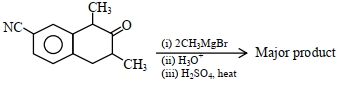
Which one of the following is the major product of the given reaction?
A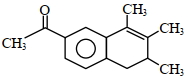
B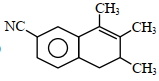
C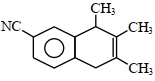
D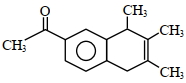
Solution
(D) The reaction involves the treatment of a compound containing both a nitrile $(-CN)$ group and a ketone $(C=O)$ group with $2$ equivalents of $CH_3MgBr$.
$1$. The $CH_3MgBr$ acts as a nucleophile and attacks both the nitrile carbon and the ketone carbonyl carbon.
$2$. Upon acidic workup $(H_3O^+)$,the intermediate imine is hydrolyzed to a ketone,and the alkoxide is protonated to an alcohol.
$3$. The final step involves dehydration using $H_2SO_4$ and heat,which removes the hydroxyl group and a hydrogen atom from the adjacent carbon to form a double bond.
$4$. The final product is a ketone with a substituted double bond,as shown in the solution image.
$1$. The $CH_3MgBr$ acts as a nucleophile and attacks both the nitrile carbon and the ketone carbonyl carbon.
$2$. Upon acidic workup $(H_3O^+)$,the intermediate imine is hydrolyzed to a ketone,and the alkoxide is protonated to an alcohol.
$3$. The final step involves dehydration using $H_2SO_4$ and heat,which removes the hydroxyl group and a hydrogen atom from the adjacent carbon to form a double bond.
$4$. The final product is a ketone with a substituted double bond,as shown in the solution image.
0 likes
View Solution1137
MediumMCQ
The structure of product $C$,formed by the following sequence of reactions is :
$CH_3COOH + SOCl_2$ $\longrightarrow A$ $\xrightarrow[AlCl_3]{Benzene} B$ $\xrightarrow[H^{+}]{KCN} C$
$CH_3COOH + SOCl_2$ $\longrightarrow A$ $\xrightarrow[AlCl_3]{Benzene} B$ $\xrightarrow[H^{+}]{KCN} C$
A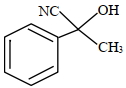
B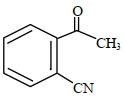
C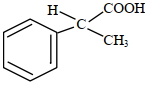
D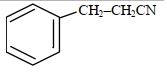
Solution
(A) Step $1$: $CH_3COOH + SOCl_2 \longrightarrow CH_3COCl (A) + SO_2 + HCl$.
Step $2$: $CH_3COCl + C_6H_6 \xrightarrow{AlCl_3} C_6H_5COCH_3 (B) + HCl$. This is a Friedel-Crafts acylation reaction.
Step $3$: $C_6H_5COCH_3 + KCN \xrightarrow{H^+} C_6H_5C(OH)(CH_3)CN (C)$. This is a nucleophilic addition reaction of $CN^-$ to the carbonyl group of acetophenone,followed by protonation to form a cyanohydrin.
Step $2$: $CH_3COCl + C_6H_6 \xrightarrow{AlCl_3} C_6H_5COCH_3 (B) + HCl$. This is a Friedel-Crafts acylation reaction.
Step $3$: $C_6H_5COCH_3 + KCN \xrightarrow{H^+} C_6H_5C(OH)(CH_3)CN (C)$. This is a nucleophilic addition reaction of $CN^-$ to the carbonyl group of acetophenone,followed by protonation to form a cyanohydrin.
0 likes
View Solution1138
MediumMCQ
For the reaction given below:
The compound which is not formed as a product in the reaction is a:
The compound which is not formed as a product in the reaction is a:
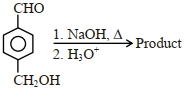
A
compound with both alcohol and acid functional groups
B
monocarboxylic acid
C
dicarboxylic acid
D
diol
Solution
(C) The given reaction is an intramolecular Cannizzaro reaction because the substrate $4-formylbenzyl alcohol$ contains both an aldehyde group $(-CHO)$ and a hydroxymethyl group $(-CH_2OH)$,but no $\alpha$-hydrogen atoms.
In the presence of concentrated $NaOH$ and heat,the aldehyde group undergoes disproportionation (oxidation and reduction).
The oxidation of the $-CHO$ group leads to the formation of a carboxylic acid group $(-COOH)$,while the reduction of the $-CHO$ group leads to the formation of a primary alcohol group $(-CH_2OH)$.
The final products are $1,4-benzenedimethanol$ (a diol) and $4-(hydroxymethyl)benzoic acid$ (a compound with both alcohol and acid functional groups).
Comparing these products with the options:
$A$. Compound with both alcohol and acid functional groups: Formed $(4-(hydroxymethyl)benzoic acid)$.
$B$. Monocarboxylic acid: Formed ($4-(hydroxymethyl)benzoic acid$ is a monocarboxylic acid).
$C$. Dicarboxylic acid: Not formed.
$D$. Diol: Formed ($1,4-benzenedimethanol$ is a diol).
Therefore,the compound that is not formed is a dicarboxylic acid.
In the presence of concentrated $NaOH$ and heat,the aldehyde group undergoes disproportionation (oxidation and reduction).
The oxidation of the $-CHO$ group leads to the formation of a carboxylic acid group $(-COOH)$,while the reduction of the $-CHO$ group leads to the formation of a primary alcohol group $(-CH_2OH)$.
The final products are $1,4-benzenedimethanol$ (a diol) and $4-(hydroxymethyl)benzoic acid$ (a compound with both alcohol and acid functional groups).
Comparing these products with the options:
$A$. Compound with both alcohol and acid functional groups: Formed $(4-(hydroxymethyl)benzoic acid)$.
$B$. Monocarboxylic acid: Formed ($4-(hydroxymethyl)benzoic acid$ is a monocarboxylic acid).
$C$. Dicarboxylic acid: Not formed.
$D$. Diol: Formed ($1,4-benzenedimethanol$ is a diol).
Therefore,the compound that is not formed is a dicarboxylic acid.
0 likes
View Solution1139
EasyMCQ
Given below are two statements :
Statement $I :$ The nucleophilic addition of sodium hydrogen sulphite to an aldehyde or a ketone involves proton transfer to form a stable ion.
Statement $II :$ The nucleophilic addition of hydrogen cyanide to an aldehyde or a ketone yields amine as final product.
In the light of the above statements,choose the most appropriate answer from the options given below :
Statement $I :$ The nucleophilic addition of sodium hydrogen sulphite to an aldehyde or a ketone involves proton transfer to form a stable ion.
Statement $II :$ The nucleophilic addition of hydrogen cyanide to an aldehyde or a ketone yields amine as final product.
In the light of the above statements,choose the most appropriate answer from the options given below :
A
Both Statement $I$ and Statement $II$ are true.
B
Statement $I$ is true but Statement $II$ is false.
C
Statement $I$ is false but Statement $II$ is true.
D
Both Statement $I$ and Statement $II$ are false.
Solution
(B) Statement $I$ is true. The nucleophilic addition of sodium hydrogen sulphite $(NaHSO_3)$ to an aldehyde or a ketone involves the attack of the sulphite nucleophile on the carbonyl carbon,followed by a proton transfer to the oxygen atom to form a stable bisulphite addition product (a white crystalline solid).
Statement $II$ is false. The nucleophilic addition of hydrogen cyanide $(HCN)$ to an aldehyde or a ketone yields a cyanohydrin,not an amine. The reaction involves the addition of the cyanide ion $(CN^-)$ to the carbonyl carbon followed by protonation of the oxygen.
Therefore,Statement $I$ is true but Statement $II$ is false.
Statement $II$ is false. The nucleophilic addition of hydrogen cyanide $(HCN)$ to an aldehyde or a ketone yields a cyanohydrin,not an amine. The reaction involves the addition of the cyanide ion $(CN^-)$ to the carbonyl carbon followed by protonation of the oxygen.
Therefore,Statement $I$ is true but Statement $II$ is false.
0 likes
View Solution1140
MediumMCQ
Which among the following compounds does not form a silver mirror when treated with Tollen's reagent?
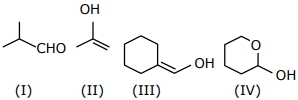
A
Only $II$
B
$I, III$ and $IV$ only
C
$III$ and $IV$ only
D
Only $IV$
Solution
(A) Tollen's reagent is used to detect the presence of aldehydes.
$I$ is an aldehyde (isobutyraldehyde),which gives a positive Tollen's test.
$II$ is an enol that tautomerizes to acetone (a ketone),which does not give a positive Tollen's test.
$III$ is an enol that tautomerizes to an aldehyde (cyclohexanecarbaldehyde),which gives a positive Tollen's test.
$IV$ is a hemiacetal,which exists in equilibrium with its open-chain aldehyde form in the presence of base,thus giving a positive Tollen's test.
Therefore,only compound $II$ does not form a silver mirror.
$I$ is an aldehyde (isobutyraldehyde),which gives a positive Tollen's test.
$II$ is an enol that tautomerizes to acetone (a ketone),which does not give a positive Tollen's test.
$III$ is an enol that tautomerizes to an aldehyde (cyclohexanecarbaldehyde),which gives a positive Tollen's test.
$IV$ is a hemiacetal,which exists in equilibrium with its open-chain aldehyde form in the presence of base,thus giving a positive Tollen's test.
Therefore,only compound $II$ does not form a silver mirror.
0 likes
View Solution1141
MediumMCQ
The number of nitrogen atoms in a semicarbazone molecule of acetone is $.....$
A
$1$
B
$2$
C
$3$
D
$4$
Solution
(C) The reaction of acetone with semicarbazide produces acetone semicarbazone and water.
The chemical reaction is: $(CH_3)_2C=O + H_2N-NH-CONH_2 \rightarrow (CH_3)_2C=N-NH-CONH_2 + H_2O$.
In the structure of acetone semicarbazone,$(CH_3)_2C=N-NH-CONH_2$,we can count the nitrogen atoms:
$1$. One nitrogen atom is in the $C=N$ group.
$2$. One nitrogen atom is in the $-NH-$ group.
$3$. One nitrogen atom is in the $-NH_2$ group.
Therefore,the total number of nitrogen atoms in a molecule of acetone semicarbazone is $3$.
The chemical reaction is: $(CH_3)_2C=O + H_2N-NH-CONH_2 \rightarrow (CH_3)_2C=N-NH-CONH_2 + H_2O$.
In the structure of acetone semicarbazone,$(CH_3)_2C=N-NH-CONH_2$,we can count the nitrogen atoms:
$1$. One nitrogen atom is in the $C=N$ group.
$2$. One nitrogen atom is in the $-NH-$ group.
$3$. One nitrogen atom is in the $-NH_2$ group.
Therefore,the total number of nitrogen atoms in a molecule of acetone semicarbazone is $3$.
0 likes
View Solution1142
DifficultMCQ
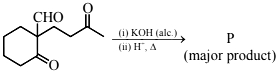
The major product $(P)$ in the following reaction is :
A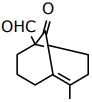
B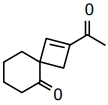
C
D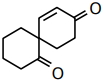
Solution
(D) The given reaction is an intramolecular aldol condensation.
$1$. The base $(KOH)$ abstracts an $\alpha$-hydrogen from the ketone group to form an enolate.
$2$. This enolate attacks the carbonyl carbon of the aldehyde group,forming a cyclic $\beta$-hydroxy ketone.
$3$. Subsequent dehydration (catalyzed by $H^+, \Delta$) leads to the formation of an $\alpha,\beta$-unsaturated ketone.
$4$. The resulting product is a spiro-compound where a cyclohexenone ring is fused to a cyclohexane ring.
$1$. The base $(KOH)$ abstracts an $\alpha$-hydrogen from the ketone group to form an enolate.
$2$. This enolate attacks the carbonyl carbon of the aldehyde group,forming a cyclic $\beta$-hydroxy ketone.
$3$. Subsequent dehydration (catalyzed by $H^+, \Delta$) leads to the formation of an $\alpha,\beta$-unsaturated ketone.
$4$. The resulting product is a spiro-compound where a cyclohexenone ring is fused to a cyclohexane ring.
0 likes
View Solution1143
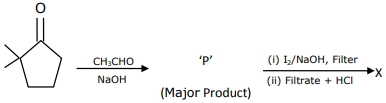
DifficultMCQ
Consider the given reaction,the product $'X'$ is:
A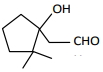
B
C
D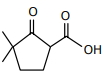
Solution
(D) $1$. The reaction of $5,5$-dimethylcyclopentanone with $CH_3CHO$ in the presence of $NaOH$ is an aldol condensation reaction,which produces a $\beta$-hydroxy ketone intermediate.
$2$. This intermediate contains a $CH_3CH(OH)-$ group,which is susceptible to the iodoform reaction.
$3$. Treatment with $I_2/NaOH$ performs the iodoform reaction,converting the $CH_3CH(OH)-$ group into a carboxylate group $(-COO^-Na^+)$ and producing $CHI_3$ (yellow precipitate).
$4$. The filtrate containing the carboxylate is then acidified with $HCl$ to yield the final product $'X'$,which is $5,5$-dimethyl$-2-$oxocyclopentanecarboxylic acid.
$2$. This intermediate contains a $CH_3CH(OH)-$ group,which is susceptible to the iodoform reaction.
$3$. Treatment with $I_2/NaOH$ performs the iodoform reaction,converting the $CH_3CH(OH)-$ group into a carboxylate group $(-COO^-Na^+)$ and producing $CHI_3$ (yellow precipitate).
$4$. The filtrate containing the carboxylate is then acidified with $HCl$ to yield the final product $'X'$,which is $5,5$-dimethyl$-2-$oxocyclopentanecarboxylic acid.
0 likes
View Solution1144
MediumMCQ
Consider the above reaction,the major product $'P'$ is:-

A
B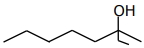
C
D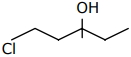
Solution
(A) The reaction involves the addition of a Grignard reagent $(C_2H_5MgBr)$ to an $\alpha,\beta$-unsaturated ketone (but$-3-$en$-2-$one).
Grignard reagents typically undergo $1,2$-addition to the carbonyl group of $\alpha,\beta$-unsaturated ketones to form an allylic alcohol.
Step $1$: The ethyl group $(C_2H_5^-)$ from $C_2H_5MgBr$ attacks the carbonyl carbon,forming an alkoxide intermediate.
Step $2$: Subsequent protonation with $H_2O$ yields the allylic alcohol,$3$-methylpent-$1$-en-$3$-ol.
Although $HCl$ is mentioned in the reaction conditions,under standard laboratory conditions for Grignard reactions,the primary product isolated is the alcohol. Among the given options,the structure corresponding to $3$-methylpent-$1$-en-$3$-ol is the correct major product.
Grignard reagents typically undergo $1,2$-addition to the carbonyl group of $\alpha,\beta$-unsaturated ketones to form an allylic alcohol.
Step $1$: The ethyl group $(C_2H_5^-)$ from $C_2H_5MgBr$ attacks the carbonyl carbon,forming an alkoxide intermediate.
Step $2$: Subsequent protonation with $H_2O$ yields the allylic alcohol,$3$-methylpent-$1$-en-$3$-ol.
Although $HCl$ is mentioned in the reaction conditions,under standard laboratory conditions for Grignard reactions,the primary product isolated is the alcohol. Among the given options,the structure corresponding to $3$-methylpent-$1$-en-$3$-ol is the correct major product.
0 likes
View Solution1145
MediumMCQ
$A$ reaction of benzonitrile with one equivalent of $CH_{3}MgBr$ followed by hydrolysis produces a yellow liquid $P$. The compound $P$ will give a positive result for which of the following tests?
A
Tollen's test
B
Schiff's test
C
Ninhydrin's test
D
Iodoform test
Solution
(D) The reaction of benzonitrile $(C_{6}H_{5}CN)$ with one equivalent of methylmagnesium bromide $(CH_{3}MgBr)$ followed by acid hydrolysis $(H_{3}O^{+})$ proceeds as follows:
$1$. Nucleophilic attack of $CH_{3}^{-}$ on the carbon of the nitrile group forms an imine magnesium salt intermediate: $C_{6}H_{5}C(CH_{3})=NMgBr$.
$2$. Hydrolysis of this intermediate yields acetophenone $(C_{6}H_{5}COCH_{3})$ and ammonia $(NH_{3})$.
$3$. Acetophenone contains the acetyl group $(CH_{3}CO-)$ attached to a phenyl ring. Compounds containing the $CH_{3}CO-$ group attached to a hydrogen or carbon atom give a positive iodoform test with $I_{2}/NaOH$.
$1$. Nucleophilic attack of $CH_{3}^{-}$ on the carbon of the nitrile group forms an imine magnesium salt intermediate: $C_{6}H_{5}C(CH_{3})=NMgBr$.
$2$. Hydrolysis of this intermediate yields acetophenone $(C_{6}H_{5}COCH_{3})$ and ammonia $(NH_{3})$.
$3$. Acetophenone contains the acetyl group $(CH_{3}CO-)$ attached to a phenyl ring. Compounds containing the $CH_{3}CO-$ group attached to a hydrogen or carbon atom give a positive iodoform test with $I_{2}/NaOH$.
0 likes
View Solution1146
DifficultMCQ
Which one of the following compounds will give an orange precipitate when treated with $2,4-$dinitrophenylhydrazine?
A
Ethyl benzoate
B
Salicylic acid
C
Ethyl salicylate
D
Acetophenone
Solution
(D) The $2,4-$dinitrophenylhydrazine $(2,4-DNP)$ test is a characteristic reaction used to identify carbonyl compounds,specifically aldehydes and ketones.
$2,4-DNP$ reacts with the carbonyl group $(>C=O)$ of aldehydes and ketones to form a crystalline orange or yellow precipitate of $2,4-$dinitrophenylhydrazone.
Among the given options:
$A$. Ethyl benzoate is an ester.
$B$. Salicylic acid is a carboxylic acid.
$C$. Ethyl salicylate is an ester.
$D$. Acetophenone is a ketone.
Since only acetophenone contains a carbonyl group,it will give a positive $2,4-DNP$ test.
$2,4-DNP$ reacts with the carbonyl group $(>C=O)$ of aldehydes and ketones to form a crystalline orange or yellow precipitate of $2,4-$dinitrophenylhydrazone.
Among the given options:
$A$. Ethyl benzoate is an ester.
$B$. Salicylic acid is a carboxylic acid.
$C$. Ethyl salicylate is an ester.
$D$. Acetophenone is a ketone.
Since only acetophenone contains a carbonyl group,it will give a positive $2,4-DNP$ test.
0 likes
View Solution1147
MediumMCQ
Consider the following sequence of reactions:
$Benzene$ $\xrightarrow{CO, HCl, \text{anhydrous } AlCl_3/CuCl} A$ $\xrightarrow{B, OH^-, 293 K} \text{Chalcone (1,3-diphenylprop-2-en-1-one)}$
The substance $B$ is:
$Benzene$ $\xrightarrow{CO, HCl, \text{anhydrous } AlCl_3/CuCl} A$ $\xrightarrow{B, OH^-, 293 K} \text{Chalcone (1,3-diphenylprop-2-en-1-one)}$
The substance $B$ is:
A
Benzene
B
Acetophenone
C
Benzaldehyde
D
Acetone
Solution
(B) $1$. The first step is the Gattermann-Koch reaction where benzene reacts with $CO$ and $HCl$ in the presence of anhydrous $AlCl_3/CuCl$ to form $A$,which is benzaldehyde $(C_6H_5CHO)$.
$2$. The second step is the Claisen-Schmidt condensation reaction between benzaldehyde $(A)$ and a ketone $(B)$ in the presence of a base $(OH^-)$ to form the product,which is chalcone $(C_6H_5-CH=CH-CO-C_6H_5)$.
$3$. For the formation of chalcone,the ketone $B$ must be acetophenone $(C_6H_5COCH_3)$.
$4$. Therefore,the substance $B$ is acetophenone.
$2$. The second step is the Claisen-Schmidt condensation reaction between benzaldehyde $(A)$ and a ketone $(B)$ in the presence of a base $(OH^-)$ to form the product,which is chalcone $(C_6H_5-CH=CH-CO-C_6H_5)$.
$3$. For the formation of chalcone,the ketone $B$ must be acetophenone $(C_6H_5COCH_3)$.
$4$. Therefore,the substance $B$ is acetophenone.
0 likes
View Solution1148
MediumMCQ
Match List $-I$ with List $-II.$
Choose the correct answer from the options given below:
| List $-I$ (Products formed) | List $-II$ (Reaction of carbonyl compound with) |
| $(a).$ Cyanohydrin | $(i).$ $NH_2OH$ |
| $(b).$ Acetal | $(ii).$ $RNH_2$ |
| $(c).$ Schiff's base | $(iii).$ Alcohol |
| $(d).$ Oxime | $(iv).$ $HCN$ |
Choose the correct answer from the options given below:
A
$(a)-(ii), (b)-(iii), (c)-(iv), (d)-(i)$
B
$(a)-(i), (b)-(iii), (c)-(ii), (d)-(iv)$
C
$(a)-(iv), (b)-(iii), (c)-(ii), (d)-(i)$
D
$(a)-(iii), (b)-(iv), (c)-(ii), (d)-(i)$
Solution
(C) The reactions of carbonyl compounds are as follows:
$(a).$ Cyanohydrin is formed by the reaction of carbonyl compounds with $HCN$ $(iv)$.
$(b).$ Acetal is formed by the reaction of aldehydes with alcohol in the presence of dry $HCl$ $(iii)$.
$(c).$ Schiff's base is formed by the reaction of carbonyl compounds with primary amines $(RNH_2)$ $(ii)$.
$(d).$ Oxime is formed by the reaction of carbonyl compounds with hydroxylamine $(NH_2OH)$ $(i)$.
Therefore,the correct matching is $(a)-(iv), (b)-(iii), (c)-(ii), (d)-(i)$.
$(a).$ Cyanohydrin is formed by the reaction of carbonyl compounds with $HCN$ $(iv)$.
$(b).$ Acetal is formed by the reaction of aldehydes with alcohol in the presence of dry $HCl$ $(iii)$.
$(c).$ Schiff's base is formed by the reaction of carbonyl compounds with primary amines $(RNH_2)$ $(ii)$.
$(d).$ Oxime is formed by the reaction of carbonyl compounds with hydroxylamine $(NH_2OH)$ $(i)$.
Therefore,the correct matching is $(a)-(iv), (b)-(iii), (c)-(ii), (d)-(i)$.
0 likes
View Solution1149
MediumMCQ
Given below are two statements:
Statement $I:$ The boiling points of aldehydes and ketones are higher than hydrocarbons of comparable molecular masses because of weak molecular association in aldehydes and ketones due to dipole-dipole interactions.
Statement $II:$ The boiling points of aldehydes and ketones are lower than the alcohols of similar molecular masses due to the absence of $H$-bonding.
In the light of the above statements,choose the most appropriate answer from the options given below:
Statement $I:$ The boiling points of aldehydes and ketones are higher than hydrocarbons of comparable molecular masses because of weak molecular association in aldehydes and ketones due to dipole-dipole interactions.
Statement $II:$ The boiling points of aldehydes and ketones are lower than the alcohols of similar molecular masses due to the absence of $H$-bonding.
In the light of the above statements,choose the most appropriate answer from the options given below:
A
Both Statement $I$ and Statement $II$ are incorrect.
B
Statement $I$ is correct but Statement $II$ is incorrect.
C
Statement $I$ is incorrect but Statement $II$ is correct.
D
Both Statement $I$ and Statement $II$ are correct.
Solution
(D) The boiling point order for compounds of comparable molecular masses is: Alcohols > Aldehydes/Ketones > Hydrocarbons.
Statement $I$ is correct: Aldehydes and ketones possess a polar carbonyl group,leading to dipole-dipole interactions,which are stronger than the weak London dispersion forces found in non-polar hydrocarbons.
Statement $II$ is correct: Alcohols exhibit intermolecular $H$-bonding,which is significantly stronger than the dipole-dipole interactions present in aldehydes and ketones,resulting in higher boiling points for alcohols.
Therefore,both statements are correct.
Statement $I$ is correct: Aldehydes and ketones possess a polar carbonyl group,leading to dipole-dipole interactions,which are stronger than the weak London dispersion forces found in non-polar hydrocarbons.
Statement $II$ is correct: Alcohols exhibit intermolecular $H$-bonding,which is significantly stronger than the dipole-dipole interactions present in aldehydes and ketones,resulting in higher boiling points for alcohols.
Therefore,both statements are correct.
0 likes
View Solution1150
MediumMCQ
Which one of the following is not formed when acetone reacts with $2-$pentanone in the presence of dilute $NaOH$ followed by heating?
A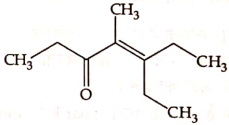
B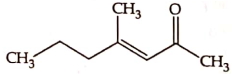
C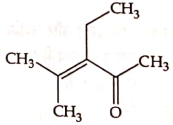
D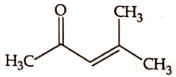
Solution
(A) The reaction between acetone $(CH_3COCH_3)$ and $2-$pentanone $(CH_3COCH_2CH_2CH_3)$ in the presence of dilute $NaOH$ and heating is a cross-aldol condensation reaction.
Acetone has two equivalent $\alpha-$hydrogens,while $2-$pentanone has two types of $\alpha-$hydrogens (at $C-1$ and $C-3$).
Self-aldol products of acetone and $2-$pentanone can also form.
The product shown in option $A$ requires a structure that cannot be derived from the condensation of these two specific ketones under the given conditions,as it would require a different carbon skeleton or starting materials.
Therefore,the structure in option $A$ is not formed.
Acetone has two equivalent $\alpha-$hydrogens,while $2-$pentanone has two types of $\alpha-$hydrogens (at $C-1$ and $C-3$).
Self-aldol products of acetone and $2-$pentanone can also form.
The product shown in option $A$ requires a structure that cannot be derived from the condensation of these two specific ketones under the given conditions,as it would require a different carbon skeleton or starting materials.
Therefore,the structure in option $A$ is not formed.
0 likes
View Solution8-1.Aldehydes and Ketones — Properties · Frequently Asked Questions
1Are these 8-1.Aldehydes and Ketones questions useful for JEE and NEET?
Yes. All questions in this section are mapped to JEE Main and NEET exam patterns. Previous year questions from JEE Main, NEET, GUJCET and state-level exams are included with full solutions.
2Can I switch to Hindi or Gujarati for these questions?
Yes. Use the language tabs in the hero section or the sidebar to view the same questions and solutions in English, Hindi or Gujarati.
3How do I generate a question paper from this subtopic?
Use the Vedclass Exam Paper Generator — select the chapter and subtopic, set difficulty, and generate Sets A, B, C, D automatically. First 3 chapters of every subject are free.
Vedclass Products
For Students
Vedclass Test Series
Mock tests in real JEE/NEET style with performance analysis. 5-day free trial.
Start Free TrialFor Teachers
Exam Paper Generator
Generate Set A/B/C/D papers from this chapter in 2 minutes. 3 chapters free.
Try FreeFor Institutes
Online Exam Module
Live online exams with unlimited students, 360° analytics & white-label branding.
See DemoFor Teachers & Institutes
Generate a 8-1.Aldehydes and Ketones Exam Paper in 2 Minutes
Select subtopic & difficulty — Sets A, B, C, D auto-generated with No Repeat logic.
First 3 chapters of every subject are free — no payment required.