
A English
Animal breeding Questions in English
Class 12 Biology · Strategies for Enhancement in Food Production · Animal breeding
156+
Questions
English
Language
100%
With Solutions
Showing 50 of 156 questions in English
101
EasyMCQ
Select the appropriate option regarding the animals between which outcrossing is performed.
A
Both (male and female) animals belong to the same breed.
B
Both animals have no common ancestors on either side of their pedigree up to $4-6$ generations.
C
Both animals have common ancestors up to $4-6$ generations.
D
Both $A$ and $B$.
Solution
(B) Outcrossing is a type of animal breeding practice where mating occurs between animals of the same breed but having no common ancestors on either side of their pedigree up to $4-6$ generations. This method is the best breeding strategy for animals that are below average in productivity in milk production,growth rate in beef cattle,etc. It helps to overcome inbreeding depression.
0 likes
View Solution102
EasyMCQ
In which method is a superior male of one breed mated with a superior female of another breed?
A
Outcrossing
B
Inbreeding
C
Cross-breeding
D
Interspecific hybridization
Solution
(C) Cross-breeding is a method of animal breeding where a superior male of one breed is mated with a superior female of another breed. This allows the desirable qualities of two different breeds to be combined into the progeny. For example,$Hisardale$ is a new breed of sheep developed in $Punjab$ by crossing $Bikaneri$ ewes and $Merino$ rams.
0 likes
View Solution103
EasyMCQ
In $MOET$,which hormone is administered to the cow to induce superovulation?
A
$LH$
B
Progesterone
C
Testosterone
D
$FSH$
Solution
(D) $MOET$ stands for Multiple Ovulation Embryo Transfer technology.
In this process,a cow is administered hormones,with $FSH$ (Follicle Stimulating Hormone) activity,to induce follicular maturation and superovulation.
Instead of one egg,which is normal per cycle,$6-8$ eggs are produced.
The cow is then either mated with an elite bull or artificially inseminated.
Therefore,the correct hormone used is $FSH$.
In this process,a cow is administered hormones,with $FSH$ (Follicle Stimulating Hormone) activity,to induce follicular maturation and superovulation.
Instead of one egg,which is normal per cycle,$6-8$ eggs are produced.
The cow is then either mated with an elite bull or artificially inseminated.
Therefore,the correct hormone used is $FSH$.
0 likes
View Solution104
EasyMCQ
At what cell stage are the fertilized eggs transferred to a surrogate mother?
A
$8-32$ cells
B
$6-30$ cells
C
$2-4$ cells
D
$6-32$ cells
Solution
(A) In the technique of Multiple Ovulation Embryo Transfer $(MOET)$,the cow is administered hormones to induce superovulation. After fertilization,the embryos at the $8-32$ cell stage are recovered non-surgically and transferred to surrogate mothers. This allows for the production of multiple high-quality offspring from a single superior cow.
0 likes
View Solution105
EasyMCQ
What does $MOET$ stand for?
A
Multiple Ovulation Enlargement Test Technology
B
Mega Ovulation Estimation Test Technology
C
Multiple Ovulation Embryo Transfer Technology
D
More Ovulation Embryo Test Technology
Solution
(C) $MOET$ stands for Multiple Ovulation Embryo Transfer Technology.
It is a program for herd improvement in animals like cattle.
In this method,a cow is administered hormones,with $FSH$-like activity,to induce follicular maturation and superovulation instead of one egg,which they normally yield per cycle,they produce $6-8$ eggs.
The animal is either mated with an elite bull or artificially inseminated.
The fertilized eggs at $8-32$ cells stages are recovered non-surgically and transferred to surrogate mothers.
It is a program for herd improvement in animals like cattle.
In this method,a cow is administered hormones,with $FSH$-like activity,to induce follicular maturation and superovulation instead of one egg,which they normally yield per cycle,they produce $6-8$ eggs.
The animal is either mated with an elite bull or artificially inseminated.
The fertilized eggs at $8-32$ cells stages are recovered non-surgically and transferred to surrogate mothers.
0 likes
View Solution106
MediumMCQ
What is the effect of $FSH$ treatment in cows?
A
Increase in the number of ovaries
B
Decrease in the number of ovaries
C
Decrease in ovulation
D
Increase in ovulation
Solution
(D) In the process of Multiple Ovulation Embryo Transfer $(MOET)$,a cow is administered hormones with $FSH$ ($Follicle$ $Stimulating$ $Hormone$)-like activity.
This treatment induces follicular maturation and superovulation.
Instead of the normal one egg per cycle,the cow is induced to produce $6-8$ eggs per cycle.
Therefore,$FSH$ treatment increases the rate of ovulation in cows.
This treatment induces follicular maturation and superovulation.
Instead of the normal one egg per cycle,the cow is induced to produce $6-8$ eggs per cycle.
Therefore,$FSH$ treatment increases the rate of ovulation in cows.
0 likes
View Solution107
EasyMCQ
In cows,normally $X$ egg$(s)$ is/are produced per cycle,and after treatment with Follicle Stimulating Hormone $(FSH)$,$Y$ egg$(s)$ is/are produced.
A
$X = 2, Y = 2$ to $4$
B
$X = 1, Y = 6$ to $8$
C
$X = 6, Y = 1$ to $3$
D
$X = 1, Y = 8$ to $32$
Solution
(B) In cows,under normal physiological conditions,only $1$ egg is released per estrous cycle.
However,in the technique of Multiple Ovulation Embryo Transfer $(MOET)$,cows are administered hormones with $FSH$-like activity to induce follicular maturation and superovulation.
This treatment results in the production of $6$ to $8$ eggs per cycle instead of the usual $1$ egg.
Therefore,$X = 1$ and $Y = 6$ to $8$.
However,in the technique of Multiple Ovulation Embryo Transfer $(MOET)$,cows are administered hormones with $FSH$-like activity to induce follicular maturation and superovulation.
This treatment results in the production of $6$ to $8$ eggs per cycle instead of the usual $1$ egg.
Therefore,$X = 1$ and $Y = 6$ to $8$.
0 likes
View Solution108
MediumMCQ
What is necessary to obtain progeny with desired traits from two different species?
A
Inbreeding
B
Outcrossing
C
Cross-breeding
D
Interspecific hybridization
Solution
(D) Interspecific hybridization is a breeding method where male and female animals of two different related species are mated together. This process allows the combination of desirable features from both species into the progeny. For example,a mule is produced by the mating of a male donkey and a female horse.
0 likes
View Solution109
MediumMCQ
Which of the following statements is incorrect?
A
Inbreeding exposes harmful recessive genes.
B
Continued close inbreeding reduces fertility and productivity.
C
Inbreeding refers to the breeding between animals that have no common ancestors for $4-6$ generations.
D
Inbreeding helps in the development of pure lines.
Solution
(C) Inbreeding refers to the mating of more closely related individuals within the same breed for $4-6$ generations. The strategy used is to identify superior males and superior females of the same breed and mate them. The statement in option $C$ describes outbreeding,not inbreeding. Therefore,statement $C$ is incorrect.
0 likes
View Solution110
EasyMCQ
$A$ liger is the product of which type of hybridization?
A
Inbreeding
B
Outcrossing
C
Interspecific hybridization
D
Cross-breeding
Solution
(C) liger is the offspring of a male lion $(Panthera \text{ } leo)$ and a female tiger $(Panthera \text{ } tigris)$.
Since the lion and the tiger belong to different species, this process is known as interspecific hybridization.
Interspecific hybridization involves mating animals of two different related species to combine desirable features in the progeny.
Since the lion and the tiger belong to different species, this process is known as interspecific hybridization.
Interspecific hybridization involves mating animals of two different related species to combine desirable features in the progeny.
0 likes
View Solution111
EasyMCQ
Inbreeding depression is
A
Reduced fertility and productivity due to continued close inbreeding
B
Reduced motility and immunity due to close inbreeding
C
Decreased productivity due to mating of superior male and inferior female
D
Decrease in body mass of progeny due to continued close inbreeding
Solution
(A) Inbreeding depression refers to the reduction in biological fitness in a given population as a result of inbreeding,or breeding of related individuals.
Continued close inbreeding,especially in cattle,usually reduces fertility and productivity.
It exposes harmful recessive genes that are expressed by homozygous conditions.
Therefore,option $A$ is the correct answer.
Outcrossing is a common practice used to overcome inbreeding depression.
Continued close inbreeding,especially in cattle,usually reduces fertility and productivity.
It exposes harmful recessive genes that are expressed by homozygous conditions.
Therefore,option $A$ is the correct answer.
Outcrossing is a common practice used to overcome inbreeding depression.
0 likes
View Solution112
MediumMCQ
Mark the incorrect statement for inbreeding.
A
Inbreeding depression increases productivity.
B
Inbreeding depression can be overcome by outcrossing.
C
Produces purelines.
D
Increases homozygosity.
Solution
(A) Inbreeding refers to the mating of more closely related individuals within the same breed for $4-6$ generations.
Continuous inbreeding,especially close inbreeding,usually reduces fertility and productivity,a phenomenon known as inbreeding depression.
Therefore,the statement that 'Inbreeding depression increases productivity' is incorrect.
Inbreeding increases homozygosity,which is necessary for the evolution of purelines in cattle.
Inbreeding depression can be overcome by outcrossing,which involves mating animals of the same breed that have no common ancestors on either side of their pedigree up to $4-6$ generations.
Continuous inbreeding,especially close inbreeding,usually reduces fertility and productivity,a phenomenon known as inbreeding depression.
Therefore,the statement that 'Inbreeding depression increases productivity' is incorrect.
Inbreeding increases homozygosity,which is necessary for the evolution of purelines in cattle.
Inbreeding depression can be overcome by outcrossing,which involves mating animals of the same breed that have no common ancestors on either side of their pedigree up to $4-6$ generations.
0 likes
View Solution113
EasyMCQ
$MOET$ stands for
A
Multiple Ovulation Embryo Transfer technology
B
More Ovulation Embryo Transfer technology
C
Multiple Ovulation Embryo Test technology
D
None of the above
Solution
(A) The term $MOET$ stands for Multiple Ovulation Embryo Transfer technology.
This is a breeding strategy used for herd improvement in animals such as cattle,sheep,rabbits,and buffaloes.
In this process,a cow is administered hormones,with $FSH$-like activity,to induce follicular maturation and superovulation instead of one egg,which they normally yield per cycle.
The animal is either mated with an elite bull or artificially inseminated.
The fertilized eggs at $8-32$ cells stages are recovered non-surgically and transferred to surrogate mothers.
This technology is used to increase herd size in a shorter period.
This is a breeding strategy used for herd improvement in animals such as cattle,sheep,rabbits,and buffaloes.
In this process,a cow is administered hormones,with $FSH$-like activity,to induce follicular maturation and superovulation instead of one egg,which they normally yield per cycle.
The animal is either mated with an elite bull or artificially inseminated.
The fertilized eggs at $8-32$ cells stages are recovered non-surgically and transferred to surrogate mothers.
This technology is used to increase herd size in a shorter period.
0 likes
View Solution114
EasyMCQ
$Hisardale$ is a new breed of ...$A$... developed in Punjab by crossing ...$B$... and ...$C$... Here $A$ and $C$ refer to:
A
$A-$sheep,$B-$Bikaneri ewes,$C-$Marino rams
B
$A-$chicken,$B-$Dorking,$C-$Sussex
C
$A-$chicken,$B-$Leghorn,$C-$Plymouth Rock
D
$A-$cow,$B-$Jersey,$C-$Brown Swiss
Solution
(A) Cross-breeding is a method where superior males of one breed are mated with superior females of another breed.
$Hisardale$ is a well-known example of a new breed of sheep developed in Punjab.
It was created by crossing Bikaneri ewes (female) and Marino rams (male).
Therefore,$A$ refers to sheep and $C$ refers to Marino rams.
$Hisardale$ is a well-known example of a new breed of sheep developed in Punjab.
It was created by crossing Bikaneri ewes (female) and Marino rams (male).
Therefore,$A$ refers to sheep and $C$ refers to Marino rams.
0 likes
View Solution115
EasyMCQ
In $MOET$ procedure to induce follicular maturation and super-ovulation,which of the following hormones is administered to the cow?
A
Follicle stimulating hormone
B
Progesterone
C
Androgen
D
Oxytocin
Solution
(A) $MOET$ (Multiple Ovulation Embryo Transfer) is a program for herd improvement in animals like cattle,sheep,rabbits,buffaloes,and mares.
$A$ cow is administered hormones with $FSH$-like activity to induce follicular maturation and super-ovulation.
The cow produces $6-8$ eggs instead of the one egg produced normally.
It is then either mated with an elite bull or artificial insemination is carried out.
When the fertilized eggs attain the $8-32$ cells stage,they are non-surgically removed and transferred to a surrogate mother.
The genetic mother can now be again super-ovulated.
$A$ cow is administered hormones with $FSH$-like activity to induce follicular maturation and super-ovulation.
The cow produces $6-8$ eggs instead of the one egg produced normally.
It is then either mated with an elite bull or artificial insemination is carried out.
When the fertilized eggs attain the $8-32$ cells stage,they are non-surgically removed and transferred to a surrogate mother.
The genetic mother can now be again super-ovulated.
0 likes
View Solution116
EasyMCQ
$MOET$ is a method of:
A
Fish cultivation
B
Cloning in sheep
C
Hybridization in cattle
D
Birth control in humans
Solution
(C) $MOET$ stands for Multiple Ovulation Embryo Transfer Technology.
It is a program for herd improvement in cattle.
In this method,a cow is administered hormones,with $FSH$-like activity,to induce follicular maturation and superovulation instead of one egg,which they normally yield per cycle,they produce $6-8$ eggs.
The animal is either mated with an elite bull or artificially inseminated.
The embryos at $8-32$ celled stages are recovered non-surgically and transferred to surrogate mothers.
Thus,it is a technique used for hybridization and genetic improvement in cattle.
It is a program for herd improvement in cattle.
In this method,a cow is administered hormones,with $FSH$-like activity,to induce follicular maturation and superovulation instead of one egg,which they normally yield per cycle,they produce $6-8$ eggs.
The animal is either mated with an elite bull or artificially inseminated.
The embryos at $8-32$ celled stages are recovered non-surgically and transferred to surrogate mothers.
Thus,it is a technique used for hybridization and genetic improvement in cattle.
0 likes
View Solution117
EasyMCQ
Mule is produced from a cross between $A$ and $B$. Here $A$ and $B$ refer to:
A
$A-$ female horse; $B-$ male donkey
B
$A-$ male horse; $B-$ female donkey
C
$A-$ male horse; $B-$ female horse
D
$A-$ male donkey; $B-$ female donkey
Solution
(A) The correct answer is $A-$ female horse; $B-$ male donkey.
Mating between male and female animals of two different species is called interspecific hybridization.
$A$ mule is the offspring produced by the cross between a male donkey ($Equus$ $asinus$) and a female horse ($Equus$ $caballus$).
This is a classic example of interspecific hybridization used in animal breeding to combine desirable traits from two different species.
Mating between male and female animals of two different species is called interspecific hybridization.
$A$ mule is the offspring produced by the cross between a male donkey ($Equus$ $asinus$) and a female horse ($Equus$ $caballus$).
This is a classic example of interspecific hybridization used in animal breeding to combine desirable traits from two different species.
0 likes
View Solution118
EasyMCQ
The method most commonly used in cattle breeding is:
A
Random breeding
B
Artificial insemination
C
Controlled breeding
D
Super ovulation and embryo transplant
Solution
(B) Artificial insemination is the most widely used method in cattle breeding for herd improvement.
In this process,semen is collected from a male that is chosen as a parent and injected into the reproductive tract of the selected female by the breeder.
This method helps in overcoming problems of normal mating,allows for the storage of semen,and enables the use of superior bulls for breeding a large number of cows.
In this process,semen is collected from a male that is chosen as a parent and injected into the reproductive tract of the selected female by the breeder.
This method helps in overcoming problems of normal mating,allows for the storage of semen,and enables the use of superior bulls for breeding a large number of cows.
0 likes
View Solution119
MediumMCQ
Cross breeding:
$I$. Refers to the cross of a superior male of one breed with a superior female of another breed.
$II$. It helps to accumulate the desirable genes of the two breeds into a progeny.
$III$. The progeny may be used for commercial production.
Which of the statements given above are correct?
$I$. Refers to the cross of a superior male of one breed with a superior female of another breed.
$II$. It helps to accumulate the desirable genes of the two breeds into a progeny.
$III$. The progeny may be used for commercial production.
Which of the statements given above are correct?
A
$I$ and $II$
B
$I$ and $III$
C
$II$ and $III$
D
$I$,$II$ and $III$
Solution
(D) Cross-breeding is a method of animal breeding where individuals from two entirely different breeds are mated.
Statement $I$ is correct: It involves mating a superior male of one breed with a superior female of another breed.
Statement $II$ is correct: This process allows the accumulation of desirable genes from both parent breeds into the offspring (progeny).
Statement $III$ is correct: The resulting hybrid progeny often exhibit superior traits and can be used directly for commercial production.
Statement $I$ is correct: It involves mating a superior male of one breed with a superior female of another breed.
Statement $II$ is correct: This process allows the accumulation of desirable genes from both parent breeds into the offspring (progeny).
Statement $III$ is correct: The resulting hybrid progeny often exhibit superior traits and can be used directly for commercial production.
0 likes
View Solution120
MediumMCQ
Which of the following has been recently used for increasing the productivity of super milk cows?
A
Artificial insemination by a pedigree bull only
B
Superovulation of a high production cow only
C
Embryo transplantation only
D
$A$ combination of superovulation,artificial insemination,and embryo transplantation into a carrier cow (surrogate mother)
Solution
(D) The technique used for increasing the herd size of high-yielding cattle is known as Multiple Ovulation Embryo Transfer $(MOET)$.
In this process,a cow is administered hormones (like $FSH$) to induce follicular maturation and superovulation,producing $6-8$ eggs instead of one per cycle.
The cow is then mated with an elite bull or artificially inseminated.
The fertilized eggs at $8-32$ cell stages are recovered non-surgically and transferred to surrogate mothers.
This allows the high-yielding cow to produce more offspring in a short time.
In this process,a cow is administered hormones (like $FSH$) to induce follicular maturation and superovulation,producing $6-8$ eggs instead of one per cycle.
The cow is then mated with an elite bull or artificially inseminated.
The fertilized eggs at $8-32$ cell stages are recovered non-surgically and transferred to surrogate mothers.
This allows the high-yielding cow to produce more offspring in a short time.
0 likes
View Solution121
EasyMCQ
Hinny is a cross breed between:
A
Male donkey and female horse
B
Female donkey and male horse
C
Male mule and female horse
D
None of these
Solution
(B) $Hinny$ is the offspring of a male horse $(stallion)$ and a female donkey $(jenny)$.
In contrast,a $Mule$ is the offspring of a male donkey $(jack)$ and a female horse $(mare)$.
Therefore,the correct option is $B$.
In contrast,a $Mule$ is the offspring of a male donkey $(jack)$ and a female horse $(mare)$.
Therefore,the correct option is $B$.
0 likes
View Solution122
MediumMCQ
What will you conclude,when a cow is crossed to a bull and female progeny is yielding more milk than its mother?
A
More number of genes for high yielding milk are inherited,only from the female parent
B
More number of genes for high yielding milk are inherited only,from the male parent
C
More number of genes for high yielding milk are inherited from both the parent
D
The progeny through mutation achieved more number of genes for high yielding milk
Solution
(C) When a cow is crossed with a bull and the female progeny produces more milk than its mother,it indicates that the offspring has inherited a greater number of favorable genes for high milk yield from both parents. This is a result of selective breeding and the combination of desirable alleles from both the sire (bull) and the dam (cow).
0 likes
View Solution123
MediumMCQ
$A$ superior female,in the case of cattle,is the $A$ that produces more milk per lactation. On the other hand,a superior $B$ is that $C$ which gives rise to $D$ as compared to those of other males. Here $A$ and $D$ refer to:
A
$A-$cow,$B-$male,$C-$bull,$D-$superior progeny
B
$A-$buffalo,$B-$male,$C-$bull,$D-$inferior progeny
C
$A-$cow,$B-$male,$C-$bull,$D-$inferior progeny
D
$A-$cow,$B-$male,$C-$bull,$D-$normal progeny
Solution
(A) In animal breeding,a superior female in cattle is defined as a $A-$cow that produces more milk per lactation.
Conversely,a superior $B-$male is a $C-$bull that produces $D-$superior progeny compared to those of other males.
This is a fundamental concept in artificial insemination and selective breeding programs aimed at improving the genetic quality of livestock.
Conversely,a superior $B-$male is a $C-$bull that produces $D-$superior progeny compared to those of other males.
This is a fundamental concept in artificial insemination and selective breeding programs aimed at improving the genetic quality of livestock.
0 likes
View Solution124
MediumMCQ
Read the given statements about outcrossing:
$I$. It is the breeding between animals within the same breed that do not have common ancestors on either side of their pedigree up to $4-6$ generations.
$II$. It is done to increase milk production and growth rate in below-average animals.
Which of the statements given above is correct?
$I$. It is the breeding between animals within the same breed that do not have common ancestors on either side of their pedigree up to $4-6$ generations.
$II$. It is done to increase milk production and growth rate in below-average animals.
Which of the statements given above is correct?
A
Only $I$
B
Only $II$
C
$I$ and $II$
D
None of these
Solution
(C) Mating between unrelated members of the same breed is called outcrossing.
The mating partners should not have common ancestors on either side of their pedigree up to $4-6$ generations.
Outcrossing is usually preferred in animals that have poor milk productivity,poor growth rate,or are suffering from inbreeding depression.
Both statements $I$ and $II$ are correct.
The mating partners should not have common ancestors on either side of their pedigree up to $4-6$ generations.
Outcrossing is usually preferred in animals that have poor milk productivity,poor growth rate,or are suffering from inbreeding depression.
Both statements $I$ and $II$ are correct.
0 likes
View Solution125
MediumMCQ
Strategic steps for inbreeding are:
$I$. Identify superior male and superior female of the same breed.
$II$. These are then mated in pairs.
$III$. Evaluate the progeny obtained from the mating to identify superior males and females.
$IV$. In cattle, a superior female is the cow or buffalo that produces more milk per lactation, and a superior male is the bull that gives rise to superior progenies.
$V$. Superior progenies obtained are further mated.
Arrange the above given steps in the correct sequence and select the correct answer.
$I$. Identify superior male and superior female of the same breed.
$II$. These are then mated in pairs.
$III$. Evaluate the progeny obtained from the mating to identify superior males and females.
$IV$. In cattle, a superior female is the cow or buffalo that produces more milk per lactation, and a superior male is the bull that gives rise to superior progenies.
$V$. Superior progenies obtained are further mated.
Arrange the above given steps in the correct sequence and select the correct answer.
A
$I \rightarrow II \rightarrow III \rightarrow IV \rightarrow V$
B
$I \rightarrow II \rightarrow III \rightarrow IV \rightarrow V$
C
$II \rightarrow I \rightarrow III \rightarrow IV \rightarrow V$
D
$III \rightarrow II \rightarrow I \rightarrow V \rightarrow IV$
Solution
(B) The process of inbreeding involves the following logical sequence:
$1$. First, identify the superior male and superior female of the same breed $(Step \ I)$.
$2$. These selected individuals are then mated in pairs $(Step \ II)$.
$3$. The progeny obtained from this mating are evaluated to identify superior males and females $(Step \ III)$.
$4$. During this evaluation, it is defined that a superior female is a cow or buffalo that produces more milk per lactation, and a superior male is a bull that gives rise to superior progeny $(Step \ IV)$.
$5$. Finally, the superior progenies obtained are further mated to continue the process $(Step \ V)$.
Therefore, the correct sequence is $I \rightarrow II \rightarrow III \rightarrow IV \rightarrow V$.
$1$. First, identify the superior male and superior female of the same breed $(Step \ I)$.
$2$. These selected individuals are then mated in pairs $(Step \ II)$.
$3$. The progeny obtained from this mating are evaluated to identify superior males and females $(Step \ III)$.
$4$. During this evaluation, it is defined that a superior female is a cow or buffalo that produces more milk per lactation, and a superior male is a bull that gives rise to superior progeny $(Step \ IV)$.
$5$. Finally, the superior progenies obtained are further mated to continue the process $(Step \ V)$.
Therefore, the correct sequence is $I \rightarrow II \rightarrow III \rightarrow IV \rightarrow V$.
0 likes
View Solution126
EasyMCQ
$A$ good breed of cattle means:
A
It should have high yielding potential
B
It should have resistance to diseases
C
It should consume less amount of water
D
Both $(a)$ & $(b)$
Solution
(D) good breed of cattle is characterized by desirable traits that maximize productivity and health.
High yielding potential ensures a greater output of products like milk or meat.
Resistance to diseases is crucial to minimize losses and maintain the health of the herd.
Therefore,both high yield and disease resistance are essential characteristics of a good breed.
High yielding potential ensures a greater output of products like milk or meat.
Resistance to diseases is crucial to minimize losses and maintain the health of the herd.
Therefore,both high yield and disease resistance are essential characteristics of a good breed.
0 likes
View Solution127
MediumMCQ
Which of the following is necessary to evolve a pureline in any animal?
A
Out-breeding
B
Out-crossing
C
Cross-breeding
D
In-breeding
Solution
(D) In-breeding involves mating between closely related individuals within the same breed for $4-6$ generations.
This process increases homozygosity,which is essential for evolving a pureline in any animal.
Out-breeding,which includes out-crossing (mating of animals of the same breed with no common ancestors for $4-6$ generations) and cross-breeding (mating between different breeds),does not lead to the development of a pureline.
This process increases homozygosity,which is essential for evolving a pureline in any animal.
Out-breeding,which includes out-crossing (mating of animals of the same breed with no common ancestors for $4-6$ generations) and cross-breeding (mating between different breeds),does not lead to the development of a pureline.
0 likes
View Solution128
EasyMCQ
Mule is an example of
A
Interspecific hybridization,obtained by crossing male donkey and female horse
B
Interspecific hybridization,obtained by crossing female donkey and male horse
C
Out-crossing,obtained by crossing male donkey and female horse
D
Cross breeding,obtained by crossing female donkey and male horse
Solution
(A) Interspecific hybridization is a breeding method where male and female animals of two different related species are mated.
$A$ mule is produced by crossing a male donkey ($Equus$ $asinus$) and a female horse ($Equus$ $caballus$).
Since these belong to two different species,this process is known as interspecific hybridization.
$A$ mule is produced by crossing a male donkey ($Equus$ $asinus$) and a female horse ($Equus$ $caballus$).
Since these belong to two different species,this process is known as interspecific hybridization.
0 likes
View Solution129
EasyMCQ
Hisardale,a new breed of sheep,is produced through:
A
Out-crossing
B
In-breeding
C
Cross-breeding
D
Interspecific hybridization
Solution
(C) Hisardale is a new breed of sheep developed in Punjab by crossing Bikaneri ewes and Merino rams.
Cross-breeding is a method of animal breeding where superior males of one breed are mated with superior females of another breed.
This allows the desirable qualities of two different breeds to be combined in the progeny.
Cross-breeding is a method of animal breeding where superior males of one breed are mated with superior females of another breed.
This allows the desirable qualities of two different breeds to be combined in the progeny.
0 likes
View Solution130
MediumMCQ
Artificial insemination is advantageous because
A
It is economical and the success rate of fertilization is high
B
Several cows can be fertilized by the semen collected from one bull
C
The semen can be stored frozen for a long period and can be easily transported to remote parts of the country
D
All of these
Solution
(D) Artificial insemination is a technique where semen collected from a superior male is injected into the reproductive tract of a selected female by the breeder.
It is advantageous because:
$1$. It is economical and the success rate of fertilization is high.
$2$. Several cows can be fertilized by the semen collected from a single bull.
$3$. The semen can be stored frozen for a long period and can be easily transported to remote areas,allowing for the breeding of animals even when they are geographically separated.
It is advantageous because:
$1$. It is economical and the success rate of fertilization is high.
$2$. Several cows can be fertilized by the semen collected from a single bull.
$3$. The semen can be stored frozen for a long period and can be easily transported to remote areas,allowing for the breeding of animals even when they are geographically separated.
0 likes
View Solution131
EasyMCQ
The process in which semen is collected from the male that is chosen as a parent and injected into the reproductive tract of the selected female by the breeder is known as
A
Animal breeding
B
Artificial insemination
C
$MOET$
D
Artificial spermatogenesis
Solution
(B) Artificial insemination is a technique in which semen is collected from the male that is chosen as a parent and injected into the reproductive tract of the selected female by the breeder.
Animal breeding is the general practice of mating animals to improve their traits.
$MOET$ (Multiple Ovulation Embryo Transfer) involves the administration of hormones with $FSH$-like activity to induce follicular maturation and superovulation. The fertilized eggs are then recovered non-surgically at the $8-32$ cell stage and transferred to surrogate mothers.
Animal breeding is the general practice of mating animals to improve their traits.
$MOET$ (Multiple Ovulation Embryo Transfer) involves the administration of hormones with $FSH$-like activity to induce follicular maturation and superovulation. The fertilized eggs are then recovered non-surgically at the $8-32$ cell stage and transferred to surrogate mothers.
0 likes
View Solution132
EasyMCQ
An out-cross is produced when animals
A
Within the same breed having common ancestors are mated
B
Within the same breed having no common ancestors on either side of their pedigree up to $4-6$ generations are mated
C
Of different breeds are mated
D
Of different species are mated
Solution
(B) An out-cross is a type of out-breeding where animals of the same breed are mated that have no common ancestors on either side of their pedigree up to $4-6$ generations.
This practice helps in overcoming inbreeding depression.
Option $A$ describes inbreeding.
Option $C$ describes cross-breeding.
Option $D$ describes interspecific hybridization.
This practice helps in overcoming inbreeding depression.
Option $A$ describes inbreeding.
Option $C$ describes cross-breeding.
Option $D$ describes interspecific hybridization.
0 likes
View Solution133
MediumMCQ
Which of the following is practised to overcome average productivity in animals with respect to milk production,growth rate in beef cattle,etc.?
A
Out-crossing
B
Cross-breeding
C
Interspecific hybridization
D
Inbreeding
Solution
(B) Cross-breeding is a breeding strategy where superior males of one breed are mated with superior females of another breed.
This allows the desirable qualities of two different breeds to be combined into the progeny,thereby overcoming average productivity in terms of milk production,growth rate in beef cattle,etc.
Interspecific hybridization involves mating animals of two different related species,which is a more specialized process.
Inbreeding primarily increases homozygosity and is used to develop pure lines,but it can lead to inbreeding depression if continued for a long time.
This allows the desirable qualities of two different breeds to be combined into the progeny,thereby overcoming average productivity in terms of milk production,growth rate in beef cattle,etc.
Interspecific hybridization involves mating animals of two different related species,which is a more specialized process.
Inbreeding primarily increases homozygosity and is used to develop pure lines,but it can lead to inbreeding depression if continued for a long time.
0 likes
View Solution134
EasyMCQ
Hissardale,a new breed of sheep developed in Punjab,is obtained by crossing:
A
Bikaneri ewes and Merino rams
B
Merino ewes and Bikaneri rams
C
Bikaneri ewes and Bikaneri rams
D
Merino ewes and Merino rams
Solution
(A) Hissardale is a crossbreed of sheep developed in Punjab.
It is produced by crossing Bikaneri ewes (female) and Merino rams (male).
This crossbreeding technique is used to improve the quality and quantity of wool production.
It is produced by crossing Bikaneri ewes (female) and Merino rams (male).
This crossbreeding technique is used to improve the quality and quantity of wool production.
0 likes
View Solution135
MediumMCQ
Which of the following statements is incorrect with respect to inbreeding?
A
Inbreeding increases homozygosity.
B
Inbreeding exposes harmful recessive genes that are eliminated by selection.
C
Inbreeding helps in accumulation of deleterious alleles and elimination of desirable alleles.
D
Inbreeding helps in developing a pure-line in animals.
Solution
(C) Inbreeding increases homozygosity,which helps in the accumulation of superior genes and the elimination of less desirable genes. It also exposes harmful recessive genes that are eliminated by selection. Therefore,the statement that inbreeding helps in the accumulation of deleterious alleles and the elimination of desirable alleles is incorrect.
0 likes
View Solution136
MediumMCQ
The hormone injected into a cow to induce follicular maturation and superovulation has . . . . . . -like activity.
A
Estrogen
B
Progesterone
C
Testosterone
D
$FSH$
Solution
(D) In the process of Multiple Ovulation Embryo Transfer $(MOET)$,a cow is administered hormones with $FSH$-like activity to induce follicular maturation and superovulation.
$FSH$ (Follicle Stimulating Hormone) stimulates the growth and maturation of ovarian follicles.
Estrogen is responsible for the proliferation of the endometrium.
Progesterone functions in maintaining the endometrium for pregnancy.
Testosterone is the primary male sex hormone responsible for spermatogenesis.
$FSH$ (Follicle Stimulating Hormone) stimulates the growth and maturation of ovarian follicles.
Estrogen is responsible for the proliferation of the endometrium.
Progesterone functions in maintaining the endometrium for pregnancy.
Testosterone is the primary male sex hormone responsible for spermatogenesis.
0 likes
View Solution137
MediumMCQ
Which of the following is not a step in Multiple Ovulation Embryo Transfer Technology $(MOET)?$
A
Cow is administered hormone having $LH$ like activity for super ovulation
B
Cow yields about $6-8$ eggs at a time
C
Cow is fertilized by artificial insemination
D
Fertilized eggs are transferred to surrogate mothers at $8-32$ cell stage
Solution
(A) Multiple Ovulation Embryo Transfer Technology $(MOET)$ is a program for herd improvement.
In this process,a cow is administered hormones,with $FSH$ (Follicle Stimulating Hormone) like activity,to induce follicular maturation and superovulation.
Instead of one egg,which is normal per cycle,the cow produces $6-8$ eggs.
The animal is either mated with an elite bull or artificially inseminated.
The embryos at $8-32$ cell stage are recovered non-surgically and transferred to surrogate mothers.
Option $A$ is incorrect because the hormone used has $FSH$ like activity,not $LH$ like activity.
In this process,a cow is administered hormones,with $FSH$ (Follicle Stimulating Hormone) like activity,to induce follicular maturation and superovulation.
Instead of one egg,which is normal per cycle,the cow produces $6-8$ eggs.
The animal is either mated with an elite bull or artificially inseminated.
The embryos at $8-32$ cell stage are recovered non-surgically and transferred to surrogate mothers.
Option $A$ is incorrect because the hormone used has $FSH$ like activity,not $LH$ like activity.
0 likes
View Solution138
MediumMCQ
Sahiwal cows with desired traits were developed in the state of ...........
A
Haryana
B
Punjab
C
Gujarat
D
Rajasthan
Solution
(B) Sahiwal is a breed of cattle that is primarily found in the Punjab region. Through the process of artificial selection and selective breeding,Sahiwal cows with desired traits (such as high milk yield and disease resistance) were developed in the state of Punjab. This is a classic example of animal breeding used to improve the quality of livestock.
0 likes
View Solution139
EasyMCQ
Identify the organism given below.
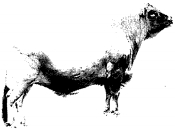
A
Gir
B
Karan Swiss
C
Jersey
D
Sahiwal
Solution
(D) The image provided shows a cow of the $Sahiwal$ breed.
$Sahiwal$ is a prominent indigenous breed of cattle in India,known for its high milk yield and heat tolerance.
It is characterized by a reddish-brown color,a loose skin,and a well-developed hump in males.
Therefore,the correct option is $D$.
$Sahiwal$ is a prominent indigenous breed of cattle in India,known for its high milk yield and heat tolerance.
It is characterized by a reddish-brown color,a loose skin,and a well-developed hump in males.
Therefore,the correct option is $D$.
0 likes
View Solution140
EasyMCQ
Hisardale is a new breed of ....... developed by .......
A
Sheep,cross-breeding
B
Goat,cross-breeding
C
Sheep,out-crossing
D
Goat,out-crossing
Solution
(A) Hisardale is a new breed of sheep developed in Punjab by crossing Bikaneri ewes and Marino rams.
This process is known as cross-breeding,where superior males of one breed are mated with superior females of another breed.
Therefore,the correct answer is $A$.
This process is known as cross-breeding,where superior males of one breed are mated with superior females of another breed.
Therefore,the correct answer is $A$.
0 likes
View Solution141
EasyMCQ
$A$ mule is the result of .......
A
Inbreeding
B
Outcrossing
C
Cross-breeding
D
Interspecific hybridization
Solution
(D) mule is produced by the mating of a male donkey and a female horse. This process, where two different species are mated to produce offspring, is known as $Interspecific \text{ } hybridization$. Therefore, the correct option is $D$.
0 likes
View Solution142
MediumMCQ
Which of the following is incorrect regarding inbreeding?
A
It involves mating between closely related individuals of the same breed.
B
Continuous inbreeding increases the level of heterozygosity.
C
Continuous inbreeding reduces fertility.
D
Pure lines can be obtained through inbreeding.
Solution
(B) Inbreeding refers to the mating of more closely related individuals within the same breed for $4-6$ generations.
$1$. It increases homozygosity,which is essential for developing pure lines.
$2$. Continuous inbreeding,especially in close inbreeding,usually reduces fertility and even productivity. This is known as inbreeding depression.
$3$. Since it increases homozygosity,it decreases heterozygosity.
Therefore,the statement that 'continuous inbreeding increases the level of heterozygosity' is incorrect.
$1$. It increases homozygosity,which is essential for developing pure lines.
$2$. Continuous inbreeding,especially in close inbreeding,usually reduces fertility and even productivity. This is known as inbreeding depression.
$3$. Since it increases homozygosity,it decreases heterozygosity.
Therefore,the statement that 'continuous inbreeding increases the level of heterozygosity' is incorrect.
0 likes
View Solution143
EasyMCQ
Inbreeding is useful for which of the following?
A
Developing a superior hybrid variety compared to parents
B
Creating new traits
C
Developing a new variety
D
Developing a pure line
Solution
(D) Inbreeding refers to the mating of more closely related individuals within the same breed for $4-6$ generations.
It increases homozygosity,which is essential for developing a pure line in any animal.
Inbreeding exposes harmful recessive genes that are eliminated by selection.
Therefore,it is primarily used to evolve a pure line in any animal.
It increases homozygosity,which is essential for developing a pure line in any animal.
Inbreeding exposes harmful recessive genes that are eliminated by selection.
Therefore,it is primarily used to evolve a pure line in any animal.
0 likes
View Solution144
EasyMCQ
Hisardale is a new breed of $......$ developed in $......$.
A
Sheep,Punjab
B
Cow,Punjab
C
Sheep,Haryana
D
Cow,Haryana
Solution
(A) Hisardale is a new breed of sheep developed in Punjab by crossing Bikaneri ewes and Marino rams. It is a high-quality breed known for its wool production.
0 likes
View Solution145
EasyMCQ
Which of the following brings harmful recessive genes to the surface?
A
Inbreeding
B
Outcrossing
C
Cross-breeding
D
Interspecific hybridization
Solution
(A) Inbreeding refers to the mating of more closely related individuals within the same breed for $4-6$ generations.
Continued inbreeding,especially close inbreeding,usually reduces fertility and productivity.
This process exposes harmful recessive genes that are eliminated by selection.
Therefore,inbreeding is the process that brings harmful recessive genes to the surface.
Continued inbreeding,especially close inbreeding,usually reduces fertility and productivity.
This process exposes harmful recessive genes that are eliminated by selection.
Therefore,inbreeding is the process that brings harmful recessive genes to the surface.
0 likes
View Solution146
EasyMCQ
The organism shown in the image is produced by which type of breeding?
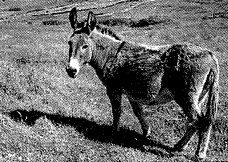
A
Inbreeding
B
Out-crossing
C
Cross-breeding
D
Interspecific hybridization
Solution
(D) The organism shown in the image is a mule. $A$ mule is produced by the mating between a male donkey and a female horse. This process,where two different related species are mated,is known as interspecific hybridization. In this method,the desirable features of two different species are combined.
0 likes
View Solution147
EasyMCQ
What is the full form of $MOET$?
A
Many Ovary Embryo Transfer
B
Multiple Ovary Embryo Technology
C
Multiple Ovulation Embryo Transfer
D
Many Ovulation Embryo Transfer
Solution
(C) $MOET$ stands for $Multiple$ $Ovulation$ $Embryo$ $Transfer$.
It is a program for herd improvement in animals like cattle.
In this method,a cow is administered hormones,with $FSH$-like activity,to induce follicular maturation and superovulation instead of one egg per cycle.
The animal is either mated with an elite bull or artificially inseminated.
The fertilized eggs at $8-32$ cells stages are recovered non-surgically and transferred to surrogate mothers.
It is a program for herd improvement in animals like cattle.
In this method,a cow is administered hormones,with $FSH$-like activity,to induce follicular maturation and superovulation instead of one egg per cycle.
The animal is either mated with an elite bull or artificially inseminated.
The fertilized eggs at $8-32$ cells stages are recovered non-surgically and transferred to surrogate mothers.
0 likes
View Solution148
EasyMCQ
Which hormone is used to induce the production of $6$ to $8$ eggs per cycle instead of a single egg in cattle?
A
$LH$
B
$FSH$
C
$GH$
D
$TSH$
Solution
(B) In cattle,the technique used for herd improvement is Multiple Ovulation Embryo Transfer $(MOET)$.
In this procedure,a cow is administered hormones,with $FSH$ ($Follicle$ $Stimulating$ $Hormone$) activity,to induce follicular maturation and superovulation.
Instead of yielding one egg per cycle,this treatment results in the production of $6$ to $8$ eggs.
The animal is then either mated with an elite bull or artificially inseminated.
In this procedure,a cow is administered hormones,with $FSH$ ($Follicle$ $Stimulating$ $Hormone$) activity,to induce follicular maturation and superovulation.
Instead of yielding one egg per cycle,this treatment results in the production of $6$ to $8$ eggs.
The animal is then either mated with an elite bull or artificially inseminated.
0 likes
View Solution149
EasyMCQ
Controlled breeding experiments can be carried out using .......
A
Artificial insemination
B
Inbreeding
C
Outcrossing
D
Cross-breeding
Solution
(A) Controlled breeding experiments are effectively carried out using $Artificial$ $Insemination$ $(AI)$.
In this technique, the semen is collected from the male that is chosen as a parent and injected into the reproductive tract of the selected female by the breeder.
This method helps in overcoming several problems of normal mating and allows the breeder to carry out cross-breeding experiments under controlled conditions.
In this technique, the semen is collected from the male that is chosen as a parent and injected into the reproductive tract of the selected female by the breeder.
This method helps in overcoming several problems of normal mating and allows the breeder to carry out cross-breeding experiments under controlled conditions.
0 likes
View Solution150
EasyMCQ
During the $MOET$ (Multiple Ovulation Embryo Transfer) procedure,how many eggs are typically produced when a hormone with $FSH$-like activity is administered to induce superovulation in cattle?
A
$6-8$
B
$8-32$
C
$10-12$
D
$14-16$
Solution
(A) $MOET$ stands for Multiple Ovulation Embryo Transfer technology.
In this procedure,a cow is administered hormones,with $FSH$-like activity,to induce follicular maturation and superovulation.
Instead of the normal one egg per cycle,the cow produces $6-8$ eggs.
These eggs are then fertilized by artificial insemination or natural mating and the embryos at $8-32$ celled stage are recovered non-surgically and transferred to surrogate mothers.
In this procedure,a cow is administered hormones,with $FSH$-like activity,to induce follicular maturation and superovulation.
Instead of the normal one egg per cycle,the cow produces $6-8$ eggs.
These eggs are then fertilized by artificial insemination or natural mating and the embryos at $8-32$ celled stage are recovered non-surgically and transferred to surrogate mothers.
0 likes
View SolutionStrategies for Enhancement in Food Production — Animal breeding · Frequently Asked Questions
1Are these Strategies for Enhancement in Food Production questions useful for JEE and NEET?
Yes. All questions in this section are mapped to JEE Main and NEET exam patterns. Previous year questions from JEE Main, NEET, GUJCET and state-level exams are included with full solutions.
2Can I switch to Hindi or Gujarati for these questions?
Yes. Use the language tabs in the hero section or the sidebar to view the same questions and solutions in English, Hindi or Gujarati.
3How do I generate a question paper from this subtopic?
Use the Vedclass Exam Paper Generator — select the chapter and subtopic, set difficulty, and generate Sets A, B, C, D automatically. First 3 chapters of every subject are free.
Vedclass Products
For Students
Vedclass Test Series
Mock tests in real JEE/NEET style with performance analysis. 5-day free trial.
Start Free TrialFor Teachers
Exam Paper Generator
Generate Set A/B/C/D papers from this chapter in 2 minutes. 3 chapters free.
Try FreeFor Institutes
Online Exam Module
Live online exams with unlimited students, 360° analytics & white-label branding.
See DemoFor Teachers & Institutes
Generate a Strategies for Enhancement in Food Production Exam Paper in 2 Minutes
Select subtopic & difficulty — Sets A, B, C, D auto-generated with No Repeat logic.
First 3 chapters of every subject are free — no payment required.