
A English
Animal breeding Questions in English
Class 12 Biology · Strategies for Enhancement in Food Production · Animal breeding
156+
Questions
English
Language
100%
With Solutions
Showing 50 of 156 questions in English
51
EasyMCQ
$A$ mule is produced by the cross-breeding of ....... with ....... .
A
Female horse,Male donkey
B
Male horse,Female donkey
C
Male mule,Female horse
D
Female mule,Male donkey
Solution
(B) mule is a hybrid animal produced through interspecific hybridization.
It is the result of a cross between a male donkey ($Equus$ $asinus$) and a female horse ($Equus$ $caballus$).
This process is a type of animal breeding where two different but related species are mated to combine desirable traits.
Therefore,the correct option is $B$.
It is the result of a cross between a male donkey ($Equus$ $asinus$) and a female horse ($Equus$ $caballus$).
This process is a type of animal breeding where two different but related species are mated to combine desirable traits.
Therefore,the correct option is $B$.
0 likes
View Solution52
MediumMCQ
Which of the following statements is false?
A
Every breed of domesticated animal possesses some specific characteristics.
B
Animal breeding is primarily carried out through two methods.
C
Improved breeds can be obtained through various methods of animal breeding.
D
Inbreeding leads to the accumulation of desired genes.
Solution
(D) The statement 'Inbreeding leads to the accumulation of desired genes' is false.
Inbreeding increases homozygosity,which helps in the accumulation of superior genes and the elimination of less desirable genes. However,it also leads to the accumulation of harmful recessive genes that are exposed by selection.
Continued inbreeding,especially close inbreeding,usually reduces fertility and productivity,a phenomenon known as 'inbreeding depression'.
Therefore,while it helps in selecting desired genes,it does not exclusively lead to the accumulation of only desired genes; it also accumulates harmful ones.
Inbreeding increases homozygosity,which helps in the accumulation of superior genes and the elimination of less desirable genes. However,it also leads to the accumulation of harmful recessive genes that are exposed by selection.
Continued inbreeding,especially close inbreeding,usually reduces fertility and productivity,a phenomenon known as 'inbreeding depression'.
Therefore,while it helps in selecting desired genes,it does not exclusively lead to the accumulation of only desired genes; it also accumulates harmful ones.
0 likes
View Solution53
MediumMCQ
$S$ - Statement: The best example of cross-breeding is Santa Gertrudis.
$R$ - Reason: Cross-breeding involves mating superior males of one breed with superior females of another breed.
$R$ - Reason: Cross-breeding involves mating superior males of one breed with superior females of another breed.
A
$S$ and $R$ are both true,and $R$ is the correct explanation of $S$.
B
$S$ and $R$ are both true,but $R$ is not the correct explanation of $S$.
C
$S$ is true and $R$ is false.
D
$S$ and $R$ are both false.
Solution
(A) Cross-breeding is a breeding strategy where superior males of one breed are mated with superior females of another breed.
This allows the desirable qualities of two different breeds to be combined into the progeny.
Santa Gertrudis is a well-known breed of cattle developed in the United States by crossing Shorthorn bulls with Brahman cows,which is a classic example of cross-breeding.
Therefore,both the statement $(S)$ and the reason $(R)$ are correct,and $R$ provides the correct explanation for $S$.
This allows the desirable qualities of two different breeds to be combined into the progeny.
Santa Gertrudis is a well-known breed of cattle developed in the United States by crossing Shorthorn bulls with Brahman cows,which is a classic example of cross-breeding.
Therefore,both the statement $(S)$ and the reason $(R)$ are correct,and $R$ provides the correct explanation for $S$.
0 likes
View Solution54
EasyMCQ
$A$ mule is produced by which method of animal breeding?
A
Inbreeding
B
Outcrossing
C
Cross-breeding
D
Interspecific hybridization
Solution
(D) mule is the offspring of a male donkey and a female horse.
This process involves mating between two different species of the same genus $(Equus)$.
This specific type of breeding,where mating occurs between two different species,is known as Interspecific hybridization.
Therefore,the correct option is $D$.
This process involves mating between two different species of the same genus $(Equus)$.
This specific type of breeding,where mating occurs between two different species,is known as Interspecific hybridization.
Therefore,the correct option is $D$.
0 likes
View Solution55
EasyMCQ
The Santa Gertrudis breed of cattle was developed through which type of breeding?
A
Cross-breeding
B
Inbreeding
C
Out-crossing
D
Interspecific hybridization
Solution
(A) The Santa Gertrudis breed is a classic example of $Cross-breeding$.
It was developed in Texas by crossing $Brahman$ bulls $(Bos \, indicus)$ with $Shorthorn$ cows $(Bos \, taurus)$.
$Cross-breeding$ allows the desirable qualities of two different breeds to be combined into the progeny.
It was developed in Texas by crossing $Brahman$ bulls $(Bos \, indicus)$ with $Shorthorn$ cows $(Bos \, taurus)$.
$Cross-breeding$ allows the desirable qualities of two different breeds to be combined into the progeny.
0 likes
View Solution56
MediumMCQ
Which harmful genes accumulate due to continuous inbreeding?
A
Dominant genes
B
Heterozygous genes
C
Recessive genes
D
Unpaired genes
Solution
(C) Inbreeding refers to the mating of more closely related individuals within the same breed for $4-6$ generations. Continuous inbreeding increases homozygosity. This process exposes harmful recessive genes that are otherwise masked by dominant alleles in a heterozygous state. These recessive genes then express themselves,leading to inbreeding depression,which reduces fertility and productivity.
0 likes
View Solution57
MediumMCQ
In animal breeding,when does the fertility of offspring decrease?
A
The proportion of homozygosity decreases.
B
The proportion of heterozygosity decreases.
C
The proportion of homozygosity increases.
D
The proportion of both homozygosity and heterozygosity increases.
Solution
(C) In animal breeding,continuous inbreeding (mating between closely related individuals) increases homozygosity. This process exposes harmful recessive genes that are otherwise masked in heterozygous conditions. The accumulation of these deleterious recessive alleles leads to 'inbreeding depression',which results in a reduction of fertility and productivity in the offspring. Therefore,the fertility of offspring decreases when the proportion of homozygosity increases.
0 likes
View Solution58
EasyMCQ
Which animal breeding method involves mating a superior male of one breed with a superior female of another breed?
A
Inbreeding
B
Cross-breeding
C
Out-crossing
D
Interspecific hybridization
Solution
(B) Cross-breeding is a method of animal breeding where a superior male of one breed is mated with a superior female of another breed. This allows the desirable qualities of two different breeds to be combined into the progeny. For example,Hisardale is a new breed of sheep developed in Punjab by crossing Bikaneri ewes and Marino rams.
0 likes
View Solution59
EasyMCQ
Which offspring is produced by crossing a male donkey and a female horse?
A
Mule
B
Santagertrudis
C
Nilgai
D
Zebra
Solution
(A) Interspecific hybridization is a breeding method where individuals of two different related species are crossed to combine desirable features in the progeny.
When a male donkey ($Equus$ $asinus$) is crossed with a female horse ($Equus$ $caballus$),the resulting offspring is known as a mule.
Conversely,when a male horse is crossed with a female donkey,the offspring is known as a hinny.
Therefore,the correct answer is a mule.
When a male donkey ($Equus$ $asinus$) is crossed with a female horse ($Equus$ $caballus$),the resulting offspring is known as a mule.
Conversely,when a male horse is crossed with a female donkey,the offspring is known as a hinny.
Therefore,the correct answer is a mule.
0 likes
View Solution60
MediumMCQ
Which of the following statements is consistent with outcrossing?
A
It does not result in the accumulation of desired genes.
B
It leads to the accumulation of harmful recessive genes.
C
It increases homozygosity.
D
It involves mating of superior males of one breed with superior females of another breed.
Solution
(A) Outcrossing is the practice of mating animals of the same breed that have no common ancestors on either side of their pedigree up to $4-6$ generations.
It is the best breeding method for animals that are below average in productivity in milk production,growth rate in beef cattle,etc.
It helps to overcome inbreeding depression because it increases heterozygosity,which masks the expression of harmful recessive genes.
Therefore,it does not lead to the accumulation of harmful recessive genes,nor does it increase homozygosity.
It is the best breeding method for animals that are below average in productivity in milk production,growth rate in beef cattle,etc.
It helps to overcome inbreeding depression because it increases heterozygosity,which masks the expression of harmful recessive genes.
Therefore,it does not lead to the accumulation of harmful recessive genes,nor does it increase homozygosity.
0 likes
View Solution61
MediumMCQ
The opportunity for genetic improvement through breeding between animals of the same breed is ..........
A
increased.
B
decreased.
C
negligible.
D
remains constant.
Solution
(A) Inbreeding refers to the mating of more closely related individuals within the same breed for $4-6$ generations. This process increases homozygosity,which is necessary for the evolution of a pure line in any animal. It exposes harmful recessive genes that are eliminated by selection. Therefore,it helps in the accumulation of superior genes and the elimination of less desirable genes,thereby increasing the opportunity for genetic improvement.
0 likes
View Solution62
MediumMCQ
Select the correct pair of $X$ and $Y$:
| Column $X$ | Column $Y$ |
| $(1)$ Cross-breeding | $(P)$ Mating between superior male of one breed and superior female of another breed |
| $(2)$ Out-crossing | $(Q)$ Mating between animals within the same breed |
| $(3)$ Interspecific hybridization | $(R)$ Mating between male and female of two different species |
A
$(1)-(P), (2)-(Q), (3)-(R)$
B
$(1)-(Q), (2)-(P), (3)-(R)$
C
$(1)-(Q), (2)-(R), (3)-(P)$
D
$(1)-(R), (2)-(P), (3)-(Q)$
Solution
(A) The correct matches are as follows:
$(1)$ Cross-breeding: This involves mating between a superior male of one breed and a superior female of another breed. This allows the desirable qualities of two different breeds to be combined in the progeny. Thus,$(1)-(P)$.
$(2)$ Out-crossing: This is the practice of mating animals within the same breed,but having no common ancestors on either side of their pedigree up to $4-6$ generations. Thus,$(2)-(Q)$.
$(3)$ Interspecific hybridization: This involves mating between male and female animals of two different related species. An example is the mule,produced by crossing a male donkey and a female horse. Thus,$(3)-(R)$.
Therefore,the correct sequence is $(1)-(P), (2)-(Q), (3)-(R)$.
$(1)$ Cross-breeding: This involves mating between a superior male of one breed and a superior female of another breed. This allows the desirable qualities of two different breeds to be combined in the progeny. Thus,$(1)-(P)$.
$(2)$ Out-crossing: This is the practice of mating animals within the same breed,but having no common ancestors on either side of their pedigree up to $4-6$ generations. Thus,$(2)-(Q)$.
$(3)$ Interspecific hybridization: This involves mating between male and female animals of two different related species. An example is the mule,produced by crossing a male donkey and a female horse. Thus,$(3)-(R)$.
Therefore,the correct sequence is $(1)-(P), (2)-(Q), (3)-(R)$.
0 likes
View Solution63
EasyMCQ
Identify the animal shown in the given figure.
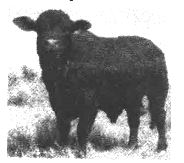
A
American cow
B
Brahmin cow
C
Santa Gertrudis
D
Mule
Solution
(C) The animal shown in the figure is a $Santa \ Gertrudis$ cow.
$Santa \ Gertrudis$ is a breed of cattle developed in the United States by crossing $Brahman$ bulls with $Shorthorn$ cows.
This breed was developed to combine the heat and insect resistance of the $Brahman$ cattle with the superior beef production qualities of the $Shorthorn$ breed.
$Santa \ Gertrudis$ is a breed of cattle developed in the United States by crossing $Brahman$ bulls with $Shorthorn$ cows.
This breed was developed to combine the heat and insect resistance of the $Brahman$ cattle with the superior beef production qualities of the $Shorthorn$ breed.
0 likes
View Solution64
EasyMCQ
Identify the animal shown in the given figure.
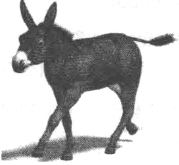
A
Horse
B
Donkey
C
Santa Gertrudis
D
Mule
Solution
(D) The animal shown in the figure is a mule. $A$ mule is a hybrid animal produced by interspecific hybridization,which involves the mating of a male donkey and a female horse. This process is a form of outbreeding used in animal husbandry to combine desirable traits from two different species.
0 likes
View Solution65
MediumMCQ
In which type of breeding is there a higher possibility of the accumulation of harmful recessive genes?
A
Inbreeding
B
Outcrossing
C
Interspecific hybridization
D
Animal breeding
Solution
(A) Inbreeding refers to the mating of more closely related individuals within the same breed for $4-6$ generations.
Continued inbreeding,especially close inbreeding,usually reduces fertility and productivity.
This process exposes harmful recessive genes that are eliminated by selection.
However,it also leads to the accumulation of harmful recessive genes if not managed properly,which can decrease the biological fitness of the population.
Continued inbreeding,especially close inbreeding,usually reduces fertility and productivity.
This process exposes harmful recessive genes that are eliminated by selection.
However,it also leads to the accumulation of harmful recessive genes if not managed properly,which can decrease the biological fitness of the population.
0 likes
View Solution66
EasyMCQ
Which type of breeding results in offspring that are directly referred to as hybrids?
A
Inbreeding
B
Outcrossing
C
Interspecific hybridization
D
Animal breeding
Solution
(C) Interspecific hybridization is a breeding method where male and female animals of two different related species are mated. The progeny obtained from such a cross are often referred to as hybrids. $A$ classic example is the mule,which is produced by the mating of a male donkey and a female horse.
0 likes
View Solution67
MediumMCQ
Homozygous purelines in cattle can be obtained by
A
mating of unrelated individuals of same breed
B
mating of individuals of different breed
C
mating of individuals of different species
D
mating of related individuals of same breed
Solution
(D) The correct answer is $D$.
Inbreeding refers to the mating of more closely related individuals within the same breed for $4-6$ generations.
This process increases homozygosity,which is essential for the evolution of a pureline in any animal.
By mating related individuals,harmful recessive genes are exposed and eliminated,and desirable traits are concentrated,leading to the development of homozygous purelines.
Inbreeding refers to the mating of more closely related individuals within the same breed for $4-6$ generations.
This process increases homozygosity,which is essential for the evolution of a pureline in any animal.
By mating related individuals,harmful recessive genes are exposed and eliminated,and desirable traits are concentrated,leading to the development of homozygous purelines.
0 likes
View Solution68
EasyMCQ
Interspecific hybridisation is the mating of
A
animals within the same breed without having common ancestors
B
two different related species
C
superior males and females of different breeds
D
more closely related individuals within the same breed for $4-6$ generations
Solution
(B) : In interspecific hybridisation,a species is mated with a different related species of the same genus.
Interspecific hybrids are generally difficult to produce,but they are important in plant breeding,particularly in breeding for disease resistance.
This is also called intrageneric hybridisation.
Interspecific hybrids are generally difficult to produce,but they are important in plant breeding,particularly in breeding for disease resistance.
This is also called intrageneric hybridisation.
0 likes
View Solution69
MediumMCQ
Outbreeding is an important strategy of animal husbandry because it
A
is useful in overcoming inbreeding depression
B
exposes harmful recessive genes that are eliminated by selection
C
helps in accumulation of superior genes
D
is useful in producing purelines of animals
Solution
(A) $Outbreeding$ is the breeding of unrelated animals, which may be between individuals of the same breed (but having no common ancestors), or between different breeds (cross-breeding) or different species (interspecific hybridization).
$Outbreeding$ is an important strategy of animal husbandry as it helps to overcome inbreeding depression, which occurs due to continuous inbreeding.
$Outbreeding$ is an important strategy of animal husbandry as it helps to overcome inbreeding depression, which occurs due to continuous inbreeding.
0 likes
View Solution70
EasyMCQ
Which of the following best represents cross-breeding?
A
Mating of animals within the same breed.
B
Male and female animals of two different related species are mated.
C
Superior males of one breed are mated with superior females of another breed.
D
Mating of animals within the same breed,but having no common ancestor on either side of their pedigree up to $4-6$ generations.
Solution
(C) Cross-breeding is a breeding strategy in animal husbandry where superior males of one breed are mated with superior females of another breed. This allows the desirable qualities of two different breeds to be combined into the progeny. The progeny may be used for commercial production or further selection to develop new stable breeds.
0 likes
View Solution71
EasyMCQ
Mule is an example of
A
Inbreeding
B
Cross breeding
C
Out crossing
D
Interspecific hybridization
Solution
(D) mule is produced by the mating of a male donkey and a female horse.
Since the donkey and the horse belong to two different species,this process is known as interspecific hybridization.
Interspecific hybridization is a breeding method where males and females of two different related species are mated to combine desirable features in the progeny.
Since the donkey and the horse belong to two different species,this process is known as interspecific hybridization.
Interspecific hybridization is a breeding method where males and females of two different related species are mated to combine desirable features in the progeny.
0 likes
View Solution72
EasyMCQ
In $MOET$,a cow is administered with ......... to induce follicular maturation.
A
$FSH$
B
$LH$
C
Aldosterone
D
Progesterone
Solution
(A) $MOET$ stands for Multiple Ovulation Embryo Transfer technology. In this process,a cow is administered with hormones,with $FSH$-like activity,to induce follicular maturation and superovulation. Instead of one egg,which is normal per cycle,$6-8$ eggs are produced. The cow is then either mated with an elite bull or artificially inseminated.
0 likes
View Solution73
EasyMCQ
$A$ cross between a superior male of one breed and a superior female of another breed is called:
A
Out-crossing
B
Cross-breeding
C
Interspecific hybridization
D
Inbreeding
Solution
(B) Cross-breeding is a method of animal breeding where a superior male of one breed is mated with a superior female of another breed.
This allows the desirable qualities of two different breeds to be combined into the progeny.
Out-crossing involves mating animals of the same breed that have no common ancestors for $4-6$ generations.
Interspecific hybridization involves mating between males and females of two different related species.
Inbreeding refers to the mating of more closely related individuals within the same breed for $4-6$ generations.
This allows the desirable qualities of two different breeds to be combined into the progeny.
Out-crossing involves mating animals of the same breed that have no common ancestors for $4-6$ generations.
Interspecific hybridization involves mating between males and females of two different related species.
Inbreeding refers to the mating of more closely related individuals within the same breed for $4-6$ generations.
0 likes
View Solution74
EasyMCQ
Hisardale is a
A
Breed of fish
B
New breed of sheep
C
Breed of Buffalo
D
New breed of honey-bee
Solution
(B) Hisardale is a new breed of sheep developed in Punjab by crossing Bikaneri ewes and Marino rams.
This breed was developed through the process of cross-breeding to improve the quality and quantity of wool production.
Therefore,the correct option is $B$.
This breed was developed through the process of cross-breeding to improve the quality and quantity of wool production.
Therefore,the correct option is $B$.
0 likes
View Solution75
EasyMCQ
$A$ mule is produced from a cross between $A$ and $B$.
A
$A$ - female horse,$B$ - male donkey
B
$A$ - male donkey,$B$ - female horse
C
$A$ - male horse,$B$ - female donkey
D
$A$ - male horse,$B$ - female horse
Solution
(B) mule is a hybrid animal produced by interspecific hybridization,which is a type of outbreeding.
It is the result of a cross between a male donkey ($Equus$ $asinus$) and a female horse ($Equus$ $caballus$).
Therefore,$A$ represents the male donkey and $B$ represents the female horse.
It is the result of a cross between a male donkey ($Equus$ $asinus$) and a female horse ($Equus$ $caballus$).
Therefore,$A$ represents the male donkey and $B$ represents the female horse.
0 likes
View Solution76
EasyMCQ
Hirsadale breed is developed by
A
Bikaneri rams - Marino ewes
B
Marino rams - Bikaneri ewes
C
Ajmeri ewes - Marino rams
D
Female horse - male donkey
Solution
(B) The Hirsadale breed of sheep is a cross-breed developed in India.
It was created by crossing Marino rams with Bikaneri ewes.
This cross-breeding program was aimed at improving the quality of wool produced by the sheep.
It was created by crossing Marino rams with Bikaneri ewes.
This cross-breeding program was aimed at improving the quality of wool produced by the sheep.
0 likes
View Solution77
MediumMCQ
High milk-yielding breeds of cows are obtained by:
A
Superovulation
B
Artificial insemination
C
Use of surrogate mothers
D
All of the above
Solution
(D) High milk-yielding breeds of cows are obtained through advanced animal breeding techniques like $MOET$ ($Multiple$ $Ovulation$ $Embryo$ $Transfer$ $Technology$).
$1$. $Superovulation$: Hormonal treatment is given to induce the production of more than one egg per cycle.
$2$. $Artificial$ $insemination$: Semen from a superior bull is used to fertilize the eggs.
$3$. $Use$ $of$ $surrogate$ $mothers$: The fertilized embryos are transferred to surrogate mothers for further development.
Therefore, all these methods are used in combination to improve the breed.
$1$. $Superovulation$: Hormonal treatment is given to induce the production of more than one egg per cycle.
$2$. $Artificial$ $insemination$: Semen from a superior bull is used to fertilize the eggs.
$3$. $Use$ $of$ $surrogate$ $mothers$: The fertilized embryos are transferred to surrogate mothers for further development.
Therefore, all these methods are used in combination to improve the breed.
0 likes
View Solution78
MediumMCQ
Outbreeding is an important strategy in animal husbandry because it $................$.
A
helps in the accumulation of superior genes.
B
is useful in producing pure lines.
C
is useful in overcoming inbreeding depression.
D
helps in eliminating harmful genes through selection.
Solution
(C) In animal husbandry,continuous inbreeding leads to inbreeding depression,which reduces the fertility and productivity of animals. Outbreeding is the breeding of unrelated animals. It is the most effective method to overcome inbreeding depression and restore the fertility and vigor of the animals.
0 likes
View Solution79
EasyMCQ
Interspecific hybridization is the breeding between which of the following?
A
Superior males and females of different breeds
B
More closely related individuals within the same breed for $4-6$ generations
C
Animals of the same breed that do not have common ancestors
D
Animals of two different related species
Solution
(D) Interspecific hybridization is a breeding method where male and female animals of two different related species are mated together.
This process allows the combination of desirable features from both parent species into the progeny.
An example of this is the mule,which is produced by crossing a male donkey and a female horse.
This process allows the combination of desirable features from both parent species into the progeny.
An example of this is the mule,which is produced by crossing a male donkey and a female horse.
0 likes
View Solution80
EasyMCQ
Hisardale is a new breed of sheep developed in Punjab by a breeding technique in which a superior male of one breed is mated with a superior female of another breed. Identify the breeding technique from the options given below.
A
Inbreeding
B
Outcrossing
C
Outbreeding
D
Cross-breeding
Solution
(D) Hisardale is a new breed of sheep developed in Punjab by crossing Bikaneri ewes and Marino rams.
Cross-breeding is a breeding technique in which a superior male of one breed is mated with a superior female of another breed.
This method allows the desirable qualities of two different breeds to be combined into a single progeny.
Cross-breeding is a breeding technique in which a superior male of one breed is mated with a superior female of another breed.
This method allows the desirable qualities of two different breeds to be combined into a single progeny.
0 likes
View Solution81
MediumMCQ
Select the incorrect statement regarding inbreeding.
A
Inbreeding helps in the elimination of deleterious alleles from the population.
B
Inbreeding is necessary to evolve a pureline in any animal.
C
Continued inbreeding reduces fertility and leads to inbreeding depression.
D
Inbreeding depression cannot be overcome by out-crossing.
Solution
(D) Inbreeding refers to the mating of more closely related individuals within the same breed for $4-6$ generations.
$1$. Inbreeding increases homozygosity,which helps in the accumulation of superior genes and the elimination of less desirable genes (deleterious alleles).
$2$. It is essential for evolving a pureline in any animal.
$3$. However,continued inbreeding,especially close inbreeding,usually reduces fertility and productivity,a phenomenon known as inbreeding depression.
$4$. Inbreeding depression can be overcome by mating the selected animals with unrelated superior animals of the same breed,a process known as out-crossing.
Therefore,the statement that 'Inbreeding depression cannot be overcome by out-crossing' is incorrect.
$1$. Inbreeding increases homozygosity,which helps in the accumulation of superior genes and the elimination of less desirable genes (deleterious alleles).
$2$. It is essential for evolving a pureline in any animal.
$3$. However,continued inbreeding,especially close inbreeding,usually reduces fertility and productivity,a phenomenon known as inbreeding depression.
$4$. Inbreeding depression can be overcome by mating the selected animals with unrelated superior animals of the same breed,a process known as out-crossing.
Therefore,the statement that 'Inbreeding depression cannot be overcome by out-crossing' is incorrect.
0 likes
View Solution82
Medium
What is animal breeding? Explain.
Solution
(N/A) Animal breeding is an important aspect of animal husbandry.
$1$. The primary aim of animal breeding is to increase the yield of animals and improve the desirable qualities of the produce.
$2$. $A$ group of animals related by descent and similar in most characters like general appearance,features,size,and configuration are said to belong to a breed.
$3$. When breeding occurs between animals of the same breed,it is called inbreeding,while crosses between different breeds are called outbreeding.
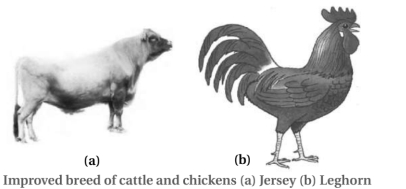
$4$. Examples of improved breeds include:
$(a)$ Jersey (cattle breed)
$(b)$ Leghorn (chicken breed)
$1$. The primary aim of animal breeding is to increase the yield of animals and improve the desirable qualities of the produce.
$2$. $A$ group of animals related by descent and similar in most characters like general appearance,features,size,and configuration are said to belong to a breed.
$3$. When breeding occurs between animals of the same breed,it is called inbreeding,while crosses between different breeds are called outbreeding.
$4$. Examples of improved breeds include:
$(a)$ Jersey (cattle breed)
$(b)$ Leghorn (chicken breed)
0 likes
View Solution83
Medium
Provide information about inbreeding and outbreeding.
Solution
(N/A) Inbreeding refers to the mating of more closely related individuals within the same breed for $4-6$ generations.
The breeding strategy is as follows:
$1$. Superior males and superior females of the same breed are identified and mated in pairs.
$2$. The progeny obtained from such matings are evaluated for superior males and females.
- $A$ superior female,in the case of cattle,is the cow or buffalo that produces more milk per lactation.
- $A$ superior male is the bull which gives rise to superior progeny as compared to those of other males.
- Inbreeding increases homozygosity. It is necessary if we want to evolve a pureline in any animal.
- Inbreeding exposes harmful recessive genes that are eliminated by selection. It also helps in the accumulation of superior genes and the elimination of less desirable genes.
- Continued inbreeding,especially close inbreeding,usually reduces fertility and productivity,which is called inbreeding depression.
Outbreeding is the breeding of the unrelated animals,which may be between individuals of the same breed (but having no common ancestors for $4-6$ generations) or between different breeds (cross-breeding) or different species (interspecific hybridization). Outbreeding is the best breeding method for animals that are below average in productivity and growth rate.
The breeding strategy is as follows:
$1$. Superior males and superior females of the same breed are identified and mated in pairs.
$2$. The progeny obtained from such matings are evaluated for superior males and females.
- $A$ superior female,in the case of cattle,is the cow or buffalo that produces more milk per lactation.
- $A$ superior male is the bull which gives rise to superior progeny as compared to those of other males.
- Inbreeding increases homozygosity. It is necessary if we want to evolve a pureline in any animal.
- Inbreeding exposes harmful recessive genes that are eliminated by selection. It also helps in the accumulation of superior genes and the elimination of less desirable genes.
- Continued inbreeding,especially close inbreeding,usually reduces fertility and productivity,which is called inbreeding depression.
Outbreeding is the breeding of the unrelated animals,which may be between individuals of the same breed (but having no common ancestors for $4-6$ generations) or between different breeds (cross-breeding) or different species (interspecific hybridization). Outbreeding is the best breeding method for animals that are below average in productivity and growth rate.
0 likes
View Solution84
Medium
Explain experiments of controlled breeding.
Solution
(A) Controlled breeding experiments are carried out using artificial insemination.
For hybridization,semen is collected from the male that is chosen as a parent and injected into the reproductive tract of the selected female by the breeder.
The semen may be used immediately or can be frozen and used at a later date.
It can also be transported in a frozen form to where the female is housed. In this way,desirable matings are carried out.
Artificial insemination helps us overcome several problems of normal matings.
Often,the success rate of crossing mature male and female animals is fairly low even though artificial insemination is carried out.
To improve chances of successful production of hybrids,other means are also used.
Multiple Ovulation Embryo Transfer Technology $(MOET)$ is one such programme for herd improvement.
In this method,a cow is administered with hormones with $FSH$-like activity to induce follicular maturation and super ovulation.
Instead of one egg,which they normally yield per cycle,they produce $6-8$ eggs.
The animal is either mated with an elite bull or artificially inseminated. The fertilised eggs at $8-32$ cell stages are recovered non-surgically and transferred to surrogate mothers. The genetic mother is available for another round of super ovulation.
- This technology has been demonstrated for cattle,sheep,rabbits,buffaloes,mares,etc.
- High milk-yielding breeds of females and high-quality (lean meat with less lipid) meat-yielding bulls have been bred successfully to increase herd size in a short time.
For hybridization,semen is collected from the male that is chosen as a parent and injected into the reproductive tract of the selected female by the breeder.
The semen may be used immediately or can be frozen and used at a later date.
It can also be transported in a frozen form to where the female is housed. In this way,desirable matings are carried out.
Artificial insemination helps us overcome several problems of normal matings.
Often,the success rate of crossing mature male and female animals is fairly low even though artificial insemination is carried out.
To improve chances of successful production of hybrids,other means are also used.
Multiple Ovulation Embryo Transfer Technology $(MOET)$ is one such programme for herd improvement.
In this method,a cow is administered with hormones with $FSH$-like activity to induce follicular maturation and super ovulation.
Instead of one egg,which they normally yield per cycle,they produce $6-8$ eggs.
The animal is either mated with an elite bull or artificially inseminated. The fertilised eggs at $8-32$ cell stages are recovered non-surgically and transferred to surrogate mothers. The genetic mother is available for another round of super ovulation.
- This technology has been demonstrated for cattle,sheep,rabbits,buffaloes,mares,etc.
- High milk-yielding breeds of females and high-quality (lean meat with less lipid) meat-yielding bulls have been bred successfully to increase herd size in a short time.
0 likes
View Solution85
Medium
Give scientific reasons: Inbreeding is necessary to obtain a pure line.
Solution
(N/A) Inbreeding increases $homozygosity$.
Therefore,if we want to evolve a pure line in any animal,inbreeding is necessary.
Inbreeding exposes harmful recessive genes that are eliminated by selection.
This process helps in the accumulation of superior genes and the elimination of less desirable genes.
Therefore,if we want to evolve a pure line in any animal,inbreeding is necessary.
Inbreeding exposes harmful recessive genes that are eliminated by selection.
This process helps in the accumulation of superior genes and the elimination of less desirable genes.
0 likes
View Solution86
MediumMCQ
How can we improve the success rate of fertilization during artificial insemination in animal husbandry programmes?
A
By using Multiple Ovulation Embryo Transfer $(MOET)$
B
By using In-vitro fertilization $(IVF)$
C
By using gene therapy
D
By using hybridization
Solution
(A) The technology used to improve the success rate of fertilization and herd improvement is called $MOET$ (Multiple Ovulation Embryo Transfer).
During this procedure,a cow is administered hormones,such as those with $FSH$-like activity,to induce follicular maturation and superovulation.
Instead of one egg,$6-8$ eggs are produced per cycle.
The cow is then either mated with an elite bull or artificially inseminated.
Embryos at the $8-32$ celled stage are recovered non-surgically and transferred to surrogate mothers.
This technology has been successfully used for cattle,sheep,rabbits,and buffaloes.
During this procedure,a cow is administered hormones,such as those with $FSH$-like activity,to induce follicular maturation and superovulation.
Instead of one egg,$6-8$ eggs are produced per cycle.
The cow is then either mated with an elite bull or artificially inseminated.
Embryos at the $8-32$ celled stage are recovered non-surgically and transferred to surrogate mothers.
This technology has been successfully used for cattle,sheep,rabbits,and buffaloes.
0 likes
View Solution87
Difficult
'Modern methods of breeding animals and plants can alleviate the global food shortage'. Comment on the statement and give suitable examples.
Solution
(N/A) Modern breeding techniques significantly enhance food production. $A$ key example in animal husbandry is the Multiple Ovulation Embryo Transfer Technology $(MOET)$.
In this method,a cow is administered hormones with $FSH$-like activity to induce follicular maturation and superovulation. Instead of the single egg normally produced per cycle,the cow produces $6-8$ eggs.
The animal is then mated with an elite bull or artificially inseminated. The fertilized eggs at the $8-32$ cell stage are recovered non-surgically and transferred to surrogate mothers. This allows the genetic mother to be available for another round of superovulation.
This technology has been successfully applied to cattle,sheep,rabbits,buffaloes,and mares. It enables the rapid multiplication of high milk-yielding breeds and high-quality meat-yielding bulls,thereby increasing herd size in a short time and addressing food shortages.
In this method,a cow is administered hormones with $FSH$-like activity to induce follicular maturation and superovulation. Instead of the single egg normally produced per cycle,the cow produces $6-8$ eggs.
The animal is then mated with an elite bull or artificially inseminated. The fertilized eggs at the $8-32$ cell stage are recovered non-surgically and transferred to surrogate mothers. This allows the genetic mother to be available for another round of superovulation.
This technology has been successfully applied to cattle,sheep,rabbits,buffaloes,and mares. It enables the rapid multiplication of high milk-yielding breeds and high-quality meat-yielding bulls,thereby increasing herd size in a short time and addressing food shortages.
0 likes
View Solution88
Medium
Differentiate between inbreeding and outbreeding.
Solution
(N/A)
| Inbreeding | Outbreeding |
|---|---|
| $(1)$ Inbreeding refers to the mating of more closely related individuals within the same breed for $4-6$ generations. | $(1)$ Outbreeding refers to the mating of unrelated individuals,either within the same breed or between different breeds/species. |
| $(2)$ Inbreeding increases homozygosity. | $(2)$ Outbreeding increases heterozygosity. |
| $(3)$ Inbreeding is useful to evolve a pure line in any animal. | $(3)$ Outbreeding is useful to produce offspring with desired characteristics or to overcome inbreeding depression. |
| $(4)$ Continuous inbreeding usually results in inbreeding depression. | $(4)$ Outbreeding helps in eliminating inbreeding depression and restoring fertility and yield. |
0 likes
View Solution89
MediumMCQ
Inbreeding is necessary to obtain a pure breed.
A
True
B
False
C
Cannot be determined
D
Depends on the species
Solution
(A) Inbreeding is necessary to obtain a pure breed because it involves the mating of more closely related individuals within the same breed for $4-6$ generations.
Inbreeding increases homozygosity,which helps in the accumulation of superior genes and the elimination of less desirable genes.
Therefore,to develop a pure line or pure breed,inbreeding is a fundamental practice.
Inbreeding increases homozygosity,which helps in the accumulation of superior genes and the elimination of less desirable genes.
Therefore,to develop a pure line or pure breed,inbreeding is a fundamental practice.
0 likes
View Solution90
EasyMCQ
By which method was a new breed 'Hisardale' of sheep formed by using Bikaneri ewes and Marino rams?
A
Inbreeding
B
Outcrossing
C
Mutational breeding
D
Cross breeding
Solution
(D) The new breed of sheep,'Hisardale',was developed by crossing Bikaneri ewes and Marino rams. This method of mating animals of two different breeds is known as cross breeding. Cross breeding allows the desirable qualities of two different breeds to be combined into the progeny.
0 likes
View Solution91
EasyMCQ
The new sheep breed 'Hisardale' was developed by crossing Bikaneri ewes and Marino rams using which of the following breeding methods?
A
Outbreeding
B
Mutation breeding
C
Cross-breeding
D
Inbreeding
Solution
(C) Hisardale is a new breed of sheep developed in Punjab by crossing Bikaneri ewes and Marino rams.
This process,where superior males of one breed are mated with superior females of another breed,is known as cross-breeding.
Cross-breeding allows the desirable qualities of two different breeds to be combined into the progeny.
This process,where superior males of one breed are mated with superior females of another breed,is known as cross-breeding.
Cross-breeding allows the desirable qualities of two different breeds to be combined into the progeny.
0 likes
View Solution92
EasyMCQ
Which new breed of cattle was developed through cross-breeding?
A
Santa Gertrudis
B
Sahiwal cows of Punjab
C
Dolly the sheep
D
Gir cow
Solution
(A) The $Santa \text{ } Gertrudis$ is a breed of cattle developed through cross-breeding. It was created by crossing $Brahman$ bulls with $Shorthorn$ cows. This breed was developed in the $United \text{ } States$ to combine the heat and insect resistance of the $Brahman$ cattle with the superior beef production qualities of the $Shorthorn$ breed.
0 likes
View Solution93
EasyMCQ
In which method are males and females of two different species mated?
A
Inbreeding
B
Outbreeding
C
Interspecific hybridization
D
Outcrossing
Solution
(C) Interspecific hybridization is a breeding method where males and females of two different related species are mated. The progeny obtained from such a cross may combine desirable features of both parents. $A$ common example is the mule,which is produced by the mating of a male donkey and a female horse.
0 likes
View Solution94
EasyMCQ
What is the mating between unrelated animals of the same breed called?
A
Out-crossing
B
Cross-breeding
C
Inbreeding
D
Out-breeding
Solution
(A) The mating of animals within the same breed,but having no common ancestors on either side of their pedigree up to $4-6$ generations,is known as $Out-crossing$. It is the best breeding method for animals that are below average in productivity in milk production or growth rate in beef cattle.
0 likes
View Solution95
MediumMCQ
Inbreeding depression can be overcome by which of the following?
A
Outcrossing
B
Cross-breeding
C
Interspecific hybridization
D
Inbreeding
Solution
(A) Inbreeding depression is a phenomenon where continuous inbreeding,especially close inbreeding,reduces fertility and productivity in a population.
To overcome this,selected animals of the same breed that have no common ancestors on either side for $4-6$ generations should be mated with the breeding population.
This practice is known as $Outcrossing$.
It helps in restoring the genetic diversity and vigor of the population.
To overcome this,selected animals of the same breed that have no common ancestors on either side for $4-6$ generations should be mated with the breeding population.
This practice is known as $Outcrossing$.
It helps in restoring the genetic diversity and vigor of the population.
0 likes
View Solution96
EasyMCQ
What is the primary characteristic of a superior cow for breeding purposes?
A
Tall stature
B
High milk yield per lactation
C
High body weight
D
Long horns
Solution
(B) In animal breeding,the selection of superior individuals is based on specific desirable traits. For dairy animals like cows,the primary objective is to increase productivity. Therefore,a superior cow is defined by its ability to produce a high yield of milk per lactation cycle. Other traits like body weight or physical appearance are secondary to the economic goal of milk production.
0 likes
View Solution97
EasyMCQ
What does a reduction in fertility and productivity of animals indicate?
A
Diseased water
B
Possessing only recessive genes
C
Possessing only dominant genes
D
Inbreeding depression
Solution
(D) Inbreeding refers to the mating of more closely related individuals within the same breed for $4-6$ generations.
Continued inbreeding, especially close inbreeding, usually reduces fertility and productivity.
This phenomenon is known as $Inbreeding \text{ } depression$.
It exposes harmful recessive genes that are eliminated by selection and helps in the accumulation of superior genes.
Continued inbreeding, especially close inbreeding, usually reduces fertility and productivity.
This phenomenon is known as $Inbreeding \text{ } depression$.
It exposes harmful recessive genes that are eliminated by selection and helps in the accumulation of superior genes.
0 likes
View Solution98
MediumMCQ
Which of the following is helpful in exposing harmful recessive genes?
A
Outcrossing
B
Cross-breeding
C
Inbreeding
D
Interspecific hybridization
Solution
(C) Inbreeding refers to the mating of more closely related individuals within the same breed for $4-6$ generations.
It increases homozygosity,which is necessary if we want to evolve a pure line in any animal.
Inbreeding exposes harmful recessive genes that are eliminated by selection.
It also helps in the accumulation of superior genes and the elimination of less desirable genes.
It increases homozygosity,which is necessary if we want to evolve a pure line in any animal.
Inbreeding exposes harmful recessive genes that are eliminated by selection.
It also helps in the accumulation of superior genes and the elimination of less desirable genes.
0 likes
View Solution99
MediumMCQ
What is common between inbreeding and outcrossing?
A
Inbreeding depression
B
Mating between animals of the same breed
C
Production of pure lines
D
Increase in homozygosity
Solution
(B) Inbreeding refers to the mating of more closely related individuals within the same breed for $4-6$ generations.
Outcrossing is the practice of mating animals within the same breed,but having no common ancestors on either side of their pedigree up to $4-6$ generations.
Both inbreeding and outcrossing involve mating between animals of the same breed.
Therefore,the common factor between them is that they both involve mating between individuals of the same breed.
Outcrossing is the practice of mating animals within the same breed,but having no common ancestors on either side of their pedigree up to $4-6$ generations.
Both inbreeding and outcrossing involve mating between animals of the same breed.
Therefore,the common factor between them is that they both involve mating between individuals of the same breed.
0 likes
View Solution100
MediumMCQ
Which of the following is helpful in increasing milk production capacity and meat growth rate?
A
Inbreeding
B
Outbreeding
C
Interspecific hybridization
D
Cross-breeding
Solution
(D) Cross-breeding is a method of animal breeding where superior males of one breed are mated with superior females of another breed. This allows the desirable qualities of two different breeds to be combined into the progeny. This method is specifically used to increase milk production capacity and meat growth rate in animals.
0 likes
View SolutionStrategies for Enhancement in Food Production — Animal breeding · Frequently Asked Questions
1Are these Strategies for Enhancement in Food Production questions useful for JEE and NEET?
Yes. All questions in this section are mapped to JEE Main and NEET exam patterns. Previous year questions from JEE Main, NEET, GUJCET and state-level exams are included with full solutions.
2Can I switch to Hindi or Gujarati for these questions?
Yes. Use the language tabs in the hero section or the sidebar to view the same questions and solutions in English, Hindi or Gujarati.
3How do I generate a question paper from this subtopic?
Use the Vedclass Exam Paper Generator — select the chapter and subtopic, set difficulty, and generate Sets A, B, C, D automatically. First 3 chapters of every subject are free.
Vedclass Products
For Students
Vedclass Test Series
Mock tests in real JEE/NEET style with performance analysis. 5-day free trial.
Start Free TrialFor Teachers
Exam Paper Generator
Generate Set A/B/C/D papers from this chapter in 2 minutes. 3 chapters free.
Try FreeFor Institutes
Online Exam Module
Live online exams with unlimited students, 360° analytics & white-label branding.
See DemoFor Teachers & Institutes
Generate a Strategies for Enhancement in Food Production Exam Paper in 2 Minutes
Select subtopic & difficulty — Sets A, B, C, D auto-generated with No Repeat logic.
First 3 chapters of every subject are free — no payment required.