
A English
Stamen, Microsporangium and Pollen Grain Questions in English
Class 12 Biology · Sexual Reproduction in Flowering Plants · Stamen, Microsporangium and Pollen Grain
348+
Questions
English
Language
100%
With Solutions
Showing 50 of 348 questions in English
201
MediumMCQ
What is released upon the dehiscence of the anther?
A
Seeds
B
Ovules
C
Pollen grains
D
Egg cells
Solution
(C) The anther is the part of the stamen that produces pollen. When the anther matures,it undergoes a process called dehiscence,where the wall of the anther breaks open to release the pollen grains into the environment for pollination.
0 likes
View Solution202
MediumMCQ
The pollen grain represents which stage?
A
Female gametophyte
B
Male gametophyte
C
Male sporophyte
D
Sporophyte
Solution
(B) The pollen grain is the immature male gametophyte in seed plants. It develops from the microspore through the process of microgametogenesis. Therefore,it represents the male gametophyte stage in the life cycle of angiosperms.
0 likes
View Solution203
MediumMCQ
What is the typical diameter of a pollen grain?
A
$25-55 \, \mu m$
B
$20-50 \, \mu m$
C
$25-50 \, \mu m$
D
$10-55 \, \mu m$
Solution
(C) Pollen grains are generally spherical in shape and measure about $25-50 \, \mu m$ in diameter. This size range is characteristic of most angiosperms,allowing them to be easily dispersed by various agents like wind,water,or insects.
0 likes
View Solution204
MediumMCQ
How many layers is the pollen grain wall composed of?
A
One
B
Two
C
Three
D
Four
Solution
(B) The pollen grain wall,known as the sporoderm,is composed of two distinct layers:
$1$. The outer layer is called the exine,which is made of sporopollenin,one of the most resistant organic materials known.
$2$. The inner layer is called the intine,which is thin and continuous,composed of cellulose and pectin.
Therefore,the pollen grain wall consists of two layers.
$1$. The outer layer is called the exine,which is made of sporopollenin,one of the most resistant organic materials known.
$2$. The inner layer is called the intine,which is thin and continuous,composed of cellulose and pectin.
Therefore,the pollen grain wall consists of two layers.
0 likes
View Solution205
MediumMCQ
What is the exine of a pollen grain made of?
A
Porphyrin
B
Melanin
C
Nucleic acid
D
Sporopollenin
Solution
(D) The pollen grain wall is composed of two layers: the outer layer called the exine and the inner layer called the intine.
The exine is made of a highly resistant organic material known as $Sporopollenin$.
$Sporopollenin$ is one of the most resistant organic materials known; it can withstand high temperatures,strong acids,and alkali,and no enzyme that degrades $Sporopollenin$ is known so far.
Therefore,the correct option is $D$.
The exine is made of a highly resistant organic material known as $Sporopollenin$.
$Sporopollenin$ is one of the most resistant organic materials known; it can withstand high temperatures,strong acids,and alkali,and no enzyme that degrades $Sporopollenin$ is known so far.
Therefore,the correct option is $D$.
0 likes
View Solution206
MediumMCQ
Which substance provides protection to pollen grains against high temperatures?
A
Intine
B
Sporopollenin
C
Porphyrin
D
Tapetum
Solution
(B) The pollen grain wall consists of two layers: the outer exine and the inner intine.
The exine is made up of a highly resistant organic material called $Sporopollenin$.
$Sporopollenin$ is one of the most resistant organic materials known. It can withstand high temperatures,strong acids,and alkali.
No enzyme that degrades $Sporopollenin$ is so far known.
Therefore,it protects the pollen grain from environmental stress and decay.
The exine is made up of a highly resistant organic material called $Sporopollenin$.
$Sporopollenin$ is one of the most resistant organic materials known. It can withstand high temperatures,strong acids,and alkali.
No enzyme that degrades $Sporopollenin$ is so far known.
Therefore,it protects the pollen grain from environmental stress and decay.
0 likes
View Solution207
MediumMCQ
Which of the following statements is false regarding the exine of pollen grains?
A
It is made of a highly resistant organic material.
B
It can withstand high temperatures.
C
It can withstand strong acids and alkalis.
D
It is degraded by enzymes.
Solution
(D) The exine is the hard outer layer of the pollen grain.
It is composed of $Sporopollenin$,which is one of the most resistant organic materials known.
$Sporopollenin$ can withstand high temperatures,strong acids,and strong alkalis.
No enzyme that degrades $Sporopollenin$ is known to date.
Therefore,the statement that it is degraded by enzymes is false.
It is composed of $Sporopollenin$,which is one of the most resistant organic materials known.
$Sporopollenin$ can withstand high temperatures,strong acids,and strong alkalis.
No enzyme that degrades $Sporopollenin$ is known to date.
Therefore,the statement that it is degraded by enzymes is false.
0 likes
View Solution208
MediumMCQ
The region in the exine where sporopollenin is absent is known as .......
A
Pollen pore
B
Pollen tetrad pore
C
Germ pore
D
All of the above
Solution
(C) The pollen grain wall is composed of two layers: the outer exine and the inner intine.
The exine is made up of a highly resistant organic material called sporopollenin,which can withstand high temperatures,strong acids,and alkali.
However,there are certain regions in the exine where sporopollenin is absent.
These apertures are known as germ pores (or germinal furrows).
These pores are the sites from which the pollen tube emerges during germination.
The exine is made up of a highly resistant organic material called sporopollenin,which can withstand high temperatures,strong acids,and alkali.
However,there are certain regions in the exine where sporopollenin is absent.
These apertures are known as germ pores (or germinal furrows).
These pores are the sites from which the pollen tube emerges during germination.
0 likes
View Solution209
EasyMCQ
Pollen grains are well-preserved as fossils due to the presence of which substance?
A
Sporopollenin
B
Intine
C
Calcium
D
Cellulose
Solution
(A) The exine of the pollen grain is composed of a highly resistant organic material called $Sporopollenin$.
$Sporopollenin$ is one of the most resistant organic materials known.
It can withstand high temperatures,strong acids,and alkali conditions.
No enzyme that degrades $Sporopollenin$ is known to date.
Due to this remarkable stability,pollen grains are well-preserved as fossils.
$Sporopollenin$ is one of the most resistant organic materials known.
It can withstand high temperatures,strong acids,and alkali conditions.
No enzyme that degrades $Sporopollenin$ is known to date.
Due to this remarkable stability,pollen grains are well-preserved as fossils.
0 likes
View Solution210
MediumMCQ
What is the intine of a pollen grain made of?
A
Sporopollenin
B
Sporopollenin and cellulose
C
Cellulose and pectin
D
Pectin and sporopollenin
Solution
(C) The pollen grain is surrounded by a two-layered wall.
$1$. The outer hard layer is called the exine,which is made up of sporopollenin,one of the most resistant organic materials known.
$2$. The inner wall is called the intine.
$3$. The intine is a thin,continuous layer made up of cellulose and pectin.
Therefore,the correct option is $C$.
$1$. The outer hard layer is called the exine,which is made up of sporopollenin,one of the most resistant organic materials known.
$2$. The inner wall is called the intine.
$3$. The intine is a thin,continuous layer made up of cellulose and pectin.
Therefore,the correct option is $C$.
0 likes
View Solution211
MediumMCQ
Where is the food stored in a pollen grain?
A
Exine
B
Vegetative cell
C
Intine
D
Generative cell
Solution
(B) mature pollen grain consists of two cells: the vegetative cell and the generative cell.
$1$. The vegetative cell is larger,has abundant food reserves,and a large irregularly shaped nucleus.
$2$. The generative cell is small and floats in the cytoplasm of the vegetative cell.
$3$. Therefore,the food is stored in the vegetative cell,which provides nourishment to the developing pollen tube during germination.
$1$. The vegetative cell is larger,has abundant food reserves,and a large irregularly shaped nucleus.
$2$. The generative cell is small and floats in the cytoplasm of the vegetative cell.
$3$. Therefore,the food is stored in the vegetative cell,which provides nourishment to the developing pollen tube during germination.
0 likes
View Solution212
MediumMCQ
Select the incorrect option regarding the vegetative cell of a pollen grain.
A
Larger cell
B
Abundant food reserve
C
Irregularly shaped nucleus
D
Spindle-shaped nucleus
Solution
(D) In a mature pollen grain,the vegetative cell is larger,has abundant food reserves,and contains a large,irregularly shaped nucleus. The generative cell is small and floats in the cytoplasm of the vegetative cell. The generative cell is spindle-shaped with dense cytoplasm and a nucleus. Therefore,the statement that the vegetative cell has a spindle-shaped nucleus is incorrect.
0 likes
View Solution213
MediumMCQ
Identify the incorrect statement regarding the generative cell of a pollen grain.
A
Small cell
B
Dense cytoplasm
C
Irregularly shaped nucleus
D
Spindle-shaped nucleus
Solution
(C) In a mature pollen grain,the generative cell is small and floats in the cytoplasm of the vegetative cell.
It has a dense cytoplasm and a spindle-shaped nucleus.
Therefore,the statement 'Irregularly shaped nucleus' is incorrect,as the nucleus is specifically spindle-shaped.
It has a dense cytoplasm and a spindle-shaped nucleus.
Therefore,the statement 'Irregularly shaped nucleus' is incorrect,as the nucleus is specifically spindle-shaped.
0 likes
View Solution214
MediumMCQ
In a majority of angiosperms,at which stage is the pollen grain released?
A
Single-celled
B
Two-celled
C
Three-celled
D
Four-celled
Solution
(B) In a majority of angiosperms $(> 60 \%)$,pollen grains are shed at the $2$-celled stage.
These two cells consist of a larger vegetative cell and a smaller generative cell.
In the remaining species,the generative cell divides mitotically to form two male gametes before the pollen grains are shed,resulting in a $3$-celled stage.
These two cells consist of a larger vegetative cell and a smaller generative cell.
In the remaining species,the generative cell divides mitotically to form two male gametes before the pollen grains are shed,resulting in a $3$-celled stage.
0 likes
View Solution215
EasyMCQ
From which cell are the male gametes produced in flowering plants?
A
Generative cell
B
Vegetative cell
C
Microspore mother cell
D
Megaspore mother cell
Solution
(A) In flowering plants,the pollen grain represents the male gametophyte.
Upon maturation,the pollen grain typically consists of two cells: the larger vegetative cell and the smaller generative cell.
The generative cell undergoes mitosis to produce two male gametes.
Therefore,the generative cell is responsible for the production of male gametes.
Upon maturation,the pollen grain typically consists of two cells: the larger vegetative cell and the smaller generative cell.
The generative cell undergoes mitosis to produce two male gametes.
Therefore,the generative cell is responsible for the production of male gametes.
0 likes
View Solution216
MediumMCQ
In angiosperms,by which process are the male gametes produced?
A
Meiosis
B
Mitosis and Meiosis
C
Apomixis
D
Mitosis
Solution
(D) In angiosperms,the pollen grain represents the male gametophyte.
$1$. The microspore mother cell undergoes meiosis to form microspore tetrads (haploid microspores).
$2$. Each microspore then undergoes mitosis to form the vegetative cell and the generative cell.
$3$. The generative cell subsequently undergoes mitosis to produce two male gametes.
Therefore,the final production of male gametes from the generative cell occurs through mitosis.
$1$. The microspore mother cell undergoes meiosis to form microspore tetrads (haploid microspores).
$2$. Each microspore then undergoes mitosis to form the vegetative cell and the generative cell.
$3$. The generative cell subsequently undergoes mitosis to produce two male gametes.
Therefore,the final production of male gametes from the generative cell occurs through mitosis.
0 likes
View Solution217
MediumMCQ
What is the ploidy of male gametes in flowering plants?
A
Haploid
B
Diploid
C
Triploid
D
Tetraploid
Solution
(A) In flowering plants,the male gametes are produced within the pollen grain.
$1$. The pollen grain (microspore) undergoes mitosis to produce a vegetative cell and a generative cell.
$2$. The generative cell further divides by mitosis to form two male gametes.
$3$. Since the microspore is haploid $(n)$,the male gametes formed through mitosis are also haploid $(n)$.
$1$. The pollen grain (microspore) undergoes mitosis to produce a vegetative cell and a generative cell.
$2$. The generative cell further divides by mitosis to form two male gametes.
$3$. Since the microspore is haploid $(n)$,the male gametes formed through mitosis are also haploid $(n)$.
0 likes
View Solution218
MediumMCQ
Which of the following is associated with the formation of the pollen tube?
A
Vegetative cell
B
Generative cell
C
$PMC$
D
$MMC$
Solution
(A) In a mature pollen grain,there are two types of cells: the vegetative cell and the generative cell.
$1$. The vegetative cell is larger,has abundant food reserves,and a large irregularly shaped nucleus.
$2$. The primary function of the vegetative cell is to produce the pollen tube upon germination on the stigma.
$3$. The generative cell is small and floats in the cytoplasm of the vegetative cell,eventually dividing to form two male gametes.
Therefore,the vegetative cell is responsible for the formation of the pollen tube.
$1$. The vegetative cell is larger,has abundant food reserves,and a large irregularly shaped nucleus.
$2$. The primary function of the vegetative cell is to produce the pollen tube upon germination on the stigma.
$3$. The generative cell is small and floats in the cytoplasm of the vegetative cell,eventually dividing to form two male gametes.
Therefore,the vegetative cell is responsible for the formation of the pollen tube.
0 likes
View Solution219
MediumMCQ
In which stage of the pollen grain are the male gametes formed?
A
Unicellular
B
Two-celled
C
Three-celled
D
Four-celled
Solution
(C) In $60\%$ of angiosperms, pollen grains are shed at the $2$-celled stage, consisting of a vegetative cell and a generative cell.
In the remaining species, the generative cell divides mitotically to give rise to the two male gametes before pollen grains are shed.
Therefore, the pollen grains are shed at the $3$-celled stage (one vegetative cell and two male gametes) in these species.
Thus, the male gametes are formed in the $3$-celled stage of the pollen grain.
In the remaining species, the generative cell divides mitotically to give rise to the two male gametes before pollen grains are shed.
Therefore, the pollen grains are shed at the $3$-celled stage (one vegetative cell and two male gametes) in these species.
Thus, the male gametes are formed in the $3$-celled stage of the pollen grain.
0 likes
View Solution220
MediumMCQ
Which of the following statements about pollen grains is incorrect?
A
Pollen grains are rich in nutrients.
B
Pollen tablets are used as food supplements.
C
The intine of a pollen grain is thick and continuous.
D
Pollen grains of Parthenium cause allergies.
Solution
(C) The pollen grain wall consists of two layers: the outer exine and the inner intine.
$1$. The exine is made of sporopollenin,which is one of the most resistant organic materials known.
$2$. The intine is a thin and continuous layer made of cellulose and pectin.
$3$. Statement $C$ is incorrect because the intine is thin,not thick.
$4$. Pollen grains are indeed rich in nutrients,used as supplements,and $Parthenium$ (carrot grass) pollen is a known cause of chronic respiratory allergies.
$1$. The exine is made of sporopollenin,which is one of the most resistant organic materials known.
$2$. The intine is a thin and continuous layer made of cellulose and pectin.
$3$. Statement $C$ is incorrect because the intine is thin,not thick.
$4$. Pollen grains are indeed rich in nutrients,used as supplements,and $Parthenium$ (carrot grass) pollen is a known cause of chronic respiratory allergies.
0 likes
View Solution221
MediumMCQ
In wheat and rice, how long does the pollen grain remain viable after being released?
A
$30$ minutes
B
$60$ minutes
C
$10$ minutes
D
$40$ minutes
Solution
(A) The viability of pollen grains depends on the prevailing temperature and humidity. In some cereals such as rice and wheat, pollen grains lose viability within $30$ minutes of their release. Therefore, they must land on the stigma within this time frame to ensure successful fertilization.
0 likes
View Solution222
MediumMCQ
What is the full form of $MMC$?
A
Microspore Mother Cell
B
Megaspore Mother Cell
C
Pollen Mother Cell
D
Female Gamete Cell
Solution
(A) $MMC$ stands for $Microspore$ $Mother$ $Cell$ in the context of male gametophyte development (microsporogenesis) or $Megaspore$ $Mother$ $Cell$ in the context of female gametophyte development (megasporogenesis). However,in standard botanical terminology,$MMC$ is most commonly used to refer to the $Microspore$ $Mother$ $Cell$ or $Pollen$ $Mother$ $Cell$ $(PMC)$. Given the options,$Microspore$ $Mother$ $Cell$ is the primary definition.
0 likes
View Solution223
MediumMCQ
What are the gametes of angiosperms like?
A
Ciliated
B
Flagellated
C
Motile
D
Non-motile
Solution
(D) In angiosperms,the male gametes are produced within the pollen grain. These male gametes are non-motile and do not possess cilia or flagella. They are carried to the female gamete (egg cell) within the embryo sac through the pollen tube,a process known as siphonogamy. Therefore,the correct answer is non-motile.
0 likes
View Solution224
MediumMCQ
What is the ploidy of a male gamete?
A
$n$
B
$2n$
C
$3n$
D
$4n$
Solution
(A) In flowering plants,the male gametes are produced within the pollen grain through the process of mitosis from the generative cell.
Since the pollen grain (microspore) is haploid $(n)$,the male gametes formed from it are also haploid $(n)$.
Therefore,the ploidy of a male gamete is $n$.
Since the pollen grain (microspore) is haploid $(n)$,the male gametes formed from it are also haploid $(n)$.
Therefore,the ploidy of a male gamete is $n$.
0 likes
View Solution225
MediumMCQ
At which stage of pollen grain development are the male gametes formed?
A
Unicellular
B
Two-celled
C
Three-celled
D
Four-celled
Solution
(C) In most angiosperms,pollen grains are shed at the $2$-celled stage (vegetative cell and generative cell).
However,in species where the pollen grain is shed at the $3$-celled stage,the generative cell divides mitotically to give rise to the two male gametes before pollen grains are shed.
Therefore,the male gametes are formed at the $3$-celled stage of the pollen grain.
However,in species where the pollen grain is shed at the $3$-celled stage,the generative cell divides mitotically to give rise to the two male gametes before pollen grains are shed.
Therefore,the male gametes are formed at the $3$-celled stage of the pollen grain.
0 likes
View Solution226
MediumMCQ
Identify the correct statement among the following.
A
The microsporangium is surrounded by three wall layers.
B
The epidermis,endothecium,and middle layers perform the function of protection.
C
Megaspores are formed from the cells of the sporogenous tissue present in the pollen sacs.
D
The male gametophyte is formed from the sporogenous tissue through mitosis.
Solution
(B) The wall of the microsporangium consists of four layers: epidermis,endothecium,middle layers,and tapetum. Therefore,option $A$ is incorrect.
The epidermis,endothecium,and middle layers provide protection and assist in the dehiscence of anthers to release pollen. Therefore,option $B$ is correct.
Microspores (pollen grains) are formed from the cells of the sporogenous tissue present in the pollen sacs,not megaspores. Therefore,option $C$ is incorrect.
The cells of the sporogenous tissue undergo meiosis to form microspores,not mitosis. Therefore,option $D$ is incorrect.
The epidermis,endothecium,and middle layers provide protection and assist in the dehiscence of anthers to release pollen. Therefore,option $B$ is correct.
Microspores (pollen grains) are formed from the cells of the sporogenous tissue present in the pollen sacs,not megaspores. Therefore,option $C$ is incorrect.
The cells of the sporogenous tissue undergo meiosis to form microspores,not mitosis. Therefore,option $D$ is incorrect.
0 likes
View Solution227
MediumMCQ
What does '$X$' represent in the given figure?
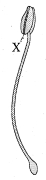
A
Anther
B
Filament
C
Stamen
D
Ovary
Solution
(B) The given figure shows a stamen,which is the male reproductive organ of a flower.
It consists of two parts: the bilobed terminal structure called the anther and the long,slender stalk called the filament.
In the provided diagram,'$X$' points to the long,slender stalk of the stamen,which is known as the filament.
It consists of two parts: the bilobed terminal structure called the anther and the long,slender stalk called the filament.
In the provided diagram,'$X$' points to the long,slender stalk of the stamen,which is known as the filament.
0 likes
View Solution228
MediumMCQ
Identify the figure.
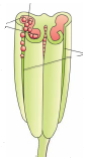
A
Three-dimensional view of an ovary
B
Three-dimensional view of an anther
C
Three-dimensional view of a pollen grain
D
Cross-section of a stamen
Solution
(B) The provided figure shows a three-dimensional view of an anther. It depicts the internal structure of the anther,including the microsporangia where pollen grains are formed and the line of dehiscence through which pollen grains are released. This diagram is a standard representation found in $NCERT$ biology textbooks for Class $12$ under the chapter 'Sexual Reproduction in Flowering Plants'.
0 likes
View Solution229
MediumMCQ
What do '$a$' and '$b$' represent in the given figure?
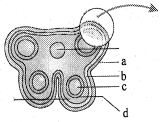
A
Endothecium and Tapetum
B
Middle layers and Endothecium
C
Endothecium and Middle layers
D
Epidermis and Endothecium
Solution
(C) The figure shows a transverse section of a young anther. The wall layers of the anther from outside to inside are: Epidermis,Endothecium,Middle layers,and Tapetum.
In the provided diagram:
'$a$' points to the Endothecium.
'$b$' points to the Middle layers.
Therefore,'$a$' and '$b$' represent Endothecium and Middle layers respectively.
In the provided diagram:
'$a$' points to the Endothecium.
'$b$' points to the Middle layers.
Therefore,'$a$' and '$b$' represent Endothecium and Middle layers respectively.
0 likes
View Solution230
MediumMCQ
What do '$c$' and '$d$' represent in the given figure?
A
Endothecium and Epidermis
B
Tapetum and Middle layer
C
Sporogenous tissue and Tapetum
D
Middle layer and Tapetum
Solution
(C) The given figure represents a cross-section of a young anther. The wall layers of a microsporangium from outside to inside are: Epidermis,Endothecium,Middle layers,and Tapetum.
In the diagram:
'$a$' represents the Epidermis.
'$b$' represents the Endothecium.
'$c$' represents the Sporogenous tissue (the central mass of cells).
'$d$' represents the Tapetum (the innermost layer surrounding the sporogenous tissue).
Therefore,'$c$' and '$d$' represent Sporogenous tissue and Tapetum respectively.
In the diagram:
'$a$' represents the Epidermis.
'$b$' represents the Endothecium.
'$c$' represents the Sporogenous tissue (the central mass of cells).
'$d$' represents the Tapetum (the innermost layer surrounding the sporogenous tissue).
Therefore,'$c$' and '$d$' represent Sporogenous tissue and Tapetum respectively.
0 likes
View Solution231
MediumMCQ
What does '$x$' represent in the given figure?
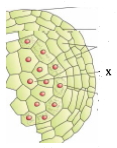
A
Tapetum
B
Microspore mother cell
C
Middle layers
D
Endothecium
Solution
(B) The figure shows a cross-section of a microsporangium wall. The layers from outside to inside are epidermis,endothecium,middle layers,and tapetum. The innermost layer is the tapetum,which nourishes the developing pollen grains. The cells labeled '$x$' are the microspore mother cells (MMCs) located in the center of the microsporangium,which undergo meiosis to form microspores.
0 likes
View Solution232
MediumMCQ
Which cell is involved in the formation of the pollen tube?
A
Megaspore mother cell
B
Tube cell
C
Generative cell
D
Synergid cell
Solution
(B) In angiosperms,the pollen grain is typically shed at the two-celled stage,consisting of a vegetative cell (also known as the tube cell) and a generative cell.
Upon landing on the stigma,the vegetative cell (tube cell) absorbs nutrients and water,leading to the germination of the pollen grain.
The nucleus of the tube cell directs the growth of the pollen tube through the style towards the ovary.
Therefore,the tube cell is responsible for the formation and elongation of the pollen tube.
Upon landing on the stigma,the vegetative cell (tube cell) absorbs nutrients and water,leading to the germination of the pollen grain.
The nucleus of the tube cell directs the growth of the pollen tube through the style towards the ovary.
Therefore,the tube cell is responsible for the formation and elongation of the pollen tube.
0 likes
View Solution233
MediumMCQ
In flowering plants,meiosis occurs at the time of:
A
Formation of buds
B
Germination of seed
C
Formation of root primordia
D
Formation of pollen grains
Solution
(D) In flowering plants,the process of meiosis is essential for the production of haploid gametes.
In the male reproductive organ (stamen),the microspore mother cells $(MMC)$ undergo meiosis to form microspore tetrads,which eventually develop into pollen grains.
Similarly,in the female reproductive organ (pistil),the megaspore mother cell $(MMC)$ undergoes meiosis to produce megaspores.
Therefore,the formation of pollen grains is a stage where meiosis occurs.
In the male reproductive organ (stamen),the microspore mother cells $(MMC)$ undergo meiosis to form microspore tetrads,which eventually develop into pollen grains.
Similarly,in the female reproductive organ (pistil),the megaspore mother cell $(MMC)$ undergoes meiosis to produce megaspores.
Therefore,the formation of pollen grains is a stage where meiosis occurs.
0 likes
View Solution234
MediumMCQ
Pollen grains are released from
A
Macrosporangium
B
Microsporangium
C
Megaspore mother cell
D
Archegonium
Solution
(B) In flowering plants,the stamen consists of an anther and a filament. The anther is typically bilobed,and each lobe has two thecae,making it dithecous. Inside the anther,the microsporangia develop,which contain the pollen mother cells. These cells undergo meiosis to produce microspores,which mature into pollen grains. Upon maturity,the anther dehisces,and the pollen grains are released from the microsporangium.
0 likes
View Solution235
MediumMCQ
The male reproductive organ of a flower consists of:
A
Stalk
B
Thalamus
C
Anther
D
Both $(a)$ and $(c)$
Solution
(D) The male reproductive organ of a flower is called the stamen (or microsporophyll).
Each stamen consists of two main parts:
$1$. $A$ long,slender stalk called the filament.
$2$. $A$ terminal,generally bilobed structure called the anther.
Therefore,the stamen consists of both the stalk (filament) and the anther.
Thus,the correct option is $(d)$.
Each stamen consists of two main parts:
$1$. $A$ long,slender stalk called the filament.
$2$. $A$ terminal,generally bilobed structure called the anther.
Therefore,the stamen consists of both the stalk (filament) and the anther.
Thus,the correct option is $(d)$.
0 likes
View Solution236
MediumMCQ
In angiosperms,male gametes are formed from
A
Antipodals
B
Prothallial cell
C
Tube cell
D
Generative cell
Solution
(D) In angiosperms,the pollen grain undergoes mitosis to form two cells: a large vegetative cell (or tube cell) and a small generative cell. The generative cell subsequently divides by mitosis to produce two male gametes. Therefore,male gametes are formed from the generative cell.
0 likes
View Solution237
MediumMCQ
To produce $102$ pollen grains, how many meiotic divisions are required?
A
$25$
B
$25.5$
C
$26$
D
$27$
Solution
(C) In plants, $1$ meiotic division produces $4$ functional microspores (pollen grains).
To calculate the number of meiotic divisions required to produce $N$ pollen grains, we use the formula: $\text{Number of meiotic divisions} = \frac{N}{4}$.
For $102$ pollen grains, the calculation is $\frac{102}{4} = 25.5$.
Since a meiotic division must be a complete process, we cannot have $0.5$ of a division.
Therefore, $25$ meiotic divisions would produce $25 \times 4 = 100$ pollen grains, which is insufficient.
Thus, $26$ meiotic divisions are required to produce at least $102$ pollen grains (the $26^{th}$ division will produce the remaining $2$ pollen grains, with $2$ cells degenerating or remaining unused).
To calculate the number of meiotic divisions required to produce $N$ pollen grains, we use the formula: $\text{Number of meiotic divisions} = \frac{N}{4}$.
For $102$ pollen grains, the calculation is $\frac{102}{4} = 25.5$.
Since a meiotic division must be a complete process, we cannot have $0.5$ of a division.
Therefore, $25$ meiotic divisions would produce $25 \times 4 = 100$ pollen grains, which is insufficient.
Thus, $26$ meiotic divisions are required to produce at least $102$ pollen grains (the $26^{th}$ division will produce the remaining $2$ pollen grains, with $2$ cells degenerating or remaining unused).
0 likes
View Solution238
MediumMCQ
What will be the amount of $DNA$ in a pollen grain if its mother cell has $32 \; pg$ $DNA$ in $G_2$ phase (in $; pg$)?
A
$16$
B
$32$
C
$8$
D
$4$
Solution
(C) The $DNA$ content of a diploid cell in the $G_1$ phase is represented as $2C$.
During the $S$-phase,the $DNA$ content doubles to $4C$.
Therefore,in the $G_2$ phase,the $DNA$ content remains $4C$.
Given that the mother cell has $32 \; pg$ of $DNA$ in the $G_2$ phase,we have $4C = 32 \; pg$,which implies $C = 8 \; pg$.
$A$ pollen grain is a haploid product of meiosis,containing $C$ amount of $DNA$.
Thus,the amount of $DNA$ in a pollen grain is $8 \; pg$.
During the $S$-phase,the $DNA$ content doubles to $4C$.
Therefore,in the $G_2$ phase,the $DNA$ content remains $4C$.
Given that the mother cell has $32 \; pg$ of $DNA$ in the $G_2$ phase,we have $4C = 32 \; pg$,which implies $C = 8 \; pg$.
$A$ pollen grain is a haploid product of meiosis,containing $C$ amount of $DNA$.
Thus,the amount of $DNA$ in a pollen grain is $8 \; pg$.
0 likes
View Solution239
EasyMCQ
Which element is required for the germination of pollen grains?
A
Boron
B
Calcium
C
Chlorine
D
Potassium
Solution
(A) Boron is an essential micronutrient for plants,present in the soil in very small amounts.
It is absorbed from the soil primarily in the form of boric acid $(H_{3}BO_{3})$ and tetraborate anions.
Boron plays a critical role in pollen tube growth and pollen germination.
Additionally,it is required for seed germination,cell wall development,and cell differentiation.
It is absorbed from the soil primarily in the form of boric acid $(H_{3}BO_{3})$ and tetraborate anions.
Boron plays a critical role in pollen tube growth and pollen germination.
Additionally,it is required for seed germination,cell wall development,and cell differentiation.
0 likes
View Solution240
EasyMCQ
Which statement is correct regarding pollen grains?
A
Haploid
B
Diploid
C
Diploid as well as triploid
D
Haploid,diploid and triploid
Solution
(A) Pollen grains represent the male gametophyte in seed plants (gymnosperms and angiosperms).
They are formed through meiosis from microspore mother cells,which results in haploid $(n)$ microspores.
Therefore,pollen grains are essentially haploid $(n)$ structures.
While they may contain different numbers of cells (e.g.,$2$-celled or $3$-celled stage in angiosperms) during their development and release,their ploidy level remains haploid $(n)$.
They are formed through meiosis from microspore mother cells,which results in haploid $(n)$ microspores.
Therefore,pollen grains are essentially haploid $(n)$ structures.
While they may contain different numbers of cells (e.g.,$2$-celled or $3$-celled stage in angiosperms) during their development and release,their ploidy level remains haploid $(n)$.
0 likes
View Solution241
MediumMCQ
When mature anthers of $Datura$ $innoxia$ are cultured in a culture medium supplemented with phytohormones named kinetin,coconut milk,and plum juice,several embryos can be obtained floating inside the microsporangia. These embryos can develop into plants that are:
A
Haploid
B
Diploid
C
Tetraploid
D
Both $(a)$ and $(b)$
Solution
(A) The process described is anther culture,which is a technique used in plant tissue culture to produce haploid plants.
In this process,the microspores (pollen grains) inside the mature anther are induced to undergo embryogenesis.
Since microspores are formed by meiosis,they are haploid $(n)$.
When these microspores develop into embryos and subsequently into plants,the resulting plants retain the haploid chromosome number.
Therefore,the plants obtained from the embryos developed within the microsporangia of $Datura$ $innoxia$ are haploid.
In this process,the microspores (pollen grains) inside the mature anther are induced to undergo embryogenesis.
Since microspores are formed by meiosis,they are haploid $(n)$.
When these microspores develop into embryos and subsequently into plants,the resulting plants retain the haploid chromosome number.
Therefore,the plants obtained from the embryos developed within the microsporangia of $Datura$ $innoxia$ are haploid.
0 likes
View Solution242
MediumMCQ
Microsporogenesis is:
A
Formation of microspores
B
Formation of female gametes
C
Formation of tapetum
D
All of the above
Solution
(A) Microsporogenesis is the process of formation of microspores from a pollen mother cell $(PMC)$ through meiosis.
During the development of the anther,the cells of the sporogenous tissue undergo meiotic division to form a microspore tetrad.
Each cell of the sporogenous tissue is capable of giving rise to a microspore tetrad and is called a pollen mother cell $(PMC)$.
The microspores are formed and arranged in a group of four cells,known as a microspore tetrad.
As the anthers mature and dehydrate,the microspores dissociate from each other and develop into pollen grains,which represent the male gametophyte.
During the development of the anther,the cells of the sporogenous tissue undergo meiotic division to form a microspore tetrad.
Each cell of the sporogenous tissue is capable of giving rise to a microspore tetrad and is called a pollen mother cell $(PMC)$.
The microspores are formed and arranged in a group of four cells,known as a microspore tetrad.
As the anthers mature and dehydrate,the microspores dissociate from each other and develop into pollen grains,which represent the male gametophyte.
0 likes
View Solution243
MediumMCQ
$60\; \%$ of the angiosperms shed their pollens at the
A
$2$-celled stage
B
$3$-celled stage
C
$4$-celled stage
D
$1$-celled stage
Solution
(A) In $60\; \%$ of angiosperms,pollen grains are shed at the $2$-celled stage,consisting of a vegetative cell and a generative cell.
In the remaining $40\; \%$ of angiosperms,the generative cell undergoes a mitotic division to form two male gametes before the pollen is shed,resulting in a $3$-celled stage.
In the remaining $40\; \%$ of angiosperms,the generative cell undergoes a mitotic division to form two male gametes before the pollen is shed,resulting in a $3$-celled stage.
0 likes
View Solution244
MediumMCQ
Approximate diameter of pollen grain is
A
$25-50 \mu m$
B
$50-75 \mu m$
C
$75-100 \mu m$
D
$25-35 \mu m$
Solution
(A) Pollen grains are generally $25-50 \mu m$ in diameter.
Pollen grains have two main layers:
$(i)$ Outer Layer: It is also called exine. It is made up of sporopollenin. It is hard and protective in nature. Due to sporopollenin,pollen can withstand extreme temperatures.
(ii) Inner layer: It is also called intine. It is made up of cellulose and pectin. It is very thin as compared to the outer layer.
Pollen grains have two main layers:
$(i)$ Outer Layer: It is also called exine. It is made up of sporopollenin. It is hard and protective in nature. Due to sporopollenin,pollen can withstand extreme temperatures.
(ii) Inner layer: It is also called intine. It is made up of cellulose and pectin. It is very thin as compared to the outer layer.
0 likes
View Solution245
MediumMCQ
Ubisch bodies are secreted by
A
Tapetum
B
Exine
C
Microspore mother cells
D
Endothecium
Solution
(A) The $Tapetum$ is the innermost layer of the microsporangium wall and is generally composed of a single layer of nutritive cells.
These cells are responsible for providing nourishment to the developing pollen grains.
Additionally,the $Tapetum$ secretes $Ubisch$ bodies (also known as orbicules),which are lipid-rich granules.
These $Ubisch$ bodies play a crucial role in the formation and deposition of $sporopollenin$ on the $exine$ of pollen grains.
These cells are responsible for providing nourishment to the developing pollen grains.
Additionally,the $Tapetum$ secretes $Ubisch$ bodies (also known as orbicules),which are lipid-rich granules.
These $Ubisch$ bodies play a crucial role in the formation and deposition of $sporopollenin$ on the $exine$ of pollen grains.
0 likes
View Solution246
MediumMCQ
Microsporangia develops into
A
Pollens
B
Sporangia
C
Megagametes
D
Pollen sacs
Solution
(D) Microsporangia are sac-like structures within the anther where pollen grains develop. As the anther matures,these microsporangia further enlarge and become known as pollen sacs,which contain the pollen grains.
0 likes
View Solution247
MediumMCQ
Identify $A$ and $B$ in the diagram given below:
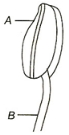
A
$A-Stamen; B-Pistil$
B
$A-Filament; B-Anther$
C
$A-Anther; B-Filament$
D
$A-Pistil; B-Stamen$
Solution
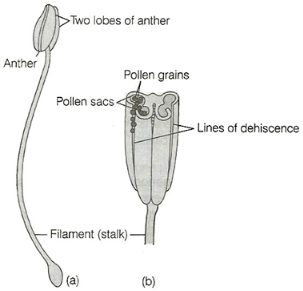
(C) $(i)$ The diagram shows a stamen, which is the male reproductive organ of a flower.
$(ii)$ The terminal, generally bilobed structure is the $A-Anther$.
$(iii)$ The long and slender stalk attached to the anther is the $B-Filament$.
$(iv)$ Therefore, $A$ represents the anther and $B$ represents the filament.
$(ii)$ The terminal, generally bilobed structure is the $A-Anther$.
$(iii)$ The long and slender stalk attached to the anther is the $B-Filament$.
$(iv)$ Therefore, $A$ represents the anther and $B$ represents the filament.
0 likes
View Solution248
EasyMCQ
Majority of pollen grains are shed at
A
$1-celled$ stage
B
$2-celled$ stage
C
$3-celled$ stage
D
$5-celled$ stage
Solution
(B) The protoplast of a pollen grain is initially uninucleate $(1-celled)$.
However, at the time of dehiscence and liberation from the anther, it undergoes mitosis to become $2-celled$ or $3-celled$.
In the majority of angiosperms (about $60\%$), pollen grains are shed at the $2-celled$ stage, consisting of a vegetative cell and a generative cell.
However, at the time of dehiscence and liberation from the anther, it undergoes mitosis to become $2-celled$ or $3-celled$.
In the majority of angiosperms (about $60\%$), pollen grains are shed at the $2-celled$ stage, consisting of a vegetative cell and a generative cell.
0 likes
View Solution249
MediumMCQ
Pollens have two prominent walls which are ... $A$... and ... $B$ .... Here $A$ and $B$ refers to
A
$A-Intine, B-Protein coat$
B
$A-Exine, B-Intine$
C
$A-Sporopollenin, B-Intine$
D
$A-Sporopollenin, B-Exine$
Solution
(B) The pollen grain is a spherical structure that possesses a two-layered wall.
$1$. The outer hard layer is called the exine, which is made up of sporopollenin, one of the most resistant organic materials known.
$2$. The inner thin and continuous layer is called the intine, which is composed of cellulose and pectin.
Therefore, $A$ refers to the exine and $B$ refers to the intine.
$1$. The outer hard layer is called the exine, which is made up of sporopollenin, one of the most resistant organic materials known.
$2$. The inner thin and continuous layer is called the intine, which is composed of cellulose and pectin.
Therefore, $A$ refers to the exine and $B$ refers to the intine.
0 likes
View Solution250
MediumMCQ
$A$ typical angiosperm anther is
A
Bilobed
B
Dithecous
C
Both $(a)$ and $(b)$
D
Monothecous
Solution
(C) typical angiosperm anther is bilobed,meaning it consists of two lobes.
Each lobe contains two theca (microsporangia),making the anther dithecous.
Therefore,a typical angiosperm anther is both bilobed and dithecous.
Each lobe contains two theca (microsporangia),making the anther dithecous.
Therefore,a typical angiosperm anther is both bilobed and dithecous.
0 likes
View SolutionSexual Reproduction in Flowering Plants — Stamen, Microsporangium and Pollen Grain · Frequently Asked Questions
1Are these Sexual Reproduction in Flowering Plants questions useful for JEE and NEET?
Yes. All questions in this section are mapped to JEE Main and NEET exam patterns. Previous year questions from JEE Main, NEET, GUJCET and state-level exams are included with full solutions.
2Can I switch to Hindi or Gujarati for these questions?
Yes. Use the language tabs in the hero section or the sidebar to view the same questions and solutions in English, Hindi or Gujarati.
3How do I generate a question paper from this subtopic?
Use the Vedclass Exam Paper Generator — select the chapter and subtopic, set difficulty, and generate Sets A, B, C, D automatically. First 3 chapters of every subject are free.
Vedclass Products
For Students
Vedclass Test Series
Mock tests in real JEE/NEET style with performance analysis. 5-day free trial.
Start Free TrialFor Teachers
Exam Paper Generator
Generate Set A/B/C/D papers from this chapter in 2 minutes. 3 chapters free.
Try FreeFor Institutes
Online Exam Module
Live online exams with unlimited students, 360° analytics & white-label branding.
See DemoFor Teachers & Institutes
Generate a Sexual Reproduction in Flowering Plants Exam Paper in 2 Minutes
Select subtopic & difficulty — Sets A, B, C, D auto-generated with No Repeat logic.
First 3 chapters of every subject are free — no payment required.