
A English
Stamen, Microsporangium and Pollen Grain Questions in English
Class 12 Biology · Sexual Reproduction in Flowering Plants · Stamen, Microsporangium and Pollen Grain
348+
Questions
English
Language
100%
With Solutions
Showing 50 of 348 questions in English
101
MediumMCQ
In which of the following is the pollen grain considered to be the male gametophyte?
A
Sorghum
B
Hyacinthus
C
Vinca
D
None of the above
Solution
(D) In angiosperms,the pollen grain represents the immature male gametophyte. It is the structure that produces the male gametes. In all angiosperms,including $Sorghum$,$Hyacinthus$,and $Vinca$,the pollen grain is considered the male gametophyte. Since all the options listed are angiosperms,the pollen grain in all of them functions as the male gametophyte. However,if the question implies a specific context or a multiple-choice selection where one must be chosen,it is important to note that the definition applies to all flowering plants. Given the options,all of them are angiosperms,so the pollen grain in each of them is the male gametophyte.
0 likes
View Solution102
MediumMCQ
Ubisch bodies are associated with the development of:
A
Embryo
B
Pollen grains
C
Endosperm
D
Embryo sac
Solution
(B) Ubisch bodies,also known as orbicules,are small,spherical,sporopollenin-containing particles produced by the tapetum cells in the anther.
These bodies are released into the anther locule and contribute to the formation of the outer wall of the pollen grain,known as the exine.
Therefore,Ubisch bodies are directly associated with the development and maturation of pollen grains.
These bodies are released into the anther locule and contribute to the formation of the outer wall of the pollen grain,known as the exine.
Therefore,Ubisch bodies are directly associated with the development and maturation of pollen grains.
0 likes
View Solution103
MediumMCQ
In angiosperms, the male gametophyte is reduced to how many cells?
A
One-celled
B
Two-celled
C
Three-celled
D
Four-celled
Solution
(C) In angiosperms, the pollen grain represents the male gametophyte.
During its development, the microspore undergoes mitosis to form two cells: a large vegetative cell and a small generative cell.
In about $60\%$ of angiosperms, pollen grains are shed at this $2$-celled stage.
In the remaining species, the generative cell divides mitotically to give rise to the two male gametes before pollen grains are shed, resulting in a $3$-celled stage.
However, the mature male gametophyte in angiosperms is generally considered to be $3$-celled at the time of fertilization, consisting of one vegetative cell and two male gametes.
During its development, the microspore undergoes mitosis to form two cells: a large vegetative cell and a small generative cell.
In about $60\%$ of angiosperms, pollen grains are shed at this $2$-celled stage.
In the remaining species, the generative cell divides mitotically to give rise to the two male gametes before pollen grains are shed, resulting in a $3$-celled stage.
However, the mature male gametophyte in angiosperms is generally considered to be $3$-celled at the time of fertilization, consisting of one vegetative cell and two male gametes.
0 likes
View Solution104
MediumMCQ
How many lobes are present in a mature anther?
A
$4$
B
$1$
C
$3$
D
$2$
Solution
(D) typical angiosperm anther is bilobed,meaning it consists of $2$ lobes.
Each lobe contains $2$ theca,making the anther dithecous.
Therefore,a mature anther is generally described as having $2$ lobes.
Each lobe contains $2$ theca,making the anther dithecous.
Therefore,a mature anther is generally described as having $2$ lobes.
0 likes
View Solution105
EasyMCQ
The enzyme callase,which degrades the callose wall of the microspore tetrad to release four microspores,is provided by the:
A
Pollen grain
B
Middle layers
C
Tapetum
D
Endothecium
Solution
(C) During microsporogenesis,the microspore mother cells $(MMC)$ undergo meiosis to form a cluster of four cells known as the microspore tetrad. These four cells are held together by a callose wall. The $Tapetum$,which is the innermost layer of the microsporangium wall,secretes the enzyme callase. This enzyme breaks down the callose wall,allowing the four microspores to separate and develop into pollen grains.
0 likes
View Solution106
MediumMCQ
Which part of the reproductive structure produces both enzymes and hormones?
A
Archesporium
B
Middle layers
C
Tapetum
D
Endothecium
Solution
(C) The $Tapetum$ is the innermost layer of the microsporangium wall.
It provides nourishment to the developing pollen grains.
It is metabolically active and secretes various enzymes (such as $callase$) and hormones (such as $auxins$) that are essential for the development and maturation of pollen grains.
It provides nourishment to the developing pollen grains.
It is metabolically active and secretes various enzymes (such as $callase$) and hormones (such as $auxins$) that are essential for the development and maturation of pollen grains.
0 likes
View Solution107
EasyMCQ
Where is sporopollenin found?
A
Exine
B
Intine
C
Cytoplasm
D
Nucleus
Solution
(A) Sporopollenin is one of the most resistant organic materials known. It is found in the $Exine$ of the pollen grain wall. It can withstand high temperatures and strong acids and alkali. No enzyme that degrades sporopollenin is so far known.
0 likes
View Solution108
MediumMCQ
What are the characteristic features of the endothecium layer in the anther of $Capsella$?
A
Radially elongated
B
Cellulosic thickening
C
Hygroscopic
D
All of the above
Solution
(D) The endothecium is the layer located just below the epidermis in the anther wall.
Its cells are radially elongated and possess fibrous thickenings of cellulose (and sometimes lignin) on their inner and radial walls.
Due to the hygroscopic nature of these fibrous thickenings,the endothecium helps in the dehiscence of the anther at maturity by losing water.
Therefore,all the given options are characteristic features of the endothecium.
Its cells are radially elongated and possess fibrous thickenings of cellulose (and sometimes lignin) on their inner and radial walls.
Due to the hygroscopic nature of these fibrous thickenings,the endothecium helps in the dehiscence of the anther at maturity by losing water.
Therefore,all the given options are characteristic features of the endothecium.
0 likes
View Solution109
MediumMCQ
What occurs in a microspore mother cell to form a mature pollen grain in grasses?
A
One meiosis and two mitoses
B
One meiosis and one mitosis
C
One meiosis
D
One mitosis
Solution
(B) $1$. The microspore mother cell $(MMC)$ is diploid $(2n)$. It undergoes one meiotic division (meiosis) to produce four haploid $(n)$ microspores,which are arranged in a microspore tetrad.
$2$. Each microspore then develops into a pollen grain. During this development,the nucleus of the microspore undergoes one mitotic division to form a vegetative cell and a generative cell.
$3$. Therefore,the formation of a mature pollen grain from a microspore mother cell involves one meiosis followed by one mitosis.
$2$. Each microspore then develops into a pollen grain. During this development,the nucleus of the microspore undergoes one mitotic division to form a vegetative cell and a generative cell.
$3$. Therefore,the formation of a mature pollen grain from a microspore mother cell involves one meiosis followed by one mitosis.
0 likes
View Solution110
EasyMCQ
The androecium is a whorl of ..........
A
Anther
B
Stamen
C
Filament
D
Perianth
Solution
(B) The flower consists of four whorls arranged successively on the thalamus. The third whorl from the outside is the androecium,which is composed of stamens. Each stamen consists of a filament and an anther. Therefore,the androecium is a whorl of stamens.
0 likes
View Solution111
EasyMCQ
In angiosperms,the wall surrounding all four microspores of a microspore tetrad is made up of which substance?
A
Pecto-cellulose
B
Callose
C
Cellulose
D
Sporopollenin
Solution
(B) During microsporogenesis,the microspore mother cell $(MMC)$ undergoes meiosis to form a cluster of four haploid cells known as a microspore tetrad.
These four microspores are initially held together by a special layer of carbohydrate called $Callose$.
As the microspores mature and separate from each other,the enzyme $Callase$ is secreted by the tapetum,which degrades the $Callose$ wall,allowing the individual pollen grains to be released.
These four microspores are initially held together by a special layer of carbohydrate called $Callose$.
As the microspores mature and separate from each other,the enzyme $Callase$ is secreted by the tapetum,which degrades the $Callose$ wall,allowing the individual pollen grains to be released.
0 likes
View Solution112
MediumMCQ
Which of the following is surrounded by a callose wall?
A
Male gamete
B
Egg cell
C
Pollen grain
D
Microspore mother cell
Solution
(D) During the process of microsporogenesis,the $Microspore Mother Cell$ $(MMC)$ undergoes meiosis to form a tetrad of microspores.
Initially,these four microspores are held together by a layer of callose,which is a polysaccharide.
Therefore,the $Microspore Mother Cell$ and the resulting microspore tetrad are surrounded by a callose wall before the microspores are released as individual pollen grains.
Initially,these four microspores are held together by a layer of callose,which is a polysaccharide.
Therefore,the $Microspore Mother Cell$ and the resulting microspore tetrad are surrounded by a callose wall before the microspores are released as individual pollen grains.
0 likes
View Solution113
EasyMCQ
In angiosperms,the male gametes are produced by the division of which of the following?
A
Generative cell
B
Vegetative cell
C
Microspore mother cell
D
Pollen grain
Solution
(A) In angiosperms,the pollen grain undergoes mitosis to form two cells: a large vegetative cell and a small generative cell.
Subsequently,the generative cell undergoes mitosis to produce two male gametes.
Therefore,the male gametes are produced by the division of the generative cell.
Subsequently,the generative cell undergoes mitosis to produce two male gametes.
Therefore,the male gametes are produced by the division of the generative cell.
0 likes
View Solution114
MediumMCQ
In angiosperms,what does the archesporium give rise to?
A
Only the parietal cells and microspore mother cells
B
Only the anther walls
C
Both the anther wall and the microspore mother cells
D
Only the wall and the tapetum
Solution
(C) In the developing anther of angiosperms,the archesporial cells divide periclinally to form an outer primary parietal cell and an inner primary sporogenous cell.
The primary parietal cell undergoes further divisions to form the various layers of the anther wall (epidermis,endothecium,middle layers,and tapetum).
The primary sporogenous cell directly or after a few divisions functions as the microspore mother cells ($MMC$s).
Therefore,the archesporium gives rise to both the anther wall layers and the microspore mother cells.
The primary parietal cell undergoes further divisions to form the various layers of the anther wall (epidermis,endothecium,middle layers,and tapetum).
The primary sporogenous cell directly or after a few divisions functions as the microspore mother cells ($MMC$s).
Therefore,the archesporium gives rise to both the anther wall layers and the microspore mother cells.
0 likes
View Solution115
MediumMCQ
In gymnosperms,the microsporophyll and microsporangium can be compared to which parts of angiosperms?
A
Stamen,Stigma
B
Stigma,Anther
C
Stigma,Ovule
D
Stamen,Anther
Solution
(D) In gymnosperms,the male reproductive structure consists of microsporophylls (leaves bearing microsporangia) which contain microsporangia.
In angiosperms,the male reproductive organ is the stamen,which consists of a filament and an anther.
The microsporophyll of a gymnosperm is homologous to the stamen of an angiosperm.
The microsporangium of a gymnosperm is homologous to the pollen sac or anther of an angiosperm.
Therefore,the correct comparison is microsporophyll to stamen and microsporangium to anther.
In angiosperms,the male reproductive organ is the stamen,which consists of a filament and an anther.
The microsporophyll of a gymnosperm is homologous to the stamen of an angiosperm.
The microsporangium of a gymnosperm is homologous to the pollen sac or anther of an angiosperm.
Therefore,the correct comparison is microsporophyll to stamen and microsporangium to anther.
0 likes
View Solution116
MediumMCQ
Where are the microsporangia located?
A
Fruit body
B
Female cone
C
On the megasporophyll
D
On the microsporophyll
Solution
(D) In gymnosperms,the microsporangia are borne on specialized leaf-like structures called microsporophylls. These microsporophylls are arranged spirally along an axis to form compact structures known as male strobili or male cones.
0 likes
View Solution117
EasyMCQ
Which of the following parts is not a component of the stamen?
A
Anther
B
Connective
C
Filament
D
Stigma
Solution
(D) The stamen is the male reproductive organ of a flower. It consists of two main parts: the $Anther$ and the $Filament$. The $Anther$ is the pollen-bearing part, and the $Filament$ is the stalk that supports it. The $Connective$ is the tissue that connects the two lobes of the anther. The $Stigma$ is the receptive tip of the carpel (pistil), which is the female reproductive part of the flower. Therefore, the $Stigma$ is not a part of the stamen.
0 likes
View Solution118
EasyMCQ
The microsporangium of gymnosperms is homologous to which part of angiosperms?
A
Stamen
B
Anther
C
Pollen grain
D
Pistil
Solution
(B) In gymnosperms,the microsporangium is the structure where microspores are produced. In angiosperms,the microsporangium is located within the anther. Therefore,the microsporangium of gymnosperms is homologous to the anther of angiosperms.
0 likes
View Solution119
EasyMCQ
To which part of an angiosperm can the microspores of a gymnosperm be compared?
A
Stamen
B
Stigma
C
Pollen grain
D
Pistil
Solution
(C) In gymnosperms,the microspores are produced within the microsporangia. These microspores develop into the male gametophyte,which is highly reduced and confined to a limited number of cells. This male gametophyte is known as the pollen grain. In angiosperms,the pollen grain is also the male gametophyte that develops from the microspore. Therefore,the microspores of a gymnosperm are homologous to the pollen grains of an angiosperm.
0 likes
View Solution120
MediumMCQ
The male gametophyte with the least number of cells is present in:
A
Pteris
B
Funaria
C
Lilium
D
Pinus
Solution
(C) The correct answer is $C$.
$Pteris$ (a pteridophyte) has a multicellular gametophytic prothallus that bears both antheridia and archegonia.
$Funaria$ (a bryophyte) has a bisexual leafy gametophyte which represents the dominant phase of its life cycle.
In $Pinus$ (a gymnosperm),the male gametophyte is highly reduced and consists of $4$ cells at the time of pollination.
In $Lilium$ (an angiosperm),the male gametophyte is the most reduced,consisting of only $2$ cells (a vegetative cell and a generative cell) at the time of pollen release.
Therefore,the male gametophyte with the least number of cells is present in $Lilium$.
$Pteris$ (a pteridophyte) has a multicellular gametophytic prothallus that bears both antheridia and archegonia.
$Funaria$ (a bryophyte) has a bisexual leafy gametophyte which represents the dominant phase of its life cycle.
In $Pinus$ (a gymnosperm),the male gametophyte is highly reduced and consists of $4$ cells at the time of pollination.
In $Lilium$ (an angiosperm),the male gametophyte is the most reduced,consisting of only $2$ cells (a vegetative cell and a generative cell) at the time of pollen release.
Therefore,the male gametophyte with the least number of cells is present in $Lilium$.
0 likes
View Solution121
MediumMCQ
Male gametophyte in angiosperms produces
A
single sperm and two vegetative cells
B
three sperms
C
two sperms and a vegetative cell
D
single sperm and a vegetative cell.
Solution
(C) The protoplast of the male gametophyte divides mitotically to produce two unequal cells: a small generative cell and a large vegetative cell.
The generative cell divides later into two non-motile male gametes (or sperms).
Thus,the mature male gametophyte in angiosperms produces two sperms and a vegetative cell.
The vegetative cell later grows to produce the pollen tube.
The generative cell divides later into two non-motile male gametes (or sperms).
Thus,the mature male gametophyte in angiosperms produces two sperms and a vegetative cell.
The vegetative cell later grows to produce the pollen tube.
0 likes
View Solution122
MediumMCQ
Which one of the following statements is correct?
A
Endothecium produces the microspores.
B
Tapetum nourishes the developing pollen.
C
Hard outer layer of pollen is called intine.
D
Sporogenous tissue is haploid.
Solution
(B) : $A$ microsporangium is generally surrounded by four wall layers - the epidermis,endothecium,middle layers,and the tapetum.
The outer three wall layers perform the function of protection and help in the dehiscence of the anther to release the pollen.
The innermost wall layer is the tapetum.
It nourishes the developing pollen grains.
Cells of the tapetum are rich in nutrients,possess dense cytoplasm,and generally have more than one nucleus.
They disintegrate to liberate their contents,which are absorbed by the developing spores.
The outer three wall layers perform the function of protection and help in the dehiscence of the anther to release the pollen.
The innermost wall layer is the tapetum.
It nourishes the developing pollen grains.
Cells of the tapetum are rich in nutrients,possess dense cytoplasm,and generally have more than one nucleus.
They disintegrate to liberate their contents,which are absorbed by the developing spores.
0 likes
View Solution123
MediumMCQ
An organic substance that can withstand environmental extremes and cannot be degraded by any enzyme is
A
cuticle
B
sporopollenin
C
lignin
D
cellulose
Solution
(B) : $Sporopollenin$ is a major component of the tough outer $(exine)$ walls of spores and pollen grains.
It is chemically very stable and is usually well preserved in soils and sediments.
It can withstand environmental extremes and cannot be degraded by any known enzymes or strong chemical reagents.
It is chemically very stable and is usually well preserved in soils and sediments.
It can withstand environmental extremes and cannot be degraded by any known enzymes or strong chemical reagents.
0 likes
View Solution124
MediumMCQ
What is the function of the germ pore?
A
Emergence of radicle
B
Absorption of water for seed germination
C
Initiation of pollen tube
D
Release of male gametes
Solution
(C) The correct answer is $C$.
In a pollen grain,the exine is thin or absent at certain places.
These areas may have thickened intine or deposition of callose.
They are called germ pores (if rounded) or germinal furrows (if elongated).
After pollination,the pollen grain on the stigma absorbs water and nutrients from the stigmatic secretion through its germ pores.
The vegetative cell enlarges and emerges from the pollen grain through the germ pore to form a pollen tube.
In a pollen grain,the exine is thin or absent at certain places.
These areas may have thickened intine or deposition of callose.
They are called germ pores (if rounded) or germinal furrows (if elongated).
After pollination,the pollen grain on the stigma absorbs water and nutrients from the stigmatic secretion through its germ pores.
The vegetative cell enlarges and emerges from the pollen grain through the germ pore to form a pollen tube.
0 likes
View Solution125
MediumMCQ
Which one of the following is resistant to enzyme action?
A
Pollen exine
B
Leaf cuticle
C
Cork
D
Wood fibre
Solution
(A) The correct answer is $A$.
Sporopollenin is a major component of the tough outer layer (exine) of pollen grains.
It is one of the most chemically stable organic materials known.
It can withstand high temperatures,strong acids,and strong alkalis.
Crucially,no enzyme is known that can degrade sporopollenin,which allows pollen grains to be well-preserved as fossils.
Sporopollenin is a major component of the tough outer layer (exine) of pollen grains.
It is one of the most chemically stable organic materials known.
It can withstand high temperatures,strong acids,and strong alkalis.
Crucially,no enzyme is known that can degrade sporopollenin,which allows pollen grains to be well-preserved as fossils.
0 likes
View Solution126
EasyMCQ
Male gametes in angiosperms are formed by the division of
A
generative cell
B
vegetative cell
C
microspore mother cell
D
microspore
Solution
(A) In the pollen sac $(microsporangium)$ of the anther,haploid microspores are formed by meiosis.
Each microspore undergoes mitosis to produce a two-celled pollen grain consisting of a small generative cell and a large vegetative cell.
The generative cell then undergoes a second mitotic division to form two male gametes.
Therefore,the male gametes are formed by the division of the generative cell.
Each microspore undergoes mitosis to produce a two-celled pollen grain consisting of a small generative cell and a large vegetative cell.
The generative cell then undergoes a second mitotic division to form two male gametes.
Therefore,the male gametes are formed by the division of the generative cell.
0 likes
View Solution127
MediumMCQ
Which one of the following is surrounded by a callose wall?
A
Male gamete
B
Egg
C
Pollen grain
D
Microspore mother cell
Solution
(D) The correct answer is $(D)$.
In the anther,the primary sporogenous tissue differentiates into microspore mother cells $(MMC)$.
These $MMC$ are diploid and are initially connected by plasmodesmata.
Each $MMC$ is surrounded by a callose wall,which is deposited between the plasma membrane and the primary cell wall.
This callose wall is synthesized by the tapetum.
Following the deposition of the callose wall,the $MMC$ undergoes meiosis to form a tetrad of microspores.
After meiosis,the callose wall is degraded by the enzyme callase,allowing the microspores to separate into individual pollen grains.
In the anther,the primary sporogenous tissue differentiates into microspore mother cells $(MMC)$.
These $MMC$ are diploid and are initially connected by plasmodesmata.
Each $MMC$ is surrounded by a callose wall,which is deposited between the plasma membrane and the primary cell wall.
This callose wall is synthesized by the tapetum.
Following the deposition of the callose wall,the $MMC$ undergoes meiosis to form a tetrad of microspores.
After meiosis,the callose wall is degraded by the enzyme callase,allowing the microspores to separate into individual pollen grains.
0 likes
View Solution128
EasyMCQ
Which of the following are the carriers of male gametes in seed plants?
A
Vegetative cells
B
Microspore
C
Tapetum
D
Pollen grain
Solution
(D) In seed plants (gymnosperms and angiosperms),the pollen grain represents the male gametophyte.
It is the structure that carries the male gametes to the female reproductive organ.
Inside the pollen grain,the generative cell divides to form two male gametes,while the vegetative cell helps in the growth of the pollen tube.
Therefore,the pollen grain acts as the carrier of male gametes.
It is the structure that carries the male gametes to the female reproductive organ.
Inside the pollen grain,the generative cell divides to form two male gametes,while the vegetative cell helps in the growth of the pollen tube.
Therefore,the pollen grain acts as the carrier of male gametes.
0 likes
View Solution129
MediumMCQ
...... possess dense cytoplasm and generally have more than one nucleus.
A
Epidermis
B
Endothecium
C
Middle layers
D
Tapetum
Solution
(D) The $Tapetum$ is the innermost wall layer of the microsporangium.
It nourishes the developing pollen grains.
The cells of the $Tapetum$ possess dense cytoplasm and generally have more than one nucleus due to endomitosis or free nuclear division.
Therefore,the correct option is $D$.
It nourishes the developing pollen grains.
The cells of the $Tapetum$ possess dense cytoplasm and generally have more than one nucleus due to endomitosis or free nuclear division.
Therefore,the correct option is $D$.
0 likes
View Solution130
MediumMCQ
The cells of the sporogenous tissue undergo meiotic division to form microspore tetrads. What would be the ploidy of the cells of the sporogenous tissue?
A
$n$
B
$2n$
C
$3n$
D
All of the above
Solution
(B) In flowering plants,the sporogenous tissue is present within the microsporangium (pollen sac).
These cells function as microspore mother cells (MMCs).
The cells of the sporogenous tissue are diploid $(2n)$ in nature.
Each microspore mother cell undergoes meiosis (reduction division) to produce four haploid $(n)$ microspores,which are arranged in a cluster known as a microspore tetrad.
Therefore,the ploidy of the cells of the sporogenous tissue is $2n$.
These cells function as microspore mother cells (MMCs).
The cells of the sporogenous tissue are diploid $(2n)$ in nature.
Each microspore mother cell undergoes meiosis (reduction division) to produce four haploid $(n)$ microspores,which are arranged in a cluster known as a microspore tetrad.
Therefore,the ploidy of the cells of the sporogenous tissue is $2n$.
0 likes
View Solution131
MediumMCQ
What is the approximate diameter of a pollen grain?
A
$25-50$ $\mathring{A}$
B
$25-50$ $\text{micron}$
C
$20-25$ $\text{micrometre}$
D
$25-50$ $\text{micrometre}$
Solution
(D) Pollen grains are generally spherical in shape and measure approximately $25-50$ micrometres in diameter. This size range is characteristic of most angiosperm pollen grains as mentioned in the $NCERT$ textbook.
0 likes
View Solution132
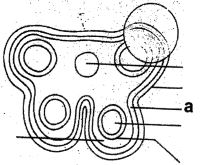
MediumMCQ
Identify '$a$' in the given figure:
A
Epidermis
B
Megaspore tetrads
C
Endothecium
D
Sporogenous tissue
Solution
(C) The given figure represents a transverse section of a young anther.
In a typical bilobed,dithecous anther,the wall layers consist of the epidermis,endothecium,middle layers,and tapetum.
The layer labeled '$a$' is situated immediately below the epidermis and is known as the endothecium.
This layer helps in the dehiscence of the anther to release pollen grains.
In a typical bilobed,dithecous anther,the wall layers consist of the epidermis,endothecium,middle layers,and tapetum.
The layer labeled '$a$' is situated immediately below the epidermis and is known as the endothecium.
This layer helps in the dehiscence of the anther to release pollen grains.
0 likes
View Solution133
MediumMCQ
Microspore tetrads are formed due to meiotic division occurring in......
A
Cells of sporogenous tissue
B
Microspore
C
$MMC$
D
Vegetative cell
Solution
(C) The process of formation of microspores from a pollen mother cell $(PMC)$ or microspore mother cell $(MMC)$ through meiosis is called microsporogenesis.
As the anther develops,the cells of the sporogenous tissue undergo meiotic divisions to form microspore tetrads.
Each cell of the sporogenous tissue is capable of giving rise to a microspore tetrad and acts as a potential $MMC$.
Therefore,the correct answer is $MMC$ (Microspore Mother Cell).
As the anther develops,the cells of the sporogenous tissue undergo meiotic divisions to form microspore tetrads.
Each cell of the sporogenous tissue is capable of giving rise to a microspore tetrad and acts as a potential $MMC$.
Therefore,the correct answer is $MMC$ (Microspore Mother Cell).
0 likes
View Solution134
MediumMCQ
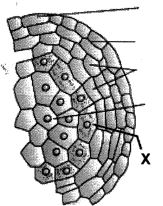
Identify the labelled part $X$ from the figure:
A
Microspore
B
Middle layer
C
Endothecium
D
Tapetum
Solution
(D) The figure represents the transverse section of a young anther. The wall layers of a microsporangium from outside to inside are: Epidermis,Endothecium,Middle layers,and Tapetum. The innermost layer is the Tapetum,which nourishes the developing pollen grains. In the provided diagram,the layer labelled $X$ is the innermost wall layer surrounding the sporogenous tissue,which is the Tapetum.
0 likes
View Solution135
MediumMCQ
Because of which substance are pollen grains well preserved as fossils?
A
Presence of germ pore
B
Presence of sporopollenin
C
Presence of cellulose
D
All of the above
Solution
(B) Pollen grains are well preserved as fossils because of the presence of $sporopollenin$ in the exine layer.
$Sporopollenin$ is one of the most resistant organic materials known.
It can withstand high temperatures,strong acids,and alkali.
No enzyme that degrades $sporopollenin$ is so far known.
$Sporopollenin$ is one of the most resistant organic materials known.
It can withstand high temperatures,strong acids,and alkali.
No enzyme that degrades $sporopollenin$ is so far known.
0 likes
View Solution136
MediumMCQ
Male gametes are produced in
A
Pollen grain
B
Ovules
C
Fruits
D
Seed
Solution
(A) In flowering plants,the male gametophyte is represented by the pollen grain.
Inside the pollen grain,the generative cell undergoes mitosis to produce two male gametes.
Therefore,male gametes are produced within the pollen grain.
Inside the pollen grain,the generative cell undergoes mitosis to produce two male gametes.
Therefore,male gametes are produced within the pollen grain.
0 likes
View Solution137
MediumMCQ
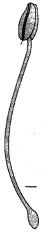
Identify the figure shown.
A
Typical gynoecium
B
Typical stamen
C
Cut section of microsporangium
D
Flower
Solution
(B) The provided figure represents a typical stamen. $A$ stamen consists of two parts: the long and slender stalk called the filament,and the terminal generally bilobed structure called the anther. This structure is the male reproductive organ of a flowering plant.
0 likes
View Solution138
MediumMCQ
$A$ - Only some cells of the sporogenous tissue are capable of giving rise to microspore tetrad.
$R$ - The microspores are arranged in a cluster of four cells - the microspore tetrad.
$R$ - The microspores are arranged in a cluster of four cells - the microspore tetrad.
A
$A$ and $R$ both are correct.
B
$A$ and $R$ both are incorrect.
C
$A$ is correct,$R$ is incorrect.
D
$A$ is incorrect,$R$ is correct.
Solution
(D) Assertion $(A)$ is incorrect because every cell of the sporogenous tissue is a potential pollen mother cell $(PMC)$ and is capable of giving rise to a microspore tetrad through meiosis.
Reason $(R)$ is correct because as the anther develops,the cells of the sporogenous tissue undergo meiotic divisions to form microspore tetrads,which are clusters of four haploid microspores.
Reason $(R)$ is correct because as the anther develops,the cells of the sporogenous tissue undergo meiotic divisions to form microspore tetrads,which are clusters of four haploid microspores.
0 likes
View Solution139
EasyMCQ
Which layer of cells possesses dense cytoplasm and generally has more than one nucleus?
A
Endothecium
B
Epidermis
C
Tapetum
D
Middle layer
Solution
(C) The $Tapetum$ is the innermost layer of the microsporangium wall.
It nourishes the developing pollen grains.
Cells of the $Tapetum$ possess dense cytoplasm and generally have more than one nucleus due to endomitosis or free nuclear division.
Therefore,the correct option is $C$.
It nourishes the developing pollen grains.
Cells of the $Tapetum$ possess dense cytoplasm and generally have more than one nucleus due to endomitosis or free nuclear division.
Therefore,the correct option is $C$.
0 likes
View Solution140
MediumMCQ
$A$ - Due to meiosis in $MMC$,microspore tetrads are produced.
$R$ - $MMC$ is a large cell containing dense cytoplasm and a prominent nucleus.
$R$ - $MMC$ is a large cell containing dense cytoplasm and a prominent nucleus.
A
$A$ and $R$ are correct,and $R$ is the correct explanation of $A$.
B
$A$ and $R$ are correct,but $R$ is not the correct explanation of $A$.
C
$A$ is correct,$R$ is incorrect.
D
$A$ is incorrect,$R$ is correct.
Solution
(A) is correct: The Microspore Mother Cell $(MMC)$ undergoes meiosis to form a cluster of four haploid microspores,known as a microspore tetrad.
$R$ is correct: The $MMC$ is a specialized cell that is typically larger than surrounding cells,possesses dense cytoplasm,and contains a prominent,well-defined nucleus,which is characteristic of cells undergoing active division.
$R$ is correct: The $MMC$ is a specialized cell that is typically larger than surrounding cells,possesses dense cytoplasm,and contains a prominent,well-defined nucleus,which is characteristic of cells undergoing active division.
0 likes
View Solution141
MediumMCQ
The male gametophyte with the least number of cells is found in .....
A
Pteris
B
Funaria
C
Lilium
D
Pinus
Solution
(C) In angiosperms like $Lilium$,the male gametophyte is highly reduced and consists of only $2$ or $3$ cells at the time of pollination (the vegetative cell and one or two generative cells). In contrast,bryophytes like $Funaria$ and pteridophytes like $Pteris$ have multicellular male gametophytes. Gymnosperms like $Pinus$ also have a more complex male gametophyte compared to angiosperms. Therefore,$Lilium$ (an angiosperm) represents the most reduced state.
0 likes
View Solution142
MediumMCQ
In angiosperms,the male gametophyte is shed at which stage?
A
Four-celled pollen grain
B
Three-celled pollen grain
C
Microspore mother cell
D
Anther
Solution
(B) In angiosperms,the pollen grain represents the male gametophyte.
In about $60\%$ of angiosperms,pollen grains are shed at the $2$-celled stage (a vegetative cell and a generative cell).
In the remaining species,the generative cell divides mitotically to give rise to the two male gametes before pollen grains are shed,resulting in a $3$-celled stage.
Therefore,the male gametophyte is shed at either the $2$-celled or $3$-celled stage. Among the given options,the $3$-celled stage is the correct developmental stage for shedding.
In about $60\%$ of angiosperms,pollen grains are shed at the $2$-celled stage (a vegetative cell and a generative cell).
In the remaining species,the generative cell divides mitotically to give rise to the two male gametes before pollen grains are shed,resulting in a $3$-celled stage.
Therefore,the male gametophyte is shed at either the $2$-celled or $3$-celled stage. Among the given options,the $3$-celled stage is the correct developmental stage for shedding.
0 likes
View Solution143
MediumMCQ
If the generative cell is destroyed by a laser,the pollen tube still forms. This is because:
A
The vegetative (tube) cell is not damaged.
B
The content of the dead generative cell stimulates pollen growth.
C
Laser rays stimulate the growth of the pollen tube.
D
The origin point of the pollen tube is not injured.
Solution
(A) In angiosperms,the pollen grain consists of two cells: the vegetative cell and the generative cell.
$1$. The vegetative cell (or tube cell) is responsible for the growth of the pollen tube.
$2$. The generative cell divides to form two male gametes.
$3$. Since the vegetative cell is responsible for the tube formation and elongation,destroying the generative cell with a laser does not prevent the formation of the pollen tube.
$1$. The vegetative cell (or tube cell) is responsible for the growth of the pollen tube.
$2$. The generative cell divides to form two male gametes.
$3$. Since the vegetative cell is responsible for the tube formation and elongation,destroying the generative cell with a laser does not prevent the formation of the pollen tube.
0 likes
View Solution144
MediumMCQ
The male gametophyte of an angiosperm is represented by the . . . . . . .
A
Microsporangium
B
Nucellus
C
Microspore
D
Stamen
Solution
(C) In angiosperms,the male gametophyte is highly reduced and is represented by the pollen grain.
$1$. The microspore (pollen grain) undergoes mitotic divisions to develop into the male gametophyte.
$2$. The microsporangium is the structure where microspores are produced.
$3$. The nucellus is the central part of the ovule.
$4$. The stamen is the male reproductive organ of the flower.
Therefore,the microspore (pollen grain) represents the male gametophyte.
$1$. The microspore (pollen grain) undergoes mitotic divisions to develop into the male gametophyte.
$2$. The microsporangium is the structure where microspores are produced.
$3$. The nucellus is the central part of the ovule.
$4$. The stamen is the male reproductive organ of the flower.
Therefore,the microspore (pollen grain) represents the male gametophyte.
0 likes
View Solution145
MediumMCQ
In which cells can meiosis be best observed?
A
Cells of apical meristem
B
Cells of lateral meristem
C
Cells of microspore mother cells
D
Cells of anther wall
Solution
(C) Meiosis is a type of cell division that results in four daughter cells each with half the number of chromosomes of the parent cell. It is specifically associated with sexual reproduction. In flowering plants,meiosis occurs in the microspore mother cells $(MMC)$ within the anther to produce microspores (pollen grains). Apical and lateral meristems undergo mitosis for growth,and the anther wall cells also undergo mitosis for development and protection. Therefore,the best site to observe meiosis is the microspore mother cells.
0 likes
View Solution146
MediumMCQ
How many microspore mother cells are required to produce $100$ pollen grains in angiosperms?
A
$25$
B
$50$
C
$75$
D
$100$
Solution
(A) In angiosperms,each microspore mother cell $(MMC)$ undergoes meiosis to produce $4$ microspores (pollen grains).
Therefore,the number of $MMC$ required to produce $n$ pollen grains is calculated as $n / 4$.
For $100$ pollen grains,the number of $MMC$ required = $100 / 4 = 25$.
Thus,$25$ microspore mother cells are needed.
Therefore,the number of $MMC$ required to produce $n$ pollen grains is calculated as $n / 4$.
For $100$ pollen grains,the number of $MMC$ required = $100 / 4 = 25$.
Thus,$25$ microspore mother cells are needed.
0 likes
View Solution147
MediumMCQ
How many pollen grains will be produced through the meiotic division of $10$ microspore mother cells?
A
$10$
B
$20$
C
$40$
D
$80$
Solution
(C) In flowering plants,each microspore mother cell $(MMC)$ undergoes meiosis to produce $4$ haploid microspores.
These $4$ microspores develop into $4$ pollen grains.
Therefore,the number of pollen grains produced from $10$ microspore mother cells is calculated as:
$10 \times 4 = 40$ pollen grains.
Thus,the correct option is $C$.
These $4$ microspores develop into $4$ pollen grains.
Therefore,the number of pollen grains produced from $10$ microspore mother cells is calculated as:
$10 \times 4 = 40$ pollen grains.
Thus,the correct option is $C$.
0 likes
View Solution148
EasyMCQ
In angiosperms,all four microspores of a microspore tetrad are covered by a layer which is made up of ........
A
Octocellulose
B
Callose
C
Cellulose
D
Sporopollenin
Solution
(B) In angiosperms,the microspore mother cell $(MMC)$ undergoes meiosis to form a cluster of four haploid microspores,known as a microspore tetrad.
These four microspores are held together by a special layer of polysaccharide called $Callose$.
As the anther matures and dehydrates,the enzyme $Callase$ is secreted by the tapetum,which degrades the $Callose$ layer,allowing the microspores to dissociate and develop into pollen grains.
These four microspores are held together by a special layer of polysaccharide called $Callose$.
As the anther matures and dehydrates,the enzyme $Callase$ is secreted by the tapetum,which degrades the $Callose$ layer,allowing the microspores to dissociate and develop into pollen grains.
0 likes
View Solution149
MediumMCQ
In flowering plants,what does the archesporial cell produce?
A
Only the tapetum and sporogenous cells
B
Only the microsporangium wall
C
The wall and sporogenous cells
D
The wall and the tapetum
Solution
(C) In the development of the microsporangium,the archesporial cells undergo periclinal division.
This division results in the formation of two types of cells:
$1$. Primary parietal cells,which divide to form the wall layers of the microsporangium (epidermis,endothecium,middle layers,and tapetum).
$2$. Primary sporogenous cells,which directly or after a few divisions form the microspore mother cells (sporogenous tissue).
Therefore,the archesporial cell gives rise to both the wall layers and the sporogenous cells.
This division results in the formation of two types of cells:
$1$. Primary parietal cells,which divide to form the wall layers of the microsporangium (epidermis,endothecium,middle layers,and tapetum).
$2$. Primary sporogenous cells,which directly or after a few divisions form the microspore mother cells (sporogenous tissue).
Therefore,the archesporial cell gives rise to both the wall layers and the sporogenous cells.
0 likes
View Solution150
EasyMCQ
Which of the following is surrounded by a cell wall?
A
Microspore mother cell
B
Male gamete
C
Egg cell
D
Pollen grain
Solution
(D) The pollen grain is the male gametophyte in angiosperms. It is surrounded by a prominent two-layered wall called the sporoderm. The hard outer layer is called the exine,which is made of sporopollenin,and the inner layer is called the intine,which is made of cellulose and pectin. Other options like male gametes and egg cells are naked cells (protoplasts) without a cell wall.
0 likes
View SolutionSexual Reproduction in Flowering Plants — Stamen, Microsporangium and Pollen Grain · Frequently Asked Questions
1Are these Sexual Reproduction in Flowering Plants questions useful for JEE and NEET?
Yes. All questions in this section are mapped to JEE Main and NEET exam patterns. Previous year questions from JEE Main, NEET, GUJCET and state-level exams are included with full solutions.
2Can I switch to Hindi or Gujarati for these questions?
Yes. Use the language tabs in the hero section or the sidebar to view the same questions and solutions in English, Hindi or Gujarati.
3How do I generate a question paper from this subtopic?
Use the Vedclass Exam Paper Generator — select the chapter and subtopic, set difficulty, and generate Sets A, B, C, D automatically. First 3 chapters of every subject are free.
Vedclass Products
For Students
Vedclass Test Series
Mock tests in real JEE/NEET style with performance analysis. 5-day free trial.
Start Free TrialFor Teachers
Exam Paper Generator
Generate Set A/B/C/D papers from this chapter in 2 minutes. 3 chapters free.
Try FreeFor Institutes
Online Exam Module
Live online exams with unlimited students, 360° analytics & white-label branding.
See DemoFor Teachers & Institutes
Generate a Sexual Reproduction in Flowering Plants Exam Paper in 2 Minutes
Select subtopic & difficulty — Sets A, B, C, D auto-generated with No Repeat logic.
First 3 chapters of every subject are free — no payment required.