
A English
Stamen, Microsporangium and Pollen Grain Questions in English
Class 12 Biology · Sexual Reproduction in Flowering Plants · Stamen, Microsporangium and Pollen Grain
348+
Questions
English
Language
100%
With Solutions
Showing 49 of 348 questions in English
151
EasyMCQ
In angiosperms,the male gametes are produced by the division of the ..........
A
Microspore
B
Generative cell
C
Vegetative cell
D
Microspore mother cell
Solution
(B) In angiosperms,the pollen grain represents the male gametophyte.
Initially,the microspore undergoes mitosis to form two cells: a large vegetative cell and a small generative cell.
The generative cell then undergoes a mitotic division to produce two male gametes.
Therefore,the male gametes are formed by the division of the generative cell.
Initially,the microspore undergoes mitosis to form two cells: a large vegetative cell and a small generative cell.
The generative cell then undergoes a mitotic division to produce two male gametes.
Therefore,the male gametes are formed by the division of the generative cell.
0 likes
View Solution152
EasyMCQ
Which of the following is an enzyme-resistant substance?
A
Cellulose
B
Sclerenchyma fibers
C
Sporopollenin
D
Leaf cuticle
Solution
(C) The exine of the pollen grain is made up of $Sporopollenin$.
$Sporopollenin$ is one of the most resistant organic materials known.
It can withstand high temperatures and strong acids and alkali.
No enzyme that degrades $Sporopollenin$ is so far known.
$Sporopollenin$ is one of the most resistant organic materials known.
It can withstand high temperatures and strong acids and alkali.
No enzyme that degrades $Sporopollenin$ is so far known.
0 likes
View Solution153
EasyMCQ
Which organic substance can withstand extreme environmental conditions and cannot be degraded by any known enzyme?
A
Cuticle
B
Sporopollenin
C
Lignin
D
Cellulose
Solution
(B) Sporopollenin is one of the most resistant organic materials known.
It is found in the exine of pollen grains.
It can withstand high temperatures,strong acids,and alkali conditions.
No enzyme that degrades sporopollenin has been discovered so far,which allows pollen grains to be well-preserved as fossils.
It is found in the exine of pollen grains.
It can withstand high temperatures,strong acids,and alkali conditions.
No enzyme that degrades sporopollenin has been discovered so far,which allows pollen grains to be well-preserved as fossils.
0 likes
View Solution154
MediumMCQ
Which of the following statements is correct?
A
The hard outer layer of pollen grain is called the intine.
B
Sporogenous tissue is haploid.
C
The endothecium produces microspores.
D
The tapetum provides nourishment to the developing pollen grains.
Solution
(D) $1$. The hard outer layer of a pollen grain is called the exine,not the intine. The intine is the inner,thin layer.
$2$. Sporogenous tissue consists of diploid $(2n)$ cells that undergo meiosis to form microspores.
$3$. The endothecium is the layer that aids in the dehiscence of anthers to release pollen,not the production of microspores.
$4$. The tapetum is the innermost wall layer of the microsporangium,which provides nourishment to the developing microspores (pollen grains). Thus,statement $D$ is correct.
$2$. Sporogenous tissue consists of diploid $(2n)$ cells that undergo meiosis to form microspores.
$3$. The endothecium is the layer that aids in the dehiscence of anthers to release pollen,not the production of microspores.
$4$. The tapetum is the innermost wall layer of the microsporangium,which provides nourishment to the developing microspores (pollen grains). Thus,statement $D$ is correct.
0 likes
View Solution155
MediumMCQ
Pollen tablets are available in the market for . . . . . . .
A
In vitro fertilization
B
Breeding programmes
C
Food supplements
D
Preservation of species
Solution
(C) Pollen grains are rich in nutrients. In recent years,pollen tablets have been used as food supplements. In western countries,a large number of pollen products in the form of tablets and syrups are available in the market. Pollen consumption has been claimed to increase the performance of athletes and race horses.
0 likes
View Solution156
MediumMCQ
What does the male gametophyte in angiosperms produce?
A
Two male gametes and one vegetative cell
B
One male gamete and one vegetative cell
C
One male gamete and two vegetative cells
D
Three male gametes
Solution
(A) In angiosperms,the mature male gametophyte is represented by the pollen grain.
During its development,the microspore undergoes mitosis to form two cells: a larger vegetative cell and a smaller generative cell.
The generative cell further undergoes mitosis to produce two male gametes.
Therefore,the mature male gametophyte consists of two male gametes and one vegetative cell (also known as the tube cell).
During its development,the microspore undergoes mitosis to form two cells: a larger vegetative cell and a smaller generative cell.
The generative cell further undergoes mitosis to produce two male gametes.
Therefore,the mature male gametophyte consists of two male gametes and one vegetative cell (also known as the tube cell).
0 likes
View Solution157
EasyMCQ
The distal end of the filament of the stamen is attached to which of the following?
A
Connective
B
Placenta
C
Thalamus or petal
D
Anther
Solution
(D) The stamen consists of two parts: the long and slender stalk called the filament,and the terminal,generally bilobed structure called the anther. The proximal end of the filament is attached to the thalamus or the petal of the flower,while the distal end is attached to the anther.
0 likes
View Solution158
EasyMCQ
Which of the following has proved helpful in preserving pollen as fossils?
A
Sporopollenin
B
Pollenkitt
C
Oil content
D
Cellulosic intine
Solution
(A) The exine of the pollen grain is composed of a highly resistant organic material called $Sporopollenin$.
$Sporopollenin$ is one of the most resistant organic materials known.
It can withstand high temperatures,strong acids,and alkali solutions.
No enzyme that degrades $Sporopollenin$ is known to date.
Due to this remarkable stability,pollen grains are well-preserved as fossils.
$Sporopollenin$ is one of the most resistant organic materials known.
It can withstand high temperatures,strong acids,and alkali solutions.
No enzyme that degrades $Sporopollenin$ is known to date.
Due to this remarkable stability,pollen grains are well-preserved as fossils.
0 likes
View Solution159
MediumMCQ
If the cells of the root in a wheat plant have $42$ chromosomes,then the number of chromosomes in the cell of a pollen grain is:
A
$14$
B
$21$
C
$28$
D
$42$
Solution
(B) The root cells of a wheat plant are diploid $(2n)$ in nature.
Given that the number of chromosomes in root cells is $2n = 42$.
Therefore,the haploid number $(n)$ is calculated as $n = \frac{42}{2} = 21$.
Pollen grains are male gametophytes and are haploid $(n)$ in nature.
Thus,the number of chromosomes in a pollen grain cell is $21$.
Given that the number of chromosomes in root cells is $2n = 42$.
Therefore,the haploid number $(n)$ is calculated as $n = \frac{42}{2} = 21$.
Pollen grains are male gametophytes and are haploid $(n)$ in nature.
Thus,the number of chromosomes in a pollen grain cell is $21$.
0 likes
View Solution160
MediumMCQ
Which of the following types of anther is found in the family $Malvaceae$?
A
Monothecous
B
Dithecous
C
Polythecous
D
Without thecous
Solution
(A) In the family $Malvaceae$,the stamens are monadelphous and the anthers are monothecous.
This means that each anther consists of only one lobe or cell,which is a characteristic feature of this family.
This means that each anther consists of only one lobe or cell,which is a characteristic feature of this family.
0 likes
View Solution161
EasyMCQ
Which of the following statements is correct?
A
Sporopollenin can withstand high temperatures but not strong acids.
B
Sporopollenin can be degraded by enzymes.
C
Sporopollenin is made up of inorganic materials.
D
Sporopollenin can withstand high temperature as well as strong acids and alkalis.
Solution
(D) Pollen grains are generally spherical and possess a prominent two-layered wall.
The hard outer layer,called the exine,is made up of sporopollenin,which is one of the most resistant organic materials known.
It can withstand high temperatures,strong acids,and strong alkalis,and no enzyme is known that degrades sporopollenin.
The hard outer layer,called the exine,is made up of sporopollenin,which is one of the most resistant organic materials known.
It can withstand high temperatures,strong acids,and strong alkalis,and no enzyme is known that degrades sporopollenin.
0 likes
View Solution162
MediumMCQ
Assertion: If pollen mother cells have $42$ chromosomes,the pollen has only $21$ chromosomes.
Reason: Pollens are formed after meiosis in pollen mother cells.
Reason: Pollens are formed after meiosis in pollen mother cells.
A
If both Assertion and Reason are correct and the Reason is a correct explanation of the Assertion.
B
If both Assertion and Reason are correct but Reason is not a correct explanation of the Assertion.
C
If the Assertion is correct but Reason is incorrect.
D
If both the Assertion and Reason are incorrect.
Solution
(A) Pollen mother cells $(PMC)$ are diploid $(2n)$ cells that undergo meiosis to produce microspores or pollen grains.
Meiosis is a reductional division,which reduces the chromosome number to half $(n)$.
If the $PMC$ has $42$ chromosomes $(2n = 42)$,then the pollen grains,being haploid,will have $n = 42/2 = 21$ chromosomes.
Therefore,both the Assertion and the Reason are correct,and the Reason is the correct explanation of the Assertion.
Meiosis is a reductional division,which reduces the chromosome number to half $(n)$.
If the $PMC$ has $42$ chromosomes $(2n = 42)$,then the pollen grains,being haploid,will have $n = 42/2 = 21$ chromosomes.
Therefore,both the Assertion and the Reason are correct,and the Reason is the correct explanation of the Assertion.
0 likes
View Solution163
Easy
Explain the role of the tapetum in the formation of the pollen grain wall.
Solution
(N/A) The tapetum is the innermost layer of the microsporangium. It plays a crucial role in the development of pollen grains by providing nourishment. During microsporogenesis,tapetal cells secrete various enzymes,hormones,amino acids,and other essential nutrients. Most importantly,the tapetum is responsible for the synthesis and deposition of $sporopollenin$,which forms the outer layer of the pollen grain known as the $exine$.
0 likes
View Solution164
Medium
Describe the internal structure of an anther by mentioning the parts of a typical stamen.
Solution
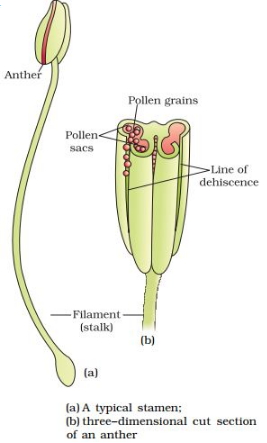
(N/A) typical stamen consists of two main parts: the long and slender stalk called the filament,and the terminal,generally bilobed structure called the anther.
The proximal end of the filament is attached to the thalamus or the petal of the flower.
The number and length of stamens are variable in flowers of different species.
$A$ typical angiosperm anther is bilobed,with each lobe having two theca,making it dithecous.
Often,a longitudinal groove runs lengthwise,separating the theca.
The anther consists of four microsporangia located at the corners.
These microsporangia develop further and become pollen sacs,which are packed with pollen grains.
The proximal end of the filament is attached to the thalamus or the petal of the flower.
The number and length of stamens are variable in flowers of different species.
$A$ typical angiosperm anther is bilobed,with each lobe having two theca,making it dithecous.
Often,a longitudinal groove runs lengthwise,separating the theca.
The anther consists of four microsporangia located at the corners.
These microsporangia develop further and become pollen sacs,which are packed with pollen grains.
0 likes
View Solution165
Medium
Describe the internal structure of a microsporangium.
Solution
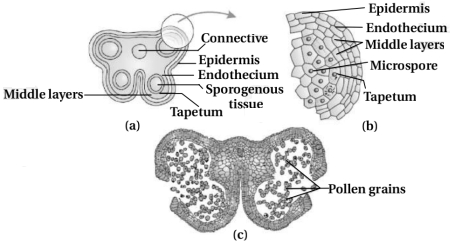
$A$ typical microsporangium appears near circular in outline.
It is generally surrounded by four wall layers: epidermis,endothecium,middle layers,and the tapetum.
The outer three wall layers (epidermis,endothecium,and middle layers) perform the function of protection and help in the dehiscence of the anther to release the pollen grains.
The innermost wall layer is the tapetum. It nourishes the developing pollen grains.
Cells of the tapetum possess dense cytoplasm and generally have more than one nucleus.
When the anther is young,a group of compactly arranged homogenous cells called the sporogenous tissue occupies the centre of each microsporangium.
It is generally surrounded by four wall layers: epidermis,endothecium,middle layers,and the tapetum.
The outer three wall layers (epidermis,endothecium,and middle layers) perform the function of protection and help in the dehiscence of the anther to release the pollen grains.
The innermost wall layer is the tapetum. It nourishes the developing pollen grains.
Cells of the tapetum possess dense cytoplasm and generally have more than one nucleus.
When the anther is young,a group of compactly arranged homogenous cells called the sporogenous tissue occupies the centre of each microsporangium.
0 likes
View Solution166
Medium
Describe the process of Microsporogenesis.
Solution
(N/A) $1$. When the anther is young,a group of compactly arranged homogenous cells called the sporogenous tissue occupies the centre of each microsporangium.
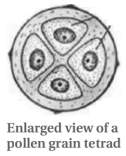
$2$. As the anther develops,the cells of the sporogenous tissue undergo meiotic divisions to form microspore tetrads.
$3$. Each cell of the sporogenous tissue is capable of giving rise to a microspore tetrad and acts as a potential pollen or microspore mother cell $(PMC)$.
$4$. The process of formation of microspores from a pollen mother cell through meiosis is called microsporogenesis.
$5$. The microspores,as they are formed,are arranged in a cluster of four cells called the microspore tetrad.
$6$. As the anthers mature and dehydrate,the microspores dissociate from each other and develop into pollen grains.
$7$. Inside each microsporangium,several thousands of microspores or pollen grains are formed that are released with the dehiscence of the anther.
$2$. As the anther develops,the cells of the sporogenous tissue undergo meiotic divisions to form microspore tetrads.
$3$. Each cell of the sporogenous tissue is capable of giving rise to a microspore tetrad and acts as a potential pollen or microspore mother cell $(PMC)$.
$4$. The process of formation of microspores from a pollen mother cell through meiosis is called microsporogenesis.
$5$. The microspores,as they are formed,are arranged in a cluster of four cells called the microspore tetrad.
$6$. As the anthers mature and dehydrate,the microspores dissociate from each other and develop into pollen grains.
$7$. Inside each microsporangium,several thousands of microspores or pollen grains are formed that are released with the dehiscence of the anther.
0 likes
View Solution167
Medium
Describe the structure of a pollen grain and explain the development of the male gametophyte within it.
Solution
(N/A) Structure of Pollen Grain:
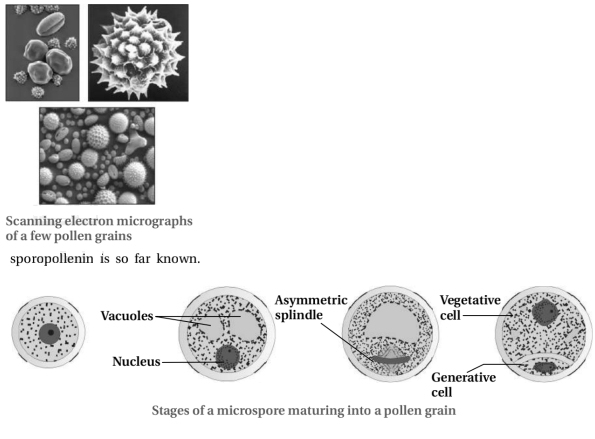
$1$. Pollen grains represent the male gametophytes. They are generally spherical,measuring about $25-50 \ \mu m$ in diameter.
$2$. They possess a prominent two-layered wall. The hard outer layer,called the exine,is made of sporopollenin,which is one of the most resistant organic materials known. It can withstand high temperatures,strong acids,and alkali. No enzyme that degrades sporopollenin is known.
$3$. The exine has prominent apertures called germ pores where sporopollenin is absent. This allows for the emergence of the pollen tube during germination.
$4$. The inner wall of the pollen grain is called the intine. It is a thin,continuous layer made up of cellulose and pectin.
Development of Male Gametophyte:
$1$. The microspore nucleus undergoes mitosis to produce two unequal cells: a larger vegetative cell and a smaller generative cell.
$2$. The vegetative cell is abundant in food reserve and has a large,irregularly shaped nucleus.
$3$. The generative cell is small and floats in the cytoplasm of the vegetative cell. It is spindle-shaped with dense cytoplasm and a nucleus.
$4$. In over $60\%$ of angiosperms,pollen grains are shed at this $2$-celled stage. In others,the generative cell divides mitotically to give rise to the two male gametes before pollen grains are shed ($3$-celled stage).
$1$. Pollen grains represent the male gametophytes. They are generally spherical,measuring about $25-50 \ \mu m$ in diameter.
$2$. They possess a prominent two-layered wall. The hard outer layer,called the exine,is made of sporopollenin,which is one of the most resistant organic materials known. It can withstand high temperatures,strong acids,and alkali. No enzyme that degrades sporopollenin is known.
$3$. The exine has prominent apertures called germ pores where sporopollenin is absent. This allows for the emergence of the pollen tube during germination.
$4$. The inner wall of the pollen grain is called the intine. It is a thin,continuous layer made up of cellulose and pectin.
Development of Male Gametophyte:
$1$. The microspore nucleus undergoes mitosis to produce two unequal cells: a larger vegetative cell and a smaller generative cell.
$2$. The vegetative cell is abundant in food reserve and has a large,irregularly shaped nucleus.
$3$. The generative cell is small and floats in the cytoplasm of the vegetative cell. It is spindle-shaped with dense cytoplasm and a nucleus.
$4$. In over $60\%$ of angiosperms,pollen grains are shed at this $2$-celled stage. In others,the generative cell divides mitotically to give rise to the two male gametes before pollen grains are shed ($3$-celled stage).
0 likes
View Solution168
Medium
List the products derived from pollen grains and explain their uses.
Solution
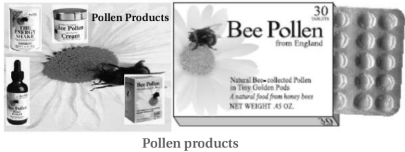
(N/A) Pollen grains are rich in nutrients.
In recent years,it has become a trend to use pollen tablets as food supplements.
In western countries,a large number of pollen products in the form of tablets and syrups are available in the market.
Pollen consumption is claimed to increase the performance of athletes and race horses.
In recent years,it has become a trend to use pollen tablets as food supplements.
In western countries,a large number of pollen products in the form of tablets and syrups are available in the market.
Pollen consumption is claimed to increase the performance of athletes and race horses.
0 likes
View Solution169
Easy
Explain the structure of a stamen.
Solution
(N/A) stamen is the male reproductive organ of a flower. It consists of two main parts:
$1$. Filament: It is the long,slender,stalk-like structure that supports the anther.
$2$. Anther: It is the terminal,generally bilobed structure. Each lobe typically has two thecae,making it dithecous. The anther is a four-sided structure consisting of four microsporangia located at the corners,two in each lobe. These microsporangia develop into pollen sacs,which contain pollen grains.
$1$. Filament: It is the long,slender,stalk-like structure that supports the anther.
$2$. Anther: It is the terminal,generally bilobed structure. Each lobe typically has two thecae,making it dithecous. The anther is a four-sided structure consisting of four microsporangia located at the corners,two in each lobe. These microsporangia develop into pollen sacs,which contain pollen grains.
0 likes
View Solution170
MediumMCQ
An anther has $1200$ pollen grains. How many pollen mother cells must have been there to produce them?
A
$300$
B
$600$
C
$1200$
D
$400$
Solution
(A) In flowering plants,each pollen mother cell $(PMC)$ undergoes meiosis to produce a tetrad of $4$ microspores (pollen grains).
Therefore,to calculate the number of pollen mother cells required to produce $1200$ pollen grains,we divide the total number of pollen grains by $4$.
Number of pollen mother cells = $\frac{1200}{4} = 300$.
Thus,$300$ pollen mother cells are required to produce $1200$ pollen grains.
Therefore,to calculate the number of pollen mother cells required to produce $1200$ pollen grains,we divide the total number of pollen grains by $4$.
Number of pollen mother cells = $\frac{1200}{4} = 300$.
Thus,$300$ pollen mother cells are required to produce $1200$ pollen grains.
0 likes
View Solution171
MediumMCQ
Describe the location and function of the $Endothecium$ and $Tapetum$.
A
Endothecium: Outer layer,protection; Tapetum: Inner layer,nutrition.
B
Endothecium: Middle layer,dehiscence; Tapetum: Innermost layer,nutrition.
C
Endothecium: Innermost layer,nutrition; Tapetum: Outer layer,protection.
D
Endothecium: Middle layer,protection; Tapetum: Middle layer,dehiscence.
Solution
(B) $Endothecium$:
Location: It is the layer situated just below the epidermis in the wall of the anther.
Function: It provides protection and helps in the dehiscence of the anther to release pollen grains.
$Tapetum$:
Location: It is the innermost layer of the wall of the anther.
Function: It provides nourishment to the developing pollen grains.
Location: It is the layer situated just below the epidermis in the wall of the anther.
Function: It provides protection and helps in the dehiscence of the anther to release pollen grains.
$Tapetum$:
Location: It is the innermost layer of the wall of the anther.
Function: It provides nourishment to the developing pollen grains.
0 likes
View Solution172
MediumMCQ
Complete the following flow chart:
Pollen Mother cell $\to$ Pollen tetrad $\to$ Pollen grain $\to$ Vegetative cell
Pollen Mother cell $\to$ Pollen tetrad $\to$ Pollen grain $\to$ ..........
Pollen Mother cell $\to$ Pollen tetrad $\to$ Pollen grain $\to$ Vegetative cell
Pollen Mother cell $\to$ Pollen tetrad $\to$ Pollen grain $\to$ ..........
A
Generative cell
B
Microspore
C
Tapetum
D
Endothecium
Solution
(A) The development of pollen grains involves the following sequence:
Pollen Mother cell $\to$ Pollen tetrad $\to$ Pollen grain $\to$ Vegetative cell and Generative cell.
In the process of microsporogenesis,pollen grains (microspores) are produced from the Pollen Mother cell $(PMC)$ through meiosis. These microspores are initially produced in a group of four cells called a pollen tetrad.
As the anthers mature and dehydrate,the microspores dissociate from each other and develop into pollen grains. During the maturation of the pollen grain,it undergoes mitosis to produce two cells: a larger vegetative cell and a smaller generative cell.
Pollen Mother cell $\to$ Pollen tetrad $\to$ Pollen grain $\to$ Vegetative cell and Generative cell.
In the process of microsporogenesis,pollen grains (microspores) are produced from the Pollen Mother cell $(PMC)$ through meiosis. These microspores are initially produced in a group of four cells called a pollen tetrad.
As the anthers mature and dehydrate,the microspores dissociate from each other and develop into pollen grains. During the maturation of the pollen grain,it undergoes mitosis to produce two cells: a larger vegetative cell and a smaller generative cell.
0 likes
View Solution173
MediumMCQ
Which are the three cells found in a pollen grain when it is shed at the three-celled stage?
A
One vegetative cell and two male gametes
B
Two vegetative cells and one male gamete
C
One generative cell and two male gametes
D
Three vegetative cells
Solution
(A) In $60\%$ of angiospermic plants,the pollen grain is shed at the two-celled stage (one vegetative cell and one generative cell).
In the remaining species,the pollen grain is shed at the three-celled stage.
At this stage,the generative cell undergoes mitosis to produce two male gametes.
Therefore,the three cells present are one vegetative cell and two male gametes.
In the remaining species,the pollen grain is shed at the three-celled stage.
At this stage,the generative cell undergoes mitosis to produce two male gametes.
Therefore,the three cells present are one vegetative cell and two male gametes.
0 likes
View Solution174
Medium
The generative cell of a two-celled pollen divides in the pollen tube but not in a three-celled pollen. Give reasons.
Solution
(N/A) In over $66\%$ of angiosperms,pollen grains are shed at the $2$-celled stage,consisting of a vegetative cell and a generative cell.
In these cases,the generative cell undergoes mitotic division within the pollen tube to produce two male gametes after pollination.
In the remaining species,the generative cell divides mitotically to give rise to the two male gametes before the pollen grains are shed. Thus,these pollen grains are already in the $3$-celled stage (one vegetative cell and two male gametes) at the time of release.
Therefore,in a $3$-celled pollen,the division has already occurred prior to pollination,whereas in a $2$-celled pollen,the division occurs later within the pollen tube.
In these cases,the generative cell undergoes mitotic division within the pollen tube to produce two male gametes after pollination.
In the remaining species,the generative cell divides mitotically to give rise to the two male gametes before the pollen grains are shed. Thus,these pollen grains are already in the $3$-celled stage (one vegetative cell and two male gametes) at the time of release.
Therefore,in a $3$-celled pollen,the division has already occurred prior to pollination,whereas in a $2$-celled pollen,the division occurs later within the pollen tube.
0 likes
View Solution175
Medium
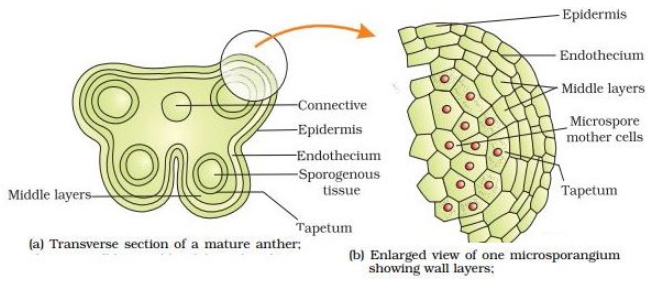
Draw the diagram of a microsporangium and label its wall layers. Write briefly about the wall layers.
Solution
(N/A) In a transverse section,a typical microsporangium appears near circular in outline. It is surrounded by four wall layers:
$(A)$ Epidermis: It is the outermost protective layer. It is single-layered and provides protection to the internal tissues.
$(B)$ Endothecium: It is located below the epidermis. Cells of this layer possess fibrous thickenings of $\alpha$-cellulose. They help in the dehiscence of the anther to release pollen grains.
$(C)$ Middle layers: These are $2-3$ layers of thin-walled cells located between the endothecium and the tapetum. They provide support and are generally ephemeral.
$(D)$ Tapetum: It is the innermost wall layer. It consists of cells with dense cytoplasm and generally more than one nucleus. It provides nourishment to the developing pollen grains.
In the center of the microsporangium,there is a group of compactly arranged homogenous cells called the sporogenous tissue. The cells of the sporogenous tissue undergo meiotic divisions to form microspore tetrads. This process is known as microsporogenesis.
$(A)$ Epidermis: It is the outermost protective layer. It is single-layered and provides protection to the internal tissues.
$(B)$ Endothecium: It is located below the epidermis. Cells of this layer possess fibrous thickenings of $\alpha$-cellulose. They help in the dehiscence of the anther to release pollen grains.
$(C)$ Middle layers: These are $2-3$ layers of thin-walled cells located between the endothecium and the tapetum. They provide support and are generally ephemeral.
$(D)$ Tapetum: It is the innermost wall layer. It consists of cells with dense cytoplasm and generally more than one nucleus. It provides nourishment to the developing pollen grains.
In the center of the microsporangium,there is a group of compactly arranged homogenous cells called the sporogenous tissue. The cells of the sporogenous tissue undergo meiotic divisions to form microspore tetrads. This process is known as microsporogenesis.
0 likes
View Solution176
Easy
Describe the external structure of a pollen grain.
Solution
(N/A) Pollen grains are generally spherical,measuring about $25-50 \ \mu m$ in diameter.
They possess a prominent two-layered wall. The hard outer layer is called the exine.
It is made up of sporopollenin,which is one of the most resistant organic materials known.
It can withstand high temperatures and strong acids and alkali. No enzyme that degrades sporopollenin is so far known.
They possess a prominent two-layered wall. The hard outer layer is called the exine.
It is made up of sporopollenin,which is one of the most resistant organic materials known.
It can withstand high temperatures and strong acids and alkali. No enzyme that degrades sporopollenin is so far known.
0 likes
View Solution177
MediumMCQ
Which of the following structures is a part of the stamen?
A
Stigma
B
Style
C
Ovary
D
Anther
Solution
(D) The stamen is the male reproductive organ of a flower,also known as the microsporophyll. It consists of two main parts: the filament (a long,slender stalk) and the anther (a terminal,generally bilobed structure). Stigma,style,and ovary are components of the pistil or carpel,which is the female reproductive organ of a flower. Therefore,the anther is the correct structure associated with the stamen.
0 likes
View Solution178
MediumMCQ
Select the appropriate option regarding the anther.
A
Dithecous
B
Bilobed
C
Tetrasporangiate
D
Monothecous
Solution
(C) typical angiosperm anther is bilobed,with each lobe having two theca (dithecous). Often,a longitudinal groove runs lengthwise separating the theca. The anther is a tetrasporangiate structure,consisting of four microsporangia located at the corners,two in each lobe.
0 likes
View Solution179
MediumMCQ
Which structure of the stamen is long and slender?
A
Anther
B
Filament
C
Connective
D
Style
Solution
(B) The stamen consists of two main parts: the anther and the filament.
$1$. The anther is a bilobed,pollen-bearing structure.
$2$. The filament is a long,slender stalk that supports the anther.
$3$. The connective is the tissue that connects the two lobes of the anther.
$4$. The style is a part of the carpel (pistil),not the stamen.
Therefore,the long and slender structure of the stamen is the filament.
$1$. The anther is a bilobed,pollen-bearing structure.
$2$. The filament is a long,slender stalk that supports the anther.
$3$. The connective is the tissue that connects the two lobes of the anther.
$4$. The style is a part of the carpel (pistil),not the stamen.
Therefore,the long and slender structure of the stamen is the filament.
0 likes
View Solution180
MediumMCQ
Which of the following structures contains the microsporangia?
A
Anther
B
Filament
C
Ovary
D
Ovule
Solution
(A) The stamen consists of two parts: the long and slender stalk called the filament,and the terminal generally bilobed structure called the anther.
Inside the anther,the microsporangia develop,which further develop into pollen sacs.
These pollen sacs contain the pollen grains.
Therefore,the anther is the structure that contains the microsporangia.
Inside the anther,the microsporangia develop,which further develop into pollen sacs.
These pollen sacs contain the pollen grains.
Therefore,the anther is the structure that contains the microsporangia.
0 likes
View Solution181
MediumMCQ
How many microsporangia does a typical angiosperm anther contain?
A
$1$
B
$2$
C
$3$
D
$4$
Solution
(D) typical angiosperm anther is dithecous,meaning it has two lobes. Each lobe contains two microsporangia,one located at each corner. Therefore,a mature anther typically contains $4$ microsporangia,which eventually develop into pollen sacs.
0 likes
View Solution182
MediumMCQ
Choose the correct option regarding the anther.
A
Tetrasporangiate
B
Tetralobed
C
Dithecous
D
Trilobed
Solution
(A) typical angiosperm anther is bilobed,with each lobe having two theca (dithecous). Often,an anther is a tetragonous structure consisting of four microsporangia located at the corners,two in each lobe. Therefore,it is described as tetrasporangiate.
0 likes
View Solution183
MediumMCQ
Which of the following represents the male reproductive organ of a flower?
A
Androecium
B
Gynoecium
C
Corolla
D
Calyx
Solution
(A) In a flower,the male reproductive organ is the $Androecium$,which consists of whorls of stamens.
Each stamen is composed of a filament and an anther.
The $Gynoecium$ represents the female reproductive organ.
The $Corolla$ (petals) and $Calyx$ (sepals) are accessory whorls involved in protection and attraction of pollinators.
Each stamen is composed of a filament and an anther.
The $Gynoecium$ represents the female reproductive organ.
The $Corolla$ (petals) and $Calyx$ (sepals) are accessory whorls involved in protection and attraction of pollinators.
0 likes
View Solution184
MediumMCQ
How many pollen sacs (microsporangia) does each lobe of an anther contain?
A
$1$
B
$2$
C
$3$
D
$4$
Solution
(B) typical angiosperm anther is bilobed,meaning it has two lobes. Each lobe is dithecous,which means it contains two pollen sacs or microsporangia. Therefore,in a bilobed anther,there are a total of $2 \times 2 = 4$ microsporangia. Since the question asks for the number of pollen sacs in each lobe,the answer is $2$.
0 likes
View Solution185
MediumMCQ
How many wall layers surround a typical microsporangium?
A
One
B
Two
C
Three
D
Four
Solution
(D) typical microsporangium is surrounded by four wall layers.
These layers are:
$1$. Epidermis (outermost layer)
$2$. Endothecium
$3$. Middle layers
$4$. Tapetum (innermost layer)
The outer three layers perform the function of protection and help in the dehiscence of anther to release the pollen. The innermost wall layer,the tapetum,nourishes the developing pollen grains.
These layers are:
$1$. Epidermis (outermost layer)
$2$. Endothecium
$3$. Middle layers
$4$. Tapetum (innermost layer)
The outer three layers perform the function of protection and help in the dehiscence of anther to release the pollen. The innermost wall layer,the tapetum,nourishes the developing pollen grains.
0 likes
View Solution186
MediumMCQ
Which is the outermost layer of the anther wall?
A
Endothecium
B
Epidermis
C
Middle layers
D
Tapetum
Solution
(B) The anther wall consists of four layers:
$1$. The outermost layer is the $Epidermis$,which provides protection.
$2$. The second layer is the $Endothecium$,which helps in dehiscence.
$3$. The middle layers consist of $1-3$ layers of cells.
$4$. The innermost layer is the $Tapetum$,which provides nourishment to the developing pollen grains.
Therefore,the outermost layer is the $Epidermis$.
$1$. The outermost layer is the $Epidermis$,which provides protection.
$2$. The second layer is the $Endothecium$,which helps in dehiscence.
$3$. The middle layers consist of $1-3$ layers of cells.
$4$. The innermost layer is the $Tapetum$,which provides nourishment to the developing pollen grains.
Therefore,the outermost layer is the $Epidermis$.
0 likes
View Solution187
MediumMCQ
Which layer of the microsporangium consists of multiple layers of cells?
A
Middle layers
B
Endothecium
C
Tapetum
D
Epidermis
Solution
(A) The microsporangium is surrounded by four wall layers: the epidermis,endothecium,middle layers,and tapetum.
$1$. The epidermis is the outermost single-cell layer.
$2$. The endothecium is the second layer,also consisting of a single layer of cells.
$3$. The middle layers are located between the endothecium and the tapetum and consist of $2-3$ layers of cells.
$4$. The tapetum is the innermost layer,which is also a single layer of cells.
Therefore,the middle layers are the only ones that consist of multiple layers of cells.
$1$. The epidermis is the outermost single-cell layer.
$2$. The endothecium is the second layer,also consisting of a single layer of cells.
$3$. The middle layers are located between the endothecium and the tapetum and consist of $2-3$ layers of cells.
$4$. The tapetum is the innermost layer,which is also a single layer of cells.
Therefore,the middle layers are the only ones that consist of multiple layers of cells.
0 likes
View Solution188
MediumMCQ
Which layer of the microsporangium helps in protection and dehiscence?
A
Epidermis
B
Endothecium
C
Middle layers
D
All of the above
Solution
(B) The wall of the microsporangium consists of four layers: $1.$ Epidermis,$2.$ Endothecium,$3.$ Middle layers,and $4.$ Tapetum.
- The outer three layers (Epidermis,Endothecium,and Middle layers) perform the function of protection and aid in the dehiscence of anther to release the pollen grains.
- The innermost layer,the Tapetum,nourishes the developing pollen grains.
- Therefore,the Endothecium is specifically known for its role in dehiscence due to the presence of fibrous thickenings,but in the context of the wall layers collectively providing protection and dehiscence,the question refers to the structural layers. However,among the options provided,the Endothecium is the most distinct layer associated with the mechanism of dehiscence.
- The outer three layers (Epidermis,Endothecium,and Middle layers) perform the function of protection and aid in the dehiscence of anther to release the pollen grains.
- The innermost layer,the Tapetum,nourishes the developing pollen grains.
- Therefore,the Endothecium is specifically known for its role in dehiscence due to the presence of fibrous thickenings,but in the context of the wall layers collectively providing protection and dehiscence,the question refers to the structural layers. However,among the options provided,the Endothecium is the most distinct layer associated with the mechanism of dehiscence.
0 likes
View Solution189
MediumMCQ
What does the tapetum provide nourishment to?
A
Developing anther
B
Developing pollen grains
C
Developing carpel
D
Developing ovule
Solution
(B) The tapetum is the innermost layer of the microsporangium wall.
Its primary function is to provide nourishment to the developing pollen grains (microspores).
It also contributes to the formation of the pollen wall (exine) by secreting sporopollenin and other enzymes.
Its primary function is to provide nourishment to the developing pollen grains (microspores).
It also contributes to the formation of the pollen wall (exine) by secreting sporopollenin and other enzymes.
0 likes
View Solution190
MediumMCQ
The middle layers of the microsporangium are located between which of the following layers?
A
Epidermis and Endothecium
B
Endothecium and Tapetum
C
Tapetum and Sporogenous tissue
D
None of these
Solution
(B) The wall of a typical microsporangium consists of four layers: the epidermis,endothecium,middle layers,and tapetum.
$1$. The epidermis is the outermost protective layer.
$2$. The endothecium lies beneath the epidermis.
$3$. The middle layers consist of $1-3$ layers of cells and are situated between the endothecium and the tapetum.
$4$. The tapetum is the innermost layer that provides nourishment to the developing pollen grains.
Therefore,the middle layers are located between the endothecium and the tapetum.
$1$. The epidermis is the outermost protective layer.
$2$. The endothecium lies beneath the epidermis.
$3$. The middle layers consist of $1-3$ layers of cells and are situated between the endothecium and the tapetum.
$4$. The tapetum is the innermost layer that provides nourishment to the developing pollen grains.
Therefore,the middle layers are located between the endothecium and the tapetum.
0 likes
View Solution191
MediumMCQ
What is the group of compactly arranged homogeneous cells located at the center of each microsporangium in a young anther called?
A
Sporogenous tissue
B
Gametophytic tissue
C
Connective tissue
D
Epidermal tissue
Solution
(A) In a young anther, each microsporangium is surrounded by four wall layers: epidermis, endothecium, middle layers, and tapetum.
At the center of each microsporangium, a group of compactly arranged homogeneous cells is present, which is known as the $Sporogenous \text{ } tissue$.
As the anther develops, the cells of the $Sporogenous \text{ } tissue$ undergo meiotic divisions to form microspore tetrads.
At the center of each microsporangium, a group of compactly arranged homogeneous cells is present, which is known as the $Sporogenous \text{ } tissue$.
As the anther develops, the cells of the $Sporogenous \text{ } tissue$ undergo meiotic divisions to form microspore tetrads.
0 likes
View Solution192
MediumMCQ
Where is the sporogenous tissue found?
A
Sepal
B
Connective
C
Anther
D
Style
Solution
(C) The sporogenous tissue is a group of compactly arranged homogeneous cells that occupy the center of each microsporangium in an anther.
As the anther develops,the cells of the sporogenous tissue undergo meiotic divisions to form microspore tetrads.
Therefore,the sporogenous tissue is specifically located within the microsporangium of the anther.
As the anther develops,the cells of the sporogenous tissue undergo meiotic divisions to form microspore tetrads.
Therefore,the sporogenous tissue is specifically located within the microsporangium of the anther.
0 likes
View Solution193
MediumMCQ
What is the full form of $PMC$?
A
Pollen Mother Cell
B
Pollen Microspore Cell
C
Pollen Megaspore Cell
D
Pollen Mother Colony
Solution
(A) In the context of flowering plants,$PMC$ stands for $Pollen$ $Mother$ $Cell$.
These cells are diploid $(2n)$ cells located within the microsporangium (pollen sac) of the anther.
Through the process of meiosis,each $PMC$ undergoes division to produce four haploid $(n)$ microspores,which eventually develop into pollen grains.
These cells are diploid $(2n)$ cells located within the microsporangium (pollen sac) of the anther.
Through the process of meiosis,each $PMC$ undergoes division to produce four haploid $(n)$ microspores,which eventually develop into pollen grains.
0 likes
View Solution194
MediumMCQ
Choose the correct option for $PMC$. (in $n$)
A
$1$
B
$2$
C
$3$
D
$4$
Solution
(B) $PMC$ stands for Pollen Mother Cell.
In flowering plants, the $PMC$ is a diploid cell found within the microsporangium.
It undergoes meiosis to produce four haploid microspores.
Therefore, the ploidy of a $PMC$ is $2n$.
In flowering plants, the $PMC$ is a diploid cell found within the microsporangium.
It undergoes meiosis to produce four haploid microspores.
Therefore, the ploidy of a $PMC$ is $2n$.
0 likes
View Solution195
MediumMCQ
What is required for the formation of microspores from a microspore mother cell?
A
Mitosis
B
Apomixis
C
Meiosis
D
All of the above
Solution
(C) The process of formation of microspores from a pollen mother cell (microspore mother cell) through meiosis is called microsporogenesis.
As the anther develops,the cells of the sporogenous tissue undergo meiotic divisions to form microspore tetrads.
Each cell of the sporogenous tissue is capable of giving rise to a microspore tetrad and is called a microspore mother cell $(MMC)$.
Therefore,meiosis is the essential process for this transformation.
As the anther develops,the cells of the sporogenous tissue undergo meiotic divisions to form microspore tetrads.
Each cell of the sporogenous tissue is capable of giving rise to a microspore tetrad and is called a microspore mother cell $(MMC)$.
Therefore,meiosis is the essential process for this transformation.
0 likes
View Solution196
MediumMCQ
Which of the following processes represents microsporogenesis?
A
$PMC \rightarrow$ (Meiosis) $\rightarrow$ Microspores
B
$MMC \rightarrow$ (Meiosis) $\rightarrow$ Microspores
C
$PMC \rightarrow$ (Mitosis) $\rightarrow$ Microspores
D
$MMC \rightarrow$ (Mitosis) $\rightarrow$ Microspores
Solution
(A) Microsporogenesis is the process of formation of microspores from a pollen mother cell $(PMC)$ through meiosis.
In this process,the diploid $(2n)$ $PMC$ undergoes meiosis to form a cluster of four haploid $(n)$ cells known as the microspore tetrad.
Therefore,the correct sequence is $PMC \rightarrow$ (Meiosis) $\rightarrow$ Microspores.
In this process,the diploid $(2n)$ $PMC$ undergoes meiosis to form a cluster of four haploid $(n)$ cells known as the microspore tetrad.
Therefore,the correct sequence is $PMC \rightarrow$ (Meiosis) $\rightarrow$ Microspores.
0 likes
View Solution197
MediumMCQ
What is the ploidy of the cells of a microspore tetrad (in $n$)?
A
$4$
B
$2$
C
$3$
D
$1$
Solution
(D) During microsporogenesis,the microspore mother cells $(MMC)$ undergo meiosis to form four haploid microspores.
These four microspores remain attached together for some time in a group of four,which is known as a microspore tetrad.
Since these microspores are the products of meiosis,they are haploid in nature.
Therefore,the ploidy of the cells of a microspore tetrad is $n$ or $1n$.
These four microspores remain attached together for some time in a group of four,which is known as a microspore tetrad.
Since these microspores are the products of meiosis,they are haploid in nature.
Therefore,the ploidy of the cells of a microspore tetrad is $n$ or $1n$.
0 likes
View Solution198
MediumMCQ
When microspores are formed, they exist as a cluster of how many cells?
A
One
B
Two
C
Three
D
Four
Solution
(D) During microsporogenesis, the microspore mother cell $(MMC)$ undergoes meiosis to form four haploid microspores. These four microspores remain attached to each other for some time in a cluster known as a microspore tetrad. Therefore, they exist as a cluster of $4$ cells.
0 likes
View Solution199
MediumMCQ
How many pollen tetrads will be formed from $100$ $PMC$s after meiosis?
A
$100$
B
$200$
C
$300$
D
$400$
Solution
(A) In flowering plants,each Pollen Mother Cell $(PMC)$ undergoes meiosis to produce a microspore tetrad.
Since $1$ $PMC$ produces $1$ pollen tetrad (which contains $4$ microspores),
Therefore,$100$ $PMC$s will produce $100$ pollen tetrads.
Since $1$ $PMC$ produces $1$ pollen tetrad (which contains $4$ microspores),
Therefore,$100$ $PMC$s will produce $100$ pollen tetrads.
0 likes
View SolutionSexual Reproduction in Flowering Plants — Stamen, Microsporangium and Pollen Grain · Frequently Asked Questions
1Are these Sexual Reproduction in Flowering Plants questions useful for JEE and NEET?
Yes. All questions in this section are mapped to JEE Main and NEET exam patterns. Previous year questions from JEE Main, NEET, GUJCET and state-level exams are included with full solutions.
2Can I switch to Hindi or Gujarati for these questions?
Yes. Use the language tabs in the hero section or the sidebar to view the same questions and solutions in English, Hindi or Gujarati.
3How do I generate a question paper from this subtopic?
Use the Vedclass Exam Paper Generator — select the chapter and subtopic, set difficulty, and generate Sets A, B, C, D automatically. First 3 chapters of every subject are free.
Vedclass Products
For Students
Vedclass Test Series
Mock tests in real JEE/NEET style with performance analysis. 5-day free trial.
Start Free TrialFor Teachers
Exam Paper Generator
Generate Set A/B/C/D papers from this chapter in 2 minutes. 3 chapters free.
Try FreeFor Institutes
Online Exam Module
Live online exams with unlimited students, 360° analytics & white-label branding.
See DemoFor Teachers & Institutes
Generate a Sexual Reproduction in Flowering Plants Exam Paper in 2 Minutes
Select subtopic & difficulty — Sets A, B, C, D auto-generated with No Repeat logic.
First 3 chapters of every subject are free — no payment required.