
A English
Stamen, Microsporangium and Pollen Grain Questions in English
Class 12 Biology · Sexual Reproduction in Flowering Plants · Stamen, Microsporangium and Pollen Grain
348+
Questions
English
Language
100%
With Solutions
Showing 50 of 348 questions in English
251
MediumMCQ
The outer layer of a pollen grain is called $A$. This is made up of $B$. This layer is absent at the $C$. Fill in the blanks $A, B$,and $C$.
A
$A$-Intine,$B$-organic compound,$C$-micropyle
B
$A$-exine,$B$-sporopollenin,$C$-germ pore
C
$A$-exine,$B$-intine,$C$-micropyle
D
$A$-micropyle,$B$-intine,$C$-exine
Solution
(B) The outer layer of the pollen grain is known as the exine $(A)$. It is composed of a highly resistant organic material called sporopollenin $(B)$. This layer is discontinuous and is absent at specific regions known as germ pores $(C)$,which allow for the emergence of the pollen tube during germination. Therefore,the correct sequence is $A$-exine,$B$-sporopollenin,$C$-germ pore.
0 likes
View Solution252
MediumMCQ
Pollen kit material is secreted by
A
Tapetum
B
Endothecium
C
Epidermis
D
Endodermis
Solution
(A) In insect-pollinated plants,a sticky material is deposited on the surface of pollen grains,which is known as 'pollen kit material'.
This material is secreted by the cells of the tapetum,which is the innermost layer of the microsporangium wall.
This material is secreted by the cells of the tapetum,which is the innermost layer of the microsporangium wall.
0 likes
View Solution253
MediumMCQ
The first three layers of the microsporangium that perform the function of protection are:
A
Epidermis,middle layer,endothecium
B
Epidermis,mesocarp,endocarp
C
Epidermis,endothecium,middle layer
D
Epidermis,endocarp,mesocarp
Solution
(C) The wall of a microsporangium consists of four layers: the epidermis,endothecium,middle layers,and tapetum.
The outermost three layers—the epidermis,endothecium,and middle layers—perform the functions of protection and aid in the dehiscence of the anther to release the pollen grains.
The innermost layer,the tapetum,provides nourishment to the developing pollen grains.
The outermost three layers—the epidermis,endothecium,and middle layers—perform the functions of protection and aid in the dehiscence of the anther to release the pollen grains.
The innermost layer,the tapetum,provides nourishment to the developing pollen grains.
0 likes
View Solution254
MediumMCQ
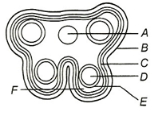
Identify $A$ to $F$ in the following diagram.
A
$A-$Epidermis,$B-$Endodermis,$C-$Connective tissues,$D-$Sporogenous tissue,$E-$Middle layer,$F-$Tapetum
B
$A-$Endodermis,$B-$Connective tissues,$C-$Epidermis,$D-$Tapetum,$E-$Sporogenous tissue,$F-$Middle layer
C
$A-$Tapetum,$B-$Middle layer,$C-$Sporogenous tissue,$D-$Connective tissues,$E-$Endodermis,$F-$Epidermis
D
$A-$Connective tissues,$B-$Epidermis,$C-$Endothecium,$D-$Sporogenous tissue,$E-$Tapetum,$F-$Middle layer
Solution
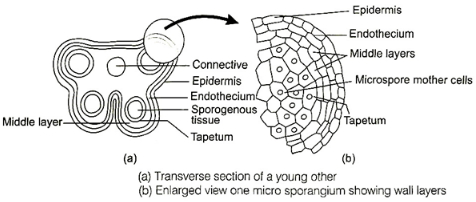
(D) The correct identification is: $A-$Connective tissues,$B-$Epidermis,$C-$Endothecium,$D-$Sporogenous tissue,$E-$Tapetum,$F-$Middle layer.
The microsporangium is surrounded by four wall layers: epidermis,endothecium,middle layers,and tapetum.
$(i)$ The outer three wall layers (epidermis,endothecium,and middle layers) perform the function of protection and aid in the dehiscence of the anther to release the pollen.
$(ii)$ The innermost wall layer is the tapetum,which nourishes the developing pollen grains.
The microsporangium is surrounded by four wall layers: epidermis,endothecium,middle layers,and tapetum.
$(i)$ The outer three wall layers (epidermis,endothecium,and middle layers) perform the function of protection and aid in the dehiscence of the anther to release the pollen.
$(ii)$ The innermost wall layer is the tapetum,which nourishes the developing pollen grains.
0 likes
View Solution255
MediumMCQ
$A$ mature male gametophyte is derived from a 'pollen mother cell' by:
A
Three meiotic divisions
B
One meiotic and one mitotic division
C
Single mitotic division
D
Two mitotic divisions
Solution
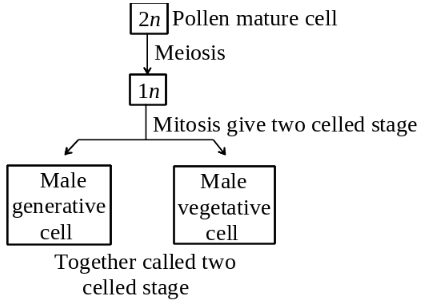
(B) The process of development of a male gametophyte from a pollen mother cell $(PMC)$ involves the following steps:
$1$. The diploid $(2n)$ pollen mother cell undergoes meiosis to form a haploid $(n)$ microspore tetrad.
$2$. Each microspore then undergoes a single mitotic division to form a two-celled stage,consisting of a vegetative cell and a generative cell.
$3$. This two-celled stage is considered the partially developed or mature male gametophyte at the time of pollen release.
Therefore,the formation involves one meiotic division followed by one mitotic division.
$1$. The diploid $(2n)$ pollen mother cell undergoes meiosis to form a haploid $(n)$ microspore tetrad.
$2$. Each microspore then undergoes a single mitotic division to form a two-celled stage,consisting of a vegetative cell and a generative cell.
$3$. This two-celled stage is considered the partially developed or mature male gametophyte at the time of pollen release.
Therefore,the formation involves one meiotic division followed by one mitotic division.
0 likes
View Solution256
MediumMCQ
If there are four microspore mother cells in an anther,what will be the total number of pollen grains produced?
A
$4$
B
$8$
C
$12$
D
$16$
Solution
(D) In the process of microsporogenesis,each microspore mother cell $(MMC)$ undergoes meiosis to produce a tetrad of four haploid microspores.
Since each microspore develops into a pollen grain,one $MMC$ produces $4$ pollen grains.
Therefore,if there are $4$ microspore mother cells,the total number of pollen grains produced will be $4 \times 4 = 16$.
Since each microspore develops into a pollen grain,one $MMC$ produces $4$ pollen grains.
Therefore,if there are $4$ microspore mother cells,the total number of pollen grains produced will be $4 \times 4 = 16$.
0 likes
View Solution257
MediumMCQ
Tapetal cells are characterized by
A
Mitotic division
B
Meiotic division
C
Endomitosis
D
Endomitosis as well as endopolyploidy
Solution
(D) The tapetum is the innermost layer of the anther wall.
It serves as the primary nourishing layer for developing pollen grains.
During development,the cells of the tapetum often become multinucleate and polyploid due to processes known as endomitosis (replication of chromosomes without nuclear division) and endopolyploidy (increase in the number of sets of chromosomes within a nucleus).
It serves as the primary nourishing layer for developing pollen grains.
During development,the cells of the tapetum often become multinucleate and polyploid due to processes known as endomitosis (replication of chromosomes without nuclear division) and endopolyploidy (increase in the number of sets of chromosomes within a nucleus).
0 likes
View Solution258
MediumMCQ
Which of the following statements about sporopollenin is false?
A
Exine is made up of sporopollenin
B
Sporopollenin is one of the resistant organic materials
C
Exine has apertures called germ pores where sporopollenin is present
D
Sporopollenin can withstand high temperatures and strong acids
Solution
(C) Exine is primarily composed of sporopollenin.
Sporopollenin is one of the most resistant organic materials known; it can withstand high temperatures,strong acids,and alkali.
However,the exine is discontinuous at certain points where sporopollenin is absent. These apertures are known as germ pores.
Therefore,the statement that germ pores contain sporopollenin is false.
Sporopollenin is one of the most resistant organic materials known; it can withstand high temperatures,strong acids,and alkali.
However,the exine is discontinuous at certain points where sporopollenin is absent. These apertures are known as germ pores.
Therefore,the statement that germ pores contain sporopollenin is false.
0 likes
View Solution259
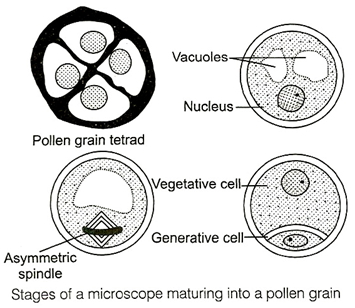
MediumMCQ
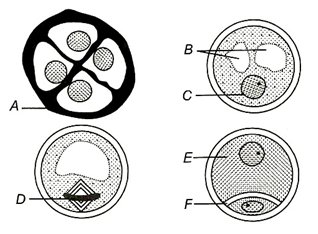
Identify the structures marked $A$ to $F$ in the given diagram.
A
$A$-Asymmetric nucleus,$B$-Nucleus,$C$-Generative cell,$D$-Vegetative cell,$E$-Pollen,$F$-Pollen tetrad
B
$A$-Pollen tetrad,$B$-Pollen,$C$-Generative cell,$D$-Vegetative cell,$E$-Asymmetric spindle,$F$-Nucleus
C
$A$-Pollen tetrad,$B$-Vacuole,$C$-Nucleus,$D$-Asymmetric spindle,$E$-Vegetative cell,$F$-Generative cell
D
$A$-Vacuole,$B$-Nucleus,$C$-Pollen tetrad,$D$-Vegetative cell,$E$-Asymmetric spindle,$F$-Generative cell
Solution
(C) The given diagram shows the stages of microsporogenesis and the maturation of a pollen grain.
$A$ represents the pollen tetrad,which is a group of four microspores formed after meiosis.
$B$ represents the vacuoles that appear in the developing microspore.
$C$ represents the nucleus of the microspore.
$D$ represents the asymmetric spindle formed during the first mitotic division of the microspore nucleus.
$E$ represents the vegetative cell,which is larger,contains abundant food reserves,and has a large irregularly shaped nucleus.
$F$ represents the generative cell,which is small,spindle-shaped with dense cytoplasm,and floats in the cytoplasm of the vegetative cell.
$A$ represents the pollen tetrad,which is a group of four microspores formed after meiosis.
$B$ represents the vacuoles that appear in the developing microspore.
$C$ represents the nucleus of the microspore.
$D$ represents the asymmetric spindle formed during the first mitotic division of the microspore nucleus.
$E$ represents the vegetative cell,which is larger,contains abundant food reserves,and has a large irregularly shaped nucleus.
$F$ represents the generative cell,which is small,spindle-shaped with dense cytoplasm,and floats in the cytoplasm of the vegetative cell.
0 likes
View Solution260
MediumMCQ
Identify $A$ to $D$ in the following diagram.
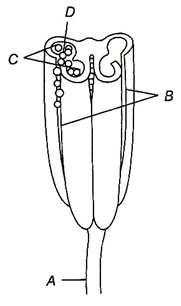
A
$A$-Filament,$B$-Pollen sac,$C$-Pollen grain,$D$-Line of dehiscence
B
$A$-Filament,$B$-Pollen sac,$C$-Line of dehiscence,$D$-Pollen grain
C
$A$-Filament,$B$-Line of dehiscence,$C$-Pollen sac,$D$-Pollen grains
D
$A$-Filament,$B$-Line of dehiscence,$C$-Pollen sac,$D$-Pollen grains
Solution
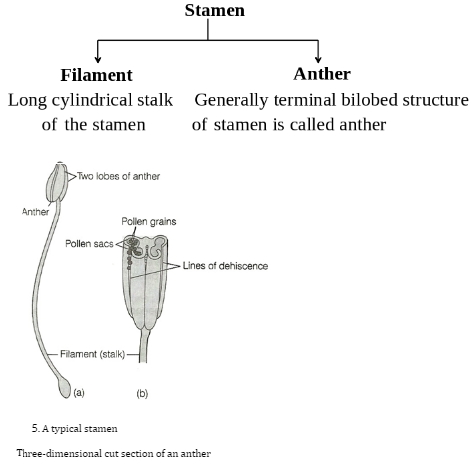
(D) $(i)$ $A$ typical angiospermic anther is a bilobed structure having two theca in each lobe.
$(ii)$ It is tetragonal in shape with $4$ microsporangia located at each lobe in its corners.
$(iii)$ Microsporangia develop into pollen sacs,which produce pollen grains.
$(iv)$ Based on the diagram: $A$ represents the Filament,$B$ represents the Line of dehiscence,$C$ represents the Pollen sac,and $D$ represents the Pollen grains.
$(ii)$ It is tetragonal in shape with $4$ microsporangia located at each lobe in its corners.
$(iii)$ Microsporangia develop into pollen sacs,which produce pollen grains.
$(iv)$ Based on the diagram: $A$ represents the Filament,$B$ represents the Line of dehiscence,$C$ represents the Pollen sac,and $D$ represents the Pollen grains.
0 likes
View Solution261
MediumMCQ
$A$ typical angiosperm anther is . . . . . . and . . . . . . .
A
Bilobed,tetrasporangiate
B
Bilobed,monosporangiate
C
Bilobed,bisporangiate
D
Tetralobed,monosporangiate
Solution
(A) typical angiosperm anther is bilobed,meaning it consists of two lobes. Each lobe contains two microsporangia,making it tetrasporangiate in total (two microsporangia per lobe $\times$ two lobes = four microsporangia).
0 likes
View Solution262
MediumMCQ
The innermost wall layer of anther:
A
Is nutritive in function
B
Helps in dehiscence of anther
C
Is haploid and protective in function
D
Forms microspores
Solution
(A) The innermost wall layer of the anther is called the $Tapetum$.
Its primary function is to provide nutrition to the developing pollen grains.
It also secretes enzymes,hormones,and components of the pollen wall (like sporopollenin).
Its primary function is to provide nutrition to the developing pollen grains.
It also secretes enzymes,hormones,and components of the pollen wall (like sporopollenin).
0 likes
View Solution263
MediumMCQ
The process of formation of microspores from a pollen mother cell is called
A
Megasporogenesis
B
Microsporogenesis
C
Megagametogenesis
D
Microgametogenesis
Solution
(B) The process of formation of microspores from a pollen mother cell $(PMC)$ or microspore mother cell $(MMC)$ through meiosis is known as microsporogenesis.
During this process,a diploid $(2n)$ $MMC$ undergoes meiosis to produce four haploid $(n)$ microspores,which are arranged in a cluster called a microspore tetrad.
During this process,a diploid $(2n)$ $MMC$ undergoes meiosis to produce four haploid $(n)$ microspores,which are arranged in a cluster called a microspore tetrad.
0 likes
View Solution264
MediumMCQ
The pollen grain represents
A
Male gamete
B
Male gametophyte
C
Microsporophyll
D
Microsporangium
Solution
(B) The pollen grain is the immature male gametophyte in seed plants. It contains the vegetative cell and the generative cell,which eventually produces the male gametes. Therefore,it represents the male gametophyte stage of the plant life cycle.
0 likes
View Solution265
MediumMCQ
The most resistant organic material known which makes up the outermost layer of pollen wall is
A
Pectin
B
Cellulose
C
Sporopollenin
D
Lignin
Solution
(C) The outermost layer of the pollen grain wall is called the exine.
It is composed of a highly resistant organic material known as Sporopollenin.
Sporopollenin is a carotenoid derivative that is resistant to high temperatures,strong acids,and alkali.
No enzyme is known that can degrade Sporopollenin,which allows pollen grains to be preserved as fossils for long periods.
It is composed of a highly resistant organic material known as Sporopollenin.
Sporopollenin is a carotenoid derivative that is resistant to high temperatures,strong acids,and alkali.
No enzyme is known that can degrade Sporopollenin,which allows pollen grains to be preserved as fossils for long periods.
0 likes
View Solution266
MediumMCQ
Choose the correct option with respect to the function of the germ pore.
A
It allows growth of pollen tube
B
It allows water absorption in seed
C
It helps dehiscence of pollen grain
D
More than one option is correct
Solution
(A) The germ pore is a small aperture in the exine of the pollen grain where the sporopollenin is absent.
During the process of germination,the pollen tube emerges through one of these germ pores.
Therefore,the primary function of the germ pore is to allow the growth of the pollen tube during the germination of the pollen grain.
During the process of germination,the pollen tube emerges through one of these germ pores.
Therefore,the primary function of the germ pore is to allow the growth of the pollen tube during the germination of the pollen grain.
0 likes
View Solution267
MediumMCQ
The thin and continuous wall layer of pollen is
A
Exine
B
Intine
C
Germ pore
D
Endothecium
Solution
(B) The pollen grain wall consists of two layers: the outer $Exine$ and the inner $Intine$.
$Exine$ is thick,hard,and discontinuous due to the presence of germ pores.
$Intine$ is a thin,continuous layer composed of cellulose and pectin.
$Exine$ is thick,hard,and discontinuous due to the presence of germ pores.
$Intine$ is a thin,continuous layer composed of cellulose and pectin.
0 likes
View Solution268
MediumMCQ
The two-celled stage of a mature pollen grain consists of:
A
Vegetative cell,generative cell
B
Vegetative cell,one male gamete
C
Two male gametes
D
Generative cell,one male gamete
Solution
(A) In over $60\%$ of angiosperms, pollen grains are shed at the two-celled stage.
These two cells are the larger vegetative cell (or tube cell) and the smaller generative cell.
The vegetative cell is rich in food reserves and has an irregularly shaped nucleus.
The generative cell is small and floats in the cytoplasm of the vegetative cell.
Therefore, the correct option is $A$.
These two cells are the larger vegetative cell (or tube cell) and the smaller generative cell.
The vegetative cell is rich in food reserves and has an irregularly shaped nucleus.
The generative cell is small and floats in the cytoplasm of the vegetative cell.
Therefore, the correct option is $A$.
0 likes
View Solution269
MediumMCQ
In $40\%$ of angiosperms,the pollen grains are shed at which stage?
A
Four-celled stage
B
Three-celled stage
C
Two-celled stage
D
Five-celled stage
Solution
(B) In flowering plants (angiosperms),the pollen grains are shed at either a two-celled or a three-celled stage.
In over $60\%$ of angiosperms,pollen grains are shed at the two-celled stage (one vegetative cell and one generative cell).
In the remaining $40\%$ of angiosperms,the generative cell divides mitotically to give rise to the two male gametes before pollen grains are shed,resulting in a three-celled stage.
In over $60\%$ of angiosperms,pollen grains are shed at the two-celled stage (one vegetative cell and one generative cell).
In the remaining $40\%$ of angiosperms,the generative cell divides mitotically to give rise to the two male gametes before pollen grains are shed,resulting in a three-celled stage.
0 likes
View Solution270
MediumMCQ
Pollen grains are generally . . . . . . in outline measuring . . . . . . micrometers in diameter.
A
Spherical,$25-50$
B
Oblong,$25-50$
C
Oval,$10-25$
D
Spherical,$75-100$
Solution
(A) Pollen grains are generally spherical in outline.
They typically measure about $25-50 \mu m$ in diameter.
Therefore,the correct option is $A$.
They typically measure about $25-50 \mu m$ in diameter.
Therefore,the correct option is $A$.
0 likes
View Solution271
MediumMCQ
The vegetative cell is
A
Small,has large irregularly shaped nucleus
B
Large,has large irregularly shaped nucleus
C
Large with spindle shaped nucleus
D
Small,spindle shaped nucleus
Solution
(B) In the development of a pollen grain,the microspore undergoes an asymmetrical mitotic division.
This division results in two unequal cells: a large vegetative cell and a small generative cell.
The vegetative cell is larger,contains abundant food reserves,and possesses a large,irregularly shaped nucleus.
This division results in two unequal cells: a large vegetative cell and a small generative cell.
The vegetative cell is larger,contains abundant food reserves,and possesses a large,irregularly shaped nucleus.
0 likes
View Solution272
MediumMCQ
Mark the incorrect statement.
A
Outer three layers of anther wall are protective in function.
B
Sporogenous tissue occupies the centre of each microsporangium.
C
Cells of tapetum and endothecium show increase in $DNA$ contents by endomitosis and polyteny.
D
Ploidy level of microspore tetrad is haploid.
Solution
(C) The statement in option $C$ is incorrect. While the cells of the tapetum often show an increase in $DNA$ content due to endomitosis or polyploidy to support the high metabolic demand of pollen development,the cells of the endothecium do not typically exhibit this phenomenon. The endothecium functions primarily in the dehiscence of the anther due to its hygroscopic nature.
0 likes
View Solution273
MediumMCQ
Which is an incorrect statement?
$I$. Each cell of sporogenous tissue in anther is capable of giving rise to a microspore tetrad.
$II$. The pollen grain represents the male gametophyte.
$III$. Pollen grains are usually triangular and $10-15 \mu m$ in diameter.
$IV$. Sporopollenin is one of the most resistant organic materials,which can be destroyed only by strong acids and alkalis.
$I$. Each cell of sporogenous tissue in anther is capable of giving rise to a microspore tetrad.
$II$. The pollen grain represents the male gametophyte.
$III$. Pollen grains are usually triangular and $10-15 \mu m$ in diameter.
$IV$. Sporopollenin is one of the most resistant organic materials,which can be destroyed only by strong acids and alkalis.
A
$I, II$ are incorrect but $III, IV$ are correct
B
$III, IV$ are incorrect but $I, II$ are correct
C
$I, III$ are incorrect but $II, IV$ are correct
D
$II, IV$ are correct but $I, III$ are incorrect
Solution
(B) Statement $I$ is correct: Each cell of the sporogenous tissue acts as a microspore mother cell and can give rise to a microspore tetrad.
Statement $II$ is correct: Pollen grains represent the male gametophyte in angiosperms.
Statement $III$ is incorrect: Pollen grains are generally spherical and measure about $25-50 \mu m$ in diameter,not triangular and $10-15 \mu m$.
Statement $IV$ is incorrect: Sporopollenin is one of the most resistant organic materials known; it cannot be degraded by any known enzyme,strong acids,or strong alkalis.
Statement $II$ is correct: Pollen grains represent the male gametophyte in angiosperms.
Statement $III$ is incorrect: Pollen grains are generally spherical and measure about $25-50 \mu m$ in diameter,not triangular and $10-15 \mu m$.
Statement $IV$ is incorrect: Sporopollenin is one of the most resistant organic materials known; it cannot be degraded by any known enzyme,strong acids,or strong alkalis.
0 likes
View Solution274
MediumMCQ
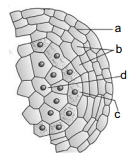
Examine the figure given below and select the right option identifying all the four parts $a, b, c$ and $d$.
A
$a$: Endothecium, $b$: Tapetum, $c$: Microspore mother cell, $d$: Middle layers
B
$a$: Tapetum, $b$: Endothecium, $c$: Microspore mother cell, $d$: Middle layers
C
$a$: Endothecium, $b$: Middle layer, $c$: Tapetum, $d$: Microspore mother cell
D
$a$: Endothecium, $b$: Microspore mother cell, $c$: Middle layer, $d$: Tapetum
Solution
(C) The figure represents a cross-section of a young anther.
- Part $a$ points to the Endothecium, which is the layer beneath the epidermis.
- Part $b$ points to the Middle layers, which are $2-3$ layers of cells between the endothecium and the tapetum.
- Part $c$ points to the Tapetum, the innermost nutritive layer.
- Part $d$ points to the Microspore mother cells (sporogenous tissue) located in the center of the microsporangium.
Therefore, the correct identification is $a$: Endothecium, $b$: Middle layer, $c$: Tapetum, $d$: Microspore mother cell.
- Part $a$ points to the Endothecium, which is the layer beneath the epidermis.
- Part $b$ points to the Middle layers, which are $2-3$ layers of cells between the endothecium and the tapetum.
- Part $c$ points to the Tapetum, the innermost nutritive layer.
- Part $d$ points to the Microspore mother cells (sporogenous tissue) located in the center of the microsporangium.
Therefore, the correct identification is $a$: Endothecium, $b$: Middle layer, $c$: Tapetum, $d$: Microspore mother cell.
0 likes
View Solution275
MediumMCQ
Select the incorrect statement regarding microsporogenesis in an anther.
A
$A$ large number of microspore mother cells differentiate in one pollen sac.
B
Each microsporogenesis involves one meiosis and two mitosis.
C
Microspore tetrads may be tetrahedral or isobilateral.
D
It consumes tapetum and middle layers.
Solution
(B) Microsporogenesis is the process of formation of microspores from a pollen mother cell $(PMC)$ through meiosis. It involves only one meiotic division to produce four haploid microspores. It does not involve mitosis. Therefore,the statement that it involves one meiosis and two mitosis is incorrect.
0 likes
View Solution276
MediumMCQ
Pick out the wrong statement.
A
Double fertilization is unique to angiosperms.
B
$Sequoia$,a gymnosperm,is one of the tallest trees.
C
Exine has apertures where sporopollenin is present.
D
Exine of pollen grains is made up of sporopollenin.
Solution
(C) The exine is the hard outer layer of the pollen grain,which is composed of sporopollenin,a highly resistant organic material.
Germ pores are the specific regions on the exine where sporopollenin is absent,allowing the pollen tube to emerge during germination.
Therefore,the statement that 'Exine has apertures where sporopollenin is present' is incorrect because apertures (germ pores) are sites where sporopollenin is absent.
Germ pores are the specific regions on the exine where sporopollenin is absent,allowing the pollen tube to emerge during germination.
Therefore,the statement that 'Exine has apertures where sporopollenin is present' is incorrect because apertures (germ pores) are sites where sporopollenin is absent.
0 likes
View Solution277
MediumMCQ
$A$: Each cell of the sporogenous tissue is capable of giving rise to a microspore tetrad.
$R$: The most abundant type of microspore tetrad is the product of simultaneous cytokinesis.
$R$: The most abundant type of microspore tetrad is the product of simultaneous cytokinesis.
A
Assertion and Reason both are correct and Reason is the correct explanation of Assertion.
B
Assertion and Reason both are correct but Reason is not the correct explanation of Assertion.
C
Assertion is correct,but Reason is incorrect.
D
Both Assertion and Reason are incorrect.
Solution
(A) The sporogenous tissue consists of microspore mother cells $(MMC)$. Each $MMC$ undergoes meiosis to form a microspore tetrad. Thus,the Assertion is correct.
In dicots,cytokinesis is simultaneous,leading to tetrahedral tetrads,which are the most common type. In monocots,cytokinesis is successive,leading to isobilateral tetrads. Since simultaneous cytokinesis is the most common process in angiosperms,the Reason is also correct and explains why the potential for forming tetrads is widespread in sporogenous tissue.
In dicots,cytokinesis is simultaneous,leading to tetrahedral tetrads,which are the most common type. In monocots,cytokinesis is successive,leading to isobilateral tetrads. Since simultaneous cytokinesis is the most common process in angiosperms,the Reason is also correct and explains why the potential for forming tetrads is widespread in sporogenous tissue.
0 likes
View Solution278
MediumMCQ
$A$: In sporoderm,the pectocellulosic layer is surrounded by sporopollenin.
$R$: Exine is differentiated into outer ektexine and inner endexine.
$R$: Exine is differentiated into outer ektexine and inner endexine.
A
Assertion and Reason both are correct and Reason is the correct explanation of Assertion.
B
Assertion and Reason both are correct but Reason is not the correct explanation of Assertion.
C
Assertion is correct,but Reason is incorrect.
D
Both Assertion and Reason are incorrect.
Solution
(A) The sporoderm (pollen wall) consists of two main layers: the inner intine and the outer exine.
The intine is composed of pectin and cellulose (pectocellulosic).
The exine is composed of sporopollenin,which is one of the most resistant organic materials known.
Thus,the assertion is correct as the sporoderm layers are protected by the highly resistant sporopollenin.
The exine is further differentiated into an outer layer called the ektexine and an inner layer called the endexine.
Therefore,both the assertion and the reason are correct,and the reason provides a structural description of the exine,which is part of the sporoderm.
The intine is composed of pectin and cellulose (pectocellulosic).
The exine is composed of sporopollenin,which is one of the most resistant organic materials known.
Thus,the assertion is correct as the sporoderm layers are protected by the highly resistant sporopollenin.
The exine is further differentiated into an outer layer called the ektexine and an inner layer called the endexine.
Therefore,both the assertion and the reason are correct,and the reason provides a structural description of the exine,which is part of the sporoderm.
0 likes
View Solution279
MediumMCQ
$A$: The generative cell comes to lie freely in the cytoplasm of the tube cell.
$R$: The cellulosic wall around the generative cell is dissolved.
$R$: The cellulosic wall around the generative cell is dissolved.
A
Assertion and Reason both are correct and Reason is the correct explanation of Assertion.
B
Assertion and Reason both are correct but Reason is not the correct explanation of Assertion.
C
Assertion is correct,but Reason is incorrect.
D
Both Assertion and Reason are incorrect.
Solution
(A) In the development of the male gametophyte in angiosperms,the pollen grain undergoes mitosis to form a large vegetative (tube) cell and a small generative cell.
Initially,the generative cell is surrounded by a callose wall. As the pollen grain matures,this wall dissolves,allowing the generative cell to detach and float freely within the cytoplasm of the vegetative cell.
Therefore,both the Assertion and the Reason are correct,and the Reason provides the correct explanation for why the generative cell lies freely in the cytoplasm.
Initially,the generative cell is surrounded by a callose wall. As the pollen grain matures,this wall dissolves,allowing the generative cell to detach and float freely within the cytoplasm of the vegetative cell.
Therefore,both the Assertion and the Reason are correct,and the Reason provides the correct explanation for why the generative cell lies freely in the cytoplasm.
0 likes
View Solution280
MediumMCQ
The whorl that produces male gametes is:
A
Calyx
B
Corolla
C
Androecium
D
Gynoecium
Solution
(C) In flowering plants,the flower consists of four whorls.
$1$. The Calyx $(A)$ and Corolla $(B)$ are accessory whorls.
$2$. The Androecium $(C)$ is the male reproductive whorl,which consists of stamens. Each stamen produces pollen grains containing male gametes.
$3$. The Gynoecium $(D)$ is the female reproductive whorl.
Therefore,the Androecium is the whorl responsible for producing male gametes.
$1$. The Calyx $(A)$ and Corolla $(B)$ are accessory whorls.
$2$. The Androecium $(C)$ is the male reproductive whorl,which consists of stamens. Each stamen produces pollen grains containing male gametes.
$3$. The Gynoecium $(D)$ is the female reproductive whorl.
Therefore,the Androecium is the whorl responsible for producing male gametes.
0 likes
View Solution281
MediumMCQ
Select the incorrect statement regarding the stamen.
A
The stamen consists of two parts.
B
The long and slender stalk is called the filament.
C
The terminal part is generally bilobed and is called the stigma.
D
The proximal end of the filament is attached to the thalamus or the petal of the flower.
Solution
(C) The stamen consists of two parts: the long and slender stalk called the filament,and the terminal,generally bilobed structure called the anther. The term 'stigma' refers to the receptive surface of the carpel (pistil),not the terminal part of the stamen. Therefore,the statement in option $C$ is incorrect.
0 likes
View Solution282
DifficultMCQ
In an angiosperm,the anther is typically described as being:
A
bilobed and dithecous
B
bilobed and tetrasporangiate
C
tetralobed and tetrasporangiate
D
tetralobed and dithecous
Solution
(A) typical angiosperm anther is bilobed,meaning it consists of two lobes. Each lobe contains two thecae,making it dithecous. Since each theca develops into a microsporangium,the anther is tetrasporangiate (containing four microsporangia). Therefore,the anther is bilobed and dithecous,which results in four microsporangia.
0 likes
View Solution283
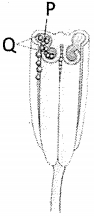
EasyMCQ
The figure below shows a three-dimensional view of an anther. Identify $P$ and $Q$.
$\quad\quad\quad\quad \quad P \quad\quad\quad\quad Q$
$\quad\quad\quad\quad \quad P \quad\quad\quad\quad Q$
A
Pollen grains $\quad$ Pollen sacs
B
Pollen mother cells $\quad$ Pollen sacs
C
Pollen grains $\quad$ Microsporangium
D
Pollen mother cell $\quad$ Microsporangium
Solution
(A) In the given diagram of a mature anther:
$P$ points to the pollen grains,which are the male gametophytes produced within the anther.
$Q$ points to the pollen sacs (also known as microsporangia),which are the structures where pollen grains develop.
According to standard $NCERT$ terminology for this specific diagram,$P$ represents pollen grains and $Q$ represents the pollen sacs (microsporangia). Therefore,the correct identification is $P = \text{Pollen grains}$ and $Q = \text{Pollen sacs}$.
$P$ points to the pollen grains,which are the male gametophytes produced within the anther.
$Q$ points to the pollen sacs (also known as microsporangia),which are the structures where pollen grains develop.
According to standard $NCERT$ terminology for this specific diagram,$P$ represents pollen grains and $Q$ represents the pollen sacs (microsporangia). Therefore,the correct identification is $P = \text{Pollen grains}$ and $Q = \text{Pollen sacs}$.
0 likes
View Solution284
MediumMCQ
How many microsporangia are present in a typical angiosperm anther?
A
$1$
B
$2$
C
$3$
D
$4$
Solution
(D) typical angiosperm anther is dithecous,meaning it consists of two lobes. Each lobe contains two microsporangia,one at each corner. Therefore,a typical bilobed anther contains a total of $4$ microsporangia. These microsporangia develop further and become pollen sacs.
0 likes
View Solution285
MediumMCQ
The development of microsporangium occurs in .......
A
Seed
B
Fruit
C
Anther
D
Pollen grain
Solution
(C) In flowering plants,the stamen consists of a filament and an anther. The anther is a bilobed structure,and each lobe typically has two thecae,making it dithecous. The microsporangia develop at the four corners of the anther,two in each lobe. These microsporangia further develop into pollen sacs,which contain pollen grains. Therefore,the development of the microsporangium occurs within the anther.
0 likes
View Solution286
MediumMCQ
Identify the layers of the microsporangium from the inside to the outside.
A
Epidermis $\rightarrow$ Middle layers $\rightarrow$ Endothecium $\rightarrow$ Tapetum
B
Tapetum $\rightarrow$ Middle layers $\rightarrow$ Endothecium $\rightarrow$ Epidermis
C
Tapetum $\rightarrow$ Endothecium $\rightarrow$ Middle layers $\rightarrow$ Epidermis
D
Epidermis $\rightarrow$ Endothecium $\rightarrow$ Middle layers $\rightarrow$ Tapetum
Solution
(B) The wall of a microsporangium consists of four layers: the epidermis,endothecium,middle layers,and tapetum.
These layers are arranged from the outside to the inside as: Epidermis $\rightarrow$ Endothecium $\rightarrow$ Middle layers $\rightarrow$ Tapetum.
Therefore,when identifying the layers from the inside to the outside,the sequence is: Tapetum $\rightarrow$ Middle layers $\rightarrow$ Endothecium $\rightarrow$ Epidermis.
These layers are arranged from the outside to the inside as: Epidermis $\rightarrow$ Endothecium $\rightarrow$ Middle layers $\rightarrow$ Tapetum.
Therefore,when identifying the layers from the inside to the outside,the sequence is: Tapetum $\rightarrow$ Middle layers $\rightarrow$ Endothecium $\rightarrow$ Epidermis.
0 likes
View Solution287
MediumMCQ
Which layer of the microsporangium is also known as the fibrous layer?
A
Epidermis
B
Endothecium
C
Middle layers
D
Tapetum
Solution
(B) The wall of the microsporangium consists of four layers: the epidermis, endothecium, middle layers, and tapetum.
$1$. The $Epidermis$ is the outermost protective layer.
$2$. The $Endothecium$ develops fibrous thickenings of $\alpha$-cellulose at maturity, which helps in the dehiscence of anthers to release pollen grains. Due to these fibrous thickenings, it is often referred to as the fibrous layer.
$3$. The $Middle$ $layers$ are ephemeral and provide nourishment.
$4$. The $Tapetum$ is the innermost layer that provides nutrition to the developing pollen grains.
Therefore, the correct answer is $Endothecium$.
$1$. The $Epidermis$ is the outermost protective layer.
$2$. The $Endothecium$ develops fibrous thickenings of $\alpha$-cellulose at maturity, which helps in the dehiscence of anthers to release pollen grains. Due to these fibrous thickenings, it is often referred to as the fibrous layer.
$3$. The $Middle$ $layers$ are ephemeral and provide nourishment.
$4$. The $Tapetum$ is the innermost layer that provides nutrition to the developing pollen grains.
Therefore, the correct answer is $Endothecium$.
0 likes
View Solution288
MediumMCQ
Select the incorrect option regarding the tapetum.
A
Tapetal cells possess a single nucleus.
B
It provides nourishment to the developing pollen grains.
C
Tapetal cells possess dense cytoplasm.
D
It is the innermost layer of the microsporangium.
Solution
(A) The tapetum is the innermost layer of the microsporangium.
Tapetal cells typically possess dense cytoplasm and are often multinucleate due to endomitosis.
Its primary function is to provide nourishment to the developing pollen grains.
Therefore,option $A$ is incorrect because tapetal cells are frequently multinucleate,not uninucleate.
Tapetal cells typically possess dense cytoplasm and are often multinucleate due to endomitosis.
Its primary function is to provide nourishment to the developing pollen grains.
Therefore,option $A$ is incorrect because tapetal cells are frequently multinucleate,not uninucleate.
0 likes
View Solution289
MediumMCQ
Which of the following layers does not help in protection and dehiscence of the anther?
A
Epidermis
B
Middle layers
C
Endothecium
D
Tapetum
Solution
(D) The anther wall consists of four layers: Epidermis,Endothecium,Middle layers,and Tapetum.
$1$. The Epidermis provides protection.
$2$. The Endothecium helps in the dehiscence of the anther to release pollen grains.
$3$. The Middle layers provide protection and also assist in dehiscence.
$4$. The Tapetum is the innermost layer that provides nourishment to the developing pollen grains. It does not play a role in protection or dehiscence.
$1$. The Epidermis provides protection.
$2$. The Endothecium helps in the dehiscence of the anther to release pollen grains.
$3$. The Middle layers provide protection and also assist in dehiscence.
$4$. The Tapetum is the innermost layer that provides nourishment to the developing pollen grains. It does not play a role in protection or dehiscence.
0 likes
View Solution290
MediumMCQ
Identify the incorrect statement regarding the sporogenous tissue.
A
It occupies the center of each microsporangium.
B
It is present in a mature anther.
C
All cells are diploid.
D
All cells are genetically identical.
Solution
(B) The sporogenous tissue is a group of compactly arranged homogeneous cells that occupy the center of each microsporangium when the anther is young.
As the anther develops,the cells of the sporogenous tissue undergo meiotic divisions to form microspore tetrads.
Therefore,in a mature anther,the sporogenous tissue is no longer present as such,because its cells have differentiated into microspore mother cells and subsequently into pollen grains.
Thus,the statement that it is present in a mature anther is incorrect.
As the anther develops,the cells of the sporogenous tissue undergo meiotic divisions to form microspore tetrads.
Therefore,in a mature anther,the sporogenous tissue is no longer present as such,because its cells have differentiated into microspore mother cells and subsequently into pollen grains.
Thus,the statement that it is present in a mature anther is incorrect.
0 likes
View Solution291
MediumMCQ
How many microspores are formed from a single microspore mother cell?
A
$1$
B
$2$
C
$3$
D
$4$
Solution
(D) microspore mother cell $(MMC)$ undergoes meiosis,which is a reductional division.
During meiosis,a single diploid $(2n)$ $MMC$ divides to form four haploid $(n)$ microspores.
These four microspores are arranged in a cluster known as a microspore tetrad.
Therefore,a single microspore mother cell produces $4$ microspores.
During meiosis,a single diploid $(2n)$ $MMC$ divides to form four haploid $(n)$ microspores.
These four microspores are arranged in a cluster known as a microspore tetrad.
Therefore,a single microspore mother cell produces $4$ microspores.
0 likes
View Solution292
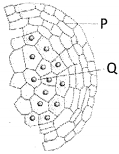
MediumMCQ
The figure shows the layers of the microsporangium wall. Identify $P$ and $Q$.
$\quad\quad\quad P\quad\quad\quad\quad Q$
$\quad\quad\quad P\quad\quad\quad\quad Q$
A
Epidermis $\quad$ Tapetum
B
Endothecium $\quad$ Tapetum
C
Endothecium $\quad$ Microspore mother cell
D
Epidermis $\quad$ Microspore mother cell
Solution
(C) The microsporangium is surrounded by four wall layers: the epidermis,endothecium,middle layers,and tapetum.
In the given diagram,$P$ points to the second layer from the outside,which is the endothecium.
$Q$ points to the central cells within the microsporangium,which are the microspore mother cells (MMCs) that undergo meiosis to form pollen grains.
Therefore,$P$ is the endothecium and $Q$ is the microspore mother cell.
In the given diagram,$P$ points to the second layer from the outside,which is the endothecium.
$Q$ points to the central cells within the microsporangium,which are the microspore mother cells (MMCs) that undergo meiosis to form pollen grains.
Therefore,$P$ is the endothecium and $Q$ is the microspore mother cell.
0 likes
View Solution293
MediumMCQ
How many microspore tetrads are formed from one microspore mother cell?
A
$1$
B
$2$
C
$3$
D
$4$
Solution
(A) microspore mother cell $(MMC)$ undergoes meiosis to produce a cluster of four haploid cells,which is known as a microspore tetrad.
Therefore,one microspore mother cell gives rise to exactly $1$ microspore tetrad containing $4$ microspores.
Therefore,one microspore mother cell gives rise to exactly $1$ microspore tetrad containing $4$ microspores.
0 likes
View Solution294
MediumMCQ
Which of the following represents the male gametophyte in flowering plants?
A
Male gamete
B
Generative cell
C
Tube cell
D
Pollen grain
Solution
(D) In flowering plants, the $Pollen$ $grain$ represents the partially developed male gametophyte.
It contains two cells: the vegetative cell (tube cell) and the generative cell.
The vegetative cell is larger and contains abundant food reserves, while the generative cell is small and floats in the cytoplasm of the vegetative cell.
Therefore, the $Pollen$ $grain$ is the structure that represents the male gametophyte stage.
It contains two cells: the vegetative cell (tube cell) and the generative cell.
The vegetative cell is larger and contains abundant food reserves, while the generative cell is small and floats in the cytoplasm of the vegetative cell.
Therefore, the $Pollen$ $grain$ is the structure that represents the male gametophyte stage.
0 likes
View Solution295
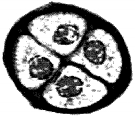
MediumMCQ
Identify the structure given below.
A
Microspore
B
Microspore mother cell
C
Megaspore mother cell
D
Pollen tetrad
Solution
(D) The image shows a group of four haploid microspores formed after the meiotic division of a microspore mother cell. This cluster of four cells is known as a pollen tetrad or microspore tetrad. As the anthers mature and dehydrate,the microspores dissociate from each other and develop into pollen grains.
0 likes
View Solution296
DifficultMCQ
What is the typical shape and diameter of a pollen grain?
A
Elliptical,$50 - 75 \, \mu m$
B
Spherical,$12.5 - 25 \, \mu m$
C
Elliptical,$25 - 50 \, \mu m$
D
Spherical,$25 - 50 \, \mu m$
Solution
(D) Pollen grains are generally spherical in shape.
They measure approximately $25 - 50 \, \mu m$ in diameter.
This information is provided in the $NCERT$ textbook under the topic of 'Pollen Grain' in the chapter 'Sexual Reproduction in Flowering Plants'.
They measure approximately $25 - 50 \, \mu m$ in diameter.
This information is provided in the $NCERT$ textbook under the topic of 'Pollen Grain' in the chapter 'Sexual Reproduction in Flowering Plants'.
0 likes
View Solution297
MediumMCQ
Identify the incorrect statement regarding sporopollenin.
A
Sporopollenin is the hard inner layer of the pollen grain.
B
It is known as one of the most resistant organic materials.
C
It can withstand high temperatures,strong acids,and bases; no enzyme is known to degrade sporopollenin.
D
Due to the presence of sporopollenin,pollen grains are preserved as fossils.
Solution
(A) Sporopollenin is a highly resistant organic material that forms the exine (outer layer) of the pollen grain,not the intine (inner layer).
Therefore,the statement that it is the hard inner layer is incorrect.
It is chemically stable,resistant to high temperatures,strong acids,and strong alkalis.
No known enzyme can degrade sporopollenin,which allows pollen grains to be well-preserved as fossils.
Therefore,the statement that it is the hard inner layer is incorrect.
It is chemically stable,resistant to high temperatures,strong acids,and strong alkalis.
No known enzyme can degrade sporopollenin,which allows pollen grains to be well-preserved as fossils.
0 likes
View Solution298
MediumMCQ
Name the two cells of a mature pollen grain.
A
Microspore and Generative cell
B
Microspore and Male gamete
C
Vegetative cell and Generative cell
D
Vegetative cell and Male gamete
Solution
(C) In most angiosperms,the pollen grain is shed at the two-celled stage.
These two cells are:
$1$. The Vegetative cell: It is bigger,has abundant food reserve,and a large irregularly shaped nucleus.
$2$. The Generative cell: It is small and floats in the cytoplasm of the vegetative cell. It is spindle-shaped with dense cytoplasm and a nucleus.
Therefore,the correct option is $C$.
These two cells are:
$1$. The Vegetative cell: It is bigger,has abundant food reserve,and a large irregularly shaped nucleus.
$2$. The Generative cell: It is small and floats in the cytoplasm of the vegetative cell. It is spindle-shaped with dense cytoplasm and a nucleus.
Therefore,the correct option is $C$.
0 likes
View Solution299
MediumMCQ
In over $60\%$ of angiosperms,pollen grains are shed at the $2$-celled stage. In less than $40\%$ of angiosperms,pollen grains are shed at the $3$-celled stage.
A
$40\%, 60\%$
B
$60\%, 40\%$
C
$30\%, 70\%$
D
$70\%, 30\%$
Solution
(B) In angiosperms,the pollen grain represents the male gametophyte.
During the development of the pollen grain,the microspore nucleus undergoes mitosis to form a vegetative cell and a generative cell.
In about $60\%$ of angiosperms,pollen grains are shed at this $2$-celled stage.
In the remaining species (less than $40\%$),the generative cell divides mitotically to give rise to the two male gametes before pollen grains are shed,resulting in a $3$-celled stage.
During the development of the pollen grain,the microspore nucleus undergoes mitosis to form a vegetative cell and a generative cell.
In about $60\%$ of angiosperms,pollen grains are shed at this $2$-celled stage.
In the remaining species (less than $40\%$),the generative cell divides mitotically to give rise to the two male gametes before pollen grains are shed,resulting in a $3$-celled stage.
0 likes
View Solution300
EasyMCQ
$P -$ This cell is big,has abundant food reserve and a large irregularly shaped nucleus.
$Q -$ This cell is small and floats in the cytoplasm of the vegetative cell. It is a spindle-shaped cell with dense cytoplasm and a nucleus.
$\quad\quad \quad P \quad \quad Q$
$Q -$ This cell is small and floats in the cytoplasm of the vegetative cell. It is a spindle-shaped cell with dense cytoplasm and a nucleus.
$\quad\quad \quad P \quad \quad Q$
A
Microspore $\quad\quad$ Vegetative cell
B
Generative cell $\quad\quad$ Vegetative cell
C
Vegetative cell $\quad\quad$ Generative cell
D
Vegetative cell $\quad\quad$ Microspore
Solution
(C) In a mature pollen grain,there are two types of cells:
$1$. The $P$ (Vegetative cell) is bigger,has abundant food reserve,and a large irregularly shaped nucleus.
$2$. The $Q$ (Generative cell) is small and floats in the cytoplasm of the vegetative cell. It is spindle-shaped with dense cytoplasm and a nucleus.
Therefore,the correct sequence is $P$ = Vegetative cell and $Q$ = Generative cell.
$1$. The $P$ (Vegetative cell) is bigger,has abundant food reserve,and a large irregularly shaped nucleus.
$2$. The $Q$ (Generative cell) is small and floats in the cytoplasm of the vegetative cell. It is spindle-shaped with dense cytoplasm and a nucleus.
Therefore,the correct sequence is $P$ = Vegetative cell and $Q$ = Generative cell.
0 likes
View SolutionSexual Reproduction in Flowering Plants — Stamen, Microsporangium and Pollen Grain · Frequently Asked Questions
1Are these Sexual Reproduction in Flowering Plants questions useful for JEE and NEET?
Yes. All questions in this section are mapped to JEE Main and NEET exam patterns. Previous year questions from JEE Main, NEET, GUJCET and state-level exams are included with full solutions.
2Can I switch to Hindi or Gujarati for these questions?
Yes. Use the language tabs in the hero section or the sidebar to view the same questions and solutions in English, Hindi or Gujarati.
3How do I generate a question paper from this subtopic?
Use the Vedclass Exam Paper Generator — select the chapter and subtopic, set difficulty, and generate Sets A, B, C, D automatically. First 3 chapters of every subject are free.
Vedclass Products
For Students
Vedclass Test Series
Mock tests in real JEE/NEET style with performance analysis. 5-day free trial.
Start Free TrialFor Teachers
Exam Paper Generator
Generate Set A/B/C/D papers from this chapter in 2 minutes. 3 chapters free.
Try FreeFor Institutes
Online Exam Module
Live online exams with unlimited students, 360° analytics & white-label branding.
See DemoFor Teachers & Institutes
Generate a Sexual Reproduction in Flowering Plants Exam Paper in 2 Minutes
Select subtopic & difficulty — Sets A, B, C, D auto-generated with No Repeat logic.
First 3 chapters of every subject are free — no payment required.