
A English
Stamen, Microsporangium and Pollen Grain Questions in English
Class 12 Biology · Sexual Reproduction in Flowering Plants · Stamen, Microsporangium and Pollen Grain
348+
Questions
English
Language
100%
With Solutions
Showing 48 of 348 questions in English
301
MediumMCQ
In a two-celled pollen grain,which cells are present?
A
One vegetative cell and one male gamete
B
One vegetative cell and one generative cell
C
One tube cell and one male gamete
D
One tube cell and one egg cell
Solution
(B) In over $60\%$ of angiosperms,pollen grains are shed at the two-celled stage.
These two cells are the vegetative cell and the generative cell.
The vegetative cell is bigger,has abundant food reserve,and a large irregularly shaped nucleus.
The generative cell is small and floats in the cytoplasm of the vegetative cell.
These two cells are the vegetative cell and the generative cell.
The vegetative cell is bigger,has abundant food reserve,and a large irregularly shaped nucleus.
The generative cell is small and floats in the cytoplasm of the vegetative cell.
0 likes
View Solution302
MediumMCQ
Which cells are present in a $3$-celled pollen grain?
A
One vegetative cell and two male gametes
B
One vegetative cell and two generative cells
C
Two vegetative cells and one male gamete
D
Two vegetative cells and one generative cell
Solution
(A) In angiosperms,the pollen grain undergoes mitotic division to form two cells: a large vegetative cell and a small generative cell.
In about $60\%$ of angiosperms,pollen grains are shed at this $2$-celled stage.
In the remaining species,the generative cell divides mitotically to give rise to the two male gametes before pollen grains are shed.
Thus,the $3$-celled stage consists of one vegetative cell and two male gametes.
In about $60\%$ of angiosperms,pollen grains are shed at this $2$-celled stage.
In the remaining species,the generative cell divides mitotically to give rise to the two male gametes before pollen grains are shed.
Thus,the $3$-celled stage consists of one vegetative cell and two male gametes.
0 likes
View Solution303
DifficultMCQ
Given below are two statements: One is labelled as Assertion $(A)$ and the other is labelled as Reason $(R).$
Assertion $(A) :$ Cells of the tapetum possess dense cytoplasm and generally have more than one nucleus.
Reason $(R):$ Presence of more than one nucleus in the tapetum increases the efficiency of nourishing the developing microspore mother cells.
In light of the above statements,choose the most appropriate answer from the options given below:
Assertion $(A) :$ Cells of the tapetum possess dense cytoplasm and generally have more than one nucleus.
Reason $(R):$ Presence of more than one nucleus in the tapetum increases the efficiency of nourishing the developing microspore mother cells.
In light of the above statements,choose the most appropriate answer from the options given below:
A
Both $A$ and $R$ are true and $R$ is the correct explanation of $A$.
B
Both $A$ and $R$ are true and $R$ is $\text{NOT}$ the correct explanation of $A$.
C
$A$ is true but $R$ is false.
D
$A$ is false but $R$ is true.
Solution
(A) The tapetum is the innermost layer of the microsporangium wall.
It provides nourishment to the developing pollen grains (microspores).
Cells of the tapetum are characterized by dense cytoplasm and are often multinucleate due to endomitosis or free nuclear division.
This multinucleate condition allows the tapetum to synthesize large amounts of proteins,enzymes,and nutrients required for the rapid development of microspore mother cells.
Therefore,both the Assertion and the Reason are true,and the Reason correctly explains why the tapetum cells possess multiple nuclei.
It provides nourishment to the developing pollen grains (microspores).
Cells of the tapetum are characterized by dense cytoplasm and are often multinucleate due to endomitosis or free nuclear division.
This multinucleate condition allows the tapetum to synthesize large amounts of proteins,enzymes,and nutrients required for the rapid development of microspore mother cells.
Therefore,both the Assertion and the Reason are true,and the Reason correctly explains why the tapetum cells possess multiple nuclei.
0 likes
View Solution304
EasyMCQ
Which of the following can withstand high temperatures,strong acids and alkali?
A
Pecto-cellulose
B
Sporopollenin
C
Intine
D
Cutin
Solution
(B) The exine of the pollen grain is composed of a highly resistant organic material called $Sporopollenin$.
It is one of the most resistant organic materials known.
It can withstand high temperatures,strong acids,and alkali.
No enzyme that degrades $Sporopollenin$ is known so far.
Therefore,pollen grains are well-preserved as fossils due to the presence of $Sporopollenin$.
It is one of the most resistant organic materials known.
It can withstand high temperatures,strong acids,and alkali.
No enzyme that degrades $Sporopollenin$ is known so far.
Therefore,pollen grains are well-preserved as fossils due to the presence of $Sporopollenin$.
0 likes
View Solution305
MediumMCQ
Which of the following is not a character of a typical anther?
A
Bilobed
B
Dithecous
C
Apocarpous
D
Tetragonal
Solution
(C) typical angiosperm anther is bilobed,meaning it has two lobes.
Each lobe is dithecous,meaning it contains two theca (pollen sacs),making a total of four pollen sacs in the anther.
Due to these four pollen sacs,the anther is often described as tetragonal (four-sided) in cross-section.
'Apocarpous' refers to a condition in the gynoecium where carpels are free,not fused. Therefore,it is not a characteristic of an anther.
Each lobe is dithecous,meaning it contains two theca (pollen sacs),making a total of four pollen sacs in the anther.
Due to these four pollen sacs,the anther is often described as tetragonal (four-sided) in cross-section.
'Apocarpous' refers to a condition in the gynoecium where carpels are free,not fused. Therefore,it is not a characteristic of an anther.
0 likes
View Solution306
EasyMCQ
Male gametes in angiosperms are formed by the division of:
A
Microspore mother cell
B
Microspore
C
Generative cell
D
Vegetative cell
Solution
(C) In angiosperms,the pollen grain represents the male gametophyte.
During its development,the microspore undergoes mitosis to form two cells: a large vegetative cell and a small generative cell.
The generative cell then undergoes a mitotic division to produce two male gametes.
Therefore,the male gametes are formed by the division of the generative cell.
During its development,the microspore undergoes mitosis to form two cells: a large vegetative cell and a small generative cell.
The generative cell then undergoes a mitotic division to produce two male gametes.
Therefore,the male gametes are formed by the division of the generative cell.
0 likes
View Solution307
EasyMCQ
$A$ typical angiosperm anther is:
A
Bilobed
B
Dithecous
C
Tetrasporangiate
D
All of the above
Solution
(D) typical angiosperm anther is bilobed,meaning it consists of two lobes.
Each lobe contains two theca,making it dithecous.
Therefore,the anther has four microsporangia located at the corners,two in each lobe,which makes it tetrasporangiate.
Thus,all the given options are correct.
Each lobe contains two theca,making it dithecous.
Therefore,the anther has four microsporangia located at the corners,two in each lobe,which makes it tetrasporangiate.
Thus,all the given options are correct.
0 likes
View Solution308
EasyMCQ
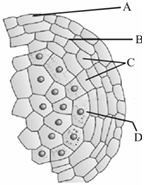
Given below is the diagrammatic sketch of a transverse section of a young anther. Identify the parts labelled $A, B, C$ and $D$ and select the right option about them.
A
part-$A \rightarrow$ Epidermis,part-$B \rightarrow$ Middle layers,part-$C \rightarrow$ Endothecium,part-$D \rightarrow$ Tapetum
B
part-$A \rightarrow$ Epidermis,part-$B \rightarrow$ Endothecium,part-$C \rightarrow$ Middle layers,part-$D \rightarrow$ Tapetum
C
part-$A \rightarrow$ Exodermis,part-$B \rightarrow$ Endothecium,part-$C \rightarrow$ Middle layers,part-$D \rightarrow$ Tapetum
D
part-$A \rightarrow$ Epidermis,part-$B \rightarrow$ Endodermis,part-$C \rightarrow$ Middle layers,part-$D \rightarrow$ Sporogenous tissue
Solution
(B) The transverse section of a young anther shows four wall layers surrounding the microsporangia.
$1$. The outermost single layer is the Epidermis $(A)$.
$2$. The layer just below the epidermis is the Endothecium $(B)$.
$3$. The layers internal to the endothecium are the Middle layers $(C)$,which are usually $2-3$ layers thick.
$4$. The innermost layer that nourishes the developing pollen grains is the Tapetum $(D)$.
Therefore,the correct identification is: part-$A \rightarrow$ Epidermis,part-$B \rightarrow$ Endothecium,part-$C \rightarrow$ Middle layers,part-$D \rightarrow$ Tapetum.
$1$. The outermost single layer is the Epidermis $(A)$.
$2$. The layer just below the epidermis is the Endothecium $(B)$.
$3$. The layers internal to the endothecium are the Middle layers $(C)$,which are usually $2-3$ layers thick.
$4$. The innermost layer that nourishes the developing pollen grains is the Tapetum $(D)$.
Therefore,the correct identification is: part-$A \rightarrow$ Epidermis,part-$B \rightarrow$ Endothecium,part-$C \rightarrow$ Middle layers,part-$D \rightarrow$ Tapetum.
0 likes
View Solution309
MediumMCQ
Statement-$I$ : Flowers are the sites of sexual reproduction in angiosperms.
Statement-$II$ : $A$ typical anther is a bilobed,dithecous,and tetragonal structure.
Statement-$II$ : $A$ typical anther is a bilobed,dithecous,and tetragonal structure.
A
Statement-$I$ and Statement-$II$ both are correct.
B
Statement-$I$ is correct and Statement-$II$ is incorrect.
C
Statement-$I$ is incorrect and Statement-$II$ is correct.
D
Both Statement-$I$ and Statement-$II$ are incorrect.
Solution
(A) Statement-$I$ is correct because flowers are the reproductive organs of angiosperms where sexual reproduction occurs.
Statement-$II$ is correct because a typical angiosperm anther is bilobed (having two lobes),dithecous (each lobe having two theca),and generally appears tetragonal (four-sided) in transverse section,containing four microsporangia.
Statement-$II$ is correct because a typical angiosperm anther is bilobed (having two lobes),dithecous (each lobe having two theca),and generally appears tetragonal (four-sided) in transverse section,containing four microsporangia.
0 likes
View Solution310
MediumMCQ
What would be the ploidy of the cells of the microspore tetrad in an angiosperm?
A
$n$
B
$2n$
C
$3n$
D
$4n$
Solution
(A) In angiosperms,the microspore mother cells $(MMC)$ are diploid $(2n)$.
These cells undergo meiosis,which is a reductional division.
As a result of meiosis,each $MMC$ produces four haploid microspores,which are collectively known as a microspore tetrad.
Therefore,the ploidy of the cells of the microspore tetrad is haploid $(n)$.
These cells undergo meiosis,which is a reductional division.
As a result of meiosis,each $MMC$ produces four haploid microspores,which are collectively known as a microspore tetrad.
Therefore,the ploidy of the cells of the microspore tetrad is haploid $(n)$.
0 likes
View Solution311
MediumMCQ
Select the correct option in which the following terms are arranged in the correct developmental sequence:
$(A)$ Pollen grain
$(B)$ Pollen mother cell
$(C)$ Microspore tetrad
$(D)$ Male gametes
$(E)$ Sporogenous tissue
$(A)$ Pollen grain
$(B)$ Pollen mother cell
$(C)$ Microspore tetrad
$(D)$ Male gametes
$(E)$ Sporogenous tissue
A
$B, D, C, E, A$
B
$E, B, C, D, A$
C
$E, B, C, A, D$
D
$E, B, A, C, D$
Solution
(C) The developmental sequence of male gametophyte formation in angiosperms is as follows:
$1$. $E$ (Sporogenous tissue): This is the mass of cells present in the microsporangium.
$2$. $B$ (Pollen mother cell): Some cells of the sporogenous tissue differentiate into pollen mother cells ($PMC$s).
$3$. $C$ (Microspore tetrad): Each $PMC$ undergoes meiosis to form a cluster of four haploid microspores,known as a microspore tetrad.
$4$. $A$ (Pollen grain): The microspores separate and develop into pollen grains.
$5$. $D$ (Male gametes): The pollen grain undergoes mitosis to produce two male gametes.
Thus,the correct sequence is $E \rightarrow B \rightarrow C \rightarrow A \rightarrow D$.
$1$. $E$ (Sporogenous tissue): This is the mass of cells present in the microsporangium.
$2$. $B$ (Pollen mother cell): Some cells of the sporogenous tissue differentiate into pollen mother cells ($PMC$s).
$3$. $C$ (Microspore tetrad): Each $PMC$ undergoes meiosis to form a cluster of four haploid microspores,known as a microspore tetrad.
$4$. $A$ (Pollen grain): The microspores separate and develop into pollen grains.
$5$. $D$ (Male gametes): The pollen grain undergoes mitosis to produce two male gametes.
Thus,the correct sequence is $E \rightarrow B \rightarrow C \rightarrow A \rightarrow D$.
0 likes
View Solution312
EasyMCQ
The number of pollen sacs in a dithecous anther is
A
one
B
two
C
three
D
four
Solution
(D) typical angiosperm anther is dithecous,meaning it has two lobes. Each lobe contains two pollen sacs (microsporangia),resulting in a total of four pollen sacs in a dithecous anther.
0 likes
View Solution313
EasyMCQ
Choose the correct option with respect to germ pore.
A
It is the opening of ovule.
B
It helps in pollen germination.
C
It helps in dehiscence of anther.
D
It helps in germination of seed.
Solution
(B) The pollen grain wall consists of two layers: the outer exine and the inner intine.
The exine is made of sporopollenin,which is one of the most resistant organic materials known.
However,the exine is absent at certain places,and these apertures are known as germ pores.
During the process of fertilization,the pollen tube emerges from the pollen grain through one of these germ pores,which is essential for pollen germination and the delivery of male gametes to the ovule.
The exine is made of sporopollenin,which is one of the most resistant organic materials known.
However,the exine is absent at certain places,and these apertures are known as germ pores.
During the process of fertilization,the pollen tube emerges from the pollen grain through one of these germ pores,which is essential for pollen germination and the delivery of male gametes to the ovule.
0 likes
View Solution314
EasyMCQ
Match the characteristics of anther wall layers given in Column-$I$ with their names given in Column-$II$.
Choose the correct option given below.
| Column-$I$ | Column-$II$ |
| $i$. Nutritive layer | $a$. Epidermis |
| $ii$. Layer with fibrous thickness | $b$. Middle layers |
| $iii$. Protective layer | $c$. Tapetum |
| $iv$. Layer that disintegrates in mature anther | $d$. Endothecium |
A
$i-c, ii-d, iii-b, iv-a$
B
$i-c, ii-d, iii-a, iv-b$
C
$i-c, ii-b, iii-a, iv-d$
D
$i-b, ii-a, iii-c, iv-d$
Solution
(B) The anther wall consists of four layers:
$1$. Epidermis: The outermost layer,which provides protection.
$2$. Endothecium: The layer beneath the epidermis,characterized by fibrous thickenings that help in dehiscence.
$3$. Middle layers: These consist of $1-2$ layers of thin-walled cells that often disintegrate in a mature anther.
$4$. Tapetum: The innermost layer,which provides nutrition to the developing pollen grains.
Matching the characteristics:
- $i$. Nutritive layer: $c$. Tapetum
- $ii$. Layer with fibrous thickness: $d$. Endothecium
- $iii$. Protective layer: $a$. Epidermis
- $iv$. Layer that disintegrates in mature anther: $b$. Middle layers
Thus,the correct match is $i-c, ii-d, iii-a, iv-b$.
$1$. Epidermis: The outermost layer,which provides protection.
$2$. Endothecium: The layer beneath the epidermis,characterized by fibrous thickenings that help in dehiscence.
$3$. Middle layers: These consist of $1-2$ layers of thin-walled cells that often disintegrate in a mature anther.
$4$. Tapetum: The innermost layer,which provides nutrition to the developing pollen grains.
Matching the characteristics:
- $i$. Nutritive layer: $c$. Tapetum
- $ii$. Layer with fibrous thickness: $d$. Endothecium
- $iii$. Protective layer: $a$. Epidermis
- $iv$. Layer that disintegrates in mature anther: $b$. Middle layers
Thus,the correct match is $i-c, ii-d, iii-a, iv-b$.
0 likes
View Solution315
EasyMCQ
Microspore mother cells in anther are immediately enclosed by
A
epidermis
B
tapetum
C
middle layers
D
endothecium
Solution
(B) The wall of a mature anther consists of four layers: epidermis,endothecium,middle layers,and tapetum.
Tapetum is the innermost layer of the anther wall.
It directly surrounds the sporogenous tissue,which consists of microspore mother cells (MMCs).
Therefore,the microspore mother cells are immediately enclosed by the tapetum.
Tapetum is the innermost layer of the anther wall.
It directly surrounds the sporogenous tissue,which consists of microspore mother cells (MMCs).
Therefore,the microspore mother cells are immediately enclosed by the tapetum.
0 likes
View Solution316
EasyMCQ
How many pollen mother cells are involved in the formation of $8$ pollen tetrads?
A
$4$
B
$8$
C
$16$
D
$32$
Solution
(B) Each pollen mother cell (also known as a microspore mother cell) undergoes a single meiotic division to produce one tetrad of four haploid pollen grains.
Therefore,to form $8$ pollen tetrads,$8$ pollen mother cells are required.
Therefore,to form $8$ pollen tetrads,$8$ pollen mother cells are required.
0 likes
View Solution317
EasyMCQ
Stigma and pollen grain represent . . . . . . .
A
sporophyte and gametophyte respectively
B
gametophyte and sporophyte respectively
C
gametophyte only
D
sporophyte only
Solution
(A) The correct answer is $A$.
The stigma is the receptive part of the carpel (pistil),which is a vegetative organ of the flower,thus representing the sporophytic generation $(2n)$.
The pollen grain is the male gametophyte,which develops from the microspore and represents the gametophytic generation $(n)$.
The stigma is the receptive part of the carpel (pistil),which is a vegetative organ of the flower,thus representing the sporophytic generation $(2n)$.
The pollen grain is the male gametophyte,which develops from the microspore and represents the gametophytic generation $(n)$.
0 likes
View Solution318
EasyMCQ
$A$ typical anther in most of the angiosperms is . . . . . . .
A
monothecous,bisporangiate
B
monothecous,tetrasporangiate
C
dithecous,bisporangiate
D
dithecous,tetrasporangiate
Solution
(D) i. $Dithecous$: $A$ typical angiosperm anther is bilobed,meaning it has two lobes.
ii. $Tetrasporangiate$: Each lobe contains two microsporangia,resulting in a total of four microsporangia in the anther.
iii. Therefore,a typical anther is described as $dithecous$ and $tetrasporangiate$.
ii. $Tetrasporangiate$: Each lobe contains two microsporangia,resulting in a total of four microsporangia in the anther.
iii. Therefore,a typical anther is described as $dithecous$ and $tetrasporangiate$.
0 likes
View Solution319
EasyMCQ
In the male reproductive whorl of a flower,the archesporial cells are formed by . . . . . . .
A
epidermal cell of anther
B
hypodermal cell of anther
C
cells of connective
D
cells of tapetum
Solution
(B) In the early development of the anther,a group of hypodermal cells in each corner of the young anther becomes differentiated from the surrounding cells.
These cells are characterized by their dense cytoplasm and prominent nuclei.
These differentiated cells are known as archesporial cells.
Therefore,the archesporial cells are formed from the hypodermal cells of the anther.
These cells are characterized by their dense cytoplasm and prominent nuclei.
These differentiated cells are known as archesporial cells.
Therefore,the archesporial cells are formed from the hypodermal cells of the anther.
0 likes
View Solution320
EasyMCQ
Given below are two statements.
Statement $I$: Generally,anthers in angiosperms are dithecous,having two pollen sacs in each lobe.
Statement $II$: Each sporangium produces pollens from sporogenous tissues by the process of sporogenesis.
In light of the above statements,select the correct answer from the options given below.
Statement $I$: Generally,anthers in angiosperms are dithecous,having two pollen sacs in each lobe.
Statement $II$: Each sporangium produces pollens from sporogenous tissues by the process of sporogenesis.
In light of the above statements,select the correct answer from the options given below.
A
Both statement $I$ and statement $II$ are correct.
B
Both statement $I$ and statement $II$ are incorrect.
C
Statement $I$ is correct,and statement $II$ is incorrect.
D
Statement $I$ is incorrect,and statement $II$ is correct.
Solution
(C) Statement $I$ is correct: In angiosperms,a typical anther is bilobed or dithecous,with each lobe containing two thecae (pollen sacs),making it tetrasporangiate.
Statement $II$ is incorrect: The process by which microspores are formed from a pollen mother cell $(PMC)$ through meiosis is called microsporogenesis,not sporogenesis. Sporogenesis is a broader term,and the specific term for pollen formation is microsporogenesis.
Statement $II$ is incorrect: The process by which microspores are formed from a pollen mother cell $(PMC)$ through meiosis is called microsporogenesis,not sporogenesis. Sporogenesis is a broader term,and the specific term for pollen formation is microsporogenesis.
0 likes
View Solution321
EasyMCQ
How many pollen grains can be produced from a $dithecous$ $tetralocular$ anther with $75$ microspore mother cells in each of its chambers?
A
$1200$
B
$900$
C
$300$
D
$750$
Solution
(A) One microspore mother cell $(MMC)$ undergoes meiosis to produce $4$ pollen grains.
Each chamber of the anther contains $75$ $MMC$s.
Since the anther is $tetralocular$ (has $4$ chambers),the total number of $MMC$s = $75 \times 4 = 300$.
Total pollen grains produced = $300 \times 4 = 1200$.
Each chamber of the anther contains $75$ $MMC$s.
Since the anther is $tetralocular$ (has $4$ chambers),the total number of $MMC$s = $75 \times 4 = 300$.
Total pollen grains produced = $300 \times 4 = 1200$.
0 likes
View Solution322
EasyMCQ
In angiosperms,a male gametophyte is developed from a pollen mother cell by . . . . . . .
A
one meiotic and two mitotic divisions
B
two mitotic divisions
C
one mitotic and two meiotic divisions
D
a single meiotic division
Solution
(A) In angiosperms,the development of the male gametophyte from a pollen mother cell $(PMC)$ occurs as follows:
$1$. The $PMC$ undergoes meiosis to produce a microspore tetrad (four haploid microspores).
$2$. Each microspore then undergoes two mitotic divisions to form the mature male gametophyte (pollen grain).
$3$. The first mitotic division produces a vegetative cell and a generative cell.
$4$. The second mitotic division occurs in the generative cell to produce two male gametes.
Therefore,the process involves one meiotic division followed by two mitotic divisions.
$1$. The $PMC$ undergoes meiosis to produce a microspore tetrad (four haploid microspores).
$2$. Each microspore then undergoes two mitotic divisions to form the mature male gametophyte (pollen grain).
$3$. The first mitotic division produces a vegetative cell and a generative cell.
$4$. The second mitotic division occurs in the generative cell to produce two male gametes.
Therefore,the process involves one meiotic division followed by two mitotic divisions.
0 likes
View Solution323
EasyMCQ
The development of male gametes in the pollen grains in angiosperms involves . . . . . . .
A
only one mitotic division
B
two mitotic divisions
C
both mitotic and meiotic divisions
D
only one meiotic division
Solution
(B) In angiosperms,the microspore (pollen grain) undergoes the first mitotic division to form a large vegetative cell and a small generative cell.
Subsequently,the generative cell undergoes a second mitotic division to produce two male gametes.
Therefore,the development of male gametes from the microspore involves a total of two mitotic divisions.
Subsequently,the generative cell undergoes a second mitotic division to produce two male gametes.
Therefore,the development of male gametes from the microspore involves a total of two mitotic divisions.
0 likes
View Solution324
EasyMCQ
The exine of pollen grain is made up of
A
chitin
B
cellulose
C
sporopollenin
D
hemicellulose
Solution
(C) The pollen grain wall is composed of two layers: the inner intine and the outer exine.
The exine is the hard outer layer of the pollen grain.
It is composed of $sporopollenin$,which is one of the most resistant organic materials known.
$Sporopollenin$ can withstand high temperatures,strong acids,and alkali,and no enzyme that degrades $sporopollenin$ is known so far.
Therefore,the correct option is $C$.
The exine is the hard outer layer of the pollen grain.
It is composed of $sporopollenin$,which is one of the most resistant organic materials known.
$Sporopollenin$ can withstand high temperatures,strong acids,and alkali,and no enzyme that degrades $sporopollenin$ is known so far.
Therefore,the correct option is $C$.
0 likes
View Solution325
EasyMCQ
The wall of the pollen tube is made up of:
A
Cellulose and Pectin
B
Only sporopollenin
C
Lignin and Pectin
D
Pectin and Sporopollenin
Solution
(A) The pollen tube is an extension of the inner wall of the pollen grain,known as the intine.
The intine is primarily composed of cellulose and pectin.
As the pollen tube grows through the style,its wall maintains this composition to allow for flexibility and elongation during the delivery of male gametes to the ovule.
Sporopollenin is found only in the exine (outer layer) of the pollen grain,not in the pollen tube wall.
The intine is primarily composed of cellulose and pectin.
As the pollen tube grows through the style,its wall maintains this composition to allow for flexibility and elongation during the delivery of male gametes to the ovule.
Sporopollenin is found only in the exine (outer layer) of the pollen grain,not in the pollen tube wall.
0 likes
View Solution326
EasyMCQ
Which of the following wall layer of anther shows fibrous thickenings of callose?
A
Epidermis
B
Tapetum
C
Middle layer
D
Endothecium
Solution
(D) The wall of a mature anther consists of four layers: Epidermis, Endothecium, Middle layers, and Tapetum.
$1$. The $Epidermis$ is the outermost protective layer.
$2$. The $Endothecium$ lies just below the epidermis. At maturity, the cells of the endothecium develop fibrous thickenings of cellulose (often referred to as callose or cellulosic bands) which help in the dehiscence of the anther.
$3$. The $Middle$ $layers$ are ephemeral and degenerate at maturity.
$4$. The $Tapetum$ is the innermost layer that provides nourishment to the developing pollen grains.
Therefore, the correct answer is $Endothecium$.
$1$. The $Epidermis$ is the outermost protective layer.
$2$. The $Endothecium$ lies just below the epidermis. At maturity, the cells of the endothecium develop fibrous thickenings of cellulose (often referred to as callose or cellulosic bands) which help in the dehiscence of the anther.
$3$. The $Middle$ $layers$ are ephemeral and degenerate at maturity.
$4$. The $Tapetum$ is the innermost layer that provides nourishment to the developing pollen grains.
Therefore, the correct answer is $Endothecium$.
0 likes
View Solution327
EasyMCQ
If there are $1280$ microspores in a tetralocular anther,how many microspore mother cells will be there in its each pollen chamber?
A
$80$
B
$160$
C
$240$
D
$1280$
Solution
(A) tetralocular anther consists of four pollen chambers.
Since there are $1280$ microspores in the entire anther,the number of microspores in each chamber is $\frac{1280}{4} = 320$.
One microspore mother cell $(MMC)$ undergoes meiosis to form four haploid microspores.
Therefore,the number of $MMCs$ required to produce $320$ microspores is $\frac{320}{4} = 80$.
Thus,$80$ $MMCs$ are present in each pollen chamber.
Since there are $1280$ microspores in the entire anther,the number of microspores in each chamber is $\frac{1280}{4} = 320$.
One microspore mother cell $(MMC)$ undergoes meiosis to form four haploid microspores.
Therefore,the number of $MMCs$ required to produce $320$ microspores is $\frac{320}{4} = 80$.
Thus,$80$ $MMCs$ are present in each pollen chamber.
0 likes
View Solution328
EasyMCQ
Pollen grain develops from . . . . . . of anther.
A
epidermis
B
endothecium
C
tapetum
D
sporogenous tissue
Solution
(D) The anther contains a central mass of cells known as the $sporogenous \text{ tissue}$.
These cells undergo meiosis to form microspore tetrads.
Each microspore eventually develops into a pollen grain.
Therefore,the pollen grains develop from the $sporogenous \text{ tissue}$ of the anther.
These cells undergo meiosis to form microspore tetrads.
Each microspore eventually develops into a pollen grain.
Therefore,the pollen grains develop from the $sporogenous \text{ tissue}$ of the anther.
0 likes
View Solution329
EasyMCQ
In a microsporangium,which layer is generally having more than one nucleus?
A
Tapetum
B
Middle layers
C
Endothecium
D
Epidermis
Solution
(A) The $Tapetum$ is the innermost layer of the microsporangium wall.
It provides nourishment to the developing pollen grains.
Cells of the $Tapetum$ often become multinucleated due to endomitosis (replication of $DNA$ without nuclear division) or cell fusion,which allows them to support the high metabolic demand of developing microspores.
It provides nourishment to the developing pollen grains.
Cells of the $Tapetum$ often become multinucleated due to endomitosis (replication of $DNA$ without nuclear division) or cell fusion,which allows them to support the high metabolic demand of developing microspores.
0 likes
View Solution330
EasyMCQ
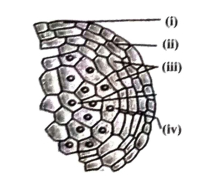
Which of the following is the correct option for the labels in the figure given below representing the wall layers of a microsporangium?
A
$(i)$ Epidermis (ii) Endothecium (iii) Middle layer (iv) Tapetum
B
$(i)$ Epidermis (ii) Middle layer (iii) Endothecium (iv) Tapetum
C
$(i)$ Tapetum (ii) Middle layer (iii) Endothecium (iv) Epidermis
D
$(i)$ Epidermis (ii) Tapetum (iii) Middle layer (iv) Endothecium
Solution
(A) The figure shows a cross-section of a young anther (microsporangium). The wall layers of a typical microsporangium are arranged from the outside to the inside as follows:
$(i)$ Epidermis: The outermost protective layer.
(ii) Endothecium: The layer lying just below the epidermis.
(iii) Middle layers: One to three layers of cells located between the endothecium and the tapetum.
(iv) Tapetum: The innermost nutritive layer that surrounds the sporogenous tissue.
Therefore,the correct sequence is $(i)$ Epidermis,(ii) Endothecium,(iii) Middle layer,(iv) Tapetum. Thus,option $A$ is correct.
$(i)$ Epidermis: The outermost protective layer.
(ii) Endothecium: The layer lying just below the epidermis.
(iii) Middle layers: One to three layers of cells located between the endothecium and the tapetum.
(iv) Tapetum: The innermost nutritive layer that surrounds the sporogenous tissue.
Therefore,the correct sequence is $(i)$ Epidermis,(ii) Endothecium,(iii) Middle layer,(iv) Tapetum. Thus,option $A$ is correct.
0 likes
View Solution331
EasyMCQ
Which of the following layers of the microsporangium provides nutrition to the developing pollen grains?
A
Epidermis
B
Middle layer
C
Endothecium
D
Tapetum
Solution
(D) The microsporangium is surrounded by four wall layers: the epidermis,endothecium,middle layers,and tapetum.
$1$. The outer three wall layers (epidermis,endothecium,and middle layers) perform the function of protection and help in the dehiscence of the anther to release the pollen.
$2$. The innermost wall layer is the $Tapetum$.
$3$. The $Tapetum$ nourishes the developing pollen grains.
Therefore,the correct option is $D$.
$1$. The outer three wall layers (epidermis,endothecium,and middle layers) perform the function of protection and help in the dehiscence of the anther to release the pollen.
$2$. The innermost wall layer is the $Tapetum$.
$3$. The $Tapetum$ nourishes the developing pollen grains.
Therefore,the correct option is $D$.
0 likes
View Solution332
EasyMCQ
Choose the correct option showing the right arrangement of different wall layers from the sporogenous tissue to the periphery in a $T.S.$ of a young anther.
A
Tapetum, Middle layer, Endothecium, Epidermis
B
Tapetum, Endothecium, Middle layer, Epidermis
C
Epidermis, Endothecium, Middle layer, Tapetum
D
Epidermis, Middle layer, Endothecium, Tapetum
Solution
(A) The wall layers of a young anther, starting from the innermost layer (closest to the sporogenous tissue) to the outermost layer (periphery), are arranged as follows:
$1$. $Tapetum$ (innermost layer, surrounding the sporogenous tissue).
$2$. $Middle \text{ } layers$ (located between the tapetum and endothecium).
$3$. $Endothecium$ (located beneath the epidermis).
$4$. $Epidermis$ (the outermost protective layer).
Therefore, the correct sequence from the sporogenous tissue to the periphery is $Tapetum \rightarrow Middle \text{ } layers \rightarrow Endothecium \rightarrow Epidermis$.
$1$. $Tapetum$ (innermost layer, surrounding the sporogenous tissue).
$2$. $Middle \text{ } layers$ (located between the tapetum and endothecium).
$3$. $Endothecium$ (located beneath the epidermis).
$4$. $Epidermis$ (the outermost protective layer).
Therefore, the correct sequence from the sporogenous tissue to the periphery is $Tapetum \rightarrow Middle \text{ } layers \rightarrow Endothecium \rightarrow Epidermis$.
0 likes
View Solution333
EasyMCQ
Which of the following options is not correct regarding pollen grains?
A
When a pollen grain is mature,it contains two cells: the vegetative cell and the male gamete.
B
Pollen grains measure about $25-50 \ \mu m$ in diameter.
C
The pollen grain exine has prominent apertures called germ pores.
D
The exine is made up of sporopollenin.
Solution
(A) The correct answer is $A$. In a mature pollen grain,there are two cells: the vegetative cell and the generative cell. The generative cell later divides to form two male gametes. Therefore,stating that it contains a 'male gamete' instead of a 'generative cell' is incorrect. Option $B$ is correct as pollen grains are generally spherical measuring $25-50 \ \mu m$. Option $C$ is correct as the exine layer has germ pores where sporopollenin is absent. Option $D$ is correct as the exine is composed of the highly resistant organic material,sporopollenin.
0 likes
View Solution334
EasyMCQ
Assertion $A$: Pollen grains are found in the form of fossils.
Reason $R$: Sporopollenin is seen in its outer layer.
Reason $R$: Sporopollenin is seen in its outer layer.
A
Assertion $A$ and Reason $R$ both are correct,Reason $R$ is the correct explanation for Assertion $A$.
B
Assertion $A$ and Reason $R$ both are correct,Reason $R$ is not the correct explanation for Assertion $A$.
C
Assertion $A$ is correct and Reason $R$ is false.
D
Assertion $A$ is false and Reason $R$ is correct.
Solution
(A) The outer layer of the pollen grain,known as the exine,is made up of a highly resistant organic material called sporopollenin.
Sporopollenin is one of the most resistant organic materials known; it can withstand high temperatures,strong acids,and alkali conditions.
No enzyme that degrades sporopollenin is known.
Due to the presence of this substance,pollen grains are well-preserved as fossils.
Therefore,both Assertion $A$ and Reason $R$ are correct,and Reason $R$ is the correct explanation for Assertion $A$.
Sporopollenin is one of the most resistant organic materials known; it can withstand high temperatures,strong acids,and alkali conditions.
No enzyme that degrades sporopollenin is known.
Due to the presence of this substance,pollen grains are well-preserved as fossils.
Therefore,both Assertion $A$ and Reason $R$ are correct,and Reason $R$ is the correct explanation for Assertion $A$.
0 likes
View Solution335
EasyMCQ
Pollen grains are well preserved as fossils because of the presence of . . . . . . .
A
Pectin
B
Cellulose
C
Lignin
D
Sporopollenin
Solution
(D) The exine of pollen grains is made up of a highly resistant organic material called $Sporopollenin$.
$Sporopollenin$ is one of the most resistant organic materials known.
It can withstand high temperatures,strong acids,and alkali conditions.
No enzyme that degrades $Sporopollenin$ is known to date.
Due to this characteristic,pollen grains are well preserved as fossils.
$Sporopollenin$ is one of the most resistant organic materials known.
It can withstand high temperatures,strong acids,and alkali conditions.
No enzyme that degrades $Sporopollenin$ is known to date.
Due to this characteristic,pollen grains are well preserved as fossils.
0 likes
View Solution336
EasyMCQ
$A$ flower has $10$ stamens,each having a bilobed,dithecous anther. If each microsporangium has $5$ pollen mother cells,how many pollen grains would be produced by the flower?
A
$1600$
B
$200$
C
$400$
D
$800$
Solution
(D) Each stamen has a bilobed,dithecous anther,which means it contains $4$ microsporangia.
Total number of microsporangia in $10$ stamens = $10 \times 4 = 40$.
Each microsporangium contains $5$ pollen mother cells (PMCs).
Total number of PMCs in the flower = $40 \times 5 = 200$.
Each pollen mother cell undergoes meiosis to produce $4$ pollen grains.
Total number of pollen grains = $200 \times 4 = 800$.
Total number of microsporangia in $10$ stamens = $10 \times 4 = 40$.
Each microsporangium contains $5$ pollen mother cells (PMCs).
Total number of PMCs in the flower = $40 \times 5 = 200$.
Each pollen mother cell undergoes meiosis to produce $4$ pollen grains.
Total number of pollen grains = $200 \times 4 = 800$.
0 likes
View Solution337
EasyMCQ
The stalk of the stamen is known as:
A
petiole
B
filament
C
peduncle
D
pedicel
Solution
(B) The stamen is the male reproductive organ of a flower,consisting of two main parts: the anther and the filament.
$1$. The anther is the pollen-bearing part.
$2$. The filament is the long,slender stalk that supports the anther.
Therefore,the stalk of the stamen is the filament.
$1$. The anther is the pollen-bearing part.
$2$. The filament is the long,slender stalk that supports the anther.
Therefore,the stalk of the stamen is the filament.
0 likes
View Solution338
EasyMCQ
Consider the following statements and choose the correct answer from the given options.
$Statement \ 1$: Innermost layer of microsporangium is tapetum.
$Statement \ 2$: Cells of tapetum possess dense cytoplasm, more than one nucleus, and nourish the developing pollen grains.
$Statement \ 1$: Innermost layer of microsporangium is tapetum.
$Statement \ 2$: Cells of tapetum possess dense cytoplasm, more than one nucleus, and nourish the developing pollen grains.
A
Both Statements $1$ and $2$ are incorrect.
B
Both Statements $1$ and $2$ are correct.
C
Statement $1$ is correct and $2$ is incorrect.
D
Statement $2$ is correct and $1$ is incorrect.
Solution
(B) The correct answer is $B$.
$Statement \ 1$ is correct because the microsporangium is surrounded by four wall layers: epidermis, endothecium, middle layers, and the innermost layer, which is the tapetum.
$Statement \ 2$ is correct because the cells of the tapetum possess dense cytoplasm and generally have more than one nucleus (multinucleate condition). Their primary function is to provide nourishment to the developing pollen grains.
$Statement \ 1$ is correct because the microsporangium is surrounded by four wall layers: epidermis, endothecium, middle layers, and the innermost layer, which is the tapetum.
$Statement \ 2$ is correct because the cells of the tapetum possess dense cytoplasm and generally have more than one nucleus (multinucleate condition). Their primary function is to provide nourishment to the developing pollen grains.
0 likes
View Solution339
EasyMCQ
How many microsporangia are located at the corners of a typical bilobed anther of angiosperm?
A
$2$
B
$4$
C
$8$
D
$1$
Solution
(B) typical angiosperm anther is bilobed,with each lobe having two theca (dithecous).
In a transverse section,a typical microsporangium appears near-circular in outline.
It is generally surrounded by four wall layers: epidermis,endothecium,middle layers,and tapetum.
There are four microsporangia located at the corners,two in each lobe.
Eventually,these microsporangia develop into pollen sacs and extend longitudinally all through the length of an anther and are packed with pollen grains.
In a transverse section,a typical microsporangium appears near-circular in outline.
It is generally surrounded by four wall layers: epidermis,endothecium,middle layers,and tapetum.
There are four microsporangia located at the corners,two in each lobe.
Eventually,these microsporangia develop into pollen sacs and extend longitudinally all through the length of an anther and are packed with pollen grains.
0 likes
View Solution340
EasyMCQ
During an excavation of soil,pollen fossils were retrieved from the deepest layer of soil. The pollen grains remained as fossils because
A
pollen grains are asexual reproductive structures
B
the intine of pollen grains is made up of pectin
C
exine has spiny ornamentation
D
the exine of pollen grains is highly resistant to enzyme action
Solution
(D) The exine of pollen grains is highly resistant to enzyme action.
Pollen grains possess a prominent two-layered wall. The hard outer layer,known as the exine,is composed of sporopollenin,which is one of the most resistant organic materials known to science.
It can withstand high temperatures,strong acids,and strong alkalis.
To date,no enzyme has been discovered that can degrade sporopollenin. This unique chemical property allows pollen grains to be well-preserved as fossils over long periods.
Pollen grains possess a prominent two-layered wall. The hard outer layer,known as the exine,is composed of sporopollenin,which is one of the most resistant organic materials known to science.
It can withstand high temperatures,strong acids,and strong alkalis.
To date,no enzyme has been discovered that can degrade sporopollenin. This unique chemical property allows pollen grains to be well-preserved as fossils over long periods.
0 likes
View Solution341
EasyMCQ
When a pollen grain is shed at the $3$-celled stage,name the cells it contains.
A
$1$ vegetative cell and $2$ male gametes
B
$2$ vegetative cells and $1$ male gamete
C
$2$ generative cells and $1$ male gamete
D
$2$ male gametes and $1$ generative cell
Solution
(A) The correct answer is $A$.
In angiosperms,the pollen grain can be shed at either the $2$-celled stage or the $3$-celled stage.
At the $3$-celled stage,the generative cell undergoes mitosis to form two male gametes.
Therefore,the pollen grain contains one large vegetative cell (tube cell) and two male gametes.
In angiosperms,the pollen grain can be shed at either the $2$-celled stage or the $3$-celled stage.
At the $3$-celled stage,the generative cell undergoes mitosis to form two male gametes.
Therefore,the pollen grain contains one large vegetative cell (tube cell) and two male gametes.
0 likes
View Solution342
EasyMCQ
Among the following statements related to pollens, choose the correct one.
Statement $I$: In $40\%$ of angiosperms, pollen grains are shed at the $3$-celled stage.
Statement $II$: Intine is made of cellulose and pectin, and it is discontinuous with germ pores.
Statement $I$: In $40\%$ of angiosperms, pollen grains are shed at the $3$-celled stage.
Statement $II$: Intine is made of cellulose and pectin, and it is discontinuous with germ pores.
A
Both statements $I$ and $II$ are correct.
B
Both statements $I$ and $II$ are incorrect.
C
Statement $I$ is correct and Statement $II$ is incorrect.
D
Statement $I$ is incorrect and Statement $II$ is correct.
Solution
(C) Statement $I$ is correct: In approximately $40\%$ of angiosperms, the generative cell divides mitotically to form two male gametes before the pollen grains are shed, resulting in a $3$-celled stage. In the remaining $60\%$ of species, pollen grains are shed at the $2$-celled stage.
Statement $II$ is incorrect: The inner wall of the pollen grain is called the intine. It is a thin and continuous layer made up of cellulose and pectin. It is not discontinuous; rather, the exine (outer layer) is discontinuous at the germ pores.
Statement $II$ is incorrect: The inner wall of the pollen grain is called the intine. It is a thin and continuous layer made up of cellulose and pectin. It is not discontinuous; rather, the exine (outer layer) is discontinuous at the germ pores.
0 likes
View Solution343
EasyMCQ
Pollen grains are generally spherical,measuring about
A
$25-50 \ \mu m$
B
$25-50 \ mm$
C
$25-50 \ nm$
D
$25-50 \ cm$
Solution
(A) The correct answer is $A$.
Pollen grains are unicellular,haploid,and generally spherical in shape.
They typically measure about $25-50 \ \mu m$ (micrometres) in diameter.
Pollen grains are unicellular,haploid,and generally spherical in shape.
They typically measure about $25-50 \ \mu m$ (micrometres) in diameter.
0 likes
View Solution344
EasyMCQ
In a dithecous anther,each pollen sac contains $1000$ $MMC$. What is the total number of pollen grains produced by the anther?
A
$4000$
B
$8000$
C
$16000$
D
$32000$
Solution
(C) dithecous anther consists of $4$ pollen sacs (microsporangia).
Each $MMC$ (Microspore Mother Cell) undergoes meiosis to produce $4$ haploid microspores (pollen grains).
Number of $MMC$ per pollen sac = $1000$.
Number of pollen grains per pollen sac = $1000 \times 4 = 4000$.
Since there are $4$ pollen sacs in a dithecous anther,the total number of pollen grains = $4 \times 4000 = 16000$.
Each $MMC$ (Microspore Mother Cell) undergoes meiosis to produce $4$ haploid microspores (pollen grains).
Number of $MMC$ per pollen sac = $1000$.
Number of pollen grains per pollen sac = $1000 \times 4 = 4000$.
Since there are $4$ pollen sacs in a dithecous anther,the total number of pollen grains = $4 \times 4000 = 16000$.
0 likes
View Solution345
EasyMCQ
The germ pores in the pollen grain are the regions
A
which are made up of lignin and suberin
B
that can withstand high temperature and strong acids and alkalies
C
which lack sporopollenin
D
through which sperms are released into the female gametophyte
Solution
(C) The correct answer is $C$.
In a mature pollen grain,the outer protective layer is known as the exine,which is composed of a highly resistant organic material called sporopollenin.
However,at certain specific locations,the exine is absent or very thin,and these regions lack sporopollenin.
These specific regions are termed as germ pores.
During the process of pollen germination,the pollen tube emerges from the pollen grain through these germ pores.
In a mature pollen grain,the outer protective layer is known as the exine,which is composed of a highly resistant organic material called sporopollenin.
However,at certain specific locations,the exine is absent or very thin,and these regions lack sporopollenin.
These specific regions are termed as germ pores.
During the process of pollen germination,the pollen tube emerges from the pollen grain through these germ pores.
0 likes
View Solution346
EasyMCQ
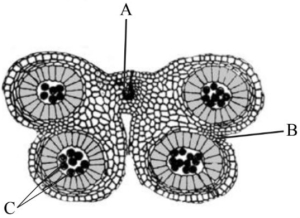
The following is the diagram of $T.S.$ of anther. Identify the parts labelled $A$,$B$ and $C$.
A
$A$-Connective tissue,$B$-Endothecium,$C$-Pollen grain
B
$A$-Endothecium,$B$-Connective tissue,$C$-Pollen grain
C
$A$-Pollen grain,$B$-Connective tissue,$C$-Endothecium
D
$A$-Connective tissue,$B$-Endothecium,$C$-Pollen grain
Solution
(A) Based on the $T.S.$ of anther diagram:
$A$ points to the central region connecting the two lobes,which is the Connective tissue.
$B$ points to the layer just inside the epidermis,which is the Endothecium.
$C$ points to the microspores or Pollen grains located within the microsporangium.
Therefore,the correct identification is $A$-Connective tissue,$B$-Endothecium,$C$-Pollen grain. The correct option is $A$.
$A$ points to the central region connecting the two lobes,which is the Connective tissue.
$B$ points to the layer just inside the epidermis,which is the Endothecium.
$C$ points to the microspores or Pollen grains located within the microsporangium.
Therefore,the correct identification is $A$-Connective tissue,$B$-Endothecium,$C$-Pollen grain. The correct option is $A$.
0 likes
View Solution347
EasyMCQ
Sporopollenin,a chemical substance,is found in . . . . . .
A
intine of pollen grain
B
exine of pollen grain
C
endothecium of anther
D
tapetum of anther
Solution
(B) exine of pollen grain.
Sporopollenin,found in the exine of pollen grains,is one of the most resistant organic materials known. It is highly resistant to extreme temperatures,strong acids,and alkali,and no enzyme that degrades sporopollenin is known so far. In contrast,the intine of pollen grains is composed of cellulose and pectin. The endothecium of the anther aids in dehiscence,while the tapetum provides nourishment to the developing pollen grains.
Sporopollenin,found in the exine of pollen grains,is one of the most resistant organic materials known. It is highly resistant to extreme temperatures,strong acids,and alkali,and no enzyme that degrades sporopollenin is known so far. In contrast,the intine of pollen grains is composed of cellulose and pectin. The endothecium of the anther aids in dehiscence,while the tapetum provides nourishment to the developing pollen grains.
0 likes
View Solution348
MediumMCQ
Arrange the following in the correct developmental sequence related to microsporogenesis:
$A$. Microspore tetrads
$B$. Sporogenous tissue
$C$. Pollen grains
$D$. Pollen mother cells
Choose the correct answer from the options given below:
$A$. Microspore tetrads
$B$. Sporogenous tissue
$C$. Pollen grains
$D$. Pollen mother cells
Choose the correct answer from the options given below:
A
$1$. $A, D, C, B$
B
$2$. $D, A, C, B$
C
$3$. $B, D, C, A$
D
$4$. $B, D, A, C$
Solution
(D) The process of microsporogenesis occurs in the following sequence:
$1$. The primary sporogenous tissue $(B)$ undergoes mitotic divisions to form pollen mother cells $(D)$.
$2$. Each pollen mother cell $(D)$ undergoes meiosis to form a group of four haploid cells known as microspore tetrads $(A)$.
$3$. These microspores separate and mature into pollen grains $(C)$.
Therefore,the correct sequence is $B \rightarrow D \rightarrow A \rightarrow C$.
$1$. The primary sporogenous tissue $(B)$ undergoes mitotic divisions to form pollen mother cells $(D)$.
$2$. Each pollen mother cell $(D)$ undergoes meiosis to form a group of four haploid cells known as microspore tetrads $(A)$.
$3$. These microspores separate and mature into pollen grains $(C)$.
Therefore,the correct sequence is $B \rightarrow D \rightarrow A \rightarrow C$.
0 likes
View SolutionSexual Reproduction in Flowering Plants — Stamen, Microsporangium and Pollen Grain · Frequently Asked Questions
1Are these Sexual Reproduction in Flowering Plants questions useful for JEE and NEET?
Yes. All questions in this section are mapped to JEE Main and NEET exam patterns. Previous year questions from JEE Main, NEET, GUJCET and state-level exams are included with full solutions.
2Can I switch to Hindi or Gujarati for these questions?
Yes. Use the language tabs in the hero section or the sidebar to view the same questions and solutions in English, Hindi or Gujarati.
3How do I generate a question paper from this subtopic?
Use the Vedclass Exam Paper Generator — select the chapter and subtopic, set difficulty, and generate Sets A, B, C, D automatically. First 3 chapters of every subject are free.
Vedclass Products
For Students
Vedclass Test Series
Mock tests in real JEE/NEET style with performance analysis. 5-day free trial.
Start Free TrialFor Teachers
Exam Paper Generator
Generate Set A/B/C/D papers from this chapter in 2 minutes. 3 chapters free.
Try FreeFor Institutes
Online Exam Module
Live online exams with unlimited students, 360° analytics & white-label branding.
See DemoFor Teachers & Institutes
Generate a Sexual Reproduction in Flowering Plants Exam Paper in 2 Minutes
Select subtopic & difficulty — Sets A, B, C, D auto-generated with No Repeat logic.
First 3 chapters of every subject are free — no payment required.