
A English
Seed and Fruit Questions in English
Class 12 Biology · Sexual Reproduction in Flowering Plants · Seed and Fruit
237+
Questions
English
Language
100%
With Solutions
Showing 50 of 237 questions in English
151
EasyMCQ
In angiosperms,which part remains attached after fertilization?
A
Stamens
B
Pistil
C
Petals
D
Sepals
Solution
(D) In angiosperms,after fertilization,the floral parts like stamens,petals,and the style/stigma of the pistil usually wither and fall off. However,the sepals often remain attached to the developing fruit in many species (e.g.,in Solanaceae family members like tomato or brinjal). Therefore,the sepals are the part that typically remains attached.
0 likes
View Solution152
MediumMCQ
The ovule and the ovary transform into which of the following,respectively?
A
Seed and Fruit
B
Fruit and Seed coat
C
Pericarp and Fruit
D
Seed and Pericarp
Solution
(A) In angiosperms,after the process of fertilization,the floral parts undergo significant changes.
$1$. The ovule develops into the seed.
$2$. The ovary matures and develops into the fruit.
$3$. The ovary wall develops into the pericarp (fruit wall).
Therefore,the ovule transforms into a seed and the ovary transforms into a fruit.
$1$. The ovule develops into the seed.
$2$. The ovary matures and develops into the fruit.
$3$. The ovary wall develops into the pericarp (fruit wall).
Therefore,the ovule transforms into a seed and the ovary transforms into a fruit.
0 likes
View Solution153
MediumMCQ
Select the correct option regarding a fertilized ovule.
A
Ovary
B
Seed
C
Fruit
D
Embryo sac
Solution
(B) In angiosperms,after the process of double fertilization,the ovule undergoes significant developmental changes.
$1$. The fertilized ovule matures to form the $Seed$.
$2$. The ovary develops into the $Fruit$.
$3$. The integuments of the ovule harden to form the seed coat.
Therefore,the fertilized ovule corresponds to the seed.
$1$. The fertilized ovule matures to form the $Seed$.
$2$. The ovary develops into the $Fruit$.
$3$. The integuments of the ovule harden to form the seed coat.
Therefore,the fertilized ovule corresponds to the seed.
0 likes
View Solution154
MediumMCQ
What is a non-albuminous seed?
A
Albuminous seed
B
Cotyledon-free seed
C
Non-albuminous seed
D
Seed coat-free seed
Solution
(C) Non-albuminous seeds are those in which the endosperm is completely consumed by the developing embryo before the seed matures.
These seeds are also known as ex-albuminous seeds.
Examples include pea,groundnut,and beans.
In contrast,albuminous seeds retain a part of the endosperm in the mature seed (e.g.,wheat,maize,castor).
These seeds are also known as ex-albuminous seeds.
Examples include pea,groundnut,and beans.
In contrast,albuminous seeds retain a part of the endosperm in the mature seed (e.g.,wheat,maize,castor).
0 likes
View Solution155
MediumMCQ
Select the incorrect option regarding albuminous seeds.
A
Wheat
B
Castor
C
Barley
D
Groundnut
Solution
(D) Albuminous seeds (endospermic seeds) are those in which the endosperm is retained in the mature seed to provide nourishment to the developing embryo. Examples include wheat,maize,barley,and castor. Groundnut is an ex-albuminous (non-endospermic) seed,where the endosperm is completely consumed by the developing embryo before seed maturation. Therefore,groundnut is the incorrect option in the context of albuminous seeds.
0 likes
View Solution156
MediumMCQ
What is perisperm?
A
Persistent nucellus
B
Persistent embryo
C
Persistent endosperm
D
All of the above
Solution
(A) In some seeds,such as black pepper and beet,remnants of the nucellus are still present. This residual,persistent nucellus is known as the perisperm.
0 likes
View Solution157
MediumMCQ
In which plant is the perisperm found?
A
Bean
B
Pea
C
Black pepper
D
Groundnut
Solution
(C) The perisperm is the persistent nucellus in a seed. In most seeds, the nucellus is consumed during the development of the embryo. However, in some plants like black pepper $(Piper \, nigrum)$ and beet, the nucellus remains as a thin, dry layer surrounding the endosperm. This residual, persistent nucellus is known as the perisperm.
0 likes
View Solution158
MediumMCQ
What do the integuments of the ovule transform into after fertilization?
A
Pericarp
B
Seed coat
C
Endosperm
D
Pericarp/Fleshy part of the fruit
Solution
(B) After fertilization,the ovule develops into a seed.
Specifically,the integuments of the ovule harden and transform into the protective seed coat (testa and tegmen).
The ovary develops into the fruit,and the ovary wall develops into the pericarp.
Specifically,the integuments of the ovule harden and transform into the protective seed coat (testa and tegmen).
The ovary develops into the fruit,and the ovary wall develops into the pericarp.
0 likes
View Solution159
MediumMCQ
After fertilization,the wall of the ovary develops into which of the following?
A
Seed coat
B
Pericarp
C
Testa
D
All of the above
Solution
(B) In angiosperms,after the process of fertilization,the ovules develop into seeds and the ovary develops into a fruit.
Specifically,the wall of the ovary transforms into the fruit wall,which is known as the pericarp.
The pericarp can be fleshy or dry depending on the type of fruit.
Specifically,the wall of the ovary transforms into the fruit wall,which is known as the pericarp.
The pericarp can be fleshy or dry depending on the type of fruit.
0 likes
View Solution160
MediumMCQ
How many of the following fruits involve floral parts other than the ovary in their formation?
Pea,Cashew,Mango,Strawberry,Orange,Apple
Pea,Cashew,Mango,Strawberry,Orange,Apple
A
One
B
Two
C
Three
D
Four
Solution
(C) Fruits in which floral parts other than the ovary contribute to fruit formation are called false fruits or accessory fruits.
In the given list:
$1$. Pea: True fruit (develops only from the ovary).
$2$. Cashew: False fruit (thalamus contributes to fruit formation).
$3$. Mango: True fruit (develops only from the ovary).
$4$. Strawberry: False fruit (thalamus contributes to fruit formation).
$5$. Orange: True fruit (develops only from the ovary).
$6$. Apple: False fruit (thalamus contributes to fruit formation).
Therefore,there are $3$ such fruits (Cashew,Strawberry,and Apple) that involve other floral parts in their formation.
In the given list:
$1$. Pea: True fruit (develops only from the ovary).
$2$. Cashew: False fruit (thalamus contributes to fruit formation).
$3$. Mango: True fruit (develops only from the ovary).
$4$. Strawberry: False fruit (thalamus contributes to fruit formation).
$5$. Orange: True fruit (develops only from the ovary).
$6$. Apple: False fruit (thalamus contributes to fruit formation).
Therefore,there are $3$ such fruits (Cashew,Strawberry,and Apple) that involve other floral parts in their formation.
0 likes
View Solution161
MediumMCQ
What is a fruit called that develops only from the ovary?
A
False fruit
B
True fruit
C
Parthenocarpic fruit
D
All of the above
Solution
(B) fruit that develops exclusively from the ovary of a flower after fertilization is known as a $True \, fruit$ (or $Eucarp$).
In contrast, if other floral parts like the thalamus contribute to fruit formation, it is called a $False \, fruit$ (e.g., apple, strawberry).
$Parthenocarpic \, fruits$ are those that develop without fertilization.
Therefore, the correct answer is $True \, fruit$.
In contrast, if other floral parts like the thalamus contribute to fruit formation, it is called a $False \, fruit$ (e.g., apple, strawberry).
$Parthenocarpic \, fruits$ are those that develop without fertilization.
Therefore, the correct answer is $True \, fruit$.
0 likes
View Solution162
MediumMCQ
Which of the following fruits is seedless?
A
Banana
B
Apple
C
Guava
D
Mango
Solution
(A) The banana is a classic example of a parthenocarpic fruit.
Parthenocarpy is the development of a fruit without fertilization.
Since fertilization does not occur,no seeds are formed within the fruit.
Therefore,bananas are naturally seedless.
Parthenocarpy is the development of a fruit without fertilization.
Since fertilization does not occur,no seeds are formed within the fruit.
Therefore,bananas are naturally seedless.
0 likes
View Solution163
MediumMCQ
What protects the mature embryo in a seed?
A
Cotyledons
B
Micropyle
C
Endosperm
D
Seed coat
Solution
(D) The mature embryo in a seed is protected by the seed coat. The seed coat is formed from the integuments of the ovule. It acts as a protective covering that shields the embryo from mechanical injury,desiccation,and pathogen attack.
0 likes
View Solution164
MediumMCQ
Which plant's seeds germinated after a dormancy period of approximately $10,000$ years?
A
Phoenix dactylifera
B
Orchid
C
Lupinus arcticus
D
Cyamopsis tetragonoloba
Solution
(C) The seeds of $Lupinus$ $arcticus$ (Arctic lupine) were found in the Arctic Tundra. These seeds germinated and flowered after an estimated dormancy period of approximately $10,000$ years. This is a classic example of extreme seed viability in plants.
0 likes
View Solution165
MediumMCQ
Where were the $2000$-year-old viable seeds of the date palm $(Phoenix dactylifera)$ discovered?
A
Arctic Tundra
B
King Herod's Palace near the Dead Sea
C
Antarctica
D
Royal Henry's Palace
Solution
(B) The $2000$-year-old viable seeds of the date palm, $Phoenix dactylifera$, were discovered during an archaeological excavation at King Herod's Palace near the Dead Sea. These seeds remained viable for such a long duration, demonstrating the longevity of seed dormancy.
0 likes
View Solution166
MediumMCQ
How many years old is the viable seed of date palm $(Phoenix dactylifera)$ discovered during the archaeological excavation at King Herod's palace near the Dead Sea?
A
$10,000$
B
$1,000$
C
$200$
D
$2,000$
Solution
(D) The viable seed of the date palm $(Phoenix dactylifera)$ was discovered during an archaeological excavation at King Herod's palace near the Dead Sea.
This seed was estimated to be approximately $2,000$ years old.
Despite its age, the seed remained viable and was successfully germinated.
This seed was estimated to be approximately $2,000$ years old.
Despite its age, the seed remained viable and was successfully germinated.
0 likes
View Solution167
MediumMCQ
Which of the following parasitic plants produces fruits containing a very large number of seeds?
A
Orchid
B
Orobanche
C
Banyan
D
Striga
Solution
(B) In the context of parasitic plants,$Orobanche$ and $Striga$ are well-known examples that produce a massive number of tiny seeds.
Among the given options,$Orobanche$ is a parasitic plant that produces fruits containing a very large number of seeds,which is an adaptation to ensure the survival and dispersal of the species in the absence of a host.
While $Orchids$ also produce a large number of tiny seeds,they are generally not classified as parasitic plants in the same context as $Orobanche$ or $Striga$.
Among the given options,$Orobanche$ is a parasitic plant that produces fruits containing a very large number of seeds,which is an adaptation to ensure the survival and dispersal of the species in the absence of a host.
While $Orchids$ also produce a large number of tiny seeds,they are generally not classified as parasitic plants in the same context as $Orobanche$ or $Striga$.
0 likes
View Solution168
MediumMCQ
Which of the following plants produces fruits that contain thousands of seeds?
A
Orange
B
Lemon
C
Striga
D
Maize
Solution
(C) In some angiosperms,the number of seeds per fruit is very high.
Examples include species like $Orobanche$ and $Striga$,which produce thousands of tiny seeds in a single fruit.
These seeds are adapted for wind dispersal and have a high reproductive potential.
Therefore,the correct option is $C$.
Examples include species like $Orobanche$ and $Striga$,which produce thousands of tiny seeds in a single fruit.
These seeds are adapted for wind dispersal and have a high reproductive potential.
Therefore,the correct option is $C$.
0 likes
View Solution169
MediumMCQ
Match the following columns:
| Column-$I$ | Column-$II$ |
| $(a)$ Pea | $(1)$ Albuminous seed |
| $(b)$ Beet | $(2)$ Albuminous dicot seed |
| $(c)$ Castor | $(3)$ Perisperm |
| $(d)$ Barley | $(4)$ Non-albuminous seed |
A
$a-3, b-2, c-1, d-4$
B
$a-2, b-4, c-1, d-3$
C
$a-4, b-3, c-2, d-1$
D
$a-3, b-2, c-4, d-1$
Solution
(C) The correct matching is as follows:
$(a)$ Pea: These are non-albuminous (ex-albuminous) seeds where the endosperm is completely consumed during embryo development. Thus, $(a-4)$.
$(b)$ Beet: In some seeds like beet and black pepper, remnants of nucellus are persistent, which is known as perisperm. Thus, $(b-3)$.
$(c)$ Castor: These are albuminous (endospermic) seeds that retain a part of the endosperm. Thus, $(c-2)$.
$(d)$ Barley: These are albuminous monocot seeds. Thus, $(d-1)$.
Therefore, the correct sequence is $a-4, b-3, c-2, d-1$.
$(a)$ Pea: These are non-albuminous (ex-albuminous) seeds where the endosperm is completely consumed during embryo development. Thus, $(a-4)$.
$(b)$ Beet: In some seeds like beet and black pepper, remnants of nucellus are persistent, which is known as perisperm. Thus, $(b-3)$.
$(c)$ Castor: These are albuminous (endospermic) seeds that retain a part of the endosperm. Thus, $(c-2)$.
$(d)$ Barley: These are albuminous monocot seeds. Thus, $(d-1)$.
Therefore, the correct sequence is $a-4, b-3, c-2, d-1$.
0 likes
View Solution170
MediumMCQ
What is the process of fruit formation without fertilization called?
A
Parthenogenesis
B
Parthenocarpy
C
Apomixis
D
All of the above
Solution
(B) The process of fruit formation without fertilization is known as $Parthenocarpy$.
$Parthenogenesis$ refers to the development of an embryo from an unfertilized egg.
$Apomixis$ is a form of asexual reproduction that mimics sexual reproduction,where seeds are formed without fertilization.
Therefore,the correct term for fruit formation without fertilization is $Parthenocarpy$.
$Parthenogenesis$ refers to the development of an embryo from an unfertilized egg.
$Apomixis$ is a form of asexual reproduction that mimics sexual reproduction,where seeds are formed without fertilization.
Therefore,the correct term for fruit formation without fertilization is $Parthenocarpy$.
0 likes
View Solution171
MediumMCQ
Which plant has the smallest and lightest seeds?
A
Tulsi
B
Orchid
C
Guava
D
Sunflower
Solution
(B) Orchids produce the smallest and lightest seeds in the plant kingdom. These seeds are often referred to as 'dust seeds' because they are extremely minute,lack endosperm,and contain an undifferentiated embryo. Due to their lightweight nature,they are easily dispersed by wind over long distances.
0 likes
View Solution172
EasyMCQ
In some plants,the thalamus contributes to fruit formation. Such fruits are termed as:
A
Parthenocarpic fruit
B
False fruits
C
Aggregate fruits
D
True fruits
Solution
(B) In some plants,such as apple,strawberry,and cashew,the thalamus also contributes to fruit formation along with the ovary. These fruits are known as false fruits or pseudocarps.
0 likes
View Solution173
MediumMCQ
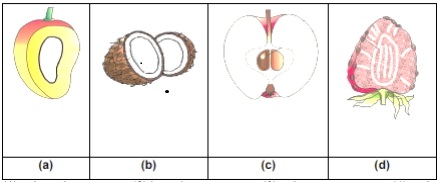
Identify which of the following fruits are false fruits based on the provided image:
$(a)$ Mango
$(b)$ Coconut
$(c)$ Apple
$(d)$ Strawberry
$(a)$ Mango
$(b)$ Coconut
$(c)$ Apple
$(d)$ Strawberry
A
$a, b, c, d$
B
$b, c, d$
C
$a, b$
D
$c, d$
Solution
(D) In most plants,the fruit develops only from the ovary,and other floral parts degenerate. Such fruits are called true fruits.
However,in some species,such as apple,strawberry,and cashew,the thalamus also contributes to fruit formation. Such fruits are called false fruits.
In the given image:
$(a)$ Mango is a true fruit.
$(b)$ Coconut is a true fruit.
$(c)$ Apple is a false fruit (thalamus contributes to fruit formation).
$(d)$ Strawberry is a false fruit (thalamus contributes to fruit formation).
Therefore,$(c)$ and $(d)$ are false fruits.
However,in some species,such as apple,strawberry,and cashew,the thalamus also contributes to fruit formation. Such fruits are called false fruits.
In the given image:
$(a)$ Mango is a true fruit.
$(b)$ Coconut is a true fruit.
$(c)$ Apple is a false fruit (thalamus contributes to fruit formation).
$(d)$ Strawberry is a false fruit (thalamus contributes to fruit formation).
Therefore,$(c)$ and $(d)$ are false fruits.
0 likes
View Solution174
MediumMCQ
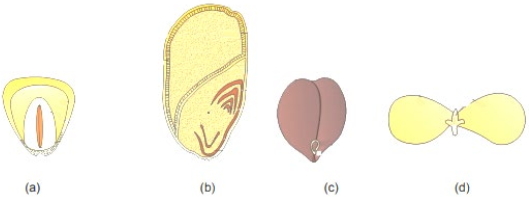
Which of the following is correct for the above diagrams?
A
$a \& b$ represent ex-albuminous seeds
B
$c \& d$ represent albuminous seeds
C
$a \& b$ represent albuminous seeds
D
$c \& d$ represent perispermic seeds
Solution
(C) The provided diagrams show different types of seeds.
Diagrams $a$ and $b$ represent monocot seeds (maize and wheat),which are albuminous (endospermic) seeds because they retain endosperm at maturity.
Diagrams $c$ and $d$ represent dicot seeds (bean and pea),which are ex-albuminous (non-endospermic) seeds because the endosperm is consumed during embryo development.
Therefore,$a \& b$ represent albuminous seeds.
Diagrams $a$ and $b$ represent monocot seeds (maize and wheat),which are albuminous (endospermic) seeds because they retain endosperm at maturity.
Diagrams $c$ and $d$ represent dicot seeds (bean and pea),which are ex-albuminous (non-endospermic) seeds because the endosperm is consumed during embryo development.
Therefore,$a \& b$ represent albuminous seeds.
0 likes
View Solution175
MediumMCQ
In mature seeds of some plants (such as gram,pea,and groundnut),the endosperm is completely consumed by the embryo. Such seeds are called:
A
Single
B
Albuminous
C
Endospermic
D
Non-endospermic
Solution
(D) In non-endospermic (or ex-albuminous) seeds,such as $Pisum$ (pea),$Arachis$ (groundnut),and $Cucurbita$,the endosperm is completely consumed by the developing embryo during seed maturation.
Consequently,the endosperm is no longer present in the mature seed.
Therefore,these seeds are classified as non-endospermic seeds.
Consequently,the endosperm is no longer present in the mature seed.
Therefore,these seeds are classified as non-endospermic seeds.
0 likes
View Solution176
MediumMCQ
Fruit is:
A
Mature ovary developed before fertilisation
B
Ripened ovary developed before fertilisation
C
Ripened ovary developed after fertilisation
D
Mature undeveloped ovary
Solution
(C) The fruit is a characteristic feature of flowering plants. It is defined as a mature or ripened ovary that develops after the process of fertilisation. In most plants,the ovary wall develops into the pericarp,and the ovules develop into seeds.
0 likes
View Solution177
EasyMCQ
Fruit formed without fertilisation of the ovary is called:
A
Cypsela fruit
B
Parthenocarpic fruit
C
Drupe fruit
D
Pome fruit
Solution
(B) fruit formed without the process of fertilisation of the ovary is known as a parthenocarpic fruit.
Parthenocarpic fruits are typically seedless.
Examples include bananas and grapes.
Parthenocarpic tomato fruits can be induced by treating the plants with low concentrations of plant growth regulators such as gibberellic acid and auxin.
Parthenocarpic fruits are typically seedless.
Examples include bananas and grapes.
Parthenocarpic tomato fruits can be induced by treating the plants with low concentrations of plant growth regulators such as gibberellic acid and auxin.
0 likes
View Solution178
MediumMCQ
In which of the following, parthenocarpy makes no sense?
A
Banana
B
Orange
C
Lemon
D
Pomegranate
Solution
(D) Parthenocarpy (Greek: $parthenos$ = virgin; $karpos$ = fruit) is the production and development of seedless fruits without fertilization of an egg in the ovary.
In many fruits like banana, orange, and lemon, seedless fruits are desirable because seeds are not required for consumption.
However, in pomegranate $(Punica \, granatum)$, the edible part is the fleshy seed coat (aril).
If a pomegranate were to be produced via parthenocarpy, it would lack seeds, meaning the edible portion would be absent.
Therefore, parthenocarpy makes no sense in the case of pomegranate.
In many fruits like banana, orange, and lemon, seedless fruits are desirable because seeds are not required for consumption.
However, in pomegranate $(Punica \, granatum)$, the edible part is the fleshy seed coat (aril).
If a pomegranate were to be produced via parthenocarpy, it would lack seeds, meaning the edible portion would be absent.
Therefore, parthenocarpy makes no sense in the case of pomegranate.
0 likes
View Solution179
MediumMCQ
The inner layer of the seed coat is called
A
Testa
B
Hilum
C
Micropyle
D
Tegmen
Solution
(D) The seed coat is typically composed of two layers. The outer layer is known as the $Testa$,while the inner layer is known as the $Tegmen$. Therefore,the correct answer is $Tegmen$.
0 likes
View Solution180
MediumMCQ
Which of the following plants has an endospermic seed?
A
Bean
B
Gram
C
Pea
D
Castor
Solution
(D) Endospermic or albuminous seeds are those in which the endosperm is retained in the mature seed to provide nourishment to the developing embryo. Among the given options, $Bean$, $Gram$, and $Pea$ are non-endospermic (ex-albuminous) seeds, where the endosperm is consumed during seed development. $Castor$ $(Ricinus \text{ } communis)$ is a classic example of an endospermic seed.
0 likes
View Solution181
MediumMCQ
$A$: Nucellus remains persistent in the seeds of black pepper.
$R$: It is a haploid parenchymatous tissue.
$R$: It is a haploid parenchymatous tissue.
A
Assertion and Reason both are correct and Reason is the correct explanation of Assertion.
B
Assertion and Reason both are correct but Reason is not the correct explanation of Assertion.
C
Assertion is correct,but Reason is incorrect.
D
Both Assertion and Reason are incorrect.
Solution
(C) The nucellus is a diploid $(2n)$ parenchymatous tissue,not a haploid $(n)$ tissue.
In some plants like black pepper and beet,a part of the nucellus remains persistent in the seed,which is known as the perisperm.
Therefore,the Assertion is correct,but the Reason is incorrect.
In some plants like black pepper and beet,a part of the nucellus remains persistent in the seed,which is known as the perisperm.
Therefore,the Assertion is correct,but the Reason is incorrect.
0 likes
View Solution182
EasyMCQ
Development of fruit without fertilization is called:
A
Cell division
B
Cell culture
C
Parthenocarpy
D
Parthenogenesis
Solution
(C) The development of fruit without the process of fertilization is known as $Parthenocarpy$.
In this process,the ovary develops into a fruit without being fertilized by pollen grains.
This phenomenon is often used in agriculture to produce seedless fruits,such as bananas,grapes,and watermelons.
$Parthenogenesis$ refers to the development of an embryo from an unfertilized egg,which is a different biological process.
In this process,the ovary develops into a fruit without being fertilized by pollen grains.
This phenomenon is often used in agriculture to produce seedless fruits,such as bananas,grapes,and watermelons.
$Parthenogenesis$ refers to the development of an embryo from an unfertilized egg,which is a different biological process.
0 likes
View Solution183
EasyMCQ
In oviparous individuals,the development of the zygote takes place:
A
Outside the body
B
Inside the body
C
Inside freshwater
D
Inside marine water
Solution
(A) Oviparous organisms are those that lay eggs.
In these organisms,although fertilization may occur inside the body,the zygote develops into an embryo outside the female parent's body.
The eggs are covered by a hard calcareous shell and are laid in a safe place in the environment,where the embryo undergoes development.
In these organisms,although fertilization may occur inside the body,the zygote develops into an embryo outside the female parent's body.
The eggs are covered by a hard calcareous shell and are laid in a safe place in the environment,where the embryo undergoes development.
0 likes
View Solution184
MediumMCQ
Choose the incorrect option with respect to the transition after fertilization in angiosperms.
A
Zygote $\longrightarrow$ Embryo
B
$PEN$ $\longrightarrow$ Endosperm
C
Ovary $\longrightarrow$ Fruit
D
Integument $\longrightarrow$ Pericarp
Solution
(D) In angiosperms,after fertilization,the following changes occur:
$1$. The Zygote develops into the Embryo.
$2$. The Primary Endosperm Nucleus $(PEN)$ develops into the Endosperm.
$3$. The Ovary matures into the Fruit.
$4$. The Ovule develops into the Seed,and the Integuments of the ovule develop into the Seed Coat (Testa and Tegmen).
$5$. The Ovary wall develops into the Pericarp.
Therefore,the option 'Integument $\longrightarrow$ Pericarp' is incorrect because the integuments form the seed coat,not the pericarp.
$1$. The Zygote develops into the Embryo.
$2$. The Primary Endosperm Nucleus $(PEN)$ develops into the Endosperm.
$3$. The Ovary matures into the Fruit.
$4$. The Ovule develops into the Seed,and the Integuments of the ovule develop into the Seed Coat (Testa and Tegmen).
$5$. The Ovary wall develops into the Pericarp.
Therefore,the option 'Integument $\longrightarrow$ Pericarp' is incorrect because the integuments form the seed coat,not the pericarp.
0 likes
View Solution185
MediumMCQ
Ovule integument gets transformed into
A
Seed
B
Fruit wall
C
Seed coat
D
Cotyledons
Solution
(C) In angiosperms,after fertilization,the ovule develops into a seed.
Specifically,the integuments of the ovule harden and differentiate to form the protective covering of the seed,known as the seed coat.
The outer integument forms the testa,and the inner integument forms the tegmen.
Therefore,the correct answer is $C$.
Specifically,the integuments of the ovule harden and differentiate to form the protective covering of the seed,known as the seed coat.
The outer integument forms the testa,and the inner integument forms the tegmen.
Therefore,the correct answer is $C$.
0 likes
View Solution186
EasyMCQ
The viability of a date palm seed is:
A
$2000 \; \text{years}$
B
$1000 \; \text{years}$
C
$500 \; \text{years}$
D
$100 \; \text{years}$
Solution
(A) The seed of the Judean date palm $(Phoenix \; dactylifera)$ is known for its remarkable longevity.
Archaeological excavations at King Herod's palace on Masada, Israel, yielded seeds that were approximately $2,000$ years old.
These seeds were found to be viable and successfully germinated, demonstrating that some seeds can remain dormant and viable for extremely long periods under specific environmental conditions.
Archaeological excavations at King Herod's palace on Masada, Israel, yielded seeds that were approximately $2,000$ years old.
These seeds were found to be viable and successfully germinated, demonstrating that some seeds can remain dormant and viable for extremely long periods under specific environmental conditions.
0 likes
View Solution187
MediumMCQ
Perisperm is found in
A
Black pepper
B
Apple
C
Beet
D
Both $(a)$ and $(c)$
Solution
(D) In some seeds,such as those of black pepper and beet,the nucellus is not completely consumed during the development of the embryo.
This persistent,residual nucellus is known as perisperm.
Therefore,perisperm is found in both black pepper and beet.
This persistent,residual nucellus is known as perisperm.
Therefore,perisperm is found in both black pepper and beet.
0 likes
View Solution188
MediumMCQ
What is the viability of lupine seed?
A
$10,000 \; \text{years}$
B
$5,000 \; \text{years}$
C
$2,000 \; \text{years}$
D
$1,000 \; \text{years}$
Solution
(A) The viability of lupine $(Lupinus \; arcticus)$ seed is $10,000 \; \text{years}$.
Viability refers to the ability of a seed to remain alive and germinate under favorable conditions.
This specific seed was excavated from Arctic tundra and was found to be viable after a dormancy period of approximately $10,000 \; \text{years}$.
Viability refers to the ability of a seed to remain alive and germinate under favorable conditions.
This specific seed was excavated from Arctic tundra and was found to be viable after a dormancy period of approximately $10,000 \; \text{years}$.
0 likes
View Solution189
MediumMCQ
Which is most crucial for seed storage?
A
Dehydration and dormancy
B
Endosperm and water
C
Least amount of development
D
Endosperm in large quantity
Solution
(A) Seed storage requires the reduction of metabolic activity to ensure longevity.
Dehydration reduces the water content in the seed,which inhibits enzymatic activity and prevents premature germination.
Dormancy is a state of suspended growth where the embryo remains inactive due to internal physiological factors or environmental conditions.
Together,dehydration and dormancy allow seeds to remain viable for long periods until favorable conditions for germination are met.
Dehydration reduces the water content in the seed,which inhibits enzymatic activity and prevents premature germination.
Dormancy is a state of suspended growth where the embryo remains inactive due to internal physiological factors or environmental conditions.
Together,dehydration and dormancy allow seeds to remain viable for long periods until favorable conditions for germination are met.
0 likes
View Solution190
MediumMCQ
Perisperm is:
A
Remnants of nucellus
B
Remnants of embryo
C
Remnants of endosperm
D
None of these
Solution
(A) Perisperm is the persistent remnant of the nucellus.
In some seeds,such as those of black pepper and beet,the nucellus is not completely consumed during the development of the embryo.
This residual,persistent nucellus is referred to as perisperm.
In some seeds,such as those of black pepper and beet,the nucellus is not completely consumed during the development of the embryo.
This residual,persistent nucellus is referred to as perisperm.
0 likes
View Solution191
MediumMCQ
Thalamus contributes to the fruit formation in
A
Apple
B
Strawberry
C
Cashewnut
D
All of these
Solution
(D) In most plants,the fruit develops exclusively from the ovary,and these are known as true fruits,while other floral parts degenerate and fall off.
However,in certain species such as apple,strawberry,and cashew,the thalamus also contributes to fruit formation.
Such fruits,where the thalamus or other floral parts participate in fruit development,are referred to as false fruits.
However,in certain species such as apple,strawberry,and cashew,the thalamus also contributes to fruit formation.
Such fruits,where the thalamus or other floral parts participate in fruit development,are referred to as false fruits.
0 likes
View Solution192
MediumMCQ
Non-endospermic seeds are seen in
A
Groundnut
B
Pea
C
Beans
D
All of these
Solution
(D) Seeds are classified based on the presence or absence of endosperm.
Non-endospermic (or exalbuminous) seeds are those in which the endosperm is completely consumed by the developing embryo before seed maturation.
Examples of non-endospermic seeds include $Groundnut$, $Pea$, and $Beans$.
Conversely, endospermic (or albuminous) seeds are those in which the endosperm persists in the mature seed, such as in $Castor$ and $Coconut$.
Non-endospermic (or exalbuminous) seeds are those in which the endosperm is completely consumed by the developing embryo before seed maturation.
Examples of non-endospermic seeds include $Groundnut$, $Pea$, and $Beans$.
Conversely, endospermic (or albuminous) seeds are those in which the endosperm persists in the mature seed, such as in $Castor$ and $Coconut$.
0 likes
View Solution193
MediumMCQ
What is a non-albuminous seed?
A
Has no reserve food
B
Also called exalbuminous
C
Has thin cotyledons
D
All of these
Solution
(D) Non-albuminous seeds are also known as ex-albuminous seeds.
In these seeds,the endosperm is completely consumed by the developing embryo during seed maturation.
Consequently,the cotyledons become thick and fleshy as they store the reserve food,while the endosperm is absent or reduced to a very thin layer.
Therefore,all the given statements are correct.
In these seeds,the endosperm is completely consumed by the developing embryo during seed maturation.
Consequently,the cotyledons become thick and fleshy as they store the reserve food,while the endosperm is absent or reduced to a very thin layer.
Therefore,all the given statements are correct.
0 likes
View Solution194
MediumMCQ
The function of the micropyle is:
A
Helps in germination
B
Helps in surviving
C
Both $(a)$ and $(b)$
D
Helps in endosperm formation
Solution
(A) The micropyle is a small opening in the ovule through which the pollen tube enters during fertilization. During seed germination,the micropyle allows for the entry of water,which is essential for the activation of metabolic processes. Additionally,it facilitates gaseous exchange between the embryo and the external environment.
0 likes
View Solution195
EasyMCQ
Exalbuminous seeds are found in:
A
Wheat,pea,groundnut
B
Castor,pea,groundnut
C
Pea,groundnut,beans
D
Wheat,castor,rice
Solution
(C) Exalbuminous seeds,also known as non-endospermic seeds,are seeds in which the endosperm is completely consumed by the developing embryo during seed maturation.
Examples of exalbuminous seeds include pea,groundnut,and beans.
In contrast,albuminous (endospermic) seeds retain a part of the endosperm,such as in wheat,castor,and rice.
Examples of exalbuminous seeds include pea,groundnut,and beans.
In contrast,albuminous (endospermic) seeds retain a part of the endosperm,such as in wheat,castor,and rice.
0 likes
View Solution196
MediumMCQ
The sheaths enclosing the plumule and radicle respectively in a monocot seed are
A
Coleoptile and coleorhiza
B
Coleorhiza and coleoptile
C
Scutellum and epiblast
D
Aleurone layer and pericarp
Solution
(A) In monocot seeds,the embryo consists of a single cotyledon called the scutellum.
The plumule is enclosed in a protective sheath known as the coleoptile.
The radicle is enclosed in a protective sheath known as the coleorhiza.
Therefore,the correct sequence for plumule and radicle is coleoptile and coleorhiza respectively.
The plumule is enclosed in a protective sheath known as the coleoptile.
The radicle is enclosed in a protective sheath known as the coleorhiza.
Therefore,the correct sequence for plumule and radicle is coleoptile and coleorhiza respectively.
0 likes
View Solution197
MediumMCQ
Perispermic seeds are:
A
Castor,sunflower
B
Black pepper,beet
C
Maize,beet
D
Barley,maize
Solution
(B) Perisperm is the persistent remnant of the nucellus that remains in the seed after fertilization.
In some seeds,such as $Black \ pepper$ $(Piper \ nigrum)$ and $Beet$ $(Beta \ vulgaris)$,the nucellus is not completely consumed during the development of the embryo and persists as a nutritive tissue called perisperm.
Therefore,these are known as perispermic seeds.
In some seeds,such as $Black \ pepper$ $(Piper \ nigrum)$ and $Beet$ $(Beta \ vulgaris)$,the nucellus is not completely consumed during the development of the embryo and persists as a nutritive tissue called perisperm.
Therefore,these are known as perispermic seeds.
0 likes
View Solution198
EasyMCQ
Which of the following is a parthenocarpic fruit?
A
Banana
B
Apple
C
Strawberry
D
Pomegranate
Solution
(A) Parthenocarpy is the development of a fruit without the process of fertilization.
In this process,the ovary develops into a fruit without being fertilized by pollen grains.
Banana is a classic example of a naturally occurring parthenocarpic fruit,as it is seedless.
In this process,the ovary develops into a fruit without being fertilized by pollen grains.
Banana is a classic example of a naturally occurring parthenocarpic fruit,as it is seedless.
0 likes
View Solution199
MediumMCQ
In castor, the proliferation of the outer integumentary cells at the micropylar region forms a structure known as the caruncle. What is the primary function of this structure?
A
Lacks hygroscopic ability
B
Attracts ants and helps in myrmecophily
C
Is called epiblast
D
Stores sugary substances
Solution
(B) In castor $(Ricinus \text{ } communis)$, the outer integumentary cells near the micropyle proliferate to form a fleshy, white, outgrowth known as the caruncle.
This structure is rich in lipids and proteins.
Its primary function is to attract ants, which then carry the seeds to different locations, thereby facilitating seed dispersal.
This specific type of seed dispersal mediated by ants is known as myrmecophily.
This structure is rich in lipids and proteins.
Its primary function is to attract ants, which then carry the seeds to different locations, thereby facilitating seed dispersal.
This specific type of seed dispersal mediated by ants is known as myrmecophily.
0 likes
View Solution200
MediumMCQ
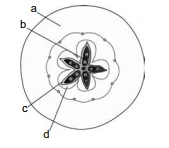
Examine the figure given below and select the right option identifying all the four parts $a, b, c$ and $d$.
A
$a$: Thalamus,$b$: Seed,$c$: Endocarp,$d$: Mesocarp
B
$a$: Thalamus,$b$: Seed,$c$: Mesocarp,$d$: Endocarp
C
$a$: Mesocarp,$b$: Seed,$c$: Endocarp,$d$: Thalamus
D
$a$: Endocarp,$b$: Seed,$c$: Thalamus,$d$: Mesocarp
Solution
(A) The given figure represents a cross-section of an apple,which is a false fruit.
In an apple,the fleshy edible part is derived from the thalamus $(a)$.
The central part contains the seeds $(b)$.
The pericarp is differentiated into the inner endocarp $(c)$ and the fleshy mesocarp $(d)$.
Therefore,the correct identification is $a$: Thalamus,$b$: Seed,$c$: Endocarp,$d$: Mesocarp.
In an apple,the fleshy edible part is derived from the thalamus $(a)$.
The central part contains the seeds $(b)$.
The pericarp is differentiated into the inner endocarp $(c)$ and the fleshy mesocarp $(d)$.
Therefore,the correct identification is $a$: Thalamus,$b$: Seed,$c$: Endocarp,$d$: Mesocarp.
0 likes
View SolutionSexual Reproduction in Flowering Plants — Seed and Fruit · Frequently Asked Questions
1Are these Sexual Reproduction in Flowering Plants questions useful for JEE and NEET?
Yes. All questions in this section are mapped to JEE Main and NEET exam patterns. Previous year questions from JEE Main, NEET, GUJCET and state-level exams are included with full solutions.
2Can I switch to Hindi or Gujarati for these questions?
Yes. Use the language tabs in the hero section or the sidebar to view the same questions and solutions in English, Hindi or Gujarati.
3How do I generate a question paper from this subtopic?
Use the Vedclass Exam Paper Generator — select the chapter and subtopic, set difficulty, and generate Sets A, B, C, D automatically. First 3 chapters of every subject are free.
Vedclass Products
For Students
Vedclass Test Series
Mock tests in real JEE/NEET style with performance analysis. 5-day free trial.
Start Free TrialFor Teachers
Exam Paper Generator
Generate Set A/B/C/D papers from this chapter in 2 minutes. 3 chapters free.
Try FreeFor Institutes
Online Exam Module
Live online exams with unlimited students, 360° analytics & white-label branding.
See DemoFor Teachers & Institutes
Generate a Sexual Reproduction in Flowering Plants Exam Paper in 2 Minutes
Select subtopic & difficulty — Sets A, B, C, D auto-generated with No Repeat logic.
First 3 chapters of every subject are free — no payment required.