
A English
Seed and Fruit Questions in English
Class 12 Biology · Sexual Reproduction in Flowering Plants · Seed and Fruit
237+
Questions
English
Language
100%
With Solutions
Showing 37 of 237 questions in English
201
Medium
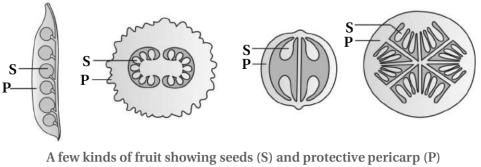
Describe the post-fertilisation changes in a flower.
Solution
(N/A) Fertilisation is the process of the fusion of male and female gametes to form a diploid zygote. After fertilisation,the following changes occur in a flower:
$1$. The zygote is formed inside the ovule and develops into the embryo.
$2$. The ovules develop into the seeds.
$3$. The ovary develops into the fruit.
$4$. The ovary wall is transformed into a protective layer called the pericarp.
$1$. The zygote is formed inside the ovule and develops into the embryo.
$2$. The ovules develop into the seeds.
$3$. The ovary develops into the fruit.
$4$. The ovary wall is transformed into a protective layer called the pericarp.
0 likes
View Solution202
MediumMCQ
Which part of the fruit,labelled in the given figure,makes it a false fruit?
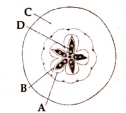
A
$B \rightarrow$ Endocarp
B
$C \rightarrow$ Thalamus
C
$D \rightarrow$ Seed
D
$A \rightarrow$ Mesocarp
Solution
(B) false fruit is a fruit in which some part of the plant other than the ovary contributes to the formation of the fruit.
In the given figure,which represents an apple,the edible part is the fleshy thalamus.
Label $C$ points to the thalamus,which develops into the fleshy part of the fruit,making it a false fruit.
Therefore,the correct option is $B$.
In the given figure,which represents an apple,the edible part is the fleshy thalamus.
Label $C$ points to the thalamus,which develops into the fleshy part of the fruit,making it a false fruit.
Therefore,the correct option is $B$.
0 likes
View Solution203
MediumMCQ
The megasporangium transforms into a/an ...... .
A
Seed
B
Fruit
C
Pericarp
D
Seed coat
Solution
(A) In the life cycle of seed-bearing plants (Gymnosperms and Angiosperms),the megasporangium is also known as the ovule.
After the process of fertilization,the ovule undergoes developmental changes and matures into a seed.
Therefore,the megasporangium transforms into a seed.
After the process of fertilization,the ovule undergoes developmental changes and matures into a seed.
Therefore,the megasporangium transforms into a seed.
0 likes
View Solution204
MediumMCQ
Fruit is developed from which of the following?
A
Ovule
B
Ovary
C
Anther
D
Stigma
Solution
(B) In flowering plants,after fertilization,the ovary matures into a fruit,while the ovules develop into seeds. Therefore,the fruit is derived from the ovary.
0 likes
View Solution205
MediumMCQ
The formation of fruit without fertilization is known as:
A
True fruit
B
False fruit
C
Parthenocarpic fruit
D
All of the above
Solution
(C) The process of fruit development without fertilization is called $Parthenocarpy$.
Fruits formed through this process are known as $Parthenocarpic$ $fruits$.
These fruits are typically seedless,such as bananas.
$True$ $fruits$ develop from the ovary after fertilization,while $False$ $fruits$ develop from other floral parts like the thalamus.
Fruits formed through this process are known as $Parthenocarpic$ $fruits$.
These fruits are typically seedless,such as bananas.
$True$ $fruits$ develop from the ovary after fertilization,while $False$ $fruits$ develop from other floral parts like the thalamus.
0 likes
View Solution206
MediumMCQ
Select the correct option regarding the classification of seeds based on the presence or absence of endosperm.
A
Non-endospermic seeds: Bean,Gram,Pea,Orchid; Endospermic seeds: Castor,Maize
B
Non-endospermic seeds: Castor,Maize; Endospermic seeds: Bean,Gram,Pea,Orchid
C
Non-endospermic seeds: Bean,Gram,Pea,Maize; Endospermic seeds: Castor,Orchid
D
Non-endospermic seeds: Castor,Orchid; Endospermic seeds: Bean,Gram,Pea,Orchid
Solution
(A) Seeds are classified into two types based on the presence or absence of endosperm:
$1$. Non-endospermic (Exalbuminous) seeds: In these seeds,the endosperm is completely consumed by the developing embryo during seed maturation. Examples include Bean,Gram,Pea,and Orchid.
$2$. Endospermic (Albuminous) seeds: In these seeds,a part of the endosperm is retained in the mature seed. Examples include Castor,Maize,Wheat,and Sunflower.
Therefore,the correct classification is: Non-endospermic seeds (Bean,Gram,Pea,Orchid) and Endospermic seeds (Castor,Maize).
$1$. Non-endospermic (Exalbuminous) seeds: In these seeds,the endosperm is completely consumed by the developing embryo during seed maturation. Examples include Bean,Gram,Pea,and Orchid.
$2$. Endospermic (Albuminous) seeds: In these seeds,a part of the endosperm is retained in the mature seed. Examples include Castor,Maize,Wheat,and Sunflower.
Therefore,the correct classification is: Non-endospermic seeds (Bean,Gram,Pea,Orchid) and Endospermic seeds (Castor,Maize).
0 likes
View Solution207
EasyMCQ
The development of the zygote takes place outside the body of the female.
A
External fertilization
B
Oviparous
C
Viviparous
D
Internal fertilization
Solution
(B) In many organisms,especially those that lay eggs (oviparous),the development of the zygote occurs outside the female body.
In oviparous animals like reptiles and birds,the fertilized eggs are covered by hard calcareous shells and are laid in a safe place in the environment.
After a period of incubation,young ones hatch out.
In contrast,in viviparous animals,the zygote develops into a young one inside the female body.
In oviparous animals like reptiles and birds,the fertilized eggs are covered by hard calcareous shells and are laid in a safe place in the environment.
After a period of incubation,young ones hatch out.
In contrast,in viviparous animals,the zygote develops into a young one inside the female body.
0 likes
View Solution208
MediumMCQ
Given the list: $I -$ Castor,$II -$ Coconut,$III -$ Wheat,$IV -$ Rice,$V -$ Maize,$VI -$ Groundnut,$VII -$ Bean,$VIII -$ Pea. Categorize these into albuminous (endospermic) and ex-albuminous (non-endospermic) seeds.
Albuminous seeds $\quad\quad$ Ex-albuminous seeds
Albuminous seeds $\quad\quad$ Ex-albuminous seeds
A
$I, II, III, IV, V \quad\quad VI, VII, VIII$
B
$VI, VII, VIII \quad\quad I, II, III, IV, V$
C
$I, II, VI, VII, VIII \quad\quad III, IV, V$
D
$III, IV, V \quad\quad I, II, VI, VII, VIII$
Solution
(A) Albuminous (endospermic) seeds are those in which the endosperm is retained in the mature seed to provide nourishment to the developing embryo.
Examples from the list include: Castor $(I)$,Coconut $(II)$,Wheat $(III)$,Rice $(IV)$,and Maize $(V)$.
Ex-albuminous (non-endospermic) seeds are those in which the endosperm is completely consumed by the developing embryo before seed maturation.
Examples from the list include: Groundnut $(VI)$,Bean $(VII)$,and Pea $(VIII)$.
Therefore,the correct classification is: Albuminous seeds $(I, II, III, IV, V)$ and Ex-albuminous seeds $(VI, VII, VIII)$.
Examples from the list include: Castor $(I)$,Coconut $(II)$,Wheat $(III)$,Rice $(IV)$,and Maize $(V)$.
Ex-albuminous (non-endospermic) seeds are those in which the endosperm is completely consumed by the developing embryo before seed maturation.
Examples from the list include: Groundnut $(VI)$,Bean $(VII)$,and Pea $(VIII)$.
Therefore,the correct classification is: Albuminous seeds $(I, II, III, IV, V)$ and Ex-albuminous seeds $(VI, VII, VIII)$.
0 likes
View Solution209
MediumMCQ
$A$ seed is defined as $...$
A
$A$ fertilized ovule
B
$A$ fertilized ovary
C
$A$ fertilized embryo sac
D
$A$ fertilized egg cell
Solution
(A) In angiosperms,after the process of double fertilization,the ovule undergoes significant developmental changes to become a seed.
$1$. The zygote develops into an embryo.
$2$. The primary endosperm nucleus develops into the endosperm.
$3$. The integuments of the ovule harden to form the seed coat.
Therefore,a seed is essentially a matured or fertilized ovule.
$1$. The zygote develops into an embryo.
$2$. The primary endosperm nucleus develops into the endosperm.
$3$. The integuments of the ovule harden to form the seed coat.
Therefore,a seed is essentially a matured or fertilized ovule.
0 likes
View Solution210
MediumMCQ
In black pepper and beet, a part of the nucellus remains unused. What is this persistent nucellus called?
A
Endosperm
B
Embryo
C
Perisperm
D
Integument
Solution
(C) In most flowering plants, the nucellus is completely consumed by the developing embryo. However, in some species like black pepper $(Piper \text{ } nigrum)$ and beet $(Beta \text{ } vulgaris)$, a portion of the nucellus remains persistent in the seed. This residual, persistent nucellus is known as the perisperm.
0 likes
View Solution211
MediumMCQ
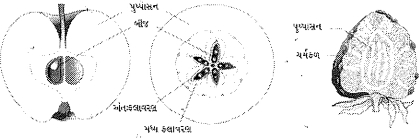
Identify the type of fruit shown in the image.
A
Parthenocarpic fruit
B
True fruit
C
False fruit
D
Both $A$ and $C$
Solution
(C) The image shows an apple and a strawberry. In these fruits,the thalamus (floral part) contributes to fruit formation along with the ovary. Such fruits are known as false fruits or pseudocarps. Therefore,the correct option is $C$.
0 likes
View Solution212
EasyMCQ
Which of the following are examples of false fruits?
A
Cashew
B
Strawberry
C
Apple
D
All of the above
Solution
(D) false fruit (or pseudocarp) is a fruit derived from parts of the flower other than the ovary,such as the thalamus or receptacle.
In apples,strawberries,and cashews,the thalamus contributes to fruit formation.
Therefore,all the given options are examples of false fruits.
In apples,strawberries,and cashews,the thalamus contributes to fruit formation.
Therefore,all the given options are examples of false fruits.
0 likes
View Solution213
EasyMCQ
What is a fruit called if it develops without fertilization?
A
True fruit
B
False fruit
C
Parthenocarpic fruit
D
All of the above
Solution
(C) fruit that develops from the ovary without the process of fertilization is known as a $Parthenocarpic$ fruit.
In this process,the ovary transforms into a fruit without the formation of seeds.
Examples include bananas and grapes.
Therefore,the correct option is $C$.
In this process,the ovary transforms into a fruit without the formation of seeds.
Examples include bananas and grapes.
Therefore,the correct option is $C$.
0 likes
View Solution214
MediumMCQ
Which is the oldest seed known?
A
Lupinus arcticus
B
Phoenix dactylifera
C
Cocos nucifera
D
Bambusa
Solution
(A) The oldest viable seed known is $Lupinus arcticus$ (Arctic lupine). It was excavated from Arctic tundra and germinated after an estimated dormancy period of $10,000$ years. In contrast,the seed of $Phoenix dactylifera$ (date palm) is known for its viability of $2,000$ years,discovered during the archaeological excavation of King Herod's palace near the Dead Sea.
0 likes
View Solution215
MediumMCQ
$A$ viable seed of date palm $(Phoenix dactylifera)$ was discovered at the King Herod's palace near the Dead Sea. How many years old was this viable seed?
A
$1000$
B
$10000$
C
$2000$
D
$200$
Solution
(C) The date palm $(Phoenix dactylifera)$ seed discovered at the King Herod's palace near the Dead Sea is estimated to be approximately $2000$ years old.
This seed remained viable despite its extreme age, which is a remarkable example of seed longevity in plants.
This seed remained viable despite its extreme age, which is a remarkable example of seed longevity in plants.
0 likes
View Solution216
MediumMCQ
The residual persistent part which forms the perisperm in the seeds of beet is:
A
Calyx
B
Endosperm
C
Nucellus
D
Integument
Solution
(C) In most flowering plants,the nucellus is completely consumed during the development of the embryo.
However,in some seeds such as beet and black pepper,a part of the nucellus remains persistent.
This residual,persistent nucellus is known as the perisperm.
However,in some seeds such as beet and black pepper,a part of the nucellus remains persistent.
This residual,persistent nucellus is known as the perisperm.
0 likes
View Solution217
MediumMCQ
Match List-$I$ with List-$II$.
Choose the option with all correct matches.
| List-$I$ | List-$II$ |
| $A.$ Scutellum | $I.$ Persistent nucellus |
| $B.$ Non-albuminous seed | $II.$ Cotyledon of Monocot seed |
| $C.$ Epiblast | $III.$ Groundnut |
| $D.$ Perisperm | $IV.$ Rudimentary cotyledon |
A
$A-II, B-III, C-IV, D-I$
B
$A-IV, B-III, C-II, D-I$
C
$A-IV, B-III, C-I, D-II$
D
$A-II, B-IV, C-III, D-I$
Solution
(A) The correct matches are as follows:
$A.$ Scutellum is the single large cotyledon of a monocot seed, which is shield-shaped. Thus, $A-II$.
$B.$ Non-albuminous seeds (ex-albuminous) are those in which the endosperm is completely consumed during embryo development, such as in groundnut or pea. Thus, $B-III$.
$C.$ Epiblast is a small, rudimentary, scale-like structure found in some monocot embryos (like grasses) opposite to the scutellum. Thus, $C-IV$.
$D.$ Perisperm is the persistent, remnant nucellus found in some seeds like black pepper and beet. Thus, $D-I$.
Therefore, the correct sequence is $A-II, B-III, C-IV, D-I$.
$A.$ Scutellum is the single large cotyledon of a monocot seed, which is shield-shaped. Thus, $A-II$.
$B.$ Non-albuminous seeds (ex-albuminous) are those in which the endosperm is completely consumed during embryo development, such as in groundnut or pea. Thus, $B-III$.
$C.$ Epiblast is a small, rudimentary, scale-like structure found in some monocot embryos (like grasses) opposite to the scutellum. Thus, $C-IV$.
$D.$ Perisperm is the persistent, remnant nucellus found in some seeds like black pepper and beet. Thus, $D-I$.
Therefore, the correct sequence is $A-II, B-III, C-IV, D-I$.
0 likes
View Solution218
EasyMCQ
Which of the following is a non-endospermic seed?
A
Rice
B
Orchid
C
Maize
D
Wheat
Solution
(B) Seeds are classified into two types based on the presence or absence of endosperm: endospermic (albuminous) and non-endospermic (exalbuminous).
In non-endospermic seeds,the endosperm is completely consumed by the developing embryo during seed maturation.
Examples of non-endospermic seeds include pea,bean,groundnut,and orchid.
In contrast,rice,maize,and wheat are examples of endospermic seeds where the endosperm persists in the mature seed to provide nourishment during germination.
Therefore,among the given options,orchid is a non-endospermic seed.
In non-endospermic seeds,the endosperm is completely consumed by the developing embryo during seed maturation.
Examples of non-endospermic seeds include pea,bean,groundnut,and orchid.
In contrast,rice,maize,and wheat are examples of endospermic seeds where the endosperm persists in the mature seed to provide nourishment during germination.
Therefore,among the given options,orchid is a non-endospermic seed.
0 likes
View Solution219
MediumMCQ
Perisperm is $-$
A
Outer part of embryo sac
B
Remains of Endosperm
C
Remains of nucellus
D
Degenerated synergids
Solution
(C) In some seeds,such as black pepper and beet,the nucellus is not completely consumed during the development of the embryo.
This persistent,residual,diploid $(2n)$ nucellus is known as the perisperm.
Therefore,perisperm is the remains of the nucellus.
This persistent,residual,diploid $(2n)$ nucellus is known as the perisperm.
Therefore,perisperm is the remains of the nucellus.
0 likes
View Solution220
EasyMCQ
Perisperm is $:-$
A
Fossil of haustoria
B
Ovary wall
C
Ovule coat
D
Persistent nucellus in seed
Solution
(D) In most flowering plants,the nucellus is consumed during the development of the embryo. However,in some seeds such as black pepper and beet,a portion of the nucellus remains as a nutritive tissue. This residual,persistent nucellus is known as the perisperm.
0 likes
View Solution221
MediumMCQ
Each fruit contains thousands of tiny seeds in parasitic plants such as:
A
Striga and orchids
B
Phoenix dactylifera
C
Orchids and Orobanche
D
Orobanche and Striga
Solution
(D) In the plant kingdom,some parasitic plants like $Orobanche$ and $Striga$ produce a large number of tiny seeds within each fruit. This is an adaptation to ensure the survival of the species,as these seeds have a very low probability of finding a suitable host plant to germinate and establish themselves. Orchids also produce thousands of tiny seeds,but they are not parasitic. Therefore,the correct pair of parasitic plants mentioned in the context of having thousands of tiny seeds is $Orobanche$ and $Striga$.
0 likes
View Solution222
MediumMCQ
Statement-$I$: Seeds generate new genetic combinations leading to variations.
Statement-$II$: Seeds are the product of sexual reproduction.
Statement-$II$: Seeds are the product of sexual reproduction.
A
Statement $I$ & $II$ both are correct.
B
Statement $I$ & $II$ both are incorrect.
C
Only statement $I$ is correct.
D
Only statement $II$ is correct.
Solution
(A) Statement-$I$ is correct because seeds are formed through the fusion of male and female gametes during sexual reproduction,which involves meiosis and recombination,leading to new genetic combinations and variations in the offspring.
Statement-$II$ is correct because seeds are the final product of sexual reproduction in flowering plants,resulting from the fertilization of an ovule by a pollen grain.
Statement-$II$ is correct because seeds are the final product of sexual reproduction in flowering plants,resulting from the fertilization of an ovule by a pollen grain.
0 likes
View Solution223
EasyMCQ
The seed of $Lupinus \text{ } arcticus$ excavated from Arctic Tundra, germinated and flowered after an estimated record of dormancy of how many years (in $years$)?
A
$1000$
B
$100$
C
$2000$
D
$10000$
Solution
(D) The seed of $Lupinus \text{ } arcticus$ (Arctic lupine) was found in the Arctic Tundra.
It is a well-documented example of extreme seed dormancy in plants.
This seed germinated and flowered after an estimated dormancy period of $10000$ years.
Therefore, the correct option is $D$.
It is a well-documented example of extreme seed dormancy in plants.
This seed germinated and flowered after an estimated dormancy period of $10000$ years.
Therefore, the correct option is $D$.
0 likes
View Solution224
MediumMCQ
Micropyle in seed helps in the entry of $:-$
A
Pollen tube
B
Male gametes
C
Water
D
Male gametes and vegetative nucleus
Solution
(C) The micropyle is a small pore present in the seed coat. During seed germination,the micropyle facilitates the entry of water and oxygen into the seed. This water absorption is essential for the activation of metabolic processes and the emergence of the radicle. While the micropyle serves as the entry point for the pollen tube during fertilization in the ovule,in the context of a mature seed,its primary function is the imbibition of water.
0 likes
View Solution225
EasyMCQ
The protective sheath of the radicle in a monocot seed is . . . . . . .
A
coleoptile
B
coleorhiza
C
scutellum
D
perisperm
Solution
(B) In monocot seeds,the plumule is enclosed in a protective sheath called the coleoptile,while the radicle is enclosed in an undifferentiated protective sheath known as the coleorhiza.
0 likes
View Solution226
EasyMCQ
Which one of the following statements is $INCORRECT$ about angiospermic seed/fruit?
A
The micropyle of the ovule persists in the seed.
B
Coconut is a non-endospermic seed.
C
Coconut is a fleshy fruit.
D
Fruit development is triggered by hormones produced by developing seeds.
Solution
(B) The correct answer is $B$. Coconut is an endospermic (albuminous) seed,meaning it retains endosperm at maturity. Therefore,the statement that 'Coconut is a non-endospermic seed' is incorrect. The micropyle often persists as a small pore in the seed coat. Fruit development is indeed stimulated by hormones like auxins and gibberellins produced by the developing seeds.
0 likes
View Solution227
EasyMCQ
In watermelon, the ovary after fertilization increases by about . . . . . . times in volume to form the fruit.
A
$50$
B
$50,000$
C
$3,00,000$
D
$3,50,000$
Solution
(C) In plants, the process of fertilization triggers significant growth in the ovary to develop into a fruit.
Specifically, in the case of watermelon $(Citrullus \text{ } lanatus)$, the ovary undergoes rapid cell division and expansion.
Scientific studies and textbook data indicate that the ovary of a watermelon increases in volume by approximately $3,00,000$ times after fertilization to reach its mature fruit size.
Therefore, the correct option is $C$.
Specifically, in the case of watermelon $(Citrullus \text{ } lanatus)$, the ovary undergoes rapid cell division and expansion.
Scientific studies and textbook data indicate that the ovary of a watermelon increases in volume by approximately $3,00,000$ times after fertilization to reach its mature fruit size.
Therefore, the correct option is $C$.
0 likes
View Solution228
EasyMCQ
The entry of oxygen and water into the seed during germination is facilitated by . . . . . . .
A
Integuments
B
Micropyle
C
Seed coat
D
Hilum
Solution
(B) During seed germination,the $Micropyle$ is a small pore present on the seed coat. It serves as the entry point for water and oxygen,which are essential for the metabolic activities of the embryo to resume growth. Therefore,the correct option is $B$.
0 likes
View Solution229
EasyMCQ
. . . . . . is an example of a parthenocarpic fruit.
A
Banana
B
Mango
C
Apple
D
Ground-nut
Solution
(A) Parthenocarpy is the development of fruit without fertilization. In such fruits, the ovary develops into a fruit without the formation of seeds. $Banana$ is a classic example of a naturally occurring parthenocarpic fruit, as it is seedless and develops without fertilization.
0 likes
View Solution230
EasyMCQ
Which plant seeds possess perisperm?
A
Black pepper,maize
B
Maize,beet
C
Black pepper,beet
D
Wheat,black pepper
Solution
(C) In some seeds, such as black pepper $(Piper \text{ } nigrum)$ and beet $(Beta \text{ } vulgaris)$, the nucellus is not completely consumed during the development of the embryo. The persistent, residual nucellus is known as the perisperm. Therefore, the correct answer is black pepper and beet.
0 likes
View Solution231
EasyMCQ
In which of the following,thalamus contributes to fruit formation?
A
Mango
B
Sapota
C
Strawberry
D
Orange
Solution
(C) In most plants,the fruit develops only from the ovary,and other floral parts degenerate and fall off. Such fruits are called true fruits. However,in some species like apple,strawberry,and cashew,the thalamus also contributes to fruit formation. Such fruits are called false fruits or accessory fruits. Therefore,the correct answer is $C$ (Strawberry).
0 likes
View Solution232
EasyMCQ
Residual persistent nucellus in seed is called . . . . . .
A
Perisperm
B
Pericarp
C
Coleorrhiza
D
Coleoptile
Solution
(A) The residual,persistent nucellus in a seed is known as $Perisperm$.
In some seeds,such as those of black pepper and beet,the nucellus is not completely consumed during the development of the embryo and remains as a nutritive tissue surrounding the embryo.
$Pericarp$ is the wall of the fruit developed from the ovary wall.
$Coleorrhiza$ and $Coleoptile$ are protective sheaths found in monocot embryos.
In some seeds,such as those of black pepper and beet,the nucellus is not completely consumed during the development of the embryo and remains as a nutritive tissue surrounding the embryo.
$Pericarp$ is the wall of the fruit developed from the ovary wall.
$Coleorrhiza$ and $Coleoptile$ are protective sheaths found in monocot embryos.
0 likes
View Solution233
EasyMCQ
In plants,the ovule is transformed into which of the following structures after fertilization?
A
Endosperm
B
Seed
C
Embryo
D
Fruit
Solution
(B) After fertilization in angiosperms,the ovule undergoes significant developmental changes. The integuments of the ovule harden to form the seed coat,and the entire ovule matures into a seed. Meanwhile,the ovary develops into the fruit.
0 likes
View Solution234
EasyMCQ
Which of the following is a $2000$ year old viable seed discovered during the archaeological excavation at King Herod's palace near the Dead Sea?
A
Maize
B
Sunflower
C
Lupin
D
Phoenix dactylifera
Solution
(D) The correct answer is $D$.
$Phoenix \ dactylifera$ (Date Palm) is the plant whose seeds were found to be viable after $2000$ years.
These seeds were discovered during an archaeological excavation at King Herod's palace near the Dead Sea.
$Phoenix \ dactylifera$ (Date Palm) is the plant whose seeds were found to be viable after $2000$ years.
These seeds were discovered during an archaeological excavation at King Herod's palace near the Dead Sea.
0 likes
View Solution235
EasyMCQ
Testa and tegmen of the seed coat represent
A
dried integuments
B
dried sepals
C
dried tepals
D
dried petals
Solution
(A) The seed coat is the outermost protective covering of a seed.
It is derived from the integuments of the ovule after fertilization.
The outer layer is known as the $Testa$,which develops from the outer integument.
The inner layer is known as the $Tegmen$,which develops from the inner integument.
Therefore,both $Testa$ and $Tegmen$ represent the dried integuments of the ovule.
It is derived from the integuments of the ovule after fertilization.
The outer layer is known as the $Testa$,which develops from the outer integument.
The inner layer is known as the $Tegmen$,which develops from the inner integument.
Therefore,both $Testa$ and $Tegmen$ represent the dried integuments of the ovule.
0 likes
View Solution236
EasyMCQ
The $2000$ year old seed excavated from King Herod's palace at the Dead Sea belongs to:
A
Dendrocalamus strictus
B
Lupinus arcticus
C
Phoenix dactylifera
D
Strobilanthes kunthiana
Solution
(C) $Phoenix$ $dactylifera$.
$A$ recent record of a $2000$ year old viable seed is that of the date palm,$Phoenix$ $dactylifera$,which was discovered during the archaeological excavation at King Herod's palace near the Dead Sea.
$A$ recent record of a $2000$ year old viable seed is that of the date palm,$Phoenix$ $dactylifera$,which was discovered during the archaeological excavation at King Herod's palace near the Dead Sea.
0 likes
View Solution237
MediumMCQ
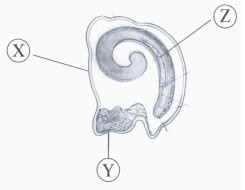
Identify '$X$','$Y$',and '$Z$' from the given diagram.
A
$X$ - Pericarp : $Y$ - Endosperm : $Z$ - Scutellum
B
$X$ - Pericarp : $Y$ - Root tip : $Z$ - Endosperm
C
$X$ - Seed coat : $Y$ - Endosperm : $Z$ - Cotyledon
D
$X$ - Seed coat : $Y$ - Cotyledon : $Z$ - Endosperm
Solution
(A) The provided diagram represents the structure of a monocot seed (specifically a maize grain).
$1$. '$X$' points to the outermost layer,which is the Pericarp (fused with the seed coat).
$2$. '$Y$' points to the large,nutrient-rich storage tissue known as the Endosperm.
$3$. '$Z$' points to the shield-shaped cotyledon,which is characteristic of monocots and is called the Scutellum.
Therefore,the correct identification is $X$ - Pericarp,$Y$ - Endosperm,and $Z$ - Scutellum.
$1$. '$X$' points to the outermost layer,which is the Pericarp (fused with the seed coat).
$2$. '$Y$' points to the large,nutrient-rich storage tissue known as the Endosperm.
$3$. '$Z$' points to the shield-shaped cotyledon,which is characteristic of monocots and is called the Scutellum.
Therefore,the correct identification is $X$ - Pericarp,$Y$ - Endosperm,and $Z$ - Scutellum.
0 likes
View SolutionSexual Reproduction in Flowering Plants — Seed and Fruit · Frequently Asked Questions
1Are these Sexual Reproduction in Flowering Plants questions useful for JEE and NEET?
Yes. All questions in this section are mapped to JEE Main and NEET exam patterns. Previous year questions from JEE Main, NEET, GUJCET and state-level exams are included with full solutions.
2Can I switch to Hindi or Gujarati for these questions?
Yes. Use the language tabs in the hero section or the sidebar to view the same questions and solutions in English, Hindi or Gujarati.
3How do I generate a question paper from this subtopic?
Use the Vedclass Exam Paper Generator — select the chapter and subtopic, set difficulty, and generate Sets A, B, C, D automatically. First 3 chapters of every subject are free.
Vedclass Products
For Students
Vedclass Test Series
Mock tests in real JEE/NEET style with performance analysis. 5-day free trial.
Start Free TrialFor Teachers
Exam Paper Generator
Generate Set A/B/C/D papers from this chapter in 2 minutes. 3 chapters free.
Try FreeFor Institutes
Online Exam Module
Live online exams with unlimited students, 360° analytics & white-label branding.
See DemoFor Teachers & Institutes
Generate a Sexual Reproduction in Flowering Plants Exam Paper in 2 Minutes
Select subtopic & difficulty — Sets A, B, C, D auto-generated with No Repeat logic.
First 3 chapters of every subject are free — no payment required.