
A English
Seed and Fruit Questions in English
Class 12 Biology · Sexual Reproduction in Flowering Plants · Seed and Fruit
237+
Questions
English
Language
100%
With Solutions
Showing 48 of 237 questions in English
101
MediumMCQ
The viability of seeds is tested by
A
$2, 6$-dichlorophenol indophenol
B
$2, 3, 5$-triphenyl tetrazolium chloride
C
$DMSO$
D
Safranine
Solution
(B) The correct answer is $B$.
Viability of seeds can be determined by two primary methods: $(i)$ testing the ability to germinate,and $(ii)$ testing the ability to respire.
All living,viable seeds perform respiration.
This metabolic activity can be tested by immersing a section of the seed containing the embryo in a $0.1\%$ solution of $2, 3, 5$-triphenyl tetrazolium chloride.
In viable seeds,the dehydrogenase enzymes present in the living embryo reduce the colourless triphenyl tetrazolium chloride into an insoluble red-coloured dye called triphenyl formazan.
Therefore,the embryo turns pink or red,indicating that the seed is viable.
Viability of seeds can be determined by two primary methods: $(i)$ testing the ability to germinate,and $(ii)$ testing the ability to respire.
All living,viable seeds perform respiration.
This metabolic activity can be tested by immersing a section of the seed containing the embryo in a $0.1\%$ solution of $2, 3, 5$-triphenyl tetrazolium chloride.
In viable seeds,the dehydrogenase enzymes present in the living embryo reduce the colourless triphenyl tetrazolium chloride into an insoluble red-coloured dye called triphenyl formazan.
Therefore,the embryo turns pink or red,indicating that the seed is viable.
0 likes
View Solution102
MediumMCQ
The oldest seed is of which of the following plants?
A
Lupinus arcticus
B
Orobanche
C
Mango
D
Coconut
Solution
(A) The oldest viable seed is of $Lupinus arcticus$ (Arctic lupine).
It was excavated from Arctic Tundra.
This seed germinated and flowered after an estimated record of $10,000$ years of dormancy.
It was excavated from Arctic Tundra.
This seed germinated and flowered after an estimated record of $10,000$ years of dormancy.
0 likes
View Solution103
EasyMCQ
Identify the false fruit.
A
Cashew
B
Apple
C
Strawberry
D
All of the above
Solution
(D) false fruit (or accessory fruit) is a fruit in which some of the flesh is derived not from the ovary,but from some adjacent tissue such as the receptacle or floral parts.
In plants like apple,strawberry,and cashew,the thalamus contributes to fruit formation.
Therefore,all the given options are examples of false fruits.
In plants like apple,strawberry,and cashew,the thalamus contributes to fruit formation.
Therefore,all the given options are examples of false fruits.
0 likes
View Solution104
MediumMCQ
$Phoenix$ $dactylifera$ was discovered during the archaeological excavation at King Herod's palace near the:
A
$Phoenix$ $dactylifera$,Srilankan sea
B
$Phoenix$ $dactylifera$,Dead Sea
C
$Lupinus$ $arcticus$,Arctic Tundra
D
$Lupinus$ $arcticus$,Dead Sea
Solution
(B) The seed of $Phoenix$ $dactylifera$ (date palm) was discovered during the archaeological excavation at King Herod's palace near the Dead Sea.
This seed is known for its extreme longevity,remaining viable for approximately $2,000$ years.
In contrast,$Lupinus$ $arcticus$ seeds were excavated from the Arctic Tundra and are known to have germinated after $10,000$ years of dormancy.
This seed is known for its extreme longevity,remaining viable for approximately $2,000$ years.
In contrast,$Lupinus$ $arcticus$ seeds were excavated from the Arctic Tundra and are known to have germinated after $10,000$ years of dormancy.
1 likes
View Solution105
EasyMCQ
What is a parthenocarpic fruit?
A
Banana
B
Apple
C
Mango
D
All of the above
Solution
(A) Parthenocarpy is the process of fruit development without fertilization.
Since fertilization does not occur,these fruits are typically seedless.
Banana is a classic example of a naturally occurring parthenocarpic fruit.
Apple is a false fruit (thalamus contributes to fruit formation),and Mango is a true fruit that develops after fertilization.
Therefore,the correct option is $A$.
Since fertilization does not occur,these fruits are typically seedless.
Banana is a classic example of a naturally occurring parthenocarpic fruit.
Apple is a false fruit (thalamus contributes to fruit formation),and Mango is a true fruit that develops after fertilization.
Therefore,the correct option is $A$.
0 likes
View Solution106
MediumMCQ
In which of the following seeds is the endosperm completely consumed by the developing embryo?
A
Castor and coconut
B
Pea and castor
C
Castor and pea
D
Groundnut and pea
Solution
(D) Seeds in which the endosperm is completely consumed by the developing embryo before seed maturation are called non-albuminous or ex-albuminous seeds.
Examples of such seeds include pea,groundnut,and beans.
In contrast,albuminous seeds (like castor and coconut) retain a part of the endosperm in the mature seed.
Therefore,the correct pair of seeds where the endosperm is completely consumed is groundnut and pea.
Examples of such seeds include pea,groundnut,and beans.
In contrast,albuminous seeds (like castor and coconut) retain a part of the endosperm in the mature seed.
Therefore,the correct pair of seeds where the endosperm is completely consumed is groundnut and pea.
0 likes
View Solution107
MediumMCQ
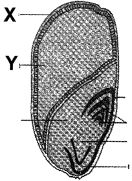
What is represented by $X$ and $Y$ in the given diagram?
A
$X$ - Plumule,$Y$ - Radicle
B
$X$ - Endosperm,$Y$ - Pericarp
C
$X$ - Coleoptile,$Y$ - Aleurone layer
D
$X$ - Seed coat + fruit wall,$Y$ - Endosperm
Solution
(D) The given diagram represents the structure of a maize grain,which is a monocot seed (caryopsis).
In a caryopsis,the seed coat is fused with the fruit wall (pericarp).
Label $X$ points to the outermost layer,which consists of the fused seed coat and fruit wall.
Label $Y$ points to the large,starchy storage tissue known as the endosperm.
In a caryopsis,the seed coat is fused with the fruit wall (pericarp).
Label $X$ points to the outermost layer,which consists of the fused seed coat and fruit wall.
Label $Y$ points to the large,starchy storage tissue known as the endosperm.
0 likes
View Solution108
MediumMCQ
In which seeds are remnants of the nucellus persistent? This residual persistent nucellus is known as the perisperm.
A
Pea
B
Legumes
C
Maize
D
Beet
Solution
(D) In most seeds,the nucellus is completely consumed during the development of the embryo. However,in some seeds such as black pepper and beet,remnants of the nucellus are persistent. This residual,persistent nucellus is called the perisperm.
0 likes
View Solution109
MediumMCQ
Identify the false pair:
A
Non-albuminous seed - Pea,Groundnut
B
Perisperm - Oats,Wheat
C
False fruit - Apple,Cashew
D
Dry fruit - Mustard,Groundnut
Solution
(B) $1$. Non-albuminous seeds are those in which the endosperm is completely consumed during embryo development (e.g.,Pea,Groundnut). This is a correct pair.
$2$. Perisperm is the remnant of the nucellus in a seed. It is found in seeds like Black pepper and Beet,not in Oats or Wheat (which are monocot seeds with endosperm). Thus,this is the false pair.
$3$. False fruits are those where the thalamus also contributes to fruit formation (e.g.,Apple,Strawberry,Cashew). This is a correct pair.
$4$. Dry fruits are those that do not become fleshy at maturity (e.g.,Mustard,Groundnut). This is a correct pair.
$2$. Perisperm is the remnant of the nucellus in a seed. It is found in seeds like Black pepper and Beet,not in Oats or Wheat (which are monocot seeds with endosperm). Thus,this is the false pair.
$3$. False fruits are those where the thalamus also contributes to fruit formation (e.g.,Apple,Strawberry,Cashew). This is a correct pair.
$4$. Dry fruits are those that do not become fleshy at maturity (e.g.,Mustard,Groundnut). This is a correct pair.
0 likes
View Solution110
MediumMCQ
In which of the following plants are the seeds found in thousands?
A
Phoenix dactylifera
B
Mango
C
Orchids
D
Carrot
Solution
(C) Orchids are well-known for producing a massive number of tiny seeds within a single fruit.
Each orchid fruit contains thousands of minute seeds, which is an adaptation for wind dispersal.
In contrast, plants like $Phoenix$ $dactylifera$ (date palm) and Mango typically produce a single seed per fruit.
Therefore, the correct answer is Orchids.
Each orchid fruit contains thousands of minute seeds, which is an adaptation for wind dispersal.
In contrast, plants like $Phoenix$ $dactylifera$ (date palm) and Mango typically produce a single seed per fruit.
Therefore, the correct answer is Orchids.
0 likes
View Solution111
MediumMCQ
After fertilization,the ovary transforms into......
A
Seed
B
Fruit
C
Inflorescence
D
Seed coat
Solution
(B) In flowering plants,after the process of fertilization,the ovules develop into seeds and the ovary matures to form the fruit.
This transformation is a characteristic feature of angiosperms,where the ovary wall develops into the pericarp (fruit wall) and the internal ovules become seeds.
This transformation is a characteristic feature of angiosperms,where the ovary wall develops into the pericarp (fruit wall) and the internal ovules become seeds.
0 likes
View Solution112
MediumMCQ
The ....... is a scar on the seed coat through which the developing seeds were attached to the fruit.
A
Hilum
B
Micropyle
C
Plumule
D
Aleurone layer
Solution
(A) The $Hilum$ is a scar on the seed coat through which the developing seeds were attached to the fruit.
It represents the point of attachment of the funicle to the seed body.
$Micropyle$ is a small pore above the $Hilum$ that facilitates the entry of water and oxygen during seed germination.
$Plumule$ is the embryonic shoot,and the $Aleurone$ layer is a protein-rich layer found in the endosperm of monocot seeds.
It represents the point of attachment of the funicle to the seed body.
$Micropyle$ is a small pore above the $Hilum$ that facilitates the entry of water and oxygen during seed germination.
$Plumule$ is the embryonic shoot,and the $Aleurone$ layer is a protein-rich layer found in the endosperm of monocot seeds.
0 likes
View Solution113
MediumMCQ
Which of the following is not found in the structure of a monocot seed?
A
Plumule,hilum,seed coat
B
Radicle,seed coat,micropyle
C
Aleurone layer,plumule,endosperm
D
Endosperm,two cotyledons,coleoptile
Solution
(D) monocot seed,such as maize,typically contains a single cotyledon (scutellum),a plumule,a radicle,a seed coat,a hilum,a micropyle,and an endosperm (often surrounded by an aleurone layer).
Option $D$ mentions 'two cotyledons',which is a characteristic feature of dicot seeds,not monocot seeds. Therefore,this structure is not found in a monocot seed.
Option $D$ mentions 'two cotyledons',which is a characteristic feature of dicot seeds,not monocot seeds. Therefore,this structure is not found in a monocot seed.
0 likes
View Solution114
MediumMCQ
In a dicot seed,which of the following is typically absent?
A
Cotyledons
B
Endosperm
C
Embryo axis
D
Seed coat
Solution
(B) In most mature dicot seeds (non-endospermic or exalbuminous seeds),the endosperm is consumed during the development of the embryo. Therefore,the food is stored in the cotyledons,and the endosperm is absent in the mature seed. Examples include pea,bean,and gram seeds.
0 likes
View Solution115
MediumMCQ
$A$: Fruit is a mature or ripened ovary,developed after fertilization.
$R$: If a fruit is formed without fertilization of the ovary,it is called a parthenocarpic fruit.
$R$: If a fruit is formed without fertilization of the ovary,it is called a parthenocarpic fruit.
A
$A$ and $R$ are both correct.
B
$A$ and $R$ are both incorrect.
C
$A$ is correct and $R$ is incorrect.
D
$A$ is incorrect and $R$ is correct.
Solution
(A) Assertion $(A)$: In flowering plants,the ovary matures into a fruit after the process of fertilization. This is a standard botanical definition.
Reason $(R)$: Parthenocarpy is the phenomenon where fruits develop without the process of fertilization. Such fruits are seedless. This is also a correct statement.
Since both statements are scientifically accurate,the correct option is $A$.
Reason $(R)$: Parthenocarpy is the phenomenon where fruits develop without the process of fertilization. Such fruits are seedless. This is also a correct statement.
Since both statements are scientifically accurate,the correct option is $A$.
0 likes
View Solution116
MediumMCQ
In groundnut, the source of oil is found in:
A
Embryo
B
Cotyledons
C
Endosperm
D
Nodule
Solution
(B) Groundnut $(Arachis \, hypogaea)$ is a dicotyledonous plant.
In dicot seeds, the food reserves are primarily stored in the cotyledons.
Since the endosperm is consumed during the development of the embryo, the mature seeds are non-endospermic (exalbuminous).
Therefore, the oil, which serves as a food reserve, is stored in the cotyledons of the groundnut seed.
In dicot seeds, the food reserves are primarily stored in the cotyledons.
Since the endosperm is consumed during the development of the embryo, the mature seeds are non-endospermic (exalbuminous).
Therefore, the oil, which serves as a food reserve, is stored in the cotyledons of the groundnut seed.
0 likes
View Solution117
MediumMCQ
Which of the following is a true fruit?
A
Apple
B
Pear
C
Cashew
D
Coconut
Solution
(D) true fruit is defined as a fruit that develops exclusively from the ovary of a flower after fertilization.
In contrast,false fruits (pseudocarps) develop from other floral parts such as the thalamus or receptacle in addition to the ovary.
$1$. Apple and Pear are false fruits because their fleshy part develops from the thalamus.
$2$. Cashew is also considered a false fruit as the peduncle (stalk) becomes fleshy.
$3$. Coconut is a true fruit (a drupe) that develops solely from the ovary.
In contrast,false fruits (pseudocarps) develop from other floral parts such as the thalamus or receptacle in addition to the ovary.
$1$. Apple and Pear are false fruits because their fleshy part develops from the thalamus.
$2$. Cashew is also considered a false fruit as the peduncle (stalk) becomes fleshy.
$3$. Coconut is a true fruit (a drupe) that develops solely from the ovary.
0 likes
View Solution118
EasyMCQ
The edible part of the litchi fruit is:
A
Mesocarp
B
Fleshy aril
C
Endocarp
D
Pericarp
Solution
(B) The edible part of the litchi $(Litchi chinensis)$ is the fleshy,succulent outgrowth that develops from the base of the ovule,which is known as the aril.
Therefore,the correct option is $B$.
Therefore,the correct option is $B$.
0 likes
View Solution119
MediumMCQ
Which of the following is an example of a seed that contains both endosperm and perisperm?
A
Coffee
B
Lotus
C
Castor
D
Cotton
Solution
(C) In some seeds,such as black pepper and beet,remnants of the nucellus are also persistent. This residual,persistent nucellus is called perisperm.
Castor ($Ricinus$ $communis$) is a seed that contains both endosperm (as it is an albuminous seed) and perisperm (remnants of nucellus).
Therefore,the correct option is $C$.
Castor ($Ricinus$ $communis$) is a seed that contains both endosperm (as it is an albuminous seed) and perisperm (remnants of nucellus).
Therefore,the correct option is $C$.
0 likes
View Solution120
EasyMCQ
The fleshy part of the fruit in $Cashew$ and $Litchi$ is known as:
A
Peduncle and Aril
B
Thalamus and Pericarp
C
Cotyledon and Endosperm
D
Mesocarp and Epicarp
Solution
(A) In $Cashew$ $(Anacardium \text{ } occidentale)$, the fleshy part is the swollen peduncle (also called the hypocarp).
In $Litchi$ $(Litchi \text{ } chinensis)$, the edible fleshy part is the succulent aril, which develops from the base of the ovule and covers the seed.
In $Litchi$ $(Litchi \text{ } chinensis)$, the edible fleshy part is the succulent aril, which develops from the base of the ovule and covers the seed.
0 likes
View Solution121
MediumMCQ
Non-albuminous seeds are produced in ..........
A
Maize
B
Castor
C
Wheat
D
Pea
Solution
(D) Non-albuminous seeds,also known as exalbuminous seeds,are those in which the endosperm is completely consumed by the developing embryo before the seed matures.
In these seeds,food is stored in the cotyledons.
Examples of non-albuminous seeds include pea,bean,and groundnut.
In contrast,maize,castor,and wheat are examples of albuminous (endospermic) seeds,where the endosperm persists in the mature seed.
Therefore,the correct option is $D$.
In these seeds,food is stored in the cotyledons.
Examples of non-albuminous seeds include pea,bean,and groundnut.
In contrast,maize,castor,and wheat are examples of albuminous (endospermic) seeds,where the endosperm persists in the mature seed.
Therefore,the correct option is $D$.
0 likes
View Solution122
MediumMCQ
Why is vivipary (germination of seeds while still attached to the parent plant) an undesirable trait for annual cereal crops?
A
It reduces the strength of the plant.
B
It adversely affects the productivity of the plant.
C
Seeds show prolonged dormancy.
D
Seeds cannot be stored in normal conditions for the next season.
Solution
(D) Vivipary is the phenomenon where seeds germinate while still attached to the parent plant. In annual cereal crops,if seeds germinate on the mother plant,they cannot be harvested,dried,and stored for the next season. This makes the seeds unsuitable for agricultural storage and future sowing,thereby negatively impacting the economic productivity and utility of the crop.
0 likes
View Solution123
MediumMCQ
The perisperm is a ..........
A
Haploid remnant
B
Diploid remnant
C
Haploid apomictic structure
D
Diploid apomictic structure
Solution
(B) In some seeds,such as black pepper and beet,remnants of the nucellus are persistent. This residual,persistent nucellus is known as the perisperm.
Since the nucellus is a part of the ovule and is composed of diploid maternal tissue $(2n)$,the perisperm is also diploid $(2n)$.
Since the nucellus is a part of the ovule and is composed of diploid maternal tissue $(2n)$,the perisperm is also diploid $(2n)$.
0 likes
View Solution124
MediumMCQ
In the seeds of $............$,the developing embryo consumes the endosperm.
A
Coconut
B
Castor
C
Pea
D
Maize
Solution
(C) In non-albuminous or exalbuminous seeds,the endosperm is completely consumed by the developing embryo during seed maturation.
Examples of such seeds include pea,bean,and groundnut.
In contrast,albuminous seeds like castor,coconut,and maize retain a portion of the endosperm in the mature seed.
Examples of such seeds include pea,bean,and groundnut.
In contrast,albuminous seeds like castor,coconut,and maize retain a portion of the endosperm in the mature seed.
0 likes
View Solution125
MediumMCQ
Which of the following is a parthenocarpic fruit?
A
Brinjal
B
Apple
C
Jackfruit
D
Banana
Solution
(D) Parthenocarpic fruits are fruits that develop without the process of fertilization.
In these fruits,the ovary develops into a fruit without being fertilized by pollen grains.
Banana is a classic example of a naturally occurring parthenocarpic fruit,as it is seedless and develops without fertilization.
In these fruits,the ovary develops into a fruit without being fertilized by pollen grains.
Banana is a classic example of a naturally occurring parthenocarpic fruit,as it is seedless and develops without fertilization.
0 likes
View Solution126
MediumMCQ
Which plant's economic value decreases if its fruits are produced by parthenocarpy?
A
Grapes
B
Pomegranate
C
Sweet lime
D
Banana
Solution
(B) Parthenocarpy is the development of fruit without fertilization,which results in seedless fruits.
For many fruits like grapes and bananas,seedlessness is a desirable trait that increases their economic value.
However,for fruits like pomegranates,the edible part is the juicy seed coat (aril).
If a pomegranate is produced via parthenocarpy,it will be seedless,meaning it will lack the edible arils,thereby significantly decreasing its economic value.
For many fruits like grapes and bananas,seedlessness is a desirable trait that increases their economic value.
However,for fruits like pomegranates,the edible part is the juicy seed coat (aril).
If a pomegranate is produced via parthenocarpy,it will be seedless,meaning it will lack the edible arils,thereby significantly decreasing its economic value.
0 likes
View Solution127
MediumMCQ
Why is vivipary an undesirable trait for annual crop plants?
A
It reduces the vigor of the plant.
B
Seeds cannot be stored for the next season under normal conditions.
C
Seeds show prolonged dormancy.
D
It adversely affects the fertility of the plant.
Solution
(B) Vivipary is a phenomenon where seeds germinate while still attached to the parent plant. In annual crop plants,this is highly undesirable because if seeds germinate on the mother plant,they cannot be harvested,dried,or stored for the next planting season. This makes the storage of seeds for agricultural purposes impossible,leading to a loss of the crop yield and the inability to preserve seeds for future use.
0 likes
View Solution128
EasyMCQ
Persistent nucellus in the seed is known as
A
Chalaza
B
Perisperm
C
Hilum
D
Tegmen
Solution
(B) In some seeds,such as black pepper and beet,remnants of the nucellus are persistent. This residual,persistent nucellus is known as the $Perisperm$.
0 likes
View Solution129
MediumMCQ
Assertion: Coconut tree is distributed in coastal areas over a large part of the world.
Reason: Coconut fruit can float and get dispersed over thousands of kilometers before losing viability.
Reason: Coconut fruit can float and get dispersed over thousands of kilometers before losing viability.
A
If both Assertion and Reason are correct and the Reason is a correct explanation of the Assertion.
B
If both Assertion and Reason are correct but Reason is not a correct explanation of the Assertion.
C
If the Assertion is correct but Reason is incorrect.
D
If both the Assertion and Reason are incorrect.
Solution
(A) The coconut fruit has a fibrous mesocarp that traps air,making it buoyant. This allows the fruit to float on seawater and travel long distances across oceans. Because the fruit is resistant to saltwater and remains viable for a long time,it can germinate after being washed ashore on distant coastal areas. Thus,the wide distribution of coconut trees in coastal regions is directly due to this mechanism of water dispersal (hydrochory). Therefore,both the Assertion and the Reason are correct,and the Reason is the correct explanation of the Assertion.
0 likes
View Solution130
MediumMCQ
Seeds are adaptively important because:
$1.$ they maintain dormancy
$2.$ they protect young plants during vulnerable stages
$3.$ they store food for young plants,and facilitate dispersal
$1.$ they maintain dormancy
$2.$ they protect young plants during vulnerable stages
$3.$ they store food for young plants,and facilitate dispersal
A
$1$ and $3$
B
$2$ and $3$
C
$1$ and $2$
D
All of these
Solution
(D) Seeds are highly adaptive structures for plants for the following reasons:
$1.$ They maintain dormancy,which allows seeds to survive unfavorable environmental conditions until favorable conditions return.
$2.$ The seed coat provides protection to the young embryo during its most vulnerable developmental stages.
$3.$ Seeds contain stored food (in the endosperm or cotyledons) that provides nourishment to the developing seedling until it can perform photosynthesis. Additionally,seeds possess various mechanisms that facilitate their dispersal to new habitats.
Therefore,all the given statements are correct.
$1.$ They maintain dormancy,which allows seeds to survive unfavorable environmental conditions until favorable conditions return.
$2.$ The seed coat provides protection to the young embryo during its most vulnerable developmental stages.
$3.$ Seeds contain stored food (in the endosperm or cotyledons) that provides nourishment to the developing seedling until it can perform photosynthesis. Additionally,seeds possess various mechanisms that facilitate their dispersal to new habitats.
Therefore,all the given statements are correct.
0 likes
View Solution131
EasyMCQ
The plant part which consists of two generations one within the other,is
A
germinated pollen grain
B
embryo
C
unfertilized ovule
D
seed
Solution
(D) The plant part which consists of two generations one within the other is the $seed$.
In a $seed$, the embryo represents the next generation (sporophyte), which is enclosed within the maternal tissues (seed coat and remains of the ovule) of the parent plant.
Specifically, the $seed$ contains the embryo (new generation) protected by the seed coat, which is derived from the integuments of the ovule (parental generation).
In a $seed$, the embryo represents the next generation (sporophyte), which is enclosed within the maternal tissues (seed coat and remains of the ovule) of the parent plant.
Specifically, the $seed$ contains the embryo (new generation) protected by the seed coat, which is derived from the integuments of the ovule (parental generation).
0 likes
View Solution132
Easy
Describe the phases of seed germination with a diagram.
Solution
(N/A) Seed germination is the process by which a seed develops into a new plant. It involves several key stages:
$1$. Imbibition: The seed absorbs water,causing it to swell and rupture the seed coat $(testa)$.
$2$. Activation: Metabolic activities resume,and enzymes are activated to break down stored food reserves.
$3$. Emergence of Radicle: The radicle (embryonic root) emerges first,growing downwards into the soil to anchor the plant and absorb water.
$4$. Emergence of Plumule: The plumule (embryonic shoot) grows upwards towards the light. In epigeal germination (as shown in the diagram),the hypocotyl elongates,pushing the cotyledons above the soil surface.
$5$. Development: The cotyledons provide initial nutrition until the first true leaves develop and the plant begins photosynthesis.
The provided diagram illustrates the germination of a bean seed,showing the emergence of the radicle,the elongation of the hypocotyl,and the development of the epicotyl and true leaves.
$1$. Imbibition: The seed absorbs water,causing it to swell and rupture the seed coat $(testa)$.
$2$. Activation: Metabolic activities resume,and enzymes are activated to break down stored food reserves.
$3$. Emergence of Radicle: The radicle (embryonic root) emerges first,growing downwards into the soil to anchor the plant and absorb water.
$4$. Emergence of Plumule: The plumule (embryonic shoot) grows upwards towards the light. In epigeal germination (as shown in the diagram),the hypocotyl elongates,pushing the cotyledons above the soil surface.
$5$. Development: The cotyledons provide initial nutrition until the first true leaves develop and the plant begins photosynthesis.
The provided diagram illustrates the germination of a bean seed,showing the emergence of the radicle,the elongation of the hypocotyl,and the development of the epicotyl and true leaves.
0 likes
View Solution133
Easy
Differentiate between:
$(a)$ Hypocotyl and epicotyl;
$(b)$ Coleoptile and coleorhiza;
$(c)$ Integument and testa;
$(d)$ Perisperm and pericarp.
$(a)$ Hypocotyl and epicotyl;
$(b)$ Coleoptile and coleorhiza;
$(c)$ Integument and testa;
$(d)$ Perisperm and pericarp.
Solution
(N/A)
$(b)$
$(c)$
$(d)$
| Hypocotyl | Epicotyl |
|---|---|
| $1.$ The portion of the embryonal axis which lies below the cotyledon in a dicot embryo is known as the hypocotyl. | $1.$ The portion of the embryonal axis above the cotyledon in a dicot embryo is known as the epicotyl. |
| $2.$ It terminates with the radicle. | $2.$ It terminates with the plumule. |
$(b)$
| Coleoptile | Coleorhiza |
|---|---|
| It is a conical protective sheath that encloses the plumule in a monocot seed. | It is an undifferentiated sheath that encloses the radicle and the root cap in a monocot seed. |
$(c)$
| Integument | Testa |
|---|---|
| It is the protective covering of an ovule. | It is the outermost hard covering of a seed,developed from the outer integument. |
$(d)$
| Perisperm | Pericarp |
|---|---|
| It is the residual nucellus which persists in some seeds such as beet and black pepper. | It is the ripened wall of a fruit,which develops from the wall of an ovary. |
0 likes
View Solution134
Easy
Why is apple called a false fruit? Which part$(s)$ of the flower forms the fruit?
Solution
(N/A) Fruits derived from the ovary and other accessory floral parts are called false fruits.
On the contrary,true fruits are those fruits which develop from the ovary,but do not consist of the thalamus or any other floral part.
In an apple,the fleshy receptacle (thalamus) forms the main edible part of the fruit.
Since the fruit develops from the thalamus instead of just the ovary,it is classified as a false fruit.
On the contrary,true fruits are those fruits which develop from the ovary,but do not consist of the thalamus or any other floral part.
In an apple,the fleshy receptacle (thalamus) forms the main edible part of the fruit.
Since the fruit develops from the thalamus instead of just the ovary,it is classified as a false fruit.
0 likes
View Solution135
Medium
Explain the structure and types of seeds.
Solution
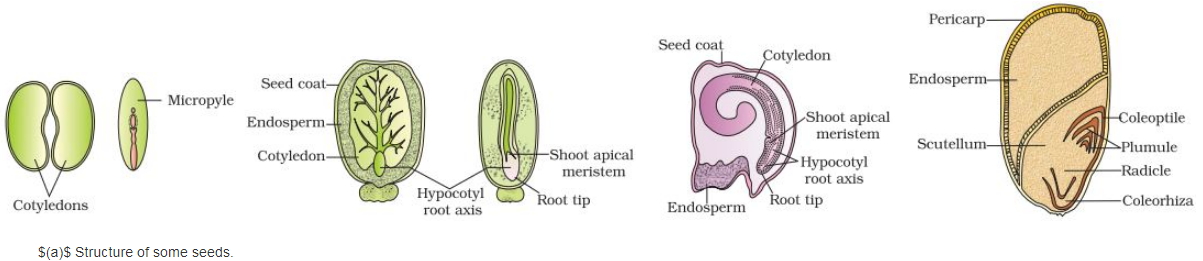
(N/A) In angiosperms,the seed is the final product of sexual reproduction.
It is often described as a fertilised ovule. Seeds are formed inside fruits. $A$ seed typically consists of seed coat$(s)$,cotyledon$(s)$,and an embryo axis. The cotyledons of the embryo are simple structures,generally thick and swollen due to the storage of food reserves (as in legumes).
Mature seeds may be non-albuminous or albuminous.
$1$. Non-albuminous seeds: These seeds have no residual endosperm as it is completely consumed during embryo development (e.g.,pea,groundnut).
$2$. Albuminous seeds: These seeds retain a part of the endosperm as it is not completely used up during embryo development (e.g.,wheat,maize,barley,castor,sunflower).
Occasionally,in some seeds such as black pepper and beet,remnants of the nucellus are also persistent. This residual,persistent nucellus is known as the perisperm.
It is often described as a fertilised ovule. Seeds are formed inside fruits. $A$ seed typically consists of seed coat$(s)$,cotyledon$(s)$,and an embryo axis. The cotyledons of the embryo are simple structures,generally thick and swollen due to the storage of food reserves (as in legumes).
Mature seeds may be non-albuminous or albuminous.
$1$. Non-albuminous seeds: These seeds have no residual endosperm as it is completely consumed during embryo development (e.g.,pea,groundnut).
$2$. Albuminous seeds: These seeds retain a part of the endosperm as it is not completely used up during embryo development (e.g.,wheat,maize,barley,castor,sunflower).
Occasionally,in some seeds such as black pepper and beet,remnants of the nucellus are also persistent. This residual,persistent nucellus is known as the perisperm.
0 likes
View Solution136
Medium
Explain the structure of a fruit and provide information about its types.
Solution
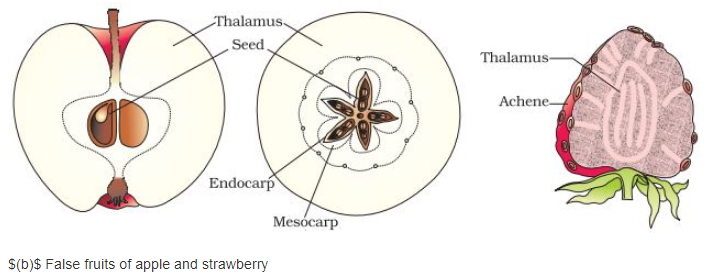
(N/A) As ovules mature into seeds, the ovary develops into a fruit; the transformation of ovules into seeds and the ovary into a fruit proceeds simultaneously. The wall of the ovary develops into the wall of the fruit, called the $pericarp$.
The fruits may be fleshy, as in guava, orange, and mango, or they may be dry, as in groundnut and mustard. Many fruits have evolved mechanisms for the dispersal of seeds.
In most plants, by the time the fruit develops from the ovary, other floral parts degenerate and fall off. However, in a few species such as apple, strawberry, and cashew, the thalamus also contributes to fruit formation. Such fruits are called $false$ $fruits$.
Most fruits, however, develop only from the ovary and are called $true$ $fruits$. Although in most species, fruits are the result of fertilization, there are a few species in which fruits develop without fertilization.
Such fruits are called $parthenocarpic$ $fruits$. Banana is one such example. Parthenocarpy can be induced through the application of growth hormones, and such fruits are seedless.
The fruits may be fleshy, as in guava, orange, and mango, or they may be dry, as in groundnut and mustard. Many fruits have evolved mechanisms for the dispersal of seeds.
In most plants, by the time the fruit develops from the ovary, other floral parts degenerate and fall off. However, in a few species such as apple, strawberry, and cashew, the thalamus also contributes to fruit formation. Such fruits are called $false$ $fruits$.
Most fruits, however, develop only from the ovary and are called $true$ $fruits$. Although in most species, fruits are the result of fertilization, there are a few species in which fruits develop without fertilization.
Such fruits are called $parthenocarpic$ $fruits$. Banana is one such example. Parthenocarpy can be induced through the application of growth hormones, and such fruits are seedless.
0 likes
View Solution137
Medium
Give the importance of seeds.
Solution
(N/A) Seeds offer several advantages to angiosperms:
$1$. Since reproductive processes such as pollination and fertilisation are independent of water, seed formation is more dependable.
$2$. Seeds have better adaptive strategies for dispersal to new habitats, helping the species colonize other areas.
$3$. As they have sufficient food reserves, young seedlings are nourished until they are capable of photosynthesis on their own.
$4$. The hard seed coat provides protection to the young embryo.
$5$. Being products of sexual reproduction, they generate new genetic combinations leading to variation.
$6$. Seeds are the basis of our agriculture. Dehydration and dormancy of mature seeds are crucial for storage, allowing them to be used as food throughout the year and to raise crops in the next season.
$7$. Seed viability: While some seeds lose viability within a few months, many remain alive for years, and some even for hundreds of years. For example, $Lupinus \text{ } arcticus$ remained viable for $10,000$ years, and $Phoenix \text{ } dactylifera$ (date palm) remained viable for $2,000$ years.
$1$. Since reproductive processes such as pollination and fertilisation are independent of water, seed formation is more dependable.
$2$. Seeds have better adaptive strategies for dispersal to new habitats, helping the species colonize other areas.
$3$. As they have sufficient food reserves, young seedlings are nourished until they are capable of photosynthesis on their own.
$4$. The hard seed coat provides protection to the young embryo.
$5$. Being products of sexual reproduction, they generate new genetic combinations leading to variation.
$6$. Seeds are the basis of our agriculture. Dehydration and dormancy of mature seeds are crucial for storage, allowing them to be used as food throughout the year and to raise crops in the next season.
$7$. Seed viability: While some seeds lose viability within a few months, many remain alive for years, and some even for hundreds of years. For example, $Lupinus \text{ } arcticus$ remained viable for $10,000$ years, and $Phoenix \text{ } dactylifera$ (date palm) remained viable for $2,000$ years.
0 likes
View Solution138
Medium
Provide the appropriate terms for the following analogies:
$(i)$ In Gymnosperms,Zygote : Embryo :: Ovule : ...
$(ii)$ In Angiosperms,Ovule : Seed :: Ovary : ...
$(i)$ In Gymnosperms,Zygote : Embryo :: Ovule : ...
$(ii)$ In Angiosperms,Ovule : Seed :: Ovary : ...
Solution
(A) $(i)$ Seed. In Gymnosperms,the ovules are naked and develop into seeds after fertilization.
$(ii)$ Fruit. In Angiosperms,the ovary matures into a fruit,and the ovules develop into seeds after fertilization.
$(ii)$ Fruit. In Angiosperms,the ovary matures into a fruit,and the ovules develop into seeds after fertilization.
0 likes
View Solution139
Medium
Define the importance of the following structures in a monocot seed:
$(i)$ Aleurone layer
$(ii)$ Epidermal layer
$(i)$ Aleurone layer
$(ii)$ Epidermal layer
Solution
(N/A) $(i)$ The Aleurone layer is a protein-rich layer that surrounds the endosperm in monocot seeds like maize. It plays a crucial role in the secretion of enzymes during germination,which helps in the breakdown of stored starch into simpler sugars for the developing embryo.
$(ii)$ The epidermal layer in a monocot seed refers to the outer boundary of the scutellum that remains in contact with the endosperm. It is involved in the absorption of nutrients from the endosperm and their transport to the growing embryo during the process of germination.
$(ii)$ The epidermal layer in a monocot seed refers to the outer boundary of the scutellum that remains in contact with the endosperm. It is involved in the absorption of nutrients from the endosperm and their transport to the growing embryo during the process of germination.
0 likes
View Solution140
Easy
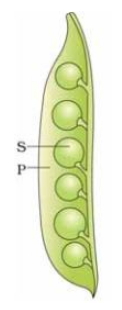
In the figure given below,identify the seed and the pericarp.

Solution
(N/A) In the provided figure of a pea pod,the structure labeled $S$ represents the seed (which develops from the ovule after fertilization),and the structure labeled $P$ represents the pericarp (the fruit wall that develops from the ovary wall).
0 likes
View Solution141
MediumMCQ
What do the following parts of a flower develop into after fertilisation? $(a)$ Ovary $(b)$ Ovules.
A
Ovary $\rightarrow$ Fruit,Ovules $\rightarrow$ Seed
B
Ovary $\rightarrow$ Seed,Ovules $\rightarrow$ Fruit
C
Ovary $\rightarrow$ Embryo,Ovules $\rightarrow$ Endosperm
D
Ovary $\rightarrow$ Flower,Ovules $\rightarrow$ Petal
Solution
(A) After fertilisation in angiosperms,the following changes occur in the flower:
$1$. The ovary develops into the fruit.
$2$. The ovules develop into seeds.
$3$. The zygote develops into the embryo.
$4$. The primary endosperm nucleus develops into the endosperm.
Therefore,the ovary becomes the fruit and the ovules become the seeds.
$1$. The ovary develops into the fruit.
$2$. The ovules develop into seeds.
$3$. The zygote develops into the embryo.
$4$. The primary endosperm nucleus develops into the endosperm.
Therefore,the ovary becomes the fruit and the ovules become the seeds.
0 likes
View Solution142
Medium
'Fertilisation is not an obligatory event for fruit production in certain plants'. Explain the statement.
Solution
(N/A) The statement refers to the biological phenomenon known as $Parthenocarpy$.
In certain plants,fruits develop from the ovary without the process of fertilisation.
Since fertilisation involves the fusion of male and female gametes to form a zygote,its absence means these fruits are typically seedless.
Examples of naturally occurring parthenocarpic fruits include bananas.
In agricultural practices,$Parthenocarpy$ can be induced artificially by the application of growth hormones like $Auxins$ and $Gibberellins$ to the flowers,which stimulates the ovary to develop into a fruit without fertilisation.
In certain plants,fruits develop from the ovary without the process of fertilisation.
Since fertilisation involves the fusion of male and female gametes to form a zygote,its absence means these fruits are typically seedless.
Examples of naturally occurring parthenocarpic fruits include bananas.
In agricultural practices,$Parthenocarpy$ can be induced artificially by the application of growth hormones like $Auxins$ and $Gibberellins$ to the flowers,which stimulates the ovary to develop into a fruit without fertilisation.
0 likes
View Solution143
Easy
What do the following parts of a flower develop into after fertilisation? $(a)$ Ovary $(b)$ Ovules.
Solution
(N/A) After fertilisation,the following changes occur in a flower:
$(a)$ The ovary develops into the fruit.
$(b)$ The ovules develop into the seeds.
$(a)$ The ovary develops into the fruit.
$(b)$ The ovules develop into the seeds.
0 likes
View Solution144
Easy
Provide definitions/explanations for the following terms:
$1.$ Dioecious
$2.$ Non-albuminous seeds
$1.$ Dioecious
$2.$ Non-albuminous seeds
Solution
(N/A) $(1)$ Dioecious: In plants like papaya,male and female flowers are produced on separate individuals. Such plants are called dioecious (bearing either male or female flowers).
$(2)$ Non-albuminous seeds: These seeds do not have any residual endosperm because it is completely consumed during embryo development. Examples include pea and groundnut.
$(2)$ Non-albuminous seeds: These seeds do not have any residual endosperm because it is completely consumed during embryo development. Examples include pea and groundnut.
0 likes
View Solution145
Medium
Give differences: False Fruit and True Fruit.
Solution
(N/A)
| False Fruit | True Fruit |
|---|---|
| $(1)$ Other floral parts,such as the thalamus,also participate in fruit development along with the ovary. | $(1)$ The fruit develops exclusively from the ovary. |
| $(2)$ Examples include apple,strawberry,and cashew,where the thalamus contributes to fruit formation. | $(2)$ Examples include mango and tomato,where the ovary matures into the fruit. |
0 likes
View Solution146
MediumMCQ
Name the common function that cotyledons and nucellus perform.
A
Protection of the embryo
B
Storage of food
C
Photosynthesis
D
Pollination
Solution
(B) Both cotyledons and nucellus serve the primary function of storing reserve food materials.
$(i)$ Cotyledons store food to provide nutrition to the developing embryo during germination.
(ii) Nucellus acts as a nutritive tissue that provides nourishment to the developing embryo sac and the embryo within the seed.
$(i)$ Cotyledons store food to provide nutrition to the developing embryo during germination.
(ii) Nucellus acts as a nutritive tissue that provides nourishment to the developing embryo sac and the embryo within the seed.
0 likes
View Solution147
Medium
Name the parts of the pistil which develop into fruit and seeds.
Solution
(N/A) The pistil is the female reproductive organ of a flower. After fertilization,the ovary of the pistil undergoes physiological changes and develops into the fruit. The ovules,which are located inside the ovary,develop into seeds.
0 likes
View Solution148
Medium
Differentiate between:
$(a)$ Integument and testa;
$(b)$ Perisperm and pericarp.
$(a)$ Integument and testa;
$(b)$ Perisperm and pericarp.
Solution
(N/A)
$(b)$
| Integument | Testa |
|---|---|
| It is the protective outer covering of an ovule. | It is the tough,outer seed coat derived from the integument. |
$(b)$
| Perisperm | Pericarp |
|---|---|
| It is the persistent,residual nucellus found in some seeds like beet and black pepper. | It is the mature,ripened wall of the fruit,which develops from the ovary wall. |
0 likes
View SolutionSexual Reproduction in Flowering Plants — Seed and Fruit · Frequently Asked Questions
1Are these Sexual Reproduction in Flowering Plants questions useful for JEE and NEET?
Yes. All questions in this section are mapped to JEE Main and NEET exam patterns. Previous year questions from JEE Main, NEET, GUJCET and state-level exams are included with full solutions.
2Can I switch to Hindi or Gujarati for these questions?
Yes. Use the language tabs in the hero section or the sidebar to view the same questions and solutions in English, Hindi or Gujarati.
3How do I generate a question paper from this subtopic?
Use the Vedclass Exam Paper Generator — select the chapter and subtopic, set difficulty, and generate Sets A, B, C, D automatically. First 3 chapters of every subject are free.
Vedclass Products
For Students
Vedclass Test Series
Mock tests in real JEE/NEET style with performance analysis. 5-day free trial.
Start Free TrialFor Teachers
Exam Paper Generator
Generate Set A/B/C/D papers from this chapter in 2 minutes. 3 chapters free.
Try FreeFor Institutes
Online Exam Module
Live online exams with unlimited students, 360° analytics & white-label branding.
See DemoFor Teachers & Institutes
Generate a Sexual Reproduction in Flowering Plants Exam Paper in 2 Minutes
Select subtopic & difficulty — Sets A, B, C, D auto-generated with No Repeat logic.
First 3 chapters of every subject are free — no payment required.