
A English
Translation Questions in English
Class 12 Biology · Molecular Basis of Inheritance · Translation
178+
Questions
English
Language
100%
With Solutions
Showing 49 of 178 questions in English
51
EasyMCQ
$A$ complex formed when multiple ribosomes are attached to a single $mRNA$ is known as:
A
Polysome
B
Polymer
C
Polymore
D
Polypeptide
Solution
(A) During the process of translation,multiple ribosomes can attach to a single $mRNA$ molecule to synthesize several copies of the same polypeptide simultaneously. This structure is known as a polysome or polyribosome. This mechanism allows for the efficient translation of $mRNA$ into proteins.
0 likes
View Solution52
EasyMCQ
What is the complex called when multiple ribosomes are associated with a single $mRNA$ strand?
A
Polynucleotide
B
Polysome
C
Polypeptide
D
Polysaccharide
Solution
(B) During the process of translation,multiple ribosomes can attach to a single $mRNA$ molecule to synthesize multiple copies of the same polypeptide chain simultaneously.
This complex structure,consisting of an $mRNA$ strand and several ribosomes attached to it,is known as a polysome or polyribosome.
This mechanism allows for the efficient translation of genetic information into proteins.
This complex structure,consisting of an $mRNA$ strand and several ribosomes attached to it,is known as a polysome or polyribosome.
This mechanism allows for the efficient translation of genetic information into proteins.
0 likes
View Solution53
MediumMCQ
The process of formation of the primary structure of a protein is controlled by which of the following?
A
Genes
B
Carbohydrates
C
Lipids
D
Hormones
Solution
(A) The primary structure of a protein is defined by the linear sequence of amino acids in the polypeptide chain.
This sequence is determined by the genetic information stored in the $DNA$ of the cell.
Genes are segments of $DNA$ that provide the instructions for the synthesis of specific proteins.
Therefore,the process of forming the primary structure of a protein is controlled by genes.
This sequence is determined by the genetic information stored in the $DNA$ of the cell.
Genes are segments of $DNA$ that provide the instructions for the synthesis of specific proteins.
Therefore,the process of forming the primary structure of a protein is controlled by genes.
0 likes
View Solution54
EasyMCQ
How many nucleotides in $tRNA$ are referred to as anticodons?
A
$2$
B
$4$
C
$3$
D
$13$
Solution
(C) The $tRNA$ molecule contains an anticodon loop,which consists of a sequence of $3$ nitrogenous bases (nucleotides) that are complementary to the specific codon on the $mRNA$ strand.
These $3$ nucleotides are collectively known as the anticodon.
Therefore,the correct answer is $3$.
These $3$ nucleotides are collectively known as the anticodon.
Therefore,the correct answer is $3$.
0 likes
View Solution55
EasyMCQ
How many nucleotides does a $t-RNA$ molecule typically contain?
A
$15$
B
$25$
C
$75$
D
$125$
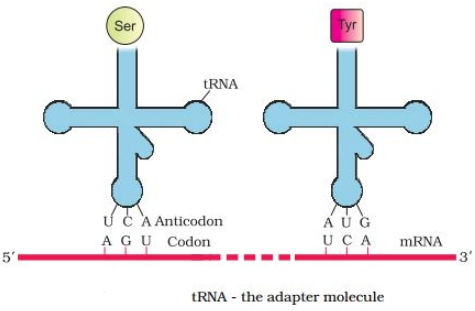
Solution
(C) $t-RNA$ (transfer $RNA$) molecule is a small $RNA$ molecule that plays a crucial role in protein synthesis.
It typically consists of a single strand of $RNA$ folded into a specific cloverleaf structure.
The length of a $t-RNA$ molecule generally ranges between $73$ and $93$ nucleotides.
Among the given options,$75$ is the most accurate representative value for the length of a $t-RNA$ molecule.
It typically consists of a single strand of $RNA$ folded into a specific cloverleaf structure.
The length of a $t-RNA$ molecule generally ranges between $73$ and $93$ nucleotides.
Among the given options,$75$ is the most accurate representative value for the length of a $t-RNA$ molecule.
0 likes
View Solution56
MediumMCQ
The $RNA$ that carries anticodons is:
A
$m-RNA$
B
$t-RNA$
C
$r-RNA$
D
$D-RNA$
Solution
(B) $t-RNA$ (transfer $RNA$) acts as an adapter molecule. It contains an anticodon loop that has bases complementary to the code on $m-RNA$. During the process of translation,the anticodon of $t-RNA$ pairs with the corresponding codon on $m-RNA$ to ensure the correct amino acid is brought to the ribosome.
0 likes
View Solution57
MediumMCQ
Which $RNA$ is responsible for picking up specific amino acids from the cytoplasm and arranging them on the ribosome?
A
$t-RNA$
B
$m-RNA$
C
$r-RNA$
D
$s-RNA$
Solution
(A) The $t-RNA$ (transfer $RNA$) acts as an adapter molecule during the process of translation.
It has an anticodon loop that recognizes the codon on the $m-RNA$ and a specific binding site for an amino acid at its $3'$ end.
It picks up specific amino acids from the cytoplasm and brings them to the ribosome,where they are arranged in the sequence specified by the $m-RNA$ to form a polypeptide chain.
It has an anticodon loop that recognizes the codon on the $m-RNA$ and a specific binding site for an amino acid at its $3'$ end.
It picks up specific amino acids from the cytoplasm and brings them to the ribosome,where they are arranged in the sequence specified by the $m-RNA$ to form a polypeptide chain.
0 likes
View Solution58
MediumMCQ
The $m-RNA$ carries the genetic information from $DNA$ for the synthesis of which of the following?
A
Carbohydrate synthesis
B
Specific protein synthesis
C
Specific lipid synthesis
D
Specific enzyme synthesis
Solution
(B) The process of protein synthesis involves the transcription of genetic information from $DNA$ to $m-RNA$.
$m-RNA$ (messenger $RNA$) acts as a template that carries the genetic code from the nucleus to the ribosomes in the cytoplasm.
At the ribosomes,this code is translated into a specific sequence of amino acids to form a polypeptide chain,which constitutes a specific protein.
While enzymes are proteins,the primary function of $m-RNA$ is the synthesis of proteins in general,making $B$ the most accurate and comprehensive answer.
$m-RNA$ (messenger $RNA$) acts as a template that carries the genetic code from the nucleus to the ribosomes in the cytoplasm.
At the ribosomes,this code is translated into a specific sequence of amino acids to form a polypeptide chain,which constitutes a specific protein.
While enzymes are proteins,the primary function of $m-RNA$ is the synthesis of proteins in general,making $B$ the most accurate and comprehensive answer.
0 likes
View Solution59
MediumMCQ
What happens to $m-RNA$ after the completion of its function?
A
It is found as an insoluble substance.
B
It is found on the cell wall.
C
It is found in the nucleus.
D
It is degraded in the cytoplasm.
Solution
(D) After the process of translation is completed,the $m-RNA$ molecule is no longer required for protein synthesis.
In eukaryotic cells,the $m-RNA$ is degraded by ribonucleases in the cytoplasm.
This degradation process is essential for regulating gene expression and recycling the nucleotides for future transcription processes.
In eukaryotic cells,the $m-RNA$ is degraded by ribonucleases in the cytoplasm.
This degradation process is essential for regulating gene expression and recycling the nucleotides for future transcription processes.
0 likes
View Solution60
MediumMCQ
What are anticodons?
A
Three nucleotides
B
Three nucleosides
C
Three nucleosides out of $64$
D
Three nucleotides out of $64$
Solution
(A) An anticodon is a sequence of three nucleotides located on a $tRNA$ molecule.
This sequence forms complementary base pairs with a specific codon present on the $mRNA$ during the process of translation.
Therefore,an anticodon consists of three nucleotides.
This sequence forms complementary base pairs with a specific codon present on the $mRNA$ during the process of translation.
Therefore,an anticodon consists of three nucleotides.
0 likes
View Solution61
MediumMCQ
What is the function of $t-RNA$?
A
It activates $m-RNA$.
B
It carries amino acids from the cytoplasm to the ribosome according to the code on $m-RNA$.
C
It joins amino acids together.
D
It arranges anticodons.
Solution
(B) The primary function of $t-RNA$ (transfer $RNA$) in protein synthesis is to act as an adapter molecule.
During the process of translation,$t-RNA$ reads the genetic code present on the $m-RNA$ template.
It carries the specific amino acid corresponding to the codon on the $m-RNA$ from the cytoplasm to the ribosome,where the polypeptide chain is synthesized.
Therefore,$t-RNA$ acts as a bridge between the mRNA sequence and the amino acid sequence.
During the process of translation,$t-RNA$ reads the genetic code present on the $m-RNA$ template.
It carries the specific amino acid corresponding to the codon on the $m-RNA$ from the cytoplasm to the ribosome,where the polypeptide chain is synthesized.
Therefore,$t-RNA$ acts as a bridge between the mRNA sequence and the amino acid sequence.
0 likes
View Solution62
MediumMCQ
What is the function of transfer $RNA$ $(tRNA)$?
A
Protein synthesis.
B
It picks up specific amino acids during protein synthesis and aligns them on the $mRNA$ template.
C
It carries genetic codes.
D
None of the above.
Solution
(B) The primary function of transfer $RNA$ $(tRNA)$ is to act as an adapter molecule during protein synthesis.
It recognizes specific amino acids and transports them to the ribosome.
It contains an anticodon that base-pairs with the complementary codon on the $mRNA$ strand,ensuring that the correct amino acid is added to the growing polypeptide chain.
It recognizes specific amino acids and transports them to the ribosome.
It contains an anticodon that base-pairs with the complementary codon on the $mRNA$ strand,ensuring that the correct amino acid is added to the growing polypeptide chain.
0 likes
View Solution63
EasyMCQ
Which of the following is $NOT$ a component of protein synthesis?
A
$m-RNA$
B
$t-RNA$
C
$r-RNA$
D
$FAD$
Solution
(D) Protein synthesis (translation) involves the participation of three main types of $RNA$: $m-RNA$ (messenger $RNA$),$t-RNA$ (transfer $RNA$),and $r-RNA$ (ribosomal $RNA$).
$m-RNA$ carries the genetic code from $DNA$.
$t-RNA$ brings specific amino acids to the ribosome.
$r-RNA$ forms the structural and catalytic core of the ribosome.
$FAD$ (Flavin Adenine Dinucleotide) is a coenzyme involved in redox reactions in metabolism,such as the Krebs cycle,and is not a component of the protein synthesis machinery.
$m-RNA$ carries the genetic code from $DNA$.
$t-RNA$ brings specific amino acids to the ribosome.
$r-RNA$ forms the structural and catalytic core of the ribosome.
$FAD$ (Flavin Adenine Dinucleotide) is a coenzyme involved in redox reactions in metabolism,such as the Krebs cycle,and is not a component of the protein synthesis machinery.
0 likes
View Solution64
MediumMCQ
Which one of the following also acts as a catalyst in a bacterial cell?
A
$5S\ rRNA$
B
$snRNA$
C
$hnRNA$
D
$23S\ rRNA$
Solution
(D) The correct answer is $D$.
In a bacterial cell (prokaryote),the $70S$ ribosome consists of a large $50S$ subunit and a small $30S$ subunit.
The $50S$ subunit contains the $23S\ rRNA$,which functions as a ribozyme.
$A$ ribozyme is an $RNA$ molecule that possesses catalytic activity.
Specifically,the $23S\ rRNA$ catalyzes the formation of peptide bonds between amino acids during protein synthesis,a process known as peptidyl transferase activity.
In contrast,$snRNA$ and $hnRNA$ are primarily found in eukaryotic cells,and $5S\ rRNA$ is a structural component of the ribosome.
In a bacterial cell (prokaryote),the $70S$ ribosome consists of a large $50S$ subunit and a small $30S$ subunit.
The $50S$ subunit contains the $23S\ rRNA$,which functions as a ribozyme.
$A$ ribozyme is an $RNA$ molecule that possesses catalytic activity.
Specifically,the $23S\ rRNA$ catalyzes the formation of peptide bonds between amino acids during protein synthesis,a process known as peptidyl transferase activity.
In contrast,$snRNA$ and $hnRNA$ are primarily found in eukaryotic cells,and $5S\ rRNA$ is a structural component of the ribosome.
0 likes
View Solution65
MediumMCQ
Which of the following $rRNAs$ acts as structural $RNA$ as well as ribozyme in bacteria (in $S\ rRNA$)?
A
$5$
B
$18$
C
$23$
D
$5.8$
Solution
(C) The correct answer is $C$.
In bacteria,the $23S\ rRNA$ is a component of the large ribosomal subunit $(50S)$.
It functions as a structural component of the ribosome and also acts as a ribozyme (specifically,it possesses peptidyl transferase activity) which catalyzes the formation of peptide bonds between amino acids during protein synthesis.
In bacteria,the $23S\ rRNA$ is a component of the large ribosomal subunit $(50S)$.
It functions as a structural component of the ribosome and also acts as a ribozyme (specifically,it possesses peptidyl transferase activity) which catalyzes the formation of peptide bonds between amino acids during protein synthesis.
0 likes
View Solution66
EasyMCQ
$A$ complex of ribosomes attached to a single strand of $RNA$ is known as
A
polypeptide
B
Okazaki fragment
C
polysome
D
polymer
Solution
(C) During the process of translation,multiple ribosomes can attach to a single $mRNA$ molecule to synthesize multiple copies of the same polypeptide chain simultaneously. This structure,consisting of a single $mRNA$ strand with several ribosomes attached to it,is called a polyribosome or polysome.
0 likes
View Solution67
MediumMCQ
Which antibiotic inhibits the interaction between $tRNA$ and $mRNA$ during bacterial protein synthesis?
A
Tetracycline
B
Erythromycin
C
Neomycin
D
Streptomycin
Solution
(C) Neomycin is a broad-spectrum antibiotic that was first isolated from a strain of $Streptomyces \, fradiae$.
It is effective against both Gram-positive and Gram-negative bacteria.
Its mechanism of action involves the selective inhibition of protein synthesis on the $70S$ (prokaryotic) ribosome.
Specifically, it inhibits the interaction between $mRNA$ and $tRNA$ during the translation process, thereby preventing the formation of the polypeptide chain.
It is effective against both Gram-positive and Gram-negative bacteria.
Its mechanism of action involves the selective inhibition of protein synthesis on the $70S$ (prokaryotic) ribosome.
Specifically, it inhibits the interaction between $mRNA$ and $tRNA$ during the translation process, thereby preventing the formation of the polypeptide chain.
0 likes
View Solution68
MediumMCQ
The amino acid sequence in protein synthesis is decided by the sequence of
A
$rRNA$
B
$tRNA$
C
$mRNA$
D
$cDNA$
Solution
(C) The correct answer is $C$.
$mRNA$ (messenger $RNA$) carries the genetic information from $DNA$ to the ribosomes,where protein synthesis occurs.
The sequence of nucleotides in $mRNA$ is organized into triplets called codons,each of which specifies a particular amino acid.
During translation,$tRNA$ molecules with complementary anticodons bring the corresponding amino acids to the $mRNA$ template,ensuring that the amino acids are linked in the order dictated by the $mRNA$ sequence.
$rRNA$ forms the structural and catalytic core of ribosomes,while $cDNA$ is complementary $DNA$ synthesized from an $RNA$ template,which is not directly involved in the translation process of protein synthesis.
$mRNA$ (messenger $RNA$) carries the genetic information from $DNA$ to the ribosomes,where protein synthesis occurs.
The sequence of nucleotides in $mRNA$ is organized into triplets called codons,each of which specifies a particular amino acid.
During translation,$tRNA$ molecules with complementary anticodons bring the corresponding amino acids to the $mRNA$ template,ensuring that the amino acids are linked in the order dictated by the $mRNA$ sequence.
$rRNA$ forms the structural and catalytic core of ribosomes,while $cDNA$ is complementary $DNA$ synthesized from an $RNA$ template,which is not directly involved in the translation process of protein synthesis.
0 likes
View Solution69
MediumMCQ
Which of the following is not a correct statement regarding $t-RNA$?
A
It has an anticodon.
B
It has an amino acid acceptor end.
C
$t-RNAs$ are not specific for each amino acid.
D
There are no $t-RNAs$ for stop codons.
Solution
(C) $t-RNA$ (transfer $RNA$) acts as an adapter molecule.
It possesses an anticodon loop that is complementary to the codon on $mRNA$.
It has an amino acid acceptor end (at the $3'$ end) to which a specific amino acid binds.
$t-RNAs$ are highly specific for each amino acid; there is at least one specific $t-RNA$ for each amino acid.
There are no $t-RNAs$ for stop codons ($UAA$,$UAG$,$UGA$),which is why they act as termination signals.
Therefore,the statement that '$t-RNAs$ are not specific for each amino acid' is incorrect.
It possesses an anticodon loop that is complementary to the codon on $mRNA$.
It has an amino acid acceptor end (at the $3'$ end) to which a specific amino acid binds.
$t-RNAs$ are highly specific for each amino acid; there is at least one specific $t-RNA$ for each amino acid.
There are no $t-RNAs$ for stop codons ($UAA$,$UAG$,$UGA$),which is why they act as termination signals.
Therefore,the statement that '$t-RNAs$ are not specific for each amino acid' is incorrect.
0 likes
View Solution70
MediumMCQ
Which molecule is carried by $tRNA$ during the initiation of protein synthesis in eukaryotic organisms?
A
Valine
B
Alanine
C
Methionine
D
Tryptophan
Solution
(C) In eukaryotic organisms,the initiation of protein synthesis begins with the amino acid $Methionine$.
Unlike prokaryotes,where the initiator $tRNA$ carries $N-formylmethionine$,eukaryotes use a specific initiator $tRNA$ that carries $Methionine$ $(Met-tRNA_i^{Met})$ to the $AUG$ start codon.
Therefore,the correct molecule carried by $tRNA$ during initiation in eukaryotes is $Methionine$.
Unlike prokaryotes,where the initiator $tRNA$ carries $N-formylmethionine$,eukaryotes use a specific initiator $tRNA$ that carries $Methionine$ $(Met-tRNA_i^{Met})$ to the $AUG$ start codon.
Therefore,the correct molecule carried by $tRNA$ during initiation in eukaryotes is $Methionine$.
0 likes
View Solution71
MediumMCQ
Which of the following acts as a ribozyme in bacteria?
A
$23S \, rRNA$
B
$tRNA$
C
$mRNA$
D
None of the above
Solution
(A) In bacteria,the process of translation involves the formation of peptide bonds between amino acids.
This reaction is catalyzed by the $23S \, rRNA$,which is a component of the $50S$ large ribosomal subunit.
Because this $rRNA$ molecule possesses catalytic activity,it is referred to as a ribozyme.
Therefore,$23S \, rRNA$ acts as an enzyme in bacteria.
This reaction is catalyzed by the $23S \, rRNA$,which is a component of the $50S$ large ribosomal subunit.
Because this $rRNA$ molecule possesses catalytic activity,it is referred to as a ribozyme.
Therefore,$23S \, rRNA$ acts as an enzyme in bacteria.
0 likes
View Solution72
MediumMCQ
Which of the following acts as a catalyst in a bacterial cell?
A
$snRNA$
B
$hnRNA$
C
$23S$ $rRNA$
D
$5S$ $rRNA$
Solution
(C) In a bacterial cell,the $23S$ $rRNA$ acts as a ribozyme,which is an $RNA$ molecule that functions as a biological catalyst.
Specifically,it is responsible for the peptidyl transferase activity during protein synthesis,which catalyzes the formation of peptide bonds between amino acids in the ribosome.
Specifically,it is responsible for the peptidyl transferase activity during protein synthesis,which catalyzes the formation of peptide bonds between amino acids in the ribosome.
0 likes
View Solution73
MediumMCQ
The process of translation is .....
A
Ribosome synthesis
B
Protein synthesis
C
$DNA$ synthesis
D
$RNA$ synthesis
Solution
(B) Translation is the process in which the genetic information present in $mRNA$ is used to synthesize a polypeptide chain (protein).
This process occurs in the cytoplasm on ribosomes,where $tRNA$ molecules bring specific amino acids based on the codon sequence of the $mRNA$.
Therefore,translation is essentially the process of protein synthesis.
This process occurs in the cytoplasm on ribosomes,where $tRNA$ molecules bring specific amino acids based on the codon sequence of the $mRNA$.
Therefore,translation is essentially the process of protein synthesis.
0 likes
View Solution74
MediumMCQ
Which of the following is not involved in protein synthesis?
A
Transcription
B
Initiation
C
Elongation
D
Termination
Solution
(A) Protein synthesis,also known as translation,involves three main stages: $Initiation$,$Elongation$,and $Termination$.
Transcription is the process of synthesizing $RNA$ from a $DNA$ template,which occurs in the nucleus before translation.
Therefore,transcription is not a stage of protein synthesis itself,but rather a precursor process.
Transcription is the process of synthesizing $RNA$ from a $DNA$ template,which occurs in the nucleus before translation.
Therefore,transcription is not a stage of protein synthesis itself,but rather a precursor process.
0 likes
View Solution75
EasyMCQ
The anticodon is a triplet of unpaired bases present on which of the following?
A
$mRNA$
B
$rRNA$
C
$tRNA$
D
$sRNA$
Solution
(C) The anticodon is a sequence of three nucleotides forming a unit of genetic code in a transfer $RNA$ $(tRNA)$ molecule,corresponding to a complementary codon in messenger $RNA$ $(mRNA)$.
During protein synthesis,the anticodon of $tRNA$ base-pairs with the codon of $mRNA$ to ensure the correct amino acid is added to the polypeptide chain.
Therefore,the anticodon is present on $tRNA$.
During protein synthesis,the anticodon of $tRNA$ base-pairs with the codon of $mRNA$ to ensure the correct amino acid is added to the polypeptide chain.
Therefore,the anticodon is present on $tRNA$.
0 likes
View Solution76
MediumMCQ
The $RNA$ that picks up specific amino acids from the amino acid pool and carries them to the ribosome during protein synthesis is called:
A
$m-RNA$
B
$t-RNA$
C
$r-RNA$
D
$RNA$
Solution
(B) The $t-RNA$ (transfer $RNA$) acts as an adapter molecule during protein synthesis.
It has an anticodon loop that recognizes the codon on $m-RNA$ and a $3'$ end that carries the specific amino acid corresponding to that codon.
Thus,it picks up amino acids from the cytoplasm and transports them to the ribosome for polypeptide chain assembly.
It has an anticodon loop that recognizes the codon on $m-RNA$ and a $3'$ end that carries the specific amino acid corresponding to that codon.
Thus,it picks up amino acids from the cytoplasm and transports them to the ribosome for polypeptide chain assembly.
0 likes
View Solution77
MediumMCQ
The exon part of $m-RNA$ codes for .............
A
Protein
B
Lipid
C
Carbohydrates
D
Phospholipid
Solution
(A) In eukaryotic genes,the coding sequences are known as exons,while the non-coding sequences are known as introns.
During the process of transcription,both exons and introns are transcribed into $pre-mRNA$.
Subsequently,through the process of splicing,the introns are removed,and the exons are joined together to form mature $mRNA$.
The mature $mRNA$ contains the genetic information that is translated into a polypeptide chain,which folds to form a functional protein.
During the process of transcription,both exons and introns are transcribed into $pre-mRNA$.
Subsequently,through the process of splicing,the introns are removed,and the exons are joined together to form mature $mRNA$.
The mature $mRNA$ contains the genetic information that is translated into a polypeptide chain,which folds to form a functional protein.
0 likes
View Solution78
MediumMCQ
During the process of translation in prokaryotes,a $GTP$ molecule is required for which of the following steps?
A
Binding of $m-RNA$ with $30S$ ribosomal subunit along with formyl-methionyl $t-RNA$
B
Association of $50S$ ribosomal subunit with the initiation complex
C
Formation of formyl-methionyl $t-RNA$
D
Binding of $30S$ ribosomal subunit with $m-RNA$
Solution
(B) In prokaryotic translation initiation,the formation of the initiation complex involves several steps.
$1$. The $30S$ ribosomal subunit binds to the $m-RNA$.
$2$. The initiator $t-RNA$ (formyl-methionyl $t-RNA$) binds to the start codon.
$3$. The association of the $50S$ ribosomal subunit with the $30S$ initiation complex requires energy,which is provided by the hydrolysis of a $GTP$ molecule.
Therefore,the $GTP$ molecule is specifically required for the association of the $50S$ ribosomal subunit with the initiation complex.
$1$. The $30S$ ribosomal subunit binds to the $m-RNA$.
$2$. The initiator $t-RNA$ (formyl-methionyl $t-RNA$) binds to the start codon.
$3$. The association of the $50S$ ribosomal subunit with the $30S$ initiation complex requires energy,which is provided by the hydrolysis of a $GTP$ molecule.
Therefore,the $GTP$ molecule is specifically required for the association of the $50S$ ribosomal subunit with the initiation complex.
0 likes
View Solution79
MediumMCQ
Which of the following $rRNA$ acts as a structural $RNA$ as well as a ribozyme in bacteria?
A
$5S \, rRNA$
B
$18S \, rRNA$
C
$23S \, rRNA$
D
$5.8S \, rRNA$
Solution
(C) In bacteria,the $23S \, rRNA$ is a component of the $50S$ large ribosomal subunit. It acts as a structural $RNA$ and also functions as a ribozyme (specifically,it possesses peptidyl transferase activity) which catalyzes the formation of peptide bonds between amino acids during protein synthesis. Therefore,the correct option is $C$.
0 likes
View Solution80
EasyMCQ
What does the $3D$ structure of a transfer $RNA$ $(tRNA)$ molecule look like?
A
$L$-shaped
B
$E$-shaped
C
$Y$-shaped
D
$S$-shaped
Solution
(A) The secondary structure of $tRNA$ is often depicted as a cloverleaf model. However,in its actual $3D$ conformation,the $tRNA$ molecule folds into a compact $L$-shaped structure. This $3D$ shape is essential for its function in protein synthesis,allowing it to interact with both the ribosome and the $mRNA$ template.
0 likes
View Solution81
MediumMCQ
Assertion: $mRNA$ attaches to the ribosome through its $3'$ end.
Reason: The $mRNA$ has $F-$ capsular nucleotide and bases of lagging sequence.
Reason: The $mRNA$ has $F-$ capsular nucleotide and bases of lagging sequence.
A
If both Assertion and Reason are correct and the Reason is a correct explanation of the Assertion.
B
If both Assertion and Reason are correct but Reason is not a correct explanation of the Assertion.
C
If the Assertion is correct but Reason is incorrect.
D
If both the Assertion and Reason are incorrect.
Solution
(D) The Assertion is incorrect because $mRNA$ attaches to the ribosome at the $5'$ end,specifically at the Shine-Dalgarno sequence in prokaryotes or the $5'$ cap in eukaryotes,not the $3'$ end.
The Reason is also incorrect as there is no such thing as an '$F-$ capsular nucleotide' in $mRNA$ structure.
Therefore,both the Assertion and the Reason are incorrect.
The Reason is also incorrect as there is no such thing as an '$F-$ capsular nucleotide' in $mRNA$ structure.
Therefore,both the Assertion and the Reason are incorrect.
0 likes
View Solution82
MediumMCQ
Assertion: Replication and transcription occur in the nucleus,but translation occurs in the cytoplasm.
Reason: $mRNA$ is transferred from the nucleus into the cytoplasm,where ribosomes and amino acids are available for protein synthesis.
Reason: $mRNA$ is transferred from the nucleus into the cytoplasm,where ribosomes and amino acids are available for protein synthesis.
A
If both Assertion and Reason are correct and the Reason is a correct explanation of the Assertion.
B
If both Assertion and Reason are correct but Reason is not a correct explanation of the Assertion.
C
If the Assertion is correct but Reason is incorrect.
D
If both the Assertion and Reason are incorrect.
Solution
(A) $DNA$ replication and transcription occur inside the nucleus in eukaryotic cells. After transcription,the $mRNA$ is processed and exported from the nucleus into the cytoplasm. In the cytoplasm,the $mRNA$ binds to ribosomes,where translation (protein synthesis) takes place using available amino acids and $tRNA$. This flow of genetic information from $DNA$ to $RNA$ to protein is known as the Central Dogma. Since the Reason correctly explains why translation must occur in the cytoplasm (due to the presence of necessary machinery),the Assertion and Reason are both correct,and the Reason is the correct explanation.
0 likes
View Solution83
Medium
List two essential roles of ribosome during translation.
Solution
(N/A) The important functions of ribosome during translation are as follows:
$1$. Ribosome acts as the site where protein synthesis takes place from individual amino acids. It consists of two subunits. The smaller subunit comes in contact with $mRNA$ and forms a protein-synthesizing complex,whereas the larger subunit provides binding sites for $tRNA$ and amino acids.
$2$. Ribosome acts as a catalyst for the formation of peptide bonds. For example,the $23S$ $rRNA$ in bacteria acts as a ribozyme to catalyze peptide bond formation.
$1$. Ribosome acts as the site where protein synthesis takes place from individual amino acids. It consists of two subunits. The smaller subunit comes in contact with $mRNA$ and forms a protein-synthesizing complex,whereas the larger subunit provides binding sites for $tRNA$ and amino acids.
$2$. Ribosome acts as a catalyst for the formation of peptide bonds. For example,the $23S$ $rRNA$ in bacteria acts as a ribozyme to catalyze peptide bond formation.
0 likes
View Solution84
Medium
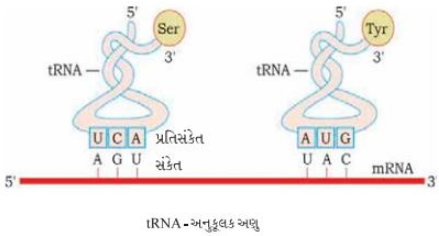
Briefly explain the mechanism of $t-RNA$ as an adapter molecule.
Solution
(N/A) According to Francis Crick,there is a mechanism to read the genetic code and link it to amino acids.
Amino acids do not have any structural features that allow them to recognize the genetic code directly.
Crick postulated the presence of an adapter molecule that could read the genetic code on one side and bind to specific amino acids on the other.
$t-RNA$ (formerly known as $s-RNA$) acts as this adapter molecule.
$t-RNA$ has an anticodon loop that contains bases complementary to the code on $m-RNA$,and it has an amino acid acceptor end to which the specific amino acid binds.
For each amino acid,there is a specific $t-RNA$. There is another specific $t-RNA$ for initiation,called initiator $t-RNA$. There are no $t-RNA$ molecules for stop codons.
The secondary structure of $t-RNA$ is clover-leaf shaped,but in its actual three-dimensional structure,$t-RNA$ is an inverted $L$-shaped molecule.
Amino acids do not have any structural features that allow them to recognize the genetic code directly.
Crick postulated the presence of an adapter molecule that could read the genetic code on one side and bind to specific amino acids on the other.
$t-RNA$ (formerly known as $s-RNA$) acts as this adapter molecule.
$t-RNA$ has an anticodon loop that contains bases complementary to the code on $m-RNA$,and it has an amino acid acceptor end to which the specific amino acid binds.
For each amino acid,there is a specific $t-RNA$. There is another specific $t-RNA$ for initiation,called initiator $t-RNA$. There are no $t-RNA$ molecules for stop codons.
The secondary structure of $t-RNA$ is clover-leaf shaped,but in its actual three-dimensional structure,$t-RNA$ is an inverted $L$-shaped molecule.
0 likes
View Solution85
Medium
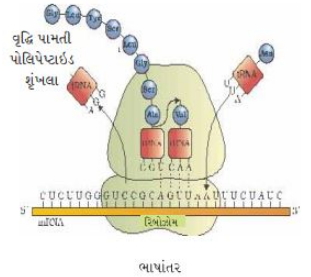
Discuss in detail the stages of translation in protein synthesis.
Solution
(N/A) Translation refers to the process of polymerization of amino acids to form a polypeptide chain.
The order and sequence of amino acids are defined by the sequence of bases in the $m-RNA$.
The amino acids are joined by a peptide bond. Formation of a peptide bond requires energy. Therefore,in the first phase,amino acids are activated in the presence of $ATP$.
This process is called charging of $t-RNA$ or aminoacylation of $t-RNA$. When two such charged $t-RNA$ molecules are brought close enough,the formation of a peptide bond between them is favored. The presence of a catalyst increases the rate of peptide bond formation.
The cellular factory responsible for protein synthesis is the ribosome. It consists of structural $RNAs$ and about $80$ different proteins. In its inactive state,it exists as two subunits: a large subunit and a small subunit.
When the small subunit encounters an $m-RNA$,the process of translation of the $m-RNA$ to protein begins. The large subunit has two sites for subsequent amino acids to bind to and thus be close enough to each other for the formation of a peptide bond.
The ribosome also acts as a catalyst ($23S$ $r-RNA$ in bacteria is the enzyme-ribozyme) for the formation of the peptide bond.
$A$ translational unit in $m-RNA$ is the sequence of $RNA$ that is flanked by the start codon $(AUG)$ and the stop codon and codes for a polypeptide. An $m-RNA$ also has some additional sequences that are not translated and are referred to as untranslated regions $(UTR)$.
The $UTR$s are present at both $5'$-end (before start codon) and $3'$-end (after stop codon). They are required for efficient translation process.
The order and sequence of amino acids are defined by the sequence of bases in the $m-RNA$.
The amino acids are joined by a peptide bond. Formation of a peptide bond requires energy. Therefore,in the first phase,amino acids are activated in the presence of $ATP$.
This process is called charging of $t-RNA$ or aminoacylation of $t-RNA$. When two such charged $t-RNA$ molecules are brought close enough,the formation of a peptide bond between them is favored. The presence of a catalyst increases the rate of peptide bond formation.
The cellular factory responsible for protein synthesis is the ribosome. It consists of structural $RNAs$ and about $80$ different proteins. In its inactive state,it exists as two subunits: a large subunit and a small subunit.
When the small subunit encounters an $m-RNA$,the process of translation of the $m-RNA$ to protein begins. The large subunit has two sites for subsequent amino acids to bind to and thus be close enough to each other for the formation of a peptide bond.
The ribosome also acts as a catalyst ($23S$ $r-RNA$ in bacteria is the enzyme-ribozyme) for the formation of the peptide bond.
$A$ translational unit in $m-RNA$ is the sequence of $RNA$ that is flanked by the start codon $(AUG)$ and the stop codon and codes for a polypeptide. An $m-RNA$ also has some additional sequences that are not translated and are referred to as untranslated regions $(UTR)$.
The $UTR$s are present at both $5'$-end (before start codon) and $3'$-end (after stop codon). They are required for efficient translation process.
0 likes
View Solution86
Medium
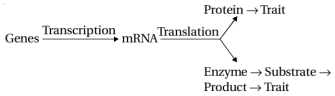
"Genes contain the information that is required to express a particular trait." Explain.
Solution
(N/A) Genes are segments of $DNA$ that carry the genetic information required for the synthesis of specific proteins or enzymes.
According to the central dogma of molecular biology, the expression of a trait occurs through the following steps:
$1$. Transcription: The genetic information stored in the $DNA$ (gene) is transcribed into $mRNA$.
$2$. Translation: The $mRNA$ is then translated into a specific protein or enzyme.
$3$. Trait Expression: The synthesized protein may directly function as a structural component or trait, or the enzyme may catalyze a reaction on a specific substrate to produce a product, which ultimately manifests as a particular phenotypic trait.
According to the central dogma of molecular biology, the expression of a trait occurs through the following steps:
$1$. Transcription: The genetic information stored in the $DNA$ (gene) is transcribed into $mRNA$.
$2$. Translation: The $mRNA$ is then translated into a specific protein or enzyme.
$3$. Trait Expression: The synthesized protein may directly function as a structural component or trait, or the enzyme may catalyze a reaction on a specific substrate to produce a product, which ultimately manifests as a particular phenotypic trait.
0 likes
View Solution87
Medium
Define/Explain the following:
$1.$ Transfer $\text{RNA}$ $(t\text{-RNA})$
$2.$ Ribosomal $\text{RNA}$ $(r\text{-RNA})$
$1.$ Transfer $\text{RNA}$ $(t\text{-RNA})$
$2.$ Ribosomal $\text{RNA}$ $(r\text{-RNA})$
Solution
(N/A) $1.$ Transfer $\text{RNA}$ $(t\text{-RNA})$: It is an adapter molecule that reads the code for protein synthesis on one end and binds to a specific amino acid on the other end.
$2.$ Ribosomal $\text{RNA}$ $(r\text{-RNA})$: It is a structural component of the ribosome. It acts as a ribozyme (catalytic $RNA$) during the process of translation.
$2.$ Ribosomal $\text{RNA}$ $(r\text{-RNA})$: It is a structural component of the ribosome. It acts as a ribozyme (catalytic $RNA$) during the process of translation.
0 likes
View Solution88
Easy
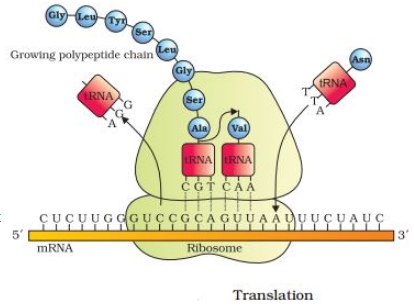
Discuss the process of translation in detail.
Solution
(N/A) Translation refers to the process of polymerisation of amino acids to form a polypeptide. Ribosome is the site of protein synthesis. The amino acids are joined by a bond which is known as a peptide bond. Formation of a peptide bond requires energy. Therefore,in the first phase itself,amino acids are activated in the presence of $ATP$ and linked to their respective $tRNA$—a process commonly called activation or charging of $tRNA$,or aminoacylation of $tRNA$ to be more specific.
If two such charged $tRNAs$ are brought close enough,the formation of a peptide bond between them would be favoured energetically. The presence of a catalyst would enhance the rate of peptide bond formation. The cellular factory responsible for synthesising proteins is the ribosome. The ribosome consists of structural $RNAs$ and about $80$ different proteins. In its inactive state,it exists as two subunits: a large subunit and a small subunit.
When the small subunit encounters an $mRNA$,the process of translation of the $mRNA$ to protein begins. There are two sites in the large subunit for subsequent amino acids to bind to and thus be close enough to each other for the formation of a peptide bond. The ribosome also acts as a catalyst ($23S$ $rRNA$ in bacteria is the enzyme-ribozyme) for the formation of a peptide bond.
$A$ translational unit in $mRNA$ is the sequence of $RNA$ that is flanked by the start codon $(AUG)$ and the stop codon and codes for a polypeptide. An $mRNA$ also has some additional sequences that are not translated and are referred to as untranslated regions $(UTR)$. The $UTRs$ are present at both $5^{\prime}$-end (before start codon) and at $3^{\prime}$-end (after stop codon). They are required for efficient translation process.
For initiation,the ribosome binds to the $mRNA$ at the start codon $(AUG)$ that is recognised only by the initiator $tRNA$. The ribosome proceeds to the elongation phase of protein synthesis. During this stage,complexes composed of an amino acid linked to $tRNA$ sequentially bind to the appropriate codon in $mRNA$ by forming complementary base pairs with the $tRNA$ anticodon. The ribosome moves from codon to codon along the $mRNA$.
If two such charged $tRNAs$ are brought close enough,the formation of a peptide bond between them would be favoured energetically. The presence of a catalyst would enhance the rate of peptide bond formation. The cellular factory responsible for synthesising proteins is the ribosome. The ribosome consists of structural $RNAs$ and about $80$ different proteins. In its inactive state,it exists as two subunits: a large subunit and a small subunit.
When the small subunit encounters an $mRNA$,the process of translation of the $mRNA$ to protein begins. There are two sites in the large subunit for subsequent amino acids to bind to and thus be close enough to each other for the formation of a peptide bond. The ribosome also acts as a catalyst ($23S$ $rRNA$ in bacteria is the enzyme-ribozyme) for the formation of a peptide bond.
$A$ translational unit in $mRNA$ is the sequence of $RNA$ that is flanked by the start codon $(AUG)$ and the stop codon and codes for a polypeptide. An $mRNA$ also has some additional sequences that are not translated and are referred to as untranslated regions $(UTR)$. The $UTRs$ are present at both $5^{\prime}$-end (before start codon) and at $3^{\prime}$-end (after stop codon). They are required for efficient translation process.
For initiation,the ribosome binds to the $mRNA$ at the start codon $(AUG)$ that is recognised only by the initiator $tRNA$. The ribosome proceeds to the elongation phase of protein synthesis. During this stage,complexes composed of an amino acid linked to $tRNA$ sequentially bind to the appropriate codon in $mRNA$ by forming complementary base pairs with the $tRNA$ anticodon. The ribosome moves from codon to codon along the $mRNA$.
0 likes
View Solution89
EasyMCQ
The first phase of translation is:
A
Recognition of an anti-codon
B
Binding of $mRNA$ to ribosome
C
Recognition of $DNA$ molecule
D
Aminoacylation of $tRNA$
Solution
(D) The process of translation involves the synthesis of a polypeptide chain from an $mRNA$ template. The first phase of this process is the 'charging' of $tRNA$,also known as the aminoacylation of $tRNA$. During this step,specific amino acids are linked to their cognate $tRNA$ molecules in the presence of $ATP$. This activation is essential for the subsequent steps of translation,such as the formation of peptide bonds.
0 likes
View Solution90
EasyMCQ
The first phase of translation is:
A
Binding of ribosome to $mRNA$
B
Recognition of $DNA$ molecule
C
Aminoacylation of $tRNA$
D
Recognition of anti-codon
Solution
(C) The process of translation involves the synthesis of a polypeptide chain from $mRNA$.
Before the actual translation begins,the $tRNA$ must be charged with its specific amino acid.
This process is known as the aminoacylation of $tRNA$ or charging of $tRNA$.
It requires the presence of specific aminoacyl-$tRNA$ synthetase enzymes and $ATP$.
Once the $tRNA$ is charged,it can participate in the translation process at the ribosome.
Before the actual translation begins,the $tRNA$ must be charged with its specific amino acid.
This process is known as the aminoacylation of $tRNA$ or charging of $tRNA$.
It requires the presence of specific aminoacyl-$tRNA$ synthetase enzymes and $ATP$.
Once the $tRNA$ is charged,it can participate in the translation process at the ribosome.
0 likes
View Solution91
Medium
Describe $tRNA$ as an adapter molecule.
Solution
(N/A) The concept of an adapter molecule that could read the genetic code and bind to specific amino acids during translation was proposed by Francis Crick in $1961$.
$tRNA$ was known before the genetic code was deciphered and was initially called $sRNA$ (soluble $RNA$),but later its role as an adapter molecule was established.
Structure of $tRNA$:
$1$. The $tRNA$ has a secondary structure that resembles a clover leaf.
$2$. Its three-dimensional structure is an inverted $L$-shaped molecule.
$3$. $tRNA$ contains specific regions:
$(i)$ Anticodon loop: It contains bases complementary to the codon on $mRNA$.
$(ii)$ Amino acid acceptor end: This end binds to the specific amino acid.
$(iii)$ $T\psi C$-loop ($T$-loop): It helps in binding to the ribosome.
$(iv)$ $D$-loop: It helps in binding to aminoacyl-tRNA synthetase.
$(v)$ Variable loop: It varies in both nucleotide composition and length.
$tRNAs$ are specific for each amino acid. For initiation,there is a specific $tRNA$ referred to as the initiator $tRNA$. There are no $tRNAs$ for stop codons.
$tRNA$ was known before the genetic code was deciphered and was initially called $sRNA$ (soluble $RNA$),but later its role as an adapter molecule was established.
Structure of $tRNA$:
$1$. The $tRNA$ has a secondary structure that resembles a clover leaf.
$2$. Its three-dimensional structure is an inverted $L$-shaped molecule.
$3$. $tRNA$ contains specific regions:
$(i)$ Anticodon loop: It contains bases complementary to the codon on $mRNA$.
$(ii)$ Amino acid acceptor end: This end binds to the specific amino acid.
$(iii)$ $T\psi C$-loop ($T$-loop): It helps in binding to the ribosome.
$(iv)$ $D$-loop: It helps in binding to aminoacyl-tRNA synthetase.
$(v)$ Variable loop: It varies in both nucleotide composition and length.
$tRNAs$ are specific for each amino acid. For initiation,there is a specific $tRNA$ referred to as the initiator $tRNA$. There are no $tRNAs$ for stop codons.
0 likes
View Solution92
Medium
Describe the process of translation.
Solution
(A) Translation refers to the process of polymerization of amino acids to form a polypeptide.
The order and sequence of amino acids are defined by the sequence of bases in the $mRNA$.
The amino acids are joined by a bond known as a peptide bond.
Formation of a peptide bond requires energy.
Therefore,in the first phase,amino acids are activated in the presence of $ATP$ and linked to their cognate $tRNA$,a process commonly called charging of $tRNA$ or aminoacylation of $tRNA$.
If two such charged $tRNAs$ are brought close enough,the formation of a peptide bond between them is favored energetically.
The presence of a catalyst enhances the rate of peptide bond formation.
The cellular factory responsible for synthesizing proteins is the ribosome.
The ribosome consists of structural $RNAs$ and about $80$ different proteins.
In its inactive state,it exists as two subunits: a large subunit and a small subunit.
When the small subunit encounters an $mRNA$,the process of translation of the $mRNA$ to protein begins.
There are two sites in the large subunit for subsequent amino acids to bind,bringing them close enough for the formation of a peptide bond.
The ribosome also acts as a catalyst ($23S$ $rRNA$ in bacteria is the enzyme ribozyme) for the formation of the peptide bond.
$A$ translational unit in $mRNA$ is the sequence of $RNA$ that is flanked by the start codon $(AUG)$ and the stop codon and codes for a polypeptide.
An $mRNA$ also has some additional sequences that are not translated,referred to as untranslated regions $(UTRs)$.
The $UTRs$ are present at both $5^{\prime}$-end (before the start codon) and at $3^{\prime}$-end (after the stop codon).
They are required for an efficient translation process.
For initiation,the ribosome binds to the $mRNA$ at the start codon $(AUG)$,which is recognized only by the initiator $tRNA$.
The ribosome then proceeds to the elongation phase of protein synthesis.
During this stage,complexes composed of amino acids linked to $tRNA$ sequentially bind to the appropriate codon in $mRNA$ by forming complementary base pairs with the $tRNA$ anticodon.
The order and sequence of amino acids are defined by the sequence of bases in the $mRNA$.
The amino acids are joined by a bond known as a peptide bond.
Formation of a peptide bond requires energy.
Therefore,in the first phase,amino acids are activated in the presence of $ATP$ and linked to their cognate $tRNA$,a process commonly called charging of $tRNA$ or aminoacylation of $tRNA$.
If two such charged $tRNAs$ are brought close enough,the formation of a peptide bond between them is favored energetically.
The presence of a catalyst enhances the rate of peptide bond formation.
The cellular factory responsible for synthesizing proteins is the ribosome.
The ribosome consists of structural $RNAs$ and about $80$ different proteins.
In its inactive state,it exists as two subunits: a large subunit and a small subunit.
When the small subunit encounters an $mRNA$,the process of translation of the $mRNA$ to protein begins.
There are two sites in the large subunit for subsequent amino acids to bind,bringing them close enough for the formation of a peptide bond.
The ribosome also acts as a catalyst ($23S$ $rRNA$ in bacteria is the enzyme ribozyme) for the formation of the peptide bond.
$A$ translational unit in $mRNA$ is the sequence of $RNA$ that is flanked by the start codon $(AUG)$ and the stop codon and codes for a polypeptide.
An $mRNA$ also has some additional sequences that are not translated,referred to as untranslated regions $(UTRs)$.
The $UTRs$ are present at both $5^{\prime}$-end (before the start codon) and at $3^{\prime}$-end (after the stop codon).
They are required for an efficient translation process.
For initiation,the ribosome binds to the $mRNA$ at the start codon $(AUG)$,which is recognized only by the initiator $tRNA$.
The ribosome then proceeds to the elongation phase of protein synthesis.
During this stage,complexes composed of amino acids linked to $tRNA$ sequentially bind to the appropriate codon in $mRNA$ by forming complementary base pairs with the $tRNA$ anticodon.
0 likes
View Solution93
Easy
Give scientific reasons: It is essential that $tRNA$ binds to both amino acids and $mRNA$ codon during protein synthesis.
Solution
(N/A) $tRNA$ acts as an adapter molecule during protein synthesis. It performs two critical functions:
$1$. It recognizes and binds to a specific activated amino acid in the cytoplasm.
$2$. It recognizes the specific codon on the $mRNA$ template via its anticodon loop to ensure the correct amino acid is placed in the polypeptide chain.
Without this dual binding,the genetic code would not be translated accurately,leading to the synthesis of incorrect proteins.
$1$. It recognizes and binds to a specific activated amino acid in the cytoplasm.
$2$. It recognizes the specific codon on the $mRNA$ template via its anticodon loop to ensure the correct amino acid is placed in the polypeptide chain.
Without this dual binding,the genetic code would not be translated accurately,leading to the synthesis of incorrect proteins.
0 likes
View Solution94
MediumMCQ
Which type of $RNA$ performs the function of reading the genetic code?
A
$tRNA$
B
$mRNA$
C
$rRNA$
D
Both $A$ and $B$
Solution
(A) The $tRNA$ (transfer $RNA$) acts as an adapter molecule.
It has an anticodon loop that contains bases complementary to the code on the $mRNA$.
During translation,the $tRNA$ reads the genetic code on the $mRNA$ by base-pairing its anticodon with the codon on the $mRNA$ and brings the corresponding amino acid to the ribosome.
Therefore,$tRNA$ is the molecule that reads the genetic code.
It has an anticodon loop that contains bases complementary to the code on the $mRNA$.
During translation,the $tRNA$ reads the genetic code on the $mRNA$ by base-pairing its anticodon with the codon on the $mRNA$ and brings the corresponding amino acid to the ribosome.
Therefore,$tRNA$ is the molecule that reads the genetic code.
0 likes
View Solution95
MediumMCQ
In prokaryotes,which process starts even before the $m-RNA$ is fully transcribed?
A
Replication
B
Reverse transcription
C
Translation
D
All of the above
Solution
(C) In prokaryotes,there is no clear-cut separation between the cytosol and the nucleus because they lack a defined nucleus.
Transcription and translation take place in the same compartment.
As a result,the translation of $m-RNA$ can begin even before the $m-RNA$ is fully transcribed from the $DNA$ template.
This phenomenon is known as coupled transcription and translation.
Transcription and translation take place in the same compartment.
As a result,the translation of $m-RNA$ can begin even before the $m-RNA$ is fully transcribed from the $DNA$ template.
This phenomenon is known as coupled transcription and translation.
0 likes
View Solution96
MediumMCQ
In bacteria,which processes occur simultaneously?
A
Ribonucleotide polymerization and amino acid polymerization
B
Ribonucleotide and monosaccharide polymerization
C
Amino acid and deoxyribonucleotide polymerization
D
Monosaccharide and amino acid polymerization
Solution
(A) In bacteria,there is no defined nucleus,and the genetic material is not separated from the cytoplasm by a nuclear membrane.
Transcription (synthesis of $RNA$ from $DNA$) and translation (synthesis of proteins from $mRNA$) can take place simultaneously in the same compartment.
Transcription involves ribonucleotide polymerization (forming $mRNA$),and translation involves amino acid polymerization (forming polypeptide chains).
Therefore,these two processes occur concurrently in bacteria.
Transcription (synthesis of $RNA$ from $DNA$) and translation (synthesis of proteins from $mRNA$) can take place simultaneously in the same compartment.
Transcription involves ribonucleotide polymerization (forming $mRNA$),and translation involves amino acid polymerization (forming polypeptide chains).
Therefore,these two processes occur concurrently in bacteria.
0 likes
View Solution97
MediumMCQ
In which of the following is the principle of complementarity $NOT$ followed?
A
Replication
B
Transcription
C
Translation
D
All of the above
Solution
(C) The principle of complementarity states that bases pair specifically (e.g.,$A$ with $T$ or $U$,and $G$ with $C$).
In $DNA$ replication,the new strand is synthesized based on the complementarity of the template strand.
In transcription,$mRNA$ is synthesized based on the complementarity of the $DNA$ template strand.
In translation,the $tRNA$ anticodon pairs with the $mRNA$ codon based on complementarity.
However,the process of translation as a whole involves the decoding of $mRNA$ into a polypeptide chain,where the genetic code is read in triplets. The interaction between the ribosome,$mRNA$,and amino acids does not follow a simple base-pairing complementarity rule for the entire process,especially regarding the peptide bond formation and the non-complementary nature of the amino acid sequence to the $mRNA$ sequence itself. Thus,among the given options,translation is the process where the direct principle of base-pairing complementarity is not the defining mechanism for the entire functional output.
In $DNA$ replication,the new strand is synthesized based on the complementarity of the template strand.
In transcription,$mRNA$ is synthesized based on the complementarity of the $DNA$ template strand.
In translation,the $tRNA$ anticodon pairs with the $mRNA$ codon based on complementarity.
However,the process of translation as a whole involves the decoding of $mRNA$ into a polypeptide chain,where the genetic code is read in triplets. The interaction between the ribosome,$mRNA$,and amino acids does not follow a simple base-pairing complementarity rule for the entire process,especially regarding the peptide bond formation and the non-complementary nature of the amino acid sequence to the $mRNA$ sequence itself. Thus,among the given options,translation is the process where the direct principle of base-pairing complementarity is not the defining mechanism for the entire functional output.
0 likes
View Solution98
MediumMCQ
What happens during the process of translation?
A
Synthesis of amino acid polymers from polysaccharides
B
Synthesis of amino acid polymers from nucleotide polymers
C
Formation of polysaccharides from amino acid polymers
D
Synthesis of nucleotide polymers from amino acid polymers
Solution
(B) The process of translation refers to the synthesis of proteins (polymers of amino acids) from an $mRNA$ template (a polymer of nucleotides).
During this process,the genetic information stored in the sequence of nucleotides in $mRNA$ is translated into the sequence of amino acids in a polypeptide chain.
Therefore,it involves the synthesis of amino acid polymers from nucleotide polymers.
During this process,the genetic information stored in the sequence of nucleotides in $mRNA$ is translated into the sequence of amino acids in a polypeptide chain.
Therefore,it involves the synthesis of amino acid polymers from nucleotide polymers.
0 likes
View Solution99
MediumMCQ
In which process does the transfer of genetic information occur?
A
Replication
B
Transcription
C
Translation
D
Both $A$ and $B$
Solution
(C) The process of $Translation$ is the polymerization of amino acids to form a polypeptide. The order and sequence of amino acids are defined by the sequence of bases in the $mRNA$. Thus,in the process of $Translation$,the genetic information is transferred from the $mRNA$ (nucleic acid language) to a polypeptide chain (protein language).
0 likes
View SolutionMolecular Basis of Inheritance — Translation · Frequently Asked Questions
1Are these Molecular Basis of Inheritance questions useful for JEE and NEET?
Yes. All questions in this section are mapped to JEE Main and NEET exam patterns. Previous year questions from JEE Main, NEET, GUJCET and state-level exams are included with full solutions.
2Can I switch to Hindi or Gujarati for these questions?
Yes. Use the language tabs in the hero section or the sidebar to view the same questions and solutions in English, Hindi or Gujarati.
3How do I generate a question paper from this subtopic?
Use the Vedclass Exam Paper Generator — select the chapter and subtopic, set difficulty, and generate Sets A, B, C, D automatically. First 3 chapters of every subject are free.
Vedclass Products
For Students
Vedclass Test Series
Mock tests in real JEE/NEET style with performance analysis. 5-day free trial.
Start Free TrialFor Teachers
Exam Paper Generator
Generate Set A/B/C/D papers from this chapter in 2 minutes. 3 chapters free.
Try FreeFor Institutes
Online Exam Module
Live online exams with unlimited students, 360° analytics & white-label branding.
See DemoFor Teachers & Institutes
Generate a Molecular Basis of Inheritance Exam Paper in 2 Minutes
Select subtopic & difficulty — Sets A, B, C, D auto-generated with No Repeat logic.
First 3 chapters of every subject are free — no payment required.