
A English
Translation Questions in English
Class 12 Biology · Molecular Basis of Inheritance · Translation
178+
Questions
English
Language
100%
With Solutions
Showing 50 of 178 questions in English
101
MediumMCQ
Which anticodon does the initiator $t-RNA$ possess?
A
$AUG$
B
$GUG$
C
$CUA$
D
$UAC$
Solution
(D) The initiator $t-RNA$ is responsible for recognizing the start codon on the $mRNA$ during the initiation of protein synthesis.
The start codon on $mRNA$ is $AUG$,which codes for the amino acid methionine.
The $t-RNA$ that carries methionine and recognizes the $AUG$ codon must have an anticodon that is complementary to $AUG$.
According to the base-pairing rules ($A$ pairs with $U$,$U$ pairs with $A$,$G$ pairs with $C$),the anticodon complementary to $AUG$ is $UAC$.
Therefore,the initiator $t-RNA$ possesses the anticodon $UAC$.
The start codon on $mRNA$ is $AUG$,which codes for the amino acid methionine.
The $t-RNA$ that carries methionine and recognizes the $AUG$ codon must have an anticodon that is complementary to $AUG$.
According to the base-pairing rules ($A$ pairs with $U$,$U$ pairs with $A$,$G$ pairs with $C$),the anticodon complementary to $AUG$ is $UAC$.
Therefore,the initiator $t-RNA$ possesses the anticodon $UAC$.
0 likes
View Solution102
MediumMCQ
At which end does the amino acid attach to $t-RNA$?
A
$5'$ end
B
$3'$ end
C
Anticodon loop
D
Both $A$ and $B$
Solution
(B) The $t-RNA$ molecule has a specific structure that includes an amino acid acceptor arm.
This acceptor arm is located at the $3'$ end of the $t-RNA$ molecule.
The sequence at the $3'$ end is typically $CCA$,where the amino acid is covalently attached to the $3'-OH$ group of the terminal adenosine residue.
Therefore,the correct answer is the $3'$ end.
This acceptor arm is located at the $3'$ end of the $t-RNA$ molecule.
The sequence at the $3'$ end is typically $CCA$,where the amino acid is covalently attached to the $3'-OH$ group of the terminal adenosine residue.
Therefore,the correct answer is the $3'$ end.
0 likes
View Solution103
MediumMCQ
Which loop/end of $t-RNA$ binds with $m-RNA$?
A
Amino acid acceptor end
B
$D-$loop
C
$T \psi C$ loop
D
Anticodon loop
Solution
(D) The $t-RNA$ molecule has a specific sequence of three nitrogenous bases known as the anticodon,which is located on the anticodon loop. During the process of translation,this anticodon base-pairs with the complementary codon present on the $m-RNA$ strand. Therefore,the anticodon loop is the site responsible for binding with $m-RNA$.
0 likes
View Solution104
MediumMCQ
Translation is the process of.........
A
Polymerization of amino acids
B
Polymerization of nucleotides
C
Polymerization of monosaccharides
D
All of the above
Solution
(A) Translation is the process by which the genetic information present in $mRNA$ is used to synthesize a polypeptide chain.
During this process,amino acids are linked together by peptide bonds to form a protein.
Since proteins are polymers of amino acids,translation is defined as the polymerization of amino acids.
During this process,amino acids are linked together by peptide bonds to form a protein.
Since proteins are polymers of amino acids,translation is defined as the polymerization of amino acids.
0 likes
View Solution105
MediumMCQ
Amino acids are activated in the presence of $(i)$ and linked to their corresponding $(ii)$?
A
$(i) ADP, (ii) t-RNA$
B
$(i) ATP, (ii) \text{any } t-RNA$
C
$(i) ATP, (ii) \text{cognate } t-RNA$
D
$(i) AMP, (ii) \text{any } t-RNA$
Solution
(C) In the first phase of the translation process,amino acids are activated in the presence of $ATP$. This process is known as the 'activation of amino acids'.
These activated amino acids are then linked to their specific or cognate $t-RNA$ molecules,a process known as 'charging of $t-RNA$' or 'aminoacylation of $t-RNA$'.
Therefore,$(i) = ATP$ and $(ii) = \text{cognate } t-RNA$.
These activated amino acids are then linked to their specific or cognate $t-RNA$ molecules,a process known as 'charging of $t-RNA$' or 'aminoacylation of $t-RNA$'.
Therefore,$(i) = ATP$ and $(ii) = \text{cognate } t-RNA$.
0 likes
View Solution106
MediumMCQ
What is the process of attaching an amino acid to $t-RNA$ called?
A
Charging of $t-RNA$
B
Aminoacylation of $t-RNA$
C
Glycosylation of $t-RNA$
D
Both $A$ and $B$
Solution
(D) The process of attaching an amino acid to its specific $t-RNA$ is known as the aminoacylation of $t-RNA$.
This process is also commonly referred to as the charging of $t-RNA$.
During this step,the amino acid is activated in the presence of $ATP$ and linked to its cognate $t-RNA$,resulting in a charged $t-RNA$ or aminoacyl-$t-RNA$ complex.
Therefore,both terms refer to the same biological process.
This process is also commonly referred to as the charging of $t-RNA$.
During this step,the amino acid is activated in the presence of $ATP$ and linked to its cognate $t-RNA$,resulting in a charged $t-RNA$ or aminoacyl-$t-RNA$ complex.
Therefore,both terms refer to the same biological process.
0 likes
View Solution107
MediumMCQ
What first binds to the $m-RNA$ to initiate the process of translation?
A
Large subunit
B
Small subunit
C
$t-RNA$
D
Complete ribosome
Solution
(B) The process of translation begins with the initiation phase.
In this phase,the small subunit of the ribosome binds to the $m-RNA$ at the start codon $(AUG)$.
Once the small subunit is attached,the initiator $t-RNA$ carrying methionine binds to the start codon.
Finally,the large subunit of the ribosome joins the complex to form the functional $70S$ (in prokaryotes) or $80S$ (in eukaryotes) ribosome,allowing protein synthesis to proceed.
Therefore,the small subunit is the first component to bind to the $m-RNA$.
In this phase,the small subunit of the ribosome binds to the $m-RNA$ at the start codon $(AUG)$.
Once the small subunit is attached,the initiator $t-RNA$ carrying methionine binds to the start codon.
Finally,the large subunit of the ribosome joins the complex to form the functional $70S$ (in prokaryotes) or $80S$ (in eukaryotes) ribosome,allowing protein synthesis to proceed.
Therefore,the small subunit is the first component to bind to the $m-RNA$.
0 likes
View Solution108
MediumMCQ
How many sites are present in the large subunit of a ribosome?
A
$1$
B
$2$
C
$3$
D
$4$
Solution
(C) The large subunit of a ribosome contains $3$ specific sites for the process of translation:
$1$. The $A$-site (Aminoacyl site): This is where the incoming aminoacyl-$tRNA$ binds.
$2$. The $P$-site (Peptidyl site): This is where the $tRNA$ carrying the growing polypeptide chain is located.
$3$. The $E$-site (Exit site): This is where the deacylated $tRNA$ leaves the ribosome after transferring its amino acid to the growing chain.
$1$. The $A$-site (Aminoacyl site): This is where the incoming aminoacyl-$tRNA$ binds.
$2$. The $P$-site (Peptidyl site): This is where the $tRNA$ carrying the growing polypeptide chain is located.
$3$. The $E$-site (Exit site): This is where the deacylated $tRNA$ leaves the ribosome after transferring its amino acid to the growing chain.
0 likes
View Solution109
MediumMCQ
Which $RNA$ acts as a ribozyme in bacteria?
A
$18S\, rRNA$
B
$13S\, rRNA$
C
$5S\, rRNA$
D
$23S\, rRNA$
Solution
(D) In bacteria,the process of protein synthesis involves the formation of peptide bonds between amino acids.
This reaction is catalyzed by the $23S\, rRNA$,which is a component of the $50S$ large ribosomal subunit.
Because this $RNA$ molecule possesses catalytic activity,it is referred to as a ribozyme.
Therefore,the correct answer is $23S\, rRNA$.
This reaction is catalyzed by the $23S\, rRNA$,which is a component of the $50S$ large ribosomal subunit.
Because this $RNA$ molecule possesses catalytic activity,it is referred to as a ribozyme.
Therefore,the correct answer is $23S\, rRNA$.
0 likes
View Solution110
MediumMCQ
Where is the translation unit found?
A
$DNA$
B
$t-RNA$
C
$m-RNA$
D
Ribosome
Solution
(C) The translation unit in $m-RNA$ is the sequence of $RNA$ that is flanked by the start codon $(AUG)$ and the stop codon and codes for a polypeptide. It is essential for the process of protein synthesis,where the genetic information is translated into a sequence of amino acids.
0 likes
View Solution111
MediumMCQ
Which of the following is not a part of the translation unit?
A
$UTR$
B
Start codon
C
Stop codon
D
Polypeptide signals
Solution
(D) The translation unit in $mRNA$ is the sequence of $RNA$ that is flanked by the start codon and the stop codon and codes for a polypeptide.
$UTR$ (Untranslated Regions) are present at both $5'$-end (before start codon) and $3'$-end (after stop codon) and are required for efficient translation process.
Polypeptide signals are not a structural component of the translation unit itself; rather,the unit codes for the polypeptide chain.
Therefore,the correct answer is $D$.
$UTR$ (Untranslated Regions) are present at both $5'$-end (before start codon) and $3'$-end (after stop codon) and are required for efficient translation process.
Polypeptide signals are not a structural component of the translation unit itself; rather,the unit codes for the polypeptide chain.
Therefore,the correct answer is $D$.
0 likes
View Solution112
MediumMCQ
What is the full form of $UTR$?
A
Universal Translated Region
B
Untranslated Region
C
Unitranslated Region
D
Untranscripted Region
Solution
(B) $UTR$ stands for Untranslated Region.
These are specific sequences present on $mRNA$ that are not translated into proteins.
They are located at both the $5'$-end (before the start codon) and the $3'$-end (after the stop codon) of the $mRNA$ molecule.
These regions are essential for the efficient translation process and the stability of $mRNA$.
These are specific sequences present on $mRNA$ that are not translated into proteins.
They are located at both the $5'$-end (before the start codon) and the $3'$-end (after the stop codon) of the $mRNA$ molecule.
These regions are essential for the efficient translation process and the stability of $mRNA$.
0 likes
View Solution113
MediumMCQ
Where is $UTR$ found?
A
$DNA$
B
$RNA$
C
Protein
D
Peptide
Solution
(B) $UTR$ stands for Untranslated Regions. These are specific sequences present on the $mRNA$ (messenger $RNA$) that are not translated into proteins. They are located at both the $5'$-end (before the start codon) and the $3'$-end (after the stop codon) of the $mRNA$ molecule. These regions are required for efficient translation process.
0 likes
View Solution114
MediumMCQ
Where are the Untranslated Regions $(UTRs)$ located?
A
Before the start codon at the $3'$ end
B
After the stop codon at the $3'$ end
C
Before the start codon at the $5'$ end
D
Both $B$ and $C$
Solution
(D) In $mRNA$,the untranslated regions $(UTRs)$ are sequences that are not translated into proteins.
These regions are required for efficient translation process.
$UTRs$ are present at both ends of the $mRNA$ strand.
Specifically,they are located before the start codon at the $5'$ end and after the stop codon at the $3'$ end.
These regions are required for efficient translation process.
$UTRs$ are present at both ends of the $mRNA$ strand.
Specifically,they are located before the start codon at the $5'$ end and after the stop codon at the $3'$ end.
0 likes
View Solution115
MediumMCQ
During translation,in which direction does the ribosome move along the $m-RNA$ and by how much?
A
$5' \rightarrow 3'$ and two codons
B
$3' \rightarrow 5'$ and two codons
C
$5' \rightarrow 3'$ and one codon
D
$3' \rightarrow 5'$ and one codon
Solution
(C) During the process of translation,the ribosome moves along the $m-RNA$ in the $5' \rightarrow 3'$ direction.
This movement is known as translocation.
In each step of translocation,the ribosome moves exactly by one codon (a sequence of three nucleotides) to read the next set of genetic information.
This movement is known as translocation.
In each step of translocation,the ribosome moves exactly by one codon (a sequence of three nucleotides) to read the next set of genetic information.
0 likes
View Solution116
MediumMCQ
Which structure binds to the termination codon to bring about the termination of the translation process?
A
Terminator
B
Initiator
C
Release factor
D
Repressor
Solution
(C) During the process of translation,when the ribosome reaches a termination codon (stop codon) on the mRNA,no tRNA molecule recognizes or binds to these codons. Instead,a protein known as a $Release \ factor$ binds to the stop codon. This binding causes the release of the polypeptide chain from the ribosome and the dissociation of the ribosomal subunits,thereby terminating the translation process.
0 likes
View Solution117
MediumMCQ
In which molecule is the amino acid acceptor end found?
A
$r-RNA$
B
$t-RNA$
C
$m-RNA$
D
$DNA$
Solution
(B) The $t-RNA$ (transfer $RNA$) molecule acts as an adapter molecule during protein synthesis.
It has a specific site known as the amino acid acceptor end,which is located at the $3'$-end of the molecule.
This end contains the sequence $CCA$ and is responsible for binding to the specific amino acid corresponding to the anticodon present on the $t-RNA$ molecule.
It has a specific site known as the amino acid acceptor end,which is located at the $3'$-end of the molecule.
This end contains the sequence $CCA$ and is responsible for binding to the specific amino acid corresponding to the anticodon present on the $t-RNA$ molecule.
0 likes
View Solution118
MediumMCQ
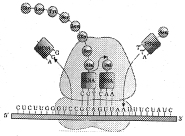
What process is shown in the given figure?
A
Replication
B
Transcription
C
Translation
D
Splicing
Solution
(C) The provided figure illustrates the process of protein synthesis,specifically the elongation phase of translation.
In this process,the ribosome moves along the mRNA molecule,and tRNA molecules bring specific amino acids to the ribosome based on the codon-anticodon pairing.
The growing polypeptide chain is transferred from the tRNA in the $P$-site to the amino acid attached to the tRNA in the $A$-site.
Therefore,the correct process shown is translation.
In this process,the ribosome moves along the mRNA molecule,and tRNA molecules bring specific amino acids to the ribosome based on the codon-anticodon pairing.
The growing polypeptide chain is transferred from the tRNA in the $P$-site to the amino acid attached to the tRNA in the $A$-site.
Therefore,the correct process shown is translation.
0 likes
View Solution119
MediumMCQ
In biological systems,the $RNA$ molecules direct the synthesis of specific proteins which are characteristics of each kind of organism. This process is known as
A
Transcription
B
Mutation
C
Replication
D
Translation
Solution
(D) The process by which the genetic information stored in $mRNA$ is used to synthesize a specific sequence of amino acids to form a protein is known as $Translation$.
During this process,the ribosome reads the genetic code on the $mRNA$ and facilitates the assembly of amino acids into a polypeptide chain.
$Transcription$ is the synthesis of $RNA$ from $DNA$.
$Replication$ is the process of copying $DNA$.
$Mutation$ refers to changes in the nucleotide sequence of $DNA$.
During this process,the ribosome reads the genetic code on the $mRNA$ and facilitates the assembly of amino acids into a polypeptide chain.
$Transcription$ is the synthesis of $RNA$ from $DNA$.
$Replication$ is the process of copying $DNA$.
$Mutation$ refers to changes in the nucleotide sequence of $DNA$.
0 likes
View Solution120
MediumMCQ
Initiation of polypeptide chain is through
A
Lysine
B
Glycine
C
Leucine
D
Methionine
Solution
(D) The first codon of $m$-$RNA$ is always $AUG$.
This codon specifies the amino acid methionine.
Therefore,the first amino acid in a polypeptide chain is always methionine.
This codon specifies the amino acid methionine.
Therefore,the first amino acid in a polypeptide chain is always methionine.
0 likes
View Solution121
MediumMCQ
Which antibiotic inhibits translation in eukaryotes?
A
Tetracycline
B
Penicillin
C
Puromycin
D
Chloromycetin
Solution
(C) Puromycin is an antibiotic that inhibits protein synthesis (translation) in both prokaryotes and eukaryotes. It acts as a structural analog of the aminoacyl-tRNA. It enters the $A$-site of the ribosome and gets incorporated into the growing polypeptide chain,causing premature chain termination and the release of the nascent polypeptide.
0 likes
View Solution122
EasyMCQ
$t-RNA$ constitutes about
A
$70-80\;\%$ of the total $RNA$
B
$15\;\%$ of the total $RNA$
C
$5\;\%$ of the total $RNA$
D
$1-3\;\%$ of the total $RNA$
Solution
(B) $r-RNA$ constitutes approximately $70-80\;\%$ of the total cellular $RNA$.
$t-RNA$ constitutes approximately $15\;\%$ of the total cellular $RNA$.
$m-RNA$ constitutes approximately $2-5\;\%$ of the total cellular $RNA$.
Therefore,the correct option is $B$.
$t-RNA$ constitutes approximately $15\;\%$ of the total cellular $RNA$.
$m-RNA$ constitutes approximately $2-5\;\%$ of the total cellular $RNA$.
Therefore,the correct option is $B$.
0 likes
View Solution123
MediumMCQ
Select the correct statement regarding protein synthesis.
A
When the small subunit of the ribosome encounters an $mRNA$,the process of translation begins.
B
Peptidase catalyses the formation of peptide bond.
C
$UTRs$ are present between the start codon and stop codon.
D
At the end of translation,the release factor binds to the initiation codon.
Solution
(A) The process of translation begins when the small subunit of the ribosome encounters an $mRNA$ at the start codon.
Peptidase is an enzyme that catalyses the breaking (hydrolysis) of peptide bonds,not their formation.
$UTRs$ (Untranslated Regions) are present at both the $5'$-end (before the start codon) and the $3'$-end (after the stop codon),not between them.
At the end of translation,the release factor binds to the stop codon,not the initiation codon,which terminates the process and releases the polypeptide chain from the ribosome.
Peptidase is an enzyme that catalyses the breaking (hydrolysis) of peptide bonds,not their formation.
$UTRs$ (Untranslated Regions) are present at both the $5'$-end (before the start codon) and the $3'$-end (after the stop codon),not between them.
At the end of translation,the release factor binds to the stop codon,not the initiation codon,which terminates the process and releases the polypeptide chain from the ribosome.
0 likes
View Solution124
MediumMCQ
Which step of translation does not consume high energy phosphate bond?
A
Translocation
B
Peptidyl transferase reaction
C
Amino acid activation
D
Aminoacyl $tRNA$ binding to $A$-site
Solution
(B) The process of translation involves several steps,some of which require energy in the form of $ATP$ or $GTP$ hydrolysis.
$1$. Amino acid activation: This step requires $ATP$ to form aminoacyl-$AMP$ complex.
$2$. Aminoacyl $tRNA$ binding to $A$-site: This step requires $GTP$ hydrolysis for the elongation factor $EF-Tu$ to function.
$3$. Translocation: This step requires $GTP$ hydrolysis for the movement of the ribosome along the $mRNA$.
$4$. Peptidyl transferase reaction: This reaction is catalyzed by the $23S$ $rRNA$ (a ribozyme) within the large ribosomal subunit. It does not require the hydrolysis of high-energy phosphate bonds like $ATP$ or $GTP$ to form the peptide bond; the energy is derived from the high-energy ester bond between the amino acid and the $tRNA$.
$1$. Amino acid activation: This step requires $ATP$ to form aminoacyl-$AMP$ complex.
$2$. Aminoacyl $tRNA$ binding to $A$-site: This step requires $GTP$ hydrolysis for the elongation factor $EF-Tu$ to function.
$3$. Translocation: This step requires $GTP$ hydrolysis for the movement of the ribosome along the $mRNA$.
$4$. Peptidyl transferase reaction: This reaction is catalyzed by the $23S$ $rRNA$ (a ribozyme) within the large ribosomal subunit. It does not require the hydrolysis of high-energy phosphate bonds like $ATP$ or $GTP$ to form the peptide bond; the energy is derived from the high-energy ester bond between the amino acid and the $tRNA$.
0 likes
View Solution125
EasyMCQ
Clover leaf secondary structure of $tRNA$ has a loop for
A
three nucleotides of a codon.
B
three nucleotides of an anticodon.
C
no nucleotides.
D
both $(a)$ and $(b)$
Solution
(B) The clover leaf secondary structure of $tRNA$ contains an anticodon loop. This loop consists of three unpaired nitrogenous bases,known as the anticodon,which are complementary to the specific codon present on the $mRNA$ strand during the process of translation.
0 likes
View Solution126
MediumMCQ
During translation,proteins are synthesized by
A
ribosomes using the information on $DNA$.
B
lysosome using the information on $DNA$.
C
ribosome using the information on $mRNA$.
D
lysosome using the information on $mRNA$.
Solution
(C) Translation is the process of protein synthesis where the genetic information stored in $mRNA$ is decoded.
This process occurs in the cytoplasm on ribosomes,which act as the site for protein synthesis.
$tRNA$ molecules bring specific amino acids to the ribosome based on the codons present on the $mRNA$ strand.
Therefore,ribosomes synthesize proteins using the information provided by $mRNA$.
This process occurs in the cytoplasm on ribosomes,which act as the site for protein synthesis.
$tRNA$ molecules bring specific amino acids to the ribosome based on the codons present on the $mRNA$ strand.
Therefore,ribosomes synthesize proteins using the information provided by $mRNA$.
0 likes
View Solution127
MediumMCQ
What is the main function of $tRNA$ in relation to protein synthesis?
A
Initiates transcription
B
Inhibits protein synthesis
C
Identifies amino acids and transports them to ribosomes
D
Proofreading
Solution
(C) $tRNA$ (transfer $RNA$) acts as an adapter molecule during protein synthesis.
It has an anticodon loop that recognizes the specific codon on the $mRNA$ sequence.
It carries the specific amino acid corresponding to the codon to the ribosome.
Thus,it identifies amino acids and transports them to the site of protein synthesis (ribosomes) to be incorporated into the polypeptide chain.
It has an anticodon loop that recognizes the specific codon on the $mRNA$ sequence.
It carries the specific amino acid corresponding to the codon to the ribosome.
Thus,it identifies amino acids and transports them to the site of protein synthesis (ribosomes) to be incorporated into the polypeptide chain.
0 likes
View Solution128
MediumMCQ
What is incorrect for $UTR$?
A
Present in between the translational unit in $mRNA$
B
Not recognised by any $tRNA$
C
Required for efficient translation process
D
Provide stability to $mRNA$
Solution
(A) $UTR$ stands for Untranslated Regions. They are present at both $5'$-end (before start codon) and $3'$-end (after stop codon) of the $mRNA$. They are not present between the translational unit. They are required for efficient translation and provide stability to $mRNA$.
0 likes
View Solution129
MediumMCQ
In bacteria,catalytic $RNA$ is found in
A
$60S$ subunit of ribosome
B
$50S$ subunit of ribosome
C
$30S$ subunit of ribosome
D
$40S$ subunit of ribosome
Solution
(B) In bacteria,the ribosome is of the $70S$ type,which consists of two subunits: a large $50S$ subunit and a small $30S$ subunit.
Catalytic $RNA$ (also known as a ribozyme) is responsible for the formation of peptide bonds during protein synthesis.
Specifically,the $23S$ $rRNA$ present in the $50S$ subunit acts as a ribozyme (peptidyl transferase) to catalyze the peptide bond formation between amino acids.
Therefore,the catalytic $RNA$ is found in the $50S$ subunit of the bacterial ribosome.
Catalytic $RNA$ (also known as a ribozyme) is responsible for the formation of peptide bonds during protein synthesis.
Specifically,the $23S$ $rRNA$ present in the $50S$ subunit acts as a ribozyme (peptidyl transferase) to catalyze the peptide bond formation between amino acids.
Therefore,the catalytic $RNA$ is found in the $50S$ subunit of the bacterial ribosome.
0 likes
View Solution130
MediumMCQ
In protein synthesis,which of the following are required for the synthesis of charged $tRNA$?
A
Amino acid,$GTP$,initiation codon,ribosome
B
Amino acid,$ATP$,$Mg^{2+}$,enzyme,$tRNA$
C
Amino acid,$ATP$,$K^+$,enzyme,$mRNA$
D
Aminoacyl $tRNA$,ribosome,initiation codon,release factor
Solution
(B) The process of charging $tRNA$ is known as aminoacylation or amino acid activation.
This process requires the following components:
$1$. Amino acid: The specific building block to be attached.
$2$. $ATP$: Provides the energy required for the activation of the amino acid.
$3$. $Mg^{2+}$: Acts as a cofactor for the enzyme.
$4$. Enzyme: Aminoacyl-$tRNA$ synthetase,which catalyzes the reaction.
$5$. $tRNA$: The specific transfer $RNA$ molecule to which the amino acid is attached.
Therefore,the correct combination is Amino acid,$ATP$,$Mg^{2+}$,enzyme,and $tRNA$.
This process requires the following components:
$1$. Amino acid: The specific building block to be attached.
$2$. $ATP$: Provides the energy required for the activation of the amino acid.
$3$. $Mg^{2+}$: Acts as a cofactor for the enzyme.
$4$. Enzyme: Aminoacyl-$tRNA$ synthetase,which catalyzes the reaction.
$5$. $tRNA$: The specific transfer $RNA$ molecule to which the amino acid is attached.
Therefore,the correct combination is Amino acid,$ATP$,$Mg^{2+}$,enzyme,and $tRNA$.
0 likes
View Solution131
MediumMCQ
Termination of polypeptide synthesis in bacteria differs from eukaryotes in:
A
Having different termination codons
B
Being $GTP$ dependent
C
Involving more than one type of release factors
D
All of these
Solution
(C) In bacteria,the termination of polypeptide synthesis is mediated by three release factors: $RF1$ (recognizes $UAA$ and $UAG$),$RF2$ (recognizes $UAA$ and $UGA$),and $RF3$ (a $GTP$-binding protein that facilitates the process). In contrast,eukaryotes use only one release factor,$eRF1$,which recognizes all three stop codons $(UAA, UAG, UGA)$,and $eRF3$ which is a $GTP$-binding protein. Therefore,the primary difference lies in the number and specificity of the release factors involved,although both processes are $GTP$-dependent and utilize the same stop codons. Since the question asks how they differ,and the options provided are technically incorrect regarding the codons and $GTP$ dependency (which are shared),the most distinct difference is the number of release factors. However,given the standard multiple-choice format,if the question implies a comparison,the involvement of multiple release factors is the key distinction.
0 likes
View Solution132
MediumMCQ
The majority of unusual bases are found in $tRNA$. The $T\Psi C$ loop is:
A
First loop from $5'-$end of $tRNA$
B
$AA-tRNA$ synthetase binding loop
C
Ribosomal binding loop
D
Codon recognition site
Solution
(C) The $tRNA$ molecule has a cloverleaf structure consisting of several loops. The $T\Psi C$ loop (also known as the $T$-loop) contains the sequence $T\Psi C$ (Thymine,Pseudouridine,Cytosine). This loop is responsible for binding the $tRNA$ to the ribosome during protein synthesis. Therefore,it is known as the ribosomal binding loop.
0 likes
View Solution133
MediumMCQ
For every single amino acid incorporated in a peptide chain,$1$ $ATP$ and $2$ $GTP$ molecules are used.
A
$1, 4$
B
$1, 6$
C
$1, 2$
D
$1, 3$
Solution
(C) During the process of protein synthesis (translation),the energy requirement for the incorporation of each amino acid is as follows:
$1$. Activation of amino acid: $1$ $ATP$ is required to charge the $tRNA$ with the specific amino acid.
$2$. Peptide bond formation and translocation: $1$ $GTP$ is required for the binding of aminoacyl-$tRNA$ to the $A$-site,and $1$ $GTP$ is required for the translocation of the ribosome along the $mRNA$.
Therefore,a total of $1$ $ATP$ and $2$ $GTP$ molecules are consumed for each amino acid added to the polypeptide chain.
$1$. Activation of amino acid: $1$ $ATP$ is required to charge the $tRNA$ with the specific amino acid.
$2$. Peptide bond formation and translocation: $1$ $GTP$ is required for the binding of aminoacyl-$tRNA$ to the $A$-site,and $1$ $GTP$ is required for the translocation of the ribosome along the $mRNA$.
Therefore,a total of $1$ $ATP$ and $2$ $GTP$ molecules are consumed for each amino acid added to the polypeptide chain.
0 likes
View Solution134
MediumMCQ
Which of the following statements is correct regarding the structure of $t-RNA$?
A
$CCA-OH$ end is present at the $5'$-end.
B
$T\Psi C$ loop is responsible for attaching the amino acid.
C
$DHU$ loop is responsible for binding with aminoacyl-$tRNA$ synthetase (amino acid-activating enzyme).
D
There are three recognition sites.
Solution
(C) The structure of $t-RNA$ consists of several loops and arms:
$1$. The $3'$-end of $t-RNA$ contains the $CCA-OH$ sequence,which is the site for amino acid attachment,not the $5'$-end.
$2$. The $T\Psi C$ loop (or $T$-loop) is involved in binding the $t-RNA$ to the ribosome.
$3$. The $DHU$ loop (Dihydrouridine loop) is the site for the recognition and binding of the aminoacyl-$tRNA$ synthetase enzyme,which activates the amino acid.
$4$. Therefore,option $C$ is the correct statement.
$1$. The $3'$-end of $t-RNA$ contains the $CCA-OH$ sequence,which is the site for amino acid attachment,not the $5'$-end.
$2$. The $T\Psi C$ loop (or $T$-loop) is involved in binding the $t-RNA$ to the ribosome.
$3$. The $DHU$ loop (Dihydrouridine loop) is the site for the recognition and binding of the aminoacyl-$tRNA$ synthetase enzyme,which activates the amino acid.
$4$. Therefore,option $C$ is the correct statement.
0 likes
View Solution135
MediumMCQ
$A$: Peptidyl transfer site is contributed by the larger subunit of the ribosome.
$R$: The enzyme peptidyl transferase is contributed by both $23S$ and $16S$ ribosomal subunits.
$R$: The enzyme peptidyl transferase is contributed by both $23S$ and $16S$ ribosomal subunits.
A
Assertion and Reason both are correct and Reason is the correct explanation of Assertion.
B
Assertion and Reason both are correct but Reason is not the correct explanation of Assertion.
C
Assertion is correct,but Reason is incorrect.
D
Both Assertion and Reason are incorrect.
Solution
(C) The Assertion is correct: The peptidyl transferase site is located on the $50S$ (larger) subunit of the $70S$ ribosome in prokaryotes.
The Reason is incorrect: The enzyme peptidyl transferase is a ribozyme. In prokaryotes,it is primarily composed of $23S$ rRNA,which is part of the $50S$ subunit. The $16S$ rRNA is part of the $30S$ (smaller) subunit and is involved in binding the mRNA and the initiation complex,not in the peptidyl transferase activity. Therefore,the statement that it is contributed by both $23S$ and $16S$ is false.
The Reason is incorrect: The enzyme peptidyl transferase is a ribozyme. In prokaryotes,it is primarily composed of $23S$ rRNA,which is part of the $50S$ subunit. The $16S$ rRNA is part of the $30S$ (smaller) subunit and is involved in binding the mRNA and the initiation complex,not in the peptidyl transferase activity. Therefore,the statement that it is contributed by both $23S$ and $16S$ is false.
0 likes
View Solution136
MediumMCQ
$A$: In bacterial translation mechanism,two $tRNA$ are required for methionine.
$R$: $AUG$ codes for methionine and it shows nonambiguity.
$R$: $AUG$ codes for methionine and it shows nonambiguity.
A
Assertion and Reason both are correct and Reason is the correct explanation of Assertion.
B
Assertion and Reason both are correct but Reason is not the correct explanation of Assertion.
C
Assertion is correct,but Reason is incorrect.
D
Both Assertion and Reason are incorrect.
Solution
(B) In bacteria,there are two types of $tRNA$ for methionine: $tRNA_f^{Met}$ (initiator $tRNA$) and $tRNA_m^{Met}$ (elongator $tRNA$).
$tRNA_f^{Met}$ is used for the initiation of protein synthesis,while $tRNA_m^{Met}$ is used for the incorporation of methionine at internal positions of the polypeptide chain.
Therefore,the Assertion is correct.
$AUG$ codes for methionine,and the genetic code is unambiguous,meaning one codon codes for only one amino acid.
However,the reason provided does not explain why two different $tRNA$ molecules are required for the same amino acid in bacteria.
Thus,both statements are correct,but the Reason is not the correct explanation of the Assertion.
$tRNA_f^{Met}$ is used for the initiation of protein synthesis,while $tRNA_m^{Met}$ is used for the incorporation of methionine at internal positions of the polypeptide chain.
Therefore,the Assertion is correct.
$AUG$ codes for methionine,and the genetic code is unambiguous,meaning one codon codes for only one amino acid.
However,the reason provided does not explain why two different $tRNA$ molecules are required for the same amino acid in bacteria.
Thus,both statements are correct,but the Reason is not the correct explanation of the Assertion.
0 likes
View Solution137
DifficultMCQ
Which of the following $RNAs$ is not required for the synthesis of protein?
A
$mRNA$
B
$tRNA$
C
$rRNA$
D
$siRNA$
Solution
(D) Protein synthesis (translation) requires three main types of $RNA$:
$1$. $mRNA$ (messenger $RNA$): Acts as a template carrying the genetic code.
$2$. $tRNA$ (transfer $RNA$): Brings amino acids to the ribosome.
$3$. $rRNA$ (ribosomal $RNA$): Forms the structural and catalytic core of the ribosome.
$siRNA$ (small interfering $RNA$) is involved in $RNA$ interference $(RNAi)$,a process of gene silencing,and is not a component of the standard protein synthesis machinery.
$1$. $mRNA$ (messenger $RNA$): Acts as a template carrying the genetic code.
$2$. $tRNA$ (transfer $RNA$): Brings amino acids to the ribosome.
$3$. $rRNA$ (ribosomal $RNA$): Forms the structural and catalytic core of the ribosome.
$siRNA$ (small interfering $RNA$) is involved in $RNA$ interference $(RNAi)$,a process of gene silencing,and is not a component of the standard protein synthesis machinery.
0 likes
View Solution138
MediumMCQ
The process of translation of mRNA to proteins begins as soon as :
A
The larger subunit of ribosome encounters mRNA
B
Both the subunits join together to bind with mRNA
C
The tRNA is activated and the larger subunit of ribosome encounters mRNA
D
The small subunit of ribosome encounters mRNA
Solution
(D) The process of translation involves the synthesis of a polypeptide chain from an $mRNA$ template.
Translation begins when the small subunit of the ribosome binds to the $mRNA$ at the start codon $(AUG)$.
Once the small subunit is attached to the $mRNA$,the initiator $tRNA$ (carrying methionine) binds to the start codon.
Following this,the large subunit of the ribosome joins the complex to form the functional $70S$ (in prokaryotes) or $80S$ (in eukaryotes) ribosome,allowing the elongation process to commence.
Therefore,the initiation of translation is triggered by the small subunit encountering the $mRNA$.
Translation begins when the small subunit of the ribosome binds to the $mRNA$ at the start codon $(AUG)$.
Once the small subunit is attached to the $mRNA$,the initiator $tRNA$ (carrying methionine) binds to the start codon.
Following this,the large subunit of the ribosome joins the complex to form the functional $70S$ (in prokaryotes) or $80S$ (in eukaryotes) ribosome,allowing the elongation process to commence.
Therefore,the initiation of translation is triggered by the small subunit encountering the $mRNA$.
0 likes
View Solution139
EasyMCQ
When multiple ribosomes are attached to a single $mRNA$ strand,the structure is called $.............$.
A
Polyribosomes
B
Polynucleosomes
C
Polysaccharide
D
Polynucleotide
Solution
(A) When several ribosomes are attached to a single $mRNA$ molecule,they form a chain-like structure known as a polyribosome or polysome.
This structure allows for the simultaneous translation of a single $mRNA$ molecule into multiple copies of the same polypeptide chain,thereby increasing the efficiency of protein synthesis.
This structure allows for the simultaneous translation of a single $mRNA$ molecule into multiple copies of the same polypeptide chain,thereby increasing the efficiency of protein synthesis.
0 likes
View Solution140
MediumMCQ
Protein synthesis is known as $.....$
A
Transcription
B
Replication
C
Translation
D
Transduction
Solution
(C) The process of protein synthesis from $mRNA$ is known as translation.
In this process,the genetic information present in $mRNA$ is translated into a sequence of amino acids to form a polypeptide chain.
Transcription is the process of synthesizing $RNA$ from $DNA$.
Replication is the process of copying $DNA$ to form a new $DNA$ molecule.
Transduction is a process of horizontal gene transfer in bacteria via bacteriophages.
In this process,the genetic information present in $mRNA$ is translated into a sequence of amino acids to form a polypeptide chain.
Transcription is the process of synthesizing $RNA$ from $DNA$.
Replication is the process of copying $DNA$ to form a new $DNA$ molecule.
Transduction is a process of horizontal gene transfer in bacteria via bacteriophages.
0 likes
View Solution141
MediumMCQ
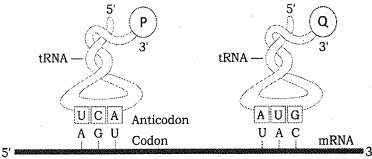
The given figure shows two $tRNA$ molecules. Which amino acids are attached to these $tRNAs$ ($P$ and $Q$)?
A
Tyr $\quad$ Ser
B
Ser $\quad$ Tyr
C
Trp $\quad$ Ser
D
Ser $\quad$ Trp
Solution
(B) $1$. To determine the amino acid,we must identify the codon on the $mRNA$ that pairs with the anticodon on the $tRNA$.
$2$. For $tRNA$ $P$,the anticodon is $UCA$. The complementary codon on the $mRNA$ is $AGU$. According to the genetic code table,the codon $AGU$ codes for the amino acid Serine $(Ser)$.
$3$. For $tRNA$ $Q$,the anticodon is $AUG$. The complementary codon on the $mRNA$ is $UAC$. According to the genetic code table,the codon $UAC$ codes for the amino acid Tyrosine $(Tyr)$.
$4$. Therefore,$P$ is Serine $(Ser)$ and $Q$ is Tyrosine $(Tyr)$. The correct option is $B$.
$2$. For $tRNA$ $P$,the anticodon is $UCA$. The complementary codon on the $mRNA$ is $AGU$. According to the genetic code table,the codon $AGU$ codes for the amino acid Serine $(Ser)$.
$3$. For $tRNA$ $Q$,the anticodon is $AUG$. The complementary codon on the $mRNA$ is $UAC$. According to the genetic code table,the codon $UAC$ codes for the amino acid Tyrosine $(Tyr)$.
$4$. Therefore,$P$ is Serine $(Ser)$ and $Q$ is Tyrosine $(Tyr)$. The correct option is $B$.
0 likes
View Solution142
EasyMCQ
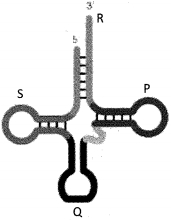
The figure below shows a $tRNA$ molecule. Where does the amino acid attach?
A
$P$
B
$Q$
C
$R$
D
$S$
Solution
(C) In a $tRNA$ molecule,the amino acid attachment site is located at the $3'$ end of the molecule.
Looking at the provided figure,the $3'$ end is labeled as $R$.
Therefore,the amino acid attaches at position $R$.
Looking at the provided figure,the $3'$ end is labeled as $R$.
Therefore,the amino acid attaches at position $R$.
0 likes
View Solution143
MediumMCQ
The aminoacylation of $tRNA$ is known as:
A
Charging of $mRNA$
B
Charging of $rRNA$
C
Charging of $tRNA$
D
Charging of $DNA$
Solution
(C) The process of aminoacylation of $tRNA$ involves the attachment of a specific amino acid to the $3'$-end of the $tRNA$ molecule.
This process is catalyzed by the enzyme aminoacyl-$tRNA$ synthetase.
Because this process requires energy (in the form of $ATP$) to link the amino acid to the $tRNA$,it is commonly referred to as the 'charging' of $tRNA$ or 'aminoacylation' of $tRNA$.
Therefore,the correct option is $C$.
This process is catalyzed by the enzyme aminoacyl-$tRNA$ synthetase.
Because this process requires energy (in the form of $ATP$) to link the amino acid to the $tRNA$,it is commonly referred to as the 'charging' of $tRNA$ or 'aminoacylation' of $tRNA$.
Therefore,the correct option is $C$.
0 likes
View Solution144
EasyMCQ
$UTRs$ (Untranslated Regions) are present on which of the following?
A
$rRNA$
B
$tRNA$
C
$mRNA$
D
$hnRNA$
Solution
(C) $UTRs$ stand for Untranslated Regions. These are specific sequences of nucleotides present on the $mRNA$ molecule that are not translated into proteins. They are located at both the $5'$-end (before the start codon) and the $3'$-end (after the stop codon). These regions are essential for the efficient translation process of $mRNA$.
0 likes
View Solution145
MediumMCQ
Which of the following $rRNA$ acts as a ribozyme in prokaryotic cells?
A
$18S \, rRNA$
B
$28S \, rRNA$
C
$23S \, rRNA$
D
$5.8S \, rRNA$
Solution
(C) In prokaryotic cells,the $70S$ ribosome consists of two subunits: a $30S$ small subunit and a $50S$ large subunit. The $50S$ large subunit contains $23S \, rRNA$ and $5S \, rRNA$. The $23S \, rRNA$ acts as a ribozyme,specifically functioning as a peptidyl transferase enzyme that catalyzes the formation of peptide bonds between amino acids during protein synthesis. Therefore,the correct option is $C$.
0 likes
View Solution146
MediumMCQ
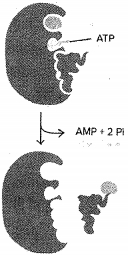
What does this process represent?
A
Charging of $tRNA$
B
Peptide bond formation
C
Translation
D
Formation of $mRNA$
Solution
(A) The provided image illustrates the process of aminoacylation of $tRNA$,also known as the charging of $tRNA$.
In this process,an amino acid is activated by $ATP$ and then attached to its specific $tRNA$ molecule.
This step is essential for protein synthesis as it ensures that the correct amino acid is brought to the ribosome during translation.
The release of $AMP$ and $2Pi$ indicates the energy-consuming nature of this activation step.
In this process,an amino acid is activated by $ATP$ and then attached to its specific $tRNA$ molecule.
This step is essential for protein synthesis as it ensures that the correct amino acid is brought to the ribosome during translation.
The release of $AMP$ and $2Pi$ indicates the energy-consuming nature of this activation step.
0 likes
View Solution147
MediumMCQ
Select the incorrect statement from the following.
A
Ribosomes consist of structural $RNAs$ and about $80$ different proteins.
B
The large subunit of the ribosome binds to the $mRNA$.
C
Untranslated regions $(UTR)$ are present at both ends of the $mRNA$.
D
The initiation codon for translation is $AUG$.
Solution
(B) The correct answer is $B$.
In the process of translation,the small subunit of the ribosome first binds to the $mRNA$.
After the binding of the small subunit,the large subunit binds to the complex to initiate the process.
Option $A$ is correct as ribosomes are ribonucleoprotein complexes.
Option $C$ is correct as $UTR$s are present at both $5'$-end (before start codon) and $3'$-end (after stop codon) of $mRNA$ to ensure efficient translation.
Option $D$ is correct as $AUG$ acts as the start codon for protein synthesis.
In the process of translation,the small subunit of the ribosome first binds to the $mRNA$.
After the binding of the small subunit,the large subunit binds to the complex to initiate the process.
Option $A$ is correct as ribosomes are ribonucleoprotein complexes.
Option $C$ is correct as $UTR$s are present at both $5'$-end (before start codon) and $3'$-end (after stop codon) of $mRNA$ to ensure efficient translation.
Option $D$ is correct as $AUG$ acts as the start codon for protein synthesis.
0 likes
View Solution148
MediumMCQ
If an $mRNA$ has the codon $UAG$,which anticodon will the incoming $tRNA$ carry?
A
$UAG$
B
$AUC$
C
$GAU$
D
None of these
Solution
(D) The codon on $mRNA$ is $UAG$.
According to the base-pairing rules,$A$ pairs with $U$ and $G$ pairs with $C$.
Therefore,the complementary anticodon on the $tRNA$ would be $AUC$.
However,it is important to note that $UAG$ is a stop codon (nonsense codon) and does not code for any amino acid.
Under normal physiological conditions,there is no $tRNA$ that carries an anticodon for a stop codon.
Therefore,the correct answer is that no such $tRNA$ will come.
According to the base-pairing rules,$A$ pairs with $U$ and $G$ pairs with $C$.
Therefore,the complementary anticodon on the $tRNA$ would be $AUC$.
However,it is important to note that $UAG$ is a stop codon (nonsense codon) and does not code for any amino acid.
Under normal physiological conditions,there is no $tRNA$ that carries an anticodon for a stop codon.
Therefore,the correct answer is that no such $tRNA$ will come.
0 likes
View Solution149
MediumMCQ
Which process is shown in the given figure?
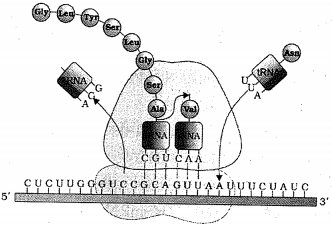
A
Replication
B
Translation
C
Transcription
D
None of these
Solution
(B) The provided figure illustrates the process of protein synthesis,specifically the elongation phase of translation. In this process,the ribosome moves along the $mRNA$ strand,and $tRNA$ molecules bring specific amino acids to the ribosome based on the codon-anticodon pairing. The amino acids are then linked together by peptide bonds to form a polypeptide chain. Since the figure shows the assembly of amino acids into a protein chain using $mRNA$ as a template,it represents translation.
0 likes
View Solution150
MediumMCQ
Gene expression can be represented in which of the following forms?
A
Formation of $mRNA$
B
Formation of $rRNA$
C
Formation of $DNA$
D
Formation of protein
Solution
(D) Gene expression is the process by which the information encoded in a gene is used in the synthesis of a functional gene product.
Most commonly,these functional products are proteins.
The process involves two main stages: transcription (where $DNA$ is copied into $mRNA$) and translation (where $mRNA$ is used to synthesize a polypeptide chain or protein).
Therefore,the final functional outcome of gene expression is the formation of a protein.
Most commonly,these functional products are proteins.
The process involves two main stages: transcription (where $DNA$ is copied into $mRNA$) and translation (where $mRNA$ is used to synthesize a polypeptide chain or protein).
Therefore,the final functional outcome of gene expression is the formation of a protein.
0 likes
View SolutionMolecular Basis of Inheritance — Translation · Frequently Asked Questions
1Are these Molecular Basis of Inheritance questions useful for JEE and NEET?
Yes. All questions in this section are mapped to JEE Main and NEET exam patterns. Previous year questions from JEE Main, NEET, GUJCET and state-level exams are included with full solutions.
2Can I switch to Hindi or Gujarati for these questions?
Yes. Use the language tabs in the hero section or the sidebar to view the same questions and solutions in English, Hindi or Gujarati.
3How do I generate a question paper from this subtopic?
Use the Vedclass Exam Paper Generator — select the chapter and subtopic, set difficulty, and generate Sets A, B, C, D automatically. First 3 chapters of every subject are free.
Vedclass Products
For Students
Vedclass Test Series
Mock tests in real JEE/NEET style with performance analysis. 5-day free trial.
Start Free TrialFor Teachers
Exam Paper Generator
Generate Set A/B/C/D papers from this chapter in 2 minutes. 3 chapters free.
Try FreeFor Institutes
Online Exam Module
Live online exams with unlimited students, 360° analytics & white-label branding.
See DemoFor Teachers & Institutes
Generate a Molecular Basis of Inheritance Exam Paper in 2 Minutes
Select subtopic & difficulty — Sets A, B, C, D auto-generated with No Repeat logic.
First 3 chapters of every subject are free — no payment required.