
A English
Translation Questions in English
Class 12 Biology · Molecular Basis of Inheritance · Translation
178+
Questions
English
Language
100%
With Solutions
Showing 28 of 178 questions in English
151
MediumMCQ
Against the codon $5' UAC 3'$,what would be the sequence of anticodon on $tRNA$?
A
$5' GUA 3'$
B
$5' AUG 3'$
C
$5' GTA 3'$
D
$3' AUG 5'$
Solution
(A) The codon on $mRNA$ is $5' UAC 3'$.
According to the base-pairing rules,the anticodon on $tRNA$ is complementary to the codon on $mRNA$.
Complementary base pairing occurs in an antiparallel orientation ($5' \rightarrow 3'$ of codon pairs with $3' \rightarrow 5'$ of anticodon).
Given codon: $5' UAC 3'$.
The complementary sequence is $3' AUG 5'$.
By convention,anticodon sequences are written in the $5' \rightarrow 3'$ direction.
Reversing $3' AUG 5'$ gives $5' GUA 3'$.
According to the base-pairing rules,the anticodon on $tRNA$ is complementary to the codon on $mRNA$.
Complementary base pairing occurs in an antiparallel orientation ($5' \rightarrow 3'$ of codon pairs with $3' \rightarrow 5'$ of anticodon).
Given codon: $5' UAC 3'$.
The complementary sequence is $3' AUG 5'$.
By convention,anticodon sequences are written in the $5' \rightarrow 3'$ direction.
Reversing $3' AUG 5'$ gives $5' GUA 3'$.
0 likes
View Solution152
MediumMCQ
Which of the following statements is not correct with respect to translation $:-$
A
The amino acids are joined by a peptide bond
B
Formation of a peptide bond does not require energy
C
Peptide bond formation is catalysed by $23S$ $rRNA$ in bacteria
D
Amino acids are activated in the presence of $ATP$
Solution
(B) Translation is the process of protein synthesis.
$1$. Amino acids are joined by peptide bonds to form a polypeptide chain.
$2$. The formation of a peptide bond is an endergonic process,meaning it requires energy. This energy is provided by the activation of amino acids using $ATP$.
$3$. In bacteria,the $23S$ $rRNA$ (a ribozyme) acts as a catalyst for peptide bond formation.
$4$. Therefore,the statement that the formation of a peptide bond does not require energy is incorrect.
$1$. Amino acids are joined by peptide bonds to form a polypeptide chain.
$2$. The formation of a peptide bond is an endergonic process,meaning it requires energy. This energy is provided by the activation of amino acids using $ATP$.
$3$. In bacteria,the $23S$ $rRNA$ (a ribozyme) acts as a catalyst for peptide bond formation.
$4$. Therefore,the statement that the formation of a peptide bond does not require energy is incorrect.
0 likes
View Solution153
MediumMCQ
Read the following statements and choose the correct set of statements:
$(a)$ $\text{tRNA}$ has an anticodon loop that has bases complementary to the code.
$(b)$ The $\text{tRNA}$,also called $\text{sRNA}$,was known before the genetic code was postulated.
$(c)$ For termination codon,there is a specific $\text{tRNA}$ that is referred to as terminator $\text{tRNA}$.
$(d)$ The secondary structure of $\text{tRNA}$ has been depicted that looks like an inverted $L$.
Choose the correct answer from the options given below:
$(a)$ $\text{tRNA}$ has an anticodon loop that has bases complementary to the code.
$(b)$ The $\text{tRNA}$,also called $\text{sRNA}$,was known before the genetic code was postulated.
$(c)$ For termination codon,there is a specific $\text{tRNA}$ that is referred to as terminator $\text{tRNA}$.
$(d)$ The secondary structure of $\text{tRNA}$ has been depicted that looks like an inverted $L$.
Choose the correct answer from the options given below:
A
$(a), (b)$ and $(d)$ only
B
$(c)$ and $(d)$ only
C
$(a), (b), (c)$ and $(d)$ only
D
$(a)$ and $(b)$ only
Solution
(D) Statement $(a)$ is correct: $\text{tRNA}$ contains an anticodon loop with bases complementary to the mRNA codon.
Statement $(b)$ is correct: $\text{tRNA}$ was previously known as soluble $RNA$ $(\text{sRNA})$ and was identified before the genetic code was fully understood.
Statement $(c)$ is incorrect: There are no $\text{tRNA}$ molecules for stop codons ($UAA$,$UAG$,$UGA$). Termination is mediated by release factors.
Statement $(d)$ is incorrect: The secondary structure of $\text{tRNA}$ is clover-leaf shaped,while the tertiary structure is inverted $L$-shaped.
Therefore,only statements $(a)$ and $(b)$ are correct.
Statement $(b)$ is correct: $\text{tRNA}$ was previously known as soluble $RNA$ $(\text{sRNA})$ and was identified before the genetic code was fully understood.
Statement $(c)$ is incorrect: There are no $\text{tRNA}$ molecules for stop codons ($UAA$,$UAG$,$UGA$). Termination is mediated by release factors.
Statement $(d)$ is incorrect: The secondary structure of $\text{tRNA}$ is clover-leaf shaped,while the tertiary structure is inverted $L$-shaped.
Therefore,only statements $(a)$ and $(b)$ are correct.
0 likes
View Solution154
MediumMCQ
What role does $\text{rRNA}$ $(\text{Ribosomal RNA})$ play during translation?
A
Structural and Catalytic role
B
Template for Polypeptide Synthesis
C
Adapter role
D
Silencing gene expression.
Solution
(A) During the process of translation,$\text{rRNA}$ performs two primary functions:
$1$. Structural role: $\text{rRNA}$ forms the structural framework of the ribosome,which is the site of protein synthesis.
$2$. Catalytic role: The $23S$ $\text{rRNA}$ in bacteria (or $28S$ $\text{rRNA}$ in eukaryotes) acts as a ribozyme,specifically a peptidyl transferase,which catalyzes the formation of peptide bonds between amino acids during polypeptide chain elongation.
$1$. Structural role: $\text{rRNA}$ forms the structural framework of the ribosome,which is the site of protein synthesis.
$2$. Catalytic role: The $23S$ $\text{rRNA}$ in bacteria (or $28S$ $\text{rRNA}$ in eukaryotes) acts as a ribozyme,specifically a peptidyl transferase,which catalyzes the formation of peptide bonds between amino acids during polypeptide chain elongation.
0 likes
View Solution155
MediumMCQ
Select the correct statement about protein synthesis $:-$
A
Translation begins when $\text{mRNA}$ attaches to the small subunit of the ribosome.
B
Peptidyl transferase catalyzes the formation of the peptide bond.
C
$\text{UTRs}$ are present at both $5'$-end (before start codon) and $3'$-end (after stop codon).
D
At the end of translation,a release factor binds to the stop codon.
Solution
(A) $1$. Translation begins when the small subunit of the ribosome binds to the $\text{mRNA}$ at the start codon,making option $A$ the correct statement.
$2$. The formation of peptide bonds is catalyzed by the enzyme peptidyl transferase (a ribozyme),not peptidase.
$3$. $\text{UTRs}$ $(\text{Untranslated Regions})$ are present at both the $5'$-end (before the start codon) and the $3'$-end (after the stop codon) to ensure efficient translation,not between the start and stop codons.
$4$. At the end of translation,the release factor binds to the stop codon (not the initiation codon) to terminate the process.
$2$. The formation of peptide bonds is catalyzed by the enzyme peptidyl transferase (a ribozyme),not peptidase.
$3$. $\text{UTRs}$ $(\text{Untranslated Regions})$ are present at both the $5'$-end (before the start codon) and the $3'$-end (after the stop codon) to ensure efficient translation,not between the start and stop codons.
$4$. At the end of translation,the release factor binds to the stop codon (not the initiation codon) to terminate the process.
0 likes
View Solution156
EasyMCQ
Anticodon loop of $tRNA$ has . . . . . . .
A
unusual bases
B
unpaired $CCA$ bases
C
$3$ unpaired complementary bases
D
$3$ paired bases
Solution
(C) The anticodon loop of $tRNA$ contains a sequence of $3$ unpaired nitrogenous bases,known as the anticodon.
These bases are complementary to the specific codon present on the $mRNA$ strand during the process of translation.
Therefore,the correct option is $C$.
These bases are complementary to the specific codon present on the $mRNA$ strand during the process of translation.
Therefore,the correct option is $C$.
0 likes
View Solution157
EasyMCQ
The amino acid acceptor end of $tRNA$ is its $i$ end which has unpaired $ii$ bases.
A
$i - 3', ii - CCA$
B
$i - 3', ii - GGA$
C
$i - 5', ii - CCA$
D
$i - 5', ii - GGA$
Solution
(A) The $tRNA$ molecule has a specific structure where the amino acid acceptor end is the $3'$ end.
This $3'$ end contains a conserved sequence of three unpaired bases,which is $CCA$.
This $CCA$ sequence serves as the binding site for the specific amino acid during the process of protein synthesis.
Therefore,$i$ corresponds to $3'$ and $ii$ corresponds to $CCA$.
This $3'$ end contains a conserved sequence of three unpaired bases,which is $CCA$.
This $CCA$ sequence serves as the binding site for the specific amino acid during the process of protein synthesis.
Therefore,$i$ corresponds to $3'$ and $ii$ corresponds to $CCA$.
0 likes
View Solution158
EasyMCQ
Identify the correct sequence of events involved in the synthesis of a polypeptide during translation.
A
Initiation - Termination - Elongation
B
Elongation - Termination - Initiation
C
Initiation - Elongation - Termination
D
Termination - Initiation - Elongation
Solution
(C) The process of translation,which is the synthesis of a polypeptide from an $mRNA$ template,occurs in three distinct stages:
$1$. Initiation: The ribosome assembles around the target $mRNA$ and the first $tRNA$ is attached to the start codon.
$2$. Elongation: The ribosome moves along the $mRNA$ strand,adding amino acids to the growing polypeptide chain one by one as specified by the codons.
$3$. Termination: When a stop codon is reached,the ribosome releases the completed polypeptide chain and dissociates from the $mRNA$.
$1$. Initiation: The ribosome assembles around the target $mRNA$ and the first $tRNA$ is attached to the start codon.
$2$. Elongation: The ribosome moves along the $mRNA$ strand,adding amino acids to the growing polypeptide chain one by one as specified by the codons.
$3$. Termination: When a stop codon is reached,the ribosome releases the completed polypeptide chain and dissociates from the $mRNA$.
0 likes
View Solution159
EasyMCQ
Which of the following statements is $INCORRECT$ for the elongation of the polypeptide chain during protein synthesis?
A
First aminoacyl $tRNA$ molecule with methionine enters the ribosome at the '$P$'-site.
B
The successive charged $tRNA$ molecules with amino acids enter the ribosome through the '$A$'-site.
C
The formation of the peptide bond is catalysed by a ribozyme.
D
Translocation on $mRNA$ occurs in the $3' \rightarrow 5'$ direction.
Solution
(D) During protein synthesis,the elongation phase involves the following steps:
$1$. The first aminoacyl-$tRNA$ (initiator $tRNA$) carrying methionine binds to the '$P$'-site of the ribosome.
$2$. Subsequent charged $tRNA$ molecules,carrying specific amino acids,enter the ribosome at the '$A$'-site.
$3$. $A$ peptide bond is formed between the amino acid at the '$P$'-site and the amino acid at the '$A$'-site,a reaction catalysed by the $23S$ rRNA (ribozyme).
$4$. Translocation is the movement of the ribosome along the $mRNA$ in the $5' \rightarrow 3'$ direction,not $3' \rightarrow 5'$. Therefore,statement $D$ is incorrect.
$1$. The first aminoacyl-$tRNA$ (initiator $tRNA$) carrying methionine binds to the '$P$'-site of the ribosome.
$2$. Subsequent charged $tRNA$ molecules,carrying specific amino acids,enter the ribosome at the '$A$'-site.
$3$. $A$ peptide bond is formed between the amino acid at the '$P$'-site and the amino acid at the '$A$'-site,a reaction catalysed by the $23S$ rRNA (ribozyme).
$4$. Translocation is the movement of the ribosome along the $mRNA$ in the $5' \rightarrow 3'$ direction,not $3' \rightarrow 5'$. Therefore,statement $D$ is incorrect.
0 likes
View Solution160
EasyMCQ
During translation in protein synthesis,the joining of the larger and smaller subunits of the ribosome requires . . . . . . ions.
A
$Mn^{++}$
B
$Cl^{-}$
C
$Ca^{++}$
D
$Mg^{++}$
Solution
(D) During the process of translation in protein synthesis,the ribosome exists as two subunits: a smaller subunit and a larger subunit.
These two subunits remain separate in the cytoplasm when not involved in protein synthesis.
When the smaller subunit binds to the mRNA,the larger subunit attaches to it to form the functional ribosome complex.
This association of the two ribosomal subunits is dependent on the concentration of magnesium ions $(Mg^{++})$.
Therefore,$Mg^{++}$ ions are essential for the assembly of the functional ribosome.
These two subunits remain separate in the cytoplasm when not involved in protein synthesis.
When the smaller subunit binds to the mRNA,the larger subunit attaches to it to form the functional ribosome complex.
This association of the two ribosomal subunits is dependent on the concentration of magnesium ions $(Mg^{++})$.
Therefore,$Mg^{++}$ ions are essential for the assembly of the functional ribosome.
0 likes
View Solution161
EasyMCQ
During translation in protein synthesis,anticodon and codon bind by formation of . . . . . . bond.
A
peptide
B
glycosidic
C
hydrogen
D
phosphodiester
Solution
(C) During the process of translation,the $mRNA$ codon pairs with the complementary $tRNA$ anticodon.
This interaction is mediated by the formation of $hydrogen$ bonds between the complementary nitrogenous bases (e.g.,$A$ with $U$,$G$ with $C$).
These $hydrogen$ bonds ensure the specificity and accuracy of the genetic code translation into a polypeptide chain.
This interaction is mediated by the formation of $hydrogen$ bonds between the complementary nitrogenous bases (e.g.,$A$ with $U$,$G$ with $C$).
These $hydrogen$ bonds ensure the specificity and accuracy of the genetic code translation into a polypeptide chain.
0 likes
View Solution162
EasyMCQ
Which one of the following is $NOT$ needed in the formation of a polypeptide chain?
A
$RNA$ polymerase
B
$DNA$
C
$DNA$ polymerase
D
amino acids
Solution
(C) The formation of a polypeptide chain occurs during the process of translation.
Translation involves the synthesis of proteins from $mRNA$ templates.
$RNA$ polymerase is required for transcription (synthesis of $mRNA$ from $DNA$).
$DNA$ serves as the template for transcription,which provides the genetic code for the polypeptide chain.
Amino acids are the building blocks (monomers) required for the synthesis of the polypeptide chain.
$DNA$ polymerase is the enzyme responsible for $DNA$ replication,which is the process of copying $DNA$ molecules.
Therefore,$DNA$ polymerase is not involved in the process of protein synthesis (translation).
Translation involves the synthesis of proteins from $mRNA$ templates.
$RNA$ polymerase is required for transcription (synthesis of $mRNA$ from $DNA$).
$DNA$ serves as the template for transcription,which provides the genetic code for the polypeptide chain.
Amino acids are the building blocks (monomers) required for the synthesis of the polypeptide chain.
$DNA$ polymerase is the enzyme responsible for $DNA$ replication,which is the process of copying $DNA$ molecules.
Therefore,$DNA$ polymerase is not involved in the process of protein synthesis (translation).
0 likes
View Solution163
EasyMCQ
The sequential events that occur during protein synthesis are:
A
Protein $\rightarrow$ Translation $\rightarrow$ Transcription $\rightarrow$ $DNA$
B
$DNA$ $\rightarrow$ Transcription $\rightarrow$ Translation $\rightarrow$ Protein
C
Translation $\rightarrow$ Transcription $\rightarrow$ $DNA$ $\rightarrow$ Protein
D
$DNA$ $\rightarrow$ Protein $\rightarrow$ Translation $\rightarrow$ Transcription
Solution
(B) The central dogma of molecular biology describes the flow of genetic information within a biological system.
$1$. $DNA$ acts as the master template and undergoes transcription to produce $mRNA$.
$2$. The $mRNA$ then undergoes translation at the ribosome to synthesize a specific polypeptide chain (protein).
$3$. Therefore,the correct sequence is $DNA \rightarrow$ Transcription $\rightarrow$ Translation $\rightarrow$ Protein.
$1$. $DNA$ acts as the master template and undergoes transcription to produce $mRNA$.
$2$. The $mRNA$ then undergoes translation at the ribosome to synthesize a specific polypeptide chain (protein).
$3$. Therefore,the correct sequence is $DNA \rightarrow$ Transcription $\rightarrow$ Translation $\rightarrow$ Protein.
0 likes
View Solution164
EasyMCQ
In eukaryotes,the anticodon of $t-RNA$ that pairs with the start codon of $mRNA$ during translation is
A
$UAA$
B
$UCA$
C
$UAC$
D
$UUU$
Solution
(C) The start codon or initiation codon on $mRNA$ is $AUG$,which serves as the first codon to be translated during protein synthesis.
The anticodon on $t-RNA$ is complementary to the codon on $mRNA$ based on base-pairing rules ($A$ pairs with $U$,$U$ pairs with $A$,and $G$ pairs with $C$).
Therefore,the anticodon for the $AUG$ codon is $UAC$.
The anticodon on $t-RNA$ is complementary to the codon on $mRNA$ based on base-pairing rules ($A$ pairs with $U$,$U$ pairs with $A$,and $G$ pairs with $C$).
Therefore,the anticodon for the $AUG$ codon is $UAC$.
0 likes
View Solution165
EasyMCQ
The triplet on the coding strand of $DNA$ is $ATG$. What would be the required anticodon on the corresponding $t-RNA$ during translation?
A
$UAA$
B
$UAG$
C
$UGA$
D
$UAC$
Solution
(D) $1$. The coding strand of $DNA$ has the sequence $ATG$ in the $5' \rightarrow 3'$ direction.
$2$. The $mRNA$ is transcribed from the template strand,which is complementary to the coding strand. Therefore,the $mRNA$ sequence will be identical to the coding strand,except that $Thymine$ $(T)$ is replaced by $Uracil$ $(U)$. Thus,the $mRNA$ codon is $AUG$.
$3$. During translation,the $t-RNA$ anticodon pairs with the $mRNA$ codon through complementary base pairing ($A$ pairs with $U$,$U$ pairs with $A$,$G$ pairs with $C$).
$4$. For the $mRNA$ codon $AUG$,the complementary anticodon on $t-RNA$ is $UAC$.
$2$. The $mRNA$ is transcribed from the template strand,which is complementary to the coding strand. Therefore,the $mRNA$ sequence will be identical to the coding strand,except that $Thymine$ $(T)$ is replaced by $Uracil$ $(U)$. Thus,the $mRNA$ codon is $AUG$.
$3$. During translation,the $t-RNA$ anticodon pairs with the $mRNA$ codon through complementary base pairing ($A$ pairs with $U$,$U$ pairs with $A$,$G$ pairs with $C$).
$4$. For the $mRNA$ codon $AUG$,the complementary anticodon on $t-RNA$ is $UAC$.
0 likes
View Solution166
EasyMCQ
How many amino acids are present in the polypeptide which is synthesised from the translation of the following $m-RNA$ sequence?
$5'-UUUUCUAUGCUGGUGGCUUGAUUUUCCCCU-3'$
$5'-UUUUCUAUGCUGGUGGCUUGAUUUUCCCCU-3'$
A
$4$
B
$8$
C
$10$
D
$7$
Solution
(A) To determine the number of amino acids,we must identify the Open Reading Frame $(ORF)$ starting from the initiation codon $(AUG)$ and ending at the termination codon ($UAA, UAG,$ or $UGA$).
The given $m-RNA$ sequence is: $5'-UUUUCUAUGCUGGUGGCUUGAUUUUCCCCU-3'$.
$1$. Locate the start codon $(AUG)$: The sequence contains $AUG$ starting at the $7^{th}$ position.
$2$. Identify the codons following $AUG$: $AUG$ (Met) - $CUG$ (Leu) - $GUG$ (Val) - $GCU$ (Ala) - $UGA$ (Stop).
$3$. The translation stops at the $UGA$ codon.
$4$. The codons are: $AUG, CUG, GUG, GCU$.
$5$. The $UGA$ codon is a stop codon and does not code for any amino acid.
$6$. Therefore,the polypeptide consists of $4$ amino acids (Methionine,Leucine,Valine,and Alanine).
Thus,the correct option is $A$.
The given $m-RNA$ sequence is: $5'-UUUUCUAUGCUGGUGGCUUGAUUUUCCCCU-3'$.
$1$. Locate the start codon $(AUG)$: The sequence contains $AUG$ starting at the $7^{th}$ position.
$2$. Identify the codons following $AUG$: $AUG$ (Met) - $CUG$ (Leu) - $GUG$ (Val) - $GCU$ (Ala) - $UGA$ (Stop).
$3$. The translation stops at the $UGA$ codon.
$4$. The codons are: $AUG, CUG, GUG, GCU$.
$5$. The $UGA$ codon is a stop codon and does not code for any amino acid.
$6$. Therefore,the polypeptide consists of $4$ amino acids (Methionine,Leucine,Valine,and Alanine).
Thus,the correct option is $A$.
0 likes
View Solution167
EasyMCQ
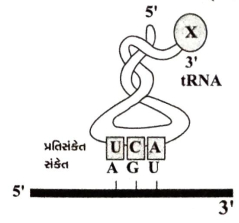
In the given figure below,what does '$X$' represent?
A
Glycine (Gly)
B
Tyrosine (Tyr)
C
Valine (Val)
D
Serine (Ser)
Solution
(D) The figure shows a $tRNA$ molecule interacting with an $mRNA$ strand. The anticodon on the $tRNA$ is $UCA$,which base-pairs with the codon $AGU$ on the $mRNA$ strand.
According to the genetic code,the codon $AGU$ codes for the amino acid Serine (Ser).
Therefore,'$X$' represents the amino acid Serine (Ser).
According to the genetic code,the codon $AGU$ codes for the amino acid Serine (Ser).
Therefore,'$X$' represents the amino acid Serine (Ser).
0 likes
View Solution168
EasyMCQ
What will be the anticodon on $t-RNA$,if the $DNA$ template has the sequence $ATG$?
A
$AUG$
B
$UAC$
C
$AGU$
D
$UCA$
Solution
(A) The $DNA$ template strand is $ATG$.
First,the $mRNA$ is synthesized from the $DNA$ template through transcription. According to the base-pairing rules ($A$ pairs with $U$,$T$ pairs with $A$,$G$ pairs with $C$),the $mRNA$ sequence will be $UAC$.
Next,the $t-RNA$ anticodon pairs with the $mRNA$ codon. The $mRNA$ codon is $UAC$.
The anticodon on $t-RNA$ is complementary to the $mRNA$ codon ($U$ pairs with $A$,$A$ pairs with $U$,$C$ pairs with $G$).
Therefore,the anticodon on $t-RNA$ will be $AUG$.
First,the $mRNA$ is synthesized from the $DNA$ template through transcription. According to the base-pairing rules ($A$ pairs with $U$,$T$ pairs with $A$,$G$ pairs with $C$),the $mRNA$ sequence will be $UAC$.
Next,the $t-RNA$ anticodon pairs with the $mRNA$ codon. The $mRNA$ codon is $UAC$.
The anticodon on $t-RNA$ is complementary to the $mRNA$ codon ($U$ pairs with $A$,$A$ pairs with $U$,$C$ pairs with $G$).
Therefore,the anticodon on $t-RNA$ will be $AUG$.
0 likes
View Solution169
EasyMCQ
If the template strand of $DNA$ has the sequence $ACG$,what will be the corresponding anticodon on the $tRNA$?
A
$UGC$
B
$ACG$
C
$TCG$
D
$UAC$
Solution
(B) The process of protein synthesis involves two main steps: transcription and translation.
$1$. During transcription,the template strand of $DNA$ $(ACG)$ is transcribed into $mRNA$. According to the base-pairing rules ($A$ pairs with $U$,$T$ pairs with $A$,$C$ pairs with $G$,and $G$ pairs with $C$),the $mRNA$ codon will be $UGC$.
$2$. During translation,the $tRNA$ carries an anticodon that is complementary to the $mRNA$ codon.
$3$. Since the $mRNA$ codon is $UGC$,the complementary anticodon on the $tRNA$ will be $ACG$ ($U$ pairs with $A$,$G$ pairs with $C$,and $C$ pairs with $G$).
Therefore,the correct option is $B$.
$1$. During transcription,the template strand of $DNA$ $(ACG)$ is transcribed into $mRNA$. According to the base-pairing rules ($A$ pairs with $U$,$T$ pairs with $A$,$C$ pairs with $G$,and $G$ pairs with $C$),the $mRNA$ codon will be $UGC$.
$2$. During translation,the $tRNA$ carries an anticodon that is complementary to the $mRNA$ codon.
$3$. Since the $mRNA$ codon is $UGC$,the complementary anticodon on the $tRNA$ will be $ACG$ ($U$ pairs with $A$,$G$ pairs with $C$,and $C$ pairs with $G$).
Therefore,the correct option is $B$.
0 likes
View Solution170
EasyMCQ
In which part of the $tRNA$ molecule is the amino acid binding site located?
A
$5'$ end
B
Anticodon loop
C
$3'$ end
D
None of the above
Solution
(C) The correct answer is $C$.
In a $tRNA$ molecule,the amino acid binding site is located at the $3'$ end.
This end contains a conserved sequence $CCA$ where the specific amino acid is attached via an ester bond to the $3'-OH$ group of the terminal adenosine residue.
In a $tRNA$ molecule,the amino acid binding site is located at the $3'$ end.
This end contains a conserved sequence $CCA$ where the specific amino acid is attached via an ester bond to the $3'-OH$ group of the terminal adenosine residue.
0 likes
View Solution171
EasyMCQ
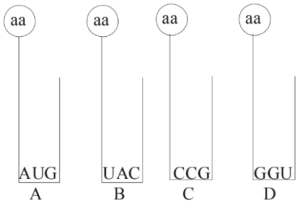
Find the sequence of binding of the following aminoacyl tRNA complexes during translation to mRNA transcribed by a $DNA$ segment having the base sequence $3$' $TACATGGGTCCG$ $5$'. Choose the answer showing the correct order of alphabets.
A
$A$,$B$,$D$,$C$
B
$B$,$A$,$D$,$C$
C
$C$,$D$,$B$,$A$
D
$D$,$C$,$A$,$B$
Solution
(B) The given $DNA$ template strand sequence is: $3$' $TAC$ $ATG$ $GGT$ $CCG$ $5$'.
During transcription,the mRNA is synthesized complementary to the $DNA$ template strand in the $5$' to $3$' direction.
The mRNA sequence will be: $5$' $AUG$ $UAC$ $CCA$ $GGC$ $3$'.
The codons on the mRNA are $AUG$,$UAC$,$CCA$,and $GGC$.
The anticodons on the tRNA molecules that bind to these codons are $UAC$ (for $AUG$),$AUG$ (for $UAC$),$GGU$ (for $CCA$),and $CCG$ (for $GGC$).
Comparing the given tRNA complexes:
- $A$: $AUG$ (Anticodon for $UAC$)
- $B$: $UAC$ (Anticodon for $AUG$)
- $C$: $CCG$ (Anticodon for $GGC$)
- $D$: $GGU$ (Anticodon for $CCA$)
The sequence of binding to the mRNA codons ($AUG$,$UAC$,$CCA$,$GGC$) is $B$,$A$,$D$,$C$.
During transcription,the mRNA is synthesized complementary to the $DNA$ template strand in the $5$' to $3$' direction.
The mRNA sequence will be: $5$' $AUG$ $UAC$ $CCA$ $GGC$ $3$'.
The codons on the mRNA are $AUG$,$UAC$,$CCA$,and $GGC$.
The anticodons on the tRNA molecules that bind to these codons are $UAC$ (for $AUG$),$AUG$ (for $UAC$),$GGU$ (for $CCA$),and $CCG$ (for $GGC$).
Comparing the given tRNA complexes:
- $A$: $AUG$ (Anticodon for $UAC$)
- $B$: $UAC$ (Anticodon for $AUG$)
- $C$: $CCG$ (Anticodon for $GGC$)
- $D$: $GGU$ (Anticodon for $CCA$)
The sequence of binding to the mRNA codons ($AUG$,$UAC$,$CCA$,$GGC$) is $B$,$A$,$D$,$C$.
0 likes
View Solution172
EasyMCQ
The $mRNA$ has Untranslated Regions $(UTRs)$
A
At $3'$-end beyond Terminator codon
B
At $5'$-end before $AUG$
C
At both $3'$-end and $5'$-end beyond Terminator codon and before $AUG$ respectively
D
$AUG$ and Terminator codon flanks the $UTR$
Solution
(C) $mRNA$ contains Untranslated Regions $(UTRs)$ which are sequences of $RNA$ that are not translated into proteins.
These $UTRs$ are present at both the $5'$-end (before the start codon $AUG$) and the $3'$-end (after the stop/terminator codon).
They are not translated but are required for the efficient translation process and stability of the $mRNA$ molecule.
These $UTRs$ are present at both the $5'$-end (before the start codon $AUG$) and the $3'$-end (after the stop/terminator codon).
They are not translated but are required for the efficient translation process and stability of the $mRNA$ molecule.
0 likes
View Solution173
EasyMCQ
Compare the statements $A$ and $B$.
$\text{Statement } A$: A monocistronic mRNA can produce several types of polypeptide chains.
$\text{Statement } B$: The terminator codon is present on the mRNA.
Select the correct description.
$\text{Statement } A$: A monocistronic mRNA can produce several types of polypeptide chains.
$\text{Statement } B$: The terminator codon is present on the mRNA.
Select the correct description.
A
Statement $A$ is wrong and $B$ is correct.
B
Both the statements $A$ and $B$ are correct.
C
Both the statements $A$ and $B$ are wrong.
D
Statement $A$ is correct and $B$ is wrong.
Solution
$(A)$ Statement $A$ is wrong because a monocistronic mRNA, typically found in eukaryotes, contains the genetic information for only a single polypeptide chain.
Polycistronic mRNA, which is common in prokaryotes, is the type that can produce multiple polypeptide chains from a single mRNA strand.
Statement $B$ is correct because the process of translation is terminated by the presence of specific stop codons (terminator codons like $UAA$, $UAG$, or $UGA$) on the mRNA molecule, which signal the release of the polypeptide chain from the ribosome.
Polycistronic mRNA, which is common in prokaryotes, is the type that can produce multiple polypeptide chains from a single mRNA strand.
Statement $B$ is correct because the process of translation is terminated by the presence of specific stop codons (terminator codons like $UAA$, $UAG$, or $UGA$) on the mRNA molecule, which signal the release of the polypeptide chain from the ribosome.
0 likes
View Solution174
EasyMCQ
In $tRNA$,the region that binds with $mRNA$ is:
A
Anticodon loop of $tRNA$
B
Amino acid acceptor end of $tRNA$
C
Amino acyl synthetase loop of $tRNA$
D
Ribosomal binding loop of $tRNA$
Solution
(A) $tRNA$ (transfer $RNA$) acts as an adapter molecule during protein synthesis.
It contains an anticodon loop,which consists of a sequence of three nitrogenous bases that are complementary to the specific codon present on the $mRNA$ strand.
During translation,the anticodon of the $tRNA$ base-pairs with the codon of the $mRNA$,ensuring that the correct amino acid is incorporated into the growing polypeptide chain.
Therefore,the correct region is the anticodon loop.
It contains an anticodon loop,which consists of a sequence of three nitrogenous bases that are complementary to the specific codon present on the $mRNA$ strand.
During translation,the anticodon of the $tRNA$ base-pairs with the codon of the $mRNA$,ensuring that the correct amino acid is incorporated into the growing polypeptide chain.
Therefore,the correct region is the anticodon loop.
0 likes
View Solution175
EasyMCQ
Which of the following types of $RNA$ carries amino acids towards the ribosome during translation?
A
mRNA
B
rRNA
C
dsRNA
D
tRNA
Solution
(D) $tRNA$.
Transfer $RNA$ $(tRNA)$ acts as an adapter molecule.
It has an anticodon loop that base pairs with the codon on $mRNA$ and a $3'$ acceptor end that carries a specific amino acid to the ribosome for protein synthesis.
Transfer $RNA$ $(tRNA)$ acts as an adapter molecule.
It has an anticodon loop that base pairs with the codon on $mRNA$ and a $3'$ acceptor end that carries a specific amino acid to the ribosome for protein synthesis.
0 likes
View Solution176
EasyMCQ
Which of the following sequences of mRNA are required for the translation process but are not translated?
A
Stop codons
B
Anticodons
C
Sense codons
D
$UTR$
Solution
(D) The correct answer is $D$.
Untranslated regions $(UTRs)$ are specific sequences present on the $mRNA$ that are required for efficient translation but are not translated into proteins.
These regions are located before the start codon at the $5'$-end and after the stop codon at the $3'$-end.
Untranslated regions $(UTRs)$ are specific sequences present on the $mRNA$ that are required for efficient translation but are not translated into proteins.
These regions are located before the start codon at the $5'$-end and after the stop codon at the $3'$-end.
0 likes
View Solution177
EasyMCQ
During protein synthesis,$AUG$ functions as the initiator codon in $mRNA$. What should be the anticodon on the $tRNA$ molecule that picks up and brings the amino acid specified by this codon?
A
$TAC$
B
$UAC$
C
$GUA$
D
$CAU$
Solution
(B) The genetic code is read in the $5' \rightarrow 3'$ direction on $mRNA$.
$AUG$ is the start codon that codes for Methionine.
The anticodon on the $tRNA$ is complementary to the codon on the $mRNA$ and is read in the $3' \rightarrow 5'$ direction.
According to the base-pairing rules ($A$ pairs with $U$,$U$ pairs with $A$,$G$ pairs with $C$,and $C$ pairs with $G$):
- The complement of $A$ is $U$.
- The complement of $U$ is $A$.
- The complement of $G$ is $C$.
Therefore,the anticodon for the $AUG$ codon is $UAC$.
$AUG$ is the start codon that codes for Methionine.
The anticodon on the $tRNA$ is complementary to the codon on the $mRNA$ and is read in the $3' \rightarrow 5'$ direction.
According to the base-pairing rules ($A$ pairs with $U$,$U$ pairs with $A$,$G$ pairs with $C$,and $C$ pairs with $G$):
- The complement of $A$ is $U$.
- The complement of $U$ is $A$.
- The complement of $G$ is $C$.
Therefore,the anticodon for the $AUG$ codon is $UAC$.
0 likes
View Solution178
EasyMCQ
What is the full form of $UTR$?
A
Unbound Transcribed Regions
B
Untranslated Regions
C
Ultra Transcribed Regions
D
Uni Translated Regions
Solution
(B) $UTR$ stands for Untranslated Regions.
These are sequences present at the $5'$ and $3'$ ends of $mRNA$ that are not translated into proteins but are crucial for translation regulation.
These are sequences present at the $5'$ and $3'$ ends of $mRNA$ that are not translated into proteins but are crucial for translation regulation.
0 likes
View SolutionMolecular Basis of Inheritance — Translation · Frequently Asked Questions
1Are these Molecular Basis of Inheritance questions useful for JEE and NEET?
Yes. All questions in this section are mapped to JEE Main and NEET exam patterns. Previous year questions from JEE Main, NEET, GUJCET and state-level exams are included with full solutions.
2Can I switch to Hindi or Gujarati for these questions?
Yes. Use the language tabs in the hero section or the sidebar to view the same questions and solutions in English, Hindi or Gujarati.
3How do I generate a question paper from this subtopic?
Use the Vedclass Exam Paper Generator — select the chapter and subtopic, set difficulty, and generate Sets A, B, C, D automatically. First 3 chapters of every subject are free.
Vedclass Products
For Students
Vedclass Test Series
Mock tests in real JEE/NEET style with performance analysis. 5-day free trial.
Start Free TrialFor Teachers
Exam Paper Generator
Generate Set A/B/C/D papers from this chapter in 2 minutes. 3 chapters free.
Try FreeFor Institutes
Online Exam Module
Live online exams with unlimited students, 360° analytics & white-label branding.
See DemoFor Teachers & Institutes
Generate a Molecular Basis of Inheritance Exam Paper in 2 Minutes
Select subtopic & difficulty — Sets A, B, C, D auto-generated with No Repeat logic.
First 3 chapters of every subject are free — no payment required.