
A English
Replication Questions in English
Class 12 Biology · Molecular Basis of Inheritance · Replication
236+
Questions
English
Language
100%
With Solutions
Showing 36 of 236 questions in English
201
MediumMCQ
Given below are two statements:
Statement $I:$
$DNA$ polymerases catalyse polymerisation only in one direction,that is $5^{\prime} \rightarrow 3^{\prime}$.
Statement $II:$
During replication of $DNA$,on one strand the replication is continuous while on the other strand it is discontinuous.
In the light of the above statements,choose the correct answer from the options given below:
Statement $I:$
$DNA$ polymerases catalyse polymerisation only in one direction,that is $5^{\prime} \rightarrow 3^{\prime}$.
Statement $II:$
During replication of $DNA$,on one strand the replication is continuous while on the other strand it is discontinuous.
In the light of the above statements,choose the correct answer from the options given below:
A
Both Statement $I$ and Statement $II$ are correct.
B
Both Statement $I$ and Statement $II$ are incorrect.
C
Statement $I$ is correct but Statement $II$ is incorrect.
D
Statement $I$ is incorrect but Statement $II$ is correct.
Solution
(A) Statement $I$ is correct: $DNA$ polymerases are enzymes that synthesize $DNA$ by adding nucleotides only to the $3^{\prime}$ end of a growing strand. Therefore,polymerization always occurs in the $5^{\prime} \rightarrow 3^{\prime}$ direction.
Statement $II$ is correct: Because $DNA$ strands are antiparallel and $DNA$ polymerase can only synthesize in the $5^{\prime} \rightarrow 3^{\prime}$ direction,one strand (the leading strand) is synthesized continuously toward the replication fork,while the other strand (the lagging strand) is synthesized discontinuously in short segments called Okazaki fragments away from the replication fork.
Conclusion: Both statements are correct.
Statement $II$ is correct: Because $DNA$ strands are antiparallel and $DNA$ polymerase can only synthesize in the $5^{\prime} \rightarrow 3^{\prime}$ direction,one strand (the leading strand) is synthesized continuously toward the replication fork,while the other strand (the lagging strand) is synthesized discontinuously in short segments called Okazaki fragments away from the replication fork.
Conclusion: Both statements are correct.
0 likes
View Solution202
MediumMCQ
Which of the following statements is correct regarding the process of replication in $E. coli$?
A
The $DNA$ dependent $RNA$ polymerase catalyses polymerization in one direction,that is $5^{\prime} \rightarrow 3^{\prime}$.
B
The $DNA$ dependent $DNA$ polymerase catalyses polymerization in $5^{\prime} \rightarrow 3^{\prime}$ as well as $3^{\prime} \rightarrow 5^{\prime}$ direction.
C
The $DNA$ dependent $DNA$ polymerase catalyses polymerization in $5^{\prime} \rightarrow 3^{\prime}$ direction.
D
The $DNA$ dependent $DNA$ polymerase catalyses polymerization in one direction,that is $3^{\prime} \rightarrow 5^{\prime}$.
Solution
(C) In prokaryotes like $E. coli$,the process of $DNA$ replication is mediated by $DNA$-dependent $DNA$ polymerase enzymes.
These enzymes are highly specific and can only catalyze the polymerization of nucleotides in the $5^{\prime} \rightarrow 3^{\prime}$ direction.
This unidirectional synthesis is a fundamental characteristic of $DNA$ replication,ensuring the accurate addition of nucleotides to the growing strand.
These enzymes are highly specific and can only catalyze the polymerization of nucleotides in the $5^{\prime} \rightarrow 3^{\prime}$ direction.
This unidirectional synthesis is a fundamental characteristic of $DNA$ replication,ensuring the accurate addition of nucleotides to the growing strand.
0 likes
View Solution203
MediumMCQ
During $DNA$ replication,one strand is formed continuously and the second strand is formed discontinuously because:
A
$DNA$ synthesis is bidirectional
B
$DNA$ replication is semiconservative
C
$DNA$ chain formation takes place in $5'$ to $3'$ direction only
D
$DNA$ replication is semidiscontinuous
Solution
(C) $DNA$ polymerase enzyme can only catalyze the polymerization of nucleotides in the $5'$ to $3'$ direction.
Since the two strands of the $DNA$ double helix are antiparallel (one runs $3'$ to $5'$ and the other $5'$ to $3'$),the replication fork moves in one direction.
On the template strand with $3'$ to $5'$ polarity,the new strand is synthesized continuously in the $5'$ to $3'$ direction (leading strand).
On the template strand with $5'$ to $3'$ polarity,the new strand must be synthesized in short fragments (Okazaki fragments) in the $5'$ to $3'$ direction because the replication fork opens in the opposite direction relative to the synthesis requirement (lagging strand).
Therefore,the constraint of $5'$ to $3'$ synthesis is the fundamental reason for discontinuous replication.
Since the two strands of the $DNA$ double helix are antiparallel (one runs $3'$ to $5'$ and the other $5'$ to $3'$),the replication fork moves in one direction.
On the template strand with $3'$ to $5'$ polarity,the new strand is synthesized continuously in the $5'$ to $3'$ direction (leading strand).
On the template strand with $5'$ to $3'$ polarity,the new strand must be synthesized in short fragments (Okazaki fragments) in the $5'$ to $3'$ direction because the replication fork opens in the opposite direction relative to the synthesis requirement (lagging strand).
Therefore,the constraint of $5'$ to $3'$ synthesis is the fundamental reason for discontinuous replication.
0 likes
View Solution204
MediumMCQ
Which of the following statements is incorrect $:-$
A
Synthesis of Okazaki segments is continuous.
B
Okazaki segments are synthesized in $5'$ to $3'$ direction.
C
Many primers are required for formation of lagging strand.
D
$DNA$ polymerase $III$ synthesizes both leading and lagging strands.
Solution
(A) During $DNA$ replication,the two strands of the double helix are antiparallel and $DNA$ polymerase can only add nucleotides in the $5'$ to $3'$ direction.
$1$. The leading strand is synthesized continuously in the $5'$ to $3'$ direction towards the replication fork.
$2$. The lagging strand is synthesized discontinuously in short segments known as Okazaki segments,also in the $5'$ to $3'$ direction,moving away from the replication fork.
$3$. Because the lagging strand is synthesized in segments,it requires multiple $RNA$ primers to initiate each segment.
$4$. $DNA$ polymerase $III$ is the primary enzyme responsible for synthesizing both the leading and lagging strands.
Therefore,the statement 'Synthesis of Okazaki segments is continuous' is incorrect,as they are synthesized discontinuously.
$1$. The leading strand is synthesized continuously in the $5'$ to $3'$ direction towards the replication fork.
$2$. The lagging strand is synthesized discontinuously in short segments known as Okazaki segments,also in the $5'$ to $3'$ direction,moving away from the replication fork.
$3$. Because the lagging strand is synthesized in segments,it requires multiple $RNA$ primers to initiate each segment.
$4$. $DNA$ polymerase $III$ is the primary enzyme responsible for synthesizing both the leading and lagging strands.
Therefore,the statement 'Synthesis of Okazaki segments is continuous' is incorrect,as they are synthesized discontinuously.
0 likes
View Solution205
MediumMCQ
During replication of $\text{DNA},$ Okazaki fragments are formed in the direction of :
A
$3^{\prime} \longrightarrow 5^{\prime}$
B
$5^{\prime} \longrightarrow 3^{\prime}$
C
$5^{\prime} \longrightarrow 5^{\prime}$
D
$3^{\prime} \longrightarrow 3^{\prime}$
Solution
(B) During $\text{DNA}$ replication,the enzyme $\text{DNA}$ polymerase can only synthesize a new strand in the $5^{\prime} \longrightarrow 3^{\prime}$ direction.
Because the two strands of the $\text{DNA}$ double helix are antiparallel,one strand (the leading strand) is synthesized continuously.
The other strand (the lagging strand) is synthesized discontinuously in short segments known as Okazaki fragments.
Even though these fragments are formed on the lagging strand,each individual Okazaki fragment is still synthesized by $\text{DNA}$ polymerase in the $5^{\prime} \longrightarrow 3^{\prime}$ direction.
Because the two strands of the $\text{DNA}$ double helix are antiparallel,one strand (the leading strand) is synthesized continuously.
The other strand (the lagging strand) is synthesized discontinuously in short segments known as Okazaki fragments.
Even though these fragments are formed on the lagging strand,each individual Okazaki fragment is still synthesized by $\text{DNA}$ polymerase in the $5^{\prime} \longrightarrow 3^{\prime}$ direction.
0 likes
View Solution206
EasyMCQ
Which enzyme joins the discontinuously synthesised fragments during $\text{DNA}$ replication?
A
$\text{DNA}$ Polymerase
B
Primase
C
$\text{DNA}$ ligase
D
Topoisomerase
Solution
(C) During $\text{DNA}$ replication,the lagging strand is synthesized in short,discontinuous segments known as Okazaki fragments.
These fragments are synthesized by $\text{DNA}$ polymerase $III$.
Once the $\text{RNA}$ primers are removed and replaced by $\text{DNA}$ nucleotides,the enzyme $\text{DNA}$ ligase catalyzes the formation of a phosphodiester bond between the adjacent fragments,effectively joining them into a continuous strand.
Therefore,the correct enzyme is $\text{DNA}$ ligase.
These fragments are synthesized by $\text{DNA}$ polymerase $III$.
Once the $\text{RNA}$ primers are removed and replaced by $\text{DNA}$ nucleotides,the enzyme $\text{DNA}$ ligase catalyzes the formation of a phosphodiester bond between the adjacent fragments,effectively joining them into a continuous strand.
Therefore,the correct enzyme is $\text{DNA}$ ligase.
0 likes
View Solution207
MediumMCQ
$DNA$ replication in the lagging strand of most eukaryotic organisms is
A
Conservative and continuous
B
Semi-conservative but discontinuous
C
Conservative and semi-discontinuous
D
Semi-conservative but continuous
Solution
(B) $DNA$ replication is semi-conservative in nature,meaning each new $DNA$ molecule consists of one parental strand and one newly synthesized strand.
In the replication fork,$DNA$ polymerase can only synthesize $DNA$ in the $5' \rightarrow 3'$ direction.
Because the two strands of the $DNA$ double helix are antiparallel,one strand (the leading strand) is synthesized continuously.
The other strand (the lagging strand) is synthesized in short,discontinuous segments known as Okazaki fragments.
Therefore,$DNA$ replication in the lagging strand is semi-conservative and discontinuous.
In the replication fork,$DNA$ polymerase can only synthesize $DNA$ in the $5' \rightarrow 3'$ direction.
Because the two strands of the $DNA$ double helix are antiparallel,one strand (the leading strand) is synthesized continuously.
The other strand (the lagging strand) is synthesized in short,discontinuous segments known as Okazaki fragments.
Therefore,$DNA$ replication in the lagging strand is semi-conservative and discontinuous.
0 likes
View Solution208
MediumMCQ
Which of the following enzymes plays a major role in the synthesis of a new $\text{DNA}$ strand during $\text{DNA}$ replication?
A
$\text{DNA}$ polymerase
B
$\text{RNA}$ ligase
C
Pepsin
D
Amylase
Solution
(A) During $\text{DNA}$ replication,the enzyme $\text{DNA}$ polymerase is responsible for synthesizing a new $\text{DNA}$ strand by adding nucleotides that are complementary to the template strand.
$\text{DNA}$ polymerase catalyzes the polymerization of deoxyribonucleotides,which is essential for the accurate replication of the genetic material.
Therefore,the correct option is $A$.
$\text{DNA}$ polymerase catalyzes the polymerization of deoxyribonucleotides,which is essential for the accurate replication of the genetic material.
Therefore,the correct option is $A$.
0 likes
View Solution209
MediumMCQ
$A$ $N^{15}-N^{15}$ $\text{DNA}$ molecule is continuously replicated in $N^{14}$ medium,then what is the percentage of heavy $\text{DNA}$ in the $4^{\text{th}}$ generation (in $\%$)?
A
$25$
B
$0$
C
$12.5$
D
$100$
Solution
(B) In the Meselson and Stahl experiment,the semi-conservative replication of $\text{DNA}$ is observed.
Starting with $N^{15}-N^{15}$ (heavy) $\text{DNA}$,after $n$ generations,the total number of $\text{DNA}$ molecules is $2^n$.
The number of heavy $\text{DNA}$ molecules $(N^{15}-N^{15})$ remains constant at $2$ after the first generation,but since we start with one molecule,the heavy strand is distributed into two hybrid molecules $(N^{15}-N^{14})$ in the first generation.
Specifically,in any generation $n$ (where $n \ge 1$),the number of hybrid $\text{DNA}$ molecules is always $2$,and the number of light $\text{DNA}$ molecules $(N^{14}-N^{14})$ is $2^n - 2$.
The number of heavy $\text{DNA}$ molecules $(N^{15}-N^{15})$ becomes $0$ after the first generation because the original heavy strands are separated and paired with light strands.
Therefore,in the $4^{\text{th}}$ generation,the percentage of heavy $\text{DNA}$ is $0 \%$.
Starting with $N^{15}-N^{15}$ (heavy) $\text{DNA}$,after $n$ generations,the total number of $\text{DNA}$ molecules is $2^n$.
The number of heavy $\text{DNA}$ molecules $(N^{15}-N^{15})$ remains constant at $2$ after the first generation,but since we start with one molecule,the heavy strand is distributed into two hybrid molecules $(N^{15}-N^{14})$ in the first generation.
Specifically,in any generation $n$ (where $n \ge 1$),the number of hybrid $\text{DNA}$ molecules is always $2$,and the number of light $\text{DNA}$ molecules $(N^{14}-N^{14})$ is $2^n - 2$.
The number of heavy $\text{DNA}$ molecules $(N^{15}-N^{15})$ becomes $0$ after the first generation because the original heavy strands are separated and paired with light strands.
Therefore,in the $4^{\text{th}}$ generation,the percentage of heavy $\text{DNA}$ is $0 \%$.
0 likes
View Solution210
MediumMCQ
An $E. coli$ cell with light $DNA$ is incubated in a culture medium containing a heavy isotope of nitrogen $(^{15}N)$. After $60$ minutes, find out the percentage of light $DNA$. (in $\%$)
A
$50$
B
$25$
C
$12.5$
D
$0$
Solution
(B) The generation time of $E. coli$ is $20$ minutes.
After $60$ minutes, the number of generations $(n)$ = $60 / 20 = 3$.
Initially, there is $1$ molecule of light $DNA$ $(^{14}N-^{14}N)$.
After $1$ generation: $2$ molecules ($1$ hybrid, $1$ light is not possible, both become hybrid $^{14}N-^{15}N$).
Actually, in semi-conservative replication, the original strands remain as templates.
After $n$ generations, the total number of $DNA$ molecules = $2^n = 2^3 = 8$.
The number of $DNA$ molecules containing original light strands = $2$ (since only the two original strands from the parent cell will remain as light templates).
Percentage of light $DNA$ = $(\text{Number of light } DNA / \text{Total } DNA) \times 100 = (2 / 8) \times 100 = 25 \%$.
After $60$ minutes, the number of generations $(n)$ = $60 / 20 = 3$.
Initially, there is $1$ molecule of light $DNA$ $(^{14}N-^{14}N)$.
After $1$ generation: $2$ molecules ($1$ hybrid, $1$ light is not possible, both become hybrid $^{14}N-^{15}N$).
Actually, in semi-conservative replication, the original strands remain as templates.
After $n$ generations, the total number of $DNA$ molecules = $2^n = 2^3 = 8$.
The number of $DNA$ molecules containing original light strands = $2$ (since only the two original strands from the parent cell will remain as light templates).
Percentage of light $DNA$ = $(\text{Number of light } DNA / \text{Total } DNA) \times 100 = (2 / 8) \times 100 = 25 \%$.
0 likes
View Solution211
MediumMCQ
If a hybrid $\text{DNA}$ $(N^{15}N^{14})$ is allowed to replicate in an $N^{14}$ medium,after three generations,how many $\text{DNA}$ molecules will contain $N^{15}$?
A
$2$
B
$4$
C
$8$
D
$1$
Solution
(A) The replication of $\text{DNA}$ is semi-conservative.
Starting with one hybrid $\text{DNA}$ molecule $(N^{15}N^{14})$:
Generation $0$: $1$ hybrid $(N^{15}N^{14})$.
Generation $1$: The $N^{15}$ strand and $N^{14}$ strand separate. Each acts as a template for a new $N^{14}$ strand. Result: $2$ hybrid $\text{DNA}$ $(N^{15}N^{14})$.
Generation $2$: The $2$ hybrid molecules produce $2$ hybrid $(N^{15}N^{14})$ and $2$ light $(N^{14}N^{14})$ $\text{DNA}$ molecules.
Generation $3$: The $2$ hybrid molecules produce $2$ hybrid $(N^{15}N^{14})$ and $2$ light $(N^{14}N^{14})$ $\text{DNA}$ molecules,while the $2$ light molecules produce $4$ light $(N^{14}N^{14})$ $\text{DNA}$ molecules.
Total $\text{DNA}$ molecules after $3$ generations = $2^3 = 8$.
Number of $\text{DNA}$ molecules containing the original $N^{15}$ strand = $2$ (these are the $2$ hybrid molecules).
Starting with one hybrid $\text{DNA}$ molecule $(N^{15}N^{14})$:
Generation $0$: $1$ hybrid $(N^{15}N^{14})$.
Generation $1$: The $N^{15}$ strand and $N^{14}$ strand separate. Each acts as a template for a new $N^{14}$ strand. Result: $2$ hybrid $\text{DNA}$ $(N^{15}N^{14})$.
Generation $2$: The $2$ hybrid molecules produce $2$ hybrid $(N^{15}N^{14})$ and $2$ light $(N^{14}N^{14})$ $\text{DNA}$ molecules.
Generation $3$: The $2$ hybrid molecules produce $2$ hybrid $(N^{15}N^{14})$ and $2$ light $(N^{14}N^{14})$ $\text{DNA}$ molecules,while the $2$ light molecules produce $4$ light $(N^{14}N^{14})$ $\text{DNA}$ molecules.
Total $\text{DNA}$ molecules after $3$ generations = $2^3 = 8$.
Number of $\text{DNA}$ molecules containing the original $N^{15}$ strand = $2$ (these are the $2$ hybrid molecules).
0 likes
View Solution212
MediumMCQ
Identify parts $A, B, C, D$ in the figure given below:
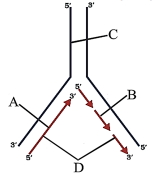
A
$A \rightarrow$ Continuous synthesis,$B \rightarrow$ Discontinuous synthesis,$C \rightarrow$ Template strand,$D \rightarrow$ Newly synthesised strands
B
$A \rightarrow$ Discontinuous synthesis,$B \rightarrow$ Continuous synthesis,$C \rightarrow$ Newly synthesised strand,$D \rightarrow$ Template strand
C
$A \rightarrow$ Template strand,$B \rightarrow$ Newly synthesised strand,$C \rightarrow$ Continuous synthesis,$D \rightarrow$ Discontinuous synthesis
D
$A \rightarrow$ Newly synthesised strand,$B \rightarrow$ Template strand,$C \rightarrow$ Continuous synthesis,$D \rightarrow$ Discontinuous synthesis
Solution
(A) In the process of $DNA$ replication,the $DNA$ polymerase enzyme can only synthesize $DNA$ in the $5' \rightarrow 3'$ direction.
Because the two strands of the $DNA$ double helix are antiparallel,one strand (the leading strand) is synthesized continuously in the direction of the replication fork movement.
In the given figure,$A$ represents the leading strand where continuous synthesis occurs.
The other strand (the lagging strand) is synthesized in short fragments known as Okazaki fragments,which represents discontinuous synthesis,indicated by $B$.
$C$ points to the original parental $DNA$ strands which act as the template for replication.
$D$ represents the newly synthesized $DNA$ strands formed during the process.
Therefore,the correct identification is $A \rightarrow$ Continuous synthesis,$B \rightarrow$ Discontinuous synthesis,$C \rightarrow$ Template strand,$D \rightarrow$ Newly synthesised strands.
Because the two strands of the $DNA$ double helix are antiparallel,one strand (the leading strand) is synthesized continuously in the direction of the replication fork movement.
In the given figure,$A$ represents the leading strand where continuous synthesis occurs.
The other strand (the lagging strand) is synthesized in short fragments known as Okazaki fragments,which represents discontinuous synthesis,indicated by $B$.
$C$ points to the original parental $DNA$ strands which act as the template for replication.
$D$ represents the newly synthesized $DNA$ strands formed during the process.
Therefore,the correct identification is $A \rightarrow$ Continuous synthesis,$B \rightarrow$ Discontinuous synthesis,$C \rightarrow$ Template strand,$D \rightarrow$ Newly synthesised strands.
0 likes
View Solution213
MediumMCQ
Given below are two statements,one is labelled as Assertion $(A)$ and the other is labelled as Reason $(R).$
Assertion $(A):$ $\text{DNA}$ replication occurs within a small opening of the $\text{DNA}$ helix,referred to as the replication fork.
Reason $(R):$ During transcription,the discontinuously synthesized fragments of $\text{DNA}$ are joined by the enzyme $\text{DNA}$ ligase.
In the light of the above statements,choose the most appropriate answer from the options given below:
Assertion $(A):$ $\text{DNA}$ replication occurs within a small opening of the $\text{DNA}$ helix,referred to as the replication fork.
Reason $(R):$ During transcription,the discontinuously synthesized fragments of $\text{DNA}$ are joined by the enzyme $\text{DNA}$ ligase.
In the light of the above statements,choose the most appropriate answer from the options given below:
A
Both $(A)$ and $(R)$ are correct and $(R)$ is the correct explanation of $(A).$
B
Both $(A)$ and $(R)$ are correct and $(R)$ is not the correct explanation of $(A).$
C
$(A)$ is correct but $(R)$ is not correct.
D
$(A)$ is not correct but $(R)$ is correct.
Solution
(C) Assertion $(A)$ is correct because $\text{DNA}$ replication begins at a specific site called the origin of replication,where the $\text{DNA}$ helix unwinds to form a $Y$-shaped structure known as the replication fork.
Reason $(R)$ is incorrect because the joining of discontinuously synthesized $\text{DNA}$ fragments (Okazaki fragments) by the enzyme $\text{DNA}$ ligase occurs during $\text{DNA}$ replication,not during transcription.
Transcription involves the synthesis of $\text{RNA}$ from a $\text{DNA}$ template,not the synthesis of $\text{DNA}$ fragments.
Reason $(R)$ is incorrect because the joining of discontinuously synthesized $\text{DNA}$ fragments (Okazaki fragments) by the enzyme $\text{DNA}$ ligase occurs during $\text{DNA}$ replication,not during transcription.
Transcription involves the synthesis of $\text{RNA}$ from a $\text{DNA}$ template,not the synthesis of $\text{DNA}$ fragments.
0 likes
View Solution214
MediumMCQ
Match List-$I$ with List-$II$ and select the correct answer using the code given below in the lists.
| List-$I$ | List-$II$ |
|---|---|
| $a$. Ligase | Joins short segments of $\text{DNA}$ together. |
| $b$. $\text{DNA}$ polymerase | Cuts $\text{RNA}$ at specific $\text{RNA}$ sequence. |
| $c$. Helicase | Breaks the hydrogen bonds between complementary pairs during $\text{DNA}$ replication. |
A
$a, b$ and $c$ are correct
B
$a$ and $b$ are correct but $c$ is false
C
$a$ is correct but $b$ and $c$ are false
D
$a$ and $c$ are correct but $b$ is false
Solution
(D) $1$. Ligase: This enzyme is responsible for joining short segments of $\text{DNA}$ (Okazaki fragments) by forming phosphodiester bonds. Thus,statement $a$ is correct.
$2$. $\text{DNA}$ polymerase: This enzyme is responsible for synthesizing a new $\text{DNA}$ strand by adding nucleotides complementary to the template strand. It does not cut $\text{RNA}$. Cutting $\text{RNA}$ at specific sequences is typically the function of ribonucleases or specific ribozymes. Thus,statement $b$ is false.
$3$. Helicase: This enzyme unwinds the $\text{DNA}$ double helix by breaking the hydrogen bonds between complementary nitrogenous base pairs during $\text{DNA}$ replication. Thus,statement $c$ is correct.
Conclusion: $a$ and $c$ are correct,while $b$ is false.
$2$. $\text{DNA}$ polymerase: This enzyme is responsible for synthesizing a new $\text{DNA}$ strand by adding nucleotides complementary to the template strand. It does not cut $\text{RNA}$. Cutting $\text{RNA}$ at specific sequences is typically the function of ribonucleases or specific ribozymes. Thus,statement $b$ is false.
$3$. Helicase: This enzyme unwinds the $\text{DNA}$ double helix by breaking the hydrogen bonds between complementary nitrogenous base pairs during $\text{DNA}$ replication. Thus,statement $c$ is correct.
Conclusion: $a$ and $c$ are correct,while $b$ is false.
0 likes
View Solution215
EasyMCQ
Given below are two statements.
Statement $I$ - The template strand with free $3'$ end is called leading template and the strand with free $5'$ end is called lagging template.
Statement $II$ - Replication always starts at the $3'$ end of the template strand and proceeds towards the $5'$ end of the template.
In the light of the above statements,select the correct option given below:
Statement $I$ - The template strand with free $3'$ end is called leading template and the strand with free $5'$ end is called lagging template.
Statement $II$ - Replication always starts at the $3'$ end of the template strand and proceeds towards the $5'$ end of the template.
In the light of the above statements,select the correct option given below:
A
Both statement $I$ and statement $II$ are correct.
B
Both statement $I$ and statement $II$ are incorrect.
C
Statement $I$ is correct but statement $II$ is incorrect.
D
Statement $I$ is incorrect but statement $II$ is correct.
Solution
(D) Statement $I$ is incorrect because the template strand with a free $3'$ end is the leading template,and the strand with a free $5'$ end is the lagging template. The original statement provided in the question had these reversed.
Statement $II$ is correct. $DNA$ polymerase synthesizes the new strand in the $5' \rightarrow 3'$ direction. Since the new strand is antiparallel to the template,the replication process proceeds along the template strand from its $3'$ end towards its $5'$ end.
Statement $II$ is correct. $DNA$ polymerase synthesizes the new strand in the $5' \rightarrow 3'$ direction. Since the new strand is antiparallel to the template,the replication process proceeds along the template strand from its $3'$ end towards its $5'$ end.
0 likes
View Solution216
EasyMCQ
During $DNA$ replication, the term leading template is applied to the one which replicates itself in $A$ and the replication is $B$.
A
$A - 5' \rightarrow 3'$, $B - \text{Continuous}$
B
$A - 3' \rightarrow 5'$, $B - \text{Continuous}$
C
$A - 5' \rightarrow 3'$, $B - \text{Discontinuous}$
D
$A - 3' \rightarrow 5'$, $B - \text{Discontinuous}$
Solution
(B) During $DNA$ replication, the two strands of the $DNA$ double helix are antiparallel.
One strand has the polarity $3' \rightarrow 5'$, which acts as the template for the leading strand.
The synthesis of the leading strand occurs in the $5' \rightarrow 3'$ direction continuously towards the replication fork.
Therefore, the leading template strand is the one with $3' \rightarrow 5'$ polarity, and the replication process on this strand is continuous.
One strand has the polarity $3' \rightarrow 5'$, which acts as the template for the leading strand.
The synthesis of the leading strand occurs in the $5' \rightarrow 3'$ direction continuously towards the replication fork.
Therefore, the leading template strand is the one with $3' \rightarrow 5'$ polarity, and the replication process on this strand is continuous.
0 likes
View Solution217
EasyMCQ
During replication of $DNA$, the $RNA$ primers are removed by i and replaced by $DNA$ sequences with the help of ii in prokaryotes and iii in eukaryotes.
A
i. - $DNA$ polymerase-$I$, ii. - $DNA$ polymerase, iii. - $DNA$ polymerase-$\alpha$
B
i. - $DNA$ polymerase, ii. - $DNA$ polymerase-$\alpha$, iii. - $DNA$ polymerase-$I$
C
i. - $DNA$ polymerase, ii. - $DNA$ polymerase-$I$, iii. - $DNA$ polymerase-$\alpha$
D
i. - $DNA$ polymerase-$\alpha$, ii. - $DNA$ polymerase, iii. - $DNA$ polymerase-$I$
Solution
(C) During $DNA$ replication, the $RNA$ primers are removed by the $5' \to 3'$ exonuclease activity of $DNA$ polymerase-$I$ in prokaryotes.
After the removal of $RNA$ primers, the gaps are filled by the $DNA$ polymerase activity of $DNA$ polymerase-$I$ in prokaryotes.
In eukaryotes, the removal of $RNA$ primers and the subsequent filling of gaps is primarily carried out by $DNA$ polymerase-$\alpha$ (which has primase activity) and $DNA$ polymerase-$\delta$ or $\epsilon$.
Therefore, the correct sequence is: $i = \text{DNA polymerase-}I$, $ii = \text{DNA polymerase-}I$, and $iii = \text{DNA polymerase-}\alpha$.
After the removal of $RNA$ primers, the gaps are filled by the $DNA$ polymerase activity of $DNA$ polymerase-$I$ in prokaryotes.
In eukaryotes, the removal of $RNA$ primers and the subsequent filling of gaps is primarily carried out by $DNA$ polymerase-$\alpha$ (which has primase activity) and $DNA$ polymerase-$\delta$ or $\epsilon$.
Therefore, the correct sequence is: $i = \text{DNA polymerase-}I$, $ii = \text{DNA polymerase-}I$, and $iii = \text{DNA polymerase-}\alpha$.
0 likes
View Solution218
EasyMCQ
Given below are the two statements.
Statement $I$: In prokaryotes,there is only one replicon,however,in eukaryotes,there are several replicons in tandem.
Statement $II$: The two separated strands in a replicon of $DNA$ are prevented from rejoining by helicase enzyme.
In the light of the above statements,choose the correct answer from the options given below.
Statement $I$: In prokaryotes,there is only one replicon,however,in eukaryotes,there are several replicons in tandem.
Statement $II$: The two separated strands in a replicon of $DNA$ are prevented from rejoining by helicase enzyme.
In the light of the above statements,choose the correct answer from the options given below.
A
Statement $I$ is incorrect but Statement $II$ is correct.
B
Statement $I$ is correct but Statement $II$ is incorrect.
C
Both statement $I$ and statement $II$ are correct.
D
Both statement $I$ and statement $II$ are incorrect.
Solution
(B) Statement $I$ is correct. Prokaryotic $DNA$ replication starts from a single origin of replication $(ori)$,meaning they have only one replicon. In contrast,eukaryotic $DNA$ is linear and very long,containing multiple origins of replication,resulting in several replicons in tandem.
Statement $II$ is incorrect. The enzyme helicase is responsible for unwinding the $DNA$ double helix by breaking the hydrogen bonds between the nitrogenous bases. The separated strands are prevented from rejoining (re-annealing) by Single-Strand Binding $(SSB)$ proteins,not by helicase.
Statement $II$ is incorrect. The enzyme helicase is responsible for unwinding the $DNA$ double helix by breaking the hydrogen bonds between the nitrogenous bases. The separated strands are prevented from rejoining (re-annealing) by Single-Strand Binding $(SSB)$ proteins,not by helicase.
0 likes
View Solution219
EasyMCQ
If a hybrid $DNA$ $(^{14}N-^{15}N)$ is allowed to undergo replication twice in a medium containing nucleotides with $^{15}N$ base,then what proportion of light,heavy,and hybrid $DNA$ will be obtained respectively?
A
$1:2:1$
B
$0:1:3$
C
$0:2:2$
D
$0:3:1$
Solution
(D) Initially,the $DNA$ is hybrid $(^{14}N-^{15}N)$.
After the first replication in a medium with $^{15}N$: Two $DNA$ molecules are formed,one hybrid $(^{14}N-^{15}N)$ and one heavy $(^{15}N-^{15}N)$.
After the second replication: $A$ total of four $DNA$ molecules are formed.
The hybrid $(^{14}N-^{15}N)$ molecule produces one hybrid $(^{14}N-^{15}N)$ and one heavy $(^{15}N-^{15}N)$ molecule.
The heavy $(^{15}N-^{15}N)$ molecule produces two heavy $(^{15}N-^{15}N)$ molecules.
Thus,the final composition is $0$ light,$3$ heavy,and $1$ hybrid $DNA$ molecules.
Therefore,the correct proportion is $0:3:1$.
After the first replication in a medium with $^{15}N$: Two $DNA$ molecules are formed,one hybrid $(^{14}N-^{15}N)$ and one heavy $(^{15}N-^{15}N)$.
After the second replication: $A$ total of four $DNA$ molecules are formed.
The hybrid $(^{14}N-^{15}N)$ molecule produces one hybrid $(^{14}N-^{15}N)$ and one heavy $(^{15}N-^{15}N)$ molecule.
The heavy $(^{15}N-^{15}N)$ molecule produces two heavy $(^{15}N-^{15}N)$ molecules.
Thus,the final composition is $0$ light,$3$ heavy,and $1$ hybrid $DNA$ molecules.
Therefore,the correct proportion is $0:3:1$.
0 likes
View Solution220
EasyMCQ
Replication of eukaryotic $DNA$ is depicted here. Identify $A$,$B$,$C$,and $D$ by selecting the correct option.
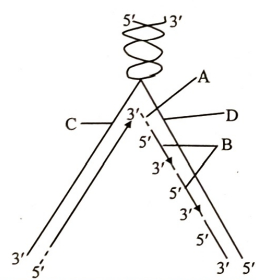
A
$A$ - $RNA$-primer,$B$ - Okazaki fragment,$C$ - Leading template,$D$ - Lagging template
B
$A$ - Leading template,$B$ - Lagging template,$C$ - $RNA$-primer,$D$ - Okazaki fragment
C
$A$ - Lagging template,$B$ - Leading template,$C$ - Okazaki fragment,$D$ - $RNA$-primer
D
$A$ - Okazaki fragment,$B$ - $RNA$-primer,$C$ - Leading template,$D$ - Lagging template
Solution
(A) $1$. $DNA$ replication always occurs in the $5'$ to $3'$ direction.
$2$. In the given diagram,$A$ represents the $RNA$-primer,which initiates the synthesis of the new $DNA$ strand.
$3$. $B$ represents the Okazaki fragments,which are short,newly synthesized $DNA$ segments formed on the lagging strand.
$4$. $C$ represents the leading template strand,where synthesis occurs continuously.
$5$. $D$ represents the lagging template strand,where synthesis occurs discontinuously in the form of Okazaki fragments.
$6$. Therefore,the correct identification is: $A$ - $RNA$-primer,$B$ - Okazaki fragment,$C$ - Leading template,$D$ - Lagging template.
$2$. In the given diagram,$A$ represents the $RNA$-primer,which initiates the synthesis of the new $DNA$ strand.
$3$. $B$ represents the Okazaki fragments,which are short,newly synthesized $DNA$ segments formed on the lagging strand.
$4$. $C$ represents the leading template strand,where synthesis occurs continuously.
$5$. $D$ represents the lagging template strand,where synthesis occurs discontinuously in the form of Okazaki fragments.
$6$. Therefore,the correct identification is: $A$ - $RNA$-primer,$B$ - Okazaki fragment,$C$ - Leading template,$D$ - Lagging template.
0 likes
View Solution221
EasyMCQ
During $DNA$ replication,Okazaki fragments on the lagging template are always formed in $A$ direction $B$.
A
$A - 5' \rightarrow 3'$,$B$ - towards the replication fork
B
$A - 3' \rightarrow 5'$,$B$ - towards the replication fork
C
$A - 5' \rightarrow 3'$,$B$ - away from the replication fork
D
$A - 3' \rightarrow 5'$,$B$ - away from the replication fork
Solution
(C) $DNA$ polymerase can only synthesize $DNA$ in the $5' \rightarrow 3'$ direction.
On the lagging strand,the template strand runs in the $5' \rightarrow 3'$ direction,which means the new strand must be synthesized in the opposite direction relative to the movement of the replication fork.
As the replication fork opens,the lagging strand is synthesized in short segments known as Okazaki fragments.
These fragments are synthesized in the $5' \rightarrow 3'$ direction,moving away from the replication fork.
On the lagging strand,the template strand runs in the $5' \rightarrow 3'$ direction,which means the new strand must be synthesized in the opposite direction relative to the movement of the replication fork.
As the replication fork opens,the lagging strand is synthesized in short segments known as Okazaki fragments.
These fragments are synthesized in the $5' \rightarrow 3'$ direction,moving away from the replication fork.
0 likes
View Solution222
EasyMCQ
At the end of replication,the contribution of nucleotides from mother $DNA$ is . . . . . . percent.
A
$75$
B
$25$
C
$100$
D
$50$
Solution
(D) $DNA$ replication is a semi-conservative process.
In this process,each of the two daughter $DNA$ molecules consists of one original (parental) strand and one newly synthesized strand.
Since one strand out of two in each daughter molecule is from the mother (parental) $DNA$,the contribution of the original nucleotides is $50\%$.
In this process,each of the two daughter $DNA$ molecules consists of one original (parental) strand and one newly synthesized strand.
Since one strand out of two in each daughter molecule is from the mother (parental) $DNA$,the contribution of the original nucleotides is $50\%$.
0 likes
View Solution223
EasyMCQ
Which of the following did Meselson and Stahl use in the experiment to prove semiconservative $DNA$ replication?
A
Radioactive phosphorus and Bacteriophage
B
Bacteriophage and $E$. coli
C
Radioactive sulphur and Bacteriophage
D
Heavy isotope $^{15}N$ and $E$. coli
Solution
(D) Meselson and Stahl performed an experiment in $1958$ to prove that $DNA$ replication is semiconservative.
They cultured $E. coli$ in a medium containing $^{15}NH_4Cl$ ($^{15}N$ is the heavy isotope of nitrogen) as the only nitrogen source for many generations.
This resulted in the incorporation of $^{15}N$ into the newly synthesized $DNA$.
Subsequently,they transferred the cells into a medium with normal $^{14}NH_4Cl$ and took samples at various definite time intervals as the cells multiplied.
The extracted DNAs were centrifuged in a cesium chloride $(CsCl)$ density gradient to measure the densities of $DNA$.
Thus,they used the heavy isotope $^{15}N$ and $E. coli$ bacteria for their experiment.
They cultured $E. coli$ in a medium containing $^{15}NH_4Cl$ ($^{15}N$ is the heavy isotope of nitrogen) as the only nitrogen source for many generations.
This resulted in the incorporation of $^{15}N$ into the newly synthesized $DNA$.
Subsequently,they transferred the cells into a medium with normal $^{14}NH_4Cl$ and took samples at various definite time intervals as the cells multiplied.
The extracted DNAs were centrifuged in a cesium chloride $(CsCl)$ density gradient to measure the densities of $DNA$.
Thus,they used the heavy isotope $^{15}N$ and $E. coli$ bacteria for their experiment.
0 likes
View Solution224
EasyMCQ
During $DNA$ replication,the addition of nucleotides on the lagging strand occurs:
A
towards the replicating fork
B
at a faster rate than leading strand
C
continuously
D
discontinuously
Solution
(D) During $DNA$ replication,the two strands of the $DNA$ double helix are antiparallel ($5' \rightarrow 3'$ and $3' \rightarrow 5'$).
$DNA$ polymerase can only synthesize $DNA$ in the $5' \rightarrow 3'$ direction.
On the leading strand,synthesis occurs continuously towards the replication fork.
On the lagging strand,synthesis occurs in short segments known as $Okazaki$ fragments,moving away from the replication fork.
Because these fragments are synthesized in short,separate bursts,the process on the lagging strand is described as discontinuous.
$DNA$ polymerase can only synthesize $DNA$ in the $5' \rightarrow 3'$ direction.
On the leading strand,synthesis occurs continuously towards the replication fork.
On the lagging strand,synthesis occurs in short segments known as $Okazaki$ fragments,moving away from the replication fork.
Because these fragments are synthesized in short,separate bursts,the process on the lagging strand is described as discontinuous.
0 likes
View Solution225
EasyMCQ
In Meselson and Stahl's experiment,if $E. coli$ was allowed to grow for $80$ minutes,what would be the proportions of light and intermediate density $DNA$ molecules,respectively (in $: 2$)? (Assume $E. coli$ divides every $20$ minutes.)
A
$12$
B
$6$
C
$2$
D
$14$
Solution
(D) The generation time of $E. coli$ is $20$ minutes.
In $80$ minutes,the number of generations $(n)$ is $80 / 20 = 4$.
The total number of $DNA$ molecules after $4$ generations is $2^n = 2^4 = 16$.
In the Meselson and Stahl experiment,the starting $DNA$ is heavy $(^{15}N^{15}N)$.
After $1$ generation: $2$ intermediate $(^{15}N^{14}N)$.
After $2$ generations: $2$ intermediate $(^{15}N^{14}N)$ and $2$ light $(^{14}N^{14}N)$.
After $3$ generations: $2$ intermediate $(^{15}N^{14}N)$ and $6$ light $(^{14}N^{14}N)$.
After $4$ generations: $2$ intermediate $(^{15}N^{14}N)$ and $14$ light $(^{14}N^{14}N)$.
Thus,the ratio of light to intermediate $DNA$ molecules is $14: 2$.
In $80$ minutes,the number of generations $(n)$ is $80 / 20 = 4$.
The total number of $DNA$ molecules after $4$ generations is $2^n = 2^4 = 16$.
In the Meselson and Stahl experiment,the starting $DNA$ is heavy $(^{15}N^{15}N)$.
After $1$ generation: $2$ intermediate $(^{15}N^{14}N)$.
After $2$ generations: $2$ intermediate $(^{15}N^{14}N)$ and $2$ light $(^{14}N^{14}N)$.
After $3$ generations: $2$ intermediate $(^{15}N^{14}N)$ and $6$ light $(^{14}N^{14}N)$.
After $4$ generations: $2$ intermediate $(^{15}N^{14}N)$ and $14$ light $(^{14}N^{14}N)$.
Thus,the ratio of light to intermediate $DNA$ molecules is $14: 2$.
0 likes
View Solution226
EasyMCQ
If $E. coli$ was allowed to grow for $60$ minutes,then what would be the respective proportions of light and hybrid density $DNA$ molecules?
A
$1: 1$
B
$3: 1$
C
$1: 3$
D
$7: 1$
Solution
(B) In the Meselson and Stahl experiment,$E. coli$ divides every $20$ minutes.
Starting with one heavy $(^{15}N^{15}N)$ $DNA$ molecule:
After $20$ minutes (first generation): $2$ hybrid $(^{15}N^{14}N)$ $DNA$ molecules are formed.
After $40$ minutes (second generation): $2$ hybrid $(^{15}N^{14}N)$ and $2$ light $(^{14}N^{14}N)$ $DNA$ molecules are formed.
After $60$ minutes (third generation): The $2$ hybrid molecules produce $2$ hybrid and $2$ light molecules,and the $2$ light molecules produce $4$ light molecules.
Total $DNA$ molecules = $8$.
Number of hybrid molecules = $2$.
Number of light molecules = $6$.
Ratio of light to hybrid = $6: 2$,which simplifies to $3: 1$.
Starting with one heavy $(^{15}N^{15}N)$ $DNA$ molecule:
After $20$ minutes (first generation): $2$ hybrid $(^{15}N^{14}N)$ $DNA$ molecules are formed.
After $40$ minutes (second generation): $2$ hybrid $(^{15}N^{14}N)$ and $2$ light $(^{14}N^{14}N)$ $DNA$ molecules are formed.
After $60$ minutes (third generation): The $2$ hybrid molecules produce $2$ hybrid and $2$ light molecules,and the $2$ light molecules produce $4$ light molecules.
Total $DNA$ molecules = $8$.
Number of hybrid molecules = $2$.
Number of light molecules = $6$.
Ratio of light to hybrid = $6: 2$,which simplifies to $3: 1$.
0 likes
View Solution227
EasyMCQ
$E. coli$ has $4.6 \times 10^6 \text{ bp}$, its rate of multiplication during replication is about $ . . . . . . $ per second. (in $\text{ bp}$)
A
$7000$
B
$5000$
C
$2000$
D
$9000$
Solution
(C) The genome of $E. coli$ contains $4.6 \times 10^6 \text{ bp}$.
$E. coli$ completes its replication process in approximately $38$ minutes ($2280$ seconds).
The rate of replication is calculated as:
$\text{Rate} = \frac{\text{Total base pairs}}{\text{Total time in seconds}}$
$\text{Rate} = \frac{4.6 \times 10^6}{2280} \approx 2017 \text{ bp/second}$.
Rounding this to the nearest standard value provided in the options, we get $2000 \text{ bp/second}$.
$E. coli$ completes its replication process in approximately $38$ minutes ($2280$ seconds).
The rate of replication is calculated as:
$\text{Rate} = \frac{\text{Total base pairs}}{\text{Total time in seconds}}$
$\text{Rate} = \frac{4.6 \times 10^6}{2280} \approx 2017 \text{ bp/second}$.
Rounding this to the nearest standard value provided in the options, we get $2000 \text{ bp/second}$.
0 likes
View Solution228
EasyMCQ
$DNA$ replicates semiconservatively was first shown in
A
plants
B
Escherichia coli
C
higher animals
D
human cell
Solution
(B) The correct answer is $B$.
Matthew Meselson and Franklin Stahl performed an experiment in $1958$ using $Escherichia \text{ } coli$ to prove that $DNA$ replication is semiconservative.
They grew $E. \text{ } coli$ in a medium containing $^{15}N$ (a heavy isotope of nitrogen) for many generations, then transferred them to a medium with $^{14}N$ (a lighter isotope).
By analyzing the density of the $DNA$ using cesium chloride density gradient centrifugation, they observed that the $DNA$ molecules were hybrids of both isotopes, confirming the semiconservative model of replication.
This mechanism was subsequently shown to occur in higher organisms, including plants and human cells.
Matthew Meselson and Franklin Stahl performed an experiment in $1958$ using $Escherichia \text{ } coli$ to prove that $DNA$ replication is semiconservative.
They grew $E. \text{ } coli$ in a medium containing $^{15}N$ (a heavy isotope of nitrogen) for many generations, then transferred them to a medium with $^{14}N$ (a lighter isotope).
By analyzing the density of the $DNA$ using cesium chloride density gradient centrifugation, they observed that the $DNA$ molecules were hybrids of both isotopes, confirming the semiconservative model of replication.
This mechanism was subsequently shown to occur in higher organisms, including plants and human cells.
0 likes
View Solution229
EasyMCQ
$^{15}N$ labeled $E. coli$ is allowed to grow in a $^{14}N$ medium. The two strands of the $DNA$ molecule of the first generation bacteria have:
A
same density and resemble their parent $DNA$.
B
same density but do not resemble their parent $DNA$.
C
different density but do not resemble their parent $DNA$.
D
different density but resemble their parent $DNA$.
Solution
(C) The correct answer is $C$.
According to the semi-conservative model of $DNA$ replication demonstrated by Meselson and Stahl,the parental $DNA$ strands (labeled with $^{15}N$) separate,and each acts as a template for the synthesis of a new strand using $^{14}N$ from the medium.
In the first generation,each $DNA$ molecule consists of one heavy strand $(^{15}N)$ and one light strand $(^{14}N)$.
Since the two strands have different densities (one heavy and one light),the resulting $DNA$ molecule is a hybrid.
Because the hybrid $DNA$ contains one $^{14}N$ strand,it does not resemble the original parent $DNA$ (which was entirely $^{15}N$).
According to the semi-conservative model of $DNA$ replication demonstrated by Meselson and Stahl,the parental $DNA$ strands (labeled with $^{15}N$) separate,and each acts as a template for the synthesis of a new strand using $^{14}N$ from the medium.
In the first generation,each $DNA$ molecule consists of one heavy strand $(^{15}N)$ and one light strand $(^{14}N)$.
Since the two strands have different densities (one heavy and one light),the resulting $DNA$ molecule is a hybrid.
Because the hybrid $DNA$ contains one $^{14}N$ strand,it does not resemble the original parent $DNA$ (which was entirely $^{15}N$).
0 likes
View Solution230
EasyMCQ
Polymerisation of $DNA$ nucleotides during the synthesis of the lagging strand occurs in:
A
$3^{\prime} \rightarrow 5^{\prime}$ direction
B
$5^{\prime} \rightarrow 3^{\prime}$ direction
C
any direction
D
promoter to terminator direction
Solution
(B) The correct answer is $(B)$.
$DNA$ polymerase enzymes can only catalyze the addition of nucleotides in the $5^{\prime} \rightarrow 3^{\prime}$ direction.
Even during the synthesis of the lagging strand,where $DNA$ is synthesized in short fragments known as Okazaki fragments,each individual fragment is synthesized in the $5^{\prime} \rightarrow 3^{\prime}$ direction.
$DNA$ polymerase enzymes can only catalyze the addition of nucleotides in the $5^{\prime} \rightarrow 3^{\prime}$ direction.
Even during the synthesis of the lagging strand,where $DNA$ is synthesized in short fragments known as Okazaki fragments,each individual fragment is synthesized in the $5^{\prime} \rightarrow 3^{\prime}$ direction.
0 likes
View Solution231
EasyMCQ
$E. coli$ bacteria grown in ${}^{15}NH_4Cl$ medium for several generations are allowed to grow in ${}^{14}NH_4Cl$ medium. After $2$ generations,the density gradient of the isolated $DNA$ is:
A
only hybrid $DNA$
B
both hybrid and heavy $DNA$
C
both heavy and light $DNA$
D
both hybrid and light $DNA$
Solution
(D) The correct answer is $D$.
According to the Meselson and Stahl experiment,$E. coli$ cells grown in a medium containing $^{15}N$ (heavy isotope) incorporate it into their $DNA$.
When these cells are transferred to a medium containing $^{14}N$ (light isotope),the $DNA$ replication follows a semi-conservative model.
After the $1^{st}$ generation ($20$ minutes),all $DNA$ molecules are hybrid $(^{15}N^{14}N)$.
After the $2^{nd}$ generation ($40$ minutes),the hybrid $DNA$ molecules replicate to produce one hybrid $DNA$ molecule and one light $DNA$ molecule $(^{14}N^{14}N)$.
Therefore,the resulting population contains both hybrid and light $DNA$ in equal proportions.
According to the Meselson and Stahl experiment,$E. coli$ cells grown in a medium containing $^{15}N$ (heavy isotope) incorporate it into their $DNA$.
When these cells are transferred to a medium containing $^{14}N$ (light isotope),the $DNA$ replication follows a semi-conservative model.
After the $1^{st}$ generation ($20$ minutes),all $DNA$ molecules are hybrid $(^{15}N^{14}N)$.
After the $2^{nd}$ generation ($40$ minutes),the hybrid $DNA$ molecules replicate to produce one hybrid $DNA$ molecule and one light $DNA$ molecule $(^{14}N^{14}N)$.
Therefore,the resulting population contains both hybrid and light $DNA$ in equal proportions.
0 likes
View Solution232
EasyMCQ
$DNA$ gyrase,the enzyme that participates in the process of $DNA$ replication,is a type of
A
$DNA$ topoisomerase
B
Reverse transcriptase
C
$DNA$ ligase
D
$DNA$ polymerase
Solution
(A) $DNA$ gyrase is a type of $DNA$ topoisomerase that relieves the torsional strain caused by the unwinding of $DNA$ during replication.
It introduces negative supercoils to counteract the positive supercoils that form ahead of the replication fork.
It introduces negative supercoils to counteract the positive supercoils that form ahead of the replication fork.
0 likes
View Solution233
EasyMCQ
When $DNA$ replication starts,
A
the phosphodiester bonds between the adjacent nucleotides break
B
the bonds between the nitrogen base and deoxyribose sugar break
C
the leading strand produces Okazaki fragments
D
the hydrogen bonds between the nucleotides of two strands break.
Solution
(D) The correct answer is $D$.
During $DNA$ replication,the process begins with the breaking of hydrogen bonds between the nitrogenous bases of the two $DNA$ strands.
This unwinds the double helix and allows each strand to serve as a template for the synthesis of a new complementary strand.
During $DNA$ replication,the process begins with the breaking of hydrogen bonds between the nitrogenous bases of the two $DNA$ strands.
This unwinds the double helix and allows each strand to serve as a template for the synthesis of a new complementary strand.
0 likes
View Solution234
EasyMCQ
Experiments involving the use of radioactive thymidine to detect the distribution of newly synthesized $DNA$ in the chromosome were performed on which plant?
A
Vicia faba
B
Pisum sativum
C
Cocos nucifera
D
Antirrhinum
Solution
(A) The experiment to demonstrate the semi-conservative replication of $DNA$ in eukaryotes was performed by Taylor and his colleagues in $1958$.
They used radioactive thymidine to detect the distribution of newly synthesized $DNA$ in the chromosomes.
This experiment was performed on the root meristem cells of the plant $Vicia$ $faba$ (fava bean).
By using autoradiography, they observed that the radioactive label was distributed in both chromatids of the chromosome, confirming the semi-conservative mode of $DNA$ replication.
They used radioactive thymidine to detect the distribution of newly synthesized $DNA$ in the chromosomes.
This experiment was performed on the root meristem cells of the plant $Vicia$ $faba$ (fava bean).
By using autoradiography, they observed that the radioactive label was distributed in both chromatids of the chromosome, confirming the semi-conservative mode of $DNA$ replication.
0 likes
View Solution235
EasyMCQ
If $E. coli$ is allowed to grow for $40$ minutes in a medium containing $^{15}N$,then the number of $^{14}N / ^{14}N$ containing $DNA$ molecules would be:
A
zero
B
$20$
C
$10$
D
$2$
Solution
(A) The correct answer is $A$ (zero).
$E. coli$ replicates its $DNA$ every $20$ minutes.
Initially,the $E. coli$ cells contain $^{14}N / ^{14}N$ $DNA$.
When these cells are transferred to a medium containing $^{15}N$,the new $DNA$ strands synthesized will incorporate $^{15}N$.
After $20$ minutes (one generation),the $DNA$ molecules will be hybrid $(^{15}N / ^{14}N)$.
After $40$ minutes (two generations),the $DNA$ molecules will be a mix of hybrid $(^{15}N / ^{14}N)$ and heavy $(^{15}N / ^{15}N)$.
Since the medium only contains $^{15}N$,no new $^{14}N / ^{14}N$ $DNA$ can be formed,and the original $^{14}N$ strands will be paired with $^{15}N$ strands.
Therefore,the number of $^{14}N / ^{14}N$ $DNA$ molecules will be zero.
$E. coli$ replicates its $DNA$ every $20$ minutes.
Initially,the $E. coli$ cells contain $^{14}N / ^{14}N$ $DNA$.
When these cells are transferred to a medium containing $^{15}N$,the new $DNA$ strands synthesized will incorporate $^{15}N$.
After $20$ minutes (one generation),the $DNA$ molecules will be hybrid $(^{15}N / ^{14}N)$.
After $40$ minutes (two generations),the $DNA$ molecules will be a mix of hybrid $(^{15}N / ^{14}N)$ and heavy $(^{15}N / ^{15}N)$.
Since the medium only contains $^{15}N$,no new $^{14}N / ^{14}N$ $DNA$ can be formed,and the original $^{14}N$ strands will be paired with $^{15}N$ strands.
Therefore,the number of $^{14}N / ^{14}N$ $DNA$ molecules will be zero.
0 likes
View Solution236
MediumMCQ
In Meselson and Stahl's experiment,heavy $DNA$ molecules could be distinguished from normal $DNA$ by centrifugation in a . . . . . . density gradient.
A
Trichloroacetic acid
B
Ethidium bromide
C
CsCl
D
NH4Cl
Solution
(C) Meselson and Stahl used $CsCl$ (Cesium chloride) density gradient centrifugation to distinguish between $^{15}N$ (heavy) and $^{14}N$ (light) $DNA$ isotopes based on their density differences. The $CsCl$ solution creates a density gradient that allows $DNA$ molecules to settle at positions corresponding to their buoyant density.
0 likes
View SolutionMolecular Basis of Inheritance — Replication · Frequently Asked Questions
1Are these Molecular Basis of Inheritance questions useful for JEE and NEET?
Yes. All questions in this section are mapped to JEE Main and NEET exam patterns. Previous year questions from JEE Main, NEET, GUJCET and state-level exams are included with full solutions.
2Can I switch to Hindi or Gujarati for these questions?
Yes. Use the language tabs in the hero section or the sidebar to view the same questions and solutions in English, Hindi or Gujarati.
3How do I generate a question paper from this subtopic?
Use the Vedclass Exam Paper Generator — select the chapter and subtopic, set difficulty, and generate Sets A, B, C, D automatically. First 3 chapters of every subject are free.
Vedclass Products
For Students
Vedclass Test Series
Mock tests in real JEE/NEET style with performance analysis. 5-day free trial.
Start Free TrialFor Teachers
Exam Paper Generator
Generate Set A/B/C/D papers from this chapter in 2 minutes. 3 chapters free.
Try FreeFor Institutes
Online Exam Module
Live online exams with unlimited students, 360° analytics & white-label branding.
See DemoFor Teachers & Institutes
Generate a Molecular Basis of Inheritance Exam Paper in 2 Minutes
Select subtopic & difficulty — Sets A, B, C, D auto-generated with No Repeat logic.
First 3 chapters of every subject are free — no payment required.